Cortes and Alexander the Great

Sometimes how historical figures are perceived has much more to do with how perceptions change over time than what people actually did in their own lifetimes.  Sometimes certain people in the past take on a romantic hue that also can distort our vision.

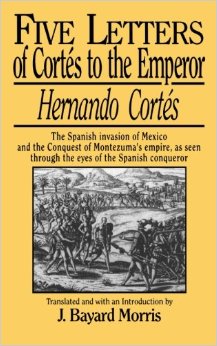
I thought about this phenomena while reading Five Letters of Cortes, a collection of letters Cortes sent 51iimHx9yvL._SY344_BO1,204,203,200_back to the continent detailing events in Mexico.  The book interested me because historians today routinely treat Cortes as a great villain, and I wanted to see how he measured up to that reputation in his own words. Scholars of course debate the veracity of some details Cortes narrates (without giving much credence to the idea that he simply told the truth as he saw it).  But my interest was not what happened so much as how Cortes wanted his readers to perceive him, regardless of whether or not he spoke fairly and truly.
As I read I thought of how history views Alexander the Great.  The two men have some similarities. Both sought glory, perhaps Alexander most of all.  Both conquered and destroyed a foreign people and culture with at least questionable justification.  Both dealt with internal disputes in their own ranks. Both used diplomacy to great effect, perhaps Cortes most of all.  And yet, history loves Alexander and despises Cortes, generally speaking, and we should ask why.

A few things stood out to me in Cortes’ letters.

  • Cortes de-emphasizes violence and tries to play up his relationship with the natives when he can.  He writes early in the first letter that, “the Indians went among us with as little fear as if they had already had dealings with us for many years.”  He seems proudest when he makes friends.  The “battles” (not battles in a traditional sense) and violence that occur happen when things break down, or in response to a tough situation initiated (in Cortes’ view) by the misunderstanding of the natives.
  • Cortes clearly admires the natives.  A modern westerner expecting to find a racially motivated imperialist will be disappointed.  He describes the sacrifices and violence surrounding Aztec religion in a lengthy passage:

And always on the day before some important enterprise they burn incense in their temples, and sometimes even sacrifice their own persons, some cutting out their tongues, others their ears, still others slicing their bodies with knives in order to offer to their idols the blood which flows from their wounds; sometimes sprinkling the whole of the temple with blood and throwing it up in the air, and many other fashions of sacrifice they use . . .

One very horrible and abominable custom they have which we have seen in no other part, and that is that whenever they wish to beg anything of their idols, in order that their petition may find more acceptance, they take large numbers of boys and girls and even of grown men and women and tear out their heart and bowels while still alive, burning them in the presence of those idols . . .  Some of us have actually seen this done and they say it is the most terrible and frightful thing that they have ever seen.  . . . Your majesties can therefore be certain that there can be no year in which they have not sacrificed some three to four thousand souls.

As to what the Spanish should do in light of this, I leave the reader to decide.  Cortes continues,

Your majesties may therefore perceive whether it is their duty to prevent such loss and evil, and certainly it will be pleasing to God if by means of, and under the protection of your royal majesties, these people are introduced to and instructed in the Holy Catholic Faith . . .

And yet, after describing the most horrible aspect of Aztec society, Cortes concludes the section by writing,

For it is certain that if they should ever serve God with that same faith, fervor, and diligence [as their idols] they would work many miracles.   We believe that by the aid of interpreters who should plainly declare to them the truths of the Holy Faith and the error in which they are, many, perhaps all of them, would quickly depart from their evil ways and come to true knowledge, for they live more equably and reasonably than any other of the tribes which we have hitherto come across.

Cortes also hates the fact that some of the Spanish use the Indians as currency in slaves.  This, he argues, earns the “notorious” Diego Velazquez followers, and Cortes urges the king to remove him from any position of authority at once.

Spanish commentary on the Aztec king Montezuma strike a poignant note.  Multiple sources all converge on the idea of admiration for the man.  Here is Diaz de Casillo writing,

The Great Montezuma was about forty years old, of good height, well proportioned, spare and slight, and not very dark, though of the usual Indian complexion. He did not wear his hair long but just over his ears, and he had a short black beard, well-shaped and thin. His face was rather long and cheerful, he had fine eyes, and in his appearance and manner could express geniality or, when necessary, a serious composure. He was very neat and clean, and took a bath every afternoon. He had many women as his mistresses, the daughters of chieftains, but two legitimate wives who were Caciques in their own right, and only some of his servants knew of it. He was quite free from sodomy. The clothes he wore one day he did not wear again till three or four days later. He had a guard of two hundred chieftains lodged in rooms beside his own, only some of whom were permitted to speak to him.”

When Moctezuma was allegedly killed by being stoned to death by his own people Cortés and all of us captains and soldiers wept for him, and there was no one among us that knew him and had dealings with him who did not mourn him as if he were our father, which was not surprising, since he was so good. It was stated that he had reigned for seventeen years, and was the best king they ever had in Mexico, and that he had personally triumphed in three wars against countries he had subjugated. I have spoken of the sorrow we all felt when we saw that Montezuma was dead. We even blamed the Mercederian friar for not having persuaded him to become a Christian.

Of course Cortes used violence at times directly and on purpose, however much he wanted to avoid it. In one such instance, we have both Aztec and Spanish sources for the same event.  Regarding a terrible massacre, the Aztecs write,

Here it is told how the Spaniards killed, they murdered the Mexicans who were celebrating the Fiesta of Huitzilopochtli in the place they called The Patio of the Gods

At this time, when everyone was enjoying the celebration, when everyone was already dancing, when everyone was already singing, when song was linked to song and the songs roared like waves, in that precise moment the Spaniards determined to kill people. They came into the patio, armed for battle.
They came to close the exits, the steps, the entrances [to the patio]: The Gate of the Eagle in the smallest palace, The Gate of the Canestalk and the Gate of the Snake of Mirrors. And when they had closed them, no one could get out anywhere.
Once they had done this, they entered the Sacred Patio to kill people. They came on foot, carrying swords and wooden and metal shields. Immediately, they surrounded those who danced, then rushed to the place where the drums were played. They attacked the man who was drumming and cut off both his arms. Then they cut off his head [with such a force] that it flew off, falling far away.
At that moment, they then attacked all the people, stabbing them, spearing them, wounding them with their swords. They struck some from behind, who fell instantly to the ground with their entrails hanging out [of their bodies]. They cut off the heads of some and smashed the heads of others into little pieces.
They struck others in the shoulders and tore their arms from their bodies. They struck some in the thighs and some in the calves. They slashed others in the abdomen and their entrails fell to the earth. There were some who even ran in vain, but their bowels spilled as they ran; they seemed to get their feet entangled with their own entrails. Eager to flee, they found nowhere to go.
Some tried to escape, but the Spaniards murdered them at the gates while they laughed. Others climbed the walls, but they could not save themselves. Others entered the communal house, where they were safe for a while. Others lay down among the victims and pretended to be dead. But if they stood up again they [the Spaniards] would see them and kill them.
The blood of the warriors ran like water as they ran, forming pools, which widened, as the smell of blood and entrails fouled the air.
And the Spaniards walked everywhere, searching the communal houses to kill those who were hiding. They ran everywhere, they searched every place.
When [people] outside [the Sacred Patio learned of the massacre], shouting began, “Captains, Mexicas, come here quickly! Come here with all arms, spears, and shields! Our captains have been murdered! Our warriors have been slain! Oh Mexica captains, [our warriors] have been annihilated!”

Then a roar was heard, screams, people wailed, as they beat their palms against their lips. Quickly the captains assembled, as if planned in advance, and carried their spears and shields. Then the battle began. [The Mexicas] attacked them with arrows and even javelins, including small javelins used for hunting birds. They furiously hurled their javelins [at the Spaniards]. It was as if a layer of yellow canes spread over the Spaniards.

And the Spanish version of the same event:

Cortes wanted to entirely understand the cause of the Indians’ rebellion. He interrogated them [the Spaniards] altogether. Some said it was caused by the message sent by Narváez, others because the people wanted to toss the Spaniards out of Mexico [Tenochtitlan], which had been planned as soon as the ships had arrived, because while they were fighting they shouted “Get out!” at them. Others said it was to liberate Moctezuma, for they fought saying, “Free our god and King if you don’t want to die!” Still others said it was to steal the gold, silver, and jewels that the Spaniards had, because they heard the Indians say, “Here you shall leave the gold that you have taken!” Again, some said it was to keep the Tlaxcalans and other mortal enemies out of Mexico. Finally, many believed that taking their idols as gods, they had given themselves to the devil.

Any of these things would have been enough to cause the rebellion, not to mention all of them together. But the principal one was that a few days after Cortes left to confront Narváez, it became time for a festival the Mexicas wanted to celebrate in their traditional way. . . . They begged Pedro de Alvarado to give them his permission, so [the Spaniards] wouldn’t think that they planned to kill them. Alvarado consented provided that there were no sacrifices, no people killed, and no one had weapons.

More than 600 gentlemen and several lords gathered in the yard of the largest temple; some said there were more than a thousand there. They made a lot of noise with their drums, shells, bugles, and hendidos, which sounded like a loud whistle. Preparing their festival, they were naked, but covered with precious stones, pearls, necklaces, belts, bracelets, many jewels of gold, silver, and mother-of-pearl, wearing very rich feathers on their heads. They performed a dance called the mazeualiztli, which is called that because it is a holiday from work [symbolized by the word for farmer, macehaulli]. . . . They laid mats in the patio of the temple and played drums on them. They danced in circles, holding hands, to the music of the singers, to which they responded.

The songs were sacred, and not profane, and were sung to praise the god honored in the festival, to induce him to provide water and grain, health, and victory, or to thank him for healthy children and other things. And those who knew the language and these ceremonial rites said that when the people danced in the temples, they perform very different from those who danced the netoteliztli, in voice, movement of the body, head, arms, and feet, by which they manifested their concepts of good and evil. The Spaniards called this dance, an areito, a word they brought from the islands of Cuba and Santo Domingo.  While the Mexica gentlemen were dancing in the temple yard of Vitcilopuchtli [Huitzilopochtli], Pedro de Alvarado went there. Whether on [the basis of] his own opinion or in an agreement decided by everyone, I don’t know, but some say he had been warned that the Indian nobles of the city had assembled to plot the mutiny and the rebellion, which they later carried out; others, believe that [the Spaniards] went to watch them perform this famous and praised dance, and seeing how rich they were and wanting the gold the Indians were wearing, he [Alvarado] covered each of the entrances with ten or twelve Spaniards and went inside with more than fifty [Spaniards], and without remorse and lacking any Christian piety, they brutally stabbed and killed the Indians, and took what they were wearing.

I have no wish to downplay a terrible massacre.  For our purposes, however, a few things surprised me about the Spanish account.

  • We might expect ‘righteous’ conquistadors rejoicing in their deed.  Some accounts of the Crusaders massacring civilians in Jerusalem in 1099 sound this way.  Instead we them troubled and very much aware of the fact that they departed from their faith with their actions.
  • Confusion, not certainty, dominates the text.  They search for answers and have a hard time understanding what it is they face or why it happened in the first place.  Some historians/sources apparently indicate that the Spanish may have believed that they were about to do another human sacrifice, though the account above does not hint at this or use it as an excuse.

One can disagree with the reasons for the Spanish presence in the new world.  One can lament the results of the Spanish conquest and the subsequent treatment of the natives.  But I found my overall opinion about Cortes changed from reading his writings, though I still lack a great deal of familiarity with the events in general and other particular sources to come to definite conclusions.

But other historians presumably do not.  And this brings us back to my question earlier about comparing Alexander and Cortes.  Some historians fall over themselves fawning about Alexander, and no one treats Cortes this way, despite their similarities.

Alexander had a few points in his favor . . .

  • The fact that he was king and thus the focal point of all narratives about him.  Cortes reported to the emperor, there were other conquistadors, Montezuma is a striking figure, etc.
  • Alexander destroyed the Persians in classic and dramatic pitched battles, the events of which featured himself.  The Aztecs died partly as a result of cunning diplomacy, Montezuma’s attitude, some skirmishes, etc.  Lacking a Battle of Issus or Gaugemela, we have a hard time latching onto Cortes to fully appreciate his skills (you don’t have to approve of Cortes to admire certain aspects of him).
  • Alexander operated within a “heroic” culture where for the most part, great deeds needed no particular justification. Even modern treatments of Alexander pick up on this, consciously or no.  I can’t recall any in depth discussion from ancient writers, for example, about Alexander’s motives, or the justice of his cause.  They simply don’t matter.  Cortes operated within a much different (and certainly superior) moral framework that calls much of the Spanish enterprise into question.
  • Of course we cannot discount the fact that, however well intentioned Cortes may have been, those that followed often exploited the natives for wealth and personal gain.  We should not directly blame Cortes for this, but his association with it taints him inevitably, and perhaps with some justice.

Of course unlike Alexander, Cortes never killed those close to him out of paranoia or political expediency (i.e. as Alexander did with Parmenio and Callisthenes), nor did he murder his friends in fits of drunken rage (Cleitus).  But these acts usually get overlooked amidst the grandeur of Gaugemela.

Whatever we may think of Cortes, sifting through accumulated historiography about him is a tricky business, especially in light of his own words.


8th Grade: Solon and the Occupy Movement

Greetings,

This week we looked at the esteemed Athenian statesman Solon.
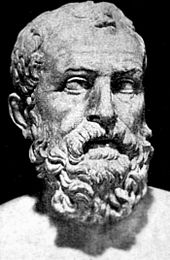
Solon of AthensThe ancient world regarded Solon as a great sage, but as we saw, his head was not in the clouds.  He took a society ready to fly apart at the seams and left it with an established social context in which democracy could take root.  I wanted to highlight a few key lessons.

First, the background:

Before Solon there was Draco, a member of the Athenian aristocracy.  His name itself came to symbolize harsh governmental policy, i.e. a ‘Draconian’ law.  His policies helped cement the divide between rich and poor and threatened to make it wider. This dynamic is not unusual.  When one group in society separates itself from others because of wealth or status, they tend to fear the rest of society, and thus, isolate themselves all the more.  This increased distance only requires more force to ensure the divide.  One can think of the ante-bellum South, for example, and various laws enacted that made it a crime to educate slaves.  Society built like this can’t last for long.

Enter Solon.

He recognized a few key things:

  • Society needs the rich.  One can argue that the rich abused their power but they are still Athenian. Secondly, their resources can benefit Athens.  If we heal the fear between the two groups we can create opportunity for the wealthy to feel a bit more free with their resources.
  • The divide between rich and poor must be healed if we are to survive.  This will require sacrifice from the rich
  • This led to what may have been Solon’s invention, and may not have been — an early version of a graduated income tax.

No one likes to pay taxes.  One of the reasons for this is that no one really knows where their money goes.  It gets dropped into a vast ocean, never to be heard from again.  Solon did things differently.  He did not ask for a direct sum from the wealthy, but offered them an opportunity.  The wealthy could fund specific projects.  They could just pay directly for a religious festival, a bridge, or a naval warship.  Of course, they could also get full credit for their funding, i.e., ‘This festival to Athena sponsored by Diodotus.’  So, paying taxes became a way to earn ‘kleos.’  The wealthy could contribute in how much they gave.  Enhancing the well being of Athens was directly connected with enhancing their own status in the community.  Solon therefore made paying ones taxes a way for the wealthy to maintain and even enhance their “kleos.”

We should not view this as “taxes,” in any sense of the modern world.  First of all, they were not precisely calculated to income, only loosely.  Secondly, they came with no direct legal obligation.  Solon erected a social framework where aristocratic status came with a kind of obligation, perhaps an early form of noblesse oblige.  We see this idea reflected in various ways up until quite recently in the western world, the idea that you demonstrated your status by public service.

Problem solved.

Could this apply today?  We are much too big to do what Solon did on any appreciable scale.  Yet I wonder, with the ‘Occupy’ movement and other kinds of resentment against the wealthy building, if we couldn’t borrow his ideas. What if we did this for the very rich, and put their faces on front pages with captions like, “Warren Buffet posing with fighter jet paid for with his taxes,” or something like this.  Would this help?

But, we should note that if we had a competition of fame/honor in paying taxes to the government, that would imply a certain relationship and attitude towards our government.  As we discussed, what we think of Solon in parts depends on what one thinks about the purpose of law and government.  Many of us think from a Roman context where law has an essentially “negative” character; i.e., the law tells you what not to do.  Greek concepts of law had different goals in mind.  The Greeks saw law as a tool to help shape the souls of individuals and communities.  Greek law did not alwys say, “You must do this,” (with Sparta as an exception), but it did seek to produce certain definite outcomes.

Solon did not create democracy in Athens, but he established a context for it to exist. Democracy cannot exist everywhere.  If the majority have an “us v. them” attitude then they will use their power to get revenge or exploit the “them,” whether they be rich or poor, black or white, etc.  In this environment, society will become cancerous and destroy itself.  Democracy can only really work when the power of the majority does not just represent merely the majority, but in some sense all the people.  In our own age of bitter partisanship and resistance to compromise, we would do well to take Solon’s wisdom to heart.

Blessings,

Dave Mathwin

Mayan Collapse and the NFL’s City-State Culture

I wish I had tried harder in math class. I always said to myself that I would never have to use all those formulas in real life, but it turns out that it would have dramatically aided my appreciation of John Lowe’s book on the mystery of the collapse of Mayan Civilization, The Dynamics of Apocalypse: A Systems Simulation of the Classic Maya Collapse.

I usually enjoy historical works that focus on the bigger picture, or at least connect a smaller scale event to something larger. But I know its also important to turn the binoculars around sometimes, and Lowe’s book accomplishes this well. I don’t mind his narrow and technical focus. Had I understood more math (most of it appears to be geo-spatial formulas) I surely would have understood his arguments better, but he does a decent job of summarizing the conclusions of all his deductions.

The mystery surrounding the apparently sudden collapse of Mayan civilization draws many different theories. What makes the case more curious still is that certain areas of Mayan civilization continued to thrive after other areas stopped functioning practically on a dime. Some speculate that the Mayans simply abandoned some large urban areas for reasons unknown.

Lowe begins by dealing with various theories of collapse he rejects.

The Environmental Argument

Lowe admits that many archaeologists find themselves drawn to ecological arguments because the two sciences lend themselves to similar kinds of analysis. But the evidence points away from this. Rainfall remained steady or increased in depopulated regions. Perhaps one might wish to say that the abandoned areas had too much rain and got choked by the jungle, but no . . . other swampy Mayan population sites experienced no depopulation.

Some suppose an over-extension of farming or denudation of soil quality. But no–Rowe points out that the Mayans used different kinds of sophisticated farming techniques that would have kept soil relatively healthy. Of course some form of soil erosion took place. In fact, most of it took place in the northeast Petan region. But again–this region experienced depopulation last among Mayan cities.

Disease

Others suppose disease wiped out the Mayans. But if the Mayans had an interconnected civilization that remained relatively homogenous ethnically, why did this disease not wipe out all of them? Most of the truly virulent diseases have their roots in the Old World, and the Old World would not visit the Mayans until some 600 years after the Mayan collapse.

W.H. McNeil proposed something along the Roman model. As he saw it, disease was not solely responsible for Rome’s collapse, but contributed greatly to it. Two plagues struck Rome in the 2nd and 3rd centuries A.D. and had the net effect of depopulating the countryside, setting in motion a chain of events from which Rome was not culturally or politically healthy enough to recover from. But whereas we have plenty of internal evidence for the plagues in Rome, all of the written accounts we have from the Mayans indicate that disease played no factor. Some later sources indicate how healthy people were before the Spanish came. If we cannot rule disease out absolutely, we can safely call it unlikely to have contributed to a collapse.

Ideological Collapse

Much of the rest of the book deals with the more sophisticated and slippery arguments surrounding Mayan beliefs. The basic approach of these scholars argues that, however much certain physical factors might have contributed, the main cause of the fall must have its roots in Mayan religious beliefs.

We know that, for example, the Mayans had a strong sense of cyclical time. D.E. Puleston argues that the general collapse came at the end of an important 250 year cycle, and perhaps the Mayans believed in the need for a general “reset” of their civilization. But the holes in this theory reside in that not all of the Mayans obeyed this “reset,” if it occurred. And other time cycles don’t quite fit the model, so Lowe finds this explanation lacking.

Others, seeing that very specific modeling of ideology can’t quite fit, propose a more general internal negative feedback loop, of sorts. Conditions deteriorate, which makes you double-down on the system of belief, which makes you pour more resources into that system that already leaks. The extra pressure on the system causes it to leak even more, leading to collapse. Rowe remains open to this approach, but it cannot arise to anything more than the level of a guess.

Rowe runs the risk of subjecting everything to such rigorous examination (and complicated mathematical formulas), that he runs the risk of cutting the beef so thin no one can see it. But he eventually gives some of his own theories, which rely on the historical city-state collapse model of ancient Greece and Mesopotamia. Before examining this, I admire that someone with such an analytical bent as Rowe can consider some historical parallels and other paths that one cannot strictly measure.

The city-state model has the advantage of keeping both independence and interdependence at play simultaneously. This flexibility ideally can make them more creative and adaptive. They avoid putting all eggs in one basket, and can theoretically benefit from innovations other city-states make. But the intricacy of the system can make them vulnerable as well. The Greeks stopped cooperating and left themselves vulnerable to assimilation from the north (just as the Mayans from the south likely assimilated to the northern regions) in the form of Macedonia. When cooperation against a possible hegemon remained impossible or ineffectual, the whole house of cards comes tumbling down.

This may not be quite fair to Rowe. While I admire his book, Rowe is much more clear with his writing when critiquing other theories. He has had time stating a positive truth clearly, held back by all the possible caveats that no doubt lurk in his brain. I may not have read him accurately, especially at this point of the book.

I think his idea of a political collapse has merit, but I believe we need more focus on the ideological explanations. For example, one can say that the Mayans stopped cooperating, but they appeared physically able to do so if they wished. Why didn’t they, then? You can argue for the power of a northern Mayan hegemon akin to Alexander the Great, but the historical record doesn’t indicate this. Even if it did, it still could not explain why the Mayans could not cooperate.

Alas, I have nowhere near the familiarity with Mayan belief systems to propose anything specific. But I can suggest an analogous situation to illustrate my point with the Redskins and the NFL.

First, we can view the NFL as a civilization of city-states. The NFL has customs and laws shared by every team, but every team has its own independent leaders and cultures. Some teams are healthier than others, but all share in a degree of common fate. The city-state model roughly works.Now, the Redskins. In the early phases of their existence the team had a very modest amount of success. They entered their “golden era” around the early 1970’s, and it lasted until January 1992 with their last Super Bowl victory. I lived through this golden era and it was gloriously fun.

Such a run of success created an enormous cache of goodwill among the fans. I have no wish to make this anti-Dan Snyder post or to catalog the many abuses of fan goodwill and the terrible decisions from the late 1990’s until today. There is more here for those interested. But, many outward edifices of a successful team still appeared in place. Fans came to games, fans cheered their team, paid for jerseys, the team made money, etc. One of the puzzling things about the Mayan collapse is that certain elements of their civilization, such as the high quality of their pottery, lasted right up until the end. We see this too with Roman coins. They maintain their weight and intricate design for decades after most historians (with the possible exception of Gibbon) mark the beginning of the end.

This year the team started 6-3 and seemed playoff-bound in a weak NFC East. But underneath lay definite problems, such as terrible performances for key home games, fans and players feuding, etc. And then, suddenly, for the last game of the year–utter collapse, as Eagles fans outnumbered Redskins fans at least 2-1 in the Redskins stadium.

The Redskins had issues in the past with other teams’ fans buying up tickets. The problem came in spurts for different teams, especially big name teams like the Steelers. But for a divisional rival . . . nothing like this has ever come close to happening before.

Of course the NFL can absorb one terribly dysfunctional team. The NFL, for now, need not worry too much. Faith in the “shield” continues on. But, imagine a scenario where

  • The Redskins don’t recover anytime soon and become dead weight in the league
  • A few other franchises (perhaps Jacksonville, Tampa Bay, the Jets) slide into similar positions
  • The concussion and player safety issue grows in importance
  • Domestic abuse and other player issues continue

Then we might see a very sudden collapse of faith, and a sudden exodus from stadiums and television sets. One might imagine abandoned stadiums to accompany abandoned temples.


Truisms that are (at least mostly) Not True

I have an affinity for the crazy theory.  I know that they can’t all be true, if for the only reason that if all of them were true, we would have no crazy theories to enjoy contemplating.  Our times have a strange character to them, however, for it seems the crackpot plays the role of conservative.  Older views of things look bizarre today.  Before continuing, I should fully disclose that, though I love crazy ideas, I am actually a very boring person.  The reason these two fit together in my life is that today the harebrained idea is sometimes quite conservative and, upon closer examination, sometimes even obvious.

Take, for example, a variety of truisms in our day.  We say that in football you have to have a great quarterback but . . .  Blake Bortles, Nick Foles, Case Keenum . . . at least one of them will play in the Super Bowl this year.  One can easily envision some coach with a crew-cut from the early 1960’s telling us how it’s a “team game, and not one of you means more than another,” and so on. We have traveled back in time.

History has its truisms as well.  I hear all the time, even from religious conservatives, that America’s religious competition has saved America from going the way of secular Western Europe.*  I have a particular antipathy for this obvious falsehood.  Medieval Europe had very little religious competition, and religion did quite well there.  Religion thrived in ancient Egypt with almost no competition for millennia.  To take the reverse, ancient Babylon had a lot more religious competition and their religion and morals seemed to suffer.  Today France may be nominally Catholic and Sweden nominally Lutheran, but no laws exist forbidding one from becoming Baptist, Methodist, or Buddhist in either place.  At least some religious competition surely exists there today.  This truism about religious competition is actually a far-fetched theory, based on only the most recent evidence.

To get slightly more controversial, we hear all the time how printing serves as one of the great civilizing tools for mankind.  No one questions this truism. But, just look for a moment . . . it seems obvious to me that the 15th century in Europe had a higher degree of civilization than the century after the printing press gained prevalence.  The printing press brought a lot of religious violence and political fragmentation in its wake. We hear too the truism that, “getting a Bible into everyone’s hands” is the key to spiritual health.  But, again, just look . . . it seems clear that the Church did quite well without the printing press for quite some time.  And, to return to an aforementioned truism, the fact that the Bible always tops bestseller lists has not prevented the west from becoming more and more secular over the last two-three centuries.

Maybe civilization and religion actually rely on things far older, far more “tried and true,” for success rather than new technologies–the crackpot as bland conservative strikes again.

I have written before about another one of my least favorite truisms, that of the evolutionary view of history and progress.  The theory basically means that civilization starts small and has run in a more or less unbroken line of progress and advancement.  Though this theory has general acceptance in many textbooks and the minds of men, it is, in fact, a radical, crazy, notion, for it ignores obvious facts.  For one, we know that a complex civilization could collapse more easily, quickly, and completely than a primitive one, due to its inevitable interdependence.  The presence of advancement makes large steps backward more, not less likely, like stock-market bubbles.  For another, we have a universally acknowledged and plain example of the fall of Rome and the subsequent so-called Dark Ages.  Whatever one thinks of the Dark Ages, Italy ca. 100 A.D. had a much higher level of civilization in most respects than Italy ca. 600 A.D.  Still, the prevalence of the evolutionary view makes those who state otherwise seem crazy.

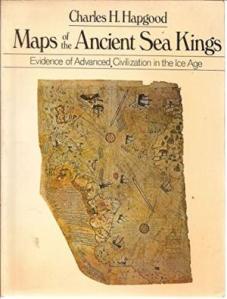
Enter Charles Hapgood, whose book Maps of the Ancient Sea Kings postulates that, based on an examination of certain ancient maps, it appears that an unknown and likely quite ancient civilization developed a geographical and nautical understanding that humanity would not equal until the modern era. Hapgood’s theory joins the voices of Graham Hancock, Jon Anthony West, and other megalithic architecture (such as Gobeckli-Tepe) that argues that pre-historic people not only existed, but existed at a far higher level of civilization than anyone previously imagined.

Unfortunately for the layman like me, Hapgood immerses the book in large amounts of technical terms and technical data.  I think one would need special knowledge of cartography, geography, and math to understand large portions of the book.  Perhaps no other way existed to make his case.  I found myself junping over much of the technical sections but hope I still understood the basic case, which runs like this:

  • In 1929 an unusual map, named, the Piri Re’is, was discovered in the old Imperial Palace of Constantinople, dated the year 1513 A.D. (Moslem reckoning 919).
  • The map was extensive and showed the coast of North America in excellent detail.  This map differed from all other 16th century maps by giving correct longitudes for South America and Africa.  No 16th-century navigator that we know of knew how to calculate longitude except by guesswork.
  • Further investigation showed that Piri Re’is (or basically, Admiral Piri) claimed to copy this map from earlier maps, some of them dating back to (he claimed) the time of Alexander the Great.
  • Even a rough study of this map indicated that it used highly advanced mathematics, including spherical trigonometry, which we do not believe existed in the classical world

So, where did the map come from?

Perhaps Hapgood’s critics are right, and the Greeks knew enough spherical trigonometry to make these maps.  But did they sail across the Atlantic?  No evidence exists for this.  Did the Egyptians or Babylonians have this knowledge?  It appears not, but if they did, they did not sail across the Atlantic to map the coasts of the Americas.  Maybe the Romans in Ptolemy’s time had the knowledge, but again, did not sail across the ocean. Did it come from the medieval period?  But they did not sail much, and no other medieval map exists that compares with the quality of the Piri Re’is.

The best map from the classical period comes from Ptolemy, who worked in Alexandria and had access to all of the accumulated knowledge the world knew at the time.  His map shows great skill:

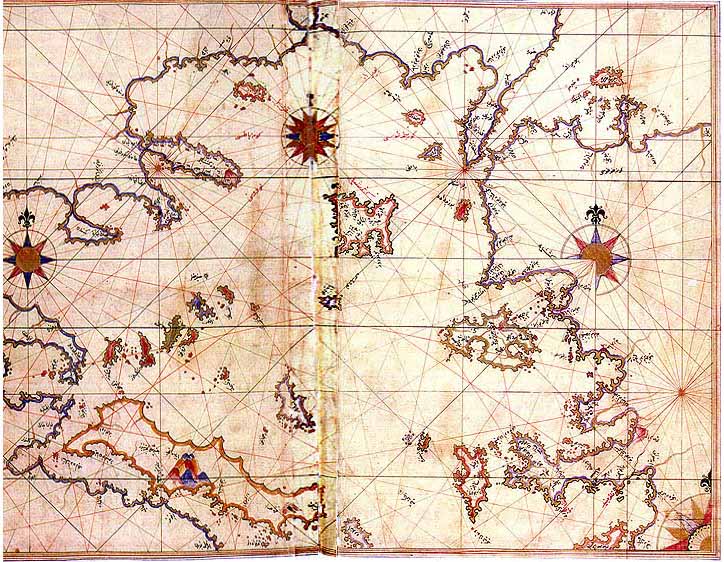
But it cannot compare with the Piri Re’is (although this is only a portion):

And again:

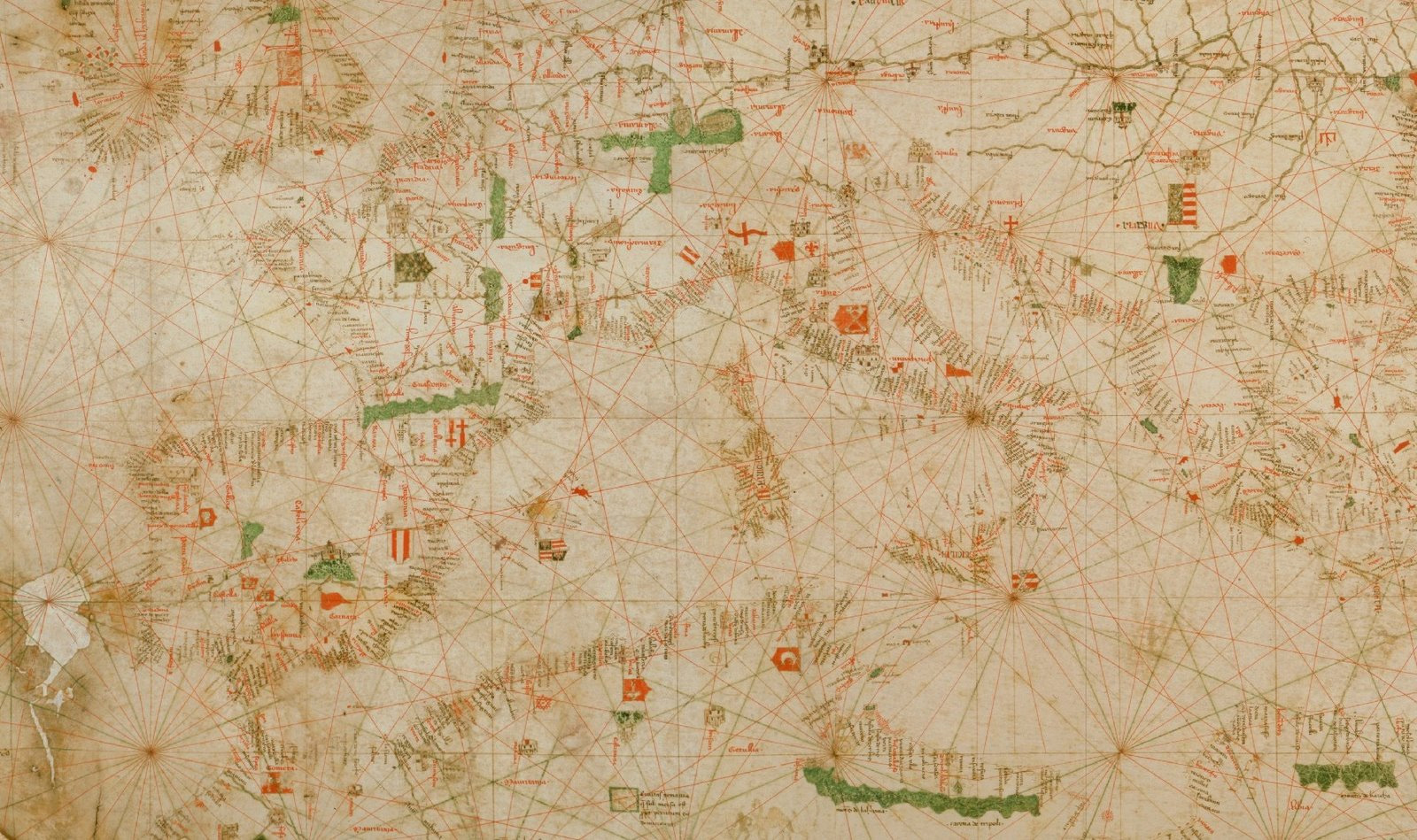
The Portolano Map, of late Medieval/Renaissance origin, is again, very good, but not quite up to snuff, at least in terms of the extent of what it mapped:

The inclusion of Antartica on the Piri Re’is map is particularly noteworthy, as many speculate that it maps landforms that for thousands of years have been covered with ice. In other words, the map seems to have been made before the ice age, and not after.

A few quotes scattered throughout the book from Hapgood illustrate his proposition:

We have discovered that in most cases the errors on the Piri Re’is mapper due to mistakes in the compilation of the world map, presumably in Alexandrian times [that is, the Piri Re’is was discovered in different pieces and put back together not quite accurately], since it appears that Piri Re’is could not himself have put them together at all.  The component maps, coming from a far greater antiquity, were far more accurate.  The Piri Re’is Map appears, therefore, to be evidence of a decline of science from remote antiquity to classical times (p. 39).

******

For a long time after the voyages of Columbus we find the latitudes of Cuba and Haiti are wrong on most maps.  Almost all the mapmakers put the islands above rather than below the Tropic of Cancer [in contrast to the Piri Re’is] (p. 41).

********

To sum up, then, this part of the Piri Re’is Map suggests a source map of Africa, Europe, and the Atlantic islands probably drawn originally on some sort of trigonmetric projection adjusted to the curvature of the earth.  By default of any other narrative, we must assign this map’s origin to a pre-Hellenic people.  The trigonometry of the projection suggests the work of Alexandrian geographers, but the evident knowledge of longitude implies a people unknown to us, a people of seafarers with instruments undreamed of by the Greeks, and as far we know, not possessed by the Phoenicians either (p. 49).

********

The suggestion of a vast antiquity behind the [Piri Re’is] is conveyed by a feature to which Captain Mallery first drew my attention.  He pointed out that the Zeno Map [which very likely had the Piri Re’is as a source map] shows Greenland with no ice caps.  The interior is filled with mountains, and rivers are shown entering the sea, in some cases at the points where glaciers now move through mountains to the coast (p. 152).**

*********

This culture [that made the Piri Re’is] may well have more advanced than Egypt, Babylon, Greece, and Rome.  In astronomy, nautical science, mapmaking, it was likely more advanced than any culture before the 18th century of the Christian era.  Not until the 18th century did we begin to send ships to the Arctic or Antarctic regions.  Organized government is indicated [by the map], as many expeditions would be needed to gather the appropriate information to map the area so precisely (p. 193).

Hapgood writes haphazardly and does not always reason in a clear, linear fashion, a trait he shares with his modern fellow believer in pre-historically advanced ancient civilizations, Graham Hancock.  The key I think to both writers lies not in the exactness of their data but in the accumulation of enough “probably’s” to make their case.  I heard most of a conversation between Hancock and Sceptic editor Michael Shermer.  The discussion went nowhere, with Shermer begging for even a small handful of absolute, concrete, data points, and Hancock pleading with him to consider the mass of “probably’s,” while admitting in the end that the study of ancient civilizations cannot provide the kind of concrete proof Shermer demanded.

Rather than ask, “Can we be absolutely sure if an ancient, advanced, prehistoric civilization existed,” (obvious answer-“no”), or, is it possible that such a civilization existed (obvious answer–“yes”) we should instead wonder whether we should expect or not expect to find such a civilization.  Is the idea reasonably likely?  Hapgood will likely not convince anyone who needs something along the lines of what Shermer requires.  He may entice others who think it likely that some kind of ancient civilization along the lines of those who like Hancock’s work.

To give Hapgood’s theory a shot, it helps to believe that:

  • The myths and folklore of most every ancient civilization that describe advanced civilizations that experienced thorough destruction (like the Atlantis story) likely have a fundamental truth behind them.
  • Civilization devolves just as much as it evolves, and in fact, devolution may be more prevalent than evolution in civilizations.
  • The flood described in Genesis 6 (and many other ancient religious texts) was substantive, historical in at least some sense, and would have had the power to destroy civilizations very quickly.
  • The absence of evidence would not condemn the case outright, as civilizations have at times experienced a catastrophic loss of a great deal of accumulated knowledge (the burning of the library at Alexandria, the collapse of Rome, etc.)

With this in place you might buy what Hapgood sells.  But without these beliefs, his book will likely frustrate readers.  In any case, I don’t find the above propositions crazy.  In fact, I find them rather ordinary.  Folklore and myth are common to all.  Belief in a historical flood of some kind is nothing new, with most ancient civilizations sharing this story.^  We have actual historically undisputed losses of vast amounts of intellectual capital at certain times in the past, such as the destruction of the library at Alexandria.

As I said earlier, despite my inclination towards “crazy” theories, I’m actually a very boring guy.

Dave

P.S.–A good friend and a math/science teacher glanced over the basic arguments of the book and found them wanting, and Hapgood’s selection of material suspicious.  He has a better nose for such things than I and his thoughts give me pause.

My friend and I both believe that ancient civilizations tend to be far more advanced then we might think.   Neither one of us believes that the history of civilization always proceeds in a directly linear way, and certainly not in a progressive evolutionary way.  We thus share some crucial assumptions.

My friend thought that Hapgood underestimates the knowledge of ancients.  For example, we know the ancient Phoenicians existed, we know they were great sailors.  It makes much more sense to say that perhaps they made the map and sailed farther than we thought, then to suggest that an unknown civilization of which we know nothing made the map.

My response would be something like, “If we know a lot about the ancients but have no record of them sailing to the Antarctic, it is plausible that they did not do so.  Thus, someone else must have.”

Plus, I confess that I just simply find the idea of advanced pre-historic civilizations fun, satisfying, and enormously entertaining.  Someone could wave such ideas in front of me daily and they would always get me pretty excited.

*One might modify this theory and argue that perhaps in today’s intellectual and cultural climate, one must have religious competition for religion to survive.  This argument has more plausibility.

**Some believe the Zeno Map to be a hoax precisely because of this feature and other “phantom islands” that do not now show themselves above water.  But Hapgood argues that a perfectly plausible explanation exists for this if the Piri Re’is was a source.  Another map, the Ibn Ben Zara Map, has a remarkably accurate depiction of the Aegean.  But it also includes several islands no longer visible.  How to explain this paradox?  How could the map be so accurate in some respects and so false in others?  We can say the map is a hoax or is filled with errors.  But another possibility is that a source map of great antiquity was constructed when these islands stood above sea-level.

^I do not mean to suggest that the Bible is merely historical.  It certainly has metaphysical, mythological, symbolic, and theological meaning beyond history.  But I don’t see these categories as exclusive.  What is real is not opposed to what is mystical, symbolic, or spiritual.

A New, Old, View of Civilizations

Generations of history textbooks have assumed two things about the history of civilizations:

  • Human civilization is a relatively new phenomena, originating in the Fertile Crescent sometime around 3500 B.C.
  • Human civilization developed largely because of an increase in technical skill which allowed for plowing, increase of production, storage, etc.

I have never liked the second assumption.  It seems so easy for us to make it, for it reflects our bias perfectly.  Toynbee wrote of the predilections of western civilization,

The Hellenic civilization displays a manifest tendency towards a predominantly aesthetic rubric for orienting and defining itself.   The Hellenic tendency to view life as a whole distinctively in such terms that the ancient Greek adjective “kalos,” which denotes what is aesthetically beautiful, is used in addition to describe what is morally good.  In other words, Greek concepts of beauty and morality . . . were indistinguishable.

When we come to our own western civilization we find no difficulty discovering our own bent or bias.  It is, of course, a penchant towards machinery: a concentration of interest and effort upon applying discoveries of Natural Science to material purposes through the creation of social-clockwork devices, i.e. steam engines, motor cars, but also social engines like representative governments and military mobilizations.

We sometimes talk as if this appetite for mechanics was a quite recent occurrence in western civilization  . . . But this is precisely how westerners were viewed by the courts in Japan and China [in the early 1800’s]–as “barbarians” redeemed partially by our manifest and outsized technical ability.   The Byzantine princess Anna Comnena had the same impression of the first crusaders in 1099 A.D.  She called  their  crossbow a “devilish construction” that, while ingenious in its mechanics, fitted perfectly the barbarians who wielded it . . .

Though I find James Burke’s Connections series entertaining, he too makes the same assumptions about the development of civilization.  What brings people together for Burke is tools, food, and political organization.  Our “appetite for mechanics” has us assume that others had the same appetite.

Recent finds at the enigmatic site of Gobekli Tepe look to possibly overthrow both of the common assumptions.

Essentially, the site contains precision stone work thousands of years before the Egyptians supposedly invented working with stone.  Not only that, we have no evidence of any habitations near the site-it appears to be the only structure at all in the vicinity.  Add to this, the site appears to have no “practical” purpose to it.  Most think it served as a place of worship.  A recent article reads,

 . . . these new findings suggest a novel theory of civilization. Scholars have long believed that only after people learned to farm and live in settled communities did they have the time, organization and resources to construct temples and support complicated social structures. But Schmidt argues it was the other way around: the extensive, coordinated effort to build the monoliths literally laid the groundwork for the development of complex societies.

Any student of ancient history will almost immediately realize that the ancients did not share our passion for mechanics, and surmise that the origins of civilization lies elsewhere.  But common sense will suffice for anyone lacking such rudimentary knowledge.  Common love of something draws people together and creates relationships.  Common needs may bring people together temporarily.  Common loves will sustain and likely originate such relationships.  We all experience this. We are what we worship.*

Others suggest that the Gobeckli-Tepe site dates just after what appears to be a cataclysmic flood–perhaps caused by large meteors striking the polar ice-caps.  Those that built Gobeckli-Tepe may have been, in fact, transferring technology from a previous, post-flood civilization.  It is striking that the first thing they do, then, is to build a religious temple.

I should stress that these remain theories, but I find them an exciting indication of a reworking of our theories of the past.

Gobekli Tepe may rouse the historical/archaeological community to rethink their views of the past, and I welcome this.  But we should realize that such a shift would not lead to a discovery of something new about mankind, but something as old as the world itself.

Dave

*This helps explain why most moderns judge those like Charlemagne so harshly.  How can he insist on a common faith of those he governs?  Not only does it fly against our sense of individual rights, it seems so unnecessary.  Didn’t Charlemagne know that starting in the late 18th century we decided that a shared use of certain technological tools creates stable societies, and not religion?

We may scoff at those who fight over religious belief.  But western powers have fought over natural resources that will allow us to create more technological tools, or more powerful tools, and so on.  Maybe ‘technological advancement’ functions like a religion for much of the modern west.

Maybe all wars can be boiled down to religious belief.


8th Grade: Civilization is Dinner with Friends

Greetings,

This week we wrapped up our introductory unit on civilizations in general and moved into more specific civilizations, beginning with Egypt.

Earlier this week I wanted the students to consider exactly what purpose civilizations serve.

In 1 Corinthians Paul seeks to address the pride and competitiveness of the Corinthian congregation.  He uses the analogy of the “Body of Christ” to show that no one can be a one-man show.  Whether we be arms or eyes, we need each other to function.  “No man is an island,” as the saying goes.

This same analogy applies to civilizations in general.  We cannot do all that we need to do to survive, or at least, thrive.  Since we cannot do all ourselves, we need the gifts and talents of others to help make our lives consist of something beyond mere survival.  Civilizations therefore exist to make communal life, and communal creation, possible.  When we realize this, many other things come into proper focus.   As C.S. Lewis once remarked, civilization boils down to dinner with friends or a game of darts at a pub.  The power that civilizations can muster, the roads, the armies, the buildings, really serve this end. It’s easy for us to forget this, and it’s easy for civilizations themselves to do the same.

This means that civilizations, in my opinion, should ultimately be about the maintenance of small communities, and not the amorphous group.  But the awesome power generated by the social connectivity of civilizations opens them up to tremendous temptations. Civilizations can drift, and start to think that the social order itself as the “Ultimate.”  Civilizations can think that they exist to serve their own ends and perpetuate itself. With this attitude civilizations become our master and not our servant.  This leads into a subtle idolatry, man worship, not of the individual, but of the group.  When a civilization loses sight of things beyond themselves and the everyday, they lose vision, and hope for the future.  It is the first step toward decline.

This is not to say that civilizations are not good things.  The alternative is barbarism, a sub-human existence. But civilizations are tricky things.  One only has to think about our homes to realize this.  We make a great effort to sweep and clean, and the house looks great.  Then someone leaves a coat here, and shoes there.  The dishes pile up, and our wills and energy reserves slacken.  Given the human tendency towards decay, destruction, and death, the relative success of civilizations is a gift of God. It goes against our human tendencies.

As we moved into Sumeria, we looked at Sargon the Great, probably the first empire builder.  This brought up the issue of the benefits of size.  Empires/large countries often do have more power and resources and their disposal. Their size can also lead to diversity, which can cushion them from specific problems in certain areas.   For example, If Louisiana was a civilization unto itself, Hurricane Katrina would have destroyed it, or at least dramatically weakened it for decades. Because they are but a small part of whole, however, it can be rebuilt.

But smaller countries have less to manage, less to defend, and less to worry about in general.  I often wonder, “Wouldn’t it be nice if we were Belgium?  What does Belgium have to worry about?”  Riches and power alone can never bring happiness.  Also, might there be a correlation between the size of the population and the liberty that population can enjoy?  Most classical theorists of government, like Aristotle for example, believed that democracy could only exist in small self contained communities.  When a babysitter watches just 1-2 children, those children have a large degree of freedom as to what they do.  When a sitter has to watch 15 children, all the children must stay together and do the same thing in the same place.  So too, a general truth of history is that large countries with large populations tend to offer less individual freedom than smaller ones (this rule has exceptions).  Which model is superior, and why have most civilizations chosen to pursue expansion and empire?  These are some of the questions I want the students to consider.

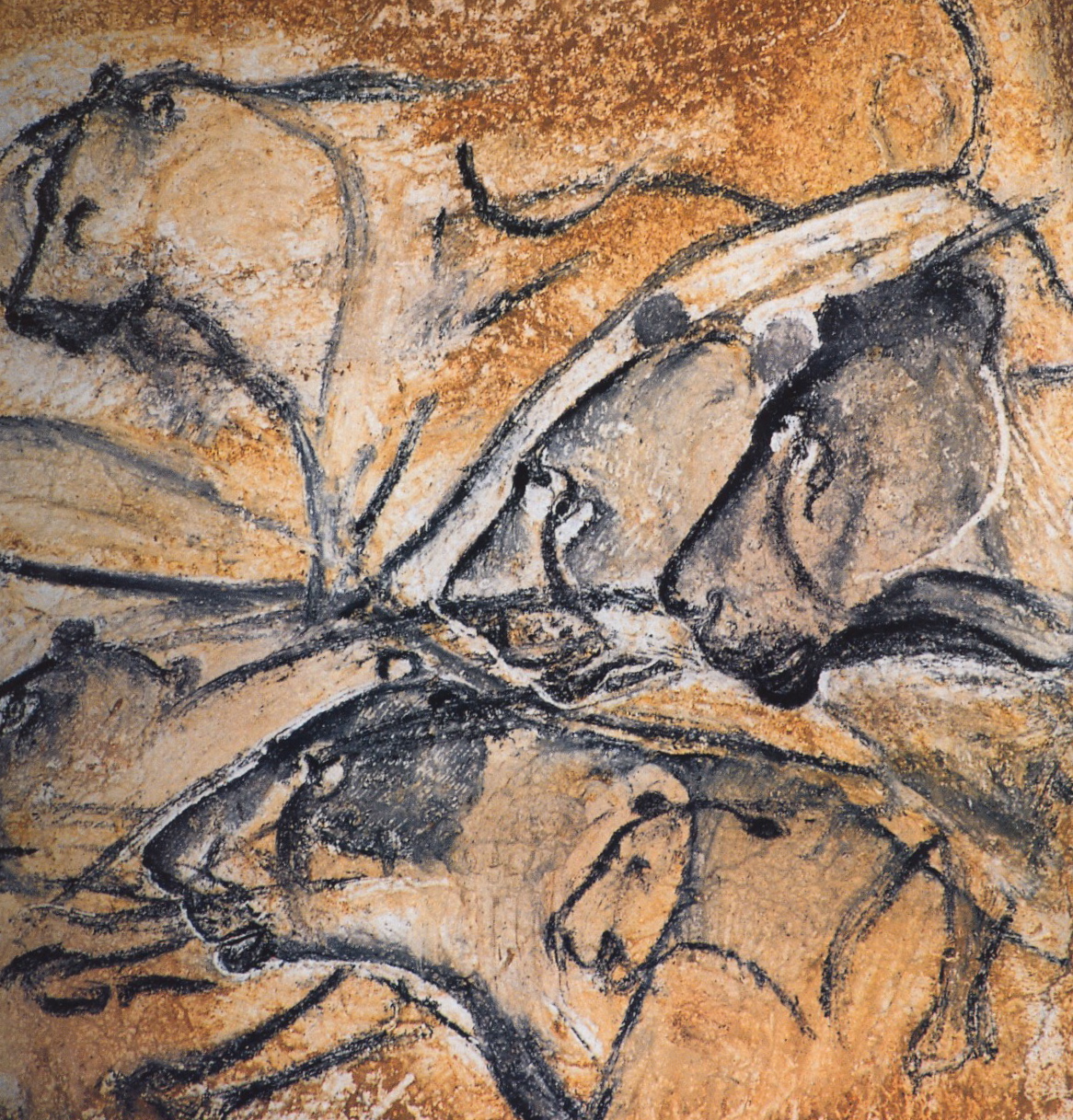
On Friday we had our first mini class discussion, where half the class tackled the topic of ancient cave paintings like these below . . .

These drawing predate what most historians and archaeologists would consider the dawn of “civilization” by thousands and thousands of years.  I wanted them to consider whether or not those that produced these works came from a society that could be called civilization.  Students presented good arguments on both sides of the issue.  I think that the drawings (especially, in my opinion, those from Chauvet cave, which includes the 2nd picture of the bears above) have remarkable communicative power.  This power can only come from great skill, and for them to develop this skill, civilization most likely existed.  Of course we can’t know for sure, but it’s fun to speculate.

If you have further interest in the cave paintings, Werner Herzog made an excellent film about them that is worth seeing called Cave of Forgotten Dreams.

Have a great weekend,

Dave

The Ties that Bind

In his Jurguthine War the Roman historian Sallust detours from his main narrative to discuss the rivalry between Carthage and Cyrene (an ancient Greek colony near modern day Libya).  In one instance the two powers thought of a novel way to settle the problem between their civilizations without the continuance of war.*  Sallust relates,

Since the affairs of the people of Lepcis have brought us to this region, it seems fitting to relate the noble and memorable act of two Carthaginians; the place calls the event to mind. At the time when the Carthaginians ruled in the greater part of Africa, the people of Cyrene were also strong and prosperous. Between that city and Carthage lay a sandy plain of monotonous aspect. There was neither river nor hill to mark the frontiers, a circumstance which involved the two peoples in bitter and lasting strife.

After many armies and fleets had been beaten and put to flight on both sides, and the long struggle had somewhat wearied them both, they began to fear that presently a third party might attack victors and vanquished in their weak state. They therefore called a truce and agreed that on a given day envoys should set out from each city and that the place where they met should be regarded as the common frontier of the two peoples. Accordingly, two brothers were sent from Carthage, called Philaeni, and these made haste to complete their journey. Those from Cyrene went more deliberately. Whether this was due to sloth or chance I cannot say, but in those lands a storm often causes no less delay than on the sea; for when the wind rises on those level and barren plains, it sweeps up the sand from the ground and drives it with such violence as to fill the mouth and eyes. Thus one is halted because one cannot see.  Now when the men of Cyrene realized that they were somewhat belated and feared punishment for their failure when they returned, they accused the Carthaginians of having left home ahead of time and refused to abide by the agreement; in fact they were willing to do anything rather than go home defeated. But when the Carthaginians demanded other terms, provided they were fair, the Greeks gave them the choice, either of being buried alive in the place which they claimed as the boundary of their country, or of allowing the Greeks on the same condition to advance as far as they wished. The Philaeni accepted the terms and gave up their lives for their country; so they were buried alive. The Carthaginians consecrated altars on that spot to the Philaeni brothers, and other honours were established for them at home. I now return to my subject . . . 

The matter-of-fact method in which Sallust relates this story should give us pause.  He obviously accepted this line of thinking — these were “fair” terms.  This was justice, this was life in the ancient pagan world.  The Philaeni brothers had no other choice.  The above passage brings to mind a more famous section of Sallust from his introduction:

I have often heard that Quintus Maximus, Publius Scipio, and other eminent men of our country, were in the habit of declaring that their hearts were set mightily aflame for the pursuit of virtue whenever they gazed upon the masks of their ancestors. Of course they did not mean to imply that the wax or the effigy had any such power over them, but rather that it is the memory of great deeds that kindles in the breasts of noble men this flame that cannot be quelled until they by their own prowess have equalled the fame and glory of their forefathers.

One can’t help but chuckle a bit at the comment that “of course” the masks did not have “any such power over them.”  They simply dedicated their entire lives to everything the masks represented.

The western world will likely to continue to experience something of a pagan revival, and elsewhere I commented that bringing out into the open what lies subtly buried in our unconscious has something to recommend it.  But we should have no illusions.  Evidence abounds that if we revive paganism we will build for ourselves cattle-shoots from which we have no escape.  We will exchange the freedom we claim to hold dear for chains.

Indeed, Chesterton spoke rightly when he declared that whereas Christianity has elements of anguish and pain at the periphery, joy occupies the core.  Pagan religions, however, have joyous elements in them only at the periphery, but at their center stands defeat and despair.  Any surface familiarity with the ancient world bears this out.  Hector must fight Achilles and lose, just as Troy must face destruction. Not even Zeus himself can stop it.  Oedipus cannot avoid his fate, though he take every counter-measure possible. Even the “realist” historian Thucydides sees events in cyclical form — what happened before will happen again. For the Norse as well, in the end the good guys lose.  It is this magnificent sense of the tragic that gives such tales their grandeur and power, but who wants to get inside such stories?

As the excerpts from Sallust indicates, shame seems to bind the ancients more than anything else.  The Philaeni brothers accepted a brutal death rather than accept what must have been a worse fate awaiting them back home — the shame of failure.  Republican Romans took their obsession with reputation and drove their civilization straight over a cliff in the 2nd century B.C.  The ancients had no escape from shame because ultimately paganism puts all the focus on the self.  Judas, for example, could only see his sin, but Peter runs to the empty tomb — he had bigger and better things on his mind than his Friday morning betrayal.  Peter had an “out” from his past.  As Paul writes in Ephesians 4, “When [Jesus] ascended on high, he led captivity captive, and gave gifts to men” (emphasis mine). Neither ones society nor ones past should be denied or destroyed.  Both are part of God’s creation and God’s plan. But both can be transcended and transformed, and with this hope we approach something akin to true freedom.

Dave

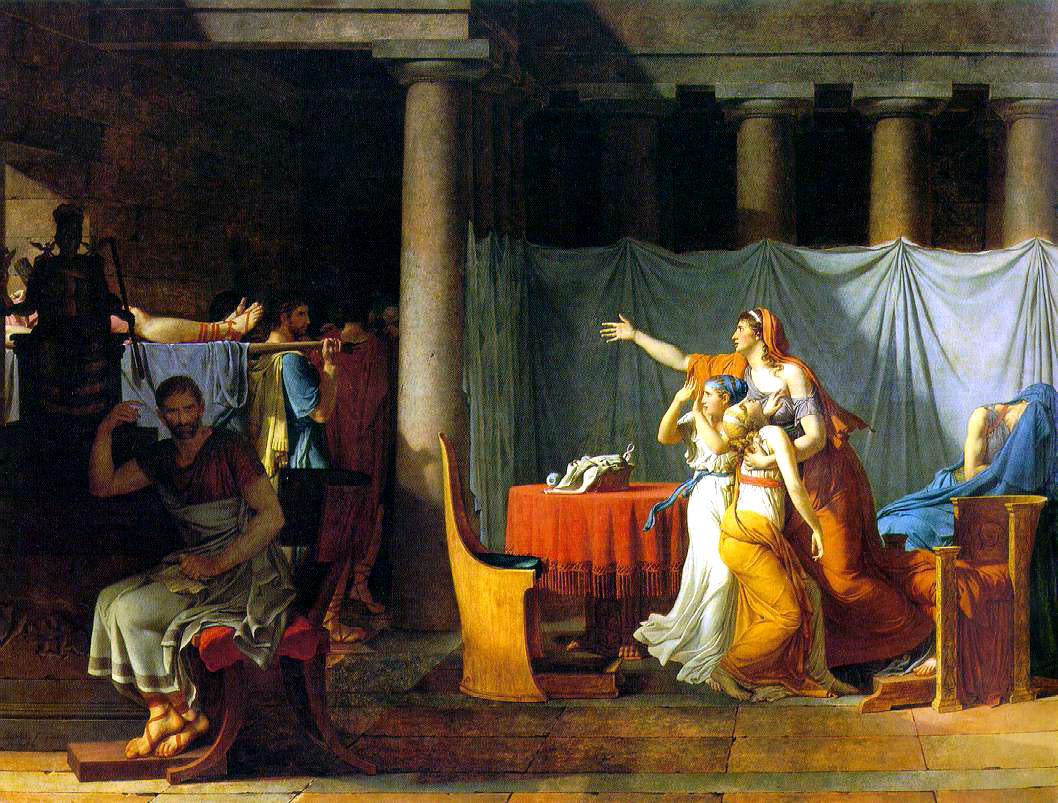
*The story reminds me of the “Oath of the Horatii” narrated by Livy.  Whether or not that lends credence to the historicity of Sallust’s tale I suppose depends on what one thinks of Livy’s narrative.


8th Grade: The Golden Age of Athens

Greetings,

This week spent some time discussing the elements of ‘golden ages’ and the factors that went into the birth of what we know as Periclean Athens.

From 480-431 B.C., Athens experienced an explosion of creativity and culture perhaps unparalleled in human history.  Much of what we consider to be modern democracy, philosophy, literature, drama, science, and architecture have many of their roots in this period and place.

What is needed for a golden age?

As we compare them across time (Periclean Athens, Dutch early 1600’s, Elizabethan England, 12th century France, etc.) some common factors emerge:

  • Some kind of cross pollination of culture based on access to the sea, or at least, extensive travel
  • A burst of confidence based on a defeat of a large power — you were the underdog and emerged on top.  The unexpected victory serves as a validation of your uniqueness.
  • An educational base to build the cultural explosion on.  There has to be some kind of literate and curious population base to build on.
  • The willingness to tolerate the possibility of new ideas, which usually has something to with #1 listed above.

With all these factors possibly needed (and possibly more that I have not accounted for), golden ages do not come often in history, but they leave their marks long after they disappear.

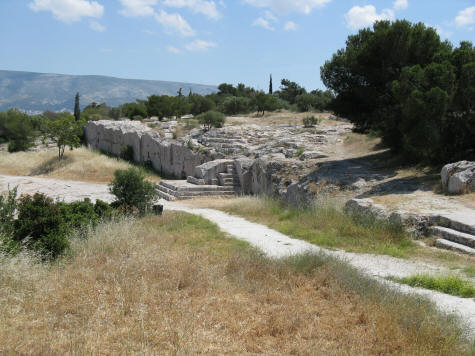
The Pynx, Meeting place of the Assembly

We also looked at the flowering of Athenian democracy.  As we examined how it functioned, we arrived at a proposition to debate next week, which is

Athenian Democracy in the age of Pericles was more democratic than America is currently.

Part of how you evaluate this statement depends on a few factors:

1. What do we mean by “Democracy?”

We are so used to the word “democracy” we may not consider what we even mean by the term.  Clearly it must mean more than mere voting.  Some elections have only one candidate, or the different candidates do not give us different options in reality (that is, the candidates would do basically the same thing if elected).    It must also mean more than mere majority rule.  If 51% of the people vote to oppress the remaining 49%, we would not call that democracy.

Democracy attempts the trick of giving power and choice to the people, while at the same time preserving freedom in some measure for all citizens.  Thus, the ‘losers’ in a contest are still protected from the possible pitfalls of majority rule.  At the same time of course, the majority cannot be obstructed too much, otherwise the point of voting and majority rule would be lost.  Historically this balancing act has never been easy.

2. What is most important in a democracy?

In the Athenians favor we note the following:

  • They had much more direct participation from their citizens in government than modern Americans.
  • The average citizen would not only vote, but could also speak in the Assembly.  Most citizens would probably serve in some political capacity during their adult lives.

Against them we can say that:

  • Women and slaves were excluded from voting and participation
  • The very fluidity of their democracy opened up the real possibility that the checks and balances of law could easily be overridden, as happened on a few occasions.
  • Critics of Athenian democracy (ancient and modern) believed Athens was easy prey for the “cult of personality.”

For modern America we note that

  • All citizens of a certain age are eligible to vote.
  • We have minority protection built into the system.

Against us some might say

  • Representative government has tended toward an oligarchy of the rich, with powerful interests controlling both parties.
  • This, in turn, has led to a real distance between Government and the people which results in an “Us and Them” attitude.

Below is a very detailed chart of the ins and outs of Athenian democracy for the very interested.

Many thanks,

Dave Mathwin

8th Grade: Cambyses and Unfriendly Historical Sources

Greetings,

This week we looked at the death of Cyrus and the reign of his son and successor, Cambyses II.

When examining Cambyses, we must use some caution.  Much of the information (though not all) about what we know about Cambyses comes from Herodotus’ writing, but Herodotus got much of his information from Egypt.  Cambyses had conquered Egypt, and we can assume that the information the Egyptians gave Cambyses would be slanted against him.  It appears that Cambyses had a terrible temper, exhibited erratic behavior, and may have killed both his brother and sister.  What are we to make of this dilemma?

If Cambyses was all who Herodotus says, this would not be terribly surprising.  Historically, Cambyses does fit the general pattern of the behavior of privileged sons of self-made men.  His father Cyrus worked from the ground up and achieved world-power status by his own innovative policies and bold tactics.  His son, on the other hand, would simply be handed the keys to something he had not earned.  In class I likened Cyrus to an expert Formula-1 driver who had been driving since he was a boy, worked his way up the lesser racing circuits, etc.  Cambyses, on the other hand, would simply be handed the keys to a Formula-1 car upon Cyrus’ death without all the work Cyrus had done.

Under such circumstances, a fiery crash of some kind would be quite likely.

We can speculate as armchair psychologists that Cyrus, given his tremendous energy and success at spreading the power of the Medo-Persians, would not have been home much.  We might surmise some latent guilt over this, and this means that if Cambyses ever came to him and said, “My tutor did ‘x’ and I didn’t like it, do something,” Cyrus might feel compelled to take his side and defer to Cambyses instead of his teachers.  And, if he was raised always to be deferred to, if he was always told how wonderful he was, he would never blame himself for his bad driving.  It would have to be the pit crew’s fault, the car’s fault, the designer’s fault — anyone or anything but himself.  This frustration would lead to anger, and erratic behavior might result.  It is noteworthy that Cambyses’ successor Darius I, a much better king than Cambyes, came from outside Cyrus’ family and was more “self-made” than Cambyses.

However, Herodotus also records several incidents of Cambyses going out of his way to desecrate Egyptian religious sites and customs after his conquest of Egypt, and this seems less plausible to me..  Cambyses, for example, is supposed to have exhumed a dead Pharaoh’s tomb and abused his corpse, and personally killed the “Apis Bull,” sacred to Egyptians.  These actions would have involved such a dramatic departure from Persian practice under Cyrus, that I wonder about their authenticity.

We discussed this dilemma in class.  I tend to think that if one source is all we have to go, we should accept that source unless someone else can contradict it.  Unless Herodotus can be shown generally untrustworthy (and I believe him to be generally trustworthy) than we should not discount his evidence without other evidence.  We should not indict him on mere suspicion.  His actions in Egypt seem very uncharacteristic, but again, we have other evidence in Persian art of the period as well (see above image).  Perhaps Cambyses was just as bad a Herodotus and the Egyptians claimed.

Many thanks,

Dave

Fun with Lists

A colleague of mine who also teaches history recently asked me to play an enjoyable game of “Name your Top Five Historical Events between the Roman Empire and the Reformation in western Europe.”

With some brief banter back and forth we came to an agreement fairly quickly on four and I inserted a fifth.  They are, in order of when they occurred,

  1. The conversion of Constantine, ca. 313 A.D.
  2. Charlemagne named Holy Roman Emperor, 800 A.D.
  3. The first Crusade, 1097 A.D.^
  4. The Black Plague ca. 1348 A.D.
  5. Columbus, 1492

As we considered these five, I rejoiced at our selections.  For, while the list is quite prosaic and hardly original, it reflects a shared worldview between us, and a shared philosophy of history.

For you see, the list has no technological innovations.  Not even the printing press!  I had to pat ourselves in the back in a moment of self-satisfaction.

Some context . . .

I like James Burke’s old show from the 1970’s Connections.  In a typical episode Burke will start with some everyday modern phenomena and then ask, “How did this come to be?”  He will then, by a serious of ingenious jumps and skips back in time, declare that, “If it were not for the discovery of the wood grouse in 1756 B.C., the modern computer would never have come to be.”

Or something like that.

I exaggerate, but sometimes Burke gets carried away.

In the first episode, Burke travels from a power outage in NYC to the invention of the plow in ancient Egypt (it actually makes some sense).  But implicit in Burke’s theme lies the idea that technology creates and then drives civilization.  I don’t buy it.  Yes, the plow probably helped ancient people produce more crops, but what brought people together in the first place?  Ok, people would gather by rivers for sure, but what would make them organize themselves into communities?

It would not be the plow.  Before the plow, some kind of common bond must have drawn people together — almost certainly a religious bond.*  Of course, it is this shared belief that still holds civilizations together today, not technology.

Admittedly not everything on that list involves a directly spiritual concern, so a brief defense of the selections seems in order:

Neither one of us thought Charlemagne’s title purely political.  It represented a hope of reorganizing society spiritually and culturally (yes, political as well) along more unified lines.  Some argue that the Holy Roman Empire never amounted to much, but it had a long run as a political and organizing force in Europe.

Whether or not the Crusades had justification in 1097, the conduct of the Crusaders and the ultimate failure of the enterprise seriously weakened the Church as an organizing force in European society.  From around 1200 A.D. on, the state had much more say than previously vis a vis the Church. Whether an improvement or not, certainly this represented a new means of how people interacted with one another.

The Black Plague killed millions, and in the process effectively ended the feudal system, which had governed Europe arguably since the time of Charlemagne.  In time a new middle class would arise with a new way of relating to one another

Columbus is in some ways a stand-in for Renaissance-era exploration as a whole.  As Felipe Fernandez-Armesto argues in his excellent book Pathfinders, exploration did not start based on new technological discoveries.  Exploration began because the way people viewed their place in the world had changed.  In that sense, Columbus is a stand-in for an entirely new way of thinking.

The printing press certainly had significance.  Probably it makes our top 10?  But the printing press has little effect without there first existing a desire to read, a desire to interact with the world in a different way through the printed page.  We should not imagine a world always hungry for books, just begging someone to invent a machine that could make them more accessible.

I am reminded, for example, of a story about Elizabeth I and toilets.  Apparently indoor plumbing was created in her day, and some enterprising inventors offered her the chance to use it. Who among us would refuse indoor plumbing?

She refused.  Having to go to the bathroom offended her sense of royal dignity.  The bathroom, in the form of the chamber pot, would come to her.  What good is being Queen if you can’t order the bathroom around anyway?

The story illustrates the point about the printing press.  It’s not about the invention, but the culture surrounding the invention that matters.  Culture and belief drive technology, and not vice-versa.

Dave

^In the interest of fairness, this represents my choice more so than an absolute unified agreement between the two of us.  As I mentioned, we were lock-step on the other four.

*Not surprisingly, armed with his materialistic view of history, Burke essentially reduces all of the religion and mysticism of Egypt down to applied science.

Ages of Refinement

I admit that the museum’s in D.C. are generally all great, even though despite living within striking distance I rarely visit them.  Recently, however, I got a chance to visit Manhattan and the Metropolitan Museum of Art — an experience on a whole different level.  One couldn’t possibly see everything, but I spent some time in their extensive Egyptian wing and a thought struck me.

The museum laid out the pieces chronologically, not topically, and this gives one a chance to see the development of Egyptian style and technique over millennia.  Now, very little changed over time — as a culture Egypt had a very strong identity and they did not necessarily value originality — but I had a flight of fancy that subtle differences emerge upon close inspection.

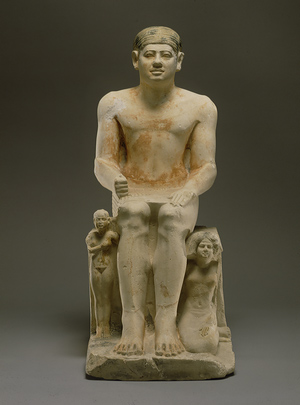
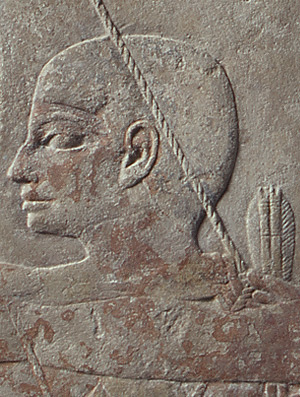
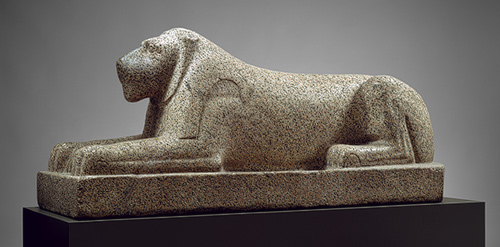
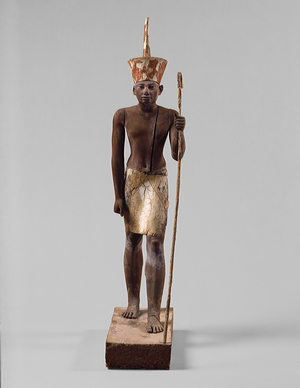
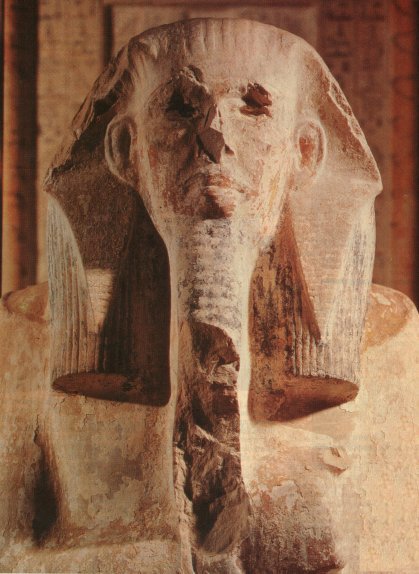
Below is some work from Egypt’s “Old Kingdom” ca. 2500 B.C.

Old

Old Kingdom

Old Kingdom

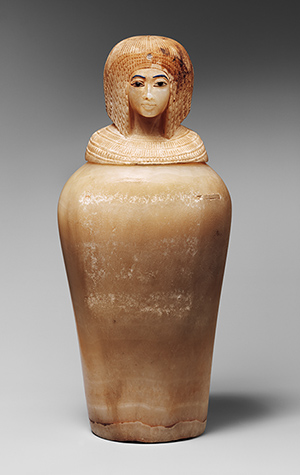
Next, examples from their “Middle Kingdom” ca. 1400 B.C.

Middle Kingdom

Middle Kingdom


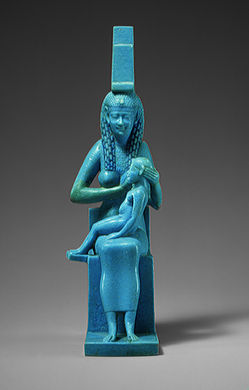
And finally, work from the “Late Kingdom” ca. 700 B.C.

Late Kingdom

Late Kingdom

Egypt Late Kingdom

No civilization lives out its time as a perfect bell-curve of steady rise, peak, and smooth decline.  Ebbs and flows interject themselves.  But we can safely say that Egypt as a “power” was on the rise early, perhaps peaked during the reign of Thutmose III in the Middle Kingdom period, and certainly continually waned after around 1100 B.C. and into the Late Kingdom.

But the artistic quality does not follow this bell curve.  In general their art evidences a steady increase at least in technical skill down through the Late Kingdom well past their political decline.  One could argue, however, that we see the most latent spiritual power in their earliest art.  The somewhat stoic solidity of their craft in the Old Kingdom seems to be bursting with energy just waiting to get released. Might we say then, that the increase in technical skill not only does not mirror an increase in the overall health of their civilization, it might even be evidence for their decline?

We see something similar in the history of Rome.  Here, for example is a bust of the hero of the 2nd Punic War, Scipio Africanus ca. 200 B.C.

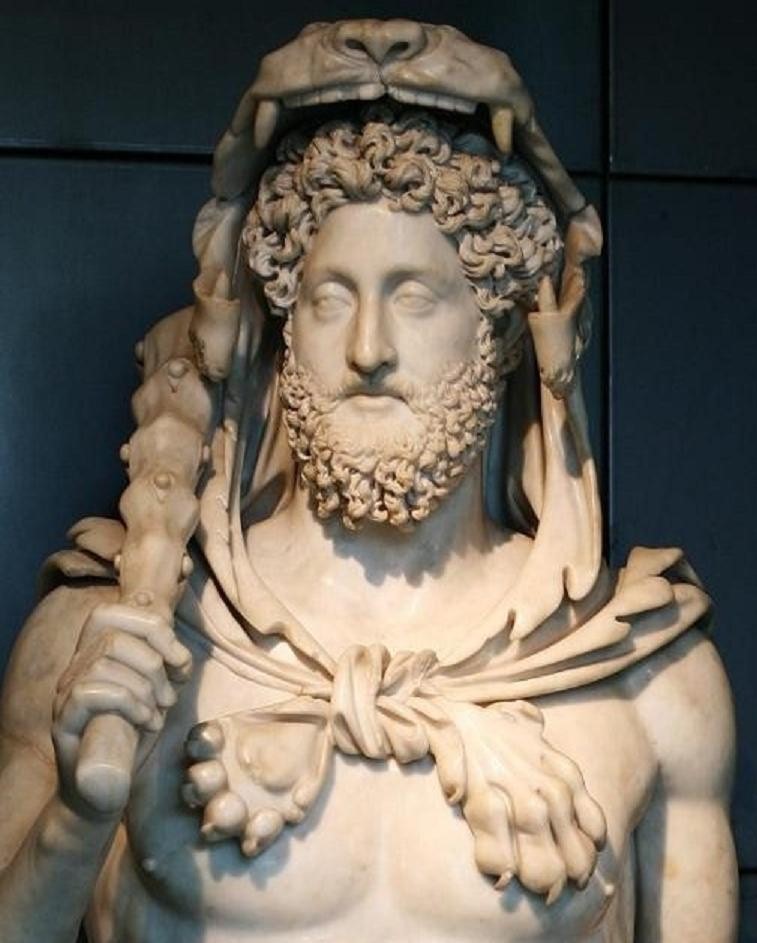
Fast-forward about 400 years and we find ourselves in the reign of the Emperor Commodus.  At this point Rome controlled more territory than at any point in its history, but no one would suggest that Rome stood taller and healthier in 180 A.D. than at 200 B.C.  And yet,

once again we see that technical skill in the arts has increased, and again we can draw similar conclusions about this increase as we can in Egypt.  Rome has declined, but technical skill has gone up.* We can also see a great deal more “spiritual” strength in Scipio than we can in Commodus, again similar to Egypt.

All this should be taken in the spirit of this blog as a whole.  I am a rank amateur making a guess. But if my guess be correct, why might it be so?

We can understand why a civilization might lack technical refinement in its earlier stages.  It has little to do with intelligence, I’m sure, and perhaps more to do with not having developed a clear style or sense of themselves.  But if the early stages show some of the clumsiness of youth, it also displays some of the (irrational) confidence of adolescence as well.

For convenience I label the later stages — like those that produce the Commodus bust — as ages of “refinement.”  I don’t think that “refinement” means an inward turn — inward turns of a civilization can bring great spiritual insights (this post here discusses this possibility in Byzantine civilization), and I don’t think either the Egyptian or Roman art shows that.  Rather, the refinement in the above art appears excessively “outward” to me, a decoration, perhaps even a covering over, of an inward reality.  In the case of Commodus, for example, his desire to show himself, a Roman emperor, in the guise of the Greek Hercules, bodes ill for himself and Rome. “Refinement” then represents a stage occupied not with deeper spiritual things but with “protesting too much.”

We can see this in Rococo art, for example, and the resulting storm that followed.  One can see the French Revolution of 1789 as the fall of one type of European Civilization.  It’s nice to celebrate simple happiness — nothing wrong with that.  But for my money Rococo (mid-late 1700’s) goes too far . . .

Schloss Ludwigsburg

The monstrous retribution that fell upon that civilization both in terms of the French Revolution specifically, and the Napoleonic Wars generally, has its harbinger with the drastic change in art represented by Jacques-Louis David.  All sense of “refinement” gets sacrificed to stark reality, in this case, the consul Brutus receiving back the bodies of his sons he ordered executed for treason to the Republic.

Returning to Egypt, while the architectural and sculptural achievements of the era of the late kingdom Pharaoh Ramses II impress in terms of scale, we do not see the same spiritual depth as in Akhenaton a century before him,

Ramses II

or the stark humanity of the much earlier Pharaoh Djoser (perhaps akin in style to bust of Scipio above, which might place their respective civilizations in the same spiritual framework).

Djoser - statue en calcaire

If this is a good/correct guess for these civilizations, we can ask whether or not it appears to be a law of civilizations generally, but   We may wonder too where our civilization fits in this suggested interpretative framework.  I think it obvious that many of our cultural creations do not evince the clumsy confidence of adolescence.  I’m tempted to say that we focus on ways to multiply purely external pleasure, which might put us in an “Age of Refinement.”  But if I say these things I will be following the pattern of every ancient historian in my, “Kids these days,” attitude, as well as most men generally past 40.  I don’t know if I’m quite ready to embrace that just yet.


*There may be another parallel between Rome and Egypt — we might say that Thutmose III (ca. 1450 B.C.) and Marcus Aurelius (ca. 160 A.D.) represent similar places in the respective histories of Egypt and Rome.  Both perhaps represent an “Indian Summer,” — a brief but ultimately failed rally against the tide.

8th Grade: Pride is the Fall

Greetings,

This week we wrapped up Babylonian civilization by looking at the reign of Nebuchadnezzar through the Book of Daniel.

Nebuchadnezzar reigned as one of Babylon’s greatest kings and one of the more powerful kings in the ancient world.  He had some significant faults, but also moments of keen insight.   When we first meet him in Daniel 2, we see that he had no patience for the sham dream interpretations of the various astrologers and “wise men” of the realm.

Then the astrologers answered the king, “May the king live forever! Tell your servants the dream, and we will interpret it.”  The king replied to the astrologers, “This is what I have firmly decided: If you do not tell me what my dream was and interpret it, I will have you cut into pieces and your houses turned into piles of rubble.

This may simply be Nebuchadnezzar’s famous temper showing itself, but he also knew that the astrologers Nebuchadnezzar's Dream, Daniel 2would simply look in a book once he told them the dream, and parrot back what the book said.  It doesn’t take a “wise man” to do that.

Daniel’s eventual interpretation of the dream had many lessons for Babylon and us today.  In its time, no other city on earth could equal the splendor and wealth of Babylon.  Not surprisingly, the “head of gold” in the vision referred to Babylon itself.  But even gold, the most precious and enduring of all metals, would eventually be superceded by the “silver” of Persia, the “bronze” of Greece, and the “iron” of Rome.  Only God’s kingdom will truly last.

The dream implicitly criticizes Babylon of course, and foretells of its coming judgment and dissolution, but Nebuchadnezzar has the wisdom and humility to reward Daniel and promote him within his kingdom.

In Daniel 3 we see the full range of Nebuchadnezzar’s strengths and weaknesses on display.  He sets up an idolatrous image of himself, and demands the death of Shadrach, Meshach, and Abednego.  His temper waxes so hot he demands the furnace temperature increased seven-fold.  But when God’s servants emerge unharmed he says,

Then Nebuchadnezzar said, “Praise be to the God of Shadrach, Meshach and Abednego, who has sent his angel and rescued his servants! They trusted in him and defied the king’s command and were willing to give up their lives rather than serve or worship any god except their own God.  Therefore I decree that the people of any nation or language who say anything against the God of Shadrach, Meshach and Abednego be cut into pieces and their houses be turned into piles of rubble, for no other god can save in this way.”

He seemed to like the whole “cut in pieces” concept.

His second dream in Daniel 4 deals with him personally.  He sees a great tree cut down and reduced to nothing, and Daniel tells him that the dream comes as a warning for Nebuchadnezzar to abandon all pride.  Alas, he fails to heed the warnings and succumbed to madness.

Nebuchadnezzar’s plight can serve as a template for examining other powerful leaders.  His insanity came as a direct judgment from God, but it stemmed from his pride.  When we think of clinically insane people we understand that they don’t live in reality, cannot perceive reality and cannot deal with reality.

Might a link exist between pride and insanity?

I think we can answer in the affirmative.  Pride, after all, prevents you from seeing yourself and others as they really exist.  Nebuchadnezzar’s own words reveal this:

[Nebuchadnezzar] said, “Is not this the great Babylon I have built as the royal residence, by my mighty power and for the glory of my majesty?”

Blake, NebuchadnezzarHis claim reaches ridiculous proportions.  Babylon had existed for centuries before Nebuchadnezzar, and no one would suggest that he did any of the actual building.  It’s quite easy to give the orders, after all.   Pride narrows the universe to one’s own dimensions and limitations.  A prideful man’s heart becomes cramped and unbearable.  Like other notorious rulers such as Stalin, Nero, and Caligula, Nebuchadnezzar didn’t begin insane, but ended this way.  Pride leads Nebuchadnezzar down the path to madness.

His sanity gets restored, however, when he “raised his eyes towards heaven,” possibly in silent prayer, or perhaps he simply recognized the universe outside of himself.

Daniel 4 concludes with Nebuchadnezzar’s own words,

At the end of that time, I, Nebuchadnezzar, raised my eyes toward heaven, and my sanity was restored. Then I praised the Most High; I honored and glorified him who lives forever.

His dominion is an eternal dominion;
his kingdom endures from generation to generation.
All the peoples of the earth
are regarded as nothing.
He does as he pleases
with the powers of heaven
and the peoples of the earth.
No one can hold back his hand
or say to him: “What have you done?”

At the same time that my sanity was restored, my honor and splendor were returned to me for the glory of my kingdom. My advisers and nobles sought me out, and I was restored to my throne and became even greater than before. Now I, Nebuchadnezzar, praise and exalt and glorify the King of heaven, because everything he does is right and all his ways are just. And those who walk in pride he is able to humble.

 While Nebuchadnezzar’s repentance saved himself, it could not save Babylon, which soon after would face conquest at the hands of Persia.  This will be our next civilization.

Detachment and Exploitation

When we attempt to define civilization we might be tempted to think of things like refinement and gentility, but this is not quite right.  As Kenneth Clark stated, “such things may be the agreeable results of civilization, but they are not what makes a civilization.”  In fact, believing that “refinement” will heighten your civilization may lead to barbarism.

In the modern age perhaps the ultimate example of refinement goes to Louis XIV Versailles.  I can think of no other place dedicated to symmetry, luxury, and delicacy.  Yet at root Versailles existed due to heavy taxation and in some ways, exploitation.  With its maze of manners and ridiculous customs, one could argue that Versailles exploited even those who lived there and “enjoyed” its opulence.  I can’t imagine any sane person wanting to go back in time to take part in the massive charade.  To me Versailles has little real beauty, and suffers from an excess of refinement.  I think the links between Versailles and the terror and barbarism of the French Revolution can be overstated, but surely, some connection exists.

Palace_of_Versailles1

In The Birds by the great Greek playwright Aristophanes, a character named Meton says that,

With the straight ruler I set to work to inscribe a square within a circle; in this center will be the marketplace, into which all straight streets will lead, converging into the center like a star, which . . . sends forth its rays in a straight line on all sides.

It sounds heroic, clean, and noble,  but then we remember that Aristophanes wrote comedies, and Meton is a figure of fun, a puffed-up fool.

The story of Athens is the story of Narcissus.

Their democracy under Pericles (ca. 450 B.C.) had its roots in the reforms of Solon (590-570 B.C.).  Certain privileges still resided in the upper classes after Solon’s time in power, but clearly Solon broadened the political class and narrowed the social gap between rich and poor.  Among his reforms. . .

  • All Athenian citizens received admission to the Areopagus
  • Foreign tradesmen were encouraged to settle in Athens and received citizenship if they brought their families
  • Any citizen could take legal action against another
  • Prohibition against a debtor’s person used as security for a loan.

The lock-step nature of Athenian society under Draco received a welcome outside stimulus.  Athenians started trusting one another, and their economy grew.  Plutarch writes that, “In Solon’s time, no trade was despised.”  The exalted Agora in fact served as a market and a general festival area.  Different people mixed together from different trades and classes.

Though no one believes that this sculpture of Solon was done anywhere near his lifetime, it reveals something of the common wisdom and concern that seems out of place with his upper-class roots:

Solon

If we go forward in time another 100+ years, we come to this bust of the Athenian statesmen Pericles.

Pericles had many successes and we can admire much of his statesmanship, but his face betrays him.  We do not see what we see in Solon.  With Pericles we have the smugness, arrogance, and touch of detachment for which the Athenians became notorious by 431 B.C.  If Pericles gets his share of credit for the brilliant culture of 5th century Athens, he shares in the blame of how far they had slipped since Solon’s time.   For example, under Pericles one could not marry foreigners, and foreigners in general had no hope of participating in Athenian political life.

Like Meton, the Athenians came to crave elegant simplicity and clarity.  They obsessed over the ideal.  The brilliant pythagoreans, who believed that all of life could be reduced to simple ratio, actually killed a member of their school who divulged the existence of irrational numbers.  They murdered to stay detached from reality.  Nothing should be allowed to end their beautiful dream.

This attitude bore bad fruit in more general ways.  Athenians still benefitted greatly from foreign trade.  In fact they depended on it, and Pericles’ initial strategy for the Peloponnesian war put absolute reliance on the availability of foreign goods.  But the tradesman and the merchant now had no social standing, whatever their political rights might have been.  The aristocratic ideal of refinement and detachment had taken firm root among the Athenian elite.  If we take Aristophanes as a reliable source, in Pericles’ day the upper-classes avoided the Agora and hung out by the gymnasium with their own more leisured companions.  Athens’ contempt for the artisan and merchant destroyed them.  Trade depends on good relationships and good faith, the same qualities needed to hold together their empire.  If Athens neglected their tradesman they would soon neglect their empire, and treat them as second class citizens.

As Lewis Mumford notes in his excellent The City in History, they did just that.  Their platonic sense of detachment led to Athens exploiting its tributary states, once allies.  This detachment and exploitation reached its peak in the Parthenon (funded by money taken under false pretense from their allies)  which doubles as an insanely impressive technical achievement and a hymn to self-worship unequaled except by the pyramids and Nebuchadnezzar’s statue.

A “schism in the soul” of Athens had arrived, an imbalance that gave the life of the leisured mind precedence over the life of the laborer.  Whereas before Solon gave economic incentive towards developing a trade, now tradesmen sat on the outside looking in.  Plato later took the aristocratic idea to its fullest extent and enshrined philosophers as kings, strictly dividing the people based on their innate functionality.  None could accuse Plato of loving democracy, but ironically, he is in many ways Pericles’ heir.

When looking at the Civil War modern history textbooks do a great deal of damage by glossing over the virtues of the South.  Many in the North had no love for blacks, and the industrial system exploited people in ways not terribly different than slavery.  Some southerners treated their slaves well (relatively speaking), some in the south spoke against slavery, etc., etc.  The ante-bellum South was no monolith.

But in the end even the Southern romantic must see that large aspects of the refinement and gentility that the South possessed came from their aristocratic detachment, made possible by wholesale exploitation of blacks.  Will Durant wrote that all cultural achievements have roots somewhere in exploitation of some kind.  I disagree.  But some cultural achievements do have rotten roots.  Some of what makes the ante-bellum south appealing (i.e. the “Gone With the Wind” culture)  had its roots in arrogance, but also in aristocratic detachment from the “vulgar’ aspects of life.  Let others get their hands dirty.  One southern newspaper wrote just before the war,

Free society!  We sicken at the name.  What is it but a conglomeration of greasy mechanics, filthy operatives, and moon struck theorists?  They are hardly fit for association with any Southern gentlemen’s body servant.

Those “hardly fit” would soon bring judgment upon Southern society, much as all the merchants, farmers, and craftsmen scattered across the Aegean dealt a mortal blow to Athens by the end of the Peloponnesian War in 404 B.C.

“The Military Institutions of the Romans,” by Flavius Renatus Vegetius

Sometime in the early 5th century Vegetius wrote this simple and straightforward work, both a manual for a successful military and a plea for Rome to return to the values of an earlier time.

I am not a military man, but much of the advice Vegetius meets out concerns basic common sense, i.e. make sure your troops are well-fed, pay attention to terrain, make sure you have a reserve force, and so on.  What interested me as I read is what the book might reveal about the late Roman empire, and why the work had a huge following the Middle Ages.

Vegetius does not bellow, shout, or stamp in his writing, and yet underneath I think we can see a quiet desperation.  It seems like every ancient and medieval historian must as a matter of course talk about the past as a beacon of light, and how decrepit the present had become (does this not change until the Enlightenment?).  In Vegetius’ case, however, his attitude may have had more connection with reality, as the Empire seemed less and less able to exert control over its borders (Hillaire Belloc disagrees with this standard interpretation in his Europe and the Faith).  We do know that Rome had a harder time recruiting for its army in its later phase, and one of the great ironies of this book is that Vegetius, though wishing for a time when all men were strong and all the children good-looking, had no military experience himself.

The book touches on many things, but at the core Vegetius pushes discipline, discipline, and still more discipline.  Who can doubt that an army needs discipline?  Nothing remarkable about that.  Still, as this Youtube shows, Rome rode a few basic military moves and formations to world dominance.  Nobody plays the hero.  Stay in formation. Crouch, block, thrust, and move on to the next enemy (warning: a bit bloody).

What I did find revealing, however, is what is not there, much like the dog in Conan Doyle’s “The Adventures of Silver Blaze.”  Nowhere does Vegetius mention anything about armies needing morale, a cause, a belief to fight for.  Napoleon for one gave it great store.  His famous quote that,

In war, the moral is to the physical as three is to one.

comes to mind.  Why does Vegetius not mention the morale, or motivating cause, of an army?

I wonder if Vegetius does not include it because the army had no possibility of fighting for a cause in the late empire.  Rome had power and wealth even in the late 4th century but had lost any real reason for its existence long before. Vegetius wouldn’t mention it not because he judged it of little value but because he never would have thought of it in the first place, like a fish failing to extol the virtues of living on dry land.

Against my interpretation, however, is Vegetius’ own claim that nothing that he says comes from his own pen.  He claimed only to be copying, collecting and transmitting much older sources.  Some of those sources, like Cato, predate him by hundreds of years, when Rome had more internal health.  Did Rome never concern itself with morale in their military treatises?  One could imagine a stereotypical Roman thinking it a bit girly to think too much.  Leave that sort of thing to the French.

Or perhaps by coincidence the sources he uses don’t mention morale, so he doesn’t either.  But if so, he also chose not to add it.  Or maybe they did include it, but Vegetius did not work with their complete full text, or perhaps he deliberately left those parts out because they made no sense to him and would make no sense to others in his day.

Since the original date of this post I had some wonderful feedback from a friend who had the following idea.  His thoughts ran in a different course, which I paraphrase in the next two paragraphs below:

Vegetius may not have included the morale section for the reason that morale for the Roman armies was never the problem.  If anything, they needed at times an check on their desire to fight, hence the strong emphasis on discipline.  We see a few examples of this, first from the Gallic Wars, when Caesar wrote,

On the next day, Caesar, having called a meeting, censured the rashness and avarice of his soldiers, “In that they had judged for themselves how far they ought to proceed, or what they ought to do, and could not be kept back by the tribunes of the soldiers and the lieutenants;” and stated, “what the disadvantage of the ground could effect, what opinion he himself had entertained at Avaricum, when having surprised the enemy without either general or cavalry, he had given up a certain victory, lest even a trifling loss should occur in the contest owing to the disadvantage of position. That as much as he admired the greatness of their courage, since neither the fortifications of the camp, nor the height of the mountain, nor the wall of the town could retard them; in the same degree he censured their licentiousness and arrogance, because they thought that they knew more than their general concerning victory, and the issue of actions: and that he required in his soldiers forbearance and self-command, not less than valor and magnanimity.

My friend continues,

Similarly, one of the Consuls in the Macedonian wars (maybe Aemelius Paulus? I’ll have to dig out Plutarch) had terrible problems with his troops making frontal charges into Macedonian phalanxes and being annihilated. He entreated them to fight defensively and maneuver but they would have none of it.

Either way you slice it, the absence of anything resembling the morale of an army in his text says something.  Feedback like this is always very welcome, so thank you.

The book had a curious second life in the Middle Ages, where it became the standard military textbook.  I find this quite amusing.  Nearly everything except for the most basic dictums would have no application in the Middle Ages.  Many differences between the two armies/societies existed.

  • The Medievals could never have raised the large, professional forces that Rome did
  • Medieval armies did not often come together, and fought in short bursts, not extended campaigns far from home (the Crusades an exception, I grant you).
  • Medieval armies had very different people in them than Roman armies did.  An aristocratic warrior elite with a shared code of honor with their opponents would probably not go for the discipline, discipline, discipline, approach of Vegetius.

And yet the Medievals loved him.  Whatever for?

Some might call them simpletons who did not realize these differences, but I would not call a culture that produced Gothic architecture and St. Thomas Aquinas simpletons.

Some might see their possession of the manuscript of Vegetius valued like one prizes a good luck charm.  On this interpretation it’s the manuscript itself that’s valued, not the actual words.  Or perhaps in a childlike and humble way, they venerated the past and gave great store to anything from that time.

I could believe this second explanation, but I think the answer lies mostly elsewhere.  A clue might arise from a medieval portrait of Vegetius here below:

Why did the late 15th/early 16th century picture him in garb exactly like their own?  Did they really believe that the Romans wore clothes that they themselves wore in their time?  Or were they visually displaying their belief in using his work for their time?  Perhaps they had no idea what Romans wore and they felt free to invent whatever  clothes they wished?

In his great The Discarded Image C.S. Lewis speaks of the medieval imagination. . .

We have grown up with pictures that aimed at the maximum of illusion and strictly followed the laws of perspective.  . . . Medieval art was deficient in perspective [both historical and visual], and their poetry followed suit.  Nature, for Chaucer, is all foreground.  We never get a landscape.

Historically, as well as cosmically, medieval man stood at the foot of a stairway; looking up, he felt delight.  The backward, like the upward, glance exhilarated him, and humility was rewarded with the pleasures of admiration.  Thanks to his deficiency in the sense of period, that packed and gorgeous past was far more immediate to him than the dark and bestial past could ever be. . . .  It differed from the present only in being better.

The Middle Ages are unrivalled, until we reach quite modern times, in the sheer foreground fact, the ‘close-up.’    . . . Two negative conditions made this possible: their freedom both from the psuedo-classical standard of decorum, and from the sense of period.  But the efficient cause surely was their devout attention to their matter and their confidence in it.  They are not trying to heighten or transform it.  It possesses them wholly.  Their eyes and ears are steadily fixed upon it . . .

This lack of “background” in their art and thought might lead them to ignore Vegetius’ context.  We do this too.  Who among us does not think that Ben Franklin’s idea of making the turkey our national bird ridiculous?  We know that Bald Eagles may not be the nicest of birds, but that’s not the point.  We are interested in the immediate image the eagle projects, not its actual reality.

But I think there is more to than that, something distinctly medieval about Vegetius’ image. Medievals developed the habit of looking so closely they missed the forest for the trees.  With Vegetius, we might surmise that all details beyond the immediate text were entirely superfluous, which made those details, in a sense, entirely in the now.  This attitude could be akin to the scientist absorbed so much in trying to clone DNA that he takes no notice of the larger consequences of his actions.

Cheap histories of the Middle Ages talk of the period’s ignorance, darkness, etc.  In reality it appears they had quite a scientific bent, with a love of classification and minutiae.  The quote, “Nothing is known perfectly which has not been masticated by the teeth of disputation,” on my homepage from Robert of Sorbone, dates from the 13th century, and not the 17th.  Vegetius’ portrait may not speak many words about him, but does speak volumes about those that created it.


8th Grade: The Athenian Golden Age

Greetings,

This week we had a test, along with a review game on Monday and worldview week, so we had little time in ‘normal’ class.  We did spend some time discussing the elements of ‘golden ages’ and the factors that went into the birth of what we know as Periclean Athens.

From 480-430 B.C., Athens experienced an explosion of creativity and culture perhaps unparalleled in human history.  Much of what we consider to be modern democracy, philosophy, literature, drama, science, and architecture have a good measure of their roots here.

What is needed for a golden age?

As we compare them across time (Athens, Dutch early 1600’s, Elizabethan England, 12th century France, etc.) some common factors emerge:

1. Some kind of cross pollination of culture based on access to the sea or at least, extensive travel

2. A burst of confidence based on a defeat of a large power — you were the underdog and emerged on top.  The unexpected victory serves as a validation of your uniqueness.

3. An educational base to build the cultural explosion on.  There has to be some kind of literate and curious population base to build on.

4. The willingness to tolerate the possibility of new ideas, which usually has something to with #1 listed above.

With all these factors possibly needed (and possibly more that I have not accounted for),

We also looked at the flowering of Athenian democracy.  As we examined how it functioned, we arrived at a proposition to debate next week, which is

Athenian Democracy in the age of Pericles was more democratic than America is currently.

Part of how you evaluate this statement depends on a few factors:

1. What do we mean by “Democracy?”

We are so used to the word “democracy” we may not consider what we even mean by the term.  Clearly it must mean more than mere voting.  Some elections have only one candidate, or the different candidates do not give us different options in reality (that is, the candidates would do basically the same thing if elected).    It must also mean more than mere majority rule.  If 51% of the people vote to oppress the remaining 49%, we would not call that democracy.

Democracy attempts the trick of giving power and choice to the people, while at the same time preserving freedom in some measure for all citizens.  Thus, the ‘losers’ in a contest are still protected from the possible pitfalls of majority rule.  At the same time of course, the majority cannot be obstructed too much, otherwise the point of voting and majority rule would be lost.  Historically this balancing act has never been easy.

2. What is most important in a democracy?

In the Athenians favor we note the following:

– They had much more direct participation in government than modern Americans.
– The average citizen would not only vote, but could also speak in the Assembly.  Most citizens would probably serve in some political capacity during their adult lives

Against them we can say that:

– Women and slaves were excluded from voting and participation
– The very fluidity of their democracy opened up the real possibility that the checks and balances of law could easily be overridden, as happened on a few occasions.

For modern America we note that

– All citizens of a certain age are eligible to vote.
– We have minority protection built into the system.

Against us some might say

– Representative government has tended toward an oligarchy of the rich, with powerful interests controlling both parties.
– This, in turn, has led to a real distance between Government and the people which results in an “Us and Them” attitude.

I will look forward to their debate when we return next week.  Below is a very detailed chart of the ins and outs of Athenian democracy for the very interested.

Many thanks,

Dave Mathwin