The Mysteries of the Monotheistic Pharaoh

I loved The City of Akenaten and Nefertiti: Amarna and its People. I loved it even though I skipped large chunks of it, and some of what I read went beyond my understanding.  This may sound strange, but Barry Kemp’s work is such an obviously great achievement that it goes beyond whether I like it or not.   All that to say, I do really like the book, and wish I had knowledge and the ability to follow him all the way down the marvelous rabbit holes he traverses.

The book puts a capstone on Kemp’s 35 years excavating the city of Amarna, a city built by Akenaten IV (sometimes known as Ikhneton).  Akenaten has long fascinated Egyptian scholars, mostly because of his religious beliefs.  He departed from the religious beliefs that dominated Egypt for centuries and clearly attempted to change the religious landscape of Egypt in general.  He may have been a monotheist, which adds to the potentially radical nature of his rule.

Differing interpretations swirl around his time in power, as we might expect.  Some like to view him as a great rebel against the constraints of his society.  Some view him as a great religious reformer.  Today, given the overwhelming influence of tolerance, the mood has switched to seeing him as a tyrant and usurper.  I hoped Kemp could help sort out some of these dilemmas.  His book reveals much, and also creates more mystery at the same time.  After reading we get no absolute conclusions.  Usually when authors do this I get frustrated.  But in Kemp’s case, who can blame him?  The historical record is 3400 years old.

But before we get to this, Kemp and the publisher deserve praise for the aesthetic aspects of the book.  It feels good in your hands.  It has thick and glossy paper.  The text and numerous illustrations mesh very nicely.  The book has an almost ennobling quality.  You feel smart just looking at it.

I also have to admire Kemp’s style.  If I had spent 35 years in excavations at Amarna and then wrote a book it would almost certainly have a shrill, demanding tone.  “I spent all this time here and now you are going to look, see, and appreciate it all!”  But Kemp writes in a relaxed, thoughtful manner that seems to say, “Ah, how nice of you to drop by.  If you’d like, I have something to show you.”

So many kudos to Kemp.

But now on to Akhenaten himself.

What was he really trying to do, and how did he try and accomplish it?

Clearly Akenaten wanted something of a fresh start for Egypt.  He moved his whole seat of government and started building a new city called Amarna.  In Egypt’s history this in itself was not all that radical, and other rulers have done something similar, notably Constantine with “New Rome.”  Unlike “New Rome”/Constantinople, however, Amarna appears to be way off of Egypt’s beaten path.  This idea in Egypt means something different than it might for us, as nearly all of life got compressed within a few miles of the Nile.  Even so, Akenaten chose a place rather out of the way by Egyptian standards, perhaps the equivalent of the U.S. making its new capital Des Moines.

Perhaps Akenaten didn’t just want a fresh start, he wanted a totally clean slate upon which to build, free from all outside interference (shot from British excavations in the 1930’s below).

Early Excavations at Amarna

So he was a radical, then?

Perhaps, but in building a city, how radical could one be?  Most cities tend to look like other cities.  He faced limits of resources and experience.  So Amarna looked like most other cities, but a few subtle differences might reveal a lot.

For example, the builders made the entrance to the “Great Aten Temple” much wider than usual temples, so wide that one could not envision doors ever being present.  This may mean nothing other than they ran out of material.  But interestingly, most city-dwellings had this same open feel to it.  In great detail Kemp describes how the houses in the city had few boundaries.  Slaves, officials, and commoners would use the same pathways in and out of the same houses.

Kemp also mentions that the plain of Amarna itself presented itself as very open and flat.

No conclusion forces itself as definitive here.  We can say that,

  • Most places in Egypt had a similar geographic layout to Amarna
  • The houses may have been constructed in an ad-hoc fashion due to lack of resources or time
  • Maybe Akhenaten wanted a really open feel to the front of the Great Temple, but that may not have any particular connection to anything else.  Or maybe they had a plan for very large, ostentatious doors that never got realized.

Or perhaps we should see intentionality in all these elements.  And if intentionality is indeed present, what might that reveal that he really did have a grand vision for real change in Egyptian society.

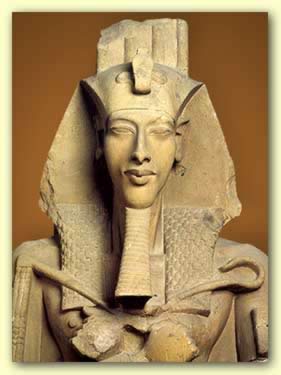
Another intriguing problem deals with Akhenaten himself.  The most famous statues linked to him and his reign look generally like this:

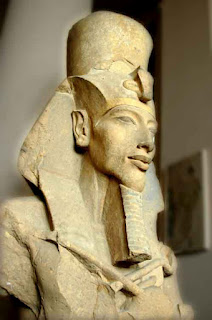
This one makes him look more thoughtful and perhaps more humanized

Akhenaten

Both statues reveal an intense and thoughtful man, given to much introspection.  Or possibly, obsession?  Kemp points out that the offering tables in the temples stood much larger than those in other standard Egyptian temples.  Was he consumed by an idea, or a Reality?  His faces here perhaps reveal just this.

And yet, it is entirely possible (though far from certain) that he actually looked like this:

What should we make of this?

One possibility is that the last image is not of Akhenaten at all, and this solves the riddle by eliminating it.  But Kemp thinks this last sculpture to be an accurate portrayal of what he really looked like.  I’ll go with the guy who spent his life studying the ruins.

So if he portrayed himself differently than he actually looked, it must have been a propaganda tool of manipulation?

No, Kemp thinks not.  Pharaoh’s often had the moniker, “Lord of the Appearances.”  They would be seen by people often, even commoners.  And this would likely be all the more true in the isolated and not terribly large city of Amarna.  Besides, the statue directly above dates from Akhenaten’s time and surely was “official” and not black market.  Kemp often cautions us not to look for consistency in Ancient Egypt, or at least our modern and Greek influenced sense of consistency.

Kemp suggests that the image Akhenaten projected may have had to do with his role as teacher of righteous living.  Certainly it seems he viewed himself this way, and others did too.  This may not make him a prig necessarily, because it was a role Pharaoh’s often assumed, perhaps as a matter of tradition.  The austere intensity of the first two busts (at least 6 ft. high) help confer the image of a deeply felt inner life that he wanted to communicate.  And since the Egyptians loved visuals more than the written word, his busts carry his theological message.

I didn’t buy the modern, “Akhenaten as a religious tyrant” argument before reading the book, and I think Kemp indirectly argues against this.  For one, we find small statues of other gods in scattered Amarna households.  Their houses were small and the statues of normal size.  Given the free-flowing nature of Amarna neighborhoods, other citizens would easily know about the statues.  For Akhenaten to have no awareness of these gods would mean that he had no secret police, no informants, and this speaks against the possibility of ‘tyrannical rule.’  He almost certainly knew about the gods, and tolerated them, however grudgingly.

Or perhaps he actually wasn’t a monotheist?  But then, how radical could he have been?  Or perhaps he had strong views and wanted wholesale change but approached the issue pragmatically.  Neither option gives us a Stalin-esque tyrant.

Other curious details make me lean away from the “tyrant” position.  Cities designed before Akhenaten had rigid layouts and exacting aesthetics.  But as Kemp writes elsewhere, “Most of this city was built around a rejection of, or an indifference to, a social prescription and a geometric aesthetic.” Instead, “organic harmonies” and “personal decision making prevail instead.”  My bet is that Akhenaten may have been too consumed with his religious ideas to really be a tyrant even if he wanted to.

Akhenaten seems to have had a “smart-bomb” approach to religious reform, at least politically.  His main innovation/change might appear slight to some of us.  The Egyptians depicted their gods in at least partial human form.

But over and over again, Akhenaten depicted himself only with Aten, and in these images, Aten has no quasi-human form.  The sun itself sufficed for him.

And this image from the Aten temple . . .

So perhaps in this area we see clarity of vision and consistency of follow-through, as to what it means, I don’t know.  It fits, though, with his overall theme of simplifying religious belief.

Kemp shows us that Akhenaten worked hard at cultivating the image of a good life at Amarna.  Many wall murals show him as a generous provider and consumer of goods.  Excavations reveal that this may not have been entirely propaganda, but Kemp reminds us Akhenaten reigned during a prosperous and secure time in Egypt.  But in 2006 excavators discovered a series of tombs for commoners that reveal high incidents of early childhood death, malnutrition,or skeletal injury.   This could throw us right back to the Stalinist image some have of him.  But the high incidents of childhood death could reveal an epidemic in Amarna, which would spread rapidly in its densely packed population.  Hittite records tell of a plague that spread from Egyptian prisoners of war during Akhenaten’s time.  As to the injuries, I can’t say whether or not this is typical for when new cities get built.  Akhenaten may have harshly driven the people to work harder and more dangerously than normal, or it may have been par for the course with ancient construction projects.

The insistence on building a new city may reveal an element of monomania, but certainly other pharaohs did the same thing.  The pyramid builders demanded vastly more labor from their people/slaves.  Besides, Akhenaten had many critics within Egypt after his death, but no one blamed him for building a city.  This fit within the normal roles pharaohs played.

Akhenaten likely saw himself as a religious liberator of the people.  I see a man with a purity of vision, but also a pragmatist in good and bad ways.  He possessed great intelligence and valued introspection.  I see him dialoguing with himself, along the lines of, “I want ‘x.’  But the people only know ‘y’ and expect ‘y.’  So I will try and lead to them to ‘x’ through a modified version of ‘y’ — not to say that I hate everything about ‘y’ — just some things.” If I’m right, this  inner wrestling match would lead to inconsistency and confusion in his own mind.  Perhaps he lost his way a bit.  “I must have a nice new city to show the people the greatness of the truth,” or something like that.

Or maybe not.  I wish I knew more.  Akhenaten provides a great template for a historical novel.

Perhaps he went too far, but I do think he had good intentions.  Of course much evil gets done with this mindset.  We all know where the road of “good intentions” leads.  But it’s hard to say for certain what evil he actually did.   But he did seek to remove certain key beliefs about the afterlife.  The traditional Egyptian’s journey to eternity had many perils and thus required many charms, protections, and so forth.  All this gave a lot of power to certain priests.  Akhenaten’s tomb stands in marked contrast to almost all other kings for its simplicity.  Clearly he sought in some ways to “democratize” death in his religious beliefs.  I think that Akhenaten wanted to simplify things in general for the common man.  But then again, his tomb contains other traditional pieces, such as the “shabti” — special figures designed to do conscripted labor in the next life.  So even the intense, focused Akehenaten either conceded to some traditional beliefs or really believed these apparently inconsistent ideas.

The mystery of Akhenaten continues.

We know that his religious ideas more or less died with him, and indications exist that foreshadow this even during his lifetime. Very few people changed their names to reflect the new ‘Atenist’ belief, and this we know from the many tombs in the area.  Had his beliefs caught on the switch in names would have also, as happened at other times in Egyptian history.  The narrative that we naturally accept about his attempt at religious change sounds similar to this text from Tutankamun, who may have been his son.

…the temples and the cities of the gods and goddesses, starting from Elephantine as far as the Delta marshes . . .were fallen into decay and their shrines fallen into ruin, having become mounds overgrown with grass . . .   The gods were ignoring this land.  If an army was sent to Syria to extend the boundaries of Egypt it met with no success at all.  If one beseeched any goddess in the same way, she did not respond at all.  Their hearts were faint in their bodies, and they destroyed what was made.

But Kemp shows that the above text doesn’t reflect the truth.  Akhenaten kept open most all the temples in the land, and left his reforms for Amarna.  And as we’ve seen, he apparently let the worship of other gods go on unofficially even in Amarna itself.  So if Akhenaten engaged in political hocus-pocus (and maybe he didn’t) then at least two played that game.

So by the end of the book we arrive where we started.  But Kemp’s extraordinary archaeological skills take the reader as far as they can go.  From here on, one must take a leap into the realms of poetry, which is where History really belongs.

9th Grade: Elements of the Exodus Debate

Greetings,

Last week we looked at the monotheistic pharaoh Akhenation IV, also known as Ikhneton.  Ikhneton had many distinctive qualities — a most unusual pharaoh.

  • He was a monotheist, a tremendous contrast to the polytheism of his surrounding culture.
  • He likely had only one wife — a significant departure from the usual practice of pharaoh
  • He wrote poetry

The surviving images of Ikhneton are not typical for pharaohs either.  His bust does not exude power, but rather thoughtfulness, depth, and caring.  The image to the right with his family highlights this as well.  Again, as far as I know, for pharaoh’s to depict themselves like this in public was quite unusual.

Where did these beliefs and practices come from?  A few theories exist:

1. He learned them from the Jews, possibly enslaved during his reign.

2. He learned them from stories he heard about the Exodus, which may have happened about 75-100 years before he came to power.

3. Perhaps God appeared to him in a vision.

4. Perhaps he learned it from creation around him.

Did he believe in the true God under a different name?  I wanted to pose the following to the students:

  • Whether or not Ikhneton believed in the true God, he was certainly at least far closer to the truth than his countrymen.  What should he do with this knowledge?  If people don’t believe him, should he use force?  What would the responsibility be of the average Egyptian who agreed with him?  Is Ikhneton responsibility different because of his position of power?
  •  Ikhneton’s project to ‘convert’ his countrymen failed almost entirely.  Why was this?  Can any kind of force ever work in religious matters?  If so, which kind?  What does his failure tell us about the power of tradition.
  • While many historians come down hard on Ikhneteon, we looked at the Book of the Dead to understand exactly what it was that Ikhneton fought against.  Here we see inside Egyptian religion, and are confronted with a maze of charms, spells, and formulas to assure a good afterlife.  I can’t imagine anyone keeping it all straight, and this gave enormous power to the priesthood of their hundreds and hundreds of gods.  Ikhneton did fail, and perhaps went about his project in the wrong way.  But Egypt remained trapped in a religion that gave enormous power to the priesthood.

In this way, Ikhenton’s story can have meaning for our own day.  We too need to consider the strengths and weaknesses that come whenever religion is associated with law.

We also looked at the Exodus.  As Christians we can have confidence that the Exodus was an historical event, but there is not a great deal of evidence within  Egypt itself to support it.  Some modern scholars use this as evidence against the Exodus, but we discussed in class why Egypt might want to “cover-up” such events.

An interesting possibility involves the presence of the Hyksos in Egyptian history.   The word “hyksos” can apparently mean either “foreign invader,” or “foreign dweller.”  Egyptologists propound different theories as to their identity, with some believing them to have been occasional foreign invaders, others foreign immigrants.  A couple of curious details, however, may link the Hyksos to the Exodus:

  • The dates given for the Hyksos presence in Egypt correspond roughly to the time span the Israelites spent in Egypt (ca. 1800-1300 B.C.)
  • Many Hyksos names appear to be semitic in origin
  • Many debate whether or not the Hyksos coexisted peacefully or not with Egyptians.  But if their co-existence was sometimes peaceful, sometimes not, that would fit the Exodus narrative.

I am intrigued by the theory that suggests that the Hyksos may have been the Israelites.  It would fit with the “foreign immigrant” theory, and melds also with the narrative in Exodus 1, which indicates that the as the Israelites grew more numerous they had less favor with some in Egypt.  Thus, when the Egyptians talk about “expelling” them from the land in possibly ca. 1300-1200 B.C. they may have engaged in the ultimate historical spin.  In the official Egyptian narrative then, the Israelites didn’t leave due to plagues, God, etc., but because we forced them to leave!  It was a great moment of national pride!  I should stress, however, that this is only a theory–a lot disagreement exists over who the Hyksos were and when they resided in Egypt.

After ca. 1200 B.C. archaeologists note a transition in how the Egyptians built cities.  Previously, most Egyptian cities had no walls, contrary to Mesopotamian cities of the same time.  After ca. 1200 B.C., most Egyptian cities had walls, marking a transition perhaps to a more unstable, frightening period.  Clearly, the 10 plagues would have devastated and de-stabilized Egypt significantly, and this of course weakened them.  The presence of walls may very well reflect the kind of dramatic decline the plagues would bring. Some consider this evidence for a later Exodus date. The architectural and political changes reflect something cataclysmic in Egypt’s recent past.

Still, I stress that this is only a theory.

Whenever we think the Exodus took place, we should realize that the plagues exposed every foundation that Egypt built its society and identity upon.  In class I compared the plagues to waking up and realizing that the life you thought you led wasn’t real, and actually you lived as a nomad in the Sahara with an entirely different family.  The psychological impact must have been devastating, which explains why many Egyptians left with the Israelites.  I also think it explains why many stayed.  With such a radical change required, many might prefer to live in a dream.

Wide disagreement exists within the scholarly community on when the Exodus took place, but there are two main theories:

1. An ‘Early’ Exodus somewhere around 1450 B.C.   1 Kings 6:1 talks of ‘480 years’ between the Exodus and Solomon’s reign,B.C.  And might the Hyksos invasion, which took place around the same time, have been facilitated by the disaster of the plagues?  Could we then see the rally of Egyptian civilization under Ramses II as a kind of Indian summer, a last gasp?

2. A ‘Late’ Exodus somewhere around 1250 B.C., which would be at the time of Ramses II.  Didn’t Ramses build a new city, which would fit with the Israelites task of making mud brick, as described in Exodus?  Might ‘480 years’ be a symbolic number (12 x 40, or the completion of the wandering of the tribes)?  I wanted the students to think through the various possibilities, with the caveat that faithful Christians can easily disagree on this, as the Bible does not speak with absolute clarity.

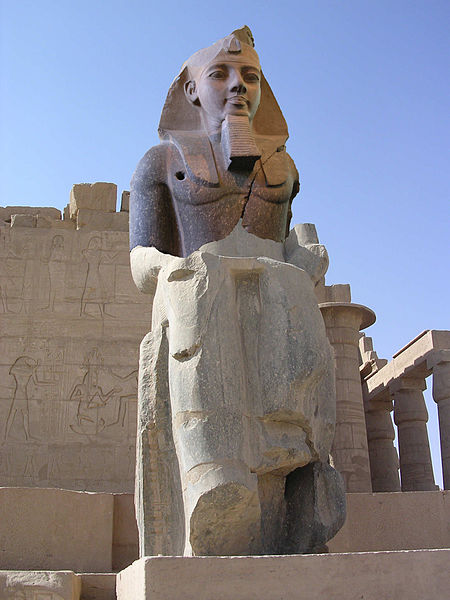
Still, the images of Ramses II seem to reflect the kind of image conscious, stubborn, and arrogant man Moses must have confronted (much different than Ikhneton’s):

Good evidence exists on both sides of this question.  Here is one interesting piece of ‘internal evidence’  on the historicity of the Exodus from Egypt itself that may recall the plagues and confirm parts of the Exodus narrative, the Ipuwer Papyrus, which has some possible parallels with the Exodus account, though it is important to stress the date of the papyrus is in great doubt, and may in fact precede the Exodus by at least 400 years):

1. The Plague of Blood as mentioned in Exodus 7: 14-25

Ipuwer 2:3 “Pestilence is throughout the land, blood is everywhere.”

Ipuwer 2:9 “The River (Nile) is Blood. Men shrink…and thirst after water.”

2. The Plague on Egyptian Livestock as found in Exodus 9: 1-7

Ipuwer 5:5 “All animals, their hearts weep. Cattle moan.”

3. The Plague of Hail and Fire as mentioned in Exodus 9: 22-26

Ipuwer 9:23 “The fire ran along the ground. There was hail, and fire mingled with the hail.”

Ipuwer 2:10 “Forsooth (Help Us), gates, columns, and walls are consumed by fire.”

4. The Plague of Locusts as mentioned in Exodus 10: 1-20 (possible allusion)

Ipuwer 6:1: “No fruit nor herbs are found…Oh, that the earth would cease from noise, and tumult (uproar) be no more.”

Ipuwer 4:14: “Trees are destroyed and the branches are stripped off.”

5. The Plague of Darkness as mentioned in Exodus 10: 21-29

Ipuwer 9:11 “The land is without light.”

6. The Plague on Egypt’s Firstborn in Exodus 12

Ipuwer 2:13 “He who places his brother in the ground is everywhere.”

Ipuwer 3:14 “Groaning is throughout the land, mingled with lamentations.”

Ipuwer 4:3 “Forsooth, the children of princes are dashed against the walls.”

Ipuwer 6:12 “€œForsooth, the children of the princes are cast out in the streets.”

7. Freeing of the Slaves and their Pillage of Egypt as seen in Exodus 12: 31-36

Ipuwer 1: “The plunderer is everywhere, and the servant takes what he finds.”€

Ipuwer 2: “Indeed, poor men have become wealthy.”

Ipuwer 3: “Gold, silver and jewels are fastened to the necks of female slaves.”€

Ipuwer 5: “Slaves (who have now been freed) are throughout the land.”

Ipuwer 10: “€œThe king’€™s storehouse has now become common property.”

And here is a good discussion of the evidence for and against various dates for the  Exodus, if you are interested.

Blesssings,

Dave

Telegraph, the Change

When you teach the same classes year after year as I have, one starts to realize that what seems like great material one year seems to fall flat in another. Many reasons exist for this, some of them obvious, such as whether or not you taught the lesson on a Tuesday or a Friday, or at the beginning or the end of the day. Sometimes more mysterious factors present themselves, such as whether or not you have a critical mass of students interested in the topic.

Thankfully, some things work even if you teach it last period on the day before Christmas vacation, such as Assyrian tortures with 8th grade boys, and the Kennedy-Nixon debates. I am always impressed how students, with very little context or introduction, immediately pick up that “somethin’ ain’t right” with Nixon–setting aside the infamous sweat on his lower lip.

What Nixon gets wrong has nothing to do with what he says. Students note, too, that the debate, while it suffers somewhat from the medium of television, has some actual substance to it from both candidates. The problem lies deeper, in the “atmosphere” around Nixon.

At times I think that Marshal McCluhan, for all his brilliance, sees everything as a nail, armed as he is with his significant insight into how the “medium is the message.” But his comments about this seminal debate in 1960 led me to following him down a rabbit hole of sorts, and wondering if our current cultural angst has its roots in transformation of our media landscape.

In a famous interview McCluhan describes the differences between what he calls “hot” and “cool” mediums, saying,

Basically, a hot medium excludes and a cool medium includes. Hot media are high in completion, and low in audience participation. Cool media are high in participation. A Hot medium extends a single sense with high definition . . . A photography for example, is “hot” whereas a rough sketch cartoon is “cool.” Radio is a hot medium because it sharply and intensely provides a great amount of high definition auditory information that leaves little or nothing to be filled in by the audience. A lecture is hot, a seminar is cool.

He continues by suggesting that television is not even a strictly visual medium. Its low definition (here we must remember that McCluhan is speaking around 1968. He might think differently about today’s “high definition” tv’s) means that we the audience have to be “drawn in.” Those who come across “hot” rather than “cool” will put off their audience. He continues

Kennedy was the first tv president . . . . TV is an inherently cool medium, and Kennedy had a compatible coolness and indifference to power, bred of personal wealth, which allowed him to adapt fully to tv. [Without this] any candidate will electrocute himself on television–as Richard Nixon did in his disastrous debates with Kennedy. Nixon was essentially hot, he presents a high-definition, sharply defined image . . . that contributed to his reputation as a phony. . . . He didn’t project the cool aura of disinterest and objectivity that Kennedy emanated so effortlessly and engagingly.

McCluhan’s analysis explains why those who listened to the debate on the radio gave the edge to Nixon. It has nothing per se to do with the content of their messages, but the medium itself.* Nixon’s earnest and direct manner worked much better on radio. McCluhan makes clear in the interview that the process of our interaction with this new media would transform western society–a society built upon the printing press.

I think McCluhan overstates his case a bit, but his analysis of media and culture have a great deal of explanatory power. I will try to present him as best as I can, starting with a long excerpt from the interview (slightly edited for clarity by myself–the ‘M’ is McCluhan):


M: Oral cultures act and react simultaneously, whereas the capacity to act without reacting, without involvement, is the special gift of literate man.  Another basic characteristic of [pre-modern] man is that he lived in a world of acoustic space, which gave him a radically different concept of space-time relationships.

Q: Was phonetic literacy alone responsible for this shift in values from tribal ‘involvement’ to civilized detachment?

M: Yes.  Any culture is an order of sensory preferences, and in the tribal world, the senses of touch, taste, smell, and hearing were more developed.  Into this world, the phonetic alphabet fell like a bombshell . . . literacy put the eye above all else.  Linear, visual values replaced an integral communal interplay.  The writing of the Egyptians, Chinese, and Mayan were an extension of multiple senses–they gave pictorial expression to reality and used many signs to cover a wide range of data.  The achievement of phonics demands the separation of both sight and sound from their semantic and dramatic meanings in order to render speech visually.  

As knowledge is extended in alphabetic form, it is localized and fragmented into specialities, creating divisions of function, classes, nations.   The rich interplay of the senses is sacrificed.

Q: But aren’t their corresponding gains in insight to compensate for the loss of tribal values?

M: Literacy . . . creates people who are less complex and diverse.  . . . But he is also given a tremendous advantage over non-literate man, who is hamstrung by cultural pluralism–values that make the African as easy a prey for the European colonialist as the barbarian was for the Greeks and Romans.  Only alphabetic cultures ever succeeded in mastering connected linear sequences as a means of social organization. 

Q: Isn’t the thrust of your argument then, that the introduction of the phonetic alphabet was not progress, but a psychic and social disaster?

M: It was both.  . . . the old Greek myth has Cadmus, who brought the alphabet to man, sowing dragons teeth that sprang up from the earth as armed men. The age of print, which held sway from 1500-1900, had its obituary tapped out by the telegraph, the first of the new electric media, and further obsequies were registered by the perception of curved space and non-Euclidean mathematics in the early years of the century, which revived [pre-modern] man’s discontinuous space-time concepts–and which even Spengler dimly perceived as the death-knell of Western literate values.  The development of tv, film, and the computer have driven further nails into the coffin.  It is tv that is primarily responsible for ending the visual supremacy that characterized all mechanical technology.  

Q: But isn’t TV primarily a visual medium?

M: No, quite the opposite.  . . . The TV image is a mosaic mesh not only of horizontal lines but of millions of tiny dots, of which the viewer is only able to pick out 50 or 60 from which he shapes the image; thus he is constantly bringing himself into involvement with the screen and acting out a creative dialog with the iconoscope, which tattoos its message directly onto our skins.  Each viewer is thus an unconscious pointilist painter, like Seurat.  

Q: How is tv reshaping our political institutions? 


M: For one thing, it is creating an entirely new type of national leader, a man who is much more a tribal chieftain than a politician. 

In his The Medium is the Message McCluhan quotes a poem of Yeats,

Locke sank into a swoon;

The garden died;

God took the spinning jenny

Out of his side

McCluhan sees the man’s interaction with media thusly:

  • Pre-literate man was essentially oral. He lived in an sensory integrated world, and an “immediate” world. He lived in a world he could cohere into a totality of experience. His sense of space-time, how he got his information, etc. came within an embodied context.
  • True–a few unusual people might have been merchants who traveled a lot, whose sense of time and space might have been somewhat different, but these people were rare, on the fringe of society.
  • The printing press both mechanized information and intensified how we received it, “assuring the eye a position of total dominance in man’s sensorium. . . . The schism between thought and action was institutionalized, and fragmented man, first sundered by the alphabet, was at last diced into bite-sized tidbits.”

Commenting on the poem above, McCluhan writes, “Yeats presents Locke, the philosopher of linear and mechanical association, as hypnotized by his own image, but the “garden” of unified consciousness had ended.”

“Literate Man,” as McCluhan names western man from 1500-1900, valued highly the detachment cultivated by textual interaction. Indeed–we have to detach ourselves to a degree to read at all. We see the values of literate man producing “detached” scientific exploration and experimentation, promoting distance, toleration, and a political transformation away from the directly personal monarchies to impersonal democratic republics. Perhaps we can say that such values peaked in the late 18th century. We begin to see with 19th century Romanticism a yearning for a more holistic way of life. McCluhan’s focus stays on media, with

  • The invention of the telegraph for McCluhan was the beginning of the end of “Literate Man,” a point he admits to borrowing from the enigmatic Oswald Spengler. The telegraph both began the process of altering our perception of time and space, and made information more direct and immediate, a feature of pre-literate experience.
  • The radio followed suit quickly, then tv, etc. We saw cultural conflict and disintegration in the 1960’s because television accelerated the process of a cultural transference away from literate man. Our educational system offered all of the values of literate man, a complete mismatch with the desire for holistic integration our interaction with modern media produces.**
  • Had McCluhan lived to see the internet (some say he clearly predicted it), he would likely say that such instantly available means of breaking down time and space might very well put the nails in the coffin of Literate Man and cause a deep cultural division. Indeed, McCluhan’s analysis can shed light on the division between Gen X–the last generation not raised with the internet–and Millennials, etc. Many under 30 today care little for the Literate Man values that helped found our country, i.e., rational debate, give and take, etc. They want a more integrated communal experience.^

Our current political struggle, then, pits not Republicans against Democrats–who knows what it means to be a Republican or Democrat anyway now?–but against literate/printing press man values of privacy, debate, and individualism vs. the tribal/internet man values of community and integrated life. We see this conflict running through different aspects of our society, such as in journalism. The old journalistic ethic taught that the reporter should cultivate distance and a degree of objectivity. The new school of reporting seeks engagement, communal change, etc.

McCluhan admitted that early in his career he saw the decline of “Literate Man” as a moral catastrophe, but by the late 1960’s he committed himself to trying to observe (ironically, perhaps, a quintessential Literate Man pose) and not attach value judgments to his preferences. But with an additional 50 years of perspective on the influence of new media, I think we should venture some conclusions about its impact.

I agree that no absolute moral difference exists between Printing Press Man and Integrated/Tribal Man. McCluhan’s focus on the telegraph makes one realize that the technological/cultural changes many of us think are 15-20 years in the making are really 150 years old. McCluhan points out rightly that the advent of the printing press, industrialization, etc. into traditional societies was at least in part “a psychic and social disaster.” But he put less attention on the switch back the other way–it too will be experienced as a “disaster” by Literate Man for society to go back to Integrated Man.

I agree too that something mysterious exists with our relationship to media, which includes not just radio and the internet, but all of the ways in which we seek to extend our being, including our clothes. A meshing of man and media leads to a switch in perception and how we act.

McCluhan rightly points out the many advantages of pre-modern societies. He saw us recapturing some of those values as our media landscape transformed. I wouldn’t mind a return of some pre-modern values. But contrary to McCluhan (if I understand him rightly), we don’t see these values returning. Or rather, we see them returning, but in a distorted way. No question, visiting a waterfall would be an “integrative” experience–sight, smell, touch, etc.–in ways that seeing the waterfall online would not. The continual availability of a fragmented online experience has not given us a holistic society but one where, according to some accounts, one in four young adults take some form of anti-depressant. McCluhan might say that this is exactly what we should expect when we ask kids to spend 7 hours a day in a detached, “Literate” environment when the media they use calls them to an entirely different way of life. I would perhaps argue that what we see now is a combination of

  • Literate Man reaching the end of its days, combined with
  • No good Integrated Man alternative available.

One can argue that there was an “Anti-Nature” strand in the history of Literate Man, with its extreme focus on linear thought and the eye. But so far, the new Integrated Man all in all shows no signs of actually wanting to create a holistic society. For example,

  • Many of the same environmentalists who want us to be closer to nature also tell us not to have children. But few other things are more “natural” than men and women getting married and having children. How can one speak of integration of our experience while excluding humanity from that experience?
  • Many advocates of an extreme individual fluidty/”rights” with their bodies (abortion, sexual differences, etc.) also are quite rigid about certain other areas around race, speech, etc.

Most all of us use the internet not as a tool of integration but escape. Television, in some ways at least, brought people together, i.e., we all watched “I Love Lucy,” “The Cosby Show,” and the Super Bowl.

Richard Rohlin noted that one can define conservatism simply as love of one’s parents. By that he meant our biological parents, but also our spiritual fathers, our culture, our past. We need not believe that our parents are perfect, or even particularly good. We love ourselves and hopefully know that we have deep flaws that need work, but we cannot build or change anything by starting with a void, a negative. America’s problem, as it relates to McCluhan, can be boiled down to

  • Conservatives should embrace tradition, but American “Conservatives” hearken back to a tradition of individually oriented, linear, and “cool” world. This is perhaps one reason why appeals to the past in American politics never quite seem to work, and only seem to further individualism.
  • Modern progressives seem to seek a more communal and holistic vision of society, which has the earmarks of “Tradition.” However, progressives tend to reject the past outright as at least a hindrane, if not something evil. They seek the impossibility of a traditional society constructed out of revolutionary ideology.

If neither vision can succeed, then our solution has to lie beyond adaptation or understanding of our new media. McCluhan shows us where we are better than most, but he can’t say where we need to go.

Dave

*McCluhan commented about Lyndon Johnson in a spot-on analysis . . . “[Johnson] botched [tv] in the same way that Nixon did in 1960. He was too intense, too obsessed with making his audience love and revere him as father and teacher. Johnson became a stereotype–even a parody–of himself, and earned the same reputation as a phony that plagued Nixon for so long. The people wouldn’t have cared about Kennedy lying to them on tv, but they couldn’t stomach Johnson even when he told them the truth.”

He also noted how Nixon rehabilitated his image by changing his tv demeanor, starting with his appearance on the Jack Parr show in 1963. “In the recent [1968] election,” he comments, “it was Nixon who was cool and Humphrey who was hot.” Correctly, he noticed in 1968 that this was a mask for Nixon. His presidency would prove this the case. If there is anything one can say about Nixon–he was not someone who “invited people in.”

**We see the maddening apotheosis of literate man in the form of the ultra-scholar who only seeks to point out facts, and never wants to commit to a conclusion, never wants to integrate his knowledge into anything cohesive or final. As for McCluhan’s point about “immediacy” and “participation,” think of the impact of television on the Civil Rights movement in the 1960’s. Everyone could see the images, the marches, and participate to a degree in the cultural moment.

^Note the stereotype of the detached, unengaged Gen X’er, with slacker anti-heroes, i.e., The Breakfast Club and Bill and Ted’s Excellent Adventure, etc. — very different movies, but with the same overall theme. Today’s heroes tend to be about “family”–think Amazon’s series The Expanse and the Fast and Furious franchise.

The Psychology of Encounters

As an author A.J. Toynbee could be controversial and intimidating.  His grand theories of the scope of history naturally had adherents and skeptics.  Toynbee repeated himself numerous times over the scope of his 12 volume magnum opus.  At times too, Toynbee’s “insights” seem like little more than average common sense, such as his observation that geography must present a challenge to encourage the development of a civilization.

But sometimes his insights, even if not earth-shattering, are nonetheless important to contemplate, and show their worth because of their applicability in different circumstances.  I have always thought that the book The World and the West a great entry point for those interested in Toynbee’s work.  My favorite chapter (the book is a collection of speeches given on a theme) is “The Psychology of Encounters” (available here for those interested).

His main point deals with how cultures interact with one another.  One of his arguments entails showing how when a culture gets transplanted into “non-native” soil, it may not “take” in the way it did so where originally planted.  He uses the rise of nationalism from the mid 19th-early 20th centuries.  The idea of nationalism grew up slowly and organically in England and France, and perhaps to a lesser extent in Russia.  But the exportation of this idea to other areas could have unintended and dangerous consequences.  I quote at length,

We can see why the same institution has had these strikingly different effects in these two different social environments. The institution of ‘national states’ has been comparatively harmless in western Europe for the same reason that accounts for its having originated there; and that is because, in western Europe, it corresponds to the local relation between the distribution of languages and the alignment of political frontiers. In western Europe, people speaking the same language happen, in most cases, to be huddled together in a single continuous and compact block of territory with a fairly well defined boundary separating it from the similarly compact domains of other languages; and, in a region where, as here, the languages are thus distributed in the pattern of a patchwork quilt, the language map provides a convenient basis for the political map, and ‘national states’ are therefore natural products of the social milieu. Most of the domains of the historic states of Western Europe do, in fact, coincide approximately with homogeneous patches of the language map; and this coincidence has come about, for the most part, undesignedly. The west European peoples have not been acutely conscious of the process by which their political containers have been moulded on linguistic lasts; and, accordingly, the spirit of nationalism has been, on the whole, easy-going in its west European homeland. In west European national states, linguistic minorities who have found themselves on the wrong side of a political frontier have in most cases shown loyalty, and been treated with consideration, because their coexistence with the majority speaking ‘the national language’ as fellow-citizens of the same commonwealth has been a historical fact which has therefore been taken for granted by everyone.

But now consider what has happened when this west European institution of ‘national states’, which in its birthplace has been a natural product of the local linguistic map, has been radiated abroad into regions in which the local language map is On a quite different pattern. When we look at a language map, not just of Western Europe, but of the world, we see that the local west European pattern, in which the languages are distributed in fairly clear-cut, compact, and homogeneous blocks, is something rather peculiar and exceptional. In the vastly larger area stretching south-eastward from Danzig and Trieste to Calcutta and Singapore, the pattern of the language map is not like a patchwork quilt; it is like a shot-silk robe. In eastern Europe, south-west Asia, India, and Malaya the speakers of different languages are not neatly sorted out from one another, as they are in western Europe; they are geographically intermingled in alternate houses on the same streets of the same towns and villages; and, in this different, and more normal, social setting, the language map—in which the threads of different colours are interwoven with each other—provides a convenient basis, not for the drawing of frontiers between states, but for the allocation of occupations and trades among individuals.

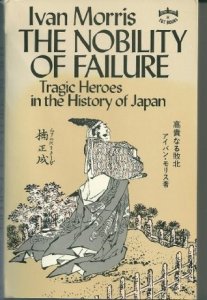
I thought of Toynbee’s insight when reading Ivan Morris’ excellent The Nobility of Failure.  In his book Morris examines the idea of the Japanese hero through mythology, folklore, and history.  By comparing various stories over two millennia a consistent picture emerges.

  • The hero must be sincerely dedicated and have a purity of devotion.
  • Japanese heroes often dedicate themselves to hopeless, or nearly hopeless causes.  The fact that the cause is relatively hopeless demonstrates his purity and sincerity.  That is, the cause itself is not particularly important — rather, the character of the hero takes center stage.
  • The Japanese hero invariably ends his life in a noble death, one that he himself controls and determines.  This death validates the purity of his cause.  We might assume that the method was always sepiku, the ritual disembowlment.  Not so, Morris explains.  Originally, ritual suicide was performed by slicing the carotid artery on the neck.  Sepiku probably became part of the samurai tradition because it is a much more painful form of death, one that allows for a greater demonstration of suffering and courage.

The last chapter naturally deals with the kamikaze attacks at the end of W.W. II.  Previous to W. W. II heroic status could only be attained by the aristocratic class & samurai class.  But Toynbee’s theory of the unpredictability of cultural transference applies in this case.  This transference on a cultural level can have the same kind of unpredictable detrimental effect as it can on the ecological level.  Think of the kudzu plant, which serves a good purpose in Japan’s unusual geography.  Transplant it to the southeastern U.S., however, and it will take over entire forests. Beginning in the mid-19th century Japan got exposed to western ideology, including obviously the idea of equality.  But what equality meant for Japan in this case became a horrifying kind of parody — now everyone can kill themselves and attain heroic status.

Hence the kamikaze pilots.  As Morris points out, the Japanese did not carry out these attacks primarily because they believed it would lead to victory.  No one really believed in victory by the end of 1944.  Such attacks, however, would certainly lead to the pilots achieving hero status in Japan.  They mimicked almost exactly the form and pattern laid down in Japan’s past.

Below I include various excerpts from Morris’ book.  Another quote from Toynbee illustrates the tragedy of Japan in W.W. II.

Since our discovery of the trick of splitting the atom, we have learned to our cost that the particles composing an atom of some inoffensive element cease to be innocuous and become dangerously corrosive so soon as they have been split off from the orderly society of particles of which an atom is constituted, and have been sent flying by themselves on independent careers of their own.

Excerpts from The Nobility of Failure

Testimonies of Kamikaze Pilots, 1944-45

If only we might fall

Like cherry blossoms in the Spring —

So pure and radiant!

  • Haiku by a kamikaze pilot in the ‘Seven Lives’ Unit, died Feb. 22, 1945, age 22. Kamikaze planes were called “Oka” bombs.  “Oka” is the Japanese word for “Cherry Blossom.”

“The purity of youth will issue in the divine wind.” [i.e., the “shimpu,” or “kamikaze.”]

  • Admiral Onishi, the probable originator of the “kamikaze” attacks.   He said to his officers, “Even if we are defeated, the noble spirit of the kamikaze attack corp will keep our homeland from ruin.  Without this spirit, ruin would surely follow defeat.  [The pilots] are already gods, without earthly desires.”

Beckoned to a chair, the young man [Lt. Seki] sat down facing us.  Commander Tamai patted him on the shoulder.  “Seki, Admiral Onishi himself has visited the 201st air group to present a plan of the greatest importance to Japan.  The plan is to crash-dive our Zero fighters, loaded with 250 kilogram bombs, into the ships of the enemy.  You are being considered to lead such an attack.  How do you feel about it?

There were tears in Tamai’s eyes as he spoke.

For a moment there was no answer.  Seki sat motionless, eyes closed, in deep thought.  Then calmly, raising his head, he said, “You absolutely must let me do it.”  There was not the slightest falter in his voice.

  • Lt. Seki was the first to lead a kamikaze squadron, and he successfully sank an escort carrier.

When it was clear that they understood my message [about forming a kamikaze squadron], I turned and said, “Anyone who wishes to volunteer for today’s sortie will raise his hand.”

The words were hardly spoken before every man raised his hand.  Several of them left their seats and pressed up against me, pleading, “Send me!  Please send me!”

I wheeled about and shouted, “Everyone wants to go.  Don’t be so selfish!”

[As the planes moved to the runway for takeoff] Lt. Nakano raised himself in the cockpit and shouted, “Commander Nakajima!”

Fearing that I had done something wrong I rushed over.  His face was wreathed in smiles as he called, “Thank you Commander!  Thank you very much for choosing me!”  I flagged him on with a vigorous wave of my arm, and other pilots shouted the same thing.  “Thank you!” they shouted.  I pretended not to hear these words, but they tore at my heart.

  • Official log of Capt. Nakajima

It is of no avail to express it now, but  in my 23 years of life I have worked out my own philosophy.  It leaves a bad taste in my mouth when I think of the deceits of the wily politicians upon the innocent population.  But I am willing to take orders from the high-command . . . because I believe in the beautiful polity of Japan.  

The Japanese way of life is indeed beautiful, and I am proud of it, as I am of Japanese history and mythology, which reflect the purity of our ancestors and our past.   And the living embodiment of all wonderful things in our past is the Imperial Family which, too, is the crystallization of the splendour and beauty of Japan and its people.  It is an honor to give my life for such beautiful and lofty things.

  • Last letter of Lt. Yamaguchi Teruo

Dear Parents:

Please congratulate me.  I have been given a splendid opportunity to die.  This destiny of our homeland hinges on the decisive battle in the seas to the south where I shall fall like a blossom from a radiant cherry tree.

How I appreciate this chance to die like a man!  . . . Thank you, my parents, for the years during which you have cared for me and inspired me.  I hope that in some small way this deed will repay you for what you have done.

  • From the last letter of Lt. Matsuo Isao

Never think of winning!

Thoughts of victory will only bring defeat.

When we lose, let us press forward, ever forward!

  • A popular kamikaze song

Cease your optimism,

Open your eyes,

People of Japan!

Japan is bound to be defeated.

It is then that we Japanese

Muse infuse into this land

A new life

A new road to restoration

Will be ours* to carve.

  • Last poem of a kamikaze pilot.  The “ours*” refers to the kamikaze pilots, whose death will plant the seeds of “new life.”

If by some strange chance, Japan should suddenly win this war, it would be a fatal misfortune for the future of the nation.  It will be better for our nation and people if they are tempered through real ordeals, which will serve to strengthen.

  • Sub. Lt. Okabe [?]

Listen carefully!  Imagine you have nothing in your hand but a pebble, and you need to take down a tree.  What is the best method?  To throw the pebble, or to take the pebble in your hand and strike it against the tree yourself?

  • Lt. Nagatsuka, last message to his parents.

Probably the most fearsome of all scenes took place on Saipan in 1944.  When organized military resistance became impossible soldiers  — some 3000 of them — armed with nothing but sticks came charging at the American concentrated machine-gun fire.   They were mowed down to the last man.   A particularly macabre note was provided by wounded Japanese soldiers who limped forward, bandages and all, to the slaughter.

Subsequently, entire units of Japanese soldiers knelt down in rows to be decapitated by their commanders, who then in turn committed ritual suicide.  Hundreds of others shot themselves in the head or, more commonly, exploded themselves with hand grenades.  As the marines advanced through the island they witnessed one mass suicide after another, culminating in the last terrible scene when Japanese civilians, including large numbers of women with children in their arms, hurled themselves off cliffs or rushed out into the sea to drown rather than risk capture.  

  • From Ivan Morris’ The Nobility of Failure

What Happens when Germans Go Nuts?

They make a rational, thoroughly scientific, argument for the existence of Atlantis, located in the Atlantic (right where Plato said it was) destroyed cataclysmically somewhere around 9000 B.C. (apologies to one of my favorite ad campaigns).

I have written before about the likelihood of advanced civilizations that existed long before their so-called beginning around 4000 B.C.  But it is so much easier to propound vague ideas then to make a concrete case for a specific civilization, let alone one for which we (seemingly) have no evidence for except Plato’s account in one of his dialogues.  And then you realize that one of the more credible arguments for the existence of Atlantis was written by Otto Muck . . . who invented the U-boat schnorkel for the Germans in W.W. II.  Yes, he came over to the U.S. like many other former German scientists after the war, but still, it does not help the case that he worked for the Nazis.

But first, Muck reminds us that Plato discussed Atlantis in two dialogues, not one, the Timaeus and Critias.  Plato has Socrates relate many myths throughout his work, but he speaks of Atlantis in strictly factual terms.  Like many others, I suppose, I had never actually read the full account of Atlantis in the dialogues and Muck makes a good point.  Plato, at least, seems to believe in the historicity of Atlantis, or certainly, Critias does, and he gives a lengthy description filling at least 15 pages of its size, location, topography, plants, and the like.  Critias talked about how the Greeks first learned of Atlantis from the Egyptians, still considered quite wise by the Greeks even in Plato’s day, via the great legislator Solon–Athens’ George Washington.  Plato invests a lot of heavy-hitters in his account of Atlantis.

It makes perfect sense to me to believe in a cataclysmic flood, as it is spoken of in every major religion of the ancient world.  I expect to find, along with Graham Hancock and others, the existence of civilizations that long predate the fertile crescent of 4000 B.C.  I delight in Jon Anthony West’s interpretation of Egypt’s history, for example, and find it persuasive.  But I cracked the cover of Muck’s book skeptically.  I don’t approach questions like this even primarily scientifically, let alone entirely so.  Still, with Atlantis, even I needed something to hold onto besides stories.  With other sites, you have megalithic architecture, for example.  For Atlantis, I need more than Plato’s account.

I give Muck credit.  He understands skepticism as a scientist and confronts head-on, piece by piece, in methodical fashion.  Some of what Muck wrote I found very intriguing, and other stuff, not so much.

To begin, Muck asks where the Atlantic ocean got its name.  Well, obviously from the Atlantis story, but this means very, very little.  Slightly more intriguing is Muck’s examination of the very similar phonetics between the god Atlas (apparently spelled out ‘Atlants’), who stood at the middle of the world upholding it, and the name “Atlantis” and its topography, which Plato tells us had a large mountain.  Well . . . ok, but . . . ?

He moves on.

If we look closely at Plato’s description of the topography he tells of a huge variety of plants and food that one could find there.  It seems almost fantastical. We assume the variety couldn’t really exist, given the size and location Plato mentions.  But if we consider the gulf stream moving across the Atlantic, then match it with the mountains described by Plato as well as the location, it matches.  You would have warm air from the south-east, with a large mountain in the center impacting the Arctic air, and the variety described by Plato is possible.  What makes this more intriguing is that Plato probably did not have the biological and topographical knowledge to make this up.

More interesting is the Gulf Stream itself.  If you compare latitudes for northwestern Europe and its overseas counterpart, you know that Europe is a lot warmer than the upper reaches of North America.  The Gulf Stream makes this possible.  But we also know that thousands of years ago Europe was much colder.  Then, around the time of Atlantis’ supposed destruction, it started to warm up.  What if the Gulf Stream did not always flow across to Europe, but instead was diverted by a continent in the middle of the ocean?  That could account for the temperature difference at first, and the shift after.

Perhaps the most bizarre, yet intriguing, argument Muck makes involves the habits of eels.

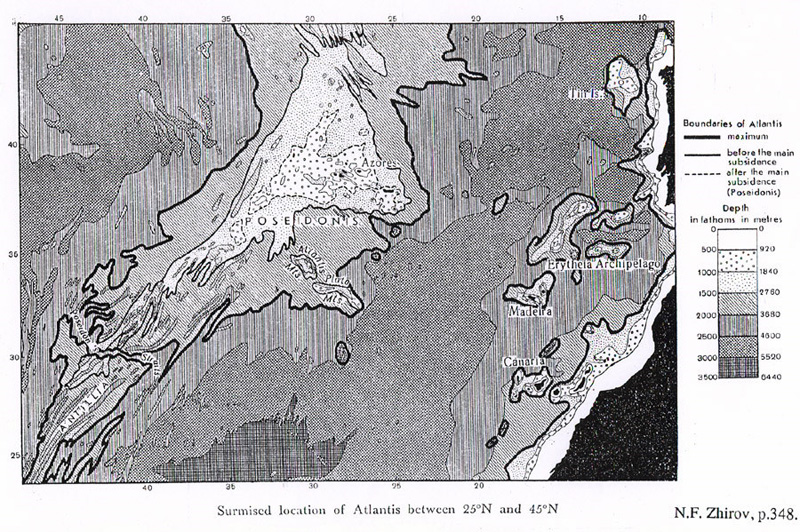
Apparently, a breed of eels exists that spawns in the Sargasso Sea (located just to the east of Atlantis on the map above).  For the longest time scientists could never understand why these eels undertook a long and dangerous migration across the Atlantic.  The females find European rivers, the males sit and wait in the ocean while the female eels fix their hair.  Ok, ok . . . observers discovered that the females can only come to sexual maturity in fresh water, hence their need for rivers.  But why travel east across the Atlantic.  It makes much more sense, from an evolutionary perspective and every other perspective, to go west from the Sargasoo.  The existence of Atlantis, however, would explain this.  For who knows how long the eels would go east for only a short distance from the Sargasso to the rivers of Atlantis.  The destruction of Atlantis did not alter their genetic memory.  They still swim east, and no doubt suppose that when they hit the coast of Europe they are back in Atlantis, more or less.

Plato considered Atlantis a bridge of sorts between land on either side of the ocean, and Muck explores some of the connections between the Americas and the world of Plato’s day.  He considers possible racial connections, considering that the typical look of the Basque people would fit well for a possible Atlantean type, since that “look” could fit in the western parts of Europe, north Africa, and Meso-America–the old sphere of Atlantean influence.  Muck makes you think hard throughout his work, but I think this the most ridiculous of Muck’s arguments.  Maybe I am just squeamish when an ex-Nazi helper-guy talks about race, but it seems that if the Atlantis story is true, 10,000 years of post-Atlantis destruction intermarriage would dilute the racial stock.

Perhaps more interesting are the ancient pyramids built by the Egyptians and Meso-Americans.  Muck seems to argue that both cultures acted as preservers of some kind of Atlantean legacy even thousands later in the post-apocalyptic reboot of civilization.  Perhaps the pyramid shape was meant to recall Atlas and Atlantis’ great mountain. This is more convincing than the racial argument, but I still think it fairly weak.  Both cultures built their structures thousands of years apart, and it seems they had different purposes in mind.  Muck’s earlier arguments about climate, topography, and the gulf stream stand on much more solid footing.  His analysis about the mapping of the ocean floor of the Atlantic indicates the possibility of an Atlantean like form still lying on the ocean floor.

As for the cataclysmic end, Muck has an answer for that as well.  Plato’s description has Atlantis lying right around the mid-Atlantic ridge, a potentially volcanic region.  The diagram below right shows the ridge shows the newest ocean floor crust in red:

Muck believes that a very large asteroid struck earth right around 9000 B.C., which matches remarkably with the chronology offered by Plato’s account.  Here is one of a variety of articles on the subject, with impact dates ranging between 10,000 to 13,000 years ago.  Some argue that this asteroid or comet struck the polar ice caps.  Muck argues that it struck somewhere around the mid-Atlantic ridge.  If Atlantis existed, and if a very large asteroid struck near the mid-atlantic ridge, you could easily have had a gigantically massive subterranean volcanic eruption that literally could have had Atlantis sink into the sea in a single night.

Muck doesn’t need the asteroid to hit the mid-Atlantic ridge necessarily.  If it did strike the polar ice-caps, it would have caused the destruction of Atlantis in a global deluge not overnight, but within a week or so at the most.

I have left out a great deal of technical information Muck includes, and must content myself with a general summary.

Muck knows he cannot absolutely prove his case one way or another.

I am a big fan of Jonathan Haidt’s work with Heterodox Academy, which encourages more ideological diversity on campus.  Haidt readily acknowledges his liberal beliefs–he has never voted Republican–but even he agrees that the situation has gotten dangerously imbalanced in many departments across many campuses.  He has discovered some interesting links, not surprisingly, between religious belief, psychological temperament, and political affiliations.  You can take various fun tests at his link here.

Just as political leanings often come from moral and religious beliefs, I think what one thinks of Muck’s book will depend on a variety of factors that go a bit deeper than the evidence itself.

If you look to disagree with Muck, most likely . . .

  • You are a committed ‘gradualist’ in all things geological
  • You are strictly scientific in deciding about the past and would hardly value Plato’s account as evidence of any kind.
  • You probably hesitate in part because you don’t want to be associated with various new age crazy people who believe in the existence of Atlantis for all the wrong reasons.
  • You need “hard” evidence like clay tablets, pots with markings, the stuff that archaeologists would find, before you would acquiesece to Muck

If you look to agree with Muck, most likely . . .

  • You are a contrarian by temperment
  • You weigh lots of different kinds of evidence much more equally than those committed to a particular field
  • You think it would be “cool” if Atlantis once existed (an attitude most abhorred by the strict scientific type, who would see this feeling as meaning absolutely nothing.  I think they are right, but only about 90% right in their approbation of this attitude).
  • You admit the possibility of great catastrophe’s altering the fabric of human history as well as geology.

I fall in the latter category, but hope that I have been fair to the former.  Again,some parts of Muck’s book I found nearly persuasive, and others not so much.

To illustrate some of the above differences, we can examine Jon Anthony West’s work in Egyptology.  He got famous/infamous for suggesting that erosion patterns on the Sphinx suggested that it was much older than was commonly believed, and was likely built by a civilization that predated Egypt perhaps by a thousands of years.  Dr. Robert Schoch, who earned his Ph.D in geology at Yale, analyzed the Sphinx and agreed with him.  You can see the video–narrated by Charlton Heston!:)–here.

When Schoch presented his findings at a conference, Egyptologists present could say little about the actual data he presented.  But one retorted, “Well, you say that the Sphinx was built thousands of years before, but if another civilization built it, where is the evidence?  Where are their tools?  Where is their writing?”  Schoch could only stare back rather dumbfounded. Hadn’t he just presented evidence in the form of the Sphinx?  Perhaps they did not accept the fact of the Sphinx itself as evidence because it did not fit into their preconceived notions of what constitutes evidence, which has to be in the form of writing, pottery, etc.  Of course, if a highly developed civilization did exist somewhere around 10,000 B.C., it would have suffered catastrophic collapse as a result of the asteroids that struck Earth around that time.  If they did have a written language and if they made pottery, it would have been washed away almost immediately.

We see how these different areas of belief work together.

So I say, let the Germans go nuts.  Let them make far-fetched claims.  It beats some other avenues they have taken in the past . . .

9th Grade: Egypt’s Desert Formation

Greetings to all,

I hope you have had a good week, and I hope too that you will enjoy the weekend before us.

This week we began our unit on Egypt, and first considered the influence of geography on the formation of their civilization.  I wanted to ask the following of the students:

1. What is the central feature of Egyptian geography, and why might this promote civilization?

2. What about Egyptian geography might influence it towards strong centralized government?

3. How might Egyptian geography have influenced their religion?

I do not believe geography exercises an absolute authority over humankind.  We are always left with choice & responsibility for those choices.  Having said that, we should not neglect the impact our surroundings may have upon us.  I do also stress to the students that the heart of any civilization is not its surroundings, resources, etc., but what it worships.  What a civilization worships is, in its turn, often reflected in its architecture.  With that in mind, I anticipate us taking a hard look at the pyramids next week.

When we think about Geography and its connections to Egypt, we noted the following:
1. The extremes of Egyptian geography: Only somewhere between 5-10% of their land was arable, but that land was some of the best farmland in the ancient world due to the yearly Nile floods.  Lush farm land backed right up against barren desert (as seen in the picture below).  This geographical tension probably produced psychological tension.  We see in Egypt, for example, the duality between the worship of almost any life whatsoever, and the reign of death just beyond.  The pictures of the Nile river valley below illustrate this stark contrast.
Nile River Valley
This tension had to be resolved in either a positive or negative way.  As time went by, death gained the upper hand.  Here is an early Egyptian poem that reflects this.  Some of these sentiments may ring true from a Christian perspective, and some lines resemble aspects of Biblical Wisdom literature. I think, however, that the overall imbalance towards death as an escape from the “claustrophobia” of life rather than a source of redemption is evident.
Egypt and Death: An Early Poem
To whom can I speak today?
One’s fellows are evil;
The friends of today do not love.
To whom can I speak today?
The gentle man has perished,
But the violent man has access to all.
To whom can I speak today?
No one remembers the past;
No one at this time does good in return for good.
Death stands before me today
Like the recovery of a sick man,
Like going outside after being confined.
Death stands before me today
Like the fragrance of myrrh,
Like sitting under the shade on a breezy day.
Death stands before me today
As a man longs to see his house,
After he has spent many years in captivity.
The Nile River valley had to serve as the center of Egyptian civilization, and in turn, we note that the Egyptians had an unusual inward focus.  They did not interact with many other peoples in the ancient near east.  Some geographies push people out of their settings, but we might imagine the Nile river as a giant vacuum, sucking everyone towards it.
  • The extremes may have led to Egypt’s focus on ‘Ma’at,’ or keeping things in balance. When one lives in between stark images of life and death constantly, it should not surprise us to see an inordinate focus on the concept of “balance.”  Keeping the order of things (ma’at) was the central job of the pharaoh, and of course this is a semi-divine task.  No problem per se for the Egyptians, as in their mind  the pharaoh’s were divine, or perhaps semi-divine, themselves.  When we look at the Exodus in a little bit we should keep in mind that among other things, God exposes Pharaoh’s complete inability to maintain “ma’at.”  God uses the plagues as a means to free His people, but also a message to the Egyptians to come join the Israelites.  Pharaoh’s inability to maintain harmony and balance gets decisively exposed.
  • The relative sameness and flatness of Egypt contributed to the political centralization of Egypt.  Egyptian society could not exist without fair and equitable distribution of the Nile floodwaters, and this would have required executive oversight.  But it may also have psychologically contributed to the eventual rigidity of thought that eventually overtook Egypt from about 1800 B.C. onward.

With this emphasis on Ma’at we get confronted with a very different way of thinking, and a very different set of priorities.  A president who wanted to look successful in his memoirs would probably highlight the great changes he brought to America.  In Egypt, Pharaoh’s “memoirs” focused on how they kept things exactly the same, in just the proper proportion (for those interested one can read this post on Ma’at and Pharaoh Userkaf).

Next week we began our look at Thutmose III and the Battle of Meggido.  We will continue that next week as well examine the Book of the Dead and the monotheistic Pharaoh Ikhneton.

Blessings,

Dave

9th Grade: An Introduction to Civilizations

Greetings,

I hope the school is going well for you and your family. Here is our first of many updates that I will send to parents and students throughout the year.

This class resets our four year cycle of our study of different time periods, which will culminate at the end of their senior year. At the beginning of any endeavor, it’s important to define the terms and the parameters for how we will examine the past.

We should understand the study of history as

  • The examination of human action,
  • Within the world God made, that God also inhabits (God is not just “up there” in Heaven but among and within us). There are some things that every human being that has ever lived has experienced in much the same way.
  • Within specific contexts of climate and geography.

I emphasized to the students that human choices do not happen in vaccuums, that context matters.

Romans 1 shows us that our experience of the world should help us know God, and we are left without excuse. Genesis 1 shows us world where things are distinct but also in harmony. We see

  • Darkness and Light
  • Water and Land, or the fluidity/change and order/stability
  • Rest and Work
  • Man and Woman

all in proper proportion. When we live rightly within these different elements of creation, we will flourish–the train is running on its tracks. When we venture beyond the red line on either side—we have too much change too rapidly, or too much emphasis on either men or women–we can expect to run aground rather quickly.

Before we move into the actual study of certain civilizations, I thought it appropriate to think of what we mean by the term ‘civilization,’ and what this might have to do with a Christian worldview.  I gave the students an example of a desert island divided into two halves.  Both halves have a government (a despotic king), religion (worship of a bloodthirsty god), laws and a way of life, (everyone pick up a stick and try and bash in the head of someone on the other side of the island).  They have a large enough group of people and a defined location, if one happens to believe that these are important criteria.

We discussed whether or not  this be could be termed ‘civilization.’  Even if it was a place where you would not want to live, was it ‘civilization?’  While I acknowledge that defining the concept is a bit slippery, in the end I think we can give a clear answer in the negative.

The definition I am using for civilization in this class is from historian Will Durant, who stated that civilization is, “Social order that promotes cultural creation.”  Life on our hypothetical island could not allow for ‘cultural creation.’ No buildings could be built, no books written, not even advances in weaponry could be made if everyone’s daily life consisted entirely of sleeping, eating, and fighting.

I believe the definition we are using is a good one because human society should help us live out what it means to be made in God’s image.  The first thing we see about God is that He creates.  A society that did not allow for human creation would deny a fundamental tenet of what it means to be human. Being made in God’s image means many things, but surely it must include something of what J.R.R. Tolkien called ‘sub-creation’ on our part.   If we look back on the island example, is the life lived there really human life?  Even beavers build dams, and otters make water slides for themselves.  Living just to eat, sleep, and fight would put us below many animals.

This week we also looked at the basic elements of all civilizations.  What purpose do civilizations serve, and how do they function?  Ultimately, civilizations exist to provide a means of human interaction, a structure that allows us to live out God’s image and call on our lives.  While none of the civilizations we will study will be ‘Christian’ civilizations (if such a thing is even possible), the closer one gets to this goal, the better off people are.  While we may not need civilizations per se, we do need each other.  God Himself is a kind of Community (Father, Son, Holy Spirit) and as we are created in His image, so too we need to live in community with one another to make us fully human.

We examined what I call the Five Elements of Civilization:

Geography

Suppose that you and your friends wish to do something together.  You would need to agree on a location to meet.  For there to be profitable human interaction, we need a defined physical space to do so.  Obviously, the geography must provide a minimum of food, water, etc. for civilization to exist.  But as we discussed, ideal geographies do not tend to foster civilizations.  When things are too easy, we never need to learn, invent, or progress.  Historically speaking, we need a challenge to thrive.  On the flip side, some geographies present such an extraordinary challenge that man’s nearly heroic adaptation to them binds them into such narrow confines as to stunt the growth of civilizations (one might think of desert nomads or Eskimo peoples in the Arctic).

Over the course of the year we will see the subtle influence of geography on the way people live.

Economics

No one can be completely self-sufficient. “No man is an island.”  We neither know all or can do all things well.  We need others to help us, but also need to have a means of exchanging goods and services fairly so these beneficial trades can take place.

A strict barter economy makes perfect sense.  I have apples, you have wood.  If we trade we both get something we easily know to have a direct value.  With one I can build a house, with the other I can avoid hunger.  Barter economies have the great advantage of simplicity, but the great burden of a complete lack of flexibility.  Imagine doing your weekly shopping, having to load up the wagon with bushels of grain, a few pigs, etc.  Then, you can only get what you need in return only if someone needs what you have.

A money economy helps solve some of these problems, and money began with precious metals.  But who made the first exchange of a shiny metal for a bushel of wheat?  You cannot eat, wear, or live in shiny metal.  The same is true of paper money.  In itself, it’s only a piece of paper.  You could write on it, or perhaps burn it for a few seconds of heat.  The money has value not for anything in itself, but because of our agreed upon belief about what it represents. Hence, the link between the health of our economy and the trust we place in our government and those around us.

A good economy will foster helpful and just exchanges of goods and services, which in turn fosters honoring social interaction.

Politics

Or — what I call the outward structure of civilization.  We need an agreed upon way of making decisions, and we need to know what is expected of us.  For example, we must decide if we are to drive on the right hand side or the left, or no one would drive at all.  We must also have an agreed upon way of deciding what side of the road we drive on, or nothing can ever get accomplished.

Laws serve a good purpose if they help grow helpful interaction between people.  They oppress if they stifle such social interaction.

Religion

Or – what I call the inward structure of civilization.  Since no one can write a law code that covers every situation, if we are to interact with others successfully we need a strong set of unwritten rules that everyone follows.  If someone cuts in line at the grocery store, we do not have the option of calling the police, for example.  This unwritten code comes ultimately from our religious beliefs.  We don’t cut in line in the final analysis because we believe in Justice.

I encouraged the class to think about religion more broadly than just what happens on ‘Sunday,’ in a given civilization.  As Jesus said, “Where your treasure is, there your heart will be also,” or to put it another way, “You are what you worship.”

Religion is in a broad sense what we give ourselves to truly, not merely our lip service.  A society might outwardly worship God, gods, or possibly even ideals and values like freedom, and so on.  Everyone worships something, and we cannot help but be conformed to the object of our worship.  This ultimate devotion becomes the main spring of our values.

Many modern historians often make materialistic arguments for the origin of civilization.  They will say things such as, “When river valley ‘x’ began to dry up the people came together to maximize their food input and begin to specialize.  From this early social organization governments arose, and then these governments codified religious belief to enforce their power.”

And so on, and so on.

I entirely disagree with these kinds of explanations, at least as the primary explanatory concept.  Such theories completely misunderstand human nature.  Why do relationships happen?  We do not enter into a relationship with people based on the need to survive.  We are made for relationship (“It is not good for man to be alone”).  We are drawn together by our common loves, by our common worship.  We were made for worship, and this is why religion forms the heart of any civilization.

Culture

In the narrow sense, culture is what we do with our free time.  A person’s hobbies are often a better insight into who they are than their jobs.   In a broader sense, culture is about how we interact with God’s creation, and how we outwardly express our inner values and strengths.  Broadly then, culture speaks to our values, and a bit more narrowly, culture is that which makes life enjoyable (reading books, playing games, etc.), and sets us apart from the rest of creation.

Of course every culture can and should have room for purely “fun” activities, but ideally our recreation truly engages in “re-creation,” whereby we image the God who creates.

My goal through all this was to try and show how each element is not an island, but impacts other areas.  These elements are interconnected and depend on one another. For example, I asked the students to think about American culture, and clearly, we value sports very highly. We put a great deal of time, attention, and money into sports. What might this say about us, and what might be the connections to other areas of our society?

Some students suggested that it means that we love competition, and I thought this an excellent insight. Indeed, we see competition baked into our political system (candidates compete for votes against each other), and our economic system as well. Some of you may be old enough to remember Hechinger hardware stores, and Crown Books, both of whom lost out in competition with other companies. These are just the kind of connections I want students to make. Well done!

Next week we will begin looking at actual civilizations, and begin applying this theoretical interpretative model to reality.  We will begin to look for the patterns and truths that history reveals to us.  Below I include the famous set of paintings by Thomas Cole called The Course of Empire.  I do not necessarily agree with everything regarding Cole’s interpretation of history, but it is a wonderful visual image of a thought provoking theory, from a civilization’s beginning to its end.

Thank you again for all your support.

Blessings,

Dave Mathwin

The Jazz Age

Some no doubt find themselves enormously annoyed at the rise of flat earth ideas. I find flat earth theories fascinating, though in no way do I profess belief in a scientifically measurable flat earth. The Earth is round. But, I confess, I would find it hilariously fun if indeed the Earth was physically flat, probably because I am not a scientist.

I find the recent appearance of these ideas intriguing not because I find them convincing, but because of what it says about our cultural moment. In other words, the “physical” part of what flat-earthers say might amount to nothing. The fact that they say it, and that many seem to agree, surely evidences a general weakening of the center in our culture–a signal amidst the noise. We no longer trust even the most basic of assumed narratives.

Traditional authorities and traditional ways of creating meaning in our culture no longer work. Many loaded criticism onto the CDC for how they handled COVID. I have no great love for the CDC, but one could view them not as the main character in a tragedy, but almost as a minor player in a much larger narrative. This breakdown of trust in the central narrative has happened in other areas as well, in elections, in the media in general, and so on.

But, while I have a large amount of trust that we live on a round earth, we all know that experientially we live on a flat earth most of the time. We do not experience the rotation of the earth–we see the sun move. Our senses are not lying to us. Here the bare facts of the Earth’s rotation matters much less than our experienced reality. Our experience shapes reality more so than the other way round.

On his Marginal Revolution blog Tyler Cowen posted an amusing link to every problem laid at the feet of jazz in the 1920’s and 30’s. If one takes the time to peruse, we see jazz blamed for

  • Warts
  • Small family sizes
  • Indigestion
  • Difficulties in college athletics

and so on. The natural reaction for us moderns typically involves a bemused smile at the obtuseness of panicky fools in the past. Perhaps we imagine that we ourselves would never react in such a way. The key here for historians at least, involves seeing if any signals exist amidst this mishmash of chatter.*

Most every western culture experienced profound shifts after W.W. I. One can argue that such changes had their roots in developments decades earlier, in the Industrial Revolution, or centuries earlier with the Scientific Revolution and the Enlightenment. One can go back further if you want. Making connections like this has its place, but we also need to separate, to delineate, as well as join together. Acknowledging the myriad of forces that drive change, we should ask if Jazz in the 20’s and 30’s stands out in any particular way.

Many have remarked how W.W. I destroyed the last vestiges of aristocracy in Europe, both physically and culturally/spiritually. This brought about more democracy politically, but perhaps more importantly, also culturally. Now the “bottom,” or “low” culture would have more prominence. I do not use these terms in a derogatory way. High and Low culture both have their place–the question involves what place, exactly. Perhaps one could argue that

  • Beethoven (maybe Mozart?) helped start this downward movement by using emotional themes and motifs heavily starting in the middle of his career. This has significance because of the place of emotions in the structure of the body, which reflects in certain respects the structure of the cosmos. Appealing to the emotions meant appealing to our bellies, what lays “lower” in our being.
  • With Franz Liszt, we see a mixture of high and low culture (‘high’ skill with ‘low’ folk motifs) with a ‘low’ reaction to him (ladies swoon and scream–he’s a rock star).
  • At the turn of the century Mahler (whose music I neither like nor understand, so take this with salt) completes the destruction of the classical forms, paving the way for something else. Maybe Stravinsky’s Rite of Spring worked in a similar way upon the world.

The visual arts mirror this trend in music, starting with Turner as early impressionism, down to Monet, Van Gogh, and then finally Duchamp’s Nude Descending a Staircase

Joseph Mallord William Turner (British, London 1775–1851 London) The Lake of Zug, 1843 British, Watercolor over graphite; 11 3/4 x 18
Nude Descending a Staircase

This progression towards less fixed form and more loose, popular expression up until W.W I certainly took place, but the dam had not burst, so to speak, however many cracks any perceptive observer might have noted at the time.

But with the breakout of jazz and swing. suddenly popular, “low” culture became the dominant culture, flipping things from a top-down/old-to-young to the reverse. Now the young grabbed the throne, and culture obligingly followed. The manic way people took to this new form should indicate that something was not quite right. Clearly, something happened in how we viewed the world, something throttled us, in a sense, and made us into something new.

Marshal McLuhan has the fascinating idea that the switch to electricity primarily drove this change, which began in earnest just before W.W. I. His complex argument can get boiled down to his belief that

  • The culture of ‘printing press’ man would lend itself to a filtered experience of the world. We gained the ability to separate our experiences in a detached way. For example, any selection from Bach’s Well Tempered Clavier has emotional content, but that comes later in the listening experience and not right away.
  • The electric age would thrust western man back in time, to a more tribal mode of culture, where sensory experience integrates and brings everything “all at once.”
  • Whichever culture we prefer, this sort of culture will not facilitate the “cool” detachment needed in a linear print culture. We would now run “hot,” experiencing culture When listening to, for example, James Brown, the impact is immediate, and does not lend itself to analysis as does Bach.

Again, whether one regards this shift as good, bad, or indifferent, it represents a massive psychic shift in perception, which would lead to a new way of life.

I do not suggest that we should adopt McCluhan’s thoughts whole hog. Exploring religious factors would also yield interesting results. But culture stands right next to religion, and I find his lens a good one. The music of jazz, appearing right at the advent of radio and electricity, fits into this shift. The experience of early swing music at least has an immediacy, and totality of effect.

The linked post from Marginal Revolution about the impacts of jazz show lack of thought, some stabs in the dark, and some panic. But those early worry-warts had an intuitive insight–they knew that something big was afoot that would alter everything.

In its modern incarnation, democracy arose from the pinnacle of the print age in the late 18th century. Our political practice, and our rights, such as freedom of speech, require a certain amount of practiced detachment. This posture now runs in short supply in certain aspects of our culture, and we may soon experience a seismic shift akin to what took place in the 20’s and 30’s. So, when we poke fun at the past and assume our own superiority, we should pause. Our modern world might resemble chickens without their heads soon enough. If the bare facts don’t tell that story, our experience might. Historians should look in both places.

Dave

*None of what follows should be seen as disparaging to jazz. It is one of my favorite musical genres. I regard Count Basie (more than Louie Armstrong or Miles Davis, though obviously they are all magnificent), as one of the great emblems of American culture of the 20th century. No one managed such a distinctive, punchy, groove for longer. Miles Davis had more intellectual inventiveness, and John Coltrane played with more rich emotion. Neither of them have nearly as much fun as Count Basie. Likewise, Basie could never be considered the best piano player, and maybe not even a “great” piano player (though I would say so, but admittedly in a certain sense of the term). But he was always the most fun, as this little moment at the 4:05 mark attests.

Just War as Christian Discipleship

Methodical.  Inexorable.  Annoying, sometimes provoking, and yet, ultimately convincing and convicting.  All these words sum up my 1441206817reaction Daniel Bell’s important book on the Christian just war tradition.

First the bad:

Bell could have used a better editor, and bears the hallmarks of a first book from the author.  He slides all too often into a repetitive and heavy didactic style, and uses paragraphs chock full of rhetorical questions that pile onto one another.  Not as bad as Mr. Chadband from Bleak House, but I might parody this habit of Bell’s thusly:

“And what are we to make of the Gadsden flag motto (used by Marines) “Don’t Tread on Me?”  Does it express a sentiment in line with the sacrificial love of Christ?  Does it encourage a transformative view of suffering?  Would such an attitude lead to just warriors?  What kind of motto’s should our soldiers use?  Is the church ready to inform the military about such things?”

So this was wearisome.

Bell also never applies his ideas to any particular conflict, which seems too easy for me.  Bell espouses some controversial ideas, but I wish he stuck his neck out a bit more and applied his thinking to some actual wars.  Granted, the reader can do this for himself, but Bell should have guided the reader a bit more in the interpretation of his ideas.

Despite these weaknesses, the book reminds us that the Church, nations, and militaries have almost completely lost touch with Christian concepts of “Just War” theory and practice.   Bell’s book does not condemn war outright.  Rather, he seeks to completely reframe the way we examine the issue, which may explain why both pacifist theologians and military chaplains have endorsed his work.

Speaking from a “Just War” tradition within the Church has its limitations.  Rarely did any accomplished theologian comment on the issue at length.  The Church’s most powerful voices on the topic, St. Augustine, and St. Thomas Aquinas, dealt with just war theory only in an in ad-hoc fashion.  Bell points out, however, that while the Church had few official individual voices on the topic, an agreed upon understanding more or less existed from the early days right up until the modern era around the 17th century.  Thus, Christians have access not just to Scripture, but also to an authoritative history of understanding of just war, what I will refer to as “The Tradition” in the rest of this post.

Bell’s main argument centers around his assertion that waging “Just War” has much more do with sanctification than a checklist of criteria that then give us justification to act as we please.  To fight justly means fighting as a Christian, with love for one’s neighbor and one’s enemy.  Fighting justly means not seeking to maximize personal well-being, or national safety, but working for the good of others.  Bell rejects pacifism.  There are times when acting faithfully might mean using force to achieve just ends.  But Bell argues well that if we cannot apply the central truths of the gospel message in how and when we fight, we have no business fighting at all.

This has many implications for us.

Self Defense

Modern understandings of just war often primarily focus on personal self-defense, or defending property, or maintaining a “way of life.”  But this approach puts ourselves, or our nation, before others.  Thus, “self-defense” can thinly disguise selfishness. As Augustine stated, “Christians should rather be killed than kill, rather suffer harm than harm others.”  Charity must prevail even under dire circumstances.

But as happens so often in this book, when you think Bell resolves the issue it deepens.  Christians can fight to defend others, particularly those who cannot defend themselves.  Christians can put others first by risking their own well-being to serve others.

If we wonder how we tell the difference between defense of self and others, Bell sympathizes.  The Tradition gives us no formula, no checklist, and this flows directly from the gospel itself.  For example, no checklist can tell you when you love your wife.  A husband cannot say, “I bought her flowers and watched the movie she wanted to see.  Therefore, I love her, and she should know I love her as long as I continue to do those things.”

What really guides the practice of Just War is not a list but just warriors themselves, who apply the gospel ethic to their situation.  This lack of black and white guidance may frustrate us at times, but Bell fears that the checklist mentality will give us carte blanche to do as we please once “the enemy” meets certain conditions.  I remember an anecdote about an ex-boxer bothered by a drunk. The drunk hit the boxer a few times, and the boxer responded, “The Lord told me to turn one cheek, and then the other.  He said nothing about a third time,” and proceeded to whale away on the unfortunate man.

The Purpose of War

From General Sherman we get the modern view that, “War is all hell.”  Those that follow Sherman believe that war remains essentially irredeemable, and making war as short as possible forms much of our strategy as to how we fight.

The Tradition offers another perspective.  In one sense we must treat fighting a war like any other activity.  We fight wars that we might grow in holiness, that we would grow closer to God.  For Christians war should develop the fruits of the Spirit.  If it can’t we have no business in it.

This may mean exercising patience.  It may mean that we fight in such a way where we give up physical advantages because of the moral problems that may result from our use of these advantages.  If we maximize the pain and suffering of our enemy in such a way that minimizes our own, we cannot claim to be just warriors following the call of Christ.

When We Fight

Following Christ means exercising charity towards one’s enemy, and charity requires us to give every reasonable chance to settle differences without violence through diplomatic pursuits.  We can use violence only when we know we have given other measures a fair try.  This raises questions about the impact of a large, professional, full-time standing army.  German theologian Karl Barth (no pacifist) argued that standing armies make it much easier for states to go to war than it should be.  Having an army always ready strongly tempts nations to use it much quicker than they ought.

We might reasonably ask whether or not one can exercise love and charity and kill another human being.  The Tradition says yes.  Justice can never rise to the dignity of the word if it stands separate from love.  “The Lord disciplines those He loves.”  Using force against another could be an act of charity.  You may be preventing them doing evil. Your “discipline” might move them to repentance.  Of course, once a person dies they cannot repent.  So the Tradition states that while we may at times use force, we must try not to kill our adversaries if we can avoid it.  Again Bell urges us to abandon the checklist in favor of Christ-like character.  Sometimes a just warrior may kill, but this killing must serve the gospel for the world and, crucially ourselves.  We cannot sacrifice our own souls or our own humanity in war.  One thinks, for example, of Joan of Arc, weeping over the English dead and praying over their wounded after a battle.

This might reduce the effectiveness of the military.  But it would be grossly uncharitable for us to urge that the military de-humanize itself and stand outside the Tradition so that we may be safer.  And–a dehumanized military would not serve us well in the long run anyway, and perhaps might even pose a threat to us.

Bell’s calls us all to own the call of “Just War.”  The military draws its direction from society, so the public must practice just policies if we want our military to do the same.  Again, the “just war” lifestyle is nothing less a Christian lifestyle, and we are all called to this.

In light of the witness of the Tradition, we have much to consider from not only our history (Sherman’s march through the South, carpet bombing in W.W. II, etc.) but also our current practice.  We already have extensive moral failures in how we use drones.  We waterboard but use the “checklist” mentality and avoid calling it torture.   The Guardian reports that we get doctors to harm prisoners by a perverse use of semantics.  The full articles is here, but the pertinent quote from it might be,

“Medical professionals were in effect told that their ethical mantra “first do no harm” did not apply, because they were not treating people who were ill.”

This does not mean that soldiers sin more than the rest of us.  Rather, soldiers sin in the same spiteful and selfish ways as all of us.  And this is part of the point Bell tries to make.  Fighting involves the application of our Christian faith just as much as teaching Sunday school.  Whatever, our problems as nation, whatever issues we have in the military,  all of us own them.

Bell touches on other topics, but at its core, the Tradition calls us back to our primary allegiance to Christ, not victory, the “mission,” expediency, country or tribe.  If our main concern is the salvation of our soul and the spread of His Kingdom, we will view war very differently than we do currently.  We may need to reevaluate why, when, and how we fight.  We may need to adopt the practice of  stepping outside our national context and ask if our side even represents justice in the first place.  This is what makes Bell’s book so necessary for us, and so difficult to accept.  As the Catholic theologian Jacques Maritain wrote,

We have no illusions about the misery of human nature.  But we have no illusions, either, about the pseudo-realists who cultivate and exalt evil in order to fight against evil, and who consider the gospel a decorative myth that we could not take seriously without throwing the machinery of the world out of order.

The Red Pants of France

Barbara Tuchmann’s The Guns of August discusses the controversies, dilemmas, and human drama in the days leading up to World War I. She puts a special focus on the war plans developed by France and Germany in the years leading up to the war. The two plans reflect much about the two nations. Germany’s Schliefflin Plan

  • Relied heavily on rail transport with precision timetables
  • Relied heavily on heavy artillery and all of the other goodies of industrialization
  • Involved violating Belgian neutrality, but no matter–the winner would determine the post-war narrative, and they had to go through Belgium to make their plan work.

France’s Plan 17 relied

  • Heavily on initiative in the field for individual commanders, with the emphasis on attack
  • Much more than Germany on the human element, “men win wars, not machines,” and so on–what the French called “elan.”
  • They eschewed heavy artillery, feeling that it would slow their men down and give them a dependent mindset.

Both sides had perfect awareness of the other’s plans, and both thought the strategic situation favored their own side. The French, with their army in red pants, hearkened back to an older time. Some called for the uniforms to be replaced with a more drab color less visible on the spectrum. The French general staff refused absolutely. The red pants embodied the spirit and will of the army, a refusal to bend to the industrial spirit of the age.

Alas, German organization, artillery, and precision destroyed the French army in first weeks of the war, inflicting at least 250,000 casualties. France had to adjust, and while they managed to stave off disaster at the Battle of the Marne, the dash and the human initiative would fade away just like the red pants. They too brought out heavy guns and “succumbed” to the Germany way.

As events unfolded, both sides ended up digging into the ground for what became known as Trench Warfare, which characterized the fighting in the western front right through 1918. Historians usually offer a variety of explanations for this unusual development–neither previous or future wars would ever use trenches so completely.

  • Some focus on the significant imbalance between defense and offense that existed between the western powers. Heavy weaponry for the most part had little mobility at this time, which limited offensive capability and gave an enormous advantage to the defensive.
  • Some focus on the narrow geography between the German and French borders, which meant an extreme concentration of men and machines. More space on the Eastern Front, for example, meant some more mobility and much less trench digging.

These explanations have merit but I think miss the larger picture.

The triumph of the metric system presaged military developments in World War I. The old systems of measurements had its roots in human experience and proportion, i.e., the “foot.” or the “stone” (about 14 pounds), which would be local and based on the weight of an actual stone in a particular town or region. The new system greatly maximized standardization, minimizing locality, and made it easier to count, measure, multiply, and so on. In other words, the new system granted one more power.* The Industrial Revolution continued this standardization, which naturally granted increased power to produce goods on a mass scale

But all of this power came from literally digging into the earth to obtain the necessary raw materials for the engines of industry and war. As industrialization reached its peak manifestation, the soldiers too dug into the earth. Perhaps the eastern theater of war saw less trench warfare because it had less industrialization. It seems a curious symmetry exists between the birth of the modern war machine and trench warfare, and we should endeavor to explain it. In other words, the creation of industrialization (digging into the earth), and its apotheosis (trench warfare) mirror each other (in the picture of the soldiers above, change the uniforms and the men could look exactly like miners). For Europe, World War I ended the belief in the inevitable progress of mankind, represented by science/industrialization and democracy. One can easily argue that science and democracy (in the form of mass media, mass mobilization, and mass production) made the war much more deadly than any previous conflict.

We can begin by noting the symmetry between birth and death. Interestingly, many ancient cultures buried people in the fetal position, linking birth and death in a circle, which I discussed here.

Perhaps this should not surprise us, as birth and death have something of a symbiosis.

We see a similar symmetry in rock music. I grew up partially in the Grunge Era. I took great delight in the transition from 80’s pop to Nirvana and Soundgarden. But anyone who reflects for a moment should see something odd going on with music in the 1990’s. In his excellent book on that decade, Chuck Klosterman made two keen observations:

  • The grunge attitude and aesthetic brought about the end of rock and roll. The whole foundation of rock music involved stardom, mass appeal, etc. Grunge artists had massive success while deriding, mocking, and hating that success, a kind of matter-anti-matter collision. In this sense, Kurt Cobain’s tragic suicide** can be seen as a harbinger, a death-knell for the genre as a whole. In many ways, the power that comes with stardom brings not life, but a kind of death, just as the power granted by industrialization ushered in an era of millions of deaths in war.
  • What was with the litany of songs with large portions of lyrics devoted either to nonsense, mere sounds, or garbled unintelligibility?

We’ll get to that list momentarily. We saw something similar at the birth of rock and roll in the late 50’s-early 60’s, in the form of a variety of songs with nonsense/unintelligible lyrics that made their way into the American psyche.

All of these songs share the exuberance that characterizes the birth of an era. The nonsense, the invented sounds, reminds one of little kids discovering their mouths for the first time.

In the 90’s you have Klosterman’s list of songs with nonsensical and unintelligible lyrics. But this time, the tenor, and atmosphere of the songs embrace not the excitement of new life but chaos, meaninglessness, and death.

  • Of course, Nirvana’s “Smells Like Teen Spirit,” with Weird Al parodying the song’s unintelligibility.
  • Blur’s “Beetlebum,” and “Song 2.” “Song 2” has a something of exuberance in it, but the video clearly shows it is the excitement of destruction, not creation. No coincidence then, that Paul Veerhoven used this song to promote his movie Starship Troopers, which parodied the meaninglessness of fascistic violence.
  • Trio’s “Da Da Da.” Volkswagen used the song expertly to hint at the banality of life for young men. Leave it to the Germans, I suppose.
  • Basement Jaxx’s “Bingo Bango.” Yes, the song has an upbeat mood to it, but the video hints at disorienting chaos.
  • “Mmmmm Mmmmmm Mmmmmm” by the Crash Test Dummies. The song has beauty, but it is the beauty of an elegy. The group’s other hit, “Coffee Spoons and Afternoons” talks about receding hairlines, hospitals, drinking coffee in the afternoon wearing pajamas–not exactly the stuff of birth.
  • At first glance, Hanson’s “Mmmmbop” may seem to have the stuff of “life” embedded within, but after listening for about 90 seconds, thoughts of anger, hatred, and despair flood one’s being. The song is hypnotically annoying/infuriating.

The end of rock music mirrored its beginning, but the mirror has cracks.

Historians date the birth of the modern state at different points. One can trace the beginnings in the later Renaissance, and things look more clear at the Peace of Westphalia in 1648. But to see the state as we know it, with its bureaucracy, centralization, uniformity of law, and military organization, we have to look at Napoleon. We have a fascination with Napoleon for good reason–undoubtedly he embodied something romantic, something of promise, in his early years.

But 100 years later, that civilization, while having much more power at its disposal, actually approaches its death–a variety of historians (Niall Ferguson, Oswald Spengler) see World War I as the end of the west. Certainly at least, Europe–the core of western civilization– has never recovered from that conflict. Western civilization’s power and identity had its start with going into the earth in hope that its raw materials would give us power to establish Kant’s dream of perpetual peace. It ended differently.

Dave

*A variety of people have pointed out this connection between counting, numbering, and power. This may be why King David suffered such a strong rebuke when he took a census in Israel. He tried to count “excessively,” i.e., he tried to consolidate power inappropriately at the end of his reign.

**In an interview with Vulture magazine, Klosterman commented,

What is so profound about Nirvana is that the relationship ended up becoming real. The song “I Hate Myself and Want to Die.” The idea that a person who writes that song also does commit suicide — that is so on the nose. People would say things like, “If that guy hates fame so much, why doesn’t he just stop?” We did not fully believe that Kurt Cobain was actually unhappy. And then when he killed himself, it made that music suddenly weirdly true.

He was presenting ideas in a culture where irony was the central understanding of all messages, and he seems to have had no ironic distance at all. It actually was incredibly sad and depressing to him that people he didn’t like loved his music. It legitimately bothered him that, say, homophobes liked his music. It bothered him in a way that for other artists, it would’ve been seen almost as branding.

Oligarchies, Expansion, and a “Time of Troubles”

I posted this originally back in 2012.  While I could have added some new thoughts to the post I wrote directly on Eric Voegelin’s Science Politics, and Gnosticism (found here), I thought it better to include in this post as a sub-set on the idea of territorial expansion.

It may very well be that to read Eric Voegelin is to be confused.  I have had my struggles with his book Order and History: The Ecumenic Age.  But, remembering that he made a special study of gnostic ideas and philosophy, I found his thoughts on the origins of Gnosticism and its relation to territorial expansion very intriguing.

Gnosticism has many permutations, but at its core it propounds an opposition of matter and spirit, the soul and the body, and so on.  Some biblical scholars believe that the Apostle John may be attempting to counter Gnosticism in his epistles. Those who have read St. Augustine’s Confessions know that he involved himself in the gnostic ideas of Manicheism before converting to Christianity.  But gnosticism as a general philosophy pre-dates the coming of Christ by many centuries. Voegelin writes on its origins,

The genetic context to which I refer is the interaction between expansion of empire and differentiation of consciousness.  In pragmatic history, Gnosticism arises from six centuries of imperial expansion and civilizational destruction (p. 21).

Thus, we may assume that gnostic ideas had their roots in the first great ecumenic empire of the Persians, and this fits with the Zoroastrianism and its adoption by Darius I as the semi-official religion of his court.

As to the “why” behind the link between expansion and Gnosticism, I am less able to penetrate Voegelin’s thoughts.  But I believe that we can surmise the following:

  • Significant expansion destroys our sense of proportion.  If the empire is everywhere, it is nowhere.
  • Lacking perspective, we lack attachment to place.  Without attachment to place, we lose our attachment to creation itself.  As an old Irish proverb states (I’m not quoting exactly), “Those who travel much lose their faith.”
  • The power that comes with empire inflates one’s sense of self and distances us from others.  As Chesterton stated, one should pray in valleys, not mountaintops.

Related to the original post below, the disconnect from creation might form the spiritual basis of the problems faced by expansion.

Having recently glanced over The Goebbels Diaries I wondered —  did Hitler’s refusal to allow Rommel to withdraw at El Alamein, and his “fight to the last bullet” order to Von Paulus at Stalingrad arise not from hope of victory but desire for the extinguishing of matter?  As Germany’s territory increased, Hitler seemed more focused on a “refining” cataclysm for creation than in actual victory.  Once separated from creation, we come to hate it, with death as the (perceived) only escape.

And now, the original post . . .

Reading Explorers of the Nile spurred on a thought experiment.

While I have not been overly compelled by the story, there have been several interesting tidbits.  Regardless of one’s feelings toward the Victorian age in general, or the Brits in particular, one can’t help but admire the sheer will and energy of the second great wave of western exploration (the first being in the 15th-early 16th centuries via the Atlantic).  Many hundreds of men risked everything for the sheer thrill of discovery, and yes, for the glory of it as well.  In the early phases from ca. 1840-1860’s, most of this exploration seemed to me to have a generally innocent tinge to it.  The more acquisitive imperialism came later.
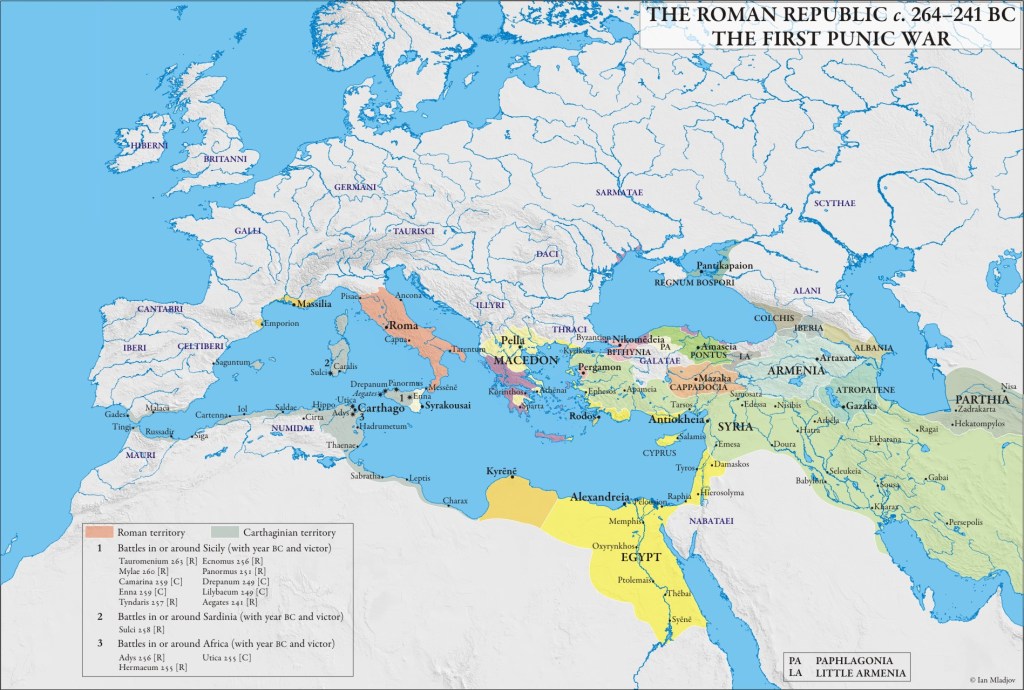
This energy and striving for glory reminded me of late Republic Rome, and the quote from Sallust in The Jurgurthine War, which reads,

I have often heard that Quintus Maximus Publius Scipio, and other distinguished men of our country were accustomed to declare that, whenever they looked on the masks of their ancestors, their hearts were set aflame in the pursuit of virtue [i.e. worthy deeds].  Of course they did not mean that the wax or the effigy had any power over them, but it is the memory of great achievements that kindles a flame in the breasts of eminent men that cannot be extinguished until their own excellence has come to rival the reputation and glory of their forefathers.

It struck me that it was during the later phase of the Republic that Rome grew the most in size.  If we look at a map of the Mediterranean at the beginning of the first Punic War in 264 B.C. . . .

Mediterranean, 264 BC

we see that Rome, though decent in size, does not dominate.  They have their sphere, along with Carthage, Egypt, Macedon, etc.

If we fast-forward 100 years we get a different picture, and as the map below indicates, Rome continues to grow almost geometrically down to the death of Caesar in 44 B.C.

Roman Growth Timeline

While Rome had a Republic at this time, I agree with Toynbee that while the government had democratic elements, it was for all intents and purposes an oligarchy.  The aristocratic senate dominated policy, however much voting by the masses took place.

Is there a connection then, between oligarchic democracies and expansion?  As time marched on from Charles I, England did by fits and starts become more democratic.  But 19th century England surely was not democracy in our sense of the word, and instead like the Republic showed strong oligarchic tinges.  As a monarchy, England’s overseas holdings were modest compared with the rest of the world, ca. 1800. . .

Colonisation, 1800

But a century later, after more democracy (while still having an oligarchy) and we see a different scene:

British Empire, 1920

As in late Republic in Rome, we have a near doubling in size.  Of course, something similar could be said of the other major European powers during the same time, many of them become more democratic after 1848, though again, like England, not fully so until after W.W. I.

Two examples do not really suffice to prove the connection.  But three will!

America gets accused of being an imperial power, but I think the charge false in our current, strongly democratic time.  It might have had more merit in the more oligarchic 19th century, however.

America, 1800:

America, 1800

America, 1900:

When America became more democratic in the 20th century, our expansion rapidly slowed.  Now, to be fair, we acquired Louisiana “fairly” from France by buying it, and Alaska fair and square from Russia.  But the same cannot be said for the Philippines, or the vast territory taken from Indians, including territory in Louisiana.  Both Abraham Lincoln and Ulysses S. Grant thought that our war with Mexico in 1846 to be manifestly unjust.

If we believe Thucydides, and call Athenian democracy in its golden age really a Pericles-led oligarchy of the best (a claim, to be fair, disputed by the great classicist Donald Kagan), we again see this principle of growth.  In 490 B.C. Athens stood as one city-state among many.  Not so 50 years later. . .

Map, Athenian Empire 431 B.C.

As to why oligarchic democracies have such expansionistic tendencies, I cannot say.  Perhaps it can be the subject of another post filled with wild theories.  But it does seem clear that this period of expansion leads to a “Time of Troubles,” for all parties involved.

For England and the rest of Europe, expansion gave way to the two World Wars.  America had its Civil War, caused largely by the exacerbation of the slavery issue.  The inflaming of the slavery question in its turn had its roots in the Mexican-American war in 1846.  Athens and the Greek world faced the Peloponnesian War (431-404 B.C.).  Though the proximate causes and results of these conflicts differ, they each have an age of expansion to precede it.

Any thoughts from anyone else, with more examples, or a connection between oligarchic democracies and expansion, are heartily welcome.

Blessings,

Dave

A Donut Shaped Universe

If anyone every feels a tinge of excitement opening Plato’s Republic for the first time, many find the text quickly snuffs it out. This foundational philosophical work starts off with a rather mundane conversation. Then, when Plato starts to talk about how the state should be built, one of the first points he makes is that no one should more than one job, one task. Stay in your lane, and do not deviate. Otherwise, “great evil” would result.

Such pronouncements strike moderns as absurd and non-sensical. I like Plato and think The Republic deserves its place in the canon, but I too never really liked the explanation given by various commentators about this section of the work.

Ah . . . but Jane Jacobs may have discovered the answer–one I had never heard or considered before.

All readers know the pleasure of discovering a new author, with the prospect not only of the current book in front of you, but of all of their other works. Well, historians get the same thrill as seekers of fiction, and I have to say . . . Jane Jacobs has been too long absent from my life. I am not sure if I agree with her, but that is not the point. The best teachers you have had may not have agreed with you, but pushed you to think, explore, and wonder.

But I have another qualification for a good historian–one cannot be simply a “one thing after another” type of historian. I would say that such people are in fact not historians–however good their research skills–for historians must create meaning. This means that historians must consciously synthesize even if they do not wish to overtly systematize. Jacobs showed in her most famous work (which I have not read) The Life and Death of American Cities that she can pick order out of the seemingly scattered flotsam of different neighborhoods.

One wants to agree with such people, and I find it annoying for the moment that I cannot decide quite what I think about one of her perhaps lesser-known works, Systems of Survival, a book that attempts to unify the entirety of history into two moral systems, or two ways in which civilizations, organizations, or movements, can order themselves. I admire the audacity of the attempt, and I love too that she organizes her thoughts in the form of hypothetical conversations–more books should take this accessible approach.*

Jacobs broadly identifies two “casts of mind” throughout history that derive from these two moral modes of being. The first, the “Guardian,” and the second, the “Commercial.” I think that “Cosmopolitan” fits better (my first minor disagreement with Jacobs), but I will stick with her terms. She has two of her characters demonstrate this with the following conversation:

Guardian: The love of money is the root of all evil.

Commercial: The love of power is the root of all evil.

G: History tells of the dynasties and the fates of nations and empires.

C: History tells us of how social, material, and economic conditions have changed.

G: The most valuable archeological findings are of art, religious artifacts, tombs, of kings, etc.

C: The most valuable artifacts are clues to how people lived everyday life, how they made their living, their tools and materials.

G: War and preparations for war are normal and peace a hiatus from war.

C: No–peace is normal, war is the aberration.

G: Man is a territorial animal.

C: People are city-building animals.

G: Knowledge is a weapon or possibly an adornment

C: Knowledge is a tool.

G: Intelligence gives us insight into others’ way of thinking–we should focus on what divides us.

C: Intelligence means primarily the ability to pick up new skills and good reasoning.  We should focus on what unites us.

G: China is prosperous at our expense.

C: China’s prosperity raises everyone’s standard of living.  Economic gain is not zero-sum.

G: ‘Ask not what your country can do for you, but what you can do for your country.’

C: The state exists for the sake of the people–that’s Locke, Rousseau, Madison–the social contract.

These casts of mind come from what Jacobs describes as two “moral syndromes.” By “syndrome” she simply means that the various parts of the moral system necessarily run together. She calls these the “Commercial” and “Guardian” moralities, and part of the vim and dash of the book is that she commits to the idea that these two “syndromes” are all that have ever existed. The values of each system are . . .

The “Commercial” Syndrome

Shun Force–Come to voluntary agreements

Be honest–collaborate easily with strangers

Compete–but respect contracts and other voluntary agreements

Use initiative and creativity

Be open to new things–change should be embraced

Be thrifty and efficient

Promote comfort and convenience

Dissent is valuable for the sake of the task

Invest for productive and practical results

Be optimistic

The Guardian Moral Syndrome

Shun trading, and exert prowess

Be disciplined and obedient

Value tradition and the ‘old ways’

Respect hierarchy–strive for loyalty

Make rich use of leisure–be ostentatious

Dispense largesse

Group exclusivity strengthens internal identity

Treasure honor

Jacobs has much to say about both, and of course both go right and wrong in different ways. In general, most of the world used to subscribe to a Guardian morality and now certainly the first world at least has shifted to the Commercial syndrome. But the shift has not been absolute, as ancient Babylon and classical Athens strike me as mainly “Commercial” in nature, and even “Guardian” civilizations had Commercial aspects. Cities, and any civilization with a port, generally need to adopt a commercial mentality.

I found myself much taken with her analysis, as it explains a lot of the success and frustrations we have with our predicament. The benefits of the Commercial syndrome seem almost second-nature. Our religious and political freedoms arise from it. The material comforts we enjoy come from the speed of innovation (and its accompanying trampling of tradition) over the last 250 years.** Many of our “freedoms” have also resulted from a variety of moral innovations, especially in the area of sexuality. To point out the obvious, if we like democracy we have to value collaborating with strangers.^

But a second look reveals its weaknesses. A “Commercial” society will never build pyramids or cathedrals–hence the constant critique of the vanilla-tapioca nature of democratic culture. The promotion of comfort will make it hard for us to sacrifice without an extreme need. The combination of valuing comfort and dissent make it hard to act as one with common purpose.

The Guardian Syndrome obviously has its associations with aristocracy and its attendant abuses–be they spiritual (such as pride), moral, (indolence) or otherwise–we see right away. But the Guardian syndrome can also give more civic-mindedness & “noblesse oblige.” Those in a Guardian society know their place and need not fight for it. Most every kind of environmental advocate, for example, uses aspects of the Guardian syndrome, i.e., hedging in and protecting defined spaces, and knows the futility of their approach to a Commercial syndrome society (something that Paul Kingsnorth discovered).

But back to Plato . . .

Jacobs surmises that what Plato might have meant by his condemnation of having more than one job or “calling” strongly correlates to these moral syndromes. When we “mix” these syndromes together we have the possibility of dangerous moral hybrids. A few examples . . .

  • In the 1980’s NYC sought to help fix crime on their subways by injecting the Transit Police (police have a natural Guardian morality) with certain Commercial incentives. The cops got rewards for things like efficiency, i.e., numbers of arrests, and competition (promotions for higher numbers). The result–Transit Police began falsely arresting people least able to fight the charges–the poor–who were mostly minorities.
  • The Nazi’s took certain aspects of the Guardian morality (such as defense of the homeland) and combined them with Commercial science, whose ‘innovation’ had spawned new racial theories, military ideas, and industrial capacity.
  • Marx hated bourgeois Commercial morality. But all of his theories lay rooted in western political categories of thought. One result–A generally Guardian mentality in terms of communal unity, but applied on a scale of universal Commercial ideology. Guardians tend towards being apolitical, but the Soviet Union also united the Guardian aspect of loyalty with Commercial ideological innovation. So–to be on the wrong side of the prevailing ideology=disloyalty to the state.

Yes, Jacobs also discusses positive moral hybrids, but seems to lean towards Plato’s conclusion that mixing them brings problems more often than solutions.

So far, so good. I found Jacobs’ thoughts stimulating and illuminating. Where I part ways with her comes with her theory of how these two moral syndromes developed. She postulates a material cause for each, with the guardian mentality arising from war, and the commercial from trade. But it is mind that generates matter, so to speak. It is mind that shapes matter. I won’t defend this proposition here, suffice to say, as a Christian I reject a strictly materialist argument for the origins of civilization. But, Jacobs has a point. These moral syndromes have ancient roots–more ancient than she supposes.

For civilizations to work, they must take into account both unity and diversity. Something must bring them together for a society to form at all, yet if this “something” binds them too tightly it will neglect their individuality. This has its roots in Being Itself. God is both Unity (1 God) and Diversity (3 Persons).

Christ, being both God and Man incarnated this duality/tension. He revealed to us both what I will “Open” and “Closed” ways of being. The Open way shows how God shows Himself in Nature (Ps. 19:1) or our fellow man (Mt. 25). Marriage is an icon of Christ and His Church. (Eph. 5). In other words, the Open way encourages us seek Truth in our experience of the world.

But just as often, we are encouraged to take the Closed way. We must gouge out our eye if it causes us to sin (Mt. 5). St. Paul often posits enmity between the world, the flesh, and the Spirit. Christ tells us that we must “hate” even our mother and father for the sake of the Kingdom. The Closed approach urges us to seek the Truth by narrowing, not broadening, our focus and shunning the trappings of this mortal coil that we might see God and God alone.

So is the Open or Closed way superior? The answer, of course, is ‘Yes.”

I love that the world Jacob’s presents has coherence–two halves, coming together to make a whole. The problem is that, like a donut, it lacks a center. Without this center, Jacobs’ outstanding observations lack any real meaning. But with the center, we have the possibility of real coherence.

And who would complain about having an extra bite of a donut?

Update . . . if only Jane Jacobs were here to comment on the Blue Angels flyover that happened Saturday (May 2, 2020), she might argue that one’s reaction to the event would pefectly pigenhole a person into one of the two aforementioned moral syndromes–if we keep in mind that heavily symbolic and “ostentatious” nature of the event:

Commercial:

  • This display wasted money that could have been used to so much better practical good
  • This display wasted time and effort.
  • This display foolishly misdirected our attention–encouraging the American public to look at the shiny object, rather than a) the problem itself, or b) the politicians and agency heads responsible for gross mismanagement of the whole pandemic.

Guardian:

  • We live by symbols, and having our most famous and powerful planes flyover gave the nation a powerful symbol of American pride and resolve.
  • These “unnecessary” displays are in fact, absolutely necessary. We are not materialists–we need such acts to lift us out of the mundane of our lives. We need ‘elevated’ out of our current circumstances. We need inspiration as a people if we are to win the “war” against the virus.
  • Leaders act responsibly when they provide these symbols for the people–something to inspire awe and help unify them.

*Another notable fact about Jacobs–she had no college degree and can be therefore classified as an amateur. Toynbee would have rejoiced.

**Though–different writers from different perspectives, such as Tyler Cowen, Ross Douthat, Peter Thiel, and even Jane Jacobs herself (in her last book Dark Age Ahead) have declared that innovation has essentially ceased in western economies.

^This kind of collaboration also seems on the decline, in Congress, in marriages (Republicans don’t marry Democrats, and vice-versa), etc.–and this may herald a decline in democratic practice.

Rebels Against the Future

(The Grumpy Old Man podcast that touches on some of these themes can be found here.).

**************************

A few years ago at the Circe Institute conference Andrew Kern made a startling statement.  In the midst of his opening speech he mentioned the Luddites.  I have always assumed (like most of us I suppose) that the Luddites attacked the mechanical looms for economic reasons.  But Kern suggested that perhaps the Luddites acted unknowingly for more fundamental reasons.

All throughout ancient literature (which people in the early 19th century would be familiar with) weaving relates strongly to wisdom.  So Penelope’s weaving, for example, is not merely a clever device to stall the suitors.  She represents wisdom and faithfulness in contrast to the suitors who grasp for power and wealth.  They will not confirm Odysseus’ death, rather they will take what they want in defiance of the pattern of creation and marriage.  The idea of the “fabric of society” closely relates to weaving, and so on.

So, Kern surmised, the Luddites didn’t just act to try and preserve their jobs.  They may have acted to preserve the idea of wisdom itself, though almost certainly not overtly but in a sub-conscious, Jungian sense.

I thought the idea intriguing at the time, but perhaps a bit of a stretch.  But I started to look for weaving in ancient literature.  To my surprise Plato uses weaving in his dialogue “The Statesmen” as an analogy for good government. With Jason and his Argonauts we see Medea the sorceress contrasted with Queen Arete, who is weaving when we first meet her.  In Homer’s The Odyssey we see a couple of references to the span of life compared to a thread (7.197-198, 24.38-29).  Melville uses similar imagery in chapter 47 of Moby Dick, and we also see it in the Upanishads.  Isaiah 38:12 reads, “My life was with me as cloth on a loom, when she that weaves draws near to cut off the thread.”

The philosopher Porphyry uses very similar imagery in his On the Cave of the Nymphs, another reference to the Odyssey (13.102-112).  Here Homer refers to a murky cave which contains, among other things, “looms, likewise of stone, on which the nymphs wear weave sea-purple garments.”  Porphyry writes (and we should remember that he–unfortunately–believed in the pre-existence of the soul),

What symbol could be more appropriate than “looms” for souls descending to birth and the creation of the body?  , . . For flesh is formed in and around the bones, which in living beings resemble stones.

We should not miss the connections to the fundamental facts of weaving, birth, death, blood, and the like.

So perhaps Kern, and the Luddites themselves, were on to something.

I finally went in search of a book on the Luddites and came across Rebels Against the Future by Kirkpatrick Sale.  Sale gives a good overview of the Luddites but does little else.  He gives us some important perspective, showing us that the Luddites had nothing against technology per se, but only against, to quote from a Luddite letter, “Machinery hurtful to commonality.”   He clearly favors the Luddite cause and shows many examples of their courage.  Sale’s explanation for the Luddites ultimate failure, however, leaves out to my mind the most basic reason.  In resorting to violence, they at times fired upon common men like themselves, and thus abandoned their moral high ground.  Furthermore, their use of violence played directly into the hands of their adversaries.  Once they broke the law, the state naturally would defend the men behind the machines.  And the state had much more force to use than the Luddites.*  Had the Luddites exercised more patience and used a non-violent, grass-roots approach, history might have been different.  As to how different, Sale offers no thoughts.  Did industrial looms pose more of a threat than factories that performed other tasks?  Would it be possible to industrialize in some areas and not others?  If other countries industrialized their economy, and thus, their armies, what would the consequences be for a non-industrial country?  The age of imperialism might offer some hints on this, and questions about community balanced with security (among other questions) should be asked.

Sale just scratches the surface.  Maybe not much else exists to see.  Maybe the Luddites had no higher purpose than saving their jobs.  But I think the Luddites continual references to “commonality” hints that Kern had more insight than I first supposed.  I will hope to find other books that can take the issue deeper.

My favorite part of Toynbee’s sixth volume of his A Study of History deals with his examination of what he calls archaism.  “Archaics” in his context seek to recover their civilization in a time of crisis by using a time-machine to travel back to some imagined golden age.  We should much prefer archaism to “futurism.”  The past has the advantage of having an actual reality and thus restrains action somewhat.  The futurist has no such limitations, and the evil they work in their earnest desperation will likely be much more terrible.  Toynbee points out that archaists would usually rather be archaeologists than politicians.  Alas, political realities set in and something must give.  The impossibility of drawing back the masses to the past with you means that archaists often choose violence in the end.  And this ends up dooming their movement.**

I think the Luddites use of violence contributed heavily to their defeat, but I would not call them “archaists.”  They sat on the knife-edge of change and saw a darkness on the horizon.  The “past” they tried to preserve was in fact the present.  Given that they did not reject all technology they had no wish to futilely put the brakes on all aspects of societal change.  They saw clearly what the Industrial Revolution would do to their communities and their sense of self.  If they did not submit to “archaism” they had more psychological flexibility at their disposal, which makes their use of violence more troubling to me.  Perhaps in the end they simply lacked the very rare traits necessary to translate those ideas politically.

Or perhaps their concerns went far away from politics.  Perhaps they saw themselves as doomed crusaders, but bound, like crusaders, to something deeper and older than politics.

Maybe.

According to the Tradition of the Church, at the Annunciation the Virgin Mary was found by Gabriel in the Temple . . . weaving a veil for the Temple where she resided, and some icons of the Annunciation (such as the one below from the 14th century in Serbia) show this as well.

In Hebrews 10:20 we see the identification with Christ’s body with the veil of the sanctuary (10:20), and we know that both the Temple curtain and the Body of Christ were broken for the life of the world.  Father Maximos Constas writes, “With the strictest visual economy, then, Mary’s thread gives consummate expression the . . . continuum of conception and crucifixion.”^

From St. Epiphianos:

About Eve and Mary it was said, “Who gave women the wisdom of weaving, and the knowledge of embroidering? (Job 38:36).  For the first wise woman, Eve, wove material garments for Adam, whom she had stripped naked.  This labor was given to her, for it was through her that the knowledge of nakedness was acquired, and thus to her was given the task of clothing the perceptible body.

To Mary, on the other hand, it was granted by God to give birth to the Lamb and the Shepherd [cf. John 1:29, 10:11], so that from his glory we might be clothed in a garment of incorruptibility (1 Cor. 15:53-54).

And from St. Nelios the Ascetic:

The Theotokos [that is, Mary, the “Mother of God”] displayed such “wisdom and manifold knowledge” (Job 38:36) that, from the wool of the Lamb who was born from her, she was able to clothe all the faithful with garments of incorruptibility.  For all true Christians stand at the right hand of the King, in golden-fringed garments, embroidered in myriad forms of the virtues.

So it may be that the liturgy of the loom points us toward the wisdom of knowing salvation itself.  I’d like to believe that the Luddites thought likewise, and would love for someone to prove or at least suggest this in another book about them.

Dave

*Gene Sharp makes brilliant points about the benefits of non-violent struggle against states or state-sponsored entities in “From Dictatorship to Democracy,” available online.

**I.e, Tiberius Graachi, who committed himself almost entirely to non-violence.  But he did violate the Roman constitution and so became a law-breaker.  This may have cost his movement the fence-sitters they needed, and it also opened the door for the Senate to respond with force.

^The entirety of this paragraph owes everything to The Art of Seeing by Father Maximos Constans, pp. 108-109, as do the quotes below, found on p. 129

10th/11th Grade: Bismarck and “Unnatural States”

Greetings,

This week we began to look at German unification, orchestrated under the brilliant and controversial Prime Minister of Prussia Otto von Bismarck.

Bismarck raises some important and perhaps uncomfortable questions about leadership.  What is the line between serving the interests of your country and serving God?  Should nations be treated akin to how one would treat individuals, and therefore punished and rewarded like individuals?  Or, should nations be thought of as artificial entities that do not have to play by the same rules as people?  Cardinal Richelieu of France ((17th century) said that, ‘People are immortal and thus subject to the law of God.  Nations are mortal ] and are subject to the law of what works.’ That is, artificial and unnatural creations — one can’t imagine the universe as it is without gravity, but it would be the same universe without the United States.  This hearkens again to Richelieu who would have argued that while Frenchman are Catholic, France is not.  France can’t be Catholic any more than a cardboard box could be Catholic.  Frenchmen may be redeemed, but France will have no heavenly judgment or reward.  For better or worse, Bismarck would have agreed with him.  He also said,

If one wants to retain respect for laws and sausages, don’t watch them being made.

Politics for Bismarck was a dirty business, and there was no point pretending that success would not mean getting his own hands dirty.  But for Bismarck, the world of international politics remained essentially unredeemable, a conclusion Christians may not wish to share.

While there are many debatable aspects of Bismarck, a few things are beyond dispute.  He gained an advantage over some of his foreign political adversaries in part because he recognized what the Industrial Revolution would mean for politics before others.  He realized that

  • Mass production would lead to a ‘mass society,’ where mobilization of opinion could make a huge difference.
  • Old aristocratic Europe was finished, at least in the sense that kings and nobles could no longer act without direct reference to their populations.  The press and public opinion would be nuisances to others.  Bismarck saw them as opportunities for making Prussia’s actions much more potent.

Bismarck is  controversial because

  • He used democracy, but he did not believe in democracy. Bismarck “believed” in a strong state and saw democracy as a possible end to create that state. But he would also use other means to suit his purpose. In the end for Bismarck, ‘blood and iron,’ not speeches, win the day.  Force and strength were the best projections of power, though to be fair to Bismarck, he believed in a limited/surgical use of force.
  • Bismarck was the ultimate realist.  He believed that concerning oneself with justice, for example, could lead one to get carried away, to lose focus.  The primary motivation for policy should be whether or not it serves the interest’s of the state.  Don’t first concern yourself with rewards or punishments.  Do what serves the ends of the state.  A foreign policy built primarily on  morality (an example might be punishing or rewarding a country based on their human rights record) was not proper for a nation, however much individuals should be concerned with it.

As an example of his policy we can look at his actions during the Polish bid for independence from Russia.  When the Poles attempted to break from Russia almost every major power gave speeches expressing their support for the Polish cause.  They did so, no doubt, for a variety of reasons:

  • The Poles vs. Russia was a great underdog story and everyone loves an underdog
  • Independence movements were rife throughout Europe and everyone loves to bandwagon.
  • Polish success would weaken Russia’s power, and most wanted Russia weakened whenever possible.

Bismarck shocked everyone by not supporting the Poles, but even offering public support — and troops — to aid the Russians in crushing the rebellion.  Why did he take such a position?

  • Speeches make you feel good and important, but speeches themselves will not help the Poles one whit.
  • These speeches, however, will serve to alienate Russia, and you would have gained nothing and angered a major power. The words of encouragement you offered Poland (without actually helping them) might even alienate Poland as well (think of a situation where you are carrying something very heavy, and someone nearby offers words of encouragement but doesn’t lift a finger to help. You probably would not have warm feelings for that person).
  • No foreign power would actually send troops to aid the Polish, so again, the expressions of support meant nothing in reality.
  • The Poles, without foreign aid, would certainly lose.

Thus, it seemed far better to Bismarck to go against the grain and actually aid his country by standing up for Russia in their time of need.  Yes, other countries would get momentarily upset at Prussia’s actions, but again, it would mean nothing.  Bismarck planned to cash in  the favor he performed for Russia later, and he did in the Austro-Prussian War of 1866.

To put Bismarck’s actions in perspective, think of the “Free Tibet” movement that we occasionally hear about.  Lot’s of people make speeches to end Chinese occupation of Tibet.  But . . . no one will actually do anything about it.  No one would risk war with China over this issue.  The words of sympathy given to Tibet 1) Do nothing for the Tibetans, 2) angers China, which makes them 3) not just worthless, but counterproductive.

To put Bismarck’s actions here in perspective, imagine if a U.S. president not only did not support Tibet, but publicly supported China.

It would be a bold move.

This does not mean that Bismarck was personally amoral.  Rather, if nations are essentially ‘pieces on a chessboard’ they cannot be sinned against.  You can sin against people.  But you cannot sin against shapes on a map.  This hearkens back to Richilieu’s foreign policy for France some 250 years prior, and to Machiavelli before that. In the same way, no one would call you a ‘sinner’ if you bluffed in poker.  The poker game is in a sense, an alternate reality where different rules apply.  For Bismarck, the same is true of politics.  We see this philosophy come through in his famous musings after Prussia’s victory in the Austro-Prussian War:

We had to avoid wounding Austria too severely; we had to avoid leaving behind in her any unnecessary bitterness of feeling or desire for revenge; we ought rather to reserve the possibility of becoming friends again with our adversary of the moment, and in any case to regard the Austrian state as a piece on the European chessboard. If Austria were severely injured, she would become the ally of France and of every other opponent of ours; she would even sacrifice her anti-Russian interests for the sake of revenge on Prussia. . . .The acquisition of provinces like Austria Silesia and portions of Bohemia could not strengthen the Prussian state; it would not lead to an amalgamation of German Austria with Prussia, and Vienna could not be governed from Berlin as a mere dependency. . . .Austria’s conflict and rivalry with us was no more culpable than ours with her; our task was the establishment or foundation of German national unity under the leadership of the King of Prussia.

….To all this the king raised no objection, but declared the actual terms as inadequate, without however definitely formulating his own demands. Only so much was clear, that his claims had grown considerably since July 4. He said that the Austria could not be allowed to escape unpunished, and that, justice once satisfied, we could let the misled backsliders off more easily; and he insisted on the cessions of territory from Austria which I have already mentioned.

I replied that we were not there to sit in judgment, but to pursue the German policy. Austria’s conflict and rivalry with us was no more culpable than ours with her; our task was the establishment or foundation of German national unity under the leadership of the king of Prussia.

Passing on to the German states, the king spoke of various acquisitions by cutting down the territories of all our opponents. I repeated that we were not there to administer retributive justice, but to pursue a policy; that I wished to avoid in the German federation of the future the sight of mutilated territories, whose princes and peoples might very easily (such is human weakness) retain a lively wish to recover their former possessions by means of foreign aid.

If we wish to dismiss his ideas, we should pause first.  After all, it is wrong to kill, but a nation can commission soldiers to kill, and we do not say they sin necessarily by doing so.  People shouldn’t lie, but a nation can spies to disseminate false information.  Is this sin?  If we say no, we have a dilemma on our hands of how we think of states as they relate to ‘individual’ morality.

In the end, Bismarck’s creation of a unified Germany would radically change European politics.  Germany became the greatest land power on the continent immediately.  But the change went deeper than that — the rationale for how a state comprised itself changed.  The idea of a “Germany for Germans” would spread and eventually undo European empires, and sow the seeds of the militant democracies of the early 20th century.

The unification of Germany also was a harbinger of the new kind of state created by the Industrial Revolution. England had already experienced the Industrial Revolution and benefitted from it. But the warp speed creation of Germany, and how it utilized various cultural and military aspects of industrialization, would serve as a blueprint for other nations. Next week we will look at how the Industrial Revolution reshaped society.

Many thanks again,

Dave Mathwin

10th/11th Grade: Faces of Leadership

For our discussions this week, we looked at three different generals. . .

First we looked at Lee.  Though not a supporter of slavery or secession, he believed himself bound to defend his friends and his home of Virginia.  One might say that he did not fight for a ’cause,’ but for his friends.  Clearly he was a man of integrity and faith, an inspirational leader.  He also was able to size up opponents psychologically to a remarkable degree.  One sees in his eyes intelligence, melancholy, and a deep fire.

For the first 100 years or so after the war, scholarship on Lee remained entirely favorable to him.  For most, the South was doomed to defeat from the beginning.  Only Lee’s brilliant generalship staved off disaster, and in fact, even got them close to pulling off a “miracle” victory.

But recently many historians have taken a much different view of the South’s chances, and see the Civil War as one that they had every chance of winning.  This shift has led to a reevaluation of Lee himself.  If one believes that the South could have won by using a “bend, don’t break” approach, then we need to ask why Lee employed the strategy he did, and what its impact was.

Military historians have taken Lee to task for his offensives into MD and PA, both of which cost the South dearly.  Lee let himself be drawn into other broad ranging offensives actions, that even when successful (like Chancellorsville) came at great cost.   Some see more than just a tactical mistakes.  Some see Lee as a good general, but not a great one, a man bound by the honor dictates of the South’s culture.  Some see this sense of honor manifesting itself not only in his “need” to attack, but also in the vague deference he showed his subordinates.  Those who may be familiar with the Battle of Gettysburg know that for the first two days of the conflict, Lee did not have his top cavalry commander, Jeb Stuart, who spent time away from the army gathering supplies. But Lee bears some responsibility for this himself, as we can see if we look at the orders he gave Stuart as the army prepared to march into Pennslyvania.
Lee’s Orders to Stuart before Gettysburg
‘If you find that Hooker is moving northward, and that two brigades can guard the Blue Ridge and take care of your rear, you can move with the other three into MD and take position on Gen. Ewell’s right, place yourself in communication with him, guard his flank, keep him informed of enemy movements, and collect all supplies you can for the use of the army.’
General Longstreet took an opportunity to perhaps add some clarity to Lee’s intent of having his cavalry stick close by:
‘Lee speaks of your leaving Hopewell Gap and passing by the rear of the enemy.  If you can get through by that route, I think you will be less likely to indicate your plans than if you pass to our rear.  You had better not leave us therefore, unless you can take the proposed route in rear of the enemy.’
But the next day another set of orders arrived from Lee, which muddied the waters yet again. . .
‘You will be able to judge if you can pass around their army without hindrance, doing them all the damage you can.  In either case, after crossing the river [Lee presented two options to him of where to cross] you must move on and feel the right of Ewell’s corp’s collecting information and provisions.
Lee’s lack of clarity to Stuart about exactly what his job was may have been the reason for his absence at Gettysburg. But that’s not all.  Many lament that General Ewell did not seize the heights during the first day of the Battle of Gettysburg.  But Lee’s Orders to Ewell regarding the heights show the same ambiguity that he communicated to Stuart:
You are to take the heights, if practicable, but avoid any general engagement until the arrival of the others divisions of the army.
You may notice a certain deference in these orders.  Lee was a gentle man at heart.  But the ambiguity could be misinterpreted.  Was Stuart to get provisions,  or stay close to his flank? Longstreet,notice, speaks with more directness on what his priorities should be.  Should Ewell take the heights, or avoid a general engagement?  We enjoyed debating the merits of Lee’s offensives, with some students agreeing with recent critics of Lee, and others arguing that the South needed to try some kind of offensive to win, and they might as well have used Lee.

U.S. Grant had none of the dash or style of most important commanders, not even an impressive mustache like the Union’s Joshua Chamberlain.  He seemed every inch the average man from Ohio.  Rumors said he drank too much. Strategically, he displayed little creativity.  Yet he had a tenacity and single-mindedness that most other Union generals lacked.  As Lincoln said of him, ‘I can’t spare this man.  He fights.’

Grant stands in stark contrast to the elegance and pedigree of Lee, and in that way mirrors Lincoln.  Nothing about his bearing or manner spoke of anything to do with flash.  His tactics reflected his straightforward, methodical nature.  But to my mind there must have been something maddening about fighting Grant.  Never brilliant, he had tremendous consistency.  He kept moving, which demanded that you (his opponent) never slack.  He had an large reservoir of patience, and tended to see not what he lost in battles, but in what he gained.  His men believed in him. Lee, for all his gifts, could not beat him.

While Grant is best known for wearing Lee down at the end of the war, many consider his most impressive campaign to be his taking of Vicksburg in July 1863.  As the map indicates, he had to travel far and wide, but in the end, simply would not let go of his objective.  The capture of Vicksburg ensured Union control of the Mississippi and allowed them to choke the life out of the Confederacy.

3. At one point during the war William T. Sherman was out of the army, depressed, and even contemplated suicide.  Volatile and somewhat unpredictable, he got another command and began to earn the trust of Grant. After taking Atlanta in September of 1864, he had the idea of taking his army and marching it to Savannah, away from supplies and communication, targeting wealthy southern properties for destruction.  Many thought the idea foolhardy, but Sherman thought otherwise:

  • His army was composed mostly of men from the midwest, which was at that time the ‘west.’  These were independent minded and self-sufficient troops.
  • He believed that just these independent minded men might be especially motivated to ransack the property of wealthy southerners.
  • He also believed that this would help drastically shorten the war.  For Sherman, it was not so much the supplies that the South would not have, but the psychological impact of the property destruction.  The South, he believed, went to war to defend their property.  If he proved they could not defend what was most dear to them, the Confederate cause would lose legitimacy and promote desertions in Confederate armies.  Slaves, too, would leave their masters and again, this would hasten the collapse of the Southern cause.

Many controversies surround Sherman’s ‘March to the Sea.’  Those in favor of him would probably argue the following:

  • Sherman’s actions did shorten the war and saved lives in the process.  His campaign was much less costly in terms of human life than any of Lee and Grant’s battles.  It is much better that property be burned than men killed.
  • Sherman’s army liberated, directly or otherwise, thousands of slaves
  • Sherman was simply more far-sighted and innovative than other generals.  Don’t blame him for doing things no one else thought of.  If you are against his targeting farms, than you have to be against our destruction of civilian areas in World War II, which culminated in our atomic attacks on Hiroshima and Nagasaki
Those against him might say:
  • Sherman started the idea of ‘total war,’ which would lead to so many horrors of 20th century warfare.
  • Sherman’s targeting of civilian property was simply wrong and violated the ‘rules of war.’
  • Many starved in the south in the aftermath of his attacks
  • If the ultimate goal of the North was reconciliation with the South, Sherman worked against this.  His humiliation of the South lingered in their minds for generations and produced a bitterness that in some areas has still not gone away.

If Lee’s picture shows his aristocratic roots, and if Grant’s belies a plain pugnacity, Sherman’s face shows us all of his brilliance, all of his craziness, and the fact that he just doesn’t care. I wouldn’t want to face him.