Sometime in the early 5th century Vegetius wrote this simple and straightforward work, both a manual for a successful military and a plea for Rome to return to the values of an earlier time.
I am not a military man, but much of the advice Vegetius meets out concerns basic common sense, i.e. make sure your troops are well-fed, pay attention to terrain, make sure you have a reserve force, and so on. What interested me as I read is what the book might reveal about the late Roman empire, and why the work had a huge following the Middle Ages.
Vegetius does not bellow, shout, or stamp in his writing, and yet underneath I think we can see a quiet desperation. It seems like every ancient and medieval historian must as a matter of course talk about the past as a beacon of light, and how decrepit the present had become (does this not change until the Enlightenment?). In Vegetius’ case, however, his attitude may have had more connection with reality, as the Empire seemed less and less able to exert control over its borders (Hillaire Belloc disagrees with this standard interpretation in his Europe and the Faith). We do know that Rome had a harder time recruiting for its army in its later phase, and one of the great ironies of this book is that Vegetius, though wishing for a time when all men were strong and all the children good-looking, had no military experience himself.
The book touches on many things, but at the core Vegetius pushes discipline, discipline, and still more discipline. Who can doubt that an army needs discipline? Nothing remarkable about that. Still, as this Youtube shows, Rome rode a few basic military moves and formations to world dominance. Nobody plays the hero. Stay in formation. Crouch, block, thrust, and move on to the next enemy (warning: a bit bloody).
What I did find revealing, however, is what is not there, much like the dog in Conan Doyle’s “The Adventures of Silver Blaze.” Nowhere does Vegetius mention anything about armies needing morale, a cause, a belief to fight for. Napoleon for one gave it great store. His famous quote that,
In war, the moral is to the physical as three is to one.
comes to mind. Why does Vegetius not mention the morale, or motivating cause, of an army?
I wonder if Vegetius does not include it because the army had no possibility of fighting for a cause in the late empire. Rome had power and wealth even in the late 4th century but had lost any real reason for its existence long before. Vegetius wouldn’t mention it not because he judged it of little value but because he never would have thought of it in the first place, like a fish failing to extol the virtues of living on dry land.
Against my interpretation, however, is Vegetius’ own claim that nothing that he says comes from his own pen. He claimed only to be copying, collecting and transmitting much older sources. Some of those sources, like Cato, predate him by hundreds of years, when Rome had more internal health. Did Rome never concern itself with morale in their military treatises? One could imagine a stereotypical Roman thinking it a bit girly to think too much. Leave that sort of thing to the French.
Or perhaps by coincidence the sources he uses don’t mention morale, so he doesn’t either. But if so, he also chose not to add it. Or maybe they did include it, but Vegetius did not work with their complete full text, or perhaps he deliberately left those parts out because they made no sense to him and would make no sense to others in his day.
Since the original date of this post I had some wonderful feedback from a friend who had the following idea. His thoughts ran in a different course, which I paraphrase in the next two paragraphs below:
Vegetius may not have included the morale section for the reason that morale for the Roman armies was never the problem. If anything, they needed at times an check on their desire to fight, hence the strong emphasis on discipline. We see a few examples of this, first from the Gallic Wars, when Caesar wrote,
On the next day, Caesar, having called a meeting, censured the rashness and avarice of his soldiers, “In that they had judged for themselves how far they ought to proceed, or what they ought to do, and could not be kept back by the tribunes of the soldiers and the lieutenants;” and stated, “what the disadvantage of the ground could effect, what opinion he himself had entertained at Avaricum, when having surprised the enemy without either general or cavalry, he had given up a certain victory, lest even a trifling loss should occur in the contest owing to the disadvantage of position. That as much as he admired the greatness of their courage, since neither the fortifications of the camp, nor the height of the mountain, nor the wall of the town could retard them; in the same degree he censured their licentiousness and arrogance, because they thought that they knew more than their general concerning victory, and the issue of actions: and that he required in his soldiers forbearance and self-command, not less than valor and magnanimity.
My friend continues,
Similarly, one of the Consuls in the Macedonian wars (maybe Aemelius Paulus? I’ll have to dig out Plutarch) had terrible problems with his troops making frontal charges into Macedonian phalanxes and being annihilated. He entreated them to fight defensively and maneuver but they would have none of it.
Either way you slice it, the absence of anything resembling the morale of an army in his text says something. Feedback like this is always very welcome, so thank you.
The book had a curious second life in the Middle Ages, where it became the standard military textbook. I find this quite amusing. Nearly everything except for the most basic dictums would have no application in the Middle Ages. Many differences between the two armies/societies existed.
- The Medievals could never have raised the large, professional forces that Rome did
- Medieval armies did not often come together, and fought in short bursts, not extended campaigns far from home (the Crusades an exception, I grant you).
- Medieval armies had very different people in them than Roman armies did. An aristocratic warrior elite with a shared code of honor with their opponents would probably not go for the discipline, discipline, discipline, approach of Vegetius.
And yet the Medievals loved him. Whatever for?
Some might call them simpletons who did not realize these differences, but I would not call a culture that produced Gothic architecture and St. Thomas Aquinas simpletons.
Some might see their possession of the manuscript of Vegetius valued like one prizes a good luck charm. On this interpretation it’s the manuscript itself that’s valued, not the actual words. Or perhaps in a childlike and humble way, they venerated the past and gave great store to anything from that time.
I could believe this second explanation, but I think the answer lies mostly elsewhere. A clue might arise from a medieval portrait of Vegetius here below:
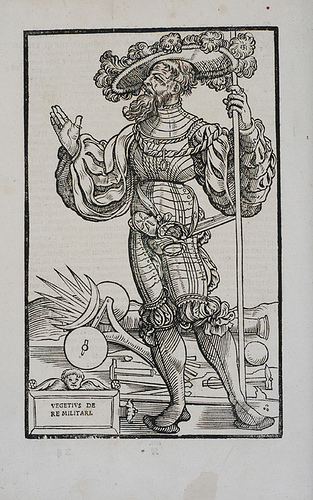
Why did the late 15th/early 16th century picture him in garb exactly like their own? Did they really believe that the Romans wore clothes that they themselves wore in their time? Or were they visually displaying their belief in using his work for their time? Perhaps they had no idea what Romans wore and they felt free to invent whatever clothes they wished?
In his great The Discarded Image C.S. Lewis speaks of the medieval imagination. . .
We have grown up with pictures that aimed at the maximum of illusion and strictly followed the laws of perspective. . . . Medieval art was deficient in perspective [both historical and visual], and their poetry followed suit. Nature, for Chaucer, is all foreground. We never get a landscape.
Historically, as well as cosmically, medieval man stood at the foot of a stairway; looking up, he felt delight. The backward, like the upward, glance exhilarated him, and humility was rewarded with the pleasures of admiration. Thanks to his deficiency in the sense of period, that packed and gorgeous past was far more immediate to him than the dark and bestial past could ever be. . . . It differed from the present only in being better.
The Middle Ages are unrivalled, until we reach quite modern times, in the sheer foreground fact, the ‘close-up.’ . . . Two negative conditions made this possible: their freedom both from the psuedo-classical standard of decorum, and from the sense of period. But the efficient cause surely was their devout attention to their matter and their confidence in it. They are not trying to heighten or transform it. It possesses them wholly. Their eyes and ears are steadily fixed upon it . . .
This lack of “background” in their art and thought might lead them to ignore Vegetius’ context. We do this too . Who among us does not think that Ben Franklin’s idea of making the turkey our national bird ridiculous? We know that Bald Eagles may not be the nicest of birds, but that’s not the point. We are interested in the immediate image the eagle projects, not its actual reality.
But I think there is more to than that, something distinctly medieval about Vegetius’ image. Medievals developed the habit of looking so closely they missed the forest for the trees. With Vegetius, we might surmise that all details beyond the immediate text were entirely superfluous, which made those details, in a sense, entirely in the now. This attitude could be akin to the scientist absorbed so much in trying to clone DNA that he takes no notice of the larger consequences of his actions.
Cheap histories of the Middle Ages talk of the period’s ignorance, darkness, etc. In reality it appears they had quite a scientific bent, with a love of classification and minutiae. The quote, “Nothing is known perfectly which has not been masticated by the teeth of disputation,” on my homepage from Robert of Sorbone, dates from the 13th century, and not the 17th. Vegetius’ portrait may not speak many words about him, but does speak volumes about those that created it.