Like most Americans, I root against the New England Patriots. It is nothing personal, but Americans root for the underdog, and the Patriots have been so successful they are never the underdog. And yet, I can’t help but admire the brilliance of Bill Belichek.
He confirmed my admiration during a particular playoff game against the Steelers many years. ago. The Patriots held a slim lead early in the game but the Steelers had a built a nice drive. They resided just out of field goal range and faced a 4th and 1 somewhere around the Patriots 40 yard line. The Steelers decided to go for it, and their home crowd cheered.
At this time the Steelers built their identity around a “smash-mouth” style of play and relied heavily on running back Jerome Bettis. Everyone knew the Steelers would want to run the ball. The Patriots of course also knew this. They stacked the line of scrimmage and their defense sold out on the run. I don’t recall if they had any safeties behind the line of scrimmage. Their defensive formation triple-dog-dared Pittsburgh to pass.
I remember yelling at the TV for Pittsburgh to call a timeout. They were obviously going to run, but if they had just flared out a tight-end it could have gone for a touchdown. But Pittsburgh went ahead and ran the ball anyway. And of course New England, having every single player right at the line of scrimmage, stopped it easily. After taking over on downs Brady promptly completed a long pass for a touchdown and broke the will of the Steelers.
Game over. In the first quarter.
I thought to myself, “How did Belichek know Pittsburgh would run?” Of course he didn’t really know, but his defense said to me that he knew. What Belichek, knew, I think, is that under stress, we revert to our comfort foods. We can’t help it. In a regular season game, with stress levels lower, maybe Pittsburgh calls a different play. But in the playoffs? He knew they would stress-eat the Ritz crackers and run Jerome Bettis over left-tackle even when a voice inside them probably told them to eat carrot sticks instead. They couldn’t help it.
Civilizations contain a vast aggregate of personalities, but have a undeniable personality and predelictions all their own. When we picture someone wearing a t-shirt and blue jeans, of course it fails to cover everything about America, but it covers enough.
Toynbee believed that western civilization reveals itself in its passion for mechanics. He wrote,
The Hellenic civilization displays a manifest tendency towards a predominantly aesthetic rubric for orienting and defining itself. The Hellenic tendency to view life as a whole distinctively in such terms that the ancient Greek adjective “kalos,” which denotes what is aesthetically beautiful, is used in addition to describe what is morally good. In other words, Greek concepts of beauty and morality . . . were indistinguishable.
When we come to our own western civilization we find no difficulty discovering our own bent or bias. It is, of course, a penchant towards machinery: a concentration of interest and effort upon applying discoveries of Natural Science to material purposes through the creation of social-clockwork devices, i.e. steam engines, motor cars, but also social engines like representative governments and military mobilizations.
We sometimes talk as if this appetite for mechanics was a quite recent occurrence in western civilization . . . But this is precisely how westerners were viewed by the courts in Japan and China [in the early 1800’s, just prior to the Industrial Revolution]–as “barbarians” redeemed partially by our manifest and outsized technical ability. The Byzantine princess Anna Comnena had the same impression of the first crusaders in 1099 A.D. She called their crossbow a “devilish construction” that, while ingenious in its mechanics, fitted perfectly the barbarians who wielded it . . .
I thought of Toynbee’s analysis reading James Carter’s Inventing Vietnam. A lot about this book revealed little about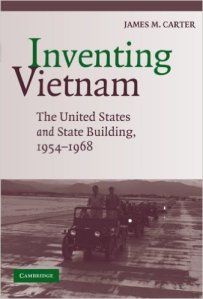 the Vietnam War that I had not read elsewhere. I thought Carter missed some important opportunities to illumine the conflict. But his basic thesis, that America essentially tried to invent, i.e. “call int0 existence” a country that did not really exist makes sense. South Vietnam had no real governance, no real culture, no real identity at all, apart from some lines on paper at the U.N.
Carter demonstrates that we tried to create South Vietnam in the only way we knew how. We went to our comfort food . . . lots and lots of mechanical stuff.
Everyone recognized fairly early on that South Vietnam occupied a precarious position in Southeast Asia. President Diem failed to inspire confidence. The North had nearly all the best political leadership. The major battles of the war against France, and thus, the major political infrastructure to handle the war, happened in the North. Even in the late 1950’s we realized the South Vietnam could collapse not so much because of the actions of North Vietnam but under its own weight. Castles cannot built on air.*
But for many reasons, some well-intentioned and justifiable, and some not, we felt that we had to try.** We sought to modernize their economy, and give thousands of South Vietnamese jobs through our massive construction projects. We could maybe, just maybe “fast-track” their way towards gaining some kind of statehood. If nothing else, in attempting this we stayed on familiar territory. We knew how to provide material goods and benefits.
While Carter’s book disappointed me overall, he proves his main point. Our efforts to “create” South Vietnam massively undermined our stated goals.
- The massive surge in U.S. dollars in South Vietnam destabilized their economy
- South Vietnam’s economy and infrastructure could not absorb the massive inflow of goods, which created a black-market economy almost immediately. This “shadow economy” further eroded governmental authority.
- Most significantly, construction projects facilitated the expansion of our war effort. The expansion of the war effort led to more bombing in South Vietnam, and more troop activity. The more war South Vietnam experienced, the more disruption they faced, the less chance the South Vietnamese government had of establishing themselves.
Each of these problems served to ensure that the South Vietnamese government had no control over its own destiny. Many in the State Department and military realized this, but could do little else but press on. We couldn’t help ourselves. This is what we knew how to do. We can reasonably assume that if we had defeated the North Vietnamese militarily, the overall strategic situation would have changed hardly at all since the 1954 Geneva Accords which divided Vietnam in the first place. South Vietnam would not have been an independent country.
When our war in Afghanistan seemingly went well in late 2001, Secretary of Defense Donald Rumsfeld was a media darling. His “transformation” doctrine of war, which emphasized smaller troop levels and increased use of technology, seemed to work. But by 2006 Iraq was a mess, and by 2009 the situation in Afghanistan had significantly eroded. In truth, much of the Rumsfeld doctrine hardly broke new ground. It appealed directly to our comfort food of believing in, and relying upon, bigger and better stuff to solve our problems. Some tech oriented environmentalists tap into this again with their pledge that new green technologies will solve economic and environmental problems. If we looked closer we would see that our weaknesses, and of course also our strengths, have deeper roots than this.
Dave
*Marine General Victor Krulak commented in 1966 that, “Despite all our assertions to the contrary, the South Vietnamese are not–and have never been–a nation.
For a postscript below, Raymond Fitts’ article entitled, The Uses and Abuses of Technology in War
“The American effort in Vietnam was the best that modern military science could offer. The array of sophisticated weapons used against the enemy boggles the mind. Combat units applied massive firepower using the most advanced scientific methods. Military and civilian managers employed the most advanced techniques of management science to support combat units in the field. The result was an almost unbroken series of American victories that somehow became irrelevant to the war. In the end, the best that military science could offer was not good enough . . .”1
How is it that such a paradox developed? How could a world Super Power lose a war to a third or forth rate military power? The answer has many parts. One part of the answer must lie in the difference between military science and military art. The more technology a country has developed, the more it seems to depend on military science in stead of military art. Another part is in the make up of the combatants and their outlook toward warfare.
Despite the many analyses of the Vietnam war produced by the military, none has adequately considered the fundamental question of how the U.S. could so completely dominate the battlefield and yet lose the war. Senior military officers have published books and memoirs about Vietnam. They have all nearly ignored the insurgent portions of the war and devoted themselves to the conventional side of the conflict. The most celebrated analysis of the war made by a military officer was produced by Col. Harry G. Summers, Jr. His basic treatment of the entire war was as it ended, i.e., in a conventional invasion of South Vietnam by North Vietnam. He ignored the guerrilla tactics and insurgent strategies of the war. All these personal accounts of the war seem to be best summarized by the adage “If they has just turned us loose in 1965, the war would have been over quickly.”2 It is clear that had the war been nothing more than a conventional one, the US should have been more successful than it was.
A clue to understanding the Vietnam paradox lies in the term “military science.” No one can doubt the importance of military science to the success of military operations in today’s world. The firepower provided by today’s weapons dominates the modern battlefield. The procurement of those same systems is a complex science in itself. However, successful military operations are a combination of the application of military science and military art.3
As the term implies, military science is a systematic body of knowledge about the conduct of military affairs. It deals with issues that can be quantified with a considerable degree of precision. It generally deals with what one can or cannot do in military operations–the technical aspects of developing and employing military forces.
Military art is the systematic study and creative planing and conduct of military affairs.4 It involves strategy (including tactics), political-military affairs, leadership, and morale. In short, it deals with the inexact side of military operations. It is concerned with what military forces should or should not do and why. It is learned through a study of history.
Successful military campaigns are the result of some sort of balance between the two. The balance may, in fact, depend on the status of the opposing forces–their equality. Reasonable equality may not exist between opposing forces. The weaker side must then depend on superior military art to achieve victory.
The North Vietnamese and Viet Cong were forced to depend on the use of military art because of the overwhelming resources and superior technology of the U.S. The Communist confused the Americans with a package of political, psychological, economic and military warfare.
There is a considerable body of literature that suggests that the warfare of the future, especially with the end of the Cold War, will be on the low-intensity end of the conflict spectrum. If indeed such is the case, then the U.S. will need to rethink how it uses its technology to fight at this end of the spectrum. But to understand what constitutes the low-intensity conflict some definitions are necessary. Applications of technology in this environment will be explored to evaluate the effects of the use of technology.
Definitions
Low-Intensity Conflict
The American military establishment considers low-intensity conflict to be manifested in four different ways: (1) counterterrorism (assuming there is a terrorist to counter); (2) peace keeping: (3) peacetime contingencies (quick sharp, peacetime military actions like the air raid on Libya in 1986); and (4) insurgency/counterinsurgency. The inclusion of some of these terms in the definition of low-intensity conflict is debatable. Terrorism can be considered a tactic that can be used in any type of warfare. Peace keeping missions are meant to prevent the outbreak of a conflict. The essential difference between war-fighting and peace-keeping missions is that one makes the maximum use of force while the latter is committed to the minimum use of force. Direct action missions tend to be high in intensity but short in duration, a situation that is particularly unsuited for the term “low-intensity conflict.” We are thus left with insurgency and counterinsurgency claiming any legitimacy to the title “low-intensity” conflict.6 A low-intensity conflict includes not only the unconventional aspects of warfare but also economic, political and psychological warfare.
There is an important aspect about low-intensity conflict that needs emphasis. The level of intensity is a relative thing. For the soldier in the trenches, combat is always intense–he’s the one getting shot at. For the United States, Vietnam was not a highly intense conflict because it did not require the full resources of the country. For the North Vietnamese, the war was a high intensity conflict because it involved all the nation’s resources. The level of intensity is usually associated with the probability of occurrence of a certain level of conflict. Terrorism is at one end of the spectrum and is highly probable while all-out nuclear war is at the other end and is least likely.
Partisan vs. Insurgent Warfare
The difference between partisan warfare and an insurgency is what the guerrilla is trying to do to the government. The partisan is merely interested in throwing out a conquering power. The partisan may need help from an outside source. An example might the East Europeans trying to expel the Germans during World War II. An insurgent is trying to overthrow an existing government by any means. Insurgencies are the more insidious of the two in as much as it has no definite beginning; its origins are not military, they are political, economic, and psychological. The insurgency is self-sustaining; and does not need outside support. An insurgency sneaks up on the existing government slowly and quietly.
Successful insurgencies have a number of elements in common. Four characteristics are particularly important for the American military: the protracted nature of the war; the central role of the insurgent political infrastructure; the secondary role of the insurgent military; and the use of guerrilla tactics in military operations.7 An insurgency represents the total integration of political and military factors with the political factors always in complete domination.
Conditions are ripe for insurgencies in many parts of the Third World. They all have several things in common: the stark contrasts between incredible poverty for the vast majority of the population and the extreme wealth for the ruling elite; a small to non-existent middle class that can be a stabilizing influence and a conduit for the upwardly mobile; these same areas often times sit astride important trade routes or trade-route chokepoints; they might contain important deposits of raw material vital to the industrialized world.8 The insurgencies of the twentieth century have been scattered all over the world and have been the result, for the most part, of real or imagined inequities in political and economic power coupled with the perception of minimal opportunity for reform, either political or economic. When taken together, the unique aspects of insurgent warfare suggests that such struggles are different from conventional warfare.
The most important aspect of an insurgency is time. Both the French and the Americans found that their enemies used time as a weapon against them. The Vietminh and later the Vietcong purposely made the struggle longer waiting for the Americans and French to get tired of the endless blood letting and look for a way out of the conflict.
The rebels also need time to build up their political support and military strength relative to the government they are trying to overthrow. Time works for the insurgent in another way: every day the rebellion exists is another day that discredits the government and its ability to govern and control its own destiny. The defeat of the insurgent military threat is only an adjunct to buying time for the government to implement reforms and for those reforms to work..
Guerrilla Warfare
Guerrilla warfare is the classic ploy of the weaker against the stronger. The conventional European military operations are planned to obtain a quick victory while guerrilla warfare tactics are geared for the long haul. The guerrilla attempts to avoid a decisive defeat at the hands of the stronger enemy. They operate in small groups to avoid presenting tempting targets for government forces that usually have vastly superior firepower for its use.9
In fact, a guerrilla wins by not losing, while the government loses by not winning. In short, there is no room for the status quo. Each side must discredit the other by some means whether it be political, economic, psychological, or military. Generally, it is s combination of all these elements. The military aspects usually are fought to make space for the other aspects to work on the minds and pocket books of the population.
The American Way of War
There are several deep-seated reasons for the condition of the American armed forces: military men are still highly regarded in Europe but not much here; the European tradition of martial exploits is missing in America; a technological bias to create weapons that can kill from a distance; and a failure to create a well-motivated, well trained military force.10 Most Americans have not had to come to grips with the central role that military forces play in international settings Americans have not had to confront war as a political act.
Its long span of oceanic-based isolation has led the Americans to think of war as an aberration, a failure of political policy Americans see warfare as a great crusade to over-come a well defined enemy who was definitely evil. Simplistic approaches to political military problems are also indications that Americans have not been forced to deal with the role of force. Despite obstacles, Americans have expected to achieve their goals; the spirit of “can-do” has been a permanent part of their collective psyche.11
The Civil War was the first American conflict observed by professional European soldiers. The British, French and Greater Prussian General Staff sent representatives to observe both sides at war. The observers noted, with some distain, the American penchant for standing off at some distance from each other and throw enormous amounts of lead at each other, often times for hours on end. This method has become ineluctably part of the American way of war.
This proclivity to conserve lives has been all the more difficult because of a distinction in the military tradition: the population has always distrusted a large standing army, it has thus developed a strong militia to fight its wars. American armies have had to learn to fight by fighting. The U.S. has been willing to compensate for what it lacked in preparation by spending its national wealth. America’s war industry has overwhelmed its enemies with weaponry.12
The U.S. military has concentrated on the sciences of developing, deploying, and employing America’s overwhelming resources since the Civil War. The military has, as a result, not had to be very clever in the military arts because it could overwhelm its opponents in a sea of men, weapons, firepower, and logistics.13 This ability has lead to a 20th Century American trend in American thinking: modern American strategists and tacticians have sought to substitute fire and steel for American blood.14 General James Van Fleet, then commander of the Korean based 8th Army in 1952, is a good example of this mode of thinking. He was determined to use his artillery as a substitute for U.S. infantrymen.
The basic aim of the U.S. military, it seems, in peacetime is to buy hardware rather than use it. The main aim of each service is to get from Congress as much money as it wants. The peacetime emphasis has moved from fighting skills to procurement and the management of technology. The best way to a promotion is through running a successful procurement program in the Pentagon. Leadership in the field is a secondary consideration. What the American military has developed is a distorted sense of priorities and a general lack of seriousness about warfare. It has fallen into a push-button mentality that has a developed a passion for hardware to the neglect of strategy, tactics, and the intangibles of warfare.15 We have done a marvelous job of preparing for the next war only to find that we cannot afford to fight it.
In spite of all this high-technology, it has never been the decisive factor in any American war. The struggle to use technology and to deal with the enemies technology has been much more important.16 Using history as a guide, the American record with military aviation technology has been mixed at best. In World War I, the U.S. flew European designed and, for the most part, built aircraft. World War II showed the Japanese Zero was better than any U.S. front line aircraft at the beginning of the war and the MiG-15 was a superior surprise during the Korean conflict.17
The French Experience
France was the last of the European imperial powers to resist, by force, the loss of its colonies following World War II. The wave of independence following the war swept over all of the former European colonies. The wave gave the colonies a moral advantage that made the war in Indochina increasingly unpopular in France.
The French experience in Indo-china finally ended with the signing of a treaty between the Viet Minh and the French. The treaty divided the country into two halves: one half went to the Vietnamese communists, the other went to what became the Republic of Vietnam. The political turmoil over the next decade brought the U. S. into a war that the French could not win. The final disaster for the French was at a small town in northwestern Vietnam called Dien Bien Phu. Hot on the heels of Vietnam was another colony of France: Algeria. It seems that the French didn’t learn enough from Vietnam because they went through the same traumatic experiences in Northern Africa that they had in Asia. The two places were very different, but the guerrilla war fought by France in both countries contained the same French military responses to the insurgents.
Vietnam18
The French experience in Vietnam lasted eight long years. The Viet Minh experienced tactical defeats with huge losses when faced with the terrible destructive power of the French firepower. The Viet Minh accepted their losses and learned from their mistakes. Over time, they succeeded in dominating Indochina except for a few French “safe areas” around Hanoi and its immediate vicinity.
The only real advantage the French had was their mastery of and ability to conduct European-style machine warfare. They believed to the very end that the enemy could be crushed and Indochina subdued by concentrated firepower. Early on, they also learned that artillery and airpower had little effect on an elusive enemy that avoided a fight. What the French wanted was a large-scale battle of attrition that would grind the Viet Minh into the ground under a final massive avalanche of bombs and artillery fire. The strategy has two fatal flaws: (1) the French were frustrated by their inability to find and fix an enemy in an inhospitable environment; and (2) the French assumed that they alone possessed the ability to apply firepower in a battle of attrition.
Giap keep the pressure on the French by infiltrating soldiers into the Delta lowlands around Hanoi thus tying down French units. He initiated local attacks against the French units creating havoc in the colonial heartland. Giap also conceded to the French their superior firepower and willing spent lives to accomplish two things: first, to maintain his offensive and secondly to buy time to build a firepower base that could challenge the French in open warfare. To accomplish such things, surprise and secrecy were essential.
The Viet Minh learned from experience that under no circumstances should a column be caught in the open to be devastated by French firepower. They traveled by night in small groups to lessen the probability of being detected. They stayed in areas firmly under their control. Limited attacks outside of their protective base areas were planned carefully and by moving to and from the objective area without delay. If they were caught in the open, the men would scatter and hide before the French were able to adjust in and mass artillery fire on the position. The elusiveness of their tactics in combination with the difficult terrain greatly reduced the killing power of French firepower.
The Viet Minh also learned something about the application of airpower. Initially, it frightened the green, inexperienced insurgents and forced them to break off attacks. The French could rarely afford to send more than single aircraft to turn back attacks. The Viet Minh learned quickly that airpower employed in small doses possessed little destructive power. They also effectively dissipated French firepower by using a “hugging” tactic that began with a concentrated recoilless rifle, mortar, and machine gun attack on a fire base with the express intent of knocking out the defender’s radio–the sole means of calling for friendly fire. They then moved the entire force within the barbed wire outside the fort. Fortress and firepower proved to be no match for cunning, patience, courage and a willingness to sacrifice lives to achieve an objective.
Close air support became more effective as time went on. The pilots got to know their assigned areas of responsibility. They could bomb and strafe with particular destructiveness because they did not need to worry about the location of their own soldiers.
The French lost the first round of the war when they lost effective control over most of the territory and population in North Vietnam. The lesson to be learned here was that no amount of firepower or fortification can be effective against an insurgent without first obtaining the support of the people who inhabit the country.
The most effective innovation in firepower control was the use of light observation aircraft, specifically the Morane, to control supporting fires in support of an infantry unit in heavy contact. Such control often meant the difference between victory and defeat for the supported unit. The pilot had to be able to put the fire at very close ranges to the friendly forces.
The American observers present were not particularly impressed with the French airsupport system. It had airplanes dashing about from one fire fight to another in small groups (often only a few planes at a time). It was not their idea of a concentrated air campaign because it seemed so disorganized and without purpose. The close air support provided by the French air force, however, was sufficient as long as the enemy restricted himself to low-level hit-and-run tactics.
Both sides were learning from the battles. Giap learned that his forces were too lightly equipped to slug it out with the French and their overwhelming firepower. He therefore resorted to guerrilla warfare tactics using irregular forces against enemy strength and main forces against French weaknesses. He committed his forces only when there was a high probability of success.
On the positive side, Giap learned that the ability to stand up of French firepower increased with experience. A few well hidden machine guns made the effectiveness of French air attacks decrease appreciably. Giap did not have to match French firepower gun for gun to reduce its effect.
Giap also realized his own impatience with his early attempts at open warfare. He then decided that he would fight on his own terms. He sought to draw the French away from their bases thereby weakening the French ability to project and supply large fire-power intensive forces. He then attacked when the right combination of circumstances (weather, lines of communication, terrain) and available forces reduced or eliminated the French firepower advantage.
For the French, their victories convinced several commanders that the war could be won by fighting a decisive set-piece battle of attrition. They therefore sought to lure the Viet Minh into attacking well-prepared positions thus letting the enemy bleed to death in the face of French firepower. In doing so, however, the French made two critical mistakes. The first was to assume that their firepower was more effective than it really was. It was indeed effective early on, but as the enemy became better able to avoid it and developed their own firepower base more and more ordnance was needed to achieve significant results. Their second mistake was in not realizing that unless the attacker has an overwhelming advantage in firepower, causalities were likely to be about the same on both sides.
The French infantry effectiveness began to decline as a result of an accumulation of all of these factors. The French soldiers, because they were often green or shaken, needed more and more concentrations of firepower to keep them effective. The guerrilla retains the strategic initiative because he can determine the level of the conflict whenever the enemy’s firepower proves to be too destructive.
The French left and the Americans began to replace them only to have to learn the same lessons the French had, but without the benefit of consulting the French.
Algeria
The Indochina war was hardly over when fresh trouble broke out in Algeria, France’s colony in Northern Africa. Trouble had been brewing there for some time, just as it had in Tunisia and Morocco. France had settled both of the latter problems by granting them independence. But Algeria was part of metropolitan France and would always be French.
Extensive European land ownership and a local Moslem elite that controlled the economic and financial structure while the bulk of the population went hungry and landless made Algeria look a lot like Vietnam. The French never ruled comfortably and force lay just below the governmental facade.19 Algeria was not France: 90 percent of the wealth was in the hands of 10 percent of the population, nearly a million people were unemployed while nearly two million were underemployed.
Both sides in the rebellion understood much about the other. The French refused to realize the strength of nationalist feelings while the rebels did not recognize the obstinacy of the Europeans or the French military against them.20
French military forces numbered about 50,000 when the rebellion started on the 1st of November, 1954. By May of the following year there were 100,000 French soldiers in Algeria. The military commanders were not worried about “bandits” who would yield rather quickly to the superior power of the French army; they thought nothing of sending mechanized columns to subdue them. Apparently the lessons of Vietnam had not yet sunk in because any Vietnam veteran could have told them that mechanized columns sent anywhere did little more that provide convenient targets for guerrillas.
The French aggravated their situation with the measures taken by the police; numerous arrests for nearly arbitrary reasons and the brutal treatment of the detainees just fed the fire. Further French counter tactics remained the rebels best friend. The build up was still under way and the military commanders did not have the forces to carry out the traditional pacification tactics. The Army was in a particularly dangerous frame of mind after the losses in 1940 and Indochina left it with a monstrous inferiority complex.21 The French guerrilla warfare doctrine applied to Algeria was doomed from the start because the French had ignored the aspirations of the population –in Mao’s doctrine the very first lesson. In spite of their revolutionary doctrine, and the results in Vietnam, the French army continued to rely on the traditional techniques of fighting the Algerian war.
Despite their inept military activities, the French did have some advantages: approximately 400,000 soldiers in Algeria; the factious nature of the rebellion; and the lack of rebellion’s internal cohesion played a disruptive role amongst the rebels.22
The Battle of Algiers occurred after the 10th Parachute Division took over counterterrorism duties. The division was not kind in its tactics. The battle that followed was an outgrowth of their brutality that left many dead behind. Controlled genocide as policy seemed to work though. The rebel infrastructure in Algiers was destroyed and the French efforts in the countryside seemed to be working. The battle in Algiers sent more moslems into the arms of the rebels.
But the French off-set their gains with their garrison concept that took the bulk of their forces. The concept left the countryside to the guerrilla (a failing seen in Indochina). Several other factors degraded the effects of French tactics: the use of inexperienced conscript soldiers, an inadequate force for the mission (again a notion left over from Indochina), guerrilla reinforcements coming in from neighboring sanctuaries, rebel determination to throw them out, French barbarism, and finally the overall extent of the destruction of the country.23 The French barbarism even reached into neighboring Tunisia when an air force colonel ordered a Tunisian village bombed on the pretext that machine guns fired at French aircraft–some three miles away in Algerian skies.24
The French attempted to seal off the Tunisian border with a fortified barrier that was 40 meters wide and just over 250 kilometers long. The Morice Line used an electrified fence as its core. It was surveyed by radar and human patrols, covered by searchlights and artillery in places, and had its approaches mined. It still had its disadvantages: it was expensive to build, it required thousands of soldiers to patrol, it was a far as 50 miles from the border in some places and it could be outflanked.25
French tactics eventually became more effective and more mobile with the use of helicopters. But by this time President Charles de Gaulle realized that the French could fight in Algeria for a hundred years without resolving the issues that brought on the conflict in the first place. He finally put an end to the madness by granting Algeria its long awaited and much desired independence. Algeria wasn’t out of the woods yet, but at least it could set its own course.
The American Experience
Americans have had a love affair with technology since the inception of the country. It helped to develop a new continent from coast to coast through the train and the telegraph. Technology made up for the lack of people in developing a new country. That very love affair carried into the way Americans fought their wars. They took it with them to all of their wars since the Civil War. In a recent example it contributed mightly to their undoing.
Gadgets in Vietnam
The Vietnam experience was a bewildering disaster for the U.S. military. The battlefield effort gave the U.S. military an almost unbroken string of victories. On the one occasion, Tet Offensive of 1968, that the enemy stood and fought the American forces in a conventional style, the enemy was so badly beaten that it could not launch another major offensive for four years.26 The U.S. still did not win the war. Apparent military success could not be translated into political success in the larger war. The United States is so dominated by its technologies and its wealth that it has lost touch with people. The United States believes it can spread democracy and maneuver politics by technology and money only. This may well be a fatal error in the life of our nation.27 The loss of China to the communists and the French loss in Indochina made for rather unpleasant news in the U.S. about a new type of warfare coming onto the world scene. Insurgency was a type of warfare that was wholly unknown and unanticipated in America. This isn’t too surprising because the Americans lacked a number of overpowering attitudes that were, and are still common in the Third World: the depth of belief that comes from desperation, a tradition of humiliation that begets hatred; the immediacy of wide spread starvation in the face of corrupt plenty; the zeal of the patriot in the face of foreign invaders and finally a basic lack of interest in war.28
In tune with their propensity to use gadgets, the Americans invented “think tanks” to think up new devices and ways to use them; the think tank was supposed to devise new policies that would allow the U.S. military to fight an insurgency war. The think tank was a development that followed the end of World War II when the Department of Defense didn’t want of lose all of the scientific talent it had accumulated during the war. Insurgency provided the think tank’s biggest challenge after the Korean war.
So we sent our soldiers to Vietnam unprepared for what they were to face. They were so unprepared, that even the soldiers responsible for intelligence gathering could not speak Vietnamese. They had to hire Vietnamese to translate for them. The translators were as ill-prepared for their task as the American intelligence specialists were; some could only barely speak English at all let alone translate Vietnamese into intelligible English. Given such a starting point, it was hardly unlikely that the wrong story got told, especially with the Oriental propensity to tell a Westerner what he wants to hear.
The toughest technical problem was to just find and identify the enemy. The VC and the NVA did not, as a rule, fight in regiments and divisions. The lengths to which the U.S. gadgeteers went to solve this problem are truly awesome.
The U.S. tried bedbugs to sniff out people.29 The bed bug is supposed to be able to smell human food from a long distance. It then moves around making some small noises. The noises were what the gadgeteers tried to use to operate a meter showing the proximity to people. The think tanks devised a machine to be carried by one soldier and operated by four or five bed bugs. The sniffing tube was pointed at a suspected ambush site thus providing a sign to the soldier that somebody was hidden there. The machine failed combat test.
A “people sniffer”, using a chemical-physical apparatus, did have some successful field tests. The machine was supposed to be able to detect body odor of concealed guerrillas from 200 yards away.
Small infantry units had a small personnel radar that could detect moving human beings and alert defenders in the dark of impending attack. The attacks happened anyway.
The starlight scope turned out to be a useful gadget. It allowed a soldier to see in the dark by concentrating the light of the stars. Aircraft were even using them.
Sound was also used as an indicator in several gadgets: one gadget detected the sound of clothing rubbing against clothing; sensors were used on the Ho Chi Minh trail to detect the sound of trucks and other vehicles. Seismic detectors were used to detect the trembling of the ground as heavy trucks and tanks drove by. Infrared detectors were developed for use to find heat sources beneath the jungle canopy. Special photographic films were developed to detect the dead vegetation used as camouflage.
American gadgeteers seldom reckoned with the propaganda effects of the usage of their gadgets. The bed-bug episode drew a wave of negative editorial comments in the Vietnamese press.
Then their was Operation Ranch Hand. The operation was designed to defoliate the jungle hide-outs of the VC and NVA. It was eventually used to destroy the rice crop. The trick back-fired in a big way because of the special status of rice in the Oriental mind: to waste it is a cardinal sin. Westerners killing whole fields not only deprived the owner of the rice but handed the Viet Cong a propaganda coup of the first magnitude. The destruction of the rice fields drove more peasants into the hands of the waiting VC. The VC then used it as the basis of a charge of germ warfare to exterminate the Vietnamese people.30
The Americans tried tear gas to disable people. The U.S. news men got a hold of the idea about “non-lethal” gas warfare in South Vietnam. The story drew instant and hostile reactions. Napalm also drew adverse reactions from the American public. Despite its military value, it provided a propaganda coup for its detractors.
The M-16 rifle that the infantry used in Vietnam generated a lot of controversy. There was its propensity to jam blamed on the users not keeping it clean while Marines died because of the defects. There was a controversy over the ammunition used–the contracts for its manufacture were suspect. And again the user did the dying.
Other gadgets included such things as the M-26 and M-79 grenade launchers, Claymore mines, airborne miniguns and the AC-47 that used them, Aluminum dust that was sprayed on trails so that radar could follow them, navigation systems for aircraft, Snake-eye bombs, CBU [Cluster Bomb Unit] that generated propaganda for the enemy because unexploded bomblets killed and maimed civilians that stumbled upon them, the Bullpup missile, special jungle clothing, a computer (IBM 1430) to help the intelligence specialists gather and sort data, and finally, of all things, lie detectors.31
The Army tried to use its old technology to provide target information. It brought in the AN/PQ-4 counter-mortar radar. The radar tracked an incoming mortar shell and back plotted its trajectory. A skilled operator could plot the mortar position to about 50 meters. Unfortunately, it was too old and easy to fool. It had a very narrow sector scan and the operator eventually got tired of looking at the screen. The enemy put his mortars where the radar wasn’t looking and fired when the operators were least likely to be alert.
The AN/TPS-25 ground surveillance radar was more modern and could detect a moving vehicle up to six miles away. It was meant for use in a conventional European war and couldn’t pick up small groups of men at a walking pace.32
Ground sensors were used as an aid in the search for targets. But for them to be effective, they had to be precisely located. Most of the sensors were dropped from slow-flying airplanes thus making them hard to locate accurately.
The enemy learned, in time, to counter the sensors in some fashion when he could not avoid them altogether. The sensor system was only effective when used in conjunction with other methods such as patrols, radars, scout dogs, and aerial sightings. Yet the system was all that provided the precision target information with the consistency necessary for effective target engagement by indirect fire.
There were some technological success stories. The AC-47 with its mini-guns proved to be great operational success. A few dedicated individuals managed to develop a system appropriate to the war being fought in Vietnam despite the Air Force’s denigration of the ideal of using an obsolete aircraft for anything (it wasn’t fast enough or the latest in technological innovations). The gunship was used to provide a large volume of firepower in a very small area for infantry engaged in heavy combat, especially at night. Other aircraft used in the gunship role, the AC-130 and AC-119, also saw action. The AC-130 saw action along the Ho Chi Minh trail in Laos.33
Americans have had a plethora of mechanical devices or military hardware in Vietnam. Unfortunately, in this war the relations between human beings and abstract ideas were decisive. Our gadgets were superb but just not enough.
Gadget Driven Tactics
Not long after the siege of Plei Mei (early in the war), in the Central Highlands, General Kinnard commanded the 1st Cavalry Division. He was instructed, by General Westmoreland, to destroy the forces that had attacked Plei Mei. The situation was considered perfect for the Division’s style of air mobile warfare. Kinnard moved his artillery into the battle area by helicopter so that it could support his infantry as soon as they touched the ground. General Kinnard hoped that his scattered units would lead the enemy to believe the units could be defeated in detail. Kinnard planned to use the units not engaged as a reserve to be moved by helicopter to reinforce any units in contact with the enemy. Holding terrain meant little in his style of warfare. The heavy lift helicopter gave isolated units the reassurance that they would and could be supported with an inexhaustible supple of artillery guns and ammunition.34 A road bound relief force could itself become a victim of an well planned ambush. The enemy commander, Colonel Ha, had learned that all he had to do to even the match was to separate the Americans from their firepower.
Another battle that made news was the battle of the Ia Drang. The lesson learned there was that firepower would be the pivotal factor in the tactical battle. The Americans goal was to use his firepower quickly to gain the advantage. (Throughout the war experienced infantry commanders were the loudest proponents of fighting battles with firepower.) The enemy’s objective was to separate the Americans from their firepower or to strike quickly and get away before firepower could shift the odds against them. The Ia Drang battle also taught the Americans that the only way to bring a reluctant enemy to battle was by sending out platoon sized units to search him out. Then the enemy was attacked with standard tactics. Unfortunately additional maneuver forces in the enemy’s rear didn’t mean that the enemy was trapped. In the jungle it was easy for him to disappear thus braking contact at will.
When an enemy base camp was found deep in the jungles and marshes of Vietnam, the conventional wisdom for attacking it was to determine its dimensions, isolate it with a strong cordon and then pound it with firepower. Occasional forays were made into the area to check on the results of the attack by fire, then the fire was repeated. This cycle was repeated as often as desired or needed. The preservation of soldier’s lives was the overriding tactical imperative.
Artillery became the fire support system of choice in Vietnam. It was always available in any weather or at any time of day. The artillery was scattered all over the countryside and concentrated by firing more shells at the enemy. Reinforcements from the Air Force and Army aviation ensured that overwhelming firepower would eventually be achieved. And despite the observer’s opinions of the French methods, the Americans learned to use spotter aircraft just as the French had during their stay in Vietnam.
Close air support from fighter aircraft was, and still is, the best way to deliver overwhelming firepower quickly and precisely against tanks, fortifications, and bunker complexes. Such bunker complexes made up enemy base camps in the deepest parts of the southern swamps and under the jungles of the rest of the country. But the enemy did not always stay at home. Often times, when major offensives were run against such base camps, it was found to be lightly defended or empty altogether. When the enemy did stay at home, a major battle ensued and airpower served its purpose very well.
Airpower in Vietnam followed a phenomenon of recent origin; a trend among Western nations to expect too much from aerial firepower, an expectation that might well be the product of our search for a technical means to win wars without expending lives.35 It took one 105 mm light artillery battery to fire 2000 rounds over a two hour period to equal the effects of a single pass of a flight of F-4s against a target thus making it more desirable for the Infantry to want to see the fighters work for them.
A major problem for fire support efforts was the acquisition of useful intelligence. A guerrilla force had to be found, fixed, targeted, and engaged with a fury of concentrated firepower that was timed to overwhelm it before it could break and run. All major ground forces eventually employed small patrols to destroy the enemy guerrilla with long-range fire power.
North Vietnam’s Giap finally realized the American public did not differentiate between front-line casualties and support troops. He then went after the fire bases used by the artillery. This did two things for him. It reduced the firepower available to the Americans and it caused casualties. Reducing the artillery available was an advantage to him because the Americans rarely moved against the NVA when the engagement was beyond the range of artillery. The less there was of it, the smaller the advantage to the enemy and the smaller the territory he could control. The enemy attacked the fire bases using a “hugging attack” that was launched from within the perimeter wire or from within the garrison itself. These tactics lessened the effectiveness of artillery and air strikes. The growing causality lists sapped morale and national will at home.
Giap tried to use tactics against the Americans that had worked against the French. The Americans fortified their fire bases to withstand the heaviest assaults and succeeded where the French had failed because of their overwhelming firepower.36 But military forces that concentrate on protecting itself forfeits the tactical and strategic initiative to the enemy. As the U.S. forces dug in, they also undermined their own offensive spirit.37
It was common practice to fire artillery at points in the jungle that were supposed to be enemy points of interest: assembly points, way points to elsewhere, temporary base camps of various sized units, and communications nodes. The Army fired and fired and fired with results that are still unknown. This type of fire was known as Harassment and Interdiction fire. Artillery units made very little effort to assess their H & I programs by early morning surveillance or the dispatch of ground patrols to investigate an area recently engaged. Perhaps this failure serves as the greatest indicator of the confidence fire planners placed in the value of H & Is.38
The Russian Experience
The Russians have not been immune from involvement in insurgencies as the counterinsurgent. They spend many years supporting “wars of national liberation” with advisors, equipment, money and weapons to make life difficult for the Western world. They were successful at making life difficult alright, but the results of the insurgencies were mixed.
Afghanistan39
The Soviet love affair with the tank soured quickly with their involvement in Afghanistan. Soviet tactical doctrine directed that tank forces operate as part of a combined arms force with mechanized infantry, artillery, and engineers. Yet in Afghanistan tank units went into combat with out the benefit of mechanized infantry. The tank’s clumsiness in rough terrain makes it vulnerable to ambushes when they have lost the advantage of surprise.
The actual invasion was the easiest part for the Soviet Army. It was, however, an army geared for conventional offensive warfare. Once in Afghanistan, it proved to be a lumbering beast better suited to fighting in the European low lands rather than the rag-tag civilians in the mountains and deserts of Afghanistan. The Soviet 40th Army rolled across the border after an airborne brigade landed at airports to take such places for themselves and to deny them to any resistance. The invasion was swift and surprising. It was planned for winter time when Western countries were preparing for Christmas and New Year’s Day. The weather was bad making guerrilla activity difficult.
Riots broke out in Kandahar. The rioters attacked anything representing either the Soviets or the new government. Soldiers sent in to control the riots couldn’t do so. MiG-17s were sent to strafe buildings and open areas but the Afghan pilots couldn’t attack their own people. The Russians sent in the 66th Motorized Division into Kandahar after the riots. The Soviet air force followed with a fleet of helicopter gunships and attacked positions in the nearby mountains almost immediately.
The Russians had tried initially, to overawe the resistance by a massive display of armor: six divisions in 4500 tanks, T-54s and T-64s, heavy artillery and APCs rolled into Afghanistan after the Airborne takeover of key locations. Afghan units were expected to subdue the rural resistance and keep it to a minimum. Bad planning was obvious from the beginning. Casualties were very high from the start and the population was not overawed. In fact, the resistance became more effective as the winter snows melted.
The Russians discovered that their main battle tank could not fight guerrillas entrenched in high mountain passes because the guns could not be elevated high enough or traversed far enough to fire at the enemy positions. The uneven terrain made it difficult to fire accurately and their engines overheated in the hot, thin air. Inexperience drivers often times snapped the treads trying to negotiate the difficult trails of the country. Some of the early battles were disasters for the round bound Soviet forces.
The Soviets also found it difficult to support their maneuver forces with firepower. Their doctrine was too firmly rooted in meticulous planning and deliberate bombardment by artillery and airpower. Obsessive obedience to a central authority permeated the higher reaches of the command structure. Change in the Soviet army came from the top down as befits a structured, autocratic society. Lower level commanders were driven by strict regulations and tactical “norms” in extreme detail. The result is a rigid method of warfare that leaves little to chance. When things go wrong, commanders excuse failure by showing his fidelity to the planned concept of operations. It is the operational norms that are at fault, that is, the scientific calculations are wrong. The solution was to change the norms.
The rebel leaders learned that they could, very often, attack a Soviet formation and get away without taking any artillery fire at all. This may well have been due to the cumbersome fire support system that was too inflexible to respond. It might well have been due to the reluctance of the ground commander to ask for the support unless it had been planned ahead of time. Not only was the system too “preplanned” oriented, it was also meant to support the main effort and not to save lives.
As in the Indochina wars, firepower played a key role in the protection of Soviet facilities and lines of communication. Mine fields were laid around major installations to such an extent that the Mujahideen did not dare attack the installations. By the summer of 1980 the ubiquitous fire base appeared as the Soviets and reliable Afghan forces sought to extend their influence farther and farther into the countryside.
The Soviets failed to solve the problem of convoy protection. The distances involved were to great for an interlocking, mutually supporting network of position artillery to cover main supply routes. The supplies had to be flown to their destination or sent by heavily protected convoy. Convoys were extremely vulnerable to ambushes without aircraft overhead. The Soviets paid a high price in men and equipment to supply their outposts because the Mujahideen ambushed so many convoys. That left a limited number of fuel and ammunition for the outpost to spend on local combat operations. Too many soldiers were tied up in convoy protection.
The Soviets experimented with various means to add more flexible firepower to their convoys: they tried putting a 4-barreled 23 mm anti-aircraft gun in a truck. They mounted a 30 mm grenade launcher in BTR-60 and some BMP vehicles. They also sent self-propelled guns with their convoys.
Two things became apparent to the Soviet commander: a war that had started out as a war of intervention had become a war of attrition, and a major transformation of Soviet tactical doctrine was necessary if the Army was to prosecute the war with any degree of proficiency. One change was their version of the forward detachment with its own organic firepower. They also decentralized their control of the artillery by splitting it up into less than the usual battery of 18 guns. They also learned that the most important single weapon in a war against a guerrilla was the helicopter–something that could well have been apparent from the French and American experiences. They also learned that to conduct a counter guerrilla campaign they needed to rely on the initiative and self-reliance amongst the junior leaders–the very things a centrally controlled army cannot deal with.
In a war without fronts or a clearly defined enemy, an infantry commander rarely knows what fire support he will need ahead of time. He must find and fix the enemy before he can employ heavy firepower with effect. The Soviets attempts to achieve decisive effect using ground delivered firepower was hampered by an obsolete and inflexible fire support doctrine. They also relearned that soldiers who are dug-in and defending mountainous terrain are nearly impossible to dislodge with indirect firepower.
The Mi-24 Hind was the Soviet version of the attack helicopter. It could carry a wide range of weapons and the pilots could talk directly to the ground commander. It could even carry a squad of infantry into a battle area. The Mujahideen learned to fear the Hind. It was the only weapon in the Soviet repertoire that could thwart effectively a guerrilla operation in the field and cause substantial casualties amongst the rebels. The Hind was the centerpiece of the firepower system in Afghanistan.
Soviet interdiction campaigns do not seem to have been very successful in reducing the fighting strength of the Mujahideen. Such campaigns have little effect against a light, mobile and thinly scattered guerrilla force despite the effects such a campaign might have against a conventional force. The Soviets could not stop movement of supply caravans along the borders or inside the country for the first three years of the war.
Several other reasons might also explain the ineffectiveness of the interdiction campaigns. Soviet munitions proved to be unreliable in the mountains.. The pilots were unable to exercise any initiative at all. They attacked what they were told to attack even if a village, for instance, was uninhabited and the rebels were driving down the road just a few miles away. There were numerous reports of such events. The pilots even flew, nearly right over, past rebel bands in the open without firing a shot at them.
The Soviets employed two basic tactical methods when they ventured into rebel-held territory. The first was to cordon off an area and then search for rebels from the population. The second was to organize “kill zones” (sounds like the Russian counterpart to the American “free-fire zone” of Vietnam) and then attempt to push the rebels into it and overwhelm them with firepower. The Soviets still lacked preparation: they used reserve soldiers who lacked even enough training to take cover from sniper fire; their officers had no maps of their routes; the officers weren’t briefed on the kind of resistance they might encounter; and the units were better versed in the local languages than they were in military tactics.
Despite their overwhelming military strength, the Soviet forces could not conquer Afghanistan. The cities, main roads, and the airbases were taken in a matter of days. Their mechanized army of more than a 100,000 made little progress in reducing insurgent control over the countryside and its control over the cities and the roads was increasingly challenged. They found that shock tactics based on massive air and armored firepower can hurt and scatter the guerrilla groups but not destroy them. The difficult terrain and fighting qualities of the Mujahideen made it evident that pacification would take more forces that the Soviets had deployed.
Road blocks made travel difficult and hazardous. Convoys were necessary with no garantees of their arrival at their destination. The effectiveness of the so-called bandits emphasized the failure of the Soviets to impose control. The Soviets were forced to use terror and destruction in order to crush the opposition. They depended on massive amounts of firepower in conducting search-and-destroy missions and punitive bombing attacks. They used gas and napalm in reprisals against resisting villages. There were many cases of indiscriminate slaughter as a result of bombing, strafing, artillery fire and helicopter attack. Terror weapons brought no advantage because the Soviets had too few soldiers to secure areas decimated by gas or bombing attacks. The population learned to anticipate such attacks thus lessening the effects. But the costs guaranteed nothing but hostility for use of such weapons.
Afghan Mujahideen tactics conformed to the classic requirements of guerrilla warfare. There were small group actions at night in territory remote from centers of power and within a supporting population that inflicted damage on the entrenched authority with vastly greater military resources. The Mujahideen were felt everywhere but lacked the weapons and organization to seriously threaten the Soviet position.
The rebels had a several things going for them in their fight against the Russians. They had the difficult countryside and their expertise with light weapons; their attacks often times took place at night while they hid in the general population when they weren’t actually fighting. They had their own stamina and ability to improvise that worked with their growing ability to organize themselves. Their motivation for the fight was a mixture of fatalism and dedication unique to Islam. They accepted the hardships of defending their way of life and religion.
Such were the conditions upon which they accepted the mission of holy warrior defending what is virtuous and meaningful against the destructive infidel. To die for such a cause was a good thing. The entire population faced massacres, weapons that it could not cope with and the presence of a superpower with a seemingly endless supply of manpower and firepower without letting up its resistance.
When the following spring arrived, the population rallied to fight the Soviets along with refugees who slipped back into the country. They fought with a hodge-podge of weapons that ranged from left-over WWI British Lee Enfields to home made flintlocks. The Soviets brought in seven motorized rifle divisions and the 105th Airborne for a total of 85,000 men. They also introduced five Air Assault brigades. By the end of two years, the Soviet force was at 105,000-110,000 soldiers. By 1985 the total stood at around 115,000 soldiers.
Their failed assault on the Kunar Valley despite overwhelming military superiority (200 MiGs, Su-24s, and helicopter gunships) left serious questions about their ability to contain, let alone destroy, a tightly organized and reasonably equipped resistance front.
The Soviets realized that more soldiers were needed but the Kremlin was unwilling to send them. They needed newer tactics and did manage to develop some that worked. The Russian Special Forces were respected by the Mujahideen for their ability to fight.
In the end, the Russians too left their insurgent war with a bad taste in their military mouths. They had the enemy outmanned and outgunned several times over but could do no better than the French and Americans in Indochina.
Chechnya40
The Russian experience of insurgent warfare wasn’t over just yet. The people of Chechnya wanted and demanded their own independent state. Their demand was the result of the break up of the former communist ruled USSR. Once again the Russians sent in the high technology equipment.
The Chichnians used classic insurgent warfare tactics in their conflict with the Russians. Only this time the rebels had a much better complement of high-technology equipment than the Afghans had. The Chechens made wide use of ambushes and good use of communications and intelligence from covert agents.
When the Russians sent their air force into the fight, the pilots had only a poor understanding of Chechen tactics. Part of those tactics included controlling mobile air defense weapons with radios and celluar phones and constantly changing the weapons systems positions. Because they had no reliable data on the disposition of Chechen weapons, the pilots were forced to operate from maximum possible ranges when using their weapons.
The Russians had learned to use a system developed in Indochina by both the French and Americans. They had learned to use the Forward Air Controller (FAC) to direct the aircraft in their attacks on the rebels. One of the primary Chechen targets for intelligence was the FAC. This mitigated the already disappointing results of the Russian air force.
Against no credible threat, other than a few ZSU-23/4 air defense artillery pieces, the Russian air force was unable to make any major impact on the course of the fighting. The performance of the air force against a lightly armed guerrilla force was less than sterling for several reasons: the rough terrain in which the combat took place; the harsh weather conditions; a general lack of training time for the pilots; old equipment; and finally poor stocks of supplies. One helicopter in ten was lost while one in four was damaged. One Russian Colonel blamed pilot performance on the tactics of retaliatory strikes against an enemy who used hit-and-run tactics constantly. Such tactics took the initiative away from the pilots; such a loss led to belated responses to rebel attacks thus reducing combat capability.
Results and Some Lessons Learned
The results of the intervention of France, the U.S. and the Russians were decidedly one-sided. The super powers of the First World overwhelmed their opponents with technology, equipment, and manpower and still lost the war. In the war of ideas its really true that the pen is mightier than the sword and ideas are harder than bullets and bombs. The wars were settled politically with the major powers leaving the country over which they fought–with the single exception of Checnya. Chechnya was unique in that it was surrounded by Russian territory; the rebels had no where to hide and no one to help them. While they made life difficult for the Russian military they would have a very difficult time obtaining their goals.
A common error in the cases studied here is readily apparent: the intervening power did not consider what it was that the people living in the country wanted for themselves. The major powers seemed to think that they already know what was best for the common people of the country when in fact the politicians had no real idea what was wanted at the grass-roots level.
For the Americans, their political objectives were poorly understood. The military strategy and tactics were designed for a very different sort of war. Morale in the field declined and support for the war disappeared because of the growing casualty list with no end of the war in sight. The problem was that the American version of reality no longer fit the real world.
A nation should never consider intervention in a small war without first considering what firepower and technology can do and what its limitations are. Modern nations have consistently overestimated the worth of their technology and the destructiveness of their firepower. Their expectations were greater than the machines they used could deliver. No matter how good the technology of target selection is, it will never be able to locate an irregular force in dense enough numbers for firepower to have a decisive effect.41
It is also apparent that such a lesson has not been learned. There are senior officers that still think that small detachments will escape detection but that larger, battalion size and bigger, will be found and decimated because when insurgents launch conventional operations they become exposed to crushing defeat.42 Experience dictates otherwise: the Chinese smuggled a quarter of a million men into Korea without anyone being the wiser; in Vietnam, 90 percent of the Viet Cong attacks were made with less than battalion sized units. The NVA moved down the Ho Chi Ming Trail in an uninterrupted, and increasingly large, stream despite the American interdiction campaigns against such traffic. At Dien Bien Phu, the Viet Minh decimated the French while at Khe Sanh it was the NVA and VC that was crushed. A mixed bag of results does not make a golden rule.
The unsuccessful American effort in Vietnam illustrated two important topics: the overwhelming tradition and the U.S. fascination with technology, it was supposed to be more efficient but efficiency does not equal effectiveness; victory on the battlefield does not necessarily mean victory in war.43
At best, modern firepower is an indiscriminate thing especially when used in populated areas. A misplaced artillery round can do more harm than good. It takes a disciplined and limited use of firepower to be effective. The fire controller must know when enough is enough and turn off the rain of destruction when that point has been reached. Firepower must be apportioned to the intensity of the conflict. It cannot compensate for bad strategy.
The American, French and Russians all discovered that there seems to be a relationship between the quality of the maneuver forces and the quantity of firepower necessary to make them effective in combat. In counterinsurgent warfare, massive firepower and large unit operations can be counterproductive. The Americans and Russians should have learned this from their search-and-destroy missions. The lesson seems to be that small units are what are needed for an effective counterinsurgency.
Another lesson all three powers should have learned from their experiences was that there is a premium placed on simple and durable equipment that requires a minimum of maintenance. The equipment must be cheap enough to be affordable by Third World countries or to be given freely by the U.S. Perhaps this is the reason the gunship did so well in Vietnam.
All three countries should have noticed that the insurgent is not without several tactical advantages: knowledge of the terrain: a very short logistical tail; they know the people who provide unlimited intelligence data; to win, the insurgent needs only to survive; the insurgent discovers that napalm is not the atomic bomb; shells do no harm when they are dropped in the wrong place; and many now enjoy having first-rate weaponry.44
In short, there is much to be learned by studying the history of insurgent warfare. Chief among them is that technology is not the answer to everything a country tries to do. In the end it is the human element that will persevere; it is the human element that makes the difference in winning and losing an insurgency. Without recognizing this, technology will be to no avail.