Communism and Gnosticism

I have written before that I think the best historians are always part-time philosophers and theologians.  For events to have meaning, they can’t just “be,” they need a context.  If we have no interpretive framework, we have no meaning.

650308

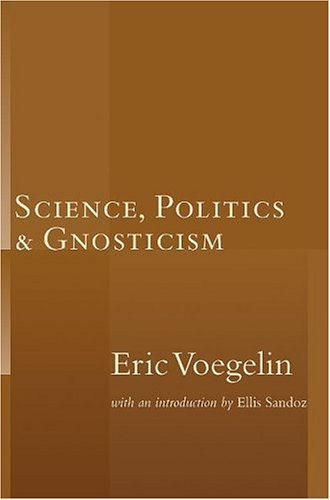
Eric Voegelin may not be a historian by some definitions, but he certainly qualifies as a philosopher/theologian.  His short pamphlet Science, Politics, and Gnosticism gives the reader a lot to digest, and provides a framework for understanding modern political movements.

First he gives his working definition of “Gnosticism.”  At root, gnostics believe that “God,” the “Demiurge,” or whatever goodness that exists had nothing to do with the creation of the physical world.  The world in fact separates us from true goodness, and to “get back” to our original, pure, and spiritual state we must somehow escape creation and its ill effects.  Of course, only a select few will have the will, but most importantly, the knowledge, (or the “gnosis”) to do this. Salvation comes only for the soul, not the body.

Every political philosopher must decide what to do with creation.  Should we seek to accommodate ourselves to it, have dominion over it, or seek to transcend or abolish it altogether?  While these choices may not always come directly from our conscious selves, we make these choices in one way or another.  Voegelin shows that even so-called materialistic ideologies like Marxism and Nazism have strong gnostic roots.

On the surface at least, Marxism appears to be all about this world.  It has a materialistic cause for the changes in history (economics and class struggle). It argues for an abolition of traditional religion.  It seems to preach an earthly utopia of sorts.  Nazism also focused on racial purity.  Hitler wanted a 1000 year Reich on earth.  He wanted to transform the world politically and aesthetically.  But Voegelin helps us look behind the mask.

To take an “anti-science” stance is to take a stand fundamentally against the created order.  Part of our humanity is the desire to grow in wisdom and understanding, to seek, to knock (Lk. 2:52, Mt. 7:7).  Science itself demands a continual re-evaluation of even its basic principles.  But Marxism, along with all totalitarian societies, demands an end to questioning. Voegelin quotes Marx,

When you inquire about the nature of creation and man, you abstract nature and man.  Give up your abstraction and you will give up your questions along with it.  For socialist man, [such a question] becomes a practical impossibility.

Thus, in denying the right to questions, the supposedly scientific basis of Marxism breaks down.

Many focus on Marx’s view of class warfare and an oppressive industrial capitalism–more “material” factors.  He and other devotees expected the Revolution to start in England or Germany, where such political and economic systems had developed farthest.  But the fact that it started in Russia, the most religious country in Europe at the time, strongly testifies to the religious roots of communist ideology.  “History” for Marx was nothing but a mistake.  Humanity’s experience in and with creation offered nothing but a universal negative of oppression.  Again we see this desire to break free from the created order, to transcend it, rather than transform it.

Gnosticism had appeal mainly to the intellectual elite of late antiquity, possibly because it told the elite what they wanted to hear.  “This knowledge is not available to all, or easy to see or understand.  How clever of you to have found it!”  Gnostic religions create a distance between the elite and the rest of humanity, with the “knowledgeable” able to dictate to the rest of us.  However much Marx may have hoped for a people’s dictatorship, the movement never got past the party-elite enjoying privileges they specifically denied the people themselves.  If Voegelin is right, communists movements never could have advanced beyond this because of their essential gnostic roots.

For Nazism (Communism and Nazism formed the immediate context of Voegelin’s writing in the early 1950’s) some of the same truths emerge.  They claimed a “scientific” basis for much of their theories involving race.  But in the end their totalitarian society naturally denied individual freedoms, but also desired escape from creation through death. Whether through Hitler’s obsession with Wagner, the killing-squads of the SS, or blitzkrieg, itself, I think more than enough evidence exists to see the Nazi hatred for creation.  For them as well, redemption can only come via escape from creation.

We can see the gnostic impulse in other areas of Marxist thought, such as their attempt to escape suffering. Marx saw that the end of fuedalism meant the breakdown of local communities. Capitalism seeks and achieves efficiency, which leads to a higher standard of life. But one does not have to be a Marxist to see that capitalism results in a degree of alienation and estrangement from one another in pursuit of these goals. One only needs to look at suburbia, or ask ourselves how many of our neighbors we know, to see this reality. Marx’s solution, however, involved abolishing private property altogether. This would result in an unprecedented coming together of humanity, which would then bring about, as Marx writes,

the genuine resolution of the conflict between man and nature, between man and man, the true resolution of the conflict between existence and being, between freedom and necessity, between objectification and self-affirmation, between individual and species. It is the solution of the riddle of history and knows itself to be the resolution.

One can say that Marx had good intentions, but good intentions pave many dark roads. The misery and oppression under communist leaders in Russia, China, Cambodia, Romania, Venenzuela, etc., etc. speak for itself. We will tackle why communism fails, and why it still appeals to us, in future weeks.

All this offers more evidence for the historian to see economics, politics, etc. as downstream from religious ideology.

Have a great weekend,

Dave

9th Grade: Civilization and the Garments of Skin

Greetings all, I hope that you will enjoy these updates and that you will find them helpful throughout the year.

We began our Ancient History class this week by looking at a biblical framework for understanding what a civilization is and how they function in our lives. Scripture does not spell this out directly, but if we find some illuminating details if we read the early chapters of Genesis closely.

We see in Genesis 2 that Adam and Eve were “naked and unashamed” before God and each other. I urged the students not to understand “nakedness” primarily in physical terms, but in spiritual and psychological terms. They were unclothed (whatever that might have meant), yes, but they lived without masks and artifice. They experienced God, each other, and creation around them directly.

After their sin Adam and Eve hide from God and wear fig leaves. They need a barrier between themselves and God, each other, and the world. In Genesis 3:21 we read that God made for them “garments of skin” as they left Eden. Whatever the nature of these garments might have been, they are obviously a more extensive covering than fig leaves. These garments may have been skins from animals in Eden, meaning that they were clothed in death. We note further that these garments are given

  • As a result of the fall, but
  • Not as part of the curse of the fall.

These garments are, in a sense, a gift from God to help them cope with exile from Eden.

We then see Cain murder his brother Abel. Cain was a farmer, Abel a shepherd. Certainly there is nothing wrong with either occupation. But there varying occupations meant that Abel wandered with his flock while Cain stayed put and worked the ground. When God disciplines us, He does so to draw us back to Him, to reconnect with Him and those around us. This obviously holds true for God’s punishment for Cain.

Cain is told to wander. Why might this be?

  • Cain murdered Abel, and so now God is trying to get Cain to become a wanderer like Abel. He needs to identify with his murdered brother.
  • Cain needs to be “naked” again, to return to something like a paradisal state. In other words, he needs to come to know God again, to become dependant on Him. Cain needs to remove all of his “coverings,” all the barriers he has erected between himself and God.

But Cain clearly does not accept his punishment or obey. Instead, he builds a city! He stays put. First, we have fig leaves, then garments, and now, the biggest covering of all in the form of buildings and other civilizational trappings. Strange as it may seem, Genesis 4 clearly shows us that the implements of civilization come from the line of Cain. We have no connection to the ancient world, but ancient readers would have seen the clues more easily.

  • The lyre (4:21) was a small harp, the strings of which were made from animal intestines.
  • Pipes were often made from the horns of animals

So we see that this “covering” of civilization comes from death, just as the original garments of skin.

Tubal-cain was the father of those who forge bronze and iron, which fits into the general pattern of further exile from Eden in the following ways.

  • First, we know that Eden was on a mountain (Ez. 28:13-14). Exile from Eden meant coming down the mountain of God.
  • There is nothing wrong with farming, obviously. But we should note that farming involves digging into the earth, i.e., descending further into the earth, moving down from the heights. Most of the best farmland is in vallyes, of course, down the mountain slopes.
  • To get the material to forge metal instruments, one has to go much deeper into the earth. We should see this as as Cain’s descendants not just going all the way down the mountain of God, but going under the earth–going further away from God.

The connection between these actions and violence becomes clear directly following this description of the origins of civilization. Lamech, who as the seventh generation from Adam should have represented completeness and rest,* instead stands for a celebration of vengeance and murder. It is telling that in the godly line of Seth in the following chapter, nothing is mentioned about the implements of civilization. Origin stories recorded from other civilizations, such as Hesiod and Ovid, also link metalurgy with violence and war.

This does not mean that civilization is evil, any more than farming, music, or mining is evil. But we should see civilization as another layer of the garments of skin, a “supplement” we now need to get by in the world and interact with one another.

We can perhaps understand the idea of a supplement working both for and against us if we think of something we use every day, such as makeup. Wearing makeup is not wrong. If used in the right way, it can reveal and accentuate beauty. But if you overuse it, makeup becomes a mask we wear to hide ourselves from others–such a person disappears behind the mask they create. What can work for us now works against us. To take an example with guys . . . I go to the gym most mornings before school. Most of the guys I see are there to lose some extra baggage, or get a modest workout. Occassionally, one sees someone so dedicated to improving themselves physically that they no longer look quite normal. Finally, to take an example all of us may relate to, the same can be true of caffeine. We feel tired and we need to get things done, so we drink some coffee. We feel great and can move on with our day. But if we take it too far, coffee becomes something we need even for normal functioning. What once aided us now binds us.

Makeup can be a good thing, and so can coffee. But we might consider that possibly, might it be best of all to use neither? So too, civilization provides many good things for us. It has been the default form of existence for almost everyone who has ever lived. Civilization provides, shelter, social organization, and protection. The specialization inherent in civilization can dramatically increase our standard of living and allows us to build incredible buildings.**

But . . . speaking of buildings, we also have the Tower of Babel. Civilization can do so much for us, in fact, that we can lose our “nakedness” and our dependance on God. To take one example, we don’t feel the need to pray for rain, because if the crops don’t grow where we live, the store can get food from somewhere else. We can easily light a match to make fire, but at the same time, we lose the skill of creating fire on our own. This trade-off happens with many aspects of civilized life.

Just about every city we encounter in the Old Testament is viewed negatively. We have mentioned Cain’s city, and the Tower of Babel, but there is also Abraham’s time in Egypt, Sodom, Jericho, Tyre, Nineveh, Babylon, etc., etc. In fact, I can think of only one viewed differently, Salem, which later becomes Jerusalem. It is Jerusalem which begins the process of the redemption of cities, the incorporation of the garments of skin into the New Heavens and New Earth (Rev. 21).

My goal with introducing this material is to help orient us in our study of the many great civilizations of the past. We should neither get too enamored of them, nor see them as a curse or blight. Rather, we should view them as a blessing that is part of a fallen world, that can become a curse if we’re not careful.

Enjoy the weekend,

Dave

*Compare Lamech to Enoch in Genesis 5, also a seventh generation descendant from Adam through Seth.

**To reinforce the idea of the dual nature of the Garments of Skin, we can see the Tabernacle as a covering akin to a city. God commanded that it be built. It is interesting that the same (or perhaps a very similar word) to describe the main builder of the Tabernacle, Bezalel, is also used to describe Tubal-Cain–a craftsman. Bezalel is a good guy, Tubal-Cain a bad guy. They both used similar skills with similar tools to do similar things towards very different ends.

8th Grade Civics: Name and Fact

Greetings Everyone,

This year, before we delve into specifics about America towards the spring semester, we want to take time to examine the big questions about culture and governance that apply to all civilizations everywhere.

To that end, we spent time this week with Aristotle’s thoughts on what makes a state. We looked at an excerpt from his Politics which reads,

It must be the case that only a shared sense of goodness and justice amongst its citizens can make a state. Merely occupying the same territory together with other men cannot make a state, as can be shown through example. If the citizens of Megara and Corinth [bitter rivals, but very close geographically] were put under one government together, that would not make them one in fact. 

Nor can a state be made merely through common association and interest. Suppose a group of people with different professions—a carpenter, a farmer, a merchant— all living together exchanging goods under a common system of law. Imagine their number to be in excess of 10,000 [a very big number for ancient Greeks]. Imagine these people had nothing in common other than the necessities of living and obedience to the law. 

The members of this group all might come together in a common place to exchange goods and services, but if each person treated their own house and their own person as a state unto itself, how could they be a state, even  if they happened to occupy the same geography?

It is clear, therefore, that a city is not only people occupying the same geography under the same law. Their true unity must come from their common purpose and common life together. True– no state can exist without a sufficient number of people living under the same law. But this in itself cannot make a state.

Aristotle wants us to distinguish between “name” and “fact.” We can all understand, for example, that if I held up a pencil and called it a pen, that would not in fact make it so. Even if I made this assertion for years, the pencil would not be any closer to a pen than when I started.

We can take this a bit deeper. Imagine someone made a robot that looked just like you. It talked like you, walked like you, and more or less mimicked you perfectly. We might even call this robot by your name. But the robot is not you. Among other things, it lacks what we cannot directly see or observe, such as a soul, a conscience, thoughts and beliefs, and so forth. Calling it “you” would not make it so. In other words, we properly name things not just by what they are made of, but by their purpose, their “telos” or end. What a thing is made from is not what a thing “is.”

If we apply this concept to country’s, we may find ourselves a bit uncomfortable. Aristotle pushes us to think of a state as more than a group of people following the same laws, within a defined border, exchanging goods and services. This, he argued, may be a country in name but not in fact. It may look like a country from the outside, but from the inside, nothing exists to bind the people together. The people have no shared purpose, no shared “telos,” no shared love.

Some may remember CS Lewis; The Dawn Treader, where the characters meet an old man (Ramandu) who is in fact a retired star. Eustace remarks that in his world, starts are not people but huge balls of flaming gas. Ramandu corrects him, saying that, “Even in your world, that is not what a star is, but only what it is made of.” In other words, mere physical composition does not determine being. So too, a state cannot be defined merely as people living in a place on a map.

I asked the students to think about whether or not Aristotle would call the United States today a country in fact, or in name only.

In favor of the “name only” position some argued that

  • We do not share a common religion
  • We do not share a common culture
  • We do not have a common point of attention with movies, music, or other media
  • We are deeply divided politically, with many not trusting our basic institutions
  • We have essentially become “states unto ourselves.” With online shopping, we don’t even need to interact with each other to buy and sell things

But others countered that

  • Sports provide us a way to come together across cultural, religious, and polticial divides
  • American ideals of freedom and self-determination still unite (almost) all Americans
  • When we have to, as in the case of natural disaster or war, we can still “rally round the flag.”
  • Sure, Americans fight with each other, but we always have. Think of our nation’s identity like a big, noisy family that argues with each other but still gets together for Thanksgiving and Christmas. We find a way to “hug it out.”

As always, the students are encouraged to take whatever position they think correct and defend it as best they can.

We also started the “History” portion of our class, and began where the class left off last year after the 1920’s. During the 1930’s the world experienced a great deal of suffering. As individuals, how we respond to suffering forms a crucial part of our well being. Some degree of suffering is inevitable, and learning how to handle it appropriately is a crucial skill, not only for individuals, but nations as well.

The rise of Fascism, especially in Germany and Japan, came about mainly because they failed to handle suffering in anything approaching a Christian manner.

For a Christian, suffering comes sometimes as a direct result of our own actions, sometimes as a result of the fault of others, and sometimes for no direct causal reason. Whatever the cause, our suffering should always spur on reflection, humility, and a turning to God. Following this path can be difficult, but . . . this is the path. Possibly Germany, and especially Japan, could make a good case that they had been mistreated by England, France, and the United States. They chose the path of blaming others (Jews, or westerners, etc.) and vowed never to be mistreated again.

They used this impetus to swing way too far in the direction of Unity (racial unity, cultural unity, etc.) and Purity. They created societies that had a great deal of rage, and received power drawn from that rage. For a time, they were formidable military foes.

Thanks so much for your support, and have a great weekend,

Dave

6th Grade: Hierarchical Collapse

Last week we discussed in class some of the key values and concepts of the pre-modern world. One crucial aspect of the medieval world involved their relationship to hierarchy. Most moderns understand that we need some form of hierarchy to allow us to have a society. But we tend to see these hierarchies as artificial and transient. We have an abundance of stories where those with power get humbled and even humiliated by the little guy. It’s built into our cultural DNA.

Medieval people thought differently. They did not automatically assume that those higher than you in status were better people, but they believed their status had a reality to it beyond mere earthly contingency. They thought this for a variety of reasons, among them:

  • Scripture has a host of examples of God choosing, either directly or indirectly, the leaders of His people. We can recall the example of Moses, Samuel, the prophets, the apostles, etc.
  • The earliest Christian writings after the first century, such as “The Didache” and the letters of St. Ignatius, speak of church hiearchy
  • Many early Christians interpreted the words of the Lord’s Prayer, “thy will be done on Earth as in Heaven,” as meaning that we should attempt to imitate the pattern and ‘life’ of Heaven here on Earth.

Possibly the most influential voice on the subject were the writings of St. Dionysius the Areopogite.* His short treatise On the Celestial Hiearchy described the ranks and orders of angels in Heaven, and he then applied this reality to our life on earth. We looked at a quote from this text in class, which reads,

Hierarchy is, in my judgment, a sacred order and science and operation, assimilated, as far as attainable, to the likeness of God, and conducted to the illuminations granted to it from God, according to capacity, with a view to the Divine imitation. The purpose, then, of Hierarchy is the assimilation and union, as far as attainable, with God . . .

In other words, hierarchy on earth does not exist merely to keep order. We have hiearchy on earth to imitate heaven, to be drawn into the life of God, and to become more like Christ. Thus, living within a God-appointed hierarchy was a crucial aspect of one’s spiritual life. Living outside of hierarchy was therefore a metaphysical and spiritual impossibility.

But what happens when the hierarchy strays and abuses their position? Can there ever come a time when one separates oneself from that hierarchy? And—are you sure you have the right hierarchy? These questions formed the background to the the first significant event we will study this year, the Reformation.

The Reformation was a complicated event that involved many historical factors. Forces such as economic and political change, the Black Death, and so forth all had a part to play in the Reformation. But for a few reasons, I want to focus on the people involved with the students. First, while acknowledging complexity is important, I don’t want to overcomplicate things for sixth graders. Secondly, while economic forces, for example, have importance, “economic forces” do not make decisions. People make decisions, and we should put our focus there.

The Church existed as essentially one physical institution for the first 1000 years of its existence. Then, in 1054 (though in fairness this date is disputed by some, others would put the date at 1204 when the Crusaders sacked Constantinople), the Church split between the east (Orthodoxy) and the west (Catholicism). Still, if you lived in the west, your life essentially remained unchanged after this split. Everyone was Catholic, and the Church thrived in the Middle Ages. One only has to look at the magnificent gothic cathedrals, and the lives of luminaries such as Thomas Aquinas, Francis of Assissi, Catherine of Siena, and many others to see a vibrant spiritual life.

However, by the late 15th century, much of this had disappeared, at least in the leadership/hierarchy of the church. Many of course lived vibrant Christian lives but starting in at least the 1370’s, the church was wracked with a succession of poor leaders that lacked spiritual vision and wisdom. The start of 1500’s saw the western church beset by corruption. Many had advocated for reforms, and many had tried various means to improve the church, but these efforts had not gained enough momentum.

No one expected that an unknown German monk named Martin Luther would upset the entire apple cart, not even Luther himself.

It is important to note that no Catholic church historian would deny that the church had grave problems leading up to the Reformation. The difference between Luther, his followers, and the Catholic church was not that one side saw problems and the other didn’t. They often (though not always) agreed on what the problem was. They disagreed on what the problem meant.**

When Luther, an Augustinian monk, published his 95 Theses he did not intend to start a revolt. He sought debate and discussion on points of Church doctrine and practice. Many within his monastic order agreed with him about what he wrote. Pope Leo X himself agreed with some of what Luther wrote and tried to put a stop to some of the abuses Luther pointed out in Germany.

How this snowballed into a full-blown religious revolution is complicated, and my goal is to make it intelligible for the students. Luther posted his theses in 1517 with general support from many. By 1521 he was excommunicated. What happened? I focused on what I see as the central dividing line between those that supported Luther and those that stuck with the church.

  • Luther believed that Scripture had authority over Church tradition and church hierarchy. Luther was convinced that his reading of Scripture was correct. For him, the issue involved putting God’s word above human authority.
  • The Catholic church obviously believed in the authority of Scripture. They wanted Luther to submit his ideas to the Church. He had taken vows of obedience as a monk. Before debating any particulars, they wanted Luther to affirm that he would live according to the vows he took. Luther’s denial of the Church’s authority, and his casting off of his monastic habit, looked to them like a married man wanting a divorce, or a private telling the joint chiefs that he did not need to obey their orders.

The question of Luther’s obedience relates particularly to his vocation. Luther became a monk, and every monk took a vow to Go of poverty, chastity, and obedience. Of course, not everyone needs to become a monk or should. We can compare this in some ways to joining the military. Not everyone can or should join. But if you do join, every recruit needs to obey the orders of their superiors.

Imagine a private writing a long treatise about problems in the high command and making his concerns public. This in itself could be viewed as a problem. Now, suppose that the generals agreed with the private about some things, maybe disgareed with him about others. They tell him to sit tight and be quiet while they consider.

The Catholic hierarchy basically chose this path. They focused on Luther’s vow of obedience, and his need to submit to authority. But increasingly, Luther started not to view the Catholic hierachy as a legitimate authority, and thus, his vows were not binding.

Finally, I would suggest that Catholics believed the best way to serve God was within the hierarchy He established, and Luther thought the only way to serve God was to separate himself from it. Catholics do not say that every pope and every bishop is godly or even a Christian. Israel had some good kings and many bad ones. In Israel, one was not supposed to rebel against even the worst of kings. Nor did anyone ever rebel against corrupt priests. In turn, Luther made a sharp contrast between church hierarchy and civil authority. Church hierarchy had the higher authority of Scripture over them, whereas civil leaders were, on earth at least, accountable only to God.

Many joined Luther in his bold and courageous stance. He inspired many. But Luther was a volatile man–a great revolutionary, but not a good diplomat. Many who agreed with a variety of his beliefs could not join him in separating themselves from the institutional church, such as Erasmus. We looked at a collection of quotes from Luther that show him at his best and worst.

Some may have familiarity with the myth of Cronos/Saturn and his children. Saturn, rebelled against the Titan Uranus, castrating him and freeing his siblings. He then became the supreme power in the cosmos. But he worried, realizing that he had established a precedent, whereby his own children could overthrow him. To prevent this, he ate his own children. But he could not stop what he had put in motion, and later his own children, freed from his belly, overthrew him as well.

Luther faced a similar challenge. His actions moved the locus of authority from the universal institution to local communities and individuals. Many peasants had grievances against the nobility. Luther agreed with them that they had legitimate reasons for their concerns. But when the peasants rose in armed rebellion against the nobility, Luther was horrified, and urged that the rebels be crushed without mercy. Luther did not have a high view of Church authority, but did have a very high view of political authority. Others failed to agree with the distinction Luther made.

Soon various other Protestants emerged, many with much more radical ideas than Luther. Which ideas would win out? How could society hold together? This would be one of the key problems that would shape the next century in Europe.

Have a good weekend,

Dave

*The dating of his life is much disputed, with some believing he lived in the late first or early second century AD, and others arguing for a date much later in the sixth century.

**This is akin to disputes about the meaning of Scripture. People generally agree on what the Bible says. They disagree about what the Bible means.