Greetings Everyone,
This week we continued looking at the reign of Charles I. His time in power, and the decision made by him and those who opposed him would do much to shape the modern political landscape. A lot of disagreement exists among scholars, with some viewing him more or less favorably depending on what they emphasize. However, there is very broad agreement that
- Charles was a sincere Christian and a “good man,” and
- Charles, although not lazy or incompetent, did not rule effectively
- Whether or not Charles or Parliament started the escalating tension that existed between them, both sides heightened the tension at different times in different ways.
The great number of books written about Charles both for and against shows that, among other things, evaluating Charles is tricky. He ruled unconventionally, but the stress and cultural changes of the period may have necessitated that. He had a excellent personal reputation, but at times made foolish mistakes that showed that he seemed not to understand what kingship meant politically. We see this at his coronation, where he made the interesting choice to wear white instead of the traditional royal purple (the image below is a fascimile of an original that I could not find online).
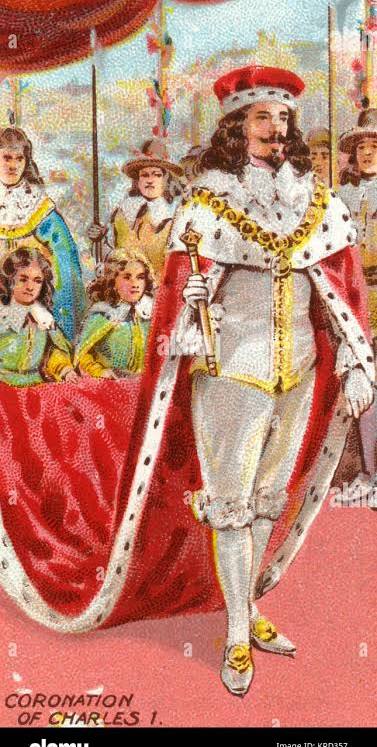
This choice of Charles serves a preview of all the controversies of his reign.
We did not have time to go through the nooks and crannies of all the disagreements this week, but we focused on the main conceptual issues that drove much of the controversy.
Law and Custom
Today of course we know that Parliament serves as the center of power in the English government, with the king having a very limited role. But this happened only after a slow political and cultural revolution over many centuries. In Charles’ time, Parliament met only at the king’s discretion, and (with some crucial exceptions) served as essentially a large group of advisors. Nearly all power still resided in the king’s hands.
However, when Charles began his reign Parliament had enjoyed a period of some decades of increased power and prestige. Custom moved in the direction of granting Parliament more of a role in the country, but the law remained the same, that unless the King asked for new taxes, he had no legal need to convene Parliament or even listen to that body.
So, when Charles ruled for several years without convening Parliament, he was perfectly within the bounds of the law. But, he reversed the trend of previous decades, which guaranteed a jilted and unhappy Parliament. Imagine a parent granting privileges to their teenager steadily over time, and then suddenly revoking them. The parent has a right to do, but the teenager will certainly resent it. The whiplash effect of privileges, then no privileges, will almost certainly result in conflict and controversy.
Different issues drove the conflict between King and Parliament, with religion residing at the core. Charles I was conservative by temperment and religious conviction. He favored the traditional ceremonial Anglicanism in the time of Elizabeth I. Many in Parliament favored what we call Puritanism, which represented a more radical, “contemporary” religous culture focused primarily on preaching and reading the Bible. Charles appointed Archbishop of Canterbury, William Laud, saw the emergence of Puritans as a threat to the role of bishops and the monarchy itself. As it turned out, he was not wrong about this, but his methods showed no tact and a touch of cruelty. In 1637 he ordered the ears cut off three strong Purtian critics of the Church of England in Parliament. In 1645, when Parliament had much more power, they put Laud on trial for treason (despite a marked lack of evidence for this) and had him executed.
Law and Spirit of the Law
Charles relationship with Parliament was soured from the very beginning of his reign. He went to war with France in 1627, in itself not a bad thing for a king of England to do. Charles convened Parliament to raise the necessary funds for the war. Parliament strongly urged Charles to appoint a military commander other than his favorite, the Duke of Buckingham. The Duke was a personal favorite of Charles, however, and Charles appointed him commander-in-chief, as was his right.
The war went badly, at least initially, and the Duke was assasinated. When news of his death reached Parliament, they celebrated and cheered, which profoundly shocked and hurt Charles. In his later actions, Charles showed that he would never trust Parliament if he could possibly help it.
This shows up years later, when Charles wanted to impose religious uniformity throughout his realm, which included Scotlant. In this Charles followed in the footsteps of the revered Elizabeth I. Her policiies could be considered draconian in comparison to Charles, and Charles I’m guessing took comfort in following a legendary monarch.
But things in Parliament had shifted religiously, and they would not create a tax that would allow for Charles to raise enough revenue to go to war with Scotland. English law clearly stated that kings could impose no new tax without Parliamentary consent.
Charles then decided to pull another page out of Elizabeth’s book and reinstate the Ship’s Tax. This was a tax levied many decades prior to raise money for the impending naval invasion from Spain, what we know as the Spanish Armada. By the letter of the law, this was not necessarily a new tax. But by the spirit of the law, Charles had clearly sidestepped the intent of the law, whereby a king could not go to war without the tacit approval of Parliament.
Both Charles and Parliament were right, but in different ways for different reasons.
The Ship’s Tax in itself did not cause the Civil War. Neither did Charles’ attempt to reinstate Elizabeth’s religious settlement, or Parliament cheering at the death of the Duke of Buckingham, or Parliament’s grave mistrust of Charles having a Catholic wife. Often we want the clarity of a clear right and wrong side. Sometimes we get these situations, but the English Civil War is not one of them. Still, those living in England at the time had to make a choice between king and Parliament, and the students do as well. Making that choice involves weighing multiple factors, and that’s why we have spent so long on this event. I hope that the students have learned to think in more complex ways.
Thanks so much, and enjoy the weekend.
Dave

