Greetings Everyone,
As we progressed in our look at WW II, I wanted to the students to consider both Japan and Germany’s strategy in light of Machiavelli’s advice to those who conquer territory.
To sum up (for a fuller look review the Machiavelli and Janus post previously), Machiavelli offers victors two options. To have success one can either:
- Utterly destroy the area, wiping the slate clean and allowing you to put your stamp upon it, or
- Occupy the area with a large number of your forces.
The first involves gaining the reputation of a moral monster, the second involves significent expense and the need for constant supervision. But if one is willing to undertake either of these options, holding onto conquered territory becomes possible. What most opt for, however, is neither option. They (understandably!) wish to avoid significant cruelty, so they rule this out. But neither are they willing to pay the financial and political costs of occupation, so they opt with something lighter, something guaranteed to have the conquered territory slip out of your hands within a few years.
But Machiavelli’s advice is predicated on the fact that the ruler begins the conquest with at least the requisite funds needed. He seems to assume that the suggested conquest is at least possible in the practical sense.
Japan and Germany had formidable armies, and both had great success early in the war. But each country embarked on strategies that made no logical sense. Both bit off vastly more than they could chew, and instead of recognizing their mistake and withdrawing to a defensive perimeter, they doubled-down on those mistakes.
Which means that we should wonder if Germany and Japan considered them strategic “mistakes.”
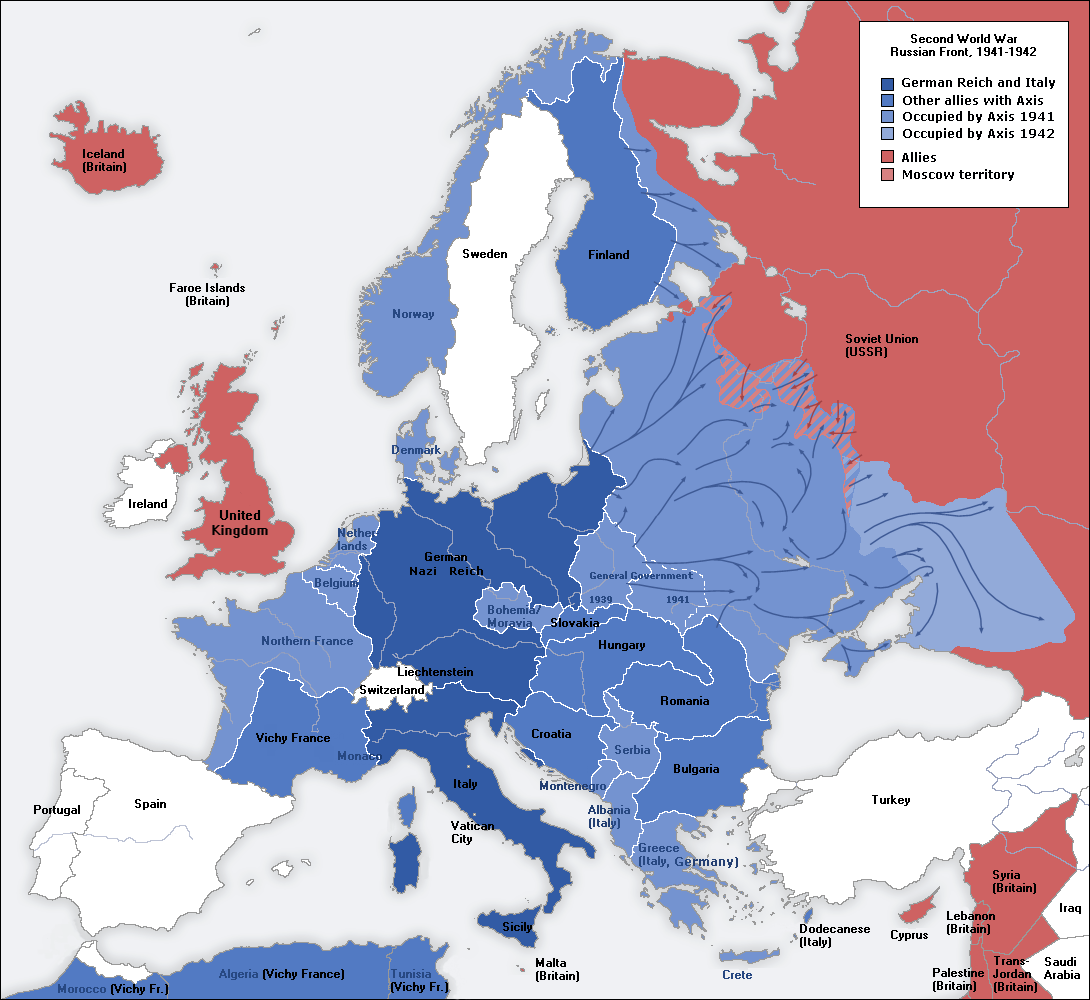
First we can look at a map of Europe at the height of Germany’s conquests:
And secondly, a map of the height of Japanese territorial gains in early 1942:
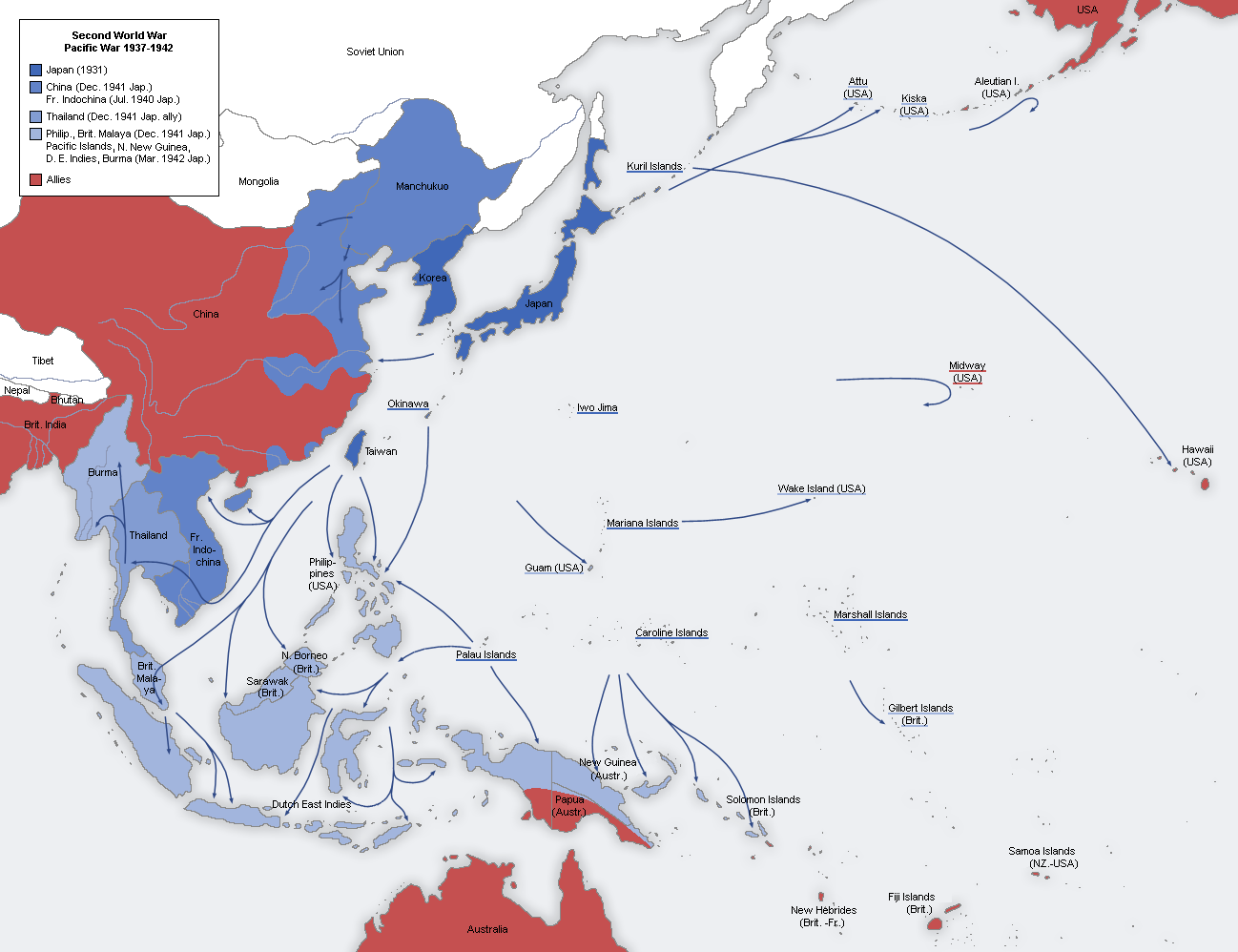
We see that both countries enveloped territory vastly greater in size and population than their own countries. Occupying this amount of land and people would not be possible for them. However, neither the Japanese or the Germans had any aversion to extreme cruelty. So could that “work?” Again, no. Both the Germans and the Japanese did horrible things to civilians (be they Jewish, Slavic, Chinese, or Phillipino, respectively), they lacked the manpower to destroy such vast population groups. What they did accomplish was to perpetrate enough terror so that the population they could not destroy would be guaranteed to turn against them, forcing them to dedicate resources not just to the conventional armies of their enemies, but also the civilian militias within the territory they conquered.
This begs the question as to why these armies embarked on a strategy practically guaranteed to fail.
Perhaps, they wanted to fail. Or at least, they considered “success” a dramatic, cataclysmic failure, a pulling down of the roof on their heads.
This may seem a dramatic claim, but several examples I believe prove this point.
From the German side*
- Hitler’s refusal to allow retreats or strategic withdrawals from El Alamein or Stalingrad, both of which turned into catastrophic defeats.
- Hitler’s plan for the Battle of Bulge in winter 1944 was wildly risky and likely to result in disaster, but he preferred this “all or nothing” strategy to holding firm behind the Rhine river.
From the Japanese side
- Japan refused to dedicate any resources to rescuing downed pilots–conquer or die an honorable death were your options.
- When the US navy/marines captured Guadalcanal the Japanese refused to withdraw into a defensive perimeter, and instead issued orders to defend every area of territory no matter the odds.
- By the end of the war, Japan used suicide bombers in airplanes to try and sink enemy ships. They did not do so thinking that this would win them the war. It was a means to provide an honorable death for many young officers.
Many may not be aware that Hitler and others in his inner circle were huge fans of Wagnerian opera. Hitler’s favorite opera was entitled Rienzi, a story of a minor Roman offical who rebels against the corrupt nobles. For a time, he has success and tries to estbalish a just polity. But soon after he is betrayed. Rienzi himself refuses to compromise, and the people turn against him. Rienzi eventually perishes in flames started by the mob.
At the end of the war, Hitler had his chance (or perhaps orchestrated it on purpose?)** to have life imitate art. Convinced he had been betrayed by the generals and the German people, he stayed in his bunker and saw Berlin burn around him. After his marriage to Eva Braun, they committed suicide together. Hitler gave orders that their bodies be burned so they could never be discovered by their enemies.
My main goal in discussing these difficult things with the students was to try to help students make connections between beliefs, ideologies, and the results of the war itself. Germany and Japan had bad strategies for winning the war because they had bad beliefs and ideological commitments, which in turn led to oppressive cultures. This, in turn, created a climate where victory in war became extremely unlikely.
Although, perhaps both sides got what they really wanted in the end. The Nazi’s achieved their norse Ragnorak, and Japan had its version of a samurai’s honorable death.
Have a great weekend,
Dave
*To be fair, many German generals who were not Nazi ideologues did not agree with these decisions.
**We have no way of knowing for sure (that I am aware of) whether this opportunity was orchestrated on purpose or not. However, I would not be at all surprised if he did. Towards the end of the war, Hitler withdrew from reality and deeper into his fantasies and ideals.

