9th Grade: Civilization and the Garments of Skin

Greetings all, I hope that you will enjoy these updates and that you will find them helpful throughout the year.

We began our Ancient History class this week by looking at a biblical framework for understanding what a civilization is and how they function in our lives. Scripture does not spell this out directly, but if we find some illuminating details if we read the early chapters of Genesis closely.

We see in Genesis 2 that Adam and Eve were “naked and unashamed” before God and each other. I urged the students not to understand “nakedness” primarily in physical terms, but in spiritual and psychological terms. They were unclothed (whatever that might have meant), yes, but they lived without masks and artifice. They experienced God, each other, and creation around them directly.

After their sin Adam and Eve hide from God and wear fig leaves. They need a barrier between themselves and God, each other, and the world. In Genesis 3:21 we read that God made for them “garments of skin” as they left Eden. Whatever the nature of these garments might have been, they are obviously a more extensive covering than fig leaves. These garments may have been skins from animals in Eden, meaning that they were clothed in death. We note further that these garments are given

  • As a result of the fall, but
  • Not as part of the curse of the fall.

These garments are, in a sense, a gift from God to help them cope with exile from Eden.

We then see Cain murder his brother Abel. Cain was a farmer, Abel a shepherd. Certainly there is nothing wrong with either occupation. But there varying occupations meant that Abel wandered with his flock while Cain stayed put and worked the ground. When God disciplines us, He does so to draw us back to Him, to reconnect with Him and those around us. This obviously holds true for God’s punishment for Cain.

Cain is told to wander. Why might this be?

  • Cain murdered Abel, and so now God is trying to get Cain to become a wanderer like Abel. He needs to identify with his murdered brother.
  • Cain needs to be “naked” again, to return to something like a paradisal state. In other words, he needs to come to know God again, to become dependant on Him. Cain needs to remove all of his “coverings,” all the barriers he has erected between himself and God.

But Cain clearly does not accept his punishment or obey. Instead, he builds a city! He stays put. First, we have fig leaves, then garments, and now, the biggest covering of all in the form of buildings and other civilizational trappings. Strange as it may seem, Genesis 4 clearly shows us that the implements of civilization come from the line of Cain. We have no connection to the ancient world, but ancient readers would have seen the clues more easily.

  • The lyre (4:21) was a small harp, the strings of which were made from animal intestines.
  • Pipes were often made from the horns of animals

So we see that this “covering” of civilization comes from death, just as the original garments of skin.

Tubal-cain was the father of those who forge bronze and iron, which fits into the general pattern of further exile from Eden in the following ways.

  • First, we know that Eden was on a mountain (Ez. 28:13-14). Exile from Eden meant coming down the mountain of God.
  • There is nothing wrong with farming, obviously. But we should note that farming involves digging into the earth, i.e., descending further into the earth, moving down from the heights. Most of the best farmland is in vallyes, of course, down the mountain slopes.
  • To get the material to forge metal instruments, one has to go much deeper into the earth. We should see this as as Cain’s descendants not just going all the way down the mountain of God, but going under the earth–going further away from God.

The connection between these actions and violence becomes clear directly following this description of the origins of civilization. Lamech, who as the seventh generation from Adam should have represented completeness and rest,* instead stands for a celebration of vengeance and murder. It is telling that in the godly line of Seth in the following chapter, nothing is mentioned about the implements of civilization. Origin stories recorded from other civilizations, such as Hesiod and Ovid, also link metalurgy with violence and war.

This does not mean that civilization is evil, any more than farming, music, or mining is evil. But we should see civilization as another layer of the garments of skin, a “supplement” we now need to get by in the world and interact with one another.

We can perhaps understand the idea of a supplement working both for and against us if we think of something we use every day, such as makeup. Wearing makeup is not wrong. If used in the right way, it can reveal and accentuate beauty. But if you overuse it, makeup becomes a mask we wear to hide ourselves from others–such a person disappears behind the mask they create. What can work for us now works against us. To take an example with guys . . . I go to the gym most mornings before school. Most of the guys I see are there to lose some extra baggage, or get a modest workout. Occassionally, one sees someone so dedicated to improving themselves physically that they no longer look quite normal. Finally, to take an example all of us may relate to, the same can be true of caffeine. We feel tired and we need to get things done, so we drink some coffee. We feel great and can move on with our day. But if we take it too far, coffee becomes something we need even for normal functioning. What once aided us now binds us.

Makeup can be a good thing, and so can coffee. But we might consider that possibly, might it be best of all to use neither? So too, civilization provides many good things for us. It has been the default form of existence for almost everyone who has ever lived. Civilization provides, shelter, social organization, and protection. The specialization inherent in civilization can dramatically increase our standard of living and allows us to build incredible buildings.**

But . . . speaking of buildings, we also have the Tower of Babel. Civilization can do so much for us, in fact, that we can lose our “nakedness” and our dependance on God. To take one example, we don’t feel the need to pray for rain, because if the crops don’t grow where we live, the store can get food from somewhere else. We can easily light a match to make fire, but at the same time, we lose the skill of creating fire on our own. This trade-off happens with many aspects of civilized life.

Just about every city we encounter in the Old Testament is viewed negatively. We have mentioned Cain’s city, and the Tower of Babel, but there is also Abraham’s time in Egypt, Sodom, Jericho, Tyre, Nineveh, Babylon, etc., etc. In fact, I can think of only one viewed differently, Salem, which later becomes Jerusalem. It is Jerusalem which begins the process of the redemption of cities, the incorporation of the garments of skin into the New Heavens and New Earth (Rev. 21).

My goal with introducing this material is to help orient us in our study of the many great civilizations of the past. We should neither get too enamored of them, nor see them as a curse or blight. Rather, we should view them as a blessing that is part of a fallen world, that can become a curse if we’re not careful.

Enjoy the weekend,

Dave

*Compare Lamech to Enoch in Genesis 5, also a seventh generation descendant from Adam through Seth.

**To reinforce the idea of the dual nature of the Garments of Skin, we can see the Tabernacle as a covering akin to a city. God commanded that it be built. It is interesting that the same (or perhaps a very similar word) to describe the main builder of the Tabernacle, Bezalel, is also used to describe Tubal-Cain–a craftsman. Bezalel is a good guy, Tubal-Cain a bad guy. They both used similar skills with similar tools to do similar things towards very different ends.

6th Grade: Hierarchical Collapse

Last week we discussed in class some of the key values and concepts of the pre-modern world. One crucial aspect of the medieval world involved their relationship to hierarchy. Most moderns understand that we need some form of hierarchy to allow us to have a society. But we tend to see these hierarchies as artificial and transient. We have an abundance of stories where those with power get humbled and even humiliated by the little guy. It’s built into our cultural DNA.

Medieval people thought differently. They did not automatically assume that those higher than you in status were better people, but they believed their status had a reality to it beyond mere earthly contingency. They thought this for a variety of reasons, among them:

  • Scripture has a host of examples of God choosing, either directly or indirectly, the leaders of His people. We can recall the example of Moses, Samuel, the prophets, the apostles, etc.
  • The earliest Christian writings after the first century, such as “The Didache” and the letters of St. Ignatius, speak of church hiearchy
  • Many early Christians interpreted the words of the Lord’s Prayer, “thy will be done on Earth as in Heaven,” as meaning that we should attempt to imitate the pattern and ‘life’ of Heaven here on Earth.

Possibly the most influential voice on the subject were the writings of St. Dionysius the Areopogite.* His short treatise On the Celestial Hiearchy described the ranks and orders of angels in Heaven, and he then applied this reality to our life on earth. We looked at a quote from this text in class, which reads,

Hierarchy is, in my judgment, a sacred order and science and operation, assimilated, as far as attainable, to the likeness of God, and conducted to the illuminations granted to it from God, according to capacity, with a view to the Divine imitation. The purpose, then, of Hierarchy is the assimilation and union, as far as attainable, with God . . .

In other words, hierarchy on earth does not exist merely to keep order. We have hiearchy on earth to imitate heaven, to be drawn into the life of God, and to become more like Christ. Thus, living within a God-appointed hierarchy was a crucial aspect of one’s spiritual life. Living outside of hierarchy was therefore a metaphysical and spiritual impossibility.

But what happens when the hierarchy strays and abuses their position? Can there ever come a time when one separates oneself from that hierarchy? And—are you sure you have the right hierarchy? These questions formed the background to the the first significant event we will study this year, the Reformation.

The Reformation was a complicated event that involved many historical factors. Forces such as economic and political change, the Black Death, and so forth all had a part to play in the Reformation. But for a few reasons, I want to focus on the people involved with the students. First, while acknowledging complexity is important, I don’t want to overcomplicate things for sixth graders. Secondly, while economic forces, for example, have importance, “economic forces” do not make decisions. People make decisions, and we should put our focus there.

The Church existed as essentially one physical institution for the first 1000 years of its existence. Then, in 1054 (though in fairness this date is disputed by some, others would put the date at 1204 when the Crusaders sacked Constantinople), the Church split between the east (Orthodoxy) and the west (Catholicism). Still, if you lived in the west, your life essentially remained unchanged after this split. Everyone was Catholic, and the Church thrived in the Middle Ages. One only has to look at the magnificent gothic cathedrals, and the lives of luminaries such as Thomas Aquinas, Francis of Assissi, Catherine of Siena, and many others to see a vibrant spiritual life.

However, by the late 15th century, much of this had disappeared, at least in the leadership/hierarchy of the church. Many of course lived vibrant Christian lives but starting in at least the 1370’s, the church was wracked with a succession of poor leaders that lacked spiritual vision and wisdom. The start of 1500’s saw the western church beset by corruption. Many had advocated for reforms, and many had tried various means to improve the church, but these efforts had not gained enough momentum.

No one expected that an unknown German monk named Martin Luther would upset the entire apple cart, not even Luther himself.

It is important to note that no Catholic church historian would deny that the church had grave problems leading up to the Reformation. The difference between Luther, his followers, and the Catholic church was not that one side saw problems and the other didn’t. They often (though not always) agreed on what the problem was. They disagreed on what the problem meant.**

When Luther, an Augustinian monk, published his 95 Theses he did not intend to start a revolt. He sought debate and discussion on points of Church doctrine and practice. Many within his monastic order agreed with him about what he wrote. Pope Leo X himself agreed with some of what Luther wrote and tried to put a stop to some of the abuses Luther pointed out in Germany.

How this snowballed into a full-blown religious revolution is complicated, and my goal is to make it intelligible for the students. Luther posted his theses in 1517 with general support from many. By 1521 he was excommunicated. What happened? I focused on what I see as the central dividing line between those that supported Luther and those that stuck with the church.

  • Luther believed that Scripture had authority over Church tradition and church hierarchy. Luther was convinced that his reading of Scripture was correct. For him, the issue involved putting God’s word above human authority.
  • The Catholic church obviously believed in the authority of Scripture. They wanted Luther to submit his ideas to the Church. He had taken vows of obedience as a monk. Before debating any particulars, they wanted Luther to affirm that he would live according to the vows he took. Luther’s denial of the Church’s authority, and his casting off of his monastic habit, looked to them like a married man wanting a divorce, or a private telling the joint chiefs that he did not need to obey their orders.

The question of Luther’s obedience relates particularly to his vocation. Luther became a monk, and every monk took a vow to Go of poverty, chastity, and obedience. Of course, not everyone needs to become a monk or should. We can compare this in some ways to joining the military. Not everyone can or should join. But if you do join, every recruit needs to obey the orders of their superiors.

Imagine a private writing a long treatise about problems in the high command and making his concerns public. This in itself could be viewed as a problem. Now, suppose that the generals agreed with the private about some things, maybe disgareed with him about others. They tell him to sit tight and be quiet while they consider.

The Catholic hierarchy basically chose this path. They focused on Luther’s vow of obedience, and his need to submit to authority. But increasingly, Luther started not to view the Catholic hierachy as a legitimate authority, and thus, his vows were not binding.

Finally, I would suggest that Catholics believed the best way to serve God was within the hierarchy He established, and Luther thought the only way to serve God was to separate himself from it. Catholics do not say that every pope and every bishop is godly or even a Christian. Israel had some good kings and many bad ones. In Israel, one was not supposed to rebel against even the worst of kings. Nor did anyone ever rebel against corrupt priests. In turn, Luther made a sharp contrast between church hierarchy and civil authority. Church hierarchy had the higher authority of Scripture over them, whereas civil leaders were, on earth at least, accountable only to God.

Many joined Luther in his bold and courageous stance. He inspired many. But Luther was a volatile man–a great revolutionary, but not a good diplomat. Many who agreed with a variety of his beliefs could not join him in separating themselves from the institutional church, such as Erasmus. We looked at a collection of quotes from Luther that show him at his best and worst.

Some may have familiarity with the myth of Cronos/Saturn and his children. Saturn, rebelled against the Titan Uranus, castrating him and freeing his siblings. He then became the supreme power in the cosmos. But he worried, realizing that he had established a precedent, whereby his own children could overthrow him. To prevent this, he ate his own children. But he could not stop what he had put in motion, and later his own children, freed from his belly, overthrew him as well.

Luther faced a similar challenge. His actions moved the locus of authority from the universal institution to local communities and individuals. Many peasants had grievances against the nobility. Luther agreed with them that they had legitimate reasons for their concerns. But when the peasants rose in armed rebellion against the nobility, Luther was horrified, and urged that the rebels be crushed without mercy. Luther did not have a high view of Church authority, but did have a very high view of political authority. Others failed to agree with the distinction Luther made.

Soon various other Protestants emerged, many with much more radical ideas than Luther. Which ideas would win out? How could society hold together? This would be one of the key problems that would shape the next century in Europe.

Have a good weekend,

Dave

*The dating of his life is much disputed, with some believing he lived in the late first or early second century AD, and others arguing for a date much later in the sixth century.

**This is akin to disputes about the meaning of Scripture. People generally agree on what the Bible says. They disagree about what the Bible means.

8th Grade Literature: The Dog Days

One of the advantages of reading ancient texts is that they expose us to an unfamiliar world with an unfamiliar way of thinking. But for us to appreciate this we sometimes need to look behind some of the archaic or strange phrases we encounter to help the story make sense. After we get a sense of the story’s meaning, we can then consider its application for us today.

At a few different points in the story the narrator compares Jason’s attractiveness to the star Sirius. This star appeared close to the sun betweeen July 3-August 11, the so called “dog days” of summer. The Sirius star is the brightest sun in the constellation Canis Major (hence the term “dog days”). Some surmise that the ancients believed that the closeness of this bright star added to the heat of the sun, intensifying all things about what summer brings.

We can perhaps easily understand why human beauty would be linked with that of a star. The brightness of Sirius stands out above all other stars in the sky, just as when we notice that special someone across the room, all others fade from view. But in comparing Jason to Sirius in particular, Apollonius gave a foreshadowing hint that his audience in AD 300 would have understood immediately in a way we do not.

The ancient Greeks valued temperance and finding a mean between extremes. Cold and heat both bring good things, but the extremes of both are destructive. Excessive heat brings destruction to crops and to the soul. We know that on hot days, for example, crime increases. Our tendency towards anger and lethargy increases with extreme heat.

Romantic feelings are also associated with heat, but it is Spring, not Summer, that we associate with romance. Summer brings excess, and this foreshadows the destructive relationship Jason will end up having with Medea. The brightness of Sirius is a foreboding brightness. Too much light can harm just as much, or perhaps even more, as too much darkness.

But there is a flip side to the dog associations Apollonius foists upon Jason, and this subtlety helps makes The Argonautica literature worthy of our attention

Dogs had a dual place in ancient and traditional socieities (something we have touched on regarding Roland in this post). To recap briefly, dogs are, on the one hand,

  • Linked with false prophets and unrestrained appetite

but on the other,

  • Associated with obedience, humility and protection.

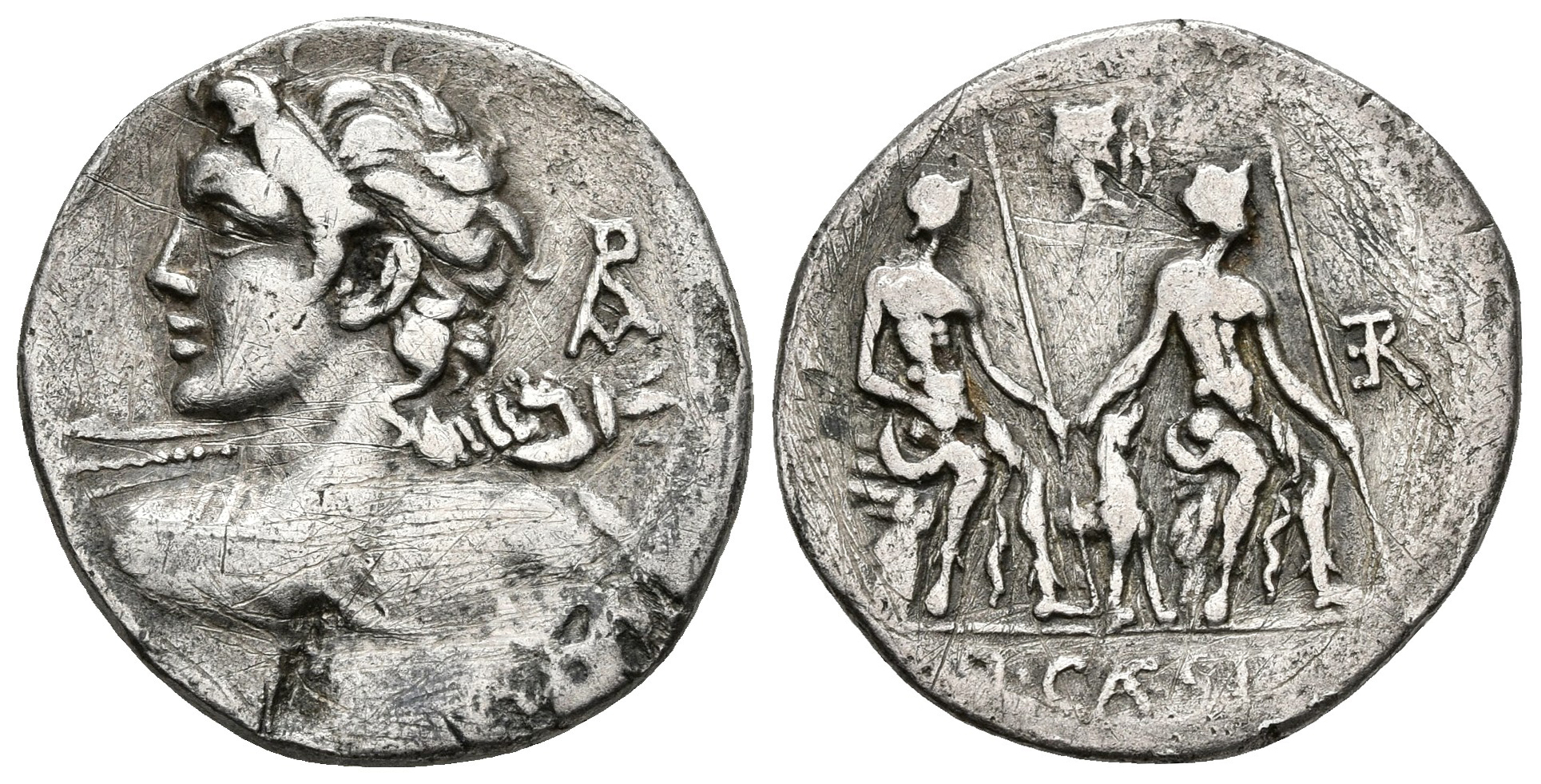
As noted previously, Jason does not exercise typical heroic leadership. He is not an unstoppable warrior like Achilles. He does not lead from the front like Roland, or possess the single-minded brilliance of Captain Nemo. Jason does show great concern for his men. He is a guardian, of sorts, for his crew, and this fits with how dogs were viewed in the Roman empire. We see here two Lares on a coin, and you can see the dog form:

Here is a later image, where they take a more distinctly human form:

So this connects positively to Jason’s leadership, and Apollonius includes this imagery to let you know of Jason’s strengths.

But dogs in the ancient world were never quite fully domestic creatures as we are used to today. They guarded borders, but would not have been brought inside the home. But Jason is the son of a king, and he should be king himself, were it not for his usurping uncle. Throughout the story, however, Jason rarely seems comfortable as a leader. He hangs back, he worries, he has insecurities. Initially his crew thought Hercules should lead. In one instance, he decides to leave an island at night because of a fair wind, but everyone knows that we have bad associations with night because of the confusion it can bring. Sure enough, Jason ends up leaving Hercules behind by mistake, and turning a ship around in the ancient world to row against the wind is basically impossible. In another instance, friendly hosts mistake Jason and his crew for invaders (again, this happens at night), and Jason accidentally kills the host king. When it comes time to box the brutish Amycus to allow them to leave his island peacefully, it is not Jason that steps forward, but another crew member.

Those who know the full story of Jason (which we will discuss at the conclusion of the Argonautica) understand that Jason will continually feel trapped and pressed by circumstances, and not able to transcend them. He never attains the greatness associated with other Greek heroes.

All this is wrapped up in Apollonius’ references to him as Sirius, the dog star, which many in the ancient world feared to see.

8th Grade Civics: Aristotle on justice and Justice

We tend to think of “Justice” almost exclusively in terms of the proper punishment of bad behavior. If someone robs a bank, we say that justice is done if he is caught and sent to prison. If someone is wrongfully accused, we declare that justice is done when the judge dismisses the case.

The ancient world, however, had a broader conception of the word “justice,” using it to describe all things being rightly ordered in one’s life and in the life of the body politic. A rightly ordered world might involve things that are directly moral, or sinful. So, for example, having one’s bed could be a portion of having a “just” house, but not making the bed would not necessarily be a sin. It would however, be a defect.

We see this use of justice in Old Testament frequently, such as in Psalm 54, which reads, “O God save me in thy name, and judge me in thy strength.” Here the psalmist is not asking God to punish him for his sins–far from it. Rather, God’s judgment and His salvation are one in the same. The psalmist is asking God to rightly order his being, to put him back together again appropriately, which would involve much more than overt sin.

Aristotle noted long ago that different forms of government have different forms of justice which both make sense and are incomplete all at once. He writes,

What are the oligarchic and democratic ideas of justice? Both sides have part of justice on their side, and both sides fail to express justice in its fullness. 

In democracies justice means equality, especially in the distribution of political power. That is, political power should be put in the hands of as wide a range of people as possible. A poor man, for example, holding power with no experience or education, is considered a triumph. This creates, in their view, a stable state where everyone feels included, and this is “justice.”

In oligarchies, inequality in the distribution of power is considered just. If people are not equal in wisdom, education, wealth, and the like, they should not have an equal share of political power. This helps the state have rulers that are best able to govern. In turn, a well governed, stable state will be “just.” 

The advocates of democracy and oligarchy both make erroneous judgments. Democrats hold that if men are equal in basic humanity, they should be equal in the distribution of power and property. Oligarchs hold that if men are not equal in talent, wisdom, and skill they should not be equal in most anything else.

True justice means that those who have contributed to the proper end [it’s reason for being] of the state, should have rights, property, and power in proportion to that contribution. For that reason, all must pay attention to the “goal” of the state in which one lives.

Aristotl’e ideas might seem confusing, but if we break the concepts down into something smaller and more in line with our experience, it might make more sense.

Imagine a family has three sons, Bob (18), Joe (12), and Sam (6). One evening the mom discovers that the she has three Oreo cookies left in the pantry. What would be just, and most likely to lead to a harmonious order within the family. Most would probably suggest that here the focus should be on pure equality, i.e., each son gets one cookie each.

But imagine now that the mom has three different sized pieces of steak, small, medium, and large. Most would likely not argue that justice requires them to cut up all the steaks and give each the same amount. Here most would lean towards something along the lines of the oldest getting the biggest steak, the youngest the smallest, and so on. To be sure, this is still “equality,” but it manifests itself differently here. If the family also had a 6 month old son, no one would suggest that justice demands he should get steak, as his stomach could not even digest it properly.

Parents usually treat their children differently when it comes to bedtimes, to the great annoyance of the younger siblings. Most, however, intuit that it would not be just to have all three go to bed at the same time. Here the context differs, and the meaning of justice would differ as well.

Ideally a state will have a degree of flexibility around their concept of justice, allowing for context to have its say. But as Aristotle suggests, what direction a society leans toward will depend on what that society values as its purpose or goal. For example, if you live in a society that believes that age should be respected above all else, you would defer decisions to the elderly, and you would give them the best seat at the table, and so forth. This is not equality, but it is justice according to one’s guiding principles.

An example more close to home comes from Elaine Calabro’s article in The Atlantic about Canada’s practice of MAiD, or “Medical Assistance in Dying.” The practice has grown from allowing euthanasia only in cases of advanced terminal illness, to those who simply want to avoid suffering. Calabro writes, “At the center of the world’s fastest growing euthanasia regime is the concept of patient autonomy. Honoring a patient’s wishes is of course a core value in medicine. But here it has become paramount.” Some physicians express moral or practical objections, but most who work in the industry find their work meaningful. As one physician noted regarding his work in assisted suicides, “We’re so happy [the patient] got what they wanted.” Given the basic values that created the practice, its expansion was “inevitable” according to the author.

Here we can note that a core value, i.e, people fulfill their purpose by achieving their desires, which drives much of economy, politics, etc. has simply morphed into the medical and ethical field. Hence, “Justice” in this case means giving people their autonomy, their say, in the most important life decisions. One can easily see how various other democratic practices and ideals come from this same source. This shows how one particular view of justice works in some areas (we should pick our political leaders, and pick what we want for desert)* might not work in other areas of life. We have already seen how parents use different views of justice depending on context in family life, and this is a good argument for its application to political life.

But which form of justice should be used when, and why? This is at the core of many of our current political disagreements. Aristotle also hints at the fact that these “justices” must somehow be connected to Justice in some final sense. Without agreement on Justice, we will struggles with our mini justices.

Dave

*I have a variety of friends who have traveled in Europe, and especially as one moves south and east (Italy, Greece, etc.) they notice that when going to a restaurant, often the proprietor will size you up and tell you what you will have. If you object and point to the menu, saying, “I was hoping for some lamb instead of the pork,” you will simply be told that “There is no lamb, only pork.” Eventually you agree to “submit” or leave the restaurant.This shows a different culture around food, but also a different culture around authority, tradition, the individual, and so on.

8th Grade Literature: The Joy of Battle

This week we continued with The Song of Roland and delved into the topic of the violence in the story.

Those familiar with this story will note partial similarities to Homer’s The Iliad, and perhaps these similarities were intended by the author. Both stories have extended battle scenes with vivid descriptions of the violence, with limbs cracked, armor pierced, heads split, and so on. Both stories have their authors and their characters exulting in the carnage. Here is just one example:

Gradonies was bold and brave, a strong intrepid fighter. Now he finds himself faced with Roland. And though he has never seen him before, he recognizes him by his proud face, noble body, his regard for bearing, and he is filled uncontrollable dread. He tries to escape but fails, for the Count strikes him with such force that the blow splits the helmet, nose piece and all, cleaves through his nose, and his mouth, and his teeth, and his whole body and the coat of linked chain mail encasing it, the gilded saddle, both sides of the silver saddle tree, and deep into the horse’s back. He kills them both. Nothing could have saved them.

And another, this one involving not just a ‘regular’ soldier, but a high ranking clergyman, the Archbishop Turpin:

Nothing can turn [the Archbishop] aside: he charges against Abisme and strikes him on the shield studded with amethysts and blazing rubies, which a devil in Val Metas had given to the Emir Galafres, who in turn presented it to Abisme. Turpin strikes him; he does not spare him; and after one blow I don’t think the shield was worth a farthing. He chops through the body from one side to the other and kicks the corpse onto the bare ground.

The French say: “That was a noble stroke! The cross will not suffer while the Archbishop is there to protect it.”

We might expect such similar language from Homer’s tale of pagan Greece, but The Song of Roland fashions itself squarely within a Christian worldview, and means to communicate a Christian message. We might understand as Christians the need for violence at times. But violence is necessary only when something is wrong in the world. Some might assume that if we must fight, we should conflicted about it and have a heavy heart about our task. Above all, we certainly should not revel in it.

Whatever you may think about this sentiment (and it is one shared by many moderns, Christian or otherwise), it certainly was not one shared by the author, and we should consider why.

I remember years ago my next door neighbor had her grandson living with her on the weekends for a few months. He was in training to be a police officer. When I asked where he hoped to be assigned, she replied, “He wants to be right in the thick of it in downtown Baltimore. He wants to be where the action is.” Naturally this attitude worried his grandmother, but she said most of his academy friends felt the same way.

Some of you may know that one of my sons recently graduated from his training to be a firefighter, and is now working regular shifts at a local station. His first week was slow. Sure, a few interesting things happened on some other shifts, but his shift had it easy. This meant some downtime at the station, and some light days. You might think that a job where not much happened might be appealing, but my son was frustrated. In his view, he didn’t become a firefighter to play cards. He wanted action.

One can have two perspectives on this:

  1. These are the wrong attitudes to have. If one wants “action” as a police officer or firefighter, then one “wants” crime and property destruction to occur. The world would be better without crime or fires or medical emergencies. We do have to deal with them, but we should not be “excited” to deal with such things.
  2. Since crime and fire do exist, we need to have people trained to deal with them. If we need to deal with them, wouldn’t it be better to enjoy the work? Is fighting crime or fire something one can do to the glory of God? If so, they should ideally find joy in the task. Probably, the cop who enjoyed the job is more likely to be better at it than someone who hated it.

One might think that Roland as a character belongs to the past, but not necessarily. He is a type, although one we don’t see much of anymore. In CS Lewis’ autobiography Surprised by Joy he recounts his experiences meeting different kinds of soldiers in the trenches of WW I. He writes,

Perhaps the best of all us was Wallie. Wallie was a farmer, a Roman Catholic, a passionate soldier (the only man I ever met who really longed for fighting) and gullible to the [highest degree]. The technique was to criticize the Yeomanry. Poor Wallie knew that it was the bravest, the most efficient, the hardest and cleanest corps that ever sat on horses. He knew all that inside, having learned it from an uncle in the Yeomanry when he was a child. But he could not get [his words] out. He stammered, and contradicted himself, and always came at last to his trump card: “I wish my Uncle Ben were here to talk to you. He’d tell you.” Mortals must not judge but I doubt whether any man who fought in France who was more likely to go straight to Heaven if he were killed. I would have been better employed cleaning his boots than laughing at him. I may add that I did not enjoy the short amount of time I spent in the company he commanded. Wallie had a genuine passion for killing Germans and a complete disregard of his own or anyone else’s safety. He was always striking out bright ideas at which the hair of us subalterns would stand on end. Luckily, he could be easily dissuaded by any plausible argument that occurred to us. Such was his valor and his innocence that he never suspected us of any but a military motive.

Charlemagne’s battle cry is “Mountjoy!” and his sword is named “Joy” (as translated from the French), so we know his approach. Some might assume that Charlemagne was a war-mongering sadist, but the story will not allow for this interpretation. Among other things, there are the last lines in the book, which read,

The King has gone to bed in his vaulted bedroom. God sends St. Gabriel to visit him, and he says, “Charles summon all of the hosts of your Empire and enter the land of Bire by force of arms, and rescue King Vivien, for the pagans have laid seige to him in the city of Imphe, and the Christians there are pleading and crying out for you.”

The Emperor does not wish to go.

“Oh God,” says the King, “my life is a burden!” And the tears run from his eyes and he rends his white beard.

We should not read this as Charles contradicting himself or his life’s work. Rather, a faithful reading of The Song of Roland causes us to examine our own life critically, just as Charlemagne had to do with his.