Greetings All,
This week we continued with seismic changes brought about by the Reformation, which started as a religious movement, and then quickly morphed into vehicle for altering the entire cultural and political landscape of Europe. For better or worse, a new world emerged in the wake of Luther, Calvin, and Zwingli.
At the end of last week we summed up the differences between the different thinkers and movements in the following manner:
- The Magisterial Reformation (Luther, Calvin, etc.) saw the church as corrupt, but the state as a secure bulwark either against the church or as a platform upon which to build a new society. Luther, for example, sympathized with the peasants who rebelled in 1524 but urged them to be crushed without mercy. Calvin wanted the state to work with the church to change laws and to use the force of law to enforce church teachings.
- The Radicat Reformation (Anabaptists mostly) saw the church as corrupt, but also the government and the “world” as a whole. Everything needed torn down and rebuilt from the ground floor. They saw earthly powers just as much a part of the problem as the Catholic church. Everyone, be they Catholics, Lutherans, or Calvinists, saw the Anabaptists as enemies and persecuted them. To be fair, when Anabaptists had a chance, they did engage in some persecution themselves.
But the Lutherans and Calvinists also disagreed amongst themselves and persecuted each other. They agreed on the nature of salvation, but disagreed on how to apply their doctrines in everyday life.
- Lutherans focused on freedom in Christ from the Law. The best thing we can do as Christians is to simply trust in the love of God and stop thinking about yourself. If you sin, that happens, use it to help draw you closer to God. Focusing on your sins, where you have been good, and where you have been bad, is just another means to keep thinking aobut yourself instead of God.
- Calvinists saw Lutherans as taking the grace of God for granted. Christ saved us not to whatever we liked but to obey God and follow his commandments. God takes how we live seriously, and we should to. Being mindful of ourselves and our behavior is how we show how we love God.
I asked students how they would seek to resolve these dilemmas and choose who was right, or at least, more right than the others. They did a wonderful job of suggesting solutions and then adjusting them when others commented. It is certainly fine to be unsure about question like this, as these are deep and difficult questions. We will tackle why everyone persecuted everyone else for their beliefs later on, but Europe descended into chaos. Nobody had clean hands.
This week we looked at the English Reformation, inaugerated by Henry VIII, and continued especially via his daughter Elizabeth I.
As always, to understand the English Reformation we have to know what preceded it. We we see a particular swing of the pendulum we best understand it by knowing about the swing to the other side. In the early 1300’s, England stood poised to become the dominant power in Europe. They had a popular and successful king, they were winning a war with France, and they had more overall political and cultural unity than most any other European power. But over the next 100 years, they experienced a period of convulsive events that upended most everything:
- The onset of the Black Plague (which also impacted the rest of Europe)
- The death of the heir to the throne
- A complete reversal of fortune in their protracted war with France
- The abdication and mysterious death of Richard II
- The unexpected early death of Henry V, victor at Agincourt.
- The War of the Roses (1455-85) between the aristocratic houses of Lancaster and York, which saw the untimely deaths of Henry VI as well as Richard III.
Henry VII was actually a relatively minor Lancastrian nobleman who came to power in part because he was the last man standing. England needed and craved stability, and when Henry married Elizabeth of York, people were satisfied. England could move forward.
Henry VII had two sons, Arthur and Henry. Arthur died as a young man, leaving his son Henry the only bridge between future stability and political chaos once again. Henry was never supposed to be Henry VIII, but . . . these things happen, and they change the course of history.
Wherever the Reformation took root, it did so for slightly different reasons and took different forms. Some say that the English Reformation was driven more by personality and nationality than theology, and there may be truth to this. In time, Anglicanism would develop a distinct theological voice, but in the beginning the marriages of the monarch determined much of the course of events.
When we think of Henry VIII we often think of a domineering and abusive man, perhaps too much in love with his own power. This may capture much of the truth of who Henry was, but he did not necessarily begin that way. He had great intelligence. He spoke fluently in perhaps three different languages. He was an accomplished musician and dancer. He wrote a legitimate and scholarly treatise on the sacraments and he had He had a love for crowds and spectacle, and England adored him in the early years of his reign. He seemed genuinely in love with his wife Queen Catherine, who bore him a daughter named Mary.
But the fact that he had no son, and his wife was getting on in years, gnawed at him. In addition, he found himself head over heels smitten with another woman named Anne Boleyn. Henry insissted that his marriage to Catherine had no validity, because Catherine had been briefly married to his elder brother. The Church disagreed and refused to grant a divorce or an annulment. So Henry broke from the Catholic faith (he had made arguments against Luther years earlier) and made himself the head of the Church of England. After that, he could divorce Catherine and marry Anne rather easily. 🙂 Of course not everyone went along with this, and some (such as the Catholic martyrs John Fisher and Thomas More) lost their lives for refusing to sign on to the new order.
Had Anne bore Henry a son, who can say what might have happened, but Elizabeth was her only surviving child. Henry eventually accused her of adultery and witchcraft and had her beheaded. Anne protested her innocence to no avail. His next wife, Jane, died in childbirth. He divorced his fourth wife Anne of Cleve, and also executed his fifth wife, Cehterine Howard. His sixth and final wife, Catherine Parr, managed to outlive Henry. By the look of her, she may have been made of sterner stuff than his previous wives, having mastered the ‘stern library’ look. 🙂 Many credit her with guiding Henry’s son Edward (from his brief marriage to Jane Seymour) in the Protestant faith and making sure he held the Protestant line after Henry’s death.
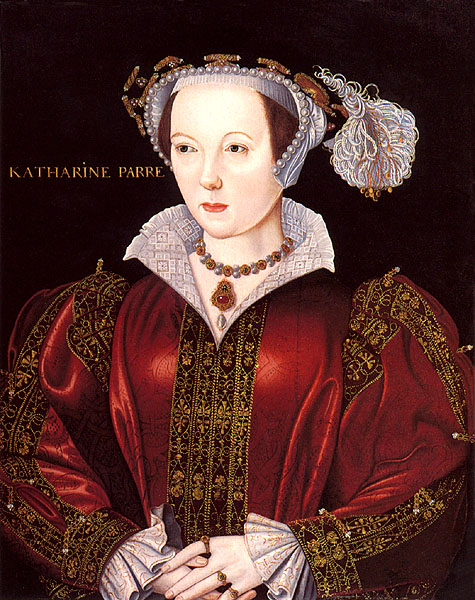
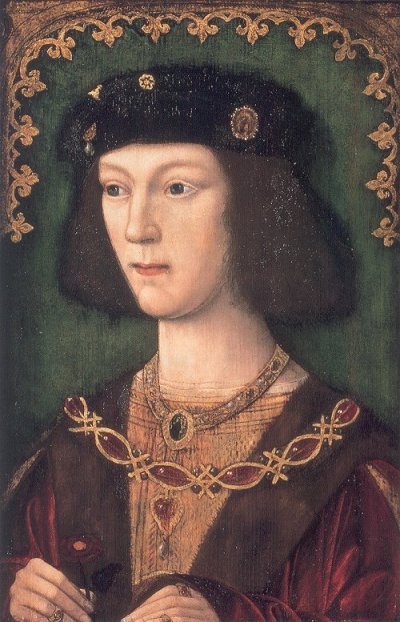
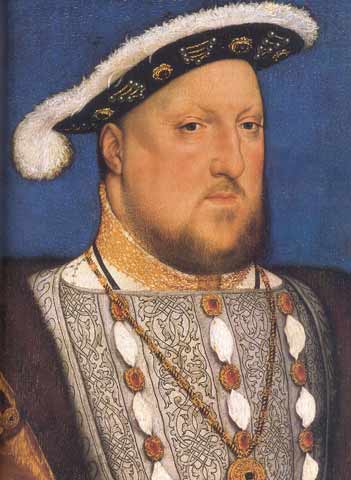
No English king, with the possible exception of Henry II, had weilded more power than Henry VIII. And yet, I think that his grasping was not driven by strength but weakness. Many of his portraits cannot help but reveal a suspicious, gnawing insecurity. Here is a portrait of him as a young man, perhaps in the very earliest days of his reign:
And him in middle age well into his time in power. The wary eyes are still there:
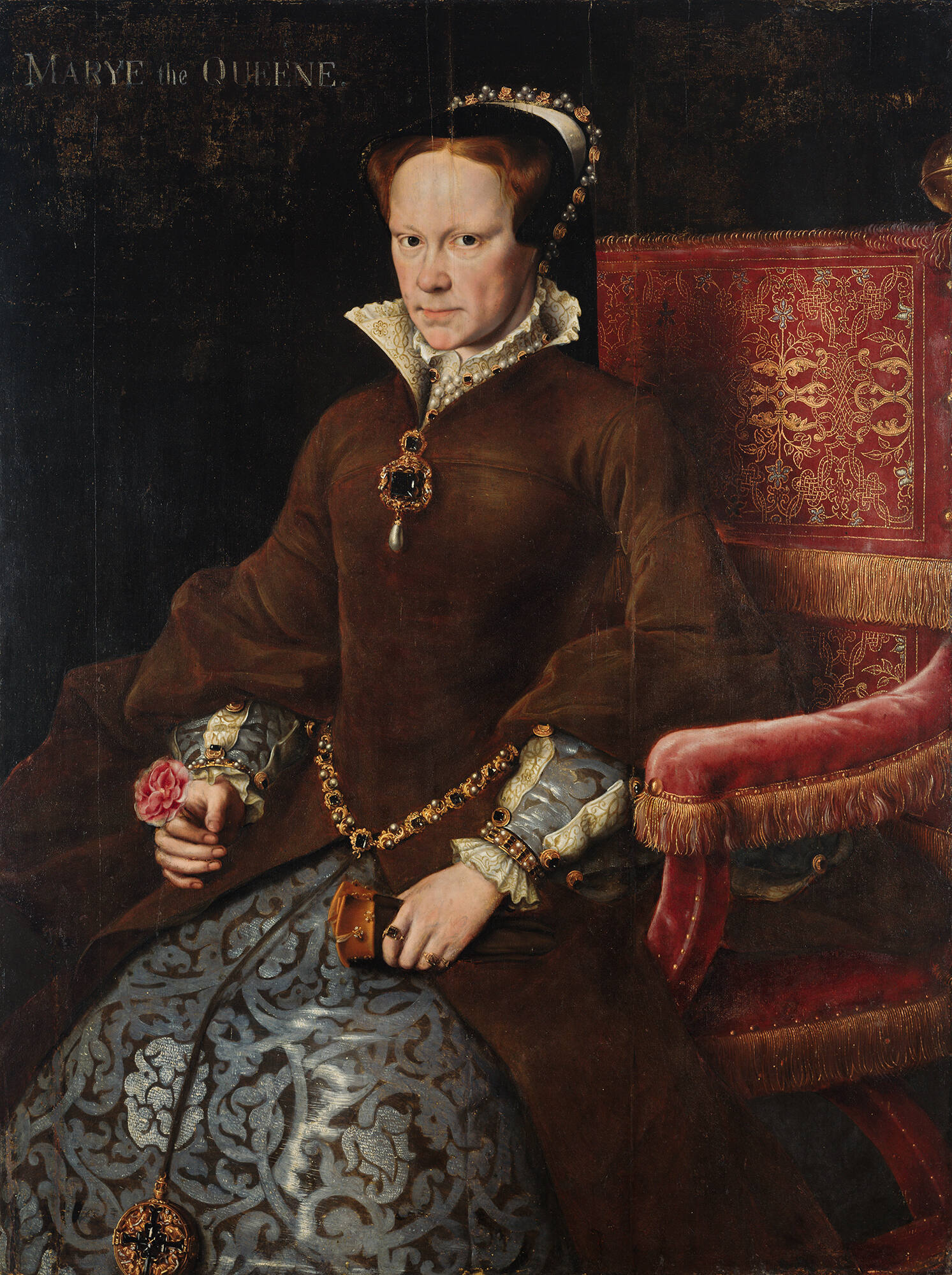
Six years after the death of Edward VI (who died at age 14) his oldest half-sister Mary became queen. History knows her as “Bloody Mary,” because of her persecution of Protestants. In many ways she deserved this epithet, but we must try and sympathize with her. Henry unjustly divorced and banished her mother Catherine of Aragon. She had little contact with Protestants, and plenty of time to nurse a grudge, to plan to right the wrongs of the past. We might understand better if we we realize that she thought that Henry had “ruined the country,” and God placed her in authority to bring England back to the faith and right previous wrongs.
To this psychological motivation we should add that neither Henry or Mary’s mother lived very long. What if she felt that she had precious little time to accomplish her goals before her death? As the saying goes, “Beware of an old man (or woman) in a hurry.” In this image to the right we see the same gnawing insecurity her father could not hide. Like Henry she knew she needed a son if her attempt at reform would last, but as an older woman nearly past childbearing years, she had little hope of a suitor actually appearing. We can lament the tragic nature of her life without condoning her actions. When we see her portrait nearly at the end of her life and reign, we see the same wary countenance as her father.
It would be left to the daughter whose birth must have dramatically disappointed Henry, the daughter of Anne Boley, Elizabeth, to attempt to consolidate the turbulence of the realm. We will look at her efforts next week.
Dave

