Jim Ottaviani’s “Suspended in Language”

Like many of you, I decided that I was not a Math/Science person sometime around 8th or 9th grade.  I hit Algebra and never looked back.  Only recently have I started to regret that choice, or rather, the false dichotomy of that choice.  Reading this essay helped me see why the so-called division between the humanities and sciences has happened.  Maybe my lack of math sense is not all my fault!

The famous “Lockhart’s Lament” essay I linked above has two main points:

  • We teach math all wrong because we teach it in a way totally divorced from reality
  • Math should be taught like a a humanities class.  Instead of random symbols we need story and context.  In short, Math and Science involve art as much as Literature or History.

Inspired by Lockhart, I no longer believe myself a lost cause in the area of science.  But I am also a realist, and so turned to the comic book medium for help.

The book’s art does the job, although it does not inspire.  Ottaviani does better with the story itself, and makes the mythical Neils Bohr into a recognizable human being.  Much of the science remains beyond my understanding, but one aspect of Bohr’s life struck me and reminded me of Lockhart’s essay.  For Bohr, theoretical physics needed to involve poetic interpretation.  Physicists need to read between the lines and create an artistic vision through inspired guesswork.  “By faith we reach understanding.”

Bohr is perhaps best known for his atomic model: 

Bohr quickly dismissed this model as inaccurate.  All physicists agree that atoms don’t look like this,  and yet it has stuck around.  Why?  The book does not speculate, but we can.  Surely something of the model’s sticking power has to do with its visual elegance.  Also, the picture gives you an instant explanation.  Finally, no one has given us something better.  This is part of Bohr’s point.  He wasn’t right about the structure of the atom, but he was more right than someone who makes no guess at all. If you insist on omniscience you will end up knowing less than if you just made your best guess, and visual poetry communicates more truth than esoteric symbols.  Hence, the book’s title borrows a phrase from Bohr.  The deepest scientific truths remain “suspended in language.”

I am very encouraged to think science can function like the humanities, and making this link is the best shot we have at getting more students interested in math and science.

Dave

Chinua Achebe’s “Things Fall Apart”

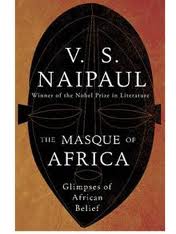
This book tackles many of the same themes as The Masque of Africa, and like that book this one too is a short but powerful work.

I cannot say if Achebe is entirely accurate about his portrayal of African tribal clan life in the Victorian era, but reading him makes me think that surely he must be accurate, so vividly does he draw the characters and action.  In the hopes of not repeating my Masque of Africa thoughts, the book touches upon many important themes:

1. Does Christianity fulfill or go against native religions?

This debate has gone back almost to the beginning of Church history itself, and Achebe does not try and solve it.  But he does a great job giving us the tension not only in different missionaries, but in the society itself.  Is the paganism of the African tribes a foundation to build upon or a negative force to be supplanted?  Or is it both/and instead of either/or?

Sometimes the reader sees the dignity and cohesiveness of tribal religion.  The Africans understand religion far more than the average agnostic westerner.  But just as often we see the terrible darkness and fear that the African religion produces.  Achebe must be given tremendous credit for not flinching in this area.

2. Religion and Culture

Again, more than many westerners, Achebe understands the importance of religion, because once the religion is changed, the culture must as well.  The missionaries quickly bring in education to the clans, as well as a different law system.  How much of this must by default come with Christianity I can’t say, but surely, for example, education must come with Protestantism.

3. Africa as a Template for Europeans

In a controversial essay, Achebe called Conrad’s “Heart of Darkness” at root a racist book.  Though Conrad certainly took a strong anti-colonial stance, Achebe believed that for Conrad, Africa had no independent legitimate existence of its own to be taken seriously.  Instead, Conrad, like the rest of his time, can’t help but view the world as their “blank slate” to work out their own issues.   Achebe is too good a writer to paint things in stark black and white, but he does work this attitude into the story.  Even when “doing good” the British tend to think of themselves on their own terms, rather than consider the Africans on their terms.

Things Fall Apart is well worth your time.

V.S. Naipaul’s “The Masque Of Africa”

This book is short, but dense and challenges readers from at least three backgrounds, including:

  • The Generic ‘Religion as Binding Ritual’ type

I always want to tear my hair out (but can’t because I have none) when I hear people talk about traditional tribal religion as giving shape to communities, providing a pattern of life, and so on, and therefore lament its passing. Yes, it does provide a “pattern of life,” but that is hardly what tribal religion (or any religion) is really about. Make no mistake, according to Naipul many Africans really believe in forest spirits, curses, and charms. They will kill cats (and on rare occasions people) suspected of bringing a curse, sell animals for sacrifices, have the ‘Juju Man’ come and beat ‘offending’ women, and so on. How’s that for a ‘pattern of life?’

Both Christianity and Islam have made huge inroads in Africa over the past century, but Naipaul shows how much traditional religion still survives in Africa, and is even mixed here and there with some Christian ideas.

It’s no good pointing fingers, however.  We in the West should think about how much our cuture influences our view of reality.  I remember a conversation long ago with a friend who asked me what I thought of Eastern medicine.  I expressed my doubts, to which she retorted, “Doesn’t Western medicine proceed with an equally, if not more unbiblical view of mankind as a mere collection of chemicals to be manipulated?”  She had a point.

  • The More Conservative Christian Type

Many Christians (like myself) are unaware of what it means to change one’s religion in the midst of very deep rooted traditions. I wonder if we have taken into account the social and psychological dislocation that results from this religious change. Naipaul subtly shows how Africa’s sense of itself has been uprooted in part by imperialism, and  religious change. This sense of dislocation impacts all areas of life and may contribute in part to much of the continent’s political instability, among other things. And perhaps this is why traditional paganism has a lingering hold. Despite its black magic and confusing ritual it does provide something comfortable and familiar. It is a pattern of life, for all that.

Having said this, one can see the stifling impact ‘traditional’ religion has. The medicine man has to be bribed and appeased.  There are veils of secrecy and fear. What we would consider normal social interaction can’t exist in such an environment. Again, back to my first point, you can’t have meaningful ritual or binding ties without those rituals rooted in some kind of belief. So choose those beliefs carefully. I think one of the African Church’s challenges over the next few decades will be to somehow create a Christian culture that is fully ‘African.’ As the western Church has failed at this task in  our own culture for the past 350 years or so, I have no advice to give them, and wish them more success than us.

  • The African Philanthropist

Maybe westerners are just too impatient with Africa, and because we usually think of religion as a condiment, many well meaning and good humanitarians (better people than myself) have no idea what Africa’s real challenges are. After Rome’s fall, it took Europe about 500 years to reach a ‘pattern of life’ that could bind people together socially and create viable political institutions that could be transferred over time.  None of this happened until the continent was essentially Christian, at least in name. And when it had not fully happened, it took ‘Strong Men’ like Charlemagne to hold things together. Are we wrong to think Africa can do this in the 50 odd years or so since most countries gained independence? It may be that we hold them to much higher standards than we hold ourselves to in our own history.

Naipaul manages to detach himself from his writing and report in deadpan style. He forces the reader into an uncomfortable position. Many times I just wasn’t sure what to make of what he saw, although I don’t know if Naipaul always knew either. I felt uncomfortable, but not in a bad way.  Overall, this book made me have a greater appreciation for 1) African Christians, who even in ‘Christian’ places face unusual challenges, and 2) The idea that religion does more to shape a place than any other factor. In the end, individuals and communities are what they worship, whether consciously realized or not.

Dave

The Integration Between Technology and the Arts

One of the things that has struck me in reading Walter Isaacson’s biography of Steve Job’s is how much Job’s saw himself as an artist.  These artistic impulses help explain a lot about Job’s personality, but also the design of his products.  He cared deeply for simple, integrated elegance.  Bill Gates and others criticized Jobs for making Apple computers closed systems and “robbing people of choice,” as some might say.  But how many artists do collaborative projects?  Once you have a finished work of art, it’s finished.  No artist would allow someone else to add a few brushstrokes here and there.

Some like Apple, and some don’t.  But I don’t think anyone could deny that Job’s largely successful attempt to integrate art and technology is a big reason for Apple’s success.  Western culture is starved for this integration, and while the cult status Apple enjoys among some devotees unnerves many, we should realize that Apple products tap into a deep need we have to make our lives a unified whole.

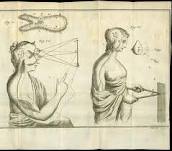
When teaching Descartes I discovered that for much of his work he made his own accompanying drawings.  As far as I know, we have yet to see someone like him, one who combines art, science, and math to such a degree.*

I don’t agree with Descartes’ worldview, but when I see his art part of me wishes I could.

Dave

* I recently realized with delight that the great 20th century physicist Richard Fenyman took art lessons with a friend to help him communicate the emotion of scientific ideas.  But he doesn’t come close to Descartes in my book.  His drawing of people are pretty good, but he couldn’t get the same touch with his famous diagrams.  Looking at Descartes’ drawings, I almost get the sense of what he was trying to say.  I have absolutely no idea what Fenyman tried to communicate with his famous diagrams. . .


Asimov’s “Foundation” and Wikipedia

Last summer I read Asimov’s “Foundation” and enjoyed it.  The plot twist early on (*spoiler alert*) of having the encyclopedia project  function as a ruse to get scientists to an outlying planet hooked me for the duration.  In the story, the mere act of compiling information wasted time. 

Reading Niall Ferguson’s “Civilization, The West and the Rest” got me thinking about encyclopedias again.  Here is my review, and here is another slightly more positive take from which I extracted this quotation (thanks to Marginal Revolution for the link):

In 1420, when London was a backwater, Nanjing was the world’s largest city, and Ming China “had an incontrovertible claim to be [its] most advanced civilization.” That it was a center of learning he makes plain with a typically entertaining detail: the Emperor tasked 2,000 scholars with creating “a compendium of Chinese learning” that “filled more than 11,000 volumes,” which was “surpassed as the world’s largest encyclopedia only in 2007 … by Wikipedia.” So what happened?

Ferguson then goes on to outline the swift decline in China’s navy as the main answer, just as Paul Kennedy did in his The Rise and Fall of Great Powers.  Like Asimov, I have a different theory: China’s encyclopedia itself was a symptom of a disease that already manifested itself in the body politic.

The Roman’s first encyclopedia, for example, came in its post-Diocletian phase, a time of  desperate attempts to conserve what they had lost centuries earlier. There’s the rub; most often, encyclopedias and dictionaries come from a conservative reaction against change.*   A fear of losing something pushes us to gather our nuts frantically for the coming winter.  Thus, it makes perfect sense that the Chinese followed up its massive encyclopedia with a concomitant reaction against traveling to contact new people and ideas and risk losing what they had so carefully tried to preserve.

I use Wikipedia in desperate moments when I forget a date before class, and I think that it has gotten more reliable over the years in giving a general idea of things.  But I have no sympathy with the pleas it makes for support.  For one, we could easily do without it, but something deeper bothers me.  Many, many creative, curious, and intelligent people spend their time for Wikipedia merely repeating and compiling what others have already said elsewhere.  What Truman Capote famously said of “On the Road” could be said of Wikipedia: “That’s not writing. It’s typing.”

Blessings,

Dave

*I admit that the Dictionary made by the French philosophes had a more militant, aggressive character, and is an exception to this rule.

Niall Ferguson’s “Civilization: The West and the Rest”

I did not read this cover-to-cover, so take everything with a handful of salt. 

I liked what I read, but this book feels uneven and rushed in parts. Perhaps that is because his subject is so big. While it feels incomplete, the book does raise some pertinent questions, given the recent rise of China and India.

Ferguson asserts that the great shift in power from East to West that started ca. 1500 can be traced to what he calls six “Killer Applications” (sometimes he uses the word ‘Apps’ – bleah!). They are science, medicine, work ethic, consumption, property rights, and competition. In no order, my thoughts:

  • Some of this feels dated. It seems to me that Paul Kennedy already treated some of these topics regarding competition, openness etc. in his ‘Rise and Fall of Great Powers.’ Ferguson is a great controversialist but this does not feel controversial
  • Couldn’t science and medicine go together?
  • As usual, he has many great visual aids, graphs, etc.
  • Ferguson has an interesting take on the decline of religion in Europe vs. America, and he roots the difference at least in part on America’s more total embrace of competition and the market and its application to churches. He makes the astute observation that having done so, America’s consumer oriented churches will feed an enfeeblement of values that unhindered consumerism brings with it. Thus, while American churches will tell its parishioners to do what we say, not what we do — it probably won’t work.

This was a rare moment of interesting argument for Ferguson (in this book at least), but it doesn’t hold up for me. True, Europe has its state churches, but people are not forbidden from going to Catholic churches in England or Baptist churches in France. The real difference must lie elsewhere — in a deeper place.

The whole religion question seemed like a great opportunity for Ferguson. Here he truly dabbles in some controversy, such as mostly agreeing with Weber’s much discredited ideas surrounding Protestantism. He discusses the rise of Christianity in China and calls it a significant factor in China’s recent rise. By his not not so subtle implication, the decline of Christianity in Europe might be cause for its decline. But having broached the topic, he swerves away. The whole religion question seemed like a great opportunity for him. But he just dips his toe. Jump in, Mr. Ferguson! Sometimes I disagree with you but I like that you make people think and reconsider their ideas. He does not do that here as in some of his other books.

Another moment of missed argument – the idea of a civilization’s ‘confidence.’ He dismisses some of Kenneth Clark’s views on civilization but then basically agrees with one of Clark’s key points, that civilizations need ‘confidence’ to survive. He then comes close to calling out various Western academics that teach nothing but the evils of Western civilization. He almost asserts that such people undermine the basic psychological foundations of the west, an argument many conservatives make. But again, he does not press it home or follow its implications.

This is what makes this work so tame in comparison to others. He no longer acts like the young historian out to take on the world, like in ‘The Pity of War.’ I disagreed with decent chunks of that book, but it was fun to read. This one is boring, if not still informative.

He raises, but leaves wide open, the question of whether or not China’s rise will mean a smooth transition for the West or not. China has gotten more powerful by adopting many of the ‘Killer Applications’ that made the West. Is this good for us? Should we root for China to become more western? Will the U.S. in 20 years be China’s partner like England is to the U.S.? Or will it go worse for us? Ferguson hints, dances, and leaves it in the air.

Here’s hoping that Ferguson takes some time off from books and tv, goes into a cave, and emerges five years from now with something better.

11th Grade: Market Psychology

Greetings,


This week we looked at the Stock Market Crash of 1929 and how it happened.   Not all Stock Market crashes cause deep depressions or recessions, and in fact, many now argue that the Great Depression had many other factors besides the ’29 crash.  For example, only about 3% of Americans owned any stock at all in 1929.  But I do think that the crash both revealed and foreshadowed deep problems within the economy as a whole, and so I still thought it worthwhile to examine.  At the very time, for example, when the stock market rose dramatically, key industries like agriculture and construction showed major signs of weakness.
Not only that, it gave us a great platform to discuss the bursting of the dot-com bubble in 2000, which did not bring about substantial economic harm, and the crash of 2008 recently which did.  What were the differences in the two, and which was 1929 more like?  It seems that the 2000 dip revealed a weird anomaly in the economy, whereas in 2008, the problems lay much more at its heart, with our financial system in general.  Here are a few different graphs that show similar drops in the market, but each had its own particular effect on the economy:
This graph suggests that maybe market ‘crashes’ are simply ‘corrections.”
We spent two days this week on our own’Stock Market of the  1920’s’ activity.   My main purpose was not recreate  entirely how stocks are actually sold and have value.  I wanted the students to focus on understanding the psychological aspect of not only stock value, but the  value of anything at all.  After all, what makes our paper money  valuable in itself?  Only that we have all agreed as a society that it  does carry value.  If we lost that belief, the economy would collapse  shortly.  
In our game the four teams quickly got a handle on how they could disrupt other teams.  Each began with a diversified portfolio, but watchful eyes soon noted who had accumulated the most amount of a certain stock.  Other teams would then work hard to devalue that stock, trying to sell it to others at ridiculously low prices, with the some teams countering by buying it way too high.  
This instability made the market wobbly, whereby the ‘government’ (myself) stepped in to buy shares at market prices.  Unfortunately, this strategy left the government holding a great deal of unpredictable stock.  Luckily for all, one investor decided to buy back from the government at slightly higher than market rate, which boosted market confidence in general.  That move propelled them to a narrow victory.
I hope the students had fun, as I did watching their not very subtle machinations against one another.
Blessings,
Dave Mathwin

12th Grade: Wag the Dog

This week we looked at Athens’s disaster in Sicily and the subsequent extensive fallout.
Why did Athens lose in Sicily?
Part of Thucydides’s brilliance as a historian is that does not look merely at battles and personalities, but finds ways to link events to a grand narrative.  Athens had so many strengths, and one could argue that their democracy itself was a product of their search for excellence and truth.  But it appears to me, at least, that something began to go wrong just prior to the Peloponnesian War with the completion of the Parthenon.  The Parthenon is of course one of the great architectural achievements in history.  Ostensibly, it is a temple to Athena, the patron goddess of the city.  But a closer look at the carvings on the Parthenon reveal not scenes of gods or goddesses but of events in their own history.  Did Athens really create a temple to their own glory?  Did they think they had arrived?  Did they begin to, in essence, worship themselves?  What would this mean for them?
This question is related to the idea of democracy itself?  Is democracy about voting?  Is it only about having a voice?  If so, then democracy becomes naval gazing, only about perpetuating itself through a process, serving no higher end.  If democracy (or any form of government) serves a higher ideal, it has a built in check upon itself.  But if we don’t have this, then whatever result we come up with must indeed be democracy, it must serve us well by definition, because it serves ourselves.  This kind of attitude, of which ancient Athens has no monopoly, will lead to disaster.  Imagine traveling with your head down continually.  You would drive off a cliff at some point.  G.K. Chesterton has a great quote about self-worship (what he calls ‘The Inner Light’) in his book ‘Orthodoxy”:

 That Jones shall worship the god within him turns out ultimately to mean that Jones shall worship Jones. Let Jones worship the sun or moon, anything rather than the Inner Light; let Jones worship cats or crocodiles, if he can find any in his street, but not the god within. Christianity came into the world firstly in order to assert with violence that a man had not only to look inwards, but to look outwards, to behold with astonishment and enthusiasm a divine company and a divine captain. The only fun of being a Christian was that a man was not left alone with the Inner Light, but definitely recognized an outer light, fair as the sun, clear as the moon, terrible as an army with banners.

The problems with the Sicily expedition can be traced to the problems with their democracy.  Alcibiades wanted the expedition, Nicias opposed it.  Both were wealthy, experienced in politics and military matters, and each had their own constituency.  Alcibiades was the fire to Nicias’s ice.  Their personal and political rivalry spilled over into the formation of Athenian policy.  The tail had begun to wag the dog.  Among other things, Nicias’s political maneuverings against Alcibiades led to drastic changes in the composition of the fighting force and, perhaps even the goal of the mission.  One wonders if they realized this.  With their heads down, I think not.  In my opinion they thought. . .
– We voted, just as always
– We picked experienced people
– We have followed the procedures and processes defined by law
Therefore,
– Everything is fine, or possibly even better than fine
I don’t think they had the wherewithal to realize that they had just voted for a massive expedition that had no real relation to their war with Sparta far from home against a powerful enemy.  The man who ultimately led the expedition, Nicias, argued against any expedition at all.   In my opinion, the disaster in Sicily was the terrible price exacted for their self-worship.  AJ Toynbee wrote in “An Historian’s Approach to Religion,”
‘The strength of the devotion that parochial-community worship evokes holds its devotees in bondage even when it is carrying them to self-destruction; and so the warfare between contending parochial states [i.e. war between Athens and Sparta] tends to grow more intense and devastating in a crescendo movement.  . . . All parochial community-worship ends in a worship of Moloch, and he exacts more cruel sacrifices than the Golden Calf.  War to the death between parochial states has been the immediate external cause of the breakdown of almost all, if not all, the civilizations that have committed suicide up to date.”
Their failure in Sicily brought about the collapse of their democratic regime.  Their god had failed to provide for their basic needs, and he needed replaced.
In this election season, we do well to remember that we cannot call ourselves a democracy if we merely count votes.  Democracies work when they serve higher purposes than themselves, and fail when the process becomes the end in itself — a means of power over our fellow men.
The oligarchs that replaced the democracy in Athens did no better, ruling wantonly based on their own pent up sense that it was “their turn.”  We sometimes see this happen when one party, shut out of Congress for a time, suddenly gains control.  With this attitude in place things go poorly, and the Gingrich led government shutdown in the 1990’s comes to mind.
Democracy came back, but the instability engendered by these power struggles did the Athenians no favors in their war effort.  In our discussion as to why Athens lost the war, I threw out a few theories bandied about by historians, such as the superiority of infantry over the navy in general, and the Sicily invasion in particular.  But most agreed that Athens made themselves their own worst enemy through their arrogance.  Their self-worship turned their gaze inward.  They never had a filter for their decisions beyond their own immediate wants, and they never opened themselves to an external variable like “justice” to use as a guide.
Next week we will look at the Plato’s critique of democracy, and Aristotle’s response to Plato.  While studying these two titans the students will read Euripides’s The Bacchae to help us get some important issues in a different way.
Blessings,
Dave Mathwin

10th Grade: The World Turned Upside Down

Greetings,
This week we discussed the preamble to the Declaration of  Independence.  While the particular grievances have come and gone,  Jefferson’s preamble is deservedly remembered.  In 1765 the colonists  talked of ‘English liberties,’ and protested on that basis.  In the  Declaration, however, we see the concept of universal human rights  enunciated.  The colonists were not fighting to be English, but in a sense to be more human.  While Jefferson was a deist and not a  Christian, he is clear to point out that these rights are universal because they originate in the fact that we are created by God.  In  class we discussed how these ideals have shaped our nation.
Many in the world, rightly or wrongly, accuse us of meddling, not minding  our own business, and so on.  Whether this charge is just or not can be debated.  What we can trace back to the Declaration, however,  is that we seek in some measure to spread our ideals not because they’re ours, but because we believed that they belonged to  all.  Are we right about this crucial assertion?  Clearly the words of the Declaration not only reflected, but also molded and shaped our self perception as a nation.
Again, this does not mean that we have always done this, or done it well, or at the right times, places, and so on.
We wrapped up the fighting of the war this week as well, and focused on the crucial battles of Saratoga and Yorktown.  To help cement the impact of these battles we did a card game activity, where the rules and structure of the game give an advantage to the ‘favorite.’  However, I hoped that the students would discern that the underdog had certain advantages as well:
– They could afford to play more recklessly, since they had less to lose
– If they got lucky or could bluff their way to 1 big success, they could simply fold (i.e. retreat in orderly fashion) and wait until the end of the game — until time ran out.
Many of you may have seen an action movie where the lone hero has to fight his way into a compound, boat, or some other such structure.  Despite being outnumbered, miraculously he kills the bad guys and escapes.  Along with Hollywood escapism at work, our hero does have one advantage.  Every person he sees on the boat he knows immediately is a bad guy.  He can shoot first, ask questions later.  Because the bad guys are so numerous, chances are nearly every person the bad guys see in the shadows is on their side.  They hesitate and give the hero the advantage, showing how their numbers work against them at least in some ways.
I could easily stretch this analogy too far, but British failures at Saratoga and Yorktown show the great difficulty the British faced winning the war.  How could they solve the problems that created the war in the first place through violence?  The situation between England and their colonies from 1764-1775 craved a political response that the British proved unable to provide.  Victory through violence therefore required an absolutely crushing military defeat, and this mean they would have to take chances to achieve it.  Both times they did this, it backfired mightily upon them.  To add to their problems, Americans could afford to take chances occasionally because their victories would mean so much more than British ones.  England’s  political bungling in the decade prior to the war prepared the way for their defeat.  I touch on some of these issues in this post on whether or not generalship can be “clutch” or not here.
Next week we will begin our unit on the Constitution and our mock Supreme Court Activity.  Many thanks for all your support,
Dave Mathwin
Here is the song supposedly played by the British at their Yorktown surrender:

Does “Clutch” Exist?

Many behavioral economists and stat crunchers decry the notion that “clutch” players exist.  Here is an excerpt from Dan Ariely’s The Upside of Irrationality:

Clutch players are paid much more than other players, and are presumed to perform especially brilliantly during the last few minutes or seconds of a game, when stress and pressure are highest.

With the help of Duke University men’s basketball Coach Mike Krzyzewski (“Coach K”), we got a group of professional coaches to identify clutch players in the NBA (the coaches agreed, to a large extent, about who is and who is not a clutch player). Next, we watched videos of the twenty most crucial games for each clutch player in an entire NBA season (by most crucial, we meant that the score difference at the end of the game did not exceed three points). For each of those games, we measured how many points the clutch players had shot in the last five minutes of the first half of each game, when pres- sure was relatively low. Then we compared that number to the number of points scored during the last five minutes of the game, when the outcome was hanging by a thread and stress was at its peak. We also noted the same measures for all the other “nonclutch” players who were playing in the same games.

We found that the non-clutch players scored more or less the same in the low-stress and high-stress moments, whereas there was actually a substantial improvement for clutch players during the last five minutes of the games. So far it looked good for the clutch players and, by analogy, the bankers, as it seemed that some highly qualified people could, in fact, per- form better under pressure.

But—and I’m sure you expected a “but”—there are two ways to gain more points in the last five minutes of the game. An NBA clutch player can either improve his percentage success (which would indicate a sharpening of performance) or shoot more often with the same percentage (which suggests no improvement in skill but rather a change in the number of attempts). So we looked separately at whether the clutch players actually shot better or just more often. As it turned out, the clutch players did not improve their skill; they just tried many more times. Their field goal percentage did not increase in the last five minutes (meaning that their shots were no more accurate); neither was it the case that non- clutch players got worse.

At this point you probably think that clutch players are guarded more heavily during the end of the game and this is why they don’t show the expected increase in performance. To see if this were indeed the case, we counted how many times they were fouled and also looked at their free throws. We found the same pattern: the heavily guarded clutch players were fouled more and got to shoot from the free-throw line more frequently, but their scoring percentage was unchanged. Certainly, clutch players are very good players, but our analysis showed that, contrary to common belief, their performance doesn’t improve in the last, most important part of the game.

Seems convincing, and here is another take on the issue with the same conclusion in a different sport.

But I don’t buy it, or at least not all of it.

I am willing to believe that my own personal emotional perception can influence what I think of hard data, but it’s also my own experience.  I grew up playing baseball and there were times when I wanted to be at the plate in crunch time and times when I hoped that the guy in front of me would win the game and spare me the agony.  The expected results often followed my attitude.  Of course, those times tended to be when I was having a good or bad season, respectively.   But the pressure definitely seemed to heighten my expectation of success or failure, and surely this had something to do with my performance.  Perhaps the key variable is pressure, not performance.

But aside from sports, can “clutch” exist in generals?

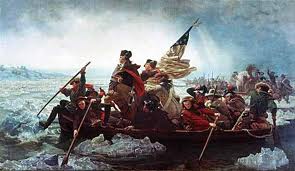
Washington only won three battles in the Revolutionary War, but he won them at the right time.  The Battle of Trenton seems something like hitting two foul shots to send the game into overtime.  Yorktown was perhaps not as crucial, but still similar in the timing and result.  Pressure brought out the best in Washington.

By contrast, the British general surely had less to play for in the Revolutionary War.  They had the best army on paper, not just against the colonies but throughout Europe and perhaps the world.  Yet they had no “clutch” performances, perhaps because pressure did not draw it out of them.  Winning and losing meant much less to them compared to the colonists.

My point is that pressure reveals something about us.  It does not always reveal something “good” or “bad” about us, but with the testing comes opportunity.

Fire away, statisticians, I still think something like “clutch” exists.

Bligh’s Portable Nightmare

The full title of the book is Captain Bligh’s Portable Nightmare: From the Bounty to Safety — 4,162 Miles Across the Pacific in a Rowing Boat.

With such a title, the author John Toohey borrowed from the dense Enlightenment style from the period he chronicles.  The original title of Bligh’s own book was The Narrative of the Mutiny aboard His Majesty’s Ship ‘Bounty;’ And the Subsequent Voyage of Part of the Crew, in the Ship’s Boat. 

Bligh’s mentor and hero Captain Cook wrote one entitiled, The Voyages of Captain Cook Round the World: Illustrated with Numerous Engravings on Wood and Steel.

Clearly, the late 18th century liked long titles.

Toohey writes well and tells a remarkable story, making some inspired guesswork about what happened on the launch and how they possibly could have traveled so far and survived.  Put Bligh’s accomplishment in the long list of things perhaps no one on Earth could do today.  To be fair to us, Bligh may have been one of the few of his time that could have done it as well.

The book grabbed me for other reasons.  Bligh represents much of his time.  In Bligh we have a man of incredible mathematical and navigational gifts.  But the journey required a great amount of indescribable “feel” as well as inspired guesswork honed by years of sailing by sun and stars.  Bligh’s abilities were innate to be sure but also honed by all the fruits that the Scientific Revolution and Enlightenment had to offer.

But it’s the long titles of all those 18th century books that bothers me.  Those titles seem so earnest and so dedicated, just like the men themselves.  But their style can be so heavy and didactic that all life gets sucked out of them.  In the same way, some of the era’s  great men like Bligh seem out of touch not just with the universe itself but with each other.  Even while in the rowboat fighting for the life of the crew, Bligh managed to make these impressive maps of surrounding islands that later sailors would use themselves and declare accurate:

But when one the men on the launch died in a Dutch settlement, Bligh did not even know if the deceased had family to notify.  He could save the lives of his men without relating to them as human beings.  Bligh’s tragic resentment towards his men whom he believed did not sufficiently appreciate him shows him to be all to human indeed.

Blessings,

Dave

And now as a postscript, being for the edification of Ladies and Gentlemen alike, for the purpose of reinforcing the bloggist’s aforementioned point concerning the titles of books in the said era under discussion. . .

Some other titles of 18th century books:

An Introduction to the Italian Language Containing specimens both of prose and verse … with a literal translation and grammatical notes, for the use of those who, being already acquainted with grammar, attempt to learn it without a master …   By Samuel Johnson

The New England Almanac, or, Lady’s and Gentlemen’s diary, for the year of our Lord Christ 1775, calculated for the meridian of Providence, New England,  lat. 41° 51′ n. and 71° 16′ w. from the Royal Observatory at Greenwich; but may serve all the adjacent provinces.  By Benjamin West

12th Grade: Fringe Ideas and the Democratic Process

Greetings,

After 8 sessions, this week we wrapped up our own in class Peloponnesian War Game, which the seniors do every year with this unit.  We divided the class into five different teams:

– Athens           – Chios (Athenian Ally)

– Sparta             – Corinth (Spartan Ally)

– Persia, the Wild Card

Each of the years this game has been played I have seen slightly different outcomes each time.  A usual pattern, however, has Athens try and keep a tight leash on Chios to prevent them from rebelling (which Chios, if it wants to win big, must do).  Persia usually wants to sponsor Chian independence and use their military for themselves.  Thus, Athens becomes Persia’s clear enemy.

This time the Athenian team used a never before seen strategy, one that would nearly guarantee them a partial victory, but deny them complete victory.  They agreed to let Persia have one of their provinces in exchange for cash to fight Sparta and Corinth.  Once Athens lost part of its empire to Persia, keeping Chios took on much less importance.  When Chios bucked for independence Athens let them go and focused their attention on Corinth and Sparta.  Fueled by Persian cash, Athens eventually destroyed both of them, though 1-2 of the battles were very close.

Thus, Chios and Persia took home the biggest prizes in our war, while Athens settled for 2nd place.  In our imaginary Greek world, the only Corinthians or Spartans you might meet would be wandering beggars on the street.  Congratulations to the winners, and to Athens for their innovative strategy.

Also this week we had a discussion on the idea of fringe opinions and whether or not they benefit democracy. This question came from their homework on Thucydides’s famous passage on the Revolution in Corcyra during the Peloponnesian War.  Most every student offered an opinion and they had an excellent discussion.  Among some of their ideas:

1. Fringe opinions are generally bad, but inevitable if you want to have a democracy.

2. Fringe opinions are not bad or good because they have no impact.  The vast meat-grinder that is American society softens whatever fringe opinion comes along before it goes mainstream.

3. Fringe opinions are bad, because those who hold then generally are not open to debate, dialogue, and compromise, all of which are essential to a democracy.

4. Radical fringes usually harm no one but a select few and pose no real threat normally.  But in times of great national stress or emergency, they become much more dangerous, as their appeal grows exponentially.

We also discussed what we meant by “fringe opinion.”  Is what makes an opinion “radical” the idea itself, or the number of people who espouse it?  Can the majority hold a “fringe” opinion?

Should any safeguards be taken against fringe opinions?  Many European nations ban the Nazi party, for example, but not the United States.

Obviously we do not face a civil war to the death in our midst, and are nowhere close to the polarization Greece experienced.  But do have any reason for concern?  These graphs might give us pause.  The first shows the increase of straight party voting over the years:

The second shows the ideological distance between the parties. . .
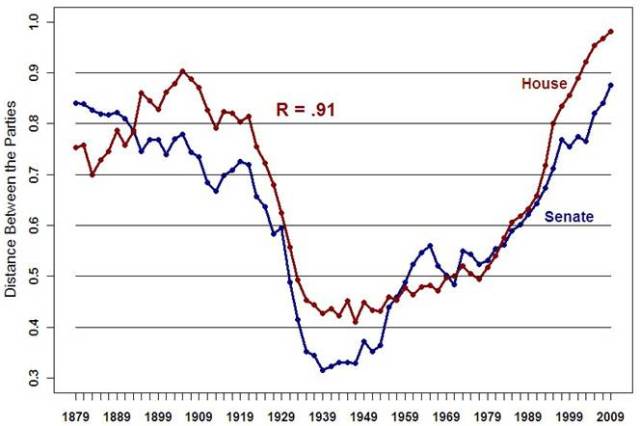
And finally, the rise of presidential Executive Orders.  If Congress stops working the rise of executive power seems inevitable. . .

Many thanks!  Enjoy the weekend,

Dave Mathwin

Here is the text the students worked through:

The following is from Thucydides, who comments on the revolution in Corcyra in Book 3, chapter 8

For not long afterwards nearly the whole Hellenic world was in commotion; in every city the chiefs of the democracy and of the oligarchy were struggling, the one to bring in the Athenians, the other the Spartans. Now in time of peace, men would have had no excuse for introducing either, and no desire to do so; but, when they were at war, the introduction of a foreign alliance on one side or the other to the hurt of their enemies and the advantage of themselves was easily effected by the dissatisfied party.

71 And revolution brought upon the cities of Greece many terrible calamities, such as have been and always will be while human nature remains the same, but which are more or less aggravated and differ in character with every new combination of circumstances. In peace and prosperity both states and individuals are actuated by higher motives, because they do not fall under the dominion of imperious necessities; but war, which takes away the comfortable provision of daily life, is a hard master and tends to assimilate men’s characters to their conditions.

When troubles had once begun in the cities, those who followed carried the revolutionary spirit further and further, and determined to outdo the report of all who had preceded them by the ingenuity of their enterprises and the atrocity of their revenges. The meaning of words had no longer the same relation to things, but was changed by them as they thought proper. Reckless daring was held to be loyal courage; prudent delay was the excuse of a coward; moderation was the disguise of unmanly weakness; to know everything was to do nothing. Frantic energy was the true quality of a man. A conspirator who wanted to be safe was a recreant in disguise. The lover of violence was always trusted, and his opponent suspected. He who succeeded in a plot was deemed knowing, but a still greater master in craft was he who detected one. On the other hand, he who plotted from the first to have nothing to do with plots was a breaker up of parties and a poltroon who was afraid of the enemy. In a word, he who could outstrip another in a bad action was applauded, and so was he who encouraged to evil one who had no idea of it. The tie of party was stronger than the tie of blood, because a partisan was more ready to dare without asking why. (For party associations are not based upon any established law, nor do they seek the public good; they are formed in defiance of the laws and from self-interest.) The seal of good faith was not divine law, but fellowship in crime. If an enemy when he was in the ascendant offered fair words, the opposite party received them not in a generous spirit, but by a jealous watchfulness of his actions.72 Revenge was dearer than self-preservation. Any agreements sworn to by either party, when they could do nothing else, were binding as long as both were powerless. But he who on a favourable opportunity first took courage, and struck at his enemy when he saw him off his guard, had greater pleasure in a perfidious than he would have had in an open act of revenge; he congratulated himself that he had taken the safer course, and also that he had overreached his enemy and gained the prize of superior ability. In general the dishonest more easily gain credit for cleverness than the simple for goodness; men take a pride in the one, but are ashamed of the other.

The cause of all these evils was the love of power, originating in avarice and ambition, and the party-spirit which is engendered by them when men are fairly embarked in a contest. For the leaders on either side used specious names, the one party professing to uphold the constitutional equality of the many, the other the wisdom of an aristocracy, while they made the public interests, to which in name they were devoted, in reality their prize. Striving in every way to overcome each other, they committed the most monstrous crimes; yet even these were surpassed by the magnitude of their revenges which they pursued to the very utmost,73 neither party observing any definite limits either of justice or public expediency, but both alike making the caprice of the moment their law. Either by the help of an unrighteous sentence, or grasping power with the strong hand, they were eager to satiate the impatience of party-spirit. Neither faction cared for religion; but any fair pretence which succeeded in effecting some odious purpose was greatly lauded. And the citizens who were of neither party fell a prey to both; either they were disliked because they held aloof, or men were jealous of their surviving.

Thus revolution gave birth to every form of wickedness in Greece. The simplicity which is so large an element in a noble nature was laughed to scorn and disappeared. An attitude of perfidious antagonism everywhere prevailed; for there was no word binding enough, nor oath terrible enough to reconcile enemies. Each man was strong only in the conviction that nothing was secure; he must look to his own safety, and could not afford to trust others. Inferior intellects generally succeeded best. For, aware of their own deficiencies, and fearing the capacity of their opponents, for whom they were no match in powers of speech, and whose subtle wits were likely to anticipate them in contriving evil, they struck boldly and at once. But the cleverer sort, presuming in their arrogance that they would be aware in time, and disdaining to act when they could think, were taken off their guard and easily destroyed.

Now in Corcyra most of these deeds were perpetrated, and for the first time. There was every crime which men could commit in revenge who had been governed not wisely, but tyrannically, and now had the oppressor at their mercy. There were the dishonest designs of others who were longing to be relieved from their habitual poverty, and were naturally animated by a passionate desire for their neighbour’s goods; and there were crimes of another class which men commit, not from covetousness, but from the enmity which equals foster towards one another until they are carried away by their blind rage into the extremes of pitiless cruelty. At such a time the life of the city was all in disorder, and human nature, which is always ready to transgress the laws, having now trampled them underfoot, delighted to show that her passions were ungovernable, that she was stronger than justice, and the enemy of everything above her. If malignity had not exercised a fatal power, how could any one have preferred revenge to piety, and gain to innocence? But, when men are retaliating upon others, they are reckless of the future, and do not hesitate to annul those common laws of humanity to which every individual trusts for his own hope of deliverance should he ever be overtaken by calamity; they forget that in their own hour of need they will look for them in vain.

Solyndra and Historical Innovation

I don’t know anyone against clean energy, though plenty of people might disagree about the priority we should give it, costs vs. benefits and so on.

Along those lines, I took no joy in Solyndra’s sad end, as it might set the cause of cleaner energy back a bit.  On the one hand, there is nothing shocking about a company failing.  Companies do fail sometimes, including those backed by government loans.

One aspect of their rise and fall intrigued me, however.  Their CEO and founder Dr. Chris Gronet had an idea.  Instead of relying on traditional and expensive silicon, he helped develop a process that could eliminate the need for silicon entirely.  It would be a great leap forward, one that would bypass the whole flow of solar panel development that came before it.

Well, among other things, the price of silicon plummeted, making Solyndra’s technological “breakthrough” unnecessary.  Aside from that, the new machines didn’t work well.  Solyndra’s bad gamble may have helped widen the door for China to continue dominate the market.

Aside from possible allegations of fraud and cronyism, did Solyndra just get unlucky?  Or, did they unwittingly violate a law of human experience?  Were they in a hurry?

The idea of a “Great Leap Forward” enticed Mao and entices all of us.  The past can seem burdensome, and  context irrelevant.  But it seems to me that no great historical “leap forward” has every happened without a long steady drip preceding it.

Most would say, for example, that Science defines itself through trial and error, the process of disputation.  As many have pointed out, however, people didn’t decide to do this overnight.  The western roots of disputation went back at least to the Medieval scholastics, if not further back.  Descartes and Newton had kinsmen at least 400 years in the past.

On the surface, Nixon’s trip to China looks like a massive, overnight tectonic shift.  But that too had deep roots in China’s conflict with Vietnam, and the Soviet style ‘one size fits all’ approach to communism that offended China’s sense of its own unique identity, among other things.

How about stylistic leap forwards?  It’s hard to go further than Shakespeare did when he brought a little levity to the dramatic arts.  His example almost destroys my theory.  But even he strikes me as decidedly “Medieval” about his conception of the world and the drama of salvation.  Also it seems that Shakespeare reached back to some of the Medieval sense of play after the heaviness of the Renaissance humanists.  So even Shakespeare did not eschew the past.

Pope John XXIII had it right: don’t be in a hurry.


Dave

“He who is always in a hurry. . . never gets very far.”

In his Journal of a Soul, the great Pope John XXIII admonished himself, “Not to worry if others are in a hurry.  He who is always in a hurry, even in the business of the Church, never gets very far.”

If this is a principle of Christian spirituality, it should be a principle of human experience as well,  and we should find examples of it at work in history.

I do think we see this principle at work in German foreign policy from at least the accession of Kaiser Wilhelm II and his dismissal of Bismarck in 1890.  One might even argue that it applies to Bismarck way back in the 1860’s.  But let’s just focus on Germany from 1890.

They directly challenged England by tripling their naval budget between 1900 and 1910.  They doubled military spending between 1910-1914.  They got involved in Africa and tried to obtain land in South America.  Perhaps in hurrying so much to “keep up with the Joneses” they did not see how ultimately self-destructive colonial acquisitions could be.  They even tried to acquire the Baja Peninsula.   Next time you are in a hurry look around and you will see how it makes others nervous.  The problem is, when we hurry we rarely look around ourselves at all.

Strategically, by adopting the Von-Schlieffen plan, they had to ‘hurry’ through Belgium so they could beat France in time to deal with Russia.  In their need for speed they committed various atrocities to get to France as soon as possible.  In the trenches they introduced chemical warfare because in their minds they had to hurry and shorten the war.

All these things worked against them long-term.  The Kaiser did not understand the power of the press as Bismarck did.  They brought on the moral outrage of the rest of the combatants and eventually their unrestricted submarine usage (also another attempt to hurry up and win) brought the U.S. into the war for good measure.  Disaster awaited them at Versailles.

Surely Napoleon also hurried.  One can see this through his whole personality.  Politically, he had no patience to establish genuine connections with those he conquered and made relatives his private puppet rulers.  We know this is not the way to win friends and influence local populations, who naturally turned on him the moment they had an opportunity.

I also think Hannibal hurried.  This, I admit, is more debatable.  He showed more political sense than Napoleon, and certainly more than Wilhelm II.  Yet he could have opted to spend time making his holdings in Spain secure and later invaded Rome from a much more secure base of logistical and political support.  Instead, he went for broke, and that’s how he ended up.

Has being in a hurry ever worked for any country/civilization?  Can we think of other failures rooted in hurry?

Has it worked for any particular company?  Have those that raced to market certain products first stood the test of time?

Blessings,

Dave

8th Grade: The Athenian Golden Age

Greetings,

This week we had a test, along with a review game on Monday and worldview week, so we had little time in ‘normal’ class.  We did spend some time discussing the elements of ‘golden ages’ and the factors that went into the birth of what we know as Periclean Athens.

From 480-430 B.C., Athens experienced an explosion of creativity and culture perhaps unparalleled in human history.  Much of what we consider to be modern democracy, philosophy, literature, drama, science, and architecture have a good measure of their roots here.

What is needed for a golden age?

As we compare them across time (Athens, Dutch early 1600’s, Elizabethan England, 12th century France, etc.) some common factors emerge:

1. Some kind of cross pollination of culture based on access to the sea or at least, extensive travel

2. A burst of confidence based on a defeat of a large power — you were the underdog and emerged on top.  The unexpected victory serves as a validation of your uniqueness.

3. An educational base to build the cultural explosion on.  There has to be some kind of literate and curious population base to build on.

4. The willingness to tolerate the possibility of new ideas, which usually has something to with #1 listed above.

With all these factors possibly needed (and possibly more that I have not accounted for),

We also looked at the flowering of Athenian democracy.  As we examined how it functioned, we arrived at a proposition to debate next week, which is

Athenian Democracy in the age of Pericles was more democratic than America is currently.

Part of how you evaluate this statement depends on a few factors:

1. What do we mean by “Democracy?”

We are so used to the word “democracy” we may not consider what we even mean by the term.  Clearly it must mean more than mere voting.  Some elections have only one candidate, or the different candidates do not give us different options in reality (that is, the candidates would do basically the same thing if elected).    It must also mean more than mere majority rule.  If 51% of the people vote to oppress the remaining 49%, we would not call that democracy.

Democracy attempts the trick of giving power and choice to the people, while at the same time preserving freedom in some measure for all citizens.  Thus, the ‘losers’ in a contest are still protected from the possible pitfalls of majority rule.  At the same time of course, the majority cannot be obstructed too much, otherwise the point of voting and majority rule would be lost.  Historically this balancing act has never been easy.

2. What is most important in a democracy?

In the Athenians favor we note the following:

– They had much more direct participation in government than modern Americans.
– The average citizen would not only vote, but could also speak in the Assembly.  Most citizens would probably serve in some political capacity during their adult lives

Against them we can say that:

– Women and slaves were excluded from voting and participation
– The very fluidity of their democracy opened up the real possibility that the checks and balances of law could easily be overridden, as happened on a few occasions.

For modern America we note that

– All citizens of a certain age are eligible to vote.
– We have minority protection built into the system.

Against us some might say

– Representative government has tended toward an oligarchy of the rich, with powerful interests controlling both parties.
– This, in turn, has led to a real distance between Government and the people which results in an “Us and Them” attitude.

I will look forward to their debate when we return next week.  Below is a very detailed chart of the ins and outs of Athenian democracy for the very interested.

Many thanks,

Dave Mathwin