System Containment

I am no authority on science-fiction, but I do partake occasionally.  Recently I devoured Christian Cantrell’s Containment, and while most of the characters are a bit flat, Cantrell fascinated me with the political and scientific problems his characters face.

The book’s cover has a blurb that hints at one of its main themes, saying,  “The colony on Venus was not built because the destruction of Earth was possible, but because it was inevitable…”

Throughout Containment the older generation advocates for realpolitik.   Arik, born and raised on Venus and trained to think “outside the box” to solve the problems inherent in the thin margins of existence in an inhospitable world, wants alternative solutions.  One of their arguments turns on Venus’ relationship with Earth.  Arik urges that  they put more resources into strengthening ties between Earth and Venus.  The leaders disagree.  “Every colony inevitably separates from the mother country,” they argue, so why put resources into a sinking relationship?

That got me to thinking, and I could not remember a colony that had not at some point separated and sometimes turned against their homeland.  In the post-colonial 20th century, the list is enormous.  But the ancient world has its own list.  Carthage came to overshadow Phoenicia.  Syracuse overshadowed Corinth.  Egyptian colonies in Canaan often had to be reclaimed.  Thera founded Cyrene in North Africa, which quickly established its own identity.  And so on, and so on. . . .

We can go beyond the idea of colonies separating from motherlands.  Containment does in part raise the question as to whether or not “Laws of Nature” govern human affairs.  Many would argue yes, that  “there is no armor against fate.”  History is rife with systematic patterns that, while not perfect, still show very strong tendencies.  For example, the idea of a “balance of power” between several states in a region appeals innately to our sense of fairness and proportion.  No one has too much, and each state has to rely on each other to maintain peace.  But, however noble the idea, can it last?

If we take Europe as an example, it seems not.  Before W.W. I England, France, Germany, Russia, Austria-Hungary, and even Italy to some extent all played a part in keeping the peace.  But with so many participants, too many possible variable were in play.  Combine these variables with human sinfulness, and you have W.W. I, which eliminated Austria-Hungary.  Twenty years later W.W. II eliminated all of them except Russia, who stood toe-to-toe with the United States, until we have the current situation where we have only one global superpower.

Earlier European history show this same tendency.  Around 1500 you have France, the Holy Roman Empire, the Hapsburgs, and to some extent, England. The wars of Charles V finish the Holy Roman Empire.  Then you had England and France both take successful shots at the Hapsburgs, which left France and England remaining.  They seesawed back and forth until Waterloo, after which England stood more or less alone until 1871.

In the ancient world similar patterns show up.  Greece for a time stood balanced precariously on the backs of Sparta, Athens, Thebes, Corinth, and Argos.  After the Persian wars only Athens and Sparta stood.  After the Peloponnesian War, a weakened Sparta held sway for a time before falling to Thebes, which then itself fell to Macedon.  Macedon alone held the torch in Greece until Rome ended all pan-Mediterranean balance by defeating both Carthage and Macedon from ca. 230-146 B.C.

Systems have the advantage of abstract elegance, but who wants fate to rule?  Many notable scholars use this fact to abandon Christian concepts of humanity.  After all, without some semblance of control, humanity gets absolved of responsibility.  If we have absolution from responsibility we have no ability to choose.  Our DNA does that for us.  The “I” disappears.  Why anyone would seek to destroy even their own identity with their theories is beyond me.  But the evidence does strongly suggests that patterns assert themselves in human affairs.  Do we have any hope of avoiding them?

We don’t need to deny the evidence, but instead see that it points in another direction.  Maybe systems assert themselves not because of fate, but because of the uniformity of human nature, a Christian truth.  Maybe we’re not enslaved to patterns, but instead enslave ourselves.  If that were true than we might expect that the spread of Christianity, which frees us from slavery to ourselves, would shatter the patterns.  If we believe that “service to God is perfect freedom,” Christians and Christian epochs should give evidence of the ability to escape destructive patterns.  Do the Middle Ages, for example exhibit a freedom from such “inevitable cycles” of behavior?

It may hold up.  After Charlemagne and the evangelization of the European continent, Europe has no significant, balance altering conflict until the 100 Years War in the 14th century.  Maybe Christianity did make a difference.  Critics, however, would probably say that

  • (1) The Crusades should count as a major conflict, and the only reason the Europeans didn’t fight each other is because the Church exported all its violent members overseas.
  • (2) The major conflict never took place because they lacked the resources and the political structure to fight major wars.  Once they had those (ca. 1500), then they did begin to fall into similar patterns as others nations in other eras.

Alas, I must confess, these are good counters to my proposal.  But on the other hand, regarding the Crusades, one could also argue that the Church also shipped society’s leaders overseas, which could opened up significant power vacuums in Europe, which usually lead to general wars.  Europe did not experience significant this during the Crusades.

Regarding point #2, they may have avoided centralized political systems (systems which could concentrate enough resources to wage a long, destructive war) during the Christian era precisely because they saw them as a threat.  Only when the moral power of the Church eroded in the 14-15th centuries do we see the state start to take over, a role it has not yet had to relinquish some 500 years later.

The evidence may be inconclusive, but  I agree with Toynbee when he wrote,

. . . the prospects of man in Process of Civilization depend above all on his ability to recover a lost control of the pitch, it is evident that this issue [is to be] decided by the course of Man’s relations, not just with his fellow men and with himself, but above all, with God his Saviour.

The Descent of Fire

In his overlooked Letters to Malcolm, C.S. Lewis quotes his friend Charles Williams in a memorable passage that has always fascinated me.  He writes,

It is no good angling for the rich moments. God sometimes seems to speak to us most intimately when he catches us, as it were, off our guard. Doesn’t Charles Williams say somewhere that ‘The altar must often be built in one place in order that the fire from heaven may descend somewhere else?'” [Find this in chapter XXI]

Spiritually, this idea seems incredibly rich with possibilities, but I confess to recalling this quote when my daughter decided to buy this song for our trip to the beach:

I had heard that the Black Key’s Dan Auerbach produced the album this song comes from, apparently from a desire to help more bands reflect the raw, “real” sound the Black Keys love.  Indeed, some songs on this album do reflect Auerbach’s influence.  But “Hypnotic Winter”  is (at least on itunes) the most popular of the tracks, and in my opinion the best.  And yet, it has a pop flavored slickness and happy bounciness that is nowhere near the ethos of the blues-drenched Black Keys.

This doesn’t mean that Auerbach had no influence on “Hypnotic Winter.”  Rather, his best influence on the band may have been an indirect one, when he stopped trying too hard to make converts.

One of my sons has developed a recent interest in Phil Collins and Genesis.  I’ve always thought that pre-1986, Phil Collins demonstrated great prowess as a progressively influence rock drummer.  But I’ve always thought that his best drum work, came in this song with Philip Bailey, a song he produced, helped sing, and horrifyingly, attempts to dance to (2:36 ff.)

The video always bugged me, because Collins’ open-tom sound and off-beat fills give the song just enough edge, a perfect amount of spice, and yet nowhere are drums even seen in the video.  Collins makes his bid for pop-stardom instead.  This certainly boded ill for Collins’ long-term future as a drummer with a distinctive voice.  But perhaps in the immediate short-term his focus on singing and dancing sub-consciously freed him to deliver a fabulous drumming performance.

I would love suggestions on how this principle can apply to teaching and life in general.  Bill Carey’s post on law and gospel in teaching may have something to contribute.

An American named Sherwood Wirt spoke with C.S. Lewis in 1963 in what ended up as Lewis’ last interview before his death.  I include a few excerpts here, as they touch on the subject at hand.

Wirt: A light touch has been characteristic of your writings, even when you are dealing with heavy theological themes. Would you say there is a key to the cultivation of such an attitude?

Lewis: “I believe this is a matter of temperament. However, I was helped in achieving this attitude by my studies of the literary men of the Middle Ages, and by the writings of G.K. Chesterton. Chesterton, for example, was not afraid to combine serious Christian themes with buffoonery. In the same way the miracle plays of the Middle Ages would deal with a sacred subject such as the nativity of Christ, yet would combine it with a farce.”

Wirt: Should Christian writers, then, in your opinion, attempt to be funny?

Lewis: “No. I think that forced jocularities on spiritual subjects are an abomination, and the attempts of some religious writers to be humorous are simply appalling. Some people write heavily, some write lightly. I prefer the light approach because I believe there is a great deal of false reverence about. There is too much solemnity and intensity in dealing with sacred matters; too much speaking in holy tones.”

Wirt: But is not solemnity proper and conducive to a sacred atmosphere?

C. S. LewisLewis: “Yes and no. There is a difference between a private devotional life and a corporate one. Solemnity is proper in church, but things that are proper in church are not necessarily proper outside, and vice versa. For example, I can say a prayer while washing my teeth, but that does not mean I should wash my teeth in church.”

The interview concludes with these words. . .

 “There is a character in one of my children’s stories named Aslan, who says, ‘I never tell anyone any story except his own.’ I cannot speak for the way God deals with others; I only know how he deals with me personally. Of course, we are to pray for spiritual awakening, and in various ways we can do something toward it. But we must remember that neither Paul nor Apollos gives the increase. As Charles Williams once said, ‘The altar must often be built in one place so that the fire may come down in another place.’”

Beware the Power of the Dead Past

Some time ago I wrote about the problems of “Renaissances” and the use of the past.  In Toynbee’s book, (reviewed in that post) he stated that if we are not careful when we recall the ‘ghosts’ of the past, we may get more than we bargained for.  This ghost, once recalled, can come to exercise a fascination that leads to domination.  With the correct spiritual attitude the past can buoy and strenghten us, like Antaeus rebounding with strength after contact with the Earth.  If our relation to the past is particularly close — a relationship of family or personal affinity — chances are it will burden us when we recall its ghost, and we will find ourselves like Atlas, trapped by its weight.  No one stands immune to this predicament.

This seeming law of human experience confronted me again as I read the blog of Ethan Iverson, pianist for the jazz trio “The Bad Plus.”  Iverson and his band mates have done much to revitalize jazz for the modern era, freeing it from stale allegiance to previous forms.  All three have done much to advocate for more recognition of newer and more innovative jazz artists.  They made their name by creatively reinterpreting classics of the 20th century cannon, from Abba to Nirvana to Stravinsky.  I used The Bad Plus to illustrate how the past can work for us, rather than against, when we apply Toynbee’s theory to music.  Insight into their powers can be seen in their cover of “Iron Man,” perhaps even heavier than the original. . .

But even Iverson, when it comes to Thelonius Monk (one of his favorite artists, and thus, a  powerful and potentially dangerous ‘ghost’ for him) can’t help but assume the position of Atlas.  A reinterpretation of Monk’s music from one of his students elicited this response on his blog (my apologies to those, who like me, don’t understand some of the musical terminology),

The excellent pianist David Rysphan came by last week, and wrote about it on his blog. I had met David but it had been a few years and in another country. He was a familiar face, though, so after he played a solid version of “I Mean You” I asked him, “Haven’t you been here before? Don’t you know better than to play Monk in my class?”

I am a hardline conservative when it comes to Monk’s music. My standard yowl of pain is, “Would you change the notes to a Mozart sonata? So why do you change the harmony to a Monk song?”

David, bless his heart, was playing G minor in bar five under the melody. I hasten to add, this is also how Kenny Barron and McCoy Tyner and a host of worthy others play it as well! But it’s 2012: in my opinion it is time to start treating Monk’s texts with fidelity (emphasis mine).

Alas, another creative mind bites the dust when confronted with a particularly important and personal ghost.  He obviously (and thankfully) does not have that same attitude to the other artists The Bad Plus has covered.

I think that many classical educators face some of the same challenges and temptations.  We look to the past for guidance, and rightly so.  Our disenchantment with the present state of education makes the past all the more attractive to us.  But this past upon which we place so much hope will be nothing but dead weight  if we fail to treat the past as prologue–living and active in our midst.  For the past to give us life for today we must interject our own life into it.  Without this, our attempts at educational change will have a short, truncated life of its own as we collapse under a burden we cannot bear.

War as an Act of Love(?)

A variety of recent authors have re-examined the “Good War” approach to World War II.  I don’t think this trend is mere cynical debunking.  I applaud it.  World War II killed a much higher percentage of the world population than any other conflict by far.  That fact must forever remain a stain on the war, and we need not  stoop to moral equivication to think carefully about why it happened.

Ronald Schaffer’s Wings of Judgment: American Bombing in W.W. II is a book in this vein.  He does not try cheap arguments that paint American bombings as ‘genocide,’ but certain facts stare one in the face.  America dropped far more bombs on civilians than the German army did, and Shaffer dispassionately wants to know why, albeit a bit too dispassionately.

He writes carefully, suggesting but never advancing a few theories here and there.  He is at his best when describing the tug-of-war between different camps within the Air Force and government as it related to bombing civilians.  We learn a lot about the views of many generals and politicians.  We get an insightful look into the history of attitudes to bombing before World War II.  But we do not get a good answer as to why we dropped so many bombs on so many people.   The question of civilian bombing comes into sharp focus especially in Nazi occupied areas (at least 12,000 dead from our bombs in places like France), not just Germany and Japan proper.  His only real answer is the oft-heard ideas of the “pressures of the moment,” “group think,” and “the protection of American lives.”  These explanations have their place, but I think a better answer exists–closer to the root cause–one that Shaffer himself mentions but does not explore: the idea that war is of necessity evil.

Of course the idea that war is by its nature evil seems to make perfect sense.  The idea that “war is hell” resonates with anyone, and given that war means the deaths of so many, it seems hard to argue the point.  But, appealing as this position seems at first glance, it puts the Christian in a difficult spot.  At times God  orders wars to take place.  Can we say that God ordered an evil thing, and that He can therefore do evil?  Secondly, the idea of war= evil has not been the view of the Church historically.

I did not read his book, but very much enjoyed Ken Myers’ interview with Daniel Bell, author of Just War as Christian Discipleship: Re-centering the Tradition in the Church Rather than the State.  The book has received favorable reviews from pacifists and military chaplains alike, which must mean something good.  Bell believes in “Just War Theory” but argues that over time it has lost its true value, because it has been used outside its true purpose.  Politicians use the ideas as a mere checklist, that once fulfilled, grants one a blank check to fight.  Bell argues instead that “just war” didn’t stop when conditions for fighting resolved, but continued into the fighting itself.  To fight to relieve the oppression of others could be a positive, but fighting the oppressors was also, in St. Augustine’s view, good for the oppressors as well.  Stopping their ability to oppress spared them piling up judgment upon themselves, or might help them see the evil of their ways.  For Augustine, if one could not fight an enemy out of love for that enemy, and even potentially kill that enemy out of love for that person, one could not claim to be fighting a “just war.”  War could be a means of sanctification just as any other legitimate activity in life.  Neither the Old or New Testaments speak against being a soldier.

If abused, this idea could to disaster.  Aim high, and you have far to fall if you miss the mark.  One could imagine a deluded commander  perverting this high calling into something monstrous, like the massacre of innocents in Jerusalem during the First Crusade.

But Wings of Judgment shows in some ways that far worse things can happen on a regular basis if governments and armies reject this view.  If war is evil, then once fighting begins nothing can be redeemed.  If one is already a lawbreaker, the checks on behavior disappear.  Though certain aspects of bombing got hotly debated, almost all agreed that since war was evil, we needed to end it as soon as possible.  Debates centered more on the tactics and efficacy of bombing than its strategic or moral value.  We dropped thousands of tons of bombs, with hundreds of thousands killed, in the name of war as a necessary evil.

Bell argues that if we are serious about just war, we need to accept the following:

  • When we fight, we cannot place the highest priority on sparing our own lives or the lives of our soldiers.  Love gives, love thinks of others, but to think of ourselves first denies the Golden Rule.
  • We cannot place the highest priority on speed.  Just war means taking time and great care to avoid any unnecessary loss of life, and we must regard the taking of innocent civilian life not as “collateral damage” but at best manslaughter, especially when done out of moral laziness or impatience.
  • Strange as it may seem, victory cannot be our supreme hope in “just wars.”  Our main goal should the increase of holiness, greater progress in sanctification.  Victory may come with such an approach, but we should fight because it’s the “right thing to do” in the “right way,” to increase in our capacity for love and holiness.

For many Christians these ideas will seem absurd, and for this, Bell indicts the Church.  We have forgotten our past and abdicated much of how we live and think to the state over the past few centuries.  Our current “War on Terror” will test us severely.  Predator drones, for example spare many American lives and allow us to go places people cannot.  But several such attacks have resulted in many civilian deaths.  The destruction is not wholesale, but still part of the same thinking that led to the destruction of Caen, Dresden, and Tokyo. If mistakes like this are in some ways inevitable, should we use them at all?   Torture may get us valuable information, but such terrible acts degrade nations who practice them.  Will we forego the information to save our souls?  Will we forego the information if not getting it puts our friends, neighbors, and children, at greater risk?

I agree with Bell, and if he’s right we must ask ourselves if we really want to fight a just war.


Thus ends the original post.  I had a conversation with a Marine friend of mine and he agreed with Bell in part.  He commented that one might love a society and be at war with a society  at the same time.  One could theoretically, “punish” a disobedient society, and just like a parent who never disciplined children, failure to “punish” would be a form of moral laziness.

But he disagreed that one could kill a particular person and still love them.  It may be permissible, but one cannot love another and kill him at the same time.  The soldier at that point is irrevocably intertwined with the “City of Man.”  I suggested that if he was right, Bell’s thesis breaks down entirely, but he thought it could partially survive.

Food for thought. . .

“Armies of the Raj,” and the Psychology of Empires

I picked up Byron Farwell’s Armies of the Raj on a whim, and was very pleasantly surprised.  From the title one might think this book has a very narrow focus, but this is not so.  Farwell uses the army as a springboard into England itself and the whole Victorian era.  Cultures come in many parts, but each diffracted part contains the whole, like light through a prism. So, while this book is military history, it is really cultural history disguised as military history, which I appreciate.

Many have made the point that Victorian era nations really worshipped themselves, and one certainly sees this confirmed by Farwell.  Part of this might have resulted from those India being away from the home country.  Perhaps they felt the need to overcompensate and out-English those in England itself.  I suppose this ‘diaspora’ psychology is not common to the English.  David Hackett-Fischer touched on this same psychology in his wonderful examination of New Zealand and America, both settled by Brits. This might not have been a problem, were it not for the over-inflated view of themselves the Victorians possessed. Toynbee comments,

The estrangement between India and a western world which, for India, has been represented by Great Britain, goes back behind the beginning of the Indian movement for independence in the eighteen- nineties, and behind the tragic conflict in 1857. It goes back to the reforms in the British administration in India that were started in the seventeen-eighties. This birth of estrangement from reform in the relations between Indians and English people is one of the ironies of history; and yet there is a genuine inner connection between the two events. In the eighteenth century the then newly installed British rulers of India were free and easy with their newly acquired Indian subjects in two senses. They were unscrupulous in using their political power to fleece and oppress them, and at the same time they were uninhibited in their social relations with them. They hob-nobbed with their Indian subjects off duty, besides meeting them at work on less agreeable terms. The more intellectual Englishmen in India in the eighteenth century enjoyed the game of capping Persian verses with Indian colleagues; the more lively Indians enjoyed being initiated into English sports. Look at Zoffany’s picture ‘Colonel Mordaunt’s Cock Match at Lucknow’, painted in 1786. . .

It tells you at a glance that, at that date, Indians and Englishmen could be hail-fellow-well met with one another. The British rulers of India in the first generation behaved, in fact, very much as their Hindu and Moslem predecessors had behaved. They were humanly corrupt and therefore not inhumanly aloof; and the British reformers of British rule, who were rightly determined to stamp out the corruption and who were notably successful in this difficult undertaking, deliberately stamped out the familiarity as well, because they held that the British could not be induced to be superhumanly upright and just in their dealings with their Indian subjects without being made to feel and behave as if they were tin gods set on pedestals high and dry above those Indian human beings down below.

Exhibit B for Toynbee’s analysis might be this painting done of Queen Victoria’s visit to the “Jewel in the Crown”. . .

What can account for this shift, and how did it express itself?

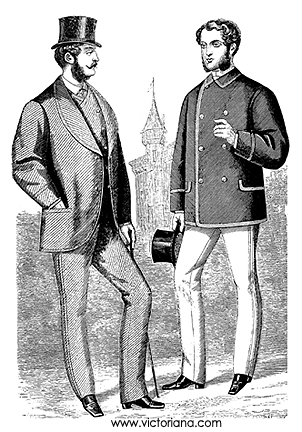
One obvious reason was the Suez Canal, which made transportation to India quicker and safer.  This opened up the possibility of women and families traveling to India, which meant the end of India as a playground for English businessmen, and the arrival of more civilizing influences.  But if one looks at how Victorians dressed, one sees that their version of a “civilized” world was in effect a closed system.  They would not be able to fully reach out to Indians.  Even their clothes seem to send a message of, “Back!  Back, I say!”

Before slamming the British completely, Farwell argues (and I agree) that many if not most British had a sincere desire to do good in India.  And they did in fact accomplish a variety of good things.  As to whether or not the good outweighed the bad in the end, Farwell doesn’t say, and I would think it’s too soon to tell for sure.  He puts his focus on how  the British reformed the military after the Sepoy Rebellion of 1857, and how their innate prejudice kept getting in the way in a few key areas:

  • The British wanted to integrate Indian troops more into the regular army, but no Indian was ever allowed to command a British soldier
  • Indian officers never had the social privileges that British officers had
  • The British recruited troops very successfully in certain provinces, but never even tried to recruit in other areas of India, believing the people there to be less martial in temperment.  Indians in the British army could never really claim to represent India as a whole, and this had a terrible impact when India did gain its independence.

As time went on the British changed some of their attitudes and tried harder to treat Indians equally. Yet rarely could they go all they way.  Some officers clubs for example, came to allow Indian officers to the bar and billiard room, but not the “swimming bath,” as they called it (though some British officers refused to allow their troops to join if their Indian officers were not granted full membership).  When W.W. II came the British worked hard to recruit all the Indians they could, and the army served to break down a variety of social barriers between British and Indians, and between Indians themselves.  Yet when it came to actually declaring war, the British government announced that India was at war with Germany without even consulting the Indian National Congress, a foolish act that led to much violence and a tragic split between Moslems and Hindu’s within the Congress itself.  General Auchinleck commented in 1940 that,

In my opinion we have been playing a losing hand from the start in this matter of “Indianization.”  The Indian has always thought, rightly or wrongly, that we never intended this scheme to succeed and expected it to fail.  Colour was lent to this view by the way in which each new step had to be wrested from us, instead of being freely given.  Now that we have given a lot we get no credit because there was little grace in our giving.

In their foibles, the British are hardly alone.  Empires find it very difficult psychologically to fully open up themselves.  They tend to believe that the locals should be thankful, first and foremost, for the blessings they bring.  They want to be seen as benefactors.  At their worst, they insist that those they rule thank them for their kindness, and get angry if others fail to do so. . .

The book is another confirmation about how nations cannot do things halfway.  You cannot bring part of your civilization and trust that it will satisfy.  If you rule on the basis of the superiority of your civilization and claim to bring its blessings, you have to bring them all.  England could claim that they brought more economic opportunity to India, as well as modernization.  These are features of western culture.  But many of the Indians the British generously sent to Oxford and Cambridge (like Ghandi and Nehru) learned that there was more to western culture than railroads.  Others principles, like equality under the law and self-determination will be evident in a western education.  That the British did not see this coming testifies to their short sight, but again, their problems were human problems, and hardly uniquely their own.  In a fallen world, we often don’t recognize what’s best for ourselves, let alone others.

I, Robot

I discovered last summer when I read Isaac Asimov’s Foundation that he makes great summer reading.  I mean this in the highest respect.  To create bad summer fiction  might be easy, but to keep it light, entertaining, but thought provoking enough to prevent the reader from feeling like a total sellout — that requires a graceful touch.

His I, Robot achieves this same delicate balance.  The book has a remarkable coherence for the fact that he culled it together from several short stories written over a period of about 15 years.  Like the best science fiction, it seems to grow only more relevant as time marches on.  As a special bonus, he anticipates the rise of Asia and the decline of Europe.  But nothing he wrote could top those sideburns.

Asimov muddies the waters well and creates complex questions, but comes down on the side that robots benefit mankind.  I remain unconvinced, though more for gut level reactions than anything absolute.  As technology progresses in the stories, robots become superior to humans in many ways.  They are faster, stronger, more durable, and more efficient than humans.  To help reinforce their control and perception of robots, humans build into their programming that robots call humans “master,” while many of the male characters call robots, “boy,” which Asimov surely knows conjures up connotations of slavery.  Perhaps we should not think so much about robots rising up and taking over.  Perhaps we should think what damage we would do to our own souls if we created servants to do our every bidding.

But if we treat robots with deference and respect, would that make them our equals, and essentially human?  Not necessarily — we can treat trees with respect.  But treating trees or even dogs with respect does not threaten us because such interactions do not threaten our sense of humanity.  The likely proliferation of walking, talking robots within the next few decades raises even the question over the tone of how we address them.  As Brian Christian noted, part of the confusion regarding our humanity may lie not just in the increase of technology, but in the fact that we are worse at being human than previously.

Asimov also makes us realize  that the very terms we use make a difference in our perceptions.  Is a robot essentially a computer?  If so, then are computers robots?  Very few of us, I think, would be comfortable with this.  I use a computer, not a robot, thank you very much.

As time marches on within I, Robot, the machines get more advanced and more integrated into society.  Eventually they come to direct the world’s economy and much of governance itself.  If the first law of robotics entails that robots may not harm humans, or allow humans to come to harm, then why fear anything they do?  For Asimov, with robots in charge the world unites, war stops, and people get more productive.

At the very end, Asimov tips his hand as to why he believes robots will be beneficial for us.  According to him, much of the misery mankind has suffered has resulted from impersonal factors like geographic resource distribution and macro-economics, rather than personal choice by individuals.  He asserts that mankind has always been at the mercy of forces beyond his control.  Forces beyond our comprehension drive us at times to try and destroy each other.  Well, robots/computers, with their vastly more efficient brains, can manage those things for us.  Factors that brought conflict in the past get effectively managed by robotic brains.

This is the root of why I fear the possible coming of increased computer/robotic domination.  Abdication of responsibility  to robots means a denial of part of our humanity.  If we put a robot in charge of our economy, it would be akin to moral and intellectual laziness–a denial of part of the image of God within us.  I find views of history that make us passive dangerous.  Should we reduce ourselves to, “Can’t somebody else do it?”

Of course, I’m probably overreacting and blind to the ways in which I rely on computers/robots all the time.  But still, Asimov tips the scales towards something problematic.

Another issue:   why was Asimov so high on science in the direct aftermath of the atomic bomb, but today we seem to be much warier?  Movies like Terminator and Matrix series, Blade Runner, the new Battlestar Galactica all proclaim doom for the future because of our continuing dependence on technology.  Even the recent Will Smith version of I, Robot strongly modifies Asimov’s original message in a more negative direction (while also strongly changing elements of the story, as you might expect).

But even an edgy show like The Outer Limits 50 years ago goes even further than Asimov in proclaiming the “robots = good,” message.  The prosecutor and sheriff represent pure ignorant anti-science sentiment in this episode. . .

We use computers much more than they did 50 years ago.  Why do we proclaim our fear out of one side of our mouths, while rejoicing in the latest gadget with the other?  How can we make sense of this? Why did an era that lived within the shadow of nuclear annihilation to a much greater degree than us believe much more in robots?  Many have claimed that Hiroshima marked the high-water mark of the scientific worldview in the west.  Is this true, or do we still live within an era dominated by an Enlightenment oriented scientific era?

I, for one,  do not have the answers, but would be curious for any feedback.

Blessings,

Dave

Steve Gadd plays drums with his Neck

I have enjoyed Steve Gadd’s drumming for years, but recently listened again to Paul Simon’s “50 Ways to Leave Your Lover,” where Gadd created a classic, universally admired beat for the song.   If you have not heard it before, you can below in a live performance. .

So many with much more knowledge than I have commented on this beat, but one thing that strikes me is how well Gadd   gives the song a massaging of the shoulders feel, like being out on a slightly choppy lake in a small sailboat where your body can pleasantly roll from side to side.  He avoids giving the beat too heavy a feel by only lightly accenting beat 4 at the end of the two measure phrase on the low tom-tom.  Most drummers (myself included)  would drag the song down unnecessarily by doing precisely what Gadd avoids and give a big “thud” at the end of the phrase.  Gadd keeps it light.

While watching Gadd perform the beat by himself, a friend noted how Gadd’s neck moves while he plays:

So, no, he does not actually play with his neck, but the way he moves it reflects the tremendous feel he gives the song.  From a purely technical standpoint, playing the beat is not very difficult.  But as the following shows, how one plays the beat makes a tremendous difference.

Perhaps the instructor needs to bob his neck more.

Gadd’s abilities start not with his wrists/fingers but somewhere inside him.  Some might call it Gadd’s “Zen” approach, but I hate that word because it implies disengagement.  I don’t think Gadd is disengaged at all, rather he engages in a different way than most drummers.  He’s after overall feel, not technique.  He stands inside, not outside the pattern.  In the following clip, Dave Weckl and Vinnie Colaiuta outclass him technically, but which of the three’s playing most impresses?   Look for Gadd’s neck to start doing its thing at the 3:27 mark, and yours may join him!

Our culture talks a lot about innovation, creativity, and the like, and we rightly recognize the importance of such things.  Unfortunately much of our approach to education will not produce it.  It will give us the same kind of result that we saw in the drum “lesson” on Gadd’s beat above, which robs all the life from Gadd’s creation.  Our standardized, rote-fact approach to education will never allow us to get inside History, Science, Math, etc. in the way that Gadd gets inside the beat in Simon’s song.  Creativity will not come from outward mastery of exteriors, but from cultivating a love and engagement with the subject from the inside out.

The master, one more time, giving his neck a wonderful workout. . .

“The Military Institutions of the Romans,” by Flavius Renatus Vegetius

Sometime in the early 5th century Vegetius wrote this simple and straightforward work, both a manual for a successful military and a plea for Rome to return to the values of an earlier time.

I am not a military man, but much of the advice Vegetius meets out concerns basic common sense, i.e. make sure your troops are well-fed, pay attention to terrain, make sure you have a reserve force, and so on.  What interested me as I read is what the book might reveal about the late Roman empire, and why the work had a huge following the Middle Ages.

Vegetius does not bellow, shout, or stamp in his writing, and yet underneath I think we can see a quiet desperation.  It seems like every ancient and medieval historian must as a matter of course talk about the past as a beacon of light, and how decrepit the present had become (does this not change until the Enlightenment?).  In Vegetius’ case, however, his attitude may have had more connection with reality, as the Empire seemed less and less able to exert control over its borders (Hillaire Belloc disagrees with this standard interpretation in his Europe and the Faith).  We do know that Rome had a harder time recruiting for its army in its later phase, and one of the great ironies of this book is that Vegetius, though wishing for a time when all men were strong and all the children good-looking, had no military experience himself.

The book touches on many things, but at the core Vegetius pushes discipline, discipline, and still more discipline.  Who can doubt that an army needs discipline?  Nothing remarkable about that.  Still, as this Youtube shows, Rome rode a few basic military moves and formations to world dominance.  Nobody plays the hero.  Stay in formation. Crouch, block, thrust, and move on to the next enemy (warning: a bit bloody).

What I did find revealing, however, is what is not there, much like the dog in Conan Doyle’s “The Adventures of Silver Blaze.”  Nowhere does Vegetius mention anything about armies needing morale, a cause, a belief to fight for.  Napoleon for one gave it great store.  His famous quote that,

In war, the moral is to the physical as three is to one.

comes to mind.  Why does Vegetius not mention the morale, or motivating cause, of an army?

I wonder if Vegetius does not include it because the army had no possibility of fighting for a cause in the late empire.  Rome had power and wealth even in the late 4th century but had lost any real reason for its existence long before. Vegetius wouldn’t mention it not because he judged it of little value but because he never would have thought of it in the first place, like a fish failing to extol the virtues of living on dry land.

Against my interpretation, however, is Vegetius’ own claim that nothing that he says comes from his own pen.  He claimed only to be copying, collecting and transmitting much older sources.  Some of those sources, like Cato, predate him by hundreds of years, when Rome had more internal health.  Did Rome never concern itself with morale in their military treatises?  One could imagine a stereotypical Roman thinking it a bit girly to think too much.  Leave that sort of thing to the French.

Or perhaps by coincidence the sources he uses don’t mention morale, so he doesn’t either.  But if so, he also chose not to add it.  Or maybe they did include it, but Vegetius did not work with their complete full text, or perhaps he deliberately left those parts out because they made no sense to him and would make no sense to others in his day.

Since the original date of this post I had some wonderful feedback from a friend who had the following idea.  His thoughts ran in a different course, which I paraphrase in the next two paragraphs below:

Vegetius may not have included the morale section for the reason that morale for the Roman armies was never the problem.  If anything, they needed at times an check on their desire to fight, hence the strong emphasis on discipline.  We see a few examples of this, first from the Gallic Wars, when Caesar wrote,

On the next day, Caesar, having called a meeting, censured the rashness and avarice of his soldiers, “In that they had judged for themselves how far they ought to proceed, or what they ought to do, and could not be kept back by the tribunes of the soldiers and the lieutenants;” and stated, “what the disadvantage of the ground could effect, what opinion he himself had entertained at Avaricum, when having surprised the enemy without either general or cavalry, he had given up a certain victory, lest even a trifling loss should occur in the contest owing to the disadvantage of position. That as much as he admired the greatness of their courage, since neither the fortifications of the camp, nor the height of the mountain, nor the wall of the town could retard them; in the same degree he censured their licentiousness and arrogance, because they thought that they knew more than their general concerning victory, and the issue of actions: and that he required in his soldiers forbearance and self-command, not less than valor and magnanimity.

My friend continues,

Similarly, one of the Consuls in the Macedonian wars (maybe Aemelius Paulus? I’ll have to dig out Plutarch) had terrible problems with his troops making frontal charges into Macedonian phalanxes and being annihilated. He entreated them to fight defensively and maneuver but they would have none of it.

Either way you slice it, the absence of anything resembling the morale of an army in his text says something.  Feedback like this is always very welcome, so thank you.

The book had a curious second life in the Middle Ages, where it became the standard military textbook.  I find this quite amusing.  Nearly everything except for the most basic dictums would have no application in the Middle Ages.  Many differences between the two armies/societies existed.

  • The Medievals could never have raised the large, professional forces that Rome did
  • Medieval armies did not often come together, and fought in short bursts, not extended campaigns far from home (the Crusades an exception, I grant you).
  • Medieval armies had very different people in them than Roman armies did.  An aristocratic warrior elite with a shared code of honor with their opponents would probably not go for the discipline, discipline, discipline, approach of Vegetius.

And yet the Medievals loved him.  Whatever for?

Some might call them simpletons who did not realize these differences, but I would not call a culture that produced Gothic architecture and St. Thomas Aquinas simpletons.

Some might see their possession of the manuscript of Vegetius valued like one prizes a good luck charm.  On this interpretation it’s the manuscript itself that’s valued, not the actual words.  Or perhaps in a childlike and humble way, they venerated the past and gave great store to anything from that time.

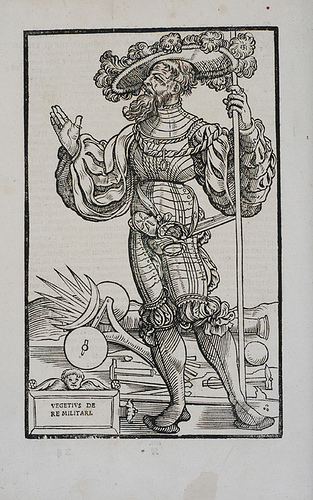
I could believe this second explanation, but I think the answer lies mostly elsewhere.  A clue might arise from a medieval portrait of Vegetius here below:

Why did the late 15th/early 16th century picture him in garb exactly like their own?  Did they really believe that the Romans wore clothes that they themselves wore in their time?  Or were they visually displaying their belief in using his work for their time?  Perhaps they had no idea what Romans wore and they felt free to invent whatever  clothes they wished?

In his great The Discarded Image C.S. Lewis speaks of the medieval imagination. . .

We have grown up with pictures that aimed at the maximum of illusion and strictly followed the laws of perspective.  . . . Medieval art was deficient in perspective [both historical and visual], and their poetry followed suit.  Nature, for Chaucer, is all foreground.  We never get a landscape.

Historically, as well as cosmically, medieval man stood at the foot of a stairway; looking up, he felt delight.  The backward, like the upward, glance exhilarated him, and humility was rewarded with the pleasures of admiration.  Thanks to his deficiency in the sense of period, that packed and gorgeous past was far more immediate to him than the dark and bestial past could ever be. . . .  It differed from the present only in being better.

The Middle Ages are unrivalled, until we reach quite modern times, in the sheer foreground fact, the ‘close-up.’    . . . Two negative conditions made this possible: their freedom both from the psuedo-classical standard of decorum, and from the sense of period.  But the efficient cause surely was their devout attention to their matter and their confidence in it.  They are not trying to heighten or transform it.  It possesses them wholly.  Their eyes and ears are steadily fixed upon it . . .

This lack of “background” in their art and thought might lead them to ignore Vegetius’ context.  We do this too.  Who among us does not think that Ben Franklin’s idea of making the turkey our national bird ridiculous?  We know that Bald Eagles may not be the nicest of birds, but that’s not the point.  We are interested in the immediate image the eagle projects, not its actual reality.

But I think there is more to than that, something distinctly medieval about Vegetius’ image. Medievals developed the habit of looking so closely they missed the forest for the trees.  With Vegetius, we might surmise that all details beyond the immediate text were entirely superfluous, which made those details, in a sense, entirely in the now.  This attitude could be akin to the scientist absorbed so much in trying to clone DNA that he takes no notice of the larger consequences of his actions.

Cheap histories of the Middle Ages talk of the period’s ignorance, darkness, etc.  In reality it appears they had quite a scientific bent, with a love of classification and minutiae.  The quote, “Nothing is known perfectly which has not been masticated by the teeth of disputation,” on my homepage from Robert of Sorbone, dates from the 13th century, and not the 17th.  Vegetius’ portrait may not speak many words about him, but does speak volumes about those that created it.


Chesterton and Toynbee on Sumerian and Greek Mythology

The explosion of interest in the ancient near east, and the rise of archaeology and anthropology in the late 19th-early 20th centuries stands as one of the great eras of historical research.  It added a great deal to our understanding of so much of the past related to the Old Testament.

Unfortunately these discoveries came at a time when Darwinism, Victorian conceit, unbelief, and the Whig interpretation of history all coincided to help radically misinterpret much of what they found, and nowhere is this more evident than in their commentary on Sumerian mythology.

In Donald MaKenzie’s  Myths of Babylonia and Assyria he mentions in the preface how scholars believe that Egyptian and Sumerian mythology had a common, ancient, as yet undiscovered source.  At this the Christian might raise an eyebrow of amusement and hopeful anticipation that Mr. Alexander might say something profound.

But no, because from there he quotes approvingly from Joseph Frazer who believed that this “homogeneity of belief” came from a “homogeneity of race” *(see below).  From the muddling use of big words he continues to slide down the slope . . .

  • In Sumerian mythology we do not deal with symbolized ideas but simple folk beliefs enlarged into greater stories.
  • Babylonian creation myths can be traced back to a story of some tribal hero who liberated the people from some oppressive neighboring tribe.
  • Sumerian dragon stories show disunity more than anything else, for some have the dragon bringing drought and others flood.  Translation: Those silly Sumerians!
It seems to me that this dissection, done with intent to kill, misses the overall point.  Myths, in their view, “evolved” from stories with “different local color, and different local geographies,” into a grand story that explained the origins of everything.  But as Chesterton said in The Everlasting Man, 
We cannot say that religion arose out of religious forms, because that is only another way of saying that it only arose when it existed already.
Somehow, according to the MacKenzie/Frazer school, the Sumerians had the audacious intelligence to found civilization itself, yet persisted in the Victorian-imposed imbecility of supposing that their view of the creation of the cosmos had its origins from some local chieftan hailing from some “local geography.”  But even if you want to suppose some gradual ascent, that still does not solve the problem.  How to explain the spiritual underpinnings of the stories? Chesterton again writes,
An event is not more intrinsically intelligible because of the pace at which it moves.  The medieval wizard may have flown through the air to the top of a tower.  But to see an old gentlemen walking through the air in a leisurely manner would still seem to call for some explanation.  Yet there runs through all the rationalistic treatment of history this curious and confused idea that difficulty is avoided, or mystery eliminated, by dwelling on mere delay . . .

Art is the signature of man. That is the sort of simple truth with which a story of the beginnings ought really to begin. The evolutionist stands staring in the painted cavern at the things that are too large to be seen and too simple to be understood. He tries to deduce all sorts of other indirect and doubtful things from the details of the pictures, because he cannot see the primary significance of the whole; thin and theoretical deductions about the absence of religion or the presence of superstition; about tribal government and hunting and human sacrifice and heaven knows what.

Greek mythology  has just as much strangeness and murkiness to it as Sumerian mythology, with violence and capricious gods doing as they please.  And yet, western Europe never subjected Greek myths to the same kind of psuedo-scientific dissection and subtle derision. Why might this be?

One reason could be that western Europe knew of Greek/Roman mythologies for many many centuries prior to the late 19th. Having been known in a more sensible age, Greek myths could be taken in the more proper literary  sense than their ancient near-eastern counterparts.  Another could be that their assault on Sumerian mythology helped train their guns, a kind of test run, for their assault on the Old Testament.

But I think a truer reason might be that Victorian Europe, and especially England (from whence so much of that nobly minded scholarship came) saw themselves as the inheritors of the Greek legacy.  Surely then, Greek foundation myths had some nobler origin than their Sumerian counterparts.

The Toynbee Convector has a great anecdote from Toynbee related to England’s patterning themselves after the Greeks, especially their “idolization of the parochial state,” (i.e. idolatrous nationalism) which I quote in full.

At some date during the latter part of the breathing-space between the general wars of A.D. 1914-18 and A.D. 1939-45, the writer of this Study heard the presiding officer of one of the livery companies of the City of London bear testimony which was convincing, because it was unselfconscious, to the primacy, in his Weltanschauung, of one of these tribe-worships. The occasion was a dinner at which the company was entertaining the delegates to an international congress that was in session in London at the time, and the presiding officer had risen to propose the toast “Church and King”. Having it on his mind that a majority of his guests were foreigners who would not be familiar with an English tribal custom, the president prefaced the toast with an apology and an explanation. No doubt, he said, the order in which he had rehearsed the two institutions that were to be honoured conjointly in the toast that he was about to propose might seem to a foreigner not only quaint but perhaps even positively unseemly. He apologized for abiding, nevertheless, by the traditional order, and explained that he did so because it was the pride of the city companies to be meticulous in preserving antique usages, even when these had become so anachronistic as to be open to misconstruction by the uninitiated. — from A Study of History, Vol. IX

The tragic irony of all these brilliant and inquisitive men like Mr. MacKenzie and Mr. Frazer ascribing real spiritual hunger to “homogenous local ethnographies” is that they reduced themselves to tribal worship of their local community, and suffered the cataclysmic fate that the Greeks suffered from 431 B.C. – 338 B.C during the years 1914-1945.
*On the love of long words, Chesterton again is spot-on:
One of my first journalistic adventures, or misadventures, concerned a comment on Grant Allen, who had written a book about the Evolution of the Idea of God. I happened to remark that it would be much more interesting if God wrote a book about the evolution of the idea of Grant Allen. And I remember that the editor objected to my remark on the ground that it was blasphemous; which naturally amused me not a little. For the joke of it was, of course, that it never occurred to him to notice the title of the book itself, which really was blasphemous; for it was, when translated into English, ‘I will show you how this nonsensical notion that there is a God grew up among men.’ My remark was strictly pious and proper; confessing the divine purpose even in its most seemingly dark or meaningless manifestations. In that hour I learned many things, including the fact that there is something purely acoustic in much of that agnostic sort of reverence. The editor had not seen the point, because in the title of the book the long word came at the beginning and the short word at the end; whereas in my comment the short word came at the beginning and gave him a sort of shock. I have noticed that if you put a word like God into the same sentence with a word like dog, these abrupt and angular words affect people like pistol-shots. Whether you say that God made the dog or the dog made God does not seem to matter; that is only one of the sterile disputations of the too subtle theologians. But so long as you begin with a long word like evolution the rest will roll harmlessly past; very probably the editor had not read the whole of the title, for it is rather a long title and he was rather a busy man.

Food and Sacrament

The recent issue of The City, a publication of Houston Baptist University, features an interview with Hoover Institute policy fellow Mary Eberstadt.  In the interview she makes a striking observation.  We all know, she remarks, that our society has become increasingly amoral regarding sexual activity over the last 50 or so years.  But an interesting thing has happened: as we became more lax on sex, we became much more censorious and aware about food.

She does not necessarily condemn this concern about food, noting that she herself is a vegetarian.  After all, we should know something about what we put in our bodies.  But she feels that a connection must exist between these two phenomena, and I agree.

What is this possible connection, and how did it come about?

For starters, we have lost the sacramental nature of sexual activity, and I don’t just mean “lawful” sex between husband and wife, but of sexual activity in general.  As St. Paul notes in Ephesians 5, the sexual union is itself a mystery, a clue to the keystone relationship of Creation itself, the union between Christ and His Church.  In certain Old Testament passages, like the meeting of Isaac and Rebecca, the sexual union is the marriage.

But sex outside of marriage also “works” — works in the sense that it forms a spiritual union between the participants.  But no man can serve two masters, and this is why those who have multiple sexual unions with many different partners might be expected to have issue that resemble those who have had multiple marriages.

To engage in the “freedom” of “free love” we have had to try and rob sex of its inherent spiritual meaning and focus on its mere physical aspects, or as a purely personal means of self-expression.

But we are a hungry people, in need of meaning.  We need to replace the meaning abandoned in sex, and perhaps we have chosen food to do that.

As mentioned, the impulse to find some kind of spirituality in food is not inherently wrong.  Fr. Alexander Schmemann wrote in the opening pages of his classic, For the Life of the World,

“Man is what he eats.”  With this statement the German materialist philosopher Feurbach thought he had put an end to all “idealistic” speculations about human nature.  In fact, however, he expressed, without knowing it, the most religious idea of man.  For long before Feurbach the same definition of man was given by the Bible.  In . . . the creation story man is presented . . . as a hungry being and the whole world as his food. (Gen. 1:29-30).  He is indeed that which he eats, and the whole world is presented as one all-embracing banquet table for man.  And this image remains throughout the whole Bible the central image of life.  It is the image of life at creation and also the image of life at its fulfillment: “. . . that you eat and drink at my table in my Kingdom.”

Later he comments that the family meal is the last American sacrament left.

If we look around we can also see that emptying the sacramentality from sex has also gone in tandem with a rise in concern for the environment, which of course also goes in tandem with increased interest in food.  In abandoning a spiritual perspective on sex, we have discovered something of the spirituality in creation.  But tragically, much of our culture associates our newfound interest in creation with something apart from a Christian world-view, even though certain conclusions the modern environmental/food movement draws are right in line with historic Christianity.  Take, for example, the interest in getting away from industrial farms and towards humane treatment of animals, which makes us think more about stewardship, and helps us realize that meat does not come from the grocery store.  I grant that this can go too far. . .

. . . but this is not the problem with the Church or the world at the moment.

Let us not throw the baby out with the bath water.  As Schememann and others have noted, if sacraments reveal and communicate the life of God to us, the whole of creation is sacramental in itself.


Thus ends the original post.  A friend of mine forwarded me this article about the Olympic village that perhaps many of you have already seen.  Sobering, to say the least.  The analogy of a college frat atmosphere used by the author may be the best explanation for their behavior.  But I wondered if there might be a connection to Eberstadt’s thoughts above.  If they train and eat so “religiously” for so long, might that lead to emptying the mystery and sacrament out of sex?

James McPherson’s “Drawn with the Sword: Reflections on the Civil War”

James McPherson is my favorite Civil War historian.  Those familiar with McPherson might assume the cause of my affinity lies in McPherson’s fondness for the Union cause.  But to say McPherson is pro-Union is like saying St. Thomas Aquinas was pro-Catholic.  Both canvass a wide field of inquiry, both speak with conviction, but conviction accompanied with a sober and careful mind.  Admittedly, an ardent pro-Confederate might not be amused.  But like any good scholastic, McPherson respects his opponent.

Drawn with the Sword is not one continuous book, but a collection of essays on a few different topics.  The most interesting section for me dealt with the broad picture issues of whether the North won the war, or the South lost it.

McPherson points out that how we frame the question will tell a lot about our perceptions of the conflict.  I have never been a fan of the view that the South lost due to the overwhelming resources of the North.  In general I fear explanations that allow you to transfer blame, and I also feel we should have antennae up when people attempt to avoid reality via romantic escapism.  Truly sometimes I feel that a minority of Confederate sympathizers are subconsciously glad they lost, for it allows them to dream of the “lost cause.”  This romance can be preserved in part because of their defeat, because their society never really had to face reality in full.

McPherson makes it clear that the South could have won the war, and in his opinion almost did in late 1862 and again as late as the summer of 1864.  Any look at a map of northern and southern territory shows that the Confederacy had certain key advantages, namely, a huge amount of territory for the North to conquer.

I have always thought that a Russian style tight-knit defense-in-depth would have served the Confederacy much better than what they actually attempted.  But the whole concept of state sovereignty forced them to spread their forces out which robbed them of a key advantage.  One might say the inherent logic of their system worked against them without “dooming” them.

McPherson gives at least a partial counter to this.  First, he notes that, however much the South may have been forced by their cultural values to a strong border defense , this would not in itself hurt them.  If the North penetrated their lines they could always let them pass through and then fall upon their rear.  One might think of Marius in the battle of Aquae Sextae, or Patton’s comment about the Nazi offensive during the Battle of the Bulge, where he said that we could let the Nazi’s advance, leading them by the nose so to speak, and then turn and kick them in the rear (it was Patton, so you might guess the quote’s not exact!).  So a strong border defense in his view was not foolish per se.  Reasons for their defeat lie elsewhere.

Second, he argues that the South came close to winning.  He defends Lee against critics that argue that his “Virginia-centrism” and his two main offensives into Northern territory cost the South the war.  Virginia was an important theater, and one where the success they had almost gave them recognition from England.  Furthermore, the relatively narrow confines between the two capitals minimized the territory the Confederacy had to defend, and thus minimized the North’s physical advantages.  Lee, he argues, did not pursue a strategy doomed to fail.  He chose a strategy that could have, and almost did work.  Again, we must look elsewhere for reasons for the North’s victory, or if you prefer, the South’s defeat.  McPherson quotes General Pickett, who when asked why the Confederacy lost, remarked, “Well, I always thought the Yankees had something to do with it.”

McPherson throws out his own opinions here and there, but mostly he forces his readers to follow an ever-widening game of ping-pong, where the ball bounces back and forth between different ideas and perspectives.  McPherson is that rare Civil War writer that can make studying the period enjoyable, as opposed to merely emotionally draining.

Hillaire Belloc’s “Waterloo”

Usually I like Hillaire Belloc, and this book was no exception.  Still, Belloc needs approached with caution.  His marvelous intelligence and delight in iconoclasm sometimes led him astray.  Thankfully, this short book, while not spectacular, highlights hints of Belloc at his best.

His best observations center on the political aspects of the struggle, and not the battle itself.  He asks two pertinent questions:

1. How significant was the Battle of Waterloo?

Sir Edward Creasy ranked Waterloo as one of the 15 most decisive battles in the history of the world.  Others wouldn’t go that far, but argue that a victory for Napoleon at Waterloo would have established him securely in France and perhaps led to a fatal fissure in the alliance against him.

Belloc disagreed.  Had Napoleon won, he would still have had to face many more armies, who could ultimately outnumber him by a factor of five.  England, Austria, Prussia, and Russia had staked their entire identity on stopping him and would not be deterred by one loss, just as they did not back down despite many defeats from 1801-1809.  However romantic Napoleon’s comeback seems, it had no chance.  Napoleon sealed his fate in Russia, not Belgium.  Two can play the iconoclasm game, so I’ll and suggest that maybe Napoleon sealed his fate in Spain in 1808-9.  His ruthless policy of repression there destroyed his image and came back to bite him terribly.

Belloc probably has a better argument, one that today, further removed from Napoleon, is not even particularly controversial.

2. Did Napoleon Lose the Battle, but Win the War?

The other major European powers lined up against Napoleon and France.  They feared all that the French Revolution represented, partly out of fear for the social disruption it brought, partly out of self-interest.  Napoleon had little to recommend him as an individual.  As a symbol and lawgiver, he brought death to the old feudal era whose political institutions no longer had mass appeal.  This other heads of state instinctively knew and feared.  They opposed him.

Napoleon’s favored target was the well-ordered, precisely drilled Enlightenment style armies of balance and proportion.  He knew just what made them tic and how to exploit their weaknesses.  His conquests destroyed the armies of the old order, but his impatience and pride led him to establish puppet regimes that could never gain the loyalty of those he ruled.  Thus, in destroying the armies of Europe he created the same kind of national identity that fueled his own rise to power.  This new national identity created new armies, mirror images of Napoleon’s own.

Belloc asserts that the Napoleonic struggle went on for too long after the creation of these new armies for the kings of Europe to avoid the consequences of creating these new armies.  By 1848, many countries had, via revolutions of their own, adopted many provisions of Napoleonic law.

Who had the last laugh?

Belloc has a similar to point to Toynbee, who explored similar ripple effects in his  magisterial work on Hannibal and the 2nd Punic War.  Was the 2nd Punic War really just a battle, and not the war itself?  Was the same true for the years 1797-1815 in Europe?

Daniel Pinkwater and Public Education

It’s always a blessing in disguise when you fail to turn your kids into clones of yourselves, but still, I feel a slight twinge in my gut when I realize that my children don’t love Daniel Pinkwater’s books.  Yobgorgle, The Last Guru — my absolute favorite The Snarkout Boys and the Avocado of Death — all of them classics, and the list could continue.

Ethan Iverson, the pianist of the jazz trio The Bad Plus grabbed my attention with his musings on Pinkwater here.  The fact that a Pinkwater fable from his book Borgel was recently included on a standardized test in New York is more than a bit ironic, as anyone familiar with his books knows.  The only really evil thing in his books are the schools, and from what I recall he gave them names like “Bat Masterson Junior High,” and “Ghengis Khan High.”  Pinkwater responded to the kerfuffle here for those interested.

I believe that just about everyone involved in education means well.  I have some good friends who do a lot of good in the public school system.  My dad devoted his life to public school education. I went to public schools, and while it could have been better, you can say that about most things in life.

I pull for public schools, in the immediate short term at least.  Society asks schools to do far more than is really possible, given the circumstances.  We ask them to teach huge groups of students with diverse abilities and backgrounds and make it all come out in the wash.  Aside from that, feed them, tell them about drugs, sex, and provide exciting and meaningful extra-curricular activities.  How does anything happen at all?  Having said that, public education has serious, systemic problems, even if we don’t have any one person or group to blame.

Toynbee once declared,

In a previous part of this Study we have seen that the process of growth [leads to] civilizations becoming differentiated from one another.  We shall now find that, conversely, the qualitative effect of disintegration is standardization.      — “The Study of History,” vol. 5

The unintended consequences of education reform have resulted in vast increase in standardization.  This mad rush to standardize cannot serve education, which should ultimately have an expansionistic and not reductionistic character.  It cannot serve political freedom, for it subtly encourages everyone to think in the same way.  As to why we standardize, the answers are grim:

  • We standardize because we lack the willpower or ability to think of more creative solutions
  • We standardize because we have no other choice — we are completely overwhelmed with a problem that we cannot fix.
Related to this second answer, a friend of mine who teaches 9th grade English has commented to me that of course he would like to assign more essays, but how can he grade 175 of them at a time?  So, Scan-tron it is.  If Toynbee is right, once standardization takes hold only a few outcomes remain:
  • A slow drift towards Kafka-esque absurdity, irrelevance, and disintegration, or
  • A reversal towards greater freedom and mobility of mind, but this can only come when the standardizing system gets forcibly dismantled.  This process brings with it large amounts of pain and disruption.
The fact that an alternative to public schools, or a solution to the problem within public schools, seems impossible to fathom is an indication that we are deeply embedded into a problematic system.  We have a long way to go.

I have been too gloomy for my tastes, so all who have read this far need rewarded. .  .

From The Snarkout Boys and the Avocado of Death:

Everybody ate in silence until the Bullfrog Root Beer was served. Then the conversation at the table got started. Aunt Terwilliger began making a sort of speech about grand opera. She was against it. Later, Rat told us that her aunt had just about every opera recording ever made. Her aunt spent hours in her bedroom listening to them, but all the rest of her time was spent arguing that people shouldn’t listen to operas, and, above all, they shouldn’t go to see them performed. Rat said that Aunt Terwilliger makes regular appearances in Blueberry Park, where she tries to convince people to live their lives opera-free. She feels that operas take up too much time. Also, she has an idea that people who like opera will become unrealistic, and not take their everyday lives seriously. Most of all, she believes that operas are habit-forming, and once a person starts listening to them, it’s hard to stop, and one tends to listen to more and more operas until one’s life is ruined.

Aunt Terwilliger has pamphlets printed up that she hands out. Her most popular one is called “Grand Opera: an Invention of the Devil.”

Brian Christian’s “The Most Human Human”

The backdrop for this book is the famous Turing Test, devised decades ago by the scientist Alan Turing.  Questions about AI existed from the very beginning of the invention of computers, and scientists wondered about a time when computers might possibly be able to “think” in a human-like way.  Turing speculated that if a computer could successfully impersonate a human 30% of the time, we would know that the necessary threshold had been crossed.

The advent of the internet has allowed computers to amass huge amounts of data and gain proficiency at this task much faster than Turing could have imagined.  And of course, technology in general improves all the time at speeds never before thought possible.  But I found Christian’s central premise quite intriguing: Is it possible that computers are better at impersonating humans not just because of the growth of technology, but  because we are worse at being human than we used to be?

Hidden behind this premise is to what degree we begin to act more like machines the more we interact with them.  When different cultures interact each leaves an imprint, however faint, on each other.  Does the same happen when we interact with machines?  Will our spoken language, for example, eventually reflect the language we use in texting?

I have just a few minor quibbles with the book.  He rambles a bit and wanders into other questions (though admittedly related ones) about the nature of language, the soul, and so on.  Here Christian summarizes the basic ideas on these questions throughout history, and because he didn’t seem to inject much of himself into these sections, they left me flat.

Still, kudos to Christian for raising a timely and interesting question.  But I wish he went further.  More questions need addressed, such as, “Why are so many so interested in proving that computers are “human?” I have a few possible theories:

  • The people who push the limits of AI do so in a vacuum, or in their minds, “science for Science’s sake.”  Science, or knowledge, is the only reward or consequence worth pursuing.  Let others deal with the moral consequences, that’s not our job.

Or

  • Some pursue the so-called merging of man and machine because they nurse a secret, perhaps unconscious hatred of Humanity itself and seek to abolish it.

Or

  • They believe that the best science helps us understand ourselves.  Thus, the success of computers at mimicking us will only push us to a further and more exploration of humankind.  The more we understand ourselves, the better we can know God.

I would guess that all three views (and no doubt others I have not thought of) exist in the computer science camp.  No doubt others do as well, so if you think of any, please let me know.

Many thanks,

Dave

The Blessings of Impractical Civilizations

(What follows was originally written in 2012) . . .

Ad Fontes is located in Centreville, which puts us within spitting distance of Dulles Airport.  That meant that we had a wonderful view of the space shuttle Discovery as it piggybacked its way to the Udvar-Hazy Center for display.  The students admired the sight (and enjoyed getting out of class), but in discussions I had with them no one seemed particularly chagrined that the shuttle program had ended.  “Why should we bother with space exploration,” many argued, “when we have so many other problems?”  To them space exploration has no point to it, “unless we know that something valuable is out there.” This argument is hardly unusual.

In 9th grade we just finished looking at the incredible boom of exploration during the early years of the Renaissance, ca. 1450-1500.  Historians have speculated on the reasons for this sudden jump, and many suppose that the answer must be “technology.”  I agree with Felipe Fernandez-Armesto who argues in his book Pathfinders that the exploration boom happened not because of any particular technological advance, but because they simply wanted to go.  Sailing technology did not measurably increase for about 300 years after the 15th century boom, when we discovered how to measure longitude, yet that their relative lack of technology did not deter them.  Given the great dangers of sailing in those early days, one cannot say that exploration was a particularly practical activity, though certain voyages did generate large profits. Despite this, people continued to travel, and most historians agree that exploration helped define and benefit Renaissance civilization in important ways.

Other civilizations did this too.  What could be more impractical than a massive cathedral?  And yet cathedrals popped up throughout northern France and England in the 12th century, then spread throughout western Europe.  Some historians talk about the economic benefits of cathedrals, as it drew visitors and trade and so on.  However true this may be, cathedrals cost tons of money and took decades to build.  I don’t think the medievals built them to create trade, and yet clearly the Gothic cathedral defined and shaped an era.

As far as glorious impracticality goes, its hard to top the Celtic monks who illumined so many manuscripts in the 5th-10th centuries.  In the midst of the Dark Ages, when civilization itself needed rebuilt, you had some of the best educated men playfully “wasting their time” drawing monsters on the pages of St. Matthew when they could have been about so much more!  And yet many historians credit this process with helping revive civilization after Rome’s fall.

Other civilization have been “impractical” in different ways.  The Age of Reason had opera, which as Kenneth Clark notes in this brief clip, has nothing rational about it.  And yet, Mozart left part of his greatest legacy in opera, and there can be little doubt of its impact on opera’s cultural impact from the mid-1700’s up until the 20th century.

This brief survey makes me wonder in what sense our civilization is wonderfully impractical, and I don’t think the question merely frivolous.  Much of what we appreciate about civilization has little direct practical value.  Take education, for example.  If we decided that a good education consisted merely in technical training human society would collapse shortly thereafter.   We could build better dams than beavers, but the difference between man and beast would be one of degree and not kind.  Thankfully, students rarely ask, “When will I need to use this in real life?” when reading Shakespeare (though they ask it all the time in math, which should clue us in that something is wrong about how we teach it).

Of course, we don’t have to pick the space shuttle program as our cultural fancy.   We can choose something else.  And, given the diversity of our culture (which has much to commend it), its unlikely that we’ll land on one thing like cathedrals or sailing.  Still, nothing prevents us as from changing civilization by starting with ourselves.  History speaks and says, “Be impractical.”

The best reason for a revival of philosophy is that unless a man has a philosophy certain horrible things will happen to him. He will be practical; he will be progressive; he will cultivate efficiency; he will trust in evolution; he will do the work that lies nearest; he will devote himself to deeds, not words. Thus struck down by blow after blow of blind stupidity and random fate, he will stagger on to a miserable death with no comfort but a series of catchwords; such as those which I have catalogued above.  . . .The idea of being “practical”, standing all by itself, is all that remains of a Pragmatism that cannot stand at all. It is impossible to be practical without a Pragma. And what would happen if you went up to the next practical man you met and said to the poor dear old duffer, “Where is your Pragma?” Doing the work that is nearest is obvious nonsense; yet it has been repeated in many albums. In nine cases out of ten it would mean doing the work that we are least fitted to do, such as cleaning the windows or clouting the policeman over the head. “Deeds, not words” is itself an excellent example of “Words, not thoughts”. It is a deed to throw a pebble into a pond and a word that sends a prisoner to the gallows. But there are certainly very futile words; and this sort of journalistic philosophy and popular science almost entirely consists of them.

From G.K. Chesterton’s “The Revival of Philosophy”