9th/10th Grade: Chivalry, Violence, and the Role of Women

Greetings,

This week we looked at the motives and methods of chivalry in the medieval period.  As a high ideal, medievals never really lived up to it, but such is the case with all high ideals.  While they fell short of the standard they set for themselves, the ideal at least set the bar high and gave them something to aim at.  Chivalry’s heart still beats faintly in much of the modern conception of manners, so all in all I think we can say it’s had a good run.

Chivalry has many origins, but one of them surely comes from the medieval Church’s practical realism.  Man will not attain perfection.  War will always be with us.  But that did not mean that civilization could not seek to limit the effects of war.  Limiting war’s collateral damage meant among other things, strict rules governing how and when people could fight.

To perhaps better understand we need only to imagine another kind of contest, like a basketball game.  We know when the game is over, and we know who has won.  We know this for more reasons than the score.  Both sides have agreed on the rules beforehand.  A clock tells you when time expires.  Referees stand ready to enforce rules that help make the contest fair.  No one likes losing, but when you lose according to the rules, you can accept it, and stop playing.  The ‘war’ is over.

Suppose the final horn sounds, and team ‘A’ is ahead 50-48.  But what if to score the last basket and pull ahead, the point guard of team ‘A’ punched a guy in the stomach to get a clear lane to the hoop?  If noticed by the ref, the basket would not count.  It’s not just the score that determines the winner.

Suppose now that the ref did not see the punch, and therefore the basket counts.  Will team ‘B’ accept the result?  Would the game be over for them?  Ask the USA basketball team from the 1972  Olympics if they think they lost the gold medal game. . .

Imagine if no rules governed how people played basketball.  At first, an someone would throw an elbow, then a punch.  Maybe someone brings brass knuckles onto the court.  A player might run out of bounds but now no out of bounds exists.  What would happen would quickly cease to resemble anything like basketball.  The contest would not test basketball skill but instead, each sides cunning use of violence.

The medievals believed that while war would involve killing, it should not be about killing.  War needed to serve something higher than mere accretion of power. This meant that

  • War needed to have a definite defensive purpose.  They justified fighting when done only for those that could not fight themselves.
  • The limited when they could fight.  No fighting on Sundays.  Or Fridays.  Or during Lent, Advent, Easter, Christmas, Pentecost, feast days, and so on.
  • They limited who could fight, which was both by accident and design.  Learning how to fight on horseback with armor took a lot of training.  Thus, only those who had the time to train would fight, which restricted it to the special class of nobles.

The idea of showing deference to women inspired a whole new set of manners, poetry, literature, and so on.  I can’t think of any other civilization that exalted the feminine ideal to such a degree.  A quick comparison of ancient and medieval art reveals this.

For civilization to survive, we need people willing and able to defend it.  We do a fearful thing during war when we hand over the fate of our civilization to men practiced in the arts of violence.  Killing machines like Achilles will defend us, but then drag us down with them in a spiral of violence.  After the Trojan War, Greece descended into a Dark Age.  After Rome’s victory over Carthage, their Republic flew apart at the seams in an intermittent civil war that lasted for a century.  Chivalry sought to stop the cycle of violence and allow civilization to return after the fighting stops.
Women today have many more rights, and have much more equality with men than they used to.  But modern women face a dilemma.  Can chivalry and equality co-exist, or do they cancel each other out?  If so which ideal should we prefer?  If they can co-exist, how would they do so?  We had an interesting discussion about holding doors open.  All the girls agreed that they liked it when guys hold the door for them, at least under most circumstances.  But guys almost universally agreed that they did not like it when girls held door open for them.  Why might this be?  Is it sexist for the guys to think this, or are they onto some fundamental truth about the nature of male and female?

I asked the students whether or not any objected to having a girl’s soccer team, and no one did.  But just about everyone agreed that a girl’s wrestling team wouldn’t just be weird, it would be “wrong.”  And yet, 100 years ago many would have thought that women wearing pants was fundamentally wrong (i.e. women shouldn’t wear men’s clothing/cross-dressing), whereas today we don’t give it a second thought. How can we know the difference?  Knowing where to draw the line between relative cultural difference and eternal principle requires a great deal of discernment.

In the end, medieval people believed that the presence of male and female in creation revealed certain truths about God Himself. These truths should be “acted out” in our daily lives so that we might better know God.  So for medievals, the confusion of genders not only denigrated God’s creation but obscured God’s revelation.

This idea makes more sense if we think of life as a kind of play.  The playwright has a particular message to get across to his audience.  That messages requires each of the performers to know their role, and to know their lines.  Forgetting ones lines wouldn’t be a sin, but it would obscure the play’s message for the audience.  In this analogy, the “audience” would be those all around us everyday.  We all have the responsibility and privilege of imaging God to others all the time. The diversity of creation reveals the “diversity” of God.  Both the male and female “principles” reveal something about God, and again, we should not obscure the revelation God means to give through us.

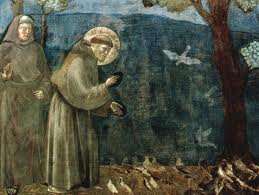
To cap off our discussion of chivalry we will look at the life and ministry of St. Francis.  I wanted to focus on his famous “Canticle of the Sun.”  It reads,

Most high, all powerful, all good Lord! All praise is yours, all glory, all honor, and all blessing. To you, alone, Most High, do they belong. No mortal lips are worthy to pronounce your name.

Be praised, my Lord, through all your creatures, especially through my lord Brother Sun, who brings the day; and you give light through him. And he is beautiful and radiant in all his splendor! Of you, Most High, he bears the likeness.

Be praised, my Lord, through Sister Moon and the stars; in the heavens you have made them, precious and beautiful.

Be praised, my Lord, through Brothers Wind and Air, and clouds and storms, and all the weather, through which you give your creatures sustenance.

Be praised, My Lord, through Sister Water; she is very useful, and humble, and precious, and pure.

Be praised, my Lord, through Brother Fire, through whom you brighten the night. He is beautiful and cheerful, and powerful and strong.

Be praised, my Lord, through our sister Mother Earth, who feeds us and rules us, and produces various fruits with colored flowers and herbs.

Be praised, my Lord, through those who forgive for love of you; through those who endure sickness and trial. Happy those who endure in peace, for by you, Most High, they will be crowned.

Be praised, my Lord, through our Sister Bodily Death, from whose embrace no living person can escape. Woe to those who die in mortal sin! Happy those she finds doing your most holy will. The second death can do no harm to them.

Praise and bless my Lord, and give thanks, and serve him with great humility.

We looked at how St. Francis personified creation and even assigned various roles, or genders, to different parts of creation.  The ‘male’ aspects are active, the female more humble and nurturing.  Despite this strong distinction, no one would call St. Francis a chauvinist.
Lest we think this a complete relic of our past, why does some much love poetry involve the moon and not the sun?  Why do we give our ships feminine names?  Are we living in the past or recognizing in some way a fundamental truth about reality?  Peter Kreeft discusses this in his wonderful “Love Sees with New Eyes” essay, which can be found here.

For those who may be interested, C.S. Lewis excellent (and short) essay entitled “The Necessity of Chivalry is here.  He writes, “The ideal embodied [in chivalry] is escapism in the sense never dreamed of by those who usually use the word; it offers the only possible escape between wolves who do not understand, and sheep who cannot defend, the things which make life desirable.”

Many thanks,

Dave Mathwin

Ages of Refinement

I admit that the museum’s in D.C. are generally all great, even though despite living within striking distance I rarely visit them.  Recently, however, I got a chance to visit Manhattan and the Metropolitan Museum of Art — an experience on a whole different level.  One couldn’t possibly see everything, but I spent some time in their extensive Egyptian wing and a thought struck me.

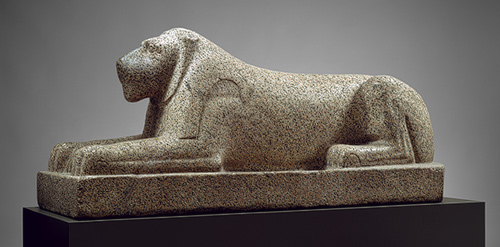
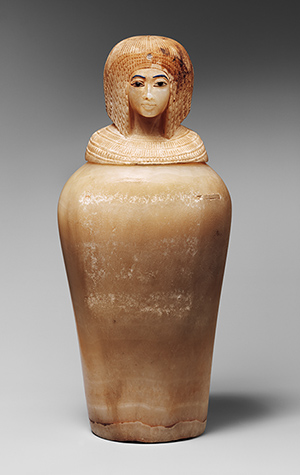
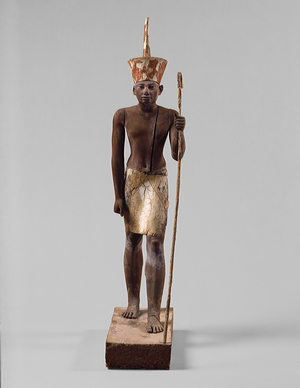
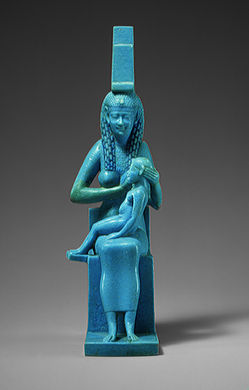
The museum laid out the pieces chronologically, not topically, and this gives one a chance to see the development of Egyptian style and technique over millennia.  Now, very little changed over time — as a culture Egypt had a very strong identity and they did not necessarily value originality — but I had a flight of fancy that subtle differences emerge upon close inspection.

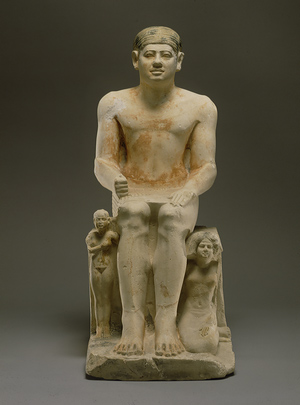
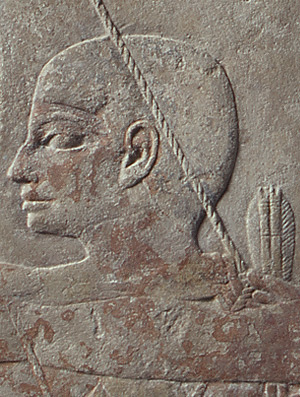
Below is some work from Egypt’s “Old Kingdom” ca. 2500 B.C.

Old

Old Kingdom

Old Kingdom

Next, examples from their “Middle Kingdom” ca. 1400 B.C.

Middle Kingdom

Middle Kingdom


And finally, work from the “Late Kingdom” ca. 700 B.C.

Late Kingdom

Late Kingdom

Egypt Late Kingdom

No civilization lives out its time as a perfect bell-curve of steady rise, peak, and smooth decline.  Ebbs and flows interject themselves.  But we can safely say that Egypt as a “power” was on the rise early, perhaps peaked during the reign of Thutmose III in the Middle Kingdom period, and certainly continually waned after around 1100 B.C. and into the Late Kingdom.

But the artistic quality does not follow this bell curve.  In general their art evidences a steady increase at least in technical skill down through the Late Kingdom well past their political decline.  One could argue, however, that we see the most latent spiritual power in their earliest art.  The somewhat stoic solidity of their craft in the Old Kingdom seems to be bursting with energy just waiting to get released. Might we say then, that the increase in technical skill not only does not mirror an increase in the overall health of their civilization, it might even be evidence for their decline?

We see something similar in the history of Rome.  Here, for example is a bust of the hero of the 2nd Punic War, Scipio Africanus ca. 200 B.C.

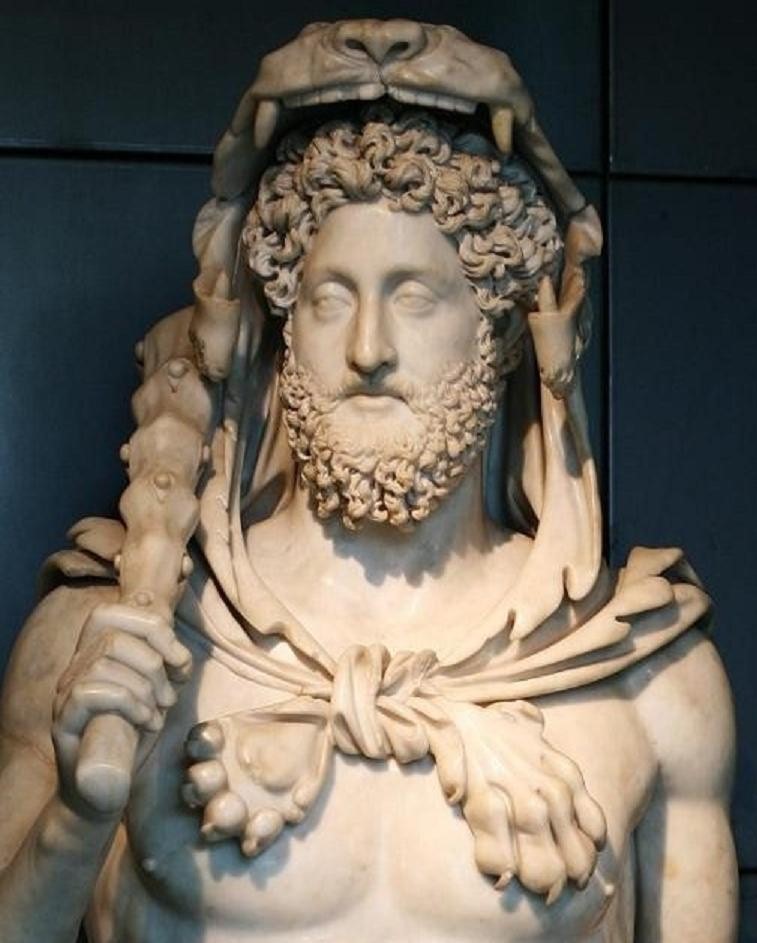
Fast-forward about 400 years and we find ourselves in the reign of the Emperor Commodus.  At this point Rome controlled more territory than at any point in its history, but no one would suggest that Rome stood taller and healthier in 180 A.D. than at 200 B.C.  And yet,

once again we see that technical skill in the arts has increased, and again we can draw similar conclusions about this increase as we can in Egypt.  Rome has declined, but technical skill has gone up.* We can also see a great deal more “spiritual” strength in Scipio than we can in Commodus, again similar to Egypt.

All this should be taken in the spirit of this blog as a whole.  I am a rank amateur making a guess. But if my guess be correct, why might it be so?

We can understand why a civilization might lack technical refinement in its earlier stages.  It has little to do with intelligence, I’m sure, and perhaps more to do with not having developed a clear style or sense of themselves.  But if the early stages show some of the clumsiness of youth, it also displays some of the (irrational) confidence of adolescence as well.

For convenience I label the later stages — like those that produce the Commodus bust — as ages of “refinement.”  I don’t think that “refinement” means an inward turn — inward turns of a civilization can bring great spiritual insights (this post here discusses this possibility in Byzantine civilization), and I don’t think either the Egyptian or Roman art shows that.  Rather, the refinement in the above art appears excessively “outward” to me, a decoration, perhaps even a covering over, of an inward reality.  In the case of Commodus, for example, his desire to show himself, a Roman emperor, in the guise of the Greek Hercules, bodes ill for himself and Rome. “Refinement” then represents a stage occupied not with deeper spiritual things but with “protesting too much.”

We can see this in Rococo art, for example, and the resulting storm that followed.  One can see the French Revolution of 1789 as the fall of one type of European Civilization.  It’s nice to celebrate simple happiness — nothing wrong with that.  But for my money Rococo (mid-late 1700’s) goes too far . . .

Schloss Ludwigsburg

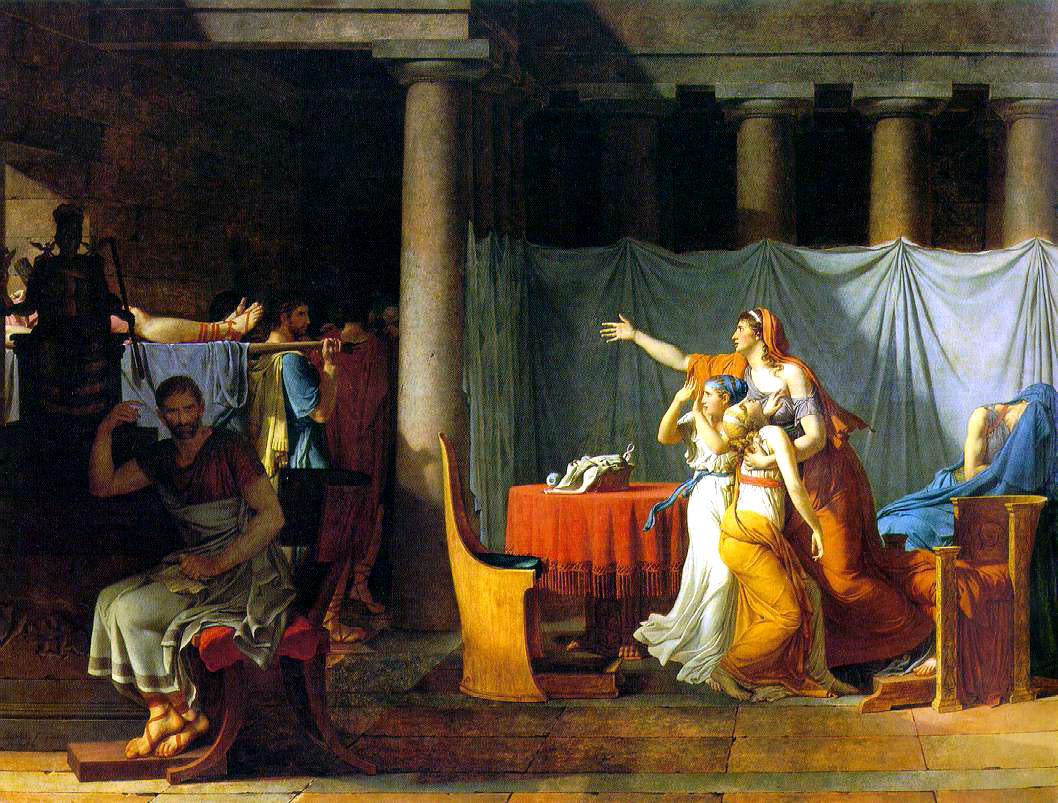
The monstrous retribution that fell upon that civilization both in terms of the French Revolution specifically, and the Napoleonic Wars generally, has its harbinger with the drastic change in art represented by Jacques-Louis David.  All sense of “refinement” gets sacrificed to stark reality, in this case, the consul Brutus receiving back the bodies of his sons he ordered executed for treason to the Republic.

Returning to Egypt, while the architectural and sculptural achievements of the era of the late kingdom Pharaoh Ramses II impress in terms of scale, we do not see the same spiritual depth as in Akhenaton a century before him,

Ramses II

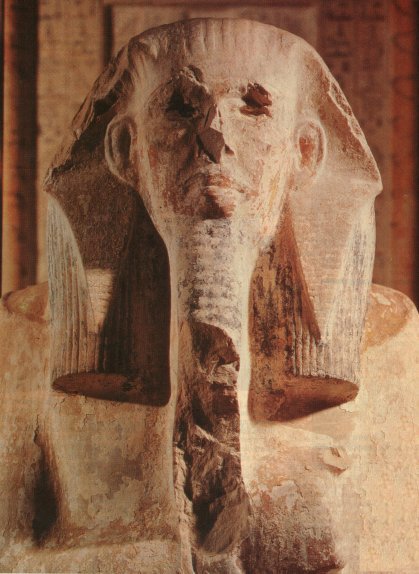
or the stark humanity of the much earlier Pharaoh Djoser (perhaps akin in style to bust of Scipio above, which might place their respective civilizations in the same spiritual framework).

Djoser - statue en calcaire

If this is a good/correct guess for these civilizations, we can ask whether or not it appears to be a law of civilizations generally, but   We may wonder too where our civilization fits in this suggested interpretative framework.  I think it obvious that many of our cultural creations do not evince the clumsy confidence of adolescence.  I’m tempted to say that we focus on ways to multiply purely external pleasure, which might put us in an “Age of Refinement.”  But if I say these things I will be following the pattern of every ancient historian in my, “Kids these days,” attitude, as well as most men generally past 40.  I don’t know if I’m quite ready to embrace that just yet.


*There may be another parallel between Rome and Egypt — we might say that Thutmose III (ca. 1450 B.C.) and Marcus Aurelius (ca. 160 A.D.) represent similar places in the respective histories of Egypt and Rome.  Both perhaps represent an “Indian Summer,” — a brief but ultimately failed rally against the tide.

9th Grade: Medieval and Modern Leeches

Greetings,

Most of us would shudder at the thought of visiting a medieval doctor.  After all, they bled people to make them well and actually used leeches for treatment of wounds (doctors were actually called ‘leeches’ in the common tongue).  This general aversion offers a great opportunity to get a fresh look at medieval people and see what they valued.  How they thought about health reflected their deeper beliefs about humanity and the world around them.  Hopefully by looking at a very different approach to health we can see the nose in front of our own face, and more accurately understand our own culture.

I remember a conversation I had just after college.  A woman asked me what I thought of  Eastern medicine, and I replied that I didn’t know much about it, but was wary of the possible non-Christian foundations of eastern approaches.  She asked me, “Are you so sure that western medicine has a Christian foundation?”  I was struck speechless (a rare occurrence, unfortunately).  I had to admit that I had never thought about it before, never seen the nose on my face, so to speak.

In that spirit, I wanted the students to approach the subject with an open mind.

What did they believe?

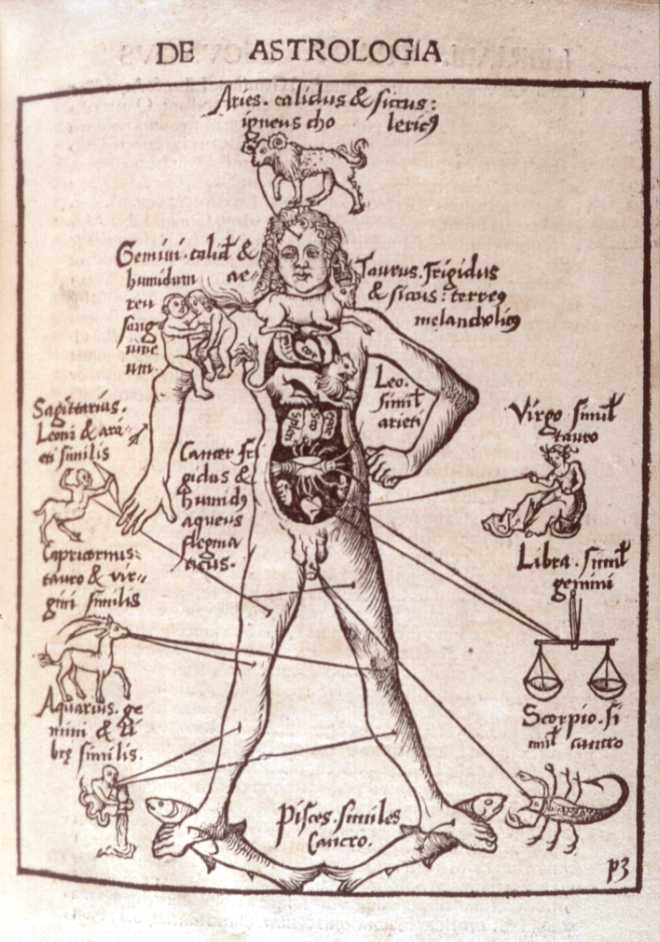
Just as the medievals based (consciously or no) their society on their perception of the order in the cosmos, so too they thought of health vis a vis man’s place in the universe.  It was “holistic” healing in the widest possible sense.  Originally, man stood in harmony with the rest of creation, just as Earth did with the rest of the cosmos.  Man in harmony with creation meant man in harmony with himself, with his various internal elements of earth, air, water, and blood in harmony.

The Fall disrupted this harmony, and so medicine should seek to restore it, to put the elements back in their right place.  This concept of balance, so important in medieval politics, shows itself in medicine as well.  Today we have various medical supplements that allow us to go beyond what is natural but for medievals the key was not fighting nature but restoring harmony with it.

Internal harmony had its reflection again in the relationship between the physical and spiritual in our lives.  Some mock medieval medicine by arguing that they thought every disease had its cure in prayer.  That is not true, but they did believe that one’s mental and spiritual well-being impacted our physical state, and vice-versa.

Their emphasis on the planets probably stands as one of their more perplexing beliefs, and for that reason perhaps most instructive for us.

First, we note that the medievals saw the cosmos as interconnected like a spider web, not one of free-floating entities.  Movement in one area effected other areas.  Motion in cosmos impacts motion on Earth, which impacts us.

This does not mean that they believed that planetary motion could cause actions on earth.  Rather, planetary motion was considered part of the environment in which man operated, and had to account for.  Here is Aquinas, for example, on the motion of the heavenly bodies and the limits of its impact. . .

Summa Theologica, Do Planets cause human action?

Objection 1: It would seem that the human will is moved by a heavenly body. For all various and multiform movements are reduced, as to their cause, to a uniform movement which is that of the heavens, as is proved in Phys. viii, 9. But human movements are various and multiform, since they begin to be, whereas previously they were not. Therefore they are reduced, as to their cause, to the movement of the heavens, which is uniform according to its nature.

Objection 2: Further, according to Augustine (De Trin. iii, 4) “the lower bodies are moved by the higher.” But the movements of the human body, which are caused by the will, could not be reduced to the movement of the heavens, as to their cause, unless the will too were moved by the heavens. Therefore the heavens move the human will.

Objection 3: Further, by observing the heavenly bodies astrologers foretell the truth about future human acts, which are caused by the will. But this would not be so, if the heavenly bodies could not move man’s will. Therefore the human will is moved by a heavenly body.

On the contrary, Damascene says (De Fide Orth. ii, 7) that “the heavenly bodies are not the causes of our acts.” But they would be, if the will, which is the principle of human acts, were moved by the heavenly bodies. Therefore the will is not moved by the heavenly bodies.

I answer that, It is evident that the will can be moved by the heavenly bodies in the same way as it is moved by its object; that is to say, in so far as exterior bodies, which move the will, through being offered to the senses, and also the organs themselves of the sensitive powers, are subject to the movements of the heavenly bodies.

But some have maintained that heavenly bodies have an influence on the human will, in the same way as some exterior agent moves the will, as to the exercise of its act. But this is impossible. For the “will,” as stated in De Anima iii, 9, “is in the reason.” Now the reason is a power of the soul, not bound to a bodily organ: wherefore it follows that the will is a power absolutely incorporeal and immaterial. But it is evident that no body can act on what is incorporeal, but rather the reverse: because things incorporeal and immaterial have a power more formal and more universal than any corporeal things whatever. Therefore it is impossible for a heavenly body to act directly on the intellect or will. For this reason Aristotle (De Anima iii, 3) ascribed to those who held that intellect differs not from sense, the theory that “such is the will of men, as is the day which the father of men and of gods bring on” [*Odyssey xviii. 135] (referring to Jupiter, by whom they understand the entire heavens). For all the sensitive powers, since they are acts of bodily organs, can be moved accidentally, by the heavenly bodies, i.e. through those bodies being moved, whose acts they are.

But since it has been stated (A[2]) that the intellectual appetite is moved, in a fashion, by the sensitive appetite, the movements of the heavenly bodies have an indirect bearing on the will; in so far as the will happens to be moved by the passions of the sensitive appetite.

Reply to Objection 1: The multiform movements of the human will are reduced to some uniform cause, which, however, is above the intellect and will. This can be said, not of any body, but of some superior immaterial substance. Therefore there is no need for the movement of the will to be referred to the movement of the heavens, as to its cause.

Reply to Objection 2: The movements of the human body are reduced, as to their cause, to the movement of a heavenly body, in so far as the disposition suitable to a particular movement, is somewhat due to the influence of heavenly bodies; also, in so far as the sensitive appetite is stirred by the influence of heavenly bodies; and again, in so far as exterior bodies are moved in accordance with the movement of heavenly bodies, at whose presence, the will begins to will or not to will something; for instance, when the body is chilled, we begin to wish to make the fire. But this movement of the will is on the part of the object offered from without: not on the part of an inward instigation.

Reply to Objection 3: As stated above (Cf. FP, Q[84], AA[6],7) the sensitive appetite is the act of a bodily organ. Wherefore there is no reason why man should not be prone to anger or concupiscence, or some like passion, by reason of the influence of heavenly bodies, just as by reason of his natural complexion. But the majority of men are led by the passions, which the wise alone resist. Consequently, in the majority of cases predictions about human acts, gathered from the observation of heavenly bodies, are fulfilled. Nevertheless, as Ptolemy says (Centiloquium v), “the wise man governs the stars”; which is a though to say that by resisting his passions, he opposes his will, which is free and nowise subject to the movement of the heavens, to such like effects of the heavenly bodies.

Or, as Augustine says (Gen. ad lit. ii, 15): “We must confess that when the truth is foretold by astrologers, this is due to some most hidden inspiration, to which the human mind is subject without knowing it. And since this is done in order to deceive man, it must be the work of the lying spirits.”

For them, paying attention to planetary motion might be akin to us today paying heed to a weather pattern off the coast of Japan.  But again, Aquinas hints at something more than this, something with more weight behind it.  C.S. Lewis, a professor of Medieval & Renaissance Literature, used these ideas in his Chronicles of Narnia series, as well as books like Perelandra  and That Hideous Strength.

Different planets had different impacts.  Of course the planets outside of earth had no sin, so the influence of some was not bad in itself, but often became so when interacting with our own fallen environment.

Saturn — The Infortuna Major

Saturn’s influence tends to make people introspective, moody, and inwardly focused.  This makes sense when we realize that the Greek name for Saturn is Cronos, where we get our language for time.  The idea here is of one who broods, who navel gazes.  Saturn is associated with the “melancholy” personality type. Melancholies can achieve great heights in artistic, intellectual, and spiritual endeavors.  Many of our great geniuses likely had this personality.  But the danger comes when they live too much inside their own head, isolate themselves, and subject themselves to psychological debilitations like depression.

Jupiter — The Fortuna Major

Jupiter received its name from Jove, the Roman name for Zeus.  Hence, Jupiter brings kingly joy.  When the king is happy the people feast.  People come together and sing, dance, eat, etc.  This concept of communal joy was the highest good for medievals, which they associated with the “Sanguine” personality type.

Mars — The Infortuna Minor

Mars of course brings war.  The “red planet” is associated with anger, and thus its earthly mirrors can be found in strong ‘Type A’ personalities.  What should strike us about Mars being the “Infortuna Minor” is that the medievals did not think war as bad as a nation of isolated brooders.  War brings many evils, but a silver lining can be that it does bring people together — and here we see again the medieval “community” emphasis.

Venus — The Fortuna Minor

Venus brings love, and is often linked with romantic love between a man and woman.  Again, we have an interesting contrast between their world and ours.  For us, nothing can be greater than experiencing romantic love, but for them, nothing was great than “joviality.”  Again, we see the community emphasis, and when we step back from romantic love, we see that while it does bring two people together, it also can isolate those two from others around them.  Isolated joy between two people cannot match communal joy for the medievals.

The composer Gustav Holst used the medieval ideas about the planets to write a series of compositions.  As is appropriate, the best one is “Jupiter.”

All in all, we have more of the medieval world with us than we might realize.

  • Some hospitals actually use leeches!
  • The current emphasis on a holistic approach to health comes directly from the medieval period
  • The focus on health care trying to keep you healthy comes directly from the Middle Ages
  • The use of dietary changes as part of health care has ancient and medieval roots

I hoped the students enjoyed our short detour into an odd corner of the medieval world.

Blessings,

Dave

9th Grade: A Medieval Cold War turns Hot

Greetings,

Henry IIThis week we wrapped up the 12th century by looking at Henry II, king of England from 1154-1179.

Henry had many great leadership qualities, as even his enemies attested to.  Tall, handsome, bold, decisive, charismatic — the list could go on.  Feudal society, however, seemed arranged specifically to prevent strong ‘type A’ personalities like Henry’s from exercising their full potential.  Past updates discussed the various ‘spheres’ of influence, local distinctions, and tangled allegiances that prevented any centralization of power in the medieval world.

All of this sort of thing no doubt maddened Henry, just as it would frustrate anyone who liked efficiency, action, and “getting things done,” not to mention power.  Henry did his best, however, and had a great deal of success.  One of his final frontiers remained the creation of universal law throughout England, and here he met the staunch opposition of the Church, in the person of his one time friend Thomas Becket, a man to whom he had personally shown enormous favor, raising him from his “common” birth to the heights of power.  Henry also wanted the power to appoint bishops to vacant sees, and to try monks and clergy who had committed crimes.  Becket didn’t mind the first so much, acquiesced on the last, and ended up dying for his opposition to Henry’s claim to control the clergy.

The medievals inherited one of their dominant theological motifs from St. Augustine’s “City of God.”  In his treatise Augustine outlined the existence of two cities on Earth, the “City of Man,” and the “City of God.”  The City of Man has its manifestation in the use of power to maintain order — the State.  The state has legitimacy in the eyes of God. It performs crucial functions for our well being.  But don’t kid yourself into thinking that the City of Man has any redemptive qualities or possibilities.  It performs purely ‘negative’ functions.  It restrains evil but cannot serve as a conduit for redemption.

The City of God, on the other hand, looks beyond the maintaining of power to redemption.  It focuses on love, forgiveness, and grace.  The City of God, therefore, must not be ‘infected’ by the City of Man.  The two are ultimately incompatible not because the City of Man is inherently bad but because they have different goals.  For many medievals, the political and legal independence of the Church helped maintain the Kingdom of God on Earth.

The feud between Henry and Beckett likely had its personal undertones, but at its heart, Beckett believed he stood for the independence of the Church.  Henry’s claim to appoint bishops and discipline clergy to Beckett looked like the City of Man trying to control the City of God.  If the City of Man got its clutches on the Church, the Kingdom of God would suffer, the light of Christ would dim.

Becket and Henry

Becket’s opposition to Henry seems arcane to us.  But to keep its independence, the Church believed that it needed to maintain both its territorial and legal separation from the state.  For his part, Henry felt that he could not tolerate a de facto “state within a state” while he reigned.  In the end, four of Henry’s knights killed Becket, though perhaps not on Henry’s direct order.  Nevertheless, Henry ‘lost,’ for the people blamed him for Becket’s death, and he had to publicly do penance.  At the end of the post I include one medieval contemporary’s admiring evaluation of Henry II.  He had many strengths, but some of these strengths could turn to weaknesses in the wrong context.

Previously we examined aspects of the medieval “guild” system.  Guilds had three basic functions:

  • To provide a means to train new workers
  • To enforce a uniform standard of quality
  • To protect its members

But beyond these basic functions, guilds, whether consciously or not, reinforced basic values of medieval society, which valued community and stability over competition and change.  I assume they would look at modern day America and shake their heads.  So much turmoil, so much of the “rat-race” mentality, so much cut-throat competition.  Why not all agree to scale back and relax a little?  Why make the middle-class dad have to stay open later to stay ahead of the competition just to keep up with competitors and miss his son’s soccer game?  In the end, it’s not worth it.

Guilds also provided another check and balance, or block of power and influence in the medieval stew.  They further prevented any kind of concentration of power.  Understanding the guild system can help us understand why Henry II actions brought so much controversy.

But, as students noted, the guild system geared itself towards stability and community, not innovation.  In America, for example, we do not shed a tear if Hechingers Hardware loses to Home Depot, so long as we get a better deal (does anyone else remember Hechingers?).  We understand that competition benefits consumers, and we accept the occasional disruption and instability that brings to the economy.  The medievals, on the other hand, made a different choice, thinking more of the immediate local community and less of the amorphous general public.

Many thanks,

Dave

Here is the “friendly” source on Henry II

To Walter, by the grace of God archbishop of Palermo, once associate, now lord and dearest friend in Christ, Peter of Blois sends greeting and wished continual success of your desires.

The blessed Lord God of Israel, who visited and made his mercy upon you, raised you up in need from the dust, so that you may sit with kings and princes and may hold the throne of glory. Terrible is the Lord in his judgments, and great in his compassion, very worthy of praise, for “His compassion is over all that he made.” [Psalm 145:9] Therefore of his compassion, which he has magnified in you, you have continual and steadfast memory, nor is that Judaic reproach seen in you: “They are not mindful of His benefits and of his wonders which he has shown to them.” [Psalm 77:11] There is nothing like ingratitude to provoke the indignation of the Most High: the very provocation of evils, deprivation of benefits, extermination of merits. On account of reverence for that one, who delivered you from contemptible poverty, may you exhibit most fully the office of humanity to the Cisalpine poor; truly those who go to, or return from the land in which walked the feet of our Lord, you could strike down in many ways, but you must fulfill their needs with the solace of more humane grace, just as your predecessors in office. You will recognize that the Father is himself Father of orphans and paupers, who exalts the humble, and humiliates the proud: for which on behalf of his poor pilgrims he will uncover you, so that they may find among you aid of customary goodness. And therefore let it frighten you, lest their clamor and complaint ascend to the ears of that one, who is terrible among the kings of the earth, who judges the case of the poor, and accuses on behalf of the meek of the earth.

For the golden sash and silken girdle, and samite, and other exotic goods, which through the bearer of gifts from your largess I receive not as much as I wish, but as much as I deserve, I give back thanks. Truly from this the ancient integrity of your liberality is clear, which neither intervening time nor distance of places, nor assumption of honor, nor other things destructive to friendship were able to undo.

Since however you have demanded from me with all insistence that I should send to you the shape and habits of the lord king of England in an accurate description – which exceeds my faculties, and for which indeed the vein of Mantuan genius would seem insufficient enough – I nevertheless will communicate to you what I know without envy and detraction. About David it was said [I Kings 16] to the commendation of his beauty, that he was red-haired; however you will know that the lord king has been red-haired so far, except that the coming of old age and gray hair has altered that color somewhat. His height is medium, so that neither does he appear great among the small, nor yet does he seem small among the great. His head is round, just as if the seat of great wisdom, and specially a shrine of lofty counsel. Such is the size of his head, that so it matches with his neck and with the whole body in proportionate moderation. His eyes are round, and white and plain, while he is of calm spirit; but in anger and disorder of heart they shine like fire and flash in fury. His hair is not in fear of the losses of baldness, nevertheless on top there is a tonsure of hairs; his leonine face is rather square. The eminence of his nose is weighed to the beauty of the whole body with natural moderation; curved legs, a horseman’s shins, broad chest, and a boxer’s arms all announce him as a man strong, agile and bold; nevertheless, in a certain joint of his foot the part of the toenail is grown into the flesh of his foot, to the vehement outrage of the whole foot. His hands testify grossly to the same neglect of his men; truly he neglects their care all the time; nor at any time, unless carrying birds, does he use gloves. Daily in mass, in counsels and in other public doings of the realm always from morning until vespers he stands on his feet. And, he never sits, unless riding a horse or eating, although he has shins greatly wounded and bruised with frequent blows of horses’ hooves. In a single day, if necessary, he can run through four or five day-marches and, thus foiling the plots of his enemies, frequently mocks their plots with surprise sudden arrivals; he wears boots without a fold, caps without decoration, light apparel. He is a passionate lover of woods; while not engaged in battles, he occupies himself with birds and dogs. For in fact his flesh would weigh him down enormously with a great burden of fat, if he did not subdue the insolence of his belly with fasts and exercise; and also in getting onto a horse, preserving the lightness of youth, he fatigues almost every day the most powerful for the labor. Truly he does not, like other kings, linger in his palace, but traveling through the provinces he investigates the doings of all, judging powerfully those whom he has made judges of others. No one is more cunning in counsel, more fiery in speech, more secure in the midst of dangers, more cautious in fortune, more constant in adversity. Whom once he has esteemed, with difficulty he unloves them; whom once he has hated, with difficulty he receives into the grace of his familiarity. Always are in his hands bow, sword, spear and arrow, unless he be in council or in books. As often as he is able to rest from cares and anxieties, he occupies himself by reading alone, or in a crowd of clerics he labors to untangle some knot of inquiry. For while your king knows his letters well, our king is more literate by far. Truly I have judged the abilities of both in learned matters. You know that the king of Sicily was my student for a year, and had had from you the basic arts of versification and literature; he obtained more benefit of knowledge through my industry and solicitude. However as soon as I had departed the kingdom, that one turned himself over to abject books in imperial leisure. But yet in the household of the lord king of the English every day is school, in the constant conversation of the most literate and discussion of questions. No one is more honest in speech than our king, more polite in eating, more moderate in drinking; no one is more magnificent in gift-giving, no one more munificent in alms-giving: and therefore his name is like poured oil, and the entire church of saints describes the alms of such a one. Our king is peaceable, victorious in war, glorious in peace: he is zealous for the things to be desired in this world and he procures peace for his people. He considers whatever pertains to the peace of the people, in whatever he speaks, in whatever he does; so that his people may rest, he incessantly takes on troubled and enormous labors. It aims to the peace of his people that he calls councils, that he makes laws, that he makes friendships, that he brings low the proud, that he threatens battles, that he launches terror to the princes. Also that immensity of money aims at the peace of his people, which he gives out, which he receives, which he gathers, which he disperses. In walls, in ramparts, in fortifications, in ditches, in enclosures of wild beasts and fish, and in palaces there is no one more subtle, and no one more magnificent to be found.

His most powerful and most noble father the count [of Anjou] extended his borders greatly; but the king added to his paternal lands with abundance in his strong hands the duchy of Normandy, the duchy of Brittany, the kingdom of England, the kingdom of Scotland, the kingdom of Ireland, the kingdom of Wales; he increased inestimably the titles of his magnificent inheritance. No one is more mild to the afflicted, no one more friendly to the poor, no one more unbearable to the proud; he always strives to oppress the proud with the semblance of divinity, to raise up the oppressed, and to stir up against swelling of pride continual persecutions and deadly troubles. When however he may according to the custom of the kingdom have had roles in making elections of most important and most powerful, he nevertheless always had his hands pure and free from all venality. I merely touch upon, I will not describe these and other endowments of soul as much as body, with which nature has marked him out before others; truly I confess my insufficiency and would believe that Cicero and Virgil themselves would sweat under such a labor. I have briefly tasted this little morsel of his appearance and habits at your request; truly I shall seem either to have undertaken an unbearable work, or to have cut back much about the magnificence of so great a man through jealousy. Nevertheless I, serving your charity, do what I can do, and what I know without envy and without detraction, I communicate with most prompt good will, and also among other great men, who write in praise of my lord, I put my might of devotion in a treasure chest along with the poor widow.

We Still Consult our Oracles

This post has had a few different lives.  It was one of the first posts on the blog years ago, but occasionally I come across a bit of information that might confirm what is a favorite and wild theory of mine.  I cannot prove the assertions I make, but I “feel” it to be true.  Below is the original post. . .

******

For some time I have had a pet theory that I am far too proud of.

When we look at the ancient past we sometimes see law in the hands of the priesthood, or at least understanding of the law in their hands.  When civilizations are at this stage it is not uncommon to see people spend a lot of time going to oracles to help interpret law, make sense of their surroundings, and so on.

When we see this historians and archaeologists immediately think, “This civilization is in its early, pre-sophisticated stage.”  We assume that the obfuscation of law and the concentration of those who interpret in the hands of a select few must mean that their society has yet to come to intellectual maturity.

But then, look at us today.  What layman can understand our laws?  Who can fathom the depths of the health-care bill?  Who can actually read it, let alone make sense of it?

Only a special class of people, our priests, whom we call “lawyers.”

Not having understanding, the layman seek out their oracles to bring clarity to the foggy mysteries of law.  Some go to FOX, CNN, Stephen Colbert, Rush Limbaugh, or NPR.  They interpret for us. They become our ‘mediums’ to give us access to the secret knowledge.  But notice, we never interact with the law itself.  Nor do we interact with the ‘holy’ priesthood of lawyers.

And yet no one would say we are an unsophisticated civilization in its “early stages.”  If anything we are far too sophisticated.  But this sophistication may really be a form of regression, albeit a regression that cleverly hides behind advancing technology.

So, when we look at the past and see priests and oracles playing a large role maybe we should not think, “New, unsophisticated civilization,” but ponder the possibility that instead we see, “Old, over-complicated, tired civilization,” one with possibly a more vibrant and clearer past.

********

That was the original post of a couple years ago, but recently I came across somethings else that made me think of the topic again.

UnknownIn Toynbee’s Cities on the Move he makes a fascinating observation to begin his examination of the city throughout history.  He begins by looking at the nomadic character of early civilizations, where those who kept flocks had to keep their livestock moving to find land to graze.  He also cites the “slash & burn” agricultural practices of the earliest civilizations.  He then writes,

Our pre-nineteenth-century ancestors would have been surprised but perturbed if they could have seen present-day descendants of theirs who had seceded from the sedentary way of life as the pastoral nomads had seceded from it three or four thousand years earlier.  They would have hardly believed that any human being who once lived in a fixed house would prefer life in a traveling car.  The trailer towns in present-day Florida would have reminded our forefathers of the pastoral nomads of huts or tents.  The daily orbit of the present day commuter would have recalled the annual orbit of the nomad or shepherd; and it would have seemed appalling that ‘civilized’ sedentary populations should have been driven by economic necessity once again to become peripatetic.   . . . It is a spiritual misfortune for a worker to be alienated emotionally from the place where he has done his work and earned his living. . .

This modern sense of rootlessness manifests itself in our lack of connection with where we work and where we live.  So many notables of past eras, be they Thucydides, Socrates, Cicero, Dante, Machiavelli, or Browning all professed a great love for their respective cities.  We may pine for our homes, but I doubt that anyone pines for Centreville or any of the other random suburbs throughout America, which exist mostly as the equivalent of bus stations to take people somewhere else.

The most recent update to this post comes in the form of . . .

UPS drivers now use a system called “Orion” to guide their routes, and nearly all do not like it.  The formula they use makes no sense to the drivers, leading to what Alex Tabborok called “Opaque Intelligence.”  He writes,

I put this slightly differently, the problem isn’t artificial intelligence but opaque intelligence. Algorithms have now become so sophisticated that we human’s can’t really understand why they are telling us what they are telling us. The WSJ writes about driver’s using UPS’s super algorithm, Orion, to plan their delivery route:

Driver reaction to Orion is mixed. The experience can be frustrating for some who might not want to give up a degree of autonomy, or who might not follow Orion’s logic. For example, some drivers don’t understand why it makes sense to deliver a package in one neighborhood in the morning, and come back to the same area later in the day for another delivery. But Orion often can see a payoff, measured in small amounts of time and money that the average person might not see.

One driver, who declined to speak for attribution, said he has been on Orion since mid-2014 and dislikes it, because it strikes him as illogical.

He continues with what I think is the key point, “Human drivers think Orion is illogical because they can’t grok Orion’s super-logic. Perhaps any sufficiently advanced logic is indistinguishable from stupidity.”

I’ve always thought Chesterton’s The Everlasting Man an underrated work.  Here he attempted to reframe the typical evolutionary way of viewing history made popular especially by H.G. Wells’ Outline of History.  He may cinch the argument with his opening lines in the chapter “The Antiquity of Civilization:”

The modern man looking for ancient origins has been like a man watching for daybreak in a strange land and expecting to see that dawn breaking behind bare uplands or solitary peaks.  But the dawn is breaking behind the black bulk of great cities long built and lost to us in the original night; colossal cities like the houses of giants, in which even the carved ornamental animals stand taller than the palm trees. . .  The dawn of history reveals a humanity already civilized [i.e. see how quickly “civilization” develops in the early chapters of Genesis].  Perhaps it reveals a civilization already old.  And among other important things, it reveals the folly of most of the generalizations about the previous and unknown period when it was really young.

9th/10th Grade: High Society

Greetings,

Next week we will look at medieval cathedrals.

We discussed what architecture reveals about a civilization,  and how specific buildings and designs reflect certain ideas and theological leanings.  In discussing cathedrals, I first wanted the  students to discuss their own churches.  Some observations we made were:

  • One church had sanctuary that used folding chairs and doubled as a  multi-purpose room.  The church had an informal worship service, with  a pastor that was generally laid back and easy going.  At the center of the stage lies the pulpit, and as we might expect, the sermon occupies the central place in their worship service.
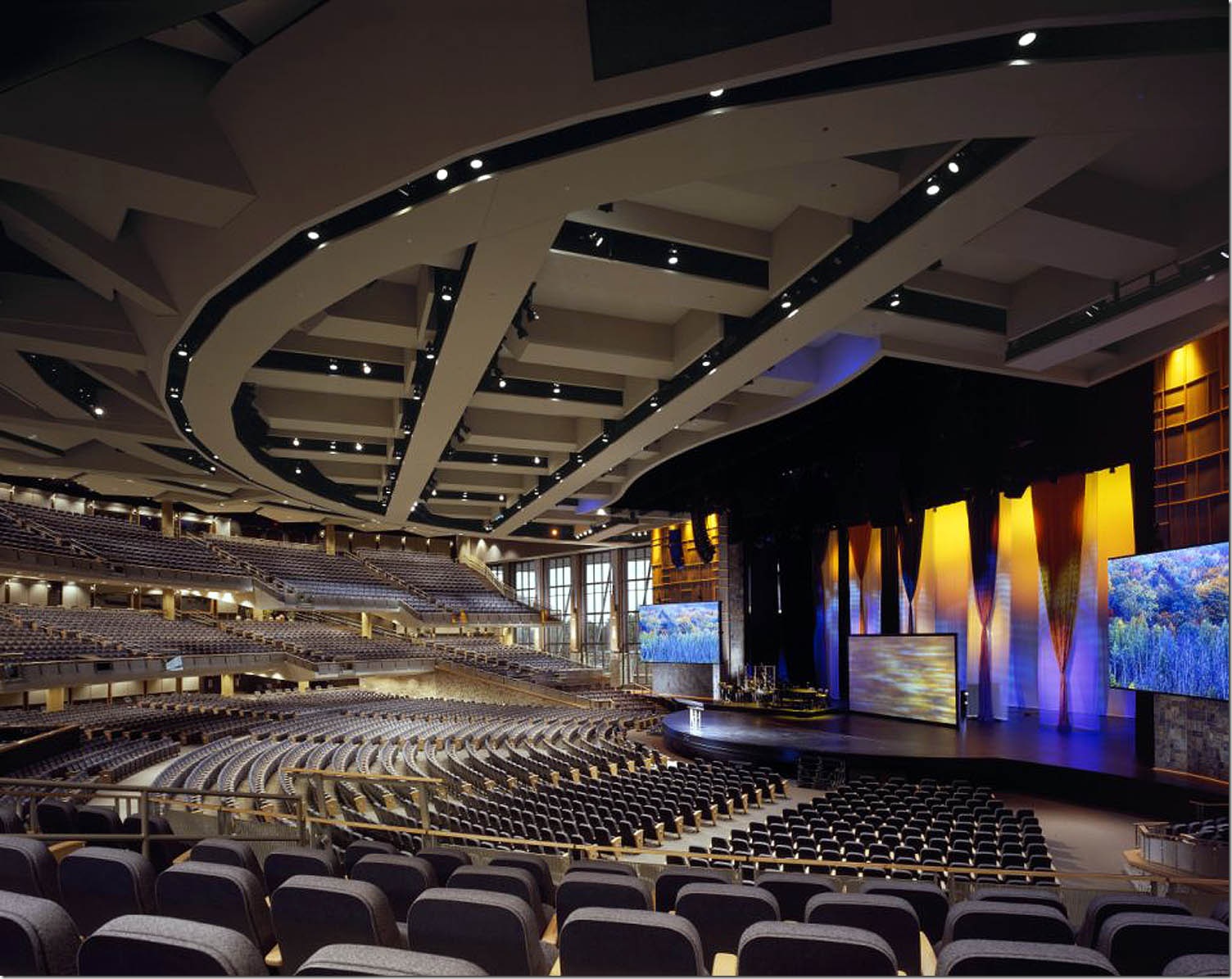
  • Another met in a room for worship with movie theater style seats, with screens occupying a prominent  place on the wall.  This church, we discovered, puts a premium on  cultural relevance and an interactive experience for the worshippers.
  • One church met in a building similar to an office building complex.  One key idea of the church seemed to be not to intimidate anyone with “church.”  The sanctuary design and flow of the service had what could be described as a “familiar” feel.
  • Another church was designed in the traditional way, but with a higher ceiling.  They had an altar rail in front, with a choir in robes, a processional with the cross, acolytes, etc.  The pulpit is placed off to the side, and true to form, the sermon is not the centerpiece of the service.  Instead, with the communion altar at the center, the celebration of the eucharist takes the bulk of the service time each week.
I shared my experience worshipping in an Eastern Orthodox Church some years ago.  When you enter, the church immediately had a “this is different” feel.  The colors, smells, and chanting all told the attendee, “You are in a different place, you have left “the world” and are now surrounded by a great cloud of witnesses, somewhere between Heaven and Earth.  Instead of sitting, you spent most of the time standing or kneeling.  The point was not to make you comfortable, but to take you out of yourself and your daily surroundings.  They might also add that one should not sit in the presence of God.
Each of these designs reflect different philosophies on worship, and  their architecture reflects that.  While it was certainly not my purpose to  say that one is better than another, it is important that we  tried to understand that theology will be reflected in architectural style.
Willow Creek, Chicago
From a cosmological and societal perspective, height had great  importance to the medievals.  When I look at the intricate design and  strange creatures that adorn many cathedrals, I get the sense that  they were enjoying themselves.  Cathedrals took at least 30 years and often more than 50 to  build.  What does this say about them?  What church today could sell a  building program that would take at least 30 years to complete?   What does that say about us?  Were the medievals wasteful and foolish, or  is it us who have made worship a humdrum bare bones experience?  Do cathedrals, as Abbott Suger said, serve to ‘urge us onwards from the material to the immaterial?’
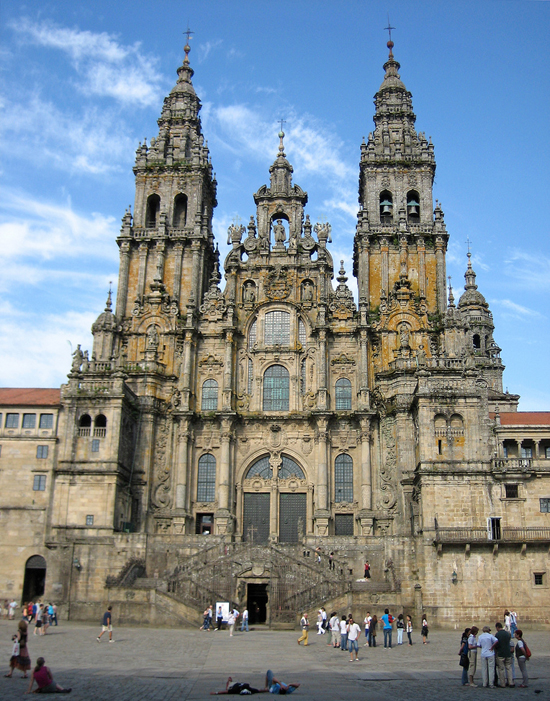
When we looked at images of a cathedral, their height immediately struck most of the students:
Santiago-de-Compostela-Cathedral
 Most likely, our involuntary reaction to these buildings would be to look up and feel small, and that indeed is part of the point.  They felt it important that you lose yourself in the face of immensity.  Clearly, this kind of architecture stressed the “otherness,” holiness, and transcendence of God.  Conversely, it does not emphasize the “nearness” of God.  But we must not have the idea that Gothic meant “dark, heavy, and foreboding.”  Rather, the medievals came up with their architectural advances specifically to let in more light.  They do not press us down to the ground (like pyramids, for example) but take us “upwards” to heaven.
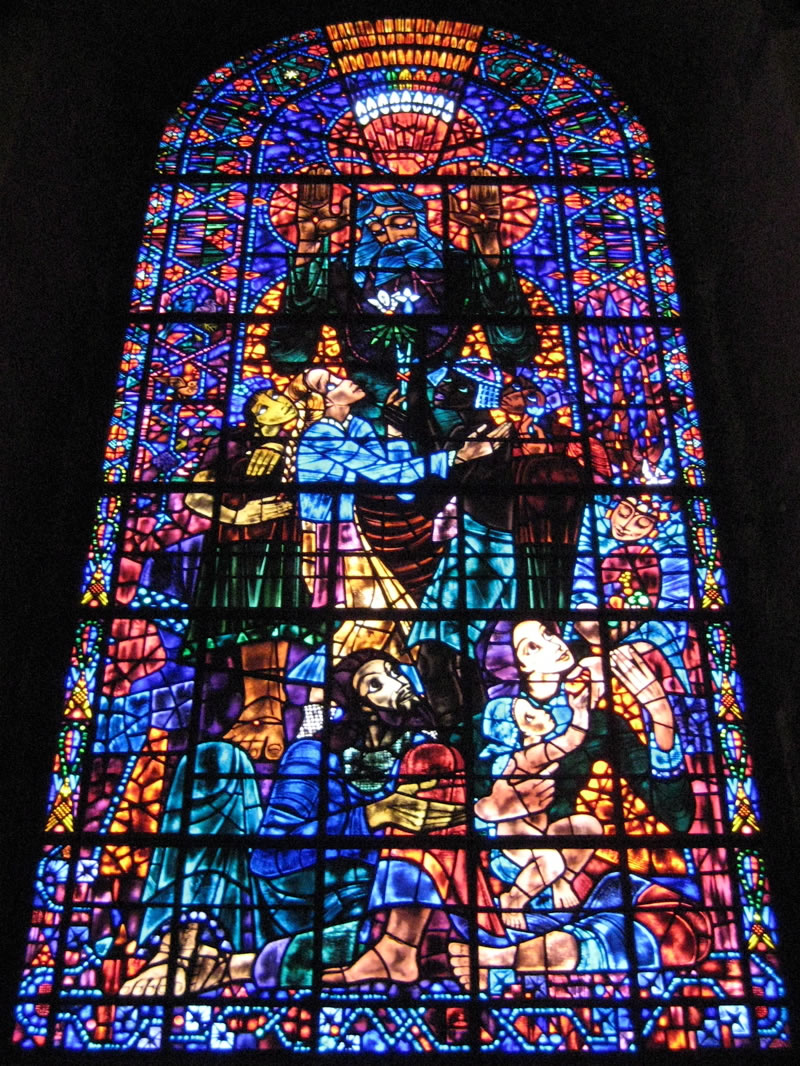
Christ in Glory, Canterbury Cathedral
Their architecture takes us back to their cosmology, which also emphasized height, as we saw last week.
Finally, we noted how it reflects the Medieval linking of the physical and spiritual.  They did this even with the location of their buildings, most especially in the Mont St. Michael Cathedral in Normandy, France.
Mont. St. Michael
The cathedral is dedicated to St. Michael the Archangel, who fights the Dragon in the book of Revelation.  They built it in the furthest point possible out into the sea, in itself a testimony and prayer that God and His angels are their first line of defense.  Mt. St. Michael perfectly illustrates what medievals believed not only about church, but about how physical things reflect spiritual reality.

The Half-Hearted Return of Thor

I find the trend in modern history books to use BCE (Before Common Era) and CE (Common Era) quite amusing.  Clearly as a culture we have a profound unease with the Christian roots of our civilization.  Naturally, then, many take issue with dividing time around the Incarnation.  Obviously I disagree with such a stance, but it makes sense that people would want to order their world around their beliefs.  And yet, using BCE/CE seems such a laughable attempt at “kicking against the goads.”  “When is the ‘Common Era?'” one might ask.  “After the coming of Jesus,” is the only response. “What makes that era ‘Common?'” as opposed to other eras?”  I can’t fathom anything other than a shrug at that point.  One archaeologist stated, “Before the Common Era (B.C.E.) and the Common Era (C.E.), are exactly the same as B.C. and A.D. but have nothing to do with Christianity.”

No . . . certainly not!

If you’re going to abandon a Christian understanding of time, abandon it already.  It will make things clearer in the culture and one’s own mind as well.

That’s why part of me applauded when I read this article  which tells us that devotees to 1000paganism in Iceland are building a temple to Thor.  For many decades now Christian understandings of nature, the human person, of sexuality, etc., etc. have steadily eroded, and been replaced in some ways by a neo-pagan revival.   If you actually build a temple, it communicates the reality that we are really worshipping something and calling a spade a spade.  Again, Jesus tells us that He prefers hot or cold people.  It’s all the lukewarm mush in our culture that makes things so difficult.

As I read a bit more, however, I discovered that they’re not going to sacrifice animals. Of course in many ways this is good news because, after all, no one wants to see animals sacrificed.  But in other ways . . .  the concept of sacrifice and propitiation, so crucial to Christianity, if taken seriously can lead one back to Christianity.  It is an example of the benefits of clarity.

And then Hilmar Örn Hilmarsson, high priest of Ásatrúarfélagiðadded, added, “I don’t believe anyone believes in a one-eyed man who is riding about on a horse with eight feet.  We see the stories as poetic metaphors and a manifestation of the forces of nature and human psychology.”

Ugh.  More mush, then.  Thor, I think, would not be pleased.

“Follow the money . . .”

It’s not easy to get students to see outside themselves and the culture they inhabit.  Our experience conditions us to love what who we are.  This is natural, and even Biblical to some extent.  But of course many other great cultures exist/ed and studying History can shake us up and force us to confront ourselves anew.

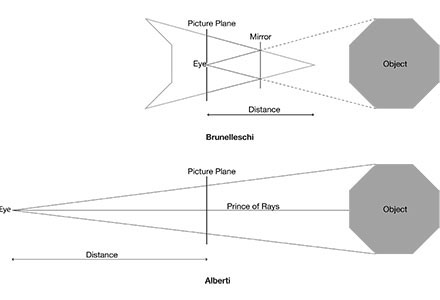
That’s why I treasured the comment of one student years ago when we looked at the work of the Renaissance genius Brunelleschi, who advanced the science of perspective,

brunelleschi-alberti

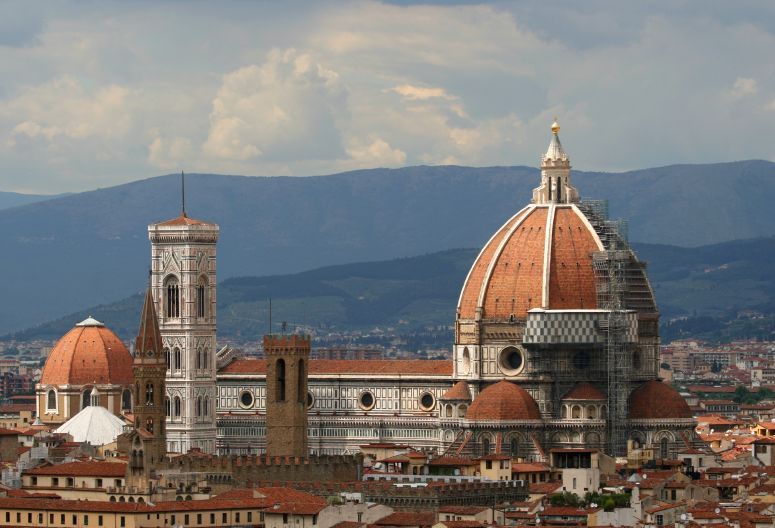
built the first dome in the western world since the Pantheon . . .

filippo-brunelleschi-duomo

and entered the sculpture/engraving contest for the doors of the Florence baptistry . ..

imgres

among other things.  After taking all this in, one student remarked, “Boy, we suck,” which delighted my ears to no end. He understood that in many ways, our civilization has a long way to go.  I don’t love Renaissance culture, but clearly they had enormous achievements in important areas, and we justly remember them for it.  They put their time and money into innovating things beautiful and useful, things that have blessed succeeding generations for more than half a millennium.

What about us today?

I came across this Marginal Revolution post from a few weeks ago, where Tyler Cowen makes the point that India’s latest Mars mission cost less than Gravity, Hollywood’s latest space movie.  At various points in the history of the west different inspirations have taken hold.  At one point we built cathedrals, at other times we sailed the seven seas, or all wanted to speak French.  We had inspiration and aspirations.  This is where we spent our time, energy, and money.

The world will little remember Transformers: Age of Extinction, or Pirates of the Caribbean: On Stranger Tides despite the fact that they cost $325 and $378 million respectively.  On balance it appears we put our money, our dreams, into merely entertaining ourselves.  We’re not, praise God, quite at “bread and circuses” yet, but the trend should concern us.

And given what I witnessed Sunday, we can’t even make good Super Bowl commercials anymore.  I miss the good ol’ days (exhibit ‘A’ below).


The Green Stick and the Saint

How does one know if your faith is “really real?”  Christians can sometimes get hung up unnecessarily on this question, but it’s an easy one to ask.  When you don’t have a dramatic night/day testimony it can seem all the more difficult to answer.  The Church can complicate matters by sometimes venerating the Damascus road kind of conversion of the overtly evil man immediately transformed.  Such people have more certainty, we assume, and so have greater faith and a more profound Christian experience.

But aside from the exceptional experience of St. Paul, very little in the history of Christian spirituality suggests this as the norm. Every significant spiritual writer I am aware explains that God almost always works slowly over time through the mundane aspects of life.  Growth in holiness comes by putting one foot in front of the other.  It makes sense then (barring exceptions of course), that those who had an early start and never traveled in the wrong direction for long periods of time would be further up the mountain than even the “dramatic” converts.

Two recent works I encountered bear this out.

We have no equivalent to Malcolm Muggeridge in the west today.  To get him we would probably have to combine G.K. Chesterton, Truman Capote, and David Brooks.  He made his career as a journalist first, but later became a social “man about town” who rubbed elbows with the media and intellectual elite of English society.  He then rejected much 3102608of the pomp and circumstance of his life and converted to Christianity.  He wrote many books, perhaps his most famous being his autobiography, Chronicles of Wasted Time, a work spread out over three volumes.  In the first volume, “The Green Stick,” he tells the story of his early life, and his embrace of the liberal left.

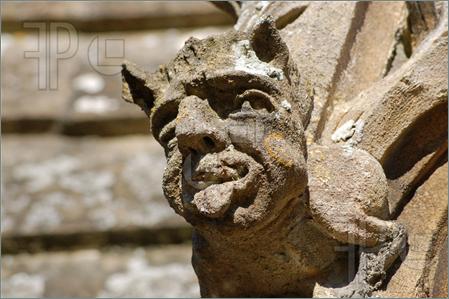
Throughout the book Muggeridge’s wit and panache shine through.  He gleefully pokes Rude-Gargoyle-1073659himself and his profession.  He had gone from devotee to gargoyle, happily mocking all our pretensions.*  Typical of his style is how he discovered as a reporter how to distill all momentous political speeches to just a few phrases.  “We decided that there was no need for politicians to finish their sentences,” he writes,  “with their end being implicit in the beginning.”  Such phrases are,

On this historic occasion when . . .

There can be no one here present who . . .

We have just passed through an ordeal that . . .

No thinking man will underestimate the . . .

While there are many circumstances which . . .

While recognizing the reality of . . .

It is surely incumbent upon all of us to . . .

Such is the choice that at present confronts . . .

It is idle to think that politicians can . . .

It rests with the common people to . . .

With head erect and clear purpose we . . .

One feels the sham nature of so much of our modern existence reading Muggeridge. Having drank deeply from the world, he can expose it all the more readily.  This brief clip illustrates not only his fabulous voice (and who wouldn’t want the life of sitting around, smoking, and giving one’s opinion on everything), but also his abhorrence with that which most fascinated the 20th century.

Muggeridge takes his title from the Russian legend of the Green Stick, so dear to Tolstoy.  In this story, should anyone find the Green Stick he would have the power to remove all suffering.  The simplicity of the idea charms anyone, but of course nothing is ever that simple.  Muggeridge as a boy talked of his wish for the same Green Stick, which may have helped lead him down socialist paths in his younger days.  One can’t fault him for this, but it strikes me that occasionally Muggeridge’s rejection of so much he experienced led him to oversimplify in the other direction.  Even his brief quote in the clip above reveals this flaw.  Power is not evil in itself, obviously, for we rejoice in God’s own power. Naturally no one on earth perfectly uses power, and most abuse it in great or small ways.  Some of the greatest saints of the Church divested themselves entirely of earthly power.

But Muggeridge would, I think, rejoice to see power rightly used to crush evil or to bring justice.  And this is not mere theory.  On rare occasions (like king St. Louis IX) Christian rulers have used power and worldly status for good ends without it getting to their heads.  So power can be redeemed.  Of course Muggeridge could have said something like, “Power is so dangerous, and so rarely used well.  We in the modern world, with it’s deadly combination of technology and our uncertain moral compass, are particularly unsuited to use power, and we should seek to limit its use whenever possible”

But he didn’t.

Muggeridge’s style easily engages the reader, and he mixes humor with profound insight almost perfectly at times.  I recommend him.  But he also comes across at times as someone with a bit too much baggage. He has a hard time appreciating things in general — perhaps he ruined his palate with the life he led.  A convert to Christianity somewhat later in life, I think he still struggled (as I and so many of us do) to see things clearly as they really are.

The Discourse and Sayings of Dorotheos of Gaza are not as entertaining to read as thMuggeridge, but one senses quickly that his writing comes from a much different place.  His stories have an endearing simplicity, though perhaps lack penetrating insight.  His instructions about the spiritual life seem immediately obvious, but then, the best kind of teaching usually has this quality.  What really struck me, however, about reading this on the heels of Muggeridge was how Dorotheos comes across as so unencumbered, so free of the “issues” that run rampant in modern experience.  He led a simple, unadorned life with monks in the wilderness, and this gives him an almost perfect freedom.  If nothing else, it shows how the dramatic, worldly convert is not better off, and often has less to teach the Church, than the slow and steady Christian who has lived the Christian life with others for countless years.  The clarity and simplicity of the Discourses reminds of Dante, who knew something akin to Dorotheos when he ended his journey by seeing God as a single point of light.

Dave

*This, I’m sure, was the true purpose of the medieval gargoyle — they had little to do with scaring anyone.  They were meant to mock us, to humble us, to poke fun at the culture around us.  That’s why I hate the famous Darth Vader gargoyle on the National Cathedral, which pats our culture on the back in a cutesy way.  I suppose though, that’s what happens when we have a “National” cathedral which serves ultimately as a monument to ourselves.

12th Grade: Thucydides and the Cold War

Greetings,

This week we began our own Peloponnesian War game on Friday, and in class we delved into the diplomatic tension that ended up bringing on a war between Athens and Sparta.

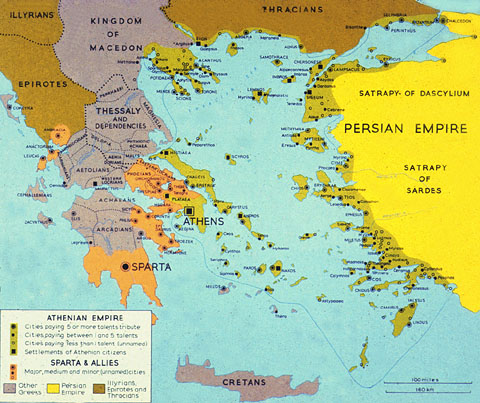
Athens and Sparta represented two different ways of life, with two different basis of military power.  During the Persian Wars between 490-479 B.C. they attained to a measure of foreign unity only because of a common foe.  Afterwards they resumed their normal role of a “cold” animosity.  Just as the war began the Greek world looked like this. . .

Sparta had an army no one could touch, and the same applied to Athens’ navy.  In a way, they had achieved a kind of ancient M.A.D. (Mutually Assured Destruction).  Both could do each other in, hypothetically, in different ways.  Then Athens decided to build a wall around its city and still preserve access to the sea.  It looked something like this:

Athens' Long Wall

Some of us may remember Reagan’s idea of a “Star Wars” missile defense system.  Many objected to the idea along the grounds that the project would not work or be too expensive, but many in Europe objected to it as well.  Why would even our allies object to a defense system?

  • Some probably thought that if the Soviets could not use their long-range weapons to hit the U.S., they would concentrate on their medium-range missiles and obliterate Europe instead.  Thus, some saw that U.S. actions might have an enormous impact on their lives, and yet they had no say in the making of those decisions. Arnold Toynbee called this the complaint of, “No annhilation without representation.”
  • Others saw that if the system worked, M.A.D. would be obsolete.  The deterrent to war from the U.S. perspective would be gone, which might make offensive action from us more likely.  Or, would the Soviets do a first-strike before the system became operational, knowing that their “time was short?”  In this way, many saw the building of a “defensive” system as an essentially offensive act.

Many in Sparta saw the situation in Athens the same way.  If the Spartans could not invade and sack the city, then the Athenians had much less of a deterrent to venture far and wide with its navy.  The walls had the direct purpose of defending themselves from attack, and after all, the Persians had sacked Athens during the Persian Wars.  But, this was not how others interpreted their actions.

When the Cold War began in the late 1940’s Secretary of State George Marshall urged those around him to delve into Thucydides’ The Peloponnesian War, for he believed that the conflict had significant parallels to the problems they would face.  He proved prescient.

Athens faced a crucial decision between the years 434-433 B.C.  Corcyra had maintained neutrality in the run-up to what would be the war but faced a crisis.  Corinth threatened them with invasion, and they knew that in time, they would likely fall in a protracted war.  As a neutral they had no allies, but they could turn to Athens (Corinth was a Spartan ally, so they certainly could not ask for Spartan help).  Athens heard from both delegations, and Thucydides records that the debate hinged on a few key points with one of them being the idea of the inevitability of war.

The Corcyrans argued that conflict with Sparta would come sooner or later, but it would certainly come.  Thus, you should ally with us because when war comes you want us as friends rather than enemies.

Corinth countered with the opposite: peace was the current reality between Athens and Sparta and that had every reason to continue.  War would only come by overt disruption of the peace, and Athenian ships tangling with Corinthian ships might be just the thing to bring on war.

LeMay with KennedyIn the Cuban Missile Crisis of 1962 General Curtis LeMay believed that Kennedy should order a full-strike against the missiles in Cuba and initiate war with the Soviet Union.  He knew that at the time we had a significant lead in nuclear weapons and would therefore win any kind of nuclear conflict.  Yes, millions of U.S. citizens would die, but the Soviets would no longer exist and trouble us no more.  If we waited, the Soviets would close the gap on our lead and then when war came millions more Americans would die and our victory would be much more in doubt.

Athens had the same decision to make, and decided to attempt a halfway solution.  They allied with Corcyra, but only for minimal defensive purposes.  Most of the students approved of this option as a way to get the best of both worlds, and it could have possibly worked out.  In actual fact, the presence of Athenian ships at the Battle of Sybota made Corinth hopping mad, but were not enough to tip the battle decisively in Athens and Corcyra’s favor.  The Corinthian fleet would live to haunt Athens at a later date.

Next week we’ll delve into the actual fighting as the war began.

If you are interested in the speeches of Corcyra and Corinth as Thucydides records them, they can be accessed online, beginning with Book 1, Chapter 32.

Blessings,

Dave

9th Grade: Our Cloudy and Confused Vision

Greetings,

This week we wrapped up our unit on the Crusades.  This difficult era raises many questions for us:

1. Did the Crusades attempt to stem the tide of Moslem aggression, or did they in fact cause more Moslem unity and a resurgence of Moslem power?

Some see the Crusades as a legitimate attempt to strike against Moslem expansionism.  Others argue that the Crusades forced the Moslems to unite once again. Having been invaded by the West, they determined to renew their attacks against them.  Do the Crusades bear any blame for the eventual collapse of Constantinople in 1453?

2. What role should faith and reason play in everyday affairs?

The Third Crusade is a good example of this problem.  Richard I fought his way to Jerusalem, but went home in part because he believed he could not hold the city even if he took it.  Therefore, it was pointless to risk his live and the lives of his men for nothing.  Some criticized his actions, saying something to the effect of, “You must step forward in faith, and watch God bless you.  This is what faith is all about!   You cannot think of this in practical terms. That is not thinking with faith.  Put  a foot into the Jordan, and then watch it part.”

We see this same question also running through the idea of the tragic Children’s Crusades, though here the Church strongly opposed Europe’s youth to no avail.* How should the balance between ‘faith’ and ‘reason’ guide our daily lives?  How should we answer the argument of many young people who participated in the ‘Children’s Crusades,’ which ran something like this:

  • God has called his people to crusade for Jerusalem.  We believed so in 1097.  Has God changed?  He is the same, yesterday, today, forever.  Therefore, His call is the same.  We must still vie for the Holy Land.
  • But how shall we go?  Let us not trust in princes, horses, or chariots (i.e. Ps. 20), let us know that our trust is in God, by marching out in true faith.  We see in Scripture that Moses led the Israelites to the Red Sea and it parted. Joshua marched around the city, and it fell.  Guided by God’s word, we shall emulate their example.  God shall make a way for us to take Jerusalem, and do so in a way so that all glory goes to him.
  • Many argue that the problem with the Crusades was a lack of organization, supplies, or reinforcements.  This only betrays worldly thinking.  Would more supplies have made the Crusaders less greedy in 1204?  Would it have made them less violent inside Jerusalem’s walls in 1099?  No, the problem has been our lack of faith and obedience.
  • Jesus pointed out the strength and purity of the faith of children.  Therefore, who better than the Church’s youth to undertake this venture?

We know that the Children’s Crusades (both of them) ended in utter disaster.  But what would you say in response to their argument?  How can you disprove them? What is faith’s relationship to reason?

3. The west attempted at least seven times at retaking Jerusalem.  What should this tell us about them?

  • That they were foolishly stubborn?
  • That they were intensely dedicated and willing to make great sacrifices for achieving their goal?
  • That they were a people of faith willing to trust in spite of adversity?
  • That they were foolish, naive, and used ‘faith’ as a cover for their prejudice and desire for gain?

In the end, the Crusades would have many unintended consequences.  The West was exposed to Greek literature and philosophy for the first time.  St. Thomas Aquinas, the Renaissance, and Exploration may all have been by-products of this, among other things.  The Crusades also raise many questions about using violence as means to bring about the Kingdom of God that are still with us.  If we agree with the Crusades, should we also agree with the bombing of abortion clinics?

Next week we will return to our look at Medieval Feudal society, and I hope that the students will be confronted with good questions.

Dave

*I should note that scholars debate when these crusades took place, and whether or not there was one crusade or two.  A few even doubt whether or not they were children at all, as some believe they may have been a mass of landless unemployed.  My rendering in class was the traditional story.

9th Grade: Everything Falls Apart

Greetings,

This week we focused on what is known as the First Crusade, the only Crusade to actually reach Jerusalem and conquer the city.  Perhaps more than other crusades, it was this first one that concentrated all that is admirable, strange, and horrifying about this period in the past.

We discussed last week the reasons and motivations for the Crusades, and whether or not one agrees with their reasons, we cannot deny the enormous difficulty of the proposed enterprise.  Capturing Jerusalem meant a journey of several hundred miles on foot without an established supply line, having to take at least one fortified city (Antioch) before even reaching Jerusalem, which would have thousands of defenders behind the large walls of the city.  Even today, parts of the the “old” city of Jerusalem still stands, and we can see what the Crusaders saw themselves 1000 years ago.

Old City Gate

The "Tower of David"

South (?) Wall of Jerusalem

As anyone can see, taking the city would be a formidable task.

From Antioch, the  Crusaders approached the city barefoot, the standard mode of travel for all medieval pilgrims.  This fact alone shows that the Crusaders saw themselves not so much as warriors first and foremost, but on a spiritual quest.  Like Joshua they marched around the city.  This was no standard military operation.

Understandably, they were anxious to get inside the city and claim victory.  They had heard many stories of atrocities perpetrated against Christians in Jerusalem.  They saw with their own own Moslem defenders taunting them, smashing crosses and other relics in front of their eyes.  Moslems also apparently killed pages sent by the knights to get water, which horrified and enraged the Crusaders all the more.  Finally, they broke through and entered the city. One eyewitness described it this way. . .

When the morning came, our men eagerly rushed to be walls and dragged the [seige towers] forward, but the Saracens had constructed so many machines that for each one of ours they now had nine or ten. Thus they greatly interfered with our efforts. This was the ninth day, on which the priest had said that we would capture the city. But why do I delay so long? Our machines were now shaken apart by the blows of many stones, and our men lagged because they were very weary. However, there remained the mercy of the Lord which is never overcome nor conquered, but is always a source of support in times of adversity. One incident must not be omitted. Two women tried to bewitch one of the hurling machines, but a stone struck and crushed them, as well as three slaves, so that their lives were extinguished and the evil incantations averted.

By noon our men were greatly discouraged. They were weary and at the end of their resources. There were still many of the enemy opposing each one of our men; the walls were very high and strong, and the great resources and skill that the enemy exhibited in repairing their defenses seemed too great for us to overcome. But, while we hesitated, irresolute, and the enemy exulted in our discomfiture, the healing mercy of God inspired us and turned our sorrow into joy, for the Lord did not forsake us. While a council was being held to decide whether or not our [seige engines] should be withdrawn, for some were burned and the rest badly shaken to pieces, a knight on the Mount of Olives began to wave his shield to those who were with the Count and others, signalling them to advance. Who this knight was we have been unable to find out. At this signal our men began to take heart, and some began to batter down the wall, while others began to ascend by means of scaling ladders and ropes. Our archers shot burning firebrands, and in this way checked the attack that the Saracens were making upon the wooden towers of the Duke and the two Counts. These firebrands, moreover, were wrapped in cotton. This shower of fire drove the defenders from the walls. Then the Count quickly released the long drawbridge which had protected the side of the wooden tower next to the wall, and it swung down from the top, being fastened to the middle of the tower, making a bridge over which the men began to enter Jerusalem bravely and fearlessly. Among those who entered first were Tancred and the Duke of Lorraine, and the amount of blood that they shed on that day is incredible. All ascended after them, and the Saracens now began to suffer.

They took the city, but then tragically took it one step further, for most of the men went to and fro, killing any Moslem they could find, be they men, women, or children.  The information about this horrifying massacre came not from Moslem sources but directly from the Christians themselves.  One wrote that,

Strange to relate, however, at this very time when the city was practically captured by the Franks, the Saracens were still fighting on the other side, where the Count was attacking the wall as though the city should never be captured. But now that our men had possession of the walls and towers, wonderful sights were to be seen. Some of our men (and this was more merciful) cut off the heads of their enemies; others shot them with arrows, so that they fell from the towers; others tortured them longer by casting them into the flames. Piles of heads, hands, and feet were to be seen in the streets of the city. It was necessary to pick one’s way over the bodies of men and horses. But these were small matters compared to what happened at the Temple of Solomon, a place where religious services are ordinarily chanted. What happened there? If I tell the truth, it will exceed your powers of belief. So let it suffice to say this much, at least, that in the Temple and porch of Solomon, men rode in blood up to their knees and bridle reins. Indeed, it was a just and splendid judgment of God that this place should be filled with the blood of the unbelievers, since it had suffered so long from their blasphemies. The city was filled with corpses and blood. Some of the enemy took refuge in the Tower of David, and, petitioning Count Raymond for protection, surrendered the Tower into his hands.

 Another account confirmed this, writing,

Many fled to the roof of the temple of Solomon, and were shot with arrows, so that they fell to the ground dead. In this temple almost ten thousand were killed. Indeed, if you had been there you would have seen our feet colored to our ankles with the blood of the slain. But what more shall I relate? None of them were left alive; neither women nor children were spared.

When the pagans had been overcome, our men seized great numbers, both men and women, either killing them or keeping them captive, as they wished.

Both Moslems and Christians committed atrocities during the Crusades, but none would equal the shocking scale and brutality of the massacre at Jerusalem.  And yet, the Crusaders at the time interpreted their actions in almost strictly religious terms.  The account continues,

Now that the city was taken, it was well worth all our previous labors and hardships to see the devotion of the pilgrims at the Holy Sepulchre. How they rejoiced and exulted and sang a new song to the Lord! For their hearts offered prayers of praise to God, victorious and triumphant, which cannot be told in words. A new day, new joy, new and perpetual gladness, the consummation of our labor and devotion, drew forth from all new words and new songs. This day, I say, will be famous in all future ages, for it turned our labors and sorrows into joy and exultation; this day, I say, marks the justification of all Christianity, the humiliation of paganism, and the renewal of our faith. “This is the day which the Lord bath made, let us rejoice and be glad in it,” for on this day the Lord revealed Himself to His people and blessed them.

On this day, the Ides of July, Lord Adhemar, Bishop of Puy, was seen in the city by many people. Many also testified that he was the first to scale the wall, and that he summoned the knights and people to follow him. On this day, moreover, the apostles were cast forth from Jerusalem and scattered over the whole world. On this same day, the children of the apostles regained the city and fatherland for God and the fathers. This day, the Ides of July, shall be celebrated to the praise and glory of the name of God, who, answering the prayers of His Church, gave in trust and benediction to His children the city and fatherland which He bad promised to the fathers. On this day we chanted the Office of the Resurrection, since on that day He, who by His virtue arose from the dead, revived us through His grace. So much is to be said of this.

 The “Jersusalem” crosses they etched inside the Church of the Holy Sepulchre can still be seen today.

While we do know that some of the crusaders risked their lives to protect civilians, most joined in the carnage and plunder.  The stain left by this atrocity lingers to this day in minds of many Moslems.  This may seem strange to Americans, but Americans in general have very, very short historical memories.  This is probably because we are a new nation, and an immigrant nation.  Many who came here wanted to make a clean break with the past.  Also, Americans tend not to be rooted in the past with tradition, but look forward to the “next” thing.  Most other societies, and perhaps especially the Mid-East have a much deeper sense of the past, a sense only exacerbated by the significant decline of Moslem power since the mid 16th century.

I related to the students that, in most of the “mountain disaster” books I have read that the problems occur when the climbers descend.  We psychologically ramp ourselves up to reach the summit, and don’t always give as much thought to what comes next.

The crusaders faced a similar problem.  They took vows to liberate Jerusalem, but not to stay and defend it.  Many had been away from home for more then two years, and understandably wanted to return, having fulfilled their purpose.  The west simply could not rally the manpower needed to hold the city, and in 1187 the Moslems retook it.  Several more attempts to retake the city would again be made, the subject of our study next week.

Blessings,

Dave

11th Grade: Power and Markets in the Progressive Era

Greetings,
The week before break we wrapped up our look at Teddy Roosevelt and the Progressive Era.

How did he begin the ‘modern’ presidency?

1. America’s rising power (I think China today is in the position America was 100-120 years ago) meant that they had a role on the world stage.  Foreign policy is the purview of the executive, not the legislative branch.  Inevitably then, the power of the presidency increased as our power relative to the rest of the world increased.

2. A united America would now think of themselves as ‘Americans’ instead of ‘Virginians,’ for example.  In a sense, all the people elect the president, at least in a way that ‘the people’ do not elect senators from Maine.  The formation of a nation would again, put focus inevitably on the presidency.  Along with this, the ‘nationalization’ of industry would lead to a more national focus for media outlets.  National news and national figures would take precedence over local ones.

 There are many across the political spectrum who believe that presidential power needs to be curtailed and is out of line with the founders vision for a dominant legislature.  Truly, there have been very few weak presidents since Roosevelt’s time in office. But those who want to curb executive power need to realize that presidential power takes place in a broad political, economic, and social context.  To add to these factors, Roosevelt had an expansive view of executive power.  For him, if the Constitution did not forbid it, he could do it.  Roosevelt also believed in the government not so much as a threat to people, but as an extension of them.  Government was the people’s steward, the sword point of the arm of the ‘people.’  This attitude led to a couple of groundbreaking actions taken:
  • Roosevelt believed in the establishment of national parks.  Part of this was personal, as Roosevelt’s experience in the west transformed him.  But part of it stemmed from his belief that the land did not belong to individuals, so much as to the nation at large.  Land then, could be used only as it referred to the public at large (he did of course believe in private ownership as well).  Having land set aside for the public fit right in with this vision. . .
  • As did his vision of corporate power and regulation.   The economics of the Industrial Revolution concentrated enormous resources in the hands of a few.  Are economic monopolies consistent with an American view of liberty?  Well, that depends.  If you see liberty as freedom from outside constraint, then there could be nothing inherently wrong with monopolies, provided they were honestly obtained.  But Roosevelt saw monopolies as a threat to liberty.  Monopolies limited the people’s ability to chose, and opened up the possibility that they could be exploited.  Besides, monopolies eliminated competition.  As the students are reading for homework, Roosevelt believed that only a ‘Strenuous Life’ could make us great.  Monopolies could lead to laziness, and in the end, national decline.

These issues raise important questions of constitutional interpretation.  Does the Constitution proscribe a certain attitude towards federal power?  What is the truest meaning of ‘liberty?’  How should we balance individual liberty with the rights of others?  I enjoyed our discussions on these questions, and we related them to the recent controversies surrounding the new body scans at airports.

This also led to a broader discussion of capitalism itself.  Many ‘classical’ economists look with fondness back to the pre-Roosevelt era as the heyday of a more pure capitalism.  This provided an opportunity to consider capitalism itself.   I wanted to place special focus.  I wanted us to consider the following:
1. Does capitalism share common ancestry with Darwinism?  Both rose to prominence at about the same time.  Both stress that it is through competition that we progress.  Both shed few tears over those whom competition eliminates.  Both, curiously enough, have a certain fatalism to them in their purest form, one of class strife, the other of the invisible hand of the market.  Fatalism, no matter the form it takes, is usually a sign of exhaustion or boredom, whether in the individual or the civilization.  C.S. Lewis argued in ‘Mere Christianity’ that a fully Christian economic system would resemble socialism or communism in some key ways (see his ‘Social Morality’ chapter in that book if you are curious).  Taking a different rout. a Christian defense of certain key free market principles can be found here.
Others would counter that while the free market of the Industrial Revolution had its problems and inequalities, surely the end result proved beneficial?  The western world saw unprecedented economic growth and the rise of a truly broad based middle class that is still the foundation of modern democracies.  When all was said and done, standards of living increased, and more people had access to more goods than ever before.
But that still begs the question: Does the free market promote Darwinism?  Or,  as Milton Friedman has argued, is it one of the best indirect promoters of personal freedom?  Or is it, as Philip Bobbitt and Guido Calabresi argued in their book ‘Tragic Choices,’ a method whereby society sometimes avoids hard decisions and puts them in the hands of ‘the market?’
2. If there are links between Darwinism and capitalism, what does that do to our interpretation of capitalism?  Do we affirm it in full, believing that Darwin may have latched onto a truth about existence?  Or does the market need regulated, or ‘softened’ to inject more community oriented values?
3. What might the doctrine of the Trinity have to do with this question?  With God we have community (1 God) and individuality (3 Persons) cohering in their fullness simultaneously.  We, however, are finite, and so we cannot experience both individuality and community in their fullness simultaneously.  Being made in the image of God, we desire and need both.  Might much of our political debates, both then and now, be helpfully viewed through this prism?  How should a society’s economic structure reflect both individual and community values?  Where should the emphasis lie?
Finally, towards the end of the week we looked at some aspects of Progressive Era culture.  Each society has its values and cannot help but give expression to those values, consciously or otherwise.  Here is an image of the city of Chicago ca. 1900
The plan of the city bears all the hallmarks of the Progressive Era.  The design is effecient, ‘scientific,’ and rational.  The design allows the city to be easily navigable to outsiders, reflecting the increasing sense of national over local identity.  Other cities would follow Chicago in their design, and thus cities could be like chain restaurants, more or less the same wherever one went.  Here is an image of St. Louis from about the same time:
Naturally this efficiency of design helped the flow of goods to and from other cities.  The links between cities and regions of the country grew easier to forge and thus became stronger.  To get a sense of the difference and meaning behind the change, here is an image of Philadelphia ca. 1750:
Granted, it’s not as if Philadelphia had no order to it, but the sense of standardization is less.
Blessings,
Dave

Paul McCartney could also play Bass

I realize it won’t shock anyone to say that Paul McCartney in his heyday was a great songwriter.  But listening to a few different songs recently made me realize that McCartney fails to get credit for his skill with the bass guitar.  The Beatles could write songs, yes, and they could sing.  But they wouldn’t have earned their reputation as one of the great all-time bands if they lacked genuine skill on their instruments, and McCartney is no exception.

McCartney’s father had a musical career largely playing show tunes and bouncy, playful big-band numbers, and McCartney has this sunny whimsy in his personality.  I think Lennon grew to resent this side of McCartney — the side that led him to write songs like, “When I’m 64,” and “Penny Lane.”  Lennon wanted “to rock” and saw songs like this as wimpy, soft, and (heaven forbid) “square.”  Lennon of course had a playful side too (i.e., “I am the Walrus”) but used it to destroy conventionality (“I am the Walrus”), not to write fun sing-along numbers.  Lennon loved to destroy — not always a bad thing.

But I’m convinced that McCartney’s whimsical side led him to take some risks with his bass playing at crucial moments.  First off, we can note that he could play a generally solid and fluid bass line, with “Hey Jude” as a good example. You can actually hear the bass line in the version of the song on the Love album — listen around the 3:06 mark:

But I have two examples of his playful side coming out in his bass playing:

Here is “Dear Prudence,” where the bass carries the song, especially from the 1:04 mark onwards:

While The Social Network I got re-exposed to “Baby You’re a Rich Man” (the song gets used expertly right at the end of the movie).  Especially in the chorus’ from about the half-way point of the song onwards, McCartney really unwinds the bass and spices up the song beautifully

The lesson perhaps for the Lennon’s of the world (more absolutist than most) is not to throw the baby out with the bathwater. Perhaps we could also say that certain skills or tendencies that annoy us in one way might have unexpected benefits in other ways.

The “Rite of Spring” as Praeparatio Evangelica

When I first heard Stravinsky’s The Rite of Spring I failed to be impressed.  I knew something of what I thought Stravinsky tried to accomplish, to make something “primal,” but felt that the orchestra may not have been the best tool for that purpose. Besides, I tended to hear jumbled nonsense.  Years later I thought again about the piece and admired it a bit more (but not that much more) when I perhaps gained greater understanding of what Stravinsky might have intended in relation to the end of the Victorian era (something I speculate on in this post).

When The Bad Plus, a jazz-rock piano trio and probably my favorite musical group, decided to play the piece I raised an eyebrow.  True, they had covered other 20th century classical pieces to great effect, but I didn’t really like the “Rite of Spring” all that much.  It didn’t seem like a piece open to reinterpretation or rearranging, and if they did not do this I feared that they would simply play the score rote with a drum beat over top.  Add to that, what ultimate spiritual significance could the piece have?  If Stravinsky hearkens back to a pagan past, could it be considered a historical reflection?  Or if he meant to contemporize the concept, to what extent could I “buy in” with a pagan message?

Thinking about this I recalled a story of G.K. Chesterton in his “Father Brown” stories (I cannot remember which one) where one of the characters has a spiritual transformation by witnessing a person devote themselves to an umbrella (I think) on a ship lost at sea.  He realized that such a person, though crazy, had more spiritual insight about God than his own vague vanilla theism, for the crazy man at least understood the nature of devotion and sacrifice.

The law clearly serves as a preparation for the gospel (Gal. 3:24), but we can wonder to what extent certain elements of pagan religion had their roots in anything beyond the revelation of creation (Rom 1:21).  The Egyptians, the Greeks, and the Norse all have myths about a dying and rising god.  Nearly all pagan religions involved notions of propitiation.  Perhaps this is one reason why Gentiles can directly bypass Judaism and go straight to Christ.  They too had a tutor.  Some early church fathers, notably, Eusebius, wrote about how paganism could be a praeparatio evangelica — a fancy word for “preparation for the gospel.”

Stravinsky’s own walk of faith had its ups and downs.  Raised in the church, he walked away from the faith in his later teens, returning to Christianity for good only in his early 40’s.  He wrote the “Rite” during his sojourning period.  But during this period he apparently did not slip into vaguely religious cant.  With the “Rite” he stayed connected to the crucial truths about death and life. Perhaps the “Rite” served as his own praeparatio evangelica

On Paul’s missionary journeys we generally see three classes of people: 1) “Ensconced” Jews, 2) “God-fearers,” or Gentiles who had converted to some kind of Judaism, and 3) Standard pagans. The “God-fearers” responded the best of these three, but the pagans responded better than the lifelong Jews.  No doubt many reasons exist for this, but one simply might have been complacency.  Perhaps living far away from the temple might have distanced them from the notion of sacrifice, of the need for life to come from death.  For all its faults the pagans still believed enough to offer sacrifices, and perhaps this opened them up to the truth of the gospel.*

So, back to the Bad Plus.

This is a great recording.  The fact that we have just two instrumentalists, and one of them a bassist, gives the music a more spare and earthy feel.  Dave King’s drumming roots the music far more to the ground than and orchestra could.  For me, this is a recording of the “Rite” that makes the music make sense and gives it the power Stravinsky no doubt intended, and for me at least, never achieved.  Here below is an excerpt of the last movement (Bad Plus fans will note their own personal exclamation point in the form of the end of their own song “Physical Cities”).  Normally I hate it when people say, “You have to listen to the whole album to get the full effect.”  In this case I think it true, but this gives one a good entry point.

Having experienced the prelude, we can now experience an “A.D.” reality, with a conductor who marvelously looks like he might have just arrived from a sacrificial dance (try pausing it right at .06 to see some wild hair).  A Merry Christmas to all . . .

*In his essay, “Christianity and Civilization,” historian Arnold Toynbee makes this very point.  I include a portion of it here . . .

. . . In this Catholic form of the Church, I see two fundamental institutions, the Sacrifice of the Mass and the Hierarchy, which are indissolubly welded together by the fact that the priest, by definition, is the person with the power to perform the rite. If, in speaking of the Mass, one may speak, without offence, with the tongues of the historian and the anthropologist, then, using this language, one may describe the Sacrifice of the Mass as the mature form of a most ancient religious rite of which the rudiments can be traced back to the worship of the fertility of the Earth and her fruits by the earliest tillers of the soil. (I am speaking here merely of the mundane origin of the rite.) as for the hierarchy of the Church in its traditional form, this, as one knows, is modelled on a more recent and less awe-inspiring yet nevertheless most potent institution, the imperial civil service of the Roman Empire. The Church in its traditional form thus stands forth armed with the spear of the Mass, the shield of the Hierarchy, and the helmet of the Papacy; and perhaps the subconscious purpose –or the divine intention, if you prefer that language– of this heavy panoply of institutions in which the Church has clad herself is the very practical one of outlasting the toughest of the secular institutions of this world, including all the civilizations. If we survey all the institutions of which we have knowledge in the present and in the past, I think that the institutions created, or adopted and adapted, by Christianity are the toughest and the most enduring of any that we know and are therefore the most likely to last –and outlast all the rest. The history of Protestantism would seem to indicate that the Protestant act of casting off this armour four hundred years ago was premature; but that would not necessarily mean that this step would always be a mistake; and , however that may be, the institutional element in the traditional Catholic form of the Church Militant on Earth, even if it proves to be an invaluable and indispensable means of survival, is all the same a mundane feature which makes the Church Militant’s life different from that of the Kingdom of Heaven, in which they neither marry nor are given in marriage but are as the angels of God, and in which each individual soul catches the spirit of God from direct communion with Him –‘like light caught from a leaping flame,’ as Plato puts it in his Seventh Letter. Thus, even if the Church had won a fully world-wide allegiance and had entered into the inheritance of the last of the civilizations and of all the other higher religions, the Church on Earth would not be a perfect embodiment here on Earth of the Kingdom of Heaven. The Church on Earth would still have sin and sorrow to contend with as well as to profit by as a means of grace on the principle of ?Ueae iUeio, and she would still have to wear for a long time to come a panoply of institutions to give her the massive social solidity that she needs in the mundane struggle for survival, but this at the inevitable price of spirituality weighing her down, On this showing, the victorious Church Militant on Earth will be a province of the Kingdom of God, but a province in which the citizens of the heavenly commonwealth have to live and breathe and labour in an atmosphere that is not their native element.

The position in which the Church would then find herself is well conveyed in Plato’s conceit, in the Phaedo, of the true surface of the Earth. We live, Plato suggests, in a large but local hollow, and what we take to be the air is really a sediment of fog. If one day we could make our way to the upper levels of the surface of the Earth, we should there breathe the pure ether and should see the light of the Sun and stars direct; and then we should realize how dim and blurred had been our vision down in the hollow, where we see the heavenly bodies, through the murky atmosphere in which we breathe, as imperfectly as the fishes see them through the water in which they swim. This Platonic conceit is a good simile for the life of the Church Militant on Earth; but the truth cannot be put better than it has been by Saint Augustine.

“It is written of Cain that he founded a commonwealth; but Abel –true to the type of the pilgrim and sojourner that he was– did not do the like. For the Commonwealth of the Saints is not of this world, though it does give birth to citizens here in whose persons it performs its pilgrimage until the time of its kingdom shall come–the time when it will gather them all together.”

This brings me in conclusion to the last of the topics on which I am going to touch, that of the relation between Christianity and progress.

If it is true, as I think it is, that the Church on Earth will never be a perfect embodiment of the Kingdom of Heaven, in what sense can we say the words of the Lord’s Prayer: ‘Thy Kingdom come, Thy will be done in Earth as it is in Heaven’? Have we been right, after all, in coming to the conclusion that –in contrast to the cyclic movement of the rises and falls of civilizations– the history of religion on Earth is a movement in a single continuous upward line? What are the matters in which there has been, in historical times, a continuous religious advance? And have we any reason to think that this advance will continue without end? Even if the species of societies called civilizations does give way to a historically younger and perhaps spiritually higher species embodied in a single world-wide and enduring representative in the shape of the Christian Church, may there not come a time when the tug of war between Christianity and original sin will settle down to a static balance of spiritual forces?

Let me put forward one or two considerations in reply to these questions.

In the first place, religious progress means spiritual progress, and spirit means personality. Therefore religious progress must take place in the spiritual lives of personalities –it must show itself in their rising to a spiritually higher state and achieving a spiritually finer activity.

Now, in assuming that this individual progress is what spiritual progress means, are we after all admitting Frazer’s thesis that the higher religions are essentially and incurably anti-social? Does a shift of human interests and energy from trying to create the values aimed at in the civilizations to trying to create the values aimed at in the higher religions mean that the values for which the civilizations stand are bound to suffer? Are spiritual and social values antithetical and inimical to each other? Is it true that the fabric of civilization is undermined if the salvation of the individual soul is taken as being the supreme aim of life?

Frazer answers these questions in the affirmative. If his answer were right it would mean that human life was a tragedy without a catharsis. But I personally believe that Frazer’s answer is not right, because I think it is based on a fundamental misconception of what the nature of souls or personalities is. Personalities are inconceivable except as agents of spiritual activity; and the only conceivable scope for spiritual activity lies in relations between spirit and spirit. It is because spirit implies spiritual relations that Christian theology has completed the Jewish doctrine of the Unity of God with the Christian doctrine of the Trinity. The doctrine of the Trinity is the theological way of expressing the revelation that God is a spirit; the doctrine of the Redemption is the theological way of expressing the revelation that God is Love. If man has been created in the likeness of God, and if the tue end of man is to make this likeness ever more and more like, then Aristotle’s saying that ‘man is social animal’ applies to man’s highest potentiality and aim –that of trying to get into ever closer communion with God. Seeking God is itself a social act. And if God’s love has gone into action in this world in the Redemption of mankind by Christ, then man’s efforts to make itself liker to God must include efforts to follow Christ’s example in sacrificing himself for the redemption of his fellow men. Seeking and following God in this way, that is God’s way, is the only true way for a human soul on Earth to seek salvation. The antithesis between trying to save one’s own soul by seeking and following God and trying to do one’s duty to one’s neighbour is therefore wholly false. The two activities are indissoluble. The human soul that is truly seeking to save itself is as fully social a being as the ant-like Spartan or the bee-like Communist. Only, the Christian soul on Earth is a member of a very different society from Sparta or Leviathan. He is a citizen of the Kingdom of God, and therefore his paramount and all-embracing aim is to attain the highest degree of communion with, and likeness to, God Himself; his relations with his fellow men are consequences of, and corollaries to, his relations with God; and his way of loving his neighbour as himself will be to try to help his neighbour to win what he is seeking for himself –that is, to come into closer communion with God and to become more godlike.

If this is a soul’s recognized aim for itself and for its fellow souls in the Christian Church Militant on Earth, then it is obvious that under a Christian dispensation God’s will will be done in Earth as it is in Heaven to an immeasurably greater degree than in a secular mundane society. It is also evident that, in the Church Militant on Earth, the good social aims of the mundane societies will incidentally be achieved very much more successfully than they ever have been or can be achieved in a mundane society which aims at these objects direct, and at nothing higher. In other words, the spiritual progress of individual souls in this life will in fact bring with it much more social progress than could be attained in any other way. It is a paradoxical but profoundly true and important principle of life that the most likely way to reach a goal is to be aiming not at that goal itself but at some more ambitious goal beyond it. This is the meaning of the fable in the Old Testament of Solomon’s Choice and of the saying in the New Testament about losing one’s life and saving it.

Therefore, while the replacement of the mundane civilizations by the world-wide and enduring reign of the Church Militant on Earth would certainly produce what to-day would seem a miraculous improvement in those mundane social conditions which the civilizations have been seeking to improve during the last six thousand years, the aim, and test, of progress under a truly Christian dispensation on Earth would not lie in the field of mundane social life; the field would be the spiritual life of individual souls in their passages through this earthly life from birth into this world to death out of it.

But if spiritual progress in time in this world means progress achieved by individual human souls during their passages through this world to the other world, in what sense can there be any spiritual progress over a time-span far longer than that of individual lives on Earth, and running into thousands of years, such as that of the historical development of the higher religions from the rise of Tammuz-worship and the generation of Abraham to the Christian era?

I have already confessed my own adherence to the traditional Christian view that there is no reason to expect any change in unredeemed human nature while human life on Earth goes on. Till this Earth ceases to be physically habitable by man, we may expect that the endowments of individual human beings with original sin and with natural goodness will be about the same, on the average, as they always have been as far as our knowledge goes. the most primitive societies known to us in the life or by report provide examples of as great natural goodness as, and no lesser wickedness than, the highest civilizations or religious societies that have yet come into existence. There has been no perceptible variation in the average sample of human nature in the past; there is no ground, in the evidence afforded by History, to expect any great variation in the future either for better or for worse.

The matter in which there might be spiritual progress in time on a time-span extending over many successive generations of life on Earth is not the unregenerate nature of man, but the opportunity open to souls, by way of the learning that comes through suffering, for getting into closer communion with God, and becoming less unlike Him, during their passage through this world.

What Christ, with the Prophets before Him and the Saints after Him, has bequeathed to the Church, and what the Church, by virtue of having been fashioned into an incomparably effective institution, succeeds in accumulating, preserving, and communicating to successive generations of Christians, is a growing fund of illumination and of grace-meaning by ‘illumination’ the discovery of revelation or revealed discovery of the true nature of God and the true end of man here and hereafter, and by ‘grace,’ the will or inspiration or inspired will to aim at getting into Him. In this matter of increasing spiritual opportunity for souls in their passages through life on Earth, there is assuredly an inexhaustible possibility of progress in this world.

Is the spiritual opportunity given by Christianity, or by one or other of the higher religions that have been forerunners of Christianity and have partially anticipated Christianity’s gifts of illumination and grace to men on Earth, an indispensable condition for salvation –meaning by ‘salvation’ the spiritual effect on a soul of feeling after God and finding Him in its passage through life on Earth?

If this were so, then the innumerable generations of men who never had the chance of receiving the illumination and grace conveyed by Christianity and the other higher religions would have been born and have died without a chance of the salvation which is the true end of man and the true purpose of life on Earth. This might be conceivable, though still repugnant, if we believed that the true purpose of life on Earth was not the preparation of souls for another life, but the establishment of the best possible human society in this world, which in the Christian belief is not the true purpose, though it is an almost certain by-product of a pursuit of the true purpose. If progress is taken as being the social of Leviathan and not the spiritual progress of individual souls, then it would perhaps be conceivable that, for the gain and glory of the body social, innumerable earlier generations should have been doomed to live a lower social life in order that a higher social life might eventually be lived by successors who had entered into their labours. This would be conceivable on the hypothesis that individual human souls existed for the sake of society, and not for their own sakes or for God’s.But this belief is not only repugnant but is also inconceivable when we are dealing with the history of religion, where the progress of individual souls through this world towards God, and not the progress of society in this world, is the end on which the supreme value is set. We cannot believe that the historically incontestable fact that illumination and grace have been imparted to men on Earth in successive installments, beginning quite recently in the history of the human race on Earth, and even then coming gradually in the course of generations, can have entailed the consequence that the vast majority of souls born into the world up to date, who have had no share in this spiritual opportunity, have, as a result, been spiritually lost. We must believe that the possibilities, provided by God, of learning through suffering in this world have always afforded a sufficient means of salvation to every soul that has made the best of the spiritual opportunity offered to it here, however small that opportunity may have been.

But, if men on Earth have not had to wait for the advent of the higher religions, culminating in Christianity, in order to qualify, in their life on Earth, for eventually attaining, after death, the state of eternal felicity in the other world, then what difference has the advent on Earth of the higher religions, and of Christianity itself, really made? The difference, I should say, is this, that, under the Christian dispensation, a soul which does make the best of its spiritual opportunities will, in qualifying for salvation, be advancing farther towards communion with God and towards likeness to God under the conditions of life on Earth, before death, than has been possible for souls that have not been illuminated, during their pilgrimage on Earth, by the light of the higher religions. A pagan soul, no less than a Christian soul, has ultimate salvation with its reach; but a soul which has been offered, and has opened itself to, the illumination and the grace that Christianity conveys, will, while still in this world, of the narrower opportunity here open to it. The Christian soul can attain, while still on Earth, a greater measure of man’s greatest good than can be attained by any pagan soul in this earthly stage of its existence.

Thus the historical progress of religion in this world, as represented by the rise of the higher religions and by their culmination in Christianity, may, and almost certainly will, bring with it, incidentally, an immeasurable improvement in the conditions of human social life on Earth; but its direct effect and its deliberate aim and its true test is the opportunity which it brings to individual souls for spiritual progress in this world during the passage from birth to death. It is this individual spiritual progress in this world for which we pray when we say ‘Thy will be done in Earth as it is in Heaven.’ It is for the salvation that is open to all men of good will –pagan as well as Christian, primitive as well as civilized– who make the most of their spiritual opportunities on Earth, however narrow these opportunities may be, that we pray when we say ‘Thy Kingdom come.’