As I mentioned here, I believe that art reveals a great deal about a civilization. This is decidedly not a radical concept, but I always enjoy coming across things that confirm that premise in one way or another.
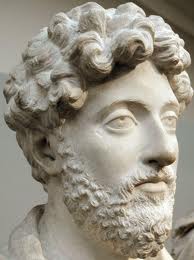
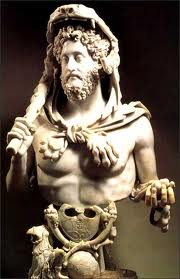
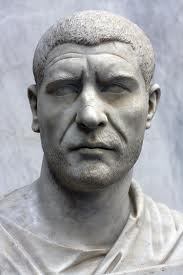
We can trace Rome’s decline, I think in the sculptured busts over the centuries. The faces say it all.
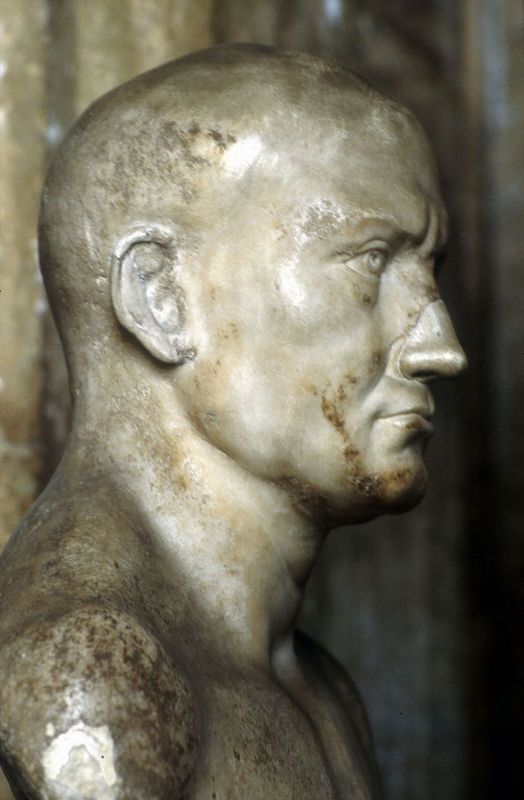
First, the hard-bitten men of the Republic, Cato the Elder, and Scipio Africanus Major, ca. 200 B.C. You may not have liked them, but you would have respected them:
Then, Julius Caesar, ca. 50 B.C. — the expression, the eyes, are different — hungrier. He seems part machine, part man, a shark on the prowl. The basic humanity of Rome’s leaders begins to fade here.
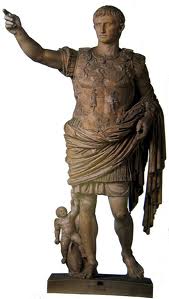
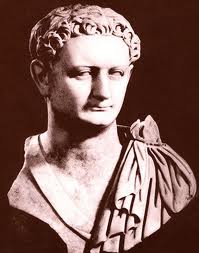
Then Augustus, ca. 10 B.C. — we see a clean break with the past. He is an image, not a man. Unlike his uncle, Augustus was hardly the military type, yet here he poses in military garb. On the right is the soft Emperor Domitian, ca. A.D. 90:
Fast forward and we get the pompous, detached Marcus Aurelius (ca. AD 165, below left), and his son Commodus (ca. AD 190, below right) who went native. Aurelius’s stoic philosophy of detachment comes through every pore, and his admiration for the Greek style in his facial hair may signal that his mind lay elsewhere. Commodus, dressed as Hercules, also gets caught up in this Greek sense of unreality. Like father, like son.
The Emperor Philip, ca. AD 250.
Here we have a relatable man again for the first time in centuries, but we, and Philip too, know it’s too late.
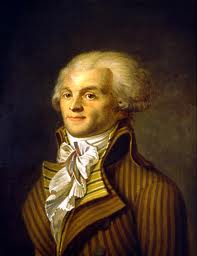
The smug, satisfied look of Marcus Aurelius has got to be the worst of them all. Similar perhaps to this guy?
Yes, I know that Robespierre was really wicked while Aurelius was merely insufferable. But still. . .
Measuring religious decline is a tricky business. How can we measure abstract ideas, principles, and so on? Well, one helpful guide is to try and see if anything makes a move to displace an idea.
Some interesting but disheartening stuff from Marginal Revolution confirms that politics may be so divisive because politics is becoming a new religion. By that I mean, politics is becoming the bell-weather by which many make their most important decisions.
In 1960, 5 percent of Republicans and 4 percent of Democrats said that they would feel “displeased” if their son or daughter married outside their political party. By 2010, those numbers had reached 49 percent and 33 percent. Republicans have been found to like Democrats less than they like people on welfare or gays and lesbians. Democrats dislike Republicans more than they dislike big business.
To test for political prejudice, Shanto Iyengar and Sean Westwood, political scientists at Stanford University, conducted a large-scale implicit association test with 2,000 adults. They found people’s political bias to be much larger than their racial bias. When Democrats see “joy,” it’s much easier for them to click on a corner that says “Democratic” and “good” than on one that says “Republican” and “good.”
To find out whether such attitudes predict behavior, Iyengar and Westwood undertook a follow-up study. They asked more than 1,000 people to look at the resumes of several high-school seniors and say which ones should be awarded a scholarship. Some of these resumes contained racial cues (“president of the African American Student Association”) while others had political ones (“president of the Young Republicans”).
Race mattered. African-American participants preferred the African-American candidates 73 percent to 27 percent. Whites showed a modest preference for African-American candidates, as well, though by a significantly smaller margin. But partisanship made a much bigger difference. Both Democrats and Republicans selected their in-party candidate about 80 percent of the time.
These findings remind of Toynbee’s words,
A crushing victory of Science over Religion would be a disaster, for if Science succeeded in expelling the Higher Religions from the human heart, she would not be able to prevent the lower religions from taking their place (Matt. 12:43-45).
We need not call politics part of the “victory of Science” per se to see the similarities.
If we continue the trends outlined in the study above, politics will become almost tribal, and little will then separate us from barbarism. De Tocqueville’s fears about the tyranny of the majority may then come fully home to roost.
The two greatest (in my opinion) theologians of the Church, St. Augustine and St. Thomas Aquinas, had different visions of political life for Christians. Augustine believed the “City of God” operated along different lines than the “City of Man.” While Christians can potentially live at peace with the City of Man, the two really have nothing to do with each other. Christians should not fool themselves into thinking that they can accomplish meaningful redemptive acts operating within the City of Man. He writes,
When these two cities began to run their course by a series of deaths and births, the citizen of this world was the first-born, and after him the stranger in this world . . .
Accordingly, it is recorded of Cain that he built a city, (Genesis 4:17) but Abel, being a sojourner, built none. For the city of the saints is above, although here below it begets citizens, in whom it sojourns till the time of its reign arrives . . .
And again,
. . . it has come to pass that the two cities could not have common laws of religion, and that the heavenly city has been compelled in this matter to dissent, and to become obnoxious to those who think differently, and to stand the brunt of their anger and hatred and persecutions, except in so far as the minds of their enemies have been alarmed by the multitude of the Christians and quelled by the manifest protection of God accorded to them. This heavenly city, then, while it sojourns on earth, calls citizens out of all nations, and gathers together a society of pilgrims of all languages, not scrupling about diversities in the manners, laws, and institutions whereby earthly peace is secured and maintained, but recognizing that, however various these are, they all tend to one and the same end of earthly peace. It therefore is so far from rescinding and abolishing these diversities, that it even preserves and adopts them, so long only as no hindrance to the worship of the one supreme and true God is thus introduced. Even the heavenly city, therefore, while in its state of pilgrimage, avails itself of the peace of earth, and, so far as it can without injuring faith and godliness, desires and maintains a common agreement among men regarding the acquisition of the necessaries of life, and makes this earthly peace bear upon the peace of heaven; for this alone can be truly called and esteemed the peace of the reasonable creatures, consisting as it does in the perfectly ordered and harmonious enjoyment of God and of one another in God.
Aquinas saw more hope for integration of the Christian and political life. With Aristotle, he saw governments as natural to life together. We would still have something akin to government even if we lived without sin, for government is mainly about rightly ordering our life together, just as God rightly orders the orbits of planets.
Aquinas and Augustine complement each other in some parts and appear exclusive in others. Their visions of government differ fundamentally, but the Church can take counsel from both. Perhaps the model we adopt should depend on the context. Augustine wrote in the waning days of the Roman Empire when a stark contrast between pagan and Christian could easily be seen. Official power in Rome came with all the necessary attendant pagan trappings. Rome dedicated itself to earthly glory. In this environment more spiritual and even physical separation of Christians from government might be warranted.
Aquinas wrote in a much different time, when the overwhelming majority of people accepted key Christian doctrines and exceptions. Some kings and nobles may not have been Christians themselves, but the hypothetical possibility of applying Christian principles to governance existed. Thus, Christians could “use” the state more effectively and with less spiritual risk in his day.
We should ask which of these two contexts most fits our current situation.*
I recently attempted to read Gregory of Tours’ History of the Franks. After Book III or thereabouts I put in down in frustration. I just could not keep up with all of the Hingest’s killing the Umvold’s marrying the Griselda’s. I got lost in the maze. I mentioned my frustration to a colleague and superior medievalist. He replied along the lines of, “Of course those parts are confusing — Gregory doesn’t care about politics. He’s really interested in what’s happening with the Church. That’s where he focuses his attention and does his best writing.” With this insight I plan on trying Gregory again sometime.
The time may have arrived for the American Church to follow Gregory’s lead, not just for our sake, but for the sake of those around us.
*We should think that Augustine preached a withdrawal from civic life altogether, or that he advocated for Christian “holy huddles.” Rather, I see Augustine advocating an approach that would help the Church maintain its salty taste. We shouldn’t enter games where the rules are by design stacked against the God’s command to love one another, to consider others better than ourselves. Every Congressman, Senator, and President must think primarily of their base. Every negotiation, every law (so it appears) is formed not from trust but from negotiating partners that start with an untenable position and then give grudgingly.
If you were like me you grew up thinking that math stood as the most obvious, least abstract, and therefore most inherently “atheistic” of the disciplines. Literature involved interpretation, who knows what happened in the past with History, but math was always math, brutal, hard, and cold.
Long after my last math class I found out that in ye olden days, Greek philosophers considered math the most inherently religious of the disciplines. It involved, after all, abstractions, universals, unchanging reality, and perfection, the very things inherent in the spiritual realms. After the Greeks, some of the greatest mathematical advances came from deeply religious people like Pascal and Newton.
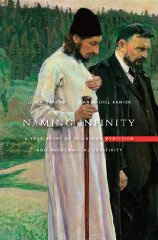
A strength of Naming Infinity, by Loren Graham and Jean-Michel Kantor, is that it looks at some of the deepest questions about the truths in Math through one obscure group of people at the turn of the 20th century. In Russia at that time a group of monks arose who engaged in a practice called Name Worshipping. The roots of this practice go back to the “Jesus Prayer” prevalent in Eastern Orthodox spirituality, where a person repeats the prayer, “Lord Jesus, have mercy on me a sinner” continually to achieve greater spiritual awareness. Name Worshippers went further, believing that “the Name of God is God.” The name of God contains His character, so speaking the name of God revealed God Himself.
The church labeled this practice heretical. God’s name stands for God Himself to be sure, but the church’s main criticism of this practice stemmed from the seemingly “magical” qualities the monks attributed to the name itself. And of course, since the name of God gets rendered differently in different languages, it could open up the charge of polytheism.
Naturally the monks accused of heresy had good arguments in their defense, denying that they believed literally in the divinity of the letters or sounds themselves. Rather, the name of God stood as the most important signifier of divinity in the world (the idea of “signs” would prove to be a link to mathematical innovation). The book frustrates somewhat on this topic, because although this so-called “name worship” will have an indirect link to the story the authors tell, it gets dropped early in the book. Still, the authors are not Church historians or theologians, and probably rightly step out of the way of an issue they wouldn’t understand well. This is one weakness of the book — the authors introduce an esoteric and unfamiliar concept and then drop it for the vast majority of the story.
The real root of the book deals with a mathematical and not a theological controversy (though theology remains indirectly involved in the story). On one side we had the French, who stressed “continuity,” the idea that to get from one mathematical point to another, one must pass through all intermediate points. Math then, is a closed system, a measurable system, where numbers have a concrete reality that cannot be manipulated.
Russians occupied the other side, the more interesting one for me. They stressed “discontinuity,” or the idea that reality is not as set in stone as we think, and thus, reality can be manipulated. We can call reality into being through the creation of numbers, or sets of numbers. In the west at this time determinism held sway over many scientific and mathematical minds. A Russian priest and mathematician, Pavel Florensky, led the opposition to this school of thought. He preached discontinuity in all fields, not just in math. Here the book frustrates yet again, for they back off from going into any real detail linking mysticism and math. I think the central idea of the Russian school had to do with the concept of naming sets of numbers (linked to set theory), and hence the connection to the heretical school of Name Worshippers. To quote the authors,
To take a simple example, defining the set of numbers such that their squares are less than 2, and naming it “A,” and analogously the set of numbers such that their squares are larger than 2 and naming it “B,” brought into existence the real number the square root of 2 (emphasis mine). Similar namings can create highly complex new sets of real numbers. . . . When a mathematician created a set by naming it, he gave birth to a new mathematical being.
If math dealt with more than finite possibilities, then “real reality” too had to be more than just finite. The connections of math with religion become obvious, as creation happened in Genesis 1 via the Word, via naming (this idea is present in Egyptian texts as well).
Freed from normal approaches to mathematical questions, the Russian school made key advances in math. They also taught in new and unusual ways. One student recalls that,
Luzin would start from the outset by posing to his students who were hardly out of high school problems of the highest level, problems that stymied the most eminent scholars.
The authors add,
One characteristic of the Russian school stood out — the conviction of the best Russian teachers that the most fruitful attack on problems was direct and straightforward, without any preliminary, long, and heavy reading. In other words, start from scratch. By doing so one got an almost physical feeling of being directly in contact with mathematical objects and experienced the sensual pleasure of having to fight intellectually with one’s bare hands. One of the great mathematicians of the time, Israel Moisseivich Gelfand, “We should study this topic before it has been tainted by handling.”*
Here we sense the mystical side of math where one bypasses “matter” to get right in touch with “reality.” It sounds thrilling, but I don’t understand it. I never was any good at math, but this sounds appealingly very little like the math I had in high school. But one also might sense its weaknesses. The great Luzin (mentioned above) would sometimes brag that he “never solved equations anymore.” That is, math resided for him not in reality, but perhaps in some gnostic fairy world. Math need now always have a direct physical application to have value. The training of the mind itself has great value. But math must, I think, have some “physical” applications to root us close to the Incarnation.
But though I found the book oddly structured, and though it bounced around too much from topic to topic, the book has great value in exposing western laymen like myself to a whole new way of thinking about math, and about reality itself.
Dave
*This whole approach reminds me of Dostoevsky’s theories on reality as it applied to gambling. In his story The Gambler, it seemed to me that he thought the interaction of the human will could influence the games played. It was never about mere statistics. Likewise, I had a friend who swore that he developed a “system” to win on roulette, which seems like a game one must lose if played for any length of time. Yet he assured me that over the course of more than a year, with 10+ trips to a local casino, that he had come out ahead $880.
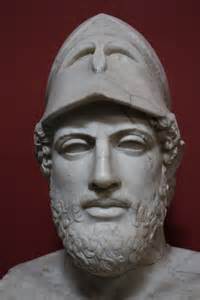
In the later 19th century Victorian England ruled the waves, the economy, and much of the inhabited world. At the same time, Victorian morality and dress focused on maintaining distance, withdrawal, and possibly, even disdain. It is perhaps no surprise then, that many Victorians saw themselves as the incarnation of classical Athens. Classical Athens ruled the waves and the treasuries of many a Greek-city state. They also began to develop at that time a philosophy that would later bloom into varieties of gnostic detachment, and the great Athenian Pericles has the arrogant disdain that comes with such detachment down pat.
Those that saw themselves in his image would likely follow in his footsteps. And indeed they did. In his Decline and Fall of the Roman Empire Gibbon poured his own brand of disdain upon Byzantine civilization, perhaps even coining the pejorative term “byzantine,” i.e. confusing, outdated, etc. He paid no attention to Eastern civilization, and if he did he would not have understood it. The English intelligensia (who led scholarship as they led the world at that time) got brought up, perhaps in Gibbon’s day, and certainly after that, to adopt the same attitudes towards this “unwieldy” appendage of the Roman Empire. Thankfully in the 20th century some great English historians (Toynbee among them) rebelled against this trend and examined Byzantine history afresh, and this resulted in English translations of the many primary sources from that period.
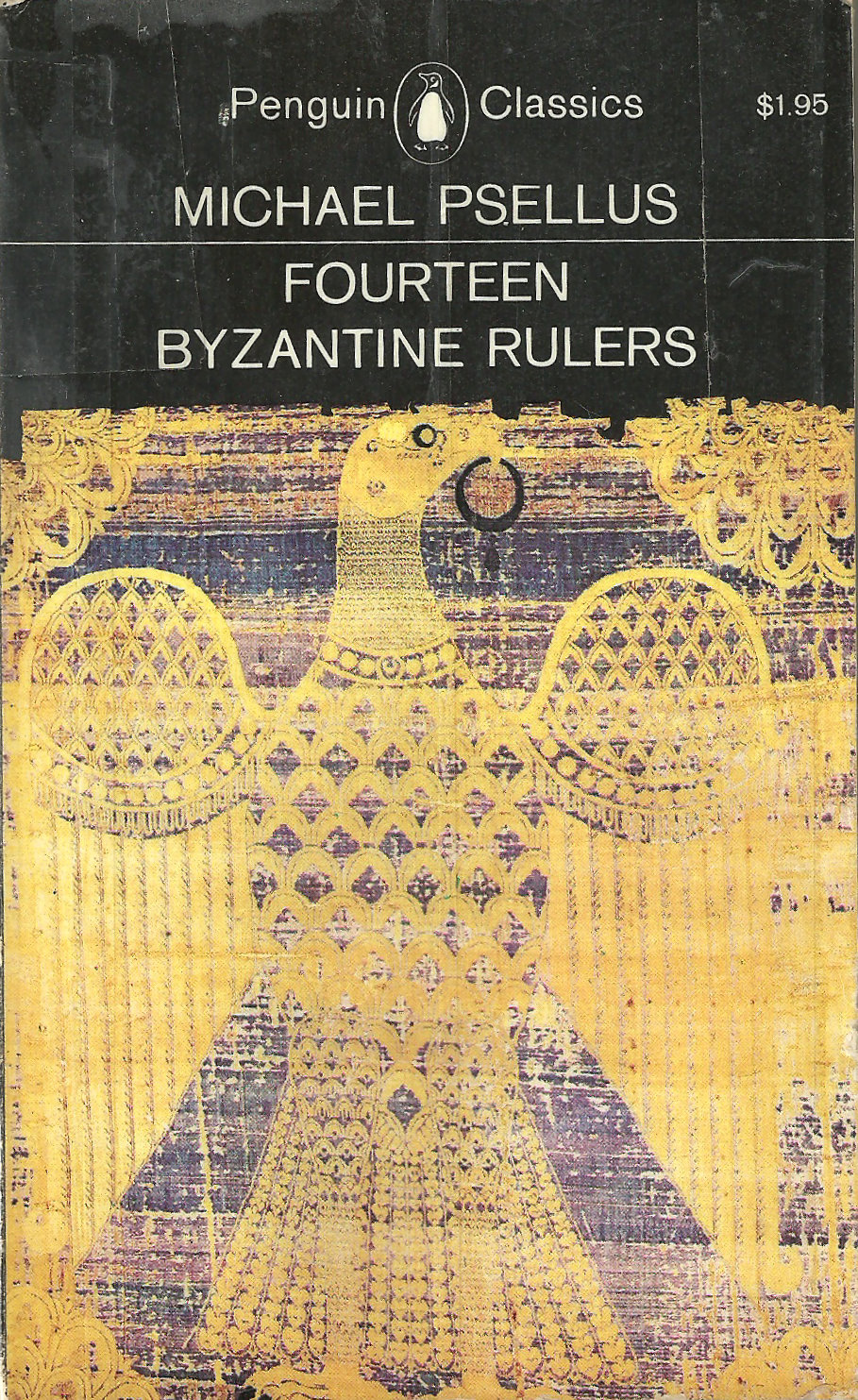
I admit that I failed in my previous attempts to read Procopius, but immediately recognized the merit of Michael Psellus’ Fourteen Byzantine Rulers. He writes with an easy style and great psychological insight. He lets us know when he personally witnessed something or knew someone, and when he reports 2nd or 3rd hand. His writing adds to the mountain of evidence that, contra Gibbon, Byzantium attained a high level of civilization and its own unique style apart from Rome. It was far more than a decrepit appendage of the western Roman empire. Psellus writes in a disarming and clear style. He structures his narratives well and doesn’t shy away from playing armchair psychologist when appropriate. I always appreciate when historians seek to interpret rather than just report, and so its natural that I would appreciate Psellus’ work. The introduction to the work argues that Psellus writes about decline, and there is some truth to this. Psellus doesn’t see a clear linear progression downwards from the first to last ruler he discusses. Nor does he lock in to one particular trait that makes a ruler good or bad. But he does have a keen sense of cause and effect over the long-term, and this gives his narrative a dramatic sweep to go along with the vivid people he portrays.
As much as I enjoyed the work, I think both Psellus and the introduction to his text might misunderstand the roots of Byzantine decline. The first ruler Psellus discusses is the great Emperor Basil II. After a rocky start, Basil righted the ship of state by transforming himself. Psellus writes of a man who refused to indulge himself in the pleasures and distractions of palace life. He ate simply, dressed simply, spent little money, and devoted himself to duty. Basil did have a weakness, however, that for power itself. Though he had various counselors and a Senate at his disposal he made them useless by his firm will and desire to see things done “right” by himself. This could work as long as the one wielding such absolute power had a firm dedication to duty and possessed more wisdom than those around him. Naturally, those that followed him had neither the character or the longevity of rule to have the kind of impact and success of Basil II.
But the decline came not after Basil in my view. Rather, the decline came in Basil’s time for two main reasons. The first has to do with the war he initiated with the Bulgarians. I don’t think the war had any real solid justification (Psellus agrees, stating that Basil “deliberately attacked their country”) and distracted them from their real problems with the Moslems on their eastern border. I touched on this war and its consequences in this post from several months ago, so I won’t elaborate here. What I didn’t say in that post is that, based on Basil’s incessant energy and love of power, it seems like the kind of war someone like him might engage in. I detailed the effects of this war on the Byzantine’s in this post here, which I also reposted. The second reason is that the system Basil set up that concentrated power in his hands put too many eggs in one basket, that of the emperor. This “idolization of an ephemeral institution,” that of the old Roman empire, may have contributed significantly to their decline. This gets placed at Basil II feet. His failure to share power extended to his brother and probable heir, whose indolence and laissez-faire attitude towards governance suited Basil II perfectly.
Sure enough, when his brother came into power he continued this same approach to life. A country can do alright if such a person delegates well to wise people, but Constantine VIII followed in his brother’s footsteps and cared nothing for the Senate, yet accompanied that habit with far less wisdom and vigor than Basil. This pattern of concentration of power and abuse of power had varying degrees of consequences over time. Romanus III (1028-1034) thought only in terms of “bigger is better.” To fight he raised big armies. To increase the treasury he collected “big taxes.” When he repented somewhat of his former ways, he sought to build the biggest church he could to demonstrate his sincerity. While I wouldn’t trace these acts directly to Basil, it shows the same lack of proportion and balance that Basil II displayed regarding power. Psellus praises devotion and piety in general, but then writes regarding Romanus,
It cannot be right, in order to show one’s piety, to commit great injustices, to put the whole state into confusion, to break down the whole body politic. He who rejects the harlot’s offering, who utterly despises the sacrifice of the ungodly, as though the wicked were no better than a dog — how could he in any way draw near a building, however rich and glorious, when that building was the cause of many evils?*
Byzantium would remain “off kilter” for the rest of its existence, but again, their problems only make sense in the context of their great achievements. If they had nothing to lose, they had nothing to mourn in their decline. But for Psellus and us, this is not so.
Dave
*This passage should not be read in isolation, as it could lead one to think that he gave lip service to “general piety” as a cloak for a secular world view. One only needs to read his praise of Emperor Michael IV (1034-41), who abandoned the throne to join a monastery at the end of his life, to see the error of that line of reasoning. Among Michael’s other acts was the founding of a home for reformed prostitutes. In order to help lure them out of their way of life and end their fear of poverty, Michael made the home luxurious, promising any who came and vowed to live celibately that “all things, unsown, without labor of hands, would spring forth for their use” (Homer, The Odyssesy). Psellus claims that “swarms” of women came to the homes.
This week we spent part of the time trying to apply some lessons from the past to our current conflicts in Iraq and Afghanistan. Central to our discussion was the following idea:
Acts of violence do not win wars.
This was a quote from the FLN leader Ben ‘Hidi in the movie, “The Battle of Algiers.” We discussed what it is exactly that does win wars, and what happens when you make military action your strategy, rather than a tactic.
Everything needs a context that gives it meaning. For example if a random person came up to you on the street and declared, “I love you!” the words would have no real meaning to you. The words fit into no known context. The person is not nice but weird. His words would not have the desired effect.
In the same way, the violence of wars needs a proper context. It must proceed from a defined moral and political reality. Furthermore, the violence used must make sense within that defined reality for it to have real effectiveness.
For example, I think it no coincidence that the Union army fought much better after they had the liberating mission proclaimed by the Emancipation Proclamation. No longer did they fight for the political abstraction of “Union” but the definite moral aim of freeing slaves.
In our discussion of the movie we focused on the question of torture and the question of French identity in particular, and democratic identity in general.
For homework recently I had the students look at various internal memos related to our use of “enhanced interrogation” tactics with enemy suspects (I’ll include what the students read at the end of the update). Next week we will discuss John Yoo’s famous/infamous memo and in large part our reactions should center around two questions:
To what extent should American values be used as a “weapon” in the War on Terror? What is our greatest asset in the war, and how can we use it?
Can torture be a tactic in fighting a “just war?” If so, how, and if not, can we ever use it?
We used some of these questions to look at the war in Iraq from 2003-2009.
When we went into Iraq initially, we had fairly narrow military goals. We planned the military campaign to make it as easy as possible for our troops to overthrow Saddam. This meant focusing on the destruction of Iraq’s infrastructure (i.e. power, communications, etc.) among other things. In a narrow military sense, we had quick and stunning success, but almost immediately afterwards, the situation deteriorated. We faced grave problems of violence and unrest, some of them of our own making. After all, the destruction of infrastructure itself created by the war made their lives more tenuous and unpredictable.
Iraqi’s also faced the question of the rule of law, or more pointedly, its absence. A few years ago I had a chance to talk to an army major who was in Baghdad just after Saddam’s regime collapsed. A respected local elder came up to him and said,
Thank you for removing Saddam. But now we are confused. What law do we follow? Are we still under Saddam’s law? Or is it the martial law of the U.S. military? Or is it local tribal law? Or is it Sharia law?
I remember the captain telling me that,
When I had no idea what the answer was, I realized we were in trouble.
In other words, our violence effectively removed the regime, but did not have any discernible meaning — it had no larger moral and political context that the Iraqi people could latch onto. Thus we should not be surprised that chaos and confusion reigned in the aftermath. Violence alone failed to come even close to achieving our objectives.
At first we used our military in Iraq to ‘kill the bad guys’ rapidly making headway amidst the chaos. We holed up in the Green Zone, rode out in armored vehicles, and retreated back. By 2006/7 the situation looked bleak. General Petraeus had a different concept of what the war was about and changed everything. The goal was no longer to kill bad guys but to protect Iraqi citizens. To even find the bad guys, we needed better intelligence, and we were only going to get that from the people themselves. Petraeus was right to surmise that the Iraqi’s didn’t want Al Queda as part of Iraq, but also realized that no one was really sharing in their struggle. He took troops out of the Green Zone and embedded squads in local Iraqi neighborhoods. As much as possible, soldiers were to appear without helmets and weapons — things average Iraqi’s did not have.
While the final chapters of Iraq’s transformation have not been written, no one can doubt the progress made since this change of strategy. Perhaps this gives insight also as to how our values might be a weapon, and how a military can be used to combat an idea. He strongly emphasized the idea that “We should be first with the truth, even on bad days.” When senior administration officials urged him to change his message to reflect a more positive image of the war, he argued that, “We don’t have an image problem. We have a results problem.”
If you are curious, this site communicates in visuals some of what Petraeus hoped to and did accomplish. The visual below shows the extent to which he broadened our field of vision as to how we fought the war.
Many believe that “The Surge” and this change in strategy helped to transform Iraq, though the final chapters of this tale will not be finished for many years. Of course, Petraeus has his critics, and one of them writes here, if you are interested.
I wanted the students to think about the extent to which we believe that our democratic values are an asset or a hindrance in the War on Terror, a decision that reveals much of what we really think of democracy in general. Generally two main schools of thought exist:
Our values/freedoms are the essential foundation of who we are, not a mere add-on when things go well. Therefore the wars we fight, and the way we fight them, must reflect those values, lest we lose our identity.
As valuable as our values/freedoms are, they only exist because of the foundation built by security. Without security as the proper soil, freedoms cannot exist. Therefore in war, we fight to protect our values by making sure we have adequate security.
This debate has great relevance for how we think of torture. Some see it as necessary to preserve freedom, others see it as a betrayal of our identity, and therefore off-limits to us. Students felt the tension between our responsibility to protect the innocent and also protect who we are as a people. Both sides have costs. To not torture might cost lives. To do so might cost us something different — our image, identity, our reason for being a nation in the first place.
I hope you enjoy the weekend. Voices on both sides of the torture debate follow, if you have interest.
Blessings,
Dave
DEPARTMENT OF THE AIR FORCE, OFFICE OF THE JUDGE ADVOCATE GENERAL,
Washington, DC, February 5, 2003.
Subject: Final Report and Recommendations of the Working Group to Assess the
Legal, Policy and Operational Issues Relating to Interrogation of Detainees
Held by the U.S. Armed Forces in the War on Terrorism (U)
1. (U) In drafting the subject report and recommendations, the legal opinions of the Department of Justice, Office of Legal Counsel (DoJ/OLC), were relied on almost exclusively. Although the opinions of DoJ/OLC are to be given a great deal of weight within the Executive Branch, their positions on several of the Working Group’s issues are contentious. As our discussion demonstrate, others within and outside the Executive Branch are likely to disagree. The report and recommendations caveat that it only applies to “strategic interrogations” of “unlawful combatants” at locations outside the United States. Although worded to permit maximum flexibility and legal interpretation, I believe other factors need to be provided to the DoD/GC before he makes a final recommendation to the Secretary of Defense.
2. (U) Several of the more extreme interrogation techniques, on their face, amount to violations of domestic criminal law and the UCMJ (e.g., assault). Applying the more extreme techniques during the interrogation of detainees places the interrogators and the chain of command at risk of criminal accusations domestically. Although a wide range of defenses to these accusations theoretically apply, it is impossible to be certain that any defense will be successful at trial; our domestic courts may well disagree with DoJ/OLC’s interpretation of the law. Further, while the current administration is not likely to pursue prosecution, it is impossible to predict how future administrations will view the use of such techniques.
3. (U) Additionally, other nations are unlikely to agree with DoJ/OLC’s interpretation of the law in some instances. Other nations may disagree with the President’s status determination regarding the Operation ENDURING FREEDOM (OEF) detainees; they may conclude that the detainees are POWs entitled to all of the protections of the Geneva Conventions. Treating OEF detainees inconsistently with the Conventions arguably “lowers the bar” for the treatment of U.S. POWs in future conflicts. Even where nations agree with the President’s status determination, many would view the more extreme interrogation techniques as violative of other international law (other treaties or customary international law) and perhaps violative of their own domestic law. This puts the interrogators and the chain of command at risk of criminal accusations abroad, either in foreign domestic courts or in international fora, to include the ICC.
4. (U) Should any information regarding the use of the more extreme interrogation techniques become public, it is likely to be exaggerated/distorted in both the U.S. and international media. This could have a negative impact on international, and perhaps even domestic, support for the war on terrorism. Moreover, it could have a negative impact on public perception of the U.S. military in general.
5. (U) Finally, the use of the more extreme interrogation techniques simply is not how the U.S. armed forces have operated in recent history. We have taken the legal and moral “high-road” in the conduct of our military operations regardless of how others may operate. Our forces are trained in this legal and moral mindset beginning the day they enter active duty. It should be noted that law of armed conflict and code of conduct training have been mandated by Congress and emphasized since the Viet Nam conflict when our POWs were subjected to torture by their captors. We need to consider the overall impact of approving extreme interrogation techniques as giving official approval and legal sanction to the application of interrogation techniques that U.S. forces have consistently been trained are unlawful.
JACK L. RIVES,
Major General, USAF,
Deputy Judge Advocate General.
DEPARTMENT OF THE NAVY, OFFICE OF THE JUDGE ADVOCATE GENERAL,
Washington, DC, February 6, 2003.
Subj: Working Group recommendations relating to interrogation of detainees.
1. Earlier today I provided to you a number of suggested changes, additions, and deletions to the subject document.
2. I would like to further recommend that the document make very clear to decision-makers that its legal conclusions are limited to arguably unique circumstances of this group of detainees, i.e., unlawful combatants held ” outside” the United States. Because of these unique circumstances, the U.S. Torture Statute, the Constitution, the Geneva Conventions and customary international law do not apply, thereby affording policy latitude that likely does not exist in almost any other circumstance. (The UCMJ, however, does apply to U.S. personnel conducting the interrogations.)
3. Given this unique set of circumstances, I believe policy considerations continue to loom very large. Should service personnel be conducting the interrogations? How will this affect their treatment when incarcerated abroad and our ability to call others to account for their treatment? More broadly, while we may have found a unique situation in GTMO where the protections of the Geneva Conventions, U.S. statutes, and even the Constitution do not apply, will the American people find we have missed the forest for the trees by condoning practices that, while technically legal, are inconsistent with our most fundamental values? How would such perceptions affect our ability to prosecute the Global War on Terrorism?
4. I accept the premise that this group of detainees is different, and that lawyers should identify legal distinctions where they exist. It must be conceded, however, that we are preparing to treat these detainees very differently than we treat any other group, and differently than we permit our own people to be treated either at home or abroad. At a minimum, I recommend that decision-makers be made fully aware of the very narrow set of circumstances-factually and legally-upon which the policy rests. Moreover, I recommend that we consider asking decision-makers directly: is this the “right thing” for U.S. military personnel?
MICHAEL F. LOHR,
Rear Admiral, JAGC, U.S. Navy,
Judge Advocaate General.
Charles Krauthammer, columnist, writing for National Review online:
I don’t see [the release of Bush administration memos on interrogation techniques] as a dark chapter in our history at all.
You look at some of these techniques — holding the head, a face slap, or deprivation of sleep. If that is torture, the word has no meaning.
I would concede that one technique, simulated drowning, you could call torture, even though the memos imply that legally it didn’t meet that definition. I’m agnostic on the legalism….
But let’s concede that it’s a form of torture. I think it’s perfectly reasonable to use it in two cases, that the ticking time bomb, if an innocent is at risk and you’ve got a terrorist that has information that would save that innocent and isn’t speaking. That’s an open and shut easy case.
A second case is a high-level Al Qaeda operative, a terrorist, who knows names and places and numbers and plans and safe houses and all that, and by using techniques to get information, you’re saving lives.
If I have to weigh on the one hand the numberless and nameless lives saved in America by the use of these techniques, and we had a CIA director who told us that these techniques on these high-level terrorists was extremely effective in giving us information.
If you have to weigh on one hand that the numberless and nameless lives saved, against the 30 seconds or so of terror in the eyes of a terrorist who is suffering this technique, I think the moral choice is easy.
It’s not a dark chapter in our history. It is a successful one. We have not had a second attack, and largely because of this.”
Looking back on my childhood, it appears I grew up in the golden age of Redskins fandom. From 1981-1992 we won 3 Super Bowls, played in another, and had many other playoff runs. But that whole period seems to be not just a golden era for me and my team but the entire NFL. During that time (especially if we extend it a bit deeper into Paul Tagliabue’s term as commissioner) the NFL rose from second fiddle to domination of the sports landscape. But these days I’m nowhere near the rabid fan I used to be, and I’m sure many factors contribute to this. I know I’m not the only one. Grantland’s Bill Simmons wrote a strange article calling the NFL all kinds of evil and comparing it at one point to slavery. But then he also expends thousands of words and numerous podcast hours discussing, analyzing, and enjoying the game.^ We seem to occupy an uncertain place. What exactly do we think the NFL is? What do we want it to be? I thought about this from a perspective of Greek and Roman historians and wondered if we might find some parallels.
We can start classical historiography in some ways with Aeschylus. He wrote no histories, but his plays interpreted the history of Athens and gave them a mental framework for them to view their place in the world. I have not read many but it appears that they all celebrate the glory that is Athens. His work has all the admirable confidence/lack of perspective of a 20 year old ready to tackle the world.
By Aeschylus’ death ca. 445 B.C. we have the Father of History, Herodotus, on the scene. His curiosity leads him to travel far and wide. He too praises Athens, but it comes within a more muted, almost ecumenical context. Amongst all the different people Herodotus sees hubris always lurking, even for Athens itself. By the time Thucydides writes (ca. 410 B.C.?) he openly questions the whole Athenian project. Xenophon, though a lesser writer than anyone aforementioned, continues that demolition process in his work after the Peloponnesian War (404 B.C.).
Roman historians have similar patterns. Polybius writes his histories ca. 140(?) B.C. and most everything in his work highlights Rome’s meteoric rise and superiority between 264-146 B.C. But even he hints at the potentially inevitable cycle of change within civilizations may catch up to Rome at some point. Livy comes next, and the glory of Rome dominates his work. But for him Rome’s greatness lay in the past, not the future. Tacitus (ca. 90 A.D.) gives Rome some tough questions in his “Annals” and other works. Then Appian (ca. 130? A.D.) looks back at Rome’s past not as a golden age but as an era prone to violence and greed. Perhaps some might have called him a “revisionist” historian in his day. By the time we get to Ammelianus (ca. 375 A.D.) no one buys into Rome anymore.
I think the NFL may reside somewhere in the Polybius/Livy period. Most commentators have an uneasy sense that a cold wind blows, but others still talk of football as “America’s game, a man’s game,” and so on. Others might put it in the Tacitus/Appian phase, where perhaps primarily because of concussions we call our whole past into question. Our confusion over football might mirror our confusion evidenced in other aspects of our culture. In many action movies either a) our own government (or some part of it), or b) one of our corporations is the main enemy. Strategically, Obama perfectly typifies our confusion about our role internationally that persists long after Bush era.
Once we figure out football, will other political and cultural questions will fall into place? Most likely not, but one can hope.
Dave
^In this article Simmons (whom I usually like) displays a common lazy habit of mind we often apply to major powers. We exaggerate their reach and blame them for everything, assuming that they can fix anything they wish. We see some other countries having this attitude towards the U.S. The powerful only have to will it, and it is so. Some feel that having power magically absolves anyone of human finitude, human folly, and so on. I call this habit lazy because it prevents us from looking at other causes — it’s too easy, and it often absolves us of personal responsibility. So Simmons blames Goodell for a gaffe made by one announcer regarding a sponsor. Simmons naturally assumes that Goodell must not have been clear enough to the announcers in his instructions. Is it possible that he did communicate clearly and someone either forgot or paid no attention? I don’t like Goodell either but this goes too far. He can’t be blamed for everything.
I’m glad I don’t teach American Literature for many reasons, one of which is that I never have to teach Hawthorne’s Scarlet Letter. I have no problem going on record stating that the book is not great literature. I would go so far as to say in fact that it is bad literature. I suppose some might argue that we should teach it nevertheless in order to get a flavor of the time-period. Now, I am no literature teacher, but as I say on occasion, ignorance of subject is no excuse for not having an opinion about it. So I’ll make another hapless decree and say that if you want to get a flavor of the times, many better ways exist than to waste your time reading bad literature.
For the Scarlet Letter Hawthorne picked a theme and perhaps even a plot worthy of great literature. But his overblown style and the obsessive introspection of his narration make the reading laborious. Different folks have different strokes, but I would have hard time relating to someone “who just loved the Scarlet Letter.” As my wife stated, who also teaches literature, “Hawthorne writes with a hammer, not a pen,” and, “He writes like a lawyer, not a novelist.” As with Oswald Spengler, I did the “random page” experiment and found this at the beginning of chapter six:
Governor Bellingham, in a loose gown and easy cap,–such as elderly gentlemen love to indue themselves with, in their domestic privacy,–walked foremost, and appeared to be showing off his estate, and extirpating on his projected improvements. . . . The impression made by his aspect, so rigid and severe, and frost-bitten with more than autumnal age, was hardly in keeping with the appliances of worldly enjoyment wherewith he had evidently done his utmost to surround himself. But is an error to suppose that our grave forefathers–though accustomed to speak and think of human existence as merely of trial and warfare, and though unfeignedly prepared to sacrifice goods and life and the behest of duty–made it a matter of conscience to reject such means of comfort or even luxury, as lay fairly within their grasp.
I hope you are not as tired reading it as I am typing it. One critic wrote that, “If the reader isn’t careful, a character can be changed dramatically in two or three pages . . .” and I don’t think she meant it as a compliment.
I recently read Aeschylus’ Oresteia trilogy and found myself struck by some similar feelings as when reading the Scarlet Letter. Especially in “The Agamemnon” (the first part of the trilogy) we have the same somewhat restless overdone style. For example . . .
Oh welcome, you blaze in the night, a light as if of day, you harbinger of many a choral dance in Argos in thanksgiving for this glad event! What ho! What ho! To Agamemnon’s queen I thus cry aloud the signal to rise from her bed, and as quickly as she can to lift up her palace halls a shout of joy in welcome of this fire. And I will make an overture to with a dance upon my own account; for my lord’s lucky roll I shall count to my own score, now that this beacon has thrown me triple six.
So yes, perhaps he adds too much mustard, but the language has something spirited about it (instead of Hawthorne’s superior snootiness), and I can’t help but smile at the translator’s great “triple six” phrase. But then later the language still remains the same no matter who talks, no matter the reason . . .
Loud rang the battle-cry they uttered in their rage, just as eagles scream which, in lonely grief for their brood, rowing with the oars of their wings, wheel high over their bed, because they have lost the toil of guarding their nursling’s nest.
And so on, throughout the whole play. The language stirs the blood at first, and then the blood begs to rest a while.
Just as Hawthorne wrote at a time when the concept of “American Literature” just was taking shape, Aeschylus wrote at a time when Greek drama had just began in any formal sense, and this may account for some of their similarities. Aeschylus’ continuous use of the heroic style may rob his characters of depth, but at least he enjoys his craft and his story. Many vastly superior Greek dramas exist, but I suppose one must start somewhere.
Perhaps when a person starts out, one can’t help but exaggerate for effect. And perhaps the same holds true for literature as well. But Hawthorne had plenty of other examples of great writers at his fingertips, whereas Aeschylus pioneered new ground. If we considered no other reason, this makes the Oresteia a much greater work than The Scarlet Letter. I easily forgive and even applaud Aeschylus, but even after all these years I can’t say the same about Hawthorne.
For possible similar themes in Chinese films, see here.
I am reposting the original post on traffic cameras from several months ago based on events in Ferguson. But one does not have to agree with the violence to understand that what happened has a deep context. I do think that Alex Tabbarrok of Marginal Revolution is on to something when he links the uprising in Ferguson in part with the problem of ciies using criminal activity to fund their budgets.
He writes,
Ferguson is a city located in northern St. Louis County with 21,203 residents living in 8,192 households. The majority (67%) of residents are African-American…22% of residents live below the poverty level.
…Despite Ferguson’s relative poverty, fines and court fees comprise the second largest source of revenue for the city, a total of $2,635,400. In 2013, the Ferguson Municipal Court disposed of 24,532 warrants and 12,018 cases, or about 3 warrants and 1.5 cases per household.
As Tabarrok comments,
You get numbers like this from %$!@ arrests for jaywalking and constant “low level harassment involving traffic stops, court appearances, high fines, and the threat of jail for failure to pay.”
The full post is here, and worth 3 minutes of your time. I think the link between traffic cameras and Ferguson are the inherent problems embedded within governments seeking to profit from crime. It opens the door to a whirlwind of abuses and unintended consequences.
And now, the original traffic camera post . . .
I have never been a fan of traffic cameras. I suppose that they might hypothetically serve a good purpose at a very limited number of places, such as schools and dangerous intersections. Maybe. Hypothetically.
But I find their proliferation, along with the growth of the security-through-technology trend, disturbing for a variety of reasons.
Many hope and believe that the cameras will make our roads safer, but we should realize that the stated purpose may also involve raising revenue. While I have no love for D.C. Mayor Vincent Gray’s assertion that he would like to see many more cameras in D.C., he at least had the openness to admit that the traffic cameras would go a long way towards balancing the budget.
There is a baseness, a dullness (for lack of a better word), and a real potential for the state to become the ultimate prig* when it uses people’s misdeeds to raise money. Can we not create or build anything anymore? Granted, this argument is in the end an “aesthetic” one and can’t be measured. You feel it or you don’t. But there are some parallels in other areas of life. We know that lotteries tend to work against the poor, but states use them to raise money for schools or other social programs. The state must ask itself, “Do we want people to play the lottery or not?”
We know the detrimental impact of institutionalized gambling but many states use slot machines to raise revenue. I remember visiting a casino years ago, and there are few sights more depressing in my memory than seeing the blank faces of the “slot jockeys” mechanically pulling the lever time after time. Maybe the state shouldn’t ban such behavior, but I am not comfortable with them profiting from it either.
The whole idea of a “vice tax” is a very old one, but seems to cut against the very idea of civil government’s purpose in creating a social order that discourages bad behavior. Perhaps there is some room for a detterence role in these kinds of taxes. Yet there is the very real possibility that states who rely on such things to raise money and actually balance budgets may want people to engage in those behaviors.
If counties want to use traffic cameras to help their budgets, do they want motorists to speed or not? Do they, in fact, need motorists to speed to balance the books? If we answer “yes,” then we only have a small leap to envision the state manipulating speed limits, roads, intersections, etc. to make sure they meet their quota.
But many will say that these arguments reside in the pure hypothetical and will want more concrete objections.
The ACLU has a good and brief piece here detailing their objections to speed cameras, arguing among other things that they violate the principle of “innocent until proven guilty.” Traffic cameras automatically suppose that the owner of the car is driving the car, a reasonable though not absolute assumption. But it you are not driving the car the burden is upon you to prove your innocence. This burden would be quite unjust especially for someone from out of town. If the fine was, say, $60 it would cost much more than that for the car owner from another locale to come to court and prove he was not driving. He will simply pay the fine. We understand that no perfect criminal justice system exists, and that some innocent people will be convicted unjustly. But we should not set up a system where an unjust result is practically guaranteed on occasion.
Debate also exists as to how much safer traffic cameras actually make roads. Wired Magazine cites this study showing how cameras at intersections have actually increased accidents. Others counter that we can accept an increase of “fender-benders” to decrease fatalities. I agree, but that that assumes a false dilemma. Increasing the length of time for yellow lights, for example, might accomplish the same purpose, and while a reckless drunk driver might not heed a longer yellow, neither would they heed traffic cameras. Marginal Revolution
I trust I am no conspiracy theorist, but my final objection does involve the slippery-slope. The Washington Post’s Michael Rosenwald wrote a piece about Prince George’s County response to vandalism of its cameras:
They put up a cameras to monitor the camera.
And from Marginal Revolution, this recent piece tells of some places shortening yellow lights for cash.
For the cost of the cameras the county could have instead hired a police officers to monitor the intersections instead. And this gets to my final objection. We should have no interest in contracting out our security to machines. One can appeal to a police officer, and police often come from the communities in which they work. Their judgments are fallible, yes, but when they make poor judgments they can be held accountable, unlike machines.
Thus ends my mild attack. But maybe both sides are wrong when it comes to solving traffic problems. Maybe we need an entirely new approach. . .
*Some years ago a friend of mine was driving south on Rt. 29 at night in a county that will remain nameless. He received a citation for “Failure to Dim” (!) his headlights. Of course the ticket itself was about $30, but add a $55 processing fee, and you have a very expensive “Failure to Dim.”
It turns out that this county raises a good portion of its revenue through traffic citations. Considering that he was driving a rental car (he lives in the mid-west) and would certainly not return to challenge the citation in court, well, things begin to add up.
The new James Brown biopic debuted recently. I don’t have much interest in the movie, as on the surface it looks a lot like Ray and Walk the Line. Steven Hyden encapsulated my thoughts when he wrote,
Like all biopics, Get on Up inserts the idea of a famous icon into a classic melodrama story line. It’s like making Terms of Endearmentabout Batman. It never really works, but Hollywood never tires of trying anyway, in part because audiences always seem to show up, in spite of already having seen this movie many, many times.
My interest in James Brown got renewed, though not so much by the movie itself, but a particular review I read.
I usually like what Grantland’s Wesley Morris has to say about film, but not this time. In reviewing the film Morris reduces Brown’s music and stage act to, “the sex, basically.” Now I won’t deny that an artist who had a hit album/song called “Sex Machine” wasn’t talking about sex in his songs. But I strongly object to reducing his music to sex, even the song “Sex Machine.”
I can easily forgive Morris’ mistake because it’s so common to our culture. We have elevated the physical experience of sex as the proper “end” of human experience, and this has cast us adrift on a host of issues plaguing our society. We miss the transcendent pointers in sex when we make it our stopping point. N.T. Wright put it succinctly when he wrote about sex and marriage (frequent readers will note I quote this in another post — forgive me),
It’s all about God making complementary pairs which are meant to work together. The last scene in the Bible is the new heaven and the new earth, and the symbol for that is the marriage of Christ and his church. It’s not just one or two verses here and there which say this or that. It’s an entire narrative which works with this complementarity so that a male-plus-female marriage is a signpost or a signal about the goodness of the original creation and God’s intention for the eventual new heavens and new earth.
Back to James Brown (almost) . . .
I remember hearing an interview with pianist Jeremy Denk some years ago when he recorded his album of pieces by Ligeti and Beethoven. Denk talked about the repetitive nature of the pieces from both composers on the album. But he didn’t see monotony, he saw Beethoven and Ligeti both grasping at the reaches of space and eternity. They strove for transcendence. Denk commented,
“The last Beethoven sonata seems to me [to be] one of the most profound musical journeys to infinity ever made,” he says. “The whole piece seems to want to bring us from a present moment into this timeless space where everything is continuous and endless.”
But of course Beethoven and Ligeti are classical musicians and we expect them to think about these things. We don’t naturally assume the same of James Brown,* though perhaps we should.
Most pop/soul/rock/swing music emphasizes the “2” and often the “4” of a four-beat phrase. On multiple occasions Brown talked about how his shift of emphasis to the downbeat, the “1” of a musical phrase, permanently changed his music. Instead of, for example, “Gonna’ HAVE a funky-GOOD time,” he sang, “GONNA have a funky-good time.” This “cleared the decks” for Brown’s musical phrasing in the rest of the measure/multi-measure phrase — it gave him a lot more room to maneuver — a kind of “timeless space,” to quote Denk.
We can hear this in one my favorite Brown songs, “Mother Popcorn.” Listen for a start to the rhythm like, “and-ONE-and.” By the time we get to the “and” of beat four we have lingered so long in the space Brown creates that it hits us like a coiled spring. Because the song gets built around a two measure phrase, after the “and” of beat four we have a whole measure of “space” until the downbeat comes again.
A lot of Brown’s music in the late 60’s/early 70’s (my favorite era of his) devolves into rhythm almost exclusively, and his downbeat emphasis allowed for extended rhythmic exploration. Brown discovered he had no real need for melody. This meant that the songs had a repetitiveness to them, but it also meant that Brown could then make his bid for something in the great beyond. He was free to “explore the space” unfettered by beats two and four.
Brown had a string of failed marriages. His friend Rev. Al Sharpton described him as a lonely person with few real friends. This should not surprise us, considering that both of his parents abandoned Brown as a child. Given the facts about his life and music, are his songs really just about sex, or even primarily about sex? It can’t be. What was “The Hardest Working Man in Show Business” working for? When we listen to “Cold Sweat” we have other things to contemplate besides sex.
His dancing adds to the transcendence. Watching him I can’t help but laugh in amazement.
The quality of my laughter is easily placed. It is, to borrow a song title from Over the Rhine, a “Laugh of Recognition.”
Every night we always
Led the pack
There and back
And we never could do anything half
Oh you have to laugh
You just gotta laugh . . .
It’s called the laugh of recognition
When you laugh but you feel like dyin’
You’re not the first one to start again
Come on now friends
There is something to be said for tenacity
To quote the late, great, Mr. James Brown, “Ain’t it Funky?”
Or perhaps we should say, “AIN’T it funky?” (go to ca. 4:30-5:30 mark for some fun).
Dave
*In comparing these three I don’t mean to assert their musical equality. For the record, I’ll take Beethoven over Brown by a long shot. But I’m guessing many of you will join me in taking Brown over Ligeti in a rout.
I enjoyed thumbing through Leonard Mlodinow’s Euclid’s Window, a book about the development of math and science from ancient to present times. Mlodinow praises the discoveries of the Egyptians and Babylonians, but focuses on the significant advances of the Greeks from Thales down to Pythagoras and Euclid. Their key discovery, their “leap of consciousness,” was abstract thought. Previously civilizations saw only isolated parts or formulas. They knew certain things worked but had no idea of the connections between different ideas. After the Greeks, we gained the ability to make generalizations, to group similar ideas under larger ones, and create systems.
Good stuff to be sure, but I hoped Mlodinow would offer speculation on how this happened. Why did abstract thought begin with the Greeks and not the Babylonians? Did abstract thought in general (rather than just in math) come from the Greeks? He did not touch on the question.
This frustrated me, so what follows is my own speculation.
Abstraction requires a certain view of creation itself. Logically one must see order and pattern in creation before one could see it in math, for example.
Initially I thought that it makes sense that abstract thought did not show itself first in either Babylon or Egypt. Babylon’s creation account reveals a haphazard universe. Creation happens due to conflict between the gods. Sorcery and power determine the winner. We don’t see principle, justice, and so on. In such a theological environment we would not expect them to think of general governing principles of thought. At the the time of Thales, for example, Babylonians obsessed over the minutiae of dream interpretations.
The Egyptian creation account bears more similarity to Genesis 1-3, which should have given them an advantage in the “race” to abstraction. However magic also plays a strong role in Egyptian society and myth. It seems that in a society where nature can be manipulated on a whim one would not learn to see the forest for the trees.
So far so good. In this triumphal ascent we should then see how Greek creation accounts most resemble Genesis and how this helped them. But . . . Greek creation accounts might resemble the Babylonians more than the Egyptians. True, magic doesn’t really have the role in Greek myth and folklore that it did in Egypt, but we do see the occasional frustrating randomness of the gods’ actions. Perhaps Zeus and the others sometimes act in accord with “Fate” and a larger plan, but Fate remains mysterious and inaccessible to both gods and men. There appears little in Greek religion on which to build the foundation of abstract thought.
Indeed, how did abstract thought arise in a polytheistic culture at all? We might guess at some special revelation of God, perhaps. What source did Thales and others draw on to develop it? I am at a loss for ideas. Perhaps this is why those who really took abstract thought seriously (like Pythagoras and Plato) end up breaking from Greek religion and starting “heretical” faiths. Standard Greek religion had no category for such things.
I also wonder why the Greeks beat out the Israelites. The Israelites had all the advantages in place.
As I mentioned, Genesis gives all the foundation for abstract thought one needs. God creates everything, and does so in an orderly and purposeful way. Yes, in the Old Testament as a whole God shows his omnipotence, love, and justice, by intervening in miraculous ways at times. But in stark contrast to other contemporary faiths, the Old Testament has none of the fanciful/whimsically “miraculous” about it. Throughout Scripture in fact, miracles get concentrated at key points in redemptive history (i.e. the founding of Israel, the beginning of the prophetic era with Elijah/Elisha, with Jesus Himself, and the beginning of the apostles’ ministry). Today missionaries report miracles in areas where the gospel first gets introduced. When looking at other ancient religions we may understand more why Jesus showed reluctance at times to effect miracles. Reliance on them at our whims hinders the development of wisdom.*
We can say that the Israelites did develop, or we should say, had revealed to them, the “abstract” reality of God’s creation of all things, and His rule over and care for all things. Certainly this is a far more important truth to have then imaginary parallel lines. Though Biblical critics of the modern school say that Jewish belief in God’s universal dominion comes only with the later prophets (and then they often date them much later than most orthodox commentators) you have it “early” in Jewish history not just in Genesis, but in 1 Samuel 5, Psalm 19, Psalm 82, and so on. The term “abstract” in this context has its problems, however. We define abstract as “existing in thought but not having a concrete or physical existence.” God exists in more than just thought. He is real reality.
But the Greeks limitations in theology should not diminish their mathematical achievement. Nor does it explain why the Israelites apparently did not take the general truths about God and the universe and apply them in other areas besides theology and ethics. Nor again, does it explain how the Greeks developed their abstract mathematical ideas within their own context.
I intrigued, and I am stumped.
*All this to say — God forbid we start thinking along the lines of, “God, please do no miracles and keep to yourself, as your involvement will hinder the development of abstract thought!”
Many of us know the anecdote of the composer with the rebellious son who could always annoy his father by playing an incomplete scale on the piano. No matter what occupied the composer at the time, he would go to the piano and complete the scale himself.
True or not, the story testifies to our need for completeness. Reading Charles Hill’s Grand Strategies: Literature, Statecraft, and World Order made me think of this story, but with a slight twist. I imagine Hill at the piano playing a complete scale, but with the last note much quieter than the others. It’s there, but so faint that one would feel bound to go the piano and play the final note at its proper volume. Meaning and wholeness requires balance, symmetry, and perhaps also, a strong finish.
Hill had a long career as a diplomat that spanned the Cold War and beyond and so has authority to speak on his subject. What drew me to the book was his idea that good diplomacy went far beyond political science theories of realism, idealism, and the like. Good diplomacy requires good literature, which touches us in areas beyond politics. Problems in diplomacy arise when we seek mere political solutions to political problems. As in C.S. Lewis’ “First and Second Things,” one only gets political solutions by basing them on something more foundational. Hill believes that great literature gives us the foundations for real wisdom, and thus, real understanding of problems. He quotes Henry Kissinger towards the end of the book, who said,
I put a proposition to you all: we have entered a time of total change in human consciousness of how people look at the world. Reading books requires you to form concepts, to train your mind to relationships. You have to come to grips with who you are. A leader needs these qualities. But now we learn from fragments of facts. A book is a large intellectual construction; you can’t hold it all in your mind all at once. You have to struggle mentally to internalize it. Now there is no need to internalize because each fact can be called up instantly on the computer. There is no context, no motive. Information is not knowledge. People are not readers, but researchers, they float on the surface. Churchill understood context. It disaggregates everything. All this makes strategic thinking about the world nearly impossible to achieve.
Hill impressed me with the idea behind his book, and he displays a wide knowledge of western civilization’s literary heritage. Many times I marked pages where I gained fresh insight and had my perspective challenged, but in the end the book left me frustrated at the missed opportunities Hill leaves on the table. He conveys the message that great literature helps us understand the world and ourselves, but this note strikes me as far too wimpy and obvious given what the book could have achieved.
As Kissinger mentioned, statesmen should prioritize context. Hill does a good job with this in his section on ancient literature. He weaves in Aristotle’s assertion that the family gives the state its foundation, and then looks at the Illiad and the Odyssey, which have marriages at their center. He fans out to Aeschylus, whose Oresteia trilogy has the breakdown of family bonds nearly destroy the state. He traces this up through De Tocqueville, who saw family, and especially women and mothers, as bulwarks of the familial stability needed for any state. But democracies in particular need family stability due to their decisive emphasis on individual rights.
So far so good — my eyes got opened to a theme that unifies so many different thinkers across time. But Hill draws no conclusions from this, he has no application. He has no stories or anecdotes about how this insight helped him, or how it can help anyone else form a “grand strategy.”
Hill makes the importance of context brilliantly in his section on Walt Whitman. If we know the opening lines of the The Illiad and The Aeneid Whitman’s, “I sing the song of myself,” suddenly strikes one like a thunderclap. We see that Whitman means to destroy, or perhaps remake, the whole concept of epic literature. His exaltation of the “eternal now” of the individual has an enormous impact on how Americans think of themselves. You, the I, are now the epic, which brings us right up to social media today. But again, to what end? Hill hints at the potentially destructive impact of Whitman’s attempts to make the past obsolete, but never draws out the consequences for American diplomacy. Many Europeans argue, for example, that Americans act rashly without proper understanding of context and history, but Hill never addresses this. But now not just Americans, but much of the western world appears ready to formally and radically redefine the concept of marriage and family. What will this mean for our diplomacy as a nation, especially in sensitive areas of the globe that reject this redefinition as blasphemy? Hill compares the hopeful message of the Oresteia with American Eugene O’Neil’s recapitulation of the same themes in Mourning Becomes Electra. O’Neill rejects Aeschylus’ hopeful conclusion. Why, and to what end? Again, Hill offers us nothing.
For someone so adept at drawing conclusions based on texts, and for someone so experienced in putting forth ideas and proposals, I cannot believe he lacks the ability to make grand strategic pronouncements. But Hill plays it very close to the vest and misses a great opportunity to share whatever wisdom he has. His great specific insights never come full circle.
Similarly, Hill frustrated me by never questioning the logic of the state itself. He has high praise for the Peace of Westphalia, which in his view ended the cycle of violence from religion and clan and created the state. This parallels what happened in the Oresteia and the symmetry appeals to Hill and to myself. But has the state in fact limited violence? Maybe it has, but it should not be assumed. What problems come with the creation of states? Aeschylus assumes the good of the state as almost a given, but that’s understandable given his medium. Aeschylus also lived in one of the great golden ages of civilization, and the state no doubt shone brightly in its virtues in his lifetime. Hill has no such restrictions of medium, and has the benefit of the hindsight of history. He should have done more.
Hill tantalizes in doses. The individual notes he strikes promise much. But he fails to deliver on the promise of his title.
Every so often I enjoy switching gears with my reading, and I found my reading of Leonard Mlodinow’s Feynman’s Rainbow quite pleasant. I got introduced to a few scientific ideas, and some interesting insights into the brilliance and insecurities of the top physicist’s in the world.
Among other things, Mlodinow delves into the rivalry between Richard Feynmann and Murray Gell-Mann, each brilliant in his own way, each a Nobel Prize Winner, and each with a very different approach to physics. Gell-Man represented what Mlodinow called the “Greek” school of physics, Feynmann the “Babylonian.”
He describes them this way:
The Babylonians made western civilization’s first great strides in understanding numbers and equations, and in geometry. Yet it was the later Greeks–in particular Thales, Pythagoras, and Euclid–whom we credit inventing mathematics. This is because Babylonians cared only whether or not a method of calculation worked–that is, adequately described a real physical phenomena–and not whether or not it was exact, or fit into any logical system. . . . To put it simply, the Babylonians focused on the phenomena, the Greeks on the underlying order.
Both approaches can be powerful. [“Greek”] physicists are guided by the mathematical beauty of their theories, and it has led to many beautiful applications of mathematics. The Babylonian approach lends itself to a certain freedom of imagination, and allows you to follow your “gut feeling” about nature, without worrying about rigor and justification. In fact, physicists employing this kind of thinking sometimes violate the formal rules of math, or make up a strange new (and unproven) math of their own based on their understanding of experimental data.
In the book, Feynmann occupies our attention and captivates it. Gell-Mann’s extraordinary demand for rigor makes him a bit socially awkward, among other things (today would we consider him autistic?). But which is the right approach? I can’t say much about either approach in science, but historians come in Babylonians and Greek forms as well. Herodotus, the “Father of History” was “Greek,” but subtley so. Thucydides would have been “Greek.” Other “Greeks” might include Polybius, St. Augustine, Gibbon, H.G. Wells, Spengler, and Toynbee. But most modern historians react strongly against the “Greeks.” I strongly dislike some of the “Greeks” I mentioned (Gibbon for one) and love others. Where to take a stand?
Well, the issue needs settled, and I thought I would write a Socratic dialogue to hash it out, with apologies to Plato.
Greek and Babylonian Views of History
Babylonian (B): Before we discuss historical knowledge, I suggest that first we discuss the foundation of all knowledge, the knowledge of God.
Greek (G): Agreed! An order of operations! How very Greek of you to suggest it.
B: I concede the point, but we’re just getting started. You haven’t won yet. I argue that God cannot be systematized, and so knowledge of God will also lack a system.
G: Yes, God cannot be “put in a box,” as you say. I agree that God is beyond a system. He is of course, Personal (and Beyond Personality), and so an approach to God that attempts to dissect via a formula will fail.
B: Well if knowledge of the Highest is attained without a system, it follows that knowledge of lesser things, i.e. mankind itself, should also avoid systems. So “systematic” historians like Toynbee err in their approach. Ha!
G: Another great example of Greek logic! I’ll have you yet. You would agree, I’m sure that reason has its place in life?
B: Yes.
G: No doubt you would also say that knowing God means going beyond our reason.
B: I couldn’t have put it better myself. Now you’ve conceded the victory to me!
G: Not yet . . . Knowledge of God is beyond our reason but is not against our reason. In the same way, God stands above our finite human capacity to fully know everything, but we do know some things.
B: Yes – we know some things. But we have only a few pieces of the puzzle. We’re not God, you know, and so can’t create the rest of the puzzle out of nothing.
G: Yes, but we’re not making it out of nothing. God has given us some things for us to know, and more than “some things.” He has given us knowledge of Himself! And He calls us to make sense of what we know.
B: Agreed, but He calls us first to humility. Let us not overreach, let us appreciate the mystery.
G: Let us also not be lazy. How can we make sense of what we know if we don’t give it some kind of order in our minds. You would have it so we know nothing besides isolated facts. And if all we know is isolated facts, then we really know nothing, for nothing can be known without context. But always in Scripture the authors draw conclusions based on what they know. One thing leads to another.
B: And what are these conclusions? Are they a system? You said that “we give it some kind of order.” Just because “we” give it order doesn’t make it true.
G: Ok . . . new approach. I say we have a template for knowing God in Jesus Himself. “He who has seen me has seen the Father.”
B: Jesus shows us the Father, yes. But the picture He gave on Earth was not the full picture. He Himself admitted to not knowing the date of His return. And surely, Jesus hid things as well. He did not tell even His disciples everything He thought and felt at every moment. I love Chesterton’s comment at the end of his Orthodoxy: “There was something that He hid from all men when He went up a mountain to pray. There was something that He covered constantly by abrupt silence or impetuous isolation. There was some one thing that was too great for God to show us when He walked upon our earth; and I have sometimes fancied that it was His mirth.”
G: Ok, Mr. Babylonian, what can we know, then? Out with it!
B: God reveals enough for us not to fall afoul — we have markers and signposts. We can know that we are in the right ocean. But we do not have enough eternal perspective to make systems of the signposts. We can’t know where we are in the vast ocean.
G: But God’s commands surely make sense! Do not murder, for example. And Jesus “spoke plainly.” I once had a professor say that, “Scripture is shallow enough so a baby can wade and deep enough so an elephant to swim.” I grant you the elephant, but you throw the baby out. You think, Babylonian, that you’re all open and mystical for your approach. But actually, you’re more closed than I. I love the part in Chesterton’s Orthodoxy (which you know so well), where he describes how fences give us more, not less freedom.
B: Do you suppose there will be such fences in Heaven? They are temporary expedients for finite creatures. The key word there is expedients. They are temporary, not eternal, and thus, not rooted in Truth.
G: You see again that you cannot avoid an order of thinking. You will admit defeat soon, I hope. But if you wish to talk of finite creatures, let us do so, for History is primarily a study of mankind and only indirectly a study of God.
B: Yes, for it here that you will meet your match.
G: Oh? Let us leave aside to what extent God can be known for the moment. But you and I are both men. And we know each other. Finite man can know something about himself, surely?
B: Oh yes, he can know something. He can know enough to know He is a mystery. All this modern talk of “looking within yourself” has given us not just terrible Disney movies, but also a terribly confused generation of people.
G: Don’t you try and link me to those wretched movies! But yes, man too is a mystery. But imagine a man driving down the road. He reaches a fork and can turn right or left. He can know why he turns one way or the other, and he can communicate that to us.
B: No — not even he would know all the reasons for his choice. He might delude himself into thinking one thing and it’s really another. And if he can’t really be sure, what can he tell us? If he can’t tell us, how can we know?
G: You confuse the issue again. In a purely individual and isolated case you may be right. But the “Greek” historian never deals with such isolated moments in time in a vacuum. He has a whole field of action at His disposal. Like in physics, each atom has lots of empty space and unpredictability, but if you put a bunch of them together, you can build bridges. Because you can build bridges doesn’t mean you know everything about matter, but you enough to consistently build bridges. So too with people. Yes, mystery exists in humanity. But we know something of what it means to be made in His image. We know something of what it means to sin and fall short of the glory of God. We can observe thousands of years of human activity and see that we tend to act in certain ways in certain times.
B: Yes, but you, “Mr. Look at me I’m so Open to Everything,” are closing God out of the picture. Supposing God steps in to change something? That alters your equation. And God may intervene and we would not know if He did or not. So how can we really predict? How can we create any system at all with an actual “God in the machine?” What we can do is stand back and admire the mystery.
G: Well how does God work then? His intervention does not make men non-men. God is always there — “in Him we live and move and have our being.” But He does not take one thing and make it another. So we are still studying “mankind,” in every case, when looking at History. Look at Pharaoh. Yes, God hardened his heart, but He did not fundamentally alter Pharaoh’s character.
B: “He does not take one thing and make it another?” How about changing water into wine? How about making a dead man come alive again?
G: Well, water is a vital part of wine. And in raising Lazarus, he raised Lazarus, not some new and different man. The Church rejected gospels where Jesus’ miracles seemed random or non-sensical. God gave us brains to use them. If He directly intervenes He will do so to enhance our understanding, not confuse it. This is why we need “Greek” historians.
B: But Greek historians are always wrong at least in part. Toynbee’s last volume of A Study of History retracted and corrected parts of his earlier work. You can say, “No one is perfect,” but that’s the point. No system works perfectly because no man works perfectly. If we know it contains errors, what value can it have as a system?
G: Toynbee showed the very humility you seek in his retractions. But I won’t argue for any particular system. Instead I’ll claim victory on your own turf by looking at any individual man. In truth, we all practice a form of “Greek” history all the time in our daily lives. We interpret and synthesize from our experience. We must, for we cannot view life as random and seemingly meaningless. Without this continual synthesis, no one would gain any wisdom. And you must concede God calls us to gain wisdom?
B: But wisdom is not a system.
G: Agreed, but . . . it is a form of synthesized and applied general knowledge, and that, my friend, clinches it.
B: And so this means that I’ve lost?
G: Yes, but you lost right away, as I told you, when you rightly imposed an order of how to think about the question.
B: Phooey.
G: Victory! I am so smart!
What about Babylonian and Greek science? Shall we debate that?
No. I would look even more silly than usual.
But if I wrote it I would give the victory to the Babylonian, or at least for the moment. Do we even know what matter is? Are we even sure that matter, if we define matter as an irreducibly small and purely physical entity, even exists? Here the Christian may have more caution in imposing a system, at least for now when our knowledge remains quite incomplete about the most basic things. Perhaps I should slightly temper my affection for the “Greek” historian. But in the end, I will side with Herodotus, Thucydides, Polybius, St. Augustine, and the like even if it means inviting Gibbon to the party.
In 1893 Frederick Jackson Turner changed our study of American history with a speech to the American Historical Association entitled “The Significance of the Frontier in American History.” His talk helped propel him to national prominence. But naturally all that attention also made him a target for criticism. In his speech Jackson proposed that the concept and reality of the frontier had done more than anything else to shape American history and American consciousness. As the frontier disappeared in the late 19th century, he argued we might expect to see a new phase in our national development.
Jackson begins his speech by defining the frontier as the boundary between “savagery and civilization,” and states that the American frontier differentiates itself from other places by lying at “the hither edge of free land.” In the days of earliest settlement in the 17th century, the east coast formed the frontier of Europe. Then, as our national identity took shape, areas in the west became our own frontier.
While initially the French rather than the English engaged in the most direct trading with Indians, Turner argues that the trading trails themselves inevitably drew English colonial civilization westward. Trails to sources of salt (used as a preservative) then assumed vital importance, leading to a still more inexorable march of civilization.
But the frontier did more than this, serving as the first real “melting pot” in American history, long before the wave of 19th century immigration. In short, frontier expansion created the first sense of “composite nationality,” the first sense of what it meant to be American as opposed to European. One could have the north and the south at odds, but “the west could not remain sectional.” Of course this new sense of national identity led to a new political identity. Turner claimed that, “this nationalizing tendency of the West that transformed the democracy of Jefferson into the national republicanism of Monroe and the democracy of Andrew Jackson.”
Perhaps most crucially, the frontier had a decisive impact on the growth of democracy. Turner cites several examples of how frontier/western sections of colonies and states continually pushed a progressive agenda, especially in terms of expanding the right to vote. Turner quotes from one early 19th century representative from western Virginia who spoke in Congress,
The Old Dominion has long been celebrated for producing great orators; the ablest metaphysicians in policy; men that can split hairs in all abstruse questions of political economy. But at home, when they return from Congress, they have negroes to fan them to sleep. But . . . a western Virginia statesman, though far inferior in logic and metaphysics and rhetoric to the old Virginia statesmen, has this advantage, that when he returns home he takes off his coat and takes hold of the plow. This gives him bone and muscle, sir, and preserves his republican principles uncontaminated.
This may give us a clue as to why we never had any success regulating frontier expansion. We attached the frontier so strongly to our national identity that to go without a frontier meant repudiating ourselves. Or perhaps, as Turner suggests, the frontier functioned as a “safety valve” for the landless, the immigrant, the economically distressed. Without this, democracy might tend towards eating itself from within. In the absence of an external threat or safety valve, Turner surmised that democracy might turn into a mere vehicle for discontent. The self-reliant virtues that made us great would weaken us when we turned inward.
Turner’s essay raises this crucial question without answering it — can democracy survive without a frontier? Rome’s history suggests it, as do the words of Alcibiades when he urged Athens to attack Syracuse:
Nicias must not divert you from your purpose by preaching indolence, and by trying to set the young against the old; . . . The state, if at rest, like everything else will wear herself out by internal friction. Every pursuit which requires skill will tend to decay, whereas by conflict the city will always be gaining fresh experience and learning to defend herself, not in theory, but in practice. My opinion in short is, that a state used to activity will quickly be ruined by the change to inaction; and that they of all men enjoy the greatest security who are truest to themselves and their institutions even when they are not the best.
There exists however, the opposite theory. Some argue that the rapid expansion of republics, and not their “rest,” that leads to a “time of troubles.” In the example above, for example, the Athenians did not rest, did attack Sicily, and this led to catastrophic disaster. Or we might bypass the question somewhat and declare that the problems experienced by Rome and Athens are human problems and not particular to democracies.
In any case, this question needs further thought.
The introduction to the essay explained Turner’s influence, and also his critics. I have no problem with such a bold idea as Turner’s drawing criticism. This is the purpose of bold ideas — to inspire conversation. What I have a problem with is the nature of some of the apparent objections. Some complain that Turner should have devoted more study to the period after the closing of the frontier. But this seems silly. He studied one particular period, and not another. Not studying the time after the closing of the frontier doesn’t mean his ideas are false.
Some complain that Turner overlooked other factors in America’s growth. “You never mention southern agrarians or eastern capitalists! For shame, Turner, for shame!”
I can’t stand these kinds of objections.
Turner only claimed that the frontier explained the heart, not the whole body. To say, “You never mentioned southern agrarians” is entirely without meaning, unless one means to say that Southern agrarians form the key to understanding America. Otherwise all you’re doing is whining that someone didn’t say something about your own pet field of study. It’s not an argument.
We should do better than this.
I also mistrust the argument that no “heart” of American history can be found at all. In this vein, Turner’s thesis is false by definition, and again, not proved wrong via an argument. This declaration sounds like a rejection of History itself. Such people may be old and grumpy long before their time, or perhaps they resent the mere effort of trying in the first place. For if those that try to find meaning happen to do so, others who reject it might feel threatened. Such people would appreciate Homer Simpson’s advice . . .
I think any biographer of Pascal has a difficult task. Brilliant, ill, and aristocratic, Pascal lived much of his life up in his head. The Abbe Jean Steinmann does a passable job with his life, though I found myself bored at times and skipped or glazed over portions of his work.
I do give Steinmann credit, however, for bringing out some of the remarkable aspects of Pascal’s mind. The 17th century witnessed an intellectual explosion that has no equal afterwards. A list of intellectuals from that time still should dizzy us — Newton, Descartes, Hume, Hobbes, Galileo, Leeuwenhoek, Boyle — the list could go on and on. We talk flippantly about the “pace of innovation” today and yet surely we can’t begin to hold a candle to that era. While I have no familiarity with most of the names on the list of 17th century notables, Pascal stands out to me as the most passionately Christian of the lot, and he was no slouch with math either. He invented the calculator and gets credit for advances in projective geometry and probability theory.
Having not read it all, the book gets no full review, but it did inspire a few thoughts. . .
Euclid
Euclid had a profound impact on Pascal’s early life. One might almost say Euclid “inspired” him. Euclid got Pascal to see the world and use his mind in wholly new ways. I know that Abraham Lincoln also had a similar experience with Euclid. When we consider that every major intellect probably from the Renaissance onwards cut his (or her) teeth on Euclid, we might surmise that perhaps only Plato and Aristotle have had more influence from the ancient world.
And yet, for whatever reason, Euclid has fallen off the face of the earth. Why do we not use Euclid for geometry classes? The answer is likely not, “Well, modern geometry texts hold the students attention much more effectively. They’re more exciting, more memorable.” Chronological snobbery probably has something to do with it. Some might add that geometry has advanced beyond Euclid and we have new ways of approaching the subject, thanks to thinkers like Descartes and Einstein’s. But (in keeping with Jacques Maritain’s dictum) the only way to fight against the tradition is to first knowthe tradition. In my own math education I had never had a whiff of the story of math, or knew how anyone in the past solved any problems. For me math meant memorizing formulas. Contrast this with Steinmann’s description of how discovering, on his own, how the angles of a triangle must equal 180 degrees changed Pascal’s early life.*
Math and Theology
Over the last few years I have often heard comments like, “We should learn to read the Bible as literature,” or “We must learn to see the poetry in theology.” I concur with both sentiments and applaud the drift away from viewing Scripture as a list of isolated proof texts. But I never hear how math or science should impact our theological thinking. Some use science to “prove” aspects of the Bible, but I have yet to hear someone show how thinking “mathematically” can help you think theologically.
This is unfortunate, and perpetuates misperceptions about math and science. If God invented both literary and scientific minds surely both lead to him, not just in the details, but in the “big picture” as well.
Enter Pascal, whose wonderful imagination (good for lots of things besides literature) led him to make theological conclusions based on his genius for math and science. Pascal argued for the idea of vacuums, against much of the establishment of his day. But he took the issue further, arguing for the infinite divisibility of matter, which then became a springboard for the proper place of reason in faith. We see him use math in other ways, such as the “spiritual perfection” of numbers showing the fallenness of the world. For Pascal some things are simply just self-evident and beyond reason, but his “math sense” led him to these ideas.
Whatever we think of some of Pascal’s conclusions, if we taught math as Pascal learned it, I think we would see math and science rejuvenated, and our theology enriched.
Dominion
Pascal’s illness meant that he lived only a few short years after starting to take his faith seriously. We need not call it a “conversion experience,” but clearly Pascal had some kind of experience in the last few years of his life that intensified his faith and changed his life. Some see Pascal rejecting reason, math, etc. in his latter years. I wouldn’t go that far — I would say that Pascal may have been going through a recalibration period that tragically got cut short by his death.
I wrote elsewhere about the concept of dominion and I will try not to repeat myself too much. The Pensees have brilliant insights, but they lack a fullness that you see in more mature Christian thinkers (granted, of course, that it was very much an unfinished work). Pascal’s brain (and his heart) burned at fever pitch. I don’t blame Pascal for this. Had he lived longer I’m sure he would have written something monumental and deep. As it is, of course, the Pensees are a classic, but Pascal did not have enough distance from math and reason to welcome it back fully into his thought, this time in the proper place. For example, he wrote that, “Curiosity is only vanity. We usually only want to know something so that we can talk about it.” Surely this is too harsh. Those who want to talk about their discoveries might do so mainly with the intent of enjoying them further, for enjoyment increases when we share it. Pascal seems a bit too jaded, a bit too sure of himself as a “new convert,” and this portrait of him shows that he may not have been at home with himself either.
But all in all Pascal’s life should strongly encourage the right brained that yes, they can do more than defend Creation by design. Their mathematical insights can give rise to profound truths about the world.
*Alas, Steinmann fails to mention how Pascal did this, just that it happened. Maybe he expects us to figure it out on our own, like Pascal.
^ Some great quotes from Pascal . . .
All of humanity’s problems stem from man’s inability to sit quietly in a room alone.
When a soldier complains of his hard life (or a labourer, etc.) try giving him nothing to do.
The heart has its order, the mind has its own, which uses principles and demonstrations. The heart has a different one. We do not prove that we ought to be loved by setting out in order the causes of love; that would be absurd.
Knowing God without knowing our wretchedness leads to pride. Knowing our wretchedness without knowing God leads to despair. Knowing Jesus Christ is the middle course, because in him we find both God and our wretchedness.
Jesus is a God whom we can approach without pride and before whom we can humble ourselves without despair.
Man is to himself the most wonderful object in nature; for he cannot conceive what the body is, still less what the mind is, and least of all how a body should be united to a mind. This is the consummation of his difficulties, and yet it is his very being.
Man is equally incapable of seeing the nothingness from which he emerges and the infinity in which he is engulfed.
We know truth, not only by reason, but also by the heart.
It seems like the battle over same-sex marriage is nearly over in the culture-at-large. How the edifice of marriage in the West fell so swiftly deserves fuller treatment at some point by someone. Though I grieve for the culture, my main concerns now lie with the Church, that She will maintain a firm witness that can one day draw the world back. One mistake we perhaps made was getting drawn into a “proof-texting” debate. Freed from larger context, critics could manipulate certain passages at will and inject their own meaning.
For this reason I rejoiced to see N.T. Wright give a succinct resetting of the issue in a recent First Things interview. When asked about the crisis surrounding marriage, Wright commented,
With Christian or Jewish presuppositions, or indeed Muslim, then if you believe in what it says in Genesis 1 about God making heaven and earth—and the binaries in Genesis are so important—that heaven and earth, and sea and dry land, and so on and so on, and you end up with male and female. It’s all about God making complementary pairs which are meant to work together. The last scene in the Bible is the new heaven and the new earth, and the symbol for that is the marriage of Christ and his church. It’s not just one or two verses here and there which say this or that. It’s an entire narrative which works with this complementarity so that a male-plus-female marriage is a signpost or a signal about the goodness of the original creation and God’s intention for the eventual new heavens and new earth.
If you say that marriage now means something which would allow other such configurations, what you’re saying is actually that when we marry a man and a woman we’re not actually doing any of that stuff. This is just a convenient social arrangement and sexual arrangement and there it is . . . get on with it. It isn’t that that is the downgrading of marriage, it’s something that clearly has gone on for some time which is now poking it’s head above the parapet. If that’s what you thought marriage meant, then clearly we haven’t done a very good job in society as a whole and in the church in particular in teaching about just what a wonderful mystery marriage is supposed to be. Simply at that level, I think it’s a nonsense. It’s like a government voting that black should be white. Sorry, you can vote that if you like, you can pass it by a total majority, but it isn’t actually going to change the reality.
The full article is here, and worthwhile for those interested.
I recently also purchased Jeremy’s Denk’s recording of Bach’s Goldberg Variations and now glimpse why it has the reputation for being one of the great keyboard works of all time. With the music Denk includes several videos of him playing and explaining elements of the piece, which made the decision to buy easy. I always love seeing musicians talking as they play. I know little about classical music, but after listening, and especially hearing Denk explaining certain elements of it, Bach clearly had this concept of “binaries in Genesis” and their ultimate unity understood, and employed that understanding often in his work. Here is Denk . . .
Wright speaks truly that our confusion on marriage has roots in the Church’s failure to fully live out what marriage means. We should see that the current marriage debate goes beyond homosexuality, beyond marriage, and into our understanding of creation itself. If we abandon the “binary” witness of marriage, this will spill over into our ideas about Creation in general. Will then our ability to create anything at all start to diminish?