9th Grade: The Church Muddies the Waters

Greetings,

Last week we looked at Henry II and his challenge to the independence of the Church, and to feudal order in general.

A generation later, Frederick II (1194-1250) mounted a similar, somewhat more successful assault on the Church.  The mighty Pope Innocent III opposed him, but in this instance, Frederick prevailed for the most part.

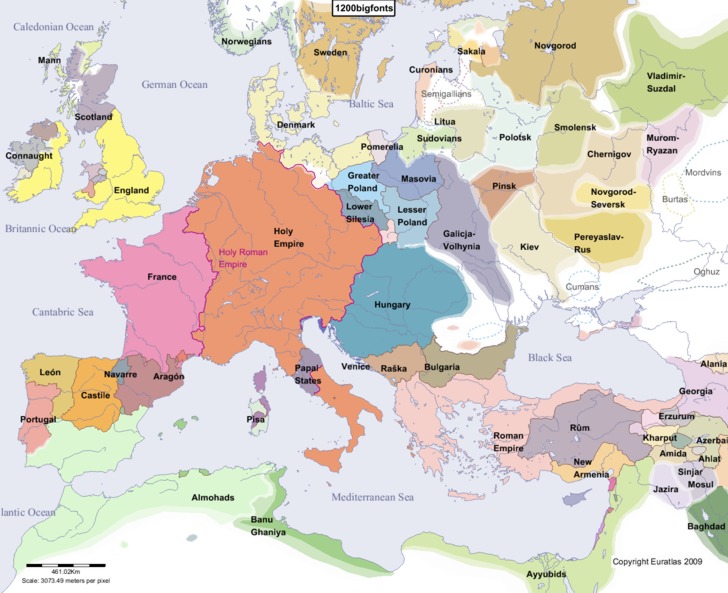
By inheritance and marriage, Frederick inherited a huge amount of territory.  He had the possibility of ruling over both the Holy Roman Empire and the Kingdom of Sicily.  You can see on the map the amount of territory he potentially could control (the big orange blob in the middle, including central-southern Italy and Sicily itself)

This fact in itself posed a threat to the Church’s vision for Europe.  The Church wanted to create a Christian community in Europe where people’s primary identity would be “Christian,” and not “English,” or “French.”  Concentration of power might mean that a ruler could challenge that general identity.  Too much power might result in more conflict as other states challenged or resisted that power.  Frederick’s vast holdings by definition challenged the Church’s concept of Europe, but also the feudal concept of everyone sticking to their own ‘sphere’ of influence.  Quite simply, he had too many slices of the pie to himself.

Frederick II with Al Kamil MuhammadSome called Frederick, “The Wonder of the World.”  He imported animals from exotic places and created the first zoo in Europe.  He wrote the standard manual for the sport of hawking, a medieval sport that required a great deal of patience and careful observation.  He spoke many languages, even Arabic, and often conversed with Moslem scholars.

Others called him, “The Anti-Christ.”  He founded the first university in Europe that was distinctly secular in nature.   Various popes consistently opposed him, and eventually Frederick struck back, murdering 120 bishops en route to a church council Frederick believed would rule against him.  Pope Innocent IV declared war on Frederick.  When some of Frederick’s subjects rebelled, Frederick turned ruthless, putting captured rebels in burlap sacks with poisonous snakes, and throwing them into the river.

The Pope eventually called off the war against him, though Frederick died shortly after and so could not savor the fruits of his ‘victory.’  Frederick’s reign reveals that the Medieval synthesis had cracks, cracks that would widen into the next century.  By choosing to oppose Frederick, the Church had to wade even further into politics than they usually did.  They spent a lot of their moral capital doing this, and failed in the attempt.  In the next few weeks we will see the ripple effects of this as the Church’s hold over society weakened.

The “successful” challenge of Frederick did not just have to do with Frederick, but with the Church’s own actions at the time.  In all ages the Church must decide the extent to which it should enter the political arena in order to try and achieve some common good.  If you accept Augustine’s interpretation of the world as “The City of Man,” this always involves risk.  What can or should be done in order to influence “the good” in a purely political sense?  For example, in Frederick’s youth his relatives Otto and Philip fought a civil war over the power inherent in his throne.  Pope Innocent III waded into the controversy, wanting to obtain the best possible advantage he could for the Church and the territorial integrity of the Papal States.  He initially supported Otto, who pledged not to extend his power into Sicily should he win.  But when the war’s events showed that Otto would lose, Innocent III switched his allegiance to Philip, hoping at the last moment to salvage something.  But then Philip died, leaving Otto the winner by default.  Innocent III switched his allegiance again back to Otto, whereby Otto reneged on his original deal and marched his armies into Sicily after all while Innocent stood by helpless.  I think Innocent III had good intentions, but the proof is in the pudding — he was way out of his league, and the prestige of the Church suffered.  It appeared to be one political faction among many, and a losing one at that.

Next week we will have some fun with medieval medicine.

Blessings,

Dave

12th Grade: Democracies and Radicalism

NGreetings,

After 8 sessions, this week we wrapped up our own in class Peloponnesian War Game, which the seniors do every year with this unit.  We divided the class into five different teams:

– Athens           – Chios (Athenian Ally)

– Sparta             – Corinth (Spartan Ally)

– Persia, the Wild Card

Each of the years this game has been played I have seen slightly different outcomes each time.  A usual pattern, however, has Athens try and keep a tight leash on Chios to prevent them from rebelling (which Chios, if it wants to win big, must do).  Persia usually wants to sponsor Chian independence and use their military for themselves.  Thus, Athens becomes Persia’s clear enemy.

This year Persia ended up as probably the biggest winner, with Chios and Corinth scoring victories as well, albeit lesser ones.  Both Athens and Sparta ended up destroyed.

In our debrief of our game, we touched on a few key concepts. . .

  • I admitted to the class that Athens has the hardest job of any of the combatants.  At the start of the game no one likes them and their ally has a strong incentive to rebel.  With all of the power and money, they are vulnerable. The only way Athens can win big is through ruthlessness.  If they wish to ‘guarantee’ survival, their only other option is “repentance” and generosity right from the start.
  • Most Athenian teams don’t realize this at the start of the game, however, and initially pursued a “strong” course of action.  Then later they attempted to be nice to their ally, but by then it was too late.  A middle course of action usually ends up in defeat for Athens.
  • Sparta too had the dilemma of how to utilize its ally.  In the end they trusted them too much and paid for it dearly.  How one can deal with allies that don’t like you is something we discussed, and something that faces us know in the mid-east.

The outcome of our own war-game resembled the actual war in a variety of ways.  Though Sparta won the actual conflict, their victory doomed them to eventual defeat as the war both exhausted them and stretched them too thin in victory.

In the end, I hope the students had fun, and I hope they saw the connections between economics, diplomacy, and fighting

Last week we had a discussion on the idea of fringe opinions and whether or not they benefit democracy. This question came from their homework on Thucydides’s famous passage on the revolution in Corcyra during the Peloponnesian War.  Among some of the ideas usually put forth are:

1. Fringe opinions are generally bad, but inevitable if you want to have a democracy.

2. Fringe opinions are not bad or good because they have no impact.  The vast meat-grinder that is American society softens whatever fringe opinion comes along before it goes mainstream.

3. Fringe opinions are bad, because those who hold then generally are not open to debate, dialogue, and compromise, all of which are essential to a democracy.

4. Radical fringes usually harm no one but a select few and pose no real threat normally.  But in times of great national stress or emergency, they become much more dangerous, as their appeal grows exponentially.

We also discussed what we meant by “fringe opinion.”  Is what makes an opinion “radical” the idea itself, or the number of people who espouse it?  Can the majority hold a “fringe” opinion?

Should any safeguards be taken against fringe opinions?  Many European nations ban the Nazi party, for example, but not the United States.

Obviously we do not face a civil war to the death in our midst, and are nowhere close to the polarization Greece experienced during the Peloponnesian War.  But do have any reason for concern?  These graphs might give us pause.  The first shows the increase of straight party voting over the years, that is, the increase of Democrats only voting with Democrats and Republicans with Republicans.

The second shows the ideological distance between the parties. . .

And finally, the rise of presidential Executive Orders.  If Congress stops working the rise of executive power seems inevitable. . .

Many thanks!

Dave Mathwin

Here is the text the students worked through:

The following is from Thucydides, who comments on the revolution in Corcyra in Book 3, chapter 8

For not long afterwards nearly the whole Hellenic world was in commotion; in every city the chiefs of the democracy and of the oligarchy were struggling, the one to bring in the Athenians, the other the Spartans. Now in time of peace, men would have had no excuse for introducing either, and no desire to do so; but, when they were at war, the introduction of a foreign alliance on one side or the other to the hurt of their enemies and the advantage of themselves was easily effected by the dissatisfied party.

71 And revolution brought upon the cities of Greece many terrible calamities, such as have been and always will be while human nature remains the same, but which are more or less aggravated and differ in character with every new combination of circumstances. In peace and prosperity both states and individuals are actuated by higher motives, because they do not fall under the dominion of imperious necessities; but war, which takes away the comfortable provision of daily life, is a hard master and tends to assimilate men’s characters to their conditions.

When troubles had once begun in the cities, those who followed carried the revolutionary spirit further and further, and determined to outdo the report of all who had preceded them by the ingenuity of their enterprises and the atrocity of their revenges. The meaning of words had no longer the same relation to things, but was changed by them as they thought proper. Reckless daring was held to be loyal courage; prudent delay was the excuse of a coward; moderation was the disguise of unmanly weakness; to know everything was to do nothing. Frantic energy was the true quality of a man. A conspirator who wanted to be safe was a recreant in disguise. The lover of violence was always trusted, and his opponent suspected. He who succeeded in a plot was deemed knowing, but a still greater master in craft was he who detected one. On the other hand, he who plotted from the first to have nothing to do with plots was a breaker up of parties and a poltroon who was afraid of the enemy. In a word, he who could outstrip another in a bad action was applauded, and so was he who encouraged to evil one who had no idea of it. The tie of party was stronger than the tie of blood, because a partisan was more ready to dare without asking why. (For party associations are not based upon any established law, nor do they seek the public good; they are formed in defiance of the laws and from self-interest.) The seal of good faith was not divine law, but fellowship in crime. If an enemy when he was in the ascendant offered fair words, the opposite party received them not in a generous spirit, but by a jealous watchfulness of his actions.72 Revenge was dearer than self-preservation. Any agreements sworn to by either party, when they could do nothing else, were binding as long as both were powerless. But he who on a favourable opportunity first took courage, and struck at his enemy when he saw him off his guard, had greater pleasure in a perfidious than he would have had in an open act of revenge; he congratulated himself that he had taken the safer course, and also that he had overreached his enemy and gained the prize of superior ability. In general the dishonest more easily gain credit for cleverness than the simple for goodness; men take a pride in the one, but are ashamed of the other.

The cause of all these evils was the love of power, originating in avarice and ambition, and the party-spirit which is engendered by them when men are fairly embarked in a contest. For the leaders on either side used specious names, the one party professing to uphold the constitutional equality of the many, the other the wisdom of an aristocracy, while they made the public interests, to which in name they were devoted, in reality their prize. Striving in every way to overcome each other, they committed the most monstrous crimes; yet even these were surpassed by the magnitude of their revenges which they pursued to the very utmost,73 neither party observing any definite limits either of justice or public expediency, but both alike making the caprice of the moment their law. Either by the help of an unrighteous sentence, or grasping power with the strong hand, they were eager to satiate the impatience of party-spirit. Neither faction cared for religion; but any fair pretence which succeeded in effecting some odious purpose was greatly lauded. And the citizens who were of neither party fell a prey to both; either they were disliked because they held aloof, or men were jealous of their surviving.

Thus revolution gave birth to every form of wickedness in Greece. The simplicity which is so large an element in a noble nature was laughed to scorn and disappeared. An attitude of perfidious antagonism everywhere prevailed; for there was no word binding enough, nor oath terrible enough to reconcile enemies. Each man was strong only in the conviction that nothing was secure; he must look to his own safety, and could not afford to trust others. Inferior intellects generally succeeded best. For, aware of their own deficiencies, and fearing the capacity of their opponents, for whom they were no match in powers of speech, and whose subtle wits were likely to anticipate them in contriving evil, they struck boldly and at once. But the cleverer sort, presuming in their arrogance that they would be aware in time, and disdaining to act when they could think, were taken off their guard and easily destroyed.

Now in Corcyra most of these deeds were perpetrated, and for the first time. There was every crime which men could commit in revenge who had been governed not wisely, but tyrannically, and now had the oppressor at their mercy. There were the dishonest designs of others who were longing to be relieved from their habitual poverty, and were naturally animated by a passionate desire for their neighbour’s goods; and there were crimes of another class which men commit, not from covetousness, but from the enmity which equals foster towards one another until they are carried away by their blind rage into the extremes of pitiless cruelty. At such a time the life of the city was all in disorder, and human nature, which is always ready to transgress the laws, having now trampled them underfoot, delighted to show that her passions were ungovernable, that she was stronger than justice, and the enemy of everything above her. If malignity had not exercised a fatal power, how could any one have preferred revenge to piety, and gain to innocence? But, when men are retaliating upon others, they are reckless of the future, and do not hesitate to annul those common laws of humanity to which every individual trusts for his own hope of deliverance should he ever be overtaken by calamity; they forget that in their own hour of need they will look for them in vain.

“Liberty . . . skulking in dusty Corners. . .”

As a juior-high and high school student I had always enjoyed history.  But by the time I attended college I had developed an exhaustion with the American story.  How this happened I don’t really remember, but I assume it had to do with a constant repetition of familiar themes.  In college my European/World History teacher had a more dynamic and engaging lecture style than my American History teacher, and he found me perfectly willing to focus on something else, anything else, other than  yet another rehash of the American Revolution and the Civil War.

Some years ago I realized my need to get reintroduced to our own tradition and have been very glad to find authors like James McPherson and Bernard Bailyn.  Neither are “revisionist” in their approach, but both give a freshness to familiar ground that has made American History intriguing for me again.

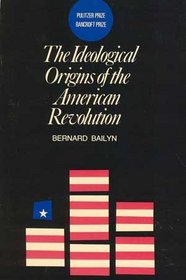
Bailyn’s The Ideological Origins of the American Revolution is his most famous work, and justly so.  Most treatments of this period focus on the legal case for and against the colonists, but Bailyn focuses on the psychological as well as the ideological aspects of the revolutionary’s thought.  I thought his keenest insight revolved around the psychological perceptions of the colonists. Revolutionary pamphlets focus far more on the state of liberty in general, rather than the particular musings of say, John Locke.  In short, the colonists believed that “Liberty” itself was in danger, and that given England’s failings, it had fallen to them alone to defend it.  This helps us understand why the Declaration of Independence did not focus on “American” or “British” rights, but “self-evident” human rights.

“Liberty” for the colonists was inherently passive, in need of a defender.  Hence the moniker, “Lady Liberty.”   Liberty needed careful cultivation, whereas power grew naturally like a weed.  “Power” had an inherent aggressiveness for the colonists that needed constant vigilance to hold at bay.  This attitude of the colonists made them inherently suspicious of the British, who seemed far too cavalier in their approach to liberty.  This alarmed many colonists, for Britain alone in the world seemed to stand for liberty.  As one colonist wrote in a charged tract, liberty had been reduced in the world to “skulking in dusty corners,” and would cease to exist at all if the colonists did nothing.  Bailyn believes that this attitude, more than Locke or Montesquieu, had the most influence in bringing about the Revolution.  This belief sounds a bit paranoid today, but outside of England no democratic state existed in Europe.  And with George III’s desire to make his stamp on England, even the stalwart British parliament seemed to suffer.  Observers of the political scene from America also had the same reaction as the British painter Hogarth, who lambasted the politics of his age.  Frontier American idealists could never stomach the crassness of an older, more cynical and tired political machine.

Hogarth: "Canvassing for Votes"

I do wonder what I would have thought had I lived in those times.  I believe the colonists were technically correct about the immediate questions of taxation and self-government that divided them and the British, and assume I would have thought so then.  But the British could hardly be described as cruel oppressors or outrageous occupiers.  I can see myself not understanding why legal trump cards warranted a bloody and uncertain war.  Maybe sharing their belief about the imperiled state of liberty might have changed my mind, but I have my doubts.

You need such passion to make revolutions, but this passion is also the Catch-22 of nearly every change of government.  That the American revolution stabilized itself relatively quickly with only  (relatively) minor political fall-out still distinguishes it from the French, Russian, and most every other revolution.  James Madison’s notes on the Constitutional Convention give us one key to why this happened.  In the tense and uncertain aftermath of their independence they managed to fairly discuss big and small picture questions with insight and humor.  Some of this “fairness” led to the tragic “3/5 Compromise” and doomed us to deal with the slavery issue at much greater cost later.  But all in all, it makes for instructive and even entertaining reading today.

The Federalist Papers have the good sense and clarity of the Convention debates, but not the entertainment value.  What makes the Anti-Federalist papers more enjoyable than their counterparts is that their objections to the Constitution reveal a keen understanding of the consequences of the Constitution for the country, which we take for granted living 200 years on the other side of their decisions.  They could see, for example, that the Constitution would mean an increased federal government and a diminished role for the states.  They accurately prophesied the results of giving the president full powers as commander-in-chief.  I don’t think we should view the Federalists as “right” and the Anti-Federalists as “wrong” or vice-versa.  Both sides were “right” in the sense that they had an accurate appraisal of the impact of accepting the Constitution. Both sides viewed liberty in much the same way, but Federalists saw a stronger national government built on the foundation of “the people” as bulwark to liberty, and the Anti-Federalists disagreed.

So why did the “Anti-Federalists” fail?  Among other things, they lacked the clarity and focus of Madison and Hamilton’s writing. But this may have been inevitable because they never had time to organize or communicate as the Federalists did.   No doubt this caused resentment and frustration.  Not all issues got perfectly resolved, and this must have impacted the causes of the Civil War.  With prescience, some Anti-Federalists strongly objected to the allowances for slavery made by the Constitution, and believed that the presence of slavery would doom the cause of liberty and the new Republic.  But on the flip side, wouldn’t we need a strong national government to remove slavery in the various states?

If nothing else, it is refreshing to see that the dilemma’s we face today have a precedent in our past.  To paraphrase Jacques Maritain, we must know our tradition that we might fight against it, and thereby renew it for each subsequent generation.

Democracy and Inequality

Though I have never read her book, several years ago I listened to an interview with Loretta Neopoltani, author of Rogue Economics.  The interview ranged over many topics, but the central theme remained constant.  We rightly celebrated the fall of the Soviet Union and the collapse of communism in Europe.  We trusted that this event would bring about the spread of freedom and democracy into places where it had not visited for many years.  So far, so good.

What Neopoltani stressed, however, is that this was not the whole story.  History tells us that in every significant breakdown of major power structures, rogue elements (be they ancient or modern day barbarians) will always have the advantage.  The shift towards democracy will be painful and slow.  The law-making process will always plod along.  Not only that, the spread of freedom means the spread of opportunity.  And since chaos comes easier than order, nascent democracies will see the rise of exploitation and even slavery.  Historically, we can think of the rise of slavery in the Renaissance after the Black Plague decimated feudalism, or the increase of slavery in the south after the American Revolution.  In more recent times we see the rise of the sex-trafficing industry from Eastern Europe after the fall of communism.

All this raises the question in general of democracy’s relationship to inequality.  Perhaps democracy merely grants opportunity, which can be used for good or ill.  Is democracy able to practice what it preaches?

Recently authors Daron Acemoglu and James Robinson published this article with links to other studies within it.  They reach mixed conclusions, stating that while democracy does transfer power away from elites, it may not do much to reduce inequality.   When confronted by this, we can reach one of two basic conclusions:

  • We can be hopeful/naive (depending on your point of view) and think that in time, democracy can learn to create a truly free and equal society.  Those of a more liberal/progressive bent might hope that increased government action, done with popular support, could help us achieve this.
  • Or we can believe as De Tocqueville did, that democracies must choose between liberty and equality, for they cannot have both in equal measure.  Liberty unchecked would create winners and losers, with the possibility of vast gaps in between.  Pure equality could grant no liberty to anyone to step out of line or distinguish themselves from their fellow men.  You cannot be married and single at the same time.  If we want a society with opportunity and liberty, we must tolerate and expect some kinds of inequalities.  C.S. Lewis began his excellent essay, “On Democratic Education” with these words (the whole essay is here),

Democratic education, Aristotle says, ought to mean not the kind of education democrats like, but the kind that will preserve democracy.

I find this analysis persuasive, and it may be one of the keys to understanding the chaos of the French Revolution, which proclaimed “Liberty, Equality, and Fraternity” for all.  These opposing ideas would inevitably create chaos and dissension even with the revolutionary leaders themselves.  We see this rift even at the very top of the revolutionary elite between Danton and Robespierre.

Hardly anyone, however, wants to choose between these two options, and perhaps with good reason.  We should reject radical redistribution, but democracy cannot exist without a healthy middle class.  Aristotle wrote in his Politics,

Now in all states there are three elements: one class is very rich, another very poor, and a third in a mean. It is admitted that moderation and the mean are best, and therefore it will clearly be best to possess the gifts of fortune in moderation; for in that condition of life men are most ready to follow rational principle. But he who greatly excels in beauty, strength, birth, or wealth, or on the other hand who is very poor, or very weak, or very much disgraced, finds it difficult to follow rational principle. Of these two the one sort grow into violent and great criminals, the others into rogues and petty rascals. And two sorts of offenses correspond to them, the one committed from violence, the other from roguery. Again, the middle class is least likely to shrink from rule, or to be over-ambitious for it; both of which are injuries to the state. Again, those who have too much of the goods of fortune, strength, wealth, friends, and the like, are neither willing nor able to submit to authority.

The evil begins at home; for when they are boys, by reason of the luxury in which they are brought up, they never learn, even at school, the habit of obedience. On the other hand, the very poor, who are in the opposite extreme, are too degraded. So that the one class cannot obey, and can only rule despotically; the other knows not how to command and must be ruled like slaves. Thus arises a city, not of freemen, but of masters and slaves, the one despising, the other envying; and nothing can be more fatal to friendship and good fellowship in states than this: for good fellowship springs from friendship.

When the gap between the wealthy and everyone else grows too great, must we then rely on some form of redistribution to balance the scales?  And if so, who would possess the wisdom to decide how much redistribution, and from whom, should take place?  That process could cause just as many problems as the problem itself.

Ultimately Aristotle, with his emphasis on friendship, and De Tocqueville, with his emphasis on the necessity of virtue to secure freedom, have it right.  If the rich practice avarice, and the rest of us covet, we will be left with neither democracy nor liberty.  Liberty itself can only create opportunities, not virtue.

Rich vs. Roach

In my teen years I purchased the album Rich vs. Roach, where two of the greatest drummers of the 50’s-60’s played together with the same band.  The highlight track for me was their drum battle “Figure Eights.”  If you wish, listen below, and see who you prefer.  Rich begins, with Roach following.

When I bought the album I had heard of Buddy Rich before, but had no idea who Max Roach was.  I remember my early listens to this particular track.  I thought Rich stole the battle hands down.  I preferred his crisp, clear sound to Roach’s looser and lower drum tuning (and still usually do).  But above all Rich’s speed and unequaled technique shone so strongly that I had no idea why Roach bothered to show up.

After several years, I finally listened to the track again.  Maybe it’s middle age, or maybe it’s my passive-aggressive nature taking a pot-shot at my youth, but I hear their drumming differently now.  Now Roach impresses me far more than he did previously.  Now I hear Roach propelling the stylistic changes throughout the duet.  Roach also varies his playing more than Rich, who tends to rely on pure speed to “get by.”

I have no desire to belittle Buddy Rich, who deserves his status as one of the great drummers of all time.  But this piece made me realize that Rich has limitations to his greatness.  He had immense energy that got all that could be humanly got out of the bands he led.  And his speed, his speed, go beyond what seems humanly possible.

But while his speed and energy has deep penetration, his style also has a narrow bandwidth. For example, Rich approached the played drums like a sprinter in a race, and would never  have looked sideways enough to come up with the rhythm Roach invents on this Bud Powell song.

Rich began his career as a young boy in vaudeville where all the gags had to be big and broad to connect with the audience.  Rich never really seemed to get away from this “need” for the big finish, or the broadness of the musical stroke.  In the 70’s, Rich’s bands moved away from the traditional big-band/jazz sound and towards funk.  I very much admire his ability to change styles, but the music is desperately square, though sometimes delightfully so.  It is Vaudeville Funk — entertaining, but . . . not funky.

Though I have never read a biography of Rich, perhaps he always remained a showman at heart.  This meant that his greatness would only be a type of greatness, and he could not be the “Greatest” of all time, if such a title is possible to give out.  Roach had the creativity Rich lacked, but did not possess Rich’s blaze of pure adrenaline.

Particularity in Creation

You do not have to be a Bruce Springsteen devotee to enjoy this career retrospective from Grantland’s Stephen Hyden.  Like his heroes Woody Guthrie and John Fogerty, Springsteen has crafted a true “American” sound that naturally appeals to a mass audience, and he deserves the fun and deferential treatment linked above.

Springsteen’s career spans more than 30 years, but most of what I really enjoy from him comes from his “classic” period (1973-1984).  In this era, Springsteen tackled big themes of life, but he often did so through narrowing his focus to specific people in specific situations.  His songs have depth.  But my favorites also have playfulness and humor, “Cadillac Ranch,” “Rosalita,” and, “Darlington County” (I know it’s an odd choice, but as a bonus it does have one of my favorite Max Weinberg drum fills at the 3:31 mark).

I do think that as time has gone on, Springsteen has drifted away from this songwriting approach, trending towards tackling big themes in his lyrics.  Then, without a particular story to give context to his theme, he is left with vague phrases that need an extra measure of emotional, sweeping music to try and make the idea stick.  Commenting on The Rising, Hyden writes,

. . . [here we have] my least-favorite version of Springsteen — the one where he’s in message-driven stump speech mode. This is a record about Big Themes being thrust upon little people, as opposed to records like Nebraska and Born in the U.S.A., which explored the lives of little people in order to illuminate the Big Themes lurking in the background.

I also felt similarly about his recent effort, Wrecking Ball, where Springsteen pushed his particular brand of politics to the forefront.  This disappointed me not so much because I tend to disagree with his politics (from what I understand them to be) but because Springsteen is one of the few national artists capable of bringing many different kinds of people together.*

I sent the article to a bigger Springsteen fan than I and he agreed with the quote above, but with distinct reservations.  Sometimes, he argued, the big abstract theme can work in art.  Sometimes great art can have a distinctly didactic character.  I thought about that, and wondered if it is was true.

Ultimately the Incarnation itself gives the best justification for art.  In Christ we have that which is most ineffable (God the Father) has clear, definite, and particular expression (Heb. 1).  Before Christ God communicated not in abstract principles such as love, or justice, but in stories, the temple, laws, focusing on  a particular people in a particular place.   I think this leads us to think that great art will have similar characteristics.  It will have great “abstract” meaning precisely because it has roots in something tangible.  Of course Christianity has symbols, like the Cross, but again, the Cross refers to something concrete and historical, as opposed to the yin-yang symbol of Chinese philosophy, which refers to an abstract idea.  One might also think of Moslem art, which arises in a religious ideology without the Incarnation to affirm creation, and so often turns to abstractions.^^

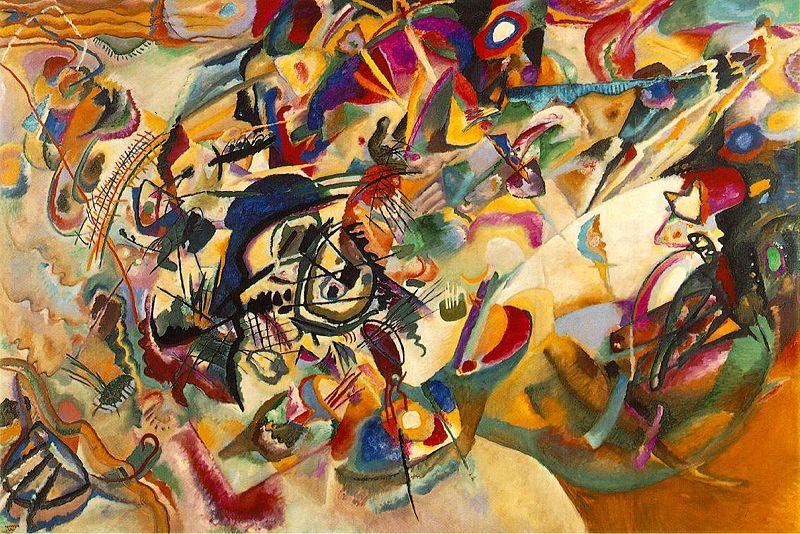
If we follow this line of reasoning, however, it would mean that abstract art could never reach the status of “great art.” I am not willing to declare this.  We cannot say that no abstract art can be great.  I do find artists like Mondrian and Kandinsky, for example, to possess a degree of communicative power.

Kandinsky

I can see skill, and I am moved.  But in what direction?  The flight of abstraction ultimately leaves my initial feeling nowhere to go, and it peters out.  Who could know that Kandinsky’s piece has the title “World War I?”

Picasso may be called the greatest of modern artists, and certainly he dealt in abstraction.  But I find that his abstraction works best when applied to something specific, like Guernica.

40-12-17/35

And I find his drawings of horses much more compelling than some of his more abstract work.

article-1334091-0C48090D000005DC-107_634x450

I don’t feel that any of the great abstract artists can rival some of the past masters.  For example, Carravaggio painting “The Calling of Matthew” works much better then if he painted something called “Redemption.”

23conta

And Kandinsky’s “World War I” abstraction can’t match the power of Rembrandt to reveal the universal from someone particular:

So while I will not declare that abstract art can never be great, I would argue that achieving greatness with this approach will come with great difficulty.  Finally, I would suggest that “contextualized” art (to coin a phrase?) will have a much greater range of impact than abstract art.  For example, I can’t imagine the possibility of a joke in abstract creations.  But unleash Springsteen’s “particularity” side and you see his comedic potential, i.e. “57 Channels (and Nothin’ On).”

Pure abstract art, then, really lacks even a didactic character, because it has no grist for the mill, it dissipates in the air.  I am reminded of Springsteen’s “Land of Hope and Dreams,” (of off The Rising), where “faith is rewarded.”  But faith in what?  The song pulls out all the stops for 9 1/2 minutes but leaves me flat nonetheless, like the sound of one hand clapping.

Perhaps I have drifted dangerously beyond my art knowledge, however, and would welcome any comments.

*I wonder if we can trace this shift in Springsteen to his on-again off-again relationship with the E Street Band since Born in the U.S.A. gave him superstar status.  In distancing himself somewhat from his own particular community (as well as becoming quite wealthy), did he then find it harder to connect with “particularity” in his songs?

^^Abstract pattern art can often have a very nice effect, I think, in decorating people (ties, necklaces, scarves, etc.), but less well decorating a blank canvas.  I acknowledge also that Persian rugs (in the Islamic tradition) can look nice in homes.  But both homes and people have a built in context in which the abstractions can fit.

Christians have occasionally used abstractions — the “Book of Kells” for example.  Here again, I think the abstractions work because they accompany something specific.

Christ Enthroned

“Reason and Revelation in the Middle Ages”

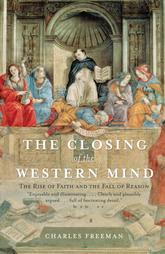
I sometimes wince at my facile attempts to appear the scholar, both on this blog and in other areas of life.  My small comfort amidst these failures comes only in that I usually know more than most 16 year olds (. . . usually).  But even I, a pretend scholar, know enough to dismiss  a book like The Closing of the Western Mind, where the author asserts that 138929the concept of “Faith” destroyed the venerable goddess “Reason” in the medieval era.  Such a perspective can only come with willful ignorance of the most obvious facts about medieval life, and blatant misunderstanding of men like Thomas Aquinas, Duns Scotus, and a host of others.  It assumes that we moderns are smart, those in the past, dumb.

But I also abhor the opposite fault, though it only appears to be its opposite.  This approach seeks to prove desperately that, “The medievals were much like us, they used reason too, see, see, see!”  But this attitude pays no compliment to the medievals, for once again the modern world forms the foundation of all his cares.  I have commented on this attitude in reference to Herbert Butterfield’s  The Whig Interpretation of History, so I will not belabor that again here.

61lL5hzAdeLIn rides Etienne Gilson to split the horns of this dilemma with his eminently accessible Reason and Revelation in the Middle Ages.  Gilson outlines three distinct approaches the medievals took to the dilemma of reconciling faith and reason, and the strengths of each.  He does not favor one over the other (overtly at least) so much as provide a framework to view each more or less objectively.

Gilson begins with what he calls the Augustinian approach, whereby we “believe, that we might understand.”  This approach put heavy emphasis on “faith,” but “reason” for Augustinians could ride comfortably in the backseat with faith at the helm — hence Augustine’s healthy admiration for Plato.  But Augustinians had their subtle differences, which Gilson summarizes masterfully by writing,

In short, all the Augustinians agree that unless we believe we shall not understand; and all them agree as to what we should believe, but they do not always agree as to what it is to understand.

No better summation of the Augustinian school of thought exists.

Another school of thought put reason in the driver’s seat, and surprisingly, most proponents of this approach were Moslems, especially Averroes.  This did not really catch on in the Christian west, with a few possible exceptions (maybe Abelard).  Gilson avoids commenting on why, but I will speculate that this approach failed in the West because

  • The Christian west understood that this relationship between faith and reason had no real Biblical foundation, and . . .
  • This approach might have much more appeal to Moslems because one could describe Islam as Christianity dumped of all its mystery (The Trinity, incarnation, crucifixion, resurrection, etc.).  These core Christian doctrines should not be viewed as irrational but supra-rational.

Most interesting to me was Gilson’s explanation of the third Medieval way, typified by St. Thomas Aquinas.  For Aquinas, faith and reason co-existed peacefully because they lived in separate houses, whereas Augustine had them in the same house but on different floors.  For Aquinas, God granted reason its own kingdom apart from faith, though its domain had less value and less magnificence than faith.  Therefore, we don’t have to worry about the relationship between faith and reason because they have no real relationship, though both have their place.

I think I fall in the Augustinian category, but Gilson’s firm command of the material and easy and natural writing style will make me return at some point to consider Aquinas’ alternative.

“A History of Future Cities”

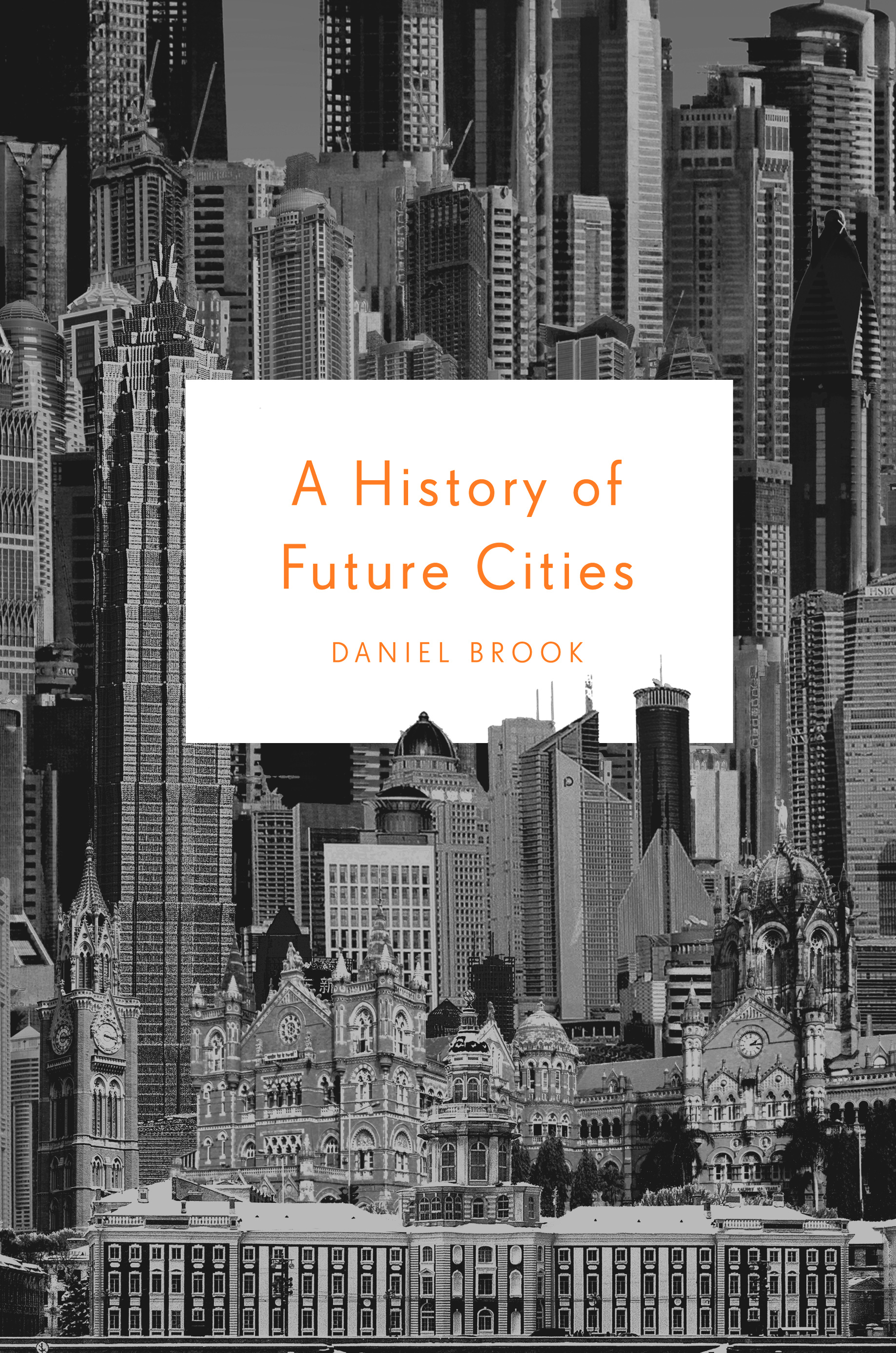
I couldn’t help but be impressed by the clever title of this book.  I judged it initially by its cover, and it mostly did not disappoint.

Author Daniel Brook looks at four different cities, St. Petersburg, Shanghai, Mumbai (Bombay), and Dubai.  Though they span a few centuries each city has some core traits in common with the other.

  • Each city arose directly from either contact with foreign populations (Shanghai, Mumbai), or was specifically designed to open the world to the world at large (St. Petersburg, Dubai).
  • Because of this, each city has a somewhat artificial character.  Neither can claim to be created from within history.  Rather, they stand as attempts to impose history on the country itself.
  • Each city has a distinct cosmopolitan flair (Arabs in Dubai, for example, comprise only about 10% of the population, depending on how you measure), and a somewhat freewheeling ethos.

The title hints at a number of themes for this book.

While I don’t think that Russia will play a significant role in shaping the 21st century, I agree that the cities of the near future will resemble St. Petersburg.  These cities will be “global” cities oriented towards those outside rather than inside them.  Peter the Great built his city to force a kind of westernization/globalization upon Russia, which resembles the motives of Dubai  today.  This fits with globalization in general.

The other three cities represent the possible impact that China, India, and the Mid-East will have on the world.  While the Mideast cannot equal them in terms of population, they can in terms of opportunity.  Much of this region has no access to markets, yet with oil the region has no shortage of cash.  The possibilities for future growth for the Mideast remain high.  Everyone knows of China’s rise, and India’s surge as the next big economic powerhouse always seems just around the corner.

Brook does a good job dealing with the energy and potential in each of these cities.  But big questions about the limits of these kinds of cities remain, and while Brook deals with the problems as well as the promise, I would have preferred more treatment of the negative side of the coin.

Because of the artificiality of these cities, neither has an authentic culture to call its own.  And because each of these cities run only skin-deep, the impact on their surrounding regions may be minimal.  Many feel that the more open and cosmopolitan the Mideast becomes, the better off the world will be.  But how impressed will the average Arab be with a city bought with Arab money but made by foreigners?  How impressed should they be?  We have already seen the minimal impact of  St. Petersburg on Russia. Three centuries later the country still has strong authoritarian roots.  Moscow, not St. Petersburg, moves Russia.  Mumbai impresses many at first glance, but tourists then and now use the city as a gateway to the “real” India.

At a deeper level the question about whether we can impose our will upon history remains.  Personally, I doubt whether we can do this.  These cities seem dedicated to the belief that markets will bring fundamental change, but the truly lasting things happen in an organic way with deep roots.  Something of our humanity as “made in the image of God” will eventually shine through and prove that we are motivated by more than mere economics, that we are more than merely acquisitive animals.*  And when this happens, the impact these cities have and the role they play in their respective countries will get diminished.

In raising these questions, Brook calls into question the whole project of the 21st century market state.  Will our modern project bring real change or be nothing more than a curious historical side-show?  Perhaps A History of Future Cities can give us a clue.

*Marxists and pure free market capitalists on the surface are mortal enemies, but if one probes a bit, we see that both share the common trait of giving absolute value to economics — one to the fatalism of class warfare, the other to what some might call the fatalism of the invisible hand of the market.

“. . . but in the western world today the number of souls who testify by their actions to a conscious or unconscious conviction that Economic Necessity is Queen of All is vastly greater than the number of professing Marxians, and would be found in fact to include a phalanx of arch-capitalists who would repudiate with horror and indignation any suggestion that they were fundamentally at one, in the faith by which they lived, with the prophet of Communism.” — Arnold Toynbee

12th Grade: Security Paradigms for a New World

Greetings,

This week we continued building towards our mid-term project by looking at three different paradigms of how security is best achieved.

1. The ‘Zero-Sum Game’ or ‘Mercantile’ Paradigm

The Mercantile approach to security will tend to see the strength of other nations as our weakness.  There is an inverse relationship between our power and those of others.  Thus, this approach will see the rise of China as an overall threat to the relative power we hold, for example.  If others ‘stay down’ we by definition remain ‘on top.’

Mercantilists tend to value ‘defense’ over ‘engagement.’  Most would probably seek to pull back from our involvement in the world.  Some might stress an ‘America First’ mentality.  Thus, there could be a curious union between, say Libertarian Conservatives like Ron Paul who want to pull back America’s military, and unions, usually associated with liberal politics, who want to “keep jobs in America.”

2. The “Rising Tide Raises all Ships”  or “Entrepreneurial” Paradigm

Just as a business wants economic growth for all, so too might a nation want general international growth.  The better off other nations are, the better off all of us can be.  Stronger nations, for example, might lead to stronger governments, which could in turn lead to less terrorism. Greater economic ties and synergy would profit us, and even greater military power could lead to sharing security burdens.  This approach, for example, would see a growing China as an opportunity rather than a threat.

Perhaps the strongest exemplar of this school of thought would be Thomas Barnett, who wrote the famous The Pentagon’s New Map back in 2003.  Among his more controversial assertions, he argued that,

  • The Department of Homeland Security was a disastrous idea, taking tons of resources and using it to ‘build a wall around America.’  He wanted those resources used to further our engagement/aid in the developing world.
  • Let Iran have nukes, because a) We won’t go to war to stop them from getting it, so we might as well give it to them rather than them ‘taking it’ from us, and b) Countries with nukes inevitably have to join a club of nations like the U.S., England, India, France, China.  In other words, it would force Iran to be dragged into the “modern world.” The more engagement Iran has with us, the better.
  • With rogue nations like North Korea, the worst thing possible is to impose sanctions and further isolate them.  North Korea’s government stays in power, according to this school of thought, only because they can garner up enough “us vs. them” in the country to detract from their woeful performance in other areas.  A good punishment for North Korea would be not sanctions, but more aid, an air-drop of computers with internet, cell-phones, or something along those lines (if this is even possible).

Obviously there is a lot of difference between the Mercantile and Entrepreneurial schools of thought.  But curiously, they both agree on not being big fans of international institutions.  For the ‘Mercantilist’ these would diminish national sovereignty and for the ‘Entrepreneur’ they are too slow and inefficient.  To understand this attitude we only need to think of business’s aversion to government regulation.

3. Or perhaps you want to try and take the ‘Managerial Approach.’

In some ways this stakes out middle ground between the previous two models.   The strength of some, be it regions or nations, you see as a benefit, as is the weakness of others.  Maybe you want to weaken Asia but strengthen the Middle East, for example.

What managers love is process and rules, and so the ‘Managers’ stake their claim apart from the other paradigms by liking international institutions, be it the UN or World Bank.  They argue that such processes inevitably ‘cool our jets’ and force us to work together.  Yes, it is more cumbersome, but we will in the end have more allies that mean more to us through this process.  They see themselves as the tortoise, while the ‘Entrepreneurs’ are the hare, with the ‘Mercantilists’ being in their view, an ostrich with its head in the sand.

Of course we do not search for magic bullets.  Very few of us would want to take either of these views as far as they could possibly go.  But we have to plan and prioritize.  We should try to aid in establishing an environment where we think the most good can flourish.  As St. Augustine once said, “It is mournful work, sustaining relative good in the face of greater evil,” and this is what I want the students to consider.

On Thursday we saw’Frontline’ episode on the revolution in Egypt two years ago.  The intersection of Islam, democracy, and technology pose difficult questions for the future of our mid-east policy.  Will the ‘Arab Spring’ spread democratic ideals or give opportunities for radicals to take control?  Is the future likely bright or grim for Egypt?  We may not have the luxury of waiting and seeing.  We may need to make our best guess and act accordingly.

We see some of these tensions embedded right within Egypt’s provisional constitution.  They proclaim many things that any “western” nation would agree with, but at the same time seek to have Islam as the foundation of the state (see for example, articles 1 and 6).  This raises important questions, not only as to whether or not Islam and democracy can co-exist, but to what degree religion and democracy can co-exist.  Could a democracy also be a “Christian State.”  I include several of their constitutional articles below if you want to read for yourself and consider the issues.

Blessings,

Dave

Egypt’s Provisional Constitution, 2011

Article 1:

The Arab Republic of Egypt is a democratic state based on citizenship. The Egyptian people are part of the Arab nation and work for the realization of its comprehensive unity.

Article 2:

Islam is the religion of the state and the Arabic language is its official language. Principles of Islamic law (Shari’a) are the principal source of legislation.

Article 3:

Sovereignty is for the people alone and they are the source of authority. The people shall exercise and protect this sovereignty, and safeguard the national unity.

Article 4:

Citizens have the right to establish associations, syndicates, federations, and parties according to the law. It is forbidden to form associations whose activities are opposed to the order of society or secret or of militaristic nature. No political activity shall be exercised nor political parties established on a religious referential authority, on a religious basis or on discrimination on grounds of gender or origin.

Article 5:

Public property is protected, and its defense and support is a duty incumbent on every citizen, according to the law. Private property is safeguard, and it is not permitted to impose guardianship over it expect through means stated in law and by court ruling. Property cannot be seized expect for the public benefit and in exchange for compensation according to the law, and the right inheritance is guaranteed.

Article 6:

Law applies equally to all citizens, and they are equal in rights and general duties. They may not be discriminated against due to race, origin, language, religion, or creed.

Article 7:

Personal freedom is an natural right, safeguarded and inviolable, and except in the case of being caught in the act of violation, it is not permitted for anyone to be detained or searched or to be freedom restricted, or movement prevented, except by a warrant order compelling the necessity of investigation or to safeguard the security of society. This warrant order shall be issued by a specialized judge or the general prosecutor, according to the law. The law also determines the period for which one may be detained.

Article 8:

Every citizen who is arrested or detained must be treated in a way that preserves his/her human dignity. It is forbidden to be abused psychically or morally, and forbidden to be detained in places outside of those designated by the prisons law. Any statement proven to be extracted from a citizen under threat will not be counted.

Article 9:

Homes are protected and it is not permitted to enter or search them without a warrant according to the law.

Article 10:

The life of citizens has special sanctity protected by law, as do messages sent by post, fax, telephone, or other means of communications, where secrecy is guaranteed. It is not permitted to confiscate, read or censor them, except by court ruling and for a limited time, according to the law.

Article 11:

The state guarantees the freedom of creed, and practicing religious rites.

Article 12:

Freedom of opinion is guaranteed, and every person has the right to express his opinion and publish it spoken, written, photographed, or other form of expression within the law. Personal criticism and constructive criticism are a guarantee for the safety of the national development.

Article 13:

Freedom of the press, printing, publication and media are guaranteed, and censorship is forbidden, as are giving ultimatums and stopping or canceling publication from an administrative channel. Exception my be made in the case of emergency or time of war, allowing limited censorship of newspapers, publication and media on matters related to general safety or the purposes of national security, all according to law.

Article 14:

It is not permitted for any citizen to be denied residence in a particular area, nor requiring him to reside in a particular place, except in cases designated by law.

Article 15:

It is not permitted to expel a citizen from the country or forbid him from returning, or to give up political refugees.

Article 16:

Citizens have the right or private assembly in peace without bearing arms or need for prior notice. It is not permitted for security forces to attend these private meetings. Public meetings, processions and gatherings are permitted within confines of the law.

Article 17:

Any attack on the personal freedom or sanctity of life of citizens or other rights and general freedom guaranteed by the constitution and law is a crime, which will be followed by a criminal or civil suit according to the statute of limitations. The state guarantees fair compensation for whoever experiences such an aggression.

Article 18:

Public taxes will instituted and their amendment or cancellation will take place by law. No one will be excluded from taxation except in cases stated in law. It is not permitted for anyone to charge another pay taxes or fees except within the bounds of law.

Article 19:

Personal penalty. There will be no crime or penalty except according to the law. Punishment will not take place except by judicial ruling, nor will punishment occur for acts that take place before enactment of the relevant law.

Article 20:

The accused is innocent until proven guilty in a court of law that guarantees for him defense. Every accused in a crime is required to have an attorney to defend him.
Jacques Maritain on Democratic Education

I am grateful for the thousands of public educators who work very hard on behalf of their students.  One can always hear horror stories in the news about disaffected and bored teachers, but the overwhelming majority of those I’ve met have cared deeply about their students and do their best in the classroom.

I also see some signs of hope in what seems to be a general backlash against standardized testing brewing amidst some of our best educators.  But even so, teachers in the current bureaucratic environment cannot help but be impacted by the mentality of standardization.  I know of students who received A’s on assignments for having “great facts!” though these facts gave no overall understanding to the period studied.  Another assignment I know of requires students to photograph themselves involved in a variety of environmentally beneficial activities, be it recycling, picking up litter, or not clubbing baby seals.

Decades ago Jacques Maritain prophesied this in his thoughts on democratic education.  Maritain had a long and maritain_jacquesdistinguished career as a theologian, philosopher, and social critic.  Even in the 1950’s Maritain astutely observed the shift occurring in education as it related to the rest of society.

Society’s trend toward specialization bothered Maritain, and he predicted two adverse effects this would bring to education.  Our concept of “knowledge” would be the first casualty.  He wrote,

If we are concerned with the future of civilization, we must be concerned primarily with a genuine understanding of what knowledge is: its values, its degrees, and how it can foster the inner unity of the human being.

Restricting knowledge to isolated facts loses the unity, that is, the narrative unity, of whatever we may study.  This is why we cannot reduce westward expansion to a few bullet point facts about railroads and farming.  Complete specialization in general cuts us off from part of our humanity.  We lose the essential symmetry of our personhood.  Related to this, Maritain commented on the second casualty,

If we remember that the animal is a specialist . . . an educational program that aimed only at forming specialists . . . would lead indeed to a progressive animalization of the human mind and life.

Maritain continues, observing and predicting that specialization will lead to lack of freedom, which leads to lack of moral formation.  Educational authorities will then need to undertake “educating the will,” “formation of character,” or “education of feeling” to fill the gap created by a multiplicity of cultural ills.  With this mindset schools feel the need to correct all of society’s problems, or at least the current ones.  He writes,

The state would summon education to make up for all that is lacking in the surrounding order in the matter of common inspiration, stable customs and traditions, common inherited standards, and unanimity.  It would urge education to perform an immediate political task and, in order to compensate for all the deficiencies in civil society, to turn out in a hurry the type of person fitted to meet the immediate needs of the political power.

This approach also takes freedom and inspiration away from teachers, who then assume the role of mere functionaries.  Truth needs freedom to have its full effect.  Teachers need to personalize their classroom experience in some way to give truth a living context, rather than rote formulas imposed from above and without.  This is why, Maritain argues, the ambitious plan of “educating character” in this lock-step fashion will almost surely fail.  The seeds teachers scatter will find only rocky ground.

A final quote from Maritain:

What I mean is that it is not enough to define a democratic society by its legal structure.  Another element plays also a basic part — namely, the dynamic leaven or energy that fosters political movement, and which cannot be inscribed in any constitution or embodied in any institution, since it is both personal and contingent in nature, and rooted in free initiative.  I should like to call the existential factor the prophetic factor.  Democracy cannot do without it.  The people need prophets.

12th Grade: The High School Insurgency Battle

Greetings,

My thanks to all who helped make our activity last Thursday possible, and my congratulations to the students who played an excellent game.  From all accounts, it appears that our senior insurgency was victorious.  The seniors can feel especially proud of this, as we intentionally made the rules harder for the seniors this year than it had been for the past two senior classes.  Their victory was well earned.  I am also glad to report that

In our planning phase I wanted to stress to the students that. . .

  • Wars are not won by acts of violence.  Don’t focus on hunting down the enemy.  Make them react in the way you want them to.  Or as Clauswitz might have put it, find their ‘center of gravity’ and seek to undermine it.

and, as Sun Tzu stated

  • Don’t begin the battle until it is already decided.  In other words, focus on creating the conditions for success, then it will come to you easily.  If we could make them bored, impatient, undisciplined, etc. we would have little problem earning the points we sought.

Finally. . .

  • Let the bad apples spoil the barrel.  Many of our opponents would stay focused, and disciplined — but we could count on the fact that not all would.  A large amount of our points came against a minority of students — students who had a habit of congregating together (creating an inviting target) or being quick to shoot first and ask questions later.  This required patience and careful observation  on the seniors part, but once armed with the appropriate information, we could take decisive action.

After stating these general truths we broke up into squads and started planning Monday and Tuesday.  Nearly all of the ideas came from the students.  I stressed that plans and squads should be flexible.  For us to have a legitimate chance to win, the students would have to cooperate with each on the fly, and expect to do so with different people as the game went on.  I am proud to say that I saw a lot of this during the game.

I’m also proud of how the 9-11 graders conducted themselves.  All the students and teachers I have talked to commented that this year the game was more fun and fair than previous years, and that’s a testimony especially to the students.  My many thanks goes to them.

Please do ask your children about their experiences.  I’m sure they had fun, and I think they learned something in the process not just about planning and coordination, but also about the particular challenges our country faces when fighting an insurgency.

Many thanks,

Dave Mathwin

Mr. Chadband

I confess that I have never been a big fan of Dickens.  I get lost in the verbiage, and sometimes find his endings a bit dull and overdone.  Still, I admit he deserves his fame as an all-time great, and he was perhaps the greatest creator of supporting characters of all time.

One of my favorites is Mr. Chadband, whom I referenced in the last post.  But that post had a heavy and somber tone, and my tribute to Dickens’ creative powers would have been out of place.  But I present here perhaps the best of Mr. Chadband from Bleak House:

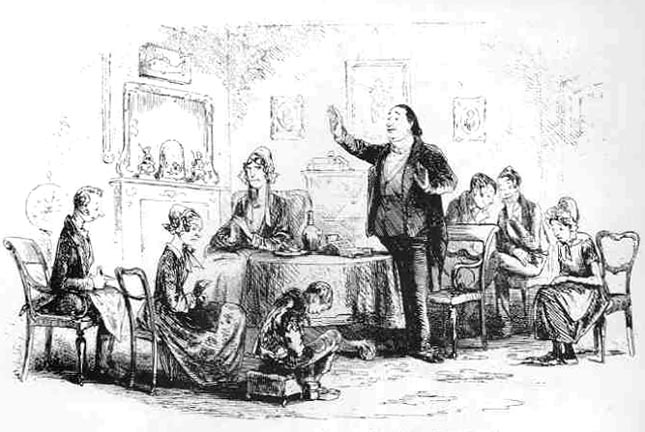
“My friends,” says Mr. Chadband, “what is this which we now behold as being spread before us? Refreshment. Do we need refreshment then, my friends? We do. And why do we need refreshment, my friends? Because we are but mortal, because we are but sinful, because we are but of the earth, because we are not of the air. Can we fly, my friends? We cannot. Why can we not fly, my friends?”

Mr Snagsby, presuming on the success of his last point, ventures to observe in a cheerful and rather knowing tone, “No wings.” But, is immediately frowned down by Mrs Snagsby.

“I say, my friends,” pursues Mr Chadband, utterly rejecting and obliterating Mr Snagsby’s suggestion, “why can we not fly? Is it because we are calculated to walk? It is. Could we walk, my friends, without strength? We could not. What should we do without strength, my friends? Our legs would refuse to bear us, our knees would double up, our ankles would turn over, and we should come to the ground. Then from whence, my friends, in a human point of view, do we derive the strength that is necessary to our limbs? Is it,” says Chadband, glancing over the table, “from bread in various forms, from butter which is churned from the milk which is yielded unto us by the cow, from the eggs which are laid by the fowl, from ham, from tongue, from sausage, and from such like? It is. Then let us partake of the good things which are set before us! [below is a print entitled, “Mr. Chadband Makes Clear a Difficult Subject”]

"Mr. Chadband makes clear a difficult subject."

12th Grade: Do Power and Security have an Inverse Relationship?

Greetings,

This week we continued with our unit on “The Changing State of Nations.”

1. As we discussed last week, terrorism arises as a kind of heresy against the prevailing orthodoxy of how states are constituted and distribute power.  Their basic goals are the same, but as the rationale and goal of the state changes, so too do their methods and targets.  So, for example, a ‘Nation-State’ terror group like IRA would be quite unlikely to want to use WMD’s against England/N. Ireland.  The IRA was trying to create a national state for themselves, and it would not be in their interests to harm the territory they want for themselves to create their own national state.  Unfortunately, modern terror groups like Al-Queda would seek them and use them, as they have global goals and are not interested in national territory per se.

The targets too changed.  The ‘State-Nation’ (1776-1914), for example, ordered itself along a ruling elite ‘fit’ to rule on behalf of the people.  George Washington used  this patrician attitude towards government generally for good, and Robespierre used a similar rationale to inflict the Reign of Terror on France.  The State-Nation anarchists targeted the leaders of governments.  This made sense for in the “State-Nation,” the leaders gave the identity to the nation.

2. U.S. strategy in the Cold War attempted for the most part to separate the domestic environment from our conflict abroad.  That is, we believed that part of the key to winning the war would be to not substantially alter our normal lives.  Throughout this unit we have been guided by the thoughts and categories of historian Philip Bobbitt, who controversially asserts that we may not be able to do this in the ‘War on Terror,’ in which our national territory can be easily infiltrated and made part of the battlefield.  Is he right?  Should we adjust our concept of privacy and the powers of government as part as a ‘weapon’ against terror?  This is one his more controversial assertions that can certainly be debated.

Another controversial assertion Bobbitt makes is that we should not see the powers of government and the rights of people as always operating in an inverse relationship.  Rather, he believes they can, under the right circumstances, work together.  Think of environments like the old west.  People got there ahead of law, and the result was that many had to wear guns and could be intimidated through force.  The fastest, most aggressive gun had the chance to hold a lot power.  We would not call this freedom in the fullest sense.  As law moved west, more freedom came with increased security and rule of law.

His use of the western frontier does support his argument, but does this equation apply in every case?  Would the increase of governmental powers always lead to more rights?  If not, under what conditions would it do so?

In his ‘Discourses on Livy,’ Machiavelli praises the provision for a dictator in times of emergency for Rome.  He writes,

. . .it is the magistracies and powers created by illegitimate means which harm a republic, and not those appointed in the regular way, as was the case of Rome, where no Dictator ever failed to be beneficial to the Republic.

In the same vein, Bobbitt urges us to consider that just as we stockpile food, vaccines, etc. for emergencies, so too we should stockpile laws.

Just as the weaponry changes from the Nation-State of the 20th century to the Market-State of the 21st, so too will the tactics and targets of terrorists change.  Now

But next week we will prepare for our CIA v. Terror Cell game, which I hope they will enjoy.  The goals of the activity are to…

  • Try and mirror some of the basic tactical problems of fighting a networked terror organization, and
  • Try and mirror some of the basic strategic issues — the political and moral side of the war on terror.  How much of their success will be dependent on the good will they build up among the other students?  If they randomly detain, torture, etc. with no thought to broader consequences they may catch the bad guys but lose the people they seek to protect.

Blessings,

Dave Mathwin

8th Grade: Pride is the Fall

Greetings,

This week we wrapped up Babylonian civilization by looking at the reign of Nebuchadnezzar through the Book of Daniel.

Nebuchadnezzar reigned as one of Babylon’s greatest kings and one of the more powerful kings in the ancient world.  He had some significant faults, but also moments of keen insight.   When we first meet him in Daniel 2, we see that he had no patience for the sham dream interpretations of the various astrologers and “wise men” of the realm.

Then the astrologers answered the king, “May the king live forever! Tell your servants the dream, and we will interpret it.”  The king replied to the astrologers, “This is what I have firmly decided: If you do not tell me what my dream was and interpret it, I will have you cut into pieces and your houses turned into piles of rubble.

This may simply be Nebuchadnezzar’s famous temper showing itself, but he also knew that the astrologers Nebuchadnezzar's Dream, Daniel 2would simply look in a book once he told them the dream, and parrot back what the book said.  It doesn’t take a “wise man” to do that.

Daniel’s eventual interpretation of the dream had many lessons for Babylon and us today.  In its time, no other city on earth could equal the splendor and wealth of Babylon.  Not surprisingly, the “head of gold” in the vision referred to Babylon itself.  But even gold, the most precious and enduring of all metals, would eventually be superceded by the “silver” of Persia, the “bronze” of Greece, and the “iron” of Rome.  Only God’s kingdom will truly last.

The dream implicitly criticizes Babylon of course, and foretells of its coming judgment and dissolution, but Nebuchadnezzar has the wisdom and humility to reward Daniel and promote him within his kingdom.

In Daniel 3 we see the full range of Nebuchadnezzar’s strengths and weaknesses on display.  He sets up an idolatrous image of himself, and demands the death of Shadrach, Meshach, and Abednego.  His temper waxes so hot he demands the furnace temperature increased seven-fold.  But when God’s servants emerge unharmed he says,

Then Nebuchadnezzar said, “Praise be to the God of Shadrach, Meshach and Abednego, who has sent his angel and rescued his servants! They trusted in him and defied the king’s command and were willing to give up their lives rather than serve or worship any god except their own God.  Therefore I decree that the people of any nation or language who say anything against the God of Shadrach, Meshach and Abednego be cut into pieces and their houses be turned into piles of rubble, for no other god can save in this way.”

He seemed to like the whole “cut in pieces” concept.

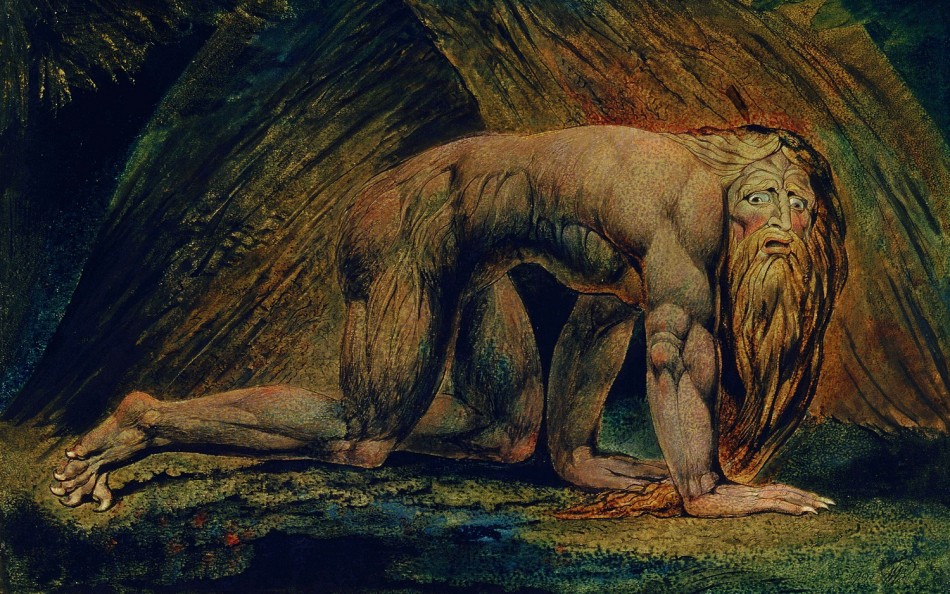
His second dream in Daniel 4 deals with him personally.  He sees a great tree cut down and reduced to nothing, and Daniel tells him that the dream comes as a warning for Nebuchadnezzar to abandon all pride.  Alas, he fails to heed the warnings and succumbed to madness.

Nebuchadnezzar’s plight can serve as a template for examining other powerful leaders.  His insanity came as a direct judgment from God, but it stemmed from his pride.  When we think of clinically insane people we understand that they don’t live in reality, cannot perceive reality and cannot deal with reality.

Might a link exist between pride and insanity?

I think we can answer in the affirmative.  Pride, after all, prevents you from seeing yourself and others as they really exist.  Nebuchadnezzar’s own words reveal this:

[Nebuchadnezzar] said, “Is not this the great Babylon I have built as the royal residence, by my mighty power and for the glory of my majesty?”

Blake, NebuchadnezzarHis claim reaches ridiculous proportions.  Babylon had existed for centuries before Nebuchadnezzar, and no one would suggest that he did any of the actual building.  It’s quite easy to give the orders, after all.   Pride narrows the universe to one’s own dimensions and limitations.  A prideful man’s heart becomes cramped and unbearable.  Like other notorious rulers such as Stalin, Nero, and Caligula, Nebuchadnezzar didn’t begin insane, but ended this way.  Pride leads Nebuchadnezzar down the path to madness.

His sanity gets restored, however, when he “raised his eyes towards heaven,” possibly in silent prayer, or perhaps he simply recognized the universe outside of himself.

Daniel 4 concludes with Nebuchadnezzar’s own words,

At the end of that time, I, Nebuchadnezzar, raised my eyes toward heaven, and my sanity was restored. Then I praised the Most High; I honored and glorified him who lives forever.

His dominion is an eternal dominion;
his kingdom endures from generation to generation.
All the peoples of the earth
are regarded as nothing.
He does as he pleases
with the powers of heaven
and the peoples of the earth.
No one can hold back his hand
or say to him: “What have you done?”

At the same time that my sanity was restored, my honor and splendor were returned to me for the glory of my kingdom. My advisers and nobles sought me out, and I was restored to my throne and became even greater than before. Now I, Nebuchadnezzar, praise and exalt and glorify the King of heaven, because everything he does is right and all his ways are just. And those who walk in pride he is able to humble.

 While Nebuchadnezzar’s repentance saved himself, it could not save Babylon, which soon after would face conquest at the hands of Persia.  This will be our next civilization.

Writing from Outside and Inside a Tradition

Ernest Hemingway once commented that American literature did not really begin until Twain’s Huckleberry Finn.  Anyone who has suffered through Cooper and the wearisome Hawthorne in an American Literature class knows that making it to Twain means finding cool water in a desert.  

As you can see, I don’t like early American literature, but in truth those authors had little chance of success.  Coming to a new place with a new population meant developing a new language and a new sensibility.  Without a defined context, and without feeling comfortable in the language, awkward first steps cannot be avoided in such situations.

I thought of Hemingway’s insight when I dipped into Adventures at Sea in the Great Age of Sail, a collection of firsthand accounts from sailors in the early 19th century.  An American named Charles Barnard starts the book off.  He had extraordinary experiences, which involved him rescuing sailors, being abandoned, and then later getting rescued himself.  But for some reason he begins his amazing story this way:

The brig Nanina, of one hundred and thirty two tons burthen, Charles H. Barnard, master, sailed from New York the 6th of April, 1812 on a sailing voyage to the Falkland Islands.  She was owned by John B. Murray & Son of New York and was completely fitted and also carried the frame of a shallop of twenty tons intended for use among the islands.

Barnard means well, and writes with all the earnestness of the young American republic.  Alas, the heavy, clumsy style betrays a man without a fully formed country and heritage.  This lack of style makes his incredible story somehow boring.

The second narrative came direct from the pen of Scotsman John Nicol.  The physical details of his life can’t equal Barnard’s, but Nicol writes with the ease of someone who has long lived within a language.  He opens with,

Having reached the age of 67 years, when I can no longer sail upon discovery, and weak and stiff, can only send my prayers with the tight ship and her merry hearts, at the earnest solicitation of friends I have here set down an account of my life at sea.  Twice I circumnavigated the globe; three times I was in China; twice in Egypt; and more than once sailed along the whole land-board of America, from Nootka Sound to Cape Horn and twice I doubled it.

I don’t blame Barnard.  We often don’t realize how long it takes not just for a culture to form, but for a people to feel comfortable enough within it to develop their own literary style.