Liberty: The God that Failed

My wife and I both love Garrison’s Keillor’s Lake Wobegon Days for its humor and insight into small-town life.  It often resides near our bedside table, so it is with great frustration that I cannot find a particular passage that immediately resonated with me years ago.  Keillor writes about the vapid predictability of his elementary school history lessons about George Washington (and his best friend Abraham Lincoln) and fantasizes about shaking things up just to relieve the boredom.  “I imagined,” Keillor writes (but here I am working from memory and not quoting directly), “fighting for the British, and calling Washington a traitor. Yes, a traitor!  There I would be, scouting the woods, finding the rebels, taking potshots at the great general.  Firing on the Father of our Country?  Why not — yes!.”

It was in this spirit that I initially approached Christopher Ferrara’s Liberty: The God that Failed.  Ah ha!  Here is something different, clearly written from a very defined point of view in a polemical spirit.  Liberty, that treasured American possession, will get exposed as a nothing, or less than nothing!  It sounded like great fun regardless of whether or not it persuaded me.
But something more meaningful also encouraged me to read this, for the author pledged to critique both the modern liberal and conservative/libertarian approaches to liberty.  The problems with modern America lie not so much with Republicans or Democrats, or any particular president, or era in our history, but instead within our very DNA as a Nation — Garrison Keillor’s daydream made real.

Before delving into the book’s arguments, I can say that it lives up to its promise.  He writes crisply, and the arguments roll like a freight train.  At 650 pages it’s a surprisingly quick read.  He has a voluminous bibliography.  But Ferrara tries to shoot everything and demolish every sacred cow, and thus sets the bar perhaps a bit too high for himself.  In the first half of the book I recognized many reputable sources from authors like Gordon Wood, Bernard Bailyn, and Joseph Ellis.  By the book’s end he repeats himself, and his discipline seems to crack (I noticed a couple “.com” footnotes later in the work, inappropriate for a book of this weight).  Still, though perhaps about 200 pages too long, Ferrara gives the reader much to ponder.

The book begins with brief summary of the heritage of Greek philosophy after the Peloponnesian War (431-404 B.C.). After the idolatrous parochial worship of their own political communities (see Appendix below) that started that devastating conflict, Plato and Aristotle saw that the state needed a foundation beyond itself.  Neither of them conceived of the state in Christian terms, but both saw that when the state merely served as a mirror for the populace, disaster resulted.  The state should aid in the living of the good life, which is the life of virtue.  The state should have no other legitimate purpose.  In other words, do we want the state to enable injustice and destroyed lives?  In the wake of Rome’s fall, medieval Europe picked up on this idea, and struck a new course.  They would have agreed with Jacques Maritain, who wrote in the mid 20th century that,

We must affirm as a truth . . . the Church’s supremacy . . . over all terrestrial powers.  On the pain of radical [earthly] disorder, she must guide the people towards the last end of human life, which is also that of states.

Without rendering justice to God, we cannot practice justice to others.

Of course the medievals did nothing new in this regard.  Every civilization that has ever existed before the Enlightenment linked the public recognition and worship of God/gods and politics.  Certainly most of the Reformers thought likewise, as Calvin’s Geneva or Puritan New England attest, among other examples.  Only since the Enlightenment has western man tried the novel experiment of severing themselves from looking at anything but themselves to guide their politics.

Ferrara continues with a brief defense of Christendom itself, which we can pass over quickly.  He notes that contrary to received myths with Enlightenment origins that continue to this day, Christendom had

  • Great cultural achievements (Gothic cathedrals, Sistine Chapel, etc.) that can only come with true artistic freedom
  • Economic freedom
  • Limited government, and therefore
  • Limited wars and violence

Ferrara recognizes wisely that defending Christendom stands outside the scope of his thesis, so he moves on from this quickly — perhaps it could have been left out, for it raises many unanswered questions.

By chapter four, he begins to lower the boom.

John Locke had a enormous influence over the founders.  Locke himself may have been either a deist or a Christian, but that, for Ferrara is beside the point (Thomas Hobbes also gets attention, but Locke had far more influence over our founders).  Locke’s “blank slate” metaphysics undermined much of the foundation for mankind knowing eternal ideas “in a state of nature,” contra Romans 1.  Since man has no shared foundation in the eternal, mankind must root government in the consent of the governed.  This is such a truism for us that we hardly give it a passing thought, but this means that “every man has the executive power of the law of nature (Locke, “Two Treatises on Government).”  Locke later states that “Virtue and vice are names pretended” based on the conventions of the day, and all this follows naturally on Locke’s view of the world.  All this forms Locke’s view of sovereignty as essentially a tautology referencing nothing but “the consent of the governed” to determine its will.

Certain places in colonial America based their societies on something like an idea of a Civitas Dei, i.e. the New England Puritans.  But with Locke the emphasis had changed, and America the nation, founded on Locke’s principles could never be a “Christian nation” and doomed itself to moral chaos.  Though other thinkers besides Locke had their role to play, most, like Montesquieu and Bayle drank deeply from Enlightenment thought.  Thus, the myth of an essentially conservative American Revolution designed to protect an already existing social order has no foundation.  The founders were revolutionaries in every sense of the word, and radically reoriented the basis of their society (I like Edmund Burke and his view of the problems between England and America, which Ferrara challenges.  This needs further consideration for me).  Ample citations show that men like Madison, Adams, Jefferson, and Washington saw themselves in this way.

The main problem with the American Revolution as Ferrara sees it, is not the concept of liberty in itself, but how our founders defined the concept.  Borrowing from Locke and others, liberty got defined either as . . .

  • A mere “freedom from” constraint from others, where, to quote Locke, “individual consent is the only proper basis for all man’s organizations, civil or ecclesiastical,” and,
  • The freedom for a people to define one’s own community, one’s own laws.  But the only possible basis for this under Enlightenment thought is “the consent of the governed,” or — “the opinion of most people.”

The end result of this ideology would make “Liberty” into a form of Power, the power to rule others, make laws, on the fly, with no reference to any eternal truth.  This proposition forms Ferrara’s central thesis.

Did the American Revolution play out this way?  At the crucial point of our history, did we turn towards a Civitas Dei or make Liberty our God, and thus make it a demon?

The book goes into some detail to show that many Founders had membership as Masons, and that Masons, by “faith,” were dedicated to deism.  The book references early modern and medieval constitutions that had explicit foundations in Christian belief and practice.  The Enlightenment changed this to “Great Architect of the Universe,” or other such vague references to a distant God.  This means that the so called “moderate Enlightenment” actually brought radical change to how our founders saw the world.  Again, ample evidence exists of this, i.e. Madison’s quote in “Federalist 14” that “our revolution has no parallel in the annals of human history.”  Gordon Wood also comments that the revolution, “fundamentally altered the character of human society.”  So the Revolution happened not to preserve an existing order, but create a new one.

We see the revolutionaries, just before and after the Revolution itself, impose their will to change society.  The Boston Tea Party is a good example.  Rather than let the “market”/people decide whether or not to buy the tea, the Sons of Liberty destroyed it (which happened after they failed to persuade the populace not to buy it, at least in Ferrara’s interpretation).  Liberty meant power over others, and it the revolutionary view of Liberty had pagan roots.  Ferrara perhaps goes a bit too far here, but does cite numerous examples of totems such as the Liberty Tree and Liberty Pole, and the resurrection of the Roman goddess Libertas, “invoked far more often than the Judeo-Christian god.”  This may seem too much for some, but Ferrara cites several 18th century sources, including the widely read and hugely popular Thomas Paine, to show that Liberty became a worshipped idol, and like all paganism, a source of power and manipulation.

The Sons of Liberty used this power to control the press during the Revolution, and tax and sometimes even arrest Tories for their support of England.  Jefferson, famed for his defense of freedom, made loyalty oaths compulsory while serving as Governor of Virginia.  Americans love to believe in the benign nature of their revolution compared to France, but our revolution produced 24 political exiles per thousand, while at the height of the Jacobin terror, France only had 5 refugees per thousand.^   Ferrara cites Murray Rothbard, a great admirer of the Revolution, who writes, “The revolutionaries moved to suppress crucial liberties of their opposition–an ironic but not surprising illustration of the conflict between Liberty and Power.”  “Jefferson,” Ferrara writes, “venerated as an icon by so many libertarians, was really just another statist.”  Maybe Rothbard is wrong.  Maybe no conflict really exists between American “Liberty” and power.

Liberty as Power continued after the revolution, where in Shay’s Rebellion the offenders had no right of habeus corpus.  Many were hung, and we see the “statist” power of Liberty on the rise.  By contrast George III never so much as arrested any revolutionary before the war.  Big government began right after the war’s conclusion with increased taxes and an army of public servants.  Could personal rights exist apart from the declared sovereign power of the people?

Deism, Ferrara argues, forms the natural religion of state grounded in Liberty.  It allows for God to create, and then nicely removes Him to the sidelines. So we have the Treaty of Tripoli (1797) unanimously approved by the Senate, which included Article XI:

As the Government of the United States of America is not, in any sense, founded on the Christian religion; as it has in itself no character of enmity against the laws, religion, or tranquility of [Moslems] . . . it is declared by the parties, that no pretext arising from religious opinions shall ever produce an interruption of the harmony existing between the two countries.

As John Adams later wrote, “[our government] was contrived merely by the use of reason and the senses.”

Ferrara continues on. . .

Liberty as Power had perfect expression in chattel slavery.  Many slave owners, in fact, explicitly defined liberty in terms of slavery.  They used the, “you can’t tell me what to do,” defense, but also went further and claimed that their personal exercise of liberty required slavery, i.e. more slavery = more freedom/more ability for me to live as I like. We rightly cringe at this today, but in fact the founders had no logic within their framework to contradict them, and slavery not only remained, but expanded.  Ferrara wants us to harbor no illusions — America from the American Revolution onwards was in no way a Christian country.  Nowhere does the Constitution recognize God as such, nowhere is any particular religious belief required.  We openly allowed for the oppression of blacks, and violated all laws and treaties to oppress the Indians as well under the same logic that allowed for slavery.  In other words, we had no law but the law of self, the idolatry of the self, or the consent based parochial community.  “We said it, it must be true.”

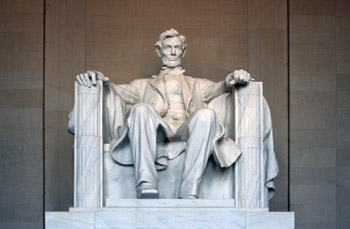
By this point the reader may grow faint, but not Ferrara.  Looking for a good guy in the Civil War?  Don’t bother.  Southern romantic myths about “genteel society,” whatever truth lay in them, rest on the foundation of slavery.  He exposes Southern myths about their so-called recovery of limited government.  The Southern constitution replicated the North’s almost exactly.  It formally recognized no Christian God (and if they had it would have been blasphemous anyway).  What about the North?  Nope — Lincoln expanded his power in ways George III never dreamed of, such as the draft, suspension of habeus corpus, and the like.  The North had the greater amount of power, so they won, and we in turn went to worship at Nebuchadnezzar’s statue.

Ferrara continues on, but I can’t.  Suffice to say, the growth of liberty as a means of power over our fellow man continues as his theme. His writing grows more scattershot, his sources get weaker.  But he does close on a fascinating and revealing note by examining Justice Kennedy’s “heart of liberty” section from his majority opinion in “Planned Parenthood v. Casey,” which overturned Pennsylvania’s abortion laws.  Kennedy wrote,

At the heart of liberty is the right to define one’s own concept of existence, of meaning, of the universe, and of the mystery of human life.  Beliefs about these matters could not define the attributes of personhood were they formed under compulsion of the state.

Many “conservatives” cried “foul” to Kennedy’s ruling, yet it bears remarkable resemblance Locke’s reasoning in his enormously influential Essay Concerning Human Understanding.  In his dissent, the “conservative” Justice Scalia argued that the decisions on these questions belonged to the state legislatures, to persuasion and the counting of votes — not judges.  Though seemingly on opposite sides, both Scalia and Kennedy drank from the same Enlightenment source, which is the essence of American political conservatism.  For both, it is consent, be it from an individual or group, that determines justice. Thus, no real barrier exists to things like pornography, abortion, homosexual marriage, and the like, provided the votes are there.  America’s very DNA means that we float along with whatever wind comes about by “consent.”  Our Constitution, far from constructing a limited government,** created a structure that would allow for this very thing.  Why would it not?  We should expect the Constitution to reflect Locke’s (and Montesquieu’s, and Bayle’s) views because our founders believed him.  Capitalism in this environment would only contribute to the growth of power, both in terms of big corporations, and in enabling whatever immoral choices we wish to make.

Well, what shall we say about Ferrara’s thesis?

I am a fan of some of John Le Carre’s earlier spy fiction, especially Tinker, Tailor, Soldier, Spy.   I remember reading a review of the book from an actual spy.  He praised it, but cautioned against anyone thinking that “this is what the world of spies really looks like.”  If as much backbiting and infighting existed as Le Carre depicts, no spy program would ever have any success.  

Part of me feels this way about this book.  America surely has had some success and done some good, right?  And the good we have done must have some good roots?  Must we burn every single thing down?*

I think Ferrara would counter that yes, we have done good at times, but that good is only the result of our consent based society sometimes aligning itself with eternal truth.  When we do so, however, we get “lucky,” and should not assume “that’s America.” This may be a fair riposte.  I will reserve final judgment for now.  But all in all, I found him persuasive on the inheritance of Western-based consent societies, especially when we remember the Napoleonic Wars, the Civil War, W.W I, II, and the fact that Nazi Germany, Maoist China, and Soviet Russia were essentially western rooted societies that acted for “the people.”

Part of the validity of his thesis can never have the requisite proof.  What would have become of medieval kingdoms and principalities with modern technology?  Would their wars have been as bloody?  Would certain kings have abused their power like a Stalin even with the more direct presence of Christianity?

We can guess, but never know.  The book also avoids certain key questions.  Would a Christian Commonwealth that Ferrara hopes for allow for freedom of speech, press, etc.?  If yes, what would be dimensions of those freedoms, and if no, would the cure be worse than the disease?  Or is “free speech” yet another idol of Liberty?  He never considers such things.  To be fair, I already stated that the book is too long, and his purpose in writing was to critique American foundations, not put up something definite in its place.  Still, we must face these questions to fully understand the implications of his thesis.

Some may object that even if Ferrara’s is correct, his point has no relevance.  Returning to the Civitas Dei will absolutely never happen now.  Yes — but  this doesn’t mean we should seek to understand exactly what we’re dealing with.  We should call spades spades.

While his ideas may lack immediate political relevance, they have great relevance for education.  So much of how we teach American history assumes significant possible divergence for various “hinge points” in our history with the War of 1812, Civil War, or with this president or that.  Ferrara tells us that many of the choices we think significant are only different shades of the same color.  The real path, the real decisions, got made in the 1760’s.  It’s almost as if we need to tell the story twice to do justice to both Ferrara’s ideas and the traditional approach.

This book should also speak to the Church.  Again, assuming he’s correct, the Church will not influence American politics directly without playing the “power” game.  If our system operates not by virtue but by votes, we may have to appeal to principles we really don’t believe in to accomplish our will.  Ferrara certainly does not believe we have any genuine Christian roots to which we can direct an appeal.

But the greatest value in Ferrara’s exciting, intriguing, but probably too ambitious work lies in how he gets us to rethink the concept of Liberty.  “Individual liberty is individual power.”  So said John Quincy Adams.   Isaiah Berlin gave the classic dilemma of negative (freedom from constraint) or positive liberty (freedom towards an end).  It appears that in the modern framework, negative liberty becomes an idol to self, positive liberty extended creates totalitarianism.  Ferrara splits the horns of the dilemma by reformulating the concept.  Liberty should mean freedom to do as we ought, not as we want, and without this understanding, our nation will float rudderless.

^We should consider, however, that in the “height of the Jacobin Terror” Robespierre’s government seemed much more concerned with executions than forcible exile.  Thus, while the American Revolution had its political compulsion, they preferred exile to execution.

*Perhaps ironically, part of Ferrara’s (a staunch Catholic classicist) work coincides nicely with Howard Zinn’s “radical” and “leftist” interpretation of American history.   Zinn is cited at least once, and probably more, in the footnotes.  In the review above I never delve into Ferrara’s critique of “Liberty” based capitalism, which he argues fosters immorality and at times, oppression and exploitation.  On the “oppression/exploitation” (one that admittedly Ferrara hardly develops) point we see another connection with Zinn.

**Ferrara briefly looks at the 10th Amendment, on which many proponents of limited government pin their hopes.  Ferrara argues that the 10th Amendment is a mere sop and has no actual teeth, not in practice, but in reality.  Those that designed the Amendment had no real belief in limited government in the first place.

Appendix: A.J. Toynbee, “The Idolization of the Parochial Community”

Unhappily, Polytheism begins to produce new and pernicious social effects when its domain is extended from the realm of Nature-worship to a province of the realm of Man-worship in which the object of worship is parochial collective human power. Local worships of deified parochial communities inevitably drive their respective devotees into war with one another. Whereas Demeter our common Mother Earth is the same goddess in Attica and in Laconia, the Athene Polias of Athens and the Athana Chalcioecus of Sparta, who are the respective deifications of these two parochial communities, are bound to be rival goddesses in spite of their bearing the same name. The worship of Nature tends to unite the members of different communities because it is not self-centred; it is the worship of a power in whose presence all human beings have the identical experience of being made aware of their own human weakness. On the other hand the worship of parochial communities tends to set their respective members at variance because this religion is an expression of self-centredness; because self-centredness is the source of all strife; and because the collective ego is a more dangerous object of worship than the individual ego is.

The collective ego is more dangerous because it is more powerful, more demonic, and less patently unworthy of devotion. The collective ego combines the puny individual power of each of its devotees into the collective power of Leviathan. This collective power is at the mercy of subconscious passions because it escapes the control of the Intellect and Will that put some restraint on the individual ego. And bad behaviour that would be condemned unhesitatingly by the conscience in an individual culprit is apt to be condoned when it is perpetrated by Leviathan, under the illusion that the first person is absolved from self-centredness by being transposed from the singular number into the plural. This is, however, just the opposite of the truth; for, when an individual projects his self-centredness on to a community, he is able, with less sense of sin, to carry his egotism to greater lengths of enormity. ‘Patriotism is the last refuge of a scoundrel’;5 and the callousness of committees testifies still more eloquently than the fury of mobs that, in collective action, the ego is capable of descending to depths to which it does not fall when it is acting on its individual responsibility.

The warfare to which parochial-community-worship leads is apt to rankle, sooner or later, into war to the death; and this self-inflicted doom is insidious, because the ultimately fatal effects of this religion are slow to reveal themselves and do not become unmistakably clear till the mischief has become mortally grave.

In its first phase the warfare between deified parochial states is usually waged in a temperate spirit and is confined within moderate limits. In this first phase the worshippers of each parochial god recognize in some degree that each neighbour parochial god is the legitimate sovereign in his own territory. Each local god will be deemed to have both the right and the power to punish alien human trespassers on his domain who commit a grievous wrong against him by committing it against his people; and this consideration counsels caution and restraint in waging war on foreign soil. It tends to prevent war from becoming total. The bashful invader will refrain, not only from desecrating the enemy’s temples, but from poisoning his wells and from cutting down his fruit trees. The Romans, when they had made up their minds to go to all lengths in warring down an enemy community, used to take the preliminary precautions of inviting the enemy gods to evacuate the doomed city and of tempting them to change sides by offering them, in exchange, honourable places in the Roman pantheon. When a local community has been exterminated or deported in defiance of the local divinity and without regard to his sovereign prerogatives, the outraged parochial god may bring the usurpers of his domain and scorners of his majesty to heel by making the place too hot to hold them except on his terms. The colonists planted by the Assyrian Government on territory that had been cleared of its previous human occupants by the deportation of the Children of Israel soon found, to their cost, that Israel’s undeported god Yahweh had lost none of his local potency; and they had no peace till they took to worshipping this very present local god instead of the gods that they had brought with them from their homelands.

Thus the conduct of war between parochial states is kept within bounds, at the start, by a common belief in the equality of sovereign parochial gods, each within his own domain. But this belief is apt to break down, and, with it, the restraint that is imposed by it. They break down because the self-worship of a parochial community is essentially incompatible with the moderation commended in such maxims as ‘Live and let live’ and ‘Do as you would be done by’. Every form of Man-worship is a religious expression of self-centredness, and is consequently infected with the intellectual mistake and the moral sin of treating a part of the Universe as if it were the whole—of trying to wrest the Universe round into centering on something in it that is not and ought not to be anything more than a subordinate part of it. Since self-centeredness is innate in every living creature, it wins allegiance for any religion that ministers to it. It also inhibits any living creature that fails to break away from it from loving its neighbor as itself, and a total failure to achieve this arduous moral feat has a disastrous effect on social relations.

A further reason why it is difficult to keep the warfare between parochial states at a low psychological temperature is because parochial-community-worship wins devotion not only by ministering disastrously to self-centredness. It wins it also by giving a beneficent stimulus to Man’s nobler activities in the first chapter of the story. In the histories of most civilizations in their first chapters, parochial states have done more to enrich their members’ lives by fostering the arts than they have done to impoverish them by taking a toll of blood and treasure. For example, the rise of the Athenian city-state made life richer for its citizens by creating the Attic drama out of a primitive fertility-ritual before life was made intolerable for them by a series of ever more devastating wars between Athens and her rivals. The earlier Athens that had been ‘the education of Hellas’ won and held the allegiance of Athenian men and women, over whom she had cast her spell, for the benefit of the later Athens that was ‘a tyrant power’; and, though these two arrogant phrases were coined to describe Athens’ effect on the lives of the citizens of other Hellenic city-states, they describe her effect on the lives of her own citizens no less aptly. This is the tragic theme of Thucydides’ history of the Great Atheno-Peloponnesian War, and there have been many other performances of the same tragedy that have not found their Thucydides.

The strength of the devotion that parochial-community-worship thus evokes holds its devotees in bondage to it even when it is carrying them to self-destruction; and so the warfare between contending parochial states tends to grow more intense and more devastating in a crescendo movement. Respect for one’s neighbours’ gods and consideration for these alien gods’ human proteges are wasting assets. All parochial-community-worship ends in a worship of Moloch, and this ‘horrid king’ exacts more cruel sacrifices than the Golden Calf. War to the death between parochial states has been the immediate external cause of the breakdowns and disintegrations of almost all, if not all, the civilizations that have committed suicide up to date. The decline and fall of the First Mayan Civilization is perhaps the only doubtful case.

The devotion to the worship of Moloch is apt to persist until it is too late to save the life of the civilization that is being destroyed by it. It does break down at last, but not until a stage of social disintegration has been reached at which the blood-tax exacted by the waging of ever more intensive, ferocious, and devastating warfare has come palpably to outweigh any cultural and spiritual benefits that the contending parochial states may once have conferred on their citizens. . .


The History of Romance

Over the past few years the church I attend has made a point of making marriages central to our congregational life, as well making the theme of marriage crucial to our interpretation of the Scriptures.  When discussing this recently, a friend of mine cast doubt on this approach.  After all,

  • No model of a good marriage (in the lives of real people) exists in the Bible
  • Nowhere do we see any developed teaching about marriage
  • Earthly marriage is not eternal, thus, not central to our life in Christ.

All good points, but overall I agree with the emphasis our church has placed on marriage, or better put, a “Nuptial Theology,” (for those married or single).  True, Scripture does not develop a full theology of marriage, but I think the most profound truths are often those that need hidden, or get barely hinted at.  “Such things are too wonderful for me, too lofty for me to understand.”  The communal life of the Trinity, for example, eternally pulsates all meaning and existence, yet we get the only the barest hints about it.  Jesus, in regards to His identity, drops only brief statements and never sermonizes on who He is.  With marriage, we get more than that, but not too much.  We see Creation cap-stoned with a wedding in Genesis 2, and History ended and renewed with the “marriage supper of the lamb” in Revelation.

Our culture has been saturated with the idea of romance that we may not realize that historically, “romantic love” appeared late on the scene.  No evidence exists that the ancient world knew nothing of it. Plato’s Symposium talks off an ascending ladder to the divine of which human love plays a part.  So far, so good, but the object of ideal male love for Plato is not a woman, and as C.S. Lewis points out, “[The human aspect] of love has simply fallen out of sight before the soul reaches its spiritual object.”

So that won’t do.

Ovid wrote The Art of Love, but as satire on the ridiculous things to which infatuation and lust drive us.  The “absurd conduct” (Lewis again) that Ovid recommends should be taken in the spirit of his advice not to “visit [your lover] on her birthday.  It costs too much.”  For a Roman man to pursue a woman would have been unmanly, shameful, ridiculous.  Such a Roman stands ripe for mockery for Ovid.*

In his The Allegory of Love (from which I quoted snippets above) Lewis makes the striking point that “Romantic” literature,9780198115625 and the idea of romance as a central part of life, doesn’t appear on the scene until the 12th century.  Can it be mere coincidence that this is precisely the moment when the last of the barbarians has been Christianized and European culture had the opportunity to be “fully Christian?”  I cannot believe it so.  Obviously 12-13th century Europe got things wrong as any society will do, but I think we should take it as a possible witness of the Spirit of God in History that when “Christian” culture arrived for the first time in history, so too did romance.  It think it a strong indication of the importance of “Nuptial Theology.”

Lewis briefly traces the journey of the Church as it relates to sexual love.  It took centuries for the Church to escape the vibe of both the hedonistic side of paganism, and the spirit vs. flesh dichotomy of the Platonic school.  This might surprise but should comfort us also — God is patient with our infirmities and does not demand we solve everything today.   In this case He appears to have been patient enough to wait centuries.  So we have St. Gregory in the 6th century say that while the act of marriage remained innocent, the desire accompanying it was evil.  In the early Middle Ages we see a tremendous shift in Hugo of St. Victor.  He boldly (for his time) states that physical attraction has a part to play in Christian marriage.  On the other hand, he also states that had mankind never fallen, children would have been born “sine carnis incentivo,” i.e. “without sex.”

If jump ahead a few generations we see bolder and greater insight.  Albert the Great dismisses the idea that pleasure is evil or a result of the Fall, arguing that our pleasure would have been greater had we not fallen.  The problem with fallen man is not the strength of pleasure but for Albert, the weakness of our reason.  Unfallen man could have enjoyed any pleasure without the diminishing of his reason or losing sight of the First Good, God Himself.  A little later St. Thomas Aquinas goes further in affirming the nature of friendship in marriage (but also backwards by talking about the pleasure of marital love — though not a sin for Aquinas — in the midst of a passage about incest).

Alas that the medievals did not combine these important theological insights into the totality of their practice.  The whole tradition of “Courtly Love” is riddled with both a lingering Platonic idealism and adultery.  Medieval culture just couldn’t quite decide about the place of the romantic impulse.  So in his Death of Arthur Malory can call Lancelot the greatest of all knights and  simultaneously show how his relationship with Guinivere destroyed a kingdom.  He includes no examples of healthy marital love that I can recall.  The division between soul and body, between our earthly and spiritual lives, still seems to remain right up until the end of the medieval period.

But let us not dismiss the medievals too easily.  For the first time in history, I think, they allowed “manly” men to pursue women.  And with their love of allegory, they had no problems connecting the pursuit of the male to God’s pursuit of us.  Many in our churches today, I think, would be uncomfortable with the “physical” implications of this.  We do not connect the romantic impulse to our theology.  Perhaps guys particularly have problems with the whole idea of marriage and salvation, but it should help us realize the totality and intensity of God’s pursuit of us.^  I’ve heard some say that “The Song of Solomon” is about God’s love for his Church.  I’ve heard others say, “Get real, it’s about pleasure, it’s about sex.”  Might it be about both?  I think the best of the medieval tradition would have been comfortable with that.

*I don’t mean to suggest that comedy is wrong when it comes to sex.  As Lewis points out in The Four Loves, without a sense of humor and even silliness, the god Eros will quickly become a demon.

^This truth can help both our culture in general, and guys in particular, understand that sex itself is best understood as a sign, or even a ceremony of something greater.  Again, the best way to ensure genuine appreciation of a thing is to understand exactly how it should be appreciated.

David Hackett Fischer’s “Fairness and Freedom”

I first posted this two years ago, but recently came across a link to a study on New Zealand’s relationship to globalization. I include this new information, which only confirms Fischer’s keen analysis within the text under the “Immigration” section below.

And now, the original post . . .

A few years ago Fischer blew me away with his classic Albion’s Seed, which for me is far and away the best book on colonial America out there.  In that work he demonstrated a remarkable ability to go from broad sweeping general statements to minute subtle detail.  Fairness and Freedom does not quite match that standard, but once again Fischer succeeds remarkably in a subject rarely, if ever, explored before.

The book looks at the two open societies of the United States and New Zealand.  While this may seem like an odd pairing, both countries

  • Share basic democratic values
  • Were colonial societies, with the vast majority of their settlers coming from England in their early formative phase
  • Have existed in relative geographical isolation from the main events in Europe during crucial periods of their history
  • Had early settlers needing to deal with native populations.

Our shared history means that someone from either country could feel more or less at home in either place.  But the book arose from some keen observations Fischer made while visiting New Zealand during a political campaign.  He noticed how frequently the major candidates used the words “fairness,” or “justice,” and contrasted that with the American lingo of “freedom,” and “liberty.”  He followed that rabbit hole and discovered how these different emphases have subtly shaped each society in a variety of ways.

Here we see the similarity in his approach in Albion’s Seed, where he takes a idea and runs with it over a large swath of time and space.  How has this subtle yet important differences in values shaped each society?

Origins and Geography

  • In NZ, the Maori tribes were themselves not native to the land, and had cultural memory of their own immigration to what know as “New Zealand.”  Furthermore, warring tribes had nearly destroyed each other before the English arrived.  Thus, the Maori had 1) already learned about cooperative living, and 2) had an immigrant identity themselves
  • In America, American Indians had no memory of any migration to the continent, which, if it happened, happened perhaps 10 thousand years ago.  Their mythology had strong elements of their own existence arising “from the earth itself.”  Thus, they had a much stronger tie to the land than the Maori of NZ.  Furthermore, the abundance of resources and space meant that tribes did not need to work out their problems to survive.

Different Kinds of Settlement at Different Times, for Different Reasons

  • The bulk of formative settlement happened in America as result not of economic oppression but lack of liberty to “worship as one pleases.”
  • The bulk of settlement in NZ came from a population that felt the injustice of early Victorian industrial society.  Their main concern was the righting of wrongs, not increased liberty.  In this sense they inherited the old British notion of “fair play.”
We see this reflected in the different visions each society produced — or how they idealized themselves.  Walt Whitman wrote,
From this hour I ordain myself loos’d of limits and
imaginary lines.
Going where I list, my own master total and absolute. . .
I inhale great draughts of space,
The east and west are mine, and the north and the
south are mine.
I am larger, better, than I thought
Song of the Open Road
Whereas New Zealand’s W.H. Oliver wrote in “Counter-Revolution”
Did it go wrong just about a hundred years ago?  A ramshackle self-appointed cast-off elite of first comers, promoters, bent lawyers and sham doctors, set it up for the themselves, a gentry of sorts, saw it collapse and crept away with slim gains . . . Something had to be done.
Fischer does not neglect the fact that America’s geography lends itself much more readily than New Zealand’s to Whitman’s expansive idea of space and freedom.
Different governments formed out of these different visions.  America embraced Federalism, which allowed for and fostered regional differences and different spheres of influence for different groups.  NZ embraced a more national model of “all for one, one for all.”

Civil Rights

Both countries had minorities fight to gain their rightful place in their respective societies.  In looking at the Civil Rights movement, Fischer observes that one key to its success was King’s emphasis on freedom.  King, Fischer notes, “understood a deep truth about America.  Equality divides Americans; freedom unites them.”  Once again, the Maori of NZ focused on  equality, which has much more resonance there.  The same holds true of the feminist movement.  In America, women fought for rights by putting themselves in competition with men.  It had/has a more militant, combative approach, consistent with the concept of Federalism.  In NZ, key feminist leaders saw their role differently.  Anna Logan Stout said that,

The real power of the women’s vote in New Zealand is not in opposition, but in its harmony and cooperation with the men’s vote.

Immigration

Throughout the book I had the impression that Fischer harbors a preference for the NZ approach, but immigration may have been an exception, where their respective emphases on Liberty and Equality bear very different fruit.  American stances on immigration have varied, but we have generally been much more open to many more people than NZ, where they looked for specific kinds of people they were sure would “fit in” to their society.

Some historians have remarked  that settler societies, though they often originate from those seeking to escape the motherland, sometimes seek to “outdo” their homelands.  With immigration, NZ has unconsciously created a country that functions in some ways like one of those exclusive Victorian clubs the original settlers would have hated back in England.

In foreign affairs also, America has stressed freedom of action, while NZ has emphasized cooperation.

(And now the addendum)

Recent studies on New Zealand’s attitude toward immigration reflected in its attitude towards globalization.  The study says that,

A report in 2012 by The New Zealand Initiative drew attention to New Zealand’s seventh position among 57 countries for having the most restrictive FDI regulatory regime. This was largely due to New Zealand’s economy-wide screening regime and the broad definition of ‘sensitive’ land. Treasury has confirmed that there is credible anecdotal evidence that New Zealand’s regime is having a chilling effect on inwards FDI investment, but the materiality of this effect is an open question. It is doubtful that the damaging Crafar farms case would have triggered regulatory barriers in other Anglo-Saxon jurisdictions or comparable Asian countries.

New Zealand’s Overseas Investment Act further detracts from the country’s ‘open for business’ image by starkly asserting that it is a privilege for foreigners to be allowed to own or control sensitive New Zealand assets. This is in stark contrast to the explicitly welcoming approach widely taken elsewhere.

Statistics show that New Zealand has largely missed out on the expansion of global FDI since the mid-1990s. Both inwards and outwards stocks of FDI peaked as a percentage of GDP more than a decade ago in New Zealand, while world stocks continued their upwards climb. Between 2000 and 2011, New Zealand’s rank on UNCTAD’s FDI attraction index slumped from 73rd in the world to 146th. Hong Kong and Singapore have been in the top five throughout this period.

The full study is here.

Military

This section may have been my favorite.  Fischer traces the differences in liberty and equality into how each military fights and organizes itself.

The U.S.

  • Emphasizes freedom of action for junior officers.  Those in higher ranks try and keep their distance from these officers so as not to interfere unless truly necessary.
  • The best and brightest soldiers are shunted to smaller elite units or branches of the service
  • Their main strength in war has been adaptability and quick response

In New Zealand

  • Serving in the infantry isn’t for the grunts, it’s considered a badge of honor
  • Officers of nearly all ranks are expected to “lead from the front” and join the men in the fighting.  Distinctions of rank do not hold the same importance as in other armies.  In W.W. II, for example, a British general complained about NZ troops who did not salute him.  “I’m sorry sir,” replied a NZ officer, “but if you wave to them I’m sure they’ll wave back.”
  • The key virtue of NZ forces over time has been their strong unit cohesion and stubbornness
What makes this work similar to Albion’s Seed is his emphasis on the persistence of cultural values over time.  We are not free to reinvent ourselves, but we should do what we can to understand ourselves.  The values embedded in our societies impact us ways we may not be aware of, and that’s justification enough for  Fischer’s enjoyable and insightful work.

12th Grade: The Justice in Due Process

Greetings,

For our final unit we have been looking at tort law, which deals with civil damages and penalties from companies to individuals.  This gives us a chance to examine some fun and controversial cases, but it also gives insight into how one applies basic democratic concepts of fairness.

We looked at the McDonald’s “Hot Coffee” case last week, where many of the students decried the verdict where a jury awarded Mrs. Leibeck more than 2 million dollars.  Many students applauded the fact that a judge lowered the damage amount to around $450,000, which in their eyes seemed more reasonable, though still excessive.

This week we looked at the case of “State Farm v. Campbell,” decided in 2003.  The case had its origins in an accident caused by Campbell.  Over a period of years, State Farm hung Campbell out to dry, which was bad enough.  Subsequent investigations showed, however, that State Farm had a nationwide policy of targeting lower income, lower education clients for systematic fraud.  Their reasoning appeared to be that they would not fight back.  So incensed were juries in this case that juries assessed State Farm with a $145 million in punitive damages.  Most students agreed that though the amount was large, the verdict seemed fair given the egregious nature of their conduct and the fact that it proceeded from explicit policy within State Farm on a national level.

By 2003 the Supreme Court got involved, however, and overturned lower court verdicts, putting certain rules in place that cap the amount of damages courts can award.  Consumer advocacy groups cried foul, business interests cheered, and some wondered what exactly the Supreme Court was doing by hearing the case in the first place.

As to last issue, the Supreme Court intervened on the basis of the Constitutional guarantee of “due process of law.”  But this begs the questions, “What is due process?”

Two basic views exist on this subject:

  • The more “conservative” view holds that “due process,” means you get a fair “process,” in your case.  Did you get a lawyer?  Did the judge act appropriately?  Was the jury properly empaneled?  If you have these elements in place, you received your guarantee of “due process.”
  • The more “liberal” view believes that “due process” goes beyond the process itself to a basic concept of general fairness.  Specifically in the State Farm case, State Farm argued that it cannot receive due process if it has no way of anticipating what its punishment might be.  A defendant on trial for robbery has a reasonable idea of his sentence might be if convicted.  But in tort law cases companies subjected themselves to the “whims” of the jury with any possible outcome.  They argued that the Court should devise clear rules for juries in the awarding of punitive damages.

By a 6-3 vote, the Supreme Court agreed with State Farm.  Interestingly, the three dissents came from opposite ends of what we usually consider to to be the political spectrum, as “Conservative” justices Scalia and Thomas joined “liberal” Justice Ginsburg in stating that, 1) The Supreme Court had no real jurisdiction in this case, and 2) Even if they did, a belief that the fine was too high is no compelling reason existed to overturn the jury’s verdict.  Ginsburg, I believe, made the “conservative” argument that if Utah (where the case originated) wanted to put a cap on damages they could do so through their legislature.

One reason why I like looking at these two cases is that they often produce a healthy tension, especially for more conservatively minded students.  Most in class argued that the McDonald’s case shows that Americans are too litigious, irresponsible, etc., but many of these same students also decry “judicial activism.”  Well, “judicial activism” of a kind changed the verdict of the jury in both the McDonald’s and State Farm cases.

Also, Conservatives generally tend toward the “pro-business” side of questions, but in these cases supporting juries meant supporting the “little guy” and not “big business.”

And this raises another broader question.

Juries, like any other institution, have a mixed history.  But practices such as trial by jury have long been considered pillars of free societies.  But the power of juries also hints at the fears of some of the founders on the role of the “common man” with difficult questions.  Many at the Constitutional Convention sought to isolate federal government from the vagaries of the “mob.”  LIkewise, do we believe that juries, rather than judges, are the surest guarantee of liberty?

This raises a still broader question, one that has lurked in the background of the entirety of this whole year:  Is democracy best thought of as a process, or as a result?  How we answer that question might depend on the circumstances.  Most would not call a people “democratic” if 51% of them voted to remove freedom of speech.  But many also do not like the idea of unelected, appointed officials overriding “popular” legislatures, such as when a Virginia judge recently overturned Virginia’s “marriage amendment” passed through its legislature.  Our own system of government was set up precisely to provide this kind of give-and-take, but the emphasis must be in one direction or the other, and we must choose.

This will be the last update of the year, and I want to take this space to say a huge thank you to all the students, all of whom I have taught for at least two years, and some for five.  I’ve had a wonderful time and learned so much from them.  Thank you also to all the parents who have offered so much support to their children and the school.  Many blessings to all,

Dave


“. . . silly imprisonments and silly damages . . .”

Books like Crime and Punishment in Early Maryland can tend to have a gawking quality.  “Would you look at that!  They branded someone for 9780801854248stealing a pig!   Hey, look, they talk different from us!  Aren’t they funny?”

Now there are certain pleasures in gawking, and some things in history call for it.  But I confess a natural suspicion of such books, and I feel authors miss a great opportunity when they employ this approach.  Yes, look at the “accident” on the side of the road if you want to call it that, but also see why the accident happened.   Such an attitude also smacks of superiority, and no one likes to hear a smug person talk for 350 pages or so.

This book usually avoids the smug attitude, but leaves other stones unturned.  Not every book has to do everything, but it seems to me that anyone can compile a list of laws and punishments.  We ask our authors to do more, to be artists, to spur on our imaginations, and so on, and this author Raphael Semmes fails to do.  Still, the book raises some interesting questions and presents a vision of colonial America that may be hard to swallow for some.

The books starts out with a chapter on the “majesty of the law” to set the tone of the book.  Those that criticized local judges or magistrates with “bad language” would routinely face fines or corporal punishment.  Of course nothing like this would ever happen today, and I’m guessing Semmes starts this way to startle the reader and get us to gawk a little bit.  As to why colonial Maryland did this, Semmes hints at the likely reasons (without exploring them) by titling his chapter, “The Majesty of the Law.”  Maybe the colonists rendered these verdicts to protect the idea of community itself.  Their legal representatives embodied themselves. So maybe the magistrates were not starchy shirts but protective of the people’s law. I stress “maybe” because I lack knowledge in this area, and Semmes could help me out by offering a thesis of his own.  Maybe I would have disagreed with his thesis, but at least I would have something to chew on.

Again, the overall tone Semmes creates is one of undue harshness.  If I’m right about this, I think he misses the bigger picture.  At times he thinks verdicts were too harsh, but at other times he frowns on the court’s clemency, i.e., “If ever a man deserved the death penalty, surely it was Jacob Smith, but the court instead granted mercy, etc.”  The most fascinating sidelight for me was Maryland’s practice of “claiming benefit of clergy.”  Basically, back in the old country, clergy could be tried for crimes but claim his priestly status as a protection against the death penalty.  Maryland allowed even layman to make this same petition, which struck me as odd especially for the most Catholic of the early colonies.  Apparently as the printing press came into greater use in the days of Henry VII more people could read, and so more people knew about and claimed this “benefit.”  Those that asked for this special exemption would receive a branding on their hand to indicate the mercy shown, and also a mark in a ledger, for one could claim the exemption once and once only.  While I’m glad that Semmes mentions the many examples when this happened, he treats the background and rationale in one paragraph, which strikes me as an significantly missed opportunity to explore something totally foreign to modern readers.

Semmes also mentions many cases where an apology changes everything.  One example had a man about to receive a heavy fine and imprisonment for cursing out a judge.  After the verdict was rendered, he apologized, stating that, “I must have been drunk at the time!”  The judge then reduced the penalty drastically with an “aw, shucks” shrug and sent him on his way.

I think Semmes seeks what most of us moderns would, a code where law, inflexible law, reigns supreme over the context and personality over those involved.  We want our Justice blind.  But when we see a law code that at times seems too harsh and at others to lenient, we know we are seeing law enacted where personal bond and communal accountability trump the exactness and blunt instrumentality of law.

The system Semmes describes has real disadvantages.  It has more inherent possibility of favoritism, corruption, and so on.  But this informal approach to law also has advantages, on which Semmes entertains no speculations, no lofty thoughts.  Think, for example, about parents with their children, where their knowledge of their personalities, the context, and other factors can lead to more nuanced judgments.  Could this work in the state?

For that I call to witness G.K. Chesterton.

The Club of Queer Trades is far from Chesterton’s greatest work, but perhaps his most entertaining.  One of the main characters is Basil Grant, a retired judge who “went mad” on the bench.  Chesterton writes,

He accused criminals from the bench, no so much of their obvious legal crimes, but of things that had never been heard of in a court of justice, [such as] mostrous egoism, lack of humour, morbidity deliberately encouraged. . . . He said to a man convicted of a crime of passion, ‘I sentence you to three years imprisonment, under the firm and God-given conviction that what you require is three months at the sea-side.’

Screen-shot-2009-09-14-at-15.31.27-278x300Towards the end of the book Basil expounds his philosophy:

Years ago, gentlemen, I was a judge; I did my best in that capacity to do justice and to administer the law.  But it gradually dawned on me that in my work, as it was, I was not touching even the fringe of justice.  I was seated with the mighty, I was robed in scarlet and ermine; nevertheless, I held a small and futile post.  I had to go by as mean a rule as the postman, and my red and gold worth no more than his.  Daily there passed before me taut and passionate problems, the stringency of which I pretended to relieve by silly imprisonments and silly damages, while I knew all the time that they would have been better relieved by a kiss, or a thrashing, or a few words of explanation, or a duel, or a tour of the West Highlands.

To my great delight, there is such a thing as the Basil Grant Society.  Score one for the internet.


Seeing the Nose on Our Face

Many Americans feel that our golden age has passed, and that our decline will come sooner or later.  Or perhaps it’s already here?  “We’ve had a good run, ” a friend of mine recently commented.   I agree that we have our problems, but given that so much talk about America tends toward either pessimism or meaningless flag-waving, I found it fascinating to read the thoughts of a French scholastic philosopher (i.e. careful, methodical, sober) who loved America and was not ashamed to admit it.

Jacques Maritain came to the U.S. in the 1930’s and stayed for part of W.W. II.  We made such a favorable impressionmYjg8Sm9DO9Q1lGkOxmb2cg on him that he returned several times and ultimately wrote “Reflections on America.”  He defended us against various charges, and spent most of the book praising our virtues.  Considering he wrote in 1953, we may ask whether or not his analysis still holds in what seems for many to be the winter of our discontent.

America often gets accused of materialism, but Maritain disagrees.  Americans simply know what money is for, and neither mystify nor disdain it.  Using money to better the condition of life should have no shame attached.  What other purpose does money have?

I think that America has been more “materialistic” in general than our European counterparts.  But this must be seen in context.  In aristocratic societies the rich serve as patrons for the poor.  One can think of the Jane Austen stories where Miss Bates gets invited to parties and will receive a basket every so often.  In some ways, self interest made the aristocrat pay attention to the condition of the lower class tenants.  Their poor condition might reflect poorly on him.  With no aristocracy and a greater sense of individualism in America, people could not depend on their social circle to look after them.  Money, not “society” might be their only refuge.

With the death of the aristocracy in Europe, I wonder if they will start to resemble our approach to money.  As for today, I think many places in South-East Asia pursue materialism far more eagerly than most Americans.  Thus, Europe’s 19th century critique of America may have had merit in its day.  But if we were more materialistic 100 years ago, it may have been not an American fault, but a predictable fault that comes with certain stages of economic and political development.  Maritain does have, however, a pertinent parting comment on this issue when he writes,

As a matter of fact, it is not money, it is work which holds sway over American civilization.

Spot on.  I agree that Americans often don’t know what to do with leisure time, myself included.

Maritain agrees that Americans often seem a bit eager to have their country admired by others.  Perhaps we are still adolescents at heart.  But as C.S. Lewis and others have said, at least vanity has a kernel of humility to it.  Perhaps we really are insecure.  This sense of insecurity and earnestness leads to an unusual attitude towards criticism.  He writes,

American people are anxious to have their country loved. (You will never find such need in an Englishman.  As to Frenchmen, they are so sure in advance that everybody loves them that they don’t feel any particular anxiety about the matter).  . . . The writer who criticizes America is listened to with special care and sorrowful appreciation.  The writer who admires and praises this country is considered a nice friend . . . but softhearted.  Americans love for their country is not indulgent, it is an exacting and chastising love.

In reading that quote I had to laugh, for after reading praise after praise, and defense after defense of America, I kept thinking, “C’mon Jacques, take the gloves off.  We can handle it.  You’re being too nice!”  Maritain may not have spent a great of time in America, but he stayed long enough to nail his audience.

But even a great admirer of America knew our faults.  Our troubled history with race is obvious, but his comments about sex and sex education struck me most forcefully.  We have made great progress on racial issues in the last 60 years, but our sexual mores have plummeted since then, and our beliefs about sex have grown more distorted.  Maritain dismisses “foolish sexual sentimentalism” in advertising as the root of the problem.  The most significant thing, he writes,

is the impact, of the . . . idea that everything, and especially human relations, is on the one hand matter for teaching and on the other matter for shallow explanation . . . where all that counts is that which can be measured and figured out.  Hence a general tendency to think of all human love in simple terms of sex, and the tendency to dismiss subjecting sexual life to supra-biological or supra-sociological standards.  . . . an artlessly serious-minded quest for good.

Vices are never so potent as when they attach themselves to virtues.  I wonder if it is our general earnestness to “do good,” and our practical and adaptable approach to problems that has led to such deep confusion regarding sex.  Perhaps too our disdain for aristocracy meant that we would also disdain ideas, and turn to measurable sciences to deal with a powerful, yet mysterious area of our lives.  Maritain accurately comments that people, “[exclusively] learn through biology and psychology how to be happy in the sexual life.”

Ironically, part of how we dealt with our crisis about race has led us down a path of deepening our crisis about sex.  Equality among races has translated to equality of ideas, and equality in self-expression.  Sex has been tied to the general focus on equality and self-expression over the last 50 years or so, and this has in part led to the current rise of homosexuality.  But the “heterosexual issues” of divorce, the “hookup culture,” delayed marriage, etc. are fruit from the same poisonous tree.  As long as we make moral decisions purely based on biological and psychological considerations, we will have problems.

Foreign observers of one’s own culture often see things that we cannot see.  Maritain’s wise commentary on America has not dulled with age, and helped me see things about us freshly.  His praise and admiration for America make his criticisms all the more valid.  There I go again, typical American, focusing on our faults . . . Maritain would have something to say about that. . .


12th Grade: Plato’s Philosophy and Constitutional Interpretation

Greetings,

This week we looked at the philosophy of Plato as it relates to our study of government, and ultimately I want the students to relate what we examine with Plato and Aristotle to their understanding of our own constitutional convention activity that we will begin next week.

Plato and Aristotle in some ways, represent two different approaches to government.  Plato (on the left) stressed the eternal, and spirit as opposed to matter.  Aristotle (on the right) focused on the observable, experience, and “nature” as a fixed point.

Detail from "The School of Athens

As for Plato. . .

  • Plato and Truth
For Plato, truth is not to be found in our experience in creation.  Creation itself is at best a mistake, at worst an evil act.  Creation is the “Fall” for Plato.  Truth, therefore, resides “up there” in the world of perfect form and function, the world of ultimate truth and beauty.  This truth is fixed, eternal, and unchanging.
  • Plato & People

Plato believed that most people were guided primarily not by their intellect, but by their appetites.  We should not restrict this idea of “appetites” to  food — it involves all things that we want.  We want to “feed” the self, based on the whims of the moment.  Only a few, according to Plato, let themselves be guided by  their perception of the truth.

  • Plato and the State

We put our focus here.  Since only a few had the intellect and the will to escape the material and physical and be guided by ultimate truth, democracy was a foolish path to disaster.  Plato uses a few important analgies to help make his point.  A ship at sea, for example, does not take advice on how to sail from the crew.  Why then, should the state take advice from the majority, who are guided by their appetites.  The state needed guidance from ‘philosopher kings’ who had the ability of true perception.

This sounds harsh, but wise decisions benefit all.  We think we would be happier following our whims, but in reality, we would be better off as a part of a well-run state, at least according to Plato.

Many things, however, stood in the way of achieving this, among them the institution of the family, which only serves to perpetuate ignorance.  All kinds of culture and context needed swept away to achieve this ideal state.  Of course this ‘context in creation’ had no value anyway because creation itself led us into error.

There is much good and bad to say about Plato.

On the plus side:

  • Plato put great emphasis on seeking ultimate, eternal, and absolute truth.  He believed that the state needed this fixed guidance, and that leaders needed a firm and clear vision of what they wanted to achieve in society.

On the negative side:

  • Plato’s lack of respect for creation led him to treat individuals as cogs in the machine of the state.  Very few have rights, freedoms, or choices in Plato’s ideal Republic.
  • Plato’s extreme emphasis on the intellect meant that music, poetry, and other such things had to be removed as, in Plato’s view, they obscured rather than revealed the truth. The same holds for the emotions.  For Christians, Plato’s gnostic influence led to the introduction of a variety of Christian heresies denigrating creation and the Incarnation.

On Thursday I plan on listening to 9780815722120legal scholar and author Jeffrey Rosen, who has written extensively on technological change and the constitution.  While this was a detour of sorts, our discussion of Plato does relate.  Do we see the Constitution as an absolute, fixed, standard, no matter what changes around it?  Or, do we see the Constitution having certain key principles, that apply differently given the context of the times?  The first view obviously would have more in common with Plato, the second has more of an Aristotelian influence.  Plato, of course, would not want “Truth” to be influenced by context, as that would mean that truth had to be bound up in “matter,” which had inherent inferiority to “spirit.”

I hope the students saw the importance of the issues Rosen raised, among them. . .

  • How ‘private’ are public spaces?  We understand that when we walk down the street, someone could look at us and observe us, and this does not violate our privacy.  What if a person filmed us walking down the street, uploaded it on YouTube set to a techno song.  Would that violate our privacy?
  • Most of us are probably fine with surveillance cameras in stores.  Perhaps fewer or us (I’m guessing) are alright with traffic cameras at dangerous intersections.  Would we be comfortable with cameras monitoring dangerous neighborhoods?
  • The 4th Amendment prohibits government from violating our privacy.  Now, however, digital cameras and other such technology are readily available to the public, or at least private companies.  Does the 4th Amendment protect us from Facebook violating our privacy?  Or what about Google and its roving band of cameras?  Can private entities violate the 4th Amendment?  Do we need to add an such protection into the Constitution?

Next we will look at Aristotle, a pupil of Plato’s.  While in some ways his vision is complimentary to Plato’s, for the most part he takes an entirely different approach to truth, human nature, and government, and I will update you on him next week.

Many thanks for all your support,

Dave Mathwin

Fra Angelico

One of the common pitfalls of adolescence is the idea that if you like something, everyone must like it.  Conversely, if you don’t happen to like something, it must be unworthy of being liked by anyone.*  Who cares if the artist/the work has a great reputation?  They must have earned it because people in the past had bad taste.  Too bad you/I wasn’t there at the time to set things right and prevent a great injustice.

I remember at 16 arguing with my friend over the superiority of Rush (my choice) to Depeche Mode.  Looking back I can see how the discussion might have been enjoyable in theory, but at 16 proved only frustrating.  I think he argued that Rush stank because you couldn’t dance to their music (very true, with rare exceptions).  I shot back that Depeche Mode had zero value because they never had any chord changes in their songs, which is very obviously false (I think I meant to argue “key changes,” but that also must be false).  In retrospect then, I must cede victory to him for at least stating something mostly correct.

Sometimes such attitudes can persist past adolescence, and I confess that I never bothered to understand the merits of the Renaissance painter Fra Angelico.  Many years ago I  saw one of his early paintings of an angel and I immediately thought, “Boring!”

Perhaps the large wings turned me against him.  Angels, beings who inspire fear every time (I think) in Scripture, seemed flat and contrived in his work.  Those who admired him must be wrong, perhaps succumbing to an unhealthy desire for sentimentality.  Now of course it’s fine not to like things, but then to think that others who like them must be inferior to you is nothing less than arrogant stupidity.  Again, however, such attitudes are quite common among adolescents, and we must go gingerly on them.  Those in the Renaissance would have said that the average teenager has too much heat and moisture in their bodies to listen to the cooler voice of reason.

I shudder to think back on my judgmental attitudes, and can give thanks for coming across Reconstructing the Renaissance, a book largely about giving Fra Angelico (literally, Brother Angelico — he was a monk) a rightful place among Renaissance masters.  To call this post a “Book Review” will stretch your credulity, for the text of the book itself meant little to me, and much I could not really understand.  The author takes up his pen largely (so it seems) to argue for the authenticity of some paintings, and the proper chronology of some of the works.   This latter point may seem silly, but I suppose that a proper chronology would ensure something of Angelico’s proper influence upon later painters.  What really grabbed me, however, were the wonderful, high quality pictures throughout the book that allowed Angelico’s great gifts to shine forth.

Unfortunately web images cannot do justice to the wonderful presentation of the paintings found in the book.  High quality paper and vivid background color make looking at the numerous included works a real delight.  Below are some of my favorites. . .

“The Virgin Annunciate”

Virgin Annunciate (Fra Angelico)

“The Deposition”

The Deposition

“The Naming of St. John the Baptist”

Angelico’s work consistently uses color magnificently, and his subjects always have a serene dignity that no doubt the artist himself possessed.  One enters a different place in his world.  One wishes for the peace his subjects have.  The title of the book comes from a painting of St. James freeing Hermogenes, who earlier had persecuted the apostle.  Again, his same qualities shine through, though lest anyone think Angelico could paint only “pretty” things, the devils in the background show his versatility.

St. James Freeing Hermogenes

I do not recommend this book to read, though I I do think that if you can find it cheap (as I did at a used book store) do go ahead and take the plunge.  Look at the pictures and feel all the stormy “heat” of adolescence melting away.   I will leave it lying around my house, in hopes that he and my other children might pick it up one day.  Perhaps then, they may avert the follies of their father’s youth.

*Some adults appear to go in the opposite direction by claiming that nothing has objective value, in apparent rejection of the foolishness of youth.  I say “appears” because I think a lot of similarity exists between the overcommitted teen and cynical adult.  Both reduce everything to their own personal point of view, a purely subjective standard.

9th Grade: The Church Muddies the Waters

Greetings,

Last week we looked at Henry II and his challenge to the independence of the Church, and to feudal order in general.

A generation later, Frederick II (1194-1250) mounted a similar, somewhat more successful assault on the Church.  The mighty Pope Innocent III opposed him, but in this instance, Frederick prevailed for the most part.

By inheritance and marriage, Frederick inherited a huge amount of territory.  He had the possibility of ruling over both the Holy Roman Empire and the Kingdom of Sicily.  You can see on the map the amount of territory he potentially could control (the big orange blob in the middle, including central-southern Italy and Sicily itself)

This fact in itself posed a threat to the Church’s vision for Europe.  The Church wanted to create a Christian community in Europe where people’s primary identity would be “Christian,” and not “English,” or “French.”  Concentration of power might mean that a ruler could challenge that general identity.  Too much power might result in more conflict as other states challenged or resisted that power.  Frederick’s vast holdings by definition challenged the Church’s concept of Europe, but also the feudal concept of everyone sticking to their own ‘sphere’ of influence.  Quite simply, he had too many slices of the pie to himself.

Frederick II with Al Kamil MuhammadSome called Frederick, “The Wonder of the World.”  He imported animals from exotic places and created the first zoo in Europe.  He wrote the standard manual for the sport of hawking, a medieval sport that required a great deal of patience and careful observation.  He spoke many languages, even Arabic, and often conversed with Moslem scholars.

Others called him, “The Anti-Christ.”  He founded the first university in Europe that was distinctly secular in nature.   Various popes consistently opposed him, and eventually Frederick struck back, murdering 120 bishops en route to a church council Frederick believed would rule against him.  Pope Innocent IV declared war on Frederick.  When some of Frederick’s subjects rebelled, Frederick turned ruthless, putting captured rebels in burlap sacks with poisonous snakes, and throwing them into the river.

The Pope eventually called off the war against him, though Frederick died shortly after and so could not savor the fruits of his ‘victory.’  Frederick’s reign reveals that the Medieval synthesis had cracks, cracks that would widen into the next century.  By choosing to oppose Frederick, the Church had to wade even further into politics than they usually did.  They spent a lot of their moral capital doing this, and failed in the attempt.  In the next few weeks we will see the ripple effects of this as the Church’s hold over society weakened.

The “successful” challenge of Frederick did not just have to do with Frederick, but with the Church’s own actions at the time.  In all ages the Church must decide the extent to which it should enter the political arena in order to try and achieve some common good.  If you accept Augustine’s interpretation of the world as “The City of Man,” this always involves risk.  What can or should be done in order to influence “the good” in a purely political sense?  For example, in Frederick’s youth his relatives Otto and Philip fought a civil war over the power inherent in his throne.  Pope Innocent III waded into the controversy, wanting to obtain the best possible advantage he could for the Church and the territorial integrity of the Papal States.  He initially supported Otto, who pledged not to extend his power into Sicily should he win.  But when the war’s events showed that Otto would lose, Innocent III switched his allegiance to Philip, hoping at the last moment to salvage something.  But then Philip died, leaving Otto the winner by default.  Innocent III switched his allegiance again back to Otto, whereby Otto reneged on his original deal and marched his armies into Sicily after all while Innocent stood by helpless.  I think Innocent III had good intentions, but the proof is in the pudding — he was way out of his league, and the prestige of the Church suffered.  It appeared to be one political faction among many, and a losing one at that.

Next week we will have some fun with medieval medicine.

Blessings,

Dave

12th Grade: Democracies and Radicalism

NGreetings,

After 8 sessions, this week we wrapped up our own in class Peloponnesian War Game, which the seniors do every year with this unit.  We divided the class into five different teams:

– Athens           – Chios (Athenian Ally)

– Sparta             – Corinth (Spartan Ally)

– Persia, the Wild Card

Each of the years this game has been played I have seen slightly different outcomes each time.  A usual pattern, however, has Athens try and keep a tight leash on Chios to prevent them from rebelling (which Chios, if it wants to win big, must do).  Persia usually wants to sponsor Chian independence and use their military for themselves.  Thus, Athens becomes Persia’s clear enemy.

This year Persia ended up as probably the biggest winner, with Chios and Corinth scoring victories as well, albeit lesser ones.  Both Athens and Sparta ended up destroyed.

In our debrief of our game, we touched on a few key concepts. . .

  • I admitted to the class that Athens has the hardest job of any of the combatants.  At the start of the game no one likes them and their ally has a strong incentive to rebel.  With all of the power and money, they are vulnerable. The only way Athens can win big is through ruthlessness.  If they wish to ‘guarantee’ survival, their only other option is “repentance” and generosity right from the start.
  • Most Athenian teams don’t realize this at the start of the game, however, and initially pursued a “strong” course of action.  Then later they attempted to be nice to their ally, but by then it was too late.  A middle course of action usually ends up in defeat for Athens.
  • Sparta too had the dilemma of how to utilize its ally.  In the end they trusted them too much and paid for it dearly.  How one can deal with allies that don’t like you is something we discussed, and something that faces us know in the mid-east.

The outcome of our own war-game resembled the actual war in a variety of ways.  Though Sparta won the actual conflict, their victory doomed them to eventual defeat as the war both exhausted them and stretched them too thin in victory.

In the end, I hope the students had fun, and I hope they saw the connections between economics, diplomacy, and fighting

Last week we had a discussion on the idea of fringe opinions and whether or not they benefit democracy. This question came from their homework on Thucydides’s famous passage on the revolution in Corcyra during the Peloponnesian War.  Among some of the ideas usually put forth are:

1. Fringe opinions are generally bad, but inevitable if you want to have a democracy.

2. Fringe opinions are not bad or good because they have no impact.  The vast meat-grinder that is American society softens whatever fringe opinion comes along before it goes mainstream.

3. Fringe opinions are bad, because those who hold then generally are not open to debate, dialogue, and compromise, all of which are essential to a democracy.

4. Radical fringes usually harm no one but a select few and pose no real threat normally.  But in times of great national stress or emergency, they become much more dangerous, as their appeal grows exponentially.

We also discussed what we meant by “fringe opinion.”  Is what makes an opinion “radical” the idea itself, or the number of people who espouse it?  Can the majority hold a “fringe” opinion?

Should any safeguards be taken against fringe opinions?  Many European nations ban the Nazi party, for example, but not the United States.

Obviously we do not face a civil war to the death in our midst, and are nowhere close to the polarization Greece experienced during the Peloponnesian War.  But do have any reason for concern?  These graphs might give us pause.  The first shows the increase of straight party voting over the years, that is, the increase of Democrats only voting with Democrats and Republicans with Republicans.

The second shows the ideological distance between the parties. . .

And finally, the rise of presidential Executive Orders.  If Congress stops working the rise of executive power seems inevitable. . .

Many thanks!

Dave Mathwin

Here is the text the students worked through:

The following is from Thucydides, who comments on the revolution in Corcyra in Book 3, chapter 8

For not long afterwards nearly the whole Hellenic world was in commotion; in every city the chiefs of the democracy and of the oligarchy were struggling, the one to bring in the Athenians, the other the Spartans. Now in time of peace, men would have had no excuse for introducing either, and no desire to do so; but, when they were at war, the introduction of a foreign alliance on one side or the other to the hurt of their enemies and the advantage of themselves was easily effected by the dissatisfied party.

71 And revolution brought upon the cities of Greece many terrible calamities, such as have been and always will be while human nature remains the same, but which are more or less aggravated and differ in character with every new combination of circumstances. In peace and prosperity both states and individuals are actuated by higher motives, because they do not fall under the dominion of imperious necessities; but war, which takes away the comfortable provision of daily life, is a hard master and tends to assimilate men’s characters to their conditions.

When troubles had once begun in the cities, those who followed carried the revolutionary spirit further and further, and determined to outdo the report of all who had preceded them by the ingenuity of their enterprises and the atrocity of their revenges. The meaning of words had no longer the same relation to things, but was changed by them as they thought proper. Reckless daring was held to be loyal courage; prudent delay was the excuse of a coward; moderation was the disguise of unmanly weakness; to know everything was to do nothing. Frantic energy was the true quality of a man. A conspirator who wanted to be safe was a recreant in disguise. The lover of violence was always trusted, and his opponent suspected. He who succeeded in a plot was deemed knowing, but a still greater master in craft was he who detected one. On the other hand, he who plotted from the first to have nothing to do with plots was a breaker up of parties and a poltroon who was afraid of the enemy. In a word, he who could outstrip another in a bad action was applauded, and so was he who encouraged to evil one who had no idea of it. The tie of party was stronger than the tie of blood, because a partisan was more ready to dare without asking why. (For party associations are not based upon any established law, nor do they seek the public good; they are formed in defiance of the laws and from self-interest.) The seal of good faith was not divine law, but fellowship in crime. If an enemy when he was in the ascendant offered fair words, the opposite party received them not in a generous spirit, but by a jealous watchfulness of his actions.72 Revenge was dearer than self-preservation. Any agreements sworn to by either party, when they could do nothing else, were binding as long as both were powerless. But he who on a favourable opportunity first took courage, and struck at his enemy when he saw him off his guard, had greater pleasure in a perfidious than he would have had in an open act of revenge; he congratulated himself that he had taken the safer course, and also that he had overreached his enemy and gained the prize of superior ability. In general the dishonest more easily gain credit for cleverness than the simple for goodness; men take a pride in the one, but are ashamed of the other.

The cause of all these evils was the love of power, originating in avarice and ambition, and the party-spirit which is engendered by them when men are fairly embarked in a contest. For the leaders on either side used specious names, the one party professing to uphold the constitutional equality of the many, the other the wisdom of an aristocracy, while they made the public interests, to which in name they were devoted, in reality their prize. Striving in every way to overcome each other, they committed the most monstrous crimes; yet even these were surpassed by the magnitude of their revenges which they pursued to the very utmost,73 neither party observing any definite limits either of justice or public expediency, but both alike making the caprice of the moment their law. Either by the help of an unrighteous sentence, or grasping power with the strong hand, they were eager to satiate the impatience of party-spirit. Neither faction cared for religion; but any fair pretence which succeeded in effecting some odious purpose was greatly lauded. And the citizens who were of neither party fell a prey to both; either they were disliked because they held aloof, or men were jealous of their surviving.

Thus revolution gave birth to every form of wickedness in Greece. The simplicity which is so large an element in a noble nature was laughed to scorn and disappeared. An attitude of perfidious antagonism everywhere prevailed; for there was no word binding enough, nor oath terrible enough to reconcile enemies. Each man was strong only in the conviction that nothing was secure; he must look to his own safety, and could not afford to trust others. Inferior intellects generally succeeded best. For, aware of their own deficiencies, and fearing the capacity of their opponents, for whom they were no match in powers of speech, and whose subtle wits were likely to anticipate them in contriving evil, they struck boldly and at once. But the cleverer sort, presuming in their arrogance that they would be aware in time, and disdaining to act when they could think, were taken off their guard and easily destroyed.

Now in Corcyra most of these deeds were perpetrated, and for the first time. There was every crime which men could commit in revenge who had been governed not wisely, but tyrannically, and now had the oppressor at their mercy. There were the dishonest designs of others who were longing to be relieved from their habitual poverty, and were naturally animated by a passionate desire for their neighbour’s goods; and there were crimes of another class which men commit, not from covetousness, but from the enmity which equals foster towards one another until they are carried away by their blind rage into the extremes of pitiless cruelty. At such a time the life of the city was all in disorder, and human nature, which is always ready to transgress the laws, having now trampled them underfoot, delighted to show that her passions were ungovernable, that she was stronger than justice, and the enemy of everything above her. If malignity had not exercised a fatal power, how could any one have preferred revenge to piety, and gain to innocence? But, when men are retaliating upon others, they are reckless of the future, and do not hesitate to annul those common laws of humanity to which every individual trusts for his own hope of deliverance should he ever be overtaken by calamity; they forget that in their own hour of need they will look for them in vain.

“Liberty . . . skulking in dusty Corners. . .”

As a juior-high and high school student I had always enjoyed history.  But by the time I attended college I had developed an exhaustion with the American story.  How this happened I don’t really remember, but I assume it had to do with a constant repetition of familiar themes.  In college my European/World History teacher had a more dynamic and engaging lecture style than my American History teacher, and he found me perfectly willing to focus on something else, anything else, other than  yet another rehash of the American Revolution and the Civil War.

Some years ago I realized my need to get reintroduced to our own tradition and have been very glad to find authors like James McPherson and Bernard Bailyn.  Neither are “revisionist” in their approach, but both give a freshness to familiar ground that has made American History intriguing for me again.

Bailyn’s The Ideological Origins of the American Revolution is his most famous work, and justly so.  Most treatments of this period focus on the legal case for and against the colonists, but Bailyn focuses on the psychological as well as the ideological aspects of the revolutionary’s thought.  I thought his keenest insight revolved around the psychological perceptions of the colonists. Revolutionary pamphlets focus far more on the state of liberty in general, rather than the particular musings of say, John Locke.  In short, the colonists believed that “Liberty” itself was in danger, and that given England’s failings, it had fallen to them alone to defend it.  This helps us understand why the Declaration of Independence did not focus on “American” or “British” rights, but “self-evident” human rights.

“Liberty” for the colonists was inherently passive, in need of a defender.  Hence the moniker, “Lady Liberty.”   Liberty needed careful cultivation, whereas power grew naturally like a weed.  “Power” had an inherent aggressiveness for the colonists that needed constant vigilance to hold at bay.  This attitude of the colonists made them inherently suspicious of the British, who seemed far too cavalier in their approach to liberty.  This alarmed many colonists, for Britain alone in the world seemed to stand for liberty.  As one colonist wrote in a charged tract, liberty had been reduced in the world to “skulking in dusty corners,” and would cease to exist at all if the colonists did nothing.  Bailyn believes that this attitude, more than Locke or Montesquieu, had the most influence in bringing about the Revolution.  This belief sounds a bit paranoid today, but outside of England no democratic state existed in Europe.  And with George III’s desire to make his stamp on England, even the stalwart British parliament seemed to suffer.  Observers of the political scene from America also had the same reaction as the British painter Hogarth, who lambasted the politics of his age.  Frontier American idealists could never stomach the crassness of an older, more cynical and tired political machine.

Hogarth: "Canvassing for Votes"

I do wonder what I would have thought had I lived in those times.  I believe the colonists were technically correct about the immediate questions of taxation and self-government that divided them and the British, and assume I would have thought so then.  But the British could hardly be described as cruel oppressors or outrageous occupiers.  I can see myself not understanding why legal trump cards warranted a bloody and uncertain war.  Maybe sharing their belief about the imperiled state of liberty might have changed my mind, but I have my doubts.

You need such passion to make revolutions, but this passion is also the Catch-22 of nearly every change of government.  That the American revolution stabilized itself relatively quickly with only  (relatively) minor political fall-out still distinguishes it from the French, Russian, and most every other revolution.  James Madison’s notes on the Constitutional Convention give us one key to why this happened.  In the tense and uncertain aftermath of their independence they managed to fairly discuss big and small picture questions with insight and humor.  Some of this “fairness” led to the tragic “3/5 Compromise” and doomed us to deal with the slavery issue at much greater cost later.  But all in all, it makes for instructive and even entertaining reading today.

The Federalist Papers have the good sense and clarity of the Convention debates, but not the entertainment value.  What makes the Anti-Federalist papers more enjoyable than their counterparts is that their objections to the Constitution reveal a keen understanding of the consequences of the Constitution for the country, which we take for granted living 200 years on the other side of their decisions.  They could see, for example, that the Constitution would mean an increased federal government and a diminished role for the states.  They accurately prophesied the results of giving the president full powers as commander-in-chief.  I don’t think we should view the Federalists as “right” and the Anti-Federalists as “wrong” or vice-versa.  Both sides were “right” in the sense that they had an accurate appraisal of the impact of accepting the Constitution. Both sides viewed liberty in much the same way, but Federalists saw a stronger national government built on the foundation of “the people” as bulwark to liberty, and the Anti-Federalists disagreed.

So why did the “Anti-Federalists” fail?  Among other things, they lacked the clarity and focus of Madison and Hamilton’s writing. But this may have been inevitable because they never had time to organize or communicate as the Federalists did.   No doubt this caused resentment and frustration.  Not all issues got perfectly resolved, and this must have impacted the causes of the Civil War.  With prescience, some Anti-Federalists strongly objected to the allowances for slavery made by the Constitution, and believed that the presence of slavery would doom the cause of liberty and the new Republic.  But on the flip side, wouldn’t we need a strong national government to remove slavery in the various states?

If nothing else, it is refreshing to see that the dilemma’s we face today have a precedent in our past.  To paraphrase Jacques Maritain, we must know our tradition that we might fight against it, and thereby renew it for each subsequent generation.

Democracy and Inequality

Though I have never read her book, several years ago I listened to an interview with Loretta Neopoltani, author of Rogue Economics.  The interview ranged over many topics, but the central theme remained constant.  We rightly celebrated the fall of the Soviet Union and the collapse of communism in Europe.  We trusted that this event would bring about the spread of freedom and democracy into places where it had not visited for many years.  So far, so good.

What Neopoltani stressed, however, is that this was not the whole story.  History tells us that in every significant breakdown of major power structures, rogue elements (be they ancient or modern day barbarians) will always have the advantage.  The shift towards democracy will be painful and slow.  The law-making process will always plod along.  Not only that, the spread of freedom means the spread of opportunity.  And since chaos comes easier than order, nascent democracies will see the rise of exploitation and even slavery.  Historically, we can think of the rise of slavery in the Renaissance after the Black Plague decimated feudalism, or the increase of slavery in the south after the American Revolution.  In more recent times we see the rise of the sex-trafficing industry from Eastern Europe after the fall of communism.

All this raises the question in general of democracy’s relationship to inequality.  Perhaps democracy merely grants opportunity, which can be used for good or ill.  Is democracy able to practice what it preaches?

Recently authors Daron Acemoglu and James Robinson published this article with links to other studies within it.  They reach mixed conclusions, stating that while democracy does transfer power away from elites, it may not do much to reduce inequality.   When confronted by this, we can reach one of two basic conclusions:

  • We can be hopeful/naive (depending on your point of view) and think that in time, democracy can learn to create a truly free and equal society.  Those of a more liberal/progressive bent might hope that increased government action, done with popular support, could help us achieve this.
  • Or we can believe as De Tocqueville did, that democracies must choose between liberty and equality, for they cannot have both in equal measure.  Liberty unchecked would create winners and losers, with the possibility of vast gaps in between.  Pure equality could grant no liberty to anyone to step out of line or distinguish themselves from their fellow men.  You cannot be married and single at the same time.  If we want a society with opportunity and liberty, we must tolerate and expect some kinds of inequalities.  C.S. Lewis began his excellent essay, “On Democratic Education” with these words (the whole essay is here),

Democratic education, Aristotle says, ought to mean not the kind of education democrats like, but the kind that will preserve democracy.

I find this analysis persuasive, and it may be one of the keys to understanding the chaos of the French Revolution, which proclaimed “Liberty, Equality, and Fraternity” for all.  These opposing ideas would inevitably create chaos and dissension even with the revolutionary leaders themselves.  We see this rift even at the very top of the revolutionary elite between Danton and Robespierre.

Hardly anyone, however, wants to choose between these two options, and perhaps with good reason.  We should reject radical redistribution, but democracy cannot exist without a healthy middle class.  Aristotle wrote in his Politics,

Now in all states there are three elements: one class is very rich, another very poor, and a third in a mean. It is admitted that moderation and the mean are best, and therefore it will clearly be best to possess the gifts of fortune in moderation; for in that condition of life men are most ready to follow rational principle. But he who greatly excels in beauty, strength, birth, or wealth, or on the other hand who is very poor, or very weak, or very much disgraced, finds it difficult to follow rational principle. Of these two the one sort grow into violent and great criminals, the others into rogues and petty rascals. And two sorts of offenses correspond to them, the one committed from violence, the other from roguery. Again, the middle class is least likely to shrink from rule, or to be over-ambitious for it; both of which are injuries to the state. Again, those who have too much of the goods of fortune, strength, wealth, friends, and the like, are neither willing nor able to submit to authority.

The evil begins at home; for when they are boys, by reason of the luxury in which they are brought up, they never learn, even at school, the habit of obedience. On the other hand, the very poor, who are in the opposite extreme, are too degraded. So that the one class cannot obey, and can only rule despotically; the other knows not how to command and must be ruled like slaves. Thus arises a city, not of freemen, but of masters and slaves, the one despising, the other envying; and nothing can be more fatal to friendship and good fellowship in states than this: for good fellowship springs from friendship.

When the gap between the wealthy and everyone else grows too great, must we then rely on some form of redistribution to balance the scales?  And if so, who would possess the wisdom to decide how much redistribution, and from whom, should take place?  That process could cause just as many problems as the problem itself.

Ultimately Aristotle, with his emphasis on friendship, and De Tocqueville, with his emphasis on the necessity of virtue to secure freedom, have it right.  If the rich practice avarice, and the rest of us covet, we will be left with neither democracy nor liberty.  Liberty itself can only create opportunities, not virtue.

Rich vs. Roach

In my teen years I purchased the album Rich vs. Roach, where two of the greatest drummers of the 50’s-60’s played together with the same band.  The highlight track for me was their drum battle “Figure Eights.”  If you wish, listen below, and see who you prefer.  Rich begins, with Roach following.

When I bought the album I had heard of Buddy Rich before, but had no idea who Max Roach was.  I remember my early listens to this particular track.  I thought Rich stole the battle hands down.  I preferred his crisp, clear sound to Roach’s looser and lower drum tuning (and still usually do).  But above all Rich’s speed and unequaled technique shone so strongly that I had no idea why Roach bothered to show up.

After several years, I finally listened to the track again.  Maybe it’s middle age, or maybe it’s my passive-aggressive nature taking a pot-shot at my youth, but I hear their drumming differently now.  Now Roach impresses me far more than he did previously.  Now I hear Roach propelling the stylistic changes throughout the duet.  Roach also varies his playing more than Rich, who tends to rely on pure speed to “get by.”

I have no desire to belittle Buddy Rich, who deserves his status as one of the great drummers of all time.  But this piece made me realize that Rich has limitations to his greatness.  He had immense energy that got all that could be humanly got out of the bands he led.  And his speed, his speed, go beyond what seems humanly possible.

But while his speed and energy has deep penetration, his style also has a narrow bandwidth. For example, Rich approached the played drums like a sprinter in a race, and would never  have looked sideways enough to come up with the rhythm Roach invents on this Bud Powell song.

Rich began his career as a young boy in vaudeville where all the gags had to be big and broad to connect with the audience.  Rich never really seemed to get away from this “need” for the big finish, or the broadness of the musical stroke.  In the 70’s, Rich’s bands moved away from the traditional big-band/jazz sound and towards funk.  I very much admire his ability to change styles, but the music is desperately square, though sometimes delightfully so.  It is Vaudeville Funk — entertaining, but . . . not funky.

Though I have never read a biography of Rich, perhaps he always remained a showman at heart.  This meant that his greatness would only be a type of greatness, and he could not be the “Greatest” of all time, if such a title is possible to give out.  Roach had the creativity Rich lacked, but did not possess Rich’s blaze of pure adrenaline.

Particularity in Creation

You do not have to be a Bruce Springsteen devotee to enjoy this career retrospective from Grantland’s Stephen Hyden.  Like his heroes Woody Guthrie and John Fogerty, Springsteen has crafted a true “American” sound that naturally appeals to a mass audience, and he deserves the fun and deferential treatment linked above.

Springsteen’s career spans more than 30 years, but most of what I really enjoy from him comes from his “classic” period (1973-1984).  In this era, Springsteen tackled big themes of life, but he often did so through narrowing his focus to specific people in specific situations.  His songs have depth.  But my favorites also have playfulness and humor, “Cadillac Ranch,” “Rosalita,” and, “Darlington County” (I know it’s an odd choice, but as a bonus it does have one of my favorite Max Weinberg drum fills at the 3:31 mark).

I do think that as time has gone on, Springsteen has drifted away from this songwriting approach, trending towards tackling big themes in his lyrics.  Then, without a particular story to give context to his theme, he is left with vague phrases that need an extra measure of emotional, sweeping music to try and make the idea stick.  Commenting on The Rising, Hyden writes,

. . . [here we have] my least-favorite version of Springsteen — the one where he’s in message-driven stump speech mode. This is a record about Big Themes being thrust upon little people, as opposed to records like Nebraska and Born in the U.S.A., which explored the lives of little people in order to illuminate the Big Themes lurking in the background.

I also felt similarly about his recent effort, Wrecking Ball, where Springsteen pushed his particular brand of politics to the forefront.  This disappointed me not so much because I tend to disagree with his politics (from what I understand them to be) but because Springsteen is one of the few national artists capable of bringing many different kinds of people together.*

I sent the article to a bigger Springsteen fan than I and he agreed with the quote above, but with distinct reservations.  Sometimes, he argued, the big abstract theme can work in art.  Sometimes great art can have a distinctly didactic character.  I thought about that, and wondered if it is was true.

Ultimately the Incarnation itself gives the best justification for art.  In Christ we have that which is most ineffable (God the Father) has clear, definite, and particular expression (Heb. 1).  Before Christ God communicated not in abstract principles such as love, or justice, but in stories, the temple, laws, focusing on  a particular people in a particular place.   I think this leads us to think that great art will have similar characteristics.  It will have great “abstract” meaning precisely because it has roots in something tangible.  Of course Christianity has symbols, like the Cross, but again, the Cross refers to something concrete and historical, as opposed to the yin-yang symbol of Chinese philosophy, which refers to an abstract idea.  One might also think of Moslem art, which arises in a religious ideology without the Incarnation to affirm creation, and so often turns to abstractions.^^

If we follow this line of reasoning, however, it would mean that abstract art could never reach the status of “great art.” I am not willing to declare this.  We cannot say that no abstract art can be great.  I do find artists like Mondrian and Kandinsky, for example, to possess a degree of communicative power.

Kandinsky

I can see skill, and I am moved.  But in what direction?  The flight of abstraction ultimately leaves my initial feeling nowhere to go, and it peters out.  Who could know that Kandinsky’s piece has the title “World War I?”

Picasso may be called the greatest of modern artists, and certainly he dealt in abstraction.  But I find that his abstraction works best when applied to something specific, like Guernica.

40-12-17/35

And I find his drawings of horses much more compelling than some of his more abstract work.

article-1334091-0C48090D000005DC-107_634x450

I don’t feel that any of the great abstract artists can rival some of the past masters.  For example, Carravaggio painting “The Calling of Matthew” works much better then if he painted something called “Redemption.”

23conta

And Kandinsky’s “World War I” abstraction can’t match the power of Rembrandt to reveal the universal from someone particular:

So while I will not declare that abstract art can never be great, I would argue that achieving greatness with this approach will come with great difficulty.  Finally, I would suggest that “contextualized” art (to coin a phrase?) will have a much greater range of impact than abstract art.  For example, I can’t imagine the possibility of a joke in abstract creations.  But unleash Springsteen’s “particularity” side and you see his comedic potential, i.e. “57 Channels (and Nothin’ On).”

Pure abstract art, then, really lacks even a didactic character, because it has no grist for the mill, it dissipates in the air.  I am reminded of Springsteen’s “Land of Hope and Dreams,” (of off The Rising), where “faith is rewarded.”  But faith in what?  The song pulls out all the stops for 9 1/2 minutes but leaves me flat nonetheless, like the sound of one hand clapping.

Perhaps I have drifted dangerously beyond my art knowledge, however, and would welcome any comments.

*I wonder if we can trace this shift in Springsteen to his on-again off-again relationship with the E Street Band since Born in the U.S.A. gave him superstar status.  In distancing himself somewhat from his own particular community (as well as becoming quite wealthy), did he then find it harder to connect with “particularity” in his songs?

^^Abstract pattern art can often have a very nice effect, I think, in decorating people (ties, necklaces, scarves, etc.), but less well decorating a blank canvas.  I acknowledge also that Persian rugs (in the Islamic tradition) can look nice in homes.  But both homes and people have a built in context in which the abstractions can fit.

Christians have occasionally used abstractions — the “Book of Kells” for example.  Here again, I think the abstractions work because they accompany something specific.

Christ Enthroned

“Reason and Revelation in the Middle Ages”

I sometimes wince at my facile attempts to appear the scholar, both on this blog and in other areas of life.  My small comfort amidst these failures comes only in that I usually know more than most 16 year olds (. . . usually).  But even I, a pretend scholar, know enough to dismiss  a book like The Closing of the Western Mindwhere the author asserts that 138929the concept of “Faith” destroyed the venerable goddess “Reason” in the medieval era.  Such a perspective can only come with willful ignorance of the most obvious facts about medieval life, and blatant misunderstanding of men like Thomas Aquinas, Duns Scotus, and a host of others.  It assumes that we moderns are smart, those in the past, dumb.

But I also abhor the opposite fault, though it only appears to be its opposite.  This approach seeks to prove desperately that, “The medievals were much like us, they used reason too, see, see, see!”  But this attitude pays no compliment to the medievals, for once again the modern world forms the foundation of all his cares.  I have commented on this attitude in reference to Herbert Butterfield’s  The Whig Interpretation of History, so I will not belabor that again here.

61lL5hzAdeLIn rides Etienne Gilson to split the horns of this dilemma with his eminently accessible Reason and Revelation in the Middle Ages.  Gilson outlines three distinct approaches the medievals took to the dilemma of reconciling faith and reason, and the strengths of each.  He does not favor one over the other (overtly at least) so much as provide a framework to view each more or less objectively.

Gilson begins with what he calls the Augustinian approach, whereby we “believe, that we might understand.”  This approach put heavy emphasis on “faith,” but “reason” for Augustinians could ride comfortably in the backseat with faith at the helm — hence Augustine’s healthy admiration for Plato.  But Augustinians had their subtle differences, which Gilson summarizes masterfully by writing,

In short, all the Augustinians agree that unless we believe we shall not understand; and all them agree as to what we should believe, but they do not always agree as to what it is to understand.

No better summation of the Augustinian school of thought exists.

Another school of thought put reason in the driver’s seat, and surprisingly, most proponents of this approach were Moslems, especially Averroes.  This did not really catch on in the Christian west, with a few possible exceptions (maybe Abelard).  Gilson avoids commenting on why, but I will speculate that this approach failed in the West because

  • The Christian west understood that this relationship between faith and reason had no real Biblical foundation, and . . .
  • This approach might have much more appeal to Moslems because one could describe Islam as Christianity dumped of all its mystery (The Trinity, incarnation, crucifixion, resurrection, etc.).  These core Christian doctrines should not be viewed as irrational but supra-rational.

Most interesting to me was Gilson’s explanation of the third Medieval way, typified by St. Thomas Aquinas.  For Aquinas, faith and reason co-existed peacefully because they lived in separate houses, whereas Augustine had them in the same house but on different floors.  For Aquinas, God granted reason its own kingdom apart from faith, though its domain had less value and less magnificence than faith.  Therefore, we don’t have to worry about the relationship between faith and reason because they have no real relationship, though both have their place.

I think I fall in the Augustinian category, but Gilson’s firm command of the material and easy and natural writing style will make me return at some point to consider Aquinas’ alternative.