Jacques Maritain on Democratic Education

I am grateful for the thousands of public educators who work very hard on behalf of their students.  One can always hear horror stories in the news about disaffected and bored teachers, but the overwhelming majority of those I’ve met have cared deeply about their students and do their best in the classroom.

I also see some signs of hope in what seems to be a general backlash against standardized testing brewing amidst some of our best educators.  But even so, teachers in the current bureaucratic environment cannot help but be impacted by the mentality of standardization.  I know of students who received A’s on assignments for having “great facts!” though these facts gave no overall understanding to the period studied.  Another assignment I know of requires students to photograph themselves involved in a variety of environmentally beneficial activities, be it recycling, picking up litter, or not clubbing baby seals.

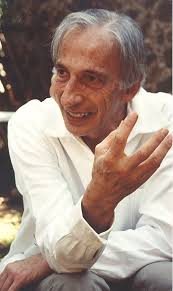
Decades ago Jacques Maritain prophesied this in his thoughts on democratic education.  Maritain had a long and maritain_jacquesdistinguished career as a theologian, philosopher, and social critic.  Even in the 1950’s Maritain astutely observed the shift occurring in education as it related to the rest of society.

Society’s trend toward specialization bothered Maritain, and he predicted two adverse effects this would bring to education.  Our concept of “knowledge” would be the first casualty.  He wrote,

If we are concerned with the future of civilization, we must be concerned primarily with a genuine understanding of what knowledge is: its values, its degrees, and how it can foster the inner unity of the human being.

Restricting knowledge to isolated facts loses the unity, that is, the narrative unity, of whatever we may study.  This is why we cannot reduce westward expansion to a few bullet point facts about railroads and farming.  Complete specialization in general cuts us off from part of our humanity.  We lose the essential symmetry of our personhood.  Related to this, Maritain commented on the second casualty,

If we remember that the animal is a specialist . . . an educational program that aimed only at forming specialists . . . would lead indeed to a progressive animalization of the human mind and life.

Maritain continues, observing and predicting that specialization will lead to lack of freedom, which leads to lack of moral formation.  Educational authorities will then need to undertake “educating the will,” “formation of character,” or “education of feeling” to fill the gap created by a multiplicity of cultural ills.  With this mindset schools feel the need to correct all of society’s problems, or at least the current ones.  He writes,

The state would summon education to make up for all that is lacking in the surrounding order in the matter of common inspiration, stable customs and traditions, common inherited standards, and unanimity.  It would urge education to perform an immediate political task and, in order to compensate for all the deficiencies in civil society, to turn out in a hurry the type of person fitted to meet the immediate needs of the political power.

This approach also takes freedom and inspiration away from teachers, who then assume the role of mere functionaries.  Truth needs freedom to have its full effect.  Teachers need to personalize their classroom experience in some way to give truth a living context, rather than rote formulas imposed from above and without.  This is why, Maritain argues, the ambitious plan of “educating character” in this lock-step fashion will almost surely fail.  The seeds teachers scatter will find only rocky ground.

A final quote from Maritain:

What I mean is that it is not enough to define a democratic society by its legal structure.  Another element plays also a basic part — namely, the dynamic leaven or energy that fosters political movement, and which cannot be inscribed in any constitution or embodied in any institution, since it is both personal and contingent in nature, and rooted in free initiative.  I should like to call the existential factor the prophetic factor.  Democracy cannot do without it.  The people need prophets.
12th Grade: The High School Insurgency Battle

Greetings,

My thanks to all who helped make our activity last Thursday possible, and my congratulations to the students who played an excellent game.  From all accounts, it appears that our senior insurgency was victorious.  The seniors can feel especially proud of this, as we intentionally made the rules harder for the seniors this year than it had been for the past two senior classes.  Their victory was well earned.  I am also glad to report that

In our planning phase I wanted to stress to the students that. . .

  • Wars are not won by acts of violence.  Don’t focus on hunting down the enemy.  Make them react in the way you want them to.  Or as Clauswitz might have put it, find their ‘center of gravity’ and seek to undermine it.

and, as Sun Tzu stated

  • Don’t begin the battle until it is already decided.  In other words, focus on creating the conditions for success, then it will come to you easily.  If we could make them bored, impatient, undisciplined, etc. we would have little problem earning the points we sought.

Finally. . .

  • Let the bad apples spoil the barrel.  Many of our opponents would stay focused, and disciplined — but we could count on the fact that not all would.  A large amount of our points came against a minority of students — students who had a habit of congregating together (creating an inviting target) or being quick to shoot first and ask questions later.  This required patience and careful observation  on the seniors part, but once armed with the appropriate information, we could take decisive action.

After stating these general truths we broke up into squads and started planning Monday and Tuesday.  Nearly all of the ideas came from the students.  I stressed that plans and squads should be flexible.  For us to have a legitimate chance to win, the students would have to cooperate with each on the fly, and expect to do so with different people as the game went on.  I am proud to say that I saw a lot of this during the game.

I’m also proud of how the 9-11 graders conducted themselves.  All the students and teachers I have talked to commented that this year the game was more fun and fair than previous years, and that’s a testimony especially to the students.  My many thanks goes to them.

Please do ask your children about their experiences.  I’m sure they had fun, and I think they learned something in the process not just about planning and coordination, but also about the particular challenges our country faces when fighting an insurgency.

Many thanks,

Dave Mathwin

Mr. Chadband

I confess that I have never been a big fan of Dickens.  I get lost in the verbiage, and sometimes find his endings a bit dull and overdone.  Still, I admit he deserves his fame as an all-time great, and he was perhaps the greatest creator of supporting characters of all time.

One of my favorites is Mr. Chadband, whom I referenced in the last post.  But that post had a heavy and somber tone, and my tribute to Dickens’ creative powers would have been out of place.  But I present here perhaps the best of Mr. Chadband from Bleak House:

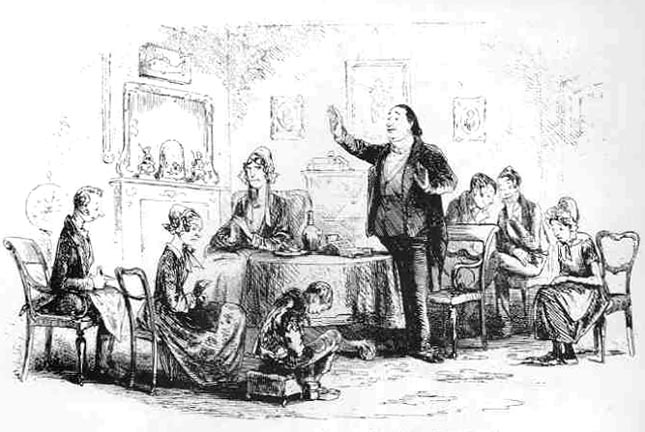
“My friends,” says Mr. Chadband, “what is this which we now behold as being spread before us? Refreshment. Do we need refreshment then, my friends? We do. And why do we need refreshment, my friends? Because we are but mortal, because we are but sinful, because we are but of the earth, because we are not of the air. Can we fly, my friends? We cannot. Why can we not fly, my friends?”

Mr Snagsby, presuming on the success of his last point, ventures to observe in a cheerful and rather knowing tone, “No wings.” But, is immediately frowned down by Mrs Snagsby.

“I say, my friends,” pursues Mr Chadband, utterly rejecting and obliterating Mr Snagsby’s suggestion, “why can we not fly? Is it because we are calculated to walk? It is. Could we walk, my friends, without strength? We could not. What should we do without strength, my friends? Our legs would refuse to bear us, our knees would double up, our ankles would turn over, and we should come to the ground. Then from whence, my friends, in a human point of view, do we derive the strength that is necessary to our limbs? Is it,” says Chadband, glancing over the table, “from bread in various forms, from butter which is churned from the milk which is yielded unto us by the cow, from the eggs which are laid by the fowl, from ham, from tongue, from sausage, and from such like? It is. Then let us partake of the good things which are set before us! [below is a print entitled, “Mr. Chadband Makes Clear a Difficult Subject”]

"Mr. Chadband makes clear a difficult subject."

12th Grade: Do Power and Security have an Inverse Relationship?

Greetings,

This week we continued with our unit on “The Changing State of Nations.”

1. As we discussed last week, terrorism arises as a kind of heresy against the prevailing orthodoxy of how states are constituted and distribute power.  Their basic goals are the same, but as the rationale and goal of the state changes, so too do their methods and targets.  So, for example, a ‘Nation-State’ terror group like IRA would be quite unlikely to want to use WMD’s against England/N. Ireland.  The IRA was trying to create a national state for themselves, and it would not be in their interests to harm the territory they want for themselves to create their own national state.  Unfortunately, modern terror groups like Al-Queda would seek them and use them, as they have global goals and are not interested in national territory per se.

The targets too changed.  The ‘State-Nation’ (1776-1914), for example, ordered itself along a ruling elite ‘fit’ to rule on behalf of the people.  George Washington used  this patrician attitude towards government generally for good, and Robespierre used a similar rationale to inflict the Reign of Terror on France.  The State-Nation anarchists targeted the leaders of governments.  This made sense for in the “State-Nation,” the leaders gave the identity to the nation.

2. U.S. strategy in the Cold War attempted for the most part to separate the domestic environment from our conflict abroad.  That is, we believed that part of the key to winning the war would be to not substantially alter our normal lives.  Throughout this unit we have been guided by the thoughts and categories of historian Philip Bobbitt, who controversially asserts that we may not be able to do this in the ‘War on Terror,’ in which our national territory can be easily infiltrated and made part of the battlefield.  Is he right?  Should we adjust our concept of privacy and the powers of government as part as a ‘weapon’ against terror?  This is one his more controversial assertions that can certainly be debated.

Another controversial assertion Bobbitt makes is that we should not see the powers of government and the rights of people as always operating in an inverse relationship.  Rather, he believes they can, under the right circumstances, work together.  Think of environments like the old west.  People got there ahead of law, and the result was that many had to wear guns and could be intimidated through force.  The fastest, most aggressive gun had the chance to hold a lot power.  We would not call this freedom in the fullest sense.  As law moved west, more freedom came with increased security and rule of law.

His use of the western frontier does support his argument, but does this equation apply in every case?  Would the increase of governmental powers always lead to more rights?  If not, under what conditions would it do so?

In his ‘Discourses on Livy,’ Machiavelli praises the provision for a dictator in times of emergency for Rome.  He writes,

. . .it is the magistracies and powers created by illegitimate means which harm a republic, and not those appointed in the regular way, as was the case of Rome, where no Dictator ever failed to be beneficial to the Republic.

In the same vein, Bobbitt urges us to consider that just as we stockpile food, vaccines, etc. for emergencies, so too we should stockpile laws.

Just as the weaponry changes from the Nation-State of the 20th century to the Market-State of the 21st, so too will the tactics and targets of terrorists change.  Now

But next week we will prepare for our CIA v. Terror Cell game, which I hope they will enjoy.  The goals of the activity are to…

  • Try and mirror some of the basic tactical problems of fighting a networked terror organization, and
  • Try and mirror some of the basic strategic issues — the political and moral side of the war on terror.  How much of their success will be dependent on the good will they build up among the other students?  If they randomly detain, torture, etc. with no thought to broader consequences they may catch the bad guys but lose the people they seek to protect.

Blessings,

Dave Mathwin

8th Grade: Pride is the Fall

Greetings,

This week we wrapped up Babylonian civilization by looking at the reign of Nebuchadnezzar through the Book of Daniel.

Nebuchadnezzar reigned as one of Babylon’s greatest kings and one of the more powerful kings in the ancient world.  He had some significant faults, but also moments of keen insight.   When we first meet him in Daniel 2, we see that he had no patience for the sham dream interpretations of the various astrologers and “wise men” of the realm.

Then the astrologers answered the king, “May the king live forever! Tell your servants the dream, and we will interpret it.”  The king replied to the astrologers, “This is what I have firmly decided: If you do not tell me what my dream was and interpret it, I will have you cut into pieces and your houses turned into piles of rubble.

This may simply be Nebuchadnezzar’s famous temper showing itself, but he also knew that the astrologers Nebuchadnezzar's Dream, Daniel 2would simply look in a book once he told them the dream, and parrot back what the book said.  It doesn’t take a “wise man” to do that.

Daniel’s eventual interpretation of the dream had many lessons for Babylon and us today.  In its time, no other city on earth could equal the splendor and wealth of Babylon.  Not surprisingly, the “head of gold” in the vision referred to Babylon itself.  But even gold, the most precious and enduring of all metals, would eventually be superceded by the “silver” of Persia, the “bronze” of Greece, and the “iron” of Rome.  Only God’s kingdom will truly last.

The dream implicitly criticizes Babylon of course, and foretells of its coming judgment and dissolution, but Nebuchadnezzar has the wisdom and humility to reward Daniel and promote him within his kingdom.

In Daniel 3 we see the full range of Nebuchadnezzar’s strengths and weaknesses on display.  He sets up an idolatrous image of himself, and demands the death of Shadrach, Meshach, and Abednego.  His temper waxes so hot he demands the furnace temperature increased seven-fold.  But when God’s servants emerge unharmed he says,

Then Nebuchadnezzar said, “Praise be to the God of Shadrach, Meshach and Abednego, who has sent his angel and rescued his servants! They trusted in him and defied the king’s command and were willing to give up their lives rather than serve or worship any god except their own God.  Therefore I decree that the people of any nation or language who say anything against the God of Shadrach, Meshach and Abednego be cut into pieces and their houses be turned into piles of rubble, for no other god can save in this way.”

He seemed to like the whole “cut in pieces” concept.

His second dream in Daniel 4 deals with him personally.  He sees a great tree cut down and reduced to nothing, and Daniel tells him that the dream comes as a warning for Nebuchadnezzar to abandon all pride.  Alas, he fails to heed the warnings and succumbed to madness.

Nebuchadnezzar’s plight can serve as a template for examining other powerful leaders.  His insanity came as a direct judgment from God, but it stemmed from his pride.  When we think of clinically insane people we understand that they don’t live in reality, cannot perceive reality and cannot deal with reality.

Might a link exist between pride and insanity?

I think we can answer in the affirmative.  Pride, after all, prevents you from seeing yourself and others as they really exist.  Nebuchadnezzar’s own words reveal this:

[Nebuchadnezzar] said, “Is not this the great Babylon I have built as the royal residence, by my mighty power and for the glory of my majesty?”

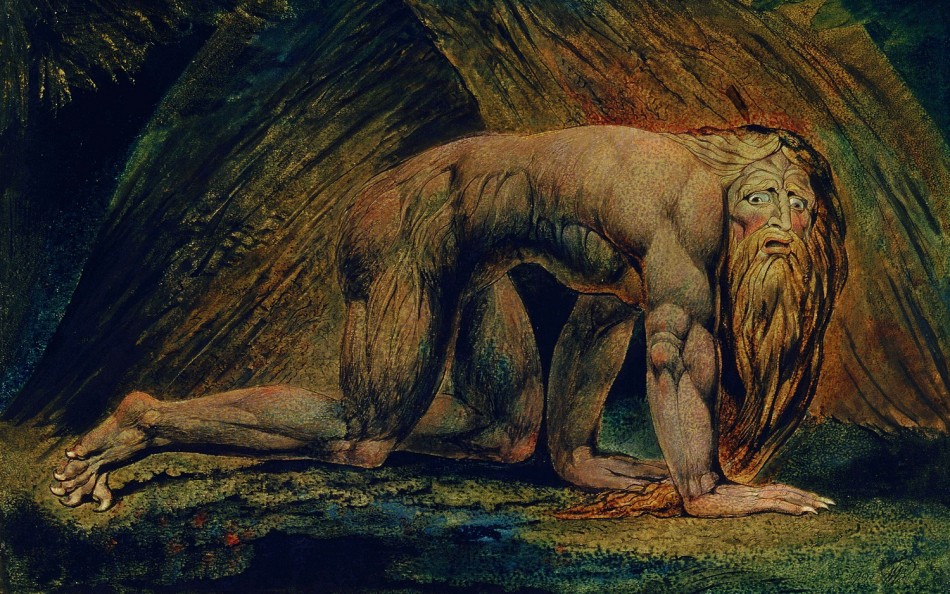
Blake, NebuchadnezzarHis claim reaches ridiculous proportions.  Babylon had existed for centuries before Nebuchadnezzar, and no one would suggest that he did any of the actual building.  It’s quite easy to give the orders, after all.   Pride narrows the universe to one’s own dimensions and limitations.  A prideful man’s heart becomes cramped and unbearable.  Like other notorious rulers such as Stalin, Nero, and Caligula, Nebuchadnezzar didn’t begin insane, but ended this way.  Pride leads Nebuchadnezzar down the path to madness.

His sanity gets restored, however, when he “raised his eyes towards heaven,” possibly in silent prayer, or perhaps he simply recognized the universe outside of himself.

Daniel 4 concludes with Nebuchadnezzar’s own words,

At the end of that time, I, Nebuchadnezzar, raised my eyes toward heaven, and my sanity was restored. Then I praised the Most High; I honored and glorified him who lives forever.

His dominion is an eternal dominion;
his kingdom endures from generation to generation.
All the peoples of the earth
are regarded as nothing.
He does as he pleases
with the powers of heaven
and the peoples of the earth.
No one can hold back his hand
or say to him: “What have you done?”

At the same time that my sanity was restored, my honor and splendor were returned to me for the glory of my kingdom. My advisers and nobles sought me out, and I was restored to my throne and became even greater than before. Now I, Nebuchadnezzar, praise and exalt and glorify the King of heaven, because everything he does is right and all his ways are just. And those who walk in pride he is able to humble.

 While Nebuchadnezzar’s repentance saved himself, it could not save Babylon, which soon after would face conquest at the hands of Persia.  This will be our next civilization.

Writing from Outside and Inside a Tradition

Ernest Hemingway once commented that American literature did not really begin until Twain’s Huckleberry Finn.  Anyone who has suffered through Cooper and the wearisome Hawthorne in an American Literature class knows that making it to Twain means finding cool water in a desert.  

As you can see, I don’t like early American literature, but in truth those authors had little chance of success.  Coming to a new place with a new population meant developing a new language and a new sensibility.  Without a defined context, and without feeling comfortable in the language, awkward first steps cannot be avoided in such situations.

I thought of Hemingway’s insight when I dipped into Adventures at Sea in the Great Age of Sail, a collection of firsthand accounts from sailors in the early 19th century.  An American named Charles Barnard starts the book off.  He had extraordinary experiences, which involved him rescuing sailors, being abandoned, and then later getting rescued himself.  But for some reason he begins his amazing story this way:

The brig Nanina, of one hundred and thirty two tons burthen, Charles H. Barnard, master, sailed from New York the 6th of April, 1812 on a sailing voyage to the Falkland Islands.  She was owned by John B. Murray & Son of New York and was completely fitted and also carried the frame of a shallop of twenty tons intended for use among the islands.

Barnard means well, and writes with all the earnestness of the young American republic.  Alas, the heavy, clumsy style betrays a man without a fully formed country and heritage.  This lack of style makes his incredible story somehow boring.

The second narrative came direct from the pen of Scotsman John Nicol.  The physical details of his life can’t equal Barnard’s, but Nicol writes with the ease of someone who has long lived within a language.  He opens with,

Having reached the age of 67 years, when I can no longer sail upon discovery, and weak and stiff, can only send my prayers with the tight ship and her merry hearts, at the earnest solicitation of friends I have here set down an account of my life at sea.  Twice I circumnavigated the globe; three times I was in China; twice in Egypt; and more than once sailed along the whole land-board of America, from Nootka Sound to Cape Horn and twice I doubled it.

I don’t blame Barnard.  We often don’t realize how long it takes not just for a culture to form, but for a people to feel comfortable enough within it to develop their own literary style.

Death and Dominion

Back in college I had a conversation with a friend who had recently graduated.  He was a solid guy, and a good bass player.  He seemed the perfect catch for some young Christian woman.  When I asked about his dating life he opened up a bit and told me that he had made some mistakes in years past, and now felt he should not date anyone.  He needed to get proper distance from his past to feel ready to have a genuine relationship.  A few years later, he ended up happily married.

Many other Christians have similar stories.  For me it was music.  After becoming a Christian early in college I felt that I had to purge myself of some of the music I owned, especially of the band I devoted myself to in high school.  I know now that this process is not unusual for new Christians, though it seemed so at the time.

I never really understood this process and resented it in many ways.  I had no joy in throwing away those cd’s.  But this summer I found myself involved in a conversation with Andrew Kern who pointed out that I purged myself of certain things in pursuit of proper dominion.  The music might have been perfectly legitimate, but in my non-Christian past I did not integrate the music into its proper place, and in this sense the music gained a kind of power over me.  I needed to hit the reset button, and cast my bread upon the waters so I might receive it back again, all towards the end of proper enjoyment.  Though I had no real idea why I did what I did, good came from it.  In this sense a Christian might very well listen to AC/DC and appreciate the guitar, drums, etc. without in the least feeling the need to run off and live the lifestyle described in the songs.  Such people have dominion over AC/DC.  The music has no control over them.  Rather, they use it for their own good purposes.

Phillipe Aries’ short but incisive book, Western Attitudes toward Death from the Middle Ages to the Present describes just what the title indicates.  Aries’ economical style and droll French wit make this book enjoyable to read, even given the subject matter.  I don’t know where Aries’ came from theologically, but “dominion” forms the subtext of his work, which asks the question, “Is it possible for individuals and a society at large to have dominion over death?”

His first chapter, “Tamed Death,” peeled scales off my eyes.  He begins with the early medieval period and shows how these people neither ignored or feared death.  They accepted it, and, in a sense, gained dominion over it.  “Death was a ritual organized by the dying person himself, who presided over it and knew its protocol” (emphasis mine).  Of course one could never particularly determine the time of death, but through the simplicity of certain postures, and liturgies of prayer and forgiveness, one might rob death of at least some of its power.  Aries quotes Solzhenitsyn’s Cancer Ward to describe the medieval attitude:

The old folk, who never made it to town, they were scared, while Yefrem rode horses and fired pistols at 13 . . . . But now . . .  he remembered how the old folk used to die back home on the Kama-Russians, Tartars, Votyaks, or whatever they were.  They didn’t puff themselves up or fight against it and brag that they weren’t going to die–they took death calmly [author’s italics].  They didn’t stall squaring things away, they prepared themselves quietly and in good time. . . .  And they departed easily, as if they were moving into a new house.

I have never liked the phrase, “Death gives meaning to life.”  It is an absurd sentiment.  Had Adam not fallen his life still would have had meaning, just as Enoch’s and Elijah’s life had meaning.  That attitude also gives Death a kind of power, for now we must struggle to find “meaning” in life, and without an eternal perspective this will be very difficult to do.  The medieval approach strikes me as far superior.

Aries shows that this sense of dominion man had over death disappeared over time.  The shift began in the latter Middle Ages/Renaissance/Reformation (Aries blends them together) when death came with a sense of final reckoning, a summation of life itself.  This may have had a salutary effect of bracing mankind for final judgment, but in the end it added a great deal of weight, burden, and expectation to death.  We no longer “presided” over death, rather, death came with a long list of duties and expectations.  Western man began to lose dominion.

As the Enlightenment dawned and science and “understanding” gained preeminence, health concerns began to separate people from death, both in terms of being with the dying or being around dead bodies, especially the presence of cemeteries and churches.   A secularization of last will and testaments followed.  Without the attendance of family and friends at death, documents disclosed the intentions of the dying instead of the actual dying person.

The Enlightenment in turn called forth a counter-reaction in Romanticism, where death got elevated to “sublime” status.  At first glance the Romantics appeared to bring death back into the human fold by doing so, but Aries points out that Romantics did not counter the Enlightenment as much as they supposed.  By making death a profound “experience” they put man on foreign footing in his relation to death. Under the Romantics the burden of death continued to increase, as did its power over us.

The modern age continued this trajectory, which culminated in a cult of the dead in the aftermath of World War I.  Yes, honoring the past and those gone has its place.  But Aries argues that Europe continued the dominion of death by excessive and repetitive attempts to memorialize the war-dead.  This had the same effect as before–the dead, and death itself, had power over the living.

In the Victorian era official mourning might continue for many months after the death of a loved one.  In the modern age, a modern industry has arisen to get rid of death as fast as possible.  Now,

“too evident sorrow does not inspire pity, but repugnance, it is the sign of . . . bad manners: it is morbid.  Within the family circle one also hesitates to let oneself go for fear of upsetting the children.  One only has the right to cry if no one else can hear.”

The hidden nature of death in the modern west, like the Enlightenment, Romanticism, and post-war period, adds to death’s hold over us.  It’s hiddenness shrouds it in mystery, making it seem omnipotent.  “But really, at heart we feel we are non-mortals,” Aries writes,  “And surprise!  Our life is not as a result gladdened!”

Through all this I felt that Aries perhaps gave a tad too much credence to the early medieval view.  Death is a curse, and in that sense not a natural part of life at all.  Thus, there should be something foreign and mysterious to it.  But Aries never talks about how the medievals arrived at their view, the book’s one weakness.  Perhaps we can assume that in recognizing this from Scripture and church tradition, they gained dominion precisely by naming death correctly, just as Adam gained dominion (however briefly) by naming the animals.

Once we have dominion, death might even be transformed from curse to friend.  We may remember St. Francis’ last stanza of his marvelous “Canticle of the Sun,”

Be praised, my Lord, through our sister Bodily Death,
from whose embrace no living person can escape.
Woe to those who die in mortal sin!
Happy those she finds doing Your most holy will.
The second death can do no harm to them.

Detachment and Exploitation

When we attempt to define civilization we might be tempted to think of things like refinement and gentility, but this is not quite right.  As Kenneth Clark stated, “such things may be the agreeable results of civilization, but they are not what makes a civilization.”  In fact, believing that “refinement” will heighten your civilization may lead to barbarism.

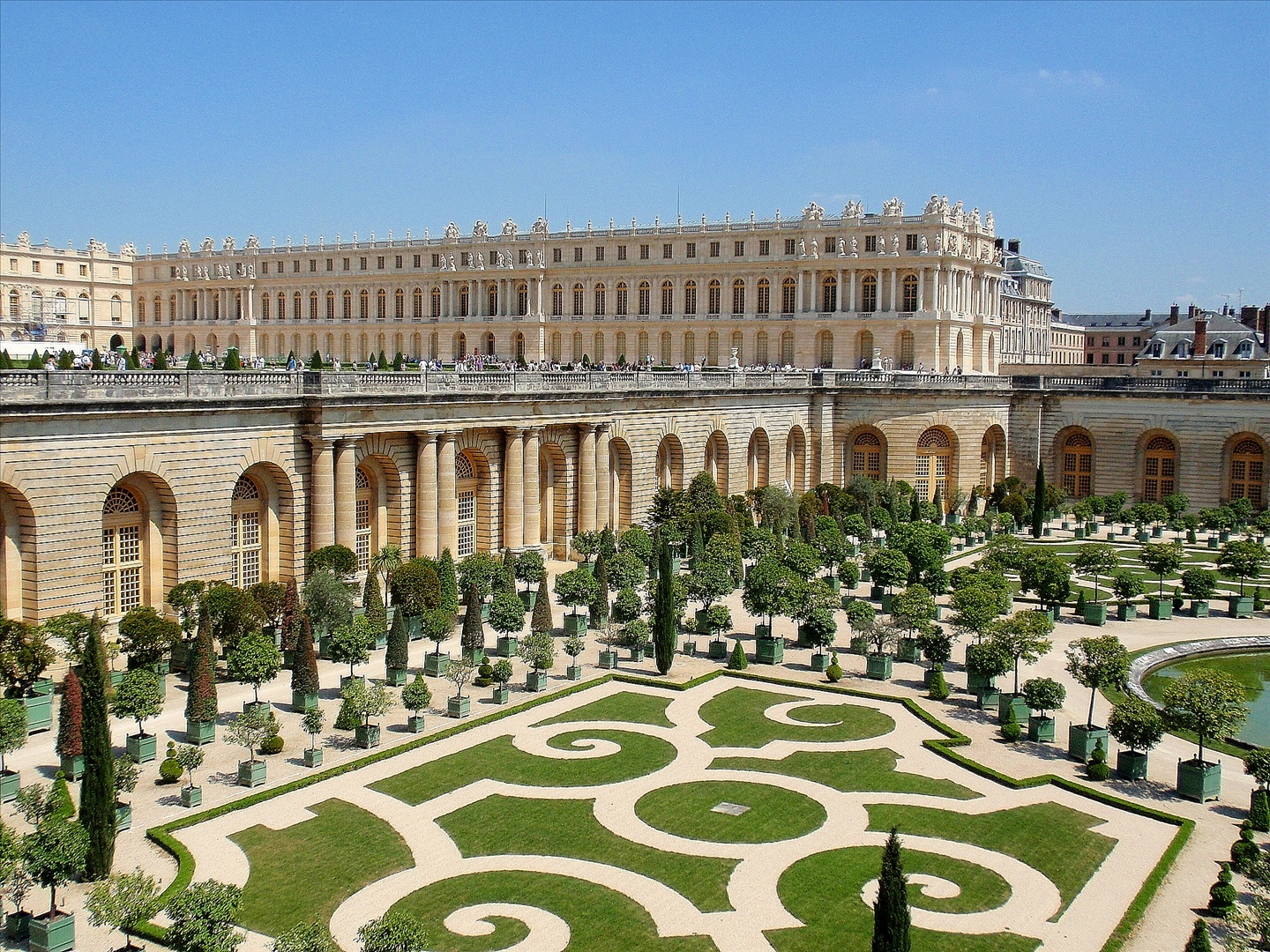
In the modern age perhaps the ultimate example of refinement goes to Louis XIV Versailles.  I can think of no other place dedicated to symmetry, luxury, and delicacy.  Yet at root Versailles existed due to heavy taxation and in some ways, exploitation.  With its maze of manners and ridiculous customs, one could argue that Versailles exploited even those who lived there and “enjoyed” its opulence.  I can’t imagine any sane person wanting to go back in time to take part in the massive charade.  To me Versailles has little real beauty, and suffers from an excess of refinement.  I think the links between Versailles and the terror and barbarism of the French Revolution can be overstated, but surely, some connection exists.

Palace_of_Versailles1

In The Birds by the great Greek playwright Aristophanes, a character named Meton says that,

With the straight ruler I set to work to inscribe a square within a circle; in this center will be the marketplace, into which all straight streets will lead, converging into the center like a star, which . . . sends forth its rays in a straight line on all sides.

It sounds heroic, clean, and noble,  but then we remember that Aristophanes wrote comedies, and Meton is a figure of fun, a puffed-up fool.

The story of Athens is the story of Narcissus.

Their democracy under Pericles (ca. 450 B.C.) had its roots in the reforms of Solon (590-570 B.C.).  Certain privileges still resided in the upper classes after Solon’s time in power, but clearly Solon broadened the political class and narrowed the social gap between rich and poor.  Among his reforms. . .

  • All Athenian citizens received admission to the Areopagus
  • Foreign tradesmen were encouraged to settle in Athens and received citizenship if they brought their families
  • Any citizen could take legal action against another
  • Prohibition against a debtor’s person used as security for a loan.

The lock-step nature of Athenian society under Draco received a welcome outside stimulus.  Athenians started trusting one another, and their economy grew.  Plutarch writes that, “In Solon’s time, no trade was despised.”  The exalted Agora in fact served as a market and a general festival area.  Different people mixed together from different trades and classes.

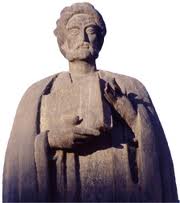
Though no one believes that this sculpture of Solon was done anywhere near his lifetime, it reveals something of the common wisdom and concern that seems out of place with his upper-class roots:

Solon

If we go forward in time another 100+ years, we come to this bust of the Athenian statesmen Pericles.

Pericles had many successes and we can admire much of his statesmanship, but his face betrays him.  We do not see what we see in Solon.  With Pericles we have the smugness, arrogance, and touch of detachment for which the Athenians became notorious by 431 B.C.  If Pericles gets his share of credit for the brilliant culture of 5th century Athens, he shares in the blame of how far they had slipped since Solon’s time.   For example, under Pericles one could not marry foreigners, and foreigners in general had no hope of participating in Athenian political life.

Like Meton, the Athenians came to crave elegant simplicity and clarity.  They obsessed over the ideal.  The brilliant pythagoreans, who believed that all of life could be reduced to simple ratio, actually killed a member of their school who divulged the existence of irrational numbers.  They murdered to stay detached from reality.  Nothing should be allowed to end their beautiful dream.

This attitude bore bad fruit in more general ways.  Athenians still benefitted greatly from foreign trade.  In fact they depended on it, and Pericles’ initial strategy for the Peloponnesian war put absolute reliance on the availability of foreign goods.  But the tradesman and the merchant now had no social standing, whatever their political rights might have been.  The aristocratic ideal of refinement and detachment had taken firm root among the Athenian elite.  If we take Aristophanes as a reliable source, in Pericles’ day the upper-classes avoided the Agora and hung out by the gymnasium with their own more leisured companions.  Athens’ contempt for the artisan and merchant destroyed them.  Trade depends on good relationships and good faith, the same qualities needed to hold together their empire.  If Athens neglected their tradesman they would soon neglect their empire, and treat them as second class citizens.

As Lewis Mumford notes in his excellent The City in History, they did just that.  Their platonic sense of detachment led to Athens exploiting its tributary states, once allies.  This detachment and exploitation reached its peak in the Parthenon (funded by money taken under false pretense from their allies)  which doubles as an insanely impressive technical achievement and a hymn to self-worship unequaled except by the pyramids and Nebuchadnezzar’s statue.

A “schism in the soul” of Athens had arrived, an imbalance that gave the life of the leisured mind precedence over the life of the laborer.  Whereas before Solon gave economic incentive towards developing a trade, now tradesmen sat on the outside looking in.  Plato later took the aristocratic idea to its fullest extent and enshrined philosophers as kings, strictly dividing the people based on their innate functionality.  None could accuse Plato of loving democracy, but ironically, he is in many ways Pericles’ heir.

When looking at the Civil War modern history textbooks do a great deal of damage by glossing over the virtues of the South.  Many in the North had no love for blacks, and the industrial system exploited people in ways not terribly different than slavery.  Some southerners treated their slaves well (relatively speaking), some in the south spoke against slavery, etc., etc.  The ante-bellum South was no monolith.

But in the end even the Southern romantic must see that large aspects of the refinement and gentility that the South possessed came from their aristocratic detachment, made possible by wholesale exploitation of blacks.  Will Durant wrote that all cultural achievements have roots somewhere in exploitation of some kind.  I disagree.  But some cultural achievements do have rotten roots.  Some of what makes the ante-bellum south appealing (i.e. the “Gone With the Wind” culture)  had its roots in arrogance, but also in aristocratic detachment from the “vulgar’ aspects of life.  Let others get their hands dirty.  One southern newspaper wrote just before the war,

Free society!  We sicken at the name.  What is it but a conglomeration of greasy mechanics, filthy operatives, and moon struck theorists?  They are hardly fit for association with any Southern gentlemen’s body servant.

Those “hardly fit” would soon bring judgment upon Southern society, much as all the merchants, farmers, and craftsmen scattered across the Aegean dealt a mortal blow to Athens by the end of the Peloponnesian War in 404 B.C.

Cannae, Carrhae, Adrianople

Every good teacher will seek different ways to communicate effectively, and over the years much has been written about how teachers can adapt to the different learning styles of the students.  Much of this information should be used as best we can but in the end, I think too much is made of it.  After all, it is impossible for teachers to adjust individually to each of his/her students, and much easier for students to adjust to the teacher.

So much of how one teaches comes from who one is as a person.  Teachers must be “on display” for much of the day, and so perhaps more than most professions, the strengths and weaknesses of teachers as people reveal themselves in the classroom.  Since this cannot be avoided, it might as well be embraced.  We have to play to our strengths and let the chips fall.  This is inevitable and in one sense, appropriate.  We are finite, limited, and are most effective when in a community of other teachers with different strengths.  This way, in the end, it all balances out.  Teachers can be blamed for a variety of things, but not our certain failure to be all things to all students.

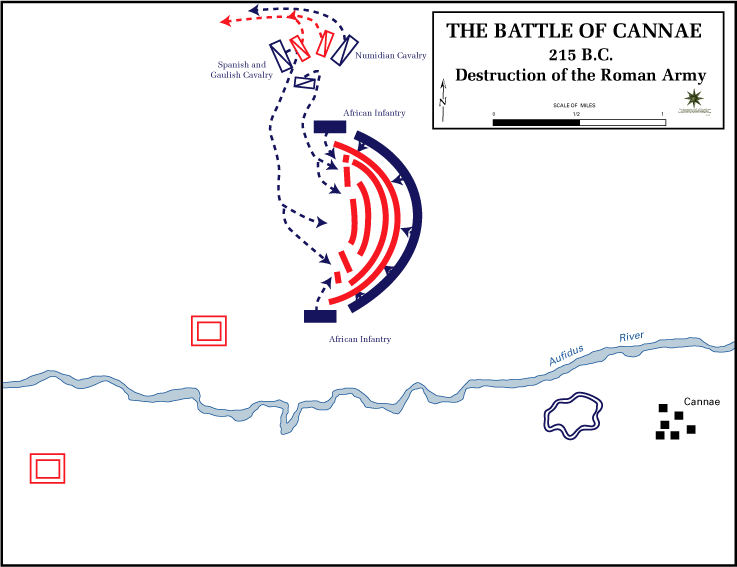
One of my favorite sections of Toynbee’s A Study of History comes in volume four when he examines the subtle idolatries that infect civilizations — idolatries of the past, of institutions, or techniques.  Toynbee applies this latter lens to the Roman army from its disaster at Cannae in 216 B.C. to its decimation at Adrianople in 378 A.D.

After Cannae Scipio helped bring about several reforms in the Roman infantry, making it more flexible and mobile.  But it was Hannibal’s cavalry that had really done Rome in at Cannae, and Rome’s reforms in this area were not nearly as significant.

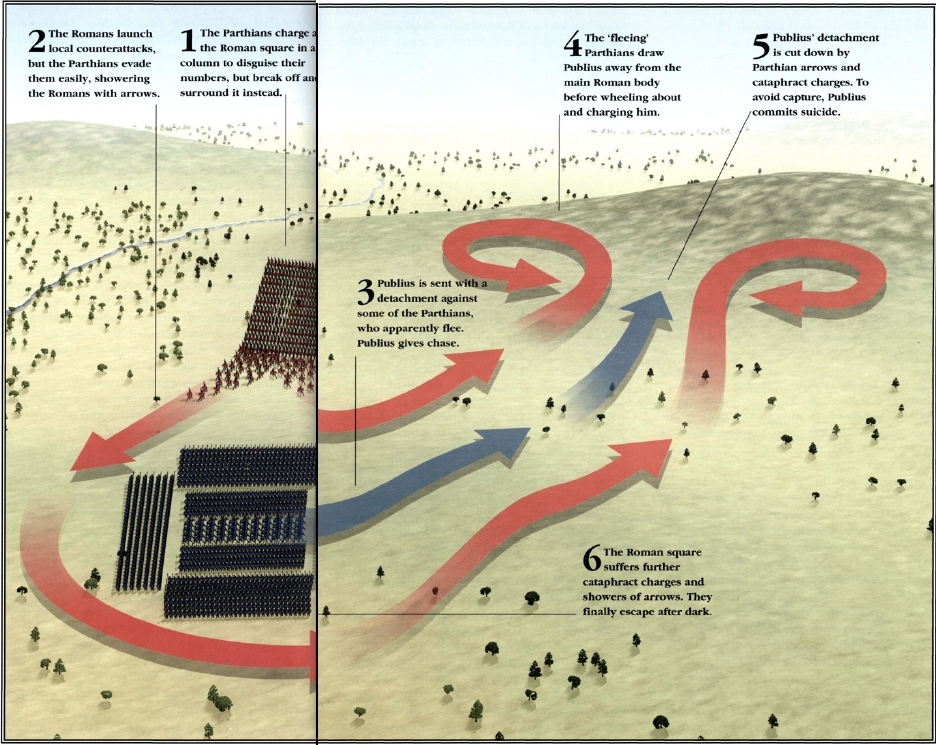
Fast forward 150 years and Crassus leads his army into Parthia.  Once again, the Romans lose decisively, and once again, the cause is the Parthians heavy cavalry deployed in a wide open area.

Carrhaie56

Historian William Tarn commented that, “Carrhae ought to have revolutionized the world’s warfare,” but Rome ignored the evidence, or perhaps has no possibility of changing anything at the time.  The Republic was collapsing all around them, and Caesar fought illegally in Gaul more or less simultaneously.  In any case, Surena, the victor at Carrhae, was executed shortly after the battle and his magnificent cavalry broken up.

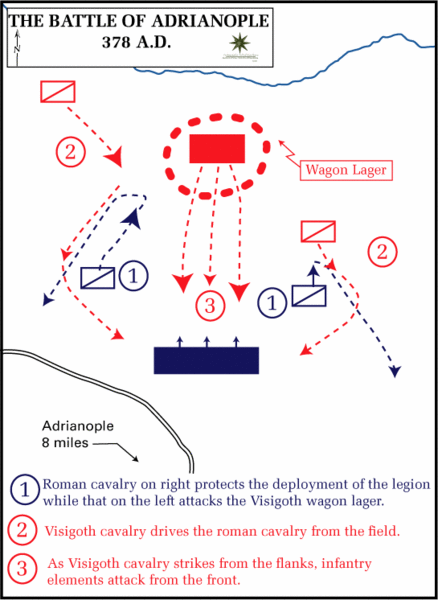
By 378 A.D. the empire totters on the verge of collapse, and the Goths deal a decisive defeat to Rome at Adrianople, with cavalry again the mainspring of this final disaster.

Toynbee argues that Rome idolized its infantry technique to the point where they never could adapt their cavalry, and this failure, among many others, helped end their empire.

One of Toynbee’s great strength is his search for spiritual roots to what seem like physical problems.  Rarely do I disagree with how he applies this methodology, but I think I may in this instance.

The adaptations made by Scipio allowed Rome to conquer much of the Mediterranean within two generations, so their attachment to the technique/institution seems understandable, and if they “idolized” it that might be expected.  This picture could fit Toynbee’s theory, but perhaps they didn’t “idolize” the technique, perhaps they simply had a finite army, just like every other civilization.  Rome could never be all things to all men, and neither could their army.

Even during their declining “Empire” phase Rome continued to adapt their military, using auxiliaries from different provinces to fight alongside the standard infantry.  So we cannot say that Rome had frozen itself in time from Scipio onwards.  Their cavalry improved enough to help defeat Hannibal at Zama, and Caesar’s cavalry helped him defeat the Gauls — no small achievement.

Maybe we can say that Rome was a great teacher, and could reach many different students, but would always have a problem with students of certain type.  To be limited is not the same as being idolatrous.  To ask them to act differently is to ask them not to be Rome.

And, we have to admit, Rome had a very successful military for whatever shortcomings they possessed.

The issue Toynbee raises, however, still has value.  Why did Rome improve in many ways at many levels, yet never develop an ‘A’ level cavalry?

I don’t know, but I would guess that. . .

  • Great cavalries usually develop in wide open geographies.  Italy did not possess the typical geography that usually developed cavalries
  • But the geographic argument can be overstated, because medieval Europe was a “cavalry” culture, and European geography has little in common with Eurasian steppes or desert flatlands. The roots of the knight-errant lie in the social-political structure of feudal Europe.  So. . . .
  • Rome inherited the Mediterranean city-state legacy, with its emphasis on a land owning infantry that fought and armed themselves to defend the city. Rome’s military was certainly an offensive machine, but they always fought best when they could, a la Henry V at Agincourt, advance to provoke an attack, then fight defensively.  Cavalry strikes me as a distinctivly offensive weapon.
  • Even when the patricians governed Rome, they always thought of themselves as a nation of simple farmers (Toynbee could charge Rome justly with another one of his idolatries, the “idolization of the ephemeral self”).  Romans, like farmers, were practical at heart, and probably had little time for the horse, a “useless” animal on the farm.  Without a real love for horses, one could never develop a great cavalry.

I would curious for any other thoughts on this question.

12th Grade: The Assassination of Anwar al-Awaki

Greetings,

One of my main goals for our first few weeks was to try and see how our current ‘War on Terror’ raises difficult questions and puts great stress on key democratic values and practices.

As an example of the kinds of questions and dilemmas we face as a nation we spent some time discussing the drone attack/assassination of Anwar Al-Waki.  No one doubts that he was a “bad guy” whose English ability made him a unique voice for terrorists.  He likely had an indirect hand in the Fort Hood shootings, as well as the failed Times Square bombing.  Here is a Youtube of his last video message before his assassination:

What makes his death especially debatable is that he was an American citizen.  Should we be allowed to, in effect, execute citizens without a trial?

There are different sides on this issue.

In favor of the action, we might say that:

  • He was a known enemy who fled the country and who advocated and perhaps facilitated attacks upon us.  This is the very definition of treason.
  • We had no access to arrest him.  In taking refuge in Yemen, he put us in an extremely awkward position. Yemen’s unique political and social dynamic make it a kind of no-man’s land.  If he wants to go into a ‘no-man’s land’ where normal political rules don’t apply, then he forfeited his right to a trial.

Against it we could say that:

  • Civilization as a whole, and our legal system in particular, is inconvenient and creates inefficient burdens to us that we simply have to abide by in order to have civilization at all. Citizens must be dealt with through the legal process, no matter the person or circumstance.
  • Do we want to give the president the power to execute citizens without trial?  Would this not continue the disturbing trend of increased presidential power that we have seen since World War II, and that has only accelerated after 9/11?
  • If we want a government to deal with all evil under the sun, we ask for an omnipotent state.  Such a state would give its citizens no liberty.  We must simply tolerate some evil (and evil people) for the sake of liberty.

Two articles about the incident can be found here and here.

In the broader context, I hope students saw this as another instance of our theme for this first unit, how the “War on Terror” does not just put stress on our security, but on our democratic system as a whole, our values, and so on.

Last week in the update I mentioned that we discussed the nature of our values as a country, and whether or not these values helped or hindered the war against terrorism.  Students disagreed on this question, with most believing that our values hamper us, or leave open the possibility that we will be taken advantage of because of our values.

What we as a people think of this question will have a significant impact on how we deal with enemies abroad and at home.  One student mentioned the famous account of a Navy SEAL mission in Afghanistan in book called Lone Survivor.  The book details “Operation Redwing,” in which a small team was charged with killing a dangerous bomb-maker behind enemy lines.  Unfortunately a few random shepherds discover the SEAL team in the early stages of their mission, and the soldiers must decide what to do.  Some on the team advocated killing the shepherds to prevent them from possibly giving away their position.  Others wanted to let them go, seeing as how they were civilians.  In the end the team leader let them go.  The Taliban discovered their position (likely because of the shepherds told others about what they saw), and only one member of the team made it out alive.

Upon reflection, the book’s author wishes he had killed the shepherds instead of letting them go, and most of the students agreed with him.  The mission, and the perceived “greater good” of the mission, took precedence over the lives of the shepherds.

This specific mission touches on the broader ethical questions we face as a nation in general, and as a democracy in particular.  If we believe in equality, that all lives have equal value, does that apply on the battlefield?  Do we believe in “innocent until proven guilty” for others?  Do these values apply in wartime?  If we fight consistently or inconsistently with them, what are the consequences for our society?  Students that advocated for letting the shepherds go argued that 1) Killing them would be a direct evil balanced out only against a possible, indeterminate good, and 2) Killing them would be an explicit admission that American lives were more valuable than the lives of Afghanis.

This decision also forces us back to the tensions in any democratic nation, for as we discussed in the first week, the natural community for democracies is “everybody.”  We preach a universal ethic rooted universal values.  Can we maintain our identity if we fail to act consistently with this?  But how can we outside our borders?

There exists another possibility. . .

Perhaps it is when we fight in such a way that prioritizes our lives over others that we in fact, fight according to our values and not vice-versa.  After all (say some), we have a “me-first” culture.  Of course, human nature has always been “me-first,” but our culture at the moments seems particularly geared in this direction.  Maybe this, and not “equality,” truly governs our actions today.

Whatever we think about these difficult questions, we must choose, and take responsibility for that choice.

Thanks once again,

Mr. Mathwin

The Mosaics at Chora

Everyone wants creativity, but everyone knows that it just not just “happen.”  Creative acts need a physical context (i.e. time, skill, etc.), but they also need a spiritual context.  That is, for human beings to see things in new ways they need the inner spiritual freedom that allows them to see in the first place.

Idolatry comes in many forms, but within Christian communities it will almost always take an indirect path and have an indirect manifestation.  We can idolize the past, or idolize institutions, for example. The Byzantine empire (ca. 330-1453 A.D.) gave much to the idea of civilization.  We can find evidence of its vitality in its unique artistic and architectural contributions.  They had a significant impact on the development of Russia outside their borders.  But, as a “grafted” branch onto the Roman tree, they persisted in an irrational attachment to Rome’s imperial idea long after things in Italy showed that the emperor had no clothes.  One could call it idolization of the past perceived glories of Rome, but they did not merely copy Rome’s culture.  They blended with their eastern surroundings and invented something new.  I think instead they stand accused of attachment to the institution of the emperor, or at least the idea of empire itself.

In another post we looked at how this idea led them into a foolish war against their Bulgarian neighbors, a conflict which took their eyes off more pressing concern of the rise of Islam.  They never fully recovered from this mistake.

The truth of the failure of the imperial idea became obvious to the eastern church by the 14th century.  The Islamic handwriting was on the wall to any person who had eyes.  The Byzantine Empire’s time was at hand.  Unfortunately, the eastern church’s realization of their failed investment in the institution of the emperor was too little, too late.  But as they freed themselves spiritually from their attachment to the emperor, they simultaneously created some of the most magnificent art ever done in the eastern iconographic style in the monastery at Chora, right near the beating heart of Byzantium, just outside Constantinople.

P40212757e

To my western eyes this may not seem that impressive.  But if we travel to Mt. Athos in Greece and observe contemporary works to those at Chora we see a difference in the examples below. . .

protaton

At Chora we see power in the images and a subtle touch only possible with a freed mind.  At Athos I don’t see quite see the same inner depth.

The reason for these differences might be the persistence of the idolization of an institution.  In Greece during the 14th century they still put their heart into the imperial treasure.   Perhaps their physical distance from the emperor made their hearts all the fonder, more fond than they should have been.  Though the monks in Constantinople were about to be engulfed, they may have had more inner freedom than those in Greece.

For the record, I am no art critic, and so would welcome any thoughts from more discerning eyes than my own.

Visual Democracy

Last year a colleague told me about Ivan Illich.  “Ivan Illych?”  I asked.  “No, the other one,” he replied.

I had never heard of him before.  His Wikipedia page mentions that he was a Catholic priest, but most Ivan Illichknown for his social criticism.  One look at his bibliography shows a wide range of interests.  His book In the Vineyard of the Text lives up to all of my friend’s hype.  I can’t call what follows here a “Book Review,” because the book is too dense, and the material too far out of my league, for me to fully grasp.  But I am excited by it and hope to make progress as time goes by.

In this book Illich looks at what he calls the origins of the age of the book.  He does not locate this with the printing press or the Englightenment, but with Hugh of St. Victor’s Didascalion written in the early 12th century (something else I had never heard of before).  Of course books existed before this particular work.  But Illich makes the observation that up until this point, books were made to be heard and not seen (i.e. The Illiad), or so visually stimulating that the text took a backseat.  The words were entirely secondary.

With Hugh of St. Victor Illich believes a significant transition took place, whereby Hugh writes to be read rather than heard.  Form follows function, so St. Victor writes in a way that allows for reflection.  Plays rely on visualization, but books ask you to exercise methodical reason.  Arguments build, and you have the opportunity to refer back.  WIth that opportunity comes expectation, and so on.   St. Victor, for the first time (according to Illich) writes with a thought towards creating the discipline of reading, which leads to the development of certain modes of thought, and for the next 800 years or so, we have the age of the book, an age which lent itself towards the formation of deliberative wisdom.

Illich, writing in 1993, notes that the age of the book has long since passed us by in favor of visual mediums.  While he does not address this transition, he notes that it will of course have dramatic consequences for society, and I wondered what consequences it might have for democracy.

Does democracy needs books to thrive, or perhaps even survive?

Democracy predates the age of the book.  We don’t need to think only of ancient Athens–we can think of innumerable local village assemblies from before Christ through the more official village and township elections of the Middle Ages.  But I’m not sure these small scale democracies should really count as examples that pertain to us today.   These  local democracies did not need a “mass-produced” way of making decisions.  Their communities were usually small enough for everyone to know each other.

Republican Rome had many democratic elements, but remained an oligarchy, for better or worse.  They had a variety of structures in place to prevent the people’s ability to make quick decisions, and the patrician Senate dominated policy until the army, another kind of oligarchy, did so starting ca. 100 B.C.

So, although it’s almost boring to say so, we are drawn back to Athens.

Athenian democracy had many more wide-open features than modern American democracy.  They made the majority of their decisions in the Assembly, which met 10x a year.  Anyone could attend and vote in Assembly meetings, provided you arrived early enough, and there may have been as many as 5000 seats.  Anyone in theory could speak, provided that you could hold the floor and didn’t get booed off stage.  Voting often took place on the same day that laws or policies were proposed.  It seems much more exciting than C-Span.

But the critics of Athenian democracy from Thucydides to Plato had a point when they argued that they often lacked the capacity for deliberative wisdom (I think both eminent men overstated their case, but they did have a case).  If we believe Thucydides, Xenophon, and others we see that they had moments where passions got the best of them and led them to disaster.  So while they were not a visual culture per se, they did seem to demonstrate the faults of visual cultures.  That is, they are easier to manipulate.  Now I do not agree that Athenian democracy had no brains behind it.  Many speeches passed down to us by Thucydides had wit and reason behind them.  It was not a smoke and mirrors show.  But at crucial moments they seemed to lack the ability to reason carefully.  This is a human fault, of course, not just one of democracies.  But the lack of “deliberation” built into their government and society made it so they were more vulnerable to the swings of emotion and powerful rhetoric.

If Illich is right that we are long past the age of the book than we may be back in the situation of ancient Athens.  I thought of this when I heard someone discuss our possible intervention in Syria.  He opposed it but admitted that if video existed of the chemical attacks and it went viral on the internet we would have no choice but to intervene.  The images would force our hand.  I think that would almost certainly be true.  Aside from whether or not we should intervene in Syria, would it be a good thing if images dictated our policy?  Will democracy experience a seismic shift in the You Tube age, or did this shift happen 20 years ago?

As a parting aside, I feel I must read Illich’s Deschooling Society  at some point.  His quote from that book, “School is the advertising agency that makes you believe you need the society as it is,” in itself offers much food for thought.

Ibn Khaldun on Jeff Bezos and Steve Jobs

Jeff Bezos’ purchase  of the Washington Post has led to a flurry of articles about him, of which I liked these two.  Clearly Bezos has a brilliant mind, supreme confidence, and intense drive.  As I read some articles about Bezos I thought he had much in common with Steve Jobs.  Both have drawn great praise and great criticism, with the praise coming for their revolutionary ideas, with much of the criticism coming from how they treat employees.

Regarding people with brilliant minds being in charge, medieval Moslem philosopher Ibn Khaldun wrote,

Benevolent government is rarely associated with a ruler whose mind is over-alert and intelligence Ibn Khaldunover-developed.  Benevolence is most commonly found in rulers who are easy-going or who behave as if they were.  The worst defect of such a ruler is that he lays burdens on his subjects which are greater than they can bear; and he does this because his mental vision outranges theirs and his insight penetrates into the end of things as well their beginnings. . . .  Divine Law prescribes in the case of rulers that excess of intelligence should be avoided. . . .because it produces oppression and bad government, and makes demands on people that are contrary to their nature.

Toynbee quotes Khaldun in volume four of his A Study of History in the context of looking at civilizations that begin to lose internal harmony.  Decline in civilizations begins for Toynbee when society reveals various forms of spiritual schisms that misalign their focus.  The lopsided nature of a mere intellectually brilliant leadership comes not as a blessing but a curse to a civilization.  Perhaps Toynbee would not be so impressed with Bezos and Jobs.

But I do wonder if Toynbee was wrong about this.  Apple products have made enjoyment of music, for example, accessible in ways not previously possible.  I realize that a lot music is pirated but that is not Apple’s fault, and anyone my age can remember the necessity of buying whole cd’s to get the 2 songs you liked.  Amazon may get a bad wrap for putting Borders out of business, but I love that the world is now my library, and I have benefitted greatly from the access that Amazon gives me.  Of course nothing is perfect, but on balance it seems that Apple and Amazon have changed the world in positive ways.  Let us grant that Bezos and Jobs are/were tough bosses.  But both did, on the other hand, have a large role in creating companies that employ thousands of people.

But I hesitate to disagree with Toynbee, so I must imagine how he would respond.  He might say that increased access is only an improvement of technique and not a real breakthrough.  He might continue that improvement in technique does not improve our souls, and what’s more, this technical advance (unaccompanied by a spiritual advance) will likely fool us into thinking that we are “all that.”  This delusion will lead to much greater problems later on.

This would be a really good counter-argument, one I am tempted by.  But I don’t know.

I do really like Amazon Prime.

Inflationary Goodwill

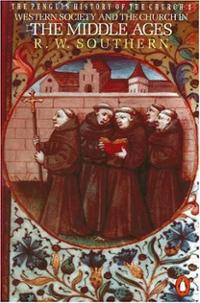
R.W. Southern’s book Western Society and the Church in the Middle Ages won’t change the discipline of medieval studies, but his work succeeds fundamentally in avoiding two key errors historians often make about the past.

The first error makes the present great, and the past barbaric and backward, an object of amusement.  This view was far more prevalent in the 18th and the 19th centuries than today.

The second error is more subtle.  Seeking to correct the first error, they explain the value of the past by showing how it led the world we have today.  “If it wasn’t for Albert the Great, we wouldn’t have light bulbs,” or something to that effect.

More truth resides in the second error than the first, but both paths share the same pitfall.  They both view the past only in terms of the present, and both assume of course that history would obviously want to lead to ourselves.  The first falls prey to chronological snobbery, the second to the “Whig” fallacy.

Happily Southern avoids both.  He seeks to evaluate the medieval church on its own merits, in its own context.  The medieval system had strengths and weaknesses that we do not.  His book essentially tells the story of how a dynamic church that saved the west from barbarism after Rome’s fall resembled a stagnant hulk by the end of the 15th century.  For Southern the church’s triumph set the stage for its demise.  In this respect, the medieval church is no different from any other organization.   Every system has a potential Achilles heel.

The peak of the medieval period had a lot going for it.  Gothic cathedrals and St. Thomas Aquinas both brought weight and meaning, combined with a feathery touch and sense of play.  Aquinas writings’ have a great deal of intricacy, but they do not form a system.  He was at heart a mystical theologian.  Holding this tension in place requires a high level of spiritual wisdom, which Aquinas possessed.  Those that came after him found it much easier to focus on the logical intricacy than the demanding spiritual wisdom and playfulness that accompanied it.  The “problem” of Aquinas is the problem of medieval civilization.  At some point it became akin to an Italian sports car — powerful, beautiful, and likely to break down in a such a way that you’ll have no idea how to fix it.

imagesJocelin of Brakelond’s Chronicle of the Abbey of Bury St. Edmonds, which details events at the abbey in the 12th century, show this same trend.  I expected some stories of bad monks or various squabbles here and there.  What I did not expect was the overwhelming political focus of Brakelond’s narrative.  Time and time again he discusses disputes over this or that property, arguments about this prerogative, this privilege of hunting or taxes, or whatever.  There was a method to this seeming madness, as the heart of the disputes involved the independence of the Church.  But one can’t locate the spiritual center of the abbey.  The emphasis has shifted too much in a dangerous direction toward power and “worldly” concerns.

One of the more interesting parts of Southern’s work is his section on indulgences.  His sympathetic eye led to some insights I had not considered before.  He argues that there is something almost childlike about how indulgences started and how they originally applied in the life of the Church (I am not Catholic and make no attempt here to understand the doctrine, but New Advent always gives good information on such things).  Those familiar with Daniel Pinkwater’s The Last Guru may recall the scene when the young protagonist Harold, having no idea what to do with his sudden immense fortune, asks if he can just give it away.  Not possible, his money-man tells him.  Billions and billions of dollars flooding the economy at once would create economic chaos.  Harold would have to think of something else.

Southern looks at the problem of indulgences as a problem of inflation.  The initial “gifts” might have been well-meaning and had a nice “impact” (if such things can be measured).  But if the supply never ran out, and the gifts kept coming, they would eventually lose their value and their meaning.  One would have to invent creative applications to keep up appearances, hence the arrival of what Southern terms the “Lawyer Popes” of the late 13th-early 14th century.  I do not think Southern was Catholic, and I can appreciate that while his particular perspective on indulgences does not attempt to be the whole truth on the matter, it can function nicely as part of the truth.

My one problem with Southern is the basic problem of the British specialist school of historical writing.  For them the past has innate value in itself, and should be understood on its own terms.  So far, I concur.  But unfortunately, that’s where the British specialist stops.  In his mind (so it seems to me) the historian’s job goes no further than telling you what happened.  I disagree, and think that history only becomes “History” when it has meaning and application for how we live today.

But while this defect prevents the book from being great, it does not stop it from being a worthwhile look at medieval times.

Scientists are Civilizations Too

Mario Livio’s Brilliant Blunders looks at five of the major scientists of the modern era (Darwin, Pauling, Einstein, etc.) and examines the significant mistakes each of them made.  Livio does not take cheap shots.  He does not blame the scientists to errors they made due to what they could not have possibly known.  Instead, Livio focuses on blind spots in their theories that they should have seen, or prideful mistakes they made later in life.  Thus his book* functions as a psychological as well as a scientific study.

Each of the scientists in the book made their most significant contributions relatively early in their career (i.e., Einstein’s “Miracle Year”), and Livio believes this trend holds true for scientists in general.  The scientists then committed their “blunders” later in life, and when asked to comment on this, Livio stated that most likely, these men were not content to stay with a pat hand.  If at 35 you change the world with your theories, who wants to tinker with its finer points until retirement?  Instead, the scientists somewhat naturally seek other major breakthroughs, but this time in areas outside their wheelhouse, which is when they make their mistakes.

Are scientists unusual in this regard, or might it be a common human trait?  One thinks of presidential second terms that never seem to go quite as planned (Truman, Nixon, Reagan, Clinton, GW Bush, Obama?).  Local Washingtonians remember the humdrum nature of Joe Gibbs’ second stint as the Redskins coach.  U.S. Grant made a much better general than president.  In literature we have figures like Merlin and Lear making their big gaffes late in life.

Of course it could be that we see “fall’s” at the end of things only in hindsight.  We call it the end because he /she “fell” and ended their careers on a bad note.  But they only would end if they did something bad, thus the theory is entirely circular.

I don’t accept this entirely, for some careers end well, and some know when to ride into the sunset.  But the question remains whether or not we trace something general about human life, and we don’t need a perfect record for that.  And if it reveals something about human life in general, it may reveal something about civilizations.

Spengler thought that civilizations had a natural lifespan, like biological organisms.  No civilization by definition could keep going ad infinitum.  I think that’s because he saw civilizations as the outworking of a particular idea, embodied in a particular people (or, perhaps for Spengler, a particular race).  If we take the city-state idea with Athens, for example, we can see

  • An initial dynamism with the “new” idea of democracy embodied in a small community
  • This dynamism having great success, which leads to expansion
  • The expansion leading to inevitable betrayal of the idea, or at least, the idea can’t apply in the same way beyond their community.
  • The tension and contradictions now need resolution, which comes in the form of the Peloponnesian War.

One can see a similar process happening with the Roman Republic, and perhaps even Israel.  The idea of a Jewish state had great moral and dynamic force in the wake of W.W. II.  This gave Israel a great cohesion and sense of mission with their founding generation (’48-’67).  But the success engendered by the force of the idea led to Israel becoming an occupying force, with all the inherent contradictions that implies for their original idea.

In the end I think we should recoil from inevitability Spengler preaches but still be strongly cognizant of the usual pattern of temptation.  In order for our ideals or our identities to experience continual renewal, we need to be aware of their limitations.

*I should say that I did not read the book, but heard the author interviewed.