This week we began looking at Macedonian civilization, and as usual we began with geography.
The map shows Macedon as a land-locked and mountainous area, and we would expect this kind of terrain to have a particular emphasis on its people. . .
Map
Mountainous areas are always difficult to control, leading to weak central governments
Usually an aristocratic warrior elite seeps into the culture, which usually divides the people into warring clans (for this and the above point, think of Afghanistan, which has a similar geography to Macedon).
With this environment, we usually see a low level of cultural output, due to their relative isolation and internal divisions (this is not the case with Scotland, but Scotland is not land-locked as Macedon is).
I was glad to see the students start to make connections between Macedon, Assyria, and Sparta. All three share a similar geography, and all three share a similar geographic position — on the periphery of their respective societies. Sparta and Assyria had stronger central governments than Macedon, but their similarities should make us realize of the power of geography to shape the course of a civilization.
As I mentioned, Macedon had little role in Greek civilization for many centuries. But as luck would have it, Macedon saw the rise of the charismatic and ruthless Phillip II just at the very moment of grave political weakness for Athens, Thebes, and Sparta. Opportunity knocked for Macedon. Phillip looked every inch the tough customer he portrayed, wearing an eye patch over his wounded eye for necessity, and probably, for effect as well. But Phillip combined his personality and appearance with a keen understanding of how to maximize the qualities of his society into a formidable military machine.
One key to the effectiveness of his military was that he matched the personality of his culture with his army. Infantrymen in other Greek city-states often came from the middle-upper classes. He owned land and had a stake in the politics and way of life of his city-state. The Athenian hoplite, for example, therefore oriented himself toward defense of what he had. He wore heavy armor and carried a large shield. This was not a mobile force, but one geared to “make a stand” to defend home turf. A standard Greek military formation might look like this:
In contrast to other city-states, Macedon had virtually no middle class. Anyone recruited for the infantry would be either poor or a mercenary. This type of man would not fight to defend anything in particular. He has no stake in the society for which he fights. Such a man might be motivated to take from others, however, and this would require shifting the balance toward an offensively minded and equipped infantry, which you see below:
In addition to the long spears you see above, their soldiers also carried a long dagger, another offensive weapon. While the image above does show the Macedonians with shields, I agree with Victor Davis Hanson (and others) that argue that Macedonian shields had no real function in battle. They were worn apparently mostly around the neck and draped to the side (as both arms would be needed to wield their spears). Some argue that the shields were used in battle, but mainly as a prop for their spears. If this is so, we see that even their shield served as a offensive weapon of sorts.
Phillip’s infantry gave them much more firepower at the point of attack. Not only did they have longer spears, but because they had to stand sideways to hold the spears, they could fit more men in each row. Some students wisely pointed out that the Macedonians would be vulnerable to a quick flanking movement, but the Greek infantry Phillip faced was “heavier” infantry, and not equipped for fast movement. They could not exploit this weakness of Phillip’s force (though a century later, the Romans would do so).
I hope that the students understood that militaries don’t, or at least should not, be created in a vacuum. They function best when they are a direct product of the civilization from which they arise. Next week we will continue by looking at the most famous Macedonian of all, Phillip’s son Alexander.
This week we continued our look at Rome by looking at the establishment of the Republic in 508 B.C., and how that related to power sharing between Patricians and Plebians.
We can see a variety of similarities between Rome’s revolution, and our own, and this comparison surely would have pleased on our own founding fathers. But that does not necessarily mean that we should see democracy, in the technical sense of the word, in either time. The Romans came to object to their kings for the following reasons:
1. Arbitrary and Personal Power
Ultimately, Roman kings did not have to use law as the basis of their rule. They could, in the end, do as they pleased. Law had the advantages of being public and stable. Rulers could now be accountable to something outside of themselves
2. Secret Power
When kings make decisions, they often do so in secret, perhaps with a few advisors. Whether he took counsel or not, the reasons behind the decision would be unknown. The Romans wanted to create a government where decisions got made in an open forum, with open debate.
3. Concentrated Power
In the pure monarchies all power flows from one source at all times. The Romans took political power and divided it among various offices and branches. They then made sure that they always had more than one person serving in a particular office. Finally, each of their offices had only one year terms, and while they did not outright forbid serving multiple terms, they frowned sternly upon it.
The best way to think about what the Romans did is to go to the technical definition of a Republic – a “Res Publica” – a “Public Thing.” Laws, expectations, debates, all these things were out in the open for the Romans. We should not expect to see the kind of democracy that Athens practiced here, though Rome’s republic certainly had democratic elements. Their main priority lay in making sure that the government was “public” — open to debate, open to observation, etc.
This does not mean that the Romans established a democracy, though they did broaden the base of political power. Still, for the most part power stayed in the hands of the Patricians, Rome’s aristocracy. This happened not necessarily by design, but certain factors heavily contributed to it.
The Senate (comprised almost entirely of Patricians) had almost complete control of War and Peace. Rome was often at war, and often won, which naturally enhanced the prestige and power of the Senate. We have seen in our own democracy that whenever a foreign policy crisis strikes, domestic issues invariably take a back-seat. Such was the relationship between the Assembly and the Senate in Rome.
As we noted last week, Rome was strongly traditional in its cultural leanings, and the Patricians had a vested interest in maintaining tradition.
The differences in wealth between Patricians and Plebians remained modest for most of the Republic’s history. As we shall see in a few weeks, when this begins to change the Patricians faced more challenges to their power.
Finally, nothing succeeds like success. For centuries, Rome grew and prospered under the general guidance of patricians.
The argument went deeper than this, however. At root the question of, “What is Rome,” ran underneath the surface arguments. For Patricians, Rome was an idea. Rome’s ideals made Rome great, and Rome could only stay great if the people who led had dedication to those ideals. For Plebians, Rome’s people made Rome great, and so Rome’s people deserved a greater share of power. This tension would bubble beneath the surface for a long time, and how Rome eventually dealt with the problem would contribute to the unraveling of the Republic itself.
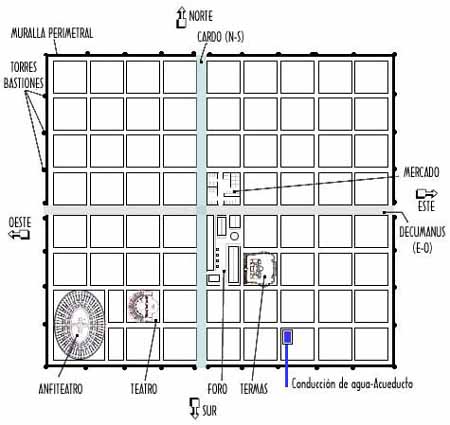
We also looked the basic grid plan of Roman cities, and discussed what they reflect about Rome.
Nothing shocks us here, but the methodical nature of the design reflects a few key Roman values, such as simplicity and unity. The design pushes people toward the center, with an emphasis on togetherness. The grid plan may also hint at the idea of equality, or at least equality under the law.
As Rome expanded they “cut and pasted” their city design into the conquered areas. Rome valued habit, tradition, and togetherness. They tended to look down on “going your own way” in general, and as we might expect, in the army as well. The key to their military success lie in the fact that everyone stayed together, everyone did what they were told.
The values that went into the formation of their government and city design also went into their army, whether consciously or not. The standard Roman military formation looks somewhat like its city design, with the men spread out in checkerboard fashion:
Rome’s design gave them more flexibility of movement in the field, but each “maniple,” or individual grouping, had a high level of discipline. This clip below, manages in 1:30 to show some of those values (warning: not bloody, but violent).
Greece, being a more individualistic society, had a long history of heroic individuals. In Roman stories, the hero is Rome itself. The clip illustrates a few key ideas along these lines:
When the whistle blows, the front lines move back, and others move up. Normally soldiers would fight in front for much longer than the clip shows, but the principle is clear: we all share the burden equally.
Roman tactics, like their other values, were simple. Block with the shield, strike with the sword around the enemy’s waist, step back into formation. With this basic move they conquered much of the world around them.
No one gets out of line. They do not tolerate even the successful “hero.” Rome itself will always get the credit. The cohesiveness of the line reflects the cohesive nature of their society. And these cohesive military formations gave them a great advantage over other less cohesive, more heroically oriented tribes surrounding them. In these kinds of circumstances, Rome simply did not lose.
Here is a clip from Stanley Kubrick’s Spartacus, where you see the Roman army advance in their maniples. The message seems to be that the city of Rome itself has come to fight as they fan out into their grid pattern.
Next week we will begin to look at Rome’s conflict with Carthage, a struggle that would define the destinies of both societies.
Some years ago I saw a video about the emergence of Greek culture and the talking heads discussed the magnificent achievements of Greek drama. Before talking about the drama itself, they mentioned the origins of drama, though only very briefly. After all, Greek drama began in the worship of Dionysius, a confusing and strange subject for modern ears. I found it fascinating to watch the speakers deal with this aspect of Greek civilization. They hated being on unfamiliar territory — unfamiliar not so much intellectually, that is, but ideologically and experientially.
Briefly,
Dionysian worship started with women sneaking off illegally, or at least shamefully, for their rites. Dionysius himself occupied, at minimum, the barest fringe of Greek religion. Some of the commentators latched onto this, for it promised a narrative we could identify with. “Aha! A sisterhood of oppressed women, sharing radical beliefs! And observe the vital contribution they made to their society and the world at large, etc.” But Dionysian rites also involved men, too, so they couldn’t press that narrative too far.
The Dionysian rites for women also seemed to involve ecstatic experiences invoking bulls, snakes, wine, and so on. This too got the barest mention, for the “oppressed sisterhood” narrative didn’t really match the fact that Dionysius was a fertility god. So the women may have been praying and dancing furiously for the chance to have children, a very traditional “role” (ha!) for women to play.
To add insult to injury, male Dionysian worship may have invoked blessings to “survive ordeals.” This got no mention at all. It appears that these “rebels” danced around madly and got drunk to attempt to fulfill the most prosaic of traditional gender roles of “tough guy,” and “nurturing mother.” This square peg had no place in their round hole interpretations.
So, after passing over all this in the quickest fashion, finally smiles came to their faces as they talked about the drama itself. Here they felt far more comfortable. Greek drama “allows for the community to come together and deal with issues of importance,” or something like that. Ah, yes, the “humanism” of the Greeks. This we understand, so this they talked about at length. Gone were any of the unusual religious associations involving Dionysius. The important thing to us is the emergence of drama, for without the emergence of drama, how could we watch Dumb and Dumber today instantly on Netflix?* And we very naturally assume that what is important to us must have been of prime importance to the Greeks. Dionysian worship, then, got relegated to a mere carrying device for what we understand and what we feel is important. As a friend of mine stated, whenever we use a word to describe an ancient people that they themselves did not use (in this case, the word “humanism”), we will likely reach false conclusions. The talking heads are not unusual. Most of us unfortunately avoid confrontations with the “other.”
I’m not an Alfred Lord Tennyson fan (to be fair I’ve read hardly anything he wrote), but his poem “The Lady of Shallot” intrigues me in one way. The Lady in question deals with a curse, and can only look at reflections in a mirror to ascertain reality. The mirror of course serves as a poor substitute of reality, and later cracks upon her sad and untimely death.
Out flew the web and floated wide-
The mirror crack’d from side to side;
“The curse is come upon me,” cried
The Lady of Shalott.
Tennyson’s work came from the same spiritual place as the dreaded pre-Raphaelites, whose paintings reveal an intense desire to recover something of antiquity. And yet the grossly over-dramatized version of the past in their eyes reveals far more about themselves, with their aspirations fit perhaps for the teenage soul more than an adult world (hence L.M. Montgomery has her young Anne of Green Gables grow fascinated with the “Lady of Shallot”).
All of us tend to distort reality to fit our own images of it, but the way the Parthenon has been interpreted over time stands as one of the more curious episodes of this typical human folly. Joan Breton Connelly chronicles this and gives her own interpretation of the architectural masterpiece in her recent book, The Parthenon Enigma. The building occupies pride of place in the history of western civilization. Its marble facade inspired those who saw it to grand notions of ideal beauty. The building’s perfect proportions inspired noble visions of clarity and a sense of true humanity. Certain technical achievements of the building are practically unparalleled.
But we made the building in our own image, and Connelly writes to set the record straight. Ever since the Enlightenment we have seen the Parthenon as reflecting the “humanism” of the Athenians. We have some justification for this. If you trace the religion of the Athenians one sees a clear descent from Aeschylus (who takes religion seriously) to Thucydides (who didn’t). The Athenians elected Pericles to multiple terms of their highest office, and he certainly fits the humanist mold. Observers therefore assumed, as the Parthenon was Pericles’ project that it would reflect his values. Then again, maybe not.
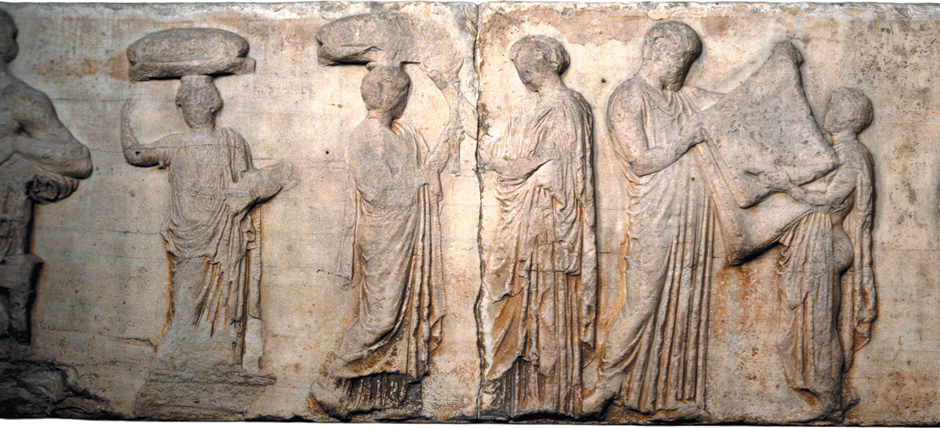
She has two main arguments, with the first drawn from the he Parthenon friezes, long thought to depict contemporary Athenians mingling with the gods. Connelly has an ironclad argument that Athens instead hearkens to not to its present but its mythological past. At Athens’ founding it had a king named Erechtheus, who had three daughters that sacrificed themselves that Athens might survive (images below on a Parthenon frieze). Athens makes an explicit statement, and explicit prayer of hope, that death might come from life with the Parthenon.
Amidst our wondering at the architectural genius of the building and the democratic (and therefore mostly familiar) practices of the Athenians, we forget that the Parthenon was a temple to Athena. Excavations show that they built the Parthenon on top of an older temple, so clearly the Parthenon was sacred space, and not merely civic space with a civic purpose.
Modern eyes miss many such death-life associations in Greece. For example, look up any article on Corinthian columns and you will likely see something about their fancy, or perhaps excessive, ornamentation. Certainly Corinthian columns do not fit with Enlightenment sensibilities about classical decorum and proportion — such people always prefer the Ionic column (I prefer the Ionic — to the right — as well so I don’t mean to cast stones). But Connelly points out that the plants in Corinthian columns hearken back to ancient myths about death and rebirth in their city. Articles may describe Corinthian columns as “one example of a Greek votive column” (as one site does) without paying any attention at all to the fact that “votive” columns, like votive candles, have a distinctly religious purpose. It’s almost as if they use the big words to obscure the meaning. We will have the Greeks be “humanists” by hook or crook.
A fascinating sub-plot is the length Victorian society went to deny that the Parthenon originally was painted. Evidence after evidence turned up, mostly brushed aside and denied with too much protest. A painted Parthenon would overturn all of their ideas of classical beauty and classical purity. Whole artistic theories got erected on an unpainted Parthenon, and they could not let it go. This in turn clouded their vision in other areas, and allowed false ideas about the Parthenon to persist well into the 20th century.
Did the Parthenon have no contemporary political meaning? Perhaps . . . perhaps Pericles wanted to heal the fractious wounds of a prosperous democracy. Success has never sat well with democracies, and it would make sense that Athens would want to go back to its founding and a story of sacrifice for the common good. All this rings partially true, but the bulk of the evidence makes the Parthenon an overtly religious shrine — one that seeks life from death. Plenty of evidence exists that Athenians saw it this way themselves. For example, during the plague that struck during the Peloponnesian War, sick Athenians came to the Parthenon for refuge, as well as for healing, and possibly, to die. It would be hard to imagine them doing so if the Parthenon was their equivalent of our Capitol or Washington Monument.
But this interpretation also challenges my own thoughts regarding the Parthenon. The “humanist” interpretation fit how I tended to see the late 5th century Athenians as essentially worshippers of themselves. This view gets lots of support from seeing contemporary Athenians mixed with gods on the Parthenon friezes. With the Parthenon cast in this new light, I think that interpretation gets challenged but not overthrown. I think other evidence exists for seeing the Athenians as self-worshippers, and perhaps the Parthenon itself still supports that view. But this will need rethinking on my part.
The lesson of this book is the peril of using history rather than receiving and letting it change you. Self-idolatry is alas, not only confined only to the Greeks, or the Enlightenment and Victorian eras.
Dave
*To be fair, this is actually a pretty good movie . . .
This week we saw the great golden age of Periclean Athens collapse into the abyss of the Peloponnesian War. We began the week by asking why “Golden Ages” tend to last not much longer than a generation.
Some suggest that the success and power a golden age brings would bring about the envy of others, and this envy could turn into a threat.
Another might suggest that the generation that grew up with the ‘golden age’ in place would likely have a much different experience than their parents. I found this comment especially perceptive. As we saw last week, golden ages usually arise from a creative response to a particular challenge. Those that grow up without the challenge won’t have the experience or ‘training’ to continue what their parents started.
Last week we also noted how golden ages require a variety of factors coming together at once, some physical and others psychological. No one can reasonably keep all the plates spinning for long. Eventually nature dictates that something will begin to spin off the axis sooner or later, and this will drag other things down with it.
Some of their comments did in fact apply directly to the outbreak of the Peloponnesian War, especially#1. Athens went from plucky underdog in 490 B.C. to the then equivalent of the New York Yankees or New England Patriots by 431 B.C. Many city-states lined up against them with Sparta. We did not spend a great deal of time on the war itself, as during their senior year we devote a few weeks entirely to this conflict and the issues it raises, but we did touch on a few key points
1. How in war the unexpected and unforeseen can occur
Of course the unforeseen can always occur, in war or at any other point. But since war requires a great deal of planning, many assume that the conflict will go as we wish. The making of the plans itself creates that expectation. Yet, in war as in life, things rarely go according to our preconceived version of events.
2. Peace treaties may not be what they seem
After 10 years of intermittent conflict, both Athens and Sparta signed a treaty called the Peace of Nicias. But treaties in name may not be in fact. Some treaties bring real peace, some only reflect a desire to call a ‘time out’ in the fighting. Unfortunately for Athens, this treaty turned out to be one of the latter.
3. War Stresses Democracy
War will put stress on any form of government and any society. Some wars brought down monarchies — like W.W. I. We assume that democracies are more stable, but the Peloponnesian War brought out many weaknesses within Athenian democracy and for a time ended it within Athens. We looked at how desperation and panic act on a democratic people in the battle of Arginusae. The Athenians won this battle, but the generals failed to pick up the dead and give them proper burial, something that could be considered sacrilege, and sacrilege could be punished by death. Grief stricken, the city put the generals on trial, found them guilty, and executed them. A few days later they regretted their actions. They put the lawyer who prosecuted the generals on trial for murder, found him guilty, and executed him also.
Ostensibly, Sparta won the Peloponnesian War. But in truth the war had no real winners in Southern Greece. All exhausted themselves in the conflict. Thebes, involved in the conflict but slightly to the north, emerged as the strongest party in the more immediate aftermath of the war. But it would be Macedon, further still to the north, and never involved in the fighting at all, that would eventually assert absolute supremacy over Greece in the person of Phillip of Macedon and his son Alexander. We’ll look at them next week.
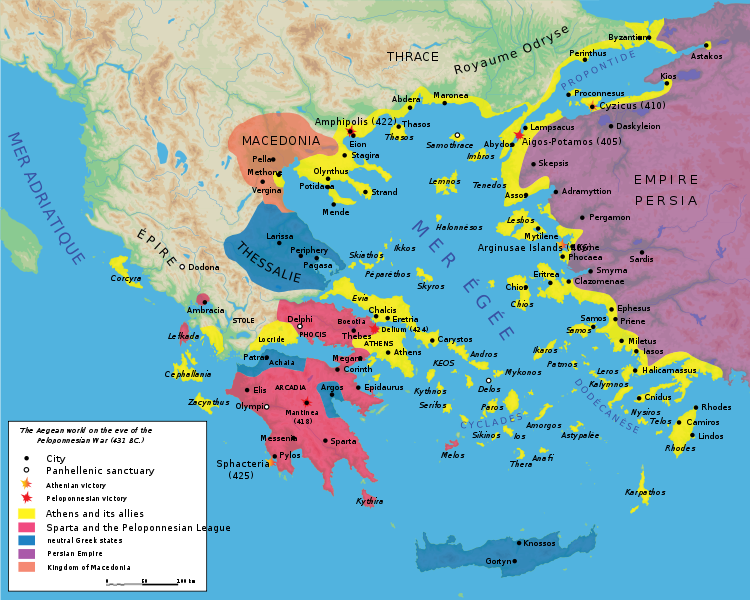
You can see the geography of it below here, with everything pink or yellow caught up in the fighting (with even blue areas involved sporadically), and Macedon waiting patiently above in brown.
For those of you who have seen From Russia with Love, the scene where “Number 1” talks about the Siamese Fighting Fish is a good parallel, if we think of Macedon as the fish who stays out of the fight.
This week we focused on The Persian Wars, a conflict that historians claim marks a transition point between Eastern and Western dominance. Persia staked a lot of their invasion, and their failure would lead to the rise of Greece in general, and Athens in particular. Our main focus Thursday and Friday lay with the Battle of Salamis, one of the more crucial naval engagements of the ancient world. As I mentioned back in September, one of the things we focus on this year and throughout the history curriculum is how to make choices. This can be applied in a variety of different settings, and this week I wanted the students to consider that on the level of strategy and tactics.
The Fleets
The Persian fleet was bigger, with a variety of incorporated Greek city-states that had surrendered to Persia. Ionians, Phonecians, Egyptians and more went into the mixture. In general, their ships were lighter and faster. Athens controlled the Greek fleet, and in general they had heavier, bulkier ships. But the weight of the ships did perhaps produce an innovation, that of a ramming prow. This in turn, led to a change in how the Athenians fought. Whereas most ancient navies wanted to get close and board other ships, the Athenians wanted to use their prow to ram other ships and sink them with a broadside charge.The Persians had sacked Athens, and the Athenians in desperation abandoned their city, got in their boats, and headed for the island of Salamis.
The Questions:
Would an immediate battle be more to the Persians advantage, or the Greeks?
If a battle were to be fought, what side would have the advantage in wide open water? What about in more narrow confines?
I enjoyed the student responses to this question, and most of them did get around to seeing that
Battle now definitely favored the Greeks, and
The geography of the Bay of Salamis definitely favored the Greeks.
Why?
The Athenians needed a battle. The Persians did not. With Athens abandoned they could have simply occupied the city, and hemmed in the fleet at Salamis. If they wait eventually a tired and bedraggled fleet would have to come out of hiding and face the Persians on their terms. Fighting in the bay itself would mean narrower corridors where the Persians could not use their numbers and speed to their full effect. Think of a heavier boxer vs. a lighter, quicker opponent. The heavier one (Athens) seeks to trap or corner the other to take away his advantage. By fighting in the bay, the Persian fleet gave up much of its advantage.
The Result
Again, with so many of our choices there are no guarantees. We must weigh the options and make our best guess. But it is important not to choose blindly. So why then, did the Persians attack the Greeks?Here we are back, at least possibly, to the personality of Xerxes. We saw that both Herodotus and the Book of Esther show us a king who was not wicked, but perhaps indolent, and someone who tended to flit from one thing to another. Note that Esther 1 begins by describing lavish parties amidst opulent splendor. Herodotus mentions that Xerxes wanted the invasion over as soon as possible. Ideally, of course, the Persians should have bottled up the fleet, entrenched themselves in the city, and watch Athens suffocate to death. When Themistocles sent a messenger to lie to the Persians about the disorder in the Greek ranks, the Persians jumped at the chance and moved into the bay to attack. Xerxes seems a suggestible, impatient type. “Let’s get this over with. . .” The result was a complete victory for the Greeks. It turned the tide of the whole Persian invasion. Having been smacked on the nose, Xerxes decided enough was enough. He withdrew most of his navy from the region. His infantry at current levels could not live off the land in Greece, and besides, winter approached. Without the navy to supply them, Xerxes withdrew a good portion of his troops back to Persia. The Battle of Platea in 479 BC would, for all intents and purposes, finish them off.
The “Center of Gravity”
Clausewitz used the term “center of gravity” to describe what one colonel described as a “factor of balance” in a campaign. This does not have to be something purely physical, but in this case, the “factor of balance” in the Persian Wars would surely include control of the sea. In invading Greece en masse as they did, Persia made naval superiority a key to the campaign. But for about 75 years prior to this they concentrated their strength on their infantry. They did not play to their strength. But we might also conclude that the whims of Xerxes would constitute part of the “center of gravity.” The Book of Esther gives us clues. Note how casually he decides on the Jews destruction, and how quickly he reverses course. Of course, it’s good that he changed his mind! My point, however, is that Xerxes never seemed fitted for the role of a noble kingly persona. He would much rather not be bothered. In every conflict, the hidden factor can often be each combatant’s internal political system. In this case, the nascent democracy of Athens had an advantage over the indolent monarchy of Persia.
This week we looked at Spartan civilization and began our look at the beginnings of democracy in Athens. We will have a test next week on Early Greece.
We began our look at Sparta by examining its geography. They had access to a limited water supply via a river, but otherwise a variety of mountains nestled them inland, and they had little contact with the sea. We have seen this kind of geography before — in Assyria. Geography never commands, but it does suggest, and like Assyria, Sparta developed with an almost exclusive focus on warfare. One historian commented
When the Spartans found their ploughlands too narrow for their population, they did not turn their eyes to the sea, like the Corinthians or Megarians. The sea is not visible either from Sparta city or at any point on the Spartan plain. The natural feature which dominates the Spartan landscape is the towering mountain range of Taygetus.
Archeological records indicate a significant shift in Spartan civilization sometime around the year 730 B.C. According to tradition a group of Dorian Greeks invaded Sparta successfully, and became the “new” Spartans, enslaving the locals called Messenians. But they quickly faced a problem. The Messenians vastly outnumbered them and had already attempted one revolt. It seemed likely that other revolts would follow, and eventually they would overwhelm their conquerors.
The Spartans could have retreated, or they could have simply slaughtered the inhabitants and moved on somewhere else. But their solution to the problem seems uniquely Greek to me. They transformed their society by militarizing it, making every male a soldier, allowing themselves to continually have a challenge to master. All this provided extra opportunity for showing “arete,” or, “excellence.” No longer could one choose to be a shoemaker, farmer, and so on. By 620 B.C., after the second war between Sparta and its enslaved population, every male now carried a spear, and the slaves grew the food. Herodotus records one Greek commenting to the Persians in 480 B.C. that
Free though the Spartans are, they are not free altogether. They too serve a master in the shape of Law. They show this by doing whatever their master orders, and his orders are always the same: ‘In action it is forbidden to retire in the face of the enemy forces of whatever strength. Troops are to keep their formation and either conquer or die.
They sacrificed everything to make this happen. Making every male a soldier, and using the slaves to farm did consolidate their conquest. But 1) All traces of cultural creativity disappeared, 2) No personal freedom of job, lifestyle, or travel, was allowed, 3) Boys were separated from their families at a young age, 4) Slave economies lack effeciency, so resources were precious. Any infant deemed physically unfit was usually killed, and so on. Spartan society ‘stopped’ in sense. But they developed the most feared heavy infantry force in ancient Greece, and that was enough to give them power and influence.
This ideal impacted their marriages. They arranged to have the strongest men marry the strongest women to create the best chances of strong sons. If marriages did not produce strong children, they were encouraged to look elsewhere. Women bought into this ideal as well. They spent their time training their bodies to have children.
Their society had all the strength of a high powered rifle bullet. Powerful, yes, but narrow in its application. The Spartans sacrificed what most would consider to be the things that made life worth living, such as personal freedoms, family life, cultural experiences, etc. Truly, you are what you worship.
Was it worth it? Some might argue that their slaves lived better lives than the Spartans. It appears they had more variety in their diet, and possibly more personal freedom as to who they married. Of course, they had harsh lives under the constant watch of Spartan overlords, but did the Spartans live much better? The Spartan world and lifestyle had all the narrowness of slavery. The old adage, “This will hurt me more than it hurts you,” might stand true for the Spartan regime.
Aristotle wrote the best epitaph of the Spartan system, saying,
Peoples ought not to train themselves in the art of war with an eye to subjugating neighbors who do not deserve subjugation. . . . The paramount aim of any social system should be to frame military institutions, like all social institutions, with an eye to peace-time, when the soldier is off duty; and this proposition is borne out by the facts of experience. For militaristic states are apt to survive only so long as they remain at war, while they go to ruin as soon as they complete their conquests. Peace causes their metal to lose its temper; and the fault lies with the social system which does not teach its soldiers what to make of their lives when off duty.
Arnold Toynbee concurred and wrote,
The superhuman–or inhuman–fixity of Sparta’s posture, like the [doom] of Lot’s wife, was manifestly a curse and not a blessing.
Several years ago I attended a conference in which Dr. Peter Kreeft was one of the featured speakers. I have read a few of Dr. Kreeft’s works and liked them all, and especially enjoyed his essay on surfing, one of his great loves.
During one of the lunch breaks I had the immense good fortune to find myself sitting next to Dr. Kreeft at one the random round tables in the dining area. I asked him for some surfing tips and he proved gracious and helpful. Based on his love for the sea I also wanted to run a pet theory of mine by him.
The theory runs something like this. . .
Mankind’s greatest feats of creativity have always come near water.
Egypt had the Nile and the Mediterranean
Babylon had the Tigris and Euphrates
Greece had the Mediterranean
Northern Europe gave birth to the Gothic Age, by the English Channel and the North Sea
London then led the way with the Channel, North Sea, etc.
The Dutch had a brief but brilliant golden age, again right on the water
In America the great cultural centers have always been Boston, New York, L.A., etc.
Even when sometimes you think of an exception, the theory still holds. Chicago is in the middle of the U.S., but has the Great Lakes. Twain invented American Literature in the Mid-West. . . but his formative years were spent on the Mississippi.
And so on, and so on.
Assyria was in the Ancient Near East, but not creative in many ways that contributed to humanity. They did not live near any great body of water. The Greek city-state of Sparta was one of the few far away from the Mediterranean, and their culture stagnated. Rome obviously had lots of power, but came to the Mediterranean late in their game and thus borrowed a great deal from everyone. Their creative cultural contributions pale in comparison to Greece, but also Egypt and probably Babylon as well.
Some might suggest that the key is majestic expanse, not just water. But I disagree. The Great Plains have majestic expanse in spades and have not led the way in creative impulse. The Himalayas have the tallest mountains on Earth but have not produced great thinkers, architects, etc. Sparta was surrounded by mountains on all sides and may have been one of the more culturally stagnant of all civilizations. Of course mountains and plains have a beauty all their own and can inspire, but they do not appear to have the universal impact of water. I still think there must be something to water itself.
A purely rational or mechanical view of this would probably put the emphasis on the fact that living near water would inevitably result in overseas trade, which would blend cultures and ideas to a degree that would naturally lead to creativity.
But I think that this puts the cart before the horse. For a civilization to think of something beyond survival and necessity, it has to think outside of itself, and for that it needs inspired. It is this sense of inspiration that opens them up to travel, other cultures, and other things. In other words, substantial bodies of water subconsciously unlocks our creativity and then civilizations take advantage of the opportunities before them.
“What do you think?” I asked Dr. Kreeft.
“I agree.”
There followed a pregnant pause but all I could think was, “He agreed! Yee-ha!”
He continued (I paraphrase his words), “There is something about water that ties us to creation itself. It is where we came from.” And with that, he politely excused himself.
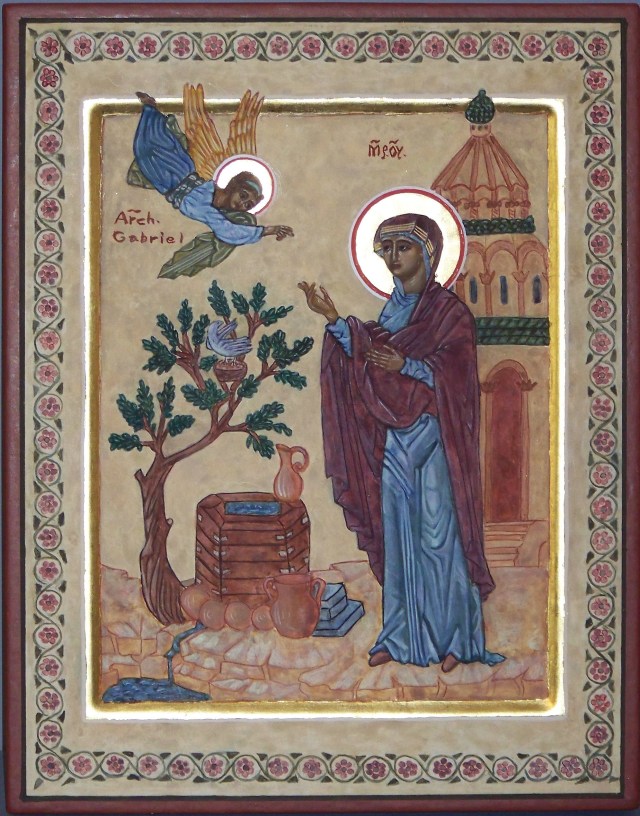
Part of me wanted him to say more, but upon reflection he had in fact said it all. I doubt very much that by the “where we came from” comment he meant anything in a purely Darwinian sense. Genesis 1 talks of creation being drawn up through water. Our new creation involves the waters of baptism. 1 John 5 talks mysteriously of the three-fold agreement of the Spirit, water and blood. I know of a physics teacher who begins the year by looking at ancient views of creation and the cosmos, and mentions Thales’ idea that all matter comes from water. The students tend to scoff until they re-read Genesis 1. There is the Tradition of the Church which portrays Mary hearing the Annunciation, with the attendant re-creation of all things through the Incarnation, sitting by a well. The creation of the “new Adam” would obviously take us back to Genesis 1, just as St. John does in the opening of his gospel.
In the Odyssey (13.102-112) Homer refers to a cave sacred to nymphs which contains “ever flowing springs of water.” Also in the cave are “jars made of stone,” along with “looms, likewise of stone, in which the nymphs weave sea-purple garments.” The Neo-Platonic philosopher Porphyry writes,
The “garments of sea-purple” are obviously the flesh, which is woven together from blood; the sea-purple dye is derived from blood, and the wool that it colors is also the vital fluids of animals. All flesh is thus fashioned from blood through blood . . .
To this day Jimi Hendrix stands firmly entrenched as the greatest electric guitarist of all time. He did things with the guitar that still no one else can equal. I don’t think it coincidental that some of his most intriguing songs (“Rainy Day, Dream Away,” “Castles Made of Sand,” “May This be Love,” “1983 . . .A Merman I Should Be”) involve water. Perhaps in some way he understood the power and meaning of water as Peter Kreeft did that day at lunch, a serendipitous moment for me if there ever was one.
This week we looked at the Trojan War and its aftermath in Greece.
In some ways the Trojan War belongs to province of literature rather than history, because no real “history” books describe the events as we know them. But that does beg the question, what is evidence? Is Homer’s Illiad a kind of historical evidence for the Trojan War? That of course depends. As part of our study of the Trojan War we looked at different kinds of historical evidence, and the strengths of each.
The points in favor of “Historical Accounts” seem obvious to most:
We know the author, and we assume that either he was a eyewitness himself, or had access to eyewitnesses, or access to the records of eyewitnesses.
The fixed nature of the text means the story cannot change over time.
But we should be careful not to discount Oral Tradition
Do we unnecessarily give undue weight to books merely because they are written down? Why is reading a book more trustworthy than hearing a story?
Books have a fixed text, but many times we remain at the author’s mercy. He may twist and distort the truth in his writing, and we give it extra weight because it is writing.
Books are the product of one man, but oral tradition comes from whole communities. Thus, some argue, oral tradition has more external checks upon its veracity than texts.
Archeological evidence is both the strongest and weakest of the three
Archeology gives us direct access to the past, often times unfiltered.
But, in contrast to texts or traditions, archeology usually gives us only a fragment of the story, and must be fitted into a larger context that archeology often cannot provide.
The best extended treatment I have seen of the evidence for the Trojan War is Michael Wood’s In Search of the Trojan War. Unfortunately, this video series is nearly 35 years old and parts of it stand outdated. Time has tended to confirm and extend evidence for the conflict. If interested you can view a more “popular” (and shorter) account here
The aftermath of the conflict did not turn out as the Greeks no doubt hoped. We know the Greeks plundered Troy for gold, jewels, and slaves, and we might expect that this sudden influx of cash, and the long-awaited return of its leaders might lead Greece into a golden age.
In fact the opposite happened, and Greece descended into a dark age that lasted somewhere between two and four centuries. It certainly appears at least that the immediate aftermath of the Trojan War brought general dissolution to the Greek mainland.
Why did this happen?
In the end we can do little better than speculate, but in class we advanced a few theories:
In winning the war, Greece won the lottery. But by a decent margin, lottery winners report that their winnings made them less happy, not more. The added wealth brings added stress, and conflict over that wealth with much higher stakes. Perhaps the same thing happened to Greece on a grand scale.
Civilizations, like individuals, tend to thrive when responding to a challenge. Greece especially emphasized this through their doctrine and practice of arete. But the massive cash infusion might have made them rest on their laurels, making them less vigilant about things in general.
The Trojan War took most of Greece’s leaders away for 10+ years, according to tradition. When parents go out for the night they have a talk with their kids — “be good to your babysitter, or when I get home I’ll ask how you behaved and then you will be punished.” Thus, babysitters have a delegated, proxy authority in the eyes children. But what if mom and dad never came home? Would the sitter still have authority?
I asked students to envision what would happen if, on their block, every parent went out for the night, and everyone had a sitter. But, only 2/3 of the parents returned to their homes, leaving the sitters there permanently. Without mom and dad to enforce the sitters’ word, their authority would collapse almost immediately. What would happen to the block? If even just five parents did not return, what would happen to the “society” of the block, and its social interaction? When we realize that many “parents” of various Greek provinces did not return from Troy, we can imagine the results for the whole of Greek society.
Dark Ages usually occur when fear and instability lead to isolation, and then isolation leads to a breakdown in the way society functions. Perhaps this is what happened with Greece. Dealing with failure requires careful thought and wise action, but so to does dealing with success.
Next week we will leapfrog a few centuries and focus on how Sparta and Athens emerge from the Dark Ages.
We began where we began where we began our look at Egyptian civilization, with geography.
Greek geography has three dominant features I wanted the students to notice: water, mountains, and climate (below is rough topography of the region)
I believe water had a few key impacts on the Greeks:
1. Psychological — it is nearly universal human reaction to be drawn out by large bodies of water. At least I tend to think it is. Most of us have probably vacationed at the beach before. Have most of you, like me, stood looking at the horizon of the sea and thought, “One day I shall go forth and seek out boldly new lands and new places”?
Alright, maybe not for everybody.
But why does waterfront property sell at such a high price? Water may not call us all to adventure, but it does seem to impact our psyche in some way.
2. Water also serves as a means to communicate and interact with others. So those that live near water tend to explore and trade, and this in turn creates vibrant economies and cultures. England, the Netherlands, and Venice might be examples of this.
In the end, we can see why great cultural explosions often come from places near water if we combine the possible psychological and obvious practical effects (Greece, Renaissance Italy, the Dutch, England) Of course like most things, this has its limits. Witness, for example, classical music from Bach though Strauss, Russian music and literature, etc. in essentially land-locked places. Still — it seems to me that there may be a connection between water and a civilization’s creativity. I expand on these possibilities here for those interested.
Mountains and Soil
1. Greece had farmers, but in general the soil was rockier and poorer than in the Fertile Crescent. This in turn, of course, might only serve to push them outwards all the more.
2. The mountains divided them geographically, which in turn divided them politically. These mostly independent communities may have helped originate, or at least broaden, the concept of self-government. All of the civilizations we have studied so far have chosen the ‘big’ route to success, partly through choice and partly through circumstance. In contrast, the Greek philosopher Aristotle believed the ideal political community should have more than 5000 citizens.
Climate
If most people could pick their ideal climate it would probably be between 50-80 degrees, light breeze, low humidity. This would be a general description of a Mediterranean climate, and one impact this had on the Greeks was that they lived life outdoors. So — as they interacted with other areas throughout Greece and the Mediterranean, they also interacted a lot with each other, and this too might have helped contribute to the creativity of ancient Greek civilization.
After looking at geography we went to another key foundation of ancient Greece and looked at their concept of ‘Arete,’ which I think can be best translated as ‘excellence.’ ‘Excellence’ is an amoral concept. The Greeks admired people who were ‘excellent’ people. Odysseus was excellent at cleverness and like a cat, always landing on his feet. Achilles is admired because no one can best him in battle. But neither would be considered moral people in any Christian sense. Arete tells you to continually pursue excellence, to never rest on one’s laurels. One of the problems with arete, however, is that it does not tell you when to stop, something that we will see working itself out in Greek civilization.
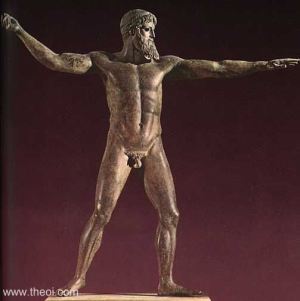
We have discussed before that what a civilization worships is what it follows after at all costs, and this may not be found ultimately in the gods themselves. One question I posed to the students was, which came first, the Greek gods, or Greek arete? Greek gods have power and beauty, but not morality. In Greek sculpture their is not much difference between how gods and men are depicted. This one is of Poseidon:
And another famous one of the discus thrower (stance obviously different, but the ‘body’ is the same:
I should say that the students were right to point out some minor differences, as the gods usually tend to look more imposing or regal, but in general the gods were just somewhat better versions of mankind.
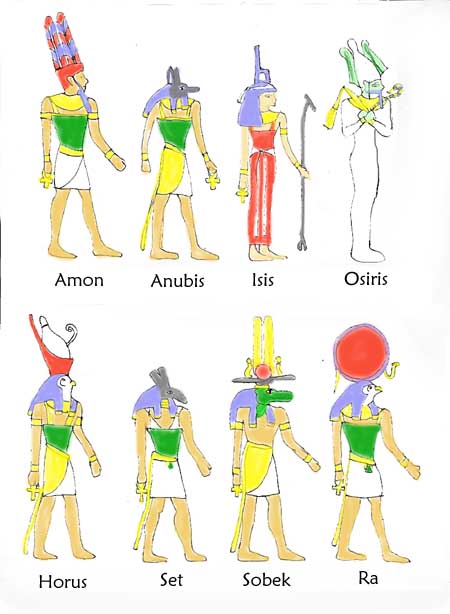
We can contrast this with the Egyptian gods.
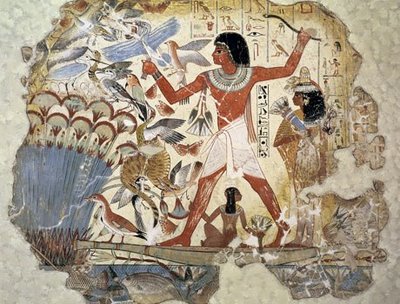
The difference is more than mere artistic technique. When they wanted, the Egyptians could be quite expressive, as this tomb painting with birds shows.
Often times the Greeks depicted the gods in motion, perhaps reflecting the fluid nature of their civilization. The Egyptians, in contrast, often showed their deities in a static posed, often with arms crossed, reflecting the more stable, tradition oriented nature of the Egyptians.
Next week we will look at the Trojan War and the possible historical roots of the conflict.
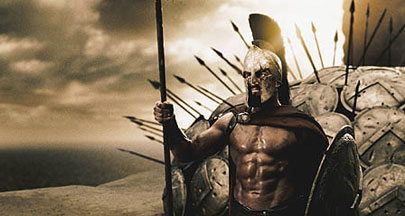
The ancient Persian Empire usually doesn’t get the credit it deserves. I reflected on this as my son read the graphic novel 300. I give the book credit for its entertainment value and reasonable historical accuracy. But at one point the story declares that in fighting Persia, the Spartans fought to preserve freedom and the light of truth and reason. This strikes me as an almost dangerous absurdity, considering that the Spartans enslaved a native population and practiced infanticide, among other horrors. The Persians built their extensive empire largely on the back of tolerance (note the praise for Cyrus the Great from the prophet Isaiah), pioneered some legal improvements, and often paid even their lowliest workers. One can root for the Greeks against the Persians, as I do, but not quite for the reasons given in 300.
The Persians also are interesting case study in the building of cities. As a people they originated in the mountainous Iranian plateau, but as their empire spread, Persian natives found themselves far afield from their native climate. How could they hold their rapidly expanding empire together? I already mentioned the legal and philosophical approach, but they matched this by having three distinct capital cities scattered in different parts of their empire.
Only Ecbatana, their summer capital, had any proximity to their place of origin. It made sense to make it their summer capital as it lay further north. But they gave Susa prominence in the South by making it the final/first stop on their royal road, and they willingly went further south still to Persepolis for symbolic purposes. Having three different capitals demonstrated the broad-minded, inclusive approach of the Persians.
The very flexibility that allowed them to grow so quickly, however, proved a double-edged sword. Being Persian came to mean nothing more than having a better economy — in other words — very little about Persia touched the soul. When Alexander invaded between 333-323 B.C., many willingly and easily switched allegiances to him.
I admire Persia’s feat of flexibility. No capital city today could “move” to a new location every few months. We have far too much bureaucracy to achieve that. Also, they “walked the walk” as well as talked. They said they were inclusive, and they demonstrated this “on the ground.” But Persia’s story begs the question of whether or not one can invent history on the fly, whether one can “create out of nothing” a culture and a way of life. I touched on my skepticism about invented cities in this post, and the reasons for the failures of St. Petersburg to lead Russia are quite similar to Persia’s ultimate demise.
Cairo is about to attempt an experiment not unlike Persia. With their population growth outpacing their geography, they plan to build a massive “New Cairo” directly adjacent to the old city to serve as Egypt’s capital.
Ordinarily I might think this a fool’s errand, but Egypt has gone through several distinct historical phases and may not quite have a distinct identity in the modern era. Maybe, just maybe, this could work (read more here).
America has some similarities to Persia, especially lately with our emphasis on tolerance. Again, there are many worse things to be known for, and besides, I think being “American” involves more of an inner identity than Persia ever had. But, we, like Persia, invented our capital city, and we might inquire how that has worked out.
Like Persia, we picked the location of our capital for purely political reasons. Tradition and geographical position probably pointed to Philadelphia as the best choice. But, despite a lack of clarity on exactly how we ended up making the decision, it appears that we decided on Virginia both to help them ratify the Constitution and perhaps to honor Washington, Madison, Jefferson, etc. To build the buildings we had to clear a swamp and import people into it the city from outside. The transience of the D.C. area has to do with military and government turnover, but has its roots in the fact that most everyone in the region originally got imported. Their homes lay elsewhere.
Thus, D.C. never had a history of its own. It had to be invented, and history has to “happen”–it can’t be invented. So while New Orleans has Bourbon Street, Memphis has Beale Street, New York has Harlem, D.C. has K Street, where lobbyists and bureaucrats cut a rug. Not exactly the stuff of legend.
As Toynbee pointed out in Cities on the Move, no city worthy of the name can sustain itself. It has to import the necessities of life, but evens out the balance sheet in other ways. All capital cities, for example, export law and national directives. But one also hopes that they might export some sense of cultural identity, some sense of “soul” for the nation (with the caveat that it need not dominate, but only add flavor). D.C. will never be able to do this, and we should not expect it. The town got created out of nothing purely for the function of exporting administration, and a leopard can’t change its spots.
It is a shame that all D.C. can export is bureaucracy, but our invention of the capital does testify to our inherent flexibility as a nation. Our lack of attachment to History itself has given us the ability to adapt quickly to challenges and allowed individuals in every generation to make of themselves what they will. The question for the future remains whether or not the lack of cohesive cultural and historical identity will ultimately hurt us as it hurt the Persian Empire 2500 years ago.
This week we began our next civilization, Medo-Persia, and began the story of the origin of Cyrus the Great as told by Herodotus.
There are those who dispute the story’s accuracy. It does resemble in some ways the stories of both Moses and Paris of Troy. We can trust the Moses story, but we need not immediately discount the Cyrus story merely for that it resembles the story of Moses. The story of Paris seems to reside in myth and folklore, but again, this should not immediately preclude the veracity of the Cyrus story. These are interesting questions to ponder, and I don’t know if we can find absolute answers. What it obvious is that it is a great story. If you ask your children about it, I’m hoping they can retell it to you if you would like. You can find it in full online in Herodotus’ Histories in Book 1, beginning in chapter 107.
The Persian Empire had its flaws, but did most things right and represented a vast improvement over the Babylonian, and especially the Assyrian empire. Some of this had to do with historical coincidence, but a lot of it had to do with the values and practices of Cyrus, the empire’s founder.
Some things to note. . .
1. Cyrus arose to power at a time when no other dominant power dominated the ancient Near East. Egypt had been on the wane for some time, Assyria was destroyed, and the Babylonians had lost their former shine. Thus, Cyrus was able to expand by slowly incorporating smaller kingdoms into his realm, without a major challenge posed by any other empire.
2. I think the biggest factor, however, was Cyrus’s foreign policy/diplomacy. According to Herodotus, he set the tone during his usurpation of the Mede King Astyages. Cyrus was half Mede, half Persian. Conquering the Medes in the traditional sense would have meant conquering himself. He spares Astyages and integrates Median and Persian alike.
Cyrus used this same model for most all of his conquests. He wanted expansion, but he also strove for incorporation and integration. He tolerated a variety of customs and religions. You got the benefits of security and participation in Cyrus’s growing network of trade and prosperity. Very little about your daily life would change. True, the former king would be exiled to a distant palace, but Cyrus tried to promote from within. He might use local lesser magistrates to rule in his stead. In class I put it this way: If Cyrus conquered the U.S. he might exile the President and V.P., but perhaps promote the Senate Majority leader and Secretary of State. He would create loyalty to himself by this, because those promoted would owe their position to him. The transition of leadership would be softly felt by the locals.
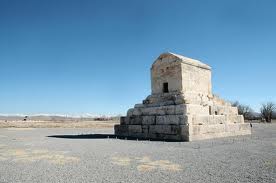
It could be said that Cyrus positioned himself as a ‘liberator,’ and not a conqueror. He could somewhat truthfully pledge that you would be better off under his dominion. Slavery came close to disappearing in his realm. The only thing he asked in exchange was that your army get attached to his and you pledged your loyalty to his person. He succeeded like few others, and we will not see such effective empire builders until we look at Rome. One sees something of his personality and humility in his surprisingly simple tomb.
This method of course differed significantly from others that we have seen so far. One tremendous benefit of this method was that it appears that the Persians had far less slavery than previous civilizations. As we progress, however, we will see that the splendid machine known as the Medo-Persian empire did have an Achilles heel. What, after all, did it mean to be Persian? Can an empire’s identity revolve only around economic advantage and efficiency? The other possible weak link was the army. This was the one sticking point in an otherwise tolerant (at least for the time) regime. They mandated and enforced military participation throughout their empire. This army grew so huge and so multi-national that it might conquer merely by showing up. But what held the army together?
The history of Persia will in some ways revolve around this question, as we shall see in the weeks to come.
I encourage my students to play, “Would you rather?” games, i.e., “Would you rather eat 500 live ants or 1 live cricket?” Often questions like this involve no specific moral quandary, but the practice of creating and defending mental hierarchies has great value, even when such hierarchies are relative. Comparing civilizations has something of the apples/oranges dilemma, I admit. And reigning cultural relativism tells us not to judge. But I believe that the mental process involved in deciding whether Greece was better than Rome, or in this case, whether or not Egypt has the leg up over Babylon, helps bring clarity and meaning to the study of history–even if one should hold on loosely to these kinds of distinctions.
Many have used various criteria for evaluating civilizations, such as how long they last, the power they accumulated, their technology, and so on. I think a better lens involves us seeing how each civilization aligns itself with the reality of creation–with the patterns and Truth found in the created order, available for any with eyes to see.
Henri Frankfurt’s Kingship and the Gods gives us more than a rundown of Egyptian and Sumerian/Babylonian kingship. He seeks to integrate religion and politics not just with their history, but also the geography and the general patterns of living from both cultures. He reveals his method early in the introduction, writing,
Mesopotamian society was entirely adapted to the cyclic succession of the seasons. While each winter resolved its harshness in the spring and the plague of summer was succeeded by autumn rains, human society moved through a succession of seasons in which humanity joined in of the cosmic crisis of life, death, rain, and drought. The [Babyonian] sees a dramatic conception played out in nature between the divine and the demoniac, between forces of order and chaos.
The most important seasonal celebrations in [Babylon] centered around the bewailing of the death of Tammuz and his rebirth on the New Year–his victory over death and his sacred marriage to the mother-goddess.
Egypt, too, reflected the natural rhythm of the seasons in the course of the official year. But their celebrations differ profoundly in character from those in Babylon. In the plain of the two rivers, the festivals were never free from anxiety, and those which we know best show a change from deep gloom to exaltation. In Egypt, festivals provided the occasion to affirm that all was well, for Egypt viewed the universe as essentially static. Revolts against the established order happened, but never got classified as anything more than a few ripples under the surface.
The rich Nile valley lies isolated and protected on both sides by a vast desert, while Mesopotamia lacks clear boundaries and was periodically assaulted on its fringes by mountain tribes. Egypt derived its prosperity from the Nile, which never fails to rise, even if the floods differ in effectiveness. But Babylon depended on uncertain rainfall and the Tigris was an unaccountable, turbulent, and dangerous river.
Some might then conclude that religion means nothing more than a natural phenomena, though Frankfurt himself does not suggest this.* Rather, Frankfurt wants to integrate our vision of each society–to see Egypt and the Egyptians as one and not many. When we pull back and see the integrated whole of a civilization, the impression they leave comes into greater focus.
If I had to choose between Egypt and Babylon, I would likely choose Egypt, but one of their key weaknesses lay in their failure to appreciate the feminine aspects of creation and experience. Nearly every religion I am aware of sees creation as essentially feminine, Christianity included. As C.S. Lewis commented, we all stand as essentially feminine in relation to God. All in the Church, whether man or woman, are the “bride” of Christ. Various pagan beliefs have “Mother-goddesses,” whereas Christianity might talk of “Mother Earth” in a slightly more abstract way, as St. Francis did in his “Canticle of the Sun.” Egypt had no “Mother Earth”–for them the earth itself was not even feminine. The idea of power had strong play in Egyptian thought, and so rather than the traditional “receiving and transforming” aspect of Earth, the Egyptians saw supreme power in the male diety of Ptah or Geb. In some creation stories, Ra stands on the Primeval Hill to create, again over-emphasizing the male aspect of reality. Apparently Egypt did not want creation to have any derivative existence.
Most every religion, including ancient Israel, had harvest festivals of some kind. Nearly all of these festivals focus on the idea of death, the earth receiving death, and then having that death transformed into life. Harvest festivals connect us with birth and new life, and so highlight feminine aspects of life in general. A proper conception of this pattern must allow for three days in the tomb, so to speak. So in Greece, as elsewhere, the seed could be identified with the king (think of Mary Renault’s classic, The King Must Die), who “dies” for the people to give them grain. No grain comes without the earth receiving and transforming the seed. But things were different in Egypt. Yes, the king ceremoniously started the harvest by cutting a symbolic stalk, but the forgoing ceremony emphasized that he was the wheat which went up to the cloud, not the chaff that fell to earth. Frankfurt comments that,
All we know of the Egyptians shows they would have found [a festival centering on the death of the seed] distasteful. They did not readily admit the shadow side of life, perhaps on hedonistic grounds, but also because, in their static conception of the world, grief had no [place].
We see this in the Egyptian harvest prayers, i.e.,
Osisris is Unas in the mounting chaff
His loathing is the earth;
He has not entered Geb to perish.
He is not sleeping in his house (i.e., tomb) upon earth
So that his bones may be broken.
His hurt is driven out!
He has purified himself with the Horus Eye.
Unas is up and away to heaven;
Unas is up and away to heaven
With the wind, with the wind!
A Christian might be tempted to see here a foreshadowing of victory over death in the resurrection. Perhaps an aspect of that exists here, but along with Frankfurt I extend a word of caution–even God Himself “submitted” to the pattern of first going down before rising up. The Egyptians seemed to want to short-circuit the process. A Christian might think of something akin to banishing “worldly sorrow”–something the Babylonians struggled mightily with–but they should have remembered that “blessed are those that mourn,” and that it is usually our moms that take pity on us when we scrape our knee or need visited in the hospital.
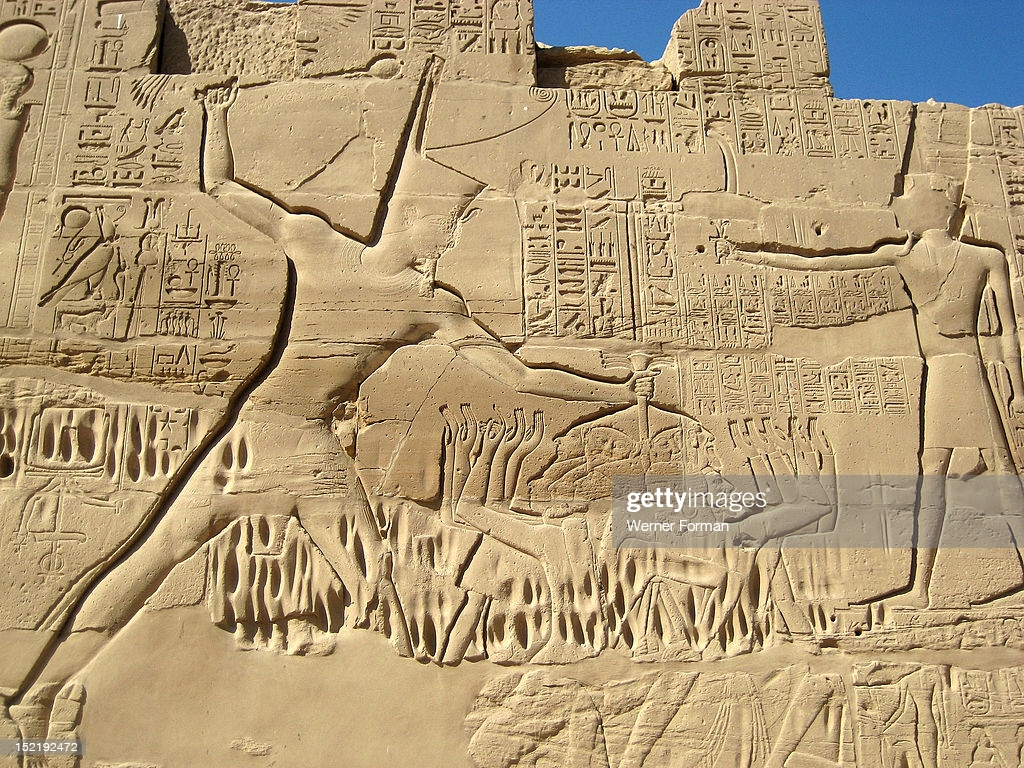
This same imbalance shows in their depictions of royalty. Certainly every society has a hierarchy and kings might naturally be depicted in some outsized way to show his importance. But in Egypt, one often sees only the king, as in this relief of the conquests of Thutmose III:
Tuthmosis III smiting his enemies, the Cannaanites, at the Battle fo Megiddo from the north wall of the Great Hypostyle Court, Egypt. Ancient Egyptian. New Kingdom 18th Dynasty, 1473 BC. Karnak. (Photo by Werner Forman/Universal Images Group/Getty Images)
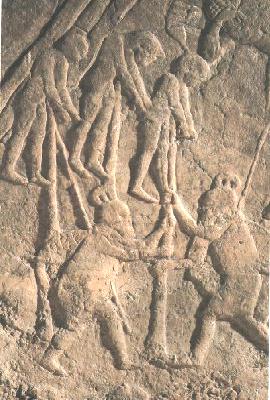
If we compare this to how Babylon depicted one of its greatest kings, Nebuchadnezzar a contrast immediately becomes evident:
and
I have mentioned a few times above that Christians should be cautious in interpreting Egypt’s religion in an overly Christological manner. Now, I offer the same caution to women in general. Some might look at certain aspects of Egyptian belief and celebrate that even the feminine earth has been raised to the level of the masculine sky. But in fact Egypt did not raise the feminine up–they (mostly) abolished the feminine aspects of reality from their experience.
Most every traditional belief system sees the following pairings:
Masculine
Strength
Vertical Hierachy
Steady/Unchanging
Feminine
Compassion
Togetherness
Protean
This “exchange,” this relationship between these two different aspects of reality, help form healthy civilizations just as they form healthy families. Historian Kenneth Clark noted when guys and gals are separated too stridently for too long in social situations, the level of discourse tends to decline in both camps.
The history of Egypt, perhaps akin to the history of China (of which I know much less about) could plausibly show forth this pattern of the elimination of feminine qualities. In his A Study of History Toynbee makes the case that after the pyramids, Egypt tightens and “freezes up.” Much of Frankfurt’s religious analysis comes from this post-pyramid era, and the evidence shows an exaggerated desire to eliminate all variability, all doubt and grief, from their way of life. Such an attitude surely helped contribute to their failure when confronted by Moses.
Babylon shows us the opposite problem–too much of the archetypal feminine. As Frankfurt aptly points out, the stately nature of Egyptian geography shows a direct contrast to that of Babylon. Women go through more changes overall than men**–this is neither a virtue or vice–and so a civilization that over-emphasized feminine qualities would tend towards too much change, and not enough solidity. This shows up in Babylonian creation mythology, with its constant conflict and shifting alliances between different gods. It arises in their depictions of the goddess Ishtar, sometimes shown wearing a beard. Aristocratic Babylonian men followed the trend in their religious beliefs and may have engaged in cross-dressing, and so on.
Other manifestations of this imbalance show up:
Coronation rituals for Babylonian kings took place in the temple of Ishtar, and their royal insignia came from the goddesses “Lady of the Crown,” and “Lady of the Scepter.”
Frankfurt suggests that, while obviously Egypt and Babylon had various religious festivals, Babylon had more festivals that “required” everyone to participate at the same time in unison–it is the mom who generally wants to have everyone home for the holidays, etc.
In Egypt, water was effectively tamed. For the Babylonians, “the ways of water are devious. It avoids obstacles rather than conquering them, goes around and yet gets to its goal.” Traditional religions always associate water with the feminine, and we see something of the “mystery of Woman” (guys are not that mysterious) in Babylonian views of water.
For clarification, I am not here suggesting that any of these things are good or bad per se. The question is more of emphasis.
One sometimes hears silly things such as, “If only women were in charge throughout the world then there would be no wars, and everyone would love each other.” But Babylon had an empire as well. And Babylon for biblical writers became (along with Egypt), an archetypal tyranny, albeit with some different manifestations than that of Egypt. I have written elsewhere of the possibilities of feminine tyranny, and will not rehash that here. In Egypt’s case, the excessive emphasis on order “naturally” called forth the chaos of the 10 Plagues. For Babylon, the undue emphasis of the market, of change and flux, of possibility, inevitably called forth excessive order–it is no coincidence that Babylon produced the world’s first known extensive code of law and punishment.
Ancient Egyptian and Babylon societies show us that masculine and feminine “gods,” when freed from proper relationship with the other side, become demons.
Dave
*I would not say that Egyptian and Babylonian religions were false because of this either. Obviously, a Christian would say that such beliefs had deep flaws, while at the same time one can affirm the aspects of the Truth that they professed. Occasionally, a skewed religious belief can at times show forth an aspect of Truth in a more compelling fashion, as they give it undue emphasis in the wrong place. Still, all in all, I think the key problem of pagan religions was their inescapable imminence of the gods. The undue focus on imminence leads to a narrowing, an entrapment of sorts, a tautology. You see this today whenever an argument is based on the fact that, “It’s 2021.” In other words, whatever we happen to be doing must be right because we are in fact doing it–the ethics of imminence. One is inevitably influenced by our surroundings, including our geography. We should not be trapped by it, to be excessively determined by it.
**I think it fair to say that puberty involves more changes for women than men. Marriage involves more change for women. Women obviously go through a lot of change in terms of conceiving and giving birth to children, and then, menopause, and so on.
This week we began our look at Babylonian civilization.
Babylon had many things going for it. They were the quintessential cosmopolitan city of the ancient world. Their geography funneled trade, cash, and resources towards them. Much of ancient learning concentrated itself there. This would be a city in general more tolerant, vibrant, and diverse than most other cities in the ancient world. I hope that the students remember our examination of the geographical influence of all of this. ‘Cosmopolitan’ cities throughout history have to be accessible, which usually puts them in relatively flat areas near water. One thinks of New York, London, and Los Angeles as examples. Of course, such cities not only need favorable geography, but they need to be accessible and open-minded culturally as well. Geography can bring you to water, but can’t make you drink.
But enormous cracks in the foundation lay below the surface. Babylonian creation accounts paint a bleak picture: Ultimately things “come to be” because of chaos and confusion amongst the gods. Unlike in Genesis 1, creation had no intentionality or design behind it. Nor can we say that the “good” gods triumphed over evil. Rather, one side simply emerged as the stronger. This impacted Babylonian thought in several ways:
Humanity is an afterthought that exists to be manipulated by the gods
Stability and order are generally absent (a stark contrast to Genesis 1).This chaos spilled over into other areas.
Sin, at root, was not your fault, as you could be ‘jumped’ by malicious spirits (jinn) who would lead you down the wrong path
Ishtar was their major goddess – goddess of love and marriage but also war and prostitution. She was again, a goddess, but was often depicted with a beard. The ambiguity was reflected in the statue of her to the side, which shows her as a warrior showing quite a bit of leg for an ancient goddess.
Not surprisingly, this gender confusion spilled over into society, as Herodotus tells us of the fad among society’s elite for cross-dressing
Not surprisingly, Babylon was known for its immorality, and notorious for its rampant temple prostitution, among other things.
A society where so much is left to chance is bound to try and find a way to explain it all, and this may have led to the Babylonian passion for dream interpretation.* A whole list of possible dreams and their meanings was drawn up, but this did not necessarily help. One tells us that if you dream that you eat meat you will have a son. Later, it says that if you have meat in a dream you will not have a son. How could one know the truth?
Or perhaps, with the mysteries of the universe completely unknowable, one might stop looking and settle for the ‘eat, drink, for tomorrow we die,’ philosophy. It is any surprise that Babylon is conquered in Daniel 5 as they are partying? Perhaps we might also surmise that Babylon’s endless possibilities led in the end to boredom. We looked at this famous Babylonian text,
Babylon’s View of Life: “The Dialog of Pessimism,” (M stands for Master, S for slave)
M “Slave, agree with me!”
S “Yes, my lord, yes!”
M “I will love a woman!”
S “So love, my lord, love!
The man who loves a woman forgets want and misery!”
M “No, slave, I will not love a woman!”
S “Love not, my lord, love not!
Woman is a snare, a trap, a pitfall;
Woman is a sharpened iron sword
Which will cut a young man’s neck!”
M “Slave, agree with me!”
S “Yes, my lord, yes!”
M “Straightaway order me water for my hands,
I will make a libation to my god!”
S “Do my lord, do! As for the man who makes a libation
To his god, his heart is at ease;
He makes loan upon loan!”
M “No slave, I will not make a libation!”
S “Make it not, my lord, make it not!
Teach the god to run after thee like a dog.”
M “Slave, agree with me!”
S “Yes, my lord, yes!”
M “I will give money to my country.”
S “So do, my lord, so do!
The man who gives money to his land,
His alms have been put in the palms of the god
Marduk himself.”
M “No, slave, I will not give alms to my land!”
S “Do it not, my lord, do it not!
Look upon the ruined mounds of
Ancient cities and look around;
Behold the skulls of those of earlier and later times.
Who is the evildoer, who is the benefactor?”
M “Slave, agree with me!”
S “Yes, my lord, yes!”
M “Now then, what is good?
To break my neck and thy neck,
To fall into the river — that is good!”
S “Yes my lord. Who is tall enough to reach up to heaven;
Who is broad enough that he might encompass the earth?
M “No slave, I will kill only you — you go first!”
S “But, you my lord, would not last three days after me!
Or consider this collection of Babylonian proverbs, which speak similarly:
Without relations, she conceived! Without eating, she became fat!
When I labor, they take away my reward. When I increase my efforts, who will give me anything?
The strong man is fed through the price of his hire, the weak man through the price of his child.
My feet keep walking, my knees do not tire, yet a foolish man pursues me with sorrow.
Am I not a thoroughbred steed? Yet I am harnessed with a mule and must draw a wagon.
I dwell in a fancy house, yet some clay pours over me (i.e., the roof leaks).
The life of the day before yesterday is that of any day.
You are placed in a river and your water at once becomes stinking; you sit in an orchard and your fruit becomes bitter.
Will ripe grain grow? How do we know? Will dried grain grow? Who can tell?
Very soon I will be dead. Let me eat, drink, and spend. Soon I will be well. Let me save for later!
You go and take the field of your enemy. The enemy comes and takes your field.
The fox had a stick with him. He asks, “Whom shall I hit?” He has a legal document. He asks, “Whom shall I challenge?”
No agreement can be reached when the women talk without ceasing.
Into an open mouth, a fly will enter!
The horse, after he had thrown his rider, lamented, “If my burden be like this always, soon I shall be weak!”
The dog understands: “Take it!” He does not understand. “Put it down!”
As I mentioned in class, in studying Egypt, Assyria, and Babylon–in that order–is not so much chronological but thematic in purpose. In Egypt, we see a self-contained, stable culture that highly valued stability and balance. With Assyria, we saw a culture that was ‘self-contained’ and homogeneous to a certain extent, but who highly valued movement. With Babylon, we have a a creation account that demonstrates chaos, and a geography that maximizes diversity. Each set of circumstances and beliefs creates different kinds of civilizations.
And–as long as we have ‘confusion’ as our theme, who can forget:
This week we very nearly wrapped up Assyrian civilization.
Last week I mentioned our look at Assyria’s religion and the concept of ‘Imperial Overstretch’ as factors in Assyria’s decline. This week we considered Assyria in light of Christ’s words to Peter and the Apostles, ‘Those who live by the sword die by the sword.’
In a fallen world, force can have a legitimate place in government. But both from a historical, moral, and political perspective, force can never be the foundation for order. Force can gain acceptance, or have legitimacy, if people see it as an extension of justice. But when a power uses force detached from justice, people sense that they use violence merely to serve their own selfish ends. This inspires them to seek justice/revenge, and this is why violence apart from justice is a wasting asset.
All of the problems Assyria faced they brought upon themselves. They treated subject populations brutally out of a combination of a) religious belief, and b) policy that sought the quickest route towards “getting everyone in line” with their conquests. But as their power grew, the attention they could give to subject territories lessened, which reduced their chances of stopping rebellions.
Eventually too, their obsession with violence and conquest would be bound to turn back on themselves. After Ashurbanipal II completed the conquest of the fertile crescent, (which left nothing for the next guy) Assyria descended into civil war (having no one left to fight but themselves). Simultaneously, they faced rebellions from a few major provinces, which mean that they faced a dire crisis from within as well as without. They had nothing left on which to stand, and collapsed completely within a few short years. Regarding their incessant militarism and addiction to violence, Toynbee comments,
The loss and misery which Assyria inflicted on her neighbors is beyond calculation, and yet the legendary remark of the schoolmaster to the boy he is whipping–‘It hurts you less than it hurts me,’–would be a pertinent critique of Assyrian military activities. . . . The full and bombastic Assyrian record of victories abroad is significantly supplemented by rarer and briefer notices of troubles at home that give us an inkling of the price at which Assyrian victories were purchased.
An increasing military strain revenged itself with increasing frequency of palace revolutions and peasant revolts. As early as the close of the second bout of aggression in the ninth century B.C. we find Shalmaneser III dying in 827 B.C. with his son on the war-path against him, and Ninevah, Asshur, and Arbela in rebellion. . .
Toynbee goes on then to cite rebellions in 763, 760, and 746, and ca. 730 B.C., and then he continues,
After this the two streams of domestic stasis and foreign warfare merge into one; after Ashurbanipal’s death this swells into a mighty river whose rushing waters bear Assyria away to her now inevitable doom. During the last years of Assyrian history the domestic and foreign aspect of Assyria’s disintegration are hardly distinguishable.
Can a civilization be rooted entirely in a frontier mentality and lifestyle? Assyria was located on the ‘frontier’ of Mesopotamian civilization. Like many frontier people, they could be inventive and self-reliant. But their beliefs, their foreign policy led them to conquest ‘a outrance’ as the French say. Assyria’s attacks against Babylon come with an animosity that a farmer in West Virginia might feel for Manhattan investment bankers. But frontiers need a home base, and with this attack, Assyria was cutting off its face to spite its nose. The arm which held the sword stabbed the heart. Without Babylon, Assyria suffered much in the same way that the West Virginia farmer would suffer. Without the banks, where would be the corporations to buy the food they grew? If they always looked outward, could they build a solid cultural foundation on which to rest? While some aspects of Assyria’s cultural heritage can be disputed, no one would doubt that in comparison to Egypt, Babylon, and Persia, Assyria’s cultural output was quite low. Their architecture, art, and literature all were inferior to their neighbors.
In the end, Assyria contributed heartily to its own demise. I quote now from Ashurbanipal II, the last great king of Assyria, who wrote as he saw things crumbling around him:
‘The rules for making offerings to the dead. . . which had not been practiced, I reintroduced. I did well unto god and man, to dead and living. Why have sickness and misery descended upon me? I cannot away with strife and dissension. Misery of flesh and mind oppress me. Death is seizing hold of me. With lamentation and mourning I wail day and night. O God wilt thou deal thus with me? Even as one who has not feared God and Goddess I am reckoned.’
Historian Arnold Toynbee comments,
‘This confession is . . . moving in its sincerity and in its bewilderment, but above all illuminating in its blindness. When this mood overtook him, did the last of the Assyrian war-lords never find himself reciting that terrible catalogue of cities sacked and people’s wiped out by Assyrian arms — a list which concluded with his own sack of Susa and annihilation of Elam?’
One sees a complete lack of self-awareness on Assyria’s part. It’s as if they erased their conscience through centuries of systematic cruelty. They reveled in their conquests and never questioned their actions, celebrating them in their meager artistic achievements.
Next week I will update you on our investigation of Babylon.
This week we looked at Assyrian civilization. Their meteoric rise was surpassed only by their complete and total destruction at the hands of several enemies. What made them who they were?
We first looked at their geography. . .
1. Assyria began in the north of the Fertile Crescent, in one of its less fertile areas, nestled in mountains towards the fringe of that region. We discussed how people who live in mountainous regions tend to display similar characteristics. Necessity might force them to rely on hunting. They grow to be tough and adaptive, and generally warlike, with built in mistrust of foreigners due to their relative isolation (think Afghanistan). Assyrians had similar characteristics.
2. Their geography may have lent impetus to their expansionist desires. These tough, warlike people were generally surrounded by more wealthy civilizations that might have been a bit ‘softer’ than the Assyrians. Nomadic civilizations (those that have to/choose to follow ‘the herd’) can never be as wealthy as more agrarian civilizations, for they can never stay in one place long enough to produce anything. Perhaps they could not resist all they saw around them. Perhaps after a while, jealousy and envy took hold.
Then we looked at their army . . .
1. Mountainous regions generally are not as populous as other places, but the Assyrians managed to create a brilliant militia force. Without the mass of other armies (nomadic hunting oriented civilizations inevitably have smaller populations) they had to rely on speed and movement. But their citizens, used to hunting, would have been used to moving, tracking, and outwitting their prey.
2. The Assyrian army was a lightning fast ‘light infantry’ force, overwhelming their opponents by swift and brutal assaults. Of course the makeup of the army impacted their foreign policy, which
Usually did not emphasize diplomacy. They could not integrate their conquered foes into their army (think about how the effectiveness of a Navy Seal platoon would be diminished by adding army regulars into their ranks).
So – how do you hold onto your territory? The Assyrian army was not generally interested in occupation. They wanted movement. If ‘you are what you worship,’ we would expect the Assyrians to use terror as a weapon, and so they did. My guess is that the students will remember the various forms of torture and death the Assyrians inflicted if you are curious enough to ask them.
With the conquered cowed into submission the Assyrians could move on. We looked at Paul Kennedy’s concept of ‘Imperial Overstretch,’ when size becomes a disadvantage as opposed to an advantage. Clearly the Assyrians suffered from this, for as we discussed, fear is a wasting asset. It tends to be a very effective short term, but disastrous long term policy.
Some of you may remember the boxer Mike Tyson, and I think he is a good representation of the Assyrian army. Tyson was almost always the smaller man in the ring, outweighed and outreached by his opponent. But his lightning speed confused his opponent, and he hit with such devastating force that he surely “ruled by fear” over his foes.
The students had fun with excerpts from these clips in class.
Then we looked at their religion. . .
The Assyrians were polytheistic, but tended to emphasize the worship of their war god Ashur. Ashur demanded blood, as the Assyrians obliged, presenting large amounts of the severed heads of their enemies at worship services. Interestingly, apparently the most common way of representing Ashur was on his winged disc, which hearkens back to the dominance of movement in Assyrian civilization.
For this coming week we will continue to see connections between Assyria’s religion, army, and foreign policy. For them, as for all of us, “you are what you worship.”
 grave political weakness for Athens, Thebes, and Sparta. Opportunity knocked for Macedon. Phillip looked every inch the tough customer he portrayed, wearing an eye patch over his wounded eye for necessity, and probably, for effect as well. But Phillip combined his personality and appearance with a keen understanding of how to maximize the qualities of his society into a formidable military machine.
 In addition to the long spears you see above, their soldiers also carried a long dagger, another offensive weapon. While the image above does show the Macedonians with shields, I agree with Victor Davis Hanson (and others) that argue that Macedonian shields had no real function in battle. They were worn apparently mostly around the neck and draped to the side (as both arms would be needed to wield their spears). Some argue that the shields were used in battle, but mainly as a prop for their spears. If this is so, we see that even their shield served as a offensive weapon of sorts.