“Kill Anything That Moves”

Nick Turse’s Kill Anything that Moves is not a comfortable book.  I did not read the whole of it, and I cannot imagine the depression that would set in for those who did.  Turse continually hits the reader over the head with atrocity after atrocity that Americans perpetrated in Vietnam.  By midway through, one feels a bit numb.

Turse’s subject matter hits hard, but only skin deep.  There is not enough context, not enough logical build up, and this may be the reason why his book may not have the impact Turse hopes for.  The work bears the mark of solid research and urgency but not sober reflection. Apparently Turse has recently come across some documents just made available from the army, which kept them secret for many years.

Kill Anything that Moves bears the hallmarks of someone desperate to share something that they have just discovered.  It comes out all at once.

I know that in my experience as a teacher I am at my worst when newly excited about something.  I remember how I rambled incoherently through the French Revolution for three weeks with students just after I read Simon Schama’s excellent Citizens (This happened!  And then this!  And then Danton did this!  And Robespierre did that!  Are you getting this down?).

Turse’s basic contention is that what happened at My Lai was not an accident, but a direct result of standard policies and orders routinely given by the military.  That is, My Lai’s happened frequently, if perhaps on a slightly smaller scale.  Of course untold thousands of civilians died due to the blanket B-52 bombing runs.  But troops also deliberately targeted civilians on their “Search and Destroy” missions.  “Kill anything that moves,” comes from typical scenarios where troops received orders to do this almost literally.  Telling friend from foe on the ground posed terrible difficulties.  They solved it by the simple formula, “If they run from our helicopters, they can be shot as enemies.”  Civilians killed by mistake could be given a weapon and called “VC.”  No one asked too many questions higher up because of their interest in body counts.

The book also details the “Destroy the village to save it,” strategy that we clumsily employed in various sectors.  The strategy had some merit and history behind it, which Turse should have brought up.  A typical mantra of insurgent warfare is that, “The peasants are the sea in which the fish swim.”  If you dry up the sea, the fish perish.  So if the peasants all came to our refugee camps, the VC would slowly suffocate.  I believe that Alexander the Great used this strategy effectively against the Bactrians.  Some say Vercintgetorix should have done this in Gaul against Caesar.   The British used this with at least short-term benefits against the Boers.  The fact, then, that U.S. tried some variation of this strategy should not shock us, and Turse should have discussed this.  It is symptomatic of his narrow focus that he did not.

However a significant difference existed between the U.S. and these previous armies.  Not every army can attempt every strategy.  For a strategy to work it needs to have consistency with the society in which it originates.  An army that fights against the values of its own culture will not march with any weight or support behind it, and will almost certainly lack real effectiveness.

Alexander and Vercintgetorix did not rule from consent.  People expected them to do as they pleased.  In South Africa the British interred not their allies but their civilian enemies.  Also, the Victorian British army represented not a democratic consent-based society but an oligarchic “father knows best” ethos that could allow for more “dramatic” treatment of civilians.

The U.S’s strategy with Vietnamese peasants had nothing to recommend it.  In theory the U.S. was a democratic, consent based society.  For its army to then willy-nilly take peasants from their land had no internal rationale.  Secondly, the U.S. had no history in Vietnam, and thus no build-up of goodwill from which to draw.  And third, the U.S. executed the policy in such a clumsy and morally lazy way that it had to fail.  The British at least knocked door-to-door like proper gentlemen and provided an escort.  Though I do not praise the British in this strategy, at least they attempted some personal connection and took measures to protect Boer civilians, whereas the boorish Americans simply bombed and torched villages and then expected the locals to go to their refugee camps by default.  Add to this, their refugee camps were dirty, unsanitary places.  Nothing about this policy matches a society based on equality and consent, and everything about this policy suggests a people and an army that wanted nothing to do with this conflict in the first place.

Turse details many such blunders and moral darkness.  His most compelling chapters detail the army’s policy about weeding out combatants from non-combatants.  Being able to tell them apart in Vietnam would have required a great deal of patience and “on the ground” intelligence. Instead troops routinely received orders that ordered them to shoot at anyone who ran away from their helicopters.  If they ran, they were VC.  If they made a mistake, no problem.  Put a gun in their hand, take their picture, and add them to the body count.  Air Force pilots patrolling the Ho Chi Minh trail had orders to blow up anything moving south, be it man or machine, indiscriminately.  God could sort them out in the end.

These chapters hit the reader in the gut but don’t get at the roots of why this happened.  He doesn’t go for the head, only our emotional reaction.

So why did this happen?  I have a theory. . .

Vietnam was a war no one wanted.

Johnson inherited the problem from Kennedy.  No one “wants” a war, but Johnson seemed specifically ill-suited to foreign policy.  It was not in his wheelhouse.  He often commented how he wished Vietnam would go away so he could do what he really wanted to do — the Great Society.

Congress did not want to deal with the war either.  With the Gulf of Tonkin resolution they signed away their responsibility and oversight to the president.

At least at the beginning of the war, we drafted troops from sections of society without much political importance, another way to pass the buck and avoid domestic conflict over the war.

Every manual on leadership prescribes leaders sharing burdens and sharing space with those they lead.  In Vietnam, very few higher officers ever patrolled with their men.  They led from desks.  They too wanted nothing to do with the messiness the war entailed.  So it is no coincidence that when they received casualty reports that in no way matched the weapons troops recovered, they looked away.  They were already “looking away” by sitting at their desks.

With all this, we should be slow to place the brunt of the blame on the ground troops themselves.  All of America owned this problem, and all of America contributed to these atrocities.  Turse makes a valuable contribution to the literature on Vietnam, but I think it will take an historian with a more prophetic bent to make the most of his findings.

11th Grade: St. Francis and 60’s Counter-Culture

Greetings,

This week we wrapped up our unit on Vietnam, and shifted our focus to the domestic scene and the rise of the “Hippie” counter-cultural movement.

The hippies were hardly America’s first prominent counter-cultural movement, but its visibility and impact may have been greater than others of its kind.  Some point to the baby-boom population reaching the teen years as the main reason for the disruption in the 60’s, but surely this can only form part of the cause.

To the older generation it seemed like the hippies rejected the America their parents handed them.  Their parents lived through the Depression, won W.W. II, and yet they seemingly despised their inheritance.  One must sympathize with the feelings of confusion and rejection those “over 30” must have felt.

But we should also ask what that inheritance might have looked like to many by 1967.

  • The growth of TV dramatized the Civil Rights struggle and exposed contradictions between our words and reality.
  • America had always thought of itself as a plucky underdog, but now we used all our technological advances to bomb a peasant nation thousands of miles away, as discussed last week.
  • Had the American dream been reduced to materialism?  That is, did they see their role in life to do well in school, to get a good job, to get a comfortable life, end of story?  What did America really stand for?  Could America not just give you a good job, but also feed the soul?

I shared with students a theory cobbled together from a few sources (only a theory, I stress).  Though it works better visually, I will try and explain:

  • Imagine a civilization as a series of concentric circles with a core, or nucleus.  This core represents the spiritual foundation of our law, customs, and so on.
  • From the core the circles radiate out.  Culture would closest to the center, as that involves a collective and creative process.  As you radiate out, the values of the core are less immediately obvious, but still influential.  So you might have politics next, then economics.  One of the furthest out might be the military (for the sake of argument).
  • Also, the further you get from the core, the easier that aspect travels.  You can’t, for example, get people to suddenly be jazz musicians, but you can send your military wherever you want.

What happens when the core begins to lose its strength?

When a middle-aged man sits up and wonders what it all means and then decides to buy a sports car and get a trophy wife we do not call that a sign of health.  We might call it overcompensating for a failure to deal with life’s realities.  Territorial expansion can mask uncertainty or weakness at the core, and gives the illusion of health.  For the circles to all hang together, weakness in one area must be made up in another.

This time of expansion makes a civilization vulnerable.  Since we no longer draw from a healthy core, we become imbalanced and materialistic.  “It is the bored civilization,” wrote Oswald Spengler, “that thinks only of economics.”  This lack of balance needs addressed, and herein lies both opportunity and danger.

Sometimes one has to leave home to truly discover it anew, and herein lies the opportunity with this process.  A civilization searches the world for a home only to discover that they like the one they left (the basic plot of Chesterton’s Manalive for those that might have interest).  Think of someone who grew up in the Church, left it to “find themselves” in their early college years, and then return after seeing the bankruptcy of the world.  Upon their return they have renewed dedication to home.

But. . .

That usually does not happen, because it was the core’s weakness that led to the expansion in the first place.  Usually the civilization gets enchanted with the “other” now that their standard fare no longer satisfies. At this point, the civilization begins to fill in the core’s gaps with elements from different civilizations.  Witness what happened to Rome after their expansion throughout the Mediterranean, and how they began to borrow from Greek civilization various religious and cultural ideals.  Various Roman emperors adopted a Greek fashions.  Marcus Aurelius posed as a Greek philosopher, while his son Commodus took it even further and dressed as Hercules.

Before we blame the seekers, we need to wonder what led them to seek elsewhere for answers.  I cannot claim to have a good handle on the state of the American Church in the post-W.W. II era, but I can say that if the Church identified too closely with “America,” their disenchantment with the country would impact their identification with the Church.  In the case of Rome,  many have documented how prior to their significant expansion after the 2nd Punic War, Rome politically had gone from a mostly admirable democracy to a less praiseworthy oligarchy.  Maybe many of the hippies meant well, and maybe they were right that America had a spiritual problem that went far beyond politics.

Of course, sometimes this process of shifting core identity brings blessings.  Think of the Roman ethos giving way to the Christian Middle Ages.  Also, all of us are made in God’s image, so every culture will reflect something of God’s truth.  Because of sin no culture will do this perfectly.  In the case of America and Western Civilization, Christianity obviously had a lot to do with its founding.  But even from the beginning, contradictions like slavery embedded itself deep within our identity.  We did not perhaps fully understand what “liberty” was supposed to mean.

I think Donovan’s “Riki-Tiki-Tavi” as illustrative of this principle, from 1965:

Here are the lyrics:

Better get into what you gotta get into
Better get into it now, no slacking please
United Nations ain’t really united
And the organisations ain’t really organised

Riki tiki tavi mongoose is gone
Won’t be coming around for to kill your snakes no more my love
Riki tiki tavi mongoose is gone

(Every)body who read the Jungle Book knows that Riki tiki tavi’s a
mongoose who kills snakes
(Well) when I was a young man I was led to believe there were organisations
to kill my snakes for me
i.e. the church, i.e. the government, i.e. the school
(but when I got a little older) I learned I had to kill them myself

(I said) Riki tiki tavi mongoose is gone
Riki tiki tavi mongoose is gone
Won’t be coming around for to kill your snakes no more my love
Riki tiki tavi mongoose is gone

People walk around they don’t know what they’re doing
They bin lost so long they don’t know what they’ve been looking for
Well, I know what I’m a looking for but I just can’t find it
I guess I gotta look inside of myself some more

oh oh oh inside of myself some more

Here he expresses something typical about growing up and the need to find one’s own identity.  He needs to “own” his way in the world, as he realizes that what he trusted in his youth isn’t all its cracked up to be.  So far so good. But his solution (“look inside of myself some more”) is very Eastern and bound for disaster.

Herein lies the seeds of the failure of the Hippie movement.  They could point out flaws, but could lay no other positive foundation merely by looking “inside of myself some more.”  It is worth noting that while, say, the Civil Rights Movement had its apex with the March on Washington and the subsequent Civil Rights Act, the Hippie counter-culture peaked with a concert at Woodstock.   Great music, but little actual impact on society.

As a brief aside, one can see some historical parallels in that civilizations which experience a “time of troubles” often develop inward looking philosophies/religions, which tend to have a strong individualistic core.   We can think of the aforementioned stoicism in Rome mentioned already, or the growth of Platonic philosophy after the Peloponnesian War in Athens.  We can add to the list Babylonian obsession with dream interpretation during and after the time of Nebuchadnezzar.  Interestingly, this inward drift happened after victorious expansion in all of these civilizations, just as it happened with us after W.W. II.  If we could call these periods “Times of Troubles” in ancient world, might we say that America is experiencing a similar “Time of Troubles” today?

This sentiment of blurring reality by looking inward gets taken about as far as it can go in the Beatles’ “Tomorrow Never Knows.”

Here the song urges you not just to refashion reality in your own image, but to escape reality altogether, and many used drugs to do just that.  The song not only has an overt Eastern message, but expresses it partially in an Eastern form.

Many former “hippies” lament the fact that their dream died and turned back into the materialism the movement initially rejected.  Part of this happened, I think, because many of them grew up, got married, had kids, and inherited all the attendant responsibilities that families bring.  But another reason for this I think was the fact that “looking inside ourselves” for answers will not lead to anything very satisfying, and none of us are interesting enough for anyone to enjoy it for very long.  The experiment had a built in short shelf life.  Many of them returned to the only thing they knew, the “materialism” of their parents generation.

Unfortunately they did a great deal of damage, especially in the realm of sexual ethics.  In looking inward, they reduced much of life to self-expression.  Sex too got included in personal self-expression, which meant that not only would sex be divorced from marriage, it could be divorced from the other person entirely.

Historians differ in how they evaluate the movement.  One went so far as to call St. Francis, “the hippie of his day.”  Well . . .St. Francis actually built something enduring based on charity, whereas the Hippie movement had an almost exclusively negative character.  St. Francis sought to transform reality out of love, not escape from it.  First Things has a good rebuke to the “St. Francis as a Rebel Hippie” idea here.  The comment about St. Francis as a Hippie does hint at one truth: both St. Francis and the Hippies gave a spiritual critique of their societies.  But St. Francis looked out at God and the World, not inward, and therein lies a crucial difference.

St. Francis

Many thanks,

Dave

10th Grade: Reality comes to Roost

Greetings,

This week we set up the class for what will be our look at the fall of Napoleon early next week.

Napoleon loved speed.

I don’t know if he could have stopped moving if he wanted to.  Motion seemed ingrained into his being.  At this time, anyone in France who ate dinner in less than an hour would be considered a barbarian.  Most took about two hours to eat.  Napoleon routinely ate in less than 15 minutes, and his favorite dish–fried potatoes and onions–was in fact a dish he frequently had while on military campaigns.

On the battlefield, in politics, he practiced what he preached: he who acts quickly and decisively wins.  He had little patience for anything that would not move quickly.  This worked well for him in France on one level — it allowed to constantly outmaneuver his political opponents.  It certainly worked for him on the battlefield, and it translated, by 1810, into a considerable empire.

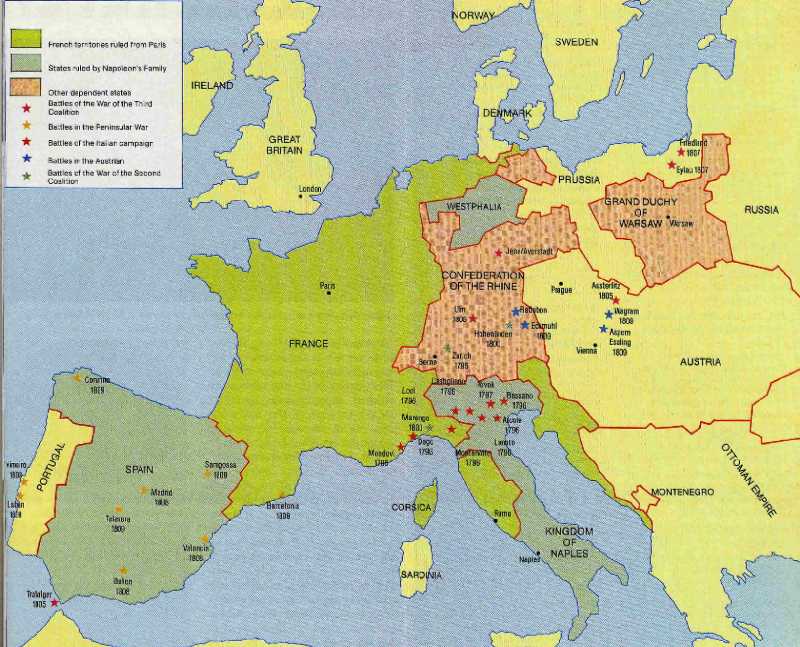
But his need for speed did not translate well in foreign policy.  He often used family members, for example, to rule large territories in his name.  This would be much quicker than patiently learning local cultures, courting local opinion, and adapting to it.   What he gained in time he paid for in many ways.  His policy was short-sighted for a number of reasons:

  • Napoleon claimed to bring the blessings of the French Revolution where he conquered.  Why then, did he think that conquered territories would accept a foreign ruler when he had exported the nationalism of the Revolution to their domains?
  • As puppets of Napoleon, his family would take orders from Napoleon, not from the people they ruled. How then, could these puppet rulers hope to hold the loyalty of the people to Napoleon?  How long until the people rebelled?

This in fact happened in Spain, a country Napoleon drastically underestimated.  To him Spain represented ignorance, sloth, military futility.  He dealt with them in his typical quick and summary fashion, but when he removed the Spanish royal family and installed his brother as king the people erupted in rebellion.  Spain became a nightmare of guerrilla war, for which Napoleon’s temperment had zero liking.  Goya captured the mood of the Spanish in his famous work, “The Third of May:”

Eventually the Spanish campaign pinned down 250,000 French troops.  But the presence of so many French in Spain alerted Portugal, who called upon England for help.  In both Portugal and Spain British general Sir Arthur Wellesley got invaluable experience fighting the French — experience he put to good use in Napoleon’s final battle at Waterloo, when he was then known as the Duke of Wellington.

But when people think of Napoleon’s missteps, they think of his invasion of Russia.

Why did he do it?

In many ways he felt he must because Russia had violated a treaty they signed with him and had traded with England.  If he let that go, then he would look weak, which would induce others to revolt as well.   Here Napoleon had, however, made his own bed.  He put tremendous stress on using his image to maintain his power.  He put his family members in charge of other nations, and so naturally did not have the loyalty of those he controlled.  So, he was right — his image was all he had left to maintain his power, and without it, it might collapse.  When Napoleon talked about the fact that losing one battle might end his reign he may not have been whining or exaggerating.  It may have been the truth, for even one defeat would shatter the image he had constructed for himself.

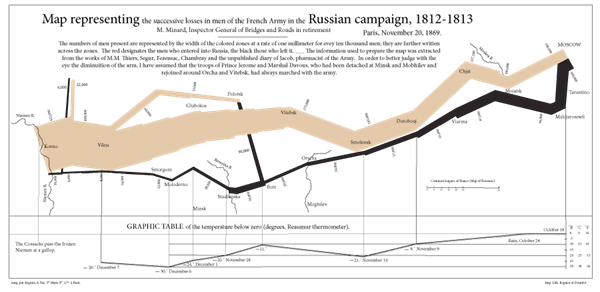
To invade Napoleon amassed a huge force that historians put between 475,000-600,000 men.  He wanted to use this army to quickly smash Russian forces and compel Czar Alexander I to surrender.  But Napoleon’s  usual keen strategic insight deserted  him here.  Who would fight an army that large?  Naturally, the Russians retreated inland, forcing Napoleon to follow and stringing out his supply lines.

What is victory?  Napoleon learned the hard way that victory comes not just by winning battles or capturing cities.  Victory does not come when you say it has.  It takes two to tango.  Victory only comes when your opponent, not you, thinks that he is defeated.  Battles, cities, crops — they meant nothing to the Russians.  But time did, and they used time to retreat inland and wait for winter.  They slashed and burned what they could — even the city of Moscow itself — and left Napoleon with nothing.

The Frenchman Joseph Minard made two classic visual aids, the first for Hannibal’s invasion of Rome, the other for Napoleon’s invasion of Russia.  Both tell the story of time, cold, and loss.

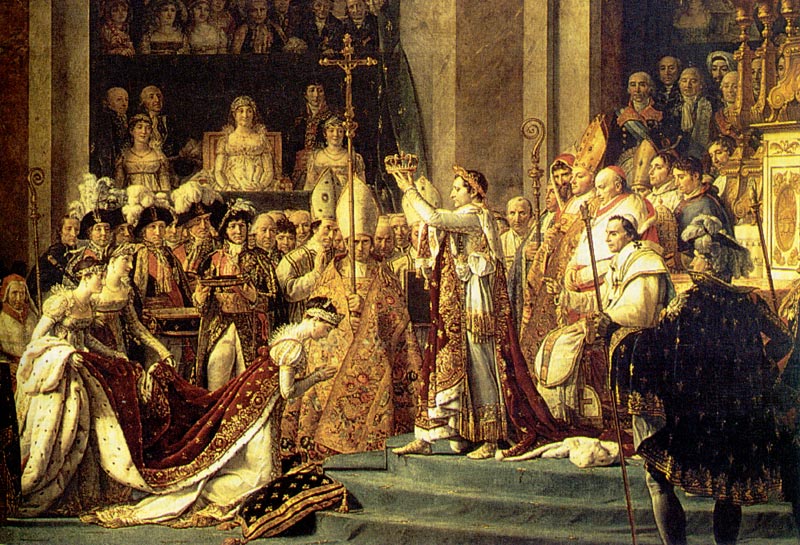
I think that Napoleon faced huge challenges when he assumed power in France.  He dealt with a country that had nearly destroyed itself during the Revolution, and felt that it needed security and stability above all else.  But he insisted on bringing that security by himself.  He never shared credit or delegated effectively.  He even took it upon himself to put the crown of France on his own head.

To establish his power, he fudged election results and removed certain civil liberties.  On occasion he imprisoned or even executed those who spoke out against him.  His image had to be preserved after all.  In the end, he complained that his friends deserted him just when he needed them the most.  He told the truth in the sense that after his failure in Russia, many did turn on him.   But his capacity for self-delusion may have been at work again.  He didn’t seem to be the type to make friends in the first place.

Many thanks,

Dave

The Ties that Bind

In his Jurguthine War the Roman historian Sallust detours from his main narrative to discuss the rivalry between Carthage and Cyrene (an ancient Greek colony near modern day Libya).  In one instance the two powers thought of a novel way to settle the problem between their civilizations without the continuance of war.*  Sallust relates,

Since the affairs of the people of Lepcis have brought us to this region, it seems fitting to relate the noble and memorable act of two Carthaginians; the place calls the event to mind. At the time when the Carthaginians ruled in the greater part of Africa, the people of Cyrene were also strong and prosperous. Between that city and Carthage lay a sandy plain of monotonous aspect. There was neither river nor hill to mark the frontiers, a circumstance which involved the two peoples in bitter and lasting strife.

After many armies and fleets had been beaten and put to flight on both sides, and the long struggle had somewhat wearied them both, they began to fear that presently a third party might attack victors and vanquished in their weak state. They therefore called a truce and agreed that on a given day envoys should set out from each city and that the place where they met should be regarded as the common frontier of the two peoples. Accordingly, two brothers were sent from Carthage, called Philaeni, and these made haste to complete their journey. Those from Cyrene went more deliberately. Whether this was due to sloth or chance I cannot say, but in those lands a storm often causes no less delay than on the sea; for when the wind rises on those level and barren plains, it sweeps up the sand from the ground and drives it with such violence as to fill the mouth and eyes. Thus one is halted because one cannot see.  Now when the men of Cyrene realized that they were somewhat belated and feared punishment for their failure when they returned, they accused the Carthaginians of having left home ahead of time and refused to abide by the agreement; in fact they were willing to do anything rather than go home defeated. But when the Carthaginians demanded other terms, provided they were fair, the Greeks gave them the choice, either of being buried alive in the place which they claimed as the boundary of their country, or of allowing the Greeks on the same condition to advance as far as they wished. The Philaeni accepted the terms and gave up their lives for their country; so they were buried alive. The Carthaginians consecrated altars on that spot to the Philaeni brothers, and other honours were established for them at home. I now return to my subject . . . 

The matter-of-fact method in which Sallust relates this story should give us pause.  He obviously accepted this line of thinking — these were “fair” terms.  This was justice, this was life in the ancient pagan world.  The Philaeni brothers had no other choice.  The above passage brings to mind a more famous section of Sallust from his introduction:

I have often heard that Quintus Maximus, Publius Scipio, and other eminent men of our country, were in the habit of declaring that their hearts were set mightily aflame for the pursuit of virtue whenever they gazed upon the masks of their ancestors. Of course they did not mean to imply that the wax or the effigy had any such power over them, but rather that it is the memory of great deeds that kindles in the breasts of noble men this flame that cannot be quelled until they by their own prowess have equalled the fame and glory of their forefathers.

One can’t help but chuckle a bit at the comment that “of course” the masks did not have “any such power over them.”  They simply dedicated their entire lives to everything the masks represented.

The western world will likely to continue to experience something of a pagan revival, and elsewhere I commented that bringing out into the open what lies subtly buried in our unconscious has something to recommend it.  But we should have no illusions.  Evidence abounds that if we revive paganism we will build for ourselves cattle-shoots from which we have no escape.  We will exchange the freedom we claim to hold dear for chains.

Indeed, Chesterton spoke rightly when he declared that whereas Christianity has elements of anguish and pain at the periphery, joy occupies the core.  Pagan religions, however, have joyous elements in them only at the periphery, but at their center stands defeat and despair.  Any surface familiarity with the ancient world bears this out.  Hector must fight Achilles and lose, just as Troy must face destruction. Not even Zeus himself can stop it.  Oedipus cannot avoid his fate, though he take every counter-measure possible. Even the “realist” historian Thucydides sees events in cyclical form — what happened before will happen again. For the Norse as well, in the end the good guys lose.  It is this magnificent sense of the tragic that gives such tales their grandeur and power, but who wants to get inside such stories?

As the excerpts from Sallust indicates, shame seems to bind the ancients more than anything else.  The Philaeni brothers accepted a brutal death rather than accept what must have been a worse fate awaiting them back home — the shame of failure.  Republican Romans took their obsession with reputation and drove their civilization straight over a cliff in the 2nd century B.C.  The ancients had no escape from shame because ultimately paganism puts all the focus on the self.  Judas, for example, could only see his sin, but Peter runs to the empty tomb — he had bigger and better things on his mind than his Friday morning betrayal.  Peter had an “out” from his past.  As Paul writes in Ephesians 4, “When [Jesus] ascended on high, he led captivity captive, and gave gifts to men” (emphasis mine). Neither ones society nor ones past should be denied or destroyed.  Both are part of God’s creation and God’s plan. But both can be transcended and transformed, and with this hope we approach something akin to true freedom.

Dave

*The story reminds me of the “Oath of the Horatii” narrated by Livy.  Whether or not that lends credence to the historicity of Sallust’s tale I suppose depends on what one thinks of Livy’s narrative.


Are you Bored?

This was one of my favorite scenes from The Great Muppet Caper:

I recently polled some of my students and gave them choice between a) Boredom, and b) A mild amount of physical pain, almost all of them chose the latter.  This might surprise us until we ask ourselves the same question.  Boredom can be excruciating, and physical pain would at least give us something on which to focus our attention.

In the poem “Waiting for the Barbarians,” C.P. Cavafy describes the hustle and bustle of a city in late Rome preparing for barbarians to menace them.  In the end, however, the barbarians for an unknown reason depart, leaving the people more confounded than relieved.  Cavafy concludes the with,

And now, what’s going to happen to us without barbarians?
They were, those people, a kind of solution.

Cavafy wrote this work originally in 1898, though it was not published until 1904.  He speaks with a macabre prescience, for one can detect a latent nihilism in Europe at this time.  Many in Europe welcomed the arrival of war in 1914 though today historians endlessly debate the cause of the war, which seems elusive.  What exactly were they fighting for?  Perhaps the answer is more mundane.  Perhaps they preferred pain to boredom.

William Lee’s book, Blackbeard: A Reappraisal of his life and Times, raises some similar questions.  His book gives some interesting detail and good stories of the notorious pirate.  Lee attempted to write with precision and has an impressive bibliography of original colonial sources.  But what stood out to me most was that Lee could not quite help himself but admire the man.  Of course many in Blackbeard’s own day felt likewise.  I blame Lee for this, but not too much.  We have always had a hard time knowing what to do both physically and psychologically with men like William Thatch/Teach/something else (a.k.a., “Blackbeard”).  Pirates remind us of our tenuous relationship with civilization itself.  St. Augustine’s City of God  and his anecdote about Alexander the Great bring this home:

Justice being taken away, then, what are kingdoms but great robberies? For what are robberies themselves, but little kingdoms? The band itself is made up of men; it is ruled by the authority of a prince, it is knit together by the pact of the confederacy; the booty is divided by the law agreed on. If, by the admittance of abandoned men, this evil increases to such a degree that it holds places, fixes abodes, takes possession of cities, and subdues peoples, it assumes the more plainly the name of a kingdom, because the reality is now manifestly conferred on it, not by the removal of covetousness, but by the addition of impunity. Indeed, that was an apt and true reply which was given to Alexander the Great by a pirate who had been seized. For when that king had asked the man what he meant by keeping hostile possession of the sea, he answered with bold pride, What you mean by seizing the whole earth; but because I do it with a petty ship, I am called a robber, while you who does it with a great fleet are styled emperor.

As mentioned, Lee can’t quite help himself.  Blackbeard obviously had a certain dash and strong leadership skills.  We can admire his bloodless appropriation of supplies and medicine from the city of Charleston.  When we compare life in the colonial south and the life of pirates, we find that the pirates ran their organizations far more democratically than many of the colonies.  Ethnicity and religion counted neither for or against you on a pirate vessel, only achievement.  Add to that, officers could be subject to votes of “no confidence” from the crew at almost any time, and indeed some captains found themselves removed in this way. We can even find ourselves winking at some of his vices, i.e., he couldn’t stop “marrying” various women in the various ports he frequented.  Lee also points out that many of the stories of Blackbeard’s cruelty surely exaggerated for effect.

Blackbeard’s eventual death also raises questions on the rule of law and the nature of civilizations.  Pirates essentially made the claim that, “the sea is my kingdom, the land is your kingdom.  Who has the right to deny us?”  What right, indeed, can anyone claim to control or rule anything? If we believe that might does not make right, does consent?  There seems no ultimate reason why it should.

Blackbeard enjoyed hiding out near North and South Carolina waters for a few reasons.  First, the Outer Banks area posed many hazards for bigger ships with deeper draughts.  These same shallower waters and hidden inlets provided ready-made hiding places for pirates.  Secondly, these colonies had less organization and money, and thus posed less of a possible military threat to Blackbeard.  But eventually Governor Spotswood of Virginia had enough, and sent a fleet south secretly to do battle with Blackbeard and kill him.  Their success raised legal questions about jurisdiction and the legality of force.  Such questions soon quieted down, however.  After all, Blackbeard was a dangerous nuisance, and Virginia had taken care of him. Just as in the case of the pirates, nothing speaks quite like success.

They had many reasons for looking the other way with Virginia’s encroachment. Blackbeard clearly possessed a streak of violence and random cruelty.  He himself admitted to randomly shooting his 1st mate in the leg because, “Otherwise no one will talk about me from henceforth.”  In other words, he had to keep up his reputation.  No one disputes that he marooned most of his crew on one occasion in order to maximize his profits from a particular voyage.  He remained a violent, unpredictable man even with Lee’s generous treatment (which I suppose goes to Lee’s credit).  Of course everyone in Blackbeard’s own day knew this, and yet they had a hard time knowing what to do, despising, fearing, admiring, and possibly even envying him in equal parts.

In his Terror and Consent, Philip Bobbitt has an excellent treatment of the history of terrorism to begin the book.  He talks about the golden age of piracy and describes that it survived so long mostly because they piggy-backed off of the prevailing political ideology of the time.  In the age of absolute kings, monarchs had no real territorial limits on their claims to rule. States in that era defined power not by contiguous territory but by the extension of one’s person.  After both the Peace of Westphalia (1648) and the Treaty of Utrecht (1713), western states redefined power in terms of physically occupied territory.  The earlier understanding fit the pirates perfectly–the sea has no boundaries, and the pirates could extend their power with their personal presence, just like any other king.  Especially after Utrecht, this logic no longer applied and European governments had a much easier time now defining them out of existence and executing combined military action.

Bobbitt’s brilliant analysis sheds important light on the problem of piracy, but for all its insight, I don’t think it fully explains the problem.

As much as modern democracies may hate to admit it, consent-based societies have a problem when it comes to authority.  We base our civilization on the idea that we consent to it via a social contract of sorts, when in fact we do no such thing.  Most of us did not choose to live here, we were simply born here.  And all of us, from time to time, may disagree with particular laws or whole movements of society.  We lack a good rationale as to why we should go along with the crowd when we have a deep disagreement, other than perhaps, “this is better than the alternative–agreeing to disagree makes things easier and more profitable for you in the long run.”  But piracy found a fairly easy way to profit far more by not agreeing to disagree.  I find it curious that the golden age of piracy began just as social contract/government by consent idea started to emerge, and as mentioned above, most pirates ran their organizations more democratically than any other colony or country.

Of course piracy is not only a byproduct of the idea of consent.  Piracy existed long before such ideas.  My suggestion here is that the idea of the social contract may have created fertile ground for its resurgence.  And this leads to perhaps the root reason for most pirates throughout time.  Many have pointed out that those who are often most attracted to violence are not so much the poor, but the bored, and we can recall the fishwives of Paris in 1790 as an example of this, or the myriad of failed artists at loose ends in Weimar Germany that later comprised the bulk of Nazi party leadership.  It may not be coincidence that the Roman gladiatorial games expanded dramatically at a time when Rome had no more wars to fight, either abroad or at home.  Under the emperors they couldn’t even argue about politics anymore.  Boredom, our failure to dwell with ourselves, perhaps even one could say, our aversion to ourselves, may lead us to take out our frustration on others.

Dave

When the holy Abba Anthony dwelled in the desert, he was beset by boredom, and attacked by many sinful thoughts.  He said to God, “Lord, I want to be saved, but these thoughts will not leave me alone.  What shall I do in my affliction?  How shall I be saved?

A short while afterwards, Anthony saw a man like himself, sitting at his work, then getting up again to pray, then sitting back down again to plait a rope, then getting up again to pray.  It was an angel of the Lord sent to correct him.  “Do this and you will be saved.”

At these words Anthony was filled with joy and courage.  He did this, and was saved.

– From The Sayings of the Desert Fathers.


The Imaginarium of Dr. Grotius

“Part of the problem with religion is that it can just be an aestheticization of life,” a young Orthodox priest from Yonkers said. “It’s still late-modern capitalism working its insidious tentacles. We need a vocabulary to get outside of that.”

This quote comes from a profile in The New Yorker on Rod Dreher (author of the much reviewed The Benedict Option).  Dreher admits that one of the problems of his book is that the terms and categories we have for the debate have already been set.  We still have all the values of “late-modern capitalism” attached to our religious thinking.  We may debate what color to paint the living room but rarely consider how the design of the house, or its foundation, may influence us.

The same holds true in every society.  The ancients regarded the Romans as a very religious people, but religious in what sense, exactly?  “Real” religious belief often lies deep beneath its outward manifestation.  In his Discourses on Livy, Machiavelli includes some revealing anecdotes:

Auguries were not only, as we have shown above, a main foundation of the old religion of the Gentiles, but were also the cause of the prosperity of the Roman commonwealth. Accordingly, the Romans gave more heed to these than to any other of their observances; resorting to them in their consular comitia; in undertaking new enterprises; in calling out their armies; in going into battle; and, in short, in every business of importance, whether civil or military. Nor would they ever set forth on any warlike expedition, until they had satisfied their soldiers that the gods had promised them victory.

Among other means of declaring the auguries, they had in their armies a class of soothsayers, named by them pullarii, whom, when they desired to give battle, they would ask to take the auspices, which they did by observing the behaviour of fowls. If the fowls pecked, the engagement was begun with a favourable omen. If they refused, battle was declined. Nevertheless, when it was plain on the face of it that a certain course had to be taken, they take it at all hazards, even though the auspices were adverse; contriving, however, to manage matters so adroitly as not to appear to throw any slight on religion; as was done by the consul Papirius in the great battle he fought with the Samnites wherein that nation was finally broken and overthrown. For Papirius being encamped over against the Samnites, and perceiving that he fought, victory was certain, and consequently being eager to engage, desired the omens to be taken. The fowls refused to peck; but the chief soothsayer observing the eagerness of the soldiers to fight and the confidence felt both by them and by their captain, not to deprive the army of such an opportunity of glory, reported to the consul that the auspices were favourable. Whereupon Papirius began to array his army for battle.

But some among the soothsayers having divulged to certain of the soldiers that the fowls had not pecked, this was told to Spurius Papirius, the nephew of the consul, who reporting it to his uncle, the latter straightway bade him mind his own business, for that so far as he himself and the army were concerned, the auspices were fair; and if the soothsayer had lied, the consequences were on his head. And that the event might accord with the prognostics, he commanded his officers to place the soothsayers in front of the battle. It so chanced that as they advanced against the enemy, the chief soothsayer was killed by a spear thrown by a Roman soldier; which, the consul hearing of, said, “All goes well, and as the Gods would have it, for by the death of this liar the army is purged of blame and absolved from whatever displeasure these may have conceived against it.” And contriving, in this way to make his designs tally with the auspices, he joined battle, without the army knowing that the ordinances of religion had in any degree been disregarded.

But an opposite course was taken by Appius Pulcher, in Sicily, in the first Carthaginian war. For desiring to join battle, he bade the soothsayers take the auspices, and on their announcing that the fowls refused to feed, he answered, “Let us see, then, whether they will drink,” and, so saying, caused them to be thrown into the sea. After which he fought and was defeated. For this he was condemned at Rome, while Papirius was honoured; not so much because the one had gained while the other had lost a battle, as because in their treatment of the auspices the one had behaved discreetly, the other with rashness. And, in truth, the sole object of this system of taking the auspices was to insure the army joining battle with that confidence of success which constantly leads to victory; a device followed not by the Romans only, but by foreign nations as well; of which I shall give an example in the following Chapter.

It seems that “success,” or possibly, “Rome,” is what the Romans really fundamentally worshipped.  Maybe it’s more complicated than that, but clearly, strict fidelity to the auguries or deviation from them was not their central concern.

Modern Social Imaginaries, by Charles Taylor, tackles some of these issues.  His title reminds one of Benedict’s Anderson’s groundbreaking Imagined Communities, and Taylor acknowledges this in his introduction.  Anderson laid bare how the concept of nation, which we take for granted as solid reality, had its roots in a kind of social mental experiment.  Villages and towns have a concrete reality.  We know the people and our direct interaction with them forms the glue of our communities.  But nations are more abstract, as no natural reason often exists for why borders should be in one place and not another.  Creating a nation requires imagination, a mythology, a mental construct, to hold the national “community” together.  This goes far beyond social theories or ideas.

Taylor builds on this idea and seeks to examine the key underpinnings of modern western civilization, to show us the nose on our face.  He writes,

This essay seeks to shed light on both the original and contemporary issues about modernity by defining the self-understandings that have been constitutive of it. Western modernity in this view is inseparable from a certain kind of social imaginary, and the differences among today’s multiple modernities are understood in terms of the divergent social imaginaries involved. This approach is not the same as one that might focus on the ideas as against the institutions of modernity. The social imaginary is not a set of ideas; rather it is what enables, through making sense of, the practices of a society.

Taylor argues that our primary imaginary has us envision society as a means for exchanging goods and services for the mutual benefit of individuals.  This leads in turn to the development of market economies and notions of rights.  But at root, we build upon the idea of the individual.  I think Taylor might agree with Allan Bloom, who commented that the real America religion is our quest for the authentic self, and we let neither tradition, or even nature, stand in the way of our search.

Our modern imaginaries form a stark contrast to pre-modern societies, which tended to be ordered in one of two ways:

  • By a “law of the people” that has existed from time immemorial*, or
  • By a hierarchy in society that mirrors nature.  Disorders in nature have their mirror in the individual, or perhaps we might conceive it the other way round–disorders in our souls and bodies have their response in nature.**

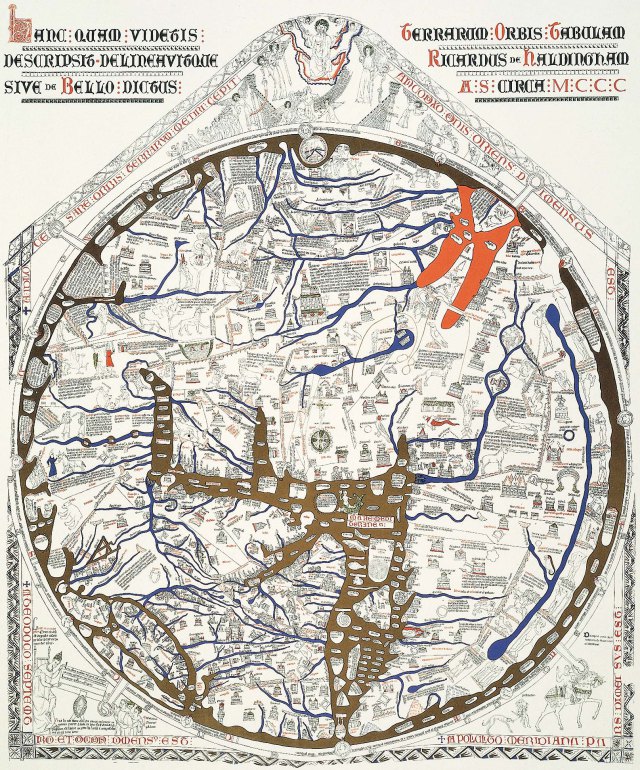
The “telos” of pre-modern societies involved living into something that existed before you.  They have an “end” beyond the society itself.  These frameworks exist not as a direct prescription but more so a guide to understanding reality.  Hence the “Mappa Mundi” (ca. 1300) tries not to accurately depict the physical world, but rather help one understand their place in the grand scheme of things.  It “maps” your life by telling you that you will die and face judgment, that Jerusalem is the center of the Earth, and so on.

The medievals obviously knew that the world did not actually look like this, but for them that was hardly the point.

The wars of religion in the 16th century lead to new ways of imagining the world. The Dutch philosopher Hugo Grotius gets credit in the eyes of most for orienting society in a new direction.  Though he wrote voluminously on many subjects, we can tie his thought together on the ideas of the individual and consent.  So, for example, the sea should be free for all, so that each individual nation may carve out their own destiny upon it.  Taylor argues that Grotius made such a case not as a radical, but a conservative.  He wanted to preserve the existing order and felt that ideas of freedom and consent were the best way to do this.

Obviously he was wrong.  But this, says Taylor, is often the way of things.  An acorn contains a whole oak, though no one would ever guess.  Our own revolution worked this way.  Within even just a few years, our founders lost control of the direction of things, and some see the Constitution as their attempt to salvage what they could before things got too far out of hand.

Our new imaginings put us on entirely different course.  In ye olden days order is self-realizing.  When evil happens time will go out of joint, for example, as in Hamlet.  Though many may flaunt established cosmic order, in time the cosmos has its way with you.  Order will come back again.  The modern imagining has no such apparatus.  It is entirely contingent, for we start with individuals and not what lies beyond them.

John Locke built on Grotius and went far beyond him.  For centuries, Christians saw sin as the result of death.  That is, our fear of death, whether subconscious or no, leads us to selfish acts of self-preservation.  This takes innocuous forms (I will have the last cookie), and more sinister, but the root is the same–our fear of self-dissolution. But Locke saw blessings in our desire for self-preservation–he saw it as part of our God-given nature.  We begin then, as individuals with a good desire of self-enhancement.  This means we meet on an amoral plane of complementarity, not an established hierarchy.  And from there, many other dominoes begin to fall.

Though Locke and others of his day had a secular foundation to their thought, some of the old way of understanding remained.  We still needed discipline to form our unformed selves.  But the balance of power shifted.  Before, nature came intact as a witness to us.  Locke believed, however, that just our labor shapes ourselves, so too our labor shapes nature.  Nature is ours form–it is our duty to form it–rather than nature forming us.  Now we see the oak embedded in Locke’s acorn–we believe that we are already formed.  As comedian Jon Stewart noted, whatever we do these days we deem special because we did it.^  Those of us who wish to challenge LGBT “agenda,” for example, don’t have the language or framework to do so effectively.  These days, our geodes must be acknowledged!

As we enter into adolescence we become more aware of the world, but our biggest problem at that age usually involves not being able to think of any world besides our own.  History helps with this, and Taylor forces us to ask, “What is normal, after all?”

In The Benedict Option Dreher asserts that Christians have lost the culture wars, and that we need to strategically withdraw.  Taylor’s book brings to mind the adage of Sun Tzu, that perhaps the battle was over before it began.  Modern imaginings are inherently secular.  Christians could never “win” a war fought entirely on their opponents terms.  But Taylor also gets us to rethink what is normal.  Dreher himself admits that he lives much like anyone else, and has yet to actually take his own advice.  He visited, however, a quasi-monastic community that lives out some of his vision.  Dreher commented,

It makes me think, Who are the abnormal ones here? These people, who live in such close rhythm with their own lives and the life of the church, or people like me, who live like I do?” He paused. “It was a sign to me of what could be.”

Dave

*Taylor rightly points out that this idea is not inherently conservative.  Those that rebelled against Charles I did so in the name of their ancient rights and privileges, and perhaps the same could be said about the Magna Carta.

**As one commentator put it, “My students start discussing Petrarch tomorrow in class, and it is easy to misread him as asserting that man is a microcosm of the universe, when in fact it is the universe that is a microcosm of man (or better put, a microcosm of Man).”

^Stewart continued . . . (I paraphrase), “You have to understand.  I grew up as a Jewish kid in New Jersey.  The one thing I heard more than anything else growing up was, “Jonny, get this through your head . . . you’re not special.”

“Eichmann Interrogated,” and Hannah Arendt’s “Eichmann in Jerusalem”

Adolph Eichmann worked closely with the notorious S.S. General Rienhard Heydrich, and helped formulate and institute the plans for the Final Solution.  He escaped eventually to Argentina, but was kidnapped by the Mossad and taken back to Israel for trial.

Eichmann Interrogated is comprised almost entirely of edited transcripts of conversations between Israeli Captain Avner Less and Eichmann himself.

The book starts and continues on a tedious note.  Eichmann takes pains to clarify the minutiae of who he knew, when he joined the S.S. and why, what his rank meant, and exactly what he did.  Painstakingly he gets us to the point where he asserts that the scope of his powers extended to Section IV B4.  That’s all.  He even expresses horror at the fact that Nazi’s murdered Less’ father in a concentration camp.

But around page 90 or so Less’ questions come more to the point, and Eichmann’s responses have to match.  Eichmann claims responsibility only for the fact that he transported people to the camps, and not for any of the deaths.  He talks of the need to obey orders, that he did nothing illegal as far as German law was concerned.  When pressed on the death of civilians at the hands of Germany, he admits it but points out that the Allies killed hundreds of thousands of civilians with their bombings as well.  He is deferential, but fights nonetheless.  He desperately tries to get distance between himself and the victims by claiming that he did not know necessarily that any of them would be killed for sure, otherwise why did so many Jews survive the war?  Bizarrely, he almost argued that his conscience could be clean because any of those he did ship to camps might hypothetically not be killed, thus, he can say he helped kill no one at all. He is very clear on this point.  Eichmann does not come to terms with his actions.

Many things make the last 150 pages or so of the book so memorable.  Did he truly believe the legal fictions he spun for himself?  Did he divorce himself so much from reality that he could not connect his transportation of people and their deaths?  Surely too, he lied about the extent of his involvement.  But again, did he believe his lies?

Hannah Arendt’s work helps complete the picture.  I thought Arendt’s Imperialism fantastic, but Eichmann in Jerusalem lacked the focus of that previous work.  Still the subtitle itself (A Report on the Banality of Evil) is a great insight into the whole Nazi regime.  Arendt does also draw one key conclusion about Eichmann himself.  She did not see him as a simpleton or a mere patsy.  He had a kind of intelligence.  But she argued that Eichmann had no ability or training to see anything beyond the moment.

One example might be that within minutes of each other he first disavowed any believe in the afterlife and then proclaimed that, “Germany will live in my heart forever.” Eichmann was perhaps literally incapable of seeing the contradiction. The same insight applies to him expressing horror over Avner Less’ father in a death camp.  Perhaps that too was not an act.  Perhaps he did not see the connection between himself and that event, however absurd that notion is.  Truly, he was never trained or encouraged to think or view things outside of himself.  He accepted his death sentence passively, but with little real sense of the reasons why he deserved it.*  For him the verdict seemed like victors justice and not Justice proper, a mere extension of the war 17 years later.

If she is right in this about Eichmann, then we can reasonably assume that he may not have only tried to concoct a desperate defense with his, “I only shipped them to the camps, I never killed anyone,” line.  He might have actually believed it. In this way Arendt makes us see that Eichmann is part of the tragedy of the Holocaust, all the more so because it seemed he couldn’t see that about himself.

*Unlike, say, Burt Lancaster’s character in the great ‘Judgment at Nuremburg.’

The Inherited Conglomerate

In his collection of folklore from Ireland W.B.Yeats quoted the Irish proverb that, Those who travel much have little faith.”  He mentioned this with seeming ambivalence, which reflects something of Yeats himself.  He certainly had many markings of the worldly man, yet he wrote the magnificent poem “The Second Coming,” with the immortal line that tells of the centre no longer holding, the widening gyre of the falcon.

I have traveled very little, but this very small amount of travel has confirmed its enormous educational benefits.  One sees new things from new perspectives “in the flesh.”  Certainly one should always wish to grow, learn, and so on, but the proverb holds at least a kernel of truth: those who travel without a secure base may find themselves more “enlightened,” but also more confused then before.  These new perspectives can completely undo one’s world.  Whether this disruption be good or bad . . . it is unquestionably a disruption.

The great Gilbert Murray made his mark in the early 20th century as one of the great scholars of classical antiquity.  For many he modeled the calm, rational confidence of pre-W.W. I Europe and the blessings of “free inquiry.  His analysis of the history of Greek religion confirmed his rationalism.  Greece turned to irrationalism, he argued, and therefore decline, only when they lost their “nerve,” their sense of themselves.

But one particular comment of his caused his followers some consternation.  He admitted that every civilization has an “inherited conglomerate” of thoughts and ideas that should not be questioned, even though they cannot be “proven” in the usual sense of the word.   When society starts to try and dissect this inherited tradition, when they lose confidence in the conglomerate, they lose a common language and purpose and begin to fracture. He defended, for example, the teaching of Christianity in Britain’s state schools because

the religious–and what is more–the ethical emotions of the English people are rooted in the Christian writings, especially the Gospels, some of the epistles, and books like the Imitation and Pilgrim’s Progress.  The situation must be accepted.

It was that “must” that particularly bothered people.  What did he truly believe?  was rationality in itself a religion?*

Murray saw the emancipatory movements of the 19th century and often supported them.  But, he remained apparently torn about this in his later years, for he saw that the collapse of traditional Europe after W.W. I did not lead to more freedom as expected, but much less freedom for millions due to the rise of totalitarianism in Italy, Germany, and Russia.

In a podcast with Ezra Klein, he and Tyler Cowen exchanged thoughts on the emerging “rationality community.”

Ezra Klein

What are your thoughts on the rationality community?

Tyler Cowen

Well, tell me a little more what you mean. You mean Eliezer Yudkowsky?

Ezra Klein

Yeah, I mean Less Wrong, Slate Star Codex, Julia Galef, Robin Hanson. Sometimes Bryan Caplan is grouped in here. The community of people who are frontloading ideas like signaling, cognitive biases, etc.

Tyler Cowen

Well, I enjoy all those sources, and I read them. That’s obviously a kind of endorsement. But I would approve of them much more if they called themselves the irrationality community. Because it is just another kind of religion. A different set of ethoses. And there’s nothing wrong with that, but the notion that this is, like, the true, objective vantage point I find highly objectionable. And that pops up in some of those people more than others. But I think it needs to be realized it’s an extremely culturally specific way of viewing the world, and that’s one of the main things travel can teach you.

All of this came to mind as I read E.R. Dodds’ provocative classic, The Greeks and the Irrational.  We assume, he argues, two main things about the Greeks:

  • Their main contribution to the western world was their spirit of free, rational inquiry, and
  • It was this spirit of free inquiry that led to the greatness of their civilization

Dodds pushes us to see the Greeks on their own terms.  They had, perhaps more than other civilizations, a “rational” tradition, but even this rationalism sometimes came cloaked in religious guise.**

For example, the Pythagoreans developed a variety of useful and progressive ideas about math.  But their obsession with ratio/rationalism clearly had strong religious overtones, which shows when they (supposedly) drowned the “heretic” Hipassus for discovering irrational numbers.  The foundation of their mathematical advances had strong irrational overtones.  Socrates, whom many assume to be an arch-rationalist, declared in the Phaedrus that, “Our greatest blessings come to us in the form of madness.”  The whole of Greek literary and dramatic culture arose out of Dionysian worship.  Xenophon, Aristotle, and even Cicero accepted the idea that dreams could have spiritual import. The list could continue.

But as in the case of all civilizations, eventually elites, followed by others, began dismantling the irrational foundations.

Though fragments of Greece’s “inherited conglomerate” survived past the 4th century B.C., by the 3rd century little if anything survived.  At that point, Dodds argues that Greece experienced a time when society was more “open” than at any other point.  Dodds writes,

A completely “open” society would be, as I understand the term, a society whose modes of behavior were entirely determined by rational choice between possible alternatives and whose adaptations were all conscious and deliberate–all “rational.”

This sounds like the dream of many a modern man, but of course, no one could argue that Greek civilization had any large degree of health at this point.  Very few, if any, of Greece’s storehouse of cultural contributions came from this era, and this era paved the way for their final takeover by Rome ca. 146 B.C.  Once you ditch the conglomerate, you might have little less than sand on which to build.  You simply have too many decisions to make and no way to make them coherently as a group.

It seems to me that today we have two groups that argue strong for a rational, open society.

On the conservative side we have those who believe in entirely unfettered markets and expanding choice.  The best society is one where everyone can choose for themselves how to maximize their welfare.  Empowered by education and multiplicity of options, the conglomerate of free choices will create a happy society.  This group favors globalization, open borders, and so on.

On the more liberal side we have those who emphasize the power of choice in more personal, intimate ways, especially in terms of gender and sexual identity, family makeup, birth control (which includes abortion), and so on.

These two sides overlap at points.  They often sit across the political aisle from each other, but they have much more in common than what divides them, for they share a common foundation of devotion to the idea of an open society described by Dodds.

Other groups still believe in some way in the inherited conglomerate.  You have the more conservative, middle-America, white picket fence group that adheres to small town values, and you have more liberal leaning who might balk at small town values a bit, but still desire a “decent America.”  The more conservative side sees culture and community holding things together, the more liberal look to government with greater frequency to manage outcomes.  Yet both sides fear markets and morality running wild and free–and both have more faith in America’s “conglomerate” than either of the aforementioned groups.  Both could be described as irrational, for there is nothing objectively verifiable about “America.”  Their commitment lies on a gut-level, formed by a variety of experiences, emotions, and so on.

This looks like a clash between the rational and the irrational, but Dodds’ book helps illumine this divide.  The irrational have an unprovable gut-level attachment to something called “America.”  But the rational have something akin to religious commitments as well.  Those devoted to the market and to personal identity need to believe that the expansion of choice ad infinitum is always a good thing.  Neither party may believe much in “America,” or they may reduce America to the mere idea of choice.  Their faith lies elsewhere, and they take on the missional mindset of some of the world’s universal religions.

Our political divides often mask religious divides.  As Cowen argued, even the rational have irrational commitments.

Dave

*Murray’s daughter asserted that he came back to the Catholicism of his youth in the last weeks of his life, though other family members dispute this.

**By “irrational” Dodds does not mean “wrong,” or “foolish” but unprovable, or a mysterious a priori, or “psychic,” i.e., related to the soul.

Catch-22

Every year at the beginning of Government class I ask the question, “If 80% of the people voted to put the entire tax burden only on people with red hair, would this be ‘democratic?'”

I am always surprised and a bit dismayed at how many answer ‘yes.’

Of course our discussion then moves toward defining “democracy,” which, for as much we use the word, proves more difficult than we might expect.

“Democracy” is a “good” word, and “empire’ is one of those words you cannot say on TV.  But empires had many things that proponents of democracy value, such as religious tolerance and ethnic mixing.

So how, exactly, should we define “democracy?”

Democracy in the modern era grew out of Enlightenment universalism.  Jefferson said that, “all men are created equal,” and France produced the “Declaration of the Rights of Man.”  Spengler may have been a nut, but he might have been on to something when he commented that “the rights of Englishman,” made a lot more sense to him than, “the rights of man.”  The ancient Greeks, for example, considered by many as the progenitors of democracy, knew nothing of “universal rights.”

This universality gave early democratic movements  their enormous power and enabled them to move speedily through Europe.  But this is not the whole story, for coupled with this universality came the rise of nationalism.

How do we reconcile these different forces?  The French had a hard time of it, rallying to defense of the “patrie” against Austria and Prussia and then expanding under Napoleon both to spread their universal ideals and rule others in the name of France.  The recent presidential election showed this tension.  It has been with us for a while.

On the one hand, democracy thrives on the idea of self-determination.  Democracy grants people the right to determine our lives because we share common interests, cultures, goals, etc.  Modern democratic movements have their genesis in rebelling against rulers who do not share our culture our goals, those that do not speak for us.

On the other hand . . . democracy believes in equality for individuals as well as groups, and this equality, applied in a heterogeneous culture, must in turn limit some aspects of self-determination for the state to hold together.

This has led some to speculate that increased diversity can contribute to more autocracy.

Germany’s Jeroen Zandberg (a proponent of democracy) put it this way:

Of course nationalism can also be used to exclude and eliminate others, but this is rare. These rare occasions are however often used to discredit nationalism. An elite who doesn’t have the best interest of the people at heart, but which does want all the benefits of a high social position often tries to promote patriotism instead, and at the same time downgrades nationalism. Patriotism is simply to owe allegiance to the state even if that state is not legitimized by the people. The state is in that perspective merely an organisation like any other. If that were true it would be like asking soldiers to die for the telephone company. Without identification and an emotional bond between people and state we would have no alternative then to live under a police state. If we don’t want a police state then we need some degree of nationalism.

If you have multiple cultures present in the same location who each have different rules on how to order the world then there needs to be another ethical system to mediate between them. For example, Muslims have Sharia law which describes how a good Islamic society should be organised. These laws are not accepted by non-Muslims for if they would accept them they would be Muslim as well. In a truly multicultural society the Sharia law would govern the lives of Muslims and each of the other cultures would have their own laws as well.

Now Germany, as with other European nations, has a culture based on Christianity and the Enlightenment, which values ideas like freedom, equality and self-determination. If you implement multiculturalism then the values of the Enlightenment are degraded to the level of only being appropriate to the ethnic German population. You would get a Germany where each (ethnic) community has its own rules. Of course such a system could never work in a modern society because people are not isolated in small communities.

Multiculturalism can however also be used to invalidate all of the cultures present, because if all cultures are equal, which multiculturalism implicitly states, than none may rule over the other. This means that, in the case of Germany, the mere presence of another culture is already reason enough to replace German culture with something else. This ‘new’ culture is by definition anti-democratic, because it is one of a small elite who appoints itself as mediator between the various cultural groups. In this way an elite rules over a set of distinct peoples. In that sense multiculturalism is a leap backward in time when there were large empires ruled by a small nobility and people’s positions in society were fixed by birth. Characteristics of such empires are that they are fiercely anti-democratic, oppressive and unable to compete economically in a globalised world.

As much as we might wish, we cannot work out either ideas of liberty and equality in a vacuum.  Something somewhere has to give.

It appears that those who lean towards the multi-ethnic, tolerant, and globalized side of democracy must tolerate some degree of nationalism for the support structure of multi-ethnic tolerant societies to exist.  The balance will be hard to find.

On what side should the Church fall?  Here we must take great care to avoid identifying too much with either camp.  The first half of the 20th century gave us the disasters of nationalism, and more recently, we see the problems created by multiculturalism.  All the more reason for the Church to create its own culture . . .

Dave


Political Enigmas and Spiritual Problems

People throw the word “courage” around too glibly, and the word should rarely apply to historians.  Yet we might possibly call the German historian Fritz Fischer and the work he did in the early-mid 1960’s courageous.  In the aftermath of W.W. II and the collapse of Nazism, Germany found itself divided and at the center of the Cold War.  The trauma of the 20th century played out in their backyard.  They had to comes to terms with their past and their place in the world.  Understandably, most everyone said something like:

  • Nazism was horrible and we have much to answer for.  But, it was a 12 year “blip on the radar.”
  • We caused W.W. II . . . and that was wrong.  But . . . we must understand that W.W. II was a byproduct of the unjust Treaty of Versailles.
  • What made that treaty so unjust was that Germany wanted peace in 1914.  But instead, we found ourselves encircled by England, France, and Russia.  Some may say we started W.W. I, but if we did, we did so out of self-defense.  We were just minding our own business, but other countries sought to “snuff us out.”
  • Thus, when we talk about helping to shape a new peaceful order of nations, we can draw on the vast majority of our history to do so.

Fischer argued instead that in fact, Germany pursued an aggressive policy leading up to both conflicts.  If they faced “encirclement” from other nations in 1914 that had everything to do with Germany’s own drive to dominate Europe themselves.  Certainly Hitler and the Nazi’s had racial aims that had almost nothing to do with the Germany of 1914.  But . . . their territorial and economic aims remained remarkably similar.  In these policy areas the Nazi regime simply picked up where Germany left off decades prior.

In making such arguments Fischer obviously made himself extremely unpopular.  He directly challenged Germany’s sense of history and sense of identity.  Provided that his arguments came from a genuine seeking of truth and not from a masochistic, cynical self-loathing, the term “courageous” might apply.

I find Fischer’s arguments persuasive.  He cites many instances of Germany planning for a long time to expand its influence, an influence it “deserved” because of its economic and military power.  Even the academic elite of Germany joined in, as Johannes Haller wrote,

Let the German nation arise, strong and invincible, only in the greatest danger conscious of all her strength.  Let her reclaim the place in the world that is hers, the place that she once had that was taken from her in the ignoble times of her weakness.  Let her begin again what she was in the long gone–mistress of the north and east, champion of German culture, and safeguard of western civilization against the tyranny of Asiatic barbarism.

As early as 1903 the scholar Erich Marcks wrote that, “the old liberalism is dead,” and that

the idea of increased state autonomy, the idea of power, has replaced it.  It is this idea that inspires and guides leading men everywhere.

It is amusing to see how the “Germany as playing defense” school of thought deals with certain comments of high-ranking German officials just before W.W. I.  Germany’s plan, for example, to fight a general European war involved willfully violating Belgian neutrality–a neutrality guaranteed by international treaty.  Chancellor Bethmann-Hollweg called this guarantee a “scrap of paper.”  German apologist Egmont Zechlin called this statement, a mere  “figure of speech,” an expression of “mood.”  It is not likely that the Belgians themselves thought much of this “mood” in August 1914 when Germany invaded unprovoked and invented a blatant lie to justify the invasion.  This reminds me of the ingenious response Marty Dibirgy received to his question some time ago:

What struck me about Fischer’s book World Power or Decline, was not so much his main argument, which I already agreed with.  What I found surprising was the philosophy that lay behind Germany’s aggressive actions.  While I disagree with Germany’s apologists, I concur with them on one point.  The belief that one must continually advance, expand, “seize the day,” and so on, was hardly limited to Germany.  Most European intellectuals said likewise.  Darwinism, among other intellectual fads, filled the mind’s of men with the idea that one must continually grow or perish.  The idea may have been first expressed by Alcibiades.  When advocating for an expedition to Sicily, Thucydides has him say to the Athenian Assembly,

What reason can we give ourselves for hesitating? What excuse can we give our allies for denying them aid? We have given them our word under oath to protect them and now we are saying they never helped us? Our treaty with them was not for them to come to Athens and help us but to harass our enemies in Sicily and prevent them from attacking us. This they did. Like all great imperial powers we have acquired our dominion by our readiness to stand by anyone, barbarian or Greek, who asked for our help. If we sit by and do nothing or make distinctions on the basis of nationality when people ask our help, we will not only add little to our empire but we will probably run the risk of losing it altogether. Wise men are not content to repel the attack of a superior power, they anticipate it. We cannot regulate at our pleasure the extent of our empire. Given our position, we must neither relax our hold on our subjects nor give up our plans to attack and rule over others. For if we do not rule over them, we will be ruled over by them! We cannot afford the luxury of inaction like those who are our subjects unless we wish to exchange places with them and become subjected to them.

The debates surrounding the origins of W.W. I and who one should primarily blame can engage and fascinate, but most miss that the real cause of the war lay in Europe’s spiritual restlessness.  The Romantic reaction to the Enlightenment initially spurred on some notable cultural and intellectual innovation.  By the end of the 19th century, however, all we had left was a pointless, restless, unease.  We must move so we do not die.  But in what direction should we move?  Where should we go?

In his book Nihilism, Father Seraphim Rose (then just Eugene Rose) called this malaise “Vitalism.”

The chief intellectual impetus for Vitalism has been a rejection of the realist/scientific view of the world, which simplifies things and “dries them out” of any emotional life.  Unfortunately, however much the Vitalist might yearn for the ‘spiritual’ or the ‘mystical,’ he will never look to Christian truth to fulfill this need, for Christianity for them is as ‘outdated’ for him as the most dedicated rationalist.

The Christian truth which the Enlightenment undermined and rationalism attacked is no mere philosophy, but the Source, the Truth of life and salvation, and once there begins among the multitude a conviction that Christianity no longer remains credible, the result will be not an urbane skepticism imagined by the Enlightenment, but a spiritual catastrophe of enormous dimensions, one whose effect will make itself felt in every area of life and thought.

Towards the end of the 19th century, a restlessness and desperation had begun to steal into the hearts of a select few of Europe’s intellectual elite.  This restlessness has been the chief psychological impetus for Vitalism; it forms the raw material that demagogues and craftsmen of human hearts may play upon.

Fascist and National Socialist regimes show us what happens when such craftsmen utilize this restlessness for their own purposes.   It may seem strange to some that such restlessness would manifest itself in places that had reached the seeming pinnacle of human cultural and political achievement, but such manifestations should not surprise us . . . .

In such phenomena “activity” serves as an escape–an escape from boredom, meaninglessness, and most profoundly from the emptiness that takes possession of the heart that has abandoned God and refuses to know their own selves.

In politics, the most successful forms of this impulse have Mussolini’s cult of action and violence, and Hitler’s darker cult of “blood and soil.”   Vitalism, in its quest for life, smells of Death.

I love Tyler Cowen’s Marginal Revolution blog.  Like so many others I find him broadminded, engaging, and properly provocative.  His most recent tome, The Complacent Class, makes some timely arguments about the state of the union.  He asserts that Americans have grown lazy.  We prefer being comfortable to a challenge.  We spend time with people just like us, and modern technology allows us to pick only the music, food, movies, etc. that we know we will like.  More than ever, we live in self-contained loops, and this has grave implications of for our culture.

I usually agree with Cowen and most of what I read about the book seems persuasive.  But one of the key supports to his arguments is the apparent fact that Americans move around and change jobs much less than they used to.  Perhaps this is a byproduct of some of the other changes in society.  Cowen calls this a serious negative, but I’m not so sure.  Putting down roots will not help build local communities if we decide to stay inside on our screens.  But the wandering psychological restlessness prevalent from 1850-1930 helped contribute to two devastating world wars.  For all of his movement and desperation to seek a challenge, how much did Alexander the Great grow as a person?  A cursory examination of his life hints more at degeneration than growth.

Cowen apparently thinks of growth in terms of seeking a challenge, conquering it, and then moving on to a new challenge.  He’s onto something.  But a tree continually transplanted will never flourish.  The unseen growth of roots in a plant are what really count.  Cowen equates movement with embracing risk, which certainly applies at times.  On some occasions, however, movement can be about avoiding risk, avoiding problems, avoiding the challenge of real growth by going somewhere else.  The desert monks of centuries ago recorded this anecdote, which all of us do well to heed:

A brother said to a hermit, “My thoughts wander, and I am troubled.”  He answered, “Go on sitting in your cell, and thoughts will come back from your wanderings.  If a donkey is tethered, her foal skips about but always comes back to her.  It is like that for anyone who for God’s sake sits patiently in his cell.  Though his thoughts wander, they will come back to God again.”


The Tyranny in “Freedom”

In his classic work Orthodoxy, G.K. Chesterton uses a masterful analogy.  In discussing the relationship between authority and adventure, he writes,

Christianity is the only frame which has preserved the pleasure of Paganism. We might fancy some children playing on the flat grassy top of some tall island in the sea. So long as there was a wall round the cliff’s edge they could fling themselves into every frantic game and make the place the noisiest of nurseries. But the walls were knocked down, leaving the naked peril of the precipice. They did not fall over; but when their friends returned to them they were all huddled in terror in the centre of the island; and their song had ceased.

As good Americans we tend to believe that absolute freedom and tyranny lie at opposite poles.  We are mistaken. Instead, they have a tendency to bend around and shake hands.  Plato recognized this long ago in his Republic. After discussing various forms of government in Book VII and how the good in each gets perverted, he turns his attention to democracies:

The ruin of oligarchy, [said Socrates] is the ruin of democracy; the same disease magnified and intensified by liberty overmasters democracy — the truth being that the excess of anything often causes a reaction in the opposite direction; and this is the case in vegetable and animal life, but above all in forms of government . . .

The excess of liberty, whether in States or individuals, seems only to pass into excess of slavery.   . . . And so tyranny naturally arises out of democracy, and the most aggravated form of tyranny and slavery out of the most extreme form of liberty.

Socrates continues in the discussion to say that democracies create “a new kind of drone.”

I thought about both Plato and Chesterton when listening to a reaction from one commentator on the Supreme Court’s decision on homosexual marriage.  He agreed with the decision not for legal or moral reasons (which I would disagree with but at least understand in part), but because, “thankfully, the Court recognizes that we live in the 21st century.”  That is, the Court should essentially approve of whatever we happen to be doing at any given time.*  This may look like freedom, but in fact enslaves us to a particular moment without any benefit of perspective. Maybe we must come to terms with the fact that this is what democracy means now.  Perhaps it has always been so and we failed to recognize it.  In any case, this method leaves ourselves only to the walls inside our own heads.

This is why “great” revolutions often end up making things much worse than the regimes they overthrew.  Of course no one intends this at the outset or even recognizes the possibility, partly because revolutionaries perceive a truth, or part of the truth, with crystal clarity.  This truth will give them the motivation they need for revolution.  But because this truth is only part of the whole Truth, it leads to a frozen dogmatism.  The fences melt away in our rush to embrace freedom, and all end up huddling at the center whether they wish it or not.

One of the great virtues of Nicolas Berdyaev’s The Russian Revolution is his keen vision that sees past the political aspects of Communism and into its spiritual core.  Of course the Soviet state adopted atheism as its official policy, but Berdyaev puts the roots of communist origins within the deep and ardent tradition of Russian spirituality.

Anyone who has read 19th century Russian literature recognizes the depths of profound insight and feeling those masters tapped.  Their intensity of feeling led them to examine the nature of suffering perhaps as no other epoch has.  The first modern globalization movement allowed more sensitive souls more exposure to more suffering.  Some, like Dostoevsky, took suffering and had it transformed by the cross.  But others failed to do so, and developed what we might call a “naked” hatred of suffering.  As one early Bolshevik proclaimed, “Suffering has no right to exist.”  Everyone must be happy.

This rejection of the meaning of suffering cannot bring one closer to our fellow men, because of course we do suffer and always will.  To reject suffering sets one up to reject the experience of mankind, and then, mankind itself.  Suffering without the Cross gives way to tyranny.

The early revolutionaries had within them a deep asceticism.  All things not geared fully towards improving the material lot of the people must be expunged.  Beauty itself became a debauched and corrupting luxury.  Everyone must do without so that nothing ever gets wasted, either in the mind or on the ledger sheet.  Such asceticism, without grace, again leads to tyranny. But let us not miss the fact that this tyranny has its roots in a certain idea of freedom.  Communists wished the people to be free from suffering, free from worry about the future, free from the competitive aspects of capitalist societies.  Now we know that such freedom leads to a drabness and narrowing of life.

Soviet Architecture

Berdyaev wrote in 1931 and he had a keen insight for the westerners to whom he wrote.  Westerners at that time and now, fundamentally are skeptics, and they assumed that the Soviets shared this basic outlook.  Not so.  The communist has deep (though misplaced) faith, and the people understand and embrace this faith.  The state could not hold together for any other reason.  This faith flies in the face of “evidence” against it.  Most communists rejected the physics of the early 20th century, for example, because Einstein and others smacked of mysticism, and we must exorcise all mysticism so that the people will have true happiness.  In the end pure rationalism becomes entirely irrational and ridiculous.  Still they press on.  Our failure to recognize this faith led us to combat it by all the wrong means.  One thinks of Nixon trying to impress Khruschev by showing him better refrigerators.  It showed our misunderstanding and our bankruptcy.  Was this all we had to offer?  If Khruschev was not impressed, we should be surprised.

The first part of Berdyaev’s book focuses on the spiritual failures of the revolutionaries themselves, but then he adroitly and appropriately turns the tables.  How did such a movement come about?  If the revolutionaries showed great spiritual hunger, we must consider the fact that churches in their locales could not feed them.  The rise of communism comes from the failure not just of capitalism to produce a just society, but from the Church to live out its calling.  He writes,

Christianity has not put its truth into full living practice.  It has found its realization either in conventional formula or in theocracies which deliberately ignore freedom (which is the fundamental condition of any genuine realization), or it has practiced a system of duality, as in modern history, when its power has weakened.  And therefore Communism has made its appearance as a punishment and a reminder, as a perversion of some genuine truth.

As I and others lament the recent high court decision on the validity of homosexual marriage we do well to follow Berdyaev’s example and point our fingers in the right place.  For what we see before us comes fundamentally from the Church’s failure to explain the true nature of marriage not as an emotional bond between two people, but as an image of salvation itself, the marriage of Heaven and Earth.  In Eastern churches, the bride and groom process around the congregation during the service wearing crowns.  These crowns represent crowns of the martyrs.  Marriage, like monasticism, is a kind of martyrdom, a death out of which new life emerges. What we see before us should serve as a “punishment and a reminder” of what we should have proclaiming and living out all along.

Dave

*One sees this in many places in our culture.  Take, for example, the rise of graphic novels.  Rather than be comfortable with the strengths and weaknesses of the medium, we hear ardent insistence that “graphic novels are just like books.”  In my limited experience it seems obligatory for authors of young-adult fiction to include a mean teacher in the story who fails to allow a student to hand in a book-report on a graphic novel.  The theme is the same —  whatever we happen to be doing must be affirmed by all.

The “Pursuit of Happiness”

I remember an interview long ago that William Buckley did with journalist and social critic Malcolm Muggeridge.  The interview touched on the idea of happiness, and Muggeridge commented that the words, “the pursuit of happiness” in the Declaration of Independence had done terrible harm to America and the west in general.  Whatever the original meaning and purpose of the phrase, Muggeridge believed that the Declaration teaches its readers that happiness can be effectively hunted down, caught, and then enjoyed.  He stated,

There is something ridiculous and even quite indecent in an individual claiming to be happy. Still more a people or a nation making such a claim. The pursuit of happiness… is without any question the most fatuous which could possibly be undertaken. This lamentable phrase ”the pursuit of happiness” is responsible for a good part of the ills and miseries of the modern world.

The truth is that a lost empire, lost power and lost wealth provide perfect circumstances for living happily and contentedly in our enchanted island.

I can say that I never knew what joy was like until I gave up pursuing happiness, or cared to live until I chose to die. For these two discoveries I am beholden to Jesus.

In reality, Muggeridge argued the very act of pursuing happiness will in fact ensure that we will never achieve happiness at all.  Instead, happiness comes unbidden.  It is a gift.  We immerse ourselves in particular person, thought, book, or what have you, and suddenly we realize, “I’m happy.”  Adherence to the Declaration’s view of happiness would lead us down a path of restlessness, materialism, cynicism, or flight into fanciful and frightful utopia’s.

I could not find the original clip of this on Youtube.  The clip below deals with an entirely different question, but it’s still worth watching.   Whether  your agree with Muggeridge or not (and he makes another controversial assertion), we must all agree that Muggeridge possessed the greatest English accent of all time.

I thought of Muggeridge on happiness when reading a brief post from David Derrick about individuals or nations that seek to “leave their mark upon history.”  In it he quotes Toynbee, who mentions that since Austria and Bavaria parted company centuries ago, the two have pursued different paths.  Austria looked to do “great things,” and they did achieve a kind of greatness with the city of Vienna.  But they also involved themselves in numerous wars that they often lost.  They got crushed by Napoleon in the 19th century, then by Russia and the allies in W.W. I.  Toynbee’s thoughts in the post above date from 1934.  In the few years that followed Austria continued to try and “leave its mark” by joining up with Nazi Germany, and of course that too ended very badly.  I have some friends who visited Austria years ago, and they saw this same attitude of “we’re special” at work in those they met (though in the modern context it had the manifestation of strong hostility to foreigners and immigration).  This approach has not helped them find their place in the world.  It appears that pursuing a place in “History” might be as futile as pursuing happiness.

What of Bavaria?  How did they do in the great trial of German history between 1933-45?  I know nothing about the history of Bavaria, but after a little research (read: I looked on a Wikipedia page), I note the following;

  • During the tumultuous period of the Weimar Republic, Bavaria avoided radicalism and voted for the mainstream conservative “Bavarian People’s Party.”
  • Hitler was fond of Bavaria, and the Nazi’s held many of their rallies in the Bavarian city of Nuremberg.
  • The White Rose, the heroic student resistance movement to Nazism, had its origins in Bavaria.

Before examining these points, we should note that no country, just as no person, should be judged only by their sins, no matter how bad those sins may be.  Still, defenders of Bavaria’s relaxed approach to their own history need to examine this period.  Points two and three stand out most sharply.  As to Nuremberg, Hitler may have held rallies there simply because he was known to be fond of Bavaria.  On the other hand, Bavaria may have been a stronghold of Nazi power.  The White Rose may have originated in part due to a strong underground of resistance in Bavaria, or it may have arose for entirely other reasons.  Without further knowledge (and I have none), we might say these two factors cancel each other out.

I think the first category may hold the most weight.  In the Weimar years Germany swayed to a fro between extreme ideas and stark resistance to the Versailles Settlement.  Both Nazi’s and Communists, for example, sought to “leave their mark” upon history.  The fact that the German people went with the Nazi’s shows their general bent towards radicalism.  The “Bavarian People’s Party” in contrast, wanted to bypass all of the immediate debates and return to traditional concepts of governance.  They contemplated separation from the rest of Germany to achieve this, not unlike the “Bloodless Revolution” in England in 1688.  Perhaps they understood the secret that Muggeridge knew, that seeking “History” can hold just as much danger as seeking happiness.

8th Grade: The Golden Age of Athens

Greetings,

This week spent some time discussing the elements of ‘golden ages’ and the factors that went into the birth of what we know as Periclean Athens.

From 480-431 B.C., Athens experienced an explosion of creativity and culture perhaps unparalleled in human history.  Much of what we consider to be modern democracy, philosophy, literature, drama, science, and architecture have many of their roots in this period and place.

What is needed for a golden age?

As we compare them across time (Periclean Athens, Dutch early 1600’s, Elizabethan England, 12th century France, etc.) some common factors emerge:

  • Some kind of cross pollination of culture based on access to the sea, or at least, extensive travel
  • A burst of confidence based on a defeat of a large power — you were the underdog and emerged on top.  The unexpected victory serves as a validation of your uniqueness.
  • An educational base to build the cultural explosion on.  There has to be some kind of literate and curious population base to build on.
  • The willingness to tolerate the possibility of new ideas, which usually has something to with #1 listed above.

With all these factors possibly needed (and possibly more that I have not accounted for), golden ages do not come often in history, but they leave their marks long after they disappear.

The Pynx, Meeting place of the Assembly

We also looked at the flowering of Athenian democracy.  As we examined how it functioned, we arrived at a proposition to debate next week, which is

Athenian Democracy in the age of Pericles was more democratic than America is currently.

Part of how you evaluate this statement depends on a few factors:

1. What do we mean by “Democracy?”

We are so used to the word “democracy” we may not consider what we even mean by the term.  Clearly it must mean more than mere voting.  Some elections have only one candidate, or the different candidates do not give us different options in reality (that is, the candidates would do basically the same thing if elected).    It must also mean more than mere majority rule.  If 51% of the people vote to oppress the remaining 49%, we would not call that democracy.

Democracy attempts the trick of giving power and choice to the people, while at the same time preserving freedom in some measure for all citizens.  Thus, the ‘losers’ in a contest are still protected from the possible pitfalls of majority rule.  At the same time of course, the majority cannot be obstructed too much, otherwise the point of voting and majority rule would be lost.  Historically this balancing act has never been easy.

2. What is most important in a democracy?

In the Athenians favor we note the following:

  • They had much more direct participation from their citizens in government than modern Americans.
  • The average citizen would not only vote, but could also speak in the Assembly.  Most citizens would probably serve in some political capacity during their adult lives.

Against them we can say that:

  • Women and slaves were excluded from voting and participation
  • The very fluidity of their democracy opened up the real possibility that the checks and balances of law could easily be overridden, as happened on a few occasions.
  • Critics of Athenian democracy (ancient and modern) believed Athens was easy prey for the “cult of personality.”

For modern America we note that

  • All citizens of a certain age are eligible to vote.
  • We have minority protection built into the system.

Against us some might say

  • Representative government has tended toward an oligarchy of the rich, with powerful interests controlling both parties.
  • This, in turn, has led to a real distance between Government and the people which results in an “Us and Them” attitude.

Below is a very detailed chart of the ins and outs of Athenian democracy for the very interested.

Many thanks,

Dave Mathwin

10th Grade: There’s More than One Way to Skin a Cat

Greetings,

As we reflected on the Scientific Revolution as a whole, we saw how people’s view of their experience in the world changed.  Newton and others gave us a universe of order and balance — a somewhat reductionistic world of cause and effect.  One could argue that a subtle shift occurred between the Reformation/Counter-Reformation era of the ‘inner’ man, the world of faith, etc., and a new focus on what can been seen and measured.

The reign of Louis XIV in some ways embodied these new principles.  Symmetry and order were key concepts of his reign, and they both were abundantly evident in the architecture of his royal residence in Versailles.  Many may tend to think of absolute monarchies existing in the Medieval period, but this is far from the case.  The era of absolutism might be dated between 1600-1750, and the Reformation certainly may have impacted this.  With the political power of the Church as a separate entity broken, that power would have to land somewhere.  For many, the most convenient and obvious place for that power to reside was in the person of the king.  And, if a neat house, for example, reflects to our eye a well-run house, than the order and symmetry in the architecture surely reflected back on Louis himself.

Hall of Mirrors

and
Gardens at Versailles
Louis himself put great stress on managing his own image, as this picture shows
Louis XIV

Perhaps most striking aspect of Louis’s reign, however, was how he controlled  the nobility.  Like many nations France’s nobles had a tumultuous relationship with the crown, with a variety of wars and compromises as the result.  Louis changed the dynamic by changing methods.  He created an elaborate system of ritual and custom. Violating these rules of ‘polite’ society meant ostracism, which meant loss of influence.  What the nobles apparently did not notice, however, was that under Louis’s system they had no influence.  Louis had them immersed in a bizarre system of etiquette.  Things like discussing politics or deep questions of life were not against the law, but frowned upon.  It was ‘not done.’  Thus, their lives became almost ridiculously trivial and inconsequential, with literally hours taken up in deciding who could sit where, who should stand for who, and so on.  Ask your children if you are interested about some of the specifics of this etiquette involving door knocking and chair sitting, among other things. The French Revolution would reveal some of the consequences of this development.

To control others, Louis did not use force.  Instead he dazzled, charmed, and confused the nobility.  To function all states need to establish some kind of order and control.  Louis, of course, had bigger fish to fry.  He did not want the status quo so much as he wanted a political revolution, a more centralized state.  To accomplish this most might have resorted to force, a “1984” style of authoritarian rule.  Louis was not known for his book learning but he must have had a keen “street-smarts,” for he chose a different path, the “Brave New World” path to control.  This path controls others not directly, but indirectly.  It creates a scenario whereby you, the individual, gladly give up some measure of political liberty to gain something you think is better.  Those who have seen the movie Matchstick Men might recall the line where the main character Roy defends himself by saying,

I’m not a criminal.  I’m a con-man.  [The difference being], I don’t take people’s money–people give me their money.

There’ more than one way to skin a cat.

We can say that Versailles was many things.  It was a social hot-spot.  It was a place of elegance and beauty, or at least, a certain idea of beauty.  But it was also a piece of political propaganda.  Louis was known as the ‘Sun King,’ and this statue of Apollo on his chariot dragging the sun up stood in a prominent place:

pd2047369

Louis masterfully tried to have image morph into reality.  Apollo, for example not only had the power to move the sun, he also was the god of music and culture.  In using Apollo, Louis claimed not just preeminence of power but also of taste, a place the French have enjoyed for centuries since.  Yet, for my money, while I would readily call Versailles impressive, I don’t think I would call it beautiful.  Louis wanted to subtly scream “Authority!” which did, I think, create a chilling effect.

Next week we will look more deeply into the policies and practices of Louis’ France.  In this update I have painted perhaps too black a picture of Louis.  He was certainly far from an overtly evil or cruel man.  He had many endearing qualities.  But the changes he began did have significant consequences.

Blessings,

Dave

11th Grade: Industrialization

Greetings all,

C.S. Lewis once commented that the world of Jane Austen had more in common with Homer than our world has in common with Austen.  If Lewis’ speaks truly, we have the Industrial Revolution to thank.  The Industrial Revolution remade society almost from top to bottom, and in so doing changed not just how we live but also how we think.

What did Lewis mean by his observation?

Obviously a great deal changed from Homer to the time of Jane Austen.  But Lewis refers not to political and ideological changes, but the basic way people lived and interacted.  Among the similarities across time include . . .

  • Both eras had a predominantly rural population where most people farmed
  • Both eras measured wealth almost exclusively in terms of land ownership
  • Both eras centered their identity often around the extended family
  • Both eras had to regulate their lives with the rhythm of creation
  • “Manufacturing” would have been done by individual skilled craftsmen rather than masses of specialized workers or assembly lines.

All of this and more changed from the early 19th-early 20th centuries.

The Industrial Revolution (IR) first and most obviously changed demographics.  For all of previously recorded human history people lived predominantly in rural areas.  Rural areas have a slower pace of life.  They tend towards social conservatism and the maintenance of tradition.  The IR began displacing small farmers and forcing people to move to the cities for work. As the graph below indicates, a trend began that has only continued up to the present day.

rural_urban

The resulting mass production of goods and, perhaps especially, of food, led eventually to increased life-expectancy and and a population explosion that has continued until today (though some predict a regression in population soon).

In changing where we lived, the IR changed how we live.  On farms the family forms the obvious central social unity.  Before mass transportation, very few children would move far from parents once they reached adulthood.  But now with many starting to leave home to work, life no longer centered around the family farm.  Now at least one parent left the house for 12 hours a day, and often both parents had to work in factories.  Individuals within families found other planets around which to orbit.

If both parents worked, what about children?  The IR inadvertently began the push towards mass public education.  Previously, only those with money and leisure received an education.  Spreading education to the masses had many benefits.  But in time how we educated and what we taught changed drastically.  Mass education mean the inevitable watering down of what schools taught.  The IR brought about changes to the curriculum, which now sought to prepare students for the workforce.  No longer did education have its focus on enriching the soul.  Now the classroom needed to prepare one to “get a job.”  One only has to read of C.S. Lewis’ experiences with his tutor “The Great Knock” (William Kirkpatrick) in his autobiography and compare it to many of our “cattle-car” approach in modern education to begin to see the difference.

Mass production changed the very nature of how people identified themselves with their communities.  For centuries most people lived life within the same 10-15 miles radius they had always known.  I recall reading a medieval primary source and noted that they used the word “foreigner” for someone from another village 7-8 miles away.  With this mindset no real possibility of a national identity or consciousness would be possible.

People need to have an identity outside of themselves.  With local communities broken down and people thrown together en masse in unfamiliar environments, a sense of national identity emerged.  Mass production supported and perhaps helped create this national mindset.  Now across the country, people had the same goods and the same experiences.  We can eat in the same restaurants and sleep in the same hotels across the country.  One could speculate that had the IR arrived sooner in America, we may not have had the Civil War.

Cultural expressions of this newfound identity changed.  In the Romantic period music expressed abstract ideals, but around the mid-19th century music started to express more ethnic or national ideas.  Liszt’s “Hugarian Rhapsodies” still did have the high-flown Romantic flourishes, but the title reveals a shift in emphasis.

In time the wild Romantic musings disappeared, and as music geared more toward the centralized mass, it grew more contained in expression.  Suddenly the military march made its way into the popular consciousness.

Interestingly, as industrialization created a global economy, it helped create a globalized culture.  German marches sound very similar to American marches (though perhaps one might detect subtle darker undertones).

We may wonder, however, that if military songs become popular culture, than whole nations go to war, and not just armies.  This would mean that war would become vastly more deadly and destructive than previously, which is just part of the mixed legacy of the Industrial Revolution.