9th Grade: Medieval and Modern Leeches

Greetings,

Most of us would shudder at the thought of visiting a medieval doctor.  After all, they bled people to make them well and actually used leeches for treatment of wounds (doctors were actually called ‘leeches’ in the common tongue).  This general aversion offers a great opportunity to get a fresh look at medieval people and see what they valued.  How they thought about health reflected their deeper beliefs about humanity and the world around them.  Hopefully by looking at a very different approach to health we can see the nose in front of our own face, and more accurately understand our own culture.

I remember a conversation I had just after college.  A woman asked me what I thought of  Eastern medicine, and I replied that I didn’t know much about it, but was wary of the possible non-Christian foundations of eastern approaches.  She asked me, “Are you so sure that western medicine has a Christian foundation?”  I was struck speechless (a rare occurrence, unfortunately).  I had to admit that I had never thought about it before, never seen the nose on my face, so to speak.

In that spirit, I wanted the students to approach the subject with an open mind.

What did they believe?

Just as the medievals based (consciously or no) their society on their perception of the order in the cosmos, so too they thought of health vis a vis man’s place in the universe.  It was “holistic” healing in the widest possible sense.  Originally, man stood in harmony with the rest of creation, just as Earth did with the rest of the cosmos.  Man in harmony with creation meant man in harmony with himself, with his various internal elements of earth, air, water, and blood in harmony.

The Fall disrupted this harmony, and so medicine should seek to restore it, to put the elements back in their right place.  This concept of balance, so important in medieval politics, shows itself in medicine as well.  Today we have various medical supplements that allow us to go beyond what is natural but for medievals the key was not fighting nature but restoring harmony with it.

Internal harmony had its reflection again in the relationship between the physical and spiritual in our lives.  Some mock medieval medicine by arguing that they thought every disease had its cure in prayer.  That is not true, but they did believe that one’s mental and spiritual well-being impacted our physical state, and vice-versa.

Their emphasis on the planets probably stands as one of their more perplexing beliefs, and for that reason perhaps most instructive for us.

First, we note that the medievals saw the cosmos as interconnected like a spider web, not one of free-floating entities.  Movement in one area effected other areas.  Motion in cosmos impacts motion on Earth, which impacts us.

This does not mean that they believed that planetary motion could cause actions on earth.  Rather, planetary motion was considered part of the environment in which man operated, and had to account for.  Here is Aquinas, for example, on the motion of the heavenly bodies and the limits of its impact. . .

Summa Theologica, Do Planets cause human action?

Objection 1: It would seem that the human will is moved by a heavenly body. For all various and multiform movements are reduced, as to their cause, to a uniform movement which is that of the heavens, as is proved in Phys. viii, 9. But human movements are various and multiform, since they begin to be, whereas previously they were not. Therefore they are reduced, as to their cause, to the movement of the heavens, which is uniform according to its nature.

Objection 2: Further, according to Augustine (De Trin. iii, 4) “the lower bodies are moved by the higher.” But the movements of the human body, which are caused by the will, could not be reduced to the movement of the heavens, as to their cause, unless the will too were moved by the heavens. Therefore the heavens move the human will.

Objection 3: Further, by observing the heavenly bodies astrologers foretell the truth about future human acts, which are caused by the will. But this would not be so, if the heavenly bodies could not move man’s will. Therefore the human will is moved by a heavenly body.

On the contrary, Damascene says (De Fide Orth. ii, 7) that “the heavenly bodies are not the causes of our acts.” But they would be, if the will, which is the principle of human acts, were moved by the heavenly bodies. Therefore the will is not moved by the heavenly bodies.

I answer that, It is evident that the will can be moved by the heavenly bodies in the same way as it is moved by its object; that is to say, in so far as exterior bodies, which move the will, through being offered to the senses, and also the organs themselves of the sensitive powers, are subject to the movements of the heavenly bodies.

But some have maintained that heavenly bodies have an influence on the human will, in the same way as some exterior agent moves the will, as to the exercise of its act. But this is impossible. For the “will,” as stated in De Anima iii, 9, “is in the reason.” Now the reason is a power of the soul, not bound to a bodily organ: wherefore it follows that the will is a power absolutely incorporeal and immaterial. But it is evident that no body can act on what is incorporeal, but rather the reverse: because things incorporeal and immaterial have a power more formal and more universal than any corporeal things whatever. Therefore it is impossible for a heavenly body to act directly on the intellect or will. For this reason Aristotle (De Anima iii, 3) ascribed to those who held that intellect differs not from sense, the theory that “such is the will of men, as is the day which the father of men and of gods bring on” [*Odyssey xviii. 135] (referring to Jupiter, by whom they understand the entire heavens). For all the sensitive powers, since they are acts of bodily organs, can be moved accidentally, by the heavenly bodies, i.e. through those bodies being moved, whose acts they are.

But since it has been stated (A[2]) that the intellectual appetite is moved, in a fashion, by the sensitive appetite, the movements of the heavenly bodies have an indirect bearing on the will; in so far as the will happens to be moved by the passions of the sensitive appetite.

Reply to Objection 1: The multiform movements of the human will are reduced to some uniform cause, which, however, is above the intellect and will. This can be said, not of any body, but of some superior immaterial substance. Therefore there is no need for the movement of the will to be referred to the movement of the heavens, as to its cause.

Reply to Objection 2: The movements of the human body are reduced, as to their cause, to the movement of a heavenly body, in so far as the disposition suitable to a particular movement, is somewhat due to the influence of heavenly bodies; also, in so far as the sensitive appetite is stirred by the influence of heavenly bodies; and again, in so far as exterior bodies are moved in accordance with the movement of heavenly bodies, at whose presence, the will begins to will or not to will something; for instance, when the body is chilled, we begin to wish to make the fire. But this movement of the will is on the part of the object offered from without: not on the part of an inward instigation.

Reply to Objection 3: As stated above (Cf. FP, Q[84], AA[6],7) the sensitive appetite is the act of a bodily organ. Wherefore there is no reason why man should not be prone to anger or concupiscence, or some like passion, by reason of the influence of heavenly bodies, just as by reason of his natural complexion. But the majority of men are led by the passions, which the wise alone resist. Consequently, in the majority of cases predictions about human acts, gathered from the observation of heavenly bodies, are fulfilled. Nevertheless, as Ptolemy says (Centiloquium v), “the wise man governs the stars”; which is a though to say that by resisting his passions, he opposes his will, which is free and nowise subject to the movement of the heavens, to such like effects of the heavenly bodies.

Or, as Augustine says (Gen. ad lit. ii, 15): “We must confess that when the truth is foretold by astrologers, this is due to some most hidden inspiration, to which the human mind is subject without knowing it. And since this is done in order to deceive man, it must be the work of the lying spirits.”

For them, paying attention to planetary motion might be akin to us today paying heed to a weather pattern off the coast of Japan.  But again, Aquinas hints at something more than this, something with more weight behind it.  C.S. Lewis, a professor of Medieval & Renaissance Literature, used these ideas in his Chronicles of Narnia series, as well as books like Perelandra  and That Hideous Strength.

Different planets had different impacts.  Of course the planets outside of earth had no sin, so the influence of some was not bad in itself, but often became so when interacting with our own fallen environment.
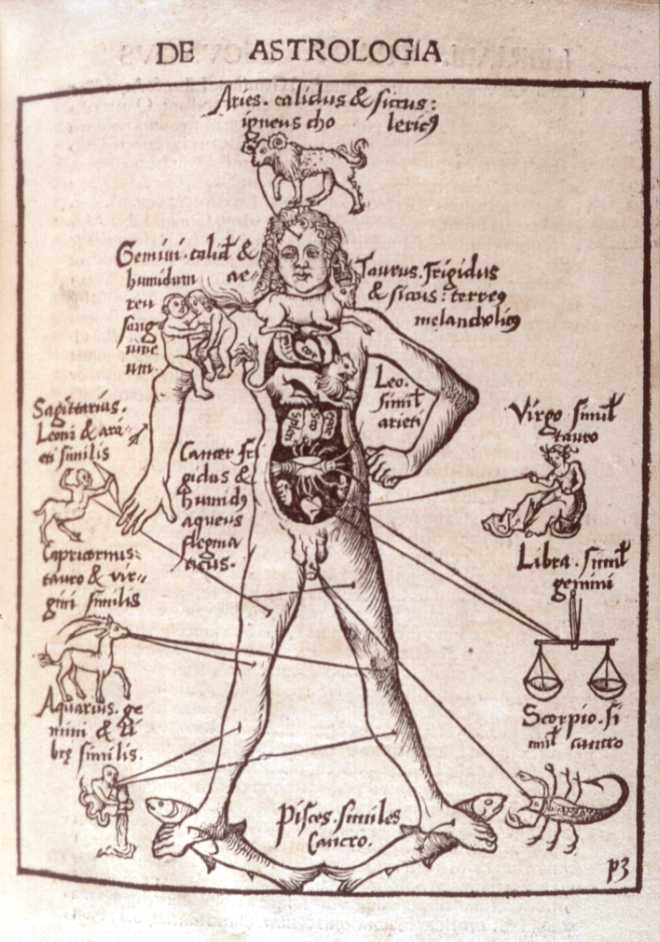
Saturn — The Infortuna Major

Saturn’s influence tends to make people introspective, moody, and inwardly focused.  This makes sense when we realize that the Greek name for Saturn is Cronos, where we get our language for time.  The idea here is of one who broods, who navel gazes.  Saturn is associated with the “melancholy” personality type. Melancholies can achieve great heights in artistic, intellectual, and spiritual endeavors.  Many of our great geniuses likely had this personality.  But the danger comes when they live too much inside their own head, isolate themselves, and subject themselves to psychological debilitations like depression.

Jupiter — The Fortuna Major

Jupiter received its name from Jove, the Roman name for Zeus.  Hence, Jupiter brings kingly joy.  When the king is happy the people feast.  People come together and sing, dance, eat, etc.  This concept of communal joy was the highest good for medievals, which they associated with the “Sanguine” personality type.

Mars — The Infortuna Minor

Mars of course brings war.  The “red planet” is associated with anger, and thus its earthly mirrors can be found in strong ‘Type A’ personalities.  What should strike us about Mars being the “Infortuna Minor” is that the medievals did not think war as bad as a nation of isolated brooders.  War brings many evils, but a silver lining can be that it does bring people together — and here we see again the medieval “community” emphasis.

Venus — The Fortuna Minor

Venus brings love, and is often linked with romantic love between a man and woman.  Again, we have an interesting contrast between their world and ours.  For us, nothing can be greater than experiencing romantic love, but for them, nothing was great than “joviality.”  Again, we see the community emphasis, and when we step back from romantic love, we see that while it does bring two people together, it also can isolate those two from others around them.  Isolated joy between two people cannot match communal joy for the medievals.

The composer Gustav Holst used the medieval ideas about the planets to write a series of compositions.  As is appropriate, the best one is “Jupiter.”

All in all, we have more of the medieval world with us than we might realize.

  • Some hospitals actually use leeches!
  • The current emphasis on a holistic approach to health comes directly from the medieval period
  • The focus on health care trying to keep you healthy comes directly from the Middle Ages
  • The use of dietary changes as part of health care has ancient and medieval roots

I hoped the students enjoyed our short detour into an odd corner of the medieval world.

Blessings,

Dave

9th Grade: A Medieval Cold War turns Hot

Greetings,

Henry IIThis week we wrapped up the 12th century by looking at Henry II, king of England from 1154-1179.

Henry had many great leadership qualities, as even his enemies attested to.  Tall, handsome, bold, decisive, charismatic — the list could go on.  Feudal society, however, seemed arranged specifically to prevent strong ‘type A’ personalities like Henry’s from exercising their full potential.  Past updates discussed the various ‘spheres’ of influence, local distinctions, and tangled allegiances that prevented any centralization of power in the medieval world.

All of this sort of thing no doubt maddened Henry, just as it would frustrate anyone who liked efficiency, action, and “getting things done,” not to mention power.  Henry did his best, however, and had a great deal of success.  One of his final frontiers remained the creation of universal law throughout England, and here he met the staunch opposition of the Church, in the person of his one time friend Thomas Becket, a man to whom he had personally shown enormous favor, raising him from his “common” birth to the heights of power.  Henry also wanted the power to appoint bishops to vacant sees, and to try monks and clergy who had committed crimes.  Becket didn’t mind the first so much, acquiesced on the last, and ended up dying for his opposition to Henry’s claim to control the clergy.

The medievals inherited one of their dominant theological motifs from St. Augustine’s “City of God.”  In his treatise Augustine outlined the existence of two cities on Earth, the “City of Man,” and the “City of God.”  The City of Man has its manifestation in the use of power to maintain order — the State.  The state has legitimacy in the eyes of God. It performs crucial functions for our well being.  But don’t kid yourself into thinking that the City of Man has any redemptive qualities or possibilities.  It performs purely ‘negative’ functions.  It restrains evil but cannot serve as a conduit for redemption.

The City of God, on the other hand, looks beyond the maintaining of power to redemption.  It focuses on love, forgiveness, and grace.  The City of God, therefore, must not be ‘infected’ by the City of Man.  The two are ultimately incompatible not because the City of Man is inherently bad but because they have different goals.  For many medievals, the political and legal independence of the Church helped maintain the Kingdom of God on Earth.

The feud between Henry and Beckett likely had its personal undertones, but at its heart, Beckett believed he stood for the independence of the Church.  Henry’s claim to appoint bishops and discipline clergy to Beckett looked like the City of Man trying to control the City of God.  If the City of Man got its clutches on the Church, the Kingdom of God would suffer, the light of Christ would dim.

Becket and Henry

Becket’s opposition to Henry seems arcane to us.  But to keep its independence, the Church believed that it needed to maintain both its territorial and legal separation from the state.  For his part, Henry felt that he could not tolerate a de facto “state within a state” while he reigned.  In the end, four of Henry’s knights killed Becket, though perhaps not on Henry’s direct order.  Nevertheless, Henry ‘lost,’ for the people blamed him for Becket’s death, and he had to publicly do penance.  At the end of the post I include one medieval contemporary’s admiring evaluation of Henry II.  He had many strengths, but some of these strengths could turn to weaknesses in the wrong context.

Previously we examined aspects of the medieval “guild” system.  Guilds had three basic functions:

  • To provide a means to train new workers
  • To enforce a uniform standard of quality
  • To protect its members

But beyond these basic functions, guilds, whether consciously or not, reinforced basic values of medieval society, which valued community and stability over competition and change.  I assume they would look at modern day America and shake their heads.  So much turmoil, so much of the “rat-race” mentality, so much cut-throat competition.  Why not all agree to scale back and relax a little?  Why make the middle-class dad have to stay open later to stay ahead of the competition just to keep up with competitors and miss his son’s soccer game?  In the end, it’s not worth it.

Guilds also provided another check and balance, or block of power and influence in the medieval stew.  They further prevented any kind of concentration of power.  Understanding the guild system can help us understand why Henry II actions brought so much controversy.

But, as students noted, the guild system geared itself towards stability and community, not innovation.  In America, for example, we do not shed a tear if Hechingers Hardware loses to Home Depot, so long as we get a better deal (does anyone else remember Hechingers?).  We understand that competition benefits consumers, and we accept the occasional disruption and instability that brings to the economy.  The medievals, on the other hand, made a different choice, thinking more of the immediate local community and less of the amorphous general public.

Many thanks,

Dave

Here is the “friendly” source on Henry II

To Walter, by the grace of God archbishop of Palermo, once associate, now lord and dearest friend in Christ, Peter of Blois sends greeting and wished continual success of your desires.

The blessed Lord God of Israel, who visited and made his mercy upon you, raised you up in need from the dust, so that you may sit with kings and princes and may hold the throne of glory. Terrible is the Lord in his judgments, and great in his compassion, very worthy of praise, for “His compassion is over all that he made.” [Psalm 145:9] Therefore of his compassion, which he has magnified in you, you have continual and steadfast memory, nor is that Judaic reproach seen in you: “They are not mindful of His benefits and of his wonders which he has shown to them.” [Psalm 77:11] There is nothing like ingratitude to provoke the indignation of the Most High: the very provocation of evils, deprivation of benefits, extermination of merits. On account of reverence for that one, who delivered you from contemptible poverty, may you exhibit most fully the office of humanity to the Cisalpine poor; truly those who go to, or return from the land in which walked the feet of our Lord, you could strike down in many ways, but you must fulfill their needs with the solace of more humane grace, just as your predecessors in office. You will recognize that the Father is himself Father of orphans and paupers, who exalts the humble, and humiliates the proud: for which on behalf of his poor pilgrims he will uncover you, so that they may find among you aid of customary goodness. And therefore let it frighten you, lest their clamor and complaint ascend to the ears of that one, who is terrible among the kings of the earth, who judges the case of the poor, and accuses on behalf of the meek of the earth.

For the golden sash and silken girdle, and samite, and other exotic goods, which through the bearer of gifts from your largess I receive not as much as I wish, but as much as I deserve, I give back thanks. Truly from this the ancient integrity of your liberality is clear, which neither intervening time nor distance of places, nor assumption of honor, nor other things destructive to friendship were able to undo.

Since however you have demanded from me with all insistence that I should send to you the shape and habits of the lord king of England in an accurate description – which exceeds my faculties, and for which indeed the vein of Mantuan genius would seem insufficient enough – I nevertheless will communicate to you what I know without envy and detraction. About David it was said [I Kings 16] to the commendation of his beauty, that he was red-haired; however you will know that the lord king has been red-haired so far, except that the coming of old age and gray hair has altered that color somewhat. His height is medium, so that neither does he appear great among the small, nor yet does he seem small among the great. His head is round, just as if the seat of great wisdom, and specially a shrine of lofty counsel. Such is the size of his head, that so it matches with his neck and with the whole body in proportionate moderation. His eyes are round, and white and plain, while he is of calm spirit; but in anger and disorder of heart they shine like fire and flash in fury. His hair is not in fear of the losses of baldness, nevertheless on top there is a tonsure of hairs; his leonine face is rather square. The eminence of his nose is weighed to the beauty of the whole body with natural moderation; curved legs, a horseman’s shins, broad chest, and a boxer’s arms all announce him as a man strong, agile and bold; nevertheless, in a certain joint of his foot the part of the toenail is grown into the flesh of his foot, to the vehement outrage of the whole foot. His hands testify grossly to the same neglect of his men; truly he neglects their care all the time; nor at any time, unless carrying birds, does he use gloves. Daily in mass, in counsels and in other public doings of the realm always from morning until vespers he stands on his feet. And, he never sits, unless riding a horse or eating, although he has shins greatly wounded and bruised with frequent blows of horses’ hooves. In a single day, if necessary, he can run through four or five day-marches and, thus foiling the plots of his enemies, frequently mocks their plots with surprise sudden arrivals; he wears boots without a fold, caps without decoration, light apparel. He is a passionate lover of woods; while not engaged in battles, he occupies himself with birds and dogs. For in fact his flesh would weigh him down enormously with a great burden of fat, if he did not subdue the insolence of his belly with fasts and exercise; and also in getting onto a horse, preserving the lightness of youth, he fatigues almost every day the most powerful for the labor. Truly he does not, like other kings, linger in his palace, but traveling through the provinces he investigates the doings of all, judging powerfully those whom he has made judges of others. No one is more cunning in counsel, more fiery in speech, more secure in the midst of dangers, more cautious in fortune, more constant in adversity. Whom once he has esteemed, with difficulty he unloves them; whom once he has hated, with difficulty he receives into the grace of his familiarity. Always are in his hands bow, sword, spear and arrow, unless he be in council or in books. As often as he is able to rest from cares and anxieties, he occupies himself by reading alone, or in a crowd of clerics he labors to untangle some knot of inquiry. For while your king knows his letters well, our king is more literate by far. Truly I have judged the abilities of both in learned matters. You know that the king of Sicily was my student for a year, and had had from you the basic arts of versification and literature; he obtained more benefit of knowledge through my industry and solicitude. However as soon as I had departed the kingdom, that one turned himself over to abject books in imperial leisure. But yet in the household of the lord king of the English every day is school, in the constant conversation of the most literate and discussion of questions. No one is more honest in speech than our king, more polite in eating, more moderate in drinking; no one is more magnificent in gift-giving, no one more munificent in alms-giving: and therefore his name is like poured oil, and the entire church of saints describes the alms of such a one. Our king is peaceable, victorious in war, glorious in peace: he is zealous for the things to be desired in this world and he procures peace for his people. He considers whatever pertains to the peace of the people, in whatever he speaks, in whatever he does; so that his people may rest, he incessantly takes on troubled and enormous labors. It aims to the peace of his people that he calls councils, that he makes laws, that he makes friendships, that he brings low the proud, that he threatens battles, that he launches terror to the princes. Also that immensity of money aims at the peace of his people, which he gives out, which he receives, which he gathers, which he disperses. In walls, in ramparts, in fortifications, in ditches, in enclosures of wild beasts and fish, and in palaces there is no one more subtle, and no one more magnificent to be found.

His most powerful and most noble father the count [of Anjou] extended his borders greatly; but the king added to his paternal lands with abundance in his strong hands the duchy of Normandy, the duchy of Brittany, the kingdom of England, the kingdom of Scotland, the kingdom of Ireland, the kingdom of Wales; he increased inestimably the titles of his magnificent inheritance. No one is more mild to the afflicted, no one more friendly to the poor, no one more unbearable to the proud; he always strives to oppress the proud with the semblance of divinity, to raise up the oppressed, and to stir up against swelling of pride continual persecutions and deadly troubles. When however he may according to the custom of the kingdom have had roles in making elections of most important and most powerful, he nevertheless always had his hands pure and free from all venality. I merely touch upon, I will not describe these and other endowments of soul as much as body, with which nature has marked him out before others; truly I confess my insufficiency and would believe that Cicero and Virgil themselves would sweat under such a labor. I have briefly tasted this little morsel of his appearance and habits at your request; truly I shall seem either to have undertaken an unbearable work, or to have cut back much about the magnificence of so great a man through jealousy. Nevertheless I, serving your charity, do what I can do, and what I know without envy and without detraction, I communicate with most prompt good will, and also among other great men, who write in praise of my lord, I put my might of devotion in a treasure chest along with the poor widow.

9th/10th Grade: High Society

Greetings,

Next week we will look at medieval cathedrals.

We discussed what architecture reveals about a civilization,  and how specific buildings and designs reflect certain ideas and theological leanings.  In discussing cathedrals, I first wanted the  students to discuss their own churches.  Some observations we made were:

  • One church had sanctuary that used folding chairs and doubled as a  multi-purpose room.  The church had an informal worship service, with  a pastor that was generally laid back and easy going.  At the center of the stage lies the pulpit, and as we might expect, the sermon occupies the central place in their worship service.
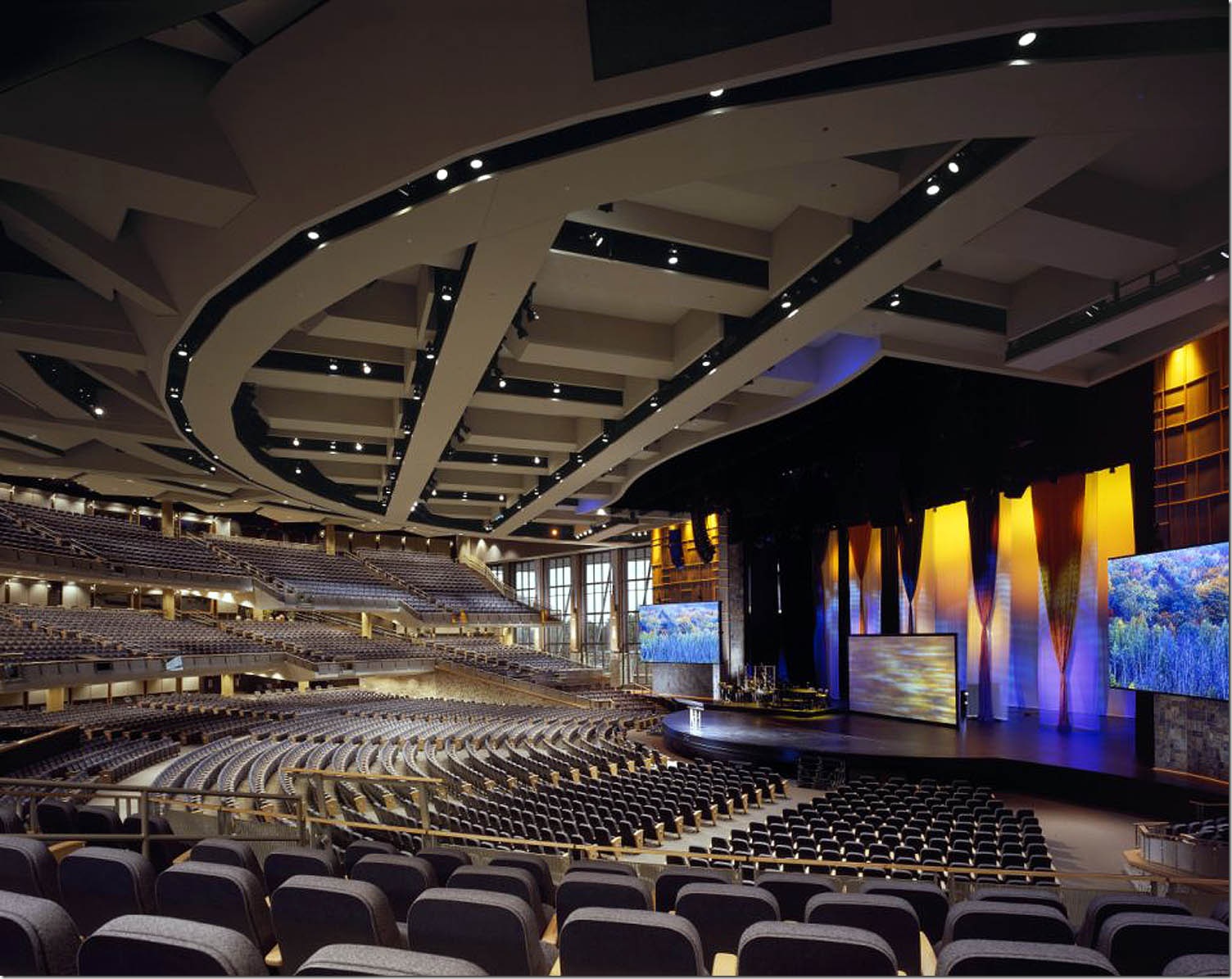
  • Another met in a room for worship with movie theater style seats, with screens occupying a prominent  place on the wall.  This church, we discovered, puts a premium on  cultural relevance and an interactive experience for the worshippers.
  • One church met in a building similar to an office building complex.  One key idea of the church seemed to be not to intimidate anyone with “church.”  The sanctuary design and flow of the service had what could be described as a “familiar” feel.
  • Another church was designed in the traditional way, but with a higher ceiling.  They had an altar rail in front, with a choir in robes, a processional with the cross, acolytes, etc.  The pulpit is placed off to the side, and true to form, the sermon is not the centerpiece of the service.  Instead, with the communion altar at the center, the celebration of the eucharist takes the bulk of the service time each week.
I shared my experience worshipping in an Eastern Orthodox Church some years ago.  When you enter, the church immediately had a “this is different” feel.  The colors, smells, and chanting all told the attendee, “You are in a different place, you have left “the world” and are now surrounded by a great cloud of witnesses, somewhere between Heaven and Earth.  Instead of sitting, you spent most of the time standing or kneeling.  The point was not to make you comfortable, but to take you out of yourself and your daily surroundings.  They might also add that one should not sit in the presence of God.
Each of these designs reflect different philosophies on worship, and  their architecture reflects that.  While it was certainly not my purpose to  say that one is better than another, it is important that we  tried to understand that theology will be reflected in architectural style.
Willow Creek, Chicago
From a cosmological and societal perspective, height had great  importance to the medievals.  When I look at the intricate design and  strange creatures that adorn many cathedrals, I get the sense that  they were enjoying themselves.  Cathedrals took at least 30 years and often more than 50 to  build.  What does this say about them?  What church today could sell a  building program that would take at least 30 years to complete?   What does that say about us?  Were the medievals wasteful and foolish, or  is it us who have made worship a humdrum bare bones experience?  Do cathedrals, as Abbott Suger said, serve to ‘urge us onwards from the material to the immaterial?’
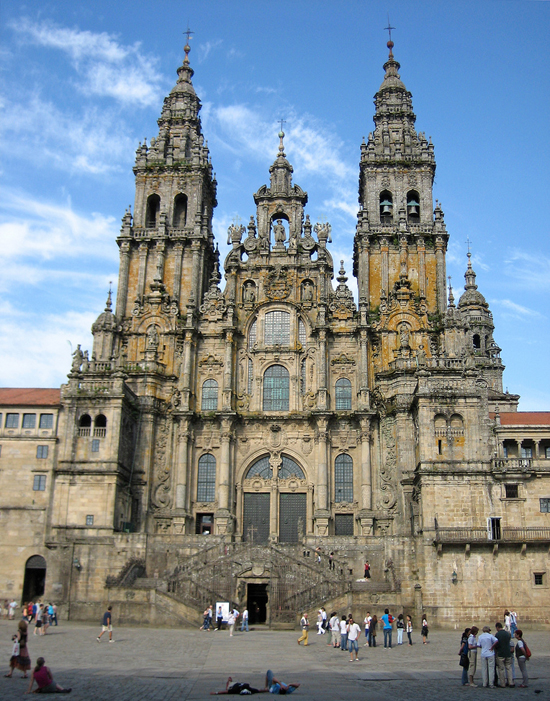
When we looked at images of a cathedral, their height immediately struck most of the students:
Santiago-de-Compostela-Cathedral
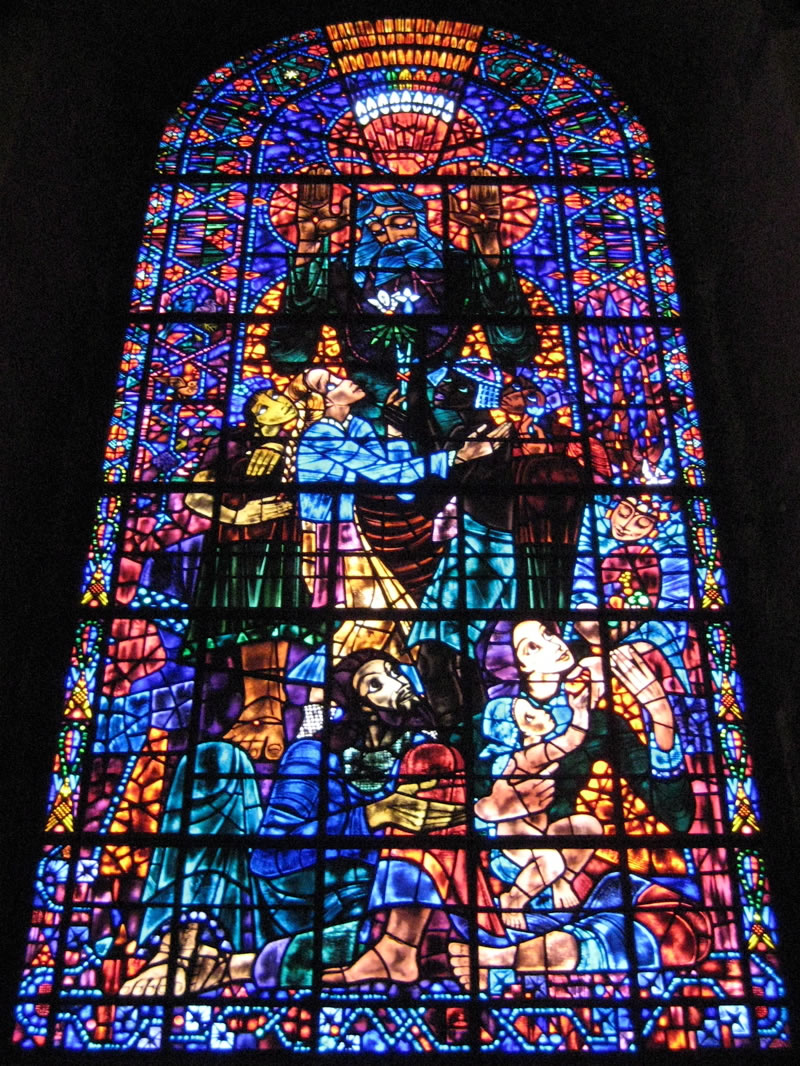
 Most likely, our involuntary reaction to these buildings would be to look up and feel small, and that indeed is part of the point.  They felt it important that you lose yourself in the face of immensity.  Clearly, this kind of architecture stressed the “otherness,” holiness, and transcendence of God.  Conversely, it does not emphasize the “nearness” of God.  But we must not have the idea that Gothic meant “dark, heavy, and foreboding.”  Rather, the medievals came up with their architectural advances specifically to let in more light.  They do not press us down to the ground (like pyramids, for example) but take us “upwards” to heaven.
Christ in Glory, Canterbury Cathedral
Their architecture takes us back to their cosmology, which also emphasized height, as we saw last week.
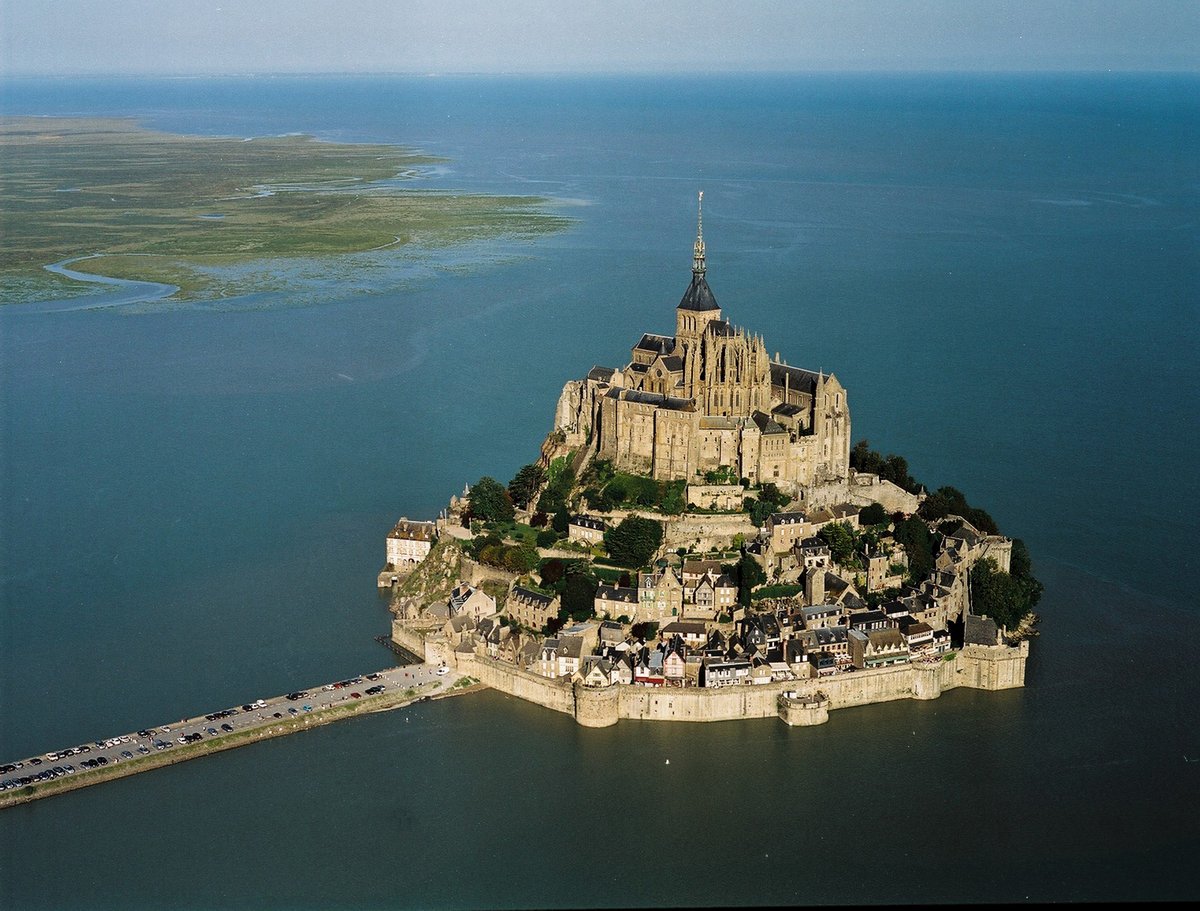
Finally, we noted how it reflects the Medieval linking of the physical and spiritual.  They did this even with the location of their buildings, most especially in the Mont St. Michael Cathedral in Normandy, France.
Mont. St. Michael
The cathedral is dedicated to St. Michael the Archangel, who fights the Dragon in the book of Revelation.  They built it in the furthest point possible out into the sea, in itself a testimony and prayer that God and His angels are their first line of defense.  Mt. St. Michael perfectly illustrates what medievals believed not only about church, but about how physical things reflect spiritual reality.

9th Grade: Our Cloudy and Confused Vision

Greetings,

This week we wrapped up our unit on the Crusades.  This difficult era raises many questions for us:

1. Did the Crusades attempt to stem the tide of Moslem aggression, or did they in fact cause more Moslem unity and a resurgence of Moslem power?

Some see the Crusades as a legitimate attempt to strike against Moslem expansionism.  Others argue that the Crusades forced the Moslems to unite once again. Having been invaded by the West, they determined to renew their attacks against them.  Do the Crusades bear any blame for the eventual collapse of Constantinople in 1453?

2. What role should faith and reason play in everyday affairs?

The Third Crusade is a good example of this problem.  Richard I fought his way to Jerusalem, but went home in part because he believed he could not hold the city even if he took it.  Therefore, it was pointless to risk his live and the lives of his men for nothing.  Some criticized his actions, saying something to the effect of, “You must step forward in faith, and watch God bless you.  This is what faith is all about!   You cannot think of this in practical terms. That is not thinking with faith.  Put  a foot into the Jordan, and then watch it part.”

We see this same question also running through the idea of the tragic Children’s Crusades, though here the Church strongly opposed Europe’s youth to no avail.* How should the balance between ‘faith’ and ‘reason’ guide our daily lives?  How should we answer the argument of many young people who participated in the ‘Children’s Crusades,’ which ran something like this:

  • God has called his people to crusade for Jerusalem.  We believed so in 1097.  Has God changed?  He is the same, yesterday, today, forever.  Therefore, His call is the same.  We must still vie for the Holy Land.
  • But how shall we go?  Let us not trust in princes, horses, or chariots (i.e. Ps. 20), let us know that our trust is in God, by marching out in true faith.  We see in Scripture that Moses led the Israelites to the Red Sea and it parted. Joshua marched around the city, and it fell.  Guided by God’s word, we shall emulate their example.  God shall make a way for us to take Jerusalem, and do so in a way so that all glory goes to him.
  • Many argue that the problem with the Crusades was a lack of organization, supplies, or reinforcements.  This only betrays worldly thinking.  Would more supplies have made the Crusaders less greedy in 1204?  Would it have made them less violent inside Jerusalem’s walls in 1099?  No, the problem has been our lack of faith and obedience.
  • Jesus pointed out the strength and purity of the faith of children.  Therefore, who better than the Church’s youth to undertake this venture?

We know that the Children’s Crusades (both of them) ended in utter disaster.  But what would you say in response to their argument?  How can you disprove them? What is faith’s relationship to reason?

3. The west attempted at least seven times at retaking Jerusalem.  What should this tell us about them?

  • That they were foolishly stubborn?
  • That they were intensely dedicated and willing to make great sacrifices for achieving their goal?
  • That they were a people of faith willing to trust in spite of adversity?
  • That they were foolish, naive, and used ‘faith’ as a cover for their prejudice and desire for gain?

In the end, the Crusades would have many unintended consequences.  The West was exposed to Greek literature and philosophy for the first time.  St. Thomas Aquinas, the Renaissance, and Exploration may all have been by-products of this, among other things.  The Crusades also raise many questions about using violence as means to bring about the Kingdom of God that are still with us.  If we agree with the Crusades, should we also agree with the bombing of abortion clinics?

Next week we will return to our look at Medieval Feudal society, and I hope that the students will be confronted with good questions.

Dave

*I should note that scholars debate when these crusades took place, and whether or not there was one crusade or two.  A few even doubt whether or not they were children at all, as some believe they may have been a mass of landless unemployed.  My rendering in class was the traditional story.

9th Grade: Everything Falls Apart

Greetings,

This week we focused on what is known as the First Crusade, the only Crusade to actually reach Jerusalem and conquer the city.  Perhaps more than other crusades, it was this first one that concentrated all that is admirable, strange, and horrifying about this period in the past.

We discussed last week the reasons and motivations for the Crusades, and whether or not one agrees with their reasons, we cannot deny the enormous difficulty of the proposed enterprise.  Capturing Jerusalem meant a journey of several hundred miles on foot without an established supply line, having to take at least one fortified city (Antioch) before even reaching Jerusalem, which would have thousands of defenders behind the large walls of the city.  Even today, parts of the the “old” city of Jerusalem still stands, and we can see what the Crusaders saw themselves 1000 years ago.

Old City Gate

The "Tower of David"

South (?) Wall of Jerusalem

As anyone can see, taking the city would be a formidable task.

From Antioch, the  Crusaders approached the city barefoot, the standard mode of travel for all medieval pilgrims.  This fact alone shows that the Crusaders saw themselves not so much as warriors first and foremost, but on a spiritual quest.  Like Joshua they marched around the city.  This was no standard military operation.

Understandably, they were anxious to get inside the city and claim victory.  They had heard many stories of atrocities perpetrated against Christians in Jerusalem.  They saw with their own own Moslem defenders taunting them, smashing crosses and other relics in front of their eyes.  Moslems also apparently killed pages sent by the knights to get water, which horrified and enraged the Crusaders all the more.  Finally, they broke through and entered the city. One eyewitness described it this way. . .

When the morning came, our men eagerly rushed to be walls and dragged the [seige towers] forward, but the Saracens had constructed so many machines that for each one of ours they now had nine or ten. Thus they greatly interfered with our efforts. This was the ninth day, on which the priest had said that we would capture the city. But why do I delay so long? Our machines were now shaken apart by the blows of many stones, and our men lagged because they were very weary. However, there remained the mercy of the Lord which is never overcome nor conquered, but is always a source of support in times of adversity. One incident must not be omitted. Two women tried to bewitch one of the hurling machines, but a stone struck and crushed them, as well as three slaves, so that their lives were extinguished and the evil incantations averted.

By noon our men were greatly discouraged. They were weary and at the end of their resources. There were still many of the enemy opposing each one of our men; the walls were very high and strong, and the great resources and skill that the enemy exhibited in repairing their defenses seemed too great for us to overcome. But, while we hesitated, irresolute, and the enemy exulted in our discomfiture, the healing mercy of God inspired us and turned our sorrow into joy, for the Lord did not forsake us. While a council was being held to decide whether or not our [seige engines] should be withdrawn, for some were burned and the rest badly shaken to pieces, a knight on the Mount of Olives began to wave his shield to those who were with the Count and others, signalling them to advance. Who this knight was we have been unable to find out. At this signal our men began to take heart, and some began to batter down the wall, while others began to ascend by means of scaling ladders and ropes. Our archers shot burning firebrands, and in this way checked the attack that the Saracens were making upon the wooden towers of the Duke and the two Counts. These firebrands, moreover, were wrapped in cotton. This shower of fire drove the defenders from the walls. Then the Count quickly released the long drawbridge which had protected the side of the wooden tower next to the wall, and it swung down from the top, being fastened to the middle of the tower, making a bridge over which the men began to enter Jerusalem bravely and fearlessly. Among those who entered first were Tancred and the Duke of Lorraine, and the amount of blood that they shed on that day is incredible. All ascended after them, and the Saracens now began to suffer.

They took the city, but then tragically took it one step further, for most of the men went to and fro, killing any Moslem they could find, be they men, women, or children.  The information about this horrifying massacre came not from Moslem sources but directly from the Christians themselves.  One wrote that,

Strange to relate, however, at this very time when the city was practically captured by the Franks, the Saracens were still fighting on the other side, where the Count was attacking the wall as though the city should never be captured. But now that our men had possession of the walls and towers, wonderful sights were to be seen. Some of our men (and this was more merciful) cut off the heads of their enemies; others shot them with arrows, so that they fell from the towers; others tortured them longer by casting them into the flames. Piles of heads, hands, and feet were to be seen in the streets of the city. It was necessary to pick one’s way over the bodies of men and horses. But these were small matters compared to what happened at the Temple of Solomon, a place where religious services are ordinarily chanted. What happened there? If I tell the truth, it will exceed your powers of belief. So let it suffice to say this much, at least, that in the Temple and porch of Solomon, men rode in blood up to their knees and bridle reins. Indeed, it was a just and splendid judgment of God that this place should be filled with the blood of the unbelievers, since it had suffered so long from their blasphemies. The city was filled with corpses and blood. Some of the enemy took refuge in the Tower of David, and, petitioning Count Raymond for protection, surrendered the Tower into his hands.

 Another account confirmed this, writing,

Many fled to the roof of the temple of Solomon, and were shot with arrows, so that they fell to the ground dead. In this temple almost ten thousand were killed. Indeed, if you had been there you would have seen our feet colored to our ankles with the blood of the slain. But what more shall I relate? None of them were left alive; neither women nor children were spared.

When the pagans had been overcome, our men seized great numbers, both men and women, either killing them or keeping them captive, as they wished.

Both Moslems and Christians committed atrocities during the Crusades, but none would equal the shocking scale and brutality of the massacre at Jerusalem.  And yet, the Crusaders at the time interpreted their actions in almost strictly religious terms.  The account continues,

Now that the city was taken, it was well worth all our previous labors and hardships to see the devotion of the pilgrims at the Holy Sepulchre. How they rejoiced and exulted and sang a new song to the Lord! For their hearts offered prayers of praise to God, victorious and triumphant, which cannot be told in words. A new day, new joy, new and perpetual gladness, the consummation of our labor and devotion, drew forth from all new words and new songs. This day, I say, will be famous in all future ages, for it turned our labors and sorrows into joy and exultation; this day, I say, marks the justification of all Christianity, the humiliation of paganism, and the renewal of our faith. “This is the day which the Lord bath made, let us rejoice and be glad in it,” for on this day the Lord revealed Himself to His people and blessed them.

On this day, the Ides of July, Lord Adhemar, Bishop of Puy, was seen in the city by many people. Many also testified that he was the first to scale the wall, and that he summoned the knights and people to follow him. On this day, moreover, the apostles were cast forth from Jerusalem and scattered over the whole world. On this same day, the children of the apostles regained the city and fatherland for God and the fathers. This day, the Ides of July, shall be celebrated to the praise and glory of the name of God, who, answering the prayers of His Church, gave in trust and benediction to His children the city and fatherland which He bad promised to the fathers. On this day we chanted the Office of the Resurrection, since on that day He, who by His virtue arose from the dead, revived us through His grace. So much is to be said of this.

 The “Jersusalem” crosses they etched inside the Church of the Holy Sepulchre can still be seen today.

While we do know that some of the crusaders risked their lives to protect civilians, most joined in the carnage and plunder.  The stain left by this atrocity lingers to this day in minds of many Moslems.  This may seem strange to Americans, but Americans in general have very, very short historical memories.  This is probably because we are a new nation, and an immigrant nation.  Many who came here wanted to make a clean break with the past.  Also, Americans tend not to be rooted in the past with tradition, but look forward to the “next” thing.  Most other societies, and perhaps especially the Mid-East have a much deeper sense of the past, a sense only exacerbated by the significant decline of Moslem power since the mid 16th century.

I related to the students that, in most of the “mountain disaster” books I have read that the problems occur when the climbers descend.  We psychologically ramp ourselves up to reach the summit, and don’t always give as much thought to what comes next.

The crusaders faced a similar problem.  They took vows to liberate Jerusalem, but not to stay and defend it.  Many had been away from home for more then two years, and understandably wanted to return, having fulfilled their purpose.  The west simply could not rally the manpower needed to hold the city, and in 1187 the Moslems retook it.  Several more attempts to retake the city would again be made, the subject of our study next week.

Blessings,

Dave
Hillaire Belloc’s “Europe and the Faith”

This is one Belloc’s most famous works, and should be read by students of Medieval history, though it is far too polemical to serve as ‘the’ text for the period.

To understand the book we should understand a bit about Belloc himself.  Born of an English mother and a French father, Belloc moved easily in both societies but perhaps felt at home in neither.  He served in the French army, but got his education in England.  His strong and unwavering Catholicism definitely made him enemies, especially in England.  He may have felt some alienation, but he loved good fights, and had no trouble finding them.

One must also glimpse the context of when he wrote this book for it to make sense.  I have not read a lot of his histories but he seemed to me have an eternal hatred against 1) The prevailing Whig interpretation of history, which saw history as one long climb out of the darkness in the wake of Rome towards the glorious & inevitable light of Victorian English society, and 2) The then-current Darwin influenced racial interpretations of European history, which saw all things good in Europe, from its “energy,” to its representative governments coming from the all-holy Nordic-Teutonic racial stock.  When he published this book W.W. I had done much to undermine the first premise,  but tragically the second was still gaining steam (Belloc gets high marks for his early and strident criticism of Nazi ideology even before they came into power).

The book makes several different arguments, all around a central theme, that of the essential unity of Europe.

He first mentions that one cannot understand European history without understanding the importance of Christian belief and the theology and history of the Church.  He takes as a type the example of the encounter between Henry II and St. Thomas Beckett.  To one outside this understanding Beckett’s attempt to try and stop Henry II from having legal jurisdiction over priests seems obstructionist and archaic at best.  Those inside see that Beckett may not have chosen the best issue to plant his flag, but he fought ultimately for the freedom and independence of the Church from the state.  Without a free Church, no people can be free in a spiritual or political sense.  If you miss this, you cannot make heads or tails of Beckett or Henry II.

Europe’s history begins, not with Rome’s fall, but from the Roman conquest of Gaul.  Nearly every historian will claim that Europe grew from seeds planted by Rome.  Belloc goes much further and argues for a great deal of continuity between the late Empire and the early Middle Ages.  And this is no mere difference of degree, but of overall perspective and purpose.  He argues that the pseudo-racial theory of hardy German barbarians sweeping down from the north to end Rome has no basis in fact whatsoever.  In denying a cataclysmic end to Rome from without, we can find more Roman, and not barbarian influence, in the society that succeeded Rome, and thus more continuity in the European experience.

True, Rome incorporated barbarians into their army, and towards the end accelerated their progressivism and made many with barbarian ancestry high ranking officials and generals.  Alaric of the famous 410 sack of Rome was one such man.  He did not come to destroy Rome so much as claim his rightful place in it.  The Battle of Adrianople in 378 stands as another such case.  Many different types of Alaric’s throughout the waning phase of Rome fought each other, but for supremacy to rule what they held dear.  None of them dreamt of destroying the empire’s unity, otherwise what would they rule over?

Radagaisus’ invasion, contemporary with Alaric’s turn on Rome, helps Belloc’s point as well.  For here we have a large truly barbarian force decisively beaten by the Roman army at a time when Romans were supposed to be “soft” and “decadent.”  Rome did not fall due to barbarian invasions.

This early section is the clearest and perhaps strongest of the book, but then I think he goes too far.  Perhaps carried away by the fight and the truths he latches onto, he buys into the idea that we cannot really speak of a decisive “fall” of Rome at all.  Instead we should envision and steady, gradual transition from one way of life to another, like easing into a hot-tub.  His theory couldn’t have credence if it had no truth to it, and Belloc cites some linguistic and administrative evidence to back it up.  But  to my mind he goes too far, for a great deal of different evidence shows a large drop off in other kinds of measures of health and well-being, like travel, trade, navigation, writing, etc.  We need not conclude that if Rome did not fall to barbarians, that it had no fall at all.

Belloc then moves on to discuss certain key aspects of the medieval church, specifically their fight against central authority.  They sought spiritual unity, not political unity, for no man can serve two masters.  He also points out that the Christianity developed in such a way to become to very essence of Europe.  We might speak of Stoicism, but not Christism. Christianity for medievals formed not “a way of life,” but the essence of life, with the Church’s life inseparable from that of any individual.

Belloc never lived to see Vatican II, and that may have been a blessing.  He was an old-school absolute Catholic in every respect, so he had no love for the Reformation, which he holds responsible for destroying the 1500 year unity of the continent.

First, his argument:

1. The medieval synthesis faced enormous challenges from within and without.  From without, the Black Plague, the march of Islam, etc. all put enormous pressure upon society.  From within, the natural waxing and waning of any civilization’s ethos was in a waning period, and thus medieval society found itself unable to deal with these challenges.  Belloc writes, “The spiritual hunger of the time was not fed.  [Society’s] extravagance was not exposed to solvent of laughter or the flame of sufficient indignation.”

Belloc admits that the 15th century had many problems, and many from different quarters talked of the need for reform.

2. But he believes that the Reformation had nothing particularly positive to offer.  Protestantism had an essentially negative and narrowing character, as each sect picked its pet doctrines and blew them out of their natural proportion.

3. The Reformation would have petered out had it not been for England.  Before England, nearly everywhere the Reformation took hold stool outside the old Roman empire (Germany, Scandinavia, Switzerland), and thus outside the essential Roman unity of Europe, which the Reformation could not challenge.  England’s defection not only meant that a powerful independent country could lend support to the cause, but most crucially, it broke the pattern of those within Rome’s ancient reach maintaining fidelity to unity, which gave legitimacy to the Reformation as a whole.  Again, without this, he believes the Reformation would have gone the way of Arianism.

4. The Reformation sprang from some noble motives, but ended up severing the soul of Europe. In breaking the spiritual unity, they altered the place of the individual, with terrible results.  Belloc writes,

The grand effect of the Reformation was isolation of the soul.  This was its fruit.  In the first place and underlying all, the isolation of the soul releases in society a furious new accession of force.  The breakup of any stable system in physics, as in society, makes actual a prodigious reserve of potential energy.

This isolation produced a society that swayed from one desperate void-filling attempt to another.  They went from

  • Worship of absolute civil governments, which began in Protestant areas and found its way into France
  • A desperate pursuit of knowledge (i.e. Scientific Revolution)
  • A flight first to reason (Englightenment), then to emotion (Romanticism), which having exhausted itself, left us only to pursue money and material gain (unbridled capitalism in the Industrial Revolution, which Belloc regards as a great evil).
What can we make of Belloc’s arguments?
  • Belloc has much to praise about the Renaissance, stating that the era continued much of the great things medievals started.  But during the Renaissance many of the things Belloc deplores had their origin, like the banking empire of the Catholic (nominally?) D’Medici’s, or the exaltation of the political sphere in Machiavelli.
  • Surely also the Church’s political maneuvering during the Middle Ages contributed to the problem of spiritual sterility in the 15th century.  They played a tight game of fostering political disunity while trying to enhance overall spiritual unity.  But this put them in the position of helping to create the monster that destroyed them, for in the end the political disunity they fostered became a tool for the Reformation to use to their advantage.  It also made the Catholic Church part of the troubled system.  Not standing outside it, they could offer no solution.
  • He asserts that the Reformation had an almost exclusively negative character, but misses the positive aspects of some reformers, notably Luther.  Clearly the Reformation also produced some great culture, Bach, Rembrandt, etc.
  • To accept a Refomation = Bad, Renaissance = Good argument, one must believe in the basic continuity between the Medieval & Renaissance eras.  But I think that more discontinuity presents itself, that the Renaissance began at least the aesthetic narrowing of Europe that the early Reformation built upon.
  • To his great credit, Belloc admits the ultimate spiritual sterility of even the greatest Catholic humanist voices, like that of Erasmus.  Whether justified or no, the Reformation filled a spiritual vacuum that the Catholic church could not fill in the state it was in.
  • Finally, the Catholic church did its fair share of pushing Luther out of the fold.  They helped create the Reformation.  One could go farther and claim that the Reformation gave the Church a needed kick in the seat of their pants to get their own house in order.  The Catholic revival of the mid-late 16th century (which produced such great witnesses as St. John of the Cross and St. Francis de Sales, among others) might not have happened without the Reformation.
So all in all, I do not believe that the Reformation deserves the treatment Belloc gives it.  But I agree with him that the Reformation exacerbated some key negative trends within Europe at the time, and that the lasting fruit of the Reformation is a mixed bag.  It did not heal Europe’s wounds — in some cases it opened them further, and did contribute (without being the only contributor) to many of our modern problems.  One can assert the necessity of the Reformation, but I would not want to make it into a golden age that “rescued” the Church and Europe.  Also, when thinking about Europe Belloc leaves the East out of the discussion entirely, and so gives no credence at all to the possibility of a third path in Eastern Orthodoxy.
Fast forward to today, and I can’t help wondering what Belloc would think of the European Union. Would he applaud it as the beginning of the healing of the harms began (in his view) during the Reformation?  I think not, and I imagine his reaction going something like,
  • Europe has recognized what Napoleon also saw, that every war in Europe had the quality of a civil war. So, kudos to them for seeing the problem.
  • But — they look for a cure in all the wrong places.  First, they have tried to impose unity in an administrative, “top-down” style where the people have little direct say in important policies.  Such an approach is bound to fail.
  • Second, they fail to recognize that from ca. 500 AD on, Europe had spiritual unity but never administrative and political unity.  Thus, they try to give Europe what it never had at the expense of what held them together in the first place.  Their focus almost exclusively on trade, currency, monetary policy, etc. shows their blindness to the true problems they face.

Belloc states in his famous conclusion to the book,

Europe is the Faith, and the Faith is Europe.

The Face of Roman Decline

As I mentioned here, I believe that art reveals a great deal about a civilization.  This is decidedly not a radical concept, but I always enjoy coming across things that confirm that premise in one way or another.

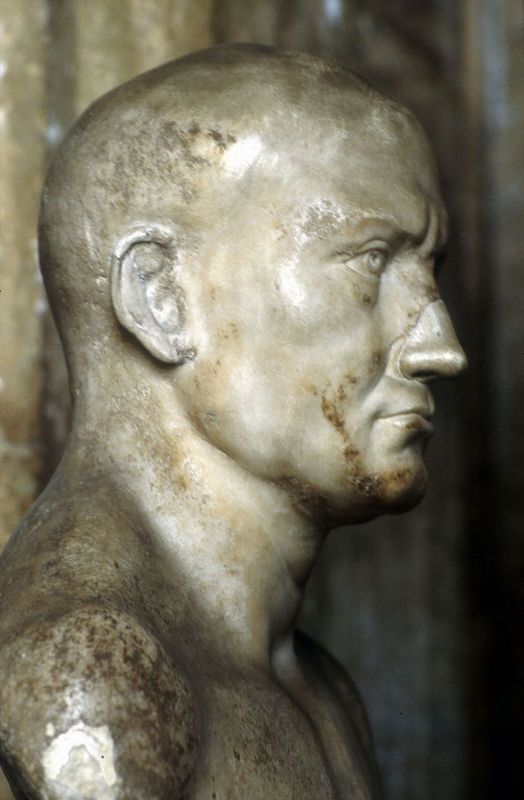
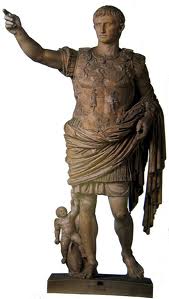
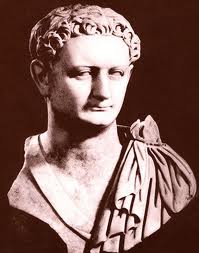
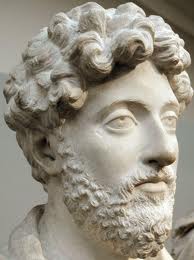
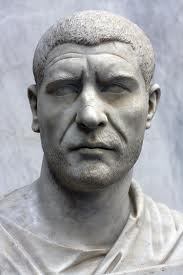
We can trace Rome’s decline, I think in the sculptured busts over the centuries.  The faces say it all.

First, the hard-bitten men of the Republic, Cato the Elder, and Scipio Africanus Major, ca. 200 B.C. You may not have liked them, but you would have respected them:

Then, Julius Caesar, ca. 50 B.C. — the expression, the eyes, are different — hungrier. He seems part machine, part man, a shark on the prowl.  The basic humanity of Rome’s leaders begins to fade here.

Then Augustus, ca. 10 B.C. —  we see a clean break with the past.  He is an image, not a man.  Unlike his uncle, Augustus was hardly the military type, yet here he poses in military garb. On the right is the soft Emperor Domitian, ca. A.D. 90:

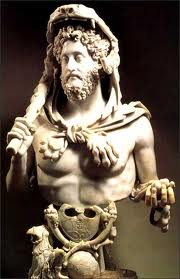
Fast forward and we get the pompous, detached Marcus Aurelius (ca. AD 165, below left), and his son Commodus (ca. AD 190, below right) who went native.  Aurelius’s stoic philosophy of detachment comes through every pore, and his admiration for the Greek style in his facial hair may signal that his mind lay elsewhere.  Commodus, dressed as Hercules, also gets caught up in this Greek sense of unreality.  Like father, like son.

The Emperor Philip, ca. AD 250.

Here we have a relatable man again for the first time in centuries, but we, and Philip too, know it’s too late.

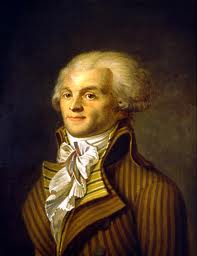
The smug, satisfied look of Marcus Aurelius has got to be the worst of them all.  Similar perhaps to this guy?

Yes, I know that Robespierre was really wicked while Aurelius was merely insufferable.  But still. . .

Byzantine Patterns

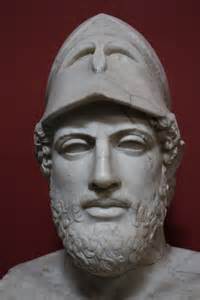
In the later 19th century Victorian England ruled the waves, the economy, and much of the inhabited world.  At the same time, Victorian morality and dress focused on maintaining distance, withdrawal, and possibly, even disdain.  It is perhaps no surprise then, that many Victorians saw themselves as the incarnation of classical Athens.  Classical Athens ruled the waves Pericles of Athensand the treasuries of many a Greek-city state.  They also began to develop at that time a philosophy that would later bloom into varieties of gnostic detachment, and the great Athenian Pericles has the arrogant disdain that comes with such detachment down pat.

Those that saw themselves in his image would likely follow in his footsteps. And indeed they did.  In his Decline and Fall of the Roman Empire Gibbon poured his own brand of disdain upon Byzantine civilization, perhaps even coining the pejorative term “byzantine,” i.e. confusing, outdated, etc.  He paid no attention to Eastern civilization, and if he did he would not have understood it.  The English intelligensia (who led scholarship as they led the world at that time) got brought up, perhaps in Gibbon’s day, and certainly after that, to adopt the same attitudes towards this “unwieldy” appendage of the Roman Empire. Thankfully in the 20th century some great English historians (Toynbee among them) rebelled against this trend and examined Byzantine history afresh, and this resulted in English translations of the many primary sources from that period.

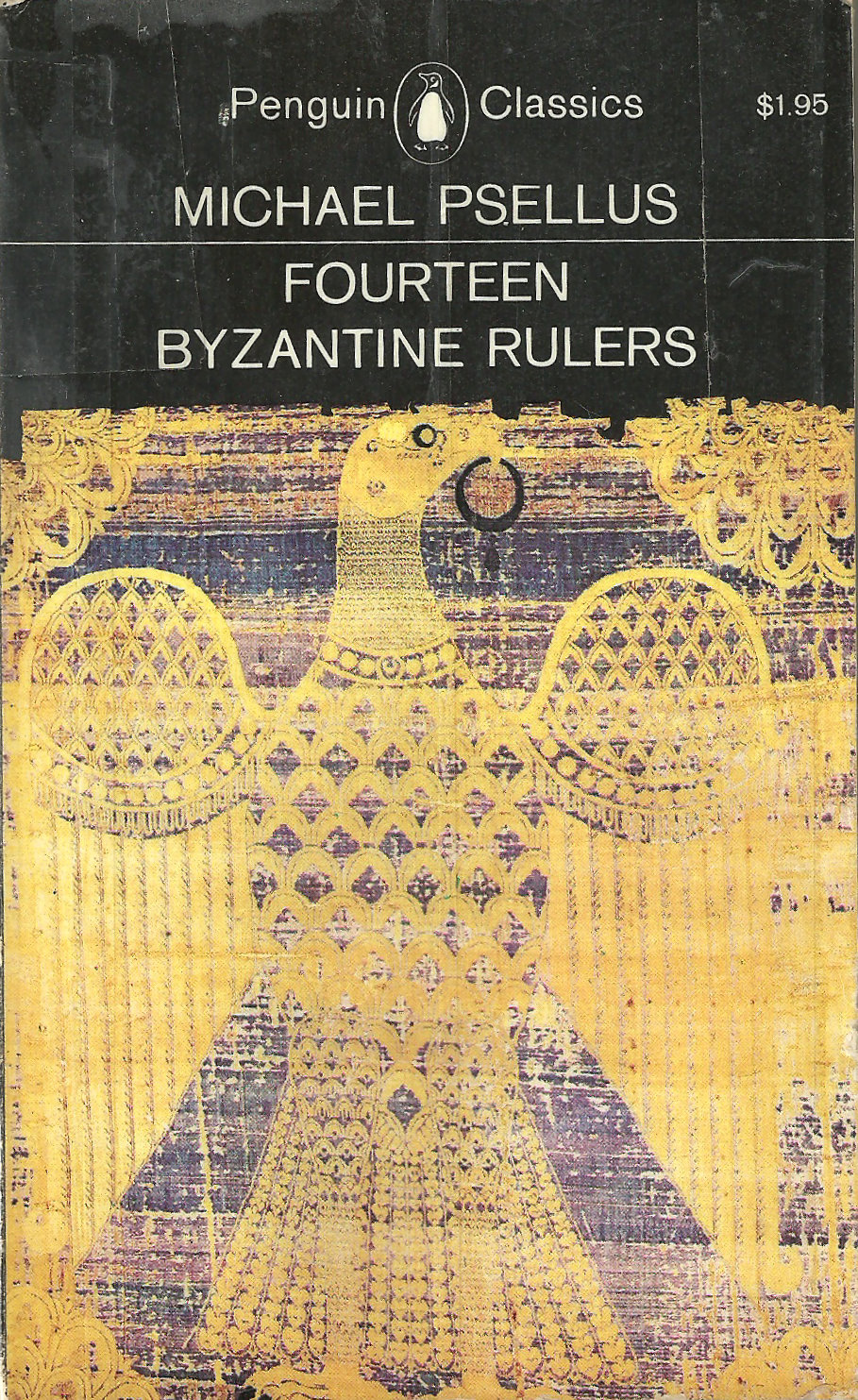
I admit that I failed in my previous attempts to read Procopius, but immediately recognized the merit of Michael Psellus’ Fourteen Byzantine Rulers.  He writes with an easy style and great psychological insight.  He lets us know when he personally witnessed something or knew someone, and when he reports 2nd or 3rd hand.  His writing adds to the mountain of evidence that, contra Gibbon, Byzantium attained a high level of civilization and its own unique style apart from Rome.  It was far more than a decrepit appendage of the western Roman empire. Psellus writes in a disarming and clear style.  He structures his narratives well and doesn’t shy away from playing armchair psychologist when appropriate.  I always appreciate when historians seek to interpret rather than just report, and so its natural that I would appreciate Psellus’ work. The introduction to the work argues that Psellus writes about decline, and there is some truth to this.  Psellus doesn’t see a clear linear progression downwards from the first to last ruler he discusses.  Nor does he lock in to one particular trait that makes a ruler good or bad.  But he does have a keen sense of cause and effect over the long-term, and this gives his narrative a dramatic sweep to go along with the vivid people he portrays.

As much as I enjoyed the work, I think both Psellus and the introduction to his text might misunderstand the roots of Byzantine decline. The first ruler Psellus discusses is the great Emperor Basil II.  After a rocky start, Basil righted the ship of state by transforming himself.  Psellus writes of a man who refused to indulge himself in the pleasures and distractions of palace life.  He ate simply, dressed simply, spent little money, and devoted himself to duty.  Basil did have a weakness, however, that for power itself.  Though he had various counselors and a Senate at his disposal he made them useless by his firm will and desire to see things done “right” by himself. This could work as long as the one wielding such absolute power had a firm dedication to duty and possessed more wisdom than those around him.  Naturally, those that followed him had neither the character or the longevity of rule to have the kind of impact and success of Basil II.

But the decline came not after Basil in my view.  Rather, the decline came in Basil’s time for two main reasons. The first has to do with the war he initiated with the Bulgarians.  I don’t think the war had any real solid justification (Psellus agrees, stating that Basil “deliberately attacked their country”) and distracted them from their real problems with the Moslems on their eastern border. I touched on this war and its consequences in this post from several months ago, so I won’t elaborate here.  What I didn’t say in that post is that, based on Basil’s incessant energy and love of power, it seems like the kind of war someone like him might engage in.  I detailed the effects of this war on the Byzantine’s in this post here, which I also reposted. The second reason is that the system Basil set up that concentrated power in his hands put too many eggs in one basket, that of the emperor.  This “idolization of an ephemeral institution,” that of the old Roman empire, may have contributed significantly to their decline.  This gets placed at Basil II feet.  His failure to share power extended to his brother and probable heir, whose indolence and laissez-faire attitude towards governance suited Basil II perfectly.

Sure enough, when his brother came into power he continued this same approach to life.  A country can do alright if such a person delegates well to wise people, but Constantine VIII followed in his brother’s footsteps and cared nothing for the Senate, yet accompanied that habit with far less wisdom and vigor than Basil. This pattern of concentration of power and abuse of power had varying degrees of consequences over time.   Romanus III (1028-1034) thought only in terms of “bigger is better.”  To fight he raised big armies.  To increase the treasury he collected “big taxes.”  When he repented somewhat of his former ways, he sought to build the biggest church he could to demonstrate his sincerity.  While I wouldn’t trace these acts directly to Basil, it shows the same lack of proportion and balance that Basil II displayed regarding power.  Psellus praises devotion and piety in general, but then writes regarding Romanus,

It cannot be right, in order to show one’s piety, to commit great injustices, to put the whole state into confusion, to break down the whole body politic.  He who rejects the harlot’s offering, who utterly despises the sacrifice of the ungodly, as though the wicked were no better than a dog — how could he in any way draw near a building, however rich and glorious, when that building was the cause of many evils?*

Byzantium would remain “off kilter” for the rest of its existence, but again, their problems only make sense in the context of their great achievements.  If they had nothing to lose, they had nothing to mourn in their decline.  But for Psellus and us, this is not so.

Dave

*This passage should not be read in isolation, as it could lead one to think that he gave lip service to “general piety” as a cloak for a secular world view.  One only needs to read his praise of Emperor Michael IV (1034-41), who abandoned the throne to join a monastery at the end of his life, to see the error of that line of reasoning.  Among Michael’s other acts was the founding of a home for reformed prostitutes.  In order to help lure them out of their way of life and end their fear of poverty, Michael made the home luxurious, promising any who came and vowed to live celibately that “all things, unsown, without labor of hands, would spring forth for their use” (Homer, The Odyssesy).  Psellus claims that “swarms” of women came to the homes.

Fra Angelico

One of the common pitfalls of adolescence is the idea that if you like something, everyone must like it.  Conversely, if you don’t happen to like something, it must be unworthy of being liked by anyone.*  Who cares if the artist/the work has a great reputation?  They must have earned it because people in the past had bad taste.  Too bad you/I wasn’t there at the time to set things right and prevent a great injustice.

I remember at 16 arguing with my friend over the superiority of Rush (my choice) to Depeche Mode.  Looking back I can see how the discussion might have been enjoyable in theory, but at 16 proved only frustrating.  I think he argued that Rush stank because you couldn’t dance to their music (very true, with rare exceptions).  I shot back that Depeche Mode had zero value because they never had any chord changes in their songs, which is very obviously false (I think I meant to argue “key changes,” but that also must be false).  In retrospect then, I must cede victory to him for at least stating something mostly correct.

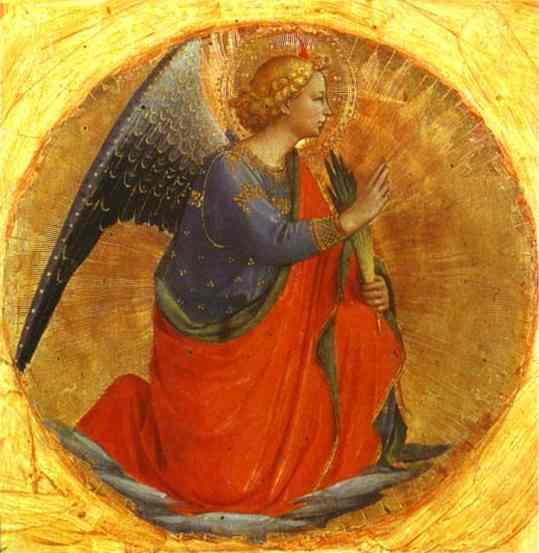
Sometimes such attitudes can persist past adolescence, and I confess that I never bothered to understand the merits of the Renaissance painter Fra Angelico.  Many years ago I  saw one of his early paintings of an angel and I immediately thought, “Boring!”

Perhaps the large wings turned me against him.  Angels, beings who inspire fear every time (I think) in Scripture, seemed flat and contrived in his work.  Those who admired him must be wrong, perhaps succumbing to an unhealthy desire for sentimentality.  Now of course it’s fine not to like things, but then to think that others who like them must be inferior to you is nothing less than arrogant stupidity.  Again, however, such attitudes are quite common among adolescents, and we must go gingerly on them.  Those in the Renaissance would have said that the average teenager has too much heat and moisture in their bodies to listen to the cooler voice of reason.

I shudder to think back on my judgmental attitudes, and can give thanks for coming across Reconstructing the Renaissance, a book largely about giving Fra Angelico (literally, Brother Angelico — he was a monk) a rightful place among Renaissance masters.  To call this post a “Book Review” will stretch your credulity, for the text of the book itself meant little to me, and much I could not really understand.  The author takes up his pen largely (so it seems) to argue for the authenticity of some paintings, and the proper chronology of some of the works.   This latter point may seem silly, but I suppose that a proper chronology would ensure something of Angelico’s proper influence upon later painters.  What really grabbed me, however, were the wonderful, high quality pictures throughout the book that allowed Angelico’s great gifts to shine forth.

Unfortunately web images cannot do justice to the wonderful presentation of the paintings found in the book.  High quality paper and vivid background color make looking at the numerous included works a real delight.  Below are some of my favorites. . .

“The Virgin Annunciate”

Virgin Annunciate (Fra Angelico)

“The Deposition”

The Deposition

“The Naming of St. John the Baptist”

Angelico’s work consistently uses color magnificently, and his subjects always have a serene dignity that no doubt the artist himself possessed.  One enters a different place in his world.  One wishes for the peace his subjects have.  The title of the book comes from a painting of St. James freeing Hermogenes, who earlier had persecuted the apostle.  Again, his same qualities shine through, though lest anyone think Angelico could paint only “pretty” things, the devils in the background show his versatility.

St. James Freeing Hermogenes

I do not recommend this book to read, though I I do think that if you can find it cheap (as I did at a used book store) do go ahead and take the plunge.  Look at the pictures and feel all the stormy “heat” of adolescence melting away.   I will leave it lying around my house, in hopes that he and my other children might pick it up one day.  Perhaps then, they may avert the follies of their father’s youth.

*Some adults appear to go in the opposite direction by claiming that nothing has objective value, in apparent rejection of the foolishness of youth.  I say “appears” because I think a lot of similarity exists between the overcommitted teen and cynical adult.  Both reduce everything to their own personal point of view, a purely subjective standard.

9th Grade: The Church Muddies the Waters

Greetings,

Last week we looked at Henry II and his challenge to the independence of the Church, and to feudal order in general.

A generation later, Frederick II (1194-1250) mounted a similar, somewhat more successful assault on the Church.  The mighty Pope Innocent III opposed him, but in this instance, Frederick prevailed for the most part.

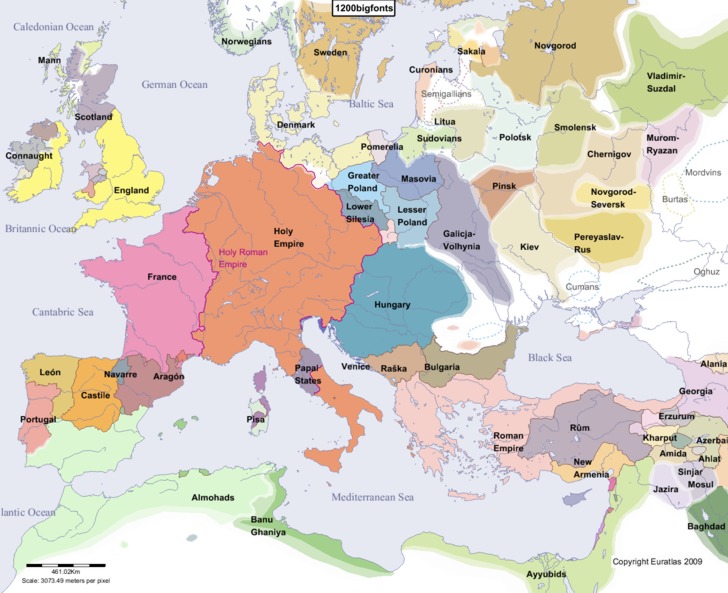
By inheritance and marriage, Frederick inherited a huge amount of territory.  He had the possibility of ruling over both the Holy Roman Empire and the Kingdom of Sicily.  You can see on the map the amount of territory he potentially could control (the big orange blob in the middle, including central-southern Italy and Sicily itself)

This fact in itself posed a threat to the Church’s vision for Europe.  The Church wanted to create a Christian community in Europe where people’s primary identity would be “Christian,” and not “English,” or “French.”  Concentration of power might mean that a ruler could challenge that general identity.  Too much power might result in more conflict as other states challenged or resisted that power.  Frederick’s vast holdings by definition challenged the Church’s concept of Europe, but also the feudal concept of everyone sticking to their own ‘sphere’ of influence.  Quite simply, he had too many slices of the pie to himself.

Frederick II with Al Kamil MuhammadSome called Frederick, “The Wonder of the World.”  He imported animals from exotic places and created the first zoo in Europe.  He wrote the standard manual for the sport of hawking, a medieval sport that required a great deal of patience and careful observation.  He spoke many languages, even Arabic, and often conversed with Moslem scholars.

Others called him, “The Anti-Christ.”  He founded the first university in Europe that was distinctly secular in nature.   Various popes consistently opposed him, and eventually Frederick struck back, murdering 120 bishops en route to a church council Frederick believed would rule against him.  Pope Innocent IV declared war on Frederick.  When some of Frederick’s subjects rebelled, Frederick turned ruthless, putting captured rebels in burlap sacks with poisonous snakes, and throwing them into the river.

The Pope eventually called off the war against him, though Frederick died shortly after and so could not savor the fruits of his ‘victory.’  Frederick’s reign reveals that the Medieval synthesis had cracks, cracks that would widen into the next century.  By choosing to oppose Frederick, the Church had to wade even further into politics than they usually did.  They spent a lot of their moral capital doing this, and failed in the attempt.  In the next few weeks we will see the ripple effects of this as the Church’s hold over society weakened.

The “successful” challenge of Frederick did not just have to do with Frederick, but with the Church’s own actions at the time.  In all ages the Church must decide the extent to which it should enter the political arena in order to try and achieve some common good.  If you accept Augustine’s interpretation of the world as “The City of Man,” this always involves risk.  What can or should be done in order to influence “the good” in a purely political sense?  For example, in Frederick’s youth his relatives Otto and Philip fought a civil war over the power inherent in his throne.  Pope Innocent III waded into the controversy, wanting to obtain the best possible advantage he could for the Church and the territorial integrity of the Papal States.  He initially supported Otto, who pledged not to extend his power into Sicily should he win.  But when the war’s events showed that Otto would lose, Innocent III switched his allegiance to Philip, hoping at the last moment to salvage something.  But then Philip died, leaving Otto the winner by default.  Innocent III switched his allegiance again back to Otto, whereby Otto reneged on his original deal and marched his armies into Sicily after all while Innocent stood by helpless.  I think Innocent III had good intentions, but the proof is in the pudding — he was way out of his league, and the prestige of the Church suffered.  It appeared to be one political faction among many, and a losing one at that.

Next week we will have some fun with medieval medicine.

Blessings,

Dave
“Reason and Revelation in the Middle Ages”

I sometimes wince at my facile attempts to appear the scholar, both on this blog and in other areas of life.  My small comfort amidst these failures comes only in that I usually know more than most 16 year olds (. . . usually).  But even I, a pretend scholar, know enough to dismiss  a book like The Closing of the Western Mindwhere the author asserts that 138929the concept of “Faith” destroyed the venerable goddess “Reason” in the medieval era.  Such a perspective can only come with willful ignorance of the most obvious facts about medieval life, and blatant misunderstanding of men like Thomas Aquinas, Duns Scotus, and a host of others.  It assumes that we moderns are smart, those in the past, dumb.

But I also abhor the opposite fault, though it only appears to be its opposite.  This approach seeks to prove desperately that, “The medievals were much like us, they used reason too, see, see, see!”  But this attitude pays no compliment to the medievals, for once again the modern world forms the foundation of all his cares.  I have commented on this attitude in reference to Herbert Butterfield’s  The Whig Interpretation of History, so I will not belabor that again here.

61lL5hzAdeLIn rides Etienne Gilson to split the horns of this dilemma with his eminently accessible Reason and Revelation in the Middle Ages.  Gilson outlines three distinct approaches the medievals took to the dilemma of reconciling faith and reason, and the strengths of each.  He does not favor one over the other (overtly at least) so much as provide a framework to view each more or less objectively.

Gilson begins with what he calls the Augustinian approach, whereby we “believe, that we might understand.”  This approach put heavy emphasis on “faith,” but “reason” for Augustinians could ride comfortably in the backseat with faith at the helm — hence Augustine’s healthy admiration for Plato.  But Augustinians had their subtle differences, which Gilson summarizes masterfully by writing,

In short, all the Augustinians agree that unless we believe we shall not understand; and all them agree as to what we should believe, but they do not always agree as to what it is to understand.
No better summation of the Augustinian school of thought exists.

Another school of thought put reason in the driver’s seat, and surprisingly, most proponents of this approach were Moslems, especially Averroes.  This did not really catch on in the Christian west, with a few possible exceptions (maybe Abelard).  Gilson avoids commenting on why, but I will speculate that this approach failed in the West because

  • The Christian west understood that this relationship between faith and reason had no real Biblical foundation, and . . .
  • This approach might have much more appeal to Moslems because one could describe Islam as Christianity dumped of all its mystery (The Trinity, incarnation, crucifixion, resurrection, etc.).  These core Christian doctrines should not be viewed as irrational but supra-rational.

Most interesting to me was Gilson’s explanation of the third Medieval way, typified by St. Thomas Aquinas.  For Aquinas, faith and reason co-existed peacefully because they lived in separate houses, whereas Augustine had them in the same house but on different floors.  For Aquinas, God granted reason its own kingdom apart from faith, though its domain had less value and less magnificence than faith.  Therefore, we don’t have to worry about the relationship between faith and reason because they have no real relationship, though both have their place.

I think I fall in the Augustinian category, but Gilson’s firm command of the material and easy and natural writing style will make me return at some point to consider Aquinas’ alternative.

“The Military Institutions of the Romans,” by Flavius Renatus Vegetius

Sometime in the early 5th century Vegetius wrote this simple and straightforward work, both a manual for a successful military and a plea for Rome to return to the values of an earlier time.

I am not a military man, but much of the advice Vegetius meets out concerns basic common sense, i.e. make sure your troops are well-fed, pay attention to terrain, make sure you have a reserve force, and so on.  What interested me as I read is what the book might reveal about the late Roman empire, and why the work had a huge following the Middle Ages.

Vegetius does not bellow, shout, or stamp in his writing, and yet underneath I think we can see a quiet desperation.  It seems like every ancient and medieval historian must as a matter of course talk about the past as a beacon of light, and how decrepit the present had become (does this not change until the Enlightenment?).  In Vegetius’ case, however, his attitude may have had more connection with reality, as the Empire seemed less and less able to exert control over its borders (Hillaire Belloc disagrees with this standard interpretation in his Europe and the Faith).  We do know that Rome had a harder time recruiting for its army in its later phase, and one of the great ironies of this book is that Vegetius, though wishing for a time when all men were strong and all the children good-looking, had no military experience himself.

The book touches on many things, but at the core Vegetius pushes discipline, discipline, and still more discipline.  Who can doubt that an army needs discipline?  Nothing remarkable about that.  Still, as this Youtube shows, Rome rode a few basic military moves and formations to world dominance.  Nobody plays the hero.  Stay in formation. Crouch, block, thrust, and move on to the next enemy (warning: a bit bloody).

What I did find revealing, however, is what is not there, much like the dog in Conan Doyle’s “The Adventures of Silver Blaze.”  Nowhere does Vegetius mention anything about armies needing morale, a cause, a belief to fight for.  Napoleon for one gave it great store.  His famous quote that,

In war, the moral is to the physical as three is to one.

comes to mind.  Why does Vegetius not mention the morale, or motivating cause, of an army?

I wonder if Vegetius does not include it because the army had no possibility of fighting for a cause in the late empire.  Rome had power and wealth even in the late 4th century but had lost any real reason for its existence long before. Vegetius wouldn’t mention it not because he judged it of little value but because he never would have thought of it in the first place, like a fish failing to extol the virtues of living on dry land.

Against my interpretation, however, is Vegetius’ own claim that nothing that he says comes from his own pen.  He claimed only to be copying, collecting and transmitting much older sources.  Some of those sources, like Cato, predate him by hundreds of years, when Rome had more internal health.  Did Rome never concern itself with morale in their military treatises?  One could imagine a stereotypical Roman thinking it a bit girly to think too much.  Leave that sort of thing to the French.

Or perhaps by coincidence the sources he uses don’t mention morale, so he doesn’t either.  But if so, he also chose not to add it.  Or maybe they did include it, but Vegetius did not work with their complete full text, or perhaps he deliberately left those parts out because they made no sense to him and would make no sense to others in his day.

Since the original date of this post I had some wonderful feedback from a friend who had the following idea.  His thoughts ran in a different course, which I paraphrase in the next two paragraphs below:

Vegetius may not have included the morale section for the reason that morale for the Roman armies was never the problem.  If anything, they needed at times an check on their desire to fight, hence the strong emphasis on discipline.  We see a few examples of this, first from the Gallic Wars, when Caesar wrote,

On the next day, Caesar, having called a meeting, censured the rashness and avarice of his soldiers, “In that they had judged for themselves how far they ought to proceed, or what they ought to do, and could not be kept back by the tribunes of the soldiers and the lieutenants;” and stated, “what the disadvantage of the ground could effect, what opinion he himself had entertained at Avaricum, when having surprised the enemy without either general or cavalry, he had given up a certain victory, lest even a trifling loss should occur in the contest owing to the disadvantage of position. That as much as he admired the greatness of their courage, since neither the fortifications of the camp, nor the height of the mountain, nor the wall of the town could retard them; in the same degree he censured their licentiousness and arrogance, because they thought that they knew more than their general concerning victory, and the issue of actions: and that he required in his soldiers forbearance and self-command, not less than valor and magnanimity.

My friend continues,

Similarly, one of the Consuls in the Macedonian wars (maybe Aemelius Paulus? I’ll have to dig out Plutarch) had terrible problems with his troops making frontal charges into Macedonian phalanxes and being annihilated. He entreated them to fight defensively and maneuver but they would have none of it.

Either way you slice it, the absence of anything resembling the morale of an army in his text says something.  Feedback like this is always very welcome, so thank you.

The book had a curious second life in the Middle Ages, where it became the standard military textbook.  I find this quite amusing.  Nearly everything except for the most basic dictums would have no application in the Middle Ages.  Many differences between the two armies/societies existed.

  • The Medievals could never have raised the large, professional forces that Rome did
  • Medieval armies did not often come together, and fought in short bursts, not extended campaigns far from home (the Crusades an exception, I grant you).
  • Medieval armies had very different people in them than Roman armies did.  An aristocratic warrior elite with a shared code of honor with their opponents would probably not go for the discipline, discipline, discipline, approach of Vegetius.

And yet the Medievals loved him.  Whatever for?

Some might call them simpletons who did not realize these differences, but I would not call a culture that produced Gothic architecture and St. Thomas Aquinas simpletons.

Some might see their possession of the manuscript of Vegetius valued like one prizes a good luck charm.  On this interpretation it’s the manuscript itself that’s valued, not the actual words.  Or perhaps in a childlike and humble way, they venerated the past and gave great store to anything from that time.

I could believe this second explanation, but I think the answer lies mostly elsewhere.  A clue might arise from a medieval portrait of Vegetius here below:

Why did the late 15th/early 16th century picture him in garb exactly like their own?  Did they really believe that the Romans wore clothes that they themselves wore in their time?  Or were they visually displaying their belief in using his work for their time?  Perhaps they had no idea what Romans wore and they felt free to invent whatever  clothes they wished?

In his great The Discarded Image C.S. Lewis speaks of the medieval imagination. . .

We have grown up with pictures that aimed at the maximum of illusion and strictly followed the laws of perspective.  . . . Medieval art was deficient in perspective [both historical and visual], and their poetry followed suit.  Nature, for Chaucer, is all foreground.  We never get a landscape.

Historically, as well as cosmically, medieval man stood at the foot of a stairway; looking up, he felt delight.  The backward, like the upward, glance exhilarated him, and humility was rewarded with the pleasures of admiration.  Thanks to his deficiency in the sense of period, that packed and gorgeous past was far more immediate to him than the dark and bestial past could ever be. . . .  It differed from the present only in being better.

The Middle Ages are unrivalled, until we reach quite modern times, in the sheer foreground fact, the ‘close-up.’    . . . Two negative conditions made this possible: their freedom both from the psuedo-classical standard of decorum, and from the sense of period.  But the efficient cause surely was their devout attention to their matter and their confidence in it.  They are not trying to heighten or transform it.  It possesses them wholly.  Their eyes and ears are steadily fixed upon it . . .

This lack of “background” in their art and thought might lead them to ignore Vegetius’ context.  We do this too.  Who among us does not think that Ben Franklin’s idea of making the turkey our national bird ridiculous?  We know that Bald Eagles may not be the nicest of birds, but that’s not the point.  We are interested in the immediate image the eagle projects, not its actual reality.

But I think there is more to than that, something distinctly medieval about Vegetius’ image. Medievals developed the habit of looking so closely they missed the forest for the trees.  With Vegetius, we might surmise that all details beyond the immediate text were entirely superfluous, which made those details, in a sense, entirely in the now.  This attitude could be akin to the scientist absorbed so much in trying to clone DNA that he takes no notice of the larger consequences of his actions.

Cheap histories of the Middle Ages talk of the period’s ignorance, darkness, etc.  In reality it appears they had quite a scientific bent, with a love of classification and minutiae.  The quote, “Nothing is known perfectly which has not been masticated by the teeth of disputation,” on my homepage from Robert of Sorbone, dates from the 13th century, and not the 17th.  Vegetius’ portrait may not speak many words about him, but does speak volumes about those that created it.


The Blessings of Impractical Civilizations

(What follows was originally written in 2012) . . .

Ad Fontes is located in Centreville, which puts us within spitting distance of Dulles Airport.  That meant that we had a wonderful view of the space shuttle Discovery as it piggybacked its way to the Udvar-Hazy Center for display.  The students admired the sight (and enjoyed getting out of class), but in discussions I had with them no one seemed particularly chagrined that the shuttle program had ended.  “Why should we bother with space exploration,” many argued, “when we have so many other problems?”  To them space exploration has no point to it, “unless we know that something valuable is out there.” This argument is hardly unusual.

In 9th grade we just finished looking at the incredible boom of exploration during the early years of the Renaissance, ca. 1450-1500.  Historians have speculated on the reasons for this sudden jump, and many suppose that the answer must be “technology.”  I agree with Felipe Fernandez-Armesto who argues in his book Pathfinders that the exploration boom happened not because of any particular technological advance, but because they simply wanted to go.  Sailing technology did not measurably increase for about 300 years after the 15th century boom, when we discovered how to measure longitude, yet that their relative lack of technology did not deter them.  Given the great dangers of sailing in those early days, one cannot say that exploration was a particularly practical activity, though certain voyages did generate large profits. Despite this, people continued to travel, and most historians agree that exploration helped define and benefit Renaissance civilization in important ways.

Other civilizations did this too.  What could be more impractical than a massive cathedral?  And yet cathedrals popped up throughout northern France and England in the 12th century, then spread throughout western Europe.  Some historians talk about the economic benefits of cathedrals, as it drew visitors and trade and so on.  However true this may be, cathedrals cost tons of money and took decades to build.  I don’t think the medievals built them to create trade, and yet clearly the Gothic cathedral defined and shaped an era.

As far as glorious impracticality goes, its hard to top the Celtic monks who illumined so many manuscripts in the 5th-10th centuries.  In the midst of the Dark Ages, when civilization itself needed rebuilt, you had some of the best educated men playfully “wasting their time” drawing monsters on the pages of St. Matthew when they could have been about so much more!  And yet many historians credit this process with helping revive civilization after Rome’s fall.

Other civilization have been “impractical” in different ways.  The Age of Reason had opera, which as Kenneth Clark notes in this brief clip, has nothing rational about it.  And yet, Mozart left part of his greatest legacy in opera, and there can be little doubt of its impact on opera’s cultural impact from the mid-1700’s up until the 20th century.

This brief survey makes me wonder in what sense our civilization is wonderfully impractical, and I don’t think the question merely frivolous.  Much of what we appreciate about civilization has little direct practical value.  Take education, for example.  If we decided that a good education consisted merely in technical training human society would collapse shortly thereafter.   We could build better dams than beavers, but the difference between man and beast would be one of degree and not kind.  Thankfully, students rarely ask, “When will I need to use this in real life?” when reading Shakespeare (though they ask it all the time in math, which should clue us in that something is wrong about how we teach it).

Of course, we don’t have to pick the space shuttle program as our cultural fancy.   We can choose something else.  And, given the diversity of our culture (which has much to commend it), its unlikely that we’ll land on one thing like cathedrals or sailing.  Still, nothing prevents us as from changing civilization by starting with ourselves.  History speaks and says, “Be impractical.”

The best reason for a revival of philosophy is that unless a man has a philosophy certain horrible things will happen to him. He will be practical; he will be progressive; he will cultivate efficiency; he will trust in evolution; he will do the work that lies nearest; he will devote himself to deeds, not words. Thus struck down by blow after blow of blind stupidity and random fate, he will stagger on to a miserable death with no comfort but a series of catchwords; such as those which I have catalogued above.  . . .The idea of being “practical”, standing all by itself, is all that remains of a Pragmatism that cannot stand at all. It is impossible to be practical without a Pragma. And what would happen if you went up to the next practical man you met and said to the poor dear old duffer, “Where is your Pragma?” Doing the work that is nearest is obvious nonsense; yet it has been repeated in many albums. In nine cases out of ten it would mean doing the work that we are least fitted to do, such as cleaning the windows or clouting the policeman over the head. “Deeds, not words” is itself an excellent example of “Words, not thoughts”. It is a deed to throw a pebble into a pond and a word that sends a prisoner to the gallows. But there are certainly very futile words; and this sort of journalistic philosophy and popular science almost entirely consists of them.

From G.K. Chesterton’s “The Revival of Philosophy”

A Word on Methodology and the Purpose of History

On the first day of school in 8th grade Ancient History (which is the first time I will have taught any of the students in that class), I begin class with the premise that I am wasting their time.

History, after all, (I argue) has no real bearing on your life.  We study some names and dates from the past, a few battles here and there.  Sometimes it might have entertainment value but will never really impact you in any way.  Whatever Cyrus the Great did, be it good or bad, won’t impact on you today.  The past has no present.

Depending on their personality and previous experience students either get very excited or troubled by the prospect that we can blow off the year.  Yes, eventually we get around to reasons why hopefully I will not waste their time, but we should not sweep the arguments against History under the rug too quickly.  Before we bother with History in the first place, we should know what we are doing and why.

Some students respond by stating that history offers us lessons.  When people do bad things, we can learn to avoid them, when they do good we can emulate them.

This is a very common answer, with some truth in it, but I refuse the premise on which it’s based.  Reducing history to didactic lessons runs akin to telling people that Christianity is about adhering to a superior morality.  Whatever truth lies in that statement, Christianity really is not about “morality” at all, or at least, the moral component makes no sense without a much larger context.

In the same way, History does not begin and end with proverbs and moral lessons.  It should be about encounter.  It should be about transformation.

History is often and easily abused.  One common form of abuse is using History as a vehicle for proving a pet theory, something all of us can be guilty of at times. Such an approach is both dangerous and uncharitable.  Uncharitable, because History has no room to speak for itself when we insist it conform to us.  We stop listening and lose the possibility of empathy and understanding.  Dangerous, because manipulating the past puts us in a position of great power.  We erect a wall between ourselves (the “good,” or those with knowledge and understanding) and others, those who “should know better.”  If we do this, we cannot learn, cannot be challenged, and cannot grow.

Finitude will always limit our experience, but we need confronted with “the other” to get shaken out of our narrow field of vision.  Historians can often make the mistake of viewing the past in terms of the present, but this robs the power of the past to really do its work.  Seeing through different eyes pushes us beyond ourselves.  In writing about great books, C.S. Lewis said,

. . . in reading great literature I become a thousand men and yet remain myself. Like the night sky in the Greek poem, I see with a myriad eyes, but it is still I who see. Here, as in worship, in love, in moral action, and in knowing, I transcend myself; and am never more myself than when I do.

This is how History (like all our endeavors) should prepare us for the Beatific Vision.  The “otherness” of different cultures and people can by grace train our hearts for the “otherness” of God’s Kingdom.  Other times and places should also make us humble and charitable.  Hindsight is a great luxury, but we must avoid “finger-wagging.”  We must honor the past by viewing it as they saw it, not as we see it now.  We too act in a fallen context without omniscience.  Those in the past lived under the same constraints.  What kind of decisions would we make in their place?

Bringing it to the present, how do we act morally and justly with the information we have?  How do we make decisions in a fallen world?   We must take responsibility for these decisions, and the difficulties we face should make us rely on God’s grace and wisdom.  Our own sin should make us slow to judge those in the past that struggled with many of the same things as ourselves.  Are we so sure that we would do better?  When we, with proper conviction, call out the past for its mistakes we likely will need the humility to call ourselves and our own society to account.

I am not interested so much in changing the opinion of any student about, say, Napoleon or the Industrial Revolution.  But I am very much interested in 1) Each student coming to a greater understanding of their view of the world, and the extent to which that view can be supported by Christian belief, ethics, etc., and 2) Each student more fully understanding the implications of their decisions in the short and long term for themselves and others.

Mark Twain once said that history does not repeat itself, but it does rhyme.  As we see connections and patterns, we learn more about humanity.  But humanity does not exist in a vacuum.  As in all disciplines, the study of History involves an attempt to understand Reality, imbued with God’s presence.  As Francis Schaeffer said, “He is there and He is not Silent.”