Words in Play

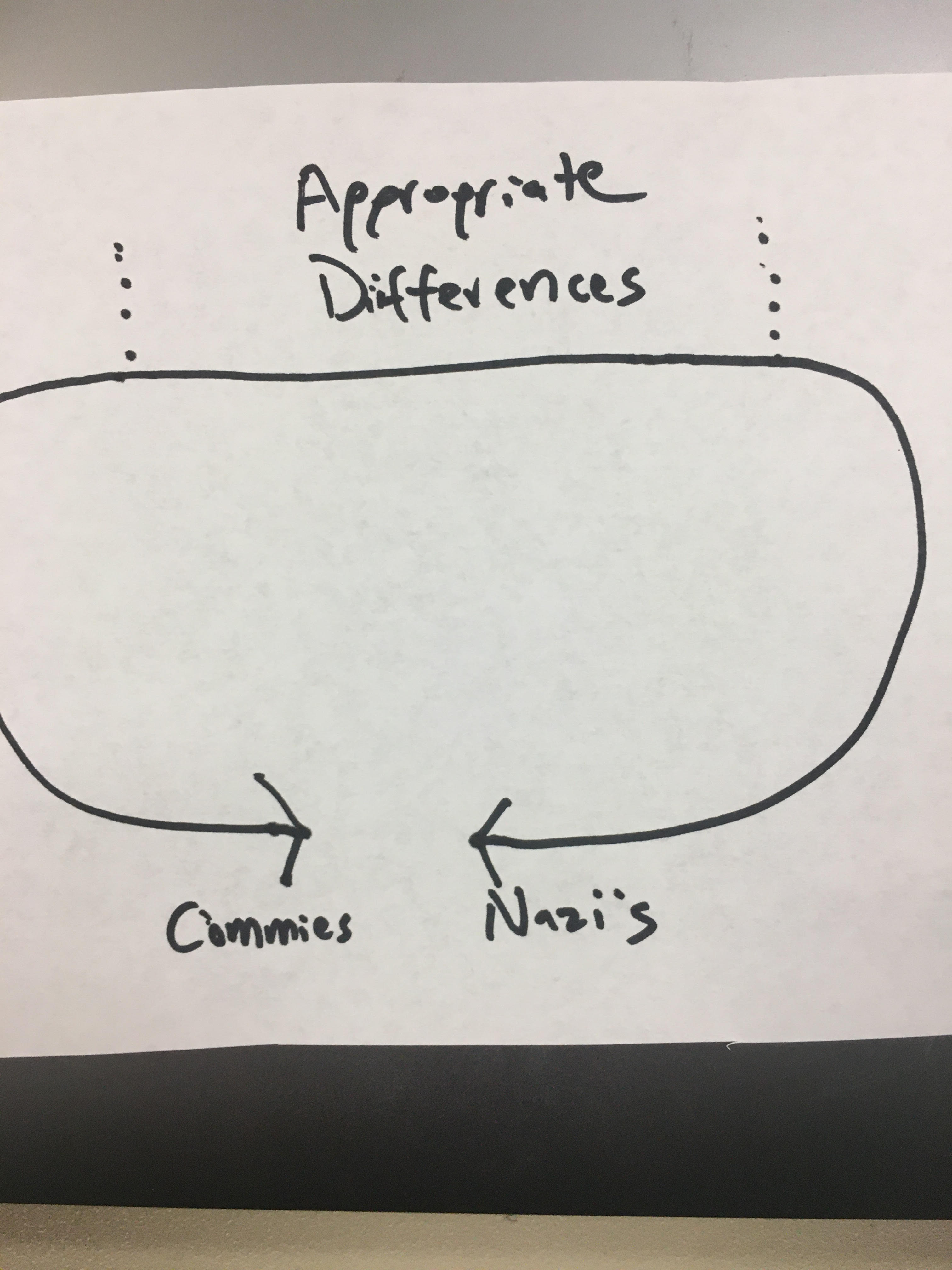
Lots of pendulum swings happen in the history of thought, but these pendulum swings sometimes resemble more the bending of a line towards the form of a circle instead of opposite points on a line horizontally. In other words, when certain positions get to their extremes, they start to resemble what they claim to oppose. Reality, when warped, curves back on itself.

For example, one could argue that the age of imperialism in Europe came from the conviction that a) We are better than you, and b) We are different than you. This is a caricature, but we can let it stand for our purposes. In turn, this attitude called forth the work of Joseph Cambell, who argued in his religious analysis that actually, nothing has any difference from anything else. Narcissus, Christ, Osiris, and so on all participate in the same reality and are basically the same god. On the surface this looks like the opposite end of the imperialist impulse, but as imperialism grew, the mingling of cultures grew, and the differences between the cultures start to blur. For example, we have Rudyard Kipling as one of imperialism’s strongest advocates, but much of his writing shows a fascination not with English culture, but with that of India and Afghanistan.

So . . . McBain was entirely correct to conflate the Commies and the Nazi’s.

Plato and Aristotle give us the foundation to western philosophy. Many first notice their differences, and certainly they parted ways in key areas. Plato emphasized the unity of things via the world of the forms. He sought to draw everything up into the eternal, i.e., when we come to know and understand something, we are in fact remembering something we used to know.* Aristotle differed from his teacher and focused on particulars. We know him best through his extensive categorizations. He separates that we might see things more clearly. It seems they occupy opposite points on a line, with opposite strengths and weaknesses. But in certain ways they share the same strengths and faults. Aristotle critiqued Plato’s overgeneralizing of concepts, but he himself seemed to overgeneralize everything in the mythical/spiritual realm, consigning it all to irrelevancy. Like Plato, he criticized aspects of Athenian religion but could not see the particular threads of truth within it. In turn, Plato’s focus on finding the eternal kernel of truth led him to define concepts so finely that in the Laches a general does not know what courage is due to his faulty definition. They both over-generalized at times, they both hyper-categorized other times.

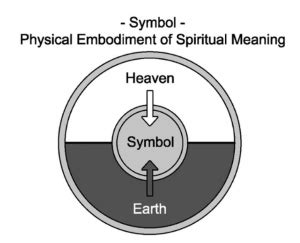
Avoiding this warping effect might involve taking Aristotle’s “advice:” If you drill a hole all the way through the earth and fall down from the North Pole, stop and hover at the halfway point. The key to healthy societies as well as healthy thought comes from fusing “Heaven” and “Earth,” and not by camping out at either locale.

I never knew that Plato’s dialogue Cratylus even existed until a few weeks ago. Here he focuses entirely on the role of language, and names in particular. The issue has relevance especially in times of societal breakdown. Without a common cultural framework, language loses its power as a conveyor of meaning and a means of discourse, i.e., we no longer have an agreed upon meaning for important words such as “male and female,” “racism,” “love,” and so on.

The dialogue begins with one extreme tentatively suggested by Hermogenes, who argues that, “whatever anyone agrees to call a particular thing is its name.” Socrates teases out the implication of such a position, which means that something can have infinite names, “And however many names someone says there are for each thing, it will really have that number at whatever time he says it?” Hermogenes reluctantly agrees.

Of course this won’t do, and Socrates leads Hermogenes out of this thicket. The problem of meaning has a link to the problem of virtue. If we can give names to anything we wish and have that in fact be its name, then we in effect, become the arbiters of reality itself. For, “some statements are true, while others are false,” and “it is possible to say things that are and that are not in a statement.” We are not God and cannot make reality come into being by merely declaring it so. Otherwise good and evil have no real existence outside of our own minds, and so we can call nothing truly good or evil at all. Meaning and coherence break down. The question of language is much more than academic.

So words and their meaning cannot come into being from below. The “bottom of the mountain,” so to speak, has too much individuation and division to provide a platform for societies. As our examples above show (i.e., Kipling, etc.), this extreme individuation shakes hands with extreme unity, for it cannot properly divide anything at all according to its nature. So in the end, with this view, everything mashes up together.

Socrates and Hermogenes then seek to go up to the “top of the mountain” to attempt to find the origin of names. Names function as a means of instruction, as a means of “divid[ing] things according to their natures. As Socrates comments,

So just as a shuttle is a tool for dividing warp and woof, a name is a tool for giving instruction, that is to say, for dividing being.**

Just as not all can use the loom, so Socrates asks, “Do you think every man is a rule-setter, or only those who possess the craft?” Hermogenes concedes that one must have the craft. Control of language cannot belong to the individual alone, but nor to “every man.” One must have “the craft.”

So Cratylus is right in saying that things have natural names, and that not everyone is a craftsman of names, but only someone who looks the natural name of a thing and is able to put its form into letters and symbols.

Undoubtedly language shapes our perception of reality, and possibly more than that, for in Genesis God’s speech creates reality as we know it. The names He gives fixes the distinctions between things, and Adam’s naming of animals gives humanity a cooperative role in the creative process.

The theological dilemma of, “Is something good because God declares it to be good, or does God declare something good because it is good already,” has a mirror in the dilemma about language.^ No one person can simply declare a word to be a word and have it fixed for all time. Socrates struggles with finding the absolute in each word. He had penetrating insights regarding the essence of truth, but stumbled in its application. The same hold true in Cratylus. The dialogue continues on a long excursion where Socrates seeks the unity of the principle embodied in names, and their particular Greek phonetics. Some of these endeavors succeed more than others. But in the end, Socrates must face reality–other cultures have different phonetical constructions for words embodying the same principles.

Socrates: Here is what I suspect. I think that the Greeks, especially those who live abroad, have adopted many names from foreign tongues.

Hermogenes: What of it?

Socrates: Well, if someone were trying to discover whether the names had been reasonably given, and he treated them as belonging to the Greek language rather than the one they were really from, then he would be in a quandary.

Hermogenes: He very probably would.

Socrates: . . . Consequently, though one might say something about these names, one mustn’t push them too far.

This realization leads Socrates nearer the truth, that language, like truth itself, involves a union of the masculine principle of declaration from those “who know,” from above, and the fluidity of things on earth. Socrates comments,

Perhaps you didn’t that [the names] are given on the assumption that the they name are moving, flowing, and coming into being. . . . Wisdom (phronesis) is the understanding of motion (phoras noesis) and flow. Or it might be interpreted as taking delight in motion. . . . Wisdom signifies the grasping of this motion.

For the rest of the dialogue Socrates struggles to find a way to unite the masculine and feminine aspects of language, but can’t quite get there. Still, he makes the crucial realization of the need for the seed from above, the plant from below, or the pattern and its manifestation must go together. For Adam in the Garden (Genesis 2) his names correctly manifested this, for at that time he had perfect communion with the Father above and the (Mother) Earth below. But since the sin entered the world, we essentially fail in proper manifestation of language, which furthers confusion of meaning.

But though we fall short, we still have the image of God within us, and can use Socrates’ insight to evaluate how we use words and their relationship to truth. There exists, for example, a certain method of Bible study among Christians that involves

  • Finding out the Hebrew/Greek meaning of a particular word
  • Grabbing a concordance to see where that word gets used in different parts of the Bible, and then
  • Using the meaning in one context to determine its meaning everywhere in Scripture.

This ignores the fluid aspects of language, and the central importance of context over strict phonetics. We all know that the word “radical” can be a math term in one context, an outdated term from the 80’s in another, an adjective for a political ideology, and so on.

Many of our current cultural debates, however, center around ignoring the fixed aspects of language. We can all acknowledge that the meaning of “male” and “female,” for example, have certain contextual fluidities determined in part by culture. Some men may be more effeminate, some women more masculine, than others of the same sex. But surely being either male or female cannot mean anything we wish it to mean. Biology certainly gives us constraints on the meaning of sex. The very fact that we call some men more masculine than other men shows that we have a defined concept of masculinity we cannot escape even if we wanted to. Indeed, some of those who wish to introduce more fluidity to the concept of sex/gender also decry “toxic masculinity” more than others.

It seems that we must see language, along with the reality language describes/creates, existing in a hierarchy. At the top we have God, who in Christian theology can only be defined as Father, Son, and Holy Spirit, one God in three persons. Then at the bottom we have words like “green,” a collection of phonetic sounds that can refer to a color, a newbie on the job, a person with sea-sickness, and so on. Yet while these phonetic sounds can take on meanings essentially unrelated to each other, they each manifest connections to a particular idea. More fluidity in language exists at the bottom of the mountain, but . . . not chaos. Then somewhere in the middle of reality, we have words such as “male and female,” which have more defined limits, along with a degree of contextual meaning.

Though the Cratylus fails to stick the landing on a unified theory of language, Socrates rightly intuits that correct naming is a “beautiful work.” We recognize beauty when we recognize a pattern, a pattern of the marriage of heaven and earth, of unity and diversity.^^ When this reality gets warped both the language absolutist and the language relativist both destroy the beauty of language and its meaning. Contrary to some, language is not a tool of power, but of meaning. When weaponized we lose beauty, wisdom, and also power. For in reality, power cannot truly exist without its connection to Heaven.

Dave

*I should state now that I am a rank amateur in my knowledge of Plato and Aristotle. My critique is not meant to deny their rightful place in the history of philosophy.

**Here we see more evidence of Andrew Kern’s suggestion that weaving and wisdom are interrelated in the ancient world, thus, the Luddites rebellion against mechanical looms had little to do with economics and much more to do with maintaining meaning and coherence in society.

^This dilemma is really no dilemma at all to those who understand Christian theology. The Church has always said that the answer to the above dilemma involves splitting the horns–things are “good” because God made them, and are stamped with God’s being and character.

^^I will attempt an explanation of my meaning by thinking about a spectacular sunset. We look up, and see light from above-that’s purity/Heaven. The light then transforms, becomes more fluid/diverse as it interacts with matter, the stuff of Earth. This combination produces the beauty we are drawn to.

While only God is eternal and infinite, this union of Heaven and Earth will continue into eternity. In His resurrection Christ continues to have a physical body. And when He returns, He will descend, and we will rise to “meet Him in the air.”

Seeing is not Believing

Imagine a large group attending a traditional bull fight in Spain, replete with the attendant pageantry. You would all witness the same actions, and the same events. But, interpretations of the events and their ultimate meaning would likely differ widely, and thus, what what one “sees” would diverge strongly as well. A possible smattering of interpretations might include

  • Some would find the event barbaric, shameful, and cruel–a terrible relic of some pre-modern past.
  • Some, a la Hemingway, would see an exhilarating, if not slightly problematic, affirmation of masculinity
  • Some would not go any deeper than pure entertainment–they would see a spectacle and be glad they had that chance.
  • Some would see a noble re-presentation of the sacrifice of Christ, and his traveling the Via Dolorosa, the path of sorrow.

This last suggestion no doubt strikes many moderns, Christians included, as absurd. And yet, the Catholic faithful called the passing of the bull through the cape the “Veronica Pass,” after the story of a young woman named Veronica (translation–“true image”–think veracity, verdict, and ‘icon’) who offered Christ her veil to wipe his face as he carried the cross. Some say that Christ accepted the offer, and an image of His face remained imprinted on the veil, the “icon made without hands.”

Some might accuse Christians here of very conveniently glomming on to something pagan like a bullfight, to make sure that Christians 1) could still have fun, 2) or still have a dark side, 3) or to appease a paganism that they could not expunge. A variety of pre-Christian cultures made extensive use of bulls and bull imagery, as did other pagan European cultures the church encountered as it grew throughout Europe. Certainly in general Christianity incorporated and transformed certain pagan customs from different cultures. But all in all, the practice likely has most of its roots in a vision of the prophet Ezekiel. In chapter 1 of his prophesy, within a larger vision of a wheel of fire, Ezekiel sees something else:

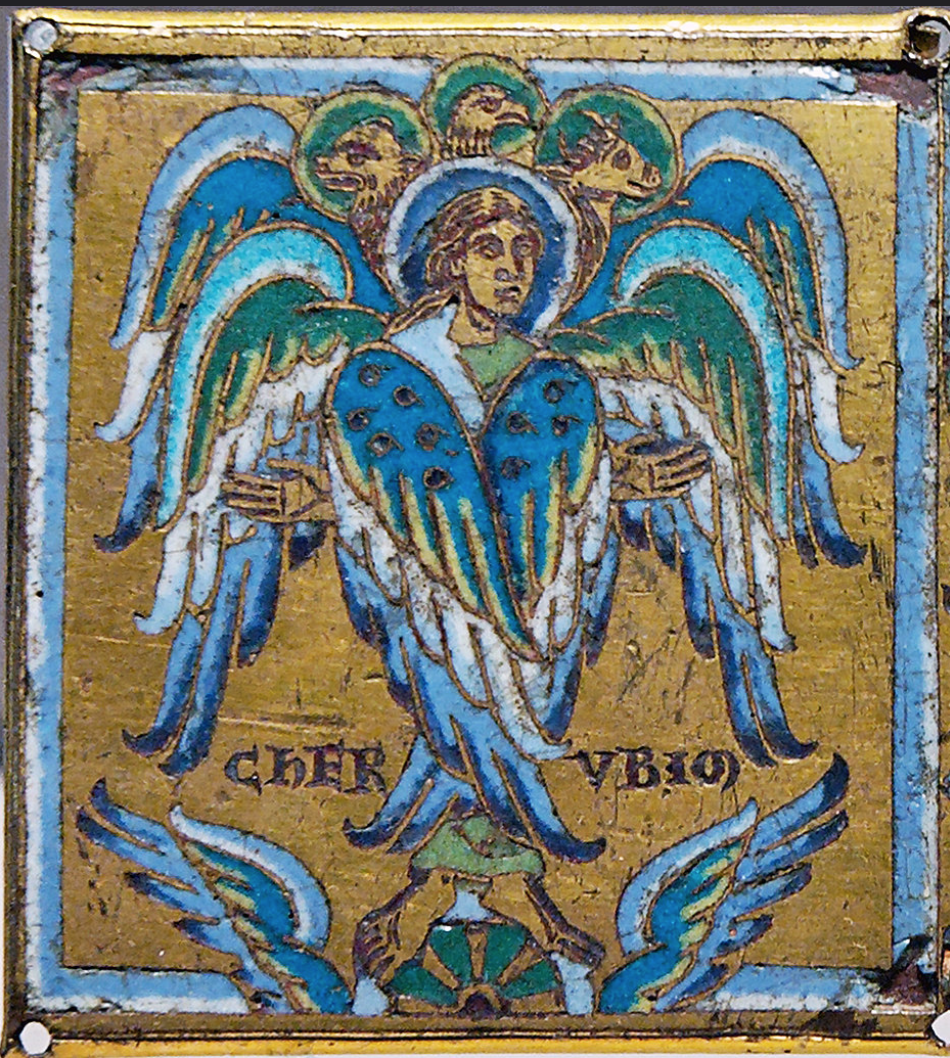
there was as it were the likeness of four living creatures. This was their appearance, and the likeness of man upon them. Each had four faces, and each had four wings. . . . This was the likeness of their faces: the face of a man, the face of a lion on the right side of the foursome, the face of an ox on the left, and the face of an eagle

Ezekiel 1:5-6, 10

Traditionally, according to St. Gregory the Great (late 6th century AD) and other commentators* from the early church

  • Matthew and his gospel is identified with the man, for he begins with a geneology
  • Mark is the lion, the “voice crying in the wilderness” (Mk. 1:1)
  • Luke is the ox, who begins with a sacrifice (Lk. 1:8)
  • John is the eagle, “who stretched towards the very substance of God” (St. Gregory, Jn. 1:1)–it is John who is regarded as the Theologian par excellence, hence his association with what is high above.

Ezekiel also mentions the essential unity of the four creatures as well, just as the four evangelists have an essential harmony, which leant early commentators to ultimately see each creature as a partial image of Christ.

Along with other cultures we also today associate the bull with virility and the source of life. This association naturally leads one to the idea of a supreme sacrifice, the outpouring of the fullness of life. In the Old Testament, the sacrifice of a bull was the highest sacrifice one could offer, the fullest outward expression of devotion (Ps. 51:19, etc.). In this light, linking the bullfight with Christ’s death makes much more sense, but nothing in what we physically saw would lead us to that conclusion. We would need the proper interpretive framework to “see” this in what we saw.

Historically speaking, the way we see now has very little to do with how most people have seen in the past. The difference probably boils down to the idea of symbols. One author writes,

The simplest way of defining this difference [between the old world and the modern] is to recall the changed meaning and function of the word “symbol.” For us the symbol is an in am image that invests physical reality with poetic meaning. For medieval man, the physical world as we understand it has no reality except as a symbol. But even the term “symbol” is misleading. For us the symbol is the creation of poetic fancy; for medieval man what we would call symbol is the only objectively valid definition of reality. We find it necessary to suppress the symbolic instinct if we seek to understand the world as it is rather than as it seems. Medieval man conceived the symbolic instinct as the only reliable guide to to such an understanding. Maximus the Confessor . . . actually defines what he calls “symbolic vision” as the ability to apprehend within the objects of sense perception the invisible reality of the intelligible that lays beyond them.

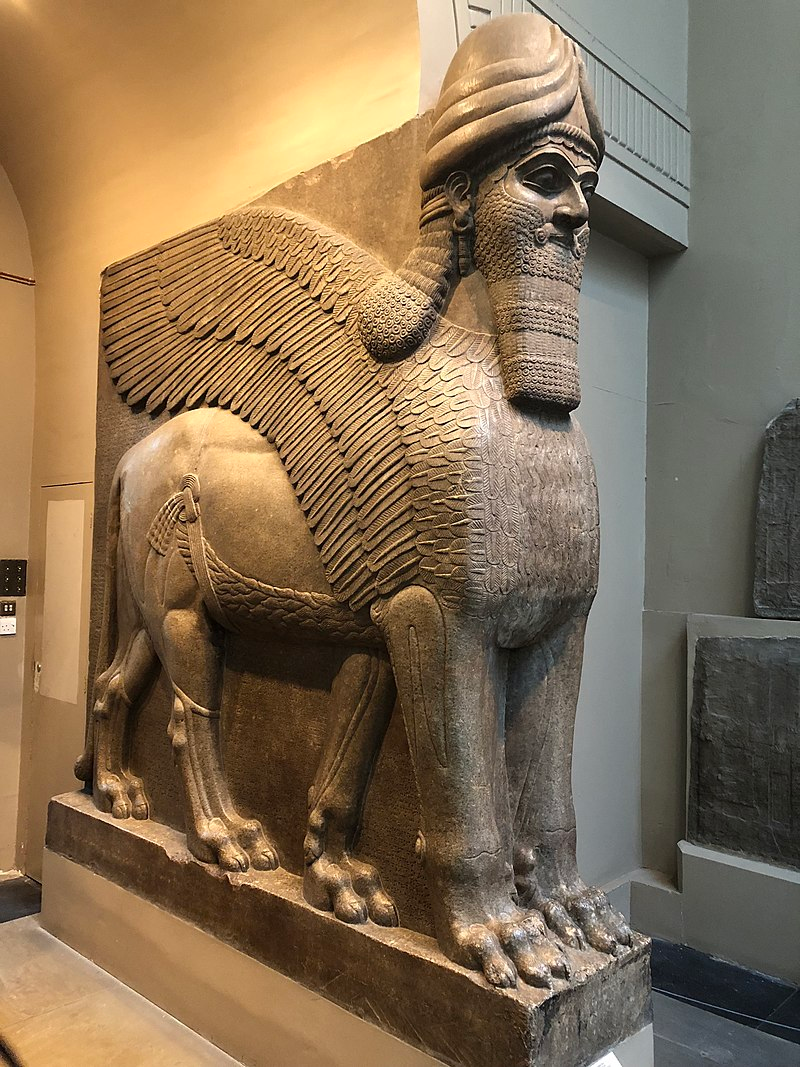
But still some might object that realm of symbol has far too much subjectivity to rely on these associations and intuitions. After all, bull imagery has a variety of pagan associations. One need only think of Assyria, one of the more cruel empires, and their winged bulls, or Egypt and their Apis bull.

However ambiguous some of these association might be (is the Assyrian depiction meant to be somewhat demonic or angelic?), we have no doubt when we look at images of Bel/Baal and the bull horn attendant imagery, or even the golden calf.

Noting this ambiguity, the materialist will assert that this proves the arbitrary nature of language and our symbols, that nothing has any meaning in itself. But this position in fact makes a grand metaphysical claim about reality, that it is univocal, that if it speaks it must speak with one voice only. But our experience tells us this is false. Meaning has multiple layers.

Mircea Eliade continues,

It is therefore the image as such, as the whole bundle of meanings, that is true, and not any one of its meanings, nor one alone of its many frames of reference. To translate an image into a concrete terminology by restricting it to any one of these frames of reference is to do worse than multilate it–it is to annihilate, to annul it as an instrument of cognition.” — Eliade, Images and Symbols, 13

We can see that the New Testament is well aware of the tension inherent in symbols. Christ is the “Lion of Judah,” but Peter also compares a lion to Satan, a merciless prowler (1 Pet. 5:8). We shouldn’t say that Peter rejects one form of symbolism for another, however. Both are possible at the same time. Our experience of objects manifests a reality that does not belong strictly to the physical, observable world. The “real” world is full of grace, yet fallen, and our symbols naturally reflect this as well.

We can go further. As I mentioned above, I think the bull image has Christian roots, for I count the Old Testament as part of the Christian tradition. But suppose I throw this out and say that any associations with a bull/ox and Christ has purely pagan roots. Well, the very act of taking something fallen, baptizing it, “cleaning it up,” and re-presenting it to God anew–this has everything to do with our role as image-bearers of God and stewards of creation.** Through repentance, we hopefully do this with ourselves every day. This is, in part, what it means to grow the Kingdom of God.

Ultimately, however, one cannot “prove” any of this in a strictly rational way. I propose, however, that we can see the superiority of the symbolic way of thinking by examining what happens when we assume a more materialistic approach.

We can start with our very selves. I have participated in discussions where a strict materialist argued that all things beyond neurons, chemicals, synapses, etc. were simply fabrications of evolution. Whatever he could not measure he discarded. Yet, this meant that everything he valued, his friends, his choices, even food he liked, would ultimately mean nothing. Thankfully, he agreed that things like love, friendship, etc. were important, just not real. Without this thin anchor, actual existence in the world for him would not be possible. To believe that chemicals are “real” and friendship is not puts one quite near the wind, as they say.

We can scale up a bit to a family. If you think in a purely materialistic manner, one could easily argue that the concept of a family is only social convention. “Names” are certain phonetic sounds, “families” just a group of people whose DNA has more in common with each other than with other people. “Marriage” gets reduced to a convenient, or not so convenient, voluntary arrangement. Marriages only really work, however, when the people involved believe that what they cannot see or measure about their relationship has a greater reality than themselves as individuals. Participating in this greater intangible reality makes the lesser reality possible.

We can only live through symbols. Our experience of objects involves the manifestation of something other, a reality that transcends our world while including it at the same time.

But we must use caution with these symbols. We can take the corporate identity of a political party, for example. Political parties can serve good ends. They bring people together across geographical space. They help aggregate ideas and should, in theory at least, filter out extremism. They can give a sense of identity. But if one makes that identity supreme, it becomes a demon instead of an angel. The person loses agency to the party–whatever the party says, they think. Like rooting for a sports team, the key is the color of the laundry, not the particular ideology. Initially being a Republican/Democrat likely bestowed a sense of belonging and purpose. Now–you are food. You exist to vote and feed the machine. The same can happen with a family. The “higher reality” of the family can give one guidance and meaning beyond our own individual existence. But if we make family the highest reality, it too will eat us. This happens in gangs, organized crime, and so on–Michael Corleone’s Godfather tragedy.

The bull can and should scale up to Christ, but if we miss the mark, or stop too short, we end up with the devil.

Dave

*St. Bruno d’ Asti, St. Yves of Chartes, among others. Perhaps we might see further symbolism in that the three synoptic gospels have more similarity in their “earthiness,” but John’s gospel departs significantly in emphasis, thus his association with the heavenly eagle(?).

**This is why the obvious fact that the church refashioned certain pagan festivals and images for Christian use is not anything to apologize for, but something to celebrate. It is part of the triumph of the Church.

8th Grade: “Bueller. . . Bueller. . .”

Greetings to all,

Are we sure that History matters?

This was the question I posed to the students the first day of school.

A few students pointed out that we should study History to learn from the mistakes and copy the successes of the past.  This is the answer most frequently given to the question, “Why History?”

But why should we accept it?  What on earth could anyone who has been dead for thousands of years, living in a completely different part of the world, have to teach us today?   “Perhaps,” I suggested to the students, “I am wasting your time, serving as part of a vast conspiracy of the old to occupy and distract the young.”  Is this what school really means?  Is the study of history merely an exercise in the “vain repetitions of the heathen?”

It’s fun to play devil’s advocate, but in the end we provided two key reasons why History does matter.

“Begin at the beginning,” said the King in Alice in Wonderland.  The study of history rests on a few key Christian assumptions:

  • We assume that what happens to people depends in part on choices they make, and these choices must in some sense be “free” choices.  If we have no ability to choose then whatever success of failure we experience has nothing to do with anything we can call “ourselves” at all, but merely instinct, environment, and so on.
  • We must believe that genuine communication across time and space can occur.  Believing this, in turn, rests on the belief that much more unites us as humans than divides us.  Otherwise, either communication would be impossible (because we would not understand one another), or meaningless (if our differences would be so extreme the experience of others would have no relevance for us).

Such things may seem so commonplace that they do not need to be defended, but in fact, those who buy into certain postmodern assumptions about identity and language would likely not agree with the above propositions.

In Genesis we read that God made mankind in His own image.  I am not capable of exhausting the richness of what this means for humanity, but we established a couple key concepts in class:

  • In Genesis 1 we see God bringing order out of the void.  He could have created everything in an instant, but He chose six days/periods of time (whichever you prefer), each with a clear progression and pattern.  In Genesis 1 we see God separating night from day, dry land from sea, and so on.  He then separates mankind from the rest of His creation.  So too, we can find order and patterns in our surroundings.  History need not be “one thing after another” with no distinctions or meaning.
  • God acts with will and intentionality, and so too we act from more than mere instinct.  If we had no ability to choose and act with purpose, History would have no meaning because we could not learn from it or apply what we learned without it.

God gives all people who have ever the lived the gift of His image, and this is the good side of the coin regarding humanity.  But in Genesis 3 sin enters the picture, with terrible consequences.

  • Adam and Eve attempt to alienate themselves from the very Source of Life itself and hide from God.  While mankind retains the stamp of God’s image, I think it no coincidence that Genesis 5:3 mentions that Seth was born in Adam’s image.
  • Adam and Eve turn away from each other, refusing responsibility for their sin
  • Humanity experiences alienation from creation as a whole.

History rightly examines many facets of various civilizations, and the collapse of various people groups  have political, economic, cultural, and geographic explanations.  But sin lies at the root of all misery, and since we are all sinners, all of us share responsibility for whatever is wrong in the world.  “All have sinned and fall short of the glory of God.”

Both the image of God and the fall of man mean that there is far more that unites, rather than divides, every person who has ever lived.   Even an Egyptian god-king from thousands of years ago and our next door neighbor still share these same characteristics.  Our differences remain skin deep.  Rod Dreher (a Christian) recently interviewed Louis Betty, a scholar of the work of the modern French author Michael Houllebecq.  Neither Betty or Houllebecq profess any allegiance to Christianity, and may not profess a religious faith of any kind. But Betty’s observation about the belief of the image of God in man are revealing.  He commented,

More concretely, you don’t get white supremacy if you believe that every human being has a soul fashioned in God’s image. Neither do you get far-left racial and ethnic identitarianism. Both are symptoms of a metaphysical deficit. It’s very easy to start dividing people up into tribal categories; after all, humans vary massively in just about every imaginable quality. It’s really something of a miracle that we ever came up with a notion of common humanity at all! We have the Judeo-Christian heritage to thank for this in the West. This is something secular people ought to consider before making glib criticisms of traditional religion.

The full article is here for any who are interested.

We see the confluence of the image of God and the Fall in every life and in every civilization.  We all seek order and coherence.  We all seek to create distinctions (just as in Genesis 1) in our lives, giving precedence to some things over others, and so on.  In this way we image the God who made us.  Yet we also see that we often choose to embrace death to create our personal/civilizational kingdoms.  We will hate others to make the kind of order we wish for our own lives.  Nations may literally kill and destroy others to achieve the peace they desire.

1 Corinthians 15:56 states that, “the sting of death is sin.”  This order might surprise us–we might expect it to be reversed.  Adam sinned and brought death to himself and his descendants.  In many ways, it is our fear of death, of the diminution of the self, that leads us into sin, as 1 Corinthians states.  We cut each other off in traffic, grab the last cookie, and declare war to obtain resources in order to preserve and extend our earthly lives.  We obtain life only through surrender to death, i.e., “He who wishes to save his life must lose it” (Luke 9:24).

Other areas of Scripture show the importance of History.  Much of the Old Testament simply records events without editorial comment.  We can read of various kings of Israel, for example, and the Biblical authors do not always insert, “And God thought ‘x’ about the king.”  No doubt God means for us to figure it out on our own from the context, and from what we already know from reason, observation, experience, and other parts of Scripture.  If History is important to God in Scripture, we can conclude that History itself serves as a kind of revelation, a revelation that will teach us much about ourselves, and God Himself indirectly.

Apart from a Christian context, History, however interesting, would have no real meaning for us beyond mere entertainment.  We will keep returning to these foundational truths, for History makes no sense without them. I told the students that this class may have started in an unexpected way for them, but we cannot understand History without understanding mankind, and we cannot understand mankind without understanding who God is. Next week, we will attempt to understand what makes a “civilization,” and how civilizations function.

Blessings,

Dave Mathwin

9th/10th Grade: Maps as Worldview

Greetings,

This week we spent time with two maps, each respective of their time, each revealing much about the societies that created it.

First, the Hereford Mappa Mundi (Map of the World), from the late 13th century :

We noted that, among other things

  • The map has very little water
  • The map is filled with animals, real or fanciful
  • Jerusalem is at the map’s center
  • The map has no actual geographical accuracy to speak of, almost on purpose

Basically the Hereford Mappa Mundi does not attempt to a map in any modern sense of the world.  It tells you nothing about physical geography.  But it does mean to orient one spiritually.  Christ sits enthroned above, the word “MORS” (Latin for death) forms a ring around the sphere, reminding us that death encompasses the globe.  Jerusalem stands at the center to remind us of the centrality of Christ’s death and resurrection.

Did they know nothing of physical geography.  Well, they may not have known much, but they knew more than this map indicates.  I think they just did not particularly care about it, it had no real importance in their society, and other Mappa Mundi’s of the era reflect the same values.

About 150 years later, we see this map:

Obviously many differences exist between the two.

  • The geography approaches reasonably accuracy
  • If you look closely you might see that upon the water there are many ships, obviously reflecting the explosion of exploration.
  • The spiritual symbolism is nowhere to be seen

The map is intended to represent physical reality, to perhaps guide one (at least marginally) while physically traveling.

Of course the map could have had spiritual symbolism if it wanted to.  But it had other purposes and goals in mind, and reflected the different values of the period, and this brings us to one of the crucial differences between the feudal period and the Renaissance.

For the Medievals, what counted most was not the actual, physical person/place/thing as it existed in reality, but the meaning behind the physical, or the symbolism inherent in the object.  So when they want to make a map of the world they did not really make a map of the world, but a spiritual map, a gospel tract.  When Dante uses Beatrice in his Divine Comedy, his treatment of her is not as a particular historical person, but as a type of how the feminine can lead one to salvation.

During the Renaissance we begin to see a shift in the other direction.  The physical world in itself has value, and is worth investigating and depicting.  I think both perspectives have value, and neither one has much value apart from the other.  Neither a peanut-butter sandwich, or a jelly sandwich, satisfies, but combined it works beautifully.  The Renaissance began by offering a helpful balance or corrective to some weak spots of the medieval order.  Whether it finishes there or not, we shall see.

If you have interest, last week we watched a brief portion of a video on the development of perspective in art which I include below.   Medieval art did not use perspective, partly because they did not know of the technique.  But I think that part of the reason why they did not discover perspective is that they never looked to develop an artistic technique that would allow them to represent the physical world accurately.  The reasons why for this are complicated.  If you want an atypical medieval ‘apologetic’ for their style contra the ‘modern’ ideas of the Renaissance, you can check out this article.

Have a great weekend!

Blessings,

Dave

Command and Control

In the Soviet edition of Marxism-Leninism on War and Army published in 1972, a section reads,

Soviet military doctrine proceeds from the assumption that the imperialists are preparing a surprise attack against the USSR and other socialist countries.  At the same time, they consider the possibility of waging military operations escalating into military actions involving the use of nuclear missile weapons.

What struck me about this passage are the assumptions it makes and the consequences of those assumptions.  The Soviets assume we are the imperialists and will strike first. Would we want to forestall such an occurrence and strike first ourselves?  Perhaps we should.  Naturally, we would object to being called the aggressors in the Cold War.  From our perspective the Soviets showed their true colors in the closing days of W.W. II when they kept for themselves territory they took from the Germans.

But, if the Soviets thought that we would strike first, they might consider striking us first to prevent it.  Should we then strike them pre-emptively to prevent the Soviet’s pre-emptive first strike to forestall our first strike?

It all seems like a bizarre vaudeville routine, or one of Shakespeare’s mistaken identity comedies.

Nuclear weapons are of course very real, with extremely real consequences for their use.

And yet, I have always thought that a certain kind of unreality has always existed around nuclear weapons.  Children were told to “duck and cover,” and wrap their necks with newspaper for protection against nuclear attack.  We developed evacuation plans for cities that would never be used, for no such plan could have worked with 15 minutes notice before the bombs hit.  We never wanted to use the weapons, but they only had value if the other side actually believed we would use them, hence Nixon’s “I’m a madman” gambit to try and end the Vietnam war.  Nixon said to H.R. Haldeman in 1969,

I call it the Madman Theory, Bob. I want the North Vietnamese to believe I’ve reached the point where I might do anything to stop the war. We’ll just slip the word to them that, “for God’s sake, you know Nixon is obsessed about communism. We can’t restrain him when he’s angry—and he has his hand on the nuclear button” and Ho Chi Minh himself will be in Paris in two days begging for peace.

Eric Schlosser’s excellent book Command and Control gets at the heart of both the reality and unreality of the existence of  nuclear weapons.

A brief example . . .

The Titan II missile carried a destructive power 3x greater than all the bombs dropped in W.W. II combined . . . including those dropped over Hiroshima and Nagasaki.   But the weapon wasn’t very accurate, and very difficult to keep properly maintained. Still, because these weapons were our most powerful they had potentially significant deterrent value in the Cold War.  So that meant that they needed to be ready to go on a moment’s notice, as their silos would likely be some of the first hit in any massive first strike by the Soviets.

That in turn meant that they needed to be fueled and ready to go at 15 minutes notice, which meant they needed a special kind of fuel, Aerozine -50 .  I can’t imagine a fuel more volatile, as contact with leather, wool, rust, or other average products could cause it to combust.  That made the missiles prone to accidents with potentially horrifying consequences, and one such accident forms the backdrop of the book.

By the 1970’s Henry Kissinger, among others, wanted to make a deal with the Soviets.  We’ll get rid of our Titan II’s, you get rid of your big missiles.  But our Titan II’s were not as good as the Soviet’s comparable missiles, and the Soviets knew this.  No deal.

Kissinger wanted the Titans gone, but no one wanted to decommission them outright.  To take the missiles offline for nothing would show weakness, and lessen the amount of bargaining chips we had the next time we negotiated.

So they stayed.

But if they stayed, they needed to stay operational or it would be the same as giving them away for nothing.  So . . . no one liked the inaccurate, accident-prone, massively powerful weapon, but in the logic of departmental budgets and global politics, their silos stuck around.

As a friend of mine put it, a conspiracy of circumstances made madness look sane.  In a world where the image/symbolic value of nuclear weapons may have meant more than their reality, Kissinger’s stance makes perfect sense.  Indeed, as much as we might like to blame someone for this state of affairs, who would it be?  Even if we step all the way back and blame those that invented the weapons, we must then confront the possibility ca. 1941 that the Nazi’s might be building them, and we might want to get there first.  We all stepped through the looking glass more or less together from the Manhattan Project onwards.

When I first started this book I looked online at “nuclear weapons accidents.” I was utterly dumbfounded.  How could there be so many?  And given these accidents, how did nukes play such a large role in our policy?  This forms the bulk of Schlosser’s work.  Command and Control could have been just a laundry list of one accident after another, and  readers would be mere gawkers on the roadside.  Schlosser makes the book valuable because he looks behind the curtain (with massive amounts of footnotes) to show how the logic of nuclear policy developed.

At the heart of our possession of nuclear weapons lay a dilemma.  On the one hand, the weapons posed great dangers not just to those on whom it might be used, but to those who kept them.  Accidents happen, so naturally we should take great precaution to make sure we don’t have a nuclear accident.  So far well and good.  But the more safety restrictions one put on the weapons, the harder they became to use.  If they became too hard to actually deploy, they had no deterrent value.  If the weapons existed accidents would happen.  But how much effort should we put into preventing accidents if each safety measure made them less valuable as an actual weapon?  And again, if they didn’t function as weapons, deterrence broke down and the world became less safe.

Or so it seemed.

Different aspects of society had different opinions on this.  Scientists stressed safety, the military stressed the efficacy and availability of the weapon.  For example, a congressional committee reviewed security at Minutemen missile sites and found it lacking.  They mandated that access to the missiles be granted only with proper code identification.  The Air Force didn’t like it.  In event of an attack they would need quick access to the missiles, and who could tell who might need access if the normal command structure at the base broke down?  But in the end they complied with the congressional order.

They made the codes for all Minuteman sites 000-000-000.

Having a ready made deterrent also meant that we needed a lot of nukes in the air on planes, especially in the first 20 years or so of the Cold War.   Before we developed rockets and guidance systems the only way to get deliver the weapons was through planes.  The planes had to have the range to stay in the air long enough to get deep inside Soviet airspace.  This meant extensive use of the B-29 bombers, planes with a wobbly safety record.  The record is actually not that wobbly on paper, but we must factor in that these planes had to stay in the air constantly in case of surprise attack by the Russians   So if you expect a mishap once every 10,000 mission hours, that small number adds up quickly.  Every time a plane crashed or caught on fire meant a potential nuclear disaster.  Sometimes bombs got lost, sometimes they exploded, scattering radioactive material.  Sometimes the fact that the nuclear material did not detonate itself may have been a matter of chance.

Can we blame someone for this?  In my opinion, not really.  Accidents happen as part of life, sometimes no matter the precautions, and this means that nuclear accidents may be inevitable.

But there can be no doubt that the logic of the Cold War itself, along with departmental budgets, made accidents more likely.  For example, when various people or agencies raised safety concerns often little got done.  Acquiring new weapons was always preferable to fixing old ones, and this makes sense.  But rarely did older weapons get discarded.  More often than not, Kissinger’s logic mentioned earlier kicked in (of course this went way beyond Kissinger himself).

Yes, the Cold War and Mutually Assured Destruction no longer form part of the strategic calculus.  But Schlosser points out that the weapons still exist, and we must still deal with them.  To do so we must bring them firmly into reality.

One can’t help but wonder that if things were this bad in the United States, what were they like in Soviet Russia?  What about places like Pakistan today?  Amidst the confusion of alternate reality created by nukes, one things seems clear to me:  the fact that we have yet to blow ourselves up must be evidence that God exists, and that His mercy endures forever.

Same Story, Different Day

Once upon a time a man lived in a good land.  His family prospered, and in time, his children and his children’s children filled this good land.  They had their own customs, faith, and rhythms of daily life.

But these good times did not last.  Eventually many others sought to rob these good people of their land.  Various kings and principalities invaded, one after the other.

The people resisted.  They fought bravely, but often these foreign invaders divided to conquer.  At times these good people found themselves at odds with one another.  Eventually the invaders persecuted them. Their very existence as a people seemed threatened.  But they had faith, and this faith will be rewarded.  Their perseverance led them to outlast the forces of history, and so their history in the modern era begins right where it left off many generations ago.

In a post about the failure of the Treaty of Versailles I discuss my view of the importance of narrative in the field of history, whether we study the past or make “history” in the present.  Analytical data or “rational” analysis about costs/benefits in the abstract will lead to wrong perceptions of reality.  A narrative view gives us a more full understanding, and when faced with a problem, a much better chance at solutions.

It sounds odd to say that I really enjoyed Padraig O’ Malley’s * The Two State Delusion: Israel and Palestine — A Tale of Two Narratives.  O’ Malley has little hope for peace if the “peace process” continues as before, and this gives the book a somber tone.  But I enjoyed it because I felt that O’Malley must be onto something by focusing not on particular events, or even security for one side or the other, but on the idea of the narratives both sides bring to the table.  One problem the two sides face is the distinct similarity in their narratives.  The structure of the story remains relatively same for them both, with different characters.

The story I told above fits both sides of the conflict, and to some extent both sides use the above narrative.

For Israel

  • They gained possession of a good land, grew and prospered, reaching their ancient peak during the reign of Solomon.
  • But soon after that, their kingdom fell prey to multiple invasions from the outside, be it Assyrians, Babylonians, or Romans.  They had to scatter throughout neighboring lands, but maintained their identity and culture.
  • They faced persecution from outsiders, culminating in the almost unimaginable horror of the Holocaust.
  • But — their persistence and faith paid off.  They returned, forged by suffering, and established themselves securely back in the land of their forefathers.

For the Palestinians . . .

  • They dwelt peacefully in the land in small communities for many generations
  • But — they fell prey to imperial forces, throughout time.  We can date their unjust subjugation in the modern era with their occupation by the Ottoman Turks from the 16th century to W.W. I.
  • At the turn of the 20th century they had independence promised them from another imperial power (the British).
  • But when it seemed like they might have their land back once again, they were betrayed and occupied  (by the British, who sponsored the return of Israeli’s).
  • Eventually, a host of foreign powers (the U.N.) imposed another conquering people upon them (the establishment of Israel — whose military might is financed from the west).  This new occupier fought a series of wars , scattering them from their homes in a host of illegal land grabs (Israel has routinely violated a varietyU.N. resolution and established settlements in occupied land).
  • But — they have faith.  Forged by suffering, their common bond to one another remains stronger than ever before.  They believe that one day, the land will be theirs once again.

Their narratives remain starkly similar, with the main problem being that:

  • For Israel, Palestinians are not often identified as average people, but as the next in a long line of foreign persecutors of Jews (i.e. PLO, Hamas, etc.)
  • For Palestinians, Israel is identified as an imperial power along the lines of the Ottomans and the British.

O’Malley rightly hones in on the common thread of the suffering of both sides.

The suffering of the Jewish people hardly needs an explanation.  Of course we have the Holocaust, but a lot of lower-level persecution existed before that for centuries throughout Europe.

What may be less obvious to us, and certainly seems less obvious to Israel, is the suffering of the Palestinians.  O’Malley asserts, and I agree, that if we could find any kernel to the disastrous relationship between the two, it lays here.

The Palestinian population has suffered greatly indirectly or directly from the presence of Israeli’s.  We could measure this in land lost to Israel, or in civilian deaths of Palestinians, which greatly outweigh those of Israeli’s due to terrorist attacks.  There also exists what one cannot measure–the wholesale breakup of communities and families due to Israeli occupation and settlements, and the wholesale dismemberment of the Palestinian Church–something Christian supporters of Israel sometimes forget.

The reason why I think it forms the core of the problem is that Israel cannot seem to admit that they have caused these problems.  Some of them one could plausibly ascribe to the “fortunes of war” or the “march of time,” but others, like the direct violation of U.N. resolutions to establish settlements, fall directly into their laps.  But it appears that the Jews in Israel, who has suffered so much at the hands of others, cannot admit that they themselves cause so much suffering to others.

The Palestinians, for their part, want more than grants of certain territory or water rights, they insist on a repentant, contrite Israel.  Having felt impotent and humiliated for so long themselves, they insist that Israel feel the same way.  The Palestinians cannot accept half-measures in this regard.  For example, Ariel Sharon released a statement along the lines of, “Israel regrets the suffering of the Palestinian people,” that the Palestinians found not just unacceptable, but insulting.  They don’t want Israel’s sympathy, they want Israel to admit fault without equivocation.  Nor can they see the above statement as a beginning of a process.  Rather, for them it represents a slap in the face.  “Ha!  This is all you get!”

Formal peace negotiations put Israel in a bit of bind, and we must sympathize with their position. Who speaks for Palestinians as a whole?  Who can negotiate for them?  If none can truly speak for them, then what good is any particular deal?  Why bother?

Israel complains that the Palestinians have not been able to absorb refugees and form stable, coherent political organizations.  After all, they themselves (that is, the Jewish settler in Israel) started with nothing and have formed a modern first-world state.  They absorbed thousands of newcomers and refugees from different countries.  They speak truth in this claim.  But, as O’Malley points out, why should the Palestinians have to form modern western political organizations?  Things moved along nicely for them without such things before Israel arrived, and can continue to do. But it appears that history may overwhelm the Palestinians and force them into an uncomfortable mold, one which will put them at a disadvantage vis a vis Israel.

The relationship between the two has calcified to such an extent that O’Malley recommends that they cease the formal peace process itself, and instead focus on healing their own psychological scars.  The peace process has also been initiated not by each other but by various American presidents looking to make their mark.  Whatever the cause, O’Malley suggests that now “negotiations” serve as a platform for each side to vent grievances or talk to their respective political bases, and not each other.  The peace process serves now to simply enable and confirm their already deeply held beliefs.

In one section of Mere Christianity C.S. Lewis talked about his impatience for how many make moral judgments.  “War is a terrible evil!” some cried.  “Yes,” Lewis agreed, but times exist when war is more morally justifiable than the current “peace.”  Sometimes issues must be considered on a relative scale.  He even mentioned dueling.  Yes, dueling often involved murder, but he admitted that there might be some instances when even a duel to the death might be preferable to indulging in a lifetime of hatred and bitterness, and passing on that hatred, that would in time destroy one’s soul.

I thought of this section when reading this book.  In this scenario both sides have their share of the blame.  As purely personal opinion I give a slight majority of blame to the Israeli side.  They are the stronger (though they don’t realize this), and they–as a formal nation with coherent leadership–have violated international law on numerous occasions.  I distinguish this from Palestinian acts of terror, which I do not believe represent–or at least always represent–the whole of the Palestinian people.  So I root for a Palestinian homeland, and feel that surely this cause has justice on its side.

And yet, the current situation destroys both sides, and there appears no end in sight.  All O’ Malley can see in is a continuation of deep fear and deep hatred growing — hence the title of his book.  A two-state solution simply will not work in the current psychological climate.

So would a “duel” of sorts be a preferable solution?  What would that even look like?  Should Israel just “get on with it” and exile the Palestinians?  This would be cruel, but it would hopefully have the ancillary effect of forcing Palestinians to start over.

On the other hand . . .

Many Palestinians believe they are close to winning.  This victory would not be physical in nature, but moral and psychological.  Some feel that if Israel goes much further they will completely delegitimize themselves internationally, and rot themselves from within morally.  They will then, as an act of atonement, give Palestinians a homeland at least to the 1967 borders.

I do not share this view, but see no other solution that will work in the current environment.  The two sides share the same space and tell the same story, but with different characters playing different roles.  I would guess that nothing will change until both sides tell themselves a different story.

Dave

*It sounds odd for an Irishman to write a definitive book on this subject, but his previous books dealt with Irish/English history and apartheid in South Africa.

Prester John, Particularly

For a long time I had no understanding of memes. I still don’t, really, but possibly a bit more than I used to. Whereas before I had a grumpy old man reaction (“Kids these days and their crazy pictures), now I see them as highly condensed, symbolic, quasi-mythic kinds of communication. They contain multiple layers. Archaeologists of the future would almost certainly make many mistakes regarding memes. They would likely begin too literally, but even if they did not, they would lack the immediate cultural context necessary for interpretation.

I have always had great students and occasionally they invite me into their world. One such time, I played Apples to Apples with 5-6 other students. It was both bizarre and enlightening all at once. If the card was “Joyful” and you had an “Ice Cream Sundae” card yourself to put in the pile, one might think that would have a shot at getting picked. Wrong. Something so “straight,” so obviously 1-1 in connection, had no chance.

But neither did pure irony or sarcasm work either. Rather, the answer might be something that had an angular or parallel relationship to the subject. Something like “Ham Sandwich” might work, but not because it was joyful or its opposite, but because it had a very particular association for that particular group. “Ham Sandwich” got chosen because

  • One day Bill took a final exam, in which he thought he did ok/meh.
  • For lunch after the exam he had a ham sandwich with no mayo or mustard or anything. It was not terrible, but a bit blah, like the exam.
  • Linking the exam, which was not joyful, and the sandwich together, well–two negatives make a positive, and people during lunch laughed at the connection.
  • Now, 5 months later, “Ham Sandwich” became a phrase, or even a meme, associated with a double-whammy kind of blah, but that makes everyone laugh when said in the right way at the right time.

In other words, their associations were entirely their own, entirely understandable to them all, even with the layers of compressed meaning. When “Ham Sandwich” came up, everyone agreed that card would win. Again, a literal minded future archaeologist might see this and assume we thought ham sandwiches the greatest things around.

My students’ thinking no doubt appears to many of us old folk as odd or newfangled. Actually, their method resembles a lot of traditional thinking, with its layers of meaning not exactly verifiable for the modern mind. Future historians, take note.

Many historians today should take similar note with the past.

One of the more intriguing side cars of medieval history is the legend of Prester John. Otto of Friesing included a letter in his history supposedly from fabulously wealthy Christian king in in India, or perhaps Africa. It begins

  1. Prester John, by the power and virtue of God and our lord Jesus Christ, lord of lords, to Emmanuel, governor of the Romans, wishing him health and the extended enjoyment of divine favour.
  2. It has been reported to our majesty that you esteem our excellency and that mention [knowledge] of our High One has reached you. And we have learned through our delegate that you should wish to send us some entertainments and trifles [ludicra et iocunda], which would satisfy our righteousness.
  3. Of course we are only human, and take it in good faith, and through our delegate we transmit to you some things, for we wish and long to know if, as with us, you hold the true faith and if you, through all things, believe our lord Jesus Christ.
  4. While we know ourselves to be mortal, the little Greeks regard you as a god, while we know that you are mortal and subject to human infirmities.
  5. Because of the usual munificence of our liberality, if there is anything you should desire for your pleasure, make it known to us through our delegate through a small note of your esteem, and you shall have it for the asking.
  6. Receive the hawkweed in our own name and use it for your own sake, because we gladly use your jar of unguent in order that we mutually strengthen and corroborate our bodily strength. And, on account of (our) art, respect and consider our gift.
  7. If you should desire to come to our kingdom, we will place you in the greatest and most dignified place in our house, and you will be able to enjoy our abundance, from that which overflows with us, and you should wish to return, you will return possessing riches.
  8. Remember your end and you will not sin forever.
  9. If you truly wish to know the magnitude and excellence of our Highness and over what lands our power dominates, then know and believe without hesitation that I, Prester John, am lord of lords and surpass, in all riches which are under the heaven, in virtue and in power, all the kings of the wide world. Seventy-two kings are tributaries to us.
  10. I am a devout Christian, and everywhere do we defend poor Christians, whom the empire of our clemency rules, and we sustain them with alms.
  11. We have vowed to visit the Sepulchre of the Lord with the greatest army, just as it is befitting the glory of our majesty, in order to humble and defeat the enemies of the cross of Christ and to exalt his blessed name.
  12. Our magnificence dominates the three Indians, and our land extends from farthest India, where the body of St. Thomas the Apostle rests, to the place where the sun rises, and returns by the slopes of the Babylonian desert near the tower of Babel.
  13. Seventy-two provinces serve us, of which a few are Christian, and each one of them has its own king, who all are our tributaries.
  14. In our country are born and raised elephants, dromedaries, camels, hippopotami, crocodiles, methagallianarii, cametheternis, thinsieretae, panthers, aurochs, white and red lions, white bears, white merlins, silent cicadas, griffins, tigers, lamas, hyenas, wild oxen, archers, wild men, horned men, fauns satyrs and women of the same kind, pigmies, dog-headed men, giants whose height is forty cubits, one-eyed men, cyclopes, and a bird, which is called the phoenix, and almost all kinds of animals that are under heaven.

It continues past this, including a variety of specific details. Prester John’s pledge to help the west win back Jerusalem from the Turks interests historians particularly. In the early-mid 20th century historians reacted in a silly and superficial way, i.e., look at those dumb, credulous medieval people. Recently some have attempted more understanding, with one such effort surmising that “Prester John” was a well crafted (for medieval times at least) hoax of sorts perpetrated by Nestorian Christian heretics upon the orthodox west in an attempt to weaken them. In an era of fake news, this should make sense to us.

But it seems obvious that more exists to the story. Sir John Mandeville writes of Prester John in his famous travelogue, declaring,

This emperor, Prester John, holds full great land, and hath many full noble cities and good towns in his realm and many great diverse isles and large. For all the country of Ind is devised in isles for the great floods that come from Paradise, that depart all the land in many parts. And also in the sea he hath full many isles. And the best city in the Isle of Pentexoire is Nyse, that is a full royal city and a noble, and full rich.

This Prester John hath under him many kings and many isles and many diverse folk of diverse conditions. And this land is full good and rich, but not so rich as is the land of the great Chan. For the merchants come not thither so commonly for to buy merchandises, as they do in the land of the great Chan, for it is too far to travel to. And on that other part, in the Isle of Cathay, men find all manner thing that is need to man–cloths of gold, of silk, of spicery and all manner avoirdupois. And therefore, albeit that men have greater cheap in the Isle of Prester John, natheles, men dread the long way and the great perils m the sea in those parts.

Mandeville’s account mashes up a variety of details and motifs, and one can’t easily tell always what he seeks to communicate. But surely Mandeville had enough smarts to know that the Prester John of Friesing could not still live, and surely he knew that his readers would know this as well. Maybe he simply tells the story for fun, or we can assume that his Prester John is the heir of the original. More likely, the name “Prester John” served consciously as a stand-in for something, a meme of sorts.

But if one reads a bit more about medieval references to Prester John, we see that they at times referenced him in very specific and concrete ways. Suddenly, for example, “Prester John” nearly morphs into Ghengis Khan:

“…from ancient times, Tartaria was subject to the King of India, and up till that time calmly and peacefully paid him the tribute that was due. When the aforesaid king asked for the customary tribute from them, he also ordered that some of them submit themselves to compulsory service, either in the armies or in work; they began complaining at this offence from the hand of their lord, and [took] counsel whether to simply obey him or to withstand him as much as possible.”

That was when Genghis Khan entered the story, and he, “who seemed [most] sagacious and venerable, gave counsel that they oppose their king’s order.” Then, quote:

“…they conspired against their lord King David, namely the son of once lord and emperor of India, Prester John, and, cunningly plot….”

“…roused by the possibility of shaking off their servitude and obtaining triumph, with a huge number of them departing their own land with bows and arrows and clubs or staffs, strengthened by their more powerful weapons, … they invaded the land of their lord simultaneously from two directions and completely saturated it with an effusion of blood. But King David, hearing of their unexpected coming, and being in no way strong enough to resist them, when he tried to flee from one section of the army, he was prevented and besieged by the other, and at length he was cut to pieces limb by limb, along with his whole family except for one daughter, namely the surviving daughter which Genghis Khan took to wife, and from whom, so it is said, he produced sons.”

We have here a mixing of the precise and contemporary, and perhaps Biblical history, though I make no claim to know whom he meant by King David. But everyone knew Ghengis Khan, who suddenly has become “Prester John.”

I am not sure why they made such associations. But I venture that

  • Some may have believed Prester John (PJ) to be an actual, particular person, but many probably did not
  • In the various references PJ occupied a place on the fringe geographically, and the fringe is always a slippery place. Hence, sometimes PJ gets described as a Christian, and other times he seems something less than a Christian (and here the interesting link to PJ as an invention of Nestorian heretics takes on an intriguing hue).
  • We can speculate, therefore, that PJ served as something of a stand-in for a “Garment of Skin” (Gen. 3:24). Originally God granted these “garments” to Adam and Eve, but they come as a result of sin. A garment of skin functions as something one could use to make one’s way in the world, something powerful, but one must show caution. Such things easily get out of hand.

The concept of “Garments of Skin” has a more theological complexity than I could discuss on this post, or any other post, for that matter. I lack the dexterity and the depth of knowledge. As a start, we can consider these garments buffers between us and the world, as well as a tool to help us deal with the world. It amounts mostly to the same thing. For example, we can consider the internet as one form of such garment. It connects to the world in a way, and.shields from the world in another. Many have noted that conservatives have seemingly made better use of YouTube and other mediums to advance their worldviews than liberals. I would agree, and to the extent that I care about such things, am glad of the fact. But I would urge caution–any medium that subverts so many barriers is inherently not an ally of tradition. One day, the internet will likely turn against conservatives, though for now (Twitter aside), conservatives have their moment.

It seems that medievals thought of Prester John just in this way. The Mongols had tremendous power, and this power, properly directed, might help Christians. But one must ask oneself with a garment of skin . . . “Do you feel in charge?”

I have digressed from my main point, that of how the medievals wrote their histories. To me, Prester John seems something akin to a Ham Sandwich meme, sometimes as a stand-in for something specific, other times as a larger intertextual construct for a particular hope of an outside buffer against the encroaching Moslem world.* Whether I am right or not, I remain convinced that we have to adopt an approach like this if wish to understand medieval histories and texts.

To me we find the key in the idea of elasticity of specificity. Even when talking about Prester John as someone on the fringe of observable reality, the anchor is not a concept but a particular person. “Ham sandwich” can mean many things, but first, it was a ham sandwich.

In his Reflections on the Psalms C.S. Lewis writes,

If Man is finally to know the bodiless, timeless, transcendent Ground of the whole universe not as a mere philosophical abstraction but as the Lord who, despite his transcendence, “is not far from any one of us,” as a an utterly concrete Being (far more concrete than you and I) whom Man can fear, love, address, and “taste,” he must begin far more humbly, far more near to home.  Begin with the local altar, the traditional feast . . . . It is possible that a certain kind of enlightenment can come too soon and too easily.  At that early stage it may not be fruitful to talk of God as a featureless being, a disc like the sun.   

 Since in the end we must come to baptism, the Eucharist, the stable at Bethlehem, the hill at Calvary, and the empty rock tomb, perhaps it is better to begin with circumcision, the Ark, and the Temple.  For “the highest does not exist without the lowest.”   It will not stand, it will not stay.  It will rise, and expand, and finally we lose it in an endless space.  God turns into a remote abstraction.  Rather, the entrance is low, and we must stoop to enter. 

Some look at traditional religion in general, or perhaps Catholicism and Orthodoxy in the Christian world in particular, and see a confusing multiplicity. The Church calendar gets overlaid with the civic calendar, various different feasts, saints, and so on. At one glance it seems unnecessarily complicated, and a threat to true worship. Of course practitioners then and now would not see it that way. For them, as Lewis indicates, without these particular roots, and perhaps even (to the outsider at least) idiosyncrasies, one cannot scale up to the Highest Good, and the Highest Good cannot scale down. Absent all of the particulars, we get left with abstractions, and ultimately, the end of belief. Surely the west gives ample evidence of this over the last few centuries.**

One can start with the mythic Prester John of Friesing and work your way back down to Ghenis Khan, or start with a ham sandwich and work up to something grand about the flip that happens at the end of the world–i.e., two negatives becoming a positive. Either up or down works as a starting point, provided that you can complete the scale.

Dave

*The history of the Mongols bears out the unpredictable, powerful nature of Garments of Skin. Yes, on the one hand they did break Moslem power, in part through a horrifying massacre at Baghdad in 1258. Yet, many Mongols in fact became Moslems and not Christians, and this Mongol “Golden Horde” wrecked havoc on Christian Russia in the 15th century. Handle such garments with extreme care.

**The way I saw the students play Apples to Apples makes me wonder if the west is becoming more medieval, more symbolic or traditional in how it views the world. Of course this alone would say nothing, but other factors seem at work, such as a trend away from liberal transnationalism, the importance of images over text, and so on.

Just like the double-negative flipping things the other way, so too the quick advancement of technology might bring back certain aspects of traditional cultures. Back in ye olden days, a written document had no authority in itself. Its contents needed incarnated, spoken, proclaimed, to be made “real.” Hence, the job of town crier. With AI video deep fakes getting more and more sophisticated, we may stop trusting anything except the actual person physically present.

The Royal Touch

As often as we may try and manage and control our experience of the world around us, we cannot avoid reality breaking into our lives from time to time.  Our secular age orients itself almost entirely around making our day to day lives workable and enjoyable on a strictly horizontal level.  We have long since abandoned ultimate “vertical” questions as unwieldy and unhelpful towards this end.  But then, the fact of death itself strikes us occasionally with great force.  As we have no common liturgies surrounding death, and no common way to experience loss, death lingers among us like a fog.  So too, the 2016 election in some ways exposed the thin veneer of our “horizontal” happiness, and ever since we have had to try and deal with the unconscious, sometimes darker Jungian aspects of our selves and our body politic.

Like life, history sometimes breaks in on us with sudden and unusual force.

One begins Henry of Huntingdon’s History of the English People:1000-1154 like any other medieval history book, and it reads similarly to other works in this genre.  Henry was nobleman with a good education in the Latin classics and knew Scripture well, and it shows.  He describes the political scene of his time with care and skill, and dances around enough hot-button issues of the day to make scholars wonder about his motives from time to time.  All of this falls well within the range of “normal” history.

But then . . .

On page 48 (Oxford Classics Edition) he drops in this comment when discussing the abrupt death of the rogue King William:

In the year 1100 King William ended his cruel life in a wretched death.  For when he had gloriously, and with historic pomp, held his court at Gloucester at Christmas, at Winchester at Easter [April 1], and in London on Whitsun [Pentecost], he went to hunt in the New Forest on 2 August. There Walter Tirel, aiming at a stag, accidentally hit the king with an arrow.  The king was struck in the heart, and fell without uttering a word.  A little earlier blood was seen to bubble up from the ground in Berkshire.

William was rightly cut off in the midst of his injustice.  For in himself, and because of the counsels of wicked men, whom he invariably chose, he was more evil to his people than any man, and most evil to himself . . .

“A little earlier blood was seen to bubble up . . . ”  What are we to make of this?  Yes, Henry wants to make a theological point, and some may feel the temptation to explain it away as allegorizing.  But he also carefully mentions specific dates and specific places, and he does not write in a “Once upon a time,” fashion. Well, perhaps we could sweep this oddity under the rug as scribal error or flight of fancy.  The casual, offhand nature of his remark, however, makes this an unlikely choice.

And then, a bit later in the book (p. 83):

In this year [1144], Earl Geoffrey de Mandeville harassed the king exceedingly, and in everything he did basked in vainglory.  But in the month of August the splendor of God showed forth a miracle worthy of His justice.  For He inflicted similar punishments on men who forcibly removed two monks and turned God’s churches into castles.  Robert Marmion–a warlike and evil man–had carried this out in the church of Coventry, and Geoffrey, as I have already said, perpetrated the same crime in Ramsey.  Robert Marmion, attacking his enemies in front of the monastery itself, was the only man killed, although he stood in the midst of a huge squadron.  As an excommunicate, he is being devoured by eternal death.

In the same way Earl Geoffrey, among the ranks of his own . . . was struck by an arrow from a foot-soldier.  He scoffed at the wound, but after a few days died of this injury, excommunicate.  See how the vengeance of God . . . is made known throughout the ages, and is executed in the same way for the same crime!  While the church in Ramsey was being held as a castle [by the Earl] blood bubbled out of the walls of the church and the adjoining cloister, clearly demonstrating the divine wrath and prophesying the destruction of the wrong-doers.  Many witnessed this, and I myself saw it with my own eyes.

Though Henry has theological points to make, this in no way should blunt the force of his report.  He mentions himself along with others as eyewitnesses to this additional sighting of blood.  Unless we wish to say he lied outright twice, we must consider whether our conception of how God, man, and nature interact needs abruptly altered.

Marc Bloch rightly deserves his reputation as one of the great scholars of the feudal era.  He has a rare knack for simply dealing with the texts before him without much evident preconception.   His book, The Royal Touch offers just such another slap of cold water, as he reminds us of the copious textual evidence for the power medieval kings possessed, at least at certain times, to heal their subjects.  Bloch’s Wikipedia page describes him as a “thoroughly modern” historian in outlook, and as he was Jewish, we would assume he has no particular theological axe to grind.  This makes his presentation all the more striking.

We may surmise that the medievals lived in an “age of faith” which made them credulous.*  Bloch will not allow this.  Medieval people may have had different standards of what constituted proof, but they argued over the evidence.  He cites William of Malmsbury’s (a respected historian in his own right) account of the miracles of St. Edward the Confessor:

But now to speak of the miracles of St. Edward.  A young woman had married a man but had no children, and the humors gathered about her neck, she contracted a sore disorder.  Admonished in a dream to the have the affected parts washed by King Edward himself, she entered the palace and the king did as she wished.  Joyous health followed his healing hand–the lurid skin opened so that worms flowed out with the putrid matter, so that the tumor subsided.  Nothing of the original wound could be found after many weeks, and she soon gave birth to twins. She increased the admiration of Edward’s holiness.

A certain man, blind, persisted in walking around the palace, certain that he should be cured if he could touch his eyes with water in which Edward had washed.  This was related to Edward, who looked angrily upon the man, confessing himself sinner, and that the works of holy men did not belong to him.

But his servants tried the experiment when he was ignorant of it, praying in church.  They gave some water to the blind man, upon which the darkness fled from him and his eyes filled with light.  

That you may know the perfect virtue of this prince, I will excite your wonder still more.  Wulwin, surnamed Spillecorn, one day cut wood and fell blind as a result, perhaps because of his excessive sleep after his labors.  He was admonished in a dream to go round to 87 churches, and earnestly entreat relief from his blindness from the saints.

At last he came to the king’s court, where he remained for a long time, being held back by the king’s men.  Finally he received admittance, whom after he had heard the dream, answered mildly, “By my lady St. Mary, I shall be truly grateful, if God, through my means, shall choose to take pity upon you.”  Though with no confidence in himself with respect to miracles, yet he placed his hand, dipped in water, on the blind man.

In a moment blood flowed from his eyes and the man restored to sight, cried, “I see you O king, I see you!”  In this recovered state he was given charge of the royal castle at Windsor, for that is where his cure was effected.  He held this job many years, having outlived his restorer.

In our day, some have used the miracles of King Edward to support a false idea.  They have claimed that the king possessed this power to heal illness, not by virtue of his holiness, but by hereditary title, as a privilege of the royal line.

Bloch comments, that

This is a doubly valuable observation, because it informs us of both William’s ideas and of the very different ones held by his contemporaries.  They disagreed about why he had power to heal, but not about the fact that he did heal.

So this text (and there are others like it) will not leave us the “out” they lacked critical thought.

Eyewitness accounts to miracles like this date back many centuries, with Gregory of Tours (another respected historian) perhaps with the first written account of this phenomena in ca. A.D. 540:

It was commonly related among the faithful that a certain woman whose son lay stretched out upon a bed of pain, suffering from fever, made her way through the crowd from behind the king, and without his noticing it, managed to pull off part of the fringe of the royal cloak.  She soaked it in water, and then gave this water to her son to drink.

The fever immediately abated, and the disease was cured.  

For my part, I do not doubt this matter.  For indeed I have often seen demons who inhabit the bodies of those possessed cry out in the name of the king, and being unmasked by the virtue proceeding from him, confess their crimes.

Bloch considers many important questions in the book.  One major topic of discussion and disagreement among medieval chroniclers had to do with whether or not

  • The power to heal came exclusively from the dignity and chrism of the office itself, or
  • If such grace to heal required personal sanctity in addition to the chrism of kingship.

But again, no debate existed as to whether or not such healings in fact took place.

Bloch also wonders why such miracles seem mostly confined the French and English monarchies.  Perhaps it happened elsewhere, but we have little textual evidence to support it.  We might also plausibly wonder why it reports of such miracles slowed considerably during the 17th century and cease practically altogether in the 18th.

For that matter, we not see blood bubble up from the ground anymore either.

Such questions are certainly uncomfortable, but we should not ignore them.  Amidst its sometime “one thing after another” tedium, History can occasionally wake us up and show us a different world.

Dave

*”Stupid” is a less polite, but more accurate description of what those that use this word really mean in such contexts.

The Burma Campaign

My grandfather fought with the 101st Airborne Division in Europe during W.W. II, and received a Silver Star for bravery in action.  But I remember on more than one occasion him saying that he was grateful he fought in Europe instead of the Pacific/Asian theater.  The jungle, he said, might have been too much for him.

I couldn’t agree more.  Jungle warfare sounds like a nightmare to me.  Frank McLynn’s fine book does nothing to dispel my notions.

For jungle warfare, how about Burma? — home to large amounts of man-eating crocodiles and tigers.  Of the 2500 known species of snakes in the world, only about 200 pose any threat to mankind.  But just about all of them can be found in Burma, a country with the largest known concentration of deadly snakes on the planet.  True, most of them avoid mankind if they can.  Alas, not the small krait, the most feared of all Burmese snakes.  Called “The Two Step” (that’s as far as you can walk if bitten before you collapse and die), these snakes had no problem hiding themselves in the dark corners of tents, or in sleeping bags and boots.

All this to say nothing of the monsoon rains or the malaria infested mosquitos.

Perhaps its our general aversion to the jungle, or our familiarity with Europe, that has led us to overlook the massive war in Burma between 1942-1945, which at various times involved more than 600,000 allied troops.

I say to my students that. . .

  • Military problems are really political problems
  • Political problems are really cultural problems
  • Cultural problems are really religious problems.

I am 100% sure that I did not invent this idea, though I can’t place its origin.  And while I can’t prove it in every case, it sure sounds good, and I expect that it’s true.

But I do think one can see the above principle work itself out in most cases, including the Burma campaign.

For example, Japan had tremendous initial success in Burma as they had all over Southeast Asia in the early days of the war.  Their “bushido” mentality helped form a fearsome army that overwhelmed Allied forces initially.  But this same mentality led them towards an unrealistic view of themselves and their opponents.  Their rigid culture formed a rigid military that did not believe that their opponent could ever learn and adjust their tactics, because after all, they never adjusted their own.  British forces eventually climbed up the learning curve and started to hammer the Japanese by 1944.

Yet, the Japanese continue to do the only thing they know how to do — attack.  Bushido cares primarily about honor, not victory.  Perhaps what the Japanese sought most was not even honor, but an “honorable” death.  Their “attaque a outrance” over Asia seemed to court death and destruction.  As McLynn notes, by war’s end they had the United Kingdom, the U.S., the Soviets, and China as enemies.  Not even the Nazi’s showed such insanity.  Perhaps Japan worshipped death most of all, and as C.S. Lewis noted, we must be careful what we wish for, lest we actually receive it.  Japanese tactics did not change during the war, no doubt due in part to their rigid culture.  But it may also have to do with the fact that they pointed their car to head over the cliff.  The Imphal campaign, where the Japanese planned a massive attack knowing that they their troops would lack the necessary supplies to succeed, again illustrates this concept.

The book starts by describing England’s role in Burma, and their record left much to be desired.  Thankfully for them (though not the Burmese), the Japanese proved much worse landlords, and this I think relates to the paragraph above.  I am reminded of Chesterton’s comment that,

Thieves respect property.  They merely wish the property to become their property, that they may more perfectly respect it.

An attitude I think, that reflects the British and Japanese in Burma.  The Burmese in the end, could tell the differences between British respecters of property and the Japanese, who sought only destruction.

George MacDonald Fraser’s memoir of his time in Burma sheds additional light.  Strikingly to me, at least, he hardly mentions the snakes, tigers, and crocodiles, and mostly concentrated on the mosquitos.  He respects the Japanese, but certain anecdotes he relates make it clear that the Japanese did not seek military success above “honorable” death.  He tells tales of soldiers charging entrenched British positions with nothing more than a sword, yelling maniacally.  After Imphal the Japanese were surely beaten, but none of them ever surrendered.

Fraser’s account  also hints at the coming political transformation of Asia, especially regarding India.  Churchill feared using the Indian Army to fight in Burma since he wanted to keep the British empire intact after the war.  An army that fought to defend India would inevitably bring home a sense of pride that would translate into independence.  Of course the independence movement had begun before the war in India, but the war certainly accelerated it.  One Indian soldier, puffed with patriotism, flew too close the sun and insulted a Gurkha while exalting his own Indian people.  The gurkha needed a dozen men to prevent him from killing the Indian in reprisal (as a brief aside, what would one not believe about the exploits of Gurkhas?  Fraser tells of one Gurkha regiment, who, on a whim, attacked a lost and bewildered Japanese detachment with no guns — only knives — killing all and suffering no casualties themselves).  The Brits explained to the gurkha that if he killed the Indian he would be tried for murder and hang.  This did nothing to deter him.  One of them changed tactics and said that if he killed the Indian he would be thrown out of the army and he would never receive his officer’s commission.  That, and that only, did the trick.  The gurkha finally backed down after a long and profuse apology from the Indian.

Fraser doesn’t talk much about anyone higher than his immediate circle, but McLynn makes a few interesting observations about allied leaders in Burma.  Churchill was known for being impetuous, and he tended to like people with just that quality.  Just as Churchill’s political career survived numerous missteps and disasters, so too he supported Mountbatten and Windgate (leaders of the special forces in Burma, who specialized in dramatic, but possible ineffective campaigns).  All three had enormous self-confidence.  Churchill and Mountbatten had both been involved in political/military disasters that should have ended their careers.  But luckily for the Allied cause only Windgate may have actually bordered on insanity.  The jungle, perhaps, can do that to you.

Democracies and their Special Forces

Originally posted in 2015 . . . .

*********************************************

Field Marshal Viscount Slim memoir Defeat into Victory: Battling Japan in Burma and India is generally regarded as one the finest, if not the finest military memoir.  Having read it (and not having read many others) I won’t dispute the claim.  I often have a hard time with books written by ex-officers, who I find usually bog down in details.  I also, to be fair, have a hard time with spatial relations and without solid maps right in front of me I often get lost.

Slim’s writing bears some marks of what usually gives me trouble with books like this.  What distinguishes this book is his sense of style and humor.  He shares many anecdotes that paint himself a bit poorly.  He shares honest introspection about his actions without getting too much inside his own head.  When he asserts opinions of people he likes or dislikes he admits that others have different opinions.  Finally, he seemed interested in the campaign as a whole, more so than his role in it.

One of his slightly controversial opinions involved Orde Wingate.  Wingate was just the sort of commander that would appeal to Churchill.  Like Churchill he loved the knight-errant approach to war, and so the Chindits, or special forces, of the Burma campaign, gave Wingate a chance to sally forth boldly behind enemy lines.  The direct military effectiveness of his operations seemed limited, though even Slim admits that he boosted morale through the exploits of his men in the aftermath of a complete defeat inflicted by Japan.

Slim’s concluding comments interested me most about this aspect of the Burma campaign.  He thought that England’s reliance on special forces, and the mythology surrounding special forces, did not serve an overall good purpose.  He mentions the variety of special forces the British used (i.e. mountain divisions, amphibious divisions, long-range penetration divisions, and so on).  He acknowledged that some showed great examples of courage but writes,

Yet I came firmly to the conclusion that such [special forces] . . . were wasteful.  They did not give, militarily, a worth-while return the resources in men, material, and time they absorbed.

To begin with, they were usually formed by attracting the best men from the normal units by better conditions, promises of excitement, and not a little propaganda.   . . . The result of these methods was to undoubtedly to lower the quality of the rest of the army, not only by drawing off the cream from it, but by encouraging the idea that certain of the normal operations of war were so difficult that only specially equipped elite corp could undertake them.  Anything, whatever short-cuts to victory it may promise, which thus weakens the army spirit is dangerous.

. . . The level of initiative, training, and weapon skill required in a commando is admirable; what is not admirable is that it should be confined to a few small units.  Any well-trained infantry battalion should be able to do what any commando can do . . .   This cult of special forces is as sensible as to form a Royal Corp of Tree Climbers and say that no soldier who does not wear its green hat with a bunch of oak leaves stuck in it should be allowed to climb a tree.

Slim retracts a wee bit of this statement when he acknowledges that certain special units devoted to intelligence and sabotage, which fall outside the duties of standard training for  a soldier, but reiterates his main point when he stresses that the multiplication of special forces in Burma made unified command difficult to attain.

Our current war on terrorism presents many political and military challenges.  We have responded in part by significantly increasing the prominence of our special forces, both in budgets, deployments, and perhaps also in a surrounding “mythos” about them.  Like Slim, I am grateful for their courage and dedication.  Perhaps unlike him, I am not willing to apply his thoughts wholesale to our current situation just yet.  We face different sorts of military challenges now as opposed to W.W. II.  But we should not assume that we can do whatever we like militarily without it  having consequences on our values and political practices.   We should at least ask whether or not the increase of special forces may distance the military from the general public, or whether or not the military will be for “the common man” in the near future.

Special Forces demand, among other things, a great deal more secrecy, something else Slim abhorred.  Along with drones, they can be used with less public notice and oversight.  Democracies do not thrive with a populace disconnected from its government.  Is there a parallel between the increase of special forces use and the recent NSA scandals?  In other words, a military disconnected from a general democratic population may work (even unconsciously) to undermine the political application of democratic values.

Other wars have brought about shifts in our country’s values, sometimes for the better.  Maybe this current war will lead us into a better place as well.  Whatever the case, we cannot escape some kind of social and political change if we continue to fight in almost exclusively in a clandestine manner, and these changes will likely alter how we practice democracy at home.

“Our danger is that we win all the battles except the last one.”

Despite a mountain of documentary evidence that survived the war in Germany, the prosecutors at Nuremberg had a difficult time establishing the guilt of some defendants.  Many of the top Nazi leaders had already died, and many of the accused found it quite convenient to blame things on those who could no longer answer.   What they knew and when they knew it, and where their responsibility lay was not always easy to ascertain.

Acclaimed military writer Basil Liddell Hart scored a great coup by getting several top German Unknowncommanders in W.W. II to talk to him about their war experience.  It proved all too easy for the generals to ascribe whatever success they had to themselves, and their failure to Hitler.  As Hart notes in his prologue, this means it’s hard to know how reliable Hart’s generals can be.  They may have invented self-justifications after the fact, and perhaps even believed such justifications.

Still, Hart’s The German Generals Talk succeeds on many levels.  While exact particulars remain cloudy in some cases, a definite overall picture emerges. Among other things, the paradigm the generals created (and we also tend to create) in regard to Hitler and the military needs tweaking, at least in some instances.

For example, we think of Hitler as a megalomaniac bent on conquest at all costs.  But how to explain, then, Hitler’s attitude towards Britain?  Hart shows that at least in the minds of the generals, Hitler wanted to back off of Britain.  At Dunkirk the generals thought that Hitler wanted the British to get away.  With Operation Sea Lion, generals complained that Hitler barely involved himself in the planning and seemed to care little for the details. He seemed almost relieved to break it off in its infant stages.

In truth, Hitler had always admired the British.  He praised them in Mein Kampf, which fit his racial view of the world.  The British, after all, had largely German and Nordic stock and thus were not Germany’s “natural” enemies.  Apparently Hitler believed that in allowing the British to save their honor at Dunkirk, they would more prone to accept a peace settlement.  Like Kaiser Wilhelm II, he implicitly thought that Germany and England were friends deep down.  Hitler’s egocentrism led to him to believe that everyone thought as he did.  All of us share this characteristic to some extent, but in Hitler it grew far out of proportion.  In this rare instance, his race theories actually made him less aggressive, and in this case, this instinct proved disastrous for Germany, a double irony.

Hart’s generals speak of how the army never really trusted or liked Hitler.  Every general interviewed sought to distance himself from Hitler in some way. But then this begs the question as to why very few military leaders stood up to Hitler, let alone actively tried to change the situation.  They explained their situation this way:

  • While many of the upper level officers might have gone against Hitler, their troops would not have.  Those from Major on down had been raised with the Nazi system and had much more loyalty to it.  Many officers doubted whether or not their troops would have followed them in rebellion.
  • The army had an ensconced officer corp with traditions that survived W.W. I.  But the Air Force and navies did not.  Many army officers believed these branches were comprised almost entirely of pro-Hitler sympathizers, as both owed their very existence to the Nazi regime.  Even if the army as a unit rebelled, the Air Force and Navy would not.

Hart offers little comment on this line of defense.  It has merit, and it touches on a larger question.  For democracy to thrive the army must be apolitical.  Is the Nazi army any different?  When do we want the army suddenly to get a conscience?  Commenting on on our military’s experience in Vietnam, one general stated that, “To argue that officers should be guided primarily by their conscience is to argue for military dictatorship.”  But of course we don’t want soldiers, or any human being, to reduce themselves to be a mere robotic arm of the state.

Interestingly the generals’ objections to Hitler had everything to do with Hitler’s military policies and nothing about the morality of the Nazi regime. Nowhere in this 300 page book is the Holocaust even mentioned, let alone the “killing groups” on the eastern front.  Maybe this has something to do with exactly who Hart interviewed, but I think it has more to do with the strict stratification of Nazi society, and the technocratic nature of their military education.  In the end, neither of these things can explain away their ultimate failure to act in any significant way.  None of them went nearly as far as Adolph Eichmann’s ridiculous assertion that, “I only transported people to the concentration camps.  I never actually killed anyone!” but they show the same tendency, albeit to a much lesser degree.

This point touches on how the generals conducted the war.  While Hart (a military man himself) often sympathizes with the military’s side of the story, he points out that the generals lacked strategic imagination.  At least at certain points and times, Hart shows how Hitler had greater grand strategic insight.  Hitler and his generals often clashed.  They had profound class differences.  The Prussian aristocracy surely resented the social mixing engendered by the Nazi regime.  But Hart shows that the differences between them also had roots in their personalities and training.  Hitler’s poetic mind gave him a potentially greater field of vision than his technocratic generals.

But this “greater field of vision” needs moral and “physical” roots.   Art has no merit for its own sake. Hitler often preferred the great, memorable, and perhaps imaginary deed to mundane reality.  If he were to win the war, it would have to be on his aesthetic terms.  So he ordered what in his mind were “gallant last stands” that really condemned his troops to slaughter.  The “Battle of the Bulge” had no real possibility of success due to lack of air support and supplies, but it would be so much more heroic than waiting behind fortified positions behind the Rhine.   Hitler seemed to live more fully in the world of Wagner’s operas than reality.

Hitler may have had at times greater strategic insight than his generals.  But this distance from reality made it so that he could never bother with mundane details.  As far as children are concerned, meat comes from the grocery store, and water comes from the faucet.  Hitler never either could or would take logistics like supplies into account.  That is why Germany could fall prey so quickly to “imperial overstretch.”  General Halder warned Hitler that, “Our danger is that we win all the battles except the last one,” and this proved prophetic in Africa, Russia, and even Europe.  Like Hannibal and Napoleon before him, Hitler forgot the need for political as well as military conquests.

It would be more satisfying for us if Hitler had a moment of self-revelation at his end.  But like many other Nazi leaders who took their own life, no such moment came.  Hitler never wavered from playing his part.  As various Nazi functionaries urged Hitler to flee Berlin, apparently it was Albert Speer who countered their advice by telling Hitler, “You must be on stage when the curtain falls.”  Speer knew that the best way to motivate Hitler was to play to his sense of theater.  Perhaps he wanted Hitler’s demise as much as some of the generals..

Dave

9th/10th Grade: The Social Revolution of the Longbow

Greetings,

This week we looked at the beginning of the 100 Years War (1337-1453), and especially the Battle of Crecy in 1346. The battle, though a major victory for England, did not prove decisive in the long run.  However, it is perhaps the most famous battle of the war because it foreshadowed the beginning of the end of chivalry, and with it, the feudal system as a whole.

As we noted a few weeks ago, the Church in particular, and the feudal system in general, tried to limit the possibility of conflict.  So, only a certain group of people should fight, and then, fight in a certain way with certain weapons.  Riding on horseback with lance and sword required a great deal of training, which in itself restricted who could possibly fight.

This is part of the reason why the Church tried to prevent the widespread use of the crossbow.  The simplicity of the design meant that anyone could use this weapon, a kind of medieval version of point and click.  And, at close enough range, a powerful crossbow could pierce a knight’s armor.  Some suggest that the Church sought only to protect the privileges of the nobility in their attempt to ban the crossbow, but I believe it’s more than that.  The crossbow posed a threat to limited warfare, restricted to a narrow class.  With a crossbow almost anyone could join the fight.

The English had a tradition of using the longbow.  Though simpler in design, longbows had much more power than crossbows, and could be fired more quickly.

Another difference between them, however, is that longbows require much more developed skill than a crossbow.  Like riding and swordsmanship, it required time and practice to attain proficiency.  Hence, longbowmen, though peasants, became a kind of privileged nobility.

At Crecy the English had longbows, but the French did not, and this proved decisive in the battle.  Muddy ground, combined with French disorganization gave the English bowmen plenty of shots at the French forces.  The French suffered untold thousands of casualties and had to flee the field.  We might be tempted to chalk this up to the ‘fortunes of war, but if we peel back layers, we see that it was no coincidence that the English had longbows and the French did not.  Armies that take the field are a byproduct of specific political cultures, and the battle at Crecy was no exception to this.

Longbows posed an even greater threat to the knightly nobility than crossbows, and the longbow could be expected to meet with the resistance of the nobility.  It would take a strong central government to allow for the longbows development.  The king would need a great deal of authority over local nobility to make this happen.

Since the Norman conquest, England had in fact this tradition of strong kingship, starting with William the Conqueror himself, but also Henry II, Edward I, and Edward III, who many believe started the 100 Years War.  These kings created special laws to further ensure the longbow’s use, including

  • Protecting forests with yew trees
  • Giving peasants with longbows time off from certain feudal duties to practice their skill
  • Giving longbow hunters the right to hunt in some normally protected forests
  • Finally, those who accidentally killed or injured others with the longbow were exempt from legal punishments.

Clearly, the longbow was not just a technological innovation, it was an innovation of a particular political environment.  To raise the longbow to the status of the sword meant elevating the status of peasants, or at least some peasants.  The longbow was not just a weapon, it foreshadowed a social revolution.

The Church found out that stemming innovation is a fruitless endeavor, but they correctly judged the consequences of the introduction of these weapons.  The feudal system could approach fairness if each group in society served legitimate needs of other groups.  The nobility had certain privileges, but also difficult military duties that endangered their lives, took them away from home frequently, and so on.  But if the peasants did not really need them for protection anymore, what was the reason for the existence of the nobility and their privileges?

Next week we will look at how Crecy may have spurred on peasant revolts in France, and the devastation of the Black Plague.

Thanks so much,

Dave

Carnival Time

One of my favorite of ESPN’s 30 for 30 documentaries is “The Guru of Go,” about Loyola Marymount University’s run-and-gun style of basketball.  Those who follow college basketball today know that scores routinely end up in the 60’s, but LMU routinely scored in the 90’s and had many games of over 100 points or more.  Their command over their own style of play “forced” other teams to try and keep up.  But . . . even when teams could stick with Loyola Marymount  in the short-term, the fact that they got caught up in the fast pace meant that they played on enemy territory.  Inevitably, the pace would wear down opponents and Loyola would shoot ahead, leaving the other guys wheezing on the bench.

Most every Christian in the west of an orthodox (small “o”) bent acknowledges that the so-called culture war is over and has been for some time.  We lost.  This might surprise someone transported from, say, the 1980’s when it appeared that “victory” was at hand, with the ascendancy of the moral majority and political conservatism firmly entrenched.  Now looking back we see that marshaling coalitions and votes for laws and Supreme Court justices only meant playing on enemy territory.  Rather, the “City of God” cannot arise using the tools of the “City of Man.”  Like Loyola’s opponents, we got enticed into playing a game ill suited to us–a secular game on secular turf.

Charles Taylor’s A Secular Age will likely prove too deep and dense for me to glean much from.  He writes in a conversational style but with deep concepts and many variations of thought.  One needs a great deal of focus to follow him.  But I felt, perhaps rashly, that the whole of his thesis made sense when he discussed . . .

medieval carnivals.

Medieval carnivals took some different forms in different times and places.  Some days merely involved eating and drinking too much, such as “Fat Tuesday.”  Some had more complexity/absurdity, such as the “Lord of Misrule,” which happened around Christmastide.  In this space of time a sub-deacon or even a peasant might get appointed as chief of festivities, which obviously involved eating and drinking, among other things.   Other such similar days had dukes serve as peasants and peasants occupy manorial houses, and so on.  So in the carnival emblem to the side, all of creation seems reversed, as the hare triumphantly rides the hunting hound.

Most commentators point out that such festivals allowed people to let off steam, especially necessary in a structured and hierarchical society such as medieval Europe.  Even some contemporary clerics acknowledge this role for the carnival.  But this forms only the baseline for understanding the role of the carnival.  The emblem of the hare and hounds attest to something grander at work.

Those committed to Christianity know that it provides a means to understand all of experience, not just life after death.  Much of our Christian life involves holding things in tension.  So we believe that God is one God in three persons, neither favoring the unity or the plurality, but going “straight ahead.”  Jesus is fully God and fully man, “without confusion,” as stated by the Council of Chalcedon.  The Church hymns the Virgin Mary as the “unwedded bride.”  For the Mother of God both terms truly apply, without confusion.  Scripture is the Word of God, written by particular men at particular times, and so on it goes.  Christians rightly recognized the Incarnation as the focal point of human experience, for in the coming of Christ creation gets remade and reborn, as John attests in his Gospel by obviously referencing Genesis 1.  After the Incarnation we live in a new world, but in many ways outwardly it exactly resembles the old world.

In the world B.C.*, people saw childlessness as a curse.  Of course children are a blessing in a physical, natural sense, but at a deeper level we were meant to perpetuate the continuing natural order as a means of bringing about the coming of Messiah.  No children meant no participation in redemption.

In the kingdom to come, however, we will neither marry nor be given in marriage.  Thus, we honor monastics.  At the baseline, we honor them for their sacrifice.  But their vows of poverty and chastity mean that they do not live in ordinary time. Their lives transcend the ordinary needs of the world with its buying, selling, and saving, and also reflects the reality of the new creation wrought by Christ. They live partially in eternal time, which contains all time.  They “neither marry, or are given in marriage,” and of course in the heavenly kingdom no one needs money.**  Monastics may or may not live exemplary lives, but the fact of their “station in life” puts them closer to eternal time than laity and even priests, who must concern themselves with affairs in the world.

In his essay Leisure, the Basis of Culture, Josef Pieper makes that case that the only way to escape the cycle of work is to receive breaks in time from without.  Even vacations, he points out, cannot be “leisure” if we view them strictly as breaks from work.  Modern views of labor probably originated with Marx and his followers, and certainly we should sympathize with the “proletariat,” if we wish to use the term.  But as Pieper wryly remarks, “Proletarianism cannot obviously be overcome by making everyone proletarian.”

Ordinary time may be strictly linear, but not “eternal time.”  Eternal time contains all moments.  We the laity, despite our ordinary and natural station, can still at times participate in eternal time.  Taking the crucifixion as an example, Taylor writes,

Meanwhile the Church, in its liturgical year, remembers and re-enacts what happened . . . [at Christ’s crucifixion].  Which is why this year’s Good Friday can be closer to the Crucifixion than last year’s mid-summer’s day.  And the Crucifixion itself, since Christ’s passion here participates in God’s eternity, is closer to all times than they in secular terms are to each other.

Put in other terms, on this view tracts of secular time were not homogenous and interchangeable.  They were [differentiated] by their placing in relation to higher time.

Medieval carnivals did not participate in sacred time, but they did recognize the duality.  By breaking down the natural order of ordinary time, they testified to the reality of sacred eternity, where a completely new order will forever take hold of the cosmos.  Thus, the breaking down of the order gives it new life, the secular/ordinary order gets reborn freshly after each carnival.  It makes perfect sense that the “Lord of Misrule” would “reign” during Christmastide, for this time on calendar celebrated the breaking in of the eternal into temporal via the Incarnation.  “How can the guests of the bridegroom fast while He is with them (Mk. 2:19)?”

Carnivals did not protest against the prevailing order so much as re-affirm it.  Recognizing its temporary and inferior status was the only way it could be reaffirmed, the only way order could perpetuate.

We remember Henry VIII for his many marriages, but it makes perfect sense that an absolutist like Henry would also abolish the days of misrule at Christmastide.  This too accompanies his seizure of monastic lands.  The monastic vocation and the carnival testify to this tension in time, and to the transitory nature of the state.  No statist like Henry likes such things.  Worlds other than those they made frighten and confuse them.

We see too that whatever its intentions, by abolishing liturgies and the church calendar, the Reformation paved the way for secularization.  Bit by bit Protestant denominations moved away from the “sacred time” of the church calendar year. Taylor cites Walter Benjamin’s description of “homogenous and empty time” as the mark of modern consciousness.  “On this view,” Taylor writes, “time [has no meaning in itself] but is like a container, indifferent to what fills it.  Without “eternal liturgics,” and without a sense of time as a gift to mold and shape us, all that is left is for us to fill time with meaning.  And so we have, and created the secular state thereby.

This secular victory is quite empty, however. The homogenization of time makes everything sterile.  Nothing can have real meaning.  Without fasting, our materialistic civilization cannot even feast.  With the homogenization of time comes the homogenization of space–including space for worship.  With no delineation of either time and space, it’s no wonder that, to riff on Milton Friedman, “we’re all secular now.”

We see this view of the homogeneity and plasticity of time permeate our society. Take Fridays for example.  Back in ye olden days Fridays for everyone involved fasting of some kind, for each Friday participated in some way in the Crucifixion–not just in memory, but in reality.  After abandoning the dual sense of time described above we instead oriented time around our work/school week.  Now Friday has taken on the opposite role in our secular liturgy as a day of release, fun, and celebration.  Imagine a family trying to establish something of the older sense of Fridays, and the enormous accompanying societal/liturgical pressure to go out and have fun with friends from work or school facing them square in the face.

“Resistance is futile.”

Of course, this same story has been played out in so many other areas. Without Advent we get Black Friday.  Without Paschaltide we get “Spring Breakers.”

In a recent conversation with Hank Hannegraaf Rod Drehrer recounted his meeting with a group of evangelical pastors near the election.  While Drehrer understood why one might vote for Trump “in sorrow,” as an alternative to Clinton, he admitted an utter incredulity in seeing some pastors positively enthused about Trump.  The response from another evangelical who shared his lament was, “You have to understand, they have no Plan B.  Politics is the only way they can conceive of changing the world.”^

The statism of Henry VIII–and others– has born disastrous fruit.

Many on the more secular left might lament Trump’s election and see it as proof that the “war has yet to be won,” or something like that.  They can relax and break out the cigars.  The war was won long ago, the rest has been mopping-up operations here and there.

I find it hard to tell if Taylor laments or merely describes the shift towards secularism.  He does state that at most all those who hope for a return can do is indulge in nostalgia.  I agree that the tide ran out long ago, but I have more hope.  A proper and effective response will first recognize that turning the battleship will take generations of small faithfulness in our lives and homes.  We should begin with a developing a new sense of time.

Dave

Written (originally in 2018) on the Feast of the Chains of St. Peter, and the Commemoration of St. Paul the Apostle

*The attempt to replace B.C./A.D. with BCE/CE may only be meant as a sop to political correctness or inclusivity.  No doubt people mean well.  But still, the switch is at root an attempt to remake our understanding of time.  Though I lament this shift, it is in many ways long overdue, as we no longer order our lives around the impact of the Incarnation.  It took the French just four years of Revolution to switch their calendar.  It will take us much longer, because we have nothing to replace it with.  We lack the bold audacity of the French, which is a good thing, considering that tens of thousands died in the French Revolution and millions died in the Napoleonic wars.

**Visitors to the monasteries on Mount Athos notice that two different clocks are used in many of the monasteries.  One, the familiar ordinary/secular time, the other clocks measure the now nearly extinct “Byzantine” time (Byzantine clock seen bel0w) to reflect this dual reality.

^So too the French Revolutionaries, which explains the failure of their festivals.  They sought to ape medieval carnivals, but key differences persisted:

  • They were attempting to construct a new order, not deconstruct an existing order.
  • Thus, their festivals had a much more didactic emphasis than medieval carnivals, which
  • Made them much more boring.

Conversations with Stalin

This post was originally written in 2018

*******************************

Some might argue that history constrains us.  Certainly many teenagers keenly feel the question, “Why does it have to be this way?  Why must the world work as it does?”  The dynamism of youth and their imaginations certainly can do wonders for any society.

We may suppose that a world without historical awareness will create a glorious whole new world of possibilities.  But . . . history rather pedantically suggests that the opposite of the case.  Recall the French Revolution, for example.  They remade everything, even their sense of time.  But this confusion and disruption led to terrible tyranny and mass incarceration.  The communist regimes of the 20th century show this same tendency.   Only the most bold would call Soviet-era culture stimulating and full of possibilities.  Their narrowness of vision–a narrowness made possible and even likely by their disrespect to history–created a terrible tyranny.

Many comedians have commented that they no longer wish to perform at many college campuses.  Students in today’s climate seemingly cannot operate with dual levels of reality.  They cannot make distinctions between jokes and real life, assuming a 1-1 correlation of all aspects of reality, a flat world.  Caitlin Flanagan of The Atlantic wrote that,

Two of the most respected American comedians, Chris Rock and Jerry Seinfeld, have discussed the unique problems that comics face on college campuses. In November, Rock told Frank Rich in an interview for New York magazine that he no longer plays colleges, because they’re “too conservative.” He didn’t necessarily mean that the students were Republican; he meant that they were far too eager “not to offend anybody.” In college gigs, he said, “you can’t even be offensive on your way to being inoffensive.” Then, in June, Seinfeld reopened the debate—and set off a frenzied round of op-eds—when he said in a radio interview that comics warn him not to “go near colleges—they’re so PC.”

When I attended the convention [The National Association for Campus Activities] in Minneapolis in February, I saw ample evidence of the repressive atmosphere that Rock and Seinfeld described, as well as another, not unrelated factor: the infantilization of the American undergraduate, and this character’s evolving status in the world of higher learning—less a student than a consumer, someone whose whims and affectations (political, sexual, pseudo-intellectual) must be constantly supported and championed. To understand this change, it helps to think of college not as an institution of scholarly pursuit but as the all-inclusive resort that it has in recent years become—and then to think of the undergraduate who drops out or transfers as an early checkout. Keeping hold of that kid for all four years has become a central obsession of the higher-ed-industrial complex. How do you do it? In part, by importing enough jesters and bards to keep him from wandering away to someplace more entertaining, taking his Pell grant and his 529 plan and his student loans with him.

But which jesters, which bards? Ones who can handle the challenge. Because when you put all of these forces together—political correctness, coddling, and the need to keep kids at once amused and unoffended (not to mention the absence of a two-drink minimum and its crowd-lubricating effect)—the black-box theater of an obscure liberal-arts college deep in flyover territory may just be the toughest comedy room in the country.

In the same vein, Alex Tabborok recently commented that,

It has been said that we live in an increasingly divided media universe but on many issues I think we live in an increasingly uniform media universe. Social media is so ubiquitous and the same things sell so widely that I suspect the collective consciousness is less fragmentary than in the past.

I thought of this issue reading transcipt trials of two Soviet authors in the late 1960’s, Yuli Daniel and Andrei Sinyavsky. The authors were not in trouble for any direct attacks against the state or against communist doctrine per se.  Obviously no writer who valued his safety would write in this way.  The problems with their work lay elsewhere.  Among the issues raised:

  • There are no clear good and bad characters in your stories.  How then can the people understand the story (i.e., the story alienates the masses, which is de-facto anti-communist)?
  • Which characters in the story definitively represent the author’s point of view?  In other words, which character speaks for the author, and which characters serve as foils?

This particular attack assumes that 1) The relationship between characters in the story and the author is always strictly linear and 1-1, and 2) This relationship is necessary for clarity in the story, and 3) Without this clarity, how can we judge if you are a threat to the state or not?

Both authors seemed terribly confused by attacks made against them, pleading “not guilty,” an unusual move in trials of this sort.  They tried to explain basic literary theory of story and character, but to no avail.  Their judges simply couldn’t accept this mental construct.  By definition character’s must express a direct relationship to the author.  Character’s who criticize the state must reflect the author’s mind.  The author’s tried to point out that some of these characters fare badly in the story, but the prosecutors shot back that not all who criticized the state “got their just desserts.”   Here is a brief excerpt from Yuli Daniel’s trial, which begins with the prosecutor reading an excerpt from one of Daniel’s stories:

Prosecutor (reading): “I hate them [referring to those in power] so much I have spasms, I scream, I tremble.”   Well, Daniel, what are we to make of this?

Daniel: That is an epigraph to the character’s thoughts (laughter in the courtroom, Daniel looks around nervously).

Prosecutor: Who is that you hate so?  Who do you want to destroy?

Daniel: To whom are you talking?  To me, or to my character, or to someone else?

Prosecutor: Who is your positive hero?  Who expresses your point of view in the story?

Daniel: I have told you, the story has no entirely positive hero and there doesn’t have to be one.

Prosecutor: Who expresses the author’s credo?

Daniel: The characters do express the author’s thoughts, but only in part.  No single character represents the author.  Maybe [my story is] bad literature, but it is literature, and it doesn’t divide everything into black and white.  . . . The indictment states that I express my ideas “through the mouths of my characters.”  That is a naive accusation, to put it mildly.

Neither author had success discussing the nuance of how stories work.  Both received labor camp sentences of 5-7 years.

In his Conversations with Stalin Milovan Djilas tells of his initial fascination with Stalin and the Soviet Union and his subsequent disenchantment in a few short years.  Many other works give many more details about the horror and oppression in Stalinist Russia.  What made Djilas’ account interesting was that he framed his account not so much in terms of how it all went wrong, but how it managed to work at all.  That is, we know Stalin was bad, but if he was so bad, why did Soviet Russia prosper and gain power, at least in certain ways?

He explores this in different ways.  For example, no one questions that the purges in the military during the 1930’s sacrificed thousands to Stalin’s paranoia, but Djilas had met many of the commanders put in place after the purges, and admitted that they were almost all quite adept, fearless, and devoted.  Naturally, Stalin had his entourage that rarely, if ever, challenged him.  As you would expect, one always had to constantly avoid saying the wrong thing by following keenly the bouncing ball of “official” opinion. But unlike most other autocrats throughout history, Stalin did actual work and remained very well informed.  He could incisively size up personalities in the room and control it with ease.

What struck me most of all, however, was this comment of Djilas:

“The world in which the Soviet leaders lived–and that was my world too–was slowly taking on a new appearance: horrible, unceasing struggle on all sides. Everything was stripped bare and reduced to strife which only changed in form and in which only the stronger and more adroit survived.  Full of admiration for Soviet leaders before this, I now succumbed to a heady enthusiasm for the inexhaustible will and awareness that never left them for a moment.  That was a world in which there was no other choice other than victory or death.”

Perhaps unconsciously, Djilas reveals that Maxism has its roots not in economics, politics, or a new conception of proletarian culture, but in a new religious understanding of the world–a naked struggle for will and power.  It is this elemental understanding of things that can give regimes who build on this faith a concentrated vitality, akin to the power of art in certain barbarian civilizations.*  Perhaps Stalin understood this as well, to great and terrible effect.

Today most of us immediately understand the danger’s of the far-right, perhaps because the far-right has a crystal-clear idea of what they want and express it forcefully.  Many on the far-left, on the other hand–quite prevalent on many campuses today–seem to think that their ideas will lead to a bright, sunlit land where everyone loves everyone else (the far-right has no such plan and no such delusion).  But if you can’t take a joke, you will dramatically narrow your world, after which, you will have nothing to fall-back on other than the paganism of power and will.

Dave

*Though I would love to claim this insight about “barbarian art,” it belongs entirely to the inimitable Kenneth Clark.  He argued that the concentrated narrowness of barbarian civilizations can give their art a certain vitality.

8th Grade: The Parthenon

Greetings,

Recently we spent time looking at the Parthenon in Athens, which, along with Egypt’s Great Pyramid, stands as a seminal achievement of ancient architecture.  I think that looking at architecture is one of the best ways to gain insight into the past.  I didn’t come up with this idea, but borrowed it from the man to whom this site pays homage.  As I have said before, a civilization might throw a banking system together haphazardly, but would not do so with a sculpture.  And buildings, more so than individual works of genius, reveal more because they involve the mind and skills of whole civilizations.

Here is what the building probably looked like ca. 432 B.C.

Parthenon Original

They built it atop of their Acropolis, the highest point in the city which served as Athens’ religious epicenter.

Acropolis Recreation

The building as it looks today. . .

Of course most people when first gazing upon the Parthenon usually think, “Yes it’s good, but what’s the big deal?”  We understand instinctively perhaps the influence this style has had on western culture.  Banks, the Supreme Court, and almost any other building that wants to convey wisdom and trust copy this style.  That in itself should clue us in that the Athenians had something special in their design, but we have to look closely to see the real genius of the Athenians.

When we look at tall buildings like skyscrapers on the Washington Monument, at least from certain angles, the buildings do not appear straight.  Built with 90 degree right angles, our eyes fail to perceive the perfectly straight.  I don’t understand the science of why this happens, but we have all experienced it.  Part of it has to do with how our converging line of sight deceives us.  For example. . .

the top line appears longer, but is in fact the same size as the bottom line.  In this second image the middle lines appear bowed, but are perfectly straight.

The Athenians understood this and built the Parthenon to compensate for the tricks our eyes play.  Each column has extremely slight variations throughout its many cylinders, sometimes with fractions of a millimeter the only thing distinguishing one block from another.  But the cumulative effect compensates for our vision and always makes the columns appear perfectly straight.  The following images exaggerate the effect, but give us the basic idea of what the Greeks accomplished:

Parthenon Columns

In fact a close look at the Parthenon reveals few right angles.  Each of the thousands of column drums remains an unique construction to that particular column.  This is not a lego set of interchangeable parts, but each part of the building stands as work of art unto itself.  If you have the time and interest, this video, and especially the last 30 minutes, give a good overview of their techniques in creating this building.

We can and should marvel at its construction, but we should go one step further and ask what the Parthenon means, and whey the Athenians built it as they did.  In class we focused on a few key areas:

  • The Greek Ideal of Perfection

In much of their philosophy and politics, the Greeks searched for the abstract ideal beyond the visible, a trend that would not really shift until Aristotle.  The Romans, for example, or at least the early Republican Romans, rarely idealized people when depicting them,

Cato the Elder

but we can say with only slight exaggeration that the Greeks did nothing but idealize people in their sculpture.

The Athenians went to tremendous lengths to bring make this ideal of perfection at least  seem  real among them in stone.

  • A Theological Statement

In theory, the Athenians built the Parthenon as a temple to Athena.  Originally a huge 35 foot statue of Athena overlaid in gold stood right at the center inside the building.  But architecture rarely lies.  The figures on the outside of the Parthenon tell a different story.  Here the Athenians put sculptures of Athenian heroes, with the clear intent of showing that the gods and men can intermingle, that Athens itself can achieve the perfection the gods embody.

That, at least, is one interpretation.

But another interpretation argues that this “temple” to Athena merely served as a cover for their true (even if subconscious) intent to glorify themselves.  It would be as if we built a church and called it “Trinity Church,” but put images of George Washington, Abraham Lincoln, etc. throughout (this actually begs the question of whether or not American flags should reside in churches, or perhaps whether or not the Capitol building is a church of sorts).

  • Mankind as the Measure

The Greek philosopher Protagoras has received a lot of bad press over the years for his comment that, “Man is the measure of all things,” and deservedly so.  But before we critique him we should understand the context of what he said and ask ourselves if the Greek gods were good “measures” of things.  Clearly, Protagoras and other philosophers had a measure of genuine spiritual insight in rejecting standard Greek religion as a guide for their lives.  The gods lived lives free of consequence, free of any restraint other than the power of other gods.

In the Parthenon the Greeks did not use the “eternal” or “mystical” dimensions as in the pyramids.  Some suggest that the proportions of the building in fact reflect the proportions found in the human body, as represented in Da Vinci’s famous “Vitruvian Man” (named after a famous Roman architect).

Vitruvian Man

What exactly the Greeks meant by this phrase, “man is the measure of all things” is not clear to me. It may have been a statement of moral relativism, or it may have been a theological/cosmological assertion that mankind functioned as a “microcosm” of the cosmos itself.  After all, we have physical elements to our being and spiritual elements.   Our higher, “heavenly” aspect (the intellect) guides our “lower,” more earthly parts, and so on.  Again, I’m not sure how to unwrap this phrase, and I’m happy to add it to the list of mysteries surrounding the Parthenon.

Blessings,

Dave