Democracies and their Aristocracies, pt. 2

This is a post of multiple lives, written originally about 4-5 years ago, reposted based on class discussions . . .

*********************

This serves as a companion piece to this post of some time ago . . .

Thanks to Martin Gurri, who makes an excellent point in his new book.  The information revolution may very well serve mass democratic movements, and that may not be a good thing . . .

**********************

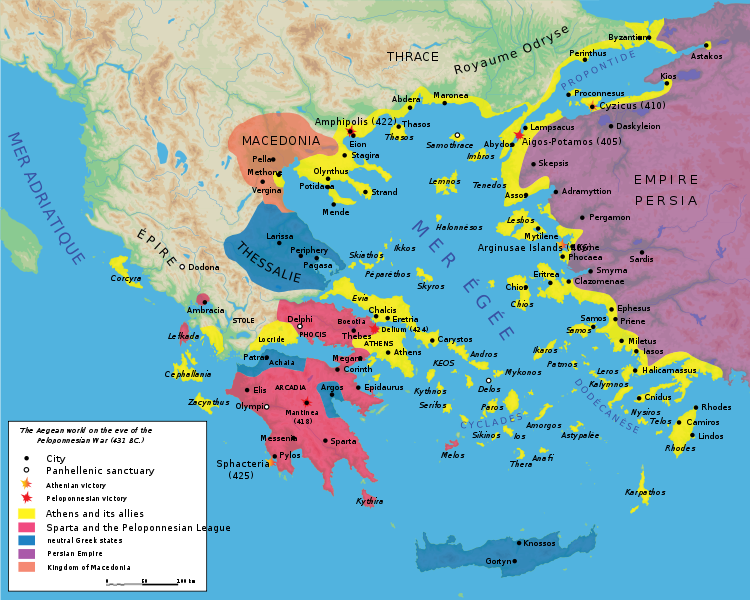
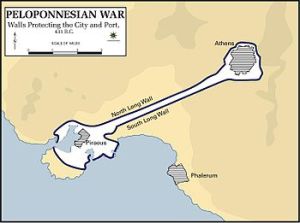
Many events leading up to the Peloponnesian War helped increase tensions between Athens and Sparta.  I never ascribe to theories that make certain events “inevitable,” but given the history between two of Greece’s pre-eminent powers, war was probably a better than 50-50 bet as tensions between them increased in the mid-5th century B.C.  Athens’ decision to build walls around the interior of the city and its harbor clearly added to these tensions.

I had always interpreted Athens’ decision in almost entirely military terms.  The Persians sacked their city in 480 B.C., and the Athenians recovered it only after a last stand naval battle in Salamis.  The psychological and physical scars of that event would naturally lead to a desire for more defense.

Naturally such an action strained things between Athens and Sparta.  Athens had a great navy, Sparta had its infantry.  Each could hurt the other in its own way, a kind of ancient application of “M.A.D.”  Now, Athens could hypothetically hurt Sparta or its allies without worrying too much about the consequences.  As great as Sparta fought in open battle, they had limited abilities in siege warfare.  Athens could remain safely behind the walls of Athens.  You could see the walls of Athens as a first strike weapon, one that allowed them to sally forth with Sparta not able to retaliate in kind.  So too, when President Reagan proposed his SDI “Star Wars” defense, many believed the invention would create a more dangerous world, not a safer one.

Peter J. Fleiss’ book Thucydides and the Politics of Bipolarity showed me a side of this issue I had not realized before.  Athens’ walls would never have been built without a decisive shift towards democracy in mid-5th century Athens.

Like almost any other place in the ancient world, Athens’ identity came from its landowning farmers.  However, around 600 B.C. the wealthier oligarchs gained an unstable amount of power via the Code of Draco.  At this point, Athens chose a tyrant named Solon to take control of Athens for 20 years, beginning in 590 B.C.  The choice revealed a lot about the Athenians.  Solon had wealth, which earned him the trust of the aristocracy, but . . . he was not an aristocrat, which earned him the respect of the people at large.

Solon embarked on a program to bring social stability back to Athens.  He had to walk a tightrope between competing factions and earned high praise from the ancient world for his reforms. For our purposes here, we note that

  • He refused to redivide land and let the wealthier aristocrats keep what they had acquired from the newly poor.
  • At the same time, he taxed the wealthy at a much higher rate
  • He helped grow a middle class by encouraging the growth of a merchant fleet

The growth of merchants provided a valve to let off social steam.  In addition, many of the city’s poor got jobs rowing the ships.  Solon attempted balance in his reforms, but hindsight shows us that the power of traditional elites was on the clock.

The economic story of Athens ca. 590-450 B.C. mirrors what happened to Rome when she started to shift to a more merchant oriented economy from 200-60 B.C.  Rome’s shift helped to destroy the very elites who profited most from this shift.  The power of elites rests on tradition.  Tradition comes from continuity, and continuity comes from land.  This has been the way of things from the days of yore.  Once cash money, and not land, formed the primary currency, the land-owning elites lost much of their power.

As Athens naval might grew the population shifted to more urban areas.  Of course poorer farmers resided outside the 350px-pelopennesian_war_walls_protecting_the_city_431_b-ccity walls, but we can be sure that the older, established families had most of their land outside the city limits.  This land would be the first target of any invading army.  Building the wall would allow for more protection, but any defensive structure sends a double message.  The Germans, for example, could invade Poland with confidence in 1939 because the Maginot line signaled a purely defensive posture for France along the frontier.  Building the walls around the city signaled that in the event of war Athens would willingly let the majority of its exterior farms fall into Spartan hands–until the war was won, of course.

Popular democracy would be the only plausible political vehicle to accomplish this.  Land of the elites outside the walls would suffer before the merchant class within the city.  In the event of a Spartan invasion, the navy, and the poor who rowed the ships, would rise even more in importance.  Only the navy could then procure food for the city under siege.  When the time came, Pericles proposed this exact strategy.*  At the start of the Peloponnesian War Athens retreated inside its walls and let Sparta have the run of the countryside, while their navy shouldered the military load.

Athens’ walls signaled a cultural shift as well.  Some of the established elites outside the walls were obviously more conservative, and might have had more in common with the average Spartan than the average Athenian inside the city.  The walls repudiated the statesmanship of leaders like Cimon who sought rapprochement with Sparta.**

To me Pericles’ strategy could have the hallmarks of the “tyranny of the majority” problem discussed by so many political philosophers.  Older, elite families lost land, but more importantly, they lost the possibility of gaining status in the war.  In the Greek world, status gave power, not vice-versa.  Pericles’ proposed strategy greatly limited the chances of the landed gentry gaining honor and status via battle, while greatly increasing the chances of the “demos” to gain in both departments.^

The failure of Pericles’ strategy, partly caused by the unforeseen plague that hit Athens, does not prove that democracies need elites.  But their failure in the overall war effort might suggest it.  Solon gained fame, honor, and success by pursuing a political agenda that both rewarded and burdened both the people and the elites.  In the 100 years after Solon left power, Athens went from an also-ran to a major power in the Greek world.  As democracy grew, so too did the people’s opportunities to strike back at their own elite.  They should have resisted the temptation.  As Tocqueville wrote, democracies usually win their wars, but that’s only when they unite against a common enemy.  In Athens’ day the political infighting that began the war lasted only until their situation got desperate.  We can’t measure the effect, but it surely hampered their efforts.  We might wonder if things would have been different if Pericles pursued a military strategy that allowed for participation and honor for both the people and the gentry.

Our recent election saw much ink spilled on the question of “elites.”  Some argued that Clinton is “elite” because of her connections and long political career.  Others argue that Trump is elite because of his wealth.  Whatever your definition, “elite” has become a dirty word.  That’s a shame, because history tells us that healthy democracies need, and perhaps even embrace, their “elites.”

Dave

*Thucydides argues that such a strategy would have worked had the Athenians had the discipline to stick with it.  This comment has always perplexed me for three main reasons: 1) At some point the Athenians would have had to deal with the Spartan infantry, and a policy of withdrawing behind walls would only embolden the Spartans, 2) The Athenians did have patience.  They tried this strategy for about 4 years, with no real success.  Initially the Spartans came, burned what they could, and left.  But eventually they realized they could come and stay for much of the year with impunity, because the Athenians never challenged them, and 3) Thucydides shows some disdain for the popular democracy throughout his narrative, and this policy only strengthened the hold of the demos on affairs of state.

**The mood shifted decisively with Cimon’s ostracism.  He father fought and won the Battle of Marathon.  Cimon himself had many noteworthy victories against the Persians.  Everything about “traditional values” pointed to a long and respected career for Cimon.

^This is one reason why I disagree with Thucydides’ assertion that Pericles’ time in power created an aristocratically leaning government with some democratic underpinnings.  Here I agree with Donald Kagan that Periclean democracy was really fully democratic.

Politics Make Strange Cities

I am republishing this based on a brief, but interesting article I read about Cairo, with info and links inserted below . . .

************************************************************************

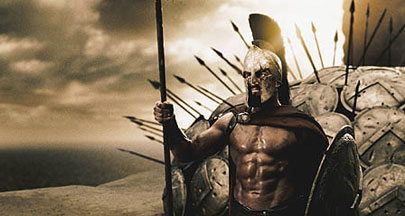
The ancient Persian Empire usually doesn’t get the credit it deserves.  I reflected on this as my son read the graphic novel 300.   I give the book credit for its entertainment value and reasonable historical accuracy.  But at one point the story declares that in fighting Persia, the Spartans fought to preserve freedom and the light of truth and reason.  This strikes me as an almost dangerous absurdity, considering that the Spartans enslaved a native population and practiced infanticide, among other horrors.  The Persians built their extensive empire largely on the back of tolerance (note the praise for Cyrus the Great from the prophet Isaiah), pioneered some legal improvements, and often paid even their lowliest workers.  One can root for the Greeks against the Persians, as I do, but not quite for the reasons given in 300.

The Persians also are interesting case study in the building of cities.  As a people they originated in the mountainous Iranian plateau, but as their empire spread, Persian natives found themselves far afield from their native climate.  How could they hold their rapidly expanding empire together?  I already mentioned the legal and philosophical approach, but they matched this by having three distinct capital cities scattered in different parts of their empire.

Only Ecbatana, their summer capital, had any proximity to their place of origin.  It made sense to make it their summer capital as it lay further north.  But they gave Susa prominence in the South by making it the final/first stop on their royal road, and they willingly went further south still to Persepolis for symbolic purposes.  Having three different capitals demonstrated the broad-minded, inclusive approach of the Persians.

The very flexibility that allowed them to grow so quickly, however, proved a double-edged sword.  Being Persian came to mean nothing more than having a better economy — in other words — very little about Persia touched the soul.  When Alexander invaded between 333-323 B.C., many willingly and easily switched allegiances to him.

I admire Persia’s feat of flexibility.  No capital city today could “move” to a new location every few months.  We have far too much bureaucracy to achieve that.  Also, they “walked the walk” as well as talked.  They said they were inclusive, and they demonstrated this “on the ground.”  But Persia’s story begs the question of whether or not one can invent history on the fly, whether one can “create out of nothing” a culture and a way of life.  I touched on my skepticism about invented cities in this post, and the reasons for the failures of St. Petersburg to lead Russia are quite similar to Persia’s ultimate demise.

Cairo is about to attempt an experiment not unlike Persia.  With their population growth outpacing their geography, they plan to build a massive “New Cairo” directly adjacent to the old city to serve as Egypt’s capital.

Ordinarily I might think this a fool’s errand, but Egypt has gone through several distinct historical phases and may not quite have a distinct identity in the modern era.  Maybe, just maybe, this could work (read more here).

America has some similarities to Persia, especially lately with our emphasis on tolerance.  Again, there are many worse things to be known for, and besides, I think being “American” involves more of an inner identity than Persia ever had.  But, we, like Persia, invented our capital city, and we might inquire how that has worked out.

Like Persia, we picked the location of our capital for purely political reasons.  Tradition and geographical position probably pointed to Philadelphia as the best choice.  But, despite a lack of clarity on exactly how we ended up making the decision, it appears that we decided on Virginia both to help them ratify the Constitution and perhaps to honor Washington, Madison, Jefferson, etc.  To build the buildings we had to clear a swamp and import people into it the city from outside.  The transience of the D.C. area has to do with military and government turnover, but has its roots in the fact that most everyone in the region originally got imported. Their homes lay elsewhere.

Thus, D.C. never had a history of its own. It had to be invented, and history has to “happen”–it can’t be invented.  So while New Orleans has Bourbon Street, Memphis has Beale Street, New York has Harlem, D.C. has K Street, where lobbyists and bureaucrats cut a rug.  Not exactly the stuff of legend.

As Toynbee pointed out in Cities on the Move, no city worthy of the name can sustain itself.  It has to import the necessities of life, but evens out the balance sheet in other ways.  All capital cities, for example, export law and national directives.  But one also hopes that they might export some sense of cultural identity, some sense of “soul” for the nation (with the caveat that it need not dominate, but only add flavor).  D.C. will never be able to do this, and we should not expect it.   The town got created out of nothing purely for the function of exporting administration, and a leopard can’t change its spots.

It is a shame that all D.C. can export is bureaucracy, but our invention of the capital does testify to our inherent flexibility as a nation.  Our lack of attachment to History itself has given us the ability to adapt quickly to challenges and allowed individuals in every generation to make of themselves what they will.  The question for the future remains whether or not the lack of cohesive cultural and historical identity will ultimately hurt us as it hurt the Persian Empire 2500 years ago.

Song of Wrath

For years now I have wondered how many books actually get published.  In the Christian book world every year, for example, books on prayer, grace, parenting, and so on tumble off the shelves each year.  Those I glance at sound almost exactly the same.  Of course it’s no business of mine that books are published, but nonetheless, I am surprised.

The same phenomena exists in the world of history as well, perhaps especially in ancient history. Here we deal with limited sources and unsure timelines, and so it seems that one can say only so much.  When dealing with the Peloponnesian War I thought that we had reached our limit.  The advent of archaeology and the concomitant renewed interest in the ancient world in the late 19th century begot groundbreaking history on ancient Greece. This all culminated, I thought, with Donald Kagan’s masterful four-volume work published in the 1960’s-70’s.  Having read portions of those books, I thought that the final word had been uttered.  Victor Davis Hanson’s uneven A War Like No Other, and Nigel Bagnall’s  disappointing book on the conflict proved to me that indeed Kagan had the last word. Now saying anything else would put one in an awkward position . . .

Or so I thought.

After all, in any field we should encourage new books because we have to encourage new ways of thinking.  Maybe 90% of what gets published never need see the light of day but that 90% might be needed to get the 10% that shines new light just where it’s needed.

Enter J.E. Lendon, Virginia’s own spirited iconoclast, and his new book Song of Wrath.

Every student of the Peloponessian War rightly begins with Thucydides, and he impresses immediately with his penetrating analysis and fluid arguments.  He talks little about what would be for us, the curiosities of ancient life (commonplaces to them of course), and instead focuses on what moderns would tend to appreciate.  For Thucydides, practical power politics and universal psychological principles explained the war.  But Lendon points out that the very fact that Thucydides has to argue for his point of view shows that he departed from traditional ways the Greeks understood conflict.  He did not reflect, then, a typical Greek understanding of the war.  This does not mean he was wrong, but it means that we must wonder if this great authority spoke rightly.  In the end, Lendon admirably challenges some of Thucydides’ key beliefs and conclusions.

Lendon begins his work by discussing Achilles.  The Iliad begins with a seemingly petty dispute between Agamemnon and Achilles over who has the right to a captured slave-girl.  Agamemnon pulls rank on Achilles and takes Achilles’ woman which leads Achilles to withdraw from the fighting altogether.  Most every modern reader inevitably views Achilles as a total heel, a petulant jerk who would rather see his companions die than accept Agamemnon’s decision, however unfair it may be.  And yet Achilles, not Agamemnon or Odysseus, remained for centuries a revered hero of the Greeks, nearly worshipped by such luminaries as Alexander the Great.

How can this be?

Lendon uses this as a window into what the Greeks valued and how they structured their world.  Once we see the great value they placed on rank and honor, we understand the reasons for the war, and the reasons for certain strategies pursued by both sides much more clearly.  Achilles earned his reputation by sacrificing all to the Greek concept of honor.  We know that he sacrificed long life for glory in battle for starters, but he also willingly defies his king and his friends to preserve his honor.  He reenters the conflict not when his honor receives satisfaction, but when his friend Patroclus dies.  When Achilles fights  he does so not for Agamemnon, but to revenge Patroclus, another key Greek concept.  After slaying Hector, Achilles goes too far and succumbs to hybris.  He drags around Hector’s body and initially refuses burial.  For this, he suffers ignominious retribution in the form of an arrow from spineless Paris. But — he had a magnificent run before he ran aground, and that’s what mattered most.

If we understand honor, revenge, and hybris, Lendon argues, we will understand the Peloponnesian War.

Some might suppose this to be a mere gimmick, but I found this lens suddenly made sense of things that had always puzzled me.  Take the strategy of Athens’ star politician Pericles in the wars earliest days.  Thucydides records Pericles arguing that,

[Sparta’s] greatest difficulty will be want of money, which they can only provide slowly; delay will thus occur, and war waits for no man. Further, no fortified place which they can raise against us is to be feared any more than their navy. As to the first, even in time of peace it would be hard for them to build a city able to compete with Athens; and how much more so when they are in an enemy’s country, and our walls will be a menace to them quite as much as theirs to us! Or, again, if they simply raise a fort in our territory, they may do mischief to some part of our lands by sallies, and the slaves may desert to them; but that will not prevent us from sailing to the Peloponnese and there raising forts against them, and defending ourselves there by the help of our navy, which is our strong arm. For we have gained more experience of fighting on land from warfare at sea than they of naval affairs from warfare on land. And they will not easily acquire the art of seamanship; even you yourselves, who have been practising ever since the Persian War, are not yet perfect. How can they, who are not sailors, but tillers of the soil, do much? They will not even be permitted to practise, because a large fleet will constantly be lying in wait for them. If they were watched by a few ships only, they might run the risk, trusting to their numbers and forgetting their inexperience; but if they are kept off the sea by our superior strength, their want of practice will make them unskilful, and their want of skill timid. Maritime skill is like skill of other kinds, not a thing to be cultivated by the way or at chance times; it is jealous of any other pursuit which distracts the mind for an instant from itself.

The Athenians, Thucydides, and the ancients who commented on the war all approved of Pericles’ strategy, which the above quote outlines in bare detail.  Essentially Pericles wanted to make Athens an island by bringing the population within its walls and refusing to fight the Spartans on land.  Then, with their superior navy they could ravage the Peloponnesian coasts.  Most moderns, on the other hand (myself included) have thought little of his approach.  At best it appears a recipe to avoid losing rather than actually winning.  At worst, it’s a passive strategy guaranteed to give all the advantages to the other side.

Lendon argues that we misunderstand the strategy because we misunderstand the Athens’ war aims.  Athens did not care about imposing their will on Sparta, or finding their “center of gravity” (a la Clauswitz) so much as they desired equal rank with Sparta.  Sparta had the rank of “hegemon” in the Peloponnese, Athens sought hegemon status in Attica and thus, equal status with Sparta in the Greek world.  Sparta will ravage our lands, but we can ravage theirs as well.  We don’t need a “shock and awe” response because we strive not to prove our absolute superiority, but our equality.  Besides, the Athenians would wish to avoid the hybris of seeking something beyond their station. They contented themselves with equality, follow the unspoken rules of war, and avoid the wrath of the gods.*

Armed with this perspective, suddenly other aspects of the war made sense to me. Before I criticized Athenian coastal raids for wasting time and resources to achieve purely symbolic results. This led me to make broader conclusions about the vacillating nature of democracies at war.

Lendon argues of course, that honor and rank have everything to do with symbolism. The Athenian coastal raids had nothing to do with “imposing their will” or tactical advantage, and everything to do with displaying status.  So Lendon’s work not only entertained me, it has forced me to reconsider most of my lesson plans for teaching the war.  Grudgingly . . . I give Lendon my thanks.

Does any of this new analysis have a modern application in war?  Some have suggested that 3rd-world warfare resembles many of these “traditional” concepts of honor and symbolism, and that we must abandon all the Cold-War principles that guided our statecraft.  Some argue that acts of terrorism have a lot more to do with symbols of honor than tactical advantage. I cannot comment on this as I lack the knowledge to do so.  But I do think we see a lot of the same principles in our modern political scene.  Democrats and Republicans both press for legislation that will give them “honor” in their districts or with their national following, and often this legislation has mere symbolic value.  Both sides too can obstruct purely for reasons of status, or to refuse honor to the other side.  Some might argue that this is part and parcel of any democracy.  If so, we will need to redefine our definition of democracy, and accept that at least in its modern context, it has little to do with Christianity. It may bear much more direct similarity to our pagan democratic ancestors, and to the song of wrath sung in ancient times . . .

Sing, goddess, the anger of Peleus’ son Achilleus
and its devastation, which put pains thousandfold upon the Achaians,
hurled in their multitudes to the house of Hades strong souls
of heroes, but gave their bodies to be the delicate feasting
of dogs, of all birds, and the will of Zeus was accomplished
since that time when first there stood in division of conflict
Atreus’ son the lord of men and brilliant Achilleus. . . .

*In Kagan’s great work he comes close to understanding this.  He addresses the modern puzzlement over Pericles’ strategy by pointing out that the Athenians essentially voted for it on multiple occasions and kept it going even after a plague struck their city  In other words, he points out that the strategy surely made sense to them and they must have thought it effective for their purposes.  Lendon argues that after a few years, Athens could have made a legitimate argument that they had won and proved themselves.  The problem with such conflicts lie in that they need interpreted, and Sparta did not interpret events as the Athenians did.  So the war continued, and in time ended with defeat for Athens in a way no one could misconstrue.

8th Grade: Cyrus and the Medo-Persian Empire

Greetings,

This week we began our next civilization, Medo-Persia, and began the story of the origin of Cyrus the Great as told by Herodotus.

There are those who dispute the story’s accuracy.   It does resemble in some ways the stories of both Moses and Paris of Troy.  We can trust the Moses story, but we need not immediately discount the Cyrus story merely for that it resembles the story of Moses. The story of Paris seems to reside in myth and folklore, but again, this should not immediately preclude the veracity of the Cyrus story.  These are interesting questions to ponder, and I don’t know if we can find absolute answers.  What it obvious is that it is a great story.  If you ask your children about it, I’m hoping they can retell it to you if you would like.  You can find it in full online in Herodotus’ Histories in Book 1, beginning in chapter 107.

The Persian Empire had its flaws, but did most things right and represented a vast improvement over the Babylonian, and especially the Assyrian empire.  Some of this had to do with historical coincidence, but a lot of it had to do with the values and practices of Cyrus, the empire’s founder.

Some things to note. . .

1. Cyrus arose to power at a time when no other dominant power dominated the ancient Near East.  Egypt had been on the wane for some time, Assyria was destroyed, and the Babylonians had lost their former shine.  Thus, Cyrus was able to expand by slowly incorporating smaller kingdoms into his realm, without a major challenge posed by any other empire.

2. I think the biggest factor, however, was Cyrus’s foreign policy/diplomacy.  According to Herodotus, he set the tone during his usurpation of the Mede King Astyages.  Cyrus was half Mede, half Persian.  Conquering the Medes in the traditional sense would have meant conquering himself.  He spares Astyages and integrates Median and Persian alike.

Cyrus used this same model for most all of his conquests.  He wanted expansion, but he also strove for incorporation and integration.  He tolerated a variety of customs and religions.  You got the benefits of security and participation in Cyrus’s growing network of trade and prosperity.  Very little about your daily life would change. True, the former king would be exiled to a distant palace, but Cyrus tried to promote from within.  He might use local lesser magistrates to rule in his stead.  In class I put it this way: If Cyrus conquered the U.S. he might exile the President and V.P., but perhaps promote the Senate Majority leader and Secretary of State.  He would create loyalty to himself by this, because those promoted would owe their position to him.  The transition of leadership would be softly felt by the locals.

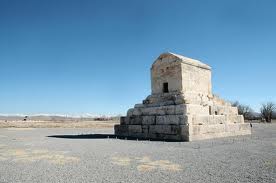
It could be said that Cyrus positioned himself as a ‘liberator,’ and not a conqueror.  He could somewhat truthfully pledge that you would be better off under his dominion.  Slavery came close to disappearing in his realm.  The only thing he asked in exchange was that your army get attached to his and you pledged your loyalty to his person.  He succeeded like few others, and we will not see such effective empire builders until we look at Rome.  One sees something of his personality and humility in his surprisingly simple tomb.

This method of course differed significantly from others that we have seen so far.  One tremendous benefit of this method was that it appears that the Persians had far less slavery than previous civilizations.  As we progress, however, we will see that the splendid machine known as the Medo-Persian empire did have an Achilles heel. What, after all, did it mean to be Persian?  Can an empire’s identity revolve only around economic advantage and efficiency?  The other possible weak link was the army.  This was the one sticking point in an otherwise tolerant (at least for the time) regime.  They mandated and enforced military participation throughout their empire.  This army grew so huge and so multi-national that it might conquer merely by showing up.  But what held the army together?

The history of Persia will in some ways revolve around this question, as we shall see in the weeks to come.


Dave


The Best Reason for Democracy is . . . Democracy?

Several years ago I read an article where the man interviewed had positive things to say about some developments in Italian democracy.  “The people are now ready to criticize and poke fun of their leaders,” he commented.  “We’ll know we have arrived as a democracy when the people can criticize themselves.”  At the time I read this, I thought, “Good for you, Italy.  One day you may join us.  We’ve got something better here.”  But upon reflection, I’m not so sure this is true.  How many politicians, for example, could get away with criticizing the American people?  How many political documentaries create a divide between us and them, whether they come from Rush Limbaugh or Michael Moore?  It always appears to be “their” fault, never “our” fault.

Judgments about one’s own society, however, are tricky.  To see the nose on one’s face you need a mirror.  Without significant experience of democracies on a historical scale, the example of Athens from 508-338 B.C. will always prove important for us to get our bearings.

Writing critical assessments of things or events can be more fun than offering praise. Critical people can sometimes come from a distant and cynical spiritual place, and we shouldn’t give much weight to their comments.  Sometimes, however, criticism arises out of love, and this should grab our attention.  Loren J. Samons’ What’s Wrong with Democracy does this.  He seeks to get past our modern adulation of democracy, and thus, our adulation with classical Athens.  When we examine them afresh, he argues, we won’t always like what we see.  In his criticism Simons sometimes overreaches and sometimes seems to contradict himself.  But his book is, as historian J.E. Lendon stated, “cleansing.”

Amidst the various topics Samons discusses, I think the essence boils down to the following question:

What is democracy really about after all?

Christopher Ferrara tackled this question head-on in his book Liberty: The God the Failed.  Samons takes a more indirect approach, but still feels that democracy, standing by itself, may lead to little more than a means to perpetuate whatever we happen to desire.  The only reason we will have for democracy is . . . democracy.

He looks at Athens’ financial history and its relationship to democracy.  He traces a few distinct stages:

  • An early phase where the ‘tyrants’ got overthrown and the franchise expanded.
  • The heralded Periclean phase, often seen as the high-point of democracy.  But Samons points out that this phase of democracy was made possible only by 1) Their silver mines, and 2) The imperial tribute they received from their client states.  The practices we tend to admire about them, such as paying people to attend the Assembly, and large cash payments for their very large juries (101-501) people, could happen only because of their predatory practices abroad.
  • The era after the Peloponnesian War, where they lacked the cash reserves of earlier times, but refused to modify their practices.  This led to serious financial problems and hard choices for the Athenians.  Yet, when faced with the task of defending themselves against Macedon or continuing to vote themselves cash payments, they consistently chose the latter.

Perhaps the Athenians didn’t just simply make bad choices, perhaps the kind of democracy they practiced would naturally encourage them to make bad choices.  If democracy is all about “serving the people” or “giving the people what they want,” then democracies will inevitably choose to short-term gains and quick fixes.  Salmons wrote his book before our own failure to arrive at a budget, or to either 1) Decrease spending, or 2) Raise taxes made itself manifest. Is our own system of government equipped to make hard choices?  Given how we consume energy, we may also have to conclude that our democratic lifestyles have a predatory aspect.

Samons’ next points out that in Athens, their more aristocratic past provided a healthy check on democracy.  Having a different past gave them a compass from which to orient their democratic practice.  It could also serve as a reminder that democracy need not serve as the be all and end all of political life.  In America we have no such check, which leads us to nearly worship democracy as a vital part of our existence.  This in turn, has led to a confused and misguided foreign policy.  On a couple of occasions Athens even voted to switch to a more aristocratic oriented governance, which Samons views as healthy.  In time, Athens banned any alternative to their democracy, and this choice contributed to their eventual conquest by Macedon.  They refused to allow any other method of making decisions, even when they methods they employed to make choices had no real hope of facilitating good outcomes.

On this issue Samons has weaker arguments.  True, I very much wish that we would appreciate democracy because it is ours, instead of investing it with angelic qualities. But the political instability in Athens from 411-400 B.C. was not always as smooth as Samons lets on.  Political exiles and political murders came with such transitions. Having the alternative to democracy came at a price.

However, if a democracy has no reference point outside itself, we should consider whether it may be worth the risk to have such an alternative.  Currently we have no particular ‘North Star’ of religion or virtue to guide our own political practice, and this will lead to everyone scrambling for whatever they can get. We may be in a position now where we could really benefit from a distinct alternative to borrow from, to get some separation from democracy that we might understand its strengths and weaknesses more clearly.  If we have no firm moral guidelines derived from a common faith, the check on democracy may have to come from other viable political ideologies and practices.  Of course such an alternative is entirely unthinkable in our modern context. This may bode ill for us.

This lack of an outside reference point for many modern historians  impacts how they view ancient critics of Athens.  Invariably, whether the ancient chronicler be Thucydides, Xenophon, Socrates, or the “Old Oligarch,” they get discounted due to their “aristocratic bias.”  Now, naturally all historians have bias — even democratic ones. But we cannot dismiss them for this bias alone, however uncomfortable their conclusions may be.  Perhaps the the extreme form of democratic bias comes in the form of the book by I.F. Stone on the trial of Socrates. I applaud Stone for his enjoyable and Herculean efforts to partially exonerate Athenian democracy while writing about one of its great crimes.  His book rises to the level of a  great counter-factual history.  But in the text Stone spills a lot more ink discussing Socrates’ “aristocratic bias” then in blaming the governmental system that executed him unjustly.

Critics of Salmons conclusions have two good points.

Salmons offers some good criticisms of Athens in particular and democracy in general. But he proposes no alternatives.  What does he want?  Would he prefer a monarchy or a dictatorship?  I grant this makes the book somewhat unsatisfying, but I can’t fault him for it.  To develop a viable alternative with historical and philosophical backing would require another book.

More problematic is Salmons’ seemingly simplistic take on the problems Athens faced. Surely he realizes that other forms of government have their problems too?  Yes, Athens had issues, but exactly how much blame can we put for their problems on democracy?  Would their problems have been less with a monarchy?  He can say that Athenian democracy made bad decisions, but kings make bad decisions, oligarchies make bad decisions, and so on.  For his book to really work he would have to show that democracies will make more bade decisions, or more catastrophic decisions, then other forms of government.  He fails to do so.

Even still, these flaws don’t bother me that much.  Salmons modestly set out to 1) Give a more balanced picture of Athenian democracy, and 2) Pour some cold water over our ardent devotion to democracy.  He succeeds, and this makes his book worthwhile.

Machiavelli is at various turns a cold man, a dangerous man, and a wise one.  Below I include a section from his Discourses on Livy where he discusses the merits of Rome’s Republic building into its foundation an alternative to the Republic when necessary. This, I think, was Machiavelli in one of his wiser moments.

Dave

Book XXIV

Those citizens who first devised a dictatorship for Rome have been
blamed by certain writers, as though this had been the cause of the
tyranny afterwards established there. For these authors allege that the
first tyrant of Rome governed it with the title of Dictator, and that,
but for the existence of the office, Cæsar could never have cloaked
his usurpation under a constitutional name. He who first took up this
opinion had not well considered the matter, and his conclusion has been
accepted without good ground. For it was not the name nor office of
Dictator which brought Rome to servitude, but the influence which
certain of her citizens were able to assume from the prolongation of
their term of power; so that even had the name of Dictator been wanting
in Rome, some other had been found to serve their ends, since power may
readily give titles, but not titles power. We find, accordingly,
that while the dictatorship was conferred in conformity with public
ordinances, and not through personal influence, it was constantly
beneficial to the city. For it is the magistracies created and the
powers usurped in unconstitutional ways that hurt a republic, not those
which conform to ordinary rule; so that in Rome, through the whole
period of her history, we never find a dictator who acted otherwise than
well for the republic. For which there were the plainest reasons. In
the first place, to enable a citizen to work harm and to acquire undue
authority, many circumstances must be present which never can be
present in a State which is not corrupted. For such a citizen must be
exceedingly rich, and must have many retainers and partisans, whom he
cannot have where the laws are strictly observed, and who, if he had
them, would occasion so much alarm, that the free suffrage of the people
would seldom be in his favour. In the second place, the dictator was not
created for life, but for a fixed term, and only to meet the emergency
for which he was appointed. Power was indeed given him to determine by
himself what measures the exigency demanded; to do what he had to do
without consultation; and to punish without appeal. But he had no
authority to do anything to the prejudice of the State, as it would have
been to deprive the senate or the people of their privileges, to subvert
the ancient institutions of the city, or introduce new. So that taking
into account the brief time for which his office lasted, its limited
authority, and the circumstance that the Roman people were still
uncorrupted, it was impossible for him to overstep the just limits of
his power so as to injure the city; and in fact we find that he was
always useful to it.

And, in truth, among the institutions of Rome, this of the dictatorship
deserves our special admiration, and to be linked with the chief causes
of her greatness; for without some such safeguard a city can hardly
pass unharmed through extraordinary dangers. Because as the ordinary
institutions of a commonwealth work but slowly, no council and no
magistrate having authority to act in everything alone, but in most
matters one standing in need of the other, and time being required to
reconcile their differences, the remedies which they provide are most
dangerous when they have to be applied in cases which do not brook
delay. For which reason, every republic ought to have some resource of
this nature provided by its constitution; as we find that the Republic
of Venice, one of the best of those now existing, has in cases of urgent
danger reserved authority to a few of her citizens, if agreed among
themselves, to determine without further consultation what course is to
be followed. When a republic is not provided with some safeguard such
as this, either it must be ruined by observing constitutional forms,
or else, to save it, these must be broken through. But in a republic
nothing should be left to be effected by irregular methods, because,
although for the time the irregularity may be useful, the example will
nevertheless be pernicious, as giving rise to a practice of violating
the laws for good ends, under colour of which they may afterwards be
violated for ends which are not good. For which reason, that can never
become a perfect republic wherein every contingency has not been
foreseen and provided for by the laws, and the method of dealing with it
defined. To sum up, therefore, I say that those republics which cannot
in sudden emergencies resort either to a dictator or to some similar
authority, will, when the danger is serious, always be undone.

We may note, moreover, how prudently the Romans, in introducing this new
office, contrived the conditions under which it was to be exercised.
For perceiving that the appointment of a dictator involved something of
humiliation for the consuls, who, from being the heads of the State,
were reduced to render obedience like every one else, and anticipating
that this might give offence, they determined that the power to appoint
should rest with the consuls, thinking that when the occasion came when
Rome should have need of this regal authority, they would have the
consuls acting willingly and feeling the less aggrieved from the
appointment being in their own hands. For those wounds or other injuries
which a man inflicts upon himself by choice, and of his own free will,
pain him far less than those inflicted by another. Nevertheless, in the
later days of the republic the Romans were wont to entrust this power to
a consul instead of to a dictator, using the formula, _Videat_ CONSUL
_ne quid respublica detrimenti capiat_.

But to return to the matter in hand, I say briefly, that when the
neighbours of Rome sought to crush her, they led her to take measures
not merely for her readier defence, but such as enabled her to attack
them with a stronger force, with better skill, and with an undivided
command.

Impress Imbalance

I encourage my students to play, “Would you rather?” games, i.e., “Would you rather eat 500 live ants or 1 live cricket?” Often questions like this involve no specific moral quandary, but the practice of creating and defending mental hierarchies has great value, even when such hierarchies are relative. Comparing civilizations has something of the apples/oranges dilemma, I admit. And reigning cultural relativism tells us not to judge. But I believe that the mental process involved in deciding whether Greece was better than Rome, or in this case, whether or not Egypt has the leg up over Babylon, helps bring clarity and meaning to the study of history–even if one should hold on loosely to these kinds of distinctions.

Many have used various criteria for evaluating civilizations, such as how long they last, the power they accumulated, their technology, and so on. I think a better lens involves us seeing how each civilization aligns itself with the reality of creation–with the patterns and Truth found in the created order, available for any with eyes to see.

Henri Frankfurt’s Kingship and the Gods gives us more than a rundown of Egyptian and Sumerian/Babylonian kingship. He seeks to integrate religion and politics not just with their history, but also the geography and the general patterns of living from both cultures. He reveals his method early in the introduction, writing,

Mesopotamian society was entirely adapted to the cyclic succession of the seasons.  While each winter resolved its harshness in the spring and the plague of summer was succeeded by autumn rains, human society moved through a succession of seasons in which humanity joined in of the cosmic crisis of life, death, rain, and drought.  The [Babyonian] sees a dramatic conception played out in nature between the divine and the demoniac, between forces of order and chaos.

The most important seasonal celebrations in [Babylon]  centered around the bewailing of the death of Tammuz and his rebirth on the New Year–his victory over death  and his sacred marriage to the mother-goddess.

Egypt, too, reflected the natural rhythm of the seasons in the course of the official year.  But their celebrations differ profoundly in character from those in Babylon.  In the plain of the two rivers, the festivals were never free from anxiety, and those which we know best show a change from deep gloom to exaltation.  In Egypt, festivals provided the occasion to affirm that all was well, for Egypt viewed the universe as essentially static.  Revolts against the established order happened, but never got classified as anything more than a few ripples under the surface.

The rich Nile valley lies isolated and protected on both sides by a vast desert, while Mesopotamia lacks clear boundaries and was periodically assaulted on its fringes by mountain tribes.  Egypt derived its prosperity from the Nile, which never fails to rise, even if the floods differ in effectiveness.  But Babylon depended on uncertain rainfall and  the Tigris was an unaccountable, turbulent, and dangerous river. 

Some might then conclude that religion means nothing more than a natural phenomena, though Frankfurt himself does not suggest this.* Rather, Frankfurt wants to integrate our vision of each society–to see Egypt and the Egyptians as one and not many. When we pull back and see the integrated whole of a civilization, the impression they leave comes into greater focus.

If I had to choose between Egypt and Babylon, I would likely choose Egypt, but one of their key weaknesses lay in their failure to appreciate the feminine aspects of creation and experience. Nearly every religion I am aware of sees creation as essentially feminine, Christianity included. As C.S. Lewis commented, we all stand as essentially feminine in relation to God. All in the Church, whether man or woman, are the “bride” of Christ. Various pagan beliefs have “Mother-goddesses,” whereas Christianity might talk of “Mother Earth” in a slightly more abstract way, as St. Francis did in his “Canticle of the Sun.” Egypt had no “Mother Earth”–for them the earth itself was not even feminine. The idea of power had strong play in Egyptian thought, and so rather than the traditional “receiving and transforming” aspect of Earth, the Egyptians saw supreme power in the male diety of Ptah or Geb. In some creation stories, Ra stands on the Primeval Hill to create, again over-emphasizing the male aspect of reality. Apparently Egypt did not want creation to have any derivative existence.

Most every religion, including ancient Israel, had harvest festivals of some kind. Nearly all of these festivals focus on the idea of death, the earth receiving death, and then having that death transformed into life. Harvest festivals connect us with birth and new life, and so highlight feminine aspects of life in general. A proper conception of this pattern must allow for three days in the tomb, so to speak. So in Greece, as elsewhere, the seed could be identified with the king (think of Mary Renault’s classic, The King Must Die), who “dies” for the people to give them grain. No grain comes without the earth receiving and transforming the seed. But things were different in Egypt. Yes, the king ceremoniously started the harvest by cutting a symbolic stalk, but the forgoing ceremony emphasized that he was the wheat which went up to the cloud, not the chaff that fell to earth. Frankfurt comments that,

All we know of the Egyptians shows they would have found [a festival centering on the death of the seed] distasteful. They did not readily admit the shadow side of life, perhaps on hedonistic grounds, but also because, in their static conception of the world, grief had no [place].

We see this in the Egyptian harvest prayers, i.e.,

Osisris is Unas in the mounting chaff

His loathing is the earth;

He has not entered Geb to perish.

He is not sleeping in his house (i.e., tomb) upon earth

So that his bones may be broken.

His hurt is driven out!

He has purified himself with the Horus Eye.

Unas is up and away to heaven;

Unas is up and away to heaven

With the wind, with the wind!

A Christian might be tempted to see here a foreshadowing of victory over death in the resurrection. Perhaps an aspect of that exists here, but along with Frankfurt I extend a word of caution–even God Himself “submitted” to the pattern of first going down before rising up. The Egyptians seemed to want to short-circuit the process. A Christian might think of something akin to banishing “worldly sorrow”–something the Babylonians struggled mightily with–but they should have remembered that “blessed are those that mourn,” and that it is usually our moms that take pity on us when we scrape our knee or need visited in the hospital.

This same imbalance shows in their depictions of royalty. Certainly every society has a hierarchy and kings might naturally be depicted in some outsized way to show his importance. But in Egypt, one often sees only the king, as in this relief of the conquests of Thutmose III:

Tuthmosis III smiting his enemies, the Cannaanites, at the Battle fo Megiddo from the north wall of the Great Hypostyle Court, Egypt. Ancient Egyptian. New Kingdom 18th Dynasty, 1473 BC. Karnak. (Photo by Werner Forman/Universal Images Group/Getty Images)

If we compare this to how Babylon depicted one of its greatest kings, Nebuchadnezzar a contrast immediately becomes evident:

and

I have mentioned a few times above that Christians should be cautious in interpreting Egypt’s religion in an overly Christological manner. Now, I offer the same caution to women in general. Some might look at certain aspects of Egyptian belief and celebrate that even the feminine earth has been raised to the level of the masculine sky. But in fact Egypt did not raise the feminine up–they (mostly) abolished the feminine aspects of reality from their experience.

Most every traditional belief system sees the following pairings:

Masculine

  • Strength
  • Vertical Hierachy
  • Steady/Unchanging

Feminine

  • Compassion
  • Togetherness
  • Protean

This “exchange,” this relationship between these two different aspects of reality, help form healthy civilizations just as they form healthy families. Historian Kenneth Clark noted when guys and gals are separated too stridently for too long in social situations, the level of discourse tends to decline in both camps.

The history of Egypt, perhaps akin to the history of China (of which I know much less about) could plausibly show forth this pattern of the elimination of feminine qualities. In his A Study of History Toynbee makes the case that after the pyramids, Egypt tightens and “freezes up.” Much of Frankfurt’s religious analysis comes from this post-pyramid era, and the evidence shows an exaggerated desire to eliminate all variability, all doubt and grief, from their way of life. Such an attitude surely helped contribute to their failure when confronted by Moses.

Babylon shows us the opposite problem–too much of the archetypal feminine. As Frankfurt aptly points out, the stately nature of Egyptian geography shows a direct contrast to that of Babylon. Women go through more changes overall than men**–this is neither a virtue or vice–and so a civilization that over-emphasized feminine qualities would tend towards too much change, and not enough solidity. This shows up in Babylonian creation mythology, with its constant conflict and shifting alliances between different gods. It arises in their depictions of the goddess Ishtar, sometimes shown wearing a beard. Aristocratic Babylonian men followed the trend in their religious beliefs and may have engaged in cross-dressing, and so on.

Other manifestations of this imbalance show up:

  • Coronation rituals for Babylonian kings took place in the temple of Ishtar, and their royal insignia came from the goddesses “Lady of the Crown,” and “Lady of the Scepter.”
  • Frankfurt suggests that, while obviously Egypt and Babylon had various religious festivals, Babylon had more festivals that “required” everyone to participate at the same time in unison–it is the mom who generally wants to have everyone home for the holidays, etc.
  • In Egypt, water was effectively tamed. For the Babylonians, “the ways of water are devious. It avoids obstacles rather than conquering them, goes around and yet gets to its goal.” Traditional religions always associate water with the feminine, and we see something of the “mystery of Woman” (guys are not that mysterious) in Babylonian views of water.

For clarification, I am not here suggesting that any of these things are good or bad per se. The question is more of emphasis.

One sometimes hears silly things such as, “If only women were in charge throughout the world then there would be no wars, and everyone would love each other.” But Babylon had an empire as well. And Babylon for biblical writers became (along with Egypt), an archetypal tyranny, albeit with some different manifestations than that of Egypt. I have written elsewhere of the possibilities of feminine tyranny, and will not rehash that here. In Egypt’s case, the excessive emphasis on order “naturally” called forth the chaos of the 10 Plagues. For Babylon, the undue emphasis of the market, of change and flux, of possibility, inevitably called forth excessive order–it is no coincidence that Babylon produced the world’s first known extensive code of law and punishment.

Ancient Egyptian and Babylon societies show us that masculine and feminine “gods,” when freed from proper relationship with the other side, become demons.

Dave

*I would not say that Egyptian and Babylonian religions were false because of this either. Obviously, a Christian would say that such beliefs had deep flaws, while at the same time one can affirm the aspects of the Truth that they professed. Occasionally, a skewed religious belief can at times show forth an aspect of Truth in a more compelling fashion, as they give it undue emphasis in the wrong place. Still, all in all, I think the key problem of pagan religions was their inescapable imminence of the gods. The undue focus on imminence leads to a narrowing, an entrapment of sorts, a tautology. You see this today whenever an argument is based on the fact that, “It’s 2021.” In other words, whatever we happen to be doing must be right because we are in fact doing it–the ethics of imminence. One is inevitably influenced by our surroundings, including our geography. We should not be trapped by it, to be excessively determined by it.

**I think it fair to say that puberty involves more changes for women than men. Marriage involves more change for women. Women obviously go through a lot of change in terms of conceiving and giving birth to children, and then, menopause, and so on.

8th Grade: Babylon’s “Ball of Confusion”

Greetings,

This week we began our look at Babylonian civilization.

Babylon had many things going for it.  They were the quintessential cosmopolitan city of the ancient world.  Their geography funneled trade, cash, and resources towards them.  Much of ancient learning concentrated itself there.  This would be a city in general more tolerant, vibrant, and diverse than most other cities in the ancient world.  I hope that the students remember our examination of the geographical influence of all of this.  ‘Cosmopolitan’ cities throughout history have to be accessible, which usually puts them in relatively flat areas near water.  One thinks of New York, London, and Los Angeles as examples.  Of course, such cities not only need favorable geography, but they need to be accessible and open-minded culturally as well.  Geography can bring you to water, but can’t make you drink.

But enormous cracks in the foundation lay below the surface.  Babylonian creation accounts paint a bleak picture: Ultimately things “come to be”  because of chaos and confusion amongst the gods.  Unlike in Genesis 1, creation had no intentionality or design behind it.  Nor can we say that the “good” gods triumphed over evil.  Rather, one side simply emerged as the stronger.  This impacted Babylonian thought in several ways:

  • Humanity is an afterthought that exists to be manipulated by the gods
  • Stability and order are generally absent (a stark contrast to Genesis 1).This chaos spilled over into other areas.
  • Sin, at root, was not your fault, as you could be ‘jumped’ by malicious spirits (jinn) who would lead you down the wrong path
  • Ishtar was their major goddess – goddess of love and marriage but also war and prostitution.  She was again, a goddess, but was often depicted with a beard.  The ambiguity was reflected in the statue of her to the side, which shows her as a warrior showing quite a bit of leg for an ancient goddess.
  • Not surprisingly, this gender confusion spilled over into society, as Herodotus tells us of the fad among society’s elite for cross-dressing
  • Not surprisingly, Babylon was known for its immorality, and notorious for its rampant temple prostitution, among other things.

A society where so much is left to chance is bound to try and find a way to explain it all, and this may have led to the Babylonian passion for dream interpretation.*  A whole list of possible dreams and their meanings was drawn up, but this did not necessarily help.  One tells us that if you dream that you eat meat you will have a son.  Later, it says that if you have meat in a dream you will not have a son.  How could one know the truth?

Or perhaps, with the mysteries of the universe completely unknowable, one might stop looking and settle for the ‘eat, drink, for tomorrow we die,’ philosophy.  It is any surprise that Babylon is conquered in Daniel 5 as they are partying?  Perhaps we might also surmise that Babylon’s endless possibilities led in the end to boredom.  We looked at this famous Babylonian text,

Babylon’s View of Life: “The Dialog of Pessimism,” (M stands for Master, S for slave)

M “Slave, agree with me!”

S “Yes, my lord, yes!”

M “I will love a woman!”

S “So love, my lord, love!

The man who loves a woman forgets want and misery!”

M “No, slave, I will not love  a woman!”

S “Love not, my lord, love not!

Woman is a snare, a trap, a pitfall;

Woman is a sharpened iron sword

Which will cut a young man’s neck!”

M “Slave, agree with me!”

S “Yes, my lord, yes!”

M “Straightaway order me water for my hands,

I will make a libation to my god!”

S “Do my lord, do!  As for the man who makes a libation

To his god, his heart is at ease;

He makes loan upon loan!”

M “No slave, I will not make a libation!”

S “Make it not, my lord, make it not!

Teach the god to run after thee like a dog.”

M “Slave, agree with me!”

S “Yes, my lord, yes!”

M “I will give money to my country.”

S “So do, my lord, so do!

The man who gives money to his land,

His alms have been put in the palms of the god

Marduk himself.”

M “No, slave, I will not give alms to my land!”

S “Do it not, my lord, do it not!

Look upon the ruined mounds of

Ancient cities and look around;

Behold the skulls of those of earlier and later times.

Who is the evildoer, who is the benefactor?”

M “Slave, agree with me!”

S “Yes, my lord, yes!”

M “Now then, what is good?

To break my neck and thy neck,

To fall into the river — that is good!”

S “Yes my lord.  Who is tall enough to reach up to heaven;

Who is broad enough that he might encompass the earth?

M “No slave, I will kill only you — you go first!”

S “But, you my lord, would not last three days after me!

Or consider this collection of Babylonian proverbs, which speak similarly:

Without relations, she conceived!  Without eating, she became fat!

When I labor, they take away my reward.  When I increase my efforts, who will give me anything?

The strong man is fed through the price of his hire, the weak man through the price of his child.

My feet keep walking, my knees do not tire, yet a foolish man pursues me with sorrow.

Am I not a thoroughbred steed?  Yet I am harnessed with a mule and must draw a wagon.

I dwell in a fancy house, yet some clay pours over me (i.e., the roof leaks).

The life of the day before yesterday is that of any day.

You are placed in a river and your water at once becomes stinking; you sit in an orchard and your fruit becomes bitter.

Will ripe grain grow?  How do we know?  Will dried grain grow?  Who can tell?

Very soon I will be dead.  Let me eat, drink, and spend.  Soon I will be well.  Let me save for later!

You go and take the field of your enemy.  The enemy comes and takes your field.  

The fox had a stick with him.  He asks, “Whom shall I hit?”  He has a legal document.  He asks, “Whom shall I challenge?”

No agreement can be reached when the women talk without ceasing.

Into an open mouth, a fly will enter!

The horse, after he had thrown his rider, lamented, “If my burden be like this always, soon I shall be weak!”

The dog understands: “Take it!”  He does not understand.  “Put it down!”

As I mentioned in class, in studying Egypt, Assyria, and Babylon–in that order–is not so much chronological but thematic in purpose. In Egypt, we see a self-contained, stable culture that highly valued stability and balance. With Assyria, we saw a culture that was ‘self-contained’ and homogeneous to a certain extent, but who highly valued movement. With Babylon, we have a a creation account that demonstrates chaos, and a geography that maximizes diversity. Each set of circumstances and beliefs creates different kinds of civilizations.

And–as long as we have ‘confusion’ as our theme, who can forget:

https://www.youtube.com/watch?v=5HjUxggPd6E

Many thanks,

Dave

Revel in the Differences

I have noticed that it seems almost impossible for us to view the medieval period on its own terms. We work this out for almost any other civilization. The period has come under attack in two separate eras, from two different directions. First, we had the period from the late Renaissance through perhaps the end of the Cold War. This attack took the form of 1) Reason instead of “superstition,” and 2) Science over faith, and the like.* Today we see a neo-pagan revival, which has its manifestations in areas of culture such as Bronze Age Pervert, The Northmen, Bernard Cornwall/Netflix’s The Last Kingdom, and The Legend of Redbad. The basic theme of all of them centers around the strong reality of the pagan gods and practices, and the cruelty, venality, femininity and emptiness of Christianity.**

I think a variety of reasons exist for this critique. As I wrote here, one of them involves the idea of the awkward uncle vs. the stranger at Thanksgiving. Maybe your mom invites someone you don’t know to Thanksgiving dinner, a friend or co-worker. They may be great or interesting people, or not. Either way, it matters little. They are not “family,” so they inspire little emotional reaction. Having no attachments to us, we have no stake in how they act. But many of us have encountered the “crazy,” awkward Great Uncle. He’s family, so he gets an invitation, though some groan at the prospect. Maybe his mannerisms or his comments alienate people around him.

The unexpected guest might act obnoxiously as well, but the uncle inspires a much stronger reaction because of his family connection. Most people think he’s annoying and crazy. But maybe a few people think, “No–he’s the sane one–the rest of my family is crazy. Uncle Bill is great!” Those that love Uncle Bill, they tend to love the Middle Ages when they meet.

We have a strange connection to the Middle Ages. They are not nuclear family to us, but neither are they someone’s friend from work who shows up randomly. They are the Great Uncle. We can view civilizations like that of Egypt and China as a new guest at dinner. Showing hospitality to strangers has a universal history. But the awkward family member, i.e., the Middle Ages, gets a different treatment. We can argue and get mad at family, or passionately defend them. We wouldn’t do this with a guest. Some, for example, who seek to appreciate and praise the medievals get called fascists on Twitter. It’s Twitter, sure, but even on Twitter no one would call those who love ancient Chines or Meso-American civilization fascists.

Modern politics in the U.S. today has this same problem. True–many can see something recognizably American about both the guy in the loud oversized pickup with accompanying gun rack, and in the guy drinking a latte admiring the art in the Guggenheim. But . . . very likely neither of the two subjects in question will see this about the other. The Red State guy knows the Blue State guy is technically American, but he looks weird, and that’s unnerving, off-putting, bizarre. It inspires a gut-level horror reactions for both sides. As we have stopped mixing with each other, as technology and other factors allow us to narrow our scope, our fellow Americans increasingly look like the weird Great Uncle at Thanksgiving, though the Red and Blue guy would both show perfect politeness to a guest from Japan.

Jean Francois Revel was a French intellectual who pulled off the unusual feat of liking and defending America during the Cold War. He wrote How Democracies Perish not so much to praise America, however, but to express outrage and incredulity at other European intellectuals and politicians. Much of the book shows how the European press, and European governments, tended to commit a kind of suicide by showing much more suspicion, and less trust overall, to the Americans instead of the Soviets. He cites numerous examples of this with various press releases and newspaper articles regarding different aspects of Soviet and American actions. He compares European treatment of America’s involvement in Vietnam (quite harsh), with the Soviet invasion of Afghanistan, which many other Europeans of Revel’s class described as regrettable, but an understandable reaction against American ambition and aggression. He shows how the European press soft-pedaled the Cambodian genocide, but jumped down the throats of America when we failed to cooperate fully (according to the journalists, at least) with the Soviets on missile reduction.

Smart, sarcastic, old, Frenchies always provide a certain pleasure. Revel delivers the goods. But I think he misses something in the explanation of why this happened, and fails to expound on perhaps his most pertinent and brilliant insight.

As to what he misses in his explanation for Europeans’ attitude towards America, I present the ‘Uncle at Thanksgiving Dinner’ theory. We Americans come off as boorish, too loud, too simple, too whatever for many European sensibilities. But, we’re also clearly a chip off the old block. So that means that we come in for more criticism than those outside the family. Russia, China, Cambodia, . . . they have never been family to Europeans.^ This covers things only partially, I admit, but Revel looks almost entirely at the facts of the difference and mostly leaves off the reasons for it.

Revel’s best insight comes in the beginning of the book. He writes,

Democratic civilization is the first in history to blame itself because another power is working to destroy it.

. . . It follows that a civilization that feels guilty for everything it is and does and thinks will lack the energy and conviction to defend itself when its existence is threatened. Drilling into a civilization that it deserved defending only if it can incarnate absolute justice is tantamount to urging that it let itself die or be enslaved.

This condition has not always existed in America in Europe. But it did seem to grow as we grew more democratic.

Athens after Marathon in 490 B.C. started to show supreme confidence in itself. We see this in a variety of ways, in its literature, its innovations, etc. and this manifested itself in increasing democratic reform. On the eve of the Peloponnesian War, Athens went to war over what many would consider a trifle with the Megaran Decree, over the perception of whether or not they had bowed to Sparta or not. I’m not sure the Greeks would have thought this a trifle, but the point stands. They had great confidence and a thin skin.

Athens lost that war, but a curious thing happened. Their defeat ultimately failed to slow the progress of democracy. Athens may have been more democratic in 350 B.C. than in 450 B.C. I believe that much of the same trappings of democracy existed as in the Periclean era, but the aristocratic tradition which had moderated democracy, giving them an alternate framework to use (as well as the thin skin of the aristocrat) had no more presence. Phillip of Macedon in the 340’s B.C. provoked Athens just as much if not more than the Spartans in 430’s. Yet the Athenians responded much more tamely, much more “politely,” to Phillip than they ever did to Sparta.

Many might point to Athens’ great material prosperity, and then argue that this made them soft. Victor Davis Hanson I believe makes this argument in his book about the Peloponnesian War. This can explain some things, but not the whole picture. Athens had a great deal of wealth in the 430’s, perhaps more proportional wealth vis a vis other city-states than in later decades. This wealth gave no hindrance to their supreme confidence and a bullish imperialism. Likewise, England’s wealth ca. 1880 did nothing to curb their global dominance.

We may miss the fact that Athens’ democratic ethos had grown stronger since the advent of the Peloponnesian War. I believe that the technical Periclean structure had not changed much, i.e., they still had the same voting rights, jury pay, and so on. But they had “addition by subtraction”–the gilding of an aristocratic ethos that still lingered in the 5th century gave Athens an alternate framework to think with. It also gave them the confidence–and thinner skin–associated with aristocracies. But by 350 B.C., that aspect of Athenian life had departed, leaving them with an unvarnished democratic ethos.

Revel points out multiple examples of the following dynamic in Europe, which mirror that of Athens in the 4th century B.C.:

  • Europeans declare that NATO should avoid unduly antagonizing the Soviets
  • The Soviets do something antagonizing, such as clamp down on Poland, or invade Afghanistan
  • Europeans insist on a muted response, to avoid antagonizing the USSR any further.

This leads, naturally enough, to a weak foreign policy. Finding explanations in grand cultural and geo-political terms has great value. But I prefer bring issues into a smaller more human lens. With this above dynamic, the Europeans practice a kind of excessive politeness.

This is also pretty good.

Good manners should produce magnanimity and humility for those who practice them, and a deferential ennobling for those on the receiving end. But the excess of this virtue works against itself, creating slavishness on one side that likely will produce a prideful dominance on the other.

The main virtues of democracies involve

  • Openness, an openness to the ideas of others, and a belief that the clash of multiple perspectives will give rise to the truth, and related to this,
  • Inclusion, and the erasure of differences between people, a necessary bulwark of equality.

The problem comes when these virtues, not ultimate in themselves, get extended to a point where they lose their meaning. Those who practice inclusion with no discrimination . . . we call them prostitutes.^^. In such situations, one dies of the flood, where too many things converge, and so we lose distinctions and coherence.

This poses a difficult problem for us. We can see that in eras when western civilization had less democracy (in good and bad ways), say, ca. 1870-1914 we had much more energy, dynamism, and confidence. This resulted in a host of good and bad things–our era has both as well. As we grew more democratic (in good and bad ways) the virtues of inclusion could transform into slavishness. It is impossible to have it all. I am not criticizing democracy, only pointing out that as a political system, it has strengths, weaknesses and limits. It has not come to save us.^^^

Revel shows us that democracies weaken themselves by gorging on democratic virtues. inviting a newcomer to Thanksgiving dinner can have the paradoxical effect of keeping the family together. As George Harrison said, inviting Billy Preston to help them record Let it Be meant that the Fab Four had to be on their best behavior. But . . . invite the whole neighborhood and the identity of the family disappears. To preserve themselves, democracies should temper their virtues, for at their limits these virtues turn to vices.

Dave

*I recently rewatched Bill and Ted’s Excellent Adventure, that renowned 80’s classic. Our heroes go back in time to get greats from the past so they can pass their history class and eventually create universal harmony through glam rock. Everywhere they go back in time, they bring back greats from the past, including Greece, China, and so on. When they get to the medieval period, it’s all darkness, gloom, and people screeching about heretics. They have to rescue two “maidens” from that period forced into marrying some crusty old barons–there is nothing to preserve, nothing to bring back from the Middle Ages. In the movie it serves only as something to escape from. When the two “babes” are brought back into the modern era as part of their rescue, they are un-ironically introduced to the joys of credit cards and shopping malls.

**Albert Mohler has a great line which he uses on those who disparage aspects of the evangelical religious right: “If you don’t like the religious right, wait until you see the irreligious right.” By that he means not your typical agnostic libertarian, but the Neo-pagan worshippers of blood, soil, and violence.

It is interesting that such a revival would occur at a time when culture in various ways seems feminized. I would say that problem is not only Uber-femininity–though that is part of it–but also the reverse. In our culture today, the only way for a female character to be the hero is for her to act like a man, to be as tough, strong, as comfortable with killing, as a man. We have very little sense of the power of the true feminine virtues.

^How then to explain Europe’s current position with Russia as the ultimate enemy once again? Well, I know the ‘Uncle’ theory is incomplete–that’s a start. Also, there is the natural affinity with the underdog at work. But I think also that we went through a period between ca. 1985-2010 or so, that we started to think of Russia a bit more like family. Then, they “betrayed” the west and “reverted to form.” Europe will not forgive them for this.

^^Note how certain strands of feminist thought have turned completely against women. Most early feminists stood strongly against pornography and objectification of women. Now, some take the idea of supporting women so far that they declare “Sex work is work!” and demand equal respect for women who choose those “professions.” No one ever said that it wasn’t work. Objections to such practices had nothing to do with the definition of work.

^^^Democracy may not be my favorite form of government, but that is not the point. I wish that defenders of democracy would focus much less on arguments that it is better than other forms, whether or not such arguments hold weight. I wish we focused more on the fact that whatever its virtues and vices, democracy is our way of life and thus worth something because it is ours. This way of thinking has its limits too. Family is not absolute either. But it is a more solid foundation that debating democracy in the abstract.

8th Grade: The Definition of Collapse

Greetings,

This week we very nearly wrapped up Assyrian civilization.

Last week I mentioned our look at Assyria’s religion and the concept of ‘Imperial Overstretch’ as factors in Assyria’s decline.  This week we considered Assyria in light of Christ’s words to Peter and the Apostles, ‘Those who live by the sword die by the sword.’

In a fallen world, force can have a legitimate place in government.  But both from a historical, moral, and political perspective, force can never be the foundation for order.  Force can gain acceptance, or have legitimacy, if people see it as an extension of justice.  But when a power uses force detached from justice, people sense that they use violence merely to serve their own selfish ends.  This inspires them to seek justice/revenge, and this is why violence apart from justice is a wasting asset.

All of the problems Assyria faced they brought upon themselves.  They treated subject populations brutally out of a combination of a) religious belief, and b) policy that sought the quickest route towards “getting everyone in line” with their conquests.  But as their power grew, the attention they could give to subject territories lessened, which reduced their chances of stopping rebellions.

Eventually too, their obsession with violence and conquest would be bound to turn back on themselves.  After Ashurbanipal II completed the conquest of the fertile crescent, (which left nothing for the next guy) Assyria descended into civil war (having no one left to fight but themselves).  Simultaneously, they faced rebellions from a few major provinces, which mean that they faced a dire crisis from within as well as without.  They had nothing left on which to stand, and collapsed completely within a few short years.  Regarding their incessant militarism and addiction to violence, Toynbee comments,

The loss and misery which Assyria inflicted on her neighbors is beyond calculation, and yet the legendary remark of the schoolmaster to the boy he is whipping–‘It hurts you less than it hurts me,’–would be a pertinent critique of Assyrian military activities. . . .  The full and bombastic Assyrian record of victories abroad is significantly supplemented by rarer and briefer notices of troubles at home that give us an inkling of the price at which Assyrian victories were purchased.

An increasing military strain revenged itself with increasing frequency of palace revolutions and peasant revolts.  As early as the close of the second bout of aggression in the ninth century B.C. we find Shalmaneser III dying in 827 B.C. with his son on the war-path against him, and Ninevah, Asshur, and Arbela in rebellion. . .

Toynbee goes on then to cite rebellions in 763, 760, and 746, and ca. 730 B.C., and then he continues,

After this the two streams of domestic stasis and foreign warfare merge into one; after Ashurbanipal’s death this swells into a mighty river whose rushing waters bear Assyria away to her now inevitable doom.  During the last years of Assyrian history the domestic and foreign aspect of Assyria’s disintegration are hardly distinguishable.

Can a civilization be rooted entirely in a frontier mentality and lifestyle?  Assyria was located on the ‘frontier’ of Mesopotamian civilization.  Like many frontier people, they could be inventive and self-reliant.  But their beliefs, their foreign policy led them to conquest ‘a outrance’ as the French say.   Assyria’s attacks against Babylon come with an animosity that a farmer in West Virginia might feel for Manhattan investment bankers.  But frontiers need a home base, and with this attack, Assyria was cutting off its face to spite its nose.  The arm which held the sword stabbed the heart.  Without Babylon, Assyria suffered much in the same way that the West Virginia farmer would suffer.   Without the banks, where would be the corporations to buy the food they grew?  If they always looked outward, could they build a solid cultural foundation on which to rest?  While some aspects of Assyria’s cultural heritage can be disputed, no one would doubt that in comparison to Egypt, Babylon, and Persia, Assyria’s cultural output was quite low.  Their architecture, art, and literature all were inferior to their neighbors.

In the end, Assyria contributed heartily to its own demise.  I quote now from Ashurbanipal II, the last great king of Assyria, who wrote as he saw things crumbling around him:

‘The rules for making offerings to the dead. . . which had not been practiced, I reintroduced.  I did well unto god and man, to dead and living.  Why have sickness and misery descended upon me?  I cannot away with strife and dissension.  Misery of flesh and mind oppress me.   Death is seizing hold of me. With lamentation and mourning I wail day and night.  O God wilt thou deal thus with me?  Even as one who has not feared God and Goddess I am reckoned.’

Historian Arnold Toynbee comments,

‘This confession is  . . . moving in its sincerity and in its bewilderment, but above all illuminating in its blindness. When this mood overtook him, did the last of the Assyrian war-lords never find himself reciting that terrible catalogue of cities sacked and people’s wiped out by Assyrian arms — a list which concluded with his own sack of Susa and annihilation of Elam?’

One sees a complete lack of self-awareness on Assyria’s part.  It’s as if they erased their conscience through centuries of systematic cruelty.  They reveled in their conquests and never questioned their actions, celebrating them in their meager artistic achievements.

Next week I will update you on our investigation of Babylon.

8th Grade: He Who Lives by the Sword. . .

Greetings,

This week we looked at Assyrian civilization.  Their meteoric rise was surpassed only by their complete and total destruction at the hands of several enemies.  What made them who they were?

We first looked at their geography. . .

1. Assyria began in the north of the Fertile Crescent, in one of its less fertile areas, nestled in mountains towards the fringe of that region.  We discussed how people who live in mountainous regions tend to display similar characteristics.  Necessity might force them to rely on hunting.  They grow to be tough and adaptive, and generally warlike, with built in mistrust of foreigners due to their relative isolation (think Afghanistan).  Assyrians had similar characteristics.

2. Their geography may have lent impetus to their expansionist desires.  These tough, warlike people were generally surrounded by more wealthy civilizations that might have been a bit ‘softer’ than the Assyrians.   Nomadic civilizations (those that have to/choose to follow ‘the herd’) can never be as wealthy as more agrarian civilizations, for they can never stay in one place long enough to produce anything.  Perhaps they could not resist all they saw around them.  Perhaps after a while, jealousy and envy took hold.

Then we looked at their army . . .

1. Mountainous regions generally are not as populous as other places, but the Assyrians managed to create a brilliant militia force.  Without the mass of other armies (nomadic hunting oriented civilizations inevitably have smaller populations) they had to rely on speed and movement.  But their citizens, used to hunting, would have been used to moving, tracking, and outwitting their prey.

In class I compared their army to the new ‘Blur Offense’ in football popularized by the University of Oregon.

2. The Assyrian army was a lightning fast ‘light infantry’ force, overwhelming their opponents by swift and brutal assaults.  Of course the makeup of the army impacted their foreign policy, which

  • Usually did not emphasize diplomacy.  They could not integrate their conquered foes into their army (think about how the effectiveness of a Navy Seal platoon would be diminished by adding army regulars into their ranks).
  • So – how do you hold onto your territory?  The Assyrian army was not generally interested in occupation. They wanted movement.  If ‘you are what you worship,’ we would expect the Assyrians to use terror as a weapon, and so they did.  My guess is that the students will remember the various forms of torture and death the Assyrians inflicted if you are curious enough to ask them.
  • With the conquered cowed into submission the Assyrians could move on.  We looked at Paul Kennedy’s concept of ‘Imperial Overstretch,’ when size becomes a disadvantage as opposed to an advantage.  Clearly the Assyrians suffered from this, for as we discussed, fear is a wasting asset.  It tends to be a very effective short term, but disastrous long term policy.

Some of you may remember the boxer Mike Tyson, and I think he is a good representation of the Assyrian army.  Tyson was almost always the smaller man in the ring, outweighed and outreached by his opponent.  But his lightning speed confused his opponent, and he hit with such devastating force that he surely “ruled by fear” over his foes.

The students had fun with excerpts from these clips in class.

Then we looked at their religion. . .

The Assyrians were polytheistic, but tended to emphasize the worship of their war god Ashur.  Ashur demanded blood, as the Assyrians obliged, presenting large amounts of the severed heads of their enemies at worship services.  Interestingly, apparently the most common way of representing Ashur was on his winged disc, which hearkens back to the dominance of movement in Assyrian civilization.

For this coming week we will continue to see connections between Assyria’s religion, army, and foreign policy.  For them, as for all of us, “you are what you worship.”
Thanks so much,
Dave

Janus

Machiavelli inspires polarizing reactions. I find that often that initially I immediate reject his idea, largely because there is something I don’t quite trust about him. But, just as often, I end up rethinking my initial reaction and revising my thoughts.

One such instance happened for me reading Machiavelli’s assertion that republics must have their foundation with one man, writing in the Discourses (I.9),

But we must assume, as a general rule, that it never or rarely happens that a republic or monarchy is well constituted, or its old institutions entirely reformed, unless it is done by only one individual; it is even necessary that he whose mind has conceived such a constitution should be alone in carrying it into effect. A sagacious legislator of a republic, therefore, whose object is to promote the public good, and not his private interests, and who prefers his country to his own successors, should concentrate all authority in himself; and a wise mind will never censure any one for having employed any extraordinary means for the purpose of establishing a kingdom or constituting a republic. It is well that, when the act accuses him, the result should excuse him; and when the result is good, as in the case of Romulus, it will always absolve him from blame. For he is to apprehended who commits violence for the purpose of destroying, and not he who employs it for beneficial purposes.

Machiavelli often engages in this kind of paradoxical thinking, i.e., “if you want peace the ruler must sometimes be cruel,” and so forth. As his logic applies to republics, he argues that concentration of power in the hands of one initially will allow for the spreading out of power later.

America’s history seems to contradict this–don’t we have founding fathers, and anyone who knows anything about them sees a multitude of disagreements about various important ideas about what they wanted. And yet, America has managed reasonable success as a republic for 250 years. But before rendering a judgment here, I realized that two of history’s most famous republics, Athens, and Rome, had foundations in one man–Theseus and Romulus.

The stories of two men, as told by Plutarch and other sources, agree in certain general particulars, especially in regards to their uncertain parentage. Both functioned as kings in their respective realms, but neither ruled as king’s in the sense that we might assume in our modern context. It seems that both functioned primarily as religious leaders and as military commanders primarily. Later, both Athens and Rome underwent significant political changes contemporaneously in the years 509/508 BC. But Rome and Athens had many differences, reflected in the lives of Theseus and Romulus.

We can chart the differences between Athens and Rome

Athens

  • Attached to water–their key lie in their navy
  • As they had roots with water, they were active in trade
  • We see this physical movement linked with significant intellectual exploration–they basically invent modern concepts of science, philosophy, literature, etc.

Rome

  • Attached to land–their key lie in their infantry
  • Ringed round with their famous seven hills, Rome remained devoted to land and agriculture. They disdained trade.
  • This rootedness to place has its echoes in Rome’s intellectual conservatism, espoused most fully in writing by Cato the Elder. Rome’s main contribution to future civilizations would be in law, i.e., how people in the same community relate to one another.

When one looks at the lives of their so-called mythical founders, we see striking parallels. Theseus hardly could keep his feet still, roaming from one place to another, never truly even settling in Athens. He had a variety of women that he “married”/grew familiar with. We moderns would diagnose him with wanderlust. Athens’ narrative seems to me to always involve something beyond Athens, the next colony, the next discovery, the next idea or theory.

Romulus founded the city of Rome and stayed there. Plutarch has much good to say of him, but with no sugarcoating–many found him a “hard” man. He gained glory through military exploits on land against Rome’s neighbors. Rome always made the narrative about Rome itself.

Though an Athenian by birth, Plato thought little of Athens’ legacy. In The Republic Socrates continually affirms conclusions that limit movement–we shouldn’t move jobs, we shouldn’t trade, we should limit too the “movement” of our souls by restricting the kind of music we listen to. In The Laws Plato writes,

Athenian Stranger. And now, what will this city be? I do not mean to ask what is or will hereafter be the name of the place; that may be determined by the accident of locality or of the original settlement-a river or fountain, or some local deity may give the sanction of a name to the newly-founded city; but I do want to know what the situation is, whether maritime or inland. 

Cleinias. I should imagine, Stranger, that the city of which we are speaking is about eighty stadia distant from the sea. 

Ath: If the city were to be built at the seaside and were going to be well supplied with harbors but ill-supplied with the necessities of life from the soil, then it would have needed mighty saviors and divinely inspired legislators to escape the moral confusion and moral corruption that are the inevitable penalty of such environments.  

For the sea is an insidious neighbor which makes itself agreeable to the daily interaction [between good soil and good harbors], but is salt and bitter inasmuch as it fills the country with tradesmen’s business, and the souls of the country with deceit, and the body politic with distrust–each seeking advantage over his fellow man and neighboring states.  

These social evils are to some extent counteracted if the soil produces something of everything; and, if it is a rough and highland country . . . it will not be able to do so.  If it could not, it would produce a large export surplus and would attract to itself the equivalent import of gold and silver currency–and that is the greatest moral disaster that can overtake a country.

[As for sea power], it would have profited the Athenians to lose seventy times seven children a year to the tyrant Minos [referring here to the ancient legend of the Minotaur] before turning themselves in defense to a sea power instead of heavy infantry, and so lose the  power of standing fast, acquiring instead the habit of perpetually jumping ashore and then running back to their ships at a run hardly after landing.  

This method of warfare erases any sense of shame at being too cowardly to risk one’s life by standing one’s ground and receiving the enemy’s attack.  It suggests facile and “plausible” excuses for taking to one’s heels–never of course in disorder but always “according to plan.”  

There is nothing so demoralizing for infantry as their allied fleet riding at anchor in their rear.  Why, even lions, if they took to tactics of that sort, would run away from deer.

Cle: Yet all the same, sir–well, what about the Battle of Salamis?  That, after all, was a naval battle, in which the Athenians beat the barbarians, and it is our belief that this victory was the salvation of Greece.

Ath: I know that is the general view . . . But in [my] belief, it was the land battles of Marathon and Platea that were the day-spring of the salvation of Greece and its crowning mercy.  . . . My good friend, I am afraid that the course of my speculations is leading me to say something depreciatory of legislators; but if the word be to the purpose, there can be no harm. And yet, why am I disquieted, for I believe that the same principle applies equally to all human things? 

Cle. To what are you referring? 

Ath. I was going to say that man never legislates, but accidents of all sorts, which legislate for us in all sorts of ways. The violence of war and the hard necessity of poverty are constantly overturning governments and changing laws. And the power of disease has often caused innovations in the state, when there have been pestilences, or when there has been a succession of bad seasons continuing during many years. Any one who sees all this, naturally rushes to the conclusion of which I was speaking, that no mortal legislates in anything, but that in human affairs chance is almost everything. And this may be said of the arts of the sailor, and the pilot, and the physician, and the general, and may seem to be well said; and yet there is another thing which may be said with equal truth of all of them. 

Cle. What is it? 

Ath. That God governs all things, and that chance and opportunity co-operate with him in the government of human affairs. There is, however, a third and less extreme view, that art should be there also; for I should say that in a storm there must surely be a great advantage in having the aid of the pilot’s art. You would agree?

Plato willingly gives a nod to the need for the “pilot’s art.” but concedes to it almost as a result of the Fall, so to speak.

Aristotle saw things differently. One of the quietly “subversive” sections in his Politics comes when he compares the constitutions of Sparta and Carthage and finds Carthage superior. I think some exaggerate the attraction some Greek theorists, including Plato, had for Sparta. But certainly with its minimal trade, almost no navy, and fearsome infantry, Sparta resembled the kind of society Plato wanted in certain respects. Carthage had more in common with Athens, an almost exclusively maritime power that relied on mercenaries for infantry. He writes

The constitution of Carthage is general accounted a good constitution, one that is peculiar in many respects, but the chief thing about it is the likeness . . . to the Spartan. . . . Many of the institutions at Carthage are certainly good. It is a proof of a well-ordered constitution that Carthage, with her large populace, should steadily keep to the same political system: she has had no civil dissensions worth mentioning, nor any attempt at tyranny.

[He then goes on at length to discuss the oligarchic and democratic elements in the constitution, and how it sometimes deviates in both directions. The oligarchic leaning comes based on the election of those by wealth–acquired from trade more often than not].

Carthage has a constitution which is in practice oligarchical; but they avoid the dangers of oligarchy by encouraging the diffusion of wealth [made possible by the constant shifting of goods and money through trade].

I think Aristotle saw that being open like Carthage or closed like Sparta was not the problem. The problems for both soceities would come when they could not maintain that equilibrium. If Sparta started to “move,” as they chose after the Peloponnesian War, it exposed contradictions and tensions within their own culture. They never recovered from their defeat at Leuctra, at the hands of Thebes, of all places. Aristotle wrote around 350 B.C., knowing the fate of Sparta. But Carthage’s problems started about 150 years later. Once Carthage lost the ability to trade and roam at leisure after the 1st Punic War, their days were similarly numbered. They had their first insurrection when, partly due to the changing terms of the Roman treaty, and partly due to the destruction of much of their fleet, they could no longer trade. Without the free flow of money, they could not pay their mercenaries, and one thing leads to another.

It seems that Machiavelli might have been onto something after all. The influence of the founders made a definite imprint on both civilizations. And this draws us back to America. We have a few options:

  • George Washington is our actual founder. He was the point of unity during and after the Revolution, without which–we never would have made it as a country.

On the one hand, we can say that

  • His two terms in office set a clear precedent
  • He embodied a spirit of political compromise, such as using Jefferson and Hamilton in prominent ways in his administration, and
  • We have to admit, his owning of slaves, but then also his freeing of his slaves, may have influenced us in both directions.

But I have doubts. Washington’s life and demeanor seem to have no real influence on the culture of the United States.

We can argue, then, that we have no founder. America is a bumpy ride, carried along by change, and so on. We should stop looking for a center and embrace change for its own sake. But this view to me holds no water. America did succeed in various ways, we grew, we built things, and so on. One can’t do all of this on quicksand.

Or we can assert that we are founded on an idea, or a set of principles, and not on a particular person. This explains or messy founding. And–it explains why the ideas, not limited by time and space, could travel so far so fast, just as we ourselves did across the country. It explains why we disagree so much seemingly about the same thing–the incarnation of the ideas might take different form in different places.

Theseus and Romulus overlap, as do Aristotle and Plato. But in the end we must choose a point of emphasis.

Aristotle, for his part, would have approved of our attempt at a mean between ideas, of commerce and agriculture, of conservative and liberal, and so on. But he surely he too would disapprove of how far the idea of democracy has traveled, for what we call democracy he would have termed mob rule. Plato might approve of our founding in the “purity” of an ideal, but I am convinced he as not as gnostic as some make him out. I think that he would see that ideas rooted only in the mind would cause too much “movement” in our culture. In The Republic, Plato only looked at the state as a means of understanding the souls of real men.

The exact nature of the historical reality of Theseus and Romulus even Plutarch wondered at, and so we in America, built more on history than myth, can extrapolate a bit to find our founder. Perhaps we should name Janus, he who looked in opposite directions. This would explain our ability to move, our ability to always find something accommodating and infuriating all at once in America. Yet in the end, Janus still was one person, and perhaps the good ol’ U.S. of A can remain one as well.

Dave

*Hannibal without question was a brilliant battlefield commander and leader of men. But . . . military men write all of his biographies and hence see things from his point of view. What is needed (if it exists I haven’t seen it) is a biography of Hannibal written by a career politician. Most criticize Carthage’s Senate for not backing Hannibal and going for Rome’s jugular after Cannae. They lament the Senate’s focus on keeping trade open and the money flowing from Spain. But, armed with Aristotle’s thoughts, perhaps the Senators were onto something, consciously or no. Without access to trade, Carthage could not be Carthage, and so would surely collapse, as happened in the 3rd Punic War.

The Mysteries of the Monotheistic Pharaoh

I loved The City of Akenaten and Nefertiti: Amarna and its People. I loved it even though I skipped large chunks of it, and some of what I read went beyond my understanding.  This may sound strange, but Barry Kemp’s work is such an obviously great achievement that it goes beyond whether I like it or not.   All that to say, I do really like the book, and wish I had knowledge and the ability to follow him all the way down the marvelous rabbit holes he traverses.

The book puts a capstone on Kemp’s 35 years excavating the city of Amarna, a city built by Akenaten IV (sometimes known as Ikhneton).  Akenaten has long fascinated Egyptian scholars, mostly because of his religious beliefs.  He departed from the religious beliefs that dominated Egypt for centuries and clearly attempted to change the religious landscape of Egypt in general.  He may have been a monotheist, which adds to the potentially radical nature of his rule.

Differing interpretations swirl around his time in power, as we might expect.  Some like to view him as a great rebel against the constraints of his society.  Some view him as a great religious reformer.  Today, given the overwhelming influence of tolerance, the mood has switched to seeing him as a tyrant and usurper.  I hoped Kemp could help sort out some of these dilemmas.  His book reveals much, and also creates more mystery at the same time.  After reading we get no absolute conclusions.  Usually when authors do this I get frustrated.  But in Kemp’s case, who can blame him?  The historical record is 3400 years old.

But before we get to this, Kemp and the publisher deserve praise for the aesthetic aspects of the book.  It feels good in your hands.  It has thick and glossy paper.  The text and numerous illustrations mesh very nicely.  The book has an almost ennobling quality.  You feel smart just looking at it.

I also have to admire Kemp’s style.  If I had spent 35 years in excavations at Amarna and then wrote a book it would almost certainly have a shrill, demanding tone.  “I spent all this time here and now you are going to look, see, and appreciate it all!”  But Kemp writes in a relaxed, thoughtful manner that seems to say, “Ah, how nice of you to drop by.  If you’d like, I have something to show you.”

So many kudos to Kemp.

But now on to Akhenaten himself.

What was he really trying to do, and how did he try and accomplish it?

Clearly Akenaten wanted something of a fresh start for Egypt.  He moved his whole seat of government and started building a new city called Amarna.  In Egypt’s history this in itself was not all that radical, and other rulers have done something similar, notably Constantine with “New Rome.”  Unlike “New Rome”/Constantinople, however, Amarna appears to be way off of Egypt’s beaten path.  This idea in Egypt means something different than it might for us, as nearly all of life got compressed within a few miles of the Nile.  Even so, Akenaten chose a place rather out of the way by Egyptian standards, perhaps the equivalent of the U.S. making its new capital Des Moines.

Perhaps Akenaten didn’t just want a fresh start, he wanted a totally clean slate upon which to build, free from all outside interference (shot from British excavations in the 1930’s below).

Early Excavations at Amarna

So he was a radical, then?

Perhaps, but in building a city, how radical could one be?  Most cities tend to look like other cities.  He faced limits of resources and experience.  So Amarna looked like most other cities, but a few subtle differences might reveal a lot.

For example, the builders made the entrance to the “Great Aten Temple” much wider than usual temples, so wide that one could not envision doors ever being present.  This may mean nothing other than they ran out of material.  But interestingly, most city-dwellings had this same open feel to it.  In great detail Kemp describes how the houses in the city had few boundaries.  Slaves, officials, and commoners would use the same pathways in and out of the same houses.

Kemp also mentions that the plain of Amarna itself presented itself as very open and flat.

No conclusion forces itself as definitive here.  We can say that,

  • Most places in Egypt had a similar geographic layout to Amarna
  • The houses may have been constructed in an ad-hoc fashion due to lack of resources or time
  • Maybe Akhenaten wanted a really open feel to the front of the Great Temple, but that may not have any particular connection to anything else.  Or maybe they had a plan for very large, ostentatious doors that never got realized.

Or perhaps we should see intentionality in all these elements.  And if intentionality is indeed present, what might that reveal that he really did have a grand vision for real change in Egyptian society.

Another intriguing problem deals with Akhenaten himself.  The most famous statues linked to him and his reign look generally like this:

This one makes him look more thoughtful and perhaps more humanized

Akhenaten

Both statues reveal an intense and thoughtful man, given to much introspection.  Or possibly, obsession?  Kemp points out that the offering tables in the temples stood much larger than those in other standard Egyptian temples.  Was he consumed by an idea, or a Reality?  His faces here perhaps reveal just this.

And yet, it is entirely possible (though far from certain) that he actually looked like this:

What should we make of this?

One possibility is that the last image is not of Akhenaten at all, and this solves the riddle by eliminating it.  But Kemp thinks this last sculpture to be an accurate portrayal of what he really looked like.  I’ll go with the guy who spent his life studying the ruins.

So if he portrayed himself differently than he actually looked, it must have been a propaganda tool of manipulation?

No, Kemp thinks not.  Pharaoh’s often had the moniker, “Lord of the Appearances.”  They would be seen by people often, even commoners.  And this would likely be all the more true in the isolated and not terribly large city of Amarna.  Besides, the statue directly above dates from Akhenaten’s time and surely was “official” and not black market.  Kemp often cautions us not to look for consistency in Ancient Egypt, or at least our modern and Greek influenced sense of consistency.

Kemp suggests that the image Akhenaten projected may have had to do with his role as teacher of righteous living.  Certainly it seems he viewed himself this way, and others did too.  This may not make him a prig necessarily, because it was a role Pharaoh’s often assumed, perhaps as a matter of tradition.  The austere intensity of the first two busts (at least 6 ft. high) help confer the image of a deeply felt inner life that he wanted to communicate.  And since the Egyptians loved visuals more than the written word, his busts carry his theological message.

I didn’t buy the modern, “Akhenaten as a religious tyrant” argument before reading the book, and I think Kemp indirectly argues against this.  For one, we find small statues of other gods in scattered Amarna households.  Their houses were small and the statues of normal size.  Given the free-flowing nature of Amarna neighborhoods, other citizens would easily know about the statues.  For Akhenaten to have no awareness of these gods would mean that he had no secret police, no informants, and this speaks against the possibility of ‘tyrannical rule.’  He almost certainly knew about the gods, and tolerated them, however grudgingly.

Or perhaps he actually wasn’t a monotheist?  But then, how radical could he have been?  Or perhaps he had strong views and wanted wholesale change but approached the issue pragmatically.  Neither option gives us a Stalin-esque tyrant.

Other curious details make me lean away from the “tyrant” position.  Cities designed before Akhenaten had rigid layouts and exacting aesthetics.  But as Kemp writes elsewhere, “Most of this city was built around a rejection of, or an indifference to, a social prescription and a geometric aesthetic.” Instead, “organic harmonies” and “personal decision making prevail instead.”  My bet is that Akhenaten may have been too consumed with his religious ideas to really be a tyrant even if he wanted to.

Akhenaten seems to have had a “smart-bomb” approach to religious reform, at least politically.  His main innovation/change might appear slight to some of us.  The Egyptians depicted their gods in at least partial human form.

But over and over again, Akhenaten depicted himself only with Aten, and in these images, Aten has no quasi-human form.  The sun itself sufficed for him.

And this image from the Aten temple . . .

So perhaps in this area we see clarity of vision and consistency of follow-through, as to what it means, I don’t know.  It fits, though, with his overall theme of simplifying religious belief.

Kemp shows us that Akhenaten worked hard at cultivating the image of a good life at Amarna.  Many wall murals show him as a generous provider and consumer of goods.  Excavations reveal that this may not have been entirely propaganda, but Kemp reminds us Akhenaten reigned during a prosperous and secure time in Egypt.  But in 2006 excavators discovered a series of tombs for commoners that reveal high incidents of early childhood death, malnutrition,or skeletal injury.   This could throw us right back to the Stalinist image some have of him.  But the high incidents of childhood death could reveal an epidemic in Amarna, which would spread rapidly in its densely packed population.  Hittite records tell of a plague that spread from Egyptian prisoners of war during Akhenaten’s time.  As to the injuries, I can’t say whether or not this is typical for when new cities get built.  Akhenaten may have harshly driven the people to work harder and more dangerously than normal, or it may have been par for the course with ancient construction projects.

The insistence on building a new city may reveal an element of monomania, but certainly other pharaohs did the same thing.  The pyramid builders demanded vastly more labor from their people/slaves.  Besides, Akhenaten had many critics within Egypt after his death, but no one blamed him for building a city.  This fit within the normal roles pharaohs played.

Akhenaten likely saw himself as a religious liberator of the people.  I see a man with a purity of vision, but also a pragmatist in good and bad ways.  He possessed great intelligence and valued introspection.  I see him dialoguing with himself, along the lines of, “I want ‘x.’  But the people only know ‘y’ and expect ‘y.’  So I will try and lead to them to ‘x’ through a modified version of ‘y’ — not to say that I hate everything about ‘y’ — just some things.” If I’m right, this  inner wrestling match would lead to inconsistency and confusion in his own mind.  Perhaps he lost his way a bit.  “I must have a nice new city to show the people the greatness of the truth,” or something like that.

Or maybe not.  I wish I knew more.  Akhenaten provides a great template for a historical novel.

Perhaps he went too far, but I do think he had good intentions.  Of course much evil gets done with this mindset.  We all know where the road of “good intentions” leads.  But it’s hard to say for certain what evil he actually did.   But he did seek to remove certain key beliefs about the afterlife.  The traditional Egyptian’s journey to eternity had many perils and thus required many charms, protections, and so forth.  All this gave a lot of power to certain priests.  Akhenaten’s tomb stands in marked contrast to almost all other kings for its simplicity.  Clearly he sought in some ways to “democratize” death in his religious beliefs.  I think that Akhenaten wanted to simplify things in general for the common man.  But then again, his tomb contains other traditional pieces, such as the “shabti” — special figures designed to do conscripted labor in the next life.  So even the intense, focused Akehenaten either conceded to some traditional beliefs or really believed these apparently inconsistent ideas.

The mystery of Akhenaten continues.

We know that his religious ideas more or less died with him, and indications exist that foreshadow this even during his lifetime. Very few people changed their names to reflect the new ‘Atenist’ belief, and this we know from the many tombs in the area.  Had his beliefs caught on the switch in names would have also, as happened at other times in Egyptian history.  The narrative that we naturally accept about his attempt at religious change sounds similar to this text from Tutankamun, who may have been his son.

…the temples and the cities of the gods and goddesses, starting from Elephantine as far as the Delta marshes . . .were fallen into decay and their shrines fallen into ruin, having become mounds overgrown with grass . . .   The gods were ignoring this land.  If an army was sent to Syria to extend the boundaries of Egypt it met with no success at all.  If one beseeched any goddess in the same way, she did not respond at all.  Their hearts were faint in their bodies, and they destroyed what was made.

But Kemp shows that the above text doesn’t reflect the truth.  Akhenaten kept open most all the temples in the land, and left his reforms for Amarna.  And as we’ve seen, he apparently let the worship of other gods go on unofficially even in Amarna itself.  So if Akhenaten engaged in political hocus-pocus (and maybe he didn’t) then at least two played that game.

So by the end of the book we arrive where we started.  But Kemp’s extraordinary archaeological skills take the reader as far as they can go.  From here on, one must take a leap into the realms of poetry, which is where History really belongs.

8th Grade: Elements of the Exodus Debate

Greetings,

Last week we looked at the monotheistic pharaoh Akhenation IV, also known as Ikhneton.  Ikhneton had many distinctive qualities — a most unusual pharaoh.

  • He was a monotheist, a tremendous contrast to the polytheism of his surrounding culture.
  • He likely had only one wife — a significant departure from the usual practice of pharaoh
  • He wrote poetry

The surviving images of Ikhneton are not typical for pharaohs either.  His bust does not exude power, but rather thoughtfulness, depth, and caring.  The image to the right with his family highlights this as well.  Again, as far as I know, for pharaoh’s to depict themselves like this in public was quite unusual.

Where did these beliefs and practices come from?  A few theories exist:

1. He learned them from the Jews, possibly enslaved during his reign.

2. He learned them from stories he heard about the Exodus, which may have happened about 75-100 years before he came to power.

3. Perhaps God appeared to him in a vision.

4. Perhaps he learned it from creation around him.

Did he believe in the true God under a different name?  I wanted to pose the following to the students:

  • Whether or not Ikhneton believed in the true God, he was certainly at least far closer to the truth than his countrymen.  What should he do with this knowledge?  If people don’t believe him, should he use force?  What would the responsibility be of the average Egyptian who agreed with him?  Is Ikhneton responsibility different because of his position of power?
  •  Ikhneton’s project to ‘convert’ his countrymen failed almost entirely.  Why was this?  Can any kind of force ever work in religious matters?  If so, which kind?  What does his failure tell us about the power of tradition.
  • While many historians come down hard on Ikhneteon, we looked at the Book of the Dead to understand exactly what it was that Ikhneton fought against.  Here we see inside Egyptian religion, and are confronted with a maze of charms, spells, and formulas to assure a good afterlife.  I can’t imagine anyone keeping it all straight, and this gave enormous power to the priesthood of their hundreds and hundreds of gods.  Ikhneton did fail, and perhaps went about his project in the wrong way.  But Egypt remained trapped in a religion that gave enormous power to the priesthood.

In this way, Ikhenton’s story can have meaning for our own day.  We too need to consider the strengths and weaknesses that come whenever religion is associated with law.

We also looked at the Exodus.  As Christians we can have confidence that the Exodus was an historical event, but there is not a great deal of evidence within  Egypt itself to support it.  Some modern scholars use this as evidence against the Exodus, but we discussed in class why Egypt might want to “cover-up” such events.

An interesting possibility involves the presence of the Hyksos in Egyptian history.   The word “hyksos” can apparently mean either “foreign invader,” or “foreign dweller.”  Egyptologists propound different theories as to their identity, with some believing them to have been occasional foreign invaders, others foreign immigrants.  A couple of curious details, however, may link the Hyksos to the Exodus:

  • The dates given for the Hyksos presence in Egypt correspond roughly to the time span the Israelites spent in Egypt (ca. 1800-1300 B.C.)
  • Many Hyksos names appear to be semitic in origin
  • Many debate whether or not the Hyksos coexisted peacefully or not with Egyptians.  But if their co-existence was sometimes peaceful, sometimes not, that would fit the Exodus narrative.

I am intrigued by the theory that suggests that the Hyksos may have been the Israelites.  It would fit with the “foreign immigrant” theory, and melds also with the narrative in Exodus 1, which indicates that the as the Israelites grew more numerous they had less favor with some in Egypt.  Thus, when the Egyptians talk about “expelling” them from the land in possibly ca. 1300-1200 B.C. they may have engaged in the ultimate historical spin.  In the official Egyptian narrative then, the Israelites didn’t leave due to plagues, God, etc., but because we forced them to leave!  It was a great moment of national pride!  I should stress, however, that this is only a theory–a lot disagreement exists over who the Hyksos were and when they resided in Egypt.

After ca. 1200 B.C. archaeologists note a transition in how the Egyptians built cities.  Previously, most Egyptian cities had no walls, contrary to Mesopotamian cities of the same time.  After ca. 1200 B.C., most Egyptian cities had walls, marking a transition perhaps to a more unstable, frightening period.  Clearly, the 10 plagues would have devastated and de-stabilized Egypt significantly, and this of course weakened them.  The presence of walls may very well reflect the kind of dramatic decline the plagues would bring.

Still, I stress that this is only a theory.

Whenever we think the Exodus took place, we should realize that the plagues exposed every foundation that Egypt built its society and identity upon.  In class I compared the plagues to waking up and realizing that the life you thought you led wasn’t real, and actually you lived as a nomad in the Sahara with an entirely different family.  The psychological impact must have been devastating, which explains why many Egyptians left with the Israelites.  I also think it explains why many stayed.  With such a radical change required, many might prefer to live in a dream.

Wide disagreement exists within the scholarly community on when the Exodus took place, but there are two main theories:

1. An ‘Early’ Exodus somewhere around 1450 B.C.   1 Kings 6:1 talks of ‘480 years’ between the Exodus and Solomon’s reign,B.C.  And might the Hyksos invasion, which took place around the same time, have been facilitated by the disaster of the plagues?  Could we then see the rally of Egyptian civilization under Ramses II as a kind of Indian summer, a last gasp?

2. A ‘Late’ Exodus somewhere around 1250 B.C., which would be at the time of Ramses II.  Didn’t Ramses build a new city, which would fit with the Israelites task of making mud brick, as described in Exodus?  Might ‘480 years’ be a symbolic number (12 x 40, or the completion of the wandering of the tribes)?  I wanted the students to think through the various possibilities, with the caveat that faithful Christians can easily disagree on this, as the Bible does not speak with absolute clarity.

Still, the images of Ramses II seem to reflect the kind of image conscious, stubborn, and arrogant man Moses must have confronted (much different than Ikhneton’s):

Good evidence exists on both sides of this question.  Here is one interesting piece of ‘internal evidence’  on the historicity of the Exodus from Egypt itself that may recall the plagues and confirm parts of the Exodus narrative, the Ipuwer Papyrus, which has some possible parallels with the Exodus account, though it is important to stress the date of the papyrus is in great doubt, and may in fact precede the Exodus by at least 400 years):

1. The Plague of Blood as mentioned in Exodus 7: 14-25

Ipuwer 2:3 “Pestilence is throughout the land, blood is everywhere.”

Ipuwer 2:9 “The River (Nile) is Blood. Men shrink…and thirst after water.”

2. The Plague on Egyptian Livestock as found in Exodus 9: 1-7

Ipuwer 5:5 “All animals, their hearts weep. Cattle moan.”

3. The Plague of Hail and Fire as mentioned in Exodus 9: 22-26

Ipuwer 9:23 “The fire ran along the ground. There was hail, and fire mingled with the hail.”

Ipuwer 2:10 “Forsooth (Help Us), gates, columns, and walls are consumed by fire.”

4. The Plague of Locusts as mentioned in Exodus 10: 1-20 (possible allusion)

Ipuwer 6:1: “No fruit nor herbs are found…Oh, that the earth would cease from noise, and tumult (uproar) be no more.”

Ipuwer 4:14: “Trees are destroyed and the branches are stripped off.”

5. The Plague of Darkness as mentioned in Exodus 10: 21-29

Ipuwer 9:11 “The land is without light.”

6. The Plague on Egypt’s Firstborn in Exodus 12

Ipuwer 2:13 “He who places his brother in the ground is everywhere.”

Ipuwer 3:14 “Groaning is throughout the land, mingled with lamentations.”

Ipuwer 4:3 “Forsooth, the children of princes are dashed against the walls.”

Ipuwer 6:12 “€œForsooth, the children of the princes are cast out in the streets.”

7. Freeing of the Slaves and their Pillage of Egypt as seen in Exodus 12: 31-36

Ipuwer 1: “The plunderer is everywhere, and the servant takes what he finds.”€

Ipuwer 2: “Indeed, poor men have become wealthy.”

Ipuwer 3: “Gold, silver and jewels are fastened to the necks of female slaves.”€

Ipuwer 5: “Slaves (who have now been freed) are throughout the land.”

Ipuwer 10: “€œThe king’€™s storehouse has now become common property.”

And here is a good discussion of the evidence for and against various dates for the  Exodus, if you are interested.

Blesssings,

Dave

What Happens when Germans Go Nuts?

They make a rational, thoroughly scientific, argument for the existence of Atlantis, located in the Atlantic (right where Plato said it was) destroyed cataclysmically somewhere around 9000 B.C. (apologies to one of my favorite ad campaigns).

I have written before about the likelihood of advanced civilizations that existed long before their so-called beginning around 4000 B.C.  But it is so much easier to propound vague ideas then to make a concrete case for a specific civilization, let alone one for which we (seemingly) have no evidence for except Plato’s account in one of his dialogues.  And then you realize that one of the more credible arguments for the existence of Atlantis was written by Otto Muck . . . who invented the U-boat schnorkel for the Germans in W.W. II.  Yes, he came over to the U.S. like many other former German scientists after the war, but still, it does not help the case that he worked for the Nazis.

But first, Muck reminds us that Plato discussed Atlantis in two dialogues, not one, the Timaeus and Critias.  Plato has Socrates relate many myths throughout his work, but he speaks of Atlantis in strictly factual terms.  Like many others, I suppose, I had never actually read the full account of Atlantis in the dialogues and Muck makes a good point.  Plato, at least, seems to believe in the historicity of Atlantis, or certainly, Critias does, and he gives a lengthy description filling at least 15 pages of its size, location, topography, plants, and the like.  Critias talked about how the Greeks first learned of Atlantis from the Egyptians, still considered quite wise by the Greeks even in Plato’s day, via the great legislator Solon–Athens’ George Washington.  Plato invests a lot of heavy-hitters in his account of Atlantis.

It makes perfect sense to me to believe in a cataclysmic flood, as it is spoken of in every major religion of the ancient world.  I expect to find, along with Graham Hancock and others, the existence of civilizations that long predate the fertile crescent of 4000 B.C.  I delight in Jon Anthony West’s interpretation of Egypt’s history, for example, and find it persuasive.  But I cracked the cover of Muck’s book skeptically.  I don’t approach questions like this even primarily scientifically, let alone entirely so.  Still, with Atlantis, even I needed something to hold onto besides stories.  With other sites, you have megalithic architecture, for example.  For Atlantis, I need more than Plato’s account.

I give Muck credit.  He understands skepticism as a scientist and confronts head-on, piece by piece, in methodical fashion.  Some of what Muck wrote I found very intriguing, and other stuff, not so much.

To begin, Muck asks where the Atlantic ocean got its name.  Well, obviously from the Atlantis story, but this means very, very little.  Slightly more intriguing is Muck’s examination of the very similar phonetics between the god Atlas (apparently spelled out ‘Atlants’), who stood at the middle of the world upholding it, and the name “Atlantis” and its topography, which Plato tells us had a large mountain.  Well . . . ok, but . . . ?

He moves on.

If we look closely at Plato’s description of the topography he tells of a huge variety of plants and food that one could find there.  It seems almost fantastical. We assume the variety couldn’t really exist, given the size and location Plato mentions.  But if we consider the gulf stream moving across the Atlantic, then match it with the mountains described by Plato as well as the location, it matches.  You would have warm air from the south-east, with a large mountain in the center impacting the Arctic air, and the variety described by Plato is possible.  What makes this more intriguing is that Plato probably did not have the biological and topographical knowledge to make this up.

More interesting is the Gulf Stream itself.  If you compare latitudes for northwestern Europe and its overseas counterpart, you know that Europe is a lot warmer than the upper reaches of North America.  The Gulf Stream makes this possible.  But we also know that thousands of years ago Europe was much colder.  Then, around the time of Atlantis’ supposed destruction, it started to warm up.  What if the Gulf Stream did not always flow across to Europe, but instead was diverted by a continent in the middle of the ocean?  That could account for the temperature difference at first, and the shift after.

Perhaps the most bizarre, yet intriguing, argument Muck makes involves the habits of eels.

Apparently, a breed of eels exists that spawns in the Sargasso Sea (located just to the east of Atlantis on the map above).  For the longest time scientists could never understand why these eels undertook a long and dangerous migration across the Atlantic.  The females find European rivers, the males sit and wait in the ocean while the female eels fix their hair.  Ok, ok . . . observers discovered that the females can only come to sexual maturity in fresh water, hence their need for rivers.  But why travel east across the Atlantic.  It makes much more sense, from an evolutionary perspective and every other perspective, to go west from the Sargasoo.  The existence of Atlantis, however, would explain this.  For who knows how long the eels would go east for only a short distance from the Sargasso to the rivers of Atlantis.  The destruction of Atlantis did not alter their genetic memory.  They still swim east, and no doubt suppose that when they hit the coast of Europe they are back in Atlantis, more or less.

Plato considered Atlantis a bridge of sorts between land on either side of the ocean, and Muck explores some of the connections between the Americas and the world of Plato’s day.  He considers possible racial connections, considering that the typical look of the Basque people would fit well for a possible Atlantean type, since that “look” could fit in the western parts of Europe, north Africa, and Meso-America–the old sphere of Atlantean influence.  Muck makes you think hard throughout his work, but I think this the most ridiculous of Muck’s arguments.  Maybe I am just squeamish when an ex-Nazi helper-guy talks about race, but it seems that if the Atlantis story is true, 10,000 years of post-Atlantis destruction intermarriage would dilute the racial stock.

Perhaps more interesting are the ancient pyramids built by the Egyptians and Meso-Americans.  Muck seems to argue that both cultures acted as preservers of some kind of Atlantean legacy even thousands later in the post-apocalyptic reboot of civilization.  Perhaps the pyramid shape was meant to recall Atlas and Atlantis’ great mountain. This is more convincing than the racial argument, but I still think it fairly weak.  Both cultures built their structures thousands of years apart, and it seems they had different purposes in mind.  Muck’s earlier arguments about climate, topography, and the gulf stream stand on much more solid footing.  His analysis about the mapping of the ocean floor of the Atlantic indicates the possibility of an Atlantean like form still lying on the ocean floor.

As for the cataclysmic end, Muck has an answer for that as well.  Plato’s description has Atlantis lying right around the mid-Atlantic ridge, a potentially volcanic region.  The diagram below right shows the ridge shows the newest ocean floor crust in red:

Muck believes that a very large asteroid struck earth right around 9000 B.C., which matches remarkably with the chronology offered by Plato’s account.  Here is one of a variety of articles on the subject, with impact dates ranging between 10,000 to 13,000 years ago.  Some argue that this asteroid or comet struck the polar ice caps.  Muck argues that it struck somewhere around the mid-Atlantic ridge.  If Atlantis existed, and if a very large asteroid struck near the mid-atlantic ridge, you could easily have had a gigantically massive subterranean volcanic eruption that literally could have had Atlantis sink into the sea in a single night.

Muck doesn’t need the asteroid to hit the mid-Atlantic ridge necessarily.  If it did strike the polar ice-caps, it would have caused the destruction of Atlantis in a global deluge not overnight, but within a week or so at the most.

I have left out a great deal of technical information Muck includes, and must content myself with a general summary.

Muck knows he cannot absolutely prove his case one way or another.

I am a big fan of Jonathan Haidt’s work with Heterodox Academy, which encourages more ideological diversity on campus.  Haidt readily acknowledges his liberal beliefs–he has never voted Republican–but even he agrees that the situation has gotten dangerously imbalanced in many departments across many campuses.  He has discovered some interesting links, not surprisingly, between religious belief, psychological temperament, and political affiliations.  You can take various fun tests at his link here.

Just as political leanings often come from moral and religious beliefs, I think what one thinks of Muck’s book will depend on a variety of factors that go a bit deeper than the evidence itself.

If you look to disagree with Muck, most likely . . .

  • You are a committed ‘gradualist’ in all things geological
  • You are strictly scientific in deciding about the past and would hardly value Plato’s account as evidence of any kind.
  • You probably hesitate in part because you don’t want to be associated with various new age crazy people who believe in the existence of Atlantis for all the wrong reasons.
  • You need “hard” evidence like clay tablets, pots with markings, the stuff that archaeologists would find, before you would acquiesece to Muck

If you look to agree with Muck, most likely . . .

  • You are a contrarian by temperment
  • You weigh lots of different kinds of evidence much more equally than those committed to a particular field
  • You think it would be “cool” if Atlantis once existed (an attitude most abhorred by the strict scientific type, who would see this feeling as meaning absolutely nothing.  I think they are right, but only about 90% right in their approbation of this attitude).
  • You admit the possibility of great catastrophe’s altering the fabric of human history as well as geology.

I fall in the latter category, but hope that I have been fair to the former.  Again,some parts of Muck’s book I found nearly persuasive, and others not so much.

To illustrate some of the above differences, we can examine Jon Anthony West’s work in Egyptology.  He got famous/infamous for suggesting that erosion patterns on the Sphinx suggested that it was much older than was commonly believed, and was likely built by a civilization that predated Egypt perhaps by a thousands of years.  Dr. Robert Schoch, who earned his Ph.D in geology at Yale, analyzed the Sphinx and agreed with him.  You can see the video–narrated by Charlton Heston!:)–here.

When Schoch presented his findings at a conference, Egyptologists present could say little about the actual data he presented.  But one retorted, “Well, you say that the Sphinx was built thousands of years before, but if another civilization built it, where is the evidence?  Where are their tools?  Where is their writing?”  Schoch could only stare back rather dumbfounded. Hadn’t he just presented evidence in the form of the Sphinx?  Perhaps they did not accept the fact of the Sphinx itself as evidence because it did not fit into their preconceived notions of what constitutes evidence, which has to be in the form of writing, pottery, etc.  Of course, if a highly developed civilization did exist somewhere around 10,000 B.C., it would have suffered catastrophic collapse as a result of the asteroids that struck Earth around that time.  If they did have a written language and if they made pottery, it would have been washed away almost immediately.

We see how these different areas of belief work together.

So I say, let the Germans go nuts.  Let them make far-fetched claims.  It beats some other avenues they have taken in the past . . .

Magicians of the Gods

I consider myself a mild agnostic on certain things about the ancient past.

I have no firm commitments about the age of the Earth.  I also have no commitment to the development of life on a macroevolutionary scale, thus I have no need for a very old earth.  As much as I understand the science, it looks like the earth (or at least the universe) has a very, very long history.  But I am intrigued by some young-earth arguments on the periphery out of curiosity.  Among other things, a lot of ‘old-earth’ arguments don’t take into account a cataclysmic worldwide flood.  If such an event happened, geological dating would need recalibrating.

When it comes to the book of Genesis, my commitments get deeper.  I am open to both literal and ‘mythopoetic’ interpretations of the early chapters of Genesis.  We can also combine them and probably both methods have their place.  But certain messages seem absolutely clear, among them:

  • That humanity fell from a state of grace, innocence, peace, etc. into a type of chaos
  • That our sin fundamentally altered the nature of human existence
  • That the change in humanity was physical as well as spiritual.  One may not believe that the lifespans given in Genesis are literal.  But the pattern is clear.  Adam and the earliest humans lived much longer than those at the end of the book.  By the end of Genesis we see that something about humanity has changed drastically.
  • The formation of civilizations happens very quickly.  It is almost the default mechanism of humanity.  Cain builds cities right away.  After the flood we have the Tower of Babel, and so on.

This reading of Genesis informs my reading of ancient history.

There is a version of early pre-history, common in most textbooks, that runs like so:

  • The earliest humans were basically ignorant and violent hunter-gatherers that lived in small groups.
  • At some point the climate changes or the herds thin out.  Food resources dwindle, forcing them to cooperate with larger groups to survive.
  • Because now you have to stick close to water, you get rooted to a particular spot.  You can’t just follow the herds.
  • So, you invent agriculture.  When you have really good harvests, you have a surplus.
  • This surplus gives the group leisure.  With this leisure they build more tools.  Eventually they build governments and laws.
  • As society expands governments have a harder time holding everything together.  So, they either invent religious practices or codify them in some way for the masses, which finishes the development of civilization.

This view is called “gradualism” or “evolutionary gradualism” or something like that.

I entirely disagree with this view.  The book of Genesis certainly at bare minimum strongly hints at something much more akin to devolution, and myths from other cultures hint at the same thing.

Enter Graham Hancock.

I don’t know exactly what to make of him.  The fact that he is an amateur bothers me not at all.  Those very familiar with this blog know of my love for Arnold Toynbee, and one of his main causes involved championing the amateur historian.  He makes no claims to fully understand some of the science he cites but relies on others with special degrees.  You can’t fault him for this.

He also has a restless curiosity about the ancient world that I love.  He willingly dives into unusual theories with a seemingly open mind.  His understanding of Christianity is deeply flawed.  But . . . his argument against the evolutionary development of religion could have come from any Christian.  Many evolutionary theorists acknowledge the social utility and advantage of religious belief.  But, he argues, there would be no obvious evolutionary advantage to saying, “We must take time and effort away from survival, making weapons, improving our shelter, etc. to build a large structure for a god that, fundamentally, we are making up.  In the evolutionary model it makes no sense that anyone would think of this and that others would somehow agree. Or, you would have to believe that the intelligent people that planned and built these temples were tremendously deluded, and furthermore, that this delusion occurred in every culture.  To crown it, if all we have is matter in motion, how would anyone think of something beyond matter in the first place?

Magicians of the Gods has some flaws.  It bounces around too much for my taste, and in some sections of the book the arguments change.  One review stated that,

Speaking as someone who found [Hancock’s earlier book] Fingerprints of the Gods to be entertaining and engaging, even when it was wrong, I can say that Magicians of the Gods is not a good book by either the standards of entertainment or science. It is Hancock at his worst: angry, petulant, and slipshod. Hancock assumes readers have already read and remembered all of his previous books going back decades, and his new book fails to stand on its own either as an argument or as a piece of literature. It is an update and an appendix masquerading as a revelation. This much is evident from the amount of material Hancock asks readers to return to Fingerprints to consult, and the number of references—bad, secondary ones—he copies wholesale from the earlier book, or cites directly to himself in that book.

Alas, I agree with some of these criticisms.  But I think some of them miss the overall point Hancock attempts to make.

When evaluating Hancock v. the Scientific Establishment, we should consider the following:

  • Arguments in the book involve interpretations of archaeology and geology, two branches of science that are relatively young, both of which have to make conclusions based on a variety of circumstantial evidence.  Science usually comes down hard on circumstantial evidence, and “proof” is hard to come by in these disciplines.  But some that attack Hancock do so when he suggests or speculates, and then blame him for not having “proof.”
  • Hancock is right to say that the Scientific Establishment is too conservative.  But, this is probably a good thing that Science is this way.  This is how Science operates.
  • Hancock cites a variety of specialists and laments that the “Establishment” pays them little heed.  I think that some of these “fringe” scientists may truly be on to something that the conservatism of the academy wants to ignore.  But . . . some of them may be ignored by the academy because they are doing bad science.  How does the layman decide when degreed specialists radically disagree?  We may need a paradigm outside of science to judge.  In any case, Hancock too often assumes that scientists with alternative ideas get rejected only for reasons that have nothing to do with science.
  • Some reviews give Hancock a hard time for referencing earlier books of his. This can be annoying, but . . . on a few occasions Hancock references his earlier books to disagree with or modify his earlier conclusions.  In the 20 years since he wrote Fingerprints of the Gods he has “pulled back” from some earlier assertions in light of some new evidence.  This seems at least something like a scientific cast of mind, but his critics seem not to have noticed this.  Should he be criticized for changing his views?
  • His book cover and title might help him sell copies, but it looks too gimmicky, and is guaranteed to draw the suspicion of “Science.”

I wish he made his central point clearer throughout and summed it up forcefully at the end of the book.  But we can glean the main thrust of his argument.

First . . .

Emerging evidence exists that a major comet, or series of comets, struck Earth some 12,000 years ago.  While this may not yet have the full weight of the scientific establishment behind it, many regard it as an entirely legitimate proposition.  It is not a fringe idea.

Many in turn believe that this comet struck to polar ice-caps, causing a flood of literally biblical proportions.  Those who believe in the Biblical flood need not ascribe this as the cause, but perhaps it could have been.  Of course many other ancient cultures have stories involving a cataclysmic flood.

Well, all this may be interesting, but this had little to do with the history  of civilization (so the argument goes) because civilization did not emerge until sometime around 4000 B.C., well after the possible/likely? meteor impact flood.

This brings us to Hancock’s second assertion, that civilization is much older than we think.

The discovery of Gobeki-Tepe some 25 years ago began to revolutionize our understanding of the ancient world.

No one disputes that the site dates to thousands of years before the so-called beginnings of human civilization.  The stone work is precise and impressive.  Recent radar penetrations indicate that even bigger, likely more impressive stone work lies beneath the site.

Here we come to a fork in the road.

  • We can rethink our assumption of early hunter-gatherers.  We can assume that they were far more advanced than we originally thought.  We can assume that they could organize in large groups and they possessed a high level of development and skill, including that of agriculture.  But then, would they be hunter-gatherers if they acted this way?
  • Or, we can assume that mingled with hunter-gatherers might have been the holdovers of a previous advanced civilization, perhaps one mostly wiped out by a global cataclysm.  These are the “magicians of the gods” Hancock postulates–those that emerged from the mass extinctions caused by global flooding, who perhaps took refuge with hunter-gatherers.  Perhaps they had a trade of sorts in mind: 1) You teach us survival skills, and 2) We teach you how to build, plant, and organize.

Option 2 might seem crazy.  It would probably mean reversing our gradual, evolutionary view of the development of civilization at least in the last 10,000 years.  But we have seen something like this already–an undisputed example of it after the fall of Rome.  All agree that in almost every respect, Roman civilization of 100 A.D. stood far above early medieval civilization of 800 A.D.

But Gobekli Tepe is not the only example of something like this.  Archaeologists observe other sites where earlier architecture seems far more advanced than later architecture.  Take, for example, the Sascayhuaman site in Peru, not far from where the Incas developed.  This wall, for example,

almost certainly predate the Incas by thousands of years.  The Incas later certainly could build things, but not in the same way, as the picture below attests (and it looks like they tried to copy the older design in some respects).

At Gobekli-Tepe, the recently deceased project head Klaus Schmidt commented regarding the parts of the site still underground that, “The truly monumental structures are in the older layers; in the younger layers [i.e., those visible to us at the moment] they get smaller and there is a significant decline in quality.”

Some similar possibilities of much older and possibly more advanced civilizations exist in Indonesia and other sites around the world. For example some believe that the Sphinx was built thousands of years before the pyramids.  There is some water erosion evidence that could support this theory.  There is also this intriguing ancient alignment with the Sphinx and the Leo constellation:

If true, this could mean that the Egyptians built the Pyramids where they did because they knew the site was already sacred from a previous era, or even possibly, a previous civilization.

With this before us, at bare minimum, we can strongly argue that the standard gradual and uniform process of the development of civilization should be in serious doubt.  If we accept this, then two other possibilities follow:

  1. Some civilizations went through periods of great advancement* and then fell into a period of steep decline, after which they never quite recovered their former glory.  A massive flood certainly could have triggered this decline.
  2. Another possibility is that we may be dealing with different civilizations altogether.  Hancock ascribes to this view.  For him, sites like Gobeckli Tepe served as a time capsule of sorts, a clue, or a deposit of knowledge for others to use in case of another disaster.  This may raise an eyebrow or two, but one of the mysterious aspects of Gobeckli-Tepe that all agree on is that they deliberately buried the site and left it. Who does this?  Why? Perhaps they wanted this site preserved so that it could be used in case of another emergency to restart civilization.  If this is true, there is much we do not understand at all about this site.

Those that want a tightly knit argument heavily supported by the scientific community will be disappointed by Magicians of the Gods.  But for those that want a springboard for rethinking the standard timeline of the ancient world, the book does very nicely.

Dave

*Michael Shurmer of Skeptic magazine argued against Hancock, saying that, “If they were so advanced, where is the writing?  Where are the tools?”  But why must writing be a pre-requisite for advancement?  Or if you believe writing is a hallmark of advancement, what if this previous civilization was more advanced in many other ways? And if they built buildings, isn’t it obvious that they used tools, even if we can’t find them?  If they built them without tools, wouldn’t they be really smart?

Maybe no tools exist at the site because they didn’t live near the site, for whatever reason.  But where they lived has nothing to do with how advanced they seem to have been.  Like Hancock, I’m not sure what else we need other than Gobekli Tepe to prove the point.