Carnival Time

One of my favorite of ESPN’s 30 for 30 documentaries is “The Guru of Go,” about Loyola Marymount University’s run-and-gun style of basketball.  Those who follow college basketball today know that scores routinely end up in the 60’s, but LMU routinely scored in the 90’s and had many games of over 100 points or more.  Their command over their own style of play “forced” other teams to try and keep up.  But . . . even when teams could stick with Loyola Marymount  in the short-term, the fact that they got caught up in the fast pace meant that they played on enemy territory.  Inevitably, the pace would wear down opponents and Loyola would shoot ahead, leaving the other guys wheezing on the bench.

Most every Christian in the west of an orthodox (small “o”) bent acknowledges that the so-called culture war is over and has been for some time.  We lost.  This might surprise someone transported from, say, the 1980’s when it appeared that “victory” was at hand, with the ascendancy of the moral majority and political conservatism firmly entrenched.  Now looking back we see that marshaling coalitions and votes for laws and Supreme Court justices only meant playing on enemy territory.  Rather, the “City of God” cannot arise using the tools of the “City of Man.”  Like Loyola’s opponents, we got enticed into playing a game ill suited to us–a secular game on secular turf.

Charles Taylor’s A Secular Age will likely prove too deep and dense for me to glean much from.  He writes in a conversational style but with deep concepts and many variations of thought.  One needs a great deal of focus to follow him.  But I felt, perhaps rashly, that the whole of his thesis made sense when he discussed . . .

medieval carnivals.

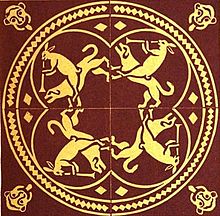
Medieval carnivals took some different forms in different times and places.  Some days merely involved eating and drinking too much, such as “Fat Tuesday.”  Some had more complexity/absurdity, such as the “Lord of Misrule,” which happened around Christmastide.  In this space of time a sub-deacon or even a peasant might get appointed as chief of festivities, which obviously involved eating and drinking, among other things.   Other such similar days had dukes serve as peasants and peasants occupy manorial houses, and so on.  So in the carnival emblem to the side, all of creation seems reversed, as the hare triumphantly rides the hunting hound.

Most commentators point out that such festivals allowed people to let off steam, especially necessary in a structured and hierarchical society such as medieval Europe.  Even some contemporary clerics acknowledge this role for the carnival.  But this forms only the baseline for understanding the role of the carnival.  The emblem of the hare and hounds attest to something grander at work.

Those committed to Christianity know that it provides a means to understand all of experience, not just life after death.  Much of our Christian life involves holding things in tension.  So we believe that God is one God in three persons, neither favoring the unity or the plurality, but going “straight ahead.”  Jesus is fully God and fully man, “without confusion,” as stated by the Council of Chalcedon.  The Church hymns the Virgin Mary as the “unwedded bride.”  For the Mother of God both terms truly apply, without confusion.  Scripture is the Word of God, written by particular men at particular times, and so on it goes.  Christians rightly recognized the Incarnation as the focal point of human experience, for in the coming of Christ creation gets remade and reborn, as John attests in his Gospel by obviously referencing Genesis 1.  After the Incarnation we live in a new world, but in many ways outwardly it exactly resembles the old world.

In the world B.C.*, people saw childlessness as a curse.  Of course children are a blessing in a physical, natural sense, but at a deeper level we were meant to perpetuate the continuing natural order as a means of bringing about the coming of Messiah.  No children meant no participation in redemption.

In the kingdom to come, however, we will neither marry nor be given in marriage.  Thus, we honor monastics.  At the baseline, we honor them for their sacrifice.  But their vows of poverty and chastity mean that they do not live in ordinary time. Their lives transcend the ordinary needs of the world with its buying, selling, and saving, and also reflects the reality of the new creation wrought by Christ. They live partially in eternal time, which contains all time.  They “neither marry, or are given in marriage,” and of course in the heavenly kingdom no one needs money.**  Monastics may or may not live exemplary lives, but the fact of their “station in life” puts them closer to eternal time than laity and even priests, who must concern themselves with affairs in the world.

In his essay Leisure, the Basis of Culture, Josef Pieper makes that case that the only way to escape the cycle of work is to receive breaks in time from without.  Even vacations, he points out, cannot be “leisure” if we view them strictly as breaks from work.  Modern views of labor probably originated with Marx and his followers, and certainly we should sympathize with the “proletariat,” if we wish to use the term.  But as Pieper wryly remarks, “Proletarianism cannot obviously be overcome by making everyone proletarian.”

Ordinary time may be strictly linear, but not “eternal time.”  Eternal time contains all moments.  We the laity, despite our ordinary and natural station, can still at times participate in eternal time.  Taking the crucifixion as an example, Taylor writes,

Meanwhile the Church, in its liturgical year, remembers and re-enacts what happened . . . [at Christ’s crucifixion].  Which is why this year’s Good Friday can be closer to the Crucifixion than last year’s mid-summer’s day.  And the Crucifixion itself, since Christ’s passion here participates in God’s eternity, is closer to all times than they in secular terms are to each other.

Put in other terms, on this view tracts of secular time were not homogenous and interchangeable.  They were [differentiated] by their placing in relation to higher time.

Medieval carnivals did not participate in sacred time, but they did recognize the duality.  By breaking down the natural order of ordinary time, they testified to the reality of sacred eternity, where a completely new order will forever take hold of the cosmos.  Thus, the breaking down of the order gives it new life, the secular/ordinary order gets reborn freshly after each carnival.  It makes perfect sense that the “Lord of Misrule” would “reign” during Christmastide, for this time on calendar celebrated the breaking in of the eternal into temporal via the Incarnation.  “How can the guests of the bridegroom fast while He is with them (Mk. 2:19)?”

Carnivals did not protest against the prevailing order so much as re-affirm it.  Recognizing its temporary and inferior status was the only way it could be reaffirmed, the only way order could perpetuate.

We remember Henry VIII for his many marriages, but it makes perfect sense that an absolutist like Henry would also abolish the days of misrule at Christmastide.  This too accompanies his seizure of monastic lands.  The monastic vocation and the carnival testify to this tension in time, and to the transitory nature of the state.  No statist like Henry likes such things.  Worlds other than those they made frighten and confuse them.

We see too that whatever its intentions, by abolishing liturgies and the church calendar, the Reformation paved the way for secularization.  Bit by bit Protestant denominations moved away from the “sacred time” of the church calendar year. Taylor cites Walter Benjamin’s description of “homogenous and empty time” as the mark of modern consciousness.  “On this view,” Taylor writes, “time [has no meaning in itself] but is like a container, indifferent to what fills it.  Without “eternal liturgics,” and without a sense of time as a gift to mold and shape us, all that is left is for us to fill time with meaning.  And so we have, and created the secular state thereby.

This secular victory is quite empty, however. The homogenization of time makes everything sterile.  Nothing can have real meaning.  Without fasting, our materialistic civilization cannot even feast.  With the homogenization of time comes the homogenization of space–including space for worship.  With no delineation of either time and space, it’s no wonder that, to riff on Milton Friedman, “we’re all secular now.”

We see this view of the homogeneity and plasticity of time permeate our society. Take Fridays for example.  Back in ye olden days Fridays for everyone involved fasting of some kind, for each Friday participated in some way in the Crucifixion–not just in memory, but in reality.  After abandoning the dual sense of time described above we instead oriented time around our work/school week.  Now Friday has taken on the opposite role in our secular liturgy as a day of release, fun, and celebration.  Imagine a family trying to establish something of the older sense of Fridays, and the enormous accompanying societal/liturgical pressure to go out and have fun with friends from work or school facing them square in the face.

“Resistance is futile.”

Of course, this same story has been played out in so many other areas. Without Advent we get Black Friday.  Without Paschaltide we get “Spring Breakers.”

In a recent conversation with Hank Hannegraaf Rod Drehrer recounted his meeting with a group of evangelical pastors near the election.  While Drehrer understood why one might vote for Trump “in sorrow,” as an alternative to Clinton, he admitted an utter incredulity in seeing some pastors positively enthused about Trump.  The response from another evangelical who shared his lament was, “You have to understand, they have no Plan B.  Politics is the only way they can conceive of changing the world.”^

The statism of Henry VIII–and others– has born disastrous fruit.

Many on the more secular left might lament Trump’s election and see it as proof that the “war has yet to be won,” or something like that.  They can relax and break out the cigars.  The war was won long ago, the rest has been mopping-up operations here and there.

I find it hard to tell if Taylor laments or merely describes the shift towards secularism.  He does state that at most all those who hope for a return can do is indulge in nostalgia.  I agree that the tide ran out long ago, but I have more hope.  A proper and effective response will first recognize that turning the battleship will take generations of small faithfulness in our lives and homes.  We should begin with a developing a new sense of time.

Dave

Written (originally in 2018) on the Feast of the Chains of St. Peter, and the Commemoration of St. Paul the Apostle

*The attempt to replace B.C./A.D. with BCE/CE may only be meant as a sop to political correctness or inclusivity.  No doubt people mean well.  But still, the switch is at root an attempt to remake our understanding of time.  Though I lament this shift, it is in many ways long overdue, as we no longer order our lives around the impact of the Incarnation.  It took the French just four years of Revolution to switch their calendar.  It will take us much longer, because we have nothing to replace it with.  We lack the bold audacity of the French, which is a good thing, considering that tens of thousands died in the French Revolution and millions died in the Napoleonic wars.

**Visitors to the monasteries on Mount Athos notice that two different clocks are used in many of the monasteries.  One, the familiar ordinary/secular time, the other clocks measure the now nearly extinct “Byzantine” time (Byzantine clock seen bel0w) to reflect this dual reality.

^So too the French Revolutionaries, which explains the failure of their festivals.  They sought to ape medieval carnivals, but key differences persisted:

  • They were attempting to construct a new order, not deconstruct an existing order.
  • Thus, their festivals had a much more didactic emphasis than medieval carnivals, which
  • Made them much more boring.

Conversations with Stalin

This post was originally written in 2018

*******************************

Some might argue that history constrains us.  Certainly many teenagers keenly feel the question, “Why does it have to be this way?  Why must the world work as it does?”  The dynamism of youth and their imaginations certainly can do wonders for any society.

We may suppose that a world without historical awareness will create a glorious whole new world of possibilities.  But . . . history rather pedantically suggests that the opposite of the case.  Recall the French Revolution, for example.  They remade everything, even their sense of time.  But this confusion and disruption led to terrible tyranny and mass incarceration.  The communist regimes of the 20th century show this same tendency.   Only the most bold would call Soviet-era culture stimulating and full of possibilities.  Their narrowness of vision–a narrowness made possible and even likely by their disrespect to history–created a terrible tyranny.

Many comedians have commented that they no longer wish to perform at many college campuses.  Students in today’s climate seemingly cannot operate with dual levels of reality.  They cannot make distinctions between jokes and real life, assuming a 1-1 correlation of all aspects of reality, a flat world.  Caitlin Flanagan of The Atlantic wrote that,

Two of the most respected American comedians, Chris Rock and Jerry Seinfeld, have discussed the unique problems that comics face on college campuses. In November, Rock told Frank Rich in an interview for New York magazine that he no longer plays colleges, because they’re “too conservative.” He didn’t necessarily mean that the students were Republican; he meant that they were far too eager “not to offend anybody.” In college gigs, he said, “you can’t even be offensive on your way to being inoffensive.” Then, in June, Seinfeld reopened the debate—and set off a frenzied round of op-eds—when he said in a radio interview that comics warn him not to “go near colleges—they’re so PC.”

When I attended the convention [The National Association for Campus Activities] in Minneapolis in February, I saw ample evidence of the repressive atmosphere that Rock and Seinfeld described, as well as another, not unrelated factor: the infantilization of the American undergraduate, and this character’s evolving status in the world of higher learning—less a student than a consumer, someone whose whims and affectations (political, sexual, pseudo-intellectual) must be constantly supported and championed. To understand this change, it helps to think of college not as an institution of scholarly pursuit but as the all-inclusive resort that it has in recent years become—and then to think of the undergraduate who drops out or transfers as an early checkout. Keeping hold of that kid for all four years has become a central obsession of the higher-ed-industrial complex. How do you do it? In part, by importing enough jesters and bards to keep him from wandering away to someplace more entertaining, taking his Pell grant and his 529 plan and his student loans with him.

But which jesters, which bards? Ones who can handle the challenge. Because when you put all of these forces together—political correctness, coddling, and the need to keep kids at once amused and unoffended (not to mention the absence of a two-drink minimum and its crowd-lubricating effect)—the black-box theater of an obscure liberal-arts college deep in flyover territory may just be the toughest comedy room in the country.

In the same vein, Alex Tabborok recently commented that,

It has been said that we live in an increasingly divided media universe but on many issues I think we live in an increasingly uniform media universe. Social media is so ubiquitous and the same things sell so widely that I suspect the collective consciousness is less fragmentary than in the past.

I thought of this issue reading transcipt trials of two Soviet authors in the late 1960’s, Yuli Daniel and Andrei Sinyavsky. The authors were not in trouble for any direct attacks against the state or against communist doctrine per se.  Obviously no writer who valued his safety would write in this way.  The problems with their work lay elsewhere.  Among the issues raised:

  • There are no clear good and bad characters in your stories.  How then can the people understand the story (i.e., the story alienates the masses, which is de-facto anti-communist)?
  • Which characters in the story definitively represent the author’s point of view?  In other words, which character speaks for the author, and which characters serve as foils?

This particular attack assumes that 1) The relationship between characters in the story and the author is always strictly linear and 1-1, and 2) This relationship is necessary for clarity in the story, and 3) Without this clarity, how can we judge if you are a threat to the state or not?

Both authors seemed terribly confused by attacks made against them, pleading “not guilty,” an unusual move in trials of this sort.  They tried to explain basic literary theory of story and character, but to no avail.  Their judges simply couldn’t accept this mental construct.  By definition character’s must express a direct relationship to the author.  Character’s who criticize the state must reflect the author’s mind.  The author’s tried to point out that some of these characters fare badly in the story, but the prosecutors shot back that not all who criticized the state “got their just desserts.”   Here is a brief excerpt from Yuli Daniel’s trial, which begins with the prosecutor reading an excerpt from one of Daniel’s stories:

Prosecutor (reading): “I hate them [referring to those in power] so much I have spasms, I scream, I tremble.”   Well, Daniel, what are we to make of this?

Daniel: That is an epigraph to the character’s thoughts (laughter in the courtroom, Daniel looks around nervously).

Prosecutor: Who is that you hate so?  Who do you want to destroy?

Daniel: To whom are you talking?  To me, or to my character, or to someone else?

Prosecutor: Who is your positive hero?  Who expresses your point of view in the story?

Daniel: I have told you, the story has no entirely positive hero and there doesn’t have to be one.

Prosecutor: Who expresses the author’s credo?

Daniel: The characters do express the author’s thoughts, but only in part.  No single character represents the author.  Maybe [my story is] bad literature, but it is literature, and it doesn’t divide everything into black and white.  . . . The indictment states that I express my ideas “through the mouths of my characters.”  That is a naive accusation, to put it mildly.

Neither author had success discussing the nuance of how stories work.  Both received labor camp sentences of 5-7 years.

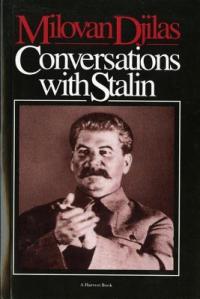
In his Conversations with Stalin Milovan Djilas tells of his initial fascination with Stalin and the Soviet Union and his subsequent disenchantment in a few short years.  Many other works give many more details about the horror and oppression in Stalinist Russia.  What made Djilas’ account interesting was that he framed his account not so much in terms of how it all went wrong, but how it managed to work at all.  That is, we know Stalin was bad, but if he was so bad, why did Soviet Russia prosper and gain power, at least in certain ways?

He explores this in different ways.  For example, no one questions that the purges in the military during the 1930’s sacrificed thousands to Stalin’s paranoia, but Djilas had met many of the commanders put in place after the purges, and admitted that they were almost all quite adept, fearless, and devoted.  Naturally, Stalin had his entourage that rarely, if ever, challenged him.  As you would expect, one always had to constantly avoid saying the wrong thing by following keenly the bouncing ball of “official” opinion. But unlike most other autocrats throughout history, Stalin did actual work and remained very well informed.  He could incisively size up personalities in the room and control it with ease.

What struck me most of all, however, was this comment of Djilas:

“The world in which the Soviet leaders lived–and that was my world too–was slowly taking on a new appearance: horrible, unceasing struggle on all sides. Everything was stripped bare and reduced to strife which only changed in form and in which only the stronger and more adroit survived.  Full of admiration for Soviet leaders before this, I now succumbed to a heady enthusiasm for the inexhaustible will and awareness that never left them for a moment.  That was a world in which there was no other choice other than victory or death.”

Perhaps unconsciously, Djilas reveals that Maxism has its roots not in economics, politics, or a new conception of proletarian culture, but in a new religious understanding of the world–a naked struggle for will and power.  It is this elemental understanding of things that can give regimes who build on this faith a concentrated vitality, akin to the power of art in certain barbarian civilizations.*  Perhaps Stalin understood this as well, to great and terrible effect.

Today most of us immediately understand the danger’s of the far-right, perhaps because the far-right has a crystal-clear idea of what they want and express it forcefully.  Many on the far-left, on the other hand–quite prevalent on many campuses today–seem to think that their ideas will lead to a bright, sunlit land where everyone loves everyone else (the far-right has no such plan and no such delusion).  But if you can’t take a joke, you will dramatically narrow your world, after which, you will have nothing to fall-back on other than the paganism of power and will.

Dave

*Though I would love to claim this insight about “barbarian art,” it belongs entirely to the inimitable Kenneth Clark.  He argued that the concentrated narrowness of barbarian civilizations can give their art a certain vitality.

8th Grade: The Parthenon

Greetings,

Recently we spent time looking at the Parthenon in Athens, which, along with Egypt’s Great Pyramid, stands as a seminal achievement of ancient architecture.  I think that looking at architecture is one of the best ways to gain insight into the past.  I didn’t come up with this idea, but borrowed it from the man to whom this site pays homage.  As I have said before, a civilization might throw a banking system together haphazardly, but would not do so with a sculpture.  And buildings, more so than individual works of genius, reveal more because they involve the mind and skills of whole civilizations.

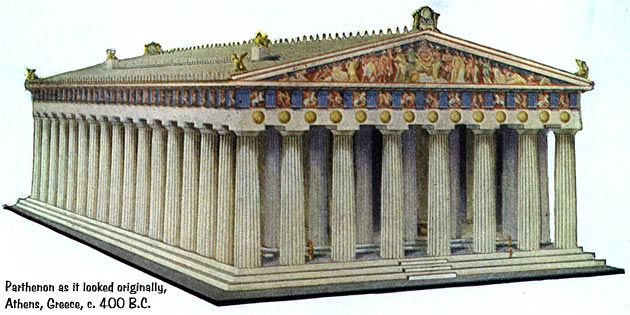
Here is what the building probably looked like ca. 432 B.C.

Parthenon Original

They built it atop of their Acropolis, the highest point in the city which served as Athens’ religious epicenter.

Acropolis Recreation

The building as it looks today. . .

Of course most people when first gazing upon the Parthenon usually think, “Yes it’s good, but what’s the big deal?”  We understand instinctively perhaps the influence this style has had on western culture.  Banks, the Supreme Court, and almost any other building that wants to convey wisdom and trust copy this style.  That in itself should clue us in that the Athenians had something special in their design, but we have to look closely to see the real genius of the Athenians.

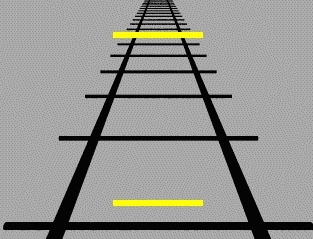
When we look at tall buildings like skyscrapers on the Washington Monument, at least from certain angles, the buildings do not appear straight.  Built with 90 degree right angles, our eyes fail to perceive the perfectly straight.  I don’t understand the science of why this happens, but we have all experienced it.  Part of it has to do with how our converging line of sight deceives us.  For example. . .

the top line appears longer, but is in fact the same size as the bottom line.  In this second image the middle lines appear bowed, but are perfectly straight.

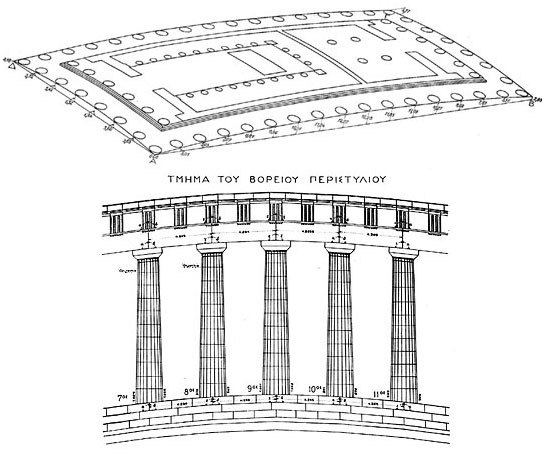
The Athenians understood this and built the Parthenon to compensate for the tricks our eyes play.  Each column has extremely slight variations throughout its many cylinders, sometimes with fractions of a millimeter the only thing distinguishing one block from another.  But the cumulative effect compensates for our vision and always makes the columns appear perfectly straight.  The following images exaggerate the effect, but give us the basic idea of what the Greeks accomplished:

Parthenon Columns

In fact a close look at the Parthenon reveals few right angles.  Each of the thousands of column drums remains an unique construction to that particular column.  This is not a lego set of interchangeable parts, but each part of the building stands as work of art unto itself.  If you have the time and interest, this video, and especially the last 30 minutes, give a good overview of their techniques in creating this building.

We can and should marvel at its construction, but we should go one step further and ask what the Parthenon means, and whey the Athenians built it as they did.  In class we focused on a few key areas:

  • The Greek Ideal of Perfection

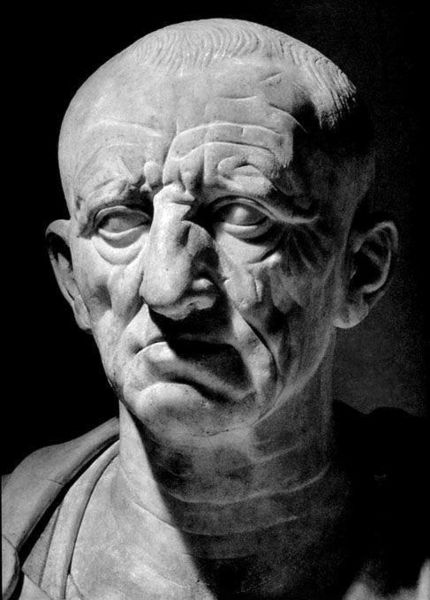
In much of their philosophy and politics, the Greeks searched for the abstract ideal beyond the visible, a trend that would not really shift until Aristotle.  The Romans, for example, or at least the early Republican Romans, rarely idealized people when depicting them,

Cato the Elder

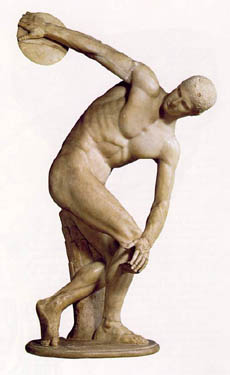
but we can say with only slight exaggeration that the Greeks did nothing but idealize people in their sculpture.

The Athenians went to tremendous lengths to bring make this ideal of perfection at least  seem  real among them in stone.

  • A Theological Statement

In theory, the Athenians built the Parthenon as a temple to Athena.  Originally a huge 35 foot statue of Athena overlaid in gold stood right at the center inside the building.  But architecture rarely lies.  The figures on the outside of the Parthenon tell a different story.  Here the Athenians put sculptures of Athenian heroes, with the clear intent of showing that the gods and men can intermingle, that Athens itself can achieve the perfection the gods embody.

That, at least, is one interpretation.

But another interpretation argues that this “temple” to Athena merely served as a cover for their true (even if subconscious) intent to glorify themselves.  It would be as if we built a church and called it “Trinity Church,” but put images of George Washington, Abraham Lincoln, etc. throughout (this actually begs the question of whether or not American flags should reside in churches, or perhaps whether or not the Capitol building is a church of sorts).

  • Mankind as the Measure

The Greek philosopher Protagoras has received a lot of bad press over the years for his comment that, “Man is the measure of all things,” and deservedly so.  But before we critique him we should understand the context of what he said and ask ourselves if the Greek gods were good “measures” of things.  Clearly, Protagoras and other philosophers had a measure of genuine spiritual insight in rejecting standard Greek religion as a guide for their lives.  The gods lived lives free of consequence, free of any restraint other than the power of other gods.

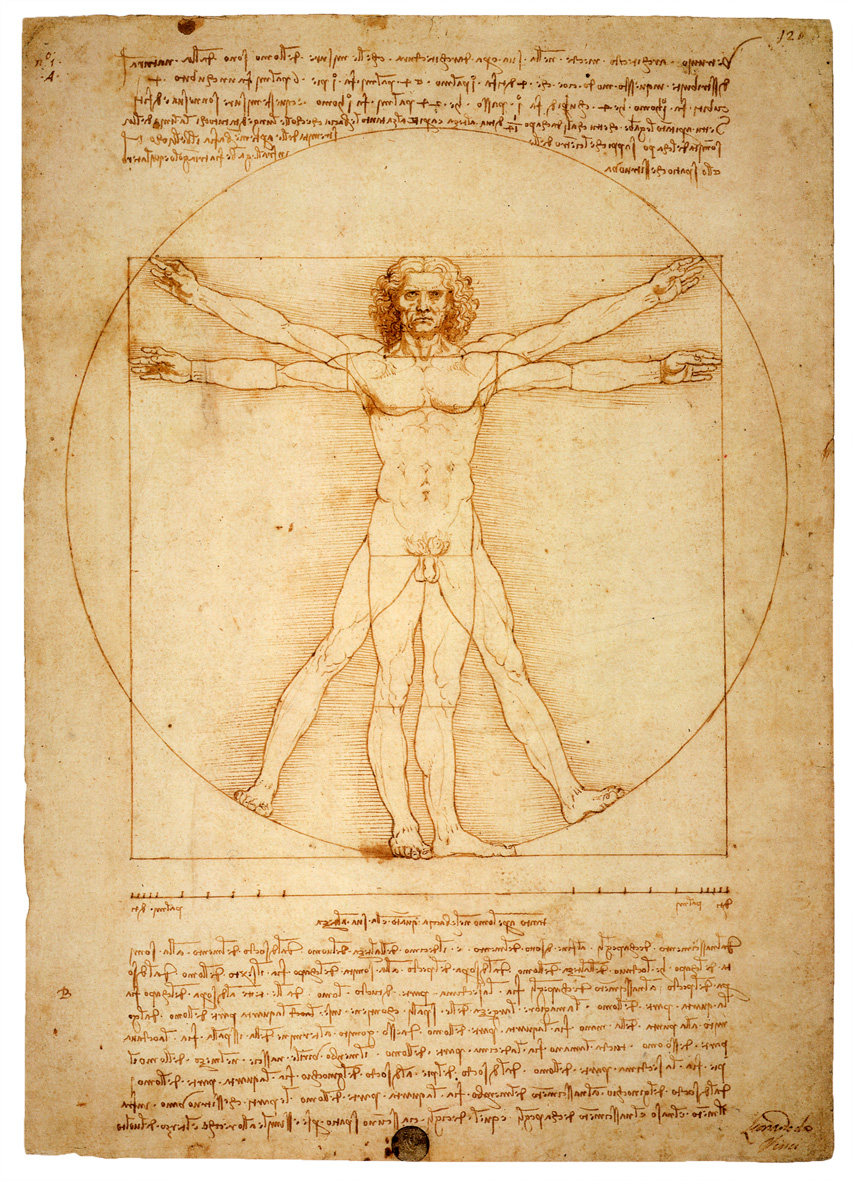
In the Parthenon the Greeks did not use the “eternal” or “mystical” dimensions as in the pyramids.  Some suggest that the proportions of the building in fact reflect the proportions found in the human body, as represented in Da Vinci’s famous “Vitruvian Man” (named after a famous Roman architect).

Vitruvian Man

What exactly the Greeks meant by this phrase, “man is the measure of all things” is not clear to me. It may have been a statement of moral relativism, or it may have been a theological/cosmological assertion that mankind functioned as a “microcosm” of the cosmos itself.  After all, we have physical elements to our being and spiritual elements.   Our higher, “heavenly” aspect (the intellect) guides our “lower,” more earthly parts, and so on.  Again, I’m not sure how to unwrap this phrase, and I’m happy to add it to the list of mysteries surrounding the Parthenon.

Blessings,

Dave

Death in the Days of Louis the Fat

Consider some of what follows a thought experiment rather than a settled conclusion . . .

For some time now I have contemplated Charles Taylor’s idea that a significant impetus in creating the modern world is that we homogenize space and time.  This belief/practice has shaped us for at least 350 years, and it has led us to try and combine many different elements of nature and the subsequent explosion of technological invention.  Many of these creations have greatly improved human life, at least in the physical sense.  But of course, it has also brought about the destruction of any corporate sense of meaning, and an immense decline in the idea of sanctity.

To homogenize something makes it ubiquitous.  Recently Marginal Revolution linked to an article about how technology has made music unimportant in our culture, largely through its constant availability.  The author’s conclusion in the linked article is not original, as many have declared something similar, but it serves as another reminder of the cost of the homogenization of space and time.

By contrast, the medieval world presents itself as one of the careful delineation of all things.  We need not say here whether their world or ours is better or worse to appreciate the difference.  Reading primary sources from a particular era gives one such an appreciation, and Abbot Suger’s crackling style makes The Deeds of Louis the Fat an enjoyable read.*  He centers his writing on how Louis enhanced the power of the monarchy by bringing several dastardly nobles back in line.  His people loved him, if for no other reason that he kept the peace and stood up for those oppressed.  Suger clearly admires his subject, though he recognizes that the good king had his moniker for a reason, writing that,

By now his body was quite heavy, weighed down as it was by burdensome flesh; no one else, not even a beggar, would have wanted to–or even been able–to ride a horse when hampered by such a dangerously large body.

And later . . .

Thus [Louis] spoke, and–despite his corpulence– he set off with astonishing enthusiasm.

I confess to reading the text with an eye to what would most engage the boys in my 9th/10th grade Medieval History class, and that meant primarily looking for stories of gruesome deaths.**  Suger delivers the goods!  For example:

There can be no doubt that the hand of God exacted this swift vengeance upon William of Laroche Guyon [who had murdered a husband and wife in cold blood to gain possession of their castle].  His accomplices were thrown out of the windows dead or alive, bristling with innumerable arrows like hedgehogs. They waved about in the air on the points of the lances, as if the very earth had rejected them. For the unparalleled deed of William they discovered a rare vengeance; for he who in life had been heartless had his heart cut out of his dead body. When they had taken it from his entrails, all swollen with fraud and iniquity, they put it on a stake and set it up for many days in a fixed place to demonstrate the punishment for crime.  

His body and those of some of his companions, were placed on hurdles tied with cords and ropes, and sent sailing down the Seine so that, if nothing stopped them floating down to Rouen, the Normans should see the punishment incurred by his crime, and also so that those who had briefly fouled France with their stink should in death continue to foul Normandy, their native soil.

Suger later discusses the murder of  Charles the Good, killed while praying prostrate in church along with his cohorts.  He spares no details and seems to relish them. First, the execution of the plotters:

Now [the criminals] despaired of life, and their lyre was turned to mourning and their organ into the voice of them that weep (Job XXX, 31); the most wicked Bourchard left with the agreement of his companions, hoping to flee the land but found himself unable to do so, though only his own iniquity prevented him. On his return to the castle of one of his intimate friends he was seized by the king’s command and suffered exquisite torture in death. Tied to the upper part of a high wheel, exposed naked to the rapacity of crows and other birds of prey, his eyes torn out and his whole face lacerated, pierced by a thousand blows from arrows, lances and spears, he perished miserably and his body was thrown into a sewer.  

Bertold, the brains behind the plot, also decided to flee; but when he found he was able to wander around without restriction, he returned through sheer pride; for he asked himself, ‘Who am I and what have I done?’ So he was captured by his own men, handed over to the king’s judgement and condemned to a well-merited and wretched death. They hanged him from a gibbet with a dog and as the dog was struck it took its anger out on Bertold, chewed his whole face and, horrible to relate, covered him with excrement; so, more miserable than the most miserable of men, he ended his wretched life in perpetual death.  

The men the king had besieged in the tower were forced by many hardships to surrender. In front of their relations Louis had them thrown our one by one from the top of the tower to crush their skulls. One of them called Isaac had been tonsured in a monastery to avoid death; Louis ordered him to be defrocked and hanged on a gibbet. Thus victorious at Bruges, the king rapidly led his army to Ypres, an excellent castle, to take vengeance on William the Bastard, who had fomented the treason. He sent messengers to the people of Bruges and brought them around to his side by threats and flattery. Then as William barred his way with three hundred knights, half the royal army rushed against him and the other half went off at an angle and boldly occupied the castle by way of its other gate. The king kept it, William lost all claim to Flanders, and was banished. Because he had aspired to gain Flanders through treachery, it was right that he should gain nothing whatever in Flanders.  

Suger closes this narrative commenting that,

Flanders was washed clean and almost re-baptized by these various forms of revenge and the great outpouring of blood. So having installed William the Norman as count, the king returned to France, victorious by God’s help.  

At first glance the means of their death, and Suger’s possible delight in such details, surely strikes us as barbaric and unChristian.  We tell ourselves that we have come much farther since those “dark days.”  But I want to suggest–or at least explore–the possibility, that Suger and the medievals may have been on to something.

I tread lightly, for I am aware that this may be one of the craziest of my crazy ideas.

To begin, we can reflect on John Wilkes Booth.  He killed Lincoln, and no one denied that he should face the death penalty.  Everyone wanted him captured alive . . . so that he could be tried and then executed.  He died while pursued by troops either by his own hand or that of a trigger-happy soldier, and people were upset.  But why bother?  Dead is dead, right?  He saved us the expense of a trial. Why all the fuss?  But, everyone recognized at the time that while his death was important, the manner of his death was also important.  To be tried and publicly executed would have a different meaning than if he took his own life, a collective, and cathartic, justice, vs. the “triumphant” and defiant individual.

If we accept this reasoning we begin to see that not every death is alike.  Different kinds of death carry with them different meanings.

If different kinds of death carry with them different meanings, then we may feel inclined to accept that our bodies have meaning, and bodily actions have certain meanings.  Some of this is obvious–certain facial expressions and gestures have a universal meaning across cultures, time, and space.  Other implications follow.  If the body has meaning then gender has an inherent meaning, and so on.  We simply cannot invent ourselves from thin air.

So far, so good, but from here it gets trickier.  Before considering the manner of their deaths we should consider the crimes committed.

  • The crimes were done in cold blood, against defenseless victims.  One of the victims was killed in church alone while praying.  The other was ambushed in his castle after he welcomed them inside, and then his wife was also brutally stabbed to death as threw herself on the body of her dying husband.
  • The crimes had many witnesses to them and no doubt existed as to their guilt.
  • Those that murdered the lord in his castle did so with the express purpose of rebelling against the king.  Those that murdered Charles the Good seemed intent on seizing his land and title.
  • Aside from the cold-blooded nature of the murders, the crimes violated a) the sacrosanct nature of the Church as a safe place of devotion to God, and b) the direct violation of hospitality.

Would an ordinary punishment suffice, that is, an ordinary death sentence, a simple, dignified, beheading?

I have not seen the movie Training Day, for which Denzel Washington won a Best Actor Oscar.  I did hear an interview with Washington, however, in which he discussed how he agreed to the movie only if they changed the script.  He felt that the original ending left the possibility that his character survived, which meant the possibility of a sequel.  Instead, he said that, (my memory is close but not exact) “My character lived like a dog, so he should die like a dog.  Anything else would not be right, or fair to the story.”

Again, we see the manner of death as having significance to the story.  Perhaps the same could be true of the events Suger relates.  We cannot see the meaning of their actions without seeing the consequences those actions have.  The public nature of the punishments inflicted rub us wrongly as well.  But we must also wonder whether or not we have swung too far in the direction of privacy in last century or so.  We no longer vote in public, we no longer need to speak in public (we can comment anonymously on line).  Perhaps this has contributed to the cultural divide and polarization we now face.

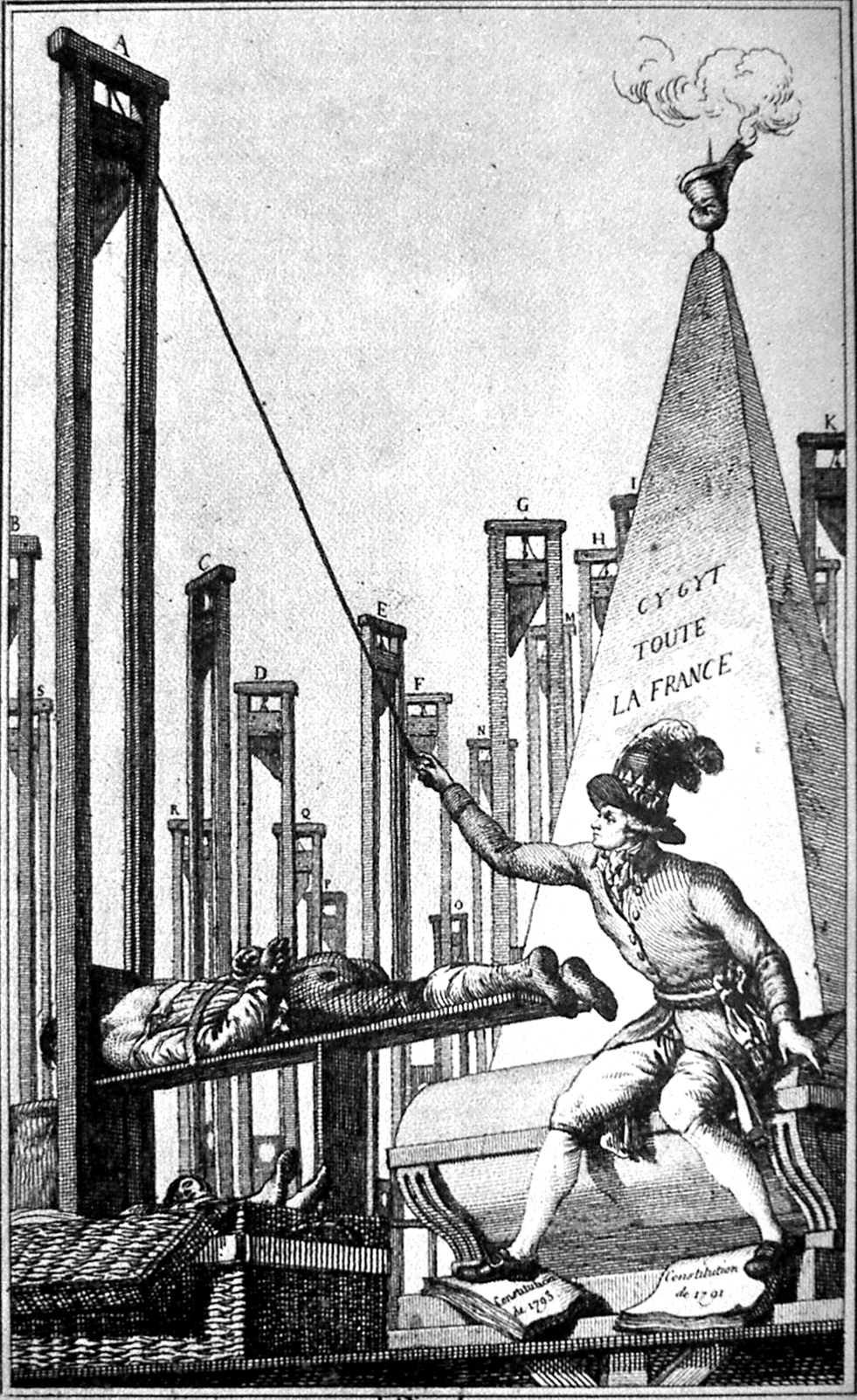
Our modern homogenization of life and death has not made unjust deaths any less frequent.  If anything, one might suggest that, at certain times at least, it has positively increased it.  The beginning of this phenomena may have been the French Revolution, where the guillotine treated all alike.  But this industrialization of death led to its mass production, and numbed much of France for years.  The class and racial identity politics of Hitler and Lenin led to further industrialized butchery.  Equality in death led to piles of statistics, an undecipherable mass.  The vast majority of these deaths were hidden far from the people at large.

I truncated the above accounts from Suger, but even still, it seems that the deaths inflicted give the stories a “satisfying” ending (the effect increases by reading the whole story). We can call this a latent string of barbarism in our psyche or . . . it may be that the medievals acted rightly, provided of course that such punishments truly fit the crimes and that no one could dispute their guilt.  Suger, an Abbott and scholar,  has no doubt of this, for he mentions specifically that the violent end of the malefactors “washed clean” Flanders, for example.

Perhaps our executions should be more public. Perhaps this could be a means for us to process important truths of life and death. I hesitate to say that the method of execution should vary depending on the crime, for in the accounts above things seemed to happen at least in part “in the heat of the moment.”  To inflict such punishments in cold blood presents a host of problems.  But I feel a certain amount of tension.  If we treat every death alike, the body may lose its inherent meaning, and then death will lose its meaning. If death loses its meaning, so too will life.  All we will have left, then, will be a monotonous march to oblivion.

*The Carolingians win for having the best names for their kings, i.e., Pepin the Short, Charles the Great (Charlemagne), Louis the Pious, Charles the Bald, Charles the Simple (i.e, Charles the Stupid), and of course, Louis the Fat.

**I know of no better way to get 15 year old boys interested in learning about feudal hierarchy and symbolism, a classic bait and switch. The girls, who are usually far more agreeable but often far less interested in the gory details, “must endure their going hence.”

9th/10th Grade: Planetary Influences

Greetings,

Last week when we looked at medieval society we saw that the basic “flow” of their civilization ran towards security and stability over opportunity and change.  This week we looked at the historical context of this choice, and what other areas of belief may have influenced those choices.

Many of us may believe that we have freedom to make of our lives what we will, that we paint upon a blank canvas.  In reality, where we live, when we live, and what happens around us influence us a great deal, sometimes subconsciously.  So too, we must evaluate the choices made by the medievals in light of the context from which they emerged.

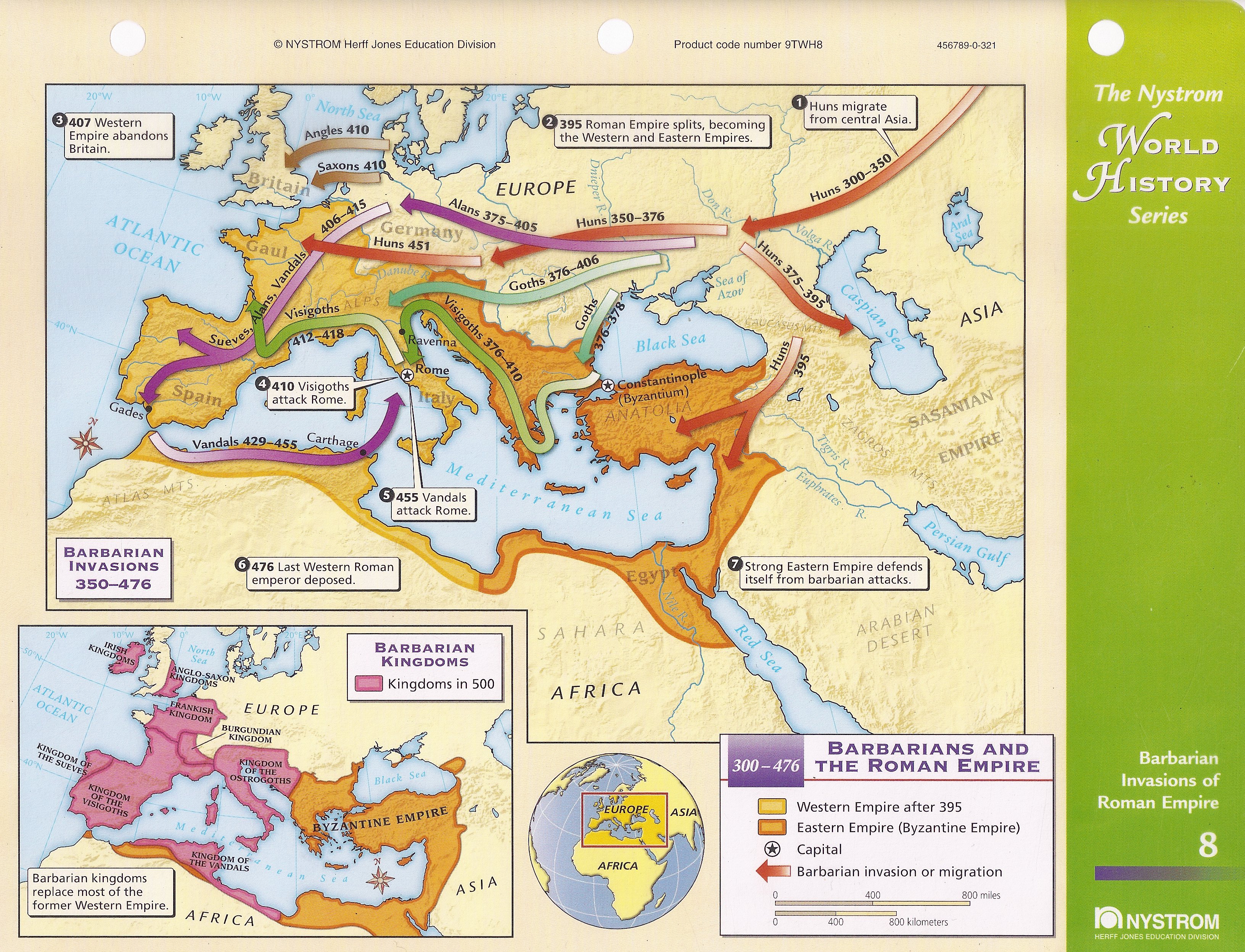
In the centuries after the fall of Rome, change and uncertainty formed the dominant theme, as the map below indicates.

Barbarian Invasions

No one can live like this for long.  Wen respite came after the conversion of many of these tribes, it made sense that one would want to create a society where one knew their place for themselves and their children.  We see this love of “knowing one’s place” in their cosmology.  A few different ideas dominated their view of the cosmos.

Heirarchy

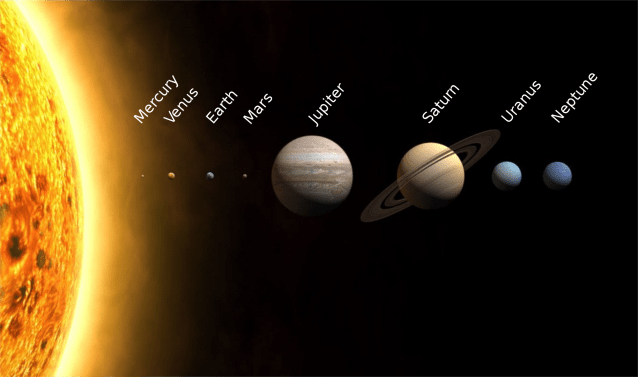
In space up and and down is all relative, but we need to find an orientation to make sense of our surroundings.  When we look at the sky moderns today would say we look “across” the universe (like the famous Beatles song) at other stars, planets, etc.  All of the pictures I remember of the Solar System had the planets in a horizontal line, like this one:

For the medievals one looked “up” at the stars from a fixed position on Earth.  Everything you saw stood higher than you, and naturally height conveyed superiority.  The Earth occupied a pride of place, in the sense that other planets revolved around it, but what many overlook is that it also occupied the bottom rung of the ladder, a combination of dignity and humility.

Spheres of Influence

Each planet, or section of the universe, had its own sphere of influence, it’s own “part to play.”  If you play second chair oboe, you keep your eyes off the music of first chair trumpet.  Here is a rough outline of how they saw things:

This concept of “spheres of influence” may have seeped into medieval feudalism, where each noble had their own territory, or “sphere” where they had a large amount of power and discretion.  Thus feudal Europe knew little of the problem of political centralization (though they had other problems).  I should note that the above picture shows Earth much larger than they believed it to be in reality.  Everyone followed Ptolemy’s Almagest which stated that,

The Earth, in relation to the distance of the fixed stars, has no appreciable size and must be treated as a mathematical point.

As my colleague Mr. Rogers pointed out, they represented the Earth thematically in relation to the rest of the cosmos, for here is where the drama of salvation takes place.

Harmony

It is precisely this division and separation that created the overall harmony.  Space for medievals brimmed with energy and life, in contrast to the modern view of a great cold void.  Sound comes from motion, and it seems that they literally believed in the “music of the spheres,” a grand cosmic symphony created by planetary motion.

Everyone knew their place in the cosmos, and knew that place to have significance.

One can exaggerate the importance of these ideas on everyday life.  The path of Saturn would not change the fact that you have pick up your kids at soccer practice.  But deep down, surely our view of a vast, linear, and empty universe impacts us.  Some of us might echo the French philosopher/mathematician Pascal, who wrote that, “the eternal silence of these infinite spaces fills me with dread.”

As a brief aside, we note that for the medievals, education involved not just the “trivium” — the grammar, logic, and rhetoric of a subject — but also the “quadrivium,” consisting of arithmetic, geometry, music and astronomy.  To see music grouped with these three will strike us as odd.  But for the medievals the only way to understand math was to understand music, and so too, astronomy could not be properly understood without knowing music.  Music then, served not just to entertain but to teach us about the reality of the universe itself.

Whether they consciously linked their cosmology and their daily life or not, we can see a direct connection between their view of society, though can’t tell if the chicken preceded the egg.  Like all societies they had their own system, their own strengths and weaknesses.  Whatever its faults, in feudal Europe you knew your duties and what was expected of you, as this text from ca. AD 1200 shows. . .

I, Thiebault, count palatine of Troyes, make known to those present and to come that I have given in fee to Jocelyn of Avalon and his heirs the manor Gillencourt, which is of the castle La Ferte sur Aube; and whatever this same Jocelyn shall be able to acquire in the same manor I have granted to him and his heirs in augmentation of that fief I have granted, moreover, to him that no free manor of mine will I retain men who are of this gift.  The same Jocelyn, moreover, on account of this, has become my liege man, saving however, his allegiance to Gerard d’ Arcy, and to the lord duke of Burgundy, and to Peterm count of Auxerre.  Done at Chouadude, by my own witness, in the year of the Incarnation of our Lord 1200 in the month of January.

Yes, it could be complicated (but less so that the software contracts we “agree” to).  Basically the king ruled at the behest of the nobility, but the nobles owed the king military service.  Peasants farmed the land of the lord, but the lord owed them protection and patronage, and so on.  The whole of society was a dance of mutual obligation.  But just as the Earth could not switch places with Jupiter, so too your station is your station, whatever betide (for the most part).

Next week we will look at those outside the basic feudal structure, the craftsmen and merchants.  Until then,

Dave

A Prohibiting Question

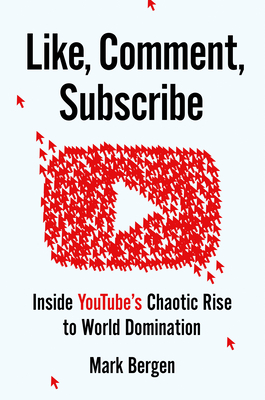
If it did nothing else, Mark Bergen’s Like, Comment, Subscribe: Inside YouTube’s Chaotic Rise to World Domination gave me a great deal of sympathy for those that tried to run this unusual company. Everyone in the early years of the web believed that the power the internet granted for anyone to say anything would work overwhelmingly for good. Much of YouTube’s history can get boiled down to dealing with the continual disproval of this hope. For every click on a silly, weird, enlightening or endearing video, another of icky sexual, violent, racist content, would crop up somewhere else. Keeping up with problematic videos quickly proved impossible. Deciding what should stay and what should go sometimes came down to blunt metrics, other times to personal judgments by a few harried staff. Neither approach could solve the problem–the problem has no solution. The internet disrupts everything. To quote Yeats, with the internet the center no longer holds. When that happens, movement away from the center takes one up, down, and every which way possible–certainly not always up! And yet, despite its missteps and issues, no one can conceive of YouTube somehow failing. Very quickly it became part of the American experience.

Many have attempted to define the essence of America. My personal stab involves the concept of “movement.” I suppose that means that I basically agree with Frederick Jackson Turner’s thesis. From the moment Europeans arrived on the continent, they began expanding their reach at a rapid pace. After the French-Indian War, England made a treaty with France that guaranteed English settlers everything east of the Appalachians. Not good enough. The Americans wanted more, and almost immediately violated the treaty terms, which resulted in Pontiac’s War of 1764. The English surely felt angry and confused. We had perhaps 10x as much land as England, and somehow this was not enough? Can’t we settle down for five minutes?

Of course we rapidly set ourselves on.a course of acquiring more land, by fair means or foul. We can understand this phenomena in part through our associations of land with liberty, which comes partly through John Locke, and partly through various other streams. But more deeply, our national predilection for movement comes naturally vis a vis our geographical symbolism. Sure, the world is round, but for Europeans at least America represented the end of the world, the edge of the world. Naturally we lived into this mental model. On the edge, things get blurry and more fluid in a literal sense (rivers or bodies of water often form boundaries of different places), and culturally and spiritually as well. America has always existed on that fluid margin.

It should not surprise us, therefore, that America has created technologies that compress time and eroded space, such as the telegraph (which admittedly had various people in different places working simultaneously with Samuel Morse), the car, the airplane, the internet, and so on. All of these technologies have had the overall impact of adding fluidity and movement to our world.

Prohibition has always perplexed me. Ken Burns’ documentary series succeeded admirably in looking at the small details of how the movement came about and collapsed. But whatever explanations we offer, from a distance Prohibition must strike us as historically bizarre. Alcohol has played a significant role* in every civilization ever that I am aware of, and we somehow believed that we could and should turn off that spigot.

Initially at least, it should also strike us as strange that an era that that moved so fluidly and loosely in a progressive direction, with

  • The beginning of cars going mainstream
  • Women getting the right to vote
  • Women starting to look and act more like men (hair and clothing styles changed)
  • General economic growth and prosperity
  • The advent of radio

should on a dime attempt a very ambitious “tighten” in an area more or less destined to fail. What follows is my attempt to understand this seeming paradox.

We tend to believe that

  • Liberals like to ‘liberalize’ and keep things moving in a fluid direction, and
  • Conservatives like to tighten things and prevent change.

So, the political left favors “time,” and the right “space.”

But in reality, both sides have aspects of their opposite. Progressives tend towards fluidity and the consequent “mixing” of gender identities, sexual identities, and the like. They disdain borders in culture and politics, preferring a global outlook. But they want much more stability on questions of speech, they seek to protect and create “safe spaces” for those they believe disadvantaged. They also prefer equality, which wants everyone together in one place, and want the market contained to prevent inequalities.

For their part, conservatives want to contain traditional ideas of family, sexuality, and the like. They value the defined space of country and flag. But they also want the market flowing freely. And–they value liberty over equality, which separates people and allows for distinctions in accolades, money, and the like.

One could see this as a kind of schizophrenia for both sides, a manner of confusion that could exist on the geo-spatial margin. I think that explains American politics partially. No question–America is weird, and likely always will be. Our political disagreements then, involve not “Tight v. Loose” but where to tighten, and where to loosen.

Though American politics is weird, I also think that fundamentally each person–and each civilization–must create some kind of balance between stability and change, because it forms the pattern of existence. Life requires it. Too much fluidity and mixing brings the flood and chaos–we perish from drowning. Too much rigidity puts us in the petrified forest, where we perish from dehydration. So we need to craft if not an actual balance between these two aspects, at least some kind of working relationship. One of our problems in the modern era is that traditional societies had this relationship worked out in theory, but mostly in practice. You see this in times in liturgical calendars for fasting, feasting, carnivals, and so on. Today, we subconsciously understand the need for stability and fluidity but have no clear idea of how to have both properly, and no guides in our culture to inform us. So, we flail about blindly instead.

I think something similar happened with Prohibition. For the above mentioned reasons, American society in 1920 felt itself on the edge of a precipice of sorts, ready to engage in a great deal of fluid movement socially, culturally, and economically. I fit most aspects of a conservative and so favor stability, but I do not subscribe to Fluidity=Bad, Stability=Good. Obviously both are good or bad depending on context. So, I do not mean to say here that the changes in the 1920’s were bad per se, but that their scale contributed to our need to tighten somewhere else. The dramatic and foolish nature of the tightening that occurred over Prohibition, I propose, was a subconscious reaction to a dramatic acceleration of fluidity. So perhaps either

  • Because we lacked a coherent means of knowing how and where to tighten a particular area of society, we landed on alcohol more or less randomly, or
  • The unprecedented loosening would require an unprecedented tightening, with alcohol then as the somewhat natural choice.

I find the latter more persuasive, though either one helps us answer the mystery of Prohibition.

Dave

*I understand the argument that a) Americans drank more than other civilizations had at any time previously, and b) Drank maybe too much harder stuff than wine, mead, beer, etc. Perhaps Prohibition might have had a better chance of success if they had focused on liquors instead of everything, but I doubt it.

Gods of the Sideways World

This post was originally published some years ago.  You will note the dated references . . .

*****************************************

Many across the political spectrum seem to feel that things in the U.S. have gone crazy, or upside-down.  Those on the left marshall Triump’s presidency, Charlottesville, and the Kavannaugh hearings, to prove their point, while those on the right do so with transgenderism, campus snowflakes, and . . . their own perspective on the Kavanaugh hearings.*

It appears that we can look at the same thing and not see the same thing.

Different theories exist to explain our predicament.  Some trace the beginnings of it all to Bush’s controversial foreign wars, others to the rise of the internet, or the Clinton presidency, or to the end of the Cold War.  Peter Thiel postulated that our cycles of cultural leaders skipped Generation X and went from the boomers–who artifically held on too long to power–straight to the millennials.**  Thus, lacking “Generation X” to mediate the generation gap, we jerk awkwardly to and fro like a record skipping across a turntable.

We can give all these theories their due.  But I wonder if we may be witnessing something more fundamental.  Without knowing it, akin to frogs in the pot, we are experiencing the final stages of the life in a vertical world, which existed in every ancient civilization up until the 17th century, and seem ready to fully embrace the victory of the sideways world, which has been gaining ground steadily since that time.

One can say anything in blogs . . . but, “Though this be madness, yet there is method in it.”

Mattheiu Pageau’s (brother of the more famous Jonathan PageauThe Language of Creation has all the appearance of quackery.  The book has no reviews or endorsements on the back cover.  The book has no footnotes, or even a bibliography, despite the obvious fact that he draws heavily on early Christian and Jewish sources.  This sends shivers down my spine and I can think of no defense for it.  While some parts of the book desperately needed footnotes to have a shot at convincing me, the opening several chapters made complete sense, and the book in a general way hits its target by helping one to reimagine the world.  Once embarked with The Language of Creation, it is probably best to turn to St. Ephrem the Syrian and St. Maximos the Confessor for surer guides.

The key to Pageau’s thoughts, and indeed to much of the ancient and medieval world, lies in how we conceive of our experience of space.

Everyone who has read Ender’s Game realizes that space has no up or down, at least in a scientific or absolute sense.  But we must order our sense of space to exist in it, and that involves choices on our part, choices that upon closer examination are not arbitrary.  And since we must choose, we should be struck by the fact that everyone (in the west at least) up until the present day concieved of the cosmos as heirarchical, as up and down.^

And it may be no coincidence that our current depiction of the solar system conceives it as existing horizontally, and not heirarchically.

This choice of how we depict the cosmos was certainly intentional in older civilizations, and we can fairly assume that it remains intentional today.

There is a difference.  The order and shape we give to the space around creates a framework for meaning.

The up/down nature of reality helps us understand creation and our experience of the world in many different ways:

Creation

  • We first note in Genesis 1 that God resides “above the waters,” above that is, undifferentiated, unformed chaos.  The immensity of God cannot be contained, thus He must mediate our experience of Himself for us to know Him at all.
  • Creation happens through speech, and not coincidentally.  Speech gives form to thoughts and ideas, it gives them a public reality.
  • Creation happens via continual separation and differentiation.  God ‘draws out’ reality from above.
  • The purpose of creation is for God to unite Heaven and Earth.

Plant Life

  • Plants grow from seeds.  The seed falls from above, containing the “idea” of the plant, the entirety of the plant’s particulars.
  • Seeds bury themselves in the earth, which produces the manifestation, the “incarnation” of the idea in more variety.

Man

  • The upright nature of man is also no coincidence.  It separates us from other creatures (while at the same time, giving us no evolutionary advantage per se.  Many robotics designers have pointed out how inefficient the design of the human body is).  But it also corresponds to heirarchy–the intellect is above and governs the body below. Our thoughts move as the thoughts of angels, thus the “heavenly” nature of our intellect. Our “earthy” parts are lower and more chaotic.  Our appetites need structure.  Our “heart,” which lies between our heads and our bellies, serves as the mediator and point of unity between the two, between “heaven” and “earth.”  The structure of our bodies, then, gives us a clue as to the meaning of space.
  • Man himself serves as the mediator of creation, a priesthood meant to image God to all of creation.  As a hybrid creature of Earth and Heaven, we stand between both worlds.

Language

  • Language itself serves as a kind of union of heaven and earth.  We have “”heavenly” thoughts in our intellect.  We take bits of “earth” in the form of random marks, and arrange them into a pattern to make letters.  We then further organize them into words, and so on.
  • Language, then, takes earthly random particulars and gives them structure and distinction from above–according to ideas, principles, etc.  We make ideas manifest through language.

Christ Himself

One could go on and on seeing the extent of this pattern, but all of these patterns cohere most fully in Christ Himself.  He “came down from Heaven,” (John 6:38, the Nicene Creed) as the Word of God, but then took on human nature through the Virgin Mary.  After His death He went even “lower” down and, “descended into hell” (as in the Apostles Creed).  His ressurection and ascencion^^ complete the redemptive process of descending and ascending, a link back to Jacob’s ladder.

Such was the view of the world, more or less, from at least the time of Nero down to the 16th century.

The Copernican Revolution certainly transformed how we view the cosmos, but the hierarchical nature of reality could have been maintained.  I cannot trace the exact time we started to depict the solar system horizontally, but perhaps we have an inkling now that this change involved more than mere astronomy.  Perhaps a trend towards this leveling can be seen, starting from this depiction in the 18th century

which still seems to preserve a sense of heirarchy, and then 100 years later we see

which seems to advance the leveling process a bit further.  Of course the present day, (as seen above) completes the progression towards a flat world.

The leveling of the cosmos presaged a levelling of society, and the ushering in of chaos and confusion.  Geographically speaking, both oceans and deserts represented chaos for the ancient and medieval world–i.e., both areas have no visibile differentiation in their form, and we cannot live there.  With chaos comes death.  For to understand anything and understand its meaning, we need differentiation and distinction.  Again, this is one of the main teachings of Genesis 1. The same holds true of society in general.  The early phases of dismantling existing heirarchies and norms come with great excitement.  Maybe the old forms had run their course, maybe change was overdue.  But the dismantling of all distinctions between up and down, creation and creature, men and women, etc. will usher in a blindness that will hinder our ability to understand the world God made and to understand God Himself.  Without this foundation, we will hardly be able to understand each other.

Since we cannot live in chaos, we will soon find that heirarchy will have to return.  Given our seeming embrace chaos (i.e. a world with no heirarchy and no distinctions), it may end up returning with a vengeance.  We already can see what distorted forms it might take. Those on the far left would make the most marginalized “victim” king^^^, and those on the far right would repeat Charlottesville en masse.  New gods would rule over us.

I believe most people want to avoid both of these extremes, but have no idea what to do about it.  Perhaps we can start with the very simple move of thinking about the world as up and down instead of side-to-side.

Dave

*I continue to hope that the world of twitter and political commentating is merely a distorted reflection of the real world we all inhabit.  Indeed, I have come across very few in my neighborhood or at church who got terribly bent out of shape one way or the other about Kavannaugh’s nomination.

**Peter Thiel believes that the dearth of viable presidential candidates in their 40’s-50’s in the last election proves this point.

^Like most medieval maps, this does not represent an accurate spatial depiction of the cosmos, but the cosmos as it appears “spiritually” to them in their hearts and minds.  Ptolemy’s Almagest was the standard work of astronomy of the Middle Ages and speaks of the Earth as a mathematical point in the universe.  But, they represented the Earth as larger than other planets because this is where the drama of the redemption of the cosmos plays itself out.

^^Most churches hardly focus on Christ’s Ascencion and stop at Easter.  But the structure and scope of redemption shows us how crucial the Ascencion is, for Heaven and Earth cannot be fully reconciled until Christ presents Himself spotless before the Father.  Only after this does the Spirit of God descend that God may dwell within us.

^^^I have no settled thoughts on the trigger warning and micro-aggression phenomena, aside from an obvious distaste for it.  But I do wonder at its logic.  If victimhood gives one power and the right to speak, would it not serve their interests to increase their victim status by having themselves “assaulted?”  Perhaps then, the enthroned victims wish to keep their power by preventing anyone else from gaining status?  That would make them like everyone else.  Those in power tend to guard it jealously.

9th/10th Grade: Societies Give, Societies Take Away

Greetings,

We did not cover a lot of new ground this week, but did manage to introduce the basic premise of feudal society.

Imagine you had the following choices at age 16:

Option 1: You have the maximum possibility of social and professional  mobility.  A variety of opportunities will be open to you.  Therefore, there is the possibility of great success and the “life of your dreams.”  However, there are no guarantees, and no safety net.  What you achieve will be up to you and up to circumstances.  Perhaps you fail, and be left destitute with nothing.

Option 2: You will be guaranteed a basic middle class life that  conforms to our image of the 1950’s.  You will have a house, 2 cars, and 2.5 children.  You will  live in a community where people know you and will look out for you, but your ability to move jobs and locations is significantly restricted.  You may not love your job, but it will not be horrible.   You will be able to work at your job for many years and retire modestly.

What would you choose?   Most students chose door #1, but some definitely preferred the security of #2.

Neither option is right or wrong per se, but each  option does reflect different values.  We distribute the benefits of each this way:

The Modern West

  • Opportunity
  • Individuality
  • Mobility

Feudal Europe

  • Stability and Security
  • Community
  • A sense of “place,” a “rhythm of life”

When I surveyed the students about the jobs of their parents, many of them had held at least 2-3 different ones over their lives already, and this represents a slight difference, I think, from my parents generation.  Many of my friends that are my age have already held 2-3 different jobs.  It seems that are moving more and more in the direction of increased social mobility, which may translate into a lesser degree of social stability.  If I’m right we will have to wait and see what this will mean for us in the future.

Whatever we choose, we must realize that to some extent these choice are mutually exclusive.  We cannot have unlimited opportunity and a maximum amount of security.  We cannot have strong communities and great mobility.  We must choose, and whatever our choice, we need to own the consequences of those choices.

For example, there is much that we find distasteful about the feudal idea of birth and class.  It runs directly counter to many ideas we hold dear.  But to be born into nobility was to be born into responsibility.  You would have many tenants on the land, but their condition reflected on you.  At least in theory, a sense of mutual obligation existed between noble and peasant.

Today we have (in theory) no difference in class, but also no sense of obligation to others, and our physical mobility makes it hard for many of us to connect in our neighborhoods.  This leads us to rely a great deal on money as a means of security, as we have no “social network” to fall back upon.  Our societies do have places and programs for the poor, but as they are often run by the state, they can have a distinctly impersonal feel to them.  Plus, most of us do not interact with the poor on any regular basis, whereas in medieval times, the poor had a much greater chance to be part of a community.

A key to understanding medieval society is the idea of “knowing one’s place.”  We can imagine the evil person in every Disney movie telling some plucky young child to “know your place,” but it had a different connotation in the medieval period.  The medieval view of society resembled something of a jig-saw puzzle.  No matter how unique each piece might be, it has a specific role within the whole.  When Jesus says, “the poor you will always have with you,”

  • We would say that the poor will always be with you because of social injustice, economic injustice, or the presence of sin in general, while
  • Medievals probably would argue that we will always have the poor because we will always need opportunities to exercise charity (the poor demonstrate the virtue of humility in receiving charity), just as some have money in order to exercise liberality.  Both are necessary because both are meant to image/reflect different aspects of the Christian life to us.

I do not mean here to romanticize feudal society, but only to point out that their structure gave them a good chance of doing some things better than the modern west does currently.

Blessings,

Dave Mathwin

Time in Joint

Historians tend towards the romantic, which means they can develop an undue fascination with decay. The best historians add to this a grand sweeping view of all things and thus see (with good reason) the vicissitudes of time and the sin to which all men are drawn. Historians hopefully are not cranks or kill-joys–rather they at least believe themselves saying, “I’ve seen this movie before . . . . ”

Exceptions exist of course, but Polybius, while writing of the glorious successes of the Republic saw the wheel of time moving that same Republic inexorably towards decline. Oswald Spengler also shared the basic assumption that civilizations, like every living thing, had its inevitable death built into their DNA. Plato too saw forms of government moving in a definite cycle, and Machiavelli–though departing from Plato as much as he could philosophically–shared this basic assumption. He hoped that practical wisdom could elongate the good parts of the cycle and shorten the bad ones, but sought nothing beyond that. Toynbee, being more influenced by Christianity than any of the aforementioned greats, saw more hope but still admitted that every civilization he studied had declined and disappeared.

All of these historians (others could be mentioned, such as Thucydides, and though Herodotus may have been the most hopeful, he did not write about the Peloponnesian War) dealt with civilizational decline but not with the concept of time itself. Some might say that historians should not bother about “Time” and let it stand as the purview of either science or theology. Well, history involves a degree of science, and no one can write about mankind without at least subconsciously thinking about God.

Enter Olivier Clement, and his dense, difficult, but still fascinating Transfiguring Time: Understanding Time in Light of the Orthodox Tradition. I cannot claim to have understood him thoroughly, but I hope to have gleaned the most important aspects of his work.

History shows us that civilizations had two main ways of conceiving of time, either as cyclical or linear. The cyclical view dominated most pre-Christian civilizations. Clement writes that

For primitive society, authentic time is the dawning moment of creation. At that moment . . . heaven was still very close to earth. . . . This first blessedness disappeared as a result of a fall, a cataclysm that separated heaven and earth . . . Thereafter he was isolated from the divine and from the cosmos.

The whole effort of fallen man was therefore to seek an end of this fallen state in order once again to be in paradise.

One sees this in the mythologies of most civilizations I am aware of. For the Greeks, Egyptians, Meso-Americans, etc. history begins with the gods ruling on earth in some capacity, a golden age of harmony and justice.

As the gods fled, all people had left to them was mimicry. By participating in the “cycles” initiated by the gods they could perhaps glean something. So we marry because heaven and earth were once married. We farm because of the motif of life from death, death from life we see played out in agriculture. Night becomes day, and day becomes night. Clement writes,

One important symbol (and ritual), the dance, sums up this conception of time. According to a very ancient tantric expression, the cosmos is the “game of god,” the divine dance. Primitive cyclical time is nothing less than the rhythm of this dance, ever tighter cycle in which the dancer is drawn in and assimilated.

Clement acknowledges that much truth exists in this conception of time, but emphasizes that it is fruitless in the end and thus, hopeless, a “hellish” repetition.* “Time is always experienced as degradation” as we move further out from the original marriage of heaven and earth. As we move further out, our connection lessens, hence the origin of ecstatic religious manifestations as an attempt to escape the cycle of reality and return to innocence. The Dionysian cult, for example, was universally acknowledged as “new” by the Greeks in the 5th century. Toynbee mentions that in the aftermath of Hannibal’s invasion, the more disciplined Romans found themselves “plagued” with an onslaught of much more emotional religious expressions. The old gods could no longer meet the new needs

This severing of man from meaning makes time itself meaningless. Eventually not even the regularity of the cycles can entice. One sees this clearly in the Viking epic Egil’s Saga. The prose sparkles, and the poetry is even better. But in the end we have feast, feud, violence, victory–rinse and repeat. So too in other cultures. Clement cites the famous story of Narada from the Sayings of Sri Ramikrishna which illustrate this well:

Narada, the model of piety, gained the favor of Vishnu by his fervent devotion and asceticism.  Narada demanded of Vishnu that he reveal to him the secret of his “maya.” Vishnu replied with an ambiguous smile, “Will you go over yonder to fetch me a little water?”  “Certainly, master,” he replied, and began to walk to a distant village. Vishnu waited in the cool shade of a rock for him to return.

Narada knocked at the first door he came to, eager to complete the errand.  A very beautiful young woman opened the door and the saintly man experienced something entirely new in his life.  He was spellbound by her eyes, which resembled those of Vishnu. He stood transfixed, forgetting why he had come. The young woman welcomed him in a friendly and straightforward way.  Her voice was like that of a gold cord passed around the neck of a stranger. 

He entered the house as if in a dream.  The occupants of the house greeted him respectfully.  He was greeted with honor, treated as a long lost friend.  After some time he asked the father of the house for permission to marry his daughter who greeted him at the door.  This is what everyone had been waiting for. He became a member of the household, sharing its burdens and joys.  

Twelve years passed.  He had three children and when his father-in-law died he became head of the family.  In the 12th year the rainy season was especially violent. The rivers swelled and floods came down from the mountains and the village was swamped with water.  During the night the waters swept away houses and cattle. Everyone fled.  

Holding his wife with one hand and two of his children with the other, with the third perched on his shoulders, Narada left with great haste.  He staggered along, battered by torrents of water. Suddenly he stumbled, and the child on his shoulders fell and plunged into the flood. With a cry of despair Narada let go of his two other children and flailed away to try and reach the littlest one, but he was too late.  At this moment, the raging water swept away his wife and two other children.  

He lost his own footing, and the flood took him away, dashing his head against a rock.  He lost consciousness. We he awoke he could see only a vast plain of muddy water, and he wept for his loss.  He heard a familiar voice, “My child, where is the water you said you would fetch me. I have been waiting for almost ½ an hour.”  

Narada turned and saw only desert scorched by the mid-day sun.  Vishnu sat beside him and smiled with cruel tenderness, “Do you now understand the secret of my maya?”

Commenting on this story, Clement cites two Hindu scholars, who write that,

The nature of each existing thing is its own instantaneity, created from an incalculable number of destructions of stasis.

and

Because the transformation from existence non-existence is instantaneous, there is no movement.

Thus, for Hindus as well as Greeks, eternity is seen in opposition to time, with immobility being the means of entering into eternity, which is again, in opposition to all that is transitory on earth.**

Viewed against other pre-Christian societies, Israel of the Old Testament looks quite different in their view of time and space. Some comment on the “crudeness” of the anthropomorphic language in the Old Testament about God, but this language, “demonstrates that eternity is oriented towards time, and that eternity marches with time towards encounter and fulfillment.” Clement uses the word “courtship” to describe this relationship, which I find most apt. One might then say that the Old Testament culminates in the Virgin Mary bearing the union of Heaven and Earth in the person of Christ. Time takes on a linear dimension and events take on definite meaning. True–time is part of creation and thus partakes of the curse of the fall–it marches us towards death and non-being. Existence gets mechanized. But this also means time will be redeemed, and this process of redemption begins not at the future “Day of the Lord,” but in the Incarnation itself, and in the everyday “now.”

The Christian worldview has elements of the cyclical time of many pre-Christian civilizations. Many medieval calendars, for example were often expressed in a circular, not linear, manner.

The Church is both eschatological and paradisal–a paradise regained–though importantly, a paradise regained that will be greater than that which was lost. Levitical liturgical life prescribed yearly festivals that mirrored the seasons of the year. In some ways, the world is a “game of God,” as St. Maximos the Confessor states.^ The liturgy recapitulates not our vain longings for a return as in pagan cultures, but the real interaction of time and eternity at the heart of existence.

In the Old Testament, time had meaning in part because it moved to a definite fulfillment with the coming of the Messiah. With the Messiah rejected, the Jewish people lost their connection with the eternal purpose of time. Now time as a straight line simply ends in death, and proclaims the reign of death just as strongly as the vain repetitive cycles of the most ancient cultures.

If I understood Clement rightly, he argues that the Christian sense of time preserves the best of both Jewish and pagan time–the cyclical and the linear–while introducing an entirely new element. The liturgical cycles give us continual entrance into a defined pattern life as we move in a distinctly forward direction towards the Day of the Lord. But these cycles don’t just recall the past or proclaim the future, but bring about an intersection of eternal and temporal. Liturgical prayers often speak of the “today” of the historical event celebrated. And if time is part of creation, then the “line” of history too will be redeemed and circumscribed by eternity.

As to the implications on blog about history and culture, well, here I have less confidence than in my attempts to understand Clement. But if I may venture forth . . . it does seem that an undue amount of political commentators have fallen prey to the romantic idea of cyclical and irretrievable decay. Right after Trump was elected, for example, a new edition of Plutarch’s lives detailing the end of the Roman Republic got published. Some now on the right feel a leftist totalitarianism on the rise. But Clement would tell us that is at precisely these times that we must remember: time no longer bears us unceasingly towards decay. If we so choose, we can live in a world infused with the paradise of eternity.

Dave

*Clement mentions that many ancient societies buried their dead in the fetal position as an indication that the cycle of life/death was to repeat ad infinitum. Many Native American tribes did this, as did the Egyptians, apparently. As far as I know, Christians have never buried their dead in a like position, testifying to a different theology of time and redemption.

Egyptian Mummy

Cremation practiced at times by the Greeks and others also testifies in some ways to the futility of the cycle–we began as nothing and return to nothing.

**Clement notes some similarity between this concept of “immobility” and Orthodox ascesis. Many monastic fathers speak of “stillness of heart” and “remaining in your cell.” Again, Clement acknowledges the complexity of the topic and the need to emphasize that sometimes the differences are not of “kind” but of degree & orientation.

^The idea being not something arbitrary but something playful and in flux, compared to the stability of the heavenly realms.

Room 237

In western Canadian native culture, they tell a story about the South Wind and a skate. The South Wind’s volatility caused many problems for the people, making it impossible for them to fish and gather shellfish on the shore. They decide to fight the winds to make them behave. Some people and fish embark on an expedition to tame the wind, and have success. The South Wind agrees only to blow from time to time at certain periods, so that people can get on with their lives.

In his Myth and Meaning: Cracking the Code of Culture Claude Levi-Strauss sees more here than a nice story. He focused on the presence of the skate, which like a flounder, presents itself as a “normal” fish but is actually quite thin. When lying on the bottom, the skate presents an easy target, but a simple twist of its body will suddenly make it a much more difficult target. The skate, then, presents a kind of binary, a yes/no option to the world. He writes,

If the South Wind blows every day of the year, then life is impossible for mankind. But if it blows only one day out of two–‘yes’ one day and ‘no’ the other–then a compromise becomes possible between the needs of mankind and the conditions of the natural world. Levi-Strauss comments,

Thus, from a logical point of view, there is an affinity between an animal like the skate and the kind of problem the myth is trying to solve. The story is not true from a strictly scientific point of view be we can only understand this property of the myth at a time when computers have come to exist and provided us with an understanding of binary operations which had already been put to use in a very different way with concrete objects or beings by mythical thought. So there is no divorce between mythology and science.

As moderns we love to parse and divide, and so many theories exist about the functions of myths (I am guessing that ancient/traditional society have no such theories). Bronislaw Malinowski championed the “Functionalist” school–myths describe how we make life work regarding our basic human needs and drives. Claude Levy-Bruhl took an entirely different approach, arguing that the key difference between “primitive” and modern people came down to “emotional” and “mystic” representations from the former vs. scientific for the latter.

Strauss had a different approach, one I think closer to the truth. Traditional or “primitive” man had the ability to think in a disinterested, scientific way, but went about it differently than moderns. Strauss argued that we need to see more science in the past, and more myth in the present. True, the “scientific mind,” as described by Descartes, seeks “to divide the difficulty into as many parts as necessary in order to solve it.” But in the end, we must find coherence in order to manifest the order of the cosmos. As Strauss argued, if humanity the world over seeks order and meaning, it must be because order and meaning exist in the world.

The link between scientific and mythological thinking shows up sometimes in suprising places.

In his The Occult Sciences in the Renaissance Wayne Shumaker gives an interesting perspective on the Renaissance–one not in keeping with our natural expectations. He agrees with historian Paul Kocher–both note that the best attacks on Astrology during the Renaissance–Elizabethan era came almost entirely from ecclesiastics, including Pope Sixtus V, Pope Urban VIII, William Fulke, John Calvin, William Perkins, John Chamber, and George Carleton. Kocher continues,

And who, on the other side, spoke up for astrology? To the bewilderment of the modern analyst, chiefly the foremost scientific men of the age . . . an almost solid front of physicians, astronomers, and other natural philosophers, renowned for their achievements.

Kocher, Science and Religion in the Elizabethan Era, p. 267

Our typical assumptions about the Renaissance need reviewed, and Shumaker writes with great clarity and precision to facilitate this.

The argument for astrology in the Renaissance came from medieval roots, to be sure. To understand the medieval approach we have to reorient our assumptions about the nature of space, the relationship between the physical and the spiritual, and the concept of identity.

Space

  • Moderns see emptiness, a void, with objects moving that only occasionally and remotely have an interactive relationship based on mass.
  • Ancient and medieval people saw a universe crammed with life, be it the gods, angels, intelligences, etc. All these beings have a continuous relationship with one another.

Physical and the Spiritual

  • Moderns tend to separate the two. We have symbols, but what is really real is matter, what we see, observe, measure, etc. Spiritual realities exist, perhaps, but the two worlds do not mix
  • Ancients and medievals saw the two as constantly intermingling and influencing one another. This has ultimate expression in the mass, where heaven and earth meet in the transformation of the eucharistic elements into the Body and Blood of Christ, and the ripple effects flow from that.

Moderns acknowledge that physical things like weather impact our moods and can alter events. Ancients and medievals extended that sphere of influence into the heavens. Many in the Renaissance took in one step further. Shumaker writes that,

the Renaissance defense of astrology rested very heavily on the alleged power of “rays” to exert influence by means of light and heat. The rays of the sun operate upon us sensibly, and those of the moon, which was known to influence the tides, could be concentrated sufficiently by a concave mirror to produce warmth. Is it credible that rays from other cosmic bodies can affect us?

Identity

  • Moderns focus a great deal on the idea of the “true self,”* which must be liberated from the constraints of every influence to act freely and shine brightly. We eschew accepting that outside entities or forces should have any role in forming our concept of the self.
  • Ancient-medieval people readily understood that family, place, the gods/God all formed core aspects of our identity that no one really questioned or fought back against.

Astrology (as distinct from astronomy) must at first glance seem very distant from the modern mindset. And yet, modern science and astrology had a partnership for a time. They went their separate ways as a couple might divorce, not because they had a natural enmity. We can begin to understand this connection if we look at one of the horoscopes prepared for King Henry VIII of England, which relied on very precise observations. Its original rendering looked like this:

Which in modern observational terms would translate to something like this:

One translation of the horoscope reads,

This horoscope, in which there could be no greater good or any greater evil–because Venus is in the 9th house with Aldebaran and the Tail an in sextile with Mercury–shows a change in the laws which will not be revoked but will remain settled. Also the moon, in the 7th house and in quartile with the sun, while Saturn is in trine aspect with Venus, places as has been described, and Mars is in trine with the lord of the 7th house, Jupiter, announces divorce and much trouble with wives, to the point that one will be capitally punished. Saturn is in opposition with Mercury, since Mercury . . .

Some excerpts from the horoscope of Cicero, the famous Roman, composed in 1547:

The ornament of eloquence and mouth of the Romans has in his horoscope (i.e., the first house) the heart of a Lion, and with it, the sun, the Tail (the descending node of the moon), Mercury, Venus, and Mars: by these his fluency and high authority were determined. Almost the same things are reported of Petrarch . . .

And again, a horoscope of Emperor Charles V:

Charles V, born February 25, at 4:34 am . . . A peculiarity is the noting of stellar magnitudes within named constellations. In Book I of the Supplementum Almanach, Cardan discussed the names and powers of some 46 stars. Here he finds significance in their magnitudes . . . . Jupiter is with the third star in the water of Aquarius, a star of the fourth magnitude, and the nature of Saturn, with very little of that of Jupiter. . . . The sun is with a star in the back of Perseus, of the 2nd magnitude, and of the nature of Mars and Mercury . . .

We see in these examples language of precise measurements of time and space, with very little overt religious language or mysticism. The key to proper astrology involved knowing the precise date and time of birth, and coordinating that with known star charts and planetary movements. Observation, notation, comparison to other known data–all of this fits snugly within a scientific frame. As Shumaker notes, “We can set aside our doubts and accept [Renaissance] astrology as meeting all the requirements of a true science.”

Renaissance astrologists shared certain characteristics with their medieval forebears. Michael Ward’s Planet Narnia ingeniously attempts to demonstrate that each of the Narnia books has as its subtext the influence of a particular planet in the medieval cosmos. Lewis, as a Medieval-Renaissance scholar, certainly knew much about how medievals thought, thought part of Ward’s argument involves accepting that Lewis employed a certain strategy.

But whether Lewis attempted this with full intentionality or not I think beside the point. The Narnian stories show forth the medieval attitude to the cosmos, and the contrast shows how Renaissance astrology represented a decisive shift. Ward’s insights show us the Moon’s presence in The Silver Chair, or Saturn’s presence in The Last Battle, but one can read the story, understand and enjoy it without awareness of this fact. For the medievals, the planets had a role to play in events, based on some of the principles explained above, but the influence was subtle, “atmospheric,” with human agency, choice, and responsibility holding center stage.

Astrology met the characteristics of a “true science,” but that adds nothing to the truth claims of astrology. In fact, we can say that such claims are false not only because of the various attacks against it rooted in proper theological thinking, but because astrology as a science involves the same kind of precision completely removed from human experience that we see in conspiracy theories. In the documentary Room 237, director Rodney Ascher explores the variety of conspiracy theories associated with Stanley Kubrick’s movie The Shining, a horror movie based on a book by Stephen King. The movie seems like a departure from the grand projects Kubrick usually attempted (such as 2001, and Barry Lyndon made before, and Full Metal Jacket made after), that a variety of people assume that Kubrick must have put a deeper, more mysterious meaning into The Shining.

A variety of people come forward in the film to propose that The Shining is actually about

  • American imperialism, especially related to the subjugation of Native Americans
  • How Kubrick helped NASA fake the moon landings
  • The Nazi Holocaust and the need to let go of grief

As Chuck Klosterman pointed out in a review, the movie exercises a spell of sorts–one can get drawn into the world of the various theorists interviewed. The main problem with all of these theories, however, is that they rely on a method of watching the movie completely inaccessible to anyone when the film was released, including Kubrick himself. The “proof” offered by the various theorists relies on stopping and enlarging certain precise frames of the movie, or running the film backwards and forwards simultaneously, or digital reproductions. Indeed, such theories likely never would have materialized had DVD’s never been invented. Sure, we can analyze movies and look for subtexts, but we will not find their meaning by breaking it down into its smallest component parts.

The scientific Renaissance astrologists relied on the same technique as the conspiracy theorists. If one looks very precisely at a few certain facts, i.e., the fact that ‘X’ was “born at 4:34 AM and not 5:12 AM, then we note that the position of ‘Y’ and ‘Z’ star had a position relative to ‘A’ planet” and so on, and. so on. They forget that none of these methods of measurement or observation were accessible for the vast majority of human history, or relevant to anyone who gives birth to and raises a child.

Science relies on deconstruction, certainly a useful and important skill. I am no more “anti-science” than any of the ancient critics of astrology. But we come to Meaning through Love, which involves “symboling” things together. Myth can nest Science within it, in the best sense of the meaning of “myth.” When science goes too far it resembles “myth” in the worst sense of the meaning of the word. Descartes had it wrong–dividing the difficulty into many parts will often pull us farther away from the solutions we seek.

Dave

*Note the theologically liberal search for the “historical” Jesus that can somehow be sifted from the gospel texts.

9th/10th Grade: ‘Faith,’ Reason, and The Crusades

Greetings,

This difficult era of the crusades raises many questions for us:

1. Did the Crusades attempt to stem the tide of Moslem aggression, or did they in fact cause more Moslem unity and a resurgence of Moslem power?

Some see the Crusades as a legitimate attempt to strike against Moslem expansionism.  Others argue that the Crusades forced the Moslems to unite once again. Having been invaded by the West, they determined to renew their attacks against them.  Do the Crusades bear any blame for the eventual collapse of Constantinople in 1453?

2. What role should faith and reason play in everyday affairs?

The Third Crusade is a good example of this problem.  Richard I fought his way to Jerusalem, but went home in part because he believed he could not hold the city even if he took it.  Therefore, it was pointless to risk his live and the lives of his men for nothing.  Some criticized his actions, saying something to the effect of, “You must step forward in faith, and watch God bless you.  This is what faith is all about!   You cannot think of this in practical terms. That is not thinking with faith.  Put  a foot into the Jordan, and then watch it part.”

We see this same question also running through the idea of the tragic Children’s Crusades, though here the Church strongly opposed Europe’s youth to no avail.* How should the balance between ‘faith’ and ‘reason’ guide our daily lives?  How should we answer the argument of many young people who participated in the ‘Children’s Crusades,’ which ran something like this:

  • God has called his people to crusade for Jerusalem.  We believed so in 1097.  Has God changed?  He is the same, yesterday, today, forever.  Therefore, His call is the same.  We must still vie for the Holy Land.
  • But how shall we go?  Let us not trust in princes, horses, or chariots (i.e. Ps. 20), let us know that our trust is in God, by marching out in true faith.  We see in Scripture that Moses led the Israelites to the Red Sea and it parted. Joshua marched around the city, and it fell.  Guided by God’s word, we shall emulate their example.  God shall make a way for us to take Jerusalem, and do so in a way so that all glory goes to him.
  • Many argue that the problem with the Crusades was a lack of organization, supplies, or reinforcements.  This only betrays worldly thinking.  Would more supplies have made the Crusaders less greedy in 1204?  Would it have made them less violent inside Jerusalem’s walls in 1099?  No, the problem has been our lack of faith and obedience.
  • Jesus pointed out the strength and purity of the faith of children.  Therefore, who better than the Church’s youth to undertake this venture?

We know that the Children’s Crusades ended in utter disaster.*  But what would you say in response to their argument?  How can you disprove them? What is faith’s relationship to reason?

3. The west attempted at least seven times at retaking Jerusalem.  What should this tell us about them?

  • That they were foolishly stubborn?
  • That they were intensely dedicated and willing to make great sacrifices for achieving their goal?
  • That they were a people of faith willing to trust in spite of adversity?
  • That they were foolish, naive, and used ‘faith’ as a cover for their prejudice and desire for gain?

In the end, the Crusades would have many unintended consequences.  The West was exposed to Greek literature and philosophy for the first time.  St. Thomas Aquinas, the Renaissance, and Exploration may all have been by-products of this, among other things.  The Crusades also raise many questions about using violence as means to bring about the Kingdom of God that are still with us.  If we agree with the Crusades, should we also agree with the bombing of abortion clinics?

Next week we will return to our look at Medieval Feudal society, and I hope that the students will be confronted with good questions.

Dave Mathwin

*I should note that scholars debate when these crusades took place, and whether or not there was one crusade or two.  A few even doubt whether or not they were children at all, as some believe they may have been a mass of landless unemployed.  My rendering in class will be the traditional story.

Guenon and the Monsters

A recent local article mentioned that one Fairfax County School (Herndon HS) will cease allowing students to use their phones in class. Anyone familiar with reality knows that listening to one’s phone in class, or texting, or scrolling through Instagram, will hinder the learning process. Of course, the rule has loopholes that some will exploit. Perhaps more embarrassing for our civilization than the actual presence of phones in class–teachers may give students a 5 minute “phone break” during instruction if necessary. Most interesting to me from a cultural perspective, however, was the stated rationale for the policy: the phones need removed, for they may distract from other students learning. I applaud the school’s principal move to ban phones. The rationale for the decision, however, will not allow any real progress in education.

When we cannot state the obvious–i.e., students with phones out distract themselves far more than others–we have discovered a sacred cow of our times. But this fits in with other aspects of our culture. So strong runs our belief even in the power of a 15 year-old to define their lives ad nauseam, that parents, teachers, our society, will not attempt to define reality for them. We will not tell them that phones hurt themselves, for we likely would have no response for, “It might hurt others, but not me,” and no idea what kind of general embodiment we should ask for from our children.

If this reads so far like a cranky reactionary, well, that can be me at times. But I have far to go to reach the crankiness of Rene Guenon. He appreciated essentially nothing of modern life. But we should not dismiss him. The Crisis of the Modern World shows real prescience (he wrote this in 1927). His symbolic framing of the topics he examines make his work intuitive to understand and important for our times.

First, what failed to impress me about the book:

  • Guenon has some brilliant insights in his critique of the modern west, but he ascribes nothing good at all to the West and finds salvation only in the East. I understand taking a big swing for effect, but in this case, the book made me want to think of ways to defend the west. His overreach has the opposite effect on me.
  • I cannot tell quite where Guenon stands religiously, which I think important in a work like this. On the one hand, he has much to praise about Hinduism. On the other, we know he converted to Islam a bit after writing this work. He also argued that the West’s only hope lay in the faint possibility of revival of true Catholicism. Perhaps he dabbled in the idea of Perennialism, which seems to run counter to his main point of commitment to a tradition. Or–perhaps Guenon at the time of this writing lacked internal clarity himself, and if so it shows a bit in this book.

Now, on to the good stuff. . .

Guenon begins by critiquing the modern west’s view of linear progress. We see time functioning as a line, and our technological and political progress demonstrating that this line moves upwards. We no longer have the same attachment to the idea of inevitable progress as 100 years ago, but we still measure progress in material terms, i.e., how the economy functions, what new technology we invent, etc. But the core of our problem lies here. How we measure time and progress put us in continuously impossible situations that we cannot comprehend, due to the angle of our vision, akin to someone who scratches their irritation and wonders why it still itches.

Ancient and traditional societies put their focus on retaining meaning within their culture, not in increasing power or wealth. Our focus on power over our environment has led us “down the mountain” towards disunity of mind and society in general. The ancient world also tended to see time as cyclical, which Guenon thinks key to his thesis about time. I disagree, but it influences his view of how our culture has moved from “higher” to “lower” things. He writes,

It will doubtless be asked why cyclic development must proceed in this manner, in a downward direction, from higher to lower, a course that will at once be perceived as a complete antithesis to progress as the moderns understand it. The reason is . . . it implies a gradual increasing of distance fro the principle from which it proceeds; starting from the highest point, it tends downward, and as with heavy bodies, the speed of its motion increases continuously until finally it reaches a point at which it is stopped. This fall could be described as “progressive materialization.”

The project of the western world for the last 500 years or so has generally involved deconstruction of the world through a focus on gaining power over our environment. Rather than a circle, I prefer the image of a mountain to explain this process, something that I will not rehash in full here (I have written about this in other posts linked above). Of course mountains have a prominent role in almost every traditional culture, including ancient Israel (Mt. Sinai, Mt. Zion, etc.). The top of the mountain allows one a unity of vision, though it entails a necessary blending of various particularities. Descending down the mountain comes naturally. It’s easier than going up. This downward movement also gives you increased ability to see particular things with greater distinction and contrast to other things around it. But to accomplish this, one must sacrifice a unity of perspective. The methods western society employs lead us to chaos and disunity, which will manifest itself in our souls and our societies.

For example, we can take the idea prevalent in modern parlance that trade will unify countries and draw them together. The more trade, the more unity. Guenon argues that, in fact, increased trade between peoples will likely lead to more conflict, not less. Perhaps we see the pattern. Trade in goods means focusing on materiality, and focusing on matter means dividing reality–and we divide to conquer. Guenon wrote just shortly after the horror of W.W. I. But in the years leading up to that conflict, Germany and England were primary trading partners.

Thirty years ago many argued that the U.S. should increase trade with China to cement good relations between us, which would help China improve its record on human rights. In fact, what has happened is just as Guenon would predict–China and the U.S. like each other less, and trade in material goods has only served to increase China’s power. A more immediate example–Europe’s use of Russian oil and gas has done nothing to make them like each other more. Perhaps trade may make disparate cultures a bit more alike, but history shows that we tend to fight more with those who look a bit skewed to us, rather than those who are completely different. For example, lots of historians pour vitriol on the Middle Ages, which has similarities and differences to the modern world, but no one “hates” ancient Egypt, which maintains a proper, non-threatening distance from us. In any case, when we act against the pattern of reality, we suffer for it.

The political schisms the western world experiences now have their origin in our souls. Many marvel at why, despite unprecedented material opportunities and prosperity, we see such a spike in suicide, escapist drugs, depression, and other mental illnesses. Guenon sees an obvious connection. A focus on “materiality” inevitably means a focus on particularity, which means division. Two years ago many believed that the presence of COVID might at least have the silver lining effect of bringing us together and helping heal our political divisions. Of course, our intense focus on the particularity of tiny molecules and the various means of treating said molecules have driven us even farther apart, which again Guenon could have predicted.*

But because Guenon has a primarily cyclical view of reality, a degree of hope exists, for this is not the first time civilization has experienced this descent into “progressive materialization.” In the history of the world, he sees in the 6th century B.C. a period when unity descended into division. He writes,

In the sixth century [B.C.] changes took place for one reason or another amongst almost all peoples . . . for example, in China, where doctrine previously established as a unified whole divided clearly into two distinct parts: Taoism, reserved for the elite and comprising pure metaphysics . . ., and Confuscianism, . . . whose domain was that of practical and social applications. In India . . . this period saw the rise of Buddhism, that is to say, a revolt against the traditional spirit . . . Moving westward we see that for the Jews this was the time of the Babylonian captivity and perhaps one of the most astonishing of all these happenings is that a short period of 70 years should have sufficed for the Jews to forget even their alphabet . . .

. . . for Rome it was the beginning of the ‘historical’ period, which followed on the ‘legendary’ period of the kings. [In Greece also], the 6th century was the start of so-called ‘classical’ civilization, which alone is entitled–according to the moderns–to be considered ‘historical.’**

This moment in Greece inaugurated the discipline of philosophy, so dear to the western intellectual tradition. What began more or less in innocence devolved into an exaltation of the rational, and hence, the analytical side of man over and above all things.

The tendencies that found expression among the Greeks had to be pushed to the extreme . . . before we could arrive at “rationalism,” a specifically modern attitude that consists in not merely ignoring, but expressly denying, everything of a supra-rational order.

Christianity arose via the collapse of western civilization in the 5th century A.D., and reasserted more traditional ways of knowing. We can see this in how history got written, with the examples of Ammianus Marcellinus, writing at the time of Rome’s decline. His precise factual accuracy has high value in today’s world. But even Gibbon found him unreadably dull and shortsighted, commenting that, “The coarse and undistinguishing pencil of Ammianus has delineated his bloody figures with tedious and disgusting accuracy.” We can compare him with the author/s? of the roughly contemporaneous Alexander Romance, which had universal appeal, with eventual versions written in Greek, Latin, Syriac, Armenian, and Ethiopian, to name a few. Many dismiss the work as “fantastical” (it has Alexander encountering mythical beasts such as centaurs) but it had broad appeal for a reason. The work seeks to interpret the life of Alexander, and thus communicate meaning, not facts. Traditional cultures understand this difference in ways that elude us, making much of the “legendary” histories written in the past unintelligible to us.

With medieval culture Guenon believes that we see the turn of history’s wheel back towards the apex of the cycle. They focused on wisdom through inhabiting meaning over analysis. But the wheel keeps turning, which brings us to the Renaissance. For Guenon, moderns get it backwards. The “Middle Ages” was not merely a bridge between “civilization” (which the term “Middle Ages” implies), but a time of actual civilization in between decayed epochs. As for the Renaissance,

As we have said . . . . the Renaissance was in reality not a rebirth but the death of many things; on the pretext of being a return to Greco-Latin civilization, it merely took over the outward part of it, since this was the only part that could be expressed clearly in written texts; and in any case, this incomplete restoration was bound to have very artificial character, as it meant a re-establishment of forms whose real life had gone out of them centuries before. . . . Henceforth there was only ‘profane’ philosophy and ‘profane’ science, in other words, the negation of true intellectuality, the limitation of knowledge to its lowest order, namely the empirical and analytical study of facts divorced from principles, a dispersion of an indefinite multitude of insignificant details . . .^

All of this ends with the ‘Individual’ as the only form of reality left that we recognize, hence the problem one encounters in a public school when you want to ban cellphones. Our individuality has generated the chaos of defining one’s own reality through social media, or through simple assertions of will, as Neo lamely articulated in the third Matrix installment. Some try and plug the holes in the ship by earnestly urging us to focus on the “facts.” Alas, like those that focus on trade, or “the science,” to bring us together fail to see that the “facts” can never accomplish that task. Focusing on meaning by examining things outside of their context separates things from other things, and so it will divide selves from other selves.^^.

The distortions of the modern have created a reality that Guenon calls “monstrous.” A “monster,” by definition, is something that exists internally and externally out of proper proportion. We may think that we have traded unity for diversity, and since both have their place, we will at least have one even if we lack the other. Guenon disagrees, “since unity is the principle out of which all multiplicity arises.” So–we will be left only with a naked assertion of will whereby we seek to subsume all things into ourselves. This brings the flood, and a restarting of the cycle.

As powerfully as Guenon writes, I push back in one particular. Guenon, influenced by his possible religious Perennialism, hovers perhaps a bit too far above the mountaintop. He seemingly fails to see that the reality he wants to inhabit has irregularities. The orbiting of the planets, like our own bodies, lack perfect symmetry. Parts of reality are “weird,” and we occasionally see creatures and situations that defy categories. Exceptions to rules exist. Where Guenon is right, however, is that those exceptions don’t destroy the form, but merely give it room to breathe.

Dave

*Many social conservatives like myself who want to rein in society’s affirmation of school-children wanting gender reassignment surgery put the focus on biology–“there are only two genders,” and so on. I have seen Ben Shapiro, for example, consistently go to this well. But focusing on “the science” perpetuates confusion, for the same reasons discussed above. A focus on deconstructing physical matter will never answer this question, because one can always find exceptions when looking to deconstruct. Those that push back against him are wrong in their conclusion but at least partially right in their method. “Why should I submit to matter?” they seem to be saying. “Shouldn’t the lower serve the higher?”

**Curiously, Guenon fails to note that at around exactly the same time in Greece and in Rome, we see a movement towards more democracy. I would not call the Roman Republic ‘democratic,’ but certainly it was more democratic than their previous era. I find it curious that he passes on a chance to point out another move away from unity towards diversity/particularity.

^Guenon later writes that philosophy, following this form, has grown obsessed with abstractions and “problems,” and multiplying difficulties rather than expounding “wisdom.”

^^COVID did indeed present us with an opportunity, but one that we missed. Rather than exclusively focusing on how to combat the disease, and whether or not this or that measure helped prevent it and by how much, we should have focused on how to preserve meaning and coherence amidst the disease. Instead, we were basically told to stay at home and watch Netflix.

8th Grade: The Clash of East and West at Marathon

Greetings,

This week we looked at Persia’s expansion in Europe under Darius as they crossed the Hellespont into Greece.  Why did they do this?  I think there are a variety of possibilities.

  • We talked before about the ‘Burden of Cyrus.’  His extraordinary accomplishments made Persia a world power.  However, this legacy could be a burden as well as a gift.  Both with Cambyses and Darius we see this ‘need’ to do something grand that Cyrus did not do, something that would allow them to leave their own mark on Persia.  For Cambyses, this took the form of the conquest of Egypt.  For Darius one could argue, it took the form of conquering Greece.  One needs only look at how childhood stars often fare in their adult lives to see the problems of too much success too quickly.
  • The answer could be simpler.  Expansion may erase current enemies but it usually creates new ones.  The Aegean Sea may simply have been the ‘next’ enemy for Persia given their previous expansion through Asia Minor.
  • A more obvious and practical reason may have been Athens’ support for rebellions against Persia amongst “Greek” cities in Asia Minor.  Though this support amounted to little more than a token gesture, Darius may have felt than any slight to Persian power needed dealt with.  If this story is true, it has similarities to Emperor Claudius’ decision to invade Britain (Britain may have been giving aid — in the barest sense of the term — to conquered Gauls) during his reign in Rome.
  • Herodotus records a few stories that suggest that Darius may have had personal motivations for conquering Greece involving a personal attendant of his who was Greek.  The stories may or may not be true, but they might have a ring of truth.  It is not unknown for kings or country’s to act at least in part with this kind of motivation.

We wanted to realize, however, that expansion across the Aegean would be a different kind of expansion than the Persians were used to.  Almost the entirety of their empire was land based.  Anyone can walk.  Not everyone can sail.  Their expansion overseas would mean the creation of a whole wing of their empire.  Embarking on the sea would put them in a position where they would need a strong presence but have little experience.  In contrast, most Greek city-states grew up on the water.  Persia would still be able to muster an overwhelming advantage in raw manpower.  For most city-states this would be enough.  But as we shall see, not for all.

We looked at the Battle of Marathon in 490 B.C., and what it revealed about Persia.  Persia’s defeat at Marathon hardly spelled doom for Persia, but it did demonstrate their weaknesses, and perhaps, the fact that they had finally stretched out their imperial arm too far.  The map below shows them coming right up against classical Greece at this time:

Persian Empire

Persia was, in general, less oppressive and more tolerant than previous empires.  They provided economic advantage and security.  But being part of Persia did not come with any sort of identity.  One might argue that Persia was all head, but no heart, and on some level people need inspired.  They possessed huge armies, but the majority of those armies had conquered troops that probably felt little reason to fight for Persia.  Thankfully for Persia, most of the time their huge numbers meant that they often did not have to fight at all.  In fact, Persia’s absolute requirement for military service for all eligible males shows them at their least tolerant.  When one father asked King Xerxes to exempt his youngest son to stay on the family farm, Xerxes executed his son, hacked his body in two, and had his departing forces march between the pieces of his son’s body as they left the city.  They allowed for no exception to their ‘No Exceptions’ policy.

At Marathon, the Athenians gained a tactical advantage by focusing their attack on the non-Persian members of Persia’s force.  The Persian force collapsed quickly as large portions of their force beat a hasty retreat.  They may have been willing to follow orders and march where told.  Why would they risk more than that?  What were they fighting for?  On a variety of occasions, Herodotus speaks of the bravery and skill of the purely Persian troops. But the conquered and incorporated troops proved to be a hindrance rather than an asset.

I also think that the Athenian victory was part psychological.  They ran at the Persians — they actually attacked!  Herodotus hints at the shock the Persians must have felt under such a circumstance.  In Greece, Persia would meet a people who refused to accept their ‘deal.’  The fact that Persia needed to build a navy to deal with this threat put them in an unusual position, like fish out of water.  We will see in a few months how and why the Greeks defeated Persia when their clash grows into something much more than a skirmish.

Many thanks,

Dave

9th/10th Grade: The Crusades and “The Fog of War”

Greetings,

In his famous work, On War, the Prussian Carl von Clausewitz commented,

War is an area of uncertainty; three quarters of the things on which all action in War is based are lying in a fog of uncertainty to a greater or lesser extent. The first thing (needed) here is a fine, piercing mind, to feel out the truth with the measure of its judgment.

This truth makes itself felt in many areas, with the Crusades certainly among them.

This week we began to look at the Crusades.  The Crusades would be one of the defining events of medieval civilization and they raise many questions.

Why did they go on the Crusades?

We understand some of the parallels from the Crusades to today, with religiously motivated conflict once again making a return to history.  But every a cursory look at the Crusades repels most modern observers.  Their reasons and motivations seem entirely foreign to us.  When we examine Crusading literature, for example, we cannot help but be struck at the importance they placed not on “holy war” against Moslems, or “breaking Moslem power,” (very general, broad reasons), but  specifically the recovery of Jerusalem, and more specifically still, the recovery of the Church of the Holy Sepulchre, where Christ may have been buried and raised from the dead.  Many miracles were recorded at the site in the Middle Ages, which we moderns may or may not believe.  But there can be little doubt that nearly all medievals believed God was present in a special way at this church.

Exterior, Church of the Holy Sepulchre

Church of the Holy Sepulchre, Interior

Many may have a hard time relating to this today.  We tend not to think of some places as more special than another.  For early medievals, however, Jerusalem was part of their spiritual inheritance.  Not having access to it might be the equivalent of not being able to have access to the Bible for some Protestants.

One need not read Scripture every day to be a Christian.  But if someone or some power decided that Christians could no longer have access to Scripture, that would be a problem.  If we see Scripture the way medieval Christians viewed Jerusalem, we would see that the Bible is part of God’s gift to the Church.  God need not ‘prove’ His love by giving us this, but He gave us His word as a gift, for our benefit.  It is part of His inheritance for us.  Should we seek to recover our inheritance?  Would we be justified in using violence to do so?

As for the medieval view of Jerusalem, I tried to explain it to student using the idea of experience and inheritance.  Suppose for a moment that there is a special place associated with your childhood and your family.  Take, for example, your grandfather’s house that had a place you enjoyed.  In my case it would be the stream in his backyard.  I had many great times there building forts, shooting bb guns, playing elaborate games of tag. Now suppose that upon his death he left the property to me in his will from now until doomsday. Let’s suppose that circumstances prevent me from staying on the property, and I get word that someone else occupies  the property and dumps toxic waste into the stream.  If I didn’t care, what it would say about how I view my grandfather, or my inheritance?

Of course, even if my analogy accurately describes the west’s view of Jerusalem, it still begs a variety of questions.  In what sense was Jerusalem the ‘inheritance’ of Christians?  Is it only history that makes it special, or are certain places (such as the Holy Sepulchre) really a literal “fount of blessing” for the Christian faithful?  If it were, what would be best way to regain it?  What methods would be justified?  Should they even attempt to do so, or ‘turn the other cheek?’

So why did people go?

  • Some went out of a general sense of holy duty.
  • Some, and perhaps many, went in a sense of a pilgrimage, in response to the call for soldiers to exercise penance (indeed, I think we have understand the idea of penance to understand the Crusades).
  • Some went out of a sense of adventure.
  • Some went out of response to the stories of Moslem persecution of Christians. Historians argue that the stories medieval Christians heard contain some exaggeration, and that may be true.  Exaggeration or not, the stories were believed, and we should keep in mind that some of the stories of Christian persecution were undoubtedly true.
  • Some argue that some went in the hopes of adding land to their existing estates.   I admit this possibility in isolated cases, but find it unlikely for the majority.  If their main concern was to add wealth, they would have stayed home and managed their estates.  The Church, for example, enacted several provisions against molesting the property of crusaders.  Their long absence surely would have opened their property up to danger in their absence.
  • Some may have seen it as a way to break the political and military power of the Moslem empire in half, and perhaps hasten its decline.

While the motives of the Crusaders may have varied, there are a few that I believe do not fit the period.  Some say that the Crusades were motivated by anti-Moslem bigotry.  This may have been true in isolated cases,  but the purpose of the Crusades cannot have been to ‘kill Moslems.’   Plenty of Moslems, for example, resided in Spain and were much closer than Jerusalem.  Also, the Crusaders occasionally made alliances with Moslems on their way to Jerusalem, which they would not have done if their avowed purpose was to kill as many as possible.  Also, while some may have wanted to add to their territory, the Crusade in itself was enormously expensive. Nobles who left paid their own way, as well as their attendants, along with being absent from their estate, which also would have reduced their income.

The Crusades had numerous causes, and sifting out the most important is very difficult.

One indirect cause surely was the rise of Moslem power from 630-750 A.D.  From modest beginnings in Arabia, they quickly grabbed the near entirety of the mid-east, along with North Africa and Spain.

But the Crusades do not begin until the late 11th century, so the growth of Islam cannot be the main proximate cause.  Some suggest that around 1050 AD a new breed of tough warrior Moslems called Seljuks caused great alarm in the west.

Moslems had also taken territory from the Byzantine empire, composed largely of Orthodox Christians.  Their appeal to the west for help opened the door not only to political reconciliation, but also reconciling of eastern and western churches, a tempting prospect.

The rise of the power of the state also contributed.  Before mid 11th century, the state generally was weak vis a vis the hold of Church on society.  With the overall stability of the civilization by 1050 came the rise of more powerful monarchs who could control more and more the lives of the warrior caste. Pope Gregory VII, for example, raised his own army of “holy warriors” to combat the rising power and threat of Henry IV.  Since fighting and violence is not in itself wrong, the Church sought to “Christianize” or refine it in the lives of Europe’s warrior caste.

All this of course, does not answer the question of whether or not the Crusades were a good idea, from either a purely military or Biblical perspective.  Even today the Crusades raise important questions:

  • Can violence be used in the name of Christ to achieve ‘holy’ ends?  If we think in Augustinian terms, can violence be part of the ‘City of God?’  Or, can the ‘City of God’ borrow from the ‘City of Man’ without being tarnished?   Can one kill others for God and His Church?  If so, how does this fit within the Christian ethic of loving our neighbors?  If not, is being a soldier wrong for a Christian?  Nearly the whole history of the Church would say ‘no’ to this question.  If a soldier cannot kill ‘for God,’ then for whom should he kill?  How can we know whether or not one truly fights for God?
  • In what sense should the Crusade be thought of in practical terms, and in what sense should the idea of a ‘leap of faith’ enter the picture?
  • Why did the Crusades not result in the reunion of East and West, as many hoped?  What impact did they have on the future of East/West relations?

All in all, the Crusades raise important and profound questions for us today.  At certain times the Crusades have been romanticized.  Today for some the Crusades are the ultimate example of religious bigotry.  Of course, the Mideast has its own remembrance of the Crusades which we do well to consider.

We will delve more into these questions next week.

Blessings,

Dave

11th/12th Grade: Stravinsky and the Victorians

Greetings,
This week we wrapped up our look at the Progressive/Victorian Era.  I wanted to look at things in a little different way, by asking if there are there any possible links between Darwinism and Victorian morality.  Victorians devoted themselves to duty, both to country and family.  But as many have noted, Victorian morality was ‘defensive’ in nature.  That is, it focused on protecting themselves from outside forces. This is reflected by the segregation of Europeans from other natives in the imperialized countries, among other things. This is not a Christian concept because love is ‘positive’ in nature and should push us out of ourselves.  We see this ‘defensive’ attitude in their fashion:
Womens’ dress reflected  this idea of protection and isolation.  Darwinism says that we are little different from the animals, thus, we need protected from the ‘animal’ instincts just below the surface.  As some students commented, the women are not allowed to look like women at all.  Does modesty require a denial of femininity in general?  Men’s fashion does not change nearly as much as women’s, but even the men seemed quite buttoned up in their multi-piece suits:
Queen Victoria herself set the tone by projecting soberness and duty:
As we discussed in class, ‘modesty’ does not mean denying one’s femininity.  I would even argue that Victorian fashion projected the idea that they needed to protect themselves from themselves as well as the world.
Can patriotism become a religion in its own right?  Arnold Toynbee remarked that the ‘victory’ of science over Christianity proved disastrous.  It did not and could not eliminate religion.  Rather, it turned people from a ‘higher’ religion to the ‘lower’ pagan religions.  Toynbee writes further about the turn of the 20th century,
‘The most serious symptom was that, professedly Christian countries . . . .were by this time, practicing the primitive pagan worship of the bee-hive by the bee and ant-heap by the ant.  This idolatry was not redeemed by being concealed under the fine name of patriotism’ (Study of History, vol. 7b).
Along these lines, we discussed briefly Stravinsky’s (very likely a Christian) premiere of his ‘Rite of Spring’ in 1913. which was meant to depict pagan ritual.  Shocked and horrified people nearly rioted at performances.  Did they do so because Stravinsky destroyed traditional artistic conventions of what music and dance should be, or because the he held up a mirror to a society that refused to see themselves for what they were (or perhaps both)?  We watched this clip in class:
All religion involves sacrifice.  If God was no longer present to sacrifice Himself, if man robbed the Crucifixion of its reality and power, would the sacrifice have to come from within the community?  If so, would this help explain the advent of the cataclysmic conflicts in the west during the first half of the 20th century?  It might also help explain the not often discussed dark underbelly of the Progressive/Victorian Era, the rise of eugenics.  My personal take is that Stravinsky was trying to unmask the very carefully cultivated civilized veneer of European society.  I think they thought of themselves this way, with Strauss’s famous, ‘Blue Danube’ waltz.
Dave Mathwin