Does “Clutch” Exist?

Many behavioral economists and stat crunchers decry the notion that “clutch” players exist.  Here is an excerpt from Dan Ariely’s The Upside of Irrationality:

Clutch players are paid much more than other players, and are presumed to perform especially brilliantly during the last few minutes or seconds of a game, when stress and pressure are highest.

With the help of Duke University men’s basketball Coach Mike Krzyzewski (“Coach K”), we got a group of professional coaches to identify clutch players in the NBA (the coaches agreed, to a large extent, about who is and who is not a clutch player). Next, we watched videos of the twenty most crucial games for each clutch player in an entire NBA season (by most crucial, we meant that the score difference at the end of the game did not exceed three points). For each of those games, we measured how many points the clutch players had shot in the last five minutes of the first half of each game, when pres- sure was relatively low. Then we compared that number to the number of points scored during the last five minutes of the game, when the outcome was hanging by a thread and stress was at its peak. We also noted the same measures for all the other “nonclutch” players who were playing in the same games.

We found that the non-clutch players scored more or less the same in the low-stress and high-stress moments, whereas there was actually a substantial improvement for clutch players during the last five minutes of the games. So far it looked good for the clutch players and, by analogy, the bankers, as it seemed that some highly qualified people could, in fact, per- form better under pressure.

But—and I’m sure you expected a “but”—there are two ways to gain more points in the last five minutes of the game. An NBA clutch player can either improve his percentage success (which would indicate a sharpening of performance) or shoot more often with the same percentage (which suggests no improvement in skill but rather a change in the number of attempts). So we looked separately at whether the clutch players actually shot better or just more often. As it turned out, the clutch players did not improve their skill; they just tried many more times. Their field goal percentage did not increase in the last five minutes (meaning that their shots were no more accurate); neither was it the case that non- clutch players got worse.

At this point you probably think that clutch players are guarded more heavily during the end of the game and this is why they don’t show the expected increase in performance. To see if this were indeed the case, we counted how many times they were fouled and also looked at their free throws. We found the same pattern: the heavily guarded clutch players were fouled more and got to shoot from the free-throw line more frequently, but their scoring percentage was unchanged. Certainly, clutch players are very good players, but our analysis showed that, contrary to common belief, their performance doesn’t improve in the last, most important part of the game.

Seems convincing, and here is another take on the issue with the same conclusion in a different sport.

But I don’t buy it, or at least not all of it.

I am willing to believe that my own personal emotional perception can influence what I think of hard data, but it’s also my own experience.  I grew up playing baseball and there were times when I wanted to be at the plate in crunch time and times when I hoped that the guy in front of me would win the game and spare me the agony.  The expected results often followed my attitude.  Of course, those times tended to be when I was having a good or bad season, respectively.   But the pressure definitely seemed to heighten my expectation of success or failure, and surely this had something to do with my performance.  Perhaps the key variable is pressure, not performance.

But aside from sports, can “clutch” exist in generals?

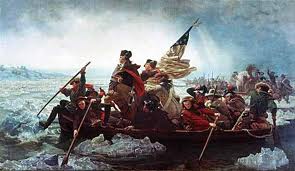
Washington only won three battles in the Revolutionary War, but he won them at the right time.  The Battle of Trenton seems something like hitting two foul shots to send the game into overtime.  Yorktown was perhaps not as crucial, but still similar in the timing and result.  Pressure brought out the best in Washington.

By contrast, the British general surely had less to play for in the Revolutionary War.  They had the best army on paper, not just against the colonies but throughout Europe and perhaps the world.  Yet they had no “clutch” performances, perhaps because pressure did not draw it out of them.  Winning and losing meant much less to them compared to the colonists.

My point is that pressure reveals something about us.  It does not always reveal something “good” or “bad” about us, but with the testing comes opportunity.

Fire away, statisticians, I still think something like “clutch” exists.

Bligh’s Portable Nightmare

The full title of the book is Captain Bligh’s Portable Nightmare: From the Bounty to Safety — 4,162 Miles Across the Pacific in a Rowing Boat.

With such a title, the author John Toohey borrowed from the dense Enlightenment style from the period he chronicles.  The original title of Bligh’s own book was The Narrative of the Mutiny aboard His Majesty’s Ship ‘Bounty;’ And the Subsequent Voyage of Part of the Crew, in the Ship’s Boat. 

Bligh’s mentor and hero Captain Cook wrote one entitiled, The Voyages of Captain Cook Round the World: Illustrated with Numerous Engravings on Wood and Steel.

Clearly, the late 18th century liked long titles.

Toohey writes well and tells a remarkable story, making some inspired guesswork about what happened on the launch and how they possibly could have traveled so far and survived.  Put Bligh’s accomplishment in the long list of things perhaps no one on Earth could do today.  To be fair to us, Bligh may have been one of the few of his time that could have done it as well.

The book grabbed me for other reasons.  Bligh represents much of his time.  In Bligh we have a man of incredible mathematical and navigational gifts.  But the journey required a great amount of indescribable “feel” as well as inspired guesswork honed by years of sailing by sun and stars.  Bligh’s abilities were innate to be sure but also honed by all the fruits that the Scientific Revolution and Enlightenment had to offer.

But it’s the long titles of all those 18th century books that bothers me.  Those titles seem so earnest and so dedicated, just like the men themselves.  But their style can be so heavy and didactic that all life gets sucked out of them.  In the same way, some of the era’s  great men like Bligh seem out of touch not just with the universe itself but with each other.  Even while in the rowboat fighting for the life of the crew, Bligh managed to make these impressive maps of surrounding islands that later sailors would use themselves and declare accurate:

But when one the men on the launch died in a Dutch settlement, Bligh did not even know if the deceased had family to notify.  He could save the lives of his men without relating to them as human beings.  Bligh’s tragic resentment towards his men whom he believed did not sufficiently appreciate him shows him to be all to human indeed.

Blessings,

Dave

And now as a postscript, being for the edification of Ladies and Gentlemen alike, for the purpose of reinforcing the bloggist’s aforementioned point concerning the titles of books in the said era under discussion. . .

Some other titles of 18th century books:

An Introduction to the Italian Language Containing specimens both of prose and verse … with a literal translation and grammatical notes, for the use of those who, being already acquainted with grammar, attempt to learn it without a master …   By Samuel Johnson

The New England Almanac, or, Lady’s and Gentlemen’s diary, for the year of our Lord Christ 1775, calculated for the meridian of Providence, New England,  lat. 41° 51′ n. and 71° 16′ w. from the Royal Observatory at Greenwich; but may serve all the adjacent provinces.  By Benjamin West

12th Grade: Fringe Ideas and the Democratic Process

Greetings,

After 8 sessions, this week we wrapped up our own in class Peloponnesian War Game, which the seniors do every year with this unit.  We divided the class into five different teams:

– Athens           – Chios (Athenian Ally)

– Sparta             – Corinth (Spartan Ally)

– Persia, the Wild Card

Each of the years this game has been played I have seen slightly different outcomes each time.  A usual pattern, however, has Athens try and keep a tight leash on Chios to prevent them from rebelling (which Chios, if it wants to win big, must do).  Persia usually wants to sponsor Chian independence and use their military for themselves.  Thus, Athens becomes Persia’s clear enemy.

This time the Athenian team used a never before seen strategy, one that would nearly guarantee them a partial victory, but deny them complete victory.  They agreed to let Persia have one of their provinces in exchange for cash to fight Sparta and Corinth.  Once Athens lost part of its empire to Persia, keeping Chios took on much less importance.  When Chios bucked for independence Athens let them go and focused their attention on Corinth and Sparta.  Fueled by Persian cash, Athens eventually destroyed both of them, though 1-2 of the battles were very close.

Thus, Chios and Persia took home the biggest prizes in our war, while Athens settled for 2nd place.  In our imaginary Greek world, the only Corinthians or Spartans you might meet would be wandering beggars on the street.  Congratulations to the winners, and to Athens for their innovative strategy.

Also this week we had a discussion on the idea of fringe opinions and whether or not they benefit democracy. This question came from their homework on Thucydides’s famous passage on the Revolution in Corcyra during the Peloponnesian War.  Most every student offered an opinion and they had an excellent discussion.  Among some of their ideas:

1. Fringe opinions are generally bad, but inevitable if you want to have a democracy.

2. Fringe opinions are not bad or good because they have no impact.  The vast meat-grinder that is American society softens whatever fringe opinion comes along before it goes mainstream.

3. Fringe opinions are bad, because those who hold then generally are not open to debate, dialogue, and compromise, all of which are essential to a democracy.

4. Radical fringes usually harm no one but a select few and pose no real threat normally.  But in times of great national stress or emergency, they become much more dangerous, as their appeal grows exponentially.

We also discussed what we meant by “fringe opinion.”  Is what makes an opinion “radical” the idea itself, or the number of people who espouse it?  Can the majority hold a “fringe” opinion?

Should any safeguards be taken against fringe opinions?  Many European nations ban the Nazi party, for example, but not the United States.

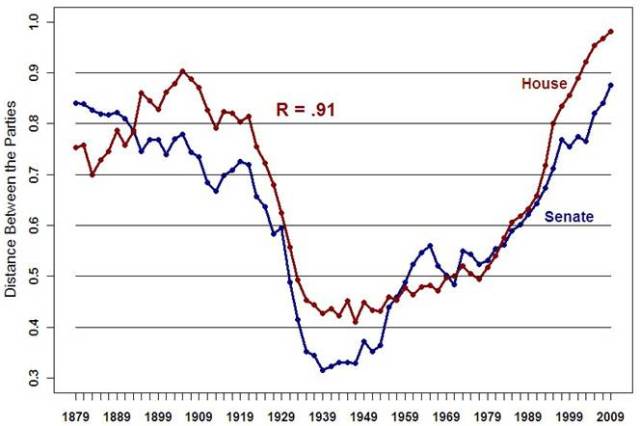
Obviously we do not face a civil war to the death in our midst, and are nowhere close to the polarization Greece experienced.  But do have any reason for concern?  These graphs might give us pause.  The first shows the increase of straight party voting over the years:

The second shows the ideological distance between the parties. . .
And finally, the rise of presidential Executive Orders.  If Congress stops working the rise of executive power seems inevitable. . .

Many thanks!  Enjoy the weekend,

Dave Mathwin

Here is the text the students worked through:

The following is from Thucydides, who comments on the revolution in Corcyra in Book 3, chapter 8

For not long afterwards nearly the whole Hellenic world was in commotion; in every city the chiefs of the democracy and of the oligarchy were struggling, the one to bring in the Athenians, the other the Spartans. Now in time of peace, men would have had no excuse for introducing either, and no desire to do so; but, when they were at war, the introduction of a foreign alliance on one side or the other to the hurt of their enemies and the advantage of themselves was easily effected by the dissatisfied party.

71 And revolution brought upon the cities of Greece many terrible calamities, such as have been and always will be while human nature remains the same, but which are more or less aggravated and differ in character with every new combination of circumstances. In peace and prosperity both states and individuals are actuated by higher motives, because they do not fall under the dominion of imperious necessities; but war, which takes away the comfortable provision of daily life, is a hard master and tends to assimilate men’s characters to their conditions.

When troubles had once begun in the cities, those who followed carried the revolutionary spirit further and further, and determined to outdo the report of all who had preceded them by the ingenuity of their enterprises and the atrocity of their revenges. The meaning of words had no longer the same relation to things, but was changed by them as they thought proper. Reckless daring was held to be loyal courage; prudent delay was the excuse of a coward; moderation was the disguise of unmanly weakness; to know everything was to do nothing. Frantic energy was the true quality of a man. A conspirator who wanted to be safe was a recreant in disguise. The lover of violence was always trusted, and his opponent suspected. He who succeeded in a plot was deemed knowing, but a still greater master in craft was he who detected one. On the other hand, he who plotted from the first to have nothing to do with plots was a breaker up of parties and a poltroon who was afraid of the enemy. In a word, he who could outstrip another in a bad action was applauded, and so was he who encouraged to evil one who had no idea of it. The tie of party was stronger than the tie of blood, because a partisan was more ready to dare without asking why. (For party associations are not based upon any established law, nor do they seek the public good; they are formed in defiance of the laws and from self-interest.) The seal of good faith was not divine law, but fellowship in crime. If an enemy when he was in the ascendant offered fair words, the opposite party received them not in a generous spirit, but by a jealous watchfulness of his actions.72 Revenge was dearer than self-preservation. Any agreements sworn to by either party, when they could do nothing else, were binding as long as both were powerless. But he who on a favourable opportunity first took courage, and struck at his enemy when he saw him off his guard, had greater pleasure in a perfidious than he would have had in an open act of revenge; he congratulated himself that he had taken the safer course, and also that he had overreached his enemy and gained the prize of superior ability. In general the dishonest more easily gain credit for cleverness than the simple for goodness; men take a pride in the one, but are ashamed of the other.

The cause of all these evils was the love of power, originating in avarice and ambition, and the party-spirit which is engendered by them when men are fairly embarked in a contest. For the leaders on either side used specious names, the one party professing to uphold the constitutional equality of the many, the other the wisdom of an aristocracy, while they made the public interests, to which in name they were devoted, in reality their prize. Striving in every way to overcome each other, they committed the most monstrous crimes; yet even these were surpassed by the magnitude of their revenges which they pursued to the very utmost,73 neither party observing any definite limits either of justice or public expediency, but both alike making the caprice of the moment their law. Either by the help of an unrighteous sentence, or grasping power with the strong hand, they were eager to satiate the impatience of party-spirit. Neither faction cared for religion; but any fair pretence which succeeded in effecting some odious purpose was greatly lauded. And the citizens who were of neither party fell a prey to both; either they were disliked because they held aloof, or men were jealous of their surviving.

Thus revolution gave birth to every form of wickedness in Greece. The simplicity which is so large an element in a noble nature was laughed to scorn and disappeared. An attitude of perfidious antagonism everywhere prevailed; for there was no word binding enough, nor oath terrible enough to reconcile enemies. Each man was strong only in the conviction that nothing was secure; he must look to his own safety, and could not afford to trust others. Inferior intellects generally succeeded best. For, aware of their own deficiencies, and fearing the capacity of their opponents, for whom they were no match in powers of speech, and whose subtle wits were likely to anticipate them in contriving evil, they struck boldly and at once. But the cleverer sort, presuming in their arrogance that they would be aware in time, and disdaining to act when they could think, were taken off their guard and easily destroyed.

Now in Corcyra most of these deeds were perpetrated, and for the first time. There was every crime which men could commit in revenge who had been governed not wisely, but tyrannically, and now had the oppressor at their mercy. There were the dishonest designs of others who were longing to be relieved from their habitual poverty, and were naturally animated by a passionate desire for their neighbour’s goods; and there were crimes of another class which men commit, not from covetousness, but from the enmity which equals foster towards one another until they are carried away by their blind rage into the extremes of pitiless cruelty. At such a time the life of the city was all in disorder, and human nature, which is always ready to transgress the laws, having now trampled them underfoot, delighted to show that her passions were ungovernable, that she was stronger than justice, and the enemy of everything above her. If malignity had not exercised a fatal power, how could any one have preferred revenge to piety, and gain to innocence? But, when men are retaliating upon others, they are reckless of the future, and do not hesitate to annul those common laws of humanity to which every individual trusts for his own hope of deliverance should he ever be overtaken by calamity; they forget that in their own hour of need they will look for them in vain.
Solyndra and Historical Innovation

I don’t know anyone against clean energy, though plenty of people might disagree about the priority we should give it, costs vs. benefits and so on.

Along those lines, I took no joy in Solyndra’s sad end, as it might set the cause of cleaner energy back a bit.  On the one hand, there is nothing shocking about a company failing.  Companies do fail sometimes, including those backed by government loans.

One aspect of their rise and fall intrigued me, however.  Their CEO and founder Dr. Chris Gronet had an idea.  Instead of relying on traditional and expensive silicon, he helped develop a process that could eliminate the need for silicon entirely.  It would be a great leap forward, one that would bypass the whole flow of solar panel development that came before it.

Well, among other things, the price of silicon plummeted, making Solyndra’s technological “breakthrough” unnecessary.  Aside from that, the new machines didn’t work well.  Solyndra’s bad gamble may have helped widen the door for China to continue dominate the market.

Aside from possible allegations of fraud and cronyism, did Solyndra just get unlucky?  Or, did they unwittingly violate a law of human experience?  Were they in a hurry?

The idea of a “Great Leap Forward” enticed Mao and entices all of us.  The past can seem burdensome, and  context irrelevant.  But it seems to me that no great historical “leap forward” has every happened without a long steady drip preceding it.

Most would say, for example, that Science defines itself through trial and error, the process of disputation.  As many have pointed out, however, people didn’t decide to do this overnight.  The western roots of disputation went back at least to the Medieval scholastics, if not further back.  Descartes and Newton had kinsmen at least 400 years in the past.

On the surface, Nixon’s trip to China looks like a massive, overnight tectonic shift.  But that too had deep roots in China’s conflict with Vietnam, and the Soviet style ‘one size fits all’ approach to communism that offended China’s sense of its own unique identity, among other things.

How about stylistic leap forwards?  It’s hard to go further than Shakespeare did when he brought a little levity to the dramatic arts.  His example almost destroys my theory.  But even he strikes me as decidedly “Medieval” about his conception of the world and the drama of salvation.  Also it seems that Shakespeare reached back to some of the Medieval sense of play after the heaviness of the Renaissance humanists.  So even Shakespeare did not eschew the past.

Pope John XXIII had it right: don’t be in a hurry.


Dave

“He who is always in a hurry. . . never gets very far.”

In his Journal of a Soul, the great Pope John XXIII admonished himself, “Not to worry if others are in a hurry.  He who is always in a hurry, even in the business of the Church, never gets very far.”

If this is a principle of Christian spirituality, it should be a principle of human experience as well,  and we should find examples of it at work in history.

I do think we see this principle at work in German foreign policy from at least the accession of Kaiser Wilhelm II and his dismissal of Bismarck in 1890.  One might even argue that it applies to Bismarck way back in the 1860’s.  But let’s just focus on Germany from 1890.

They directly challenged England by tripling their naval budget between 1900 and 1910.  They doubled military spending between 1910-1914.  They got involved in Africa and tried to obtain land in South America.  Perhaps in hurrying so much to “keep up with the Joneses” they did not see how ultimately self-destructive colonial acquisitions could be.  They even tried to acquire the Baja Peninsula.   Next time you are in a hurry look around and you will see how it makes others nervous.  The problem is, when we hurry we rarely look around ourselves at all.

Strategically, by adopting the Von-Schlieffen plan, they had to ‘hurry’ through Belgium so they could beat France in time to deal with Russia.  In their need for speed they committed various atrocities to get to France as soon as possible.  In the trenches they introduced chemical warfare because in their minds they had to hurry and shorten the war.

All these things worked against them long-term.  The Kaiser did not understand the power of the press as Bismarck did.  They brought on the moral outrage of the rest of the combatants and eventually their unrestricted submarine usage (also another attempt to hurry up and win) brought the U.S. into the war for good measure.  Disaster awaited them at Versailles.

Surely Napoleon also hurried.  One can see this through his whole personality.  Politically, he had no patience to establish genuine connections with those he conquered and made relatives his private puppet rulers.  We know this is not the way to win friends and influence local populations, who naturally turned on him the moment they had an opportunity.

I also think Hannibal hurried.  This, I admit, is more debatable.  He showed more political sense than Napoleon, and certainly more than Wilhelm II.  Yet he could have opted to spend time making his holdings in Spain secure and later invaded Rome from a much more secure base of logistical and political support.  Instead, he went for broke, and that’s how he ended up.

Has being in a hurry ever worked for any country/civilization?  Can we think of other failures rooted in hurry?

Has it worked for any particular company?  Have those that raced to market certain products first stood the test of time?

Blessings,

Dave

8th Grade: The Athenian Golden Age

Greetings,

This week we had a test, along with a review game on Monday and worldview week, so we had little time in ‘normal’ class.  We did spend some time discussing the elements of ‘golden ages’ and the factors that went into the birth of what we know as Periclean Athens.

From 480-430 B.C., Athens experienced an explosion of creativity and culture perhaps unparalleled in human history.  Much of what we consider to be modern democracy, philosophy, literature, drama, science, and architecture have a good measure of their roots here.

What is needed for a golden age?

As we compare them across time (Athens, Dutch early 1600’s, Elizabethan England, 12th century France, etc.) some common factors emerge:

1. Some kind of cross pollination of culture based on access to the sea or at least, extensive travel

2. A burst of confidence based on a defeat of a large power — you were the underdog and emerged on top.  The unexpected victory serves as a validation of your uniqueness.

3. An educational base to build the cultural explosion on.  There has to be some kind of literate and curious population base to build on.

4. The willingness to tolerate the possibility of new ideas, which usually has something to with #1 listed above.

With all these factors possibly needed (and possibly more that I have not accounted for),

We also looked at the flowering of Athenian democracy.  As we examined how it functioned, we arrived at a proposition to debate next week, which is

Athenian Democracy in the age of Pericles was more democratic than America is currently.

Part of how you evaluate this statement depends on a few factors:

1. What do we mean by “Democracy?”

We are so used to the word “democracy” we may not consider what we even mean by the term.  Clearly it must mean more than mere voting.  Some elections have only one candidate, or the different candidates do not give us different options in reality (that is, the candidates would do basically the same thing if elected).    It must also mean more than mere majority rule.  If 51% of the people vote to oppress the remaining 49%, we would not call that democracy.

Democracy attempts the trick of giving power and choice to the people, while at the same time preserving freedom in some measure for all citizens.  Thus, the ‘losers’ in a contest are still protected from the possible pitfalls of majority rule.  At the same time of course, the majority cannot be obstructed too much, otherwise the point of voting and majority rule would be lost.  Historically this balancing act has never been easy.

2. What is most important in a democracy?

In the Athenians favor we note the following:

– They had much more direct participation in government than modern Americans.
– The average citizen would not only vote, but could also speak in the Assembly.  Most citizens would probably serve in some political capacity during their adult lives

Against them we can say that:

– Women and slaves were excluded from voting and participation
– The very fluidity of their democracy opened up the real possibility that the checks and balances of law could easily be overridden, as happened on a few occasions.

For modern America we note that

– All citizens of a certain age are eligible to vote.
– We have minority protection built into the system.

Against us some might say

– Representative government has tended toward an oligarchy of the rich, with powerful interests controlling both parties.
– This, in turn, has led to a real distance between Government and the people which results in an “Us and Them” attitude.

I will look forward to their debate when we return next week.  Below is a very detailed chart of the ins and outs of Athenian democracy for the very interested.

Many thanks,

Dave Mathwin

“Everybody Loves Our Town” — Seattle’s (and America’s) Identity Crisis

I grew up loving “Grunge” music.  I remember where I was when I first heard “Smells Like Teen Spirit.”  How many other 18 year olds rejoiced with me, as we could move from cuffed khaki’s and pastel button-up shirts to jeans and untucked flannel?  It was an oasis in a desert.  Freedom!

I also like oral histories, and so it was a given that I read Everybody Loves Our Town: An Oral History of Grunge

The book has many interesting aspects, but a theme throughout was the dilemma Grunge artists faced.  The whole musical movement had its roots in being an outsider and on the fringe.  They bucked the system — the system was the enemy.  But what happens when you get wildly popular?  What happens to your identity when you get on the cover of Time  magazine?  Can the two co-exist?  This theme runs throughout Mark Yarm’s excellent work. 

As you might imagine, the dilemma produced a profound psychological crisis for many.  Take Nirvana’s second album, for example, which is vastly inferior to Nevermind.  It’s almost as if Cobain wanted to make it bad on purpose.  I don’t think they were a “one and done” kind of band, either, as their stellar performance on MTV Unplugged showed.  In tragic retrospect, this video from In Utero shows Cobain’s self-loathing.  Soundgarden bassist Ben Shepperd astutely remarked that you can hear Cobain’s self-hatred in how he uses his voice.

This concept of “identity crisis” I think applies to civilizations as well.  Take Rome — for centuries they are the “Little Engine that Could” and then, within a few years of their victory over Hannibal, they have unquestioned Mediterranean dominance.  Their subsequent history shows that they did not handle their new role well at all, and this identity crisis runs right down through to The Aenid.

How about the United States?  What is our self-image?  Have we gotten used to the idea that we are globally dominant?  Even in the Cold War we could assume the “underdog” mantle.   I think it’s safe to say that we do not like to think of ourselves this way and do not like it when others see us as the “top dog.”  How will we handle our own shift in identity?

Is this perhaps why so many instantly related to the Clint Eastwood Super Bowl commercial?  Being the underdog — that’s what we identify with.  This poses a tricky dilemma for politicians.  On the hand they usually need to say something like, “America is strong!” and on the other have to inculcate a “We’re down, but not out!” mentality.

Stravinsky and Nationalism

I have a theory about Stravinsky’s famous “The Rite of Spring.”

Many assume that the riots surrounding the premiere of his ballet had to do with the fact that he made ballet “ugly,” or that he destroyed conventional concepts of dance, beauty, etc.

I’m sure this represents part of the reason for the intense negativity–possibly even most of it.  But I wonder if part of the reason was not that Stravinsky showed people themselves — a pagan people who worshipped the tribe.   But here I need help from someone who knows more about Stravinsky than I, for I know next to nothing.

Every religion involves sacrifice, and Stravinsky here reminds me of Wilfred Owen’s line,

The old Lie; Dulce et Decorum est
Pro patria mori.

Translated, I believe, “It is sweet and right to die for one’s country.”

Toynbee also commented incisively on this era,

Great, for example, as was the havoc wrought in Hellenic history by the Hellenes’ sin of idolizing their parochial states, the havoc was still greater when this particular form of Hellenic idolatry was resuscitated in a Western Christendom where the vein of Judaic fanaticism . . . was lying in wait . . . imported from Hades with a demonic intensity which it had never attained in even the deadliest of its manifestations on its native heath in a heathen Hellenic World whose life it brought to a bad end.

Stravinksy seems to have embraced Christianity.  Among some of his comments are,

Music praises God. Music is well or better able to praise him than the building of the church and all its decoration; it is the Church’s greatest ornament.

and,

I cannot now evaluate the events that, at the end of those thirty years, made me discover the necessity of religious belief. I was not reasoned into my disposition. Though I admire the structured thought of theology (Anselm’s proof in the Fides Quaerens Intellectum, for instance) it is to religion no more than counterpoint exercises are to music. I do not believe in bridges of reason or, indeed, in any form of extrapolation in religious matters. … I can say, however, that for some years before my actual “conversion,” a mood of acceptance had been cultivated in me by a reading of the Gospels and by other religious literature. ..

If “The Rite of Spring” is art, does art always have to be beautiful?  Or does art merely need to reflect truth?

Blessings,

Dave

Regine Pernoud’s “Those Terrible Middle Ages!”

Don’t be fooled by the unfortunate, somewhat silly title.  Ms. Pernoud is sharp old French woman you don’t want to mess with.  She brings her best wit and sarcasm to the table. 

Pernoud starts by acknowledging that most everyone believes that “Middle Ages” means “darkness,” oppression, and rigidity.  Pernoud argues that this grossly misrepresents the period, which should not surprise anyone with some familiarity with actual medieval people. What makes her work interesting and entertaining is that Pernoud thinks that the epithets we apply to the Middle Ages should really be reserved for the Renaissance.

The success of her first aim was almost a given, and the book does serve as a helpful resource for those looking for a quick and positive spin on the Middle Ages.  But as much as we might admire a lone knight sallying forth to slay a dragon, does she have any chance at bringing down the massive psychological support the West has given the Renaissance over the past centuries?

The planks of her argument:

1. For the first time in western history, European civilization during the Middle Ages eliminated slavery from the social structure.  Don’t you dare call serfs “slaves,” she asserts.  Serfs had many legal protections and rights from the Church and from the nobility.  Slavery returned in the Renaissance, when scholars revived Roman concepts of ownership.

2. Medieval culture embodied genuinely popular culture–the culture of the masses, of the tradesmen.  The great artistic achievements, like cathedrals, exemplify truly ‘popular’ achievements in this respect.  By contrast again, the Renaissance introduced aristocratic culture patronized by society’s elite, with only “the artists” fit to contribute.

3. Medieval art and the Gothic style, whatever its weaknesses, brought something original to human expression.  Whatever the merits of Renaissance art, they merely cut and pasted a dead image from Greece and Rome.  We falsely give the Renaissance credit for its supposed color and pageantry; while in reality “classical fanatics” during that period smashed the multi-colored stained glass windows and put clear panes in their place.

4. If you like weak central governments and local color, then you should like the Middle Ages.  The power of the king rested on a variety of contingencies.  During the Renaissance we see the centralization of the power of “The Prince,” and the beginnings of the road to absolutism practiced by Charles I and Louis XIV a century later.  Again, this was due to the pernicious influence of Roman ideas of power.

Does she succeed in this “great reversal?”  Well, at least she come close.  If the book has a weakness, it would be that it is too “French”–too assertive and dogmatic.  But, that is part of what makes it a fun read.

Blessings,

Dave

Apple and Lewis Mumford

In his essay Authoritarian and Democratic Technics historian Lewis Mumford gives wonderful clarity to typical discussions about technology.

The article is here, but I will summarize for those who want the quick version.

Typically people will say, “Technology is neither good nor bad, but can be used for good or bad ends.”  That is, technology is value-neutral, and entirely so.

Mumford disagrees.  No technology is inherently good or bad.  But products are designed to be used in certain ways, and they enter into a human context that is always moral.  Basically, Mumford argues that

– Some kinds of ‘technics’ are designed to be used in such a way that enhance our humanity, which he calls ‘Democratic,’

and

– Some, as we use them, will inevitably take away from our humanity, which he calls, ‘Authoritarian.’  For Mumford, the Industrial Revolution produced much of this.

His categories really help cut through debates surrounding technology.  With the recent passing of Steve Jobs and focus on his legacy, a question arose in my mind.

Jobs was notorious for his insistence on control of every aspect of product development.  Apple products are essentially ‘closed’ systems that have definite boundaries of how they can be used.

And yet, Apple products are wonderfully accessible.  What’s more, they have a simple elegance about them.  Jobs took aesthetics quite seriously.  He created beautiful products.

Do Apple products fall within the ‘Authoritarian’ or ‘Democratic’ side of the Mumford’s analysis?

Here is one person’s take.

Blessings,

Dave

Ferguson and Spengler on Imperialism

Oswald Spengler was certainly eccentric, and some of his ideas were legitimately dangerous.  But in straying far from the beaten path, he occasionally stops you dead in your tracks.

I think he does this with his thoughts on imperialism.

Niall Ferguson represents the traditional view of imperialism as it relates to the overall health of the West in his excellent ” The War of the World.”  For Ferguson, Western Civilization peaks just before World War I.  At this point the West ruled close to half the globe in some way, shape, or form.  Their massive overseas expansion was therefore a sign of health.

This should not surprise us.  Expansion requires

  • Abundance of energy and drive
  • The necessary resources to carry out one’s will
  • A great degree of power relative to those you encounter

All this backs up Ferguson’s position.

But Spengler comes at the question in an entirely different way.  For him, the expansion on the scale Europe indulged in ca. 1850-1914 meant the end of the West was nigh, and I think that came from his psychological approach.

For Spengler, a civilization is healthy when it possesses a vibrant ‘inner-life’ and is at peace with their place in the world.  When a civilization exhausts its inner life, the only thing left is to extend the possibilities of the self outwardly.  So — expansion is sign of boredom, of weakness, a lack of vitality.  Just as we would think that a person who needed constant variety would be bored, so too civilizations.

The picture continues if we apply this idea to a 50 year old man in ‘mid-life crisis.’  What does he do?  He buys a sports car and obtains a trophy wife.  Suddenly he is very tan.  Many admire his “vigor,” and he convinces himself that youth has been restored.

But we know that he deludes himself.  His “expansion” of “energy” comes from profound inward unease.  Rather than deal with it, he paints over it through activity.

I find Spengler’s lens of viewing civilizations as organic, not material, entities compelling.  But this is a great Rubicon to cross, and has many implications. . .

Blessings,

Dave

Spengler’s “The Hour of Decision: Germany and World Historical Evolution”

I confess I am a bit mystified by the high reviews some give this book. It’s not just the disturbing racial undertones  of what Spengler says, but the lack of coherent, consistent, and original thinking that made this book a bit of a chore for me.

One highlight, however, is that here is a Spengler book I can actually understand (for the most part).

The book blurb talks of how this book influenced Nazism and Hitler in particular. Unfortunately, there is good reason for this link. Spengler talks a lot about race, racial vigor, blood, and so on in ways that are most definitely unnerving, considering that he wrote in 1933. So, some of it is distasteful, some of it is frightening, and some of his talk about race is downright absurd. But Spengler is too smart for us to dismiss this book outright.

This link between Spengler and the Nazis may not be fully justified. At one point Spengler writes, “Those who talk too much about race no longer have it in them. what is needed is not a pure race, but a strong one, which has a nation within it.”  I think that Spengler would probably accuse the Nazis of “protesting too much” about race in general. He would have thought that their racial obsessions marked deep insecurities.  At least I hope so.

If we unpack this quote I think one can get to his main point. Spengler likes things to be definite. He likes specific cultural achievements and style (i.e. the Gothic). He likes particular people to make their mark on history (i.e. Bismarck). He likes rights particularly defined, at one point praising Burke for talking about his ‘rights as an Englishman,’ as opposed to vague, uncontexualized, “human rights.” He critiqued the Weimar Republic , for example, for eroding all the best that “Prussianism” had to offer Germany.  Here at least I don’t think I can agree.  I admit it’s easy to dislike the Weimar Republic but much easier and better to hate the word “Prussianism.”

This is why he did not like democracy. He brings out the old saw that it essentially is mob rule and will create a blase and meaningless culture.

Is there anything here worth considering?

  • He has a decent analysis of W.W. I as the wrong war to fight at that time. The real enemy was Russia, and any war fought by Germany with such opposites as Russia and France was bound not to be decisive.
  • He makes thought-provoking comparisons between Russia and the U.S. Both, he argues, have despotism in their future. And his links between democracy and despotism are worth considering. The size and scope of the country (note again his preference for measurable, definite things) will naturally pull us in that direction. Of course Jefferson disagreed and thought the size of the country would prevent it from being centralized. We shall see, and I certainly hope that Spengler is wrong on this one.


Musical and Literary Endings

One my favorite bands is “The Bad Plus,” a genre bending jazz trio.  I love just about everything they have done.

I say “just about” because they have a few songs that end in a discordant or incomplete fashion, and to me that’s no ending at all.  I recall a story about a son who always knew how to aggravate his composer father.  He would play seven notes of a scale on the family piano and refuse to play the last.  His father, no matter the situation, would inevitably have to come back to the piano and play the last note.

My question — Is this a matter of taste?  Or is it “wrong” to end a song discordantly?  As far as my limited knowledge takes me, jazz is the only musical genre that does this, however rare it might be.  Can discordant endings be appropriate in certain musical genres and not others?

I tend to think that it is wrong to end a song discordantly.  Songs are like stories and should have a beginning, middle, and end.   The songwriter has a duty to their audience.  There should be wholeness, completion. Don’t get our attention and then not deliver.

But then I check myself, because I don’t always mind, and sometimes even like, movies or books with ambiguous endings.  Should ambiguous or endings be considered ‘discordant’ endings?  Why or why not?


Losers in History vs. Losers in Sports

Historical memory will sometimes romanticize losers.

Robert E. Lee, Hannibal, Napoleon, Vercingetorix — all of them have a romantic glow about them in the minds of some.  In this ‘Romantic’ narrative, all of them begin as significant underdogs, but through pluck and brilliance make Goliath quake.  They nearly succeed, but then one mistake, or one setback of fate, and cruel reality overwhelms them.  So, Lee would have won had Stuart been at Gettysburg, Napoleon would have won if it had not rained at Waterloo, Hannibal if he had attacked Rome after Cannae, and so on.

Life can sometimes imitate art, but it is usually messier.  One can certainly make arguments for the causes of all of the military men I mentioned, but making them tragic heroes can blind us to reality.  Were all of them really underdogs?  Lee and Vercingetorix had many, many, advantages.  Napoleon nearly always faced divided allies.  Hannibal was not forced into choosing what amounted to an all or nothing strategy.  Furthermore, failure on a grand scale like theirs can rarely be attributed to one event.  All of them exhibited, to my mind, poor strategic thinking and were sunk not by fate but by their own choices.

Have you noticed that we don’t romanticize sports losers?  No one waxes eloquent about Joe Flacco, loser in two AFC Championship games, or Donovan McNabb, loser in a variety of NFC champioship games and one Super Bowl.  No one cares that Jake Delhomme nearly beat the Patriots in Super Bowl XXXVIII.  Commentators killed Miami for losing the NBA championship to Dallas.  No romanticizing there.  The list goes on.  Perhaps the one exception I can think of might be Joe Frazier, but of course he beat Ali once, and was treated horribly by Ali in a way that should draw our sympathy.  My wife brought up the point that we romanticize Dan Marino.  Is there a common thread?

We also never romanticize political losers.  Michael Dukakis?  Who cares?  McCain, Mondale, Dole, — I can’t think of one romanticized defeated candidate.  The concept of gallantry amidst futility (or at least perceived futility) inspires admiration for some historical figures, but not political ones.

What can account for this difference?  I have no answers, but would like some suggestions.

Thanks,

Dave

8th Grade: What would the ‘Occupy’ Movement think of Solon?

Greetings,

After the test early in the week, we spent the next few days looking at the rule of Solon in Athens from 590-570 B.C. The ancient world regarded Solon as a great sage, but as we saw, his head was not in the clouds.  He took a society ready to fly apart at the seams and left it with an established social context in which democracy could take root.  I wanted to highlight a few key lessons.

First, the background:

Before Solon there was Draco, a member of the Athenian aristocracy.  His name itself came to symbolize harsh governmental policy, i.e. a ‘Draconian’ law.  His policies helped cement the divide between rich and poor and threatened to make it wider. This dynamic is not unusual.  When one group in society separates itself from others because of wealth or status, they tend to fear the rest of society and thus, isolate themselves all the more.  This increased distance only requires more force to ensure the divide.  One can think of the ante-bellum South, for example, and various laws enacted that made it criminal to educate slaves.  Society built like this can’t last for long.

Enter Solon.

He recognized a few key things:

1. Society needs the rich.  One can argue that the rich abused their power but they are still Athenian, and their resources can benefit Athens
2. The divide between rich and poor must be healed if we are to survive.  This will require sacrifice from the rich
3. This led to what may have been Solon’s invention, and may not have been — a graduated income tax.

No one likes to pay taxes.  One of the reasons I this is so is that no one really knows where their money goes.  It gets dropped into a vast ocean, never to be heard from again.  Solon, perhaps recognizing this, did things differently.  He did not ask for a direct sum from the wealthy, but offered them opportunity.  The wealthy could fund specific projects.  They could just pay directly for a religious festival, a bridge, or a naval warship.  Of course, they could also get full credit for their funding, i.e., ‘This festival to Athena sponsored by Diodotus.’  So, paying taxes became a way to earn ‘kleos.’  The wealthy could contribute in how much they gave.  Enhancing the well being of Athens was directly connected with enhancing their own status in the community.

Problem solved.

Could this apply today?  We are much too big to do what Solon did on any appreciable scale.  Yet I wonder, with the ‘Occupy’ movement and other kinds of resentment against the elite building, if we couldn’t borrow his ideas. What if we did this for the very rich, and put their faces on front pages with captions like, “Warren Buffet posing with fighter jet paid for with his taxes,” or something like this.  Would this help?

But, we should note that if we had a competition of fame/honor in paying taxes to the government, that would imply a certain relationship and attitude towards our government.  Would that attitude be appropriate?

Solon did not create democracy in Athens, but he established a context for it to exist.   Democracy cannot exist everywhere.  If the majority have an ‘us v. them’ attitude then they will use their power to ‘get revenge’ or exploit the others.  In this environment, society will become cancerous and destroy itself.  Democracy can only really work when the power of the majority does not just represent merely the majority, but in some sense, all the people.

Blessings,

Dave Mathwin