Stopping the Buck in Russia and Elsewhere

I have always been amused by Milo Yiannapoulos, and have regarded him primarily as a funny person, an obvious provocateur.  Every court jester knows that he has to push the envelope to fulfill his duty.  The king must remain flexible enough of mind and heart to laugh rather than get angry.  It is indeed the foolish king that gets angry at his fool.

Milo has always contained contradictions and has never hid his admiration for Catholicism, despite the fact that he was abused by a priest as a young boy. Despite the fact that he lives as openly gay, he has never wanted the Church to change its official position on gay marriage or homosexual behavior in general.  But despite his support of traditional morality, he is gay married.  But, he then goes on to insist that his is not a marriage at all–which can only be between a man and a woman– but rather a civil partnership of some kind.

In a recent interview with Patrick Coffin, Milo showed that he honestly wrestles with some of these contradictions.  He spoke of how he used free speech as a tool against the radical left and the good effect he felt it had.  But he also acknowledged his realization that free speech by itself remains a mere tool and not a destination.  The tools need used in the service of some greater good, and he feels now that this “greater good” is found in the Christian foundations of western civilization.

But he still remains gay married.  We’ll see where this all ends up for him in the coming years.

I have felt for some time that the current debates about free speech and our current political mess are really about our search for a new center, a new place where we can all agree that the buck stops.  The left, which used to ardently defend free speech, now uses exeedingly irresponsible language in regard to curtailing this right on campuses and beyond.*  We all recognize at least subconsciously that free speech cannot stand as our absolute monarch.  No one thinks we can yell “fire” in a crowded theater.  We know that free speech needs some limits and direction. Our problem now is that we have no agreement as to what end we should direct our rights.  And, if we do not know how they should be used, some now think that we should put away these “weapons,” or at least reduce the scope of these rights.

I use the word “monarch” intentionally.  We booted out George III and banned aristocracy.  But of course we have makers of taste, and of course the buck must stop somewhere in any culture.  In some cases it might be with a person, or possibly a place, or in America’s case, most likely in some shared ideas and beliefs.  As Milo has discovered, not even our vitally important right to free speech is an absolute value or a final destination.

Russia has been in the news for some time lately, and we are used once again to the idea of Russia autocracy.  Certainly Russia’s history gives ample evidence that they have less of a problem with authority than most Americans.  But Russia too has at times had crises of authority, and George Fedotov gives us the context and story of one of their most famous confrontations involving the power of the state in volume three of his collected works entitled, St. Fillipp, Metropolitan of Moscow: Encounter with Ivan the Terrible.

Fedotov gives good background to the conflict between the czar and the saint:

  • Czar Ivan III (grandfather to Ivan IV, the Terrible) began to introduce more “foreign” court subservience via his marriage to a Byzantine princess.  One can argue that the expansion of royal courts could hypothetically serve as a buffer to the unlimited power of the king.  Alas, they can also tend to create competitions for the favor of the monarch, with the resul that royal favorites are merely obsequious to the king, and this seemed to happen in Russia.
  • Fedotov gives proper blame to the church under the reigns of Ivan III and Vasilli III (grandfather and father of Ivan IV, respectively) for continually extolling and promoting the wars of the monarchs.  Many church heirarchs made sacrifices of conscience to honor the power of the czar.
  • As a case in point, Fedotov highlights the divorce and remarriage of Vasilli III, who while not an abusive despot, obtained a most uncanonical divorce due to his lack of children with his first wife.  Some church heirarchs supported the divorce on purely political grounds of succession, which set a dangerous precedent of the church finding ways to justify whatever the czar wanted to do, of putting the state before God–or confusing the state with God.

Thus, by the time we reach the reign of Ivan IV (the Terrible, b. 1530, d. 1584), the power of czars badly needed curbed, and the church desperately needed a soul and spine to give proper direction to the government and the people of Russia.

Ivan IV likely had some kind of genuine religious faith.  However, his faith focused on apocalytpic visions, and he felt himself beseiged by traitors everywhere.  He saw himself as Russia’s last bastion of hope.  Perhaps Ivan truly suffered from a psychological disorder, but as Metropolitan Fillip knew, Ivan did not need “understood” so much as he needed stopped.  Ivan built on his grandfather’s court policies and elevated certain favorites, even foreign favorites from Germany.  He executed his brutal repression of “traitors” through them, the so called “Oprichina.”  In a time reminiscent of the Reign of Terror in France, thousands had property seized, and thousands of random murders took place on a whim.  Fedotov rightly points out that Ivan inaugerated civil war within his own land, a likely reflection of the torments and divisions in his own mind.  No one who looks at those persecuted by Ivan believes that no more than a few were guilty of anything.  But, the will of the Tsar prevailed without question.

Beneath the tragedy lay the genuine questions: what is the basis for authority in the state?  What is authority for?

Ivan possessed great intelligence and had a keenly developed theory to buttress his use of power.  Like many other monarchs of his day he believed in the divine right and gifting of kings.  He saw his power like that of the emperors of Constantine, and even Augustus, showing that he believed Russia to be the new “Rome” after the collapse of the west and of Byzantium.  Ivan asks, “How can an autocrat rule if he does not do so by himself?”  In the realms of the “godless” a different situation exists, he argued, but in Russia, “autocracy has always been supreme in the realm.”  “Every kingdom is destroyed when it is ruled by priests.  [Priests] destroyed the Greek state and now it is ruled by the Turks.”  In Israel as well, “God did not place a priest or commoners as the ruler or rulers of the people when he led them out of Egypt, but gave power only to Moses, like a Czar.  But when Aaron the priest “temporarily assumed this authority over people he led them away from God,” and the same happened in the days of Eli (see I Samuel) “who took unto himself the sacerdotal and lay power,” leading Israel into disaster.  “Do you see how it is not good for the clergy to rule over that which belongs to the czar?”

Ivan points out further that of course, the czar might sin, but even many of the saints “were among the fallen and the rebellious.”  His sins then, did nothing to limit his power.  Russia may suffer, but through suffering Russia will be purified and brought to greater faith.

In his political writings Ivan talks much about justice and wrath against evildoers, and the need for God to rule unfettered in the state through his chosen man.  The czar should promote the good and punish the wicked. Fedotov skillfully points out, however, that for Ivan the reality of truth rarely receives mention, and that, “The patriarchial relationship of the Tsar to the people as his children, as ‘wards of the state,’ gives way to the severe rule of a master over his slaves.”

We may not want the Church to weild political power, but as Fedotov states, “The Church’s participation in worldly affairs is natural, because the world too is subject to Christ’s truth.”   We have many recorded words from Fillip, some of which I include below:

The crown of piety adorns the Tsar more than any earthly glory.  It is glorious to display one’s power over one’s enemies, and one’s humanity to those who are submissive.  And, in defeating enemies by force of arms, it is glorious to be conquered by one’s own unarmed love.

You have been placed by God to judge the Lord’s people in truth, not to take upon yourself the image of a torturer.  Do not divide the realm.  Unify your people, for God is present only when there exists a spirit of sincere love.  Forgive, and you shall be forgiven.  Do not put your trust in any kind of justice which is not from God.

Ivan told Fillip he had heard enough and warned him on many occasions to be silent.  Fillip responded,

Our silence places a sin on your soul and causes national death.   Our faith will be in vain as will the very Incarnation of God.  If I maintain silence in matters of truth, then I cannot retain episcopal rank.

Fillip’s failure to maintain this silence eventually brought about his death at the hands of Ivan, who felt that he had found yet another “traitor” seeking to undermine his holy will.

One notable aspect of Fillip’s responses to Ivan is that they do not concentrate on legal distinctions, but rather personal commitment to something beyond rights and arrangement of power.  In the west, for better or worse, church and state fought at times over legal rights.  Fillip makes no appeal to the legal rights of the church or his own legal standing as Metropolitan.  He sought not a legal solution but a moral or spiritual one.  The “buck stopped” not with a code of conduct, but in the hearts of men committed to universal truth.

For all of my numerous objections regarding the progressive left’s attack on free speech, I acknowledge that they, along with Milo, see that free speech alone gets us nowhere, and should be in service of some higher truth.  One area where I diverge from the left is that their persistent insistence on dividing people into separate identities of race, sexuality, and gender will defeat their very purpose of finding this universal higher truth and lead us all, like Ivan the Terrible, to find “enemies” everywhere we look.

The postscript to Fillip’s death illustrates this.

In 1590, 21 years after his death, the monastery of which he as formerly the head requested that his body be returned to them.  They wrote to Ivan’s grandson Tsar Fedor, who eagerly gave his permission.  His exhumed body showed no decay, and very shortly after he was reinterred at the monastery, many were healed at his tomb.  The miracles continued, and by the 1650’s, Fillip was now St. Fillip of Moscow.  Czar Alexis (who had the interesting moniker of “the Quiet”) wrote a letter to the monastery, addressing St. Fillip directly,

Even though I am innocent of your vexation, my great-grandfather’s coffin convicts me and leads me to grief.  For this reason I bow my imperial dignity for him who sinned against you, that you forgive him by your coming here.  I submit the honor of my kingdom to your venerable relics.  For the sake of his penitence, and for our forgivenesss, come to us, holy one. You have accomplished the word of the Gospel . . . and there is no controversy about the commandments of God.

The monastery did send the body of St. Fillip, and when he appeared in Moscow Tsar Alexis spoke,

O blessed commandments of Christ!   O blessed truth!  O blessed is he, and thrice blessed, who carried out Christ’s commandments and suffered for them for his own people.  Truly, one can choose no better than to be glad and joyous in truth, to suffer for it, and to reason with God’s people about truth.  . . . God’s judgement does not dwell in falsehood . . . . and we have concern for all Christian souls, and it is our duty to stand strong and pillar like in the faith and in truth, and to suffer unto death unto ages of ages.

The Tsar understood that the repentence needed to be on a national level, for many had profitted from Ivan’s plunders and murders, contributing to the de facto civil war within Russia, and many cooperated with the notorious Oprichina.  But if the repentence involved all, so too the joy.  Tsar Alexis wrote to Prince Odoevskii that,

God has given us a great sovereign, a great sun.  Just as the relics of the radiant John Chrysostom were returned to the ancient emperor Theodosius, so also God has granted us a healer, a new Peter, a second Paul . . . the most splendid and most radiant sun.  We have been granted the return of the relics of the miracle-worker Fillip, Metropolitan of Moscow.  . . . We greeted Fillip at the Naprudnaia settlement, and took the relics upon our heads with great honor.  As we were taking them, a miracle occurred–a raving and dumb woman immediately became well and began to speak.  . . . And when we brought [Fillip] to the square across from the Granovitaia, here again a miracle occurred.  A blind man was healed, and just as in the days of Christ, people cried, “Have mercy upon us son of David!

DM

*I refer primarily to Justice Kagan’s remark about the right seeking to “weaponize” the first amendment.  The Janus case has complexity that deserves a fair hearing on both sides, but I found the phrase itself troubling.  But as a counterpoint, see this argument as to why we should think of righs as weapons (though he makes no comment on the merits of the case itself).


The Unprofessional Historian

I can’t quite help myself when it comes to Arnold Toynbee.  But I acknowledge  . . . In his 12 volume A Study of History (I have read about 8 of them) he repeats himself many times, and uses some of same examples more than a few times.  He veers sometimes wildly between philosophical speculation and the facts of the case (which I love but I understand might bother others).  A central point of his examination of Greece and Rome involves conflating them to such a degree that he seems to claim that Rome began to decline when the Pelopponesian War began.(!) He drifts too easily into gnostic, or perhaps Neo-Platonic, tendencies that raise many of my eyebrows.

Still, he takes huge swings, takes big risks with his thoughts, and offers a coherent picture of civilizations that mixes various disciplines such as archaeology, philosophy, myth, and the like.  He is in my mind the ideal of what a historian should be, not so much in his conclusions, but in his methods.

‘Volume 10’ is almost last volume of his A Study of History and has only about 150 pages of straight text, with a few appendices and a long and needed index to the other 9 volumes. This conclusion might even serve as a good introduction to the whole of his work, for here he fully describes and defends his view of what an historian is, and what History should be all about.

I say he ‘defends’ but this might be misleading, for it sounds like a didactic argument. It’s not. Part of the charm of this book for me is that he let’s himself go and speaks with passion from the heart. But the Toynbee magic is still here, as even in the first few pages we see him seamlessly weave in his grand view of history with personal recollections and observations about changes in women’s headgear in Victorian England and Turkey in the 1920’s.

I can understand people disagreeing with certain particulars of his “system,” but doesn’t this sound like fun?

His main points are

  • A historian’s proper vocation (as is the case in other vocations) is to receive and act on a call from God to ‘feel after Him and find Him.’ (Acts 17:27). There are as many ‘angles of vision’ as there are proper vocations. The historian’s vision is not greater or lesser than these, but he has a task nonetheless.
  • The inspiration of a historian is ultimately a spiritual one. The ‘muse’ of curiosity leads into broader fields of vision. Since God aims to unite all of humanity, one’s field of vision under the inspiration of the ‘muse’ (I think Toynbee means to use this term in at least a mostly literal sense) will inevitably broaden.
  • He does not spend much time on this, but this question leads to a small digression on Toynbee’s dislike of the ‘professional’ specialist. The ‘professional’ pursues not true knowledge but an impossible omniscience. This pursuit is of course impossible, and whatever knowledge he gains will be sterile — it will in fact not be real knowledge at all, and certainly not wisdom. His lack of ‘action’ in the world has a humble mask, but only serves to camouflage ‘the three deadly sins of Satanic pride, negligence, and sloth.’ (p. 26). God calls us to add to the stream of human knowledge of the world and Himself by adding one’s own thimbleful to the stream. Knowledge is never for one’s own sake or for the sake of knowledge itself, but to put humanity in a better position to know God. The same Spirit that inspires us to investigate human affairs calls us to action in service, however small, to humanity as a whole.

Perhaps this gives us some insight into his admiration for Heinrich Schliemann. Of all the historians he admires here (Polybius, Herodotus, St. Augustine, etc.) it is Schliemann, the messy amateur par excellence, whom he spends the most time with. Surely in Schliemann we find a man “inspired,” one who led with his heart rather than his head. It may be said that he created the modern field of archaeological study by going on a goose chase of absurd proportions.  And yet, he discovered Troy and Mycenae. He created the discipline of archaeology. But as soon as archaeology developed into a profession the “professionals” he creaetd dismissed him as a carnival barker. Toynbee does not dwell on Schliemann’s personal life or professional errors, but surely he would say for every step back he took two or three forward.

Finally, towards the end of the work, Toynbee sheds light on his religious views. He does this in a more straightforward and polemical way in ‘Experiences,’ which he wrote about a decade after this, and his views did not change much from this volume to then. I do not agree with his final conclusion in either volume. But here his conclusions make more sense to me in the context offered — that is — I can see how much his ‘heart’ was in his views. This is a point made by his friend Columba Cary-Elwes, a monk, in their correspondence (“An Historian’s Conscience”) which I accepted but did not understand until now. Cary-Elwes also disagreed with Toynbee ultimately, but felt that there was more agreement than Toynbee may have been aware of. Of course, as a “friend’”of Toynbee myself, I would like to think the same thing. This may be purely wishful or even ego-centric thinking on my part, but I hope not.

Basically, Toynbee believes that ultimate reality is spiritual reality, and that this spiritual reality is Love. Love is best expressed in action, not in words or syllogisms. Hence, Historian’s are called to action, and hence, Toynbee’s rejection of the various dogmas of religion as essentially unimportant distractions. He saw unity in human affairs throughout time, and a uniformity of human nature. All this led him to affirm the essential unity of religions. Claims to exclusivity are at best misdirected and at worst rooted in pride.

This is a good argument, and Toynbee was far from a cynic. He did not seek to attack religion so much as promote what he saw as something ‘higher.’ I think the Church would say that Toynbee was right about many things. But, as Chesterton said, “You cannot make a success of anything, even loving, without thinking.” He said in Orthodoxy,

The things said most confidently by advanced persons to crowded audiences are generally those quite opposite to the fact; it is actually our truisms that are untrue. Here is a case. There is a phrase of facile liberality uttered again and again at ethical societies and parliaments of religion: “the religions of the earth differ in rites and forms, but they are the same in what they teach.” It is false; it is the opposite of the fact. The religions of the earth do not greatly differ in rites and forms; they do greatly differ in what they teach. It is as if a man were to say, “Do not be misled by the fact that the CHURCH TIMES and the FREETHINKER look utterly different, that one is painted on vellum and the other carved on marble, that one is triangular and the other hectagonal; read them and you will see that they say the same thing.” The truth is, of course, that they are alike in everything except in the fact that they don’t say the same thing. An atheist stockbroker in Surbiton looks exactly like a Swedenborgian stockbroker in Wimbledon. You may walk round and round them and subject them to the most personal and offensive study without seeing anything Swedenborgian in the hat or anything particularly godless in the umbrella. It is exactly in their souls that they are divided.

So the truth is that the difficulty of all the creeds of the earth is not as alleged in this cheap maxim: that they agree in meaning, but differ in machinery. It is exactly the opposite. They agree in machinery; almost every great religion on earth works with the same external methods, with priests, scriptures, altars, sworn brotherhoods, special feasts. They agree in the mode of teaching; what they differ about is the thing to be taught. Pagan optimists and Eastern pessimists would both have temples, just as Liberals and Tories would both have newspapers. Creeds that exist to destroy each other both have scriptures, just as armies that exist to destroy each other both have guns.

Chesterton is mostly, but not absolutely correct with this. I would add what C.S. Lewis said in Mere Christianity, that he would not have believed in Christianity unless it professed some similarity with other religions. As he came to see, it would be impossible for other faiths to contain no truths. But Christianity could be the fulfillment of the hints and whispers in other places. Toynbee came to close to asserting this himself in his “Christianity and Civilization” essay included in “Civilization on Trial.”* It is not arrogance to believe that one has found the truth, or more correctly, that the Truth has found you.**

Please pardon the long digression (for those still reading :), but I have learned a great deal from Toynbee. I feel the clue to much of his genius is in his religious views. For him, History was very much a religious endeavor, with an emphatically religious goal. I couldn’t agree more. But here too is his greatest error.

This volume is eminently suited for anyone interested in these kind of questions. The prose is lively, and the heart and mind are both engaged.

Dave

*It is probable that Toynbee came closest to a profession of traditional Christian belief when he wrote this essay in the late 40’s.  Indeed, it is Volumes 4-6 of his study, written just before this time (I think), that are his best work with his best religious insights into the meaning of history.

**After publishing this volume, Toynbee’s views if anything only drifted further from Orthodox Christianity. But there is this brief excerpt from Toynbee’s good friend Columba Cary-Elwes, a monk and frequent correspondent with Toynbee.

During our last meeting, during which he was incapable of clear speech or writing, suddenly he said very distinctly, ‘In the name of the Father, Son, and Holy Ghost,’ and then fell back into silence. As I wrote before, I do not use that to prove anything to the general public. It may have been an act of courtesy to me on his part, as Veronica suggested. For me it was an answer to prayer!

9th Grade: Conversions in the City of Man

Greetings,

We began the week looking at St. Augustine’s crucial work, The City of God.  Augustine began writing shortly after the sack of Rome in A.D. 410, and did not finish until many years later.  What he began as a response to Roman attacks on Christianity became, by the end of the work, a full-fledged outline of how History happens.  His work influenced a great deal of medieval thought, though eventually not all agreed with the categories he used to formulate his vision.

Augustine saw history divided into two camps, the City of Man and the City of God.  In Scripture we see Cain & Abel, Ishmael & Isaac, Esau and Jacob, and so on, each representing their respective cities.  The “City of Man” has its place on earth.  The state does not bear the sword for nothing.  But the guiding principles of the city of man are

  • Power
  • Pride of place
  • Competition
  • Justice

Note that justice is part of the City of Man.  This is the legitimate function of the state.  The point Augustine wanted to make, however, is that however legitimate the City of Man may be, it cannot redeem us.  It cannot exercise the fruit of the Spirit.  When pronouncing a sentence, for example, a judge cannot say, “The law says you must serve at least 15 years for your crime, but I forgive you.  You’re a free man!”  And we would not want him to.  Soldiers have the right to kill under certain circumstances, but ending life is not the best way to redeem life.

The Church represents the “City of God” which runs along different principles of love, mercy, etc.  The main goal of the Church is not social order but the redemption of individual souls.  We want the Church to be the place of healing, reconciliation, etc.

Where the rubber meets the road on this is how Church and State should interact.  Should the two meet in some way, ignore each other, or oppose each other?  We will revisit this topic at a later date.

This week we also looked at the reign of Charlemagne, probably the most important figure after Constantine in the history of the West.

In previous weeks we saw how the Church played a crucial role in setting the foundation for the rebuilding of civilization. This week we looked at a few different aspects of Charlemagne’s contribution to this project.

1. Can conversions by force be genuine?

Charlemagne conquered a great deal of territory, and as he conquered he ‘enforced’ the conversion of those he defeated.  To modern minds this seems absurd and counterproductive.  It may have been, but I wanted the students to think about, how in a different time, it may (I stress the word may) have been more effective than we might think.

  • Charlemagne ruled in a time when spiritual beliefs were worn more on one’s sleeve.  Many had the sense that when a tribe fought, so too did it’s god.  Charlemagne may have held a similar view.  In some ways this is admirable, in other ways dangerous (cf. 1 Sam. 4-5).  So, if Charlemagne beat you, you might very well think that your god had lost, and it was literally time for a new one.
  • Modern western democracies do not identify leadership with the nation itself.  We do this in some ways with diplomats,  but in Charlemagne’s time we see a sense that the king ‘was’ the tribe.  If the king converted, the nation would ‘convert’ as well.  A member of a tribe  might do so with the same conviction with which they followed him to battle.   It’s not ideal, but might God work with it?
  • Part of Charlemagne’s motives I think were rooted in part with his sacramental theology.  I don’t think that they believed that baptism would guarantee you Heaven.  But they did believe that baptism conferred God’s grace on the recipient.  With this view, perhaps they thought that if one had a few embers in their hearts inclined toward God, baptism could help fan that into a flame.

How might we tell if these conversions were genuine?  First off, clearly not all them were.  One can see evidence of this in some gravestones with Christian and pagan symbols.  Perhaps they hedged their bets.  But — for the most part Christianity lasted in these conquered lands.  Charlemagne’s conquests on the whole did seem to aid, rather than detract, from the growth of Christianity on the continent.

2. Is force necessary for Civilization?  If you are like me, you wish that it was not so.  And yet, civilization requires security and confidence to flourish.  In the chaotic period of semi-nomadic barbarians that Charlemagne inhabited, war may have been required for order to be established.

Certainly not all forms of civilization are worth the price of every war.  But we must keep in mind that before Charlemagne’s conquests, Europe was hardly a peaceful place.  In every measurable way, the quality of life declined significantly after Rome’s fall.  In the aftermath of Charlemagne’s conquests, civilization does make a comeback with the “Carolingian Renaissance.”  The Carolingian Renaissance cannot hold much of a candle to Periclean Athens or Florence in the 15th century. But then again, they started from a much different place. Writing and scholarship returned to the continent.  They started building with stone, showing a desire for permanence.  With permanence came a stable foundation upon which they could build again.

Last week we discussed the dilemma of whether or not King Arthur existed.  I think we can assume that the Arthur tales, if they had truth in them, may have grown with the telling.  But the stories do not arise from nowhere.  The historian Nennius, for example, writes ca. 800 A.D. that

Then Arthur fought against [the Saxons] in those days with the kings of Briton, but he himself was the leader of battles. . . . The eighth battle was in Fort Gunnion in which Arthur carried the image of St.  Mary, ever virgin, on his shoulders and the pagans were turned to flight through the virtue of Our Lord Jesus Christ and Mary the Virgin, his mother. . . The twelfth battle was on Mt.  Badon, in which 960 men fell in one day from one charge by Arthur, and none overthrew them but Arthur alone.  And in [all 12 battles] he stood forth as victor.

Nennius writes some 300 years after Arthur existed (if he existed), whereas Bede, a more respected historian who wrote earlier than Nennius, says nothing about Arthur at all.  How do we decide what source to trust, and what sources to ignore? When do we grant oral tradition weight as an historical source, and when do we discount it?  I hope the students enjoyed thinking through these questions.

Blessings,

Dave

9th Grade: History Doesn’t Help Julian

Greetings to all,

This week we began to put the nails in the coffin of Roman civilization in the West.

We looked at the emperor Julian the Apostate and thought about the purpose of the study of history.  One would think that a leader who loved history, read extensively in history, and believed in learning from history would serve Rome well.  In fact, Julian had a disastrous reign and it was his use of history that brought his reign to a swift end (361-63 A.D.).

In a sense, anyone who uses the past to inform the present is a historian, and this includes all of us.  History gives us valuable lessons from the past, but it’s study should not make us seek to repeat the past.  That is not History’s purpose.  Someone who looked to the past only for facts about what happened would gain knowledge.  But wisdom comes when we take this knowledge and learn to apply it in our current context.  Julian seemed to be unable to think of history at more than a grammar level.  For him, learning from the past mean repeating the past.  This showed up during his brief reign in a variety of ways:

  • He fought Persia instead of those crossing the Northern frontier and dealing with the pressing problem of the northern barbarians.  Fighting Persia meant he could follow in the footsteps of Achilles and Alexander, and replay the whole grand epic of East v. West, as well as avenge the death of Crassus and Rome’s defeat at Carrhae in 53 B.C.
  • To inspire his men he burned his supply ships, just like Agathon of Sicily and Alexander.  But he did so apparently without realizing that those previous armies marched into fertile areas and could supply themselves from the surrounding terrain, whereas he marched into semi-arid terrain with scant supplies.
  • He modeled his seige of a city off of Scipio’s successful seige of Carthage, without taking into account the different design of each city, specifically the fact that his army would be more exposed than that of Scipio’s back in 146 B.C.
  • We refer to him as “The Apostate” because though he was raised as a Christian, he wanted Rome to return to its pagan beliefs, and he himself abandoned Christianity for paganism — again finding his anchor entirely in the past.

Julian had intelligence and ruled conscientiously.  He did not live extravagantly.  He was not cruel, erratic, or selfish.  He had a genuine devotion to Rome and believed in the idea of Roman civilization.  But he suffered from some of the same defects that plagued his contemporaries.  For him, progress for Rome could only mean a return to the past.  He had competent administrative capability, but he had no clear vision or purpose with what to do with that ability.  As one student said last year, when all you think of is the past, it shows you don’t think much of the future.  In this respect, Julian simply followed in the footsteps of emperors like Diocletian, who we looked at last week.  He too could only think of the past when he conceived of Rome’s future.  Rome continued along the same path in a different guise.

It seems that Julian could not synthesize and apply information — he could not think at the rhetoric stage of learning.  Like Rome, he too was stuck in the grammar stage.  His death on a foolish campaign into Persia seems emblematic of Rome’s demise.

Rome had been declining in many ways from the years 180-350 A.D., and one of the problems they faced was their thinning population.  This could be managed if Rome pulled back from its borders and closed ranks.  But Rome could not face that.  To pull back would admit that the emperor had no clothes.

Rome decided to try and solve the problem by integrating barbarian soldiers into Rome.  Maybe the old Roman magic would reassert itself.  Barbarians would be acclimated to Rome and serve them loyally.  It had worked that way in the past.  But that was when Rome was healthy.  Now there was little to attract them to Rome.  What ended up happening was simply that they armed and trained barbarian war lords, who would not need much provocation to turn against them.  Rome’s defeat at Adrianople in 378 B.C., and the sack of Rome by Alaric in 410 AD, can be directly related to this.  In 476 Rome ends with a whimper, as no Roman is even able to be emperor.  The title goes to the barbarian Odoacer, and Rome as we know is no more.

I include below a missive of Julian the Apostate’s thoughts on how to revive paganism in Rome.  If you read, you will see that Julian was no fool.  He saw that Christianity had greater vitality than paganism, and his observations can apply to any age.  The mistake he makes of assuming that all religions share a common morality at the center, with rites, ceremonies differing at the fringe, seems very modern.  In fact, his “modern” error has deep roots.  Julian’s program for returning Rome to paganism failed in part because he lived such a short time in power (361-63 A.D.), but also because he asks pagans to act like Christians in order to return to paganism.  Julian, like Rome, was tragically confused.

Blessings,

Dave

Julian the Apostate: On Paganism’s Revival

The religion of the Greeks does not yet prosper as I would wish, on account of those who profess it. But the gifts of the gods are great and splendid, better than any prayer or any hope . . . Indeed, a little while ago no one would have dared even to pray for a such change, and so complete a one in so short a space of time [i.e., the arrival of Julian himself, a reforming traditionalist, on the throne]. Why then do we think that this is sufficient and do not observe how the kindness of Christians to strangers, their care for the burial of their dead, and the sobriety of their lifestyle has done the most to advance their cause?

Each of these things, I think, ought really to be practiced by us. It is not sufficient for you alone to practice them, but so must all the priests in Galatia [in modern Turkey] without exception. Either make these men good by shaming them, persuade them to become so or fire them . . . Secondly, exhort the priests neither to approach a theater nor to drink in a tavern, nor to profess any base or infamous trade. Honor those who obey and expel those who disobey.

Erect many hostels, one in each city, in order that strangers may enjoy my kindness, not only those of our own faith but also of others whosoever is in want of money. I have just been devising a plan by which you will be able to get supplies. For I have ordered that every year throughout all Galatia 30,000 modii of grain and 60,000 pints of wine shall be provided. The fifth part of these I order to be expended on the poor who serve the priests, and the rest must be distributed from me to strangers and beggars. For it is disgraceful when no Jew is a beggar and the impious Galileans [the name given by Julian to Christians] support our poor in addition to their own; everyone is able to see that our coreligionists are in want of aid from us. Teach also those who profess the Greek religion to contribute to such services, and the villages of the Greek religion to offer the first-fruits to the gods. Accustom those of the Greek religion to such benevolence, teaching them that this has been our work from ancient times. Homer, at any rate, made Eumaeus say: “O Stranger, it is not lawful for me, even if one poorer than you should come, to dishonor a stranger. For all strangers and beggars are from Zeus. The gift is small, but it is precious.” [Julian is quoting from the Odyssey, 14-531.] Do not therefore let others outdo us in good deeds while we ourselves are disgraced by laziness; rather, let us not quite abandon our piety toward the gods . . .

While proper behavior in accordance with the laws of the city will obviously be the concern of the governors of the cities, you for your part [as a priest] must take care to encourage people not to violate the laws of the gods since they are holy . . . Above all you must exercise philanthropy. From it result many other goods, and indeed that which is the greatest blessing of all, the goodwill of the gods . . .

We ought to share our goods with all men, but most of all with the respectable, the helpless, and the poor, so that they have at least the essentials of life. I claim, even though it may seem paradoxical, that it is a holy deed to share our clothes and food with the wicked: we give, not to their moral character but to their human character. Therefore I believe that even prisoners deserve the same kind of care. This type of kindness will not interfere with the process of justice, for among the many imprisoned and awaiting trial some will be found guilty, some innocent. It would be cruel indeed if out of consideration for the innocent we should not allow some pity for the guilty, or on account of the guilty we should behave without mercy and humanity to those who have done no wrong . . . How can the man who, while worshipping Zeus the God of Companions, sees his neighbors in need and does not give them a dime–how can he think he is worshipping Zeus properly?  . . .

Priests ought to make a point of not doing impure or shameful deeds or saying words or hearing talk of this type. We must therefore get rid of all offensive jokes and licentious associations. What I mean is this: no priest is to read Archilochus or Hipponax or anyone else who writes poetry as they do. They should stay away from the same kind of stuff in Old Comedy. Philosophy alone is appropriate for us priests. Of the philosophers, however, only those who put the gods before them as guides of their intellectual life are acceptable, like Pythagoras, Plato, Aristotle, and the Stoics . . . only those who make people reverent . . . not the works of Pyrrho and Epicurus . . . We ought to pray often to the gods in private and in public, about three times a day, but if not that often, at least in the morning and at night.

No priest is anywhere to attend shameful theatrical shows or to have one performed at his own house; it is in no way appropriate. Indeed, if it were possible to get rid of such shows altogether from the theater and restore the theaters, purified, to Dionysus as in the olden days, I would certainly have tried to bring this about. But since I thought that this was out of the question, and even if possible would for other reasons be inexpedient, I did not even try. But I do insist that priests stay away from the licentiousness of the theaters and leave them to the people. No priest is to enter a theater, have an actor or a chariot driver as a friend, or allow a dancer or mime into his house. I allow to attend the sacred games those who want to, that is, they may attend only those games from which women are forbidden to attend not only as participants but even as spectators.

11th Grade: Civil War Voices

Greetings,

This week, I include without comment a handout I gave the students which includes thoughts on both sides about slavery and secession.  Many thanks,

Dave

Thoughts on Secession

Pro-Secession Quotes

 No one can now be deluded that the Black Republican party is a moderate party.  It is in fact a revolutionary party.  – the ‘New Orleans Delta’ newspaper

[Secession] is a revolution of the most intense character, and can no more be checked by human effort than a prairie fire by a gardeners water pot. – Sen. Benjamin, Louisiana

Secession is an act of revolution, a mighty political revolution which will result in putting the Confederate states among the independent nations of the earth.’ – Vicksburg mayor

I never believed the Constitution recognized the right of secession.  I took up arms upon a broader ground–the right of revolution.  We were wronged.   Our properties and liberties were about to be taken from us. – Confederate Officer

Were not the men of 1776 secessionists?  – Alabama delegate

If we remain in the union, we will be deprived of that which our forefathers fought for in the revolution. – Florida delegate

Will you be slaves or independent?  Will you consent to being robbed of your property, or will you strike bravely for liberty, property, honor and life? – J. Davis

We left the union to save ourselves from a revolution–a revolution to make property in slaves so insecure as to be comparatively worthless. – J. Davis

[Our founders were wrong] if they meant to include Negroes in the phrase ‘all men.’   Our government is founded upon exactly the opposite idea; its cornerstone rests upon the great truth that the negro is not equal to the white man; that slavery is his natural and normal condition. ‘ Alexander Stephens, VP of the Confederacy

I am fighting for the rights of mankind–fighting for all we in the South hold dear. – Confederate soldier

We cannot wait for a ‘overt act’ by Lincoln.  If I find a coiled rattlesnake in my path, do I wait for his ‘overt act’ or do I smite him in his coil?’ – Alabama editor

If you are tame enough to submit, abolitionist preachers will descend to consummate the marriage of your daughters to black husbands.  Will you submit to have our wives and daughters choose between death and gratifying the hellish lust of the negro?  Better ten thousand deaths than submission to Black Republicanism. – Rev. J. Furman

Democratic liberty exists because we have black slaves, [whose presence] promotes the equality of the free.  Freedom is not possible without slavery.  – Richmond Enquirer, editorial

When secession is inaugurated in the South, we mean to do a little of the same business here and cut loose from the fanatics of New England and the North generally, including most of our own state. – New York lawyer, speaking in support of Mayor Fernando Wood, who wanted New York City to become independent.

An Interesting Quote that falls into Neither Camp Directly

Secession is nothing but revolution.  The framers of our constitution never exhausted so much labor, wisdom, and forbearance in its formation, and surrounded it with so many guards and securities, if it was intended to be broken by any member of the Confederacy at will.  Still, a Union that can only be maintained by swords and bayonets, and in which strife and civil war are to take the place of brotherly love and kindness, has no charm for me. If the Union is dissolved, the government disrupted, I shall return to my native state and share the miseries of my people.  Save in her defense, I will draw my sword no more. — Robert E. Lee

Anti-Secession Quotes

 The great revolution has actually taken place.   The country has once and for all thrown off the domination of the slaveholders. – Charles Francis Adams

The founders fought to establish the rights of man and principles of general humanity.  The South rebels not in the interest of general humanity, but of domestic despotism.  Their motto is not liberty but slavery.  – W. Cullen Bryant

The framers never intended to implant in its bosom the seeds of its own destruction, nor were the guilty of providing for its own dissolution.  [If secession stands] our 33 states may resolve themselves into as many petty, jarring, and hostile republics.  By such dread catastrophe the hopes of freedom throughout the world would be destroyed. – James Buchannan

I would hang every man higher than Haman who would attempt to break up the Union by resistance to its laws.  – Stephen Douglas

I hold that the election of any man on earth by the American people, according to the Constitution, is no justification for breaking up the government. – Stephen Douglas, commenting on the states that seceded after Lincoln’s election, but before he took office.

State sovereignty is a sophism.  The Union is older than any of the states, and in fact created them as states.  Having never been states, either in substance or name, outside the Union, whence this magical omnipotence of State rights, asserting a claim of power to destroy the Union itself? – A. Lincoln

Revolution is a moral right, when exercised for a morally just cause.  When exercised without such cause revolution is no right, but a wicked exercise of physical power.  The event that precipitated secession was the election of a president by a constitutional majority.  We must settle this question now, whether in a free government the minority have the right to break up the government whenever they choose.  – A. Lincoln

Disunion by armed force is treason, and treason must be put down at all hazard.  The laws of the United States must be executed–the President has no discretionary power of the subject–his duty is emphatically pronounced in the Constitution. – Illinois State Journal.

Other Thoughts

Slavery is the divinely appointed condition for the highest good of the slave – ‘Richmond Whig’

The free labor system educates all alike, and by opening all fields of employment to all classes of men.  It brings the highest possible activity all the physical and mental energies of man. — William Seward, Governor of New York

Free society!  We sicken at the name.  What is it but a conglomeration of greasy mechanics, filthy operatives, and moon struck theorists?  They are hardly fit for association with any Southern gentlemen’s body servant.  – ‘Muscogee Messenger’

Slavery is the natural and normal condition of society.  The situation in the North is abnormal.   To give equality of rights is but giving the strong license to protect the weak, for capital exercises a more perfect compulsion than human masters over slaves, for free laborers must work or starve, and slaves are fed whether they work or not. – G. Fitzhugh, Virginia politician

Slavery is destined, as it began in blood, so to end. – Abolitionist Thomas Higginson

Slavery lies at the root of all the shame, poverty, ignorance, and imbecility of the South.  Slavery is against education.  – Hinton Helper, North Carolina author

Relic

The Introduction to Relic opens this way:

American government is dysfunctional . . . .  As a decision-maker Congress is inexcusably bad . . . utterly incapable of taking responsible, effective action . . .

So why is this happening?  The common view is that Congress’ problems are due to the polarization of the [political] parties over the last few decades.  By this rendering, if the nation could move towards a more moderate brand of politics–say by reforming primary elections or campaign finance–Congress could get back to the way it functioned in the good old days when it (allegedly) did a fine job of making public policy.

But this isn’t so.  . . . The brute reality is that the good old days were not good. . . . Congress’ fundamental inadequacies are not due to polarization.  Nor are they of recent vintage.  Congress is irresponsible largely because it is wired to be that way–and it’s wiring is due to Constitutional design.

[Congress’] pathologies are not really of it’s own making.  They are rooted in the Constitution, and it is the Constitution that is the fundamental problem.

I have concerns over the growth of presidential power in the last few generations, but . . . I love it 41XKcNSIeQLwhen writers undertake such magnificent and almost dashing glove-slaps to our received wisdom.  Authors William Howell and Terry Moe teach at the University of Chicago and Stanford respectively, so this is not a talk-show rant.  They write with an apolitical bent for the most part and take a broad view.  They focus on clarity and concision and don’t try and dazzle us with their erudition.

I don’t think I agree with them, but I admire their efforts.  We need more books with these strengths.

Their basic argument runs as follows:

Before the Revolutionary War each colony acted almost entirely independently of one another.  No one had any idea of a “United States of America.”  During the war we created the Articles of Confederation, which, while it created a national government, made it exceedingly weak.

This then, is their first main point.  Yes, the Constitution created a stronger national government–but not that strong.  We have to understand the Constitution’s grant of executive power not in a vacuum but in relation to the Articles of Confederation.  The Constitution still allowed for states to have the pre-eminent place in people’s hearts.*

The design of our federal government reflects this by giving nearly all the most important powers to Congress.  This in turn makes it very difficult to enact national policy.  This was not a mistake.  This is the exact intention of most of the founders (though not all, such as Alexander Hamilton, who argued for a much stronger executive at the Constitutional Convention).

When we manage to create a national policy, such policies get diluted, confusing, and sometimes absurd because of the fact that all laws have to come through Congress.  Everyone wants their piece of pork, everyone needs something to crow about.   The confusion of many laws, and the expense needed to enforce them, weakens government, expands bureaucracy, and lowers quality of life.  Again, the authors don’t blame Congress for this.  Our representatives have job of representing their districts, not the national interest.

The authors argue that Congress has never solved a national problem.  It has either taken either national emergencies (like war, disasters, etc.) or unusually shrewd or charismatic presidents to get Congress to move.  They concede that perhaps our form of government worked in the pre-industrial era when towns remained largely isolated from one another (though Congress certainly could not solve the slavery issue, the biggest contributor to the Civil War). But the Industrial Revolution created a new country that drew the states much closer together.  We now think of ourselves as “Americans” and need national policies on a consistent basis.  Again, we should not say that Congress will not solve them. Congress cannot solve them, just as pigs can’t fly.  We have, in fact, many problems on the horizon that have existed for decades that Congress will never solve, such as Social Security reform, the tax code, the national debt, and so on.  And while the American Revolution inspired a variety of democratic movements across the globe, no one has copied our system of government.**  This should tell us something.

Their solution mirrors the simplicity of their writing.  They know that rewriting the Constitution is impossible, and officially amending it very difficult.  Instead they seek “fast-track” authority for certain kinds of legislation.

Lest we deride their analysis as overblown, the authors point out that we already recognize the foolishness of our constitutional design with international treaties and trade agreements.  We give the president power to negotiate such agreements without congressional interference.  Presidents then can present them to Congress for a simple “yes”/”no” vote.

The authors propose that we simply allow presidents to submit legislation to Congress involving national policy for this kind of yes/no vote.  No pork, no earmarks, no preferments, no deals. Congress needs to keep its diseased hands away from issues like the national debt, health-care, and national defense. If such laws passed they would have the clarity and unity needed for effective policy.

That’s it.  No fuss, no muss.  It preserves the Constitutional role for Congress and merely expands slightly the powers of the executive.

The authors write with great force, but part of me wonders, has it really been so bad?  Sure, the separation of powers brings problems, but America has a top notch military, technological innovation, a leading economy, a high standard of living, and so on.  Yes, we have difficult social issues, but we also have much greater challenges in this regard than most other nations.  Ok, we have rocky outcroppings in many parts of our history, but so too do other modern democracies.

It’s hard to disagree, however, that Congress annoys us like no other branch of government.

As much as I enjoyed the book, the authors missed the root question.  Of course their suggestion would make government more efficient and policy more workable.  The authors argue that their proposed alteration involves no real philosophical issue.  We simply need something that works.  Wanting a dishwasher that works, for example, need not involve politics, philosophy, or theology.

Part of my hesitation to jump in with the authors, however, lies with just these concerns.  We should concern ourselves with more than whether or not something works.  We should consider the implications of increased executive power.  Many of the founders were philosophers as well as practical politicians.  We owe it to our past to at least consider such things before going far beyond what they intended.

Dave

*I wonder if the authors would have agreed with Napoleon’s assessment of America while in exile on St. Helena in 1816.  Napoleon foresaw the Civil War, among other things.  He commented,

What is needed for national defense? Unity and permanence in government. America remains united for now due to their common interest of their emancipation from the English crown. But their existence as a great nation was impeded by their federal constitution. A dissonance exists between northern and southern states which reflects on the weakness of the federal principle. Either the national government will be strengthened by conquest, or else national unity will be broken by local interests and commercial rivalries.

**This is a good point, but America also had a unique historical situation that preceded their revolution.

The Analogy Gap

I remember that back in my day, we had multiple sections of analogies on the SAT.  I always thought they were fun, but alas, analogies are no longer part of the test.  Apparently different reasons exist as to their absence, ranging from cultural bias to not wanting the test to seem too “tricky.”  I care little for standardized tests so I wouldn’t argue the point too strongly, but I think any look around at our discourse, where everyone who sneezes wrongly gets compared to Hitler, shows that we need more rigorous analogical thinking in our lives.

Of course analogies can be tricky, but making sense of reality requires them, so we need good ones and we need to distinguish good ones from bad. As long as we know that using a three-leaf clover to describe the Trinity works in some ways and fails in others, we can benefit from the illustration.  But using a car, a cigarette, and an oven as a replacement analogy can’t help anyone, despite the fact that all three can sometimes produce smoke.

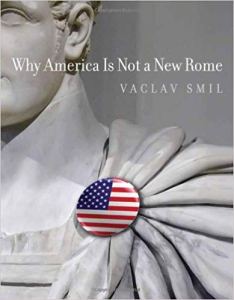
MIT professor Vaclav Smil specializes in the study of energy, but he has a hobby of reading Roman history.  In the wake of our post 9/11 military ventures, and especially after things in Iraq began to go south, we saw many academics proclaiming the demise of the American “empire,” with comparisons to the fate of Rome everywhere across the media landscape.  Smil smelled a rat, and wrote Why America is not a New Rome to counter this wave.  I wish he put more thought into his title, but it points to the straightforward approach of his work.  He brings the discipline of a scientist to the fog of blogs and talking heads.

The question is one of analogy–how alike are the American and Roman experiences?

The comparisons should not surprise us, and have some basis in fact.  Our founders modeled our constitution on Rome’s.  Our early years resemble the heyday of the aristocratically oriented Roman Republic governed primarily by a strong Senate.  Since the Industrial Revolution, and especially since the Great Depression, we have witnessed the continual growth of executive power until now Congress has nearly reached rubber-stamp status, akin to the senate in Rome under the emperors.

Briefly, then, the case for strong links between America and Rome:

  • After 1989, America had no real military or economic competitor, just as Rome had no real competition in its sphere of influence after the 2nd Punic War
  • America has more than 200 overseas bases and can put its military in action most anywhere in the globe much faster than anyone else, just as Rome could move with its road system throughout its empire.
  • The world economy is controlled through New York, and Washington sets the basic rules of this economy, just as Rome did so for centuries in its era.
  • At the same time, both societies experienced drains on the real power of their economy through foolish military ventures and lack of stable monetary policy.
  • Both societies developed professional militaries that have grown increasingly distant from the general public
  • Both societies exercised considerable soft power through their cultural exports
  • The population of both societies seemed driven by distraction and entertainment.  Some point out strong connections between the gladiatorial games and our love for (American) football.
  • A loss of cultural glue across large geography means that trust and the ability to suffer together both decrease.  Hence, both societies would “buy off” the population with bread, buyouts, stimulus packages, etc.
  • Some even went so far as to say that both civilizations had a, “common obsession with central heating and plumbing.”

Stated this way some connections seem strong, but Smil doesn’t buy it.

First we can consider the concept of “empire.”  Some understand that if America has an empire, it is “informal,” and “an empire without an emperor.”  Smil argues that some concepts of empire are so vague as to be meaningless, and pushes for a very specific definition:

Empire means political control exercised by one organized political unit over another unit separate from it and alien to it.  Its essential core is political: the possession of final authority by one entity over the vital political decisions of another.

With this definition in place we should consider if America ever exercised imperial ambitions.  Perhaps one could begin with the Mexican War of 1846, or perhaps earlier with the Indian wars that made the Northwest Territories into Ohio, Indiana, and Illinois. With our various conflicts on the continent we did not so much seek to control ‘alien’ peoples as much as we sought to move in and displace them.  Perhaps one could argue that the Spanish-American War made us an imperial power, but even then, we gave Cuba independence immediately and the Philippines got their independence right after W.W. II.  Smil spends a lot of time on this rather technical argument over what exactly constitutes an empire.  He has some good points to make, but only stylistically.  The real question, I think, involves how much power the U.S. has vis a vis the rest of the world.

Here Smil gets more interesting and convincing.  He cites a variety of data to show that American power, or at least our relative share of power (in political, economic, and military terms), has actually declined dramatically since the end of W.W. II.  Our global share of economic output has dropped by at least 1/3 since 1945, with continuing trade deficits largely due to reliance on foreign energy.  We send much less of our military abroad than we used to.  True, we have hundreds of military bases all over the world, but less than 20 of them have more than 1000 troops.  President Eisenhower served as our top military commander in our most glorious and successful war.  Yet he denounced the “Military-Industrial Complex in his farewell address.  One cannot even conceive of any Roman ever doing any such thing.  Empires do not act this way.

FT_17.08.21_usMilitary_locations_trend-1.png

Smil agrees that we might call the U.S. a “hegemonic” power and not an empire.  But . . . he argues that we are either a weak hegemon or a benign one.  Castro ruled Cuba for decades and all agreed he posed a potential threat to our well being, yet we could do nothing to stop him.  Similarly, we could not get rid of North Korea or beat North Vietnam.  Smil continues,

Germany was defeated by the United States in a protracted war that cost more than 180,000 lives, subsequently received America’s generous financial aid to resurrect its formidable economic potential, and is home to more than 60,000 U.S. troops.  Yet when its foreign minister was asked to join the Iraq War coalition, he simply told the U.S. Secretary of Defense, “Sorry, you haven’t convinced me,” and there the matter ended.

No less tellingly, the Turkish government (with NATO’s second largest standing army and after decades of a close relationship with the U.S.), forbade US forces to use its territory for the invasion of Iraq, a move that complicated the drive to Baghdad and undoubtedly prolonged the campaign.  America in a time of war could not even count on two of its closer allies, but there was no retaliation, no hint of indirect punishment, such as economic sanctions or suspension of certain relations.  One could cite many other such instances . . . both illustrating America’s ineffective hegemony and non-imperial behavior.

With a proliferation of graphs and paragraphs like these, Smil makes a good case that America exercises far less power than its critics at home and abroad surmise.  Smil’s book is not brilliant, but he writes with a concision and clarity that cannot but convince the reader.

Or perhaps, very nearly convince.  American political culture struggles for coherence at the moment, but we have experienced times in our past very much like this before.  We have a disconnect between cultural elites and everyday people, but as Smil points out, this happens in almost every advanced civilization.  Economic inequality is a problem, but again, Smil shows how this tends to happen in many advanced economies, and in any case, our inequality now is not nearly as great as it was in the late 19th century.  By these measures we are no more an empire, or no more in decline, than other countries with power at different times.  The analogy is too thin to make anything of.

But . . . perhaps the strongest point of comparison lies elsewhere.  Toynbee argued that the military and economic problems Rome experienced in the 3rd and 4th centuries AD had their roots in the spiritual detachment of stoicism.  In a similar vein, Eric Voegelin wrote frequently that global power and global influence (of which the U.S. certainly has in some measure) easily leads to a gnostic view of the created order, which again inspires a detachment and loss of engagement.

Perhaps this should be our biggest concern.  We have recently legalized pot, the new drug of choice (in contrast to stimulants like cocaine of 30-40 years ago).  The digital revolution allows us to entertain ourselves with our screens and enter fantasy lands alone in our rooms.  Recently the Caspar mattress company founded a line of stores dedicated to napping as an art form.  It may be a good thing not to have a political, military, or other such analogous connections to Rome.  Here’s hoping that our growing sense of detachment is not in fact the strongest point of comparison between us.


Dave


The Three Languages of Politics

Like many of you, I feel frustrated at the polarization of politics today.  Some of this polarization comes with the territory of democracy, but some of it I feel results from failures in technique and imagination.

Classical rhetoricians used the term “stasis” to refer to the situation in an argument where both sides argue about the same thing.  If an issue did not achieve “stasis” the argument would get nowhere because the rhetorical ships would pass in the night.

For example, you may have observed this lack of stasis in the abortion debate, where the sides argue in circles similar to this example:

  • Pro-Life – Governments should protect those who cannot protect themselves.  They should give a voice to those without a voice.   Governments must stand for the defense of innocent lives if we want to call ourselves civilized.
  • Pro-Choice – Decisions about our families and our futures are some of the most private and personal decisions one can make.  If we wish to avoid any tendency towards a totalitarian regime, we must keep government out of our most private decisions.

Both sides of the abortion debate could hypothetically agree with both statements in different contexts, thus, an argument with these two premises would spin its wheels.  Ironically, most on the “Pro-Life” side are conservatives, but the argument used above has a distinctly Progressive tinge.  Most “Pro-Choice” advocates might usually reside in the Progressive wing of politics, but when they use arguments like the one above they sound just like Libertarians.

I would suggest a Pro-Life argument that went something like. . .

In general, governments have no business making decisions about our bodies.  What we wear, what we eat, whether or not to get a tattoo–no one who values a free society would want government involved in such things.

However, we do give governments the power to make decisions about our bodies when our actions pose a threat to others.  We ban drinking and driving.  We ban the use of various drugs.  These kinds of laws have a good purpose because they protect innocent lives.  If we protect citizens against drunk drivers, how much more should we protect the unborn?

This is just one possible example of stasis on this issue, though no doubt many better ones exist.  Please feel free to share whatever examples you might have.

In his book The Three Languages of Politics author Arnold Kling addresses the problem of a lack of stasis in our political debate and points to one reason for this.  He argues that we speak three different kinds of political language currently, each with its own vocabulary and coded language.  One goal for the book is to expose others to these three different languages and and make us aware of the various worldviews these languages represent.

I mentioned earlier that a failure of stasis in debate can be traced in part to a failure of imagination, and this leads to Kilng’s second main goal.  To achieve stasis we have to learn to use the languages of those we disagree with, and have to enter into their worlds in order to do so.  This does not mean that we abandon our convictions, but it will mean that we reframe in different modes of thought with different emphasis.  This requires a willingness at times to fall down a rabbit hole, but you will actually have a chance of talking to people rather than at them.  Granted, this won’t bring the NRA and NOW to the hallowed halls of Shambala, but it might start something.

Kling starts his book with a quiz designed to help one to discover their own political language, something like a political personality test.  Some of the questions are Kling’s, some are mine.  Of course you may not like either of the three options offered, or may want to combine answers to create a hybrid.  For the purposes of the exercise, however, circle just one letter for each question.

To score the quiz, make three sections on a piece of paper, labeled “P,” “C,” and “L” and follow the guidelines below when you are done.

Gun violence at schools primarily reveals

A. The need for teachers to be armed to fight back.

B. The need for society to have more control over the mentally ill.

C. The need to curtail the power of the gun lobby.

2. If I were honest about myself, the kind of political ad that would appeal to me most would include

A. Pictures of farms, flags, and hallowed documents like the Constitution.

B. Scenes of ordinary Americans from all walks of life working together.

C. A statement about our financial status and clear plan to help reduce spending.

3. During the 1940’s many ordinary Germans committed atrocities against Jews.  This shows us

A. The dangers of a totalitarian system of government

B. The dangers of a collapse of moral values when a country’s institutions have been corrupted and compromised

C. The dangers of anti-Semitism

4. When the issue of tax law comes up, what question is most important?

A. How will the laws impact and reward people get for hard work and thrift?

B. Does government spend money more or less wisely than individuals?

C. How will changes in law impact the growing gap of inequality?

5. What is notable about the conflict between Israelis and Palestinians is that

A. Israelis share many of the same values as Americans

B. The Palestinians are an oppressed people

C. Israel, the Palestinians, other Arab and western governments, all share blame for this tragedy.

6. The wave of mortgage defaults known as the “sub-prime crisis” was caused by mortgage loans that were

A. Given to unqualified and undeserving borrowers

B. Government induced

C. Predatory

7. The large number of unwed mothers with low income reflects that

A. Lack of economic opportunities and education

B. Cultural decay, which overvalues sexual gratification and undervalues marital responsibility

C. Incentives built into our tax and welfare system that can reward bad behavior

8. Since 9/11, Presidents have used controversial powers, such as warrantless surveillance and targeted killings.  What do you think of the use of these powers?

A. Because Islamic terrorism is such a difficult and dangerous problem, I support the use of these powers to protect Americans.

B. I am against the use of these powers on principle.

C. I am not sure about these powers, but I am willing to trust the Obama administration more than the Bush administration on the exercise of them.

9. When teaching the history of the United States, the most important goal should be

A. To have the student develop an appreciation for all that makes America great, especially by focusing on the leadership of people like George Washington, Teddy Roosevelt, and Ronald Reagan.

B. To have the student realize that our country is far from perfect, and has abused the rights of minorities in numerous ways.  We show our greatness as nation most clearly by reforming ourselves and remedying our past mistakes.

C. To have the student appreciate the vital role of American individualism and self-reliance in making our country free and prosperous.

10. If I was visiting the Mall downtown, the most important place to go would be

A. The Capitol, where the representatives of ordinary citizens sit and debate.

B. The Washington, Lincoln, and Jefferson Memorials

C. I wouldn’t want to visit at all.  With its hallowed halls and marble monuments, the Mall downtown encourages a dangerous reverence for government.

11. Which most accurately describes your view of the Press?

A. The Press often functions as an enemy of our civilization, as it artificially makes the margins of society “mainstream” with a distinct liberal bias.

B. The Press works best when it serves as a tool to keep government in check by exposing corruption and abuse of power.

C. The Press works best when it finds societies problems and puts them into public view, thereby giving the organs of representative government a chance to fix the problem.

12.  Of the following, who was the best president?

A. Theodore Roosevelt

B. Calvin Coolidge

C. Ronald Reagan

13. Which most accurately describes your feelings about free markets?

A. Government intervention in the market is counter-productive every time.  The market, unregulated, is one of the best tools of freedom we have.

B. Some form of free market must exist, but government should intervene to minimize the aspects of the market that exploit the poor and create vast gaps in equality.

C. The free market is in general a great tool for a free society, but government should strongly regulate/ban certain items from being sold, like drugs, pornography, and other socially/morally disruptive products.

14. Which most accurately describe your feelings about the War on Drugs?

A. The War on Drugs has failed most notably in that most of those in jail are the poor and underprivileged of society.  Whatever our original aims may have been, the War on Drugs has done little besides incarcerating poor minorities for a host of minor offenses.

B. The War on Drugs has been in some instances a war on what should be personal freedom, and at times it has also been a misguided attempt to enforce purely cultural mores.  It has also costs billions of dollars with little to show for it.

C. The War on Drugs has not had the success we hoped for, but it remains a noble fight with a noble cause.  Drugs ravage lives and communities everywhere, and government rightly acts to try and stop their scourge.

15. Which Most Accurately Describes You?

A. My heroes are people who have stood up for underprivileged and oppressed people.  The people I cannot stand are those who seem to care nothing for the rights of average citizens as opposed to the privileged few, or ethnic and religious minorities.

B. My heroes are people who have stood up for Western values and the beneficial civilizations these values  help create. The people I cannot stand are those who don’t mind, or even encourage, the wanton assault on the traditional values that have made this country great.

C. My heroes are those who have stood up for the right of individuals to make their own choices.  The people I cannot stand are those who want the government to impose their value system on others.

  1. The best thing about a Trump presidency (whether you like him or not, or think he is a good president or not) is likely to be

A. His presidency will shift power away from coastal elites and towards the values and practices of mainstream Americans.

B. He will shine light on the “forgotten” blue collar worker, many of whom have lost jobs due to a globalization process that has moved way too fast.

C. He will “get things done” and help make our government more efficient and lean by getting around the “red tape” of bureaucracy.

The worst thing about a Trump presidency (whether you like him or not, or think he is a good president or not) is likely to be

A. His inflammatory rhetoric and possible racist leanings will hurt immigrants and other minorities, endangering decades of social progress.

B. He will erode the governmental institutions we rely on for a peaceful society, and become a “one man show,” extending the power of the executive branch and growing the reach of government.

C. He is a New York real-estate and tv personality–he focuses only on the bottom line and cares nothing for the values that have made America great.

Question 1

  • If you checked A put a mark in the ‘L’ column
  • If you checked B put a mark in the ‘C” column
  • If you checked C put a mark in the ‘P’ column

Question 2

  • If you checked A put a mark in the ‘C’ column
  • If you checked B put a mark in the ‘L’ column
  • If you checked C put a mark in the ‘P’ column

Question 3

  • If you checked A put a mark in the ‘L’ column
  • If you checked B put a mark in the ‘C’ column
  • If you checked C put a mark in the ‘P’ column

Question 4

  • If you checked A put a mark in the ‘C’ column
  • If you checked B put a mark in the ‘L’ column
  • If you checked C put a mark in the ‘P’ column

Question 5

  • If you checked A put a mark in the ‘C’ column
  • If you checked B put a mark in the ‘P’ column
  • If you checked C put a mark in the ”L” column

Question 6

  • If you checked A put a mark in the ‘C’ column
  • If you checked B put a mark in the ‘L’ column
  • If you checked C put a mark in the ‘P’ column

Question 7

  • If you checked A put a mark in the ‘P’column
  • If you checked B put a mark in the ‘C’ column
  • If you checked C put a mark in the ‘L’ column

Question 8

  • If you checked A put a mark in the ‘C’ column
  • If you checked B put a mark in the ‘L’ column
  • If you checked C put a mark in the ‘P’ column

Question 9

  • If you checked A put a mark in the ‘C’ column
  • If you checked B put a mark in the ‘P’ column
  • If you checked C put a mark in the ‘L’ column

Question 10

  • If you checked A put a mark in the ‘P’ column
  • If you checked B put a mark in the ‘C’ column
  • If you checked C put a mark in the ‘L’ column

Question 11

  • If you checked A put a mark in the ‘C’ column
  • If you checked B put a mark in the ‘L’ column
  • If you checked C put a mark in the ‘P’ column

Question 12

  • If you checked A put a mark in the ‘P’ column
  • If you checked B put a mark in the ‘L’ column
  • If you checked C put a mark in the ‘C’ column

Question 13

  • If you checked A put a mark in the ‘L’ column
  • If you checked B put a mark in the ‘P’ column
  • If you checked C put a mark in the ‘C’ column

Question 14

  • If you checked A put a mark in the ‘P’ column
  • If you checked B put a mark in the ‘L’ column
  • If you checked C put a mark in the ‘C’ column

Question 15

  • If you checked A put a mark in the ‘P’ column
  • If you checked B put a mark in the ‘C’ column
  • If you checked C put a mark in the ‘L’ column

Question 16

  • If you checked A put a mark in the “C” column
  • If you checked B put a mark in the “P” column
  • If you checked C put a mark in the “L” column

Question 17

  • If you checked A put a mark in the “P” column
  • If you checked B put a mark in the “L” column
  • If you checked C put a mark in the “C” column

“P” stands in this case for “Progressives,” who tend to see the world along an axis of oppressor/oppressed.  “Progressives” here put strong emphasis on “no one left behind,” and equality.

“C” stands for “Conservatives,” or “Civilizers” who put primary focus on good vs. evil, or civilization vs. barbarism.  They tend to see a role for government in upholding certain values and traditions.

“L” stands for “Libertarian” who emphasize individual rights and freedoms apart from group/government coercion.  They fear actions that threaten individual autonomy.

In the interest of full disclosure, I score out this way:

Progressive/2, Conservative/10, Libertarian/5

Chances are that your score mixes the three categories in some fashion, and this in itself will help us recognize the limitations of our own particular perspective.  The Progressive, Conservative, and Libertarian axises are all finite and cannot be our main guide on every question.  Kling cites a few examples to this effect.  Libertarians like Goldwater opposed Civil Rights legislation on the grounds that it would give more power to the federal government and upset the balance of federalism.  They were not wrong about this per se, but wrong in their priorities.  The Libertarian axis (Kling’s own personal bias, as he tells us) did not have the proper framework to deal with that issue.  Some Southern “Conservatives” (be they Republican or otherwise) rejected integration for terribly misguided fears about what would happen to their “civilization.” For the sake of fairness, Kling rejects the Progressive explanation for the sub-prime crisis.  The oppressor/oppressed axis has its own limitations.  The strong “Conservatism” of Churchill served him just as poorly in dealing with India as it served him well in dealing with Hitler.

It is this concept of the finite nature of our political vision that is the most valuable takeaway for me.  Every Christian I know would admit to some degree of mystery and incompleteness about their knowledge of God and the Faith.  Yet we do not always apply that same sense of humility to our political ideologies, and we usually get no help from the media with this.  It may be humility, more than anything, that can salvage our broken political discourse.

Dave

10th Grade: You Can’t Go Home Again

Greetings,

This week we put our main focus on the Congress of Vienna, where the nations of England, Russia, Prussia, Austria and France gathered to try and redraw the map of Europe in Napoleon’s wake.

Historians have debated many issues about this peace conference from the moment it met.

France

What do to with France?  Napoleon’s conquests discombobulated every nation in Europe, and perhaps as many as 3 million died in what we call the Napoleonic Wars.  Should France be punished?

Most give the Congress credit for realizing that taking revenge on France would not serve peace in Europe.  France weakened would wave the red flag at every other strong nation in Europe.  Soon nations might fight over French spoils.  Besides, during the Napoleonic Wars the other nations made it clear that they made war on Napoleon, not France.  France was not the problem in their minds during the war, they could not very well make France the issue during the peace.

The French too made the point that if other nations wanted to avoid another Napoleon, they needed to hand the recently re-installed Louis XVIII the keys to a nice car.   If he inherited weakness, the Bourbon dynasty would crumble once again, and Europe would revisit all the issues  brought on by events in 1789.  For example, one of the problems of the Weimar Republic in Germany in 1919 was that the new democratic regime came into being only because of Germany’s defeat in World War I.  That government lacked the psychological or cultural legitimacy to have a solid chance at success.  Louis XVIII was a nice guy, but didn’t impress like Napoleon.  He would need some help.

Louis XVIII

Napoleon on Horseback at the St Bernard Pass by Jacques-Louis David

The Congress of Vienna explicitly rejected the “Romantic” notion of expansive ideals transforming states and creating new national boundaries, and returned to the 18th century Enlightenment policies of security through interlocking and more or less equal parts.  Those familiar with Madison’s “Federalist #10” and his theory on democracy and political factions will see the same concept writ large on the European stage in Vienna.  In reacting against the French Revolution ideologically, they also returned to the pre-French Revolution methods of foreign policy.  The genie needed stuffed back into the bottle.

For the most part the countries involved agreed on these principles, but the practical outworking of meant a great deal of jockeying for position.  The map had changed so much so quickly, a lot seemed up for grabs.

Here is Europe in 1789, just prior to the French Revolution

Now Europe in 1800, just after Napoleon took power

Europe in 1807, after Napoleon’s victorious Peace of Tilsit

Europe in 1812, at the peak of Napoleon’s power

Europe in 1813, after his first exile

Napoleon’s success and the subsequent rise of Russia made the fate of Poland crucial to the peace process.  Their turbulent history get reflected in the many ways the map below reflects how their country got sliced and diced over the years.

Napoleon made it a point of policy to resurrect Poland to check the power of Russia, and also to limit the expansion of Austria and Prussia.  England, however, also waned a strong Poland to check the very same countries.  Napoleon’s conquests also demolished the tottering Holy Roman Empire, making a complete mish-mash of central Europe, sure to draw the attention of Prussia and Austria.

For a class activity I wanted the students to deal with the issues divided the class into five different groups, each representing the interests of their assigned country.  The winning group would be the one that got the best deal relative to their interests.

England

Wants:

  • To maintain its absolute dominance of the sea
  • To prevent anyone else from having the dominance on land that they enjoy currently at sea
  • The independence of the “Low Countries” (Belgium, Holland, Netherlands) to prevent any other major power from obtaining the coastal ports there.

Fears:

  • The rising land power of Russia – England likes the idea of Poland as a buffer to Russian power.
  • The possible westward expansion ideas of Prussia

Russia

Wants:

  • What it considers to be its rightful place in the sun given the fact that their repulse of Napoleon in 1812 opened the floodgates for all of Europe to overthrow him
  • The elimination of Poland, which Napoleon recreated to reduce Russian power
  • A weak Austria

Fears:

  • England using its economic whip to get its way on the continent
  • A strong Austria
  • A strong Prussia

Prussia

Wants:

  • Its rightful place in the sun considering their efforts in 1813 at the Battle of Leipzig, and at Waterloo in 1815.
  • The possibility of westward expansion if Austria were strengthened.  They would rather see Austria strengthened rather than Russia

Fears:

  • A strong Russia
  • French Expansion

France

Wants:

  • An extension of their borders to their “natural” borders near the Rhine River
  • Territory in the Low Countries, who speak French after all
  • A curbing of English naval power

Fears:

  • English dominance
  • Reduction to 2nd rate status

Austria

Wants:

  • To restore national honor, for no one got beat more often than Austria during Napoleon’s reign.
  • To prevent instability in central Europe, which would likely lead to a war they would lose

Fears:

  • The joint rise of Prussia and Russia.  Should those two ever fight, they would inevitably be drawn in as a second-banana ally.  No matter who won that war, they would lose

The actual Congress of Vienna decided on this. . .

Did the Congress of Vienna work?  Can we call it a successful peace conference?

By most measures we can answer “yes.”  The system started to break down after 35 years in 1848, and had broken completely by 1871.  Still, while so-called “small wars” popped up intermittently, Europe did not see another general war until World War I in 1914.

Critics of the Congress call it reactionary.  Those that thought they could truly put the French Revolutionary genie away deluded themselves, for it had roamed throughout Europe for 25 years.  They felt that they could smother the liberal democratic impulse to death, when really it turned out that they had created a pressure cooker instead.  When it finally burst in 1914, nationalistic impulses that had been held in check unleashed a conflict that essentially destroyed Europe.

I personally have a lot of sympathy with this latter view, but feel it may be too harsh on the participants.  Their immediate experience of French romantic nationalism saw France overthrowing religion, traditional values, and killing one’s fellow man over shades of political difference.  It would be quite natural for them to throw the baby out with the bath water, and they did not have the benefit of hindsight.   Maybe we can say the countries represented had high levels of competence and lower amounts of imaginative foresight.  Even so, on some level they wanted to pretend that the French Revolution never happened, that everything could go back to normal after 25 years of philosophical, cultural, and political upheaval.  The saying, “You can’t go home again,” proved itself true in this case.

Next week we begin to review for the final exam.  Many thanks for a great year,

Dave

Things in a Museum

Some time ago I accompanied some students to a museum on a field trip when I encountered a harried-looking adult wearing a “Chaperone” sticker for another school.  Evidently he had gotten separated from his pack, but he didn’t seem to mind too terribly.  He had the thousand-yard stare of a man utterly defeated.  When I asked if he was supervising another group he chuckled, “You think so?  I have no idea what we’re doing or why we brought them here.”

I am proud of my students.  I have had 8th graders show far more interest on trips to museums than seniors from other high-schools I have witnessed, and yet even they have well-set limits.  The Walters Gallery in Baltimore is a wonderful museum.  Alas, at some point the students inevitably conk out and don’t care how old or rare a particular painting or artifact may be.  Any pleading or begging I might have attempted would only be met with the same thousand-yard stare I saw from the hapless chaperone.

And yet, these same students had endless energy on the bus ride for variously animated discussions on the merits of Panera or the next Avengers movie.

Now, this is not to say that I blame them at all.  I stand firmly by my appreciation for them.  But this experience of mine surely has a universality to it, experienced not just by every teacher that takes students to a museum, but anyone who has visited museums like this.  Why does “museum fatigue” set in so quickly not just for students, but for all of us?

The most obvious answer that comes to mind is that no one argues that museums are the ideal setting for such things.  To take a small thing and remove it from its context, putting it in a hushed room with lots of other things removed from their original context, surely limits their power.

I doubt that even museum curators would disagree with this, but I’m convinced this only begins to answer the question.

What makes the Walters a great place is that it packs a great deal into a small space.  Even if you wanted to linger, in about 3 hours you could go from ancient Egypt through the 1800’s in Europe and see the sweep of human culture.  And this led me to some thoughts as to why we have such a hard time engaging with the past. When you move through the Walters you can see a dramatic shift in the art and culture of different periods.  Almost everything from ancient Egypt has a direct religious purpose and is crafted with direct religious symbolism. Babylon is similar, though Assyria less so. You don’t always see the same direct ‘religiosity’ in Greece and Rome but it’s still there more often than we might think.  In the medieval world nearly everything had a distinct religious meaning, and a rich symbolic world lay behind most of what we saw with our eyes. The art from Egypt through the medieval world generally had this same quality–layers within layers of meaning that would have been intuitively obvious to those who lived in those times.  Of course the forms that they expressed this richness of symbolic meaning changed, but they all shared (more or less) in having this tapestry.

But beginning in the Renaissance (with more realistic depictions?, more overt interest in the natural world?) and sharply accelerating in the 17th century, we begin to see a dramatic shift. We could argue about why this happened (the Reformation was often iconoclastic, the Scientific Revolution happened, etc.) but that it happened is perfectly obvious.  In the 17th century and beyond we see a focus on the natural world. The ‘layers’ of meaning so obvious in centuries prior seem absent. The tree is just a tree, the man is just a man. If the layers are there they are no longer part of a general cultural understanding, but have to be supplied via individual interpretation.  

If one thinks students incapable of finding layers of meaning within images, simply observe the world of memes.  Here one witnesses students discovering whole worlds within stock cultural images.  Alas that these meanings and references remain almost entirely self-referential within a shallow cultural context.  Still, the staying power of memes surely has something to do with the joy and satisfaction they take in discovering and creating these endless loops of meaning.  So, while in my snooty and grumpy way I generally look down upon meme culture, I suppose I should see glimmers of hope that students not only can see such layers, but also enjoy finding them.

This led to some other thoughts and possible realizations.

Many have noted and lamented the decline of the influence of the text in our society, and we can point to a variety of causes for this.  No one questions that this will create a different kind of culture and eventually a new way of understanding.  The shift may be painful, but will we end up worse off?  In the “Phaedrus” Socrates recalls the Egyptian myth of Thamus and Theuth, in which the merits of writing are contested by Thamus.

At the Egyptian city of Naucratis, there was a famous old god, whose name was Theuth; the bird which is called the Ibis is sacred to him, and he was the inventor of many arts, such as arithmetic and calculation and geometry and astronomy and draughts and dice, but his great discovery was the use of letters. Now in those days the god Thamus was the king of the whole country of Egypt; and he dwelt in that great city of Upper Egypt which the Hellenes call Egyptian Thebes, and the god himself is called by them Ammon. To him came Theuth and showed his inventions, desiring that the other Egyptians might be allowed to have the benefit of them; he enumerated them, and Thamus enquired about their several uses, and praised some of them and censured others, as he approved or disapproved of them. It would take a long time to repeat all that Thamus said to Theuth in praise or blame of the various arts. But when they came to letters, “This,” said Theuth, “will make the Egyptians wiser and give them better memories; it is a specific both for the memory and for the wit. “

Thamus replied: “O most ingenious Theuth, the parent or inventor of an art is not always the best judge of the utility or inutility of his own inventions to the users of them. And in this instance, you who are the father of letters, from a paternal love of your own children have been led to attribute to them a quality which they cannot have; for this discovery of yours will create forgetfulness in the learners’ souls, because they will not use their memories; they will trust to the external written characters and not remember of themselves. The specific which you have discovered is an aid not to memory, but to reminiscence, and you give your disciples not truth, but only the semblance of truth; they will be hearers of many things and will have learned nothing; they will appear to be omniscient and will generally know nothing; they will be tiresome company, having the show of wisdom without the reality.”

Of course Egypt had writing, but even that writing was highly symbolic.  They had an overwhelmingly visual culture but achieved a very high level of civilization for millennia.  The Gothic age also had writing, but one suspects that this writing was not fashioned primarily to be read:

Though it may not be quite as obvious to some, their highly visual and religiously oriented society achieved quite a high-level of civilization.*  Their perception was more immediate.

As an example of our poverty of perception surrounding images and meaning, I refer to the famous “ichthus” symbol for Christianity.  One sees this symbol many places, and who can miss the scintillating war of fish magnets/Darwin fish magnets/anti-Darwin fish magnets on the bumpers of cars?  Though the symbol has been around in modern perception since the 1970’s, I never heard anything about the symbol except that the Greek letters for “fish” resemble the letters for “Christ.”  Of course one might also think of the direct reference to the miracle of the feeding of the 5000, or the fact that some of the apostles were fisherman before they met Jesus.

But the indirect symbolic meaning has much greater depth and wholeness.  To quote Leonid Ouspensky,

The first and most essential meaning of the fish is therefore Jesus Christ Himself.  Some ancient writers occasionally call our Lord, “the Heavenly fish.  We find the image of a boat, symbol of the Church, carried by a fish: the Church rests on Christ its founder.  To represent Christ in the midst of Christians united in baptism, little fishes surrounded by a large fish were often portrayed [in early Christian art].  “We are little fish,” Tertullian writes [ca. A.D. 200], “we are born in water like our fish Jesus Christ, and can only be saved by staying in the water.”**  Thus, the symbolism of fish leads back to that of water, that is, to baptism.”

Here we see a whole history, a whole theological understanding, a whole world to explore.  We must recover this sense of the “things” we see if we wish to re-enchant ourselves.

Dave


*The great Kenneth Clark ranks 12th century Europe as one of the great ages of the history of civilization.  John Anthony West, a devoted reinterpreter of Egyptian civilization, makes an interesting comparison between Gothic cathedrals and Egyptian temples.  While he is not a Christian, and seems perhaps slightly tilted against it in general, he admitted that the Gothic cathedrals communicate something directly to the soul.

**Hence the practice of annointing oneself with holy water as one enters and leaves some churches, not so much as a reminder of this, but as a way of connecting to these truths.


Danton Democracy

I originally published this in 2013, and repost it in light of our study of the French Revolution.  Apologies for any dated information on the ACA . . .

***********************

It took a while, but I finally came across an article on the ACA (also called “Obamacare”) that I resonated with.  Ross Douthat does not need to argue that the law will destroy civilization as we know it.  He admits that many will probably benefit from the law.  But in the final analysis (if coming to a final analysis even possible with such a ridiculously complex piece of legislation), he writes.

Now an effective levy of several thousand dollars on the small fraction of middle class Americans who buy on the individual market is not history’s great injustice. But neither does it seem like the soundest or most politically stable public policy arrangement. And to dig back into the position where I do strongly disagree with Cohn’s perspective, what makes this setup potentially more perverse is that it raises rates most sharply on precisely those Americans who up until now were doing roughly what we should want more health insurance purchasers to do: Economizing, comparison shopping, avoiding paying for coverage they don’t need, and buying a level of insurance that covers them in the event of a true disaster while giving them a reason not to overspend on everyday health expenses.

If we want health inflation to stay low and health care costs to be less of an anchor on advancement, we should want more Americans making $50,000 or $60,000 or $70,000 to spend less upfront on health insurance, rather than using regulatory pressure to induce them to spend more. And seen in that light, the potential problem with Obamacare’s regulation-driven “rate shock” isn’t that it doesn’t let everyone keep their pre-existing plans. It’s that it cancels plans, and raises rates, for people who were doing their part to keep all of our costs low.

You can find the full article here.

The article does not fully address my two ‘gut-level’ objections to the law:

  • Many well-intentioned government servants believe that they have found the ‘solution’ to problems that have heretofore eluded society.  Thus, they see only the positive and never realize the cost of certain kinds of legislation.
  • More specifically, the health care system already involved a great deal of physical complexity laid over top of a myriad of individual financial and moral choices.  Government action, almost by definition in cases like this, would almost certainly gum up the works and unintentionally create problems, even those they could not foresee.

I thought of the health care controversy as I read David Lawday’s enjoyable biography Danton: The Giant of the French Revolution.  Danton’s outsized personality stands in sharp contrast to the cold Robespierre, who eventually turned on Danton and had him executed.  Their faces tell the whole story:

georges_danton


Robespierre

Danton styled himself a man of the people.  He claimed to truly understand the people, for he (and not Robespierre) thought and acted like one of them.  He laughed, enjoyed food, women, and friends.  Thus, as he had a seat in government and understood the people, he naturally assumed that government action would work to benefit the people and help fulfill their wishes.  The video below may not reflect an actual historical meeting between  Danton and Robespierre, but it accurately depicts the different personalities of them both.

One can easily get drawn into Danton’s huge personality, but we should remember that he sanctioned horrible butcheries both before and after the fact, in the name of the people.  Danton was not a thinker.  He did not inscribe his speeches, he wrote few letters (that have survived at least), and so we know little of his motivations.  Lawday allows himself to make his best guesses, and paints a portrait of a man who had no love for violence per se, but believed he could successfully manage it once unleashed.  He later seemed to change his mind about this during the Reign of Terror, and this shift factored into his execution.

Unfortunately Danton’s greatest legacy to the Revolution was the Revolutionary Tribunal, the government’s supreme tool in legitimizing political murder on a mass scale.  Danton had some good motives in starting the tribunal.  He saw the random destruction engaged in by “the people,” and thought that direct government action would relieve the masses of the burden of imposing justice, or at least their version of justice.  This in turn would limit the violence that plagued the Revolution, for government would surely exercise more restraint and wisdom than the masses.  In a speech advocating for the establishment of the tribunal he reportedly said, “Let us be terrible, so they do not have to be.”

Tragically, the Tribunal simply gave legitimacy to the worst impulses of the Revolution, and the amount of deaths and imprisonments skyrocketed.  This same tribunal eventually tried Danton himself and found him guilty without allowing Danton to call any witnesses for his defense.

The ACA and the Revolutionary Tribunal remain vastly different things.  I hesitate to include mention of them both in the same post, for in 99 out of 100 ways they have nothing to do with each other.

But they do share one thing in common–they both spring from the mistaken belief that government can enter a complicated situation and with a wave of a wand make everything alright.  It usually fails to work, even with the best of intentions.

On the subject of good intentions, Marginal Revolution posted a link with this abstract. . .

Immigration and American Identity

The machinery of modern states sometimes makes things harder, not easier.

Coming to a proper solution for the immigration question is one example of this.  A variety of sources and polls indicate that most Americans favor allowing more legal immigration and have for years.  Back in simpler times one could enter a land, ask the king to stay, usually he said “yes,” with not much fuss. Perhaps one took an oath of fealty to his person.  Now, we have a whole mess of courts, paperwork, etc., etc. that make coming legally quite difficult.  The good intentions of most Americans gets lost in the morass of modern civilization.

Incremental reform of the system seems unlikely to lead to dramatically different results, so I have great sympathy for the argument made by Prof. Bryan Caplan.  As a libertarian Caplan believes in limiting government as much as possible, but his stance on immigration comes from a strongly moral place.  He would like to essentially eliminate the morass but eliminating almost every test that could prevent someone from working and living in the U.S.  He argues that

  • No one chooses to be born in a particular place, and almost always the best way to get out of poverty in a poor country is to move to a rich country, where your labor has a much greater value.
  • Those in the rich country benefit from their birthplace, which they also did not choose.  They have no moral right to deny someone something they did not earn or choose themselves.
  • As long as 1) An employer consents to have someone work for them, and 2) A worker consents to work for that same person, then no good moral reason exists for denying both people the right to hire/work.

Caplan breaks his argument down into even simpler terms:

  • Someone wants to come in my house, but I do not want them to.  Ok, then, they cannot come in.
  • Someone invites someone in, but they don’t want to come.  Ok, they can certainly refuse to come.
  • Someone invites someone into their house, and they accept, but a 3rd party–i.e., the Government–tells them that this cannot happen.  This, Caplan argues, makes no moral sense and yet this perfectly encapsulates our current immigration policy.

He made these points quite well in this debate below:

As well as Caplan argued (and we can note the contrast between the more intense, east coast, suit-wearing Caplan, and the laid-back Californian Wellman), I found myself siding with his opponent.  Their debate has the added bonus of illuminating much about our identity as a nation and our past.

The title of the debate, “Is Immigration a Human Right” might slip past us but the very idea of human rights as opposed to “A Right of Americans” represents a fairly radical shift in thinking.  We see this same shift in the years leading up to the American Revolution.  When colonists protested the Stamp Act in 1765 they talked of their rights as British subjects.  By the time we get to the Declaration of Independence, Jefferson argues that King George III has violated their human rights, that “all men are created equal.”  On the one hand, because we believe that God has created all mankind in His image, the clarity of Jefferson’s Enlightenment inspired prose makes perfect sense.  But it also makes things muddier—for incarnating this idea politically means different things to different people.  Treating all people equally from different political communities makes the whole concept of political communities irrelevant, aside from posing many other questions.

Even within a family, parents will love all their children equally but treat them differently as their circumstances require.  And when Joey argues that Billy’s parents let him stay up late, every parent knows the classic retort, “Well, you are not in Billy’s family.”

Interestingly, both Caplan and Wellman agree that societies do not exist via consent and that governments do not therefore derive their legitimacy from the “consent of the governed” per se.  This slips by without much discussion but I find it a crucial point.  The fact that the colonists failed to consent to certain British measures inspired many to revolt.  But even a moment’s thought about the concept of consent regarding the whole of society renders it a bit silly.  We “consent” to very little that shapes our lives.  We do not choose to be born, we do not choose our families, our gender, our personalities, or our looks.  We receive them, just as we do not consent to where we are born.  Nor did any of us in America today “consent” to our system of government. Imagine the chaos if everyone had to consent to their governments in some kind of purely rational vacuum.  Even the most die-hard supporters of consent would likely not want continual plebiscites to determine whether or not we should be governed by our Constitution, or a king, or an oligarchy.

The question then remains as to whether or not the fact that we do not really consent to our society supports Caplan or Wellman’s position.  For Caplan, the fact no one chooses where they are born and how they are governed means that everyone should have the freedom to go where they please and pick a place where they actually do consent to a particular society.

But Wellman has a powerful counter to Caplan’s “house” analogy mentioned above.  He poses a scenario of him leaving for a week and returning home to ask his wife what happened during his absence.  “Well, let’s see,” Wellman imagines his wife replying, “On Wednesday, I went to yoga class. On Thursday I met Carol for lunch.  And on Friday, I adopted a young man named Bob into our family.  Here he is, meet your new son.”  Wellman goes on to ask rhetorically whether or not she and Bob, as consenting individuals have the right to do this.  Caplan’s house analogy, he argues, needs more nuance.  Caplan’s argument above has a fair amount of moral force, but it would also overthrow our entire conception of the state as a community.  Unwittingly or not, Wellman’s analogy hearkens to the older Aristotelian idea of the state-as-family analogy, hence the notion that the king served as a “father” to his people.  One cannot simply alter the composition of the family at will, nor make unilateral decisions as “sovereign,” consenting individuals apart from the family at large.

Here we see how truly radical the American Revolution was and glimpse why it had such an impact on the world.  The notion that the state in fact was not a family perhaps finished off Aristotle’s formal influence in the modern world, a process begun in the Scientific Revolution.

And here we see something else–why the immigration issue poses such a difficulty for us.  If any nation could apply Caplan’s form of the “house” analogy, it is the United States.  As a “nation of immigrants” our belief in universal rights is woven into our DNA, however poorly we have applied it at times.  But pushed as Caplan wishes to push it, the idea becomes non-sensical. His vision of the state primarily as a conglomeration of free-floating individuals renders the idea of “society” almost meaningless.

The same Enlightenment ideas that inspired the idea of “human rights” also led to the creation of modern democracies.  The irony, perhaps even the tragic irony, with this issue, is that cutting red tape and making legal immigration much simpler could be achieved much more easily with a monarch than our federated democracy, with its attendant slowness, interest groups, and the like.  We might even reflect that minorities and outsiders (i.e. African-Americans and Native Americans) fared somewhat worse in the aftermath of our victory in the American Revolution.


Dave


Truisms that are (at least mostly) Not True

I have an affinity for the crazy theory.  I know that they can’t all be true, if for the only reason that if all of them were true, we would have no crazy theories to enjoy contemplating.  Our times have a strange character to them, however, for it seems the crackpot plays the role of conservative.  Older views of things look bizarre today.  Before continuing, I should fully disclose that, though I love crazy ideas, I am actually a very boring person.  The reason these two fit together in my life is that today the harebrained idea is sometimes quite conservative and, upon closer examination, sometimes even obvious.

Take, for example, a variety of truisms in our day.  We say that in football you have to have a great quarterback but . . .  Blake Bortles, Nick Foles, Case Keenum . . . at least one of them will play in the Super Bowl this year.  One can easily envision some coach with a crew-cut from the early 1960’s telling us how it’s a “team game, and not one of you means more than another,” and so on. We have traveled back in time.

History has its truisms as well.  I hear all the time, even from religious conservatives, that America’s religious competition has saved America from going the way of secular Western Europe.*  I have a particular antipathy for this obvious falsehood.  Medieval Europe had very little religious competition, and religion did quite well there.  Religion thrived in ancient Egypt with almost no competition for millennia.  To take the reverse, ancient Babylon had a lot more religious competition and their religion and morals seemed to suffer.  Today France may be nominally Catholic and Sweden nominally Lutheran, but no laws exist forbidding one from becoming Baptist, Methodist, or Buddhist in either place.  At least some religious competition surely exists there today.  This truism about religious competition is actually a far-fetched theory, based on only the most recent evidence.

To get slightly more controversial, we hear all the time how printing serves as one of the great civilizing tools for mankind.  No one questions this truism. But, just look for a moment . . . it seems obvious to me that the 15th century in Europe had a higher degree of civilization than the century after the printing press gained prevalence.  The printing press brought a lot of religious violence and political fragmentation in its wake. We hear too the truism that, “getting a Bible into everyone’s hands” is the key to spiritual health.  But, again, just look . . . it seems clear that the Church did quite well without the printing press for quite some time.  And, to return to an aforementioned truism, the fact that the Bible always tops bestseller lists has not prevented the west from becoming more and more secular over the last two-three centuries.

Maybe civilization and religion actually rely on things far older, far more “tried and true,” for success rather than new technologies–the crackpot as bland conservative strikes again.

I have written before about another one of my least favorite truisms, that of the evolutionary view of history and progress.  The theory basically means that civilization starts small and has run in a more or less unbroken line of progress and advancement.  Though this theory has general acceptance in many textbooks and the minds of men, it is, in fact, a radical, crazy, notion, for it ignores obvious facts.  For one, we know that a complex civilization could collapse more easily, quickly, and completely than a primitive one, due to its inevitable interdependence.  The presence of advancement makes large steps backward more, not less likely, like stock-market bubbles.  For another, we have a universally acknowledged and plain example of the fall of Rome and the subsequent so-called Dark Ages.  Whatever one thinks of the Dark Ages, Italy ca. 100 A.D. had a much higher level of civilization in most respects than Italy ca. 600 A.D.  Still, the prevalence of the evolutionary view makes those who state otherwise seem crazy.

Enter Charles Hapgood, whose book Maps of the Ancient Sea Kings postulates that, based on an examination of certain ancient maps, it appears that an unknown and likely quite ancient civilization developed a geographical and nautical understanding that humanity would not equal until the modern era. Hapgood’s theory joins the voices of Graham Hancock, Jon Anthony West, and other megalithic architecture (such as Gobeckli-Tepe) that argues that pre-historic people not only existed, but existed at a far higher level of civilization than anyone previously imagined.

Unfortunately for the layman like me, Hapgood immerses the book in large amounts of technical terms and technical data.  I think one would need special knowledge of cartography, geography, and math to understand large portions of the book.  Perhaps no other way existed to make his case.  I found myself junping over much of the technical sections but hope I still understood the basic case, which runs like this:

  • In 1929 an unusual map, named, the Piri Re’is, was discovered in the old Imperial Palace of Constantinople, dated the year 1513 A.D. (Moslem reckoning 919).
  • The map was extensive and showed the coast of North America in excellent detail.  This map differed from all other 16th century maps by giving correct longitudes for South America and Africa.  No 16th-century navigator that we know of knew how to calculate longitude except by guesswork.
  • Further investigation showed that Piri Re’is (or basically, Admiral Piri) claimed to copy this map from earlier maps, some of them dating back to (he claimed) the time of Alexander the Great.
  • Even a rough study of this map indicated that it used highly advanced mathematics, including spherical trigonometry, which we do not believe existed in the classical world

So, where did the map come from?

Perhaps Hapgood’s critics are right, and the Greeks knew enough spherical trigonometry to make these maps.  But did they sail across the Atlantic?  No evidence exists for this.  Did the Egyptians or Babylonians have this knowledge?  It appears not, but if they did, they did not sail across the Atlantic to map the coasts of the Americas.  Maybe the Romans in Ptolemy’s time had the knowledge, but again, did not sail across the ocean. Did it come from the medieval period?  But they did not sail much, and no other medieval map exists that compares with the quality of the Piri Re’is.

The best map from the classical period comes from Ptolemy, who worked in Alexandria and had access to all of the accumulated knowledge the world knew at the time.  His map shows great skill:

But it cannot compare with the Piri Re’is (although this is only a portion):

And again:

The Portolano Map, of late Medieval/Renaissance origin, is again, very good, but not quite up to snuff, at least in terms of the extent of what it mapped:

The inclusion of Antartica on the Piri Re’is map is particularly noteworthy, as many speculate that it maps landforms that for thousands of years have been covered with ice. In other words, the map seems to have been made before the ice age, and not after.

A few quotes scattered throughout the book from Hapgood illustrate his proposition:

We have discovered that in most cases the errors on the Piri Re’is mapper due to mistakes in the compilation of the world map, presumably in Alexandrian times [that is, the Piri Re’is was discovered in different pieces and put back together not quite accurately], since it appears that Piri Re’is could not himself have put them together at all.  The component maps, coming from a far greater antiquity, were far more accurate.  The Piri Re’is Map appears, therefore, to be evidence of a decline of science from remote antiquity to classical times (p. 39).

******

For a long time after the voyages of Columbus we find the latitudes of Cuba and Haiti are wrong on most maps.  Almost all the mapmakers put the islands above rather than below the Tropic of Cancer [in contrast to the Piri Re’is] (p. 41).

********

To sum up, then, this part of the Piri Re’is Map suggests a source map of Africa, Europe, and the Atlantic islands probably drawn originally on some sort of trigonmetric projection adjusted to the curvature of the earth.  By default of any other narrative, we must assign this map’s origin to a pre-Hellenic people.  The trigonometry of the projection suggests the work of Alexandrian geographers, but the evident knowledge of longitude implies a people unknown to us, a people of seafarers with instruments undreamed of by the Greeks, and as far we know, not possessed by the Phoenicians either (p. 49).

********

The suggestion of a vast antiquity behind the [Piri Re’is] is conveyed by a feature to which Captain Mallery first drew my attention.  He pointed out that the Zeno Map [which very likely had the Piri Re’is as a source map] shows Greenland with no ice caps.  The interior is filled with mountains, and rivers are shown entering the sea, in some cases at the points where glaciers now move through mountains to the coast (p. 152).**

*********

This culture [that made the Piri Re’is] may well have more advanced than Egypt, Babylon, Greece, and Rome.  In astronomy, nautical science, mapmaking, it was likely more advanced than any culture before the 18th century of the Christian era.  Not until the 18th century did we begin to send ships to the Arctic or Antarctic regions.  Organized government is indicated [by the map], as many expeditions would be needed to gather the appropriate information to map the area so precisely (p. 193).

Hapgood writes haphazardly and does not always reason in a clear, linear fashion, a trait he shares with his modern fellow believer in pre-historically advanced ancient civilizations, Graham Hancock.  The key I think to both writers lies not in the exactness of their data but in the accumulation of enough “probably’s” to make their case.  I heard most of a conversation between Hancock and Sceptic editor Michael Shermer.  The discussion went nowhere, with Shermer begging for even a small handful of absolute, concrete, data points, and Hancock pleading with him to consider the mass of “probably’s,” while admitting in the end that the study of ancient civilizations cannot provide the kind of concrete proof Shermer demanded.

Rather than ask, “Can we be absolutely sure if an ancient, advanced, prehistoric civilization existed,” (obvious answer-“no”), or, is it possible that such a civilization existed (obvious answer–“yes”) we should instead wonder whether we should expect or not expect to find such a civilization.  Is the idea reasonably likely?  Hapgood will likely not convince anyone who needs something along the lines of what Shermer requires.  He may entice others who think it likely that some kind of ancient civilization along the lines of those who like Hancock’s work.

To give Hapgood’s theory a shot, it helps to believe that:

  • The myths and folklore of most every ancient civilization that describe advanced civilizations that experienced thorough destruction (like the Atlantis story) likely have a fundamental truth behind them.
  • Civilization devolves just as much as it evolves, and in fact, devolution may be more prevalent than evolution in civilizations.
  • The flood described in Genesis 6 (and many other ancient religious texts) was substantive, historical in at least some sense, and would have had the power to destroy civilizations very quickly.
  • The absence of evidence would not condemn the case outright, as civilizations have at times experienced a catastrophic loss of a great deal of accumulated knowledge (the burning of the library at Alexandria, the collapse of Rome, etc.)

With this in place you might buy what Hapgood sells.  But without these beliefs, his book will likely frustrate readers.  In any case, I don’t find the above propositions crazy.  In fact, I find them rather ordinary.  Folklore and myth are common to all.  Belief in a historical flood of some kind is nothing new, with most ancient civilizations sharing this story.^  We have actual historically undisputed losses of vast amounts of intellectual capital at certain times in the past, such as the destruction of the library at Alexandria.

As I said earlier, despite my inclination towards “crazy” theories, I’m actually a very boring guy.

Dave

P.S.–A good friend and a math/science teacher glanced over the basic arguments of the book and found them wanting, and Hapgood’s selection of material suspicious.  He has a better nose for such things than I and his thoughts give me pause.

My friend and I both believe that ancient civilizations tend to be far more advanced then we might think.   Neither one of us believes that the history of civilization always proceeds in a directly linear way, and certainly not in a progressive evolutionary way.  We thus share some crucial assumptions.

My friend thought that Hapgood underestimates the knowledge of ancients.  For example, we know the ancient Phoenicians existed, we know they were great sailors.  It makes much more sense to say that perhaps they made the map and sailed farther than we thought, then to suggest that an unknown civilization of which we know nothing made the map.

My response would be something like, “If we know a lot about the ancients but have no record of them sailing to the Antarctic, it is plausible that they did not do so.  Thus, someone else must have.”

Plus, I confess that I just simply find the idea of advanced pre-historic civilizations fun, satisfying, and enormously entertaining.  Someone could wave such ideas in front of me daily and they would always get me pretty excited.

*One might modify this theory and argue that perhaps in today’s intellectual and cultural climate, one must have religious competition for religion to survive.  This argument has more plausibility.

**Some believe the Zeno Map to be a hoax precisely because of this feature and other “phantom islands” that do not now show themselves above water.  But Hapgood argues that a perfectly plausible explanation exists for this if the Piri Re’is was a source.  Another map, the Ibn Ben Zara Map, has a remarkably accurate depiction of the Aegean.  But it also includes several islands no longer visible.  How to explain this paradox?  How could the map be so accurate in some respects and so false in others?  We can say the map is a hoax or is filled with errors.  But another possibility is that a source map of great antiquity was constructed when these islands stood above sea-level.

^I do not mean to suggest that the Bible is merely historical.  It certainly has metaphysical, mythological, symbolic, and theological meaning beyond history.  But I don’t see these categories as exclusive.  What is real is not opposed to what is mystical, symbolic, or spiritual.

The Rings of Saturn

Bernard Bailyn starts his book The Peopling of British North America with an illuminating analogy about the rings of Saturn.  When astronomers first noticed Saturn’s rings their beauty appeared as a shimmering uniformity.  Now that technology has given us a closer look, we see that in fact, the “rings” are comprised of thousands of bits of rock and dust, some as big as your hand, some as big as a car, some almost microscopic.

History, he then argues, is often like this.  From a distance things look easy to understand but get up close and the elegant simplicity and uniformity of the past dissipates into confusing bits that won’t go together.  Reality will confound our ability to understand it as a coherent whole.

A lot about this analogy rings true for me.  When young we learn that George Washington was the father of our country, a great leader, and so on.  As we get older, we need to deal with his owning slaves, his social striving, his possible mixed motives for fighting the British, etc.

But ultimately historians can’t stop where Bailyn leaves off.  After seeing what the rings of Saturn actually are, he/she then needs to find a way to have them make sense.  He must interpret and synthesize.  Bailyn’s book tantalizes at times with revealing details about early colonial settlement, but I found myself frustrated that the book never quite got off the ground.

The book shows us that settlement of the colonies happened seemingly without real pattern, aside from the obvious facts that most immigrants were young, male, from a middle-class or lower background.  Different things seemed to happen for different reasons.  In sifting through the data, Bailyn admits that it might take a a poet or impressionist painter to make sense of the disparate information.  This is a wonderful admission of his, and seems to go against his “rings of Saturn” analogy.  Bailyn admits that in this instance he can’t fulfill that role (though he did just this in his great Ideological Origins of the American Revolution).  Interestingly, Bailyn contrasts the disparate design and feel of American settlements with new towns in Germany of the same period.  In Germany, new towns all looked the same.  So again, sometimes the rings of Saturn look exactly like we think they should look.  It may be American history in particular, rather than History in general, that presents a unique picture.

Ultimately, of course, this must be Bailyn’s point.  We might imagine the early days of European settlement to have uniformity, with diversity coming in the 19th century with large scale immigration, but no — from the earliest times no one story could account for everything.  “Let us celebrate America’s diversity,” and all that.

I thought of Bailyn’s work while reflecting on 8th grade reactions to the history of the Roman Republic.  In the year’s “Great Debate” over whether ancient Greece or Rome was the superior civilization, the boys invariably choose Rome by about a 2/3 margin, and the girls Greece by the same amount.  Many years of teaching this class bear this out for me, so why might this be?

Though images of the ancient Greeks reveal a touch of brutishness, they had more feminine qualities than the Romans.  They displayed more creativity and originality than the Romans.  They appreciated beauty and proportion.  As for the Romans, their plodding, methodical nature probably fits very easily within the mind of an 8th grade boy.  Their lack of imagination and their pig-headed stubbornness may have been designed specifically to both infuriate their ancient opponents and the average modern 8th grade girl.  I have seen a few young ladies actually stomp their feet in anger when Rome manages to rise after their disaster at Cannae, as the boys chuckle in Beavis and Butt-head like fashion.  “We’re still here,” the Romans seem to be saying to Carthage, “dunking your pigtails in inkwells yet again.”

I can identify somewhat with this aggravation, but there is something magnificent about how the Romans embraced their sense of identity.  The Roman scholar J.V.P.D. Balsdon makes the observation that the Roman origin story of Romulus and Remus raised by wolves had nothing to commend it to the ancient world.  Apparently it would have been much better if they had been suckled by she-goats, as the Greeks did with Zeus.  To what extent they truly believed in the myths I can’t say, but even a quick perusal of Rome’s stories show fratricide, violence, and no hint of elegance.  The touching Greek story of Pygmalion carried no truck with the Romans.  When they needed women, they simply stole them from the Sabines.  Even when the Romans “invent” their stories (though I am not comfortable with that word, but like a typical guy I can’t think of a better one) they utterly lack imagination and adornment.  And the Romans chuckle stupidly again.  They’re perfectly happy with their unimaginative early history.  Aggravating or no, their fierce sense of identity, no doubt gleaned partially from their commonly accepted founding mythology, gave them great strength of purpose and dedication.  They knew they were a gritty, uncouth, blue collar bunch and reveled in it.

When discussing the Arthurian legend in his A Short History of England G.K. Chesterton made the comment that the “tradition” surrounding Arthur was more true than the “history” surrounding him.  He meant that the Arthurian tradition may not be entirely accurate, but expressed more truth about the past than the confusion produced by historians who tackle the same subject.  I think the same holds true for Rome.  Take Will Durant (whom I like, for the record) in his Caesar and Christ, where he vaguely talks of Roman origins in terms of nomads from the steppes, and scraps of pottery dated to some people at some unsure time.  This tells us nothing.  No one should trust in the full accuracy of Livy’s history, but Livy communicates something more true about Rome’s early period than Durant.

If Chesterton is right we should consider his principle in light of America’s history.  The newness of our country means that we can have far more accurate information about our past than almost any other civilization.  For many of us, the stories we learned in elementary school no longer have persuasive power.  Postmodernism has done its deconstructive work well.  We see this in the words of the great jazz pianist Vijay Iyer who recently spoke at Yale, where he seemed to suggest that all success in America is somehow linked to exploitation (I hope I’m reading him incorrectly, as I like Iyer’s music and don’t want his name attached to something silly like this).  Iyer commented,

And as we continue to consider, construct and develop our trajectories as Americans, I am also constantly mindful of what it means to be complicit with a system like this country, with all of its structural inequalities, its patterns of domination, and its ghastly histories of slavery and violence.

Many of us are here because we’ve become successful in that very context. That’s how we got into Yale, by being voted most likely to succeed; and that may be what emboldened some of us to show our faces here this weekend, because we actually have something to show for ourselves, that somehow in the years since we first dined at the Alternate Food Line we’ve managed to carve a place for ourselves in the landscape of America. Whether you attribute it to some mysterious triple package or to your own Horatio Alger story, to succeed in America is, somehow, to be complicit with the idea of America—which means that at some level you’ve made peace with its rather ugly past.

Perhaps at least a few of those voted, “Most Likely to Succeed” actually worked hard?

But we need not fear or lament the postmodern landscape, but see an opportunity.  We need to seek the truth, and the deconstructive project has helped us do that.  But somewhere out there, I hope, is a historian who can give us a “true tradition” amidst the rings of Saturn to anchor us moving forward.

A House Swept Clean

Richard Rorty’s America had a wonderful run, even if it was short lived.

I well remember my senior year of high school in 1990-91.  For the first few months of school Iraq’s invasion of Kuwait had pride of place in our minds.  We had furious debates as to the rightness or wrongness of our presence in the Mid-East.  As military action looked more imminent, the arguments got more heated.  I filled out my draft service card.  Some thought the war could take years and become a dreaded “quagmire.”

The fighting actually started and a hush fell over the debates.  And then, just as quickly, the fighting  ceased.   The ground war took no more than a week.  We sat stunned for a moment, then, elation.  Talk of world affairs ceased immediately.  We all shifted into thinking about college, planning out our lives, and so on.  The Soviet Empire had crumbled.  What was left but Kant’s dream of perpetual peace and George Bush’s “New World Order?”

The end of the Cold War brought about the end of modernism in the mainstream and a shift towards the postmodern individualistic ethos.  Professors like Richard Rorty from the University of Virginia rode the wave.  Rorty hit the sweet spot.  In contrast to some academics, he championed the American project and American exceptionalism, which went well with our post Cold-War confidence.  He also gave free vent philosophically to our desire to maximize our individual idea of happiness as far as we wanted.  No one grand narrative need control us.  In fact, for Rorty the 1990’s allowed for America to truly fulfill her mission as a kind of blank slate for autonomous individuals.  All could achieve happiness, none need worry about “Civilization” or religion.

Ah, the 1990’s.  Good times, good times.

Peter Augustine Lawler tackles the thorny problem of the nature of the American Enterprise in his Aliens in America: The Strange Truth about our Souls.  In his work Lawler examines the various attempts to craft a secular paradise in America from Thomas Jefferson down to Richard Rorty and Francis Fukuyama.  Lawler agrees with many of the intellectuals he examines that America has essentially been about creating a republic of happy and secular individuals.  In this way he mostly sides with the liberal interpretation of America vs. the religious and conservative interpretation.  But he parts with them ultimately, stating that this dream, though seemingly close to realization at certain points in time, can never come to fruition.

Lawler published this originally just after 9/11.  We might think that he would point to the terrorist attacks as destroying the liberal dream.  True, he seems to argue, 9/11 did perhaps hasten the end of the most recent attempt at secular paradise, but it would have ended at some point in any case. To see this one need not exhaustively examine the thought of various thinkers over time (this indeed got old for me, as each thinker-guy in the book ran together in my brain).  Rather, it was when Lawler looks to two of the most perceptive critics of America in Tocqueville and Walker Percy, that his own ideas make sense.

Most know the basics of Alexis de Tocqueville’s monumental Democracy in America:

  • He came from an aristocratic background
  • He came to investigate democracy, seeing it as the wave of the future
  • He offered important criticisms of democratic practice, while giving it the nod in the end over the aristocratic past.

One could say a great deal about this work.  Lawler focuses on an oft-overlooked observation of Tocqueville’s about aristocracy.  Aristocracy has its flaws, but in giving people a definitive place and a definitive role they give people something to do.  Aristocratic societies come with “meaning included” in the packaging.  This goes not just for the elite.  Even Odysseus’ dog knew he had purpose.

Tocqueville praises the machinery of democracy for making everyone equal to all.  Everyone believes that this means they have worth as an individual, and they have reason for this belief.  This rational pursuit of self-interest then creates a nation of those who create peace by a kind of selfishness, just as markets create equilibrium via constant competition.  But even in the late 1830’s Tocqueville saw what we could not–that equality would actually create a large amorphous mass in which few of us would know where we stand.  We are told to be whatever we wish, but more than a few of us respond with, “And what might that be?”*

Rorty and others no doubt praise this possibility as exactly the meaning of America, one that should persist into time immemorial.

History gives witness to others of like mind and goal to Rorty.  Rorty rejected much of modernity and the Enlightenment, but he shared with Gibbon, Voltaire, Hume, and others of that time a belief that calm, rational self-interest could conquer the ills of “barbarism and religion”–a phrase used by Gibbon in describing the fall of Rome in his magnum opus, writing that, “I have described the triumph of barbarism and religion.”  For him, Rome had reached its zenith with the rule of the humane, tolerant, religiously skeptical and urbane Antonine Emperors (A.D. 96-180).

Like Edward Gibbon, historian Arnold Toynbee sought for universals amongst particulars in his multi-volume A Study of History, and so perhaps this helps explain why one particular quote of Gibbon’s fascinated Toynbee, as he uses the quote several times across his twelve volume work.   In 1781 Gibbon wrote that,

In War the European forces exercised themselves in temperate and indecisive contests.  The Balance of Power will continue to fluctuate, and the prosperity of our own or neighboring kingdoms may be alternately exalted or depressed; but these partial events cannot injure our general state of happiness, the system of arts, laws, and manners, which so advantageously distinguish, above the rest of Mankind, the Europeans and their colonists.

With the mild peace settlement after America’s victory in the Revolutionary War, Gibbon looked justified in his assumption.  It seemed that Europe’s house was swept clean of the various bothers of the religious wars.  It seemed that a paradise of calm rationality awaited them.

But 10 years after his utterance, the illusion disappeared utterly in France’s revolution (a nation that drunk deeply from the well of Enlightenment), engulfing Europe in 20 years of war that left perhaps three million dead.

Hugh Trevor-Roper writes in his History and Enlightenment about Gibbon that

. . . Gibbon gave a confident answer to the problems of his time.  Since progress depended on science, and since science and the useful arts were irreversible in a world of free competition and inquiry, and since Europe, unlike the Roman Empire, was a plural society where competition could not be stifled by a single, repressive, centralized figure, a reversion to barbarism was unthinkable.  Gibbon wrote that, “the essential engine of progress having been distributed over the globe, it can never be lost.  We may therefore acquiesce in the pleasing conclusion that every age of the world has increased, and still increases, the real happiness, knowledge, and virtue of the human race.”

I think Gibbon’s quote above fascinated Toynbee because in Gibbon he saw of man of great intellect, good intention, and broad vision completely miss a seismic shift in the history of his times.  Like Rorty and Fukuyama in the 1990’s, Gibbon thought that European civilization had truly arrived and that history had effectively ended for Europe in 1780.

Had Gibbon looked even at his own field of expertise he could have known his dream was doomed to fail.  Yes, the reign of the mild, intelligent, and reasonable Antonines helped Rome.  But the reaction against this was swift and brutal, beginning with Commodus and not really ending until 150 years later–a period that included decades of conflict between Rome’s generals.  The Antonines could not quite connect with the real heart of Rome, and could not feed their souls on mild urbanity.

Lawler asserts that Tocqueville felt his dilemma keenly.  Aristocracy relies on a kind of fiction and cannot stand up in argument to the exacting syllogisms of equality.  Aristocratic societies, like tradition, just “exist.”  Tocqueville had no arguments, but he saw the spiritual vacuum democracy could easily produce.  The logic of equality satisfies our minds, but inclusion into the great mass in the middle would do little for our hearts.  He feared what the absence of virtue would do to democratic societies.

Walker Percy’s novels touch on a similar theme as Tocqueville.  He came from an aristocratic southern family, and he saw that their time had come and gone.  Novels last The Last Gentlemen deal with the tension of knowing that the old way of living no longer works and not knowing how to replace it.  In time Percy’s characters grow weary of “democratic diversions” and begin seeking something else.  Percy knows that, while the southern aristocratic answer is better than nothing, it failed for the right reasons.**  The quest must continue, but in what direction?^

Today we seem to be at another point of whether we will reaffirm something of what it means to be an American in a traditional sense, or change it dramatically, or, as is more likely, do some of both.  We are discovering that the pragmatic, ‘rational,’ and soulless plurality of self-interest espoused by Gibbon, Rorty, and Marcus Aurelius has a definite shelf life.  Commodus “went native,” the French Revolution unraveled  centuries of tradition and killed thousands in the process, and today we have white nationalists and Antifa radicals.  Thankfully for the moment we’re not nearly in the same place as Rome and France found themselves (or for that matter, the situation of Germany in the 1930’s after the ‘devil-may-care’ Weimar era).

Whatever merits may have been in rejecting the various “gods” of our past, we should be careful in discarding them wholesale.

When an unclean spirit comes out of a man, it passes through arid places seeking rest and does not find it. Then it says, “I will return to the house I left.  On its arrival it finds the house vacant, swept clean, and  put in order.  Then it goes and brings with it seven other spirits more evil than itself, and they go in and dwell there; and the final plight of that man is worse than the first. So will it be with this wicked generation.” — Matthew 12:43-45

Dave

*Of course the mass of people must have someone to follow, and so we do have makers of taste and opinion.  Perhaps a cynic of democracy might agree that these people alone have true freedom.  But, an even greater cynic might point out that even these people quickly become subjects of mass opinion, and the people turn on them quickly when they fall out of line.

**I have read very little about the Civil Rights era, but Percy’s brief essay “Stoicism in the South” is the best analysis of why well meaning southern elites failed to bring about civil rights reform in the decades after the Civil War.

^My favorite novel of Percy’s is The Second Coming, a more profound (I think) sequel to The Last Gentlemen.  In a famous passage found here, the character of Will Barrett wrestles with two unacceptable options of dealing with reality (warning: language).  It is not quite the same as the aristocratic/democratic option, but hints at some of the same tension.