Machiavelli on Maintaining a Republic

Reading Machiavelli’s The Prince is akin to eating Twizzlers — it may not be good* for you, but it is a lot of fun.  That work in particular gave Machiavelli the reputation as one who believed, “the end’s justified the Unknownmeans,” one who could sanction anything if it accomplished his purposes.  As to whether or not Machiavelli truly meant what he wrote, or whether he merely sought to describe reality dispassionately, or if he sought to work evil in the hearts of men, or whether the above assessment is even fair at all . . . I leave this to the scholars.  What is obvious is that Machiavelli should not be judged only by his most famous/infamous of works.

In his Discourses on Livy none can doubt Machiavelli’s earnest belief about the superiority of the Republican form of government.  For example, one can’t help but think of our “Green Zone” failure in reading his thoughts on the futility of fortresses, which I include below for those interested (General Petraeus would not disagree with a thing, I think).

He starts off The Art of War mainly talking about how to maintain peace, and he makes illuminating remarks about the nature of professional armies in republics.  He writes the book as a dialogue, and has one of the speakers say,

for there is not to be found a more dangerous infantry than that which is composed of those who make the waging of war their profession; for you are forced to make war always, or pay them always, or to risk the danger that they take away the Kingdom from you. To make war always is not possible: (and) one cannot pay always; and, hence, that danger is run of losing the State. My Romans ((as I have said)), as long as they were wise and good, never permitted that their citizens should take up this practice as their profession . . . 

For those who do not know how to live another practice . . . are forced by necessity to roam the streets, and justice is forced to extinguish them.

Ottavianus first, and then Tiberius, thinking more of their own power than the public usefulness, in order to rule over the Roman people more easily, begun to disarm them and to keep the same armies continually at the frontiers of the Empire. And because they did not think it sufficient to hold the Roman People and the Senate in check, they instituted an army called the Praetorian (Guard), which was kept near the walls of Rome in a fort adjacent to that City. And as they now begun freely to permit men assigned to the army to practice military matters as their profession, there soon resulted that these men became insolent, and they became formidable to the Senate and damaging to the Emperor. Whence there resulted that many men were killed because of their insolence, for they gave the Empire and took it away from anyone they wished, and it often occurred that at one time there were many Emperors created by the several armies. From which state of affairs proceeded first the division of the Empire and finally its ruin. 

De Tocqueville too thought that professional armies ran counter to the interests of democracy.  He writes,

The equality of conditions and the manners as well as the institutions resulting from it do not exempt a democratic people from the necessity of standing armies, and their armies always exercise a powerful influence over their fate. It is therefore of singular importance to inquire what are the natural propensities of the men of whom these armies are composed.

All the ambitious spirits of a democratic army are consequently ardently desirous of war, because war makes vacancies and warrants the violation of that law of seniority which is the sole privilege natural to democracy.

We thus arrive at this singular consequence, that, of all armies, those most ardently desirous of war are democratic armies, and of all nations, those most fond of peace are democratic nations; and what makes these facts still more extraordinary is that these contrary effects are produced at the same time by the principle of equality.

Do Machiavelli’s and De Tocqueville’s analysis hold true for America today?

One thing is for certain: we do not want a return the Vietnam era, when many Americans turned against the military as they turned against the war.  This separation of the people from the troops is unfair to them, and poses dangers to a democracy.

Today, by a vast majority Americans support our military.  No politician can survive without doing so themselves.  I found it a bit comical to see both Vice-Presidential candidates in their 2012 debate fall over themselves talking about “supporting the troops” by increasing defense spending.  But we must realize that no classical or early modern theorist of government believed that standing armies aided democracy.  We should recognize also that having a large professional army arrived just recently in American history and can be traced to the difficult strategic decisions after the Korean War.  Thus, we live in unusual times and must take account of them.  We cannot assume that we can do whatever we wish with our military without any consequences to our democracy, just as bad economic policy will impact our freedoms.

In Machiavelli’s time fighting a war stood by leaps and bounds the most expensive thing a ruler could do.  Taxation happened in a much more irregular fashion as well, making monetary supply more volatile.  So we do not necessarily have difficulty paying our military, and so-called entitlement spending actually accounts for the most money in our budget.

Unlike Augustus and Tiberius (referenced by Machiavelli above) we have no reason to fear our military.  We want them home as soon as remotely possible from wherever they might be stationed.  Also many military men seem to me to easily transition into civilian life by working for technology companies, defense contractors, etc.  Our military academies continue to attract the cream of our youth, so Machiavelli’s worry about the worst sort of men attracted to the legal use of violence appears to have little cause now.  All in all, Machiavelli’s warnings about a professional military do not strike very close to home in America at this time.

But this should not mean that we do not heed his warnings.  The continual valiant service of the military may create a climate where the military can’t be criticized.  The power and technology of the military has now gone far and above the power of the citizens to resist the military, should the need arise.  Thus, the military could take over the government whenever they chose, though thankfully this appears highly unlikely.  The reasonable tension in the “Security v. Liberty” debate may need to include the decades long practice of the most powerful democracy having a large and continually active professional force.

Dave

*I like reading The Prince and think it has a lot of wisdom in it.  What bothers me, what leaves me cold at times, is where I think Machiavelli comes from — that his only desire is to build the City of Man.

Machiavelli, “On the Futility of Fortresses”

It may perhaps appear to these sages of our times as something not well considered, that the Romans in wanting to assure themselves of the people of Latium and of the City of Privernum, did not think of building some fortresses there, which would be a restraint to hold them faithful; especially as there was a saying in Florence alleged by our wise men, that Pisa and other similar Cities ought to be held by fortresses. And truly, if the Romans had been like them, they would have thought to build them: but as they were of another virtu, of another judgment, of another power, they did not build them. And so long as Rome lived free and followed her institutions and virtuous constitutions, they never built one to hold either a City or a province, but they did save some that had already been built. Whence seeing the mode of proceeding of the Romans in this regard, and that of the Princes in our times, it appears to me proper to put into consideration whether it is good to build fortresses, or whether they are harmful Or useful to him who builds them. It ought to be considered, therefore, whether fortresses are built for defending oneself from the enemy or to defend oneself form one’s subjects.

In the first case they are not necessary, in the second harmful. And I will begin by giving the reason why in the second case they are harmful, I say that that Prince or that Republic which is afraid of its subjects and of their rebelling, it results first from the fact that that fear arises from the hate which the subjects have for them, and the hate they have of the treatment given them. The ill treatment results either from the belief of being able to hold them by force, or from the little prudence of those who govern them; and one of the things that makes them believe they are able to force them, is to have their fortresses near them: for the ill treatment that is the cause of hatred, arises in good part because of that Prince or that Republic have the fortresses, which ((if this is true)) are much more harmful by far than useful: For firstly ((as has been said)) they cause you to be more audacious and more violent toward your subjects: afterwards there is not that internal security of which you persuade yourself, as all the strength and violence that is employed in holding a people are nothing, except these two: either you have always to place a good army in the field, as the Romans had, or you must disperse them, extinguish them, disorganize them, and so destroy them that they are not able to come together to attack you; for if you impoverish them, the despoiled ones will win their arms: if you disarm them, fury will serve as arms: if you kill the Captains and continue to injure the others, the Heads will spring up as those of the Hydra: if you build fortresses, they are useful in times of peace because they give you more courage to do evil to them, but in times of war most useless because they will be assaulted by the enemy and by your subjects, nor is it possible that they can resist the one and the other. And if ever they were useless, they are now in our times on account of artillery, because of which the small places, where moreover you cannot retire behind earthworks, are impossible to defend, as we discussed above.

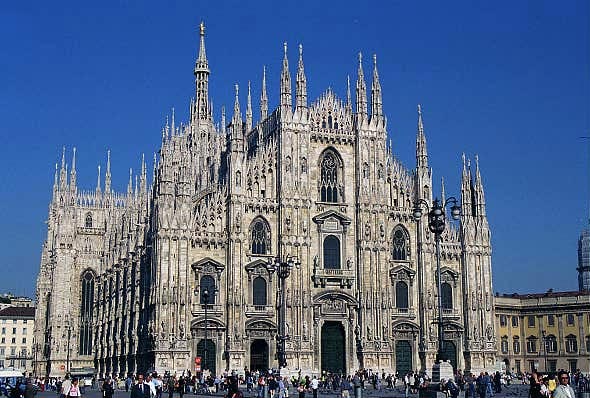
I want to discuss this manner more tritely. Either you, a Prince, want to keep the people of the City in restraint with these fortresses, or you, a Prince or a Republic, want to keep a City in restraint that has been occupied in war. I want to turn to the Prince, and I say to him that such fortresses cannot be more useless to him in holding his Citizens in restraint for the reasons given above, for it makes you more prompt and less regardful in oppressing them, and that oppression will expose you to your ruin and will excite them so, that that fortress which is the reason for it cannot afterwards defend you; so that a wise and good Prince, in order to keep himself good and not give cause to his sons to dare to become bad, will never build fortresses, so that they will rely, not upon the fortresses, but on the good will of men. And if Count Francesco Sforza who had become Duke of Milan was reputed wise and none the less built fortresses in Milan, I say that in this case he was not wise, and the result has shown that that fortress was harmful and not a security to his heirs: for judging that through the medium of it to live securely, and to be able to oppress their Citizens and subjects, they indulged in all kinds of violence, so that they became so hated as described above, that they lost the State as soon as the enemy assaulted them: nor did that fortress defend them, nor did they have any usefulness for them in war, and in peace had done them much harm: for if they had not had them, and if because of little prudence they had not treated their Citizens harshly, they would have discovered the peril more quickly, and would have retreated, and would then have been able to resist the impetus of the French more courageously with friendly subjects and without a fortress, than with hostile subjects, and with the fortress, which do you no good in any way, for either they (fortresses) are lost through the treachery of those who guard them, or because of the violence of those who assault it, or by famine.

And if you want them to do you any good and to help you in recovering a lost State, where only the fortress remains to you, it behooves you to have an army with which you can assault those who have driven you out; and if you have the army you would recover the State in any case, (and) even more (easily) if the fortress did not exist, and so much more easily as men would be more friendly than they were to you, for you had maltreated them because of the pride of having the fortress. And from experience it has been seen that this fortress of Milan was of no usefulness either to the Sforza or to the French in times of adversity for the one or the other; rather it brought much harm and ruin to both, not having given thought because of it to more honest means of holding that State. Guidobaldo Duke of Urbino, son of Frederick, who is his time was an esteemed Captain, was driven out of his State by Cesare Borgia, son of Pope Alexander VI; when afterwards because of an incident that had arisen he returned there, he caused all the fortresses that existed in that province to be destroyed, judging them to be injurious. For he being beloved by men, did not need them on their account, and with regard to his enemies, he had seen that he could not defend them; as they needed an army in the field to defend them, he resolved to destroy them. Pope Julius, after having driven out the Bentivogli from Bologna, built a fortress in that City, and afterwards had those people assassinated by one his Governors: so that that people rebelled, and the Pope quickly lost the fortress; and thus the fortress did him no good, but injury, and the more so, that by conducting himself otherwise it could have done him good. Niccolo Da Costello, father of the Vitelli, returning to his country when he had been exiled, quickly razed two fortresses that Pope Sixtus IV had built, judging that the good will people, not the fortresses, would keep him in that State. But of all the other examples, the most recent and the most notable in every way, and apt to show the uselessness of building them and the usefulness of destroying them, is that of Genoa which ensued in the most recent time. Everyone knows that in MDVII (1507) Genoa rebelled against Louis XII, King of France, who had come in person with all his forces to recover it, and having recovered it, he had a fortress built stronger than all others known up to the present time; it was impregnable because of its location and other circumstances, being placed on the apex of a hill that extended into the sea, called Codefa by the Genoese, and by means of this he commanded all the port and great part of the town of Genoa. Afterwards in the year MDVII (1512) it happened that the French forces were driven out of Italy, Genoa rebelled notwithstanding the fortress, and Ottaviano Fregoso seized the State, who, after sixteen months and with every industry, captured it by starvation. And everyone believed, and many counselled him, that he should preserve it as a refuge in any event: but being a most prudent man, (and) knowing that the good will of men and not fortresses maintained Princes in their States, destroyed it. And thus without founding his State on the fortress, but on his virtu and prudence, he has held it and still holds it. And where before only a thousand infantry usually were enough to overturn the State of Genoa, his adversaries have assaulted him with ten thousand and have not been able to harm him. It will be seen from this, therefore, that the destruction of the fortress did no more harm Ottaviano, than the building of it protected the King of France. For when he was able to come into Italy with his army, he was able to recover Genoa without the fortress being there; but without the army he could not come into Genoa even though he had a fortress there. For him, therefore, it was an expense to do (build) it and a disgrace to lose it: To Ottaviano the recovery of it was glorious and the destruction of it useful.

But let us come to the Republics which build fortresses, not within their own country, but inside the towns they acquire. And if the example given of France and Genoa are not enough to demonstrate the fallacy of this, those of Florence and Pisa will be enough for me; for the Florentines build fortresses in order to hold that City, and did not understand that to hold a City which was always hostile to Florentine rule, had lived in freedom, and had resorted to rebellion as a refuge for liberty, it was necessary in wanting to observe the old Roman method, either to make her an associate or to destroy her: for the virtu of fortresses is seen in the coming of King Charles, to whom they all surrendered, either through the treachery of those who guarded it, or from fear of a greater evil: for if there had not been one, the Florentines never would have based their holding Pisa on it, and the King (of France) could never in that manner have deprived the Florentines of that City: and the means by which they had maintained it up to that time would perhaps have been sufficient to preserve it, and without doubt would have stood the test better than the fortress.

I conclude, therefore, that to hold one’s own country a fortress is injurious and to hold towns that are acquired fortresses are useless: And I want the authority of the Romans to be enough (for me), who razed the walls of those towns which they wanted to hold, having taken them by violent means, and never rebuilt them. And if anyone should cite in opposition to this opinion that (example) of Tarantum in ancient times and of Brescia in modern times, both of which places were recovered from their rebellious subjects by means of fortresses, I reply, that for the recovery of Tarantum Fabius Maximus was sent at the beginning of the year with the entire army, who would have been more apt to have recovered it if there had not been a fortress: for although Fabius had used that means, if there had not been this means (fortress), he would have used other means which would have had the same result. And I do not know of what usefulness a fortress may be, if in the recovery of a town, a consular army with Fabius Maximus for its Captain is needed to recover it: And that the Romans would have recovered it in any event, is seen by the example of Capua where there was no fortress, and which they reacquired through the virtu of the army. But let us come to Brescia. I say that there rarely occurs that which occurred in that rebellion, that while the fortress remains in your power ((the town having revolted)) you should have a large army (and) nearby as was that of the French: for Monsignor De Foix, Captain of the King, being with his army at Bologna and learning of the loss of Brescia recovered the town by means of the fortress. The fortress of Brescia, therefore, ((in order to be of benefit)) also needed a Monsignor De Foix, and a French army which had to succor it in three days: Hence this example in contrast to opposite examples is not enough, for many fortresses have been taken and retaken in wars of our times, by the same fortune as field campaigns (have taken and retaken), not only in Lombardy, but also in the Romagna, in the Kingdom of Naples, and throughout all parts of Italy.

But as to building fortresses in order to defend oneself from external enemies, I say that they are not necessary to those people, or to those Kingdoms that have good armies, and are useless to those who do not have good armies: for good armies without fortresses are sufficient to defend themselves, and fortresses without good armies cannot defend you. And this is seen from the experience of those who are held to be excellent as governors and in other things, as was the case with the Romans and the Spartans; for if the Romans did not build fortresses, the Spartans not only abstained from building them, but even did not permit the City to have walls, because they wanted (to rely on) the personal virtu of their men to defend them, (and) not some other means of defense. When, therefore, a Spartan was asked by an Athenian whether the walls of Athens appeared beautiful to him, he replied “yes, if the (City) was inhabited by women”.

The Prince, therefore, who has good armies, may have on the frontiers of his State, or on the sea, some fortresses that could resist the enemy for some days until he could be checked; this may sometimes be a useful thing, but is not a necessary one. But when the Prince does not have a good army, then having fortresses throughout his State or at the frontiers, are either injurious or useless to him: injurious, because he loses them easily, and when they have been lost they are turned (make war) against him; or even if they should be so strong that that enemy cannot occupy them, they are left behind by the enemy army, and are of no benefit; for good armies, unless they are confronted by equally brave ones, enter into enemy country regardless of the City or fortress which they leave behind, as is seen in ancient histories; and as Francesco Maria did, who in recent times, in order to assault Urbino, left ten enemy Cities behind him, without taking any account of them. That Prince, therefore, who can raise a good army, can do without building fortresses: He who does not have a good army, ought not to build. He ought indeed to fortify the City where he lives, and keep it fortified, and keep the Citizens of that City well disposed, in order to be able to sustain an enemy attack so that he can (keep it) free by an accord or by external aid. All other plans are an expense in times of peace, and useless in times of war. And thus whoever considers all that I have said, will recognize the Romans as wise in all their other institutions, as they were prudent in their judgments concerning the Latins and the Privernati, where, not thinking of fortresses, they assured themselves of these people by wiser and more virtuous means.
9th Grade: Machiavelli’s Bombshell

Greetings,

This we week we wrapped up some aspects of Renaissance exploration by thinking about why exactly Europe experienced such a huge burst of exploration activity in the mid-late 15th century.

Most of us might tend to think that the key to the increased activity was the advent of new technology.  That is, Europeans discovered new tools that would help them sail the seas, and so now they could make the attempts to find new lands that lack of technology made previously impossible.

In his book Pathfinders, historian Felipe-Fernandez Armesto discounts this notion.  Very few technological advances took place in the decades leading up to the great expansion of exploration.  One thing did change significantly, however, and that was their desire to explore.  Quite simply, they wanted to go, whereas before they did not. Exploration resulted from a belief that mankind should take great risks to find out more about the world.  While they made some technological advances as a result of their sailing, things continued more or less as they had been from 1450 until the discovery of how to measure longitude in late 18th century.  Belief, not technology, spurred on exploration.

What happened?  The Renaissance shifted the emphasis from orienting one’s life from “top to bottom,” as the Medievals viewed life and thought, to a more “side to side” perspective that focused on the knowable, observable, and measurable.  Whether this shift indicated that the Renaissance tried to “improve upon God’s handiwork of creation,” as the great Umberto Eco stated, or that, “the people of the Renaissance had a renewed sense of humanity’s responsibility and stewardship of creation,” as the great art appreciator Sister Wendy postulated, is a question I want the students to consider.

So, what building cathedrals was to medievals, exploration was to the Renaissance.  Both capture the spirit of the times, and show the values of each time and place.  A good question for us to consider is, “What values does our society pursue?”  Do cultures need to dream, to risk, to reach beyond themselves to function well?

We then went on to discuss the controversial political philosopher Nicolo Machiavelli.  To help set the groundwork for understanding him, I asked the students a few questions:

1. Martin Luther supposedly said, “I would rather be ruled by a wise Turk than a foolish Christian” (though many now believe that Luther never said this exactly, though he said other things like it).  If we agree with Luther, this assumes that what we want from political governance differs from what we want from our spiritual leaders.  If we followed Machiavelli, for example, we would not put moral character or spiritual guidance at the top of our list for qualities we look for in political leadership.  Consider these two alternatives for president

  • A solid Christian in belief and morals, but possessing little political experience, imagination, or intelligence,

or

  • A shrewd, intelligent, and experienced leader with respect from the international community, but who does not consider himself a Christian.

“See,” Machiavelli might argue, “Contrary to your instincts, religion is not most important in politics.”  Machiavelli encourages rulers not to be hostile to religion, but believes that politics operates independently from it.

2. Can politics have a redemptive effect on humanity?  St. Augustine argued that politics, as it dealt with the ordering of earthly relationships, could not by definition help lead one to God.  Other theologians disagree with Augustine, but if you agree with him, then one opens the door for politics to have different rules than “normal” life.  For example, we have no problem admitting that trying to bluff in poker is not a sin, however much one tries to deceive others in the game.  Poker is not “normal” life.  When we play poker, we enter into an agreed upon alternate reality.

Politics functioned in a similar kind of alternate reality, according to Machiavelli.  There are times when we expect our leaders to lie or disseminate false information, especially about military operations.  Most of us would not only expect it, we might even admire the tactic should it prove successful and give our country a greater measure of safety.  Whether we agree or not, if we understand these questions we can understand where Machiavelli came from with some of his ideas.

In a famous phrase intended as jibe against Plato, Machiavelli urges us not to seek out “imagined republics.”  Like the Renaissance in general he sought guidance from what he saw in front of him, a consummate political realist.  For example. . .

1. It would be best if you (the ruler) were perfect.  But you’re not, so you will have faults and vices.  First, seek to turn your faults to your advantage if you can.  If you lack consistency of character, perhaps this could mean that your enemies will fear your unpredictability. Failing that, make sure you avoid vices that will directly effect your ability to rule.  Much better for you to run around with women, for example, than to steal from the public till.  God can forgive all sin, people will probably forgive the former, but not the latter.  Above all, power is your guiding star.  Do what you needed to do to maintain and keep power, for without that, nothing else matters (from a political perspective).

2. Should a ruler prefer to be loved or feared?  Again, ideally the answer is, “both.”  But very few can achieve this.  Since nearly all of us must choose one or the other, Machiavelli writes,

Because this is to be asserted in general of men, that they are ungrateful, fickle, false, cowardly, covetous, and as long as you succeed they are yours entirely; they will offer you their blood, property, life and children, as is said above, when the need is far distant; but when it approaches they turn against you. And that prince who, relying entirely on their promises, has neglected other precautions, is ruined; because friendships that are obtained by payments, and not by greatness or nobility of mind, may indeed be earned, but they are not secured, and in time of need cannot be relied upon; and men have less scruple in offending one who is beloved than one who is feared, for love is preserved by the link of obligation which, owing to the baseness of men, is broken at every opportunity for their advantage; but fear preserves you by a dread of punishment which never fails.

Some of you may remember the controversy Surgeon General C. Everett Koop created when he allowed for contraceptive education in public schools.  He stood against abortion and as a Christian privately supported abstinence, but as a public servant he believed in that if teens did have sex, they should use contraceptives, as it would protect them from disease and reduce teen pregnancy and abortions.  Some Christians applauded this stance. Others believed that Koop did not just take sin into account with his policy, he gave it the victory.  One can level the same charge against Machiavelli.  Koop and Machiavelli both, though in different ways and to different degrees, touch on the dilemma between public service and personal belief and practice.

Few Christians would want to go as far as Machiavelli did, yet many would probably find themselves agreeing with some of his assumptions.  Drawing the line appropriately will require great wisdom, and the students did a great job discussing some of these tough questions this past week.

Many thanks,

Dave M

11th Grade: Victory and Defeat Rest on Culture

Greetings,

This week we continued with W.W. II, and put a special focus on the impact a culture has on its army, and how that impacts the fighting itself.

When we think of qualities that an army needs to succeed, we would probably list

  • Unity
  • Order
  • Obedience
  • Hierarchical control

All of these qualities dovetail nicely with totalitarian societies.  Examples abound of the extreme sacrifices of individual Japanese soldiers in W.W. II.  They rarely surrendered.  They threw themselves on top of barbed wire and let fellow soldiers climb on top of them.  Surely any commander would prize these qualities.  And yet, democracies have a very favorable historical record in war against totalitarian regimes.  In fact, democracies get in much more trouble when they fight each other, i.e. The Peloponnesian War, The Roman Social War, World War I, etc.

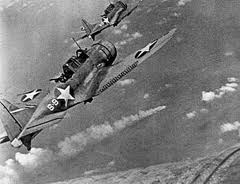
What values, then, do democracies give their armies, and how does this help them win?  We looked at the Battle of Midway in June 1942 to help us understand this.  Both Japanese and American armies had brave soldiers, but their actions were byproducts of their cultures, and the values of Japanese society put them at a relative disadvantage.

For example:

  • Intelligence

Historians of all stripes universally agree that American military intelligence far outstripped Japans.  Is this coincidence?  Code breaking requires an extreme level of mathematical and analytic ability, and many people who possess that ability would not easily fit into a military lifestyle.  The U.S. army let these code breakers work independently.  Sometimes they showed up in uniform, sometimes they showed up in a bathrobe and slippers.  Sometimes they worked 9-5, sometimes they worked 24 hrs. straight and then took the next day off.  The U.S. tolerated all of their individual eccentricities, and it paid off with sterling results.

By June of ’42 we had broken the Japanese naval code and knew that they had planned a major assault on Midway.

In contrast, Japanese code breakers worked within a much more rigid structure.  They could not work independently, but had to take specific direction from superiors at all times.  They never achieved any measurable result.

  • Battle Plan and Strategy

All armies have a hierarchy, with orders that require obedience.  But different armies allow for more independence from their soldiers than others.  As we might expect, Japanese leadership insisted on strict, uniform control of all aspects of the battle.  To help achieve this level of control they grouped their air craft carriers all together, ostensibly to prevent free-lancing.  But it went both ways, for Japanese soldiers, not having been trained to act independently, could not do so.  The Americans, by contrast, spread out their ships.

The turning point of the battle came when an American dive-bomber squadron located the carriers (grouped together) they just happened to all be refueling, leaving tons of fuel exposed to attack.  The Americans needed only a few direct hits to essentially sink three carriers in six minutes.

Again, whatever role you assign to “chance,” it was no coincidence, especially when we consider that dive-bombers found the carriers when the squadron leader made a “best guess” of his own, and did not act on any specific order.  The military culture of the American army had some distinct differences from that of the Japanese, and this difference emanated from the society at large.

  • The Fate of the Commanders

When the Japanese carriers were hit, all of the Japanese admirals and captains gathered below deck to commit ritual suicide.  This action emanated directly from their code of “Bushido,” which penalizes failure and dishonor with death.

We can contrast this with General MacArthur of the U.S., who, when he suffered defeat and humiliation in the Philippines in 1942, fled the scene.  In 1944 he came back to liberate it.

Most historians I have come across argue that Japanese Generals and Admirals were at least the equal, if not superior, to their Allied counterparts.  Japanese privates had just as much, if not more, fighting spirit as the Americans.  All agree that the real difference between the armies could be found in their respective sergeants, lieutenants, and captains.  Allied soldiers of this rank could lead and adapt to changing conditions on their own, and their Japanese counterparts could not.

Interestingly, Hitler also had an obsession with “honorable” suicide, though few of his generals took him up on the idea.  Rommel eventually ignored Hitler’s “Victory or Death” order at El Alamein, though he later regretted he did not disobey even earlier than he did, for Montgomery’s artillery inflicted so much damage the Nazi’s never recovered in Africa.

A common theme running through all these factors is the honor given to individual life, something that totalitarian societies do not value.  In the end, such values not only don’t help your society, they don’t help your military either.

Have a great weekend,

Dave Mathwin

9th Grade: Mark Twain and Renaissance Florence

Greetings,

This week we began looking at the Renaissance in Europe.  The Renaissance can be viewed as a either a reaction to, or an extension of, the feudal period that preceded it.  Whatever position one takes on that issue, no one doubts that that the Renaissance represents a new way of thinking about the world and our relationship to it.

Historians debate exactly when the Renaissance began, but most agree that the ‘Spirit of the Renaissance’ had its origin in Florence, a city in northern Italy.  Why this city, previously of no real importance, should suddenly be the epicenter of a whole new way of thinking poses a question we needed to explore.

If we look at the conditions under which cultural revolutions take place throughout history, a few general trends emerge.  For one, it appears that they generally arise in geographical and social frontiers, and not as we might expect, in the centers of power and influence.  Thus, in the Middle Ages, we see the Gothic style originate in northern France, which saw so much conflict with England and the Vikings.  On top of that, northern France had relatively less Roman influence than southern France near the Mediterranean, making them less “civilized” in the eyes of many.  But the tension between “Gallic” and “Roman” may have given them the freedom to think of things in new ways.

UnknownIn our own history Mark Twain invents American literature on what was for the time, the geographic and social frontier of America.  Today, the mythology and folklore of the “frontier” still do much to shape the American psyche. If we think of Twain’s vocabulary and compare it to say, Hawthorne’s, we see that Twain occupied a social frontier as well as a geographic one.

Notice also, for example the incredibly dynamic & spiritual  response of African-Americans to persecution from say, 1880-1964 or thereabouts.  Swing, jazz, blues, motown, soul, rock and roll — all of them basically their creations, and that hardly encompasses a final account of their contributions to American life and culture.  Perhaps their disadvantaged social position led them to think of creative ways to deal with that challenge, which helped them create such vibrant music.

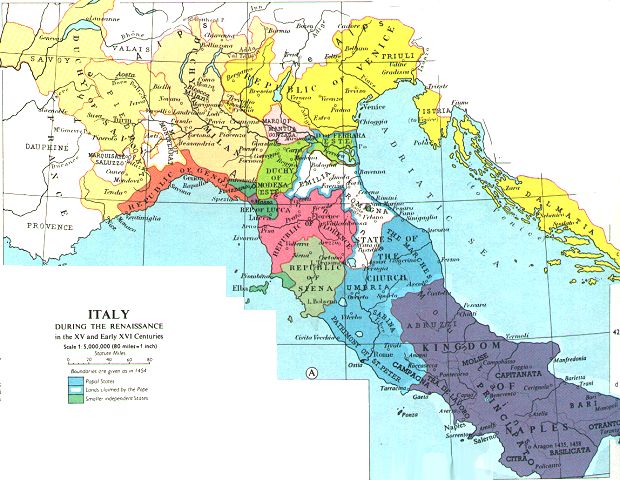
Florence found itself on the geographic frontier of two more established civilizations, that of France and southern Italy.  Divided politically (as the map below indicates) northern Italy never quite had the chance to develop its own social identity.  It appears that culture arises not from comfort, but from a challenge, be that challenge physical or social.


Another common thread in cultural innovation seems to be water.  The great cultural explosions, be it in Athens, Amsterdam, London, New York, or New Orleans, all have water in common.  I don’t think this is a coincidence, something I take up much more fully in this post, which we discussed in class.  Here is a link to a post that formed part of the basis of our discussion about water and creativity.

As we delve into the Renaissance, we face many questions:

1. Inherent in the names “Middle Ages,” and “Renaissance” (which means “rebirth”) are a lot of assumptions, namely, that the Renaissance took major leaps forward for humanity after we treaded water in the “Middle Ages” after the fall of Rome.  Some historians, however, like Regine Pernoud, see the Renaissance as a step backward from what came before.  Who is right?

2. Will the new view of mankind in the Renaissance be consistent with Christianity?  Will it correct what some perceive to be a medieval over-spiritualization, or will it give humanity too much pride of place?

3. How will this new view of mankind spill over into the rest of Renaissance society?

The Renaissance emerged from the wreckage of the feudal system in the 14th century.  The old social structure did not hold, the Church was busy shooting itself in the foot, and so on.  Different ways of thinking had opportunity to emerge, and we looked at the financial innovations of the Renaissance, particularly in banking.

Many thanks,

Dave

Cultures are all Different, except when they’re the Same

It strikes me as a plausible proposition that anthropology developed primarily as a science out of democratic cultures. The openness fostered by democracy may contribute to curiosity and a desire for travel. Many consider the Athenian Herodotus the “Father of History,” but his work has many anthropological dimensions as well. I discussed in another post the archetypal Feminine within democracy, so it may be no surprise that the most famous anthropologists in the 20th century were two women, Margaret Mead and Ruth Benedict.

We can imagine the stereotypical male being almost a parody of an anthropologist–narrow, rigid, calling anything different “stupid,” or “dumb” (this could have been a marvelous Monty Python skit with John Cleese). So we can see how typical feminine traits of fluidity, appreciating context, nurture and acceptance, and so on, might fit women best–in general of course.

Many have written extensively on Ruth Benedict’s classic, Patterns of Culture, and I will not seek to say what has already been said. Briefly, however, Benedict seems to have two main goals:

  • To show that cultures are fundamentally different from one another, and are developed internally, not dependent on race or geography
  • Benedict of course makes many interesting observations about the societies she observes and her work has great merit. But, just as John Cleese might marvelously enact a parody of an anthropologist in the field, so too anthropologists can sometimes parody themselves. It is possible to be so open, so fluid, as to lose one’s moorings.

By this I mean that, of course cultures are different from one another, but this should not surprise us at all. People are different too. What I find more striking are the similarities across cultures that testify to the essential unity of human nature. For example, Benedict tackles how different cultures treat adolescent girls. In one place, young teens are primarily feared. The transformation they undergo has an element of sacredness about it, but, the sacred can also bring terror. So the young girls are sent away from the community to live in tents apart for months at a time. In another culture, they are celebrated and receive something akin to adoration, with men of the tribe literally bowing to them as potential and future mothers of the tribe. In Polynesian cultures, Benedict asserts that no one makes a big deal of adolescence at all. No ceremonies exist to mark the passing from youth to young adulthood, but . . . during this time teens are granted a great deal of sexual freedom, which they readily take advantage of until marriage.

Benedict’s strong accentuation of differences, however, have her miss the overall point. Each of these cultures treat the teen years as a distinct phase of development, each other them apply different standards of conduct for teens and others in the tribe treat them differently than either children or adults. To me, this seems more striking than their differences.

I find this emphasis on difference–not at all unique to Benedict among anthropologists–as a symptom of the democratic cultures from whence they arise which also stress individual differences and uniqueness. Paradoxically, I think this leads us towards a fascination with cultures that are tightly interlocked and cohesive, for democratic cultures can produce no such thing.

When a book gets reviewed positively by diverse thinkers such as Rod Dreher and Cornel West, one should take note. Patrick Deneeen’s Why Liberalism Failed partially indulges in too much romanticism for the past. His book is more of an essay or a thought-piece, and so it has holes. Still, I find his paradoxical analysis that Liberalism–by which he means the liberal democratic order that forms the foundation of both Republicans and Democrats–has failed because it has in fact done everything it set out to do, compelling, and an interesting companion to Benedict and other anthropologists.

Deneen argues that the Liberal order, which had its origins in with the work of Hobbes and Locke, set out to create a radically new society with a very different conception of how an individual relates to the state and one another. Traditional societies saw the state fundamentally as a community of persons pointed in the same direction with the same values.

Liberal society starts with the premise that recognizing and maximizing individuals, and the inherent competition that comes with it, will create a more prosperous and workable state. Liberalism seeks to free us from all group oriented authorities that are not consensual, be it tradition, community norms, etc. It achieved its goals in spectacular fashion and we all partake readily of what it has to offer. It has brought unprecedented prosperity, but left us adrift at sea in a mass of individuals. In turn, this has led to the rise of statism, and emotionally driven authoritarian politics. Gone is the world of George H.W. Bush. Welcome to the world of Trump and Ocasio-Cortez. The success of Liberalism has brought us to place that will naturally usher in its demise.*

Deneen explains himself well on any number of podcast interviews, and the book has various and detailed reviews. I will mention two of his main points that might help us understand the polarity of the self-loathing expressed by some in academia and the progressive left, and the chest-thumping of the more nationalistic right.

Deneen mentions that Liberalism is supposed to make men “free” and “liberal” in their disposition. But the whole tradition of the liberal arts expounds a very different meaning of freedom. The great thinkers and writers from the ancients down through Austen and Dickens all characterize freedom as living with limits, be it the limits of nature, tradition, or the law of God. But the Liberal order defines freedom as acting without any constraint, be it constraints on the market, on family, on biology, and so on. So, Wal-Mart should be free to eradicate mom-and-pop Main Street. And, if every civilization that ever existed defined marriage in a certain way, that stricture simply sets up another bowling pin for the Liberal order to knock down. The whole history of the human past has no authority over the now.

Our orientation towards living without limits has led to our striking crisis of inequality. Our solution to this, however, is not to champion the limitations taught by the liberal arts, rooted in God, natural law, or nature itself, but instead to blame liberal education for being “impractical.” For Deneen, an insistent STEM emphasis only continues to feed the beast, though he surmises that we will avoid violence. John Locke himself argued that, of course his proposed new order would bring about a new kind of inequality. But this new inequality will give us much more overall prosperity, and indeed he was correct. Even the poor may not mind inequality so much because we all have iphones.** Still, the benefits of a liberal economy do not feed the soul.

So too, Deneen argues that Liberalism destroys “culture” as part of its operating procedure. To develop, culture requires place, habit, tradition, and local difference, none of which have a role in the Liberal state. We have no place, and if we live in a particular place for long, it may not have any “place” about it (suburbs are wonderfully convenient and give many obvious benefits, but most are interchangeable with each other).

I think this might explain why many in the west have a fascination with other cultures. The Pueblo and the Dobu people profiled by Benedict have a tight culture in which roles and identity stand out with perfect clarity to all who live within them. We may not want to live among them but we long for their sense of solidity. Conversely, the Dobu do not send out anthropologists to find out about us. A man who is full need not scavenge for food.

This may help explain the progressive liberal drive to limit free speech. They seek not the liberal idea of freedom, but taboos that might give us identity. I completely object to their methods and their goals, though I understand the impulse. You can only celebrate diversity for so long, until you realize that everyone has the same need to define themselves as a people, and we cannot define ourselves without living within limits .

Deneen’s book has few solutions in mind, and this has frustrated some reviewers. But he does he offer the following from Edmund Burke’s Reflections on the French Revolution:

In this enlightened age I am bold enough to confess that we are generally men of untaught feelings, [and] that instead of throwing away our old prejudices, we cherish them . . . . W are are afraid to put men to live and trade each on his own private stock of reason, because we suspect that this stock of each man is small, and the individuals do better to avail themselves of the general captital of nations and of ages. . . . Prejudice renders a man’s virtue his habit, and not a series of unconnected acts. Through just prejudice, his duty becomes part of his nature.

Dave

*In an interesting aside, Deneen points out that James Madison specifically sought to develop a government where different political interests were inexorably pitted against one another. He eschewed the idea of community almost from the start. These different and intractable differences would preserve liberty for each group by each interest group canceling each other out. Alas, he probably envisioned several kinds of difference, and not just two.

Or . . . perhaps just two versions of the same impulse? Many criticize Trump for his relationship to facts. But Oscasio-Cortez recently derided those who are “more concerned about being precisely, factually, and semantically correct than about being morally right.”

**Deneen said in a recent speech that he leads at Notre Dame a class on the idea of utopia, from ancient days until now. At the end, he polled the class to ask them which society of those he presented would they least want to live in, and which they would most want to live in. They all said 1984 is the one they wouldn’t want to live in. But which would they choose? A handful chose the world Wendell Berry presents in Hannah Coulter. But about half the class said Brave New World.

“It was stunning that they saw it as a utopia,” Deneen said. “That’s liberalism succeeding, and that’s liberalism failing.”

The Imperial Draftee

Children often hear, “This is going to hurt me more than it will hurt you,” before getting punished and of course they never believe it.  One day, they find out that it takes a lot of energy to come up with a punishment and enforce it.  In a similar vein, no one who wins the lottery believes that they will fall victim to the “curse” of great financial windfall actually making people more unhappy.

So too imperial states do not realize that extra conquests often presage a time of troubles,* and soon begin to work against them.  We usually think of the geo-political or financial burden of conquest, but it takes a psychological toll as well.

Here is a picture of a draftee into Japan’s army, with his family at a farewell gathering.

The Imperial Draftee

The picture should be blown up beyond screen size to get the full impact, and you can do that here.

We might guess that this picture was taken late in World War II, when all that seemed left for Japan was either surrender or “honorable” death.  But in fact, the picture is from 1939, when Japan’s fortunes seemed very much on the rise.  But this “rise” in fortunes may not have been all it seemed.  In 1939 Japan had reached a stalemate of sorts in China after quick and early victories.  To break the stalemate they began wanton and indiscriminate bombing of Chinese cities.  As David Derrick notes, Japanese tended to look somber in photographs, but here they appear beyond somber.  They are troubled , suffering from what Toynbee called a “schism of the soul.”

Whether your religion be Christianity, or in Japan’s case, Shintoism, people were not made to kill on such a scale.  Such actions take their toll.  It may hurt the conqueror more than the conquered.

*Readers of the linked post may note that while Japan technically was ruled by the Emperor, in fact they were controlled by a military oligarchy.

“The (Optimistic) Spirit of Medieval Philosophy”

There exists an “old saw” approach to Christianity that runs something like this: A long time ago Christians devoted themselves to practical matters of personal morality.  The early Church lived as a community of love devoted to good works.  Then, along comes ________ (this “blank” takes many forms — St. Paul, St. Athanasius, St. Augustine, etc.) and Christianity forever tainted itself with “theology” and a philosophical turn of mind completely at odds with the spirit of Christ and his early followers.”

I believe firmly in the idea that every organization gets the culture they deserve.  Perhaps the Church over time has contributed to the great error described above by focusing too much on morality as such and not on transformation.  Perhaps Christian education has concerned itself too much at various times with mere outward good results and good looks rather than giving a firm foundation in eternal principles.

But I also think that those that attack the “philosophical” elements of Christianity have a conscious or unconscious agenda to keep religion tucked away in its own small corner.  “You Christians please continue to be nice to each other and try and help others.  We’ll handle the big stuff.”

In his The Spirit of Medieval Philosophy Etienne Gilson sets out to refute those who wish to keep Christian belief in a 1124081small corner.  Gilson was a pre-eminent scholar and philosopher in his day, and alas for me, some of his philosophical vocabulary went over my head.  But one of the great strengths of his work is its simplicity.  He asks the critic to please, just actually read the Bible and Christian theologians honestly, and the idea that Christian belief was never “philosophical” melts away.

For starters we have the book of Job as a deep philosophical statement on the nature of suffering.  Many Old Testament history books like the book of Judges show artful arrangement to make pointed statements about the nature of man.  We have Ecclesiastes and many Psalms.  Some would say Jesus said nothing “philosophical” but this can only possibly hold water if one discounts the Gospel of John entirely.  Then of course we have the “dreaded” St. Paul who “intruded” with his theological cast of mind, and so on, and so on.

Gilson’s main point, however, deals with the Middle Ages.  Here most critics (at least in his day) stated that whatever philosophy the medievals attempted strictly copied from the Greeks.  They had no originality.  Gilson’s quick retort to this deals with the nature of originality itself.  In one sense, “all philosophy is a footnote to Plato,” as Alfred North Whitehead stated.  Of course the medievals took some ideas from the Greeks.  What philosopher would not?

Others (like Edward Gibbon) charge the medievals with dimming the light of reason with the obscurantism of faith and revelation.  Gilson shows with many examples that the bulk of medieval thinkers saw reason enhanced, not diminished, by faith.  He writes,

By revealing to man what he could not actually know, revelation opens up the way for the work of reason.

God’s gift of rationality now has more to chew on, and thus gets more of a workout.  For the medievals revelation makes mankind more rational, not less.*

But the bulk of the book forms Gilson’s main point that the medievals creatively used and transmuted Greek philosophy rather than copied them rote.  They had a strong desire to save everything they could and use it for Christian purposes.  My favorite example of this comes from Boethius. Gilson writes,

Fate had weighed too heavily on men’s mind’s to be too summarily dismissed.  Boethius took the trouble to put up some rather complicated architecture in order to ensure it a niche in the Christian temple.  Providence is then the divine intelligence comprehending all things in the world; that is to say their natures and the laws of their development.  As reunited therefore in the divine ideas the universal order is one with Providence; as particularized, broken up, and so to speak, incorporated with the the things it rules, the providential order may be called Fate.  All that is subject to Fate is thus subject to Providence, since Fate depends on Providence as a consequence on its principle.

Boethius himself wrote,

For as the innermost of several circles revolving around the same center approaches the simplicity of the mid-most point . . . while the outermost, whirled in an ampler orbit takes in a wider sweep of space–even so whatever departs from the Primal mind is involved more deeply in the meshes of fate, and things are free from fate in proportion as they seek to approach the center; while if aught cleaves close to the supreme mind in absolute fixity, this too, being free from movement, rises above Necessity.  Therefore as is reasoning to pure intelligence, as that which is generated to that which is, time to eternity, a circle to its center, so is the shifting series of fate to the steadfastness and simplicity of providence.

I admit I don’t fully understand it, nor might I buy what he sells. Whatever the explanation, I think it best to avoid the word “Fate” altogether.  But who wouldn’t smile at Boethius’ boyish enthusiasm and deft mental gymnastics? Aquinas, to my mind a more mature and clearer thinker than Boethius, rejects this concept of Fate as well.  I’m sure that Aquinas understood him, and I’ll stick with his analysis.

Of particular interest to me was Gilson’s explanation of the medieval view of history.  Previous historians in the Greek and Roman tradition did brilliant work.  But even the best of the ancients, i.e. Herodotus, Thucydides, and Polybius, all show the tendency toward Fate and Inevitability.  For Herodotus, everyone eventually crosses the boundaries of natural law — even Cyrus — and gets crushed for it.  Thucydides sees civilization doomed by the passions and fears of man that lie just below the surface.  Even the more spiritually minded Polybius sees mighty Rome caught up in the grand cycle of growth, peak, and decay from which they cannot escape.

Medievals demonstrated originality in their historical vision.  They saw linear progression where others saw only vicious cycle.  With revelation illumining reason we can build on the past, move forward, and advance.  The medievals had humility in relation to the past.  They knew the Romans and Greeks had done better than they in most ways.  But they never felt imprisoned by that presumption.  Rather, they sought to press on and hopefully help carry mankind to a better place.  In comparison to what came before, Gilson rightly claims this as an original philosophical development.

This view of history has its roots of course in theology.  History is a poem, which makes sense only when we know the beginning and the end.  Thanks to revelation, we know both, and can now see Christ building His kingdom on Earth, one that grows as a mustard seed.  If God be true, we have the opportunity to progress in relation to the past, though of course we may reject that chance.  This explains Boethius’ desire to save Fate from the chopping block — we must save everything so we can build on everything — but it also explains Aquinas refusal to yield.  God binds no one by Fate.  Otherwise, how can God’s kingdom advance?

The medievals, often portrayed as dour and gloomy, strike me as a hopeful people.

Dave

*Perhaps one example of this is the doctrine of the Trinity, a reality beyond the realm of reason.  But after revelation announces the doctrine, reason and experience can then deepen our understanding, which seems to be the experience of the early Church.

Stalinism as a Civilization

I have never quite agreed with Tolstoy’s famous quote, “All happy families are alike; each unhappy family is unhappy in its own way.”  The quote seems to indicate to me that goodness is static, while evil has “interesting” variety.  I see it the other way round.  The great saints of the Church demonstrate great variety, whereas all the bad guys of history have little to differentiate them.  What, after all, makes Pol Pot that much different from Mao, or Nero from Cambyses, or Hitler from Stalin?  On the contrary, St. Francis and St. Thomas Aquinas, to take two contemporary medieval examples, could not be more different.

Of course I could also be misinterpreting the quote badly.

Reading Magnetic Mountain: Stalinism as a Civilization I thought of Tolstoy’s quote again and rethought it a bit.  

Kotkin’s goal for the book intrigued me.  Ok, he states, of course Stalin was a bad guy and Stalinism proved enormously destructive in many ways.  But no regime can last for as long as Stalin’s did without him doing something right, or at least, appealing to large numbers of the population with his ideas and “results.” In other words, not everyone got oppressed, and some must have benefitted from what Stalin did.  More than that, enough must have truly believed in what Stalin sought to accomplish not to just obey his directives, but to revere him as well.  Kotkin seeks to uncover exactly how Stalinism “worked” in every day life and get us beyond our cardboard cutout of Stalin as “bad dictator” without leaving it entirely. Looking at the city of Magnitogorsk gives him ample opportunity to do so, for it was a city built from nothing almost overnight according to at least what Soviets planned as purely “socialist” or “Stalinist” designs.

Is it possible that, “All evil dictators are alike, but each of them does their “good” things in different ways?

The book begins by discussing briefly the context of the rise of the “Stalinist city.”  Part of the appeal of communism in the 1920’s lie in the seeming collapse of the west.  In retrospect World War I seems to be the death knell of Europe, and many at the time felt the same.  Capitalism had, obviously, exhausted itself and brought about the grisly destruction of the war.  What else could one expect on a system rooted fundamentally in economic and class exploitation.  Socialism was so obviously the way of the future, only a stubborn fool would cling to it still.

Or so the argument went.

Given that for many ca. 1925 socialism represented the way of the future, socialism needed to be on the cutting edge of technology. Socialism had rational roots, and this rationalism would inevitably flee tradition and embrace the hopeful future.

To that end, the Soviets faced a few problems.

The first is that Russia was far, far behind the west in terms of technology and industrialization.  They needed to catch up in a big hurry, and not just for reasons of security, but also for ideology.  Socialism must show itself superior to capitalism in all respects if their revolution would spread.

The second is that Russia never quite experienced the Enlightenment and may have been the most traditional of European societies.   These traditions had their roots in the daily rhythms of peasant village life and in the multitude of small villages scattered throughout the country — the kind of places adored by Tolstoy.  These villagers invariably looked down on “cities” as enemies to their way of life and their faith, often with good reason.

To build the new humanity sought by socialists nearly everything had to change within the Soviet Union.

The “Magnetic Mountain” served as a perfect template for all of Stalin’s most important plans. Everyone knew that the mountains nearby contained enormous quantities of iron ore deposits, some of the largest in the known world.  And because the area stood as merely a barren wasteland in the steppes, they could build on a blank slate.  The new steel plant would be the largest in the world, and the people who came to work could be drafted from the villages, forging a new kind of humanity in the process (the use of the term “forging” was deliberate, tying the plant and economic changes to the social and political changes they sought).

Kotkin uncovers some fascinating, but perhaps obvious details about the design of the city.  Not just the village, but the family itself presented a barrier to socialist reform.  The original design of the living spaces were apartments.  Apartments had the advantage of economic efficiency.  They also helped “forge the new humanity, breaking down the village and then family unit in one go.  The first apartments had no kitchens or common space within individual quarters.  They located the kitchen’s and common areas in more central locations — no one should be excluded, and no one could exclude themselves (later buildings allowed for more family space).  The design of the buildings discouraged families from creating distinct identities for themselves apart from the people as a whole.

Equality formed the bedrock value, so each apartment should have equal access to the sun. Unfortunately, this meant that, with no courtyard, each apartment had equal exposure to the brutally cold winds that roared across the steppe 6-7 months a year.  Finally, as socialists defined value through labor, all apartments got built on a line equidistant from the plant itself. The prominence of the massive plant in the geography and psychology of the city made it not unlike the role of churches in medieval towns.  Mankind will be defined by what he worships, whether that be God or labor.

One of the most dreary aspects of this period was the politicization of all aspects of life.  The Soviets faced the embarrassment of needing capitalist firms to design most of the major parts of the plant.  But . . . socialists could show their superiority by getting more out of the machines than believed by the capitalists.  So if part ‘x’ was predicted to operate at ‘y’ speed and efficiency, we could do better.  We will operate at ‘y + ?’ efficiency, thereby showing the superiority of socialist labor.  Of course, this resulted in a host of mechanical problems.

This forced them into an uncomfortable choice.  Either socialist labor was not superior, or . . . “wreckers” existed within the plant — counter-revolutionaries and capitalists.  So, now those that worked the machines too hard might be subject to “unmasking” by true patriots and devotees of the revolution.  Of course, if workers were to be true participants in the revolution they had to have the power to “unmask” — and be expected to.

As you might expect, many got unmasked. Limiting production turned into treason, for it was “counter-revolutionary.”  Under the principle of equality, many party members got unmasked as well (though many got reinstated on the back end — the party had to cover for itself).

But Kotkin shows that despite the madness of the method, it won many converts.  The Soviet Union did get transformed into an industrial colossus, and had enough social unity to withstand the withering Nazi onslought in W.W. II.  By most any rational calculus, Stalin and the Soviets should have closed up shop in 1941.  How did they avoid this fate?

We have recourse to the standard answers, which include

  • The Russian Winter
  • The deep reservoirs of Russian nationalism the Nazi’s unleashed that mobilized an entire population
  • The brutal tactics of the S.S. turning local populations against the Nazi’s
  • The over-extension of the Nazi forces and the sound interior lines of Soviet defenses.
  • And again, the industrialization Stalin began allowed them to churn out tank after tank after tank.

All of these factors played a role.

However, we cannot overlook the fact that Stalin also had converts.  His program worked in the sense that it gave people a a new purpose, a new sense of belonging, a new sense of destiny and their own place within History and the cosmos. Many remained ambivalent, some opposed him — mostly in secret.  But many others no doubt believed.

This should give us pause.  No man is an island.  We would like to think that we would not fall prey to the design of the buildings, the alluring glow of the plant and the comradeship of the work.  None of these, we think, would have any impact on us.  We would not believe, we would not be changed.

Hopefully, we would be right.  But one lesson of Stalin’s Magnetic Mountain is that people are inextricably influenced by their surroundings, sometimes even against their inclinations.

Cortes and Alexander the Great

Sometimes how historical figures are perceived has much more to do with how perceptions change over time than what people actually did in their own lifetimes.  Sometimes certain people in the past take on a romantic hue that also can distort our vision.

I thought about this phenomena while reading Five Letters of Cortes, a collection of letters Cortes sent 51iimHx9yvL._SY344_BO1,204,203,200_back to the continent detailing events in Mexico.  The book interested me because historians today routinely treat Cortes as a great villain, and I wanted to see how he measured up to that reputation in his own words. Scholars of course debate the veracity of some details Cortes narrates (without giving much credence to the idea that he simply told the truth as he saw it).  But my interest was not what happened so much as how Cortes wanted his readers to perceive him, regardless of whether or not he spoke fairly and truly.

As I read I thought of how history views Alexander the Great.  The two men have some similarities. Both sought glory, perhaps Alexander most of all.  Both conquered and destroyed a foreign people and culture with at least questionable justification.  Both dealt with internal disputes in their own ranks. Both used diplomacy to great effect, perhaps Cortes most of all.  And yet, history loves Alexander and despises Cortes, generally speaking, and we should ask why.

A few things stood out to me in Cortes’ letters.

  • Cortes de-emphasizes violence and tries to play up his relationship with the natives when he can.  He writes early in the first letter that, “the Indians went among us with as little fear as if they had already had dealings with us for many years.”  He seems proudest when he makes friends.  The “battles” (not battles in a traditional sense) and violence that occur happen when things break down, or in response to a tough situation initiated (in Cortes’ view) by the misunderstanding of the natives.
  • Cortes clearly admires the natives.  A modern westerner expecting to find a racially motivated imperialist will be disappointed.  He describes the sacrifices and violence surrounding Aztec religion in a lengthy passage:

And always on the day before some important enterprise they burn incense in their temples, and sometimes even sacrifice their own persons, some cutting out their tongues, others their ears, still others slicing their bodies with knives in order to offer to their idols the blood which flows from their wounds; sometimes sprinkling the whole of the temple with blood and throwing it up in the air, and many other fashions of sacrifice they use . . .

One very horrible and abominable custom they have which we have seen in no other part, and that is that whenever they wish to beg anything of their idols, in order that their petition may find more acceptance, they take large numbers of boys and girls and even of grown men and women and tear out their heart and bowels while still alive, burning them in the presence of those idols . . .  Some of us have actually seen this done and they say it is the most terrible and frightful thing that they have ever seen.  . . . Your majesties can therefore be certain that there can be no year in which they have not sacrificed some three to four thousand souls.

As to what the Spanish should do in light of this, I leave the reader to decide.  Cortes continues,

Your majesties may therefore perceive whether it is their duty to prevent such loss and evil, and certainly it will be pleasing to God if by means of, and under the protection of your royal majesties, these people are introduced to and instructed in the Holy Catholic Faith . . .

And yet, after describing the most horrible aspect of Aztec society, Cortes concludes the section by writing,

For it is certain that if they should ever serve God with that same faith, fervor, and diligence [as their idols] they would work many miracles.   We believe that by the aid of interpreters who should plainly declare to them the truths of the Holy Faith and the error in which they are, many, perhaps all of them, would quickly depart from their evil ways and come to true knowledge, for they live more equably and reasonably than any other of the tribes which we have hitherto come across.

Cortes also hates the fact that some of the Spanish use the Indians as currency in slaves.  This, he argues, earns the “notorious” Diego Velazquez followers, and Cortes urges the king to remove him from any position of authority at once.

Spanish commentary on the Aztec king Montezuma strike a poignant note.  Multiple sources all converge on the idea of admiration for the man.  Here is Diaz de Casillo writing,

The Great Montezuma was about forty years old, of good height, well proportioned, spare and slight, and not very dark, though of the usual Indian complexion. He did not wear his hair long but just over his ears, and he had a short black beard, well-shaped and thin. His face was rather long and cheerful, he had fine eyes, and in his appearance and manner could express geniality or, when necessary, a serious composure. He was very neat and clean, and took a bath every afternoon. He had many women as his mistresses, the daughters of chieftains, but two legitimate wives who were Caciques in their own right, and only some of his servants knew of it. He was quite free from sodomy. The clothes he wore one day he did not wear again till three or four days later. He had a guard of two hundred chieftains lodged in rooms beside his own, only some of whom were permitted to speak to him.”

When Moctezuma was allegedly killed by being stoned to death by his own people Cortés and all of us captains and soldiers wept for him, and there was no one among us that knew him and had dealings with him who did not mourn him as if he were our father, which was not surprising, since he was so good. It was stated that he had reigned for seventeen years, and was the best king they ever had in Mexico, and that he had personally triumphed in three wars against countries he had subjugated. I have spoken of the sorrow we all felt when we saw that Montezuma was dead. We even blamed the Mercederian friar for not having persuaded him to become a Christian.

Of course Cortes used violence at times directly and on purpose, however much he wanted to avoid it. In one such instance, we have both Aztec and Spanish sources for the same event.  Regarding a terrible massacre, the Aztecs write,

Here it is told how the Spaniards killed, they murdered the Mexicans who were celebrating the Fiesta of Huitzilopochtli in the place they called The Patio of the Gods

At this time, when everyone was enjoying the celebration, when everyone was already dancing, when everyone was already singing, when song was linked to song and the songs roared like waves, in that precise moment the Spaniards determined to kill people. They came into the patio, armed for battle.
They came to close the exits, the steps, the entrances [to the patio]: The Gate of the Eagle in the smallest palace, The Gate of the Canestalk and the Gate of the Snake of Mirrors. And when they had closed them, no one could get out anywhere.
Once they had done this, they entered the Sacred Patio to kill people. They came on foot, carrying swords and wooden and metal shields. Immediately, they surrounded those who danced, then rushed to the place where the drums were played. They attacked the man who was drumming and cut off both his arms. Then they cut off his head [with such a force] that it flew off, falling far away.
At that moment, they then attacked all the people, stabbing them, spearing them, wounding them with their swords. They struck some from behind, who fell instantly to the ground with their entrails hanging out [of their bodies]. They cut off the heads of some and smashed the heads of others into little pieces.
They struck others in the shoulders and tore their arms from their bodies. They struck some in the thighs and some in the calves. They slashed others in the abdomen and their entrails fell to the earth. There were some who even ran in vain, but their bowels spilled as they ran; they seemed to get their feet entangled with their own entrails. Eager to flee, they found nowhere to go.
Some tried to escape, but the Spaniards murdered them at the gates while they laughed. Others climbed the walls, but they could not save themselves. Others entered the communal house, where they were safe for a while. Others lay down among the victims and pretended to be dead. But if they stood up again they [the Spaniards] would see them and kill them.
The blood of the warriors ran like water as they ran, forming pools, which widened, as the smell of blood and entrails fouled the air.
And the Spaniards walked everywhere, searching the communal houses to kill those who were hiding. They ran everywhere, they searched every place.
When [people] outside [the Sacred Patio learned of the massacre], shouting began, “Captains, Mexicas, come here quickly! Come here with all arms, spears, and shields! Our captains have been murdered! Our warriors have been slain! Oh Mexica captains, [our warriors] have been annihilated!”

Then a roar was heard, screams, people wailed, as they beat their palms against their lips. Quickly the captains assembled, as if planned in advance, and carried their spears and shields. Then the battle began. [The Mexicas] attacked them with arrows and even javelins, including small javelins used for hunting birds. They furiously hurled their javelins [at the Spaniards]. It was as if a layer of yellow canes spread over the Spaniards.

And the Spanish version of the same event:

Cortes wanted to entirely understand the cause of the Indians’ rebellion. He interrogated them [the Spaniards] altogether. Some said it was caused by the message sent by Narváez, others because the people wanted to toss the Spaniards out of Mexico [Tenochtitlan], which had been planned as soon as the ships had arrived, because while they were fighting they shouted “Get out!” at them. Others said it was to liberate Moctezuma, for they fought saying, “Free our god and King if you don’t want to die!” Still others said it was to steal the gold, silver, and jewels that the Spaniards had, because they heard the Indians say, “Here you shall leave the gold that you have taken!” Again, some said it was to keep the Tlaxcalans and other mortal enemies out of Mexico. Finally, many believed that taking their idols as gods, they had given themselves to the devil.

Any of these things would have been enough to cause the rebellion, not to mention all of them together. But the principal one was that a few days after Cortes left to confront Narváez, it became time for a festival the Mexicas wanted to celebrate in their traditional way. . . . They begged Pedro de Alvarado to give them his permission, so [the Spaniards] wouldn’t think that they planned to kill them. Alvarado consented provided that there were no sacrifices, no people killed, and no one had weapons.

More than 600 gentlemen and several lords gathered in the yard of the largest temple; some said there were more than a thousand there. They made a lot of noise with their drums, shells, bugles, and hendidos, which sounded like a loud whistle. Preparing their festival, they were naked, but covered with precious stones, pearls, necklaces, belts, bracelets, many jewels of gold, silver, and mother-of-pearl, wearing very rich feathers on their heads. They performed a dance called the mazeualiztli, which is called that because it is a holiday from work [symbolized by the word for farmer, macehaulli]. . . . They laid mats in the patio of the temple and played drums on them. They danced in circles, holding hands, to the music of the singers, to which they responded.

The songs were sacred, and not profane, and were sung to praise the god honored in the festival, to induce him to provide water and grain, health, and victory, or to thank him for healthy children and other things. And those who knew the language and these ceremonial rites said that when the people danced in the temples, they perform very different from those who danced the netoteliztli, in voice, movement of the body, head, arms, and feet, by which they manifested their concepts of good and evil. The Spaniards called this dance, an areito, a word they brought from the islands of Cuba and Santo Domingo.  While the Mexica gentlemen were dancing in the temple yard of Vitcilopuchtli [Huitzilopochtli], Pedro de Alvarado went there. Whether on [the basis of] his own opinion or in an agreement decided by everyone, I don’t know, but some say he had been warned that the Indian nobles of the city had assembled to plot the mutiny and the rebellion, which they later carried out; others, believe that [the Spaniards] went to watch them perform this famous and praised dance, and seeing how rich they were and wanting the gold the Indians were wearing, he [Alvarado] covered each of the entrances with ten or twelve Spaniards and went inside with more than fifty [Spaniards], and without remorse and lacking any Christian piety, they brutally stabbed and killed the Indians, and took what they were wearing.

I have no wish to downplay a terrible massacre.  For our purposes, however, a few things surprised me about the Spanish account.

  • We might expect ‘righteous’ conquistadors rejoicing in their deed.  Some accounts of the Crusaders massacring civilians in Jerusalem in 1099 sound this way.  Instead we them troubled and very much aware of the fact that they departed from their faith with their actions.
  • Confusion, not certainty, dominates the text.  They search for answers and have a hard time understanding what it is they face or why it happened in the first place.  Some historians/sources apparently indicate that the Spanish may have believed that they were about to do another human sacrifice, though the account above does not hint at this or use it as an excuse.

One can disagree with the reasons for the Spanish presence in the new world.  One can lament the results of the Spanish conquest and the subsequent treatment of the natives.  But I found my overall opinion about Cortes changed from reading his writings, though I still lack a great deal of familiarity with the events in general and other particular sources to come to definite conclusions.

But other historians presumably do not.  And this brings us back to my question earlier about comparing Alexander and Cortes.  Some historians fall over themselves fawning about Alexander, and no one treats Cortes this way, despite their similarities.

Alexander had a few points in his favor . . .

  • The fact that he was king and thus the focal point of all narratives about him.  Cortes reported to the emperor, there were other conquistadors, Montezuma is a striking figure, etc.
  • Alexander destroyed the Persians in classic and dramatic pitched battles, the events of which featured himself.  The Aztecs died partly as a result of cunning diplomacy, Montezuma’s attitude, some skirmishes, etc.  Lacking a Battle of Issus or Gaugemela, we have a hard time latching onto Cortes to fully appreciate his skills (you don’t have to approve of Cortes to admire certain aspects of him).
  • Alexander operated within a “heroic” culture where for the most part, great deeds needed no particular justification. Even modern treatments of Alexander pick up on this, consciously or no.  I can’t recall any in depth discussion from ancient writers, for example, about Alexander’s motives, or the justice of his cause.  They simply don’t matter.  Cortes operated within a much different (and certainly superior) moral framework that calls much of the Spanish enterprise into question.
  • Of course we cannot discount the fact that, however well intentioned Cortes may have been, those that followed often exploited the natives for wealth and personal gain.  We should not directly blame Cortes for this, but his association with it taints him inevitably, and perhaps with some justice.

Of course unlike Alexander, Cortes never killed those close to him out of paranoia or political expediency (i.e. as Alexander did with Parmenio and Callisthenes), nor did he murder his friends in fits of drunken rage (Cleitus).  But these acts usually get overlooked amidst the grandeur of Gaugemela.

Whatever we may think of Cortes, sifting through accumulated historiography about him is a tricky business, especially in light of his own words.


9th Grade: The Black Death and the Death of Feudalism

Greetings to all,

This week we brought an end to the Medieval world by seeing its erosion in the 14th century, mostly through the decimation of the Black Plague, as well as the early hints of nationalism.

The disaster wrought by the Plague went beyond the deaths of millions of people.  It also did away with an entire social and moral fabric upon which the medieval world rested.

The virulent and contagious nature of the disease created acute moral dilemmas wherever it struck.  Should diseased people be quarantined?  Should apparently well people be allowed to flee to other towns?  They might have the disease but not yet show the symptoms.  The communal spirit that medievals needed to make their society work broke down.  Fear and uncertainty meant that no one could trust one another.

Imagine that you know that a couple people in a certain household have the plague.  Probably their other family members have it too, but of course you can’t be sure.  Should you let the apparently well people out of the house?  Some towns took the step of immediately boarding up houses where even one person had the plague, which would condemn all those in the house to death.  But towns that took these harsh measures had far fewer deaths overall than those who didn’t.  Is this moral?  It condemns a few to certain death, but it might save a number of other lives. The plague caused a great deal of tension between those who thought the greatest good lay in the safety of the community, and those who thought the priority should be treatment of the individual.

A number of contemporary chroniclers tell of the debilitating social impact of the disease.  Families abandoned even the bodies of their dead for fear of catching the disease, and so many went unburied.  Healthy (and usually wealthier) people abandoned towns if they could, and the mutual relationships between nobility and the “commons” eroded.  The plague may have had an indirect role in the peasant uprisings, first in France in 1358, and later in England in 1381.  Froissart records events in France this way. . .

Thus [the peasants] gathered together without any other counsel, and without any armour saving with staves and knives, and so went to the house of a knight dwelling thereby, and brake up his house and slew the knight and the lady and all his children great and small and brent his house. And they then went to another castle, and took the knight thereof and bound him fast to a stake, and then violated his wife and his daughter before his face and then slew the lady and his daughter and all his other children, and then slew the knight by great torment and burnt and beat down the castle. And so they did to divers other castles and good houses; and they multiplied so that they were a six thousand, and ever as they went forward they increased, for such like as they were fell ever to them, so that every gentleman fled from them and took their wives and children with them, and fled ten or twenty leagues off to be in surety, and left their house void and their goods therein. These mischievous people thus assembled without captain or armour robbed, brent and slew all gentlemen that they could lay hands on, and forced and ravished ladies and damosels, and did such shameful deeds that no human creature ought to think on any such, and he that did most mischief was most praised with them and greatest master. I dare not write the horrible deeds that they did to ladies and damosels; among other they slew a knight and after did put him on a broach and roasted him at the fire in the sight of the lady his wife and his children; and after the lady had been enforced and ravished with a ten or twelve, they made her perforce to eat of her husband and after made her to die an evil death and all her children. They made among them a king, one of Clermont in Beauvoisin: they chose him that was the most ungraciousest of all other and they called him king Jaques Goodman, and so thereby they were called companions of the jaquery. They destroyed and brent in the country of Beauvoisin about Corbie, and Amiens and Montdidier more than threescore good houses and strong castles. In like manner these unhappy people were in Brie and Artois, so that all the ladies, knights and squires of that country were fain to fly away to Meaux in Brie, as well the duchess of Normandy and the duchess of Orleans as divers other ladies and damosels, or else they had been violated and after murdered. Also there were a certain of the same ungracious people between Paris and Noyon and between Paris and Soissons, and all about in the land of Coucy, in the country of Valois, in the bishopric of Laon, Nyon and Soissons. There were brent and destroyed more than a hundred castles and good houses of knights and squires in that country.

The plague also had a catastrophic impact on the Church and its witness.  Many priests demonstrated great courage in tending to the sick, and in consequence died in much higher numbers than the average population (I came across one figure that estimates that the plague may have killed 80% of the priests in Europe).  This left many towns with  no priest at all, while other had priests rushed into office with little to no training.  This led to a poorly trained, uneducated clergy and many layman with no religious guidance at all.  The Reformation 150 years later had many causes, but surely the gutting of Church leadership from 1350-1450 is one of them.

Desperate people usually seek scapegoats, and the medievals did the same.  Many blamed Jews for the plague, and although the Pope declared that anyone “who believed Jews responsible for the disease is deluded by Satan,” people did not listen and Jews were unjustly attacked.  A sect called The Flagellants arose, and they claimed to avert the disease through their own personal penance.  Their argument seemed to go something like:

  • The Plague is God’s judgment upon humanity
  • Once the allotment of God’s wrath is poured out, the Plague will stop
  • If we ‘absorb’ some of God’s wrath, other people will suffer less
  • Therefore, we inflict punishment on ourselves to atone for the sins of others.

The Church rightly declared such people heretics.  They had a faulty view of  God, suffering, humanity, and the disease itself.  Froissart comments again,

In the Year of Grace 1349, the penitents went about, coming first out of Germany. They were men who did public penance and scourged themselves with whips of hard knotted leather with little iron spikes. Some made themselves bleed very badly between the shoulders and some foolish women had cloths ready to catch the blood and smear it on their eyes, saying that it was miraculous blood. While they were doing penance, they sang very mournful songs about the nativity and passion of Our Lord.

The object of this penance was to entreat God to put a stop to the mortality, for in that time of death there was an epidemic of plague. People died suddenly and at least a third of all the people in the world died then. The penitents of whom I am speaking went in companies from town to town and from city to city and wore long felt hoods on their heads, each company with its own color. Their rules forbade them to sleep more than one night in each town and the length of their goings-out was fixed by the thirty-three and a half years which Jesus Christ spent on earth, as the Holy Scriptures tell us; each of their companies went about for thirty-three and a half days, and then they returned to the towns or castles from which they had come. They spent very little money on their journeys, because the good people of the towns which they visited asked them to dinner and supper. They slept only on straw, unless illness forced them to do otherwise. When they entered a house in which they were to dine or sup, they kneeled down humbly on the threshold and said three paternosters and three Ave Marias, and did the same when they left. Many reconciliations were achieved through the penitents as they went about, for instance, over killings which had taken place and about which it had so far been impossible to reach an accord; but by means of the penitents peace was made.

Their rules contained some quite reasonable and acceptable things which agreed with such natural human inclinations as to journey about and do penance, but they did not enter the Kingdom of France because Pope Innocent, who was at Avignon at that time with his cardinals, considered the practice and opposed it very strongly, declaring in condemnation of the penitents that public penance inflicted by oneself was neither right nor lawful. They were excommunicated for doing it, and especially those clergy who went with them.

But again, most did not listen, so strongly did fear grip them.

As the Church declined in prestige, the first inklings of nationalism arose.  The Church opposed nationalism in the past because they did not want people to think of themselves as primarily English or French, but Christians.  One goal of the medieval church was to create a unified Christendom in Europe, a Christendom that if necessary could serve as a “power” bloc to the Moslem world.  To achieve this, however, the church had to minimize the role of national hero-kings.  But as the war progressed both sides had their national heroes, like Henry V and Joan of Arc, and this led to the rise of an “English” and “French” spirit that helped end to the medieval dream of a unified Christendom.

I think we can point to a few possible reasons for this rise of nationalism, and while we should not confuse it with modern day nationalism, it had some similarities.

  • As the length of the war increased, the ‘bet’ each side made increased as well.  With so much invested, no one wanted to fold.  War has a logic of its own, and finds new ways to justify itself, so. . .
  • Nationalism would be an easy target for the war to find.  The kings that began the war died.  Neither side could claim the conflict as a holy crusade.  If you can’t fight for Edward III, or for the Church, perhaps you could fight “for England.”

Henry V clearly capitalized on this, but so too did the more distinctly Christian Joan of Arc.

By the end of the 100 Years War in 1453 the medieval world had disappeared.  Those that survived the plague found their labor in much more demand, forever altering the relationship between peasant and noble. What the Battle of Crecy began the plague finished.  Western Europe would seek a new way of understanding themselves and humanity’s place in the world, which we know as the Renaissance.  We turn our attention to this period at the end of next week.

Dave M

11th Grade: Market Psychology

Greetings,

This week we looked at the Stock Market Crash of 1929 and how it happened.   Not all Stock Market crashes cause deep depressions or recessions, and in fact, many now argue that the Great Depression had many other factors besides the ’29 crash.  For example, only about 3-5% of Americans owned any stock at all in 1929.  But I do think that the crash both revealed and foreshadowed deep problems within the economy as a whole, and so I still thought it worthwhile to examine.  At the very time, for example, when the stock market rose dramatically, key industries like agriculture and construction showed major signs of weakness.
Not only that, it gave us a great platform to discuss the bursting of the dot-com bubble in 2000, which did not bring about substantial economic harm, and the crash of 2008 recently which did.  What were the differences in the two, and which was 1929 more like?  It seems that the 2000 dip revealed a weird anomaly in the economy, whereas in 2008, the problems lay much more at its heart of our financial system in general.  Here are a few different graphs that show similar drops in the market, but each had its own particular effect on the economy:
This graph suggests that maybe market ‘crashes’ are simply ‘corrections.”
We spent two days this week on our own’Stock Market of the  1920’s’ activity.   My main purpose was not recreate  entirely how stocks are actually sold and have value.  I wanted the students to focus on understanding the psychological aspect of not only stock value, but the  value of anything at all.  After all, what makes our paper money  valuable in itself?  Only that we have all agreed as a society that it  does carry value.  If we lost that belief, the economy would collapse  shortly.
In our game this week the market started slowly.  In fact, this class on the first day was the most cautious class I can remember in the last 10 years I have done this activity.  But towards the end of the first day and into the second, the volume of trades and the amounts traded grew a great deal. Crashes usually happen when meteoric rises create a bubble, but in this case most every stock traded at a reasonable growth rate.  “Consumer Confidence” remained high throughout this period, as most teams willingly parted with cash to get stock.  Then, some interesting things happened as certain teams noticed that other teams had a lot of certain stocks.  They then attempted to crash the market for certain stocks, but other teams caught on, and countered effectively.  Though “the market” feared instability and lost some value, in the end it “held” enough for team with the most “blue chip” stocks to win.
Blessings,
Dave Mathwin

Sherlock Holmes and the Solar System

I knew I would like E.M.W. Tillyard’s book The Elizabethan World Picture early on when Tillyard references Shakespeare’s famous, “What a piece of work is a man,” speech from Hamlet.  He writes,

This has been taken as one of the great English versions of Renaissance humanism, an assertion of human dignity over medieval asceticism.  Actually, it is within the purest medieval tradition.

Hah!  Take that those who exalt the Renaissance over all else!  Tillyard goes on to add how Shakespeare writes within the medieval “chain of being” tradition, which they derived from the Church fathers.  He could have added something about Psalm 8, but we’ll let it slide.

Tillyard talks about how he began the book trying to get at the context of Shakespeare, but found that his subject grew on him until he found he had to continually peel back layers of the onion.  It’s hard not to gain a kind of fascination and admiration for the medieval view of reality, and this is the book’s real subject.

C.S. Lewis tackled the exact same thing in his excellent The Discarded Image.  Tillyard’s book lacks the depth and insight of Lewis, but his writing is also much more accessible.  I wish I had started with him first.  The fact that so much of the book deals with the medieval view of the world rather than strictly the Elizabethan stands as one of Tillyard’s main arguments.  Yes, the Reformation broke with certain things from the past, but in the main they kept much of the medieval synthesis intact.  The Scientific Revolution, not the Reformation, ended that view of the world.

The medievals borrowed from the classical tradition, Scripture, and the Church fathers to give themselves a very distinct world filled to the brim with sharp corners.  Their universe had

Order and Unity: Everything had its place, everything played a part.  In that sense it was crowded, with nothing out of place.  But it was purposeful.

  • Sin and Progress: Medieval people believed in the reality of the first, but the possibility of the latter. A healthy tension resulted from a clear view of human folly on one hand, and the love of God on the other.  Tillyard writes,

This is one of things that most separates the Elizabethan from the Victorian world.  In the latter there was a general pressure of opinion in favour of the doctrine of progress: the pessimists were in opposition.  In the Elizabethan world equal pressure existed on both sides, and the same person could be simultaneously aware of each.

In our day, we seem to believe in nothing in particular, though a belief in progress and progress alone would I’m sure be more insufferable.

  • Hierarchy: The “Chain of Being” meant that an infinitely long descending ladder from God down to the creatures far beneath the sea.  Earth itself had a rather humble spot on this ladder.  But the main feature here were the connections.  Air had superiority to earth, and earth to water.  Air is linked to water through earth, and so on.

The system had many advantages.  Tillyard includes many quotes from the period and one immediately realizes how much authors had to work with and build upon.  They could know that their audience would understand a multitude of sacred and secular references, and have a shared view of the world.  Modern authors have to do so much more work for much less assumed reward.  Tolkien had to create an entirely new world to write an epic.

But we should be careful not to romanticize such a world.  Their cosmology did not directly conflict with Christian teaching, but neither was it inherently Christian, and as such left much to be desired.  It was so crowded one did not have much space to maneuver.  The only ones who seemed to have that freedom were fairies, and their role in redemptive history remained undefined — not a good place to be.  Such a cosmology might easily arise in a time that begged for stability in the aftermath of the Dark Ages, and just as easily would wear out its welcome in due course, and even Shakespeare had his fun with it just as he depended upon it.  Tillyard quotes from Twelfth Night in a revealing passage that links parts of the body with constellations:

Sir Toby Belch: I did think by the excellent constitution of thy leg it was formed under the star of a galliard.

Sir Andrew Aguecheek: Ay, tis’ strong, and it does indifferently well in a flame-coloured stock.  Shall we set about some revels?

Sir T: What shall we do else?  Were we not born under Taurus

Sir A: Taurus: that’s sides and heart.

Sir T: No, sir, it is legs and thighs.

Tillyard comments,

Characteristically both speakers are made to get the association wrong; and Shakespeare probably knew that to Taurus were assigned neck and throat.  There is irony in Sir Toby being right in a way he did not mean.  He meant to refer to dancing — legs and thighs — but the drinking implied by neck and throat is just as apt to the proposed revels.  The present point is that the serious and ceremonious game of the Middle Ages has degenerated into farce.

This clip from the excellent Sherlock series from BBC recalls Holmes’ famous quote on his knowledge of the solar system:

Who wants to disagree with Sherlock Holmes?  But he is wrong — one’s view of the solar system does matter.  We have yet to find a workable replacement for Ptolemy and the medievals, and this surely has impacted our cultural life as a whole, and our individual sense of our place in the world.  Like Major Tom, we float aimlessly and need to find a place to stand.

Maybe We Don’t Stink at Parenting

A mantra thrown around the column circuit from time to time is the idea that, back in the good old days, parents were parents and children were taught responsibility, duty, and thrift.  Scenes like this no doubt abounded. . .

Embedded in this picture is the idea that adolescence as a distinct stage of life was an invention of the Victorians in the mid-19th century.  This essentially artificial creation of a previously non-existent stage  then created all sorts of problems that we deal with in the modern world, as our youth postpone “growing up” well beyond what is “normal,” or at least what existed before the Victorians ruined everything.  Many commentators point to the laws against child-labor, and the increase of wealth during the late 19th century that allowed for children to have more leisure, and so on.  The argument makes sense logically.

In her book The Life Cycle of Western Europe, ca. 1300-1500 (“Take courage,” I thought to myself as I picked it up, “The book can’t possibly be as boring as the title.”), Deborah Youngs sets out, at least in part, to debunk this modern notion.  The medievals viewed life as happening in 4-5 distinct stages, with different expectations for each stage.  Childhood, and yes, adolescence, has its roots far beyond the Victorians.  Logical, common sense must give way to the historical record.

Youngs crafts no narrative but her book managed to hold my interest due to the surprising amount of information she gives you in a short book.  Thus, while her work contains no lofty insights, it gives the reader plenty to chew on.  Among some of the highlights:

  • The medievals in general were much less concerned with one’s actual age, however much they fixated on “stage of life.”  When Henry IV of France sought an annulment of his marriage based on the fact that he was too young to give legal consent, no one could remember exactly when he was born.  Opinion varied — some said he was 12 at the time of the betrothal (which would have allowed an annulment) and some said he was 15 (he would have to stay married).  
  • Adolescents (12-18) were universally acknowledged to be in an irresponsible stage.  Medieval literature expected erratic behavior from them.  They simply had too much “heat” in their bodies and too little reason to control it.  Many of us might have an image of an authoritarian and rigid medieval culture, but to my mind they were surprisingly tolerant.  For example, boys who engaged in homosexual activity under 18 were given a “free pass” of sorts.  After 18, not so much.  Some might not find this “tolerant” at all. But if you account for the fact that they believed homosexual behavior to be a great sin, then by their standards they were tolerant, at least in this respect.
  • Some might guess that medieval culture expected all to be “saints” from the toddler years on, but again, the data confounds our expectations.  The key for them was “acting your age.”  Each stage came with certain expected behaviors.  True, acting outside these expectations brought censure, but this held true even with “good” behavior. For example, regarding piety, they had a saying: “Young saints make old devils.”  Those who have read Belloc’s The Path to Rome might recall him saying that he always felt much more comfortable when altar boys made faces at each other rather than standing with scrupulous and solemn attention to duty.  If boys were boys, he took it as a sign that all was right with the world.

In this way, some medievals had more of a sense of “stages of life” than most moderns, who see human nature as more fungible than those in the past.

Youngs argues for no main thesis, but underneath her writing runs the current of the universality of human nature.  We lack a sense of the past, and this opens us up to think unrealistically about the present.  We exaggerate our virtues, vices, problems, and successes.  Youngs reminds us that six year olds have always been noisy, and that twelve year olds have never been responsible.  Parents, take heart, we are not alone.

Most of their ideas regarding “stages of life” bear a general similarity to ours, with one exception: the final stage.  I think if you asked most people what kind of death they preferred they would answer, “Quick and painless.”  Medievals had a different perspective.  A quick death robbed one of the chance to prepare, to “pack” for the final journey.  Medievals wanted the chance to reconcile with God and man, and provide a firm legal pathway for their relatives.  Here I think they had an advantage over us.  In general they did not ignore or flee from death, but called a spade a spade.  Again we are faced with the possibility that medievals did a better job facing reality than we do currently.

8th Grade: Solon and the Occupy Movement

Greetings,

This week we looked at the esteemed Athenian statesman Solon.
Solon of AthensThe ancient world regarded Solon as a great sage, but as we saw, his head was not in the clouds.  He took a society ready to fly apart at the seams and left it with an established social context in which democracy could take root.  I wanted to highlight a few key lessons.

First, the background:

Before Solon there was Draco, a member of the Athenian aristocracy.  His name itself came to symbolize harsh governmental policy, i.e. a ‘Draconian’ law.  His policies helped cement the divide between rich and poor and threatened to make it wider. This dynamic is not unusual.  When one group in society separates itself from others because of wealth or status, they tend to fear the rest of society, and thus, isolate themselves all the more.  This increased distance only requires more force to ensure the divide.  One can think of the ante-bellum South, for example, and various laws enacted that made it a crime to educate slaves.  Society built like this can’t last for long.

Enter Solon.

He recognized a few key things:

  • Society needs the rich.  One can argue that the rich abused their power but they are still Athenian. Secondly, their resources can benefit Athens.  If we heal the fear between the two groups we can create opportunity for the wealthy to feel a bit more free with their resources.
  • The divide between rich and poor must be healed if we are to survive.  This will require sacrifice from the rich
  • This led to what may have been Solon’s invention, and may not have been — an early version of a graduated income tax.

No one likes to pay taxes.  One of the reasons for this is that no one really knows where their money goes.  It gets dropped into a vast ocean, never to be heard from again.  Solon did things differently.  He did not ask for a direct sum from the wealthy, but offered them an opportunity.  The wealthy could fund specific projects.  They could just pay directly for a religious festival, a bridge, or a naval warship.  Of course, they could also get full credit for their funding, i.e., ‘This festival to Athena sponsored by Diodotus.’  So, paying taxes became a way to earn ‘kleos.’  The wealthy could contribute in how much they gave.  Enhancing the well being of Athens was directly connected with enhancing their own status in the community.  Solon therefore made paying ones taxes a way for the wealthy to maintain and even enhance their “kleos.”

We should not view this as “taxes,” in any sense of the modern world.  First of all, they were not precisely calculated to income, only loosely.  Secondly, they came with no direct legal obligation.  Solon erected a social framework where aristocratic status came with a kind of obligation, perhaps an early form of noblesse oblige.  We see this idea reflected in various ways up until quite recently in the western world, the idea that you demonstrated your status by public service.

Problem solved.

Could this apply today?  We are much too big to do what Solon did on any appreciable scale.  Yet I wonder, with the ‘Occupy’ movement and other kinds of resentment against the wealthy building, if we couldn’t borrow his ideas. What if we did this for the very rich, and put their faces on front pages with captions like, “Warren Buffet posing with fighter jet paid for with his taxes,” or something like this.  Would this help?

But, we should note that if we had a competition of fame/honor in paying taxes to the government, that would imply a certain relationship and attitude towards our government.  As we discussed, what we think of Solon in parts depends on what one thinks about the purpose of law and government.  Many of us think from a Roman context where law has an essentially “negative” character; i.e., the law tells you what not to do.  Greek concepts of law had different goals in mind.  The Greeks saw law as a tool to help shape the souls of individuals and communities.  Greek law did not alwys say, “You must do this,” (with Sparta as an exception), but it did seek to produce certain definite outcomes.

Solon did not create democracy in Athens, but he established a context for it to exist. Democracy cannot exist everywhere.  If the majority have an “us v. them” attitude then they will use their power to get revenge or exploit the “them,” whether they be rich or poor, black or white, etc.  In this environment, society will become cancerous and destroy itself.  Democracy can only really work when the power of the majority does not just represent merely the majority, but in some sense all the people.  In our own age of bitter partisanship and resistance to compromise, we would do well to take Solon’s wisdom to heart.

Blessings,

Dave Mathwin

Mayan Collapse and the NFL’s City-State Culture

I wish I had tried harder in math class. I always said to myself that I would never have to use all those formulas in real life, but it turns out that it would have dramatically aided my appreciation of John Lowe’s book on the mystery of the collapse of Mayan Civilization, The Dynamics of Apocalypse: A Systems Simulation of the Classic Maya Collapse.

I usually enjoy historical works that focus on the bigger picture, or at least connect a smaller scale event to something larger. But I know its also important to turn the binoculars around sometimes, and Lowe’s book accomplishes this well. I don’t mind his narrow and technical focus. Had I understood more math (most of it appears to be geo-spatial formulas) I surely would have understood his arguments better, but he does a decent job of summarizing the conclusions of all his deductions.

The mystery surrounding the apparently sudden collapse of Mayan civilization draws many different theories. What makes the case more curious still is that certain areas of Mayan civilization continued to thrive after other areas stopped functioning practically on a dime. Some speculate that the Mayans simply abandoned some large urban areas for reasons unknown.

Lowe begins by dealing with various theories of collapse he rejects.

The Environmental Argument

Lowe admits that many archaeologists find themselves drawn to ecological arguments because the two sciences lend themselves to similar kinds of analysis. But the evidence points away from this. Rainfall remained steady or increased in depopulated regions. Perhaps one might wish to say that the abandoned areas had too much rain and got choked by the jungle, but no . . . other swampy Mayan population sites experienced no depopulation.

Some suppose an over-extension of farming or denudation of soil quality. But no–Rowe points out that the Mayans used different kinds of sophisticated farming techniques that would have kept soil relatively healthy. Of course some form of soil erosion took place. In fact, most of it took place in the northeast Petan region. But again–this region experienced depopulation last among Mayan cities.

Disease

Others suppose disease wiped out the Mayans. But if the Mayans had an interconnected civilization that remained relatively homogenous ethnically, why did this disease not wipe out all of them? Most of the truly virulent diseases have their roots in the Old World, and the Old World would not visit the Mayans until some 600 years after the Mayan collapse.

W.H. McNeil proposed something along the Roman model. As he saw it, disease was not solely responsible for Rome’s collapse, but contributed greatly to it. Two plagues struck Rome in the 2nd and 3rd centuries A.D. and had the net effect of depopulating the countryside, setting in motion a chain of events from which Rome was not culturally or politically healthy enough to recover from. But whereas we have plenty of internal evidence for the plagues in Rome, all of the written accounts we have from the Mayans indicate that disease played no factor. Some later sources indicate how healthy people were before the Spanish came. If we cannot rule disease out absolutely, we can safely call it unlikely to have contributed to a collapse.

Ideological Collapse

Much of the rest of the book deals with the more sophisticated and slippery arguments surrounding Mayan beliefs. The basic approach of these scholars argues that, however much certain physical factors might have contributed, the main cause of the fall must have its roots in Mayan religious beliefs.

We know that, for example, the Mayans had a strong sense of cyclical time. D.E. Puleston argues that the general collapse came at the end of an important 250 year cycle, and perhaps the Mayans believed in the need for a general “reset” of their civilization. But the holes in this theory reside in that not all of the Mayans obeyed this “reset,” if it occurred. And other time cycles don’t quite fit the model, so Lowe finds this explanation lacking.

Others, seeing that very specific modeling of ideology can’t quite fit, propose a more general internal negative feedback loop, of sorts. Conditions deteriorate, which makes you double-down on the system of belief, which makes you pour more resources into that system that already leaks. The extra pressure on the system causes it to leak even more, leading to collapse. Rowe remains open to this approach, but it cannot arise to anything more than the level of a guess.

Rowe runs the risk of subjecting everything to such rigorous examination (and complicated mathematical formulas), that he runs the risk of cutting the beef so thin no one can see it. But he eventually gives some of his own theories, which rely on the historical city-state collapse model of ancient Greece and Mesopotamia. Before examining this, I admire that someone with such an analytical bent as Rowe can consider some historical parallels and other paths that one cannot strictly measure.

The city-state model has the advantage of keeping both independence and interdependence at play simultaneously. This flexibility ideally can make them more creative and adaptive. They avoid putting all eggs in one basket, and can theoretically benefit from innovations other city-states make. But the intricacy of the system can make them vulnerable as well. The Greeks stopped cooperating and left themselves vulnerable to assimilation from the north (just as the Mayans from the south likely assimilated to the northern regions) in the form of Macedonia. When cooperation against a possible hegemon remained impossible or ineffectual, the whole house of cards comes tumbling down.

This may not be quite fair to Rowe. While I admire his book, Rowe is much more clear with his writing when critiquing other theories. He has had time stating a positive truth clearly, held back by all the possible caveats that no doubt lurk in his brain. I may not have read him accurately, especially at this point of the book.

I think his idea of a political collapse has merit, but I believe we need more focus on the ideological explanations. For example, one can say that the Mayans stopped cooperating, but they appeared physically able to do so if they wished. Why didn’t they, then? You can argue for the power of a northern Mayan hegemon akin to Alexander the Great, but the historical record doesn’t indicate this. Even if it did, it still could not explain why the Mayans could not cooperate.

Alas, I have nowhere near the familiarity with Mayan belief systems to propose anything specific. But I can suggest an analogous situation to illustrate my point with the Redskins and the NFL.

First, we can view the NFL as a civilization of city-states. The NFL has customs and laws shared by every team, but every team has its own independent leaders and cultures. Some teams are healthier than others, but all share in a degree of common fate. The city-state model roughly works.Now, the Redskins. In the early phases of their existence the team had a very modest amount of success. They entered their “golden era” around the early 1970’s, and it lasted until January 1992 with their last Super Bowl victory. I lived through this golden era and it was gloriously fun.

Such a run of success created an enormous cache of goodwill among the fans. I have no wish to make this anti-Dan Snyder post or to catalog the many abuses of fan goodwill and the terrible decisions from the late 1990’s until today. There is more here for those interested. But, many outward edifices of a successful team still appeared in place. Fans came to games, fans cheered their team, paid for jerseys, the team made money, etc. One of the puzzling things about the Mayan collapse is that certain elements of their civilization, such as the high quality of their pottery, lasted right up until the end. We see this too with Roman coins. They maintain their weight and intricate design for decades after most historians (with the possible exception of Gibbon) mark the beginning of the end.

This year the team started 6-3 and seemed playoff-bound in a weak NFC East. But underneath lay definite problems, such as terrible performances for key home games, fans and players feuding, etc. And then, suddenly, for the last game of the year–utter collapse, as Eagles fans outnumbered Redskins fans at least 2-1 in the Redskins stadium.

The Redskins had issues in the past with other teams’ fans buying up tickets. The problem came in spurts for different teams, especially big name teams like the Steelers. But for a divisional rival . . . nothing like this has ever come close to happening before.

Of course the NFL can absorb one terribly dysfunctional team. The NFL, for now, need not worry too much. Faith in the “shield” continues on. But, imagine a scenario where

  • The Redskins don’t recover anytime soon and become dead weight in the league
  • A few other franchises (perhaps Jacksonville, Tampa Bay, the Jets) slide into similar positions
  • The concussion and player safety issue grows in importance
  • Domestic abuse and other player issues continue

Then we might see a very sudden collapse of faith, and a sudden exodus from stadiums and television sets. One might imagine abandoned stadiums to accompany abandoned temples.