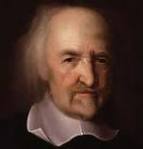
10th Grade: The Feeding Frenzy

Greetings,

This week we came close to wrapping up the events of the Reign of Terror.  During the terrible years of 1793-94 somewhere between 15-40 thousand people died and some 300,000 were imprisoned.  How did a Republic dedicated to “Liberty, Equality, and Fraternity” descend into this barbaric nightmare.  Many theories exist, and here I would like to highlight a few we will discuss in class.

David Andress – The Terror & Outside Pressure

Historian David Andress wants us to consider what happened inside France in light of events outside of France.  England, Austria, and Prussia all tried militarily to oppose France, and all looked for the the fledgling republic to collapse.  The stress of war on an already fragile government heightened the stakes inside France, and they cracked under the pressure.

Edmund Burke – The Abandonment of Tradition

A contemporary of the Revolution, Burke warned back in 1790 that France would pay a terrible price for putting people in power who had no idea how to use it.  Having no political experience, France’s leaders would quickly grow frustrated, and then lash out in the most basic way possible: violence.  Burke would prove a prophet.

Burke may seem stodgy at fist glance, because of his strong emphasis on tradition and habit.  But in a paradoxical way, he believed that habits were the only sure foundation for progress in the world.  We make thousands upon thousands of decisions in a given day, and Burke sees these these habits as a path to freedom, giving us time to pursue new things rather than have to “rationally” whether or not to eat breakfast first or get dressed first.

In a terrible irony Burke predicted, those fired by the Enlightenment idea to apply the strong light of reason to all things would end up erasing habit and thereby condemn us to starting all over again, setting us back to a barbarian past.  The Revolution saw multiple constitutions over a short period of time, a change of calendar, a change of morals.  No one could be sure of anything, and in this environment, fear and violence would likely take over.

Burke applied the same thought process to the exercise of power.  We often make two mistakes regarding political power:

  • We assume that it is a kind of magic, reserved only for society’s wizards.
  • We assume that anyone can do it.

Burke believed that good use of political power functioned like many other things in life, as a matter of experience and training — a matter of habit.  Certainly we want intelligent people to hold office, but this intelligence needed training like anything else in life.  The problem with the revolutionary leaders was not their lack of intelligence.  It was not their wicked designs (we can grant that some of them, at least, meant well).  The main problem lie in the fact that no one really knew what they were doing, and so fell back on force as a last resort.

Simon Schama – Dangers of Ideology

In his great work Citizens, Schama took another approach.  He focused how the French defined what it meant to be a citizen of their country. Increasingly they defined citizenship in moral and ideological and not legal terms.  Frenchmen had rights, but only those truly “virtuous,” or dedicated to the Revolution were truly French.  Those not revolutionary enough could not be French, and so they had no rights.  They functioned as a cancerous tumor, foreign to the national body, and had to be excised.

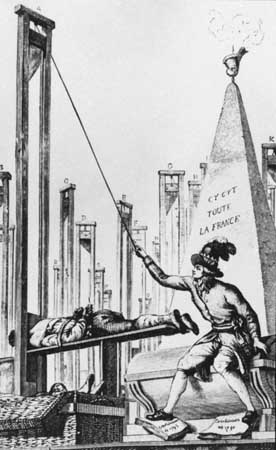
All three of these eminent thinkers emphasize important aspects of the political context. But all three I think leave out some fundamental aspects of human nature.  I think this image of Robespierre, the head of the ironically named “Committee of Public Safety,”  speaks volumes.  Here we have a man who believed in his own virtue, and had a passion for enforcing his rules on others.  Imagine the ultimate HOA Board Member on steroids.

Robespierre believed in perfection and insisted upon it.  Unfortunately he more or less thought he had achieved it himself.  People called Robespierre the “Incorruptible.”  In all his dealings, Robespierre appears to have been that rare politician who truly did not take bribes or show favoritism.  It would have been better for France (and Robespierre).  Perhaps then he would not have been able to maintain his furious streak of self-righteousness, which led to so many deaths (perhaps thinking of Robespierre might help us to understand Martin Luther’s oft misunderstood “Sin boldly.  God can only forgive a hearty sinner,” line to his quibbling friend Melancthon).

A passion for moral and political purity destroyed France. One can think of a potter attempting to make the perfect circle.  It wouldn’t be perfect at first, and one would have to shave off bits of clay continually to get it just right.  Eventually, however, you would not have any clay left.  While they said they cared for liberty, they did not realize that the amount of liberty one can enjoy is the amount you are willing to have abused.  France found that it could tolerate no abuse of liberty, so in the end they had none at all.  As the Terror increased, even the Committee of Public Safety members turned on each other and many of them faced the guillotine.

The guillotine itself represents part of the tragedy of the Revolution.  Dr. Guillotin invented the instrument to make executions more humane.  In the past, death by beheading was actually a privilege reserved for the nobility.  Those of more “common” lineage might face execution through hanging, disembowling, or even being drawn and quartered.

The guillotine meant now that everyone would have the “right” to death by beheading, and the mechanism meant now that no executioner might potentially botch the job.  Instead, in an almost bizarre parody, the mechanical nature of the machine gave the state power to execute more people more quickly, and now indeed “the people” could all face death equally.

Emmett Kennedy, author of A Cultural History of the French Revolution makes a great observation about French Romanticism and its relation to violence.  If man is naturally good, he suggests, than grace becomes irrelevant.  But what can take the place of grace as a proper inducement to virtue?  St. Just, Robespierre’s lieutenant, had the answer.  Kennedy writes,

Sensibilite (right sentiments, for lack of a better word) impels a man toward virtue, it affirms his natural goodness; it does for him what grace does for Christians.  If “sentiments”  do not produce virtue, then [St. Just argues] terror must take its place (emphasis mine).

In a round-about way Kennedy hits at a central truth.  The doctrine of the Fall of Man leads us not towards cruelty but mercy.  The Revolution denied mankind’s nature, but this “liberation” from sin could only lead them to destroy one another in blind and merciless search for perfection.

12th Grade: Israel, Palestine, and Solutions Beyond Governments

Greetings,

This week and last we looked at Israeli democracy, and tried to understand the dilemma they face regarding Palestinian statehood.  I hope we gained sympathy for both sides of this question.  Through this lens I wanted the students to understand one of the Catch-22’s that many democratic states face.

Democracies appeal to us largely because of their high ideals and goals, not just for the state itself, but for the individual.  But human nature almost guarantees that we will not attain these goals, and so democratic states are much more prone to hypocrisy and blind spots than authoritarian dictatorships, for example.  This should not make us abandon democracy.   As Chesterton and others have said, if you aim at nothing you’re sure to hit it.  But I do hope it will give us greater understanding of democracy’s Achilles heel.  The “processes” of democracy, like voting, representation, etc. have no real meaning unless they have roots in specific values.  If values make a democracy, then one must lead with those values.

The idea of a Jewish state predated World War II to the 1890’s.  The western world in general experienced an intensification of nationalism and heightened awareness of ethnic identity, which bore such horrific fruit in the 20th century.  Many Jews, having been scattered throughout Europe for centuries, began to resettle in Palestine, which the Ottomans then administered.  By the 1920’s Jewish settlement in Palestine looked something like this (darker areas indicate Jewish presence), though I should add that almost every map related to the Israel/Palestine question is polemical and controversial in one way or another.

After World War I, the British administered the area, but could no longer do so after World War II.  At that point England wanted to jettison nearly all of its colonial empire, and so they handed the question of Palestine over to the United Nations.  After the Holocaust the world had to answer the question as to whether or not there should be a specific Jewish state, and if so, where it should be.

Although people debated various sites, including Madagascar, they eventually settled on Palestine, which made sense in relation to Jewish history and the recent Zionist movement. No place would be without controversy, but choosing Palestine came with problems.  During World War I many Arabs fought with the British against the Turks, and the British in turn pledged to grant Arabs independence.  Instead they reneged on the deal and added Palestine to its colonial holdings.

Actions have consequences, even if sometimes those consequences take years to make themselves known.

From the Israeli’s perspective, owning a small sliver of land that did not even include Jerusalem, was the least the world could do.  Europe had persecuted the Jews on and off since the Crusades.  The latent, on again off again anti-Semitism that simmered for centuries metastasized into a horrifically clinical attempt to wipe them out entirely with the Nazi domination of Europe.  The world had shown that the Jews must have a safe haven, and giving them back a small part of their ancestral land made  political and ethical sense.

The Palestinians saw it differently and many continue to do so.

While the Palestinians were not the Jews number one fan, the Holocaust happened in Europe. It was not their doing, either directly or indirectly.  If the Jews need a homeland, and Europeans need to give them one to assuage their consciences, fine.  How about taking some European territory?  How about part of Germany?

Instead, what the Palestinians feel happened is what they felt always happens with the West. The Palestinians felt stomped on by one colonial power or another for centuries, and now it looked like deja vu  all over again.  This time, the guise took the form of the United Nations, but the result is the same:  someone took our land without our consent.  Rest assured, the Palestinians did not vote at the U.N. to cede part of Palestine for a Jewish state.  Thus, the very existence of the Jewish state is another form of colonial imperialism in Palestinian eyes.  The Jews invaded, in a sense, under U.S. and European flags.  In their mind Israel has no legitimacy because they are no better than other colonial occupiers.  When some critics of Israel, be they Palestinian or not, talk of Israel as a state founded on thievery, they have these associations in mind.

Most argue that the wars fought between Israel and her neighbors in 1948, 1967, and 1973 were started by Israel’s Moslem neighbors (though some might dispute ’67, where Israel launched the first physical attacks).  Not so, say the Arabs.  Israel started them all simply by being there.

Time has not favored the Palestinian cause, as the map below indicates:

Upon its creation, Israel had to make some crucial choices about its future.  It chose a Parliamentary style democracy, which did not surprise many.  But what to do with Palestinians living within their territory?  In 1948, Palestinians formed a distinct minority within Israel, but they were protected and given citizenship.  A British parliamentary style usually has less federation and more majority rule.  But that was ok, because Jews had the clear majority.  Still, it stood as a statement that Israel need not be for Jews only, and in the wake of the Holocaust, this was a powerful statement.

But what to do with Palestinians in the territory Israel acquired in 1948 and 1967?  Should they be citizens too?

This dilemma pierced the heart of the whole purpose for Israel’s existence.  They no longer could be both a Jewish ethnic state and a fully functioning democracy.  In other words, they could either

  • Give every Palestinian full citizenship rights, and risk that Jews would no longer be the majority in Israel.
  • Give them no rights and treat them as an occupied people
  • Give them some rights and not others, but this middle ground would probably not make legal or moral sense, something akin to the 3/5 Compromise in the Constitution, which made slaves count as 3/5 of a person.  How can one be 3/5 of a person?

In other words, Israel could be an ethnic state or a full fledged democracy.  The two could no longer go together.  They would have to give up something.  I have enormous sympathy for Israel here.  The whole purpose of Israel was to create a refuge for Jews and create a state run by Jews. To attain peace they would need to give up something of their identity.  For a generation that saw and survived the Holocaust, this would have been a near supernatural act, and it is not my place to judge.  Palestinian Christians have the only solution, but tragically, some of Israel’s policies, at times supported by the West, and at times supported by some Christian denominations, have deeply eroded and marginalized the Palestinian Christian community.

The middle course Israel chose gave Palestinians in newly acquired land some economic opportunities but not political representation.  Such mixed messages are usually deadly for democracies, and in time those contradictions often assert themselves with a vengeance.  One only needs to think of what happened when our own country sent blaring mixed messages for the first 80-90 years of our existence. In essence, the Palestinians got invited to the party, but then got told to eat with the servants in the basement.

Eventually, security concerns led Israel to build a wall between themselves and certain occupied areas.  But this seems all wrong.  We are familiar with walls — the Berlin Wall, the Iron Curtain, and so on.  Democracies are not supposed to do this.  But Israel felt that they could not be secure without it.   Some supporters of the wall might argue that it sends a signal, like the Emperor Hadrian’s wall in the north of England, of an end point to expansion in the occupied territories.  In other words, it should comfort the Palestinians. But this is not how Palestinians, or the world-wide community, has interpreted the wall.   Some have called it “the most religious place on Earth.”  The images are powerful:

I think Israel’s history comes with many lessons for democracies, including the need for consistency, and the need to lead with cultural values over strict security concerns.  Ultimately, however, we see the need for something greater than what governments can give.

Many thanks,

Dave M

10th Grade: The Rules of War

Greetings,

We began the actual fighting of the Revolutionary War this week, with a focus on the generalship of George Washington.

But we began by looking at the tactics employed by the colonials at the Battle of Concord.

After the British broke through the lines like a knife through hot butter at Lexington, the colonials changed tactics after the British abandoned their search for weapons in Concord.  Rather than meet them out in the open, the hid amidst the treelines, taking potshots and then melting back into the woods.  The British had no effective way of countering this.

This infuriated the British, of course.  This was not how men fought!  What kind of coward fires from safety and then runs away?  Battle was meant as a test of honor, solidarity in the ranks, and courage under fire.  Fighting as the colonials did at Concord might be akin to one team poisoning the water of their opponent.  If they then won the game, would we call that victory?

There is a possibly apocryphal story of the Battle of Fontenoy, between the British and French in 1745.  Tradition says that both sides argued about who which side would strike the first blow. Lord Hay, the British general, supposedly asked, “Gentlemen of France, perhaps you would care to fire first?”

The Battle of Fontenoy

For the Europeans, for battle to be decisive, for it to mean anything, it must be ‘fair.’  Victory without ‘fairness’ solved nothing.

Students wisely countered with the fact that this analogy of a sports team doesn’t quite add up.  First of all, it’s against the law to poison water, where there is no law saying that armies must line up in the middle of field.  Secondly, why should the colonials have to fight on British terms according to British strengths?  The  colonial troops should be free to do what they do best.

These are good arguments.  What happens when we apply them to our current situation in “The War on Terror?”  We would all wish that the terrorist radicals would all line up in a field somewhere.  If this happened, the “War on Terror” would be over in about 15 minutes.  Naturally, they possess enough intelligence not to do this, so they choose other tactics.  Does this make them cowards?  Are they “playing fair?”  Where are the differences?  Some said that the differences lie in the treatment of civilians, and this is an excellent point.  Does the same difference apply to the Ft. Hood shooting a few years ago, where only military personnel were targeted?

To turn this further on ourselves, we should confront the fact that our extensive use of drones inspire a great deal of hatred.  For our enemies (and the innocent civilians in the line of fire), our use of drones is ultimately a cowardly act.  We put others at risk while risking nothing ourselves.  The drones hover in ways not accessible to retaliation, and they strike without giving anyone a chance to escape.  My guess is that if terrorists flew a small drone into a large city remotely and attacked people, we would be tempted to call it a “cowardly act.”

It’s important for us to realize (returning to our original context) that for the British raw military victory did not count in the same way that honor and integrity did in battle.  Wars happened, but wars should take place within the confines of civilization, not outside it.  How one fought was in itself a victory of sorts, and could not get separated from the tangible results on the field.

During our look at Washington, we noted that he won only 3 of his 9 revolutionary war battles.  Previously to the American Revolution, he may have been responsible for the Fort Necessity disaster with the French, and he accompanied Braddock on his ill-fated attempt to capture Fort Duquense.  Does he deserve his high reputation?

Some years ago I came across a book entitled, ‘The 100 Greatest Generals of All-Time’ (or something very close to that).  Lists are always fun for me, so I opened it out of curiosity.  As one might expect the usual suspects of Julius Caesar, Alexander, Napoleon, Ghengis Khan, etc. could be found in the top 10.  But his number 1 general of all-time?  George Washington.

This shocked me so I had to read his thoughts (was this shock value part of the author’s motivation for listing him at #1, and not say, at #4?).  His points were these:

  • Many of the generals in the list accomplished a great deal militarily but failed politically (i.e. Alexander, Julius Caesar).  Some had short-term political success, but could not make it last (i.e. Napoleon).
  • Some of the generals (again Alexander and Caesar) inherited what was likely the best army in the known world at the time and fought against weaker opponents (this could especially be said about Alexander).
  • By contrast, Washington faced the best with an untrained army with weak political support.  As commander-in-chief, not only did he win the war, he turned that victory into lasting political success for his side.  Not only did he help usher in a new political era, he did so without seizing control himself.
  • Washington had a solid understanding of the fact that the Americans only needed to ‘not lose’ the war to win it. He knew that keeping the army intact and functional was more important than risking the army in unsure scenarios. Orderly retreat could sometimes be the better part of valor.  Most military men can’t do this consistently even when intellectually they know it’s the right thing to do.  Washington did so, and distinguished himself thereby.
  • Former Georgetown Hoya basketball coach John Thompson says on occasion, “I don’t want to know how many points somebody scores in a game.  I want to know when he scores them.  What do his points mean for the team in a given situation?”  In the same vein, Washington knew how to minimize the impact of his defeats and maximize his victories.  When things looked bleak in the winter of 1776, for example, he came through in the battles of Trenton and Princeton.  It would be years before his next victory at Yorktown in 1781, but the British surrender there basically gave America its independence.

As I mentioned previously, it is possible the author listed Washington so high to distinguish his book from others. Still, I feel he has solid arguments to at least rank him highly.  I wanted to use our look at Washington to introduce the concept that in war success can come in many ways.  Since war is ultimately a political act, the battles themselves are simply one extension of the conflict.

When we think about war in broader terms, we see how many of England’s advantages (such as an elite professional army) meant little in the political context of the Revolution.  They had the unenviable task taking someone who didn’t want to be your friend anymore and making them a friend.  Would beating them up do the trick?  Over the previous 10 years (1764-75) the British proved politically inept with the colonies, so a political solution would not come easily for them.  If they went the route of force more or less exclusively they would need to absolutely pulverize the colonies so badly that further resistance would be physically and psychologically impossible.   As long as the Americans kept their heart beating, they could outlast England.  Washington, I think, understood this to his advantage.

Next week we will look at the battles of Saratoga as well as the Declaration of Independence.

Enjoy the weekend, and many thanks,

Dave Mathwin

12th Grade: Wag the Dog

Greetings,

Last week we looked at Athens’ disaster in Sicily and the subsequent and extensive fallout.

Why did Athens lose in Sicily?

Part of Thucydides’ brilliance lies in that he does not merely look at battles and personalities, but finds ways to link events to a grand narrative.  Athens had many strengths, and one could argue that their passion for excellence helped produce democracy.  But I think that something began to go wrong just prior to the Peloponnesian War with the completion of the Parthenon, one of the great architectural achievements in history.  Ostensibly the building stands as a temple to Athena, the patron goddess of the city.  But a closer look at the carvings on the Parthenon reveal not scenes of gods and goddesses but of events in their own history.  Athens had in fact, made a temple to themselves, and showed that the true god they worshipped was their own community.

What kind of impact would this idolatry have, and what does it have to do with democracy?  Part of answering this question has to do with what we say the essence of democracy is.  If we say that the mere act of voting, of having a voice, is the meaning of democracy, than a naval-gazing, self-worshipping state will not be far behind.  For in this situation the process counts, and not the result.  If democracy (or any other form of government) serves a higher ideal than it has a built in check upon itself.  With no higher ideal than whatever decision we arrive at must by definition be good, because we thought of it.  This kind of attitude, present in ancient Athens, leads to disaster eventually.  If we travel with our heads down we’ll eventually walk off a cliff.  G.K. Chesterton has a great quote about self-worship in his book Orthodoxy,

That Jones shall worship the god within turns out ultimately to mean that Jones shall worship Jones.  Let Jones worship the sun, the moon, anything rather than the “Inner Light.”  Let Jones worship cats or crocodiles, but not the god within.  Christianity came into the world firstly in order to assert with violence that a man had not only to look inwards, but outwards. . . . The only fun of being a Christian was that a man was not left alone with the Inner-Light, but definitely recognized an outer light, fair as the sun, clear as the moon, terrible as an army with banners.

The problems with Athens’ expedition to Sicily can be traced to their democracy.  Alcibiades wanted the expedition, Nicias opposed it.  Both had wealth, political and military experience, each had their own political power base at home.  They also could not stand each other.  Their personal and political rivalry spilled over into the formation of Athens’ war policy in Sicily.  For example, Nicias’ purely personal political moves against Alcibiades ended up having a dramatic effect on the composition of the numbers and kind of military forces Athens used against Sicily, and perhaps even the goal of the mission.  One wonders if they realized this.  With their heads down, I think not.  In my opinion, they thought that

  • We voted, just as always
  • We picked experienced people
  • We followed the procedures and processes to arrive at a decision

Therefore, everything is fine!

Democracy has to involve more than mere voting, more than mere process.  The Athenians apparently did not see that in voting for the expedition they had approved a massive invasion of another democratic country not directly involved in the war they had been fighting.  The man who ultimately led them (Nicias) argued against any expedition at all.  Self-worship exacted its price in the thousands of dead outside Syracuse.  In his An Historian’s Approach to Religion AJ Toynbee wrote,

The strength of the devotion that parochial-community-worship thus evokes holds its devotees in bondage to it even when it is carrying them to self-destruction; and so the warfare between contending parochial states tends to grow more intense and more devastating in a crescendo movement. Respect for one’s neighbours’ gods and consideration for these alien gods’ human proteges are wasting assets. All parochial-community-worship ends in a worship of Moloch, and this ‘horrid king’ exacts more cruel sacrifices than the Golden Calf. War to the death between parochial states has been the immediate external cause of the breakdowns and disintegrations of almost all, if not all, the civilizations that have committed suicide up to date.

Athens’ failure in Sicily brought about the collapse of their democratic regime.  Their god had failed to provide for their basic needs, and needed replaced.

The oligarchs that replaced the democracy fared no better, ruling wantonly based on the pent-up sense that now is was “their turn.”  We sometimes see this when one party, shut out of Congress for a time, suddenly gains control.  This “my-turn” attitude usually leads to over-reaching and miscalculation.  The Newt Gingrich led government shut down in the mid-90’s comes to mind.

Democracy came back, but the instability engendered by these power struggles weighed like a mill-stone around the Athenians necks.  They had no anchor beyond their immediate needs.  We saw Athens 1) Win the Battle of Arginusae, then 2) Put the victorious generals to death for impiety, and finally 3) Put the lawyer who prosecuted the generals to death (we never should have listened to him!) all within the span of  several days.  Process trumped justice.  The tail wagged the dog.

Authenticity, Man

Having flamed out on Charles Taylor’s A Secular Age, I was happy to find a more bite-sized chunk of his thought in The Ethics of Authenticity. I admit to approaching the book, like others of a traditional bent, leaning against the very idea of authenticity. “Get over yourself, already.” The search for meaning within the self can never go anywhere and remains something of an illusion. What, after all is there to really “experience?”

The whole concept of “authenticity,” born out of the 1960’s (or so I thought), has given rise to a whole host of modern problems. All of the issues with sex and gender have their roots here, as does a great deal of spiritual innovation with the church, along with the Trump presidency. Many inclined to read this book of Taylor’s might hope for a thorough denunciation from the venerable professor.

Of course, boring conservatives such as myself may not have always been such. We may remember the days of our youth when it seemed we had to break free from our surroundings to see what we were made of. Taylor taps into this, and so, while he criticizes much of what the “Authenticity” stands for, and finds it ultimately self-defeating, he reminds us that a kernel of something like the truth remains within this–in my view– unpleasant husk. Taylor writes,

The picture I am offering is rather than of an ideal that has been degraded . . . So what we need is neither root-and-branch condemnation nor uncritical praise; and not a carefully balanced tradeoff. What we need is a work of retrieval . . .

Taylor demonstrates that of what we term “authenticity” has its roots in Christianity. In the ancient world nearly every person received their identity by what lay wholly outside their control, be it birth, race, family, etc. The triumph of Christianity meant believing that an entirely other world lay outside of our normal lives, the Kingdom of God, in which there existed “neither Jew nor Gentile, neither slave nor free . . . (Gal. 3:28).” The book of Revelation tells us that God “will also give that person a white stone, with a new name written on it, known only to the one who receives it (Rev. 2:17). St. Augustine’s magnum opus told us that the City of God lies nestled, in some ways, within the City of Man, to be discovered by anyone willing to walk through the wardrobe.

18th century Romantic thinkers, primarily Jean-Jacques Rousseau, picked up this dormant thread, albeit thin sprinting with it in ways that St. Augustine would abhor. I find the 18th century an absolute disaster for the Church, but still, Taylor calls me to at least a degree of balance. There was something quite ridiculous and artificial about the French aristocracy, for example, ca. 1770, accurately portrayed (I think) in this clip from John Adams

Perhaps St. Augustine did see “the road to God as passing through a reflexive awareness of ourselves” (p. 27). Many have pointed out how psychologically oriented was Martin Luther’s view of salvation. John Calvin began his Institutes by asking his readers to heed the Socratic dictum to “know thyself,” for knowledge of God and ourselves have an inextricable link. But Taylor sees Rousseau as the main originator of the modern view of authenticity. For Rousseau, “Our moral salvation comes from recovering authentic moral contact with ourselves,” and, “Self determining freedom demands that I break free from external impositions and decide for myself alone” (p. 27).

Well . . . ok. I don’t like the concept of authenticity but perhaps the difference lies in the “time of day.” What I mean is, bacon and eggs smells wonderful on the skillet when you’re hungry before breakfast, but that same smell hits one very differently with a full belly after lunch. The early Romantic movement, just as with the early Enlightenment, had good points to make. Rousseau championed, among other things, mothers actually breast-feeding their own children–something dramatically out of fashion for his time. Connecting with “nature” and the “self” I suppose could lead to more morally responsible living. You cannot blame your birth or other circumstances for who you are. But let it linger too long and you get the ridiculous movie Titanic, riddled through with romantic and “authentic” ideology–the smell of bacon and eggs at 10 am after you have already eaten. Still, Taylor asks the reader to see the premise of the morning before jumping straight to the twilight.

As for today, Taylor points out a variety of ways in which the “authenticity” narrative has gone astray.

Rousseau and his followers helped fuel democratic movements at home and abroad, but having created democracies in part through the dignifying the self, these same democracies would make a mockery of the original golden thread. Liberated from tradition, democratic man seemed to attain authenticity not via stern moral struggle against tradition, but as a birthright. If we are all authentic, then are all special, and thus, we all need recognized and regarded by others.

Taylor’s insights show us why those, for example, like Kaitlyn Jenner can be granted moral weight. The Authenticity narrative tells us that such people have attained a status of “real” humans because of their “courage” to make war even on biology itself–the final frontier–in order to achieve their version of true personhood. And, while I believe that those who alter their sex (if such a thing is truly possible) make terrible and tragic decisions, Taylor hints at why those that make these decisions often find them so empowering. Seeking a “genuine” connection with the self is the modern version of a transcendent experience. We grant large amounts of authority to those that have them, like the mystics of old.

Taylor also points out the endgame in store for “authenticity” lay implicit in its origins. If the self is to be the guide, and self-actualization has the ultimate authority, then we have a contradiction. The self can never be absolute, certainly not over others. Telling someone about your “experience” is nearly as bad as telling someone about the dream you had last night. In the end, we require an outside reference.

Alas, logical contradictions will likely not derail the Authenticity movement. But it is possible that time may take of this in ways that logic cannot.

I mentioned above the analogy of the smell of bacon before and after breakfast, and the analogy holds true in other aspects of life. In his War and Civilization compilation Toynbee admits the allure of the “morning” of a military outlook when reading the Iliad. Homer’s battle scenes have a dramatically bracing effect. Then, fast-forward to 19th century, where Prussian militarists like Helmuth von Moltke give one an entirely different impression of essentially the same thing that Homer described:

Perpetual Peace is a dream–and not even a beautiful dream–and War is an integral part of God’s ordering of the Universe. In War, Man’s noblest virtues come into play: courage and renunciation, fidelity to duty and a readiness to sacrifice that does not stop short of offering up Life itself. Without War the World would be swamped in materialism

Toynbee comments that, “there is a note of passion, of anxiety, and of rancor,” here that takes far away from the Greek poets. Moltke continues, perhaps even aware that he sails too close to the wind;

It is when an institution no longer appears necessary that fantastic reasons are sought or invented for satisfying the instinctive prejudice in its favor, which its long persistence has created.

If the modern Liberal order was created in part on the back of Authenticity, then surely we might say that those who still champion the idea copy Moltke and indeed invent “fantastic reasons” for the path they take. Perhaps Authenticity has run its course and can go into hibernation. We will wake it up when the scales have tipped too far in the other direction.

Dave

Zombie Markets in Everything

This post’s title, of course, has its origins with Tyler Cowen . . .

It seems as if we are living in a tale of two cities. It is the best and worst of times. One the one hand, the economy is great, and unemployment is way down. Public intelllectuals like Steven Pinker proclaim that, however bad things may be in certain segments of life, all the most important indicators show remarkable growth and progress, such as a sharp decline in infant mortality. Momentary trends may not always look favorable, but the arc of the last 300 years shows a continual rise in progress thanks to science and the application of reason. The complaining and angst so prevalent in the media, then, resembles that of a spoiled child. If we could all just calm down and count our blessings . . .

But others like Jordan Peterson, John Vervacke, and Jonathan Pageau state that western civilization exists by a thin thread in the midst of a deep meaning crisis–a crisis that perhaps hits men harder than women. Rates of anxiety, depression, and suicide have risen dramatically over the last 20 years. I think Vervacke would tell Pinker that he sees only a fragmented surface. I suppose Pinker and others like him would say such people are fundamentally deluded.

Chronologically we have mirror images from both camps. Pinker and his crowd write that starting around AD 1700, the Enlightenment took hold and over the next few centuries the world became a dramatically better place. But for those on the other side, the Enlightenment disastrously contributed to all the problems we have now in relation to meaning and knowing our place in the world (though others would go further back still, into the Renaissance).

Most would say one or the other is true, and you have to choose. Below I propose a theory that will attempt a “both-and” explanation–a highly speculative one–that will attempt to explain how the economy can grow and life can improve in various measurable ways and we can still struggle with meaning. In fact, the two may have a symbiotic relationship.

The perception of a current meaning crisis has led to the dramatic recent rise of the psychologist as guru, i.e., Jordan Peterson. John Vervacke has less fame, and popularizes less than Peterson (I do not use the term ‘popularizes’ derogatorily). His analysis goes deeper, and his co-authored book Zombies in Western Culture: A Twenty-First Century Crisis gives a slightly sideways but effective analysis of modern culture. Vervacke et. al do not blame the right or the left, campus ideology, or Trumpism, for the decay. “Decay” is indeed the right word, for zombies are decomposed beings of some undefinable kind. Our modern disease has infected most all of us to some degree.

Each era has its monsters that help define its zeitgeist. As the Enlightenment settled across western Europe, and scientific materialism began to entrench itself as the dominant ideology, Mary Shelley wrote Frankenstein, which explores the limits of man’s powers over nature. The monster in the book of course, is not the “Monster” but Dr. Frankenstein, it’s creator. A few decades later we have Bram Stoker’s Dracula. In the Victorian era, the aristocracy still exists, but exists in a weird place in society given the nascent rise of democratic ideals. Everyone perhaps feels in their bones that the aristocracy no longer serve a real purpose, isolated as they are within a culture that no longer needs them. One notes that, in contrast with pre-modern Europe, in the modern age the monster is a twisted human, though perhaps still a kind of tragically grand monster. That is, at least there exists some kind of high aspiration for a Dr. Frankenstein or Count Dracula.

Vervacke argues that the zombie is the monster for the 21st century, and the graph below shows the dramatic increase of the word in the popular culture just recently, just as the Cold War ended.

Zombies have the following characteristics:

  • They move in packs, but have no connection to one another
  • They have no particular intent–they exercise no conscious will towards evil.
  • They live only to consume, and their hunger to consume cannot be satiated or even lessened.
  • Constantly on the move, they have no home base or concept of home.

In other words, they form the perfect monster for the democratic age.

The zombie personifies our crisis of meaning. The internet, globalization, etc. means we can indeed consume as we like virtually for free, but though we like to sing along, we “know not what it means.”* The market also thrives on fluidity and movement. It is best for everybody to give everybody else money, for example, rather than everybody put it under their mattress, even if that consumption has no real overall purpose or goal in mind.

So too the market of information thrives on abundance and transfer. But like zombies, we both crave and lack Mind, and so have no way to integrate our experience into a meaningful whole. Vervacke writes regarding this,

This is because the information we obtain from the world has never been more unreliable. Abundance is one dimension of the problem; one need look no further than news media to appreciate the sheer volume of (often irreconcilable) narratives.

And again,

Humans are animals who most fundamentally understand what reality is . . . by locating ourselves within larger narratives and meta narratives that we hear and tell . . . When such narratives collapse, we are lost in the dislocation, fragmentation, and disorientation of homelessness.

So far so good, but what of the other side of the coin, i.e., a strong economy, less violence worldwide, and so on? Vervacke gives us the link. If truly we are the “walking dead,” then lacking mind and the means to integrate our experience, we would naturally seek expansive consumption as a means of coping. This consumption is a byproduct of all of the intense focus on the material aspects of creation fostered in western culture during the time period Pinker cites. It indeed brought great blessings of a certain kind, but it could possibly be nearing the end of its string.

Of course all humanity throughout all time has sought some sort of solution for a lack of understanding of the self. But our typical response is indeed to consume. We are depressed, we might go shopping. We are anxious, we “stress-eat.” We are out of sorts, we might consume information by browsing Facebook or news feeds. Such actions can distract us for a time, but also creates an unsustainable cycle. It is this drive to consume that makes solving certain environmental problems so difficult for all of us, whether Green or not so Green. The “peace” of the modern world championed by Steven Pinker has in some ways brought this out of us.

In contrast [to times of war], in times of relative peace, internal issues become more focal and so the opportunity for a relative loss of social integration is greater, hence the increase in the suicide rate.

This antipathy to peace can lead to increased participation in what the authors call the “pseudo-religion” of politics. Politics gives us much that religion provides.

As politics is, by necessity of governance naturally integrative of other systems, it was a proximal replacement for [meaning]. . . . systematic complexity made [politics] a convincing imitator of that normatively as the influence of religion diminished. The 20th century, therefore, bore witness to the rise of the most potent political pseudo-religion we have known in the modern world.

We risk ending the “peace” we have then, by feeding upon our own body politic, unable to stop our consumption of so called “outrage porn.” specialized in by Twitter and news media of all kinds. We can see this process of disintegration at work since the time of the vampire as monster. First, modernism deconstructed the church, and told us that it could no longer function as a means of communal coherence. “Religion should be private.” We then expected the state could serve that purpose, and so we developed various rituals around the symbols of the idea of nationhood. By the mid-20th century, we saw the folly of that project, but no fear–we can rally around our freedom to consume. So we built malls, accurately described by James K. Smith as spaces constructed for liturgical communal consumption.** But this no longer holds either. Now, like zombies, we roam the internet to consume, with no defined space to bind us.

In the old tales, the hero slays the dragon, but Vervacke points out that our zombie stories offer little hope. The plague always seems to grow, and those that survive will be continuously on the run. Rebuilding something new in these scenarios becomes extremely difficult. Patrick Deneen, for example, has a persuasive critique of the whole modern enterprise in Why Liberalism Failed. He blames progressives and conservatives nearly equally but offers no alternative political reality to which we can aspire. Slightly more hopeful is Rod Dreher, whose The Benedict Option, while giving no grand solution, at least points us towards embodied liturgical relationships with others as a good beginning.

With a quick search I found one place in our culture where a cure for zombies is possible: Minecraft. I find it charming that such a thing exists within this relatively benign (I dislike video games) world building enterprise, and that even many teens still play this game. It is interesting to see how they use traditional archetypes for this cure. Among other things needed to cure local villagers from being a zombie is dragon’s breath. In other words, the monster may be the only hope for the monster. Jonathan Pageau has often talked about how once a culture reaches the outer limits of the fringe, it takes just a small tap for everything to come right round again. The clown, or the fool, or perhaps even the monster is needed to make things right. It may be that if we are indeed in such a dark place, dawn is not far behind.

Dave

*Those my age, or fans of the music of early 90’s music, will recognize the Nirvana reference. In retrospect grunge music might be seen as a harbinger of the meaning crisis. How is it that right after winning the Cold War, when we should have celebrated and entered something of a golden age, we plunged ourselves into music that fundamentally celebrated alienation?

**We need not absolutely throw the baby out with the bathwater. National symbols and national identity can do us good. Market exchanges often benefit both parties. The problem is putting a weight on such things that they cannot bear. The only way they can bear the load of culture for long is to give them a kind of steroid. Of course one recalls the specter of the early 20th century regarding the problems of nationality. I also remember post-9/11 how we were all encouraged to keep spending so the terrorists would not win. It can work for a while, but the body gives out eventually.

Risky Business

In Goodbye to All That Robert Graves wrote that in W.W. I, young officers went through some distinct stages in their acclimatization to trench life. For the first couple months, the new man was a danger to himself. Ignorant of how things worked, he easily could walk in the wrong place at the wrong time and be injured or killed. Then, from around month three to six, the officer functioned well, armed with more knowledge but maintaining a healthy fear. The real problems came after the sixth month, when the officer now became a danger to others. The abnormal risks of trench life were now normal life for him, which influenced the officer to take stupid chances that foolishly cost lives–choices that the officer would not recognize as abnormally risky at all. Graves, of course, experienced this first hand as a young officer himself.

Diane Vaughn’s excellent The Challenger Launch Decision made me think of Graves’ remark. Ultimately I lacked the patience and technical familiarity to fully benefit from her magnificent analysis of the decision to launch the Challenger in January 1986. A sociologist by training, she still demonstrated a solid command of the technical information. But she focused not on what happened but the working cultures of engineers, managers, and NASA in general. The end result lends a great deal of complexity to our standard understanding.

After the tragedy, the standard understanding of the event went something like . . .

  • NASA faced unusual pressure to launch as part of their two pronged effort to 1) Advertise civilians in space (teacher Christa MaCualiffe), and 2) Be included in the President’s State of the Union address.
  • The unusually low temperatures created the possibility of the failure of the ‘O-Ring’ to seal. Design engineers noted this possibility and passed their concerns up the chain of command.
  • Design engineers indeed did initially recommend canceling or delaying the launch, but faced with strong pressure from NASA managers, changed their minds and approved the launch.

Events seemingly fit a Hollywood script–plucky engineers, lone dissenters faced down by The Man, with tragic results.

But Vaughn painstakingly points out that this narrative dramatically oversimplifies what happened.

First, the idea of risk . . .

Vaughn gives a helpful picture for us regarding perception of risk. Imagine a butcher shop, with its variety of saws, knives, etc. A two year old around said saws and knives would have no perception of any risk whatsoever. His mother would have an entirely different perspective. The butcher himself would have yet a third perspective. He understands the equipment, knows that it can be dangerous, but accommodates his life to work around and manage these risks. Without willingness to do so, he could not be a butcher at all.

So too, Vaughn reminds us that space flight remains extremely risky, at least relative to almost anything else our government undertakes. When the general public, unfamiliar with such risks, sees engineering reports that describe “possible” malfunctions (or some other such phrase) we react in ways that NASA personnel would not. To attempt to fly into space at all meant assuming a great deal of risk to begin with. That something might go wrong was perfectly obvious, the more relevant questions for NASA routinely ran along the lines of:

  • What is the likelihood of something going wrong?
  • Does this likelihood exceed the threshold of “acceptable risk?”
  • Why do you think it would go wrong? Is this a theory, or do you have testing data to back it up? If you have data, is that data conclusive or conjectural?

NASA had known for years about the problems with the solid rocket booster design and performance. They had known that what happened to the Challenger might possibly happen. The Solid Rocket Boosters (SRB’s) always worried NASA. They launched in spite of these concerns because, “we are in the business of launching rockets”–they routinely “pushed the envelope.” If you don’t want risks. then you don’t want to go space. No one thought the shuttle design perfect–far from it–but the shuttle was what they had to work with.

Vaughn suggests that NASA made the important decisions about the SRB’s years before the Challenger Launch, when they accepted a design that all knew had flaws, and then began a process of systematically normalizing these flaws. Bigger flaws then became smaller flaws, because the starting point itself had flaws built in.

Most Americans accept, however, that space travel has risks. What seemed abnormal and negligent were the events leading up to the launch. We had a launch in unusually low temperatures, a launch to which the SRB design engineers from Thiokol objected to the night before. They had fears that the rubber O-rings might not seal properly and allow too much explosive gas to escape at any temperature below 53 degrees. Of course this is exactly what happened.

But NASA managers strongly criticized Thiokol’s assessment and (seemingly) put pressure on them to change their opinion. Larry Mulloy stated, “My God, Thiokol–when do you want me to launch? Next April?” Another NASA manager, George Hardy, stated that he was “appalled” by their recommendation. Thiokol went back to confer among themselves and then reversed their position. The rest is tragedy, and on the face of it NASA seems horribly guilty.

Vaughn has plenty of criticism for NASA throughout her lengthy book. The book gives copious details about the budgetary issues, design choices, and the engineering culture that was NASA between the early days of shuttle development and January 1986. I will focus on the launch decision itself, because what made The Challenger Launch Decision such a great read for me is that by the end of it, I perceived these seemingly damning comments given above entirely differently. Vaughn devotes at least half of the book towards this end. NASA bears ultimate responsibility for the disaster, but Thiokol bears much of the blame as well. Events proved them right, but those that objected to the launch were not right for the right reasons, or perhaps, for reasons that the engineering culture of NASA would be able to hear and act upon.

Of course NASA had known of the the O-ring problems for years.

Thiokol’s stated position that the design flaws [of the SRB] are not desirable but acceptable.  Neither NASA or Thiokol expected the rubber O-ring sealing joints to be touched by hot gases of motor ignition, much less be partially burned.  However, as tests and flights confirmed damage to the sealing rings, the reaction was to consider the amount of damage “acceptable.” At no time did management recommend a redesign of the SRB . . . 

Presidential Commission Report on Challenger

From the beginning, a certain understanding of risk developed within NASA.

As in all previous space programs, certain residual risks have been accepted by management.  These residual, or acceptable risks, which remain after all feasible corrective actions have been taken, have been thoroughly reviewed . . . 

The conclusion of this review is that there is no single hazard nor combination of hazards that should be considered a constraint to launch.  All phases of Shuttle development and operations are continually being monitored to ensure that the aggregate risk remains acceptable.

Space Shuttle Safety Assessment Report, 1981

Before the Challenger, NASA had 24 successful launches in different kinds of weather. Yes, the O-rings would always be damaged, but that damage stayed within the bounds of “acceptable” wear and tear.

Vaughn collected a great deal of documentation and first hand testimony to describe what happened on the fateful eve of the disaster. NASA had several critiques of Thiokol’s recommendation to postpone the Challenger launch.

The 53 Degree Limit

As mentioned above, on the night before the launch SRB designers Thiokol declared that they could not recommend any launch when the outside temperature dropped below 53 degrees.

For NASA, this posed some terrible problems.

Whether [NASA’s Richard Mulloy’s] choice of words was a precise as perhaps it could have been, it was certainly a valid point, because the vehicle was designed to launch year-round.  Thiokol was proposing significant changes to the whole shuttle program on the eve of launch.  

NASA Engineer Larry Wear

The implications of trying to live with the 53 degree [limit] were incredible.  And coming in the night before the launch on such a weak basis was just–I couldn’t understand it.  

NASA Engineer Bill Riehl

And from Richard Mulloy, of the “launch next April!?” comment:

There are currently no launch criteria for joint temperature.  What you are proposing to do is to create a new launch criteria [not backed up by data], after we have successfully flown 24 launches with the existing criteria.  With the new criteria we may not be able to launch until April.  

I was frustrated.  Their analysis was dumb.  The data said one thing, the recommendation another.  Their 53 degree limit did not solve the technical issue, which was–what temperature did the joint need to be, [not what temperature it was outside]?

I find Mulloy’s point about joint temperature rather than outside temperature most crucial. Also, the Challenger launch had already been delayed several times, and on some of the other proposed launch days the temperature was below 53 degrees. None of the postponements were based on temperature, and Thiokol never raised this objection at any time before. The launch was scheduled for January 27, when it was 37 degrees out, and postponed, but not for cold temperatures. Again, Thiokol failed to raise temperature objections January 27. Thiokol engineer Jack Kapp admitted that,

Most of the concerns we presented . . . we had a very difficult time having enough data to quantify the effects we had talked about.  A lot was based on engineering “feel.”

It seems unreasonable to me to ask that the NASA cancel a launch and completely revise launch criteria based on “feel.” In fact, in the various O-ring tests, the worst damage the equipment had ever sustained came on a day of high outside temperature. Thus, no data existed to show that low temperatures had a conclusive impact on the ability of the O-ring to seal. And yet, NASA said they would have canceled the launch had Thiokol stuck to their guns.

George Hardy, of the “appalled” comment, also stated according to many witnesses that he would not launch against designer advice, and also said, “For God’s sake, don’t let me make a dumb mistake.” If Thiokol truly thought they were on to something, they failed to state their case in a way that could convince NASA or even convince themselves beyond the standard nerves everyone has for a launch. They had no data. They had a “feeling.”

Now of course–they were right about this feeling! This adds to the Challenger tragedy. They had a hunch, but could not translate that hunch in a way that could lead to meaningful action. NASA would have listened to them, but Thiokol could not speak in a way they–or even themselves–could understand. Canceling would have meant that

  • New launch protocols would have been introduced without any real data to back it up
  • The number of shuttle launches planned would have to be drastically reduced
  • NASA management would have to have a reason for the cancellation to their bosses, and would have been asked to base it on a “feeling.”

To cancel the launch would have essentially upended the entirety of NASA’s culture. This is exactly what should have happened. But Vaughn wants us to see that, all things considered, it is not reasonable for us to expect that either Thiokol (which did reverse their recommendation to cancel) or NASA to do this. We do not have a Hollywood script with heroes and villains. The Challenger astronauts died not at the hands of craven management, but as part of something much larger. Vaughn’s analysis shows us that questions we should ask in the aftermath of the tragedy are much more complicated than we might have thought. Once an organization establishes a culture, some decisions almost seem to get made automatically.

Vaughn wrote her book in 1996, and if anyone at NASA read it, it had no impact. We may remember the destruction of the Columbia in 2003 upon re-entry. It’s heat shielding was very likely damaged upon launching when insulation foam from the external tank dislodged during liftoff and struck the left wing. The tank needed insulation to keep the fuel cold enough, but it routinely dislodged during launch, as we might expect given so much thrust and vibration. Unfortunately, this time a large piece dislodged and struck the shuttle in a vulnerable spot during liftoff under the left wing. Columbia lost control and disintegrated upon re-entry. The official investigation into the crash stated that,

Cultural traits and organizational practices were allowed to develop . . . and reliance on past successes [served] as a substitute for sound engineering practices. Organizational barriers prevented communication of critical safety information.

Some might take solace in the fact that NASA’s culture of risk appears to have changed. In their partnership with Space-X, for example, their criteria holds Space-X to a 1 fatality for every 230 launches. Some applaud this reform. But others find this impossible–how can NASA hold Space-X to a standard that no space program at any time and place have ever been accountable to? How much risk must we accept to make progress?

Dave

Time Me

This post is slightly dated, as it was originally written three years ago.  I repost it based on our discussions in class this week . . . . .

****************************

I don’t follow baseball vey closely, nor do I watch many games.  I had no interest in watching the Home Run Derby before the All-Star game.  Unfortunately I still listen too frequently to sports talk radio.  After the said derby, commentators proclaimed that the new rules involving time limits had made the experience much more enjoyable.  “The clock saved the Home Run Derby,” proclaimed one radio host.  After discussing it briefly, they quickly turned to other areas of life where clocks could make things better, like for teenage daughters in bathrooms, bank lines, and so on.  If only we could have more clocks in our lives!

This got me reflecting a bit on the the invention of the clock.  Besides fire and the wheel, I have a hard time thinking of other inventions with as much staying power.  The influence of the clock goes so deep we don’t notice it.  Part of the motivation for me to read Authority, Liberty, & Automatic Machinery in Early Modern Europe by Otto Mayr was the hope that, among other things, he would give some perspective on the clock and its impact.

By “clock” Mayr means the mechanical clock.  People used sun-dials from ancient times, but even the most reliable  sun dials (in Egypt where the sun always shined) did not facilitate an acute subdivision of our experience of time.  In other more cloudy locales the sun-dial had even less influence.  The mechanical clock came on the scene in the late middle-ages and immediately made a dramatic impact on that society.  People fell in love immediately.  In his Paradiso Dante used the metaphor of the movement of a clock’s implements to describe the movement of the angels in heaven, and this merely stood as one example among many. The rare dissenting voice did exist.  The Welsh bard David Gwillym wrote,

Woe to the black faced clock which awoke me on the ditch side.  A curse on its head and tongue, its two ropes and heavy wheels, its weights, yards, and hammer, its ducks which think it day and its unquiet mills.  Uncivil clock like the foolish tapping of a tipsy cobbler, a blasphemy on its face.

But on the whole the “ayes” substantially overwhelmed the dissenters.  People praised the precision and complexity of the instrument, and almost immediately various metaphors for God’s design of the universe arose.  And as we might expect, no people sang such great peans to the clock as in Germany.

Such was the scene on the continent.  Yet those in England reacted far differently.  Yes, many liked the clock and it came into general use.  But far more dissented in England than in other places. In Love’s Labor Lost Shakespeare uses a “German clock” as an epithet.  In Richard II Shakespeare flips all the positive clock metaphors and in a soliloquy by Richard has the clock stands for a symbol of undue self-consciousness and a failed life.

Now sir, the sound that tells what hour it is

Are clamorous groans, that strike upon my heart

Which is the bell.  So sighs, and tears, and groans

Show minutes, times, and hours . . .

Why did they feel this way?  Here we get to the heart of the main idea of Mayr’s book.

Mayr believes that ultimately the answer lies in the different kinds of political cultures of England and the continent.  Briefly, authoritarian style politics had far more “boots on the ground” in places like Germany and France, which explains their love of the clock.  He develops the connection thusly: England’s political theory emphasized balance.  Whether they invented the idea of the “separation of powers” is beside the point.  They had a long history, predating the Magna Carta, of seeking equilibrium between different political bodies, which the European continent lacked.  This led England to put much more emphasis on developing “feedback” technologies.  These devices did not exert power so much as prevented one element from gaining too much power.  The thermostat serves as a good example of such a device.  It helps create balance.  Neither heat nor cold win the day. Notably, thermostats only come on when they need to correct the temperature.  Otherwise they lie dormant.

We may balk a bit at this distinction.  We may not consider the clock a device associated with unchecked power.  The clock may always be “on,” we surmise, but it exerts no direct influence over us.  Perhaps, but I think Mayr has a good point.  During the talk show I mentioned earlier, for example, all the ideas that people had related to people having to move faster because of the presence of the clock. They wanted the clock to make people act in certain definite ways.  Our speech reflects this as well. We “answer to the clock,” and so forth.  This idea played itself out politically.*  France had Louis XIV, Robespierre, and Napoleon. Prussia had Frederick the Great.  When England’s Charles I attempted to reign more independently he faced a revolution and the loss of his life.  Mary Tudor and James II also failed to introduce significant changes.**

The book moves along nicely to show how other “self-regulating” systems developed in England.  Aside from the political self-regulation between king, parliament, and courts, Adam Smith developed the idea of a self-regulating economy. Mercantilism, the prevailing economic theory in the 18th century, called for one to dominate other countries via exports over imports.  Smith believed the market could work much like a thermostat and correct itself with no government interference.  Central control of trade not only was unnecessary, but counter-productive.  We need not wonder about the veracity of Smith’s theory here.  What seems obvious from Mayr’s extensive knowledge is how developments throughout a particular culture have a common root.  The thermostat and Smith’s free market ideology come from the same place.

If the clock occupied pride of place for inventions from 1300-1800, what shall we say about our own day?  We would first need to decide what invention has pride of place in our society.  One would at this moment probably say the smart-phone, but we might wonder if in 10 years we will have moved on.  So we should settle on something larger, like “digital technology.”  As Peter Thiel has commented frequently, we have dramatically advanced the world of “bits” while the world of atoms has remained stagnant.  We need to look beyond mere profit and opportunity to understand why we have done so.

The digital universe excites us perhaps mainly because it has no discernible limits.  The powers of computers change all the time.  We can assume different identities, and so on.  We can always have our music.  We can contact anyone we want at any time.  It seems at times as if we can defy reality itself.  The world of atoms, however, confronts us with limits.  And if our recent behavior surrounding gender and sexuality give us any clues, we do not like limits.^  Our politics may soon start to reflect this and our corporate practice.^^  Who can say exactly where this will end up?  But if the trend continues we may need to revisit De Tocqueville’s dilemma regarding liberty (no limits on our actions) and equality.  We cannot have unfettered doses of both, for at some point they work against each other.  We must choose.  We still live in the real world.

Dave

*Compare Bishop Bousset’s explication of absolute monarchy for Louis XIV to James I (King of England) own writing on the subject.  Both reach similar conclusions, but in very different ways.  Bousset’s writing has an inexorable logical methodology.  James I writes more haphazardly, and more poetically.

**Henry VIII may be the exception that proves the rule.

^I re-watched The Matrix recently and noticed something curious.  At the end of the movie Neo speaks into the phone to the machines and tells them that he will show people “a world without limits, a world of possibility” and so on, and then proceeds to fly in the air.  But surely he refers to the world of the Matrix?  This is the world that offers the possibilities of dodging bullets.  In reality we remain subject to gravity.  On board their ship they have to wear dingy clothes and eat protein goop.  So what did Neo really mean?

True to form, the story starts to bleed out in the next two installments.  The Wachowski’s can’t stay content to let Neo be limitless merely in the Matrix (which makes some sense within their invented world).  By the end of Matrix Revolutions Neo can stop the Sentinels in reality just as he could stop bullets in the Matrix.  The Wachowski’s refuse even stay within the limits of their own story.

^^I like Amazon, but I found it a bit odd that they essentially tried to start their own holiday (Prime Day).

10th Grade: The Galileo Myth

This week we continued with many of the same themes as last week, with a special focus on Galileo.

Thomas HobbesBefore tackling him, we looked at the political philosophy of Thomas Hobbes. Hobbes’ concerned himself mainly with outlining his vision of a workable political system, but he was strongly influenced by the tenor of the times.  Hobbes, like Descartes before him, believed that getting at the truth meant reducing the world to its simplest, most understandable components.  If we dig deep enough, we will finally find an irreducible foundation.  For Descartes, it was thought, and Hobbes builds his politics on the concept of motion.  Mankind, for Hobbes, was in many ways “matter in motion.”

The Scientific Revolution did indeed change many things, and this concept of knowledge may have been at the heart of those changes.  The Medieval philosopher would have argued that to see a thing truly, it must be seen as a whole of many parts.  Not only that, they would have gone further and said that to know a thing, one must know its purpose, its end, its “telos.”

Galileo continued the revolution in other facets of thought.  Copernicus had established the possibility of a heliocentric universe in the 16th century, and while his ideas did not gain wide acceptance, Copernicus was not a controversial figure.  Aristarchus of Samos had, in fact, proposed a similar theory in the 3rd century B.C.  Galileo caused controversy by proposing a new idea of how we arrive at truth, and blurred the lines between theory and fact.  In 1543 a man named Osiander wrote in the preface to Copernicus’ work that,

[W]hen from time to time there are offered for one and the same motion different hypotheses…, the astronomer will accept above all others the one which is easiest to grasp. The philosopher will perhaps seek the semblance of the truth. But neither of them will understand or state anything certain unless it has been divinely revealed to him…. So far as hypotheses are concerned, let no one expect anything certain from astronomy which cannot furnish it, lest he accept as the truth ideas conceived for another purpose and depart from this study a greater fool than when he entered it.

Owen Barfield, a contemporary of C.S. Lewis, wrote in his Saving the Appearances, that Galileo

began to affirm that the heliocentric hypothesis not only ‘saved the appearances,’ but was physically true.” What they professed was in fact a new theory of the nature of theory; namely that, if a hypothesis saves all the appearances, it is identical with truth.

What (I think) Barfield meant by the idea of “saving the appearances” was the old idea that our notions of scientific truth should do their best to explain the reality that we see around us, to preserve the validity of the senses.  However, this was always recognized to represent our “best guess” and may not reflect actual truth.

But after Galileo the burden of proof shifted.   Arthur Koestler writes in his book The Sleepwalkers that,

if theologians could not refute Galileo their case [would] go by default, and Scripture must be reinterpreted.  This implied (though Galileo did not dare state it explicitly) that the truth of the system was rigorously demonstrated. It is all so subtly done that the trick is almost imperceptible to the reader and, as far as I know, has escaped the attention of students to this very day. Yet it decided the strategy he was to follow in the coming years.

Galileo was right about the Earth’s rotation around the sun, though we would later discover that the sun, too, is in motion.  The issue that I wanted to stress to the students, however, was the fact that one can be right for the wrong reasons.  Many great scientific minds of this time were likely sincere Christians, but the ways which they reached their conclusions may have helped lead people away from Christianity.  True knowledge must involve more than what we see with our senses.

The Scientific Revolution also raised the question of how we should interpret Scripture.  To what degree should scientific discoveries impact how we read the famous passage about the sun standing still in Joshua?

On the day the Lord gave the Amorites over to Israel, Joshua said to the Lord in the presence of Israel:

“Sun, stand still over Gibeon,
and you, moon, over the Valley of Aijalon.”
 So the sun stood still,
and the moon stopped,
till the nation avenged itself on its enemies,

as it is written in the Book of Jashar.

The sun stopped in the middle of the sky and delayed going down about a full day. There has never been a day like it before or since, a day when the Lord listened to a human being. Surely the Lord was fighting for Israel!

Of course the Church made mistakes at this time too.  In condemning Galileo they surely overreached and made themselves look silly, contributing to an unnecessary and unhealthy divide between science and faith that lasted for at least three centuries, from which we have fully to recover.
Dave

Time vs. Space Redux

Whether the conversations be thoughtful or awkward, Thanksgiving seems to be a time to think about the times we live in with our families. About a month ago I tried to think about our culture in deeper terms than merely red state vs. blue state, taxes, immigration, and so on. I think what’s plaguing us runs deeper (I base what follows on my previous post on this topic, which is here), though what follows should be seen as a thought experiment more so than anything definitive.

In that previous post I suggested that what might be “proper” tension between Time and Space could vary depending on the culture. So Egypt leaned heavily toward Space, Babylon towards Time, but both civilizations could be considered “great” in different ways. I have only scratched their respective surfaces, but if one reads their mythology and folklore I think we see that they both had some awareness of this necessary tension. My point previously was that we lack even this basic awareness and need to recast our thinking in order to understand our culture more fully.

The problem is not that we contain contradictions within ourselves. We overpraise consistency in most cases. We need the fluidity of Time and the stability of Space in some measure–a society built 100% on either reality would be both an absurdity and an impossibility. One can be 2-1 in favor of space, or 3-2 in favor of time. I think that our issue is, rather, that our different political sides embrace 100% of both without even realizing it. Our political choices then, border on the non-sensical and thus can only go into more subconscious symbolic realms.*

On the Left Time/Fluidity Scale:

  • Open borders–which makes the capital and labor maximally fluid
  • LGBT agendas (which often involve the erosion of the “fixed” state of nature and biology)
  • Maximal “Equality” for men/women (which includes strong pro-choice stances–“safe, legal, and rare” won’t cut it any more), which flatten out distinctions and traditions.

On the Right Time/Fluidity Scale:

  • Free market and free trade (few forces are more destabilizing to tradition, be it good or bad, then the free market, so though I apologize that I can only think of one example for the right, it is a really big one:).

On the Left Space/Stability Scale:

  • Higher minimum wage laws, which restricts the flow of free labor, along with a penchant for corporate regulation.
  • Safe spaces and tight restrictions on what can be said so that the “communal identity” might be preserved

On the Right Space/Stability Scale:

  • Build a wall, protect our borders
  • I don’t see a strident nationalism in the U.S. as a huge problem, but if it came it would certainly come from the right

Again, it is one thing to hold positions in some kind of balance, it is another to hold them maximally in different areas without even being aware of the contradictions.

Once we see that our differences run into mutually contradictory realms, we naturally look for who or what to blame for our predicament. Some say the iPhone, the internet, the 2008 stock market crash, identity politics, the War in Iraq, Newt Gingrich, and so on. But I think we have to go further back. If there is any consolation for us, I don’t think millennials, Get-X’ers, or Boomers started all this.

Perhaps we can begin with the Enlightenment. The Enlightenment valued (at least at the beginning) common things for common people. That era valued self-control of body and emotions. So far they lean heavily on the side of Stability/Space. But at the same time they gave strong preference to syllogistic reason, the province of the mind and the elite. Jefferson, Rousseau and others also propounded the most universal ideas (which have no boundaries) in the modern era–“all men are created equal,” and “the rights of man,” from the French Revolution, and so on. It is no wonder that the French Revolution swung so wildly so quickly.

Then we have the Romantic era. On the one hand, they praised emotion which put them heavily on the side of Time/Fluidity. But at the same time the Romantic movement gave birth to the modern recovery of folklore, fairy tales, and a kind of ethno-nationalism seen in Wagner, among others, all of which strongly favor Space/Stability.

The dramatic tension in the Romantic movement has a touchstone example in England’s empire. They spread throughout the globe (Time) but also sought to bring England’s culture (Space) everywhere they went. Such tension might very well produce something of a “schism in the soul” that Toynbee often wrote about.

In W.W. II both of the major Axis powers (Germany and Japan) sought to mimic the British in far, far more hideous ways.

  • Both Germany and Japan were strong ethno-nationalist states, yet both sought a significant increase of their territorial reach.
  • Both had strongly hierarchical views of authority (Space), but their military strategies strongly favored continual motion and speed (observe how Hitler took the traditional swastika image and pivoted it to give the impression of continuous forward motion. The problem being, of course, is that the swastika shape cannot “move.” It could not spin or roll forward. Thus, the inherent contradictions of Nazism were present right within its foremost symbol).
  • I believe that both countries perhaps subconsciously pursued impossible objectives that could only end in cataclysmic defeat–the kind of destruction that can come only with a violent clash of two opposing forces (I write a bit about this here).

In our own land we have struggled with the same dichotomies. Our blended form of government gets somewhat near a political balance of Time & Space. But in truth, we have no truly conservative tradition outside of democracy to call upon, which can lead to excess fluidity of the liberal democratic tradition. We have a strong sense of land (stability) being tied to liberty (fluidity) inherited from Aristotle, Locke, et al. but showed an outsized and continuous desire for more and more land–a quasi schizophrenia between Time and Space. Every political theorist on democracy thought that for it to work it needed contained in a small space–“stability” to balance out the “fluidity” of liberty. We said “no thanks” to that and immediately upon getting our independence, we began rapidly expanding our territory, believing that perhaps everyone else was wrong about this political calculus.

Possibly this can give us some perspective on the current Time/Space war in our culture. If it feels like it is accelerating, it may be because we are entering another election cycle, or perhaps it is the pace of life which our ubiquitous “time-saving” technologies push us towards. But I think too that both political parties contribute to this by jumping into the mosh-pit.

On the ACLU Twitter homepage their banner reads, “Fight for the Country We Want to Live In.” I don’t wish to pick on the ACLU per se–my point likely could have been made with other organizations, though I do fear that they too are becoming overly politicized. The country we “want” to live in? The country I want to live in is an impossible pipe-dream of my own personal fancies.** No one should want me to fight for the country I want to live in. The country I need involves something much more politically feasible–a balance between Time and Space, and left and right. That perhaps, is worth a fight.

Dave

A postscript from the recent British election which may show us how to reduce the tension between Time and Space:

He has done what no other conservative leader in the West has done: He has co-opted and thereby neutered the far right. The reactionary Brexit Party has all but collapsed since Boris took over. Anti-immigration fervor has calmed. The Tories have also moved back to the economic and social center under Johnson’s leadership. And there is a strategy to this. What Cummings and Johnson believe is that the E.U., far from being an engine for liberal progress, has, through its overreach and hubris, actually become a major cause of the rise of the far right across the Continent. By forcing many very different countries into one increasingly powerful Eurocratic rubric, the E.U. has spawned a nationalist reaction. From Germany and France to Hungary and Poland, the hardest right is gaining. Getting out of the E.U. is, Johnson and Cummings argue, a way to counter and disarm this nationalism and to transform it into a more benign patriotism. Only the Johnson Tories have grasped this, and the Johnson strategy is one every other major democracy should examine.

*By this I mean that we will make our political choices more from our gut and less from our head. This will likely give an advantage to Trump, who seems quite comfortable governing from his gut impulses.

**Growing up I swore that if I ever became King of the U.S.A., I would first and foremost make it illegal for bands to release a “Greatest Hits” album with one new song on it–something routinely done in the 80’s and 90’s. The internet has fortunately solved this for me, but in so doing it did take away what was to be a major plank in my policy platform.

If Civilization is Worth Doing, it’s Worth Doing Badly

Historian Arnold Toynbee takes the long view–the very long view, on the fall of Rome.  We think of Rome as a grand empire, but Toynbee reminds us both in his book Hellenism, and in Hannibal’s Legacy, that Rome originally organized itself very much like other Greek city-states.  The early Roman Republic was essentially a polis.  As they grew in size, the political dynamics changed until little to nothing remained of its more democratic past.  But if we think of Rome as a “Republic” first and foremost, we should place the decline of Rome somewhere in the transition between the 3rd-2nd cenutry B.C. at the absolute latest.*

Toynbee takes this approach because he sees civilizations operating in a spiritual sense.  He focuses on the beliefs, the internal coherence, the relationships between different groups in society, and so on.  He has long sections in volumes five and six of his multi-volume A Study of History on the “schism in the soul” present in declining civilizations, which might strike one with a more materialist bent as rather absurd.

Niall Ferguson takes a different approach, and I believe that I see common themes in his books, Civilization, Colossus, and Empire.  Ferguson sees civilization running on various physical platforms, such as the quality of roads, a good sewer system, and a good way of gathering and using tax revenue.**  He eschewed the idea of slow, steady decline–or at least one that we could observe in any meaningful way.  For him, the system works until suddenly it doesn’t, and no one can really predict when it will stop working. This explains why no one saw the collapse of the Soviet Union coming, or various stock-market crashes.  The collapses, when they come, will therefore come out of the blue suddenly.

Joseph Tainter’s The Collapse of Complex Socieities is a short, dense, book about a difficult subject. Tainter does a good job with his argument, which I admit even I though I disagree with some of his basic premises.

His argument boils down to a few key points:

  • Major civilizations tend to experience an early period of rapid growth through the ‘low hanging fruit’ of available territory, resources, etc.
  • This growth inevitably leads to specialization, stratification, and complexity which initially serves growth–though this “low-hanging fruit” won’t last forever.
  • The civilization plateau’s and the structure established to help it grow becomes an inextricable  part of society just at the moment that it is no longer really needed.
  • When the ‘low hanging fruit’ disappears, further expansion (be it territorial, trade-oriented) becomes less and less profitable, and eventually starts to work against the civilization.
  • Finally, the complex structure gets too unwieldy, a ball and chain, as the state has to spend more and more to get less and less. But now we depend on the structure.   It has become too big to fail, but like a house of cards, easy to knock over.

Tainter supports his theory well from civilizations across time, and uses very obvious info, like territory, and some other more unusual information, like crop yields, colonial administrations, and so on. No doubt there are many lessons for economists here.

But, while his book is valuable, it has big holes.

In his quest for absolute objectivity, he rejects all value-judgment theories of collapse. If you can’t measure it, it’s not useful. We can never be sure exactly a civilization really believes, and even if we could, it is not an objective field of study, so has nothing to contribute to the study of collapse. After a brief summary of  the work of people like Gibbon, Toynbee, Spengler, and others he dismisses them with a wave of his hand. But as C.S. Lewis once pointed out, very few people are actually German economists. Any study of history must involve people, which will involve more than graphs on paper.

This over-emphasizing of economics shows up in what is actually a thought-provoking idea. What happens after collapse, he argues, may actually be beneficial to society, because it removes a great deal of inefficiency that the old system labored under. Collapse, might be the cleansing forest fires of history, events to almost welcome.

This sounds good on paper, but no actual human being who lived through collapses would have agreed with him. Imagine living in Western Europe ca. 550 AD and thinking, “Boy, I sure am glad for the fall of Rome. Of course, our ramshackle village could be overrun, destroyed, and our people pillaged who knows when by some Goth, Ostrogoth, Visigoth, Vandal, Hun, or some other kind of Goth I have forgotten about. But I’ll take that any day over the economic inefficiency of the late Roman Empire.”

To augment Chesterton’s oft-quoted phrase (If a thing is worth doing, it’s worth doing badly,” “If civilization is worth doing, it’s worth doing badly.”

Dave


*I love and admire Toynbee for many reasons.  But in some places he puts the decline of Rome at 431 B.C. (!), the same year as the outbreak of the Pelopponesian War in Greece.  He does this mostly because he sees much more similarity than difference between Greece and Rome.  One can make that argument, and he does so decently in his Recollections, but to carry it so far as to say that Rome began declining when Athens hit the wall goes way too far.

**In some ways the difference between Toynbee and Ferguson boils down, as (almost) always, to the differences between Plato and Aristotle.  Both are great–I prefer Toynbee and Plato.

Epilogue

I almost always find Toynbee stimulating, and I include some of his collected thoughts on the fall of Rome . . .

It is indeed, one of the tragic ironies that the idealists that arise within the ruling class should tread the same path of social migration as the wastrels.  The Graachi worked far greater havoc through a nobility [in the late Republic] to which someone like Commodus could never aspire. Commodus did far less damage by his own social truancy [i.e., pretending to be Hercules, fighting in the arena, etc.], by engaging in a vulgarity that represents a spiritual malaise, to which the Graachi would never fall.  

By their ‘downward migration’ towards the plebs, the Graachi incurred the wrath of their fellows, who punished them severely for abandoning their class privilege.  Commodus is uneventfully swallowed by the slough in which he delighted to wallow, whereas the Graachi released a kind of demonic energy into the masses of Rome.

*********

Seneca writes ca. A.D. 60 concerning the social function of the Emperor in one of his treatises. . .


“He is the bond that holds the Commonwealth together, he is the breath of life is breathed by his subjects, who in themselves would be nothing but a burden and a prey if they were left to their own devices through the removal of a presence which is the soul of the Empire.


Their king is safe?  One mind informs them all;

Lost?  They break faith straightway.

*********

If this calamity, written about by Vergil in his Georgics (IV, 212-13), which he imagines overtaking the bees, would overtake us, the people would be safe so long as it does not snap the reins, or–if they refuse to be bridled again.  Should this happen–then the texture of this mighty empire would be rent and its present tidiness would fly apart into a hundred shreds. Rome will cease to rule the moment they cease to render obedience.”

A foretaste of the fulfillment of the prophecy that Seneca made to the Emperor Nero was inflicted on the Roman world in A.D. 68-69 as an immediate result of Nero’s tyranny; but the first time round this calamity acted as a stimulus, for after the chaos Rome got Vespasian as emperor and relative calm.  Though Domitian (d. A.D. 96) tried his utmost to revive the chaos by claiming deity for himself, the tide was turned by a series of beneficial philosopher emperors who succeeded one another from Nerva (A.D. 96) through Marcus Aurelius (d. A.D. 180).

It was only after Marcus that the new “time of troubles” set in, and even then foolishness of Commodus managed to right itself after the civil wars of Severus, who repeated Vespasian’s work, though with a rougher and less skilled hand.  It was only after the death of Alexander Severus (A.D. 235) that the storm broke with shattering and uncontrollable violence.

*********

And finally, some of his thoughts on the drawn out length of Roman decline:

In the downward course of a civilization there is truth in the saying of the philosopher Heraclitus: “War is the father of all things.”  The sinister concentration of the resources of a civilization upon the business of fratricidal warfare may generate a military prowess that will place their neighbors at their mercy, may create a military technique that may grant them a far reaching technical mastery over the merely “Material World.”   

Since it is common to reckon success primarily by power and wealth, the opening chapters in the decline of a civilization will be hailed as times of blessing and growth, and this misconception can persist even for centuries.  Sooner or later, however, disillusionment is bound to follow, for a society that is hopelessly divided against itself is almost certain to try and double down on military might, for that is what seemed to work initially.

For example, we see the money-power and man-power won for Greek society by Alexander the Great, and these same vast resources used to intensify the civil wars between Alexander’s successors.  This same power swept into Roman hands through the meteoric rise in Rome’s land and wealth ca. 241-146 B.C. was just as quickly spent in the various civil wars that wracked Rome before the rise of Augustus and the Pax Romana.  For Spain, the treasure gained in the new world and the free labor of the essentially enslaved native populations was the food for their wars in Europe during the late 16th and early 17th centuries–the same wars that brought them into second-rate power status in Europe.

Thus the increasing command over the environment gained is apt to bestow upon a society a disintegration that puts a greater driving power into the suicidally demented society’s chosen work of self-destruction; and that story turns out to be a simple illustration of the theme that, “The wages of sin is death” (Rom. 6:23).  And again, the empires of industrialized Europe in the late 19th century gained the material resources to nearly destroy European civilization in our great Western civil war of 1914-18.

[Toynbee goes on to argue at length that Augustan synthesis bought Rome time, and brought Rome increased prosperity, nevertheless, it was an “Indian Summer” that lasted about 175 years that did nothing to fix Rome’s basic issues or  prevent the coming winter.]


10th Grade: The Death of a King

Greetings to all,

This week we looked at the building tension between Parliament and Charles I.  The civil war that eventually came would, in the long term, change the way the western world thought of political power.

As I mentioned last week, Charles inherited the ideas of absolute monarchy from his father James.  As some commentators, have suggested, however, there was a difference.  For James absolutism was an intellectual question, and thus a conviction he could dispense with, or at least minimize, when the time called for it.  For Charles, absolutism was a emotional issue, and one associated with his religious convictions.  It ran deeper for him, he believed in it with his heart instead of his head.

It would be wrong to say that Charles coveted power for the sake of power.  His conception of England was a realm that needed a shepherd.  He viewed England in personal terms.  His “High Church” Anglicanism serves as an example of this.  Yes, Charles liked ceremony, but also believed ceremony and pageantry appealed to masses, many of whom could not read.  He saw himself as their protector from the more “intellectual” Puritans.  His parliamentarian opponents saw England I think, in terms of institutions, and these institutions for them were the guarantee of the people’s liberties.  Both sides saw the same picture from different perspectives, and different aspects of the picture had different meanings for them.

Among the issues at stake:

Should something be considered legal if it is within the letter but not necessarily the spirit of the law?  Is the letter or the spirit of the law a better guarantee of liberty?

To understand this question, the issue at hand was Charles’s refusal to rule with Parliament, and his collection of the ‘Ship’s Tax.’  Being an introvert and socially awkward, I think Charles hated Parliament.  He did not hate every MP, but he did hate the crowd, the glad-handing, the politicking of it all.  Charles lacked people skills. It was just so much easier, on a number of levels, for him to rule alone without Parliament’s help.  As king, he was not required to call Parliament at all, except when he wanted new taxes.
Charles tried to keep expenses down but every government needs money at some point.  The ‘Ship’s Tax’ was a law still on the books from a few generations prior, but it had fallen into disuse.  It was used as a war-time measure to raise money when under the threat of invasion.   The last time it had been collected was back in the days when Elizabeth used it as a special measure to help prepare defense against the Spanish Armada.  Charles resurrected the tax.  Technically it was not a ‘new’ tax, for it had been collected before.  But Charles was using the tax as a means of general, not special revenue, and he did so to avoid calling for Parliament’s approval for any new taxes.  Charles was within the letter, but not the spirit of the law.  The tax was not “new” in the sense that it had once been collected, albeit with a different purpose in mind.  But Charles revived the tax not under threat of invasion, but as a loophole to avoid Parliament altogether.
By definition, can the king be a traitor?  If so, what would he have to do to merit that approbation?  If one conceives of the king personally embodying England itself then the answer is no.  But if one sees the king as a steward over something outside of himself, then it becomes a possibility.  Charles obviously viewed himself in the former sense, and Parliament the latter.  But at the time, no consensus existed on this question.

Should a bad, or ineffective king, be given complete loyalty?  Does the power of the king depend on how he rules, or on his office?

In the end, Parliament put Charles on trial for treason.  He had, they claimed, made war on his own people and trampled on the Constitution.  Furthermore, he had lied to them and negotiated with the Scots to invade on his behalf, while negotiating in supposed good faith with Parliament.  But the Parliament that tried Charles was not the full Parliament.  The army booted out those whom they suspected that Charles bought off, including the whole House of Lords.  Parliament may have the power to try the king, but was this Parliament?  Charles, at the trial, refused to enter a plea for this reason.  He argued that while “a power” faced him, law did not, which the following clip illustrates. . .

Charles never actually had a trial.  When he refused to enter a plea Parliament found him guilty “in abstentia” (though of course it did not take 2:30 as in the movie clip!).  Though I personally think that Parliament had a good case against Charles, they forced the issue and gave Charles back some dignity and legitimacy when they did not use the full Parliament to put him on trial.

At the end of this week we assigned lawyers to prosecute and defend Charles, as well as witnesses for the defense and prosecution.  I hope the students will have fun with our own mini ‘mock-trial’ and come away with a greater understanding of England during the mid-1600’s.  But as we will discuss next week, the past is not wholly “past.”  Our own ‘War on Terror’ has raised many of the same questions that faced the English.  Should torture ever be used, as Charles did, in time of war?  How far does the power of the president extend in war time?  Bush, for example, defended his extensive wire-tapping as a necessary war-time measure even if it was in a distinctly grey constitutional area, as this article notes.
These are many of the same dilemmas, in an obviously different context, that the English dealt with in 1650.  I hope students will make the connections.
Dave Mathwin
*Observe, for example, how in Shakespeare’s “Henry V” the kings of France and England call each other “Brother France,” and “Brother England.”

Why Classicists should like Pro-Wrestling

If one said that our modern political scene resembled the spectacle of pro-wrestling, few might object to the statement. Indeed, I have never cared much for following the daily grind of politics, but I can see how it matters–even though I think many vastly overrate it. But I have never understood why anyone would like pro-wrestling. If we all know that it is essentially staged, and “fake,” why bother? The theater of it all is so obvious, yet people react to it so strongly. So too, our political discourse often seems so often cast in such stark terms, and who can say that this benefits us in any way?

Time for a confession . . . though I teach at a classical school, I have a hard time entering into most Greek drama. Aristophanes is fun, and I feel that I “get” Sophocles to a certain extent. But Euripides, and especially Aeschylus, have always seemed odd and distant. The action, the acting (those masks–how strange they seem to me), and the chorus take on such outsized proportions that the plays seems to offer no avenue to enter into the story. The characters almost become Ideas in awkward human form. Here stands “Rage,” there goes “Justice,” and so on.

But the Greek’s founded western civilization. They produced spectacular achievements in philosophy, science, architecture, and the like. So, Greek drama must be “high culture,” on par with these other elements of their civilization . . . ? If the Greeks are not being “lazy” with their dramatic works, we should consider whether or not “high culture” must always be subtle and refined like the Parthenon.*

In an intriguing essay Roland Barthes writes that,

What is thus displayed for the public [in pro-wrestling] is the great spectacle of Suffering, Defeat, and Justice. Wrestling presents man’s suffering with all the amplification of tragic masks. The wrestler who suffers in a hold which is reputedly cruel offers an excessive portrayal of Suffering. . . . This is why all the actions which produce suffering are particularly spectacular . . . Suffering which appeared without intelligible cause would not be understood. . . . suffering appears as inflicted with emphasis and conviction, for everyone must see not only that he suffers, but also and above all understand why he suffers.

. . . There is here the paroxysm of meaning in the style of antiquity, which can only recall the heavily underlined intentions in Roman triumphs.

From Mythologies, pp. 19-21

Leave it to a French intellectual to use the phrase “paroxysm of meaning” when discussing pro-wrestling. But still–here I discovered why so many could know that pro-wrestling is “fake” and still enjoy it. Lots of people enjoy Greek drama too. Barthes writes earlier in the same essay that,

The function of grandiloquence is indeed the same as that of ancient theater, where principle, language, and props (masks and buskins) concurred in the exaggeratedly visible explanation of a Necessity. . . . Each sign in wrestling is therefore endowed with an absolute clarity, since one must always understand everything on the spot. As soon as the opponents enter the ring, the public is overwhelmed with the obviousness of the roles.

Mythologies, pp. 16-17

At least in the Greek plays I have read, the audience clearly did not go to see a “plot twist,” or subtle character analysis. The action unfolds as the audience expects. Even the dilemmas for the characters have a structural rather than internal or personal character. Everything remains on the surface.

Our last four presidents (Clinton, Bush, Obama, Trump), two Democrats and two Republicans, have rarely been subject to shades of grey analysis–especially Obama and most especially Trump.

For many in the print news media at least, Trump has the obvious role of villain. His hair, demeanor, speech, etc. are characterized in outsized terms. His every action must have sinister undertones. Some others see him in outsized heroic terms, even the acclaimed Eric Metaxas (whose biography on Bonhoeffer garnered much acclaim) wrote a children’s book entitled Donald Drains the Swamp, which casts President Trump in a mythically heroic role.

Given these observations, a few options present themselves.

The first could encourage us . . . many have lamented the decline of our discourse evident in increased polarization and lack of critical thinking in the media. But the Greeks did much the same thing with their public “media” in theaters, and they were not barbarians. Maybe we overstate the danger posed by our current discourse, just as cultural critics who lament the existence of pro-wrestling (and probably love Greek drama) should take another look at the various spectacles of our national life.

A problem with this interpretation, however, is that our culture is divided as to who is the villain, and who is the hero. But perhaps the Greeks were more divided than we might think. Just because they had plays doesn’t mean everyone loved them or agreed with their interpretations. Thucydides, for example, gives us plenty of evidence of a divided Athenian body politic.

A more negative interpretation would not focus on the lack of subtlety or nuance in our language, or divisions in our country–serious though they are. What I fear instead is that we don’t express our mythic loves and hates in mythic terms, and this leads to confusion and a lack of stasis in our culture. Our ships pass in the night nearly all the time. That is, we cannot and should not avoid our metaphysical reactions to certain policies or events, but in Greek drama and pro-wrestling, the language and structure is metaphysical, and thus, perfectly clear.

Perhaps our most obvious example of this involves our discussion of immigration. All of our discussions about the economic costs and benefits of increased or decreased immigration do nothing to convince anyone, because they fail to address the deep subtext. Those that favor more immigration really mean to advocate for

  • A world where individual is seen as the key building block of society, and the empowerment of individual choice should triumph group solidarity.
  • Immigrants are often seen as the underdogs, and so more open immigration supports the underdog
  • Having a free market should mean free labor, and the more movement of labor allowed, the healthier and more productive the market will be (which is why libertarians favor more open immigration).

Those who seek more restrictions on immigration really seek to

  • Prioritize the concept of a ‘national’ or local family’ and culture over that of the individual.**
  • Put more of a focus on what happens inside our borders than outside (which is why non-interventionists in foreign policy tend towards wanting less immigration).
  • Create a world where law and boundaries have real meaning and are not just arbitrary, i.e. good fences create good neighbors.

So poor has our discourse become on this issue, that both sides have devolved into nearly equally untenable positions: “Build a wall,” or “open borders.” The first option, at least in how it is understood in symbolic terms, proclaims that only a societal core should exist, that virtues such as hospitality cannot exist within that core. The second proclaims that no boundaries have any moral purpose, that borders–be they physical, cultural, or behavioral, have no place in society, despite the fact that every culture since the beginning of time has had them.

As usual, one gains perspective by not by discussing the ‘thing’ in question, but by something related to it. Maybe the next time you disagree with someone on a political issue, maybe try discussing instead whether or not you prefer Hulk Hogan or Ric Flair, and see where that takes you.

Dave

*Another possibility exists, one that I will not explore in depth here, and that is that our division of “high” and “low” culture has no real merit. Or, perhaps the Greeks would have admitted that their drama was “lowbrow,” and we just think it highbrow because it is old.

Going to a Shakespeare play today is quite a “high culture” event most of the time, but Shakespeare has many “low brow” moments in his plays. Of course, one could double back and say that “high” culture needs sprinklings of “low” moments to make it real and tangible, and avoid the danger of pure abstraction.

If we follow the bouncing ball, we might wonder if “low-brow” culture often is more conservative in nature. Or at least, it does not attempt to deconstruct anything.

However we think of these question, I acknowledge that the issue is not as simple as the post above might seem to make it.

A Cronyism Dilemma

A friend of mine related that he had begun to contemplate retirement.  He wanted to teach about another 10 years or so and then thought about opening a small barbershop.  He reasoned that, having spent almost the entirety of his teaching career in one small town, he would hypothetically know a large percentage of the population.  The barber shop need not be a scheme to make his fortune, so much as a pleasant way to stay connected to the townspeople.

He did some research and to his horror discovered that between the mandated schooling, permitting, and licensing requirements forced upon one by Pennsylvania, he would be in the red $20,000 before he plunked down his first rent check on the property.

All this just to have “permission” from the state to cut hair.

He abandoned his retirement plans.

Often we think of regulations as the little guy limiting the power of the big guy.  But sometimes wealthy companies are the ones who favor regulations because they are the only ones who can afford it.  Regulations can serve as a way to limit competition.  This kind of “crony-capitalism” is possibly an extreme example, yet many have noted the vast increases recently in the number of jobs that need state permits, licenses, and so on.  In these polarized political times, this is an issue Republicans and Democrats could unite on.  Republicans could talk about fostering individual initiative.  Democrats could talk about limiting the reach of big corporations.  It’s a win-win for both sides.  One problem is that these regulations come largely at the state level and not the federal level.  Few people pay much attention to state politics anymore (including myself), and so creating pressure for change would require more patience and diligence.

I thought about this issue while reading the “Aristocrats and Semi-Aristocrats” chapter in R.G. Starr’s Economic and Social Growth in Early Greece.  He mentions that the city-state system got its beginnings when aristocrats came together to try and combine their power.  Of course, this same city-state system would eventually significantly limit the power of the aristocracy in Greece.  This seems counter-intuitive. Why did this happen?

Some see an “aristocracy” in the age that Homer describes.  Starr rightly disagrees.  Certainly one can see a social hierarchy in The Iliad, but not I think, an aristocracy in the sense the word usually carries.  True, Odysseus was king of Ithaca and had some men bound to serve him militarily like medieval lords.  Odysseus tried to escape the Trojan War by pretending to be insane.  It was not, however, that fact that he plowed land that gave him away, but that he would not plow over his son.  Odysseus was a farmer in ways that a typical aristocrat never would have dreamed.

By “aristocracy” we mean an established code of behavior and dress that sets one apart from the rest of the population.  Without some kind of population concentration, one cannot have an aristocracy in the truest sense of the word.  This concentration allows for more accentuation of difference.  In Odysseus’ world you have him as king and then everyone else.  But, bring aristocrats together and you can have stratified layers–“Aristocrats and Semi-Aristocrats.”

The initial coming together of aristocrats naturally did increase their power, as Athens’ literally “Draconian” law code evidences (the name comes from an aristocrat named Draco).  But shortly after this apparent victory their power began to erode, eventually ending up with a fairly radical democracy a century and a half after Draco.

Many reasons exist for this shift, I’m sure.  I feel that one of them has to do with the nature of aristocratic stratification.  Distinguishing oneself by birth has never been quite satisfactory in almost any aristocratic society.  Certainly birth alone never quite worked for the Greeks.  Their ideals called for achieving glory for oneself via striving and competition.  Naturally, these aristocrats would seek for allies in this competitive world, even including the “average Joe.”

But be careful, aristocrats.  The average Joe’s outnumber you, and they eventually took over the competition and established the possibility of “arete” for all.  Something similar happened in Rome.  From about 500-200 B.C. an aristocracy largely ran Rome quite effectively by most measures.  Again, the story has complexity, but the aristocracy began to decline when their competitiveness no longer had a foreign outlet.  Their competition against each other naturally led to their enlistment of the commoners for allies.  A vast network of clients & patrons formed.  By the time Octavian triumphed about 100 years after this process began in earnest, the aristocracy had essentially killed themselves off in fratricidal warfare–a war made possible in part by their enlistment of the common man.

We assume that Rome’s emperors continued aristocratic dominance.  But the Emperors, much like the early Roman kings, tended to side with the “people” and rule in their name.  Rome’s aristocracy led the revolution that exiled the Tarquin kings in their early history.  The worst of Rome’s emperors, like Caligula and Nero, did many of their worst deeds to the senatorial class.  Of course many others abused their power in various ways.  Ending the power of the aristocracy meant the creation of, in the end, an even great power.

Such are the dilemmas of politics.

The decline of the Greek aristocracy did not lead to the kind of absolute rule Rome experienced.  But . . . without the healthy tension between democratic and aristocratic ideas that existed in the time of Pericles, Athenian democracy acquired a kind of absolute power of its own in the form of its laws.  The death of Socrates serves as ‘Exhibit A’ of this transition.

For the sake of my friend and many others like him, I hope for an end to crony-capitalism.  As to what power we will need to dislodge it, I cannot say.  As to whether or not the trade-off will be worth it . . . that too we cannot say for sure.

Such are the dilemmas of politics.


Dave


11th/12th Grade: An Ideal Republic

Greetings,

We started off the year by reading some excerpts from St. Augustine’s City of God to examine how we are defined by our loves.  This “definition” holds true for civilizations, states, and individuals.

Our first major work that we will spend significant time will be Plato’s Republic, one of his earlier and perhaps most significant works.

Plato grew up in Athens and experienced the decline and fall of Athens as a result of the Peloponnesian War.  Not only did they lose the war, the character of their democratic practice changed, and not long after their defeat they execute Socrates (Plato’s mentor) for impiety.  All of this must have shaken Plato to his core, and he uses this psychological disruption to examine what went wrong.  Clearly Athens’ foundation must have been faulty for it to crumble so quickly under stress.  What purpose should government’s serve?  How should they best accomplish this?  These questions drove Plato’s thoughts throughout the Republic.

We will look at the early books of The Republic next week.

Socrates begins the dialog by assuming that people and governments naturally desire justice.  But his companions immediately challenge this and make the following arguments:

  • People give lip service to justice, but really what everybody wants is to practice injustice to their own advantage and get away with it, and they want their country to do the same.
  • Even if people seek justice, it will only be for show.  People will pursue it for a good reputation, or as a bargaining chip on future actions.

Thus, people don’t want justice, so it cannot form the foundation of any state.  It won’t work, because it won’t be built for those who live in it.  The most we can hope for is to limit the desire and practice of injustice.

Before we think these arguments harsh, let us examine them.

As to point 1, who among us has not gone to the grey areas of not being courteous in traffic, or dropped something and not picked it up, because “we were in a hurry.”  We expect to get away with these actions — we justify them by our own self-interest.  According to us, it is in fact “just” that do these things.

As to point 2, some research has shown that when people perform a moral act, they then feel entitled to do an immoral one in exchange.  The moral act “paid” for the transgression.  The fact that many of these “exchanges” involve “small” sins is beside the point.  I recall a recent example in my own life where, when driving I let a couple into my lane, but then the light went yellow before I could cross the intersection.  I remember distinctly thinking to myself (as I went through the intersection on yellow-red) that, given my kindness, I “deserved” to go through the light.  Perhaps I am not alone.

Socrates counters that even our bad actions are often an attempt to seek justice, however skewed that version of justice might be.  So I “deserved” to cross the intersection, or we believe that “being in a hurry” makes it just that I run the light, or what have you.  So justice remains a central concern. We can’t escape it, as our sins bear witness to it.  But at this point the dialog shifts.  Socrates supposes that, as a state is larger than an individual, we will see justice writ larger if we look at the state instead of individuals.  So the key to understanding justice lies in understanding the state.  If we want to understand the state, we must imagine a world where no state exists that we might see how it should be built from the ground up.  When we see the state in this way, we will see the true nature of justice.

Plato has an expansive definition of justice.  We tend to think of punishing right and wrong.  But we can go further–justice “happens” when all is rightly ordered, when we can say that peace has been established.  A just man will have rightly ordered loves and affections.  A just state will not really even need laws, for just people govern themselves.

Understanding Plato involves entering into a pre-modern understanding of the world.  We in the modern world usually tend to think that governments and societies are for us to mold and shape according to our needs and desires.  The world comes to us as series of malleable situations.  What matters most is that we agree on how to mold the clay of our society.

Ancient/medieval societies differed in their perception of the universe.  They believed that human society should be ordered around a pre-existing and hierarchical reality.  Life meant living into an already existing reality.  Perhaps some of you may have said to your children, “The men of our family don’t act like this.”  In other words, you expect your children to live into a reality, a habit or pattern, that predates them that they are not free to alter.  This is a modified form of the pre-modern view–modified because the Johnson family still created this reality.  For the Egyptians, Aztecs, Medievals, many Greeks and Romans, and so on, the structure of their society came from God/the gods.

Next week we will continue to explore these themes, and our journey will lead us into all sorts of interesting places, such as art, music, and education.

Until then,

Dave