What comes out of his mouth, that is what makes him ‘unclean.'”

I am republishing this post as a companion piece to the review of Michael Psellus’ Fourteen Byzantine Rulers. The original post begins below . . .

*******

Proximate causes to events are always easier to see, and depending on one’s role in the sweep of history, more satisfying to the ego.  The rise of Nazism in Germany horrified the civilized world of Europe. “Sore losers after W.W. I,” many no doubt thought. But the Nazi’s drew strength in part from the centuries old feeling that they (Germany) were no longer going to be the doormat of Europe.  After all, from the time of the 30 Years War (1618-1648) most of Europe’s conflicts played themselves out on German soil.  England, France, and Russia had a part in creating the monster that nearly destroyed them. The Jews of Jesus’ day faced a variety of problems, and the Romans could hypothetically be blamed for nearly all of them.  “It’s their fault that we have no nation, freedom, etc. etc.”  But Jesus never let His fellow Jews sink to this attitude.  His famous words in Matthew 15:11,

It is not what enters into the mouth that defiles the man, but what proceeds out of the mouth, this defiles the man.

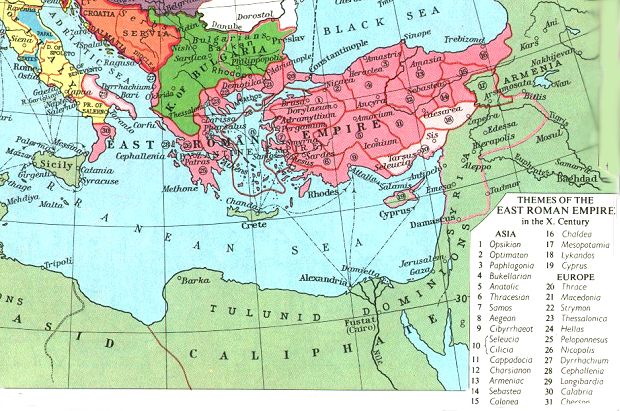
applied directly to the spiritual leaders of the time, but have broader application.  Speaking as one of God’s prophets, he speaks as the prophets do.  “Your problems are your own faults.  Don’t project blame elsewhere.” In the fourth volume of his A Study of History Toynbee applies this principle in a fascinating way regarding the Byzantine Empire. A look at Byzantium’s history that hit only the highlights would likely make a long jump from Justinian over to the Crusades, which would give the impression of an embattled area of Christendom making a desperate stand against the rise of Islam.  The political and military failure of the Crusades (to say nothing of the moral failures on all sides) end up sealing their fate, and the Moslems finish them off in 1453 when Constantinople falls.  Thus, they could easily say that the fell due to Islamic aggression.  It’s “their” fault. But this perspective ignores what happened in the intermittent period between these bookmark events, and especially ignores the Byzantine’s war with Bulgaria from A.D. 977-1018, which took place long before the Seljuk Turks posed any real threat to the Byzantines (those who read the review of “Fourteen Byzantine Rulers will note that this was during the reign of Basil II). A look at the map just before the conflict reveals the situation, with the Byzantines in Pink and Bulgaria in green. Byzantium ca. 950 ADIn fairness to the Byzantines, the Kingdom of Bulgaria represented a political division from the old Roman empire, and since the Byzantines had always seen themselves as “Roman,” they likely felt the duty of reclaiming lost territory.  It also appears that the Bulgarians may have initiated conflict in 700’s-800’s A.D., and perhaps the Byzantines this time thought of payback. But this political division ran only skin deep.  Both kingdoms had unity on a deeper level, as both committed themselves to Christianity, but more specifically, to the distinctive “Eastern Orthodox” brand of Christianity prevalent in Eastern Europe at the time.  Whatever the Byzantines might gain from such a conflict, an inevitable cost on the “back end” would wait them for them as in all civil wars.  If they could forego the political division, they would still likely have had unity against a common foe. Still, as a result of the war, the map changed and their territory increased. . . Byzantine Empire 1000-1100 The map also shows, however, that their gains in a long, desperate conflict between evenly matched foes came in part by ignoring the growing threat to the east.  By gaining in the west they ignored Anatolia and the growing power of an enemy with whom their differences were more fundamental. The map doesn’t show the social strain placed on Byzantium as a result of the war.  Emperor Basil the Bulgar Killer gained glory in war, but ignored the growing strife of his subjects in agricultural areas of Anatolia, a product of what  Toynbee calls, “their profound political distress and economic discontent, too frequent to be dismissed as the work of ambitious or unruly individuals.”  What should have been the core of Byzantium’s strength was in fact rotten with decay, ready to fall away at a mere touch to the Turks. Though their territory had increased since the 700’s, their burden of defense had increased, and not just in terms of territory.  They also had to care for more people, and thus had even reason to distract themselves from the social problems in Anatolia. The maps tell the rest of the story. . . 1025 A.D. Byzantium 1355 A.D.: Bulgaria is back, showing that their previous conquest could not hold amidst growing internal social strife.  All of that effort did nothing for them in the long run. And then, the end of it all, proving Matthew 15:11 true, though it took centuries for it to apply in the Byzantine case. Ottoman Empire

A Flip of the Script

A few days ago I came across the trailer for a mini-series on Amazon called Redbad, a harbinger of Europe’s (and perhaps ours as well) cultural moment. The movie involves the advancement of Christianity into a pagan land. The story proceeds from the pagans’ perspective. A few things immediately stand out:

  • The cross is associated not with sacrificial love, but with a ‘dark god’ who presumably loves punishment, an enormous ‘flip’ of its symbolic meaning for the last two millennia.
  • The series depicts Christians as intolerant bigots, the pagans as allowing something akin to freedom of conscience.
  • The Christians are usually filmed amidst darkness and smoke. Scenes with pagans alone seem to give them brighter light.

A few comments . . .

  • I would not say that Charlemagne allowed for freedom of conscience, but the idea that the pagans did . . . well–no one practiced this in the 8th century.
  • Charlemagne’s reign had plenty of messiness. But ‘messiness’ reigned in the West politically more or less since the time of Roman emperor Septimus Severus ca. 200 A.D. What historians should look for, as Will Durant suggested, was not how particular people shared in the vices of their time, but whether or not they swam against the current in any way with their virtues. With this standard, the cultural impact of the “Carolingian Renaissance” gleams brightly. As Kenneth Clark stated, paraphrasing Ruskin, “Great nations write their autobiographies in three manuscripts: the book of their words, the book of their deeds, and the book of their art.” If we think, like Clark, that the last is the most trustworthy, Charlemagne’s reign comes off rather well.

A few examples:

  • The invention of a beautiful script (the Carolingian).
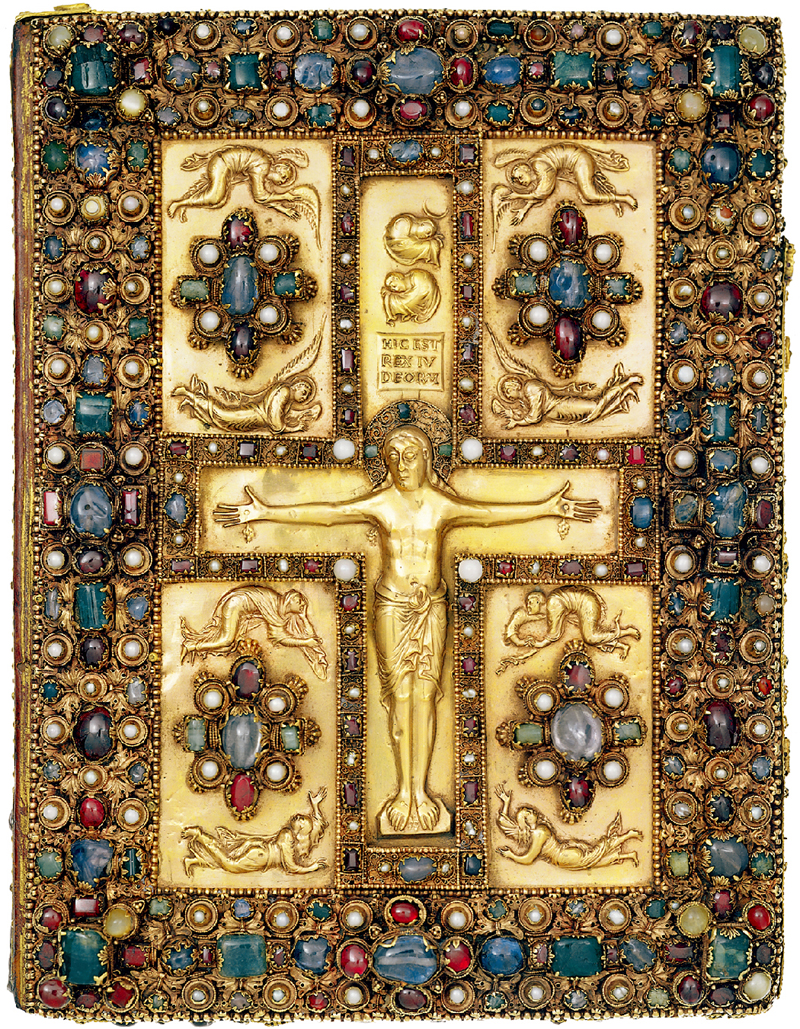
  • The creation of books, and the elevation of books as highly prized articles (studding the cover with jewels couldn’t make their value more obvious to their contemporaries).
  • Architectural innovations. Charlemagne put of the building talent of his empire not into palaces and castles, but the church at Aachen:

None of these things belong to pagan achievement.

One should not criticize Redbad for ‘historical inaccuracy’ per se. The medium of film works differently and tells stories differently. “Accuracy” is not my real concern. The mythos surrounding Charlemagne in the centuries after his death lacked “accuracy” in the strict sense of the word, just as any reporting or retelling of any event lacks “accuracy.” We edit and shape all the time, this is how our brain works as well as our souls. The problem with Redbad comes from the replacement of the standard Christian mythos entirely, and inventing another out of whole cloth, a perverse parody of creation ‘ex nihilo.’ As we see from the “book of their art,” the mythos surrounding Charlemagne has basis in fact.

Per Fexneld

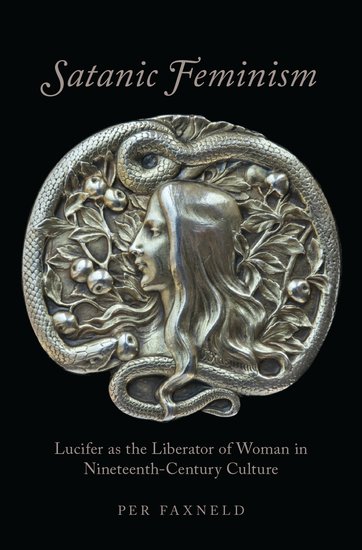
When seeing a book titled, Satanic Feminism: Lucifer as the Liberator of Women in the 19th Century, one should proceed with caution. The book could be written by a crazy feminist, or a crazy anti-feminist. The book could hardly be a book at all, and instead a mere rant. But this book stands as a work of scholarship, carefully (mostly too carefully) written with extensive bibliography and footnotes. The author, Per Fexneld, teaches at the University of Stockholm and seems an ordinary professorial sort, with perhaps a small chip on his shoulder. Digging a bit further, you see that he intends not necessarily to praise or condemn with what he finds, but merely to put the facts before the dear reader. I will usually at least pick up books with bold titles like these, merely out of curiosity and admiration for the sense of dash the writer displays.*

I kept reading the book because Fexneld faithfully executes his task of providing copious information, albeit at arms length from the material. But his perspective seems trustworthy because of this distance. He clearly has no love for Christianity and has much sympathy with women of the 19th century. He never identifies as a “Satanist” himself but seems to value, or at least understand, the role the idea of Satan plays in transgressing norms for the sake of liberation as it relates to feminism.

A few things I did not like:

  • As an Orthodox Christian, naturally I would be sensitive as to how Fexneld uses ancient Christian sources. I found to my chagrin that when discussing them, he uses secondary sources rather than direct quotes from the primary texts. I sense that these secondary sources shaped his opinions of the early fathers, not reading the primary texts directly. Despite this, he treats early Christian commentators mostly with fairness, but he could have done much better than this for what aims to be a serious scholarly study. My sense is that he cherrypicked what early Christian witnesses said about women, and to his credit, he partially admits this at least one point.
  • Fexneld takes his place among the many (mostly European? it seems to me) “historians” that don’t write history at all, but reference books. He has good information, but writes with such obviously posed dry detachment that his style could light a fire on a wet day. Where are the Abbot Suger’s, the Thomas Carlyle’s? Alas, gone are the poet historians from the world.
  • The “reference book” feel means that he tries hard not let the reader in on how one should interpret his information. Should we denounce the “satanic” feminists? Should we praise them? Or should we merely observe and think nothing about these feminists, besides concluding that a=a?

But in the end I have to confess that he created an effective and interesting reference book. My frustration above stems from the fact that he has talent that he holds back through fear or misperceptions regarding his chosen profession. If you want to do research, well and good. If you want to write, at least make an attempt at poetry that seeks meaning and synthesis.

To the thrust of his work, then . . .

With copious notes and numerous examples, Fexneld amply shows a “Satanic” strain that ran through many early feminists. He distinguishes full blown “Satanists” (of which there were a few) from those that merely used Satanic tropes (the majority of his examples). With different particular manifestations, these women

  • Built upon Romantic ideas from Byron and Shelley that recast Satan as a tragic hero of the Biblical narrative. He attempted to bring knowledge and liberation, and so on.
  • Recast Eve as the mankind’s savior, of sorts, a figure akin to Prometheus. She boldly went where Adam refused to go and paid the price, but she gave mankind knowledge and self-awareness.
  • Thus, for these women, feminism represented a real social and theological revolution, not just icing on a semi-Christian foundation. They wanted an overthrow of the Christian narrative and the patriarchy which it established. To do so, it simultaneously exalted Eve, Satan, and the fall itself.

The multitude of examples is the strength of the book, but Fexneld throws them together in ‘one after another’ fashion. Worse, one cannot sense if any one example or group of examples accurately embodies or represents the whole. He very carefully hedges many of his statements. This caution has its place in parts, but not for the whole. When writing a book like this you have to actually say something. To mitigate this, the breadth of his treatment touches on

  • The rise of the occult in the period
  • The focus from the pre-Raphaelites on feminine figures from classical cultures, “strange” women, and even Lillith, Adam’s first wife in certain Jewish texts.
  • How popular literature and art veered into occult themes with the thinnest Christian veneer, with significant attacks on “Christian patriarchy” hidden below the surface.
  • The popularity of certain occult female writers like Mary McClane and Sylvia Townsend
  • The connection of feminist social inversion to sexual inversion (lesbianism).
  • The rise of women depicted as Satan (in a positive sense) or at least, womanly figures depicted as Satan.
  • The publication of The Woman’s Bible which inverted the basic biblical narrative, praising Eve, etc.

. . . and other things. One gets the sense of a tidal wave of either direct, or mostly indirect, Satanism flooding the feminist movement from 1880-1920. But the central question–was 1st wave feminism driven primarily by “Satanism” or not? I have the feeling Fexneld would recoil at the thought of the volumes of his research intended to answer that question one way or the other. No doubt he would see such a commitment as a grave faux pas.

Let us deal with this crucial question which Fexneld leaves untouched.

First, the feminist movement obviously challenged and successfully upended certain elements of society. Certainly Satan, among other things, sought to upend the order God established in creation. So perhaps feminist women found themselves naturally drawn to satanic symbols or Satan himself. But, not all orders should stay in place. Scripture has numerous examples of the established order needing “flipped” or inverted to attain proper wholeness again. David, the youngest son of Jesse and a shepherd, will overthrow Saul, the “demonic” king who consulted with witches. Herod, for example, rightly feared that Christ would give him a run for his money.

So, second . . . was the feminist movement a proper or improper inversion? I don’t think we should answer this question based on the rote numbers of “satanic” vs. non-satanic feminists. I think the question has its roots in the nature of the inversion. If the inversion was proper, then we can relegate the trends Fexneld observes to the fringe. If improper, then we can say that even the “good” feminists participated in something wrong.

This is a very tricky question, and I can see why Fexneld failed to tackle it. But how can we truly avoid it? I’m sure that Fexneld has an answer for this conundrum somewhere in his own mind, or at least I hope he has answered it. I cannot claim to know enough to answer it definitively. I will try a pass at it, however–why not?

I begin with the obvious statement that calling upon Satan in reality or in tropes, for any cause, will ultimately destroy you, just as the flood and chaos will destroy anyone.

Not surprisingly, the feminist movements occurred within democratic societies. One can see democracy itself as a kind of inversion against traditional monarchy, replacing a “top down” political order with one from the “bottom up.” Just like Saturn eating his children in a fruitless attempt to stop the slippery slope of revolution, so too the feminist movement seems like an inevitable byproduct of democracy itself–the revolt of “Earth” against “Heaven.” Feminist detractors could not prevent this ‘revolt’ even as they might praise and affirm a democratic way of life.

Were Victorian era women “oppressed” in some sense of the word? If we look at women’s fashion as a piece of evidence, we see that–whether or not women created/embraced these fashions, their movement, the way for them to show themselves to the world, was certainly restricted–especially if we accept Fexneld’s “proto-feminists” from the mid-19th century starting the modern feminist movement. This may shed light on their overall place in society. But the place of women in Victorian society is something which I know too little about to comment on.

I suspect that the “oppression” of women lacked the severity that some claimed, but disconnects from equality are hard to bear within a democracy. I withhold sympathy from many of Fexneld’s female examples, but would extend it to more moderate feminists.

The age old problem of revolutions has always been, however, where and when do they stop?

Obviously, I oppose the rebellion against Christianity that at least some feminists then and now espouse, on historical as well as religious grounds. I trust my religious objections are obvious. As to the historical, we can briefly consider Regine Pernoud’s Women in the Days of Cathedrals, which shows us an era where

  • The earliest medieval treatise on education was written by a woman
  • We see the invention of romantic love (at least as an accepted part of general society)
  • Women regularly practiced medicine
  • Women in monastic orders could get more or less the same education men in the church received

In short, the status of women at the height of medievalism–a patriarchal society in most respects–far surpassed that of any pagan society. Pernoud suggests, however, that the Renaissance and subsequent ages introduced more Roman and classical pagan concepts of property and ownership. Possibly this did have an impact on women’s status in the Renaissance and future centuries.

Of course, one cannot construct a society entirely of “Heaven” anymore than entirely out of “Earth.” Mankind itself is both “heavenly” and “earthly,” (just as mankind is not just men or just women) made from the dust of the earth and the spirit from above. Strikingly, many of the cathedrals in the “Age of Cathedrals” reference by Pernoud were dedicated to the Virgin Mary, including Chartes, Notre Dame, Burgos, and Cologne, just to name a few. Here, I am convinced, lies the heart of the matter Fexneld misses entirely. Yes, Christianity is obviously patriarchal. We pray to our Father in Heaven. But Christians made the “Woman” (John 2:24, 19:26) the representative of Creation itself. On the one hand, Mary flips the hierarchy. As a young girl, she resided in the Holy of Holies–unheard of within Judaism. This seems a radical inversion. But it is her assent to God “flips” everything– she sets what was askew right again, the harm of Eve healed.** But what Mary put back in place is not a revolutionary society but a the right hierarchy, the reign of the true king–the subject of her Magnificat.

A blessed Advent to all.

*Some of Fexneld’s other work includes a published article: “Bleed for the Devil: Self-injury as Transgressive Practice in Contemporary Satanism, and the Re-enchantment of Late Modernity.” Clearly he has Satan on the brain. As an aside, should I ever become President my first executive order would ban all titles that that have something short and arresting to start, and then ruin it with a long and boring subtitle.

**Many of the fathers from St. Justin Martyr (ca. AD 150) onward develop the Eve-Mary parallel. Both are approached by an angel, and both assent to the angel, but it is Mary who in questioning Gabriel shows wisdom–Eve should have questioned the serpent. Eve’s pride humbles her, whereas Mary’s humility exalts her to the highest place.

9th/10th Grade: Matter and Spirit in the Dark Ages

Greetings,

After our Rome unit we transition out of Roman civilization into the medieval world.  This transition will involve rebuilding civilization along a whole new foundation with a different view of reality and consequently, society.  Early next week we will examine the question of the relationship between the physical and spiritual reality, and to what extent (if any) they can be separated.

Can a physical thing be a spiritual thing at the same time?  Or vice-versa?

The modern west tends to view reality in binary form.  We have a spiritual world and a physical world and for the most part the two live separately and do not mingle.  But the medievals would answer the above question affirmatively, and for them the divide between the physical and spiritual had much less rigid separation.

As an entry point into their mindset, we might think of mankind itself.  We are physical and spiritual beings.  Our bodies and souls have a mutual relationship.  We cannot separate them, just as we cannot extract the sugar from the eggs in a cake mix once we mix them together.  We exist as physical and spiritual beings simultaneously.

Medieval people applied this concept to many other areas of theology and life in general.  The elements in the eucharist can be both the body and blood of Christ and bread and wine at the same time.  Certain physical places were holy and important to see on pilgrimages, which were spiritual journeys often undertaken barefoot.  God’s presence hallowed certain physical objects, and God used them in various ways.  The medievals called them relics, and some Biblical examples of this might be Moses’ staff, the cloaks of Elijah and Jesus, and Paul’s handkerchief (Acts 19:12).  The saints don’t reside “out there” so much as they dwell in the here and now as a cloud of witnesses.  The presence of God and the saints link Heaven and Earth and we should (according to early Church doctrine and practice) ask the saints to intercede for us in prayer, just as we ask those on Earth to pray for us.

These theological ideas did not stay purely in the spiritual life of Christians, but impacted the values and shape of society in unique ways.  As we might expect these theological ideas took some time to trickle down into society itself, but eventually we will see their impact when we examine feudalism.

This week we also looked at the chaos in Europe after Rome’s fall.  As the only transnational organized group, the Church inevitably ended up bearing the brunt of the load in bringing about the return of civilization.  At first glance, the proliferation of monasteries has little to do with the recovery of civilization.  But monasteries performed at least 3 crucial functions to aid civilization:

1. Geographical Stability

As this map indicates,

the 5th and 6th centuries saw a great deal of chaos.  Semi-nomadic barbarian tribes wandered and fought as they went.  At bare minimum, civilization needs a defined location upon which to build.  Monasteries provided that, not only be dedicating themselves to prayer, but also to agriculture.  Farmers have to stay put and establish roots to successfully grow crops.

2. Refugees

With barbarians on the move many lost their homes and families.  Monasteries often served as places of refuge to care for, or possibly even educate, thousands of unfortunates.

3. Manuscripts

Many of you, like me, grew up in a time when parents said something akin to, “If we ever have a fire the house, the first and only thing to grab is the photo album.”  As a kid, this never made sense to me.  How about grabbing the tv?  But my parents had the right idea.  Part of our identity means having a connection to the past and those around us.  We don’t just exist as individuals in the ‘now,’ we know who we are based at least in part on our connection to others.

Monks copied many manuscripts such as the Bible and Church fathers, but also other Latin texts from Rome’s past.  We owe a great deal of our ancient Latin literature today to monks from the 6th-10th centuries preserving and copying them.  These books, I think, helped enhance their collective cultural memories.  It helped them connect to a past, reminding them that not all was lost.

The prevalence of monasteries raises the question of what exactly civilizations build upon.  Many critics of the Church accused Christians of “dropping out” by going to monasteries.  This withdrawal showed a heart that did not care.

In his monumental work, The City of God, St. Augustine asks his audience what exactly makes civilization work (among other topics).  It is not, he argues, a good economy, a powerful military, or even a workable political system.  What makes civilization tick is an established pattern of interacting with others both within and without one’s borders.  These interactions get formed from our values, and our values come from what we worship.

Perhaps monasteries can be viewed as a civilizational act of faith, akin to tithing.  They declare that we put our roots in the worship of God, in prayer and in praise, and not in our economy, our military, etc.  Only after recognizing the source of all things can things be properly enjoyed and properly used.  Rome, like nearly every other civilization, mistakenly believed that enough power, enough effort, enough careful application of resources, could hold things together.  They put the cart before the horse.

Command Performance

The poor often are more conservative than the rich, at least in certain respects. If we define “conservative” only in terms of policy, this distinction won’t apply. But, if we think of “conservative” in the traditional sense of opposition to change, the label fits more aptly. Perhaps this is because the rich can navigate change much more easily than others. The wealthy can create their place in society, but the poor rely on tradition, for lack of a better word, to give them a coherent identity.

Those “higher” than the lower classes have always exercised authority in every age, and this in itself I have no problem with. If one believes, as I do, that the world manifests itself in a hierarchical way, then we should adapt ourselves into this pattern. But how one exercises authority proves one’s fitness to rule. The patterns in creation reveal a liturgy, of sorts, of experience, and those who rule should abide by this pattern.

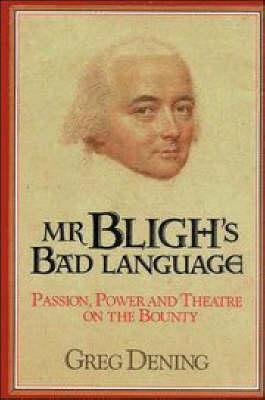
All of this may sound rather esoteric, and indeed I lack the language for a full and general explanation. But I found a fascinating and provoking example of this principle in Mr. Bligh’s Bad Language, by Greg Dening. The mutiny on the “Bounty” has inspired at least 3 movies and a variety of interpretations as to why it happened. Analysis of the event often focus on the strictly legal aspects of the case–was Captain Bligh too severe or not, and so on. Others focus on the psychological aspects of Bligh and Fletcher Christian, the first-mate who led the mutiny. Dening examines another field of inquiry entirely. He looks beyond the strictly legal and and avoids undue psychological guesswork, focusing not on the technical limits of Bligh’s authority, but how he used his authority.

Some look for the cause of mutiny in leaving the pleasurable confines of Tahiti for a long voyage home. We all have experienced relaxing after a strain, and how hard it can be to resume the task. But extant diaries and testimony shows that the sailors had no deep objections to leaving Tahiti. Many talked of looking forward to getting back home to England.

Other theories (and movies) imagine Bligh a harsh commander, a severe disciplinarian. Sailing into the Pacific meant a very long journey into hostile territory. We need no imagination to understand the need for order, though we may blanch at flogging as the most typical punishment.* But of the captains who sailed into the Pacific in Bligh’s era, Bligh punished less than most other captains, and far less than some. From ca. 1760-1800 on Pacific voyages, Dening estimates that all told, about 21% of sailors received flogging punishments.* Captain Vancouver flogged about 45% of his sailors during his time in command and never faced mutiny. Bligh, on the Bounty voyage and other subsequent journeys, flogged between 8-9% of his men. We must throw out the idea of tyranny and severity as the explanation of the mutiny.

Flogging seems unnaturally harsh to us for minor offenses, yet Dening points out the sailors accepted it without much fuss. This can be ascribed to their innate conservatism, but also to other factors. Flogging was short in duration and then the matter was over and settled. Flogging was the common lot of sailors, something they could bond over. Thus, flogging did not single anyone out or humiliate them. Legal formality, and especially tradition, gave sailors very clear boundaries with how and when they could face the punishment. Dening writes, “Sailors liked that flogging left no debt. Those punishments that sought to leave a mark on the sailors soul rather than his body–leg irons, mockery, badges of guilt–required a dangerous sort of theater.”

It is in this concept of “Theater” that Dening finds his thesis.

A kind of “Theater” exists in teaching, somewhat akin to stand-up comedy. In a sense the teacher puts on a performance–think of a 1st grade teacher doing different voices in a story they read. But it also holds true for teaching older students. The way one presents their material, their voice inflections, their pauses, etc., and then the punchline, i.e., the king died, or the molecules fizzle in the cup, and so on. A classroom, like a theater or a ship at sea, functions as a separate kind of liturgical space. Good teachers know how to use that space well for their purposes.

Dening points out that the very design of the Bounty meant that navigating the space of the ship presented challenges to Bligh, to which he seemed wholly unaware. The main purpose of the Bounty’s voyage involved transplanting breadfruit from Tahiti, which the British navy wanted to transplant to the Caribbean as food for native/slave workers. Bringing back cargo that would need space, light, and water meant redesigning the ship to accommodate their presence. That in turn meant less space for the crew. Bligh himself accepted less space than a captain would normally have for his cabin. That likely was a good move on his part, but the meaning of space in cabins and the all important quarterdeck (the ship’s “throne” so to speak) was altered, which altered the meaning of his command. Bligh saw himself as a captain imbued with Enlightenment values. He saw great scientific purpose in the voyage. He envisioned the Bounty “making history” and made various speeches to the crew to that effect. One can imagine that the average “salty” sailor would hardly see things that way. The breadfruits, “stupid plants,” of all things, stole their space, their water, and their captain’s kind attention. They would have probably preferred Bligh’s attention directed towards a mistress from Tahiti. It would have been more relatable, more human, and made him seem less of a calculator.

Bligh also acted as his own Purser for the voyage (a Purser kept charge of accounts for the Navy). This meant he oversaw the profitability of the voyage. Nobody on board likes the inevitably penny-pinching purser, and the Captain might at times play against the purser to boost his standing with the crew, an important fact if we realize that the crew would care little for how much money the voyage made. Every time that Bligh cut rations or cut corners, no matter his real intent, meant that the crew could suspect that he was shorting them to fill his own pockets. Indeed, Bligh had taken much less than his usual fee to captain the voyage, believing in the trip’s historic importance and opportunities it would afford him in the future. The fact that none of the rest of the crew shared in his convictions or cared about his “sacrifices” alienated Bligh psychologically from his men. Bligh in turn took their lack of zeal personally.

Taking things personally is one of the cardinal sins a teacher can commit. As for myself, I liked history classes in high school and college but not the science, math, or Spanish classes, and it was nothing personal. Every teacher thinks their subject the most important and wants everyone should love it as they do. Those that verbalize this thought out loud will sound bonkers to students. Students just want to get through the day–they owe you nothing, they owe “history” nothing. Likewise the best classroom discipline involves minimal talking and no lectures, i.e., “You did ‘x,’ the consequence is ‘y,'” end of story. Bligh had the habit of haranguing the crew for their lack of appreciation of his efforts on their behalf, delivering maudlin sermons instead of direct, quick punishments. In an illuminating section, Dening compares the discipline of harsher captains who flogged more than Bligh. “Harsher” captains speechified much less, and this made their discipline much less personal.

Dening sees Bligh making mistakes even when sincerely trying to be good to the crew. The sailors had a hazing ritual of sorts known as “Dunking,” which involved having a rope tied to your leg and being lowered overboard under the water. Many sailors could not swim, but even so, if the rope ever came loose, even a swimmer might drown, for the boat might not be able to turn around in time. Bligh saw this ritual as exploitative and put a stop to it, even increasing the rations of rum to make up the loss of dunking. Bligh no doubt saw himself as stamping out barbarism on behalf of the “little guy” below deck. Dening hints strongly that the men would have seen it very differently:**

  • To start, “dunking” was the province of the men below deck. In stopping the ritual, Bligh intruded on their space. In fact, the sailors had their own economy regarding the practice, with grog rations as the currency.
  • On every voyage, the officers had a chance to further their careers and gain honor. This ritual, though dangerous, was how ‘enlisted men’ could obtain honor among each other. Bligh thus appeared no doubt to steal honor from them, possibly so he could monopolize it for himself–akin perhaps to Achilles’ reaction to Agamemnon’s actions at the beginning of The Iliad.

Bligh’s attempts to appear benevolent surely fell flat. Sailors would have resented his intrusion into space generally reserved for them alone. A man who punished mercilessly might guess that he risked the affections of his men. Bligh’s problem involved him trampling on his men’s good will while deluding himself that he acted as their benefactor. No wonder the mutiny struck him with complete surprise.

Some might to compare Bligh to President Trump, but that comparison fails–except perhaps that neither one seemed to understand that the main objection to their power came not from what they did but how and when they did it.

Bligh represents the Enlightenment intellectual entrepreneur type. He had outstanding personal ability in navigation, and was a self-made man in many ways. One might have thought the common sailor would take to him.

Not so. Interestingly enough, Dening cites data that shows that sailors in fact preferred officers from the officer class and not those that rose through the ranks. Again, this hints at the need in such close personal quarters aboard ship to respect liturgical boundaries.

Not being from the traditional officer class, and as a man of the Enlightenment, Bligh would naturally have aversion to the varieties of arcane naval tradition. But on a long and dangerous voyage, the only shelter from chaos would be the ship itself and the world it represented. As such, the routine, the manners, etc. would have to be ironclad to give a sense of safety and permanence. When Bligh messed with that, he altered the sailors sense of place, stability and security. He messed with their bearings, so to speak. The strain would be psychological, not physical. Perhaps this accounts for 1st Officer Fletcher Christian’s comment to Bligh during the mutiny: “I am in hell.”

Good teachers, like good statesman (or sea captains) understand that the world reveals itself not fundamentally in laws but in relationships. The longer the friendship, the greater the liturgy of that relationship, due to all of the accumulated experiences. Bligh’s “bad language” to which the title alludes were not the actual words he spoke. He used words that any other sea captain would have spoken, but used them in the wrong way at the wrong time and place. The weirder the situation, such as being on wooden boards in the middle of the largest ocean on Earth, the tighter the reins we need on the liturgy of the existing relationships. Such mysteries are felt more than explained. Dening might not have pure logic on the side of his argument, but he does call to mind something we’ve all experienced, and that makes his book a delight.

Dave

*I should note that Dening cites another study that puts the average much lower–at around 10% instead of 21%. The two studies count differently, but even this alternate view does no damage to understanding Bligh’s so-called ‘severity.’

**I have seen two movie versions of the Bounty mutiny, the version from the 1960’s with Trevor Howard and Marlon Brando, and the one from the 1980’s with Anthony Hopkins and Mel Gibson. The Hopkins/Gibson version comes closer in most respects to what Dening presents. It includes a dunking scene and Hopkins does very well in expressing barely restrained disapproval.

The Saga of King Hrolf Kraki

Some paint the Middle Ages as a period of narrow intolerance.  I’ve said enough in other posts not to address that directly here, but in short, that view has little support in the lives or sources of the time.  We see in Beowulf, for example an appreciation for the pagan past and an understanding of the difficulties in trying to make sense of the Christian faith in light of their past, not a “narrow intolerance.”

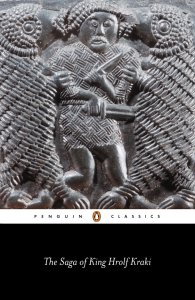
The Saga of King Hrolf Kraki can’t quite equal the power and style of Beowulf, but it has many of its outstanding 71ebyqgznclqualities, as well as a similar task.  The author retells a famous Norse story to a newly Christian Norse audience.  At various points he likely altered the story slightly to make certain theological points.  One such instance caught my attention.

At the end of the story our hero returns triumphant from defeating the villain.  Before setting out on his expedition, he took advice from a seemingly simple farmer and reduced his army (in similar fashion to Gideon in the book of Judges).  After victory he marches back and sees the same farmer again.  They greet each other warmly, after which the farmer offers more help.

This time King Hrolf refuses.  It’s not immediately clear why.

As they take their leave Hrolf declares that the farmer was none other than the Norse god Odin in disguise.  He had to refuse his help.  He would not take advice from a pagan god though all knew that Odin brought success to those who honored him.

In refusing Odin’s help, he refused “Victory.”  The consequences of this decision for him and his kingdom follow predictably.  Hrolf Kraki loses everything by the end.  But the author clearly believes he should indeed have preferred failure to success at the price of aid from a pagan god.

In an article entitled “No Enduring City,” author David Bentley Hart muses on the success of Christians and their involvement in politics.  He begins citing two events in medieval Europe.  He writes,

The first occurred on August 25, 1256, when the  podest  and  capitano del popolo of ­Bologna summoned the citizens of the  comune to the Piazza Maggiore in order to announce the abolition of all bonded servitude within the city’s civil and ­diocesan jurisdictions. Some 5,855 serfs were redeemed from their  signori—who were remunerated out of the communal treasury at a total price of 54,014 lire—then placed under ecclesiastical authority, and then granted their liberty.

An irrevocable abolition of serfdom in Bologna was then issued in a short text known as the  Liber Paradisus, in which was indited the name of every emancipated serf. Historians have occasionally ­spe­culated on the economic benefits that Bologna may have reaped from this decision—for one thing, freedmen were eligible to pay taxes—but the actual cost of the manumission, immediate and deferred, was so exorbitant that it is rather difficult to see how the municipal administration could have calculated any plausible profit from its actions.

Perhaps, then, one should take seriously the motives the  Liber Paradisus itself actually adduces: “Paradisum voluptatis plantavit dominus Deus omnipotens a principio,” it begins,“in quo posuit hominem, quem formaverat, et ipsius corpus ornavit veste candenti, sibi donans perfectissimam et perpetuam libertatem”: “In the beginning, the Lord God Almighty planted a paradise of delight, in which he placed man, whom he had formed, and whose body he had adorned with the garb of radiance [a shining raiment], endowing him with perfect and perpetual freedom.” It was only by sinning, the argument proceeds, that humanity bound itself in servitude to corruption; God in his mercy, however, sent his Son into the world to break the bonds that hold humanity in thrall, that by Christ’s own dignity all of us should have our natural liberty restored. Thus all persons currently bound in servitude by human law should have their proper freedom granted them, for they along with all the rest of us belong to a single  massa libertatis wherein now not so much as a single  modicum fermentum of servitude can be tolerated, lest it corrupt the whole.

Hart continues . . .

The second episode, however, which to our sensibilities might seem the more outlandish of the two, was for its time far and away the more ordinary. Some twelve to fifteen years after the promulgation of the  Liber Paradisus (the date cannot be more precisely determined than that), Thomas Aquinas put the finishing touches on that famous (or infamous) passage in the  Summa Theologiae  where he defends the practice of executing heretics. The argument he laid out there was quite a simple one, consisting of only two points, both of which he considered more or less incontestable. First, as regards the heretics themselves, their sin by itself warrants both excommunication and death. Second, as regards the Church, the graver evil of heresy is that it corrupts the faith, which gives life to the soul; and so, if we execute forgers for merely corrupting our currency, which can sustain only temporal life, how much more justly may we deal with convicted heretics not only by excommunicating them, but by putting them to death as well.

Of course, Thomas adds, out of her mercy towards each man who has strayed, the Church hesitates to pronounce a final condemnation until “the first and second admonition” have both failed; but then, if the heretic remains obstinate, “the Church, no longer hoping for his conversion, turns itself to the salvation of others, by excommunicating him and separating him from the Church, and furthermore delivers him over to the secular tribunal so that the latter might remove him from the world by death.” Nor can ecclesial compassion extend any further than this. Recidivism, for instance, even of the most transient kind, is unpardonable. Says Thomas, “At God’s tribunal, all who return are always received, because God is a searcher of hearts, and knows those who return in sincerity. But the Church cannot imitate God in this, for she presumes that those who relapse after being once received are insincere when they return; so she does not obstruct their path to salvation, but neither does she shield them from the sentence of death.”

Both examples have their counterpoints.  Some rather cynically suggest that the economic motive of creating more taxpayers formed the real motivation behind freeing the serfs.  Others point out, that, whatever we may think of Thomas’ counsel, he sought to save souls and not to kill people.  It is easy to cherry-pick the weaknesses of any man or any civilization.

Still, however we slice it, we cannot avoid a contradiction.

Hart suggests that Christian involvement in politics always seems to go south at some point.  On the one hand, when Christians have the power to do good, they can accomplish good things in a unique and lasting way.  On the other, such power either corrupts or puts one in an awkward enough position where a compromise of gospel ethics becomes inevitable.  We can cite numerous examples of the good and the bad.  Betrayals of the gospel ethic may not even be anyone’s “fault,” per se–it could be the nature of the beast.  He draws no firm conclusions, but asks us to consider how we should deal with this problem.

I admire Hart a great deal.  He has a powerful mind and thinks deeply.  His The Doors of the Sea is the best book I have read on the problem of evil.  But I found myself a bit frustrated with “No Enduring City.”  He has the intellectual capital to spend, but plays the miser. He holds too much back. I wanted more from him to try and settle this conundrum.

When surveying the history of Christian involvement in politics, I think we have the following options:

  • Christians should never be involved in politics.  Whatever good they will do will be outweighed by the inevitable corruption of their witness to the gospel.
  • Christians will likely fail in some way in the political realm.  But, we should expect that their failures will be less damaging, and they will accomplish more good in their time in power.  Thus, Christians should be involved in politics as much as they can.
  • Compromising one’s Christian witness may likely happen in the political realm, but it is not inevitable.  Thus, the potential good from Christians involvement in politics is worth the risk, with the right people.
  • Compromising our witness to Christ is indeed quite likely in the political realm. Christians should avoid political office. However, Christians should do what they can to influence those in power.  In this way they can hopefully create some good for society and escape direct blame for the bad in politics.

Other options likely exist.

In his article Hart hints (but not outright declares) that the continual cycle of success/failure might serve the good purpose of continual renewal, keeping the Church on its toes and supplied with fresh blood.  This parallels in some ways Toynbee’s creative/dominant minorities in society.  A particular system gets stale and rigid.  A ‘creative minority’ finds a way to challenge this system successfully, which brings them into power.  Eventually, however, this ‘creative minority’ succumbs to temptation and morphs into its own ‘dominant minority,’ starting the cycle over again.

But Hart will not outright declare one way or the other, because the mere fact of such a cycle doesn’t mean that the good of the creative minority outweighs the bad of dominant minority.

If such a man as Hart cannot decide, I will not either.  Perhaps historical analysis is not our best servant for this question.  Perhaps we need epic poetry to instruct us.

King Hrolf Kraki ultimately fails.  His realm grows a bit soft and corrupt.  Yet before that happened he managed to defeat a wicked and truly evil king who had wrought chaos throughout the land for years.  He fails, but the good outweighed the bad.  So too king Arthur fails.  His sins, and the sins of others catch up with them.  Yet, the good that came from the golden age of Camelot inspired the very idea of chivalry, which formed the ethic of the west for 500 years at least.  When Roland receives the assignment of the rear guard, he suspects treachery, but turns to his stepfather and says,

Ah, slave and coward, malicious heir of dishonored ancestors, did you think I would let the glove fall to the ground as you did the staff when you stood before Charles?

The rearguard is destroyed under Roland’s command, but Charlemagne returns just in time. Beowulf defeats the dragon but could not establish the kind of kingdom that meant that others took up similar fights as he.  But . . . who doesn’t love the character of Beowulf?

The attempts referenced above, however, were all “grand gestures” involving personal risk.  Epic literature is of course literature and not history.  But they give some historical insights.  The politicking of the religious right involved no grand gesture, no personal risk for anyone.  Christian involvement in the political realm will likely fail in some way, no matter how great the sacrifice.  But the utterly mundane garnering of power through votes not only failed in the U.S., it engendered resentment against the religious right.  The relative political disengagement of most younger Christians today testifies to the insipid nature of such action.

At the end of The Song of Roland Charlemagne cries out, “O God, my life is a burden!”  He knows that all of his fighting and all of the sacrifice will not bring about a heaven on earth.  But, he smashed the pagans, avenged treachery, and Julienne was led triumphantly to the baptismal font.

Truly sacrificial action, whether political or otherwise, has a lasting impact despite our sins and limitations.

Perhaps herein lies the answer Hart seeks.

The Prophet or the Madman

A good education should prepare one to see many sides of an issue and to see the complex nature of problems. Solutions, should they exist, come from seeing the good in things and building upon that, along with balance, patience, and so on.

It seems to me that about 95% of problems or questions should get handled in this fashion.

But the remaining 5% probably require none of the aforementioned qualities, but instead call for a prophet.  Some problems have such deep and destructive roots in society that only radical solutions suffice, and coming to these conclusions require a complete change of perspective not unlike repentance.  In such cases balance and moderation hurt more than help.

The problem with prophets is that they usually sound crazy.  They are entirely “unreasonable” and see nothing among us to build on.  They abhor compromise.  No doubt this explains why most of Israel’s prophets were dismissed as lunatics or dangerous subversives.

The fact that not all prophets deserve the title of “Prophet” adds to the dilemma.  God mandated harsh punishments for false prophets, who unnecessarily rile up/provide false comfort in addition to the far worse consequence of giving us the wrong view of God and our place in the universe.

If we took the Industrial Revolution as an example, we might expect a “reasonable” historian to take a standard cost/benefit approach.  On the one hand, the Industrial Revolution eventually ushered in higher wages and higher standards of living.  Medical technology improved and helped us lead healthier lives.  Mass production led to greater social and political equality.  On the other hand, the Industrial Revolution also disconnected us from nature and allowed us to mass produce destructive things like weapons and pollutants.  The regimentation of the factory led to regimentation of other areas of life.  Modern conveniences also facilitated longer working hours, which helped erode the family.  Some good, some bad, and the trick lies in deciding how to weigh the importance of each category.

Enter Ivan Illich.

Illich (a one time Catholic priest turned social critic) wants nothing to do with the above paragraph.  The Industrial Revolution, or in his phrase, “hygenic progress” has led to continuing impoverishment of all who drink from its waters.

Perhaps you think he means impoverishment of the soul, and then we can still perhaps argue that certain economic benefits outweigh that at least in some circumstances.

But no — he means impoverishment of the soul and economic impoverishment. Industrial society has made us poorer in every sense, which on the surface seems demonstrably untrue.  But nevertheless, he wants to burn it all down, if not physically, then at least in our whole approach to what lies around us.

Do we have a madman or a prophet?

I will say that having read his book Toward a History of Needs I’m not quite sure myself. He fits one criteria for having a prophetic voice — neither the political right or left knew what to do with him in his day.  On the imgresone hand, Illich heavily criticized market-based solutions as essentially imperialistic projects that in the end only benefitted producers.  On the other hand, he spoke just as harshly against the industrialized “do-gooders” of the left and their projects like the Peace Corp and The Alliance for Progress.  He saw both sides as Tweedle-Dee and Tweedle-Dum — the same person with a different face, sharing essentially the same destructive perspective.

Illich’s main idea is that the “hygenic progress” of the last two centuries has not solved any problem mankind faces so much as it has created needs that have become mandatory for civilization. These “mandatory needs” continue to increase and drain both soul and wallet.  This favors not only producers but also, “anyone in the driver seat” (government bureaucracy). He cites many examples to prove his point, and we can add to those examples today.

Some of his examples (with hardly an exhaustive list) . . .

Medicine has become vastly more expensive over the last few decades without necessarily making us healthier. Pregnant women, for example, now have seemingly dozens of “mandatory” checkups involving expensive lab work to check on her health.  But babies are not measurably more healthy than they were 20-30 years ago.  These checkups did not come in response to a severe crisis, but as part of the logic of the “producers of health.”  Ilich also argues that most of the vast costs involving medical care for the elderly go more towards prolonging suffering than actually making us healthier.  Of course, this suffering in turn drives us back to the health producers.

Simple things like driving also fall prey to this logic.  In days of yore, you acquired driving skills more or less by osmosis and guided practice from parents.  Now prospective drivers need a certification from driving schools to prove their merit.  The fact that many who take courses from “driving schools” spend their time doing errands for the producer of the certificates should call for us to abolish the criteria altogether.  Instead, because we are a society of “hygenic progress,” we call for reform, not abolition, of such institutions, which bring in government bureaucrats once again.  The system continually empowers “those in the driver’s seat” literally and figuratively.

This dynamic impoverishes us financially by forcing us to pay for the certification and government authentication of our lives, and it also steals away time and personal initiative.  Citizens of “hygenic progress” societies will get boxed in continually.  We realize that one “must” have a car to survive in modern society (with the rare exception of a few cities), and the logic of car ownership has followed suit. No layman can repair their car anymore, which drives us toward complete reliance on the producers of car health.  Writing in the early 1970’s, Illich did not foresee the rise of digital technology.  Now, we “need” not just computers and internet, but cell phones and the like to “survive” the modern world.  Failure to keep up brings nebulous social penalties, along with more realistic drawbacks.  Who communicates by phone anymore?**

Education has gone through the same process.  Public education once was conceived as a free gift.  Now this gift is mandatory, with a mandated curriculum.  Initially the system called for you to stay through 8th grade, now one must stay until 16.  Of course, society’s demands for more pieces of paper to certify one as “educated” has increased. Now everyone “must” graduate high school to have any chance in society, and to get a “real job” everyone must go to college — though we know that many high school and college educations hardly dignify the name.  Now Master’s Degrees have become “required” in many professions.  Some of this might be acceptable if the certificates proved that you actually had a good education, when what it really proves it that you jumped through the required hoops.  The role of government oversight and financial enrichment of the producers of certificates (think of the growth of private companies in the standardized testing industry) again go hand in hand.

Of course not all want this outcome, but that’s just “the way it goes.”  I have an autistic son, and from time to time speculate on why autism diagnoses have dramatically increased over the last 20-odd years.  With the caveat that the question is complex and mysterious, part of me wonders if the increased regimentation in education makes those who lack the social skills necessary to navigate that world stand out in much bolder relief than previously.

Illich uses many more examples which I will pass over.  He astutely references the classical concept of “nemesis” from Greek mythology.  Nemesis served justice and punished hubris.  In the modern sense, nemesis stood for the punishment of a rash abuse of privilege.  In heroic literature the truly elite of society experience “nemesis” by going too far beyond the lot of mortals.  Now, Illich comments that nemesis has been democratized and no longer is reserved for rash abuse of a privilege.  Rather, “Industrialized nemesis is retribution for dutiful participation in society.”

At this point we may want to push back a bit.  Maybe the benefits of industrial society have plateaued somewhat, but if we do a before/after look since the start of industrialization, we see that life expectancy has gone up, and more people have access to more conveniences of life.  Who would want to return to pre-industrial living?  And while we can’t repair our cars, they do last a lot longer than they used to, which puts us back to the +/- calculus of the “reasonable” historian.  Some products over time became ubiquitous, but also cheap.  A perfectly good land-line phone, for example, costs no more than $15.  DVD players began by costing a few hundred bucks and now come at 1/10 of that price.  These examples seem to go against the idea that producers will get continually enriched at consumer expense.

I’m not sure how Illich would respond to these arguments, but I would guess that he would say that producers will continue to turn today’s luxuries into tomorrow’s “needs.”  And — they will continue to partner with government to make the needs mandatory — hence, good bye rabbit ears, hello to required conversion to digital.  DVD players are cheap, but look out for Blue-Ray, which will likely supplant DVD’s soon enough and start the cycle over again.

Of course prophets don’t just critique, they also offer hope and a way forward.  For Illich that means more creative and especially, autonomous action on the part of individuals.  We must escape the professionalization, the certificates of approval, and the commodification that governs modern lives.  We no longer make decisions — we have algorithms or rubrics to that for us.

However, a question remains — do we wish to be free? Do we even know what that means?  Would it matter if we did?  I am reminded of a passage in Machiavelli’s Discourses which captures the essence of the issue.  Are we a healthy body with a corrupt head, i.e. Rome at the time of the latter Tarquin kings? After the expulsion of Tarquin Superbus the Romans immediately had the ability to form a stable, successful, alternative government.  Or, has the whole body been infected, and cutting off the head will produce only more problems?  Much later in Rome’s history a new “Tarquin” arose in the form of Julius Caesar, but his death only made things worse for Rome — the whole body had become corrupt.

Illich also fails to discuss another question — is the situation he describes (if he correctly describes it — I am at least partially persuaded) a necessary or contingent consequence of industrialization?  If the latter, then we can work to change things.  If the former is true, then we need to pattern ourselves after the characters in many of Phillip K. Dick’s stories and go “through” the situation rather than running away from it, and find a spot of peace therein.

I suspect, however, that if Illich is correct, then we are living with contingent consequences of industrialization.  We can get pushed in certain directions but never off the road entirely.  While I would not call him a madman, nor would I yet call him a prophet.  He describes some of the technical reasons for our situation, but he fails to unmask the religious devotion that created this situation.  The key question, “What does industrial bureaucratic capitalism truly worship?” has yet to receive an answer.  Until we understand this, we will have no power to change our circumstances.  We need also to see that the situation Illich describes results not just from the confluence of bureaucrats and producers, but from everyone.  We “the people” cannot be part of whatever path forward may exist without acknowledging our own complicity.

Dave

*Hence his book Deschooling Society on the surface seems like a call to dismantle public education in favor of more market based approaches (the “Right” cheers).  But what Illich really calls for is that society “de-school” itself and fundamentally change the nature of the relationship between “school” and “society” (the Right and the Left look at each other quizzically).

**The confluence of the producers of society’s digital “needs” and government oversight continues with a vengeance with the rise of technology in education.  Now curricula get planned around the assumption that students have technology in the classroom.  Those who don’t will be given access.  The option to “drop out” — i.e., “I don’t want my child to have access to a tablet, phone, etc.” — doesn’t really exist.  Most teacher training now gets geared towards showing teachers how to better serve the god “Technology in the Classroom.”  All of this of course is “necessary” because we must “prepare students for the modern world.”  Meanwhile of course, we create the “modern world” via the use of technology in the classroom.  One hand washes the other.  This seems a similar argument to Hillaire Belloc’s The Servile State.

“. . . And in the End”

My dad has a large record collection, and growing up I heard a lot of different music. One of my earliest memories involves me asking him to, “Put the Apple record on,” by which I meant, “Put on Abbey Road by the Beatles, side two, “The End.” There I would hear the vastly underrated (by the general public) Ringo Starr play his one and only drum solo. I grabbed Tinker Toys, made two mallets, and attempted to play along with the music on the sofa.

Years later when I started playing the drums myself, I sometimes tried to replicate the sound Starr got out of his kit on that album, with no success. Reading And in the End: The Last Days of the Beatles, I discovered the secret–a new way of mic’ing the drums was employed, but the real trick may have been his switch to calfskin drum heads on his tom-toms. Ringo loved the new sound and feel, and credited the heads for giving him some newfound excitement on the kit. With the drum heads sounding so good, it inspired him to integrate his toms more than he had on previous albums–the result can be heard especially on “Come Together,” and “Something,” to say nothing of his famous aforementioned solo.

This little nugget may not be of much interest to anyone but myself, but And in the End gives everyone lots to chew on about the decline and final fall of the Beatles. I have skimmed through biographies of Lennon and McCartney and seen a few documentaries about them, which prepped me for this book. Author Ken McNab gives little background information, which suited me just fine. For anyone with an interest in The Beatles and a passing familiarity with their dynamics, this book will do nicely in filling out some unexplored corners of Beatles lore.

Most of us know about Lennon and McCartney’s personality feuds, the presence of Yoko Ono, and Harrison’s rise in prominence. And in the End mentions this but knows that we have heard about it before. Instead McNab spends a lot of time talking about the business side of The Beatles and how that, perhaps even more than personality differences, contributed heavily to their demise as a group.

The Beatles faced in formidable challenges to their cohesion in 1969:

  • John married Yoko, and Paul married Linda. Again, we are aware of the challenges Yoko brought to the table. Many have well documented the unnerving effects of her awkward presence during rehearsals. But McNab puts a different focus on Paul’s marriage to Linda Eastman as a major contributor to the widening John-Paul divide. Eastman came from New York high society money. Paul’s marriage, then, confirmed and deepened every suspicion John had about Paul–his social striving, his “bourgeoise” aspirations, etc.
  • At the same time, George Harrison began to assert himself much more aggressively in the group. John and Paul had previously worked out truces and trades in sharing the spotlight and wrote “together” at least officially. Now they would have share even more than they had before at a time of much higher tension.
  • At the same time, the “Apple” company they founded floundered badly, obviously bleeding cash. Their image and their pocketbooks would take a big wallop.
  • At the same time, The Beatles attempted to rework their financial arrangements, with John, George, and Ringo favoring one company, and Paul favoring another company–which happened to be run by his new brother-in-law (this did not go over well with the other three. John especially tore into the fact that the Eastman’s had changed their name from Epstein to Eastman, a sign of “inauthenticity”).
  • At the same time, Lennon–who had smoked plenty of weed and experimented with psychedelics in the past, now began a much more problematic heroin habit.

In other words, to paraphrase Fletch in his visit to Dr. Dolan, the Beatles may have been dying for years, but the end was very sudden.

A few bands have lasted more than a few decades, and fewer still have stayed productive during their span instead of merely rehashing older hits on tour. So on the one hand, the demise of The Beatles should not surprise anyone. But McNab’s treatment of the band’s final year made me realize that the main failure of the Beatles involved their failure to “institutionalize” themselves in some respect–a failure to scale up their issues to a point where the issues were “solved” by the institution known as “The Beatles.”

I can think of only two other bands that managed to last long and stay reasonably productive: Kiss and Rush (who actually toured together in 1975). In the case of Rush, they perhaps solved their problem by always having two guys write the songs and one guy write the lyrics. Harmony could be maintained as long as they stuck with this formula, and they did so right until the end. This very stark division of labor will be exceedingly rare in any collaborative group.

The more typical path is that of KISS, who had two strong frontmen with strong personalities. Paul Stanley and Gene Simmons certainly feuded over the years. But the outfits–Starman, Catman, Spaceman, etc.–gave them an identity outside themselves. This allowed them to replace particular musicians when needed (such as Peter Criss, Ace Frehly) while still maintaining their individual identity. They could do a solo album or a solo project as “Paul Stanley”–who is not KISS, then put on the makeup and become KISS again.

Not having Rush’s division of labor, the Beatles needed something of the KISS formula to work, but they could not create it in time. Given the challenges they faced along with their particular personalities, this was not likely to happen, but perhaps the possibility existed.

As I finished the book it appeared that Trump will not have a second term, and this spurred some reflection on the purpose of institutions, and their role in our culture at the moment.

In the Democratic primaries many lamented that anti-establishment figures like Tulsi Gabbard and Andrew Yang got the freeze-out from mainstream media and the party establishment. In the end, the Democratic base chose the most “establishment” figure possible in Biden. On the one hand, Trump vs. Biden at first glance appears to boil down to “Anti-Establishment v. Establishment. That is short-sighted view of the situation–just as seeing the Beatles conflict as purely Lennon v. McCartney–Anti-Establishment v. Establishment–also interprets a lot of the signal as noise.

First we can see Trump akin to John Lennon. Both despised or could not work within institutions. Both always had/have the most gravity in the room. Those freed from an institutional ‘gloss’ or ‘crust’ can shine forth with a particularly concentrated vitality. Lennon would at times impress everyone with his clarity and intelligence, and at other times embarrass everyone with his rash anger and insane narcissism. His partnership with McCartney worked so well because he needed someone to ground him, someone to “land” his ideas, which Paul did with some of John’s best songs*

The Trump-Lennon connection is easy . . . making McCartney into Biden stretches things a bit. Well–it works in some ways. Lennon always hated the “grandma” tunes that McCartney loved, the sweetly melodic semi-vaudeville stuff that Paul dipped into now and then. Paul always believed that the Beatles had to be a “band,” which meant recording and then touring. “Back to basics,” and so on. So we can see the election of Biden as a vindication of our institutions, and at least the perception of “normalcy.”

Certainly Trump is “anti-establishment”–but particularly in his personal behavior. He cared nothing for the niceties, decorum, and customs of acting “presidential.” Some of his political agenda, however, had roots in old Pat Buchanan Republicanism. He had broad support for his judicial nominees and support for pro-life policies, all of which would fit within the Reagan heyday.

Biden on the one hand is quintessential “Establishment,” having served in the Senate for who knows how long. He is nothing if not boring in his personal behavior–which at times can be a strength. He will uphold presidential cultural and political norms.

But he also brings with him a long trail of supporters who also wish to dismantle certain aspects of the Establishment and its norms. It wasn’t too long ago that we heard chants of “Defund the Police.” Biden’s supporters have already created an “enemies list” of Trump staffers and “enablers” that may be used to exclude them from various aspects of public life. No such acts have ever been perpetrated so openly before, at least that I am aware of.** We shall see to what degree Biden takes the Democratic party into more anti-institutional waters. Note that some Democratic supporters have called for the abolition of the Electoral College, a dismantling of certain powers of the Senate, and so on. To alter the Constitution is to dismantle the American institution.

But just as Biden may have a slightly jaded take on institutions, so perhaps did McCartney.

As mentioned above, the problems faced by The Beatles were legion–too much to handle all at once. But–had it boiled down to Lennon’s ‘anti-establishment’ and Paul’s ‘establishment’ they could have compromised here and there, just as they did with their songwriting. In reality, they represented two different mixes of both ‘establishment’ and ‘anti-establishment,’ the combinations of which could not compromise.

John as “Anti-Establishment” (this is rather obvious)

  • The drugs, the weird behavior, founding “Bagism,” the marriage to an avant-garde artist who would lay down inside a bag and scream during performances
  • Etc.

Paul as “Anti-Establishment”

  • Paul was a rock star who did not fit a conventional rock star mold. He was much more fruitfully experimental than John
  • Paul utilized orchestras, audio experimenting, etc.
  • He did the India thing just as the others did

John as “Establishment”

  • The counter-culture is admittedly not the Culture, but the counterculture had enormous power in the late 60’s and John was at the crest of that wave.
  • John wanted to be seen as a rock star who played rock music, and who at times loathed Paul’s “sissified” experimentation.

Paul as “Establishment”

  • He marries into wealthy NYC society
  • He appeals to a much broader cross section of the population than John. He is “the cute one”–certainly much “safer” than John.

A big part of the problem for the Beatles lay here–two different blends of establishment/anti-establishment that allowed both to call the other “squares” on the one hand and feel good personally about stretching boundaries on the other. This dynamic makes compromise a lot harder, because you see the other side as lacking everything while you already “have it all.” When at their best, for example, Paul saw that he needed John to get him to take more risks, and John saw that he needed Paul to “ground him” and give his ideas shape. But as they both grew, Paul found a way to experiment without John, and John found a “grounding” in the counter-culture. Then–they perceived no need for each other.

The right and the left in the U.S. have good and bad things about them and always have. When both sides can even just occasionally see how they need each other, our democracy will be healthy. But now that both sides have both Anti-Institutional and Institutional impulses within them, they will feel this need for each other much less. This, perhaps more than any particular policy change, may be our most significant political challenge.

Dave

*If anyone argues that “Imagine” or “Instant Karma” is as good as “In My Life,” or even “Come Together,” they are just being plain silly or purely ideological. Neither Lennon or McCartney ever topped solo what they did with each other.

**Trump said dangerous things like, “Lock her up,” but never acted on anything. Again–he had a hard time acting on his various statements (look at how little he accomplished when Republicans controlled House and Senate from 2016-18) which we can be thankful for in part.

The ideological left, on the other hand, is much more connected to institutions in media, academia, and increasingly, in the corporate world as well. We shall see whether or not this threat of a “list” becomes reality.

American History: The Civil War: Causes and Conclusion

For the coming test I want the students to think about the following question: ‘How did the causes of the war impact  how the war was fought, and how did these factors help lead to the ultimate victory of Union forces?’

The first thing they need to do is to discern what they believe to be the root cause of the war.  The three main options are:

1. Some say that slavery is the root cause of the war.  While slavery was not a direct issue in 1861, it influenced all the political controversies of the time, and all the previous political controversies, going back to the Declaration of Independence itself (where a section condemning slavery was removed from the original text).

2. Some say that the root cause of the war was growth of federal power that came to erode a proper constitutional balance between state and national government.  This theory sees the Confederacy not as radicals but as preservers of a truly American vision.

3. Both of the previous theories have good guys and bad guys (in the first, the South is the bad guy, in the second, the North), but there is another approach to the war that does not see good guys v. bad guys, what I will call ‘The Cultural Opposition Theory’ of the conflict’s origin (if nothing else, the name makes me sound smarter than I really am :).

This theory sees both sides drawing upon the founders vision.  We tend to think of the founders in 1787 having one coherent vision for the country, but this was not so.  The North latches on more to Alexander Hamilton’s idea of the U.S. having a strong national government with a manufacturing base.   The South adopts Jefferson’s vision of limited national power with an agricultural base.  Thus, both sides were right in a sense in claiming to be the inheritors of what it meant to be “American.”  These different ideas produce different societies that have different values, practices, and cultures.  These opposing cultures each have their merits, their strong and weak points.  But — they would inevitably come to blows at some point.  In this view the war doesn’t have a good guy or bad guy.  The conflict started because one of these visions had to win out in the end, though neither vision was “right” or “wrong” per se.

To the best of my knowledge these are the theories with the most prominence among historians.  There are a few others, such as those that historically see conflict inevitably associated with territorial expansion (in this case, the Civil War had its roots in the huge expansion after the Louisiana Purchase and the Mexican-American War) or those that use economics as the key to explaining human behavior.  If students are not satisfied with any of the suggestions I offered, they are welcome to come up with their own.

After making a case for the war, students then need to link the cause with how the war was fought, and then link again the fighting to the eventual Union victory.  This means that they have to synthesize what they know from 1800-1865 and create a unified narrative.  This is a challenge, but I hope that students will enjoy that challenge and rise to the occasion.

As always, students are welcome to show me any rough draft or outline of their thoughts before the test.

Dave Mathwin

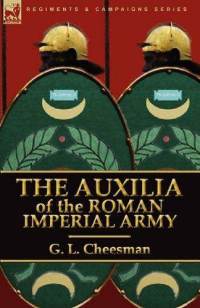
G.L. Cheesman: “The Auxilia of the Roman Imperial Army”

The author knows he is writing about something arcane and of little general interest. He does little to spruce up the writing — he at times seems to wallow in the details, perhaps getting a secret laugh out of boring his readers. My eyes glazed over more than once.

The book is thorough, but still brief enough for someone with just enough interest to glean some tidbits. I am far, far from having any comprehensive knowledge about Rome, but I wanted to read this to test a theory. Gibbon puts the fall of Rome essentially beginning after Marcus Aurelius. Others, like Toynbee put it far earlier. I tend to see it happening sometime after the 2nd and before the 3rd Punic War, and I wanted to see what Cheesman analysis of the Roman army had to contribute to this debate.

Early on Cheesman makes some interesting observations, namely that the imperial army was more versatile and specialized than any army of the Republic. This probably has do with the fact that they encountered different cultures and fighting styles as they expanded. They added cavalry (one may recall the serious weakness of the Roman cavalry when they faced Hannibal), usually getting them from far flung conquered provinces.  But no one would think that the Imperial armies were superior to say, those under Scipio Africanus ca. 210 BC. In other words, increasing complexity and specialization may not have been a sign of strength, but subtle weakness.  The increased specialization shows they had too many burdens in too many places around the globe to maintain a coherent fighting force with a fixed identity.

Also, Cheesman points out that many of the recruited ‘auxilia’ (auxiliary troops attached to the legions, recruited from conquered provinces) often rebelled against their new masters when stationed near their home territory. This could be fixed by shipping them elsewhere, but this created awkward burdens and costs involving transport.  Surely it also lessened the effectiveness of these auxiliaries, as they had to fight far from familiar territory.

The fact that Rome faced so many rebellions within its ranks tells me that Rome lost its mojo long before Marcus Aurelius, contra Gibbon. These rebellions came despite the fact that some emperors fast-tracked the path to rights and citizenship for many auxiliary regiments. They were being more ‘progressive’ in a sense, but it made no difference — things were not working as they used to for Rome. One need only recall the general solidity of their alliance system during the much greater stress of the 2nd Punic War to see this happening.

With more knowledge of Imperial Rome, more patience, and more military background I might have gleaned more from this work.  Still, one always likes their theories backed by neutral observers! So, my gratitude to G.L. Cheesman for his somewhat tedious, partially sleep inducing, yet still occasionally quite insightful book.

Dave

Every Sacrifice Needs a Witness

You will notice some dated references, as this post was originally written in the fall of 2020. The original is below . . .

****************************

I enjoy athletics, but since the lockdown last March I have watched zero hours of live sports. One might think that televised sports would act as a lifeline for people like me during these strained times, but my interest has markedly declined. But it’s not just me, apparently. Ratings have plummeted for live sports across the board. Here are some statistics:

  • US Open (golf) final round: down 56%
  • US Open (tennis) was down 45% and the French open is down 57%
  • Kentucky Derby: down 43%
  • Indy 500: down 32%
  • Through four weeks, NFL viewership is down approximately 10%
  • NHL Playoffs were down 39% (Pre Stanley Cup playoffs was down 28% while the Stanley Cup was down 61%).
  • NBA finals are down 45% (so far). Conference finals were down 35%, while the first round was 27% down. To match the viewership, activity on the NBA reddit fan community is also down 50% from the NBA finals last year.

So it’s not just the woke politics in some of our major sports that are driving people away. The above statistics are from blogger Daniel Frank. He suggests a variety of reasons for this decline, including the rise in mental health issues and political uncertainties that eliminate our bandwidth for consuming sports. He has other reasons, all of them thoughtful and possibly true, but I think he misses the heart of the matter.

My thoughts below should be, as Tyler Cowen states, filed under “speculative.”

Sports occupies a very large place in our civilizations bandwidth. The growth of the importance of sports, and the money associated with sports, accelerated on a national scale as a few different things happened over the last 50 years:

  • Growth of technology allowed people across the country to discover sports hero’s from other locales.
  • Beginning around the 1960’s a dramatic moral shift happened that eroded certain key foundations Tocqueville and others cite as necessary to support democracy, such as shared trust and a robust family structure.
  • Perhaps we can also cite the growth of suburbia as a factor eroding another key facet of healthy democratic life cited by Tocqueville–local neighborhoods and local institutions and customs.

So as things start to erode on a local and particular level, they homogenized on a national level. Sports benefitted from this, but its growth was necessary, in a sense, to account for the above trends. We lacked local means of conflict mediation on front porches, coffee shops, etc. Sports stepped into that void. Fundamentally, we can understand sports as a highly ritualized, liturgical, and controlled means of combat. For those two hours we can “hate” the team wearing the other jersey, but we know that we don’t really hate them. The liturgy of competition creates a parallel world where we can control conflict. We have all played games against friends–for a time they function as the “enemy,” then real life resumes. Bad sportsmanship means in part the inability to come back to the real world from the parallel world. Whether at cards, basketball, or the like–our competition serves as a way to mediate/navigate our relationships.

Without shared trust, without real communities, we need sports now more than we did 50-100 years ago.

But then–why did the ratings plummet for sports at a time when a need for controlled conflict mediation seems quite high?

If sports serve as a parallel liturgy of rivalry, we can see that this “conflict” gets resolved via sacrifice. Athletes, then, function in certain ways as priests of this liturgy. We expect them to “sacrifice” for the team, their time, their bodies, etc. Thus, they serve as “victims” in some ways of the liturgy. But in addition, at least our star athletes also control the liturgical space. They ask us to cheer, we cheer. When they complain to the ref, we join in with them–the ref’s call was obviously wrong–and so forth.

If a tree falls in the forest and no one hears it, does it make a sound? If you have a materialist-leaning view of the universe, the answer is an obvious ‘yes.’ You can ‘prove’ your point by recording the event with no one around, and then listening to the recording. You hear the tree falling and presto, you have your answer. But if you have something of an ‘idealist’ view of the world, as did Bishop Berkeley,* you answer in the negative. Is there “sound” on that recording? Can you carry around “sound” that you do not hear? It seems to me that for reality to be Real it requires perception.

This idea closely relates to the dictum in both Catholic and Orthodox churches (and perhaps others) that no priest can celebrate the sacrifice of the mass alone–though of course certain unusual exceptions allow for it. Many reasons exist for this restriction, but briefly:

  • The sacrifice of the mass is always for the people–the body of Christ, and not merely the priest.
  • The priest, representing Christ, cannot be the sole ‘beneficiary’ of the mass, just as Christ did not “benefit” from His own death (of course He does “benefit” in the end, but I trust all take my meaning).
  • The “power” of the sacrifice has to “land” to take form and reality. Without this “landing” the sacrifice has no power and no life to give.
  • The Head (Christ) must nourish the body. Just as we take in physical nourishment through our mouths, so too–what is the point of the sacrifice of food (for all food was once alive and now has died that we might have life) if we have no body? The food–which has already undergone death, will not be transformed into life for us, but rather, stay “dead” as it falls out of our throats onto the floor. Or to put it another way, maybe Berkeley was right about trees falling in forests all by their lonesome.

All well and good, but this fancy talk, some might say, forgets that the televised sporting events do have witnesses, both in person and at home. Most watched at home anyway in the first place before the virus hit. Very little has changed about how the vast majority of us consume sports now except the immediate social factors Frank listed above.

Well, I concede partially. But just as virtual church is not church, and a virtual concert is no real concert–a virtual sporting event is not a real sporting event. Anyone who has watched on tv senses this. The viewers themselves sense it, which is why teams pipe in crowd noise. It is a trick meant to fool those watching at home more than the players, I think. The “sacrifice” of sports needs a place to land within the “church”/arena. If it disappears into the ether, its power disperses with it.**

The ratings decline in sports confuse us only if we fail to see connections between liturgical worship and sports.

Dave

*I do not claim to understand more than the bare outline of Berkeley’s premises, and could not defend his general philosophy even if I wanted to.

**We can also consider the sudden collapse of Rome’s gladiatorial games in the mid-4th century. No question–one main factor had to be the rise of the Christian ethic. But the growth of the games themselves also had something to do with it. When one man fought one man in front of 50,000, whatever took place would be witnessed and participated in by all. But as the games grew in importance they grew in scope, and the cruelty of the games grew more random and bizarre. As the games (unknowingly) neared the precipice, dozens of men fought other dozens of others more or less randomly.

At that point, if you were a gladiator you could not be sure that anything that happened would be directly seen by anyone. One could kill or die with honor and dignity and who knows who witnessed it? If nothing is affirmed, nothing glorified, then why fight at all? With no glory possible, only chaotic death remains. Why would a Roman citizen want to witness a “nothing?”

To the Victor go Some of the Spoils

Many often declare that since, “To the victor go the spoils,” so too, that, “Victors write the history books.”  This pithy phrase assumes that historical narratives boil down to power, a concession to postmodern theory that I am loathe to make.  Aside from the debate over the theory, however, history itself will not confirm the statement.  Several examples exist to prove this point:

  • The Athenians exiled Thucydides but we read of the war that helped bring about his exile almost exclusively through him.
  • Athenian Democracy “won” by executing Socrates, but subsequent generations of readers learned Athenian democracy primarily through Plato’s eyes.
  • The triumph of the “imperial” system over the Republic in Rome became a fact of life after Augustus, but we think of that triumph foremost through the writings of Tacitus, a significant critic of most of the emperors.
  • The North won the American Civil War, but the Confederacy had a variety of champions shortly after the war and a variety of sympathizers today,

and so on.

As Tocqueville noted, mere physical force can control the body but often has the opposite impact on the soul.  The examples above demonstrate also that, contra the mundane postmodernist, shaping how we see the world has much more to do with our imagination that rote political force.

Jaroslav Pelikan’s The Excellent Empire disappointed me overall.  He is likely one of the few who could have possibly made a history of Christian doctrine an exciting read, and he did just that in his four volume work The Christian Tradition.  In The Excellent Empire he flashes his ability to deftly dance from text to text, but seems to get trapped into the detached tone of his main subject, Edward Gibbon, whose The Decline and Fall of the Roman Empire forms the backdrop of this book.

I give Gibbon much credit for his labors, his erudition, and for having a defined point of view.  Alas, he writes like a know-it-all, and I cannot buy into how he frames his narrative.  Pelikan seems to accept Gibbon’s perspective (or–is just playing a scholarly game, or am I too dense to notice something else?), and discusses how GIbbon’s perspective relates to Christian thoughts at the time from Sts. Jerome and Augustine, as well as a touch of Salvian and Orosius.

Gibbon’s work is an interesting examination of who gets the last laugh.

Roman contemporary critics of Christians viewed them as a drain on the Roman state, and in many ways enemies of the Roman state.  Jerome saw the collapse of Rome in the most starkly apocalyptic terms, and in the most anguished.  He compared Rome’s end to various passages from Revelation.  He saw Rome as ripe for judgement.  Yet, he grieved over their fall, seeing their end as the end of all things as he knew them.  Augustine took a more cerebral approach, which gained him some more penetrating insights.  He conceived of a Rome built upon shaky foundations from the start.  In one brilliant passage from Book 3 of The City of God he writes,

First, then, why was Troy or Ilium, the cradle of the Roman people (for I must not overlook nor disguise what I touched upon in the first book(2)), conquered, taken and destroyed by the Greeks, though it esteemed and worshipped the same gods as they? Priam, some answer, paid the penalty of the perjury of his father Laomedon.(3) Then it is true that Laomedon hired Apollo and Neptune as his workmen. For the story goes that he promised them wages, and then broke his bargain. I wonder that famous diviner Apollo toiled at so huge a work, and never suspected Laomedon was going to cheat him of his pay. And Neptune too, his uncle, brother of Jupiter, king of the sea, it really was not seemly that he should be ignorant of what was to happen. For he is introduced by Homer(4) (who lived and wrote before the building of Rome) as predicting something great of the posterity of AEneas, who in fact founded Rome. And as Homer says, Neptune also rescued AEneas in a cloud from the wrath of Achilles, though (according to Virgil (1))

“All his will was to destroy
His own creation, perjured Troy.”

Gods, then, so great as Apollo and Neptune, in ignorance of the cheat that was to defraud them of their wages, built the walls of Troy for nothing but thanks and thankless people.(2) There may be some doubt whether it is not a worse crime to believe such persons to be gods, than to cheat such gods. Even Homer himself did not give full credence to the story for while he represents Neptune, indeed, as hostile to the Trojans, he introduces Apollo as their champion, though the story implies that both were offended by that fraud. If, therefore, they believe their fables, let them blush to worship such gods; if they discredit the fables, let no more be said of the “Trojan perjury;” or let them explain how the gods hated Trojan, but loved Roman perjury. For how did the conspiracy of Catiline, even in so large and corrupt a city, find so abundant a supply of men whose hands and tongues found them a living by perjury and civic broils? What else but perjury corrupted the judgments pronounced by so many of the senators? What else corrupted the people’s votes and decisions of all causes tried before them? For it seems that the ancient practice of taking oaths has been preserved even in the midst of the greatest corruption, not for the sake of restraining wickedness by religious fear, but to complete the tale of crimes by adding that of perjury.

Such analysis gave medieval Europe a whole new foundation of political and religious ideology on which to proceed.

Rome attacked Christians for not giving themselves fully to the well-being of the state.  For the Romans, this might have taken the form of not giving due sacrifices to the emperor, or not joining the army.  Gibbon pointed out as well that the best men in the Church gave themselves to the Church, and not Rome.  Imagine a Rome where Athanasius, Jerome, Augustine, Ambrose, etc.–with all of their energy and intelligence–served as provincial governors instead of bishops.

Jerome and Augustine responded variously with how Rome had doomed itself to destruction via its sins, or how Christians were in fact the best citizens of Rome.  Their analysis won the day.  Monastics, for example, appear on the surface at least, to not contribute anything to the well-being of civilization.  But monastics would be honored in the west for the next 1000 years.  Their presence made no sense to either the Romans or to Gibbon.  The “social triumph of the church,” as Pelikan calls it, gave the Church the power of interpreting Rome’s history.  But I gathered that Pelikan thought Augustine and Jerome thieves, to a certain extent.*  Perhaps for Pelikan, Gibbon restored Rome’s vision of itself back to the stream of history.

Augustine and Jerome appeared to be the victors in the 5th century A.D. and beyond, as the Church had a strong hand on shaping the next millennium.  But historical spoils can be slippery things.  In an irony that perhaps not even Gibbon might have foreseen, today’s Christians, having abandoned much of the otherworldliness of the Church of the 5th century, may find more congeniality with Gibbon’s interpretation as opposed to Augustine’s.  What modern mega-church leader, for example, would tell anyone to become a monk?  We have our eyes set on this world and have no concept of how to patttern ourselves after the heavenly realms.  Some may applaud this.  But without the worldview of Augustine and Jerome we may find ourselves wishing, along with Gibbon, that St. Augustine had served as proconsul of Alexandria.

DM

*I could be totally wrong here.  Part of the difficulty I had with this book was I felt that I was reading a different Pelikan than the one I encountered in The Christian Tradition.  I had assumed that The Excellent Empire was written before this series, because its tone seemed more distant to me, less committed to the idea of truth than The Christian Tradition.  I knew that Pelikan had converted to Orthodox Christianity in 1998.  But I had somehow thought (how I thought this I’m not sure) that The Christian Tradition was written during/after his conversion, when in reality the early volumes stretch back to 1973, and the last volume predates his official reception into the Church by eight years.

This could mean that

  • I have misread Pelikan entirely in The Excellent Empire
  • Pelikan is deft at hiding his particular point of view from the reader and is simply examining certain points of view in a more detached way.
  • He does admire Gibbon (which is understandable) and agrees with Gibbon that Christians really did bring down Rome from the inside out.  This stance is not Augustine’s or Jerome’s, but it is certainly not an anti-Christian idea in itself.  Nebuchadnezzar’s first dream may hint at this (Daniel 2).  Perhaps I am too ingrained in my distaste for Gibbon’s pompous Enlightenment attitude to see that, despite this weakness, he may have been right after all about the Church’s relationship to Rome.


11th Grade: “Fire all of Your Guns at Once”

Greetings to all,

This week we began the actual battles of the Civil War.  In previous years we tended to look at battles as isolated incidents unto themselves.  Last year, I wanted to begin to broaden their understanding of conflict at a deeper level.  We started to do this somewhat when we looked at Napoleon towards the end of last year, and we continue to deepen our understanding as they go farther in the rhetoric stage of learning.

I wanted the students to consider the following:

Who had the most important advantages in the conflict?  The traditional view usually argues that the North, with its larger population, established economy, and industrial might had the edge.  The picture below, for example, shows the differences in respective railway capacity:

Recently, however,  scholarship has tended to see the South as having the strategic edge.  After all, they merely had to ‘not-lose.’  The Union not only had to win, but win to such an extent that the South would not consider secession again.  The South also had a huge amount of territory, along with the psychological edge of defending their ‘homeland.’  A quick glance shows us that the Civil War had some of the same dynamics as the Revolutionary War, with the Americans playing the role of the Confederacy (to some extent) and using their advantages to victory in that conflict.  The North certainly had its hands full.

These respective advantages did not come about via magic, but by the accumulation of various conscious and unconscious choices made by each society.  The South, for example lacked industrial capacity in part because they wanted to avoid the inevitable cultural and political changes that come with industry.

Related to the idea of cultures, I wanted the students understand a few of the dynamics present in the conflict.

For the South:
We discussed that the South’s main advantage was that it could play on the defensive, play up their psychological ‘home field advantage,’ and merely, ‘not lose’ the war.  They would also have to be careful with resources.  They would not want to cede ground in this area to the North, as the North could easily overmatch their industrial production.

So far, so good.  But one of the tensions in this conflict would be how this strategy would fit with the notions of honor usually prevalent in more aristocratic, honor oriented societies.  De Tocqueville reported a conversation that surprised him in his travels in the South in the late 1830’s.  Even for a Frenchmen, the sense of honor he encountered surprised him.  While on a train, he asked the following of a gentlemen next to him. . .

Q. Is it true, then that people in Alabama are as accustomed violence as is said?

A. Yes, there is no one here who doesn’t carry weapons under his clothes.  At the slightest quarrel he’ll have a knife or pistol in his hand.  These things happen constantly, the state of society is half-barbarous.

Q. But when a man kills another like that, isn’t he punished?

A. He’s always brought to trial, and the jury always acquits.  I don’t remember a single man who was at all well-known to have to pay for his life for such a crime.  Besides, I’m no better.  Look at all these wounds [showed the traces of 4-5 deep scars].

Q. But surely you lodged a complaint?

A. My God, no!  I tried to give back as good as I got!

For the North:
No one doubts that there immense advantages of men and material, coupled with the need not just to win but really pulverize the South, should have committed them to a long term ‘anaconda’ like strategy.

But Lincoln, initially at least, eschewed this path, largely because of how he saw secession.  He believed that secession resulted from the manipulation of a wealthy elite — that the average southerner wanted back in the Union, but had been temporarily deluded.  He felt, therefore, that he needed a quick and dramatic victory to prevent the concrete of secession from settling, so to speak.  This victory would also serve as a kind of smelling salt to wake up the south, and bring them back into the fold.

Union General Irwin McDowell told Lincoln that the army stood nowhere near ready for offensive operations, but Lincoln’s political beliefs pushed McDowell to go for a quick victory.  “If you are green, so are they,” he reportedly told McDowell.  But of course, offensive maneuvers are always much more difficult than defensive ones, and the disaster of the Battle of Bull Run ensued, when the Union forces crumbled into nothingness.

Lincoln misjudged the South badly here.  Secession, as we saw last week, was supported by most Southerners, and one victory would not have swung the tide in any case.  Victory, if it came, would have to mean a longer, more rigorous, and grinding conflict.

Bull Run shows that the outcome of battles almost always has deeper roots than the fighting itself, and I hope the students saw this in class.

The President of the Confederacy, Jefferson Davis, also wanted compromise at the beginning of the war.  For example, he offered mid-western farmers the use of the Mississippi and pledged them access to New Orleans.  He, like Lincoln, figured that the Union did not really want to go through the trouble of war, and one quick victory would show them the folly of their ways.

But Davis, like Lincoln, misjudged his opponent.  For many in the North the issue went beyond economics or jilted pique.  Many felt at the time that democracy itself would be considered an international and historical failure if secession worked.  If Constitutional democracy meant one leaves the moment things don’t go your way, democracy had no future.  Secession would only serve as the first step in a broader conflict that would only serve, in time, to make America just like Europe, where wars broke out at regular intervals.  The misperceptions of both sides meant in part that the early phase of the war had little overall strategic effect.

When we remember that both the Puritan revolutionaries in England, and the more Enlightenment oriented philosophes in France, both entirely failed to bring about constitutional democracy, this attitude makes more sense.  In 1861 only England, of all European nations could claim some kind of viable democracy.

From the beginning then, Lincoln had a “cause,” or a grand ideal to fight for, but it was abstract.  In time, he would seek to transform the war even more, turning the nation’s eyes toward the slavery question.  This will give the North something more tangible to fight over.  Next week we will examine this as well as Lincoln’s attitude towards the Constitution.

Many blessings,

Dave Mathwin

The Augurs of the Temple

In my 8th grade ancient history class one of the great questions of the year involves whether or not one believes that Greece or Rome was the superior civilization.  The students usually get into heated discussions on the issue and seem quite excited by the question–until they discover that they have to write a long essay about it for the final exam.  Somehow, this dampens their ardor.

Comparisons between Greece and Rome can always yield fruit.  Each civilization has significant primary source documentation.  Their development overlaps and departs at points like a figure eight.  Both civilizations had similar climates, were right near the Mediterranean, with mountains forming a large part of the topography.  Both civilizations started out a city-states and transitioned from kings/tyrants (in the technical sense of the word) to a republic/democracy at almost exactly the same time.

But despite these similarities, Rome grew into one of the largest global empires of all time and Greece stayed within its narrow confines for the vast majority of its history and never expanded as Rome did.  I thought of this question recently because Michael Rostovtzeff raised it in the early pages of his book on Rome.*  He saw more similarity between Greece and Rome than others, and so had to account for the differences in their historical development in ways that those who see more difference between the two could ignore.

I agree with Rostovtzeff’s rejection of purely mechanical or physical explanations.  Some argue that geography can explain the difference.  Greece’s geography hemmed them in and forced the creation of independent city-states, whereas Italy’s geography allowed for more expansion.  But Rostovtzeff points out that both areas had relatively the same interaction with mountains and the Mediterranean.  Italy’s soil had an advantage, but not a great enough advantage to explain Rome’s expansion.  And while Greece’s topography had more mountains to contend with, occasionally certain city-states built empires, showing that geography itself cannot explain the difference.

He then goes on to assert that we can explain Rome’s expansion, and Greece’s relative lack of territorial expansion, to the following:

  • Rome had a better political structure, which allowed for more effective and consistent mobilization of the population, and
  • Rome’s political changes came slowly, which prevented shocks to the system that would inevitably derail or delay a civilization’s growth.  Such shocks could be compared to long bouts of illness in an individual.

I certainly prefer these explanations to geographical explanations, but I feel one needs to go deeper.  Politics flows downstream from culture, and culture from religion, and it is here that I feel the answer must lie.  To get at religious differences we need to look not at particular beliefs or religious rites, but what those beliefs and rites point to.  To get at that question, we need to examine their mythologies, for if nothing else, it shows us how they perceived themselves and gets at their motivations.

On the surface of things Greece and Rome look much alike, but their myths tell a different story.  The story of Pygmalion and Galatea, for example, reveals the Greek passion for perfection.  Pygmalion eschews women because none he sees truly merit his affection.  He carves his thoughts into a perfect stone sculpture, and Aphrodite rewards him for his devotion by having the statue come to life, and they live happily ever after.  We see this pursuit of perfection in other areas of Greek life, in the Parthenon, in their mathematical idealism, and so on.

When Livy writes of Rome’s early days he recounts how Romulus and the early founders of Rome–all men–needed women. So they come up with an idea of a religious festival and invited young ladies from the Sabines. When they came they abducted and forcibly marry them.

When the hour for the games had come, and their eyes and minds were alike riveted on the spectacle before them, the preconcerted signal was given and the Roman youth dashed in all directions to carry off the maidens who were present. The larger part were carried off indiscriminately, but some particularly beautiful girls who had been marked out for the leading patricians were carried to their houses by plebeians told off for the task. One, conspicuous amongst them all for grace and beauty, is reported to have been carried off by a group led by a certain Talassius, and to the many inquiries as to whom she was intended for, the invariable answer was given, “For Talassius.” Hence the use of this word in the marriage rites. Alarm and consternation broke up the games, and the parents of the maidens fled, distracted with grief, uttering bitter reproaches on the violators of the laws of hospitality and appealing to the god to whose solemn games they had come, only to be the victims of impious perfidy.

The abducted maidens were quite as despondent and indignant. Romulus, however, went round in person, and pointed out to them that it was all owing to the pride of their parents in denying right of intermarriage to their neighbours. They would live in honourable wedlock, and share all their property and civil rights, and – dearest of all to human nature – would be the mothers of freemen. He begged them to lay aside their feelings of resentment and give their affections to those whom fortune had made masters of their persons. An injury had often led to reconciliation and love; they would find their husbands all the more affectionate, because each would do his utmost, so far as in him lay, to make up for the loss of parents and country. These arguments were reinforced by the endearments of their husbands, who excused their conduct by pleading the irresistible force of their passion – a plea effective beyond all others in appealing to a woman’s nature.

The tenor of this story fits well within the framework of the rest of Livy’s work.  The story of Romulus and Remus, for example, has some of the same heroic qualities as in the founding myths of other civilizations.  But the story have Romulus kill his brother Remus in a fit of temper for a minor dispute, and the tale takes little pains to justify the deed.

I think that Livy has more actual history in him than others might, but even I would not say that Livy writes history as Thucydides wrote history.  So we must consider why Rome’s foundational stories have this different feel and emphasis.  Two possibilities present themselves:

  • The key to Rome’s greatness comes from the fact that they did not whitewash things.  They called a spade a spade.  They did not hide the truth about themselves, and so they were much better equipped to deal with reality than those around them
  • The key to Rome’s greatness comes from the fact that, not only did they not hide their warts, they reveled in them.  In fact, stories like the Romulus/Remus story would not have been viewed as a black spot on their past, but rather, a positive good.  Of all the soft civilizations that surrounded them, Rome and Rome only did what needed to be done.  Rome understood, just as Machiavelli understood, that states need founded by one man, and one man only.  Either Romulus or Remus would have to go, twins or not.

I favor the second option.  If we imagine that Rome’s founding myths and folklore follow the general pattern of most every other civilization (the U.S. included), we should imagine that these stories reflect something of an idealized version of themselves.

Some years ago in our 8th grade ancient history class, a student made a striking comment as we discussed exactly what Rome “meant” by their multiple conquests.  What drove them to expand?  Rome’s religion technically forbade offensive war, and yet Rome never lacked a justification for war when they felt they needed one.  The student suggested that the Romans were not unlike the Assyrians.  The Assyrians conquered (in part at least) as an offering to Ashur, their god of war.  The Romans (though certainly not as rapacious or cruel as the Assyrians) conquered as offering to their god as well, except their god was the city of Rome itself.  Greece could occupy itself with abstractions like ideal perfection but Rome remained very physical in their orientation throughout.  Their god was literally made visible all of the time.  Thus, this physical orientation would require very tangible applications.

Perhaps the key to Rome’s expansion vis a vis Greece lies here.

Machiavelli recorded an intriguing anecdote on Roman religion:

Auguries were not only, as we have shown above, a main foundation of the old religion of the Gentiles, but were also the cause of the prosperity of the Roman commonwealth. Accordingly, the Romans gave more heed to these than to any other of their observances, in undertaking new enterprises; in calling out their armies; in going into battle; and, in short, in every business of importance, whether civil or military. Nor would they ever set forth on any warlike expedition, until they had satisfied their soldiers that the gods had promised them victory.

Among other means of declaring the auguries, they had in their armies a class of soothsayers, named by them pullarii, whom, when they desired to give battle, they would ask to take the auspices, which they did by observing the behaviour of fowls. If the fowls pecked, the engagement was begun with a favourable omen. If they refused, battle was declined. Nevertheless, when it was plain on the face of it that a certain course had to be taken, they take it at all hazards, even though the auspices were adverse; contriving, however, to manage matters so adroitly as not to appear to throw any slight on religion; as was done by the consul Papirius in the great battle he fought with the Samnites wherein that nation was finally broken and overthrown. For Papirius being encamped over against the Samnites, and perceiving that he fought, victory was certain, and consequently being eager to engage, desired the omens to be taken. The fowls refused to peck; but the chief soothsayer observing the eagerness of the soldiers to fight and the confidence felt both by them and by their captain, not to deprive the army of such an opportunity of glory, reported to the consul that the auspices were favourable. Whereupon Papirius began to array his army for battle.

But some among the soothsayers having divulged to certain of the soldiers that the fowls had not pecked, this was told to Spurius Papirius, the nephew of the consul, who reporting it to his uncle, the latter straightway bade him mind his own business, for that so far as he himself and the army were concerned, the auspices were fair; and if the soothsayer had lied, the consequences were on his head. And that the event might accord with the prognostics, he commanded his officers to place the soothsayers in front of the battle. It so chanced that as they advanced against the enemy, the chief soothsayer was killed by a spear thrown by a Roman soldier; which, the consul hearing of, said, “All goes well, and as the Gods would have it, for by the death of this liar the army is purged of blame and absolved from whatever displeasure these may have conceived against it.” And contriving, in this way to make his designs tally with the auspices, he joined battle, without the army knowing that the ordinances of religion had in any degree been disregarded.

But an opposite course was taken by Appius Pulcher, in Sicily, in the first Carthaginian war. For desiring to join battle, he bade the soothsayers take the auspices, and on their announcing that the fowls refused to feed, he answered, “Let us see, then, whether they will drink,” and, so threw them into the sea. After which he fought and was defeated. For this he was condemned at Rome, while Papirius was honoured; not so much because the one had gained while the other had lost a battle, as because in their treatment of the auspices the one had behaved discreetly, the other with rashness . . .

Machiavelli surmises that the Romans wisely manipulated their religion to serve their political or cultural needs.  I agree as far his explanation goes, but I think we can go one further.  The Romans had a conscious religion of oracles, auguries, and the like, but a deeper, perhaps even unconscious religion of worship of their city itself.  I’m not so sure that Appius would have received censure had he been victorious.

I remain grateful to this student, who years ago helped me see the history of Rome in a new light.

Dave

*Though it has little to do with the post above, I cannot resist commenting on some reviews of Rostovtzeff’s work.  He emigrated from Russia shortly after the Russian Revolution.  His experience of events in Russia certainly impacted his analysis of Rome, where he saw the decline of the Republic in terms of 1) Too much change too quickly, and 2) Given the size of Rome, too much power shifted into the hands of too many (he felt that democracies needed to be small in size to work well).

Some dismiss him out of hand, because, obviously, his experience in Russia strongly colored his analysis of Roman politics.  Well, ok.  But a man is surely more than his influences.  What of the merits of Rostovtzeff’s analysis?  It can be debated, but his interpretations is hardly crazy, or such an obvious byproduct of personal experience that it has nothing to do with the evidence.  These same reviewers, I’m sure, would not want their own work subjected to the tests they used for Rostovtzeff.

Though C.S. Lewis’ original discussion of the “personal heresy” applied directly to poetry, I think it applies also to works of history as well, which are acts of creation somewhat akin to poetry.


11th Grade: Lord Grantham vs. the 49ers

Greetings,

This week we looked briefly at the California Gold Rush of 1848-49, where I want to touch on a few different issues:

1. The link with land and opportunity

Americans since early colonization often associated this country with opportunity – be it economic or religious in nature.  The Gold Rush did not present the lure of an easy life with easy riches.  Travel was long and dangerous, finding gold was not guaranteed, nor could you be sure to protect your claim.  Still, the possibility of changing your circumstance, of making something for yourself, proved irresistible to thousands.  The idea of opportunity has always been powerful for Americans. Often this idea of opportunity was linked with land.  We talked last year about how absurd the Americans must have seemed to the British with our near obsession for land.  After all, even before the Louisiana Purchase we far exceeded England in terms of size.  Today we still link home ownership, for example, with independence.

We can trace part of the difference in our approach to land in the different cultures.  In England many lived and worked due to the patronage of a benefactor, usually someone in the aristocracy.  In America the idea of patronage ran counter to our “do it yourself” mindset of personal independence.  There is a lot to say for our attitudes.

But we should not view this European mindset as mere laziness.  Many felt that if one had the means to hire a maid and a gardener, you had a duty to hire them and provide jobs.  It could be considered part of the duties of one’s “station in life.”  At its best, this mindset produced a sense of community and mutual responsibility. Mrs. Mathwin was a big fan of Downton Abbey, and I saw one scene where Matthew (who feels that all the servants are waste of time and money) is upbraided by Lord Grantham, who asks Matthew to think about where the butler will go if he had no job at Downton.  The best aristocratic tradition saw having servants as a means to provide for others.  But without a “benefactor class” in America, individuals had to make their own way, and land always played a key role in making that happen.

It is this belief in independence and opportunity that led many to oppose slavery who were not necessarily generous in their attitude to blacks.  This attitude can be just as puzzling to us today as those who favored slavery in the name of liberty.  But many Californians opposed slavery because slavery represented being rich enough to hire someone else to do your dirty work.  In this line of thinking, slavery stood against the “do it yourself” ethic inherent in the 49ers, and so stood against the idea of independence and liberty.  But we should be careful of thinking too highly of their motives.  Again, many of them had no love for blacks per se, however much they opposed slavery.  Others in the North shared this same attitude.  Unfortunately, strict abolitionists were a distinct minority.

2. Institutions Travel

It is probable that many of the 49er’s simply thought of themselves as seeking their fortune.  But institutions and economies would inevitably travel with them.  With money came the need to protect it, and for that you ultimately need political institutions (unless you would prefer lawlessness and spoils going to the strongest).  In our own Gold Rush Game played this week, students probably let the ‘individualism’ of the game go too far, and their hesitancy to form towns led to many of them being ‘killed’ by a rich outlaw.  The game will have to be tweaked a bit more next year to give more incentive to the formation of banks and towns.

3. Cultures Linger

As a curious side note, the names of the towns created by the Gold Rush reveals a lot about the people there.  In contrast to much of the rest of the county that named towns with European associations (i.e. New York), Biblical references (i.e. Providence, Rhode Island), virtues (Philadelphia) or a virtuous past (i.e. Cincinatti for the Roman Cincinattus, and Columbus, Ohio).  Gold Rush towns had very different names like Devil’s Thumb, Rough and Ready, Hangtown, etc.  Clearly, many came to California with entirely different goals and outlook than those that settled North America initially in the 17th and early 18th centuries.  There are those that say that California today marches to a different drummer than other parts of the country, and clearly this has its roots dating to the Gold Rush. The culture of a particular place will often have deeper roots than we think, and our actions have longer ripple effects than we usually imagine.

I will look forward to updating you next week, when we delve deeper in the slavery question and other issues that began to split the country in the 1850’s.

Dave Mathwin

Lost in the Cosmos

(For those interested, check out the Grumpy Old Man podcast on this same topic here.)

*********************

We all know the Chinese saying, “May you live in interesting times,” and we now fully understand why they regarded it as a curse. But we should look for the silver linings whenever we can. Our normal customs give us the advantage, as Edmund Burke argued, of not having to think about the myriad of everything all the time, freeing us for hopefully finer pursuits. Perhaps the one advantage of strange times is that it allows us to either more deeply understand and affirm basic assumptions (such as our need for meaningful human interaction), or to question them and see how strange they might be. If we are unmoored, maybe we might reach something better than we knew before.

Maybe.

Few would doubt that the two greatest Catholic southern writers of the 20th century were Flannery O’ Connor and Walker Percy. O’Connor took her normal, everyday characters, and confronted them with something strange to jolt them out of complacency. Walker Percy, to my mind, went one better. He took normal people in normal situations showed how how strange the ‘normal’ really was. This was his great accomplishment in Lost in the Cosmos: The Last Self-Help Book.* It seems that Percy (who had medical training) wanted to administer a kind of shock-therapy for his readers He induced trauma to help us recover equilibrium.

Percy administers this shock of sorts through very simple questions, such as:

  • When yearbooks are handed out, why does everyone look to see how many pictures they are in? Don’t we know what we already look like?Why do we all also not want anyone to know that we are doing this if everyone is indeed doing it?
  • Why do we value antiques? Why do we seem to exhaust the meaning of things? Did past eras value antiques? Would a 17th century gentlemen want something from the 12th century more than his own time?
  • Why do we have so many different versions of selves in the modern world?

Percy also includes this conversation he had with someone recalling the Kennedy assassination:

I remember that I was watching the soap opera As the World Turns. There was a scene between Chris and Grandpa, and I remember that particularly because I saw something scroll on the bottom of the screen that shots had been fired at President Kennedy. I remember thinking how insignificant the soap opera seemed in relation to what was happening in Dallas.

But before you saw that message, the soap opera seemed much more important than Kennedy’s visit to Dallas?

Yes.

And, afterwards, did you resume watching the soap opera?

Yes.

Lost in the Cosmos contains a section on semiotics in the middle of the book that I found too difficult, and some short fiction on some of this themes at the end of the book, but for me the heart of the work lies in the first 50-70 pages. Percy may intend to lean us towards particular answers, but mostly he remains content to ask the questions of meaning the self in the modern world (I include more excerpts in the postscript).

Many now recognize that we are disconnected now, but think that it is only the particular circumstances we face in the moment that creates this, i.e., masks, social media, polarization, and so on. I grant that this has a part to play, but I would like to go deeper and suggest that we are alienated from ourselves because the modern world alienates us from reality in general.

First some of the particular and surface elements of our discontent . . .

We like to assume that every technology occupies neutral space. It is neither good or bad, for us or against us. But surely, the way we interact with a technology will change us, and not all change is neutral. Working a hoe or hammer might give you stronger shoulders or forearms. Social media attempts a daring exploit. We know that communication works best when we use our whole being, which involves our bodies. Face to face we catch expressions and subtleties we would miss over the phone. Over the phone, we at least get voice inflections, and presumably speak with someone we know.

Facebook, Twitter, etc. attempts to gather all of our communicative apparatus and squeeze it through the eye a needle. Obviously, this fails–the narrowing of our being in our communication modes always narrows our ability to communicate effectively. Alienation and confusion result–“Why is everyone so angry on Twitter?” is because it is impossible to be a whole self on Twitter. We are unmoored when using this kind of communication and perhaps subconsciously rant against not so much the politics we disagree with but the fact of alienation itself.

Many have commented on this already, and perhaps we are learning this as a society, but alas–we are learning slowly.

We have paid less attention to the deeper nature of the right and the left, which also contributes significantly to the problem.

The “right” and “left” as categories of thought and being go far back into the earliest civilizations. There is a profound Christian tradition linked to this reality, which others have spoken of much better than I ever could. Perhaps its modern political derivations have their roots not in the Christian tradition, but in Greek tragedy, and how one reacts to Fate. The “Left” in such works argues for striving against established order. One need not accept everything just as it is. We can work to better our lot in life and the lives of others–the structure of things can alter. The ‘Right’ talks of acceptance and working within established norms, for to challenge them is to challenge divine order and invite even greater chaos–a kind of “nemesis.”

Both the “Left” and the “Right” have their place. I doubt even the staunchest conservative would object to the invention of glasses, for example, which does better one’s “natural” condition. But those on the left too have to understand at least some limits imposed by Nature, i.e., night cannot become day, winter will never be summer.**

The Greeks sought a mediator between these two poles and perhaps never found it. We too need such mediation. Percy hinted at how we are alienated from ourselves. It goes deeper–we are alienated from creation as well. I won’t make a direct case for the Christian perspective on Creation and the our expulsion from Paradise here. For our purposes we not that most every culture has creation myths that resemble the Christian story in some way. Since the Fall, perhaps a natural tension exists between night and day, earth and sea, and men and women. But we have forgotten that mankind was placed on earth in part to reconcile and mediate these polarities back to God. Men and women are reconciled through marriage.^ Indeed–life itself can bring a kind of trauma. Our broken state can be repaired, but not through ideology, but instead, the recreation of the world and ourselves through liturgy.

What was lost, can be found.

Dave

*There is a section in the book about a theory of language/semiotics that Percy admits will not satisfy the scholar and could be too ‘high’ for the layman. I reside in the latter category, and will not comment there.

Perhaps one day . . .

**There is a curious flip on certain issues that only highlight the strangeness of our times. The Left seems, on the one hand, to grant maximum autonomy for individuals to rebel against the ‘fixity’ of human biology. Pregnant? Get an abortion. You’re a man but you think you should be a woman? Take hormones and get surgery. But with non-human nature many are staunch conservatives. Climate change is bad for the modern left at least in part because of the change it brings to nature, which should be protected from alteration. Their attitudes hearken back to pre-modern ideas that sought harmony, not growth.

The Right on the one hand promotes traditional family values. On the other, they advocate for an economic system geared towards maximum individual autonomy and disruption of tradition. Marx, for example, supported capitalism and democracy because he saw them as weapons against traditional values and practices, which would have to go in order for the proletariat revolution to come about.

We don’t want people who are entirely either right or left. At least, our society cannot handle too many on either extreme. Of course we need some kind of harmonization of the two within our own persons as well as in society. What puzzles me is how those on both sides hold oil & water types of beliefs that have no internal coherence that I can discern.

^A hint as to why, if you think of marriage as an image of cosmic reconciliation, marriage requires priestly mediation.

And now . . .

Lost in the Cosmos Excerpts

(What follows is 95% copied from Percy’s book, which I have tweaked in parts for more accessible student use).

Which of the following selves, if any, do you identify with?

The Cosmological Self

The self is unconscious of itself only insofar as it can identify itself with a cosmological myth or classificatory system.  For example, ask an LSU fan at a football game who they are, and they may reply, “I am a tiger.”

The Hindu/Buddhist Self

My self is impaled on the wheel of non-being, obscured by the veil of unreality.  But it can realize itself by plumbing the depths of self until it achieves nirvana, or absorption and destruction into nirvana, or the Atman.

The Authentic Self

A more modern and secular version of this might run, “My self is buried somewhere within me, caked over with customs, habits, etc. that are not truly my own.  I become a true self by my choices which may involve rejecting all traditions, norms, and if necessary, even Nature itself to become who I am truly supposed to be.

The Role Taking Self

We become a ‘self’ by taking on certain roles, as a mother, a lawyer, a mechanic, a macho-man, an ‘independent woman,’ and so on.  When ‘in action’ within these roles, we feel ‘actualized’ and ‘alive.’

The High School Graduation Speech Self

You are created with certain rights and the freedom to pursue happiness and fulfill your potential.  You achieve your potential through participation in society via family, work, political engagement, and so on.  This happiness can be pursued and eventually caught.

The Diverted Self, or the Woody Allen Self

Our “selves” are in fact unbearable.  That is–we cannot make anything of the “self,” either because the idea of the self is  too light and insubstantial, or too heavy, for us to comprehend. The path to happiness is, frankly, diversion, or escape from the self.  Thankfully, we live in a time when endless diversion is easily accessible.

The Free Self in Bondange

The rational pursuit of happiness that Jefferson espoused has become a flaky emptiness in our time.  Every advance of objective understanding  of the Cosmos, and the technologies we invent to gain that understanding, distances the self from the Cosmos precisely as far as we advance in understanding the physical world.  The self, then, roams like a ghost through the Cosmos which it happens to understand very well.  Thus, the self is free in a sense through its understanding of its predicament, but is powerless to do much about that predicament.  

The Abandoned Self

The self only achieves ‘actualization’ by abandoning itself utterly to some goal or task.  Think of the fevered artist, possessed by a sculpture they must finish, or the scientist who must complete the experiment at all costs.  

Would a Christian conception of the self be like any of these?  Which of the above is perhaps the furthest away from a Christian view of the self?

*****************

Amnesia

In many soap-operas of the late 20th century, amnesia was a favorite plot tool.  A character would experience a trauma, and suddenly not know who they were.  The world for them became at once hostile and confused, but also, re-enchanted.  With the slate clean, anything was possible–you have a new lease on life and the self.

But this plot device is not confined to old soap-operas.  The James Bond series of movies fits this in some ways.  With each movie, reality is reset–new bad guys, new women, new locations to visit, etc.  In these scenarios, previous excitement, trauma, encounters–none of them really move or shape the character.  

Question: Is “amnesia” a favorite plot-device because 

  • The character in the story is sick of himself and needs a change, a reboot
  • The writers are sick of their characters
  • The writers are sick of themselves and they need a change
  • The viewers long for the same amnesiac-like experience and they want to experience this vicariously through the characters.
  • All of the above?

Things and Their Meaning

Pick up a home decor magazine, or watch one of the home decoration shows that are always playing in dentist’s offices, and you will note that we have a penchant for making simple things out of unusual objects.  What I mean is–a coffee table can usually not be a normal coffee table.  It is has to be 

  • A tree trunk made of cypress wood
  • A vintage Coca-Cola crate
  • An old lobster trap
  • A large, flat rock

In other words, a coffee table can be anything but a board of wood with four legs.  

Why has this happened?

  • Because we are tired of ordinary tables, and we need novelty
  • Because to feel like a self, we must distinguish ourselves from other selves in some way  
  • Because an unusual table is a great conversation piece, a way to break the ice with company
  • Because it is good to recycle older things into newer uses and to repurpose their meaning
  • Because the older thing comes from a time of greater coherence and ‘weight,’ possession of such objects seems to give ourselves more substance and ‘weight.’
  • Because the modern self is voracious and consumes meaning.  We continually need to expand, like the feeding vacuole of an amoeba seeking to nourish itself with new objects, but like a vacuole, only in fact empties them.  

Consider to what extent an antique is prized.  Is it because

  • It is  beautiful and wonderfully made

 or

  • Because it is saturated with another time and place, and therefore resistant to absorption by the self?  After all, things resistant to absorption by the self have a higher degree of power to form the self. 

or . . . because the older thing comes from a time of greater coherence and ‘solidity’ unlike our modern plastic age.  Thus, possession of such objects seems to give ourselves more substance and ‘weight.’

Has mankind always been like this?  Would someone of the 14th century prefer something of his own time, or something from 4th century Rome?

**************

The Self Amidst other Selves

Imagine that you are at a dinner party in a beautiful, urbane setting.  You have wonderful food and drink to consume.  You are at the party alone and are standing near another person whom the host “thinks you should meet.”  You oblige your host and go to talk to the eligible young man/young woman, but quite frankly, after about 3 minutes you think the person is boring and you are not that interested.  You are in a room by yourselves, with nothing to interrupt conversation should it occur, but things are going nowhere and getting awkward quickly. You know that the host will make sure you are alone for at least another five minutes (they are really hoping you hit it off) so extracting yourself from the conversation will not be possible without a lot of awkwardness.  

Or

Imagine that you are at that same dinner party, and have just been introduced to the same person.  You have said ‘hello,’ you’ve known them for literally about 5 seconds.  Suddenly, an earthquake strikes and much of the house collapses.  Thankfully you both suffer only minor scrapes, and it seems that everyone else is more or less ok also.  But–you are pinned underneath some rubble about 3 feet away from each other and will have to wait about 30 minutes for help.

Which situation would you prefer?  Under which scenario is a good conversation more likely to occur?  

***************

Imagine that you are a movie star, say Robert Downey, Jr., or Emma Stone, and you have to stop in a small town to buy some food.  Which is the greater fear?

  • That the townspeople will recognize you, that they will detain you for 20 minutes or more, make you take selfies with them, you will have to sign autographs, they will expect you to say something funny or memorable, because they will tell everyone about meeting you, etc.  You will have to be “on” for them.

Or

  • That no one will recognize you at all, and, in fact, you hear someone criticizing one of the movies you were recently in, a movie you thought was actually quite good.

***************

Imagine . . .

You wake up with some dread.  You have to make a big speech today, and you aren’t really prepared. You also have a physics test coming up, and you suppose you will fail that as well. You are nervous, and haven’t slept well recently. Things seem to be slipping in general–there was the argument with your friend last week and you haven’t really ‘made-up’ after that.

As you walk out of the house, a crazy person pulls up in his car and shoots you.  He speeds off, but hits a fire hydrant and is apprehended by the police.  The ambulance comes and helps you.  You are in pain, but your mind is clear.  People gather around and give you encouraging words.  You make a few witty remarks to the EMT’s helping you, and people laugh. Your mom comes out terribly anxious, but you quote President Reagan back to her when he was shot–”Sorry, mom, I forgot to duck.”  You notice the amazement of onlookers at your wit and presence in the moment. They whisk you away to the hospital.  You will survive, the bullet missed everything vital, though of course you will have a long recovery.

As far as school goes, of course the speech and the test are waved, as is a lot of other schoolwork.  Your estranged friend, feeling bad, apologizes to you and your relationship is restored.  People from school come to visit you, and stories are told of how you responded to the terrible incident with bravery and charm.  

Is this

  • Unreservedly bad news.  You have been shot and that is a terrible thing. There will be some minor damage you will carry in your body into old age. Not to mention–the person who shot you will of course suffer, via arrest, institutionalization, etc.  This is also bad for him–physically and spiritually.  You both would be much better off if he did not shoot you.

Or

  • Relatively bad news.  All of the above is true, but the incident seems to have reset your life entirely in your favor.  People view you differently now.  

***********************

Anxiety and Depression

Many have remarked that people, and especially younger people, seem more anxious and disaffected than at any other time in recent memory. Why might this be?

Pick one or more

  1. Because modern life is more difficult and anxiety producing than during other times in the past.
  2. The young have always been anxious and whiny.  There is no crisis.  We just have many more ways to measure things now. People did not used to want to know how everyone was feeling, and we had far fewer ways to express our thoughts.  In fact, by talking about it so much, we create the problem.  Back in the old days, the young would be anxious, but just then be told to get over it and get back to work.
  3. Because for men, there has never been a time when your role in the world seemed so unstable.  People talk of ‘toxic masculinity.’  In the media we consume, some men may be good guys but women will almost never be the bad guys.The educational system, so crucial to our success, is firmly oriented towards female achievement, which statistics bear out. Men want to provide but the job market is constantly in flux–there are no guarantees. 
  4. Because things have never been harder for women.  For those that want to stay home with kids, society will not support you, and there will be no community of moms to share life with.  For those that work, there will be the impossible juggling of family in addition to dealing with the “man’s world” at work.
  5. Because our educational institutions have failed to prepare young people for the world, and so no wonder they struggle with coping with the future.
  6. Because the decline of religious belief and church attendance has left youth today completely adrift, and therefore, naturally anxious.
  7. Because the self has in fact experienced a radical loss of sovereignty, as technology has increased.  We have the real sense that we have no place, that we are not really needed. We are like the astronauts in the movie 2001, punching at the air, unable to connect.
  8. Because modern life is insane, and enough to make anyone anxious and depressed.  In fact, anyone who is not depressed and anxious at the nature of modern life are themselves deranged, or living in the land of the Lotus Eaters.

************************

Boredom

The word ‘boredom’ did enter our vocabulary until the 18th century.  No one knows its etymology.  One guess is that it comes from the French word, ‘to stuff.’

Why was there no such word before the 18th century?  Pick all that apply.

  1. Was it because people were not bored before that time?
  2. Was it because people were bored but did not have a word for it?
  3. Was it because people were too busy trying to stay alive to be bored (but of course, rich dilettantes have always existed).
  4. Is it that we have been encouraged to be so self-aware, to ‘pursue happiness,’ that we inevitably become alienated from ourselves and therefore ‘stuff’ ourselves into oblivion?
  5. Is it because, starting in the 18th century, we have had an increasingly scientific view that disenchants the world,  and thereby renders it meaningless?

Why is it that man is the only species that gets bored?  Under the circumstances in which a person gets bored, a dog happily takes a nap.