9th/10th Grade: The Gods Athirst

Greetings,

This week we continued to look at the French Revolution through a few different events.

As I mentioned last week, how the French defined the “people” of France would be crucial to how the revolution itself would take shape.  I asked the students how they would define who the “people” of America would be, and I got the following responses:

  • Anyone who lives here (but does this also include illegal immigrants, or people here legally on visas, green cards, etc.?)
  • Anyone who is a citizen (but would this include those who live here legally but are not citizens?)
  • Anyone who “believes” in American values and our way of life (but would this mean that someone living in Sweden could be part of the “people,” and would it exclude a citizen who did not believe in the American way?

The concept is obviously hard to define even for us, with a settled way of life and political traditions.  Imagine how much harder, then, it would be to define “the people” in the midst of internal upheaval and the threat of foreign invasion.  We sparked a good debate when I proposed the following scenario:

Imagine that America has undergone a major political revolution.  We have replaced our form of government with a divine-right monarchy that holds power tenuously throughout the country.  Of course, there are many who object to these changes and wish to see a return of the old ways.

Now suppose that China has decided to invade America with the express purpose of restoring the constitution and the president ousted by the revolution that replaced him with a king.  We can further suppose that the ex-president had good relations with China and the current king wants to alter all of our trade agreements with them.  Many oppose the invasion out of a sense of patriotism and/or loyalty to the Revolution, but many others hope for a Chinese victory and a restoration of the Constitution.

Which group would be more “American?”  The group that wanted to defeat China, or the group that hoped for a Chinese victory over American forces?

The question carries enormous weight, for only “the people” of France will get the rights due to the French people.

With this in mind, we can look at two key events.

1. The Storming of the Royal Residence: August 10, 1792

One of the keys to kingship working is the perceived mystical distance between the king and other men.  No one makes a king, kings are born.  He does not chose his life, God chooses him to rule by virtue of his birth.  As a man, a king is no different from anyone, but as king he takes on a different identity.

Royalty has always sought to maintain this distance through their dress, their manners, their homes, and so on.

At the start of the revolution many still wanted a strong king in France.  As the revolution progressed most slowly abandoned tat idea until Louis’ very existence threatened the revolution itself.  Finally on August 10 a mob stormed the palace, brutally slew many of the guards and servants, and might have done the same to Louis and Marie had they not escaped.  In one act, the people eradicated the perceived distance between the monarchy and themselves.  Louis had no power left.

2. The September Massacres, 1792

The events of August 10 did not cause the Austrians and Prussians to invade France all by itself, but it did propel those armies to greater alacrity in their attempt to restore Louis’ power.  As the armies moved closer to France, many feared that prisons in France (which contained ‘counter-revolutionaries’ after all) would be liberated to serve as “5th Column” to aid the foreign invasion.

From September 2-5 mobs went to various prisons, monasteries, and convents in France systematically butchering most of those inside.  The death of Marie Antoinette’ friend Princess Lamballe exemplifies France’s descent into paganism.  They cut off her head and paraded it in front of Marie’s prison window.  Then, according some accounts, they also cut out her heart and ate it.

3. The Death of Marat

Jean-Paul Marat failed at most things in life before he came to edit the tabloid “The Friend of the People.”  More than others he celebrated and encouraged the violence of the revolution, at one point calling for the deaths of hundreds of thousands of the “enemies of the people.”  A young woman named Charlotte Corday believed in the Revolution but also thought Marat a tyrant.  She gained access to him and plunged a knife into his chest.

Corday hoped that Marat’s death would quell violence, but tragically it had the opposite effect.  She hoped to end tyranny, but created a martyr.  It also served to confirm the paranoia of many other revolutionary leaders.  Who could you trust?  Corday posed as a revolutionary, but struck against it.  Anyone, in fact, could secretly be an enemy.  Marat’s death did not create the Reign of Terror, but it did help contribute to it.

If you have interest, Simon Schama has an excellent treatment of David’s famous painting of Marat’s death below.

One of the ways in which they attempted to smoke-out counter-revolutionaries was through the then equivalent of a modern day block party.  Usually attendance at such gatherings was mandatory, for they meant to celebrate the revolutionary oneness of the people.  It sounds harmless enough, but these “parties” terrified many.  You had to be careful not to stand out in the crowd.  The government had proclaimed the need to strike out against “fanaticism” and “moderation.”  If you showed too much enthusiasm for the Revolution, you probably were not being natural and so only sought to mask your true anti-revolutionary intent.  If you showed too little enthusiasm, you again showed your lack of zeal.  This is why these “parties” terrified so many.  You had to avoid standing out in the crowd.

What would you wear to such gatherings?  If you overdressed, you could be seen as “better than others.”  If you underdressed, you obviously showed no respect for the “people of France.”  What food should you bring?  Bring too little, you’re a cheapskate, don’t care about the people, etc.  Bring too much and you fall prey to the “you think you’re better than us,” suspicion, or perhaps others might think that you have secretly hoarded goods and hidden wealth from “the people.”

This fear of being labelled a hoarder proved especially potent.  The revolution had not improved economic conditions in France, contrary to expectations.  But with their Enlightenment beliefs, the removal of the bad monarchical institutions should have, by definition, fixed the problem.  The fact that everything did not work well showed that the Revolution must have been undermined from within.  Hence, the need to find hoarders, the secret enemies of the people.  Saturn had turned on his children — the gods athirst.

I also wanted the students to think about how the layout of the city can contribute to the possibility of a revolt.  Many in 1789 commented that few cities had a layout more conducive to revolution than Paris.  Here is an image of the city in 1788:

I then asked the students to redesign the city to make revolution less likely, which meant of course they had to think about why the city might be susceptible to revolution in the first place.

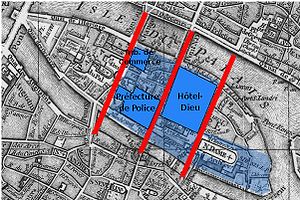
A few generations later Napoleon III wanted the city redesigned specifically to discourage the possibility of further revolution.  The map below indicates some of his changes, with the red strips representing broad thoroughfares, and the the darker blue representing wide public spaces.

Many thanks!

Dave M

9th/10th Grade: The Inevitability of Revolutionary Violence?

Greetings,

This week we saw the French Revolution immediately take a dangerous turn, and I wanted us to consider why violence formed such an integral part of the Revolution.  I think we can offer a variety of possible answers to this question.

Historian Simon Schama made an interesting observation regarding the nature of the change that gripped France.  If we go back to the France during the heyday of Versailles, we see the king rigidly controlling events.  The spectacle of Versailles began with the king and sometimes ended with him as well.

Louis XVI had a modernist, progressive bent.  He loved science, and joyfully hosted some of the first ballooning experiments on the grounds of Versailles.  The experiments were a great triumph, but in some ways worked against Louis.  With the balloons up in the air, nature controlled the spectacle.  The wind blows,i.e., nature speaks, and the reaction occurs.  The air was public space.  We see this concept of the Revolution as a “force of nature” in David’s drawing of the Tennis Court Oath (note the rush of wind occupying the top areas of the painting).

The revolution then, was a “force of nature” in the minds of many,  outside the control of the king, or anyone else, for that matter.  One must follow where it led — you had no choice.

Traditionally historians have viewed the Revolution as happening in two phases:

1) The idealistic, peaceful, “good” phase from 1789-1792, and

2) The ugly, destructive phase that began in 1792 and lasted until 1794.

Following Simon Schama and his stellar book Citizens, I disagree with this characterization.  Violence and political action went hand in hand in 1788, for example, a year before the Revolution proper began.  Bastille Day in 1789 saw the mob beat Captain DeLaunay to death and put his head on a pike.  The language of blood had much cache in the rhetoric of the time, with orators often proclaiming their desire to shed their blood for the cause, or the need for blood to “water the soil of the fatherland,” blood as the “cement of the new republic,” and so on.

Part of understanding the violence involves understanding the nature of sin itself.  How often have we thought that if we do this one bad thing, we can quickly then step back, shut the lid on our misdeeds, and return to righteous behavior.  But as Scriptural language makes clear, once sin has room to maneuver it tends to take control.  Once they used violence to achieve small objectives, it began to have a life and logic of its own.  Pandora’s box had opened.

Part of the reason for the violence also involves what the French tried to accomplish with their revolution.  Stop and ponder for a moment how many political questions we take for granted. Who gets rights?  Who is a citizen?  How should we apportion political power?  Americans disagree a lot about politics, but nearly all our arguments deal with what to do within the existing system.

But what if we had to completely rethink all of those things on the fly, for this is what the French faced.  Naturally they had many disagreements about fundamental political questions.  Under pressure from foreign powers, did the French have the space and time to decide these questions?  The lazy way out would mean violence.  One can weary of talking endlessly, especially under pressure.  “Since we cannot agree on who gets the last cookie and I’m tired of talking, I’ll shove you out of the way and grab it myself.”

The art of the period reflected some of this change of mindset.  The artistic style called “Rococo” tended to dominate in the period prior to the Revolution, with this painting as perhaps the pre-eminent example:

The emphasis here was on light, softness, and the pleasures (though its critics used the word “frivolity) of life.  Art presaged the political shift of the Revolution.  The colors got bolder, the subject matter more serious, and the focus shifted from celebrating life to facing death.

Here is Jacques Louis-David’s “The Oath of the Horatii,” from a story in Roman history that celebrated the sacrifice of the three brothers for Rome.

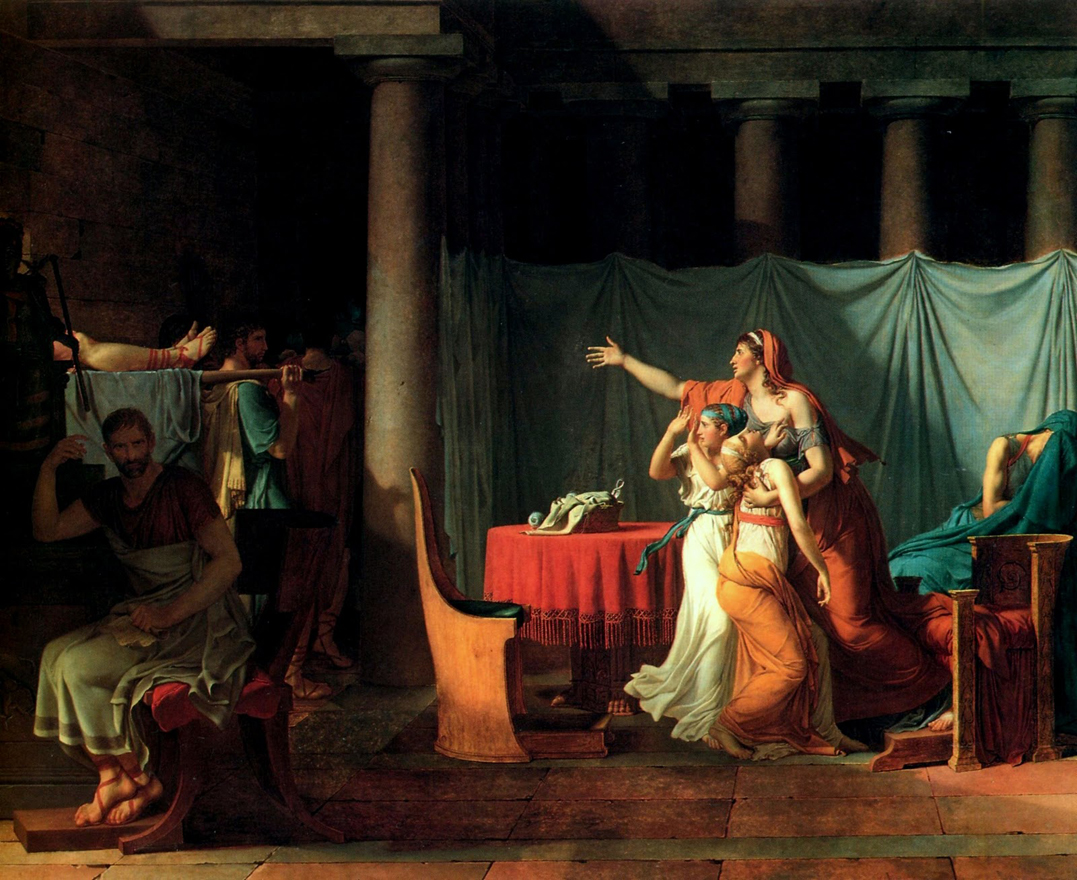
And below, “Brutus and His Sons,” which again uses Rome as the narrative template.  Brutus served as one of Rome’s first consuls, its chief law enforcement officer.  But two of his sons participated in a plot to bring back the monarchy.  The punishment was death, and Brutus had the duty of executing the punishment.  As in the picture above, the men have steely resolve while the women swoon:

The semi-apocalyptic tone of the art no doubt captured the existing mood, but also propelled French society toward violence.

We also cannot underestimate the climate of fear that gripped France.  They knew that their attempts to remake their society would draw the ire of other nations.  Austria and Prussia sent armies to invade their country, and France itself had to deal with an army whose aristocratic officer corp had largely fled or been discredited.  But once the French began the Revolution, they could not turn back.  They had already done enough to face punishment from other nations or a restored Louis XVI.  If, for example, you knew you would be hung for the thefts you committed, would you try and kill the witnesses?  What more could the authorities do to you?  Facing domestic uncertainty and international pressure, success became mandatory for the revolutionaries.  This desperation surely contributed to the violence.  Tragically (and not surprisingly) they eventually turned this fear and desperation on each other.  Saturn would eat his children.

It was in this climate of fear that the French had to decide who constituted the “people” of France.  Usually nations decide this along the lines of birth, but many in France thought this could not work, since not all favored the Revolution.  If those who did not go along with the Revolution were “oppressors” of the people, could oppressors of the people be part of the people?  Why give rights to those who work against the nation? This led to the French defining citizenship along ideological lines, which had a disastrous impact on the Revolution.

Violence played a crucial part in this decision too.  On Bastille Day crowds already began executing people without trial.  If those executed were part of “the people” then their actions were obviously illegal.  But to call those actions illegal would call the whole revolution into question.  So, the natural conclusion would be that those executed were not in fact part of France after all, and not deserving of rights.

Next week we will see where these ideas lead the Revolution.

9th/10th Grade: Romanticism

Greetings,

This week we looked at Jean Jacques Rousseau and the Romantic movement.  Last week in our examination of  the Enlightenment, we said that it both built upon the past (Scientific Revolution) and reacted against it (Louis XIV’s Versailles).  So Romanticism both reacted against the Enlightenment emphasis on reason and built upon its rejection of current society.

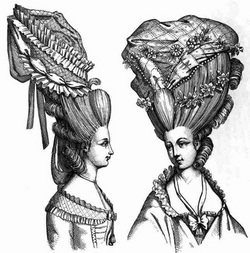
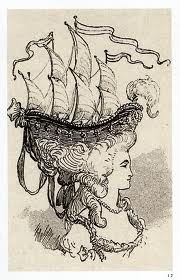
We think of the Romantics praising the virtues of emotion, but we should not interpret the word ’emotion’ in a narrow sense.  Rousseau focused more on our ‘gut,’ or our ‘inner man.’  For Romantics society itself was humanity’s enemy.  All of its trappings, like wigs, crevattes, five-fork dinners, etc. put a ridiculous husk over the kernel of our true selves.  Anyone who ever felt uncomfortable among the wine and cheese set, for example, can identify with at least some of what Rousseau preached.  Manners and mores, if taken too far, can be elitist, exclusionary, and anti-human.  When we consider that the picture to the left depicted actual hairstyles as worn by aristocratic ladies, we begin to identify with what the Romantics advocated.  Rousseau wanted to return to what was “natural.”  It makes sense, then, that one of his main causes involved getting mothers to breast feed their own children, rather than handing them over to wet-nurses.

Rousseau and the Romantics wanted to free people from society to live as they were truly meant to live.

For them, mankind need not fear logic and reason, but instead  needed to realize that they do not come first in human development.  We add them later, whereas our emotions arise naturally from within us from the very start.  Reason, on the other hand, must be imposed from without.  So our ‘guts’ are better guides to behavior than our reason.

From a Christian perspective one can say that God gave both emotion and reason, and that both can guide us to truth.  We come back to the idea of truth in tension.  Unfortunately we see the abandonment of this tension in Rousseau, who thought for example, that the tragic Lisbon earthquake was God’s judgment against cities.  C.S. Lewis’ famous essay “Men Without Chests” makes the point that, as valuable as our heads and our guts are, they need the “Chest” to act as a moral mediator.  Separated from right moral guidance, both emotion and reason turn tyrant. Jonah Goldberg has a humorous but insightful take on what happens when men are left to their own devices here.  When the forces of Enlightenment and Romanticism combined and then turned against each other in the French Revolution, the results would be less humorous.

Like the Enlightenment movement, the Romantics were on to at least a part of something.  One example of this is the idea of breastfeeding.  For centuries women in the elite of society considered it “vulgar” to breastfeed their own children and farmed them out to wet-nurses. One of the first goals of the “Romantic” movement was to get women to see that what was “natural” in this case was good.  What could be more “unnatural” than the separation of mother and infant child?  And yet, such practices persisted.

The problem of course lay in how one defined “natural.”  If every “natural” thing has a direct moral imperative, then we must define “natural” very carefully.  Like the Enlightenment then, the Romantics did not see the world or humanity as basically fallen, and this would bring forth terrible consequences in due course.

We looked at the tragic case of Louis XVI.  In him we have a good man who, in turbulent times, lacked the foresight to be a good king.  As a French king, he probably thought that supporting the Americans against the British was just something that French kings do.  But Louis’ aid to the colonies, which involved people trying to overthrow a monarchy, can be compared to bringing the kudzu plant to the U.S.  You are importing your own destruction, though Louis likely did not see this, just as we did not with the infamous plant.  When an idea (like some plants) gets transplanted away from its native soil the results may be much different than we anticipated.

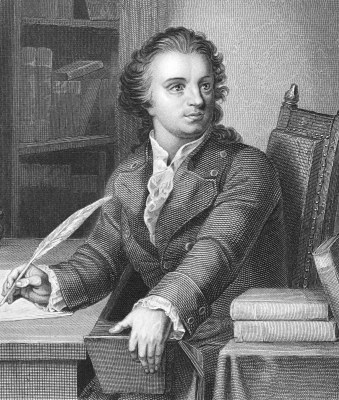
As the official diplomat to Paris, Ben Franklin knew exactly what chord to strike with the French.  He knew that the French idealized the Americans as fulfilling Rousseau’s dream of living close to nature, and milked that as much as possible.  To the left is a famous portrait of Rousseau, and the outfit Franklin donned for his portrait in France while on a diplomatic mission.

Louis attempted to enact many helpful reforms, and this makes his tragedy more poignant.  Many have the mistaken idea that France rebelled against a decrepit regime bent on maintaining the status quo at all costs.  In fact, many philosophes felt that France had the perfect king for the times.  Louis worked hard at fiscal responsibility.  He abandoned much of the waste and foolishness of Versailles. He avidly patronized the sciences, and founded the first known school anywhere for the blind.  France did not rebel against a king who refused to change, they rebelled against a king who tried hard to modernize France.  We shall have to unpack the significance of this later when we look at his trial under the Revolutionary government.

Usually no matter how often we criticize our Presidents we profess admiration for our First Ladies.  Not so in France.  Marie Antoinette, queen of France, was hated almost from the moment she set foot in the country.  Many stood against her from the very start, but her actions, innocent though many may have been did not help her cause.

The bad press began the moment the French found out that Louis’ bride hailed from Austria, a traditional rival of France, a step-child.  Louis, and thus France as a whole, was seen as “marrying down.”

Strike one against Marie.

Marie was desperate to please.  So, if the above picture showed how high-born ladies should wear their hear, she would do one better.   She wore this hairstyle (the picture is accurate, not satirical) to commemorate a French naval victory.   The French, with their vicious eye for taste, could easily detect when someone tries too hard.

So, as the Romantic movement gained acceptance, the pendulum swung the other way.  Marie eagerly dove headfirst into the new style.  She would be “simple.”  She asked Louis to build her a special estate where she and her friends could pretend to be farm girls and feed sheep, milk cows, and so on.  Again, Marie seems to be “trying too hard” to almost ludicrous proportions.

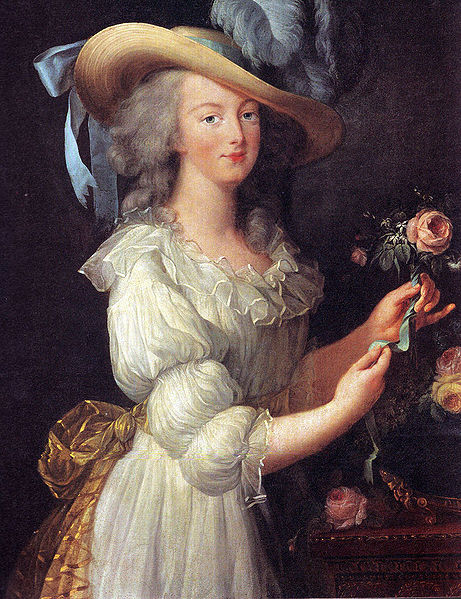
Her friend Elisabeth Vigee-Lebrun painted the famous portrait of her to the left.

This new image would surely work, right?  In this portrait she was elegantly simple, just as Rousseau would want her.  Marie very much hopedInstead, once again the French detected desperation, someone who obviously was not “natural.”   “You are queen of France.  Act like one, dress like one!”  the French seemed to say.  Marie did not figure out how to act like a queen to anyone’s liking, perhaps not even her own.

When Marie finally had children, she settled down, and enjoyed her role as a mother.  But much damage had already been done.  Part of this damage stemmed from the personality differences between Louis and Marie.  Introverted Louis never liked parties, and used any excuse to retire early (one source indicates that Marie purposely set Louis’ clocks ahead in hopes of having Louis retire even earlier).  Once Louis left, Marie felt like she could cut loose, and played cards and danced the night away.   Much of this behavior was very likely innocent, but it raised many eyebrows, and rumors flew.  Louis, did what any wealthy, decent, and befuddled husband might do and bought her lots of expensive things.  Marie got the blame for this, not Louis.  In time various epitaphs floated around France, including, “The Austrian Whore,” and “Madame Deficit.”  Marie could never understand the impact of her actions, and how important image was to her success in politics.

Next week we will see Louis lose control of events in the French Revolution, and how France’s abandonment of what Lewis called “the chest” would wreak terrible havoc.


Dave

Language as Myth

One will sometimes hear thinkers of a materialist stripe say something along the lines of, “A table is obviously a table, but words like truth or beauty are mere abstractions, a placeholder/convenience for certain ideas that different cultures have,” and so on. The problem with this lies in the fact that most everything anyone can think of deserves the title, “abstraction.” A table is not one thing but many things put together in a particular arrangement. Is it only a delusion that we call a table a table? Any living creature has many millions of separate parts, yet these parts function as a unity. Even an atom has multiple parts that we “conveniently” put together as a whole. We all “abstract” reality. Reality functions, in this way, as myth. The title of Ernst Cassirer’s difficult (for me at least) but significant work, Language and Myth could perhaps have the title Language IS Myth.

Writing at the end of WW II mean that Cassirer stood near the end of the unquestioned dominance of the scientific worldview. The deconstruction of the coherence of more traditional ways of knowing seemed complete. Cassirer was struck with the fact that the, “theory of knowledge as philosophers had developed it since the Middle Ages concerned itself solely with ‘facts’ and the development of orderly thoughts about facts. . . . Human intelligence begins with conception, the prime mental activity; the process of conception always culminates in symbolic expression. ” The book’s translator Susanne Langer noted in her introduction that, “Myth never breaks out of the magic circle of its figurative ideas. . . . But language, born in that same magic circle, has the power to break its bounds; language takes us from the myth making to phase of logical thought and the conception of facts.”

Hence, “Myth is an inherent necessity of language.”

In the early chapters Cassirer looks at theorist Max Muller. For Muller,

the mythical world is essentially one of illusion–but an illusion that sings its explanation whenever, the original, necessary self-deception of the mind, from which the error arises, is discovered. . . . From this point it is but a single step to the conclusion which the modern skeptical critics of language have drawn: the complete dissolution of any alleged truth content of language . . . Moreover, from this standpoint, not only myth, art, and language, but even theoretical knowledge itself becomes a phantasmagoria; for even knowledge can never reproduce the true nature of things as they are.

If myth be nothing, Cassirer writes, “it is mystifying indeed that this shadow should . . . evolve a positive activity and vitality in its own right, which tends to eclipse the immediate reality of things . . .” All in all Cassirer critiques “that naive realism which regards the reality of objects as something directly and unequivocally given–literally something tangible.” Objects in themselves cannot give meaning directly, for every object is a contract of other objects–hence, reality requires myth-making to achieve any sort of comprehension.

Most interesting to me were his thoughts on the idea that gods in the ancient world served mainly as embodied synthesized concepts. Much of what I learned about ancient religion growing up often amounted to something like, “The ancients didn’t know about electricity, so they thought Zeus threw lightning bolts.” Of course, how such unsophisticated people all over the ancient world managed to achieve such great heights of philosophy, architecture, etc. remains a mystery. Perhaps aliens?” Cassirer has a better approach, though also incomplete.

He begins talking about the “realness” of ancient religious feeling, even through the classical period in Greece, often thought of an an irreligious era. “Reason, Wealth, Chance, Feasting . . . Whatever comes to us suddenly [is] like a sending from heaven. Whatever rejoices or oppresses us, seems to religious consciousness like a divine being.” From these momentary “daimons” a new kind of god emerged, not from immediate experience but from “the ordered and continual activities of mankind,” which happened as our relation to the outer world went from passivity to active engagement. These gods have a narrow “width” but a degree of depth and permanence, as every year one needs to plant, sow, fish, and so forth. “Whenever a special god is conceived, it is invested with a special name, which is derived from the particular activity that has given rise to the deity.” Here we see the connection between language and religion, and how we need both to synthesize and create meaning from experience. Cassirer, using the work of Hermann Usener, thinks too much in an evolutionary way, but represents a big improvement from standard ways of viewing ancient religion.

Again–we have the link between language, myth, religion, all as examples of a synthesizing of material (be that material certain sounds or certain experiences) into meaning. Cassirer seems to lean heavily on the side of “emergence” in the Emanation/Emergence debate, but we can take his point. Cognitive scientist John Vervake has made a similar point about the current conflict in the Ukraine. Everyone is worried that something will happen to expand the war, but that “something” may not come from individual agency. Rather, war means participation in “Ares/Mars.” When we describe war as having “a logic of its own” we mean that a separate “life” exists as a corporate personality that drives decisions. We get enmeshed within this life and follow its bidding.

We can assert that we control this “life” because we created it. But I think it more accurate to say that we, speaking from the “emergence” side of the coin, call it into being rather than create it. History shows that such “ghosts” can be notoriously difficult to control. Think for example, of all of the allied moral denunciations of German use of chemical warfare in W.W. I, or the German bombing of civilian England in W.W. II. But England used chemical weapons in W.W. I shortly after the Germans, and the British and American forces killed far more civilians with bombs than the axis powers in W.W. II. As Vervake noted, these “collective ideations” (which I think was his term) resemble gods of the Bronze Age in Homer’s Iliad. They have abundant power, but grant no wisdom.

We can say the same for the internet itself. Humans created it, but we also called something into being, as we entered a hybrid-partnership of sorts. We feed it with attention, and it in turn learns and feeds things back to us. Surely, the internet has an agency, and seeks to add to its agency all the time.

Ok, the stuff about the internet I stole directly from

and both Vervake and Pageau explain the concept much better than I could.

The new Compact magazine has an article by Edwin Aponte that attempts to split the horns of the free speech wars. Most look at the fact that the left championed free speech in the 60’s, and now seems to favor more restrictions, or that the Right championed the “Moral Majority” and now wants comedians to say whatever they feel like saying, as either ironic or puzzling. But Aponte sees something else, writing

Consider also the activist left’s resistance to the Reagan White House’s unofficial gag order on public discussion of the HIV/AIDS epidemic in the 1980s, and then, barely a decade later, when the Democratic Party held the executive branch, the push for what was at the time called “political correctness”—a speech rubric spearheaded by many of the same left organizers.

In other words, today conservatives are out of power and railing against the canceling of comedians who make jokes about transgender people; tomorrow, the same people may be in power and leading the charge in favor of a ban against transgenderism in schools. This is borne out by the Times editorial. Per the survey, 66 percent of respondents agreed that democracy is built on the free and open exchange of ideas, yet a whole 30 percent also allowed for the curbing of speech if it runs afoul of acceptable etiquette.

Aponte makes the noteworthy claim that the root of this dichotomy lies in the Liberal (the term includes the modern Left and Right) project itself, which pledges unrestrained autonomy to grant one’s desires. Well, one’s desires could easily include both the right to say what you think and to not be bothered by what other people think. When Liberalism chucked Tradition and social mores as guides, they opened these floodgates.

I think, however, that something else is happening. In his farewell address, George Washington warned his countrymen against the formation of political parties, advice which we ignored almost immediately. Perhaps participation in democracies means that we cannot help but form political collectives to try and get what we want. This in turn catches us up in the war of “gods” who seek power but grant no wisdom. Language itself shows that we cannot avoid synthesizing meaning, but how we do so . . . that’s up to us.

Dave

Tribal Bureaucracy

This was originally posted in 2015–you will see some dated references.

*****************************************

The phrase “All is fair in love and war,” has various attributions, but it certainly has a direct hold on the popular imagination.  But I wonder if those that cite it truly believe in it.  What I think we tend to mean when we say this is, “If the side I’m rooting for does something that helps them win, I generally approve.”  But if the other side does it . . .

War also tends to come with a relentless osmosis.  So the English and French cried “foul” when the Germans started using chemical weapons in W.W. I, and then used them themselves.  The same happened in W.W. II.  First the Nazi’s bombed London and then the Allies retaliated in more than kind.  It is this spiritual cost of war that often gets ignored amidst the loss of life.

These things flitted through my mind as I read the painful and at times darkly comic Guantanamo_diaryGuantanamo Diary by Mohamedou Slahi.  The scars and trauma of 9/11 come through on almost every page of this book, and if his narrative speaks even half-truths, we have much to mourn and much to fear about who we are as a people.

Briefly, Slahi received an excellent education growing up in Mauritania, gaining fluency in French and German along with Arabic (in prison he learned English well enough to write his diary in English).  He traveled a lot as well throughout Europe and also visited Canada.  During the 1990’s he traveled to Afghanistan to fight against the Russians (so he claims) where he certainly met others in the Taliban and Al Queda.  He returned to his native Mauritania.  While there he was arrested and questioned in relationship to the Millennium plot, and then released.  His government, at the request/likely insistence of the United States  then asked him to come in for questioning again after 9/11.  He agreed to come in voluntarily to “clear the air,” so to speak, and from that moment on, disappeared into the bureaucratic abyss.  He has yet to be charged with anything, and yet remains in detention.

Shahi comes off as a very sympathetic figure in his narrative.  Perhaps we should expect this.  We naturally sympathize and accept the point of view of the main character of almost any story.  But surely we might just as naturally wonder to what degree we can trust his account of events.

In a recent podcast interview, Bill Simmons and Chuck Klosterman discuss Klosterman’s recent GQ article on Tom Brady.  In their remarks both agreed that our culture has a serious problem.  Whatever narrative emerges first (in this case they were discussing the ridiculous nature of “Deflate-gate”) embeds itself deeply in the American consciousness.  Whatever narrative emerges next not only has to fight for space in the national narrative, it has the unfair burden of having to also disprove the first narrative, even though its only “crime” was to be known second and not first.  Perhaps this is not only a modern American problem — perhaps this has always been the case with humanity in general.  But if so the problem seems accentuated in our day by the fact that we have a very short national attention span and will quickly to move from one issue to the next.

Quite possibly, this same problem exists when reading Slahi’s diary.  We should not hold his account to a higher standard than accounts from our own government who initially branded him as a mastermind behind the 9/11 attacks, just because this comes from “our side” and it was the story we heard first.  We should treat his account as truthful unless otherwise contradicted by some other source.  Admittedly, this is difficult as contradicting him might reveal classified information.  Such is the dilemma of democracy in the 21st century.*

Briefly the “case” against him:

  • He had been in Afghanistan and fought with Al-Qaida against the Russians.  His own words on this subject — “I fought with Al Qaida, but then we did not wage jihad against America.  They told us to fight against the Communists.  In the mid-90’s they wanted to wage jihad against America, but . . . I didn’t join them in that idea; that’s their problem. . . . I am completely independent of this problem.”
  • His brother-in-law, Abu Safs, was a high-ranking member of Al-Queda.  Alhough interestingly, we have documented transcripts of Safs urging AQ leadership not to proceed with the 9/11 attacks.  In turn, might this have meant that Slahi knew of the impending attacks?
  • He knew different languages and had traveled abroad a great deal.
  • The United States accepted that he had no knowledge of/participation in the Millennium plot.  But it became apparent that Slahi had not told the whole truth about other matters during this questioning, which even Slahi himself admits.  Apparently he denied knowing a man whom he did meet at one point for a short time (although we know nothing about the nature of their relationship). Might then he know other things about terrorists that he has not revealed?
  • In any case, a federal judge reviewed his case and found no basis to detain him any further.  After some outrage from some New York newspapers, the Obama administration appealed the decision, which has yet to come to trial again.  He remains in a bottomless, meaningless detention.

There appears to be very little else against him, and ten plus years of detention have yet to produce a single criminal charge.  It appears we have, as Marine prosecutor Col. Morris Davis commented, a case of, “a lot of smoke and no fire.”  Another interesting testimony comes from Lt. Col. Stuart Crouch, a former prosecutor on the case.  He had left the military, but a good friend died in one of the planes on 9/11.  He decided to reenlist to, in his words, “get a crack at the guys who attacked the United States.”  Eventually he had a total change of heart and withdrew from the case.  He recounted in an interview his realization.

Right in the middle of this time . . . I was in church and we had a baptism.  We got to the part of the liturgy where the congregation repeats–I’m paraphrasing here–but the essence is that we respect the dignity of every human being and seek peace and justice on earth.  And when we spoke those words . . . I could have been the only one there.  You can’t come in here on Sunday and as a Christian ascribe to the dignity of every human being and . . . continue with the prosecution using that kind of evidence.

Some may argue that while we do not have enough evidence to charge him with a crime, a very slim chance remains that Slahi is smart enough to pull a huge snow-job on us.  A chance remains that he may possibly know of some person we don’t know about yet that may seek to do us or others harm (though honestly, since he has been detained for so long, it seems he could know nothing about any possible plans).

Are we willing to take that chance?  To me it seems a really safe bet.

Ironically, it appears that his intellect worked against him in a Catch-22 fashion.  Interrogators admitted that they had nothing concrete to pin on him, but “smart people leave no traces.”  If he wasn’t smart, he would obviously be guilty . . .  because he would have left traces.  Being smart, he naturally left no traces of his guilt.

Such bizarre moments pockmarked his narrative.

For example, interrogators revisited one particular conversation he had with his brother in which Slahi urged him to “concentrate on school,” with an extended conversation about “tea and sugar.”  Since this came up in more than one interrogation, U.S. intel must have thought that such statements involved a code of some kind.  Shahi could not convince them otherwise.

Of course some detainees no doubt bear some measure of guilt.  One prisoner sought a plea-bargain with prosectors.  But this detainee wanted to be generous to Slahi, who resided in the cell next to his.  He would only accept a plea-bargain if they gave one to him as well.  Prosecutors would have loved to offer Slahi a deal, but do to so they would have to charge him with something, and despite repeated efforts, they could not come up with anything.

So the end result was no charge and no plea bargain, but instead a renewed insistence that he must be guilty of something, and so renewed interrogations.  After all, Slahi’s next door neighbor thought he was guilty.

A few final reflections . . .

I absolutely hate and abhor attempts to change meaning of words based on the “letter of the law.”  Interrogators subjected him to sexual molestation, sleep deprivation, forced continuous water drinking (to bring about constant urination and sleep deprivation), and the like.  They did not physically pummel him, but no matter.  He was tortured.  I beg us to call a spade a spade.

Shahi does not paint himself a brave resistance hero or a martyr for truth.  He routinely complains of his back pain.  He admits freely that he lied at points during torture and finally even implicated others, something he earlier vowed not to do, simply to make the torture stop.  He hated certain guards, but liked others and even sympathized with their plight.  He mentioned several times that war brings out the best and worst on both sides.

Surprisingly, when he vented his anger — which was not often — he did so not at the United States but at his home country of Mauritania.  He saw the Mauritanian government as utter cowards for handing him over the U.S. with no specific charges, in direct violation of their constitution and his rights as a Mauritanian citizen.

Eventually he gained the privilege to see movies and watched Black Hawk Down with his interrogators and guards.  He did not enjoy the movie much, but the reaction of the Americans troubled him greatly.  Some soldiers cried bitterly for the Americans that died, no doubt justly.  But Slahi wondered why they shed no tears for the hundreds of Somalis who died, some of them no doubt forced to fight by a warlord dictatorship, some of them civilians.  Americans, Slahi mused, are essentially tribal and care for their own kind not just in preference to others, but to the exclusion of others.  In this we are not exceptional, but just like most anyone else. Ultimately, however, Shahi’s continued detention shows us entirely sacrificing his dignity and freedom on the slim chance that perhaps he knows (or once knew) something or someone.

I will pass over his experiences with guards who knew very little about Christianity trying to evangelize him amidst torture and illegal detention. Shahi, for his part, seemed to enjoy picking apart their arguments. But a few other comments on his opinions about Americans are amusing if not instructive:

Americans are just big babies.  In my country it’s not appropriate for somebody my age to sit in front of a console and waste his time.  And Americans worship their bodies.  They eat well.  [Name redacted] was like anyone else.  He bought more food than he needed, worked out even during duty, talked constantly [about sex], played computer games, and was very confused when it came to his religion.

And,

Many young men and women join the U.S. forces under the misleading propaganda . . . which makes people believe that the Armed Forces are nothing but a big Battle of Honor.   . . . But the reality is a little bit different.  To go directly to the bottom line, the rest of the world thinks of Americans as revengeful barbarians.  That may be harsh, and I don’t believe the dead average American is a revengeful barbarian.  But the U.S. government bets its last penny on violence as the magic solution for every problem.

A few brief comments on the blurbs on the jacket cover and other such comments made about the book.  Those that read it, like myself, emerge fairly convinced of at least Shahi’s legal innocence as well as liking him.  I believe that we have done a grave injustice to Slahi and his family that nothing can erase.  But some commentators fall into the tribalism that Slahi denounced, that Slahi himself avoids.  For some, the U.S. gets no sympathy at all.  They make no attempt to understand the serious intel dilemmas after the trauma of 9/11 we faced, no attempt to understand the gravity of our situation.  For them, the U.S. is a kind of “evil empire.”**

I think rather that we acted, and do still act, the way many frightened and confused people act when they have very little to comfort them.  I agree that we sometimes act foolishly and wrongly, but probably no more so than most other major powers.  We had a few strands of intel that might mean something . . . and we felt forced to act because not acting might possibly result in catastrophe.  It is a terrible situation, and it appears that we have done terrible things in its midst.

But I do not mean to let ourselves off the hook.  We no doubt  felt forced.  But in reality, we are simply selfish*** and will remain so as long as Slahi stays in the legal Neverland of Guantanamo.

Dave

*There is the added question of whether or not the various tortures he underwent may have altered his perception of the past.

**John le Carre must have been only too delighted to write a blurb for this book, as he been roasting the west in general, and the U.S. in particular, for years.  Alas for the bygone days of his great spy fiction from the 1960’s and 70’s.

***Via Marginal Revolution came this quote related to the Syrian refugee crisis.

Even 4-year-old Syrian orphans are too dangerous to welcome to the United States, says New Jersey Gov. Chris Christie. What sort of man turns away desperate orphans out of fear? Christie’s words and actions are shameful and unbecoming of a great nation—as are those of 25 other governors who said they will work to keep Syrian refugees from moving to their state. Is America no longer the home of the brave?

9th/10th Grade: Truth Without Tension

Greetings.

This week we returned to Europe in the mid 18th century and began to look at the ideas that shaped the coming French Revolution.  In this “Prelude to the Revolution” unit I hope that students will see that ideas have consequences.  The French pursued truth, or at least what they believed to be truth, with a passion, but this pursuit nearly destroyed them as they attempted to entirely remake their nation from the ground up.

How then, can we recognize truth?

Christians have many answers at their disposal to this question, but we discussed in class that many of our foundational truths are truths in tension.  So we see that God is one God in three persons, Christ is fully God and fully Man, Scripture is the Word of God written by men, and so on.  Sometimes we can know that we are close to Truth when we feel pulled in different directions at once.

Christians also realize that Ultimate Reality (God Himself) is personal, not abstract or propositional.  In inviting us to know Him, God does not want us primarily to know truths about Him (though this too is necessary), but to have a relationship with Him.  So truth must have an incarnational, or personal aspect to it for it to fully achieve the status of “Truth.”

French society needed reform in the mid-18th century.  The dominance Louis XIV bought came at a cost, and one cost was the inherent contradictions that Louis’s France left unresolved, and in fact widened.   When untethered from “truth in tension” we might expect wild swings or “over-corrections” in the ideas and solutions of the time.  The Enlightenment is no exception.  But the Church needs to have judgment begin at home, for it was precisely the Church’s relative weakness in the aftermath of the wars of religion and the Scientific Revolution that opened the door for people to seek truth elsewhere.

The Enlightenment had many noble motives and goals.  Many “philosophes” (as French Enlightenment philosophers were known) saw that society had become a kind of anachronism, guided by long outdated feudal customs.  Certain areas in society operated autonomously, without reason or justice.  Many stories abound for example, of “press-gangs” rounding up derelicts or drunks and forcing them into the navy or infantry.  From the perspective of many, society seemed to be made only for the elite, or for those with connections, or special, secret knowledge (the echoes of Louis’s ridiculous system at Versailles form a good example).  Enlightenment thinkers sought to free society from archaic mystery and make it livable for the common man.  Reason’s clear light revealed the absurdity of class and privilege.  The Philosophes prided themselves as sensible men.  Ben Franklin, for example, records basic advice like, “A penny saved is a penny earned.”  No wild Platonistic musings here, thank you very much.

One sees this spirit animating their music as well.  Haydn, for example, wanted to write for the farmer and tradesman, so his music has a popular danceability to it that one immediately perceives.  Odd meter changes, wild swings in tempo, and so on might have been perceived as “elitist,” or inaccessible.

In the early Enlightenment one also sees a glorification of the everyday.  Those outside the nobility, like Christopher Wren in England, got picked to design St. Paul’s Cathedral.  Enlightenment era paintings depicted women realistically, and showed life as it was really lived by most people.  It elevated simple pleasures of good company and conversation.

For centuries the Church had controlled much of daily life, especially education.  This too needed freed for “the people.”  With people loosed from institutional religion, they would be freed to be their “natural” religious selves.   No more obscure doctrines, no more mystery, just the clear light of reason.  So in the end, society, education, religion, culture — all this seemed to come down from their pedestals on high and into the people’s hands.  The early years of the Enlightenment must have been quite exciting.

But this excitement masked certain key problems.

For all of their realism and so-called common sense, the philosophes tended to be quite unrealistic about human nature.  For them, part of their liberation from mankind meant liberating them from their sense of sin.  “You’re not bad, just ignorant!”  But in severing people from their sense of sin they dehumanized them.  We know we sin, and we know that it is part of being human to sin.  To say that sin doesn’t exist makes us less responsible, and if we are less responsible, we are less human.  Again, Enlightenment thinkers surely thought they were doing mankind a favor by removing the idea of punishment for sin.  I want the students to appreciate the Enlightenment’s strengths, but the tragic irony of the Enlightenment is while they sought to liberate they set us on a path of potential slavery.  We deserve to be held responsible for sin because we are human beings responsible for our actions.  Dogs are not responsible for their actions.  C.S. Lewis elaborates on this in his essay “The Humanitarian Theory of Punishment.

The Enlightenment frowned on mystery.  We know that many key doctrines of Christianity are mysteries at heart, but what about other areas?  Is not life itself mysterious?  What about love?  Guys, what about women?  Again, to be fully human we must have a sense of mystery about our existence.  In its eagerness to redress an imbalance, the Enlightenment abandoned “truth in tension” and created other kinds of problems, some worse than those it fixed.

The ironic tragedy of the Enlightenment is that while they sought to liberate, they ended up dehumanizing people on a path to slavery, for dehumanization is the first step towards control.  One sees this in subtle ways in the “Smile of Reason”  in many philosophe portrayals:

The constant tight-lipped smile of these reasonable, agreeable people tips the hand of the Enlightenment.  As Clarke notes, the philosophes might smile, but never laugh.  They restricted what it meant to be human.  Life can be enjoyed, but only in moderation.  They prized control above all else.

I don’t want to overreach, but the Enlightenment insistence on control paved the way for some of the tyrannies of the French Revolution and beyond.  The Enlightenment gave us good things to be sure.  No doubt many good Christians made the best of what the Enlightenment had to offer.  But its legacy, like all heresies, continues to haunt us.

Blessings,

Dave


11th/12th Grade: The Battleground of Democratic Ideas

Greetings,

This year we have examined how democracies function across time and space.  What do they do well?  What challenges put great stress upon them?  Are their paths that democracies generally take that they should always avoid?  Under the umbrella of these big picture questions, we begin the year looking at the French-Algerian War from 1954-62.

I chose this conflict to study for a variety of reasons:

  • The conflict is a recent example of a western democratic power fighting both against and amongst Moslems
  • The conflict is far enough removed from us to allow objective analysis, and to allow us to see its ripple effects
  • The French dealt with many similar issues as we currently do in Afghanistan, and to a lesser extent, Iraq (such as the use of torture, attempts to win over local populations, etc.)
  • The excellent movie  (based largely in actual events) The Battle of Algiers is a great tie-in to our study

We introduced a few key background concepts before delving into the main events.

1. Why did France feel the absolute need to win in Algeria?

From the time of Charlemagne (or perhaps even dating back to the pre-Romanized Gauls) France was regarded as having the world’s pre-eminent military, from the Charlemagne, the Crusades, to Joan of Arc, to Napoleon.  In W.W. I they fought heroically and with great determination.  In 1940, however, they suffered a humiliating and shockingly quick defeat to the Nazi’s.  Desperately seeking to regain their pre-war glory, they did not give up their colonies (unlike their friendly rival England).  They lost again in humiliating fashion in 1954 in Southeast Asia — but they would not lose in Algeria.  This was where they would prove to the world that France was still France after all.

The French began colonizing Algeria as far back as 1830, and over time millions of French had come to live there.  As France’s reputation declined in the post-W.W. II years, Algeria became the place where they staked their reputation as a nation “good for the world.”  France was still France after all, a bastion of liberty and democratic, western ideals.  Algeria would be their proving ground.  They would bring the blessings of their civilization to North Africa.  They would show how Moslems could prosper in a western context.  Many other European powers shed their colonial empires after W.W. II.  France left S.E. Asia with their tails between their legs.  They granted independence to a few other colonies.  But not Algeria.  Algeria would be different.  Algeria would prove the validity of western ideals across cultures and the globe.

We shall see how this psychological and cultural attitude influenced how they fought

2. What is the battleground in an insurgent campaign?

As a modern “First-World” country, the French could easily outspend and outmuscle the Algerians who opposed them.  The Algerians naturally quickly turned to guerilla tactics.  It seems clear that the French thought that the battle was against the insurgents primarily, and so put their military foot forward almost exclusively.

Why did this fail?  What is the primary battleground in an insurgent campaign?  Is it the people, or is it an idea?  If so, what role can the military play?  What role does the government and people play?  In our discussion, one student suggested that the only way France could have saved its position in Algeria was through lots of apologies for their poor treatment of them, and lots of financial and social programs to rectify the situation.   In other words, was the problem a military one at all?

Well, it certainly might have been.  But there is a difference between ‘strategy’ and ‘tactics.’  In large measure,* France’s problem was that their use of the military was their strategy.  It was not used as a ‘tactic’ in a broader campaign.

How does an army battle an idea?  As one student suggested last year, the only way to do defeat an idea is to have a better one. Did the French, in fact, have a better idea?  If they did, how did they present it?

3. What happens when an army fights in disconnected way from its country’s values?

There is a great deal of evidence that French troops tortured and killed some prisoners as a matter of policy.  This was done with the tacit approval of French politicians, but not the French people.  As revelations of the torture emerged, the French public began to turn against the war, feeling betrayed by the army.  The army in turn felt betrayed by the people.  This tension between identity and actions needed resolution in some way — and the result was one successful military coup that put De Gaulle in as president, and another coup attempt that failed to get De Gaulle out of power a few years later.

Why are cultural and political values an important ‘weapon’ in a war?  Under what circumstances can we depart from those values?  How is a country’s identity a part of its strategy in conflict?

4. Related to #3, what should the role of the press be in a free society?

Next week we will discuss a few different options related to this question.  Opinions differ. . .

  • Some say the press should be an entirely objective entity, focused on presenting ‘just the facts.’  But, however much of an ideal this is, it is rarely, if ever attained.
  • Others argue that the press should be an implicit supporter of the government, or the majority.  This does not mean ignoring obvious truths, but it would mean using the press as a means to ‘rally the people.’
  • Still others assert that the press should be oriented ‘against’ the government.  That is, the press’ main function is to provide an alternate viewpoint apart from the government’s message.  The government gets its chance, the press provides the people with ‘the other side of the story.’

This week we watched and discussed The Battle of Algiers.  Our discussion and analysis of it will help form the basis of our own insurgency game coming up in a couple of weeks.

Here is the preview for the movie, which is also available (I believe) to watch in full on You Tube.

Sincerely,

Dave Mathwin

*France did attempt some small scale political reforms, but almost everyone viewed it as ‘too little, too late.’

9th/10th Grade: Past and Present Imperfect

Greetings,

This week we delved quickly into our unit on the Constitution, where we focused on a few main ideas, and lay the groundwork for what we will discuss next week:

  • We sometimes have the idea that drafting the Constitution was simply a matter of getting on paper what everybody already thought.  In reality, many of those present had strongly divergent ideas of what federal government should look like.  Some wanted no executive at all, while others (like Alexander Hamilton) wanted a very strong executive elected for life.  The federal judiciary seems almost an afterthought as did the Vice-Presidency, and so on.
  • Compromise tended to be how the delegates operated, and many today praise the fact that they forged consensus amidst uncertain times, which usually give rise to fear and rigid dogmatism.  But this process of compromise extended also to slavery with disastrous moral, and long-term political, effects.  For better or worse, they decided that compromise for the sake of union (which they had already done with many other issues) on slavery was worthwhile.  A variety of theories exists as to why this happened.  Some argue that many believed that slavery would die out eventually on its own within a generation, and thus was not worth forcing some of the die-hards from South Carolina out of the nation entirely.  Others state that slavery involved directly only private moral issues that best belonged outside the purview of federal power (some make the same argument regarding abortion today).  Finally, some assert a simple exhaustion among the delegates.  Having performed so many arduous climbs, the thought of ascending Everest proved too much for them.  I enjoyed the students thoughts on the validity of their decision.  This issue we will raise again next year as we move towards the Civil War.
  • Despite their significant differences, delegates did share some basic principles, such as 1) The federal government did need strengthening, and 2) Federal power needed to avoid concentration in the hands of any particular branch, lest our liberties suffer danger, and 3) A fear of the ‘power of the people.’  While the Constitution did create a more democratic government that existed anywhere else in the West, it contains several barriers to translating the people’s desire into government action.  We often complain of gridlock in government, but may not always realize that the Constitution seems tailor made to create it.
  • For all its tremendous success, the Constitution did not foresee the quickly approaching era of a popular, national president that embodied the will of the people.  This almost led to disaster in the election of 1800, as we will discuss in a few weeks.

People did not immediately embrace the Constitution.  Patrick Henry read the first to the three words, “We the people,” and began his vehement objections.  States, in Henry’s view, should be the basis of federal power.  Henry may have been right or wrong about the wisdom of making “the people” the foundation of political power, but he certainly astutely recognize the difference.  The Constitution created a new kind of America, one where national identity would trump local identity in the long run.

Henry also believed that the proposed national capital would in fact become a vast armory, one that would inevitably destroy liberties.  In the strict literal sense, he was wrong about that.  But he was right that the creation of a national, federal army would put a great deal of power in the hands of the national government.  It is an odd and unsettling thought, but we should realize that the only thing preventing the military from taking over the government is that they don’t want to.  Should the army desire to march on the Capitol, for example, the Capitol would fall in about 15 minutes.

We spent the bulk of our week on our 4th Amendment unit.  I wanted to focus in on one particular aspect of the Constitution to help drill the down the implication of some of its core principles.  The 4th Amendment, which reads

The right of the people to be secure in their persons, houses, papers, and effects, against unreasonable searches and seizures, shall not be violated, and no warrants shall issue, but upon probable cause, supported by oath or affirmation, and particularly describing the place to be searched, and the persons or things to be seized.

This amendment has tremendous relevance for us today.  Technology has changed the meaning of privacy, and our enemies have no qualms with using our system against us.  The government has extraordinary powers at its disposal.  Should privacy or security concerns take precedence?

9780815722120Scholar and author Jeffrey Rosen has done a lot of thinking in the areas of technology and privacy.  He raises many key questions, such as

  • How private can public space be in the digital age?  Do we have a right to privacy from Google or Facebook cameras if we walk down a public sidewalk?
  • Can Facebook violate the 4th Amendment, which after all, only prohibits government from infringing on our liberties, and not the private sector?
  • Europe has already done a lot to regulate the private sector in regard to digital privacy.  Many civil libertarians, for example, would applaud the upholding of privacy concerns that Europe is pioneering.  But, given the tremendous growth of technology, regulating these companies requires strong government interference.  But — the same people who applaud the privacy are usually ones who do not want government regulation of the private sector.  How should we resolve this paradox?

These are some of the issues we will attempt to tackle with out mock Supreme Court Case this past week.

Many thanks,

Dave

Tradition under Control

To combine high and low is a rare thing. Historians usually write either “high” with an overarching idea or theme but weak support, or they write “low” with lots of details and specific observations but little overall goal or point. The best historians know how to unite “Heaven” and “Earth,” for only in this union can one glean wisdom. A few years ago I read Carlin Barton’s book on the gladiatorial games and immediately decreed it the best book ever on the subject, case closed. Barton knows how to write in both directions, and she has bold ideas.

In the Sorrows of the Ancient Romans Barton successfully sought to see the gladiator contests not in light of the “bread and circuses” lens of Roman politics, but in the cultural and religious meaning of “suffering” for the Romans. In Imagine No Religion, cowritten with Daniel Boyarin, Barton remakes our understanding of Roman religion. She suggests in her introduction that the problem many scholars have in translating ancient texts comes from their natural love for abstraction.

Intellectuals and academics in the contemporary world are cosmopolites . . . . They are like the relativist Xenophanes who boasted of traveling the “world” for 67 years. They are pressed hard to find ways of ordering the variety of human experience. We scholars, like all cosmopolites, cope . . . by creating abstractions.

Barton argues that many translators see the world “religio” in Latin, and fail to see the nuance inherent in the word. I would add that academics might also tend to see the Roman concept of “religio” much in the way that those they connect with in the ancient world might see it. Hence, academics have tended to see Roman religion too much through the lens of Cicero. Cicero–a brilliant man who could see different sides of issues, alternating between retreat and involvement–seems a perfect doppelgänger for the modern don.

But when we look at Cicero in the 1st century B.C., we are not looking at the traditional reality of Roman religion, but at a reaction to political tumult, which likely sprang from the cultural and social upheaval of the Roman Republic at that time.

Some of Cicero’s more famous pronouncements on religion reveal something of a hierarchical and ordered system. He writes,

So from the very beginning we must persuade our citizens that the gods are the masters and regulators of all things, . . . that the race of humans are greatly indebted to them. They observe the character of every individual . . . with what intentions and with what pietas he fulfills his religiones . . .

In De Natura Deorum Cicero writes again in a similar vein,

. . . I ought to uphold the opinions about the immortal gods that we have received from the mayors, the caerimoniae, and the religiones. Indeed, I will always defend them, and always have. When it is a matter of religio I am guided by the pontifex maximus Titus . . .

Barton sees the concept of “religio” working much differently than as a means of social control, and cites the work of other scholars who translate the word as “care for the gods,” “hesitation,” “anxiety,” and the like. Clearly, some kind of cultural “attitude” is at work, a balancing of emotional attitudes and actions, and this forms the heart of Barton’s project with the book.

Earliest preserved appearances show that religio meant not so much a system of thought, but something akin to “what gave men pause.” In the Mercator of Plautus (184 B.C.) Charinus wants to leave home, his friend Eutyches tries to change his mind. Charinus responds, “That man causes me to have second thoughts–he makes me pause and wonder. I”ll turn round and go over to him” (Religionem mi obiecit: recipiam me illuc). In other sections of Plautus “religio” indicates the thought/emotion of holding back, thinking twice. A century later Cicero uses the word in a like manner when he recounts that Publius was greatly angry at Valerius, “Yet he kept hesitating and religio repeatedly resisted, holding back his anger.” In turn, acting against such a feeling caused one to feel pudor, whose symtoms gave one high anxiety more than shame. Barton suggests a parallel–“A modern man might approach a lapdog casually, but might hesitate before a Doberman or a pit bull. . . .Just so, ‘religio’ was evoked in dealing with the risky ventures of life, causing the Romans to behave with awe or circumspection.

Livy recounts the interactions between the consuls Paulus and Varro as they approached Cannae:

Paulus himself wished to delay . . . . Varro was greatly vexed at this hindrance, but the recent disaster of Flaminius and the memorable defeat of the consul Claudius in the First Punic struck his animus with religio.

Seneca writes similarly,

If a cave, made by the deep crumbling of the rocks, holds up a mountain on its arch, a place not made with hands but hollowed out by natural causes, it will strike your spirit with a certain religio.

Barton again comments, “‘Religio‘ was especially evoked by highly charged boundaries, and the fear of transgressing taboos, such as we might approach the edge of an electric fence. No fear of magisterial authority or divine judgment was necessary.”

But religio had negative connotations as well. One could hem and haw too much, and in the wrong times and places. Cicero criticizes a rhetor named Calvus, who spoke with excessive precision and balancing, so that “his language was weakened with too much religio.” So too, superstition had a close alliance with religio, which should be seen, as Barton states, as “not the antithesis but the excess of religio.” One needed a steady balance of the right religio to act rightly in the world. Failure to have a proper balance would later result in unhelpful wild swings. Livy writes of Tullus Hostilius, “[a] man who had so far thought nothing of . . . sacred rites, [who then] suddenly fell prey all sorts of superstitions, and filled even the minds of the people with religiones.” Livy also recounts the impact of the 2nd Punic War warping the people’s sense of religio:

The longer the war dragged on and success or failure altered the spirits of men no less than their fortunes, such a great religio invaded the republic, for the most part from the outside, so that gods or men suddenly seemed changed. Now that the disorder appeared too strong, the senate assigned . . . the city praetor the task of freeing people from these religiones.

An intriguing “chicken or the egg” question arises when one looks at the collapse of the Roman Republic. Most look at the political disorder beginning with the Graachi and then see the concomitant centralization of power that culminated with Caesar as a solution to the breakdown. Another option–could the centralization of power in fact have indirectly caused the disorder? An alteration of the traditional political give and take would send shock waves through the psyches of the populace. Of course, most chicken-egg questions have no possibility of resolution, but thinking of the relationship between power and disorder will help us understand the fabric of reality.

We can apply this to Roman religion, and we see the possibility that too much control may have come before religio got out of balance. Toynbee and others document how the 2nd Punic War (218-202) particularly challenged traditional religion by exposing Romans to new ideas, cults, and (as we saw above), an excess of religio as superstition. As the Republic collapsed in the late 1st century BC, Lucretius expounds the notion of the gods keeping everyone in perpetual fear–through excessive control. “Religio” had gotten out of control:

Human life lay for all to see foully groveling on the ground, crushed beneath the weight of religio which displayed her head in the regions of heaven, threatening mortals on high with horrible aspect . . .

I must show in what ways fear of the gods crept into the heart which our earth keeps holy their shrines and pools and groves, their altars and images.

De reruns natura, 1.62ff., 5.73ff.

Statius in the mid 1st century A.D. wrote that, “It was fear that first made gods in the world.” I’m not sure we would have seen such language 200 years prior.

Lucretius did not likely represent the majority opinion, but the authors look at what they call the “Ciceronian Turn,” where Cicero at least, and perhaps Rome as a whole, begins to look at religion as a tool for countering chaos. With the proper balance of religio gone, now things needed more hierarchy, more top-down structure. This in turn created the need for more “noble falsehoods” from the elite and a greater separation from patricians and the plebs.

It appears at first glance that the religious expansion/innovation happened first, and then we have the tightening afterwards. This view appeals to me as someone who views that religion, whether that religion have a direct conscious expression or no, forms the heart of any civilization. But the connection between excessive control and freedom will always be a close one. We can perhaps see Rome’s politics and culture tightening during the Punic Wars, the devastation of Italy due to Hannibal, etc., and then–religio starts to get out of alignment, showing more extremes.

However we see this relationship, the west will always play with fire when we focus alternately on the rights of individuals and the limits of government power, for that puts the focus on the edge rather than the center. Then, just as when we breathe heavily, we get unbalanced. A civilization cannot breathe heavily in and out for very long. A civilization cannot exist as a negotiation between extremes. It functions instead optimally when the tension between different elements is intuitive and thus, healthy. In Rome, for whatever reason this tension got out of alignment, with a resulting political and cultural decline from which they never quite recovered.

This relationship between extremes manifesting themselves simultaneously runs rampant throughout our world:

  • The internet allows us to have more options than ever and to be surveilled as never before.
  • Social media platforms give us essentially no limits on whom we reach with our thoughts, but online speech is also the most heavily regulated/punished.
  • Technology gives us the possibilities of travel even into the uninhabitable regions of space, but even slight damage to the craft in the wrong place would kill everyone onboard.
  • Nuclear power on the one hand could give the world abundant clean energy, and on the other hand, could destroy civilization entirely.

And so on. To take another example, Russia may have done wrong by invading Ukraine, but observe . . . even Russians who protest the war are being “canceled”, presumably because they are Russian. This absolutist way of acting in the world will hurt far more than it helps.

Imagine No Religion gives us great insight into the relationship between culture, religion and power. It is an open question as to whether or not America ever was a “Christian nation,” but certainly we are not that now, and have not been for some time. Many debate the nature of the “real” religion of America. Whatever that might actually be, the cultural and political tightening we have witnessed recently, however, either has come on the heels of a religious shift, or presages one. As man is, as St. Maximos put it, a macrocosm, individuals and civilizations need to breathe in and out calmly, intuiting the boundaries of our conduct. Healthy people and healthy civilizations result.

Dave

9th/10th Grade: The World Turned Upside Down

This week we discussed the preamble to the Declaration of Independence.  Certainly the whole document has great importance for us, but whereas the specific grievances have come and gone, we rightly remember the words of the first paragraphs.

When in the Course of human events, it becomes necessary for one people to dissolve the political bands which have connected them with another, and to assume among the powers of the earth, the separate and equal station to which the Laws of Nature and of Nature’s God entitle them, a decent respect to the opinions of mankind requires that they should declare the causes which impel them to the separation.

We hold these truths to be self-evident, that all men are created equal, that they are endowed by their Creator with certain unalienable Rights, that among these are Life, Liberty and the pursuit of Happiness.–That to secure these rights, Governments are instituted among Men, deriving their just powers from the consent of the governed, –That whenever any Form of Government becomes destructive of these ends, it is the Right of the People to alter or to abolish it, and to institute new Government, laying its foundation on such principles and organizing its powers in such form, as to them shall seem most likely to effect their Safety and Happiness. Prudence, indeed, will dictate that Governments long established should not be changed for light and transient causes; and accordingly all experience hath shewn, that mankind are more disposed to suffer, while evils are sufferable, than to right themselves by abolishing the forms to which they are accustomed. But when a long train of abuses and usurpations, pursuing invariably the same Object evinces a design to reduce them under absolute Despotism, it is their right, it is their duty, to throw off such Government, and to provide new Guards for their future security.

We take this wording for granted today, but Jefferson’s words espoused some revolutionary ideas.  In 1765, the colonists (for the most part) couched their dispute with England in terms of English rights, i.e. “The English government fails to give English liberties to its citizens.”  In the Declaration, however, we see the colonists fighting for human, not British rights.  Their struggle took place specifically against England, but in the broader sense the colonists fought to be more human.

Jefferson professed Deism and not Christianity, but he clearly states that these rights have universality because of the identity and purpose of our Creator.   Jefferson takes the Romans 13 dilemma we discussed a few weeks ago and turns it on its head.  Government’s exist to protect human dignity.  If they fail in this, government becomes the rebel against God, and this means people have a duty to fight them, not merely permission.  Jefferson’s stroke remains brilliant and controversial even today.

Unlike other countries (founded on shared history or shared biology), the United States founded itself on an idea.  The universality of this idea has done much to shape our history.  Critics of our policy often accuse us of “meddling” in affairs that don’t concern us.  Certainly this charge has at least some merit.  But in our defense, we might say that we can’t help it.  The Declaration makes humanity itself our business.  We might further state that we have no wish to make others more like us, rather, we wish to help them become more human.  There may be some self-deception in this line of reasoning, but I think many Americans think this way whether consciously or no.  On the flip-side, this universality has helped us be more open to other peoples emigrating and finding a place in our society.

We also discussed two other controversial aspects of the Declaration:

  • Should we have the right to “pursue happiness?”  What has this meant for us?  I touch on some of these ideas in this post here.

Author/commentator Malcolm Muggeridge thought the inclusion of the “pursuit of happiness in the Declaration a great disaster.  He said,

There is something ridiculous and even quite indecent in an individual claiming to be happy. Still more a people or a nation making such a claim. The pursuit of happiness… is without any question the most fatuous which could possibly be undertaken. This lamentable phrase ”the pursuit of happiness” is responsible for a good part of the ills and miseries of the modern world.

The truth is that a lost empire, lost power and lost wealth provide perfect circumstances for living happily and contentedly in our enchanted island.

I can say that I never knew what joy was like until I gave up pursuing happiness, or cared to live until I chose to die. For these two discoveries I am beholden to Jesus.

  • Jefferson’s original draft of the Constitution contained a strong anti-slavery section, but in the end he removed it to allow for all colonies to join in signing the document.  This may have helped us fight the war for independence, but it disastrously postponed our nation dealing with the terrible crime of slavery.  Was this worth it?

We then moved on to finish the fighting in the war, and focused on the battles of Saratoga (1777) and Yorktown (1781).  On Friday we played a game in class where the rules gave certain advantages to the “favorite.”  But the “underdog” also had key advantages. .

  • They could afford to play more recklessly as they had less to lose
  • If they got luck or could bluff their way to one big success, they could simply fold (i.e. retreat in orderly fashion) and wait until time ran out in the game.

Many of you may have seen an action movie where the lone hero has to fight his way into a compound, boat, or other structure.  Despite being badly outnumbered, he manages to get the bad guys and escape.  Along with Hollywood convention at work, the hero does have some actual advantages.  He knows that every person he sees is a bad guy, where his opponents must exercise much more caution.  They hesitate and give the hero the advantage, who can shoot first and ask questions later.

This analogy could easily get stretched too far, but British failures at Saratoga and Yorktown show the great difficulty the British faced to win the war.  How could they solve the problems that created the war in the first place through violence?  The deteriorating situation between England and the colonies between 1763-1775 craved a political response that the English proved unable to provide.  Victory through violence therefore demanded an absolutely crushing military victory, and would have to take great risks to achieve it.  Both times they attempted this, it backfired on them.

Americans had more “freedom” in their strategy because their failures mattered little and their successes got magnified greatly in their political effect.  England’s political bungling prior to the war itself paved the way for their defeat.

Here is the march the British played when they surrendered at Yorktown, “The World Turned Upside Down.”

The Way of the Fox

I can always count on a few “Let’s conquer Canada!” “jokes” a year from my students.  We might be studying the Mexican-American War and someone will say, “No, no, no.  We need to find our ‘true north’ and fight Canada!”  If it’s the Spanish-American War it could be, “Spain?  Why Spain?  We should fight Canada!”  If it’s W.W. II . . . “We fought on the same side?  Phooey.  After the Germans, on to Canada!”

Mild groans or exasperated rebukes (from the girls) usually ensue.

So it comes as a delightful surprise (to the boys) to actually find out that we did try and conquer Canada in 1775.

Because the idea of conquering Canada is such a passe joke, we assume that George Washington was crazy to order such an attempt.  In the minds of many our invasion comes to nothing more than a madcap escapade, a schoolboy’s lark.

Dave R. Palmer argues in his book The Way of the Fox (newer editions have a different title indicated by the cover to the right) that in fact such an invasion not only nearly succeeded, but also made sound strategic sense.  Palmer seeks to rescue Washington from his saccharine and wooden image and recasts him as an effective and in some ways brilliant grand strategist for the American Revolution.  And yes, this includes his invasion of Canada.

Today many think of Washington as either a great man/demi-god or nothing more than a member of elite/exploiting class.  Both views are cardboard cutouts.  Palmer shows us someone who thought carefully and with subtlety, someone who adjusted his thinking on multiple occasions to deal with changing reality.  British generals often referred to Washington as the “old fox,” sometimes with contempt because he would not fight, sometimes with admiration for his cleverness.  The moniker should stick — it brings Washington and the war to life.

First and foremost Washington stood as the perfect symbol for the Revolution. Certain qualities made him the obvious choice for command, such as his experience, his height, his bearing, and the fact that he hailed from the South.  But none of these things would matter if Washington failed to think in broad strategic terms effectively. Palmer divides the Revolution into three stages, and correspondingly sees Washington adjust his strategy each time.  Washington made specific mistakes as he went, but in terms of broad strategic goals Palmer has Washington never miss a beat.

Palmer argues that revolutions possess an offensive character by their very nature.  They seek to effect change and so must act accordingly.  Thus, Washington was entirely right to begin the war with an aggressive strategy that sought to expel the British.

This failed to fully succeed, which allowed the British to send massive reinforcements.  This meant that Washington, now outmanned and outgunned, needed to withdraw and avoid having his army destroyed by a pitched battle he could not win.

France’s entry after 1778 changed the situation yet again.  Now momentum and manpower lay with the Americans. Washington needed to take advantage of the alliance while it lasted.  So during this period Washington should have sought to press his dramatic advantage, which he did with great effect at Yorktown.

I take no issue with either Palmer’s interpretation or Washington’s actions for phases two and three.  But it’s the first phase, which includes the invasion of Canada, where we can push back most easily.  It seems to me that Washington should have been cautious until the final phase where the advantage finally tipped in his favor.  His aggressiveness at the start of the conflict seems out of place to me.

True, at the beginning of the war you have an emotional high that you can capitalize on.  But you will have undisciplined and untested troops. What’s more, they will not yet have developed that cohesion that great armies have of sharing routines, time, space, and danger.  Think of Caesar’s legions — nothing remarkable when they started into Gaul, and unbeatable five years later.  In our Civil War one reason for the South’s early success had to do with the offensive burden the North faced.  When General Irwin McDowell objected to offensive action at Bull Run in 1861 due to the lack of experience of his men, Lincoln replied that “[both sides] are green together.”  Yes, but McDowell knew that a green attacker has a lot more to worry about than a green defender, and so it proved.

Beyond this psychological reason, Palmer asserts another more narrowly strategic goal for invading Canada.  America’s size and her numerous ports put a huge strategic burden on England.  Colonial armies could easily retreat inland and lead British forces on goose chases through the wilderness.  Add to that, the layout of the land presented very few “choke points” at which the British could use their superior manpower to any real effect.  Perhaps the only such point lay at the nexus between England and Canada — the Hudson River.

Flowing from north of Albany down to New York City, British control of the Hudson would have allowed them to control the upper third of the colonies.  Controlling New York and Boston would have meant control of America’s biggest ports.  Cutting off New England would further mean nabbing most of the colonies financial resources and a hefty portion of its intellectual political capital.  Everyone on both sides of the Atlantic agreed that control of the Hudson could determine the war.

So if it makes sense for Washington to defend the Hudson, why not go just a bit further into Canada itself?  To capture Quebec would have given the colonies everything else in Canada.  Success would have prevented England from having a free “back door” entry point into the colonies via the St. Lawrence River.  Shutting down the St. Lawrence would topple another domino by cutting off England from potential Indian allies* out in the west.

Reading Palmer’s lucid and logical defense, I found myself almost persuaded.  Palmer urges us to remember that the failure of Benedict Arnold’s invasion (yes, that Benedict Arnold) — and it nearly succeeded, does not prove that the idea or the goal was faulty.  Had it paid off, the war might have been over within a year or two instead of eight.

Yes, but . . .

Arnold  lost in Quebec and Washington lost in New York City.  Palmer gives a generous interpretation of Washington’s actions in New York and believes that politically speaking, Washington had to defend the city.  Maybe so.  But if he had to defend the city for the sake of politics, then why also invade Canada and divide your forces? Palmer wants it both ways.  He believes that circumstances called for an aggressive campaign in 1775-early ’76, but that politics and not military necessity alone forced Washington’s hand to defend New York.  This seems to admit the fact that Washington should have given ground and played defense in New York alone.

All in all I agree that Washington brilliantly guided the colonies to victory, and Palmer argues this decisively.  He points out also that Washington faced a bungling and confused command structure in England.  But Washington had Congress to deal with, who although more intelligent and capable by far than their British counterparts, had much less experience in running a war.  By any measure, Washington deserves his place as one of the great generals of the modern era.

But I can’t let go of the invasion of Canada.

If we try and evaluate Washington’s gambit in Canada we should try and compare it to similar kinds of military actions across time.  My case remains that the invasion made logical sense in a certain way.  He was not reckless or foolhardy to try.  But I feel that he should have focused more on defense, and perhaps even success might have hurt him in the long run.  The colonies might have had the direct motivation to expel the British, but would they support long-term the occupation of Canada?**

I can think of three campaigns that might be comparable in certain ways . . .

  • Athens’ invasion of Sicily in 415 B.C.
  • Hannibal attacking Rome directly instead of defending Spain
  • Napoleon going on the offensive in Belgium in 1815 instead of rallying the people to “defend France.”
  • Our invasion of Iraq in 2003***

Sometimes foxes can be a bit too clever.  Still, unlike Athens, Hannibal, and Napoleon, Washington committed a relatively small portion of his forces to the plan.  As a general most would not rank Washington with Hannibal, Napoleon, and the like.  But Palmer argues that not only should we put Washington in their company, but given his military and political success, make him the general of the modern era.

Dave

*This no mere fancy.  In 1777 the British did invade via the St. Lawrence and did gather some Indian allies for their “Saratoga” campaign.  That escapade ended in disaster for the British, but Washington’s strategic fears did come true nonetheless.

**Strange as it may sound now, Palmer points out that the motivation to occupy and settle Canada ourselves might have existed not on strategic but religious grounds.  Many in 1775 saw Canadian Catholicism as a mortal threat to our freedoms and would have gladly occupied it in the name of liberty.  Certainly we showed the ability to expand and settle territory in the west. Why not in the north as well?

***Right or wrong, Bush enjoyed overwhelming support to fight in Afghanistan in 2001.  It made sense to us in the way that (again, right or wrong) responding to Pearl Harbor made sense.  But his case in 2003 was much less compelling, at least to the international community.

From Puritan to Yankee

Recently I found myself talking politics with a Trump supporter.  Interestingly, he mentioned very little about his policies or personality.  Rather, he seemed drawn to him because of the multitude of attacks against him.  No one, he argued, deserved what Trump receives from at least some in the media.  Politics had very little to do with this, for this same person said that he liked both Obama and Hillary Clinton for much the same reason–in his mind of them have been attacked to an unfair extreme.

I have no great love for the Puritans, and perhaps this might explain why I sometimes seek to defend them.  I certainly felt this way at the start of Richard Bushman’s From Puritan to Yankee: Character and Social Order in Connecticut, 1690-1765.  When describing Puritan society in the first chapter he invariably uses words like, “austere,” “imposing,” “monolithic,” and that most dreaded word for an academic who originally published this book in 1967, “conformity.”*

Later in the book Bushman shows his excellence as a historian of a certain type, but I did not like the first chapter.

We naturally have difficulty in understanding and evaluating the Puritans.  They look like us in many respects, but then part with modern society in other radical ways.  It is the heretic, rather than the unbeliever, who always poses the greater threat.  Hence, our natural distaste for the Puritans.  But we must keep certain things in mind.

First of all, the Puritan ideal of social order oriented around religion hardly broke new ground.  They borrowed from the medieval idea of the “great chain of being,” and in orienting their society around religion they merely did what most civilizations practiced up until that point.  Numerous examples of this exist, with the Egyptians, early Romans, the Mezo-American civilizations, and the aforementioned medievals to name a few (this should clue us in on the radical nature of post-Enlightenment western society–more on this later).

Secondly, many moderns, progressive or otherwise, would likely admire some of the main goals of Puritan society.  The Puritans sought to live a common life together by minimizing  (though not eliminating) economic competition and distinctions in wealth.  Bushman himself notes that in the early days of settlement even the richer members of society lived much in the same way as their neighbors, working fields and milking cows like anyone else.  Bushman and others may not realize that such a society cannot exist with modern notions of liberty that tell us to “find our own way,” “follow your heart,” and so on.  Societies like the early Puritans must get their formation from shared conviction that only comes with religious belief. You cannot have one without the other.  One Puritan stated, “Law should serve free exercise of just privileges.  Without this, lives and liberties would be a prey to the covetous and cruel.”  Modern notions of liberty, in the view of early Puritans, would lead to exploitation and alienation.

Bushman himself cites early in chapter two that this shared communal life allowed government in Connecticut to be, in his words, “flexible” in ways that “minimized local conflicts.”  This hardly seems “austere,” or “monolithic.”

True, certain “upper-crust” Puritans (apologies for the emotionally laden word choice) had a fear of any of the “lesser sort” getting into political power.  We can snub our noses at this.  But we should remember that it is 1700.  Puritan Connecticut was more democratic than the England of William and Mary, and infinitely more so than Louis XIV France or Frederick the Great’s Prussia.  Almost every other European society at the time shared these same fears of “lesser men” ruining everything. We have good evidence that many of our founders decades later had these same fears, as of course did every major western political thinker from Homer on down the line.

Finally, nearly all the early Puritan settlers came from the same east-Anglia towns and villages.  They knew the content of Puritan theology, they knew Puritan leadership.  It’s not as if the Puritans pulled a bait-and-switch on the journey across the Atlantic–“You thought you signed up to run wild and free in the woods, but no!  Now that we have you in the middle of the ocean, welcome to John Calvin!”

If some settlers grew frustrated with Puritan leadership, well, they knew what to expect.

So yes, the Puritans need criticism, but criticism with the right context in mind, and aimed in the right place.

After chapter one, Bushman shows his great skill at sifting through data to form larger conclusions.  He puts the focus on the problems settlers faced due to a growing population, which would necessitate an inevitable territorial expansion of the colony.  Some civilizations, like the Romans, link most everything in life to land.  Some see the beginning of the  Roman Republic’s political problems beginning the moment land in Italy disappeared for their soldiers.**  Not every civilization operates with this mentality.  Carthage, for example, and possibly Periclean Athens, largely freed themselves from land as a measure of identity (they had different problems).  But our early settlers fit well within the Roman mindset.

In the first generation or two land distribution remained equitable.  The size of the colony allowed everyone to attend the most important churches pastored by the acknowledged town leaders in piety and purpose.  The population’s proximity to these churches and to town hall bound the colony together politically.

But time marches on, and fathers want the same for their younger sons as for the oldest. In a settled mostly aristocratic society like England of the time, the younger sons of even minor aristocracy join the army or perhaps the clergy.  You see this even in Austen’s novels 100 years later.  Settlers in the new world, however, believed in equality, more or less, and wanted everyone to have an equal chance.

Expanding the size of the colony meant greater distances from the town center.  Naturally those predisposed to want to lead the settlement would stay close to its center.  Those with some disaffection towards leadership might more easily head a few miles outbound.  With this even small scale migration came an inevitable tension, and an inevitable choice.

The colony could either, a) Split off in different settlements and grant autonomy to each.  However, this came with the problem of effectively ending the Puritan dream.  Those who left for outbound land tended towards a more enterprising, individualistic mindset.  Or they could, b) Increase the power of the original settlement’s leaders and weaken the participatory democracy carefully crafted by the original settlers.

As is typical of most any democratically government they chose neither absolutely, though probably favored option ‘b.’  Everyone recognized that the social order had suffered due to increased wealth–a wealth occasioned by expansion (again, similar to Rome ca. 200-75 B.C.).  But try as they might, too many things swirled in conflict with one another to make sense of it all.  In the end tensions increased between eastern and western settlers in most religious and economic matters.  Once they let the’Yankee’ mentality of individual enterprise get its foot in the door, their social construct had its days numbered.

Let us give credit where due.  Bushman’s work should help us to see certain larger issues with more clarity.  For example, Thomas Jefferson bucked historical convention in his belief that a republic should have lots rather than a little territory.  He hoped that the Louisiana Purchase would allow everyone to practice self-government and live free and independently on their own land.  But–if everyone can live free and independently from one another, how can we maintain order?  Only by doing as the Puritans attempted to do–by increasing executive authority.  If we want the kind of liberty envisioned by Jefferson, let us count the cost.  Rome saw this same increase of executive authority as their territory expanded beyond Italy.  Whatever our uniqueness as a nation, we cannot escape history.

But in the end I think Bushman misses the real point.

Bushman mentions religious issues and gives them due treatment, but he gives pride of place to the decline of Puritanism to land and economic issues.  He deals with the source material masterfully.  But he seems to argue that certain geographic and social issues caused the religious issues to manifest themselves later.  We can acknowledge the influence of geographic and economic factors.  But in the end, I think he puts the cart before the horse.  The key to Puritan disintegration must be found in their religion.

For example . . . the Roman Republic experienced some of the same stresses faced by the CT settlers, with a much larger population over much larger territory.  Yet, the Republic maintained its central identity for at least two and perhaps three and half centuries, in contrast to Puritan ideals lasting no more than  two generations.  Egyptian civilization also had some of the same issues regarding land, and though obviously not a republic, maintained their identity for perhaps 1500 years.

Yes, democracies traditionally have a problem maintaining identity and cohesion.  One can a make a good case that Pericles built the Parthenon primarily as a way to reestablish unity by calling people back to their religious roots, whereas we today tend to look at this period in Athens as the pinnacle of democratic experience. This “pinnacle of democratic experience” may have had more cracks than we initially assume.  Athens at this time certainly had lots of money, which tends to work ill upon democracies.  If Thucydides tells only mostly the truth, they did not have much social cohesion. Rome lasted longer than CT or Athens with similar geographic and economic factors at play, and so I feel a reason exists beyond land distribution and the expansion of trade that Bushman focuses on.^

In the Puritans particular case we should note that their theology departed from traditional orthodox Christianity in certain respects.  Their emphasis on the will of God rather than the love of God reduced their faith to more of a philosophy, a handbook of propositions for life.^^  They had no appreciation for sacraments and thus no way for the grace of God to be made manifest in their lives except by how they thought. This led to impersonal abstractions gaining sway.  The famous (or infamous if you prefer) 5 Points of Calvinism work on the mind like a geometric proof, inexorably moving toward a foreordained conclusion.  Abstract ideas, however, are slippery things, and ideas floating in the air don’t always land on the ground in the same form for repeated generations.  Like a point in infinite space, various lines can connect with it and go almost anywhere.

Interestingly, Puritans created a government structure that tended toward defending an abstract notion of rights.  As the colony expanded, Bushman documents a swell of lawsuits and disputes centered around the “claims” of one settler vs. another.  Communal relationships disappeared as “rights” dominated public discourse.  Religious revivals like the Great Awakening followed this pattern in some ways..  The religious impulse coming from this revival did not push people back into communal life.  Rather, we see a rise in the individualistic idea of the “liberty of the conscience” gaining the upper hand among the (formerly) Puritan settlers.

Whatever the merits of my very incomplete analysis above, by the early 19th century New England certainly had adopted a vague mixture of theism and deism as its unofficial religion–a death by abstraction.

We see hints of 1776 as this abstract notion of rights grew.  In time colonial corporations made grants of land to settlers.  When royal officials came over and examined these title deeds they annulled them outright.  No “corporation,” they argued, can grant title to anything.  What is a “corporation” after all?  It’s surpra-personal identity meant it had in effect no personality, and with no personality, how could it truly exist?  A king can grant title, for the king is an actual person, and actual people can own things and give them to others.

The colonists may have nodded “sure!” to these royal representatives, but likely crossed their fingers behind their backs. Though kingship has the advantage of being personal, a king across an ocean has perhaps even less personality than a corporation.  In any case, they no longer had a connection to government rooted directly in either religious belief or social ties. They put their eggs in propositions, in “rights,” in “liberty of conscience,” which no one can touch.  Their point in infinite space must be free to go where it pleases.

A standard debate among historians of the American Revolution involves the question of whether or not the founders were radical or conservative in their ideas.  Years ago I would have answered with the latter, but not anymore.  Bushman’s work accompanies Bernard Bailyn’s and Gordon Wood’s thesis that our stodgy, wig-wearing founders had radical ideas.  For the first time, society would not be oriented around God/the gods.  Nor would social order have its roots in personal relationships, i.e., feudal society, or the lives and patronage of prominent families.  Now for the basically the first time, society would be organized around certain ideas, or we might almost say, geometric axioms.  What Bushman’s book shows us is that you don’t need to go to 1776 to see these principles at work.  If you wish, you can content yourself with a small CT settlement, ca. 1700.

*******************

*Here I must give credit to the playwright Arthur Miller.  His work The Crucible certainly criticized certain aspects of Puritan society.  And yet in his preface to the play he spends most of his time trying to get the reader to sympathize with the Puritans.  This sympathy, in fact, serves as the only solid basis for critique.

**I think the land issue a contributing factor accompanying deeper causes for Rome’s Republic, much in the same way I think Bushman overstates land issues as the primary cause for the collapse of the Puritan ideal.  In Rome’s case, one can see a shift in religious belief occasioned by their contact with Greece and the Mediterranean as the precursor to their political and social fragmentation.

^This is another great example of how Bushman’s book shed’s light on larger issues.  Most every commentator on Plato’ Laws calls Plato a grumpy old fart for banning trade from his theoretical realm.  But increased trade undeniably negatively impacted CT’s social order. Farmers deal roughly with the same soil and the same weather.  Surplus food grown by one poses no real threat to other farmers.

But trade seems to encourage more of the competitive spirit.  Trade deals more with luxuries than necessities, so unsold surpluses can ruin a merchant.  Hence, the extra competition to sell, and so on.  The rise of money and trade certainly played a role in the demise of Rome’s Republic.

^^I realize that this one sentence is hardly a reasonable defense for my views on Puritan theology,   My apologies–to defend them here is a bridge too far for me.  If I am correct, however, there are some  similarities in Puritanism to Stoicism (I stress “some”–the Puritans probably gave much more room for the emotions than the Stoics), a religion for Greece and Rome’s intellectual elite, but not for the masses.
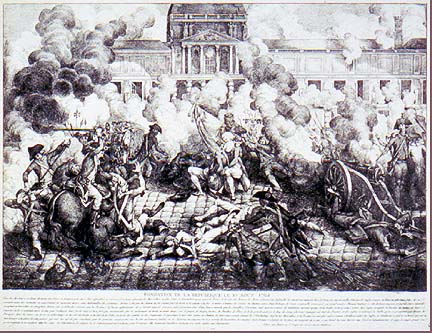
9th/10th Grade: Liberty and Terror

Greetings,

This week we finished the preliminaries of the American Revolution and will start the fighting in earnest after the weekend.  I hope that our examination of the events leading up to the Revolution has  helped see the issue from both sides.  Can we get out of our American skin and at least sympathize with the British?  Quite a few of the students have developed some sympathy with the British perspective, which shows me that they are thinking and honestly engaging the material.
One crucial issue involves the ‘Sons of Liberty.’  Were they freedom fighters or terrorists?  Against them we might say that. . .
  • They used violence, and the threat of violence, to achieve political ends.  They destroyed property, tarred and feathered people, etc.
1773 Engraving
Man Tarred and Feathered for not Buying War Bonds
  • They used force to rob people of their freedom.  For example, lets take the Tea Act.  Let us suppose that you lived in Boston and in general, supported the British perspective in this debate.  This would have put you in the minority, but it’s a free country, right?  You have been looking forward to drinking tea again, but after the Tea Party you can’t.
The pro-British colonists could easily say that, “You Sons of ‘Liberty'” act under the cloak of freedom.  But you are not willing to let the people choose freely.  If the tea gets unloaded and you convince people not to buy it, well and good.  If you can’t then you don’t represent the people anyway.  You use force to take away my liberty to buy tea, which is perfectly legal, so you can have your way.  Your violent acts show you don’t really trust people at all.
In their favor we could argue that
  • A variety of peaceful means of protest had been tried, and those failed to even be acknowledged by Parliament.
  • They would often warn people beforehand, and as far as I know, they did not kill anyone.

In response to #2 above, the Sons of Liberty might say,

  • “It is true that we deprive you of your liberty to buy tea.  But, this was for your own good and that of the whole community.  If people bought tea we would become slaves to the British.  It is right to take away the liberty to destroy yourself, just as we would take away your right to buy heroin on the open market.  If you become an addict, that effects everyone around you.
  • The same is true for tea in this case.  If you buy it, everyone will indirectly suffer a loss of their liberty, yours included.
We are faced with a tough choice here.  If we say that they are in fact ‘terrorists,’ what does this do to our view of the Revolution itself?  If we say they are ‘freedom fighters,’ how do we respond to acts of terror today?  Some of them at least claim that the current political situation has left them with no other option.  Since they have no planes, tanks, and missiles they will fight with what means they have available.  Are they ‘freedom fighters’ too?
Or, does the label ‘terrorist’ or ‘freedom fighter’ depend on the purpose of the acts and the end in view? Lincoln believed that Revolution was a moral, and not a political right.  In this vein of thought the line between terrorist and freedom fighter can be drawn by the purposes they serve.  So, if Al Queda attempts to establish a Medieval caliphate on the Mid-East they are terrorists, but the Sons of Liberty act for “freedom for all.”   But does this mean that, “the ends justifies the means?”  I do not mean to say that suicide bombers and the Sons of Liberty are the same.  There is a big difference between smashing a customs house and the willful and random destruction of human life.  But we must at least ask ourselves if there are in fact, uncomfortable similarities.
This week I wanted the students to consider whether or not the American Revolution can be justified from a Biblical perspective.  This of course involves moral and political questions in general, but I did want them to consider the issue specifically in light of Romans 13:1 -7.
It reads:

1 Let everyone be subject to the governing authorities, for there is no authority except that which God has established. The authorities that exist have been established by God.2 Consequently, whoever rebels against the authority is rebelling against what God has instituted, and those who do so will bring judgment on themselves. 3 For rulers hold no terror for those who do right, but for those who do wrong. Do you want to be free from fear of the one in authority? Then do what is right and you will be commended. 4 For the one in authority is God’s servant for your good. But if you do wrong, be afraid, for rulers do not bear the sword for no reason. They are God’s servants, agents of wrath to bring punishment on the wrongdoer. 5 Therefore, it is necessary to submit to the authorities, not only because of possible punishment but also as a matter of conscience. 6 This is also why you pay taxes, for the authorities are God’s servants, who give their full time to governing. 7 Give to everyone what you owe them: If you owe taxes, pay taxes; if revenue, then revenue; if respect, then respect; if honor, then honor.

Related to the America Revolution, I think prominent Christian thinkers would have viewed this passage differently in light of our study.
Luther:
I think he would have been anti-Revolution and pro-British.  He strongly supported secular authority in general.   I think he would have told the colonists to be quiet and get back in line.  He may have thought the colonists concerns with taxes made them too worldly.
Calvin:
He developed what he called the ‘Lesser Magistrates Theory.’  He was not in favor of revolution coming from the people as a whole, as he believed it violated Romans 13.  But what if those in authority violate their trust?  And what if ‘lesser magistrates’ (i.e. colonial officials, Continental Congress?) took up the mantle on behalf of the people.  These ‘lesser magistrates’ are still people ‘in authority’ and they can lawfully lead a Revolution provided it was for the right reasons, etc.  Perhaps this is why many New England Presbyterians and Congregationalists supported the Revolution.
Aquinas:
I can’t say exactly what he would have thought and will make a guess.  I do think that Aquinas saw government originating not in a ‘top down’ way,’ but in a more ‘bottom up’ way in line with his thought of the natural law and the fact that he believed that government, or some sort of organizing principle, would have come about even if mankind had never sinned.  He might have emphasized that governments originate with the people, and they have power only ‘to do good.’  When they stray from that, they lose their real power.  Evil never has authority over anyone.
We know what John Wesley, the great Methodist evangelist, thought it quite hypocritical that slave owners would talk loud and long about “liberty.”
Friday we took a break from our heavy discussions over the past few weeks and did an activity comparing 18th and early 19th century American art and architecture to England’s at the same time.  Of course there are many similarities, as one might expect.  After all, the two places were, and still are, similar in many ways.  I wanted the students to focus on the differences.  In the end I think we deduced that:
  • American art at times lacks developed style and technique
  • Americans tended to be simpler and more straightforward people
  • Americans did not have the wealth of the English, and clearly were not an aristocratic people
  • European art could tend to idealize the frontier experience of nature.  Naturally, having not experienced it, one could more easily idealize it.  American art did not portray an idealized nature.
  • Clearly too, Americans and the British thought of themselves differently.  The British are more “cultured,” while the Americans seems more “sober-minded.”
You can probably see some of the differences below.  First, a couple of Americans:
The Ellsworths
 Roger Sherman
Below are some  contemporary British aristocrats:
John Perceval, Earl of Egmont
 Duke John Churchill
Their expressions say it all.  In a fight, I’m putting my money on Ellsworth and Sherman.  Even in this famous painting of Benjamin West (a European) on the death of General Wolfe, one gets the impression that Ellsworth and Sherman would have said something like, “Sir, if you are going to die would you please be quick about it  . . .and stop mugging for the audience!”
Death of General Wolfe Benjamin West
I hope the students will enjoy our look at the war itself beginning next week.

A Leopard Cannot Change His Spots

I originally write this in January 2013, so don’t be too puzzled by the very dated football playoff reference!

********************

It’s playoff time in the NFL, and many talking heads now say that Atlanta quarterback Matt Ryan has “made the leap” by engineering a late game comeback against the Seahawks this past Sunday.  Having won the “big game,” Ryan can now join the club of “clutch” quarterbacks.

But if Matt Bryant had missed the field goal, we would be having a different conversation, one that focused on Ryan’s crucial 4th quarter interception that helped lead to a Seahawks comeback.  I agree with Grantland’s Bill Barnwell.  A lot depends on context.  After the Falcons lost to the 49ers, thanks in part to a Matt Ryan fumble, Barnwell wrote amusing follow-up here.

What is the stuff of leadership?

Any visitor to a library can get stuffed to the gills with theories of leadership, and while I admit to judging these books by their covers, I don’t think I buy any particular “theory” of leadership.

Of course all good leaders demonstrate the same basic characteristics.  They show firmness at the right time, or flexibility at the right time, or the willingness to listen and adapt at the right time, or to maintain the strength of their convictions at the right time, and so on, and so on.  But anyone can write this without any special talent.  Add to that, much leadership theory presupposes that people can fundamentally change who they are, that “type B” leaders can become “type A” leaders whenever the situation arises.  I doubt this happens much.  The same firmness and clarity of vision from Winston Churchill that helped save Europe in W.W. II also led him to be nearly all wrong on the Indian question throughout the 1930’s.

Bernard Bailyn’s book The Ordeal of Thomas Hutchinson demonstrates that people who might be great leaders in certain circumstances are utter failures in others.

Bailyn begins his book by revisiting the worst of the riots over the Stamp Act of 1765.  A variety of British officials received threats and intimidation, but none received the level of concentrated violence as Thomas Hutchinson, the Lt. Governor of Massachussets and also the Supreme Court justice.  Looters ransacked his house methodically for three days straight, taking several thousand dollars in cash and valuables, while causing another few thousand dollars damage to his house.

With this in mind, we would naturally make many assumptions about the man.  He probably gave loud and hearty support to the Stamp Act.   He probably displayed a haughty character.  Maybe he was even not native to the land, but a British import.  Probably he lived ostentatiously and lorded it over his fellow men.

But nearly all of our natural assumptions about him would be wrong.  His portrait reveals a man of some reserve with the pleasant “Smile of Reason” the Enlightenment philosophes had down pat.   His house was nice, but not over the top.  He was born and bred in the colonies, and even wrote what is considered to be the best contemporary history of the Massachusetts  Colony.  He never published it. He commented to a few friends that it had too many flaws.

Thomas Hutchinson

The Hutchinson HouseAdd to that, he opposed the Stamp Act!  As Chief Justice he commented that he thought the Stamp Act bad policy and sure to fail.  He earnestly hoped that the British would see reason and cease their plans for the doomed tax.

But he, more than any other, received the laser-like focus of wrath from the Sons of Liberty.  John Adams, along with James Otis, vilified him in print year after year, and Hutchinson, perhaps totally flummoxed, never seems to have responded in kind.  How did this happen?  Why did such a mild-mannered man as Hutchinson cause so much anger and resentment?

John Adams rarely passed up an opportunity to call Hutchinson a “courtier” — someone of no account who fawned his way to the top of society.  True, the marriages within his family aided his cause, but this form of social climbing was hardly unknown even in the colonies, and certainly known in England.  For what it’s worth, Hutchinson appeared to have a very good marriage, and he grieved long and hard for his wife who died in childbirth.

Others point to the fact that in 1765 Hutchinson held two offices, Lt. Governor and Chief Justice, and thus ran afoul of the emerging doctrine of the separation of powers that would make itself manifest in the Constitution.  But Hutchinson never sought a position on the court.  The governor nominated him, and he initially refused, claiming that he “had not the necessary legal mind” for the job.  He took it only reluctantly after repeated entreaties from the governor himself.

But Bailyn holds that the main cause of Hutchinson’s singular failure lie in his personality.  His love of careful compromise, his lifelong aversion to stirring the pot unnecessarily, made him singularly unsuited to leadership in a revolutionary age.  Indeed, had Hutchinson held power in England, we might very well be reading about how his careful, compromising leadership helped King George avoid war with the colonies.  But in America, that shoe did not fit.

We get an idea of the temper of the times when colonists criticized Hutchinson not for being for the Stamp Act, but for being against it for the wrong reasons.  Where people like Adams and Otis saw deep-seated principle at stake, Hutchinson saw misguided policy, and this attitude led to Hutchinson’s most unfortunate and damaging mistake.  Bostonians drew up  an eloquent and passionate objection to the Stamp Act to send to Parliament, but Hutchinson put on the brakes.  He argued, tinkered and pleaded for a month to change much of the tone and some of the substance of their entreaty, while still sharing their objections to the tax.  In the interval, other colonies gained fame and glory by publishing their own heated objections, making Boston look weak and tepid.  Between their first headstrong and final lukewarm drafts, England settled their minds and began the road to enforcing the Act.

Boston was not amused.  They vented all their considerable anger directly at Hutchinson.  Many of them suspected him (erroneously) of merely stalling for time and not really being against the Act at all.

If the revolution had never happened, who’s to say that the colonies would not in time have developed their essential independence along the lines of Canada? Such a smooth, uneventful and gradual transition would have tickled Hutchinson pink.

What Hutchinson never saw, however, was how his own mindset and personality had been shaped by a revolution 75-100 years prior — the intellectual paradigm shift known as the Enlightenment.   All that calm reasonableness would not have fit within the late 16th century any more than it did in late 18th century North America.

Alas for Thomas Hutchinson, a good and decent man, but one decidedly not of his time — a leopard who could not change his spots.

Edmund Burke on how to Prevent a Revolution

UnknownIt might be a good sign when those one admirers disagree among themselves, but for me it can be painful.  Few have taught me more than G.K. Chesterton, but I also like Edmund Burke.  Had the two co-existed they would not have been friends.  Chesterton believed that Burke’s innate conservatism meant that he disapproved of any change at any price, or that whatever political and social order in existence had divine sanction behind it.  Burke tended towards the stodgy, but I think Chesterton overreacted.  I see Burke as a champion of workable, reasonable policy, an Enlightenment man in a Romantic era.  Perhaps this is what Chesterton, the art school dropout, could not forgive in Burke.  Practicality can be maddening.

Burke’s marshaling of logic expressed in dense Enlightenment style can infuriate, all the more so when he’s right.  His Reflections on the French Revolution is a hard read but deserves its acclaim for its early prediction of all that would go wrong in France.   When I saw his Speeches and Letters on American Affairs for sale cheap, I felt I had to pounce and take a dose of good sense, albeit in protein bar form.

Burke speaks better than he writes, but I still found it rough going.  Despite this, Burke’s patented insight strikes again in England’s dealings with America. Burke saw England kill the golden goose between the years 1765-74 through one bad decision after another.  England never heeded his advice, and two wars resulted.  Burke’s thoughts have universal roots and application, and proceed as follows:

I hear the honorable gentlemen say, ‘I don’t care how we got into our predicament.  I only care now how to get out of it.’  . . . No possible good can come from this attitude towards our situation . . .

Burke calls England back to first principles.  Is the problem English debt, or colonial recalcitrance?  By 1774 the revolution had nearly begun, and England scrambled to make things right.  Burke saw England concerning itself only with dealing with whatever situation lay in front of them.  Constantly reacting, they never reflected.  One can’t solve a problem until you understand the problem, and this England never bothered to do.

In this case, Burke calls England to look in the mirror.  However bad the colonies have acted, we ourselves first damaged the relationship by our own actions.  Their policy adjustments thus amounted to little more than course corrections to avoid icebergs, when you should think more about heading south in the first place.

Besides, some of the things taxed were so trivial, that the loss of the objects themselves and their utter annihilation out of American commerce would have been comparatively as nothing.

Perhaps the English had a right to tax the colonists in some respects.  But Burke rightly calls out the English for foolish and paltry duties on things like playing cards.  Such taxes only aggravate and obscure whatever good purpose you might have.

. . . but whatever it is, [you] gentlemen will force the colonists to take the teas.  You will force them?

Burke admits that the Tea Act had many benign and even generous provisions.  To then use force risked ruining everything.

“Incredible as it many seem, you know that you have deliberately thrown away a large duty [the normal course of trade in tea] for the vain hope of getting one 3/4 less, through every hazard, certain litigation, and possibly through war.”

Had they left well enough alone they would have collected plenty of money.  They reduced duties on tea, but then used force to ensure they would collect it.  Again, Burke argues that it appears that the true purpose of the British is to assert their authority rather than enrich their people and make peace.  This gets to the root of the problem itself — England had its priorities all wrong.

Force over time wastes away.

Burke continues . . .

To repeal by the denial of our right to tax in the preamble would have cut, in the heroic style, the Gordian knot with a sword.

The English piddled around the fringes of the various taxes they imposed, modifying this or that over time.  True, sometimes they lessened the duties instead of increasing them, but this yo-yo act ensured colonial aggravation.  Had they simply denied their right to tax altogether they would solved the problem immediately.  Nor would it have cost them money in the long run.  Burke cites the exponentially increasing British imports pouring into America over the past 50 years.  Forcing certain duties, having the Americans object, followed by the inevitable British penalty of closing ports, has the British run the long way round for nothing, or less than nothing.  Much better to act on principle (which the colonists would respect) and be done with it.

Freedom is to them not only an enjoyment, but a kind of rank and privilege. . . . I do not mean, Sir, to commend the superior morality of this sentiment, which has at least as much pride and virtue in it; but I cannot alter the nature of man.

Burke acknowledges that some colonists talked far too much of liberty, perhaps without any sense of responsibility.  John Wesley certainly thought so.  Slavery proves it.  But Burke realized that England had no ability to change what the colonists believe.  Force would certainly not accomplish this, and likely make it worse.

But England would not back down, because at least on Burke’s reading of the situation, they cared more about asserting power than peace.  Perhaps they cared about peace, but it would have to be on their terms.  The outbreak of war and its result proved how wrong they were, and that sometimes stodgy, methodical wisdom is best after all.

I can’t assert this with blanket accuracy, but it seems to me that whenever nations disconnect from reality by doing one thing not for the purpose of the thing itself, but as a placeholder for something else entirely, the results never pan out.  One thinks of Johnson’s bombing in Vietnam.   No one thought the actual bombing particularly effective, but we assumed it would send a political message to the North.  We know how that worked out.  Burke’s message to live in reality stands the test of time.