9th/10th Grade: The Window of Roman Architecture

Greetings to all,

I am a believer in the revealing power of architecture in a civilization.  There are many ways to get insight into the past, but I think that architecture is one of the best, for it puts a civilization’s creative power on display, and it involves much more than the work of one individual.  One of themes I wanted to stress with this was a shift in emphasis in how Rome built its buildings, and what this revealed about them as a civilization.  Arches, for example, were a great innovation used in aqueducts to bring water into cities.

The design of cities pushed people toward the center, which was in keeping with Rome’s Republic (literally a ‘public thing’).

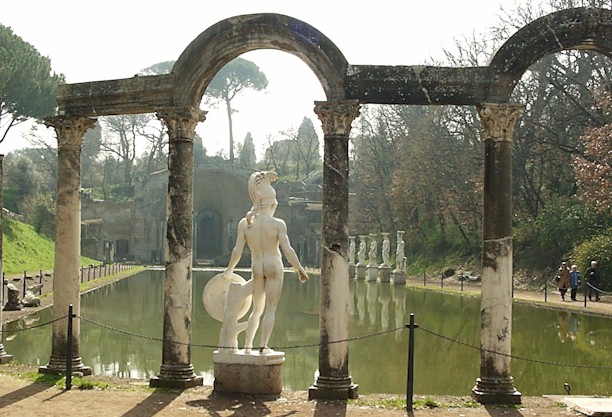
But as time went by, arches are used to build monuments to emperors, and whatever talent they possessed went to make things like the Emperor Hadrian’s villa:

Here below is the general outline of the whole of Hadrian’s villa:

And again, another so-called “good emperor” of Rome (Marcus Aurelius) put his focus on the building of private monuments, like this personal “arch” monument below (contrasted with the public use of the arch for water above)

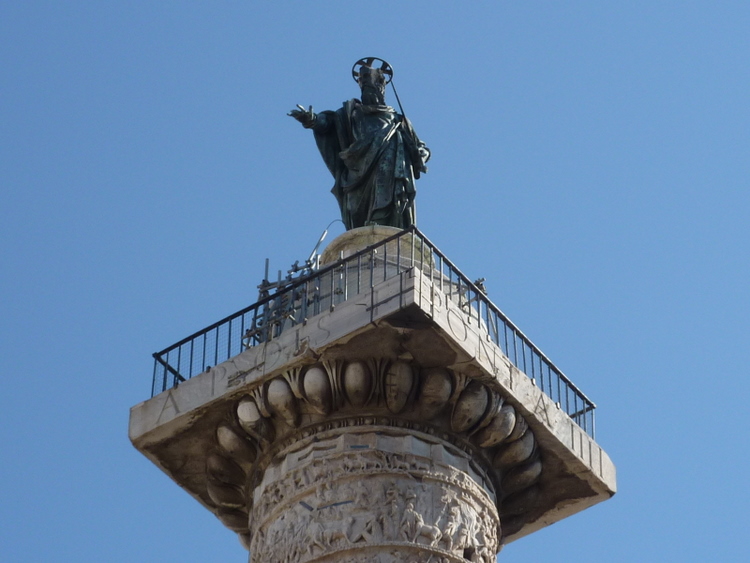
And another personal monument column to add to that. . .

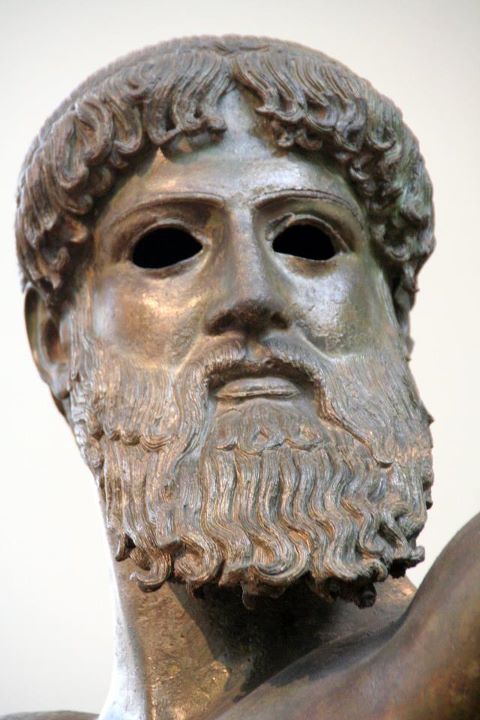
If Rome was committed to understanding the changes in their culture, perhaps they may have been used for good, but Rome would not do this, and preferred to live in the past.  Their innovations (never a strong point) dried up, and whatever was new in Rome was simply borrowed from the Greeks (as the statue in Hadrian’s villa indicates).  Rome had grown stale and petrified, but would they see this?  As we noted, this would not be likely, for another thing the architecture reveals is whereas in the past their energies were directed to the public sphere, now most of what they did centered around the emperor.

A bored and uncreative people will  tend to think bigger is better all the time.  The Romans were no exception. Like an addict, it takes more and more over time to get the same response.  As the activity’s reward decreases, more effort only gives diminishing returns.  As we began our discussion of the games, we saw  how an old Etruscan funeral rite grew into an unregulated black market trade, to ‘opening act’ for the chariot races, eventually growing to a hideous and repulsive spectacle on a grand scale before tens of thousands.  How did this happen, and what does it say about Rome?

We need to see not only the moral dimension of this problem, but the political one as well.  The Games served to enhance the prestige of the emperor and keep people amused and distracted, in a sense, from the reality around them.  One may recall the Wizard of Oz’s line not to look behind the curtain.  The whole system of Empire had degenerated essentially into a military dictatorship by Vespasian’s time.  No emperor could ill afford a populace too rowdy or too thoughtful.  The Games helped buy them off.
Casinos, for example, want you to lose money, but not all of your money.  After all, they want you to leave happy so you will come back.  When you start to lose too much, often times an employee will appear suddenly, encourage you to stop, and offer you a coupon for a free steak dinner at their award winning restaurant. Their goal of course, is that you think, “Hey, that casino is really great for giving me this free dinner,” instead of, “I just lost X amount of money at that casino.”  I think the Games worked much in the same way.
Certain emperors, of course, may have felt more of a need to establish their legitimacy than others.  Claudius, for example, was a big proponent of the games, and he was the ‘runt’ of the Julio-Claudian line, and Caligula’s uncle.  Vespasian built the Colosseum specifically for the games, and he came to power after a year of civil war.
There are other means of cementing your power, notably, buying your friends.  This dynamic was not, I think, the main reason for the debasement of Roman currency, but it surely did not help.  I passed this chart out to the students showing the general decline of currency value, with some being more responsible than others.  Those emperors that rose to power after a change in dynasty often did so after civil war (marked with an *), and would have extra need to buy the loyalty of key people, and especially, key army legions (though to be fair, Nerva does not fit this pattern).

9th/10th Grade: Bad Roman Fathers

Greetings,

This week we looked at the aftermath of Nero’s suicide in 68 A.D.  Having no heirs, Nero did not establish any process for a succession.  Three generals, Galba, Otho, and Vitellius ended up holding power alternately before the last, Vespasian, remained standing and took up Imperium himself and stability returned.

The Civil Wars did not last long and probably did not impact the common people very much, but this “Year of 3 Emperors,” portended ill for Rome.

  • It showed that in the absence of any family successor, power could simply go to the strongest
  • The system Augustus established at least maintained a fictional role for the Senate.  Some emperors (like Claudius) used the Senate to a moderate degree.  Now however, the Senate lost all role in who governed Rome.  The mask was off the pig.  Power belonged to the army, not to any of the pre-existing public institutions.

Vespasian looks like a solid sort, and he ruled well by most standards.  He eliminated a massive debt (largely through raising taxes).  He had no obvious vices to bring himself or Rome down.  He began the project that turned the land that housed Nero’s ridiculous private palace into a large public building for all people, known then as the Flavian Amphitheater (after his family name), known to us as the Colosseum.

One of the main functions of this intricately engineered building was to house the gladiator contests, that by Vespasian’s time, became more and central to Rome’s way of life.  What began as a holdover from old Etruscan funeral rite ca. 600 B.C. then became ad hoc neighborhood entertainment by 50 B.C., and finally turned into a horrendous spectacle where criminals (and Christians) were tortured and killed for amusement by 100 A.D.  When we realize that Rome financed much of the construction from looting the Temple in Jerusalem, and that thousands of Jewish slaves built it, we see that even when Rome tried to go “good” it brought about a terrible evil.  We discussed how this could happen. . .

1. Among other things, the Romans demonstrated what happens to addicts.  More and more is needed as the ‘drug’ gives less and less back, but it becomes so much a part of you that stopping is near impossible, at least humanly speaking.  Along those lines we discussed how in Scripture sin is described as a ‘power,’ a kind of black hole like vortex.  We delude ourselves when we think that we can easily jump back and forth between sinning and not sinning.  Quicksand doesn’t work that way.

2. The games satisfied Rome’s need for glory and courage.  Rome believed that they were still Rome, but very few citizens fought anymore.  Cicero, among others, thought the games served the purpose of ‘toughening’ the citizens. The Pax Romana created a breathing space for Rome that they could have used to transform themselves to some degree.  However, the very foundation of the Augustus’s principate system was built on the idea that Rome had not changed.  The games allowed the Romans to imagine that they were just like their ancestors, tough and able to deal with violence.

3. The games were also related to Rome’s broken political system.  Like the Wizard of Oz, Rome’s emperors could ill afford the citizens a look behind the curtain.  The games proved a marvelous distraction for the populace.  Also, since all power became centralized with the emperor, he needed to appear all powerful.  The bigger the spectacle, the better it tended to reflect on the emperor.

But the political problem had broader foundations than this.  With the rise of wealthy landowners gobbling up the small farms, thousands ended up flocking to the cities to find work, especially Rome.  What could be done with these people? Ultimately. . .

4. The games also show Rome’s continual band-aid approach to its problems.  They were not good at making hard choices about who they were at this point in their history.  The games distracted people and bought the short term favor of the lower classes, but it produced nothing for their society.  Whole armies of soldiers, slaves, and animals perished, countless money was spent, merely to enhance the image of the emperor and entertain the people.   But no creative or productive activity flowed from the games.  It was all ‘sunk costs.’

5. The Romans viewed the games as a means of displaying their power, in at least two ways.  First, it meant that Romans could say something to the effect of, “Look at what we can make people do for us!”  Perhaps this was more subconsciously believed than stated.  But the variety of people and the different fighting styles they employed did serve as a visual reminder of the scope of their power.

Had Rome been more productive or creative economically, this population influx might have led to a economic revolution of sorts for Rome, if we imagine the mid-late 19th century Industrial Revolution on a smaller, less technical scale.  However, being economically creative can’t just happen when you want it to.  It takes a foundation in education and attitude that Rome did not have.

Thus, the games reveal not only Rome’s moral bankruptcy, but its political and economic stagnation.

7. Finally, the games reflect Rome’s social and cultural climate “gone bad.”

When thinking of how the empire functioned we cannot lose hold of the context of Rome’s past Republican history.  Rome’s revolution in 508 B.C. created some measure of what we would call democracy, but it mainly gave the aristocracy/patricians more direct control over policy.  Americans view aristocracy as a dirty word, but Rome’s Republic functioned very well for many centuries.  One reason for this is that Rome’s aristocracy usually considered themselves patrons and acted as “patrons of Rome” without being overly “patronizing.”  The “patrons” sought to look after the lower classes, to provide for them, give them gifts, and sometimes be the stern father figure.  In fact, the patrons of Rome came from the “patrician” class, i.e. the “fathers.”

Good Roman fathers have many roles.  They lead worship.  They provide law.  They provide continuance of the family line.  Sometimes, too, they give gifts.  “Here’s 20 bucks, go have a good time at the movies with your friends,” and so on.  Emperors served as Rome’s ultimate patrons.  The Civil Wars of 133-31 B.C. decimated Rome’s aristocracy and left the Senate impotent.  Thus, whereas before Rome had many “fathers,” now for the most part, they have just one, the Emperor.

We understand Roman reaction to their emperors better if we view it through this lens.

  • Augustus cast the perfect balance between stern, reliable Roman father upholding the morals of Rome, with a sprinkling of gifts (of money, bread, etc.) and indulgence.
  • Tiberius was a great manager of money, but viewed as a miser.  He never threw a party, never gave gifts, etc.  He had no “heart.”
  • Caligula was a disaster — completely unreliable, giving no family stability
  • Claudius didn’t look the part, which was a drawback.  He had some problems with women — also a drawback.  But in the main he followed Augustus’ model.
  • Nero was the dad in perpetual mid-life crisis, who spent your inheritance and that of his brothers. He steals from other families when that runs dry.  He quits his job to become a very unsuccessful opera-singer and provides no leadership, no example, for his children.

Roman fathers had to show that they identified with their children’s interests.  The Roman Games were one big party, given as a gift.  Of course because Rome’s political system meant that they had just one father, the party had to be huge to cover the whole population.  The expense, the expectation, and the length of the games (by the 2nd century the games might last 4-5 months) all grew as each emperor tried to establish his credentials as a proper Roman father.*

All of this is bound to catch up with them at some point.  This week we will take a look at Rome’s decline through the lens of economics and architecture, and begin to find our way towards the coming of Constantine.

Dave

 *We want dads to provide the party for his teenage children, but not really to join in the party.  That would be weird and off-putting, most “un-fatherly” conduct.  Hence, the Romans did not like it when Emperor Commodus “joined the party” by participating personally in the gladiatorial games.

Despair and Exaltation in Ancient Rome

The phenomena of Roman gladiators has gotten lots of attention over the years, and that’s no surprise.  One way of quickly getting a sense of an ancient people is to seek what details stand out and makes them look odd, impressive, or otherwise shocking to modern eyes.  The gladiatorial games, like human sacrifices for the Aztecs, Egyptian tombs, or medieval cathedrals all fit the bill.

We usually see the gladiatorial contests as evidence of Rome’s decline.  Rome got wealthy, Rome got bored and decadent, and so it needed the bread and circuses to maintain order in a tumultuous political climate. “How sad,” some say, “and how dramatic a change from Rome’s hard and flinty past!  But, when a big empire goes south, it will go south on a grand and terrible scale.”

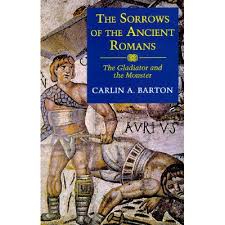
So the story goes.  But, what if, like Tweedle-Dee and Tweedle-Dum, we had it contrariwise?  What if the Rome of the gladiatorial games is simply the Rome that always was, and money and power just gave them more opportunities to expand their sense of themselves?  Such are the implications of Carlin Barton’s eye-opening The Sorrows of the Ancient Romans: The Gladiator and the Monster.  Barton wants to show us that our modern categories of thought and experience will not work for Rome.  We cannot say, “Well, we like football so we’re just like the Romans.”  This shallow method will not cut it for Barton.  She asks us to go deeper and to notice the Romans on their own terms, and gives us plenty of food for thought to reconsider the meaning of Rome, and what it means that Rome was a “religious” society.

Barton examines the gladiatorial games, one of the more sensational aspects of Rome’s past.  The title focuses on the concept of “sorrow,” but Barton tries to examine the games through a lens of the tension between asceticism, discipline, glory, indulgence, and exaltation.  We might think of the Romans as orderly people who lived in the middle of the road.  If true, Barton suggests that they could do so only by holding opposites in constant tension.

For an example we have the Roman triumph.  Anyone familiar with Roman lore and tradition knows that Rome itself, not a particular individual, occupies the heroic position.  They wove their fear of too much individualism into their laws and customs.  They valued communal fraternity so much that one of their laws states that,

If any person has sung or composed against another person a song such as was causing slander or insult…. he shall be clubbed to death,+

and they valued order and gravitas to the extent that they banned excessive mourning at funerals.

But at the same time they gave massive official “Triumphs” to certain generals on occasion, where the whole city came out to shower the victor with praise.  But as the victor processed, his soldiers could–and perhaps should?–sing bawdy or insulting songs about their general in direct violation of law, while a slave rode with him as well to remind him of his mortality.*

Barton tries to explore this at least seeming tension through the lens of the so-called “circuses” of Rome, which Barton writes were a, “Powerful opera of emotions in which the gladiator was the star.”

Most people, most of the time, imagine themselves doing good more often than not, and suppose that others will naturally share the assumptions they make about themselves.  The same holds true for countries and perhaps especially for imperial powers, who tell themselves that they come with blessings for all, and get a shock when they find themselves not always as appreciated as they feel they deserve.**  So too with gladiators and the games, the Romans saw themselves as benefactors.  Barton pushes back on the modern notion that they served as mere entertainment for a swelling populace that needed distracted.

The Romans saw themselves as giving gladiators a chance to redeem their low-estate, even to become something more than a mere man–an act of generosity.  The crowd attends to cooperate and encourage this transformation, not so much to gratify idle curiosity but rather to partake in a kind of religious apotheosis.  To begin, the military oath had a great deal of similarity to the gladiatorial oath. Seneca wrote,

You have enlisted under oath.  If any man say that this is a soft or easy form of soldiering they will only wish to mock you.  But be not deceived: the words of this most honorable of compacts are the very same as those of the most foulest [i.e., the gladiator’s oath]: to be burned, to be bound, to be slain by the sword.  You must die erect and invincible. What difference will it make if you gain a few more days or years? We are born into a world in which no quarter is given.

Thus, Barton comments, the gladiator became a kind of soldier/philosopher, one who lives between life and death, understands both, and can mock at both.  This in turn gave him license to become a new man.   If the emperor claimed his life, one might see it as akin to a god claiming his own.  His death, then, was not necessarily a cause for sorrow.

This gives us a new image of the crowd’s role at the games.  The crowd does not so much cheer for life, or death, but for a communal religious right.  Seneca again comments,

I judge you wretched because you have never been wretched yourself.  You have passed through life without an adversary. No one will know what you are capable of, not even you yourself will know.  And so there are men of their own accord [i.e. gladiators] come forward to challenge reluctant misfortune, and sought an opportunity to blazon forth their worth when it was about to pass into obscurity.  Great men glory in adversity, as do brave men in battle. 

The injuries inflicted by the powerful must be borne, not just patiently, but with a glad countenance.  At the table of a king every meal is a delight. So must they drink, so must they respond, so must the laugh at the funerals of their loved ones.

To glory in suffering is to become glorious.  So even in death, the gladiator wins.  He shows his exalted status by despising life.  As one commented on D. Junius Brutus: “He behaved so basely that he deserved to live.”  The crowd could occasionally assume risk as well, flocking to rickety theaters that could collapse or catch fire at any time.  They cheer on the gladiator toward his glorious suffering just as they–albeit in a more limited fashion–participate in that same suffering, that same embrace and defiance of death.

With this in place we can view the decadence of the Romans in new light.  Gladiators lived beyond normal life, so they could indulge themselves freely, embracing the extremes of life and death.  St. Augustine commented that the life of the gladiator involved licenstious cruelty, an excess of indulgence in everything.  And yet at the same time, they functioned as Rome’s ascetics, able to abandon their very lives to the people of Rome.  Their lives do not belong to them and in so doing their lives can belong to all. They simultaneously embraced both extremes, the demi-gods of Rome who lived beyond the lot of mortals.

This is why the crowd could cheer even the losers in combat, for in their death they display their superiority to death, unblinking, and unafraid.  It was only when the combatants shrank from death that crowd turned on them, and then with stern vengeance.  Showing fear of death made them normal once again, and once they became “normal” they turned the games into something shameful and cruel, rather than something “exalted.”  A gladiator’s fear of death ended the crowd’s participation in the ritual and suddenly transformed the event to a mere butchery.  Who wants to see that?

This is why Rome embraced fleshly decadence as a kind of asceticism.  In Rome one must learn to endure all things and keep going.  A Roman can embrace everything and maintain his dignity.  He can die, and he can eat, vomit it all up, and eat some more.  He can endure death and every form of excess life throws at him and “triumph.”  It is hard to say whether the banquets and excess of late-Republican Rome derived from gladiator culture or vice-versa, but I suspect the former.  J.E. Lendon at the University of Virginia seems to suggest in his Soldiers and Ghosts that the Romans had an extraordinary ability to do almost anything to avoid shame.  That ability could include

  • A strong aversion to any kind of trickery in warfare.  The only honorable way to fight was to march straight into the enemy and smash them in the mouth.
  • A strong aversion to a fear of death and ready acceptance of suicide as superior to even small personal or political failures among the political elite, and
  • As Barton points out, a refusal to accept any limits not just on pains^ but even on the pleasures that one could endure, such as eating six meat pies, spewing it out, and still look forward to eating the seventh.  We know that no matter how much one loves pizza, for example, there comes a point after eating too many slices that one starts to despise pizza. For the Romans, the man who lost the ability to desire had lost something of himself.

One might see the how these practices could stray into some rather bizarre sexual realms.  Clearly gladiators enjoyed status as sexual objects, and Barton is hardly the first to discuss this.  But she did, if it be possible, help me understand Caligula, at least indirectly.  Of course no one can possibly excuse Caligula via “understanding!”  But in Caligula we see the same kind of excess of cruelty, physical and sexual indulgence, along with religious ecstasy as we see in gladiators.  Caligula claimed a kind of deity for himself.  Perhaps this was insanity, but perhaps he was simply following the gladiator ethic of testing himself, pushing himself, to extremes of vice and religious glorification, courting disaster but not shirking from the challenge.

Maybe.

I found Barton’s book in turns fascinating and perplexing.  I don’t know what it means for understanding the breadth of Rome’s existence from start to finish.  In the preface to his history, Livy wrote that, “Of late wealth has brought us avarice, and abundant pleasures, yearning–amidst both excess and the desire to perish and destroy all things.”  It is a familiar trope of ancient historians, but that has no particular bearing on the accuracy of his interpretation.  Still, I tend to see what happened with gladiators not as a weird appendage of the late-Republic/Empire, but as an integral part of Rome that lay under the surface initially, and grew in prominence over time.

For example, the Romans established the office of aedile very early in their history in the 5th century B.C.  Most aspects of how they functioned look very Roman in our usual sense of the word, as they maintained buildings, streets, laws, etc.  But, they also had charge of public entertainments or other public events, such as large funerals.  Aedlies were expected to fund these out of their own pocket, and many could easily go bankrupt during their time in office.

But the Romans saw the role of aedile as a crucial stepping stone to higher office, where the opportunities for glory and riches increased.  Caesar risked everything and beggared himself to win the election of pontiff, then used the office for fabulous gain.  This pattern was established long before him, however, this yo-yo between poverty and wealth, despair and exaltation.

It seems fitting to give the last word here to an important critic of all of this mess, St. Cyprian of Carthage, who wrote,

Man is killed for the pleasure of man, and to be able to kill is a skill, an employment, an art.  He undergoes discipline in order to kill, and when he does kill, it is a glory. What is this, I ask you, of what nature is it, where those offer themselves to wild beasts, whom no one has condemned, in the prime of life, of comely appearance, in costly garments?  While alive they adorn themselves for voluntary death and miserable as they are, they even glory in their sufferings

Dave

+It seems particularly Roman to me that their wouldn’t say, “shall be executed,” but rather the more stark, “shall be clubbed to death.”

*Some might say that these exceptions have much in common with medieval carnivals or days of “misrule.”  I disagree, and I assume Barton would as well.  The medieval carnival temporarily suspended normal reality to a) reset/refresh the existing order, and b) demonstrate the reality of a world beyond our own.  The Romans seemed to live in perpetual earthly tension within one plane of existence.

**I do not mean for this to serve as an all-encompassing statement on the question of how empires do or do not benefit those under their control.  The question is complicated and perhaps no one good general answer exists.  All I mean to assert here is that imperial powers assume that they are helping and not hurting.

^If we look at the 2nd Punic War, one can imagine almost any civilization surrendering in 216 B.C. after Cannae.  Poylbius points out the political structure of Rome as one of the keys to their ultimate victory and ability to persevere.  Certainly that helped.  I think the real key, however, was Rome’s culture/religion that told them to suffer–to embrace suffering.  This should tell us that:

  • Indeed, what we saw with gladiators was present earlier in Rome’s history (in a more noble form).
  • Culture and religion trump politics.  One can see a parallel in W.W. II where Germany inflicted unimaginable losses against the Soviets in the first few months their attacks.  Any rational man would assume a surrender would be forthcoming.  Yet, somehow, the Soviets kept going and eventually destroyed the Nazi’s.  The Soviets and the Romans had very different political systems, but both drew from religions that taught them how to suffer–albeit in different ways for different reasons (in the case of the Soviets it was Orthodox Christianity, which made a significant unofficial comeback during the war).

9th/10th Grade: Fiddling with Flames

Greetings,

This week we looked at Emperors Claudius and Nero and the problems he caused Rome.

Claudius had his good points.  He was intelligent and hard working.  Some of his legislative and judicial reforms improved things in Rome.  His bust tells us that he was a “normal” guy, and he did not demonstrate any of the insanely cruel tendencies of Caligula.

But generally he is known for three things:

1. The conquest of Britain

What Julius Caesar began in the most tentative way, Claudius finished.  Ostensibly, Rome did this because Gaul may have been receiving aid from across the channel.  To me at least, however, this conquest served no real purpose for Rome accept to continue to delude itself that it was still strong as ever.  Some conquests could potentially make geographical sense even if based on shaky moral grounds.  It’s hard to see how the conquest of Britain fits into any category except that of  Claudius’s ego.  But it may simply been a way to solidify his legitimacy as emperor.  In other words, Claudius (a scholar, a man with a speech impediment and slightly deformed shoulder — not things Romans would have valued) may have thought that some kind of conquest was necessary to prove himself as a Roman leader.

Claudius may have further justified the action as ‘for the good of Rome,’ because if his regime faltered civil war might result, and Rome as a whole would suffer.  If we accept this line of reasoning we see how Rome’s system of government may have worked against the chances of Rome’s success.

We talked of how empire expansion can in some ways, resemble acquisitions done by companies.  I I listened months ago to an interview with the CEO of Ebay, who mentioned that the company’s mission was to “connect buyers and sellers.”  Previously Ebay bought Skype, and then under his tenure, sold it off again.  I asked the students if they had ever used Skype to call a business or seller, or if they had ever received a business call on Skype.  No one had, and this was Ebay’s CEO main point.  However neat Skype may be, it did not fit within their company mission.  Dumping even a “neat” product made their company healthier.

So too, territorial acquisitions have to make some sense, have to fit within the “mission” of the conqueror for it to have any hope of benefitting them (I realize that for the moment, I am not directly considering the moral issue of conquest).  I can’t see how Britain’s conquest could possibly fit within Rome’ s interests, though one student suggested that it fit perfectly well — Rome only cared about being bigger than before.

2. The expansion of the civil service

Claudius can be admired for having a soft spot for recently freed slaves who showed intelligence.  But, being clever, he used them to expand his own power.  The civil service was in many ways necessary, but it was also a tool to bypass whatever vestiges remained of Republican government in the Senate and other elected officers.  The Senate did little to object.  Some have commented that our own predilection for appointing ‘Czars’ (“Education Czar,” “Drug Czar,” over the last 20-25 years for the war on drugs, the economy, trade, etc. does the same thing, putting more and more in the hands of the executive branch.

3. His taste in women

For all his intelligence, Claudius had a blind spot when it came to women.  His first wife was named Urganulilla (enough said there), who may have murdered his sister.  Some suggest he divorced his second wife for emotional abuse.  His third wife had numerous affairs and probably involved herself in a plot to overthrow him.  Grudgingly, he executed her for treason.  His fourth wife probably instigated his death via poisoned mushrooms.  Well, no one’s perfect!

Claudius seemed to have a thing for women stronger in personality than him, and maybe was a glutton for punishment.  Perhaps a connection exists between his taste in women and his love for the gladitorial games, which he frequented.

Nero’s reign, like that of Caligula and other bad emperors, raises a question: Can anyone be, in historian Will Durant’s words, “both omnipotent and sane?”  Nero was not on the scale of say, Caligula, but clearly he distanced himself from reality.

He had a passion for the arts.  He spent much of his time devoted to singing.  He held concerts, where attendance was unofficially mandatory for Rome’s political class.  The Roman historian Seutonius writes that some  feigned death or heart attack in hopes of being carried out of these concerts early.  No doubt many volunteers rushed to the scene to “help” if they could.  Nero appears not to have noticed.

Nero’s passion surely must have struck the Romans as bizarre.  Imagine a campaign ad for a president that showed him, not shaking hands or looking smart at a desk, but taking lessons in how to sing an opera aria.

Nero attended the Greek Olympics in AD 68, giving many concerts to “wild applause.”  Nero also entered the chariot race, but alas, his chariot broke during the competition and he did not finish.  Nevertheless the Greeks awarded Nero first prize, and gave him their most distinguished award for excellence in competition.  Any normal person should have seen right through this, but Nero appears to have missed what the Greeks were trying to accomplish.  He proclaimed that the Greeks recognized “true greatness” and in appreciation removed Greece from the list of provinces that paid annual tributes to Rome.

Whatever their faults, no one ever said the Greeks were idiots.

I find something almost childlike about Nero’s utter lack of self-awareness.  But as we have said in previous updates, distancing oneself from reality to such a degree, combined with great power, would inevitably lead to disaster.  Nero’s self-delusion manifested itself in other ways.  He may have murdered his mother to obtain the divorce and remarriage he sought.  He may have had a hand in the great fire of 64 AD that burned much of Rome.  Nero had always talked of redesigning Rome on more aesthetic lines, and now with much of the city destroyed he could (Christians became a convenient scapegoat).  He almost certainly did not really “fiddle while Rome burned,” but the story points to a truth about his character.

When he died by suicide, he is reported to have lamented, “What a great artist dies with me!” delusional to the bitter end.  Few of us will always like the limits imposed on us by law, custom, circumstance, and conscience, but maybe these are some of the things God uses to keep us from being enslaved to our own self, and trapped in our own view of reality.

The aftermath of Nero’s death removed all traces of what remained of the Republic.  While under Augustus, the Senate at least served as a rubber stamp, now the position of emperor simply went to the general who could control Rome.

The Romans were glad enough to get rid of Nero, but eliminating him meant the end of the Julio-Claudian dynasty and a power vacuum that needed filled.  Rome burned in A.D. 64, but Rome itself played with fire with a political system bound to rupture at some point.

Blessings,

Dave

Invictus Diplomacy

Historians are people too, and they need jobs just like everyone else.  One way some seek to perpetuate their role in society is by coming up with new and different perspectives on the past.  I am all for reexamining things and keeping them fresh, but . . .  recently I have noticed a few attempts to redeem Rome’s most notorious Emperors, Nero and Caligula, and I wonder if this carries things a bit too far.*  Still, despite my concerns that this represents something “weird for the sake of being weird,” we must contend, for example, with the fact that Nero had a great deal of popularity with the masses in general.  We need not assume that Tacitus and Suetonius deliberately lied and distorted things to wonder if they failed to give us the full picture.

Aloys Winterling recently published a well-received biography of Caligula.  Some reviews got my ire up with the word “rehabilitation,” but upon further examination, Winterling seeks to condemn Caligula in a different way, and not “rehabilitate” him.  Winterling allows us to understand Rome and his reign in a different light.  Traditionally most assume that Caligula’s actions had their roots in some type of madness, and this allows for us to excuse them in some ways, obscuring Caligula’s true motives.**

The Augustan synthesis fixed the bleeding in Rome after a century of intermittent civil war, but at a price of the straightforward approach Rome prided itself on.  Augustus may have “pretended” not to want power and the Senate likely “pretended” to rule.  But in the end, Augustus had the power and the senate didn’t. Augustus performed an intricate kibuki dance of sorts that allowed everyone to assume, if they wished, that Rome was still Rome, after all.

Caligula wanted to end this charade, Winterling argues, by carrying its logic as far it went.  He deliberately sought to expose the hypocrisy involved amongst Roman elite.  So, he made his horse a senator and consul as a deliberate insult, as a joke, not because he was “crazy.”  Nero had a thing for the stage and part of me wonders if we might not see Caligula’s time in power as something akin to Andy Kauffman as Emperor, where all masks come off because all masks are on, and things are funny because they are . . . not really that funny.  His goal seemed to be make people feel uncomfortable, something slightly akin to an act of social ‘violence,’^ which of course would presage the very real violence that characterized Caligula’s reign.

In attempting to strip off masks by putting on masks–such as “pretending” to be a god (though he might really have believed it?  Anything is possible). Many other examples exist of this.  When Caligula fell ill one Senator prayed for his recovery and, in an act of great ‘devotion,’ pledged his life for the health of the emperor.  When he recovered, Caligula made him go through with his pledge and end his life. No more masks, no more empty words. Caligula sought to break everything down and rule by himself with no need for social niceties.  One might think of Caligula’s reign as a 3 1/2 year stage act of a much more evil version of Andy Kauffman.

Diplomacy (and most aspects ofpolitics, I suppose) involves masks, and wearing such things must get tiresome.  One has to say things indirectly, if at all.  One says things with posture, and what one eats.  The job grants one high status and honor, yet it often requires a self-effacing temperment that often will not mesh with such requirements.  To say what one wants, to be an authentic man, such is the dream of every romantic.  It is this same romantic who no doubt envisions that his bracing personality is just what the world has been waiting for.

Liuprand of Cremona came from northern Italy as an ambassador for Emperor Otto in the middle of the 10th century A.D.  Otto sent him to Constantinople in hopes of arranging a royal marriage.  Liuprand’s life as a churchman gave him an excellent education, and he had a reputation as a fine speaker.  He seemed the best possible candidate to navigate the highly developed and occasionally strange world of Byzantium.

Liuprand wrote Otto an account of all of his exploits, and what makes his work so enjoyable is that he thinks he’s doing a great job.  He’s “telling it like it is,” not giving the Byzantines an inch!  He fights a valiant war of words on behalf of his emperor, of whom he seems to forget . . . wants a marriage into the Byzantine royal family.

One exchange, involving precedence and the tension between eastern and western churches, got a bit testy.  The Byzantines speak first (Liuprand writes in the first person) . . .

“But he will do that,” said Basil, the head of the imperial bedchamber, “when he makes Rome and the Roman church obedient to his nod.”

Then I said, “A certain fellow, having suffered much harm from another, approached God and said, “Lord, avenge me of my enemy!” God answered him, “I will do it, on the day on which I will give each according to his deeds.”

But to this Basil relpied, “How late!” [this exchange weaves together quotes from Ps. 61:13, Lk 18:3].

Then they all left the disputation shaking with laughter . . .

Liuprand walks away angry, but doesn’t seem to recognize the light-hearted touch from the Byzantines throughout this conversation, obvious in their laughter over his theological “zinger.”

In another instance, Liuprand grows incensed at the “masks” of the Byzantines, as they honored the emperor’s father, with the traditional song, “God grant you many years,” often sung in Orthodox churches even today.  We enter his narrative moments after he has been chastised by the emperor for finding their food too dainty and smelly.

[The Emperor] did not permit me a reply to his words, but instead ordered me back to the table.  Then his father entered and sat down, a man, it seemed, born 150 years before.  In their praises, or rather, their venting, the Greeks sang out, asking God  to multiply his years.

From this we can discern just how ignorant and greedy the Greeks are, and how enamored they are of their own glory.  They wish upon an old man, indeed–a walking corpse–what they certainly know nature will not allow, and the walking corpse wishes that which he knows will never happen, which he knows God will not do, and would not even be good for him if He did do it, but bad.

Liuprand is just the man to set them straight, if only they would listen!  How greedy the Greeks are, indeed!

As one might surmise, Liuprand failed to secure a royal bride for Otto. He has no capability to see his role in this disaster, or perhaps thinks it just as well.  How awful, he must have thought, to think of his leige Otto allying himself with these fish-eating onion lovers. Early during his visit he had been allowed to purchase some costly robes (though LIuprand seemed to despise all he saw and met, he did like their robes), but now the Emperor asked for them back.

When this was done, they took from me five very precious purple robes, judging that you [that is, Otto] and all the Italians, Saxons, Franks, Bavarians, Swabians, indeed all the nations, are unworthy to go about decked in cloth of that quality.  But how unsuitable and how insulting it is that soft, effeminate, long-sleeved, tiara wearing, hooded, lying, unsexed, idle people strut about in purple, while heroes, that is, strong men, who know war, full of faith and charity, in submission to God, full of virtues, do not!  What an insult, if that is not!” [he does add, we should note, that they reimbursed him for the price of the robes].

Thus ended his hilariously inept diplomatic career.

I know that many noble and worthy souls love the poem “Invictus,” by William Ernst Henley, but I have never liked a thing about it. The bald pagan statements in the poem always seemed to me a bit ridiculous and silly coming from the pen of a Victorian Brit.  I won’t argue the point too strongly, but I think we can at least say this, that when diplomats and politicians in sticky situations attempt to be “captains of their souls” and give nothing to no man, they become at best failures, at worst, a horrible wreck of humanity.  The final irony may be that such scrupulously confident people often end up the butt of jokes.

Dave

*Most academics, especially in the humanities, tend to lean left politically.  I wonder then, if we should be encouraged or worried that a variety of them seem to be trying to redeem, or perhaps lean towards “explaining away,” autocratic emperors.

**We should not call Hitler, Stalin, Pol Pot, etc., “mad” unless we do wish to excuse them in some way.

^For any who might not know, Tony Clifton is Andy Kaufmann.  I am one of those who (his Might Mouse routine aside), do not find him all that funny.  In my defense, reading the entire Great Gatsby on stage as his ‘act’ might be audacious (he actually did this at least once), but is it funny?  You might laugh at hearing about it, but would you pay to see it?


9th/10th Grade: Pride and Insanity

Greetings,

This week we continued our look at the early Roman emperors.  After the death of Augustus came the reign of Emperor Tiberius.

There is  good evidence that suggests that Tiberius never wanted to be emperor at all.  Duty bound, he did not shrink from service.  In many key ways, Tiberius was a good emperor (generally just, sound money manager, no foolish military adventures), but his introverted personality distanced him from the population and the ruling elite.  His bust shows him at least at a young age to be a decent, unassuming man.  As time went on, he grew more bitter, more distant.

His time in power raises a few questions:

As the Republic faded and Augustus’s system took over, was it possible for the emperor to be a simple civil servant?  Did the principate system of Augustus require a more dynamic kind of leadership than Tiberius could muster?   I recently heard an interview with an actor who had senators John McCain and Diane Feinstein guest-star on the sitcom he is a part of.  He mentioned how naturally acting came to the politicians.  It initially surprised him at first, but then he thought that in fact, politicians play a role all the time.

Some decry this situation, while others accept it passively.  But we should wonder if our system of government and our society do not almost require our leaders to be at least part image.  They need to represent something abstract beyond themselves in order to appeal to a broad enough cross-section of people to get elected.

Tiberius’s reaction to his unpopularity exacerbated the problem.   Tiberius took his unpopularity personally.  He grew distant and sullen.  The distance eventually became physical as well as social, as he withdrew from Rome and ruled from the island of Capri.  His isolation forced him to trust a select few.  When one of them named Sejanus betrayed him, Tiberius went off the rails.  Now no one was trustworthy, and many were arrested on flimsy treason charges.  Once he could take refuge in the good work he did for Rome, but now he spent much of his time trying to find “traitors.”  Whereas before people may have grudgingly respected him without liking him, now he had the hatred of most of the political class in Rome.

So strong was their dislike of Tiberius, the Romans rejoiced at his murder in favor of Emperor Gaius, known to us and his contemporaries as Caligula.  With Caligula, the pendulum swung in the opposite direction. Here was a man of some charm, but almost no real care for the actual demands of office.

Unlike Tiberius, he actually had a sense of humor — but this often had a cruel edge to it even when expressed in its most benign forms.  Growing as the mascot of the army in Germany, the son of the beloved but murdered General Germanicus, Caligula never had any check on his whims.  In normal society he would have been an annoying brat.  Unfortunately for Rome, his birth and connections made him emperor of the most powerful empire in the western world.

As his reign progressed, he grew more and proud and insane with power.

Caligula may never have been “normal,” but he wasn’t always insane (however unnerving this most famous bust of him might be, with that smirk and those distant eyes).  We call those insane who cannot cope with reality, and pride and delusions of omnipotence certainly distance us from reality.  This distance can lead to paranoia and erratic behavior, perhaps out of fear.  A paranoid and erratic emperor would spell disaster for Rome’s political class.

Can a person make oneself insane through their actions?  We can consider Daniel 4 and the story of Nebuchadnezzar, where his pride led to his insanity.  The same might be said of Caligula.

Next week, we examine the reign of Claudius and Nero.

Blessings,

Dave Mathwin

Rome’s Final Frontier

Greetings to all,

This week we continued our look at the formation of the Empire under Augustus Caesar.  His leadership gave Rome peace and stability, but this came at a price.  Augustus solved some of the decayed Republic, but his solution created other problems.

Decades of civil war faced Rome with the need for change.  Rome’s society, however, was built on tradition. Augustus carried himself as a leader in the old tradition, but in reality eroded all of the old checks and balances of the Republic.  He was much more careful than his uncle Julius, who made no secret of his power.  In reality, however, Augustus had just as much, if not more power than Julius ever did.  He certainly understood the power inherent in manipulating his image. . .

The problem may not have been the power itself, but the fact that it was done more or less secretly, and so did not encourage Rome to face reality.  We talked of how Rome was in a sense, ‘pretending’ — living in a fantasy land that told them that Rome was still Rome, after all.  This pretending, however, can be dangerous for a civilization, because the tension between your imagination and reality can grow over time.

In their “Res Getae” assignment the students got an idea of the subtlety with which Augustus worked.  He saw what happened to his uncle Julius, and modified his actions accordingly.  He never (or hardly ever) took power, he waited to receive it from others.  He rejected the title of Dictator which would have brought odium upon himself, but he took bits and pieces of other offices that added up to total control in the end, a kind of “majority ownership” of Rome.

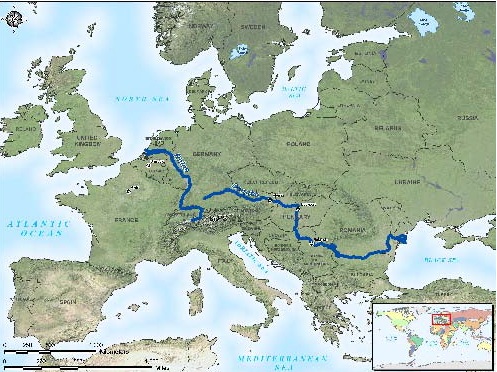
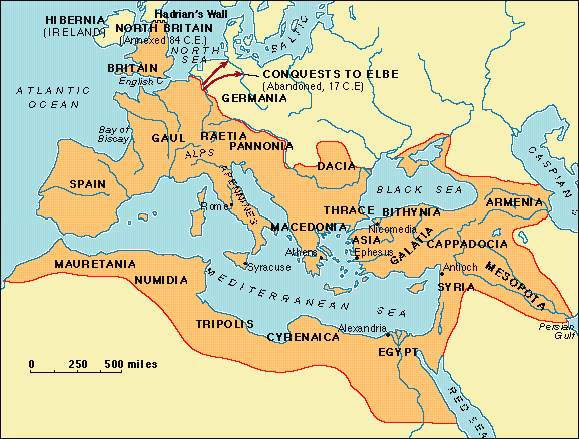
Next week we will see that one problem Augustus faced was the German frontier along the Rhine and Danube river.  He was right to recognize its weaknesses.  This map shows the wedge into Roman territory created by the meeting of the Rhine and Danube river.

Do rivers make for good frontiers?  We might think so, for rivers are not easy for armies to cross.  But when compared with mountains or deserts we see that rivers can be quite porous. Neither side, after all, has a barrier to using the river on their side of territory.  Furthermore, most people use rivers for fishing, travel, and commerce.  Thus, rivers often act to bring people together rather than separate them.  The MD/D.C./No. VA area is a good example of this.  Augustus needed a new frontier, a more secure border.

Prudence might dictate falling back to something more secure.  But Augustus built his power in part on the fantasy that Rome had not changed.  Rome never falls back!  He tried to push forward further into Germany to the more advantageous Elbe/Danube frontier, seen here below. . .

and picked the arrogant Varus to command.  Varus fell for Arminius’s trap and led his army to disaster at the Battle of Tuetonburg Forest.  We will discuss how Augustus was right about his frontier being vulnerable, but was he right in his solution?

We shall see that their are limits to what the military can accomplish when the situation requires a  political solution While Rome would win battles against Germans in the future, they could never end their power of resistance.

Next week we will do an activity where I want the students to rethink the Roman frontier.  In the ideal world Rome could have pulled back a great deal.  But of course that would completely ignore political realities.  If he withdrew in one place, would he have to advance in another?  If so, where?  I hope the students enjoyed this change of pace and the chance to view the problem in a different way.

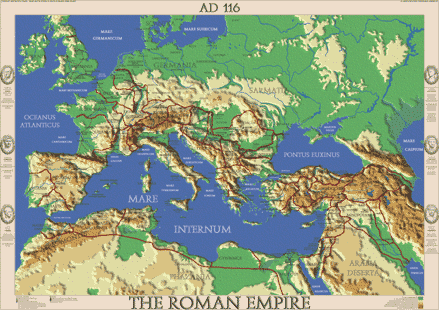
Here is a map of the Empire from a topographical perspective:

Where could Rome get an ‘easy’ victory to allow them to withdraw on the German border?  Where should troops be concentrated?

When we wrap up Augustus we will discuss various aspects of his reign.  He ended a century of civil war and brought peace throughout the Roman empire.  Under his leadership the economy and culture of Rome revived.  The system he established did give Rome stability long after he departed, and as far as masterful politicians go, I would rank Augustus as one of the all-time greats.  On the other hand, while Augustus was very effective, he had to curtail civil liberties to achieve his goals.  He never sought to make Rome face reality, to take them from their current perception of reality at point ‘A’ and bring them to the necessary point ‘B.’  In this way, Augustus lacked true leadership greatness.

After Augustus we will see how the system he established fared under different emperors.  Tiberius and Caligula will get our attention next week.

Many thanks,

Dave

9th/10th Grade: Let’s Pretend

Greetings to all,

It’s always exciting to begin a new year, and I have enjoyed the students and our interactions.  I trust that we will have a great year together.

We begin the year resuming the story of Rome in 44 B.C., after the death of Julius Caesar.  I am aware that for new students, it is not easy to pick up the story in the middle.  We have reviewed the context of Caesar’s assassination, but I would urge all students (and parents if you wish) to read this and this — both will hopefully help provide some additional insight into the background from Rome’s transition from Republic to Empire.  I would also suggest a review the Five Elements of Civilization that  formed the backbone of the 8th Grade Ancient History class.  If anyone wishes to review that (especially new students), look here.

To get new students up to speed, we went quickly through the first two of Rome’s three stages.  The first stage was the monarchy phase (753-508 B.C.), the second the Republic (508-44 B.C.).  Whatever their differences, both phases showed forth Rome’s main characteristics:

  • An emphasis on tradition.  Rome looked back to the past for guidance, not forward to the future.  They valued stability over change.
  • Rome began as an agrarian oriented society, which usually goes hand-in-hand with tradition oriented societies.  Though Rome began to develop a wealthy merchant class around 100 B.C., the ruling elite always thought of themselves as farmers.
  • In the Republic phase, they shared and divided power amongst different people and institutions, though usually monopolized by the nobility.  They feared that a concentration of power, especially in executive offices, would bring about a tyrannical government.

We spent this week reviewing the decline of the Roman Republic, setting the stage for our look at the Roman Empire and Augustus next week.   I wanted to with a few main themes:

1. Don’t Pretend

We reviewed the basics of the structure of the Republic, and how this helped form Rome’s identity, along with their self-image.  In Rome’s eyes, they were, and had always been, a nation of self reliant farmers.  But Rome changed over time, and because of Rome’s strong (at least stated) belief in tradition, Rome never felt the need to change. When they did change, they usually pretended that they were, in fact, not changing at all.

Next week we will discuss how potentially dangerous this attitude can be.  For example, a couple years ago during the summer I got  a minor shoulder injury at the beach.  Thinking myself to be 24 instead of the 38 I was at the time, after a few days I used the muscles much too soon and tweaked it all over again.  I need to realize that things take longer to heal at 38 than they did at 24, however sad a realization this might be!  This is all the more true for me at 41.   If I were to continue to pretend to be 24 the damage and bodily dysfunction would grow worse.  Imagine if a whole civilization did this, and what consequences would be in store for people that did so.

As the Republic collapsed, the distance between Rome’s self-image and reality grew wider and wider.  Will Augustus help solve the problem, or will he exacerbate it?

2. The Power and Vulnerability of Tradition

Most of us have probably experienced the positive power of tradition.  It provides structure, and sometimes comfort to our lives. Many families have holiday traditions that add depth and meaning to the occasion.  Tradition seems to have a magical power of sorts — we do something because that’s what we do, and it works.  In this way, tradition can be stronger than law.  It has a power all its own.

But the spell of tradition can be easily broken.  There is nothing, for example, to stop you from violating tradition.  Once you stop, the genie cannot be put back in the bottle.  Tradition’s power can be broken in a moment, whereas law takes much longer to whittle away.  Rome prided itself on being guided by the past, of “not departing from the ways of their fathers.”  Yet a century of civil war eroded most, if not all of those “old ways.”

Did they perceive this truth?  Can a tradition oriented society make necessary adaptations?  It’s safe to say that nearly every civilization would likely collapse after so much inner conflict and turmoil.  Rome will survive under Augustus, but they will pay a steep price to do so, as we shall see.

Next week we will look at some of the dilemmas facing Augustus as he ruled Rome, and see how the dynamic of ‘pretending’ likely pushed him into the disastrous Battle of Tuetonborg Forest.  We will also ask the question, “Should you ever trade liberty for security?”

Blessings,

Dave

Kevin Kelly’s Mind, and . . . Matter

I vaguely remember sometime in high school discovering the idea that “technology is neither good or bad in itself, but one can use technology for good or bad ends.” As a young American teen whose greatest life-changing event might have been the switch from cassettes (the sound muddied and faded so quickly!) to CD’s, that idea served as an important corrective.

But years later I distinctly remember coming across Lewis Mumford, who made the striking point that the design and use of the technology shapes us as much as we shape it. We may create a tool, but then immediately afterwards, the relationship turns symbiotic. Using a shovel all day will shape certain muscles more than others. A civilization, for example, that comes to rely on computers will inevitably prioritize certain skills and values over others.

The developed world’s response to COVID made me wonder whether or not Mumford could have gone even further. As many have noted (Paul Kingsnorth, Mary Harrington, etc.), the existence of the internet and other digital technology seemed to drive our policy, i.e., “We can work online and have food delivered, so we should do so.” The tail wagged the dog.

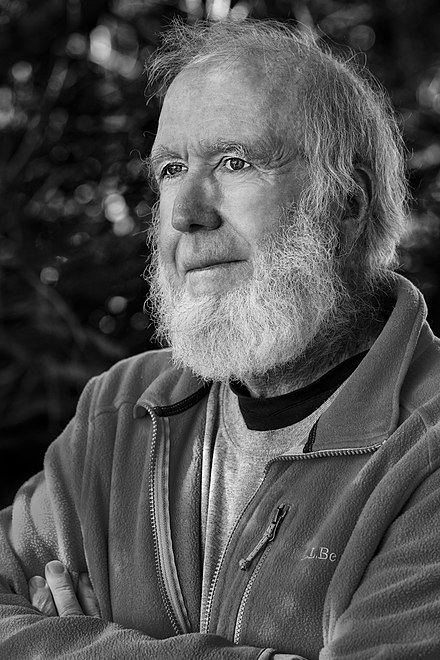
Some intellectual spaces, such as perhaps The World Economic Forum, believe that technology will fix all of our GDP’s everywhere, have yet to learn what I learned at 16. I have few worries about such people, because they seem fundamentally naive and out of touch. Much more interesting, and so potentially much more impactful for good or ill, is the work of someone like Kevin Kelly, as demonstrated by his two books, What Technology Wants, and The Inevitable. Kelly helped cofound Wired magazine and has a wealth of practical experience with technology and the tech world. He spent much of his youth trekking around the world technology free. He has worked extensively with conservation efforts. Kelly has his foot in many worlds, and possesses much more experience and intellect than most anyone who talks about technology. As his recent Wikipedia page picture indicates, this man has the look of a true believer–a prophet or a madman, but certainly no fool.

At the core of Kelly’s thoughts lay a few key principals:

  • Certain technological advances and changes are ‘inevitable’ precisely because we do not choose them. Rather, technology, which he names in corporately personal terms, “The Technetium,” functions as a living part of our environment.*
  • Just as we have the task of cooperating with our natural environment, so too we have the task of cooperating with the “technical” environment. But because both Nature and the Technium are alive in like ways, the process of adaptation to technology is not artificial, or anti-human, but natural and organic to human existence over time.

As he writes,

Our concern should not be about whether to embrace [the Technium]. We are beyond embrace; we are already symbiotic with it. At a macro-scale, the technium follows an inevitable progression. Yet at the microscope, volition rules. Our choice is to align ourselves with this direction, to expand choice and possibilities for everyone and everything.

Technology, he argues, wants what all life wants, which means increasing flexibility, opportunity, emergence, complexity, specialization, ubiquity, freedom, beauty, diversity, and yes, sentience. He writes elsewhere that,

Living organisms and ecosystems are characterized by a high degree of indirect collaboration, transparency of function, decentralization, flexibility, redundancy of roles, and natural efficiency; these are all traits that make biology useful to us and reasons why life can sustain its own evolution indefinitely. So the more lifelike we train our technology to be, the more convivial it becomes for us . . .

The fact that the pace of societal adaptation of new technology has dramatically increased over the last century shows us that this process of conviviality and symbiosis has also increased. Kelly want us to know that life works this way, and always has. We can try and invent better technologies as opposed to worse ones. But we cannot avoid a partnership with technology, just as we cannot avoid a partnership with Nature.

Kelly has a variety of observations to demonstrate that the development of new ideas and technology acts independently from material linear causation. Something operates outside of purely singular human volition. Among other things, he notes that successful authors/screenwriters get sued all the time for supposedly stealing ideas from other authors. Investigation then shows that such authors never came across the work of those that sue them.** We see the simultaneous development of blowgun techniques from tribes in the Amazon and in Borneo with no contact whatsoever. We see Luther and Zwingli coming up with very similar theology at the same time without ever interacting with each other. We see similar technological progression across cultures that have no contact. Some of the processes have an explanation in material causation, but others not, such as why rock art precedes sewing development almost uniformly.

Such propositions get at something transcendent, and Kelly quotes Carver Mead on this, who writes,

Moore’s Law is really about belief systems, it’s not a law of physics. After long enough, people talk about it in retrospect, and in retrospect it looks like a curve, a physical law, and people talk about it that way. But if you actually live it, as I am now, then it doesn’t feel like a physical law. It’s really a thing about human activity, it’s about vision, it’s about what you’re allowed to believe.

Kelly obviously recognizes variability. Not everything, or even most developments, end up fully entering the Technium. The question revolves more around the “wanting” of technology. He writes, “The poppy seed wants to become a plant, even though a fair amount of them end up on bagels.”

Kelly writes persuasively and uses a variety of examples and techniques to drive his points home. He avoids claiming that every technology has value. He spent a lot of time among the Amish, and praises them for how they interact with technology. Contrary to typical belief, the Amish have nothing against technology per se. But they put a tremendous amount of energy into monitoring how technology impacts their community. They make distinctions, but they base these distinctions (such as riding in cars, but not owning cars) on careful observation over long periods of time. They are not arbitrary, nor hypocritical. The point he wishes to make I think is–even with the Amish, human interaction with technology will happen, as it has always happened. Let’s work together, like the Amish, to maximize our understanding of technology and how it shapes us, while understanding that it will certainly shape us.

All of this sounds reasonable. I remember railing against email in the late 90’s, but I use it all the time now. I resisted getting a smart phone for many years, but now have one. Kelly would tell me, “There, there, it’s ok. You’re not a bad person, you haven’t betrayed any crucial moral principle. You simply are doing what humanity has always done.”

But I can’t quite accept this. Perhaps email and smart phones have a reasonable place in the world. In the end, however, the totality of Kelly’s book left me cold, though I could not put my finger on why for a few weeks . . . until I read portions of a book on medieval views of memory.

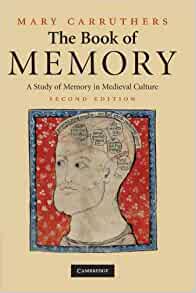
Mary Carruthers’ The Book of Memory: A Study of Memory in Medieval Culture is alas, not one that I could read cover-to-cover. Long stretches of the work delve into very technical matters that I lack the patience or interest to digest. But she makes some of her more general points with great clarity, and charitably illumines a world with different values than our own. In her introduction she cites the reflections of the contemporaries of two acknowledged great geniuses–first Einstein from our time, and then, St. Thomas Aquinas.

The greatness of Einstein lies in his tremendous imagination, in the unbelievable obstinacy with which he pursues problems.  Originality is the most important factor in any scientific work.  Intuition leads to unexplored regions of thought, though intuition is difficult to explain rationally.

No great scientific achievement happens without wandering in the darkness of error.  The more imagination is restricted, the more work moves only along a definite track, which limits new ideas. The ground is safer here, and that means fewer mistakes.  No great man is always correct.  Einstein’s recent paper might be wrong, and Einstein would still be the greatest of scientists today.

The most amazing aspect of Einstein is that he directs his whole vital force to one object–original thinking.  Slowly I came to realize that here his greatness lies.  Nothing has the importance of physics.  No personal life can match the comprehension of how God created the world.  One feels that behind his external calm his brain works without interruption–nothing can stop it.  

The clue to Einstein’s role in science lies in his loneliness and aloofness.  In this respect he differs from other scientists.  He never studied at a famous university–he worked at a patent office.  The isolation served as a blessing, since it prevented his thought from wandering into already established channels.  This ‘loneliness,’ this refusal to march with the crowds but looking instead to his own path, is the most essential feature of his creations.

Reflections of Leopold Infeld, who worked with Einstein at Princeton

And now, St. Thomas:

Of the brilliance of his intellect and his soundness of judgment, sufficient proof lies in his vast literary output.  His memory was extremely rich and retentive: whatever he once read and grasped he never forgot; it was as if knowledge were added to his soul as one might add pages to a book.  

Consider, for example, that admirable compilation of patristic commentaries on the four gospels he made for Pope Urban, and for the most part, he dictated from texts that he already had read and committed to memory while staying in various monasteries.  Still stronger is the testimony of Reginald [his secretary] and of others who took dictation for him.  All declare that he used to dictate to three separate secretaries at once, and occasionally four, on different subjects at the same time, completely from memory.  No one could do such a thing without a special grace.  Nor did he seem to search for things yet unknown to him.  Rather, he simply let his memory pour out its treasures.

He never set himself to study or argue a point, without first having recourse to prayer mingled with tears.  When perplexed, he would pause and pray at length, and when returning, he found his thought so clear that it seemed to show him, as in a book, the pages that he needed.

Reflections of Thomas of Celano, friend of Reginald, one of St. Thomas’ principal secretaries

On can glean a great deal from these short few paragraphs. We can start by noticing that the modern world view of genius means breaking from the past, and the older view meant connecting more firmly with it. Moreover, we see that the development of a strong memory for the medievals involved something akin to moral virtue, a “special grace.”

Memory involved reading, among other things. Carruthers shows that for the medievals, reading and memory were not for their own sakes. Rather, like the bee (the medievals viewed bees very highly for a number of reasons), they were to take the raw material of the text and turn into something “sweet,” like honey. This sounds unremarkable, but the medievals put a particularly earthy twist on how they discussed the process of reading. She writes,

The writer [of the Regula Monachorum] speaks of various stomach rumblings, belchings, and fartings that accompany the nightly gathering of monks.  But, he continues, as a famous pastor has said, just as smoke drives out bees, so belching caused by indigestion drives away the Holy Spirit [i.e., improper eating, or the taking of things into the body, caused improper means of expelling things from the body].”  

But this does not mean that all belches and farts were viewed negatively, per se, as it would be possible to have proper bodily “ex-takes” as you would proper bodily intake.  The Regula Monachorum declares,

Wherefore, as the belch bursts forth from the stomach according to the quality of food, and the index of a fart is according to the sweetness and stench of its odor, so the cogitations of the inner man brings forth words, and “from the abundance of the heart the mouth speaks” (Lk. 6:45).  The just man, eating, fills his soul.  And when he is replete with sacred doctrine, from the good treasury of his memory he brings forth those things which are good.

Carruthers comments,

The notion of Spirit as breath or wind is biblical; modern scholars, accustomed to thinking of this trope as a mere figure of speech, would never make the connection with a belch or fart that the medieval writer did.  Modern scholars who think they have observed class rivalries, or a “medieval unconscious” at odds with its piety in the texts that deal with memory work, would do well to consider the pervasive image of monks at prayer as spiritual flatulence.  This trope was often intended to provoke laughter and humility, and we should not assume it to be impious.

Just as we might say that our Constitution, for example, functions as a kind of decision-making technology, so also medieval memory techniques functioned as a technology. But what differentiates Kelly from the older understanding is this mixing of the heavenly and the earthly, talked of so starkly by the medievals. Kelly only seems to care for what comes next, and concerns himself more or less only with how we will adapt to the Technium. As to why the medievals thought of memory as a moral quality, I assume that one must gather the past to live rightly in the present. As for the future, well, it has no reality because it has no existence. But the past, while not equal in “reality” to the present, functions differently for us. We can, and must, have a connection to it.

Kelly sees a continuing “loss of body” as humanity’s only possible future. It is “inevitable” that we fly upwards and join with all of the etherealizing tendencies of modern digital technology. Thankfully such a vision can certainly never completely come to pass. Those that want the Metaverse will still need workers to lay cable. The heavens, after all, cannot exist without Atlas holding them up.

Dave

*This post is not the place to discuss the reality of corporate identities and personalities. But John Vervake and Jonathan Pageau do a good job of trying to explain the idea here and here.

**Some of the examples he cites are weird and uncanny, like JK Rowling getting sued for stealing the idea of an author who developed a story about a wizard school, whose hero is named Larry Potter, who has a scar, etc.

Tradition under Control

To combine high and low is a rare thing. Historians usually write either “high” with an overarching idea or theme but weak support, or they write “low” with lots of details and specific observations but little overall goal or point. The best historians know how to unite “Heaven” and “Earth,” for only in this union can one glean wisdom. A few years ago I read Carlin Barton’s book on the gladiatorial games and immediately decreed it the best book ever on the subject, case closed. Barton knows how to write in both directions, and she has bold ideas.

In the Sorrows of the Ancient Romans Barton successfully sought to see the gladiator contests not in light of the “bread and circuses” lens of Roman politics, but in the cultural and religious meaning of “suffering” for the Romans. In Imagine No Religion, cowritten with Daniel Boyarin, Barton remakes our understanding of Roman religion. She suggests in her introduction that the problem many scholars have in translating ancient texts comes from their natural love for abstraction.

Intellectuals and academics in the contemporary world are cosmopolites . . . . They are like the relativist Xenophanes who boasted of traveling the “world” for 67 years. They are pressed hard to find ways of ordering the variety of human experience. We scholars, like all cosmopolites, cope . . . by creating abstractions.

Barton argues that many translators see the world “religio” in Latin, and fail to see the nuance inherent in the word. I would add that academics might also tend to see the Roman concept of “religio” much in the way that those they connect with in the ancient world might see it. Hence, academics have tended to see Roman religion too much through the lens of Cicero. Cicero–a brilliant man who could see different sides of issues, alternating between retreat and involvement–seems a perfect doppelgänger for the modern don.

But when we look at Cicero in the 1st century B.C., we are not looking at the traditional reality of Roman religion, but at a reaction to political tumult, which likely sprang from the cultural and social upheaval of the Roman Republic at that time.

Some of Cicero’s more famous pronouncements on religion reveal something of a hierarchical and ordered system. He writes,

So from the very beginning we must persuade our citizens that the gods are the masters and regulators of all things, . . . that the race of humans are greatly indebted to them. They observe the character of every individual . . . with what intentions and with what pietas he fulfills his religiones . . .

In De Natura Deorum Cicero writes again in a similar vein,

. . . I ought to uphold the opinions about the immortal gods that we have received from the mayors, the caerimoniae, and the religiones. Indeed, I will always defend them, and always have. When it is a matter of religio I am guided by the pontifex maximus Titus . . .

Barton sees the concept of “religio” working much differently than as a means of social control, and cites the work of other scholars who translate the word as “care for the gods,” “hesitation,” “anxiety,” and the like. Clearly, some kind of cultural “attitude” is at work, a balancing of emotional attitudes and actions, and this forms the heart of Barton’s project with the book.

Earliest preserved appearances show that religio meant not so much a system of thought, but something akin to “what gave men pause.” In the Mercator of Plautus (184 B.C.) Charinus wants to leave home, his friend Eutyches tries to change his mind. Charinus responds, “That man causes me to have second thoughts–he makes me pause and wonder. I”ll turn round and go over to him” (Religionem mi obiecit: recipiam me illuc). In other sections of Plautus “religio” indicates the thought/emotion of holding back, thinking twice. A century later Cicero uses the word in a like manner when he recounts that Publius was greatly angry at Valerius, “Yet he kept hesitating and religio repeatedly resisted, holding back his anger.” In turn, acting against such a feeling caused one to feel pudor, whose symtoms gave one high anxiety more than shame. Barton suggests a parallel–“A modern man might approach a lapdog casually, but might hesitate before a Doberman or a pit bull. . . .Just so, ‘religio’ was evoked in dealing with the risky ventures of life, causing the Romans to behave with awe or circumspection.

Livy recounts the interactions between the consuls Paulus and Varro as they approached Cannae:

Paulus himself wished to delay . . . . Varro was greatly vexed at this hindrance, but the recent disaster of Flaminius and the memorable defeat of the consul Claudius in the First Punic struck his animus with religio.

Seneca writes similarly,

If a cave, made by the deep crumbling of the rocks, holds up a mountain on its arch, a place not made with hands but hollowed out by natural causes, it will strike your spirit with a certain religio.

Barton again comments, “‘Religio‘ was especially evoked by highly charged boundaries, and the fear of transgressing taboos, such as we might approach the edge of an electric fence. No fear of magisterial authority or divine judgment was necessary.”

But religio had negative connotations as well. One could hem and haw too much, and in the wrong times and places. Cicero criticizes a rhetor named Calvus, who spoke with excessive precision and balancing, so that “his language was weakened with too much religio.” So too, superstition had a close alliance with religio, which should be seen, as Barton states, as “not the antithesis but the excess of religio.” One needed a steady balance of the right religio to act rightly in the world. Failure to have a proper balance would later result in unhelpful wild swings. Livy writes of Tullus Hostilius, “[a] man who had so far thought nothing of . . . sacred rites, [who then] suddenly fell prey all sorts of superstitions, and filled even the minds of the people with religiones.” Livy also recounts the impact of the 2nd Punic War warping the people’s sense of religio:

The longer the war dragged on and success or failure altered the spirits of men no less than their fortunes, such a great religio invaded the republic, for the most part from the outside, so that gods or men suddenly seemed changed. Now that the disorder appeared too strong, the senate assigned . . . the city praetor the task of freeing people from these religiones.

An intriguing “chicken or the egg” question arises when one looks at the collapse of the Roman Republic. Most look at the political disorder beginning with the Graachi and then see the concomitant centralization of power that culminated with Caesar as a solution to the breakdown. Another option–could the centralization of power in fact have indirectly caused the disorder? An alteration of the traditional political give and take would send shock waves through the psyches of the populace. Of course, most chicken-egg questions have no possibility of resolution, but thinking of the relationship between power and disorder will help us understand the fabric of reality.

We can apply this to Roman religion, and we see the possibility that too much control may have come before religio got out of balance. Toynbee and others document how the 2nd Punic War (218-202) particularly challenged traditional religion by exposing Romans to new ideas, cults, and (as we saw above), an excess of religio as superstition. As the Republic collapsed in the late 1st century BC, Lucretius expounds the notion of the gods keeping everyone in perpetual fear–through excessive control. “Religio” had gotten out of control:

Human life lay for all to see foully groveling on the ground, crushed beneath the weight of religio which displayed her head in the regions of heaven, threatening mortals on high with horrible aspect . . .

I must show in what ways fear of the gods crept into the heart which our earth keeps holy their shrines and pools and groves, their altars and images.

De reruns natura, 1.62ff., 5.73ff.

Statius in the mid 1st century A.D. wrote that, “It was fear that first made gods in the world.” I’m not sure we would have seen such language 200 years prior.

Lucretius did not likely represent the majority opinion, but the authors look at what they call the “Ciceronian Turn,” where Cicero at least, and perhaps Rome as a whole, begins to look at religion as a tool for countering chaos. With the proper balance of religio gone, now things needed more hierarchy, more top-down structure. This in turn created the need for more “noble falsehoods” from the elite and a greater separation from patricians and the plebs.

It appears at first glance that the religious expansion/innovation happened first, and then we have the tightening afterwards. This view appeals to me as someone who views that religion, whether that religion have a direct conscious expression or no, forms the heart of any civilization. But the connection between excessive control and freedom will always be a close one. We can perhaps see Rome’s politics and culture tightening during the Punic Wars, the devastation of Italy due to Hannibal, etc., and then–religio starts to get out of alignment, showing more extremes.

However we see this relationship, the west will always play with fire when we focus alternately on the rights of individuals and the limits of government power, for that puts the focus on the edge rather than the center. Then, just as when we breathe heavily, we get unbalanced. A civilization cannot breathe heavily in and out for very long. A civilization cannot exist as a negotiation between extremes. It functions instead optimally when the tension between different elements is intuitive and thus, healthy. In Rome, for whatever reason this tension got out of alignment, with a resulting political and cultural decline from which they never quite recovered.

This relationship between extremes manifesting themselves simultaneously runs rampant throughout our world:

  • The internet allows us to have more options than ever and to be surveilled as never before.
  • Social media platforms give us essentially no limits on whom we reach with our thoughts, but online speech is also the most heavily regulated/punished.
  • Technology gives us the possibilities of travel even into the uninhabitable regions of space, but even slight damage to the craft in the wrong place would kill everyone onboard.
  • Nuclear power on the one hand could give the world abundant clean energy, and on the other hand, could destroy civilization entirely.

And so on. To take another example, Russia may have done wrong by invading Ukraine, but observe . . . even Russians who protest the war are being “canceled”, presumably because they are Russian. This absolutist way of acting in the world will hurt far more than it helps.

Imagine No Religion gives us great insight into the relationship between culture, religion and power. It is an open question as to whether or not America ever was a “Christian nation,” but certainly we are not that now, and have not been for some time. Many debate the nature of the “real” religion of America. Whatever that might actually be, the cultural and political tightening we have witnessed recently, however, either has come on the heels of a religious shift, or presages one. As man is, as St. Maximos put it, a macrocosm, individuals and civilizations need to breathe in and out calmly, intuiting the boundaries of our conduct. Healthy people and healthy civilizations result.

Dave

Tradition and Technology

Those who regularly read this blog know that I tend to favor traditional values and traditional societies. Those like me need to realize that things change inevitably, making the challenge knowing how to change and stay the same all at once. Those on the opposite side need to realize that “change” is not a good word, any more than “tradition” is a dirty one.

Traditionalists must face the question of the role of technology. Certainly one could have a society that held tightly to tradition with little-no technological development. Is it possible for tradition to captain the ship while innovating technologically, and maintaining a robust economy? The question has immediate cultural and political relevance for those like me, Charles Haywood, and others. Much of our economic growth appears dependent on new technology. If a new cultural and political version of America is on the horizon, can it combine an anchor of tradition and still give us Amazon (which I do not regard as a dirty word necessarily)? Or, perhaps we need to choose one or the other, and accept the consequences. I have no clarity on this, though I suspect we may have to choose.

This question has interest in the abstract, but possibly we gain more clarity if we have a specific example, maybe even one out of left field . . . such as the development of handwriting from the classical era until today.

Ancient Writing and its Influence by B.L. Ullman lives up to its title but in a narrow sense. Ullman wrote originally in 1932–thankfully. I think if he wrote today it would be impossibly technical with much poorer writing. Even so, many parts of the book I read with semi or fully glazed eyes. As a sample, I open randomly to page 74, which reads,

The term half-uncial is sometimes used for mixed uncials of the type described, but in a narrower sense it applied to a very definite script that became a rival of uncial as a book script from the fifth to eight centuries. Again the name is unfortunate in its suggestion that it was derived from uncial. Rather it is the younger brother of that script, making us of an almost complete minuscule alphabet. It does not use the shapes of ‘a’, ‘d’, ‘e’, ‘m’ characteristic of uncial script but rather those of modern minuscule type, except that the ‘a’ is in the form used in italics, not roman. The only letter which maintains its capital form is ‘N’, and this letter readily enables one to distinguish this script from later minuscule. The reason for the preservation of this kind of ‘N’ was to avoid confusion with the minuscule ‘r,’ which in some half-uncials is very much like ‘n.’ The desire to avoid ambiguity is seen also in the ‘b,’ which is the form familiar to . . .

So, what Ullman means mostly about influence is how one form of writing influenced another kind of writing in a nearly purely technical sense. I wanted more on how changes in writing either propelled or reflected changes in the culture at large. Ullman gives us some hints of this, and his extensive, precise knowledge gives some space to the reader for guessing on our own.

We can start by recognizing that the phonetic alphabet itself ranks as one of the more propulsive and destructive (creatively or otherwise) of human technologies. Marshall McCluhan noted this with keen historical insight, in a famous interview (the ‘M’ is McCluhan, the ‘Q’ for the interviewer):

M: Oral cultures act and react simultaneously, whereas the capacity to act without reacting, without involvement, is the special gift of literate man.  Another basic characteristic of [pre-modern] man is that he lived in a world of acoustic space, which gave him a radically different concept of space-time relationships.

Q: Was phonetic literacy alone responsible for this shift in values from tribal ‘involvement’ to civilized detachment?

As knowledge is extended in alphabetic form, it is localized and fragmented into specialities, creating divisions of function, classes, nations.   The rich interplay of the senses is sacrificed.

Q: But aren’t their corresponding gains in insight to compensate for the loss of tribal values?

M: Literacy . . . creates people who are less complex and diverse.  . . . But he is also given a tremendous advantage over non-literate man, who is hamstrung by cultural pluralism–values that make the African as easy a prey for the European colonialist as the barbarian was for the Greeks and Romans.  Only alphabetic cultures ever succeeded in mastering connected linear sequences as a means of social organization. 

Q: Isn’t the thrust of your argument then, that the introduction of the phonetic alphabet was not progress, but a psychic and social disaster?

M: It was both.  . . . the old Greek myth has Cadmus, who brought the alphabet to man, sowing dragon’s teeth that sprang up from the earth as armed men.

My meager knowledge of pre-historic man (so called) will not prevent me from thinking that McCluhan exaggerates to a degree–the written word need not totalize all of our being. Still, we must acknowledge that we cannot expand our abilities infinitely, and if we go “deep” in one area we will certainly see shallow waters in other aspects of our being. We can also acknowledge that we how we present the world to others will reflect and shape our beliefs about the world. It need not be the chicken or the egg as to whether it reflects or shapes–we can say that both happen.

Ullman makes a few opening technical remarks perhaps designed to quell those who want to make large conclusions from changes in writing over the years. Sometimes changes in writing come from changes in the medium of the writing. Writing primarily on stone lends itself much more to straight lines and hard angles, as opposed to paper or even papyrus. Very true, but this also begs the question as to why a people use stone or scrolls in the first place. Eventually certain choices become second nature, but not at the beginning of the switch, which involves more conscious choice. I remain convinced that switches in the medium for writing, and how they write, surely mean something. Few aspects of our being rank higher in importance in our desire to connect with others, to achieve understanding from person-person, not just of content but of the meaning of that content. We accomplish this best face-to-face, where we express the full panoply of the message with our bodies as well as words. This means that when apart, the written words we choose, and how we present those words, seek in some way to make up for the absence of the body.

For this reason, and others, I say we can deduce much from the script of a civilization.

My theory runs like so: the more a civilization develops, the more refined its writing. This, I admit, means hardly saying anything more important than 2+2=4. But I hope to venture a step further, and suggest that perhaps we can wonder whether that development/refinement will still allow a people to preserve its civilizational ethos, or propel it away from its center. Not all growth is good.

We can start by examining the development of Roman script, with the first example from perhaps the 6th century B.C.

And now, moving forward in time to ca. AD 70

The latter examples show refinement and a development into a clear style that everyone recognizes as “Roman.” But with the codification has come “Empire.”

As the empire declined and we move into late antiquity, their writing changed as well, showing perhaps more of a Greek influence, with these first examples from likely the 400’s AD (apologies for intrusion of my fingers).

and these from 1-2 centuries later.

I suggest the changes could come from from more cultural blending, and less control over the empire, as the differences between barbarian and Roman blurred.

And now, for the development of Greek script. First, from 700 B.C.

Within just a few centuries, we see quick development of a more elegant but also more “rigid” script style, from the 5th century BC in Athens, with the second example a few decades later than the first.

As Greek power wanes in the 4th century BC, their script becomes a bit more fluid, just as in Rome:

With the establishment of more Roman presence in the Greek east after Constantine, Greek script grows a bit more fluid over time, with the examples below showing a progression of about a century.

Then, as the western part of the empire collapses, the writing gets more fluid and stylized, with the dating as the 9th century, 12th century, and the 15th century, respectively, just before Moslem conquest of Constantinople.

In the west, the collapse of Rome led to the development of a new civilization. First, for some context, Roman writing in the 5th/6th centuries, AD:

and Visigothic writing from north Italy, ca. 9th century AD:

Other European cultures had a bit more development than the Visigoths, however, and we see this reflected somewhat in their script, with the first two being Anglo-Saxon from the 8th century, and the last Carolingian from the 9th century, as the “Carolingian Renaissance” had gotten underway by then:

By the 12th century, we see more elegance and uniformity, as in previous civilizations over time.

In parts of France, we have a parallel development of sorts, with each example progressing from the early to late 9th century near Tours.

As the Middle Ages develop, you get more refinement, but less overall readability, with these examples from the 12th century,

and then into the 13th and 14th centuries,

which seems to almost beg for a correction with the coming of the Italian Renaissance in the mid-15th century.

Ullman’s excellent visuals make his text intelligible for novice’s like myself, and allow us to speculate on some broader conclusions.

It seems that the scripts go through three phases that seem to circle back on one another.

  • First, you have early script, which has less uniformity, is “sloppier,” and more free, in a way.
  • Second, as the civilization develops and gets on its feet and flexes a bit, the script gets more uniform, and certainly in the case of Greece and Rome, “blockier.”
  • Then, as the civilization wanes, either physically, intellectually, or both, the script gets more fluid. In Rome, you see the blending of Greek and Roman influences towards late antiquity. In the Middle Ages, you see ornamentation increase nearly beyond the pale, which brings back the more Roman/Carolingian, unified style.

One might suggest that we get a an interesting comparison between the Roman Empire of the Augustan age, the Byzantines, and the Latin west at the “peak” of their powers. Roman script screams empire and control (see “Plate 2” above), whereas the other two have more breath in their writing, with more feminine qualities. I think the comparison helps, but we must take the scholar’s caution, for Ullman reminds us that writing on parchment allows for a lot more fluid motion than writing on stone.

We can apply all of this to our original question: can a civilization maintain a firm anchor in tradition and still innovate?

As Rome’s republic fell into disarray, many contemporary historians lamented the decline of the old ways. Historians always lament the decline of the old ways. But Rome’s unwritten constitution relied on tradition to work, and the letter of the law could not save the republic. We know too that Augustus sought to promote a return of traditional values even as he consolidated power in a non-traditional way, an indication that the contemporary perception that “times had changed” involved more than “grumpy old man” Roman historians like Livy and Polybius. We can confidently say that Rome gives us significant data point that points to tradition eroding as innovation in their writing increased.

Greece has a slightly different story. They standardize their writing more quickly than Rome, and then change it a bit more quickly again after that. Their more fluid and script has a warmer, more human feel, and suggests that perhaps they maintained traditions more effectively than Rome (and perhaps also their proximity to water). However, no one argues that Greece in the 4th-3rd centuries BC were at the top of their game.

As for the Byzantines, a variety of historians from the Enlightenment onwards critiqued what they saw as their slippery, devious methodology in international relations. Edward Luttwak’s brilliant book on the Byzantine’s grand strategy shows that their foreign policy choices were methodical and moral, consistent with a power facing multiple enemies over a wide front. Surprisingly or no, their handwriting seems to mimic the fluidity of their geopolitics. My knowledge of Byzantine history has gaping holes, but based on my perusal of The Glory of Byzantium they maintained a clear and consistent artistic style while innovating and changing their technique. Marcus Plested has shown that many theologians interacted positively with the early medieval philosophical tradition. They seemed to manage a balance of some kinds of innovation without sacrificing tradition and identity. However, they fell to the Moslems, albeit after a 1000 year run. If innovation forms the kernel of success and power (a big “if), they failed to innovate fast enough to protect themselves fully.

With the medievals we see something similar. They created an original style that peaked perhaps in the 11th-12th century, the same century that saw an explosion of cathedral construction in the Gothic style. In both writing and architecture, one sees innovation that reinforced rather than altered their traditions. But Ullman argues–and the visual evidence seems indisputable–that as their script continued to “innovate” its actual functionality markedly decreased. They then snapped back to the tradition of writing extant centuries prior. But the Renaissance had no intention of reaffirming tradition per se. Instead, Renaissance humanists led an artistic, architectural, and philosophic movement that dramatically changed society, abandoning a host of medieval traditions (though in fairness the Black Death had a lot to do with this as well).

Our look at four civilizations fails to provide a decisive answer. In Rome and classical Greece, innovation seemed to stifle tradition and presaged decline. In Byzantium and medieval Europe, innovation initially accompanied “measurable” growth in their civilizations, to say nothing of what we cannot measure, but it seemed also to run its course. Nothing lasts forever, and one wonders whether or not civilizations can possibly extend their lives ad infinitum regardless of their choices to rapidly change or resist it at all costs.

It seems we must table the discussion, but we have hints. We don’t often think of tradition and fluidity existing in tandem, but it works at least when both sides get the balance right. After all, men and women have been marrying each other since the dawn of time. Perhaps what we see in Gothic Europe and Byzantium should not therefore surprise us. Perhaps the desire to lock things in place too severely effectively takes the air out of tradition, killing the best of what makes a civilization tick, i.e., Athens killed Socrates just as they rigidified their script. Perhaps we can conclude these things if handwriting reliably guides us.

Dave

“Therefore,” and “Nevertheless”

Towards the end of the Benedictine office of Lauds there exists a prayer which uses the old King James English which seems like a shock of cold water amidst the pleasant praises of God’s majesty–“and blessed are the paps which gave suck to Christ the Lord.” Such language could put off different people for different reasons, but mostly I think it boils down to a “disturbing” physicality and particularity. High-flown theological language suits us better. A Christian must confess that the second Person of the Trinity became a male human being in all fulness. The Benedicitine office, as other prayers of the Church, puts the focus on “higher” things of majesty and praise, but rightly will not conclude without bringing us back to earth and ourselves, reminding us of this stark truth. Clearly, Christ did nurse at the breasts of the Virgin Mary, and we must decide whether we celebrate this or feel embarrassed and horrified by it.

Many react with such embarrassment to time. Temporality flows inexorably, which makes those moments of glory, grandeur, and insight we experience at once so powerful and frustrating. We long for their return, but they will not come even for the asking. Our society in general seems embarrassed and frustrated by Time (manifested in some respects with bands like Kiss, Judas Priest, and even the Rolling Stones apparently still touring). Some may accept Time in the sense of merely resigning oneself to its power, but while this may be a superior attitude over ignoring or “rebelling” against Time, it too seems to see the physicality of time not as a blessing but as part of what we must endure in our going hence.

William Lynch’s Christ and Apollo: Dimensions of the Literary Imagination examines the question of physicality and particularity in theology and literature. I lack the depth and breadth of reading needed to truly benefit from this book, but the applications of his insights go beyond the literary and into life and redemption itself. Lynch keeps focus on his crucial question: Does God accomplish His purposes through the finite, or in spite of it? Authors, “regular people,” and civilizations face the temptation to either ignore or despise creation, thereby failing to see through it and discern the patterns of grace. Lynch diagrams this basic idea like so,

with the diagram on the left as the proper path. Heraclitus may have had the same intuition, stating that, “the way up and the way down are one in the same.” Tension has always existed in Christian thought between 1) Moving down “the mountain” as moving away from God (a pattern present from the Garden of Eden, Mt. Sinai, Mt. Tabor, etc.), and seeing that movement as a kind of death, and 2) Recognition that we have no other option other than to take this passage down into death to return to God whole, i.e., “He who wishes to save his life must lose it,” and “unless a seed falleth into the earth and die, it bears no fruit.”* Escape from this tension provides only an illusion of freedom, and in fact produces a kind of slavery to a fear of things, and even of ourselves. Our glimpse into the infinite comes only through the finite.** Dante’s grand cosmological vision would not have been complete without tethering it to 14th century Florence. In The Brothers Karamazov, Dostoevsky knows that Aloysha’s great mystical visions can only come through his engagement with his wretchedly dysfunctional family.

But many modern authors cannot embrace this paradoxical pattern. Lynch examines a few different metaphysical categories to demonstrate the paradox. For Proust, time is man’s greatest enemy. The cubist painter can not accept the finite image–instead they must represent all of the possible angles of vision of the minding a futile attempt to see only the abstract. Lynch writes,

Perhaps the most ambitious, most brilliant, and most sophisticated vendetta launched against time was that of Descartes, who first put forward the notion of a pure intelligence within us not subject to time. . . . when that ambition takes the form of a desire to wipe out the succession and the partial quantities of time, and to live in an isolated area of the personality where the temporal has no meaning or power, then a grave folly has been committed. . . . The “man in the street” knows what the intellectual does not: that true reality is contained within the dramatic temporal life of the body. The peasant knows he will be healed not only by doctors but also by time. [He knows that time] is as much a part of him as his own skin, out of which he cannot leap.

Christ and Apollo, p. 50, 53

Christ exemplifies this true approach to time as a positive good: He refuses to cling to childhood (Lk 2:41-52), He refuses the easy path to glory (Mt. 4), and allows His death to come to Him “in the fullness of time” (Gal. 4:4).

Different literary genres can make the same mistake of rejecting creation. In tragedy, Lynch cites the modern tendency that “exaltation must come from exaltation, and that infinites must come out of infinites.” This path leads to two consequences:

  1. The idea that the achievement of great tragedy has its roots in the mystical conquest of the “human spirit” against pain–the tragic figure as exalted conqueror, which
  2. In fact makes the writing of tragedy more difficult, not easier, because it seems that tragedy, like death, doesn’t really exist.

Comedies too can make the same error. Comedy (in the modern sense of “what makes us laugh”) often deals with the breakdown of order and expectations–all well and good. But if we ask ourselves why A Midsummer Night’s Dream still gets staged four centuries after its debut, we need look no further than that “the play, [even] in its wildest fantasy [in Act 5], is only dealing with Snug the joiner and Bottom the weaver.” T.S. Eliot commented that, “human kind cannot bear very much reality.” “I am not so sure of that,” Lynch writes, “The bigger truth is that they cannot stand very much unreality.”

Perhaps part of the problem lies in that great literary minds can see their idea so clearly that the idea burns away all around it if they fail to take care. Here then, lies Lynch’s “Univocal Man:”

He is, emotionally, full of extraordinary energies–in fact, a kind of energy seems to mark the whole of his character. He has a genius for a unilateral passion, and is, and therefore always has been–a passionate center of good and bad in civilization. . . . Superficially, then, he resembles the religious genius. . . . It is only by exercising great caution that we will avoid this profound mistake and will refrain from giving this character the veneration that is not his due. . . . The univocal man has no respect for reality; he is contemptuous of it, or distorts it, or flattens it–or he refuses to take responsibility in the face of it. . . . The univocal man is not free. He is rigid, unbending, fixed. One can understand the fixity of the idea of logic and essences, but his fixed ideas are born of a fixity of all the forces of his personality and a refusal to remain open to existence. . . . To put the matter simply, these would reject all the unities and relations projected by any sentence, for example, “The horse is white,” for a horse is a horse, and white is white, and that is the end of the discussion.

pp. 141, 144, 147

We might say that the Univocal man has too much “purity” in him. He cannot or will not mix his idea with the stuff of reality. That this should happen to a literary type is no surprise. In general they write because they are gripped by an idea or image.^ The one who mixes things up too much would likely never have the clarity or organization to get anything down on paper to begin with. Lynch shows us Eugene O’Neil, who wants us to be sad, and so gives us Sadness in Mourning Becomes Electra, with her mansion as her prison. Or, even more absurdly, he gives us Laughter in Lazarus Laughed, with this ridiculous passage where Lazarus speaks to Caligula,

You are proud of being evil! What if there is no evil? Believe in the Healthy God called Man within you! . . . Believe! What if you are a man and man is despicable? Men are also unimportant! Men pass! Like rain into the sea! The sea remains! Man remains! . . . For Man death is not! Man, Son of God’s laughter, is! . . . Believe in the laughing God within you!

Alas, too many exclamation points. O’Neill wants rapture but he attempts to achieve it by rebounding off of creation and denying it altogether. Only a fool would say that “death is not.”

With a denial of creation will come an absence of transcendence, purchased at the price of avoiding all mess. George Bernard Shaw claimed a sort of spiritualism but could not stand religion actually practiced, writing,

In Italy, for instance, churches are used in such a way that priceless pictures become smeared with filthy tallow-soot, and have to be rescued by the temporal power and placed in national galleries. But worse than this are the innumerable daily services which disturb the truly religious visitor. If these were decently and intelligently conducted by genuine mystics to whom the mass were no mere rite or miracle, but genuine communion, the celebrants might reasonably claim a place in the church as their share of the common right to its use. But the average Italian priest, personally unclean and with a chronic catarrh in his nose from living in frowsy, ill-ventilated rooms, punctuating his gabbled Latin only by expectorate hawking . . . this unseemly wretch should be seized and put out . . . until he learns to behave himself.

Whatever communion Shaw desires, it would have to include rite, miracle, and perhaps even the dirty priest, for it to happen at all. But for Shaw, such things are too messy and not “spiritual” enough. We should not suppose that he would enter in absent the dirty priest, either–something physical would always bar his way. It is much easier to comment online, or even to read books.

We in our day have the bigger and smaller problem of not even being able to enter into politics. The problem is smaller in that religion is more important than politics, but bigger in that we cannot hope to solve big questions if we cannot solve smaller ones. Too many on the right and left want nothing to do with mixing their ideas in the mess of politics. Some want a Caesar from above to wave a magic wand, some want the “innocent” people to rise up from below to abolish the Bill of Rights. Neither will achieve anything like an ordered communion, for neither wants to find the path to grace through creation. They do have their dreams. These dreams will have to content them, for they can know nothing of sorrow or joy.

Dave
*Perhaps this might explain in part Christ’s sometime reluctance to work miracles. Miracles, could, hypothetically, interrupt the U-shaped pattern and hinder us on our journey back to God.

**If we learn to see this pattern and interpret the Scriptures more analogically and less in a directly moral fashion, many things make themselves more clear. For example, we should honor the elderly not simply because of their wisdom–for some have none of it–but because they are closer to death, and thus also closer to glory. So too, this explains why the Church has always warned less against the “earthly,” “physical” sins of gluttony, too many women, etc., than the “spiritual” sins of pride. Many have gone down the path of fleshly indulgence and found the place where it turns upwards to God. But no path to God exists through pride. Of course, it is best still not to dabble in either.

**The literary, educated types–one always has to watch out for them . . .

Beauty in the Eyes of the Beholders

When a crazy theory comes around, some reject it out of hand, or desperately hope that it is not true. I understand this–I myself very much hope, for example that intelligent alien life does not exist–and theories that they do in fact exist are not wildly crazy. Their presence would destabilize our view of the cosmos and our place in it far too much. When it comes to history, some reject any different theory as inherently destabilizing. Some adopt the Bill Hader approach, and seem to only want to make others squirm. For me–new theories generally appeal because I find them fun. In a world where every traditional narrative now has a target on its back, even flat-earth theories have made a comeback. Alas, it seems quite certain that we inhabit a spherical world, but wouldn’t it be fun if it was indeed flat? What a hilarious and tremendous flip of the script that would be.*

In 1946, at the tail end of the crisis that in hindsight dramatically weakened western civilization, William Ivins wrote Art and Geometry: A Study in Space Intuitions. This admittedly boring title concealed a powerful punch in the form of a sustained attack on the veneration of Greek sculpture so prevalent in the west at that time, or at least prevalent until 1914. Ivins admits the foolish impossibility of judging some art as superior to other art, but then proceeds to do just that (this was the right call–obviously we have the faculty to judge such things–we do it all the time–but should do so carefully). Greek sculpture, in fact, had little real vitality, little real understanding of geometry and its relationship to the body. Here we have what seems like a crazy idea, and what’s more, Ivins enjoys himself, writing with confidence and panache.

As his book involves geometry along with sculpture, one of his main criticisms involves the Greek’s apparent lack of spatial relatedness, of their inability to put their figures in relation to other people or things. He writes:

I have happened on no evidence to show that any Greek ever sat down and drew a view, or a group of figures, or a congeries of objects, such as his tables and chairs, as they appeared relatively to each other in their shapes and sizes, and positions from a single point of view.

And,

The celebrated battle friezes from the temple at Bassae or Phigaleia . . . were removed and sold before any record was made of their respective positions. They were taken to London, where for 100 years intelligent men of all nations labored to discover the order in which they had been originally set up. . . . Then at last, a brilliant young American solved the problem . . . Reasoning that the slabs must have been held to the wall by dowels, he went to the still standing temple and compared the dowel holes in the slabs to that of the temple walls. He solved the problem, in the most literal sense of the word, without ever having to look at the faces of the sculptures themselves [which gave no clue to the solution].

Ivins also lays into the Greeks for their persistent abstraction and the resulting aloofness of nearly all their subjects.

The extremely small number of Greek portrait heads is significant. . . . They are what we call “idealized” or “ennobled” portraits, i.e., abstractions with only the faintest personal character and psychological value–really no more than “composite group photographs.”

Compare any Greek figure to the quietly seated Pythagoras of the Cathedral at Chartes. He is only making an erasure in his manuscript, but his personality and the intentness and tensions of his mind and body probably cannot be equaled in all of Greek sculpture. It is as perfect a demonstration of the nonsense of the Aristotelian definition of fine art as an be imagined.

To illustrate his point, first the Pythagoras from Chartes**

And Greek sculpture

He continues his argument by linking the limitations of Greek art to their geometric theory. Whatever the greatness of Euclid and his successors, they had significant limitations. Ivins writes,

Basically the Greeks thought about their geometry in terms of an unexpressed chalk line or yard stick which they held in their two hands. . . . The way Euclid proved his basic theorem (I.4) that two triangles, having two sides and the angle between them equal, are equal to each other–was by picking one triangle up and superimposing it upon the other. . . . Euclid’s geometry was based on the tactile-muscular intuitions . . . neither Euclid or his successors had any notion of infinity.

And,

The story of Peithon and Serenus, two geometers of the 4th century AD, affords a striking example of how the Greeks missed out. [It goes] as follows:

“In the propositions (29-33) from this point to the end of the book Serenus deals with what is really an optical problem. Peithon, not being satisfied with Euclid’s treatment of parallels, thought to define them by means of an illustration, observing that parallels are such lines as are shown on a wall or roof by the shadow of a pillar with light behind it. This definition was generally ridiculed; and his friend Serenus seeks to rehabilitate Peithon by showing his statement as mathematically sound. He proves with regard to the cylinder that if any number of rays outside the cylinder are drawn touching it on all sides, all the rays pass through the parallelogram–Prop. 29–and if they are produced farther to meet any other plane parallel to that of the parallelogram the point in which they meet will lie on two parallel lines. He adds that the lines will not seem parallel.

Ivins then charts the problems with not challenging assumptions, and so on, until the era of the Renaissance. The Renaissance obviously borrowed from the classical world and the classical ideal of beauty and proportion. But in Ivins’ judgment improvements in geometric theory beginning in the early 15th century greatly improved the art of the time. This book stretched my very weak mathematical knowledge throughout, especially so as geometric theory got more complex. For Ivins, the key leap came from the renowned Alberti:

It has been said that Alberti’s greatest discovery was that the picture plane was a section of the cone of vision, but really it was something in addition to that. Up to his time the problem had been thought of as a simple two-term beholder-object relation that was really insoluble. His great contribution, though doubtless he was not aware of it, was that in fact he discarded the simple two term relation and discovered other relations sufficient to permit a solution–in other words he discovered that form and position were functions of each other, and thus were relative and not absolute . . .

Alberti’s Linear Perspective Model

Advances in geometric theory set the stage for a dramatic shift in art, with several Renaissance painters making full use of perspective.

Ivins comments,

Looked at in retrospect it seems almost incredible that the Greeks should not have discovered these things, which today seem intuitive in their simplicity and obviousness. The probable reason for this failure is that they were so obsessed by measuring and working out the relations between measurments in each of the separate conics that they were never able to see the descriptive qualities that ran through a whole series of conics.

I confess that I could not understand much of what Ivins said related to geometry, but I found his applications of geometry to art clear, and made obvious by any number of examples.

Ivins continues in his conclusion,

There is much talk of how much we owe the ancient Greek ideas, but most of this talk seems to be based on some vestigial legend of a “Golden Age,” which in this case extended for several hundred years, in a definite historical time with its origin in a definite historical place [i.e. Athens]. In general people who talk this way show little acquaintance to what we owe other peoples, and to what we owe ourselves.

Indeed the end of W.W. II ended in many respects the dream of a unified and confident western culture. Ivins’ reevaluation of the greek inheritance in geometry presaged an entire rethinking of western civilization itself. Seventy-odd years after Ivins, the west has yet to fully deal with its identity crisis.

I admire Ivins for his pluck, and I agree that there is something “off” about Greek art. Their sculptures invariably do reveal a problematic detachment, and possibly, even a kind of brutality in their subjects. But a common theme running through many of a scientific bent is that pauses in scientific knowledge, or moments when the world seems “stuck” in a particular mode of thinking, can invariably get reduced to some cruel twist of fate, or some power structure holding things back, or some basic lack of imagination due to a historical accident, or some other such “linear” explanation solved by restarting the stuck timeline.

In this area I depart with Ivins. If an idea persists, I say we should look for the reason for its persistence. We should assume that people are smart, and not hoodwinked or trapped for centuries on end.^ Judging the superiority of one kind of art over another quickly gets problematic. Still, I believe that the persistence of certain styles/ideas is evidence not of some trick of fate or conspiracy, but instead points to the idea having legs–it must have a point of connection with reality that people intuitively recognize.

Whatever we might think of the classical style, it dominated the ancient Mediterranean world for 800 years, give or take. I agree with Ivins that its revival ca. 1700-1900 AD was problematic and unfortunate in certain ways. But still–we should not attribute the dominance of this style merely to the power of the Greeks and Romans, and its revival merely to the power of England and France. They, and those around them, must have found something intuitively “right” about the classical approach.

In certain ways the Renaissance artists had more skill and worked with more developed geometric ideas. We can commend them for this. But . . . the Renaissance artistic style lasted perhaps 100 years at most, and failed to spread much beyond southern Europe. If we use the criteria of “long-term reception by ‘the people'” then we have to conclude that using advanced ideas of perspective did not make for “better” art. Ivins may overrate the place of perspective in important cultural creations.

There exists another example of an artistic style that consciously abandons certain principles of perspective that has lasted longer than the classical model–around 1500+ years–and still continues today, that being . . . Christian iconography.

We cannot attribute the persistence of this style to power (sometimes the Church had “power” and sometimes not), nor the limitations of geometric knowledge (the style began before Alberti and others revolutionized geometry, but continued long after). Though different cultures developed their own iconographic style, and though certain changes have taken place within iconography over time, no one has ever fully integrated perspective into icons. At times icons seem to deliberately reject perspective.

I am no student of iconography and will say little about the theology behind these choices, except that the power of art may reside in its ability not to accurately reflect the world as we see it, but to show us the spiritual tension we feel between we what we see, and what we “know.” We feel, not in our gut, but in our bones, that we live between two worlds, between the physical and the spiritual, between heaven and earth. Nearly all of human history testifies to our desire to somehow unite these two elements of our knowledge and experience. History shows us that most of the time we fail badly in our attempts.

Icons reveal part of the reason why we misfire so often. Our nearly exclusive focus on how people and objects relate to one another in space has made us look only at linear explanations for reality that cannot satisfy. Certainly advances in geometric knowledge did not cause this problem, but our exclusive focus on this aspect of reality (the linear/spatial) has brought about a new view of reality. Our perception is warped. We also need a way to see how we relate to each other in time, as well as space, and this, icons seek to display.

I love Ivins’ panache and willingness to go a little crazy. But maybe the truth doesn’t always extend forward, maybe sometimes it bends back around in a circle.

Dave

*Yes, some crazy ideas are really crazy . . . but perhaps there is a part of you that would want to have a conversation with this guy . . . ?

**His choice of Pythagoras to make his point is interesting–obviously this sculpture would have been regarded as a minor part of the whole edifice–and yet still something definite of his personality shines through.

^Though Ivins rightly points out the west’s immoderate attachment to the Greeks (something not really present, btw, during the Middle Ages), especially in the Victorian era, he failed to reckon what might happen when we gave up the idea of any kind of cultural center at all.

Seeing what you Mean

This was originally written in 2018 . . . .

*****************************

It seems that we occupy a strange place in our national life.  We have more political divisions even though we have much less actual discretionary spending in the federal budget than in the past.  President’s Trump and Obama function/ed largely as symbols for their supporters and detractors.  Many do not care much to look at their particular actions, rather, an action becomes bad or good because of who did it.  We have a hard time seeing past the ad hominem.

But this should not surprise us.  Perhaps it is our very lack of flexibility in the budget that heightens the symbolic role of the president.  I suspect also that especially since the end of the Cold War, and probably since Vietnam, America has searched for a new identity, and forming an identity requires strong symbols.  And, while I think that we would struggle in our political life currently in any case because of this, as (bad) luck would have it, our last two presidents have been near opposites in terms of their personalities and style.  Some argue that Obama was the far more “rational” president, but even if that were true, Obama’s supporters had a strong emotional, gut-level attachment to him, akin to Trump’s current supporters.  In any case, we will miss what is really happening if we focus only on the policies, or the outward appearance of things (though to be sure, we could use some dispassionate focus on what presidents are actually doing in addition to their symbolic perception).

What is a president, exactly?

Childish interpretations of kingship in earlier eras tend to argue along the lines of, “Kings dressed up in all their finery because they were greedy, cruel, and didn’t care about the people.”  Much better interpretations see monarchs as an extension of the people themselves in some way.  The people would not want them to dress in a dowdy fashion, for that would reflect poorly on them too.  So, for example, many Frenchman took great pride in the fact that Louis XIV could eat 2-3x more than a normal man with no apparent ill effects.  But I have struggled with even some of these more sympathetic approaches.  I still feel that they leave something out.

Alice Hunt’s The Drama of Coronation brings out many nuances and subtleties of English coronation rites.  She demonstrates a great ability to let the texts breathe and speak for themselves.  Her analysis strikes me as fair and careful, and her comments attempt to illumine what for 21st-century moderns is a great mystery.  She traces the coronations of five English monarchs in attempt to answer the question:

What is a king (or queen), exactly?

We will miss the mark widely if we think only in terms of having an executive function in government.  One problem that faces historians with this question is that we have very few records of medieval coronation rites.  This in itself gives us a clue that coronation ceremonies had a primarily religious function.  In the older Byzantine rite, we see that the public, and even catechumens, had to leave the service during the canon of the mass.  In the western rite of St. Gregory the Great, the confession of sin has communicants proclaim, “I will not speak of thy mysteries to thine enemies.”  Hunt suggests that at least beginning with Pepin the Short, coronations took place in a sacramental and liturgical sphere, which would have meant “private” in at least some ways.

But we have many records or eyewitnesses of England’s 16th-century coronations.  The crowning of Henry VIII would not have been unusual, but each subsequent coronation had its own unique elements that perhaps called for a more public justification, aside from the turbulent historical circumstances:

  • Anne Boleyn was crowned.  The fact that a new queen would be publicly crowned while the king still reigned was entirely novel.
  • The coronations of Mary and Elizabeth as “queens regnant” had not happened before
  • Edward VI coronation involved that of a boy king amidst stark religious changes

As mentioned, Hunt handles the sources marvelously.  My only quibble is one that I have with many (it seems) English historians, which involves their failure to raise their eyes above the various perspectives and declare something definite.  I am all for intellectual humility, but sometimes it takes more humility to take a risk of being wrong than to say nothing at all.

The first issue Hunt tackles involves historians who try and argue for something along the lines of “exploitation of ceremonies” to achieve power.  She cites some historians of the Wars of the Roses that accuse the Yorkist faction of attempting just this to achieve power.  Hunt dismisses this perspective quickly.  Along with David Kertzer and others, she argues that ceremonies don’t exploit as much as they create legitimate rule.  This may sound silly to some modern ears if they think only of ancient robes and mitres.  But if we imagine a disputed presidential election in the U.S., and one candidate had the Chief Justice of the Supreme Court administer the oath of office, we would not say that he “exploited ceremony.”  Rather, the ceremony–at least in part–made him president.  He could not be president without the ceremony, nor would we say the ceremony meant nothing more than empty ritual.

Henry VIII gives us a good place to begin as the last great coronation before the Reformation.  Here we reside in the realm, so we imagine, of absolute divine right before the advent of more popular Reformation polities.  But just as the Roman emperors opposed themselves to the aristocratic senate and ruled in the name of the people, so too did Henry and other European kings.  Kingship had an element of “popularity” about it, in the strict sense of the Latin meaning of “populares.”  Hunt quotes from the Liber Regalis:

Here followers a device for the manner and order of Coronation of the most excellent and Christian prince Henry VIII, rightful and undoubted inheritor of the Crown of England and of France with all appurtenances, which is only by the whole assed and consent of every of the three estates of his realm.

Henry’s legitimacy is real, rooted not just in Heaven but on Earth.  Thus, the “physicality” of his rule has a reflection in his person, and required the physical objects of rulers past, especially the chalice of St. Edward, among other things.  These various objects had a hierarchy of value, and who carried them and where people processed gave rather than reflected status.  Contra the modern assumption of the homogenization of space and time, the king stood somewhere between heaven and earth.  Heaven of course was not earth, but the two met in various times and places in the medieval view.  Church buildings themselves were a touchstone, and the designs of the buildings manifested this.*  Clergy were consecrated, set apart, so they could receive the ultimate intersection between heaven and earth–the holy eucharist.  The City of God was not the City of Man, but they sought to model earthly order on heavenly order, or reality itself.  Thus, officiating clergy elevated the king at a certain point in the coronation, just as they would elevate the bread and wine.  The ceremony made the connection of “consecration” immediately obvious to all.

Many assume that Henry’s Reformation might make such “catholic” ceremonies obsolete, but in fact Henry seems to have gone “all out” in Anne’s coronation ceremony.  To start, he held a separate coronation service for her, which may have had no precedent.  Second, the ceremony took place on Whitsunday (Pentecost), the second most holy day in the church calendar.  Third, Henry absented himself from being seen directly during the ceremony itself, which gave him more “god-like” status, the unseen yet present “earthly god” bidding Anne receive the crown.  Finally, Henry wanted for Anne to wear Katherine’s crown during the ceremony. Yet here even Henry met a roadblock he could not overcome, as the man in charge of the crown would not give it up.  The ambassador of Venice relates,

Accordingly, the king wrathfully sent to the one who has charge  of the queen’s [i.e. Katherine] crown, Master Sadocho by name, a great man in that island, requiring the crown for the coronation.  Master Sadocho replied he could not give it up because of the oath he had taken to the said queen, that he would guard that crown faithfully. The king then went to see him and expressed his desire.  At this, Master Sadocho, who is a man of ripe age, took off his cap and flung it to the ground without saying a word.  When the king saw this he asked what moved him to do such a thing as this, to which Master Sadocho replied that rather than give him the crown he would suffer his head to lie where his cap did.  . . . As he is a  great personage who also has a son also of great worth and numerous followers, the king took no further steps, but had another crown made for the coronation of the new queen, who has been pregnant for five months.

Obviously, symbols had real meaning for those outside of the king and clergy.

In all these things Henry to me seems to overreach, realizing the precarious nature of his enterprise.  He had founded a new church, divorced/annulled his marriage with Katherine, and married someone already pregnant.  He gave Anne all the symbolism he could.  Prayers said during the coronation directly assumed that the child Anne carried was a boy.  Alas for Anne, perhaps the connection between symbolism and reality could only go so far.

The real shift took place with Edward VI.  Here we had a combination of 1) No Henry to go all out to get his way, 2) More evangelical reformers in charge in the Church of England, 3) A boy king who had no real say in what went on.  The crucial distinction came when Bishop Cranmer stated that, “the oil [for consecration], if added, is but a ceremony,” and not strictly necessary.  Nothing really happens at the coronation that could not happen elsewhere.  Heredity, the system, and his oath made Edward king, and nothing more.  Certainly the ceremony had to have the Church presiding–or so it seemed obvious at the time–but the Church no longer had to “do” anything important.

One might argue that this shifted politics wholly into the realm of the secular, and so made kingship defendant on the right exercise of power.  This made kings potentially just as politically vulnerable as any president, but in a more precarious position, as Charles I and Louis XVI discovered.

As a culture, we clearly crave symbolic archetypes more than in the past.  We see this in the consistent popularity of super-hero movies, and the somewhat polarizing popularity of Jordan Peterson.  We see it in recent political commentary, as a handful of mostly normal people believed that Obama was the anti-Christ in 2008, or that Bush and Trump were/are Nazis. We see it in our woeful neglect of Congress–perhaps there are just too many of them to affix any meaningful archetypes.  It may be that we are forced into this symbolic realm by the incomprehensibility of our laws. However we got here, this unsettling political moment gives our culture some interesting opportunities to understand our symbols and to recover an older view of reality.

Today we tend to assume that if something is a symbol it is not really real, but only a signifier for the real.  Hence, we know what a male sign for the bathroom means, even though of course no one in the bathroom looks like the symbol.  Symbol and reality live in different worlds, in different planes of meaning.  But the older meaning of “symbol” meant the bringing together of reality to create “real” meaning.  St. Maximos the Confessor writes,

…for he who starting from the spiritual world sees appear the visible world or else who sees appear symbolically the contour of spiritual things freeing themselves from visible things… that one does not consider anything of what is visible as impure, because he does not find any irreconcilable contradiction with the ideas of things.

To quote Jonathan Pageau, “a symbol is a meeting place of two worlds, the meeting of the will of God with His creation.”  Pageau goes on to say that the most real things are that way because precisely because they are symbols.  Reality “really happens” when heaven and earth unite, when they “symbol together.”^

I can’t say for sure if this older view of reality will help us understand exactly what a president is, but I think it will help.  The more self-aware we can be of what we are doing, the more hope we have.   Then, maybe we can go back to the lemonade on the porch days of debating the finer points of Social Security reform.

Dave

*Pageau talks mostly of church designs in the eastern Roman empire, though his point applies in the west, though with different applications.

**I am indebted to Pageau’s article here: https://www.orthodoxartsjournal.org/the-recovery-of-symbolism/

^This is exactly what St. Luke tells us the Virgin Mary did in Lk. 2:19 when she “gathered” or (as the Greek states) “symballoussa” all of what had happened to her.

Historical Philosophy in Renaissance France

Like many of you I have spent some time wondering where we are as a civilization and how we got here.

It might seem like a book about French historians of the 16th century might have very little to do with this question.  But bear with me!–George Huppert’s book The Idea of Perfect History: Historical Erudition and Historical Philosophy in Renaissance France might indeed have something to do with where we find ourselves.
Though perhaps getting there via this informative but slightly dry tome may require more patience from readers than usual!

Huppert makes that point that the writing of history changed dramatically during the period he examines, but to understand this we need to briefly glimpse the history of “History,” for the study of history as we know it came into being comparatively recently.

In the ancient world various kings had their escapades recorded for posterity.  A text of the Egyptian pharaoh Thutmose III, for example, has him slaying 1000 lions with a single arrow and other such things.  We can wonder, did Thutmose expect others to believe him?  Did he believe it himself?  More likely, he had no wish to record exactly what happened but inhabited another way of thinking and another form of writing.  Herodotus records a combination of personal observations, investigations, and poetic constructions.  He saw no need to differentiate.  Apparently, he didn’t think it mattered.  He saw no need to concern himself exclusively with what “actually happened.”  Even Thucydides–who had a much more scientific bent and witnessed many of the events he records–surely invents certain speeches to craft an artful narrative.

The medieval period formed the immediate context for many of Huppert’s subjects.  Many wrote first-hand accounts of kings or crusades during this period.  What they knew and saw they described.  But when going beyond this, they no problem filling in gaps with some educated guesswork, and like the ancients, saw no need to be clear about the difference.  Others went further.  In his History of the Kings of Britain Geoffrey of Monmouth includes a lengthy section on King Arthur.  Here Geoffrey is on at least semi-historical footing.  King Arthur, or someone like him, may have existed.  But Geoffrey includes a section detailing Arthur’s denunciation by the senate of Rome, and his combat against a rag-tag army which included “Kings from the Orient,” which certainly never happened.  Moreover, Geoffrey and his readers must have known this never happened.

We also see in many medieval histories the desire to connect one’s own particular history with a grander narrative.  One can do this with myth directly, but others did this “mythically.”  Vergil has the origins of Rome come from Troy, and Geoffrey has the English, in turn, come from Rome/Troy.  French historians have the Franks come from Troy as well.*  Again, the desire to connect poetically/narratively with the grand story of civilization trumps that of what “actually happened.”  They did this quite self-consciously.

Nicole Gilles’ Annals of France (ca. 1525) gives us a late example of this.  He begins with Creation itself and then recounts some aspects of Biblical history.  He moves quickly to the history of France’s kings, but here he includes many legends and miracles.  The giants he describes, as well as the kings, have an ancestry. It just so happens in the Annals that the Franks were founded by a man named Francio, . . . also from Troy. Even the giant Feragut, slain by Roland, descends from Goliath.  Perhaps Roland and Francio did not exist, but certainly Charlemagne did.  But he has Charlemagne do things that few would really think actually happened, such as undertake a crusade to Jerusalem.  His book was a wild success, which surely frustrated many of the France’s emerging humanist scholars.  Those scholars might have taken solace had they known that the Annals were the last of its kind.

We see the shift evidenced by the comments of two humanist scholars in the mid 16th century.  Claude Fauchet wrote that medieval historians had, “failed in the chief responsibility of the historian, that is, to tell the truth.” And Lancelot Popeliniere declared that “no man of honor ever practiced [history in France], since the profession had always been in the hands of clerics,” whose limitations and biases prevented them from giving an objective appraisal of events.

These statements contain within them a revolution of thought, but they both beg questions: What does it mean for a historian to tell the truth?  And who is objective?

Their passion for “what really happened” involved the following:

  • Making history a science that concerned itself with the affairs of men, not so much the intervention of God, which cannot be measured or predicted.
  • Broadening the scope of history beyond national or religious concerns, and focusing on the history of all, and
  • Getting the best texts, and staying faithful to the best texts, would get us to the truth.  Truth comes from texts, not so much from tradition.

The astute observer no doubt notices a strong correlation between this last goal and the emerging Protestant Reformation.  Indeed, some of this new breed of historians had much sympathy with the French Protestants, and we can say more on this later.  But regardless of religious affiliation, all three goals also added up to a rejection of the idea that history involved a kind of devolution, a falling away from grace.  Rather, for these French humanists, just as we could improve the study of history and cleanse from the muck of the errors of the past, so too could our whole society move forward and progress.**

Huppert details the writing of several French historians of the 16th century who followed these axioms.  The details here ran a bit dry for me, but the overall effect was the same.  When one combines the work of these scholars in the 16th century with the Scientific Revolution of the 17th century, the work of history changed dramatically, and we should evaluate the fallout for good or ill.

The passion for precision and the value of the text have done a great deal to improve history in a variety of ways that seem axiomatic to mention.  We have more access to more information, we have more texts in translation, and almost certainly, a better idea for “what really happened,” than previously.  The late Renaissance humanists foreshadowed the Enlightenment, which gave us a variety of other secondary blessings, especially related to advancements in science that comes with breaking things down into component parts.

But we have lost a great deal in the exchange, and the exchange may not have worth it.

First, I stress that while we have a “better idea” for what really happened in the past, we still don’t really know.  We still have to guess and be comfortable with guessing.  Having more texts will not solve the problem of interpreting the texts.  But all this says is that the French humanists had a bit too much optimism, hardly a dreadful fault.  But this optimism has had certain consequences.

Their methods assert that we can get outside traditions and into a place of pure perspective and rationality.  We know that we cannot do this.  Their reliance on texts exacerbates this.  A text, divorced from tradition, can have an almost infinite amount of interpretations.  Note how the reliance on “sola Scriptura” has doomed Protestants into constant splintering and thousands of factions, each claiming to base their ideas on the “text” of the Bible.  In the end, different traditions of interpretation do in fact form, with Reformed Study Bibles, Scofield Reference Bibles, and so on.

We must also deal with Geoffrey of Monmouth and Nicole Gilles and ask if they write history. We may say that the discipline of History involves many things, but we must first ask what it involves primarily.  Is it primarily an art or science?  If we had to choose would we rather have eyewitness testimonies to tell us what happened in Guernica, or Picasso’s painting?

If we side with Picasso we will begin to understand medieval historians.

For History to have any real significance, it must have meaning.  Meaning requires interpretation, and interpretation requires poetry, something beyond mere facts.  We might surmise that in having Arthur deal with Rome, Geoffrey sought to display his view of Arthur as the inheritor of the mantle of Christendom after the fall of Rome–the literary equivalent to an interpretative painting of him, or perhaps an “icon” of Arthur (a great example of how truth can be communicated in image can be found here). The same could be said of Gilles’ “depiction” of Charlemagne.

We do not critique paintings by saying things such as, “He didn’t look exactly like that, so that’s not painting.”  But humanistic rationalism treated the text as having more truth than the image.  This is why they treated medieval historians unfairly.  They failed to see how truth claims could be communicated in the text artistically (and entertainingly as well, as anyone who has read Geoffrey of Monmouth can attest).^  I have no problem calling Geoffrey and Gilles historians, albeit historians of a different type.  They told the “truth,” (if their interpretations were accurate), but in a different way.  They had their biases, but so do you and I.

One can point to many reasons why we experience our current political situation.  Some of them do indeed have a connection to the historians of Renaissance France.  The founders (not the early colonists) drank deeply from the same Enlightenment-oriented spirit of our aforementioned historians.  They too focused heavily on texts, and indeed, we base our life together not on shared traditions, but the texts of the Declaration and Constitution, and this has certain consequences.

The postmoderns rightly tell us that texts can have an almost uncountable number of interpretations.  The search for the “absolute” interpretation of the text will get us nowhere.  So, both those who drive pickups with big American flags, and those who drink latte’s and protest the national anthem can claim to live out what it means to be an American (i.e., “protest is the most American thing one can do,” and so on).  On the one hand, Trump takes an ax to many traditions of how a president should act.  But on the other hand, he “connects with the common man,” and isn’t America all about the common man and freedom from tradition?

Hence, we see our dilemma.

But postmoderns fail us because not every interpretation has the same validity.  We have to have a way of distinguishing and separating the good from the bad.  With only texts and no traditions at our disposal, however, we will have a hard time reigning in the various interpretations.  Other ways of seeing and apprehending the “truths” of history can provide checks, balances, and possibly, a return to sanity.  In his introduction to Fr. Maximos Constas’ The Art of Seeing Bishop Maxim asks

For example, if you have a photograph of Christ and an icon painting of Christ, which is more truthful?  Certainly, if you have a naturalistic approach, you would say, “the photograph.”  But if you say [the icon] you point to unconventional and eschatological truth.  . . . .Therefore, there is truth in art that does not correspond to the mind of reality.

Dave

*I find it interesting that everyone wanted to come from Troy and not Greece.  Troy lost.  Many say that the Europeans wanted to come from Troy to connect themselves with Rome.  I can’t deny this might have something to do with it, but I think it goes beyond that.  Hector, for example, became a Christian name, while Odysseus and Achilles did not.  I’m sure there is more here to explore.

**The idea that history means speaking of such devolution is hardly the property of medievals alone.  Most every ancient society had myths of golden ages in the past we should attempt to emulate, whether these ages be mythical, quasi-mythical, or presented as historical (as perhaps Livy does in his work).  What looks benign to us in the French scholars really represented a radical shift from the past.

I consider the idea of devolution in history here.

^I think this attitude towards texts and the reduction of the idea of truth to “what actually happened” contributed greatly to the Galileo controversy and the subsequent tension between science and religion. In my limited reading of the situation, no such tension existed before this time.