Every Sacrifice Needs a Witness

You will notice some dated references, as this post was originally written in the fall of 2020. The original is below . . .

****************************

I enjoy athletics, but since the lockdown last March I have watched zero hours of live sports. One might think that televised sports would act as a lifeline for people like me during these strained times, but my interest has markedly declined. But it’s not just me, apparently. Ratings have plummeted for live sports across the board. Here are some statistics:

  • US Open (golf) final round: down 56%
  • US Open (tennis) was down 45% and the French open is down 57%
  • Kentucky Derby: down 43%
  • Indy 500: down 32%
  • Through four weeks, NFL viewership is down approximately 10%
  • NHL Playoffs were down 39% (Pre Stanley Cup playoffs was down 28% while the Stanley Cup was down 61%).
  • NBA finals are down 45% (so far). Conference finals were down 35%, while the first round was 27% down. To match the viewership, activity on the NBA reddit fan community is also down 50% from the NBA finals last year.

So it’s not just the woke politics in some of our major sports that are driving people away. The above statistics are from blogger Daniel Frank. He suggests a variety of reasons for this decline, including the rise in mental health issues and political uncertainties that eliminate our bandwidth for consuming sports. He has other reasons, all of them thoughtful and possibly true, but I think he misses the heart of the matter.

My thoughts below should be, as Tyler Cowen states, filed under “speculative.”

Sports occupies a very large place in our civilizations bandwidth. The growth of the importance of sports, and the money associated with sports, accelerated on a national scale as a few different things happened over the last 50 years:

  • Growth of technology allowed people across the country to discover sports hero’s from other locales.
  • Beginning around the 1960’s a dramatic moral shift happened that eroded certain key foundations Tocqueville and others cite as necessary to support democracy, such as shared trust and a robust family structure.
  • Perhaps we can also cite the growth of suburbia as a factor eroding another key facet of healthy democratic life cited by Tocqueville–local neighborhoods and local institutions and customs.

So as things start to erode on a local and particular level, they homogenized on a national level. Sports benefitted from this, but its growth was necessary, in a sense, to account for the above trends. We lacked local means of conflict mediation on front porches, coffee shops, etc. Sports stepped into that void. Fundamentally, we can understand sports as a highly ritualized, liturgical, and controlled means of combat. For those two hours we can “hate” the team wearing the other jersey, but we know that we don’t really hate them. The liturgy of competition creates a parallel world where we can control conflict. We have all played games against friends–for a time they function as the “enemy,” then real life resumes. Bad sportsmanship means in part the inability to come back to the real world from the parallel world. Whether at cards, basketball, or the like–our competition serves as a way to mediate/navigate our relationships.

Without shared trust, without real communities, we need sports now more than we did 50-100 years ago.

But then–why did the ratings plummet for sports at a time when a need for controlled conflict mediation seems quite high?

If sports serve as a parallel liturgy of rivalry, we can see that this “conflict” gets resolved via sacrifice. Athletes, then, function in certain ways as priests of this liturgy. We expect them to “sacrifice” for the team, their time, their bodies, etc. Thus, they serve as “victims” in some ways of the liturgy. But in addition, at least our star athletes also control the liturgical space. They ask us to cheer, we cheer. When they complain to the ref, we join in with them–the ref’s call was obviously wrong–and so forth.

If a tree falls in the forest and no one hears it, does it make a sound? If you have a materialist-leaning view of the universe, the answer is an obvious ‘yes.’ You can ‘prove’ your point by recording the event with no one around, and then listening to the recording. You hear the tree falling and presto, you have your answer. But if you have something of an ‘idealist’ view of the world, as did Bishop Berkeley,* you answer in the negative. Is there “sound” on that recording? Can you carry around “sound” that you do not hear? It seems to me that for reality to be Real it requires perception.

This idea closely relates to the dictum in both Catholic and Orthodox churches (and perhaps others) that no priest can celebrate the sacrifice of the mass alone–though of course certain unusual exceptions allow for it. Many reasons exist for this restriction, but briefly:

  • The sacrifice of the mass is always for the people–the body of Christ, and not merely the priest.
  • The priest, representing Christ, cannot be the sole ‘beneficiary’ of the mass, just as Christ did not “benefit” from His own death (of course He does “benefit” in the end, but I trust all take my meaning).
  • The “power” of the sacrifice has to “land” to take form and reality. Without this “landing” the sacrifice has no power and no life to give.
  • The Head (Christ) must nourish the body. Just as we take in physical nourishment through our mouths, so too–what is the point of the sacrifice of food (for all food was once alive and now has died that we might have life) if we have no body? The food–which has already undergone death, will not be transformed into life for us, but rather, stay “dead” as it falls out of our throats onto the floor. Or to put it another way, maybe Berkeley was right about trees falling in forests all by their lonesome.

All well and good, but this fancy talk, some might say, forgets that the televised sporting events do have witnesses, both in person and at home. Most watched at home anyway in the first place before the virus hit. Very little has changed about how the vast majority of us consume sports now except the immediate social factors Frank listed above.

Well, I concede partially. But just as virtual church is not church, and a virtual concert is no real concert–a virtual sporting event is not a real sporting event. Anyone who has watched on tv senses this. The viewers themselves sense it, which is why teams pipe in crowd noise. It is a trick meant to fool those watching at home more than the players, I think. The “sacrifice” of sports needs a place to land within the “church”/arena. If it disappears into the ether, its power disperses with it.**

The ratings decline in sports confuse us only if we fail to see connections between liturgical worship and sports.

Dave

*I do not claim to understand more than the bare outline of Berkeley’s premises, and could not defend his general philosophy even if I wanted to.

**We can also consider the sudden collapse of Rome’s gladiatorial games in the mid-4th century. No question–one main factor had to be the rise of the Christian ethic. But the growth of the games themselves also had something to do with it. When one man fought one man in front of 50,000, whatever took place would be witnessed and participated in by all. But as the games grew in importance they grew in scope, and the cruelty of the games grew more random and bizarre. As the games (unknowingly) neared the precipice, dozens of men fought other dozens of others more or less randomly.

At that point, if you were a gladiator you could not be sure that anything that happened would be directly seen by anyone. One could kill or die with honor and dignity and who knows who witnessed it? If nothing is affirmed, nothing glorified, then why fight at all? With no glory possible, only chaotic death remains. Why would a Roman citizen want to witness a “nothing?”

10th Grade: The Feeding Frenzy

Greetings,

This week we came close to wrapping up the events of the Reign of Terror.  During the terrible years of 1793-94 somewhere between 15-40 thousand people died and some 300,000 were imprisoned.  How did a Republic dedicated to “Liberty, Equality, and Fraternity” descend into this barbaric nightmare.  Many theories exist, and here I would like to highlight a few we will discuss in class.

David Andress – The Terror & Outside Pressure

Historian David Andress wants us to consider what happened inside France in light of events outside of France.  England, Austria, and Prussia all tried militarily to oppose France, and all looked for the the fledgling republic to collapse.  The stress of war on an already fragile government heightened the stakes inside France, and they cracked under the pressure.

Edmund Burke – The Abandonment of Tradition

A contemporary of the Revolution, Burke warned back in 1790 that France would pay a terrible price for putting people in power who had no idea how to use it.  Having no political experience, France’s leaders would quickly grow frustrated, and then lash out in the most basic way possible: violence.  Burke would prove a prophet.

Burke may seem stodgy at fist glance, because of his strong emphasis on tradition and habit.  But in a paradoxical way, he believed that habits were the only sure foundation for progress in the world.  We make thousands upon thousands of decisions in a given day, and Burke sees these these habits as a path to freedom, giving us time to pursue new things rather than have to “rationally” whether or not to eat breakfast first or get dressed first.

In a terrible irony Burke predicted, those fired by the Enlightenment idea to apply the strong light of reason to all things would end up erasing habit and thereby condemn us to starting all over again, setting us back to a barbarian past.  The Revolution saw multiple constitutions over a short period of time, a change of calendar, a change of morals.  No one could be sure of anything, and in this environment, fear and violence would likely take over.

Burke applied the same thought process to the exercise of power.  We often make two mistakes regarding political power:

  • We assume that it is a kind of magic, reserved only for society’s wizards.
  • We assume that anyone can do it.

Burke believed that good use of political power functioned like many other things in life, as a matter of experience and training — a matter of habit.  Certainly we want intelligent people to hold office, but this intelligence needed training like anything else in life.  The problem with the revolutionary leaders was not their lack of intelligence.  It was not their wicked designs (we can grant that some of them, at least, meant well).  The main problem lie in the fact that no one really knew what they were doing, and so fell back on force as a last resort.

Simon Schama – Dangers of Ideology

In his great work Citizens, Schama took another approach.  He focused how the French defined what it meant to be a citizen of their country. Increasingly they defined citizenship in moral and ideological and not legal terms.  Frenchmen had rights, but only those truly “virtuous,” or dedicated to the Revolution were truly French.  Those not revolutionary enough could not be French, and so they had no rights.  They functioned as a cancerous tumor, foreign to the national body, and had to be excised.

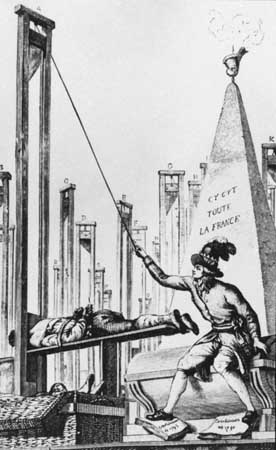
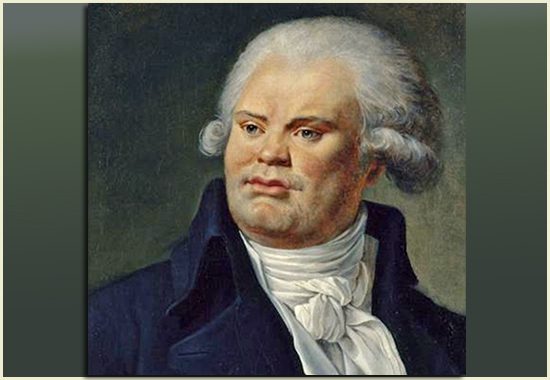
All three of these eminent thinkers emphasize important aspects of the political context. But all three I think leave out some fundamental aspects of human nature.  I think this image of Robespierre, the head of the ironically named “Committee of Public Safety,”  speaks volumes.  Here we have a man who believed in his own virtue, and had a passion for enforcing his rules on others.  Imagine the ultimate HOA Board Member on steroids.

Robespierre believed in perfection and insisted upon it.  Unfortunately he more or less thought he had achieved it himself.  People called Robespierre the “Incorruptible.”  In all his dealings, Robespierre appears to have been that rare politician who truly did not take bribes or show favoritism.  It would have been better for France (and Robespierre).  Perhaps then he would not have been able to maintain his furious streak of self-righteousness, which led to so many deaths (perhaps thinking of Robespierre might help us to understand Martin Luther’s oft misunderstood “Sin boldly.  God can only forgive a hearty sinner,” line to his quibbling friend Melancthon).

A passion for moral and political purity destroyed France. One can think of a potter attempting to make the perfect circle.  It wouldn’t be perfect at first, and one would have to shave off bits of clay continually to get it just right.  Eventually, however, you would not have any clay left.  While they said they cared for liberty, they did not realize that the amount of liberty one can enjoy is the amount you are willing to have abused.  France found that it could tolerate no abuse of liberty, so in the end they had none at all.  As the Terror increased, even the Committee of Public Safety members turned on each other and many of them faced the guillotine.

The guillotine itself represents part of the tragedy of the Revolution.  Dr. Guillotin invented the instrument to make executions more humane.  In the past, death by beheading was actually a privilege reserved for the nobility.  Those of more “common” lineage might face execution through hanging, disembowling, or even being drawn and quartered.

The guillotine meant now that everyone would have the “right” to death by beheading, and the mechanism meant now that no executioner might potentially botch the job.  Instead, in an almost bizarre parody, the mechanical nature of the machine gave the state power to execute more people more quickly, and now indeed “the people” could all face death equally.

Emmett Kennedy, author of A Cultural History of the French Revolution makes a great observation about French Romanticism and its relation to violence.  If man is naturally good, he suggests, than grace becomes irrelevant.  But what can take the place of grace as a proper inducement to virtue?  St. Just, Robespierre’s lieutenant, had the answer.  Kennedy writes,

Sensibilite (right sentiments, for lack of a better word) impels a man toward virtue, it affirms his natural goodness; it does for him what grace does for Christians.  If “sentiments”  do not produce virtue, then [St. Just argues] terror must take its place (emphasis mine).

In a round-about way Kennedy hits at a central truth.  The doctrine of the Fall of Man leads us not towards cruelty but mercy.  The Revolution denied mankind’s nature, but this “liberation” from sin could only lead them to destroy one another in blind and merciless search for perfection.

10th Grade: The Rules of War

Greetings,

We began the actual fighting of the Revolutionary War this week, with a focus on the generalship of George Washington.

But we began by looking at the tactics employed by the colonials at the Battle of Concord.

After the British broke through the lines like a knife through hot butter at Lexington, the colonials changed tactics after the British abandoned their search for weapons in Concord.  Rather than meet them out in the open, the hid amidst the treelines, taking potshots and then melting back into the woods.  The British had no effective way of countering this.

This infuriated the British, of course.  This was not how men fought!  What kind of coward fires from safety and then runs away?  Battle was meant as a test of honor, solidarity in the ranks, and courage under fire.  Fighting as the colonials did at Concord might be akin to one team poisoning the water of their opponent.  If they then won the game, would we call that victory?

There is a possibly apocryphal story of the Battle of Fontenoy, between the British and French in 1745.  Tradition says that both sides argued about who which side would strike the first blow. Lord Hay, the British general, supposedly asked, “Gentlemen of France, perhaps you would care to fire first?”

The Battle of Fontenoy

For the Europeans, for battle to be decisive, for it to mean anything, it must be ‘fair.’  Victory without ‘fairness’ solved nothing.

Students wisely countered with the fact that this analogy of a sports team doesn’t quite add up.  First of all, it’s against the law to poison water, where there is no law saying that armies must line up in the middle of field.  Secondly, why should the colonials have to fight on British terms according to British strengths?  The  colonial troops should be free to do what they do best.

These are good arguments.  What happens when we apply them to our current situation in “The War on Terror?”  We would all wish that the terrorist radicals would all line up in a field somewhere.  If this happened, the “War on Terror” would be over in about 15 minutes.  Naturally, they possess enough intelligence not to do this, so they choose other tactics.  Does this make them cowards?  Are they “playing fair?”  Where are the differences?  Some said that the differences lie in the treatment of civilians, and this is an excellent point.  Does the same difference apply to the Ft. Hood shooting a few years ago, where only military personnel were targeted?

To turn this further on ourselves, we should confront the fact that our extensive use of drones inspire a great deal of hatred.  For our enemies (and the innocent civilians in the line of fire), our use of drones is ultimately a cowardly act.  We put others at risk while risking nothing ourselves.  The drones hover in ways not accessible to retaliation, and they strike without giving anyone a chance to escape.  My guess is that if terrorists flew a small drone into a large city remotely and attacked people, we would be tempted to call it a “cowardly act.”

It’s important for us to realize (returning to our original context) that for the British raw military victory did not count in the same way that honor and integrity did in battle.  Wars happened, but wars should take place within the confines of civilization, not outside it.  How one fought was in itself a victory of sorts, and could not get separated from the tangible results on the field.

During our look at Washington, we noted that he won only 3 of his 9 revolutionary war battles.  Previously to the American Revolution, he may have been responsible for the Fort Necessity disaster with the French, and he accompanied Braddock on his ill-fated attempt to capture Fort Duquense.  Does he deserve his high reputation?

Some years ago I came across a book entitled, ‘The 100 Greatest Generals of All-Time’ (or something very close to that).  Lists are always fun for me, so I opened it out of curiosity.  As one might expect the usual suspects of Julius Caesar, Alexander, Napoleon, Ghengis Khan, etc. could be found in the top 10.  But his number 1 general of all-time?  George Washington.

This shocked me so I had to read his thoughts (was this shock value part of the author’s motivation for listing him at #1, and not say, at #4?).  His points were these:

  • Many of the generals in the list accomplished a great deal militarily but failed politically (i.e. Alexander, Julius Caesar).  Some had short-term political success, but could not make it last (i.e. Napoleon).
  • Some of the generals (again Alexander and Caesar) inherited what was likely the best army in the known world at the time and fought against weaker opponents (this could especially be said about Alexander).
  • By contrast, Washington faced the best with an untrained army with weak political support.  As commander-in-chief, not only did he win the war, he turned that victory into lasting political success for his side.  Not only did he help usher in a new political era, he did so without seizing control himself.
  • Washington had a solid understanding of the fact that the Americans only needed to ‘not lose’ the war to win it. He knew that keeping the army intact and functional was more important than risking the army in unsure scenarios. Orderly retreat could sometimes be the better part of valor.  Most military men can’t do this consistently even when intellectually they know it’s the right thing to do.  Washington did so, and distinguished himself thereby.
  • Former Georgetown Hoya basketball coach John Thompson says on occasion, “I don’t want to know how many points somebody scores in a game.  I want to know when he scores them.  What do his points mean for the team in a given situation?”  In the same vein, Washington knew how to minimize the impact of his defeats and maximize his victories.  When things looked bleak in the winter of 1776, for example, he came through in the battles of Trenton and Princeton.  It would be years before his next victory at Yorktown in 1781, but the British surrender there basically gave America its independence.

As I mentioned previously, it is possible the author listed Washington so high to distinguish his book from others. Still, I feel he has solid arguments to at least rank him highly.  I wanted to use our look at Washington to introduce the concept that in war success can come in many ways.  Since war is ultimately a political act, the battles themselves are simply one extension of the conflict.

When we think about war in broader terms, we see how many of England’s advantages (such as an elite professional army) meant little in the political context of the Revolution.  They had the unenviable task taking someone who didn’t want to be your friend anymore and making them a friend.  Would beating them up do the trick?  Over the previous 10 years (1764-75) the British proved politically inept with the colonies, so a political solution would not come easily for them.  If they went the route of force more or less exclusively they would need to absolutely pulverize the colonies so badly that further resistance would be physically and psychologically impossible.   As long as the Americans kept their heart beating, they could outlast England.  Washington, I think, understood this to his advantage.

Next week we will look at the battles of Saratoga as well as the Declaration of Independence.

Enjoy the weekend, and many thanks,

Dave Mathwin

Time Me

This post is slightly dated, as it was originally written three years ago.  I repost it based on our discussions in class this week . . . . .

****************************

I don’t follow baseball vey closely, nor do I watch many games.  I had no interest in watching the Home Run Derby before the All-Star game.  Unfortunately I still listen too frequently to sports talk radio.  After the said derby, commentators proclaimed that the new rules involving time limits had made the experience much more enjoyable.  “The clock saved the Home Run Derby,” proclaimed one radio host.  After discussing it briefly, they quickly turned to other areas of life where clocks could make things better, like for teenage daughters in bathrooms, bank lines, and so on.  If only we could have more clocks in our lives!

This got me reflecting a bit on the the invention of the clock.  Besides fire and the wheel, I have a hard time thinking of other inventions with as much staying power.  The influence of the clock goes so deep we don’t notice it.  Part of the motivation for me to read Authority, Liberty, & Automatic Machinery in Early Modern Europe by Otto Mayr was the hope that, among other things, he would give some perspective on the clock and its impact.

By “clock” Mayr means the mechanical clock.  People used sun-dials from ancient times, but even the most reliable  sun dials (in Egypt where the sun always shined) did not facilitate an acute subdivision of our experience of time.  In other more cloudy locales the sun-dial had even less influence.  The mechanical clock came on the scene in the late middle-ages and immediately made a dramatic impact on that society.  People fell in love immediately.  In his Paradiso Dante used the metaphor of the movement of a clock’s implements to describe the movement of the angels in heaven, and this merely stood as one example among many. The rare dissenting voice did exist.  The Welsh bard David Gwillym wrote,

Woe to the black faced clock which awoke me on the ditch side.  A curse on its head and tongue, its two ropes and heavy wheels, its weights, yards, and hammer, its ducks which think it day and its unquiet mills.  Uncivil clock like the foolish tapping of a tipsy cobbler, a blasphemy on its face.

But on the whole the “ayes” substantially overwhelmed the dissenters.  People praised the precision and complexity of the instrument, and almost immediately various metaphors for God’s design of the universe arose.  And as we might expect, no people sang such great peans to the clock as in Germany.

Such was the scene on the continent.  Yet those in England reacted far differently.  Yes, many liked the clock and it came into general use.  But far more dissented in England than in other places. In Love’s Labor Lost Shakespeare uses a “German clock” as an epithet.  In Richard II Shakespeare flips all the positive clock metaphors and in a soliloquy by Richard has the clock stands for a symbol of undue self-consciousness and a failed life.

Now sir, the sound that tells what hour it is

Are clamorous groans, that strike upon my heart

Which is the bell.  So sighs, and tears, and groans

Show minutes, times, and hours . . .

Why did they feel this way?  Here we get to the heart of the main idea of Mayr’s book.

Mayr believes that ultimately the answer lies in the different kinds of political cultures of England and the continent.  Briefly, authoritarian style politics had far more “boots on the ground” in places like Germany and France, which explains their love of the clock.  He develops the connection thusly: England’s political theory emphasized balance.  Whether they invented the idea of the “separation of powers” is beside the point.  They had a long history, predating the Magna Carta, of seeking equilibrium between different political bodies, which the European continent lacked.  This led England to put much more emphasis on developing “feedback” technologies.  These devices did not exert power so much as prevented one element from gaining too much power.  The thermostat serves as a good example of such a device.  It helps create balance.  Neither heat nor cold win the day. Notably, thermostats only come on when they need to correct the temperature.  Otherwise they lie dormant.

We may balk a bit at this distinction.  We may not consider the clock a device associated with unchecked power.  The clock may always be “on,” we surmise, but it exerts no direct influence over us.  Perhaps, but I think Mayr has a good point.  During the talk show I mentioned earlier, for example, all the ideas that people had related to people having to move faster because of the presence of the clock. They wanted the clock to make people act in certain definite ways.  Our speech reflects this as well. We “answer to the clock,” and so forth.  This idea played itself out politically.*  France had Louis XIV, Robespierre, and Napoleon. Prussia had Frederick the Great.  When England’s Charles I attempted to reign more independently he faced a revolution and the loss of his life.  Mary Tudor and James II also failed to introduce significant changes.**

The book moves along nicely to show how other “self-regulating” systems developed in England.  Aside from the political self-regulation between king, parliament, and courts, Adam Smith developed the idea of a self-regulating economy. Mercantilism, the prevailing economic theory in the 18th century, called for one to dominate other countries via exports over imports.  Smith believed the market could work much like a thermostat and correct itself with no government interference.  Central control of trade not only was unnecessary, but counter-productive.  We need not wonder about the veracity of Smith’s theory here.  What seems obvious from Mayr’s extensive knowledge is how developments throughout a particular culture have a common root.  The thermostat and Smith’s free market ideology come from the same place.

If the clock occupied pride of place for inventions from 1300-1800, what shall we say about our own day?  We would first need to decide what invention has pride of place in our society.  One would at this moment probably say the smart-phone, but we might wonder if in 10 years we will have moved on.  So we should settle on something larger, like “digital technology.”  As Peter Thiel has commented frequently, we have dramatically advanced the world of “bits” while the world of atoms has remained stagnant.  We need to look beyond mere profit and opportunity to understand why we have done so.

The digital universe excites us perhaps mainly because it has no discernible limits.  The powers of computers change all the time.  We can assume different identities, and so on.  We can always have our music.  We can contact anyone we want at any time.  It seems at times as if we can defy reality itself.  The world of atoms, however, confronts us with limits.  And if our recent behavior surrounding gender and sexuality give us any clues, we do not like limits.^  Our politics may soon start to reflect this and our corporate practice.^^  Who can say exactly where this will end up?  But if the trend continues we may need to revisit De Tocqueville’s dilemma regarding liberty (no limits on our actions) and equality.  We cannot have unfettered doses of both, for at some point they work against each other.  We must choose.  We still live in the real world.

Dave

*Compare Bishop Bousset’s explication of absolute monarchy for Louis XIV to James I (King of England) own writing on the subject.  Both reach similar conclusions, but in very different ways.  Bousset’s writing has an inexorable logical methodology.  James I writes more haphazardly, and more poetically.

**Henry VIII may be the exception that proves the rule.

^I re-watched The Matrix recently and noticed something curious.  At the end of the movie Neo speaks into the phone to the machines and tells them that he will show people “a world without limits, a world of possibility” and so on, and then proceeds to fly in the air.  But surely he refers to the world of the Matrix?  This is the world that offers the possibilities of dodging bullets.  In reality we remain subject to gravity.  On board their ship they have to wear dingy clothes and eat protein goop.  So what did Neo really mean?

True to form, the story starts to bleed out in the next two installments.  The Wachowski’s can’t stay content to let Neo be limitless merely in the Matrix (which makes some sense within their invented world).  By the end of Matrix Revolutions Neo can stop the Sentinels in reality just as he could stop bullets in the Matrix.  The Wachowski’s refuse even stay within the limits of their own story.

^^I like Amazon, but I found it a bit odd that they essentially tried to start their own holiday (Prime Day).

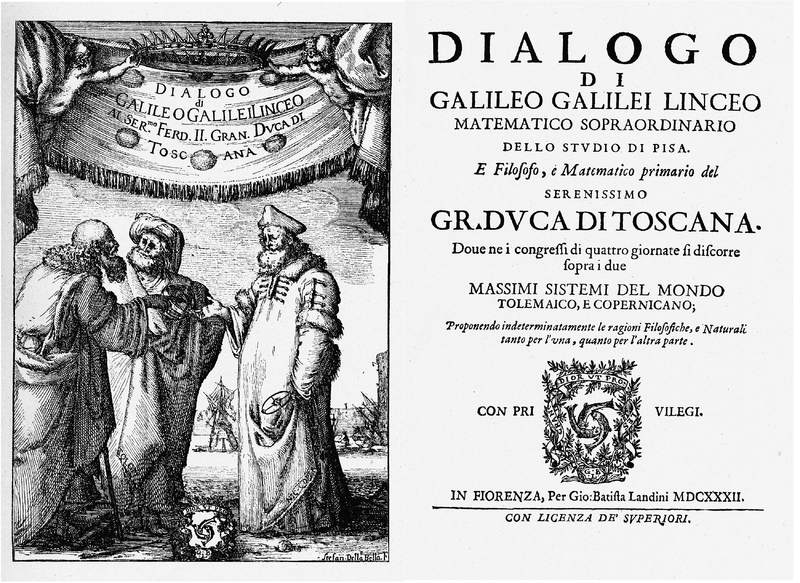
10th Grade: The Galileo Myth

This week we continued with many of the same themes as last week, with a special focus on Galileo.

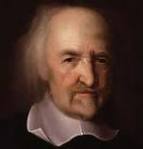
Thomas HobbesBefore tackling him, we looked at the political philosophy of Thomas Hobbes. Hobbes’ concerned himself mainly with outlining his vision of a workable political system, but he was strongly influenced by the tenor of the times.  Hobbes, like Descartes before him, believed that getting at the truth meant reducing the world to its simplest, most understandable components.  If we dig deep enough, we will finally find an irreducible foundation.  For Descartes, it was thought, and Hobbes builds his politics on the concept of motion.  Mankind, for Hobbes, was in many ways “matter in motion.”

The Scientific Revolution did indeed change many things, and this concept of knowledge may have been at the heart of those changes.  The Medieval philosopher would have argued that to see a thing truly, it must be seen as a whole of many parts.  Not only that, they would have gone further and said that to know a thing, one must know its purpose, its end, its “telos.”

Galileo continued the revolution in other facets of thought.  Copernicus had established the possibility of a heliocentric universe in the 16th century, and while his ideas did not gain wide acceptance, Copernicus was not a controversial figure.  Aristarchus of Samos had, in fact, proposed a similar theory in the 3rd century B.C.  Galileo caused controversy by proposing a new idea of how we arrive at truth, and blurred the lines between theory and fact.  In 1543 a man named Osiander wrote in the preface to Copernicus’ work that,

[W]hen from time to time there are offered for one and the same motion different hypotheses…, the astronomer will accept above all others the one which is easiest to grasp. The philosopher will perhaps seek the semblance of the truth. But neither of them will understand or state anything certain unless it has been divinely revealed to him…. So far as hypotheses are concerned, let no one expect anything certain from astronomy which cannot furnish it, lest he accept as the truth ideas conceived for another purpose and depart from this study a greater fool than when he entered it.

Owen Barfield, a contemporary of C.S. Lewis, wrote in his Saving the Appearances, that Galileo

began to affirm that the heliocentric hypothesis not only ‘saved the appearances,’ but was physically true.” What they professed was in fact a new theory of the nature of theory; namely that, if a hypothesis saves all the appearances, it is identical with truth.

What (I think) Barfield meant by the idea of “saving the appearances” was the old idea that our notions of scientific truth should do their best to explain the reality that we see around us, to preserve the validity of the senses.  However, this was always recognized to represent our “best guess” and may not reflect actual truth.

But after Galileo the burden of proof shifted.   Arthur Koestler writes in his book The Sleepwalkers that,

if theologians could not refute Galileo their case [would] go by default, and Scripture must be reinterpreted.  This implied (though Galileo did not dare state it explicitly) that the truth of the system was rigorously demonstrated. It is all so subtly done that the trick is almost imperceptible to the reader and, as far as I know, has escaped the attention of students to this very day. Yet it decided the strategy he was to follow in the coming years.

Galileo was right about the Earth’s rotation around the sun, though we would later discover that the sun, too, is in motion.  The issue that I wanted to stress to the students, however, was the fact that one can be right for the wrong reasons.  Many great scientific minds of this time were likely sincere Christians, but the ways which they reached their conclusions may have helped lead people away from Christianity.  True knowledge must involve more than what we see with our senses.

The Scientific Revolution also raised the question of how we should interpret Scripture.  To what degree should scientific discoveries impact how we read the famous passage about the sun standing still in Joshua?

On the day the Lord gave the Amorites over to Israel, Joshua said to the Lord in the presence of Israel:

“Sun, stand still over Gibeon,
and you, moon, over the Valley of Aijalon.”
 So the sun stood still,
and the moon stopped,
till the nation avenged itself on its enemies,

as it is written in the Book of Jashar.

The sun stopped in the middle of the sky and delayed going down about a full day. There has never been a day like it before or since, a day when the Lord listened to a human being. Surely the Lord was fighting for Israel!

Of course the Church made mistakes at this time too.  In condemning Galileo they surely overreached and made themselves look silly, contributing to an unnecessary and unhealthy divide between science and faith that lasted for at least three centuries, from which we have fully to recover.
Dave

10th Grade: The Death of a King

Greetings to all,

This week we looked at the building tension between Parliament and Charles I.  The civil war that eventually came would, in the long term, change the way the western world thought of political power.

As I mentioned last week, Charles inherited the ideas of absolute monarchy from his father James.  As some commentators, have suggested, however, there was a difference.  For James absolutism was an intellectual question, and thus a conviction he could dispense with, or at least minimize, when the time called for it.  For Charles, absolutism was a emotional issue, and one associated with his religious convictions.  It ran deeper for him, he believed in it with his heart instead of his head.

It would be wrong to say that Charles coveted power for the sake of power.  His conception of England was a realm that needed a shepherd.  He viewed England in personal terms.  His “High Church” Anglicanism serves as an example of this.  Yes, Charles liked ceremony, but also believed ceremony and pageantry appealed to masses, many of whom could not read.  He saw himself as their protector from the more “intellectual” Puritans.  His parliamentarian opponents saw England I think, in terms of institutions, and these institutions for them were the guarantee of the people’s liberties.  Both sides saw the same picture from different perspectives, and different aspects of the picture had different meanings for them.

Among the issues at stake:

Should something be considered legal if it is within the letter but not necessarily the spirit of the law?  Is the letter or the spirit of the law a better guarantee of liberty?

To understand this question, the issue at hand was Charles’s refusal to rule with Parliament, and his collection of the ‘Ship’s Tax.’  Being an introvert and socially awkward, I think Charles hated Parliament.  He did not hate every MP, but he did hate the crowd, the glad-handing, the politicking of it all.  Charles lacked people skills. It was just so much easier, on a number of levels, for him to rule alone without Parliament’s help.  As king, he was not required to call Parliament at all, except when he wanted new taxes.
Charles tried to keep expenses down but every government needs money at some point.  The ‘Ship’s Tax’ was a law still on the books from a few generations prior, but it had fallen into disuse.  It was used as a war-time measure to raise money when under the threat of invasion.   The last time it had been collected was back in the days when Elizabeth used it as a special measure to help prepare defense against the Spanish Armada.  Charles resurrected the tax.  Technically it was not a ‘new’ tax, for it had been collected before.  But Charles was using the tax as a means of general, not special revenue, and he did so to avoid calling for Parliament’s approval for any new taxes.  Charles was within the letter, but not the spirit of the law.  The tax was not “new” in the sense that it had once been collected, albeit with a different purpose in mind.  But Charles revived the tax not under threat of invasion, but as a loophole to avoid Parliament altogether.
By definition, can the king be a traitor?  If so, what would he have to do to merit that approbation?  If one conceives of the king personally embodying England itself then the answer is no.  But if one sees the king as a steward over something outside of himself, then it becomes a possibility.  Charles obviously viewed himself in the former sense, and Parliament the latter.  But at the time, no consensus existed on this question.

Should a bad, or ineffective king, be given complete loyalty?  Does the power of the king depend on how he rules, or on his office?

In the end, Parliament put Charles on trial for treason.  He had, they claimed, made war on his own people and trampled on the Constitution.  Furthermore, he had lied to them and negotiated with the Scots to invade on his behalf, while negotiating in supposed good faith with Parliament.  But the Parliament that tried Charles was not the full Parliament.  The army booted out those whom they suspected that Charles bought off, including the whole House of Lords.  Parliament may have the power to try the king, but was this Parliament?  Charles, at the trial, refused to enter a plea for this reason.  He argued that while “a power” faced him, law did not, which the following clip illustrates. . .

Charles never actually had a trial.  When he refused to enter a plea Parliament found him guilty “in abstentia” (though of course it did not take 2:30 as in the movie clip!).  Though I personally think that Parliament had a good case against Charles, they forced the issue and gave Charles back some dignity and legitimacy when they did not use the full Parliament to put him on trial.

At the end of this week we assigned lawyers to prosecute and defend Charles, as well as witnesses for the defense and prosecution.  I hope the students will have fun with our own mini ‘mock-trial’ and come away with a greater understanding of England during the mid-1600’s.  But as we will discuss next week, the past is not wholly “past.”  Our own ‘War on Terror’ has raised many of the same questions that faced the English.  Should torture ever be used, as Charles did, in time of war?  How far does the power of the president extend in war time?  Bush, for example, defended his extensive wire-tapping as a necessary war-time measure even if it was in a distinctly grey constitutional area, as this article notes.
These are many of the same dilemmas, in an obviously different context, that the English dealt with in 1650.  I hope students will make the connections.
Dave Mathwin
*Observe, for example, how in Shakespeare’s “Henry V” the kings of France and England call each other “Brother France,” and “Brother England.”

The Definitive Absence

I have always thought, along with C.V. Wedgwood and others, that Charles I got a raw deal in the aftermath of the English Civil War (1642-49). Leaving aside the matter of his personal guilt, I can see no good legal argument for Parliament having the authority to put him to death after their victory. But as many have remarked, as sympathetic a figure as Charles cuts at his trial and the end of his life, one finds it hard to embrace him as king.

In discussing this, many pay attention to the combination of poor decisions, occasional overreaching, ideological and religious foment, and bad luck during his reign. Some perhaps mention that in addition to the above factors, Charles simply lacked the ability to “look the part” of King of England, and this I think gets more to the root of the issue.

But why would this be? Charles had a personal piety and beliefs in tune with the vast majority of his countrymen. His real leadership flaws should not have risen to level of revolution and the loss of his head. After all, he had certain strengths as a leader as well. Something else must have been going on within England, perhaps even on a subconscious level.

A hint lies in the coronation celebrations, or lack thereof, in the reigns of Elizabeth I and the unfortunate Charles. Several accounts exist of Elizabeth’s coronation procession into London, the first from an Italian ambassador:

The houses on the way were all decorated; there being on both sides of the street wooden barricades, on which the merchants and artisans of every trade campe in long black gowns lined with hodds of red and black cloth . . . with all the emblems and banners–it made a very fine show.  Owing to the rain there was much mud, but the people had made preparations, by placing sand and gravel in front of their houses.

[He estimates perhaps 1000 horses in the procession], behind which came the queen, in an open litter, trimmed to the ground in gold brocade.  She herself dressed in royal robe rich in golden color, and over her head a coif of gold. Her crown was plain, with no gold lace, but studded with precious gems.

Another commented,

Onlookers noted, “For in all her passage she did not only shew her most gracious love toward the people in general, but also privately if the baser personages had either offered her any flowers or the like as a sign of their goodwill, she most gently staid her chariot and her their requests.

Thomas Mulcaster [Ass’t to the Lord Mayor of London?] added, “London was showed a most wonderful spectacle of a noble-hearted princess toward her most loving people, and the people’s exceeding comfort in so worthy a sovereign.

Holinshed’s Chronicles notes [I have updated the spelling]

For in all her passage she did not only shew her most gracious love toward all the people in general, but also privately if the baser personages had either offered her grace any flowers or any other sign of their good will, she most gently, to the common rejoicing of all onlookers, staid her chariot and heard their requests.

David Bergeron comments that,

The whole report creates the unmistakable impression that this queen in the golden litter forms very much a part of the action, one of the actors in the pageant, part of the theatrical experience.

English Civic Pageantry, 1558-1642, p. 20

Accounts exist of Elizabeth’s own words:

I thank my Lord Mayor, his brethren, and you all.  And whereas your request is that I should continue your good lady and queen, be ye ensured that I will be as good unto you as ever any queen unto her people.  No will in me can lack, neither do I trust that I lack any power. And persuade yourselves, that for the safety and quietness of you all, I will not spare, if need be, to spend my blood, God thank you all. 

As for Charles’ coronation, we have the following from the Earl of Pembroke, 25 of May, 1626:

My Lord,
Whereas your lordship and the rest of that Court now formerly directed by letters from the right honourable Earl Marshall, to prepare and erect in several places within the city various and sundry pageants for the fuller and more significant expression of your joys upon his Majesty, and his royal consorts intended entrance through your fair city: His Majesty having now allowed his said purpose, and given me Command to signify such to you, it may please your Lordship to take notice therof by these, as also remove the said Pageants, which besides the particular charge they accrue, do choke and hinder the passage of such as in coaches or carriages that have occasion to go up and down.  

Charles’ desire to save money actually was mostly moot, as many of the preparations had already been made for his procession. Workers would still need paid. Perhaps Charles had no knowledge of this, but I think not. Rather, Charles, unlike Elizabeth, could not force himself to go through with the public spectacle of coronation. Perhaps this was his introverted and private personality. Or perhaps his sense of royal dignity was so acute as to be intensely personal, and thus misguided.

Either way . . . Elizabeth clearly understood how to embody what it meant to be queen, and she communicated that understanding in a publicly meaningful way. By meaningful, I mean liturgical. One sees this throughout her reign. She mastered the art of the “royal progress.” Theatrical and symbolic encounters, such as when a child might present her a book and a flower, or a peasant giving her a trowel, or whatever, she made look completely natural and appropriate. This I am convinced is the key difference between Charles and Elizabeth. Charles modeled himself on Elizabeth in certain respects and even in certain laws (i.e., the Ship’s Tax). But it all fell flat. Charles could not embody and transmit the meaning of his kingship effectively to enough of his people.

We see this difference in portraits of the two monarchs. Elizabeth revels in overtly outward display.

To many today she no doubt appears ridiculous. Indeed, it seems that Elizabeth Tudor hardly appears at all. But “Elizabeth I” is in full view, and the English responded to her.

Scouring Google, I think Charles seems to be holding something back in every image I saw.

And . . .

Perhaps those like me feel sympathy for Charles even if we might not like him very much because his portraits reveal something of the man that was Charles Stuart. But where is Charles I?

As for his son Charles II, say what you will, but he certainly knew how to project, both as a young man, and later in life.

The first image might let Charles Stuart Jr. bleed through a little bit, but it is at least a more likeable person than Charles I that we see. As he got older, he learned to be more fully Charles II. Alas for Charles I–during his reign much less religious persecution existed than under Elizabeth, and he certainly had far superior morals than his son, all to no avail. His morally reprobate son was far more popular and effective as king.

I think many miss a central lesson we can draw from Elizabeth and the Stuart kings: if one can’t communicate outwardly the meaning of leadership through symbol and liturgy, then people will be driven inward in the fraught and dangerous realm of ideas and ideology.

In his Myth and Reality Marcel Eliade made an observation about modern art that struck me with great force. He notes the decline of a common symbolic language and forms in the wake of the Reformation, and perhaps especially after the Enlightenment. The lack of a common outward symbolic language–the Enlightenment called such things “superstitions”–leads then to a destruction of a common visual language in the arts. Eliade writes,

Beginning with painting, this destruction of language has spread to the novel, and just recently [writing in 1963] to the theater. In some cases there is a real annihilation of the established artistic universe. Looking at some recent canvases, we get the impression that the artist wished to make a ‘tabula rasa’ of the entire history of painting. There is more than destruction, there is a reversion to chaos . . . *

I found Eliade’s book in turns deeply illuminating and frustrating. But one only needs to think of cubism, dadaism, Jackson Pollack’s work, and some of Picasso as well, to see the force of his statement. Perhaps his greatest insight came with his assertion that the rise of psychotherapy directly accompanied the destruction of forms in the art world. With outward and visible avenues of meaning eliminated, we retreated inward for answers. But Eliade points out rightly that we are still following the mythological tropes. We still seek the lost paradise, (the Romantic movement) we still seek to deal with original sin (for the SJW’s this is ‘prejudicial conduct’), and we still seek the end of history (communists and other utopians). Without the common language, however, our fights will grow only deeper. Without something transcendent outside the system for us to reference, we will have to put all of our eggs into our earthly baskets.

Both Presidents Trump and Obama understand/stood very well, consciously or no, how to embody certain symbolic types. No one much cared how much money Elizabeth spent if she fit the part so well. So too, Mitt Romney could never equal Obama’s symbolic value. If Democrats want to beat Trump, they will need someone who can equal Trump’s archetypal value to the culture, even if it is a different archetype. Presidents Clinton and Reagan also excelled at politically embodying the “meaning of America” for their eras. Whitewater/Lewinsky and Iran-Contra might have sunk other leaders with less symbolic/liturgical footing with the culture at large.

Recently a government sponsored arts festival in Germany ran for a week, with its basic message being that, “European democracy is, and always has been, racist construct based on power and prestige,” later declaring that, “wretchedness is the basis of all art.” Such sentiments have a lot in common with the conspiracy theories of those like Alex Jones. Conservatives like myself who lament such things have to take Eliade’s insight seriously. The German ‘festival’ (which sounds like something from “Sprockets”), Jones, and others testify to the loss of a common narrative, a common language made manifest in the culture we can all adhere to. I am wondering if an Elizabeth I or even a Charles II** might emerge, if not in America, then hopefully somewhere else.

Dave

**Eliade could have mentioned movies as well. Think of all of the grand epic films of the 1950’s, with their oversized sets and out-sized acting. Charlton Heston has something in common with Elizabeth I. In The Magnificent Seven, the inner life of the heroes is not important and not explored. Charles Bronson’s character–rugged individualist that he is–knows he is not the hero. Fast forward a few years to the Guns of Navarone, where David Niven’s character is played with a sense of restraint and knowing detachment (though Peck’s character rebukes him for this). The common forms still hold, but we see possible cracks in the foundation. Just about 10 years after Bronson’s turn in The Magnificent Seven, his (and Donald Sutherland’s) knowing smirks in The Dirty Dozen testify to the imminent collapse of the common forms. Of course in Europe this shift probably happened decades earlier.

Here I do not seek to romanticize the 1950’s or any other previous era. Every time and place has its problems. I just seek to point out the differences.

**For the record, I have no great love for either monarch. Elizabeth persecuted many Catholics, and Charles II would have been hard for me to respect, though I acknowledge he was popular for a reason. What we need is someone like them whom we can rally around not in terms of his policies but as a symbol. Many of the best monarchs understood this intuitively, as thinking “symbolically” was part and parcel of their culture.

Familial Anxiety

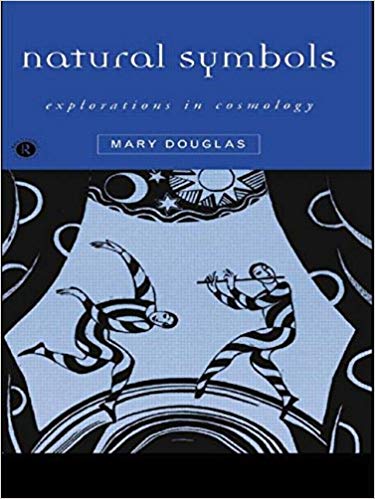
Perhaps Mary Douglas’ Catholic faith gave her great perception in her examination of the so-called “Bog Irish,” who emigrated from Ireland to London to find work in the mid-20th century.

This group of Irish Catholics found themselves in a country that had long persecuted them on some level, and who had slim tolerance for their faith. What bound them together was their observance from abstinence from meat on Fridays. Perhaps they did not always pray or love their neighbor as they should, but they faithfully avoided eating meat on Fridays. Whatever one feels about such practice, it had the effect of binding themselves together as a “peculiar people” in the midst of exile.

Of course, the injunction against eating meat went beyond mere cultural significance, as each Friday fast could link us in some small physical way to Christ’s death. In the late 1960’s modernist Catholic bishops made the decision to eliminate the obligatory Friday abstinence. Some of them seemed to worry about their parishioners seeming “weird” to the surrounding culture. In general, they expected that the faithful could take their zeal for Friday abstinence from meat and apply it instead to other more “meaningful” good works, such as prayer and serving their fellow man.

But the opposite happened. For Douglas, anyone versed in the actual history of human experience should have known this. The removal of the binding ritual did not create more good works, but less belief, and most likely, fewer good works. The “good works” asked for by the bishops, of course, should be done by any Christian, but “we live by symbols,” as Douglas states, and the removal of the ritual removed the ground that their faith rested on. No identity=no faith. Douglas writes,

The Catholic hierarchy today [1968] are under pressure to underestimate the expressive function of ritual. [They exhort] Catholics to invent individual acts of almsgiving as a more meaningful celebration of Friday. But why Friday? Why not be good and generous all the time? As soon as the symbolic action is denied value in its own right, the floodgates to confusion are opened.

[As] there is no person whose life does not need to unfold in a coherent symbolic system.. . . there is a dreary conclusion for those who turn to good works to solve problems about their own identity. They are liable to be frustrated on every count. First, it would seem that they must give their good causes over to bureaucratic energies of industrial organization, or they will have no effect. Second, . . . they will never be able to arrange their personal relations so that a structure of non-verbal symbols can emerge. For only a ritual structure makes possible a wordless channel of communication that is not entirely incoherent.

Douglas, p. 38, pp. 50-51

She then points out that the Maccabean martyrs (cf. 1 & 2 Maccabees) equated not eating pork with the entirety of obedience to God’s law. Their abstinence from pork formed an integral part of a whole way of existing.

Mary Douglas’ title, Natural Symbols, Explorations in Cosmology may be daunting to many, as it was to me. But she writes in a manner to match her clear, concise perception I thought her work superior to Ruth Benedict’s. Benedict could describe entwined patters of culture well, but she seemed to not quite grasp the meaning of these patterns. Perhaps Douglas built on her work, for she not only sees the patters, she perceives their meaning–perhaps her Irish Catholic background helped her with this.

As an entry point into this shift, Douglas first looks at how families function. She offers two basic modes, what she calls “Positional” and “Personal.”

Positional families

  • Value truth, piety, and duty
  • The cardinal sins relate to failures to live into the expectations of the group, or to maintain the appropriate ritual behaviors. Discipline takes the form of, “You should know that members of our group do not act that way.”
  • Have a wide network/structure over the individual, to which the individual has reference to

Personal families

  • Value sincerity, authenticity, individuality
  • The main sins relate to failures to “be all that you can be,” and discipline takes the form of “How could you do this to me?” or, “How could you do this to yourself?”
  • Celebrate the individual triumphing over the structure

For most of human history, we have had some kind of positional family structure, but now most everyone in the western world has grown up in at least a mostly “Personal” family. The consequences of this shift have profound implications for us, and involve, among other things, a movement from the concrete to the abstract.

Douglas points to the Reformation as the origin of this shift with some merit, but I will take a flyer and point to the Renaissance as when this began. We can see this in the art of the Renaissance and the medieval era which preceded it.

Many might assume that medieval religious art was ‘obscurantist.’ Certainly they used symbols in their art, but it communicated a concrete message. St. Anthony the Great, for example, had great stature but the depictions of him tell us that, “you can be like him, he is one of us.” So too the statues astride their cathedrals. Whatever “legends” may have been told about such saints, they lived real lives as you and I did.

But, to take perhaps the most famous example, who can be Michelangelo’s “David?”

Of course, no one can be such a man, and thus David becomes not a saint or even a man, but an ideal in the ether. The Renaissance also revived an interest in mythology. I agree that myths are not simply lies, and that they can have value in leading one to truth. But one must careful with such stories. The pagan could believe that Marsyas was literally flayed by Apollo, but not the man of the Renaissance. So any depiction of such an event ca. 1500 would inevitably be transmuted into an ideal. And indeed, the beloved Sister Wendy, in fact, explained Titian’s masterpiece as showing something akin to the intense “challenge of the artist,” whatever that might mean.

Alas, one of my great heroes, A.J. Toynbee wrote that such “etherialization” of concrete principles was a prime factor in the growth of civilizations, but Douglas argues that what this usually leads to is cultural confusion.* This movement toward abstraction continued in the west as the Reformation over time removed the liturgies, images, and sacramentalism from their worship. This put everything inside one’s head or heart, and again, put things in abstract categories–such as the unknowable “elect” for the Calvinists.

The different ways of conceiving reality always take on particular manifestations in our bodies, the main way we express meaning and our cosmological belief. A moment’s thought about this shows its truth. When Douglas wrote this book (1970), of course, it was even more obvious. The 1960’s started tight and neat but ended with long hair, open collars, psychedelic prints, and so on. We know the “Law and Order” look–what policeman has long hair and a scruffy beard (unless going undercover to mix with the more dangerous types)?** So too, no non-denominational pastor could ever think of wearing anything but jeans, and perhaps a polo shirt.

Thus, what happened in the 1960’s was a real revolution, and not just kids blowing off steam. Douglas cringes at contemporary commentators who called the destruction wrought by various riots and protests in the 60’s as “mindless.” College campuses exist as liturgical institutions, a manifestation of a particular order and authority structure. Today we see many of the same things as in the 60’s, such as more casual dress and campus protests. It would not surprise Douglas to see such behaviors coupled with a loosening of other body oriented morality, especially the highly charged area of sexual morality. Perhaps some of the intended meaning of such acts may not be conscious, but they are far from “mindless,” as they point towards a very definite goal.

Most educators have noted a rise in the anxiety of their students. Different theories exist for this phenomena. Some explain it with the rise of social media and their attendant lack of real personal connections. Others point out that the 9/11 generation has come of age in the age of terrorism, where threats can come from anywhere anytime.

No one I know of has pointed out that the rise of anxiety may come from the continual loosening of our societal structures, both in worship, family, dress, and so on. But Douglas hints at this quite strongly. True, the “Personal Family” structure brings many benefits. She mentions that this path often develops strong verbal skills and meshes nicely with the need to do well in social environments like school, which dominates the lives of children. Besides, even if we wanted to orient ourselves in a more “Positional” way many of us have no tradition, social class, or family history to build upon.

Teens today not only have jobs and careers to choose, but whole selves to construct, a heavy burden to carry.^^ Add to this that the reasons for doing or not doing a thing could be endless. Douglas writes,

Above all, the [“Personal Family”] child’s behavior is controlled by being made sensitive to the feelings of others, and by inspecting his own feelings. Why can’t I do it? Because father’s feeling worried; because I have a headache. How would you like it if you were a fly? Or a dog?^ In this way the child is freed from a system of rigid positions but made a prisoner of a system of feelings and abstract principles. (emphasis mine).

Douglas, pp. 26-27

We have had many good anthropologists, but I am not aware of any who wrote with such clarity as Mary Douglas.

Dave

*I acknowledge that energy can be released in the early stages of breaking with concrete societal forms, and perhaps this is what Toynbee saw and admired. I liken it, however, to taking a fussy toddler bundled in bulky clothes. You take them out of the crib, remove the onesie, and they are so happy, arms and legs unfettered! They whirl around like spinning tops for five minutes. But then, the look of, “What do I do now?” strikes them, and of course, the pajamas will have to come back on sooner or later.

I should say that Douglas may disagree with me, as she thinks that loose “etherialization” (to use Toynbee’s phrase) can continue indefinitely if it is paired with loose social structures.

**Douglas asserts the universality of the patterns she describes, but how to explain the long beards of Orthodox monks, priests, etc? The Orthodox are likely the most liturgically formal of all Christian denominations, yet have the most unkempt facial hair. Perhaps we could see the connection in a kind of manly disdain such priests/monks have for the world. But again, there may be limits to this, as for Old Testament Jews–another structured and highly liturgical society–long beards for men were normal and could not be seen as a form of distancing oneself from society.

But . . . this pattern certainly played out in Greece and Rome, two similar civilizations. The Greeks loved the sea, and thus valued beards and more fluid and flowing hair. Their society was more fluid as well. The Romans valued farming, and with it, law and order. With that comes shorter hair and clean shaves. Not until the empire was past its prime did we see the Romans going native, sporting beards and longer hair.

The pattern hold also for the Egyptians (clean-shaven, less ornamentation in dress, more order focused) and the Babylonians (more fluid as a society, more fluid in their dress).

^We might add today, “Do you feel like a boy? Or a girl?” The Personal Family’s predilection for rebelling against all forms of imposed identity have stretched out to rebelling against Nature itself.

^^It is no coincidence that we invented technologies to help us in this very endeavor, and that these technologies would further advance abstraction. In addition–we usually view the creation of public schools as a response to industrialization. Douglas might want us to view the creation of the public school system as a response to the dominance of the Personal Family model. If we have a self to construct apart from the family/neighborhood, we will need a tangible place to do so.

Cultures are all Different, except when they’re the Same

It strikes me as a plausible proposition that anthropology developed primarily as a science out of democratic cultures. The openness fostered by democracy may contribute to curiosity and a desire for travel. Many consider the Athenian Herodotus the “Father of History,” but his work has many anthropological dimensions as well. I discussed in another post the archetypal Feminine within democracy, so it may be no surprise that the most famous anthropologists in the 20th century were two women, Margaret Mead and Ruth Benedict.

We can imagine the stereotypical male being almost a parody of an anthropologist–narrow, rigid, calling anything different “stupid,” or “dumb” (this could have been a marvelous Monty Python skit with John Cleese). So we can see how typical feminine traits of fluidity, appreciating context, nurture and acceptance, and so on, might fit women best–in general of course.

Many have written extensively on Ruth Benedict’s classic, Patterns of Culture, and I will not seek to say what has already been said. Briefly, however, Benedict seems to have two main goals:

  • To show that cultures are fundamentally different from one another, and are developed internally, not dependent on race or geography
  • Benedict of course makes many interesting observations about the societies she observes and her work has great merit. But, just as John Cleese might marvelously enact a parody of an anthropologist in the field, so too anthropologists can sometimes parody themselves. It is possible to be so open, so fluid, as to lose one’s moorings.

By this I mean that, of course cultures are different from one another, but this should not surprise us at all. People are different too. What I find more striking are the similarities across cultures that testify to the essential unity of human nature. For example, Benedict tackles how different cultures treat adolescent girls. In one place, young teens are primarily feared. The transformation they undergo has an element of sacredness about it, but, the sacred can also bring terror. So the young girls are sent away from the community to live in tents apart for months at a time. In another culture, they are celebrated and receive something akin to adoration, with men of the tribe literally bowing to them as potential and future mothers of the tribe. In Polynesian cultures, Benedict asserts that no one makes a big deal of adolescence at all. No ceremonies exist to mark the passing from youth to young adulthood, but . . . during this time teens are granted a great deal of sexual freedom, which they readily take advantage of until marriage.

Benedict’s strong accentuation of differences, however, have her miss the overall point. Each of these cultures treat the teen years as a distinct phase of development, each other them apply different standards of conduct for teens and others in the tribe treat them differently than either children or adults. To me, this seems more striking than their differences.

I find this emphasis on difference–not at all unique to Benedict among anthropologists–as a symptom of the democratic cultures from whence they arise which also stress individual differences and uniqueness. Paradoxically, I think this leads us towards a fascination with cultures that are tightly interlocked and cohesive, for democratic cultures can produce no such thing.

When a book gets reviewed positively by diverse thinkers such as Rod Dreher and Cornel West, one should take note. Patrick Deneeen’s Why Liberalism Failed partially indulges in too much romanticism for the past. His book is more of an essay or a thought-piece, and so it has holes. Still, I find his paradoxical analysis that Liberalism–by which he means the liberal democratic order that forms the foundation of both Republicans and Democrats–has failed because it has in fact done everything it set out to do, compelling, and an interesting companion to Benedict and other anthropologists.

Deneen argues that the Liberal order, which had its origins in with the work of Hobbes and Locke, set out to create a radically new society with a very different conception of how an individual relates to the state and one another. Traditional societies saw the state fundamentally as a community of persons pointed in the same direction with the same values.

Liberal society starts with the premise that recognizing and maximizing individuals, and the inherent competition that comes with it, will create a more prosperous and workable state. Liberalism seeks to free us from all group oriented authorities that are not consensual, be it tradition, community norms, etc. It achieved its goals in spectacular fashion and we all partake readily of what it has to offer. It has brought unprecedented prosperity, but left us adrift at sea in a mass of individuals. In turn, this has led to the rise of statism, and emotionally driven authoritarian politics. Gone is the world of George H.W. Bush. Welcome to the world of Trump and Ocasio-Cortez. The success of Liberalism has brought us to place that will naturally usher in its demise.*

Deneen explains himself well on any number of podcast interviews, and the book has various and detailed reviews. I will mention two of his main points that might help us understand the polarity of the self-loathing expressed by some in academia and the progressive left, and the chest-thumping of the more nationalistic right.

Deneen mentions that Liberalism is supposed to make men “free” and “liberal” in their disposition. But the whole tradition of the liberal arts expounds a very different meaning of freedom. The great thinkers and writers from the ancients down through Austen and Dickens all characterize freedom as living with limits, be it the limits of nature, tradition, or the law of God. But the Liberal order defines freedom as acting without any constraint, be it constraints on the market, on family, on biology, and so on. So, Wal-Mart should be free to eradicate mom-and-pop Main Street. And, if every civilization that ever existed defined marriage in a certain way, that stricture simply sets up another bowling pin for the Liberal order to knock down. The whole history of the human past has no authority over the now.

Our orientation towards living without limits has led to our striking crisis of inequality. Our solution to this, however, is not to champion the limitations taught by the liberal arts, rooted in God, natural law, or nature itself, but instead to blame liberal education for being “impractical.” For Deneen, an insistent STEM emphasis only continues to feed the beast, though he surmises that we will avoid violence. John Locke himself argued that, of course his proposed new order would bring about a new kind of inequality. But this new inequality will give us much more overall prosperity, and indeed he was correct. Even the poor may not mind inequality so much because we all have iphones.** Still, the benefits of a liberal economy do not feed the soul.

So too, Deneen argues that Liberalism destroys “culture” as part of its operating procedure. To develop, culture requires place, habit, tradition, and local difference, none of which have a role in the Liberal state. We have no place, and if we live in a particular place for long, it may not have any “place” about it (suburbs are wonderfully convenient and give many obvious benefits, but most are interchangeable with each other).

I think this might explain why many in the west have a fascination with other cultures. The Pueblo and the Dobu people profiled by Benedict have a tight culture in which roles and identity stand out with perfect clarity to all who live within them. We may not want to live among them but we long for their sense of solidity. Conversely, the Dobu do not send out anthropologists to find out about us. A man who is full need not scavenge for food.

This may help explain the progressive liberal drive to limit free speech. They seek not the liberal idea of freedom, but taboos that might give us identity. I completely object to their methods and their goals, though I understand the impulse. You can only celebrate diversity for so long, until you realize that everyone has the same need to define themselves as a people, and we cannot define ourselves without living within limits .

Deneen’s book has few solutions in mind, and this has frustrated some reviewers. But he does he offer the following from Edmund Burke’s Reflections on the French Revolution:

In this enlightened age I am bold enough to confess that we are generally men of untaught feelings, [and] that instead of throwing away our old prejudices, we cherish them . . . . W are are afraid to put men to live and trade each on his own private stock of reason, because we suspect that this stock of each man is small, and the individuals do better to avail themselves of the general captital of nations and of ages. . . . Prejudice renders a man’s virtue his habit, and not a series of unconnected acts. Through just prejudice, his duty becomes part of his nature.

Dave

*In an interesting aside, Deneen points out that James Madison specifically sought to develop a government where different political interests were inexorably pitted against one another. He eschewed the idea of community almost from the start. These different and intractable differences would preserve liberty for each group by each interest group canceling each other out. Alas, he probably envisioned several kinds of difference, and not just two.

Or . . . perhaps just two versions of the same impulse? Many criticize Trump for his relationship to facts. But Oscasio-Cortez recently derided those who are “more concerned about being precisely, factually, and semantically correct than about being morally right.”

**Deneen said in a recent speech that he leads at Notre Dame a class on the idea of utopia, from ancient days until now. At the end, he polled the class to ask them which society of those he presented would they least want to live in, and which they would most want to live in. They all said 1984 is the one they wouldn’t want to live in. But which would they choose? A handful chose the world Wendell Berry presents in Hannah Coulter. But about half the class said Brave New World.

“It was stunning that they saw it as a utopia,” Deneen said. “That’s liberalism succeeding, and that’s liberalism failing.”

Cortes and Alexander the Great

Sometimes how historical figures are perceived has much more to do with how perceptions change over time than what people actually did in their own lifetimes.  Sometimes certain people in the past take on a romantic hue that also can distort our vision.

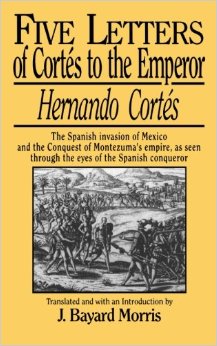
I thought about this phenomena while reading Five Letters of Cortes, a collection of letters Cortes sent 51iimHx9yvL._SY344_BO1,204,203,200_back to the continent detailing events in Mexico.  The book interested me because historians today routinely treat Cortes as a great villain, and I wanted to see how he measured up to that reputation in his own words. Scholars of course debate the veracity of some details Cortes narrates (without giving much credence to the idea that he simply told the truth as he saw it).  But my interest was not what happened so much as how Cortes wanted his readers to perceive him, regardless of whether or not he spoke fairly and truly.

As I read I thought of how history views Alexander the Great.  The two men have some similarities. Both sought glory, perhaps Alexander most of all.  Both conquered and destroyed a foreign people and culture with at least questionable justification.  Both dealt with internal disputes in their own ranks. Both used diplomacy to great effect, perhaps Cortes most of all.  And yet, history loves Alexander and despises Cortes, generally speaking, and we should ask why.

A few things stood out to me in Cortes’ letters.

  • Cortes de-emphasizes violence and tries to play up his relationship with the natives when he can.  He writes early in the first letter that, “the Indians went among us with as little fear as if they had already had dealings with us for many years.”  He seems proudest when he makes friends.  The “battles” (not battles in a traditional sense) and violence that occur happen when things break down, or in response to a tough situation initiated (in Cortes’ view) by the misunderstanding of the natives.
  • Cortes clearly admires the natives.  A modern westerner expecting to find a racially motivated imperialist will be disappointed.  He describes the sacrifices and violence surrounding Aztec religion in a lengthy passage:

And always on the day before some important enterprise they burn incense in their temples, and sometimes even sacrifice their own persons, some cutting out their tongues, others their ears, still others slicing their bodies with knives in order to offer to their idols the blood which flows from their wounds; sometimes sprinkling the whole of the temple with blood and throwing it up in the air, and many other fashions of sacrifice they use . . .

One very horrible and abominable custom they have which we have seen in no other part, and that is that whenever they wish to beg anything of their idols, in order that their petition may find more acceptance, they take large numbers of boys and girls and even of grown men and women and tear out their heart and bowels while still alive, burning them in the presence of those idols . . .  Some of us have actually seen this done and they say it is the most terrible and frightful thing that they have ever seen.  . . . Your majesties can therefore be certain that there can be no year in which they have not sacrificed some three to four thousand souls.

As to what the Spanish should do in light of this, I leave the reader to decide.  Cortes continues,

Your majesties may therefore perceive whether it is their duty to prevent such loss and evil, and certainly it will be pleasing to God if by means of, and under the protection of your royal majesties, these people are introduced to and instructed in the Holy Catholic Faith . . .

And yet, after describing the most horrible aspect of Aztec society, Cortes concludes the section by writing,

For it is certain that if they should ever serve God with that same faith, fervor, and diligence [as their idols] they would work many miracles.   We believe that by the aid of interpreters who should plainly declare to them the truths of the Holy Faith and the error in which they are, many, perhaps all of them, would quickly depart from their evil ways and come to true knowledge, for they live more equably and reasonably than any other of the tribes which we have hitherto come across.

Cortes also hates the fact that some of the Spanish use the Indians as currency in slaves.  This, he argues, earns the “notorious” Diego Velazquez followers, and Cortes urges the king to remove him from any position of authority at once.

Spanish commentary on the Aztec king Montezuma strike a poignant note.  Multiple sources all converge on the idea of admiration for the man.  Here is Diaz de Casillo writing,

The Great Montezuma was about forty years old, of good height, well proportioned, spare and slight, and not very dark, though of the usual Indian complexion. He did not wear his hair long but just over his ears, and he had a short black beard, well-shaped and thin. His face was rather long and cheerful, he had fine eyes, and in his appearance and manner could express geniality or, when necessary, a serious composure. He was very neat and clean, and took a bath every afternoon. He had many women as his mistresses, the daughters of chieftains, but two legitimate wives who were Caciques in their own right, and only some of his servants knew of it. He was quite free from sodomy. The clothes he wore one day he did not wear again till three or four days later. He had a guard of two hundred chieftains lodged in rooms beside his own, only some of whom were permitted to speak to him.”

When Moctezuma was allegedly killed by being stoned to death by his own people Cortés and all of us captains and soldiers wept for him, and there was no one among us that knew him and had dealings with him who did not mourn him as if he were our father, which was not surprising, since he was so good. It was stated that he had reigned for seventeen years, and was the best king they ever had in Mexico, and that he had personally triumphed in three wars against countries he had subjugated. I have spoken of the sorrow we all felt when we saw that Montezuma was dead. We even blamed the Mercederian friar for not having persuaded him to become a Christian.

Of course Cortes used violence at times directly and on purpose, however much he wanted to avoid it. In one such instance, we have both Aztec and Spanish sources for the same event.  Regarding a terrible massacre, the Aztecs write,

Here it is told how the Spaniards killed, they murdered the Mexicans who were celebrating the Fiesta of Huitzilopochtli in the place they called The Patio of the Gods

At this time, when everyone was enjoying the celebration, when everyone was already dancing, when everyone was already singing, when song was linked to song and the songs roared like waves, in that precise moment the Spaniards determined to kill people. They came into the patio, armed for battle.
They came to close the exits, the steps, the entrances [to the patio]: The Gate of the Eagle in the smallest palace, The Gate of the Canestalk and the Gate of the Snake of Mirrors. And when they had closed them, no one could get out anywhere.
Once they had done this, they entered the Sacred Patio to kill people. They came on foot, carrying swords and wooden and metal shields. Immediately, they surrounded those who danced, then rushed to the place where the drums were played. They attacked the man who was drumming and cut off both his arms. Then they cut off his head [with such a force] that it flew off, falling far away.
At that moment, they then attacked all the people, stabbing them, spearing them, wounding them with their swords. They struck some from behind, who fell instantly to the ground with their entrails hanging out [of their bodies]. They cut off the heads of some and smashed the heads of others into little pieces.
They struck others in the shoulders and tore their arms from their bodies. They struck some in the thighs and some in the calves. They slashed others in the abdomen and their entrails fell to the earth. There were some who even ran in vain, but their bowels spilled as they ran; they seemed to get their feet entangled with their own entrails. Eager to flee, they found nowhere to go.
Some tried to escape, but the Spaniards murdered them at the gates while they laughed. Others climbed the walls, but they could not save themselves. Others entered the communal house, where they were safe for a while. Others lay down among the victims and pretended to be dead. But if they stood up again they [the Spaniards] would see them and kill them.
The blood of the warriors ran like water as they ran, forming pools, which widened, as the smell of blood and entrails fouled the air.
And the Spaniards walked everywhere, searching the communal houses to kill those who were hiding. They ran everywhere, they searched every place.
When [people] outside [the Sacred Patio learned of the massacre], shouting began, “Captains, Mexicas, come here quickly! Come here with all arms, spears, and shields! Our captains have been murdered! Our warriors have been slain! Oh Mexica captains, [our warriors] have been annihilated!”

Then a roar was heard, screams, people wailed, as they beat their palms against their lips. Quickly the captains assembled, as if planned in advance, and carried their spears and shields. Then the battle began. [The Mexicas] attacked them with arrows and even javelins, including small javelins used for hunting birds. They furiously hurled their javelins [at the Spaniards]. It was as if a layer of yellow canes spread over the Spaniards.

And the Spanish version of the same event:

Cortes wanted to entirely understand the cause of the Indians’ rebellion. He interrogated them [the Spaniards] altogether. Some said it was caused by the message sent by Narváez, others because the people wanted to toss the Spaniards out of Mexico [Tenochtitlan], which had been planned as soon as the ships had arrived, because while they were fighting they shouted “Get out!” at them. Others said it was to liberate Moctezuma, for they fought saying, “Free our god and King if you don’t want to die!” Still others said it was to steal the gold, silver, and jewels that the Spaniards had, because they heard the Indians say, “Here you shall leave the gold that you have taken!” Again, some said it was to keep the Tlaxcalans and other mortal enemies out of Mexico. Finally, many believed that taking their idols as gods, they had given themselves to the devil.

Any of these things would have been enough to cause the rebellion, not to mention all of them together. But the principal one was that a few days after Cortes left to confront Narváez, it became time for a festival the Mexicas wanted to celebrate in their traditional way. . . . They begged Pedro de Alvarado to give them his permission, so [the Spaniards] wouldn’t think that they planned to kill them. Alvarado consented provided that there were no sacrifices, no people killed, and no one had weapons.

More than 600 gentlemen and several lords gathered in the yard of the largest temple; some said there were more than a thousand there. They made a lot of noise with their drums, shells, bugles, and hendidos, which sounded like a loud whistle. Preparing their festival, they were naked, but covered with precious stones, pearls, necklaces, belts, bracelets, many jewels of gold, silver, and mother-of-pearl, wearing very rich feathers on their heads. They performed a dance called the mazeualiztli, which is called that because it is a holiday from work [symbolized by the word for farmer, macehaulli]. . . . They laid mats in the patio of the temple and played drums on them. They danced in circles, holding hands, to the music of the singers, to which they responded.

The songs were sacred, and not profane, and were sung to praise the god honored in the festival, to induce him to provide water and grain, health, and victory, or to thank him for healthy children and other things. And those who knew the language and these ceremonial rites said that when the people danced in the temples, they perform very different from those who danced the netoteliztli, in voice, movement of the body, head, arms, and feet, by which they manifested their concepts of good and evil. The Spaniards called this dance, an areito, a word they brought from the islands of Cuba and Santo Domingo.  While the Mexica gentlemen were dancing in the temple yard of Vitcilopuchtli [Huitzilopochtli], Pedro de Alvarado went there. Whether on [the basis of] his own opinion or in an agreement decided by everyone, I don’t know, but some say he had been warned that the Indian nobles of the city had assembled to plot the mutiny and the rebellion, which they later carried out; others, believe that [the Spaniards] went to watch them perform this famous and praised dance, and seeing how rich they were and wanting the gold the Indians were wearing, he [Alvarado] covered each of the entrances with ten or twelve Spaniards and went inside with more than fifty [Spaniards], and without remorse and lacking any Christian piety, they brutally stabbed and killed the Indians, and took what they were wearing.

I have no wish to downplay a terrible massacre.  For our purposes, however, a few things surprised me about the Spanish account.

  • We might expect ‘righteous’ conquistadors rejoicing in their deed.  Some accounts of the Crusaders massacring civilians in Jerusalem in 1099 sound this way.  Instead we them troubled and very much aware of the fact that they departed from their faith with their actions.
  • Confusion, not certainty, dominates the text.  They search for answers and have a hard time understanding what it is they face or why it happened in the first place.  Some historians/sources apparently indicate that the Spanish may have believed that they were about to do another human sacrifice, though the account above does not hint at this or use it as an excuse.

One can disagree with the reasons for the Spanish presence in the new world.  One can lament the results of the Spanish conquest and the subsequent treatment of the natives.  But I found my overall opinion about Cortes changed from reading his writings, though I still lack a great deal of familiarity with the events in general and other particular sources to come to definite conclusions.

But other historians presumably do not.  And this brings us back to my question earlier about comparing Alexander and Cortes.  Some historians fall over themselves fawning about Alexander, and no one treats Cortes this way, despite their similarities.

Alexander had a few points in his favor . . .

  • The fact that he was king and thus the focal point of all narratives about him.  Cortes reported to the emperor, there were other conquistadors, Montezuma is a striking figure, etc.
  • Alexander destroyed the Persians in classic and dramatic pitched battles, the events of which featured himself.  The Aztecs died partly as a result of cunning diplomacy, Montezuma’s attitude, some skirmishes, etc.  Lacking a Battle of Issus or Gaugemela, we have a hard time latching onto Cortes to fully appreciate his skills (you don’t have to approve of Cortes to admire certain aspects of him).
  • Alexander operated within a “heroic” culture where for the most part, great deeds needed no particular justification. Even modern treatments of Alexander pick up on this, consciously or no.  I can’t recall any in depth discussion from ancient writers, for example, about Alexander’s motives, or the justice of his cause.  They simply don’t matter.  Cortes operated within a much different (and certainly superior) moral framework that calls much of the Spanish enterprise into question.
  • Of course we cannot discount the fact that, however well intentioned Cortes may have been, those that followed often exploited the natives for wealth and personal gain.  We should not directly blame Cortes for this, but his association with it taints him inevitably, and perhaps with some justice.

Of course unlike Alexander, Cortes never killed those close to him out of paranoia or political expediency (i.e. as Alexander did with Parmenio and Callisthenes), nor did he murder his friends in fits of drunken rage (Cleitus).  But these acts usually get overlooked amidst the grandeur of Gaugemela.

Whatever we may think of Cortes, sifting through accumulated historiography about him is a tricky business, especially in light of his own words.


10th Grade: You Can’t Go Home Again

Greetings,

This week we put our main focus on the Congress of Vienna, where the nations of England, Russia, Prussia, Austria and France gathered to try and redraw the map of Europe in Napoleon’s wake.

Historians have debated many issues about this peace conference from the moment it met.

France

What do to with France?  Napoleon’s conquests discombobulated every nation in Europe, and perhaps as many as 3 million died in what we call the Napoleonic Wars.  Should France be punished?

Most give the Congress credit for realizing that taking revenge on France would not serve peace in Europe.  France weakened would wave the red flag at every other strong nation in Europe.  Soon nations might fight over French spoils.  Besides, during the Napoleonic Wars the other nations made it clear that they made war on Napoleon, not France.  France was not the problem in their minds during the war, they could not very well make France the issue during the peace.

The French too made the point that if other nations wanted to avoid another Napoleon, they needed to hand the recently re-installed Louis XVIII the keys to a nice car.   If he inherited weakness, the Bourbon dynasty would crumble once again, and Europe would revisit all the issues  brought on by events in 1789.  For example, one of the problems of the Weimar Republic in Germany in 1919 was that the new democratic regime came into being only because of Germany’s defeat in World War I.  That government lacked the psychological or cultural legitimacy to have a solid chance at success.  Louis XVIII was a nice guy, but didn’t impress like Napoleon.  He would need some help.

Louis XVIII

Napoleon on Horseback at the St Bernard Pass by Jacques-Louis David

The Congress of Vienna explicitly rejected the “Romantic” notion of expansive ideals transforming states and creating new national boundaries, and returned to the 18th century Enlightenment policies of security through interlocking and more or less equal parts.  Those familiar with Madison’s “Federalist #10” and his theory on democracy and political factions will see the same concept writ large on the European stage in Vienna.  In reacting against the French Revolution ideologically, they also returned to the pre-French Revolution methods of foreign policy.  The genie needed stuffed back into the bottle.

For the most part the countries involved agreed on these principles, but the practical outworking of meant a great deal of jockeying for position.  The map had changed so much so quickly, a lot seemed up for grabs.

Here is Europe in 1789, just prior to the French Revolution

Now Europe in 1800, just after Napoleon took power

Europe in 1807, after Napoleon’s victorious Peace of Tilsit

Europe in 1812, at the peak of Napoleon’s power

Europe in 1813, after his first exile

Napoleon’s success and the subsequent rise of Russia made the fate of Poland crucial to the peace process.  Their turbulent history get reflected in the many ways the map below reflects how their country got sliced and diced over the years.

Napoleon made it a point of policy to resurrect Poland to check the power of Russia, and also to limit the expansion of Austria and Prussia.  England, however, also waned a strong Poland to check the very same countries.  Napoleon’s conquests also demolished the tottering Holy Roman Empire, making a complete mish-mash of central Europe, sure to draw the attention of Prussia and Austria.

For a class activity I wanted the students to deal with the issues divided the class into five different groups, each representing the interests of their assigned country.  The winning group would be the one that got the best deal relative to their interests.

England

Wants:

  • To maintain its absolute dominance of the sea
  • To prevent anyone else from having the dominance on land that they enjoy currently at sea
  • The independence of the “Low Countries” (Belgium, Holland, Netherlands) to prevent any other major power from obtaining the coastal ports there.

Fears:

  • The rising land power of Russia – England likes the idea of Poland as a buffer to Russian power.
  • The possible westward expansion ideas of Prussia

Russia

Wants:

  • What it considers to be its rightful place in the sun given the fact that their repulse of Napoleon in 1812 opened the floodgates for all of Europe to overthrow him
  • The elimination of Poland, which Napoleon recreated to reduce Russian power
  • A weak Austria

Fears:

  • England using its economic whip to get its way on the continent
  • A strong Austria
  • A strong Prussia

Prussia

Wants:

  • Its rightful place in the sun considering their efforts in 1813 at the Battle of Leipzig, and at Waterloo in 1815.
  • The possibility of westward expansion if Austria were strengthened.  They would rather see Austria strengthened rather than Russia

Fears:

  • A strong Russia
  • French Expansion

France

Wants:

  • An extension of their borders to their “natural” borders near the Rhine River
  • Territory in the Low Countries, who speak French after all
  • A curbing of English naval power

Fears:

  • English dominance
  • Reduction to 2nd rate status

Austria

Wants:

  • To restore national honor, for no one got beat more often than Austria during Napoleon’s reign.
  • To prevent instability in central Europe, which would likely lead to a war they would lose

Fears:

  • The joint rise of Prussia and Russia.  Should those two ever fight, they would inevitably be drawn in as a second-banana ally.  No matter who won that war, they would lose

The actual Congress of Vienna decided on this. . .

Did the Congress of Vienna work?  Can we call it a successful peace conference?

By most measures we can answer “yes.”  The system started to break down after 35 years in 1848, and had broken completely by 1871.  Still, while so-called “small wars” popped up intermittently, Europe did not see another general war until World War I in 1914.

Critics of the Congress call it reactionary.  Those that thought they could truly put the French Revolutionary genie away deluded themselves, for it had roamed throughout Europe for 25 years.  They felt that they could smother the liberal democratic impulse to death, when really it turned out that they had created a pressure cooker instead.  When it finally burst in 1914, nationalistic impulses that had been held in check unleashed a conflict that essentially destroyed Europe.

I personally have a lot of sympathy with this latter view, but feel it may be too harsh on the participants.  Their immediate experience of French romantic nationalism saw France overthrowing religion, traditional values, and killing one’s fellow man over shades of political difference.  It would be quite natural for them to throw the baby out with the bath water, and they did not have the benefit of hindsight.   Maybe we can say the countries represented had high levels of competence and lower amounts of imaginative foresight.  Even so, on some level they wanted to pretend that the French Revolution never happened, that everything could go back to normal after 25 years of philosophical, cultural, and political upheaval.  The saying, “You can’t go home again,” proved itself true in this case.

Next week we begin to review for the final exam.  Many thanks for a great year,

Dave

Danton Democracy

I originally published this in 2013, and repost it in light of our study of the French Revolution.  Apologies for any dated information on the ACA . . .

***********************

It took a while, but I finally came across an article on the ACA (also called “Obamacare”) that I resonated with.  Ross Douthat does not need to argue that the law will destroy civilization as we know it.  He admits that many will probably benefit from the law.  But in the final analysis (if coming to a final analysis even possible with such a ridiculously complex piece of legislation), he writes.

Now an effective levy of several thousand dollars on the small fraction of middle class Americans who buy on the individual market is not history’s great injustice. But neither does it seem like the soundest or most politically stable public policy arrangement. And to dig back into the position where I do strongly disagree with Cohn’s perspective, what makes this setup potentially more perverse is that it raises rates most sharply on precisely those Americans who up until now were doing roughly what we should want more health insurance purchasers to do: Economizing, comparison shopping, avoiding paying for coverage they don’t need, and buying a level of insurance that covers them in the event of a true disaster while giving them a reason not to overspend on everyday health expenses.

If we want health inflation to stay low and health care costs to be less of an anchor on advancement, we should want more Americans making $50,000 or $60,000 or $70,000 to spend less upfront on health insurance, rather than using regulatory pressure to induce them to spend more. And seen in that light, the potential problem with Obamacare’s regulation-driven “rate shock” isn’t that it doesn’t let everyone keep their pre-existing plans. It’s that it cancels plans, and raises rates, for people who were doing their part to keep all of our costs low.

You can find the full article here.

The article does not fully address my two ‘gut-level’ objections to the law:

  • Many well-intentioned government servants believe that they have found the ‘solution’ to problems that have heretofore eluded society.  Thus, they see only the positive and never realize the cost of certain kinds of legislation.
  • More specifically, the health care system already involved a great deal of physical complexity laid over top of a myriad of individual financial and moral choices.  Government action, almost by definition in cases like this, would almost certainly gum up the works and unintentionally create problems, even those they could not foresee.

I thought of the health care controversy as I read David Lawday’s enjoyable biography Danton: The Giant of the French Revolution.  Danton’s outsized personality stands in sharp contrast to the cold Robespierre, who eventually turned on Danton and had him executed.  Their faces tell the whole story:

georges_danton


Robespierre

Danton styled himself a man of the people.  He claimed to truly understand the people, for he (and not Robespierre) thought and acted like one of them.  He laughed, enjoyed food, women, and friends.  Thus, as he had a seat in government and understood the people, he naturally assumed that government action would work to benefit the people and help fulfill their wishes.  The video below may not reflect an actual historical meeting between  Danton and Robespierre, but it accurately depicts the different personalities of them both.

One can easily get drawn into Danton’s huge personality, but we should remember that he sanctioned horrible butcheries both before and after the fact, in the name of the people.  Danton was not a thinker.  He did not inscribe his speeches, he wrote few letters (that have survived at least), and so we know little of his motivations.  Lawday allows himself to make his best guesses, and paints a portrait of a man who had no love for violence per se, but believed he could successfully manage it once unleashed.  He later seemed to change his mind about this during the Reign of Terror, and this shift factored into his execution.

Unfortunately Danton’s greatest legacy to the Revolution was the Revolutionary Tribunal, the government’s supreme tool in legitimizing political murder on a mass scale.  Danton had some good motives in starting the tribunal.  He saw the random destruction engaged in by “the people,” and thought that direct government action would relieve the masses of the burden of imposing justice, or at least their version of justice.  This in turn would limit the violence that plagued the Revolution, for government would surely exercise more restraint and wisdom than the masses.  In a speech advocating for the establishment of the tribunal he reportedly said, “Let us be terrible, so they do not have to be.”

Tragically, the Tribunal simply gave legitimacy to the worst impulses of the Revolution, and the amount of deaths and imprisonments skyrocketed.  This same tribunal eventually tried Danton himself and found him guilty without allowing Danton to call any witnesses for his defense.

The ACA and the Revolutionary Tribunal remain vastly different things.  I hesitate to include mention of them both in the same post, for in 99 out of 100 ways they have nothing to do with each other.

But they do share one thing in common–they both spring from the mistaken belief that government can enter a complicated situation and with a wave of a wand make everything alright.  It usually fails to work, even with the best of intentions.

On the subject of good intentions, Marginal Revolution posted a link with this abstract. . .

Immigration and American Identity

The machinery of modern states sometimes makes things harder, not easier.

Coming to a proper solution for the immigration question is one example of this.  A variety of sources and polls indicate that most Americans favor allowing more legal immigration and have for years.  Back in simpler times one could enter a land, ask the king to stay, usually he said “yes,” with not much fuss. Perhaps one took an oath of fealty to his person.  Now, we have a whole mess of courts, paperwork, etc., etc. that make coming legally quite difficult.  The good intentions of most Americans gets lost in the morass of modern civilization.

Incremental reform of the system seems unlikely to lead to dramatically different results, so I have great sympathy for the argument made by Prof. Bryan Caplan.  As a libertarian Caplan believes in limiting government as much as possible, but his stance on immigration comes from a strongly moral place.  He would like to essentially eliminate the morass but eliminating almost every test that could prevent someone from working and living in the U.S.  He argues that

  • No one chooses to be born in a particular place, and almost always the best way to get out of poverty in a poor country is to move to a rich country, where your labor has a much greater value.
  • Those in the rich country benefit from their birthplace, which they also did not choose.  They have no moral right to deny someone something they did not earn or choose themselves.
  • As long as 1) An employer consents to have someone work for them, and 2) A worker consents to work for that same person, then no good moral reason exists for denying both people the right to hire/work.

Caplan breaks his argument down into even simpler terms:

  • Someone wants to come in my house, but I do not want them to.  Ok, then, they cannot come in.
  • Someone invites someone in, but they don’t want to come.  Ok, they can certainly refuse to come.
  • Someone invites someone into their house, and they accept, but a 3rd party–i.e., the Government–tells them that this cannot happen.  This, Caplan argues, makes no moral sense and yet this perfectly encapsulates our current immigration policy.

He made these points quite well in this debate below:

As well as Caplan argued (and we can note the contrast between the more intense, east coast, suit-wearing Caplan, and the laid-back Californian Wellman), I found myself siding with his opponent.  Their debate has the added bonus of illuminating much about our identity as a nation and our past.

The title of the debate, “Is Immigration a Human Right” might slip past us but the very idea of human rights as opposed to “A Right of Americans” represents a fairly radical shift in thinking.  We see this same shift in the years leading up to the American Revolution.  When colonists protested the Stamp Act in 1765 they talked of their rights as British subjects.  By the time we get to the Declaration of Independence, Jefferson argues that King George III has violated their human rights, that “all men are created equal.”  On the one hand, because we believe that God has created all mankind in His image, the clarity of Jefferson’s Enlightenment inspired prose makes perfect sense.  But it also makes things muddier—for incarnating this idea politically means different things to different people.  Treating all people equally from different political communities makes the whole concept of political communities irrelevant, aside from posing many other questions.

Even within a family, parents will love all their children equally but treat them differently as their circumstances require.  And when Joey argues that Billy’s parents let him stay up late, every parent knows the classic retort, “Well, you are not in Billy’s family.”

Interestingly, both Caplan and Wellman agree that societies do not exist via consent and that governments do not therefore derive their legitimacy from the “consent of the governed” per se.  This slips by without much discussion but I find it a crucial point.  The fact that the colonists failed to consent to certain British measures inspired many to revolt.  But even a moment’s thought about the concept of consent regarding the whole of society renders it a bit silly.  We “consent” to very little that shapes our lives.  We do not choose to be born, we do not choose our families, our gender, our personalities, or our looks.  We receive them, just as we do not consent to where we are born.  Nor did any of us in America today “consent” to our system of government. Imagine the chaos if everyone had to consent to their governments in some kind of purely rational vacuum.  Even the most die-hard supporters of consent would likely not want continual plebiscites to determine whether or not we should be governed by our Constitution, or a king, or an oligarchy.

The question then remains as to whether or not the fact that we do not really consent to our society supports Caplan or Wellman’s position.  For Caplan, the fact no one chooses where they are born and how they are governed means that everyone should have the freedom to go where they please and pick a place where they actually do consent to a particular society.

But Wellman has a powerful counter to Caplan’s “house” analogy mentioned above.  He poses a scenario of him leaving for a week and returning home to ask his wife what happened during his absence.  “Well, let’s see,” Wellman imagines his wife replying, “On Wednesday, I went to yoga class. On Thursday I met Carol for lunch.  And on Friday, I adopted a young man named Bob into our family.  Here he is, meet your new son.”  Wellman goes on to ask rhetorically whether or not she and Bob, as consenting individuals have the right to do this.  Caplan’s house analogy, he argues, needs more nuance.  Caplan’s argument above has a fair amount of moral force, but it would also overthrow our entire conception of the state as a community.  Unwittingly or not, Wellman’s analogy hearkens to the older Aristotelian idea of the state-as-family analogy, hence the notion that the king served as a “father” to his people.  One cannot simply alter the composition of the family at will, nor make unilateral decisions as “sovereign,” consenting individuals apart from the family at large.

Here we see how truly radical the American Revolution was and glimpse why it had such an impact on the world.  The notion that the state in fact was not a family perhaps finished off Aristotle’s formal influence in the modern world, a process begun in the Scientific Revolution.

And here we see something else–why the immigration issue poses such a difficulty for us.  If any nation could apply Caplan’s form of the “house” analogy, it is the United States.  As a “nation of immigrants” our belief in universal rights is woven into our DNA, however poorly we have applied it at times.  But pushed as Caplan wishes to push it, the idea becomes non-sensical. His vision of the state primarily as a conglomeration of free-floating individuals renders the idea of “society” almost meaningless.

The same Enlightenment ideas that inspired the idea of “human rights” also led to the creation of modern democracies.  The irony, perhaps even the tragic irony, with this issue, is that cutting red tape and making legal immigration much simpler could be achieved much more easily with a monarch than our federated democracy, with its attendant slowness, interest groups, and the like.  We might even reflect that minorities and outsiders (i.e. African-Americans and Native Americans) fared somewhat worse in the aftermath of our victory in the American Revolution.


Dave


The Rings of Saturn

Bernard Bailyn starts his book The Peopling of British North America with an illuminating analogy about the rings of Saturn.  When astronomers first noticed Saturn’s rings their beauty appeared as a shimmering uniformity.  Now that technology has given us a closer look, we see that in fact, the “rings” are comprised of thousands of bits of rock and dust, some as big as your hand, some as big as a car, some almost microscopic.

History, he then argues, is often like this.  From a distance things look easy to understand but get up close and the elegant simplicity and uniformity of the past dissipates into confusing bits that won’t go together.  Reality will confound our ability to understand it as a coherent whole.

A lot about this analogy rings true for me.  When young we learn that George Washington was the father of our country, a great leader, and so on.  As we get older, we need to deal with his owning slaves, his social striving, his possible mixed motives for fighting the British, etc.

But ultimately historians can’t stop where Bailyn leaves off.  After seeing what the rings of Saturn actually are, he/she then needs to find a way to have them make sense.  He must interpret and synthesize.  Bailyn’s book tantalizes at times with revealing details about early colonial settlement, but I found myself frustrated that the book never quite got off the ground.

The book shows us that settlement of the colonies happened seemingly without real pattern, aside from the obvious facts that most immigrants were young, male, from a middle-class or lower background.  Different things seemed to happen for different reasons.  In sifting through the data, Bailyn admits that it might take a a poet or impressionist painter to make sense of the disparate information.  This is a wonderful admission of his, and seems to go against his “rings of Saturn” analogy.  Bailyn admits that in this instance he can’t fulfill that role (though he did just this in his great Ideological Origins of the American Revolution).  Interestingly, Bailyn contrasts the disparate design and feel of American settlements with new towns in Germany of the same period.  In Germany, new towns all looked the same.  So again, sometimes the rings of Saturn look exactly like we think they should look.  It may be American history in particular, rather than History in general, that presents a unique picture.

Ultimately, of course, this must be Bailyn’s point.  We might imagine the early days of European settlement to have uniformity, with diversity coming in the 19th century with large scale immigration, but no — from the earliest times no one story could account for everything.  “Let us celebrate America’s diversity,” and all that.

I thought of Bailyn’s work while reflecting on 8th grade reactions to the history of the Roman Republic.  In the year’s “Great Debate” over whether ancient Greece or Rome was the superior civilization, the boys invariably choose Rome by about a 2/3 margin, and the girls Greece by the same amount.  Many years of teaching this class bear this out for me, so why might this be?

Though images of the ancient Greeks reveal a touch of brutishness, they had more feminine qualities than the Romans.  They displayed more creativity and originality than the Romans.  They appreciated beauty and proportion.  As for the Romans, their plodding, methodical nature probably fits very easily within the mind of an 8th grade boy.  Their lack of imagination and their pig-headed stubbornness may have been designed specifically to both infuriate their ancient opponents and the average modern 8th grade girl.  I have seen a few young ladies actually stomp their feet in anger when Rome manages to rise after their disaster at Cannae, as the boys chuckle in Beavis and Butt-head like fashion.  “We’re still here,” the Romans seem to be saying to Carthage, “dunking your pigtails in inkwells yet again.”

I can identify somewhat with this aggravation, but there is something magnificent about how the Romans embraced their sense of identity.  The Roman scholar J.V.P.D. Balsdon makes the observation that the Roman origin story of Romulus and Remus raised by wolves had nothing to commend it to the ancient world.  Apparently it would have been much better if they had been suckled by she-goats, as the Greeks did with Zeus.  To what extent they truly believed in the myths I can’t say, but even a quick perusal of Rome’s stories show fratricide, violence, and no hint of elegance.  The touching Greek story of Pygmalion carried no truck with the Romans.  When they needed women, they simply stole them from the Sabines.  Even when the Romans “invent” their stories (though I am not comfortable with that word, but like a typical guy I can’t think of a better one) they utterly lack imagination and adornment.  And the Romans chuckle stupidly again.  They’re perfectly happy with their unimaginative early history.  Aggravating or no, their fierce sense of identity, no doubt gleaned partially from their commonly accepted founding mythology, gave them great strength of purpose and dedication.  They knew they were a gritty, uncouth, blue collar bunch and reveled in it.

When discussing the Arthurian legend in his A Short History of England G.K. Chesterton made the comment that the “tradition” surrounding Arthur was more true than the “history” surrounding him.  He meant that the Arthurian tradition may not be entirely accurate, but expressed more truth about the past than the confusion produced by historians who tackle the same subject.  I think the same holds true for Rome.  Take Will Durant (whom I like, for the record) in his Caesar and Christ, where he vaguely talks of Roman origins in terms of nomads from the steppes, and scraps of pottery dated to some people at some unsure time.  This tells us nothing.  No one should trust in the full accuracy of Livy’s history, but Livy communicates something more true about Rome’s early period than Durant.

If Chesterton is right we should consider his principle in light of America’s history.  The newness of our country means that we can have far more accurate information about our past than almost any other civilization.  For many of us, the stories we learned in elementary school no longer have persuasive power.  Postmodernism has done its deconstructive work well.  We see this in the words of the great jazz pianist Vijay Iyer who recently spoke at Yale, where he seemed to suggest that all success in America is somehow linked to exploitation (I hope I’m reading him incorrectly, as I like Iyer’s music and don’t want his name attached to something silly like this).  Iyer commented,

And as we continue to consider, construct and develop our trajectories as Americans, I am also constantly mindful of what it means to be complicit with a system like this country, with all of its structural inequalities, its patterns of domination, and its ghastly histories of slavery and violence.

Many of us are here because we’ve become successful in that very context. That’s how we got into Yale, by being voted most likely to succeed; and that may be what emboldened some of us to show our faces here this weekend, because we actually have something to show for ourselves, that somehow in the years since we first dined at the Alternate Food Line we’ve managed to carve a place for ourselves in the landscape of America. Whether you attribute it to some mysterious triple package or to your own Horatio Alger story, to succeed in America is, somehow, to be complicit with the idea of America—which means that at some level you’ve made peace with its rather ugly past.

Perhaps at least a few of those voted, “Most Likely to Succeed” actually worked hard?

But we need not fear or lament the postmodern landscape, but see an opportunity.  We need to seek the truth, and the deconstructive project has helped us do that.  But somewhere out there, I hope, is a historian who can give us a “true tradition” amidst the rings of Saturn to anchor us moving forward.

“A Dialogue Concerning the Two Chief World Systems” by Galileo Galilei

The Dedication of the Dialogue

The Dedication of the Dialogue

I repost this wonderful offering from my friend and colleague Bill Carey . . .

*******************************

A Gallup poll of 6 July 1999 of more than a thousand adults determined that only about four out of five Americans believe that the Earth orbits the Sun. Fully one in five believes that the Sun orbits the Earth. [1] It’s interesting that four in five Americans believe something that seems obviously and demonstrably false. The Earth doesn’t feel like its moving underfoot, and every day we see the Sun rise and set. We believe the moon orbits the Earth, and it sure looks like the behavior of the Sun and moon is pretty similar. Why do four out of five Americans believe that, contrary to our intuition, the Earth orbits the Sun?

I’ve been taking an informal survey of my friends, with just two questions. The first is whether the Earth or the Sun is the center of the solar system. [2] After I assure them it’s not a trick question, everyone answers the Sun. We’re beating Gallup’s averages. The second question confuses people: “How do you know?” The most common answer I’ve gotten is, “Duh, everyone knows that”. Some people know that Copernicus and Galileo got in trouble with the Church for saying the Sun was the center of the solar system. Others vaguely remember a science or history teacher telling them about “heliocentrism”. Fair enough.

When I rephrased the question to ask how human beings originally figured that the Earth orbits the Sun, my friends gave me a quizzical look. I was no better off than them; I knew that Galileo and Copernicus had gotten everyone to switch from the geocentric view to the heliocentric. I didn’t know how or why. How did those astronomers convince everyone to abandon more than a thousand years of careful science and replace it with a new framework? What arguments and data struck the telling blows for heliocentrism?

The Retrogradation of Mars

The Retrogradation of Mars

The work that I turned to to understand the arguments for heliocentrism is Galileo’s delightful Dialogue Concerning the Two Chief World Systems. It is a surprising book. The first surprise it delivers is its style and structure. Galileo imitates a Socratic dialogue. Like all good literature, conflict drives the plot of the Dialogue. In particular, the conflict between Ptolemy and Aristotle on the one hand, and Copernicus on the other, motivates Galileo. His protagonist, Salviati, argues for the Copernican world system. The canny, initially neutral Sagredo drives the conversation forward. The wryly named Simplicio attempts to prop up the Ptolemaic system. Simplicio’s bumbling affords Galileo an opportunity to clearly articulate his ideas about physics and the motion of the stars. Of Aristotle, Salviati says that “[w]e need guides in forests and in unknown lands, but on plains and in open places only the blind need guides. It is better for such people to stay at home, but anyone with eyes in his head and his wits about him could serve as a guide for them. In saying this I do not mean that a person should not listen to Aristotle; indeed, I applaud the reading and careful study of his works, and I reproach only those who give themselves up as slaves to him in such a way as to subscribe blindly to everything he says and take it as inviolable.” [3] The arguments about the motion of the heavens make the work science; the metaphors, plot, dialogue, and humor make it literature.

The second surprise in the Dialogue is Galileo’s outstanding ear for argument. He refutes Aristotle’s arguments bluntly and often amusingly. Aristotle claims that a ball of iron will fall one hundred cubits in the time a block of wood falls ten cubit. This is preposterously false, and Sagredo doubts whether Aristotle ever actually tried it out: “I greatly doubt that Aristotle ever tested by experiment whether it be true that two stones, one weighing ten times as much as the other, if allowed to fall, at the same instant, from a height of, say, 100 cubits, would so differ in speed that when the heavier had reached the ground, the other would not have fallen more than 10 cubits.” Simplicio leaps to the defense of his preposterously wrong philosopher by pointing out that “[Aristotle’s] language would seem to indicate that he had tried the experiment, because he says: ‘we see the heavier’; now the word ‘see’ shows he had made the experiment.” Galileo’s characters are forthright in dismissing this tomfoolery. They describe experimental procedures that we can repeat today that confirm Galileo’s ideas and to refute Aristotle’s.

Epicycles and Deferents

Epicycles and Deferents

Claudius Ptolemy offers Galileo a foil with more scientific substance. [3] Ptolemy’s exposition of the geocentric world system in the unreadably complex Almagest is a surprisingly empirical and scientific work. Ptolemy’s system of deferents and epicycles is a compelling, mathematically precise, vision of the world. To refute it, Galileo works through a detailed analysis of the parallax of various celestial bodies and their distances from the Earth. The argument is technical and subtle. Writing before the great tectonic shift from Euclid to Descartes, Galileo’s mathematical reasoning tends towards geometry as well. Here he argues with Ptolemy on the latter’s home turf. A good edition that reproduces the figures is essential, as the characters lean on them as much as the reader. When a character references a table of astronomical data, Galileo’s language leads one to vividly imagine the characters sitting around a table passing papers to one another as they eat and drink.

The third surprise nestled in the Dialogue is that it’s deeply unsatisfying. It’d be tempting to say that, having read Galileo’s dialogue, I can answer the question about how we know the Earth goes around the Sun. The truth, though, is that I’ve just replaced one authority with another. I haven’t observed the phases of Venus, and I haven’t observed the parallax of the fixed stars (much less of the planets) that would let me work out the celestial mechanics on my own. Even so, reading Galileo’s argument is valuable. When I trust his authority, it’s an authority that I understand a little better than before. It’s an authority that’s grounded in reason and argument that I can wrestle with and assess critically. But if I want to add to the conversation myself, take a stand along with Ptolemy and Galileo, I need to telescope-up and start looking at the stars.

Too often we treat science as an Athena, sprung full grown and clothed from the head of Zeus. We trust our predecessors when they say that the Earth orbits the Sun without understanding how they came to believe that. We belittle people who disagree without understanding the arguments that make us correct. It turns out that the story of scientific discovery is always messy, usually fascinating, often wildly contingent, and occasionally well told. Whenever we can grapple with not only the results of scientific inquiry, but also the story behind it, we should. In his preface to the Dialogue, Einstein writes that, “[t]he leitmotif which I recognize in Galileo’s work is the passionate fight against any kind of dogma based on authority.” Galileo would rue his fate; like Aristotle before him, he’s become an authority, chalky and dead. We can rescue him from that cruel fate by listening carefully to the scientific conversation and the adding our voices to the tumultous banter.

[1] See http://www.gallup.com/poll/3742/new-poll-gauges-americans-general-knowledge-levels.aspx

[2] An astute reader pointed out to me that I beg the question here, so ingrained is the heliocentric system in my mental picture of the universe.

[3] Galileo, The Dialogue, p. 131

[4] Ptolemy will be the subject of another post, I hope. He deserves far more credit as a scientist than we’re inclined to give him.