“The Military Institutions of the Romans,” by Flavius Renatus Vegetius

Sometime in the early 5th century Vegetius wrote this simple and straightforward work, both a manual for a successful military and a plea for Rome to return to the values of an earlier time.

I am not a military man, but much of the advice Vegetius meets out concerns basic common sense, i.e. make sure your troops are well-fed, pay attention to terrain, make sure you have a reserve force, and so on.  What interested me as I read is what the book might reveal about the late Roman empire, and why the work had a huge following the Middle Ages.

Vegetius does not bellow, shout, or stamp in his writing, and yet underneath I think we can see a quiet desperation.  It seems like every ancient and medieval historian must as a matter of course talk about the past as a beacon of light, and how decrepit the present had become (does this not change until the Enlightenment?).  In Vegetius’ case, however, his attitude may have had more connection with reality, as the Empire seemed less and less able to exert control over its borders (Hillaire Belloc disagrees with this standard interpretation in his Europe and the Faith).  We do know that Rome had a harder time recruiting for its army in its later phase, and one of the great ironies of this book is that Vegetius, though wishing for a time when all men were strong and all the children good-looking, had no military experience himself.

The book touches on many things, but at the core Vegetius pushes discipline, discipline, and still more discipline.  Who can doubt that an army needs discipline?  Nothing remarkable about that.  Still, as this Youtube shows, Rome rode a few basic military moves and formations to world dominance.  Nobody plays the hero.  Stay in formation. Crouch, block, thrust, and move on to the next enemy (warning: a bit bloody).

What I did find revealing, however, is what is not there, much like the dog in Conan Doyle’s “The Adventures of Silver Blaze.”  Nowhere does Vegetius mention anything about armies needing morale, a cause, a belief to fight for.  Napoleon for one gave it great store.  His famous quote that,

In war, the moral is to the physical as three is to one.

comes to mind.  Why does Vegetius not mention the morale, or motivating cause, of an army?

I wonder if Vegetius does not include it because the army had no possibility of fighting for a cause in the late empire.  Rome had power and wealth even in the late 4th century but had lost any real reason for its existence long before. Vegetius wouldn’t mention it not because he judged it of little value but because he never would have thought of it in the first place, like a fish failing to extol the virtues of living on dry land.

Against my interpretation, however, is Vegetius’ own claim that nothing that he says comes from his own pen.  He claimed only to be copying, collecting and transmitting much older sources.  Some of those sources, like Cato, predate him by hundreds of years, when Rome had more internal health.  Did Rome never concern itself with morale in their military treatises?  One could imagine a stereotypical Roman thinking it a bit girly to think too much.  Leave that sort of thing to the French.

Or perhaps by coincidence the sources he uses don’t mention morale, so he doesn’t either.  But if so, he also chose not to add it.  Or maybe they did include it, but Vegetius did not work with their complete full text, or perhaps he deliberately left those parts out because they made no sense to him and would make no sense to others in his day.

Since the original date of this post I had some wonderful feedback from a friend who had the following idea.  His thoughts ran in a different course, which I paraphrase in the next two paragraphs below:

Vegetius may not have included the morale section for the reason that morale for the Roman armies was never the problem.  If anything, they needed at times an check on their desire to fight, hence the strong emphasis on discipline.  We see a few examples of this, first from the Gallic Wars, when Caesar wrote,

On the next day, Caesar, having called a meeting, censured the rashness and avarice of his soldiers, “In that they had judged for themselves how far they ought to proceed, or what they ought to do, and could not be kept back by the tribunes of the soldiers and the lieutenants;” and stated, “what the disadvantage of the ground could effect, what opinion he himself had entertained at Avaricum, when having surprised the enemy without either general or cavalry, he had given up a certain victory, lest even a trifling loss should occur in the contest owing to the disadvantage of position. That as much as he admired the greatness of their courage, since neither the fortifications of the camp, nor the height of the mountain, nor the wall of the town could retard them; in the same degree he censured their licentiousness and arrogance, because they thought that they knew more than their general concerning victory, and the issue of actions: and that he required in his soldiers forbearance and self-command, not less than valor and magnanimity.

My friend continues,

Similarly, one of the Consuls in the Macedonian wars (maybe Aemelius Paulus? I’ll have to dig out Plutarch) had terrible problems with his troops making frontal charges into Macedonian phalanxes and being annihilated. He entreated them to fight defensively and maneuver but they would have none of it.

Either way you slice it, the absence of anything resembling the morale of an army in his text says something.  Feedback like this is always very welcome, so thank you.

The book had a curious second life in the Middle Ages, where it became the standard military textbook.  I find this quite amusing.  Nearly everything except for the most basic dictums would have no application in the Middle Ages.  Many differences between the two armies/societies existed.

  • The Medievals could never have raised the large, professional forces that Rome did
  • Medieval armies did not often come together, and fought in short bursts, not extended campaigns far from home (the Crusades an exception, I grant you).
  • Medieval armies had very different people in them than Roman armies did.  An aristocratic warrior elite with a shared code of honor with their opponents would probably not go for the discipline, discipline, discipline, approach of Vegetius.

And yet the Medievals loved him.  Whatever for?

Some might call them simpletons who did not realize these differences, but I would not call a culture that produced Gothic architecture and St. Thomas Aquinas simpletons.

Some might see their possession of the manuscript of Vegetius valued like one prizes a good luck charm.  On this interpretation it’s the manuscript itself that’s valued, not the actual words.  Or perhaps in a childlike and humble way, they venerated the past and gave great store to anything from that time.

I could believe this second explanation, but I think the answer lies mostly elsewhere.  A clue might arise from a medieval portrait of Vegetius here below:
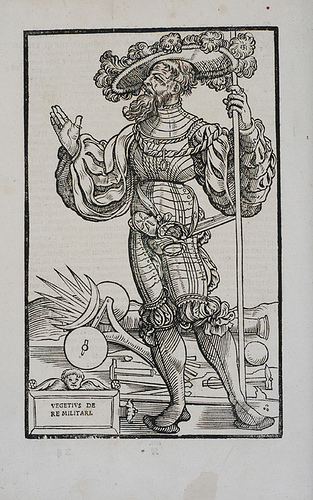
Why did the late 15th/early 16th century picture him in garb exactly like their own?  Did they really believe that the Romans wore clothes that they themselves wore in their time?  Or were they visually displaying their belief in using his work for their time?  Perhaps they had no idea what Romans wore and they felt free to invent whatever  clothes they wished?

In his great The Discarded Image C.S. Lewis speaks of the medieval imagination. . .

We have grown up with pictures that aimed at the maximum of illusion and strictly followed the laws of perspective.  . . . Medieval art was deficient in perspective [both historical and visual], and their poetry followed suit.  Nature, for Chaucer, is all foreground.  We never get a landscape.

Historically, as well as cosmically, medieval man stood at the foot of a stairway; looking up, he felt delight.  The backward, like the upward, glance exhilarated him, and humility was rewarded with the pleasures of admiration.  Thanks to his deficiency in the sense of period, that packed and gorgeous past was far more immediate to him than the dark and bestial past could ever be. . . .  It differed from the present only in being better.

The Middle Ages are unrivalled, until we reach quite modern times, in the sheer foreground fact, the ‘close-up.’    . . . Two negative conditions made this possible: their freedom both from the psuedo-classical standard of decorum, and from the sense of period.  But the efficient cause surely was their devout attention to their matter and their confidence in it.  They are not trying to heighten or transform it.  It possesses them wholly.  Their eyes and ears are steadily fixed upon it . . .

This lack of “background” in their art and thought might lead them to ignore Vegetius’ context.  We do this too.  Who among us does not think that Ben Franklin’s idea of making the turkey our national bird ridiculous?  We know that Bald Eagles may not be the nicest of birds, but that’s not the point.  We are interested in the immediate image the eagle projects, not its actual reality.

But I think there is more to than that, something distinctly medieval about Vegetius’ image. Medievals developed the habit of looking so closely they missed the forest for the trees.  With Vegetius, we might surmise that all details beyond the immediate text were entirely superfluous, which made those details, in a sense, entirely in the now.  This attitude could be akin to the scientist absorbed so much in trying to clone DNA that he takes no notice of the larger consequences of his actions.

Cheap histories of the Middle Ages talk of the period’s ignorance, darkness, etc.  In reality it appears they had quite a scientific bent, with a love of classification and minutiae.  The quote, “Nothing is known perfectly which has not been masticated by the teeth of disputation,” on my homepage from Robert of Sorbone, dates from the 13th century, and not the 17th.  Vegetius’ portrait may not speak many words about him, but does speak volumes about those that created it.


8th Grade: The Athenian Golden Age

Greetings,

This week we had a test, along with a review game on Monday and worldview week, so we had little time in ‘normal’ class.  We did spend some time discussing the elements of ‘golden ages’ and the factors that went into the birth of what we know as Periclean Athens.

From 480-430 B.C., Athens experienced an explosion of creativity and culture perhaps unparalleled in human history.  Much of what we consider to be modern democracy, philosophy, literature, drama, science, and architecture have a good measure of their roots here.

What is needed for a golden age?

As we compare them across time (Athens, Dutch early 1600’s, Elizabethan England, 12th century France, etc.) some common factors emerge:

1. Some kind of cross pollination of culture based on access to the sea or at least, extensive travel

2. A burst of confidence based on a defeat of a large power — you were the underdog and emerged on top.  The unexpected victory serves as a validation of your uniqueness.

3. An educational base to build the cultural explosion on.  There has to be some kind of literate and curious population base to build on.

4. The willingness to tolerate the possibility of new ideas, which usually has something to with #1 listed above.

With all these factors possibly needed (and possibly more that I have not accounted for),

We also looked at the flowering of Athenian democracy.  As we examined how it functioned, we arrived at a proposition to debate next week, which is

Athenian Democracy in the age of Pericles was more democratic than America is currently.

Part of how you evaluate this statement depends on a few factors:

1. What do we mean by “Democracy?”

We are so used to the word “democracy” we may not consider what we even mean by the term.  Clearly it must mean more than mere voting.  Some elections have only one candidate, or the different candidates do not give us different options in reality (that is, the candidates would do basically the same thing if elected).    It must also mean more than mere majority rule.  If 51% of the people vote to oppress the remaining 49%, we would not call that democracy.

Democracy attempts the trick of giving power and choice to the people, while at the same time preserving freedom in some measure for all citizens.  Thus, the ‘losers’ in a contest are still protected from the possible pitfalls of majority rule.  At the same time of course, the majority cannot be obstructed too much, otherwise the point of voting and majority rule would be lost.  Historically this balancing act has never been easy.

2. What is most important in a democracy?

In the Athenians favor we note the following:

– They had much more direct participation in government than modern Americans.
– The average citizen would not only vote, but could also speak in the Assembly.  Most citizens would probably serve in some political capacity during their adult lives

Against them we can say that:

– Women and slaves were excluded from voting and participation
– The very fluidity of their democracy opened up the real possibility that the checks and balances of law could easily be overridden, as happened on a few occasions.

For modern America we note that

– All citizens of a certain age are eligible to vote.
– We have minority protection built into the system.

Against us some might say

– Representative government has tended toward an oligarchy of the rich, with powerful interests controlling both parties.
– This, in turn, has led to a real distance between Government and the people which results in an “Us and Them” attitude.

I will look forward to their debate when we return next week.  Below is a very detailed chart of the ins and outs of Athenian democracy for the very interested.

Many thanks,

Dave Mathwin

8th Grade: What would the ‘Occupy’ Movement think of Solon?

Greetings,

After the test early in the week, we spent the next few days looking at the rule of Solon in Athens from 590-570 B.C. The ancient world regarded Solon as a great sage, but as we saw, his head was not in the clouds.  He took a society ready to fly apart at the seams and left it with an established social context in which democracy could take root.  I wanted to highlight a few key lessons.

First, the background:

Before Solon there was Draco, a member of the Athenian aristocracy.  His name itself came to symbolize harsh governmental policy, i.e. a ‘Draconian’ law.  His policies helped cement the divide between rich and poor and threatened to make it wider. This dynamic is not unusual.  When one group in society separates itself from others because of wealth or status, they tend to fear the rest of society and thus, isolate themselves all the more.  This increased distance only requires more force to ensure the divide.  One can think of the ante-bellum South, for example, and various laws enacted that made it criminal to educate slaves.  Society built like this can’t last for long.

Enter Solon.

He recognized a few key things:

1. Society needs the rich.  One can argue that the rich abused their power but they are still Athenian, and their resources can benefit Athens
2. The divide between rich and poor must be healed if we are to survive.  This will require sacrifice from the rich
3. This led to what may have been Solon’s invention, and may not have been — a graduated income tax.

No one likes to pay taxes.  One of the reasons I this is so is that no one really knows where their money goes.  It gets dropped into a vast ocean, never to be heard from again.  Solon, perhaps recognizing this, did things differently.  He did not ask for a direct sum from the wealthy, but offered them opportunity.  The wealthy could fund specific projects.  They could just pay directly for a religious festival, a bridge, or a naval warship.  Of course, they could also get full credit for their funding, i.e., ‘This festival to Athena sponsored by Diodotus.’  So, paying taxes became a way to earn ‘kleos.’  The wealthy could contribute in how much they gave.  Enhancing the well being of Athens was directly connected with enhancing their own status in the community.

Problem solved.

Could this apply today?  We are much too big to do what Solon did on any appreciable scale.  Yet I wonder, with the ‘Occupy’ movement and other kinds of resentment against the elite building, if we couldn’t borrow his ideas. What if we did this for the very rich, and put their faces on front pages with captions like, “Warren Buffet posing with fighter jet paid for with his taxes,” or something like this.  Would this help?

But, we should note that if we had a competition of fame/honor in paying taxes to the government, that would imply a certain relationship and attitude towards our government.  Would that attitude be appropriate?

Solon did not create democracy in Athens, but he established a context for it to exist.   Democracy cannot exist everywhere.  If the majority have an ‘us v. them’ attitude then they will use their power to ‘get revenge’ or exploit the others.  In this environment, society will become cancerous and destroy itself.  Democracy can only really work when the power of the majority does not just represent merely the majority, but in some sense, all the people.

Blessings,

Dave Mathwin

A Word on Methodology and the Purpose of History

On the first day of school in 8th grade Ancient History (which is the first time I will have taught any of the students in that class), I begin class with the premise that I am wasting their time.

History, after all, (I argue) has no real bearing on your life.  We study some names and dates from the past, a few battles here and there.  Sometimes it might have entertainment value but will never really impact you in any way.  Whatever Cyrus the Great did, be it good or bad, won’t impact on you today.  The past has no present.

Depending on their personality and previous experience students either get very excited or troubled by the prospect that we can blow off the year.  Yes, eventually we get around to reasons why hopefully I will not waste their time, but we should not sweep the arguments against History under the rug too quickly.  Before we bother with History in the first place, we should know what we are doing and why.

Some students respond by stating that history offers us lessons.  When people do bad things, we can learn to avoid them, when they do good we can emulate them.

This is a very common answer, with some truth in it, but I refuse the premise on which it’s based.  Reducing history to didactic lessons runs akin to telling people that Christianity is about adhering to a superior morality.  Whatever truth lies in that statement, Christianity really is not about “morality” at all, or at least, the moral component makes no sense without a much larger context.

In the same way, History does not begin and end with proverbs and moral lessons.  It should be about encounter.  It should be about transformation.

History is often and easily abused.  One common form of abuse is using History as a vehicle for proving a pet theory, something all of us can be guilty of at times. Such an approach is both dangerous and uncharitable.  Uncharitable, because History has no room to speak for itself when we insist it conform to us.  We stop listening and lose the possibility of empathy and understanding.  Dangerous, because manipulating the past puts us in a position of great power.  We erect a wall between ourselves (the “good,” or those with knowledge and understanding) and others, those who “should know better.”  If we do this, we cannot learn, cannot be challenged, and cannot grow.

Finitude will always limit our experience, but we need confronted with “the other” to get shaken out of our narrow field of vision.  Historians can often make the mistake of viewing the past in terms of the present, but this robs the power of the past to really do its work.  Seeing through different eyes pushes us beyond ourselves.  In writing about great books, C.S. Lewis said,

. . . in reading great literature I become a thousand men and yet remain myself. Like the night sky in the Greek poem, I see with a myriad eyes, but it is still I who see. Here, as in worship, in love, in moral action, and in knowing, I transcend myself; and am never more myself than when I do.

This is how History (like all our endeavors) should prepare us for the Beatific Vision.  The “otherness” of different cultures and people can by grace train our hearts for the “otherness” of God’s Kingdom.  Other times and places should also make us humble and charitable.  Hindsight is a great luxury, but we must avoid “finger-wagging.”  We must honor the past by viewing it as they saw it, not as we see it now.  We too act in a fallen context without omniscience.  Those in the past lived under the same constraints.  What kind of decisions would we make in their place?

Bringing it to the present, how do we act morally and justly with the information we have?  How do we make decisions in a fallen world?   We must take responsibility for these decisions, and the difficulties we face should make us rely on God’s grace and wisdom.  Our own sin should make us slow to judge those in the past that struggled with many of the same things as ourselves.  Are we so sure that we would do better?  When we, with proper conviction, call out the past for its mistakes we likely will need the humility to call ourselves and our own society to account.

I am not interested so much in changing the opinion of any student about, say, Napoleon or the Industrial Revolution.  But I am very much interested in 1) Each student coming to a greater understanding of their view of the world, and the extent to which that view can be supported by Christian belief, ethics, etc., and 2) Each student more fully understanding the implications of their decisions in the short and long term for themselves and others.

Mark Twain once said that history does not repeat itself, but it does rhyme.  As we see connections and patterns, we learn more about humanity.  But humanity does not exist in a vacuum.  As in all disciplines, the study of History involves an attempt to understand Reality, imbued with God’s presence.  As Francis Schaeffer said, “He is there and He is not Silent.”

8th Grade: The First Clash of East and West?

Greetings,

This week we had our debate on the forms of government, and wrapped up Persian civilization.  We will have a test on Persia this coming Wednesday before we start to review for our mid-terms.

We looked at Persia’s expansion in Europe this week as they crossed the Hellespont into Greece.  Why did they do this?  I think there are a variety of possibilities.

1. We have talked before about the ‘Burden of Cyrus.’  His extraordinary accomplishments made Persia a world power.  However, this legacy could be a burden as well as a gift.  Both with Cambyses and Darius we see this ‘need’ to do something grand that Cyrus did not do, something that would allow them to leave their own mark on Persia.  For Cambyses, this took the form of the conquest of Egypt.  For Darius one could argue, it took the form of conquering Greece.

2. The answer could be simpler.  Expansion may erase current enemies but it usually creates new ones.  The Aegean Sea may simply have been the ‘next’ enemy for Persia given their previous expansion.

3. Herodotus records a few stories that suggest that Darius may have had personal motivations for conquering Greece.  The stories may or may not be true, but they might have a ring of truth.  It is not unknown for kings or country’s to act with this kind of motivation.

We wanted to realize, however, that expansion across the Aegean would be a different kind of expansion than the Persians were used to.  Almost the entirety of their empire was land based.  Anyone can walk.  Not everyone can sail.  Their expansion overseas would mean the creation of a whole wing of their empire.  Embarking on the sea would put them in a position where they would need a strong presence but have little experience.  In contrast, most Greek city-states grew up on the water.  Persia would still be able to muster an overwhelming advantage in raw manpower.  For most city-states this would be enough.  But as we shall see, not for all.

We looked at the Battle of Marathon in 490 B.C., and what it revealed about Persia.  Persia’s defeat at Marathon hardly spelled doom for Persia, but it did demonstrate their weaknesses, and perhaps, the fact that they had finally stretched out their imperial arm too far.

Persia was, in general, less oppressive and more tolerant than previous empires.  They provided economic advantage and security.  But being part of Persia did not come with any sort of identity.  One might argue that Persia was all head, but no heart, and on some level people need inspired.  They possessed huge armies, but the majority of those armies had conquered troops that probably felt little reason to fight for Persia.  Thankfully for Persia, most of the time their huge numbers meant that they often did not have to fight at all.  In fact, Persia’s absolute requirement for military service for all eligible males shows them at their least tolerant.  When one father asked King Xerxes to exempt his youngest son to stay on the family farm, Xerxes executed his son, hacked his body in two, and had his departing forces march between the pieces of his son’s body as they left the city.  They allowed for no exception to their ‘No Exceptions’ policy.

At Marathon, the Athenians gained a tactical advantage by focusing their attack on the non-Persian members of Persia’s force.  The Persian force collapsed quickly as large portions of their force beat a hasty retreat.  They may have been willing to follow orders and march where told.  Why would they risk more than that?  What were they fighting for?  On a variety of occasions, Herodotus speaks of the bravery and skill of the purely Persian troops. But the conquered and incorporated troops proved to be a hindrance rather than an asset.  But I also think that the Athenian victory was part psychological.  They ran at the Persians — they actually attacked!  Herodotus hints at the shock the Persians must have felt under such a circumstance.  In Greece, Persia would meet a people who refused to accept their traditional ‘deal.’  The fact that Persia needed to build a navy to deal with this threat put them in an unusual position, like fish out of water.  We will see in a few months how and why the Greeks defeated Persia in a battle of East v. West.

Many thanks

Dave