Magicians of the Gods

I consider myself a mild agnostic on certain things about the ancient past.

I have no firm commitments about the age of the Earth.  I also have no commitment to the development of life on a macroevolutionary scale, thus I have no need for a very old earth.  As much as I understand the science, it looks like the earth (or at least the universe) has a very, very long history.  But I am intrigued by some young-earth arguments on the periphery out of curiosity.  Among other things, a lot of ‘old-earth’ arguments don’t take into account a cataclysmic worldwide flood.  If such an event happened, geological dating would need recalibrating.

When it comes to the book of Genesis, my commitments get deeper.  I am open to both literal and ‘mythopoetic’ interpretations of the early chapters of Genesis.  We can also combine them and probably both methods have their place.  But certain messages seem absolutely clear, among them:

  • That humanity fell from a state of grace, innocence, peace, etc. into a type of chaos
  • That our sin fundamentally altered the nature of human existence
  • That the change in humanity was physical as well as spiritual.  One may not believe that the lifespans given in Genesis are literal.  But the pattern is clear.  Adam and the earliest humans lived much longer than those at the end of the book.  By the end of Genesis we see that something about humanity has changed drastically.
  • The formation of civilizations happens very quickly.  It is almost the default mechanism of humanity.  Cain builds cities right away.  After the flood we have the Tower of Babel, and so on.

This reading of Genesis informs my reading of ancient history.

There is a version of early pre-history, common in most textbooks, that runs like so:

  • The earliest humans were basically ignorant and violent hunter-gatherers that lived in small groups.
  • At some point the climate changes or the herds thin out.  Food resources dwindle, forcing them to cooperate with larger groups to survive.
  • Because now you have to stick close to water, you get rooted to a particular spot.  You can’t just follow the herds.
  • So, you invent agriculture.  When you have really good harvests, you have a surplus.
  • This surplus gives the group leisure.  With this leisure they build more tools.  Eventually they build governments and laws.
  • As society expands governments have a harder time holding everything together.  So, they either invent religious practices or codify them in some way for the masses, which finishes the development of civilization.

This view is called “gradualism” or “evolutionary gradualism” or something like that.

I entirely disagree with this view.  The book of Genesis certainly at bare minimum strongly hints at something much more akin to devolution, and myths from other cultures hint at the same thing.

Enter Graham Hancock.

I don’t know exactly what to make of him.  The fact that he is an amateur bothers me not at all.  Those very familiar with this blog know of my love for Arnold Toynbee, and one of his main causes involved championing the amateur historian.  He makes no claims to fully understand some of the science he cites but relies on others with special degrees.  You can’t fault him for this.

He also has a restless curiosity about the ancient world that I love.  He willingly dives into unusual theories with a seemingly open mind.  His understanding of Christianity is deeply flawed.  But . . . his argument against the evolutionary development of religion could have come from any Christian.  Many evolutionary theorists acknowledge the social utility and advantage of religious belief.  But, he argues, there would be no obvious evolutionary advantage to saying, “We must take time and effort away from survival, making weapons, improving our shelter, etc. to build a large structure for a god that, fundamentally, we are making up.  In the evolutionary model it makes no sense that anyone would think of this and that others would somehow agree. Or, you would have to believe that the intelligent people that planned and built these temples were tremendously deluded, and furthermore, that this delusion occurred in every culture.  To crown it, if all we have is matter in motion, how would anyone think of something beyond matter in the first place?

Magicians of the Gods has some flaws.  It bounces around too much for my taste, and in some sections of the book the arguments change.  One review stated that,

Speaking as someone who found [Hancock’s earlier book] Fingerprints of the Gods to be entertaining and engaging, even when it was wrong, I can say that Magicians of the Gods is not a good book by either the standards of entertainment or science. It is Hancock at his worst: angry, petulant, and slipshod. Hancock assumes readers have already read and remembered all of his previous books going back decades, and his new book fails to stand on its own either as an argument or as a piece of literature. It is an update and an appendix masquerading as a revelation. This much is evident from the amount of material Hancock asks readers to return to Fingerprints to consult, and the number of references—bad, secondary ones—he copies wholesale from the earlier book, or cites directly to himself in that book.

Alas, I agree with some of these criticisms.  But I think some of them miss the overall point Hancock attempts to make.

When evaluating Hancock v. the Scientific Establishment, we should consider the following:

  • Arguments in the book involve interpretations of archaeology and geology, two branches of science that are relatively young, both of which have to make conclusions based on a variety of circumstantial evidence.  Science usually comes down hard on circumstantial evidence, and “proof” is hard to come by in these disciplines.  But some that attack Hancock do so when he suggests or speculates, and then blame him for not having “proof.”
  • Hancock is right to say that the Scientific Establishment is too conservative.  But, this is probably a good thing that Science is this way.  This is how Science operates.
  • Hancock cites a variety of specialists and laments that the “Establishment” pays them little heed.  I think that some of these “fringe” scientists may truly be on to something that the conservatism of the academy wants to ignore.  But . . . some of them may be ignored by the academy because they are doing bad science.  How does the layman decide when degreed specialists radically disagree?  We may need a paradigm outside of science to judge.  In any case, Hancock too often assumes that scientists with alternative ideas get rejected only for reasons that have nothing to do with science.
  • Some reviews give Hancock a hard time for referencing earlier books of his. This can be annoying, but . . . on a few occasions Hancock references his earlier books to disagree with or modify his earlier conclusions.  In the 20 years since he wrote Fingerprints of the Gods he has “pulled back” from some earlier assertions in light of some new evidence.  This seems at least something like a scientific cast of mind, but his critics seem not to have noticed this.  Should he be criticized for changing his views?
  • His book cover and title might help him sell copies, but it looks too gimmicky, and is guaranteed to draw the suspicion of “Science.”

I wish he made his central point clearer throughout and summed it up forcefully at the end of the book.  But we can glean the main thrust of his argument.

First . . .

Emerging evidence exists that a major comet, or series of comets, struck Earth some 12,000 years ago.  While this may not yet have the full weight of the scientific establishment behind it, many regard it as an entirely legitimate proposition.  It is not a fringe idea.

Many in turn believe that this comet struck to polar ice-caps, causing a flood of literally biblical proportions.  Those who believe in the Biblical flood need not ascribe this as the cause, but perhaps it could have been.  Of course many other ancient cultures have stories involving a cataclysmic flood.

Well, all this may be interesting, but this had little to do with the history  of civilization (so the argument goes) because civilization did not emerge until sometime around 4000 B.C., well after the possible/likely? meteor impact flood.

This brings us to Hancock’s second assertion, that civilization is much older than we think.

The discovery of Gobeki-Tepe some 25 years ago began to revolutionize our understanding of the ancient world.

No one disputes that the site dates to thousands of years before the so-called beginnings of human civilization.  The stone work is precise and impressive.  Recent radar penetrations indicate that even bigger, likely more impressive stone work lies beneath the site.

Here we come to a fork in the road.

  • We can rethink our assumption of early hunter-gatherers.  We can assume that they were far more advanced than we originally thought.  We can assume that they could organize in large groups and they possessed a high level of development and skill, including that of agriculture.  But then, would they be hunter-gatherers if they acted this way?
  • Or, we can assume that mingled with hunter-gatherers might have been the holdovers of a previous advanced civilization, perhaps one mostly wiped out by a global cataclysm.  These are the “magicians of the gods” Hancock postulates–those that emerged from the mass extinctions caused by global flooding, who perhaps took refuge with hunter-gatherers.  Perhaps they had a trade of sorts in mind: 1) You teach us survival skills, and 2) We teach you how to build, plant, and organize.

Option 2 might seem crazy.  It would probably mean reversing our gradual, evolutionary view of the development of civilization at least in the last 10,000 years.  But we have seen something like this already–an undisputed example of it after the fall of Rome.  All agree that in almost every respect, Roman civilization of 100 A.D. stood far above early medieval civilization of 800 A.D.

But Gobekli Tepe is not the only example of something like this.  Archaeologists observe other sites where earlier architecture seems far more advanced than later architecture.  Take, for example, the Sascayhuaman site in Peru, not far from where the Incas developed.  This wall, for example,

almost certainly predate the Incas by thousands of years.  The Incas later certainly could build things, but not in the same way, as the picture below attests (and it looks like they tried to copy the older design in some respects).

At Gobekli-Tepe, the recently deceased project head Klaus Schmidt commented regarding the parts of the site still underground that, “The truly monumental structures are in the older layers; in the younger layers [i.e., those visible to us at the moment] they get smaller and there is a significant decline in quality.”

Some similar possibilities of much older and possibly more advanced civilizations exist in Indonesia and other sites around the world. For example some believe that the Sphinx was built thousands of years before the pyramids.  There is some water erosion evidence that could support this theory.  There is also this intriguing ancient alignment with the Sphinx and the Leo constellation:

If true, this could mean that the Egyptians built the Pyramids where they did because they knew the site was already sacred from a previous era, or even possibly, a previous civilization.

With this before us, at bare minimum, we can strongly argue that the standard gradual and uniform process of the development of civilization should be in serious doubt.  If we accept this, then two other possibilities follow:

  1. Some civilizations went through periods of great advancement* and then fell into a period of steep decline, after which they never quite recovered their former glory.  A massive flood certainly could have triggered this decline.
  2. Another possibility is that we may be dealing with different civilizations altogether.  Hancock ascribes to this view.  For him, sites like Gobeckli Tepe served as a time capsule of sorts, a clue, or a deposit of knowledge for others to use in case of another disaster.  This may raise an eyebrow or two, but one of the mysterious aspects of Gobeckli-Tepe that all agree on is that they deliberately buried the site and left it. Who does this?  Why? Perhaps they wanted this site preserved so that it could be used in case of another emergency to restart civilization.  If this is true, there is much we do not understand at all about this site.

Those that want a tightly knit argument heavily supported by the scientific community will be disappointed by Magicians of the Gods.  But for those that want a springboard for rethinking the standard timeline of the ancient world, the book does very nicely.

Dave

*Michael Shurmer of Skeptic magazine argued against Hancock, saying that, “If they were so advanced, where is the writing?  Where are the tools?”  But why must writing be a pre-requisite for advancement?  Or if you believe writing is a hallmark of advancement, what if this previous civilization was more advanced in many other ways? And if they built buildings, isn’t it obvious that they used tools, even if we can’t find them?  If they built them without tools, wouldn’t they be really smart?

Maybe no tools exist at the site because they didn’t live near the site, for whatever reason.  But where they lived has nothing to do with how advanced they seem to have been.  Like Hancock, I’m not sure what else we need other than Gobekli Tepe to prove the point.



8th Grade: Egypt’s Desert Formation

Greetings to all,

I hope you have had a good week, and I hope too that you will enjoy the weekend before us.

This week we began our unit on Egypt, and first considered the influence of geography on the formation of their civilization.  I wanted to ask the following of the students:

1. What is the central feature of Egyptian geography, and why might this promote civilization?

2. What about Egyptian geography might influence it towards strong centralized government?

3. How might Egyptian geography have influenced their religion?

I do not believe geography exercises an absolute authority over humankind.  We are always left with choice & responsibility for those choices.  Having said that, we should not neglect the impact our surroundings may have upon us.  I do also stress to the students that the heart of any civilization is not its surroundings, resources, etc., but what it worships.  What a civilization worships is, in its turn, often reflected in its architecture.  With that in mind, I anticipate us taking a hard look at the pyramids next week.

When we think about Geography and its connections to Egypt, we noted the following:
1. The extremes of Egyptian geography: Only somewhere between 5-10% of their land was arable, but that land was some of the best farmland in the ancient world due to the yearly Nile floods.  Lush farm land backed right up against barren desert (as seen in the picture below).  This geographical tension probably produced psychological tension.  We see in Egypt, for example, the duality between the worship of almost any life whatsoever, and the reign of death just beyond.  The pictures of the Nile river valley below illustrate this stark contrast.
Nile River Valley
This tension had to be resolved in either a positive or negative way.  As time went by, death gained the upper hand.  Here is an early Egyptian poem that reflects this.  Some of these sentiments may ring true from a Christian perspective, and some lines resemble aspects of Biblical Wisdom literature. I think, however, that the overall imbalance towards death as an escape from the “claustrophobia” of life rather than a source of redemption is evident.
Egypt and Death: An Early Poem
To whom can I speak today?
One’s fellows are evil;
The friends of today do not love.
To whom can I speak today?
The gentle man has perished,
But the violent man has access to all.
To whom can I speak today?
No one remembers the past;
No one at this time does good in return for good.
Death stands before me today
Like the recovery of a sick man,
Like going outside after being confined.
Death stands before me today
Like the fragrance of myrrh,
Like sitting under the shade on a breezy day.
Death stands before me today
As a man longs to see his house,
After he has spent many years in captivity.
The Nile River valley had to serve as the center of Egyptian civilization, and in turn, we note that the Egyptians had an unusual inward focus.  They did not interact with many other peoples in the ancient near east.  Some geographies push people out of their settings, but we might imagine the Nile river as a giant vacuum, sucking everyone towards it.
  • The extremes may have led to Egypt’s focus on ‘Ma’at,’ or keeping things in balance. When one lives in between stark images of life and death constantly, it should not surprise us to see an inordinate focus on the concept of “balance.”  Keeping the order of things (ma’at) was the central job of the pharaoh, and of course this is a semi-divine task.  No problem per se for the Egyptians, as in their mind  the pharaoh’s were divine, or perhaps semi-divine, themselves.  When we look at the Exodus in a little bit we should keep in mind that among other things, God exposes Pharaoh’s complete inability to maintain “ma’at.”  God uses the plagues as a means to free His people, but also a message to the Egyptians to come join the Israelites.  Pharaoh’s inability to maintain harmony and balance gets decisively exposed.
  • The relative sameness and flatness of Egypt contributed to the political centralization of Egypt.  Egyptian society could not exist without fair and equitable distribution of the Nile floodwaters, and this would have required executive oversight.  But it may also have psychologically contributed to the eventual rigidity of thought that eventually overtook Egypt from about 1800 B.C. onward.

With this emphasis on Ma’at we get confronted with a very different way of thinking, and a very different set of priorities.  A president who wanted to look successful in his memoirs would probably highlight the great changes he brought to America.  In Egypt, Pharaoh’s “memoirs” focused on how they kept things exactly the same, in just the proper proportion (for those interested one can read this post on Ma’at and Pharaoh Userkaf).

Next week we began our look at Thutmose III and the Battle of Meggido.  We will continue that next week as well examine the Book of the Dead and the monotheistic Pharaoh Ikhneton.

Blessings,

Dave

8th Grade: “Bueller. . . Bueller. . .”

Greetings to all,

Are we sure that History matters?

This was the question I posed to the students the first day of school.

A few students pointed out that we should study History to learn from the mistakes and copy the successes of the past.  This is the answer most frequently given to the question, “Why History?”

But why should we accept it?  What on earth could anyone who has been dead for thousands of years, living in a completely different part of the world, have to teach us today?   “Perhaps,” I suggested to the students, “I am wasting your time, serving as part of a vast conspiracy of the old to occupy and distract the young.”  Is this what school really means?  Is the study of history merely an exercise in the “vain repetitions of the heathen?”

It’s fun to play devil’s advocate, but in the end we provided two key reasons why History does matter.

“Begin at the beginning,” said the King in Alice in Wonderland.  The study of history rests on a few key Christian assumptions:

  • We assume that what happens to people depends in part on choices they make, and these choices must in some sense be “free” choices.  If we have no ability to choose then whatever success of failure we experience has nothing to do with anything we can call “ourselves” at all, but merely instinct, environment, and so on.
  • We must believe that genuine communication across time and space can occur.  Believing this, in turn, rests on the belief that much more unites us as humans than divides us.  Otherwise, either communication would be impossible (because we would not understand one another), or meaningless (if our differences would be so extreme the experience of others would have no relevance for us).

Such things may seem so commonplace that they do not need to be defended, but in fact, those who buy into certain postmodern assumptions about identity and language would likely not agree with the above propositions.

In Genesis we read that God made mankind in His own image.  I am not capable of exhausting the richness of what this means for humanity, but we established a couple key concepts in class:

  • In Genesis 1 we see God bringing order out of the void.  He could have created everything in an instant, but He chose six days/periods of time (whichever you prefer), each with a clear progression and pattern.  In Genesis 1 we see God separating night from day, dry land from sea, and so on.  He then separates mankind from the rest of His creation.  So too, we can find order and patterns in our surroundings.  History need not be “one thing after another” with no distinctions or meaning.
  • God acts with will and intentionality, and so too we act from more than mere instinct.  If we had no ability to choose and act with purpose, History would have no meaning because we could not learn from it or apply what we learned without it.

God gives all people who have ever the lived the gift of His image, and this is the good side of the coin regarding humanity.  But in Genesis 3 sin enters the picture, with terrible consequences.

  • Adam and Eve attempt to alienate themselves from the very Source of Life itself and hide from God.  While mankind retains the stamp of God’s image, I think it no coincidence that Genesis 5:3 mentions that Seth was born in Adam’s image.
  • Adam and Eve turn away from each other, refusing responsibility for their sin
  • Humanity experiences alienation from creation as a whole.

History rightly examines many facets of various civilizations, and the collapse of various people groups  have political, economic, cultural, and geographic explanations.  But sin lies at the root of all misery, and since we are all sinners, all of us share responsibility for whatever is wrong in the world.  “All have sinned and fall short of the glory of God.”

Both the image of God and the fall of man mean that there is far more that unites, rather than divides, every person who has ever lived.   Even an Egyptian god-king from thousands of years ago and our next door neighbor still share these same characteristics.  Our differences remain skin deep.  Rod Dreher (a Christian) recently interviewed Louis Betty, a scholar of the work of the modern French author Michael Houllebecq.  Neither Betty or Houllebecq profess any allegiance to Christianity, and may not profess a religious faith of any kind. But Betty’s observation about the belief of the image of God in man are revealing.  He commented,

More concretely, you don’t get white supremacy if you believe that every human being has a soul fashioned in God’s image. Neither do you get far-left racial and ethnic identitarianism. Both are symptoms of a metaphysical deficit. It’s very easy to start dividing people up into tribal categories; after all, humans vary massively in just about every imaginable quality. It’s really something of a miracle that we ever came up with a notion of common humanity at all! We have the Judeo-Christian heritage to thank for this in the West. This is something secular people ought to consider before making glib criticisms of traditional religion.

The full article is here for any who are interested.

We see the confluence of the image of God and the Fall in every life and in every civilization.  We all seek order and coherence.  We all seek to create distinctions (just as in Genesis 1) in our lives, giving precedence to some things over others, and so on.  In this way we image the God who made us.  Yet we also see that we often choose to embrace death to create our personal/civilizational kingdoms.  We will hate others to make the kind of order we wish for our own lives.  Nations may literally kill and destroy others to achieve the peace they desire.

1 Corinthians 15:56 states that, “the sting of death is sin.”  This order might surprise us–we might expect it to be reversed.  Adam sinned and brought death to himself and his descendants.  In many ways, it is our fear of death, of the diminution of the self, that leads us into sin, as 1 Corinthians states.  We cut each other off in traffic, grab the last cookie, and declare war to obtain resources in order to preserve and extend our earthly lives.  We obtain life only through surrender to death, i.e., “He who wishes to save his life must lose it” (Luke 9:24).

Other areas of Scripture show the importance of History.  Much of the Old Testament simply records events without editorial comment.  We can read of various kings of Israel, for example, and the Biblical authors do not always insert, “And God thought ‘x’ about the king.”  No doubt God means for us to figure it out on our own from the context, and from what we already know from reason, observation, experience, and other parts of Scripture.  If History is important to God in Scripture, we can conclude that History itself serves as a kind of revelation, a revelation that will teach us much about ourselves, and God Himself indirectly.

Apart from a Christian context, History, however interesting, would have no real meaning for us beyond mere entertainment.  We will keep returning to these foundational truths, for History makes no sense without them. I told the students that this class may have started in an unexpected way for them, but we cannot understand History without understanding mankind, and we cannot understand mankind without understanding who God is. Next week, we will attempt to understand what makes a “civilization,” and how civilizations function.

Blessings,

Dave Mathwin

8th Grade: The Parthenon

Greetings,

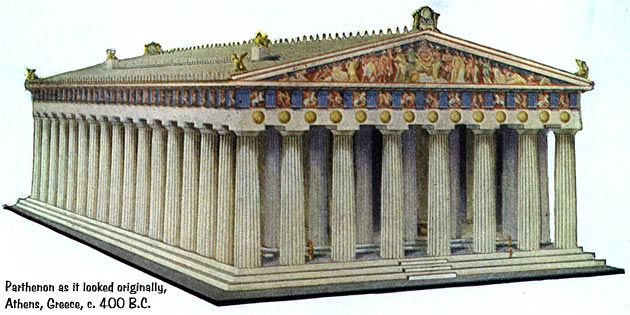
Recently we spent time looking at the Parthenon in Athens, which, along with Egypt’s Great Pyramid, stands as a seminal achievement of ancient architecture.  I think that looking at architecture is one of the best ways to gain insight into the past.  I didn’t come up with this idea, but borrowed it from the man to whom this site pays homage.  As I have said before, a civilization might throw a banking system together haphazardly, but would not do so with a sculpture.  And buildings, more so than individual works of genius, reveal more because they involve the mind and skills of whole civilizations.

Here is what the building probably looked like ca. 432 B.C.

Parthenon Original

They built it atop of their Acropolis, the highest point in the city which served as Athens’ religious epicenter.

Acropolis Recreation

The building as it looks today. . .

Of course most people when first gazing upon the Parthenon usually think, “Yes it’s good, but what’s the big deal?”  We understand instinctively perhaps the influence this style has had on western culture.  Banks, the Supreme Court, and almost any other building that wants to convey wisdom and trust copy this style.  That in itself should clue us in that the Athenians had something special in their design, but we have to look closely to see the real genius of the Athenians.

When we look at tall buildings like skyscrapers on the Washington Monument, at least from certain angles, the buildings do not appear straight.  Built with 90 degree right angles, our eyes fail to perceive the perfectly straight.  I don’t understand the science of why this happens, but we have all experienced it.  Part of it has to do with how our converging line of sight deceives us.  For example. . .

the top line appears longer, but is in fact the same size as the bottom line.  In this second image the middle lines appear bowed, but are perfectly straight.

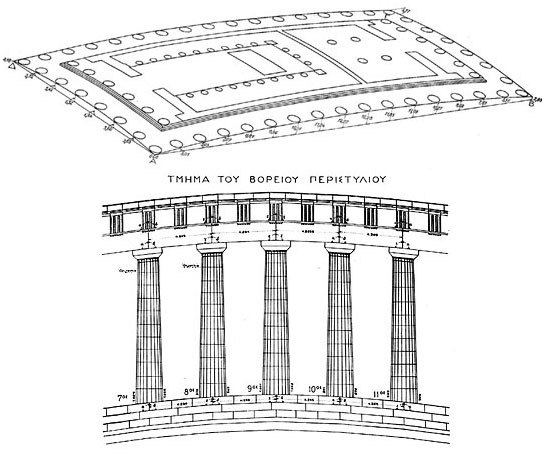
The Athenians understood this and built the Parthenon to compensate for the tricks our eyes play.  Each column has extremely slight variations throughout its many cylinders, sometimes with fractions of a millimeter the only thing distinguishing one block from another.  But the cumulative effect compensates for our vision and always makes the columns appear perfectly straight.  The following images exaggerate the effect, but give us the basic idea of what the Greeks accomplished:

Parthenon Columns

In fact a close look at the Parthenon reveals few right angles.  Each of the thousands of column drums remains an unique construction to that particular column.  This is not a lego set of interchangeable parts, but each part of the building stands as work of art unto itself.  If you have the time and interest, this video, and especially the last 30 minutes, give a good overview of their techniques in creating this building.

We can and should marvel at its construction, but we should go one step further and ask what the Parthenon means, and whey the Athenians built it as they did.  In class we focused on a few key areas:

  • The Greek Ideal of Perfection

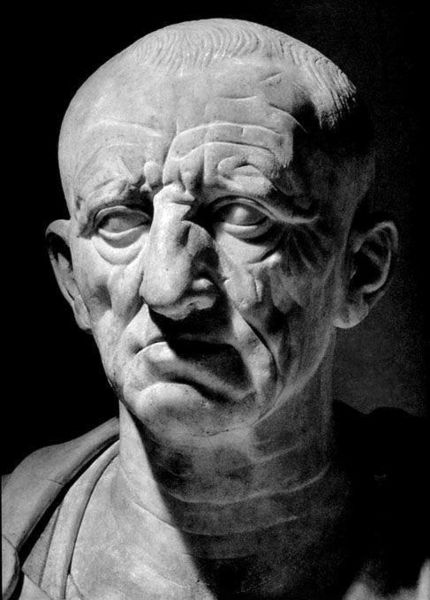
In much of their philosophy and politics, the Greeks searched for the abstract ideal beyond the visible, a trend that would not really shift until Aristotle.  The Romans, for example, or at least the early Republican Romans, rarely idealized people when depicting them,

Cato the Elder

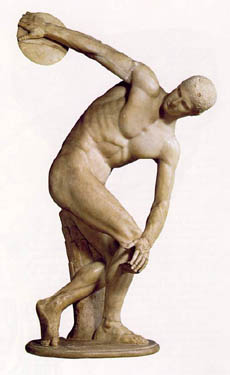
but we can say with only slight exaggeration that the Greeks did nothing but idealize people in their sculpture.

The Athenians went to tremendous lengths to bring make this ideal of perfection at least  seem  real among them in stone.

  • A Theological Statement

In theory, the Athenians built the Parthenon as a temple to Athena.  Originally a huge 35 foot statue of Athena overlaid in gold stood right at the center inside the building.  But architecture rarely lies.  The figures on the outside of the Parthenon tell a different story.  Here the Athenians put sculptures of Athenian heroes, with the clear intent of showing that the gods and men can intermingle, that Athens itself can achieve the perfection the gods embody.

That, at least, is one interpretation.

But another interpretation argues that this “temple” to Athena merely served as a cover for their true (even if subconscious) intent to glorify themselves.  It would be as if we built a church and called it “Trinity Church,” but put images of George Washington, Abraham Lincoln, etc. throughout (this actually begs the question of whether or not American flags should reside in churches, or perhaps whether or not the Capitol building is a church of sorts).

  • Mankind as the Measure

The Greek philosopher Protagoras has received a lot of bad press over the years for his comment that, “Man is the measure of all things,” and deservedly so.  But before we critique him we should understand the context of what he said and ask ourselves if the Greek gods were good “measures” of things.  Clearly, Protagoras and other philosophers had a measure of genuine spiritual insight in rejecting standard Greek religion as a guide for their lives.  The gods lived lives free of consequence, free of any restraint other than the power of other gods.

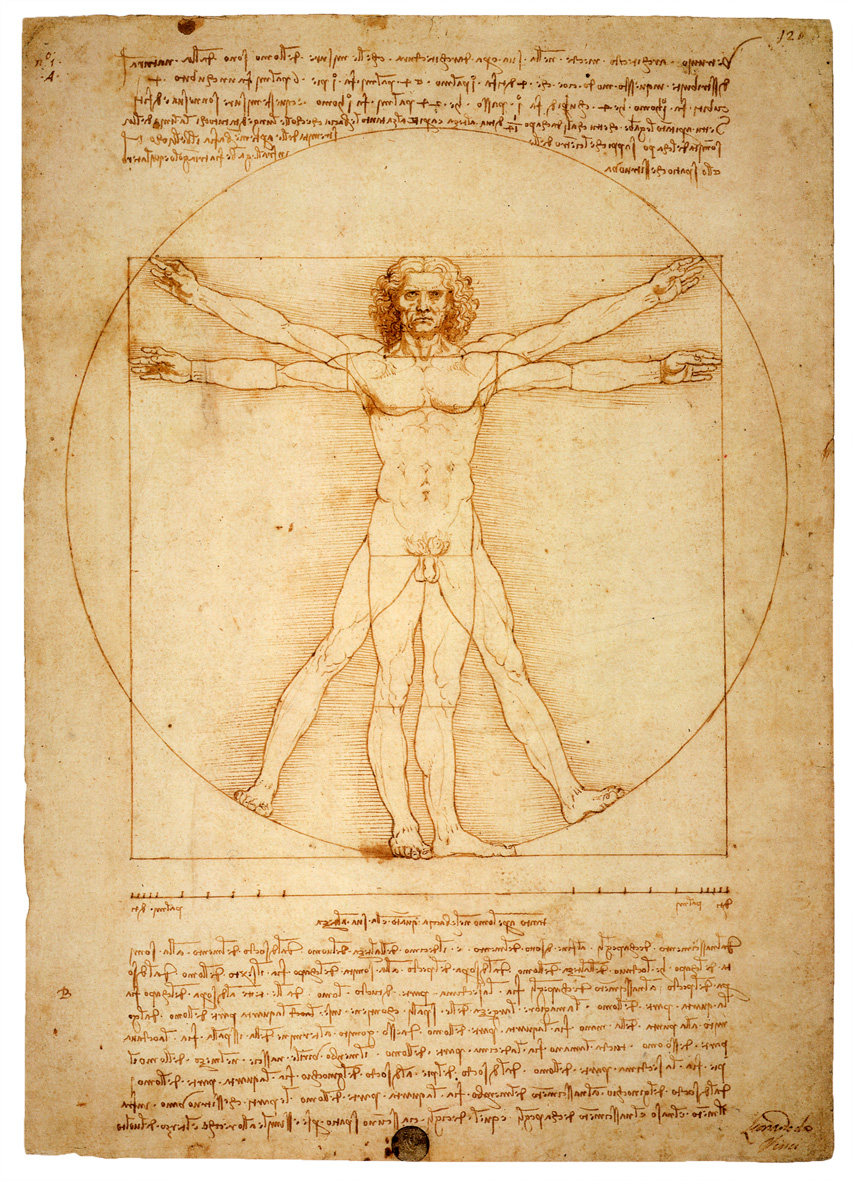
In the Parthenon the Greeks did not use the “eternal” or “mystical” dimensions as in the pyramids.  Some suggest that the proportions of the building in fact reflect the proportions found in the human body, as represented in Da Vinci’s famous “Vitruvian Man” (named after a famous Roman architect).

Vitruvian Man

What exactly the Greeks meant by this phrase, “man is the measure of all things” is not clear to me. It may have been a statement of moral relativism, or it may have been a theological/cosmological assertion that mankind functioned as a “microcosm” of the cosmos itself.  After all, we have physical elements to our being and spiritual elements.   Our higher, “heavenly” aspect (the intellect) guides our “lower,” more earthly parts, and so on.  Again, I’m not sure how to unwrap this phrase, and I’m happy to add it to the list of mysteries surrounding the Parthenon.

Blessings,

Dave

8th Grade: The Clash of East and West at Marathon

Greetings,

This week we looked at Persia’s expansion in Europe under Darius as they crossed the Hellespont into Greece.  Why did they do this?  I think there are a variety of possibilities.

  • We talked before about the ‘Burden of Cyrus.’  His extraordinary accomplishments made Persia a world power.  However, this legacy could be a burden as well as a gift.  Both with Cambyses and Darius we see this ‘need’ to do something grand that Cyrus did not do, something that would allow them to leave their own mark on Persia.  For Cambyses, this took the form of the conquest of Egypt.  For Darius one could argue, it took the form of conquering Greece.  One needs only look at how childhood stars often fare in their adult lives to see the problems of too much success too quickly.
  • The answer could be simpler.  Expansion may erase current enemies but it usually creates new ones.  The Aegean Sea may simply have been the ‘next’ enemy for Persia given their previous expansion through Asia Minor.
  • A more obvious and practical reason may have been Athens’ support for rebellions against Persia amongst “Greek” cities in Asia Minor.  Though this support amounted to little more than a token gesture, Darius may have felt than any slight to Persian power needed dealt with.  If this story is true, it has similarities to Emperor Claudius’ decision to invade Britain (Britain may have been giving aid — in the barest sense of the term — to conquered Gauls) during his reign in Rome.
  • Herodotus records a few stories that suggest that Darius may have had personal motivations for conquering Greece involving a personal attendant of his who was Greek.  The stories may or may not be true, but they might have a ring of truth.  It is not unknown for kings or country’s to act at least in part with this kind of motivation.

We wanted to realize, however, that expansion across the Aegean would be a different kind of expansion than the Persians were used to.  Almost the entirety of their empire was land based.  Anyone can walk.  Not everyone can sail.  Their expansion overseas would mean the creation of a whole wing of their empire.  Embarking on the sea would put them in a position where they would need a strong presence but have little experience.  In contrast, most Greek city-states grew up on the water.  Persia would still be able to muster an overwhelming advantage in raw manpower.  For most city-states this would be enough.  But as we shall see, not for all.

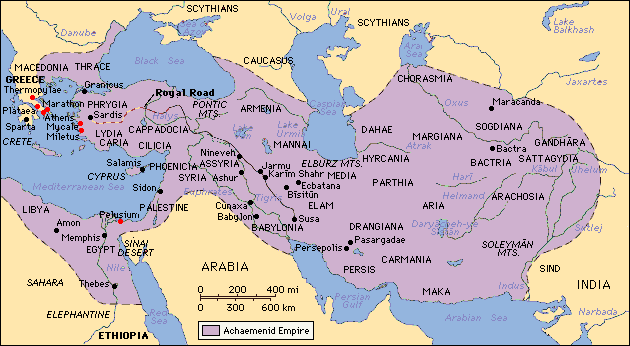
We looked at the Battle of Marathon in 490 B.C., and what it revealed about Persia.  Persia’s defeat at Marathon hardly spelled doom for Persia, but it did demonstrate their weaknesses, and perhaps, the fact that they had finally stretched out their imperial arm too far.  The map below shows them coming right up against classical Greece at this time:

Persian Empire

Persia was, in general, less oppressive and more tolerant than previous empires.  They provided economic advantage and security.  But being part of Persia did not come with any sort of identity.  One might argue that Persia was all head, but no heart, and on some level people need inspired.  They possessed huge armies, but the majority of those armies had conquered troops that probably felt little reason to fight for Persia.  Thankfully for Persia, most of the time their huge numbers meant that they often did not have to fight at all.  In fact, Persia’s absolute requirement for military service for all eligible males shows them at their least tolerant.  When one father asked King Xerxes to exempt his youngest son to stay on the family farm, Xerxes executed his son, hacked his body in two, and had his departing forces march between the pieces of his son’s body as they left the city.  They allowed for no exception to their ‘No Exceptions’ policy.

At Marathon, the Athenians gained a tactical advantage by focusing their attack on the non-Persian members of Persia’s force.  The Persian force collapsed quickly as large portions of their force beat a hasty retreat.  They may have been willing to follow orders and march where told.  Why would they risk more than that?  What were they fighting for?  On a variety of occasions, Herodotus speaks of the bravery and skill of the purely Persian troops. But the conquered and incorporated troops proved to be a hindrance rather than an asset.

I also think that the Athenian victory was part psychological.  They ran at the Persians — they actually attacked!  Herodotus hints at the shock the Persians must have felt under such a circumstance.  In Greece, Persia would meet a people who refused to accept their ‘deal.’  The fact that Persia needed to build a navy to deal with this threat put them in an unusual position, like fish out of water.  We will see in a few months how and why the Greeks defeated Persia when their clash grows into something much more than a skirmish.

Many thanks,

Dave

Animalia Agonistes

Given that I was 17 when Nirvana released Nevermind, the album obviously completely blew me away. For some time the subversive nature of the lyrics eluded me, lost as I was in the joy of our culture granting new-found permission to wear flannel shirts untucked. But then, one notices their audience mockery, such as in “In Bloom”–“He’s the one who likes all our pretty songs, and he likes to sing along, but he knows not what it means.”

I confess to feeling a bit guilty for thinking of this song in reference to the monumental achievement of J.M.C Toynbee and her book Animals in Roman Life and Art (yes, she was the sister of that Toynbee). I have no wish to mock as did Kurt Cobain, but I confess frustration with the traditional British historian. The British, like all cultures, should own and even celebrate their quirks. And perhaps nothing quite says “British” like the charming codger who has spent his entire life curating a particular old building, and can tell you everything that has ever happened to every plank of wood. This same trait gets passed on to many of their historians, our esteemed author included. In her day she stood as a substantial authority on Roman art in general, and perhaps the authority for the Romans and animals–no small achievement.

But she takes all of that knowledge and . . . writes a reference book. She fails to make her facts into a poem, to make her knowledge sing. Knowing everything, she “knows not what it means.”

I will make a meager attempt to do so.

But first, some of the fascinating facts about Romans and their relationship to animals.

Some years ago I saw a documentary on gladiators, and the video mentioned the “ecological disaster” inflicted upon wildlife. Surely, I thought this must be overdramatized. Apparently not! The numbers are numbing:

  • Some 9000 animals were killed at the inaugeration of the Colosseum, many of them “ordinary” animals which were not ferocious, such as foxes. Women killed some of these animals.
  • Trajan killed 11,000 to celebrate his Dacian Triumph
  • In one show, Nero’s bodyguard brought down 400 lions and 300 bears
  • Having beasts fight each other formed part of the spectacle as well.
  • From the late Republic on, having thousands of animals killed (most of them threatening) for a particular “celebration” was rather ordinary–the examples are too numerous to list to here, though Toynbee lays them out nicely.
  • All in all, some estimate that as many as 1,000,000 animals died in the arena (not to mention 400,000 humans), and it does indeed appear that certain species disappeared from certain regions of the globe due to this.

Some other more “tame”(zing!) factoids:

  • Elephants may have become a symbol of divinization for the Romans by the time of Emperor Tiberius. In addition, the Romans appear to have been able to train elephants to do unusual tricks, including walk a tightrope.
  • Aelian noted that he had seen a monkey trained to drive a chariot.
  • Lions were frequently featured on tombs by the age of Augustus, and dogs also were symbols of death.
  • On rare occasions, they kept bears as private pets.
  • In contrast to Judeo-Christian civilizations (and most others), the Romans regarded snakes as beneficial creatures.
  • The Romans had little regard for the tortoise, but the term they used for their interlocking shields was “testudo,” obviously borrowed from turtles. Turtle shells were also prized as baths for infants.

And so on. The book has hundreds of observations akin to these. So far, so good–she brings forward a variety of interesting facts. She helpfully reminds us that in a civilization that Rome’s relationship to its animals would have been much closer than ours. They relied on animals for farming, transport, and the like far more than we, and perhaps more than other contemporary civilizations (given their size, road structure, mobility of their army, etc.). But the data points never take us anywhere. Some might find this a humble attitude. I do not. Certainly there are plenty of times when one should keep their mouth shut, but I think Chesterton’s quote applies here:

What we suffer from today is humility in the wrong place. Modesty has moved from the organ of ambition and settled upon the organ of conviction, where it was never meant to be. A man was meant to be doubtful about himself, but undoubting about the truth; this has been exactly reversed. We are on the road to producing a race of men too mentally modest to believe in the multiplication table

If you are the world’s foremost authority on animals in Roman art, surely you can risk some of your accumulated capital and venture some highly educated guesses. Alas that she does not.

Two points in particular raised eyebrows with me that might shed a more general light on Roman civilization.

One is from page 68, where she writes,

[Here] two mosaic panels show a well-maned lion devouring a dark grey fawn. . . . The lions are arena beasts . . . [Another example] shows a lion holding in its maw the head of an antlered stag, which drips abundantly with blood. Lively amphitheater scenes are indeed, not uncommon on the floors of well-mannered houses.

Later, on page 83, she writes about leopards and describes another mosaic:

Above the three are dying leopards, each transfixed murderously by a barbed spear, writhing in agony, one rolled over on its back. Below, two venatores, one labeled MELITTO, are each driving a spear into the leopard’s chest, from which gush streams of blood. A dying leopard, also speared, lies in the background. . . . the realism with which they are portrayed is excruciating; and this picture raises in a most acute form the problem of how householders could wish to perpetuate such scenes of carnage on the floors of their home.

Though the problem be “acute,” she says not one word about it!

In a few other instances, usually involving lions or elephants, Toynbee tells of written texts that speak of people starting to sympathize with animals in the arena, even coming to root for them against their human counterparts, with thousands in the crowd weeping as they were killed. One might expect that such instances would serve as a spark for moral revolution, but this never came close to happening. Objections to the practice in any written record can be listed easily on one hand over a period that spans many centuries.

Can we put these curiosities together?

On one hand we have the “modern” answer to the problem which would run like so:

  • The Romans were a calloused, bored, and violent people. Such people would go to the games, cheer the games, and celebrate the games. The fact that they decorate their floors with scenes from the games is not much different than us putting up posters of our sports heroes in action.
  • Yes, they did lament the cruelty of the games at times. But again, when a player gets badly injured we too get quiet. If the injury is particularly bad players and fans might cry. But though the injury may cause us pause, this will not stop us from watching the next game or even the next play.

This explanation might be true, but I doubt it is. It seems too neat, too comfortable to the modern mind, to fit an ancient civilization.

We can start an alternate inquiry by asking what purpose the games served in Rome. Based on Carlin Barton’s wonderful insights, we can say that the games did not serve strictly as entertainment, but rather as an extension of their religious belief. Moderns like to separate religion from other aspects of life, the ancients would not have understood this distinction.

Most know that the Romans saw themselves as “tough” and “hard,” so we naturally assume that their drunken revels were a departure from that, a sign of decadence. But the Romans saw these seemingly disparate aspects as part of the same cloth. We are hard on ourselves in the army–we are hard on ourselves at parties too. We will eat until we cannot eat, then vomit, and eat some more–and still strive to enjoy it all. We push ourselves to endure both pain and pleasure in its maximum degree. Moderation?–not a thing in Rome.

My guess, then, with the animals and the arena, is that they could weep for them not so much because they felt sorry for them, but because they saw them as partners in the struggle of life. They weep for them falling as they would lament the deaths of their soldiers. Toynbee points out the close and varied relationship Rome had with animals, so this might fit with her work. So too, they have mosaics of dying animals in their homes not to revel in their destruction, but to honor them as fellow participants in the “Roman way,” just as we have posters of our sports heroes to honor their achievements.

So too, seeing lions and elephants as symbols of death and divinization might explain why they participated in the arena. Just as a Roman could be “divinized” by transcending normal human attributes such as fear of death, so too the animals could achieve this same level, in a sense. The title of this post recalls Milton’s poem, “Samson Agonistes.” Milton portrays Samson as a great champion,, but one imprisoned also by his “inner struggle” (a rough translation of “agonistes”)–and perhaps glorified by this same struggle? The Romans may have thought they were being generous in sharing their glory by sharing their struggle with the animals.

I may be wrong, but I do feel that ancient civilizations are generally “weirder” than we usually expect, and taking this approach will eventually lead to the right answer. Given how many unusual observations Toynbee made, it grieves me that she failed to use her enormous gifts to attempt a synthesis.

The Axis Mundi of Ecosystem Agents

Nothing quite says “hip” like a corporate cruise ship. For those like myself whose musical tastes in the 1980’s went towards the progressive rock of the 70’s, well, one could punch no faster ticket to the top of the high school social scene than to wear a shirt from Yes’ “Tales of Topographic Oceans” tour. What if one combined these Wonder-Twin powers and had a cruise dedicated to all of the bands that broke up 30 years ago? What if one could combine a non-stop buffet with non-stop mellotrons and Moogs?

Such is the starting premise for Dave Weigel’s amusing The Show that Never Ends: The Rise and Fall of Prog Rock. Such a cruise actually happened. Weigel booked his passage, and started interviewing. His book quickly gets into the history of various bands and the genre as a whole. Weigel writes as a fan and as a journalist, so he gives the reader many nuggets of the brilliance and pretentious stupidity of most every band featured.*

The stories of King Crimson, Yes, Genesis, ELP (the bands Weigel focuses on) have their particularities of course, but the similarities of their narrative arc struck me the most. These similarities manifest themselves despite the significant differences in the music of the groups above. Basically their stories boil down to

  • Band creates a brilliant, groundbreaking sound that wins them critical praise and popularity.
  • Band then begins shortly thereafter to experience significant interpersonal tension, and often, radical turnover in its members.
  • Bands then get second lives of sorts by completely embracing 80’s pop conventions, entirely altering their sound (King Crimson avoided this final step probably because they had decisively broken up by the time the 80’s came).

I am not saying that any of this is “wrong,” per se. Culture changes, people change, I get it. But the changes were very stark, rapid, and essentially uniform.

  • Emerson, Lake and Palmer go from Tarkus to this.
  • Yes goes from Tales of Topographic Oceans to this.
  • Rush opens their Hemispheres album in 1978 with an 18 minute suite (about the conflict between reason and emotion, with the section between 1:58-2:45 among their very best vignettes), and then four years later this is their biggest hit.

An argument about whether such changes were good, bad, or indifferent has merit, but the full abandonment of one ethos for another is notable in itself.

Genesis combined significant musical change and strong commercial success in both the progressive and pop incarnations more than any other band. I had no real knowledge of their output in the 1970’s before this book. In the 1970’s Phil Collins’ drumming is magnificent–inventive, swirling, yet powerful as well, as he demonstrates on “Down and Out” from 1978.

Even in 1980 Genesis showed strong ties to the progressive scene on their opening track for Duke, “Behind the Lines.”

Just three years later, we have an entire reboot of the band.

And, while I am scrupulously avoiding value judgments here, no one can forget the absolute horror of Invisible Touch from 1986. Genesis had completely transformed, leaving them with nothing left to declare, except “I Can’t Dance.”**

The band Rush created the catalog I most admired between 1975-1982. I practically made altars to them in high school, and so when I discovered their transition to pop with the mid-late 80’s releases, I had a hard time adjusting and still feel conflicted. I heard interviews from the band explaining the change and they said things like

  • We don’t want to do 20 minute songs in 17/16 time for the rest of our lives (wise and fair, but does that mean you want to do 4 minute songs in 4/4 time for the rest of your lives?).
  • We’ve never listened to the critics.
  • We’ll always be our own entity, marching to our own drummer
  • We’ll always follow our own muse, and the music we make comes from that muse within.

Ok, fine. Every band says stuff like that. But how is it then, that all these prog bands, while “listening to the muse from within” and being completely “their own individualized creative team,” all end up in the same place, chucking progressive conventions and embracing those of pop? How did it all end so quickly, and all end in the same place?

Some might say that no one could possibly recover from Spinal Tap’s unmasking of the whole progressive genre:

Others suggest that the corporatization of record companies explains the shift. In the “golden age,” bands could be signed and allowed to develop over time. Now, hits had to be churned out more regularly, and this meant the need for more immediately radio friendly material.

We can acknowledge that record companies want to sell records. This explanation might have some merit, but it ignores the fact that bands like Yes, Genesis, ELP, Jethro Tull, and so on all sold millions of albums as progressive acts in the 1970’s. “Selling records” doesn’t answer the question. Others might point to the music press, which gushed over prog rock in 1970 and uniformly despised it by 1978. Of course, all of these bands talked about following their own path, never listening to the critics. But even if they in fact tacked towards the critics, what led the critics to all suddenly change their mind?

Tocqueville has a great deal to say about the individualism in democracies, and how everyone tends think they are their own man, while at the same time following the general mass, but this cannot explain how the general mass decides to like or not like something.

Others might point to shifts in the culture that happen every 10 years or so, that everyone participates in. These shifts happen in politics, fashion, automobile design (i.e., remember SUV’s?) so they happen in music as well. This has the merit of putting music within a larger context. But at the same time, it lacks specificity. And, it still begs the question of why cultures shift so rapidly. How does that happen? If we think of prog rock as a civilization of sorts on a small scale, it would be akin to punk rockers becoming bank clerks within a few years, or if the Greeks chucked their Homer and embraced contemplative mysticism minutes of each other.

If one looks at any ancient or pre-modern civilization, one notices a clear orientation and direction that lasts for hundreds and sometimes thousands of years. Mario Baghos terms this orientation as an “Axis Mundi,” an intersectional point that encompasses death, life on earth, and heaven above. His From the Ancient Near East to Christian Byzantium: Kings, Symbols, and Cities explores the axis mundi’s of Sumeria, Egypt, Babylon, Greece, Rome, and then looks at early Christian Rome and Byzantium.

Baghos’ terms, such as Axis Mundi, and “Ecosystem Agent” need some fleshing out to understand his point. We start with a pyramid text from Pharaoh Pepi I, ca. 2300 B.C.:

Look, Osiris is come as Orion, the lord wine-colored with goods. Live! Live, as the gods have commanded you, live.  With Orion in the eastern arm of the sky shall you go down.  Sothis is the one who will lead you in the Marsh of Reeds to the perfect paths in the sky.

In this brief vignette we have

  • What is above (Orion, as god and constellation–likely one and the same in their mind)
  • What is below (the marsh of reeds), which completes the vertical axis, and
  • The horizontal axis, with the reference to the path of the sun

The Greeks had similar patterns of thought, as exemplified by their writings on the oracle of Delphi, of which Strabo below is an example.

Now although the greatest share of honor was paid to theis temple because of its oracle, since of all the oracles in the world it had the repute of being the most truthful, yet the position of the place added something.  For it is almost in the center of Greece as a whole, and it was also believed to be in the center of the inhabited world, and people called it the navel of the earth.  In addition there is the myth, told by Pindar, the the two eagles (though some say crows) which had been set free by Zeus met there, one coming from the west, and the other from the east.  There is also a kind of navel to be seen in the temple, and on it are the two likenesses of the birds of the myth.

Again, we have the idea a center point, and an intersection horizontally between east and west. Other stories have the origins of Delphi associated with Apollo becoming a dolphin and swimming to this point, which gives us a vertical axis of above (Apollo) and below (the water and sea creature), as well as a lexical history (dolphin, Delphi).

Rome focused more on earthy practicality than either Egypt or Greece, and this shows in some of their Axis Mundi descriptions. First, with Romulus and the inauguration of the Comititium:

. . . within which were deposited first fruits of all things the use of which sanctioned by custom as good and by nature as necessary; and every man brought a small portion of the soil of his native land and were cast in among the first fruits and mingled with them.  They call this trench, as they do the heavens, by the name of “mundus.”  Then, with this as the center, they marked out the city in a circle around it.

And–from Plutarch’s life of Numa Pompilius, regarding the Temple of Vesta:

Numa Pompilius built the temple of the Vesta where the perpetual fire was kept, of a circular form, not in imitation of the shape of the earth, believing Vesta to be the earth, but of the entire universe, at the center of which the Pythagoreans place the element of fire, and call it Vesta.  And, they hold that the earth is neither motionless nor situated in the center of surrounding space, but that it revolves in a circle around the central fire . . . 

Rome’s difference with previous civilizations comes out in that we see less direct reference to what is above (which we see most strongly in Egypt). But we have references to circles in both texts, the shape of eternity, and fire in the second, an “airy” substance (with the Vestal fire being possibly the most important place in Rome). We see a reference to “under the earth” with the trench and the soil as the “earth.” And though Rome undeniably thought more about earth than the heavens, we note the crucial role played by augurs–those who observed birds–in the whole of their society.

Baghos shows that early Christian culture in both and east and west grew with a similar understanding. Many medieval towns formed because of the acts of various saints in a particular place, usually involving their martyrdom. These saints descend in death, then ascend through the power of God, then descend again, by God’s leave, in the form of their relics, of which thousands of examples exist of miracles wrought through them. Churches would then get built on/near their grave, and towns would form around these churches. Each church in each locale formed its own Axis Mundi.

The concept of “Ecosystem Agent” also factors into Baghos’ analysis. An “Ecosystem Agent” functioned in many ancient civilizations as a focal point in the flesh of the civilization’s Axis Mundi. Such people were almost always kings in the ancient world. In Egypt, the Pharaoh literally was a god, in Babylon and elsewhere, the king may not have been divine himself, but functioned as the first touchpoint between the gods and his people. Numerous sources show that at the beginnings of civilizations, kingship had a priestly function, and may have even began specifically as a priestly, not a political office. Greeks of the classical era, and Romans under the Republic may not have shared entirely in this, as they had no kings. But we could say that they spread out their Ecosystem Agent functions to different offices, with the parts making a whole. During the Roman Empire, emperors served in this function, as the words of Munantius Plaucus (87-15 B.C.) show regarding Augustus:

The founding of Rome under Augustus is more honorable [than that of Romulus], inasmuch as sacred places too, and those in which anything is consecrated by augural rites are called “august” (augusta) from the increase (auctus) of dignity . . . as Ennius also shows when he writes, “After by augury august illustrious Rome had been founded.

In other words, Romulus founded the city by observing birds, and that’s great and all, but Augustus remakes Rome with his own person.

As Christian culture developed, we see both continuity and a decisive break from the past. On the one hand, Christ’s kingdom “is not of this world” and we should never try to make it so. On the other, Christ comes not just to save our souls, but our bodies, and all of creation. Everything gets eventually remade because of Him. We, as His servants, need to cooperate with this union of Heaven and Earth that He inaugurated in His Incarnation. Baghos writes,

In relation to the Logos’ transcendent governance of the cosmos, we can discern a distinct difference with ancient cultures.  But the model is not rejected, but transformed and at times flipped. For example, many ancients viewed the celestial realm as immutable, and so disturbances in the heavens often heralded death for kings.  This paradigm is inverted in Matthew’s gospel, in which the appearance of the strange star announces the birth of the true king.  

St. Ignatius of Antioch [early 2nd century] in his Epistle to the Ephesians sees “the Church and Cosmos worshiping symphonically together.  The 2nd century apologist St. Clement of Alexandria transfers the mythological metaphor of Orpheus’ songs as reshaping the cosmos, to the “celestial Logos, who sings the foundational principles throughout creation.”  

St. Irenaeus [mid 2nd century] relates the content of this teaching to Christ as “the Word, the Maker of All, . . . who has manifested Himself to men, giving His gospel under four aspects, but bound together by one Spirit.  He comes to this conclusion after a discussion on why there are four Gospels.  Since the number four “is wholly even” and thus represents equality and stability, there can be only four gospels that mirror cosmic stability.

Here Baghos quotes Irenaeus who writes,

Since there are four zones of the world in which we live and four principal winds, while the Church is scattered throughout all the world, and the “pillar and ground” of the Church is Gospel and the spirit of life, it is fitting that she [the Church] should have four pillars, breathing out immortality on every side, and making men alive.

The spiritual and the physical connect and mirror each other at every point. But Christ Himself is the Axis Mundi, and the Ecosystem agent, though saints, kings, priests, and the ordinary man may perform some of those functions, in a limited way, as God’s viceroys.

This historical and theological event had significant implications for culture.

The older pre-Christian model had a great deal of stability, but it bound people to a kind of earthly absolutism. Christianity freed people to be anywhere, but . . . without being nowhere. The difference matters. The early Christian/medieval model meant that since Epiphany at least, the entire cosmos was sacred. But, the union of heaven and earth “needs” the participation, in a sense, of Christ’s body to make it manifest. And, since unity and diversity are present in Godhead Himself, the particularity of places and people should be preserved as well as the unity of all. Hence, the formation of lots of localisms throughout the pre-modern world, the kind of associations that Tocqueville thought essential to maintaining democracy.

The problem came between the years 1400-1700, when people decided that they could dispense with all earthly incarnations of the sacred and just look to “Providence” from above. This in turn gave rise to ideas of universality of rights, of ideas, and so on. I don’t say that this was bad in itself–it helped create America, obviously. But it means that if a thing can be everywhere it can also be nowhere. Culture will be more ubiquitous, and less stable and impactful.

All this means that Prog music, a byproduct of the cultural upheaval of the late 60’s, could not, and perhaps should not have lasted long. It used trappings of classical European culture sometimes with love, but also to subvert. Such is the nature of chaos. It comes and goes.

There are those who say that we moderns have abandoned all of that sacred stuff that ancients and medievals obsessed over, and now have built our civilization around interest, economics, and the like. Some praise such a development. Others declare secularization the source of our woes. Those like myself, however, believe that having a civilization without an Axis Mundi and Ecosystem Agents cannot really happen. We have them, of that I’m sure. As to what or where they are, the answer, my friend, may be blowing in the wind.

Dave

*My favorite such nugget may be the dispute between drummer Bill Bruford and lyricist/frontman Jon Anderson of Yes. Bruford could stand Anderson’s meandering, abstruse lyrics no more. “What is this rubbish, this ‘Total Mass Retain?’ What does it mean? How we can we put this kind of song out?” Anderson retorted that, how could he [Bruford] not understand that, “My lyrics take the form of colors, of pastiches of colors.”

I mean, really.

Bruford ended up leaving the band. The parting seemed somewhat mutual, however.

I played drums growing up so naturally my sympathies go to Bruford on this one. But my wife pointed out that Anderson may have been pompous, by Bruford was being a fool. “You say that Yes has just released what many consider to be the greatest progressive rock album ever, and Bruford is their drummer. He is living the dream, and leaves because he doesn’t understand the lyrics?”

She has a point. Ringo, after all, stuck around after “I am the Walrus.”

Such are the pitfalls of art.

**Yes, I find Invisible Touch impossible to listen to, but I do not think that prog=good, pop=bad. I would take Yes’ 90125 over their Topographic Oceans and Relayer albums every time. Genesis’ “No Reply at All,” and “Just a Job to Do,” stand far above over lots of what they did with Peter Gabriel back in the day.

As to the volatility of the membership of most all of these bands, I speculate that

  • A great prog song is better than a great pop song in the way that a perfectly made French pastry is better than an ordinary piece of toast with butter.
  • But . . . while the impact is deeper with the French pastry, the vein is narrower. It requires perfect mixing and perfect timing. Otherwise, the pastry gets ruined.
  • Toast, on the other hand, is always good more or less. It is easy to make–it has a very broad appeal, but obviously has much less deep penetration.
  • Prog bands are like French pastries, they have to be perfectly balanced to work well, and thus, can easily go wrong. They are volatile constructions. The only prog band that really made it long-term was Rush, who had a perfectly balanced sound between the three, and very well defined roles for constructing the music (Peart with lyrics, Lee and Lifeson with the music).

Language as Myth

One will sometimes hear thinkers of a materialist stripe say something along the lines of, “A table is obviously a table, but words like truth or beauty are mere abstractions, a placeholder/convenience for certain ideas that different cultures have,” and so on. The problem with this lies in the fact that most everything anyone can think of deserves the title, “abstraction.” A table is not one thing but many things put together in a particular arrangement. Is it only a delusion that we call a table a table? Any living creature has many millions of separate parts, yet these parts function as a unity. Even an atom has multiple parts that we “conveniently” put together as a whole. We all “abstract” reality. Reality functions, in this way, as myth. The title of Ernst Cassirer’s difficult (for me at least) but significant work, Language and Myth could perhaps have the title Language IS Myth.

Writing at the end of WW II mean that Cassirer stood near the end of the unquestioned dominance of the scientific worldview. The deconstruction of the coherence of more traditional ways of knowing seemed complete. Cassirer was struck with the fact that the, “theory of knowledge as philosophers had developed it since the Middle Ages concerned itself solely with ‘facts’ and the development of orderly thoughts about facts. . . . Human intelligence begins with conception, the prime mental activity; the process of conception always culminates in symbolic expression. ” The book’s translator Susanne Langer noted in her introduction that, “Myth never breaks out of the magic circle of its figurative ideas. . . . But language, born in that same magic circle, has the power to break its bounds; language takes us from the myth making to phase of logical thought and the conception of facts.”

Hence, “Myth is an inherent necessity of language.”

In the early chapters Cassirer looks at theorist Max Muller. For Muller,

the mythical world is essentially one of illusion–but an illusion that sings its explanation whenever, the original, necessary self-deception of the mind, from which the error arises, is discovered. . . . From this point it is but a single step to the conclusion which the modern skeptical critics of language have drawn: the complete dissolution of any alleged truth content of language . . . Moreover, from this standpoint, not only myth, art, and language, but even theoretical knowledge itself becomes a phantasmagoria; for even knowledge can never reproduce the true nature of things as they are.

If myth be nothing, Cassirer writes, “it is mystifying indeed that this shadow should . . . evolve a positive activity and vitality in its own right, which tends to eclipse the immediate reality of things . . .” All in all Cassirer critiques “that naive realism which regards the reality of objects as something directly and unequivocally given–literally something tangible.” Objects in themselves cannot give meaning directly, for every object is a contract of other objects–hence, reality requires myth-making to achieve any sort of comprehension.

Most interesting to me were his thoughts on the idea that gods in the ancient world served mainly as embodied synthesized concepts. Much of what I learned about ancient religion growing up often amounted to something like, “The ancients didn’t know about electricity, so they thought Zeus threw lightning bolts.” Of course, how such unsophisticated people all over the ancient world managed to achieve such great heights of philosophy, architecture, etc. remains a mystery. Perhaps aliens?” Cassirer has a better approach, though also incomplete.

He begins talking about the “realness” of ancient religious feeling, even through the classical period in Greece, often thought of an an irreligious era. “Reason, Wealth, Chance, Feasting . . . Whatever comes to us suddenly [is] like a sending from heaven. Whatever rejoices or oppresses us, seems to religious consciousness like a divine being.” From these momentary “daimons” a new kind of god emerged, not from immediate experience but from “the ordered and continual activities of mankind,” which happened as our relation to the outer world went from passivity to active engagement. These gods have a narrow “width” but a degree of depth and permanence, as every year one needs to plant, sow, fish, and so forth. “Whenever a special god is conceived, it is invested with a special name, which is derived from the particular activity that has given rise to the deity.” Here we see the connection between language and religion, and how we need both to synthesize and create meaning from experience. Cassirer, using the work of Hermann Usener, thinks too much in an evolutionary way, but represents a big improvement from standard ways of viewing ancient religion.

Again–we have the link between language, myth, religion, all as examples of a synthesizing of material (be that material certain sounds or certain experiences) into meaning. Cassirer seems to lean heavily on the side of “emergence” in the Emanation/Emergence debate, but we can take his point. Cognitive scientist John Vervake has made a similar point about the current conflict in the Ukraine. Everyone is worried that something will happen to expand the war, but that “something” may not come from individual agency. Rather, war means participation in “Ares/Mars.” When we describe war as having “a logic of its own” we mean that a separate “life” exists as a corporate personality that drives decisions. We get enmeshed within this life and follow its bidding.

We can assert that we control this “life” because we created it. But I think it more accurate to say that we, speaking from the “emergence” side of the coin, call it into being rather than create it. History shows that such “ghosts” can be notoriously difficult to control. Think for example, of all of the allied moral denunciations of German use of chemical warfare in W.W. I, or the German bombing of civilian England in W.W. II. But England used chemical weapons in W.W. I shortly after the Germans, and the British and American forces killed far more civilians with bombs than the axis powers in W.W. II. As Vervake noted, these “collective ideations” (which I think was his term) resemble gods of the Bronze Age in Homer’s Iliad. They have abundant power, but grant no wisdom.

We can say the same for the internet itself. Humans created it, but we also called something into being, as we entered a hybrid-partnership of sorts. We feed it with attention, and it in turn learns and feeds things back to us. Surely, the internet has an agency, and seeks to add to its agency all the time.

Ok, the stuff about the internet I stole directly from

and both Vervake and Pageau explain the concept much better than I could.

The new Compact magazine has an article by Edwin Aponte that attempts to split the horns of the free speech wars. Most look at the fact that the left championed free speech in the 60’s, and now seems to favor more restrictions, or that the Right championed the “Moral Majority” and now wants comedians to say whatever they feel like saying, as either ironic or puzzling. But Aponte sees something else, writing

Consider also the activist left’s resistance to the Reagan White House’s unofficial gag order on public discussion of the HIV/AIDS epidemic in the 1980s, and then, barely a decade later, when the Democratic Party held the executive branch, the push for what was at the time called “political correctness”—a speech rubric spearheaded by many of the same left organizers.

In other words, today conservatives are out of power and railing against the canceling of comedians who make jokes about transgender people; tomorrow, the same people may be in power and leading the charge in favor of a ban against transgenderism in schools. This is borne out by the Times editorial. Per the survey, 66 percent of respondents agreed that democracy is built on the free and open exchange of ideas, yet a whole 30 percent also allowed for the curbing of speech if it runs afoul of acceptable etiquette.

Aponte makes the noteworthy claim that the root of this dichotomy lies in the Liberal (the term includes the modern Left and Right) project itself, which pledges unrestrained autonomy to grant one’s desires. Well, one’s desires could easily include both the right to say what you think and to not be bothered by what other people think. When Liberalism chucked Tradition and social mores as guides, they opened these floodgates.

I think, however, that something else is happening. In his farewell address, George Washington warned his countrymen against the formation of political parties, advice which we ignored almost immediately. Perhaps participation in democracies means that we cannot help but form political collectives to try and get what we want. This in turn catches us up in the war of “gods” who seek power but grant no wisdom. Language itself shows that we cannot avoid synthesizing meaning, but how we do so . . . that’s up to us.

Dave

Tradition under Control

To combine high and low is a rare thing. Historians usually write either “high” with an overarching idea or theme but weak support, or they write “low” with lots of details and specific observations but little overall goal or point. The best historians know how to unite “Heaven” and “Earth,” for only in this union can one glean wisdom. A few years ago I read Carlin Barton’s book on the gladiatorial games and immediately decreed it the best book ever on the subject, case closed. Barton knows how to write in both directions, and she has bold ideas.

In the Sorrows of the Ancient Romans Barton successfully sought to see the gladiator contests not in light of the “bread and circuses” lens of Roman politics, but in the cultural and religious meaning of “suffering” for the Romans. In Imagine No Religion, cowritten with Daniel Boyarin, Barton remakes our understanding of Roman religion. She suggests in her introduction that the problem many scholars have in translating ancient texts comes from their natural love for abstraction.

Intellectuals and academics in the contemporary world are cosmopolites . . . . They are like the relativist Xenophanes who boasted of traveling the “world” for 67 years. They are pressed hard to find ways of ordering the variety of human experience. We scholars, like all cosmopolites, cope . . . by creating abstractions.

Barton argues that many translators see the world “religio” in Latin, and fail to see the nuance inherent in the word. I would add that academics might also tend to see the Roman concept of “religio” much in the way that those they connect with in the ancient world might see it. Hence, academics have tended to see Roman religion too much through the lens of Cicero. Cicero–a brilliant man who could see different sides of issues, alternating between retreat and involvement–seems a perfect doppelgänger for the modern don.

But when we look at Cicero in the 1st century B.C., we are not looking at the traditional reality of Roman religion, but at a reaction to political tumult, which likely sprang from the cultural and social upheaval of the Roman Republic at that time.

Some of Cicero’s more famous pronouncements on religion reveal something of a hierarchical and ordered system. He writes,

So from the very beginning we must persuade our citizens that the gods are the masters and regulators of all things, . . . that the race of humans are greatly indebted to them. They observe the character of every individual . . . with what intentions and with what pietas he fulfills his religiones . . .

In De Natura Deorum Cicero writes again in a similar vein,

. . . I ought to uphold the opinions about the immortal gods that we have received from the mayors, the caerimoniae, and the religiones. Indeed, I will always defend them, and always have. When it is a matter of religio I am guided by the pontifex maximus Titus . . .

Barton sees the concept of “religio” working much differently than as a means of social control, and cites the work of other scholars who translate the word as “care for the gods,” “hesitation,” “anxiety,” and the like. Clearly, some kind of cultural “attitude” is at work, a balancing of emotional attitudes and actions, and this forms the heart of Barton’s project with the book.

Earliest preserved appearances show that religio meant not so much a system of thought, but something akin to “what gave men pause.” In the Mercator of Plautus (184 B.C.) Charinus wants to leave home, his friend Eutyches tries to change his mind. Charinus responds, “That man causes me to have second thoughts–he makes me pause and wonder. I”ll turn round and go over to him” (Religionem mi obiecit: recipiam me illuc). In other sections of Plautus “religio” indicates the thought/emotion of holding back, thinking twice. A century later Cicero uses the word in a like manner when he recounts that Publius was greatly angry at Valerius, “Yet he kept hesitating and religio repeatedly resisted, holding back his anger.” In turn, acting against such a feeling caused one to feel pudor, whose symtoms gave one high anxiety more than shame. Barton suggests a parallel–“A modern man might approach a lapdog casually, but might hesitate before a Doberman or a pit bull. . . .Just so, ‘religio’ was evoked in dealing with the risky ventures of life, causing the Romans to behave with awe or circumspection.

Livy recounts the interactions between the consuls Paulus and Varro as they approached Cannae:

Paulus himself wished to delay . . . . Varro was greatly vexed at this hindrance, but the recent disaster of Flaminius and the memorable defeat of the consul Claudius in the First Punic struck his animus with religio.

Seneca writes similarly,

If a cave, made by the deep crumbling of the rocks, holds up a mountain on its arch, a place not made with hands but hollowed out by natural causes, it will strike your spirit with a certain religio.

Barton again comments, “‘Religio‘ was especially evoked by highly charged boundaries, and the fear of transgressing taboos, such as we might approach the edge of an electric fence. No fear of magisterial authority or divine judgment was necessary.”

But religio had negative connotations as well. One could hem and haw too much, and in the wrong times and places. Cicero criticizes a rhetor named Calvus, who spoke with excessive precision and balancing, so that “his language was weakened with too much religio.” So too, superstition had a close alliance with religio, which should be seen, as Barton states, as “not the antithesis but the excess of religio.” One needed a steady balance of the right religio to act rightly in the world. Failure to have a proper balance would later result in unhelpful wild swings. Livy writes of Tullus Hostilius, “[a] man who had so far thought nothing of . . . sacred rites, [who then] suddenly fell prey all sorts of superstitions, and filled even the minds of the people with religiones.” Livy also recounts the impact of the 2nd Punic War warping the people’s sense of religio:

The longer the war dragged on and success or failure altered the spirits of men no less than their fortunes, such a great religio invaded the republic, for the most part from the outside, so that gods or men suddenly seemed changed. Now that the disorder appeared too strong, the senate assigned . . . the city praetor the task of freeing people from these religiones.

An intriguing “chicken or the egg” question arises when one looks at the collapse of the Roman Republic. Most look at the political disorder beginning with the Graachi and then see the concomitant centralization of power that culminated with Caesar as a solution to the breakdown. Another option–could the centralization of power in fact have indirectly caused the disorder? An alteration of the traditional political give and take would send shock waves through the psyches of the populace. Of course, most chicken-egg questions have no possibility of resolution, but thinking of the relationship between power and disorder will help us understand the fabric of reality.

We can apply this to Roman religion, and we see the possibility that too much control may have come before religio got out of balance. Toynbee and others document how the 2nd Punic War (218-202) particularly challenged traditional religion by exposing Romans to new ideas, cults, and (as we saw above), an excess of religio as superstition. As the Republic collapsed in the late 1st century BC, Lucretius expounds the notion of the gods keeping everyone in perpetual fear–through excessive control. “Religio” had gotten out of control:

Human life lay for all to see foully groveling on the ground, crushed beneath the weight of religio which displayed her head in the regions of heaven, threatening mortals on high with horrible aspect . . .

I must show in what ways fear of the gods crept into the heart which our earth keeps holy their shrines and pools and groves, their altars and images.

De reruns natura, 1.62ff., 5.73ff.

Statius in the mid 1st century A.D. wrote that, “It was fear that first made gods in the world.” I’m not sure we would have seen such language 200 years prior.

Lucretius did not likely represent the majority opinion, but the authors look at what they call the “Ciceronian Turn,” where Cicero at least, and perhaps Rome as a whole, begins to look at religion as a tool for countering chaos. With the proper balance of religio gone, now things needed more hierarchy, more top-down structure. This in turn created the need for more “noble falsehoods” from the elite and a greater separation from patricians and the plebs.

It appears at first glance that the religious expansion/innovation happened first, and then we have the tightening afterwards. This view appeals to me as someone who views that religion, whether that religion have a direct conscious expression or no, forms the heart of any civilization. But the connection between excessive control and freedom will always be a close one. We can perhaps see Rome’s politics and culture tightening during the Punic Wars, the devastation of Italy due to Hannibal, etc., and then–religio starts to get out of alignment, showing more extremes.

However we see this relationship, the west will always play with fire when we focus alternately on the rights of individuals and the limits of government power, for that puts the focus on the edge rather than the center. Then, just as when we breathe heavily, we get unbalanced. A civilization cannot breathe heavily in and out for very long. A civilization cannot exist as a negotiation between extremes. It functions instead optimally when the tension between different elements is intuitive and thus, healthy. In Rome, for whatever reason this tension got out of alignment, with a resulting political and cultural decline from which they never quite recovered.

This relationship between extremes manifesting themselves simultaneously runs rampant throughout our world:

  • The internet allows us to have more options than ever and to be surveilled as never before.
  • Social media platforms give us essentially no limits on whom we reach with our thoughts, but online speech is also the most heavily regulated/punished.
  • Technology gives us the possibilities of travel even into the uninhabitable regions of space, but even slight damage to the craft in the wrong place would kill everyone onboard.
  • Nuclear power on the one hand could give the world abundant clean energy, and on the other hand, could destroy civilization entirely.

And so on. To take another example, Russia may have done wrong by invading Ukraine, but observe . . . even Russians who protest the war are being “canceled”, presumably because they are Russian. This absolutist way of acting in the world will hurt far more than it helps.

Imagine No Religion gives us great insight into the relationship between culture, religion and power. It is an open question as to whether or not America ever was a “Christian nation,” but certainly we are not that now, and have not been for some time. Many debate the nature of the “real” religion of America. Whatever that might actually be, the cultural and political tightening we have witnessed recently, however, either has come on the heels of a religious shift, or presages one. As man is, as St. Maximos put it, a macrocosm, individuals and civilizations need to breathe in and out calmly, intuiting the boundaries of our conduct. Healthy people and healthy civilizations result.

Dave

Mr. No Depth Perception Man

There is an old SNL skit of the aforementioned title, in which a hapless suburbanite can only see in 2-D. He makes terribly awkward comments about his guests, assuming that he does so without the offended party being aware. An excerpt:

Mr. No Depth Perception Man: I can’t believe Brenda’s dating this loser! You know what she’s after, right?! I bet he’s got money, or something! [the “loser” he’s talking about is 7-8 feet away, looking quite awkward at his comments].

[Embarrassed Guest who knows the “loser” tries to get him to be quiet].

Mr. No Depth Perception Man: What are you worried about? Relax! He can’t hear me–he’s way down there!

I thought of the sketch when reading Leo Deuel’s enlightening and eminently fair Memoirs of Heinrich Schliemann. The book intersperses Schliemann’s own writing with commentary and context from Deuel throughout. This is needed to get an accurate picture, because Schliemann is, alas, not a reliable narrator–much less reliable than most.

I say, “alas,” because I confess to liking Schliemann, despite his enormous faults. Most modern history films I have seen that discuss him focus almost entirely on those faults (which I will get to) and basically pass by his vast contribution to the study of the ancient world and archaeology itself. He possessed an enormous talent for languages and learned several of them. He did this through optimism, the ability to engage in drudgery, and enormous exertions of will and energy–truly the quintessential 19th century man.*

Such men are out of fashion in our day, but I admit that I am not terribly sad that they are mostly gone. Such people are charming but also exhausting. Their vices, though perhaps childlike in a way, are all the more infuriating for the fact that they seem completely blind to them.** Schliemmann lived in a two dimensional world.

For example . . .

To get permission for his ground-breaking (zing!) work at Troy, Schliemann had to promise to turn over all he found to a museum being planned in Instanbul. He ended up giving them very little. As to the famous, “Treasure of Priam,” he very intentionally hid it from the Turkish authorities. His escape with various relics from the past got his Turkish overseer in a lot of trouble. Schliemann was a bit bothered by this, but it never crossed his mind to think of the artifacts as belonging to anyone but himself. Since I don’t think we can assume that Schliemann was directly evil, I suppose this was an unfortunate byproduct of his enormous self-will.

Schliemann uncovered some spectacular finds but often misinterpreted their significance. His errors would be easily excusable as a mistake or misguided educated guess. In Schliemann’s case, his mistakes came from his enormous though unconscious self-regard. Almost incredibly, his main justification, for example, for his claim that he had uncovered Agamemmnon himself at Mycenae was that the death mask he uncovered, “looks just as I imagined [Agamemmnon].” For Schliemann, his own imagination was all the “evidence” he needed.

Perhaps Schliemann’s daughter might sum him up best, with this brief recollection:

My early years living with this explosive, dedicated, and tireless man of genius was a stern trial . . . . Throughout my own girlhood he would often get me up at 5:00 in the morning in winter to ride horseback five miles to go swim in the sea, as he himself did every day. He built us a palace to live in, but it contained not one stick of comfortable furniture. He worked and studied standing at a high bookkeeper’s desk. As a gentle hint, Mother made him a present of an armchair, but he banished it to the garden.

His concern with health was fanatical. When my younger brother was baptized, with many guests solemnly assembled in church, my father suddenly whisked out a thermometer and took the temperature of the holy water. There was a great commotion; the priest was outraged. It took my mother’s gentle intervention to reinvest the water with holiness.

Beneath these imperious traits Father was warmhearted and generous to a fault. He was humble, too, in his own way.

After reviewing his life, I am hard-pressed to find a great deal of “humility” in Schliemann. Schliemann did mature a bit with each passing archaeological dig, both in his methods, and–by the end he let others take credit for their own discoveries! Perhaps Schliemann also possessed a humility towards the past, a virtue of his that should return.

Some of Schliemmann’s comments about his Greek workers grabbed my eye. It bothered him that they would not work on Sundays, but this he understood to a degree. What he could not understand was their refusal to work on certain other days, such as the festival of certain saints.

I suggested a likeness of Schliemann to a certain short-lived SNL character. He absolutely had his own superstitions, though he proceeded through life entirely unaware of them. Chief among Schliemann’s suerstitions I already mentioned, namely the implicit trust in his own imagination. So strong was this trust that it led him to declare that some discoveries of others were in fact his own!

We cannot say that this was an example of cultural bias or prejudice. Schliemann nearly worshipped Greece, or at least his idea of it. He married a Greek woman and gave his two children ancient Greek names (Andromache and Agamemmnon). He lived in Athens for much of his later life. Rather, it was the customs, or beliefs, that he could not understand. He wrote in his diary that,

There have been, including today, three great and two lesser Greek church festivals, so that out of these 12 days I have had in reality only seven days of work. Poor as the people are, and as they would like to work, it is impossible to persuade them to do so on feast days, even if it be the day of some unimportant saint . . . . I try to persuade the poor creatures to set their superstition aside for higher wages.

Even a cursory look at Schilemann’s life reveals at least a few “superstitions” of his own. Naturally, it depends on how one should define such a thing. But surely uncritical assumption that we can define reality for ourselves fits any reasonable description of “superstition.”

I am reminded of a famous passage in Plato’s Phaedrus in which Socrates and Phaedrus are walking through the city and come upon the supposed site of ancient story involving the gods. Phaedrus asks if Socrates believes the story, and he replies,

The wise are doubtful, and I should be singular if, like them, I too doubted. . . . Now if one were skeptical [about all stories] and would fain reduce them one after another to the rules of probability, this sort of crude philosophy will take up a great deal of time. Now I have no leisure for such inquiries. Do you wish to know why? I must first know myself, as the Delphian inscription says; to be curious about that which is not my concern, while I am still in ignorance about myself, would be ridiculous. And therefore I bid farewell to all this; the common opinion is enough for me.

If we might take another example of the “common opinion . . . ”

A long standing tradition states that Joseph of Arimethea came to Britain as a missionary shortly after Christ’s resurrection. Other parts of the story indicate that Joseph obtained his wealth via trade in tin, and likely made many excursions to the island for his business. Some parts of the tale indicate that Jesus Himself traveled with Joseph (His uncle) as a young boy on an adventure, and still some other parts of the tale say that the Virgin Mother accompanied Joseph on his missionary journey to the island.

Most of us might be inclined to doubt the whole story, if not at least some of its parts. No doubt Schliemann would call it “superstition.” And yet, the belief of Britain being evangelized quite early in the first century A.D. dates back to St. Clement of Rome, and St. Irenaeus, Tertullian, St. Athanasius, St. Augustine and others all testify to this fact. A great deal more evidence for this “superstitious tradition” may exist than we previously thought–such is the conclusion of Lionel Lewis in his informative work on St. Joseph and the Glastonbury tradition. Not all details of the traditional story have the same level of evidence for their historicity, but still, much more exists than we might suppose.

Schliemann’s intensely narrow passion helped him ignite a whole era of discovery about the ancient world. Indeed, many before him might have regarded some kind of historical belief in a Trojan War as a superstition backed only by “tradition.” Alas for him that this narrowness of vision closed him off to world’s outside of his own.

The “common opinion” perhaps might be true in the case of St. Joseph of Arimethea, just as it was about the Trojan War–as further excavations at Schliemann’s site have only further confirmed at least a rudimentary historical context to Homer’s tale. I wonder if Schliemann could grant the same to Greek saints of the Church–even the “unimportant” ones.

Dave

*England “ruled the world” during Schliemann’s era, and it is perhaps no coincidence that it was England that gave him the most favorable reception to his work. Schliemann might be described almost as an incarnation of England itself in all of their virtues and faults of the Victorian era.

**One thinks of the great line uttered by Patton in the Patton movie where he states to General Bradley, “Hell, I know I’m a prima dona! I admit it! What I can’t stand about Monty [General Bernard Montgomery] is that he won’t admit it!”

Tradition and Technology

Those who regularly read this blog know that I tend to favor traditional values and traditional societies. Those like me need to realize that things change inevitably, making the challenge knowing how to change and stay the same all at once. Those on the opposite side need to realize that “change” is not a good word, any more than “tradition” is a dirty one.

Traditionalists must face the question of the role of technology. Certainly one could have a society that held tightly to tradition with little-no technological development. Is it possible for tradition to captain the ship while innovating technologically, and maintaining a robust economy? The question has immediate cultural and political relevance for those like me, Charles Haywood, and others. Much of our economic growth appears dependent on new technology. If a new cultural and political version of America is on the horizon, can it combine an anchor of tradition and still give us Amazon (which I do not regard as a dirty word necessarily)? Or, perhaps we need to choose one or the other, and accept the consequences. I have no clarity on this, though I suspect we may have to choose.

This question has interest in the abstract, but possibly we gain more clarity if we have a specific example, maybe even one out of left field . . . such as the development of handwriting from the classical era until today.

Ancient Writing and its Influence by B.L. Ullman lives up to its title but in a narrow sense. Ullman wrote originally in 1932–thankfully. I think if he wrote today it would be impossibly technical with much poorer writing. Even so, many parts of the book I read with semi or fully glazed eyes. As a sample, I open randomly to page 74, which reads,

The term half-uncial is sometimes used for mixed uncials of the type described, but in a narrower sense it applied to a very definite script that became a rival of uncial as a book script from the fifth to eight centuries. Again the name is unfortunate in its suggestion that it was derived from uncial. Rather it is the younger brother of that script, making us of an almost complete minuscule alphabet. It does not use the shapes of ‘a’, ‘d’, ‘e’, ‘m’ characteristic of uncial script but rather those of modern minuscule type, except that the ‘a’ is in the form used in italics, not roman. The only letter which maintains its capital form is ‘N’, and this letter readily enables one to distinguish this script from later minuscule. The reason for the preservation of this kind of ‘N’ was to avoid confusion with the minuscule ‘r,’ which in some half-uncials is very much like ‘n.’ The desire to avoid ambiguity is seen also in the ‘b,’ which is the form familiar to . . .

So, what Ullman means mostly about influence is how one form of writing influenced another kind of writing in a nearly purely technical sense. I wanted more on how changes in writing either propelled or reflected changes in the culture at large. Ullman gives us some hints of this, and his extensive, precise knowledge gives some space to the reader for guessing on our own.

We can start by recognizing that the phonetic alphabet itself ranks as one of the more propulsive and destructive (creatively or otherwise) of human technologies. Marshall McCluhan noted this with keen historical insight, in a famous interview (the ‘M’ is McCluhan, the ‘Q’ for the interviewer):

M: Oral cultures act and react simultaneously, whereas the capacity to act without reacting, without involvement, is the special gift of literate man.  Another basic characteristic of [pre-modern] man is that he lived in a world of acoustic space, which gave him a radically different concept of space-time relationships.

Q: Was phonetic literacy alone responsible for this shift in values from tribal ‘involvement’ to civilized detachment?

As knowledge is extended in alphabetic form, it is localized and fragmented into specialities, creating divisions of function, classes, nations.   The rich interplay of the senses is sacrificed.

Q: But aren’t their corresponding gains in insight to compensate for the loss of tribal values?

M: Literacy . . . creates people who are less complex and diverse.  . . . But he is also given a tremendous advantage over non-literate man, who is hamstrung by cultural pluralism–values that make the African as easy a prey for the European colonialist as the barbarian was for the Greeks and Romans.  Only alphabetic cultures ever succeeded in mastering connected linear sequences as a means of social organization. 

Q: Isn’t the thrust of your argument then, that the introduction of the phonetic alphabet was not progress, but a psychic and social disaster?

M: It was both.  . . . the old Greek myth has Cadmus, who brought the alphabet to man, sowing dragon’s teeth that sprang up from the earth as armed men.

My meager knowledge of pre-historic man (so called) will not prevent me from thinking that McCluhan exaggerates to a degree–the written word need not totalize all of our being. Still, we must acknowledge that we cannot expand our abilities infinitely, and if we go “deep” in one area we will certainly see shallow waters in other aspects of our being. We can also acknowledge that we how we present the world to others will reflect and shape our beliefs about the world. It need not be the chicken or the egg as to whether it reflects or shapes–we can say that both happen.

Ullman makes a few opening technical remarks perhaps designed to quell those who want to make large conclusions from changes in writing over the years. Sometimes changes in writing come from changes in the medium of the writing. Writing primarily on stone lends itself much more to straight lines and hard angles, as opposed to paper or even papyrus. Very true, but this also begs the question as to why a people use stone or scrolls in the first place. Eventually certain choices become second nature, but not at the beginning of the switch, which involves more conscious choice. I remain convinced that switches in the medium for writing, and how they write, surely mean something. Few aspects of our being rank higher in importance in our desire to connect with others, to achieve understanding from person-person, not just of content but of the meaning of that content. We accomplish this best face-to-face, where we express the full panoply of the message with our bodies as well as words. This means that when apart, the written words we choose, and how we present those words, seek in some way to make up for the absence of the body.

For this reason, and others, I say we can deduce much from the script of a civilization.

My theory runs like so: the more a civilization develops, the more refined its writing. This, I admit, means hardly saying anything more important than 2+2=4. But I hope to venture a step further, and suggest that perhaps we can wonder whether that development/refinement will still allow a people to preserve its civilizational ethos, or propel it away from its center. Not all growth is good.

We can start by examining the development of Roman script, with the first example from perhaps the 6th century B.C.

And now, moving forward in time to ca. AD 70

The latter examples show refinement and a development into a clear style that everyone recognizes as “Roman.” But with the codification has come “Empire.”

As the empire declined and we move into late antiquity, their writing changed as well, showing perhaps more of a Greek influence, with these first examples from likely the 400’s AD (apologies for intrusion of my fingers).

and these from 1-2 centuries later.

I suggest the changes could come from from more cultural blending, and less control over the empire, as the differences between barbarian and Roman blurred.

And now, for the development of Greek script. First, from 700 B.C.

Within just a few centuries, we see quick development of a more elegant but also more “rigid” script style, from the 5th century BC in Athens, with the second example a few decades later than the first.

As Greek power wanes in the 4th century BC, their script becomes a bit more fluid, just as in Rome:

With the establishment of more Roman presence in the Greek east after Constantine, Greek script grows a bit more fluid over time, with the examples below showing a progression of about a century.

Then, as the western part of the empire collapses, the writing gets more fluid and stylized, with the dating as the 9th century, 12th century, and the 15th century, respectively, just before Moslem conquest of Constantinople.

In the west, the collapse of Rome led to the development of a new civilization. First, for some context, Roman writing in the 5th/6th centuries, AD:

and Visigothic writing from north Italy, ca. 9th century AD:

Other European cultures had a bit more development than the Visigoths, however, and we see this reflected somewhat in their script, with the first two being Anglo-Saxon from the 8th century, and the last Carolingian from the 9th century, as the “Carolingian Renaissance” had gotten underway by then:

By the 12th century, we see more elegance and uniformity, as in previous civilizations over time.

In parts of France, we have a parallel development of sorts, with each example progressing from the early to late 9th century near Tours.

As the Middle Ages develop, you get more refinement, but less overall readability, with these examples from the 12th century,

and then into the 13th and 14th centuries,

which seems to almost beg for a correction with the coming of the Italian Renaissance in the mid-15th century.

Ullman’s excellent visuals make his text intelligible for novice’s like myself, and allow us to speculate on some broader conclusions.

It seems that the scripts go through three phases that seem to circle back on one another.

  • First, you have early script, which has less uniformity, is “sloppier,” and more free, in a way.
  • Second, as the civilization develops and gets on its feet and flexes a bit, the script gets more uniform, and certainly in the case of Greece and Rome, “blockier.”
  • Then, as the civilization wanes, either physically, intellectually, or both, the script gets more fluid. In Rome, you see the blending of Greek and Roman influences towards late antiquity. In the Middle Ages, you see ornamentation increase nearly beyond the pale, which brings back the more Roman/Carolingian, unified style.

One might suggest that we get a an interesting comparison between the Roman Empire of the Augustan age, the Byzantines, and the Latin west at the “peak” of their powers. Roman script screams empire and control (see “Plate 2” above), whereas the other two have more breath in their writing, with more feminine qualities. I think the comparison helps, but we must take the scholar’s caution, for Ullman reminds us that writing on parchment allows for a lot more fluid motion than writing on stone.

We can apply all of this to our original question: can a civilization maintain a firm anchor in tradition and still innovate?

As Rome’s republic fell into disarray, many contemporary historians lamented the decline of the old ways. Historians always lament the decline of the old ways. But Rome’s unwritten constitution relied on tradition to work, and the letter of the law could not save the republic. We know too that Augustus sought to promote a return of traditional values even as he consolidated power in a non-traditional way, an indication that the contemporary perception that “times had changed” involved more than “grumpy old man” Roman historians like Livy and Polybius. We can confidently say that Rome gives us significant data point that points to tradition eroding as innovation in their writing increased.

Greece has a slightly different story. They standardize their writing more quickly than Rome, and then change it a bit more quickly again after that. Their more fluid and script has a warmer, more human feel, and suggests that perhaps they maintained traditions more effectively than Rome (and perhaps also their proximity to water). However, no one argues that Greece in the 4th-3rd centuries BC were at the top of their game.

As for the Byzantines, a variety of historians from the Enlightenment onwards critiqued what they saw as their slippery, devious methodology in international relations. Edward Luttwak’s brilliant book on the Byzantine’s grand strategy shows that their foreign policy choices were methodical and moral, consistent with a power facing multiple enemies over a wide front. Surprisingly or no, their handwriting seems to mimic the fluidity of their geopolitics. My knowledge of Byzantine history has gaping holes, but based on my perusal of The Glory of Byzantium they maintained a clear and consistent artistic style while innovating and changing their technique. Marcus Plested has shown that many theologians interacted positively with the early medieval philosophical tradition. They seemed to manage a balance of some kinds of innovation without sacrificing tradition and identity. However, they fell to the Moslems, albeit after a 1000 year run. If innovation forms the kernel of success and power (a big “if), they failed to innovate fast enough to protect themselves fully.

With the medievals we see something similar. They created an original style that peaked perhaps in the 11th-12th century, the same century that saw an explosion of cathedral construction in the Gothic style. In both writing and architecture, one sees innovation that reinforced rather than altered their traditions. But Ullman argues–and the visual evidence seems indisputable–that as their script continued to “innovate” its actual functionality markedly decreased. They then snapped back to the tradition of writing extant centuries prior. But the Renaissance had no intention of reaffirming tradition per se. Instead, Renaissance humanists led an artistic, architectural, and philosophic movement that dramatically changed society, abandoning a host of medieval traditions (though in fairness the Black Death had a lot to do with this as well).

Our look at four civilizations fails to provide a decisive answer. In Rome and classical Greece, innovation seemed to stifle tradition and presaged decline. In Byzantium and medieval Europe, innovation initially accompanied “measurable” growth in their civilizations, to say nothing of what we cannot measure, but it seemed also to run its course. Nothing lasts forever, and one wonders whether or not civilizations can possibly extend their lives ad infinitum regardless of their choices to rapidly change or resist it at all costs.

It seems we must table the discussion, but we have hints. We don’t often think of tradition and fluidity existing in tandem, but it works at least when both sides get the balance right. After all, men and women have been marrying each other since the dawn of time. Perhaps what we see in Gothic Europe and Byzantium should not therefore surprise us. Perhaps the desire to lock things in place too severely effectively takes the air out of tradition, killing the best of what makes a civilization tick, i.e., Athens killed Socrates just as they rigidified their script. Perhaps we can conclude these things if handwriting reliably guides us.

Dave

Trade Off

One of the great strengths of one of my former bosses involved his ability to see that the pie never extended unto forever. Everything one did in the classroom came with costs and benefits. Whenever trying something new, consider what that meant one would conversely not do, and judge the consequences. We see little of this thinking on either side of the political aisle today. When looking at issues, one should consider not just the benefits it would bring, but also consider which costs and drawbacks one can live with most reasonably.

The words “free trade” are a major coup for laissez-faire capitalists. Even those against such practices have to stand against something “free.” One can understand what the term means in one sense–that no barriers should exist between those who want to exchange something. But, the term obscures the fact that no trade is “free.” In every trade, one gives up something, and the term “free-trade” might not clue us into this fact.

In his book, Global Squeeze author Richard Longworth argues that the global “free trading” market which opened up in the post-Cold War era hurt us much more than it helped. We have exchanged much more than we thought in the bargain. This in itself is nothing remarkable–many books have argued likewise. What drew me to the book initially was that

  • He predicted many of our economic and resulting political concerns today (such as the rise of ethno-nationalism, populism, etc.) way back in 1998, when virtually everyone else saw only one side of the new globalism. At the same time,
  • I felt that this was not just a lucky guess, because he clearly understood the nature of trade-off’s even in “free trade,” and most of all,
  • He asked questions that no other economics book I’ve read asked, such as, “What is an economy for?”

That question we rarely ask. We want a “good” economy, but we have no clear idea what a “good” economy means. While I have no impression that Longworth has a conscious understanding of the patterns and symbolic structure of reality, his book helped me see economics within this frame. So, with apologies to all who find where I begin a bit odd . . .

Theologian Dumitru Staniloae wrote concerning St. Maximos the Confessor

Some of the Fathers of the Church have said that man is a microcosm, a world which sums up in itself the larger world. Saint Maximus the Confessor remarked that the more correct way would be to consider man as a macrocosm because he is called to comprehend the whole world within himself, as one capable of comprehending it without losing himself, for he is distinct from the world. Therefore man effects a unity greater than the world exterior to himself whereas, on the contrary, the world as cosmos, as nature, cannot contain man fully within itself without losing him, that is, without losing in this way the most important reality, that part which more than all others gives reality its meaning. The idea that man is called to become ‘the world writ large’ has a more precise expression, however, in the term macroanthropos. 

The term conveys the fact that in the strict sense the world is called to be humanised entirely, that is, to bear the entire stamp of the human, to become panhuman, making real through that stamp a need that is implicit in the world’s own meaning, to become in its entirety a humanised cosmos in a way that the human being is not called to become nor can ever fully become, even at the farthest limit of his attachment to the world where he is completely identified with it, a cosmosised man. The destiny of the cosmos is found in man not man’s destiny in the cosmos. This is shown, not only by the fact that the cosmos is the object of human consciousness and knowledge and not the reverse, but also by the fact that the entire cosmos serves human existence in a practical way.

Taking this view of man and the cosmos as my premise, I argue that we should interpret our experience of the world and derive meaning through the lens of what it means to be human, a composite being of body, soul, and spirit. This does not mean that all truth is relative or subjective–far from it. Rather, it is a perspective that recognizes that, “The sabbath was made for man, and not man for the sabbath” (Mk. 2:27). God creates the world through the Logos, who is Christ (John 1). Ultimately then, Christ is not the image of Adam so much as Adam is the image of Christ, mysteriously “slain before the foundation of the world” (Rev. 13:8).

So for things to have intelligibility and proper functionality, they should scale to human experience (I realize that I am about to take a massive leap from this premise which I have not done a lot to prove, but . . . :)*

We have to trade things to live, in a sense, both in our bodies individually and in the body social. We have to take in food, water, and so on. We are not autonomous or self-sufficient. Longworth agrees, giving us examples of cultures that have no trade that end up drab, and lifeless. One might think of the ancient Spartans, and the more contemporary Soviet Union. But we can’t just take in anything from anywhere, for any reason–“trade” is not an inherent good, but a contingent one. If we trade too much, even of a good thing, it will be bad for us. One can drown even by drinking excessive amounts of water–too much water brings a flood. In addition, for reality to make sense to us, ideally at least, we should have some connection to those we trade with. Personal contact and personal relationships help let us know if we have a fair trade or not, one that pleases both sides.**

In sum, for an economy to work as it should, it should benefit all sides involved, and benefit them in a way that preserves meaning and coherence. Nations should trade, just as people should trade oxygen for carbon dioxide.

While Longworth does not engage in these kinds of symbolic connections, they do form the unspoken background to his foundational question of, “Whom is an economy meant to serve?”

We come into the world and into a family, if not sociologically, at least biologically. A family economy, then, primarily should serve the family. But it gets tricky, because no family should only concern itself with itself. When this happens, one gets The Godfather saga. Christian teaching pushes outwards towards those on the fringe socially and economically, but we need balance. A mom or dad who devoted too much of their energies to those outside the family would erode the very foundation of their well intentioned actions. Here, C.S. Lewis’ great principle of “First and Second Things” directly applies, which runs something like,

Put first things first and we get second things thrown in: put second things first & we lose both first and second things. We never get, say, even the sensual pleasure of food at its best when we are being greedy.^

Many have discussed the lack of connection we have to what we purchase. We have divorced the thing we buy from who made it, where it was made, and so on. Many have spoken of a “meaning crisis” in our culture and surely the fact that what we trade for and consume has no “context” for us contributes to this dislocation. However, Longworth doesn’t address this, and altering this societal condition remains impossible for almost everyone. We can focus then, on what we can fix, at least on a national level.

Longworth points out in multiple ways how our globalized economy violates the “First and Second Things,” principle. The “nature” of capital seeks out the most efficient way of doing business, so naturally labor would migrate out of the country. We anticipated this in part economically, but not at all sociologically. Longworth mentions that many African-American families (to take one example) rose to the middle class in part through blue-collar jobs in inner-cities. These jobs offered stability and helped build distinct local neighborhoods. As these jobs left, these communities eroded (something seen by Jane Jacobs way back in the 1960’s–this is not NAFTA’s fault alone). Just as we can see the distortions of Marxism as a reaction to the distortions of industrialism, so too we can see racial identity politics as the current distortion to try and correct for the distortions of the market. We can bring it back to the family concept. If your plumber brother really needed work, but you had a 20% discount coupon for some other guy you didn’t know, and hired him instead of your brother, you could expect family difficulties.

As Longworth points out, the medieval peasant always had work, but rarely had prospects for growth. Now, we have the opposite problem of the possibility of growth for all, but no promise of work.

Many today fear the presence of national populism, but here too Longworth had prescience. When we exhale deeply we will inhale in a like manner. One can look at the Hapsburg dominions of the mid 16th century . . .

and compare it with modern European global trading connections

The discontinuities lack coherence on both examples. The Hapsburg holdings don’t make sense, and most students recognize this immediately at some level. They then rarely root for them in any of their various wars. Starting around the mid 17th century, we saw the beginnings of concentration of identity into national states, partly as a reaction to the wars involving the Habsburg dominions. The trade map above concerns Europe primarily, but the principle applies to other regions. Start neglecting meaning and coherence in the family, and look for the kids to try and recover that meaning in ways the parents might not like–look no further than the relationship between the EU and Hungary.

Our modern free trade policies evolved for various reasons in the wake of W.W. II. Free-trade could legitimately serve (perhaps) as a means to combat communism in part because the vast majority of major players shared many in things in common:

  • Common cultures and religions
  • Similar pools of labor and technological access
  • A common political goal

Japan participated in this as well, which posed problems for the U.S. in particular. Japan had different cultural and political goals, which led to more protection of its labor force and different economic practices. However, Japan’s labor pool was small enough not to erode and distort the system. With the entrance of China and India, however, things changed dramatically. Economist Richard Koo commented in the early 1990’s

The free trade system has lasted this long only because China and India are not in it. The U.S started this system after the war and other countries joined in. Japan is not a full member even yet–Japan is certainly not a free-trader. But if the problem is just Japan, it’s tolerable. But if China plays the game as Japan has done, the system will not last without safeguards. With the 3rd world entering–there is no end to the potential problem.

Trade in finance may prove an even bigger problem than trade of goods, and again, Longworth showed remarkable foresight here. Bartering goods has a direct coherence to it. You give me your apples, I give you my wheat. But bartering is cumbersome, so we go to money. But in the early stages at least, one could exert a degree of control over money and give it a degree of coherence in a local context–i.e., the money that “works” in a given place is the money with the king’s head on it. That too, limits us, so we went to a more universal, though still concrete, “gold standard” to determine the value of money and limit its movement at least partially. Then Nixon abandoned the Bretton-Woods arrangement and broke from the gold standard, which pushed money into an even further abstraction. Non-national currencies in the cloud are the inevitable conclusion to this process, a process which–however many it benefits materially–pushes us further away from meaning and coherence in our exchanges with each other. I am not one to often quote Keynes approvingly, but he understood–perhaps subconsciously–the necessary symbolic balance of trade, stating,

I sympathize therefore, with those who would minimize, rather than maximize economic entanglement between nations. Ideas, knowledge, art, hospitality, travel–these are things which of their nature should be international. But let goods be homespun whenever reasonably possible. Above all, let finance be primarily national.

But nations cannot control the flow of money because they cannot control trade. Merely trying to control currency movement by the elite, therefore will not work and only hurt the “everybody else” in the economy.

The bigger question, however, of “Can we stop this?” relates strongly to the question, “Do we want to stop it?” Here it gets difficult for all of us. Longworth rightly says that technology is not the problem. The internet obviously has the ability to “actualize” many of the trends Longworth saw developing, but the shift had begun decades before the internet entered society. For Longworth, the root lies in trade, but I say, let’s go one deeper–what in our cultural leads us to practice trade as we do?

Democracies foster a sense of individualism, which maximizes opportunities for the self vis a vis the group. Democracies tend towards dynamism, which bodes ill for stability. For example, a recent study shows that

…democratic rule and high state capacity combined produce higher levels of income inequality over time. This relationship operates through the positive effect of high-capacity democratic context on foreign direct investment and financial development. By making use of a novel measure of state capacity based on cumulative census administration, we find empirical support for these claims using fixed-effects panel regressions with the data from 126 industrial and developing countries between 1970 and 2013.

Aye, there’s the rub. To change how trade works, we may have to change more than just trade.^^

Dave

*Suggesting any kind of absolute relativism is the last thing I mean to do, but unfortunately I fear I may not be explaining it well. By ‘human experience’ I don’t mean anything at all that humans might experience. We experience many things that are obviously wrong and bad for us. I mean then, something akin to a union of Heaven and Earth that is supremely Christ Himself, then the Virgin Mary, the saints, and so on down the line. Of course man himself was meant to function as a union of Heaven and Earth originally in creation. One can see this in the very structure of our bodies. Some animals soar above the earth, some slither under it (fish). Most every animal has all of its appendages on the ground, whereas we have two on the ground, with our intellect–our ‘heavenly’ aspect on the commanding heights above us. Our heart unites the two.

**For those that used to trade baseball cards, think of those times when you might see when you drove too hard a bargain for the “Mutton Chop Yaz” in the face of your friend. Unless you were Comic Book Guy, hopefully you adjusted the cost so that you prioritized your relationship and avoided taking advantage of him.

^In seminary many years ago I heard several cautionary tales along the lines of:

  • Young, energetic pastor and young family come to the church
  • Young pastor becomes popular and receives lots of affirmation from church. He throws himself into his work at church–glory and acclaim can be like a drug.
  • But because of this, he spends less time at home, where things are inevitably more mundane. His wife eventually grows resentful and distant.
  • Wife leaves husband, which makes it impossible for him to keep his job at church. Thus, he loses both the “first thing” (family, in this case), and the “second thing” (job) all at once.

^^Supposing the accuracy of the study, one can react in the following ways:

  • Inequalities in wealth are such a bad thing that if democracy contributes to it we should overthrow it.
  • Inequalities in wealth are not good, but perhaps it is one of the costs we must endure to have the greater good of democracy.
  • Inequalities in wealth are not always bad–and in fact can sometimes become a positive good. The wealthy (individuals or companies) can dramatically advance society in important ways, etc. We cannot avoid hierarchy.

As to #1–I would wonder what we would replace it with. Certainly most modern replacement ideas involve a revival of Marxism which we should reject out of hand. The other two make more sense to me, but I am still not satisfied. I feel that if a solution to the problem exists, it exists outside the system itself, and this would mean letting go of some aspects of our modern world as it relates to culture, politics, etc.

Traditional Strengths

About a month ago Jordan Peterson returned to the public eye after a long period of dealing with his own personal and family medical issues. Controversy followed him in his earlier rise to prominence, and sure enough, controversy picked up where it left off with his first major interview in years with the Sunday Times. It appears that the published interview, and the unpublished edited transcript, show that the Times performed something of a hit piece. Given the mainstream media’s general dislike of Peterson (I also am critical of certain aspects of his message, and appreciative of others), some called into question why he would give the interview at all. One could easily assume that it came from weakness–a desire to correct the “embarrassment” of his departure from the public eye and subsequent issues with medication. Others questioned why he would, even with the best of motives, open himself up to the “jackals” of leftist media.

Peterson acknowledged the issues and explained some of his motivation on his website, writing,

So, what would a wise man do?

Learn my lesson, and avoid the press at all cost? But I don’t know how to distinguish that from turning my tail and hiding, and I think that would be worse for me, even in my currently compromised state, than continuing to engage as I have.

Only choose to make myself available to outlets that will produce positive coverage? First, how do I know which outlets are trustworthy. I could only talk to people with whom I have become friendly, such as David Rubin and Joe Rogan. But I don’t think it’s right to stay inside what risks becoming a mere echo chamber.

Was it a mistake for me to conduct the now-infamous Channel Four interview with Cathy Newman? Or the almost equally-viewed GQ interview with Helen Lewis? Both of those were markedly hostile. Were they failures, or successes? I don’t think it is unreasonable to note that they are markedly of our time, and perhaps indicate something important–whatever that might be–about our time. Both have garnered some 25 million views. There’s something of broad public interest about the tension that characterizes both conversations….

GQ, motivated by the success (?) of the Helen Lewis interview, plans to produce a profile on me in the near future. I have been asked to make myself available for an interview. Should I do it? I haven’t decided. If it goes badly, will I only have myself to blame? Should I therefore avoid it?

I hope to be judicious in my decisions about when and where to speak. I hope that I can stick to the truth when I do so, and believe that there is no better defense (and, indeed, no better offense) than that? Do I trust myself to tell the truth? Will my ego invariably get in the way? Has that already happened?

As the man says: You pays your money and you takes your chances.

I have no idea if Peterson should continue to give such interviews. But his “staying the course” I feel shows at least some strength. He gave such interviews before, which people interpreted in different ways. He can continue to give such interviews, with likely the same result–people will continue to disagree about him, perhaps even sharply so. But if he chooses the path of more mainstream interviews I will not condemn him. The temptation invariably will tend, however, towards seeing that choice as a weakness–as a love of attention, as an attempt to cover over his illness, etc. We love to break down narratives and deconstruct.

Within the Pseudepigrapha there exists a delightful story called “Joseph and Aseneth,” which details the marriage between the biblical Joseph and the daughter of the priest of On (Gen. 41:45). Essentially, Aseneth has great beauty and is much desired throughout the land of Egypt, but refuses to consider marriage to the great Joseph. Joseph, for his part, wants nothing to do with someone devoted to idols. But Aseneth repents, forsakes her gods, and marries Joseph, all the while preventing a clash between Joseph’s brothers and the Pharoah’s eldest son.

What struck me in particular the means whereby the editor (someone named C. Burchard) of the text framed the story. First, we have the insinuation that the story is designed to cover over an embarrassment–“How could Joseph–the model of chastity, piety, and statesmanship, marry a foreign Hamitic girl, daughter of an idolatrous priest?”* Rather–should we not see the story in terms of the triumph of the whole biblical narrative? If we read the Old Testament from Christ backwards, we should expect to see marriages to foreigners as a foreshadowing of Christ “wooing” the Gentiles into the Kingdom of God.

Second, despite the clear statement that, “The book is an author’s work, not a folk tale which has no progenitor,” the editor seeks here and there for textual origins of the story. I apologize, for I have little stomach for the minutiae of scholars on such questions, though I admit the minutiae has its place at times. I feel, however, that often we make things too complicated. He sees the origin of the story’s framework in various kinds of Greek literature, writing, “More helpful is hellenistic romance [most agree that the story was originally written in Greek], especially the erotic variety as represented by the Great Five, “Chariton’s ‘Chaereas and Calirrrhoe,’ Xenophon of Ephesus . . . [etc.]” I confess I have no idea who these authors are, but again–might we not be trying too hard for the sake of trying too hard? Isn’t there plenty of “origin” within the Old Testament itself, i.e., the Song of Songs, Hosea and Gomer, or the Book of Ruth for such romantic tales?

Though I lack all of the technical knowledge possessed by the editor, and therefore perhaps should not judge–yet–what bothers me is

  • The idea that tales such as “Joseph and Aseneth” present themselves to cover gaps, to explain away embarrassments, etc. rather than expand/magnify the existing tradition.
  • The idea that traditions are inherently weak, that they must constantly fill from the outside in

Essentially, the problem I encounter at times (though perhaps I judge the editor C. Burchard too harshly) involves focusing so much on the bark of one tree that no one sees the forest.^

Rachel Hallote’s Death, Burial, and Afterlife in the Biblical World suffers from a similar problem. Her main thesis involves showing that the burial practices she uncovered show that the Israelites borrowed heavily from pagan practices in other peoples, and therefore failed to follow Mosaic law in their attitude towards the dead. Well, given the many denuniciations found in the prophets and elsewhere, the fact that Israel broke various commandments should not surprise us. We do not need an archaeologist to tell us this, though some of the burial details could illumine how they broke biblical law and whom they might have borrowed from. But, hearkening back to my earlier point, many scholars see themselves in the role of breaking down traditions by finding smoking guns in the historical record. When they do so, they sometimes miss the forest, as I think Rachel Hallote has in her book.

Hallote’s central point revolves around her observations that, while the Mosaic Law seems to mandate a definitive break between the living and dead, and that Israelite burial practices show a much more fluid relationship between them. Her main observations include:

  • Evidence of family members buried in agricultural fields, and not strictly formal graves. While at first glance this may seem disrespectful, Hallote and others speculate that the dead were to function as sentinels, in a sense, of fields laying fallow. Israel practiced this, as did other Middle Bronze Age cultures.
  • Iron and Bronze age burials of family members also took place under houses, indicating a continued relationship with the departed. The members buried under houses might be those still thought in need of care in some way, such as children or the elderly–not those in between, who might be buried in fields.
  • A strong suggestion that alternate forms of burial, such as placing a body under a stone mound, likely indicated that such a person was to receive no offerings, prayers, etc. It was a way of marking that person as ‘cursed’ in some way (i.e., Josh. 8:29, 10:27).

I see her chapter “The Cult of the Dead in Ancient Israel ” as central to her thesis. She cites various proscriptions about not participating in “sacrifices” to the dead, common among the Canaanites. She then goes on to point out that various Old Testament texts show that Israelites participated in such practices, such as Ps. 106:28. Certain particular archaeological finds certainly can illumine these texts for us. But she puts all of her eggs into the archaeology basket–everything similar from the Israelites and the Canaanites regarding their dead for her must mean an unbiblical syncretism. She cites a variety of passages from 1 Samuel to show that Israelites conducted yearly worship service families for their dead (1 Sm. 1:21, 2:19, 20:6, 20:29), which apparently the Canaanites also held. Yet no condemnation exists that I am aware of for such services (one of the references involves the soon to be crowned David and the family of Jesse).

Where Hallote sees embarrassment, I see strength. Some time ago my wife knew a lady that attended a particular church with a distinct fundamentalist leaning. Our friends’ skirts were inevitably the length of her shins. Obviously, skirts too short would be immodest. But at that time, long flowing skirts were very much in fashion. Thus, to avoid “worldliness” one had to wear modest skirts that out of fashion–to wear something modest but “fashionable” would not cut it. Should shin length skirts shoot up in popularity, her church would switch to those of a longer length. When one tacks so much to the world around them, “strength” is not the word most would use. Ideally one has such confidence in their way of life, that the world around them fades as a reference point. So in Deut. 26:13-14, Hallote sees evidence of Mosaic law making a concession to existing practices that Israelite leaders cannot control, rather than establishing a clear delineation between having a relationship with the dead and offering them sacrifices. She sees weakness where she should see strength.

So, not every Canaanite practice is “wrong,” just as not every fashion choice the “world” makes Christians need to avoid. A further distinction Hallote misses shows the limits of what archaeology can prove. To praise the dead is not worship. To remember the dead is not worship. To pray for them is not to worship them (i.e, 2 Macc. 12). To ask them to pray for us is not worshiping them. To offer sacrifices to them–that is worship, and that the Law and the Prophets condemns.

Archaeology deals with “facts,” with observational, physical data. So when Hallote observes practices that allow for a narrowly “physical” meaning, that is what she puts forth. So the Israelites used spices for the dead because of the smell of decomposition in the hot weather. Or, they buried people under trees to provide a kind of fertilization. To her credit, when such a narrow interpretation would lead into absurdity, she backs off (as in the above cited examples about burials in fields, for example). But why not apply that same symbolic understanding to all of what she sees? Surely, a trees at least have a great deal of rich layers of meaning attached to them. Surely death itself is a great mystery and only the barest minority of us deals with it in a strictly physical manner.

Archaeology can give wonderful insights into particular matters, and the strengths of Hallote’s work share in the strengths of that field. But trees can never show you the forest.

Dave

*After writing this, upon reflection and a re-read, I may have read the editor’s intro to the story (C. Burchard, found in Charlesworth’s collection of the Pseudepigrapha, p. 177 ff.) too critically. A week later I am not as confident in my interpretation above–the idea of the editor that the story meant to cover an embarrassment. I still think it likely given the tone and content of the intro, but I may be over-sensitive. If anyone else reads it for themselves and wants to offer a correction, my ears are open. Of course, this initial reading of the Burchard’s intro formed the basis of this haphazard post, so naturally I cannot question my initial reading too substantially.

**The story may be of Christian or Jewish origin. Either way, there is the fascinating renaming of Aseneth to “City of Refuge.” If the story is of Jewish origin, it shows that Marian typology, i.e., Mary as the “City of God” has its roots within Jewish tradition. If the story is of Christian origin, it shows us how to read back into stories “types of Mary” just as we can read back “types of Christ.”

^I find it perfectly natural that western scholars should seek to deconstruct traditions, for they would naturally view traditions as weak. Modern western civilization is built on a rejection of tradition. It is in our cultural DNA to assume that traditions are weak because we naturally assume a kind of unreality about them. Thus, it seems we must continually find underdogs to keep our culture moving at all.

A Flip of the Script

A few days ago I came across the trailer for a mini-series on Amazon called Redbad, a harbinger of Europe’s (and perhaps ours as well) cultural moment. The movie involves the advancement of Christianity into a pagan land. The story proceeds from the pagans’ perspective. A few things immediately stand out:

  • The cross is associated not with sacrificial love, but with a ‘dark god’ who presumably loves punishment, an enormous ‘flip’ of its symbolic meaning for the last two millennia.
  • The series depicts Christians as intolerant bigots, the pagans as allowing something akin to freedom of conscience.
  • The Christians are usually filmed amidst darkness and smoke. Scenes with pagans alone seem to give them brighter light.

A few comments . . .

  • I would not say that Charlemagne allowed for freedom of conscience, but the idea that the pagans did . . . well–no one practiced this in the 8th century.
  • Charlemagne’s reign had plenty of messiness. But ‘messiness’ reigned in the West politically more or less since the time of Roman emperor Septimus Severus ca. 200 A.D. What historians should look for, as Will Durant suggested, was not how particular people shared in the vices of their time, but whether or not they swam against the current in any way with their virtues. With this standard, the cultural impact of the “Carolingian Renaissance” gleams brightly. As Kenneth Clark stated, paraphrasing Ruskin, “Great nations write their autobiographies in three manuscripts: the book of their words, the book of their deeds, and the book of their art.” If we think, like Clark, that the last is the most trustworthy, Charlemagne’s reign comes off rather well.

A few examples:

  • The invention of a beautiful script (the Carolingian).
  • The creation of books, and the elevation of books as highly prized articles (studding the cover with jewels couldn’t make their value more obvious to their contemporaries).
  • Architectural innovations. Charlemagne put of the building talent of his empire not into palaces and castles, but the church at Aachen:

None of these things belong to pagan achievement.

One should not criticize Redbad for ‘historical inaccuracy’ per se. The medium of film works differently and tells stories differently. “Accuracy” is not my real concern. The mythos surrounding Charlemagne in the centuries after his death lacked “accuracy” in the strict sense of the word, just as any reporting or retelling of any event lacks “accuracy.” We edit and shape all the time, this is how our brain works as well as our souls. The problem with Redbad comes from the replacement of the standard Christian mythos entirely, and inventing another out of whole cloth, a perverse parody of creation ‘ex nihilo.’ As we see from the “book of their art,” the mythos surrounding Charlemagne has basis in fact.

Per Fexneld

When seeing a book titled, Satanic Feminism: Lucifer as the Liberator of Women in the 19th Century, one should proceed with caution. The book could be written by a crazy feminist, or a crazy anti-feminist. The book could hardly be a book at all, and instead a mere rant. But this book stands as a work of scholarship, carefully (mostly too carefully) written with extensive bibliography and footnotes. The author, Per Fexneld, teaches at the University of Stockholm and seems an ordinary professorial sort, with perhaps a small chip on his shoulder. Digging a bit further, you see that he intends not necessarily to praise or condemn with what he finds, but merely to put the facts before the dear reader. I will usually at least pick up books with bold titles like these, merely out of curiosity and admiration for the sense of dash the writer displays.*

I kept reading the book because Fexneld faithfully executes his task of providing copious information, albeit at arms length from the material. But his perspective seems trustworthy because of this distance. He clearly has no love for Christianity and has much sympathy with women of the 19th century. He never identifies as a “Satanist” himself but seems to value, or at least understand, the role the idea of Satan plays in transgressing norms for the sake of liberation as it relates to feminism.

A few things I did not like:

  • As an Orthodox Christian, naturally I would be sensitive as to how Fexneld uses ancient Christian sources. I found to my chagrin that when discussing them, he uses secondary sources rather than direct quotes from the primary texts. I sense that these secondary sources shaped his opinions of the early fathers, not reading the primary texts directly. Despite this, he treats early Christian commentators mostly with fairness, but he could have done much better than this for what aims to be a serious scholarly study. My sense is that he cherrypicked what early Christian witnesses said about women, and to his credit, he partially admits this at least one point.
  • Fexneld takes his place among the many (mostly European? it seems to me) “historians” that don’t write history at all, but reference books. He has good information, but writes with such obviously posed dry detachment that his style could light a fire on a wet day. Where are the Abbot Suger’s, the Thomas Carlyle’s? Alas, gone are the poet historians from the world.
  • The “reference book” feel means that he tries hard not let the reader in on how one should interpret his information. Should we denounce the “satanic” feminists? Should we praise them? Or should we merely observe and think nothing about these feminists, besides concluding that a=a?

But in the end I have to confess that he created an effective and interesting reference book. My frustration above stems from the fact that he has talent that he holds back through fear or misperceptions regarding his chosen profession. If you want to do research, well and good. If you want to write, at least make an attempt at poetry that seeks meaning and synthesis.

To the thrust of his work, then . . .

With copious notes and numerous examples, Fexneld amply shows a “Satanic” strain that ran through many early feminists. He distinguishes full blown “Satanists” (of which there were a few) from those that merely used Satanic tropes (the majority of his examples). With different particular manifestations, these women

  • Built upon Romantic ideas from Byron and Shelley that recast Satan as a tragic hero of the Biblical narrative. He attempted to bring knowledge and liberation, and so on.
  • Recast Eve as the mankind’s savior, of sorts, a figure akin to Prometheus. She boldly went where Adam refused to go and paid the price, but she gave mankind knowledge and self-awareness.
  • Thus, for these women, feminism represented a real social and theological revolution, not just icing on a semi-Christian foundation. They wanted an overthrow of the Christian narrative and the patriarchy which it established. To do so, it simultaneously exalted Eve, Satan, and the fall itself.

The multitude of examples is the strength of the book, but Fexneld throws them together in ‘one after another’ fashion. Worse, one cannot sense if any one example or group of examples accurately embodies or represents the whole. He very carefully hedges many of his statements. This caution has its place in parts, but not for the whole. When writing a book like this you have to actually say something. To mitigate this, the breadth of his treatment touches on

  • The rise of the occult in the period
  • The focus from the pre-Raphaelites on feminine figures from classical cultures, “strange” women, and even Lillith, Adam’s first wife in certain Jewish texts.
  • How popular literature and art veered into occult themes with the thinnest Christian veneer, with significant attacks on “Christian patriarchy” hidden below the surface.
  • The popularity of certain occult female writers like Mary McClane and Sylvia Townsend
  • The connection of feminist social inversion to sexual inversion (lesbianism).
  • The rise of women depicted as Satan (in a positive sense) or at least, womanly figures depicted as Satan.
  • The publication of The Woman’s Bible which inverted the basic biblical narrative, praising Eve, etc.

. . . and other things. One gets the sense of a tidal wave of either direct, or mostly indirect, Satanism flooding the feminist movement from 1880-1920. But the central question–was 1st wave feminism driven primarily by “Satanism” or not? I have the feeling Fexneld would recoil at the thought of the volumes of his research intended to answer that question one way or the other. No doubt he would see such a commitment as a grave faux pas.

Let us deal with this crucial question which Fexneld leaves untouched.

First, the feminist movement obviously challenged and successfully upended certain elements of society. Certainly Satan, among other things, sought to upend the order God established in creation. So perhaps feminist women found themselves naturally drawn to satanic symbols or Satan himself. But, not all orders should stay in place. Scripture has numerous examples of the established order needing “flipped” or inverted to attain proper wholeness again. David, the youngest son of Jesse and a shepherd, will overthrow Saul, the “demonic” king who consulted with witches. Herod, for example, rightly feared that Christ would give him a run for his money.

So, second . . . was the feminist movement a proper or improper inversion? I don’t think we should answer this question based on the rote numbers of “satanic” vs. non-satanic feminists. I think the question has its roots in the nature of the inversion. If the inversion was proper, then we can relegate the trends Fexneld observes to the fringe. If improper, then we can say that even the “good” feminists participated in something wrong.

This is a very tricky question, and I can see why Fexneld failed to tackle it. But how can we truly avoid it? I’m sure that Fexneld has an answer for this conundrum somewhere in his own mind, or at least I hope he has answered it. I cannot claim to know enough to answer it definitively. I will try a pass at it, however–why not?

I begin with the obvious statement that calling upon Satan in reality or in tropes, for any cause, will ultimately destroy you, just as the flood and chaos will destroy anyone.

Not surprisingly, the feminist movements occurred within democratic societies. One can see democracy itself as a kind of inversion against traditional monarchy, replacing a “top down” political order with one from the “bottom up.” Just like Saturn eating his children in a fruitless attempt to stop the slippery slope of revolution, so too the feminist movement seems like an inevitable byproduct of democracy itself–the revolt of “Earth” against “Heaven.” Feminist detractors could not prevent this ‘revolt’ even as they might praise and affirm a democratic way of life.

Were Victorian era women “oppressed” in some sense of the word? If we look at women’s fashion as a piece of evidence, we see that–whether or not women created/embraced these fashions, their movement, the way for them to show themselves to the world, was certainly restricted–especially if we accept Fexneld’s “proto-feminists” from the mid-19th century starting the modern feminist movement. This may shed light on their overall place in society. But the place of women in Victorian society is something which I know too little about to comment on.

I suspect that the “oppression” of women lacked the severity that some claimed, but disconnects from equality are hard to bear within a democracy. I withhold sympathy from many of Fexneld’s female examples, but would extend it to more moderate feminists.

The age old problem of revolutions has always been, however, where and when do they stop?

Obviously, I oppose the rebellion against Christianity that at least some feminists then and now espouse, on historical as well as religious grounds. I trust my religious objections are obvious. As to the historical, we can briefly consider Regine Pernoud’s Women in the Days of Cathedrals, which shows us an era where

  • The earliest medieval treatise on education was written by a woman
  • We see the invention of romantic love (at least as an accepted part of general society)
  • Women regularly practiced medicine
  • Women in monastic orders could get more or less the same education men in the church received

In short, the status of women at the height of medievalism–a patriarchal society in most respects–far surpassed that of any pagan society. Pernoud suggests, however, that the Renaissance and subsequent ages introduced more Roman and classical pagan concepts of property and ownership. Possibly this did have an impact on women’s status in the Renaissance and future centuries.

Of course, one cannot construct a society entirely of “Heaven” anymore than entirely out of “Earth.” Mankind itself is both “heavenly” and “earthly,” (just as mankind is not just men or just women) made from the dust of the earth and the spirit from above. Strikingly, many of the cathedrals in the “Age of Cathedrals” reference by Pernoud were dedicated to the Virgin Mary, including Chartes, Notre Dame, Burgos, and Cologne, just to name a few. Here, I am convinced, lies the heart of the matter Fexneld misses entirely. Yes, Christianity is obviously patriarchal. We pray to our Father in Heaven. But Christians made the “Woman” (John 2:24, 19:26) the representative of Creation itself. On the one hand, Mary flips the hierarchy. As a young girl, she resided in the Holy of Holies–unheard of within Judaism. This seems a radical inversion. But it is her assent to God “flips” everything– she sets what was askew right again, the harm of Eve healed.** But what Mary put back in place is not a revolutionary society but a the right hierarchy, the reign of the true king–the subject of her Magnificat.
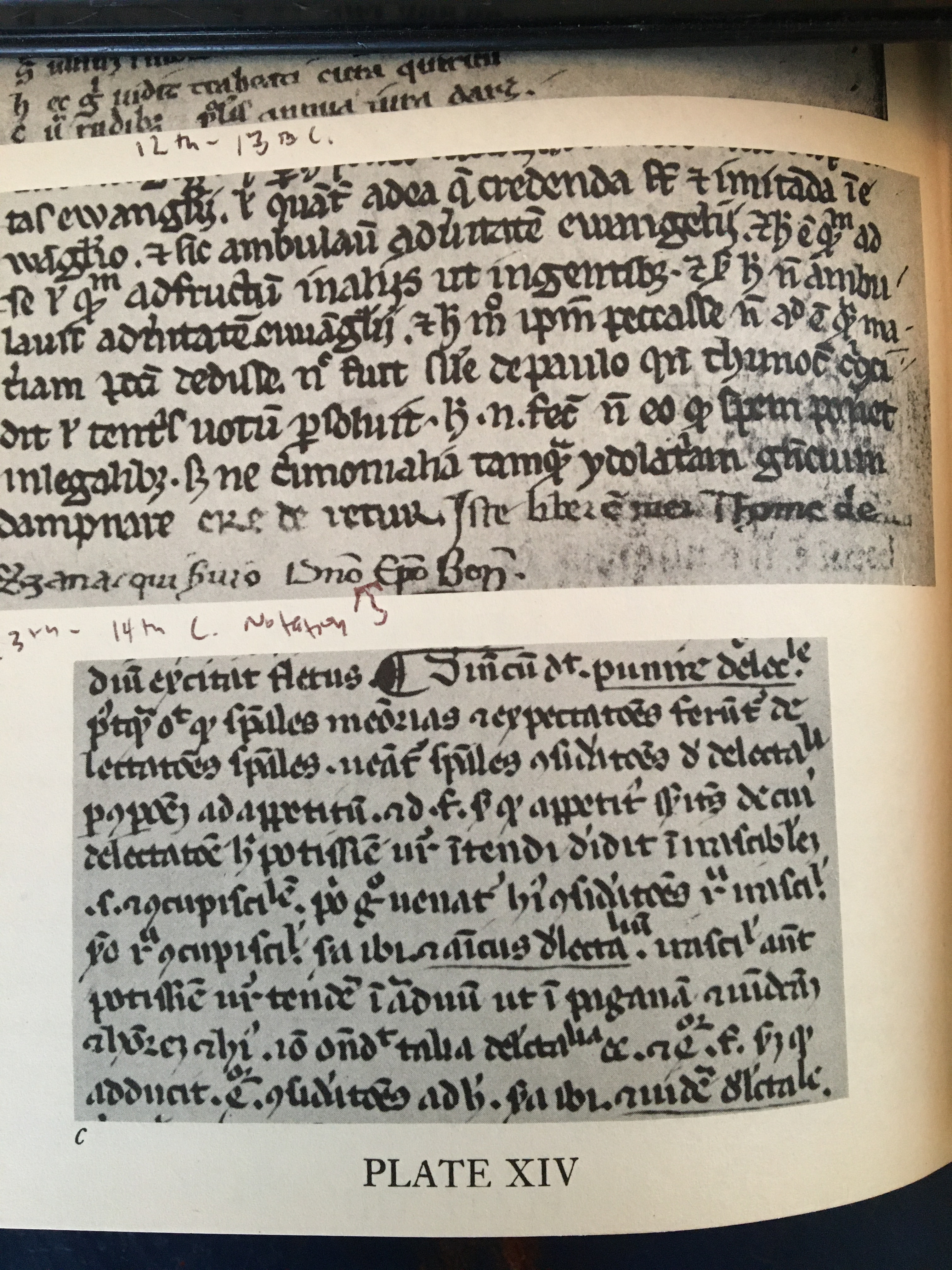
A blessed Advent to all.
*Some of Fexneld’s other work includes a published article: “Bleed for the Devil: Self-injury as Transgressive Practice in Contemporary Satanism, and the Re-enchantment of Late Modernity.” Clearly he has Satan on the brain. As an aside, should I ever become President my first executive order would ban all titles that that have something short and arresting to start, and then ruin it with a long and boring subtitle.

**Many of the fathers from St. Justin Martyr (ca. AD 150) onward develop the Eve-Mary parallel. Both are approached by an angel, and both assent to the angel, but it is Mary who in questioning Gabriel shows wisdom–Eve should have questioned the serpent. Eve’s pride humbles her, whereas Mary’s humility exalts her to the highest place.

The Augurs of the Temple

In my 8th grade ancient history class one of the great questions of the year involves whether or not one believes that Greece or Rome was the superior civilization.  The students usually get into heated discussions on the issue and seem quite excited by the question–until they discover that they have to write a long essay about it for the final exam.  Somehow, this dampens their ardor.

Comparisons between Greece and Rome can always yield fruit.  Each civilization has significant primary source documentation.  Their development overlaps and departs at points like a figure eight.  Both civilizations had similar climates, were right near the Mediterranean, with mountains forming a large part of the topography.  Both civilizations started out a city-states and transitioned from kings/tyrants (in the technical sense of the word) to a republic/democracy at almost exactly the same time.

But despite these similarities, Rome grew into one of the largest global empires of all time and Greece stayed within its narrow confines for the vast majority of its history and never expanded as Rome did.  I thought of this question recently because Michael Rostovtzeff raised it in the early pages of his book on Rome.*  He saw more similarity between Greece and Rome than others, and so had to account for the differences in their historical development in ways that those who see more difference between the two could ignore.

I agree with Rostovtzeff’s rejection of purely mechanical or physical explanations.  Some argue that geography can explain the difference.  Greece’s geography hemmed them in and forced the creation of independent city-states, whereas Italy’s geography allowed for more expansion.  But Rostovtzeff points out that both areas had relatively the same interaction with mountains and the Mediterranean.  Italy’s soil had an advantage, but not a great enough advantage to explain Rome’s expansion.  And while Greece’s topography had more mountains to contend with, occasionally certain city-states built empires, showing that geography itself cannot explain the difference.

He then goes on to assert that we can explain Rome’s expansion, and Greece’s relative lack of territorial expansion, to the following:

  • Rome had a better political structure, which allowed for more effective and consistent mobilization of the population, and
  • Rome’s political changes came slowly, which prevented shocks to the system that would inevitably derail or delay a civilization’s growth.  Such shocks could be compared to long bouts of illness in an individual.

I certainly prefer these explanations to geographical explanations, but I feel one needs to go deeper.  Politics flows downstream from culture, and culture from religion, and it is here that I feel the answer must lie.  To get at religious differences we need to look not at particular beliefs or religious rites, but what those beliefs and rites point to.  To get at that question, we need to examine their mythologies, for if nothing else, it shows us how they perceived themselves and gets at their motivations.

On the surface of things Greece and Rome look much alike, but their myths tell a different story.  The story of Pygmalion and Galatea, for example, reveals the Greek passion for perfection.  Pygmalion eschews women because none he sees truly merit his affection.  He carves his thoughts into a perfect stone sculpture, and Aphrodite rewards him for his devotion by having the statue come to life, and they live happily ever after.  We see this pursuit of perfection in other areas of Greek life, in the Parthenon, in their mathematical idealism, and so on.

When Livy writes of Rome’s early days he recounts how Romulus and the early founders of Rome–all men–needed women. So they come up with an idea of a religious festival and invited young ladies from the Sabines. When they came they abducted and forcibly marry them.

When the hour for the games had come, and their eyes and minds were alike riveted on the spectacle before them, the preconcerted signal was given and the Roman youth dashed in all directions to carry off the maidens who were present. The larger part were carried off indiscriminately, but some particularly beautiful girls who had been marked out for the leading patricians were carried to their houses by plebeians told off for the task. One, conspicuous amongst them all for grace and beauty, is reported to have been carried off by a group led by a certain Talassius, and to the many inquiries as to whom she was intended for, the invariable answer was given, “For Talassius.” Hence the use of this word in the marriage rites. Alarm and consternation broke up the games, and the parents of the maidens fled, distracted with grief, uttering bitter reproaches on the violators of the laws of hospitality and appealing to the god to whose solemn games they had come, only to be the victims of impious perfidy.

The abducted maidens were quite as despondent and indignant. Romulus, however, went round in person, and pointed out to them that it was all owing to the pride of their parents in denying right of intermarriage to their neighbours. They would live in honourable wedlock, and share all their property and civil rights, and – dearest of all to human nature – would be the mothers of freemen. He begged them to lay aside their feelings of resentment and give their affections to those whom fortune had made masters of their persons. An injury had often led to reconciliation and love; they would find their husbands all the more affectionate, because each would do his utmost, so far as in him lay, to make up for the loss of parents and country. These arguments were reinforced by the endearments of their husbands, who excused their conduct by pleading the irresistible force of their passion – a plea effective beyond all others in appealing to a woman’s nature.

The tenor of this story fits well within the framework of the rest of Livy’s work.  The story of Romulus and Remus, for example, has some of the same heroic qualities as in the founding myths of other civilizations.  But the story have Romulus kill his brother Remus in a fit of temper for a minor dispute, and the tale takes little pains to justify the deed.

I think that Livy has more actual history in him than others might, but even I would not say that Livy writes history as Thucydides wrote history.  So we must consider why Rome’s foundational stories have this different feel and emphasis.  Two possibilities present themselves:

  • The key to Rome’s greatness comes from the fact that they did not whitewash things.  They called a spade a spade.  They did not hide the truth about themselves, and so they were much better equipped to deal with reality than those around them
  • The key to Rome’s greatness comes from the fact that, not only did they not hide their warts, they reveled in them.  In fact, stories like the Romulus/Remus story would not have been viewed as a black spot on their past, but rather, a positive good.  Of all the soft civilizations that surrounded them, Rome and Rome only did what needed to be done.  Rome understood, just as Machiavelli understood, that states need founded by one man, and one man only.  Either Romulus or Remus would have to go, twins or not.

I favor the second option.  If we imagine that Rome’s founding myths and folklore follow the general pattern of most every other civilization (the U.S. included), we should imagine that these stories reflect something of an idealized version of themselves.

Some years ago in our 8th grade ancient history class, a student made a striking comment as we discussed exactly what Rome “meant” by their multiple conquests.  What drove them to expand?  Rome’s religion technically forbade offensive war, and yet Rome never lacked a justification for war when they felt they needed one.  The student suggested that the Romans were not unlike the Assyrians.  The Assyrians conquered (in part at least) as an offering to Ashur, their god of war.  The Romans (though certainly not as rapacious or cruel as the Assyrians) conquered as offering to their god as well, except their god was the city of Rome itself.  Greece could occupy itself with abstractions like ideal perfection but Rome remained very physical in their orientation throughout.  Their god was literally made visible all of the time.  Thus, this physical orientation would require very tangible applications.

Perhaps the key to Rome’s expansion vis a vis Greece lies here.

Machiavelli recorded an intriguing anecdote on Roman religion:

Auguries were not only, as we have shown above, a main foundation of the old religion of the Gentiles, but were also the cause of the prosperity of the Roman commonwealth. Accordingly, the Romans gave more heed to these than to any other of their observances, in undertaking new enterprises; in calling out their armies; in going into battle; and, in short, in every business of importance, whether civil or military. Nor would they ever set forth on any warlike expedition, until they had satisfied their soldiers that the gods had promised them victory.

Among other means of declaring the auguries, they had in their armies a class of soothsayers, named by them pullarii, whom, when they desired to give battle, they would ask to take the auspices, which they did by observing the behaviour of fowls. If the fowls pecked, the engagement was begun with a favourable omen. If they refused, battle was declined. Nevertheless, when it was plain on the face of it that a certain course had to be taken, they take it at all hazards, even though the auspices were adverse; contriving, however, to manage matters so adroitly as not to appear to throw any slight on religion; as was done by the consul Papirius in the great battle he fought with the Samnites wherein that nation was finally broken and overthrown. For Papirius being encamped over against the Samnites, and perceiving that he fought, victory was certain, and consequently being eager to engage, desired the omens to be taken. The fowls refused to peck; but the chief soothsayer observing the eagerness of the soldiers to fight and the confidence felt both by them and by their captain, not to deprive the army of such an opportunity of glory, reported to the consul that the auspices were favourable. Whereupon Papirius began to array his army for battle.

But some among the soothsayers having divulged to certain of the soldiers that the fowls had not pecked, this was told to Spurius Papirius, the nephew of the consul, who reporting it to his uncle, the latter straightway bade him mind his own business, for that so far as he himself and the army were concerned, the auspices were fair; and if the soothsayer had lied, the consequences were on his head. And that the event might accord with the prognostics, he commanded his officers to place the soothsayers in front of the battle. It so chanced that as they advanced against the enemy, the chief soothsayer was killed by a spear thrown by a Roman soldier; which, the consul hearing of, said, “All goes well, and as the Gods would have it, for by the death of this liar the army is purged of blame and absolved from whatever displeasure these may have conceived against it.” And contriving, in this way to make his designs tally with the auspices, he joined battle, without the army knowing that the ordinances of religion had in any degree been disregarded.

But an opposite course was taken by Appius Pulcher, in Sicily, in the first Carthaginian war. For desiring to join battle, he bade the soothsayers take the auspices, and on their announcing that the fowls refused to feed, he answered, “Let us see, then, whether they will drink,” and, so threw them into the sea. After which he fought and was defeated. For this he was condemned at Rome, while Papirius was honoured; not so much because the one had gained while the other had lost a battle, as because in their treatment of the auspices the one had behaved discreetly, the other with rashness . . .

Machiavelli surmises that the Romans wisely manipulated their religion to serve their political or cultural needs.  I agree as far his explanation goes, but I think we can go one further.  The Romans had a conscious religion of oracles, auguries, and the like, but a deeper, perhaps even unconscious religion of worship of their city itself.  I’m not so sure that Appius would have received censure had he been victorious.

I remain grateful to this student, who years ago helped me see the history of Rome in a new light.

Dave

*Though it has little to do with the post above, I cannot resist commenting on some reviews of Rostovtzeff’s work.  He emigrated from Russia shortly after the Russian Revolution.  His experience of events in Russia certainly impacted his analysis of Rome, where he saw the decline of the Republic in terms of 1) Too much change too quickly, and 2) Given the size of Rome, too much power shifted into the hands of too many (he felt that democracies needed to be small in size to work well).

Some dismiss him out of hand, because, obviously, his experience in Russia strongly colored his analysis of Roman politics.  Well, ok.  But a man is surely more than his influences.  What of the merits of Rostovtzeff’s analysis?  It can be debated, but his interpretations is hardly crazy, or such an obvious byproduct of personal experience that it has nothing to do with the evidence.  These same reviewers, I’m sure, would not want their own work subjected to the tests they used for Rostovtzeff.

Though C.S. Lewis’ original discussion of the “personal heresy” applied directly to poetry, I think it applies also to works of history as well, which are acts of creation somewhat akin to poetry.