The History of Romance

Over the past few years the church I attend has made a point of making marriages central to our congregational life, as well making the theme of marriage crucial to our interpretation of the Scriptures.  When discussing this recently, a friend of mine cast doubt on this approach.  After all,

  • No model of a good marriage (in the lives of real people) exists in the Bible
  • Nowhere do we see any developed teaching about marriage
  • Earthly marriage is not eternal, thus, not central to our life in Christ.

All good points, but overall I agree with the emphasis our church has placed on marriage, or better put, a “Nuptial Theology,” (for those married or single).  True, Scripture does not develop a full theology of marriage, but I think the most profound truths are often those that need hidden, or get barely hinted at.  “Such things are too wonderful for me, too lofty for me to understand.”  The communal life of the Trinity, for example, eternally pulsates all meaning and existence, yet we get the only the barest hints about it.  Jesus, in regards to His identity, drops only brief statements and never sermonizes on who He is.  With marriage, we get more than that, but not too much.  We see Creation cap-stoned with a wedding in Genesis 2, and History ended and renewed with the “marriage supper of the lamb” in Revelation.

Our culture has been saturated with the idea of romance that we may not realize that historically, “romantic love” appeared late on the scene.  No evidence exists that the ancient world knew nothing of it. Plato’s Symposium talks off an ascending ladder to the divine of which human love plays a part.  So far, so good, but the object of ideal male love for Plato is not a woman, and as C.S. Lewis points out, “[The human aspect] of love has simply fallen out of sight before the soul reaches its spiritual object.”

So that won’t do.

Ovid wrote The Art of Love, but as satire on the ridiculous things to which infatuation and lust drive us.  The “absurd conduct” (Lewis again) that Ovid recommends should be taken in the spirit of his advice not to “visit [your lover] on her birthday.  It costs too much.”  For a Roman man to pursue a woman would have been unmanly, shameful, ridiculous.  Such a Roman stands ripe for mockery for Ovid.*

In his The Allegory of Love (from which I quoted snippets above) Lewis makes the striking point that “Romantic” literature,9780198115625 and the idea of romance as a central part of life, doesn’t appear on the scene until the 12th century.  Can it be mere coincidence that this is precisely the moment when the last of the barbarians has been Christianized and European culture had the opportunity to be “fully Christian?”  I cannot believe it so.  Obviously 12-13th century Europe got things wrong as any society will do, but I think we should take it as a possible witness of the Spirit of God in History that when “Christian” culture arrived for the first time in history, so too did romance.  It think it a strong indication of the importance of “Nuptial Theology.”

Lewis briefly traces the journey of the Church as it relates to sexual love.  It took centuries for the Church to escape the vibe of both the hedonistic side of paganism, and the spirit vs. flesh dichotomy of the Platonic school.  This might surprise but should comfort us also — God is patient with our infirmities and does not demand we solve everything today.   In this case He appears to have been patient enough to wait centuries.  So we have St. Gregory in the 6th century say that while the act of marriage remained innocent, the desire accompanying it was evil.  In the early Middle Ages we see a tremendous shift in Hugo of St. Victor.  He boldly (for his time) states that physical attraction has a part to play in Christian marriage.  On the other hand, he also states that had mankind never fallen, children would have been born “sine carnis incentivo,” i.e. “without sex.”

If jump ahead a few generations we see bolder and greater insight.  Albert the Great dismisses the idea that pleasure is evil or a result of the Fall, arguing that our pleasure would have been greater had we not fallen.  The problem with fallen man is not the strength of pleasure but for Albert, the weakness of our reason.  Unfallen man could have enjoyed any pleasure without the diminishing of his reason or losing sight of the First Good, God Himself.  A little later St. Thomas Aquinas goes further in affirming the nature of friendship in marriage (but also backwards by talking about the pleasure of marital love — though not a sin for Aquinas — in the midst of a passage about incest).

Alas that the medievals did not combine these important theological insights into the totality of their practice.  The whole tradition of “Courtly Love” is riddled with both a lingering Platonic idealism and adultery.  Medieval culture just couldn’t quite decide about the place of the romantic impulse.  So in his Death of Arthur Malory can call Lancelot the greatest of all knights and  simultaneously show how his relationship with Guinivere destroyed a kingdom.  He includes no examples of healthy marital love that I can recall.  The division between soul and body, between our earthly and spiritual lives, still seems to remain right up until the end of the medieval period.

But let us not dismiss the medievals too easily.  For the first time in history, I think, they allowed “manly” men to pursue women.  And with their love of allegory, they had no problems connecting the pursuit of the male to God’s pursuit of us.  Many in our churches today, I think, would be uncomfortable with the “physical” implications of this.  We do not connect the romantic impulse to our theology.  Perhaps guys particularly have problems with the whole idea of marriage and salvation, but it should help us realize the totality and intensity of God’s pursuit of us.^  I’ve heard some say that “The Song of Solomon” is about God’s love for his Church.  I’ve heard others say, “Get real, it’s about pleasure, it’s about sex.”  Might it be about both?  I think the best of the medieval tradition would have been comfortable with that.

*I don’t mean to suggest that comedy is wrong when it comes to sex.  As Lewis points out in The Four Loves, without a sense of humor and even silliness, the god Eros will quickly become a demon.

^This truth can help both our culture in general, and guys in particular, understand that sex itself is best understood as a sign, or even a ceremony of something greater.  Again, the best way to ensure genuine appreciation of a thing is to understand exactly how it should be appreciated.

David Hackett Fischer’s “Fairness and Freedom”

I first posted this two years ago, but recently came across a link to a study on New Zealand’s relationship to globalization. I include this new information, which only confirms Fischer’s keen analysis within the text under the “Immigration” section below.

And now, the original post . . .

A few years ago Fischer blew me away with his classic Albion’s Seed, which for me is far and away the best book on colonial America out there.  In that work he demonstrated a remarkable ability to go from broad sweeping general statements to minute subtle detail.  Fairness and Freedom does not quite match that standard, but once again Fischer succeeds remarkably in a subject rarely, if ever, explored before.

The book looks at the two open societies of the United States and New Zealand.  While this may seem like an odd pairing, both countries

  • Share basic democratic values
  • Were colonial societies, with the vast majority of their settlers coming from England in their early formative phase
  • Have existed in relative geographical isolation from the main events in Europe during crucial periods of their history
  • Had early settlers needing to deal with native populations.

Our shared history means that someone from either country could feel more or less at home in either place.  But the book arose from some keen observations Fischer made while visiting New Zealand during a political campaign.  He noticed how frequently the major candidates used the words “fairness,” or “justice,” and contrasted that with the American lingo of “freedom,” and “liberty.”  He followed that rabbit hole and discovered how these different emphases have subtly shaped each society in a variety of ways.

Here we see the similarity in his approach in Albion’s Seed, where he takes a idea and runs with it over a large swath of time and space.  How has this subtle yet important differences in values shaped each society?

Origins and Geography

  • In NZ, the Maori tribes were themselves not native to the land, and had cultural memory of their own immigration to what know as “New Zealand.”  Furthermore, warring tribes had nearly destroyed each other before the English arrived.  Thus, the Maori had 1) already learned about cooperative living, and 2) had an immigrant identity themselves
  • In America, American Indians had no memory of any migration to the continent, which, if it happened, happened perhaps 10 thousand years ago.  Their mythology had strong elements of their own existence arising “from the earth itself.”  Thus, they had a much stronger tie to the land than the Maori of NZ.  Furthermore, the abundance of resources and space meant that tribes did not need to work out their problems to survive.

Different Kinds of Settlement at Different Times, for Different Reasons

  • The bulk of formative settlement happened in America as result not of economic oppression but lack of liberty to “worship as one pleases.”
  • The bulk of settlement in NZ came from a population that felt the injustice of early Victorian industrial society.  Their main concern was the righting of wrongs, not increased liberty.  In this sense they inherited the old British notion of “fair play.”
We see this reflected in the different visions each society produced — or how they idealized themselves.  Walt Whitman wrote,
From this hour I ordain myself loos’d of limits and
imaginary lines.
Going where I list, my own master total and absolute. . .
I inhale great draughts of space,
The east and west are mine, and the north and the
south are mine.
I am larger, better, than I thought
Song of the Open Road
Whereas New Zealand’s W.H. Oliver wrote in “Counter-Revolution”
Did it go wrong just about a hundred years ago?  A ramshackle self-appointed cast-off elite of first comers, promoters, bent lawyers and sham doctors, set it up for the themselves, a gentry of sorts, saw it collapse and crept away with slim gains . . . Something had to be done.
Fischer does not neglect the fact that America’s geography lends itself much more readily than New Zealand’s to Whitman’s expansive idea of space and freedom.
Different governments formed out of these different visions.  America embraced Federalism, which allowed for and fostered regional differences and different spheres of influence for different groups.  NZ embraced a more national model of “all for one, one for all.”

Civil Rights

Both countries had minorities fight to gain their rightful place in their respective societies.  In looking at the Civil Rights movement, Fischer observes that one key to its success was King’s emphasis on freedom.  King, Fischer notes, “understood a deep truth about America.  Equality divides Americans; freedom unites them.”  Once again, the Maori of NZ focused on  equality, which has much more resonance there.  The same holds true of the feminist movement.  In America, women fought for rights by putting themselves in competition with men.  It had/has a more militant, combative approach, consistent with the concept of Federalism.  In NZ, key feminist leaders saw their role differently.  Anna Logan Stout said that,

The real power of the women’s vote in New Zealand is not in opposition, but in its harmony and cooperation with the men’s vote.

Immigration

Throughout the book I had the impression that Fischer harbors a preference for the NZ approach, but immigration may have been an exception, where their respective emphases on Liberty and Equality bear very different fruit.  American stances on immigration have varied, but we have generally been much more open to many more people than NZ, where they looked for specific kinds of people they were sure would “fit in” to their society.

Some historians have remarked  that settler societies, though they often originate from those seeking to escape the motherland, sometimes seek to “outdo” their homelands.  With immigration, NZ has unconsciously created a country that functions in some ways like one of those exclusive Victorian clubs the original settlers would have hated back in England.

In foreign affairs also, America has stressed freedom of action, while NZ has emphasized cooperation.

(And now the addendum)

Recent studies on New Zealand’s attitude toward immigration reflected in its attitude towards globalization.  The study says that,

A report in 2012 by The New Zealand Initiative drew attention to New Zealand’s seventh position among 57 countries for having the most restrictive FDI regulatory regime. This was largely due to New Zealand’s economy-wide screening regime and the broad definition of ‘sensitive’ land. Treasury has confirmed that there is credible anecdotal evidence that New Zealand’s regime is having a chilling effect on inwards FDI investment, but the materiality of this effect is an open question. It is doubtful that the damaging Crafar farms case would have triggered regulatory barriers in other Anglo-Saxon jurisdictions or comparable Asian countries.

New Zealand’s Overseas Investment Act further detracts from the country’s ‘open for business’ image by starkly asserting that it is a privilege for foreigners to be allowed to own or control sensitive New Zealand assets. This is in stark contrast to the explicitly welcoming approach widely taken elsewhere.

Statistics show that New Zealand has largely missed out on the expansion of global FDI since the mid-1990s. Both inwards and outwards stocks of FDI peaked as a percentage of GDP more than a decade ago in New Zealand, while world stocks continued their upwards climb. Between 2000 and 2011, New Zealand’s rank on UNCTAD’s FDI attraction index slumped from 73rd in the world to 146th. Hong Kong and Singapore have been in the top five throughout this period.

The full study is here.

Military

This section may have been my favorite.  Fischer traces the differences in liberty and equality into how each military fights and organizes itself.

The U.S.

  • Emphasizes freedom of action for junior officers.  Those in higher ranks try and keep their distance from these officers so as not to interfere unless truly necessary.
  • The best and brightest soldiers are shunted to smaller elite units or branches of the service
  • Their main strength in war has been adaptability and quick response

In New Zealand

  • Serving in the infantry isn’t for the grunts, it’s considered a badge of honor
  • Officers of nearly all ranks are expected to “lead from the front” and join the men in the fighting.  Distinctions of rank do not hold the same importance as in other armies.  In W.W. II, for example, a British general complained about NZ troops who did not salute him.  “I’m sorry sir,” replied a NZ officer, “but if you wave to them I’m sure they’ll wave back.”
  • The key virtue of NZ forces over time has been their strong unit cohesion and stubbornness
What makes this work similar to Albion’s Seed is his emphasis on the persistence of cultural values over time.  We are not free to reinvent ourselves, but we should do what we can to understand ourselves.  The values embedded in our societies impact us ways we may not be aware of, and that’s justification enough for  Fischer’s enjoyable and insightful work.

Democracy and Inequality

Though I have never read her book, several years ago I listened to an interview with Loretta Neopoltani, author of Rogue Economics.  The interview ranged over many topics, but the central theme remained constant.  We rightly celebrated the fall of the Soviet Union and the collapse of communism in Europe.  We trusted that this event would bring about the spread of freedom and democracy into places where it had not visited for many years.  So far, so good.

What Neopoltani stressed, however, is that this was not the whole story.  History tells us that in every significant breakdown of major power structures, rogue elements (be they ancient or modern day barbarians) will always have the advantage.  The shift towards democracy will be painful and slow.  The law-making process will always plod along.  Not only that, the spread of freedom means the spread of opportunity.  And since chaos comes easier than order, nascent democracies will see the rise of exploitation and even slavery.  Historically, we can think of the rise of slavery in the Renaissance after the Black Plague decimated feudalism, or the increase of slavery in the south after the American Revolution.  In more recent times we see the rise of the sex-trafficing industry from Eastern Europe after the fall of communism.

All this raises the question in general of democracy’s relationship to inequality.  Perhaps democracy merely grants opportunity, which can be used for good or ill.  Is democracy able to practice what it preaches?

Recently authors Daron Acemoglu and James Robinson published this article with links to other studies within it.  They reach mixed conclusions, stating that while democracy does transfer power away from elites, it may not do much to reduce inequality.   When confronted by this, we can reach one of two basic conclusions:

  • We can be hopeful/naive (depending on your point of view) and think that in time, democracy can learn to create a truly free and equal society.  Those of a more liberal/progressive bent might hope that increased government action, done with popular support, could help us achieve this.
  • Or we can believe as De Tocqueville did, that democracies must choose between liberty and equality, for they cannot have both in equal measure.  Liberty unchecked would create winners and losers, with the possibility of vast gaps in between.  Pure equality could grant no liberty to anyone to step out of line or distinguish themselves from their fellow men.  You cannot be married and single at the same time.  If we want a society with opportunity and liberty, we must tolerate and expect some kinds of inequalities.  C.S. Lewis began his excellent essay, “On Democratic Education” with these words (the whole essay is here),

Democratic education, Aristotle says, ought to mean not the kind of education democrats like, but the kind that will preserve democracy.

I find this analysis persuasive, and it may be one of the keys to understanding the chaos of the French Revolution, which proclaimed “Liberty, Equality, and Fraternity” for all.  These opposing ideas would inevitably create chaos and dissension even with the revolutionary leaders themselves.  We see this rift even at the very top of the revolutionary elite between Danton and Robespierre.

Hardly anyone, however, wants to choose between these two options, and perhaps with good reason.  We should reject radical redistribution, but democracy cannot exist without a healthy middle class.  Aristotle wrote in his Politics,

Now in all states there are three elements: one class is very rich, another very poor, and a third in a mean. It is admitted that moderation and the mean are best, and therefore it will clearly be best to possess the gifts of fortune in moderation; for in that condition of life men are most ready to follow rational principle. But he who greatly excels in beauty, strength, birth, or wealth, or on the other hand who is very poor, or very weak, or very much disgraced, finds it difficult to follow rational principle. Of these two the one sort grow into violent and great criminals, the others into rogues and petty rascals. And two sorts of offenses correspond to them, the one committed from violence, the other from roguery. Again, the middle class is least likely to shrink from rule, or to be over-ambitious for it; both of which are injuries to the state. Again, those who have too much of the goods of fortune, strength, wealth, friends, and the like, are neither willing nor able to submit to authority.

The evil begins at home; for when they are boys, by reason of the luxury in which they are brought up, they never learn, even at school, the habit of obedience. On the other hand, the very poor, who are in the opposite extreme, are too degraded. So that the one class cannot obey, and can only rule despotically; the other knows not how to command and must be ruled like slaves. Thus arises a city, not of freemen, but of masters and slaves, the one despising, the other envying; and nothing can be more fatal to friendship and good fellowship in states than this: for good fellowship springs from friendship.

When the gap between the wealthy and everyone else grows too great, must we then rely on some form of redistribution to balance the scales?  And if so, who would possess the wisdom to decide how much redistribution, and from whom, should take place?  That process could cause just as many problems as the problem itself.

Ultimately Aristotle, with his emphasis on friendship, and De Tocqueville, with his emphasis on the necessity of virtue to secure freedom, have it right.  If the rich practice avarice, and the rest of us covet, we will be left with neither democracy nor liberty.  Liberty itself can only create opportunities, not virtue.

Rich vs. Roach

In my teen years I purchased the album Rich vs. Roach, where two of the greatest drummers of the 50’s-60’s played together with the same band.  The highlight track for me was their drum battle “Figure Eights.”  If you wish, listen below, and see who you prefer.  Rich begins, with Roach following.

When I bought the album I had heard of Buddy Rich before, but had no idea who Max Roach was.  I remember my early listens to this particular track.  I thought Rich stole the battle hands down.  I preferred his crisp, clear sound to Roach’s looser and lower drum tuning (and still usually do).  But above all Rich’s speed and unequaled technique shone so strongly that I had no idea why Roach bothered to show up.

After several years, I finally listened to the track again.  Maybe it’s middle age, or maybe it’s my passive-aggressive nature taking a pot-shot at my youth, but I hear their drumming differently now.  Now Roach impresses me far more than he did previously.  Now I hear Roach propelling the stylistic changes throughout the duet.  Roach also varies his playing more than Rich, who tends to rely on pure speed to “get by.”

I have no desire to belittle Buddy Rich, who deserves his status as one of the great drummers of all time.  But this piece made me realize that Rich has limitations to his greatness.  He had immense energy that got all that could be humanly got out of the bands he led.  And his speed, his speed, go beyond what seems humanly possible.

But while his speed and energy has deep penetration, his style also has a narrow bandwidth. For example, Rich approached the played drums like a sprinter in a race, and would never  have looked sideways enough to come up with the rhythm Roach invents on this Bud Powell song.

Rich began his career as a young boy in vaudeville where all the gags had to be big and broad to connect with the audience.  Rich never really seemed to get away from this “need” for the big finish, or the broadness of the musical stroke.  In the 70’s, Rich’s bands moved away from the traditional big-band/jazz sound and towards funk.  I very much admire his ability to change styles, but the music is desperately square, though sometimes delightfully so.  It is Vaudeville Funk — entertaining, but . . . not funky.

Though I have never read a biography of Rich, perhaps he always remained a showman at heart.  This meant that his greatness would only be a type of greatness, and he could not be the “Greatest” of all time, if such a title is possible to give out.  Roach had the creativity Rich lacked, but did not possess Rich’s blaze of pure adrenaline.

Particularity in Creation

You do not have to be a Bruce Springsteen devotee to enjoy this career retrospective from Grantland’s Stephen Hyden.  Like his heroes Woody Guthrie and John Fogerty, Springsteen has crafted a true “American” sound that naturally appeals to a mass audience, and he deserves the fun and deferential treatment linked above.

Springsteen’s career spans more than 30 years, but most of what I really enjoy from him comes from his “classic” period (1973-1984).  In this era, Springsteen tackled big themes of life, but he often did so through narrowing his focus to specific people in specific situations.  His songs have depth.  But my favorites also have playfulness and humor, “Cadillac Ranch,” “Rosalita,” and, “Darlington County” (I know it’s an odd choice, but as a bonus it does have one of my favorite Max Weinberg drum fills at the 3:31 mark).

I do think that as time has gone on, Springsteen has drifted away from this songwriting approach, trending towards tackling big themes in his lyrics.  Then, without a particular story to give context to his theme, he is left with vague phrases that need an extra measure of emotional, sweeping music to try and make the idea stick.  Commenting on The Rising, Hyden writes,

. . . [here we have] my least-favorite version of Springsteen — the one where he’s in message-driven stump speech mode. This is a record about Big Themes being thrust upon little people, as opposed to records like Nebraska and Born in the U.S.A., which explored the lives of little people in order to illuminate the Big Themes lurking in the background.

I also felt similarly about his recent effort, Wrecking Ball, where Springsteen pushed his particular brand of politics to the forefront.  This disappointed me not so much because I tend to disagree with his politics (from what I understand them to be) but because Springsteen is one of the few national artists capable of bringing many different kinds of people together.*

I sent the article to a bigger Springsteen fan than I and he agreed with the quote above, but with distinct reservations.  Sometimes, he argued, the big abstract theme can work in art.  Sometimes great art can have a distinctly didactic character.  I thought about that, and wondered if it is was true.

Ultimately the Incarnation itself gives the best justification for art.  In Christ we have that which is most ineffable (God the Father) has clear, definite, and particular expression (Heb. 1).  Before Christ God communicated not in abstract principles such as love, or justice, but in stories, the temple, laws, focusing on  a particular people in a particular place.   I think this leads us to think that great art will have similar characteristics.  It will have great “abstract” meaning precisely because it has roots in something tangible.  Of course Christianity has symbols, like the Cross, but again, the Cross refers to something concrete and historical, as opposed to the yin-yang symbol of Chinese philosophy, which refers to an abstract idea.  One might also think of Moslem art, which arises in a religious ideology without the Incarnation to affirm creation, and so often turns to abstractions.^^

If we follow this line of reasoning, however, it would mean that abstract art could never reach the status of “great art.” I am not willing to declare this.  We cannot say that no abstract art can be great.  I do find artists like Mondrian and Kandinsky, for example, to possess a degree of communicative power.

Kandinsky

I can see skill, and I am moved.  But in what direction?  The flight of abstraction ultimately leaves my initial feeling nowhere to go, and it peters out.  Who could know that Kandinsky’s piece has the title “World War I?”

Picasso may be called the greatest of modern artists, and certainly he dealt in abstraction.  But I find that his abstraction works best when applied to something specific, like Guernica.

40-12-17/35

And I find his drawings of horses much more compelling than some of his more abstract work.

article-1334091-0C48090D000005DC-107_634x450

I don’t feel that any of the great abstract artists can rival some of the past masters.  For example, Carravaggio painting “The Calling of Matthew” works much better then if he painted something called “Redemption.”

23conta

And Kandinsky’s “World War I” abstraction can’t match the power of Rembrandt to reveal the universal from someone particular:

So while I will not declare that abstract art can never be great, I would argue that achieving greatness with this approach will come with great difficulty.  Finally, I would suggest that “contextualized” art (to coin a phrase?) will have a much greater range of impact than abstract art.  For example, I can’t imagine the possibility of a joke in abstract creations.  But unleash Springsteen’s “particularity” side and you see his comedic potential, i.e. “57 Channels (and Nothin’ On).”

Pure abstract art, then, really lacks even a didactic character, because it has no grist for the mill, it dissipates in the air.  I am reminded of Springsteen’s “Land of Hope and Dreams,” (of off The Rising), where “faith is rewarded.”  But faith in what?  The song pulls out all the stops for 9 1/2 minutes but leaves me flat nonetheless, like the sound of one hand clapping.

Perhaps I have drifted dangerously beyond my art knowledge, however, and would welcome any comments.

*I wonder if we can trace this shift in Springsteen to his on-again off-again relationship with the E Street Band since Born in the U.S.A. gave him superstar status.  In distancing himself somewhat from his own particular community (as well as becoming quite wealthy), did he then find it harder to connect with “particularity” in his songs?

^^Abstract pattern art can often have a very nice effect, I think, in decorating people (ties, necklaces, scarves, etc.), but less well decorating a blank canvas.  I acknowledge also that Persian rugs (in the Islamic tradition) can look nice in homes.  But both homes and people have a built in context in which the abstractions can fit.

Christians have occasionally used abstractions — the “Book of Kells” for example.  Here again, I think the abstractions work because they accompany something specific.

Christ Enthroned

Jacques Maritain on Democratic Education

I am grateful for the thousands of public educators who work very hard on behalf of their students.  One can always hear horror stories in the news about disaffected and bored teachers, but the overwhelming majority of those I’ve met have cared deeply about their students and do their best in the classroom.

I also see some signs of hope in what seems to be a general backlash against standardized testing brewing amidst some of our best educators.  But even so, teachers in the current bureaucratic environment cannot help but be impacted by the mentality of standardization.  I know of students who received A’s on assignments for having “great facts!” though these facts gave no overall understanding to the period studied.  Another assignment I know of requires students to photograph themselves involved in a variety of environmentally beneficial activities, be it recycling, picking up litter, or not clubbing baby seals.

Decades ago Jacques Maritain prophesied this in his thoughts on democratic education.  Maritain had a long and maritain_jacquesdistinguished career as a theologian, philosopher, and social critic.  Even in the 1950’s Maritain astutely observed the shift occurring in education as it related to the rest of society.

Society’s trend toward specialization bothered Maritain, and he predicted two adverse effects this would bring to education.  Our concept of “knowledge” would be the first casualty.  He wrote,

If we are concerned with the future of civilization, we must be concerned primarily with a genuine understanding of what knowledge is: its values, its degrees, and how it can foster the inner unity of the human being.

Restricting knowledge to isolated facts loses the unity, that is, the narrative unity, of whatever we may study.  This is why we cannot reduce westward expansion to a few bullet point facts about railroads and farming.  Complete specialization in general cuts us off from part of our humanity.  We lose the essential symmetry of our personhood.  Related to this, Maritain commented on the second casualty,

If we remember that the animal is a specialist . . . an educational program that aimed only at forming specialists . . . would lead indeed to a progressive animalization of the human mind and life.

Maritain continues, observing and predicting that specialization will lead to lack of freedom, which leads to lack of moral formation.  Educational authorities will then need to undertake “educating the will,” “formation of character,” or “education of feeling” to fill the gap created by a multiplicity of cultural ills.  With this mindset schools feel the need to correct all of society’s problems, or at least the current ones.  He writes,

The state would summon education to make up for all that is lacking in the surrounding order in the matter of common inspiration, stable customs and traditions, common inherited standards, and unanimity.  It would urge education to perform an immediate political task and, in order to compensate for all the deficiencies in civil society, to turn out in a hurry the type of person fitted to meet the immediate needs of the political power.

This approach also takes freedom and inspiration away from teachers, who then assume the role of mere functionaries.  Truth needs freedom to have its full effect.  Teachers need to personalize their classroom experience in some way to give truth a living context, rather than rote formulas imposed from above and without.  This is why, Maritain argues, the ambitious plan of “educating character” in this lock-step fashion will almost surely fail.  The seeds teachers scatter will find only rocky ground.

A final quote from Maritain:

What I mean is that it is not enough to define a democratic society by its legal structure.  Another element plays also a basic part — namely, the dynamic leaven or energy that fosters political movement, and which cannot be inscribed in any constitution or embodied in any institution, since it is both personal and contingent in nature, and rooted in free initiative.  I should like to call the existential factor the prophetic factor.  Democracy cannot do without it.  The people need prophets.

Mr. Chadband

I confess that I have never been a big fan of Dickens.  I get lost in the verbiage, and sometimes find his endings a bit dull and overdone.  Still, I admit he deserves his fame as an all-time great, and he was perhaps the greatest creator of supporting characters of all time.

One of my favorites is Mr. Chadband, whom I referenced in the last post.  But that post had a heavy and somber tone, and my tribute to Dickens’ creative powers would have been out of place.  But I present here perhaps the best of Mr. Chadband from Bleak House:

“My friends,” says Mr. Chadband, “what is this which we now behold as being spread before us? Refreshment. Do we need refreshment then, my friends? We do. And why do we need refreshment, my friends? Because we are but mortal, because we are but sinful, because we are but of the earth, because we are not of the air. Can we fly, my friends? We cannot. Why can we not fly, my friends?”

Mr Snagsby, presuming on the success of his last point, ventures to observe in a cheerful and rather knowing tone, “No wings.” But, is immediately frowned down by Mrs Snagsby.

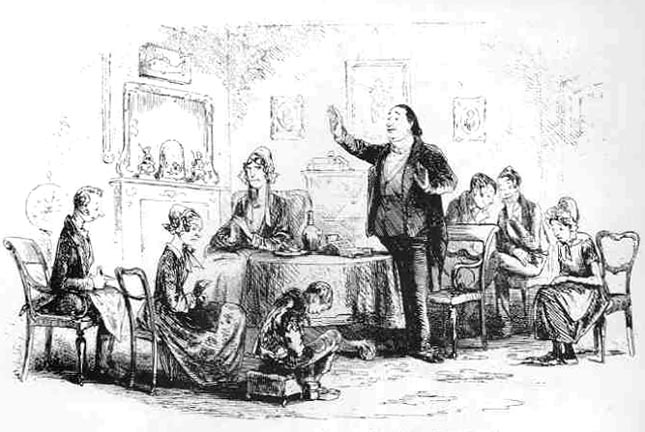
“I say, my friends,” pursues Mr Chadband, utterly rejecting and obliterating Mr Snagsby’s suggestion, “why can we not fly? Is it because we are calculated to walk? It is. Could we walk, my friends, without strength? We could not. What should we do without strength, my friends? Our legs would refuse to bear us, our knees would double up, our ankles would turn over, and we should come to the ground. Then from whence, my friends, in a human point of view, do we derive the strength that is necessary to our limbs? Is it,” says Chadband, glancing over the table, “from bread in various forms, from butter which is churned from the milk which is yielded unto us by the cow, from the eggs which are laid by the fowl, from ham, from tongue, from sausage, and from such like? It is. Then let us partake of the good things which are set before us! [below is a print entitled, “Mr. Chadband Makes Clear a Difficult Subject”]

"Mr. Chadband makes clear a difficult subject."

Detachment and Exploitation

When we attempt to define civilization we might be tempted to think of things like refinement and gentility, but this is not quite right.  As Kenneth Clark stated, “such things may be the agreeable results of civilization, but they are not what makes a civilization.”  In fact, believing that “refinement” will heighten your civilization may lead to barbarism.

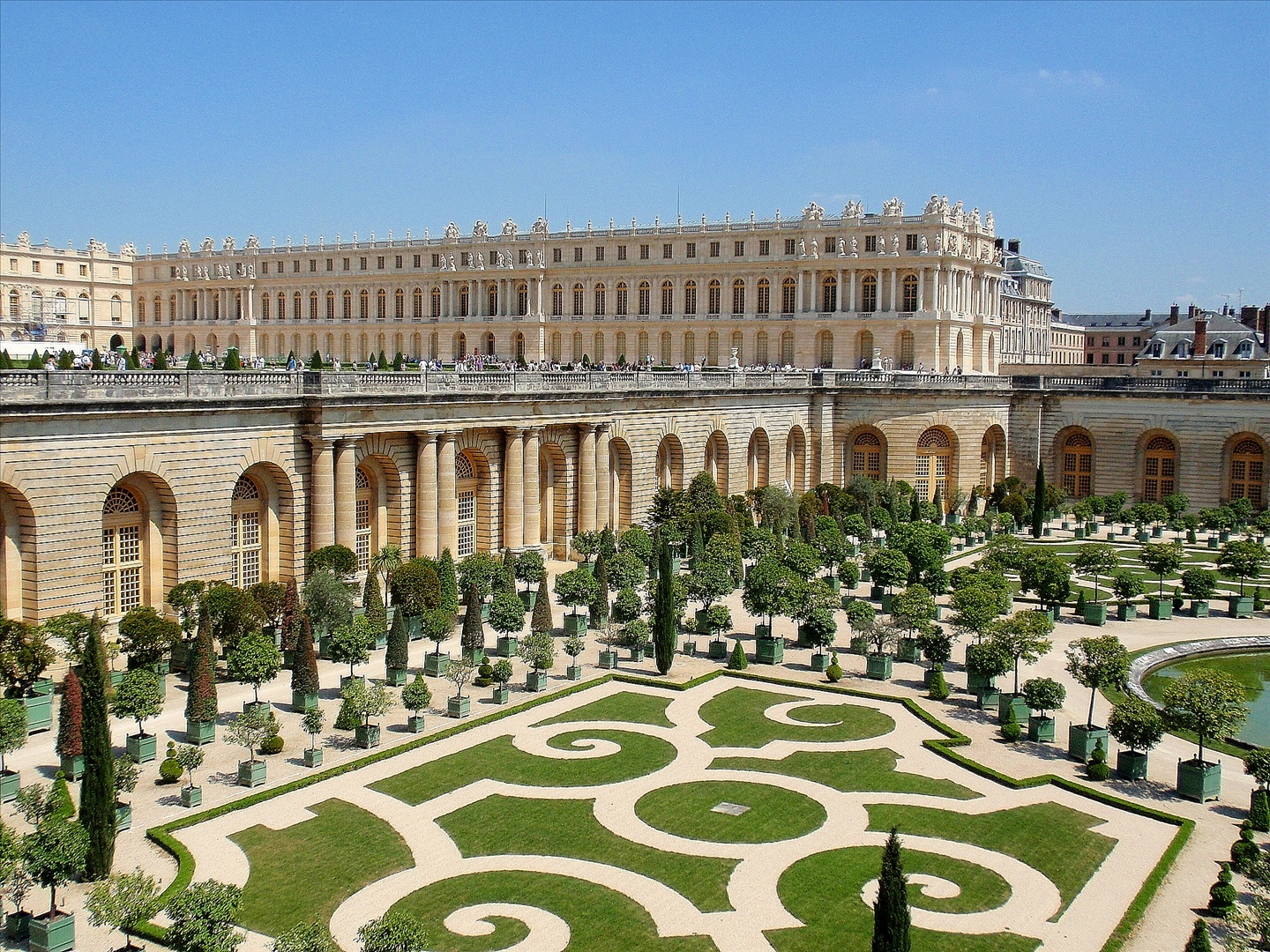
In the modern age perhaps the ultimate example of refinement goes to Louis XIV Versailles.  I can think of no other place dedicated to symmetry, luxury, and delicacy.  Yet at root Versailles existed due to heavy taxation and in some ways, exploitation.  With its maze of manners and ridiculous customs, one could argue that Versailles exploited even those who lived there and “enjoyed” its opulence.  I can’t imagine any sane person wanting to go back in time to take part in the massive charade.  To me Versailles has little real beauty, and suffers from an excess of refinement.  I think the links between Versailles and the terror and barbarism of the French Revolution can be overstated, but surely, some connection exists.

Palace_of_Versailles1

In The Birds by the great Greek playwright Aristophanes, a character named Meton says that,

With the straight ruler I set to work to inscribe a square within a circle; in this center will be the marketplace, into which all straight streets will lead, converging into the center like a star, which . . . sends forth its rays in a straight line on all sides.

It sounds heroic, clean, and noble,  but then we remember that Aristophanes wrote comedies, and Meton is a figure of fun, a puffed-up fool.

The story of Athens is the story of Narcissus.

Their democracy under Pericles (ca. 450 B.C.) had its roots in the reforms of Solon (590-570 B.C.).  Certain privileges still resided in the upper classes after Solon’s time in power, but clearly Solon broadened the political class and narrowed the social gap between rich and poor.  Among his reforms. . .

  • All Athenian citizens received admission to the Areopagus
  • Foreign tradesmen were encouraged to settle in Athens and received citizenship if they brought their families
  • Any citizen could take legal action against another
  • Prohibition against a debtor’s person used as security for a loan.

The lock-step nature of Athenian society under Draco received a welcome outside stimulus.  Athenians started trusting one another, and their economy grew.  Plutarch writes that, “In Solon’s time, no trade was despised.”  The exalted Agora in fact served as a market and a general festival area.  Different people mixed together from different trades and classes.

Though no one believes that this sculpture of Solon was done anywhere near his lifetime, it reveals something of the common wisdom and concern that seems out of place with his upper-class roots:

Solon

If we go forward in time another 100+ years, we come to this bust of the Athenian statesmen Pericles.

Pericles had many successes and we can admire much of his statesmanship, but his face betrays him.  We do not see what we see in Solon.  With Pericles we have the smugness, arrogance, and touch of detachment for which the Athenians became notorious by 431 B.C.  If Pericles gets his share of credit for the brilliant culture of 5th century Athens, he shares in the blame of how far they had slipped since Solon’s time.   For example, under Pericles one could not marry foreigners, and foreigners in general had no hope of participating in Athenian political life.

Like Meton, the Athenians came to crave elegant simplicity and clarity.  They obsessed over the ideal.  The brilliant pythagoreans, who believed that all of life could be reduced to simple ratio, actually killed a member of their school who divulged the existence of irrational numbers.  They murdered to stay detached from reality.  Nothing should be allowed to end their beautiful dream.

This attitude bore bad fruit in more general ways.  Athenians still benefitted greatly from foreign trade.  In fact they depended on it, and Pericles’ initial strategy for the Peloponnesian war put absolute reliance on the availability of foreign goods.  But the tradesman and the merchant now had no social standing, whatever their political rights might have been.  The aristocratic ideal of refinement and detachment had taken firm root among the Athenian elite.  If we take Aristophanes as a reliable source, in Pericles’ day the upper-classes avoided the Agora and hung out by the gymnasium with their own more leisured companions.  Athens’ contempt for the artisan and merchant destroyed them.  Trade depends on good relationships and good faith, the same qualities needed to hold together their empire.  If Athens neglected their tradesman they would soon neglect their empire, and treat them as second class citizens.

As Lewis Mumford notes in his excellent The City in History, they did just that.  Their platonic sense of detachment led to Athens exploiting its tributary states, once allies.  This detachment and exploitation reached its peak in the Parthenon (funded by money taken under false pretense from their allies)  which doubles as an insanely impressive technical achievement and a hymn to self-worship unequaled except by the pyramids and Nebuchadnezzar’s statue.

A “schism in the soul” of Athens had arrived, an imbalance that gave the life of the leisured mind precedence over the life of the laborer.  Whereas before Solon gave economic incentive towards developing a trade, now tradesmen sat on the outside looking in.  Plato later took the aristocratic idea to its fullest extent and enshrined philosophers as kings, strictly dividing the people based on their innate functionality.  None could accuse Plato of loving democracy, but ironically, he is in many ways Pericles’ heir.

When looking at the Civil War modern history textbooks do a great deal of damage by glossing over the virtues of the South.  Many in the North had no love for blacks, and the industrial system exploited people in ways not terribly different than slavery.  Some southerners treated their slaves well (relatively speaking), some in the south spoke against slavery, etc., etc.  The ante-bellum South was no monolith.

But in the end even the Southern romantic must see that large aspects of the refinement and gentility that the South possessed came from their aristocratic detachment, made possible by wholesale exploitation of blacks.  Will Durant wrote that all cultural achievements have roots somewhere in exploitation of some kind.  I disagree.  But some cultural achievements do have rotten roots.  Some of what makes the ante-bellum south appealing (i.e. the “Gone With the Wind” culture)  had its roots in arrogance, but also in aristocratic detachment from the “vulgar’ aspects of life.  Let others get their hands dirty.  One southern newspaper wrote just before the war,

Free society!  We sicken at the name.  What is it but a conglomeration of greasy mechanics, filthy operatives, and moon struck theorists?  They are hardly fit for association with any Southern gentlemen’s body servant.

Those “hardly fit” would soon bring judgment upon Southern society, much as all the merchants, farmers, and craftsmen scattered across the Aegean dealt a mortal blow to Athens by the end of the Peloponnesian War in 404 B.C.

Cannae, Carrhae, Adrianople

Every good teacher will seek different ways to communicate effectively, and over the years much has been written about how teachers can adapt to the different learning styles of the students.  Much of this information should be used as best we can but in the end, I think too much is made of it.  After all, it is impossible for teachers to adjust individually to each of his/her students, and much easier for students to adjust to the teacher.

So much of how one teaches comes from who one is as a person.  Teachers must be “on display” for much of the day, and so perhaps more than most professions, the strengths and weaknesses of teachers as people reveal themselves in the classroom.  Since this cannot be avoided, it might as well be embraced.  We have to play to our strengths and let the chips fall.  This is inevitable and in one sense, appropriate.  We are finite, limited, and are most effective when in a community of other teachers with different strengths.  This way, in the end, it all balances out.  Teachers can be blamed for a variety of things, but not our certain failure to be all things to all students.

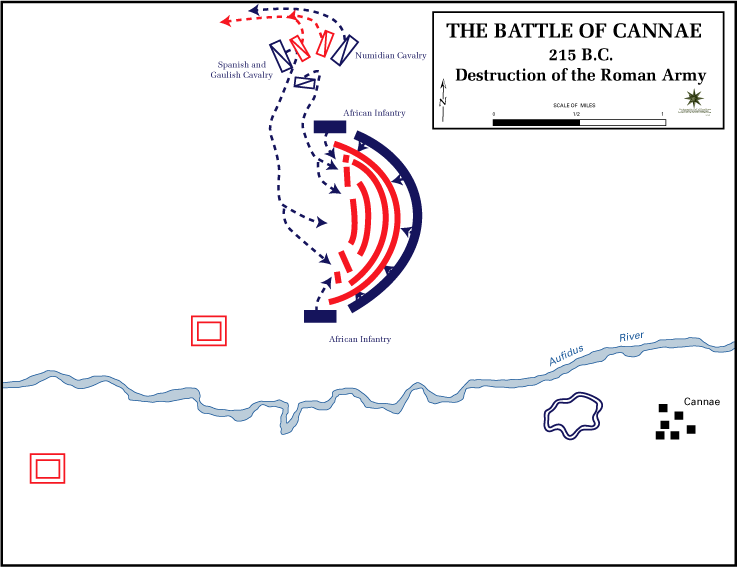
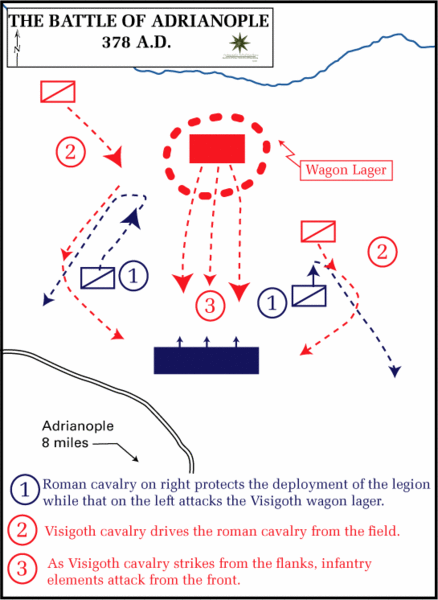
One of my favorite sections of Toynbee’s A Study of History comes in volume four when he examines the subtle idolatries that infect civilizations — idolatries of the past, of institutions, or techniques.  Toynbee applies this latter lens to the Roman army from its disaster at Cannae in 216 B.C. to its decimation at Adrianople in 378 A.D.

After Cannae Scipio helped bring about several reforms in the Roman infantry, making it more flexible and mobile.  But it was Hannibal’s cavalry that had really done Rome in at Cannae, and Rome’s reforms in this area were not nearly as significant.

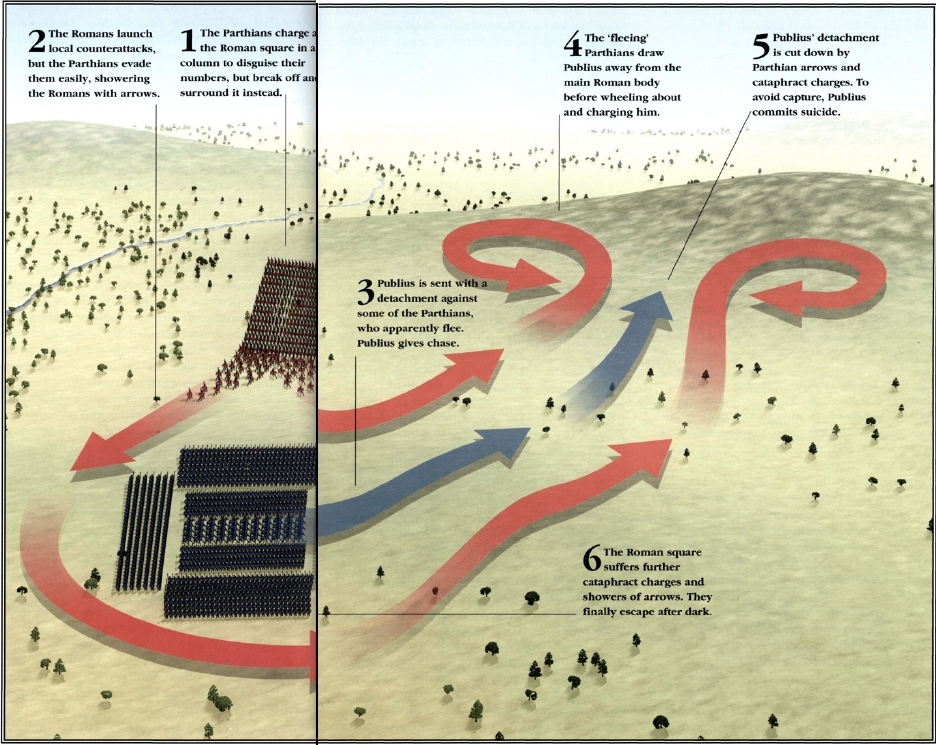
Fast forward 150 years and Crassus leads his army into Parthia.  Once again, the Romans lose decisively, and once again, the cause is the Parthians heavy cavalry deployed in a wide open area.

Carrhaie56

Historian William Tarn commented that, “Carrhae ought to have revolutionized the world’s warfare,” but Rome ignored the evidence, or perhaps has no possibility of changing anything at the time.  The Republic was collapsing all around them, and Caesar fought illegally in Gaul more or less simultaneously.  In any case, Surena, the victor at Carrhae, was executed shortly after the battle and his magnificent cavalry broken up.

By 378 A.D. the empire totters on the verge of collapse, and the Goths deal a decisive defeat to Rome at Adrianople, with cavalry again the mainspring of this final disaster.

Toynbee argues that Rome idolized its infantry technique to the point where they never could adapt their cavalry, and this failure, among many others, helped end their empire.

One of Toynbee’s great strength is his search for spiritual roots to what seem like physical problems.  Rarely do I disagree with how he applies this methodology, but I think I may in this instance.

The adaptations made by Scipio allowed Rome to conquer much of the Mediterranean within two generations, so their attachment to the technique/institution seems understandable, and if they “idolized” it that might be expected.  This picture could fit Toynbee’s theory, but perhaps they didn’t “idolize” the technique, perhaps they simply had a finite army, just like every other civilization.  Rome could never be all things to all men, and neither could their army.

Even during their declining “Empire” phase Rome continued to adapt their military, using auxiliaries from different provinces to fight alongside the standard infantry.  So we cannot say that Rome had frozen itself in time from Scipio onwards.  Their cavalry improved enough to help defeat Hannibal at Zama, and Caesar’s cavalry helped him defeat the Gauls — no small achievement.

Maybe we can say that Rome was a great teacher, and could reach many different students, but would always have a problem with students of certain type.  To be limited is not the same as being idolatrous.  To ask them to act differently is to ask them not to be Rome.

And, we have to admit, Rome had a very successful military for whatever shortcomings they possessed.

The issue Toynbee raises, however, still has value.  Why did Rome improve in many ways at many levels, yet never develop an ‘A’ level cavalry?

I don’t know, but I would guess that. . .

  • Great cavalries usually develop in wide open geographies.  Italy did not possess the typical geography that usually developed cavalries
  • But the geographic argument can be overstated, because medieval Europe was a “cavalry” culture, and European geography has little in common with Eurasian steppes or desert flatlands. The roots of the knight-errant lie in the social-political structure of feudal Europe.  So. . . .
  • Rome inherited the Mediterranean city-state legacy, with its emphasis on a land owning infantry that fought and armed themselves to defend the city. Rome’s military was certainly an offensive machine, but they always fought best when they could, a la Henry V at Agincourt, advance to provoke an attack, then fight defensively.  Cavalry strikes me as a distinctivly offensive weapon.
  • Even when the patricians governed Rome, they always thought of themselves as a nation of simple farmers (Toynbee could charge Rome justly with another one of his idolatries, the “idolization of the ephemeral self”).  Romans, like farmers, were practical at heart, and probably had little time for the horse, a “useless” animal on the farm.  Without a real love for horses, one could never develop a great cavalry.

I would curious for any other thoughts on this question.

The Mosaics at Chora

Everyone wants creativity, but everyone knows that it just not just “happen.”  Creative acts need a physical context (i.e. time, skill, etc.), but they also need a spiritual context.  That is, for human beings to see things in new ways they need the inner spiritual freedom that allows them to see in the first place.

Idolatry comes in many forms, but within Christian communities it will almost always take an indirect path and have an indirect manifestation.  We can idolize the past, or idolize institutions, for example. The Byzantine empire (ca. 330-1453 A.D.) gave much to the idea of civilization.  We can find evidence of its vitality in its unique artistic and architectural contributions.  They had a significant impact on the development of Russia outside their borders.  But, as a “grafted” branch onto the Roman tree, they persisted in an irrational attachment to Rome’s imperial idea long after things in Italy showed that the emperor had no clothes.  One could call it idolization of the past perceived glories of Rome, but they did not merely copy Rome’s culture.  They blended with their eastern surroundings and invented something new.  I think instead they stand accused of attachment to the institution of the emperor, or at least the idea of empire itself.

In another post we looked at how this idea led them into a foolish war against their Bulgarian neighbors, a conflict which took their eyes off more pressing concern of the rise of Islam.  They never fully recovered from this mistake.

The truth of the failure of the imperial idea became obvious to the eastern church by the 14th century.  The Islamic handwriting was on the wall to any person who had eyes.  The Byzantine Empire’s time was at hand.  Unfortunately, the eastern church’s realization of their failed investment in the institution of the emperor was too little, too late.  But as they freed themselves spiritually from their attachment to the emperor, they simultaneously created some of the most magnificent art ever done in the eastern iconographic style in the monastery at Chora, right near the beating heart of Byzantium, just outside Constantinople.

P40212757e

To my western eyes this may not seem that impressive.  But if we travel to Mt. Athos in Greece and observe contemporary works to those at Chora we see a difference in the examples below. . .

protaton

At Chora we see power in the images and a subtle touch only possible with a freed mind.  At Athos I don’t see quite see the same inner depth.

The reason for these differences might be the persistence of the idolization of an institution.  In Greece during the 14th century they still put their heart into the imperial treasure.   Perhaps their physical distance from the emperor made their hearts all the fonder, more fond than they should have been.  Though the monks in Constantinople were about to be engulfed, they may have had more inner freedom than those in Greece.

For the record, I am no art critic, and so would welcome any thoughts from more discerning eyes than my own.

Visual Democracy

Last year a colleague told me about Ivan Illich.  “Ivan Illych?”  I asked.  “No, the other one,” he replied.

I had never heard of him before.  His Wikipedia page mentions that he was a Catholic priest, but most Ivan Illichknown for his social criticism.  One look at his bibliography shows a wide range of interests.  His book In the Vineyard of the Text lives up to all of my friend’s hype.  I can’t call what follows here a “Book Review,” because the book is too dense, and the material too far out of my league, for me to fully grasp.  But I am excited by it and hope to make progress as time goes by.

In this book Illich looks at what he calls the origins of the age of the book.  He does not locate this with the printing press or the Englightenment, but with Hugh of St. Victor’s Didascalion written in the early 12th century (something else I had never heard of before).  Of course books existed before this particular work.  But Illich makes the observation that up until this point, books were made to be heard and not seen (i.e. The Illiad), or so visually stimulating that the text took a backseat.  The words were entirely secondary.

With Hugh of St. Victor Illich believes a significant transition took place, whereby Hugh writes to be read rather than heard.  Form follows function, so St. Victor writes in a way that allows for reflection.  Plays rely on visualization, but books ask you to exercise methodical reason.  Arguments build, and you have the opportunity to refer back.  WIth that opportunity comes expectation, and so on.   St. Victor, for the first time (according to Illich) writes with a thought towards creating the discipline of reading, which leads to the development of certain modes of thought, and for the next 800 years or so, we have the age of the book, an age which lent itself towards the formation of deliberative wisdom.

Illich, writing in 1993, notes that the age of the book has long since passed us by in favor of visual mediums.  While he does not address this transition, he notes that it will of course have dramatic consequences for society, and I wondered what consequences it might have for democracy.

Does democracy needs books to thrive, or perhaps even survive?

Democracy predates the age of the book.  We don’t need to think only of ancient Athens–we can think of innumerable local village assemblies from before Christ through the more official village and township elections of the Middle Ages.  But I’m not sure these small scale democracies should really count as examples that pertain to us today.   These  local democracies did not need a “mass-produced” way of making decisions.  Their communities were usually small enough for everyone to know each other.

Republican Rome had many democratic elements, but remained an oligarchy, for better or worse.  They had a variety of structures in place to prevent the people’s ability to make quick decisions, and the patrician Senate dominated policy until the army, another kind of oligarchy, did so starting ca. 100 B.C.

So, although it’s almost boring to say so, we are drawn back to Athens.

Athenian democracy had many more wide-open features than modern American democracy.  They made the majority of their decisions in the Assembly, which met 10x a year.  Anyone could attend and vote in Assembly meetings, provided you arrived early enough, and there may have been as many as 5000 seats.  Anyone in theory could speak, provided that you could hold the floor and didn’t get booed off stage.  Voting often took place on the same day that laws or policies were proposed.  It seems much more exciting than C-Span.

But the critics of Athenian democracy from Thucydides to Plato had a point when they argued that they often lacked the capacity for deliberative wisdom (I think both eminent men overstated their case, but they did have a case).  If we believe Thucydides, Xenophon, and others we see that they had moments where passions got the best of them and led them to disaster.  So while they were not a visual culture per se, they did seem to demonstrate the faults of visual cultures.  That is, they are easier to manipulate.  Now I do not agree that Athenian democracy had no brains behind it.  Many speeches passed down to us by Thucydides had wit and reason behind them.  It was not a smoke and mirrors show.  But at crucial moments they seemed to lack the ability to reason carefully.  This is a human fault, of course, not just one of democracies.  But the lack of “deliberation” built into their government and society made it so they were more vulnerable to the swings of emotion and powerful rhetoric.

If Illich is right that we are long past the age of the book than we may be back in the situation of ancient Athens.  I thought of this when I heard someone discuss our possible intervention in Syria.  He opposed it but admitted that if video existed of the chemical attacks and it went viral on the internet we would have no choice but to intervene.  The images would force our hand.  I think that would almost certainly be true.  Aside from whether or not we should intervene in Syria, would it be a good thing if images dictated our policy?  Will democracy experience a seismic shift in the You Tube age, or did this shift happen 20 years ago?

As a parting aside, I feel I must read Illich’s Deschooling Society  at some point.  His quote from that book, “School is the advertising agency that makes you believe you need the society as it is,” in itself offers much food for thought.

Ibn Khaldun on Jeff Bezos and Steve Jobs

Jeff Bezos’ purchase  of the Washington Post has led to a flurry of articles about him, of which I liked these two.  Clearly Bezos has a brilliant mind, supreme confidence, and intense drive.  As I read some articles about Bezos I thought he had much in common with Steve Jobs.  Both have drawn great praise and great criticism, with the praise coming for their revolutionary ideas, with much of the criticism coming from how they treat employees.

Regarding people with brilliant minds being in charge, medieval Moslem philosopher Ibn Khaldun wrote,

Benevolent government is rarely associated with a ruler whose mind is over-alert and intelligence Ibn Khaldunover-developed.  Benevolence is most commonly found in rulers who are easy-going or who behave as if they were.  The worst defect of such a ruler is that he lays burdens on his subjects which are greater than they can bear; and he does this because his mental vision outranges theirs and his insight penetrates into the end of things as well their beginnings. . . .  Divine Law prescribes in the case of rulers that excess of intelligence should be avoided. . . .because it produces oppression and bad government, and makes demands on people that are contrary to their nature.

Toynbee quotes Khaldun in volume four of his A Study of History in the context of looking at civilizations that begin to lose internal harmony.  Decline in civilizations begins for Toynbee when society reveals various forms of spiritual schisms that misalign their focus.  The lopsided nature of a mere intellectually brilliant leadership comes not as a blessing but a curse to a civilization.  Perhaps Toynbee would not be so impressed with Bezos and Jobs.

But I do wonder if Toynbee was wrong about this.  Apple products have made enjoyment of music, for example, accessible in ways not previously possible.  I realize that a lot music is pirated but that is not Apple’s fault, and anyone my age can remember the necessity of buying whole cd’s to get the 2 songs you liked.  Amazon may get a bad wrap for putting Borders out of business, but I love that the world is now my library, and I have benefitted greatly from the access that Amazon gives me.  Of course nothing is perfect, but on balance it seems that Apple and Amazon have changed the world in positive ways.  Let us grant that Bezos and Jobs are/were tough bosses.  But both did, on the other hand, have a large role in creating companies that employ thousands of people.

But I hesitate to disagree with Toynbee, so I must imagine how he would respond.  He might say that increased access is only an improvement of technique and not a real breakthrough.  He might continue that improvement in technique does not improve our souls, and what’s more, this technical advance (unaccompanied by a spiritual advance) will likely fool us into thinking that we are “all that.”  This delusion will lead to much greater problems later on.

This would be a really good counter-argument, one I am tempted by.  But I don’t know.

I do really like Amazon Prime.

Scientists are Civilizations Too

Mario Livio’s Brilliant Blunders looks at five of the major scientists of the modern era (Darwin, Pauling, Einstein, etc.) and examines the significant mistakes each of them made.  Livio does not take cheap shots.  He does not blame the scientists to errors they made due to what they could not have possibly known.  Instead, Livio focuses on blind spots in their theories that they should have seen, or prideful mistakes they made later in life.  Thus his book* functions as a psychological as well as a scientific study.

Each of the scientists in the book made their most significant contributions relatively early in their career (i.e., Einstein’s “Miracle Year”), and Livio believes this trend holds true for scientists in general.  The scientists then committed their “blunders” later in life, and when asked to comment on this, Livio stated that most likely, these men were not content to stay with a pat hand.  If at 35 you change the world with your theories, who wants to tinker with its finer points until retirement?  Instead, the scientists somewhat naturally seek other major breakthroughs, but this time in areas outside their wheelhouse, which is when they make their mistakes.

Are scientists unusual in this regard, or might it be a common human trait?  One thinks of presidential second terms that never seem to go quite as planned (Truman, Nixon, Reagan, Clinton, GW Bush, Obama?).  Local Washingtonians remember the humdrum nature of Joe Gibbs’ second stint as the Redskins coach.  U.S. Grant made a much better general than president.  In literature we have figures like Merlin and Lear making their big gaffes late in life.

Of course it could be that we see “fall’s” at the end of things only in hindsight.  We call it the end because he /she “fell” and ended their careers on a bad note.  But they only would end if they did something bad, thus the theory is entirely circular.

I don’t accept this entirely, for some careers end well, and some know when to ride into the sunset.  But the question remains whether or not we trace something general about human life, and we don’t need a perfect record for that.  And if it reveals something about human life in general, it may reveal something about civilizations.

Spengler thought that civilizations had a natural lifespan, like biological organisms.  No civilization by definition could keep going ad infinitum.  I think that’s because he saw civilizations as the outworking of a particular idea, embodied in a particular people (or, perhaps for Spengler, a particular race).  If we take the city-state idea with Athens, for example, we can see

  • An initial dynamism with the “new” idea of democracy embodied in a small community
  • This dynamism having great success, which leads to expansion
  • The expansion leading to inevitable betrayal of the idea, or at least, the idea can’t apply in the same way beyond their community.
  • The tension and contradictions now need resolution, which comes in the form of the Peloponnesian War.

One can see a similar process happening with the Roman Republic, and perhaps even Israel.  The idea of a Jewish state had great moral and dynamic force in the wake of W.W. II.  This gave Israel a great cohesion and sense of mission with their founding generation (’48-’67).  But the success engendered by the force of the idea led to Israel becoming an occupying force, with all the inherent contradictions that implies for their original idea.

In the end I think we should recoil from inevitability Spengler preaches but still be strongly cognizant of the usual pattern of temptation.  In order for our ideals or our identities to experience continual renewal, we need to be aware of their limitations.

*I should say that I did not read the book, but heard the author interviewed.

Standardization Is Decline

While browsing lazily through some assorted links, I came upon this head-scratcher from The Guardian.  The jist of it is that

[the EU proposed a law banning] jugs and dishes of olive oil in restaurants. From January next year, dishes of oil are to be replaced by bottles, which must be presented, claret-like, at the table with a tamper-proof nozzle and EU-approved labeling.

The law intended to “protect customers and improve hygiene,” which seems strange, as the article notes.  Few of us imagine that we need protection from olive oil on plates.  Thanks to the internet generating massive blowback, the EU withdrew the law.  What bothered me about their withdrawl, however, was that they did not seem to think that the idea itself was bad, merely their technique of presenting it.  Agricultural Commissioner Dacian Ciolos commented that, “the law was not formulated in a way designed to draw widespread support.”  I suppose they may try again another time.

Many of the objections to the law centered around the burden it placed on smaller independent producers and smaller cafe’s and restaurants.  Progressives like to use government to  aid the “little guy,” but some regulation does the opposite.  Big companies can much more easily absorb the costs of regulation than smaller ones.

Some regulation serves a public good.  I do not believe that the “invisible hand of the market” should determine all things.  As Philip Bobbitt argued in Tragic Choices, a purely unregulated market is another way of saying, “We take no responsibility as a society for our actions.”  Pure capitalism can descend into a kind of fatalism.

That said, I do think that regulation can easily damage society in subtle and hidden ways.  When regulation goes too far it limits freedom, and in this way, too much government can bring down a civilization.

Of course we need some government action to have any freedom at all.  An anarchic state enslaves everyone to the power of the strongest.  We romanticize the wild West, but who wants to have to carry around a gun to ensure our own personal security?  Government needs to have a near monopoly on the use of force so that we can all go about our business in peace.

One particular objector to the EU’s Olive Oil proposal, though, hit the nail on the head of the true problem of over-regulation with this comment:

“What’s next? I really don’t see the rationale. The whole contract between restaurant and customer is based on trust. If someone’s going to break it, they’re going to break it. No one says you need to show the pack of flour that the bread came from, so why the oil?” (emphasis mine).

In his Civilisation series Kenneth Clark developed the idea that “confidence” formed the basis for the success of any civilization.  In referring to the fall of the Roman Empire he asked,

“What happened?

It took Gibbon six volumes to describe the decline and fall of the Roman Empire, so I shan’t embark on that. But thinking about this almost incredible episode does tell one something about the nature of civilisation.

It shows that however complex and solid it seems, it is actually quite fragile. It can be destroyed.

What are its enemies?

Well, first of all fear — fear of war, fear of invasion, fear of plague and famine, that make it simply not worthwhile constructing things, or planting trees or even planning next year’s crops. And fear of the supernatural, which means that you daren’t question anything or change anything.

The late antique world was full of meaningless rituals and mystery religions, that destroyed self-confidence. And then exhaustion, the feeling of hopelessness which can overtake people even with a high degree of material prosperity. 

There is a poem by the modern Greek poet, Cavafy, in which he imagines the people of an antique town like Alexandria waiting every day for the barbarians to come and sack the city. Finally the barbarians move off somewhere else and the city is saved; but the people are disappointed — it would have been better than nothing.

Of course, civilisation requires a modicum of material prosperity. What civilization really needs [is] confidence in the society in which one lives, belief in its philosophy, belief in its laws, and confidence in one’s own mental powers. The way in which the stones of the Pont du Gard are laid is not only a triumph of technical skill, but shows a vigorous belief in law and discipline.

Vigour, energy, vitality: all the civilisations—or civilising epochs—have had a weight of energy behind them.

People sometimes think that civilisation consists in fine sensibilities and good conversations and all that. These can be among the agreeable results of civilisation, but they are not what make a civilisation, and a society can have these amenities and yet be dead and rigid.”

The Pont du Gard

The presence of “mystery religions” might seem far removed from over-regulation, but both have a “this is pointless, absurd, disconnected from real life” quality to them, and both can confuse and exhaust those subject to them.  Silly regulations reduce trust in our institutions.  This sense of confusion and despair produces a lethargy that saps a civilization of creative freedom.

Though I have not read even half of the volumes of Toynbee’s A Study of History, so far Volume 5 ranks highest in mind.  Within the first few pages Toynbee describes on the main themes of the book when he writes,

In a previous part of this study we have seen that in the process of growth the several growing civilizations become differentiated from one another.  We shall now find that, conversely, the qualitative effect of the standardization process is decline.

He goes on to argue that standardization makes society rigid, and in so doing, prevents creative responses to challenges we face.  The “Dominant Minorities” that do so much damage can take the form of snobby aristocrats, or even wide-eyed, well intentioned bureaucrats.

Civilization needs some kind of standardization to allow for people to interact productively with others both within and without their respective civilizations.  Some degree of unity, then, helps civilization to flourish.  But it becomes all too easy to run too far with that impulse, and at some point the line gets crossed.  Standardization eliminates individual or local initiative.  I have heard from public school teachers, for example, who argue that the rise of standardized testing has not only proscribed what to teach, but how to teach.

Busy governments can fool themselves into thinking that because things may be orderly, that things are well.  They may forget that civilizations are not sustained primarily through government action, but through the connections made by people in their communities — connections with their neighbors, their schools, etc.  Foolish regulation puts up barriers to the trust that is essential between people.  We no longer directly trust our doctor, we trust the program.  This “top-down” approach to governance creates whitewashed tombs that can collapse almost instantaneously under the right conditions, a la Soviet Russia.  Governments can, as C.S. Lewis points out, easily get confused.

It is easy to think the State has a lot of different objects — military, political, economic, and what not.  But in a way things are much simpler than that.  The State exists simply to promote and to protect the ordinary happiness of human beings in this life.  A husband and wife chatting over a fire, a couple of friends having a game of darts in a pub, a man reading a book in his own room or digging in his own garden — that is what the State is there for. And unless they are helping to increase and prolong and protect such moments, all the laws, parliaments, armies, courts, police, economics, etc., are simply a waste of time.

Many conservatives often state that government programs threaten freedom.  As a blanket statement, this makes no sense.  Think of how our system of roads, and their regular maintenance, enhance our freedom of movement.  But as a general rule it has a kernel of truth, at least in our day.  The impact of improper regulation will not be direct or immediately felt, but in working against freedom of initiative and bonds of trust, it erodes civilizations from the inside out.

These concepts do not tell us exactly what to do in every case, but I do think that if we agree with Clark, Toynbee and the restaurant owner, we should have a “presumed guilty” bias against regulation in developed societies.  Some regulations will and should pass the test of examination, but many others should not.

I think Joseph Tainter would have agreed with Clark and Toynbee as well.


An Alternate Take on the Korean Crisis

I never quite understood the only book I ever tried to read by acclaimed security expert Edward Luttwak, but I found his take on the improbable survival of the North Korean regime enlightening.  For those who want the short version, he argues that the root of the problem has a lot to do with South Korea acting as an enabler of the North.  Among his points. . .

  • North Korea could never survive on its own, so its survival can only come by acting as a parasite
  • The South has acted as a primary enabler, through payoffs, work programs, etc.
  • The South enables the North also through a failure to realistically face the North militarily.

Basically, if the South can change its behavior, Luttwak argues, the North cannot sustain itself for much longer.  But the South fails to live up to strategic realities.  He writes,

Meanwhile, South Korea has matched the North’s bellicosity with its own strategic perversity: It remains obsessed with an utterly unthreatening Japan and has been purchasing air power to contend with imagined threats from Tokyo as opposed to the real ones just north of the demilitarized zone. Seoul is simply unwilling to acquire military strength to match its vastly superior economy. Instead, it spends billions of dollars to develop its proudly “indigenous” T-50 jet fighters, Surion helicopters, and coastal defense frigates — alternatives for which could be much better, and cheaper, imported from the United States. Meanwhile, gaping holes remain in South Korean defenses (and thus we see the ridiculous spectacle of last-minute scrambling for missing equipment and munitions in the present crisis). And the cycle continues: Because the South allows itself to remain so vulnerable, it cannot react effectively against North Korea’s perpetual threats and periodic attacks. Instead, Seoul checks its bank account and gets ready for the next payoff.

Luttwak’s article illumines a great deal of the reality of the North Korean situation, and provides insight that we did not hear during the heat of the crisis.  The idea of Japan still looming large in South Korea’s mindset testifies to the longevity and power of cultural memory.  It made me wonder, however, if one piece remains missing.  If Luttwak is right, we still have to ask the question why South Korea continues to keep North Korea on life support.  We might arrive if we think of North and South Korea not as two separate nation-states, but as two brothers of the same family.

Families are meant to stay together, and the unnatural separation of North and South Korea after World War II traumatized both sides.  But they coped with this situation differently, and South Korea, obviously, is the brother that made good.  With their newfound and perhaps unexpected success, the South Koreans would inevitably feel twinges of survivor’s guilt.  So, while others just see dangerous choices that need to run its course, South Korea remembers the way it used to be, back before things went awry.  They give into the North’s demands maybe because they truly believe North Korea’s reformation is surely just right around the corner.  This time, they’ll be good for it, if just for old times sake.

Cousin EddieI feel for the South, and if I’m right about this sibling analogy, they have my sympathy.  But I doubt that, whatever their good intentions, that their actions will pay off.  Cousin Eddie, after all, stayed Cousin Eddie no matter how many vacations the Griswold’s took.