Breathe In, Breathe Out

I have very fond feelings for Will Durant. His multi-volume series The Story of Civilization was an absolute lifeline for me in my early years of teaching, and reading those volumes propelled me to some wonderful primary sources. His insights were not as profound as those of his contemporary AJ Toynbee, but he wrote with a more whimsical touch.

In Durant’s The Lessons of History (co-authored by his wife Ariel) he includes an essay on the question of whether or not progress is real. In grand Thomistic fashion Durant begins by proposing a negative answer. Philosophy will never eclipse Plato, literature will not move beyond Shakespeare. Science heals but also has created new forms of death and accelerated our means to destroy each other.

But Durant then pivots, and affirms that we have progressed–not in happiness (we will always find ways to be unhappy)–but in command over the environment. Famine and other natural disasters no longer decimate millions each year, and Durant asks,

“Are we ready to scuttle the science that has so diminished superstition, obscurantism, and religious intolerance, or the technology that has spread food, home ownership, comfort, education, and leisure beyond any precedent?”

He continues and admires the expansion of education, stating that

“If education is the transmission of civilization, we are unquestionably progressing … our finest contemporary achievement is our unprecedented expenditure of wealth and toil in the provision of higher education for all … we have raised the average level of knowledge beyond any age in history.”

It is a fine argument, and as always, wonderfully written.

In 1845 Thomas Macaulay wrote eloquently in favor of the Progress narrative:

It is now the fashion to place the golden age of England in times when noblemen were destitute of comforts the want of which would be intolerable to a modern footman, when farmers and shopkeepers breakfasted on loaves the very sight of which would raise a riot in a modern workhouse, when to have a clean shirt once a week was a privilege reserved for the higher class of gentry, when men died faster in the purest country air than they now die in the most pestilential lanes of our towns, and when men died faster in the lanes of our towns than they now die on the coast of Guiana.

We too shall, in our turn, be outstripped, and in our turn be envied. It may well be, in the twentieth century, that the peasant of Dorsetshire may think himself miserably paid with twenty shillings a week; that the carpenter at Greenwich may receive ten shillings a day; that labouring men may be as little used to dine without meat as they now are to eat rye bread; that sanitary police and medical discoveries may have added several more years to the average length of human life; that numerous comforts and luxuries which are now unknown, or confined to a few, may be within the reach of every diligent and thrifty working man

But even Macaulay, amidst his rhapsody, at least gives a quick nod to the counter argument:

And yet it may then be the mode to assert that the increase of wealth and the progress of science have benefited the few at the expense of the many, and to talk of the reign of Queen Victoria as the time when England was truly merry England, when all classes were bound together by brotherly sympathy, when the rich did not grind the faces of the poor, and when the poor did not envy the splendour of the rich.

Most ancient historians claim that things have gotten worse, that we progress from golden ages, to silver, to bronze and iron, a descent from heaven to earth. A middle position exists that I want to explore, one that questions the main arguments of the progress and decline narratives–though obviously certain kinds of progress and decline happen–and instead focus on the idea that “there is nothing new under the sun,” and be guided by St. Gregory of Nyssa’s treatise, On the Making of Man.*

Consider what follows speculative . . .

Humanity may progress in certain ways, and decline in others, but will always be limited by the circumstances of his creation. We are meant both to reflect God to world and to mediate the world to God. As such we have elements both of movement and stability in our nature. St. Gregory writes,

It may be, by a providential dispensation, so that the property of nature which constitutes its immutability and immobility might not, when viewed in any created object, cause the creature to be accounted as God; for that which may happen to move or change would cease to admit the conception of the Godhead.

Hence the earth is stable without being immutable, while the heavens, on the contrary, as it has no mutability, so has not stability either, that the Divine power, by weaving change in the stable nature and motion with that which is not subject to change, might by the interchange of attributes, at once join them both closely to each other, and make them alien from the conception of Deity.

That is, God makes us in such a way so that we can neither have the presumption to be God, but also see that we are more than the beasts. We have this duality within us, meant to exist in harmony.

St. Gregory makes many such connections between the rhythms and operations of nature and our own flourishing as human beings made by God. He comments that many creatures are larger, stronger, and faster than us, yet we have dominion over them–a seeming puzzle. He answers this disarmingly by stating that if we were to be the largest, fastest, and strongest of the creatures we would surely look rather funny–misshapen and unbalanced, “wild looking.” But as he stresses our dominion over creation, he does so again by establishing our connection with it.

. . . moreover, he would have neglected his rule over the other creatures if he had no need of the co-operation of his subjects.

St. Gregory establishes (so it seems to me) an irrevocable connection between God, man, and nature, writing elsewhere that,

The creation of man is related as coming last, as of one who took up into himself every single form of life, both that of plants and that which is seen in brutes.

So, although we are all always in a state of flux, we have stable elements, just as creation itself is both stable and fluid. We never step into the same river twice, and yet it is still the same river. And while some may see hints of evolutionary ideas in St. Gregory’s above comment, I think that he would say that creation reflects man more so than man reflects creation.

Given this, we can ask in regards to the question of progress–can creation “progress?” Certainly dirty water can become clean, but we might call this a “return” more than an “advance.”

We should think similarly in terms of human progress.

What I mean is that what we often call progress may be simply a reflection of how we breathe. We inhale, that is:

  • We draw things into ourselves
  • We concentrate our being, we focus, or in other words,
  • We centralize our being

And we exhale, meaning

  • We disperse things from our being
  • We separate the good and bad, the proper and improper
  • We get looser physically and mentally, we de-centralize**

We shouldn’t call inhalation or exhalation progress, but we often do. So, for example, many heralded the changes we made in the area of national intelligence in the wake of 9/11. We centralized our intelligence gathering–we inhaled. Surely this was correct? But in the wake of our intelligence failure after Pearl Harbor we determined that we needed to exhale and de-centralize intelligence agencies so we could have multiple views to consider. Both seemed like exactly the right thing to do given their respective contexts, and maybe both were correct actions to take, but neither can be termed “progress,” though it may feel like it at the time. What we might instead be doing is returning to a proper balance, or recalibrating temporarily.

Of course we usually want avoid dramatic inhalation and exhalation, which we only do as humans exerting ourselves or trying to de-escalate an emotional situation. We cannot continue for long in such a state.

We can take the state of education, so lauded by Durant, among others. Democratic education “inhales” a great deal by taking in everyone it can. But this has led to a kind of hyper-concentration in education, which can only lead to more centralization and standardization. So, naturally we see the rise of importance in standardized tests, which have the effect of getting teachers to “teach to the test.” In what sense has education truly improved in the last 100 years? What we can say for sure is that it has done some things at the expense of others.

Democracies possibly overvalue the “fluid” elements of our created selves, and trust in the free flow of people, goods, and information. The New York Times recently announced, for example, that it would “open up” its process of how it endorses presidential candidates and make it more transparent. Surely transparency means progress in any democracy? But as Alex Tabbarok pointed out, this will likely make all of the candidates far less candid than they might have otherwise been when talking with the Times. Certain stances they might have explained as a kind of horse-trading off the record they would never reveal in a more public forum. When the scale tips too far in the “fluid” direction, the natural reaction brings us to excessive solidity. “Progress,” so called, seems impossible in either direction, and that by design. The structure of creation, our bodies, etc. makes utopias impossible.

Perhaps the most striking form of progress surely is the application of science to food production and the eradication of disease. We live healthier and longer than in the past. Infant mortality has decreased dramatically. Unquestionably, the argument goes, this is progress that all can champion without qualification.

This certainly strongly challenges my argument–and most every argument has its limits. Still, perhaps these significant improvements do have a hidden cost of separation from the very creation that nurtures us and with whom our identity is inextricably linked. Here, I will admit, however, that it is hard to argue against progress of this kind.

Maybe . . . certain kinds of progress are possible.

But I think the larger point still remains, one that we do well to consider as we head towards another election cycle. Some may feel that Trump has lurched us too far in one direction, so that the solution is go hard in the opposite direction. This will exhaust us quickly. Rather, as St. Gregory taught us, we need to be a nation that takes calm and measured breaths.

Dave

*I should state at the outset that I do not find St. Gregory an easy read, and I make no certain claim to interpreting him correctly, though hopefully I have at least applied his words in the right spirit.

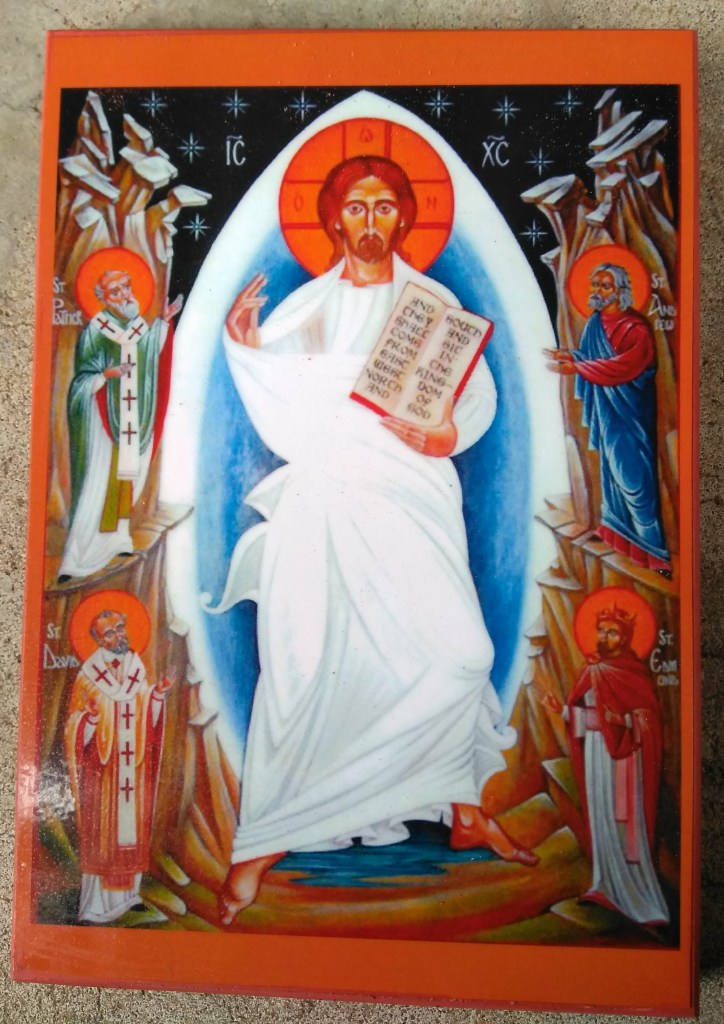
**This process of gathering in and pushing out is reflected in almost every icon of Christ, as He blesses with His right hand (drawing in) and separates with his left (in the form of a scroll, the Book of Life, which makes distinctions between people, etc.), further testimony to this pattern at the very Head of Humanity itself.
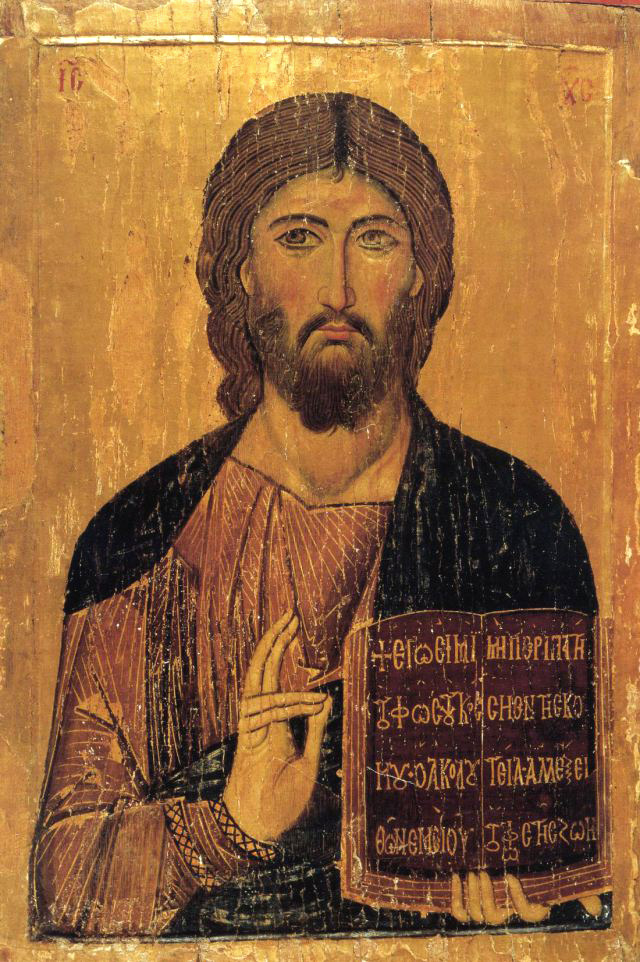
In the Byzantine icon below, the blessing/”drawing in” motif is more explicit, as His right hand almost seems to draw one towards Him:

A more modern icon, “Christ of the Isles” (Celtic style), that abides by the traditional pattern . . .
Meandering Thoughts on Equality

For the past several years now we have seen a fair amount of thought on the idea of economic inequality. Some see it as a serious problem, others perhaps as a temporary byproduct of the switch from a production economy to one rooted in service.  I suppose a very few might celebrate the possibilities free market economies in the fact of inequality.

I had a chance to think about this a bit recently, and attempt to bring some historical perspective.

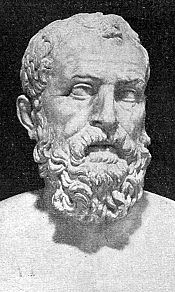
It is hard to imagine this issue being resolved more successfully than the Athenians under Solon, ca. 590-570 B.C.  There were the aristocrats and the commoners, with law and wealth heavily sided in favor of the aristocratic class (the ‘Code of Draco’).  Debt spiraled out of control, society was coming apart.

Enter Solon.  He was given full powers to resolve this crisis. He did not need to curry votes or constituents. He was not an aristocrat, but he was rich.  He could appeal to both sides and be trusted by both sides.  He believed that Athens needed its rich citizens, as we might expect.  More crucially, he knew how to motivate reform by appealing to the aristocratic ‘need’ for glory, or arete.  One can’t just dismiss this, as it was part of the Greek mindset for centuries.

He made paying high taxes a sign of arete. You could pay your high taxes not in terms of a fixed percentage, but in terms of

  • Pay for this religious festival, and we’ll say loud and long that you paid for it
  • Build a trireme and pay the crew, but you get to command the ship
  • Build this bridge and we’ll name it after you
  • Etc.  You get the idea.

By some accounts aristocrats paid a percentage 12x higher than the poor, but they got ‘arete’ for those taxes, and they had a direct hand in how they were spent.  

He did other things, like expanding the merchant fleet and encouraging trade, which put a lot of people to work.  This sounds easy but must have been politically difficult, given the role of farming in almost every ancient civilization.

He canceled all debts, but he refused to redistribute property.  

In the end

  • Athens had a stronger middle class
  • Athens had relative social stability
  • Many believe that this helped lead to the cultural/political explosion in their ‘golden age’ a century later.  They  create modern science, literature, democracy, etc.)

Alas, many things about Solon are not replicable for us.  For one thing, change did not come from a democratic process.  He was a ‘tyrant’ (a technical description and not a bad word).  C.S. Lewis commented a few times that to get good results for democracies often you have to achieve them in non-democratic ways.  We are locked into our one democratic tradition, and have not nearly the flexibility the Athenians had.

I love his taxes idea, but we just too big and bureaucratic to copy it.  Could we do something like it–give the rich the privilege of naming how they contribute if they willingly contribute more, and giving them public recognition for this (i.e. naming a bridge after them, getting their name on a fighter jet’s wings, I don’t know)?

The idea of a ‘bridge-builder’ politician we can do, and have done successfully before.  But we lack the civic-mindedness of the Athenians.  For better or worse we are more individualistic.  The ancient world would find our attitude towards the state unfathomable.  

Unfathomable, yes, but their conception of rule, society, etc. was far more personal, far more uniform, and far more religious than ours.  Ancient Persia could be an exception.  The Roman Republic could also serve as an exception.  They did integration and pluralism quite well until they ventured beyond Italy and the Alps and into the Mediterranean.  It proved too much for them to swallow. Most Italians had similar cultures.  But in North Africa, Spain, etc., . . . they were different, and no one wanted to try integrating them into the Republic, and no one thought of not ruling over them in some way.  This is another factor, I’m sure, in the collapse of the Republic.  It may be that societies with higher ethnic diversity have a harder time with equality.  If so, this makes America’s relative equality all the more impressive.*

The trade-offs are huge.  You can get more civic buy-in, in theory, in America, but you would probably have to sacrifice some sense of personal rights, and you would definitely have to ditch pluralism and relatively open immigration.  The first is highly unlikely, the second probably impossible.  Even if we could do those things, it is debatable that we should.

Anyway, we can’t dismiss the rugged individualism out of our national DNA, nor should we want to. Solon could not dismiss arete.  But . . . he found a way to work with it.  

Can we create low-skilled jobs from the digital revolution and keep them in America?  If we did so, would it make things worse for workers in Asia?  Would we want the flag-waving and possible economic confrontations that would come from a more nationalistic America?  Would the world be safer?  I don’t know the answers to these questions.

We are such a big nation (like almost every other one) that our problems become abstract and impersonal.  In Athens more or less everyone knew everyone in some way.  Dealing with inequality has much more meaning when we have a personal connection to the problem.

Rome faced a similar problem ca. 150 B.C. that Athens faced in 600 B.C.  They never found a way out, and the Republic collapsed.  All agree this period has many complexities, and historians hotly debate why the collapse happened, but I think most agree that

  • Both sides used violence to settle issues
  • Both sides tended to view politics as a zero-sum game, very much an ‘us vs. them.’  They destroyed each other with a century of intermittent civil war.

The French Revolution, the Russian Revolution, the revolutions in China, SE Asia, Cuba, and even arguably the American Revolution created far worse tyrannies than those they replaced (this is a stretch in the U.S.– the British weren’t tyrants, and neither were the victors, but the victors did exile many loyalists, slavery expanded, Indians fared far worse than under the British, etc.).  The Roman civil wars over the political questions of the day gave them the emperors.  

We need a political genius of sorts, who can find a synthesis between liberty and equality, between civic responsibility and rugged individualism. He/she would need to be trusted by the common man in Iowa and in Silicon Valley.  He/she would have to, perhaps, give huge tax breaks to corporations who did not outsource jobs–a pro-nationalist low taxes weird hybrid.  If we find him (and I don’t see him/her around), he would not have nearly the power Solon had, at least by the letter of the law.  

None of these mostly unoriginal thoughts get to the unspoken root issue.  Why is inequality a problem in the first place?  By “problem” I don’t mean whether or not inequality exists, but whether or not people perceive it as an issue worthy of much attention.

We might think that inequality is problem in every society but, not so.  For example, monastics renounce property and have all things in common.  We say that communism has never worked, but it works in monastic societies, though of course on a small scale and with everyone present strongly and voluntarily committed to that idea.

Other societies experience inequality, but seem not to think much of it. Neither Homer, Plato, Augustine, Chaucer, Shakespeare, or Austen ever made it a burning issue.  But we do see the issue move right to the front of political thinking just after Austen in the mid-19th century.**  We see it in Marx as well as Dickens, and thereafter inequality could be a rallying cry for political revolution.

Surely the Industrial Revolution has something to do with this, for it created a society where, having mastered the elements of nature, one could quickly have great material success.  The first two generations of factory workers at least likely lived at lower standard of living than previously.  Vast gaps between classes opened up.

Vast gaps existed in ancient Egypt as well between the pharaoh and the peasants, for example, but these gaps made sense to their society historically and theologically.  In a society where “all men are created equal” inequality hits with much greater force.

Marx thought that in the first 50 years or so of Industrialism some of these “non-sensical” gaps would certainly destroy the capitalistic state.  Marx had many things wrong.  But on this, I can’t blame him for his guess.  Why did the capitalist state survive?  Marx, the great materialist, had ironically underestimated our materialism as a society.  Its reasonable to assume that the social gaps created by the industrial revolution, coupled with our ideology of equality, would end the industrial-capitalist society.

The “cause” of the problem of inequality perhaps lies in solving this riddle.  It seems that the poor want what the rich have. Both rich and poor want the same thing, and the values of western society tell them they should have the same thing.  I don’t mean to say that inequality is not a problem or no such problem of economic injustice exists, or that the poor should rest content with the rich as mortal gods on earth.  I am not advocating a revival of ancient Egypt.  I merely point out that our society as a whole has surrendered to the materialist impulse which makes easing the problem that much harder.

Of course this parallels the rise of the issue in the mid-19th century just as social Darwinism, textual biblical criticism, and other de-mythologizers of life gained pride of place.  All that we left ourselves had to do with the here and now, i.e. applied science to increase our standard of living, and our various abstractions to make these things real.

All this to say, dealing with crippling inequality in society will involve a spiritual solution.  The monastics show us that it is possible.

Dave

*If this is true, we are faced with choosing between the competing goods of liberty and equality.  Would we prefer economic peace between our citizens or freedom of movement for all?

**Others I’m sure would disagree, but I don’t see the French Revolution being driven primarily by inequality.

What comes out of his mouth, that is what makes him ‘unclean.'”

I am republishing this post as a companion piece to the review of Michael Psellus’ Fourteen Byzantine Rulers. The original post begins below . . .

*******

Proximate causes to events are always easier to see, and depending on one’s role in the sweep of history, more satisfying to the ego.  The rise of Nazism in Germany horrified the civilized world of Europe. “Sore losers after W.W. I,” many no doubt thought. But the Nazi’s drew strength in part from the centuries old feeling that they (Germany) were no longer going to be the doormat of Europe.  After all, from the time of the 30 Years War (1618-1648) most of Europe’s conflicts played themselves out on German soil.  England, France, and Russia had a part in creating the monster that nearly destroyed them. The Jews of Jesus’ day faced a variety of problems, and the Romans could hypothetically be blamed for nearly all of them.  “It’s their fault that we have no nation, freedom, etc. etc.”  But Jesus never let His fellow Jews sink to this attitude.  His famous words in Matthew 15:11,

It is not what enters into the mouth that defiles the man, but what proceeds out of the mouth, this defiles the man.

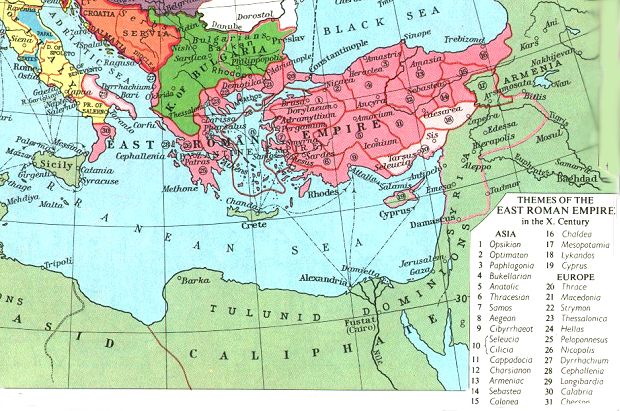
applied directly to the spiritual leaders of the time, but have broader application.  Speaking as one of God’s prophets, he speaks as the prophets do.  “Your problems are your own faults.  Don’t project blame elsewhere.” In the fourth volume of his A Study of History Toynbee applies this principle in a fascinating way regarding the Byzantine Empire. A look at Byzantium’s history that hit only the highlights would likely make a long jump from Justinian over to the Crusades, which would give the impression of an embattled area of Christendom making a desperate stand against the rise of Islam.  The political and military failure of the Crusades (to say nothing of the moral failures on all sides) end up sealing their fate, and the Moslems finish them off in 1453 when Constantinople falls.  Thus, they could easily say that the fell due to Islamic aggression.  It’s “their” fault. But this perspective ignores what happened in the intermittent period between these bookmark events, and especially ignores the Byzantine’s war with Bulgaria from A.D. 977-1018, which took place long before the Seljuk Turks posed any real threat to the Byzantines (those who read the review of “Fourteen Byzantine Rulers will note that this was during the reign of Basil II). A look at the map just before the conflict reveals the situation, with the Byzantines in Pink and Bulgaria in green. Byzantium ca. 950 ADIn fairness to the Byzantines, the Kingdom of Bulgaria represented a political division from the old Roman empire, and since the Byzantines had always seen themselves as “Roman,” they likely felt the duty of reclaiming lost territory.  It also appears that the Bulgarians may have initiated conflict in 700’s-800’s A.D., and perhaps the Byzantines this time thought of payback. But this political division ran only skin deep.  Both kingdoms had unity on a deeper level, as both committed themselves to Christianity, but more specifically, to the distinctive “Eastern Orthodox” brand of Christianity prevalent in Eastern Europe at the time.  Whatever the Byzantines might gain from such a conflict, an inevitable cost on the “back end” would wait them for them as in all civil wars.  If they could forego the political division, they would still likely have had unity against a common foe. Still, as a result of the war, the map changed and their territory increased. . . Byzantine Empire 1000-1100 The map also shows, however, that their gains in a long, desperate conflict between evenly matched foes came in part by ignoring the growing threat to the east.  By gaining in the west they ignored Anatolia and the growing power of an enemy with whom their differences were more fundamental. The map doesn’t show the social strain placed on Byzantium as a result of the war.  Emperor Basil the Bulgar Killer gained glory in war, but ignored the growing strife of his subjects in agricultural areas of Anatolia, a product of what  Toynbee calls, “their profound political distress and economic discontent, too frequent to be dismissed as the work of ambitious or unruly individuals.”  What should have been the core of Byzantium’s strength was in fact rotten with decay, ready to fall away at a mere touch to the Turks. Though their territory had increased since the 700’s, their burden of defense had increased, and not just in terms of territory.  They also had to care for more people, and thus had even reason to distract themselves from the social problems in Anatolia. The maps tell the rest of the story. . . 1025 A.D. Byzantium 1355 A.D.: Bulgaria is back, showing that their previous conquest could not hold amidst growing internal social strife.  All of that effort did nothing for them in the long run. And then, the end of it all, proving Matthew 15:11 true, though it took centuries for it to apply in the Byzantine case. Ottoman Empire

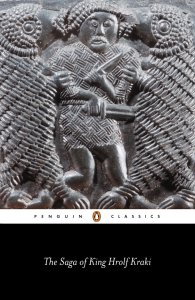
The Saga of King Hrolf Kraki

Some paint the Middle Ages as a period of narrow intolerance.  I’ve said enough in other posts not to address that directly here, but in short, that view has little support in the lives or sources of the time.  We see in Beowulf, for example an appreciation for the pagan past and an understanding of the difficulties in trying to make sense of the Christian faith in light of their past, not a “narrow intolerance.”

The Saga of King Hrolf Kraki can’t quite equal the power and style of Beowulf, but it has many of its outstanding 71ebyqgznclqualities, as well as a similar task.  The author retells a famous Norse story to a newly Christian Norse audience.  At various points he likely altered the story slightly to make certain theological points.  One such instance caught my attention.

At the end of the story our hero returns triumphant from defeating the villain.  Before setting out on his expedition, he took advice from a seemingly simple farmer and reduced his army (in similar fashion to Gideon in the book of Judges).  After victory he marches back and sees the same farmer again.  They greet each other warmly, after which the farmer offers more help.

This time King Hrolf refuses.  It’s not immediately clear why.

As they take their leave Hrolf declares that the farmer was none other than the Norse god Odin in disguise.  He had to refuse his help.  He would not take advice from a pagan god though all knew that Odin brought success to those who honored him.

In refusing Odin’s help, he refused “Victory.”  The consequences of this decision for him and his kingdom follow predictably.  Hrolf Kraki loses everything by the end.  But the author clearly believes he should indeed have preferred failure to success at the price of aid from a pagan god.

In an article entitled “No Enduring City,” author David Bentley Hart muses on the success of Christians and their involvement in politics.  He begins citing two events in medieval Europe.  He writes,

The first occurred on August 25, 1256, when the  podest  and  capitano del popolo of ­Bologna summoned the citizens of the  comune to the Piazza Maggiore in order to announce the abolition of all bonded servitude within the city’s civil and ­diocesan jurisdictions. Some 5,855 serfs were redeemed from their  signori—who were remunerated out of the communal treasury at a total price of 54,014 lire—then placed under ecclesiastical authority, and then granted their liberty.

An irrevocable abolition of serfdom in Bologna was then issued in a short text known as the  Liber Paradisus, in which was indited the name of every emancipated serf. Historians have occasionally ­spe­culated on the economic benefits that Bologna may have reaped from this decision—for one thing, freedmen were eligible to pay taxes—but the actual cost of the manumission, immediate and deferred, was so exorbitant that it is rather difficult to see how the municipal administration could have calculated any plausible profit from its actions.

Perhaps, then, one should take seriously the motives the  Liber Paradisus itself actually adduces: “Paradisum voluptatis plantavit dominus Deus omnipotens a principio,” it begins,“in quo posuit hominem, quem formaverat, et ipsius corpus ornavit veste candenti, sibi donans perfectissimam et perpetuam libertatem”: “In the beginning, the Lord God Almighty planted a paradise of delight, in which he placed man, whom he had formed, and whose body he had adorned with the garb of radiance [a shining raiment], endowing him with perfect and perpetual freedom.” It was only by sinning, the argument proceeds, that humanity bound itself in servitude to corruption; God in his mercy, however, sent his Son into the world to break the bonds that hold humanity in thrall, that by Christ’s own dignity all of us should have our natural liberty restored. Thus all persons currently bound in servitude by human law should have their proper freedom granted them, for they along with all the rest of us belong to a single  massa libertatis wherein now not so much as a single  modicum fermentum of servitude can be tolerated, lest it corrupt the whole.

Hart continues . . .

The second episode, however, which to our sensibilities might seem the more outlandish of the two, was for its time far and away the more ordinary. Some twelve to fifteen years after the promulgation of the  Liber Paradisus (the date cannot be more precisely determined than that), Thomas Aquinas put the finishing touches on that famous (or infamous) passage in the  Summa Theologiae  where he defends the practice of executing heretics. The argument he laid out there was quite a simple one, consisting of only two points, both of which he considered more or less incontestable. First, as regards the heretics themselves, their sin by itself warrants both excommunication and death. Second, as regards the Church, the graver evil of heresy is that it corrupts the faith, which gives life to the soul; and so, if we execute forgers for merely corrupting our currency, which can sustain only temporal life, how much more justly may we deal with convicted heretics not only by excommunicating them, but by putting them to death as well.

Of course, Thomas adds, out of her mercy towards each man who has strayed, the Church hesitates to pronounce a final condemnation until “the first and second admonition” have both failed; but then, if the heretic remains obstinate, “the Church, no longer hoping for his conversion, turns itself to the salvation of others, by excommunicating him and separating him from the Church, and furthermore delivers him over to the secular tribunal so that the latter might remove him from the world by death.” Nor can ecclesial compassion extend any further than this. Recidivism, for instance, even of the most transient kind, is unpardonable. Says Thomas, “At God’s tribunal, all who return are always received, because God is a searcher of hearts, and knows those who return in sincerity. But the Church cannot imitate God in this, for she presumes that those who relapse after being once received are insincere when they return; so she does not obstruct their path to salvation, but neither does she shield them from the sentence of death.”

Both examples have their counterpoints.  Some rather cynically suggest that the economic motive of creating more taxpayers formed the real motivation behind freeing the serfs.  Others point out, that, whatever we may think of Thomas’ counsel, he sought to save souls and not to kill people.  It is easy to cherry-pick the weaknesses of any man or any civilization.

Still, however we slice it, we cannot avoid a contradiction.

Hart suggests that Christian involvement in politics always seems to go south at some point.  On the one hand, when Christians have the power to do good, they can accomplish good things in a unique and lasting way.  On the other, such power either corrupts or puts one in an awkward enough position where a compromise of gospel ethics becomes inevitable.  We can cite numerous examples of the good and the bad.  Betrayals of the gospel ethic may not even be anyone’s “fault,” per se–it could be the nature of the beast.  He draws no firm conclusions, but asks us to consider how we should deal with this problem.

I admire Hart a great deal.  He has a powerful mind and thinks deeply.  His The Doors of the Sea is the best book I have read on the problem of evil.  But I found myself a bit frustrated with “No Enduring City.”  He has the intellectual capital to spend, but plays the miser. He holds too much back. I wanted more from him to try and settle this conundrum.

When surveying the history of Christian involvement in politics, I think we have the following options:

  • Christians should never be involved in politics.  Whatever good they will do will be outweighed by the inevitable corruption of their witness to the gospel.
  • Christians will likely fail in some way in the political realm.  But, we should expect that their failures will be less damaging, and they will accomplish more good in their time in power.  Thus, Christians should be involved in politics as much as they can.
  • Compromising one’s Christian witness may likely happen in the political realm, but it is not inevitable.  Thus, the potential good from Christians involvement in politics is worth the risk, with the right people.
  • Compromising our witness to Christ is indeed quite likely in the political realm. Christians should avoid political office. However, Christians should do what they can to influence those in power.  In this way they can hopefully create some good for society and escape direct blame for the bad in politics.

Other options likely exist.

In his article Hart hints (but not outright declares) that the continual cycle of success/failure might serve the good purpose of continual renewal, keeping the Church on its toes and supplied with fresh blood.  This parallels in some ways Toynbee’s creative/dominant minorities in society.  A particular system gets stale and rigid.  A ‘creative minority’ finds a way to challenge this system successfully, which brings them into power.  Eventually, however, this ‘creative minority’ succumbs to temptation and morphs into its own ‘dominant minority,’ starting the cycle over again.

But Hart will not outright declare one way or the other, because the mere fact of such a cycle doesn’t mean that the good of the creative minority outweighs the bad of dominant minority.

If such a man as Hart cannot decide, I will not either.  Perhaps historical analysis is not our best servant for this question.  Perhaps we need epic poetry to instruct us.

King Hrolf Kraki ultimately fails.  His realm grows a bit soft and corrupt.  Yet before that happened he managed to defeat a wicked and truly evil king who had wrought chaos throughout the land for years.  He fails, but the good outweighed the bad.  So too king Arthur fails.  His sins, and the sins of others catch up with them.  Yet, the good that came from the golden age of Camelot inspired the very idea of chivalry, which formed the ethic of the west for 500 years at least.  When Roland receives the assignment of the rear guard, he suspects treachery, but turns to his stepfather and says,

Ah, slave and coward, malicious heir of dishonored ancestors, did you think I would let the glove fall to the ground as you did the staff when you stood before Charles?

The rearguard is destroyed under Roland’s command, but Charlemagne returns just in time. Beowulf defeats the dragon but could not establish the kind of kingdom that meant that others took up similar fights as he.  But . . . who doesn’t love the character of Beowulf?

The attempts referenced above, however, were all “grand gestures” involving personal risk.  Epic literature is of course literature and not history.  But they give some historical insights.  The politicking of the religious right involved no grand gesture, no personal risk for anyone.  Christian involvement in the political realm will likely fail in some way, no matter how great the sacrifice.  But the utterly mundane garnering of power through votes not only failed in the U.S., it engendered resentment against the religious right.  The relative political disengagement of most younger Christians today testifies to the insipid nature of such action.

At the end of The Song of Roland Charlemagne cries out, “O God, my life is a burden!”  He knows that all of his fighting and all of the sacrifice will not bring about a heaven on earth.  But, he smashed the pagans, avenged treachery, and Julienne was led triumphantly to the baptismal font.

Truly sacrificial action, whether political or otherwise, has a lasting impact despite our sins and limitations.

Perhaps herein lies the answer Hart seeks.

Every Sacrifice Needs a Witness

You will notice some dated references, as this post was originally written in the fall of 2020. The original is below . . .

****************************

I enjoy athletics, but since the lockdown last March I have watched zero hours of live sports. One might think that televised sports would act as a lifeline for people like me during these strained times, but my interest has markedly declined. But it’s not just me, apparently. Ratings have plummeted for live sports across the board. Here are some statistics:

  • US Open (golf) final round: down 56%
  • US Open (tennis) was down 45% and the French open is down 57%
  • Kentucky Derby: down 43%
  • Indy 500: down 32%
  • Through four weeks, NFL viewership is down approximately 10%
  • NHL Playoffs were down 39% (Pre Stanley Cup playoffs was down 28% while the Stanley Cup was down 61%).
  • NBA finals are down 45% (so far). Conference finals were down 35%, while the first round was 27% down. To match the viewership, activity on the NBA reddit fan community is also down 50% from the NBA finals last year.

So it’s not just the woke politics in some of our major sports that are driving people away. The above statistics are from blogger Daniel Frank. He suggests a variety of reasons for this decline, including the rise in mental health issues and political uncertainties that eliminate our bandwidth for consuming sports. He has other reasons, all of them thoughtful and possibly true, but I think he misses the heart of the matter.

My thoughts below should be, as Tyler Cowen states, filed under “speculative.”

Sports occupies a very large place in our civilizations bandwidth. The growth of the importance of sports, and the money associated with sports, accelerated on a national scale as a few different things happened over the last 50 years:

  • Growth of technology allowed people across the country to discover sports hero’s from other locales.
  • Beginning around the 1960’s a dramatic moral shift happened that eroded certain key foundations Tocqueville and others cite as necessary to support democracy, such as shared trust and a robust family structure.
  • Perhaps we can also cite the growth of suburbia as a factor eroding another key facet of healthy democratic life cited by Tocqueville–local neighborhoods and local institutions and customs.

So as things start to erode on a local and particular level, they homogenized on a national level. Sports benefitted from this, but its growth was necessary, in a sense, to account for the above trends. We lacked local means of conflict mediation on front porches, coffee shops, etc. Sports stepped into that void. Fundamentally, we can understand sports as a highly ritualized, liturgical, and controlled means of combat. For those two hours we can “hate” the team wearing the other jersey, but we know that we don’t really hate them. The liturgy of competition creates a parallel world where we can control conflict. We have all played games against friends–for a time they function as the “enemy,” then real life resumes. Bad sportsmanship means in part the inability to come back to the real world from the parallel world. Whether at cards, basketball, or the like–our competition serves as a way to mediate/navigate our relationships.

Without shared trust, without real communities, we need sports now more than we did 50-100 years ago.

But then–why did the ratings plummet for sports at a time when a need for controlled conflict mediation seems quite high?

If sports serve as a parallel liturgy of rivalry, we can see that this “conflict” gets resolved via sacrifice. Athletes, then, function in certain ways as priests of this liturgy. We expect them to “sacrifice” for the team, their time, their bodies, etc. Thus, they serve as “victims” in some ways of the liturgy. But in addition, at least our star athletes also control the liturgical space. They ask us to cheer, we cheer. When they complain to the ref, we join in with them–the ref’s call was obviously wrong–and so forth.

If a tree falls in the forest and no one hears it, does it make a sound? If you have a materialist-leaning view of the universe, the answer is an obvious ‘yes.’ You can ‘prove’ your point by recording the event with no one around, and then listening to the recording. You hear the tree falling and presto, you have your answer. But if you have something of an ‘idealist’ view of the world, as did Bishop Berkeley,* you answer in the negative. Is there “sound” on that recording? Can you carry around “sound” that you do not hear? It seems to me that for reality to be Real it requires perception.

This idea closely relates to the dictum in both Catholic and Orthodox churches (and perhaps others) that no priest can celebrate the sacrifice of the mass alone–though of course certain unusual exceptions allow for it. Many reasons exist for this restriction, but briefly:

  • The sacrifice of the mass is always for the people–the body of Christ, and not merely the priest.
  • The priest, representing Christ, cannot be the sole ‘beneficiary’ of the mass, just as Christ did not “benefit” from His own death (of course He does “benefit” in the end, but I trust all take my meaning).
  • The “power” of the sacrifice has to “land” to take form and reality. Without this “landing” the sacrifice has no power and no life to give.
  • The Head (Christ) must nourish the body. Just as we take in physical nourishment through our mouths, so too–what is the point of the sacrifice of food (for all food was once alive and now has died that we might have life) if we have no body? The food–which has already undergone death, will not be transformed into life for us, but rather, stay “dead” as it falls out of our throats onto the floor. Or to put it another way, maybe Berkeley was right about trees falling in forests all by their lonesome.

All well and good, but this fancy talk, some might say, forgets that the televised sporting events do have witnesses, both in person and at home. Most watched at home anyway in the first place before the virus hit. Very little has changed about how the vast majority of us consume sports now except the immediate social factors Frank listed above.

Well, I concede partially. But just as virtual church is not church, and a virtual concert is no real concert–a virtual sporting event is not a real sporting event. Anyone who has watched on tv senses this. The viewers themselves sense it, which is why teams pipe in crowd noise. It is a trick meant to fool those watching at home more than the players, I think. The “sacrifice” of sports needs a place to land within the “church”/arena. If it disappears into the ether, its power disperses with it.**

The ratings decline in sports confuse us only if we fail to see connections between liturgical worship and sports.

Dave

*I do not claim to understand more than the bare outline of Berkeley’s premises, and could not defend his general philosophy even if I wanted to.

**We can also consider the sudden collapse of Rome’s gladiatorial games in the mid-4th century. No question–one main factor had to be the rise of the Christian ethic. But the growth of the games themselves also had something to do with it. When one man fought one man in front of 50,000, whatever took place would be witnessed and participated in by all. But as the games grew in importance they grew in scope, and the cruelty of the games grew more random and bizarre. As the games (unknowingly) neared the precipice, dozens of men fought other dozens of others more or less randomly.

At that point, if you were a gladiator you could not be sure that anything that happened would be directly seen by anyone. One could kill or die with honor and dignity and who knows who witnessed it? If nothing is affirmed, nothing glorified, then why fight at all? With no glory possible, only chaotic death remains. Why would a Roman citizen want to witness a “nothing?”

The Augurs of the Temple

In my 8th grade ancient history class one of the great questions of the year involves whether or not one believes that Greece or Rome was the superior civilization.  The students usually get into heated discussions on the issue and seem quite excited by the question–until they discover that they have to write a long essay about it for the final exam.  Somehow, this dampens their ardor.

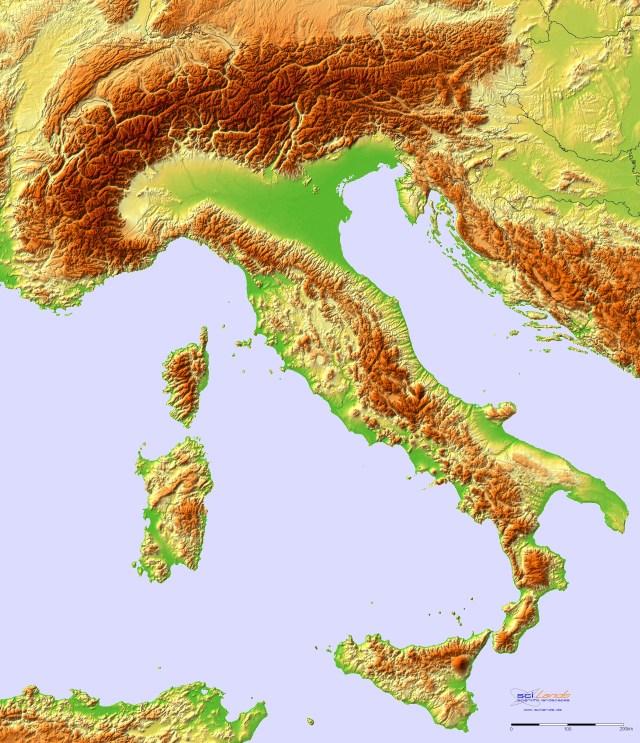
Comparisons between Greece and Rome can always yield fruit.  Each civilization has significant primary source documentation.  Their development overlaps and departs at points like a figure eight.  Both civilizations had similar climates, were right near the Mediterranean, with mountains forming a large part of the topography.  Both civilizations started out a city-states and transitioned from kings/tyrants (in the technical sense of the word) to a republic/democracy at almost exactly the same time.

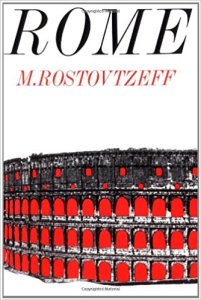
But despite these similarities, Rome grew into one of the largest global empires of all time and Greece stayed within its narrow confines for the vast majority of its history and never expanded as Rome did.  I thought of this question recently because Michael Rostovtzeff raised it in the early pages of his book on Rome.*  He saw more similarity between Greece and Rome than others, and so had to account for the differences in their historical development in ways that those who see more difference between the two could ignore.

I agree with Rostovtzeff’s rejection of purely mechanical or physical explanations.  Some argue that geography can explain the difference.  Greece’s geography hemmed them in and forced the creation of independent city-states, whereas Italy’s geography allowed for more expansion.  But Rostovtzeff points out that both areas had relatively the same interaction with mountains and the Mediterranean.  Italy’s soil had an advantage, but not a great enough advantage to explain Rome’s expansion.  And while Greece’s topography had more mountains to contend with, occasionally certain city-states built empires, showing that geography itself cannot explain the difference.

He then goes on to assert that we can explain Rome’s expansion, and Greece’s relative lack of territorial expansion, to the following:

  • Rome had a better political structure, which allowed for more effective and consistent mobilization of the population, and
  • Rome’s political changes came slowly, which prevented shocks to the system that would inevitably derail or delay a civilization’s growth.  Such shocks could be compared to long bouts of illness in an individual.

I certainly prefer these explanations to geographical explanations, but I feel one needs to go deeper.  Politics flows downstream from culture, and culture from religion, and it is here that I feel the answer must lie.  To get at religious differences we need to look not at particular beliefs or religious rites, but what those beliefs and rites point to.  To get at that question, we need to examine their mythologies, for if nothing else, it shows us how they perceived themselves and gets at their motivations.

On the surface of things Greece and Rome look much alike, but their myths tell a different story.  The story of Pygmalion and Galatea, for example, reveals the Greek passion for perfection.  Pygmalion eschews women because none he sees truly merit his affection.  He carves his thoughts into a perfect stone sculpture, and Aphrodite rewards him for his devotion by having the statue come to life, and they live happily ever after.  We see this pursuit of perfection in other areas of Greek life, in the Parthenon, in their mathematical idealism, and so on.

When Livy writes of Rome’s early days he recounts how Romulus and the early founders of Rome–all men–needed women. So they come up with an idea of a religious festival and invited young ladies from the Sabines. When they came they abducted and forcibly marry them.

When the hour for the games had come, and their eyes and minds were alike riveted on the spectacle before them, the preconcerted signal was given and the Roman youth dashed in all directions to carry off the maidens who were present. The larger part were carried off indiscriminately, but some particularly beautiful girls who had been marked out for the leading patricians were carried to their houses by plebeians told off for the task. One, conspicuous amongst them all for grace and beauty, is reported to have been carried off by a group led by a certain Talassius, and to the many inquiries as to whom she was intended for, the invariable answer was given, “For Talassius.” Hence the use of this word in the marriage rites. Alarm and consternation broke up the games, and the parents of the maidens fled, distracted with grief, uttering bitter reproaches on the violators of the laws of hospitality and appealing to the god to whose solemn games they had come, only to be the victims of impious perfidy.

The abducted maidens were quite as despondent and indignant. Romulus, however, went round in person, and pointed out to them that it was all owing to the pride of their parents in denying right of intermarriage to their neighbours. They would live in honourable wedlock, and share all their property and civil rights, and – dearest of all to human nature – would be the mothers of freemen. He begged them to lay aside their feelings of resentment and give their affections to those whom fortune had made masters of their persons. An injury had often led to reconciliation and love; they would find their husbands all the more affectionate, because each would do his utmost, so far as in him lay, to make up for the loss of parents and country. These arguments were reinforced by the endearments of their husbands, who excused their conduct by pleading the irresistible force of their passion – a plea effective beyond all others in appealing to a woman’s nature.

The tenor of this story fits well within the framework of the rest of Livy’s work.  The story of Romulus and Remus, for example, has some of the same heroic qualities as in the founding myths of other civilizations.  But the story have Romulus kill his brother Remus in a fit of temper for a minor dispute, and the tale takes little pains to justify the deed.

I think that Livy has more actual history in him than others might, but even I would not say that Livy writes history as Thucydides wrote history.  So we must consider why Rome’s foundational stories have this different feel and emphasis.  Two possibilities present themselves:

  • The key to Rome’s greatness comes from the fact that they did not whitewash things.  They called a spade a spade.  They did not hide the truth about themselves, and so they were much better equipped to deal with reality than those around them
  • The key to Rome’s greatness comes from the fact that, not only did they not hide their warts, they reveled in them.  In fact, stories like the Romulus/Remus story would not have been viewed as a black spot on their past, but rather, a positive good.  Of all the soft civilizations that surrounded them, Rome and Rome only did what needed to be done.  Rome understood, just as Machiavelli understood, that states need founded by one man, and one man only.  Either Romulus or Remus would have to go, twins or not.

I favor the second option.  If we imagine that Rome’s founding myths and folklore follow the general pattern of most every other civilization (the U.S. included), we should imagine that these stories reflect something of an idealized version of themselves.

Some years ago in our 8th grade ancient history class, a student made a striking comment as we discussed exactly what Rome “meant” by their multiple conquests.  What drove them to expand?  Rome’s religion technically forbade offensive war, and yet Rome never lacked a justification for war when they felt they needed one.  The student suggested that the Romans were not unlike the Assyrians.  The Assyrians conquered (in part at least) as an offering to Ashur, their god of war.  The Romans (though certainly not as rapacious or cruel as the Assyrians) conquered as offering to their god as well, except their god was the city of Rome itself.  Greece could occupy itself with abstractions like ideal perfection but Rome remained very physical in their orientation throughout.  Their god was literally made visible all of the time.  Thus, this physical orientation would require very tangible applications.

Perhaps the key to Rome’s expansion vis a vis Greece lies here.

Machiavelli recorded an intriguing anecdote on Roman religion:

Auguries were not only, as we have shown above, a main foundation of the old religion of the Gentiles, but were also the cause of the prosperity of the Roman commonwealth. Accordingly, the Romans gave more heed to these than to any other of their observances, in undertaking new enterprises; in calling out their armies; in going into battle; and, in short, in every business of importance, whether civil or military. Nor would they ever set forth on any warlike expedition, until they had satisfied their soldiers that the gods had promised them victory.

Among other means of declaring the auguries, they had in their armies a class of soothsayers, named by them pullarii, whom, when they desired to give battle, they would ask to take the auspices, which they did by observing the behaviour of fowls. If the fowls pecked, the engagement was begun with a favourable omen. If they refused, battle was declined. Nevertheless, when it was plain on the face of it that a certain course had to be taken, they take it at all hazards, even though the auspices were adverse; contriving, however, to manage matters so adroitly as not to appear to throw any slight on religion; as was done by the consul Papirius in the great battle he fought with the Samnites wherein that nation was finally broken and overthrown. For Papirius being encamped over against the Samnites, and perceiving that he fought, victory was certain, and consequently being eager to engage, desired the omens to be taken. The fowls refused to peck; but the chief soothsayer observing the eagerness of the soldiers to fight and the confidence felt both by them and by their captain, not to deprive the army of such an opportunity of glory, reported to the consul that the auspices were favourable. Whereupon Papirius began to array his army for battle.

But some among the soothsayers having divulged to certain of the soldiers that the fowls had not pecked, this was told to Spurius Papirius, the nephew of the consul, who reporting it to his uncle, the latter straightway bade him mind his own business, for that so far as he himself and the army were concerned, the auspices were fair; and if the soothsayer had lied, the consequences were on his head. And that the event might accord with the prognostics, he commanded his officers to place the soothsayers in front of the battle. It so chanced that as they advanced against the enemy, the chief soothsayer was killed by a spear thrown by a Roman soldier; which, the consul hearing of, said, “All goes well, and as the Gods would have it, for by the death of this liar the army is purged of blame and absolved from whatever displeasure these may have conceived against it.” And contriving, in this way to make his designs tally with the auspices, he joined battle, without the army knowing that the ordinances of religion had in any degree been disregarded.

But an opposite course was taken by Appius Pulcher, in Sicily, in the first Carthaginian war. For desiring to join battle, he bade the soothsayers take the auspices, and on their announcing that the fowls refused to feed, he answered, “Let us see, then, whether they will drink,” and, so threw them into the sea. After which he fought and was defeated. For this he was condemned at Rome, while Papirius was honoured; not so much because the one had gained while the other had lost a battle, as because in their treatment of the auspices the one had behaved discreetly, the other with rashness . . .

Machiavelli surmises that the Romans wisely manipulated their religion to serve their political or cultural needs.  I agree as far his explanation goes, but I think we can go one further.  The Romans had a conscious religion of oracles, auguries, and the like, but a deeper, perhaps even unconscious religion of worship of their city itself.  I’m not so sure that Appius would have received censure had he been victorious.

I remain grateful to this student, who years ago helped me see the history of Rome in a new light.

Dave

*Though it has little to do with the post above, I cannot resist commenting on some reviews of Rostovtzeff’s work.  He emigrated from Russia shortly after the Russian Revolution.  His experience of events in Russia certainly impacted his analysis of Rome, where he saw the decline of the Republic in terms of 1) Too much change too quickly, and 2) Given the size of Rome, too much power shifted into the hands of too many (he felt that democracies needed to be small in size to work well).

Some dismiss him out of hand, because, obviously, his experience in Russia strongly colored his analysis of Roman politics.  Well, ok.  But a man is surely more than his influences.  What of the merits of Rostovtzeff’s analysis?  It can be debated, but his interpretations is hardly crazy, or such an obvious byproduct of personal experience that it has nothing to do with the evidence.  These same reviewers, I’m sure, would not want their own work subjected to the tests they used for Rostovtzeff.

Though C.S. Lewis’ original discussion of the “personal heresy” applied directly to poetry, I think it applies also to works of history as well, which are acts of creation somewhat akin to poetry.


The Emperor Might Need New Clothes

Some years ago my students and I came across a remarkable passage in Madison’s notes on the Constitutional Convention.  The delegates debated some issue about term limits or representation, when one of the lesser known men commented that, in effect, “this constitution will last us about 75 years, after which we will have to make a new one.”*

This comment passed apparently without much notice or fuss at the Convention in Philadelphia.  Perhaps it was a generally assumed idea, or perhaps they simply had enough trouble in the moment to worry about arguing whether or not their document would last past their grandchildren.

This shocked everyone in class because we think of America like any other country, a more or less solid oak in the earth.  Of course, we have also been brought up with political rhetoric from both parties that venerates the constitution (though perhaps different parts of it).   Because Americans share little besides some form of faith in the Constitution, if that shakes, we all fall down.

Because American history has many unique aspects, I find getting an interpretive handle on our past very difficult.  I have taught American History for about 15 years and have only some educated and less than educated guesses.  Clearly, however, politically and culturally we are currently shifting in some direction or another at the moment.  How should we make sense of it?

One of the more remarkable periods of positive dynamic change occurred in Greece between the years ca. 800-500 B.C.  We know about the Bronze Age, but sometime after the Trojan War Greece descended into a dark age about which we know very little.  Perhaps Homer was the beginning of the rebirth.  Early on in his The Economic and Social Growth of Early Greece: 800-500 B.C. Chester Starr makes an interesting point.  Definite ideas or concepts like “equality” or “rights” did not guide the Greeks ca. 800 B.C.  Rather, the concept of eunomia, or “traditional right” formed the basis of Greek social and political interaction.  Sometimes they invoked eunomia against abuse of power by tyrants or aristocrats, at other times aristocrats invoked it rightly against the “mob.”  This flexibility surely gave them good ground on which to innovate.

This stands in contrast to our history.  We founded America on ideas, whether because we thought that the best way to go, or because we had no other choice.  We often agreed on the results we wanted, but rarely on the “why” of that result.  Even early colonial America had a great deal of cultural diversity, at least by 17th century measurements.  We have never really had a shared culture to build upon, except perhaps for a vague sense of Protestantism.

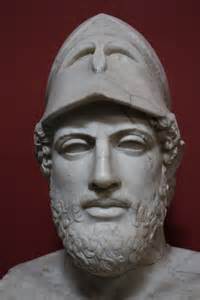
Starr goes to demonstrate that the creation of the much admired political unit of the city-state had at least part of its origins in the desire of the aristocracy to concentrate its power.  Later, asPericles of Athens we know, democracy arose in many Greek city-states, a tribute to the aforementioned flexibility.  But many Greek democracies still had their aristocratic imprint.  The outstanding reformer Pericles made Athens more democratic while definitely living and fashioning himself as an aristocrat, and not as a “man of the people.” His bust makes this clear.

All good things come to end, and the Greek system had played itself out by the time of Alexander, who had little trouble putting it to rest.  Still, all in all, a good run by any measure, one too that makes sense in some clearly defined stages.

In light of Greek history and our own, I offer some some highly speculative thoughts . . .

Theory 1

Since early colonization America has gone through several iterations:

  • Colonial America – 1600-1756
  • Revolutionary America – 1756-1828
  • Jacksonian America – 1828-1860
  • Progressive America – 1860-1929
  • New Deal America – 1929-1965
  • Global Power America – 1965-2001
  • ???

Obviously some of these dates can be disputed and overlap.  Basically, Theory 1 asserts that because America has been rooted in ideas and not culture/tradition, we subject ourselves to significant shifts every 2-3 generations (the first phase doesn’t really count, as we had no concept of an American “nation” until the mid 1700’s).  We can reinterpret our common language on the fly and create “new Americas” every so often–though of course each era has some connections to past eras.  This ability has its strengths and weaknesses.

This theory, if true, may comfort us now because the the shifting ground beneath our feet will settle again as it has for previous generations.  We’ve done this before, we can do it again.

Theory 2 . . .

proposes more unity for the majority of American history.  Yes, some cultural and political shifts happened over time.  But we consistently maintained faith in the democratic process, and in our reason for being.  Even in the Civil War, the Confederacy broke away not out of a rejection of the American ideal, but out of a belief that they represented the true America.  We had “confidence,” that crucial element of any civilization, even in the midst of our most profound domestic crisis.

But something significant happened in 1965.**  In this year we passed the Voting Rights Act, which could be viewed as the apotheosis of what America was supposed to be.  In this year also we dramatically increased our involvement in Vietnam, again, in some ways I think, out of a belief that this was what we were “supposed” to do.  We increased our troop presence initially at least with the general backing of Congress and the population at large.

However, almost immediately after we passed the Voting Rights Act the riots in America’s cities began.  Rioting continued sporadically in many major cities for the next few years.  Perhaps this was pure coincidence, but I think not, though I would not claim to really understand the reasons for the violence.  But I think that part of the reason might be an intuition that we had “done all we could do,” but that it wasn’t enough.  The supreme confidence we had in our democratic way of life taught us that things would always improve, but now we knew better.  Shortly after our troop surge in Vietnam waves of self-doubt began surging through the country.

The two phenomena are likely connected, though I’m not sure how.

Along with this, the counter-culture “hippie” movement went mainstream into popular culture and eventually most of academia.  Western icons like the Beatles went to India to learn see the world in a non-western way.  We lost confidence in our own culture, and we have not regained it.    We had never agreed fully on the why we did what we did, but we had agreed on what we did.  After this era we could no longer claim this for ourselves, and this makes the modern shift much different than others in our history.  The lack of political flexibility may have hastened the at least seeming collapse of the principles that guided us.  Some of the “vomiting up” of our past in some areas of our culture seems willfully self-induced.^

Recently The Guardian ran a great article about Tory MP Rory Stewart.  Stewart got a great education and attempted on two occasions to serve in difficult postings in Iraq and Afghanistan.  His comments say much about the state of the western world:

Ten years ago he would have listed 10 things Afghanistan needed to build a new state: rule of law, financial administration, civil administration and so on. “And, then you would say, well, how do you do that? Well, I’d say, by a mapping of internal and external stakeholders, definition of critical tasks – all this jargon talk. And I’ve only now just begun to realise these words are nonsense words. I mean, they have no content at all. We should be ashamed to even use them.”

They are nothing more, Stewart now acknowledges, than tautologies. “They pretend to be a plan, but they’re actually just a description of an absence. Saying ‘What we need is security, and what we need to do is eliminate corruption’ is just another way of saying: ‘It’s really dangerous and corrupt.’ None of that actually tells you how it’s done.”

And later,

In some sense I’m a romantic. I like the idea of organic history and tradition. But I think Britain is such a different place now, and changing so quickly, that I’m coming slowly, painfully, to accept that we need to start again.

I emphasize that these comments come not from a reactionary revisionist Liberal, but a member of England’s conservative party.

If we agree that we need to “start again,” in some way, will we agree on where to start from, and where we wish to go?

Dave

For anyone interested in further thoughts on America’s political culture, check out The Grumpy Old Man podcast with Audrey and Emily here.

*My apologies, I have looked back and forth for this comment and cannot find it again to save my life.

**A possible counter-date might be the end of W.W. II.  As Arnold Toynbee regretfully admitted, democracies are not well-equipped to handle something like nuclear weapons, though, so far no horrifying apocalypse.

^Trump gets rightly accused for excessive negativity, but why does no one focus on the obvious negativity from the Left?  Here is Clive Crook, via Marginal Revolution . . . 

Trump’s critics complain about his relentless invoking of crisis — despite agreeing with him that the system is collapsing. Conservatives keep telling us that the American project is in mortal danger, that liberty itself is at stake. Liberals keep telling us that global capitalism is wrecking everything that’s decent in society, that the U.S. is institutionally racist, and America’s traditional values are so much hypocrisy. I think back to the rapturous reception accorded by the left in 2014 to Thomas Piketty’s “Capital,” which argued, you may recall, that capitalism is an engine of injustice, headed for self-destruction; progressives everywhere nodded wisely in agreement. Here’s what puzzles many of them today: Why does Trump have to be so negative?

Finding a Medium

Some of you may have familiarity with the show “Hoarders.” In each episode a person who has collected way too much stuff has an intervention team come and try and get them to get rid of stuff and reclaim sanity in their lives. I avoid shows like this but others in my family occasionally dabble, so I have a mild familiarity with it. I have always assumed that such people had a kind of emotional or social block of sorts. But I think differently after listening to Malcolm Gladwell’s Revisionist History episode on art galleries.

In part of the episode he interviews people who knew famous hoarders, and they revealed that, in fact, the hoarders had an exceedingly heightened emotional connection with their possessions (this makes sense, I should have recognized this before). Each item was connected with an intense memory, and they needed the object to connect to that memory. For them, no object=no memory, which meant a loss of self identity.

It struck me that the real issue with hoarders involved not just a crass materialism, but more fundamentally, their inability to rightly “symbolize” their experience. We tend to think of symbols as stand-in’s for reality, as something less than real. But actually symbols are a form of heightened reality, a concentrated reality, akin to myths or folklore. Most of us do keep some things from our past. But we concentrate a diffuse set of memories into one object, i.e., this shell unlocks our beach memories, or this hat accesses my experience with my grandfather. We don’t need 30 shells and 17 hats to do this.

But not just any object can serve as a symbol. As forms of heightened reality, symbols have to unlock complexity. A proper symbol will have many layers, like an onion. In turn, this helps explain why religions utilize so many symbols. In his episode about art galleries, Gladwell compared hoarders to dragons of western folklore. Dragons collect treasure not to spend it but simply to have. They live in caves, and their absolute focus on wealth shows them as overtly and dangerously “of the earth.” Dragons have a chaotic biology and function–they bring chaos wherever they go. Their exclusively earthly mindset essentially means that they cannot symbolize.

Most every religion has holy mountains in its sacred texts or myth. We probably assume this is because that mountains exude awe and power. But mountains in their physical structure also represent the one and the many. At the bottom is breadth and the ‘individuality’ of things. As we move up the mountain, our experience become more “concentrated,” and of course the summit brings unity to our experience.

Someone too earthly focused will stay on the bottom of the mountain, seeing only one thing after another thing, after another–a form of chaos. Reside only on the peak and you miss the individuality of things and can hyper-focus on their unity.

Be that as it may, when we see symbolism on a grand scale we should assume that we observe a religious activity.

Currently we witness a plethora of symbolic activity, from sloganeering to mask wearing/not mask wearing. It is no surprise that a great deal of this symbolism has seeped into sports. Sports have always had ritual elements involved, but it seems that such ritualization has ballooned over the last few years, especially in the NBA and perhaps in the NFL. Of course there are the pre-game rituals athletes and fans engage in. The post-game press conference ritual is another. But now, even entering the arena from the bus, the slow saunter down the hall, has taken on the weight of ritual, as athletes seek to market themselves, the products they endorse, their kids, or what have you.

To me, a breaking point surely seems near.

Let us take the question of the national anthem. What has a collective expression of patriotism have to do with sports? The fact that many of us feel some need to do this goes beyond societal conditioning. I think we subconsciously realize that we are engaging in a collective ritual and know that it needs solemnized. With this in mind, a few theories emerge:

Theory 1

It is good and right that we ritualize sports and solemnize sports with the anthem. Obviously we are a pluralistic country and so we are not going to sing a hymn. But, we can sing the national ‘hymn’/anthem. This brings us together, unifying the home team and the “enemy”/away team with the crowd. The spectacle then belongs to all of us. Players have an obligation, as the enactors of the ritual, to stand at attention at least.

In church, for example, not everyone in the congregation will sing along. Some may stand silently, some will look at their phones. But what would happen to the church if instead of singing along, the pastor looked at his phone, or . . . protested the singing of the song. That church could not last long. So . . . athletes, this is your chosen profession, and the duty of respecting the ritual comes with it.

Theory 2

Mark Cuban defended players kneeling for the anthem recently by asking a fan, “How would you like it if they played the anthem every day that you came to work?”–a thoughtful rebuke. For, of course, we wouldn’t like it at all. Such repetition would feel oppressive. Athletes should maintain their individuality and have the same rights as anyone else, which includes freedom of speech. If we force them to engage in the ritual, we must also allow them all of their rights under the Constitution to protest the government, a particular law, or anything else they wish.

The problem with Theory 1 is that it inveighs sports and the athletes with a symbolic weight that they cannot carry. Theory 1 attitudes will bring about Theory 2 behavior as a natural reaction. The players at some point rightly rebel under the burden. The Problem with Theory 2 is that it sets up an oppositional relationship with those that make their lives possible, with the fans that “pay their salaries.” Neither theory can sustain itself for long. So, I offer

Theory 3

I argue that we rightly attach important rituals to sports, but that we have gone too far with them, and that players, fans, and media alike share the blame. Player salaries, lifestyle, and the powerful voice that comes with fame and fortune cannot happen without media and fans. Yet, nearly every media duty is onerous and pointless. Reporters usually ask dumb questions, and when they ask good ones, players fear speaking honestly, knowing that their every word will be dissected by millions. Yet much of the money leagues make comes from media rights. You can’t bite the hand that feeds you.

Fans can create impossible standards for athletes. We want the bland media rituals perfectly enacted. Athletes look like they have fun playing the game, as they should. Who ever had fun at a press conference? Fans will also damage the souls of athletes by completely overlooking anything and everything–their behavior and education, to pick two examples–provided that they can beautifully enact on the field rituals of play.

Many athletes, perhaps especially in the NBA, go to great lengths, however, to create cardboard images of cool, and to thereby become a kind of Greek god, whose power, both cultural and physical, is worshipped. Then, they turn on those that worship them. Fans are understandably confused, for many players seek outsized attention, then spurn the peons who give it.

But the solution is not to remove rituals from sports. Athletics precede drama historically, but when drama started with the Greeks, it emerged from Dionysian worship. The “ecstasy” associated with acting and the stage–the “out of body” experience–is akin to a great athlete transcending normal physical limitations. Perhaps this is why we give god-like attention both movie and sports stars. There is indeed a communal beauty involved in most sports, but this needs translated via ritual for communal consumption. Confuse the ritual, and something will indeed be lost in translation.

But this beauty, because of its transcendence, cannot be confined to the purely national. And though we long to worship beauty, we have to inject levity back into sports to put them into proper perspective again. So I propose (finally–sorry for the very long prologue!) the following:

  • The national anthem will not be played before sporting events. Rather, a team song (akin to a fight song for high schools and colleges) can be played when the team takes the field. If you don’t have a fight song for your team–time to get one.
  • Post- game press conferences will no longer be mandatory. If an athlete wants to participate, great, but no fines for those that don’t want to.
  • Athletes need to live in the town of the team they play for. They need to be seen by the communities that support them. This used to be the case more or less everywhere, and I think this is healthy for all sides. If people know the athletes as normal people, the athletes may feel less need to fight back against the weight of their symbolic identity.

The first suggestion could be easily implemented. The second would be a bit harder, the third should not be enforced, obviously. Restructuring sports media would likely make profits and salaries decrease slightly. Sure, things would change, but the change would allow us to remain the same.

A friend of mine in the telecommunications field in a recent conversation talked about the priority of their company. Amidst changing consumer demands, changing cultural priorities, and so forth, the number one goal is always to maintain the reliability of their network platform. Without that, nothing else really matters because nothing else could take place without a reliable network. Let athletes say whatever they would like on their own time, he argued, but don’t tamper with the rituals that give you the prominence to spread your ideas. I think our sports culture, from owners down to the casual fan, needs to come up with a way to maintain a viable baseline platform of connection to fans. That might involve risk to players in the COVID era, changing expectations from fans and media, and possibly, as suggested above, introducing slightly new rituals.

All of this might restore a new normal and a proper symbolism associated with sports, the “medium” we seek.

I have spoken of sports here, but teachers–my profession–are playing the same dangerous game as sports leagues. In ‘Teacher Mythology’ you find phrases such as “It’s all about the students,” “Going all-out for a better future for the students,” etc. Some of this is gooey nonsense, some of it has a semblance of truth. Teachers are not wealthy but they enjoy a general sense of respect in the community for their profession–a respect based on shared trust in this mythology.

With many public sector teacher unions declaring that they will only teach online (this is not true of many private schools), they greatly endanger this mythology. Certainly some teachers may be at genuine risk, but this should be dealt with separately. All of the evidence suggests that kids need to be at school. By focusing exclusively on their physical well-being and refusing to take reasonable risks for their students, public school teachers rapidly dismantle the pedestal upon which they stand.

My advice to athletes and teachers alike–you can stand on the mountain peak, but don’t forget that underneath you lies tons of rock.

Dave

Zombie Markets in Everything

This post’s title, of course, has its origins with Tyler Cowen . . .

It seems as if we are living in a tale of two cities. It is the best and worst of times. One the one hand, the economy is great, and unemployment is way down. Public intelllectuals like Steven Pinker proclaim that, however bad things may be in certain segments of life, all the most important indicators show remarkable growth and progress, such as a sharp decline in infant mortality. Momentary trends may not always look favorable, but the arc of the last 300 years shows a continual rise in progress thanks to science and the application of reason. The complaining and angst so prevalent in the media, then, resembles that of a spoiled child. If we could all just calm down and count our blessings . . .

But others like Jordan Peterson, John Vervacke, and Jonathan Pageau state that western civilization exists by a thin thread in the midst of a deep meaning crisis–a crisis that perhaps hits men harder than women. Rates of anxiety, depression, and suicide have risen dramatically over the last 20 years. I think Vervacke would tell Pinker that he sees only a fragmented surface. I suppose Pinker and others like him would say such people are fundamentally deluded.

Chronologically we have mirror images from both camps. Pinker and his crowd write that starting around AD 1700, the Enlightenment took hold and over the next few centuries the world became a dramatically better place. But for those on the other side, the Enlightenment disastrously contributed to all the problems we have now in relation to meaning and knowing our place in the world (though others would go further back still, into the Renaissance).

Most would say one or the other is true, and you have to choose. Below I propose a theory that will attempt a “both-and” explanation–a highly speculative one–that will attempt to explain how the economy can grow and life can improve in various measurable ways and we can still struggle with meaning. In fact, the two may have a symbiotic relationship.

The perception of a current meaning crisis has led to the dramatic recent rise of the psychologist as guru, i.e., Jordan Peterson. John Vervacke has less fame, and popularizes less than Peterson (I do not use the term ‘popularizes’ derogatorily). His analysis goes deeper, and his co-authored book Zombies in Western Culture: A Twenty-First Century Crisis gives a slightly sideways but effective analysis of modern culture. Vervacke et. al do not blame the right or the left, campus ideology, or Trumpism, for the decay. “Decay” is indeed the right word, for zombies are decomposed beings of some undefinable kind. Our modern disease has infected most all of us to some degree.

Each era has its monsters that help define its zeitgeist. As the Enlightenment settled across western Europe, and scientific materialism began to entrench itself as the dominant ideology, Mary Shelley wrote Frankenstein, which explores the limits of man’s powers over nature. The monster in the book of course, is not the “Monster” but Dr. Frankenstein, it’s creator. A few decades later we have Bram Stoker’s Dracula. In the Victorian era, the aristocracy still exists, but exists in a weird place in society given the nascent rise of democratic ideals. Everyone perhaps feels in their bones that the aristocracy no longer serve a real purpose, isolated as they are within a culture that no longer needs them. One notes that, in contrast with pre-modern Europe, in the modern age the monster is a twisted human, though perhaps still a kind of tragically grand monster. That is, at least there exists some kind of high aspiration for a Dr. Frankenstein or Count Dracula.

Vervacke argues that the zombie is the monster for the 21st century, and the graph below shows the dramatic increase of the word in the popular culture just recently, just as the Cold War ended.

Zombies have the following characteristics:

  • They move in packs, but have no connection to one another
  • They have no particular intent–they exercise no conscious will towards evil.
  • They live only to consume, and their hunger to consume cannot be satiated or even lessened.
  • Constantly on the move, they have no home base or concept of home.

In other words, they form the perfect monster for the democratic age.

The zombie personifies our crisis of meaning. The internet, globalization, etc. means we can indeed consume as we like virtually for free, but though we like to sing along, we “know not what it means.”* The market also thrives on fluidity and movement. It is best for everybody to give everybody else money, for example, rather than everybody put it under their mattress, even if that consumption has no real overall purpose or goal in mind.

So too the market of information thrives on abundance and transfer. But like zombies, we both crave and lack Mind, and so have no way to integrate our experience into a meaningful whole. Vervacke writes regarding this,

This is because the information we obtain from the world has never been more unreliable. Abundance is one dimension of the problem; one need look no further than news media to appreciate the sheer volume of (often irreconcilable) narratives.

And again,

Humans are animals who most fundamentally understand what reality is . . . by locating ourselves within larger narratives and meta narratives that we hear and tell . . . When such narratives collapse, we are lost in the dislocation, fragmentation, and disorientation of homelessness.

So far so good, but what of the other side of the coin, i.e., a strong economy, less violence worldwide, and so on? Vervacke gives us the link. If truly we are the “walking dead,” then lacking mind and the means to integrate our experience, we would naturally seek expansive consumption as a means of coping. This consumption is a byproduct of all of the intense focus on the material aspects of creation fostered in western culture during the time period Pinker cites. It indeed brought great blessings of a certain kind, but it could possibly be nearing the end of its string.

Of course all humanity throughout all time has sought some sort of solution for a lack of understanding of the self. But our typical response is indeed to consume. We are depressed, we might go shopping. We are anxious, we “stress-eat.” We are out of sorts, we might consume information by browsing Facebook or news feeds. Such actions can distract us for a time, but also creates an unsustainable cycle. It is this drive to consume that makes solving certain environmental problems so difficult for all of us, whether Green or not so Green. The “peace” of the modern world championed by Steven Pinker has in some ways brought this out of us.

In contrast [to times of war], in times of relative peace, internal issues become more focal and so the opportunity for a relative loss of social integration is greater, hence the increase in the suicide rate.

This antipathy to peace can lead to increased participation in what the authors call the “pseudo-religion” of politics. Politics gives us much that religion provides.

As politics is, by necessity of governance naturally integrative of other systems, it was a proximal replacement for [meaning]. . . . systematic complexity made [politics] a convincing imitator of that normatively as the influence of religion diminished. The 20th century, therefore, bore witness to the rise of the most potent political pseudo-religion we have known in the modern world.

We risk ending the “peace” we have then, by feeding upon our own body politic, unable to stop our consumption of so called “outrage porn.” specialized in by Twitter and news media of all kinds. We can see this process of disintegration at work since the time of the vampire as monster. First, modernism deconstructed the church, and told us that it could no longer function as a means of communal coherence. “Religion should be private.” We then expected the state could serve that purpose, and so we developed various rituals around the symbols of the idea of nationhood. By the mid-20th century, we saw the folly of that project, but no fear–we can rally around our freedom to consume. So we built malls, accurately described by James K. Smith as spaces constructed for liturgical communal consumption.** But this no longer holds either. Now, like zombies, we roam the internet to consume, with no defined space to bind us.

In the old tales, the hero slays the dragon, but Vervacke points out that our zombie stories offer little hope. The plague always seems to grow, and those that survive will be continuously on the run. Rebuilding something new in these scenarios becomes extremely difficult. Patrick Deneen, for example, has a persuasive critique of the whole modern enterprise in Why Liberalism Failed. He blames progressives and conservatives nearly equally but offers no alternative political reality to which we can aspire. Slightly more hopeful is Rod Dreher, whose The Benedict Option, while giving no grand solution, at least points us towards embodied liturgical relationships with others as a good beginning.

With a quick search I found one place in our culture where a cure for zombies is possible: Minecraft. I find it charming that such a thing exists within this relatively benign (I dislike video games) world building enterprise, and that even many teens still play this game. It is interesting to see how they use traditional archetypes for this cure. Among other things needed to cure local villagers from being a zombie is dragon’s breath. In other words, the monster may be the only hope for the monster. Jonathan Pageau has often talked about how once a culture reaches the outer limits of the fringe, it takes just a small tap for everything to come right round again. The clown, or the fool, or perhaps even the monster is needed to make things right. It may be that if we are indeed in such a dark place, dawn is not far behind.

Dave

*Those my age, or fans of the music of early 90’s music, will recognize the Nirvana reference. In retrospect grunge music might be seen as a harbinger of the meaning crisis. How is it that right after winning the Cold War, when we should have celebrated and entered something of a golden age, we plunged ourselves into music that fundamentally celebrated alienation?

**We need not absolutely throw the baby out with the bathwater. National symbols and national identity can do us good. Market exchanges often benefit both parties. The problem is putting a weight on such things that they cannot bear. The only way they can bear the load of culture for long is to give them a kind of steroid. Of course one recalls the specter of the early 20th century regarding the problems of nationality. I also remember post-9/11 how we were all encouraged to keep spending so the terrorists would not win. It can work for a while, but the body gives out eventually.

Time vs. Space Redux

Whether the conversations be thoughtful or awkward, Thanksgiving seems to be a time to think about the times we live in with our families. About a month ago I tried to think about our culture in deeper terms than merely red state vs. blue state, taxes, immigration, and so on. I think what’s plaguing us runs deeper (I base what follows on my previous post on this topic, which is here), though what follows should be seen as a thought experiment more so than anything definitive.

In that previous post I suggested that what might be “proper” tension between Time and Space could vary depending on the culture. So Egypt leaned heavily toward Space, Babylon towards Time, but both civilizations could be considered “great” in different ways. I have only scratched their respective surfaces, but if one reads their mythology and folklore I think we see that they both had some awareness of this necessary tension. My point previously was that we lack even this basic awareness and need to recast our thinking in order to understand our culture more fully.

The problem is not that we contain contradictions within ourselves. We overpraise consistency in most cases. We need the fluidity of Time and the stability of Space in some measure–a society built 100% on either reality would be both an absurdity and an impossibility. One can be 2-1 in favor of space, or 3-2 in favor of time. I think that our issue is, rather, that our different political sides embrace 100% of both without even realizing it. Our political choices then, border on the non-sensical and thus can only go into more subconscious symbolic realms.*

On the Left Time/Fluidity Scale:

  • Open borders–which makes the capital and labor maximally fluid
  • LGBT agendas (which often involve the erosion of the “fixed” state of nature and biology)
  • Maximal “Equality” for men/women (which includes strong pro-choice stances–“safe, legal, and rare” won’t cut it any more), which flatten out distinctions and traditions.

On the Right Time/Fluidity Scale:

  • Free market and free trade (few forces are more destabilizing to tradition, be it good or bad, then the free market, so though I apologize that I can only think of one example for the right, it is a really big one:).

On the Left Space/Stability Scale:

  • Higher minimum wage laws, which restricts the flow of free labor, along with a penchant for corporate regulation.
  • Safe spaces and tight restrictions on what can be said so that the “communal identity” might be preserved

On the Right Space/Stability Scale:

  • Build a wall, protect our borders
  • I don’t see a strident nationalism in the U.S. as a huge problem, but if it came it would certainly come from the right

Again, it is one thing to hold positions in some kind of balance, it is another to hold them maximally in different areas without even being aware of the contradictions.

Once we see that our differences run into mutually contradictory realms, we naturally look for who or what to blame for our predicament. Some say the iPhone, the internet, the 2008 stock market crash, identity politics, the War in Iraq, Newt Gingrich, and so on. But I think we have to go further back. If there is any consolation for us, I don’t think millennials, Get-X’ers, or Boomers started all this.

Perhaps we can begin with the Enlightenment. The Enlightenment valued (at least at the beginning) common things for common people. That era valued self-control of body and emotions. So far they lean heavily on the side of Stability/Space. But at the same time they gave strong preference to syllogistic reason, the province of the mind and the elite. Jefferson, Rousseau and others also propounded the most universal ideas (which have no boundaries) in the modern era–“all men are created equal,” and “the rights of man,” from the French Revolution, and so on. It is no wonder that the French Revolution swung so wildly so quickly.

Then we have the Romantic era. On the one hand, they praised emotion which put them heavily on the side of Time/Fluidity. But at the same time the Romantic movement gave birth to the modern recovery of folklore, fairy tales, and a kind of ethno-nationalism seen in Wagner, among others, all of which strongly favor Space/Stability.

The dramatic tension in the Romantic movement has a touchstone example in England’s empire. They spread throughout the globe (Time) but also sought to bring England’s culture (Space) everywhere they went. Such tension might very well produce something of a “schism in the soul” that Toynbee often wrote about.

In W.W. II both of the major Axis powers (Germany and Japan) sought to mimic the British in far, far more hideous ways.

  • Both Germany and Japan were strong ethno-nationalist states, yet both sought a significant increase of their territorial reach.
  • Both had strongly hierarchical views of authority (Space), but their military strategies strongly favored continual motion and speed (observe how Hitler took the traditional swastika image and pivoted it to give the impression of continuous forward motion. The problem being, of course, is that the swastika shape cannot “move.” It could not spin or roll forward. Thus, the inherent contradictions of Nazism were present right within its foremost symbol).
  • I believe that both countries perhaps subconsciously pursued impossible objectives that could only end in cataclysmic defeat–the kind of destruction that can come only with a violent clash of two opposing forces (I write a bit about this here).

In our own land we have struggled with the same dichotomies. Our blended form of government gets somewhat near a political balance of Time & Space. But in truth, we have no truly conservative tradition outside of democracy to call upon, which can lead to excess fluidity of the liberal democratic tradition. We have a strong sense of land (stability) being tied to liberty (fluidity) inherited from Aristotle, Locke, et al. but showed an outsized and continuous desire for more and more land–a quasi schizophrenia between Time and Space. Every political theorist on democracy thought that for it to work it needed contained in a small space–“stability” to balance out the “fluidity” of liberty. We said “no thanks” to that and immediately upon getting our independence, we began rapidly expanding our territory, believing that perhaps everyone else was wrong about this political calculus.

Possibly this can give us some perspective on the current Time/Space war in our culture. If it feels like it is accelerating, it may be because we are entering another election cycle, or perhaps it is the pace of life which our ubiquitous “time-saving” technologies push us towards. But I think too that both political parties contribute to this by jumping into the mosh-pit.

On the ACLU Twitter homepage their banner reads, “Fight for the Country We Want to Live In.” I don’t wish to pick on the ACLU per se–my point likely could have been made with other organizations, though I do fear that they too are becoming overly politicized. The country we “want” to live in? The country I want to live in is an impossible pipe-dream of my own personal fancies.** No one should want me to fight for the country I want to live in. The country I need involves something much more politically feasible–a balance between Time and Space, and left and right. That perhaps, is worth a fight.

Dave

A postscript from the recent British election which may show us how to reduce the tension between Time and Space:

He has done what no other conservative leader in the West has done: He has co-opted and thereby neutered the far right. The reactionary Brexit Party has all but collapsed since Boris took over. Anti-immigration fervor has calmed. The Tories have also moved back to the economic and social center under Johnson’s leadership. And there is a strategy to this. What Cummings and Johnson believe is that the E.U., far from being an engine for liberal progress, has, through its overreach and hubris, actually become a major cause of the rise of the far right across the Continent. By forcing many very different countries into one increasingly powerful Eurocratic rubric, the E.U. has spawned a nationalist reaction. From Germany and France to Hungary and Poland, the hardest right is gaining. Getting out of the E.U. is, Johnson and Cummings argue, a way to counter and disarm this nationalism and to transform it into a more benign patriotism. Only the Johnson Tories have grasped this, and the Johnson strategy is one every other major democracy should examine.

*By this I mean that we will make our political choices more from our gut and less from our head. This will likely give an advantage to Trump, who seems quite comfortable governing from his gut impulses.

**Growing up I swore that if I ever became King of the U.S.A., I would first and foremost make it illegal for bands to release a “Greatest Hits” album with one new song on it–something routinely done in the 80’s and 90’s. The internet has fortunately solved this for me, but in so doing it did take away what was to be a major plank in my policy platform.

Why Classicists should like Pro-Wrestling

If one said that our modern political scene resembled the spectacle of pro-wrestling, few might object to the statement. Indeed, I have never cared much for following the daily grind of politics, but I can see how it matters–even though I think many vastly overrate it. But I have never understood why anyone would like pro-wrestling. If we all know that it is essentially staged, and “fake,” why bother? The theater of it all is so obvious, yet people react to it so strongly. So too, our political discourse often seems so often cast in such stark terms, and who can say that this benefits us in any way?

Time for a confession . . . though I teach at a classical school, I have a hard time entering into most Greek drama. Aristophanes is fun, and I feel that I “get” Sophocles to a certain extent. But Euripides, and especially Aeschylus, have always seemed odd and distant. The action, the acting (those masks–how strange they seem to me), and the chorus take on such outsized proportions that the plays seems to offer no avenue to enter into the story. The characters almost become Ideas in awkward human form. Here stands “Rage,” there goes “Justice,” and so on.

But the Greek’s founded western civilization. They produced spectacular achievements in philosophy, science, architecture, and the like. So, Greek drama must be “high culture,” on par with these other elements of their civilization . . . ? If the Greeks are not being “lazy” with their dramatic works, we should consider whether or not “high culture” must always be subtle and refined like the Parthenon.*

In an intriguing essay Roland Barthes writes that,

What is thus displayed for the public [in pro-wrestling] is the great spectacle of Suffering, Defeat, and Justice. Wrestling presents man’s suffering with all the amplification of tragic masks. The wrestler who suffers in a hold which is reputedly cruel offers an excessive portrayal of Suffering. . . . This is why all the actions which produce suffering are particularly spectacular . . . Suffering which appeared without intelligible cause would not be understood. . . . suffering appears as inflicted with emphasis and conviction, for everyone must see not only that he suffers, but also and above all understand why he suffers.

. . . There is here the paroxysm of meaning in the style of antiquity, which can only recall the heavily underlined intentions in Roman triumphs.

From Mythologies, pp. 19-21

Leave it to a French intellectual to use the phrase “paroxysm of meaning” when discussing pro-wrestling. But still–here I discovered why so many could know that pro-wrestling is “fake” and still enjoy it. Lots of people enjoy Greek drama too. Barthes writes earlier in the same essay that,

The function of grandiloquence is indeed the same as that of ancient theater, where principle, language, and props (masks and buskins) concurred in the exaggeratedly visible explanation of a Necessity. . . . Each sign in wrestling is therefore endowed with an absolute clarity, since one must always understand everything on the spot. As soon as the opponents enter the ring, the public is overwhelmed with the obviousness of the roles.

Mythologies, pp. 16-17

At least in the Greek plays I have read, the audience clearly did not go to see a “plot twist,” or subtle character analysis. The action unfolds as the audience expects. Even the dilemmas for the characters have a structural rather than internal or personal character. Everything remains on the surface.

Our last four presidents (Clinton, Bush, Obama, Trump), two Democrats and two Republicans, have rarely been subject to shades of grey analysis–especially Obama and most especially Trump.

For many in the print news media at least, Trump has the obvious role of villain. His hair, demeanor, speech, etc. are characterized in outsized terms. His every action must have sinister undertones. Some others see him in outsized heroic terms, even the acclaimed Eric Metaxas (whose biography on Bonhoeffer garnered much acclaim) wrote a children’s book entitled Donald Drains the Swamp, which casts President Trump in a mythically heroic role.

Given these observations, a few options present themselves.

The first could encourage us . . . many have lamented the decline of our discourse evident in increased polarization and lack of critical thinking in the media. But the Greeks did much the same thing with their public “media” in theaters, and they were not barbarians. Maybe we overstate the danger posed by our current discourse, just as cultural critics who lament the existence of pro-wrestling (and probably love Greek drama) should take another look at the various spectacles of our national life.

A problem with this interpretation, however, is that our culture is divided as to who is the villain, and who is the hero. But perhaps the Greeks were more divided than we might think. Just because they had plays doesn’t mean everyone loved them or agreed with their interpretations. Thucydides, for example, gives us plenty of evidence of a divided Athenian body politic.

A more negative interpretation would not focus on the lack of subtlety or nuance in our language, or divisions in our country–serious though they are. What I fear instead is that we don’t express our mythic loves and hates in mythic terms, and this leads to confusion and a lack of stasis in our culture. Our ships pass in the night nearly all the time. That is, we cannot and should not avoid our metaphysical reactions to certain policies or events, but in Greek drama and pro-wrestling, the language and structure is metaphysical, and thus, perfectly clear.

Perhaps our most obvious example of this involves our discussion of immigration. All of our discussions about the economic costs and benefits of increased or decreased immigration do nothing to convince anyone, because they fail to address the deep subtext. Those that favor more immigration really mean to advocate for

  • A world where individual is seen as the key building block of society, and the empowerment of individual choice should triumph group solidarity.
  • Immigrants are often seen as the underdogs, and so more open immigration supports the underdog
  • Having a free market should mean free labor, and the more movement of labor allowed, the healthier and more productive the market will be (which is why libertarians favor more open immigration).

Those who seek more restrictions on immigration really seek to

  • Prioritize the concept of a ‘national’ or local family’ and culture over that of the individual.**
  • Put more of a focus on what happens inside our borders than outside (which is why non-interventionists in foreign policy tend towards wanting less immigration).
  • Create a world where law and boundaries have real meaning and are not just arbitrary, i.e. good fences create good neighbors.

So poor has our discourse become on this issue, that both sides have devolved into nearly equally untenable positions: “Build a wall,” or “open borders.” The first option, at least in how it is understood in symbolic terms, proclaims that only a societal core should exist, that virtues such as hospitality cannot exist within that core. The second proclaims that no boundaries have any moral purpose, that borders–be they physical, cultural, or behavioral, have no place in society, despite the fact that every culture since the beginning of time has had them.

As usual, one gains perspective by not by discussing the ‘thing’ in question, but by something related to it. Maybe the next time you disagree with someone on a political issue, maybe try discussing instead whether or not you prefer Hulk Hogan or Ric Flair, and see where that takes you.

Dave

*Another possibility exists, one that I will not explore in depth here, and that is that our division of “high” and “low” culture has no real merit. Or, perhaps the Greeks would have admitted that their drama was “lowbrow,” and we just think it highbrow because it is old.

Going to a Shakespeare play today is quite a “high culture” event most of the time, but Shakespeare has many “low brow” moments in his plays. Of course, one could double back and say that “high” culture needs sprinklings of “low” moments to make it real and tangible, and avoid the danger of pure abstraction.

If we follow the bouncing ball, we might wonder if “low-brow” culture often is more conservative in nature. Or at least, it does not attempt to deconstruct anything.

However we think of these question, I acknowledge that the issue is not as simple as the post above might seem to make it.

A Cronyism Dilemma

A friend of mine related that he had begun to contemplate retirement.  He wanted to teach about another 10 years or so and then thought about opening a small barbershop.  He reasoned that, having spent almost the entirety of his teaching career in one small town, he would hypothetically know a large percentage of the population.  The barber shop need not be a scheme to make his fortune, so much as a pleasant way to stay connected to the townspeople.

He did some research and to his horror discovered that between the mandated schooling, permitting, and licensing requirements forced upon one by Pennsylvania, he would be in the red $20,000 before he plunked down his first rent check on the property.

All this just to have “permission” from the state to cut hair.

He abandoned his retirement plans.

Often we think of regulations as the little guy limiting the power of the big guy.  But sometimes wealthy companies are the ones who favor regulations because they are the only ones who can afford it.  Regulations can serve as a way to limit competition.  This kind of “crony-capitalism” is possibly an extreme example, yet many have noted the vast increases recently in the number of jobs that need state permits, licenses, and so on.  In these polarized political times, this is an issue Republicans and Democrats could unite on.  Republicans could talk about fostering individual initiative.  Democrats could talk about limiting the reach of big corporations.  It’s a win-win for both sides.  One problem is that these regulations come largely at the state level and not the federal level.  Few people pay much attention to state politics anymore (including myself), and so creating pressure for change would require more patience and diligence.

I thought about this issue while reading the “Aristocrats and Semi-Aristocrats” chapter in R.G. Starr’s Economic and Social Growth in Early Greece.  He mentions that the city-state system got its beginnings when aristocrats came together to try and combine their power.  Of course, this same city-state system would eventually significantly limit the power of the aristocracy in Greece.  This seems counter-intuitive. Why did this happen?

Some see an “aristocracy” in the age that Homer describes.  Starr rightly disagrees.  Certainly one can see a social hierarchy in The Iliad, but not I think, an aristocracy in the sense the word usually carries.  True, Odysseus was king of Ithaca and had some men bound to serve him militarily like medieval lords.  Odysseus tried to escape the Trojan War by pretending to be insane.  It was not, however, that fact that he plowed land that gave him away, but that he would not plow over his son.  Odysseus was a farmer in ways that a typical aristocrat never would have dreamed.

By “aristocracy” we mean an established code of behavior and dress that sets one apart from the rest of the population.  Without some kind of population concentration, one cannot have an aristocracy in the truest sense of the word.  This concentration allows for more accentuation of difference.  In Odysseus’ world you have him as king and then everyone else.  But, bring aristocrats together and you can have stratified layers–“Aristocrats and Semi-Aristocrats.”

The initial coming together of aristocrats naturally did increase their power, as Athens’ literally “Draconian” law code evidences (the name comes from an aristocrat named Draco).  But shortly after this apparent victory their power began to erode, eventually ending up with a fairly radical democracy a century and a half after Draco.

Many reasons exist for this shift, I’m sure.  I feel that one of them has to do with the nature of aristocratic stratification.  Distinguishing oneself by birth has never been quite satisfactory in almost any aristocratic society.  Certainly birth alone never quite worked for the Greeks.  Their ideals called for achieving glory for oneself via striving and competition.  Naturally, these aristocrats would seek for allies in this competitive world, even including the “average Joe.”

But be careful, aristocrats.  The average Joe’s outnumber you, and they eventually took over the competition and established the possibility of “arete” for all.  Something similar happened in Rome.  From about 500-200 B.C. an aristocracy largely ran Rome quite effectively by most measures.  Again, the story has complexity, but the aristocracy began to decline when their competitiveness no longer had a foreign outlet.  Their competition against each other naturally led to their enlistment of the commoners for allies.  A vast network of clients & patrons formed.  By the time Octavian triumphed about 100 years after this process began in earnest, the aristocracy had essentially killed themselves off in fratricidal warfare–a war made possible in part by their enlistment of the common man.

We assume that Rome’s emperors continued aristocratic dominance.  But the Emperors, much like the early Roman kings, tended to side with the “people” and rule in their name.  Rome’s aristocracy led the revolution that exiled the Tarquin kings in their early history.  The worst of Rome’s emperors, like Caligula and Nero, did many of their worst deeds to the senatorial class.  Of course many others abused their power in various ways.  Ending the power of the aristocracy meant the creation of, in the end, an even great power.

Such are the dilemmas of politics.

The decline of the Greek aristocracy did not lead to the kind of absolute rule Rome experienced.  But . . . without the healthy tension between democratic and aristocratic ideas that existed in the time of Pericles, Athenian democracy acquired a kind of absolute power of its own in the form of its laws.  The death of Socrates serves as ‘Exhibit A’ of this transition.

For the sake of my friend and many others like him, I hope for an end to crony-capitalism.  As to what power we will need to dislodge it, I cannot say.  As to whether or not the trade-off will be worth it . . . that too we cannot say for sure.

Such are the dilemmas of politics.


Dave


The Definitive Absence

I have always thought, along with C.V. Wedgwood and others, that Charles I got a raw deal in the aftermath of the English Civil War (1642-49). Leaving aside the matter of his personal guilt, I can see no good legal argument for Parliament having the authority to put him to death after their victory. But as many have remarked, as sympathetic a figure as Charles cuts at his trial and the end of his life, one finds it hard to embrace him as king.

In discussing this, many pay attention to the combination of poor decisions, occasional overreaching, ideological and religious foment, and bad luck during his reign. Some perhaps mention that in addition to the above factors, Charles simply lacked the ability to “look the part” of King of England, and this I think gets more to the root of the issue.

But why would this be? Charles had a personal piety and beliefs in tune with the vast majority of his countrymen. His real leadership flaws should not have risen to level of revolution and the loss of his head. After all, he had certain strengths as a leader as well. Something else must have been going on within England, perhaps even on a subconscious level.

A hint lies in the coronation celebrations, or lack thereof, in the reigns of Elizabeth I and the unfortunate Charles. Several accounts exist of Elizabeth’s coronation procession into London, the first from an Italian ambassador:

The houses on the way were all decorated; there being on both sides of the street wooden barricades, on which the merchants and artisans of every trade campe in long black gowns lined with hodds of red and black cloth . . . with all the emblems and banners–it made a very fine show.  Owing to the rain there was much mud, but the people had made preparations, by placing sand and gravel in front of their houses.

[He estimates perhaps 1000 horses in the procession], behind which came the queen, in an open litter, trimmed to the ground in gold brocade.  She herself dressed in royal robe rich in golden color, and over her head a coif of gold. Her crown was plain, with no gold lace, but studded with precious gems.

Another commented,

Onlookers noted, “For in all her passage she did not only shew her most gracious love toward the people in general, but also privately if the baser personages had either offered her any flowers or the like as a sign of their goodwill, she most gently staid her chariot and her their requests.

Thomas Mulcaster [Ass’t to the Lord Mayor of London?] added, “London was showed a most wonderful spectacle of a noble-hearted princess toward her most loving people, and the people’s exceeding comfort in so worthy a sovereign.

Holinshed’s Chronicles notes [I have updated the spelling]

For in all her passage she did not only shew her most gracious love toward all the people in general, but also privately if the baser personages had either offered her grace any flowers or any other sign of their good will, she most gently, to the common rejoicing of all onlookers, staid her chariot and heard their requests.

David Bergeron comments that,

The whole report creates the unmistakable impression that this queen in the golden litter forms very much a part of the action, one of the actors in the pageant, part of the theatrical experience.

English Civic Pageantry, 1558-1642, p. 20

Accounts exist of Elizabeth’s own words:

I thank my Lord Mayor, his brethren, and you all.  And whereas your request is that I should continue your good lady and queen, be ye ensured that I will be as good unto you as ever any queen unto her people.  No will in me can lack, neither do I trust that I lack any power. And persuade yourselves, that for the safety and quietness of you all, I will not spare, if need be, to spend my blood, God thank you all. 

As for Charles’ coronation, we have the following from the Earl of Pembroke, 25 of May, 1626:

My Lord,
Whereas your lordship and the rest of that Court now formerly directed by letters from the right honourable Earl Marshall, to prepare and erect in several places within the city various and sundry pageants for the fuller and more significant expression of your joys upon his Majesty, and his royal consorts intended entrance through your fair city: His Majesty having now allowed his said purpose, and given me Command to signify such to you, it may please your Lordship to take notice therof by these, as also remove the said Pageants, which besides the particular charge they accrue, do choke and hinder the passage of such as in coaches or carriages that have occasion to go up and down.  

Charles’ desire to save money actually was mostly moot, as many of the preparations had already been made for his procession. Workers would still need paid. Perhaps Charles had no knowledge of this, but I think not. Rather, Charles, unlike Elizabeth, could not force himself to go through with the public spectacle of coronation. Perhaps this was his introverted and private personality. Or perhaps his sense of royal dignity was so acute as to be intensely personal, and thus misguided.

Either way . . . Elizabeth clearly understood how to embody what it meant to be queen, and she communicated that understanding in a publicly meaningful way. By meaningful, I mean liturgical. One sees this throughout her reign. She mastered the art of the “royal progress.” Theatrical and symbolic encounters, such as when a child might present her a book and a flower, or a peasant giving her a trowel, or whatever, she made look completely natural and appropriate. This I am convinced is the key difference between Charles and Elizabeth. Charles modeled himself on Elizabeth in certain respects and even in certain laws (i.e., the Ship’s Tax). But it all fell flat. Charles could not embody and transmit the meaning of his kingship effectively to enough of his people.

We see this difference in portraits of the two monarchs. Elizabeth revels in overtly outward display.

To many today she no doubt appears ridiculous. Indeed, it seems that Elizabeth Tudor hardly appears at all. But “Elizabeth I” is in full view, and the English responded to her.

Scouring Google, I think Charles seems to be holding something back in every image I saw.

And . . .

Perhaps those like me feel sympathy for Charles even if we might not like him very much because his portraits reveal something of the man that was Charles Stuart. But where is Charles I?

As for his son Charles II, say what you will, but he certainly knew how to project, both as a young man, and later in life.

The first image might let Charles Stuart Jr. bleed through a little bit, but it is at least a more likeable person than Charles I that we see. As he got older, he learned to be more fully Charles II. Alas for Charles I–during his reign much less religious persecution existed than under Elizabeth, and he certainly had far superior morals than his son, all to no avail. His morally reprobate son was far more popular and effective as king.

I think many miss a central lesson we can draw from Elizabeth and the Stuart kings: if one can’t communicate outwardly the meaning of leadership through symbol and liturgy, then people will be driven inward in the fraught and dangerous realm of ideas and ideology.

In his Myth and Reality Marcel Eliade made an observation about modern art that struck me with great force. He notes the decline of a common symbolic language and forms in the wake of the Reformation, and perhaps especially after the Enlightenment. The lack of a common outward symbolic language–the Enlightenment called such things “superstitions”–leads then to a destruction of a common visual language in the arts. Eliade writes,

Beginning with painting, this destruction of language has spread to the novel, and just recently [writing in 1963] to the theater. In some cases there is a real annihilation of the established artistic universe. Looking at some recent canvases, we get the impression that the artist wished to make a ‘tabula rasa’ of the entire history of painting. There is more than destruction, there is a reversion to chaos . . . *

I found Eliade’s book in turns deeply illuminating and frustrating. But one only needs to think of cubism, dadaism, Jackson Pollack’s work, and some of Picasso as well, to see the force of his statement. Perhaps his greatest insight came with his assertion that the rise of psychotherapy directly accompanied the destruction of forms in the art world. With outward and visible avenues of meaning eliminated, we retreated inward for answers. But Eliade points out rightly that we are still following the mythological tropes. We still seek the lost paradise, (the Romantic movement) we still seek to deal with original sin (for the SJW’s this is ‘prejudicial conduct’), and we still seek the end of history (communists and other utopians). Without the common language, however, our fights will grow only deeper. Without something transcendent outside the system for us to reference, we will have to put all of our eggs into our earthly baskets.

Both Presidents Trump and Obama understand/stood very well, consciously or no, how to embody certain symbolic types. No one much cared how much money Elizabeth spent if she fit the part so well. So too, Mitt Romney could never equal Obama’s symbolic value. If Democrats want to beat Trump, they will need someone who can equal Trump’s archetypal value to the culture, even if it is a different archetype. Presidents Clinton and Reagan also excelled at politically embodying the “meaning of America” for their eras. Whitewater/Lewinsky and Iran-Contra might have sunk other leaders with less symbolic/liturgical footing with the culture at large.

Recently a government sponsored arts festival in Germany ran for a week, with its basic message being that, “European democracy is, and always has been, racist construct based on power and prestige,” later declaring that, “wretchedness is the basis of all art.” Such sentiments have a lot in common with the conspiracy theories of those like Alex Jones. Conservatives like myself who lament such things have to take Eliade’s insight seriously. The German ‘festival’ (which sounds like something from “Sprockets”), Jones, and others testify to the loss of a common narrative, a common language made manifest in the culture we can all adhere to. I am wondering if an Elizabeth I or even a Charles II** might emerge, if not in America, then hopefully somewhere else.

Dave

**Eliade could have mentioned movies as well. Think of all of the grand epic films of the 1950’s, with their oversized sets and out-sized acting. Charlton Heston has something in common with Elizabeth I. In The Magnificent Seven, the inner life of the heroes is not important and not explored. Charles Bronson’s character–rugged individualist that he is–knows he is not the hero. Fast forward a few years to the Guns of Navarone, where David Niven’s character is played with a sense of restraint and knowing detachment (though Peck’s character rebukes him for this). The common forms still hold, but we see possible cracks in the foundation. Just about 10 years after Bronson’s turn in The Magnificent Seven, his (and Donald Sutherland’s) knowing smirks in The Dirty Dozen testify to the imminent collapse of the common forms. Of course in Europe this shift probably happened decades earlier.

Here I do not seek to romanticize the 1950’s or any other previous era. Every time and place has its problems. I just seek to point out the differences.

**For the record, I have no great love for either monarch. Elizabeth persecuted many Catholics, and Charles II would have been hard for me to respect, though I acknowledge he was popular for a reason. What we need is someone like them whom we can rally around not in terms of his policies but as a symbol. Many of the best monarchs understood this intuitively, as thinking “symbolically” was part and parcel of their culture.

The Social Justice Warrior and the Meaning of Creation

Before I write anything I should say that anyone familiar with the ideas of Dr. Jordan Peterson or Jonathan Pagaeu will note their presence all over what follows.  My debt to them is deep in this post.  My thanks to them both.

Some time ago I had fun debating with a colleague about Russia’s move to restrict the freedom’s of Jehovah’s Witnesses.  No western commentator approved the move.  Everyone thought that this added to the examples of how Russia is lurching away from the West, is authoritarian, is evil, and so on.  Even Trump lodged a protest.  Now, while I happen to agree with Russia’s move (or mostly agree), I acknowledge that my position is far from a slam-dunk.

It seems impossible for us to imagine society working without more or less complete freedom of religion.  But, every society up until quite recently, from ancient Egypt down through the Scientific Revolution, limited freedom of religion.  Somehow their societies functioned just fine.  Even here and now we restrict the liberties of Jehovah’s Witnesses in some ways, along with other religions.  Would we give “freedom of religion” to satanists who sacrificed chickens next door?

Anyway, Jehovah’s Witnesses, for example, do not allow for blood transfusions.  When one of their children comes to the hospital needing a transfusion, the state assumes temporary guardianship if the parents refuse to allow for proper treatment.  The child receives a transfusion and lives.  We have no problem with restricting the religious liberties of Jehovah’s Witnesses in this respect.  Russia just takes our approach a bit further. The difference between us is one of degree and not kind.  In fact Russia stated that the blood-transfusion issue particularly bothered them.  Russia may not even have the guardianship laws we do in the U.S., making the possibility of children dying in their hospitals potentially a genuine reality.

The point being, every society has to draw a line somewhere.  Every society must distinguish between order, chaos and the acceptable margin.  Civilization could not exist otherwise.  Maybe Russia has erred in judgment.  But all must acknowledge that freedom has limits, and maybe those limits should have different boundaries in different places depending on the culture and context.  As Peter Augustine Lawler noted, many of those who champion a homogenous amorality concerning religion get quite judgmental regarding “obesity, smoking, alcohol, and seatbelts.”

Every society has a doctrine of creation that flows from their creation story, and this story informs every society in how they will deal with the boundary between order and chaos. Genesis deals with this quite directly and more clearly than any other I have read.  In one chapter we see the following:

  • The existence of a formless void far too vast for us to begin to understand.  We are finite, and cannot comprehend the infinite (some brilliant mathematicians have gone insane trying to do this).  If the vast scope of the created order defies imagination and numbs the mind, how can we begin to understand God Himself?
  • God creating differentiation, separating light from dark, the sea from dry land, plants from animals, and so on.
  • God creating mankind in His own image–differentiating them as male and female–inviting them to participate in this process of dominion and creating differentiation themselves  In chapter 2, for example, we see Adam naming the animals.
  • It is this very order, then, that allows for us to understand our place in the world and begin to know God.

The Mosaic law extends this in a variety of ways.  God called the Israelites to differentiate in the foods they ate, the clothes they wore, and of course, in the God they worshipped.  And yet, sprinkled throughout the Old Testament God gives reminders that the laws He gave and the differentiation he required were not absolute.  One thinks of the visions of Isaiah or Ezekiel, for example.  Often we see God and/or the psalmists tell us that He does not desire sacrifice, but then of course tells us to sacrifice all the same.  David understands this tension perfectly in Psalm 51, one of the most important psalms for the Church.

The Incarnation destroyed some of the old paradigms and created new ones.  Jesus breaks down the differentiation between Jew and Gentile, slave and free.  He destroys the dominion of sin and death.  He creates, or perhaps re-creates, a new kind of humanity.  The “chaos” outside of our categories invaded and transformed the world.  But . . . He still left us with “categories.”  We still have the Apostles as the foundation of the Church (Eph. 2:20), the canon, the liturgy, the bishops, and so on.

In his recent writing and in his numerous interviews, Jonathan Pageau discusses the relationship between the core of society, its margins, and the chaos beyond (the linked article is a fascinating discussion of the role of zombies in our culture, and a look at how the Church has dealt with the core and margin in its iconography).  Every society has a core of values and behaviors that shape culture, social interaction, politics, and so on.  So too each society has people and behavior on the margins, and the realm of nonsense and chaos beyond.  Total devotion to complete order would suffocate us.  If we let anything go at any time you have (to use Pageau’s phrase) “the flood”–a complete absence of differentiation that would destroy us in short order.

Each element has its place.  Generally speaking, the chaos exists as a warning.*  We can’t go there and live.  No one can see the face of God. The margins serve the dual purpose of challenging the core and thereby strengthen it at the same time.  Sometimes the margins penetrate the core and find ways to enlarge it and reshape in a healthy way.  The margin reminds us as well that the order we created is not absolute.  Societies need their margins and need to respond to them.

Not to stereotype too dramatically, but usually the artistic, creative groups in society occupy the margins.  To say this is “where they belong” is no insult.  That is where they are most effective.  We need only think of how certain musicians, comedians, and actors helped with the Civil Rights movement, for example.  But, would we want Picasso or Miles Davis as our congressmen?  What would happen to our arts and music?  Unfortunately at the moment, the margins of society, especially those in favor of radically different understandings of sexuality and gender, seek to become the core via judicial or executive fiat (and not the legislative process), and to enforce the ethics of the margin upon the mainstream.

This flipping of roles will work out badly for everyone.  The margins have no idea how to maintain a stable core–their whole business involves continually exploring new possibilities.  The core, ousted from their traditional role, will serve us very poorly as the prodding margin.  Just imagine a Sousa march as radical, avant-garde culture.  The end result will either result in another flood or a swing toward stifling authoritarianism, just as in France ca. 1791, or Germany in 1933, or perhaps even in Athens in 404 B.C.**

We have lived with democracy too long to see the nose on our face.  We cannot comprehend why others, including Russia, might feel apprehensive about adopting our system and our values wholesale. Democracy has a time-tested ability to plow through core traditions with extreme rapidity.  One need only look at how quickly our sexual ethics have gone from thinking about homosexual rights in the late 1990’s to state mandated speech regarding gender in about 20 years.  Perhaps we might think of democracy akin to an Italian sports car.  A sight to behold, powerful, able to move quickly in any direction.  At the same time, such cars are temperamental, break easily, and shouldn’t be driven by just anyone.

This remarkable adaptivity, however, may save us in the end.  Maybe the margin and the core can trade places rather quickly.  We have gone through transitions in the past and at least mostly righted the ship.  Hopefully soon we’ll have Aristophanes making us laugh again, and we’ll get Brad Lauhaus off the perimeter and back to grabbing rebounds on the low block.  All would be right with the world.

Dave

*I believe it is in Mere Christianity where C.S. Lewis mentions that many atheists or agnostics have no clue what it means to say, “If God would only show Himself plainly to all, then I would believe,” or something to that effect.  Lewis rightly points out that when the playwright steps on stage, the play is over.  God’s full revelation of Himself would overwhelm everything.  There would be no time for “belief.”

**Examples of this abound everywhere, especially on campuses around the country.  Just recently Brandeis University pulled the plug on a play by one of their own students about Lenny Bruce . . . for being too controversial.  Or read what happened to Prof. Bret Weinstein (an acknowledged supporter of Bernie Sanders, and far from a conservative) at Evergreen State University.

Finally, some might say that I contradict myself.  I favor (sort of) Russia putting limits on Jehovah’s Witnesses, while I am critical of those on the left imposing their own limits.  To clarify, I see a difference.

  • The actions of Russia are taken to reinforce their core.  Russia has a tremendously long history, and a religious history very different from our own.  We have a hard time understanding this in America, as we build off an abstract concept of rights divorced from culture, whereas Russia builds first from culture.
  • The actions of the progressive left seek to radically alter the core with ethics and practices from the margin.

Russia’s action may go too far, but fundamentally it changes very little about who they are as a people. Our recent changes are an attempt to radically shift what our core is, and introduces uncertainty about what we should be, which is dangerous to a society.

Machiavelli predicts Hong Kong’s Future

I have not followed the protests in Hong Kong in any way closely, but the role of the city in China strikes me as similar to the role played by St. Petersburg in Russia.  Both cities (especially Hong Kong) have a somewhat artificial history imposed upon it by the west — though Peter the Great himself imposed the west on St. Petersburg.  Both cities lead their respective civilizations in producing western style culture.  Neither city has of yet been able to turn their respective civilizations in a more western leaning direction, but perhaps time will tell.

I read a bit of Josephus recently and saw that the Romans got a foothold in Palestine initially because those the rebelled against Antiochus Epiphanes IV and the Seluecid Empire asked for Rome’s aid.  Asking for Rome’s aid proved akin to casting out one devil so that seven might take its place.  Had the Jews had the chance to read Machiavelli, they might have reconsidered their request.  Machiavelli writes concerning such unequal alliances,

And here it is to be noted that a prince ought to take care never to make an alliance with one more powerful than himself for the purpose of attacking others, unless necessity compels him, as is said above; because if he conquers you are at his discretion, and princes ought to avoid as much as possible being at the discretion of any one (The Prince, Ch. XXI).

We need not imagine Rome accepting this alliance ca. 165 B.C. knowing that 200 years later they would raze Jerusalem under Emperor Vespasian. Rather, it seems to be the way of things that stronger powers almost always subsume the weaker when it suddenly becomes “necessary,” or “convenient.”

The question remain then, which is the stronger, the possible tide of westernization creeping into China largely through Hong Kong, or the rising Chinese nationalism along more traditional and authoritarian lines?

The Guardian weighed in with an essay that argues the future lies with China, not Hong Kong:

Much has changed since 1997. The Chinese economy has grown many times, the standard of living of the Chinese likewise. If you want to access the Chinese market nowadays, why move to Hong Kong when you can go straight to Beijing, Shanghai, Guangzhou, Chengdu and a host of other major cities? Hong Kong has lost its role as the gateway to China. Where previously Hong Kong was China’s unrivalled financial centre, now it is increasingly dwarfed by Shanghai. Until recently, Hong Kong was by far China’s largest port: now it has been surpassed by Shanghai and Shenzhen, and Guangzhou will shortly overtake it.

Two decades ago westerners comprised the bulk of Hong Kong’s tourists, today mainlanders account for the overwhelming majority, many of them rather more wealthy than most Hong Kong Chinese. Likewise, an increasing number of mainlanders have moved to the territory – which is a growing source of resentment. If China needed Hong Kong in an earlier period, this is no longer nearly as true as it was. On the contrary, without China, Hong Kong would be in deep trouble.

Understandably, many Hong Kong Chinese are struggling to come to terms with these new realities. They are experiencing a crisis of identity and a sense of displacement. They know their future is inextricably bound up with China but that is very different from embracing the fact. Yet there is no alternative: China is the future of Hong Kong.

All these issues, in a most complex way, are being played out in the present arguments over universal suffrage. Hong Kong is divided. About half the population support China’s proposals on universal suffrage, either because they think they are a step forward or because they take the pragmatic view that they will happen anyway. The other half is opposed. A relatively small minority of these have never really accepted Chinese sovereignty. Anson Chan, the former head of the civil service under Chris Patten, and Jimmy Lai, a prominent businessman, fall into this category, and so do some of the Democrats. Then there is a much larger group, among them many students, who oppose Beijing’s plans for more idealistic reasons.

One scenario can be immediately discounted. China will not accept the election of a chief executive hostile to Chinese rule. If the present unrest continues, then a conceivable backstop might be to continue indefinitely with the status quo, which, from the point of view of democratic change, both in Hong Kong and China, would be a retrograde step. More likely is that the Chinese government will persist with its proposals, perhaps with minor concessions, and anticipate that the opposition will slowly abate. This remains the most likely scenario.*

At another point the article explains a basic difference of approach between China and the West:

This proposal should be seen in the context of what was a highly innovative – and, to westerners, completely unfamiliar – constitutional approach by the Chinese. The idea of “one country, two systems” under which Hong Kong would maintain its distinctive legal and political system for 50 years. Hong Kong would, in these respects, remain singularly different from the rest of China, while at the same time being subject to Chinese sovereignty. In contrast, the western view has always embraced the principle of “one country, one system” – as, for example, in German unification. But China is more a civilisation-state than a nation-state: historically it would have been impossible to hold together such a vast country without allowing much greater flexibility. Its thinking – “one civilisation, many systems” – was shaped by its very different history.

The United States for the most part adopts this “one country, one system” approach.  In our history it has its roots at least as far back as Lincoln’s “House Divided” speech.  So we end slavery, end segregation, and impose homosexual marriage from our more centralized court system, rather than the more diverse state legislatures, based on this principle.  It has its pro’s and con’s.  But the increasing polarization of the political landscape makes me wonder how long this can continue.  We see cracks in our “one system” approach in the drug laws of Colorado which directly contradict Washington.  If China takes in Hong Kong successfully (and I agree with the article cited above, I think it will.  “Democracy” as an idea doesn’t seem to have the power these days that “China” does), will they model this “one country, two systems” for the world at large successfully?  Could this system provide relief for American democratic practice?

Dave

*If you read the whole article, one detects an unnecessary amount of British imperial guilt throughout.  Maybe England should not have had Hong Kong in the first place, but who would argue that under Mao people in Hong Kong were much better off than those under his control?