History and the Resurrection

Some months ago I picked up the book The Resurrection and Modern Man, by the Patriarch of Antioch Ignatius IV.  I have yet to wrap my head and my heart around even the first 20 pages.  But in light of the fact that Easter has come, I thought a few passages worth quoting:

Let us listen to Him who sits on the throne and declares: “Behold, I make all things new” (Rev. 21:5).  “I make all things new,” is not a program; it is an event, in fact the only Event of history.

We propose to be neither archeologists of Christianity nor sociologists of a revolutionary Chruch: all that is radically outdated.  We must instead be prophets of the New Creation and visionaries of the resurrected Christ.

In Christ death has been overcome, but among those who are of the lineage of the Woman of the Apocalypse, it still has to be definitely conquered (Rev. 12:17).  . . . If we do not take this fact into account, our response to the Word of God will be nothing more than ecclesiastical triumphalism or pathological repentance.  In other words, the New Creation appears in history as a battle against death; it can only be perceived as a paschal drama.

. . . the New Creation is explained not by the past, but by the future.  It is clear that the action of the living God can only be transformative and creative.  . . .Any other god than the Lord is a [dead] god.  And it is high time that our modern consciousness bury him.  This multiform god, who lives in the “old consciousness” of man stands behind man as a mere cause.  This old god dominates, organizes, leads man backwards, and finally alienates him.  There is nothing prophetic about this god; on the contrary he always follows after as the ultimate reason for the unexplainable or as the last recourse for irresponsible people and their actions.  This false transcendence is as old as death itself; it is an idol made by the hands of man and for which man feels a passionate jealousy (Gen. 3).

Irenaeus of Lyon says that we are to “know that He has given us something completely new by giving us Himself, He who had been announced in former times;  He is the new principle of life which was to come, to renew and enliven humanity.”

Wonderful words for a wonderful day, if only I could fully understand them!

Have a blessed Easter,

Dave

Sir Paul’s Secrets to Success

Perhaps Paul McCartney could have been another example in this post.

His new album “Kisses on the Bottom” has occasioned a flurry of attention for the music legend.  I heard his interview with Terry Gross on “Fresh Air” and enjoyed Paul talking about the music he heard growing up, and how his work didn’t seek to escape from the old standards, but build upon them.

He specifically mentioned two of what he called “tricks”  from the old songwriters that he incorporated into the Beatles:

  • Switching from Major to Minor Key, and then Back to Major

The first example he recalled from the Beatles was one of their early hits, “From Me to You.”  The verses are in major — “If there’s anything that you want, if there’s anything I can do,” etc.  But then it switches to minor when he sings, “I’ve got arms that long to hold you, and keep you by my side . . .”

  • Taking a Song Full Circle

McCartney talked about an old standard called, “Cheek to Cheek,” which begins with a theme, leaves it, and returns to it at the end.  He referenced “Here, There, and Everywhere,” and we might add on a grander scale the entire second side of Abbey Road that begins with “You Never Give Me Your Money.”

Of course the Beatles had tremendous success for many reasons, but the fact that they followed Toynbee’s prescription for successful creativity surely played a role.  In the interview McCartney specifically mentioned how they consciously set out not to reject the past, but instead borrowed what they could and put their own spin on it.

And yet, his latest album seems to do exactly what the Beatles did not do, for based on what little I’ve heard, it seems that he tries to recreate the past, not make something new.  Perhaps this is why his new release falls flat, for me at least.

Rooting for Jerry Jones and Dan Snyder?

I’m a Redskins fan.  How can I possibly feel bad for Jerry Jones?  For that matter, how can I root for Dan Snyder?

Recently, Commissioner Roger Godell levied fines against the Cowboys and Redskins for violating salary cap regulations in 2010.  The Redskins will lose $36 million in cap space this year, $10 million for the Cowboys.

Except of course, that there was no salary cap in 2010, and all the contracts tendered by both teams that year had league approval.  Beltway Sports has a good take here, with links to other articles about this issue.

Ah, but wise Godell, declared after the fact that Snyder and Jones violated the principles of competitive balance implied in the terms of the collective bargaining agreement.  So they didn’t actually violate any actual rule, they merely refused to what, salute the “shield” snappily enough?  Snyder and Jones have fallen victim to an ancient legal principle known as,

PRIVILEGIUM

Black’s Law Dictionary defines the term this way:

In Roman law, a special constitution granted the Roman emperor the right to confer on a single person some anomalous or irregular right, or imposed an anomalous or irregular obligation, or inflicted on some single person some anomalous or irregular punishment.  When such privilcyia conferred anomalous rights, they were styled “favorable.”  When they imposed anomalous obligations or irregular punishments, they were styled “odious.”

I think it’s safe to say that Jones and Snyder got the odious kind.

Numerous horrible and amusing stories abound about the worst emperors, but even some of the worst, like Nero, could be erratic in someone’s favor.  In AD 68 Nero competed in the Greek Olympics and entered the chariot race.  He did not even manage to finish, but the Greeks awarded him the prize for most outstanding rider in the competition.  In gratitude, Nero absolved all of Greece from tributary taxes.

No fools, those Greeks.

More often than not it worked the other way, like when Caligula made looking down at his bald head a capital offense, or when Tiberius made breathing wrong treasonous (yes — the Tiberius example exaggerates a little).

Both Snyder and Jones are easy to root against.  We must restrain our impulse in this case, especially if we realize that

  • The league said yes to the all their 2010 contracts
  • Now the league says, “You should have known that yes meant no.”
  • For not knowing that yes means no, we restrict your right to spend your money as you see fit according to the agreed upon rules for this year.

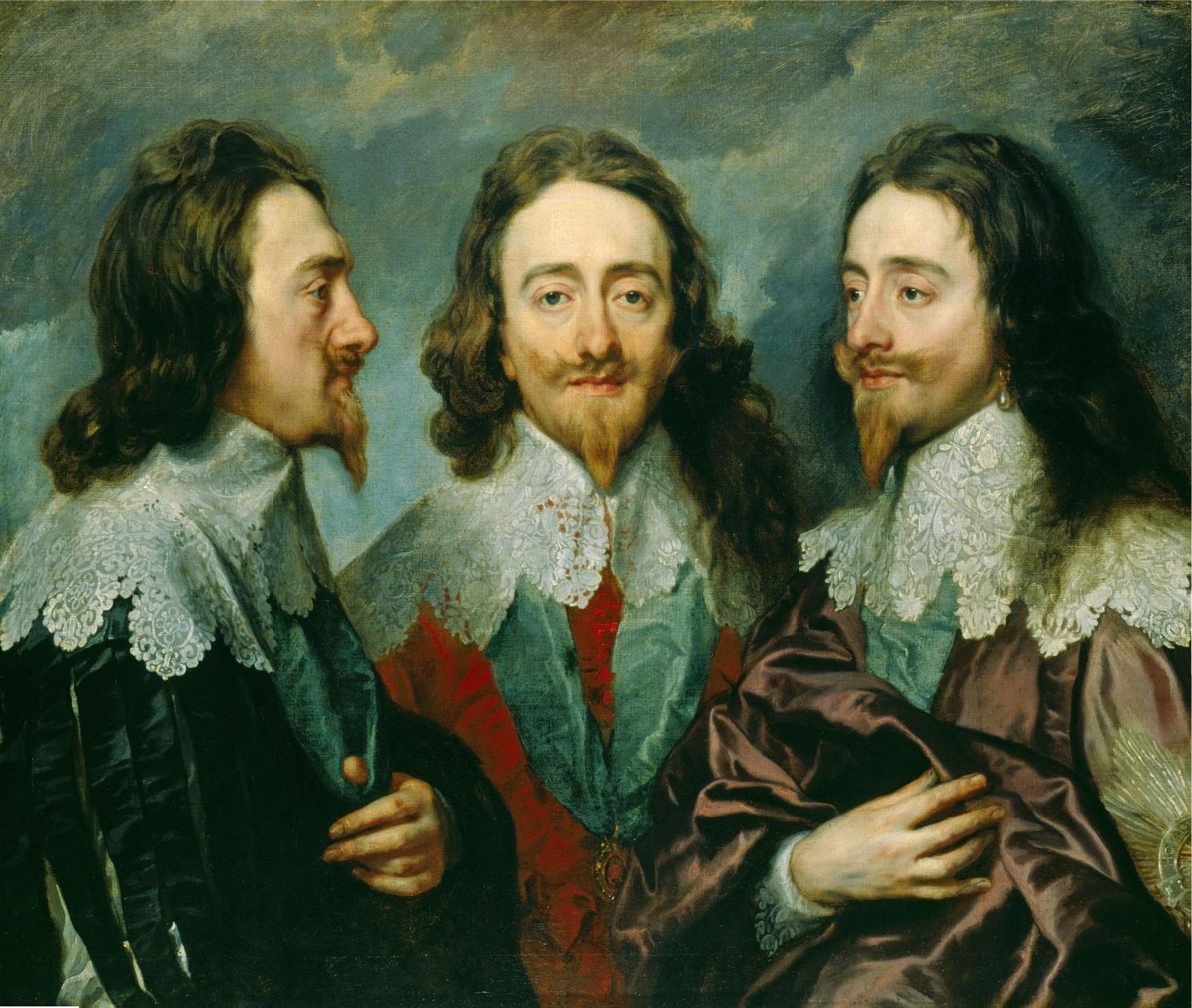
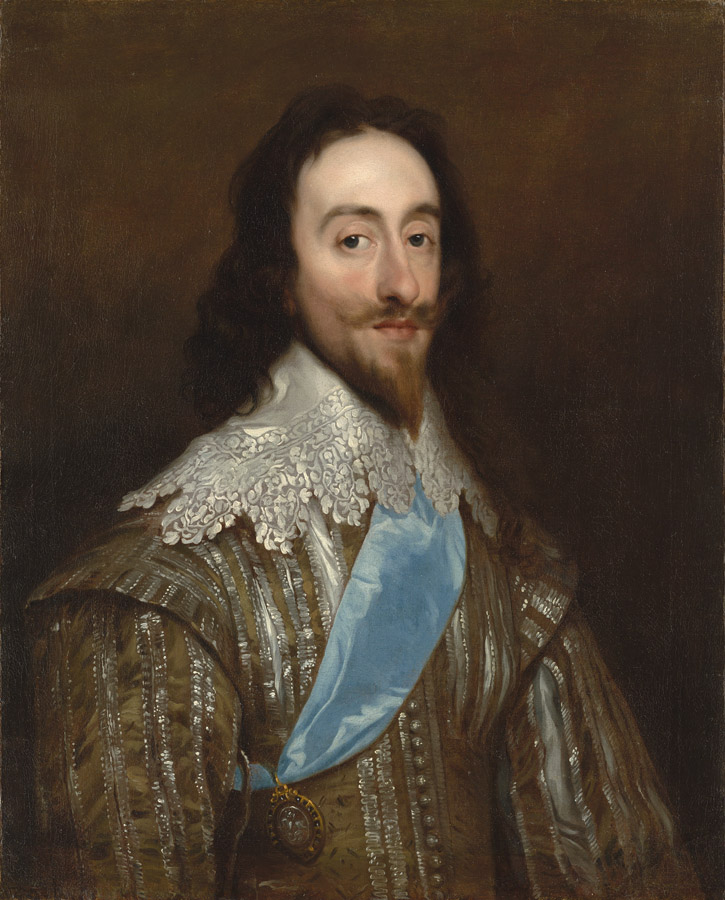
The case reminds me a bit of the trial of Charles I, another monarch easy to dislike.  He had haughtiness down pat, as you can see here:

Or here:

Through various high-handed measures he alienated much of the country and provoked a civil war.  After his defeat, Parliament put him on trial.  By law, Parliament could hear treason cases, but the problem for Parliament was that Parliament wasn’t really there.  The army had gotten rid of most of Parliament’s elected representatives, and the entire House of Lords for ideological reasons.  Seeing the writing on the wall, Charles refused to recognize the court’s legitimacy and did not even enter a plea.  With rare insight, he stated to the so-called court,

I would know by what power I am called hither … I would know by what authority, I mean lawful; there are many unlawful authorities in the world; thieves and robbers by the high-ways … Remember, I am your King, your lawful King, and what sins you bring upon your heads, and the judgement of God upon this land. Think well upon it, I say, think well upon it, before you go further from one sin to a greater … I have a trust committed to me by God, by old and lawful descent, I will not betray it, to answer a new unlawful authority; therefore resolve me that, and you shall hear more of me.

I do stand more for the liberty of my people, than any here that come to be my pretended judges … I do not come here as submitting to the Court. I will stand as much for the privilege of the House of Commons, rightly understood, as any man here whatsoever: I see no House of Lords here, that may constitute a Parliament … Let me see a legal authority warranted by the Word of God, the Scriptures, or warranted by the constitutions of the Kingdom, and I will answer.

 If it were only my own particular case, I would have satisfied myself with the protestation I made the last time I was here, against the legality of the Court, and that a King cannot be tried by any superior jurisdiction on earth: but it is not my case alone, it is the freedom and the liberty of the people of England; and do you pretend what you will, I stand more for their liberties. For if power without law, may make laws, may alter the fundamental laws of the Kingdom, I do not know what subject he is in England that can be sure of his life, or any thing that he calls his own.
The other NFL owners have nodded in assent to Godell, just like the Roman Senate always did under the emperors.  But they should be careful.  If the richest and most visible can be dealt with arbitrarily, who will speak when the Bills, Browns, or Jaguars come into Godell’s sights?

Moral Clarity Amidst Moral Fatalism

In the aftermath of the horrible shootings in France, and in light of this post last week, I rejoiced to see real moral courage and clarity from Palestinian Prime Minister Salam Fayadd.  After the terrorist Mohamed Merah claimed to act on behalf of Palestine, he commented.

It is time for these criminals to stop marketing their terrorist acts in the name of Palestine and to stop pretending to stand up for the rights of Palestinian children who only ask for a decent life. This terrorist crime is condemned in the strongest terms by the Palestinian people and their children. No Palestinian child can accept a crime that targets innocent people.

Walter Russell Mead has a great perspective here.  I wouldn’t change a thing.

Alas, Fayadd’s words stand in contrast to esteemed Moslem scholar Tariq Ramadan who stated,

[The shooter’s] political thought is that of a young man adrift, imbued neither with the values of Islam, or driven by racism and anti-Semitism … A pathetic young man, guilty and condemnable beyond the shadow of a doubt, even though he himself was the victim of a social order that had already doomed him, and millions of others like him, to a marginal existence, and to the non-recognition of his status as a citizen equal in rights and opportunities.

…he was French, as are all his victims (in the name of what strange logic are they differentiated and categorized by religion?), but he felt himself constantly reduced to both his origin by his skin color, and his religion by his name.

Again, thanks to the esteemed Mr. Mead.
Neither I or Mead seek to overlook French treatment of their Moslem population and the real problems it has caused.  Nor do I wish to be unduly harsh on Mr. Ramadan, because unfortunately, many far worse things than Ramadan’s words have been said in France in the aftermath of the tragedy.  But Mead rightly notes that, while Ramadan in no way approves of the shootings, he does not see (or perhaps he does all too well?) that he provides a kind of exoneration for the killer.  Society allowed him no identity, thus he possessed no real will to resist the urge to some perverted form of imaginary revenge.
So many issues could be raised here, but with no disrespect to the victims intended at all, I immediately thought of the issue of fatalism.  With so much focus on the “will of Allah,” Islam has always had fatalistic strands imbedded within some of its varied expressions.  One could say the same thing about certain strands of Protestant Calvinism.  But I do not think Calvin himself fell prey to this fatalism.  And that is the point.  The fatalism came later, with Calvinism in decline.
This is the way of fatalistic ideologies.  They are passive, not active, and manifest themselves when civilizations/religions have played their last cards.  So Babylonian dream interpretation finally covered every facet of life by Nebuchadnezzar’s time, as this partial list shows:

‘If a date appears on a man’s head, it means woe. If a fish appears on his head, that man will be strong. If a mountain appears on his head, it means that he will have no rival. If salt appears on his head, it means that he will apply himself to bald his house….If a man dreams that he goes to a pleasure garden, it means that he will gain his freedom. If he goes to a market garden, his dwelling will be uncomfortable. If he goes to kindle a firebrand he will see woe during his days. If he goes to sow a field, he will escape from a ruined place. If he goes to hunt in the country, he will be eminent. If he goes to an oxstall, (he will have) safety. If he goes to the sheepfold, he will rise to the first rank.’

 And so on, and so on.
The Romans turned to Stoicism only in their empire phase.  Soviet Russia followed the doctrines of economic class fatalism blindly off a cliff.  Even Austrian economists, with whom I often agree, have to be careful that they don’t say, “The market made me do it.”
But some might object.  “The Babylonians reached their territorial peak under Nebuchadnezzar, as did the Romans under Marcus Aurelius, a Stoic emperor, as did the Soviets under Stalin.  So how can fatalism represent decay?”  Hitler talked about being a mere tool of “providence,” and certainly strove for expansion.   It happened with the Soviets, who took all of Eastern Europe.  The most rapid period of expansion in the U.S. also matches the time when markets were at their freest,or most laissez-faire, ca. 1870-1900.
Radical Islam (which is the most fatalistic) today wants a restoration of Moslem power at its medieval apex, a significant expansion of power.
Maybe this connection is purely coincidental, but I think not.  But that means we have to offer some kind of explanation for this paradoxical idea that a passive approach to the world results in territorial expansion.
I myself have no magic bullet, but will tentatively offer a personal theory.  G.K. Chesterton noted that children have the capacity to delight in monotony.  The world is fresh and life-giving in their eyes.  Give them a ball or three blocks, and they are content.  Their world can be small because everything delights them.  Life is one continuous party.
The fatalist tells the sad tale of boredom.  Small things in life no longer delight.  For them, the world must grow larger in a desperate search to fill the void.  But this search for more ironically detracts from their humanity.  For soon they exhaust their own ‘inner man’ and, like bugs drawn to porch lights, they seek the collective, the ‘force,’ the vast bowl of tapioca pudding.  They find meaning in having no purpose, an end to their boredom, an end to themselves.  As Eric Hoffer noted, it is the bored, not the poor, that are primarily attracted to all-consuming mass movements.
I can do no better than quote Chesterton:

The sun rises every morning. I do not rise every morning; but the variation is due not to my activity, but to my inaction. Now, to put the matter in a popular phrase, it might be true that the sun rises regularly because he never gets tired of rising. His routine might be due, not to a lifelessness, but to a rush of life.

The thing I mean can be seen, for instance, in children, when they find some game or joke that they specially enjoy. A child kicks his legs rhythmically through excess, not absence, of life. Because children have abounding vitality, because they are in spirit fierce and free, therefore they want things repeated and unchanged. They always say, “Do it again”; and the grown-up person does it again until he is nearly dead. For grown-up people are not strong enough to exult in monotony. But perhaps God is strong enough to exult in monotony.

It is possible that God says every morning, “Do it again” to the sun; and every evening, “Do it again” to the moon. It may not be automatic necessity that makes all daisies alike; it may be that God makes every daisy separately, but has never got tired of making them. It may be that He has the eternal appetite of infancy; for we have sinned and grown old, and our Father is younger than we. The repetition in Nature may not be a mere recurrence; it may be a theatrical encore.

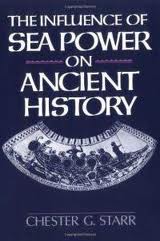
Chester G. Starr’s “The Influence of Sea Power on Ancient History”

Starr wrote his book to respond to Alfred Mahan’s  The Influence of Sea Power Upon History 1660-1783.  Many consider that work an indispensable classic, an essential plank in the argument for sea power trumping land power.  What drew me to Starr’s tome was his criticism of Mahan’s “lackluster prose,” and essential “indigestibility.”  I too dipped my toe in  Mahan’s waters and had the impression that it was a book that everyone says they’ve read without actually doing so.

After that, Starr gets into his thesis, which is that sea power has not been nearly as decisive as we might think.  For Starr, Mahan was not all wrong, but at least mostly wrong . . . in certain ways.

And with this moderately wishy-washy thesis lies most of the problem with Starr’s book.  In the end, he can’t quite deliver the coup de grace to Mahan.  He only wishes us to modify Mahan . . . somewhat.  This stance has the advantage of being eminently reasonable, but the disadvantage of being rather dull and not very helpful.  And he only wants us to think about the ancient world.  The modern era he leaves untouched and unresolved, even though that was the era Mahan mostly dealt with.

So, this book is hardly Mahan’s nemesis, but Starr still has some good points.

The first is that most major ancient empires eventually acquired navies, yet none of them met their end at sea.  Persia finished off Egypt by land, the Greeks finished off Persia by land, Sparta took Athens on land (at least at the very end of the Peloponnesian War), Hannibal brought Rome to its knees via a land invasion, and Rome itself met its doom from the northern barbarians who were light years away from having fleets.  So how could naval power be all that decisive?

If we carry his point to the modern era, naval dominance did not help Portugal, Spain, or the Netherlands maintain their role in world affairs for very long.

With his second major point Starr approaches something of a broad analysis applicable across time.  Naval powers will usually face a Catch-22 of sorts.  Only a well-organized, wealthy, and successful state can achieve naval superiority, giving that state a much wider reach.  But this wide reach comes with great responsibility.  As Admiral Crowe commented,

Sea Power is more potent than land power, because it is pervading as the element in which it moves and has its being.  . . . A maritime State, is, in the literal sense of the world, the neighbor of every country accessible by sea.  It would be natural that a State supreme at sea should inspire universal jealousy and fear, and be ever in danger of being overthrown by a general combination of the world.  Against such a combination no single nation could in the long run stand, least of all a small kingdom not possessed of a people trained to arms, and dependent on overseas commerce for food.

The danger in practice can only be averted . . . on condition that the national policy of the naval State is so directed to harmonize with the general desires and ideals of all mankind, and more particularly, that it is closely identified with the primary interests of the majority of mankind.

By  the time most states have the infrastructure to have a big navy they also have the arrogance to match.  England avoided Athens’ fate in part because of her geography, though she certainly had arrogance.  America today finds that our global reach makes us many enemies as well as friends.

Naval power opens a state up to other temptations.  More efficient global markets reduce the need for self-sufficiency and fosters increased specialization.  But if the global network fails, the naval power may look homeward and find an empty shell.  Thus did Starr anticipate some of the problems of modern globalization.

Starr had some good ideas, but needed more audacity to carry them through.  Well, perhaps Mahan’s massive reputation cannot be felled at a single blow.


Jim Ottaviani’s “Suspended in Language”

Like many of you, I decided that I was not a Math/Science person sometime around 8th or 9th grade.  I hit Algebra and never looked back.  Only recently have I started to regret that choice, or rather, the false dichotomy of that choice.  Reading this essay helped me see why the so-called division between the humanities and sciences has happened.  Maybe my lack of math sense is not all my fault!

The famous “Lockhart’s Lament” essay I linked above has two main points:

  • We teach math all wrong because we teach it in a way totally divorced from reality
  • Math should be taught like a a humanities class.  Instead of random symbols we need story and context.  In short, Math and Science involve art as much as Literature or History.

Inspired by Lockhart, I no longer believe myself a lost cause in the area of science.  But I am also a realist, and so turned to the comic book medium for help.

The book’s art does the job, although it does not inspire.  Ottaviani does better with the story itself, and makes the mythical Neils Bohr into a recognizable human being.  Much of the science remains beyond my understanding, but one aspect of Bohr’s life struck me and reminded me of Lockhart’s essay.  For Bohr, theoretical physics needed to involve poetic interpretation.  Physicists need to read between the lines and create an artistic vision through inspired guesswork.  “By faith we reach understanding.”

Bohr is perhaps best known for his atomic model: 

Bohr quickly dismissed this model as inaccurate.  All physicists agree that atoms don’t look like this,  and yet it has stuck around.  Why?  The book does not speculate, but we can.  Surely something of the model’s sticking power has to do with its visual elegance.  Also, the picture gives you an instant explanation.  Finally, no one has given us something better.  This is part of Bohr’s point.  He wasn’t right about the structure of the atom, but he was more right than someone who makes no guess at all. If you insist on omniscience you will end up knowing less than if you just made your best guess, and visual poetry communicates more truth than esoteric symbols.  Hence, the book’s title borrows a phrase from Bohr.  The deepest scientific truths remain “suspended in language.”

I am very encouraged to think science can function like the humanities, and making this link is the best shot we have at getting more students interested in math and science.

Dave

The Integration Between Technology and the Arts

One of the things that has struck me in reading Walter Isaacson’s biography of Steve Job’s is how much Job’s saw himself as an artist.  These artistic impulses help explain a lot about Job’s personality, but also the design of his products.  He cared deeply for simple, integrated elegance.  Bill Gates and others criticized Jobs for making Apple computers closed systems and “robbing people of choice,” as some might say.  But how many artists do collaborative projects?  Once you have a finished work of art, it’s finished.  No artist would allow someone else to add a few brushstrokes here and there.

Some like Apple, and some don’t.  But I don’t think anyone could deny that Job’s largely successful attempt to integrate art and technology is a big reason for Apple’s success.  Western culture is starved for this integration, and while the cult status Apple enjoys among some devotees unnerves many, we should realize that Apple products tap into a deep need we have to make our lives a unified whole.

When teaching Descartes I discovered that for much of his work he made his own accompanying drawings.  As far as I know, we have yet to see someone like him, one who combines art, science, and math to such a degree.*

I don’t agree with Descartes’ worldview, but when I see his art part of me wishes I could.

Dave

* I recently realized with delight that the great 20th century physicist Richard Fenyman took art lessons with a friend to help him communicate the emotion of scientific ideas.  But he doesn’t come close to Descartes in my book.  His drawing of people are pretty good, but he couldn’t get the same touch with his famous diagrams.  Looking at Descartes’ drawings, I almost get the sense of what he was trying to say.  I have absolutely no idea what Fenyman tried to communicate with his famous diagrams. . .


Asimov’s “Foundation” and Wikipedia

Last summer I read Asimov’s “Foundation” and enjoyed it.  The plot twist early on (*spoiler alert*) of having the encyclopedia project  function as a ruse to get scientists to an outlying planet hooked me for the duration.  In the story, the mere act of compiling information wasted time. 

Reading Niall Ferguson’s “Civilization, The West and the Rest” got me thinking about encyclopedias again.  Here is my review, and here is another slightly more positive take from which I extracted this quotation (thanks to Marginal Revolution for the link):

In 1420, when London was a backwater, Nanjing was the world’s largest city, and Ming China “had an incontrovertible claim to be [its] most advanced civilization.” That it was a center of learning he makes plain with a typically entertaining detail: the Emperor tasked 2,000 scholars with creating “a compendium of Chinese learning” that “filled more than 11,000 volumes,” which was “surpassed as the world’s largest encyclopedia only in 2007 … by Wikipedia.” So what happened?

Ferguson then goes on to outline the swift decline in China’s navy as the main answer, just as Paul Kennedy did in his The Rise and Fall of Great Powers.  Like Asimov, I have a different theory: China’s encyclopedia itself was a symptom of a disease that already manifested itself in the body politic.

The Roman’s first encyclopedia, for example, came in its post-Diocletian phase, a time of  desperate attempts to conserve what they had lost centuries earlier. There’s the rub; most often, encyclopedias and dictionaries come from a conservative reaction against change.*   A fear of losing something pushes us to gather our nuts frantically for the coming winter.  Thus, it makes perfect sense that the Chinese followed up its massive encyclopedia with a concomitant reaction against traveling to contact new people and ideas and risk losing what they had so carefully tried to preserve.

I use Wikipedia in desperate moments when I forget a date before class, and I think that it has gotten more reliable over the years in giving a general idea of things.  But I have no sympathy with the pleas it makes for support.  For one, we could easily do without it, but something deeper bothers me.  Many, many creative, curious, and intelligent people spend their time for Wikipedia merely repeating and compiling what others have already said elsewhere.  What Truman Capote famously said of “On the Road” could be said of Wikipedia: “That’s not writing. It’s typing.”

Blessings,

Dave

*I admit that the Dictionary made by the French philosophes had a more militant, aggressive character, and is an exception to this rule.

Does “Clutch” Exist?

Many behavioral economists and stat crunchers decry the notion that “clutch” players exist.  Here is an excerpt from Dan Ariely’s The Upside of Irrationality:

Clutch players are paid much more than other players, and are presumed to perform especially brilliantly during the last few minutes or seconds of a game, when stress and pressure are highest.

With the help of Duke University men’s basketball Coach Mike Krzyzewski (“Coach K”), we got a group of professional coaches to identify clutch players in the NBA (the coaches agreed, to a large extent, about who is and who is not a clutch player). Next, we watched videos of the twenty most crucial games for each clutch player in an entire NBA season (by most crucial, we meant that the score difference at the end of the game did not exceed three points). For each of those games, we measured how many points the clutch players had shot in the last five minutes of the first half of each game, when pres- sure was relatively low. Then we compared that number to the number of points scored during the last five minutes of the game, when the outcome was hanging by a thread and stress was at its peak. We also noted the same measures for all the other “nonclutch” players who were playing in the same games.

We found that the non-clutch players scored more or less the same in the low-stress and high-stress moments, whereas there was actually a substantial improvement for clutch players during the last five minutes of the games. So far it looked good for the clutch players and, by analogy, the bankers, as it seemed that some highly qualified people could, in fact, per- form better under pressure.

But—and I’m sure you expected a “but”—there are two ways to gain more points in the last five minutes of the game. An NBA clutch player can either improve his percentage success (which would indicate a sharpening of performance) or shoot more often with the same percentage (which suggests no improvement in skill but rather a change in the number of attempts). So we looked separately at whether the clutch players actually shot better or just more often. As it turned out, the clutch players did not improve their skill; they just tried many more times. Their field goal percentage did not increase in the last five minutes (meaning that their shots were no more accurate); neither was it the case that non- clutch players got worse.

At this point you probably think that clutch players are guarded more heavily during the end of the game and this is why they don’t show the expected increase in performance. To see if this were indeed the case, we counted how many times they were fouled and also looked at their free throws. We found the same pattern: the heavily guarded clutch players were fouled more and got to shoot from the free-throw line more frequently, but their scoring percentage was unchanged. Certainly, clutch players are very good players, but our analysis showed that, contrary to common belief, their performance doesn’t improve in the last, most important part of the game.

Seems convincing, and here is another take on the issue with the same conclusion in a different sport.

But I don’t buy it, or at least not all of it.

I am willing to believe that my own personal emotional perception can influence what I think of hard data, but it’s also my own experience.  I grew up playing baseball and there were times when I wanted to be at the plate in crunch time and times when I hoped that the guy in front of me would win the game and spare me the agony.  The expected results often followed my attitude.  Of course, those times tended to be when I was having a good or bad season, respectively.   But the pressure definitely seemed to heighten my expectation of success or failure, and surely this had something to do with my performance.  Perhaps the key variable is pressure, not performance.

But aside from sports, can “clutch” exist in generals?

Washington only won three battles in the Revolutionary War, but he won them at the right time.  The Battle of Trenton seems something like hitting two foul shots to send the game into overtime.  Yorktown was perhaps not as crucial, but still similar in the timing and result.  Pressure brought out the best in Washington.

By contrast, the British general surely had less to play for in the Revolutionary War.  They had the best army on paper, not just against the colonies but throughout Europe and perhaps the world.  Yet they had no “clutch” performances, perhaps because pressure did not draw it out of them.  Winning and losing meant much less to them compared to the colonists.

My point is that pressure reveals something about us.  It does not always reveal something “good” or “bad” about us, but with the testing comes opportunity.

Fire away, statisticians, I still think something like “clutch” exists.

Bligh’s Portable Nightmare

The full title of the book is Captain Bligh’s Portable Nightmare: From the Bounty to Safety — 4,162 Miles Across the Pacific in a Rowing Boat.

With such a title, the author John Toohey borrowed from the dense Enlightenment style from the period he chronicles.  The original title of Bligh’s own book was The Narrative of the Mutiny aboard His Majesty’s Ship ‘Bounty;’ And the Subsequent Voyage of Part of the Crew, in the Ship’s Boat. 

Bligh’s mentor and hero Captain Cook wrote one entitiled, The Voyages of Captain Cook Round the World: Illustrated with Numerous Engravings on Wood and Steel.

Clearly, the late 18th century liked long titles.

Toohey writes well and tells a remarkable story, making some inspired guesswork about what happened on the launch and how they possibly could have traveled so far and survived.  Put Bligh’s accomplishment in the long list of things perhaps no one on Earth could do today.  To be fair to us, Bligh may have been one of the few of his time that could have done it as well.

The book grabbed me for other reasons.  Bligh represents much of his time.  In Bligh we have a man of incredible mathematical and navigational gifts.  But the journey required a great amount of indescribable “feel” as well as inspired guesswork honed by years of sailing by sun and stars.  Bligh’s abilities were innate to be sure but also honed by all the fruits that the Scientific Revolution and Enlightenment had to offer.

But it’s the long titles of all those 18th century books that bothers me.  Those titles seem so earnest and so dedicated, just like the men themselves.  But their style can be so heavy and didactic that all life gets sucked out of them.  In the same way, some of the era’s  great men like Bligh seem out of touch not just with the universe itself but with each other.  Even while in the rowboat fighting for the life of the crew, Bligh managed to make these impressive maps of surrounding islands that later sailors would use themselves and declare accurate:

But when one the men on the launch died in a Dutch settlement, Bligh did not even know if the deceased had family to notify.  He could save the lives of his men without relating to them as human beings.  Bligh’s tragic resentment towards his men whom he believed did not sufficiently appreciate him shows him to be all to human indeed.

Blessings,

Dave

And now as a postscript, being for the edification of Ladies and Gentlemen alike, for the purpose of reinforcing the bloggist’s aforementioned point concerning the titles of books in the said era under discussion. . .

Some other titles of 18th century books:

An Introduction to the Italian Language Containing specimens both of prose and verse … with a literal translation and grammatical notes, for the use of those who, being already acquainted with grammar, attempt to learn it without a master …   By Samuel Johnson

The New England Almanac, or, Lady’s and Gentlemen’s diary, for the year of our Lord Christ 1775, calculated for the meridian of Providence, New England,  lat. 41° 51′ n. and 71° 16′ w. from the Royal Observatory at Greenwich; but may serve all the adjacent provinces.  By Benjamin West

Solyndra and Historical Innovation

I don’t know anyone against clean energy, though plenty of people might disagree about the priority we should give it, costs vs. benefits and so on.

Along those lines, I took no joy in Solyndra’s sad end, as it might set the cause of cleaner energy back a bit.  On the one hand, there is nothing shocking about a company failing.  Companies do fail sometimes, including those backed by government loans.

One aspect of their rise and fall intrigued me, however.  Their CEO and founder Dr. Chris Gronet had an idea.  Instead of relying on traditional and expensive silicon, he helped develop a process that could eliminate the need for silicon entirely.  It would be a great leap forward, one that would bypass the whole flow of solar panel development that came before it.

Well, among other things, the price of silicon plummeted, making Solyndra’s technological “breakthrough” unnecessary.  Aside from that, the new machines didn’t work well.  Solyndra’s bad gamble may have helped widen the door for China to continue dominate the market.

Aside from possible allegations of fraud and cronyism, did Solyndra just get unlucky?  Or, did they unwittingly violate a law of human experience?  Were they in a hurry?

The idea of a “Great Leap Forward” enticed Mao and entices all of us.  The past can seem burdensome, and  context irrelevant.  But it seems to me that no great historical “leap forward” has every happened without a long steady drip preceding it.

Most would say, for example, that Science defines itself through trial and error, the process of disputation.  As many have pointed out, however, people didn’t decide to do this overnight.  The western roots of disputation went back at least to the Medieval scholastics, if not further back.  Descartes and Newton had kinsmen at least 400 years in the past.

On the surface, Nixon’s trip to China looks like a massive, overnight tectonic shift.  But that too had deep roots in China’s conflict with Vietnam, and the Soviet style ‘one size fits all’ approach to communism that offended China’s sense of its own unique identity, among other things.

How about stylistic leap forwards?  It’s hard to go further than Shakespeare did when he brought a little levity to the dramatic arts.  His example almost destroys my theory.  But even he strikes me as decidedly “Medieval” about his conception of the world and the drama of salvation.  Also it seems that Shakespeare reached back to some of the Medieval sense of play after the heaviness of the Renaissance humanists.  So even Shakespeare did not eschew the past.

Pope John XXIII had it right: don’t be in a hurry.


Dave

“He who is always in a hurry. . . never gets very far.”

In his Journal of a Soul, the great Pope John XXIII admonished himself, “Not to worry if others are in a hurry.  He who is always in a hurry, even in the business of the Church, never gets very far.”

If this is a principle of Christian spirituality, it should be a principle of human experience as well,  and we should find examples of it at work in history.

I do think we see this principle at work in German foreign policy from at least the accession of Kaiser Wilhelm II and his dismissal of Bismarck in 1890.  One might even argue that it applies to Bismarck way back in the 1860’s.  But let’s just focus on Germany from 1890.

They directly challenged England by tripling their naval budget between 1900 and 1910.  They doubled military spending between 1910-1914.  They got involved in Africa and tried to obtain land in South America.  Perhaps in hurrying so much to “keep up with the Joneses” they did not see how ultimately self-destructive colonial acquisitions could be.  They even tried to acquire the Baja Peninsula.   Next time you are in a hurry look around and you will see how it makes others nervous.  The problem is, when we hurry we rarely look around ourselves at all.

Strategically, by adopting the Von-Schlieffen plan, they had to ‘hurry’ through Belgium so they could beat France in time to deal with Russia.  In their need for speed they committed various atrocities to get to France as soon as possible.  In the trenches they introduced chemical warfare because in their minds they had to hurry and shorten the war.

All these things worked against them long-term.  The Kaiser did not understand the power of the press as Bismarck did.  They brought on the moral outrage of the rest of the combatants and eventually their unrestricted submarine usage (also another attempt to hurry up and win) brought the U.S. into the war for good measure.  Disaster awaited them at Versailles.

Surely Napoleon also hurried.  One can see this through his whole personality.  Politically, he had no patience to establish genuine connections with those he conquered and made relatives his private puppet rulers.  We know this is not the way to win friends and influence local populations, who naturally turned on him the moment they had an opportunity.

I also think Hannibal hurried.  This, I admit, is more debatable.  He showed more political sense than Napoleon, and certainly more than Wilhelm II.  Yet he could have opted to spend time making his holdings in Spain secure and later invaded Rome from a much more secure base of logistical and political support.  Instead, he went for broke, and that’s how he ended up.

Has being in a hurry ever worked for any country/civilization?  Can we think of other failures rooted in hurry?

Has it worked for any particular company?  Have those that raced to market certain products first stood the test of time?

Blessings,

Dave

“Everybody Loves Our Town” — Seattle’s (and America’s) Identity Crisis

I grew up loving “Grunge” music.  I remember where I was when I first heard “Smells Like Teen Spirit.”  How many other 18 year olds rejoiced with me, as we could move from cuffed khaki’s and pastel button-up shirts to jeans and untucked flannel?  It was an oasis in a desert.  Freedom!

I also like oral histories, and so it was a given that I read Everybody Loves Our Town: An Oral History of Grunge

The book has many interesting aspects, but a theme throughout was the dilemma Grunge artists faced.  The whole musical movement had its roots in being an outsider and on the fringe.  They bucked the system — the system was the enemy.  But what happens when you get wildly popular?  What happens to your identity when you get on the cover of Time  magazine?  Can the two co-exist?  This theme runs throughout Mark Yarm’s excellent work. 

As you might imagine, the dilemma produced a profound psychological crisis for many.  Take Nirvana’s second album, for example, which is vastly inferior to Nevermind.  It’s almost as if Cobain wanted to make it bad on purpose.  I don’t think they were a “one and done” kind of band, either, as their stellar performance on MTV Unplugged showed.  In tragic retrospect, this video from In Utero shows Cobain’s self-loathing.  Soundgarden bassist Ben Shepperd astutely remarked that you can hear Cobain’s self-hatred in how he uses his voice.

This concept of “identity crisis” I think applies to civilizations as well.  Take Rome — for centuries they are the “Little Engine that Could” and then, within a few years of their victory over Hannibal, they have unquestioned Mediterranean dominance.  Their subsequent history shows that they did not handle their new role well at all, and this identity crisis runs right down through to The Aenid.

How about the United States?  What is our self-image?  Have we gotten used to the idea that we are globally dominant?  Even in the Cold War we could assume the “underdog” mantle.   I think it’s safe to say that we do not like to think of ourselves this way and do not like it when others see us as the “top dog.”  How will we handle our own shift in identity?

Is this perhaps why so many instantly related to the Clint Eastwood Super Bowl commercial?  Being the underdog — that’s what we identify with.  This poses a tricky dilemma for politicians.  On the hand they usually need to say something like, “America is strong!” and on the other have to inculcate a “We’re down, but not out!” mentality.

Stravinsky and Nationalism

I have a theory about Stravinsky’s famous “The Rite of Spring.”

Many assume that the riots surrounding the premiere of his ballet had to do with the fact that he made ballet “ugly,” or that he destroyed conventional concepts of dance, beauty, etc.

I’m sure this represents part of the reason for the intense negativity–possibly even most of it.  But I wonder if part of the reason was not that Stravinsky showed people themselves — a pagan people who worshipped the tribe.   But here I need help from someone who knows more about Stravinsky than I, for I know next to nothing.

Every religion involves sacrifice, and Stravinsky here reminds me of Wilfred Owen’s line,

The old Lie; Dulce et Decorum est
Pro patria mori.

Translated, I believe, “It is sweet and right to die for one’s country.”

Toynbee also commented incisively on this era,

Great, for example, as was the havoc wrought in Hellenic history by the Hellenes’ sin of idolizing their parochial states, the havoc was still greater when this particular form of Hellenic idolatry was resuscitated in a Western Christendom where the vein of Judaic fanaticism . . . was lying in wait . . . imported from Hades with a demonic intensity which it had never attained in even the deadliest of its manifestations on its native heath in a heathen Hellenic World whose life it brought to a bad end.

Stravinksy seems to have embraced Christianity.  Among some of his comments are,

Music praises God. Music is well or better able to praise him than the building of the church and all its decoration; it is the Church’s greatest ornament.

and,

I cannot now evaluate the events that, at the end of those thirty years, made me discover the necessity of religious belief. I was not reasoned into my disposition. Though I admire the structured thought of theology (Anselm’s proof in the Fides Quaerens Intellectum, for instance) it is to religion no more than counterpoint exercises are to music. I do not believe in bridges of reason or, indeed, in any form of extrapolation in religious matters. … I can say, however, that for some years before my actual “conversion,” a mood of acceptance had been cultivated in me by a reading of the Gospels and by other religious literature. ..

If “The Rite of Spring” is art, does art always have to be beautiful?  Or does art merely need to reflect truth?

Blessings,

Dave

Apple and Lewis Mumford

In his essay Authoritarian and Democratic Technics historian Lewis Mumford gives wonderful clarity to typical discussions about technology.

The article is here, but I will summarize for those who want the quick version.

Typically people will say, “Technology is neither good nor bad, but can be used for good or bad ends.”  That is, technology is value-neutral, and entirely so.

Mumford disagrees.  No technology is inherently good or bad.  But products are designed to be used in certain ways, and they enter into a human context that is always moral.  Basically, Mumford argues that

– Some kinds of ‘technics’ are designed to be used in such a way that enhance our humanity, which he calls ‘Democratic,’

and

– Some, as we use them, will inevitably take away from our humanity, which he calls, ‘Authoritarian.’  For Mumford, the Industrial Revolution produced much of this.

His categories really help cut through debates surrounding technology.  With the recent passing of Steve Jobs and focus on his legacy, a question arose in my mind.

Jobs was notorious for his insistence on control of every aspect of product development.  Apple products are essentially ‘closed’ systems that have definite boundaries of how they can be used.

And yet, Apple products are wonderfully accessible.  What’s more, they have a simple elegance about them.  Jobs took aesthetics quite seriously.  He created beautiful products.

Do Apple products fall within the ‘Authoritarian’ or ‘Democratic’ side of the Mumford’s analysis?

Here is one person’s take.

Blessings,

Dave