12th Grade: Constitutions for Dummies, by Dummies

Greetings,

Several weeks ago the Government class discussed the basics of Plato and Aristotle’s philosophy.  One goal I had in this was for students to understand . . .

  • How fundamental ideas about the nature of reality, and the nature of God, help form one’s ideas about government.
  • How one’s view of the nature of humanity (is mankind a body & soul? What is the relationship between our body and soul?) impact how one governs.
  • What relationship should context & history have in a given situation?

I shared an example from my own life that illustrates some of these issues.  Many years ago I lived in a townhouse community run by an HOA.  The development placed about 5 trashcans every 1/4 mile or so.  When people walked their dogs (and we had a high population density of dogs) we commonly deposited the refuse in the trashcans.  But during warmer weather, more people walked their dogs, and the additional heat made the trashcans, well, stink.  This was unfortunate.  Was it a “problem?”

The HOA came up with a rule: No more deposited dog waste in trashcans.  This, they hoped, would solve the problem.

One can view their solution in two basic ways, from a Platonist and Aristotelian perspectives.

The Platonist would argue. . .

  •  The law is a good one because it seeks to better the condition of all.  The neighborhood would become a nicer neighborhood.
  • The people would be encouraged to accept more direct personal responsibility for their pets — taking the refuse to their own trashcans would help them be more responsible overall.

The Aristotelian might respond. . .

  • The law is foolish because people will likely not obey it.  They will either continue to deposit the refuse in the trashcans, or worse, simply not pick it up at all.
  • The law cannot be enforced.  The HOA has no mechanism to police the area.  Thus, people’s disobedience will only encourage a more hostile attitude towards the HOA than they may already have.  In other words, a good law can only be called “good” if people actually obey it, no matter how good in theory the law might be.

I hope students enjoyed this unit.  I then wanted to have the students see how some of these ideas applied in the making of our own government.  To that end we spent the last few days reading Madison’s diary of the constitutional convention debates. We see that different people had different perspectives, different notions of what “liberty” meant and how to achieve it.  They wrestled with the big ideas, referencing key political texts, but also worried how those ideas would apply in the current political climate.  Some of there more lengthy debates seem immediately relevant today, others quite arcane.The decisions they reached sometimes came from unanimity, but more often came through compromise and disagreement.  And despite their brilliance, they failed dreadfully in not foreseeing a popular presidency, and what this meant for the Vice-Presidency.

I had a few main goals with this particular unit:

  • I wanted students to see that political agreements required a great deal of compromise.  I don’t mean to use compromise as a word of praise or derision.  Some compromises achieve great things, others, like the compromises made on slavery, condemn the future to deal with an issue that has had time to fester.
  • I wanted students to consider whether or not the many compromises they made had roots in their agreement on fundamental principles, or whether America was built on band-aids to the deep divisions between Americans at that time (and now).  If they agreed on fundamental principles, what were they?  If they had no agreement on such principles, why not?
  • What did the Constitution do particularly well?  In what areas did it fail?
  • Many of the men at the original Constitutional convention had years of experience in law and government, and an education that rooted them to the classical world.  And yet at times the decisions made seemed based more on arbitrary circumstance than profound guiding principles.  Should this worry us, or is this the way of the world?  Or perhaps it’s a gift, a reminder that we are all in need of God, that none of us, however intelligent, will ever have all the answers or the stamina to decide them fairly?


Thanks again,

Dave


Death by Abstraction

“A theology without practice is the theology of demons.”  So said St. Maximos the Confessor.  Abstractions have never held any weight within Christianity.  The devil believes, and it makes no difference.  The Incarnation explodes the possibility of the efficacy of “abstraction.”  God became a particular man at a particular time in a particular place.*

We see this theological truth spill out into other areas.  Beware, for example, of vague descriptions of “Human Rights.”  Without application in a particular context, such “rights” have no meaning.  Hence France’s “Declaration of the Rights of Man” declared in 1789 gave absolutely no protection to anyone during the Reign of Terror in 1793.  The Committee of Pubic Safety interpreted such rights as they pleased to do what they wished.  Beware the man with grand visions of glory who cares nothing for the actual human cost.  On such foundations were the great tyrannies of the 20th century built.

A great deal of debate exists as to the question, “What is America?”  Different answers have been given to this question, but we don’t often stop to question why we have so much debate about our identity.  I think the root of this problem lies in the commonly accepted idea (whether it is true or false) that America has its origin in certain ideas about liberty, freedom, and so on, not in any particular experience in history.  In a few other posts on this blog I muse on this question (see here and here if you have not wearied of me quite yet:).

Some historians argue that America took a decided turn with the victory of the North in the Civil War.  Proponents of this do not necessarily assert that the South was “good” and the North “bad,” though some may argue this.  Some in this school of thought, like Clark Carlton from Tennessee Tech, don’t even put the focus on the good of one side vs. the other, or on state’s rights and federal power, but rather on culture and the idea of what America actually is or should be.

Carlton argues that the two sides in the Civil War represented two different ideas about America.  The North, dominated by a New England ethos, believed that America had its roots in certain ideas that should have application everywhere for all men.  The South, rooted in a very different migratory pattern (discussed brilliantly by David Hackett Fischer in Albion’s Seed, by far the best book I’ve read on colonial America), saw America as a place to transplant a certain kind of Anglo-Celtic way of life.

I lack the wherewithal to discuss the merits of this theory, except to say that it has enough plausibility to deserve consideration.  For the moment let’s assume its core proposition and explore its possible merits.  For the theory to hold water, we would need to trace the development of abstract ideas throughout the history of New England and see its pernicious effects.**  Of course this means that we find that they did in believe such abstractions.

Recently I read the The Wreck of the Whaleship Essex by Owen Chase, written in 1821.  The book tells of the shocking attack and sinking of their ship by a sperm whale, the inspiration for 51-cWJypx5L._SX355_BO1,204,203,200_Melville’s Moby Dick.  Most American whaling crews hailed from the New England area, as did the Essex.  The account held my interest all the way through.  For our purposes here, I couldn’t help notice, however, how the author spoke about God.  I don’t believe he ever used the word “God,” referring instead to “Providence,” or “the benefits of the Creator,” or something like that.  Certainly they never made any reference to Jesus Himself.  Such language left me cold.  Whether or not the author and his crew believed in Christ I cannot say, but this impersonal and ultimately abstract language is certainly not a Christian way to speak about God.  It seems to exactly mirror the Transcendentalists like Emerson, who of course hailed from New England.^

As their journey in the lifeboats continued, their supplies of food obviously dwindled.  At first when crewmen died they buried them at sea decently.  But after several weeks they grew more desperate, and fell to eating parts of the deceased crew’s body before burial.  They did so even though they still had small amounts of bread left, so they had other options.  One of the lifeboats even eventually drew lots to see who would be shot, so his flesh could be consumed.  A man named Owen Coffin drew the short straw and apparently submitted to his fate willingly.

So all in all eight crewmen survived, but at what cost?  I do not judge them too harshly.  They endured severe trials and privations.  After several weeks I’m sure they had nothing left physically, mentally, and emotionally.  I have never endured anything remotely akin to their ordeal.  Yet in the writing of the account itself I expected some remorse, some second-guessing of their practices, especially given the time proximity of their rescue to their cannibalism.  In hindsight, such horrors probably were not even necessary for their strict survival.  But Mr. Chase has no such reflections.

I can’t help but wonder if their cold and distant manner of speaking about God might contribute to their cold, impersonal view of each others lives and bodies.  This surprised me because earlier in the book he wrote touching passages about the attachment of the crew to each other.  After the ship sunk the crew found themselves in three separate lifeboats.  Chase talks movingly of losing sight of their fellow ships at night and their frantic efforts to find each other lest they be separated.  But in the end, I suppose, their abstract notions of life won out.

But this crew did not invent such a way of speaking.  These abstractions must have had their roots somewhere.  We might start with the New England Puritans.  Initially, it seems that the Puritans were anything but abstract in their views.  They practiced a very particular way of life and belief.  But a second look tells otherwise.  I have no wish to “pile on” the Puritans, who get a lot of bad press, much of it undeserved.  I admire certain things about them.  But their strong Calvinism does lead one to a kind of abstraction regarding God.  God’s abstract “will” often asserts itself to the fore in Puritan theology, pushing more personal characteristics such as love, mercy, etc. to the periphery.  Their conception of the “will” of God swallowed up all individual personality.  So I think we can say that abstraction had its roots in the foundation of New England society.^^

The American Revolution had many of its roots in New England, and there again we can say that they had an attachment to abstractions.  They began by charging the British with violating their rights as British citizens in 1765, but ended by conceiving of Lady Liberty (a goddess?), and human rights that should apply to all men everywhere.

This abstract seed has grown many branches, some good and some bad.  The root issue seems to be the idea that once a certain group of people latch onto a particular incarnated meaning of “liberty,” they seek to apply to all everywhere.  So we have the New England abolitionists on the one hand, and LGBT rights on the other.  Both have very different seeming applications, but both might have the same root.+

In the end I’m not sure “abstraction” was a distinctly New England problem.  Carlton sees the Civil War as a turning point for American ideals of abstract liberty, and here I disagree.  Perhaps New England held to such “abstractions” more than others, but by 1800 at least these ideals had spread most everywhere.  Where I agree with him fully, however, is that latching onto abstract propositions to guide us has resulted in many theological and civil problems.

As we end the Christmas season, may the truth of the Incarnation lead us in a different direction.

Dave


*Hence the importance of the prologue of St. Luke’s gospel, the historical books of the Old Testament, and various other portions of Scripture.

**I don’t mean to leave aside the possible pernicious effects of Anglo-Celtic culture.  For his part I don’t believe Carlton means to glorify this culture.  Rather, he seems to assert that the culture was uniquely their culture, and thus they (and not anyone else) had ownership of its strengths and sins, slavery obviously among them.  Their moral life remains their responsibility and not those of other states/countries, or the Federal government.  Perhaps he might continue to argue that taking it out of their hands in a way absolved them of ownership and responsibility — creating a pernicious distance between themselves and their political and cultural lives.  Did this then lead to actually more mistreatment of blacks?  It seems hard to argue this, as slavery ended because of the Civil War.  But . . . perhaps this “distance” gave them more subconscious permission to continue subjugating blacks as an act of defiance?  This would be a pretty radical idea, one that we could not test and can therefore only speculate.  But it does seem a bit of a stretch to me.  Still, I am only speculating as to his argument.

^Such manner of speaking about God is not only confined to New England, however.  Washington, Jefferson, and other southerners spoke in a similar  way.  This may cast doubt on Carlton’s thesis.

^^We can find other examples, I think.  The Puritans did not really grow a local culture, but rather “imported” and imposed a large measure of it from the Old Testament — or at least their interpretation of it.  We might argue that Puritan culture was the byproduct of abstract theological ideas.

+On the issue of slavery Carlton argues that the New England abolitionists accomplished nothing in part because of their abstractions.  They had no roots in the culture they critiqued.  They merely espoused vague notions of liberty.  He wanted southern abolitionists (such societies did exist, at least in the upper South) to solve the issue — alas, they did not.  But neither, I suppose, did northern abolitionists.  They both failed alike to avert Civil War. As to why America could not solve this issue legislatively, as England did, I’m not sure.

Retreat to Move Forward

I confess to having a strong antipathy to smart phones.  I know that they have their good uses.  But I am bewildered as I see people bring them out at various times and places.  I wonder what has become of us.

Now, I also realize a large amount of hypocrisy on my part.  I should also ask what has become of me.  I don’t have a smartphone . . . but I love my iPod, and I check my email too much.  In my mind, if technology had stopped advancing after Apple came out with its 160 GB iPod classic, I would be content.  But even if I am right that our prolific use of smartphones do us harm, what can be done?  After all, retreating from them seems impossible, and time marches on.  To stop advancing technologically would condemn us to economic stagnation.  To actually prevent technology from further advancing would probably require a government more powerful than would be good for us.

So it appears that we’re stuck.

But, maybe not.  The premise of Noel Perrin’s Giving up the Gun: Japan’s Reversion to the Sword, 1543-1879 is that a people can halt a certain kind of technology without radically changing their society.  While certain particular features of Japanese society allowed for this, Perrin states rightly that this example disproves certain well-entrenched ideas about technology and progress, among them:

  • That one must “keep up with the Jones'” to have a successful society
  • That technological progress comes as a whole and not in parts.  In other words, many falsely assume that to halt “progress” in one area will prevent advances in other areas.
  • That halting progress will put a society irrevocably behind other societies.  Instead, when Japan did decide to adopt modern weapons in the late 19th century, they very quickly caught up to others and soon posed a significant military threat.

So first we can examine why Japan could nearly eliminate guns from their society, and then secondarily, we can consider its possible application for us.

I initially assumed that Japan’s restrictive trade practices limited their contact with firearms from the start.  Not so — in fact they made significant use of firearms well into the 1560’s, and European traders remarked quite favorably on their quality.  We might also assume that Japan had a low-level of technology in general, but again — not the case.  To quote Perrin,

Japan had already reached a high level of technology.  Her copper and steel were probably better, and certainly cheaper, than any produced in Europe.  Despite enormous shipping costs, the Dutch found it profitable to send Japanese copper 10,000 miles from Amsterdam.

. . . In iron and steel Japan could undersell England, the recognized leader of European producers.  [Japan also] led the world in paper products.  For 200 years they were the leading manufacturer of weapons.  These were top quality weapons, too, especially the swords.  It is designed to cut through tempered steel, and it can . . .

In a country often experiencing some kind of conflict at some point, they well understood the value of rifles.  But by the end of the 16th century Japan decided against all forms of military mechanization so successfully that they generally disappeared for 250 years.

Of course others in Europe saw the problems with firearms.  Martin Luther said that, “Cannon and firearms are cruel and damnable machines.  I believe them to be the direct invention of the Devil.”  But Germany went on to become the pre-eminent arms manufacturer.  Many French aristocrats inveighed vociferously against the impersonal nature of such weapons, as well as the fact that their introduction would broaden war beyond the aristocracy.  But they too followed the general trend.

Certain factors within Japan made it more likely that they would have success while Europeans failed.  Being an island did not hurt.  Their demographics also played a role.  In France, for example, the warrior aristocracy represented about .1-.2% of the population.  In Japan that number reached close to 10%, which gave them that much more influence.   Japanese swords also had such a high quality that the difference in effectiveness between a sword and a 16th century gun was less than in Europe.

But Perrin argues that the main factor lies in the role of the sword in Japan.  In Europe some swords had religious and symbolic significance, i.e. King Arthur’s “Excalibur,” or Roland’s “Durendal.”  But in Japan, the sword almost literally represented the soul of warrior for every samurai.  Swords were an extension of the self.  Making them obsolete would in effect, make themselves obsolete.  They would have no purpose as they would have no identity.

Perrin relates an interesting story along these lines.  One group of samurai besieged the castle of another warrior.  Eventually it became obvious that the besiegers would win, whereby the besieged asked for a conference.  He explained to his attackers that he had several swords inside that he wished to preserve from destruction.  Would the attackers agree to receive the swords and preserve them?  And so, the defenders, with solemn ceremony, transferred the swords to the attacking army and then retreated back into the castle.  After which, the attackers set fire to the estate and all those inside perished.

Many aristocratic warriors in Europe and Japan detested firearms because it made combat itself impersonal and unredeemable.   We see many examples of dialog during combat in the Arthurian tales, but it seems the Japanese took this to another level.  Perrin gives us one such example, as Warrior ‘X’ tried to behead Warrior ‘Y’ unsuccessfully, who was wounded and exhausted.

Y: Are you fluttered, sir?  You see you have no success.  Look, I wear a nagowa (an iron neck collar).  Remove it, and you can cut off my head.

X: (Bows to “Y”) Thank you sir!  You die an honorable death.  You have my admiration!

One could even argue that Japanese warriors sought not so much victory, but an honorable death.  Firearms dramatically increased the chance that you would die without an honorable end, without a chance to “fly the flag” at the last moment — however much it increased your chances of victory.

Early Japanese firearm manuals acknowledged this and more.  To fire guns well, such manuals stated, one even had to put the body in “demeaning,” inelegant postures.  For the Japanese, the gun represented not just another weapon, but another view of humanity.

Firearms returned late in the 19th century.  Ironically, Admiral Perry told them that if they wanted to keep others like him away, they would need more modern weapons.  Japan then turned on a dime and within a generation had a respectable military force.  Within two generations they posed a grave threat to the most modern of militaries and nearly conquered all of Asia.  The absence of mechanized weapons for three centuries put them at no real disadvantage once they determined to catch up.

One of the oldest tropes in the history of History is historians wishing for bygone days of yore.  But I think our worries about technology go far beyond nostalgia.  Advancement is now so rapid that we have no time to contemplate or evaluate the role of technology in our lives.  We have to ability to develop “social antibodies” to the problems with technology.  As such, we have within the last 10 years become utterly dependent and quite possibly addicted to the internet.  Paul Graham, the innovator behind Reddit, Dropbox, and a variety of other programs, writes,

. . . And unless the rate at which social antibodies evolve can increase to match the accelerating rate at which technological progress throws off new addictions, we’ll be increasingly unable to rely on customs to protect us. Unless we want to be canaries in the coal mine of each new addiction—the people whose sad example becomes a lesson to future generations—we’ll have to figure out for ourselves what to avoid and how. It will actually become a reasonable strategy (or a more reasonable strategy) to suspect everything new.

In fact, even that won’t be enough. We’ll have to worry not just about new things, but also about existing things becoming more addictive. That’s what bit me. I’ve avoided most addictions, but the Internet got me because it became addictive while I was using it.

Do we have any hope of emulating the Japanese and pausing our technological growth?

A few other random examples of at least halting technology exist (such as Elizabeth I preventing indoor plumbing), but I can’t think of another example of a society moving “forwards,”* then “backwards” with the adoption of certain technologies.  Japan’s insular geographic position helped them, as did their demographics, governance, and culture — and I find these last two most significant.

Americans rarely acknowledge the fact that aristocracies come with some benefits, or at least, alternative possibilities.  Japan’s warrior elite had the political and social status to make the ban stick.  Add to that the pull of a unique and deeply distinctive Japanese culture, one that perhaps approximated that of ancient Egypt in its power to unify a large mass of people in a particular way of life (another geographically insulated civilization).

We have no geographic isolation.  Nor does our culture have anything close to Japan’s gravitational pull, i.e. — our capital exports little more than bureaucracy to the rest of the country.  And finally, our democratic system has something close to a zero-percent chance of desiring, or certainly enforcing, such a return to earlier ways.  Self-denial simply has very little place in democratic cultures.

Now I think it’s time for me to check my email . . .

Dave


Matt Zoller of RogerEbert.com writes,

We’ve become a one-handed species. We keep one hand in reserve for taking out a wallet, digging in a purse, swiping a Metrocard, helping up a person who’s fallen on the sidewalk, whatever. The other hand is for Making Sure We Got This.

I know, I know. This has been going on for a few years. It’s not a news flash; it’s who we are as a species. I’m Grandpa Abe Simpson yammering about onion belts. I should climb onto the ice floe and shove off. Or say, “Oh yeah, things change, technology changes, it’s no big deal” and quit complaining.

But I think it deserves ongoing consideration and argument, because it’s everywhere.

Is it merely different from, but in no way inferior to, older forms of participation, as people who are addicted to doing it tend to claim when they read pieces like this one? I have no idea. Only a cognitive researcher could say with any authority. But it’s a major and visible change. It’s species-wide.

And I’ve personally not heard any convincing arguments against the idea that it means we have become, in some basic way, detached from our own existence; that life itself is becoming a supplier of material for Instagram, Flicker, Twitter, YouTube, Facebook and the like, rather than a thing that happens to us, and that we absorb with our bodies and minds, not with our phones.

*I think it would be a nearly impossible to construct a good argument that mechanized weaponry represented an advance for civilization.


12th Grade: From Nation to Market, from Family to Individual

Greetings,

This week we looked at the transition from the ‘Nation-State’ to the ‘Market-State,’ with all its attendant implications.

The ‘Nation-State’ (1914-89) was the era that you and I grew up in.  Sometimes its easy to assume that our experience is somehow universal, but in fact that America was different than the America of Thomas Jefferson, and the America of our children will be different as well.

What characterizes this era?

We see here that, in Bobbitt’s words, “Government’s are responsible to and for the people.”  In contrast to Washington, Jefferson, etc., whereas before, people found their identity in ‘the state,’ now ‘the state’ finds its identity in ‘the people’ (my thanks to Addison Smith for this insight).  Gone is the more aristocratic, patriarchal attitude of the founders.  One can see beginnings of this shift in Jacksonian Democracy.  The closing of Lincoln’s ‘Gettysburg Address’ puts forward a new basis for government’s relationship to the people.

Essentially, the Nation-State will end up creating a sense of unity and community.  Many of us remember growing up playing with kids from ‘the neighborhood.’  ‘We are the World,’ and ‘Hands Across America’ were major cultural phenomena.  We listened in with all our friends to Casey Kasem’s Top 40 to see what the #1 song was for the week.

Politically, if we are a family, we take care of the family.  So programs like Social Security to take care of the elderly and Welfare to care for the poor make sense within this rationale.  Iconic presidents on both sides of the political spectrum arise like FDR and Reagan that can rally the whole nation behind them.

It is easy to romanticize this era, and it has many strengths.  But this was also the era of ‘Total War,’ for if whole populations make up ‘the State,’ then whole populations can be the targets.  The horrific devastation of World War I & II come out of this mentality.  Also, mass groups define themselves at times by who is outside the group as well inside.  So the Nation-State era also experienced terrible levels of ethnically motivated violence of which the Holocaust is only the worst example.

The ‘Long War’ of 1914-89, like all epochal conflicts, inevitably forces states to innovate.  And so they did.  The weapons that won this war (nuclear weapons, the computer, international trade) just as in the past, ended up destabilizing the nation-state order and helped bring about our current one, what Bobbitt calls the ‘Market-State.’

We might contrast the two orders by recalling some common experiences then and now.  In the Nation-State, you had to go to a few centralized locations to ‘consume culture,’ for example.  If you wanted to hear a couple songs from an artist, you had to buy the whole album.  If you want news, go to one of the 4-5 major outlets, most of which said much the same thing.  It was the era of the ‘water-cooler’ show, where everyone tuned in to see the Cosby Show, for example (‘Seinfeld’ may have been the last show truly like this).

Now, thanks to technology, identity politics, Vietnam and Watergate, among many factors, we have many more choices.  We can individualize our lives in ways not possible even 15 years ago.

I wanted the students to think about the implications for modern America, and the modern state in general.

First, we noted that governments now have a much harder time controlling the message they want heard. Government’s simply won’t be able to mobilize mass opinion as they could before.  The Arab Spring is one example of this, but there are countless other smaller ones.  Note the leaking of the Abu Ghraib scandal, for example.  Perhaps a downside to this is that with the wealth of options available, we never have to listen to the ‘other side’ if we don’t want to.  Might this contribute to the current rancor in politics today?  Both Bush and Obama have been compared to Hitler, which in my opinion does not foster healthy, responsible debate on their relative merits.  Still, every president or senator is bound to have plenty of critics.   In one sense then, governments have much less power than they used to.

But on the other hand, technology puts a tremendous amount of information at the government’s disposal.  What will happen to the concept of privacy, for example?  The globalized market de-emphasizes territorial boundaries among states.  In the same way, traditional notions of private and public boundaries are also changing.  Will our interpretation of the 4th Amendment also change?

Regardless of where we might stand on these developments, we must avoid a) Vainly wishing for a mythically pristine bygone era, or b) Assuming that every change is inherently good because it is change.  The Market-State, like any other model, will give and take away, and we need to be discerning to maximize its strengths and minimize its weaknesses.

Dave Mathwin

12th Grade: From State-Nation to Nation State

Greetings,

This week we continued looking at the development of states, attempting to make the connection between the various elements in society that propel change.  We looked this week at the ‘State-Nation,’ and the ‘Nation-State.’

Th ‘Territorial-State’ (1648-1776) was a conscious move away from the monarchical ambition and religious motivated violence of the previous era.  They sought order, symmetry, balance, and proportion.  This required careful international diplomacy, and sought to prevent any inward social upheavals, for good or ill.

A variety of factors lead to the breakup of this constitutional order.  For one, the Enlightenment grew stale and begged for a more ‘Romantic’ counter-reaction.  But perhaps more than that, the expansion of Territorial States stretched the logic of their identity based on contiguous property (and not ideology, which travels in the minds of men).  The French-Indian War is perhaps the most striking example of a Territorial-State conflict that gives birth to the ‘State-Nation’ here in America.

The French-Indian War created a sense of identity, a sense of a ‘people’ in the English North American colonies.  This ‘people’ would naturally now not want to be treated as pawns in an international game.  They would inevitably demand rights, and this is at least part of the roots of the conflict between the colonies and England.

A look at the Declaration of Independence and Constitution gives us insight into the emerging world of ‘State-Nations.’

  • We have the basis of the particular relationship between government and the people rooted in universal ideas (all men are created equal)
  • We have recognition that the ‘people,’ not territory or states, are the basis for political power, i.e. “We the people. .  .”
  • At the same time we still have a somewhat aristocratic, paternalistic attitude towards ‘the people.’  Government was responsible “for” the people, but neither George Washington, John Adams, Robespierre, or Napoleon would have thought in terms of government “by” the people, or “of” the people.

Napoleon is a great example of someone who understood how the socio-political landscape had changed, and understood how to take advantage of it.  The French Revolution destroyed not only the aristocracy, but the professional army led by aristocrats.  Napoleon had mass, energy, and ideology at his disposal, but lacked the well drilled and trained armies of the rest of Europe.

With a “people” now organized in France to form a “nation,” Napoleon could mobilize more support for his campaigns.  He had the supplies, backing, and motive to take his army far (we are liberators of the oppressed).  His took this energy and channeled, achieving superiority of mass at points of his choosing.  This rag-tag ball of energy created by the French Revolution and harnessed by Napoleon made quick work of the rational, balanced, symmetrical, and aristocratic armies of Europe.

But then a curious thing happened.  The countries Napoleon occupied inevitably brought with them the ideology and ‘constitution’ they espoused.  If France was so great, why couldn’t Prussia or Austria be great too?  If they wanted to resist, they would need to raise a new army rooted in this new sense of solidarity, this new sense of a ‘people.’  The old aristocratic officers had been discredited by their initial defeat at Napoleon’s hands.  The armies that defeated Napoleon from 1809-1815 from Spain to Russia, from Prussia to England, were in sense, Napoleon’s accidental creations.

Napoleon’s success and ultimate failure have many lessons.  For our purposes I want the students to see how elements of society fit together and in a sense, carry the same message.  Different ideas and actions create new social and political contexts.  Without awareness of the ripple effects of these changes, nations will end up behind the 8 ball, much like Spain of the early 17th century, France and England in the late 18th century, the Austro-Hungarians in the early 20th century, and so on.

We discussed in class the various ways the transition from these two state models might manifest itself.  The “State-Nation” built itself on universal ideas, (i.e. “all men are created equal, and endowed by their creator with certain inalienable rights.”)  These grand, sweeping ideas have their incarnation in Beethoven’s music, for example.

But the music of the next model, the “Nation-State” reflected different values.  It was more group oriented, so the music aimed not everywhere but for the broad middle, creating more “popular” and “accessible” music.

Later we had. . .

And then. . .

The ‘Nation-State’ (1914-89) was the era that you and I grew up in.  Sometimes its easy to assume that we experience is somehow universal, but in fact that America was different than the America of Thomas Jefferson, and the America of our children will be different as well.

What characterizes this era?

We see here that, in Bobbitt’s words, “Government’s are responsible to and for the people.”  In contrast to Washington, Jefferson, etc., whereas before, people found their identity in ‘the state,’ now ‘the state’ finds its identity in ‘the people’ (my thanks to Addison Smith for this insight).  Gone is the more aristocratic, patriarchal attitude of the founders.  One can see beginnings of this shift in Jacksonian Democracy.  The closing of Lincoln’s ‘Gettysburg Address’ puts forward a new basis for government’s relationship to the people.

Essentially, the Nation-State will end up creating a sense of unity and community.  Many of us remember growing up playing with kids from ‘the neighborhood.’  ‘We are the World,’ and ‘Hands Across America’ were major cultural phenomena.  We listened in with all our friends to Casey Kasem’s Top 40 to see what the #1 song was for the week.

Politically, if we are a family, we take care of the family.  So programs like Social Security to take care of the elderly and Welfare to care for the poor make sense within this rationale.  Iconic presidents on both sides of the political spectrum arise like FDR and Reagan that can rally the whole nation behind them.

It is easy to romanticize this era, and it has many strengths.  But this was also the era of ‘Total War,’ for if whole populations make up ‘the State,’ then whole populations can be the targets.  The horrific devastation of World War I & II come out of this mentality.  Also, mass groups define themselves at times by who is outside the group as well inside.  So the Nation-State era also experienced terrible levels of ethnically motivated violence of which the Holocaust is only the worst example.

The ‘Long War’ of 1914-89, like all epochal conflicts, inevitably forces states to innovate.  And so they did.  The weapons that won this war (nuclear weapons, the computer, international trade) just as in the past, ended up destabilizing the nation-state order and helped bring about our current one, what Bobbitt calls the ‘Market-State.’

We might contrast the two orders by recalling some common experiences then and now.  In the Nation-State, you had to go to a few centralized locations to ‘consume culture,’ for example.  If you wanted to hear a couple songs from an artist, you had to buy the whole album.  If you want news, go to one of the 4-5 major outlets, most of which said much the same thing.  It was the era of the ‘water-cooler’ show, where everyone tuned in to see the Cosby Show, for example (‘Seinfeld’ may have been the last show truly like this).

Now, thanks to technology, identity politics, Vietnam and Watergate, among many factors, we have many more choices.  We can individualize our lives in ways not possible even 15 years ago.

I wanted the students to think about the implications for modern America, and the modern state in general.

First, we noted that governments now have a much harder time controlling the message they want heard. Government’s simply won’t be able to mobilize mass opinion as they could before.  The Arab Spring is one example of this, but there are countless other smaller ones.  Note the leaking of the Abu Ghraib scandal, for example.  Perhaps a downside to this is that with the wealth of options available, we never have to listen to the ‘other side’ if we don’t want to.  Might this contribute to the current rancor in politics today?  Both Bush and Obama have been compared to Hitler, which in my opinion does not foster healthy, responsible debate on their relative merits.  Still, every president or senator is bound to have plenty of critics.   In one sense then, governments have much less power than they used to.

But on the other hand, technology puts a tremendous amount of information at the government’s disposal.  What will happen to the concept of privacy, for example?  The globalized market de-emphasizes territorial boundaries among states.  In the same way, traditional notions of private and public boundaries are also changing.  Will our interpretation of the 4th Amendment also change?

Regardless of where we might stand on these developments, we must avoid a) Vainly wishing for a bygone era, or b) Assuming that every change is inherently good because it is change.  The Market-State, like any other model, will give and take away, and we need to be discerning to maximize its strengths and minimize its weaknesses.

Men Behaving Badly

Byron Farwell’s The Great Anglo-Boer War offers an intriguing glimpse into the waning days of Victorian England, deals with some difficult moral dilemmas, and entertains with good writing and good stories.  When one combines the myopia of Victorian Brits and the self-righteousness of the Dutch Boers, it can lead, if nothing else, to entertaining reading.  The whole episode reminded me of the failed Rob Schieder TV show Men Behaving Badly.   I saw exactly 0 episodes of this show, but I do remember the promo, which had Schieder’s character standing by a sink full of dirty dishes.  He narrated,

What does a guy do when all of his dishes are dirty?  Well, the way I see it, he could a) Buy more dishes, b) Rent another apartment, or c) Find suitable dish-like replacement from your natural surroundings (holds up a frisbee).

My guess is that was about as good as the show got.

Who is one to root for in this conflict?

On the surface, you have an imperial nation at the high-water mark of its power, fighting in land not their own against a group of rag-tag farmers who only wish to be left alone.  Our underdog instinct wants to kick in, but then we remember the Dutch Boers woeful mistreatment of the indigenous local African population and back off on any potential support.  So perhaps we can root for the Brits?  After all, “Empire” is not, or should not be, a dirty word in and of itself. Sometimes empire-states can serve the common good.  And one can make a legitimate argument that England’s empire on balance did more good than harm, where no such argument exists for say, the French or Germans.

But then you see their reasons for their fight against the Dutch, and you throw up your hands.  The British and the Dutch had their separate spheres of influence in South Africa, and managed to tolerate each other.  But then miners found gold in the Dutch portion and a variety of treasure-seeking Brits came to seek their fortunes.  The Dutch understandably did not embrace their presence.  Almost exclusively they farmed and cared nothing for mining.  They had a narrow, pious view of how life should be led that did not mesh well with the more rambunctious materialistic miners.  Some kind of conflict between them would be inevitable.

The British couldn’t face the idea of their citizens not getting the royal treatment.  Without citizenship, the miners naturally could not vote, and the Dutch passed a law aimed squarely at the miners making the residency requirement for voting 14 years.  The British were outraged, and some minor scuffles ensued, followed by negotiations.  The Dutch agreed to lower the residency requirement to seven years, two shy of the five years the British wanted.

It took someone like Foreign Secretary Alfred Milner to make this difference into a war.  A brilliant scholar, perhaps his German ancestry led him to develop an outsized passion for all things British, especially the Empire.  Was it his mixed ethnic background that subconsciously put so much racial language into his speech?  He once stated,

I believe in the British race.  I believe that the British race is the greatest governing race that the world has ever seen, and I believe there are no limits to its future.  It is the British race which built the Empire, and the undivided British race which can alone uphold it. . . Deeper, stronger, more primordial than material ties is the bond of common blood, a common language, a common history and traditions.”

His Credo, published posthumously, somehow unfortunately only added to his popularity. . .

I am a Nationalist and not a cosmopolitan …. I am a British (indeed primarily an English) Nationalist. If I am also an Imperialist, it is because the destiny of the English race, owing to its insular position and long supremacy at sea, has been to strike roots in different parts of the world. I am an Imperialist and not a Little Englander because I am a British Race Patriot … The British State must follow the race, must comprehend it, wherever it settles in appreciable numbers as an independent community. If the swarms constantly being thrown off by the parent hive are lost to the State, the State is irreparably weakened. We cannot afford to part with so much of our best blood. We have already parted with much of it, to form the millions of another separate but fortunately friendly State. We cannot suffer a repetition of the process.

As an aside we can see that the Nazi’s did not invent all of their horrible language about “race,” and “blood.”

To our point, with this attitude Milner could make a mountain out of a molehill.  His extreme sense of British dignity could be quite easily tweaked.  When some in England felt that with the concession of the Boers war could be avoided Milner stated, “No no no.  If enforced rigidly their government would be able to exclude anyone they deemed undesirable.”  As Farwell noted, why Milner thought that the sovereign Dutch state could not exclude people they deemed undesirable implied that the Dutch had no sovereignty where England was concerned.

Milner’s counterpart Joseph Chamberlain also saw these minor disputes in absolute terms.  He argued for war as well, stating,

We are going to war in defense of principles, the principle upon which this Empire has been founded, and upon which it alone can exist.  The first principle is this–if we are to maintain our existence as a great power in South Africa, we are bound to show that we are both willing and able to protect British subjects everywhere when they are made to suffer injustice and oppression.  The second is that in the interests of the British Empire, Great Britain must remain the paramount Power in South Africa.  [The Dutch] are menacing the peace of the world.

That last sentence is almost breathtaking in its foolishness.  How could a small group of Dutch farmers who denied British citizens the vote in Dutch elections and taxed them 5% on their profits menace the peace of the world?  Not unless the British see their own peace as the world’s peace, or their own inability to get their way everywhere as tantamount to a rupture of “world peace.”

I could not bring myself to root for the British.  Even British opponents of the war, like Major General William Butler, show this same insufferable posture.  Butler forecasted many troubles the British faced in the war, and afterwords commented, “I was able to judge of a possible war between us and the Boers with a power of forecast of a quite exceptional character.”

The war progressed in the way we might expect.  The rugged South African terrain gave the Dutch farmers plenty of hiding space, and British arrogance and unfamiliarity with their surroundings made for a few massacres.  The Dutch were better shots and had better rifles.  But then, British persistence kicked in.  They poured in more money, more troops, and even had an upswing in Victorian enthusiasm, and eventually wore the Boers down.  They took pages out of Sherman’s book by burning crops and farms (they targeted more broadly than Sherman did) and starving troops in the field.  They anticipated the Nazi’s not only in racial language, but also in the use of concentration camps.

But the peace settlement showed that England had only won battles, and in fact, lost the war.  They could not stay in South Africa, and eventually the Dutch gained their complete independence.  As for “upholding British prestige,” the Germans did not think much of it and thus crashed through Belgium in 1914.  So England lost what it both indirectly and directly fought for within a few years of the war’s conclusion.

What lessons can we deduce from this conflict?

1. The expansiveness of late-stage empires

The end of the Victorian era saw a huge expansion of the the Empire.  As the reign waned, they had to loosen their belts.  The same happened, albeit with less success, under Louis XIV in France, and with Augustus’ bid to get into Germany at the end of his life.

I have no good explanation for this.  My only stab might be that when we get older, we don’t really change, but our characteristics come into sharper focus, be they good or bad.  The same might hold for civilizations at the end of epoch. Expansive minded rulers might take a while to find their sea legs, but then once they/the civilization have made their characters, their expansive nature could accentuate itself more and more as time went on.

2. The Persistence of the Armies of Empire

The British troops showed remarkable tenacity and a passion for glory, much like the Roman army in its heyday.  Mounting British casualties early on did nothing to abate this.  I think we can say that rather than the expansiveness creating the armies, the armies provide the possibility of it in the first place.

3. Empires in their late stages make mountains of molehills

Pericles did this with the Megaran Decree, and Victoria did it in South Africa.  To some extent, Napoleon did this with Russia.  When empire-states do this, they always justify their extreme action under the aegis of defending their reputation throughout the world.  For them, their action proves their vitality, but in reality, it may only prove that they have grown old, cranky, inflexible, and overly touchy.

4. The futility of force alone

On certain extreme political ends, some might say that, “violence never solves anything.”  This is quite obviously untrue.  But violence alone, apart from any other political or moral power, will rarely solve problems, especially for the aggressor far from home.  The British experience in India should have taught them this lesson, for they established themselves there with very little force, and rarely had to use it to stay.

Milner wanted to make South Africa something of a second India, but their brutal tactics could never win over the local population.  The Dutch never wanted to be British the way some Indians did.  Even many Indians that eventually fought for independence used their British educations to do so.

I like the ‘Redux’ version of Apocalypse Now, and I think this scene sums up in some ways the position of the Dutch and the British.

Like sand falling though our fingers, South Africa slipped away despite their military victory.

12th Grade: The Changing State of Nations

Greetings,

Towards the end of this week we began preparation for our look at the Constitutional Convention in 1787 by examining how nations change over time, and why.

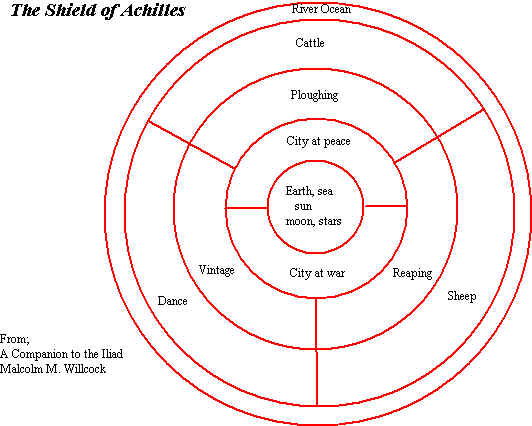
To help guide us we will be using Philip Bobbitt’s framework from his book, “The Shield of Achilles.”  I have picked this because we need to have some kind of general categories to work from, and Bobbitt provides them, though one can debate his specific conclusions.  One of the strengths of Bobbitt’s work for our project is that he is more concerned with showing the possibilities than arriving at specific conclusions.  Bobbitt chose the title because he wanted to emphasize the connections between various aspects of society, and he refers to the famous shield given to Achilles by his mother Thetis.  We might expect that the shield would have military insignia exclusively, but in fact that shield had depictions of numerous scenes of life in general, as the diagram shows.

I want the students to see these same connections.

Bobbitt makes several points worth noting.

  • Many historians will seek for the one defining turning point in the history of the western idea of the state.  Bobbitt points out, rightly I think, that there are many such turning points in history, and that we are in the midst of one now.  By understanding how these changes happened before, we can better prepare for our own future
  • People remain who they are from birth, but the way they relate to the world will change over time.  For example, as a young boy I thought of myself as a future NFL wide receiver.  What if I still thought of myself that way?  What if I left my job, trained hard, and showed up at Redskins training camp next year hoping to make the team?  This would be silly, but also destructive.  What would happen to my family, for example?  So too, nations must accurately assess their own identity and match it to the reality they face.  When nations fail to do so — when their concept of their own identity does not fit well with reality, that nation suffers.
  • Bobbitt also encourages us to see the various state models over time as opportunities.  Often people, like nations, get stuck wishing and acting based on a bygone past.  How much better if we could accept things we could not change and make the most of them?  What are those things that can be changed, and things that cannot?  How should we act and plan accordingly?

We proceed recognizing that elements of a state’s internal order (politics, economics, culture, military, etc.) will all share a common rationale.  When we looked at the “Territorial State” (1648-1776) model we saw its origins in the rejection of the “Kingly State” (1588ish-1648) and its identity.

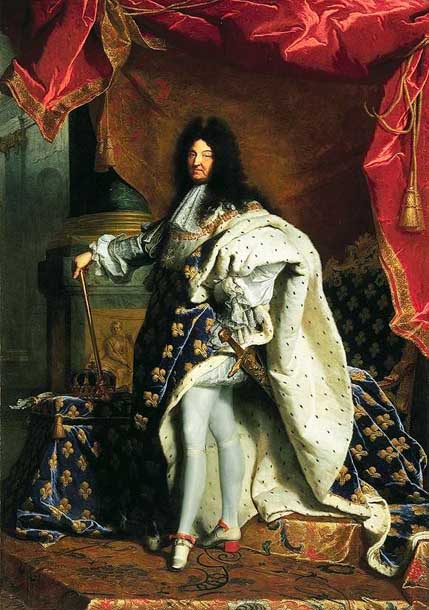
The Kingly state built itself around the king.  The “bigger” the king, the grander the people.  So, for example, the French took pride in the fact that Louis XIV could eat far more than other men.  It made him seem larger than life, and this in turn spilled over into the people.  Frequently other monarchs of this era (like Henry VIII, Elizabeth I) pictured themselves in outsized proportions.

If the king’s religion formed the religion of the people, than those that did not share in that religion must either have second-class status (like Catholics in England, or Protestants in France) or be banned entirely from participation in the state.  Furthermore, the wars of the state could in theory be universal in scope, because religion is not bound by geography.

The transition to the “Territorial State” came about due primarily to the physical and moral exhaustion brought about by the wars of religion.  Now states feared above all “enthusiasms,” or anything that might upset the apple cart.  Now rulers sought to keep wars local and short, because the only justification for war had to be acquisition of contiguous territory.  The universal ambitions of previous monarchs made no sense anymore.

The age of the Territorial State is the age of the Scientific Revolution and Enlightenment, with a focus on what can be known and measured.  Economically, the “mercantile” philosophy dominated the era, with its strict control on imports.  Adam Smith’s The Wealth of Nations would do much to undermine this philosophy, and coincidentally, appeared at the same time as the American Revolution.

This transition can be seen visually:
The ‘Kingly-State’ King, Louis XIV, where the “bigger” kings are, the more power they have (notice how Louis seems to say, “Look at me in all my glory!”):
The ‘Territorial State” King, Frederick the Great (notice that does not seek to reveal himself to the painter–he almost turns himself away):
‘Kingly State’ Architecture:
‘Territorial State’ Architecture:
This is a tough concept, but I hope the students will get the hang of it.
Dave Mathwin

The “Great Man” Theory of History

The book “Blood and Iron Origin of the German Empire As Revealed by the Character of Its Founder, Bismarck,” by John Hubert Greusel is not so much a biography of Bismarck as it is a pean to an idea, an homage to a theory of History.

Historiography has its fashions just like other disciplines.  In the late 19th century the “History is Made by Great Men” theory gained prominence among a certain set.

To best of my knowledge, the theory runs something like this:

  • Existence, political or otherwise, is about struggle for survival and little else.
  • Civilizations have moral codes to help check our naturally competitive instincts, and these serve a good purpose — most of the time.  But times arise that call for a transcending of such codes.  We don’t like to admit it to ourselves, but the vast majority of us lack the strength of will and purpose needed to accomplish what needs done.  Society craves champions.
  • “Great Men” arise to meet such a challenge.   Such men have vast intellects and plentiful energy.  They can mold the minds of men and make Lady Fortune their mistress.  Their grand vision naturally requires sacrifice, but they sacrifice themselves most of all to their ideals.  They sacrifice the prevailing mores of the time to this ideal as well.  Their “greatness of soul” excuse all their crimes and vices, some of which are only mere convention anyway.
  • Such “Great Men” are beloved by some, hated and reviled by most others.  Inevitably, “lesser” men gang up on them and bring them down, but the “Great Men” manage to have the last laugh.  They gain immortality by their deeds and the impact they leave behind.

Colonel Jessup believed in this theory. . . (warning: language)

Historians typically use a few different people to expound this philosophy.  Julius Caesar fits the bill, as does Napoleon, who said, “The world begged me to govern it.”  Some write about Alexander the Great this way, a man with a vision of the brotherhood of man, only to face betrayal from his own army.  Hannibal gets this treatment too, as his own government first would not give him reinforcements and then after the war betrayed him to of all people, the Romans.  At least Hannibal, unlike Napoleon, Caesar, and Alexander, got a noble death by his own hands.  He remained “unconquered.”

Bismarck most definitely could be written about this way, and that is how Greusel treats him.

Fashions change of course, and historiography changed.  By the mid-20th century historians had stopped focusing on the great men and swung the pendulum to examine culture, environment, and the everyday (think Fernand Braudel).  Interestingly, the “Great Man” approach coincided with the advent of Nietzche’s philosophy of the “over-man” and the heyday of imperialism. Historians’ focus switched as empires collapsed and the civil rights movement began.

First, a word about Greusel specifically.

His writing has an endearing quality, because he cannot contain himself.  He gets carried away with his subject, with both Bismarck and the Idea.  Each page has multiple exclamation points to accompany the exalted language.  A typical paragraph might look like . . .

And here is Bismarck, striding over the plain of Sedan.  Look at his steps, like a Colossus!  His face — o his face! — triumphant in his glory.  But look close.  Is that a tear in his eye?  A tear for the slain, the cost of victory?  Weep, o weep Bismarck, if you must, but not here, not now. Watch him suppress his anguish, for what is the cost?  This is Germany’s hour!  Watch Bismarck complete the triumph.  For he will drink champagne — yes champagne! — right in Versailles where Louis XIV looked with eagle eye over his foppish band.  Bismarck guzzles the liquid, as he guzzles glory!  For here we have a man who loves and hates like no other!

Entertaining in doses, but not entirely informative.

Greusel does not entirely gloss over Bismarck’s faults, but he keeps returning to the idea that, “You need Bismarck on that wall, you want Bismarck on that wall!”  Germany needed united, after all, and it took a force of nature to overrule a pathetic Parliament and outmoded provincial princes.  Thus Bismarck fulfilled, “the secret yearning of the Teutonic Heart,” (his words, not mine) and the immensity of the task meant that immense deeds needed done, and lesser men must give way to The Deed.

I’ll give Greusel credit for this: he does not hide his thoughts in flowery prose.  He has no qualms with making his views obvious, such as his intolerance for weakness or the “pettiness” of democracies.  His heroes are the Great Men, who serve the god Will, embodied in the German national consciousness.

I have profound antipathy for the “Great Men” theory of History for many reasons, but we must first understand its appeal.  We admire strength because we do need it at times.  Part of us can’t help but agree with Colonel Jessup.  Certain times call for clarity of vision and courage to make difficult decisions when all others see a foggy grey landscape.  The question is, what kind of strength do we need?

With that in mind, problems with the theory abound:

  • The theory absolves one of responsibility.  Bismarck’s individuality gets merged into something resembling Fate.  For all of Greusel’s croonings about how Bismarck was a “man” his treatment of him abstracts Bismarck to the point where he no longer is an individual, but a Type.  As a colleague of mine rightly pointed out, a great gulf exists between the Great Men and Biographical approach to History.  The biographical approach values their subjects as men/women, rather than seeing them through the lens of imagined archetypes.
  • This absolving of responsibility allows the characters of this treatment (Napoleon, Alexander, etc.) to indulge via proxy in childish shifting of blame.  “It’s not my fault!  He did it!”  Again, not particularly manly.
  • The theory has no appreciation for anything like moral strength, or the power in humility.  The growth of the Church within the Roman Empire, or the Civil Rights movement stand as clear examples of the power of humility.  Selfishness and pride get pride of place with “Great Men.”
  • Great Men adherents tend to think that force is always the correct solution.  Napoleon may have been right that Europe needed unity, and that every war between European nations had the character of a civil war.  But his conquests provoked far more war than existed previously.  Bismarck wanted to Germany to unite, and I suppose that Germany had a right to unity if they mutually desired it.  But Bismarck did not want unity through a democratic process.  He wanted to create Germany through the forge of blood and iron.  Only in that way could he serve his god.
  • The theory predicates itself on the unremitting “struggle of life.”  But if History means looking at actual people in time, we should ask if “struggle” defines human existence.  Obviously struggle is part of life, but it also seems like most of the time people watch tv, hang out with friends, read books, visit relatives, etc.
  • Not so much on the theory but on Greusel specifically — why exactly did Germany need united, and why did it need to get that unification at the expense of a patient democratic process?  Greusel never addresses this question directly.

Historian Herbert Butterfield commented,

It is easy to make plans of quasi-political salvation of the world. . . .  And when such plans go wrong, it is easy to find a culprit–easy for the idealist to bring out from under his sleeve that doctrine of human sinfulness which would have been much better to face squarely and fairly in the first instance.  At a later stage in the argument the disillusioned idealist trounces the people who opposed him, brings human wickedness into the question as a deux ex machina.  . . . And now he discovers human wickedness with a vengeance, for on this system the sinners are fewer in number, and thus must be diabolically wicked to make up for it.  Nothing more completely locks humanity in some of its bewildering predicaments and dilemmas than to range history as a fight between the righteous and the wicked, rather than seeing initially that human nature–including oneself–is imperfect generally.

Greusel wrote in 1915, when Germany looked like it might “fulfill its destiny on the world stage.”  The sad irony of this book is that Germany’s worship of force led them to near annihilation over the next 30 years.  Beware of calling forces to your aid you call you cannot control.  Their gods Will and Force turned out to be demons.  St. Augustine commented in The City of God, referring to the Romans folly of adopting the gods that could not save Troy,

For who does not see, when he thinks of it, what assumption it is that they could not be vanquished under vanquished defenders, and that they only perished because they had lost their guardian gods, when, indeed, the only cause of their perishing was they chose for themselves protectors condemned to perish.

Finally Greusel’s abstraction of Bismarck has him overlook aspects of the man that don’t fit his theory.  I’m no great fan of Bismarck, but after 1871 he showed a measure of restraint in foreign policy.   He thought imperialistic ventures foolish and self-defeating, for example.  Germany only embarked on extensive colonialism as he lost power in the government.  Was this a “conversion experience” that Greusel overlooked, or is Bismarck just more complicated that he lets on?  I suspect the latter.

Therefore the book, while entertaining in parts, may reveal more about Greusel than Bismarck himself.  

8th Grade: Cambyses and Unfriendly Historical Sources

Greetings,

This week we looked at the death of Cyrus and the reign of his son and successor, Cambyses II.

When examining Cambyses, we must use some caution.  Much of the information (though not all) about what we know about Cambyses comes from Herodotus’ writing, but Herodotus got much of his information from Egypt.  Cambyses had conquered Egypt, and we can assume that the information the Egyptians gave Cambyses would be slanted against him.  It appears that Cambyses had a terrible temper, exhibited erratic behavior, and may have killed both his brother and sister.  What are we to make of this dilemma?

If Cambyses was all who Herodotus says, this would not be terribly surprising.  Historically, Cambyses does fit the general pattern of the behavior of privileged sons of self-made men.  His father Cyrus worked from the ground up and achieved world-power status by his own innovative policies and bold tactics.  His son, on the other hand, would simply be handed the keys to something he had not earned.  In class I likened Cyrus to an expert Formula-1 driver who had been driving since he was a boy, worked his way up the lesser racing circuits, etc.  Cambyses, on the other hand, would simply be handed the keys to a Formula-1 car upon Cyrus’ death without all the work Cyrus had done.

Under such circumstances, a fiery crash of some kind would be quite likely.

We can speculate as armchair psychologists that Cyrus, given his tremendous energy and success at spreading the power of the Medo-Persians, would not have been home much.  We might surmise some latent guilt over this, and this means that if Cambyses ever came to him and said, “My tutor did ‘x’ and I didn’t like it, do something,” Cyrus might feel compelled to take his side and defer to Cambyses instead of his teachers.  And, if he was raised always to be deferred to, if he was always told how wonderful he was, he would never blame himself for his bad driving.  It would have to be the pit crew’s fault, the car’s fault, the designer’s fault — anyone or anything but himself.  This frustration would lead to anger, and erratic behavior might result.  It is noteworthy that Cambyses’ successor Darius I, a much better king than Cambyes, came from outside Cyrus’ family and was more “self-made” than Cambyses.

However, Herodotus also records several incidents of Cambyses going out of his way to desecrate Egyptian religious sites and customs after his conquest of Egypt, and this seems less plausible to me..  Cambyses, for example, is supposed to have exhumed a dead Pharaoh’s tomb and abused his corpse, and personally killed the “Apis Bull,” sacred to Egyptians.  These actions would have involved such a dramatic departure from Persian practice under Cyrus, that I wonder about their authenticity.

We discussed this dilemma in class.  I tend to think that if one source is all we have to go, we should accept that source unless someone else can contradict it.  Unless Herodotus can be shown generally untrustworthy (and I believe him to be generally trustworthy) than we should not discount his evidence without other evidence.  We should not indict him on mere suspicion.  His actions in Egypt seem very uncharacteristic, but again, we have other evidence in Persian art of the period as well (see above image).  Perhaps Cambyses was just as bad a Herodotus and the Egyptians claimed.

Many thanks,

Dave

Fun with Lists

A colleague of mine who also teaches history recently asked me to play an enjoyable game of “Name your Top Five Historical Events between the Roman Empire and the Reformation in western Europe.”

With some brief banter back and forth we came to an agreement fairly quickly on four and I inserted a fifth.  They are, in order of when they occurred,

  1. The conversion of Constantine, ca. 313 A.D.
  2. Charlemagne named Holy Roman Emperor, 800 A.D.
  3. The first Crusade, 1097 A.D.^
  4. The Black Plague ca. 1348 A.D.
  5. Columbus, 1492

As we considered these five, I rejoiced at our selections.  For, while the list is quite prosaic and hardly original, it reflects a shared worldview between us, and a shared philosophy of history.

For you see, the list has no technological innovations.  Not even the printing press!  I had to pat ourselves in the back in a moment of self-satisfaction.

Some context . . .

I like James Burke’s old show from the 1970’s Connections.  In a typical episode Burke will start with some everyday modern phenomena and then ask, “How did this come to be?”  He will then, by a serious of ingenious jumps and skips back in time, declare that, “If it were not for the discovery of the wood grouse in 1756 B.C., the modern computer would never have come to be.”

Or something like that.

I exaggerate, but sometimes Burke gets carried away.

In the first episode, Burke travels from a power outage in NYC to the invention of the plow in ancient Egypt (it actually makes some sense).  But implicit in Burke’s theme lies the idea that technology creates and then drives civilization.  I don’t buy it.  Yes, the plow probably helped ancient people produce more crops, but what brought people together in the first place?  Ok, people would gather by rivers for sure, but what would make them organize themselves into communities?

It would not be the plow.  Before the plow, some kind of common bond must have drawn people together — almost certainly a religious bond.*  Of course, it is this shared belief that still holds civilizations together today, not technology.

Admittedly not everything on that list involves a directly spiritual concern, so a brief defense of the selections seems in order:

Neither one of us thought Charlemagne’s title purely political.  It represented a hope of reorganizing society spiritually and culturally (yes, political as well) along more unified lines.  Some argue that the Holy Roman Empire never amounted to much, but it had a long run as a political and organizing force in Europe.

Whether or not the Crusades had justification in 1097, the conduct of the Crusaders and the ultimate failure of the enterprise seriously weakened the Church as an organizing force in European society.  From around 1200 A.D. on, the state had much more say than previously vis a vis the Church. Whether an improvement or not, certainly this represented a new means of how people interacted with one another.

The Black Plague killed millions, and in the process effectively ended the feudal system, which had governed Europe arguably since the time of Charlemagne.  In time a new middle class would arise with a new way of relating to one another

Columbus is in some ways a stand-in for Renaissance-era exploration as a whole.  As Felipe Fernandez-Armesto argues in his excellent book Pathfinders, exploration did not start based on new technological discoveries.  Exploration began because the way people viewed their place in the world had changed.  In that sense, Columbus is a stand-in for an entirely new way of thinking.

The printing press certainly had significance.  Probably it makes our top 10?  But the printing press has little effect without there first existing a desire to read, a desire to interact with the world in a different way through the printed page.  We should not imagine a world always hungry for books, just begging someone to invent a machine that could make them more accessible.

I am reminded, for example, of a story about Elizabeth I and toilets.  Apparently indoor plumbing was created in her day, and some enterprising inventors offered her the chance to use it. Who among us would refuse indoor plumbing?

She refused.  Having to go to the bathroom offended her sense of royal dignity.  The bathroom, in the form of the chamber pot, would come to her.  What good is being Queen if you can’t order the bathroom around anyway?

The story illustrates the point about the printing press.  It’s not about the invention, but the culture surrounding the invention that matters.  Culture and belief drive technology, and not vice-versa.

Dave

^In the interest of fairness, this represents my choice more so than an absolute unified agreement between the two of us.  As I mentioned, we were lock-step on the other four.

*Not surprisingly, armed with his materialistic view of history, Burke essentially reduces all of the religion and mysticism of Egypt down to applied science.

A Proud Death

Exposing oneself to older ideas has many benefits.  Such a statement is almost a cliche for someone in my line of work, but then every so often the reality of this truth hits one afresh.  The old world had much wisdom that we have lost.

One idea that struck me with particular force recently has to do with the early Church’s link between the reality of sin as it relates to fact of death.  For Adam and Eve, sin brought death, and their progeny inherit bodies of death.  After the Fall, sin now results from death.  That is, we sin because we know we will die.  Sin often originates in our rebellion against death.

We do this unfortunately, in a variety of ways.  We distract ourselves endlessly with extended consumption.*  When men reach my age they buy sports cars and get trophy wives in an attempt to feel young and powerful again.  All of us feel the need for self-preservation, so when we see a chance to “extend ourselves” and grow our kingdom we seize it, whether that means invading another country or cutting someone off in traffic.

The futility of such actions is obvious on a biological level — we will die.  But such actions do more than merely delay the inevitable.  By making death more distant, we lose our dominion over it and thereby give it more power over our lives.

This is the main theme of Philippe Aries’ book The Hour of our Death, which stands as a greatly expanded version of his Western Attitudes toward Death.  In that book he talks about the idea of a “tame” death in a more thematic manner. In this work, in minute and at times fascinating detail Aries gives the reader a multi-faceted look at how western man has died since the early Middle Ages.

I will try not to repeat myself too much from the review linked above.  He begins his study under the heading “The Tame Death.”   Essentially from the early Middle Ages, our approach to death consisted of . . .

  • A belief that death “politely” let one know of its imminent arrival.  This blessed those about to die, for it gave them a chance to say goodbye and reconcile with friends and family.
  • Rituals that governed the process of death for the dying, which included last rites
  • The rituals having the effect of “taming” death*

Aries concludes his first chapter by writing,

The fact that we keep meeting instances of the same general attitude toward death from Homer to Tolstoy does not mean we should assign a historical permanence exempt from variation.  .  . . But for 2000 years it resisted pressures in a world subject to change . . . this attitude toward death is like a bulwark of inertia and continuity.

It has by now been so obliterated from our culture that it is hard for us to imagine or understand it.

Thus, when we call this “familiar” death the tame death, we do not mean to say that it was once wild and is now domesticated.  On the contrary, we mean that it has become wild today when it used to be tame.

This “wild” state of death came about in distinct stages.

  1. Perhaps because of the plague, the later Middle Ages depicted the gruesomeness of death and the reality of death much more frequently in their artwork.  Death was far from “put aside,” but assumed a more terrible aspect.
  2. The late Renaissance made death more about the Last Judgment than redemption in their art.  Perhaps this happened as Renaissance culture knew that it had drifted from its medieval roots and sought through a kind of force — like shaking a patient — to regain some ground.
  3. Many Protestants abandoned this Catholic practice, but as is typical in such cases, swung the other way entirely.  Death no longer brought terror, but neither could it allow for mourning.  Some Puritans, for example, had encouragement to remarry within a month or two of the decease of their spouse.  Rather than fix the “problem” of death, this approach attempts to give death an unreality, which makes it ultimately abstract and impossible to tame.
  4. The scientific age believed that cemeteries were unhealthy places.  Burials stopped happening in or beside churches (located within the town) and got moved outside town limits.  Now, too, rituals involving the dying were in jeopardy, because of the risk of disease, infection, etc.  In suffering “medicalization,” death left the field of the Church and entered the field of science.
  5. The Romantic era of the “beautiful death” attempted to correct the Enlightenment approach.  But like the Puritans before them, they unintentionally swung unhelpfully in the other direction in two main ways: 1) The “beautiful death” imposed a burden on the dying to “get it right” — be tranquil, be composed, be “natural,” etc., and 2) In returning death to the provence of nature they believed they entered a beneficent realm.  But nature in truth (at least according to Aries) is arbitrary, and cannot be “tamed” on its own terms.  Thus, the impossibility of taming death in nature.
  6. The modern era has abandoned rituals of almost every kind that guide cultural practice.  Our societies do not pause in any way for death, unless it is perhaps the death of a statesmen or our military.  Other deaths in society do not register.  As the “ends” of our communal life have secularized, so too has death been secularized.  The whole notion of a “communion of saints,” or a “cloud of witnesses” has disappeared utterly from nearly all Protestant churches.  Without this sense of continuity or ritual, death has free reign, no controls, and again, becomes more terrible in aspect.

Aries published his book in 1981, perhaps the height of the modern medicalization of death.  With the advent of hospice care and other less invasive end of life medical practices we begin to move back in a more positive direction.  But we have a long way to go.

One key way back to a more proper understanding of death will involve a theological shift, as I hinted above.  If we persist in the idea that God resides “up there” while we remain “down here,” we will never understand death.  The same holds true for the departed.  Without the communion of saints, death will continue its lordship.  I quote extensively from Stephen Freeman’s Everywhere Present below to illustrate the point and show us the way forward.

At the time of my visit [to the St. Saba monastery] one of the brotherhood had “fallen asleep” two weeks earlier.  “We never say that a monk has died, ” our guide told us, and I suddenly imagined the unspokenness of death I knew so well [from living in America].  He continued, “We always say, in the words of Scripture, that they have “fallen asleep.”  But most we say this because we see them so often.

Now I knew I was in a different place.

“You see them?” I asked.

“Sure,” he said.  “They appear to monks all the time.  It’s nothing to see St. Saba on the stairs or elsewhere.”  The witness of the monk (who happened to be from San Francisco) was not a tale of the unexpected.  These were not ghostly visits he described, but the living presence of the saints who inhabit the same space as ourselves.  It is a one-storey universe.  Such stories . . . can be duplicated all over the monastic world.

The doctrine of the ancient Church is quite clear in this matter.  Those who have died are separated from us in the body, but the Church remains One.  There is not one church in heaven and another on Earth.


Dave


*Who doesn’t love Amazon Prime?  But my countenance fell upon reading a recent ad of theirs for same day shipping — “Patience no longer required.”

A Vast Gulf of Minor Mistakes

I am very much enjoying Phillipe Aries The Hour of our Death, a magnificent and thorough study of the history of how western civilization dealt with death from its founding in the Middle Ages until now.  The book has many virtues, perhaps chief among them is how illumines the vast gulf he points out between the medieval and modern world in how they dealt with death.  I look forward to commenting more on Aries’ wisdom another time.

For now, however, two minor gaffes on Aries’ part can’t get out of my head.  So with apologies to Aries. . .

He begins talking about death in the Song of Roland, a good place to start as 1) the story comes from the early middle ages, 2) it has the hallmarks of fully developed civilization (unlike the histories of Nottker and Einhard), and 3) it has a lot of death.  He makes excellent points about how the rituals that (spoiler alert) Roland, Turpin, and Oliver perform before their deaths have the effect of “taming” death and reducing its sting.  So far so good.  But then he asserts that, “thoughts of reunion on the other side of death,” or even the vitality of the afterlife, had no part in their consciousness because they do not mention it.  Aries quotes from Roland’s wistfulness at losing the land’s he conquered in death as evidence that early medieval man did not think much of the next life in death.  We might respond that the argument from silence does not convince very much, or perhaps, that it is good evidence for how Roland felt, but perhaps not necessarily the whole of the middle ages.  We could also debate the extent to which literary evidence should count as historical evidence.

In a fascinating segment Aries discusses how over time the place of burial mattered more and more.  Eventually, burial within the church itself came even to supersede burial within church lands, or the church graveyard.  He cites one example,

In the 17th century the parochial mass was said at the altar of the blessed sacrament.  “Beneath this altar lies the body of Claude d’ Aubray, knight.  Having had on this earth a wholehearted and singular devotion to to the precious body of our Savior, he desired that on his death he be laid to rest and buried next to the Blessed Sacrament, that he might obtain mercy through the prayers of the faithful who prostrate themselves before the very holy and venerable sacrament and be born again with them in glory.”

Granted, such burials did not come without a fee.  But it is here that Aries, I think, misinterprets the purpose.  He views the special burial as a kind of exchange — the deceased do ‘x’ so that they get ‘y,’ and thus descends into a legalistic understanding of spiritual concerns.  Though throughout the book Aries offers implicit criticism in how the modern world deals with death and admires much of how the early modern world handled things.  He seems to have particular admiration for the early medieval world.  But, alas, he cannot escape his own modern, scientific outlook and assumes the same about the past.

We might say in response that, yes, such burials brought a certain cost, but funerals today cost as well, and likely cost more.  Regardless, proper burial requires work and workers need paid.

But we can go a bit further.  Aries assumes that such burials were seen as beneficial to the dead in the way that buying milk with a few dollar bills benefits the consumer.  But our relationship with God, let alone our relationships with people, do not work this way.  We don’t buy flowers for our wives to earn their favor, but for other, less concrete reasons.  Parishioners do not cross themselves, for example, for God, but for themselves.  Ritual acts proceed primarily from devotion, not duty.  So too, burial within the church or within church lands has nothing to do with any kind of “exchange” for salvation, but as a way for the dead to plant their flag in the “City of God,” represented by the church.  Thinking differently about death requires us to change our perspective on many other issues.

Others in earlier centuries share in Aries’ misunderstanding.  He writes,

Erasmus finds [belief] in the virtues of the last rites superstitious for the same reason [as other 17th century writers]: because they seemed to designed a dissolute life to be saved ‘in extremis.’

Heaven forbid that someone be saved in their last moments after a dissolute life!  That would upset the whole notion of righteousness as a kind of exchange.  This legalistic understanding is not limited to our modern times.

Aries’ book illumines much, and even his modern understandings reveal the vast gulf between the modern and early modern worlds.

The Social State

As the American History class reads through some excerpts from De Tocqueville, questions about the nature of equality have arisen consistently, especially in regards to the recent Supreme Court decision on marriage.  The students (and to a somewhat lesser extent, myself) seem plowed over by the speed of how things have changed.  In 2004, some argued that the issue of homosexual marriage helped mobilize conservatives to defeat John Kerry.  Ten years later many acted as if the high Court’s decision was an inevitable byproduct of the times.  The shift came swift and sure, and in some ways out of nowhere.

What happened, and why?

One could advance many reasons and theories.  An extended treatment of the topic would involve an in depth look at theological and cultural shifts, and so forth.  Pierre Manent’s De Tocqueville and the Nature of Democracy helped me see one piece of the puzzle in stark clarity.  In discussing De Tocqueville’s general political theory, he writes,

Tocqueville draws distinctions between three types of regimes: those where power is external to society (absolute monarchies), those where it is both internal and external to society (aristocracies, who reside outside the people, but reside there due to custom and tradition, thus from within the culture), and finally, the United States, where the society “acts by itself on itself,” because “there is no power except that which emanates from within.”  He paints the picture of regime where the social bond is immediately political.

Aha!  Here we have it, as he asserts that democratic governments have no guidance from “the state,” rather, it comes from everyone, or no one in particular.  This is why we don’t always see these changes coming.

Manent continues to enumerate two main characteristics of such regimes.

  • Invisibility — De Tocqueville writes, “In America the laws are seen, their daily execution is perceived, everything is in movement around you, but the motor is discovered nowhere.”
  • Omnipresence — This invisible power is present and active.  “In the New England states, the legislative power extends to more objects than are among us.” “In the United States, government centralization is at a high point.  It would be easy to prove that national power there is more concentrated than it has been in any of the ancient monarchies of Europe.”  De Tocqueville referred, of course, to the 1830’s — not today.

This means that, among other things, we cannot blame the courts, the media, Hollywood, or any other particular entity in society.  If we don’t like something we have only two choices: blame everyone, or no one at all.

Tocqueville thought in the 1830’s that this power still mainly operated through legislative bodies and elections.  Today, I can’t think of a strong legislative body in any particular state, let alone Congress itself.  Change now, even more so than Tocqueville’s day, comes from the mist of the air.  It concentrates quickly and becomes universal.  “The social bond is immediately political.”  One can debate whether or not the Supreme Court’s decision truly reflected the “average American.”  But we cannot deny that the “spirit of the age” gave the Court’s decision that feeling of inevitability.  We didn’t see it coming because American politics truly operate from the people, not even from our elected officials — hence the enormous power  of this force.  We can elect new leaders.  Even kings die eventually.  The people will always remain.  Our institutions. then, even our guaranteed rights, should not be seen as natural byproducts of democratic government, but foreign agents sent to sabotage this unseen motor.  Tocqueville believed that the insertion of the Bill of Rights checked democratic feeling, and proved the wisdom of the founders.*  In general, he predicted that the massive power of the people would run through every possible crack in the Constitution and widen it immeasurably.  One only has to see how we have used the commerce clause** for good and ill as yet another exhibit of Tocqueville’s keen perception.

As we might imagine, this “motor” must derive its primary source of energy from a passion for equality, not liberty.  Tocqueville pointed out often that at some point these two governing principles become mutually exclusive and cancel each other out.  “Liberty” might produce more individual works of great genius, but equality will give us “immediate pleasures” and a more equitable foundation for democracy.  He predicted that equality would rise in prominence as the years went by and he predicted accurately.

We might think that the idea of “marriage equality” shows that we have reached the apotheosis of this democratic idea, but if we look at the culture at large I have my doubts.  Movies like “Elysium” and “Snowpiercer,” tv shows like “Mr. Robot,” broader trends like the “Occupy” movement — all show that we may not be done with “Equality” just yet.  This in turn made me think about a comment A.J. Toynbee made about a link between capitalism and communism.  He writes in Volume Five of his A Study of History,

However that may be, the modern Western World seems to have broken virgin soil in extending the empire of Necessity into the economic field — which is indeed a sphere of social life that has been overlooked or ignored by almost all the minds that have directed the thoughts of other societies.  The classic exposition of Economic Determinism is of course Karl Marx; but in the western world of today the number of souls who testify by their acts to a conviction that Economic Necessity is Queen of All is vastly greater than the number of professing Marxists, and would be found to include a phalanx of arch-capitalists who would repudiate with horror any suggestion that were fundamentally at one, in the faith by which they lived, with the execrable prophet of communism.

Many of us grew up with Democracy and Communism as bitter enemies.  But Tocqueville and Manent have made me wonder, if in communism we simply have democracy’s final and untenable form.

Dave


*Though the Bill of Rights was not in the original Constitution, we can agree with Tocqueville if we interpret “founders” more broadly.

**Article 1, Section 8, Clause 3 of the U.S. Constitution, which gives Congress the power “to regulate commerce with foreign nations, and among the several states, and with the Indian tribes.”  We have used the commerce clause as the basis for labor laws, farm subsidies, gun control, etc., etc. in ways I’m sure the framers of the Constitution never imagined.

12th Grade: We are Defined by what we Love

In his magnum opus, The City of God, St. Augustine wrote how people define themselves not so much by what they do, or even what they believe, but by what they love.  This penetrating insight led him to develop a whole theory about how the church and state operate and what goals they pursue.

St. Augustine had a classical education and certainly Plato influenced him a great deal.  In fact, Augustine may very well have had the last few books of Plato’s Republic in mind as he developed his theory.  For Plato argued essentially the same thing, that every form of government results from the accumulated desires of the people it governs.  In other words, every society gets the kind of government that reflects their “soul” as a nation, or every nations gets the kind of government they deserve.

Plato spends the majority of The Republic laying the groundwork for the perfect state.  His vision contains much that we should admire, and other aspects we should utterly reject.  He had far seeing and radical ideas for his day, ideas that would remain radical for many centuries (such as the equality of men and women, and his goal to educate women the same as men).  He had others that map out a modern plan for the worst state tyrannies, such as his proposal to have the state erode the family as a vital part of the state.

Some accuse Plato of living too much in an imaginary play-world, but by the end of the dialog Plato discusses the visible imperfections of governments.  We would approach the issue likely by looking at the structures of governments and the distribution of powers.  Plato starts with the soul, and believes that each form of government, be it oligarchy, democracy, monarchy, or the like, has its roots in souls of the people in the state.  In other words, an oligarchic state will have a preponderance of “oligarchic souls” that comprise it.  I suppose Plato might say that each state gets the form of government it deserves.

He starts by discussing what he calls a “timocracy,” a state where people dedicate themselves to honor.  Most of these societies (Sparta and Macedon serve as examples) find that achieving honor comes most quickly in war.  Thus, their drive for honor makes them a warlike state.  Socrates describes the timocratic man,

He should have more of self-assertion and be less cultivated, and yet a friend of culture; and he should be a good listener, but no speaker. Such a person is apt to be rough with slaves, unlike the educated man, who is too proud for that; and he will also be courteous to freemen, and remarkably obedient to authority; he is a lover of power and a lover of honour; claiming to be a ruler, not because he is eloquent, or on any ground of that sort, but because he is a soldier and has performed feats of arms; he is also a lover of gymnastic exercises and of the chase.

Timocracies have the main advantage of dedicating themselves to something “spiritual,” beyond mere material gratification.  But, as is often the case, this kind of intense dedication and shunning the world has its consequences.  First, due to the intense desire to preserve honor, powerful timocratic men will not want to “put themselves out there” for fear of failure and loss of face.  More significantly, his heirs likely will not take satisfaction in his purely “spiritual pursuits.”  His descendants will want honor to translate into something more tangible, and so timocracy generates into oligarchy, where the souls of men seek the accumulation of wealth.  Plato penetratingly blames the avaricious nature of timocratic man — he is avaricious of honor itself — for creating the more common form of avarice in his descendants.  The timocratic man cares not for the education of the soul towards eternal beauty, so he is more apt to succumb to the temptations of avarice in the first place.

The defects of the oligarchic soul, and thus the oligarchic state, are many. . .

The accumulation of gold in the treasury of private individuals is ruin the of timocracy; they invent illegal modes of expenditure; for what do they or their wives care about the law? And then one, seeing another grow rich, seeks to rival him, and thus the great mass of the citizens become lovers of money.

Likely enough.

And so they grow richer and richer, and the more they think of making a fortune the less they think of virtue; for when riches and virtue are placed together in the scales of the balance, the one always rises as the other falls. And in proportion as riches and rich men are honoured in the State, virtue and the virtuous are dishonoured.

Clearly.

And what is honoured is cultivated, and that which has no honour is neglected. And so at last, instead of loving contention and glory, men become lovers of trade and money; they honour and look up to the rich man, and make a ruler of him, and dishonour the poor man. They next proceed to make a law which fixes a sum of money as the qualification of citizenship; the sum is higher in one place and lower in another, as the oligarchy is more or less exclusive; and they allow no one whose property falls below the amount fixed to have any share in the government. These changes in the constitution they effect by force of arms, if intimidation has not already done their work.   And this, speaking generally, is the way in which oligarchy is established.

Yes, he said; but what are the characteristics of this form of government, and what are the defects of which we were speaking?

First of all, I said, consider the nature of the qualification just think what would happen if pilots were to be chosen according to their property, and a poor man were refused permission to steer, even though he were a better pilot?

You mean that they would shipwreck?

Yes; and is not this true of the government of anything?

I should imagine so.

Except a city? –or would you include a city?

Nay, he said, the case of a city is the strongest of all, inasmuch as the rule of a city is the greatest and most difficult of all.

And here is another defect which is quite as bad, namely, the inevitable division: such a State is not one, but two States, the one of poor, the other of rich men; and they are living on the same spot and always conspiring against one another.

That, surely, is at least as bad.

Another discreditable feature is, that, for a like reason, they are incapable of carrying on any war. Either they arm the multitude, and then they are more afraid of them than of the enemy; or, if they do not call them out in the hour of battle, they are oligarchs indeed, few to fight as they are few to rule. And at the same time their fondness for money makes them unwilling to pay taxes.

How discreditable!

It is the lack of harmony, the lack of balance (which carries us back to our discussion about music), which brings down the oligarchic state.  The pursuit of money leads to grossly top-heavy state with no guiding principle other than the accumulation of property.

The timocratical soul loves honor, the oligarchic loves money, and the democratical soul loves the empowerment of choice.  The oligarchic soul fails to pursue wisdom, so he passes no guiding principle down to his children to help them govern the desires his own accumulative practices enflamed. He despised the poor, so he never bothered to train them either.  The door now stands wide open for democratical man.  Plato writes,

And then, again, after the old desires have been driven out, fresh ones spring up, which are akin to them, and because he, their father, does not know how to educate them, wax fierce and numerous.

Though Plato has some praise for democracy, he believes that democratical soul may be the poorest of all, for in the end he pursues nothing outside of himself, nothing outside of whatever he desires at a given moment.  It is this passion for choice that Plato believes guides democratic man — a passion ultimately for “the freedom and libertinism of useless and unnecessary pleasures.”  He writes,

Yes, I said, he lives from day to day indulging the appetite of the hour; and sometimes he is lapped in drink and strains of the flute; then he becomes a water-drinker, and tries to get thin; then he takes a turn at gymnastics; sometimes idling and neglecting everything, then once more living the life of a philosopher; often he-is busy with politics, and starts to his feet and says and does whatever comes into his head; and, if he is emulous of any one who is a warrior, off he is in that direction, or of men of business, once more in that. His life has neither law nor order; and this distracted existence he terms joy and bliss and freedom; and so he goes on.

The democratic state, then, can have no harmony, because democratic man himself has no internal harmony.  He pursues many things, but none of them well, none with any depth.  The virtues of patience, moderation, and deliberation stand as enemies to “Choice” — they impede choice because they slow down “Choice.”  Thus, democratic man eventually dispenses with them, and with him the state.  Finally the disharmony and competition engendered by “Choice” becomes unmanageable.  At this point, we crave the end result of choice, self-gratification, more than what attained us this gratification, which was Choice itself.  We will then want a tyrant to control the conflict and make sure we can still attain the life of pleasure that Choice brought us.

Plato’s harsh critique of democracy should give us pause and have us consider a few points.  A quick glance seems to show that the decline of the Church in the west has brought about the rise of the god “Choice.”  We spend much time, money, and resources developing technology to enhance our seemingly limitless ability to choose.  Policies like abortion and homosexual marriage receive their justification from the concept of choice itself: we chose it, and that fact trumps all others.  Christians may rightly object to such practices, but must realize that “Choice” stands as a fundamentally different god.  Death has also come under the dominion of Choice, as some states now legalize assisted suicide, which allows for us to exit this life on our terms.

Our founders certainly had awareness of this problem.  In the Federalist #10 Madison ingeniously turned Plato’s argument somewhat on its head.  He claimed that the multiplicity of choice would create a multiplicity of factions.  So long as none gained too much of a majority they would cancel each other out, and preserve liberty thereby.  Whether this has proven true in the long run remains to be seen.  Plato would surely argue that a government with disharmony actually built into the system (as opposed to it being a by-product in timocracies and oligarchies) could never have any real stability.  Without this stability, tyranny could not be far away.

We will have to wait until later to consider a defense of democracy.  For now, I hope that Plato’s critique will sink in to the students and help them see the strengths and weaknesses of democracy more clearly.

Historians of Fortune

My disclaimer to all my posts is that I am strictly an amateur historian, and perhaps no more so than in the post below . . .

A frequent topic of conversation among historians is the nature of decline and fall.  Is the collapse of a particular civilization essentially inevitable, or can a civilization continue unto the end of all things?  Others nuance the dilemma a bit by stating that decline and fall remains eminently likely but possible to stave off.

Discussion about decline in the ancient and medieval world involved the concept of Fortune.  For the ancients, Fortune could often have the sense of arbitrary incoherence.  Troy must fall — Hector knows this.  As to why or to what end, he has no idea and seemingly cares not to know.  Not even Zeus seems to know why Troy must fall.  Fate, that awful word, never strayed far from the mind of the ancients.

Medieval thinkers sought to have a generous spirit and wanted to give Fortune a place in the Divine scheme.  Dante describes Lady Fortune as one of God’s servants.  She dispensed with blessings and setbacks indiscriminately, yes, but not for an unknown purpose.  God always wants to show forth his kingly munificence and have that imaged on Earth for all to see.  At the same time, all must learn humility, for without humility, who can be saved?   Blessings and rewards (in Fortune’s kingdom) not so much because of sin or righteousness but to teach grand lessons about salvation.  That is why Fortune is “Lady Fortune,” for the same reason St. Francis called death “our Sister, Bodily Death.”  Both have the gentle, nurturing female touch despite the pain they bring.

Eric Voegelin’ s treatment of Polybius in his Order and History intrigued me.  Perhaps the most famous section of Polyblius’ work is in Book VI where he discusses the cycle of rise and fall that preys upon all civilizations.  What makes this section of particular for me is that Polybius writes about Rome’s rise from ca. 270-200 B.C., but writes himself around 140 B.C. when cracks in the Republic started becoming evident.  It gives Polybius an unusual vantage point.

Voegelin, a notable critic of “disembodied” interpretive methods of history, makes two points worth noting in his treatment of Polybius.

The first surrounds the idea of cause and effect.  At times Polybius, like his fellow Greek Herodotus before him, has a tendency to extend the cause beyond comprehensible reason, placing the fulcrum for events he discusses have orgins long before anyone living at the time can recall.  Of course Polybius distinguishes between direct and distant causes, but the question is one of proportion.  If everything can be a cause, then nothing is a cause.  If the real cause has roots beyond the knowledge or experience of anyone living, then things “just happen.”  Both practices could be described as gnostic because both encourage us to live in a world without responsibility, in a state disconnected from creation.

The second concerns Polybius’ ultimate failure to find a true cause.  This leads him in turn to focus first on the bare reality of Rome’s practices, how they built forts, how they made laws, and so on.  He pays little attention to whether the laws be good or bad, or what particular advantage the forts might have given them.  This focus on the pure “physics” of things likely explain his drift into explaining everything with the Wheel of Fortune, which has in his mind an arbitrary quality.  Polybius quotes from the last Macedonian king with evident approval, who said,

If you take not an indefinite time, nor many generations, but just the last 50 years, you will see the cruelty of Fortune.  Fifty years ago do you suppose that the Macedonians or the Persians, if some god foretold it, would have believed by the present time that the Persians, who once ruled the world, would by now have ceased to be a name, while the Macedonians, who were then not even a name, would be rulers of all?  Yet this Fortune, who never keeps faith, but transforms everything against our reckoning . . . has lent him these good things until she decides to dispose differently of them (XXIX, 21).

Later Polybius, with Scipio in at the destruction of Carthage he records Scipio’s foreboding that now that Persia, Macedon, and Carthage had been destroyed, perhaps Rome would now be next.  But just as with the king of Macedon, no intelligible cause would exist.  Fortune does what she wills, leaving mankind ‘not guilty’ for whatever happens.

Of course others took up this idea before Polybius, notably Plato himself in The Republic.  Some accuse Plato of gnosticism and he can drift in that direction at times, but his analysis has its roots not so much in disembodied fate but in the lives of individuals.  When thinking about the transition from oligarchy to democracy he discusses the choices and desires of individuals.  So the “oligarchic man/men” lead the transition from timocracy to oligarchy.  The “democratic man” in turn brings about democracy, and so on.  The city-state contains the accumulated souls of its inhabitants, thus the city too might be said to have a “soul” in aggregate.  It too chooses.  It too has responsibility.  A brief excerpt discussing “democratic man” shows his method:

Yes, I said, he lives from day to day indulging the appetite of the hour; and sometimes he is lapped in drink and strains of the flute; then he becomes a water-drinker, and tries to get thin; then he takes a turn at gymnastics; sometimes idling and neglecting everything, then once more living the life of a philosopher; often he-is busy with politics, and starts to his feet and says and does whatever comes into his head; and, if he is emulous of any one who is a warrior, off he is in that direction, or of men of business, once more in that. His life has neither law nor order; and this distracted existence he terms joy and bliss and freedom; and so he goes on.

Plato refuses to submit everything to “Fortune/Fate” and this makes hima  greater thinker, and in another sense, the greater historian (see — this is why you read this blog, so you can find out shocking things such as, “Plato was a more profound thinker than Polybius.”  Thank goodness for A Stick in the Mud!).