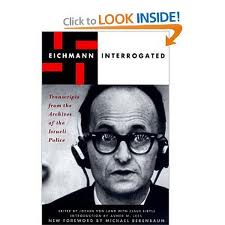
“Eichmann Interrogated,” and Hannah Arendt’s “Eichmann in Jerusalem”

Adolph Eichmann worked closely with the notorious S.S. General Rienhard Heydrich, and helped formulate and institute the plans for the Final Solution.  He escaped eventually to Argentina, but was kidnapped by the Mossad and taken back to Israel for trial.

Eichmann Interrogated is comprised almost entirely of edited transcripts of conversations between Israeli Captain Avner Less and Eichmann himself.

The book starts and continues on a tedious note.  Eichmann takes pains to clarify the minutiae of who he knew, when he joined the S.S. and why, what his rank meant, and exactly what he did.  Painstakingly he gets us to the point where he asserts that the scope of his powers extended to Section IV B4.  That’s all.  He even expresses horror at the fact that Nazi’s murdered Less’ father in a concentration camp.

But around page 90 or so Less’ questions come more to the point, and Eichmann’s responses have to match.  Eichmann claims responsibility only for the fact that he transported people to the camps, and not for any of the deaths.  He talks of the need to obey orders, that he did nothing illegal as far as German law was concerned.  When pressed on the death of civilians at the hands of Germany, he admits it but points out that the Allies killed hundreds of thousands of civilians with their bombings as well.  He is deferential, but fights nonetheless.  He desperately tries to get distance between himself and the victims by claiming that he did not know necessarily that any of them would be killed for sure, otherwise why did so many Jews survive the war?  Bizarrely, he almost argued that his conscience could be clean because any of those he did ship to camps might hypothetically not be killed, thus, he can say he helped kill no one at all. He is very clear on this point.  Eichmann does not come to terms with his actions.

Many things make the last 150 pages or so of the book so memorable.  Did he truly believe the legal fictions he spun for himself?  Did he divorce himself so much from reality that he could not connect his transportation of people and their deaths?  Surely too, he lied about the extent of his involvement.  But again, did he believe his lies?

Hannah Arendt’s work helps complete the picture.  I thought Arendt’s Imperialism fantastic, but Eichmann in Jerusalem lacked the focus of that previous work.  Still the subtitle itself (A Report on the Banality of Evil) is a great insight into the whole Nazi regime.  Arendt does also draw one key conclusion about Eichmann himself.  She did not see him as a simpleton or a mere patsy.  He had a kind of intelligence.  But she argued that Eichmann had no ability or training to see anything beyond the moment.

One example might be that within minutes of each other he first disavowed any believe in the afterlife and then proclaimed that, “Germany will live in my heart forever.” Eichmann was perhaps literally incapable of seeing the contradiction. The same insight applies to him expressing horror over Avner Less’ father in a death camp.  Perhaps that too was not an act.  Perhaps he did not see the connection between himself and that event, however absurd that notion is.  Truly, he was never trained or encouraged to think or view things outside of himself.  He accepted his death sentence passively, but with little real sense of the reasons why he deserved it.*  For him the verdict seemed like victors justice and not Justice proper, a mere extension of the war 17 years later.

If she is right in this about Eichmann, then we can reasonably assume that he may not have only tried to concoct a desperate defense with his, “I only shipped them to the camps, I never killed anyone,” line.  He might have actually believed it. In this way Arendt makes us see that Eichmann is part of the tragedy of the Holocaust, all the more so because it seemed he couldn’t see that about himself.

*Unlike, say, Burt Lancaster’s character in the great ‘Judgment at Nuremburg.’

The Inherited Conglomerate

In his collection of folklore from Ireland W.B.Yeats quoted the Irish proverb that, Those who travel much have little faith.”  He mentioned this with seeming ambivalence, which reflects something of Yeats himself.  He certainly had many markings of the worldly man, yet he wrote the magnificent poem “The Second Coming,” with the immortal line that tells of the centre no longer holding, the widening gyre of the falcon.

I have traveled very little, but this very small amount of travel has confirmed its enormous educational benefits.  One sees new things from new perspectives “in the flesh.”  Certainly one should always wish to grow, learn, and so on, but the proverb holds at least a kernel of truth: those who travel without a secure base may find themselves more “enlightened,” but also more confused then before.  These new perspectives can completely undo one’s world.  Whether this disruption be good or bad . . . it is unquestionably a disruption.

The great Gilbert Murray made his mark in the early 20th century as one of the great scholars of classical antiquity.  For many he modeled the calm, rational confidence of pre-W.W. I Europe and the blessings of “free inquiry.  His analysis of the history of Greek religion confirmed his rationalism.  Greece turned to irrationalism, he argued, and therefore decline, only when they lost their “nerve,” their sense of themselves.

But one particular comment of his caused his followers some consternation.  He admitted that every civilization has an “inherited conglomerate” of thoughts and ideas that should not be questioned, even though they cannot be “proven” in the usual sense of the word.   When society starts to try and dissect this inherited tradition, when they lose confidence in the conglomerate, they lose a common language and purpose and begin to fracture. He defended, for example, the teaching of Christianity in Britain’s state schools because

the religious–and what is more–the ethical emotions of the English people are rooted in the Christian writings, especially the Gospels, some of the epistles, and books like the Imitation and Pilgrim’s Progress.  The situation must be accepted.

It was that “must” that particularly bothered people.  What did he truly believe?  was rationality in itself a religion?*

Murray saw the emancipatory movements of the 19th century and often supported them.  But, he remained apparently torn about this in his later years, for he saw that the collapse of traditional Europe after W.W. I did not lead to more freedom as expected, but much less freedom for millions due to the rise of totalitarianism in Italy, Germany, and Russia.

In a podcast with Ezra Klein, he and Tyler Cowen exchanged thoughts on the emerging “rationality community.”

Ezra Klein

What are your thoughts on the rationality community?

Tyler Cowen

Well, tell me a little more what you mean. You mean Eliezer Yudkowsky?

Ezra Klein

Yeah, I mean Less Wrong, Slate Star Codex, Julia Galef, Robin Hanson. Sometimes Bryan Caplan is grouped in here. The community of people who are frontloading ideas like signaling, cognitive biases, etc.

Tyler Cowen

Well, I enjoy all those sources, and I read them. That’s obviously a kind of endorsement. But I would approve of them much more if they called themselves the irrationality community. Because it is just another kind of religion. A different set of ethoses. And there’s nothing wrong with that, but the notion that this is, like, the true, objective vantage point I find highly objectionable. And that pops up in some of those people more than others. But I think it needs to be realized it’s an extremely culturally specific way of viewing the world, and that’s one of the main things travel can teach you.

All of this came to mind as I read E.R. Dodds’ provocative classic, The Greeks and the Irrational.  We assume, he argues, two main things about the Greeks:

  • Their main contribution to the western world was their spirit of free, rational inquiry, and
  • It was this spirit of free inquiry that led to the greatness of their civilization

Dodds pushes us to see the Greeks on their own terms.  They had, perhaps more than other civilizations, a “rational” tradition, but even this rationalism sometimes came cloaked in religious guise.**

For example, the Pythagoreans developed a variety of useful and progressive ideas about math.  But their obsession with ratio/rationalism clearly had strong religious overtones, which shows when they (supposedly) drowned the “heretic” Hipassus for discovering irrational numbers.  The foundation of their mathematical advances had strong irrational overtones.  Socrates, whom many assume to be an arch-rationalist, declared in the Phaedrus that, “Our greatest blessings come to us in the form of madness.”  The whole of Greek literary and dramatic culture arose out of Dionysian worship.  Xenophon, Aristotle, and even Cicero accepted the idea that dreams could have spiritual import. The list could continue.

But as in the case of all civilizations, eventually elites, followed by others, began dismantling the irrational foundations.

Though fragments of Greece’s “inherited conglomerate” survived past the 4th century B.C., by the 3rd century little if anything survived.  At that point, Dodds argues that Greece experienced a time when society was more “open” than at any other point.  Dodds writes,

A completely “open” society would be, as I understand the term, a society whose modes of behavior were entirely determined by rational choice between possible alternatives and whose adaptations were all conscious and deliberate–all “rational.”

This sounds like the dream of many a modern man, but of course, no one could argue that Greek civilization had any large degree of health at this point.  Very few, if any, of Greece’s storehouse of cultural contributions came from this era, and this era paved the way for their final takeover by Rome ca. 146 B.C.  Once you ditch the conglomerate, you might have little less than sand on which to build.  You simply have too many decisions to make and no way to make them coherently as a group.

It seems to me that today we have two groups that argue strong for a rational, open society.

On the conservative side we have those who believe in entirely unfettered markets and expanding choice.  The best society is one where everyone can choose for themselves how to maximize their welfare.  Empowered by education and multiplicity of options, the conglomerate of free choices will create a happy society.  This group favors globalization, open borders, and so on.

On the more liberal side we have those who emphasize the power of choice in more personal, intimate ways, especially in terms of gender and sexual identity, family makeup, birth control (which includes abortion), and so on.

These two sides overlap at points.  They often sit across the political aisle from each other, but they have much more in common than what divides them, for they share a common foundation of devotion to the idea of an open society described by Dodds.

Other groups still believe in some way in the inherited conglomerate.  You have the more conservative, middle-America, white picket fence group that adheres to small town values, and you have more liberal leaning who might balk at small town values a bit, but still desire a “decent America.”  The more conservative side sees culture and community holding things together, the more liberal look to government with greater frequency to manage outcomes.  Yet both sides fear markets and morality running wild and free–and both have more faith in America’s “conglomerate” than either of the aforementioned groups.  Both could be described as irrational, for there is nothing objectively verifiable about “America.”  Their commitment lies on a gut-level, formed by a variety of experiences, emotions, and so on.

This looks like a clash between the rational and the irrational, but Dodds’ book helps illumine this divide.  The irrational have an unprovable gut-level attachment to something called “America.”  But the rational have something akin to religious commitments as well.  Those devoted to the market and to personal identity need to believe that the expansion of choice ad infinitum is always a good thing.  Neither party may believe much in “America,” or they may reduce America to the mere idea of choice.  Their faith lies elsewhere, and they take on the missional mindset of some of the world’s universal religions.

Our political divides often mask religious divides.  As Cowen argued, even the rational have irrational commitments.

Dave

*Murray’s daughter asserted that he came back to the Catholicism of his youth in the last weeks of his life, though other family members dispute this.

**By “irrational” Dodds does not mean “wrong,” or “foolish” but unprovable, or a mysterious a priori, or “psychic,” i.e., related to the soul.

Catch-22

Every year at the beginning of Government class I ask the question, “If 80% of the people voted to put the entire tax burden only on people with red hair, would this be ‘democratic?'”

I am always surprised and a bit dismayed at how many answer ‘yes.’

Of course our discussion then moves toward defining “democracy,” which, for as much we use the word, proves more difficult than we might expect.

“Democracy” is a “good” word, and “empire’ is one of those words you cannot say on TV.  But empires had many things that proponents of democracy value, such as religious tolerance and ethnic mixing.

So how, exactly, should we define “democracy?”

Democracy in the modern era grew out of Enlightenment universalism.  Jefferson said that, “all men are created equal,” and France produced the “Declaration of the Rights of Man.”  Spengler may have been a nut, but he might have been on to something when he commented that “the rights of Englishman,” made a lot more sense to him than, “the rights of man.”  The ancient Greeks, for example, considered by many as the progenitors of democracy, knew nothing of “universal rights.”

This universality gave early democratic movements  their enormous power and enabled them to move speedily through Europe.  But this is not the whole story, for coupled with this universality came the rise of nationalism.

How do we reconcile these different forces?  The French had a hard time of it, rallying to defense of the “patrie” against Austria and Prussia and then expanding under Napoleon both to spread their universal ideals and rule others in the name of France.  The recent presidential election showed this tension.  It has been with us for a while.

On the one hand, democracy thrives on the idea of self-determination.  Democracy grants people the right to determine our lives because we share common interests, cultures, goals, etc.  Modern democratic movements have their genesis in rebelling against rulers who do not share our culture our goals, those that do not speak for us.

On the other hand . . . democracy believes in equality for individuals as well as groups, and this equality, applied in a heterogeneous culture, must in turn limit some aspects of self-determination for the state to hold together.

This has led some to speculate that increased diversity can contribute to more autocracy.

Germany’s Jeroen Zandberg (a proponent of democracy) put it this way:

Of course nationalism can also be used to exclude and eliminate others, but this is rare. These rare occasions are however often used to discredit nationalism. An elite who doesn’t have the best interest of the people at heart, but which does want all the benefits of a high social position often tries to promote patriotism instead, and at the same time downgrades nationalism. Patriotism is simply to owe allegiance to the state even if that state is not legitimized by the people. The state is in that perspective merely an organisation like any other. If that were true it would be like asking soldiers to die for the telephone company. Without identification and an emotional bond between people and state we would have no alternative then to live under a police state. If we don’t want a police state then we need some degree of nationalism.

If you have multiple cultures present in the same location who each have different rules on how to order the world then there needs to be another ethical system to mediate between them. For example, Muslims have Sharia law which describes how a good Islamic society should be organised. These laws are not accepted by non-Muslims for if they would accept them they would be Muslim as well. In a truly multicultural society the Sharia law would govern the lives of Muslims and each of the other cultures would have their own laws as well.

Now Germany, as with other European nations, has a culture based on Christianity and the Enlightenment, which values ideas like freedom, equality and self-determination. If you implement multiculturalism then the values of the Enlightenment are degraded to the level of only being appropriate to the ethnic German population. You would get a Germany where each (ethnic) community has its own rules. Of course such a system could never work in a modern society because people are not isolated in small communities.

Multiculturalism can however also be used to invalidate all of the cultures present, because if all cultures are equal, which multiculturalism implicitly states, than none may rule over the other. This means that, in the case of Germany, the mere presence of another culture is already reason enough to replace German culture with something else. This ‘new’ culture is by definition anti-democratic, because it is one of a small elite who appoints itself as mediator between the various cultural groups. In this way an elite rules over a set of distinct peoples. In that sense multiculturalism is a leap backward in time when there were large empires ruled by a small nobility and people’s positions in society were fixed by birth. Characteristics of such empires are that they are fiercely anti-democratic, oppressive and unable to compete economically in a globalised world.

As much as we might wish, we cannot work out either ideas of liberty and equality in a vacuum.  Something somewhere has to give.

It appears that those who lean towards the multi-ethnic, tolerant, and globalized side of democracy must tolerate some degree of nationalism for the support structure of multi-ethnic tolerant societies to exist.  The balance will be hard to find.

On what side should the Church fall?  Here we must take great care to avoid identifying too much with either camp.  The first half of the 20th century gave us the disasters of nationalism, and more recently, we see the problems created by multiculturalism.  All the more reason for the Church to create its own culture . . .

Dave


Political Enigmas and Spiritual Problems

People throw the word “courage” around too glibly, and the word should rarely apply to historians.  Yet we might possibly call the German historian Fritz Fischer and the work he did in the early-mid 1960’s courageous.  In the aftermath of W.W. II and the collapse of Nazism, Germany found itself divided and at the center of the Cold War.  The trauma of the 20th century played out in their backyard.  They had to comes to terms with their past and their place in the world.  Understandably, most everyone said something like:

  • Nazism was horrible and we have much to answer for.  But, it was a 12 year “blip on the radar.”
  • We caused W.W. II . . . and that was wrong.  But . . . we must understand that W.W. II was a byproduct of the unjust Treaty of Versailles.
  • What made that treaty so unjust was that Germany wanted peace in 1914.  But instead, we found ourselves encircled by England, France, and Russia.  Some may say we started W.W. I, but if we did, we did so out of self-defense.  We were just minding our own business, but other countries sought to “snuff us out.”
  • Thus, when we talk about helping to shape a new peaceful order of nations, we can draw on the vast majority of our history to do so.

Fischer argued instead that in fact, Germany pursued an aggressive policy leading up to both conflicts.  If they faced “encirclement” from other nations in 1914 that had everything to do with Germany’s own drive to dominate Europe themselves.  Certainly Hitler and the Nazi’s had racial aims that had almost nothing to do with the Germany of 1914.  But . . . their territorial and economic aims remained remarkably similar.  In these policy areas the Nazi regime simply picked up where Germany left off decades prior.

In making such arguments Fischer obviously made himself extremely unpopular.  He directly challenged Germany’s sense of history and sense of identity.  Provided that his arguments came from a genuine seeking of truth and not from a masochistic, cynical self-loathing, the term “courageous” might apply.

I find Fischer’s arguments persuasive.  He cites many instances of Germany planning for a long time to expand its influence, an influence it “deserved” because of its economic and military power.  Even the academic elite of Germany joined in, as Johannes Haller wrote,

Let the German nation arise, strong and invincible, only in the greatest danger conscious of all her strength.  Let her reclaim the place in the world that is hers, the place that she once had that was taken from her in the ignoble times of her weakness.  Let her begin again what she was in the long gone–mistress of the north and east, champion of German culture, and safeguard of western civilization against the tyranny of Asiatic barbarism.

As early as 1903 the scholar Erich Marcks wrote that, “the old liberalism is dead,” and that

the idea of increased state autonomy, the idea of power, has replaced it.  It is this idea that inspires and guides leading men everywhere.

It is amusing to see how the “Germany as playing defense” school of thought deals with certain comments of high-ranking German officials just before W.W. I.  Germany’s plan, for example, to fight a general European war involved willfully violating Belgian neutrality–a neutrality guaranteed by international treaty.  Chancellor Bethmann-Hollweg called this guarantee a “scrap of paper.”  German apologist Egmont Zechlin called this statement, a mere  “figure of speech,” an expression of “mood.”  It is not likely that the Belgians themselves thought much of this “mood” in August 1914 when Germany invaded unprovoked and invented a blatant lie to justify the invasion.  This reminds me of the ingenious response Marty Dibirgy received to his question some time ago:

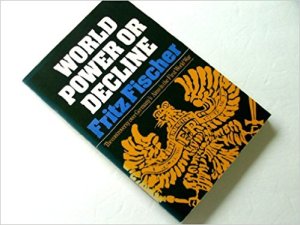
What struck me about Fischer’s book World Power or Decline, was not so much his main argument, which I already agreed with.  What I found surprising was the philosophy that lay behind Germany’s aggressive actions.  While I disagree with Germany’s apologists, I concur with them on one point.  The belief that one must continually advance, expand, “seize the day,” and so on, was hardly limited to Germany.  Most European intellectuals said likewise.  Darwinism, among other intellectual fads, filled the mind’s of men with the idea that one must continually grow or perish.  The idea may have been first expressed by Alcibiades.  When advocating for an expedition to Sicily, Thucydides has him say to the Athenian Assembly,

What reason can we give ourselves for hesitating? What excuse can we give our allies for denying them aid? We have given them our word under oath to protect them and now we are saying they never helped us? Our treaty with them was not for them to come to Athens and help us but to harass our enemies in Sicily and prevent them from attacking us. This they did. Like all great imperial powers we have acquired our dominion by our readiness to stand by anyone, barbarian or Greek, who asked for our help. If we sit by and do nothing or make distinctions on the basis of nationality when people ask our help, we will not only add little to our empire but we will probably run the risk of losing it altogether. Wise men are not content to repel the attack of a superior power, they anticipate it. We cannot regulate at our pleasure the extent of our empire. Given our position, we must neither relax our hold on our subjects nor give up our plans to attack and rule over others. For if we do not rule over them, we will be ruled over by them! We cannot afford the luxury of inaction like those who are our subjects unless we wish to exchange places with them and become subjected to them.

The debates surrounding the origins of W.W. I and who one should primarily blame can engage and fascinate, but most miss that the real cause of the war lay in Europe’s spiritual restlessness.  The Romantic reaction to the Enlightenment initially spurred on some notable cultural and intellectual innovation.  By the end of the 19th century, however, all we had left was a pointless, restless, unease.  We must move so we do not die.  But in what direction should we move?  Where should we go?

In his book Nihilism, Father Seraphim Rose (then just Eugene Rose) called this malaise “Vitalism.”

The chief intellectual impetus for Vitalism has been a rejection of the realist/scientific view of the world, which simplifies things and “dries them out” of any emotional life.  Unfortunately, however much the Vitalist might yearn for the ‘spiritual’ or the ‘mystical,’ he will never look to Christian truth to fulfill this need, for Christianity for them is as ‘outdated’ for him as the most dedicated rationalist.

The Christian truth which the Enlightenment undermined and rationalism attacked is no mere philosophy, but the Source, the Truth of life and salvation, and once there begins among the multitude a conviction that Christianity no longer remains credible, the result will be not an urbane skepticism imagined by the Enlightenment, but a spiritual catastrophe of enormous dimensions, one whose effect will make itself felt in every area of life and thought.

Towards the end of the 19th century, a restlessness and desperation had begun to steal into the hearts of a select few of Europe’s intellectual elite.  This restlessness has been the chief psychological impetus for Vitalism; it forms the raw material that demagogues and craftsmen of human hearts may play upon.

Fascist and National Socialist regimes show us what happens when such craftsmen utilize this restlessness for their own purposes.   It may seem strange to some that such restlessness would manifest itself in places that had reached the seeming pinnacle of human cultural and political achievement, but such manifestations should not surprise us . . . .

In such phenomena “activity” serves as an escape–an escape from boredom, meaninglessness, and most profoundly from the emptiness that takes possession of the heart that has abandoned God and refuses to know their own selves.

In politics, the most successful forms of this impulse have Mussolini’s cult of action and violence, and Hitler’s darker cult of “blood and soil.”   Vitalism, in its quest for life, smells of Death.

I love Tyler Cowen’s Marginal Revolution blog.  Like so many others I find him broadminded, engaging, and properly provocative.  His most recent tome, The Complacent Class, makes some timely arguments about the state of the union.  He asserts that Americans have grown lazy.  We prefer being comfortable to a challenge.  We spend time with people just like us, and modern technology allows us to pick only the music, food, movies, etc. that we know we will like.  More than ever, we live in self-contained loops, and this has grave implications of for our culture.

I usually agree with Cowen and most of what I read about the book seems persuasive.  But one of the key supports to his arguments is the apparent fact that Americans move around and change jobs much less than they used to.  Perhaps this is a byproduct of some of the other changes in society.  Cowen calls this a serious negative, but I’m not so sure.  Putting down roots will not help build local communities if we decide to stay inside on our screens.  But the wandering psychological restlessness prevalent from 1850-1930 helped contribute to two devastating world wars.  For all of his movement and desperation to seek a challenge, how much did Alexander the Great grow as a person?  A cursory examination of his life hints more at degeneration than growth.

Cowen apparently thinks of growth in terms of seeking a challenge, conquering it, and then moving on to a new challenge.  He’s onto something.  But a tree continually transplanted will never flourish.  The unseen growth of roots in a plant are what really count.  Cowen equates movement with embracing risk, which certainly applies at times.  On some occasions, however, movement can be about avoiding risk, avoiding problems, avoiding the challenge of real growth by going somewhere else.  The desert monks of centuries ago recorded this anecdote, which all of us do well to heed:

A brother said to a hermit, “My thoughts wander, and I am troubled.”  He answered, “Go on sitting in your cell, and thoughts will come back from your wanderings.  If a donkey is tethered, her foal skips about but always comes back to her.  It is like that for anyone who for God’s sake sits patiently in his cell.  Though his thoughts wander, they will come back to God again.”


The Tyranny in “Freedom”

In his classic work Orthodoxy, G.K. Chesterton uses a masterful analogy.  In discussing the relationship between authority and adventure, he writes,

Christianity is the only frame which has preserved the pleasure of Paganism. We might fancy some children playing on the flat grassy top of some tall island in the sea. So long as there was a wall round the cliff’s edge they could fling themselves into every frantic game and make the place the noisiest of nurseries. But the walls were knocked down, leaving the naked peril of the precipice. They did not fall over; but when their friends returned to them they were all huddled in terror in the centre of the island; and their song had ceased.

As good Americans we tend to believe that absolute freedom and tyranny lie at opposite poles.  We are mistaken. Instead, they have a tendency to bend around and shake hands.  Plato recognized this long ago in his Republic. After discussing various forms of government in Book VII and how the good in each gets perverted, he turns his attention to democracies:

The ruin of oligarchy, [said Socrates] is the ruin of democracy; the same disease magnified and intensified by liberty overmasters democracy — the truth being that the excess of anything often causes a reaction in the opposite direction; and this is the case in vegetable and animal life, but above all in forms of government . . .

The excess of liberty, whether in States or individuals, seems only to pass into excess of slavery.   . . . And so tyranny naturally arises out of democracy, and the most aggravated form of tyranny and slavery out of the most extreme form of liberty.

Socrates continues in the discussion to say that democracies create “a new kind of drone.”

I thought about both Plato and Chesterton when listening to a reaction from one commentator on the Supreme Court’s decision on homosexual marriage.  He agreed with the decision not for legal or moral reasons (which I would disagree with but at least understand in part), but because, “thankfully, the Court recognizes that we live in the 21st century.”  That is, the Court should essentially approve of whatever we happen to be doing at any given time.*  This may look like freedom, but in fact enslaves us to a particular moment without any benefit of perspective. Maybe we must come to terms with the fact that this is what democracy means now.  Perhaps it has always been so and we failed to recognize it.  In any case, this method leaves ourselves only to the walls inside our own heads.

This is why “great” revolutions often end up making things much worse than the regimes they overthrew.  Of course no one intends this at the outset or even recognizes the possibility, partly because revolutionaries perceive a truth, or part of the truth, with crystal clarity.  This truth will give them the motivation they need for revolution.  But because this truth is only part of the whole Truth, it leads to a frozen dogmatism.  The fences melt away in our rush to embrace freedom, and all end up huddling at the center whether they wish it or not.

One of the great virtues of Nicolas Berdyaev’s The Russian Revolution is his keen vision that sees past the political aspects of Communism and into its spiritual core.  Of course the Soviet state adopted atheism as its official policy, but Berdyaev puts the roots of communist origins within the deep and ardent tradition of Russian spirituality.

Anyone who has read 19th century Russian literature recognizes the depths of profound insight and feeling those masters tapped.  Their intensity of feeling led them to examine the nature of suffering perhaps as no other epoch has.  The first modern globalization movement allowed more sensitive souls more exposure to more suffering.  Some, like Dostoevsky, took suffering and had it transformed by the cross.  But others failed to do so, and developed what we might call a “naked” hatred of suffering.  As one early Bolshevik proclaimed, “Suffering has no right to exist.”  Everyone must be happy.

This rejection of the meaning of suffering cannot bring one closer to our fellow men, because of course we do suffer and always will.  To reject suffering sets one up to reject the experience of mankind, and then, mankind itself.  Suffering without the Cross gives way to tyranny.

The early revolutionaries had within them a deep asceticism.  All things not geared fully towards improving the material lot of the people must be expunged.  Beauty itself became a debauched and corrupting luxury.  Everyone must do without so that nothing ever gets wasted, either in the mind or on the ledger sheet.  Such asceticism, without grace, again leads to tyranny. But let us not miss the fact that this tyranny has its roots in a certain idea of freedom.  Communists wished the people to be free from suffering, free from worry about the future, free from the competitive aspects of capitalist societies.  Now we know that such freedom leads to a drabness and narrowing of life.

Soviet Architecture

Berdyaev wrote in 1931 and he had a keen insight for the westerners to whom he wrote.  Westerners at that time and now, fundamentally are skeptics, and they assumed that the Soviets shared this basic outlook.  Not so.  The communist has deep (though misplaced) faith, and the people understand and embrace this faith.  The state could not hold together for any other reason.  This faith flies in the face of “evidence” against it.  Most communists rejected the physics of the early 20th century, for example, because Einstein and others smacked of mysticism, and we must exorcise all mysticism so that the people will have true happiness.  In the end pure rationalism becomes entirely irrational and ridiculous.  Still they press on.  Our failure to recognize this faith led us to combat it by all the wrong means.  One thinks of Nixon trying to impress Khruschev by showing him better refrigerators.  It showed our misunderstanding and our bankruptcy.  Was this all we had to offer?  If Khruschev was not impressed, we should be surprised.

The first part of Berdyaev’s book focuses on the spiritual failures of the revolutionaries themselves, but then he adroitly and appropriately turns the tables.  How did such a movement come about?  If the revolutionaries showed great spiritual hunger, we must consider the fact that churches in their locales could not feed them.  The rise of communism comes from the failure not just of capitalism to produce a just society, but from the Church to live out its calling.  He writes,

Christianity has not put its truth into full living practice.  It has found its realization either in conventional formula or in theocracies which deliberately ignore freedom (which is the fundamental condition of any genuine realization), or it has practiced a system of duality, as in modern history, when its power has weakened.  And therefore Communism has made its appearance as a punishment and a reminder, as a perversion of some genuine truth.

As I and others lament the recent high court decision on the validity of homosexual marriage we do well to follow Berdyaev’s example and point our fingers in the right place.  For what we see before us comes fundamentally from the Church’s failure to explain the true nature of marriage not as an emotional bond between two people, but as an image of salvation itself, the marriage of Heaven and Earth.  In Eastern churches, the bride and groom process around the congregation during the service wearing crowns.  These crowns represent crowns of the martyrs.  Marriage, like monasticism, is a kind of martyrdom, a death out of which new life emerges. What we see before us should serve as a “punishment and a reminder” of what we should have proclaiming and living out all along.

Dave

*One sees this in many places in our culture.  Take, for example, the rise of graphic novels.  Rather than be comfortable with the strengths and weaknesses of the medium, we hear ardent insistence that “graphic novels are just like books.”  In my limited experience it seems obligatory for authors of young-adult fiction to include a mean teacher in the story who fails to allow a student to hand in a book-report on a graphic novel.  The theme is the same —  whatever we happen to be doing must be affirmed by all.

The “Pursuit of Happiness”

I remember an interview long ago that William Buckley did with journalist and social critic Malcolm Muggeridge.  The interview touched on the idea of happiness, and Muggeridge commented that the words, “the pursuit of happiness” in the Declaration of Independence had done terrible harm to America and the west in general.  Whatever the original meaning and purpose of the phrase, Muggeridge believed that the Declaration teaches its readers that happiness can be effectively hunted down, caught, and then enjoyed.  He stated,

There is something ridiculous and even quite indecent in an individual claiming to be happy. Still more a people or a nation making such a claim. The pursuit of happiness… is without any question the most fatuous which could possibly be undertaken. This lamentable phrase ”the pursuit of happiness” is responsible for a good part of the ills and miseries of the modern world.

The truth is that a lost empire, lost power and lost wealth provide perfect circumstances for living happily and contentedly in our enchanted island.

I can say that I never knew what joy was like until I gave up pursuing happiness, or cared to live until I chose to die. For these two discoveries I am beholden to Jesus.

In reality, Muggeridge argued the very act of pursuing happiness will in fact ensure that we will never achieve happiness at all.  Instead, happiness comes unbidden.  It is a gift.  We immerse ourselves in particular person, thought, book, or what have you, and suddenly we realize, “I’m happy.”  Adherence to the Declaration’s view of happiness would lead us down a path of restlessness, materialism, cynicism, or flight into fanciful and frightful utopia’s.

I could not find the original clip of this on Youtube.  The clip below deals with an entirely different question, but it’s still worth watching.   Whether  your agree with Muggeridge or not (and he makes another controversial assertion), we must all agree that Muggeridge possessed the greatest English accent of all time.

I thought of Muggeridge on happiness when reading a brief post from David Derrick about individuals or nations that seek to “leave their mark upon history.”  In it he quotes Toynbee, who mentions that since Austria and Bavaria parted company centuries ago, the two have pursued different paths.  Austria looked to do “great things,” and they did achieve a kind of greatness with the city of Vienna.  But they also involved themselves in numerous wars that they often lost.  They got crushed by Napoleon in the 19th century, then by Russia and the allies in W.W. I.  Toynbee’s thoughts in the post above date from 1934.  In the few years that followed Austria continued to try and “leave its mark” by joining up with Nazi Germany, and of course that too ended very badly.  I have some friends who visited Austria years ago, and they saw this same attitude of “we’re special” at work in those they met (though in the modern context it had the manifestation of strong hostility to foreigners and immigration).  This approach has not helped them find their place in the world.  It appears that pursuing a place in “History” might be as futile as pursuing happiness.

What of Bavaria?  How did they do in the great trial of German history between 1933-45?  I know nothing about the history of Bavaria, but after a little research (read: I looked on a Wikipedia page), I note the following;

  • During the tumultuous period of the Weimar Republic, Bavaria avoided radicalism and voted for the mainstream conservative “Bavarian People’s Party.”
  • Hitler was fond of Bavaria, and the Nazi’s held many of their rallies in the Bavarian city of Nuremberg.
  • The White Rose, the heroic student resistance movement to Nazism, had its origins in Bavaria.

Before examining these points, we should note that no country, just as no person, should be judged only by their sins, no matter how bad those sins may be.  Still, defenders of Bavaria’s relaxed approach to their own history need to examine this period.  Points two and three stand out most sharply.  As to Nuremberg, Hitler may have held rallies there simply because he was known to be fond of Bavaria.  On the other hand, Bavaria may have been a stronghold of Nazi power.  The White Rose may have originated in part due to a strong underground of resistance in Bavaria, or it may have arose for entirely other reasons.  Without further knowledge (and I have none), we might say these two factors cancel each other out.

I think the first category may hold the most weight.  In the Weimar years Germany swayed to a fro between extreme ideas and stark resistance to the Versailles Settlement.  Both Nazi’s and Communists, for example, sought to “leave their mark” upon history.  The fact that the German people went with the Nazi’s shows their general bent towards radicalism.  The “Bavarian People’s Party” in contrast, wanted to bypass all of the immediate debates and return to traditional concepts of governance.  They contemplated separation from the rest of Germany to achieve this, not unlike the “Bloodless Revolution” in England in 1688.  Perhaps they understood the secret that Muggeridge knew, that seeking “History” can hold just as much danger as seeking happiness.

8th Grade: The Golden Age of Athens

Greetings,

This week spent some time discussing the elements of ‘golden ages’ and the factors that went into the birth of what we know as Periclean Athens.

From 480-431 B.C., Athens experienced an explosion of creativity and culture perhaps unparalleled in human history.  Much of what we consider to be modern democracy, philosophy, literature, drama, science, and architecture have many of their roots in this period and place.

What is needed for a golden age?

As we compare them across time (Periclean Athens, Dutch early 1600’s, Elizabethan England, 12th century France, etc.) some common factors emerge:

  • Some kind of cross pollination of culture based on access to the sea, or at least, extensive travel
  • A burst of confidence based on a defeat of a large power — you were the underdog and emerged on top.  The unexpected victory serves as a validation of your uniqueness.
  • An educational base to build the cultural explosion on.  There has to be some kind of literate and curious population base to build on.
  • The willingness to tolerate the possibility of new ideas, which usually has something to with #1 listed above.

With all these factors possibly needed (and possibly more that I have not accounted for), golden ages do not come often in history, but they leave their marks long after they disappear.

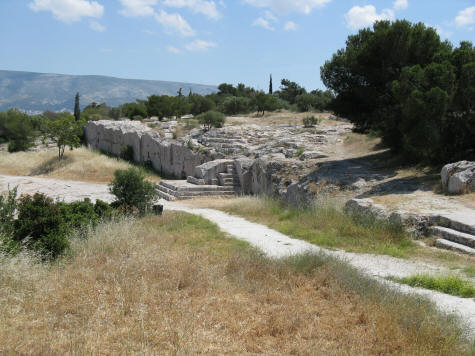
The Pynx, Meeting place of the Assembly

We also looked at the flowering of Athenian democracy.  As we examined how it functioned, we arrived at a proposition to debate next week, which is

Athenian Democracy in the age of Pericles was more democratic than America is currently.

Part of how you evaluate this statement depends on a few factors:

1. What do we mean by “Democracy?”

We are so used to the word “democracy” we may not consider what we even mean by the term.  Clearly it must mean more than mere voting.  Some elections have only one candidate, or the different candidates do not give us different options in reality (that is, the candidates would do basically the same thing if elected).    It must also mean more than mere majority rule.  If 51% of the people vote to oppress the remaining 49%, we would not call that democracy.

Democracy attempts the trick of giving power and choice to the people, while at the same time preserving freedom in some measure for all citizens.  Thus, the ‘losers’ in a contest are still protected from the possible pitfalls of majority rule.  At the same time of course, the majority cannot be obstructed too much, otherwise the point of voting and majority rule would be lost.  Historically this balancing act has never been easy.

2. What is most important in a democracy?

In the Athenians favor we note the following:

  • They had much more direct participation from their citizens in government than modern Americans.
  • The average citizen would not only vote, but could also speak in the Assembly.  Most citizens would probably serve in some political capacity during their adult lives.

Against them we can say that:

  • Women and slaves were excluded from voting and participation
  • The very fluidity of their democracy opened up the real possibility that the checks and balances of law could easily be overridden, as happened on a few occasions.
  • Critics of Athenian democracy (ancient and modern) believed Athens was easy prey for the “cult of personality.”

For modern America we note that

  • All citizens of a certain age are eligible to vote.
  • We have minority protection built into the system.

Against us some might say

  • Representative government has tended toward an oligarchy of the rich, with powerful interests controlling both parties.
  • This, in turn, has led to a real distance between Government and the people which results in an “Us and Them” attitude.

Below is a very detailed chart of the ins and outs of Athenian democracy for the very interested.

Many thanks,

Dave Mathwin

10th Grade: There’s More than One Way to Skin a Cat

Greetings,

As we reflected on the Scientific Revolution as a whole, we saw how people’s view of their experience in the world changed.  Newton and others gave us a universe of order and balance — a somewhat reductionistic world of cause and effect.  One could argue that a subtle shift occurred between the Reformation/Counter-Reformation era of the ‘inner’ man, the world of faith, etc., and a new focus on what can been seen and measured.

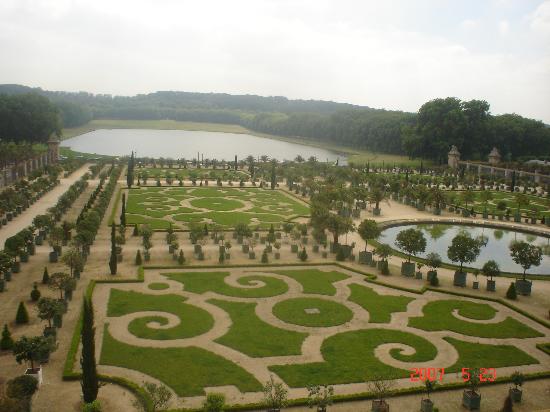
The reign of Louis XIV in some ways embodied these new principles.  Symmetry and order were key concepts of his reign, and they both were abundantly evident in the architecture of his royal residence in Versailles.  Many may tend to think of absolute monarchies existing in the Medieval period, but this is far from the case.  The era of absolutism might be dated between 1600-1750, and the Reformation certainly may have impacted this.  With the political power of the Church as a separate entity broken, that power would have to land somewhere.  For many, the most convenient and obvious place for that power to reside was in the person of the king.  And, if a neat house, for example, reflects to our eye a well-run house, than the order and symmetry in the architecture surely reflected back on Louis himself.

Hall of Mirrors

and
Gardens at Versailles
Louis himself put great stress on managing his own image, as this picture shows
Louis XIV

Perhaps most striking aspect of Louis’s reign, however, was how he controlled  the nobility.  Like many nations France’s nobles had a tumultuous relationship with the crown, with a variety of wars and compromises as the result.  Louis changed the dynamic by changing methods.  He created an elaborate system of ritual and custom. Violating these rules of ‘polite’ society meant ostracism, which meant loss of influence.  What the nobles apparently did not notice, however, was that under Louis’s system they had no influence.  Louis had them immersed in a bizarre system of etiquette.  Things like discussing politics or deep questions of life were not against the law, but frowned upon.  It was ‘not done.’  Thus, their lives became almost ridiculously trivial and inconsequential, with literally hours taken up in deciding who could sit where, who should stand for who, and so on.  Ask your children if you are interested about some of the specifics of this etiquette involving door knocking and chair sitting, among other things. The French Revolution would reveal some of the consequences of this development.

To control others, Louis did not use force.  Instead he dazzled, charmed, and confused the nobility.  To function all states need to establish some kind of order and control.  Louis, of course, had bigger fish to fry.  He did not want the status quo so much as he wanted a political revolution, a more centralized state.  To accomplish this most might have resorted to force, a “1984” style of authoritarian rule.  Louis was not known for his book learning but he must have had a keen “street-smarts,” for he chose a different path, the “Brave New World” path to control.  This path controls others not directly, but indirectly.  It creates a scenario whereby you, the individual, gladly give up some measure of political liberty to gain something you think is better.  Those who have seen the movie Matchstick Men might recall the line where the main character Roy defends himself by saying,

I’m not a criminal.  I’m a con-man.  [The difference being], I don’t take people’s money–people give me their money.

There’ more than one way to skin a cat.

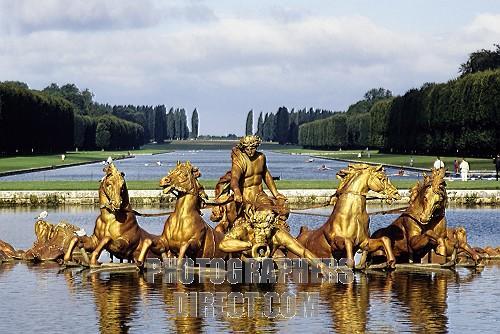
We can say that Versailles was many things.  It was a social hot-spot.  It was a place of elegance and beauty, or at least, a certain idea of beauty.  But it was also a piece of political propaganda.  Louis was known as the ‘Sun King,’ and this statue of Apollo on his chariot dragging the sun up stood in a prominent place:

pd2047369

Louis masterfully tried to have image morph into reality.  Apollo, for example not only had the power to move the sun, he also was the god of music and culture.  In using Apollo, Louis claimed not just preeminence of power but also of taste, a place the French have enjoyed for centuries since.  Yet, for my money, while I would readily call Versailles impressive, I don’t think I would call it beautiful.  Louis wanted to subtly scream “Authority!” which did, I think, create a chilling effect.

Next week we will look more deeply into the policies and practices of Louis’ France.  In this update I have painted perhaps too black a picture of Louis.  He was certainly far from an overtly evil or cruel man.  He had many endearing qualities.  But the changes he began did have significant consequences.

Blessings,

Dave

11th Grade: Industrialization

Greetings all,

C.S. Lewis once commented that the world of Jane Austen had more in common with Homer than our world has in common with Austen.  If Lewis’ speaks truly, we have the Industrial Revolution to thank.  The Industrial Revolution remade society almost from top to bottom, and in so doing changed not just how we live but also how we think.

What did Lewis mean by his observation?

Obviously a great deal changed from Homer to the time of Jane Austen.  But Lewis refers not to political and ideological changes, but the basic way people lived and interacted.  Among the similarities across time include . . .

  • Both eras had a predominantly rural population where most people farmed
  • Both eras measured wealth almost exclusively in terms of land ownership
  • Both eras centered their identity often around the extended family
  • Both eras had to regulate their lives with the rhythm of creation
  • “Manufacturing” would have been done by individual skilled craftsmen rather than masses of specialized workers or assembly lines.

All of this and more changed from the early 19th-early 20th centuries.

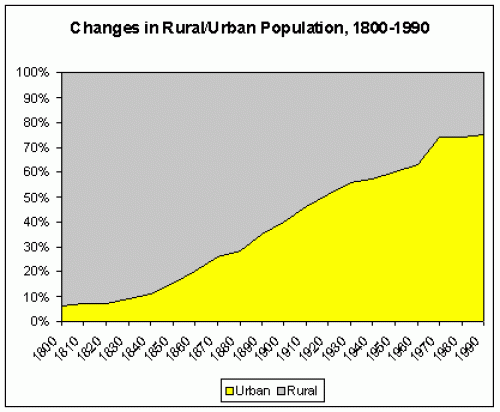
The Industrial Revolution (IR) first and most obviously changed demographics.  For all of previously recorded human history people lived predominantly in rural areas.  Rural areas have a slower pace of life.  They tend towards social conservatism and the maintenance of tradition.  The IR began displacing small farmers and forcing people to move to the cities for work. As the graph below indicates, a trend began that has only continued up to the present day.

rural_urban

The resulting mass production of goods and, perhaps especially, of food, led eventually to increased life-expectancy and and a population explosion that has continued until today (though some predict a regression in population soon).

In changing where we lived, the IR changed how we live.  On farms the family forms the obvious central social unity.  Before mass transportation, very few children would move far from parents once they reached adulthood.  But now with many starting to leave home to work, life no longer centered around the family farm.  Now at least one parent left the house for 12 hours a day, and often both parents had to work in factories.  Individuals within families found other planets around which to orbit.

If both parents worked, what about children?  The IR inadvertently began the push towards mass public education.  Previously, only those with money and leisure received an education.  Spreading education to the masses had many benefits.  But in time how we educated and what we taught changed drastically.  Mass education mean the inevitable watering down of what schools taught.  The IR brought about changes to the curriculum, which now sought to prepare students for the workforce.  No longer did education have its focus on enriching the soul.  Now the classroom needed to prepare one to “get a job.”  One only has to read of C.S. Lewis’ experiences with his tutor “The Great Knock” (William Kirkpatrick) in his autobiography and compare it to many of our “cattle-car” approach in modern education to begin to see the difference.

Mass production changed the very nature of how people identified themselves with their communities.  For centuries most people lived life within the same 10-15 miles radius they had always known.  I recall reading a medieval primary source and noted that they used the word “foreigner” for someone from another village 7-8 miles away.  With this mindset no real possibility of a national identity or consciousness would be possible.

People need to have an identity outside of themselves.  With local communities broken down and people thrown together en masse in unfamiliar environments, a sense of national identity emerged.  Mass production supported and perhaps helped create this national mindset.  Now across the country, people had the same goods and the same experiences.  We can eat in the same restaurants and sleep in the same hotels across the country.  One could speculate that had the IR arrived sooner in America, we may not have had the Civil War.

Cultural expressions of this newfound identity changed.  In the Romantic period music expressed abstract ideals, but around the mid-19th century music started to express more ethnic or national ideas.  Liszt’s “Hugarian Rhapsodies” still did have the high-flown Romantic flourishes, but the title reveals a shift in emphasis.

In time the wild Romantic musings disappeared, and as music geared more toward the centralized mass, it grew more contained in expression.  Suddenly the military march made its way into the popular consciousness.

Interestingly, as industrialization created a global economy, it helped create a globalized culture.  German marches sound very similar to American marches (though perhaps one might detect subtle darker undertones).

We may wonder, however, that if military songs become popular culture, than whole nations go to war, and not just armies.  This would mean that war would become vastly more deadly and destructive than previously, which is just part of the mixed legacy of the Industrial Revolution.

Democracies and their Aristocracies

This post has had a few different lives (originally written during the party primaries in 2016) . . .

Our most recent election raises many questions for many people.  One thing appears clear . . . we knew that the Republican party was in trouble before this election.  Otherwise, Trump never would have received the nomination.  The fact that Clinton lost, however, shows the weakness of the Democratic party as well.  The whole party system will likely need a reboot in the coming years.

Below is the first re-posting note . . .

*************

I published this about a year ago (you will note the dated references), but republish it to coincide with our look at Aristotle in our senior level Government class.  The original post is below.

**************************************

Democracies have always had at best an uneasy relationship with aristocracies, for obvious reasons. The very presence of an aristocracy either seems like an obstacle or a reminder of the inadequacy of democracy.  But first and foremost, I suppose, democracies would interest themselves in self-preservation.  In turn it might mean, to paraphrase Aristotle, that democracies should adopt not the political practices that democracies want, but those designed instead to preserve democracies.

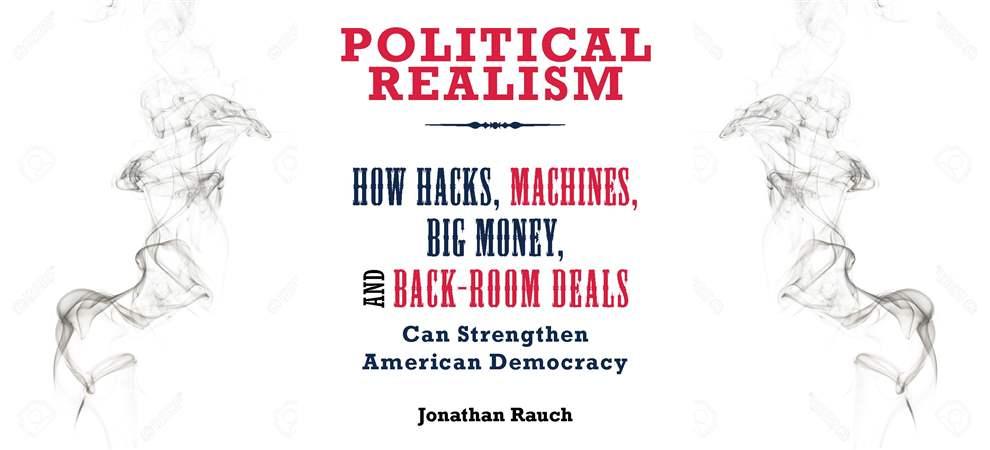
I thought of Aristotle’s dictum while reading Jonathan Rauch’s provocatively titled Political Realism: How Hacks, Machines, Big Money, and Back Room Deals can Strengthen American Democracy.   I love the title.  Its (seeming) incongruity demands further examination.  But I admit I initially dismissedpoliticalrealism_990x450 the idea as a farce — until I thought about Donald Trump in the Republican primaries.  Democrats should be careful of cheering Trump on in the almost certain hope that he will fall on his face in due course.  We need good candidates on both sides to spur one another on and stabilize the electorate.  I found myself thinking, “Trump has had his fun and served his purpose.  Why hasn’t someone taken care of this?”  Then I realized that what in fact I wanted was a smoke-filled back room where “decisions” got made about these sorts of things.

No one suggests that such a solution resembles democracy.  But Rauch argues that these practices in fact preserve middle-ground, the key to a stable democracy. We fret about the increased polarization of the country and the lack of compromise. Look no further, Rauch argues, then to the decline of the power of parties — in our day particularly, the decline of the Republican party.  He contends that political machines in fact serve two key purposes:

  • They traffic in interests not ideas.  Ideas have no limits, no boundaries.  The “system” of politics is more easily quantified, thus more easily measured and controlled.
  • The candidates of a ‘machine’ stand accountable to a conglomeration of interests.  Ideological candidates have much less direct accountability.  This lack of accountability makes ideological candidates more free, and thus more oppositional.  As Rauch writes, “Show me a political system without machine-politics, and I’ll show you confusion, fragmentation, and a drift towards ungovernable extremism.”  Moderation, he argues comes not from moderates, but from machines that by design moderate everyone’s extremism.

Machine politics reminds us of Tammany Hall and other kinds of organizations filled with what even its ardent defenders might call “honest graft.”  Rauch argues that politics always involves making a lot of sausage.  But he argues that political machines also accomplished a great deal.  Tammany Hall dramatically boosted voter turnout and passed a great deal of progressive legislation.  Lyndon Johnson made who knows how many deals to pass the Civil Rights Act.  Progressives, Libertarians, and Tea-Partiers, Rauch argues, get so caught up in the purity of the idea, the purity of the process, that nothing ever gets done.  For him they are the modern-day lotus eaters.

But however good sausages taste, watching them get made never sits well.  Machine politics face the hurdles of ideologues. The modern media microscope surely offers no help either.  I can see Americans get fed up with polarization and return to a more centrist mindset.  I can’t see the media going away or turning a blind eye any time soon to back-room deals.  This poses the biggest challenge to a return to the bygone days of political machines.

Rauch makes an eloquent plea for his idea.  He effectively demonstrates the moderating effect of machines.  I wish he had talked more about the inevitable nature of ideology in democracies, or the inevitable nature of ideology in human experience.  For Rauch, ideology is almost a four-letter word. He recognizes its power, but not its place.  So, ok, machines can moderate ideologies.  But I wonder if Rauch the pragmatic realist is asking us to accept the fantasy that (to reference Thucydides) interest will trump honor and/or fear.

Also we need more than a modern comparison to evaluate it. We need greater perspective outside of our own sphere. Basically what he asks for is a democracy managed by a semi-official oligarchy.  In many ways we had this in  post-Napoleonic Europe in the 19th century.  How does this period stack up?

Some features of this era:

  • A significant increase in democracy through expanded voting rights, and in some places, limitations on the ‘elite’ legislative bodies (like the House of Lords in England).
  • Relative peace — at least internally in Europe.  Wars happened but they tended to be limited in scope and duration.
  • An aristocracy that had less power than the previous century but still lots of influence.  What’s more — this aristocracy had more mobility than perhaps at any other time in history.  Traveling around Europe formed an integral part of the growing up experience for many aristocratic youth.  Thus, the aristocracy formed a real “boys club” throughout central and western Europe (most of the monarchies also had some familial relationship to one another as well).
  • As an extension of this, lots and lots of international conferences to settle disputes and award prizes to the participants.

Of course no era is perfect.  Some would point out that the “relative peace” I mention came at the expense of significant overseas expansion. I argue elsewhere that such expansion created domestic internal issues.  Others might say that the catastrophe of W.W. I emerged from the ultimate failure of this system. We should consider their record in context, however. The system they established must have the backdrop of the chaos of the highly ideological French Revolution and the resultant Napoleonic Wars that killed millions.

We will see whether or not this next election shows the need for the return of political machines.  If Hilary Clinton runs against Jeb Bush for the presidency, we might even argue that such machines never left.  But another question that Rauch fails to ask is, can they return to prominence?  It may be more than a matter of political will.  The decline of political machines has its roots beyond politics.  For example, after itunes, Youtube, etc., record companies exist, but not in the same way.  The power they had in the 1990’s to release greatest hits albums of their artists but put one new song on the album to try and make die-hard fans buy entire albums to get that one song — may never return (not that I’m bitter or anything).  We can observe this de-centralization most everywhere in our culture.  And surely this de-centralization comes at a price, but also gives some benefits?  Rauch sees no real benefits to political de-centralization and cannot weigh the merits of both.

But this is still a good book.  It makes one think.  Fundamentally, it asks us to consider whether or not democracies, left to themselves, will preserve themselves from their own folly.

11th Grade: The Dilemmas of Reconstruction

Greetings,
This week the students worked on their Reconstruction projects.  I wanted to give them a chance to approach an era from a different perspective than the usual classroom.  They had to present their own plan for organizing Reconstruction as if they lived at that time.  A couple of “big picture” issues they need to keep in mind. . .
  • Winning the peace is just as important as winning the war — indeed winning the peace is not only  part of the war effort, it forms the very reason for the war itself.
  • How various elements of reconstruction, the economic, cultural, political, military, etc. should all work together.  Ideally students should see this seemingly disparate elements as part of a coherent whole, moving together towards a single purpose.
  • Part of the goal of Reconstruction deals with why conflict began in the first place.  If “Reconstruction” will prevent another war, it has to deal with the root causes of the conflict to be successful.  Seeing the Civil War arising largely out of economic and cultural differences, as opposed to purely political differences, would produce different goals for the post-war process.  If one saw the main problem rooted in the social position of African-Americans, Reconstruction would look different still.

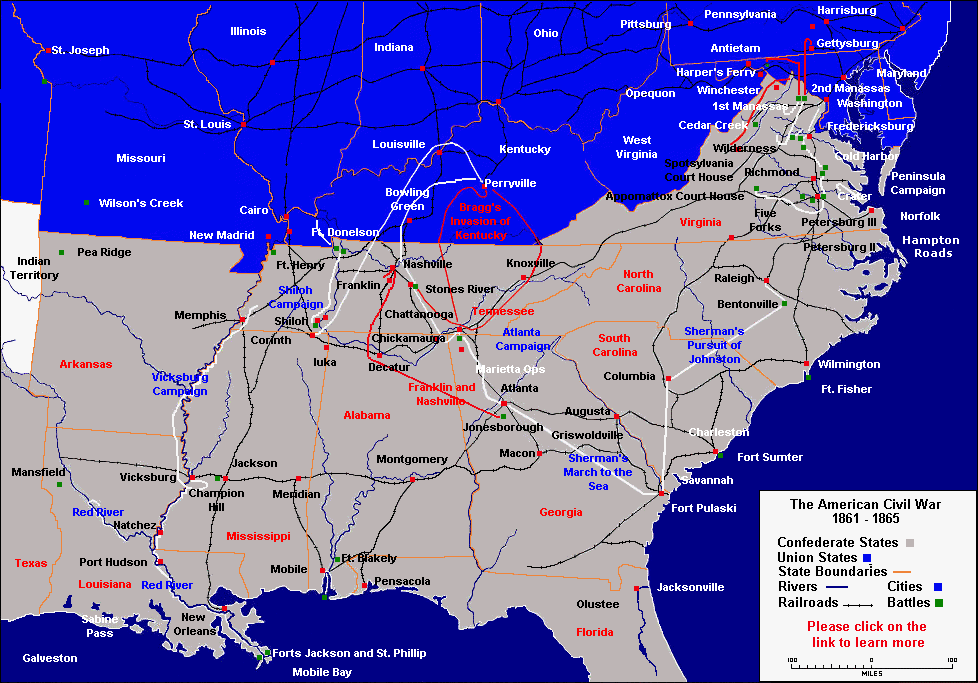
I gave students a series of maps to help guide them through this process.  For example, if students want to focus on the social aspects of Reconstruction they may need to know the population density for African-Americans:

And the population density of the U.S. as a whole . . .
Economic issues would certainly involve railroads. . .
And you may want to concentrate your efforts most effected by the Civil War itself. . .
And so on.  The students had to face many questions and dilemmas.
Was Reconstruction a success or failure?  Ultimately it depends on your point of view, and what one might want Reconstruction to accomplish.  On the one hand, civil war  never again threatened the country, and the lives of African Americans did improve, at least to a relative degree.  The 13th-15th Amendments helped preserve legal rights especially for African Americans.   On the other hand, ‘Jim Crow’ laws arose in the South, which kept most African-Americans as second class citizens.  Many issues from the Civil War would not be fully worked out until the Civil Rights era of the 1960’s.  Some enduring bitterness remained in parts of the South that have still yet to be fully healed.  We will revisit these issues later this year.

10th Grade: The Dutch Have Their 15 Minutes

Greetings,

This week we looked at the golden age of Dutch culture from around 1630-75, and how that related to the painting of Rembrandt.  I can think of three instances where a naval based culture defeats a large empire, and then subsequently experienced a ‘golden age.’

1. Athens defeats Persia ca. 480 BC, which leads to Periclean Athens (Aeschylus, Euripides, etc.)
2. England defeats Spain in 1588, which leads to Elizabethan England (Shakespeare, Philip Sydney, etc.)
3. The Dutch defeat Spain ca. 1600, which brings about the Dutch Republic (Rembrandt)

I don’t know if this is coincidence or not.  Can anyone think of other examples?  We discussed before what needs to happen to create a ‘golden age’ in a culture, but I don’t know if having a solid navy needs to be part of that. Might we suggest that navies give people a broader perspective of the world, which allows for broader minds to create culture?  Or, do navies lead to trade, which brings economic prosperity, which also seems to be an ingredient?   I am not sure.

The Dutch defeat of Spain had military and economic causes.  The Spanish had seemingly inexhaustible silver mines in the new world, but the Dutch had something new and more powerful: a stock market.  Initially all of us might take the silver mine over the stock market, but why did the stock market beat the silver mine?  We discussed this in class, with the caveat that I am not an economist:

  • A silver mine would make one feel rich, but what does one do with the wealth?  If everyone wins the lottery, no one in fact would win, because inflation would skyrocket as prices would inevitably rise.  Loads of silver are in the end a wasting asset.  In fact, prices rose some 400%  in Spain over a period of a century.
  • Besides this, how the money is used makes a difference.  If it is used in a consumptive way, no new wealth is created.  If you buy a series of fancy dinners, well and good, but the money is in your belly.  If money was invested or used to create, it could create ‘new’ money, like a perpetual motion machine.
  • Of course, having money create new wealth requires a society where innovation is possible, a society that allows for creativity and risk.  When studying the Spanish Armada we saw how Spain lagged behind other European nations by maintaining a traditional social structure.
  • Currency can be anything that has value.  If you buy $10 worth of stock, the certificate = $10.  But if the value of the company goes up, the value of what you own does as well.  That $10 certificate can become $30 over time. You just made $20 — new wealth appears almost by magic.  But this new wealth would ideally, at least, be tied toward actual production which would benefit society.  So, ideally again, the value is not simply ‘on paper’ but has some tie to reality.  Stock market bubbles burst when value becomes artificial, supported merely by belief or false delusion, and we discussed the first stock market boom/bust with the tulip craze.

The Dutch also invent the idea of the corporation.  Though today many view the corporation as  the epitome of entities estranged from “the people,”  their original invention had a lot to do with the broad Republic created by the Dutch.  The corporation not only allowed resources to be maximized and risks minimized, it allowed for the ordinary Joe to have a shot at wealth and status.  No longer would money be in the hands of the aristocracy, or those granted a royal monopoly.  It is a bit ironic to see what has happened to the image of corporations recently, but perhaps some of it is just.  Perhaps corporations have grown so large as to become essentially faceless and detached from a human and understandable context.  This, I think, is the root of some of modern unease some feel towards corporations today, but in the beginning the corporations was the ‘underdog,’ the People vs. the Established Powers.  Still, I long for the day when a corporation is not the bad guy in a recently released movie.

On a related note, we had a good discussion about the morality of stock markets, and whether or not it is just for someone from the market.  Should someone profit without work?  Or is investing in company a kind of ‘work’ that benefits society?  I’m happy to say that the students did very well with these heady concepts.

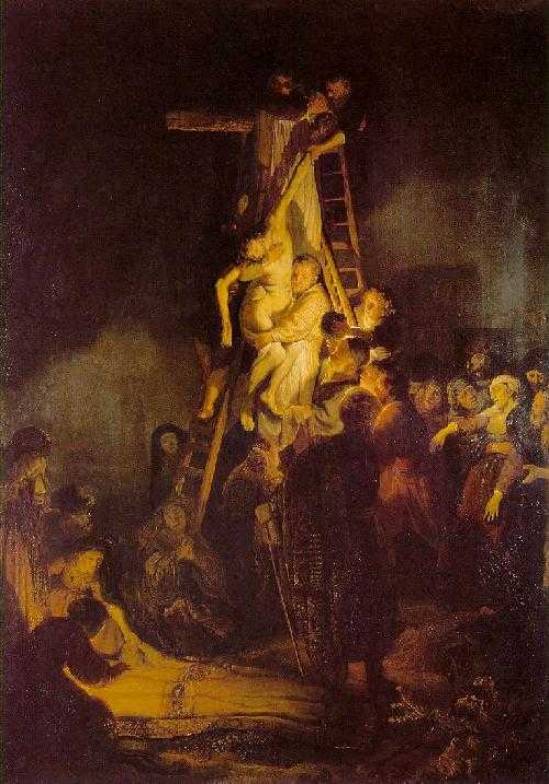
A few weeks ago we  looked at the  art of Rembrandt, the great Dutch master, and compared him to Carravaggio, contemporaries of each other.  The Reformation emphasis of the sanctity of the everyday, of humanity itself, shines through in Rembrandt’s work.  His portraits get inside people’s skin, bringing dignity and meaning to each individual.

Rembrandt painted many religious works, and his up and down life may have helped him not pull any punches with himself.  In this famous work, many believe that Rembrandt puts himself in the work (bottom right), associating himself with those that killed Christ.

Though Carravaggio was a Catholic, his emphasis on everyday people amidst the drama of salvation shows the influence of the Reformation (and perhaps a resurgence of the Medieval mindset against the Renaissance) as well.  He excelled in painting sinners.  In my favorite work of his, “The Calling of St. Matthew,” all of his genius gets poured to Matthew’s surprised, yet hopeful eyes.

Carravaggio’s possessed a wild and unruly streak, one that led to him killing a man in a duel in a dispute over a woman.  In perhaps his most dramatic work (and one of his last), he uses his own head as the model for Goliath.

How can one choose between two great masters?  Yet the differences in their work reveal differences in their personalities and their respective cultures, something I wanted the students to consider.

Blessings,

Dave Mathwin

The Passions of Digenis Akritis

I honor Francis Schaeffer as one of the great Christian voices of the 20th century.  While I am not certain, I think he was one of the first to urge Christians to focus on the power of art to shape culture.  He also urged us to pay attention to environmental and stewardship concerns decades before such topics became mainstream.  As well as he commented on the modern age, I feel he badly misrepresented early Christian and medieval culture in his How Shall we Then Live? series.  In his view medieval culture indulged in too much spiritualization, too much “etherealizing,” and missed the stark reality of the Kingdom of God.  He acknowledged Dante’s genius, but then proceeds to essentially dismiss The Divine Comedy because of his idealization of Beatrice and her role as his guide to Heaven.  I fail to see how one can accuse an era that went on the Crusades, built cathedrals, and founded the first universities, of too much “spiritualization.”  As Schaeffer resided in the Reformed Protestant camp, perhaps he carried too much anti-Catholic baggage to see the medieval era straight.

And yet . . . when it comes to his essential critique of Dante, he has a partial point.  Before I continue, I should say that I regard The Divine Comedy, along with Shakespeare’s plays, as the greatest literary achievements of the western world in the last 1500 years.  I have no idea who could possibly challenge them.  But Dante had some of the faults as well as the great strengths of his culture.

The aristocratic tradition of courtly love came out of the positive development of the possibility of men pursuing women romantically and remaining “men,” as C.S. Lewis points out in his Allegory of Love.  But then it morphed into a kind of love that had no feet on the ground.  Romantic love without its proper end in marriage has all of the substance of leaves in the wind, a dance of disembodied heads.  Courtly love could descend into a kind of idealization of a mere passion, which could then become an idealization of lust itself.*

The Orthodox Byzantine epic poem Digenis Akritas** (translated, “The two-blood border lord”), for all its charm and energy, cannot match up to some other contemporary western epic poems such as The Song of Roland.  But its simplicity and clarity reveals a strength, a helpful corrective to the whole courtly love tradition.  To outsiders, Eastern Orthodox practice probably looks “mystical,” with its icons, incense, and so on.  Those with more experience know that Orthodox life and worship has a decided earthy practicality about it.

We see this in the story.  It begins en media res with the life of hero’s father, a prominent Moslem emir.  He raids a Christian town and captures one particularly beautiful Christian woman.  Utterly captivated, he eventually agrees to convert to Christianity and marry her, forsaking family, title, and everything for the sake of her love.  So far we might see parallels to The Divine Comedy, where Dante comes to God through love of Beatrice.  But again, the “earthiness” of Orthodoxy stands out, for in this story the man actually marries the woman.

Interestingly, while Digenis Akritas celebrates the marriage and the emir’s conversion, it warns that such ardent passion can lead also lead to “madness.”  It celebrates the results of the passion of the Emir, but not the passion itself.

In time our hero is born, and as a young man, like his father, he forms an unquenchable passion for  a young maiden.  They marry and live happily.  But . . . the poem’s earlier warning about the possible destructive possibilities in such a passion come to fruition with Digenes.  Twice he commits adultery.  The first time it happens he recounts his repentance bitterly.  The second time, he defeats an Amazon warrior, and then, carried on by his passions, one thing leads to another.  His wife accuses him of infidelity and he denies it.  But again, now possessed by anger and shame, he goes back to the Amazon woman and murders her.

Our hero and his wife die together in the faith, but his tale recognizes what medieval Christendom did not.  When controlled by our desires, if we end up doing the right thing it may be no more than mere luck.  Just as often, such desires lead us into destructive behaviors.  Malory’s version of the Arthurian legends perhaps hint at something similar by showing how Lancelot and Guinevere destroyed the fellowship of the Round Table.  But Digenes Akritas is much more direct.

We see this directness in Orthodox iconography.  From the outside I understand those who may feel that, whatever the merits of the artists, icons remain static and lifeless.  But viewed from within the tradition, one sees that icons often depict (though in different ways) victory over the passions.  This victory does not banish emotion, it gives us dominion over them.  Hence, the saints remain quiet, yet alert, like St. Anthony the Great (below) in any all circumstances They have freedom because they have been freed from the dominion of the passions.

The Life of Saint Anthony the Great

Though Digenis Akritis falls a bit short in overall literary merit with other epic poems, it possesses a directness and practicality its western counterparts often lack.

Dave

*As I mentioned, I don’t agree with Schaeffer’s main point.  But on the fringes . . . . ?  For example, the scholastic movement in the late Middle Ages over-rationalized theology.  Too much emphasis on reason, like courtly love, can put one in danger of living purely in a mental construct and risk falling into a kind of gnosticism.

**Many modern perspectives assume that  medieval Christians from the east and west had an implacable, ignorant hatred of Moslems.  And yet, our hero here is half Arab/Persian, half “Roman.”  In Malory’s Morte de Arthur, he includes admirable accounts of Sir Palomides, a Moslem knight.

The NFL vs. Toynbee’s Theory of Decline and Renewal

This post of many lives lives again,

This time, I repost for two reasons:

The 3rd(?) intro from the original post is just below.

************************

Shamelessly I repost this yet again, based in part on this article from Bill Barnwell.  At their latest meetings the NFL has yet again added more regulations about player behavior.  Thanks to the NFL’s passion for off-season rule changes dunking of the ball over the goalposts, that scourge of TD celebrations everywhere, will no longer threaten our beloved sport.

I speculated some time ago that the NFL was in danger of drifting from an “administrative” phase of business development to a “bureaucratic” one, from which return to sanity is difficult if not impossible, and  Mark Cuban seems to agree!  

So below is a brief intro from the first time I reposted.  Behold, the post that will not die . . .

Back then I wrote .  . .

I am reposting this as I’ve just read this article from the always insightful Tyler Cowen on the sometimes enjoyable Grantland site from Bill Simmons.

Regarding concussions. . . their recent increase in their acknowledged frequency has a lot to do with our increased knowledge of head trauma.  But football’s success helped create this problem.  The money and attention the sport gets increases the pay, which increases the time players can train, and so on.  Salary increases have likely been commensurate with increases in the speed and strength of the athletes.  Increased media coverage means more microscopes on more areas of the sport.  Thus, like many areas in life, success has solved problems and created others for the NFL.

And now, the original post (from 2012) . . .

The NFL dominates the sports landscape as well as TV ratings.  No other major sport can get close enough to smell them.  But I wonder about their long-term future, given some of the trends in place today.  I think that a historical perspective on the process of growth and decline shows that the NFL’s long-term prospects are bleak.

My fears about the NFL are not based on revenue sharing, but on their increasing push towards standardization, which leads to outmoded application of old ideas, which leads increasingly to irrelevance and vulnerability, which leads to decline.

In his career Arnold Toynbee uncovered what he believed were patterns that human civilizations followed.  He was not a determinist – nothing was inevitable – but people tend to act in similar ways when put in similar situations.  Civilizations grow when what he calls ‘Creative Minorities,’ who are not bound by current patterns and thus have the possibility of greater freedom of vision and action, have a chance to impact and shape existing institutions.

The problem is that more often than not, after this creative minority has success and obtains power they forget how they rose to prominence in the first place.  They tend to believe that it was a specific technique or solution that brought them where they are.  They forget that it was their elasticity that produced those solutions.  So – this ‘creative minority’ becomes a ‘dominant minority.’   They become arrogant, and this arrogance leads to increased standardization (“my way or the highway”).

Dominant minorities engage in pointless expansion just because they can, and they refuse to change with the times. marcus_aurelius The Roman Empire, for example, expanded into Britain, Egypt went into Syria under the Pharaohs, etc. all for no reason other than that they could and knew no other way.  This mentality gets the leaders it deserves.Take a look, for example at this image of the so called ‘great’  emperor Marcus Aurelius here, who evidences all the above characteristics.

The Confederate South fits this bill too, where our key creative minority founders (southerners mostly like Washington, Madison, P. Henry, Jefferson) turned into ‘Dominant Minority’ Jefferson Davis’s in a few generations.  They insisted on keeping slavery and tied their future almost exclusively to the possibility of territorial expansion out west.  When Lincoln threatened this, they rebelled, trapped in a mindset that believed the lie that ‘1 Southerner can beat 10 Yankees, etc.’  Anyway, this drive to expand, whether successful or not, overextends civilizations and is a factor in their demise.

Record companies were doing quite well, and then hit the master stroke of the cd.  This boosted their profits enormously, but they got foolish and greedy.  They standardized their industry, eliminating the sale of singles, forcing people to buy whole albums.  They established, on the whole, even greater control of the artists and how that product was distributed through conventional media.  The price of cd’s never declined like we thought it would – in fact prices rose.  With almost complete control over the process, they felt no need to lower prices.  Because we were stuck the money kept rolling in.  But when the internet came along they were stuck in outmoded thinking, and ended up attempting to fight a battle with all the sense of arrogant people living in the past, and music consumers have little sympathy with them as we watch them struggle in vain.

I fear the NFL is demonstrating some of the same tendencies, like standardization and expansion.  Everyone will wear only NFL gear (no Tom Landry  suits and hats, for example).  Everyone will adhere to outmoded black out rules – we’re the NFL, after all, and we rule the sports world.  We will certainly not adapt, as we may not even know how to anymore.  Starting with Fed-Ex field, stadiums are expanding to ridiculous sizes that will only serve to lead to more blackouts.  And expansion is not evidenced only in the stadiums, but also on how often football is televised.  Note how many more Thursday games there are today as opposed to a few years ago.

If we could track the decline we would have the bold, innovative Rozelle give way to the administrative Tagliabue, succeeded by the bureaucratic Goddell.

When a civilization reaches this point, it does not look good.  Decline usually happens, but it is also true that this encrusted situation begs for a ‘creative minority’ type to enter and shake things up.  Such movements and people can revive organizations.  In American history, Lincoln (from out west in Illinois, his political power based in the new and up and coming Chicago) and Teddy Roosevelt (from NYC but with his heart and mind out west) I think fit this bill.  Rome, for example, never got and never wanted such people, and so marched themselves over a cliff, and that is the normal pattern.  The NFL needs to embrace something like this soon before things go beyond the pale.  One of their problems, however, is that so much of what they have done will be tied up in stadiums.  Indeed, once an empire expands, retreat from ground gained is very difficult to negotiate, both psychologically and politically.  This, I think, will be the NFL’s albatross, and they will need some creative leadership to avoid shipwreck.  They don’t appear to be heading in this direction, as now the league looks like it will pick Super Bowl sites based on who has a new stadium.

************
If you have further interest, check out my podcast on sports and culture with Steve and Marc at the link below:

12th Grade: The Presence of Law is Half the Problem

Greetings,

This week we wrapped up our discussion of Plato’s political philosophy, at least for the moment.  This week we spent some time with Plato’s dialog The Statesman.  Many take the position that Plato’s Republic represents his best-case, unrealistic dream-world, and his subsequent dialogs (such as The Statesman) represent a more realistic approach.  I think this too simplistic, but clearly in The Statesman Plato wrestles with the fact that a) Rulers are not divine, and b) people are not sheep who will easily obey.

The problem gets compounded for Plato when he considers the nature and purpose of law.  States cannot exist without law, and yet Plato believes that the presence of law at all reveals a fundamental weakness in the state itself.  This sounds confusing, but if we consider our relationships with our spouses and friends, they are not governed by law.  We don’t have stipulations such as, “You must call me every day from work or you will face ‘x’ consequence.  Law in fact would kill the relationship.  The bonds between us have to be more organic and natural for the relationship to function well.

The same holds true for the state itself.  The presence of law presupposes problems in our relationships with one another.  If a state relies on law to hold itself together, the bonds will be merely external and therefore weak.  Plato knows that “philosopher kings” who know all and get obeyed by all is an impossibility.  He knows that a law-bound state will lack the internal harmony* required for success.  How to proceed?

Plato believes that the problem will have a partial solution if our leaders are “statesman,” and not “politicians” in the standard sense of the word.  Politicians attempt to curry favor with the people, or blow with the prevailing winds in a pavlovian manner, without regard for wisdom.  Politics then, can be a matter of mere technique.  Statesmanship, on the other hand, is an art form.  Statesman don’t rule via law, they find a way to knit people together without law.  We can approach Plato’s idea here if we think back on our greatest Presidents, who seem to embody something “American” for all people.  We don’t call them successful presidents for the great laws they passed, but for how the embody us and motivate us.  Law can do neither of these things.

Plato uses the analogy of weaving to describe the statesman’s art.  I include an excerpt from the dialog below if you have the interest.  Weaving shows up in many ancient texts, and seems to represent more than just skill with cloth (something I discuss in this post).  Plato kept on exploring, and he entitled one of his last dialogs The Laws, which may be an indication that he abandoned his dream late in life.  We need not see this necessarily.  Perhaps Plato wanted to tackle the problem of good governance from many different angles, and even in the laws he focuses on the importance of the soul.  We shall look at The Laws later in the year.

*A harmonious state requires harmonious souls within the state, hence Plato’s frequent references to music and the need for the state to control music within it.

Plato’s “The Statesman” — The Art of Weaving

STRANGER:

Then you and I will not be far wrong in trying to see the nature of example in general in a small and particular instance; afterwards from lesser things we intend to pass to the royal class, which is the highest form of the same nature, and endeavour to discover by rules of art what the management of cities is; and then the dream will become a reality to us.

YOUNG SOCRATES:

Very true.

STRANGER:

Then, once more, let us resume the previous argument, and as there were innumerable rivals of the royal race who claim to have the care of states, let us part them all off, and leave him alone; and, as I was saying, a model or example of this process has first to be framed.

YOUNG SOCRATES:

Exactly.

STRANGER:

What model is there which is small, and yet has any analogy with the political occupation? Suppose, Socrates, that if we have no other example at hand, we choose weaving, or, more precisely, weaving of wool—this will be quite enough, without taking the whole of weaving, to illustrate our meaning?

YOUNG SOCRATES:

Certainly.

STRANGER:

Why should we not apply to weaving the same processes of division and subdivision which we have already applied to other classes; going once more as rapidly as we can through all the steps until we come to that which is needed for our purpose?

YOUNG SOCRATES:

How do you mean?

STRANGER:

I shall reply by actually performing the process.

YOUNG SOCRATES:

Very good.

STRANGER:

All things which we make or acquire are either creative or preventive; of the preventive class are antidotes, divine and human, and also defences; and defences are either military weapons or protections; and protections are veils, and also shields against heat and cold, and shields against heat and cold are shelters and coverings; and coverings are blankets and garments; and garments are some of them in one piece, and others of them are made in several parts; and of these latter some are stitched, others are fastened and not stitched; and of the not stitched, some are made of the sinews of plants, and some of hair; and of these, again, some are cemented with water and earth, and others are fastened together by themselves. And these last defences and coverings which are fastened together by themselves are called clothes, and the art which superintends them we may call, from the nature of the operation, the art of clothing, just as before the art of the Statesman was derived from the State; and may we not say that the art of weaving, at least that largest portion of it which was concerned with the making of clothes, differs only in name from this art of clothing, in the same way that, in the previous case, the royal science differed from the political?

YOUNG SOCRATES:

Most true.

STRANGER: In the next place, let us make the reflection, that the art of weaving clothes, which an incompetent person might fancy to have been sufficiently described, has been separated off from several others which are of the same family, but not from the co-operative arts.

YOUNG SOCRATES:

And which are the kindred arts?

STRANGER:

I see that I have not taken you with me. So I think that we had better go backwards, starting from the end. We just now parted off from the weaving of clothes, the making of blankets, which differ from each other in that one is put under and the other is put around: and these are what I termed kindred arts.

YOUNG SOCRATES:

I understand.

STRANGER: And we have subtracted the manufacture of all articles made of flax and cords, and all that we just now metaphorically termed the sinews of plants, and we have also separated off the process of felting and the putting together of materials by stitching and sewing, of which the most important part is the cobbler’s art.  Then we separated off the currier’s art, which prepared coverings in entire pieces, and the art of sheltering, and subtracted the various arts of making water-tight which are employed in building, and in general in carpentering, and in other crafts, and all such arts as furnish impediments to thieving and acts of violence, and are concerned with making the lids of boxes and the fixing of doors, being divisions of the art of joining; and we also cut off the manufacture of arms, which is a section of the great and manifold art of making defences; and we originally began by parting off the whole of the magic art which is concerned with antidotes, and have left, as would appear, the very art of which we were in search, the art of protection against winter cold, which fabricates woollen defences, and has the name of weaving.

YOUNG SOCRATES:

Very true.

STRANGER:

Yes, my boy, but that is not all; for the first process to which the material is subjected is the opposite of weaving.

YOUNG SOCRATES:

How so?

STRANGER:

Weaving is a sort of uniting?

YOUNG SOCRATES:

Yes.

STRANGER:

But the first process is a separation of the clotted and matted fibres?

YOUNG SOCRATES:

What do you mean?

STRANGER:

I mean the work of the carder’s art; for we cannot say that carding is weaving, or that the carder is a weaver.  Again, if a person were to say that the art of making the warp and the woof was the art of weaving, he would say what was paradoxical and false.

YOUNG SOCRATES:

To be sure.

STRANGER:

Shall we say that the whole art of the fuller or of the mender has nothing to do with the care and treatment of clothes, or are we to regard all these as arts of weaving?

YOUNG SOCRATES:

Certainly not.

STRANGER:

And yet surely all these arts will maintain that they are concerned with the treatment and production of clothes; they will dispute the exclusive prerogative of weaving, and though assigning a larger sphere to that, will still reserve a considerable field for themselves.

YOUNG SOCRATES:

Very true.

STRANGER:

Besides these, there are the arts which make tools and instruments of weaving, and which will claim at least to be co-operative causes in every work of the weaver.

YOUNG SOCRATES:

Most true.

STRANGER:

Well, then, suppose that we define weaving, or rather that part of it which has been selected by us, to be the greatest and noblest of arts which are concerned with woollen garments—shall we be right?