Myths and Realities

Carl Bridenbaugh’s Myths and Realities has a bold title.  One supposes that he will seek to reshape everything about the colonial south.  He doesn’t.  If we view the colonial south as a society of aristocratic-minded men with large social networks, with a mass of underclass and slaves lurking just beneath the surface–well, Bridenbaugh sees the same thing.

But the book shines an unusual and unexpected light on certain aspects of society that surprised me.  What he lacks in flash and dash Bridenbaugh makes up for in clear, concise prose.  Though he grew up in Philadelphia (and taught at Harvard), he writes with the nonchalance of our picture of a southern gentlemen.  It works.

Before I write more I should say that Bridenbaugh deals very little with slavery in this volume.  At certain times he acknowledges its obvious impact and the problems it caused.  Among a few other things, he briefly seeks to dismantle the myth of the contented rural slave.* Here he focuses, however, on those that shaped the overall culture, which means focusing on whites.  Those interested in a much more in-depth look at slavery, at least in Chesapeake society, may wish to go here.  Though Bridenbaugh focuses on a variety of issues, his thoughts on education and cultural formation interested me the most.

Myths are not lies per se, and ancient myths reveal many truths.  In part, myths serve as a kind of synthesis of accumulated data.  Myths might not reveal the whole complete truth but can illumine the important core truths.

I am not anti-myth, any more than I am anti-folklore.  Indeed, these are not things one can really be “against”–they just are.

But . . . while myths can reveal truths, at times they can also obscure them, at least partially.

In Classical-Christian education circles, the narrative (or “myth,” if you prefer) at times runs something like this:

  • America’s founding fathers were an assemblage of great men who gave us a remarkable political system that is the envy of many around the world.
  • The men would not have had the impact they did or been who they were without their educations, which in general were “classical” educations, involving the extensive reading of the classics.
  • Pre-Revolutionary America was largely a Christian society, and Christianity obviously shaped this education along with the classics.
  • Therefore . . . we should all receive this kind of education to help improve our selves and our country.

There are many truths in the above statements, but is it “True”?

Yes, many of our founders were remarkable and interesting men.  Many of them had classical educations.  But they represented a very small sliver of the population and we should wonder whether or not their experience can be transferred to the broader public. Bridenbaugh shows that

  • Formative elite culture and education had little to do with literacy and
  • Little to do with religion, or at least the church

Those that eventually revolted against the British (below the Mason-Dixon line at least) do not quite fit the assumed narrative some have about our past education.  But if the vast bulk of the populace lacked a classical education, what kind of education did they have?

Most settlers might have been literate, but they likely did very little reading.  A few notables had impressive libraries, like Thomas Jefferson, James Madison, and a few others.  Most other families had a Bible, The Pilgrim’s Progress, practical farming manuals, and little else.  They had nothing against book-learning per se.  Part of the reason surely was that books cost a great deal.

But there were other reasons.  Frankly, we hear no great laments about the lack of books in colonial America.  Those that did write books wrote for a small coterie that would have little application beyond their communities.  The lack of books meant they found their education elsewhere, and it seems they liked it that way.

All this made me think about the nature of education, but please consider the following thoughts speculative . . .

Residents in both the mid-atlantic and southern colonies loved visiting, events, and conversation.  Bridenbaugh states that they were all, “Eminently endowed with the art of talking.”  Dancing had great importance for youngsters, but not just because dancing allowed one to demonstrate aristocratic status. Such an interpretation gives far too much credit to Marx. They genuinely believed that learning the social graces and physical movements improved character.  We might suppose that this characater formation had strictly moral applications.  But again, this society had a political consciousness high enough to revolt from the British.  So either we assume that

  • The education of even the upper classes had no real historical content.  Then, this means that the American Revolution was not really a popular revolt, but one led primarily by the top crust of societal elites, something akin to Rome’s republican rebellion against their kings, or
  • Such an education (in visiting, talking, dancing, etc.) really did give one a distinct set of values that had public and political content.

We should not dismiss the first option out of hand (though the American Revolution, like most any revolution, was too messy to categorize absolutely in any direction).  George Washington, for example, had  a great fondness for Addison’s play about Cato the Younger, one of the pre-eminent plays of the Enlightenment.  Our Constitution very obviosuly borrows from the structures and ethos of the Roman Republic.  The Roman aristocracy led the rebellion and formed a government that favored their class.  And, we might note that the colonial rebellion started amongst the more egalitarian (and probably more literate) New England colonies.

But I do think the second option more likely.  This means we might have to change our view of what consititutes a good education, and helps us get beyond our current model, so heavily influenced by the Industrial Revolution.  Bridenbaugh writes that this upbringing did produce “a responsible aristocracy, though not a cultured one.”  And of course, one can get “historical content” in many ways apart from books.

The western emphasis on literacy predates the Reformation.  The Reformation on the whole certainly stressed it, but they inherited this from the Catholic church.  The Church preserved the ancient manuscripts.  Up until quite recently, one had to go to the Church to receive an education.

This might lead us to further speculation . . . if the education in the mid-atlantic and southern regions lacked a strong literate foundation, what might have been the state of the church?  Indeed, Bridenbaugh cites a variety of examples showing the rather deplorable state of the dominant Anglican church in the south.  Among other things, churches could not lead colonial culture because they failed to transcend it.  The majority of churches seemed to provide little in the way of spiritual guidance, training, or education.

This in turn leads us to question the role of the Church in the American Revolution.  To what extent did it have either a firm Christian foundation, or merely a polite Christian veneer that covered an Enlightenment foundation?

As I mentioned earlier, consider this mostly speculative.  But I credit Bridenbaugh with gently encouraging such thoughts.

Dave


*Population figures seem to indicate that in rural areas blacks outnumbered whites, who feared rebellion constantly, which does not support the ‘contented’ myth.

 

Enlightenment Liberty and its Children

The website Aeon recently posted a solid article from historian Josiah Ober.  In the article Ober makes the point that democracy and liberal government — that is, rule of law, free speech, protection of minority rights, etc. — do not always go hand in hand.  Indeed, we have seen many good marriages between the two concepts over time.  But at times democracy has not produced liberal government, and historical examples exist of other forms of government ruling in a liberal way.

Ober states that liberal ideas that limited the power of government and enthroned the autonomy of the individual came from the Enlightenment, ca. 1650-1750.  I have no qualms with this, and I applaud Ober pointing out the tension that sometimes exists between democracy and liberalism.  But we should pause for a moment to consider the implications for the minority protections the Enlightenment sought to enthrone.

I’ll start by saying that rule of law brings a huge amount of good to a society.  But a quick scan of the heritage of the Enlightenment will confuse us.  For as we saw the rise of political and individual liberty enshrined in democratic regimes we also see a rise in slavery — at least in America.*  Surely many reasons exist for the rise of slavery ca. 1700-1860 — too many for me to explore or fully understand.  But we cannot deny the confluence of political liberalism and oppression of the natives and African Americans.  Does a link exist between freedom and slavery?

We often hear arguments such as, “Of course pornography is bad for society.  But the remedy for the evil (i.e., making it illegal) would be worse than the disease.”  We hear these kinds of statements all the time, they roll off the tongue without thinking.  But not long ago people used similar arguments to justify slavery.  “Yes slavery is bad, but in order to have freedom we cannot give government the power to curtail it.”  I don’t want to over-spiritualize the issue, but the fact remains that pornography enslaves the passions and the basic humanity of hundreds of thousands and perhaps millions of men and women.  The abortion issue has similar rhetoric. I had a college professor argue that, “Yes, abortion is a terrible thing, but what you pro-life people don’t understand is that without abortion, women would not have the rights and opportunities they have today.”  All over the Enlightenment view of individual autonomy we see this ghastly trade-off between “liberty” and death — be it physical or spiritual — again and again.  We may have to entertain the notion that slavery often comes on the coattails of this kind of freedom.

In our history, at certain times at least, we definitely lacked the will to restrain ourselves.  Historian Pauline Maier notes that at the Constitutional Convention George Mason wanted to include a provision to have all trade laws pass by a super majority.  He foresaw that northern commercial interests, combined with its more numerous population, would alienate southern agricultural interests. In exchange, he willingly hoped to grant Congress the power to abolish slavery.  He lost on this issue, according to him, because Georgia and South Carolina would not agree.  In exchange for precluding even the possibility of the banning of slavery until 1808, trade laws would pass with simple majorities.

Sure enough, in 1860 such states complained of laws that favored northern manufacturing interests as one motive for secession (the issue also came up in the Nullification Crisis during Jackson’s presidency).  Of course, they complained as well about Republican plans with regards to slavery.

In a recent interview the Archimandrite Tikhon said that,

Today . . . we talk not of the possible limitations of the freedom of speech, but of the real everyday criminal abuses of this freedom. Who are those that shout of the threat of ‘limitations’ most of all? Those, who have monopolized information and turned the media into real weapons, which are meant not only for manipulating the public conscience, but also aiming at ruining personality and society.   . . . Of course, I’m for limiting speech that ruins freedom, as well for limitation of drugs and alcohol, for limitation of abortions – and everything which causes loss of health, degradation and ruin of nation. And the opportunity to watch vileness on TV, the right to be duped, the ability to develop a brutal cruelty and the lowest instincts in oneself – this is not freedom. Plainly, it is an absolute slavery.

In spite of any prohibitions man will have the right and possibility to choose evil anyway, nobody will take away this right, don’t worry. But the state must protect its citizens from aggressive foisting this evil upon them.

The man interviewing him got quite nervous at such a response, as would many in the United States today.  Who should make the decisions, and to what degree, remains a very thorny question.  One might even successfully argue that no good method of making that decision exists today, at least in America. But the fact that, at least in theory, we should certainly limit liberty in certain respects, appears obvious.  To say otherwise is to bring pure selfishness and greed into the fabric of our lives  Many would say that this has already happened.

Once we realize this we must re-evaluate the whole heritage of the Enlightenment view of liberty and the individual.  The rule of law seems a nearly unqualified good.  But I don’t think it need go hand-in-glove with a view of liberty that inevitably leads to slavery in some form.  Law after all, by its very nature, asks us to give up some form of liberty for the good of others.

Aristotle’s Politics adds another perspective.  He discusses the concept of proportionality in the state and teases out how imbalances even of virtues can cause harm.  The concept of “the golden mean” drips throughout his writings.  When even certain particular virtues assume too much of a place in the life of the state, it will cause harm.  In this situation, the inevitable counter-reaction will cause harm, because it too will lack balance and proportion.  One might posit that the whole “snowflake,” “safe space,” and trigger-warning phenomena present on some college campuses is just such a misshapen and destructive reaction to the abuse of freedom.

Tocqueville made the boring but true statement that, “Liberty cannot be established without morality, nor morality without faith.”  Aristotle would add that such liberty must exist in proportion to other necessary virtues of the state.

Dave

*I know that of course slavery existed before the Enlightenment.  But slavery had generally disappeared during the Middle Ages, and revived again only during the Renaissance, when certain Roman concepts of law, property, and a classical idea of liberty made its way back into the stream of European civilization.  The Enlightenment built off this Renaissance heritage in many respects, and so it is no surprise that its heirs practiced a revival of slavery — something worse even than Roman slavery.

12th Grade: Aristotle and the Modern Political Landscape

Greetings,

This week we examined the philosophy of Aristotle, specifically his theory of truth and how it related to his ideas about government.

Creation

Aristotle saw the created order not as a negative (like Plato), but as a friend or guide to truth.  Truth Aristotleresided here among us, not “up there” among the gods.  For Aristotle, God/the gods may or may not exist, but whether they did or not they had nothing to teach us.  As far as Zeus and Apollo are concerned, the power and immortality of the Greek gods make it so they never pay for any of their decisions.  They stand immune from consequences, and hence, immune to gathering wisdom.  If God existed, Aristotle thought he stood too far removed from human life to be of much use to us.  We experience truth in the created order, not by looking beyond the stars.*

This does not make Aristotle a moral relativist, at least in the meaning that we normally give the word.  However much truth depended on context, what worked could be said to be fundamentally true.  If someone, for example, argued that his heroin addiction benefitted him, because it, “transfers me to a different spiritual plane,” where, “I see myself and the world in radically new way,” Aristotle would respond by saying:

  • You cannot be a heroin addict and function in creation
  • Who you are cannot be separated from your physical body.  Thus, you will not learn anything about yourself by seeking to destroy yourself.

Aristotle did not deny that mankind had a soul, but he thought that the physical and spiritual aspects of who we are cannot be separated, which made his view of creation and the body much more Christian than Plato’s.

balloon-glassI like to think of Aristotle’s view of truth like one of those air-blown figurines.  Some things always remain constants, i.e. human nature and creation.  But, the application of those constants might change depending on the circumstances.  The figure may flap around but always remain rooted to the ground.  A law, for example, can only be considered a good law if it will actually work in the applied context.

Aristotle had a profound influence on the philosophy and theology of St. Thomas Aquinas, who gives a striking example of this principle.  Suppose you were made king of a country that thought murder was a good thing, and had practiced murder for centuries prior to your arrival.  One might think that your first order of business would be to make murder illegal.  Indeed, murder is obviously wrong, but Aristotle would argue that such an action would be foolish, and would not help make your people more virtuous.  Why?

  • The people would not obey this law, and would find it ridiculous.  This would lead to them flaunting the law, adding to their sin.
  • The people would also lose respect for you as king, and refuse to follow your authority.

If you wanted to make the people more virtuous, they must have respect for law in order to change.  This change will come about slowly.  People, like battleships, can’t be turned so quickly.  We discussed in class how Aristotle would face such a situation, and got some interesting responses from the students.  Maybe start, some suggested, by arming everyone to make murder more risky.  Or maybe make a law restricting murder to certain days.  In any event, virtue comes by the practice of it, not from a mere intellectual recognition of what virtue might be.  Abstracting a law from its context is not the way to judge it.  Rather, a law can only be judged properly when we see its application, its result.

Plato spilled a lot of ink thinking about how to form a government without making it too much of a government in the standard sense.  Plato sought for a society knitted together not by law but a community of harmonious souls.  Aristotle seems to have not given such a prospect much thought, as it probably seemed to him pointlessly unrealistic.  He had no doubt that the best form of government would be the absolute rule of one good man.  But just as easily, the rule of one bad individual would create a disaster.  The rule of a ‘few good men’ via an oligarchy of birth can minimize the possibility of autocracy and provide the state with wisdom.  But this oligarchy can easily degenerate into rule by an elitist and wealthy cabal.  Democracy provides more stability, but less brilliance.  It has the advantage of building on the broadest foundation, but can descend into mob rule.  The government that might work best for a given area would depend on what they valued most, and what their current political context might be.

The differences between Plato and Aristotle are not merely academic.  Few of us might always agree with either one, but our leanings to one side or the other will influence our decisions.  Generally those on either the far left or right might have more in common with Plato.  The goal is to move people to the absolute standard of the founders vision (Tea Party?), or create a better society on Earth regardless of the messy context of law and custom (Liberal Progressives?).  Centrists and moderates tend to be more comfortable with moving slowly, tweaking things with the times around the edges, and being ‘realistic.’

We can relate this idea to our views about democracy.  Supposing that one believes that democracy is the best form of government (and that is a big ‘suppose’). Should the U.S. attempt to spread democracy abroad?  Of course this involves some speculation, but we might consider that. . .

Plato

Plato would answer ‘yes,’ if he believed that democracy was the ideal form of government (he did not in actuality). Though not all have an immediate cultural context for democracy, he would argue that democracy appeals to all humanity on a ‘spiritual’ level.  Just as most of us can guess that that Caribbean vacation would be nice even if we’ve only experienced a cold and crowded New Jersey beach, so too things like equality, control of your destiny, participation, and rights, have an immediate gut level connection with us.  We should spread it because it would take root in people’s hearts, even if it might take a bit longer in some places than others to come to fruition.

Aristotle

Likely Aristotle would answer ‘no,’ or at least ‘no’ most of the time.  He would have wanted to see certain key structures in place before even considering spreading democracy, like a strong middle class, an educated populace, a stable economy, and a general trust across class, race, and religion.  Without these things democracy would have no place to take root, like a bird trying to make a nest in the air.

If I had to make a personal wild guess, Aristotle might think that democracy in Iraq has about 33-50% chance of succeeding.  In Afghanistan, with its mountainous terrain, strong tribal affinities, little education, and divided population, I’m guessing his estimation of success would be much lower.

Plato would counter that since true knowledge is ‘remembering,’ the truth is bound to take root once they have a chance to truly experience democracy.  Democracy would not be a narrowly western system in this view, but truly universal, applicable regardless of context.  Again, this is mostly speculation, but hopefully profitable nonetheless.

Many thanks,

Dave Mathwin

*The Incarnation provides the bridge between Aristotle and Plato’s ideas.  It fits within neither one of their philosophies, but their systems stand in sore need of a proper unity between the eternal and the temporal.

A New, Old, View of Civilizations

Generations of history textbooks have assumed two things about the history of civilizations:

  • Human civilization is a relatively new phenomena, originating in the Fertile Crescent sometime around 3500 B.C.
  • Human civilization developed largely because of an increase in technical skill which allowed for plowing, increase of production, storage, etc.

I have never liked the second assumption.  It seems so easy for us to make it, for it reflects our bias perfectly.  Toynbee wrote of the predilections of western civilization,

The Hellenic civilization displays a manifest tendency towards a predominantly aesthetic rubric for orienting and defining itself.   The Hellenic tendency to view life as a whole distinctively in such terms that the ancient Greek adjective “kalos,” which denotes what is aesthetically beautiful, is used in addition to describe what is morally good.  In other words, Greek concepts of beauty and morality . . . were indistinguishable.

When we come to our own western civilization we find no difficulty discovering our own bent or bias.  It is, of course, a penchant towards machinery: a concentration of interest and effort upon applying discoveries of Natural Science to material purposes through the creation of social-clockwork devices, i.e. steam engines, motor cars, but also social engines like representative governments and military mobilizations.

We sometimes talk as if this appetite for mechanics was a quite recent occurrence in western civilization  . . . But this is precisely how westerners were viewed by the courts in Japan and China [in the early 1800’s]–as “barbarians” redeemed partially by our manifest and outsized technical ability.   The Byzantine princess Anna Comnena had the same impression of the first crusaders in 1099 A.D.  She called  their  crossbow a “devilish construction” that, while ingenious in its mechanics, fitted perfectly the barbarians who wielded it . . .

Though I find James Burke’s Connections series entertaining, he too makes the same assumptions about the development of civilization.  What brings people together for Burke is tools, food, and political organization.  Our “appetite for mechanics” has us assume that others had the same appetite.

Recent finds at the enigmatic site of Gobekli Tepe look to possibly overthrow both of the common assumptions.

Essentially, the site contains precision stone work thousands of years before the Egyptians supposedly invented working with stone.  Not only that, we have no evidence of any habitations near the site-it appears to be the only structure at all in the vicinity.  Add to this, the site appears to have no “practical” purpose to it.  Most think it served as a place of worship.  A recent article reads,

 . . . these new findings suggest a novel theory of civilization. Scholars have long believed that only after people learned to farm and live in settled communities did they have the time, organization and resources to construct temples and support complicated social structures. But Schmidt argues it was the other way around: the extensive, coordinated effort to build the monoliths literally laid the groundwork for the development of complex societies.

Any student of ancient history will almost immediately realize that the ancients did not share our passion for mechanics, and surmise that the origins of civilization lies elsewhere.  But common sense will suffice for anyone lacking such rudimentary knowledge.  Common love of something draws people together and creates relationships.  Common needs may bring people together temporarily.  Common loves will sustain and likely originate such relationships.  We all experience this. We are what we worship.*

Others suggest that the Gobeckli-Tepe site dates just after what appears to be a cataclysmic flood–perhaps caused by large meteors striking the polar ice-caps.  Those that built Gobeckli-Tepe may have been, in fact, transferring technology from a previous, post-flood civilization.  It is striking that the first thing they do, then, is to build a religious temple.

I should stress that these remain theories, but I find them an exciting indication of a reworking of our theories of the past.

Gobekli Tepe may rouse the historical/archaeological community to rethink their views of the past, and I welcome this.  But we should realize that such a shift would not lead to a discovery of something new about mankind, but something as old as the world itself.

Dave

*This helps explain why most moderns judge those like Charlemagne so harshly.  How can he insist on a common faith of those he governs?  Not only does it fly against our sense of individual rights, it seems so unnecessary.  Didn’t Charlemagne know that starting in the late 18th century we decided that a shared use of certain technological tools creates stable societies, and not religion?

We may scoff at those who fight over religious belief.  But western powers have fought over natural resources that will allow us to create more technological tools, or more powerful tools, and so on.  Maybe ‘technological advancement’ functions like a religion for much of the modern west.

Maybe all wars can be boiled down to religious belief.


8th Grade: Civilization is Dinner with Friends

Greetings,

This week we wrapped up our introductory unit on civilizations in general and moved into more specific civilizations, beginning with Egypt.

Earlier this week I wanted the students to consider exactly what purpose civilizations serve.

In 1 Corinthians Paul seeks to address the pride and competitiveness of the Corinthian congregation.  He uses the analogy of the “Body of Christ” to show that no one can be a one-man show.  Whether we be arms or eyes, we need each other to function.  “No man is an island,” as the saying goes.

This same analogy applies to civilizations in general.  We cannot do all that we need to do to survive, or at least, thrive.  Since we cannot do all ourselves, we need the gifts and talents of others to help make our lives consist of something beyond mere survival.  Civilizations therefore exist to make communal life, and communal creation, possible.  When we realize this, many other things come into proper focus.   As C.S. Lewis once remarked, civilization boils down to dinner with friends or a game of darts at a pub.  The power that civilizations can muster, the roads, the armies, the buildings, really serve this end. It’s easy for us to forget this, and it’s easy for civilizations themselves to do the same.

This means that civilizations, in my opinion, should ultimately be about the maintenance of small communities, and not the amorphous group.  But the awesome power generated by the social connectivity of civilizations opens them up to tremendous temptations. Civilizations can drift, and start to think that the social order itself as the “Ultimate.”  Civilizations can think that they exist to serve their own ends and perpetuate itself. With this attitude civilizations become our master and not our servant.  This leads into a subtle idolatry, man worship, not of the individual, but of the group.  When a civilization loses sight of things beyond themselves and the everyday, they lose vision, and hope for the future.  It is the first step toward decline.

This is not to say that civilizations are not good things.  The alternative is barbarism, a sub-human existence. But civilizations are tricky things.  One only has to think about our homes to realize this.  We make a great effort to sweep and clean, and the house looks great.  Then someone leaves a coat here, and shoes there.  The dishes pile up, and our wills and energy reserves slacken.  Given the human tendency towards decay, destruction, and death, the relative success of civilizations is a gift of God. It goes against our human tendencies.

As we moved into Sumeria, we looked at Sargon the Great, probably the first empire builder.  This brought up the issue of the benefits of size.  Empires/large countries often do have more power and resources and their disposal. Their size can also lead to diversity, which can cushion them from specific problems in certain areas.   For example, If Louisiana was a civilization unto itself, Hurricane Katrina would have destroyed it, or at least dramatically weakened it for decades. Because they are but a small part of whole, however, it can be rebuilt.

But smaller countries have less to manage, less to defend, and less to worry about in general.  I often wonder, “Wouldn’t it be nice if we were Belgium?  What does Belgium have to worry about?”  Riches and power alone can never bring happiness.  Also, might there be a correlation between the size of the population and the liberty that population can enjoy?  Most classical theorists of government, like Aristotle for example, believed that democracy could only exist in small self contained communities.  When a babysitter watches just 1-2 children, those children have a large degree of freedom as to what they do.  When a sitter has to watch 15 children, all the children must stay together and do the same thing in the same place.  So too, a general truth of history is that large countries with large populations tend to offer less individual freedom than smaller ones (this rule has exceptions).  Which model is superior, and why have most civilizations chosen to pursue expansion and empire?  These are some of the questions I want the students to consider.

On Friday we had our first mini class discussion, where half the class tackled the topic of ancient cave paintings like these below . . .

These drawing predate what most historians and archaeologists would consider the dawn of “civilization” by thousands and thousands of years.  I wanted them to consider whether or not those that produced these works came from a society that could be called civilization.  Students presented good arguments on both sides of the issue.  I think that the drawings (especially, in my opinion, those from Chauvet cave, which includes the 2nd picture of the bears above) have remarkable communicative power.  This power can only come from great skill, and for them to develop this skill, civilization most likely existed.  Of course we can’t know for sure, but it’s fun to speculate.

If you have further interest in the cave paintings, Werner Herzog made an excellent film about them that is worth seeing called Cave of Forgotten Dreams.

Have a great weekend,

Dave

12th Grade: The Peace Democracies Pursue

Greetings to all,

Welcome!  I hope the year will be a blessed one for you and your family.  Senior year can be at turns stressful and special all at once.  My prayer is that you will look back on the vista of your achievement have reason for thankful hearts come June.

As I mentioned in orientation, this class discusses the idea and practice of democracy.  This means we will look at different events and thinkers across time and space.  It means also that we need to hit the “reset” button and re-examine our beliefs with the aid of the great philosophers and events from the past.

We began the year rethinking our approach to civilizations in general, just as we did way back in 8th grade.  We discussed what a civilization is and is not, and how democracies fit within that framework. But I also wanted to consider whether or not we should view civilization as good thing in itself, or if civilization is in fact the core problem of our existence.  Here we have two basic approaches:

  • Civilization is good because it provides a framework for fruitful human interaction.  Civilization as we know it would have existed even without the Fall — note that there was “law” in the Garden.
  • Civilization may have some redeeming characteristics, but overall it is the symbol of the “City of Man” and serves to concentrate the human impulse to exploit one another.  Note how in Genesis 4 the arts of civilization get developed by Cain’s lineage.

You can read more about this theory in the post reviewing I Saw Satan Fall like Lightning.

We also discussed what the concept of democracies mean.  We might understand that democracies, like dogs, can take different forms.  But what is it about democracies that we would intrinsically recognize across different forms?  What is the central core of democracies?  How do we recognize that boxers, poodles, and labradors are all dogs?

We can start out our thinking on this question by considering what the “natural core community” is of a particular form of government.  In monarchies the family serves as this core.  The king comes from a “royal family.”  The successor to the king is the king’s oldest son, and so on.  In oligarchies one could argue that the clan, or an extended group of families, forms the central core.  When one builds from a proper foundation, good results can follow, but if not, we can expect significant problems.  For example, imagine a literature teacher who thought that “it’s all about the kids.”  With this approach, the teacher would not care whether or not they read Homer, Shakespeare, or the latest teen romance so long as “the kids were engaged.”  In fact, in literature class it should be “all about the literature,” and the students’ engagement with it.  Without this foundation, no “literature class” would exist.

What about democracies?

Truthfully, they have no central building block.  Democracies build on the foundation of “all men are created equal.”  Each individual is a core unto himself.  The giant mass of people (“We the people of the United States . . .”) also could be the core, for democracies at least in theory do not discriminate. Not only do democracies have no ethnic divisions or class divisions, they also have no geographical boundaries.  Democracies preach human rights, not English rights, or German rights.  The spirit of democracies roves to and fro, in contrast to the more tradition oriented forms of government.

This reality gives democracies enormous potential dynamism.  It is no coincidence that democratic peoples both now and in history have been the most powerful countries in existence when they thrive.  They build invincible citizen armies, and can even produce superior culture (think of Periclean Athens, or the law of Rome’s Republic, or Whitman and Twain, etc.)

But this floating and amorphous core gives rise to potentially massive and dangerous contradictions when individuals don’t receive equal treatment.  Our own civil war comes easily to mind, or the tumultuous 1960’s which had its roots in the unequal treatment of blacks.  Today we see the same logic used surrounding the marriage issue for homosexuals.  Christians have solid Scriptural and historical reasons for opposing it, but do democracies?  If the majority of people approve or disapprove of something, should that be enough to make it so?  As one student last year noted, democracies find their reference point in the here and now.

These potential stress points also inform a democracy’s foreign policy.  We see that in regards to Syria. When flagrant human rights abuses take place and the world knows about it, the boundary-less, human-conscious democracies must take notice (I realize that there is some dispute as to exactly what is happening in Syria).  Of course, we should realize that democracies will process information differently than other forms of government.  The internet age fits very well with the international field of vision democracies can’t help but fall into.

I assigned the students a small portion of Augustine’s magisterial The City of God which we will discuss on Wednesday.  Augustine discusses how each person ultimately seeks eternal peace with God.  On earth, we seek shadows of this peace in various ways.  He wisely points out that even we make war to bring about a peace more suitable to us.  By the nature of our creation in God’s world we naturally seek harmony with our surroundings, though often in false ways.  I want the students to consider what kinds of political and social equilibrium democracies pursue, and what the consequences for that will be.

Many thanks,

Dave

Lawyers, Guns, and Money

In his excellent work on the French Revolution, Citizens, Simon Schama makes many connections between the path of revolution and Romantic philosophy.  They came to associate monarchy with secrecy–secret plans, secret councils, and the like.  Romanticism preached openness to all things, to nature, to oneself, and so on.  Real, authentic, people had nothing to hide.   It made sense then, that real, authentic government had nothing to hide either.

The French paranoia over secrecy, Schama argues, drove much of the violence in the Revolution.  Even simple misunderstandings could be evidence of “plots,” for no true Frenchman would have anything to hide.  For example, Robespierre’s lieutenant Armand St. Just wrote some unpublished ideas for laws that would have taken his ideas of an open society to an absurd degree.  He urged that,

Every man twenty-one years of age shall publicly state in the temples who are his friends. This declaration shall be renewed each year during the month Ventose. If a man deserts his friend, he is bound to explain his motives before the people in the temples; if he refuses, he shall be banished. Friends shall not put their contracts into writing, nor shall they oppose one another at law. If a man commits a crime, his friends shall be banished. Friends shall dig the grave of a deceased friend and prepare for the obsequies, and with the children of the deceased they shall scatter flowers on the grave. He who says that he does not believe in friendship, or who has no friends, shall be banned of ingratitude shall be banished.

But all this wide-eyed optimism did not prevent the Revolution from eventually being run by the Committee of Public Safety, which met in secret.  It did not prevent informers roaming about looking for counter-revolutionaries.

With the best of intentions comes a tremendous and inevitable tension.  We expect monarchies to have secrets.  Monarchs, by definition, are not quite like normal people anyway.  They decide things apart from the people.  Democracies have different standards, which sometimes makes for more difficult choices and an unsolvable tension.

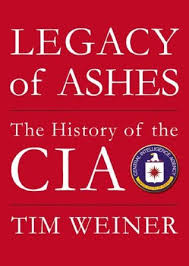
Tim Weiner’s Legacy of Ashes: The History of the CIA is in some respects a marvelous book.  He writes well and so the pages turn easily.   Weiner’s pours gobs of research into his account.  He has more than 100 pages of footnotes.  Many of his citations come not from other books about the CIA, but from the agents themselves and especially from the CIA’s own de-classified documents.  Weiner works for the NY Times in his day-job reporting on national security issues, so he knows the territory for this book quite well.

Unfortunately for me Weiner rarely delves into analysis and synthesis of his material.  Maybe he wants a “just the facts” reporters perspective.  That’s his strength, and if he added analysis the book might get unwieldy in size.  Fair enough, but in the end the failure to plumb the depths of certain questions make this book incomplete in my eyes.

Weiter hammers away at the CIA, citing failure after failure, blown operation after blown operation.  Their charter called for them to provide political leadership with crucial information that could inform decisions but they whiffed on almost every major crisis.  Their most significant “successes,” such as organizing regime change in Iran in the 1950’s, backfired terribly a generation later.  We had very little success recruiting agents within the Soviet Union and often relied on the intel of our allies.  Internal reviews often pointed out the CIA’s shortcomings, but these reports almost always got buried and nothing changed.

Supposing that Weiner’s basic appraisal is true (which is up for debate), I would have liked more from Weiner on why the CIA failed as it did, but he offers only hints.

Time might have something to do with it.  We are still a young country, with a very young intelligence service.  The British, the Russians, and so on have all done  this for much longer than us and would likely do a better job than us for that reason alone.

I wondered if the level of internal criticism from their own reviews is at least a partial function of personality.  Many intelligence analysts might tend toward pessimism and obsession over detail.  Maybe they would naturally be too hard on themselves.  I stress the word “maybe.”  I glanced through Victor Cherkashin’s Spy Handler: Memoir of  a KGB Officer for a different look and he confirmed some of what Weiner wrote, especially regarding our very poor handling of some of our agents behind the curtain.  Cherkashin handled and helped recruit both Aldrich Ames and Robert Hanssen.  He confirms some of what Weiner wrote about the Ames disaster (Hanssen was from the FBI). But he also mentioned some worthy adversaries and tough problems posed by the CIA for the KGB.  His perspective gives the CIA more credit than Weiner.

In one brief aside Weiner mentions that while, yes, the CIA proved almost inept at gathering intelligence, they did an excellent job of using money to buy influence, and they created some really cool gadgets that would be the envy of the international intelligence community.   I am reminded of John le Carre’s quote that one sees the character of a country most particularly in its intelligence service.*  The shoe definitely fits in this case.  We specialize in gadgets and money.

But that doesn’t mean an intelligence failure per se, it could mean a different kind of success.  For example, Weiner seems critical of the development of the U-2 spy plane.  We would not have needed to develop such a plane if we had better human intelligence on the ground.  Eisenhower worried that the plane might get shot down, and so on. True, but the plane gathered important information, some better, some worse, than an agent on the ground would have obtained.  When Gary Powers was shot down it did cause problems, but having an agent captured would also cause problems, albeit of a different type.  We made the U-2 because of our lack of human intelligence, but that doesn’t mean to me that the U-2 symbolizes failure, or is in itself a failure.

A review of Legacy of Ashes by the CIA’s historian, who makes this same point (among many other criticisms), is here.

But it’s in another aside that Weiner gets at the real root issue.  Democracies, he mentions, simply aren’t very good at secrecy, and we’re not good at it mainly because it goes against all of our democratic instincts.  Like the French Romantics, concealment means that we must be up to no good.  And if we commit ourselves to democracy then we need an informed public.  How an informed public, let alone informed public officials, and a clandestine agency should mix we have yet to figure out.  Weiner offers no solutions.  I can’t blame him, as I have none myself.  I do wish, however, that he paid some mind to this tension present in every democracy.

Part of our desire for openness gives the press more freedom in the U.S. than anywhere else.  We have no equivalent, for example, to England’s Official Secrets Act, which allows the British government to shut down almost any story they deem a threat to national security.  The U.S. cannot do this thanks to the first amendment.  Of course sometimes the government lies and the press exposes it.  But sometimes the press gets it wrong and messes up the government.  Weiner cites one such instance during Ford’s presidency.  Ford had orchestrated a dual arms deal to both Egypt and Israel via CIA backchannels.  He wanted to avoid seeming too pro-Israeli, but didn’t want Israel to know about the sales to Egypt.  However we judge it, he had the intention of setting up the U.S. as an international broker between the two countries.  But the press caught wind of the arms sale to Israel and published stories on it, but they had no information on Egypt.  Ford couldn’t say, “Well we sold stuff to Egypt too–we’re trying our best!” for that would expose the operation.

Of course as a reporter Weiner benefits from this access and freedom.  I wish he would have explored this tension. I’m not suggesting that it’s too bad that we have the first amendment, but it’s not an unqualified good. Among other things, it makes life harder for our intelligence services.  Weiner fails to take this into account in his evaluation.

In his Revisionist History podcast renowned author Malcolm Gladwell takes a second look at stories that he feels got neglected by the flow of time.  In his “Damascus Road” episode he looks at an instance involving the press and a CIA asset.  A man named Carlos the Jackal was everybody’s most wanted list.  No one could come close to catching him.  Out of the blue a man volunteered his help to the CIA.  He wanted no money, rather, he sought to try and make amends for the terrorist activities of his past, some of which had killed Americans.  He gave us information that allowed for his capture.

Under the Clinton administration the Justice Department ordered an “asset scrub” as part of the overhaul of the CIA.  How to draw a line between who stays and who goes?  It seemed simple enough to say that anyone who had previously killed Americans needed let go as an asset.

The CIA complied for the most part, but this particular asset was simply too valuable.  He remained on the books.

Eventually, however, a reporter found out about this non-compliance from a variety of sources.  He wrote the story but met with a CIA agent before publishing it.  The CIA representative got the reporter to remove some the crucial details, but not all.  He pleaded with the reporter . . . the details he left in would expose this asset and seal his fate.  The story was published, and the asset was killed shortly thereafter.

You probably guessed that the reporter in question was Tim Weiner.

Weiner argued that if anyone should be blamed for the man’s death, it was the CIA.  They broke the law (a dumb law, but the law nonetheless) and his job as a reporter is to at times expose the misdeeds of government.  He had credible sources within the CIA itself for the story.  He might further argue that he had no reason to fundamentally trust the CIA with its claims, so often did they mislead and misdirect.

I can’t see it that way.  Had Weiner not published the article, or even watered it down more, our asset would not have been exposed.  He played a role in his death.  When asked how those at the NY Times reacted to this turn of events, he said that for the most part it was business as usual.  You move on to the next story.

That argument aside, I find it ironic that Weiner should so stringently criticize the CIA for not developing foreign assets when he himself had a direct hand in exposing one of their best.

Moving on to a different argument . . . I say that “Lawyers, Guns, and Money” is far and away Warren Zevon’s best song.  The song’s unreliable narrator makes this one so enjoyable and so funny.  Those familiar with the lyrics know that the protagonist always goes home with a waitress, and surprise, it doesn’t always work out.  He goes “gambling in Havanna” and–shockingly–finds himself in hot water, then calls upon dear old dad (not for the first time, it seems) to bail him out.  Yet, he remains “an innocent bystander,” who “somehow got stuck.”

Ok, the connection to all I’ve written here is weak.  Mainly, I thought the song made a great title for this post.  It’s a book about the CIA, after all.  I do not suggest that Weiner resembles Zevon’s most famous character.  But Weiner criticizes the CIA constantly throughout his work for losing track of ends and means, for never looking squarely in the mirror, for dissimulation and failure.  However true, Weiner suffers from something similar.  Legacy of Ashes paints with too narrow a brush.

Weiner’s characters almost all suffer from myopia.  Weiner might suffer from it as well.  There is no particular shame in this.  It is a human problem, and not the sole property of spies.

Dave

*Le Carre is a perfect example of the principle I speculate about in the above paragraph.  He is the former spy for the west who now is enormously critical of spying.  His cold war novels expressed an ambivalence about the two major sides, while his post-cold war work exclusively criticizes the West in general, and the U.S. in particular.  People naturally assume that this makes his portrayals more realistic, but I’m confident that’s not necessarily so.


Tolkien the Anarchist

It is easy to confuse anarchism with nihilism.

The nihilist cares for nothing but destruction itself.  He derives strength ironically (and illogically) from the “meaning” of no meaning at all.  Owlman makes this perfectly clear, giving perhaps the clearest nihilistic statement in modern times.

The anarchist has a different approach.  His desire to destroy comes with reasonably good motives and a limited scope.  He really seeks not to destroy and create  better way of life.  One senses this in the music of Rage Against the Machine.  They have passion and plenty of excessive, destructive anger, but they plead for something real.  G.K. Chesteron’s brilliant The Man Who was Thursday touches on this as well, with the character of Sunday (slight spoiler alert) serving as the chief destroyer and chief unifier of the characters in the tale.

So it should not scare us too badly that a professor from Yale comes out in favor of anarchism.

James C. Scott’s book Two Cheers for Anarchism has a bark worse than its bite.  He believes that the state has some function to play, though never quite describes how.  He reveals himself as a strong critic of the industrial capitalistic modern world, much like Ivan Illich.  His critiques hit on something amiss about our predicament.  I wish he said more about about solutions.  In fairness, the road out of our situation is long and narrow.

How might one sympathize with a self-described anarchist?  We must first gain historical perspective and realize that the modern world looks very different from almost every other historical era.  The ordering of our lives occasioned especially by the industrial revolution make our lives much more regimented not by nature, but by our own creations, than any other time.

To work against this Scott urges us to abandon all centralized and regimented government solutions.  A simple example illustrates his point.  The Dutch tried an experiment with a notoriously dangerous and congested intersection.  They could have spent tens of millions and took several months to make an overpass.  The more obvious solution called for breaking up the intersection with more traffic lights and more centralized control.

Instead they opted for a traffic circle, with glorious results.  Accidents sharply declined and so did congestion. Traffic circles call for drivers to pay attention and make judgments, but Scott argues this is precisely why they work.  Governments need to get in the habit of giving over more initiative to the people and divesting themselves of institutional means of control, even with something as simple as traffic lights.  Plenty of other examples illustrate the same point, including

  • The superiority of the ‘randomness’ of nature to regimented/”scientific” planting of trees and gardens
  • The failures of housing projects vs. the concept of “neighborhoods.”
  • The unseen bonuses of shopping in neighborhoods as opposed to the ‘big box’ stores,

and so on.  His basic argument comes down to the concept of “small is beautiful.”

But he goes beyond this.  The “anarchist” part of the book involves his encouragement to small-scale kinds of disobedience to perverse means of establishing control.  He cites the recent example of French cab drivers suddenly finding themselves targeted for offenses of a particular traffic law.  They smelled not safety but money-making for the state as the motive.  So they banded together and decided that they would rigidly obey all the various traffic regulations.  Of course, traffic ground to a halt throughout French cities, the point being that

  • The practice of the people truly define what the law is, such as with speed limits, and
  • The state has stuffed the people full of useless and menacing regulations.  To enforce them all is impossible, to enforce most others would be arbitrary.

Scott laments when the natural actions and interests of the common man get co-opted by organizations.  Whatever their initial intentions, the imposed structure of unions, protest organizations, and the like, can never match the organic actions of the common man.  He admits that at times that state plays a useful function in giving an imprimatur, or proper force behind collective action, such as in the Civil Rights Movement.  But in general, a step towards centralization moves one closer to lifeless banality.

I also give Scott a lot of credit for recognizing that large-scale revolutionary action will make things worse.*  Every modern revolution created a more oppressive state than what it replaced:

  • After the American Revolution, British loyalists got a far worse treatment than any revolutionary against George III ever did before 1775.
  • The French Revolution made things far worse than the worst of the old regime
  • The Bolshevik revolution made Russia far worse than under the czars
  • Mao
  • Etc., etc.

We fix things, then in the steady and simple way of rejecting top-down government centralization, and looking for small ways in everyday life to assert the independence of organic communities and organic action.

So far so good, but while I realize the book merely wants to serve as an introduction, one issue in particular bothered me.

Scott states that, essentially, no possibility of a just society even existed until the political invention of modern democracy.  Ok . . . but . . . all of the worst examples of modern totalitarianism occurred in the name of the people.  It seems like democracy can, like nuclear power, give tremendous benefits but also cause tremendous damage.  Scott admits this from a structural standpoint, i.e., universal citizenship gives way to universal conscription, but misses something on the political side.

Scott also attaches himself too strongly to democracy itself, with the English Civil War as a case in point.  One can make a reasonable case that Charles I abused his power.  I think it much harder to justify his execution, done in the name of the law, in the name of the people, after a trial of dubious legality.  I know of no historian who argues that the Protectorate under Cromwell gave people more freedoms than Charles I.  In time, England begged Charles’ son to come back and rule as Charles II, and he returned to huge acclaim.  Again, it seems that the “Restoration” era under Charles II provided more tolerance and more room for localism than Cromwell and his more democratically minded Puritans.

The vision Scott argues for reminded me of G.K. Chesterton and Hillaire Belloc with “distributism.”  Scott decisively breaks with left-leaning academics who despise the “petty bourgeoise,” and instead looks for just the sort of limited land-ownership and localism that this class provides.  But the closest parallel to this kind of organization has historically only come from

  • Frontier societies, whose time may be sweet but is inevitably limited, as it waits for the rest of society to catch up
  • Societies on geographical fringes, like the eskimos, aborigines, jungle tribes, desert nomads, etc.
  • The Middle Ages

Maybe modern democracy is the cause, not the solution to the problems Scott decries.  Marx himself, I believe, believed that capitalism served the purpose of destroying local traditions, a necessary step towards worldwide revolution.  Maybe we need not blame democracy for all of the problems of the industrialized state.  But at the very least, sometimes non-democratic governments do a better job of preserving localism and traditions.

I wish Scott had tackled this.

Scott also may need to choose.  Does he prefer organic localism, or individual rights, democracy, etc.  The two do not always mix, so which does he prefer?  As an anarchist Scott blames the system.  But with democracies people generally get to create the system they want. If a democracy goes bad, then, blame the people, and not the system.  We get what we deserve.

Scott will strike many as decidedly modern, but if you poke around writers and thinkers with a bent towards bygone eras we get some surprises.  The great J.R.R. Tolkien railed against the modern world with his life and work to no avail.   Yet in a letter to his son he wrote,

My political opinions lean more and more to Anarchy (philosophically understood, meaning the abolition of control not whiskered men with bombs)—or to ‘unconstitutional’ Monarchy. I would arrest anybody who uses the word State (in any sense other than the inanimate real of England and its inhabitants, a thing that has neither power, rights nor mind); and after a chance of recantation, execute them if they remained obstinate! If we could go back to personal names, it would do a lot of good. Government is an abstract noun meaning the art and process of governing and it should be an offence to write it with a capital G or so to refer to people . . . .

He continued on the nature of ruling that,

Not one in a million is fit for it, and least of all those who seek the opportunity. At least it is done only to a small group of men who know who their master is. The mediaevals were only too right in taking nolo episcopari as the best reason a man could give to others for making him a bishop. Grant me a king whose chief interest in life is stamps, railways, or race-horses; and who has the power to sack his Vizier (or whatever you dare call him) if he does not like the cut of his trousers. And so on down the line. But, of course, the fatal weakness of all that—after all only the fatal weakness of all good natural things in a bad corrupt unnatural world—is that it works and has only worked when all the world is messing along in the same good old inefficient human way . . . .

David Bentley Hart quotes from this letter in a recent article in First Things, and Hart himself seems to get the gist of Tolkien’s meaning when he writes,

The ideal king would be rather like the king in chess: the most useless piece on the board, which occupies its square simply to prevent any other piece from doing so, but which is somehow still the whole game. There is something positively sacramental about its strategic impotence. And there is something blessedly gallant about giving one’s wholehearted allegiance to some poor inbred ditherer whose chief passions are Dresden china and the history of fly-fishing, but who nonetheless, quite ex opere operato, is also the bearer of the dignity of the nation, the anointed embodiment of the genius gentis—a kind of totem or, better, mascot.

Scott has done a great service with his book.  If he writes again I would love for his critique of modernism to go a bit a deeper.  Lets see what he can write if he broadens his vision.

Dave

*He never gets into why this is, however, and the question is worth pondering.  Why do popular revolutions create more totalitarianism than the governments they replace?

Be Like the Fox

This post was originally written in 2017, and you will note the reference to Trump as president below . .  .

****************

If you wanted to be an English aristocrat in the Victorian age (or perhaps most any age) one needed to hunt foxes.  For years this perplexed me.  Sure, foxes eat chickens sometimes and maybe cause a bit of mischief, but they posed no real threat to anyone.  They did not seem like noble quarry.  But then I realized that foxes were not hunted because of the damage they did to farms (like you would hunt wolves or wild hogs), or the danger they posed to the hunters (like lions or bears), but because they were so clever at avoiding traps.  To hunt a clever beast, one had to display their own cunning.

Machiavelli has always beguiled his admirers and detractors alike.  Reading him can feel like a bracing tonic, but then he leaves you cold with his “Machiavellian” calculations.  He seems both clear and contradictory.  We may wonder if we can read him as anything more than a guilty pleasure.

We need not look further than his “It is Better to be Feared rather than Loved” chapter from The Prince.  In his typically realistic/pessimistic way, he says that the love of the people will never be constant, whereas fear will keep them bound to the ruler.  This seems to fit within Machiavelli’s general framework, but we should recall that as an avid student of history, Machiavelli would surely know that fear never works beyond the short-term.  The most successful rulers throughout history may not have people “love” them in the sense in which we use the word, but they did establish relationships and a series of mutual benefits for the ruler and ruled.

Erica Benner makes the bold suggestion that not only is Machiavelli giving bad advice in this notorious chapter, he knows he is giving bad advice.  In fact, he wants his audience (the D’ Medici’s who ended Florence’s Republic) to take this advice and make themselves odious to the people.  He hopes, in fact, that the Republic he loves might be restored through the stupidity of those that read him.*

Ordinarily I would suspect some show-off chicanery with this analysis, but Be Like the Fox surprised me with its even-handed and careful approach that remains accessible to someone like me.  She begins by suggesting that we should not view Machiavelli primarily through the lens of The Prince, but rather through the body of his other work, and especially, his life as a diplomat.  The book weaves biography and analysis gracefully.  Diplomats, especially Renaissance diplomats, often had to speak elliptically and carefully.  The message lay not so much in what was said but in how it was said.  Perhaps Machiavelli’s writings evidence some of this same character.

At his best, Machiavelli bring us back to questions of purpose in political action.  Benner includes an example from Machiavelli’s own life to illustrate this.  Early in his marriage Niccolo had a brief affair with his cousin Bernardo’s female servant and got her pregnant.  She admitted to Bernardo that Niccolo was the father.  From his diaries, we know that Bernardo considered carefully what to do.

Privately he approached Niccolo and mentioned the pregnancy and, in neutral tones, the accusation. “What will happen to the Machiavelli name,” Niccolo, “when word of this gets out?”  Niccolo sympathized with the poor girl and his cousin.  He blamed himself . . . because, he said, a friend of his had seduced the poor girl while he and his wife were away from the house.  Niccolo offered to try and track him down.  Of course, after a few days he reported that the “man” was a scoundrel and would never fess up.  But . . . since he recognized that the fault in the end lay with him, he agreed to provide for a large dowry for the girl so she could get married . . . quietly.  After all, no one wanted a scandal to tarnish the Machiavelli name.

If the cousin’s goal was to bring Machiavelli to repentance, this method may have hindered that cause.  If he desired a quiet solution to the outward problem itself, this worked. Would a direct attack on Niccolo bring about a quickening of his conscience, or merely a stubborn defense that would leave him (Bernardo) holding the bag for his pregnant serving girl?  Benner tells this story early in the book to illustrate the point of much of Machiavelli’s writing.

Benner supports her analysis of The Prince especially through the life of Cesare Borgia, whom many suspect Machiavelli admires on their first reading.  As the son of Rodrigo Borgia, a.k.a., Pope Alexander VI, Cesare had enormous advantages.  “Fortune loves and impetuous youth,” Machiavelli writes.  Cesare had a string of great victories throughout Italy based in part on his charisma, luck, and a talent for acquisition via dubious means.  Yet Machiavelli consistently notes that,

  • People who use deception to great effect always assume that everyone else will be honest.
  • People who thrive on conquest often have a hard time building a stable network of alliances, and making and keeping friends.
  • People who have the smile of Fortune rarely realize that Fortune has a fickle streak.  One must do the work of real relationships to create a truly stable state.

In other words, The Prince has much more implied criticism of Cesare Borgia than praise,

Benner illustrates this with other events in Machiavelli’s life.  We assume that Machiavelli just cared about results and not about methods, but Benner argues this would make nonsense of many of his experiences and other writings.  When Pope Sixtus IV (seemingly) supported the failed assassination attempt of Lorenzo and Guillamo d’ Medici, it left Florence in a vulnerable position despite the fact that Lorenzo survived.  Lorenzo’s ruthless revenge not just against the assassins themselves, but the entire Pazzi family from whence they came (which included a few clergy) gave the Pope ammunition to take control of Florence regardless of the failed plot.

Lorenzo scrambled and tried to isolate the pope by getting Naples to break free from their alliance with the Pope.  He thought he scored a major coup for Florence and saved the city.  But then . . .

  • The Pope was still furious because of the treachery of Naples
  • Venice, as an side player in this whole affair, got angry that no one included them in the conversations and joined the Pope against Florence.
  • Meanwhile, Naples had only signed a non-aggression pact with Florence, which meant that they offered no military assistance, leaving Florence in exactly the same position as before.

Slipshod diplomacy made for now diplomacy at all.  Thus, Machiavelli concludes that, “One must things by their methods, and not merely by their results alone,” a conclusion that may surprise us.**

In his fun From Barbarians to Bureaucrats Lawerence Fairley makes the point that companies go through  many of the same life-cycles as civilizations, and uses A.J. Toynbee’s analysis to aid him.  One stage belongs to the “Barbarian.”  Fairley writes that one may be a “barbarian” leader if,

  • You love competition, and the ‘thrill of victory.’  You cannot shrug off losing.
  • You are action-oriented.  You don’t care so much for ideas or systems, but results.
  • You like being in charge and like making decisions
  • You may not have come up with the vision, but want badly to see it through and have definite plans for doing so.
  • You don’t have tons of patience for those who seem to be standing in the way of your mission.
  • You see the ‘struggle’ in absolute terms of us/them, good/evil, etc.

Certainly Cesare Borgia fits this bill, as I think, does our current president.  Fairley points out that we can have good and bad “barbarian” leadership, with each style obviously having its strengths and weaknesses.  Cesare Borgia’s problems came directly after the fighting stopped, as did Alexander the Great’s, as perhaps did Donald Trump’s?  With Cesare, Machiavelli seemed to indirectly counsel that the worst thing one could do with a barbarian was prolong the fighting, which plays directly to his strengths.  The true barbarian, however, will never handle peace well.  Let Cesare stumble over his own feet.  Let Fortune abandon him.  Perhaps Machiavelli would counsel Trump’s political opponents to lay low and let Trump defeat himself.^

In hindsight, of course, some of Machiavelli’s advice looks less and less “Machiavellian.”  In  Debriefing the President, John Nixon writes of his experiences at the CIA and especially about his time spent with Saddam Husssein.  In the midst of his criticism of Clinton, Bush the Younger, Obama, and George Tenet, he reveals changes in his opinion.  He admits that he thought the best intel the U.S. possessed pointed to a stockpile of W.M.D’s, and so initially supported the war.  But he concludes that Iraq and the Mideast would be much better off today with Saddam in power.

Well, obviously.  But Nixon makes this claim more interesting with Saddam’s own words and history, much of which he missed himself as an intelligence analyst leading up to the war.  Saddam’s greatest threat was not the U.S., he argues, but Sunni-based Islamic terror, because he relied on the Sunni’s for nearly all his power in Iraq.  Thus, Saddam would have opposed Al-Queada and especially ISIS, as mortal threats to his regime.  Perhaps the fighting would have happened regardless, but Saddam may have appeared vulnerable enough for more open fighting, which would have played right into the U.S.’s tactical and technological advantages.

Maybe so, though this is much easier to say in 2017 than it was in 2003.  Still, I surmise that Benner would concur with Nixon that the best policies come from taking a lesson from the fox, who lives not by paying attention to ideology, but by finding the best way to avoid traps.^^

DM

*Other aspects of The Prince suggest something similar.  He discusses in one chapter that there are two kinds of kingdoms. One type is easy to conquer because they are divided, but this same type of kingdom is all the more difficult to hold precisely because of its divisions.  Was this a word of warning for his D’ Medici enemies who had taken advantage of Florence’s internal divisions?

**Machiavelli argues that Florence survived only because of the serendipity of Turkish activity right at this moment.  The Italian city-states agreed on little besides the fact that Turkey was their greatest enemy.

^This is the conventional view.  But it may be that Trump is actually doing a good job fulfilling his basic promises, as the irrepressible and always enjoyable Camille Paglia points out in her interview here.

^Here I speculate on Benner’s and Nixon’s position, and do not necessarily mean to give my own.  Machiavelli’s work forces one to answer many questions about Christianity’s relationship to politics–but I haven’t come up with an answer yet!

“Kill Anything That Moves”

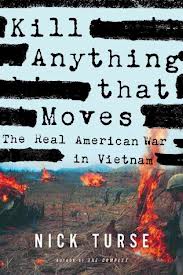
Nick Turse’s Kill Anything that Moves is not a comfortable book.  I did not read the whole of it, and I cannot imagine the depression that would set in for those who did.  Turse continually hits the reader over the head with atrocity after atrocity that Americans perpetrated in Vietnam.  By midway through, one feels a bit numb.

Turse’s subject matter hits hard, but only skin deep.  There is not enough context, not enough logical build up, and this may be the reason why his book may not have the impact Turse hopes for.  The work bears the mark of solid research and urgency but not sober reflection. Apparently Turse has recently come across some documents just made available from the army, which kept them secret for many years.

Kill Anything that Moves bears the hallmarks of someone desperate to share something that they have just discovered.  It comes out all at once.

I know that in my experience as a teacher I am at my worst when newly excited about something.  I remember how I rambled incoherently through the French Revolution for three weeks with students just after I read Simon Schama’s excellent Citizens (This happened!  And then this!  And then Danton did this!  And Robespierre did that!  Are you getting this down?).

Turse’s basic contention is that what happened at My Lai was not an accident, but a direct result of standard policies and orders routinely given by the military.  That is, My Lai’s happened frequently, if perhaps on a slightly smaller scale.  Of course untold thousands of civilians died due to the blanket B-52 bombing runs.  But troops also deliberately targeted civilians on their “Search and Destroy” missions.  “Kill anything that moves,” comes from typical scenarios where troops received orders to do this almost literally.  Telling friend from foe on the ground posed terrible difficulties.  They solved it by the simple formula, “If they run from our helicopters, they can be shot as enemies.”  Civilians killed by mistake could be given a weapon and called “VC.”  No one asked too many questions higher up because of their interest in body counts.

The book also details the “Destroy the village to save it,” strategy that we clumsily employed in various sectors.  The strategy had some merit and history behind it, which Turse should have brought up.  A typical mantra of insurgent warfare is that, “The peasants are the sea in which the fish swim.”  If you dry up the sea, the fish perish.  So if the peasants all came to our refugee camps, the VC would slowly suffocate.  I believe that Alexander the Great used this strategy effectively against the Bactrians.  Some say Vercintgetorix should have done this in Gaul against Caesar.   The British used this with at least short-term benefits against the Boers.  The fact, then, that U.S. tried some variation of this strategy should not shock us, and Turse should have discussed this.  It is symptomatic of his narrow focus that he did not.

However a significant difference existed between the U.S. and these previous armies.  Not every army can attempt every strategy.  For a strategy to work it needs to have consistency with the society in which it originates.  An army that fights against the values of its own culture will not march with any weight or support behind it, and will almost certainly lack real effectiveness.

Alexander and Vercintgetorix did not rule from consent.  People expected them to do as they pleased.  In South Africa the British interred not their allies but their civilian enemies.  Also, the Victorian British army represented not a democratic consent-based society but an oligarchic “father knows best” ethos that could allow for more “dramatic” treatment of civilians.

The U.S’s strategy with Vietnamese peasants had nothing to recommend it.  In theory the U.S. was a democratic, consent based society.  For its army to then willy-nilly take peasants from their land had no internal rationale.  Secondly, the U.S. had no history in Vietnam, and thus no build-up of goodwill from which to draw.  And third, the U.S. executed the policy in such a clumsy and morally lazy way that it had to fail.  The British at least knocked door-to-door like proper gentlemen and provided an escort.  Though I do not praise the British in this strategy, at least they attempted some personal connection and took measures to protect Boer civilians, whereas the boorish Americans simply bombed and torched villages and then expected the locals to go to their refugee camps by default.  Add to this, their refugee camps were dirty, unsanitary places.  Nothing about this policy matches a society based on equality and consent, and everything about this policy suggests a people and an army that wanted nothing to do with this conflict in the first place.

Turse details many such blunders and moral darkness.  His most compelling chapters detail the army’s policy about weeding out combatants from non-combatants.  Being able to tell them apart in Vietnam would have required a great deal of patience and “on the ground” intelligence. Instead troops routinely received orders that ordered them to shoot at anyone who ran away from their helicopters.  If they ran, they were VC.  If they made a mistake, no problem.  Put a gun in their hand, take their picture, and add them to the body count.  Air Force pilots patrolling the Ho Chi Minh trail had orders to blow up anything moving south, be it man or machine, indiscriminately.  God could sort them out in the end.

These chapters hit the reader in the gut but don’t get at the roots of why this happened.  He doesn’t go for the head, only our emotional reaction.

So why did this happen?  I have a theory. . .

Vietnam was a war no one wanted.

Johnson inherited the problem from Kennedy.  No one “wants” a war, but Johnson seemed specifically ill-suited to foreign policy.  It was not in his wheelhouse.  He often commented how he wished Vietnam would go away so he could do what he really wanted to do — the Great Society.

Congress did not want to deal with the war either.  With the Gulf of Tonkin resolution they signed away their responsibility and oversight to the president.

At least at the beginning of the war, we drafted troops from sections of society without much political importance, another way to pass the buck and avoid domestic conflict over the war.

Every manual on leadership prescribes leaders sharing burdens and sharing space with those they lead.  In Vietnam, very few higher officers ever patrolled with their men.  They led from desks.  They too wanted nothing to do with the messiness the war entailed.  So it is no coincidence that when they received casualty reports that in no way matched the weapons troops recovered, they looked away.  They were already “looking away” by sitting at their desks.

With all this, we should be slow to place the brunt of the blame on the ground troops themselves.  All of America owned this problem, and all of America contributed to these atrocities.  Turse makes a valuable contribution to the literature on Vietnam, but I think it will take an historian with a more prophetic bent to make the most of his findings.

11th Grade: St. Francis and 60’s Counter-Culture

Greetings,

This week we wrapped up our unit on Vietnam, and shifted our focus to the domestic scene and the rise of the “Hippie” counter-cultural movement.

The hippies were hardly America’s first prominent counter-cultural movement, but its visibility and impact may have been greater than others of its kind.  Some point to the baby-boom population reaching the teen years as the main reason for the disruption in the 60’s, but surely this can only form part of the cause.

To the older generation it seemed like the hippies rejected the America their parents handed them.  Their parents lived through the Depression, won W.W. II, and yet they seemingly despised their inheritance.  One must sympathize with the feelings of confusion and rejection those “over 30” must have felt.

But we should also ask what that inheritance might have looked like to many by 1967.

  • The growth of TV dramatized the Civil Rights struggle and exposed contradictions between our words and reality.
  • America had always thought of itself as a plucky underdog, but now we used all our technological advances to bomb a peasant nation thousands of miles away, as discussed last week.
  • Had the American dream been reduced to materialism?  That is, did they see their role in life to do well in school, to get a good job, to get a comfortable life, end of story?  What did America really stand for?  Could America not just give you a good job, but also feed the soul?

I shared with students a theory cobbled together from a few sources (only a theory, I stress).  Though it works better visually, I will try and explain:

  • Imagine a civilization as a series of concentric circles with a core, or nucleus.  This core represents the spiritual foundation of our law, customs, and so on.
  • From the core the circles radiate out.  Culture would closest to the center, as that involves a collective and creative process.  As you radiate out, the values of the core are less immediately obvious, but still influential.  So you might have politics next, then economics.  One of the furthest out might be the military (for the sake of argument).
  • Also, the further you get from the core, the easier that aspect travels.  You can’t, for example, get people to suddenly be jazz musicians, but you can send your military wherever you want.

What happens when the core begins to lose its strength?

When a middle-aged man sits up and wonders what it all means and then decides to buy a sports car and get a trophy wife we do not call that a sign of health.  We might call it overcompensating for a failure to deal with life’s realities.  Territorial expansion can mask uncertainty or weakness at the core, and gives the illusion of health.  For the circles to all hang together, weakness in one area must be made up in another.

This time of expansion makes a civilization vulnerable.  Since we no longer draw from a healthy core, we become imbalanced and materialistic.  “It is the bored civilization,” wrote Oswald Spengler, “that thinks only of economics.”  This lack of balance needs addressed, and herein lies both opportunity and danger.

Sometimes one has to leave home to truly discover it anew, and herein lies the opportunity with this process.  A civilization searches the world for a home only to discover that they like the one they left (the basic plot of Chesterton’s Manalive for those that might have interest).  Think of someone who grew up in the Church, left it to “find themselves” in their early college years, and then return after seeing the bankruptcy of the world.  Upon their return they have renewed dedication to home.

But. . .

That usually does not happen, because it was the core’s weakness that led to the expansion in the first place.  Usually the civilization gets enchanted with the “other” now that their standard fare no longer satisfies. At this point, the civilization begins to fill in the core’s gaps with elements from different civilizations.  Witness what happened to Rome after their expansion throughout the Mediterranean, and how they began to borrow from Greek civilization various religious and cultural ideals.  Various Roman emperors adopted a Greek fashions.  Marcus Aurelius posed as a Greek philosopher, while his son Commodus took it even further and dressed as Hercules.

Before we blame the seekers, we need to wonder what led them to seek elsewhere for answers.  I cannot claim to have a good handle on the state of the American Church in the post-W.W. II era, but I can say that if the Church identified too closely with “America,” their disenchantment with the country would impact their identification with the Church.  In the case of Rome,  many have documented how prior to their significant expansion after the 2nd Punic War, Rome politically had gone from a mostly admirable democracy to a less praiseworthy oligarchy.  Maybe many of the hippies meant well, and maybe they were right that America had a spiritual problem that went far beyond politics.

Of course, sometimes this process of shifting core identity brings blessings.  Think of the Roman ethos giving way to the Christian Middle Ages.  Also, all of us are made in God’s image, so every culture will reflect something of God’s truth.  Because of sin no culture will do this perfectly.  In the case of America and Western Civilization, Christianity obviously had a lot to do with its founding.  But even from the beginning, contradictions like slavery embedded itself deep within our identity.  We did not perhaps fully understand what “liberty” was supposed to mean.

I think Donovan’s “Riki-Tiki-Tavi” as illustrative of this principle, from 1965:

Here are the lyrics:

Better get into what you gotta get into
Better get into it now, no slacking please
United Nations ain’t really united
And the organisations ain’t really organised

Riki tiki tavi mongoose is gone
Won’t be coming around for to kill your snakes no more my love
Riki tiki tavi mongoose is gone

(Every)body who read the Jungle Book knows that Riki tiki tavi’s a
mongoose who kills snakes
(Well) when I was a young man I was led to believe there were organisations
to kill my snakes for me
i.e. the church, i.e. the government, i.e. the school
(but when I got a little older) I learned I had to kill them myself

(I said) Riki tiki tavi mongoose is gone
Riki tiki tavi mongoose is gone
Won’t be coming around for to kill your snakes no more my love
Riki tiki tavi mongoose is gone

People walk around they don’t know what they’re doing
They bin lost so long they don’t know what they’ve been looking for
Well, I know what I’m a looking for but I just can’t find it
I guess I gotta look inside of myself some more

oh oh oh inside of myself some more

Here he expresses something typical about growing up and the need to find one’s own identity.  He needs to “own” his way in the world, as he realizes that what he trusted in his youth isn’t all its cracked up to be.  So far so good. But his solution (“look inside of myself some more”) is very Eastern and bound for disaster.

Herein lies the seeds of the failure of the Hippie movement.  They could point out flaws, but could lay no other positive foundation merely by looking “inside of myself some more.”  It is worth noting that while, say, the Civil Rights Movement had its apex with the March on Washington and the subsequent Civil Rights Act, the Hippie counter-culture peaked with a concert at Woodstock.   Great music, but little actual impact on society.

As a brief aside, one can see some historical parallels in that civilizations which experience a “time of troubles” often develop inward looking philosophies/religions, which tend to have a strong individualistic core.   We can think of the aforementioned stoicism in Rome mentioned already, or the growth of Platonic philosophy after the Peloponnesian War in Athens.  We can add to the list Babylonian obsession with dream interpretation during and after the time of Nebuchadnezzar.  Interestingly, this inward drift happened after victorious expansion in all of these civilizations, just as it happened with us after W.W. II.  If we could call these periods “Times of Troubles” in ancient world, might we say that America is experiencing a similar “Time of Troubles” today?

This sentiment of blurring reality by looking inward gets taken about as far as it can go in the Beatles’ “Tomorrow Never Knows.”

Here the song urges you not just to refashion reality in your own image, but to escape reality altogether, and many used drugs to do just that.  The song not only has an overt Eastern message, but expresses it partially in an Eastern form.

Many former “hippies” lament the fact that their dream died and turned back into the materialism the movement initially rejected.  Part of this happened, I think, because many of them grew up, got married, had kids, and inherited all the attendant responsibilities that families bring.  But another reason for this I think was the fact that “looking inside ourselves” for answers will not lead to anything very satisfying, and none of us are interesting enough for anyone to enjoy it for very long.  The experiment had a built in short shelf life.  Many of them returned to the only thing they knew, the “materialism” of their parents generation.

Unfortunately they did a great deal of damage, especially in the realm of sexual ethics.  In looking inward, they reduced much of life to self-expression.  Sex too got included in personal self-expression, which meant that not only would sex be divorced from marriage, it could be divorced from the other person entirely.

Historians differ in how they evaluate the movement.  One went so far as to call St. Francis, “the hippie of his day.”  Well . . .St. Francis actually built something enduring based on charity, whereas the Hippie movement had an almost exclusively negative character.  St. Francis sought to transform reality out of love, not escape from it.  First Things has a good rebuke to the “St. Francis as a Rebel Hippie” idea here.  The comment about St. Francis as a Hippie does hint at one truth: both St. Francis and the Hippies gave a spiritual critique of their societies.  But St. Francis looked out at God and the World, not inward, and therein lies a crucial difference.

St. Francis

Many thanks,

Dave

10th Grade: Reality comes to Roost

Greetings,

This week we set up the class for what will be our look at the fall of Napoleon early next week.

Napoleon loved speed.

I don’t know if he could have stopped moving if he wanted to.  Motion seemed ingrained into his being.  At this time, anyone in France who ate dinner in less than an hour would be considered a barbarian.  Most took about two hours to eat.  Napoleon routinely ate in less than 15 minutes, and his favorite dish–fried potatoes and onions–was in fact a dish he frequently had while on military campaigns.

On the battlefield, in politics, he practiced what he preached: he who acts quickly and decisively wins.  He had little patience for anything that would not move quickly.  This worked well for him in France on one level — it allowed to constantly outmaneuver his political opponents.  It certainly worked for him on the battlefield, and it translated, by 1810, into a considerable empire.

But his need for speed did not translate well in foreign policy.  He often used family members, for example, to rule large territories in his name.  This would be much quicker than patiently learning local cultures, courting local opinion, and adapting to it.   What he gained in time he paid for in many ways.  His policy was short-sighted for a number of reasons:

  • Napoleon claimed to bring the blessings of the French Revolution where he conquered.  Why then, did he think that conquered territories would accept a foreign ruler when he had exported the nationalism of the Revolution to their domains?
  • As puppets of Napoleon, his family would take orders from Napoleon, not from the people they ruled. How then, could these puppet rulers hope to hold the loyalty of the people to Napoleon?  How long until the people rebelled?

This in fact happened in Spain, a country Napoleon drastically underestimated.  To him Spain represented ignorance, sloth, military futility.  He dealt with them in his typical quick and summary fashion, but when he removed the Spanish royal family and installed his brother as king the people erupted in rebellion.  Spain became a nightmare of guerrilla war, for which Napoleon’s temperment had zero liking.  Goya captured the mood of the Spanish in his famous work, “The Third of May:”

Eventually the Spanish campaign pinned down 250,000 French troops.  But the presence of so many French in Spain alerted Portugal, who called upon England for help.  In both Portugal and Spain British general Sir Arthur Wellesley got invaluable experience fighting the French — experience he put to good use in Napoleon’s final battle at Waterloo, when he was then known as the Duke of Wellington.

But when people think of Napoleon’s missteps, they think of his invasion of Russia.

Why did he do it?

In many ways he felt he must because Russia had violated a treaty they signed with him and had traded with England.  If he let that go, then he would look weak, which would induce others to revolt as well.   Here Napoleon had, however, made his own bed.  He put tremendous stress on using his image to maintain his power.  He put his family members in charge of other nations, and so naturally did not have the loyalty of those he controlled.  So, he was right — his image was all he had left to maintain his power, and without it, it might collapse.  When Napoleon talked about the fact that losing one battle might end his reign he may not have been whining or exaggerating.  It may have been the truth, for even one defeat would shatter the image he had constructed for himself.

To invade Napoleon amassed a huge force that historians put between 475,000-600,000 men.  He wanted to use this army to quickly smash Russian forces and compel Czar Alexander I to surrender.  But Napoleon’s  usual keen strategic insight deserted  him here.  Who would fight an army that large?  Naturally, the Russians retreated inland, forcing Napoleon to follow and stringing out his supply lines.

What is victory?  Napoleon learned the hard way that victory comes not just by winning battles or capturing cities.  Victory does not come when you say it has.  It takes two to tango.  Victory only comes when your opponent, not you, thinks that he is defeated.  Battles, cities, crops — they meant nothing to the Russians.  But time did, and they used time to retreat inland and wait for winter.  They slashed and burned what they could — even the city of Moscow itself — and left Napoleon with nothing.

The Frenchman Joseph Minard made two classic visual aids, the first for Hannibal’s invasion of Rome, the other for Napoleon’s invasion of Russia.  Both tell the story of time, cold, and loss.

I think that Napoleon faced huge challenges when he assumed power in France.  He dealt with a country that had nearly destroyed itself during the Revolution, and felt that it needed security and stability above all else.  But he insisted on bringing that security by himself.  He never shared credit or delegated effectively.  He even took it upon himself to put the crown of France on his own head.

To establish his power, he fudged election results and removed certain civil liberties.  On occasion he imprisoned or even executed those who spoke out against him.  His image had to be preserved after all.  In the end, he complained that his friends deserted him just when he needed them the most.  He told the truth in the sense that after his failure in Russia, many did turn on him.   But his capacity for self-delusion may have been at work again.  He didn’t seem to be the type to make friends in the first place.

Many thanks,

Dave

The Ties that Bind

In his Jurguthine War the Roman historian Sallust detours from his main narrative to discuss the rivalry between Carthage and Cyrene (an ancient Greek colony near modern day Libya).  In one instance the two powers thought of a novel way to settle the problem between their civilizations without the continuance of war.*  Sallust relates,

Since the affairs of the people of Lepcis have brought us to this region, it seems fitting to relate the noble and memorable act of two Carthaginians; the place calls the event to mind. At the time when the Carthaginians ruled in the greater part of Africa, the people of Cyrene were also strong and prosperous. Between that city and Carthage lay a sandy plain of monotonous aspect. There was neither river nor hill to mark the frontiers, a circumstance which involved the two peoples in bitter and lasting strife.

After many armies and fleets had been beaten and put to flight on both sides, and the long struggle had somewhat wearied them both, they began to fear that presently a third party might attack victors and vanquished in their weak state. They therefore called a truce and agreed that on a given day envoys should set out from each city and that the place where they met should be regarded as the common frontier of the two peoples. Accordingly, two brothers were sent from Carthage, called Philaeni, and these made haste to complete their journey. Those from Cyrene went more deliberately. Whether this was due to sloth or chance I cannot say, but in those lands a storm often causes no less delay than on the sea; for when the wind rises on those level and barren plains, it sweeps up the sand from the ground and drives it with such violence as to fill the mouth and eyes. Thus one is halted because one cannot see.  Now when the men of Cyrene realized that they were somewhat belated and feared punishment for their failure when they returned, they accused the Carthaginians of having left home ahead of time and refused to abide by the agreement; in fact they were willing to do anything rather than go home defeated. But when the Carthaginians demanded other terms, provided they were fair, the Greeks gave them the choice, either of being buried alive in the place which they claimed as the boundary of their country, or of allowing the Greeks on the same condition to advance as far as they wished. The Philaeni accepted the terms and gave up their lives for their country; so they were buried alive. The Carthaginians consecrated altars on that spot to the Philaeni brothers, and other honours were established for them at home. I now return to my subject . . . 

The matter-of-fact method in which Sallust relates this story should give us pause.  He obviously accepted this line of thinking — these were “fair” terms.  This was justice, this was life in the ancient pagan world.  The Philaeni brothers had no other choice.  The above passage brings to mind a more famous section of Sallust from his introduction:

I have often heard that Quintus Maximus, Publius Scipio, and other eminent men of our country, were in the habit of declaring that their hearts were set mightily aflame for the pursuit of virtue whenever they gazed upon the masks of their ancestors. Of course they did not mean to imply that the wax or the effigy had any such power over them, but rather that it is the memory of great deeds that kindles in the breasts of noble men this flame that cannot be quelled until they by their own prowess have equalled the fame and glory of their forefathers.

One can’t help but chuckle a bit at the comment that “of course” the masks did not have “any such power over them.”  They simply dedicated their entire lives to everything the masks represented.

The western world will likely to continue to experience something of a pagan revival, and elsewhere I commented that bringing out into the open what lies subtly buried in our unconscious has something to recommend it.  But we should have no illusions.  Evidence abounds that if we revive paganism we will build for ourselves cattle-shoots from which we have no escape.  We will exchange the freedom we claim to hold dear for chains.

Indeed, Chesterton spoke rightly when he declared that whereas Christianity has elements of anguish and pain at the periphery, joy occupies the core.  Pagan religions, however, have joyous elements in them only at the periphery, but at their center stands defeat and despair.  Any surface familiarity with the ancient world bears this out.  Hector must fight Achilles and lose, just as Troy must face destruction. Not even Zeus himself can stop it.  Oedipus cannot avoid his fate, though he take every counter-measure possible. Even the “realist” historian Thucydides sees events in cyclical form — what happened before will happen again. For the Norse as well, in the end the good guys lose.  It is this magnificent sense of the tragic that gives such tales their grandeur and power, but who wants to get inside such stories?

As the excerpts from Sallust indicates, shame seems to bind the ancients more than anything else.  The Philaeni brothers accepted a brutal death rather than accept what must have been a worse fate awaiting them back home — the shame of failure.  Republican Romans took their obsession with reputation and drove their civilization straight over a cliff in the 2nd century B.C.  The ancients had no escape from shame because ultimately paganism puts all the focus on the self.  Judas, for example, could only see his sin, but Peter runs to the empty tomb — he had bigger and better things on his mind than his Friday morning betrayal.  Peter had an “out” from his past.  As Paul writes in Ephesians 4, “When [Jesus] ascended on high, he led captivity captive, and gave gifts to men” (emphasis mine). Neither ones society nor ones past should be denied or destroyed.  Both are part of God’s creation and God’s plan. But both can be transcended and transformed, and with this hope we approach something akin to true freedom.

Dave

*The story reminds me of the “Oath of the Horatii” narrated by Livy.  Whether or not that lends credence to the historicity of Sallust’s tale I suppose depends on what one thinks of Livy’s narrative.


Are you Bored?

This was one of my favorite scenes from The Great Muppet Caper:

I recently polled some of my students and gave them choice between a) Boredom, and b) A mild amount of physical pain, almost all of them chose the latter.  This might surprise us until we ask ourselves the same question.  Boredom can be excruciating, and physical pain would at least give us something on which to focus our attention.

In the poem “Waiting for the Barbarians,” C.P. Cavafy describes the hustle and bustle of a city in late Rome preparing for barbarians to menace them.  In the end, however, the barbarians for an unknown reason depart, leaving the people more confounded than relieved.  Cavafy concludes the with,

And now, what’s going to happen to us without barbarians?
They were, those people, a kind of solution.

Cavafy wrote this work originally in 1898, though it was not published until 1904.  He speaks with a macabre prescience, for one can detect a latent nihilism in Europe at this time.  Many in Europe welcomed the arrival of war in 1914 though today historians endlessly debate the cause of the war, which seems elusive.  What exactly were they fighting for?  Perhaps the answer is more mundane.  Perhaps they preferred pain to boredom.

William Lee’s book, Blackbeard: A Reappraisal of his life and Times, raises some similar questions.  His book gives some interesting detail and good stories of the notorious pirate.  Lee attempted to write with precision and has an impressive bibliography of original colonial sources.  But what stood out to me most was that Lee could not quite help himself but admire the man.  Of course many in Blackbeard’s own day felt likewise.  I blame Lee for this, but not too much.  We have always had a hard time knowing what to do both physically and psychologically with men like William Thatch/Teach/something else (a.k.a., “Blackbeard”).  Pirates remind us of our tenuous relationship with civilization itself.  St. Augustine’s City of God  and his anecdote about Alexander the Great bring this home:

Justice being taken away, then, what are kingdoms but great robberies? For what are robberies themselves, but little kingdoms? The band itself is made up of men; it is ruled by the authority of a prince, it is knit together by the pact of the confederacy; the booty is divided by the law agreed on. If, by the admittance of abandoned men, this evil increases to such a degree that it holds places, fixes abodes, takes possession of cities, and subdues peoples, it assumes the more plainly the name of a kingdom, because the reality is now manifestly conferred on it, not by the removal of covetousness, but by the addition of impunity. Indeed, that was an apt and true reply which was given to Alexander the Great by a pirate who had been seized. For when that king had asked the man what he meant by keeping hostile possession of the sea, he answered with bold pride, What you mean by seizing the whole earth; but because I do it with a petty ship, I am called a robber, while you who does it with a great fleet are styled emperor.

As mentioned, Lee can’t quite help himself.  Blackbeard obviously had a certain dash and strong leadership skills.  We can admire his bloodless appropriation of supplies and medicine from the city of Charleston.  When we compare life in the colonial south and the life of pirates, we find that the pirates ran their organizations far more democratically than many of the colonies.  Ethnicity and religion counted neither for or against you on a pirate vessel, only achievement.  Add to that, officers could be subject to votes of “no confidence” from the crew at almost any time, and indeed some captains found themselves removed in this way. We can even find ourselves winking at some of his vices, i.e., he couldn’t stop “marrying” various women in the various ports he frequented.  Lee also points out that many of the stories of Blackbeard’s cruelty surely exaggerated for effect.

Blackbeard’s eventual death also raises questions on the rule of law and the nature of civilizations.  Pirates essentially made the claim that, “the sea is my kingdom, the land is your kingdom.  Who has the right to deny us?”  What right, indeed, can anyone claim to control or rule anything? If we believe that might does not make right, does consent?  There seems no ultimate reason why it should.

Blackbeard enjoyed hiding out near North and South Carolina waters for a few reasons.  First, the Outer Banks area posed many hazards for bigger ships with deeper draughts.  These same shallower waters and hidden inlets provided ready-made hiding places for pirates.  Secondly, these colonies had less organization and money, and thus posed less of a possible military threat to Blackbeard.  But eventually Governor Spotswood of Virginia had enough, and sent a fleet south secretly to do battle with Blackbeard and kill him.  Their success raised legal questions about jurisdiction and the legality of force.  Such questions soon quieted down, however.  After all, Blackbeard was a dangerous nuisance, and Virginia had taken care of him. Just as in the case of the pirates, nothing speaks quite like success.

They had many reasons for looking the other way with Virginia’s encroachment. Blackbeard clearly possessed a streak of violence and random cruelty.  He himself admitted to randomly shooting his 1st mate in the leg because, “Otherwise no one will talk about me from henceforth.”  In other words, he had to keep up his reputation.  No one disputes that he marooned most of his crew on one occasion in order to maximize his profits from a particular voyage.  He remained a violent, unpredictable man even with Lee’s generous treatment (which I suppose goes to Lee’s credit).  Of course everyone in Blackbeard’s own day knew this, and yet they had a hard time knowing what to do, despising, fearing, admiring, and possibly even envying him in equal parts.

In his Terror and Consent, Philip Bobbitt has an excellent treatment of the history of terrorism to begin the book.  He talks about the golden age of piracy and describes that it survived so long mostly because they piggy-backed off of the prevailing political ideology of the time.  In the age of absolute kings, monarchs had no real territorial limits on their claims to rule. States in that era defined power not by contiguous territory but by the extension of one’s person.  After both the Peace of Westphalia (1648) and the Treaty of Utrecht (1713), western states redefined power in terms of physically occupied territory.  The earlier understanding fit the pirates perfectly–the sea has no boundaries, and the pirates could extend their power with their personal presence, just like any other king.  Especially after Utrecht, this logic no longer applied and European governments had a much easier time now defining them out of existence and executing combined military action.

Bobbitt’s brilliant analysis sheds important light on the problem of piracy, but for all its insight, I don’t think it fully explains the problem.

As much as modern democracies may hate to admit it, consent-based societies have a problem when it comes to authority.  We base our civilization on the idea that we consent to it via a social contract of sorts, when in fact we do no such thing.  Most of us did not choose to live here, we were simply born here.  And all of us, from time to time, may disagree with particular laws or whole movements of society.  We lack a good rationale as to why we should go along with the crowd when we have a deep disagreement, other than perhaps, “this is better than the alternative–agreeing to disagree makes things easier and more profitable for you in the long run.”  But piracy found a fairly easy way to profit far more by not agreeing to disagree.  I find it curious that the golden age of piracy began just as social contract/government by consent idea started to emerge, and as mentioned above, most pirates ran their organizations more democratically than any other colony or country.

Of course piracy is not only a byproduct of the idea of consent.  Piracy existed long before such ideas.  My suggestion here is that the idea of the social contract may have created fertile ground for its resurgence.  And this leads to perhaps the root reason for most pirates throughout time.  Many have pointed out that those who are often most attracted to violence are not so much the poor, but the bored, and we can recall the fishwives of Paris in 1790 as an example of this, or the myriad of failed artists at loose ends in Weimar Germany that later comprised the bulk of Nazi party leadership.  It may not be coincidence that the Roman gladiatorial games expanded dramatically at a time when Rome had no more wars to fight, either abroad or at home.  Under the emperors they couldn’t even argue about politics anymore.  Boredom, our failure to dwell with ourselves, perhaps even one could say, our aversion to ourselves, may lead us to take out our frustration on others.

Dave

When the holy Abba Anthony dwelled in the desert, he was beset by boredom, and attacked by many sinful thoughts.  He said to God, “Lord, I want to be saved, but these thoughts will not leave me alone.  What shall I do in my affliction?  How shall I be saved?

A short while afterwards, Anthony saw a man like himself, sitting at his work, then getting up again to pray, then sitting back down again to plait a rope, then getting up again to pray.  It was an angel of the Lord sent to correct him.  “Do this and you will be saved.”

At these words Anthony was filled with joy and courage.  He did this, and was saved.

– From The Sayings of the Desert Fathers.


The Imaginarium of Dr. Grotius

“Part of the problem with religion is that it can just be an aestheticization of life,” a young Orthodox priest from Yonkers said. “It’s still late-modern capitalism working its insidious tentacles. We need a vocabulary to get outside of that.”

This quote comes from a profile in The New Yorker on Rod Dreher (author of the much reviewed The Benedict Option).  Dreher admits that one of the problems of his book is that the terms and categories we have for the debate have already been set.  We still have all the values of “late-modern capitalism” attached to our religious thinking.  We may debate what color to paint the living room but rarely consider how the design of the house, or its foundation, may influence us.

The same holds true in every society.  The ancients regarded the Romans as a very religious people, but religious in what sense, exactly?  “Real” religious belief often lies deep beneath its outward manifestation.  In his Discourses on Livy, Machiavelli includes some revealing anecdotes:

Auguries were not only, as we have shown above, a main foundation of the old religion of the Gentiles, but were also the cause of the prosperity of the Roman commonwealth. Accordingly, the Romans gave more heed to these than to any other of their observances; resorting to them in their consular comitia; in undertaking new enterprises; in calling out their armies; in going into battle; and, in short, in every business of importance, whether civil or military. Nor would they ever set forth on any warlike expedition, until they had satisfied their soldiers that the gods had promised them victory.

Among other means of declaring the auguries, they had in their armies a class of soothsayers, named by them pullarii, whom, when they desired to give battle, they would ask to take the auspices, which they did by observing the behaviour of fowls. If the fowls pecked, the engagement was begun with a favourable omen. If they refused, battle was declined. Nevertheless, when it was plain on the face of it that a certain course had to be taken, they take it at all hazards, even though the auspices were adverse; contriving, however, to manage matters so adroitly as not to appear to throw any slight on religion; as was done by the consul Papirius in the great battle he fought with the Samnites wherein that nation was finally broken and overthrown. For Papirius being encamped over against the Samnites, and perceiving that he fought, victory was certain, and consequently being eager to engage, desired the omens to be taken. The fowls refused to peck; but the chief soothsayer observing the eagerness of the soldiers to fight and the confidence felt both by them and by their captain, not to deprive the army of such an opportunity of glory, reported to the consul that the auspices were favourable. Whereupon Papirius began to array his army for battle.

But some among the soothsayers having divulged to certain of the soldiers that the fowls had not pecked, this was told to Spurius Papirius, the nephew of the consul, who reporting it to his uncle, the latter straightway bade him mind his own business, for that so far as he himself and the army were concerned, the auspices were fair; and if the soothsayer had lied, the consequences were on his head. And that the event might accord with the prognostics, he commanded his officers to place the soothsayers in front of the battle. It so chanced that as they advanced against the enemy, the chief soothsayer was killed by a spear thrown by a Roman soldier; which, the consul hearing of, said, “All goes well, and as the Gods would have it, for by the death of this liar the army is purged of blame and absolved from whatever displeasure these may have conceived against it.” And contriving, in this way to make his designs tally with the auspices, he joined battle, without the army knowing that the ordinances of religion had in any degree been disregarded.

But an opposite course was taken by Appius Pulcher, in Sicily, in the first Carthaginian war. For desiring to join battle, he bade the soothsayers take the auspices, and on their announcing that the fowls refused to feed, he answered, “Let us see, then, whether they will drink,” and, so saying, caused them to be thrown into the sea. After which he fought and was defeated. For this he was condemned at Rome, while Papirius was honoured; not so much because the one had gained while the other had lost a battle, as because in their treatment of the auspices the one had behaved discreetly, the other with rashness. And, in truth, the sole object of this system of taking the auspices was to insure the army joining battle with that confidence of success which constantly leads to victory; a device followed not by the Romans only, but by foreign nations as well; of which I shall give an example in the following Chapter.

It seems that “success,” or possibly, “Rome,” is what the Romans really fundamentally worshipped.  Maybe it’s more complicated than that, but clearly, strict fidelity to the auguries or deviation from them was not their central concern.

Modern Social Imaginaries, by Charles Taylor, tackles some of these issues.  His title reminds one of Benedict’s Anderson’s groundbreaking Imagined Communities, and Taylor acknowledges this in his introduction.  Anderson laid bare how the concept of nation, which we take for granted as solid reality, had its roots in a kind of social mental experiment.  Villages and towns have a concrete reality.  We know the people and our direct interaction with them forms the glue of our communities.  But nations are more abstract, as no natural reason often exists for why borders should be in one place and not another.  Creating a nation requires imagination, a mythology, a mental construct, to hold the national “community” together.  This goes far beyond social theories or ideas.

Taylor builds on this idea and seeks to examine the key underpinnings of modern western civilization, to show us the nose on our face.  He writes,

This essay seeks to shed light on both the original and contemporary issues about modernity by defining the self-understandings that have been constitutive of it. Western modernity in this view is inseparable from a certain kind of social imaginary, and the differences among today’s multiple modernities are understood in terms of the divergent social imaginaries involved. This approach is not the same as one that might focus on the ideas as against the institutions of modernity. The social imaginary is not a set of ideas; rather it is what enables, through making sense of, the practices of a society.

Taylor argues that our primary imaginary has us envision society as a means for exchanging goods and services for the mutual benefit of individuals.  This leads in turn to the development of market economies and notions of rights.  But at root, we build upon the idea of the individual.  I think Taylor might agree with Allan Bloom, who commented that the real America religion is our quest for the authentic self, and we let neither tradition, or even nature, stand in the way of our search.

Our modern imaginaries form a stark contrast to pre-modern societies, which tended to be ordered in one of two ways:

  • By a “law of the people” that has existed from time immemorial*, or
  • By a hierarchy in society that mirrors nature.  Disorders in nature have their mirror in the individual, or perhaps we might conceive it the other way round–disorders in our souls and bodies have their response in nature.**

The “telos” of pre-modern societies involved living into something that existed before you.  They have an “end” beyond the society itself.  These frameworks exist not as a direct prescription but more so a guide to understanding reality.  Hence the “Mappa Mundi” (ca. 1300) tries not to accurately depict the physical world, but rather help one understand their place in the grand scheme of things.  It “maps” your life by telling you that you will die and face judgment, that Jerusalem is the center of the Earth, and so on.

The medievals obviously knew that the world did not actually look like this, but for them that was hardly the point.

The wars of religion in the 16th century lead to new ways of imagining the world. The Dutch philosopher Hugo Grotius gets credit in the eyes of most for orienting society in a new direction.  Though he wrote voluminously on many subjects, we can tie his thought together on the ideas of the individual and consent.  So, for example, the sea should be free for all, so that each individual nation may carve out their own destiny upon it.  Taylor argues that Grotius made such a case not as a radical, but a conservative.  He wanted to preserve the existing order and felt that ideas of freedom and consent were the best way to do this.

Obviously he was wrong.  But this, says Taylor, is often the way of things.  An acorn contains a whole oak, though no one would ever guess.  Our own revolution worked this way.  Within even just a few years, our founders lost control of the direction of things, and some see the Constitution as their attempt to salvage what they could before things got too far out of hand.

Our new imaginings put us on entirely different course.  In ye olden days order is self-realizing.  When evil happens time will go out of joint, for example, as in Hamlet.  Though many may flaunt established cosmic order, in time the cosmos has its way with you.  Order will come back again.  The modern imagining has no such apparatus.  It is entirely contingent, for we start with individuals and not what lies beyond them.

John Locke built on Grotius and went far beyond him.  For centuries, Christians saw sin as the result of death.  That is, our fear of death, whether subconscious or no, leads us to selfish acts of self-preservation.  This takes innocuous forms (I will have the last cookie), and more sinister, but the root is the same–our fear of self-dissolution. But Locke saw blessings in our desire for self-preservation–he saw it as part of our God-given nature.  We begin then, as individuals with a good desire of self-enhancement.  This means we meet on an amoral plane of complementarity, not an established hierarchy.  And from there, many other dominoes begin to fall.

Though Locke and others of his day had a secular foundation to their thought, some of the old way of understanding remained.  We still needed discipline to form our unformed selves.  But the balance of power shifted.  Before, nature came intact as a witness to us.  Locke believed, however, that just our labor shapes ourselves, so too our labor shapes nature.  Nature is ours form–it is our duty to form it–rather than nature forming us.  Now we see the oak embedded in Locke’s acorn–we believe that we are already formed.  As comedian Jon Stewart noted, whatever we do these days we deem special because we did it.^  Those of us who wish to challenge LGBT “agenda,” for example, don’t have the language or framework to do so effectively.  These days, our geodes must be acknowledged!

As we enter into adolescence we become more aware of the world, but our biggest problem at that age usually involves not being able to think of any world besides our own.  History helps with this, and Taylor forces us to ask, “What is normal, after all?”

In The Benedict Option Dreher asserts that Christians have lost the culture wars, and that we need to strategically withdraw.  Taylor’s book brings to mind the adage of Sun Tzu, that perhaps the battle was over before it began.  Modern imaginings are inherently secular.  Christians could never “win” a war fought entirely on their opponents terms.  But Taylor also gets us to rethink what is normal.  Dreher himself admits that he lives much like anyone else, and has yet to actually take his own advice.  He visited, however, a quasi-monastic community that lives out some of his vision.  Dreher commented,

It makes me think, Who are the abnormal ones here? These people, who live in such close rhythm with their own lives and the life of the church, or people like me, who live like I do?” He paused. “It was a sign to me of what could be.”

Dave

*Taylor rightly points out that this idea is not inherently conservative.  Those that rebelled against Charles I did so in the name of their ancient rights and privileges, and perhaps the same could be said about the Magna Carta.

**As one commentator put it, “My students start discussing Petrarch tomorrow in class, and it is easy to misread him as asserting that man is a microcosm of the universe, when in fact it is the universe that is a microcosm of man (or better put, a microcosm of Man).”

^Stewart continued . . . (I paraphrase), “You have to understand.  I grew up as a Jewish kid in New Jersey.  The one thing I heard more than anything else growing up was, “Jonny, get this through your head . . . you’re not special.”