The Way of the Fox

I can always count on a few “Let’s conquer Canada!” “jokes” a year from my students.  We might be studying the Mexican-American War and someone will say, “No, no, no.  We need to find our ‘true north’ and fight Canada!”  If it’s the Spanish-American War it could be, “Spain?  Why Spain?  We should fight Canada!”  If it’s W.W. II . . . “We fought on the same side?  Phooey.  After the Germans, on to Canada!”

Mild groans or exasperated rebukes (from the girls) usually ensue.

So it comes as a delightful surprise (to the boys) to actually find out that we did try and conquer Canada in 1775.

Because the idea of conquering Canada is such a passe joke, we assume that George Washington was crazy to order such an attempt.  In the minds of many our invasion comes to nothing more than a madcap escapade, a schoolboy’s lark.

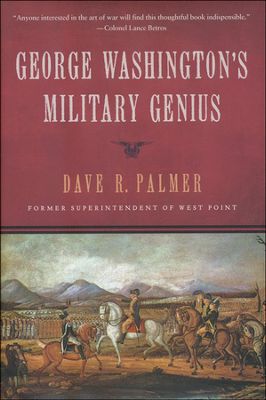
Dave R. Palmer argues in his book The Way of the Fox (newer editions have a different title indicated by the cover to the right) that in fact such an invasion not only nearly succeeded, but also made sound strategic sense.  Palmer seeks to rescue Washington from his saccharine and wooden image and recasts him as an effective and in some ways brilliant grand strategist for the American Revolution.  And yes, this includes his invasion of Canada.

Today many think of Washington as either a great man/demi-god or nothing more than a member of elite/exploiting class.  Both views are cardboard cutouts.  Palmer shows us someone who thought carefully and with subtlety, someone who adjusted his thinking on multiple occasions to deal with changing reality.  British generals often referred to Washington as the “old fox,” sometimes with contempt because he would not fight, sometimes with admiration for his cleverness.  The moniker should stick — it brings Washington and the war to life.

First and foremost Washington stood as the perfect symbol for the Revolution. Certain qualities made him the obvious choice for command, such as his experience, his height, his bearing, and the fact that he hailed from the South.  But none of these things would matter if Washington failed to think in broad strategic terms effectively. Palmer divides the Revolution into three stages, and correspondingly sees Washington adjust his strategy each time.  Washington made specific mistakes as he went, but in terms of broad strategic goals Palmer has Washington never miss a beat.

Palmer argues that revolutions possess an offensive character by their very nature.  They seek to effect change and so must act accordingly.  Thus, Washington was entirely right to begin the war with an aggressive strategy that sought to expel the British.

This failed to fully succeed, which allowed the British to send massive reinforcements.  This meant that Washington, now outmanned and outgunned, needed to withdraw and avoid having his army destroyed by a pitched battle he could not win.

France’s entry after 1778 changed the situation yet again.  Now momentum and manpower lay with the Americans. Washington needed to take advantage of the alliance while it lasted.  So during this period Washington should have sought to press his dramatic advantage, which he did with great effect at Yorktown.

I take no issue with either Palmer’s interpretation or Washington’s actions for phases two and three.  But it’s the first phase, which includes the invasion of Canada, where we can push back most easily.  It seems to me that Washington should have been cautious until the final phase where the advantage finally tipped in his favor.  His aggressiveness at the start of the conflict seems out of place to me.

True, at the beginning of the war you have an emotional high that you can capitalize on.  But you will have undisciplined and untested troops. What’s more, they will not yet have developed that cohesion that great armies have of sharing routines, time, space, and danger.  Think of Caesar’s legions — nothing remarkable when they started into Gaul, and unbeatable five years later.  In our Civil War one reason for the South’s early success had to do with the offensive burden the North faced.  When General Irwin McDowell objected to offensive action at Bull Run in 1861 due to the lack of experience of his men, Lincoln replied that “[both sides] are green together.”  Yes, but McDowell knew that a green attacker has a lot more to worry about than a green defender, and so it proved.

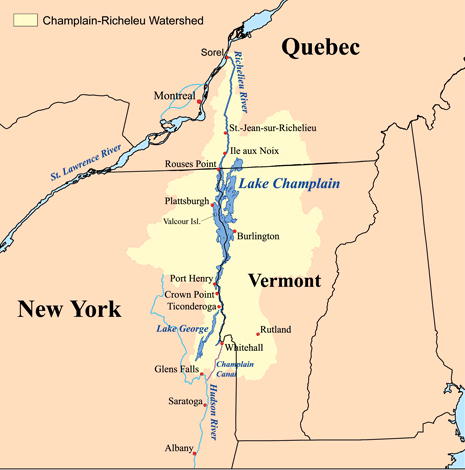
Beyond this psychological reason, Palmer asserts another more narrowly strategic goal for invading Canada.  America’s size and her numerous ports put a huge strategic burden on England.  Colonial armies could easily retreat inland and lead British forces on goose chases through the wilderness.  Add to that, the layout of the land presented very few “choke points” at which the British could use their superior manpower to any real effect.  Perhaps the only such point lay at the nexus between England and Canada — the Hudson River.

Flowing from north of Albany down to New York City, British control of the Hudson would have allowed them to control the upper third of the colonies.  Controlling New York and Boston would have meant control of America’s biggest ports.  Cutting off New England would further mean nabbing most of the colonies financial resources and a hefty portion of its intellectual political capital.  Everyone on both sides of the Atlantic agreed that control of the Hudson could determine the war.

So if it makes sense for Washington to defend the Hudson, why not go just a bit further into Canada itself?  To capture Quebec would have given the colonies everything else in Canada.  Success would have prevented England from having a free “back door” entry point into the colonies via the St. Lawrence River.  Shutting down the St. Lawrence would topple another domino by cutting off England from potential Indian allies* out in the west.

Reading Palmer’s lucid and logical defense, I found myself almost persuaded.  Palmer urges us to remember that the failure of Benedict Arnold’s invasion (yes, that Benedict Arnold) — and it nearly succeeded, does not prove that the idea or the goal was faulty.  Had it paid off, the war might have been over within a year or two instead of eight.

Yes, but . . .

Arnold  lost in Quebec and Washington lost in New York City.  Palmer gives a generous interpretation of Washington’s actions in New York and believes that politically speaking, Washington had to defend the city.  Maybe so.  But if he had to defend the city for the sake of politics, then why also invade Canada and divide your forces? Palmer wants it both ways.  He believes that circumstances called for an aggressive campaign in 1775-early ’76, but that politics and not military necessity alone forced Washington’s hand to defend New York.  This seems to admit the fact that Washington should have given ground and played defense in New York alone.

All in all I agree that Washington brilliantly guided the colonies to victory, and Palmer argues this decisively.  He points out also that Washington faced a bungling and confused command structure in England.  But Washington had Congress to deal with, who although more intelligent and capable by far than their British counterparts, had much less experience in running a war.  By any measure, Washington deserves his place as one of the great generals of the modern era.

But I can’t let go of the invasion of Canada.

If we try and evaluate Washington’s gambit in Canada we should try and compare it to similar kinds of military actions across time.  My case remains that the invasion made logical sense in a certain way.  He was not reckless or foolhardy to try.  But I feel that he should have focused more on defense, and perhaps even success might have hurt him in the long run.  The colonies might have had the direct motivation to expel the British, but would they support long-term the occupation of Canada?**

I can think of three campaigns that might be comparable in certain ways . . .

  • Athens’ invasion of Sicily in 415 B.C.
  • Hannibal attacking Rome directly instead of defending Spain
  • Napoleon going on the offensive in Belgium in 1815 instead of rallying the people to “defend France.”
  • Our invasion of Iraq in 2003***

Sometimes foxes can be a bit too clever.  Still, unlike Athens, Hannibal, and Napoleon, Washington committed a relatively small portion of his forces to the plan.  As a general most would not rank Washington with Hannibal, Napoleon, and the like.  But Palmer argues that not only should we put Washington in their company, but given his military and political success, make him the general of the modern era.

Dave

*This no mere fancy.  In 1777 the British did invade via the St. Lawrence and did gather some Indian allies for their “Saratoga” campaign.  That escapade ended in disaster for the British, but Washington’s strategic fears did come true nonetheless.

**Strange as it may sound now, Palmer points out that the motivation to occupy and settle Canada ourselves might have existed not on strategic but religious grounds.  Many in 1775 saw Canadian Catholicism as a mortal threat to our freedoms and would have gladly occupied it in the name of liberty.  Certainly we showed the ability to expand and settle territory in the west. Why not in the north as well?

***Right or wrong, Bush enjoyed overwhelming support to fight in Afghanistan in 2001.  It made sense to us in the way that (again, right or wrong) responding to Pearl Harbor made sense.  But his case in 2003 was much less compelling, at least to the international community.

From Puritan to Yankee

Recently I found myself talking politics with a Trump supporter.  Interestingly, he mentioned very little about his policies or personality.  Rather, he seemed drawn to him because of the multitude of attacks against him.  No one, he argued, deserved what Trump receives from at least some in the media.  Politics had very little to do with this, for this same person said that he liked both Obama and Hillary Clinton for much the same reason–in his mind of them have been attacked to an unfair extreme.

I have no great love for the Puritans, and perhaps this might explain why I sometimes seek to defend them.  I certainly felt this way at the start of Richard Bushman’s From Puritan to Yankee: Character and Social Order in Connecticut, 1690-1765.  When describing Puritan society in the first chapter he invariably uses words like, “austere,” “imposing,” “monolithic,” and that most dreaded word for an academic who originally published this book in 1967, “conformity.”*

Later in the book Bushman shows his excellence as a historian of a certain type, but I did not like the first chapter.

We naturally have difficulty in understanding and evaluating the Puritans.  They look like us in many respects, but then part with modern society in other radical ways.  It is the heretic, rather than the unbeliever, who always poses the greater threat.  Hence, our natural distaste for the Puritans.  But we must keep certain things in mind.

First of all, the Puritan ideal of social order oriented around religion hardly broke new ground.  They borrowed from the medieval idea of the “great chain of being,” and in orienting their society around religion they merely did what most civilizations practiced up until that point.  Numerous examples of this exist, with the Egyptians, early Romans, the Mezo-American civilizations, and the aforementioned medievals to name a few (this should clue us in on the radical nature of post-Enlightenment western society–more on this later).

Secondly, many moderns, progressive or otherwise, would likely admire some of the main goals of Puritan society.  The Puritans sought to live a common life together by minimizing  (though not eliminating) economic competition and distinctions in wealth.  Bushman himself notes that in the early days of settlement even the richer members of society lived much in the same way as their neighbors, working fields and milking cows like anyone else.  Bushman and others may not realize that such a society cannot exist with modern notions of liberty that tell us to “find our own way,” “follow your heart,” and so on.  Societies like the early Puritans must get their formation from shared conviction that only comes with religious belief. You cannot have one without the other.  One Puritan stated, “Law should serve free exercise of just privileges.  Without this, lives and liberties would be a prey to the covetous and cruel.”  Modern notions of liberty, in the view of early Puritans, would lead to exploitation and alienation.

Bushman himself cites early in chapter two that this shared communal life allowed government in Connecticut to be, in his words, “flexible” in ways that “minimized local conflicts.”  This hardly seems “austere,” or “monolithic.”

True, certain “upper-crust” Puritans (apologies for the emotionally laden word choice) had a fear of any of the “lesser sort” getting into political power.  We can snub our noses at this.  But we should remember that it is 1700.  Puritan Connecticut was more democratic than the England of William and Mary, and infinitely more so than Louis XIV France or Frederick the Great’s Prussia.  Almost every other European society at the time shared these same fears of “lesser men” ruining everything. We have good evidence that many of our founders decades later had these same fears, as of course did every major western political thinker from Homer on down the line.

Finally, nearly all the early Puritan settlers came from the same east-Anglia towns and villages.  They knew the content of Puritan theology, they knew Puritan leadership.  It’s not as if the Puritans pulled a bait-and-switch on the journey across the Atlantic–“You thought you signed up to run wild and free in the woods, but no!  Now that we have you in the middle of the ocean, welcome to John Calvin!”

If some settlers grew frustrated with Puritan leadership, well, they knew what to expect.

So yes, the Puritans need criticism, but criticism with the right context in mind, and aimed in the right place.

After chapter one, Bushman shows his great skill at sifting through data to form larger conclusions.  He puts the focus on the problems settlers faced due to a growing population, which would necessitate an inevitable territorial expansion of the colony.  Some civilizations, like the Romans, link most everything in life to land.  Some see the beginning of the  Roman Republic’s political problems beginning the moment land in Italy disappeared for their soldiers.**  Not every civilization operates with this mentality.  Carthage, for example, and possibly Periclean Athens, largely freed themselves from land as a measure of identity (they had different problems).  But our early settlers fit well within the Roman mindset.

In the first generation or two land distribution remained equitable.  The size of the colony allowed everyone to attend the most important churches pastored by the acknowledged town leaders in piety and purpose.  The population’s proximity to these churches and to town hall bound the colony together politically.

But time marches on, and fathers want the same for their younger sons as for the oldest. In a settled mostly aristocratic society like England of the time, the younger sons of even minor aristocracy join the army or perhaps the clergy.  You see this even in Austen’s novels 100 years later.  Settlers in the new world, however, believed in equality, more or less, and wanted everyone to have an equal chance.

Expanding the size of the colony meant greater distances from the town center.  Naturally those predisposed to want to lead the settlement would stay close to its center.  Those with some disaffection towards leadership might more easily head a few miles outbound.  With this even small scale migration came an inevitable tension, and an inevitable choice.

The colony could either, a) Split off in different settlements and grant autonomy to each.  However, this came with the problem of effectively ending the Puritan dream.  Those who left for outbound land tended towards a more enterprising, individualistic mindset.  Or they could, b) Increase the power of the original settlement’s leaders and weaken the participatory democracy carefully crafted by the original settlers.

As is typical of most any democratically government they chose neither absolutely, though probably favored option ‘b.’  Everyone recognized that the social order had suffered due to increased wealth–a wealth occasioned by expansion (again, similar to Rome ca. 200-75 B.C.).  But try as they might, too many things swirled in conflict with one another to make sense of it all.  In the end tensions increased between eastern and western settlers in most religious and economic matters.  Once they let the’Yankee’ mentality of individual enterprise get its foot in the door, their social construct had its days numbered.

Let us give credit where due.  Bushman’s work should help us to see certain larger issues with more clarity.  For example, Thomas Jefferson bucked historical convention in his belief that a republic should have lots rather than a little territory.  He hoped that the Louisiana Purchase would allow everyone to practice self-government and live free and independently on their own land.  But–if everyone can live free and independently from one another, how can we maintain order?  Only by doing as the Puritans attempted to do–by increasing executive authority.  If we want the kind of liberty envisioned by Jefferson, let us count the cost.  Rome saw this same increase of executive authority as their territory expanded beyond Italy.  Whatever our uniqueness as a nation, we cannot escape history.

But in the end I think Bushman misses the real point.

Bushman mentions religious issues and gives them due treatment, but he gives pride of place to the decline of Puritanism to land and economic issues.  He deals with the source material masterfully.  But he seems to argue that certain geographic and social issues caused the religious issues to manifest themselves later.  We can acknowledge the influence of geographic and economic factors.  But in the end, I think he puts the cart before the horse.  The key to Puritan disintegration must be found in their religion.

For example . . . the Roman Republic experienced some of the same stresses faced by the CT settlers, with a much larger population over much larger territory.  Yet, the Republic maintained its central identity for at least two and perhaps three and half centuries, in contrast to Puritan ideals lasting no more than  two generations.  Egyptian civilization also had some of the same issues regarding land, and though obviously not a republic, maintained their identity for perhaps 1500 years.

Yes, democracies traditionally have a problem maintaining identity and cohesion.  One can a make a good case that Pericles built the Parthenon primarily as a way to reestablish unity by calling people back to their religious roots, whereas we today tend to look at this period in Athens as the pinnacle of democratic experience. This “pinnacle of democratic experience” may have had more cracks than we initially assume.  Athens at this time certainly had lots of money, which tends to work ill upon democracies.  If Thucydides tells only mostly the truth, they did not have much social cohesion. Rome lasted longer than CT or Athens with similar geographic and economic factors at play, and so I feel a reason exists beyond land distribution and the expansion of trade that Bushman focuses on.^

In the Puritans particular case we should note that their theology departed from traditional orthodox Christianity in certain respects.  Their emphasis on the will of God rather than the love of God reduced their faith to more of a philosophy, a handbook of propositions for life.^^  They had no appreciation for sacraments and thus no way for the grace of God to be made manifest in their lives except by how they thought. This led to impersonal abstractions gaining sway.  The famous (or infamous if you prefer) 5 Points of Calvinism work on the mind like a geometric proof, inexorably moving toward a foreordained conclusion.  Abstract ideas, however, are slippery things, and ideas floating in the air don’t always land on the ground in the same form for repeated generations.  Like a point in infinite space, various lines can connect with it and go almost anywhere.

Interestingly, Puritans created a government structure that tended toward defending an abstract notion of rights.  As the colony expanded, Bushman documents a swell of lawsuits and disputes centered around the “claims” of one settler vs. another.  Communal relationships disappeared as “rights” dominated public discourse.  Religious revivals like the Great Awakening followed this pattern in some ways..  The religious impulse coming from this revival did not push people back into communal life.  Rather, we see a rise in the individualistic idea of the “liberty of the conscience” gaining the upper hand among the (formerly) Puritan settlers.

Whatever the merits of my very incomplete analysis above, by the early 19th century New England certainly had adopted a vague mixture of theism and deism as its unofficial religion–a death by abstraction.

We see hints of 1776 as this abstract notion of rights grew.  In time colonial corporations made grants of land to settlers.  When royal officials came over and examined these title deeds they annulled them outright.  No “corporation,” they argued, can grant title to anything.  What is a “corporation” after all?  It’s surpra-personal identity meant it had in effect no personality, and with no personality, how could it truly exist?  A king can grant title, for the king is an actual person, and actual people can own things and give them to others.

The colonists may have nodded “sure!” to these royal representatives, but likely crossed their fingers behind their backs. Though kingship has the advantage of being personal, a king across an ocean has perhaps even less personality than a corporation.  In any case, they no longer had a connection to government rooted directly in either religious belief or social ties. They put their eggs in propositions, in “rights,” in “liberty of conscience,” which no one can touch.  Their point in infinite space must be free to go where it pleases.

A standard debate among historians of the American Revolution involves the question of whether or not the founders were radical or conservative in their ideas.  Years ago I would have answered with the latter, but not anymore.  Bushman’s work accompanies Bernard Bailyn’s and Gordon Wood’s thesis that our stodgy, wig-wearing founders had radical ideas.  For the first time, society would not be oriented around God/the gods.  Nor would social order have its roots in personal relationships, i.e., feudal society, or the lives and patronage of prominent families.  Now for the basically the first time, society would be organized around certain ideas, or we might almost say, geometric axioms.  What Bushman’s book shows us is that you don’t need to go to 1776 to see these principles at work.  If you wish, you can content yourself with a small CT settlement, ca. 1700.

*******************

*Here I must give credit to the playwright Arthur Miller.  His work The Crucible certainly criticized certain aspects of Puritan society.  And yet in his preface to the play he spends most of his time trying to get the reader to sympathize with the Puritans.  This sympathy, in fact, serves as the only solid basis for critique.

**I think the land issue a contributing factor accompanying deeper causes for Rome’s Republic, much in the same way I think Bushman overstates land issues as the primary cause for the collapse of the Puritan ideal.  In Rome’s case, one can see a shift in religious belief occasioned by their contact with Greece and the Mediterranean as the precursor to their political and social fragmentation.

^This is another great example of how Bushman’s book shed’s light on larger issues.  Most every commentator on Plato’ Laws calls Plato a grumpy old fart for banning trade from his theoretical realm.  But increased trade undeniably negatively impacted CT’s social order. Farmers deal roughly with the same soil and the same weather.  Surplus food grown by one poses no real threat to other farmers.

But trade seems to encourage more of the competitive spirit.  Trade deals more with luxuries than necessities, so unsold surpluses can ruin a merchant.  Hence, the extra competition to sell, and so on.  The rise of money and trade certainly played a role in the demise of Rome’s Republic.

^^I realize that this one sentence is hardly a reasonable defense for my views on Puritan theology,   My apologies–to defend them here is a bridge too far for me.  If I am correct, however, there are some  similarities in Puritanism to Stoicism (I stress “some”–the Puritans probably gave much more room for the emotions than the Stoics), a religion for Greece and Rome’s intellectual elite, but not for the masses.

9th/10th Grade: Liberty and Terror

Greetings,

This week we finished the preliminaries of the American Revolution and will start the fighting in earnest after the weekend.  I hope that our examination of the events leading up to the Revolution has  helped see the issue from both sides.  Can we get out of our American skin and at least sympathize with the British?  Quite a few of the students have developed some sympathy with the British perspective, which shows me that they are thinking and honestly engaging the material.
One crucial issue involves the ‘Sons of Liberty.’  Were they freedom fighters or terrorists?  Against them we might say that. . .
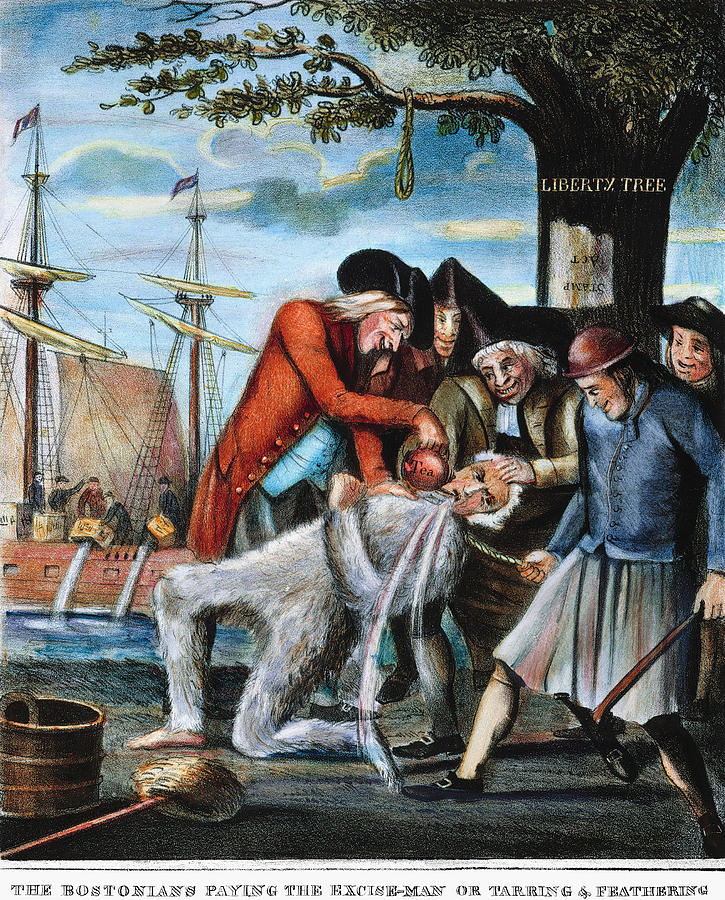
  • They used violence, and the threat of violence, to achieve political ends.  They destroyed property, tarred and feathered people, etc.
1773 Engraving
Man Tarred and Feathered for not Buying War Bonds
  • They used force to rob people of their freedom.  For example, lets take the Tea Act.  Let us suppose that you lived in Boston and in general, supported the British perspective in this debate.  This would have put you in the minority, but it’s a free country, right?  You have been looking forward to drinking tea again, but after the Tea Party you can’t.
The pro-British colonists could easily say that, “You Sons of ‘Liberty'” act under the cloak of freedom.  But you are not willing to let the people choose freely.  If the tea gets unloaded and you convince people not to buy it, well and good.  If you can’t then you don’t represent the people anyway.  You use force to take away my liberty to buy tea, which is perfectly legal, so you can have your way.  Your violent acts show you don’t really trust people at all.
In their favor we could argue that
  • A variety of peaceful means of protest had been tried, and those failed to even be acknowledged by Parliament.
  • They would often warn people beforehand, and as far as I know, they did not kill anyone.

In response to #2 above, the Sons of Liberty might say,

  • “It is true that we deprive you of your liberty to buy tea.  But, this was for your own good and that of the whole community.  If people bought tea we would become slaves to the British.  It is right to take away the liberty to destroy yourself, just as we would take away your right to buy heroin on the open market.  If you become an addict, that effects everyone around you.
  • The same is true for tea in this case.  If you buy it, everyone will indirectly suffer a loss of their liberty, yours included.
We are faced with a tough choice here.  If we say that they are in fact ‘terrorists,’ what does this do to our view of the Revolution itself?  If we say they are ‘freedom fighters,’ how do we respond to acts of terror today?  Some of them at least claim that the current political situation has left them with no other option.  Since they have no planes, tanks, and missiles they will fight with what means they have available.  Are they ‘freedom fighters’ too?
Or, does the label ‘terrorist’ or ‘freedom fighter’ depend on the purpose of the acts and the end in view? Lincoln believed that Revolution was a moral, and not a political right.  In this vein of thought the line between terrorist and freedom fighter can be drawn by the purposes they serve.  So, if Al Queda attempts to establish a Medieval caliphate on the Mid-East they are terrorists, but the Sons of Liberty act for “freedom for all.”   But does this mean that, “the ends justifies the means?”  I do not mean to say that suicide bombers and the Sons of Liberty are the same.  There is a big difference between smashing a customs house and the willful and random destruction of human life.  But we must at least ask ourselves if there are in fact, uncomfortable similarities.
This week I wanted the students to consider whether or not the American Revolution can be justified from a Biblical perspective.  This of course involves moral and political questions in general, but I did want them to consider the issue specifically in light of Romans 13:1 -7.
It reads:

1 Let everyone be subject to the governing authorities, for there is no authority except that which God has established. The authorities that exist have been established by God.2 Consequently, whoever rebels against the authority is rebelling against what God has instituted, and those who do so will bring judgment on themselves. 3 For rulers hold no terror for those who do right, but for those who do wrong. Do you want to be free from fear of the one in authority? Then do what is right and you will be commended. 4 For the one in authority is God’s servant for your good. But if you do wrong, be afraid, for rulers do not bear the sword for no reason. They are God’s servants, agents of wrath to bring punishment on the wrongdoer. 5 Therefore, it is necessary to submit to the authorities, not only because of possible punishment but also as a matter of conscience. 6 This is also why you pay taxes, for the authorities are God’s servants, who give their full time to governing. 7 Give to everyone what you owe them: If you owe taxes, pay taxes; if revenue, then revenue; if respect, then respect; if honor, then honor.

Related to the America Revolution, I think prominent Christian thinkers would have viewed this passage differently in light of our study.
Luther:
I think he would have been anti-Revolution and pro-British.  He strongly supported secular authority in general.   I think he would have told the colonists to be quiet and get back in line.  He may have thought the colonists concerns with taxes made them too worldly.
Calvin:
He developed what he called the ‘Lesser Magistrates Theory.’  He was not in favor of revolution coming from the people as a whole, as he believed it violated Romans 13.  But what if those in authority violate their trust?  And what if ‘lesser magistrates’ (i.e. colonial officials, Continental Congress?) took up the mantle on behalf of the people.  These ‘lesser magistrates’ are still people ‘in authority’ and they can lawfully lead a Revolution provided it was for the right reasons, etc.  Perhaps this is why many New England Presbyterians and Congregationalists supported the Revolution.
Aquinas:
I can’t say exactly what he would have thought and will make a guess.  I do think that Aquinas saw government originating not in a ‘top down’ way,’ but in a more ‘bottom up’ way in line with his thought of the natural law and the fact that he believed that government, or some sort of organizing principle, would have come about even if mankind had never sinned.  He might have emphasized that governments originate with the people, and they have power only ‘to do good.’  When they stray from that, they lose their real power.  Evil never has authority over anyone.
We know what John Wesley, the great Methodist evangelist, thought it quite hypocritical that slave owners would talk loud and long about “liberty.”
Friday we took a break from our heavy discussions over the past few weeks and did an activity comparing 18th and early 19th century American art and architecture to England’s at the same time.  Of course there are many similarities, as one might expect.  After all, the two places were, and still are, similar in many ways.  I wanted the students to focus on the differences.  In the end I think we deduced that:
  • American art at times lacks developed style and technique
  • Americans tended to be simpler and more straightforward people
  • Americans did not have the wealth of the English, and clearly were not an aristocratic people
  • European art could tend to idealize the frontier experience of nature.  Naturally, having not experienced it, one could more easily idealize it.  American art did not portray an idealized nature.
  • Clearly too, Americans and the British thought of themselves differently.  The British are more “cultured,” while the Americans seems more “sober-minded.”
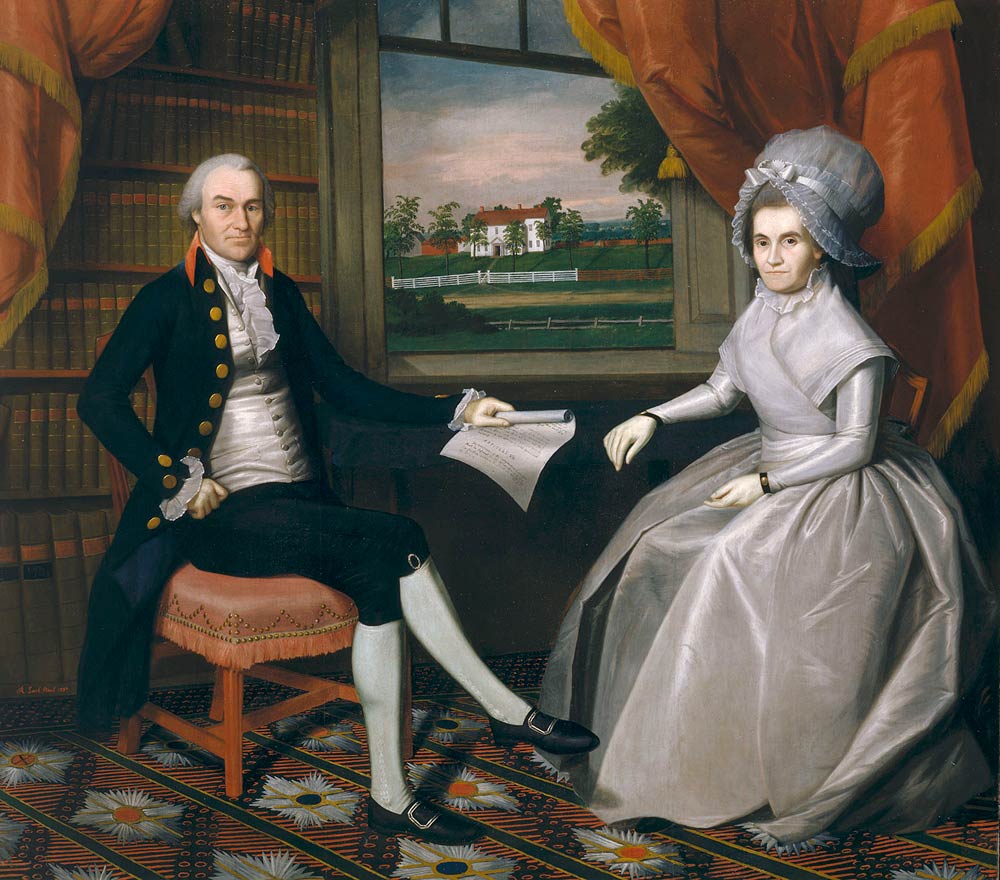
You can probably see some of the differences below.  First, a couple of Americans:
The Ellsworths
 Roger Sherman
Below are some  contemporary British aristocrats:
John Perceval, Earl of Egmont
 Duke John Churchill
Their expressions say it all.  In a fight, I’m putting my money on Ellsworth and Sherman.  Even in this famous painting of Benjamin West (a European) on the death of General Wolfe, one gets the impression that Ellsworth and Sherman would have said something like, “Sir, if you are going to die would you please be quick about it  . . .and stop mugging for the audience!”
Death of General Wolfe Benjamin West
I hope the students will enjoy our look at the war itself beginning next week.

A Leopard Cannot Change His Spots

I originally write this in January 2013, so don’t be too puzzled by the very dated football playoff reference!

********************

It’s playoff time in the NFL, and many talking heads now say that Atlanta quarterback Matt Ryan has “made the leap” by engineering a late game comeback against the Seahawks this past Sunday.  Having won the “big game,” Ryan can now join the club of “clutch” quarterbacks.

But if Matt Bryant had missed the field goal, we would be having a different conversation, one that focused on Ryan’s crucial 4th quarter interception that helped lead to a Seahawks comeback.  I agree with Grantland’s Bill Barnwell.  A lot depends on context.  After the Falcons lost to the 49ers, thanks in part to a Matt Ryan fumble, Barnwell wrote amusing follow-up here.

What is the stuff of leadership?

Any visitor to a library can get stuffed to the gills with theories of leadership, and while I admit to judging these books by their covers, I don’t think I buy any particular “theory” of leadership.

Of course all good leaders demonstrate the same basic characteristics.  They show firmness at the right time, or flexibility at the right time, or the willingness to listen and adapt at the right time, or to maintain the strength of their convictions at the right time, and so on, and so on.  But anyone can write this without any special talent.  Add to that, much leadership theory presupposes that people can fundamentally change who they are, that “type B” leaders can become “type A” leaders whenever the situation arises.  I doubt this happens much.  The same firmness and clarity of vision from Winston Churchill that helped save Europe in W.W. II also led him to be nearly all wrong on the Indian question throughout the 1930’s.

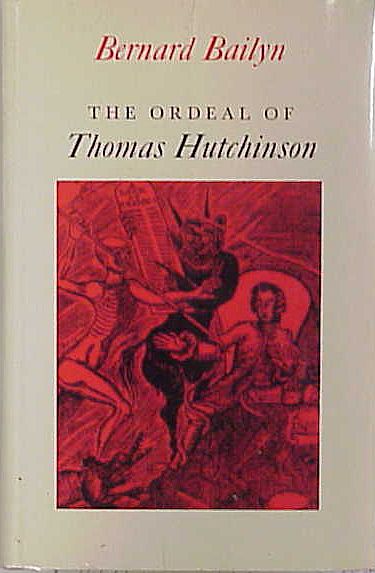
Bernard Bailyn’s book The Ordeal of Thomas Hutchinson demonstrates that people who might be great leaders in certain circumstances are utter failures in others.

Bailyn begins his book by revisiting the worst of the riots over the Stamp Act of 1765.  A variety of British officials received threats and intimidation, but none received the level of concentrated violence as Thomas Hutchinson, the Lt. Governor of Massachussets and also the Supreme Court justice.  Looters ransacked his house methodically for three days straight, taking several thousand dollars in cash and valuables, while causing another few thousand dollars damage to his house.

With this in mind, we would naturally make many assumptions about the man.  He probably gave loud and hearty support to the Stamp Act.   He probably displayed a haughty character.  Maybe he was even not native to the land, but a British import.  Probably he lived ostentatiously and lorded it over his fellow men.

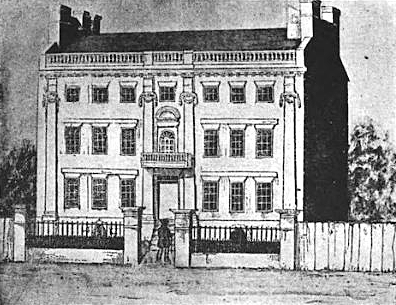
But nearly all of our natural assumptions about him would be wrong.  His portrait reveals a man of some reserve with the pleasant “Smile of Reason” the Enlightenment philosophes had down pat.   His house was nice, but not over the top.  He was born and bred in the colonies, and even wrote what is considered to be the best contemporary history of the Massachusetts  Colony.  He never published it. He commented to a few friends that it had too many flaws.

Thomas Hutchinson

The Hutchinson HouseAdd to that, he opposed the Stamp Act!  As Chief Justice he commented that he thought the Stamp Act bad policy and sure to fail.  He earnestly hoped that the British would see reason and cease their plans for the doomed tax.

But he, more than any other, received the laser-like focus of wrath from the Sons of Liberty.  John Adams, along with James Otis, vilified him in print year after year, and Hutchinson, perhaps totally flummoxed, never seems to have responded in kind.  How did this happen?  Why did such a mild-mannered man as Hutchinson cause so much anger and resentment?

John Adams rarely passed up an opportunity to call Hutchinson a “courtier” — someone of no account who fawned his way to the top of society.  True, the marriages within his family aided his cause, but this form of social climbing was hardly unknown even in the colonies, and certainly known in England.  For what it’s worth, Hutchinson appeared to have a very good marriage, and he grieved long and hard for his wife who died in childbirth.

Others point to the fact that in 1765 Hutchinson held two offices, Lt. Governor and Chief Justice, and thus ran afoul of the emerging doctrine of the separation of powers that would make itself manifest in the Constitution.  But Hutchinson never sought a position on the court.  The governor nominated him, and he initially refused, claiming that he “had not the necessary legal mind” for the job.  He took it only reluctantly after repeated entreaties from the governor himself.

But Bailyn holds that the main cause of Hutchinson’s singular failure lie in his personality.  His love of careful compromise, his lifelong aversion to stirring the pot unnecessarily, made him singularly unsuited to leadership in a revolutionary age.  Indeed, had Hutchinson held power in England, we might very well be reading about how his careful, compromising leadership helped King George avoid war with the colonies.  But in America, that shoe did not fit.

We get an idea of the temper of the times when colonists criticized Hutchinson not for being for the Stamp Act, but for being against it for the wrong reasons.  Where people like Adams and Otis saw deep-seated principle at stake, Hutchinson saw misguided policy, and this attitude led to Hutchinson’s most unfortunate and damaging mistake.  Bostonians drew up  an eloquent and passionate objection to the Stamp Act to send to Parliament, but Hutchinson put on the brakes.  He argued, tinkered and pleaded for a month to change much of the tone and some of the substance of their entreaty, while still sharing their objections to the tax.  In the interval, other colonies gained fame and glory by publishing their own heated objections, making Boston look weak and tepid.  Between their first headstrong and final lukewarm drafts, England settled their minds and began the road to enforcing the Act.

Boston was not amused.  They vented all their considerable anger directly at Hutchinson.  Many of them suspected him (erroneously) of merely stalling for time and not really being against the Act at all.

If the revolution had never happened, who’s to say that the colonies would not in time have developed their essential independence along the lines of Canada? Such a smooth, uneventful and gradual transition would have tickled Hutchinson pink.

What Hutchinson never saw, however, was how his own mindset and personality had been shaped by a revolution 75-100 years prior — the intellectual paradigm shift known as the Enlightenment.   All that calm reasonableness would not have fit within the late 16th century any more than it did in late 18th century North America.

Alas for Thomas Hutchinson, a good and decent man, but one decidedly not of his time — a leopard who could not change his spots.

Edmund Burke on how to Prevent a Revolution

UnknownIt might be a good sign when those one admirers disagree among themselves, but for me it can be painful.  Few have taught me more than G.K. Chesterton, but I also like Edmund Burke.  Had the two co-existed they would not have been friends.  Chesterton believed that Burke’s innate conservatism meant that he disapproved of any change at any price, or that whatever political and social order in existence had divine sanction behind it.  Burke tended towards the stodgy, but I think Chesterton overreacted.  I see Burke as a champion of workable, reasonable policy, an Enlightenment man in a Romantic era.  Perhaps this is what Chesterton, the art school dropout, could not forgive in Burke.  Practicality can be maddening.

Burke’s marshaling of logic expressed in dense Enlightenment style can infuriate, all the more so when he’s right.  His Reflections on the French Revolution is a hard read but deserves its acclaim for its early prediction of all that would go wrong in France.   When I saw his Speeches and Letters on American Affairs for sale cheap, I felt I had to pounce and take a dose of good sense, albeit in protein bar form.

Burke speaks better than he writes, but I still found it rough going.  Despite this, Burke’s patented insight strikes again in England’s dealings with America. Burke saw England kill the golden goose between the years 1765-74 through one bad decision after another.  England never heeded his advice, and two wars resulted.  Burke’s thoughts have universal roots and application, and proceed as follows:

I hear the honorable gentlemen say, ‘I don’t care how we got into our predicament.  I only care now how to get out of it.’  . . . No possible good can come from this attitude towards our situation . . .

Burke calls England back to first principles.  Is the problem English debt, or colonial recalcitrance?  By 1774 the revolution had nearly begun, and England scrambled to make things right.  Burke saw England concerning itself only with dealing with whatever situation lay in front of them.  Constantly reacting, they never reflected.  One can’t solve a problem until you understand the problem, and this England never bothered to do.

In this case, Burke calls England to look in the mirror.  However bad the colonies have acted, we ourselves first damaged the relationship by our own actions.  Their policy adjustments thus amounted to little more than course corrections to avoid icebergs, when you should think more about heading south in the first place.

Besides, some of the things taxed were so trivial, that the loss of the objects themselves and their utter annihilation out of American commerce would have been comparatively as nothing.

Perhaps the English had a right to tax the colonists in some respects.  But Burke rightly calls out the English for foolish and paltry duties on things like playing cards.  Such taxes only aggravate and obscure whatever good purpose you might have.

. . . but whatever it is, [you] gentlemen will force the colonists to take the teas.  You will force them?

Burke admits that the Tea Act had many benign and even generous provisions.  To then use force risked ruining everything.

“Incredible as it many seem, you know that you have deliberately thrown away a large duty [the normal course of trade in tea] for the vain hope of getting one 3/4 less, through every hazard, certain litigation, and possibly through war.”

Had they left well enough alone they would have collected plenty of money.  They reduced duties on tea, but then used force to ensure they would collect it.  Again, Burke argues that it appears that the true purpose of the British is to assert their authority rather than enrich their people and make peace.  This gets to the root of the problem itself — England had its priorities all wrong.

Force over time wastes away.

Burke continues . . .

To repeal by the denial of our right to tax in the preamble would have cut, in the heroic style, the Gordian knot with a sword.

The English piddled around the fringes of the various taxes they imposed, modifying this or that over time.  True, sometimes they lessened the duties instead of increasing them, but this yo-yo act ensured colonial aggravation.  Had they simply denied their right to tax altogether they would solved the problem immediately.  Nor would it have cost them money in the long run.  Burke cites the exponentially increasing British imports pouring into America over the past 50 years.  Forcing certain duties, having the Americans object, followed by the inevitable British penalty of closing ports, has the British run the long way round for nothing, or less than nothing.  Much better to act on principle (which the colonists would respect) and be done with it.

Freedom is to them not only an enjoyment, but a kind of rank and privilege. . . . I do not mean, Sir, to commend the superior morality of this sentiment, which has at least as much pride and virtue in it; but I cannot alter the nature of man.

Burke acknowledges that some colonists talked far too much of liberty, perhaps without any sense of responsibility.  John Wesley certainly thought so.  Slavery proves it.  But Burke realized that England had no ability to change what the colonists believe.  Force would certainly not accomplish this, and likely make it worse.

But England would not back down, because at least on Burke’s reading of the situation, they cared more about asserting power than peace.  Perhaps they cared about peace, but it would have to be on their terms.  The outbreak of war and its result proved how wrong they were, and that sometimes stodgy, methodical wisdom is best after all.

I can’t assert this with blanket accuracy, but it seems to me that whenever nations disconnect from reality by doing one thing not for the purpose of the thing itself, but as a placeholder for something else entirely, the results never pan out.  One thinks of Johnson’s bombing in Vietnam.   No one thought the actual bombing particularly effective, but we assumed it would send a political message to the North.  We know how that worked out.  Burke’s message to live in reality stands the test of time.


Mr. No Depth Perception Man

There is an old SNL skit of the aforementioned title, in which a hapless suburbanite can only see in 2-D. He makes terribly awkward comments about his guests, assuming that he does so without the offended party being aware. An excerpt:

Mr. No Depth Perception Man: I can’t believe Brenda’s dating this loser! You know what she’s after, right?! I bet he’s got money, or something! [the “loser” he’s talking about is 7-8 feet away, looking quite awkward at his comments].

[Embarrassed Guest who knows the “loser” tries to get him to be quiet].

Mr. No Depth Perception Man: What are you worried about? Relax! He can’t hear me–he’s way down there!

I thought of the sketch when reading Leo Deuel’s enlightening and eminently fair Memoirs of Heinrich Schliemann. The book intersperses Schliemann’s own writing with commentary and context from Deuel throughout. This is needed to get an accurate picture, because Schliemann is, alas, not a reliable narrator–much less reliable than most.

I say, “alas,” because I confess to liking Schliemann, despite his enormous faults. Most modern history films I have seen that discuss him focus almost entirely on those faults (which I will get to) and basically pass by his vast contribution to the study of the ancient world and archaeology itself. He possessed an enormous talent for languages and learned several of them. He did this through optimism, the ability to engage in drudgery, and enormous exertions of will and energy–truly the quintessential 19th century man.*

Such men are out of fashion in our day, but I admit that I am not terribly sad that they are mostly gone. Such people are charming but also exhausting. Their vices, though perhaps childlike in a way, are all the more infuriating for the fact that they seem completely blind to them.** Schliemmann lived in a two dimensional world.

For example . . .

To get permission for his ground-breaking (zing!) work at Troy, Schliemann had to promise to turn over all he found to a museum being planned in Instanbul. He ended up giving them very little. As to the famous, “Treasure of Priam,” he very intentionally hid it from the Turkish authorities. His escape with various relics from the past got his Turkish overseer in a lot of trouble. Schliemann was a bit bothered by this, but it never crossed his mind to think of the artifacts as belonging to anyone but himself. Since I don’t think we can assume that Schliemann was directly evil, I suppose this was an unfortunate byproduct of his enormous self-will.

Schliemann uncovered some spectacular finds but often misinterpreted their significance. His errors would be easily excusable as a mistake or misguided educated guess. In Schliemann’s case, his mistakes came from his enormous though unconscious self-regard. Almost incredibly, his main justification, for example, for his claim that he had uncovered Agamemmnon himself at Mycenae was that the death mask he uncovered, “looks just as I imagined [Agamemmnon].” For Schliemann, his own imagination was all the “evidence” he needed.

Perhaps Schliemann’s daughter might sum him up best, with this brief recollection:

My early years living with this explosive, dedicated, and tireless man of genius was a stern trial . . . . Throughout my own girlhood he would often get me up at 5:00 in the morning in winter to ride horseback five miles to go swim in the sea, as he himself did every day. He built us a palace to live in, but it contained not one stick of comfortable furniture. He worked and studied standing at a high bookkeeper’s desk. As a gentle hint, Mother made him a present of an armchair, but he banished it to the garden.

His concern with health was fanatical. When my younger brother was baptized, with many guests solemnly assembled in church, my father suddenly whisked out a thermometer and took the temperature of the holy water. There was a great commotion; the priest was outraged. It took my mother’s gentle intervention to reinvest the water with holiness.

Beneath these imperious traits Father was warmhearted and generous to a fault. He was humble, too, in his own way.

After reviewing his life, I am hard-pressed to find a great deal of “humility” in Schliemann. Schliemann did mature a bit with each passing archaeological dig, both in his methods, and–by the end he let others take credit for their own discoveries! Perhaps Schliemann also possessed a humility towards the past, a virtue of his that should return.

Some of Schliemmann’s comments about his Greek workers grabbed my eye. It bothered him that they would not work on Sundays, but this he understood to a degree. What he could not understand was their refusal to work on certain other days, such as the festival of certain saints.

I suggested a likeness of Schliemann to a certain short-lived SNL character. He absolutely had his own superstitions, though he proceeded through life entirely unaware of them. Chief among Schliemann’s suerstitions I already mentioned, namely the implicit trust in his own imagination. So strong was this trust that it led him to declare that some discoveries of others were in fact his own!

We cannot say that this was an example of cultural bias or prejudice. Schliemann nearly worshipped Greece, or at least his idea of it. He married a Greek woman and gave his two children ancient Greek names (Andromache and Agamemmnon). He lived in Athens for much of his later life. Rather, it was the customs, or beliefs, that he could not understand. He wrote in his diary that,

There have been, including today, three great and two lesser Greek church festivals, so that out of these 12 days I have had in reality only seven days of work. Poor as the people are, and as they would like to work, it is impossible to persuade them to do so on feast days, even if it be the day of some unimportant saint . . . . I try to persuade the poor creatures to set their superstition aside for higher wages.

Even a cursory look at Schilemann’s life reveals at least a few “superstitions” of his own. Naturally, it depends on how one should define such a thing. But surely uncritical assumption that we can define reality for ourselves fits any reasonable description of “superstition.”

I am reminded of a famous passage in Plato’s Phaedrus in which Socrates and Phaedrus are walking through the city and come upon the supposed site of ancient story involving the gods. Phaedrus asks if Socrates believes the story, and he replies,

The wise are doubtful, and I should be singular if, like them, I too doubted. . . . Now if one were skeptical [about all stories] and would fain reduce them one after another to the rules of probability, this sort of crude philosophy will take up a great deal of time. Now I have no leisure for such inquiries. Do you wish to know why? I must first know myself, as the Delphian inscription says; to be curious about that which is not my concern, while I am still in ignorance about myself, would be ridiculous. And therefore I bid farewell to all this; the common opinion is enough for me.

If we might take another example of the “common opinion . . . ”

A long standing tradition states that Joseph of Arimethea came to Britain as a missionary shortly after Christ’s resurrection. Other parts of the story indicate that Joseph obtained his wealth via trade in tin, and likely made many excursions to the island for his business. Some parts of the tale indicate that Jesus Himself traveled with Joseph (His uncle) as a young boy on an adventure, and still some other parts of the tale say that the Virgin Mother accompanied Joseph on his missionary journey to the island.

Most of us might be inclined to doubt the whole story, if not at least some of its parts. No doubt Schliemann would call it “superstition.” And yet, the belief of Britain being evangelized quite early in the first century A.D. dates back to St. Clement of Rome, and St. Irenaeus, Tertullian, St. Athanasius, St. Augustine and others all testify to this fact. A great deal more evidence for this “superstitious tradition” may exist than we previously thought–such is the conclusion of Lionel Lewis in his informative work on St. Joseph and the Glastonbury tradition. Not all details of the traditional story have the same level of evidence for their historicity, but still, much more exists than we might suppose.

Schliemann’s intensely narrow passion helped him ignite a whole era of discovery about the ancient world. Indeed, many before him might have regarded some kind of historical belief in a Trojan War as a superstition backed only by “tradition.” Alas for him that this narrowness of vision closed him off to world’s outside of his own.

The “common opinion” perhaps might be true in the case of St. Joseph of Arimethea, just as it was about the Trojan War–as further excavations at Schliemann’s site have only further confirmed at least a rudimentary historical context to Homer’s tale. I wonder if Schliemann could grant the same to Greek saints of the Church–even the “unimportant” ones.

Dave

*England “ruled the world” during Schliemann’s era, and it is perhaps no coincidence that it was England that gave him the most favorable reception to his work. Schliemann might be described almost as an incarnation of England itself in all of their virtues and faults of the Victorian era.

**One thinks of the great line uttered by Patton in the Patton movie where he states to General Bradley, “Hell, I know I’m a prima dona! I admit it! What I can’t stand about Monty [General Bernard Montgomery] is that he won’t admit it!”

9th/10th Grade: “It’s the Economy, Stupid.”

Greetings,

This week we looked at the Seven Years War, and the puzzling question as to why the aftermath of the war ended up driving Americans and the British apart. Why this happened should puzzle us, because usually when two sides ally, fight together, and win, it draws them closer together.  We got some hints this week as to how this might have happened.

In the end, I think the war had this effect because of fundamental disagreements about the reasons for the war, the reasons for changes in British policy, and the question of colonial identity.

1. Why was the war fought:

  • I think the British thought of the war being fought for the benefit of empire generally, but more specifically for the benefit of the colonies.  The French were now far away,  a secure border established with the Indians, and a clear treaties signed to that effect.
  • The colonists fought out of a sense of duty to empire, but they did not ask for or cause this war.  The border was just fine, thank you, before you came.  We hate your treaties because it limits our expansion.  You are infringing upon our rights of self-determination

2. Changes in Policy

  • The British faced enormous debts at the end of the war.  They felt that they should shoulder the overwhelming % of the cost.  But they did ask the colonies to help bear perhaps around 10-15% of the burden of maintaining troops out west along the frontier.   These troops, of course, were there to protect the colonists, and to enforce the treaty (i.e. make sure we did not cause trouble along the border).
  • The colonists saw the British debt as England’s problem.  What if we were taxed to help relieve the debt of Greece, for example?  The troops were there not to protect but to possibly infringe on our liberties, and meddle in our affairs.

3. The Question of Identity

  • The British saw the colonies as an extension of England itself — England transplanted far away — hence names like ‘New England,’ ‘New York,’ etc.
  • The colonies saw themselves as part of the British Empire, yes, but much in the same position as Ireland or Scotland, who had sovereign control of their own domestic affairs, and England could not tax them.

Another backdrop to this dispute was the role of Parliament in English affairs.  Over the course of the 18th England saw a gradual rise in the role of Parliament in relation to the power of the king, after many immigrants to the colonies had already left. All early colonial charters and governemtns professed their allegiance and loyalty to English kings like James I, Charles II, etc. but are silent on the question of Parliament.  They did not directly experience this gradual in English history. They recognized the authority of the king as a kind of figurehead of empire, but Parliament?  Parliament, in their experience, was a body sovereign only in domestic English affairs, and not in the empire as a whole.

The Seven Years War also created a perfect storm of factors involving land.

The war settled questions of the colonies’ western frontier, and so it shouldn’t surprise us that the British victory helped spur on massive emigration west towards the newly acquired land.

At the same time, the new land may have been at least a partial impetus for a massive influx of immigration from the British isles of people wanting a “fresh start” in America on basically free land.

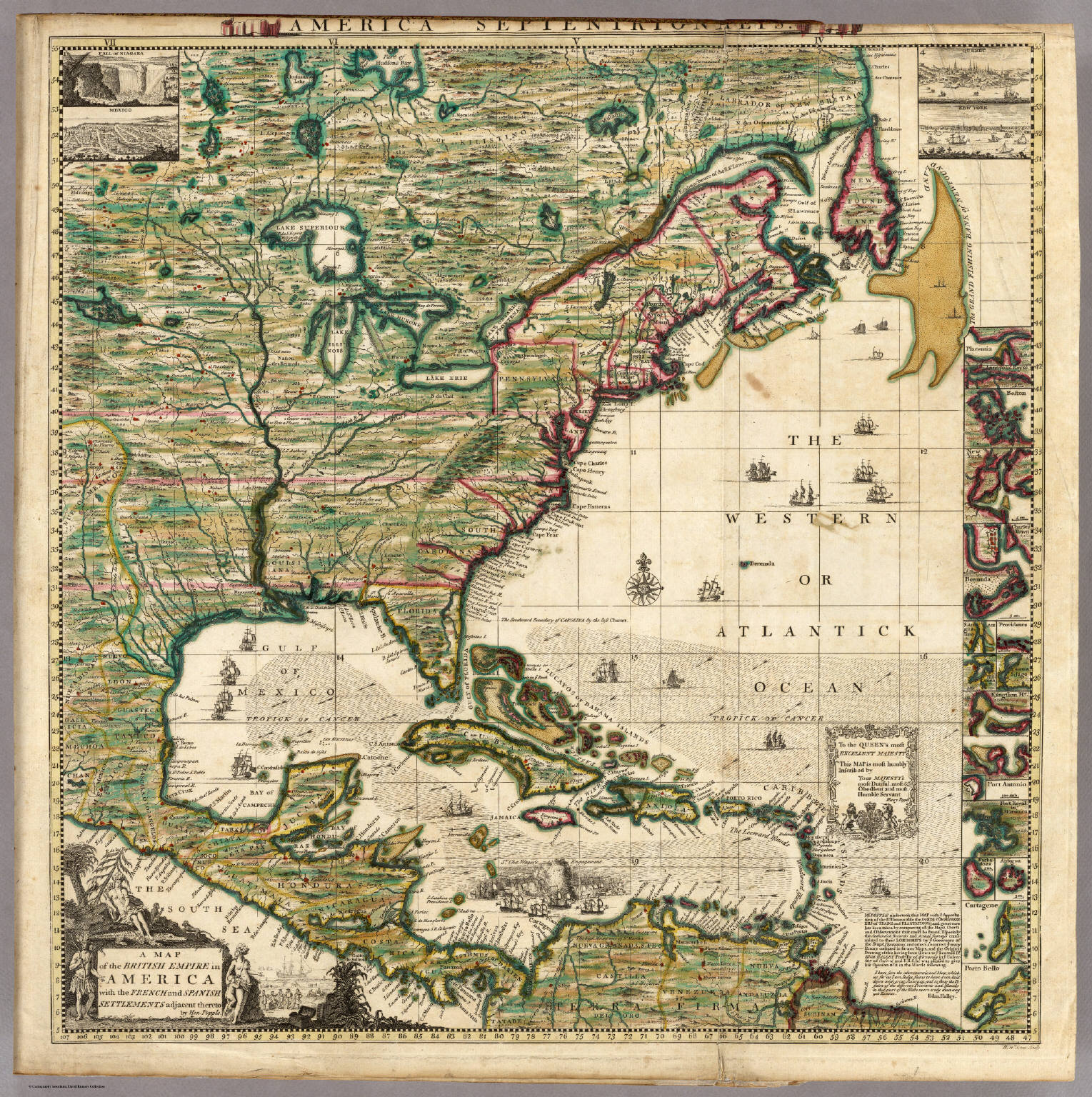
Thus, at just the moment when the British wanted to restrict western movement to prevent another conflict with France, settlers poured into these very same territories and pushed the limits of the treaty.  Ideally I include a map below to show you this, but alas, I could not find an electronic version of the map I handed out in class showing this western push, so do feel free to look at the map I handed the students last week.

Like ships passing in the night, the colonists and the English saw land differently as well.

For the colonists, land represented opportunity, opportunity that did not exist in the more aristocratic, patron-oriented system in England.  Restricting land, for many colonists, meant restricting self-government.

The British must have found this hard to swallow.  They could understand the link with land and independence, even if they did not feel the link as keenly.  But, as far as they were concerned, the colonists surely had far more than enough to go around.  The original colonies contained about 430,000 square miles, compared to about 70,000 square miles in England.  The Seven Years War only added perhaps an additional 200,000 square miles for the colonists.  Now you say you want more?  How much is enough?

We closed the week by examining the Sugar Act, in particular.

The Sugar Act has to be put in context with the following:

  • England’s Debt.  Their normal peacetime budget was 8 million pounds a year.  The interest payment on their war debt alone was 5 million pds./year.
  • The fact that colonists on the border had, hardly before the ink dried on the treaty, strayed across the Appalachian border and brought on a conflict with the Pontiac tribe.  This worried England to no end.  They just got finished fighting a long and expensive war.  The last thing they wanted was to be drawn into another conflict.  Some students rightly asked why the British would care about skirmishes with Indians.  I don’t think the British worried too much about the Indians, but beyond the Indians lay the French.  If the colonists clashed with the French, it would become England’s business.  Besides this, the treaty that ended the war was a mutually agreed upon international treaty.

Of course, no colonial representatives had a part in the terms of this treaty.

  • During the war many New England merchants expanded their operations to deal with increased trans-Atlantic traffic.  The end of the war left many over-extended and in financial trouble.  A number of merchants resorted to smuggling to help make up the difference.  The smuggling mostly centered around the molasses trade.  England collected a 6 pence/gallon duty, but people knew that if you approached the right people you could get a 1 1/2 pence/gallon ‘off the books’ price, which England would never see.

So, Parliament enacted the Sugar Act in 1764.  It had a broad purpose, ultimately geared towards getting England back on its feet economically. Over the last few years, we are all familiar with a political atmosphere dominated by economic concerns, and we can understand the hope we might feel if a plan emerged to ease our pain.  England hoped to raise about 20% of the cost of maintaining English troops along the border out west.

Ultimately, the act was designed to raise revenue indirectly from the colonists.  Here’s how they wanted to do it:

  • The British lowered the import duty to 3 pence per gallon (instead of the normal 6 pence) in the hopes that this would deter smuggling.
  • They gave expanded powers to customs agents to search cargo.  And, they gave them legal protection in case of a mistaken accusation.  Currently, accused smugglers went on trial before their peers, and, of course, were often acquitted.  Customs officials would then have to pay a heavy, heavy fine for ‘false accusation.’
  • They wanted to encourage the colonists to manufacture and sell their own rum.  Hence, they erected a variety of barriers to the purchase of French rum from the Carribbean, and lowered the import duty on British sugar. That way, the British get the import duty, and the tax from the sale of local rum (taxes on the sale and manufacture of alcohol was a primary revenue source for governments in the early modern age, before things like income tax, sales tax, etc.)  Aside from that – be good British subjects and stop giving money to the French!

Thus, no one is hurt, or even directly taxed.  We stop breaking the law.  The British get money.  Colonists are protected from Indians.  It is all very reasonable in the typical British way.

So, why did we object to the import duty being lowered (in fact, colonists continued to smuggle until the British lowered the duty to 1 pence p/gallon, below the smuggling price)?

  • The expanded search powers gave customs officials the right to seize cargo on mere suspicion.  Their warrants were in effect, blank checks.  Colonists felt that this violated their rights.
  • A large amount of hoop jumping was now required to prove the validity of cargo.  The lives of many merchants got much harder.  Think of how the process of obtaining a loan changed after 2009, making it more cumbersome and time consuming.
  • Accused smugglers could now be tried not in local courts, but special admiralty courts.  In other words, they would not be tried by a civilian court of their peers, and again, the colonists believed this violated their traditional rights.
  • Who cares about the troops in the forts anyway?  We were doing just fine before you showed up, thank you very much.  We managed our own affairs for the last 125 years and can still do so without your help.  We helped you with the war, like we were supposed to.  But this war was your idea, not ours.  We should not have to help pay for it, indirectly or otherwise.  Here, I think, it was not the amount of money, but the principle that mattered.

At root in this controversy is the exact nature of the relationship between the colonists and England.  England saw the colonists as essentially extensions of themselves.  Thus, Parliament had jurisdiction over them just as they would any town in England.  The colonists saw themselves akin to Ireland, part of the empire but internally, entirely self-governing.  Even a little bit of meddling was still meddling, and still unjustified.

Students hopefully see that both sides have good arguments, but they will need to try and discern which side has the better argument, and the exact nature of the disagreement between the colonists and England.  Parents may recognize my reference in the title to the 1992 Presidential race, but in the end, what brought on the American Revolution was not money, but something deeper.

Blessings,

Dave

Growth Measures

This post is from 2016 originally, and you will note some dated references.  I repost it in conjunction with discussions this week in our Government class.

The original post follows . . .

****************

In his account of the Athenian debate over their proposed expedition to Sicily during the Peloponnesian War, Thucydides has Alicibiades close with a famous analogy on the fate of states and nations that remain inert.

And as for security, whether for remaining there, in case of any success, or for returning, our fleet will provide us with it; for by sea we shall be superior to all the Siceliots put together. And let not the non-interfering policy which Nicias recommends in his speeches, nor his setting the young against the old, divert you from your purpose; but acting in your usual order, just as our fathers, by consulting young with old, raised the state to its present height, do ye now too, in the same manner, endeavor to advance it; being convinced that youth and old age can do nothing without each other; but that the period of levity, and of mid-age, and of extreme preciseness, will have most power when joined together; and that the state, if it remain quiet, will be worn out on itself, like anything else, and its skill in everything grow dull; while by entering into contest it will continually gain fresh experience, and will find self-defense habitual to it, not in word, but rather in deed. My decided opinion then is, that I think a state of no inactive character would most quickly be ruined by a change to inactivity; and that those men live most securely, who regulate their affairs in accordance with their existing habits and institutions, even though they may be of an inferior character, with the least variation.

The Athenian adventure into Sicily ended in disaster, but the idea that states and people must essentially “keep swimming or die” entered into our consciousness.  Progress must involve motion, the conquering of challenges.  So J.S. Huxley comments that,

Life can never be about equilibrium.  Given the well established facts that change . . . multiplies in an expanding geometric ratio, then change in the status quo is inevitable.  A status quo may exist for a time, but with one organism bumping against another means a rearrangement of them all.   

And J.R. Smuts adds,

A peculiar feature about the change in equilibrium in a physico-chemical structure is that it is never such as to produce a perfect new equilibrium; the new is merely approximate, just as the old was.  We may say the change was from too little to too much.

The instance of a super-saturated solution is a case in point, where the crystallization lags behind the conditions which bring it about.  When the change comes it swings beyond the necessities of the case.  Again there is the condition of instability which has to be righted by a swing back in due course.  Thence arises the character of natural change.  Complete equilibrium is never attained and would be fatal if attained, because it would mean stagnation, atrophy, and death.

Once let a large, favorable variation take place . . . others must keep up or perish.  So it comes to pass that history moves in successive phases of momentary equilibrium, with extended periods of “conflict” and readjustment, each one a higher plane of independence than the one before, and each giving place to the other.

So it seems nearly an axiom (at least for post-Enlightenment western societies) that change=growth, growth=progress, progress= something good (?).

But Thucydides had no love for Alicibades, and whether or not he reports fairly, clearly the scope of his narrative means to show the disastrous nature of Alcibiades’ logic.  Earlier in the war his hero Pericles urged the Athenians to accept war with Sparta, but only if they resolved firmly not to add any new territory to their empire.

But Pericles may not have been entirely consistent.  In his famous “Funeral Oration” he celebrated the dynamic, maritime nature of Athenian life in his famous funeral oration.

If we turn to our military policy, there also we differ from our antagonists. We throw open our city to the world, and never by alien acts exclude foreigners from any opportunity of learning or observing, although the eyes of an enemy may occasionally profit by our liberality; trusting less in system and policy than to the native spirit of our citizens; while in education, where our rivals from their very cradles by a painful discipline seek after manliness, at Athens we live exactly as we please, and yet are just as ready to encounter every legitimate danger. In proof of this it may be noticed that the Lacedaemonians do not invade our country alone, but bring with them all their confederates; while we Athenians advance unsupported into the territory of a neighbour, and fighting upon a foreign soil usually vanquish with ease men who are defending their homes. Our united force was never yet encountered by any enemy, because we have at once to attend to our marine and to dispatch our citizens by land upon a hundred different services; so that, wherever they engage with some such fraction of our strength, a success against a detachment is magnified into a victory over the nation, and a defeat into a reverse suffered at the hands of our entire people. And yet if with habits not of labour but of ease, and courage not of art but of nature, we are still willing to encounter danger, we have the double advantage of escaping the experience of hardships in anticipation and of facing them in the hour of need as fearlessly as those who are never free from them.

“In short, I say that as a city we are the school of Hellas, while I doubt if the world can produce a man who, where he has only himself to depend upon, is equal to so many emergencies, and graced by so happy a versatility, as the Athenian. And that this is no mere boast thrown out for the occasion, but plain matter of fact, the power of the state acquired by these habits proves.

Pericles’ words have resonated strongly with western societies for at least the last two centuries.  Democracies have long wanted to be thought of as progressive, diverse, open to new experiences and new people, etc.  But this vision had its critics, most notably Plato, who wrote in his Laws,

Athenian Stranger. And now, what will this city be? I do not mean to ask what is or will hereafter be the name of the place; that may be determined by the accident of locality or of the original settlement-a river or fountain, or some local deity may give the sanction of a name to the newly-founded city; but I do want to know what the situation is, whether maritime or inland.

Cleinias. I should imagine, Stranger, that the city of which we are speaking is about eighty stadia distant from the sea.

Ath: If the city were to be built at the seaside and were going to be well supplied with harbors but ill-supplied with the necessities of life from the soil, then it would have needed mighty saviors and divinely inspired legislators to escape the moral confusion and moral corruption that are the inevitable penalty of such environments.

For the sea is an insidious neighbor which makes itself agreeable to the daily interaction [between good soil and good harbors], but is salt and bitter inasmuch as it fills the country with tradesmen’s business, and the souls of the country with deceit, and the body politic with distrust–each seeking advantage over his fellow man and neighboring states.

These social evils are to some extent counteracted if the soil produces something of everything; and, if it is a rough and highland country . . . it will not be able to do so.  If it could not, it would produce a large export surplus and would attract to itself the equivalent import of gold and silver currency–and that is the greatest moral disaster that can overtake a country.

[As for sea power], it would have profited the Athenians to lose seventy times seven children a year to the tyrant Minos [referring here to the ancient legend of the Minotaur] before turning themselves in defense to a sea power instead of heavy infantry, and so lose the  power of standing fast, acquiring instead the habit of perpetually jumping ashore and then running back to their ships at a run hardly after landing.

This method of warfare erases any sense of shame at being too cowardly to risk one’s life by standing one’s ground and receiving the enemy’s attack.  It suggests facile and “plausible” excuses for taking to one’s heels–never of course in disorder but always “according to plan.”

There is nothing so demoralizing for infantry as their allied fleet riding at anchor in their rear.  Why, even lions, if they took to tactics of that sort, would run away from deer.

Cle: Yet all the same, sir–well, what about the Battle of Salamis?  That, after all, was a naval battle, in which the Athenians beat the barbarians, and it is our belief that this victory was the salvation of Greece.

Ath: I know that is the general view . . . But in [my] belief, it was the land battles of Marathon and Platea that were the day-spring of the salvation of Greece and its crowning mercy.

Arnold Toynbee took up the question of how civilizations grow in volume 3 of his A Study of History.  He first considers civilizations in an “arrested” state.  The nomads and the Eskimos perform near heroic feats of adaptation to survive in their environment.  However, the environment requires too much adaptation, leaving those in them stuck at a particular point in its development.  Ultimately the social organization can never transcend their environment.*

Toynbee has a lot in common with Spengler, but ultimately rejects Spengler’s “biological life span” template for civilizations.  Toynbee believes that civilization transcends individuals so in theory, civilizations can extend themselves ad-infinitum if they play their cards right.  So to find the clue Toynbee uses scientific analogies about crystallization and so forth.  Civilizations have to keep moving to avoid stagnation.  But what kind of movement?  Toynbee is too smart to focus on mere territorial enlargement.  Measuring growth by technological advancement also fails as rubric for many reasons, one of them being the question, “Which is more impressive, the ‘invention’ and original mastery of fire, or the steam engine?”

Ultimately knows that spiritual/psychological growth should occupy pride of place along with other factors.  But how to measure this?  How would it manifest itself?  This is not so easy, as Toynbee knows (though credit him for trying).

Recently I wrote about the “noon-day” devil of acedia.  Essentially acedia involves the temptation to distraction out of a sense of listlessness and no purpose.  The key to fighting this temptation involved drilling down into the recesses of the self, and ultimately to train oneself not to bored with the things of God.  So one monk tells his confessor, “Father, I have been troubled by acedia, but praise be, the temptation vanishes whenever I go visit Abba Paul.” “On the contrary,” his confessor replies, “you have entirely given into the temptation and will soon be in its power.”

Hence the dictum–“stay in your cell.”

St. John Cassian writes,

When this besieges the unhappy mind, it begets aversion from the place, boredom with one’s cell, and scorn and contempt for one’s brethren, whether they be dwelling with one or some way off, as careless and unspiritually minded persons. Also, towards any work that may be done within the enclosure of our own lair, we become listless and inert. It will not suffer us to stay in our cell, or to attend to our reading: we lament that in all this while, living in the same spot, we have made no progress, we sigh and complain that bereft of sympathetic fellowship we have no spiritual fruit; and bewail ourselves as empty of all spiritual profit, abiding vacant and useless in this place; and we that could guide others and be of value to multitudes have edified no man, enriched no man with our precept and example. We praise other and far distant monasteries, describing them as more helpful to one’s progress, more congenial to one’s soul’s health. We paint the fellowship of the brethren there, its suavity, its richness in spiritual conversation, contrasting it with the harshness of all that is at hand, where not only is there no edification to be had from any of the brethren who dwell here, but where one cannot even procure one’s victuals without enormous toil. Finally we conclude that there is not health for us so long as we stay in this place, short of abandoning the cell wherein to tarry further will be only to perish with it, and betaking ourselves elsewhere as quickly as possible.

Towards eleven o’clock or midday it induces such lassitude of body and craving for food, as one might feel after the exhaustion of a long journey and hard toil, or the postponing of a meal throughout a two or three days fast. Finally one gazes anxiously here and there, and sighs that no brother of any description is to be seen approaching: one is for ever in and out of one’s cell, gazing at the sun as though it were tarrying to its setting: one’s mind is in an irrational confusion, like the earth befogged in a mist, one is slothful and vacant in every spiritual activity, and no remedy, it seems, can be found for this state of siege than a visit from some brother, or the solace of sleep. Finally our malady suggests that in common courtesy one should salute the brethren, and visit the sick, near or far. It dictates such offices of duty and piety as to seek out this relative or that, and make haste to visit them; or there is that religious and devout lady, destitute of any support from her family, whom it is a pious act to visit now and then and supply in holy wise with necessary comforts, neglected and despised as she is by her own relations: far better to bestow one’s pious labour upon these than sit without benefit or profit in one’s cell. . . .

The wisdom and achievement (both spiritual and social) of the desert fathers has few historical parallels.  This points us in a new and more profitable direction than standard measures of growth, such as the health of the economy or advancement in technology.

Certainly, for example, the western world has achieved tremendous technological leaps over the past 150 years, but we should not necessarily call this “growth.”  These technological advances have largely served to help us to the things democratic nations tend to do, such as move and consume, except now we can do this more quickly.  I don’t mean this to sound harsh or cynical.  Democracies tend to be forward looking and anti-tradition.  This has its place.  Democracies seek to empower choice, and this has its most obvious reflection in choosing where we go and what we buy.  Technology has changed nothing in the spiritual and social plane for us.  We remain on the go, we remain distracted, with the facilities for spinning our wheels vastly improved over time.

De Tocqueville, as usual, predicted something like this, writing

The first thing which strikes a traveler in the United States is the innumerable multitude of those who seek to emerge from their original condition; and the second is the rarity of lofty ambition to be observed in the universally ambitious stir of society.  No Americans are devoid of a yearning desire to rise; but hardly any appear to entertain hopes of a great magnitude, or to pursue lofty aims.  All constantly to acquire property, power, and reputation; few contemplate these things on a great scale.

Without this great ambition (if he is correct) we will tend to spin our wheels in the same direction.  Again–we should not call this growth automatically.**

We assume that the desert monks had no social impact.  Sure, we assume, they helped their own souls, or perhaps those of their brotherhood, but not society at large.  But a careful reading of the biographies of such fathers shows the opposite.  People came to them all the time for healing and advice.  Many stories exist of their charity to others.  Some lived as solitary hermits, but many others lived in monasteries close to towns where a fair amount of interaction between them took place.

Perhaps the secret of real growth lies here.  No tree can bear fruit if constantly uprooted.

Dave

*This can be contrasted to civilizations that seem “petrified” or “frozen,” such as a certain time period of ancient Egypt.  Nothing about their physical circumstances forces a frozen civilization to stay at a particular level of development, but they choose to do so for a variety of reasons.

**I realize that what follows puts me squarely within the company of other grumpy old men.  But I’ll take the plunge . . . .  The fact that The Force Awakens was so popular reveals this very fact about our culture.  The movie had nothing original about it, with no memorable dialogue, acting, or even memorable scenes.  With its casting it was calculated precisely to hit squarely within the middle of our cultural mindset.  People praised it for “being the movie fans wanted to see.” It hit all its marks, giving us all the old characters plus an even bigger Death Star.  But this is precisely the reason why the movie failed to challenge or move us in any way.

To plunge even further . . . one might almost say that an “acedic” listlessness pervades the whole movie.  What happened to the Republic?  Nobody knows, nobody cares–it’s not important.  What is the “First Order” and what do they want?  How did they get here?  Nobody knows, nobody cares.  In A New Hope Alderann is destroyed cruelly but for a “reason.”  Now whole systems are destroyed for no apparent reason.  Obi-Wan’s death had some meaning or purpose within the Star Wars universe, but not Han’s death–it just happened.  Han himself as a character appears stuck in an endless loop of meaningless activity.  The heroine receives Jedi powers and can fly the spaceships with no context, no training, again for no apparent reason.  Why?  Nobody knows, nobody cares.  What is important is that we saw what we desired.  The movie fulfilled our list of demands.

11th/12th Grade: Only in a Democracy

This week we continued the Peloponnesian War by looking at the Peace of Nicias, and why it failed.

Like most things, not all peace treaties are created equal.  Throughout history some treaties have worked and many others have not.  Can we detect any patterns or similarities to their success or failure?

“Punic Peaces” (which refers to Rome’s complete obliteration of Carthage during the 3rd Punic War) always work because the enemy ceases to exist.  A lesser version of a Punic Peace might be what England did to Napoleon after Waterloo.  France technically could have continued to resist, as the bulk of their army remained intact, but the English put Napoleon in exile on St. Helena, which might as well have been the moon.  His continued resistance was impossible.

But in thinking of peace treaties, most of us would not want conflict to get to that point.  We prefer to avoid to save lives and avoid cataclysmic destruction if we can.  But it is these kinds of treaties, where both sides retain much of their original strength, that are so hard to devise and so hard to have succeed.

Why might this be?  The best treaties reflect reality as it really is, and not merely the whims or circumstances of the moment.  The best treaties factor in the reasons for the war starting, as well as how both sides fought.  They would also account for the current political dynamics in each country, as well as their psychological and emotional state.  Treaties are problematic because reality will not be caught so easily.

After 10 years of fighting both Athens and Sparta signed onto the “Peace of Nicias,” designed to last 50 years.  Alas, it never really took firm root in either society and lasted about six.  Even a cursory glance will tell us why the treaty failed.

  • If we follow the mantra of considering the beginning before deciding on an end, we should ask ourselves why the war started in the first place, and what each side fought for.  Indeed, the war lacked a defining physical cause.  One side did not invade the other.  Instead, the war seemed to be over honor and perception.
  • But the treaty shoved a couple of significant “dishonors” into the face of both sides.  Athens had abandoned Platea earlier in the war, a stain on their honor.  But now they could not get it back — the stain would be permanent.
  • Sparta had “liberated” Amphibolus from Athenian clutches, redeeming their embarrassing “no-show” in Mytilene.  Now, the treaty required them to give Amphibolus back to Athens.
  • Corinth, one of Sparta’s major allies, did not sign onto the treaty.  Naturally they would do much to try and undermine it.

At the core, the Peace of Nicias failed because it reflected temporary moods.  Neither side had expended even half of its strength in the fight so far.  Both sides smarted under the recent death of prominent generals (Cleon for Athens, Brasidas for Sparta).  Athenian failure at Delium helped the political rise to the “dove” Nicias, but democratic politics sways to and fro.  Facing dishonor, with more bullets left in the gun, both Athens and Sparta would likely begin fighting again.

We also began our look at the famous/infamous Alcibiades of Athens.Alcibiades

Only a democracy could produce someone like him.  He was. . .

  • Young
  • Rich
  • Handsome
  • Charismatic
  • Heedless of tradition
  • A man of “action”

In addition, no one could accuse him of being a dandy .  He fought in a few infantry engagements with some distinction.

I say that Alcibiades could exist only in a democracy because most other societies, especially aristocratic ones, value

  • The Elderly
  • Tradition
  • Stability

Political conservatives in the U.S. often talk about “returning to our Constitutional roots,” but have not had much success recently in presidential or senatorial elections.  o arguments like, “That’s the way the founders did it,” have any success?  I would tend to think not, and the reason might not be the willful ignorance or decadence of the electorate, but the pervading forward looking spirit of democratic cultures.

Blessings,

Dave

9th/10th Grade: The Iroquois Get Nothing for Their Trouble

Greetings to all,

During this week we left Europe and went back to America ca. 1700.  We will begin the buildup to the American Revolution over the next few weeks.  As a backdrop, I wanted the following questions to be in our minds:

  • Why did the American Revolution happen?  Was it inevitable?  Was it mainly motivated by economics, politics, culture, or religion?  From the beginning, the colonists were in an unusual relationship to England.  England did not usually force them out — most left on their own accord.  And yet most left for a reason rooted in dissatisfaction with England.  Colonial charters affirm loyalty to the king, but don’t say anything about Parliament.  More on that difference later. . .
Of course, a combination of distance and internal English politics meant that both sides mutually ignored one another for generations.  All that began to change around 1750.
  • Was the American Revolution Christian in origin and execution?  Or did it have to do more with prevailing Enlightenment ideas of the time?  Can the desire for ‘liberty’ in the colonies be reconciled with the presence of slavery?  What did the colonists mean by ‘liberty?’
  • How did the Revolution look from the British perspective?  Most of us have always heard the story from ‘our’ side, so I think it’s crucial that we try and understand the issues from the English point of view.
We began by looking at the events that precipitated the Seven Years War, also known as the French-Indian War, from 1756-63.
The war involved the major European powers overseas, but on the continent the war had some of its origin in the fate of the Iroquois Nation.  Here is a map:
 
When the colonies were first being settled, had the Indians united against them the European settlers would have had no chance.  Native American tribal unity appears to have been rare, however, except in the case of the Iroquois Nation.  This unified stance allowed them to maintain themselves with the British to the NE in the South in the New England settlements, and French to the West of them.
They maintained their survival by trying to play the British and French off one another and never letting one get too powerful — a tricky game to be sure.  One could easily argue that the British posed the greater threat.  Their settlers formed unified social and political communities, whereas the French just did trading posts.  But, if you thought that the British might one day just take it, perhaps you should find a way to pre-empt and get something for it?  Of course this risked alienating the French, who were more likely to be their natural allies.
In the 1740’s the Iroquois sold land to the British.  Did this solve their problems?  No — for the French got scared, and bulked up their presence, so the British returned the favor and bulked up theirs  Eventually war broke out between the two powers and the Iroquois would not be able to survive.  One can’t help but feel bad for the Indians in this.  The “Iroquois Nation” managed to do what so few other tribes managed to do — unify in the face of the European threat.  But this bought them only a slight amount of time.  Sandwiched between two greater powers with a history of animosity, almost every move they made would bring suspicion from one side or the other.  Their fate was the unfortunate fate of so many small nations caught between bigger ones.  One only needs to think of Poland and their history with Prussia/Germany and Russia, for example, to see that their fate was the fate of many other such nations in similar circumstances.
The conflict had other roots too, perhaps in the basic perception of the continent both the English and French had.  Here is America according to the French:
And here according to the British (look how far the faint pink line extends west!)
Blessings,
Dave Mathwin

Ascetic Harmony

I talked with a friend of mine recently who works in upper management of a major company. Officially, companies have a dedication to bottom line. But appearances can leave out part of the story. My friend talked of how different aspects of the company need to cooperate to achieve the goal of expanding customer base, increasing profit, and so on. It became obvious that certain programs advanced certain departments failed to work in achieving these goals. But in high-level meetings, this could never be said outright. He mentioned that he spent the better part of an hour on one slide for a presentation, and particularly one sentence on that slide where he had to say that ‘X’ idea hadn’t worked without actually saying it directly.

In the end he attempted a solution by bypassing direct criticism and instead left out mention of the program in what his team had accomplished. But this approach failed to pass muster, and he had several rounds of post-meeting meetings to “clarify” the situation.

We may think such behavior odd for a business in competition with others. Why would they beat around the bush when their competitors nipped at their heels? Reading Philip Mansel’s new biography of Louis XIV, entitled King of the World, provided an interesting insight into this behavior. Essentially, the upper level of management at this particular company–and no doubt many others–functioned like a court, where etiquette and harmony trump the achievement of certain objectives. Or, rather, we might say that harmony, order, and gentility were the objective.

Though I have read some other things about Louis XIV before, Mansel provided an important insight I had not considered. For Mansel, Versailles existed primarily because Louis loved Versailles. It served as a grand passion for him. I and others often focus on the particular political ends Louis achieved partially as a result of Versailles, such as his centralization of government, control over the nobles, and so on. But I can’t stand medieval historians who say silly things about medieval people, such as that the French built Chartes Cathedral to increase trade in the area–an utterly absurd statement. But the same holds true for Louis. One might build a road to aid trade, but not a cathedral, which is essentially how Versailles functioned. Only acts of “love” can truly take root. Just as the Gothic cathedrals gave impetus to the shape of culture for 250 years, so too Versailles launched France into a place of prominence for perhaps 150 years, give or take.

The lens of “emotional attachment” through which Mansel viewed Louis makes a lot of sense. We see Louis elevating his illegitimate children in rank above certain other nobility, in defiance of custom. Was this a mere political ploy? One can also see him as acutely interested in the harmony of his family, though perhaps not necessarily as a devoted father. Louis also elevated the status of many women at court to never before seen heights. Again–a political, cultural move, or one rooted in his definite fondness for at least certain women? Mansel looks at the wars of Louis XIV, and again sees his actions rooted in a somewhat irrational longing, rather than clear-headed policy.

Though Louis had his significant failures we have to see him as overall a very successful monarch, at least in the sense of creating political stability and vaulting France into prominence in Europe.

But as we all know, coupled with the romantic side of Louis came strict and unusual etiquette. One could commit a grave offense for trivial matters such as knocking at the door in the wrong manner, or sitting in the wrong chair, or failing to open both doors for a Countess instead of just one, and so on. We see this passion for harmony and order throughout the grounds of Versailles, both inside

and out.

We should not see this as pure self-indulgence–the rigorous etiquette shows that. Many other anecdotes exist about the behavior of the nobles in Versailles, especially as it relates to money. One of the few activities at Versailles that all could engage in more or less equally was gambling. Before reading Mansel, I saw this primarily as a means of control, with the ebb and flow of fortunes exchanging hands serving to weaken the nobility. Now, I see it more so as a gift from Louis which allowed everyone present to engage in aristocratic disdain for money. The gambling tables created a sense of harmony in that winning or losing mattered little in comparison to display of aristocratic virtues and conviviality.

Indeed, perhaps we can see court behavior at Versailles as a kind of rigorous self-abandonment–one leaves their estates, some of their family, their customs, and their fortunes to join together as one happy family.

Not long after Louis’ death in 1715 a new kind of ethic arose, one ably elucidated by Max Weber in his classic The Protestant Ethic and the Spirit of Capitalism. Weber was certainly a genius, and a German one at that, which makes his prose quite dense. But, despite the significant criticisms leveled at this seminal work over the last century, I’m convinced his core points remain standing.

Early in the work, Weber cites a letter of Ben Franklin to his son to show the new Protestant ethic, at its face a radical departure from the nobles at Versailles just 30-40 years earlier. Franklin writes,

Remember that time is money. He that can earn 10 shillings a day by his labor, and goes abroad, or sits idle, though he spends only 6 pence on diversions, ought not to reckon that as his only expense.  He must think of what he could have made through labor, rather than what he lost through diversion.  

Remember that credit is money.  If a man lets his money in my hands after it is due, he gives me the interest, or so much as I can make of it during that time.  This amounts to a considerable sum, if a man can make use of it.  Remember that money can beget money, and its offspring can beget more.  The more there is, the more is produced.  He that kills a breeding sow destroys not just the cow but her offspring unto the generations.  

Remember this saying, “The good paymaster is lord of another man’s purse.”  He that is known to pay punctually and exactly to the time he promises, may at any time, raise all the money his friends can spare.  This is sometimes of great use.  After industry and frugality, nothing raises a man more in the world than punctuality in all of his dealings. 

The most trifling actions that can affect a man’s credit are to be regarded.  The sound of your hammer on the anvil at 5 in the morning and 8 at night, heard by a creditor, makes him easy 6 months longer; but if he hears your voice in a tavern when you should be at work, he will demand payment in full without fail and without delay.

Keep an exact account of all you owe and all payments coming to you.  You will then notice well how even trifling expenses add up against you, and you will discern what might have been.  You will grow wise with little effort.

One might see here a self-indulgent of luxury, of riches for the sake of riches. But we see here a similar sense of self-abandonment as at Versailles, with different tools directed at different ends. We must live frugally, arrive punctually, etc. so that . . . ? Weber sees the connections between Protestantism–especially the Calvinistic stripes–and Capitalism, in the following ways:

  • The grace of God, and hence, salvation, can never be earned. Forms, ceremonies, etc. are not aids but distractions to proper devotion. We should ascetically remove all such distractions, lest we indulge ourselves and think that any ceremony has any efficacious quality.
  • But how to know that we are truly elect? We can do the works God has commanded us to do. These works, of course, cannot save us but can witness to others of our convictions.
  • Since God orders all things providentially, and is no respecter of persons, all activities can serve as a means of displaying Christian virtues.
  • In the old Catholic world, different seasons of the year called for different levels of piety and devotion, and different practices. But–aside from unnecessary ceremony–this is a crutch, allowing one to “get off easy.” Just as God is no respecter of persons, He is no respecter of time or space. Everything at all time deserves our full attention and best effort.

This “worldly asceticism,” as Weber calls it, creates capitalist economies. Of course, “the love of money is the root of all evil,” but Franklin’s pursuits have money only as a byproduct. The real goal is virtue and “election.”* The aristocrat and the capitalist both disdain and embrace the world, but in different ways for different reasons.**

One can see how harmony might come about as a result of Louis XIV. Instead of having aristocrats fight each other and the king, he brought them together and unified them through their enchanted surroundings and ritualized behavior. We know this world could not withstand the mulititude of changes that arose almost right after Louis’ death, but it has an internal consistency. One problem–Louis’, while outwardly pious, made the highest end his own Disneyland.^ Unlike the medieval construction, Louis’ France could not “scale up” high enough to include enough particularity throughout his realm. We are now in the midst of wondering whether or not our world can create enough harmony to sustain our civilization. The capitalist ethic, like our political system in general, is built on the idea of mutual opposition and competition (between companies or branches of government) creating enough unity through this clash of mutual self-interest (i.e., Madison’s “Federalist #10). We shall see.

Many conservatives were surprised, even blindsided, by the fact that so many corporations adopted woke policies. Weber would see this as a natural byproduct of “worldly asceticism,” a form of self-denial to create harmony. Like Louis’ Versailles, even slight, trivial missteps assume grand proportions. But like Louis’ construct, it cannot scale to include enough particularity. Their god is too small.

Dave

*Some critics of Weber point out that capitalism existed long before Protestantism. True–in the sense that people have sought profit and traded with others since time immemorial. However, I think it no coincidence that modern Democratic capitalism was created by both Dutch Calvinists (New York, Amsterdam, the Vanderbilts) and Scotch/English Low Country Calvinists (Adam Smith, Andrew Carnegie, London, and Boston).

**Seen this way, it makes total sense to me why many Americans wanted to keep Catholics out of America up until the late 19th century. The issue goes beyond religious difference and into two very different ideas of cultural formation. As it turned out, they need not have worried, as the American system soon captured Catholics and most other immigrants.

^Versailles and Disneyland have much in common. They both have immaculate landscaping, and seek to create a kind of alternate universe. Some years ago I knew someone who had worked at Disneyland as a landscape supervisor. The pay was good, but he grew weary of the job due largely to the severe etiquette involved, such as

  • Tools always had to be lined up parallel to each other on the ground
  • Golf cart drivers always had to have two hands on the wheel
  • Regular band-aids could not worn for cuts. Disneyland supplied their own flesh-colored ‘invisible’ band-aids.
  • Workers could not really talk to each other while working in public view–they needed to be as invisible as possible (much like household servants in all of those British dramas).

Tradition and Technology

Those who regularly read this blog know that I tend to favor traditional values and traditional societies. Those like me need to realize that things change inevitably, making the challenge knowing how to change and stay the same all at once. Those on the opposite side need to realize that “change” is not a good word, any more than “tradition” is a dirty one.

Traditionalists must face the question of the role of technology. Certainly one could have a society that held tightly to tradition with little-no technological development. Is it possible for tradition to captain the ship while innovating technologically, and maintaining a robust economy? The question has immediate cultural and political relevance for those like me, Charles Haywood, and others. Much of our economic growth appears dependent on new technology. If a new cultural and political version of America is on the horizon, can it combine an anchor of tradition and still give us Amazon (which I do not regard as a dirty word necessarily)? Or, perhaps we need to choose one or the other, and accept the consequences. I have no clarity on this, though I suspect we may have to choose.

This question has interest in the abstract, but possibly we gain more clarity if we have a specific example, maybe even one out of left field . . . such as the development of handwriting from the classical era until today.

Ancient Writing and its Influence by B.L. Ullman lives up to its title but in a narrow sense. Ullman wrote originally in 1932–thankfully. I think if he wrote today it would be impossibly technical with much poorer writing. Even so, many parts of the book I read with semi or fully glazed eyes. As a sample, I open randomly to page 74, which reads,

The term half-uncial is sometimes used for mixed uncials of the type described, but in a narrower sense it applied to a very definite script that became a rival of uncial as a book script from the fifth to eight centuries. Again the name is unfortunate in its suggestion that it was derived from uncial. Rather it is the younger brother of that script, making us of an almost complete minuscule alphabet. It does not use the shapes of ‘a’, ‘d’, ‘e’, ‘m’ characteristic of uncial script but rather those of modern minuscule type, except that the ‘a’ is in the form used in italics, not roman. The only letter which maintains its capital form is ‘N’, and this letter readily enables one to distinguish this script from later minuscule. The reason for the preservation of this kind of ‘N’ was to avoid confusion with the minuscule ‘r,’ which in some half-uncials is very much like ‘n.’ The desire to avoid ambiguity is seen also in the ‘b,’ which is the form familiar to . . .

So, what Ullman means mostly about influence is how one form of writing influenced another kind of writing in a nearly purely technical sense. I wanted more on how changes in writing either propelled or reflected changes in the culture at large. Ullman gives us some hints of this, and his extensive, precise knowledge gives some space to the reader for guessing on our own.

We can start by recognizing that the phonetic alphabet itself ranks as one of the more propulsive and destructive (creatively or otherwise) of human technologies. Marshall McCluhan noted this with keen historical insight, in a famous interview (the ‘M’ is McCluhan, the ‘Q’ for the interviewer):

M: Oral cultures act and react simultaneously, whereas the capacity to act without reacting, without involvement, is the special gift of literate man.  Another basic characteristic of [pre-modern] man is that he lived in a world of acoustic space, which gave him a radically different concept of space-time relationships.

Q: Was phonetic literacy alone responsible for this shift in values from tribal ‘involvement’ to civilized detachment?

As knowledge is extended in alphabetic form, it is localized and fragmented into specialities, creating divisions of function, classes, nations.   The rich interplay of the senses is sacrificed.

Q: But aren’t their corresponding gains in insight to compensate for the loss of tribal values?

M: Literacy . . . creates people who are less complex and diverse.  . . . But he is also given a tremendous advantage over non-literate man, who is hamstrung by cultural pluralism–values that make the African as easy a prey for the European colonialist as the barbarian was for the Greeks and Romans.  Only alphabetic cultures ever succeeded in mastering connected linear sequences as a means of social organization. 

Q: Isn’t the thrust of your argument then, that the introduction of the phonetic alphabet was not progress, but a psychic and social disaster?

M: It was both.  . . . the old Greek myth has Cadmus, who brought the alphabet to man, sowing dragon’s teeth that sprang up from the earth as armed men.

My meager knowledge of pre-historic man (so called) will not prevent me from thinking that McCluhan exaggerates to a degree–the written word need not totalize all of our being. Still, we must acknowledge that we cannot expand our abilities infinitely, and if we go “deep” in one area we will certainly see shallow waters in other aspects of our being. We can also acknowledge that we how we present the world to others will reflect and shape our beliefs about the world. It need not be the chicken or the egg as to whether it reflects or shapes–we can say that both happen.

Ullman makes a few opening technical remarks perhaps designed to quell those who want to make large conclusions from changes in writing over the years. Sometimes changes in writing come from changes in the medium of the writing. Writing primarily on stone lends itself much more to straight lines and hard angles, as opposed to paper or even papyrus. Very true, but this also begs the question as to why a people use stone or scrolls in the first place. Eventually certain choices become second nature, but not at the beginning of the switch, which involves more conscious choice. I remain convinced that switches in the medium for writing, and how they write, surely mean something. Few aspects of our being rank higher in importance in our desire to connect with others, to achieve understanding from person-person, not just of content but of the meaning of that content. We accomplish this best face-to-face, where we express the full panoply of the message with our bodies as well as words. This means that when apart, the written words we choose, and how we present those words, seek in some way to make up for the absence of the body.

For this reason, and others, I say we can deduce much from the script of a civilization.

My theory runs like so: the more a civilization develops, the more refined its writing. This, I admit, means hardly saying anything more important than 2+2=4. But I hope to venture a step further, and suggest that perhaps we can wonder whether that development/refinement will still allow a people to preserve its civilizational ethos, or propel it away from its center. Not all growth is good.

We can start by examining the development of Roman script, with the first example from perhaps the 6th century B.C.

And now, moving forward in time to ca. AD 70

The latter examples show refinement and a development into a clear style that everyone recognizes as “Roman.” But with the codification has come “Empire.”

As the empire declined and we move into late antiquity, their writing changed as well, showing perhaps more of a Greek influence, with these first examples from likely the 400’s AD (apologies for intrusion of my fingers).

and these from 1-2 centuries later.

I suggest the changes could come from from more cultural blending, and less control over the empire, as the differences between barbarian and Roman blurred.

And now, for the development of Greek script. First, from 700 B.C.

Within just a few centuries, we see quick development of a more elegant but also more “rigid” script style, from the 5th century BC in Athens, with the second example a few decades later than the first.

As Greek power wanes in the 4th century BC, their script becomes a bit more fluid, just as in Rome:

With the establishment of more Roman presence in the Greek east after Constantine, Greek script grows a bit more fluid over time, with the examples below showing a progression of about a century.

Then, as the western part of the empire collapses, the writing gets more fluid and stylized, with the dating as the 9th century, 12th century, and the 15th century, respectively, just before Moslem conquest of Constantinople.

In the west, the collapse of Rome led to the development of a new civilization. First, for some context, Roman writing in the 5th/6th centuries, AD:

and Visigothic writing from north Italy, ca. 9th century AD:

Other European cultures had a bit more development than the Visigoths, however, and we see this reflected somewhat in their script, with the first two being Anglo-Saxon from the 8th century, and the last Carolingian from the 9th century, as the “Carolingian Renaissance” had gotten underway by then:

By the 12th century, we see more elegance and uniformity, as in previous civilizations over time.

In parts of France, we have a parallel development of sorts, with each example progressing from the early to late 9th century near Tours.

As the Middle Ages develop, you get more refinement, but less overall readability, with these examples from the 12th century,

and then into the 13th and 14th centuries,

which seems to almost beg for a correction with the coming of the Italian Renaissance in the mid-15th century.

Ullman’s excellent visuals make his text intelligible for novice’s like myself, and allow us to speculate on some broader conclusions.

It seems that the scripts go through three phases that seem to circle back on one another.

  • First, you have early script, which has less uniformity, is “sloppier,” and more free, in a way.
  • Second, as the civilization develops and gets on its feet and flexes a bit, the script gets more uniform, and certainly in the case of Greece and Rome, “blockier.”
  • Then, as the civilization wanes, either physically, intellectually, or both, the script gets more fluid. In Rome, you see the blending of Greek and Roman influences towards late antiquity. In the Middle Ages, you see ornamentation increase nearly beyond the pale, which brings back the more Roman/Carolingian, unified style.

One might suggest that we get a an interesting comparison between the Roman Empire of the Augustan age, the Byzantines, and the Latin west at the “peak” of their powers. Roman script screams empire and control (see “Plate 2” above), whereas the other two have more breath in their writing, with more feminine qualities. I think the comparison helps, but we must take the scholar’s caution, for Ullman reminds us that writing on parchment allows for a lot more fluid motion than writing on stone.

We can apply all of this to our original question: can a civilization maintain a firm anchor in tradition and still innovate?

As Rome’s republic fell into disarray, many contemporary historians lamented the decline of the old ways. Historians always lament the decline of the old ways. But Rome’s unwritten constitution relied on tradition to work, and the letter of the law could not save the republic. We know too that Augustus sought to promote a return of traditional values even as he consolidated power in a non-traditional way, an indication that the contemporary perception that “times had changed” involved more than “grumpy old man” Roman historians like Livy and Polybius. We can confidently say that Rome gives us significant data point that points to tradition eroding as innovation in their writing increased.

Greece has a slightly different story. They standardize their writing more quickly than Rome, and then change it a bit more quickly again after that. Their more fluid and script has a warmer, more human feel, and suggests that perhaps they maintained traditions more effectively than Rome (and perhaps also their proximity to water). However, no one argues that Greece in the 4th-3rd centuries BC were at the top of their game.

As for the Byzantines, a variety of historians from the Enlightenment onwards critiqued what they saw as their slippery, devious methodology in international relations. Edward Luttwak’s brilliant book on the Byzantine’s grand strategy shows that their foreign policy choices were methodical and moral, consistent with a power facing multiple enemies over a wide front. Surprisingly or no, their handwriting seems to mimic the fluidity of their geopolitics. My knowledge of Byzantine history has gaping holes, but based on my perusal of The Glory of Byzantium they maintained a clear and consistent artistic style while innovating and changing their technique. Marcus Plested has shown that many theologians interacted positively with the early medieval philosophical tradition. They seemed to manage a balance of some kinds of innovation without sacrificing tradition and identity. However, they fell to the Moslems, albeit after a 1000 year run. If innovation forms the kernel of success and power (a big “if), they failed to innovate fast enough to protect themselves fully.

With the medievals we see something similar. They created an original style that peaked perhaps in the 11th-12th century, the same century that saw an explosion of cathedral construction in the Gothic style. In both writing and architecture, one sees innovation that reinforced rather than altered their traditions. But Ullman argues–and the visual evidence seems indisputable–that as their script continued to “innovate” its actual functionality markedly decreased. They then snapped back to the tradition of writing extant centuries prior. But the Renaissance had no intention of reaffirming tradition per se. Instead, Renaissance humanists led an artistic, architectural, and philosophic movement that dramatically changed society, abandoning a host of medieval traditions (though in fairness the Black Death had a lot to do with this as well).

Our look at four civilizations fails to provide a decisive answer. In Rome and classical Greece, innovation seemed to stifle tradition and presaged decline. In Byzantium and medieval Europe, innovation initially accompanied “measurable” growth in their civilizations, to say nothing of what we cannot measure, but it seemed also to run its course. Nothing lasts forever, and one wonders whether or not civilizations can possibly extend their lives ad infinitum regardless of their choices to rapidly change or resist it at all costs.

It seems we must table the discussion, but we have hints. We don’t often think of tradition and fluidity existing in tandem, but it works at least when both sides get the balance right. After all, men and women have been marrying each other since the dawn of time. Perhaps what we see in Gothic Europe and Byzantium should not therefore surprise us. Perhaps the desire to lock things in place too severely effectively takes the air out of tradition, killing the best of what makes a civilization tick, i.e., Athens killed Socrates just as they rigidified their script. Perhaps we can conclude these things if handwriting reliably guides us.

Dave

“We have a great king, who loves ham.”

Originally written a few years ago, reposted based on recent material in class . . .

***************

I recently came across an interesting article about a man who commands fees of $4000 for slicing a leg of ham.

If one reads the article, the startling headline begins to make a bit of sense.  Many consider Florencio Sanchez the pre-eminent international voice for Iberian ham, a traditional Spanish cuisine/delicacy.  Apparently Iberian ham means to Spain what barbecue might mean for Texan.  The pig must be raised in a certain way, cut in a certain way, and so on.  Clearly as well, Sanchez styles himself as an “artiste.”  For Iberian ham to truly be Iberian ham it must be presented in a certain way, with certain instruments that . . .  only he may ever touch. Among other things, Sanchez believes that no true slicer of ham would ever speak English.

One comment in the video below particularly stuck with me, however:

Sanchez clearly takes the most pride in having cut ham for the King of Spain, which should not surprise us.  But he added that, “We have a great king, who loves ham.”

It seemed to me that he could have almost said, “We have a great king because he loves ham.”

Of course, Sanchez has honed and practices a very traditional skill, and monarchy is a traditional form of government that relies on tradition to succeed.  And if the king appreciates Sanchez’s life’s work, we should not blame Sanchez if he feels flattered and even vindicated.  But with this comment, I think Sanchez has an insight into political leadership, and why many in the west–not just in the U.S.– feel less confidence about our democracies at the moment.

A successful monarch need not necessarily have the right policies.  He/she will generally be loved if their actions in some measure reflect well on their country.  So Richard I, the “Lionhearted,” can be revered in English memory although he actually spent very little time in England.  Saint Louis IX lost on two crusades and emptied the treasury in payments to Moslems for his own ransom, but his noble character and sanctity earned him the love of France.  Louis XIV had an enormous appetite (apparently due to his abnormally huge stomach), eating multiple courses for dinner, making a huge show of it in the process, and Frenchmen took pride in that.  “Look what our king can do!”   So too, “Our king loves ham.”  He acts in ways that embody something of Spain, just as Richard did for England.  Such kings overshadow more “successful” monarchs like Henry II, if we think of success in modern terms.*

Our founders recognized the need for this on some level.  I think they wanted the president to always be George Washington–that is–someone above reproach who used his powers sparingly but with forbearance and wisdom, someone who had no political skin in the game. They utterly failed to anticipate the almost immediate rise of the presidency as a popular/populist office and the impact that would have on our democracy.

Bernard Bailyn, Gordon Wood, and others point out the radical nature of the American Revolution and its clean break with tradition and the past.  This bold move helped make the Revolution successful and gave it its influence worldwide.  But, this recent election might make us wish that we had a king, “who loves ham,” or in our case, perhaps cheeseburgers.

Dave

*Before we think that, “Hey, I’ll gladly love ham if you make me king of Spain,” kingship has some very tricky elements.  By the end of his reign the people hated Louis XIV.  Louis might say, “Sure, I lost two big wars, but after all, so did St. Louis IX!  And . . . I can still eat more than most mortal men, right?”

But it wouldn’t have helped him.

People cheered Louis XVI at the opening of the Estates General in 1789.  They executed him a few years later. Kingship works when a quasi-mystical, perhaps sacred connection exists between him and his people–when he rightly acts as the “pater-familias.”

Wikipedia tells us that Felipe VI of Spain has the favor of the Spanish people, and that many want him to intervene a bit more to reconcile party differences.  He seems to have popularity and good-will at the moment. But if Wikipedia accurately reports, he will need great caution, because some of his popularity seems rooted in his abandonment of certain long-standing traditions, such as the practice of elected officials taking their oaths of office upon a Bible or crucifix.

A king’s power rests in large measure upon tradition, and he tampers with that as his peril.  Many assume France’s Louis XVI was reactionary and inflexible.  In fact, as Simon Schama points out in his Citizens, Louis attempted many progressive reforms.  Some of the Enlightenment philosophes initially praised him as just the sort of king France needed (Louis probably did not want their praise, but still . . . ).  Events show that this stance almost certainly hurt rather than helped.

9th/10th Grade: Image and Reality in Louis XIV France

Greetings to all,

We continued with Louis by looking at France’s tax structure, and to understand it, a few things need to be kept in mind:

Louis was in a sense, attempting to cook the nobles like frogs in a pot of water slowly heated up.  He wanted to make them politically impotent, as we saw last week, and this involved using Versailles to cast a ‘spell’ of sorts. The key to a magic spell working, however, is that you don’t know that a spell is indeed being performed upon you.

The problem centered around Louis wanting to change things without anyone noticing that things had changed.  In the heyday of the feudal era, the nobility had tax exempt status, for a variety of reasons:

  • One was probably coldly political, i.e., the king needs the support of the nobles, and gets it through tax exemptions.
  • But the king also needed an army from time to time, and the nobles were largely in charge both of fighting his wars and paying and equipping the troops under their command.  This required a lot of financial flexibility on short notice — hence, the tax exemptions.
  • Their service in the wars went unpaid, so their “tax” could be “paid” in the form of their free military service.

We talked last week about Louis’ neutering of the nobility, but he also used this opportunity to create an army that was more professional, and more accountable directly to him.  He did not bypass the nobility entirely, but did do so partially.

Thus, Louis did not need the nobility in the same way his predecessors did, and logic dictates that therefore, he should tax at least a portion of the nobility.  But to do so risked exposing the fiction he created with Versailles.  He could not “awaken” the nobles to the reality of their own decline, therefore, he could not take the risk of taxing them.

Towards the end of  C.S. Lewis’ The Silver Chair the Queen of Underland attempts to put a spell on the her visitors to make them forget Narnia.  Lewis writes

[Jill] was very angry because she could feel the enchantment getting hold of her every moment.  But of course the very fact that she could still feel it, showed that it had not yet fully worked.

Louis attempted to have his cake and eat it too, and this can never work for long.  He began to create a more modern governmental infrastructure, while at the same time only reinforcing some of the older ways of doing things.  The French Revolution will have many causes, but this disconnect between practice and reality will be one of them.  In the short term, it may have contributed to the financial crisis France faced at the time of Louis’ death.

Louis’s legacy will be a debatable one.  He made France matter in world affairs, and made France the cultural leader for western civilization.  After Louis, all ‘gentlemen’ had to know French as a matter of course.  WIth men like Descartes, Pascal, and Moliere they dominated the intellectual landscape.  We discussed how cultural leadership can be a kind of power that can translate on the world stage.

Part of France’s power came from Louis cutting the red tape between executive decisions and the nobility.  The efficiency and centralization of his government gave him a certain advantage over other European countries. Red tape isn’t always a bad thing.  There are certain things we don’t want the government to be efficient at.  We might suggest that we do not want the government to be efficient at spending money.  We wouldn’t want them to be able efficiently enslave all brunettes.  Having said that, red tape often hinders normal and reasonable social functions.  We may recall the congressional debates and inaction surrounding the debt ceiling in the summer of 2011, and recently now.  In 2011 we made the decision the credit agencies wanted us to make, but Standard and Poor’s was so appalled by the bickering, infighting, and stalling that they lowered our rating anyway.  Here is a quote,

“More broadly, the downgrade reflects our view that the effectiveness, stability, and predictability of American policy making and political institutions have weakened at a time of ongoing fiscal and economic challenges to a degree more than we envisioned when we assigned a negative outlook to the rating on April 18, 2011,” the statement continues.

Of course there are those that disagree with Standard and Poor’s, but some may have felt that it would have been better for someone to just ‘make a decision.’  Louis’ system of government allowed for many “decisions” to get made quickly, but he also lost two major wars and brought France close to financial ruin.  In politics as in other areas of life, sometimes one must “pick their poison.”
Blessings,
Dave

A Method to the Madness

In the heady days of youth, many a man in my position (i.e., newly engaged, etc.) allowed themselves to watch a whole host of Jane Austen movies with their literarily inclined fiance.  Depending on our taste and level of courage, some of us liked the movies, while others pretended to like them to one degree or another.  But as watched them I recall having a thought (one that I most definitely did not voice at the time) I think most people have when exposed to Austen’s world: “What exactly did these women do all day?”

Enter Norbert Elias to answer this, and other perplexing questions about European aristocratic life in the age of Louis XIV and beyond.  His book The Court Society sets out to give the European aristocracy a context in which they lived.  They had reasons for their actions, reasons that made at least some sense in their world.  And like any other system, the seeds of its destruction embedded themselves right within the virtues the aristocracy practiced.

By early on in the book one realizes that, yes, the aristocracy did have “jobs.”  Of course menial/”blue collar” labor remained beneath them, but each member of an aristocratic household had charge of the family name, and advancing that family name.  Americans have little concept of this, but once we understand this idea, most everything else about the aristocracy falls into place.

While Elias did not deal with Austen’s period, I couldn’t help but reference her work when thinking of what Elias described.  In the Austen movies the women spend a great deal of time visiting one another, and Elias points out how this practice allowed for a display of rank and honor.  Thus, these meetings between aristocracy rarely had a “purely social” character to them.  Some may recall the surprise visit of Elizabeth to Darcy’s estate in Pride and Prejudice.  Darcy quickly puts on his “Sunday best” to receive visitors.  Of course it is polite in any society not to receive visitors in the equivalent of pajamas, but it is important to Darcy as well to reflect the dignity of his house to others.  Of course this may be why his house (like other aristocratic houses) remained open to the public, which seems quite strange to modern Americans.  How can one just show up uninvited?  But the aristocracy generally welcomed such visits, as an actor welcomes a chance to perform.  Proper dress and decorum went beyond mere politeness — it served as a means of displaying and advancing status.  Being a good host/guest was “work” for the aristocracy.  Advancing the family name meant advancing the family fortunes.  One might even imagine the members of the family often “on campaign” to advance or defend the family honor, as this note from the Duchess of Orleans to the Duchess of Hanover makes clear:

I must really tell you how just the King is. The Duchesse de Bourgogne’s ladies, who are called Ladies of the Palace, tried to arrogate the rank and take the place of my ladies everywhere. Such a thing was never done either in the time of the Queen or of the Dauphiness. They got the King’s Guards to keep their places and push back the chairs belonging to my ladies. I complained first of all to the Duc de Noailles, who replied that it was the King’s order. Then I went immediately to the King and said to him, “May I ask your Majesty if it is by your orders that my ladies have now no place or rank as they used to have? If it is your desire, I have nothing more to say, because I only wish to obey you, but your Majesty knows that formerly when the Queen and the Dauphiness were alive the Ladies of the Palace had no rank, and my Maids of Honour, Gentlemen of Honour, and Ladies of the Robe had their places like those of the Queen and the Dauphiness. I do not know why the Ladies of the Palace should pretend to anything else.” The King became quite red, and replied, “I have given no such order, who said that I had?” “The Maréchal de Noailles,” I replied. The King asked him why he had said such a thing, and he denied it entirely. “I am willing to believe, since you say so,” l replied, “that my lackey misunderstood you, but as the King has given no such orders, see that your Guards don’t keep places for those ladies and hinder my servants from carrying chairs for my service,” as we say here. Although these ladies are high in favour, the King, nevertheless, sent the majordomo to find out how things should be done. I told him, and it will not happen again. These women are becoming far too insolent now that they are in favour, and they imagined that I would not have the courage to report the matter to the King. But I shall not lose my rank nor prerogatives on account of the favour they enjoy. The King is too just for that.

The greatness of the “House” depended on the greatness of the family, which explains why Darcy would have hesitated to be in their company.  A man of Darcy’s status would naturally hesitate to confer “honor” to Elizabeth’s family by visiting, or especially dancing, which would have conferred an extra measure of approval for their “low status” behavior.  And with Elizabeth’s family’s status teetering on the brink, one can then see how potentially damaging Lydia’s behavior would be later in the book.

Elias points out that the aristocracy needed to visit others not only to forge connections and give and receive honor, but also to understand their place in the social hierarchy.  Take fashion, for example.  One should always dress appropriate to one’s station, never above it or below.  But the appropriate dress might shift over time depending on how others dressed and what approval they received from those above them.  A lord “goes for broke” and wears a cravat a bit frillier than he might normally while visiting a duke.  The duke gives his tacit approval by wearing an even more outlandish cravat, and now everyone must level jump on their cravat’s.  Suddenly, the “normal” cravat another lord wears is out of fashion — he now dresses as a bore.  If he had been invited to more places and been busier with his “job” he would have known this.  His family’s status declines.  Hence the near obsession with the aristocracy with visiting and being visited.  It was the only way to have “information,” to use a phrase Austen’s Emma frequently uttered.

Family status often had little to do with money.  No aristocrat worth his salt would stoop to such vulgar behavior as to actually care about money.  I believe Saint-Simon relates a story of one baron who gave his son some money to spend on the town.  When the son returned with money leftover he received harsh criticism from his father, who then threw the remaining money out of the window.  In returning with money the son showed not prudence, but foolishness.  Anyone who looked like they counted their money might look like they cared about money, and that stigma would hurt their reputation severely.

Americans often get accused, and rightly so, of focusing way too much on money, which proves our essential boorishness as a nation.  We have to see this malady in some ways as a by-product of equality.  Americans for the most part have no built in social framework for support, no “society” (to use another term from Emma) where we can claim membership.  Money, therefore, more so than family or connections, becomes our primary, if not our only tool, to keep us afloat.  The charge against us is just, but the charge is easier to avoid in aristocratic societies.

Many aristocrats got their names inscribed in stone by risking vast sums on throws of dice and turns of cards.  One might go broke with such games, but even an incredible loss had glory in it and at least proved one’s cavalier approach to money.  Far better a spendthrift than a miser, but this half-virtue ruined many families.  For of course, they did need money just as anyone else did.  Tradition mitigated against them developing a trade, speculating, or becoming a merchant.  They hoped for an appointment to high ranking government or military posts which traditionally went to high ranking aristocrats.  The only way to prove oneself worthy of this honor was not only to have impeccable taste and sense within the pecking order, but also to demonstrate that they never needed to ask the price of anything.  They played a dangerous game, one that Louis XIV must have been only too delighted to see them play.  As long as the fortunes of the aristocracy ebbed and flowed unpredictably, the greater his power.

So a method did exist.  And we see that, yes, they did work of a kind and had many constraints on their existence.  They were not free in the sense we might imagine.  I had students watch the following video about how aristocrats dressed in the 18th century:

As one might expect, they thought their habits pointless, wasteful, and weird (so much makeup for the man!)*, and so on.  But we must seek to understand.

  • Fundamentally, they sought to dress in ways in which commoners could not possibly dress.  They needed to reflect their proper status, for their own benefit, of course.  But it went beyond that–it was for the good of society too (at least in their minds).  To reflect their station was to give witness to the great chain of being.
  • Most of us dress in rather plain ways.  I think they might say of us that, “You have nothing in your society to lift you above the mundane and ordinary.  You have no higher goal than your base entertainment.  Should there be no glory, nothing to strive for?”

I think this last point has some merit.  But I’m not wearing makeup.

Perhaps one might think the life of the king free from constraint, but not so.  Louis XIV put before himself a tremendous task, to become the state.  While apparently he did not utter the phrase, “L ‘etat c’est moi,” he did say

 “The interests of the state come first. When one gives these priority, one labours for one’s own good. These advantage to the state redounds to one’s glory.”

So, while Louis did get to set the rules of fashion (being the top aristocrat all matters of taste and decorum flowed down from him), he had to organize methodically his use of power.  In order to effectively display the glory of France/himself and set the rules, he had to be “on call” all the time.  This lends more sympathy perhaps to the comical and bizarre rituals of various select noblemen watching Louis dress, undress, and eat.  I had always focused on the prison the nobles had allowed themselves to enter, but to keep the nobles beholden to himself, Louis had to keep himself beholden to them.  He too faced severe constraints on his behavior.

This element of control had to be extended at Versailles to nature itself.

garden-versailles_6475_600x450

With Louis XIV one has a possible glimpse of the final apogee of the Medieval idea of the Great Chain of Being, where happiness consisted in knowing who you were by knowing your place in the universe, and how that related to redemption of all things.  But in what could be called its culmination, the egg goes bad instead of hatching.  No wonder so many aristocrats supported the French Revolution, and even supported abolishing feudal titles.  One must always take caution when using one’s own culture and experience to judge the past, but perhaps the aristocracy simply got tired of playing a game no one had any real chance of winning.  One can make a good argument for the real usefulness of the aristocracy during the medieval period, but that time had long past, and one wonders if the French nobility somehow, deep down, knew that to be true.

Dave

*Yes, I too am disturbed by the use of makeup.  But we must be careful . . . it would not have been too long ago that a woman wearing pants would have been considered a form of cross-dressing.  Men wearing earrings takes on different meanings at different times, and so on.