12th Grade: Wag the Dog

This week we looked at Athens’s disaster in Sicily and the subsequent extensive fallout.
Why did Athens lose in Sicily?
Part of Thucydides’s brilliance as a historian is that does not look merely at battles and personalities, but finds ways to link events to a grand narrative.  Athens had so many strengths, and one could argue that their democracy itself was a product of their search for excellence and truth.  But it appears to me, at least, that something began to go wrong just prior to the Peloponnesian War with the completion of the Parthenon.  The Parthenon is of course one of the great architectural achievements in history.  Ostensibly, it is a temple to Athena, the patron goddess of the city.  But a closer look at the carvings on the Parthenon reveal not scenes of gods or goddesses but of events in their own history.  Did Athens really create a temple to their own glory?  Did they think they had arrived?  Did they begin to, in essence, worship themselves?  What would this mean for them?
This question is related to the idea of democracy itself?  Is democracy about voting?  Is it only about having a voice?  If so, then democracy becomes naval gazing, only about perpetuating itself through a process, serving no higher end.  If democracy (or any form of government) serves a higher ideal, it has a built in check upon itself.  But if we don’t have this, then whatever result we come up with must indeed be democracy, it must serve us well by definition, because it serves ourselves.  This kind of attitude, of which ancient Athens has no monopoly, will lead to disaster.  Imagine traveling with your head down continually.  You would drive off a cliff at some point.  G.K. Chesterton has a great quote about self-worship (what he calls ‘The Inner Light’) in his book ‘Orthodoxy”:

 That Jones shall worship the god within him turns out ultimately to mean that Jones shall worship Jones. Let Jones worship the sun or moon, anything rather than the Inner Light; let Jones worship cats or crocodiles, if he can find any in his street, but not the god within. Christianity came into the world firstly in order to assert with violence that a man had not only to look inwards, but to look outwards, to behold with astonishment and enthusiasm a divine company and a divine captain. The only fun of being a Christian was that a man was not left alone with the Inner Light, but definitely recognized an outer light, fair as the sun, clear as the moon, terrible as an army with banners.

The problems with the Sicily expedition can be traced to the problems with their democracy.  Alcibiades wanted the expedition, Nicias opposed it.  Both were wealthy, experienced in politics and military matters, and each had their own constituency.  Alcibiades was the fire to Nicias’s ice.  Their personal and political rivalry spilled over into the formation of Athenian policy.  The tail had begun to wag the dog.  Among other things, Nicias’s political maneuverings against Alcibiades led to drastic changes in the composition of the fighting force and, perhaps even the goal of the mission.  One wonders if they realized this.  With their heads down, I think not.  In my opinion they thought. . .
– We voted, just as always
– We picked experienced people
– We have followed the procedures and processes defined by law
Therefore,
– Everything is fine, or possibly even better than fine
I don’t think they had the wherewithal to realize that they had just voted for a massive expedition that had no real relation to their war with Sparta far from home against a powerful enemy.  The man who ultimately led the expedition, Nicias, argued against any expedition at all.   In my opinion, the disaster in Sicily was the terrible price exacted for their self-worship.  AJ Toynbee wrote in “An Historian’s Approach to Religion,”
‘The strength of the devotion that parochial-community worship evokes holds its devotees in bondage even when it is carrying them to self-destruction; and so the warfare between contending parochial states [i.e. war between Athens and Sparta] tends to grow more intense and devastating in a crescendo movement.  . . . All parochial community-worship ends in a worship of Moloch, and he exacts more cruel sacrifices than the Golden Calf.  War to the death between parochial states has been the immediate external cause of the breakdown of almost all, if not all, the civilizations that have committed suicide up to date.”
Their failure in Sicily brought about the collapse of their democratic regime.  Their god had failed to provide for their basic needs, and he needed replaced.
In this election season, we do well to remember that we cannot call ourselves a democracy if we merely count votes.  Democracies work when they serve higher purposes than themselves, and fail when the process becomes the end in itself — a means of power over our fellow men.
The oligarchs that replaced the democracy in Athens did no better, ruling wantonly based on their own pent up sense that it was “their turn.”  We sometimes see this happen when one party, shut out of Congress for a time, suddenly gains control.  With this attitude in place things go poorly, and the Gingrich led government shutdown in the 1990’s comes to mind.
Democracy came back, but the instability engendered by these power struggles did the Athenians no favors in their war effort.  In our discussion as to why Athens lost the war, I threw out a few theories bandied about by historians, such as the superiority of infantry over the navy in general, and the Sicily invasion in particular.  But most agreed that Athens made themselves their own worst enemy through their arrogance.  Their self-worship turned their gaze inward.  They never had a filter for their decisions beyond their own immediate wants, and they never opened themselves to an external variable like “justice” to use as a guide.
Next week we will look at the Plato’s critique of democracy, and Aristotle’s response to Plato.  While studying these two titans the students will read Euripides’s The Bacchae to help us get some important issues in a different way.
Blessings,
Dave Mathwin

10th Grade: The World Turned Upside Down

Greetings,
This week we discussed the preamble to the Declaration of  Independence.  While the particular grievances have come and gone,  Jefferson’s preamble is deservedly remembered.  In 1765 the colonists  talked of ‘English liberties,’ and protested on that basis.  In the  Declaration, however, we see the concept of universal human rights  enunciated.  The colonists were not fighting to be English, but in a sense to be more human.  While Jefferson was a deist and not a  Christian, he is clear to point out that these rights are universal because they originate in the fact that we are created by God.  In  class we discussed how these ideals have shaped our nation.
Many in the world, rightly or wrongly, accuse us of meddling, not minding  our own business, and so on.  Whether this charge is just or not can be debated.  What we can trace back to the Declaration, however,  is that we seek in some measure to spread our ideals not because they’re ours, but because we believed that they belonged to  all.  Are we right about this crucial assertion?  Clearly the words of the Declaration not only reflected, but also molded and shaped our self perception as a nation.
Again, this does not mean that we have always done this, or done it well, or at the right times, places, and so on.
We wrapped up the fighting of the war this week as well, and focused on the crucial battles of Saratoga and Yorktown.  To help cement the impact of these battles we did a card game activity, where the rules and structure of the game give an advantage to the ‘favorite.’  However, I hoped that the students would discern that the underdog had certain advantages as well:
– They could afford to play more recklessly, since they had less to lose
– If they got lucky or could bluff their way to 1 big success, they could simply fold (i.e. retreat in orderly fashion) and wait until the end of the game — until time ran out.
Many of you may have seen an action movie where the lone hero has to fight his way into a compound, boat, or some other such structure.  Despite being outnumbered, miraculously he kills the bad guys and escapes.  Along with Hollywood escapism at work, our hero does have one advantage.  Every person he sees on the boat he knows immediately is a bad guy.  He can shoot first, ask questions later.  Because the bad guys are so numerous, chances are nearly every person the bad guys see in the shadows is on their side.  They hesitate and give the hero the advantage, showing how their numbers work against them at least in some ways.
I could easily stretch this analogy too far, but British failures at Saratoga and Yorktown show the great difficulty the British faced winning the war.  How could they solve the problems that created the war in the first place through violence?  The situation between England and their colonies from 1764-1775 craved a political response that the British proved unable to provide.  Victory through violence therefore required an absolutely crushing military defeat, and this mean they would have to take chances to achieve it.  Both times they did this, it backfired mightily upon them.  To add to their problems, Americans could afford to take chances occasionally because their victories would mean so much more than British ones.  England’s  political bungling in the decade prior to the war prepared the way for their defeat.  I touch on some of these issues in this post on whether or not generalship can be “clutch” or not here.
Next week we will begin our unit on the Constitution and our mock Supreme Court Activity.  Many thanks for all your support,
Dave Mathwin
Here is the song supposedly played by the British at their Yorktown surrender:

12th Grade: Fringe Ideas and the Democratic Process

Greetings,

After 8 sessions, this week we wrapped up our own in class Peloponnesian War Game, which the seniors do every year with this unit.  We divided the class into five different teams:

– Athens           – Chios (Athenian Ally)

– Sparta             – Corinth (Spartan Ally)

– Persia, the Wild Card

Each of the years this game has been played I have seen slightly different outcomes each time.  A usual pattern, however, has Athens try and keep a tight leash on Chios to prevent them from rebelling (which Chios, if it wants to win big, must do).  Persia usually wants to sponsor Chian independence and use their military for themselves.  Thus, Athens becomes Persia’s clear enemy.

This time the Athenian team used a never before seen strategy, one that would nearly guarantee them a partial victory, but deny them complete victory.  They agreed to let Persia have one of their provinces in exchange for cash to fight Sparta and Corinth.  Once Athens lost part of its empire to Persia, keeping Chios took on much less importance.  When Chios bucked for independence Athens let them go and focused their attention on Corinth and Sparta.  Fueled by Persian cash, Athens eventually destroyed both of them, though 1-2 of the battles were very close.

Thus, Chios and Persia took home the biggest prizes in our war, while Athens settled for 2nd place.  In our imaginary Greek world, the only Corinthians or Spartans you might meet would be wandering beggars on the street.  Congratulations to the winners, and to Athens for their innovative strategy.

Also this week we had a discussion on the idea of fringe opinions and whether or not they benefit democracy. This question came from their homework on Thucydides’s famous passage on the Revolution in Corcyra during the Peloponnesian War.  Most every student offered an opinion and they had an excellent discussion.  Among some of their ideas:

1. Fringe opinions are generally bad, but inevitable if you want to have a democracy.

2. Fringe opinions are not bad or good because they have no impact.  The vast meat-grinder that is American society softens whatever fringe opinion comes along before it goes mainstream.

3. Fringe opinions are bad, because those who hold then generally are not open to debate, dialogue, and compromise, all of which are essential to a democracy.

4. Radical fringes usually harm no one but a select few and pose no real threat normally.  But in times of great national stress or emergency, they become much more dangerous, as their appeal grows exponentially.

We also discussed what we meant by “fringe opinion.”  Is what makes an opinion “radical” the idea itself, or the number of people who espouse it?  Can the majority hold a “fringe” opinion?

Should any safeguards be taken against fringe opinions?  Many European nations ban the Nazi party, for example, but not the United States.

Obviously we do not face a civil war to the death in our midst, and are nowhere close to the polarization Greece experienced.  But do have any reason for concern?  These graphs might give us pause.  The first shows the increase of straight party voting over the years:

The second shows the ideological distance between the parties. . .

And finally, the rise of presidential Executive Orders.  If Congress stops working the rise of executive power seems inevitable. . .

Many thanks!  Enjoy the weekend,

Dave Mathwin

Here is the text the students worked through:

The following is from Thucydides, who comments on the revolution in Corcyra in Book 3, chapter 8

For not long afterwards nearly the whole Hellenic world was in commotion; in every city the chiefs of the democracy and of the oligarchy were struggling, the one to bring in the Athenians, the other the Spartans. Now in time of peace, men would have had no excuse for introducing either, and no desire to do so; but, when they were at war, the introduction of a foreign alliance on one side or the other to the hurt of their enemies and the advantage of themselves was easily effected by the dissatisfied party.

71 And revolution brought upon the cities of Greece many terrible calamities, such as have been and always will be while human nature remains the same, but which are more or less aggravated and differ in character with every new combination of circumstances. In peace and prosperity both states and individuals are actuated by higher motives, because they do not fall under the dominion of imperious necessities; but war, which takes away the comfortable provision of daily life, is a hard master and tends to assimilate men’s characters to their conditions.

When troubles had once begun in the cities, those who followed carried the revolutionary spirit further and further, and determined to outdo the report of all who had preceded them by the ingenuity of their enterprises and the atrocity of their revenges. The meaning of words had no longer the same relation to things, but was changed by them as they thought proper. Reckless daring was held to be loyal courage; prudent delay was the excuse of a coward; moderation was the disguise of unmanly weakness; to know everything was to do nothing. Frantic energy was the true quality of a man. A conspirator who wanted to be safe was a recreant in disguise. The lover of violence was always trusted, and his opponent suspected. He who succeeded in a plot was deemed knowing, but a still greater master in craft was he who detected one. On the other hand, he who plotted from the first to have nothing to do with plots was a breaker up of parties and a poltroon who was afraid of the enemy. In a word, he who could outstrip another in a bad action was applauded, and so was he who encouraged to evil one who had no idea of it. The tie of party was stronger than the tie of blood, because a partisan was more ready to dare without asking why. (For party associations are not based upon any established law, nor do they seek the public good; they are formed in defiance of the laws and from self-interest.) The seal of good faith was not divine law, but fellowship in crime. If an enemy when he was in the ascendant offered fair words, the opposite party received them not in a generous spirit, but by a jealous watchfulness of his actions.72 Revenge was dearer than self-preservation. Any agreements sworn to by either party, when they could do nothing else, were binding as long as both were powerless. But he who on a favourable opportunity first took courage, and struck at his enemy when he saw him off his guard, had greater pleasure in a perfidious than he would have had in an open act of revenge; he congratulated himself that he had taken the safer course, and also that he had overreached his enemy and gained the prize of superior ability. In general the dishonest more easily gain credit for cleverness than the simple for goodness; men take a pride in the one, but are ashamed of the other.

The cause of all these evils was the love of power, originating in avarice and ambition, and the party-spirit which is engendered by them when men are fairly embarked in a contest. For the leaders on either side used specious names, the one party professing to uphold the constitutional equality of the many, the other the wisdom of an aristocracy, while they made the public interests, to which in name they were devoted, in reality their prize. Striving in every way to overcome each other, they committed the most monstrous crimes; yet even these were surpassed by the magnitude of their revenges which they pursued to the very utmost,73 neither party observing any definite limits either of justice or public expediency, but both alike making the caprice of the moment their law. Either by the help of an unrighteous sentence, or grasping power with the strong hand, they were eager to satiate the impatience of party-spirit. Neither faction cared for religion; but any fair pretence which succeeded in effecting some odious purpose was greatly lauded. And the citizens who were of neither party fell a prey to both; either they were disliked because they held aloof, or men were jealous of their surviving.

Thus revolution gave birth to every form of wickedness in Greece. The simplicity which is so large an element in a noble nature was laughed to scorn and disappeared. An attitude of perfidious antagonism everywhere prevailed; for there was no word binding enough, nor oath terrible enough to reconcile enemies. Each man was strong only in the conviction that nothing was secure; he must look to his own safety, and could not afford to trust others. Inferior intellects generally succeeded best. For, aware of their own deficiencies, and fearing the capacity of their opponents, for whom they were no match in powers of speech, and whose subtle wits were likely to anticipate them in contriving evil, they struck boldly and at once. But the cleverer sort, presuming in their arrogance that they would be aware in time, and disdaining to act when they could think, were taken off their guard and easily destroyed.

Now in Corcyra most of these deeds were perpetrated, and for the first time. There was every crime which men could commit in revenge who had been governed not wisely, but tyrannically, and now had the oppressor at their mercy. There were the dishonest designs of others who were longing to be relieved from their habitual poverty, and were naturally animated by a passionate desire for their neighbour’s goods; and there were crimes of another class which men commit, not from covetousness, but from the enmity which equals foster towards one another until they are carried away by their blind rage into the extremes of pitiless cruelty. At such a time the life of the city was all in disorder, and human nature, which is always ready to transgress the laws, having now trampled them underfoot, delighted to show that her passions were ungovernable, that she was stronger than justice, and the enemy of everything above her. If malignity had not exercised a fatal power, how could any one have preferred revenge to piety, and gain to innocence? But, when men are retaliating upon others, they are reckless of the future, and do not hesitate to annul those common laws of humanity to which every individual trusts for his own hope of deliverance should he ever be overtaken by calamity; they forget that in their own hour of need they will look for them in vain.

8th Grade: The Athenian Golden Age

Greetings,

This week we had a test, along with a review game on Monday and worldview week, so we had little time in ‘normal’ class.  We did spend some time discussing the elements of ‘golden ages’ and the factors that went into the birth of what we know as Periclean Athens.

From 480-430 B.C., Athens experienced an explosion of creativity and culture perhaps unparalleled in human history.  Much of what we consider to be modern democracy, philosophy, literature, drama, science, and architecture have a good measure of their roots here.

What is needed for a golden age?

As we compare them across time (Athens, Dutch early 1600’s, Elizabethan England, 12th century France, etc.) some common factors emerge:

1. Some kind of cross pollination of culture based on access to the sea or at least, extensive travel

2. A burst of confidence based on a defeat of a large power — you were the underdog and emerged on top.  The unexpected victory serves as a validation of your uniqueness.

3. An educational base to build the cultural explosion on.  There has to be some kind of literate and curious population base to build on.

4. The willingness to tolerate the possibility of new ideas, which usually has something to with #1 listed above.

With all these factors possibly needed (and possibly more that I have not accounted for),

We also looked at the flowering of Athenian democracy.  As we examined how it functioned, we arrived at a proposition to debate next week, which is

Athenian Democracy in the age of Pericles was more democratic than America is currently.

Part of how you evaluate this statement depends on a few factors:

1. What do we mean by “Democracy?”

We are so used to the word “democracy” we may not consider what we even mean by the term.  Clearly it must mean more than mere voting.  Some elections have only one candidate, or the different candidates do not give us different options in reality (that is, the candidates would do basically the same thing if elected).    It must also mean more than mere majority rule.  If 51% of the people vote to oppress the remaining 49%, we would not call that democracy.

Democracy attempts the trick of giving power and choice to the people, while at the same time preserving freedom in some measure for all citizens.  Thus, the ‘losers’ in a contest are still protected from the possible pitfalls of majority rule.  At the same time of course, the majority cannot be obstructed too much, otherwise the point of voting and majority rule would be lost.  Historically this balancing act has never been easy.

2. What is most important in a democracy?

In the Athenians favor we note the following:

– They had much more direct participation in government than modern Americans.
– The average citizen would not only vote, but could also speak in the Assembly.  Most citizens would probably serve in some political capacity during their adult lives

Against them we can say that:

– Women and slaves were excluded from voting and participation
– The very fluidity of their democracy opened up the real possibility that the checks and balances of law could easily be overridden, as happened on a few occasions.

For modern America we note that

– All citizens of a certain age are eligible to vote.
– We have minority protection built into the system.

Against us some might say

– Representative government has tended toward an oligarchy of the rich, with powerful interests controlling both parties.
– This, in turn, has led to a real distance between Government and the people which results in an “Us and Them” attitude.

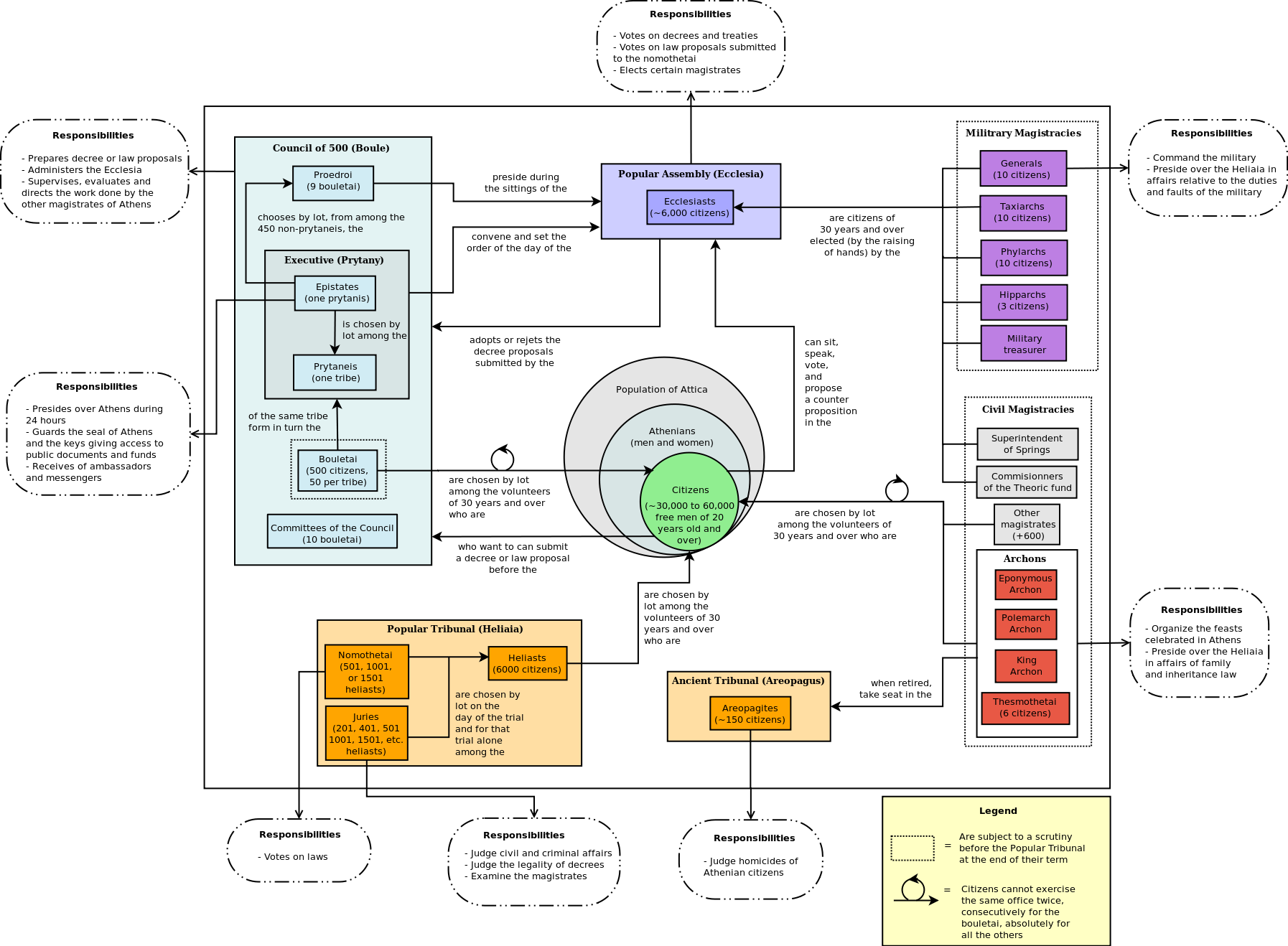
I will look forward to their debate when we return next week.  Below is a very detailed chart of the ins and outs of Athenian democracy for the very interested.

Many thanks,

Dave Mathwin

8th Grade: What would the ‘Occupy’ Movement think of Solon?

Greetings,

After the test early in the week, we spent the next few days looking at the rule of Solon in Athens from 590-570 B.C. The ancient world regarded Solon as a great sage, but as we saw, his head was not in the clouds.  He took a society ready to fly apart at the seams and left it with an established social context in which democracy could take root.  I wanted to highlight a few key lessons.

First, the background:

Before Solon there was Draco, a member of the Athenian aristocracy.  His name itself came to symbolize harsh governmental policy, i.e. a ‘Draconian’ law.  His policies helped cement the divide between rich and poor and threatened to make it wider. This dynamic is not unusual.  When one group in society separates itself from others because of wealth or status, they tend to fear the rest of society and thus, isolate themselves all the more.  This increased distance only requires more force to ensure the divide.  One can think of the ante-bellum South, for example, and various laws enacted that made it criminal to educate slaves.  Society built like this can’t last for long.

Enter Solon.

He recognized a few key things:

1. Society needs the rich.  One can argue that the rich abused their power but they are still Athenian, and their resources can benefit Athens
2. The divide between rich and poor must be healed if we are to survive.  This will require sacrifice from the rich
3. This led to what may have been Solon’s invention, and may not have been — a graduated income tax.

No one likes to pay taxes.  One of the reasons I this is so is that no one really knows where their money goes.  It gets dropped into a vast ocean, never to be heard from again.  Solon, perhaps recognizing this, did things differently.  He did not ask for a direct sum from the wealthy, but offered them opportunity.  The wealthy could fund specific projects.  They could just pay directly for a religious festival, a bridge, or a naval warship.  Of course, they could also get full credit for their funding, i.e., ‘This festival to Athena sponsored by Diodotus.’  So, paying taxes became a way to earn ‘kleos.’  The wealthy could contribute in how much they gave.  Enhancing the well being of Athens was directly connected with enhancing their own status in the community.

Problem solved.

Could this apply today?  We are much too big to do what Solon did on any appreciable scale.  Yet I wonder, with the ‘Occupy’ movement and other kinds of resentment against the elite building, if we couldn’t borrow his ideas. What if we did this for the very rich, and put their faces on front pages with captions like, “Warren Buffet posing with fighter jet paid for with his taxes,” or something like this.  Would this help?

But, we should note that if we had a competition of fame/honor in paying taxes to the government, that would imply a certain relationship and attitude towards our government.  Would that attitude be appropriate?

Solon did not create democracy in Athens, but he established a context for it to exist.   Democracy cannot exist everywhere.  If the majority have an ‘us v. them’ attitude then they will use their power to ‘get revenge’ or exploit the others.  In this environment, society will become cancerous and destroy itself.  Democracy can only really work when the power of the majority does not just represent merely the majority, but in some sense, all the people.

Blessings,

Dave Mathwin

12th Grade: Platea, Taiwan, and SOPA

This week we continued our look at the Peloponnesian War and looked at a few important topics:

1. Athens and Platea,

Platea had been a long time ally of Athens, and a strategically important one because of its geographical location near Spartan allies.  Platea’s position was much like that of West Berlin in the Cold War, and perhaps, Taiwan today.  When they came under attack, Athens faced a brutal decision of either abandoning them or attempting a very risky attempt at reinforcing them.  Of course this is shortly after their city suffered an attack of the plague that killed perhaps 1/3 of its citizens.  What should they do?  The class was divided on this question, and it resulted in some interesting debate.  Would/should we, for example, be willing to defend Taiwan at any costs if China attacked?

2. The Athenian Assembly

Thucydides gives us a great behind the scenes look at Athenian democracy in action.  Here we see something much different than we are used to from Congress.  They discussed real issues in plain language with arguments that people could follow.  No 800 page laws passed here.  Average, everyday people could have a direct impact who were not even elected officials, like Cleon, the son of a tanner.  Anyone who has watched congressional sessions on C-Span and found themselves less than inspired would, I think, find accounts of the Athenian assembly bracing.

But there was a down side, as sometimes this rough and tumble process found itself outside established law.  The first time this happened, they approved of a military action that resulted in their biggest success of the early part of the war.  Years later, when they did something similar after the Battle of Arginusae, it would be a disaster.

Is it possible to have our cake and eat it with democracy?  Must we choose between an emphasis on law, with its attendant stuffiness, and dynamic social interaction, with it’s propensity to get carried away?  If so, which should we choose?  Is it possible for our country and our system of government to have the latter even if we wanted to?

3. The War Expands

When the Peloponnesian War began in 431 BC, I think it safe to say that both major proponents felt the war would be over in a year.  After all, no major strategic question divided them (or so, perhaps, it merely appeared to be so). Why was the early phase of the war indecisive?  How did this lead to a change of tactics for both sides, and how did this end up changing the war itself?

On Wednesday we took a detour and discussed the SOPA law being debated before Congress.  I thought this was worthwhile not just because it was a hot topic of conversation, but because it has a lot to do with how one thinks of democracy and society properly functioning.

The law raises a couple of key questions:

– Most see the internet as a good thing for democracy.  Witness, for example, the role of cell phones, web broadcasts, and other such things during the Arab Spring.  The internet puts enormous amount of choices before consumers, which can translate into an enormous amount of power.  The relative ease with which the public can pirate media forces media conglomerates to not take the consumer for granted.  Many have written, for example, of the entrenched arrogance and aloofness of the record companies ca. 1995.  CD”s made them huge profits, and they reduced customer choice.  After all, what other choice did we have but to go to them and buy whole albums? Such is the usual attitude of dictatorships before the fall.

– On the other hand, the digitizing of information has allowed those with power (be they governments or corporations) to amass enormous amounts of data about us.  The data is easy to acquire, store, and retrieve. Privacy has been redefined by the very existence of such technology.  As we have said in class before, the only thing preventing our military from taking over the government is whether they want to or not.  Even citizens with all the automatic weapons the NRA would want available would be no match for an air force, laser guided bombs, etc. In the same way, the only thing preventing government’s from accessing and using this information is whether they want to or not.

On another note,

I noticed during our conversation that the democratization of information may have led to a democratization of Constitutional interpretation.  One student objected to the law because, “It makes the companies instead of the individual the arbiter of what is or is not copyright infringement.”  This student said this almost without realizing the revolutionary implications of such a thought.  For myself, the idea that individuals decide what infringes copyright is a radically new idea.  For the student, it seemed perfectly obvious.

Of course the proposed law does ultimately involve the courts.  Media companies can’t put anyone in jail.  But it struck me that ‘Government’ as the deciding entity rarely came up in the discussion.  This may reflect something Philip Bobbitt discussed regarding the ‘Market State’ back in our mid-term project unit.  He predicted that in the ‘Internet’ era government’s would grow weaker in their connection to the people.  We just don’t need the centralization governments give society anymore.

All in all, it was a wonderful rabbit trail, and one we will likely revisit in a week or so when we see if the law passes.

Blessings,

Dave Mathwin

A Word on Methodology and the Purpose of History

On the first day of school in 8th grade Ancient History (which is the first time I will have taught any of the students in that class), I begin class with the premise that I am wasting their time.

History, after all, (I argue) has no real bearing on your life.  We study some names and dates from the past, a few battles here and there.  Sometimes it might have entertainment value but will never really impact you in any way.  Whatever Cyrus the Great did, be it good or bad, won’t impact on you today.  The past has no present.

Depending on their personality and previous experience students either get very excited or troubled by the prospect that we can blow off the year.  Yes, eventually we get around to reasons why hopefully I will not waste their time, but we should not sweep the arguments against History under the rug too quickly.  Before we bother with History in the first place, we should know what we are doing and why.

Some students respond by stating that history offers us lessons.  When people do bad things, we can learn to avoid them, when they do good we can emulate them.

This is a very common answer, with some truth in it, but I refuse the premise on which it’s based.  Reducing history to didactic lessons runs akin to telling people that Christianity is about adhering to a superior morality.  Whatever truth lies in that statement, Christianity really is not about “morality” at all, or at least, the moral component makes no sense without a much larger context.

In the same way, History does not begin and end with proverbs and moral lessons.  It should be about encounter.  It should be about transformation.

History is often and easily abused.  One common form of abuse is using History as a vehicle for proving a pet theory, something all of us can be guilty of at times. Such an approach is both dangerous and uncharitable.  Uncharitable, because History has no room to speak for itself when we insist it conform to us.  We stop listening and lose the possibility of empathy and understanding.  Dangerous, because manipulating the past puts us in a position of great power.  We erect a wall between ourselves (the “good,” or those with knowledge and understanding) and others, those who “should know better.”  If we do this, we cannot learn, cannot be challenged, and cannot grow.

Finitude will always limit our experience, but we need confronted with “the other” to get shaken out of our narrow field of vision.  Historians can often make the mistake of viewing the past in terms of the present, but this robs the power of the past to really do its work.  Seeing through different eyes pushes us beyond ourselves.  In writing about great books, C.S. Lewis said,

. . . in reading great literature I become a thousand men and yet remain myself. Like the night sky in the Greek poem, I see with a myriad eyes, but it is still I who see. Here, as in worship, in love, in moral action, and in knowing, I transcend myself; and am never more myself than when I do.

This is how History (like all our endeavors) should prepare us for the Beatific Vision.  The “otherness” of different cultures and people can by grace train our hearts for the “otherness” of God’s Kingdom.  Other times and places should also make us humble and charitable.  Hindsight is a great luxury, but we must avoid “finger-wagging.”  We must honor the past by viewing it as they saw it, not as we see it now.  We too act in a fallen context without omniscience.  Those in the past lived under the same constraints.  What kind of decisions would we make in their place?

Bringing it to the present, how do we act morally and justly with the information we have?  How do we make decisions in a fallen world?   We must take responsibility for these decisions, and the difficulties we face should make us rely on God’s grace and wisdom.  Our own sin should make us slow to judge those in the past that struggled with many of the same things as ourselves.  Are we so sure that we would do better?  When we, with proper conviction, call out the past for its mistakes we likely will need the humility to call ourselves and our own society to account.

I am not interested so much in changing the opinion of any student about, say, Napoleon or the Industrial Revolution.  But I am very much interested in 1) Each student coming to a greater understanding of their view of the world, and the extent to which that view can be supported by Christian belief, ethics, etc., and 2) Each student more fully understanding the implications of their decisions in the short and long term for themselves and others.

Mark Twain once said that history does not repeat itself, but it does rhyme.  As we see connections and patterns, we learn more about humanity.  But humanity does not exist in a vacuum.  As in all disciplines, the study of History involves an attempt to understand Reality, imbued with God’s presence.  As Francis Schaeffer said, “He is there and He is not Silent.”

About the Title of This Site

‘A Stick in the Mud’ pays homage to the late great Kenneth Clark, who won international acclaim for his ‘Civilisation’ series in 1969.

To be sure, Clark has his detractors.

Against him, one might say that,

  1. He is a mildly stuffy British lord
  2. He has bad teeth
  3. Niall Ferguson (another favorite of mine) took a shot at Clark in his latest work, “Civilization: The West and the Rest.”  Ferguson argued that civilization isn’t about pictures and sculpture so much as it is about roads, banking systems, and stable governance.

Would Clark have disagreed?

I think so.  All decent civilizations have roads, financial systems, and so on.  Their differences in these areas would be quite instructive though I suspect we would find more similarity. The variety of artistic styles, however, shines immediate and obvious light into the values of any creative people.  After all, one might make a banking system as a mere slipshod afterthought.  No one would do this with a sculpture.

I heartily encourage you to try out Clark on your students.  Those who do will be delighted by his insight and careful eye.  Yes, your students may groan at the prospect.  When they do that with me I tell them, “You protest too much.  You are only groaning to cover up your real love for Clark, and to maintain some semblance of cool in the eyes of your classmates.  It’s alright, I’ve been there too.”

They usually do not groan after that.

Enjoy!

8th Grade: The First Clash of East and West?

Greetings,

This week we had our debate on the forms of government, and wrapped up Persian civilization.  We will have a test on Persia this coming Wednesday before we start to review for our mid-terms.

We looked at Persia’s expansion in Europe this week as they crossed the Hellespont into Greece.  Why did they do this?  I think there are a variety of possibilities.

1. We have talked before about the ‘Burden of Cyrus.’  His extraordinary accomplishments made Persia a world power.  However, this legacy could be a burden as well as a gift.  Both with Cambyses and Darius we see this ‘need’ to do something grand that Cyrus did not do, something that would allow them to leave their own mark on Persia.  For Cambyses, this took the form of the conquest of Egypt.  For Darius one could argue, it took the form of conquering Greece.

2. The answer could be simpler.  Expansion may erase current enemies but it usually creates new ones.  The Aegean Sea may simply have been the ‘next’ enemy for Persia given their previous expansion.

3. Herodotus records a few stories that suggest that Darius may have had personal motivations for conquering Greece.  The stories may or may not be true, but they might have a ring of truth.  It is not unknown for kings or country’s to act with this kind of motivation.

We wanted to realize, however, that expansion across the Aegean would be a different kind of expansion than the Persians were used to.  Almost the entirety of their empire was land based.  Anyone can walk.  Not everyone can sail.  Their expansion overseas would mean the creation of a whole wing of their empire.  Embarking on the sea would put them in a position where they would need a strong presence but have little experience.  In contrast, most Greek city-states grew up on the water.  Persia would still be able to muster an overwhelming advantage in raw manpower.  For most city-states this would be enough.  But as we shall see, not for all.

We looked at the Battle of Marathon in 490 B.C., and what it revealed about Persia.  Persia’s defeat at Marathon hardly spelled doom for Persia, but it did demonstrate their weaknesses, and perhaps, the fact that they had finally stretched out their imperial arm too far.

Persia was, in general, less oppressive and more tolerant than previous empires.  They provided economic advantage and security.  But being part of Persia did not come with any sort of identity.  One might argue that Persia was all head, but no heart, and on some level people need inspired.  They possessed huge armies, but the majority of those armies had conquered troops that probably felt little reason to fight for Persia.  Thankfully for Persia, most of the time their huge numbers meant that they often did not have to fight at all.  In fact, Persia’s absolute requirement for military service for all eligible males shows them at their least tolerant.  When one father asked King Xerxes to exempt his youngest son to stay on the family farm, Xerxes executed his son, hacked his body in two, and had his departing forces march between the pieces of his son’s body as they left the city.  They allowed for no exception to their ‘No Exceptions’ policy.

At Marathon, the Athenians gained a tactical advantage by focusing their attack on the non-Persian members of Persia’s force.  The Persian force collapsed quickly as large portions of their force beat a hasty retreat.  They may have been willing to follow orders and march where told.  Why would they risk more than that?  What were they fighting for?  On a variety of occasions, Herodotus speaks of the bravery and skill of the purely Persian troops. But the conquered and incorporated troops proved to be a hindrance rather than an asset.  But I also think that the Athenian victory was part psychological.  They ran at the Persians — they actually attacked!  Herodotus hints at the shock the Persians must have felt under such a circumstance.  In Greece, Persia would meet a people who refused to accept their traditional ‘deal.’  The fact that Persia needed to build a navy to deal with this threat put them in an unusual position, like fish out of water.  We will see in a few months how and why the Greeks defeated Persia in a battle of East v. West.

Many thanks

Dave

12th Grade: The Dynamic of the ‘State Nation’

Greetings,

This week we continued looking at the development of states, attempting to make the connection between the various elements in society that propel change.  We looked this week at the ‘State-Nation,’ and the ‘Nation-State.’

Th ‘Territorial-State’ (1648-1776) was a conscious move away from the monarchical ambition and religious motivated violence of the previous era.  They sought order, symmetry, balance, and proportion.  This required careful international diplomacy, and sought to prevent any inward social upheavals, for good or ill.

A variety of factors lead to the breakup of this constitutional order.  For one, the Enlightenment grew stale and begged for a more ‘Romantic’ counter-reaction.  But perhaps more than that, the expansion of Territorial States stretched the logic of their identity based on contiguous property (and not ideology, which travels in the minds of me).  The French-Indian War is perhaps the most striking example of a Territorial-State conflict that gives birth to the ‘State-Nation’ here in America.

The French-Indian War created a sense of identity, a sense of a ‘people.’   This ‘people’ would naturally now not want to be treated as pawns in an international game.  They would inevitably demand rights, and this is at least part of the roots of the conflict between the colonies and England.

A look at the Declaration of Independence and Constitution gives us insight into the emerging world of ‘State-Nations.’
1. We have the basis of the particular relationship between government and the people rooted in universal ideas (all men are created equal)
2. We have recognition that the ‘people,’ not territory or states, are the basis for political power, i.e. “We the people. .  .”
3. At the same time we still have a somewhat aristocratic, paternalistic attitude towards ‘the people.’  Government was responsible ‘for’ the people, but neither George Washington, John Adams, Robespierre, or Napoleon would have thought in terms of government ‘by’ the people, or ‘of’ the people.

Napoleon is a great example of someone who understood how the socio-political landscape had changed, and understood how to take advantage of it.  The French Revolution destroyed not only the aristocracy, but the professional army led by aristocrats.  Napoleon had mass, energy, and ideology at his disposal, but lacked the well drilled and trained armies of the rest of Europe.

With a ‘people’ now organized in France, Napoleon could mobilize more support for his campaigns.  He had the supplies, backing, and motive to take his army far (we are liberators of the oppressed).  His took this energy and channeled, achieving superiority of mass at points of his choosing.  This rag-tag ball of energy created by the French Revolution and harnessed by Napoleon made quick work of the rational, balanced, symmetrical, and aristocratic armies of Europe.

But then a curious thing happened.  The countries Napoleon occupied inevitably brought with them the ideology and ‘constitution’ they espoused.  If France was so great, why couldn’t Prussia or Austria be great too?  If they wanted to resist, they would need to raise a new army rooted in this new sense of solidarity, this new sense of a ‘people.’  The old aristocratic officers had been discredited by their initial defeat at Napoleon’s hands.  The armies that defeated Napoleon from 1809-1815 from Spain to Russia, from Prussia to England, were in sense, Napoleon’s accidental creations.  is it any wonder that

Napoleon’s success and ultimate failure have many lessons.  For our purposes I want the students to see how elements of society fit together and in a sense, carry the same message.  Different ideas and actions create new social and political contexts.  Without awareness of the ripple effects of these changes, nations will end up behind the 8 ball, much like Spain of the early 17th century, France and England in the late 18th century, the Austro-Hungarians in the early 20th century, and so on.

Next week I will update you on the ‘Nation-State’ (what you and I grew up with) passed away, and speculate on the best way to move forward in the new economic, technological, social, cultural, political, and moral world we live in. Having seen a few examples of how this process tends to work, I am hoping for some good observations and discussion from the students.

Blessings,

Dave Mathwin

11th Grade: The Bible, the Constitution and Slavery

This was in response to a parent question about the Constitution and slavery.  A difficult and debated question to be sure.  What follows is my two cents, but I would be curious for anyone else’s thoughts. . . 

As to why the Constitution did not forbid slavery, my guess is that:

– The disagreement on slavery could not be solved either at the time of the Declaration (Jefferson’s original draft had an anti-slavery section in it) or the Constitution because it was too much a part of enough of the states at the time.  It had become a part of everyday life.  Slavery was considered to be worth having to get (at least in their minds) the greater good of unity.  If you look at the Convention debates, there is some doubt whether or not states like South Carolina would have signed onto the Constitution if it banned slavery.  Whether they were right about the ultimate benefits of that trade-off . . . I’m not sure.  But personally it would seem to me that history says ‘no.’  We don’t know what would have happened had the anti-slavery faction left some states out of the Union.  But it’s hard to imagine it being worse than a Civil War that claimed 600,000 lives and divided the country for another 100 year afterwards, with segregation, etc.

Of course one could argue that there was nothing in the Constitution that made the continuation and expansion of slavery inevitable, and I would agree.  But the Constitution did not really provide a physical or moral framework for deciding this question either, aside from the difficult amendment process.  The southern states only accepted the 13th-14th Amendments when they were totally broken and had no recourse to object.

– I also think that many believed that, while slavery was bad, it should go away of its own accord rather than government action.  This has a lot to do with many people’s view of ‘liberty’ at that time.  “I don’t like what you’re doing, but I suppose it’s not my business,” etc.  It might be similar to someone today on the abortion question.  “I don’t approve of abortion, but I don’t think government should be telling people what to do with their bodies, their families, etc.  Those are private, not public matters.”

As to the Bible and slavery, this too is a tough, slippery question.  I tend to think that while the Bible does not speak directly against it, the entire tenor and ‘atmosphere’ of the New Testament speaks against it indirectly.  This is in part why when the Christian Middle Ages come, slavery disappears almost entirely for the first time in human history.  When the Church begins to falter badly in the Renaissance, slavery returns.  Though I realize there were other factors, such as exploration, for one.

The concept of free individuals is also relatively new.  Aristotle, for example, was a progressive thinker in many ways.  But he defended certain kinds of slavery because he believed some were nothing more than slaves by nature.  Though some slave owners claimed him as an authority, they should have been more careful.  Aristotle did not think anyone should be a slave by race, or merely because they were captured in war.

What do you think?

12th Grade: The French-Algerian War

Greetings to all,

This week we examined one of the more studied insurgency campaigns, Algeria’s ultimately successful bid to get independence from France from 1954-1962.  I wanted to focus on a few main issues, aided by our watching of ‘The Battle of Algiers.’

1. Why did France feel the absolute need to win in Algeria?

From the time of Charlemagne (or perhaps even dating back to the pre-Romanized Gauls) France was regarded as having the world’s pre-eminent military, from the Crusades, to Joan of Arc, to Napoleon.  In W.W. I they fought heroically and with great determination.  In 1940, however, they suffered a humiliating and shockingly quick defeat to the Nazi’s.  Desperately seeking to regain their pre-war glory, they did not give up their colonies (unlike their friendly rival England).  They lost again in humiliating fashion in 1954 in Southeast Asia — but they would not lose in Algeria.  This was where they would prove to the world that France was still France after all.

How might this psychological and cultural attitude have impacted their strategy and tactics against the insurgency, and was this beneficial?

2. What is the battleground in an insurgent campaign?

It seems clear that the French thought that the battle was against the insurgents primarily, and so put their military foot forward almost exclusively.  Why did this fail?  What is the primary battleground in an insurgent campaign?  Is it the people, or is it an idea?  If so, what role can the military play?  What role does the government and people play?  In our discussion, one student suggested that the only way France could have saved its position in Algeria was through lots of apologies for their poor treatment of them, and lots of financial and social programs to rectify the situation.   In other words, was the problem a military one at all?

Well, it certainly might have been.  But there is a difference between ‘strategy’ and ‘tactics.’  In large measure,* France’s problem was that their use of the military was their strategy.  It was not used as a ‘tactic’ in a broader campaign.

3. What happens when an army fights in disconnected way from its country’s values?

There is a great deal of evidence that French troops tortured and killed some prisoners as a matter of policy.  This was done with the tacit approval of French politicians, but not the French people.  As revelations of the torture emerged, the French public began to turn against the war, feeling betrayed by the army.  The army in turn felt betrayed by the people.  This tension between identity and actions needed resolution in some way — and the result was one successful military coup that put De Gaulle in as president, and another coup attempt that failed to get De Gaulle out of power a few years later.

Why are cultural and political values an important ‘weapon’ in a war?  Under what circumstances can we depart from those values?  How is a country’s identity a part of its strategy in conflict?

4. Related to #3, what should the role of the press be in a free society?

We discussed a few different options related to this question.

– The press should be an entirely objective entity, focused on presenting ‘just the facts.’  But, however much of an ideal this is, it is rarely, if ever attained.

– The press should be an implicit supporter of the government, or the majority.  This does not mean ignoring obvious truths, but it would mean using the press as a means to ‘rally the people.’

or

– The press should be oriented ‘against’ the government.  That is, the press’ main function is to provide an alternate viewpoint apart from the government’s message.  The government gets its chance, the press provides the people with ‘the other side of the story.’

Students took a variety of positions and tried to combine some of them as well.  We agreed that the current situation is both better and worse than it was 20 years ago.  Better in that we have many different options readily available to us, worse in that it can be challenging to sift through the competing perspectives and narratives.

Next week we will look at our current campaigns in Iraq and Afghanistan, and also begin to prepare for our own ‘insurgency.’

Sincerely,

Dave Mathwin

*France did attempt some small scale political reforms, but almost everyone viewed it as ‘too little, too late.’