Danton Democracy

I originally published this in 2013, and repost it in light of our study of the French Revolution.  Apologies for any dated information on the ACA . . .

***********************

It took a while, but I finally came across an article on the ACA (also called “Obamacare”) that I resonated with.  Ross Douthat does not need to argue that the law will destroy civilization as we know it.  He admits that many will probably benefit from the law.  But in the final analysis (if coming to a final analysis even possible with such a ridiculously complex piece of legislation), he writes.

Now an effective levy of several thousand dollars on the small fraction of middle class Americans who buy on the individual market is not history’s great injustice. But neither does it seem like the soundest or most politically stable public policy arrangement. And to dig back into the position where I do strongly disagree with Cohn’s perspective, what makes this setup potentially more perverse is that it raises rates most sharply on precisely those Americans who up until now were doing roughly what we should want more health insurance purchasers to do: Economizing, comparison shopping, avoiding paying for coverage they don’t need, and buying a level of insurance that covers them in the event of a true disaster while giving them a reason not to overspend on everyday health expenses.

If we want health inflation to stay low and health care costs to be less of an anchor on advancement, we should want more Americans making $50,000 or $60,000 or $70,000 to spend less upfront on health insurance, rather than using regulatory pressure to induce them to spend more. And seen in that light, the potential problem with Obamacare’s regulation-driven “rate shock” isn’t that it doesn’t let everyone keep their pre-existing plans. It’s that it cancels plans, and raises rates, for people who were doing their part to keep all of our costs low.

You can find the full article here.

The article does not fully address my two ‘gut-level’ objections to the law:

  • Many well-intentioned government servants believe that they have found the ‘solution’ to problems that have heretofore eluded society.  Thus, they see only the positive and never realize the cost of certain kinds of legislation.
  • More specifically, the health care system already involved a great deal of physical complexity laid over top of a myriad of individual financial and moral choices.  Government action, almost by definition in cases like this, would almost certainly gum up the works and unintentionally create problems, even those they could not foresee.

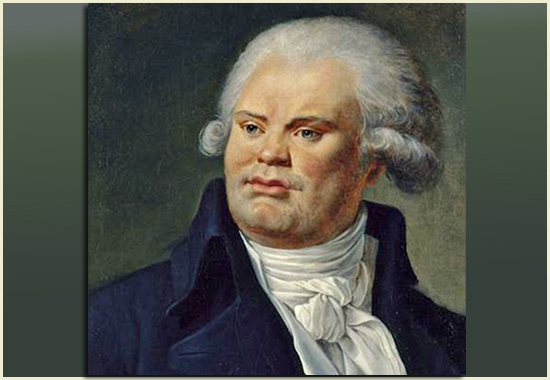
I thought of the health care controversy as I read David Lawday’s enjoyable biography Danton: The Giant of the French Revolution.  Danton’s outsized personality stands in sharp contrast to the cold Robespierre, who eventually turned on Danton and had him executed.  Their faces tell the whole story:

georges_danton


Robespierre

Danton styled himself a man of the people.  He claimed to truly understand the people, for he (and not Robespierre) thought and acted like one of them.  He laughed, enjoyed food, women, and friends.  Thus, as he had a seat in government and understood the people, he naturally assumed that government action would work to benefit the people and help fulfill their wishes.  The video below may not reflect an actual historical meeting between  Danton and Robespierre, but it accurately depicts the different personalities of them both.

One can easily get drawn into Danton’s huge personality, but we should remember that he sanctioned horrible butcheries both before and after the fact, in the name of the people.  Danton was not a thinker.  He did not inscribe his speeches, he wrote few letters (that have survived at least), and so we know little of his motivations.  Lawday allows himself to make his best guesses, and paints a portrait of a man who had no love for violence per se, but believed he could successfully manage it once unleashed.  He later seemed to change his mind about this during the Reign of Terror, and this shift factored into his execution.

Unfortunately Danton’s greatest legacy to the Revolution was the Revolutionary Tribunal, the government’s supreme tool in legitimizing political murder on a mass scale.  Danton had some good motives in starting the tribunal.  He saw the random destruction engaged in by “the people,” and thought that direct government action would relieve the masses of the burden of imposing justice, or at least their version of justice.  This in turn would limit the violence that plagued the Revolution, for government would surely exercise more restraint and wisdom than the masses.  In a speech advocating for the establishment of the tribunal he reportedly said, “Let us be terrible, so they do not have to be.”

Tragically, the Tribunal simply gave legitimacy to the worst impulses of the Revolution, and the amount of deaths and imprisonments skyrocketed.  This same tribunal eventually tried Danton himself and found him guilty without allowing Danton to call any witnesses for his defense.

The ACA and the Revolutionary Tribunal remain vastly different things.  I hesitate to include mention of them both in the same post, for in 99 out of 100 ways they have nothing to do with each other.

But they do share one thing in common–they both spring from the mistaken belief that government can enter a complicated situation and with a wave of a wand make everything alright.  It usually fails to work, even with the best of intentions.

On the subject of good intentions, Marginal Revolution posted a link with this abstract. . .

Immigration and American Identity

The machinery of modern states sometimes makes things harder, not easier.

Coming to a proper solution for the immigration question is one example of this.  A variety of sources and polls indicate that most Americans favor allowing more legal immigration and have for years.  Back in simpler times one could enter a land, ask the king to stay, usually he said “yes,” with not much fuss. Perhaps one took an oath of fealty to his person.  Now, we have a whole mess of courts, paperwork, etc., etc. that make coming legally quite difficult.  The good intentions of most Americans gets lost in the morass of modern civilization.

Incremental reform of the system seems unlikely to lead to dramatically different results, so I have great sympathy for the argument made by Prof. Bryan Caplan.  As a libertarian Caplan believes in limiting government as much as possible, but his stance on immigration comes from a strongly moral place.  He would like to essentially eliminate the morass but eliminating almost every test that could prevent someone from working and living in the U.S.  He argues that

  • No one chooses to be born in a particular place, and almost always the best way to get out of poverty in a poor country is to move to a rich country, where your labor has a much greater value.
  • Those in the rich country benefit from their birthplace, which they also did not choose.  They have no moral right to deny someone something they did not earn or choose themselves.
  • As long as 1) An employer consents to have someone work for them, and 2) A worker consents to work for that same person, then no good moral reason exists for denying both people the right to hire/work.

Caplan breaks his argument down into even simpler terms:

  • Someone wants to come in my house, but I do not want them to.  Ok, then, they cannot come in.
  • Someone invites someone in, but they don’t want to come.  Ok, they can certainly refuse to come.
  • Someone invites someone into their house, and they accept, but a 3rd party–i.e., the Government–tells them that this cannot happen.  This, Caplan argues, makes no moral sense and yet this perfectly encapsulates our current immigration policy.

He made these points quite well in this debate below:

As well as Caplan argued (and we can note the contrast between the more intense, east coast, suit-wearing Caplan, and the laid-back Californian Wellman), I found myself siding with his opponent.  Their debate has the added bonus of illuminating much about our identity as a nation and our past.

The title of the debate, “Is Immigration a Human Right” might slip past us but the very idea of human rights as opposed to “A Right of Americans” represents a fairly radical shift in thinking.  We see this same shift in the years leading up to the American Revolution.  When colonists protested the Stamp Act in 1765 they talked of their rights as British subjects.  By the time we get to the Declaration of Independence, Jefferson argues that King George III has violated their human rights, that “all men are created equal.”  On the one hand, because we believe that God has created all mankind in His image, the clarity of Jefferson’s Enlightenment inspired prose makes perfect sense.  But it also makes things muddier—for incarnating this idea politically means different things to different people.  Treating all people equally from different political communities makes the whole concept of political communities irrelevant, aside from posing many other questions.

Even within a family, parents will love all their children equally but treat them differently as their circumstances require.  And when Joey argues that Billy’s parents let him stay up late, every parent knows the classic retort, “Well, you are not in Billy’s family.”

Interestingly, both Caplan and Wellman agree that societies do not exist via consent and that governments do not therefore derive their legitimacy from the “consent of the governed” per se.  This slips by without much discussion but I find it a crucial point.  The fact that the colonists failed to consent to certain British measures inspired many to revolt.  But even a moment’s thought about the concept of consent regarding the whole of society renders it a bit silly.  We “consent” to very little that shapes our lives.  We do not choose to be born, we do not choose our families, our gender, our personalities, or our looks.  We receive them, just as we do not consent to where we are born.  Nor did any of us in America today “consent” to our system of government. Imagine the chaos if everyone had to consent to their governments in some kind of purely rational vacuum.  Even the most die-hard supporters of consent would likely not want continual plebiscites to determine whether or not we should be governed by our Constitution, or a king, or an oligarchy.

The question then remains as to whether or not the fact that we do not really consent to our society supports Caplan or Wellman’s position.  For Caplan, the fact no one chooses where they are born and how they are governed means that everyone should have the freedom to go where they please and pick a place where they actually do consent to a particular society.

But Wellman has a powerful counter to Caplan’s “house” analogy mentioned above.  He poses a scenario of him leaving for a week and returning home to ask his wife what happened during his absence.  “Well, let’s see,” Wellman imagines his wife replying, “On Wednesday, I went to yoga class. On Thursday I met Carol for lunch.  And on Friday, I adopted a young man named Bob into our family.  Here he is, meet your new son.”  Wellman goes on to ask rhetorically whether or not she and Bob, as consenting individuals have the right to do this.  Caplan’s house analogy, he argues, needs more nuance.  Caplan’s argument above has a fair amount of moral force, but it would also overthrow our entire conception of the state as a community.  Unwittingly or not, Wellman’s analogy hearkens to the older Aristotelian idea of the state-as-family analogy, hence the notion that the king served as a “father” to his people.  One cannot simply alter the composition of the family at will, nor make unilateral decisions as “sovereign,” consenting individuals apart from the family at large.

Here we see how truly radical the American Revolution was and glimpse why it had such an impact on the world.  The notion that the state in fact was not a family perhaps finished off Aristotle’s formal influence in the modern world, a process begun in the Scientific Revolution.

And here we see something else–why the immigration issue poses such a difficulty for us.  If any nation could apply Caplan’s form of the “house” analogy, it is the United States.  As a “nation of immigrants” our belief in universal rights is woven into our DNA, however poorly we have applied it at times.  But pushed as Caplan wishes to push it, the idea becomes non-sensical. His vision of the state primarily as a conglomeration of free-floating individuals renders the idea of “society” almost meaningless.

The same Enlightenment ideas that inspired the idea of “human rights” also led to the creation of modern democracies.  The irony, perhaps even the tragic irony, with this issue, is that cutting red tape and making legal immigration much simpler could be achieved much more easily with a monarch than our federated democracy, with its attendant slowness, interest groups, and the like.  We might even reflect that minorities and outsiders (i.e. African-Americans and Native Americans) fared somewhat worse in the aftermath of our victory in the American Revolution.


Dave


Truisms that are (at least mostly) Not True

I have an affinity for the crazy theory.  I know that they can’t all be true, if for the only reason that if all of them were true, we would have no crazy theories to enjoy contemplating.  Our times have a strange character to them, however, for it seems the crackpot plays the role of conservative.  Older views of things look bizarre today.  Before continuing, I should fully disclose that, though I love crazy ideas, I am actually a very boring person.  The reason these two fit together in my life is that today the harebrained idea is sometimes quite conservative and, upon closer examination, sometimes even obvious.

Take, for example, a variety of truisms in our day.  We say that in football you have to have a great quarterback but . . .  Blake Bortles, Nick Foles, Case Keenum . . . at least one of them will play in the Super Bowl this year.  One can easily envision some coach with a crew-cut from the early 1960’s telling us how it’s a “team game, and not one of you means more than another,” and so on. We have traveled back in time.

History has its truisms as well.  I hear all the time, even from religious conservatives, that America’s religious competition has saved America from going the way of secular Western Europe.*  I have a particular antipathy for this obvious falsehood.  Medieval Europe had very little religious competition, and religion did quite well there.  Religion thrived in ancient Egypt with almost no competition for millennia.  To take the reverse, ancient Babylon had a lot more religious competition and their religion and morals seemed to suffer.  Today France may be nominally Catholic and Sweden nominally Lutheran, but no laws exist forbidding one from becoming Baptist, Methodist, or Buddhist in either place.  At least some religious competition surely exists there today.  This truism about religious competition is actually a far-fetched theory, based on only the most recent evidence.

To get slightly more controversial, we hear all the time how printing serves as one of the great civilizing tools for mankind.  No one questions this truism. But, just look for a moment . . . it seems obvious to me that the 15th century in Europe had a higher degree of civilization than the century after the printing press gained prevalence.  The printing press brought a lot of religious violence and political fragmentation in its wake. We hear too the truism that, “getting a Bible into everyone’s hands” is the key to spiritual health.  But, again, just look . . . it seems clear that the Church did quite well without the printing press for quite some time.  And, to return to an aforementioned truism, the fact that the Bible always tops bestseller lists has not prevented the west from becoming more and more secular over the last two-three centuries.

Maybe civilization and religion actually rely on things far older, far more “tried and true,” for success rather than new technologies–the crackpot as bland conservative strikes again.

I have written before about another one of my least favorite truisms, that of the evolutionary view of history and progress.  The theory basically means that civilization starts small and has run in a more or less unbroken line of progress and advancement.  Though this theory has general acceptance in many textbooks and the minds of men, it is, in fact, a radical, crazy, notion, for it ignores obvious facts.  For one, we know that a complex civilization could collapse more easily, quickly, and completely than a primitive one, due to its inevitable interdependence.  The presence of advancement makes large steps backward more, not less likely, like stock-market bubbles.  For another, we have a universally acknowledged and plain example of the fall of Rome and the subsequent so-called Dark Ages.  Whatever one thinks of the Dark Ages, Italy ca. 100 A.D. had a much higher level of civilization in most respects than Italy ca. 600 A.D.  Still, the prevalence of the evolutionary view makes those who state otherwise seem crazy.

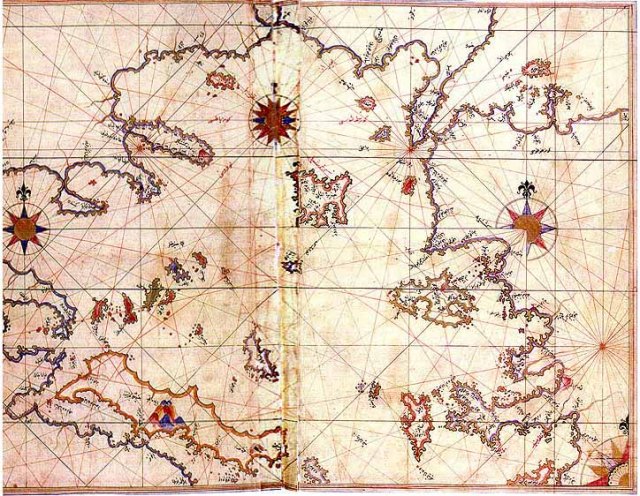
Enter Charles Hapgood, whose book Maps of the Ancient Sea Kings postulates that, based on an examination of certain ancient maps, it appears that an unknown and likely quite ancient civilization developed a geographical and nautical understanding that humanity would not equal until the modern era. Hapgood’s theory joins the voices of Graham Hancock, Jon Anthony West, and other megalithic architecture (such as Gobeckli-Tepe) that argues that pre-historic people not only existed, but existed at a far higher level of civilization than anyone previously imagined.

Unfortunately for the layman like me, Hapgood immerses the book in large amounts of technical terms and technical data.  I think one would need special knowledge of cartography, geography, and math to understand large portions of the book.  Perhaps no other way existed to make his case.  I found myself junping over much of the technical sections but hope I still understood the basic case, which runs like this:

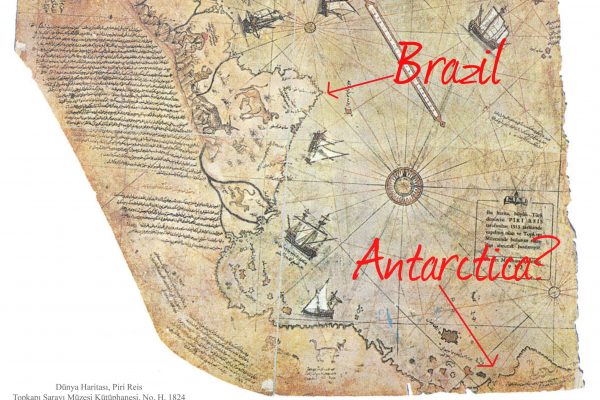
  • In 1929 an unusual map, named, the Piri Re’is, was discovered in the old Imperial Palace of Constantinople, dated the year 1513 A.D. (Moslem reckoning 919).
  • The map was extensive and showed the coast of North America in excellent detail.  This map differed from all other 16th century maps by giving correct longitudes for South America and Africa.  No 16th-century navigator that we know of knew how to calculate longitude except by guesswork.
  • Further investigation showed that Piri Re’is (or basically, Admiral Piri) claimed to copy this map from earlier maps, some of them dating back to (he claimed) the time of Alexander the Great.
  • Even a rough study of this map indicated that it used highly advanced mathematics, including spherical trigonometry, which we do not believe existed in the classical world

So, where did the map come from?

Perhaps Hapgood’s critics are right, and the Greeks knew enough spherical trigonometry to make these maps.  But did they sail across the Atlantic?  No evidence exists for this.  Did the Egyptians or Babylonians have this knowledge?  It appears not, but if they did, they did not sail across the Atlantic to map the coasts of the Americas.  Maybe the Romans in Ptolemy’s time had the knowledge, but again, did not sail across the ocean. Did it come from the medieval period?  But they did not sail much, and no other medieval map exists that compares with the quality of the Piri Re’is.

The best map from the classical period comes from Ptolemy, who worked in Alexandria and had access to all of the accumulated knowledge the world knew at the time.  His map shows great skill:

But it cannot compare with the Piri Re’is (although this is only a portion):
And again:
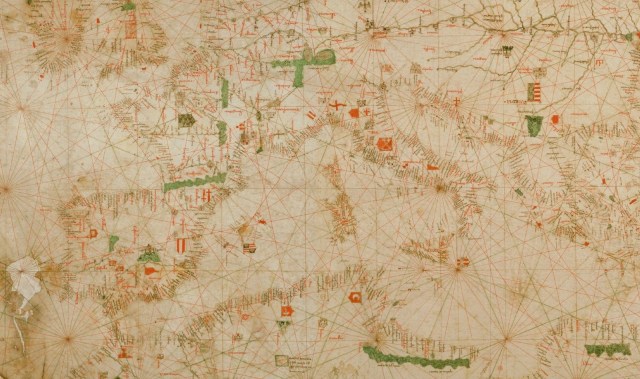
The Portolano Map, of late Medieval/Renaissance origin, is again, very good, but not quite up to snuff, at least in terms of the extent of what it mapped:
The inclusion of Antartica on the Piri Re’is map is particularly noteworthy, as many speculate that it maps landforms that for thousands of years have been covered with ice. In other words, the map seems to have been made before the ice age, and not after.

A few quotes scattered throughout the book from Hapgood illustrate his proposition:

We have discovered that in most cases the errors on the Piri Re’is mapper due to mistakes in the compilation of the world map, presumably in Alexandrian times [that is, the Piri Re’is was discovered in different pieces and put back together not quite accurately], since it appears that Piri Re’is could not himself have put them together at all.  The component maps, coming from a far greater antiquity, were far more accurate.  The Piri Re’is Map appears, therefore, to be evidence of a decline of science from remote antiquity to classical times (p. 39).

******

For a long time after the voyages of Columbus we find the latitudes of Cuba and Haiti are wrong on most maps.  Almost all the mapmakers put the islands above rather than below the Tropic of Cancer [in contrast to the Piri Re’is] (p. 41).

********

To sum up, then, this part of the Piri Re’is Map suggests a source map of Africa, Europe, and the Atlantic islands probably drawn originally on some sort of trigonmetric projection adjusted to the curvature of the earth.  By default of any other narrative, we must assign this map’s origin to a pre-Hellenic people.  The trigonometry of the projection suggests the work of Alexandrian geographers, but the evident knowledge of longitude implies a people unknown to us, a people of seafarers with instruments undreamed of by the Greeks, and as far we know, not possessed by the Phoenicians either (p. 49).

********

The suggestion of a vast antiquity behind the [Piri Re’is] is conveyed by a feature to which Captain Mallery first drew my attention.  He pointed out that the Zeno Map [which very likely had the Piri Re’is as a source map] shows Greenland with no ice caps.  The interior is filled with mountains, and rivers are shown entering the sea, in some cases at the points where glaciers now move through mountains to the coast (p. 152).**

*********

This culture [that made the Piri Re’is] may well have more advanced than Egypt, Babylon, Greece, and Rome.  In astronomy, nautical science, mapmaking, it was likely more advanced than any culture before the 18th century of the Christian era.  Not until the 18th century did we begin to send ships to the Arctic or Antarctic regions.  Organized government is indicated [by the map], as many expeditions would be needed to gather the appropriate information to map the area so precisely (p. 193).

Hapgood writes haphazardly and does not always reason in a clear, linear fashion, a trait he shares with his modern fellow believer in pre-historically advanced ancient civilizations, Graham Hancock.  The key I think to both writers lies not in the exactness of their data but in the accumulation of enough “probably’s” to make their case.  I heard most of a conversation between Hancock and Sceptic editor Michael Shermer.  The discussion went nowhere, with Shermer begging for even a small handful of absolute, concrete, data points, and Hancock pleading with him to consider the mass of “probably’s,” while admitting in the end that the study of ancient civilizations cannot provide the kind of concrete proof Shermer demanded.

Rather than ask, “Can we be absolutely sure if an ancient, advanced, prehistoric civilization existed,” (obvious answer-“no”), or, is it possible that such a civilization existed (obvious answer–“yes”) we should instead wonder whether we should expect or not expect to find such a civilization.  Is the idea reasonably likely?  Hapgood will likely not convince anyone who needs something along the lines of what Shermer requires.  He may entice others who think it likely that some kind of ancient civilization along the lines of those who like Hancock’s work.

To give Hapgood’s theory a shot, it helps to believe that:

  • The myths and folklore of most every ancient civilization that describe advanced civilizations that experienced thorough destruction (like the Atlantis story) likely have a fundamental truth behind them.
  • Civilization devolves just as much as it evolves, and in fact, devolution may be more prevalent than evolution in civilizations.
  • The flood described in Genesis 6 (and many other ancient religious texts) was substantive, historical in at least some sense, and would have had the power to destroy civilizations very quickly.
  • The absence of evidence would not condemn the case outright, as civilizations have at times experienced a catastrophic loss of a great deal of accumulated knowledge (the burning of the library at Alexandria, the collapse of Rome, etc.)

With this in place you might buy what Hapgood sells.  But without these beliefs, his book will likely frustrate readers.  In any case, I don’t find the above propositions crazy.  In fact, I find them rather ordinary.  Folklore and myth are common to all.  Belief in a historical flood of some kind is nothing new, with most ancient civilizations sharing this story.^  We have actual historically undisputed losses of vast amounts of intellectual capital at certain times in the past, such as the destruction of the library at Alexandria.

As I said earlier, despite my inclination towards “crazy” theories, I’m actually a very boring guy.

Dave

P.S.–A good friend and a math/science teacher glanced over the basic arguments of the book and found them wanting, and Hapgood’s selection of material suspicious.  He has a better nose for such things than I and his thoughts give me pause.

My friend and I both believe that ancient civilizations tend to be far more advanced then we might think.   Neither one of us believes that the history of civilization always proceeds in a directly linear way, and certainly not in a progressive evolutionary way.  We thus share some crucial assumptions.

My friend thought that Hapgood underestimates the knowledge of ancients.  For example, we know the ancient Phoenicians existed, we know they were great sailors.  It makes much more sense to say that perhaps they made the map and sailed farther than we thought, then to suggest that an unknown civilization of which we know nothing made the map.

My response would be something like, “If we know a lot about the ancients but have no record of them sailing to the Antarctic, it is plausible that they did not do so.  Thus, someone else must have.”

Plus, I confess that I just simply find the idea of advanced pre-historic civilizations fun, satisfying, and enormously entertaining.  Someone could wave such ideas in front of me daily and they would always get me pretty excited.

*One might modify this theory and argue that perhaps in today’s intellectual and cultural climate, one must have religious competition for religion to survive.  This argument has more plausibility.

**Some believe the Zeno Map to be a hoax precisely because of this feature and other “phantom islands” that do not now show themselves above water.  But Hapgood argues that a perfectly plausible explanation exists for this if the Piri Re’is was a source.  Another map, the Ibn Ben Zara Map, has a remarkably accurate depiction of the Aegean.  But it also includes several islands no longer visible.  How to explain this paradox?  How could the map be so accurate in some respects and so false in others?  We can say the map is a hoax or is filled with errors.  But another possibility is that a source map of great antiquity was constructed when these islands stood above sea-level.

^I do not mean to suggest that the Bible is merely historical.  It certainly has metaphysical, mythological, symbolic, and theological meaning beyond history.  But I don’t see these categories as exclusive.  What is real is not opposed to what is mystical, symbolic, or spiritual.
The Rings of Saturn

Bernard Bailyn starts his book The Peopling of British North America with an illuminating analogy about the rings of Saturn.  When astronomers first noticed Saturn’s rings their beauty appeared as a shimmering uniformity.  Now that technology has given us a closer look, we see that in fact, the “rings” are comprised of thousands of bits of rock and dust, some as big as your hand, some as big as a car, some almost microscopic.

History, he then argues, is often like this.  From a distance things look easy to understand but get up close and the elegant simplicity and uniformity of the past dissipates into confusing bits that won’t go together.  Reality will confound our ability to understand it as a coherent whole.

A lot about this analogy rings true for me.  When young we learn that George Washington was the father of our country, a great leader, and so on.  As we get older, we need to deal with his owning slaves, his social striving, his possible mixed motives for fighting the British, etc.

But ultimately historians can’t stop where Bailyn leaves off.  After seeing what the rings of Saturn actually are, he/she then needs to find a way to have them make sense.  He must interpret and synthesize.  Bailyn’s book tantalizes at times with revealing details about early colonial settlement, but I found myself frustrated that the book never quite got off the ground.

The book shows us that settlement of the colonies happened seemingly without real pattern, aside from the obvious facts that most immigrants were young, male, from a middle-class or lower background.  Different things seemed to happen for different reasons.  In sifting through the data, Bailyn admits that it might take a a poet or impressionist painter to make sense of the disparate information.  This is a wonderful admission of his, and seems to go against his “rings of Saturn” analogy.  Bailyn admits that in this instance he can’t fulfill that role (though he did just this in his great Ideological Origins of the American Revolution).  Interestingly, Bailyn contrasts the disparate design and feel of American settlements with new towns in Germany of the same period.  In Germany, new towns all looked the same.  So again, sometimes the rings of Saturn look exactly like we think they should look.  It may be American history in particular, rather than History in general, that presents a unique picture.

Ultimately, of course, this must be Bailyn’s point.  We might imagine the early days of European settlement to have uniformity, with diversity coming in the 19th century with large scale immigration, but no — from the earliest times no one story could account for everything.  “Let us celebrate America’s diversity,” and all that.

I thought of Bailyn’s work while reflecting on 8th grade reactions to the history of the Roman Republic.  In the year’s “Great Debate” over whether ancient Greece or Rome was the superior civilization, the boys invariably choose Rome by about a 2/3 margin, and the girls Greece by the same amount.  Many years of teaching this class bear this out for me, so why might this be?

Though images of the ancient Greeks reveal a touch of brutishness, they had more feminine qualities than the Romans.  They displayed more creativity and originality than the Romans.  They appreciated beauty and proportion.  As for the Romans, their plodding, methodical nature probably fits very easily within the mind of an 8th grade boy.  Their lack of imagination and their pig-headed stubbornness may have been designed specifically to both infuriate their ancient opponents and the average modern 8th grade girl.  I have seen a few young ladies actually stomp their feet in anger when Rome manages to rise after their disaster at Cannae, as the boys chuckle in Beavis and Butt-head like fashion.  “We’re still here,” the Romans seem to be saying to Carthage, “dunking your pigtails in inkwells yet again.”

I can identify somewhat with this aggravation, but there is something magnificent about how the Romans embraced their sense of identity.  The Roman scholar J.V.P.D. Balsdon makes the observation that the Roman origin story of Romulus and Remus raised by wolves had nothing to commend it to the ancient world.  Apparently it would have been much better if they had been suckled by she-goats, as the Greeks did with Zeus.  To what extent they truly believed in the myths I can’t say, but even a quick perusal of Rome’s stories show fratricide, violence, and no hint of elegance.  The touching Greek story of Pygmalion carried no truck with the Romans.  When they needed women, they simply stole them from the Sabines.  Even when the Romans “invent” their stories (though I am not comfortable with that word, but like a typical guy I can’t think of a better one) they utterly lack imagination and adornment.  And the Romans chuckle stupidly again.  They’re perfectly happy with their unimaginative early history.  Aggravating or no, their fierce sense of identity, no doubt gleaned partially from their commonly accepted founding mythology, gave them great strength of purpose and dedication.  They knew they were a gritty, uncouth, blue collar bunch and reveled in it.

When discussing the Arthurian legend in his A Short History of England G.K. Chesterton made the comment that the “tradition” surrounding Arthur was more true than the “history” surrounding him.  He meant that the Arthurian tradition may not be entirely accurate, but expressed more truth about the past than the confusion produced by historians who tackle the same subject.  I think the same holds true for Rome.  Take Will Durant (whom I like, for the record) in his Caesar and Christ, where he vaguely talks of Roman origins in terms of nomads from the steppes, and scraps of pottery dated to some people at some unsure time.  This tells us nothing.  No one should trust in the full accuracy of Livy’s history, but Livy communicates something more true about Rome’s early period than Durant.

If Chesterton is right we should consider his principle in light of America’s history.  The newness of our country means that we can have far more accurate information about our past than almost any other civilization.  For many of us, the stories we learned in elementary school no longer have persuasive power.  Postmodernism has done its deconstructive work well.  We see this in the words of the great jazz pianist Vijay Iyer who recently spoke at Yale, where he seemed to suggest that all success in America is somehow linked to exploitation (I hope I’m reading him incorrectly, as I like Iyer’s music and don’t want his name attached to something silly like this).  Iyer commented,

And as we continue to consider, construct and develop our trajectories as Americans, I am also constantly mindful of what it means to be complicit with a system like this country, with all of its structural inequalities, its patterns of domination, and its ghastly histories of slavery and violence.

Many of us are here because we’ve become successful in that very context. That’s how we got into Yale, by being voted most likely to succeed; and that may be what emboldened some of us to show our faces here this weekend, because we actually have something to show for ourselves, that somehow in the years since we first dined at the Alternate Food Line we’ve managed to carve a place for ourselves in the landscape of America. Whether you attribute it to some mysterious triple package or to your own Horatio Alger story, to succeed in America is, somehow, to be complicit with the idea of America—which means that at some level you’ve made peace with its rather ugly past.

Perhaps at least a few of those voted, “Most Likely to Succeed” actually worked hard?

But we need not fear or lament the postmodern landscape, but see an opportunity.  We need to seek the truth, and the deconstructive project has helped us do that.  But somewhere out there, I hope, is a historian who can give us a “true tradition” amidst the rings of Saturn to anchor us moving forward.

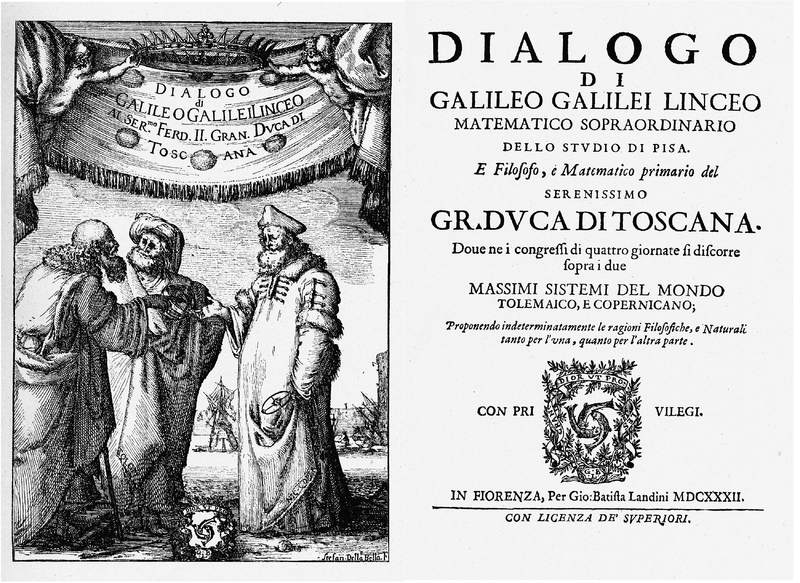
“A Dialogue Concerning the Two Chief World Systems” by Galileo Galilei

The Dedication of the Dialogue

The Dedication of the Dialogue

I repost this wonderful offering from my friend and colleague Bill Carey . . .

*******************************

A Gallup poll of 6 July 1999 of more than a thousand adults determined that only about four out of five Americans believe that the Earth orbits the Sun. Fully one in five believes that the Sun orbits the Earth. [1] It’s interesting that four in five Americans believe something that seems obviously and demonstrably false. The Earth doesn’t feel like its moving underfoot, and every day we see the Sun rise and set. We believe the moon orbits the Earth, and it sure looks like the behavior of the Sun and moon is pretty similar. Why do four out of five Americans believe that, contrary to our intuition, the Earth orbits the Sun?

I’ve been taking an informal survey of my friends, with just two questions. The first is whether the Earth or the Sun is the center of the solar system. [2] After I assure them it’s not a trick question, everyone answers the Sun. We’re beating Gallup’s averages. The second question confuses people: “How do you know?” The most common answer I’ve gotten is, “Duh, everyone knows that”. Some people know that Copernicus and Galileo got in trouble with the Church for saying the Sun was the center of the solar system. Others vaguely remember a science or history teacher telling them about “heliocentrism”. Fair enough.

When I rephrased the question to ask how human beings originally figured that the Earth orbits the Sun, my friends gave me a quizzical look. I was no better off than them; I knew that Galileo and Copernicus had gotten everyone to switch from the geocentric view to the heliocentric. I didn’t know how or why. How did those astronomers convince everyone to abandon more than a thousand years of careful science and replace it with a new framework? What arguments and data struck the telling blows for heliocentrism?

The Retrogradation of Mars

The Retrogradation of Mars

The work that I turned to to understand the arguments for heliocentrism is Galileo’s delightful Dialogue Concerning the Two Chief World Systems. It is a surprising book. The first surprise it delivers is its style and structure. Galileo imitates a Socratic dialogue. Like all good literature, conflict drives the plot of the Dialogue. In particular, the conflict between Ptolemy and Aristotle on the one hand, and Copernicus on the other, motivates Galileo. His protagonist, Salviati, argues for the Copernican world system. The canny, initially neutral Sagredo drives the conversation forward. The wryly named Simplicio attempts to prop up the Ptolemaic system. Simplicio’s bumbling affords Galileo an opportunity to clearly articulate his ideas about physics and the motion of the stars. Of Aristotle, Salviati says that “[w]e need guides in forests and in unknown lands, but on plains and in open places only the blind need guides. It is better for such people to stay at home, but anyone with eyes in his head and his wits about him could serve as a guide for them. In saying this I do not mean that a person should not listen to Aristotle; indeed, I applaud the reading and careful study of his works, and I reproach only those who give themselves up as slaves to him in such a way as to subscribe blindly to everything he says and take it as inviolable.” [3] The arguments about the motion of the heavens make the work science; the metaphors, plot, dialogue, and humor make it literature.

The second surprise in the Dialogue is Galileo’s outstanding ear for argument. He refutes Aristotle’s arguments bluntly and often amusingly. Aristotle claims that a ball of iron will fall one hundred cubits in the time a block of wood falls ten cubit. This is preposterously false, and Sagredo doubts whether Aristotle ever actually tried it out: “I greatly doubt that Aristotle ever tested by experiment whether it be true that two stones, one weighing ten times as much as the other, if allowed to fall, at the same instant, from a height of, say, 100 cubits, would so differ in speed that when the heavier had reached the ground, the other would not have fallen more than 10 cubits.” Simplicio leaps to the defense of his preposterously wrong philosopher by pointing out that “[Aristotle’s] language would seem to indicate that he had tried the experiment, because he says: ‘we see the heavier’; now the word ‘see’ shows he had made the experiment.” Galileo’s characters are forthright in dismissing this tomfoolery. They describe experimental procedures that we can repeat today that confirm Galileo’s ideas and to refute Aristotle’s.

Epicycles and Deferents

Epicycles and Deferents

Claudius Ptolemy offers Galileo a foil with more scientific substance. [3] Ptolemy’s exposition of the geocentric world system in the unreadably complex Almagest is a surprisingly empirical and scientific work. Ptolemy’s system of deferents and epicycles is a compelling, mathematically precise, vision of the world. To refute it, Galileo works through a detailed analysis of the parallax of various celestial bodies and their distances from the Earth. The argument is technical and subtle. Writing before the great tectonic shift from Euclid to Descartes, Galileo’s mathematical reasoning tends towards geometry as well. Here he argues with Ptolemy on the latter’s home turf. A good edition that reproduces the figures is essential, as the characters lean on them as much as the reader. When a character references a table of astronomical data, Galileo’s language leads one to vividly imagine the characters sitting around a table passing papers to one another as they eat and drink.

The third surprise nestled in the Dialogue is that it’s deeply unsatisfying. It’d be tempting to say that, having read Galileo’s dialogue, I can answer the question about how we know the Earth goes around the Sun. The truth, though, is that I’ve just replaced one authority with another. I haven’t observed the phases of Venus, and I haven’t observed the parallax of the fixed stars (much less of the planets) that would let me work out the celestial mechanics on my own. Even so, reading Galileo’s argument is valuable. When I trust his authority, it’s an authority that I understand a little better than before. It’s an authority that’s grounded in reason and argument that I can wrestle with and assess critically. But if I want to add to the conversation myself, take a stand along with Ptolemy and Galileo, I need to telescope-up and start looking at the stars.

Too often we treat science as an Athena, sprung full grown and clothed from the head of Zeus. We trust our predecessors when they say that the Earth orbits the Sun without understanding how they came to believe that. We belittle people who disagree without understanding the arguments that make us correct. It turns out that the story of scientific discovery is always messy, usually fascinating, often wildly contingent, and occasionally well told. Whenever we can grapple with not only the results of scientific inquiry, but also the story behind it, we should. In his preface to the Dialogue, Einstein writes that, “[t]he leitmotif which I recognize in Galileo’s work is the passionate fight against any kind of dogma based on authority.” Galileo would rue his fate; like Aristotle before him, he’s become an authority, chalky and dead. We can rescue him from that cruel fate by listening carefully to the scientific conversation and the adding our voices to the tumultous banter.

[1] See http://www.gallup.com/poll/3742/new-poll-gauges-americans-general-knowledge-levels.aspx

[2] An astute reader pointed out to me that I beg the question here, so ingrained is the heliocentric system in my mental picture of the universe.

[3] Galileo, The Dialogue, p. 131

[4] Ptolemy will be the subject of another post, I hope. He deserves far more credit as a scientist than we’re inclined to give him.

A House Swept Clean

Richard Rorty’s America had a wonderful run, even if it was short lived.

I well remember my senior year of high school in 1990-91.  For the first few months of school Iraq’s invasion of Kuwait had pride of place in our minds.  We had furious debates as to the rightness or wrongness of our presence in the Mid-East.  As military action looked more imminent, the arguments got more heated.  I filled out my draft service card.  Some thought the war could take years and become a dreaded “quagmire.”

The fighting actually started and a hush fell over the debates.  And then, just as quickly, the fighting  ceased.   The ground war took no more than a week.  We sat stunned for a moment, then, elation.  Talk of world affairs ceased immediately.  We all shifted into thinking about college, planning out our lives, and so on.  The Soviet Empire had crumbled.  What was left but Kant’s dream of perpetual peace and George Bush’s “New World Order?”

The end of the Cold War brought about the end of modernism in the mainstream and a shift towards the postmodern individualistic ethos.  Professors like Richard Rorty from the University of Virginia rode the wave.  Rorty hit the sweet spot.  In contrast to some academics, he championed the American project and American exceptionalism, which went well with our post Cold-War confidence.  He also gave free vent philosophically to our desire to maximize our individual idea of happiness as far as we wanted.  No one grand narrative need control us.  In fact, for Rorty the 1990’s allowed for America to truly fulfill her mission as a kind of blank slate for autonomous individuals.  All could achieve happiness, none need worry about “Civilization” or religion.

Ah, the 1990’s.  Good times, good times.

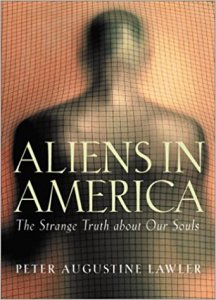
Peter Augustine Lawler tackles the thorny problem of the nature of the American Enterprise in his Aliens in America: The Strange Truth about our Souls.  In his work Lawler examines the various attempts to craft a secular paradise in America from Thomas Jefferson down to Richard Rorty and Francis Fukuyama.  Lawler agrees with many of the intellectuals he examines that America has essentially been about creating a republic of happy and secular individuals.  In this way he mostly sides with the liberal interpretation of America vs. the religious and conservative interpretation.  But he parts with them ultimately, stating that this dream, though seemingly close to realization at certain points in time, can never come to fruition.

Lawler published this originally just after 9/11.  We might think that he would point to the terrorist attacks as destroying the liberal dream.  True, he seems to argue, 9/11 did perhaps hasten the end of the most recent attempt at secular paradise, but it would have ended at some point in any case. To see this one need not exhaustively examine the thought of various thinkers over time (this indeed got old for me, as each thinker-guy in the book ran together in my brain).  Rather, it was when Lawler looks to two of the most perceptive critics of America in Tocqueville and Walker Percy, that his own ideas make sense.

Most know the basics of Alexis de Tocqueville’s monumental Democracy in America:

  • He came from an aristocratic background
  • He came to investigate democracy, seeing it as the wave of the future
  • He offered important criticisms of democratic practice, while giving it the nod in the end over the aristocratic past.

One could say a great deal about this work.  Lawler focuses on an oft-overlooked observation of Tocqueville’s about aristocracy.  Aristocracy has its flaws, but in giving people a definitive place and a definitive role they give people something to do.  Aristocratic societies come with “meaning included” in the packaging.  This goes not just for the elite.  Even Odysseus’ dog knew he had purpose.

Tocqueville praises the machinery of democracy for making everyone equal to all.  Everyone believes that this means they have worth as an individual, and they have reason for this belief.  This rational pursuit of self-interest then creates a nation of those who create peace by a kind of selfishness, just as markets create equilibrium via constant competition.  But even in the late 1830’s Tocqueville saw what we could not–that equality would actually create a large amorphous mass in which few of us would know where we stand.  We are told to be whatever we wish, but more than a few of us respond with, “And what might that be?”*

Rorty and others no doubt praise this possibility as exactly the meaning of America, one that should persist into time immemorial.

History gives witness to others of like mind and goal to Rorty.  Rorty rejected much of modernity and the Enlightenment, but he shared with Gibbon, Voltaire, Hume, and others of that time a belief that calm, rational self-interest could conquer the ills of “barbarism and religion”–a phrase used by Gibbon in describing the fall of Rome in his magnum opus, writing that, “I have described the triumph of barbarism and religion.”  For him, Rome had reached its zenith with the rule of the humane, tolerant, religiously skeptical and urbane Antonine Emperors (A.D. 96-180).

Like Edward Gibbon, historian Arnold Toynbee sought for universals amongst particulars in his multi-volume A Study of History, and so perhaps this helps explain why one particular quote of Gibbon’s fascinated Toynbee, as he uses the quote several times across his twelve volume work.   In 1781 Gibbon wrote that,

In War the European forces exercised themselves in temperate and indecisive contests.  The Balance of Power will continue to fluctuate, and the prosperity of our own or neighboring kingdoms may be alternately exalted or depressed; but these partial events cannot injure our general state of happiness, the system of arts, laws, and manners, which so advantageously distinguish, above the rest of Mankind, the Europeans and their colonists.

With the mild peace settlement after America’s victory in the Revolutionary War, Gibbon looked justified in his assumption.  It seemed that Europe’s house was swept clean of the various bothers of the religious wars.  It seemed that a paradise of calm rationality awaited them.

But 10 years after his utterance, the illusion disappeared utterly in France’s revolution (a nation that drunk deeply from the well of Enlightenment), engulfing Europe in 20 years of war that left perhaps three million dead.

Hugh Trevor-Roper writes in his History and Enlightenment about Gibbon that

. . . Gibbon gave a confident answer to the problems of his time.  Since progress depended on science, and since science and the useful arts were irreversible in a world of free competition and inquiry, and since Europe, unlike the Roman Empire, was a plural society where competition could not be stifled by a single, repressive, centralized figure, a reversion to barbarism was unthinkable.  Gibbon wrote that, “the essential engine of progress having been distributed over the globe, it can never be lost.  We may therefore acquiesce in the pleasing conclusion that every age of the world has increased, and still increases, the real happiness, knowledge, and virtue of the human race.”

I think Gibbon’s quote above fascinated Toynbee because in Gibbon he saw of man of great intellect, good intention, and broad vision completely miss a seismic shift in the history of his times.  Like Rorty and Fukuyama in the 1990’s, Gibbon thought that European civilization had truly arrived and that history had effectively ended for Europe in 1780.

Had Gibbon looked even at his own field of expertise he could have known his dream was doomed to fail.  Yes, the reign of the mild, intelligent, and reasonable Antonines helped Rome.  But the reaction against this was swift and brutal, beginning with Commodus and not really ending until 150 years later–a period that included decades of conflict between Rome’s generals.  The Antonines could not quite connect with the real heart of Rome, and could not feed their souls on mild urbanity.

Lawler asserts that Tocqueville felt his dilemma keenly.  Aristocracy relies on a kind of fiction and cannot stand up in argument to the exacting syllogisms of equality.  Aristocratic societies, like tradition, just “exist.”  Tocqueville had no arguments, but he saw the spiritual vacuum democracy could easily produce.  The logic of equality satisfies our minds, but inclusion into the great mass in the middle would do little for our hearts.  He feared what the absence of virtue would do to democratic societies.

Walker Percy’s novels touch on a similar theme as Tocqueville.  He came from an aristocratic southern family, and he saw that their time had come and gone.  Novels last The Last Gentlemen deal with the tension of knowing that the old way of living no longer works and not knowing how to replace it.  In time Percy’s characters grow weary of “democratic diversions” and begin seeking something else.  Percy knows that, while the southern aristocratic answer is better than nothing, it failed for the right reasons.**  The quest must continue, but in what direction?^

Today we seem to be at another point of whether we will reaffirm something of what it means to be an American in a traditional sense, or change it dramatically, or, as is more likely, do some of both.  We are discovering that the pragmatic, ‘rational,’ and soulless plurality of self-interest espoused by Gibbon, Rorty, and Marcus Aurelius has a definite shelf life.  Commodus “went native,” the French Revolution unraveled  centuries of tradition and killed thousands in the process, and today we have white nationalists and Antifa radicals.  Thankfully for the moment we’re not nearly in the same place as Rome and France found themselves (or for that matter, the situation of Germany in the 1930’s after the ‘devil-may-care’ Weimar era).

Whatever merits may have been in rejecting the various “gods” of our past, we should be careful in discarding them wholesale.

When an unclean spirit comes out of a man, it passes through arid places seeking rest and does not find it. Then it says, “I will return to the house I left.  On its arrival it finds the house vacant, swept clean, and  put in order.  Then it goes and brings with it seven other spirits more evil than itself, and they go in and dwell there; and the final plight of that man is worse than the first. So will it be with this wicked generation.” — Matthew 12:43-45

Dave

*Of course the mass of people must have someone to follow, and so we do have makers of taste and opinion.  Perhaps a cynic of democracy might agree that these people alone have true freedom.  But, an even greater cynic might point out that even these people quickly become subjects of mass opinion, and the people turn on them quickly when they fall out of line.

**I have read very little about the Civil Rights era, but Percy’s brief essay “Stoicism in the South” is the best analysis of why well meaning southern elites failed to bring about civil rights reform in the decades after the Civil War.

^My favorite novel of Percy’s is The Second Coming, a more profound (I think) sequel to The Last Gentlemen.  In a famous passage found here, the character of Will Barrett wrestles with two unacceptable options of dealing with reality (warning: language).  It is not quite the same as the aristocratic/democratic option, but hints at some of the same tension.

Myths and Realities

Carl Bridenbaugh’s Myths and Realities has a bold title.  One supposes that he will seek to reshape everything about the colonial south.  He doesn’t.  If we view the colonial south as a society of aristocratic-minded men with large social networks, with a mass of underclass and slaves lurking just beneath the surface–well, Bridenbaugh sees the same thing.

But the book shines an unusual and unexpected light on certain aspects of society that surprised me.  What he lacks in flash and dash Bridenbaugh makes up for in clear, concise prose.  Though he grew up in Philadelphia (and taught at Harvard), he writes with the nonchalance of our picture of a southern gentlemen.  It works.

Before I write more I should say that Bridenbaugh deals very little with slavery in this volume.  At certain times he acknowledges its obvious impact and the problems it caused.  Among a few other things, he briefly seeks to dismantle the myth of the contented rural slave.* Here he focuses, however, on those that shaped the overall culture, which means focusing on whites.  Those interested in a much more in-depth look at slavery, at least in Chesapeake society, may wish to go here.  Though Bridenbaugh focuses on a variety of issues, his thoughts on education and cultural formation interested me the most.

Myths are not lies per se, and ancient myths reveal many truths.  In part, myths serve as a kind of synthesis of accumulated data.  Myths might not reveal the whole complete truth but can illumine the important core truths.

I am not anti-myth, any more than I am anti-folklore.  Indeed, these are not things one can really be “against”–they just are.

But . . . while myths can reveal truths, at times they can also obscure them, at least partially.

In Classical-Christian education circles, the narrative (or “myth,” if you prefer) at times runs something like this:

  • America’s founding fathers were an assemblage of great men who gave us a remarkable political system that is the envy of many around the world.
  • The men would not have had the impact they did or been who they were without their educations, which in general were “classical” educations, involving the extensive reading of the classics.
  • Pre-Revolutionary America was largely a Christian society, and Christianity obviously shaped this education along with the classics.
  • Therefore . . . we should all receive this kind of education to help improve our selves and our country.

There are many truths in the above statements, but is it “True”?

Yes, many of our founders were remarkable and interesting men.  Many of them had classical educations.  But they represented a very small sliver of the population and we should wonder whether or not their experience can be transferred to the broader public. Bridenbaugh shows that

  • Formative elite culture and education had little to do with literacy and
  • Little to do with religion, or at least the church

Those that eventually revolted against the British (below the Mason-Dixon line at least) do not quite fit the assumed narrative some have about our past education.  But if the vast bulk of the populace lacked a classical education, what kind of education did they have?

Most settlers might have been literate, but they likely did very little reading.  A few notables had impressive libraries, like Thomas Jefferson, James Madison, and a few others.  Most other families had a Bible, The Pilgrim’s Progress, practical farming manuals, and little else.  They had nothing against book-learning per se.  Part of the reason surely was that books cost a great deal.

But there were other reasons.  Frankly, we hear no great laments about the lack of books in colonial America.  Those that did write books wrote for a small coterie that would have little application beyond their communities.  The lack of books meant they found their education elsewhere, and it seems they liked it that way.

All this made me think about the nature of education, but please consider the following thoughts speculative . . .

Residents in both the mid-atlantic and southern colonies loved visiting, events, and conversation.  Bridenbaugh states that they were all, “Eminently endowed with the art of talking.”  Dancing had great importance for youngsters, but not just because dancing allowed one to demonstrate aristocratic status. Such an interpretation gives far too much credit to Marx. They genuinely believed that learning the social graces and physical movements improved character.  We might suppose that this characater formation had strictly moral applications.  But again, this society had a political consciousness high enough to revolt from the British.  So either we assume that

  • The education of even the upper classes had no real historical content.  Then, this means that the American Revolution was not really a popular revolt, but one led primarily by the top crust of societal elites, something akin to Rome’s republican rebellion against their kings, or
  • Such an education (in visiting, talking, dancing, etc.) really did give one a distinct set of values that had public and political content.

We should not dismiss the first option out of hand (though the American Revolution, like most any revolution, was too messy to categorize absolutely in any direction).  George Washington, for example, had  a great fondness for Addison’s play about Cato the Younger, one of the pre-eminent plays of the Enlightenment.  Our Constitution very obviosuly borrows from the structures and ethos of the Roman Republic.  The Roman aristocracy led the rebellion and formed a government that favored their class.  And, we might note that the colonial rebellion started amongst the more egalitarian (and probably more literate) New England colonies.

But I do think the second option more likely.  This means we might have to change our view of what consititutes a good education, and helps us get beyond our current model, so heavily influenced by the Industrial Revolution.  Bridenbaugh writes that this upbringing did produce “a responsible aristocracy, though not a cultured one.”  And of course, one can get “historical content” in many ways apart from books.

The western emphasis on literacy predates the Reformation.  The Reformation on the whole certainly stressed it, but they inherited this from the Catholic church.  The Church preserved the ancient manuscripts.  Up until quite recently, one had to go to the Church to receive an education.

This might lead us to further speculation . . . if the education in the mid-atlantic and southern regions lacked a strong literate foundation, what might have been the state of the church?  Indeed, Bridenbaugh cites a variety of examples showing the rather deplorable state of the dominant Anglican church in the south.  Among other things, churches could not lead colonial culture because they failed to transcend it.  The majority of churches seemed to provide little in the way of spiritual guidance, training, or education.

This in turn leads us to question the role of the Church in the American Revolution.  To what extent did it have either a firm Christian foundation, or merely a polite Christian veneer that covered an Enlightenment foundation?

As I mentioned earlier, consider this mostly speculative.  But I credit Bridenbaugh with gently encouraging such thoughts.

Dave


*Population figures seem to indicate that in rural areas blacks outnumbered whites, who feared rebellion constantly, which does not support the ‘contented’ myth.


Enlightenment Liberty and its Children

The website Aeon recently posted a solid article from historian Josiah Ober.  In the article Ober makes the point that democracy and liberal government — that is, rule of law, free speech, protection of minority rights, etc. — do not always go hand in hand.  Indeed, we have seen many good marriages between the two concepts over time.  But at times democracy has not produced liberal government, and historical examples exist of other forms of government ruling in a liberal way.

Ober states that liberal ideas that limited the power of government and enthroned the autonomy of the individual came from the Enlightenment, ca. 1650-1750.  I have no qualms with this, and I applaud Ober pointing out the tension that sometimes exists between democracy and liberalism.  But we should pause for a moment to consider the implications for the minority protections the Enlightenment sought to enthrone.

I’ll start by saying that rule of law brings a huge amount of good to a society.  But a quick scan of the heritage of the Enlightenment will confuse us.  For as we saw the rise of political and individual liberty enshrined in democratic regimes we also see a rise in slavery — at least in America.*  Surely many reasons exist for the rise of slavery ca. 1700-1860 — too many for me to explore or fully understand.  But we cannot deny the confluence of political liberalism and oppression of the natives and African Americans.  Does a link exist between freedom and slavery?

We often hear arguments such as, “Of course pornography is bad for society.  But the remedy for the evil (i.e., making it illegal) would be worse than the disease.”  We hear these kinds of statements all the time, they roll off the tongue without thinking.  But not long ago people used similar arguments to justify slavery.  “Yes slavery is bad, but in order to have freedom we cannot give government the power to curtail it.”  I don’t want to over-spiritualize the issue, but the fact remains that pornography enslaves the passions and the basic humanity of hundreds of thousands and perhaps millions of men and women.  The abortion issue has similar rhetoric. I had a college professor argue that, “Yes, abortion is a terrible thing, but what you pro-life people don’t understand is that without abortion, women would not have the rights and opportunities they have today.”  All over the Enlightenment view of individual autonomy we see this ghastly trade-off between “liberty” and death — be it physical or spiritual — again and again.  We may have to entertain the notion that slavery often comes on the coattails of this kind of freedom.

In our history, at certain times at least, we definitely lacked the will to restrain ourselves.  Historian Pauline Maier notes that at the Constitutional Convention George Mason wanted to include a provision to have all trade laws pass by a super majority.  He foresaw that northern commercial interests, combined with its more numerous population, would alienate southern agricultural interests. In exchange, he willingly hoped to grant Congress the power to abolish slavery.  He lost on this issue, according to him, because Georgia and South Carolina would not agree.  In exchange for precluding even the possibility of the banning of slavery until 1808, trade laws would pass with simple majorities.

Sure enough, in 1860 such states complained of laws that favored northern manufacturing interests as one motive for secession (the issue also came up in the Nullification Crisis during Jackson’s presidency).  Of course, they complained as well about Republican plans with regards to slavery.

In a recent interview the Archimandrite Tikhon said that,

Today . . . we talk not of the possible limitations of the freedom of speech, but of the real everyday criminal abuses of this freedom. Who are those that shout of the threat of ‘limitations’ most of all? Those, who have monopolized information and turned the media into real weapons, which are meant not only for manipulating the public conscience, but also aiming at ruining personality and society.   . . . Of course, I’m for limiting speech that ruins freedom, as well for limitation of drugs and alcohol, for limitation of abortions – and everything which causes loss of health, degradation and ruin of nation. And the opportunity to watch vileness on TV, the right to be duped, the ability to develop a brutal cruelty and the lowest instincts in oneself – this is not freedom. Plainly, it is an absolute slavery.

In spite of any prohibitions man will have the right and possibility to choose evil anyway, nobody will take away this right, don’t worry. But the state must protect its citizens from aggressive foisting this evil upon them.

The man interviewing him got quite nervous at such a response, as would many in the United States today.  Who should make the decisions, and to what degree, remains a very thorny question.  One might even successfully argue that no good method of making that decision exists today, at least in America. But the fact that, at least in theory, we should certainly limit liberty in certain respects, appears obvious.  To say otherwise is to bring pure selfishness and greed into the fabric of our lives  Many would say that this has already happened.

Once we realize this we must re-evaluate the whole heritage of the Enlightenment view of liberty and the individual.  The rule of law seems a nearly unqualified good.  But I don’t think it need go hand-in-glove with a view of liberty that inevitably leads to slavery in some form.  Law after all, by its very nature, asks us to give up some form of liberty for the good of others.

Aristotle’s Politics adds another perspective.  He discusses the concept of proportionality in the state and teases out how imbalances even of virtues can cause harm.  The concept of “the golden mean” drips throughout his writings.  When even certain particular virtues assume too much of a place in the life of the state, it will cause harm.  In this situation, the inevitable counter-reaction will cause harm, because it too will lack balance and proportion.  One might posit that the whole “snowflake,” “safe space,” and trigger-warning phenomena present on some college campuses is just such a misshapen and destructive reaction to the abuse of freedom.

Tocqueville made the boring but true statement that, “Liberty cannot be established without morality, nor morality without faith.”  Aristotle would add that such liberty must exist in proportion to other necessary virtues of the state.

Dave

*I know that of course slavery existed before the Enlightenment.  But slavery had generally disappeared during the Middle Ages, and revived again only during the Renaissance, when certain Roman concepts of law, property, and a classical idea of liberty made its way back into the stream of European civilization.  The Enlightenment built off this Renaissance heritage in many respects, and so it is no surprise that its heirs practiced a revival of slavery — something worse even than Roman slavery.

12th Grade: Aristotle and the Modern Political Landscape

Greetings,

This week we examined the philosophy of Aristotle, specifically his theory of truth and how it related to his ideas about government.

Creation

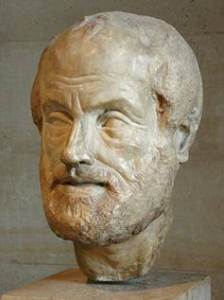
Aristotle saw the created order not as a negative (like Plato), but as a friend or guide to truth.  Truth Aristotleresided here among us, not “up there” among the gods.  For Aristotle, God/the gods may or may not exist, but whether they did or not they had nothing to teach us.  As far as Zeus and Apollo are concerned, the power and immortality of the Greek gods make it so they never pay for any of their decisions.  They stand immune from consequences, and hence, immune to gathering wisdom.  If God existed, Aristotle thought he stood too far removed from human life to be of much use to us.  We experience truth in the created order, not by looking beyond the stars.*

This does not make Aristotle a moral relativist, at least in the meaning that we normally give the word.  However much truth depended on context, what worked could be said to be fundamentally true.  If someone, for example, argued that his heroin addiction benefitted him, because it, “transfers me to a different spiritual plane,” where, “I see myself and the world in radically new way,” Aristotle would respond by saying:

  • You cannot be a heroin addict and function in creation
  • Who you are cannot be separated from your physical body.  Thus, you will not learn anything about yourself by seeking to destroy yourself.

Aristotle did not deny that mankind had a soul, but he thought that the physical and spiritual aspects of who we are cannot be separated, which made his view of creation and the body much more Christian than Plato’s.

balloon-glassI like to think of Aristotle’s view of truth like one of those air-blown figurines.  Some things always remain constants, i.e. human nature and creation.  But, the application of those constants might change depending on the circumstances.  The figure may flap around but always remain rooted to the ground.  A law, for example, can only be considered a good law if it will actually work in the applied context.

Aristotle had a profound influence on the philosophy and theology of St. Thomas Aquinas, who gives a striking example of this principle.  Suppose you were made king of a country that thought murder was a good thing, and had practiced murder for centuries prior to your arrival.  One might think that your first order of business would be to make murder illegal.  Indeed, murder is obviously wrong, but Aristotle would argue that such an action would be foolish, and would not help make your people more virtuous.  Why?

  • The people would not obey this law, and would find it ridiculous.  This would lead to them flaunting the law, adding to their sin.
  • The people would also lose respect for you as king, and refuse to follow your authority.

If you wanted to make the people more virtuous, they must have respect for law in order to change.  This change will come about slowly.  People, like battleships, can’t be turned so quickly.  We discussed in class how Aristotle would face such a situation, and got some interesting responses from the students.  Maybe start, some suggested, by arming everyone to make murder more risky.  Or maybe make a law restricting murder to certain days.  In any event, virtue comes by the practice of it, not from a mere intellectual recognition of what virtue might be.  Abstracting a law from its context is not the way to judge it.  Rather, a law can only be judged properly when we see its application, its result.

Plato spilled a lot of ink thinking about how to form a government without making it too much of a government in the standard sense.  Plato sought for a society knitted together not by law but a community of harmonious souls.  Aristotle seems to have not given such a prospect much thought, as it probably seemed to him pointlessly unrealistic.  He had no doubt that the best form of government would be the absolute rule of one good man.  But just as easily, the rule of one bad individual would create a disaster.  The rule of a ‘few good men’ via an oligarchy of birth can minimize the possibility of autocracy and provide the state with wisdom.  But this oligarchy can easily degenerate into rule by an elitist and wealthy cabal.  Democracy provides more stability, but less brilliance.  It has the advantage of building on the broadest foundation, but can descend into mob rule.  The government that might work best for a given area would depend on what they valued most, and what their current political context might be.

The differences between Plato and Aristotle are not merely academic.  Few of us might always agree with either one, but our leanings to one side or the other will influence our decisions.  Generally those on either the far left or right might have more in common with Plato.  The goal is to move people to the absolute standard of the founders vision (Tea Party?), or create a better society on Earth regardless of the messy context of law and custom (Liberal Progressives?).  Centrists and moderates tend to be more comfortable with moving slowly, tweaking things with the times around the edges, and being ‘realistic.’

We can relate this idea to our views about democracy.  Supposing that one believes that democracy is the best form of government (and that is a big ‘suppose’). Should the U.S. attempt to spread democracy abroad?  Of course this involves some speculation, but we might consider that. . .

Plato

Plato would answer ‘yes,’ if he believed that democracy was the ideal form of government (he did not in actuality). Though not all have an immediate cultural context for democracy, he would argue that democracy appeals to all humanity on a ‘spiritual’ level.  Just as most of us can guess that that Caribbean vacation would be nice even if we’ve only experienced a cold and crowded New Jersey beach, so too things like equality, control of your destiny, participation, and rights, have an immediate gut level connection with us.  We should spread it because it would take root in people’s hearts, even if it might take a bit longer in some places than others to come to fruition.

Aristotle

Likely Aristotle would answer ‘no,’ or at least ‘no’ most of the time.  He would have wanted to see certain key structures in place before even considering spreading democracy, like a strong middle class, an educated populace, a stable economy, and a general trust across class, race, and religion.  Without these things democracy would have no place to take root, like a bird trying to make a nest in the air.

If I had to make a personal wild guess, Aristotle might think that democracy in Iraq has about 33-50% chance of succeeding.  In Afghanistan, with its mountainous terrain, strong tribal affinities, little education, and divided population, I’m guessing his estimation of success would be much lower.

Plato would counter that since true knowledge is ‘remembering,’ the truth is bound to take root once they have a chance to truly experience democracy.  Democracy would not be a narrowly western system in this view, but truly universal, applicable regardless of context.  Again, this is mostly speculation, but hopefully profitable nonetheless.

Many thanks,

Dave Mathwin

*The Incarnation provides the bridge between Aristotle and Plato’s ideas.  It fits within neither one of their philosophies, but their systems stand in sore need of a proper unity between the eternal and the temporal.

A New, Old, View of Civilizations

Generations of history textbooks have assumed two things about the history of civilizations:

  • Human civilization is a relatively new phenomena, originating in the Fertile Crescent sometime around 3500 B.C.
  • Human civilization developed largely because of an increase in technical skill which allowed for plowing, increase of production, storage, etc.

I have never liked the second assumption.  It seems so easy for us to make it, for it reflects our bias perfectly.  Toynbee wrote of the predilections of western civilization,

The Hellenic civilization displays a manifest tendency towards a predominantly aesthetic rubric for orienting and defining itself.   The Hellenic tendency to view life as a whole distinctively in such terms that the ancient Greek adjective “kalos,” which denotes what is aesthetically beautiful, is used in addition to describe what is morally good.  In other words, Greek concepts of beauty and morality . . . were indistinguishable.

When we come to our own western civilization we find no difficulty discovering our own bent or bias.  It is, of course, a penchant towards machinery: a concentration of interest and effort upon applying discoveries of Natural Science to material purposes through the creation of social-clockwork devices, i.e. steam engines, motor cars, but also social engines like representative governments and military mobilizations.

We sometimes talk as if this appetite for mechanics was a quite recent occurrence in western civilization  . . . But this is precisely how westerners were viewed by the courts in Japan and China [in the early 1800’s]–as “barbarians” redeemed partially by our manifest and outsized technical ability.   The Byzantine princess Anna Comnena had the same impression of the first crusaders in 1099 A.D.  She called  their  crossbow a “devilish construction” that, while ingenious in its mechanics, fitted perfectly the barbarians who wielded it . . .

Though I find James Burke’s Connections series entertaining, he too makes the same assumptions about the development of civilization.  What brings people together for Burke is tools, food, and political organization.  Our “appetite for mechanics” has us assume that others had the same appetite.

Recent finds at the enigmatic site of Gobekli Tepe look to possibly overthrow both of the common assumptions.

Essentially, the site contains precision stone work thousands of years before the Egyptians supposedly invented working with stone.  Not only that, we have no evidence of any habitations near the site-it appears to be the only structure at all in the vicinity.  Add to this, the site appears to have no “practical” purpose to it.  Most think it served as a place of worship.  A recent article reads,

 . . . these new findings suggest a novel theory of civilization. Scholars have long believed that only after people learned to farm and live in settled communities did they have the time, organization and resources to construct temples and support complicated social structures. But Schmidt argues it was the other way around: the extensive, coordinated effort to build the monoliths literally laid the groundwork for the development of complex societies.

Any student of ancient history will almost immediately realize that the ancients did not share our passion for mechanics, and surmise that the origins of civilization lies elsewhere.  But common sense will suffice for anyone lacking such rudimentary knowledge.  Common love of something draws people together and creates relationships.  Common needs may bring people together temporarily.  Common loves will sustain and likely originate such relationships.  We all experience this. We are what we worship.*

Others suggest that the Gobeckli-Tepe site dates just after what appears to be a cataclysmic flood–perhaps caused by large meteors striking the polar ice-caps.  Those that built Gobeckli-Tepe may have been, in fact, transferring technology from a previous, post-flood civilization.  It is striking that the first thing they do, then, is to build a religious temple.

I should stress that these remain theories, but I find them an exciting indication of a reworking of our theories of the past.

Gobekli Tepe may rouse the historical/archaeological community to rethink their views of the past, and I welcome this.  But we should realize that such a shift would not lead to a discovery of something new about mankind, but something as old as the world itself.

Dave

*This helps explain why most moderns judge those like Charlemagne so harshly.  How can he insist on a common faith of those he governs?  Not only does it fly against our sense of individual rights, it seems so unnecessary.  Didn’t Charlemagne know that starting in the late 18th century we decided that a shared use of certain technological tools creates stable societies, and not religion?

We may scoff at those who fight over religious belief.  But western powers have fought over natural resources that will allow us to create more technological tools, or more powerful tools, and so on.  Maybe ‘technological advancement’ functions like a religion for much of the modern west.

Maybe all wars can be boiled down to religious belief.


8th Grade: Civilization is Dinner with Friends

Greetings,

This week we wrapped up our introductory unit on civilizations in general and moved into more specific civilizations, beginning with Egypt.

Earlier this week I wanted the students to consider exactly what purpose civilizations serve.

In 1 Corinthians Paul seeks to address the pride and competitiveness of the Corinthian congregation.  He uses the analogy of the “Body of Christ” to show that no one can be a one-man show.  Whether we be arms or eyes, we need each other to function.  “No man is an island,” as the saying goes.

This same analogy applies to civilizations in general.  We cannot do all that we need to do to survive, or at least, thrive.  Since we cannot do all ourselves, we need the gifts and talents of others to help make our lives consist of something beyond mere survival.  Civilizations therefore exist to make communal life, and communal creation, possible.  When we realize this, many other things come into proper focus.   As C.S. Lewis once remarked, civilization boils down to dinner with friends or a game of darts at a pub.  The power that civilizations can muster, the roads, the armies, the buildings, really serve this end. It’s easy for us to forget this, and it’s easy for civilizations themselves to do the same.

This means that civilizations, in my opinion, should ultimately be about the maintenance of small communities, and not the amorphous group.  But the awesome power generated by the social connectivity of civilizations opens them up to tremendous temptations. Civilizations can drift, and start to think that the social order itself as the “Ultimate.”  Civilizations can think that they exist to serve their own ends and perpetuate itself. With this attitude civilizations become our master and not our servant.  This leads into a subtle idolatry, man worship, not of the individual, but of the group.  When a civilization loses sight of things beyond themselves and the everyday, they lose vision, and hope for the future.  It is the first step toward decline.

This is not to say that civilizations are not good things.  The alternative is barbarism, a sub-human existence. But civilizations are tricky things.  One only has to think about our homes to realize this.  We make a great effort to sweep and clean, and the house looks great.  Then someone leaves a coat here, and shoes there.  The dishes pile up, and our wills and energy reserves slacken.  Given the human tendency towards decay, destruction, and death, the relative success of civilizations is a gift of God. It goes against our human tendencies.

As we moved into Sumeria, we looked at Sargon the Great, probably the first empire builder.  This brought up the issue of the benefits of size.  Empires/large countries often do have more power and resources and their disposal. Their size can also lead to diversity, which can cushion them from specific problems in certain areas.   For example, If Louisiana was a civilization unto itself, Hurricane Katrina would have destroyed it, or at least dramatically weakened it for decades. Because they are but a small part of whole, however, it can be rebuilt.

But smaller countries have less to manage, less to defend, and less to worry about in general.  I often wonder, “Wouldn’t it be nice if we were Belgium?  What does Belgium have to worry about?”  Riches and power alone can never bring happiness.  Also, might there be a correlation between the size of the population and the liberty that population can enjoy?  Most classical theorists of government, like Aristotle for example, believed that democracy could only exist in small self contained communities.  When a babysitter watches just 1-2 children, those children have a large degree of freedom as to what they do.  When a sitter has to watch 15 children, all the children must stay together and do the same thing in the same place.  So too, a general truth of history is that large countries with large populations tend to offer less individual freedom than smaller ones (this rule has exceptions).  Which model is superior, and why have most civilizations chosen to pursue expansion and empire?  These are some of the questions I want the students to consider.

On Friday we had our first mini class discussion, where half the class tackled the topic of ancient cave paintings like these below . . .

These drawing predate what most historians and archaeologists would consider the dawn of “civilization” by thousands and thousands of years.  I wanted them to consider whether or not those that produced these works came from a society that could be called civilization.  Students presented good arguments on both sides of the issue.  I think that the drawings (especially, in my opinion, those from Chauvet cave, which includes the 2nd picture of the bears above) have remarkable communicative power.  This power can only come from great skill, and for them to develop this skill, civilization most likely existed.  Of course we can’t know for sure, but it’s fun to speculate.

If you have further interest in the cave paintings, Werner Herzog made an excellent film about them that is worth seeing called Cave of Forgotten Dreams.

Have a great weekend,

Dave

12th Grade: The Peace Democracies Pursue

Greetings to all,

Welcome!  I hope the year will be a blessed one for you and your family.  Senior year can be at turns stressful and special all at once.  My prayer is that you will look back on the vista of your achievement have reason for thankful hearts come June.

As I mentioned in orientation, this class discusses the idea and practice of democracy.  This means we will look at different events and thinkers across time and space.  It means also that we need to hit the “reset” button and re-examine our beliefs with the aid of the great philosophers and events from the past.

We began the year rethinking our approach to civilizations in general, just as we did way back in 8th grade.  We discussed what a civilization is and is not, and how democracies fit within that framework. But I also wanted to consider whether or not we should view civilization as good thing in itself, or if civilization is in fact the core problem of our existence.  Here we have two basic approaches:

  • Civilization is good because it provides a framework for fruitful human interaction.  Civilization as we know it would have existed even without the Fall — note that there was “law” in the Garden.
  • Civilization may have some redeeming characteristics, but overall it is the symbol of the “City of Man” and serves to concentrate the human impulse to exploit one another.  Note how in Genesis 4 the arts of civilization get developed by Cain’s lineage.

You can read more about this theory in the post reviewing I Saw Satan Fall like Lightning.

We also discussed what the concept of democracies mean.  We might understand that democracies, like dogs, can take different forms.  But what is it about democracies that we would intrinsically recognize across different forms?  What is the central core of democracies?  How do we recognize that boxers, poodles, and labradors are all dogs?

We can start out our thinking on this question by considering what the “natural core community” is of a particular form of government.  In monarchies the family serves as this core.  The king comes from a “royal family.”  The successor to the king is the king’s oldest son, and so on.  In oligarchies one could argue that the clan, or an extended group of families, forms the central core.  When one builds from a proper foundation, good results can follow, but if not, we can expect significant problems.  For example, imagine a literature teacher who thought that “it’s all about the kids.”  With this approach, the teacher would not care whether or not they read Homer, Shakespeare, or the latest teen romance so long as “the kids were engaged.”  In fact, in literature class it should be “all about the literature,” and the students’ engagement with it.  Without this foundation, no “literature class” would exist.

What about democracies?

Truthfully, they have no central building block.  Democracies build on the foundation of “all men are created equal.”  Each individual is a core unto himself.  The giant mass of people (“We the people of the United States . . .”) also could be the core, for democracies at least in theory do not discriminate. Not only do democracies have no ethnic divisions or class divisions, they also have no geographical boundaries.  Democracies preach human rights, not English rights, or German rights.  The spirit of democracies roves to and fro, in contrast to the more tradition oriented forms of government.

This reality gives democracies enormous potential dynamism.  It is no coincidence that democratic peoples both now and in history have been the most powerful countries in existence when they thrive.  They build invincible citizen armies, and can even produce superior culture (think of Periclean Athens, or the law of Rome’s Republic, or Whitman and Twain, etc.)

But this floating and amorphous core gives rise to potentially massive and dangerous contradictions when individuals don’t receive equal treatment.  Our own civil war comes easily to mind, or the tumultuous 1960’s which had its roots in the unequal treatment of blacks.  Today we see the same logic used surrounding the marriage issue for homosexuals.  Christians have solid Scriptural and historical reasons for opposing it, but do democracies?  If the majority of people approve or disapprove of something, should that be enough to make it so?  As one student last year noted, democracies find their reference point in the here and now.

These potential stress points also inform a democracy’s foreign policy.  We see that in regards to Syria. When flagrant human rights abuses take place and the world knows about it, the boundary-less, human-conscious democracies must take notice (I realize that there is some dispute as to exactly what is happening in Syria).  Of course, we should realize that democracies will process information differently than other forms of government.  The internet age fits very well with the international field of vision democracies can’t help but fall into.

I assigned the students a small portion of Augustine’s magisterial The City of God which we will discuss on Wednesday.  Augustine discusses how each person ultimately seeks eternal peace with God.  On earth, we seek shadows of this peace in various ways.  He wisely points out that even we make war to bring about a peace more suitable to us.  By the nature of our creation in God’s world we naturally seek harmony with our surroundings, though often in false ways.  I want the students to consider what kinds of political and social equilibrium democracies pursue, and what the consequences for that will be.

Many thanks,

Dave

Lawyers, Guns, and Money

In his excellent work on the French Revolution, Citizens, Simon Schama makes many connections between the path of revolution and Romantic philosophy.  They came to associate monarchy with secrecy–secret plans, secret councils, and the like.  Romanticism preached openness to all things, to nature, to oneself, and so on.  Real, authentic, people had nothing to hide.   It made sense then, that real, authentic government had nothing to hide either.

The French paranoia over secrecy, Schama argues, drove much of the violence in the Revolution.  Even simple misunderstandings could be evidence of “plots,” for no true Frenchman would have anything to hide.  For example, Robespierre’s lieutenant Armand St. Just wrote some unpublished ideas for laws that would have taken his ideas of an open society to an absurd degree.  He urged that,

Every man twenty-one years of age shall publicly state in the temples who are his friends. This declaration shall be renewed each year during the month Ventose. If a man deserts his friend, he is bound to explain his motives before the people in the temples; if he refuses, he shall be banished. Friends shall not put their contracts into writing, nor shall they oppose one another at law. If a man commits a crime, his friends shall be banished. Friends shall dig the grave of a deceased friend and prepare for the obsequies, and with the children of the deceased they shall scatter flowers on the grave. He who says that he does not believe in friendship, or who has no friends, shall be banned of ingratitude shall be banished.

But all this wide-eyed optimism did not prevent the Revolution from eventually being run by the Committee of Public Safety, which met in secret.  It did not prevent informers roaming about looking for counter-revolutionaries.

With the best of intentions comes a tremendous and inevitable tension.  We expect monarchies to have secrets.  Monarchs, by definition, are not quite like normal people anyway.  They decide things apart from the people.  Democracies have different standards, which sometimes makes for more difficult choices and an unsolvable tension.

Tim Weiner’s Legacy of Ashes: The History of the CIA is in some respects a marvelous book.  He writes well and so the pages turn easily.   Weiner’s pours gobs of research into his account.  He has more than 100 pages of footnotes.  Many of his citations come not from other books about the CIA, but from the agents themselves and especially from the CIA’s own de-classified documents.  Weiner works for the NY Times in his day-job reporting on national security issues, so he knows the territory for this book quite well.

Unfortunately for me Weiner rarely delves into analysis and synthesis of his material.  Maybe he wants a “just the facts” reporters perspective.  That’s his strength, and if he added analysis the book might get unwieldy in size.  Fair enough, but in the end the failure to plumb the depths of certain questions make this book incomplete in my eyes.

Weiter hammers away at the CIA, citing failure after failure, blown operation after blown operation.  Their charter called for them to provide political leadership with crucial information that could inform decisions but they whiffed on almost every major crisis.  Their most significant “successes,” such as organizing regime change in Iran in the 1950’s, backfired terribly a generation later.  We had very little success recruiting agents within the Soviet Union and often relied on the intel of our allies.  Internal reviews often pointed out the CIA’s shortcomings, but these reports almost always got buried and nothing changed.

Supposing that Weiner’s basic appraisal is true (which is up for debate), I would have liked more from Weiner on why the CIA failed as it did, but he offers only hints.

Time might have something to do with it.  We are still a young country, with a very young intelligence service.  The British, the Russians, and so on have all done  this for much longer than us and would likely do a better job than us for that reason alone.

I wondered if the level of internal criticism from their own reviews is at least a partial function of personality.  Many intelligence analysts might tend toward pessimism and obsession over detail.  Maybe they would naturally be too hard on themselves.  I stress the word “maybe.”  I glanced through Victor Cherkashin’s Spy Handler: Memoir of  a KGB Officer for a different look and he confirmed some of what Weiner wrote, especially regarding our very poor handling of some of our agents behind the curtain.  Cherkashin handled and helped recruit both Aldrich Ames and Robert Hanssen.  He confirms some of what Weiner wrote about the Ames disaster (Hanssen was from the FBI). But he also mentioned some worthy adversaries and tough problems posed by the CIA for the KGB.  His perspective gives the CIA more credit than Weiner.

In one brief aside Weiner mentions that while, yes, the CIA proved almost inept at gathering intelligence, they did an excellent job of using money to buy influence, and they created some really cool gadgets that would be the envy of the international intelligence community.   I am reminded of John le Carre’s quote that one sees the character of a country most particularly in its intelligence service.*  The shoe definitely fits in this case.  We specialize in gadgets and money.

But that doesn’t mean an intelligence failure per se, it could mean a different kind of success.  For example, Weiner seems critical of the development of the U-2 spy plane.  We would not have needed to develop such a plane if we had better human intelligence on the ground.  Eisenhower worried that the plane might get shot down, and so on. True, but the plane gathered important information, some better, some worse, than an agent on the ground would have obtained.  When Gary Powers was shot down it did cause problems, but having an agent captured would also cause problems, albeit of a different type.  We made the U-2 because of our lack of human intelligence, but that doesn’t mean to me that the U-2 symbolizes failure, or is in itself a failure.

A review of Legacy of Ashes by the CIA’s historian, who makes this same point (among many other criticisms), is here.

But it’s in another aside that Weiner gets at the real root issue.  Democracies, he mentions, simply aren’t very good at secrecy, and we’re not good at it mainly because it goes against all of our democratic instincts.  Like the French Romantics, concealment means that we must be up to no good.  And if we commit ourselves to democracy then we need an informed public.  How an informed public, let alone informed public officials, and a clandestine agency should mix we have yet to figure out.  Weiner offers no solutions.  I can’t blame him, as I have none myself.  I do wish, however, that he paid some mind to this tension present in every democracy.

Part of our desire for openness gives the press more freedom in the U.S. than anywhere else.  We have no equivalent, for example, to England’s Official Secrets Act, which allows the British government to shut down almost any story they deem a threat to national security.  The U.S. cannot do this thanks to the first amendment.  Of course sometimes the government lies and the press exposes it.  But sometimes the press gets it wrong and messes up the government.  Weiner cites one such instance during Ford’s presidency.  Ford had orchestrated a dual arms deal to both Egypt and Israel via CIA backchannels.  He wanted to avoid seeming too pro-Israeli, but didn’t want Israel to know about the sales to Egypt.  However we judge it, he had the intention of setting up the U.S. as an international broker between the two countries.  But the press caught wind of the arms sale to Israel and published stories on it, but they had no information on Egypt.  Ford couldn’t say, “Well we sold stuff to Egypt too–we’re trying our best!” for that would expose the operation.

Of course as a reporter Weiner benefits from this access and freedom.  I wish he would have explored this tension. I’m not suggesting that it’s too bad that we have the first amendment, but it’s not an unqualified good. Among other things, it makes life harder for our intelligence services.  Weiner fails to take this into account in his evaluation.

In his Revisionist History podcast renowned author Malcolm Gladwell takes a second look at stories that he feels got neglected by the flow of time.  In his “Damascus Road” episode he looks at an instance involving the press and a CIA asset.  A man named Carlos the Jackal was everybody’s most wanted list.  No one could come close to catching him.  Out of the blue a man volunteered his help to the CIA.  He wanted no money, rather, he sought to try and make amends for the terrorist activities of his past, some of which had killed Americans.  He gave us information that allowed for his capture.

Under the Clinton administration the Justice Department ordered an “asset scrub” as part of the overhaul of the CIA.  How to draw a line between who stays and who goes?  It seemed simple enough to say that anyone who had previously killed Americans needed let go as an asset.

The CIA complied for the most part, but this particular asset was simply too valuable.  He remained on the books.

Eventually, however, a reporter found out about this non-compliance from a variety of sources.  He wrote the story but met with a CIA agent before publishing it.  The CIA representative got the reporter to remove some the crucial details, but not all.  He pleaded with the reporter . . . the details he left in would expose this asset and seal his fate.  The story was published, and the asset was killed shortly thereafter.

You probably guessed that the reporter in question was Tim Weiner.

Weiner argued that if anyone should be blamed for the man’s death, it was the CIA.  They broke the law (a dumb law, but the law nonetheless) and his job as a reporter is to at times expose the misdeeds of government.  He had credible sources within the CIA itself for the story.  He might further argue that he had no reason to fundamentally trust the CIA with its claims, so often did they mislead and misdirect.

I can’t see it that way.  Had Weiner not published the article, or even watered it down more, our asset would not have been exposed.  He played a role in his death.  When asked how those at the NY Times reacted to this turn of events, he said that for the most part it was business as usual.  You move on to the next story.

That argument aside, I find it ironic that Weiner should so stringently criticize the CIA for not developing foreign assets when he himself had a direct hand in exposing one of their best.

Moving on to a different argument . . . I say that “Lawyers, Guns, and Money” is far and away Warren Zevon’s best song.  The song’s unreliable narrator makes this one so enjoyable and so funny.  Those familiar with the lyrics know that the protagonist always goes home with a waitress, and surprise, it doesn’t always work out.  He goes “gambling in Havanna” and–shockingly–finds himself in hot water, then calls upon dear old dad (not for the first time, it seems) to bail him out.  Yet, he remains “an innocent bystander,” who “somehow got stuck.”

Ok, the connection to all I’ve written here is weak.  Mainly, I thought the song made a great title for this post.  It’s a book about the CIA, after all.  I do not suggest that Weiner resembles Zevon’s most famous character.  But Weiner criticizes the CIA constantly throughout his work for losing track of ends and means, for never looking squarely in the mirror, for dissimulation and failure.  However true, Weiner suffers from something similar.  Legacy of Ashes paints with too narrow a brush.

Weiner’s characters almost all suffer from myopia.  Weiner might suffer from it as well.  There is no particular shame in this.  It is a human problem, and not the sole property of spies.

Dave

*Le Carre is a perfect example of the principle I speculate about in the above paragraph.  He is the former spy for the west who now is enormously critical of spying.  His cold war novels expressed an ambivalence about the two major sides, while his post-cold war work exclusively criticizes the West in general, and the U.S. in particular.  People naturally assume that this makes his portrayals more realistic, but I’m confident that’s not necessarily so.


Tolkien the Anarchist

It is easy to confuse anarchism with nihilism.

The nihilist cares for nothing but destruction itself.  He derives strength ironically (and illogically) from the “meaning” of no meaning at all.  Owlman makes this perfectly clear, giving perhaps the clearest nihilistic statement in modern times.

The anarchist has a different approach.  His desire to destroy comes with reasonably good motives and a limited scope.  He really seeks not to destroy and create  better way of life.  One senses this in the music of Rage Against the Machine.  They have passion and plenty of excessive, destructive anger, but they plead for something real.  G.K. Chesteron’s brilliant The Man Who was Thursday touches on this as well, with the character of Sunday (slight spoiler alert) serving as the chief destroyer and chief unifier of the characters in the tale.

So it should not scare us too badly that a professor from Yale comes out in favor of anarchism.

James C. Scott’s book Two Cheers for Anarchism has a bark worse than its bite.  He believes that the state has some function to play, though never quite describes how.  He reveals himself as a strong critic of the industrial capitalistic modern world, much like Ivan Illich.  His critiques hit on something amiss about our predicament.  I wish he said more about about solutions.  In fairness, the road out of our situation is long and narrow.

How might one sympathize with a self-described anarchist?  We must first gain historical perspective and realize that the modern world looks very different from almost every other historical era.  The ordering of our lives occasioned especially by the industrial revolution make our lives much more regimented not by nature, but by our own creations, than any other time.

To work against this Scott urges us to abandon all centralized and regimented government solutions.  A simple example illustrates his point.  The Dutch tried an experiment with a notoriously dangerous and congested intersection.  They could have spent tens of millions and took several months to make an overpass.  The more obvious solution called for breaking up the intersection with more traffic lights and more centralized control.

Instead they opted for a traffic circle, with glorious results.  Accidents sharply declined and so did congestion. Traffic circles call for drivers to pay attention and make judgments, but Scott argues this is precisely why they work.  Governments need to get in the habit of giving over more initiative to the people and divesting themselves of institutional means of control, even with something as simple as traffic lights.  Plenty of other examples illustrate the same point, including

  • The superiority of the ‘randomness’ of nature to regimented/”scientific” planting of trees and gardens
  • The failures of housing projects vs. the concept of “neighborhoods.”
  • The unseen bonuses of shopping in neighborhoods as opposed to the ‘big box’ stores,

and so on.  His basic argument comes down to the concept of “small is beautiful.”

But he goes beyond this.  The “anarchist” part of the book involves his encouragement to small-scale kinds of disobedience to perverse means of establishing control.  He cites the recent example of French cab drivers suddenly finding themselves targeted for offenses of a particular traffic law.  They smelled not safety but money-making for the state as the motive.  So they banded together and decided that they would rigidly obey all the various traffic regulations.  Of course, traffic ground to a halt throughout French cities, the point being that

  • The practice of the people truly define what the law is, such as with speed limits, and
  • The state has stuffed the people full of useless and menacing regulations.  To enforce them all is impossible, to enforce most others would be arbitrary.

Scott laments when the natural actions and interests of the common man get co-opted by organizations.  Whatever their initial intentions, the imposed structure of unions, protest organizations, and the like, can never match the organic actions of the common man.  He admits that at times that state plays a useful function in giving an imprimatur, or proper force behind collective action, such as in the Civil Rights Movement.  But in general, a step towards centralization moves one closer to lifeless banality.

I also give Scott a lot of credit for recognizing that large-scale revolutionary action will make things worse.*  Every modern revolution created a more oppressive state than what it replaced:

  • After the American Revolution, British loyalists got a far worse treatment than any revolutionary against George III ever did before 1775.
  • The French Revolution made things far worse than the worst of the old regime
  • The Bolshevik revolution made Russia far worse than under the czars
  • Mao
  • Etc., etc.

We fix things, then in the steady and simple way of rejecting top-down government centralization, and looking for small ways in everyday life to assert the independence of organic communities and organic action.

So far so good, but while I realize the book merely wants to serve as an introduction, one issue in particular bothered me.

Scott states that, essentially, no possibility of a just society even existed until the political invention of modern democracy.  Ok . . . but . . . all of the worst examples of modern totalitarianism occurred in the name of the people.  It seems like democracy can, like nuclear power, give tremendous benefits but also cause tremendous damage.  Scott admits this from a structural standpoint, i.e., universal citizenship gives way to universal conscription, but misses something on the political side.

Scott also attaches himself too strongly to democracy itself, with the English Civil War as a case in point.  One can make a reasonable case that Charles I abused his power.  I think it much harder to justify his execution, done in the name of the law, in the name of the people, after a trial of dubious legality.  I know of no historian who argues that the Protectorate under Cromwell gave people more freedoms than Charles I.  In time, England begged Charles’ son to come back and rule as Charles II, and he returned to huge acclaim.  Again, it seems that the “Restoration” era under Charles II provided more tolerance and more room for localism than Cromwell and his more democratically minded Puritans.

The vision Scott argues for reminded me of G.K. Chesterton and Hillaire Belloc with “distributism.”  Scott decisively breaks with left-leaning academics who despise the “petty bourgeoise,” and instead looks for just the sort of limited land-ownership and localism that this class provides.  But the closest parallel to this kind of organization has historically only come from

  • Frontier societies, whose time may be sweet but is inevitably limited, as it waits for the rest of society to catch up
  • Societies on geographical fringes, like the eskimos, aborigines, jungle tribes, desert nomads, etc.
  • The Middle Ages

Maybe modern democracy is the cause, not the solution to the problems Scott decries.  Marx himself, I believe, believed that capitalism served the purpose of destroying local traditions, a necessary step towards worldwide revolution.  Maybe we need not blame democracy for all of the problems of the industrialized state.  But at the very least, sometimes non-democratic governments do a better job of preserving localism and traditions.

I wish Scott had tackled this.

Scott also may need to choose.  Does he prefer organic localism, or individual rights, democracy, etc.  The two do not always mix, so which does he prefer?  As an anarchist Scott blames the system.  But with democracies people generally get to create the system they want. If a democracy goes bad, then, blame the people, and not the system.  We get what we deserve.

Scott will strike many as decidedly modern, but if you poke around writers and thinkers with a bent towards bygone eras we get some surprises.  The great J.R.R. Tolkien railed against the modern world with his life and work to no avail.   Yet in a letter to his son he wrote,

My political opinions lean more and more to Anarchy (philosophically understood, meaning the abolition of control not whiskered men with bombs)—or to ‘unconstitutional’ Monarchy. I would arrest anybody who uses the word State (in any sense other than the inanimate real of England and its inhabitants, a thing that has neither power, rights nor mind); and after a chance of recantation, execute them if they remained obstinate! If we could go back to personal names, it would do a lot of good. Government is an abstract noun meaning the art and process of governing and it should be an offence to write it with a capital G or so to refer to people . . . .

He continued on the nature of ruling that,

Not one in a million is fit for it, and least of all those who seek the opportunity. At least it is done only to a small group of men who know who their master is. The mediaevals were only too right in taking nolo episcopari as the best reason a man could give to others for making him a bishop. Grant me a king whose chief interest in life is stamps, railways, or race-horses; and who has the power to sack his Vizier (or whatever you dare call him) if he does not like the cut of his trousers. And so on down the line. But, of course, the fatal weakness of all that—after all only the fatal weakness of all good natural things in a bad corrupt unnatural world—is that it works and has only worked when all the world is messing along in the same good old inefficient human way . . . .

David Bentley Hart quotes from this letter in a recent article in First Things, and Hart himself seems to get the gist of Tolkien’s meaning when he writes,

The ideal king would be rather like the king in chess: the most useless piece on the board, which occupies its square simply to prevent any other piece from doing so, but which is somehow still the whole game. There is something positively sacramental about its strategic impotence. And there is something blessedly gallant about giving one’s wholehearted allegiance to some poor inbred ditherer whose chief passions are Dresden china and the history of fly-fishing, but who nonetheless, quite ex opere operato, is also the bearer of the dignity of the nation, the anointed embodiment of the genius gentis—a kind of totem or, better, mascot.

Scott has done a great service with his book.  If he writes again I would love for his critique of modernism to go a bit a deeper.  Lets see what he can write if he broadens his vision.

Dave

*He never gets into why this is, however, and the question is worth pondering.  Why do popular revolutions create more totalitarianism than the governments they replace?

Be Like the Fox

This post was originally written in 2017, and you will note the reference to Trump as president below . .  .

****************

If you wanted to be an English aristocrat in the Victorian age (or perhaps most any age) one needed to hunt foxes.  For years this perplexed me.  Sure, foxes eat chickens sometimes and maybe cause a bit of mischief, but they posed no real threat to anyone.  They did not seem like noble quarry.  But then I realized that foxes were not hunted because of the damage they did to farms (like you would hunt wolves or wild hogs), or the danger they posed to the hunters (like lions or bears), but because they were so clever at avoiding traps.  To hunt a clever beast, one had to display their own cunning.

Machiavelli has always beguiled his admirers and detractors alike.  Reading him can feel like a bracing tonic, but then he leaves you cold with his “Machiavellian” calculations.  He seems both clear and contradictory.  We may wonder if we can read him as anything more than a guilty pleasure.

We need not look further than his “It is Better to be Feared rather than Loved” chapter from The Prince.  In his typically realistic/pessimistic way, he says that the love of the people will never be constant, whereas fear will keep them bound to the ruler.  This seems to fit within Machiavelli’s general framework, but we should recall that as an avid student of history, Machiavelli would surely know that fear never works beyond the short-term.  The most successful rulers throughout history may not have people “love” them in the sense in which we use the word, but they did establish relationships and a series of mutual benefits for the ruler and ruled.

Erica Benner makes the bold suggestion that not only is Machiavelli giving bad advice in this notorious chapter, he knows he is giving bad advice.  In fact, he wants his audience (the D’ Medici’s who ended Florence’s Republic) to take this advice and make themselves odious to the people.  He hopes, in fact, that the Republic he loves might be restored through the stupidity of those that read him.*

Ordinarily I would suspect some show-off chicanery with this analysis, but Be Like the Fox surprised me with its even-handed and careful approach that remains accessible to someone like me.  She begins by suggesting that we should not view Machiavelli primarily through the lens of The Prince, but rather through the body of his other work, and especially, his life as a diplomat.  The book weaves biography and analysis gracefully.  Diplomats, especially Renaissance diplomats, often had to speak elliptically and carefully.  The message lay not so much in what was said but in how it was said.  Perhaps Machiavelli’s writings evidence some of this same character.

At his best, Machiavelli bring us back to questions of purpose in political action.  Benner includes an example from Machiavelli’s own life to illustrate this.  Early in his marriage Niccolo had a brief affair with his cousin Bernardo’s female servant and got her pregnant.  She admitted to Bernardo that Niccolo was the father.  From his diaries, we know that Bernardo considered carefully what to do.

Privately he approached Niccolo and mentioned the pregnancy and, in neutral tones, the accusation. “What will happen to the Machiavelli name,” Niccolo, “when word of this gets out?”  Niccolo sympathized with the poor girl and his cousin.  He blamed himself . . . because, he said, a friend of his had seduced the poor girl while he and his wife were away from the house.  Niccolo offered to try and track him down.  Of course, after a few days he reported that the “man” was a scoundrel and would never fess up.  But . . . since he recognized that the fault in the end lay with him, he agreed to provide for a large dowry for the girl so she could get married . . . quietly.  After all, no one wanted a scandal to tarnish the Machiavelli name.

If the cousin’s goal was to bring Machiavelli to repentance, this method may have hindered that cause.  If he desired a quiet solution to the outward problem itself, this worked. Would a direct attack on Niccolo bring about a quickening of his conscience, or merely a stubborn defense that would leave him (Bernardo) holding the bag for his pregnant serving girl?  Benner tells this story early in the book to illustrate the point of much of Machiavelli’s writing.

Benner supports her analysis of The Prince especially through the life of Cesare Borgia, whom many suspect Machiavelli admires on their first reading.  As the son of Rodrigo Borgia, a.k.a., Pope Alexander VI, Cesare had enormous advantages.  “Fortune loves and impetuous youth,” Machiavelli writes.  Cesare had a string of great victories throughout Italy based in part on his charisma, luck, and a talent for acquisition via dubious means.  Yet Machiavelli consistently notes that,

  • People who use deception to great effect always assume that everyone else will be honest.
  • People who thrive on conquest often have a hard time building a stable network of alliances, and making and keeping friends.
  • People who have the smile of Fortune rarely realize that Fortune has a fickle streak.  One must do the work of real relationships to create a truly stable state.

In other words, The Prince has much more implied criticism of Cesare Borgia than praise,

Benner illustrates this with other events in Machiavelli’s life.  We assume that Machiavelli just cared about results and not about methods, but Benner argues this would make nonsense of many of his experiences and other writings.  When Pope Sixtus IV (seemingly) supported the failed assassination attempt of Lorenzo and Guillamo d’ Medici, it left Florence in a vulnerable position despite the fact that Lorenzo survived.  Lorenzo’s ruthless revenge not just against the assassins themselves, but the entire Pazzi family from whence they came (which included a few clergy) gave the Pope ammunition to take control of Florence regardless of the failed plot.

Lorenzo scrambled and tried to isolate the pope by getting Naples to break free from their alliance with the Pope.  He thought he scored a major coup for Florence and saved the city.  But then . . .

  • The Pope was still furious because of the treachery of Naples
  • Venice, as an side player in this whole affair, got angry that no one included them in the conversations and joined the Pope against Florence.
  • Meanwhile, Naples had only signed a non-aggression pact with Florence, which meant that they offered no military assistance, leaving Florence in exactly the same position as before.

Slipshod diplomacy made for now diplomacy at all.  Thus, Machiavelli concludes that, “One must things by their methods, and not merely by their results alone,” a conclusion that may surprise us.**

In his fun From Barbarians to Bureaucrats Lawerence Fairley makes the point that companies go through  many of the same life-cycles as civilizations, and uses A.J. Toynbee’s analysis to aid him.  One stage belongs to the “Barbarian.”  Fairley writes that one may be a “barbarian” leader if,

  • You love competition, and the ‘thrill of victory.’  You cannot shrug off losing.
  • You are action-oriented.  You don’t care so much for ideas or systems, but results.
  • You like being in charge and like making decisions
  • You may not have come up with the vision, but want badly to see it through and have definite plans for doing so.
  • You don’t have tons of patience for those who seem to be standing in the way of your mission.
  • You see the ‘struggle’ in absolute terms of us/them, good/evil, etc.

Certainly Cesare Borgia fits this bill, as I think, does our current president.  Fairley points out that we can have good and bad “barbarian” leadership, with each style obviously having its strengths and weaknesses.  Cesare Borgia’s problems came directly after the fighting stopped, as did Alexander the Great’s, as perhaps did Donald Trump’s?  With Cesare, Machiavelli seemed to indirectly counsel that the worst thing one could do with a barbarian was prolong the fighting, which plays directly to his strengths.  The true barbarian, however, will never handle peace well.  Let Cesare stumble over his own feet.  Let Fortune abandon him.  Perhaps Machiavelli would counsel Trump’s political opponents to lay low and let Trump defeat himself.^

In hindsight, of course, some of Machiavelli’s advice looks less and less “Machiavellian.”  In  Debriefing the President, John Nixon writes of his experiences at the CIA and especially about his time spent with Saddam Husssein.  In the midst of his criticism of Clinton, Bush the Younger, Obama, and George Tenet, he reveals changes in his opinion.  He admits that he thought the best intel the U.S. possessed pointed to a stockpile of W.M.D’s, and so initially supported the war.  But he concludes that Iraq and the Mideast would be much better off today with Saddam in power.

Well, obviously.  But Nixon makes this claim more interesting with Saddam’s own words and history, much of which he missed himself as an intelligence analyst leading up to the war.  Saddam’s greatest threat was not the U.S., he argues, but Sunni-based Islamic terror, because he relied on the Sunni’s for nearly all his power in Iraq.  Thus, Saddam would have opposed Al-Queada and especially ISIS, as mortal threats to his regime.  Perhaps the fighting would have happened regardless, but Saddam may have appeared vulnerable enough for more open fighting, which would have played right into the U.S.’s tactical and technological advantages.

Maybe so, though this is much easier to say in 2017 than it was in 2003.  Still, I surmise that Benner would concur with Nixon that the best policies come from taking a lesson from the fox, who lives not by paying attention to ideology, but by finding the best way to avoid traps.^^

DM

*Other aspects of The Prince suggest something similar.  He discusses in one chapter that there are two kinds of kingdoms. One type is easy to conquer because they are divided, but this same type of kingdom is all the more difficult to hold precisely because of its divisions.  Was this a word of warning for his D’ Medici enemies who had taken advantage of Florence’s internal divisions?

**Machiavelli argues that Florence survived only because of the serendipity of Turkish activity right at this moment.  The Italian city-states agreed on little besides the fact that Turkey was their greatest enemy.

^This is the conventional view.  But it may be that Trump is actually doing a good job fulfilling his basic promises, as the irrepressible and always enjoyable Camille Paglia points out in her interview here.

^Here I speculate on Benner’s and Nixon’s position, and do not necessarily mean to give my own.  Machiavelli’s work forces one to answer many questions about Christianity’s relationship to politics–but I haven’t come up with an answer yet!