9th/10th Grade: Ramandu and the Scientific Revolution

Greetings to all,

We spent the week looking at three key figures of the Scientific Revolution.  An explosion of scientific awareness and knowledge occurred from the beginning of the 17th to the middle of the 18th centuries.  Some of the great minds in history like Descartes, Galileo, and Newton made extraordinary discoveries and changed the way we viewed the world.  All three of these men may have been devout believers but their ideas seemed to push people away from Christianity.  Why was this?

In the aftermath of the devastating period of religious wars that ended after the Thirty Years War in 1648, people began to search for a new way of understanding the world.  During the Middle Ages things were understood first as a whole, then broken into its component parts.  Now knowledge would begin with the particulars.  One gained understanding of a thing through observation and induction.

This new way of understanding is perhaps best encapsulated by a conversation in C.S. Lewis’ ‘The Dawn Treader.’  In this volume of “The Chronicles of Narnia,” the character Eustace meets a retired star named Ramandu (in Narnia stars are personal beings), and tells him that “in our world a star is  a huge ball of flaming gas.”  “That is not what a star is,” replied  Ramandu, “but only what it is made of.”  Eustace represents this new way of understanding as a result of the Scientific Revolution, the star the old.  Eustace has a reductionistic view of reality, one influenced by our modern scientific outlook.  The star sees things more in terms of their teleological purpose — who we are should be defined not by our biology, our circumstances, or even our choices — all measurable, tangible things.  Rather, our identity should come from we were made for, our design, our “telos.”

Perhaps one can see the impact this might have on Christianity, which would ultimately be robbed of mystery and imagination.  Without mystery and imagination, orthodox belief about the incarnation, the trinity, and the atonement, among others, cannot be sustained.  The full impact of this way of thinking for society would not be felt until the 20th century (at least in my opinion), but we will see the beginnings of its effects in the Enlightenment and French Revolution, and more debatably, perhaps also in the founding of America.

We began by looking at Francis Bacon, the “Father of the Scientific Method.”  He believed that science had long laid imprisoned by dogma.  Medieval Science had largely proceeded along the following lines.

1. Deduction over Induction

Deduction works like this:

All Men are Mortal

Socrates was a Man

Therefore, Socrates was mortal.

We have a certain conclusion based upon a universal premise.  But of course, the premise must be assumed, it can’t be proven.  In other words, you have to work from assumptions, from ‘faith.’

2. The Dominance of the Past

Aristotle, Ptolemy, and others held great sway over Medieval science.  Part of this fact was rooted in humility.  If you and Einstein did the same problem and arrived at different results, would you trust Einstein or yourself?  Part of this attitude had its roots in the loss of so much scientific heritage after the fall of Rome, and the fact that the Romans were not particularly scientific to begin with.  This led to an assumption that past thinkers were smarter than you.

In general, Medieval society was not geared towards innovation, both in economics, industry, and science.  That is not to say that no innovation existed in the Medieval world.  It did exist, especially in architecture.  But,  it was not their priority.

Bacon sought to overturn the whole basis of science by focusing not on unproved assumptions, but measurement, observation, and experimentation.  He favored Induction.  If we return to our previous syllogism we see it would run this way.

Socrates was a man

Socrates was mortal

Therefore, ???

What can you say in the final analysis?  You cannot say that all men are mortal.  You can only say that Socrates is mortal, or perhaps that ‘Some men (meaning at least 1 man) are mortal.  Nothing needs to be ‘taken on faith,’ but on the other hand, no ultimate truth can be discovered.  Modern science would be much more effective at advancing our specific knowledge of the finite world, but would not be able to communicate any grand meaning.

Marshal McLuhan wrote in 1964 that, “The medium is the message.”  This idea has many facets, but one of them is that the form of communication will have a decisive influence over what exactly we communicate.  Bacon did much for Science in freeing from over-reliance on accepted theory. But, if Science has as its “modus operandi” observation and experimentation, then the ability to do something becomes the reason for doing it.  Hence, science  can gallop far ahead of a society’s moral compass, i.e. abortion, nuclear weapons, cloning, and so on.

We see this specifically in the philosophy of Descartes.  Descartes fought in the 30 Years War and must have thought that the world he knew, all the old certainties, were crashing down about him.  He sought a new path to certainty.  Ultimately he wanted a fresh basis for acting in the world which certainly included God and the Church.  What went wrong?  With his famous phrase, “Cognito ergo sum” (I think, therefore I am) Descartes builds his system on

  • Doubt.  He found that he could doubt everything — except the fact that he was doubting.  This doubting proved that he must be thinking, and if he was thinking he must exist.
  • Himself.  It is the individual thinking man on which Descartes builds his universal system.  But we are finite, and not universal.  Thus, any system built upon something finite would be bound to fail.  In a famous Socratic dialogue, the philosopher Protagoras proclaimed that ‘Man is the measure of all things.’  “Which man?” was the essence of Socrates’s famous reply.

Again, and again, with Thomas Hobbes, Galileo, and perhaps even Newton we will see this phenomena.  Galilelo, for example, said,

“In every hypothesis of reason error may lurk unnoticed, but a discovery of sense cannot be at odds with the truth.”

Is this indeed true?  Are our senses infallible?  Is what we can measure the highest standard of truth?

A great deal of good came from the Scientific Revolution, and many of these pioneering scientists professed a Christian faith.   What I want the students to recognize for how, however, is the reductionistic view of reality shared by most of these Scientific pioneers.  Descartes, for example, reduced everything to doubt, while Hobbes reduced everything to motion.  The de-mystifying of the world around us would not serve Christianity in the long run.  Below are Descartes’ own drawings.  Who would not admire their elegance and grace?  I do feel, however, that they belie something of Descartes’ materialism.

It is not so much the conclusions they reached, but how they reached them, that should have been of great concern to the Church.  Unfortunately the Church’s hold on the populace had diminished, mostly thanks to their own actions, wars, and brutalities.  We see this spirit of reaction against the concept of ‘faith’ in general throughout these eminent men.  Many, like Bacon, Descartes, and Galileo, seemed to be honest Christian men who thought they did Christianity a favor.  No doubt in some respects they did.  But some of  their assumptions were just as unproven as Aristotle’s.

Next week we will continue with a few other thinkers of the Scientific Revolution as we work towards the mid-term exam.

If you are curious, I include below some primary source text from the period indicating the shift that took place.

The Great Divide: Primary Sources on the Scientific Revolution and Religion

The fierceness of violent inspirations is in good measure departed: the remains of it will soon be chased out of the World by the remembrance of the the terrible footsteps it has everywhere left behind it.  And yet, though the Church of Rome still preserves its pomp, yet its real authority is also decaying.   This is the present state of Christendom.  It is now impossible to spread the same cloud over the world again: the universal disposition of this age is bent on rational religion.

Let it be a true observation that many modern naturalists have been negligent in the worship of God; yet perhaps they have been driven on this profaneness by the late excesses of enthusiasm.  The infinite pretences to . . . Divine inspiration that have abounded in this age have carried several men of wit so far as to reject the whole matter.   From hence it derives that [for religion to recover its place] it must not endeavor to cast a veil of darkness, but chiefly to allay spiritual madness.

Sprat, The History of the Royal Society for Improving Natural Knowledge, 1667

Man’s lot is so unfortunately placed that those lights that deliver him from one evil precipitate him into another.  Cast out ignorance and barbarism, and you will overthrow superstition.  But in the act of illuminating men’s mind’s regarding these [mental disorders], you will inspire them for a passion to examine everything, and they will apply the fine tooth comb, and they will go into such subtleties that they will find nothing to content their wretched Reason.

Bayle, The Dictionary, 1696

It is worthy to be observed and lamented that the most violent of these defenders of truth, the “opposers of errors,”  . . .do hardly ever let loose this their zeal for God, with which they are so inflamed, unless they have the civil magistrate on their side.  As soon as court favor has given them the better end of the staff, they begin to feel themselves the stronger, then presently peace and charity are laid aside.

One finds that, as soon as Christians were in a position to persecute, they leveled the same reproach against religious error that Paganism leveled at Christianity.  Unhappy advocates of intolerance!  Your malady must indeed be a bizarre one, considering that it is proof against being cured by the application of lex talionis.

John Locke, A Letter Concerning Toleration, 1689

When [the spirit of religious division] is rife, you need have no fear that the multiplicity of sects will create many skeptics.

Bayle, Letters, ca. 1690

The doctrine of right and wrong is perpetually disputed, whereas the doctrine of lines and figures is not so, because men care not so what be the truth as pertains to their lust or ambition.

Thomas Hobbes, Leviathan, 1651

Mechanics is the paradise of the mathematical sciences, because with mechanics, we reach the fruit that mathematics can be made to bear.

Mechanical science is most noble above all sciences, because this one is the means by which all living bodies that have the power of movement perform all their operations.

Science is the Captain and Practice the rank and file. . . .   People who fall in love with Practice without Science are like the skipper who boards ship without rudder or compass and who consequently never knows where he is going

Leonardo da Vinci

All knowledge is to be got the same way that a language is: by industry, use, and observation.

Whatever other hurt or good comes by such holy speculative wars, yet certainly by this means the knowledge of Nature has been very much retarded. . . .  The wit of men has been profusely poured out on religion, which needed not its help, and which was thereby made tempestuous.  Experimental Philosophy [i.e. Science] will prevent men spending the strength of their thoughts about disputes by turning them into works.

Sprat, The History of the Royal Society of London, 1667

It cannot be denied that it is rare to find any great religious devotion in people who have tasted of the study of mathematics, or have made any progress in the province of Science.

Bayle, The Dictionary, 1696

Only let Mankind regain their rights over Nature, assigned to them by the gift of God, and obtain that power, whose exercise will be governed by right reason and true religion.

F. Bacon, Novum Organum (emphasis mine), 1620

I perceived it to be possible to arrive at a knowledge highly useful in life, . . . .to discover a practical philosophy, by means of which — knowing the force and action of fire, water, air, the stars, the heavens, . . .we might also apply them in the same way to all the uses to which they are adapted, and thus make ourselves the lords and possessors of Nature.

Rene Descartes, Discourse on Method, 1637


Have a great weekend,

Dave
“Therefore,” and “Nevertheless”

Towards the end of the Benedictine office of Lauds there exists a prayer which uses the old King James English which seems like a shock of cold water amidst the pleasant praises of God’s majesty–“and blessed are the paps which gave suck to Christ the Lord.” Such language could put off different people for different reasons, but mostly I think it boils down to a “disturbing” physicality and particularity. High-flown theological language suits us better. A Christian must confess that the second Person of the Trinity became a male human being in all fulness. The Benedicitine office, as other prayers of the Church, puts the focus on “higher” things of majesty and praise, but rightly will not conclude without bringing us back to earth and ourselves, reminding us of this stark truth. Clearly, Christ did nurse at the breasts of the Virgin Mary, and we must decide whether we celebrate this or feel embarrassed and horrified by it.

Many react with such embarrassment to time. Temporality flows inexorably, which makes those moments of glory, grandeur, and insight we experience at once so powerful and frustrating. We long for their return, but they will not come even for the asking. Our society in general seems embarrassed and frustrated by Time (manifested in some respects with bands like Kiss, Judas Priest, and even the Rolling Stones apparently still touring). Some may accept Time in the sense of merely resigning oneself to its power, but while this may be a superior attitude over ignoring or “rebelling” against Time, it too seems to see the physicality of time not as a blessing but as part of what we must endure in our going hence.

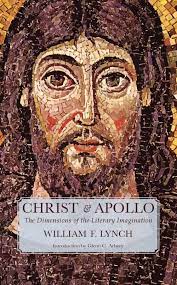
William Lynch’s Christ and Apollo: Dimensions of the Literary Imagination examines the question of physicality and particularity in theology and literature. I lack the depth and breadth of reading needed to truly benefit from this book, but the applications of his insights go beyond the literary and into life and redemption itself. Lynch keeps focus on his crucial question: Does God accomplish His purposes through the finite, or in spite of it? Authors, “regular people,” and civilizations face the temptation to either ignore or despise creation, thereby failing to see through it and discern the patterns of grace. Lynch diagrams this basic idea like so,

with the diagram on the left as the proper path. Heraclitus may have had the same intuition, stating that, “the way up and the way down are one in the same.” Tension has always existed in Christian thought between 1) Moving down “the mountain” as moving away from God (a pattern present from the Garden of Eden, Mt. Sinai, Mt. Tabor, etc.), and seeing that movement as a kind of death, and 2) Recognition that we have no other option other than to take this passage down into death to return to God whole, i.e., “He who wishes to save his life must lose it,” and “unless a seed falleth into the earth and die, it bears no fruit.”* Escape from this tension provides only an illusion of freedom, and in fact produces a kind of slavery to a fear of things, and even of ourselves. Our glimpse into the infinite comes only through the finite.** Dante’s grand cosmological vision would not have been complete without tethering it to 14th century Florence. In The Brothers Karamazov, Dostoevsky knows that Aloysha’s great mystical visions can only come through his engagement with his wretchedly dysfunctional family.

But many modern authors cannot embrace this paradoxical pattern. Lynch examines a few different metaphysical categories to demonstrate the paradox. For Proust, time is man’s greatest enemy. The cubist painter can not accept the finite image–instead they must represent all of the possible angles of vision of the minding a futile attempt to see only the abstract. Lynch writes,

Perhaps the most ambitious, most brilliant, and most sophisticated vendetta launched against time was that of Descartes, who first put forward the notion of a pure intelligence within us not subject to time. . . . when that ambition takes the form of a desire to wipe out the succession and the partial quantities of time, and to live in an isolated area of the personality where the temporal has no meaning or power, then a grave folly has been committed. . . . The “man in the street” knows what the intellectual does not: that true reality is contained within the dramatic temporal life of the body. The peasant knows he will be healed not only by doctors but also by time. [He knows that time] is as much a part of him as his own skin, out of which he cannot leap.

Christ and Apollo, p. 50, 53

Christ exemplifies this true approach to time as a positive good: He refuses to cling to childhood (Lk 2:41-52), He refuses the easy path to glory (Mt. 4), and allows His death to come to Him “in the fullness of time” (Gal. 4:4).

Different literary genres can make the same mistake of rejecting creation. In tragedy, Lynch cites the modern tendency that “exaltation must come from exaltation, and that infinites must come out of infinites.” This path leads to two consequences:

  1. The idea that the achievement of great tragedy has its roots in the mystical conquest of the “human spirit” against pain–the tragic figure as exalted conqueror, which
  2. In fact makes the writing of tragedy more difficult, not easier, because it seems that tragedy, like death, doesn’t really exist.

Comedies too can make the same error. Comedy (in the modern sense of “what makes us laugh”) often deals with the breakdown of order and expectations–all well and good. But if we ask ourselves why A Midsummer Night’s Dream still gets staged four centuries after its debut, we need look no further than that “the play, [even] in its wildest fantasy [in Act 5], is only dealing with Snug the joiner and Bottom the weaver.” T.S. Eliot commented that, “human kind cannot bear very much reality.” “I am not so sure of that,” Lynch writes, “The bigger truth is that they cannot stand very much unreality.”

Perhaps part of the problem lies in that great literary minds can see their idea so clearly that the idea burns away all around it if they fail to take care. Here then, lies Lynch’s “Univocal Man:”

He is, emotionally, full of extraordinary energies–in fact, a kind of energy seems to mark the whole of his character. He has a genius for a unilateral passion, and is, and therefore always has been–a passionate center of good and bad in civilization. . . . Superficially, then, he resembles the religious genius. . . . It is only by exercising great caution that we will avoid this profound mistake and will refrain from giving this character the veneration that is not his due. . . . The univocal man has no respect for reality; he is contemptuous of it, or distorts it, or flattens it–or he refuses to take responsibility in the face of it. . . . The univocal man is not free. He is rigid, unbending, fixed. One can understand the fixity of the idea of logic and essences, but his fixed ideas are born of a fixity of all the forces of his personality and a refusal to remain open to existence. . . . To put the matter simply, these would reject all the unities and relations projected by any sentence, for example, “The horse is white,” for a horse is a horse, and white is white, and that is the end of the discussion.

pp. 141, 144, 147

We might say that the Univocal man has too much “purity” in him. He cannot or will not mix his idea with the stuff of reality. That this should happen to a literary type is no surprise. In general they write because they are gripped by an idea or image.^ The one who mixes things up too much would likely never have the clarity or organization to get anything down on paper to begin with. Lynch shows us Eugene O’Neil, who wants us to be sad, and so gives us Sadness in Mourning Becomes Electra, with her mansion as her prison. Or, even more absurdly, he gives us Laughter in Lazarus Laughed, with this ridiculous passage where Lazarus speaks to Caligula,

You are proud of being evil! What if there is no evil? Believe in the Healthy God called Man within you! . . . Believe! What if you are a man and man is despicable? Men are also unimportant! Men pass! Like rain into the sea! The sea remains! Man remains! . . . For Man death is not! Man, Son of God’s laughter, is! . . . Believe in the laughing God within you!

Alas, too many exclamation points. O’Neill wants rapture but he attempts to achieve it by rebounding off of creation and denying it altogether. Only a fool would say that “death is not.”

With a denial of creation will come an absence of transcendence, purchased at the price of avoiding all mess. George Bernard Shaw claimed a sort of spiritualism but could not stand religion actually practiced, writing,

In Italy, for instance, churches are used in such a way that priceless pictures become smeared with filthy tallow-soot, and have to be rescued by the temporal power and placed in national galleries. But worse than this are the innumerable daily services which disturb the truly religious visitor. If these were decently and intelligently conducted by genuine mystics to whom the mass were no mere rite or miracle, but genuine communion, the celebrants might reasonably claim a place in the church as their share of the common right to its use. But the average Italian priest, personally unclean and with a chronic catarrh in his nose from living in frowsy, ill-ventilated rooms, punctuating his gabbled Latin only by expectorate hawking . . . this unseemly wretch should be seized and put out . . . until he learns to behave himself.

Whatever communion Shaw desires, it would have to include rite, miracle, and perhaps even the dirty priest, for it to happen at all. But for Shaw, such things are too messy and not “spiritual” enough. We should not suppose that he would enter in absent the dirty priest, either–something physical would always bar his way. It is much easier to comment online, or even to read books.

We in our day have the bigger and smaller problem of not even being able to enter into politics. The problem is smaller in that religion is more important than politics, but bigger in that we cannot hope to solve big questions if we cannot solve smaller ones. Too many on the right and left want nothing to do with mixing their ideas in the mess of politics. Some want a Caesar from above to wave a magic wand, some want the “innocent” people to rise up from below to abolish the Bill of Rights. Neither will achieve anything like an ordered communion, for neither wants to find the path to grace through creation. They do have their dreams. These dreams will have to content them, for they can know nothing of sorrow or joy.

Dave

*Perhaps this might explain in part Christ’s sometime reluctance to work miracles. Miracles, could, hypothetically, interrupt the U-shaped pattern and hinder us on our journey back to God.

**If we learn to see this pattern and interpret the Scriptures more analogically and less in a directly moral fashion, many things make themselves more clear. For example, we should honor the elderly not simply because of their wisdom–for some have none of it–but because they are closer to death, and thus also closer to glory. So too, this explains why the Church has always warned less against the “earthly,” “physical” sins of gluttony, too many women, etc., than the “spiritual” sins of pride. Many have gone down the path of fleshly indulgence and found the place where it turns upwards to God. But no path to God exists through pride. Of course, it is best still not to dabble in either.

**The literary, educated types–one always has to watch out for them . . .

Time vs. Space

This post was originally written in 2019 . . . .

*******************************

In an essay he wrote a few years ago called “The Four America’s” conservative columnist David Brooks pointed to the need for a new unifying narrative for America. What he called the “Exodus” paradigm held from our founding as a nation until recently. We told ourselves that America was essentially replaying the story of the Israelites, who fled religious oppression in Egypt, and came to the promised land to be a light unto the nations. Americans too fled oppression in the old world and came to a new one, establishing a special and unique nation that could broadcast freedom to the rest of the world. We existed to inspire others to follow in our footsteps.

Obviously this national myth no longer holds the imagination of our culture. In some ways we can lament the loss of this sense of mission and purpose, but I also think that the story never quite fit to begin with. Granted, every myth compresses and synthesizes, but our treatment of Native Americans and slavery stand as massive exceptions that the myth simply cannot hold within it. Our relative ignorance of these “anomalies” in our story* for centuries then naturally led people to focus almost exclusively upon the “exception” to the story, and so the pendulum swung entirely in the other direction. I am no friend of the modern progressive left, but reluctantly, I understand why they exist. We will have to endure them at least a little longer, it seems, perhaps as penance for our sins.

In addition, the Exodus story works wonderfully for a pioneer people, but less well for a major superpower. And, finally, even a cursory look suggests the possibility that the Enlightenment had just as much, if not more, influence on our founding than Christianity.

Brooks then suggests four other off-shoots from this myth, though admits that neither of them work even as well as the Exodus narrative.

  • The Libertarian myth sees us as “a land of free individuals responsible for our own fate.” It celebrates choice and the free market. It borrows from the freedom element of the Exodus story, but economic choice isn’t as powerful as religious choice. And–simply focusing on personal choice and responsibility cannot sufficiently unify us.
  • The “Globalized America” narrative celebrates a sliver of the “America as beacon for the world” from the Exodus story, as well as the dismantling of old hierarchies celebrated by our founders. But this story fails to provide an America distinctive enough to give us an identity.
  • “Multicultural America” borrows from the “Exodus” story with its narrative of oppression and the idea of a melting pot nation. But in always focusing on the exceptions and purely personal identity, no common core can be built to rally around.
  • The “America First” story gives us a common core and reinforces American distinctives, unlike the above three options. It has a brashness that can be bracing, especially compared to the other options. But it leaves out the inclusive aspect of the American story. It can tend to produce a “patriotism for the sake of patriotism” whirlpool. It gives America no transcendent reason to exist beyond its mere existence.

I agree with Brooks that neither of these four approaches are even as good as our discarded “Exodus” story. I agree that we need another narrative, but am not sure how we’re going to get one in our polarized culture. But as to what polarizes us a country–we don’t agree on this either. This is not only America’s problem–most everywhere else at least in the developed world seems to have the “first world problem” of no unifying narrative.** But we do not look deep enough for the cause of this rift, and blame different sides for the wrong reasons.

Though democracies have done much to alter traditions, they cannot change the basic ways in which the world works and the ways we perceive the world, at least on a subconscious level. Ancient creation stories agree in many ways, perhaps most fundamentally in that they conceived of creation as a harmony of contrasting forces. “Salvation” in a Christian sense is about the marriage of Heaven and Earth, and of course, the Incarnation is Christ the God-Man uniting Heaven and Earth in one Person. I do not intend this post to be an explicit argument for the truth of the Christian story, but I do believe it contains the most coherent and best “version” of all the ancient cosmologies. Biblical cosmology overlaps with many other ancient cosmologies, and this only serves as a point in its favor. Acknowledging these huge questions, from here on I will proceed by discussing ancient cosmologies in general.

The modern age measures time in what I would consider to be rather an insane way:

The second (abbreviation, s or sec) is the Standard International ( SI ) unit of time. One second is the time that elapses during 9,192,631,770 (9.192631770 x 10 9 ) cycles of the radiation produced by the transition between two levels of the cesium 133 atom . . .

This has advantages, as it allows to universalize and quantify precisely, but it happens completely outside of our experience, and thus, time can have little real meaning for us. The way we parse out units of time remains essentially arbitrary. For the ancient world, time had a manifest reality because it brought observable change. Day turns to night, and then night turns to day. Seasons change, and death and new life come with these changes. Thus the ancients conceived time as something moving, fluid, in flux–like water, but also solid and experientially verifiable.

Space gives us stability. Time allows us to become, but we need to “be” something to “become” anything (apologies to Brad Goodman). Time needs space to act upon. The relationship between time and space can only work well when we have a strong concept of the unity of heaven and earth. Possibly, we could have an acceptable range of this relationship. Some parents are more strict and some more permissive, but as long as one avoids the red line on either side, families can be stable and healthy.

For example, ancient Egypt leaned heavily on the side of space. They lived within a narrow strip of land, with the “chaos” of desert and death right next to them. Even their greatest architectural achievements mainly had the psychological effect of weights pressing on the ground. The Nile flooding formed in integral part of Egyptian life, but they put all their energy into controlling the Nile flood. Theirs was a “masculine” civilization all in all, and some historians criticize them for being too rigid and not sufficiently adaptable to change.

Babylon favored the fluidity of time (too much so, I would say, but we’ll let it pass for now–they had a long and storied history, after all). The Euphrates bisected their city, and they sought not to control the river–they had no great need to do so anyway–but to utilize it for their benefit. One of their main deities, Ishtar, was goddess of love, war, marriage, and prostitution, and sometimes was pictured with a beard. Aristocratic males were known to cross-dress and temple prostitution was the norm. Babylon was the quintessential cosmopolitan city–home of every philosophy and religious idea in existence in their known world. Theirs was a “feminine” civilization, in the sense that they had little devotion to the concept of a stable, unified form.

We can debate the merits of both civilizations, but should acknowledge that although they had different answers as to the balance between time and space, both at least were conscious of the realities of both. Our problem is twofold: 1) We lack even basic awareness of these concepts on a metaphysical level, and 2) We have abandoned the “marriage” of Heaven and Earth (a mirror also for “Time, and “Space” respectively) in Christ, and so have lost any hope of holding them in tension. With both freed from each other, Time makes war on Space, and vice-versa.^

Some argue that Time reigns supreme. In favor of the victory of Time, we see the rapid expansion of “time saving” technologies. Cars and planes compress space, but nothing compresses space quite like the internet. We erode boundaries of privacy, and we live in a “hot-take” world of moving information. Very few media outlets can afford patient reflection. Time’s triumph–thinking in terms of the “fluid” aspect of time–seems most evident in our culture’s support for people changing genders.

But, not so fast . . . “Space” does not take this lying down. If Democrats propose open borders, Trump will build a wall. In countries such as Poland and Hungary we see a resurgence of a strong nationalistic mindset. As we do more to celebrate exceptions and fluidity in the west, at the same time we have more absolute boundaries enforced by the culture as to what we can and cannot say. College students demand rigid “safe spaces” on the one hand while simultaneously affirming the legitimacy of every possible identity–a perfect incarnation of the intense stalemate between time and space. And–every spot on earth is mapped out, which means that space has complete definition. No country would possibly consider negotiating space with another country to resolve a dispute. Lest our modern avoidance of this seem perfectly natural, it stands in sharp contrast to politics before perhaps 1789, where king’s would routinely trade provinces here and there as diplomatic chips.

So today we have both “Time” and “Space” making a strong play for dominance, and just like the whole family suffers when dad and mom fight, so too we suffer in the midst of this contest. But children have little hope of solving their parent’s problems. We have more control of ours. We need the King to return to end the vicious squabbling of princes. When the dust settles, then we may see clearly enough to tell ourselves the story we all need to hear.

Dave

*I suppose there are those that would not call slavery and our treatment of Native Americans as anomalies to the story. Israel did have slaves–and some might draw a parallel to our treatment of Native Americans with what Israel did at Jericho. I disagree with this interpretation, but I want to acknowledge its existence.

**I know some do not want a unifying narrative because they fear the unity that this provides, and the concentration of power it gives. We saw the destructive potential of this in the early 20th century. But you can shove this basic human need under the carpet for only so long, and the longer we wait, the more chances for a destructive “pendulum swing” identity to emerge.

^Those familiar with Jonathan Pageau’s Symbolic World podcast will note my debt in what follows to episode 62, along with Matthew Pageau’s The Language of Creation.

Comparing civilizations on the Time/Space axis can be fun and illuminating. Clearly America, along with Babylon, heavily leans in the direction of “Time.” We have pioneered many so-called “time saving” technologies. The great Tyler Cowen proclaimed that our decline in physical mobility is a worrisome problem. We love our cars, and some argue that we lost our mojo as a civilization the moment the frontier closed. Bob Dylan mythologized the rolling stone, and who can possibly forget Journey telling us that the wheel in the sky keeps on turning, and that he doesn’t know where he’ll be tomorrow?

We have countless writers and other aspects of our culture that celebrate movement, the open road, etc. I can think only of Wendell Berry as perhaps our only cultural contributor of note who writes in celebration of Space.

9th/10th Grade: Richelieu and the New World Order

Greetings to all,

This week we looked at the 30 Years War and previewed the coming change towards the ‘Scientific Revolution.’

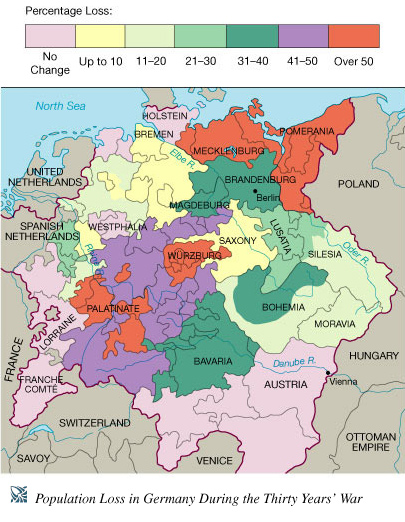
The 30 Years War was a devastating conflict in terms of loss of life.  But it was also devastating in a psychological, moral sense.  For decades Catholics and Protestants killed each other, burned towns, committed atrocities, all in the name of the Christian faith.  The map below shows the casualties in various parts of Germany alone.

Part of the reason the war became so destructive is that various nations, like Sweden, Spain, and France found reasons to get involved at various times during the war and extended it artificially. But part of the reason that religious conflicts  persist in general is that:

  • It is difficult to compromise or negotiate with religious belief
  • Victory in a religious war is hard to define

One can only come to terms in a religious war when either

  • Both sides are completely exhausted, or
  • You change what the war is about, making it something that you can compromise on, such as possession of territory.

This is in fact what happened, and this second reason is a clue to the coming transformation in the worldview of Europe.  Since the start of the Reformation, Catholics and Protestants had both lead with religion in the political and philosophical realm.  Now, their focus shifted towards the more tangible and measurable. We will explore this in more depth in coming weeks.

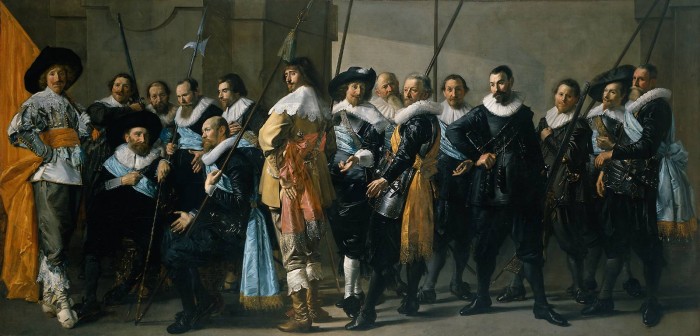
Essentially, we see a shift from theory, which would include intellectual ideas as well as the unproven realm of ‘faith,’ to experience, observation, and the natural world.  It is the Dutch school of the 17th century that  exemplified this change.  One can see it in the work of Van Hals:

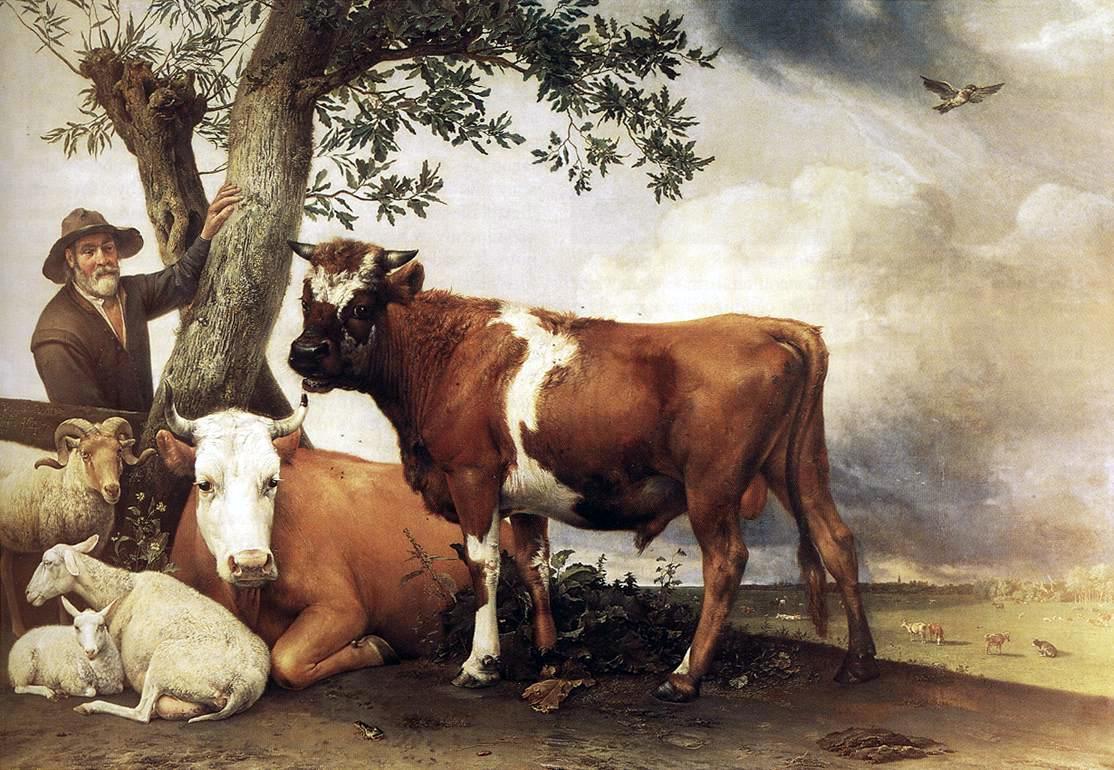
Here are practical, reasonable men.  They are a long way from the emotionally and spiritually moved men from, say, Carravaggio’s work just a few decades earlier.  This passion for representing reality apart from meaning reached it’s peak with this work of Paulus Potter:

.Probably the artist who married the best of the observational school with meaning had to be Rembrandt.   He depicted people “realistically,” but he managed to depict them as morally imaginative as well.  We think of him as a painter, but he was best known in his day for his etchings.  Here is one example:

If the Dutch exemplified the change in art, the French did so in the political realm.  Cardinal Richelieu is known for many things, but this quote exemplifies his philosophy:

‘People are immortal, and thus subject to the law of God.  States are mortal [that is, ‘unnatural,’ artificial, man-made creations], and are thus subject to the law of what works.’

Richelieu believed that nations did not interact with each other in the way that individuals did.  After all, people cannot kill each other, but nations can have armies that kill each other without necessarily sinning.  People can’t lie, but nations can send spies to other places where they ‘lawfully’ engage in deception.  It might be similar to people bluffing in poker.  They are trying to deceive, but are they sinning?  Most would say not, because when we play poker we enter into a world that has its own set of rules set apart from normal life.  Frenchmen will be judged by God.  But the geographical entity we call ‘France’ will pass away, it will not be judged.  Thus, ‘France’ could play by different rules than Frenchmen.

This famous painting of him shows his famously lean, intelligent frame:

With this perspective, Richelieu astounded and infuriated his contemporaries.  As France’s chief minister, he sought to serve the entity ‘France.’  This meant that:

  • France would intervene on behalf of Protestants in the 30 Years War, despite the fact that they were a Catholic nation.  Except that Richelieu didn’t see ‘Catholic France,’ but ‘France, where most people are Catholic.’  Richelieu fought not to protect Catholics, but the entity France, which he did not want surrounded by Catholic Spain.  Spain fought in the 30 Years War in part to recover the Netherlands, territory they had lost in the early 1600’s.  This new perspective shocked many, but it would be the way of the future
  • He believed that strengthening France would have to mean strengthening the king.  This in turn meant weakening the nobles.  We will see this European turn  away from the feudal era, and toward more centralized authority.  It would be another Frenchmen, Louis XIV, that would push these ideas even further later in the 17th century.

Dave Mathwin

11th/12th Grade: The Origins of the Peloponnesian War

Greetings,

This week we started our unit on the Peloponnesian War.  This conflict took place between 431- 404 BC, and was chronicled by one of the founders of History itself, Thucydides.  Thucydides’s genius lay far beyond his dispassionate recording of events.  He concerned himself not only with battles, but also the deeper political, economic, and psychological contexts.  He was a commentator on democracy and human nature itself.  We will attempt to follow his lead, ranging back and forth between ancient and modern times.

We will also shortly begin our own Peloponnesian War game, in which the class is divided up into 5 different teams, each of whom participated in the actual Peloponnesian War.  The game is designed to give each side certain strengths and weaknesses, and different means of winning.  Generally speaking, the teams that have won in the past have focused not merely on eliminating enemy soldiers, but instead on forging a synergy between their economics, politics, and diplomacy, with their military action arising from that context.  This usually means that things start slow, but tend to pick up as weeks go by.

Most of us are used to thinking of democracy as a permanent fixture in our lives, but the Athenians lost, regained, lost, and finally regained democracy during and after the conflict.  Why did this happen?  Does war put more pressure on democracies than other forms of government?  On another note, are democracies naturally inclined toward expansion, or are those democracies that have expanded a product of historical coincidence?

Our study of this conflict should always have the idea of democracy behind it, for the war as a whole, and Athens’ role in it particularly, can teach us a lot about democracies.  Fundamentally, we should consider what makes a country “democratic.”  I offered the students the following choices:

  • In country ‘X’ the people are ruled by a king, but the laws of the realm allow for free speech, equal treatment under the law, freedoms of assembly, religion, etc.  In short, all the trappings we usually associate with democracy, except the people did not elect their leaders.
  • In country ‘Y’ the people have a representative democracy where they elect all their leaders.  But the elected government (which won 60% of the vote) uses their power to restrict the rights those that opposed them.

Which country is more democratic?  Does democracy have more to do with the process than the result?

As we look at the origins of the conflict, we will consider criteria for a ‘just’ war.  What kind of strategy should Athens have pursued, and does it teach us how democracies tend to, or should act, in war?

First, some of the background to the war.

Prior to ca. 500 B.C., Athens was not one of the major city-states of Greece.  They were not nobodies, but they could not be called a New York, LA, or Chicago.  Perhaps a Philadelphia. Their moment came during the Persian Wars, where their staunch resistance and military success propelled them into a potential leadership role.  How did they handle it?

They helped from what was known as The Delian League, a mutual defense alliance with other city-states that rimmed the Aegean against Persia.  Member states could contribute money or ships. As one might expect, nearly all chose the ‘money’ option. It was easier, for starters. But it also made sense.  Since Persia might return any time it made sense to fund the best navy and get more of the best ships out into the Aegean, and Athens had that navy.

But what if Persia did not look like it was coming back?  Can you leave the Delian League? Athens said no. They had some good arguments:

  • Persia was still a major power and could decide to come back at any time.
  • If a city-state left they could potentially make an alliance with Persia, which would threaten all of their neighbors.
  • Even if a city-state did not make an alliance with Persia, they would still get security.  Athens could not let Persia establish a beach-head anywhere in Greece.  Therefore they would get free security, which was unfair.

We can still imagine that the other city-states failed to be impressed with these arguments.  Athens, the one-time champion of the ‘little guy’ had become the block bully in the minds of many.  How should we view Athens? Who was right? Here is a map of the Greek world at the time the war began:

I think we have to appreciate Athens’ dilemma, but if we look elsewhere for clues, it appears Athens had fallen into what Toynbee called “The Idolization of the Parochial Community.’  That is, once Athens stood for something, something outside itself. Now, despite the progressive nature of Athenian democracy, drama, philosophy, and so on, Athens seemed to justify its actions based on how it related to themselves and themselves alone.  This can be seen in their siding against certain democracies when it looked like doing so might advantage them in some way. One can see the comparisons with pre-World War I Europe, with democracy at home, and imperialism and a form of subjugation abroad.  By 431 B.C. the Greeks had made their society into a fireworks stand where anything might upset the apple cart. Athens’s power, their rivalry with Sparta and Corinth, created a potential disaster. If you are interested, I include below an excerpt from Toynbee’s ‘An Historian’s Approach to Religion’ on the idea of parochial communities.  When war breaks out next week we will consider a few different issues.

  • To what extent is a country’s reputation part of its power and security?  Can threat’s to your reputation be considered a threat to your security?  Should war’s be fought if no physical danger is immediately present?  How much importance did reputation have in the Greek world?  Does that make the actions of Athenians and Spartans more or less defensible?
  • Traditionally, just war theory within the framework of Christian thought has focused on 1) The cause, 2) The goal, and 3) Proportionality of response.  One may fight defensively, but not start wars.  One can fight to defend the innocent, but not merely to extend one’s power.   If a rival invades with 1000 troops, you cannot counter with 100,000 and destroy him utterly.  Did Sparta or Athens begin the war?  Can either side lay claim to fighting a just war?
  • Corinth was a city-state covered in faded glory, anxious to reclaim it, and one that burned with indignation at Athens for wearing the mantle of ‘top dog.’  Does Corinth share any similarities with China and Russia today?  How should Athens have dealt with the overly touchy Corinth?How do the ideas of just war fit into the context of the Peloponnesian War?  How do they fit into the modern period? What constitutes an ‘attack’ upon us?  Would a cyber-attack be an act of war that would allow us to kill others? What does the possibility of weapons of mass destruction do to the concept of pre-emption in war?  Are the old guidelines relevant today, or do they need rethought?
Dave Mathwin
Toynbee, “The Idolization of the Parochial Community”
Unhappily, Polytheism begins to produce new and pernicious social effects when its domain is extended from the realm of Nature-worship to a province of the realm of Man-worship in which the object of worship is parochial collective human power. Local worships of deified parochial communities inevitably drive their respective devotees into war with one another. Whereas Demeter our common Mother Earth is the same goddess in Attica and in Laconia, the Athene Polias of Athens and the Athana Chalcioecus of Sparta, who are the respective deifications of these two parochial communities, are bound to be rival goddesses in spite of their bearing the same name. The worship of Nature tends to unite the members of different communities because it is not self-centred; it is the worship of a power in whose presence all human beings have the identical experience of being made aware of their own human weakness. On the other hand the worship of parochial communities tends to set their respective members at variance because this religion is an expression of self-centredness; because self-centredness is the source of all strife; and because the collective ego is a more dangerous object of worship than the individual ego is.
The collective ego is more dangerous because it is more powerful, more demonic, and less patently unworthy of devotion. The collective ego combines the puny individual power of each of its devotees into the collective power of Leviathan. This collective power is at the mercy of subconscious passions because it escapes the control of the Intellect and Will that put some restraint on the individual ego. And bad behaviour that would be condemned unhesitatingly by the conscience in an individual culprit is apt to be condoned when it is perpetrated by Leviathan, under the illusion that the first person is absolved from self-centredness by being transposed from the singular number into the plural. This is, however, just the opposite of the truth; for, when an individual projects his self-centredness on to a community, he is able, with less sense of sin, to carry his egotism to greater lengths of enormity. ‘Patriotism is the last refuge of a scoundrel’;5 and the callousness of committees testifies still more eloquently than the fury of mobs that, in collective action, the ego is capable of descending to depths to which it does not fall when it is acting on its individual responsibility.
The warfare to which parochial-community-worship leads is apt to rankle, sooner or later, into war to the death; and this self-inflicted doom is insidious, because the ultimately fatal effects of this religion are slow to reveal themselves and do not become unmistakably clear till the mischief has become mortally grave.
In its first phase the warfare between deified parochial states is usually waged in a temperate spirit and is confined within moderate limits. In this first phase the worshippers of each parochial god recognize in some degree that each neighbour parochial god is the legitimate sovereign in his own territory. Each local god will be deemed to have both the right and the power to punish alien human trespassers on his domain who commit a grievous wrong against him by committing it against his people; and this consideration counsels caution and restraint in waging war on foreign soil. It tends to prevent war from becoming total. The bashful invader will refrain, not only from desecrating the enemy’s temples, but from poisoning his wells and from cutting down his fruit trees. The Romans, when they had made up their minds to go to all lengths in warring down an enemy community, used to take the preliminary precautions of inviting the enemy gods to evacuate the doomed city and of tempting them to change sides by offering them, in exchange, honourable places in the Roman pantheon. When a local community has been exterminated or deported in defiance of the local divinity and without regard to his sovereign prerogatives, the outraged parochial god may bring the usurpers of his domain and scorners of his majesty to heel by making the place too hot to hold them except on his terms. The colonists planted by the Assyrian Government on territory that had been cleared of its previous human occupants by the deportation of the Children of Israel soon found, to their cost, that Israel’s undeported god Yahweh had lost none of his local potency; and they had no peace till they took to worshipping this very present local god instead of the gods that they had brought with them from their homelands.
Thus the conduct of war between parochial states is kept within bounds, at the start, by a common belief in the equality of sovereign parochial gods, each within his own domain. But this belief is apt to break down, and, with it, the restraint that is imposed by it. They break down because the self-worship of a parochial community is essentially incompatible with the moderation commended in such maxims as ‘Live and let live’ and ‘Do as you would be done by’. Every form of Man-worship is a religious expression of self-centredness, and is consequently infected with the intellectual mistake and the moral sin of treating a part of the Universe as if it were the whole—of trying to wrest the Universe round into centring on something in it that is not and ought not to be anything more than a subordinate part of it. Since self-centredness is innate in every living creature, it wins allegiance for any religion that ministers to it. It also inhibits any living creature that fails to break away from it from loving its neighbour as itself, and a total failure to achieve this arduous moral feat has a disastrous effect on social relations.
A further reason why it is difficult to keep the warfare between parochial states at a low psychological temperature is because parochial-community-worship wins devotion not onlyby ministering disastrously to self-centredness. It wins it also by giving a beneficent stimulus to Man’s nobler activities in the first chapter of the story. In the histories of most civilizations in their first chapters, parochial states have done more to enrich their members’ lives by fostering the arts than they have done to impoverish them by taking a toll of blood and treasure. For example, the rise of the Athenian city-state made life richer for its citizens by creating the Attic drama out of a primitive fertility-ritual before life was made intolerable for them by a series of ever more devastating wars between Athens and her rivals. The earlier Athens that had been ‘the education of Hellas’ won and held the allegiance of Athenian men and women, over whom she had cast her spell, for the benefit of the later Athens that was ‘a tyrant power’; and, though these two arrogant phrases were coined to describe Athens’ effect on the lives of the citizens of other Hellenic city-states, they describe her effect on the lives of her own citizens no less aptly. This is the tragic theme of Thucydides’ history of the Great Atheno-Peloponnesian War, and there have been many other performances of the same tragedy that have not found their Thucydides.
The strength of the devotion that parochial-community-worship thus evokes holds its devotees in bondage to it even when it is carrying them to self-destruction; and so the warfare between contending parochial states tends to grow more intense and more devastating in a crescendo movement. Respect for one’s neighbours’ gods and consideration for these alien gods’ human proteges are wasting assets. All parochial-community-worship ends in a worship of Moloch, and this ‘horrid king’ exacts more cruel sacrifices than the Golden Calf. War to the death between parochial states has been the immediate external cause of the breakdowns and disintegrations of almost all, if not all, the civilizations that have committed suicide up to date. The decline and fall of the First Mayan Civilization is perhaps the only doubtful case.
The devotion to the worship of Moloch is apt to persist until it is too late to save the life of the civilization that is being destroyed by it. It does break down at last, but not until a stage of social disintegration has been reached at which the blood-tax exacted by the waging of ever more intensive, ferocious, and devastating warfare has come palpably to outweigh any cultural and spiritual benefits that the contending parochial states may once have conferred on their citizens. . . 

9th/10th Grade: Light and Darkness in New England

Greetings,

This week we examined Puritan society in New England during the 17th century. We will not examine much else in regard to North American colonization, but I feel that a focus on the Puritans is appropriate.  Of all the early colonization efforts, theirs had the most influence on the formation of what America would become, for better or worse.

We first looked at what motivated North American colonization in the first place.  Sometimes we tend to think that such colonization must have resulted from great oppression of the lower classes.  In reality many in England who came to North America had some limitations on their lives under Charles I, but all could live out their daily existence without much change, and most of them came from the middle-classes.  After all, a journey across the Atlantic did cost money, and the poor did not have much of it.

The basic characteristics of most who came probably consisted of. . .

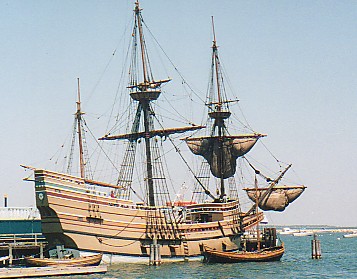
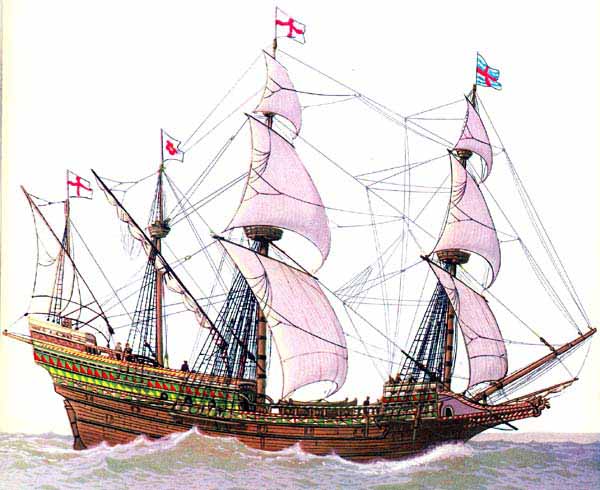
  • People not afraid to take risks.  A journey across the ocean in a boat this small (see below) would not be for the faint of heart.
  • People who could afford (see above), but given the risk-reward ratio of sailing across the ocean to hew civilization out of the wilderness from scratch, very few if any of the aristocracy (who “had it all” in Europe) would come.  Hence, though Europeans (all who came from places with aristocracies) founded American civilization, from the start they had an anti-aristocratic bias.
  • While many who came sought their financial well-being, I believe the majority came for deeper reasons.  One could find business opportunity at home if need be.  Many who came were fired by an idea, or at minimum, the sense of adventure.  The risks were too great, and the rewards too uncertain, to be motivated by much less.

All these categories fit the Puritans, and then some.

We have some unfair misconceptions of the Puritans.  They were not, “Puritanical” in their morals.  At Harvard College, which they founded, a mug of beer came with the “meal plan” for lunch. . . and breakfast.  A surprising number of sermons (which were lengthy) dealt with sexuality.  In one town a married woman complained to the Church elders that her husband was not, shall we say, performing his husbandly duties in the bedroom.  The husband got put in the stockade for a day, with a sign around his neck indicating the reason for his being there.

But the Puritans were deadly serious about their mission, and about life in general.  They wanted to leave England not so much because they were sorely oppressed, but because England would let them fully live out how they perceived God’s call on their lives.  The Puritans did not want merely to tweak society, but remake it from top to bottom along more Biblical lines.  England simply offered no room for this, and so, like Constantine (Constantinople) and Ikhneton (Amarna) before them, they sought a fresh canvas to live out their vision.

They did not do this blindly.  After all, God had already called a people to flee a wicked land, and led them to a new place where He gave them special laws to live as a witness to the nations.  The Puritans modeled themselves on Israel, which perhaps explains the vast increase in Old Testament names like Jacob, Joseph, Sarah, etc. in Puritan communities.*  Some went so far as to give their children hortatory names, with actual examples like. . .

  • Fight-the-good-fight-of faith (last name, Snat)
  • Kill-sin (last name, Pemble)
  • Humiliation (last name, Scratcher)

And the very unfortunate young lady who was named

  • Flee-fornication (she married a man named Goodman, last name, Woodman).

They saw their mission not just for themselves, but for all of Christendom.  If they could show the world the blessings that came from living according to God’s law, other places would repent and copy them.  Thus, their success was imperative, not just for themselves, but in their eyes, for all the world.  They were to be a “City on a Hill.”

The light that they hoped would shine could not be dimmed in any way.  While they came to have the freedom to exercise their faith, they could not afford to have “error” contaminate them.  Within their communities they granted no freedom of religion to others, and came into conflict most frequently with Quakers.

This strong sense of mission made a huge impact on Puritan communities.  When compared with other places in Europe or North America, the Puritans had a much lower illegitimate birthrate, and a much higher literacy rate.  Man for man the Puritans gave more sacrificially than their contemporaries.  Nowhere else was their more attention to Scripture, more “clean and sober” living.

As with any zealous people, however, this sense of mission had a darker side.  Since their entire society had a spiritual overtone, all that happened could be explained in spiritual terms.  If you went sailing on the Sabbath (forbidden in Puritan communities) and drowned, well, that was what you get for breaking God’s law.  If you had a toothache, no doubt you had sinned with your teeth.  The Puritans frowned on taverns, not because of alcohol, but because it tended to lead to boisterous singing.  All that energy was better spent elsewhere.  The Puritans wanted no blending, no syncretism with what they considered “pagan.”  The Puritans did not celebrate Christmas, which ’12 Days’ has its roots in the Roman festival of Saturnalia, and fined those that did celebrate it.

We can trace this approach back to the Puritans attitude about life in general.  Typical was this quote from Puritan Richard Sibbes,

There are two grand sides in the world, to which all belong: there is God’s side and those that are His, and there is another side that is Satan’s and those that are his. . . two contrary dispositions that pursue one another.

And from another fellow Puritan,

God hath placed us in the world to do him some work.  This is God’s working place; He hath houses of work for us: now, our lot here is to do work, to be in some calling. . . to work for God.

While the Puritans had many strengths, many of their weaknesses made themselves manifest in the infamous Salem Witch Trials.  When approaching this event, we should keep a couple of things in mind.

  • Could witchcraft real?  That is, is it possible that someone could give themselves over to Satan and use that power to work evil in the world?
  • If yes, then how would you know if someone was a witch?
  • If you thought someone was a real witch, what should be done with them?  As we discussed in class, if they had real powers, those powers would not be limited by geography.

In 1692, Salem experienced a burst of hysteria and a flurry of accusations over witchcraft.  They did not dispense with people on mere whims.  They had trials, brought forward witnesses, and had standard of evidence.  Those convicted usually had several witnesses against them, and many claimed to see spectres of the accused out and about in the community.  Astral Projection is a claimed power of witches.

If convicted, you had a chance to repent and be spared death.  However, one problem with the trials was the court’s demand that to demonstrate repentance, the accused name other witches in the community.  Refusal to name others could be taken as a sign that you had not really repented after all.

Within a few months they put the brakes on this runaway train, mainly because 1) They recognized that the trials tore the community apart, and this could not be the work of God, and 2) Significantly, they did not discount “spectral evidence,” or claim that the witnesses lied, but rather, that spectral evidence could be faked by demonic powers, again revealing their worldview.  They believed in evidence, but their standard for evidence, for better or worse, differs a good deal from ours today.

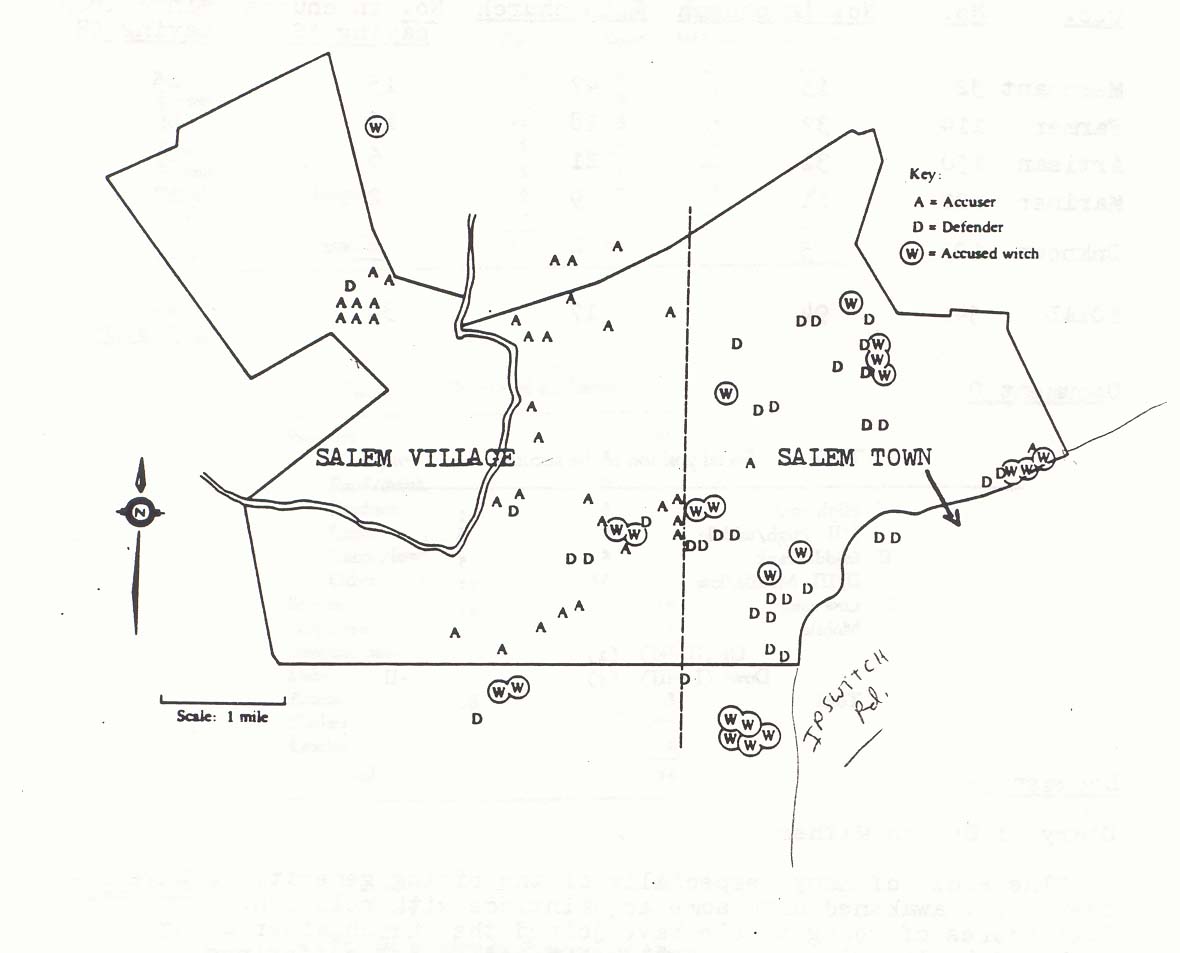
Though the trials stopped, they revealed deep divisions within Salem itself and a sign of the failing of the Puritan dream of a unified, godly community.  As the map below indicates, most of the accusers (‘A’) came from the poorer western sections of town, and most of those accused came from the wealthier eastern section.

The Puritans would fade away in the 18th century, but their stamp upon America remains, especially in regard to “family values,” and education.  In the early colonial era, New England could be described as perhaps the most “conservative” area, and is now one of the most liberal.  Some see this as evidence that, being wound so tight, New Englanders simply “snapped” and went the other way.  Some trace this to the influx of immigrants in the mid 19th century and beyond.  Personally, I tend to see more continuity.  In the 19th century, New England formed the hotbed of the abolitionist movement, and I think the Puritan, crusading spirit lives on, for better or worse, in New England today.

Blessings,

Dave
*One can see cultural differences reflected in how those in colonial Virginia, for example, named their children, with a predominance of famous English kings (William, Henry, etc.) and classic English female names like Margaret.  Clearly, Virginia had a more traditional Anglo-centric emphasis to their society.

9th/10th Grade: The Puritans in Power

Greetings,

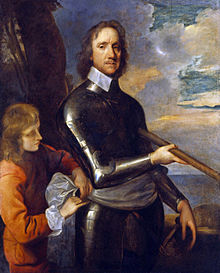
This week we looked at the aftermath of the trial and execution of Charles I in England, and the ascension of the Puritans, represented by Oliver Cromwell, to power.

It’s hard to get more controversial than Oliver Cromwell.  Some see him as a champion of republican liberty, while some go so far as to label him a proto-fascist.    The facts are that the army dominated Parliament, and so Cromwell dominated Parliament.  He used this power to clear Parliament out of many of his opponents. He then went on campaigns in Ireland and Scotland to put down Stuart inspired resistance known for their brutality, and attempted to resign upon his return.  When this seemed impossible, he continued in power and became ‘Lord Protector’ of England and practically a king in all but name.

If you are a fan of Oliver Cromwell, you look at the events this way:

  • He did not have the luxury of waiting for Parliament to decide on a proper course.  Society will not stop to wait while the Revolution makes its decisions.  Cromwell felt that if Parliament would not act, society might descend into anarchy.
  • His campaigns were brutal, but you could argue that they were traitors and needed to be killed.
  • His attempt to resign shows that he was not interested in power as such, and wanted broader based democratic government.

Those against could just as well argue that

  • His lack of patience with Parliament may have had much more to due with the fact that he viewed Parliament as ineffectual not because they couldn’t function, so much as they would not agree with him.
  • His brutality during the Irish campaign became notorious, as he executed even those who surrendered voluntarily.  This poisoned Anglo-Irish relations for centuries to come.
  • His assuming essential monarchical powers does not help those who argue that Cromwell was not interested in power for the sake of power alone.

The English Civil War gives witness to a key principle of revolutions in general.  For an existing power to get overthrown, one usually needs significant power to oppose it.  For the existing power to in danger of getting overthrown usually (not always) means some kind of misrule and perhaps abuse of power which would affect many people.  However, this abuse of power would not affect everyone in the same way.  So, while the government falls because many opposed it, they did not oppose it for the same reasons.  After the revolution, the victorious discover that they could agree on what was wrong, but not what to do in its place.

Who gets the power in these circumstances?  Usually whoever exerts the most direct control over the army.  The dynamic that played out in England may resemble what happened in Egypt, for example, after they overthrew Mubarak.

Cromwell’s attempt to found a republic also raises uncomfortable questions about the line between morality and practicality in politics.  In his Discourses on Livy Machiavelli argues that any major shift in power, especially to a more democratic form of government, must be the work of one man (I include the full text at the end of the post).  In the end, the changes in government must have a point of unity, a point of control.  One might think that the American Revolution defeats this argument, but I think it unlikely the colonies would have successfully transitioned without George Washington, who “had” to serve as our first president.  One need not agree with Machiavelli’s moral implications (he excuses Romulus’ murder of his brother) to see the practical side of his ideas.

What did the Revolution Accomplish?

At first glance it seems the revolution accomplished little.  After Cromwell’s death Parliament recalled Charles I son Charles from exile and asked him to be King Charles II.  Charles did not rule without Parliament as his father had, but the powers of Parliament had clearly declined.  People rejoiced in Charles’s return from exile in France.  On the surface, since Charles II would have succeeded his father had their been no civil war, it seems like nothing changed.

But the proof would be felt in the long term.  Parliament had set a precedent.  Even in recalling Charles, they showed that it was they who could make kings as well as unmake them.  This would be felt most clearly after the Glorious Revolution of 1688, when Parliament kicked out James II and brought in William and Mary to be king in 1689.  Of course, William and Mary could reign, but on Parliament’s terms, not their own.

Still the aftermath of the Revolution does show the power of embedded habits and tradition.  We should expect that in uncertain times we fall back upon what we know — hence — Charles II.

The “Restoration” under Charles II had many strengths.  After the tumult of the previous 15-20 years people desperately wanted to relax and live their normal lives.  Charles II proved to be a very different man than his father, both in governing style and in temperament, as this portrait reveals.

Pulling off those shoes would require, if nothing else, a sense of humor, something Charles I lacked.  He also had more political sense regarding Parliament, and though he had little strong religious feeling himself (until the very end of his life, apparently) this at least meant that the religious furor that had wracked England for the past few decades could subside.

Niccolò Machiavelli (1469-1527):
Founding a Republic,
Excerpt from Discourses I, 9


To found a new republic, or to reform entirely the old institutions of an existing one, must be the work of one man only

It may perhaps appear to some that I have gone too far into the details of Roman history before having made any mention of the founders of that republic, or of her institutions, her religion and her military establishment. Not wishing, therefore, to keep any longer in suspense the desires of those who wish to understand these matters, I say that many will perhaps consider it an evil example that the founder of a civil society, as Romulus was, should first have killed his brother, and then have consented to the death of Titus Tatius, who had been elected to share the royal authority with him; from which it might be concluded that the citizens, according to the example of their prince, might, from ambition and the desire to rule, destroy those who attempt to oppose their authority. This opinion would be correct, if we do not take into consideration the object which Romulus had in view in committing that homicide. But we must assume, as a general rule, that it never or rarely happens that a republic or monarchy is well constituted, or its old institutions entirely reformed, unless it is done by only one individual; it is even necessary that he whose mind has conceived such a constitution should be alone in carrying it into effect. A sagacious legislator of a republic, therefore, whose object is to promote the public good, and not his private interests, and who prefers his country to his own successors, should concentrate all authority in himself; and a wise mind will never censure any one for having employed any extraordinary means for the purpose of establishing a kingdom or constituting a republic. It is well that, when the act accuses him, the result should excuse him; and when the result is good, as in the case of Romulus, it will always absolve him from blame. For he is to be reprehended who commits violence for the purpose of destroying, and not he who employs it for beneficent purposes. The lawgiver should, however, be sufficiently wise and virtuous not to leave this authority which he has assumed either to his heirs or to any one else; for mankind being more prone to evil than to good, his successor might employ for evil purposes the power which he had used only for good ends. Besides, although one man alone should organise a government, yet it will not endure long if the administration of it remains on the shoulders of a single individual; it is well, then, to confide this to the charge of many, for thus it will be sustained by the many. Therefore, as the organisation of anything cannot be made by many, because the divergence of their opinions hinders them from agreeing as to what is best, yet, when once they do understand it, they will not readily agree to abandon it. That Romulus deserves to be excused for the death of his brother and that of his associate, and that what he had done was for the general good, and not for the gratification of his own ambition, is proved by the fact that he immediately instituted a senate with which to consult, and according to the opinions of which he might form his resolutions. And on carefully considering the authority which Romulus reserved for himself, we see that all he kept was the command of the army in case of war, and the power of convoking the senate. This was seen when Rome became free, after the expulsion of the Tarquins, when there was no other innovation made upon the existing order of things than the substitution of two consuls, appointed annually, in place of an hereditary king; which proves clearly that all the original institutions of that city were more in conformity with the requirements of a free and civil society than with an absolute and tyrannical government.

The above views might be corroborated by any number of examples, such as those of Moses, Lycurgus, Solon, and other founders of monarchies and republics, who were enabled to establish laws suitable for the general good only by keeping for themselves an exclusive authority; but all these are so well known that I will not further refer to them. I will adduce only one instance, not so celebrated, but which merits the consideration of those who aim to become good legislators: it is this. Agis, king of Sparta, desired to bring back the Spartans to the strict observance of the laws of Lycurgus, being convinced that, by deviating from them, their city had lost much of her ancient virtue, and consequently her power and dominion; but the Spartan ephors had him promptly killed, as one who attempted to make himself a tyrant. His successor, Cleomenes, had conceived the same desire, from studying the records and writings of Agis, which he had found, and which explained his aims and intentions. Cleomenes was convinced that he would be unable to render this service to his country unless he possessed sole authority; for he judged that, owing to the ambitious nature of men, he could not promote the interests of the many against the will of the few; and therefore he availed himself of a convenient opportunity to have all the ephors slain, as well as all such others as might oppose his project, after which he restored the laws of Lycurgus entirely. This course was calculated to resuscitate the greatness of Sparta, and to give Cleomenes a reputation equal to that of Lycurgus, had it not been for the power of the Macedonians and the weakness of the other Greek republics. For being soon after attacked by the Macedonians, and Sparta by herself being inferior in strength, and there being no one whom he could call to his aid, he was defeated; and thus his project, so just and laudable, was never put into execution. Considering, then, all these things, I conclude that, to found a republic, one must be alone; and that Romulus deserves to be absolved from, and not blamed for, the death of Remus and of Tatius.

10th Grade: Authority and the Stuart Kings

Greetings to all,

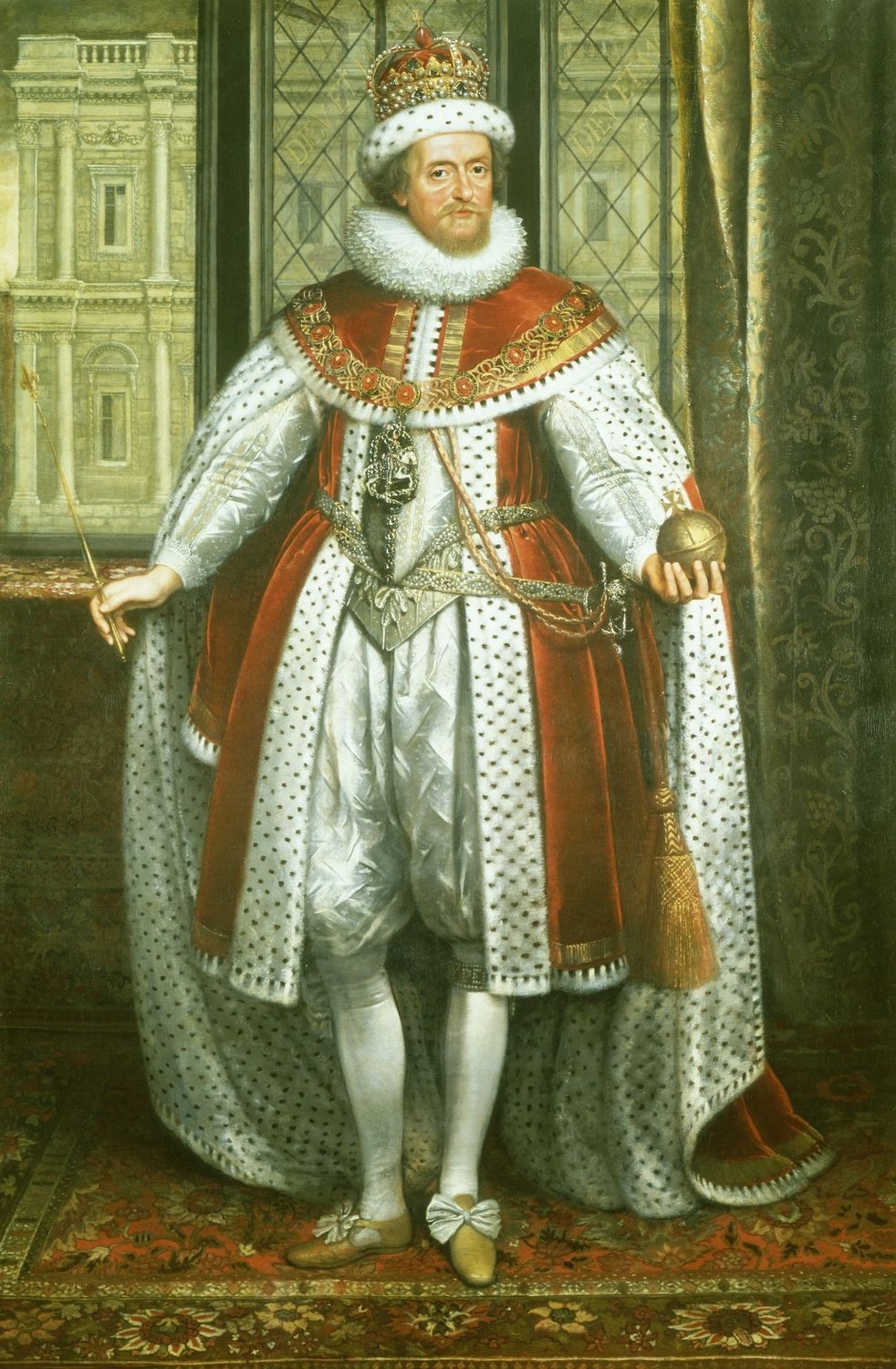
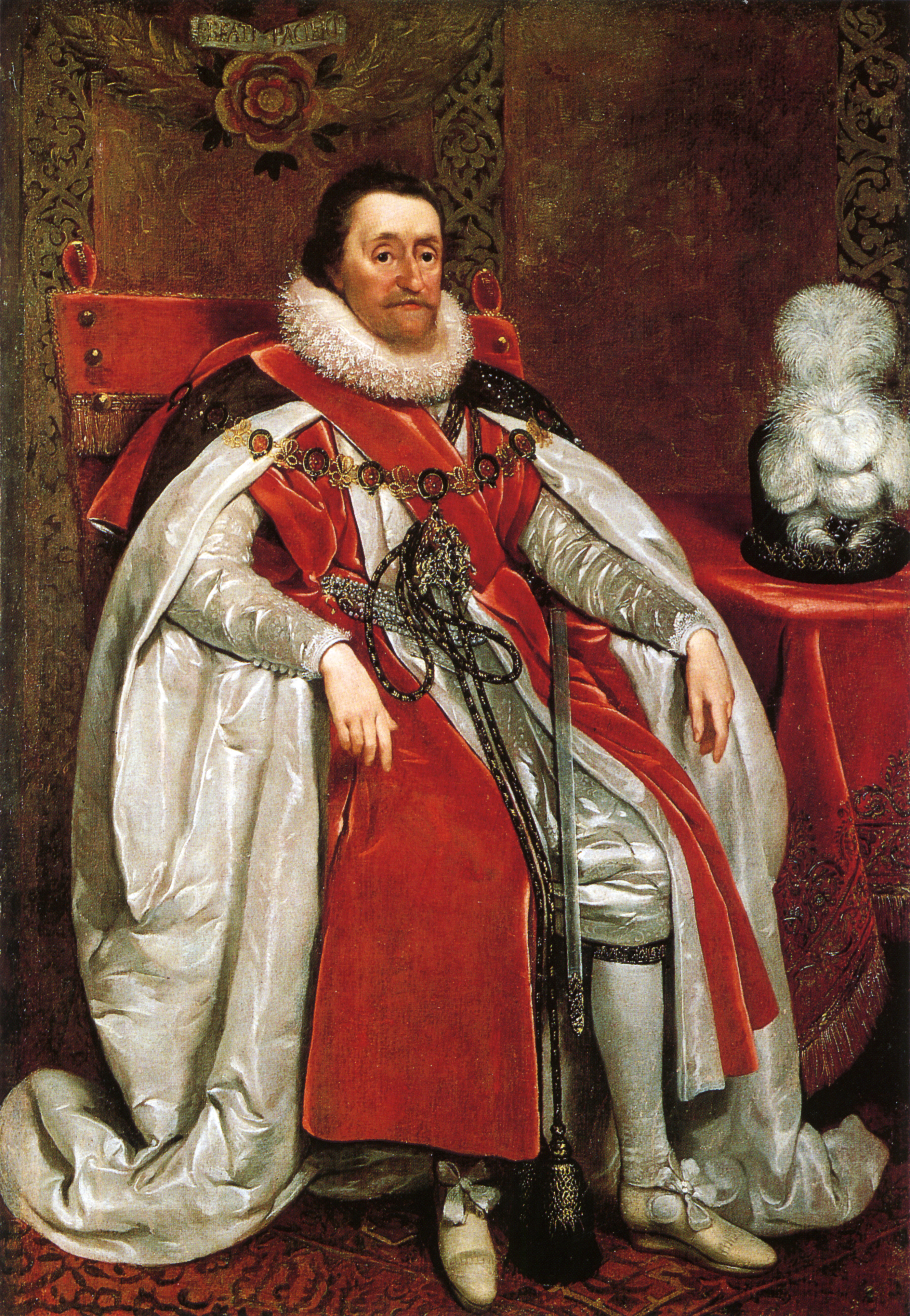
This week we continued our story in England.  With the death of Elizabeth, the male Tudor line ended, but the line could continue through Henry’s niece Mary, known as Mary Queen of Scots.  She had been executed for treason by Elizabeth, but now ironically, it was her son James that was called upon to take the reigns of power in England.

James I defense of absolute monarchy raises a dilemma occasioned by  the Reformation.  Protestants often accused Catholics of being ‘authoritarian.’  “Look,” they might say, “you have to obey bishops, popes, councils, and the like. Man has no chance to have an individual, personal relationship to God.”  Thus, according to this argument, Catholicism and democratic government could never go hand in hand.  Catholicism is inherently authoritarian.

Catholics would likely respond that Protestantism has the “authoritarian” problem.  By reducing everything to “Scripture alone” and forgoing reason, tradition, etc. we put ourselves at the mercy of whoever has the authority to give the “right” interpretation of Scripture.  With no buffer between man and the state in an independent church, the state would naturally grab up all the power.

As for Catholicism and democracy, what about the local village elections in the Middle Ages, or the Italian city-state republics of the 15th century?  Democracy has its roots in Catholicism, not Protestantism.

Both sides of this debate are a bit of a caricature, but absolute monarchy arose first within Protestantism, beginning with Henry VIII and extending down to James I.  In class we discussed when absolutism can gain acceptance by the people.  It takes certain historical circumstances, generally, for that sort of thing to fly.  One needs a time of great transition or crisis for people to accept this kind of authority.  In the aftermath of the Wars of the Roses, Henry VIII had the license to reign autocratically.  In the aftermath of “Bloody” Mary and the Spanish Armada, perhaps his daughter Elizabeth did as well.  By the time of James I, however, this license may have expired.  But James exercised his absolute rule generally to bring moderation.  His portraits reveal an ease with himself and his surroundings,  He is comfortable in power, and makes others comfortable thereby.

James_I_of_England_404446 James_I_of_England_by_Daniel_Mytens

His son Charles, however, inherited his father’s ideas about absolute rule, but without the political sense  and personality of his father.  One look at his most famous portrait shows a man of unease and intensity, someone who might “upset the apple cart.”

His actions and those of others would bring about a clash that would shape the question of power and rights in England and perhaps western Europe, for decades to come.

From our vantage point monarchy seems quaint and outdated.  But we must realize that democratic movements are the relative newcomer on the historical stage.  It behooves us then, to consider the arguments for monarchical government.

Most such arguments that I encountered focus on some the technical aspects of kingly rule.  Monarchy is faster, more efficient,  and more unifying than democracies, and so on.   I think these arguments, whatever their merits, miss the major point of monarchies from a Christian perspective.  We should consider whether or not certain forms of government, and not just how they function, can aid or detract from our spiritual lives.

We begin by recognizing that the physical world is inextricably bound up with our spiritual lives.  Of course creation itself reflects God, but it goes beyond that.  Certain physical states may be more “spiritual” than others at certain times.  Thus, kneeling to pray put our bodies in a submissive posture, which can aid our prayers.  Or we stand to praise God, rather than recline on a couch during worship.   God gave humanity the special privilege of being created in His image, and we in turn should “image” God to the rest of creation as well as to each other.

In this line of thought, our form of government should image God’s governance of His creation.  Having a king, then, (regardless of whether the king acts well or poorly) gives us a physical reminder that we serve a heavenly king.  Serving a king (whether or not we agree with him) trains and prepares us to serve the King of Kings.

Thus, king’s should at times be dressed regally to reflect the splendor and majesty of kingly rule.  Also, a king should lead in service, modeling himself after how Jesus exercised His kingship (St. Louis IX of France and Emperor Michael II of Byzantium are notable examples of this).  Either way, it is the office of kingship that teaches us about God’s Kingship over creation. It has nothing to do with the person itself, who got the job merely by accident of birth.  And that’s the point (in part): some have the job of lawyer, or shoemaker, and some have the job of pantomiming the kingship of God.  Democracy, in contrast, gives us not just a poor but even detrimental spiritual example (the argument goes), because it essentially states, “What you want, you get.”  Democracy then, can encourage the worst of our spiritual impulses.

When we get to the democratic movements that sweep America and France we will make the case for a different form of government.  For now, I want students to understand the logic and motivation behind the actions and attitudes like James and Charles.

As some of you may know, the title of this site is drawn from the historian Kenneth Clarke, one of my favorites.  Last week we looked at parts of the ‘Protest and Communication” episode of his epic “Civilisation” series.  I include the entire episode below if you are interested, but even if you had time to see just the first few minutes, that alone reveals how much insight art can give into an era.

Chaos Theory

In the wake of 9/11 Patrick Deneen wrote an essay entitled “Patriotic Vision: At Home in a World made Strange,” in which he lamented the dichotomy he saw in public opinion. On the one hand, you had an entirely uncritical belief among many of the righteousness of the United States. Politicians needed to wear a small flag on their jacket lapels, (couldn’t happen now), and waved through sweeping legislation (the “Patriot Act”) that dramatically increased the surveillance powers of the government. On the other . . . you had many in academia, perhaps especially among our elite institutions, that could barely contain their smugness with pronouncements that America had gotten what it deserved for its overbearing foreign policy. Deneen published this essay in early 2002, and this split would only grow in the run-up to the Iraq War. Remember “America Fries?”

Two seems to be a natural number for democracies to fall into, and perhaps somewhat natural in general for any society. We have night and day, sun and moon, major and minor keys, and so on. But “two” has always been something of a dangerous number, symbolically speaking. The either/or paths “2” creates bring inevitable division among extremes. Still, if we think of myths and creation accounts as, among other things, poetic interpretations of the world, we note that “2,” while obviously prevalent in creation, does not have the final say.

Between day and night, and night and day, lies twilight and dawn, the grey area linking them both. We have Adam and Eve, but they are supposed to “be fruitful and multiply,” i.e., not stay just the two of them. We have six days of creation and the seventh day–a breathing space of sorts within the normal cycle of the week. In Revelation the angel tells the Apostle John to measure the inner court of the temple of God, but to leave the outer court unmeasured (Rev. 11:1-2), i.e., we need to loosen our intellectual hold on at least parts of reality. St. John’s gives us grand cosmic visions, but the Old Testament has this need for an unmeasured, in-between space, displayed even in the most prosaic of ways. The Israelites had to leave the fringe of their fields unharvested, and to leave the edges of their garments loose (Duet. 24, Num. 15).

It is on this fringe, the in-between spaces, where fruitful interaction and new creation can happen.

Certainly Deneen’s essay has resonance with us today. But he did not seek merely to lament the situation that existed in 2002, nor do I seek only to bemoan the world today. Rather, Deneen pointed to the classical world for a possible solution to the dilemma of “2”–the Greek vocation of the “theorist.”

One form of education seeks to construct by rote a particular view of the world. In regard to our own history some proclaim that the founders were all wise and good men–and only wise and good–our wars are always just, etc. Without cultivating any possibility of error, no repentance can happen and growth a forlorn hope. Such infants can never eat meat. As Aristotle noted, the perfect citizen would rarely be a good man. He could never grow into virtue.

The other education aims only at deconstruction–our founders were all misogynists, slave owners, etc. Of course this deconstruction supposes the need to construct something else in its place. Nothing can exist based on a universal negative. But often, having despised their birthright, deconstructionists have no idea what or where to build, and can feed only on dreams, or worse–themselves, and thereby “starve for feeding”(Coriolanus, Act 4.2). We need another approach.

Enter “one who sees,” which is a translation from the Greek word “theorist.” Certain elected officials within most classical Greek city-states had the title of “theoroi.” To quote Deneen,

To “theorize” was to take part in a sacred journey to visit the “other,” to “see” events such as religious or athletic festivals, and to return to their home city to give an account . . . the theorist would then attempt to comprehend, assess, compare, and then, in the idiom of his own city, explain what he had seen. The encounter would inevitably raise questions about the customs and practices of the theorists own city. . . . Might their be a best way of organizing the city that is not our way?

. . . The activity of “seeing” other ways of foreign life comprised half of the theorist’s duty. The other half . . . was the “giving an account” of what the theorist had seen. A “theorist” would betray his office if he were, so to speak, “go native” while abroad. . . . Even if a theorist were persuaded that that foreign practices were superior to those of his own city, the primacy of the theorist’s allegiance to his own city demanded careful and prudent explanation . . .

The “theorist” then, was not chosen only for his ability to “see” and apprehend with sensitivity the new and unusual but equally for the abiding customs of his own way of life. . . . it was by means of deep familiarity and love for that cultural inheritance that the theorist was able to move fellow citizens to renewed devotion to those practices . . . or to subtle questioning of dubious customs . . .

Conserving America: Essays on Present Discontents, pp. 18-20

It is through this lens that Deneen suggests we should see Socrates. He self-consciously went on a “sacred journey” of philosophy and saw himself as a “gadfly” to Athens, but also someone who would never consider disobedience to the laws of his city.*

Deneen examines Rene Descartes as possibly the first example of a modern “theorist.” As a French Catholic fighting other Catholics in the brutal 30 Years War, Descartes had a unique opportunity for serious soul-searching. As Deneen points out, however, he operated purely with his mind and imagination, and not with his heart. He “begins with radical suspicion of all that preceded him in act or thought, and especially all that is the result of the common endeavors of a community or people” (23). Descartes prefers to think by himself in a foreign land, but cares not even for the foreign locale. Time and place matter not to him. “A thinker like Descartes would be content to think anywhere on earth” (24). Descartes loved to sit in bed and think–all well and good. But what person, or place, or custom, did he love?

The abstract method Descartes employed led him to question everything . . . except himself (“I think, therefore, I am”). The mind, powered by egotism and unfettered from the body, became a weapon to remake nations and nature itself for civilizations that followed his wake. But to be free from one’s time and place is also to be estranged from it. We tend to lash out at strangers, even if the stranger is our very selves.

Those younger than me may groan–but nevertheless–a line runs straight from Descartes’ abstractions to the internet and social media, or, the “cloud.” The internet has perfected the art of taking you away from where you reside and placing you nowhere in particular. I suppose with very simple and direct messages, social media works well, i.e., “Look, my son graduated from high school,” or, “I love my new haircut.” But anything involving complexity requires context, and context requires “full body” communication–not just the mind. Misunderstandings become almost the norm if we ignore this, which brings chaos. Our connections to one another disappear. To compensate for the interpersonal gap (which we perhaps feel but may not be fully aware of), we use manipulation as a method to bridge the chasm. Christians are guilty of this just as others are, i.e., “Jesus is the Light of the World–If you love God you will share with all your Friends!” Marshall McLuhan was right–the medium often dictates the message.

In difficult times we face two temptations. One is to bury our vision into the dark and tangled soil. There we meet the demons of blood and earth. The early 20th century saw this nightmare made real. The other involves a flight into escapist utopian fantasy with our heads in the sky. Devils lay there as well (i.e. the “prince of the powers of the air”–Eph. 2:2**). Both soil and clouds exist for a reason, however. Both have their place. We need to see what lies below and above at the same time, with Christ in the center, holding all things together.

*We can note that in The Republic he places his ideal, or perhaps, imaginary, city outside of Athens (I tend to think of The Republic as a thought experiment and not a description of Plato’s “real” beliefs–others disagree). Deneen also notes that the great Athenian dramatists played the role of “theorists,” and they, like Plato, often set their events outside of Athens.

**Perhaps we should think of Paul’s words in a strictly spatial manner, but I am fairly sure that we should interpret his words metaphorically (the two are not mutually exclusive–both meanings are in play). That is, the “air” shifts to and fro–it has no boundaries, no direction–its shiftiness resembles the snake, who speaks with a forked tongue, etc.

A Religious War that was about . . . Religion

Most modern westerners have a hard time with the notion of a religious war.  After 9/11 many commentators scrambled to find other alternatives to the notion that the conflict had religious differences at its core.  We talked about the relative poverty of the Mideast as the cause, though many leaders of terror groups come from wealthy backgrounds.  We argued that they simply fail to understand us, even though many terrorists lived (and currently live) in western countries and got fully exposed to our culture and way of life.

Quite simply, it may be the case that most of us in the west can no longer understand faith as a motive for much of anything, seeing no purpose for religion aside from something purely private and “spiritual.”

Many scholars of the wars that convulsed Europe in the wake of the Reformation take the same approach.  Whatever the religious differences between the sides, many point to rising tides of nationalism, economic concerns, class strife, and so on, to explain the crises. While all these issues have their place, they are almost always not the cause, but the fruit of underlying religious differences.

For example, let us take the rise of nationalist feeling in late 15th and early 16th centuries.  Such ideas arose no doubt as an outgrowth of the revival of classical culture.  Classical culture meant a revival of the city-state ethos, which worked directly against the medieval notion of Christendom.  Certainly, the weakness of church leadership in the 15th century did little to stem this tide.  But nationalism came from a revival of classical culture, a new life for an old religion buried 12 centuries prior.

Mack Holt’s The French Wars of Religion, 1562-1629 impressed me immediately by his simple declaration that yes, the French wars of religion really were about religion.  If we only realized that sanity comes at such a simple price.

From John Wycliffe on down, reformers often focused their attacks on the Mass and the doctrine of the real presence of Christ in the eucharistic feast.  The same happened in France, with the first major Protestant salvo coming with with the “Affair of the Placards” in 1534.  Various pamphlets distributed throughout Paris read thusly:

By this mass the poor people are like ewes or miserable sheep, kept and maintained by these priests, then eaten, gnawed, and devoured.  Is there anyone who would not say and think that this is larceny and debauchery?  

By this mass they have seized, destroyed, and swallowed up everything.  They have disinherited kings, princes, nobles, merchants, and everything else alive.  Because of this, the priests live without any duty to anyone or anything, even the need to study.  What more do you want?  Do not be amazed then, that they defend it with such force.

They kill, burn, and destroy all who oppose them.  For now, all they have left is force.  Truth is lacking in them, but it menaces them, follows them, and chases them, and in the end, truth will find them out.  By it they shall be destroyed, Amen. Amen.  Amen.

For many Protestants, issues such as the eucharist began and ended in the theologically intellectual realm.  Strongly influenced by Renaissance humanists, they believed that truth came via textual analysis and debate.  Their arguments centered on interpretation of Scripture.  Holt gives a clear yet subtle analysis with this incident.  He points out that for Catholics the issue went far beyond abstract theological interpretation.  Obviously they had a theological position.  But for Frenchmen at least at this time, the celebration of the mass formed crucial social bonds between its participants.  The Church placed strong emphasis on not communing unless one had peace with your neighbors.  So in the end, attacking the mass meant attacking the linchpin of social cohesion in France.  It was the mass, and not any particular laws, political, or social organization that made France “France.”  To change the theology of the mass would be akin to dramatically altering our Constitution.

Critics of religious wars today might often wonder why they couldn’t all just get along.  Holt again parries and shows us the coronation oath all French kings took, which reads:

I shall protect the canonical privilege, due law, and justice, and I shall exercise defense of each bishop and of each church committed unto him, as much as I am able, with God’s help, just as a king properly ought to do in his kingdom.

To this Christian populace entrusted and subject to me, I promise in the name of Christ:

First, that by our authority the whole Christian populace shall preserve at all times true peace for the  Church of God.

Also, that in good faith to all men I shall be diligent to expel from my land all heretics designated by the Church

I affirm by oath all this said above.

Faced with the “Affair of the Placards,” any French king could either abjure his oath or try and fulfill it.  We can legitimately question some of the approaches used, but should not fault the French king for trying.  He had no other choice, at least initially.

Things got out of hand quickly.  The untimely death of certain French kings left a power vacuum filled at different times with different factions.  Huguenots often converted from the merchant class.  They had money and lived in towns that could easily be fortified against attackers.  It would have taken a dynamic king with a budget in the black to defeat them if it came to fighting.  France had neither.  Eventually, commoners took up the cause themselves, and then things got really ugly, even allowing for the possibility of exaggeration in some accounts.

Catholics and Protestants both committed atrocities for various reasons.  Catholics seem to have perpetrated more than their fair share of terrible deeds.  Holt shows us, however, how the issues that divided them went far below the skin.  Each side fought for a certain theology, and in so doing, fought for different versions of the meaning and purpose of France.

I find understanding the differences between the Protestant and Catholic versions of France tricky, but my best guess would be

  • Catholic France had an agricultural bent, while Protestantism favored merchants.
  • Protestants defined community via intellectual and doctrinal agreement.  Catholics found community in common visible practices and common observance of the liturgical calendar.
  • Protestants stressed the written word, Catholics looked to a more embodied “word” in their mass, liturgy, architecture, sacraments, and so on.

Whatever the overlap between Catholics and Protestants, these religious differences would produce different cultures.  We can imagine a Huguenot triumph perhaps resembling the Dutch Republic, where Protestants triumphed with a similar theology as the Huguenots–though Huguenots never had the numbers to actually take over France as they did the Netherlands.

For various reasons the monarchy never could root out Protestants.  An uneasy peace developed which allowed for toleration and Protestants to have a firm minority presence in France.  Some might say this proves that France could still be France with the two faiths co-existing.

Maybe.  But France could no longer have the same basis of political and social order if the celebration of the mass no longer held the country together.  The role of the king would have to change, his person would inevitably become less sacred, his job more administrative.  In time the brilliant but enigmatic Richelieu stated that, “People are immortal, and so must live by the law of God.  States are mortal, and thus are subject to the law of what works.”  Possibly the emphasis on the text for Huguenots led to a decidedly different, more disembodied intellectual climate, and perhaps this helped lead to the universal dream of a rational Enlightenment.

“A house divided against itself cannot stand.”  In the event that you find your house divided, you will therefore need to find a new place to live.  In our own Civil War, one side triumphed decisively enough to force their opponents to live with them.  In this case, the minority never succumbed to the majority, and so it seems that they both had to find a different house to live in.

Holt’s book reminded me of the quote from Adam Wayne, a character in G.K. Chesterton’s The Napoleon of Notting Hill.  Wayne commented that,

There were never any just wars but the religious wars.  There were never any humane wars, but the religious wars.  For these men fought for something they claimed at least, to be the happiness of a man, the virtue  of a man.  A Crusader at least thought that Islam hurt the soul of every man, king, or tinker that it could capture.

Beauty in the Eyes of the Beholders

When a crazy theory comes around, some reject it out of hand, or desperately hope that it is not true. I understand this–I myself very much hope, for example that intelligent alien life does not exist–and theories that they do in fact exist are not wildly crazy. Their presence would destabilize our view of the cosmos and our place in it far too much. When it comes to history, some reject any different theory as inherently destabilizing. Some adopt the Bill Hader approach, and seem to only want to make others squirm. For me–new theories generally appeal because I find them fun. In a world where every traditional narrative now has a target on its back, even flat-earth theories have made a comeback. Alas, it seems quite certain that we inhabit a spherical world, but wouldn’t it be fun if it was indeed flat? What a hilarious and tremendous flip of the script that would be.*

In 1946, at the tail end of the crisis that in hindsight dramatically weakened western civilization, William Ivins wrote Art and Geometry: A Study in Space Intuitions. This admittedly boring title concealed a powerful punch in the form of a sustained attack on the veneration of Greek sculpture so prevalent in the west at that time, or at least prevalent until 1914. Ivins admits the foolish impossibility of judging some art as superior to other art, but then proceeds to do just that (this was the right call–obviously we have the faculty to judge such things–we do it all the time–but should do so carefully). Greek sculpture, in fact, had little real vitality, little real understanding of geometry and its relationship to the body. Here we have what seems like a crazy idea, and what’s more, Ivins enjoys himself, writing with confidence and panache.

As his book involves geometry along with sculpture, one of his main criticisms involves the Greek’s apparent lack of spatial relatedness, of their inability to put their figures in relation to other people or things. He writes:

I have happened on no evidence to show that any Greek ever sat down and drew a view, or a group of figures, or a congeries of objects, such as his tables and chairs, as they appeared relatively to each other in their shapes and sizes, and positions from a single point of view.

And,

The celebrated battle friezes from the temple at Bassae or Phigaleia . . . were removed and sold before any record was made of their respective positions. They were taken to London, where for 100 years intelligent men of all nations labored to discover the order in which they had been originally set up. . . . Then at last, a brilliant young American solved the problem . . . Reasoning that the slabs must have been held to the wall by dowels, he went to the still standing temple and compared the dowel holes in the slabs to that of the temple walls. He solved the problem, in the most literal sense of the word, without ever having to look at the faces of the sculptures themselves [which gave no clue to the solution].

Ivins also lays into the Greeks for their persistent abstraction and the resulting aloofness of nearly all their subjects.

The extremely small number of Greek portrait heads is significant. . . . They are what we call “idealized” or “ennobled” portraits, i.e., abstractions with only the faintest personal character and psychological value–really no more than “composite group photographs.”

Compare any Greek figure to the quietly seated Pythagoras of the Cathedral at Chartes. He is only making an erasure in his manuscript, but his personality and the intentness and tensions of his mind and body probably cannot be equaled in all of Greek sculpture. It is as perfect a demonstration of the nonsense of the Aristotelian definition of fine art as an be imagined.

To illustrate his point, first the Pythagoras from Chartes**

And Greek sculpture

He continues his argument by linking the limitations of Greek art to their geometric theory. Whatever the greatness of Euclid and his successors, they had significant limitations. Ivins writes,

Basically the Greeks thought about their geometry in terms of an unexpressed chalk line or yard stick which they held in their two hands. . . . The way Euclid proved his basic theorem (I.4) that two triangles, having two sides and the angle between them equal, are equal to each other–was by picking one triangle up and superimposing it upon the other. . . . Euclid’s geometry was based on the tactile-muscular intuitions . . . neither Euclid or his successors had any notion of infinity.

And,

The story of Peithon and Serenus, two geometers of the 4th century AD, affords a striking example of how the Greeks missed out. [It goes] as follows:

“In the propositions (29-33) from this point to the end of the book Serenus deals with what is really an optical problem. Peithon, not being satisfied with Euclid’s treatment of parallels, thought to define them by means of an illustration, observing that parallels are such lines as are shown on a wall or roof by the shadow of a pillar with light behind it. This definition was generally ridiculed; and his friend Serenus seeks to rehabilitate Peithon by showing his statement as mathematically sound. He proves with regard to the cylinder that if any number of rays outside the cylinder are drawn touching it on all sides, all the rays pass through the parallelogram–Prop. 29–and if they are produced farther to meet any other plane parallel to that of the parallelogram the point in which they meet will lie on two parallel lines. He adds that the lines will not seem parallel.

Ivins then charts the problems with not challenging assumptions, and so on, until the era of the Renaissance. The Renaissance obviously borrowed from the classical world and the classical ideal of beauty and proportion. But in Ivins’ judgment improvements in geometric theory beginning in the early 15th century greatly improved the art of the time. This book stretched my very weak mathematical knowledge throughout, especially so as geometric theory got more complex. For Ivins, the key leap came from the renowned Alberti:

It has been said that Alberti’s greatest discovery was that the picture plane was a section of the cone of vision, but really it was something in addition to that. Up to his time the problem had been thought of as a simple two-term beholder-object relation that was really insoluble. His great contribution, though doubtless he was not aware of it, was that in fact he discarded the simple two term relation and discovered other relations sufficient to permit a solution–in other words he discovered that form and position were functions of each other, and thus were relative and not absolute . . .

Alberti’s Linear Perspective Model

Advances in geometric theory set the stage for a dramatic shift in art, with several Renaissance painters making full use of perspective.

Ivins comments,

Looked at in retrospect it seems almost incredible that the Greeks should not have discovered these things, which today seem intuitive in their simplicity and obviousness. The probable reason for this failure is that they were so obsessed by measuring and working out the relations between measurments in each of the separate conics that they were never able to see the descriptive qualities that ran through a whole series of conics.

I confess that I could not understand much of what Ivins said related to geometry, but I found his applications of geometry to art clear, and made obvious by any number of examples.

Ivins continues in his conclusion,

There is much talk of how much we owe the ancient Greek ideas, but most of this talk seems to be based on some vestigial legend of a “Golden Age,” which in this case extended for several hundred years, in a definite historical time with its origin in a definite historical place [i.e. Athens]. In general people who talk this way show little acquaintance to what we owe other peoples, and to what we owe ourselves.

Indeed the end of W.W. II ended in many respects the dream of a unified and confident western culture. Ivins’ reevaluation of the greek inheritance in geometry presaged an entire rethinking of western civilization itself. Seventy-odd years after Ivins, the west has yet to fully deal with its identity crisis.

I admire Ivins for his pluck, and I agree that there is something “off” about Greek art. Their sculptures invariably do reveal a problematic detachment, and possibly, even a kind of brutality in their subjects. But a common theme running through many of a scientific bent is that pauses in scientific knowledge, or moments when the world seems “stuck” in a particular mode of thinking, can invariably get reduced to some cruel twist of fate, or some power structure holding things back, or some basic lack of imagination due to a historical accident, or some other such “linear” explanation solved by restarting the stuck timeline.

In this area I depart with Ivins. If an idea persists, I say we should look for the reason for its persistence. We should assume that people are smart, and not hoodwinked or trapped for centuries on end.^ Judging the superiority of one kind of art over another quickly gets problematic. Still, I believe that the persistence of certain styles/ideas is evidence not of some trick of fate or conspiracy, but instead points to the idea having legs–it must have a point of connection with reality that people intuitively recognize.

Whatever we might think of the classical style, it dominated the ancient Mediterranean world for 800 years, give or take. I agree with Ivins that its revival ca. 1700-1900 AD was problematic and unfortunate in certain ways. But still–we should not attribute the dominance of this style merely to the power of the Greeks and Romans, and its revival merely to the power of England and France. They, and those around them, must have found something intuitively “right” about the classical approach.

In certain ways the Renaissance artists had more skill and worked with more developed geometric ideas. We can commend them for this. But . . . the Renaissance artistic style lasted perhaps 100 years at most, and failed to spread much beyond southern Europe. If we use the criteria of “long-term reception by ‘the people'” then we have to conclude that using advanced ideas of perspective did not make for “better” art. Ivins may overrate the place of perspective in important cultural creations.

There exists another example of an artistic style that consciously abandons certain principles of perspective that has lasted longer than the classical model–around 1500+ years–and still continues today, that being . . . Christian iconography.

We cannot attribute the persistence of this style to power (sometimes the Church had “power” and sometimes not), nor the limitations of geometric knowledge (the style began before Alberti and others revolutionized geometry, but continued long after). Though different cultures developed their own iconographic style, and though certain changes have taken place within iconography over time, no one has ever fully integrated perspective into icons. At times icons seem to deliberately reject perspective.

I am no student of iconography and will say little about the theology behind these choices, except that the power of art may reside in its ability not to accurately reflect the world as we see it, but to show us the spiritual tension we feel between we what we see, and what we “know.” We feel, not in our gut, but in our bones, that we live between two worlds, between the physical and the spiritual, between heaven and earth. Nearly all of human history testifies to our desire to somehow unite these two elements of our knowledge and experience. History shows us that most of the time we fail badly in our attempts.

Icons reveal part of the reason why we misfire so often. Our nearly exclusive focus on how people and objects relate to one another in space has made us look only at linear explanations for reality that cannot satisfy. Certainly advances in geometric knowledge did not cause this problem, but our exclusive focus on this aspect of reality (the linear/spatial) has brought about a new view of reality. Our perception is warped. We also need a way to see how we relate to each other in time, as well as space, and this, icons seek to display.

I love Ivins’ panache and willingness to go a little crazy. But maybe the truth doesn’t always extend forward, maybe sometimes it bends back around in a circle.

Dave
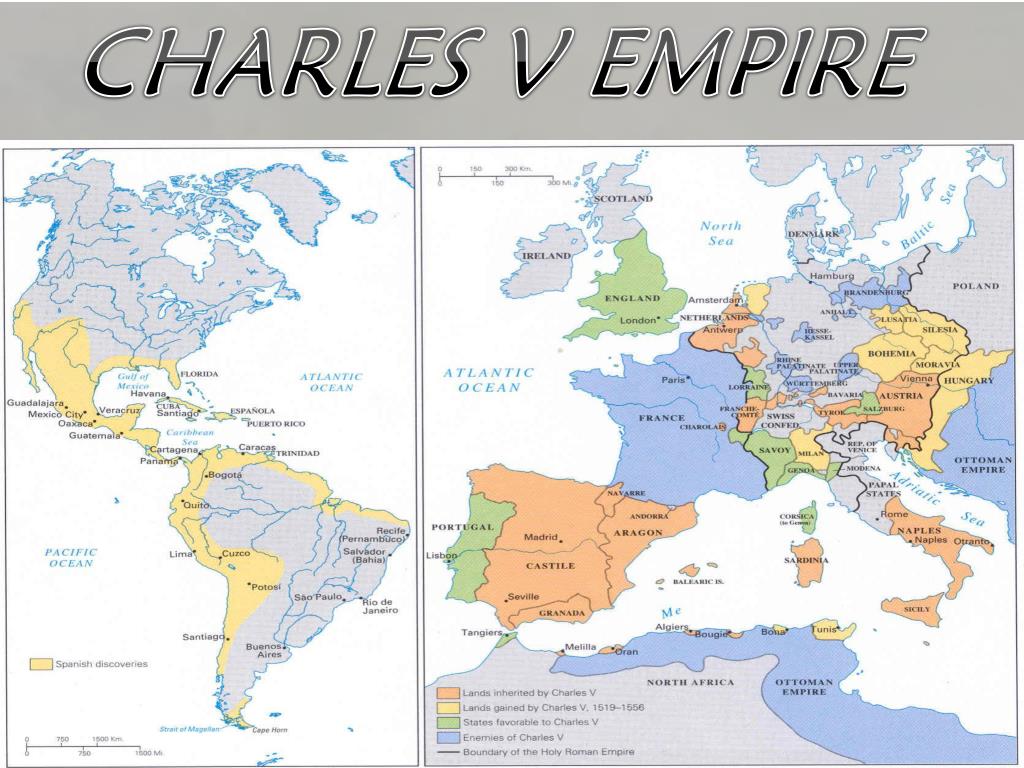
*Yes, some crazy ideas are really crazy . . . but perhaps there is a part of you that would want to have a conversation with this guy . . . ?

**His choice of Pythagoras to make his point is interesting–obviously this sculpture would have been regarded as a minor part of the whole edifice–and yet still something definite of his personality shines through.

^Though Ivins rightly points out the west’s immoderate attachment to the Greeks (something not really present, btw, during the Middle Ages), especially in the Victorian era, he failed to reckon what might happen when we gave up the idea of any kind of cultural center at all.

9th/10th Grade: The Big Armada that Couldn’t

Greetings to all,

This week we continued our look at Elizabeth’s reign in England, and began our special focus on the Spanish Armada of 1588.  This crucial naval battle was the high water mark of the Hapsburg Empire.  With hindsight, we can see that Spain’s defeat here sent them spiraling into a decline for the next few centuries.  Traditionally, the conflict between England and Spain is viewed through the following lens:

1. Spain was the big dominant empire, with all the advantages that brings, led by an intolerant king bent only on increasing his power.

2. England was the ‘Little Island that Could’ — the huge underdog that through scrap and pluck defeated the big bully.

I think this analysis is flawed for a number of reasons:

  • Did Spain have a legitimate strategic reason to attack England?  The English had been raiding the Spanish coastline, as well as Spanish ships in the Atlantic, for years.  England’s support of the Dutch’s rebellion against the Spanish would have made communication and supply very difficult for the Spanish.  None of this is to say that Spain had a good plan, or that you have to root for Spain — but it is important to understand what might have motivated the Spanish in the first place.
  • England’s ‘privateering’ could in one sense be called ‘state-sponsored piracy,’ and what the Spanish might have called, ‘State-Sponsored Terrorism’ (though the Spanish, with the conditions of their mines and their treatment of the natives across the Atlantic, cannot claim moral high ground either).  The English knew they could not beat Spain in the purely conventional sense.  But they also knew they did not need to.  If they could hit them here and there unpredictably, the Spanish would be forced to expend a great deal of resources to cover themselves everywhere.  Maybe Spain could be slowly weakened not by destroying them from without, but putting too much strain on them from within.
 We can see Spain in the mirror when we look at our current situation.  In some ways, we are the Spain of today, one of the few nations with a truly global reach of power and presence.  Al Queda and other like minded groups are in some ways in the position of England.  What happened on 9/11 was devastating in the sense of shock and loss of life.  The ripple effects, both financial (new government agencies, extra security measures, wars, etc.) and psychological continue to this day.  They don’t have to hit us everywhere all the time to hurt us.  To help identify with Phillip further I  asked the students to consider the following hypothetical possibility:
  • You are president, and your Secretary of Defense comes to you with a plan.  If the U.S. acts quickly, he has an idea, that if successful, could end the War on Terror and bring peace to the Mid East for the next 50 years.  The plan is realistic and achievable
  • However, the plan requires a large commitment of our available forces
  • The plan has about a 50% chance of success
  • If the plan fails, perhaps as much as 1/3 of our forces might be wiped out.

Would you approve of the plan and take the risk?  Most students said they would.  Though if it failed, history would likely paint you as an ignorant fool who had blind faith, just as Phillip tended to get portrayed until the latter 20th century.

3. What were the strategic burdens the Spanish faced?  They had more ships, but their ship were bigger, slower, and of course, needed to carry a lot of men and supplies (for the invasion).  Spanish ships had, at best, 5% of their weight as weaponry, while the average English ship had about 14% of its weight as weapons.  Who is the real underdog?

Below is the image of the newly designed English “race” ship:

And here we have the a typical Spanish ship of the time:

Of course, these differences in their respective ships are not the product of coincidence, but of the overall culture of Spain and England.  Spain and England had many similarities, with neither monarch presenting us with either the image of a saint or sinner.  Spain fought Protestants, but Elizabeth persecuted Catholics.   We must careful to find good and bad guys too quickly.

I do think we can say with confidence that England was a more ‘open’ society.  Next week we will examine the relative advantages more open societies have over their more ‘closed society’ counterparts.  England was not necessarily more tolerant than Spain.  They persecuted Catholics with the same zeal as Spain persecuted Protestants.   But England had more social mobility.  For example, in England non-nobles like Francis Drake could have enormous influence.  In Spain, Philip II appointed the Duke of Medina Sedona as the top commander of the Armada, chiefly I think because he was the highest ranking nobleman available.  He did this in spite of the fact that the Duke had rarely even been at sea, let alone commanded ships at sea.  The Duke protested to the king to no avail.  For Philip, the nature of things dictated that the highest ranking nobleman command the fleet.

Philip II may not have been tyrannical, but he did close himself off from his people.  He never communicated in person – it was all done through official letters.  While he communicated frequently with people, it was not in a manner that would generate a free flow of ideas.   He issued pronouncements, and did not invite dialogue.  Take a look at his palace in this image here, which shows his physical as well as psychological isolation:

In any contest, there are many factors at work, including what we might call luck.  But we should not be surprised to see connections between winning and losing armies, and the respective contexts from which they are born.
As a total aside, here is a painting of Philip II, not afraid to show a little leg!  Elizabethan fashion remains a mystery to me.  When I asked what fashion accessory future generations will scratch their heads at, a few students said, “Ties.”  I say, “Stiletto heels.”
Blessings,

Dave Mathwin

11th/12th Grade: Bad Music Begets Bad Government

This week we continued in our reading of Plato’s Republic.  In class we have simply been reading and discussing excerpts from this great philosophical treatise, and I have enjoyed seeing the students react and respond to this text, strange as it will seem to our modern eyes.

The Republic has political implications, but the dialog begins with a discussion about justice.  The participants realize that to see justice more clearly, they had to talk about something larger than justice in individuals.  “If we look at justice in the state we will see justice more clearly,” they suppose, “for the state has a much greater size than any one individual.”  But justice itself becomes a vehicle for larger questions of truth.  Thus, the dialog always has immediate application for individual lives even as we consider their political implications.  Plato writes The Republic, I think, not so much to create a better state but to hopefully make better people, who will then make a better state.

The dialog starts early on discussing the origins of the state.  No matter their talents, everybody at one point realizes that they need others even to meet basic needs.  We then divide up tasks to accomplish them more efficiently.  Providing for our basic needs is relatively natural and easy, but then we begin to want “luxuries,” which Plato terms anything more than what we need for a decent, ordinary life.  This desire for luxury corrupts the soul and creates problems in the state itself, because now the state will have to provide for something beyond the “natural,” and at times the only way to do this involves taking from others.  Hence, war and the attendant expansion of the state come into being.

How to avoid this?  Some see the state as a mere conduit of whatever the people desire.  The government’s job, in this view, is to actualize our choices.  Plato feels differently, and like many Greeks believed that the state should help us live the good life, which might sometimes mean giving us what we might even dislike–just like parents helping their kids healthy by feeding them vegetables.  In Plato’s famous analogy of the cave he imagines humanity bound in chains underground.  All they can see are their shadows cast on the cave walls made by the fire behind them.  They believe the shadows are reality, and the fire true light.  But eventually some break free and walk out of the cave to see true light and true reality.  Their discovery brings pain — we shrink from the sun’s light, and the reality we discover will be so much different than what we imagined.  When these people go back to the cave, few if any believe them, and nearly all prefer to live in the shadows.

Plato asks us to understand that just because we fail to immediately appreciate the truth might even point to the truth of what he argues.

Plato may surprise his modern readers at least with going from war as a result of greed to a discussion of music and the arts.  But political problems for Plato begin with disordered souls, and Plato believes that little has more power to shape the soul than music.  Plato relates a common anecdote of the time of Sparta banning certain kinds of music altogether.  Perhaps even Plato thought the Spartans too severe, but he agrees with the fundamental idea that musical change brings  political changes.

Many moderns think of music as a matter of personal taste and personal enjoyment.  We listen to the music we like, and imagine ourselves having control over the music.  Plato asks us to think more carefully about the music we hear, and wants us to admit that “gets under our skin” in ways we might not even notice.  Upon reflection some of us might testify to the power of music.  It can move us even when we might not want to be moved.

Understanding Plato’s doctrine of the soul helps explain his views here.  Some think of the soul as encompassing the merely moral part of us.  Plato went further.  For him the soul was the “heart” of man in the Hebraic sense, encompassing everything about someone.  Our moral acts do define, mold, and shape us, but we are more than our moral acts.  So for Plato, a beautiful soul would be one that not only loved truth, but also had it itself shaped by beautiful things.  Separating truth from beauty never occurred to Plato.

So if we want to concern ourselves with “doing right” we need first to provide the necessary surroundings, the necessary training, for our souls.  Plato admits that this means certain music can stay, and other forms must go in the ideal state.  The state has a vested interest in the arts because the arts shape the soul.  Badly formed souls will create badly formed governments.  He writes,

Philosophy, [said Socrates], tempered with music, who comes and takes her abode in a man, . . . is the only saviour of his virtue throughout life.

Justice for Plato means having all things in their proper place, or giving each thing its proper due.  This leads to Plato’s prescription that only music that emphasizes balance and proportion should be allowed.  If we want harmony in the state we must have proper training of the soul, and that means the right harmonies in our music.  The rhythm must not over-excite, nor should it be too “soft.”  Curiously for the students, Plato seemed to link rhythm with the idea of grace.  He writes,

But there is no difficulty in seeing that grace or the absence of grace is an effect of good or bad rhythm.

and,

Then beauty of style and harmony and grace and good rhythm depend on simplicity, — I mean the true simplicity of a rightly and nobly ordered mind and character, not that other simplicity which is only an euphemism for folly?

What can Plato mean here?

When we see the word “grace” we immediately put it in a distinctly Christian context.  The Greek word for grace is “charis,” which had different connotations.  The basic meaning had roots in something like “power” or “movement” — hence a “charismatic” man has the ability to “move” people.  The Greeks also used the word in the context of the social graces, which can have the sense of proper “movement” in society.  But Plato, I think, has something more in mind besides mere politeness.  If we think of a gracious hostess, for example, we think of how she controls, or “moves” a social event.  She will possess a certain rhythm of movement and speech.  She’ll have impeccable timing, she’ll neither be overbearing nor invisible, akin to a symphony conductor.  Thus, for Plato, if we immerse ourselves in proper rhythm and harmony, we will train our souls towards “graciousness.”^

Plato has another motive for his seeming harshness about music.  Problems in the state arise from the people’s desire for luxury.  This desire is almost inevitable given human nature, but Plato believes the state can curb it (thereby saving everyone lots of trouble) by proper training of the souls of the young.  If we purge the person of luxurious taste in music, or the desire for too much variety in music, we can form the soul to desire less.* This can get into a “chicken or the egg” argument.  Does music reflect or shape the culture?  Well, we can say  perhaps that it performs both functions, but which primarily?  Here, I at least agree with Plato (and Francis Schaeffer, Kenneth Clark, and others) who feel that in general, artists work ahead of culture and do more to shape it than reflect it.

If all this seems hopelessly idealistic, I think Plato would respond by saying that,

  • You have to aim for something to hit anything, and
  • My point here is not to create the perfect state so much as it is to use the state to better see Justice and apply that understanding to how we live our lives.

Next week we will look at Plato’s ideas of how different souls create different forms of government.

*************

*Many in the modern world make the argument that classical music makes one smarter.  Plato did not focus so much on classical music (it didn’t exist) or increased intelligence.  Rather, the right music would help form the right kind of soul, not the right kind of brain.

^Since the New Testament writes use “charis” to denote grace in the Christian sense, we may wonder whether or not a certain “rhythm” exists in God’s grace — a certain pattern, timing, or tempo, perhaps?

Trade Off

One of the great strengths of one of my former bosses involved his ability to see that the pie never extended unto forever. Everything one did in the classroom came with costs and benefits. Whenever trying something new, consider what that meant one would conversely not do, and judge the consequences. We see little of this thinking on either side of the political aisle today. When looking at issues, one should consider not just the benefits it would bring, but also consider which costs and drawbacks one can live with most reasonably.

The words “free trade” are a major coup for laissez-faire capitalists. Even those against such practices have to stand against something “free.” One can understand what the term means in one sense–that no barriers should exist between those who want to exchange something. But, the term obscures the fact that no trade is “free.” In every trade, one gives up something, and the term “free-trade” might not clue us into this fact.

In his book, Global Squeeze author Richard Longworth argues that the global “free trading” market which opened up in the post-Cold War era hurt us much more than it helped. We have exchanged much more than we thought in the bargain. This in itself is nothing remarkable–many books have argued likewise. What drew me to the book initially was that

  • He predicted many of our economic and resulting political concerns today (such as the rise of ethno-nationalism, populism, etc.) way back in 1998, when virtually everyone else saw only one side of the new globalism. At the same time,
  • I felt that this was not just a lucky guess, because he clearly understood the nature of trade-off’s even in “free trade,” and most of all,
  • He asked questions that no other economics book I’ve read asked, such as, “What is an economy for?”

That question we rarely ask. We want a “good” economy, but we have no clear idea what a “good” economy means. While I have no impression that Longworth has a conscious understanding of the patterns and symbolic structure of reality, his book helped me see economics within this frame. So, with apologies to all who find where I begin a bit odd . . .

Theologian Dumitru Staniloae wrote concerning St. Maximos the Confessor

Some of the Fathers of the Church have said that man is a microcosm, a world which sums up in itself the larger world. Saint Maximus the Confessor remarked that the more correct way would be to consider man as a macrocosm because he is called to comprehend the whole world within himself, as one capable of comprehending it without losing himself, for he is distinct from the world. Therefore man effects a unity greater than the world exterior to himself whereas, on the contrary, the world as cosmos, as nature, cannot contain man fully within itself without losing him, that is, without losing in this way the most important reality, that part which more than all others gives reality its meaning. The idea that man is called to become ‘the world writ large’ has a more precise expression, however, in the term macroanthropos. 

The term conveys the fact that in the strict sense the world is called to be humanised entirely, that is, to bear the entire stamp of the human, to become panhuman, making real through that stamp a need that is implicit in the world’s own meaning, to become in its entirety a humanised cosmos in a way that the human being is not called to become nor can ever fully become, even at the farthest limit of his attachment to the world where he is completely identified with it, a cosmosised man. The destiny of the cosmos is found in man not man’s destiny in the cosmos. This is shown, not only by the fact that the cosmos is the object of human consciousness and knowledge and not the reverse, but also by the fact that the entire cosmos serves human existence in a practical way.

Taking this view of man and the cosmos as my premise, I argue that we should interpret our experience of the world and derive meaning through the lens of what it means to be human, a composite being of body, soul, and spirit. This does not mean that all truth is relative or subjective–far from it. Rather, it is a perspective that recognizes that, “The sabbath was made for man, and not man for the sabbath” (Mk. 2:27). God creates the world through the Logos, who is Christ (John 1). Ultimately then, Christ is not the image of Adam so much as Adam is the image of Christ, mysteriously “slain before the foundation of the world” (Rev. 13:8).

So for things to have intelligibility and proper functionality, they should scale to human experience (I realize that I am about to take a massive leap from this premise which I have not done a lot to prove, but . . . :)*

We have to trade things to live, in a sense, both in our bodies individually and in the body social. We have to take in food, water, and so on. We are not autonomous or self-sufficient. Longworth agrees, giving us examples of cultures that have no trade that end up drab, and lifeless. One might think of the ancient Spartans, and the more contemporary Soviet Union. But we can’t just take in anything from anywhere, for any reason–“trade” is not an inherent good, but a contingent one. If we trade too much, even of a good thing, it will be bad for us. One can drown even by drinking excessive amounts of water–too much water brings a flood. In addition, for reality to make sense to us, ideally at least, we should have some connection to those we trade with. Personal contact and personal relationships help let us know if we have a fair trade or not, one that pleases both sides.**

In sum, for an economy to work as it should, it should benefit all sides involved, and benefit them in a way that preserves meaning and coherence. Nations should trade, just as people should trade oxygen for carbon dioxide.

While Longworth does not engage in these kinds of symbolic connections, they do form the unspoken background to his foundational question of, “Whom is an economy meant to serve?”

We come into the world and into a family, if not sociologically, at least biologically. A family economy, then, primarily should serve the family. But it gets tricky, because no family should only concern itself with itself. When this happens, one gets The Godfather saga. Christian teaching pushes outwards towards those on the fringe socially and economically, but we need balance. A mom or dad who devoted too much of their energies to those outside the family would erode the very foundation of their well intentioned actions. Here, C.S. Lewis’ great principle of “First and Second Things” directly applies, which runs something like,

Put first things first and we get second things thrown in: put second things first & we lose both first and second things. We never get, say, even the sensual pleasure of food at its best when we are being greedy.^

Many have discussed the lack of connection we have to what we purchase. We have divorced the thing we buy from who made it, where it was made, and so on. Many have spoken of a “meaning crisis” in our culture and surely the fact that what we trade for and consume has no “context” for us contributes to this dislocation. However, Longworth doesn’t address this, and altering this societal condition remains impossible for almost everyone. We can focus then, on what we can fix, at least on a national level.

Longworth points out in multiple ways how our globalized economy violates the “First and Second Things,” principle. The “nature” of capital seeks out the most efficient way of doing business, so naturally labor would migrate out of the country. We anticipated this in part economically, but not at all sociologically. Longworth mentions that many African-American families (to take one example) rose to the middle class in part through blue-collar jobs in inner-cities. These jobs offered stability and helped build distinct local neighborhoods. As these jobs left, these communities eroded (something seen by Jane Jacobs way back in the 1960’s–this is not NAFTA’s fault alone). Just as we can see the distortions of Marxism as a reaction to the distortions of industrialism, so too we can see racial identity politics as the current distortion to try and correct for the distortions of the market. We can bring it back to the family concept. If your plumber brother really needed work, but you had a 20% discount coupon for some other guy you didn’t know, and hired him instead of your brother, you could expect family difficulties.

As Longworth points out, the medieval peasant always had work, but rarely had prospects for growth. Now, we have the opposite problem of the possibility of growth for all, but no promise of work.

Many today fear the presence of national populism, but here too Longworth had prescience. When we exhale deeply we will inhale in a like manner. One can look at the Hapsburg dominions of the mid 16th century . . .

and compare it with modern European global trading connections

The discontinuities lack coherence on both examples. The Hapsburg holdings don’t make sense, and most students recognize this immediately at some level. They then rarely root for them in any of their various wars. Starting around the mid 17th century, we saw the beginnings of concentration of identity into national states, partly as a reaction to the wars involving the Habsburg dominions. The trade map above concerns Europe primarily, but the principle applies to other regions. Start neglecting meaning and coherence in the family, and look for the kids to try and recover that meaning in ways the parents might not like–look no further than the relationship between the EU and Hungary.

Our modern free trade policies evolved for various reasons in the wake of W.W. II. Free-trade could legitimately serve (perhaps) as a means to combat communism in part because the vast majority of major players shared many in things in common:

  • Common cultures and religions
  • Similar pools of labor and technological access
  • A common political goal

Japan participated in this as well, which posed problems for the U.S. in particular. Japan had different cultural and political goals, which led to more protection of its labor force and different economic practices. However, Japan’s labor pool was small enough not to erode and distort the system. With the entrance of China and India, however, things changed dramatically. Economist Richard Koo commented in the early 1990’s

The free trade system has lasted this long only because China and India are not in it. The U.S started this system after the war and other countries joined in. Japan is not a full member even yet–Japan is certainly not a free-trader. But if the problem is just Japan, it’s tolerable. But if China plays the game as Japan has done, the system will not last without safeguards. With the 3rd world entering–there is no end to the potential problem.

Trade in finance may prove an even bigger problem than trade of goods, and again, Longworth showed remarkable foresight here. Bartering goods has a direct coherence to it. You give me your apples, I give you my wheat. But bartering is cumbersome, so we go to money. But in the early stages at least, one could exert a degree of control over money and give it a degree of coherence in a local context–i.e., the money that “works” in a given place is the money with the king’s head on it. That too, limits us, so we went to a more universal, though still concrete, “gold standard” to determine the value of money and limit its movement at least partially. Then Nixon abandoned the Bretton-Woods arrangement and broke from the gold standard, which pushed money into an even further abstraction. Non-national currencies in the cloud are the inevitable conclusion to this process, a process which–however many it benefits materially–pushes us further away from meaning and coherence in our exchanges with each other. I am not one to often quote Keynes approvingly, but he understood–perhaps subconsciously–the necessary symbolic balance of trade, stating,

I sympathize therefore, with those who would minimize, rather than maximize economic entanglement between nations. Ideas, knowledge, art, hospitality, travel–these are things which of their nature should be international. But let goods be homespun whenever reasonably possible. Above all, let finance be primarily national.

But nations cannot control the flow of money because they cannot control trade. Merely trying to control currency movement by the elite, therefore will not work and only hurt the “everybody else” in the economy.

The bigger question, however, of “Can we stop this?” relates strongly to the question, “Do we want to stop it?” Here it gets difficult for all of us. Longworth rightly says that technology is not the problem. The internet obviously has the ability to “actualize” many of the trends Longworth saw developing, but the shift had begun decades before the internet entered society. For Longworth, the root lies in trade, but I say, let’s go one deeper–what in our cultural leads us to practice trade as we do?

Democracies foster a sense of individualism, which maximizes opportunities for the self vis a vis the group. Democracies tend towards dynamism, which bodes ill for stability. For example, a recent study shows that

…democratic rule and high state capacity combined produce higher levels of income inequality over time. This relationship operates through the positive effect of high-capacity democratic context on foreign direct investment and financial development. By making use of a novel measure of state capacity based on cumulative census administration, we find empirical support for these claims using fixed-effects panel regressions with the data from 126 industrial and developing countries between 1970 and 2013.

Aye, there’s the rub. To change how trade works, we may have to change more than just trade.^^

Dave

*Suggesting any kind of absolute relativism is the last thing I mean to do, but unfortunately I fear I may not be explaining it well. By ‘human experience’ I don’t mean anything at all that humans might experience. We experience many things that are obviously wrong and bad for us. I mean then, something akin to a union of Heaven and Earth that is supremely Christ Himself, then the Virgin Mary, the saints, and so on down the line. Of course man himself was meant to function as a union of Heaven and Earth originally in creation. One can see this in the very structure of our bodies. Some animals soar above the earth, some slither under it (fish). Most every animal has all of its appendages on the ground, whereas we have two on the ground, with our intellect–our ‘heavenly’ aspect on the commanding heights above us. Our heart unites the two.

**For those that used to trade baseball cards, think of those times when you might see when you drove too hard a bargain for the “Mutton Chop Yaz” in the face of your friend. Unless you were Comic Book Guy, hopefully you adjusted the cost so that you prioritized your relationship and avoided taking advantage of him.

^In seminary many years ago I heard several cautionary tales along the lines of:

  • Young, energetic pastor and young family come to the church
  • Young pastor becomes popular and receives lots of affirmation from church. He throws himself into his work at church–glory and acclaim can be like a drug.
  • But because of this, he spends less time at home, where things are inevitably more mundane. His wife eventually grows resentful and distant.
  • Wife leaves husband, which makes it impossible for him to keep his job at church. Thus, he loses both the “first thing” (family, in this case), and the “second thing” (job) all at once.

^^Supposing the accuracy of the study, one can react in the following ways:

  • Inequalities in wealth are such a bad thing that if democracy contributes to it we should overthrow it.
  • Inequalities in wealth are not good, but perhaps it is one of the costs we must endure to have the greater good of democracy.
  • Inequalities in wealth are not always bad–and in fact can sometimes become a positive good. The wealthy (individuals or companies) can dramatically advance society in important ways, etc. We cannot avoid hierarchy.

As to #1–I would wonder what we would replace it with. Certainly most modern replacement ideas involve a revival of Marxism which we should reject out of hand. The other two make more sense to me, but I am still not satisfied. I feel that if a solution to the problem exists, it exists outside the system itself, and this would mean letting go of some aspects of our modern world as it relates to culture, politics, etc.

9th/10th Grade: Gnawing Insecurity

Greetings,

This week we looked at the English Reformation, beginning with Henry VIII, and culminating with Elizabeth I.  Wherever the Reformation took root, it did so for slightly different reasons and took different forms.  Some say that the English Reformation was driven more by personality and nationality than theology, and there may be truth to this.  In time, Anglicanism would develop a distinct theological voice, but in the beginning the marriages of the monarch determined much of the course of events.

When we think of Henry VIII we often think of a domineering and abusive man, perhaps too much in love with his own power.  This may capture much of the truth of who Henry was, but he did not necessarily begin that way.  He had great intelligence.  He spoke fluently in perhaps three different languages.  He was an accomplished musician and dancer.  He wrote a legitimate and scholarly work on the sacraments.   He had a love for crowds and spectacle, and England adored him in the early years.

When we see him as a young man . . .

we may wonder how eventually he became this man. . .

But I think both pictures share something in common.  We often think of Henry as all confidence and show, like this. . .

But I wonder if this last picture shows Henry “protesting too much.”  The first two pictures to me show a lurking insecurity.  The man in the first two pictures is not at ease with himself or his place in the world.  Perhaps I go too far in psychological speculation, but the image above with him jutting out his chest seems to reinforce this idea of insecurity.  If we see Henry this way, his near obsession for a son begins to make sense to us.  Strong as Henry wanted to appear, his theological views depended greatly on those who he surrounded himself at a given moment in time.  Perhaps this is why many assert that Henry’s last wife, the evangelical Catherine Parr (here below giving her best “Excuse me, will you please keep your children quiet — this is a library!” look) may have been his most important.  She tutored Henry’s son Edward, and had the strength of will to get her vision of Anglicanism imprinted on England.  To outlive Henry (the only of his wives to do so) she must have been a strong woman!

Six years after his death, his oldest daughter Mary assumed the throne.  History knows her as “Bloody Mary,” because of her persecution of Protestants.  In many ways she deserved this epithet, but we must try and sympathize with her.  Henry unjustly divorced and banished her mother Catherine of Aragon.  She had little contact with Protestants, and plenty of time to nurse a grudge, to plan to right the wrongs of the past.  We might understand better if we we realize that she thought that Henry had “ruined the country,” and God placed her in authority to bring England back to a godly foundation.  We can imagine becoming president where your predecessor had done everything against your most deepest convictions.  You would want to set things aright.

To this psychological motivation we should add that neither Henry or Mary’s mother lived very long.  What if she felt that she had precious little time to accomplish her goals before her death?  As the saying goes, “Beware of an old man (or woman) in a hurry.”  In this image to the right we see the same gnawing insecurity her father could not hide.  Like Henry she knew she needed a son if her attempt at reform would last, but as an older woman nearly past childbearing years, she had little hope of a suitor actually appearing.  We can lament the tragic nature of her life without condoning her actions.

After Mary’s death the stage was set for her half-sister Elizabeth to have a glorious reign.  Yet she too had reason to fear.  The pope had declared Henry’s marriage to Anne illegitimate, which meant that Elizabeth herself had no right to rule.  After Elizabeth, the closest to the throne was her cousin Mary Queen of Scots, niece of Henry VIII.  She stayed Catholic, and so remained the focus of Catholic plots to unseat Elizabeth.

Matters got more complicated when Mary fled to England for refuge after some accused her of murder. Personal letter between the two reveal a long friendship between them, but almost immediately after her arrival in England, Elizabeth imprisoned her.  Eventually one of Elizabeth’s spies uncovers evidence of Mary implicating herself  in a plot to overthrow Elizabeth.  The trial is a foregone conclusion — she’s guilty of treason.

We know that Elizabeth agonized over the options about what to do with her friend and cousin.  Many  believed that England and Elizabeth could never be safe as long as Mary lived.  Now that Mary had committed treason, Elizabeth had every right to deal with the problem once and for all.  Elizabeth had a few options:

  • She could execute her
  • She could keep Mary imprisoned, knowing that plots could still arise
  • She could exile Mary, but in exile she could still raise an army and return
  • She could ignore it altogether and hope it would not happen again.  But what head of state can ignore treason?

Neither option appealed to Elizabeth.  Sometimes we don’t have good choices, only a series of bad ones.

Some students wondered astutely if Elizabeth could escape all these choices by marrying herself.  If she had kids, her place on the throne, and the future of Protestantism, would be much more secure.  As to why she never did marry, my theory is the Tudor love of power.  If she married, she would still be queen, but someone else would be king.  This image below shows Elizabeth, like her father, perfectly comfortable in the role of outsized, grand monarch.

Next, the Spanish Armada.

Many thanks,

Dave