A.J. Toynbee: “Hannibal’s Legacy” in 2 vols.

I have republished this because of the partial similarities in theme with Hillaire Belloc’s Waterloo, reviewed here.

And now, the original review. . .

This is a great work, probably a labor of love to write and certainly at times to read. It bogs down in parts, at times too technical and obscure. But if you let it wash over you and absorb the full effects, one sees the book’s great value. It’s theme of how war pressures a society, and how victory can be turned into a defeat of sorts, is entirely relevant for us today.

First, the weaknesses:

  • Toynbee’s subject fits an epic scope, but the book becomes very technical at times. He loads the writing with untranslated Latin phrases. I realize he may have had the specialist in mind with because he does not do this in his other writings. But it’s still aggravating and pointless.
  • The book is too long. I admire his desire to touch on everything related to the subject (such as animal husbandry habits), I often lost focus and momentum reading it.

But don’t let this stop you. Look at me for example. I skipped big chunks of it and here I am, confidently reviewing it!

Toynbee believed that studying the classical world had importance not so much because of its influence on western civilization, however true that may be, but because we have with the Hellenic world a complete story fairly well documented. Given the uniformity of human nature, their story can be instructive for all us.

His argument runs like this:

1. One key to understanding the Hellenic world is the city-state model. Time and again, this model proved its superiority over other political organizations in the Mediterranean and beyond. The Greeks beat Persia for example. Organized along these lines, the Romans were poised to better their less well organized neighbors.

2. Conflict is part of life, and Rome eventually and continually got into conflicts with provinces around them. Their inward structure and at least moderately progressive alliance structure gave them a final advantage in these various conflicts.

Toynbee does not exalt Rome as the paragons of ancient virtue. But neither does he dismiss the good parts of what made them great. It’s ok to discover good things about western civilization!

Their victories solved some problems but created others. By the mid 4th century B.C. Rome’s expansion had done two things

  • It brought them up to the Mediterranean which likely would have inevitably involved them in conflict with Mediterranean naval powers. Should this conflict come the impact on Rome would be far reaching, win or lose. But this particular law of unintended consequence is faced by every civilization.
  • More importantly, Rome’s territorial expansion put great stress on the concept of the city-state. City-state’s work well when their is enough familiarity with one another to share rights, privileges, and responsibilities equally. When done, the resulting social cohesion can be personally fulfilling and politically dynamic.

Now such cohesion would be impossible. They were too big. Rome had a choice to make. They could either a) Transition into a more bureaucratic state with more central authority, b) Expand the base of their rights and go to a broad-based representative democracy, or c) Forget social cohesion and extend the power of their ruling class to these other areas as well.

Given their aversion to monarchy, ‘a’ was not likely, but ‘b’ was possible. Alas, they chose ‘c.’

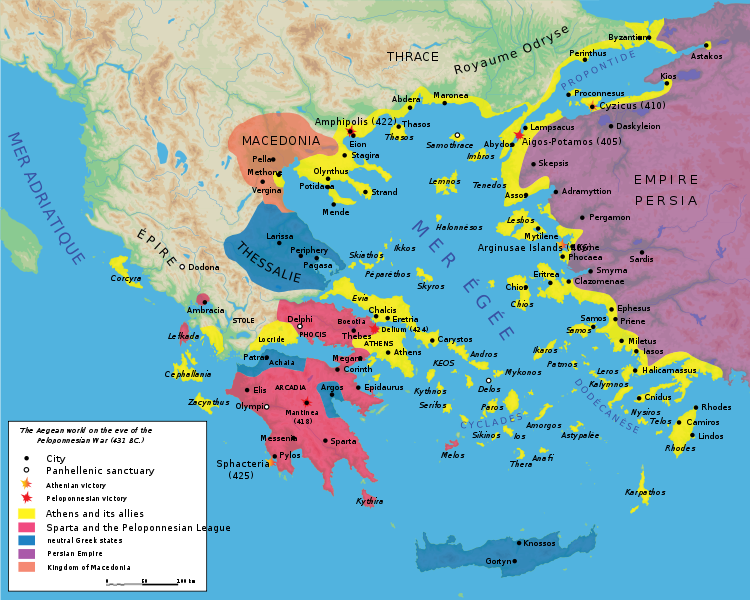
Toynbee elsewhere makes the somewhat dubious assertion that the Hellenic world (which included Rome in his view) began to collapse in 431 BC with the Peloponnesian War. As it applies to Greece, it works, but not Rome. His argument here though, that Rome began to lose itself somewhere around 350 BC makes more sense. This is when Rome makes the transition from some kind of admirable democracy to a less admirable oligarchy.

3. It is the nature of oligarchies (like most regimes) to maintain control. Rome was still progressive in some ways, but in moral/political matters going half-way is worse than nothing. For example, most would rather not be invited to a party at all, instead of being invited and then told, “You can’t eat that. These rooms are off limits, etc.” They could be benevolent at times, but insisted on control. This dynamic often led to a unity of prominent families over and against the masses. They condescended to give allies some rights, but never equality.  This made them vulnerable.  Pride often does.

4. This was the climate that Hannibal hoped to exploit when he invaded. The traditional narrative is that Rome, pressed to the brink by a military genius, rallied itself and  gained the victory. They add lots of territory in Africa and Spain. It’s a triumph for western civilization.  Rome’s victory over Hannibal saved them from coming under the thumb of an an elitist merchant class oligarchy that would never have let them exercise their political wings.  That was the best case scenario, with the worst case being utter destruction.  Hurray — western civilization is saved!

Not so fast, says Toynbee.  He dedicates the vast majority of vol. 2 to showing the unintended negative ripple effects of Rome’s victory. Some of them were inevitable, but most Rome had a direct or indirect hand in.  They could have avoided their fate.

The Effects:

  • Rome had treated allies generally well before the 2nd Punic War, and often imposed extra burdens on themselves, sparing allied troops certain duties. After the war (during which some key allied states left for Hannibal) this was no longer the case. Rome now often gave the extra/harder duties to their allies. This is just part of the psychological scars the war left on Rome.
  • Much of the SE Italian population and land had been devastated by the war. Many peasants fled to the cities, which caused a manpower shortage in terms of raising troops from the provincial areas. But Rome, being less trusting, would not let their allies short them in any way on troop requirements any longer. But the extra burden came at a time when they were much less able to meet it.

  • New territory had to be manned, but this meant that troops would be away from farms for long extended periods, making their farms unprofitable. The people who get stationed in Spain can’t come back to vote. If they can’t vote they have no power. Legions in Spain would end up serving for 5-10 years at a time. Out of sight out of mind — until you can’t possibly ignore it any longer.  They do not return as happy campers.
  • In general, the war destroyed the average independent peasant farmer. Wealthy oligarchs could easily buy up lots of cheap property and turn them into plantation farms. But who could work these farms? A free peasantry might get called off to war. Slaves made more sense, and of course, were readily available from the conquests. Thus, slavery expands in Rome during and after the 2nd Punic War, which would rot away the core of Rome’s traditional republican values.
  • As the army grew more disconnected from the social and political life of Rome, their habits became more self-serving. Hence, their abuse and looting of the provinces, of seeking conflict for the sake of loot, and of their increased loyalty to the commander instead of Rome itself.
  • Religion changed in Rome as they became exposed to the more emotive Mediterranean faiths. Traditional Roman religion could not provide for the new needs of the people to deal with the trauma of the war. Of course for the most part, the ruling oligarchy responded as they usually did, with force to suppress. But as you might imagine, this did not work very well.
  • The Romans lost perspective in many foreign crisis. ‘Hannibal’ was everywhere, and so what should have been perceived as a minor threat became a major one, which led to the more frequent drafting of larger armies. This put even more stress on an already stressed peasantry.

The main theme of the post-war years is the oligarchy attempting to maintain their hold on power, but shooting themselves in the foot with most every attempt. For example,

  • Vast new flocks and herds required shepherds to watch them. Shepherds need to be armed against theft and animal predators. But shepherds were often also slaves.  So. . . we see a sharp increase in slave rebellions against the oligarchy.  The Romans armed their potential destroyers.
  • The oligarchy maintained their power through accumulation of land, which led to wealth. Their wealth, along with Rome’s Mediterranean expansion, allowed them to acquire more exotic goods from all over. But this created a new class of wealthy merchants who inevitably challenged the oligarchy for control, and the resulting political tension spilled over into violence.

In the end Rome’s response to their victory led to the destruction of the oligarchy, first in their alienation of the peasantry, then in their fratricidal civil wars, and finally, in their death at the hands of the Principate with Augustus.

What lessons can be learned?

Rome made many mistakes, but many of these were not unusual mistakes. When people win the lottery they take the money and don’t consider the consequences. Most civilizations would take the territory gained in war in the same way.

The fact that Rome ‘lashed out’ and became more controlling and paranoid is also not unusual given the horrific shock and destruction Hannibal inflicted. In their minds it must have been ‘prudence.’ ‘Fool me once,’ and all that.

But Rome was not doomed to follow this path. Though Toynbee does not mention this specifically, I believe that his thesis fits with his overall belief that civilization routinely destroy themselves through acts of pride, fear, and envy. Only sacrificial love can allow a civilization to maintain itself long-term. This is not mere sentimentality. In fact, he takes 800 pages with gobs of footnotes from obscure German historians who wrote books with very long titles to prove his point. If we cast our bread upon the waters, we’ll get it back eventually.

For us today, in light of 9/11, the lessons are similar.

We cannot compare the shock of 9/11 to what Rome endured in the 2nd Punic War. The two events are not even close in magnitude, so the fact that our reaction has not been as extreme as Rome’s is nothing to write home about. We should be thankful.

However, in some areas, such as the extension of our military, the possible ‘tightening’ of our society, the easy way which our civilization can give way to fear, should be a warning to us. Through acts we could and perhaps could not help, we find ourselves stretched economically and more divided culturally than before. We would be silly to suppose that are automatically immune from Rome’s fate.

To close the review (too long!) in the true style of Toynbee’s book (also too long!), I need to include a large appendix. So, below is ‘Exhibit A’ for the change of Rome’s character: the expansion of slavery beginning with the first Punic War (264 B.C.) and ending with the destruction of Carthage in 146 B.C.

Expansion of Roman Slavery During Punic Wars (not a complete list): 264-146 B.C.

  • 262 B.C. 25,000 Agrigentines sold into slavery
  • 258 B.C. Myttisstraton massacred by Romans, survivors sold into slavery
  • 258 B.C. Camarinans population into slavery
  • 254 B.C. 13,000 Panormitans, into slavery
  • 241 B.C. 10,000 Carthaginian POW’s into slavery
  • 230 B.C. Romans buy large batch of slaves from Boii
  • 214 B.C. 25,000 killed or enslaved by Fabius Maximus
  • 210 B.C. 2,000 artisans from New Carthage enslaved
  • 210 B.C. Akragas population into slavery by Valerius, leaders executed
  • 210 B.C. Anticyrans sold into slavery, though they had previously made a good faith pledge with Rome
  • 209 B.C. African POW’s in Hasdrubal’s camp enslaved by Scipio
  • 207 B.C. Dymaeans enslaved by Galba
  • 204 B.C. 8,000 African civilians sold into slavery
  • 202 B.C. Wholesale African populations enslaved by Scipio
  • 189 B.C. Samean population enslaved by Fulvius
  • 177 B.C. 5700 from Istrian towns enslaved
  • 177 B.C. 80,000 killed or captured by Sempronius Graachus
  • 171 B.C. Haliatus population massacred, 2500 survivors enslaved
  • 171 B.C. Anti-Roman party at Thisbe enslaved with families
  • 167 B.C. 150,000 from 70 Molossian towns enslaved by direct Senatorial order
  • 155 B.C. Delminium population enslaved by Scipio Nascia
  • 146 B.C. Remaining women-children survivors from the seige of Carthage (perhaps 50,000?) enslaved.
  • 146 B.C. Captured Corinthians massacred, women and children enslaved, liberated Greek slaves re-enslaved by Romans
  • 133 B.C. Numantines enslaved by Scipio Aemilianus

8th Grade: Go Down Gamblin’

Greetings,

This week we looked at one of Rome’s most controversial figures, Julius Caesar.

Caesar stands as one larger than life, and inspires many different reactions.  Many view him quite differently, and he begs the question, “Who was he?”

1. Some see him as a rare combination of political and military genius, not seen again until perhaps Napoleon.  But some counter that he got carried away, went too far, and ended up assassinated.  How much of genius could he have been?  One could say the same about Napoleon, by the way.

2. Others see a man of the people, dedicated to helping Rome’s less fortunate and ending the reign of an elite’s aristocracy’s hold on Rome.  But why then, did he himself amass a massive personal fortune?

3. Still others see a man bent purely on personal gain, dedicated to destroying whatever stood in his way.  His killers did not commit murder, but performed a judicial execution on behalf of the state on a criminal.  Those that disagree point out that no real Republic existed for Caesar to betray anymore.  The patricians sought power just as Caesar did and cloaked that under the auspices of “preserving the Republic.”

4. Finally, some see Caesar as a man dedicated to preserving order in Rome after nearly a century of political strife.  The Republic failed to prevent multiple small level civil wars, and so a “strong-man” needed to arise to bring stability to Rome.  And yet others counter that Caesar went out of his way to antagonize the patricians, who (like them or not) surely were needed to ensure Rome’s stability.

Truth may reside in all these theories, but one struggles to make sense of them all, to find a coherent center.  I believe that one way we can do this is to see Caesar as a gambler at heart.  He had the ability to quickly seize the initiative and take great risks with great rewards that accompany them.  He read people superbly, and at times could conceal his intentions.  He had high levels of self-confidence.  He would have identified with the Bob Seger song I referenced for this posts title. But like many gamblers, he did not know when to stop.  The compulsive gambler must eventually lose.

We see different examples of this principle at work throughout his life.  He married the niece of Marius, who lost a civil war with the dictator Sulla.  Sulla had Caesar on a list for execution, but decided to spare him on account of Caesar’s mother — on one condition.  Caesar had to divorce his wife, a relative of Sulla’s greatest enemy.

Caesar refused.  No doubt his refusal stemmed in part from his love for his wife.  But clearly another part had to do with the fact that Caesar would not back down to anyone.  No one would tell him what to do.  Or did he just want to see how far he could push the mighty Sulla?

Later on at his mother’s funeral he unveiled statues of his uncle (by marriage) Marius, whose likeness had been forbidden since Sulla’s time.  It’s hard to know if he genuinely sympathized with the cause or just loved tweaking authority.  His rejection of his patrician ancestry puzzles some.  The patricians could have guaranteed Caesar wealth and status.  But of course, it would have been wealth and status on their terms, not his.  Siding with “the people” gave a him a blank slate upon which he would stand or fall by himself.

Other such “all or nothing” instances exist in his life.  He went into massive debt to run for Pontiff, and had he failed he would have gone to jail disgraced.  Naturally, he succeeds, and uses the power of that office to amass a new fortune.  We get the phrase, “Crossing the Rubicon” from his life as well.  He had no qualms about going “all in” even without the strongest of hands.

I’m a believer in the power of images/faces to reveal a lot about the past.  What does Caesar’s face tell us?

Of course this is not the only bust of Caesar in existence.  The one below, in fact, may be the only surviving bust from his actual lifetime, and perhaps it tells a different story:

One of the few that Caesar could not overwhelm with either his charm, force of personality, or force of arms was Cato the Younger.  Cato opposed all that Caesar did, and not always because Caesar went outside the system.  For a long time Caesar worked carefully within the Republic, but Cato still opposed every idea he had.  Cato feared that Caesar had an insatiable attitude for recognition and control, so he must oppose even lawful and possibly good ideas lest they work and enhance Caesar’s reputation.

Even historians who do not like Caesar debate the merits of Cato’s stance.  Did it antagonize and push Caesar further than he would otherwise have gone?  Did it make him despair of the Republic as a whole?  Could the Republic still function, as Cato thought, or had it died long ago, as Caesar believed?  I hope the students enjoyed thinking through these questions.

After Caesar assumed power in Rome, he acted in a number of highly provocative ways:

  • He wore red boots.  A bold fashion statement, yes, but also a political statement, since red boots were associated with the exiled and despised Tarquin kings from centuries earlier.
  • He allowed himself to be named “Dictator for Life.”
  • Some sources say that while presiding over the Senate, he sat on a throne of sorts overlaid with gold.
  • He packed the Senate with his friends and supporters, making that institution politically useless.
  • He had a fling with Cleopatra.  This might cause eyebrow raising and gossip left to itself.  But then Caesar put a statue of Cleopatra up amongst other heroes of Rome.

The question of whether or not Caesar plotted to assume kingship had deep implications.  Rome’s Republic built itself primarily on the rejection of monarchy.  Rome made a law stating that anyone who sought kingship could be killed.  The conspirators believed, or at least said that they believed, that Caesar planned to do just that.

Others counter that Caesar already had all the power kingship could bring.  Before his assassination he planned on a large-scale military expedition against Parthia that would have taken him out of Rome for perhaps a couple of years.  Some argue that it made no sense for him to seek monarchy.

Perhaps the way to see through this dilemma is to see Caesar, for the sheer thrill of it, seeing just how far he could push things.  Like most gamblers, he eventually went too far.

Many thanks for a great year,

Dave

World War II, Japan’s Peloponnesian War

Any student of classical history must admire the incredible flourishing of 5th century Periclean Athens.   From the years 480-430 B.C. we see the birth/enormous growth of drama, architecture, sculpture, politics, etc., etc. Kenneth Clark called this period one of the four or five great eras in human history, and few would dispute this.

Historians also always point out how the unexpected victory of the Greeks in the Persian Wars between 490-479 B.C. propelled them into this golden age.  The victory gave them an unexpected burst of confidence and a validation of their identity.  I have not read anyone who has not made this connection, for it seems obvious.  More than this, we can see that golden ages in other civilizations have origins in similar bouts of resistance against an apparently stronger foe.  So, the Florentines resist the French in the early 15th century, and the English defeat Spain’s Armada in 1588 (not long after we get Shakespeare, Ben Jonson, etc.), and the Dutch defeat the Spanish in the early 17th century, after which we get Rembrandt.

The epilogue to this glory comes with the Peloponnesian War, where Athens flushes away this incredible storehouse of achievement in a messy and long conflict with its rival Sparta.  Athens loses and the golden age ends, but . . . all good things must end, the wheel of fortune spins, and no one doubts the salutary effect of their victory in the Persian Wars.

Recently I have read a slight amount of Japanese history and I wondered about certain possible parallels.  The Russo-Japanese War had all the makings of an equivalent to Greece’s triumph against Persia.  With Japan, we see a ‘rising star’ defeat a much larger power in Russia that everyone expected to win.  Like Greece, the Dutch, the English, etc. the Japanese also were a rising naval power.  Like the Greeks, the Japanese experienced a surge of confidence which led them into a disastrous conflict between 1937-45.  Yet I have yet to read anyone who makes this connection.

Add to this, certain historical conditions for the emergence of a golden age in Japan existed in addition to their underdog victory over Russia.

  • Their naval power gave them a chance to come in contact with other civilization to experience a cultural fusion, (like the Dutch and the English), and
  • A cultural fusion of sorts already existed in their country, with a revival of traditional Japanese culture combined with the western industrial influence.

In response to this at least partial connection, a few thoughts arise:

  1. Though the classic conditions for a golden age in Japan existed, they did not experience a golden age for various possible reasons (most seem to think that Japan’s golden age existed in the Edo Era (1605-1868).
  2. Maybe they did experience a golden age, or at least a silver age, of cultural achievement but we in the west don’t recognize it as easily.
  3. Perhaps neither the Japanese or the Greeks experienced a golden age after their unexpected victories! Perhaps the appearance of a golden age in Greece in the 5th century B.C. is simply a sham propagated by generations of uncritical historians!
  4. Perhaps unexpected military victories are in fact not the necessary spark that ignites a golden age.  Perhaps instead they serve as impediments.

Numbers 1-2 both could be possible, but both lie beyond my abilities to discern.  Alas, though I love the exhilarating death or glory dash of number 3, we must conclude that yes, at least Athens experienced a golden age in 5th century B.C.   We shall have no slaying of dragons today.

Sigh.

But I am intrigued by #4.

Let us revisit the “Golden Ages” I listed above with a fresh eye.

After Dutch independence from Spain we did get Rembrandt and certain pleasant, if unremarkable architectural style.  But the other byproducts of this victory appear more prosaic, such as the first corporation and the first stock exchange.  Of course Shakespeare has few if any equals, but might we see a more sustained English cultural flowering from the late 18th-mid 19th century with Turner, Dickens, etc.?*

Furthermore, we see that some of the greatest and most profound cultural landmarks have come in the midst of defeat or decline.  St. Augustine writes The City of God after the fall of Rome.  Plato and Aristotle pen their penetrating insights after the Peloponnesian War.  Homer’s tales come to us in the midst of the Greek Dark Ages.  The Byzantines may have done their best art just decades before their fall to the Turks.  The golden age of Russian literature came in the final years of the Romanov’s.**

We should also surmise, did civilizations experience a golden age without the assumed prerequisite of unexpected military victory?

Florence’s true golden age may have had nothing to do with the French in the 15th century and more to do with double-entry bookkeeping developed far earlier for medieval fairs.  This skill put them in demand throughout Europe.  The increased revenue and attention led to a burst of innovative construction way back in the 11th century.  This lacks the pizazz of defeating the Persians, but may have been more effective.

Northern Europe experienced one of the great golden ages in history during the late 12th and early 13th centuries.  Here we had a revival of individual scholarship but also the invention of Gothic architecture.  One could argue that this had something to do with the Crusades, but not necessarily a direct military victory that impacted local communities.  I agree with Kenneth Clark, who argues that this particular cultural boom had more to do with movement in general (even for double-entry bookkeeping) than the Crusades which took place so far away, and from which no news would be had for years at a time.

Maybe a military victory such as Athens and Japan experienced might serve as a dangerous stimulant.  Both victories did not contribute to golden ages, but both contributed certainly to overconfidence and expansion.  In the case of Athens they turned the Delian League and the Aegean Sea into an Empire, which certainly contributed to their demise as a result of the Peloponnesian War.  As for Japan, their triumph over Russia may have spurred on efforts to turn much of Asia into their backyard.^  Historian Niall Ferguson I believe argues that Japanese expansion had more to do with the origins of W.W. II than Germany’s expansion.

The Russo-Japanese War may have been akin for Japan to the Persian Wars for Greece.  But if so, perhaps World War II served as their own version of Greece’s disastrous Peloponnesian War.

Dave

*One could argue that this happened after England’s triumph in the Napoleonic Wars, however.

**A possible answer to this might be the civilizations do their best work amidst heady and confident days–things like great architectural works, whereas individuals have their most penetrating insights only in the midst of suffering.

^We think of W.W. II as a global war, but we can see Japan mainly trying to establish dominance over other Asians.  The Greek city-states had a relatively common religious, ethnic, and cultural heritage (with certain distinct differences), just as perhaps did Japan, Korea, China, Manchuria, etc.


Drinking Tea in Wartime

My grandfather fought in W.W. II for the 101st Airborne.  He took part in the invasion of Arnhem in September 1944, a campaign immortalized by the book/movie A Bridge too Far. One story he related dealt with the British love of tea.  If the British/American plan had a chance of success allied forces needed to move as fast as possible to seize several key bridgeheads across the Rhine River.  But at around 4:00, British units pulled over on the side of the road and had their tea for 15 minutes, driving their American counterparts nuts.  How anyone could justify teatime at such a time baffled them.

I suppose the British might have responded along the lines of, “If we don’t stop for tea at 4:00, then the Nazi’s have already won!”

Tensions between tradition and the exigencies of the moment have always been with us. In every instance where it arises good arguments exist on both sides that invariably go something like

  • We must change in order to survive, vs.
  • If we change the wrong things, or change too much, it won’t be “we” that survive but another sort of society entirely.

I very much enjoyed the many strengths of Basil Liddell Hart’s Scipio Africanus: Greater than Napoleon.  My one quibble with the book is his failure to tackle this dilemma as it relates to Rome in the 2nd Punic War.

But first, the book’s strengths . . .

The title indicates that Hart might indulge in a bit of hero-worship, but I have no problem with this in itself.  First of all, he lets the reader know from the outset where he stands. And, while her0-worship books have inevitable weaknesses, I very much prefer this approach to writing that equivocates to such a degree so that the author says nothing at all.

Hart’s book also reverses the common tendency to glorify the romantic loser.  We love Robert E. Lee, but Grant, well, he’s boring.  We love Napoleon and see Wellington as . . . boring.  Historians of the 2nd Punic War have devoted an overwhelming amount of attention to Hannibal.  His march through the Alps and his enormously impressive successes at Trebia, Trasimene, and Cannae have inspired military minds for centuries. Sure, Rome won in the end, but for “boring” reasons like better political structure and more human resources–just as many assume Grant won not because of what he did, but because of the North’s “boring” industrialization and economy.

But surely Hannibal’s defeat had something to do with Scipio himself, especially seeing as how a variety of other Roman commanders failed spectacularly at fighting the wily Carthaginian.  To add to this, if you knock out the champ, doesn’t that mean that we have a new champion?

Liddell Hart gives us some great insights in this book.

Those familiar with Hart’s philosophy know that he constantly praised the value of what he called the “indirect approach” to war, both tactically and strategically.  Rome at first tried the direct approach with Hannibal and lost badly.  Then with Fabius they practiced what some might call “no approach” with a debatable amount of success.  Scipio struck a balance.  After assuming command he fought the Carthaginians, but not in Italy.  He took the fight to Carthage’s important base in Spain.  He fought against Carthaginian troops with Carthaginian commanders, but avoided Hannibal.

I have no great military knowledge and no experience, but Hart’s concise explanation of Scipio’s maneuvering in Spain impressed me greatly.  His “double envelopment” move at the Battle of Ilipa against a numerically superior foe was an inspired stroke:

battle-of-ilipa

But I found Scipio’s diplomatic and grand-strategical vision more impressive.  Hart admits that Hannibal had the edge over Scipio in tactics, but I feel that most overlook or excuse Hannibal’s deficiencies at accomplishing his strategy of prying allies away from Rome.  In a very short time Scipio turned the tables completely in Spain, giving Rome a foundation on which to build a Mediterranean empire.  Unlike other great commanders such as Napoleon and Alexander, and even Hannibal, Scipio never had full control of his forces or his agenda.  He accomplished more than most any other commander while navigating more difficult political terrain.  He established the basis militarily and diplomatically for Rome’s preeminence in the Mediterranean.  He deserves the praise Hart heaps on him.

However, the ‘hero-worship’ part of the book needs addressing.  Hart writes with much more balance than Theodore Dodge, who wrote about Scipio’s counterpart Hannibal.  But he makes the same kind of mistakes as Dodge by dismissing some of the political realities Rome faced because of Scipio’s success.  In sum, Hart has no appreciation for the tension between Roman tradition and Roman military success at the heart of this conflict.

Rome’s Republic had no written constitution.  It ran according to tradition.  The bedrock principles were:

  • Sharing power amongst the aristocratic class
  • Yearly rotation of offices
  • Direct appeals to the people smelled of dictatorship
  • No one stands out too much more than anyone else.  They sought more or less to divvy up honor equally.
  • You wait your turn like everyone else.  No one jumps in line ahead of anyone.

From the start of his career Scipio challenged nearly all of these principles in a dramatic way.  Hart himself admits that:

  • He ‘level-jumped’ to high office far earlier than anyone else, breaking the unofficial rules that held things together.
  • He frequently received his support directly from the people against the wishes of the aristocracy
  • He at times used religious claims to boost his appeal for office, which the people responded to over and against the scowls of the aristocracy.
  • In defeating Hannibal he raised his status far higher than any other Roman of his day.  This can’t be held against him obviously, but everyone noticed.

Of course we naturally have a distaste for aristocracy and so does Hart, who loses no opportunities to cast aspersions on Cato, Fabius, and other grumpy, jealous old men.

But . . . by any measure the Roman Republic ranks as one of the more successful governments of all-time.  While they were not close to fully democratic, they had many democratic elements, and still managed annual, peaceful transitions of power across all levels of government for (at the time of the 2nd Punic War) for 300 years.  Judged by the standards of their day, some might even label them as “progressives.”  They had a great thing going and we should not rashly blame them for wanting to protect it.

During the war itself one can easily agree with Hart and his roasting of Fabius and especially Cato the Elder. But events in the generations after the 2nd Punic War show that Scipio’s enemies may have been at least partially on to something.  Within 30 years of their victory, the Republic had major cracks.  After 75 years, the Republic began its collapse.  In time the Republic could not even pretend to contain Marius, Sulla, Crassus, Pompey, and Caesar.  One could argue that Scipio in an indirect way set the stage for this.

Hart wrote a very good book, but not a great one.  I wonder what he would have thought of the British soldiers at Arnhem.  The disruption Rome suffered as a result of the 2nd Punic War had a lot more to do with Hannibal than Scipio.  And yet, Scipio played some part, albeit a small one. Was it worth it?   Could it have reasonably happened differently?  Hart doesn’t say, and leaves us to wonder.


The Invention of Strategy . . . Sort of

I have written at times about my dislike for the “great man” theory of historical interpretation (here extensively).  My objections to this theory, in brief, are that

  • The writer invariably sees events only through one lens, which limits their vision
  • The writer’s hero worship distorts their vision

I could not resist the Kindle deal of Theodore Dodge’s Hannibal: A History of the Art of War Among the Carthaginians and Romans Down to the Battle of Pydna, 168 B.C., with a Detailed Account of the Second Punic War.  I suspected from some reviews that Dodge would fall prey to the aforementioned hero-worship, the besetting sin of many a 19th century historian.  I happily discovered that while I took issue with some of Dodge’s emphasis and conclusions, he writes an informative and engaging account of the Punic War era.  His is a much better book than Druesel’s Bismarck biography linked above, for example.  Likely Dodge was simply a more sane and intellectually honest person than Druesel.  Or it may be that Dodge’s more practical American sensibility and his own experience in our Civil War gave him better perspective.  Whatever the reason, his book pleasantly surprised me.  He delves into some hero worship, but keeps it to acceptable levels.

Dodge first argues briefly that Hannibal, with some help from Alexander the Great, invented the art of military strategy.  This at first struck me as “hero worship” but upon reflection I mostly agree with him.  For the ancients, battle was battle in the way for us that a handshake is a handshake.  We don’t think of strategizing a handshake.  Handshakes represent our pledge, ourselves.  To strategize a handshake seems impersonal, disconnecting us from ourselves and putting up a false pretense.

For the ancients, in battle you lined up in a field and fought.  Battle tested not the intellect but the will, the discipline, and the courage of the armies.  To have it become something more than that struck many as absurd, or perhaps cheating.  Certainly some Romans viewed Hannibal this way.  Some of our generals in Vietnam felt similarly.  I recall one of them saying, “To *&^% with them!  They wouldn’t come out and fight!”  So the attitude may have a universality beyond the ancient world.

Hannibal often fought with deception, move, and counter-move.  At times he sacrificed a small portion of his men in hopes that Rome would bite on a bait-and-switch.  He always seemed to have several tools in his bag to try and get what he wanted.  I wondered with a colleague of mine how this came to be.  What context helped create Hannibal?  Major shifts like this do not happen in a vacuum.

Carthage had a great naval tradition, but little overt military tradition to speak of.  A society centered around merchants, they contracted out nearly the entirety of their infantry.  An army with dozens of different traditions is an army with no traditions.  Dodge does a solid job of explaining the jigsaw puzzle that was the Carthaginian army, which would need a charismatic and forceful leader to hold together, let alone use effectively.  Hannibal deserves much of the credit he receives.

Hannibal also spent the majority of his life away from Carthage in Spain with the army, including his formative years.  Thus, Hannibal had little connection to Carthaginian civilization (something that would hurt him later in his war with Rome).  He roamed as a “free agent” in many respects, and could be dedicated to victory while others dedicated themselves to honor or tradition.

Many of Hannibal’s admirers rightly point out that unlike Alexander, Caesar, or Napoleon Hannibal faced  rather than actually had the best army in the known world.  True, Rome’s infantry distinguished itself for an almost 200 year unbroken string of victories by the time Hannibal invaded.  But for someone like Hannibal Rome offered unique opportunities.  Unlike Carthage, their army was embedded directly within their civilization of farmers.  And, like farmers, Rome’s army stuck to routine.  They could be counted on to charge at any red flag in any environment, and a patient commander with excellent command over his men might find a way to exploit this.  Certainly Hannibal did, with Cannae as the exemplar par excellence of his theatrical genius.

In the end, however, Dodge reverts to the hero-worship mentality.  The “objective” view (ok — my view) of Hannibal makes him a bit too clever by half.  The 2nd Punic War ostensibly began as a dispute over territory in Spain.  Had Hannibal stayed in Spain and waited for Rome to come to him, he would have been well supplied and could pick his spots more or less at will.  One can easily foresee a significant victory for Carthage in that scenario.  But Hannibal chose to play for much bigger and riskier stakes by invading Italy itself.  Any full treatment of the 2nd Punic War then, must be largely a biography of Hannibal.  Understanding what made him tick would make a great template for a great writer, but Dodge is not it.  Granted, Dodge never claimed to write a Hannibal biography, but I don’t see how one can ignore this side of Hannibal in writing about the war.  For example, in faithful hero-worship fashion, Dodge brushes off the many cruel acts of Hannibal and never uses them to try and gain insight into the man.  When Hannibal makes two prisoners fight each other to the death for their freedom merely as an object lesson for his men, all Dodge can say is, “This had a remarkable effect on his army.”

Essentially, Hannibal’s strategy boiled down to:

  • Crossing the Alps to invade Italy — this would surprise Rome and put him in a position to quickly ally himself with the Gauls in the north of Italy, long time enemies of Rome, then
  • March south and hope to gather more allies as he went — to do this he would need a few big battles to impress/scare the locals
  • Eventually he would have enough troops to march on Rome itself

I think Hannibal a great military commander, but we have to remember that he lost.  It’s easy to love Lee, but Grant beat him.  Napoleon is more interesting than Wellington, but Wellington had the last laugh.  So if we avoid getting carried away with the brilliant nature of some of Hannibal’s victories, we may wonder how great a grand strategist Hannibal really was.  His plan had significant flaws.

Many point out that Hannibal got very little support from Carthage itself, and then argue that had he had this support, he would have been victorious.  Dodge writes,

That Hannibal eventually failed was not from lack of intelligent policy, but because he had no aid from home. . .

and again,

The opposition of Hanno [a Carthaginian politician] wrecked all of Hannibal’s wonderful work.

and later again,

When we look at the [internal condition of Carthaginian politics], it ceases to be a matter of curiosity why so little was done to aid Hannibal.

It is a mark of faith in the “great men” school of thought that nothing can ever be really the fault of the great man.

True, Hannibal received little support from Carthage, but Hannibal should have been quite familiar with the topsy-turvy nature of his home civilization’s politics.  Besides, in crossing the Alps Hannibal adopted a strategy that would isolate him from any kind of supply line.  Finally, and most tellingly for me, even Dodge admits that Carthaginian armies had a tradition of operating independently and self-sufficiently apart from Carthage’s government.  All this Hannibal should have taken into account, and it was a serious mistake for him not to connect his strategy to his political situation.  Again, even Dodge himself writes about the Carthaginian government,

. . . it was natural that [the Carthaginian government] should prefer to hold Spain to winning in Italy.  They believed they could do the first, they doubted the other.

So Hannibal adopted a strategy (rather than hold Spain, go for the jugular in Italy) that he either knew or should have known went in direct opposition to Carthage’s political leadership.  Carthage refused to take extra risks for a general that had defied them, and this should not surprise us, nor should it have surprised Hannibal.  It seems to have surprised Dodge.

For Hannibal’s strategy to work, he would need to pry allies away from Rome.  But in cutting his army off from a supply line, he forced them to rely on foraging the countryside, alienating the very people he tried to win over.  Oil and water just don’t mix.

Besides this, I think Hannibal also showed a basic ignorance of Rome’s alliance system.  Rome wasn’t perfect.  No one is.  But in general Rome offered a good deal to those they conquered and incorporated into their Republic.  They required taxes and military service, and little else.  How could Hannibal top this?  What better offer could he make?  He could, of course, exempt them from military service, but then their “help” would not be much help at all.

I think Hannibal failed to understand the political system his enemy really operated, and by my tally that means he failed to understand politics at all.  A general who operated on Hannibal’s scale needed to, and this failure cost him everything.  Dodge writes,

Like Napoleon, Hannibal saw that a peace, to be a peace, must be conquered at the doors of the enemy’s capital.  This was his policy.  It was the proper one; but it failed because he could not control the resources of Carthage.

That Dodge writes this without attaching any blame to Hannibal speaks volumes.  Why should we praise a man who undertook a strategy that required he control Carthage’s resources when Hannibal lacked the power to control them?  And why be so sure that Napoleon was correct when he too lost, and lost badly?

Those in the romantic “Great Men” school ultimately have to explain why their heroes lost (losers are always more romantic than winners).  For those looking at R.E. Lee, it was his generals.  “If only Jackson had lived, or Ewell had taken the hill, or if Stuart were there, etc. (Lee of course only blamed himself).  Napoleon, serving as his own “Great Man” autobiographer, and perhaps the founder of the “Great Man” school, blamed fate.  For him, I think, to blame others would have meant admitting that others had real power, which perhaps he hesitated to do.  Alas, Dodge (though thankfully not Hannibal) takes refuge behind Fate as well, writing,

Hannibal . . . was hoping against hope; he recognized that the stars in their courses were fighting against him.

and,

[Alexander the Great] was a prime favorite of Fortune.  She smiled on Hannibal until after Cannae.  Thereafter no man ever faced luck so contrary.

Fate is a refuge for those who refuse to face the message Reality wishes to convey.

In the end, the traditional story of the 2nd Punic War as a war of personal revenge of Hannibal on Rome may make the most sense.   The strategy employed, the blitzkrieg nature of his execution, and his “anger” flaming out after Cannae may speak to the truth of this version.

So, I disagree with Dodge, but I enjoyed his book, and others will too.  At least he had an opinion to go with his fine writing and interesting way of presenting Rome and Hannibal’s epic confrontation.  Though Rome had the last laugh, Hannibal remains a fascinating figure.

Though see here for the possibility that Hannibal had the last, last laugh after all.

8th Grade: Rome Waves the Red Flag

Greetings,

Over the past week we have looked at the conflict between Rome and Carthage, beginning in the 1st Punic War starting in 264 B.C., and continuing down to the start of the 2nd Punic War in 218 B.C.

This series of conflicts would end up determining the balance of power in the Mediterranean and the destiny of each respective civilization.  Win or lose, neither power would emerge the same.

One overarching concern I have the for the year is to show students that the various elements of civilization, be it economics, geography, or religion, are all part of a whole and have a symbiotic relationship to one another. The same holds true for the military.  We ca easily make the mistake of viewing the military as functioning independently, but it will reflect the strengths and weaknesses from its home society.

First we looked at Rome’s values.  These rural people tended to act a lot like modern farmers some of us may know — practical, persevering, plodding, disciplined in the routines of the year.  The Romans made up their army not from professionals, but through a citizen militia.  Their army fought in tribal/community groups in ways that did not allow individuals to stand out (which we looked at in our last update).  Those who held high government offices often led in the field, which could serve to bind the average soldier not just to his fellow man, but also the government itself.

Carthage was older than Rome and different in character.  They devoted their empire largely to trade, not agriculture.  Nearly all their prominent citizens were merchants.  Of course no moral difference exists between farmers and merchants, but  they live different lives.  We can imagine the majority of Carthaginians often going on the modern equivalent of business trips.  If one is not around to mind the store, you have to hire someone to do it for you.  Carthage’s military leaders came from a highly trained and well educated section of their population, but Carthage found it convenient and necessary to have the bulk of their forces be paid mercenary troops.  This did not mean that Carthage had no military power.  On the contrary they had a strong navy and a respected infantry.  But their military had little to no direct connection to the society for which they fought.  The diversity of their army could give them a great deal of flexibility, but it took a dynamic and forceful commander to hold such an army together.

These two titans did not clash for much of their history.  Rome expanded first to the northwest, away from Carthage’s sphere of influence.  But later, when Rome’s Italian empire drifted toward the south, it came close to Sicily, which Carthage relied upon for its grain.  A spark in that environment could ignite a blaze, and the First Punic War resulted (264-241 B.C.).  Rome showed incredible tenacity and adaptability by building a fleet and standing up to Carthage on Carthage’s turf — the sea.  Setbacks did not seem to bother Rome.  For example, in one 5 year stretch, Rome lost 700 ships at sea.  No matter — they made more, and kept on coming.

Rome won that conflict, though narrowly, but it was how they handled that victory that helped set the stage for an even more devastating conflict, the Second Punic War (218-202 B.C.).  They made several key mistakes, some of them tactical, and others moral:

  • After the First Punic War they offered lenient terms initially, which Carthage readily accepted.  However, they then altered the terms of the peace and made it much tougher on the Carthaginians.  Naturally the Carthaginians felt betrayed.
  • Rome’s more stringent terms may have meant that Carthage could not pay its mercenaries, who promptly revolted and spurred on a brutal civil war within Carthage.
  • While Carthage had its hands full internally, Rome took the opportunity to snatch a few of Carthage’s outlying provinces.  In class I likened this to the foolishness of slapping a heavyweight champ while he is bound and gagged.  You can get away with it, but only for so long.
  • In response, Carthage sought additional territory in Spain, far from Rome.  Once again, Rome inserted itself and insisted on limited Carthage’s sphere of influence.  Once again, Carthage agreed.  But then, just as before, Rome altered the agreement and insisted on that Carthage refrain from attacking Saguntum, a key port city on the Spain’s east coast.

At this point, Carthage felt it had all it could take.  Their army now had a daring commander at its head, Hannibal Barca, son of the great Hamilcar Barca, Carthage’s top general in the First Punic War.  Rome could technically claim that Carthage attacked them in 218 B.C., but Rome had done much in the interval to provoke that attack.  Eventually actions do have consequences.  The bull usually charges when one waves the red flag.

The Second Punic War has more drama and defining moments than the first conflict.  Again, however, I want the students to see the big picture, and connect smaller events to larger realities, and this will be the subject of our discussions this week.

Many thanks,

Dave

8th Grade: The Country Rome and the City Rome

Greetings,

This week we started our unit on the Romans, where will remain for the rest of the year.  We began by looking at Italian geography and made the following observations:

  • Roman civilization began not in the more fertile southeast of Italy, but in the more challenging south-central area near Rome itself.  We have met the concept that civilizations flourish not in ideal circumstances, but moderately challenging ones, as in other civilizations like Egypt.
  • We noted that unlike Greece, Italy favored more agriculture. While Italy is a peninsula and never too far from water, it has a fairly even coastline without many ports.  The best ports are in the southeast, but Rome did not get there until nearly five centuries of its history had elapsed.  By that time, Rome had a thoroughly rural bent to their way of life.
  • If one stands in Rome, it seems the land tended to run downhill in a north-eastern direction.  If true, even slightly, this may help explain why Rome’s conquests ran initially towards that direction.  This in turn meant that Rome would not have any significant interaction with the naval oriented cultures of Greece and Carthage until around 300 B.C.  So, while Greece and Rome would inevitably share certain similarities due in part to their common geography, Rome developed along different lines than Greece in the early part of its history.

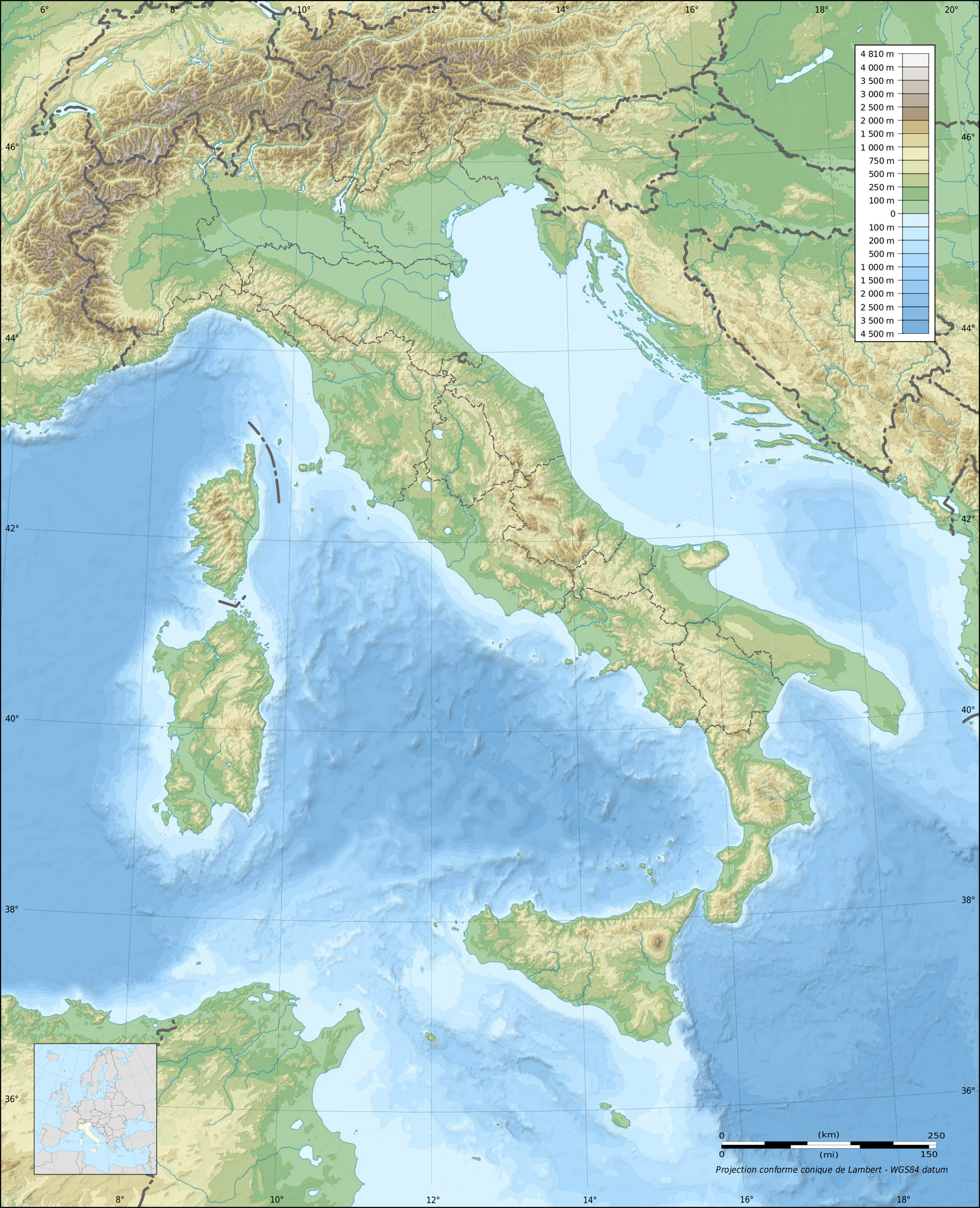
Here is a topographical map of Italy:

This agricultural bent of Rome shaped their civilization in ways similar to other agriculturally oriented areas, like Egypt.  Just like rural cultures today, Rome based much of their way of life around tradition, the past, routine, and practicality.  Both urban and rural cultures have strengths, but a key question for Rome would how they would react when they did interact with the more cosmopolitan Mediterranean.   When it comes, this clash will determine the fate of Rome, Greece, and Carthage.  As Rome conquered others, they could not avoid confronting the possibility of changing their own identity.

We likened Rome to a young farm boy (we’ll call him ‘Jim’)who goes off to New York City for college, and postulated three different outcomes.

  • Benign Awkwardness — Jim doesn’t really fit in city life, and knows it.  He try particularly hard to fit in either, and soon wearies of his clumsy attempts.  He keeps his rural identity, plugs along more or less alone at school, goes home on weekends, and returns home after graduation.
  • A Happy Medium — Here Jim keeps his roots, but also approaches NYC with an open mind.  He learns to see the good and bad of both city and rural life, and picks and chooses from both like a cafeteria menu.  The experience changes Jim, but he learns to enjoy both environments without changing who he fundamentally is.  This ideal reaction, however, is probably the least likely of the three possibilities I list here.
  • Drink from the Fire hose — Jim becomes completely enamored with his new surroundings.  He chucks his rural identity and jumps in with both feet into city life.  Tragically, he doesn’t even manage to attach an urban identity to himself.  He so obviously ‘tries too hard’ that he fails to find acceptance, and this rejection only makes him try harder.  His actions leave him with no identity at all.

How Rome faces this challenge will be the subject of our study in the weeks to come.

Next week we will look at Roman religion and the extreme emphasis on the practical over the theoretical.  Again, it will help us if we remember that Rome was a nation of farmers, who often have little use for theory and speculation, and who focus on soil, crops, and so on.

Ancient chroniclers agree that the Romans were a religious people, unlike the Greeks.  But their sense of religion was also much different than in Egypt, for example, another ancient “religious” people.  In Egypt, their beliefs filtered down into the government, architecture, and where they lived.  Their literature is filled with stories of the gods.  They wrote psalms/hymns of praise to their gods.

We see nothing like this in Rome.  The Romans had devotion to their religious duties, but they saw “religion” usually in terms of “checking off the box.”  They would do what they needed to do, but rarely did their religion touch their souls, and a variety of stories from their past illustrate this.

Machiavelli recounts a story from Livy, where a Roman general wanted to attack the enemy, which I recount below. . .

The consul Papirius, in conducting a war against the Samnites, [saw a favorable moment to fight], and ordered that the priests take the auspices.  The birds, however, did not eat.  But the chief priest, seeing the great desire of the army to fight, and their confidence in victory, reported to the consul that the auspices were in fact favorable.  But one of the assistant priests told the consul that the chief priest lied.  . . . And so the consul put the Chief Priest in the front ranks of the army, and it happened by chance that a Roman arrow struck the chief priest, whereupon he died. When Papirius heard this, he declared that whatever wrath the gods felt toward them had been appeased, and thus by apparently to accommodate his designs to the auspices, Papirius gave battle without giving the appearance of neglecting his religious duty.

Was the general ‘impious?

According to the Romans, not at all.  He did his duty.  He took the sacrifices.  A priest told him that the gods approved.  And they won.

Machiavelli relates another story. . .

Appius Pulcher acted just the contrary way in Sicily during the first Punic war; for wishing to fight the Carthaginian army, he caused the priests to take the auspices, and when they reported that they did not eat, he said, “Then let us see whether or not they drink,” and threw the birds into the sea.  He then went into battle and was defeated, for which he was punished in Rome.

The historian Livy goes on to say that Pulcher was not punished for losing, but for his brazen impiety.  Paprius “kept up appearances,” whereas Pulcher did not.  But I have doubts.  If Pulcher had won the battle, would he have been punished?  What these stories show, I think, is that Rome really worshipped Rome itself.  All things bowed to glory of Rome.  Was then their religion a mere smokescreen?  We know, for example, that Roman religion technically forbade offensive war of any kind, yet they became one of the greatest conquering empires they world has ever known.  Something it seems, gave at some point.

Blessings,

Dave

8th Grade: Burning Out vs. Fading Away

Greetings,

This week we wrapped up our look at ancient Greek civilization.  The death of Alexander the Great allowed for the Greek city-states to try and rebel once more from Macedon.  They did not have the strength to do it on their own, so they asked for help from Rome.

As the Greek’s found out, however, it’s dangerous to ask Rome over to visit.  They had a knack for overstaying their welcome.  From around 200-150 B.C., Greece became a satellite of the then mighty Romans.  Their culture lived on in a kind of degenerated way afterwards (see Luke’s comment in Acts 17:21), but as an independent political entity, they were done.

As we leave Greece and introduce Rome I wanted the students to think about the following choice.  I chose basketball because of March Madness, but one could apply the same concept to other areas of life.  In class we had fun thinking about the ultimate hamburger, for example.

Choice #1

You will be given the ability to dunk, but only one time.  However, this dunk can be the most spectacular dunk you can possibly imagine.  You can jump from half-court, do a double summersault reverse spin, twirl, reverse jam — whatever you can think of.  Furthermore, you will execute this dunk in stadium full of people, and it will immediately go viral on You Tube.  The dunk will be forever known as the greatest dunk of all time.

Or

Choice #2

You will be given the ability to dunk as often as you like.  You will be able to dunk in games, but the dunks will be unimpressive, and not noteworthy in any way.  But it will be a dunk, and you will be able to do it whenever you wish.

This choice illustrates one of the differences between Greece and Rome.  In their heyday Greece ended up bequeathing more towards the formation of the future than perhaps any other civilization.  They practically invented science, literature, drama, democracy, and so on.  But their run was relatively brief.  They followed Neil Young’s dictum, “It’s better to burn out than fade away.”  They compressed most of their brilliance into about a 100 year period of practically unmatched excellence, but the intensity of the heat may have led to their fire putting itself by devouring all the oxygen around them.

Rome will have many similarities with Greece, as we might expect from sharing the Mediterranean basin.  But I think that one of their differences is that Rome would not have agreed with Neil Young.  They were good, sometimes very good, at most things they tried.  And they managed consistently to achieve this level of “very good” for much longer than Greece maintained their “excellent” status.  But, the Romans never achieved the level of brilliance of Greece.

What kind of dunk the students choose will probably reflect what side they will defend in one of our year’s great debates on whether Greece was superior to Rome, or vice-versa.

Next we will examine Roman civilization.  As usual we will begin with geography.  If we look at a topographical map of Italy, how might we expect Italian geography to influence Roman civilization?  How might this differ from how Greek geography influenced the Greeks?

Many thanks,

Dave

8th Grade: The Possible Alexanders

Greetings,

This week we examined the brief and turbulent life of Alexander the Great, a man who has enthralled people for centuries.  No one conquered more people quicker than he.  Of course, his early death immortalized him and helps us tend to see his successes.

I offered the students four different ways of thinking about Alexander, adopted by different historians in different times and places.

  1. Historian J.F.C. Fuller sees in Alexander one the great men of the ancient world.  In him we see statesman, philosopher, and man of action all rolled into one.  He at times sunk to the morals of his time, but often rose above them.
  2. Some see Alexander as the embodiment of a romantic ideal, a young boy out to change the world, an idealist visionary.  A variation of this view would be one that does not see Alexander in primarily moral terms, but views him as a “force of nature.”  We do not call a tornado good or bad, but we cannot help but stand and stare, perhaps even in spite of ourselves.
  3. Some see him as a great military leader, but a failed statesman.  Great generals win battles, but great statesman get men to transform their view of the world.  Regardless of how we view Alexander’s desire to unite East and West, he failed to sell this to his men and his dream collapsed.
  4. Still others, like Victor Davis Hanson, see in Alexander a common thug, a man who lived to kill.  He massacred Thebans and most in Tyre after their defeats.  Like Stalin, most of those close to him ended up dead.  He demanded practices like prostration, and may have believed what his mother told him, that he was the Son of Zeus.  Hanson sees admiration for Alexander as dangerous, a symptom of boredom and our will to escape this boredom through death.

This image of Alexander, though made long after his death, captures something of his madness, focus, brilliance, and lust for conquest:

alex11

alexander2

The battle that defined Alexander’s life and career was Guagemela in 331 B.C.

He had already beaten the Persians decisively twice, but this time Darius III, king of Persia, seemed to have learned his lesson.  He choose a wide open plain for battle, which could maximize his numeric advantage which was probably at least 5-1.  He brought with him chariots, one of the fearsome weapons of the ancient world.  He gave more heavy weaponry to his infantry.

Many of Alexander’s advisors urged him to wait, to go around, or perhaps fight Darius at night.  Alexander would have none of it.  He would not, he argued, “steal his victory.”

How did an army of around 45,000 defeat an army at least 5x its size?

Part of understanding Alexander’s victory is to see that many problems that most generals traditionally worried about Alexander felt he could ignore.  For example, most generals would take troops to protect supplies, but Alexander didn’t mind if the Persians raided his supplies.  If he won the battle, he could march straight to Babylon and have all the supplies he needed.

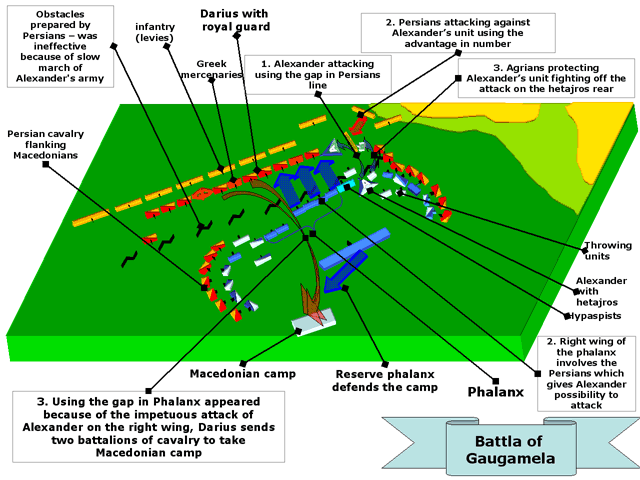
Alexander also believed that he make up for his lack of numbers by speed.  In fact, he probably hoped that the deficiency in his own numbers might provoke the Persians to over-commit themselves in a certain area, leaving a gap in their lines.  By a lightning quick cavalry thrust from what may have been the best cavalry in the known world at the time, Alexander could cause panic and confusion in the ranks, and once that set in, Persia’s numbers would work against them.  Imagine a horrible accident on the interstate that forces people to turn around and redirect their route.  In that case, this redirection would be much more easily accomplished with fewer numbers.  The large amount of cars, or people in our case at Guagemela, would make for nightmarish confusion.

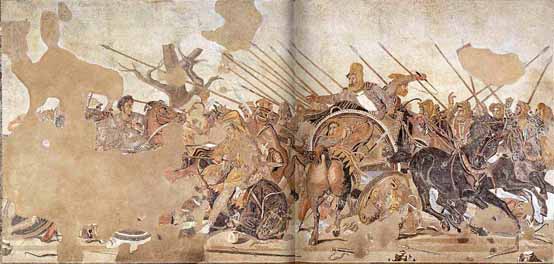
Here are a couple of depictions of how things went.

It was the gap in the Persians indicated by the map directly above, that gave Alexander the opening he needed.  He plunged through and rode right at Darius, who lost his nerve and fled.

I confess that I am cheating a bit with the image above, because most think that this mosaic depicted Darius’s flight at the Battle of Issus two years earlier.   But accurate or not, Darius fled the scene in both battles, and this, just as much as Alexander’s cavalry charge, cost the Persians the battle.

Guagemela stands for all time as Alexander’s most impressive victory and crowning achievement.  It also may have marked a turning point in his character.  Darker elements always latent in him rose to the surface much more often than before.

Dave

The Bottom of the Mountain

“Whatever we may think of Alexander–whether Great or only lucky, a civilizer or a sociopath–most people do not regard him as a religious leader. And yet religion permeated all aspects of his career.”

This opening line of the book blurb for F.S. Naiden’s Soldier, Priest, and God: A Life of Alexander the Great, sucked me right in. I too had viewed Alexander nearly solely through a narrow political and moral lens, and had never really considered his religious views and acts as central to his successes and failures. The book was too long for me. I would have preferred if he assumed reader knowledge of the standard elements of the Alexander narrative. But what Naiden draws out from his expertise in ancient religious rituals helps us see Alexander afresh in certain ways.

Historians tend to think about Alexander along three standard deviations:

  • Great visionary and magnificent strategist, one of the truly “Great Men” that, naturally, and tragically, few could truly follow
  • Fantastic military leader with flawed political skills. After Gaugemela in 331 B.C., his political skills become more necessary than his military skills, and so his fortune waned and his decisions got worse
  • A thug and barbarian who lived for the chase and the kill. He never really changed, or “declined,”–he always was a killer and remained so until his death.

Soldier, Priest, and God tries to bypass all of these paradigms, though touches on each in turn. Naiden’s Alexander is a man who mastered much of the trappings and theater of Greek religion, which included

  • The hunt
  • Prowess in battle
  • A religious bond with his “Companions,”–most of whom were in the elite cavalry units.
  • Responding properly to suppliants

As he entered into the western part of the Persian empire, i.e., Asia Minor, he encountered many similar kinds of religious rituals and expectations. The common bonds and expectations between he and his men could hold in Asia Minor. But the religious terrain changed as Alexander left Babylon (his experience in Egypt had already put some strain between he and his men, but it could be viewed as a “one-off” on the margins), and he had to adopt entirely new religious forms and rituals to extend his conquest.

Here, Naiden tacitly argues, we have the central reason for Alexander’s failures after the death of Darius. Some examples of Naiden’s new insights . . .

Alexander’s men did not want to follow him into India-they wanted to go home. Some view this in “great man” terms–his men could not share Alexander’s vision. Some view this in political/managerial terms–his army signed on to punish Persia for invading Greece. Having accomplished this, their desire to return was entirely natural and “contractual.” Naiden splits the horns of this dilemma, focusing on the religious aspects of their travels east.

Following Alexander into the Hindu Kush meant far fewer spoils for the men. Some see the army as purely selfish here–hadn’t Alexander already made them rich? But sharing in the spoils formed a crucial part of the bonds of the “Companions.” The Companions were not just friends, as Philip had created a religious cult of sorts of the companions. It wasn’t just that going further east would mean more glory for Alexander and no stuff for his men. It meant a breaking of fellowship and religious ritual. This, perhaps more so than the army being homesick, or tired, led to Alexander having to turn back to Babylon.

Alexander killed Philotas for allegedly taking part in a conspiracy against him. Others see this as either Alexander’s crass political calculus, or a sign of megalomania, or paranoia. Naiden sees this action in religious terms.

  • Philotas was a Companion. To execute him on the flimsy grounds Alexander possessed could amount to oath-breaking by Alexander, a dangerous religious precedent. “Companionship” bound the two together religiously, not just fraternally.
  • Philotas did not admit his guilt but presented himself as a suppliant to Alexander and asked for mercy. True–not every suppliant had their request granted, but Philotas fit the bill of one who should normally have his request met.

Killing Philotas, and subsequently Philotas’ father Parmenio (likely one of the original Companions under Philip), should be seen through a religious lens and not primarily psychologically (Alexander is going crazy) or politically (politics is a dirty business, no getting around it, etc.).

We also get additional perspective on the death of Cleitus the Black. We know that he was killed largely because of the heavy drinking engaged by all during a party. We know too that Cleitus had in some ways just received a promotion. Alexander wanted him to leave the army, stay behind and serve as a governor/satrap of some territory. Why then was Cleitus so upset? Naiden points out that Alexander had not so much promoted Cleitus, but made him a subject of himself, as well as exiling him from the other Companions. The Companions shared in the spoils equally, and addressed each other as equals. As satrap, Cleitus would have to address Alexander as king and treat him as other satraps treated the King of Persia. Hence, the taunt of Cleitus (who had saved Alexander’s life at the battle of Granicus), “this is the hand that saved you on that day!” came not just from wounded pride, but as an accusation against Alexander’s religious conversion of sorts. Alexander had abandoned the “Equality” tenet of faith central to the Companions.

We can imagine this tension if we put in modern religious terms (though the parallels do fall short):

  • Imagine Alexander and his men are Baptists of a particular stripe. They grew up in Sunday school, reciting the “Baptist Faith and Message.” They join Alexander to punish Moslems who had tried to hurt other Baptists.
  • As they conquer, they link up with other Baptists. There are Southern Baptists, Regular Baptists, Primitive Baptists, and so on. They go to worship with these people, and while it might be a bit different, it is still familiar. All is good.
  • Flush with success, the go further. Now they meet more varieties of Protestants–some non-denominational churches, Lutherans, Presbyterians, some Assemblies of God, etc. Ok, from a traditional Baptist perspective, it’s getting a little weird, but we are still more or less on familiar ground.
  • Now we go to Egypt and–what!–Alexander seems to be joining in on a Catholic service. Ok, this is bad, but at least very few in the army saw this, and we don’t have to spread the news.
  • Now as we get into Bactria and India Alexander seems to be converting to something unrecognizable. He seems to be breaking with the Baptist Faith and Message and repudiating his past. Or is he? He might be converting to Islam, or what else, I have no idea. We can no longer worship with him. In hindsight, his killing of Philotas was a decisive move in this “conversion.”

Naiden points out that Alexander never officially becomes king of Persia, and attributes this largely to the religious ideology behind the Persian monarchy that Alexander could not quite share or, perhaps understand. As he went into Bactria and beyond, not only had he grown religiously distant from his men, but he could no longer understand or adapt to the religions he encountered. He found himself constantly torn between acting as a king to those he conquered, and as a Companion to his army. In the end he could not reconcile the two competing claims, and perhaps no one could.

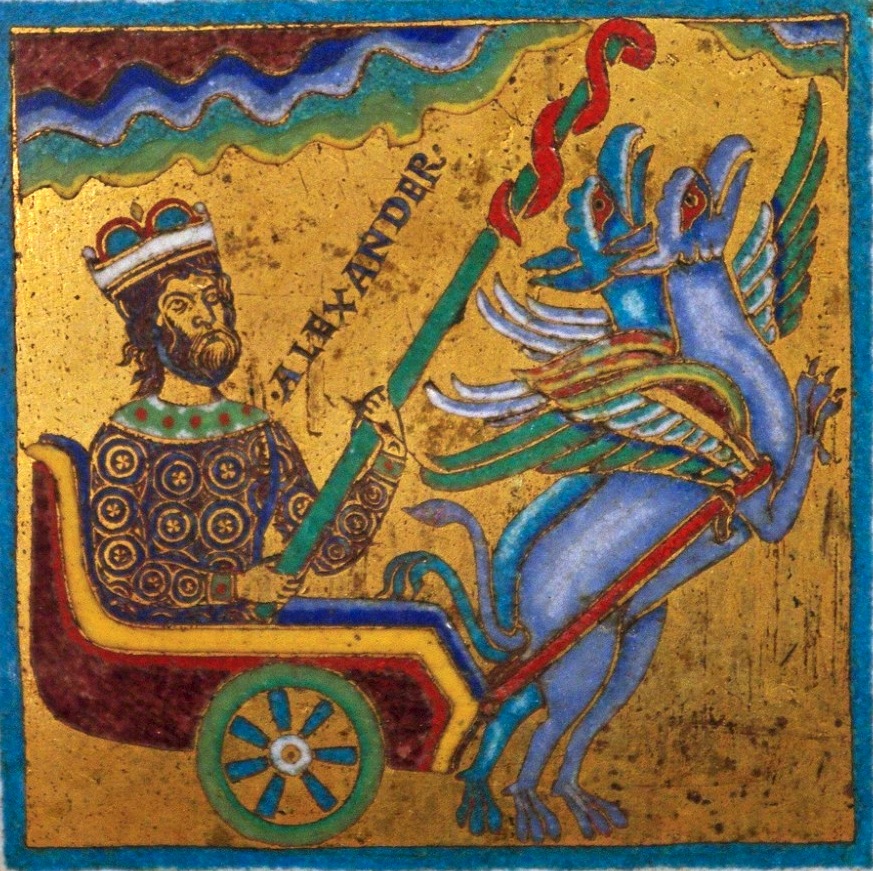
Alexander stands as perhaps the most universal figure from the ancient world. Obviously the Greeks wrote about him, as did the Romans, but stories cropped up about him in India, Egypt, Israel, Byzantium, and within Islam as well. Naiden mentions this but fails to explore its meaning. Naiden has a remarkable ability to find facts and present a different perspective. But he never explores how and why most every ancient and pre-modern culture found in Alexander something universal. Though it will strike many as strange the most common image of Alexander has him not riding into battle on his famous horse, but ascending into the heavens, holding out meat so that large birds will carry him up into the sky.

This image comes from a medieval Russian cathedral:

The story comes from the famous Alexander Romance, and runs like so:

Then I [Alexander] began to ask myself if this place was really the end of the world, where the sky touched the earth.   I wanted to discover the truth, and so I gave orders to capture the two birds that we saw nearby.  They were very large, white birds, very strong but tame.  They did not fly away when they saw us.  Some soldiers climbed on their backs, hung on, and flew off with them.  The birds fed on carrion, so that they were attracted to our camp by our many dead horses.  

 I ordered that the birds be captured, and given no food for three days.  I had for myself a yoke constructed from wood and tied this to their throats.  Then I had an ox-skin made into a large bag, fixed it to the yoke, and climbed in.  I held two spears, each about 10 feet long, with horse meat on their tips.  At once the birds soared up to seize the meat, and I rose up with them into the air, until I thought I must be close to the sky.  I shivered all over due to the extreme cold.  

Soon a creature in the form of a man approached me and said, “O Alexander, you have not yet secured the whole earth, and are you now exploring the heavens?  Return to earth quickly, or you will become food for these birds.   Look down on earth, Alexander!”  I looked down, somewhat afraid, and I saw a great snake, curled up, and in the middle of the snake a tiny circle like a threshing-floor.  

Then my companion said to me, “Point your spear at the threshing-floor, for that is the world.  The snake is the sea that surrounds the world.”

Admonished by Providence above, I returned to earth, landing about seven days journey from my army.  I was now frozen and half-dead.  Where I landed I found one of my satraps under my command; borrowing 300 horses, I returned to my camp.  Now I have decided to make no more attempts at the impossible.  Farewell.  

Here we have the key to understanding the meaning of Alexander as the ancient world saw him.*

The person of a king becomes the focal point of “bodies.” For example, a single, jobless, man living alone in his parent’s basement has only himself as a “body.” His identity includes only himself–his identity includes nothing outside of himself. Thus, he grows stale. Now imagine said man gets a job. He adds the identity of others to his own. If he gets married, now he has bound his identity to another person. This is why marriage has always been viewed as a religious rite within almost every society past and present, Christian or otherwise. Only God/the gods can effect this kind of change in a person. Then the couple has children, and the man has added more “body” to himself. Then one day he has grandchildren and ascends to the level of “paterfamilias.” His “body” includes multiple families.

A king of Macedon has more “body” than the average Macedonian. As we have seen, Macedonian kingship didn’t function like kingship elsewhere, either politically or religiously. Still, kingship has roots in every culture. But everyone knew that this kind of adding of body involved something of a risky and religious transformation–something akin to marriage. If one goes too far you risk losing everything. We can think of Alexander as holding folded laundry in his hand. He bends down to pick up a book, and can do that, then a plate, and it works, then a cup, etc.–but eventually one reaches a limit as to what you can add to oneself, and everything falls to the floor.

I have written before about the biblical image of the mountain in Genesis. Adam and Eve seek to add something to themselves that they should not. As a result they must descend down the paradisal mountain, where more multiplicity exists, and less unity. This leads to a fracturing of their being, and ultimately violence. This is King Solomon’s story as well. He receives great wisdom–the ability to take in knowledge from multiple sources and achieve penetrating insights (many scholars have noted that the biblical books traditionally ascribed to him contain tropes and fragments from cultures outside of Israel). But he goes too far–he strives for too much multiplicity, too much “adding of body,” as is evidenced by his hundreds of marriages to “foreign women.” This brings about the dissolution of his kingdom, the same result Alexander experienced after his own death. But before Alexander lost his kingdom, many would say he lost himself, with executions, massacres, and other erratic behavior. Like Solomon, he lost his own personal center in his attempt to add body to himself ad infinitum.

The story of the Ascension of Alexander hits on these same themes. He tries to ascend to a unity of the multiplicity through the multiplicity itself (note the use of body in the form of the meat to accomplish this). But it can never work this way. When you attempt to ascend via a Tower of Babel, you get sent back down.

The universality of this problem manifests itself today in these two kinds of people:

  • Purists who believe that even the slightest deviation from an original aim or interpretation destroys everything. Things here get so dry and lifeless that it brings the “death” of the desert.
  • Compromisers who want to stretch anything and everything to fit anything and everything. No exception ever endangers the rule–everything can always be included. Here you have the flood–undifferentiated chaos with nothing holding anything together. Eventually you reach points of absurd contradiction, and then, conflict.

Alexander’s life fits this tension between purity/unity and multiplicity:

  • He could take in Greece
  • He could take in Asia Minor
  • Perhaps he could just barely take in Egypt
  • But beyond that–though he could “eat” other kingdoms further east, they certainly didn’t agree with him.

Indeed, why invoke a blessing from God on food before we eat? We ask, in fact, for a kind of miracle–that things dead might be made life-giving. We too ask for help on the potentially treacherous path of making that which is “not us” a beneficial part of our being. We cannot have real unity without multiplicity, and vice-versa. But no blessing will save us from every deliberate choice to drink from the firehose and ingest foreign gods.

Dave

*Understanding this episode in The Alexander Romance will clue us in on how to read ancient texts. We should not assume that the ancients believed that this story was true in a scientific or “literal” sense. It was true in a more profound, metaphorical, and spiritual sense.

8th Grade: The Military Revolution of Macedon

Greetings,

This week we began looking at Macedonian civilization, and as usual we began with geography.

The map shows Macedon as a land-locked and mountainous area, and we would expect this kind of terrain to have a particular emphasis on its people. . .

Map

  • Mountainous areas are always difficult to control, leading to weak central governments
  • Usually an aristocratic warrior elite seeps into the culture, which usually divides the people into warring clans (for this and the above point, think of Afghanistan, which has a similar geography to Macedon).
  • With this environment, we usually see a low level of cultural output, due to their relative isolation and internal divisions (this is not the case with Scotland, but Scotland is not land-locked as Macedon is).

I was glad to see the students start to make connections between Macedon, Assyria, and Sparta.  All three share a similar geography, and all three share a similar geographic position — on the periphery of their respective societies.  Sparta and Assyria had stronger central governments than Macedon, but their similarities should make us realize of the power of geography to shape the course of a civilization.

As I mentioned, Macedon had little role in Greek civilization for many centuries.  But as luck would have it, Macedon saw the rise of the charismatic and ruthless Phillip II just at the very moment of Phillip of Macedongrave political weakness for Athens, Thebes, and Sparta.  Opportunity knocked for Macedon.   Phillip looked every inch the tough customer he portrayed, wearing an eye patch over his wounded eye for necessity, and probably, for effect as well.  But Phillip combined his personality and appearance with a keen understanding of how to maximize the qualities of his society into a formidable military machine.

One key to the effectiveness of his military was that he matched the personality of his culture with his army.  Infantrymen in other Greek city-states often came from the middle-upper classes.  He owned land and had a stake in the politics and way of life of his city-state.  The Athenian hoplite, for example, therefore oriented himself toward defense of what he had.  He wore heavy armor and carried a large shield.  This was not a mobile force, but one geared to “make a stand” to defend home turf.  A standard Greek military formation might look like this:

Greek Phalanx

In contrast to other city-states, Macedon had virtually no middle class.  Anyone recruited for the infantry would be either poor or a mercenary.  This type of man would not fight to defend anything in particular.  He has no stake in the society for which he fights.  Such a man might be motivated to take from others, however, and this would require shifting the balance toward an offensively minded and equipped infantry, which you see below:

Macedonian PhalanxIn addition to the long spears you see above, their soldiers also carried a long dagger, another offensive weapon.   While the image above does show the Macedonians with shields, I agree with Victor Davis Hanson (and others) that argue that Macedonian shields had no real function in battle.  They were worn apparently mostly around the neck and draped to the side (as both arms would be needed to wield their spears).  Some argue that the shields were used in battle, but mainly as a prop for their spears.  If this is so, we see that even their shield served as a offensive weapon of sorts.

Phillip’s infantry gave them much more firepower at the point of attack.  Not only did they have longer spears, but because they had to stand sideways to hold the spears, they could fit more men in each row.  Some students wisely pointed out that the Macedonians would be vulnerable to a quick flanking movement, but the Greek infantry Phillip faced was “heavier” infantry, and not equipped for fast movement.  They could not exploit this weakness of Phillip’s force (though a century later, the Romans would do so).

I hope that the students understood that militaries don’t, or at least should not, be created in a vacuum. They function best when they are a direct product of the civilization from which they arise.  Next week we will continue by looking at the most famous Macedonian of all, Phillip’s son Alexander.

Many thanks,

Dave


8th Grade: An Introduction to Civilizations

Greetings,

I hope the school is going well for you and your family.  I already can tell that I will enjoy this class. They are enthusiastic participators and willing and able to track with me and think about the issues before us.

As I told the students, before we move into the actual study of certain civilizations, I thought it appropriate to think of what we mean by the term ‘civilization,’ and what this might have to do with a Christian worldview.  I gave the students an example of a desert island divided into two halves.  Both halves have a government (a despotic king), religion (worship of a bloodthirsty god), laws and a way of life, (everyone pick up a stick and try and bash in the head of someone on the other side of the island).  They have a large enough group of people and a defined location, if one happens to believe that these are important criteria.

We discussed whether or not  this be could be termed ‘civilization.’  Even if it was a place where you would not want to live, was it ‘civilization?’  While I acknowledge that defining the concept is a bit slippery, in the end I think we can give a clear answer in the negative.

The definition I am using for civilization in this class is from historian Will Durant, who stated that civilization is, “Social order that promotes cultural creation.”  Life on our hypothetical island could not allow for ‘cultural creation.’ No buildings could be built, no books written, not even advances in weaponry could be made if everyone’s daily life consisted entirely of sleeping, eating, and fighting.

I believe the definition we are using is a good one because human society should help us live out what it means to be made in God’s image.  The first thing we see about God is that He creates.  A society that did not allow for human creation would deny a fundamental tenet of what it means to be human. Being made in God’s image means many things, but surely it must include something of what J.R.R. Tolkien called ‘sub-creation’ on our part.   If we look back on the island example, is the life lived there really human life?  Even beavers build dams, and otters make water slides for themselves.  Living just to eat, sleep, and fight would put us below many animals.

This week we also looked at the basic elements of all civilizations.  What purpose do civilizations serve, and how do they function?  Ultimately, civilizations exist to provide a means of human interaction, a structure that allows us to live out God’s image and call on our lives.  While none of the civilizations we will study will be ‘Christian’ civilizations (if such a thing is even possible), the closer one gets to this goal, the better off people are.  While we may not need civilizations per se, we do need each other.  God Himself is a kind of Community (Father, Son, Holy Spirit) and as we are created in His image, so too we need to live in community with one another to make us fully human.

We examined what I call the Five Elements of Civilization:

Geography

Suppose that you and your friends wish to do something together.  You would need to agree on a location to meet.  For there to be profitable human interaction, we need a defined physical space to do so.  Obviously, the geography must provide a minimum of food, water, etc. for civilization to exist.  But as we discussed, ideal geographies do not tend to foster civilizations.  When things are too easy, we never need to learn, invent, or progress.  Historically speaking, we need a challenge to thrive.  On the flip side, some geographies present such an extraordinary challenge that man’s nearly heroic adaptation to them binds them into such narrow confines as to stunt the growth of civilizations (one might think of desert nomads or Eskimo peoples in the Arctic).

Over the course of the year we will see the subtle influence of geography on the way people live.

Economics

No one can be completely self-sufficient. “No man is an island.”  We neither know all or can do all things well.  We need others to help us, but also need to have a means of exchanging goods and services fairly so these beneficial trades can take place.

A strict barter economy makes perfect sense.  I have apples, you have wood.  If we trade we both get something we easily know to have a direct value.  With one I can build a house, with the other I can avoid hunger.  Barter economies have the great advantage of simplicity, but the great burden of a complete lack of flexibility.  Imagine doing your weekly shopping, having to load up the wagon with bushels of grain, a few pigs, etc.  Then, you can only get what you need in return only if someone needs what you have.

A money economy helps solve some of these problems, and money began with precious metals.  But who made the first exchange of a shiny metal for a bushel of wheat?  You cannot eat, wear, or live in shiny metal.  The same is true of paper money.  In itself, it’s only a piece of paper.  You could write on it, or perhaps burn it for a few seconds of heat.  The money has value not for anything in itself, but because of our agreed upon belief about what it represents. Hence, the link between the health of our economy and the trust we place in our government and those around us.

A good economy will foster helpful and just exchanges of goods and services, which in turn fosters honoring social interaction.

Politics

Or — what I call the outward structure of civilization.  We need an agreed upon way of making decisions, and we need to know what is expected of us.  For example, we must decide if we are to drive on the right hand side or the left, or no one would drive at all.  We must also have an agreed upon way of deciding what side of the road we drive on, or nothing can ever get accomplished.

Laws serve a good purpose if they help grow helpful interaction between people.  They oppress if they stifle such social interaction.

Religion

Or – what I call the inward structure of civilization.  Since no one can write a law code that covers every situation, if we are to interact with others successfully we need a strong set of unwritten rules that everyone follows.  If someone cuts in line at the grocery store, we do not have the option of calling the police, for example.  This unwritten code comes ultimately from our religious beliefs.  We don’t cut in line in the final analysis because we believe in Justice.

I encouraged the class to think about religion more broadly than just what happens on ‘Sunday,’ in a given civilization.  As Jesus said, “Where your treasure is, there your heart will be also,” or to put it another way, “You are what you worship.”

Religion is in a broad sense what we give ourselves to truly, not merely our lip service.  A society might outwardly worship God, gods, or possibly even ideals and values like freedom, and so on.  Everyone worships something, and we cannot help but be conformed to the object of our worship.  This ultimate devotion becomes the main spring of our values.

Many modern historians often make materialistic arguments for the origin of civilization.  They will say things such as, “When river valley ‘x’ began to dry up the people came together to maximize their food input and begin to specialize.  From this early social organization governments arose, and then these governments codified religious belief to enforce their power.”

And so on, and so on.

I entirely disagree with these kinds of explanations, at least as the primary explanatory concept.  Such theories completely misunderstand human nature.  Why do relationships happen?  We do not enter into a relationship with people based on the need to survive.  We are made for relationship (“It is not good for man to be alone”).  We are drawn together by our common loves, by our common worship.  We were made for worship, and this is why religion forms the heart of any civilization.

Culture

In the narrow sense, culture is what we do with our free time.  A person’s hobbies are often a better insight into who they are than their jobs.   In a broader sense, culture is about how we interact with God’s creation, and how we outwardly express our inner values and strengths.  Broadly then, culture speaks to our values, and a bit more narrowly, culture is that which makes life enjoyable (reading books, playing games, etc.), and sets us apart from the rest of creation.

Of course every culture can and should have room for purely “fun” activities, but ideally our recreation truly engages in “re-creation,” whereby we image the God who creates.

My goal through all this was to try and show how each element is not an island, but impacts other areas.  These elements are interconnected and depend on one another. For example, I asked the students to think about American culture, and clearly, we value sports very highly. We put a great deal of time, attention, and money into sports. What might this say about us, and what might be the connections to other areas of our society?

Some students suggested that it means that we love competition, and I thought this an excellent insight. Indeed, we see competition baked into our political system (candidates compete for votes against each other), and our economic system as well. Some of you may be old enough to remember Hechinger hardware stores, and Crown Books, both of whom lost out in competition with other companies. These are just the kind of connections I want students to make. Well done!

Next week we will begin looking at actual civilizations, and begin applying this theoretical interpretative model to reality.  We will begin to look for the patterns and truths that history reveals to us.  Below I include the famous set of paintings by Thomas Cole called The Course of Empire.  I do not necessarily agree with everything regarding Cole’s interpretation of history, but it is a wonderful visual image of a thought provoking theory, from a civilization’s beginning to its end.

Thank you again for all your support.

Blessings,

Dave Mathwin

8th Grade: The Values of the Republic, The Practice of the Army

Greetings,

This week we continued our look at Rome by looking at the establishment of the Republic in 508 B.C., and how that related to power sharing between Patricians and Plebians.

We can see a variety of similarities between Rome’s revolution, and our own, and this comparison surely would have pleased on our own founding fathers.  But that does not necessarily mean that we should see democracy, in the technical sense of the word, in either time.    The Romans came to object to their kings for the following reasons:

1. Arbitrary and Personal Power

Ultimately, Roman kings did not have to use law as the basis of their rule.  They could, in the end, do as they pleased.  Law had the advantages of being public and stable.  Rulers could now be accountable to something outside of themselves

2. Secret Power

When kings make decisions, they often do so in secret,  perhaps with a few advisors.  Whether he took counsel or not, the reasons behind the decision would be unknown.  The Romans wanted to create a government where decisions got made in an open forum, with open debate.

3. Concentrated Power

In the pure monarchies all power flows from one source at all times.  The Romans took political power and divided it among various offices and branches.  They then made sure that they always had more than one person serving in a particular office.  Finally, each of their offices had only one year terms, and while they did not outright forbid serving multiple terms, they frowned sternly  upon it.

The best way to think about what the Romans did is to go to the technical definition of a Republic – a “Res Publica” – a “Public Thing.”  Laws, expectations, debates, all these things were out in the open for the Romans.  We should not expect to see the kind of democracy that Athens practiced here, though Rome’s republic certainly had democratic elements.  Their main priority lay in making sure that the government was “public” — open to debate, open to observation, etc.

This does not mean that the Romans established a democracy, though they did broaden the base of political power.  Still, for the most part power stayed in the hands of the Patricians, Rome’s aristocracy.  This happened not necessarily by design, but certain factors heavily contributed to it.

  • The Senate (comprised almost entirely of Patricians) had almost complete control of War and Peace.  Rome was often at war, and often won, which naturally enhanced the prestige and power of the Senate.  We have seen in our own democracy that whenever a foreign policy crisis strikes, domestic issues invariably take a back-seat.  Such was the relationship between the Assembly and the Senate in Rome.
  • As we noted last week, Rome was strongly traditional in its cultural leanings, and the Patricians had a vested interest in maintaining tradition.
  • The differences in wealth between Patricians and Plebians remained modest for most of the Republic’s history.  As we shall see in a few weeks, when this begins to change the Patricians faced more challenges to their power.
  • Finally, nothing succeeds like success.  For centuries, Rome grew and prospered under the general guidance of patricians.

The argument went deeper than this, however.  At root the question of, “What is Rome,” ran underneath the surface arguments.  For Patricians, Rome was an idea.  Rome’s ideals made Rome great, and Rome could only stay great if the people who led had dedication to those ideals.  For Plebians, Rome’s people made Rome great, and so Rome’s people deserved a greater share of power.  This tension would bubble beneath the surface for a long time, and how Rome eventually dealt with the problem would contribute to the unraveling of the Republic itself.

We also looked the basic grid plan of Roman cities, and discussed what they reflect about Rome.

Nothing shocks us here, but the methodical nature of the design reflects a few key Roman values, such as simplicity and unity.  The design pushes people toward the center, with an emphasis on togetherness.  The grid plan may also hint at the idea of equality, or at least equality under the law.

As Rome expanded they “cut and pasted” their city design into the conquered areas.  Rome valued habit, tradition, and togetherness.  They tended to look down on “going your own way” in general, and as we might expect, in the army as well.  The key to their military success lie in the fact that everyone stayed together, everyone did what they were told.

The values that went into the formation of their government and city design also went into their army, whether consciously or not. The standard Roman military formation looks somewhat like its city design, with the men spread out in checkerboard fashion:

Rome’s design gave them more flexibility of movement in the field, but each “maniple,” or individual grouping, had a high level of discipline.  This clip below, manages in 1:30 to show some of those values (warning: not bloody, but violent).

Greece, being a more individualistic society, had a long history of heroic individuals.  In Roman stories, the hero is Rome itself.  The clip illustrates a few key ideas along these lines:

  • When the whistle blows, the front lines move back, and others move up.  Normally soldiers would fight in front for much longer than the clip shows, but the principle is clear: we all share the burden equally.
  • Roman tactics, like their other values, were simple.  Block with the shield, strike with the sword around the enemy’s waist, step back into formation.  With this basic move they conquered much of the world around them.
  • No one gets out of line.  They do not tolerate even the successful “hero.”  Rome itself will always get the credit.  The cohesiveness of the line reflects the cohesive nature of their society.  And these cohesive military formations gave them a great advantage over other less cohesive, more heroically oriented tribes surrounding them.  In these kinds of circumstances, Rome simply did not lose.

Here is a clip from Stanley Kubrick’s Spartacus, where you see the Roman army advance in their maniples.  The message seems to be that the city of Rome itself has come to fight as they fan out into their grid pattern.

Next week we will begin to look at Rome’s conflict with Carthage, a struggle that would define the destinies of both societies.

Have a great weekend,

Dave

The Mirror Crack’d

Some years ago I saw a video about the emergence of Greek culture and the talking heads discussed the magnificent achievements of Greek drama.  Before talking about the drama itself, they mentioned the origins of drama, though only very briefly.  After all, Greek drama began in the worship of Dionysius, a confusing and strange subject for modern ears. I found it fascinating to watch the speakers deal with this aspect of Greek civilization.  They hated being on unfamiliar territory — unfamiliar not so much intellectually, that is, but ideologically and experientially.

Briefly,

  • Dionysian worship started with women sneaking off illegally, or at least shamefully, for their rites. Dionysius himself occupied, at minimum, the barest fringe of Greek religion.  Some of the commentators latched onto this, for it promised a narrative we could identify with.  “Aha!  A sisterhood of oppressed women, sharing radical beliefs! And observe the vital contribution they made to their society and the world at large, etc.”  But Dionysian rites also involved men, too, so they couldn’t press that narrative too far.
  • The Dionysian rites for women also seemed to involve ecstatic experiences invoking bulls, snakes, wine, and so on. This too got the barest mention, for the “oppressed sisterhood” narrative didn’t really match the fact that Dionysius was a fertility god.  So the women may have been praying and dancing furiously for the chance to have children, a very traditional “role” (ha!) for women to play.
  • To add insult to injury, male Dionysian worship may have invoked blessings to “survive ordeals.”  This got no mention at all.  It appears that these “rebels” danced around madly and got drunk to attempt to fulfill the most prosaic of traditional gender roles of “tough guy,” and “nurturing mother.”  This square peg had no place in their round hole interpretations.

So, after passing over all this in the quickest fashion, finally smiles came to their faces as they talked about the drama itself. Here they felt far more comfortable.  Greek drama “allows for the community to come together and deal with issues of importance,” or something like that.  Ah, yes, the “humanism” of the Greeks.  This we understand, so this they talked about at length.  Gone were any of the unusual religious associations involving Dionysius.  The important thing to us is the emergence of drama, for without the emergence of drama, how could we watch Dumb and Dumber today instantly on Netflix?*  And we very naturally assume that what is important to us must have been of prime importance to the Greeks.  Dionysian worship, then, got relegated to a mere carrying device for what we understand and what we feel is important.  As a friend of mine stated, whenever we use a word to describe an ancient people that they themselves did not use (in this case, the word “humanism”), we will likely reach false conclusions. The talking heads are not unusual. Most of us unfortunately avoid confrontations with the “other.”

I’m not an Alfred Lord Tennyson fan (to be fair I’ve read hardly anything he wrote), but his poem “The Lady of Shallot” intrigues me in one way.  The Lady in question deals with a curse, and can only look at reflections in a mirror to ascertain reality.  The mirror of course serves as a poor substitute of reality, and later cracks upon her sad and untimely death.

Out flew the web and floated wide-

The mirror crack’d from side to side;

“The curse is come upon me,” cried

The Lady of Shalott.

Tennyson’s work came from the same spiritual place as the dreaded pre-Raphaelites, whose paintings reveal an intense desire to recover something of antiquity.  And yet the grossly over-dramatized version of the past in their eyes reveals far more about themselves, with their aspirations fit perhaps for the teenage soul more than an adult world (hence L.M. Montgomery has her young Anne of Green Gables grow fascinated with the “Lady of Shallot”).

All of us tend to distort reality to fit our own images of it, but the way the Parthenon has been interpreted over time stands as one of the more curious episodes of this typical human folly.  Joan Breton Connelly chronicles this and gives her own interpretation of the architectural masterpiece in her recent book, The Parthenon Enigma.  The building occupies pride of place in the history of western civilization.  Its marble facade inspired those who saw it to grand notions of ideal beauty.  The building’s perfect proportions inspired noble visions of clarity and a sense of true humanity.  Certain technical achievements of the building are practically unparalleled.

But we made the building in our own image, and Connelly writes to set the record straight.  Ever since the Enlightenment we have seen the Parthenon as reflecting the “humanism” of the Athenians.  We have some justification for this.  If you trace the religion of the Athenians one sees a clear descent from Aeschylus (who takes religion seriously) to Thucydides (who didn’t).  The Athenians elected Pericles to multiple terms of their highest office, and he certainly fits the humanist mold. Observers therefore assumed, as the Parthenon was Pericles’ project that it would reflect his values.  Then again, maybe not.

She has two main arguments, with the first drawn from the he Parthenon friezes, long thought to depict contemporary Athenians mingling with the gods.  Connelly has an ironclad argument that Athens instead hearkens to not to its present but its mythological past.  At Athens’ founding it had a king named Erechtheus, who had three daughters that sacrificed themselves that Athens might survive (images below on a Parthenon frieze).  Athens makes an explicit statement, and explicit prayer of hope, that death might come from life with the Parthenon.

Amidst our wondering at the architectural genius of the building and the democratic (and therefore mostly familiar) practices of the Athenians, we forget that the Parthenon was a temple to Athena.  Excavations show that they built the Parthenon on top of an older temple, so clearly the Parthenon was sacred space, and not merely civic space with a civic purpose.

Corinthian_Column_Head_JerashModern eyes miss many such death-life associations in Greece.  For example, look up any article on Corinthian columns and you will likely see something about their fancy, or perhaps excessive, ornamentation.  Certainly Corinthian columns do not fit with Enlightenment sensibilities about classical decorum and proportion — such people always prefer the Ionic column (I prefer the Ionic — to the right — as well so I don’t mean to cast stones).  But Connelly points out that the plants in Corinthian columns hearken back to ancient myths about death and rebirth in their city.  Articles may describe Corinthian columns as “one example of a Greek votive column” (as one site does) without paying any attention at all to the fact that “votive” columns, like votive candles, have a distinctly religious purpose.  It’s almost as if they use the big words to obscure the meaning.  We will have the Greeks be “humanists” by hook or crook.

A fascinating sub-plot is the length Victorian society went to deny that the Parthenon originally was painted.  Evidence after evidence turned up, mostly brushed aside and denied with too much protest.  A painted Parthenon would overturn all of their ideas of classical beauty and classical purity.  Whole artistic theories got erected on an unpainted Parthenon, and they could not let it go.  This in turn clouded their vision in other areas, and allowed false ideas about the Parthenon to persist well into the 20th century.

725-1422641769E21CEBE6B

Did the Parthenon have no contemporary political meaning?  Perhaps . . . perhaps Pericles wanted to heal the fractious wounds of a prosperous democracy.  Success has never sat well with democracies, and it would make sense that Athens would want to go back to its founding and a story of sacrifice for the common good.  All this rings partially true, but the bulk of the evidence makes the Parthenon an overtly religious shrine — one that seeks life from death.  Plenty of evidence exists that Athenians saw it this way themselves.  For example, during the plague that struck during the Peloponnesian War, sick Athenians came to the Parthenon for refuge, as well as for healing, and possibly, to die.  It would be hard to imagine them doing so if the Parthenon was their equivalent of our Capitol or Washington Monument.

But this interpretation also challenges my own thoughts regarding the Parthenon.  The “humanist” interpretation fit how I tended to see the late 5th century Athenians as essentially worshippers of themselves.  This view gets lots of support from seeing contemporary Athenians mixed with gods on the Parthenon friezes.  With the Parthenon cast in this new light, I think that interpretation gets challenged but not overthrown.  I think other evidence exists for seeing the Athenians as self-worshippers, and perhaps the Parthenon itself still supports that view.  But this will need rethinking on my part.

The lesson of this book is the peril of using history rather than receiving and letting it change you. Self-idolatry is alas, not only confined only to the Greeks, or the Enlightenment and Victorian eras.

Dave

*To be fair, this is actually a pretty good movie . . .

8th Grade: All Good Things Must Come to an End

Greetings,

This week we saw the great golden age of Periclean Athens collapse into the abyss of the Peloponnesian War.  We began the week by asking why “Golden Ages” tend to last not much longer than a generation.

  • Some suggest that the success and power a golden age brings would bring about the envy of others, and this envy could turn into a threat.
  • Another might suggest that the generation that grew up with the ‘golden age’ in place would likely have a much different experience than their parents.  I found this comment especially perceptive.  As we saw last week, golden ages usually arise from a creative response to a particular challenge.  Those that grow up without the challenge won’t have the experience or ‘training’ to continue what their parents started.
  • Last week we also noted how golden ages require a variety of factors coming together at once, some physical and others psychological.  No one can reasonably keep all the plates spinning for long.  Eventually nature dictates that something will begin to spin off the axis sooner or later, and this will drag other things down with it.

Some of their comments did in fact apply directly to the outbreak of the Peloponnesian War, especially#1.  Athens went from plucky underdog in 490 B.C. to the then equivalent of the New York Yankees or New England Patriots by 431 B.C.  Many city-states lined up against them with Sparta. We did not spend a great deal of time on the war itself, as during their senior year we devote a few weeks entirely to this conflict and the issues it raises, but we did touch on a few key points

1. How in war the unexpected and unforeseen can occur

Of course the unforeseen can always occur, in war or at any other point.  But since war requires a great deal of planning, many assume that the conflict will go as we wish.  The making of the plans itself creates that expectation.  Yet, in war as in life, things rarely go according to our preconceived version of events.

2. Peace treaties may not be what they seem

After 10 years of intermittent conflict, both Athens and Sparta signed a treaty called the Peace of Nicias.  But treaties in name may not be in fact.  Some treaties bring real peace, some only reflect a desire to call a ‘time out’ in the fighting.  Unfortunately for Athens, this treaty turned out to be one of the latter.

3. War Stresses Democracy

War will put stress on any form of government and any society.  Some wars brought down monarchies — like W.W. I.  We assume that democracies are more stable, but the Peloponnesian War brought out many weaknesses within Athenian democracy and for a time ended it within Athens.  We looked at how desperation and panic act on a democratic people in the battle of Arginusae.  The Athenians won this battle, but the generals failed to pick up the dead and give them proper burial, something that could be considered sacrilege, and sacrilege could be punished by death.  Grief stricken, the city put the generals on trial, found them guilty, and executed them.  A few days later they regretted their actions. They put the lawyer who prosecuted the generals on trial for murder, found him guilty, and executed him also.

Ostensibly, Sparta won the Peloponnesian War.  But in truth the war had no real winners in Southern Greece.  All exhausted themselves in the conflict.  Thebes, involved in the conflict but slightly to the north, emerged as the strongest party in the more immediate aftermath of the war.  But it would be Macedon, further still to the north, and never involved in the fighting at all, that would eventually assert absolute supremacy over Greece in the person of Phillip of Macedon and his son Alexander.  We’ll look at them next week.

You can see the geography of it below here, with everything pink or yellow caught up in the fighting (with even blue areas involved sporadically), and Macedon waiting patiently above in brown.

Peloponnesian War

For those of you who have seen From Russia with Love, the scene where “Number 1” talks about the Siamese Fighting Fish is a good parallel, if we think of Macedon as the fish who stays out of the fight.