Fantasy Island

You will notice the dated references from 2019 to the Covington kids caught on film at pro-life protest. I repost this in conjunction with the start of our American History class.

***************

I did not grow up watching a lot of TV, as my parents were (thankfully) on the stricter side of things in that regard. Yet, like most everyone else, I watched what I could when they were not around. Almost anything would do when these opportunities struck, and I distinctly remember even watching a few scattered episodes of Fantasy Island. Some of you will remember this show, in which Ricardo Montalban presided over an island resort of sorts, where people would come for vacations. But inevitably, guests would have some kind of unreal and usually traumatic experience, whereby certain unknown issues in their lives would attain resolution. The guests would leave happy, Montalban smiling benignly as they left.

Again, I watched this show even though I never particularly enjoyed it (it was on tv, and that was enough). What’s more, I could never grasp its basic premise or understand what was happening. Were the experiences of the guests real or not? They seemed unreal, but then if unreal, why did people feel so satisfied at the end? How could the island produce just what was needed for each guest (The Lost series, after an intriguing start, definitely borrowed way too much from Fantasy Island in its later seasons)? I remember no explanation, just that, “it had all worked out” somehow in a package that always seemed too neat and tidy

Again, the aggravations I had with the show didn’t prevent me from watching. In my defense, how can one look away from Ricardo Montalblan (still the best Star Trek villain to date)?

Much has been said about the dust-up over the brief video clips from the Pro-Life March involving the “clash” between Catholic high-school students and other protestors. I will say little here, except that

  • I was glad to see some who made ridiculous and ill-founded statements retract their comments when new, extended video evidence came to light. I wish I saw far more laments that thousands of people rushed to extreme judgment of a 17-year-old after seeing 1 minute of video–in other words, the very exercise of commenting on Twitter “in the moment” is desperately fraught with peril. It wasn’t just that people got it wrong, but that no one should have commented in the first place.*
  • I basically agree with David Brooks, who argued that 1) this scary and tribal rush to judgment happens on both sides** (this time the left was at fault) , and 2) the problem we have is also a byproduct a new technology (phones and social media) that we must understand more fully and use more wisely.

But as much as I appreciated Brooks’ wisdom, I think he misses something deeper and more fundamental. No one questions the impact of smart phones on how we interact with each other and the world. We should remember, however, that inventions do not simply randomly drop from the sky. They emerge within specific cultural contexts. While the phone was certainly not fated to arise in America, it makes perfect sense that it did. Apple marketed its products with the letter “i” in front, itunes, the ipod, the iMac, and of course, the iphone. Apple wanted one to think of these tools as a way to radically personalize our worlds, which fits within our cultural and political notions of individualism. It’s no surprise that their products made them billions of dollars. They did not create the need for radical personalization of our lives, they tapped into what already existed and helped us expand the horizons of our collective felt need.

I agree that we need to work as a society to understand the technologies we create, but that is just another way of saying we need to understand ourselves.
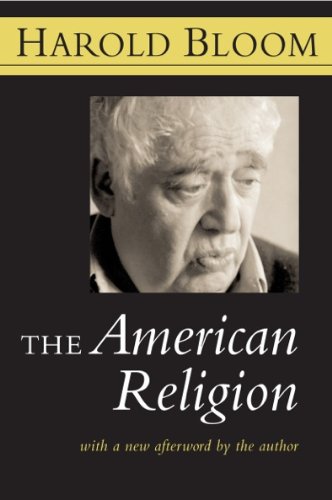
Harold Bloom’s The American Religion attempts to do just this. He argues that, as diverse as we are religiously, every culture must have some unifying belief, even if this belief remains below the level of consciousness. Bloom states that America is in fact a gnostic nation and not a Christian one, and he defines gnosticism as:

  • A belief that the physical world is essentially evil, and the “spiritual” is good.
  • That all people have a “divine spark” within them covered over by experience, culture, history, and materiality (the “all people” part of this is our particular democratization of what was an elitist religion in the ancient world).
  • We must find a way to liberate our true selves, this “divine spark,” from its constraints. Culture, tradition, history, etc. often stand as enemies in this effort.

Bloom postulates that this faith lies underneath other professed faiths, be they agnostic, Baptist, Jewish, or Mormon. It has invaded and colonized our institutional religions and our overall mindset. He finds it particular present in Southern Baptists of his era, but today he would likely look to the various mega-churches, which operate on the idea that Sundays should be friendly, relatable, accessible, and above all, not “boring.” Ralph Waldo Emerson no doubt helped found our particular version of gnostic faith, writing in 1838 that,

Jesus Christ belonged to the true race of prophets. He saw with open eye the mystery of the soul. Drawn by its severe harmony, ravished with its beauty, he lived in it . . . . Alone in history he estimated the greatness of man. One man was true to what is in you and me. . . . He spoke of miracles, for he felt that man’s life was a miracle, and all that man doth, and he knew that this miracle shines as the character ascends.

1838 Divinity School Address

So too William James wrote that

Religion, as I ask you take it, shall mean for us the feelings, acts, and experiences of individual men in their solitude, so far as they stand in relation to whatever they may consider the divine. . . . as I have already said, the immediate personal experiences the immediate personal experiences will amply fill our time, and we shall hardly consider theology or ecclesiasticism at all.

“The Variety of Religious Experience, 1902

We could easily sandwich Walt Whitman’s Song of Myself in between these two thinkers for the trifecta of the prophets of non-contextualized, disembodied, American hyper-individualism. This kind of individualism has as its mission liberation from other groups other entities that would seek to mold, shape, and define. And, as we look at the crumbling of institutional churches, our lack of respect for governmental instiutions, the crisis at many universities, etc. we must declare that the individualism of Emerson and Whitman has triumphed almost completely.^

I can think of few things more compatible with this faith than combining Twitter and iphones. We can both memorialize our lives (which are of course special and worthy of documentation) and express our inmost thoughts to the world at any time. Conventions of privacy, or politeness, you say? Sorry, the god of individualism is a jealous god and will brook no rivals for his throne. Do we contradict oursevles and treat others as we would rather not be treated? Well, we are large, to paraphrase Whitman, and contain multitudes. We believe firmly that our souls should have the right to break free at all times.

Thus, if Bloom is correct, if we want to avoid such miscarriages of justice in the future, we may need to do much more than get a better understanding of technology. Brooks is wrong. No quick and mysterious sitcom-like fix is in sight. We need a new religion to avoid such disasters in the future. Our nation, relatively isolated as it is, is still not an island. And, double alas, Ricardo Montalblan is not here to save us.

Dave

*I know that we need journalism, public records of public events, etc., but I will go one step farther. I don’t know why anyone was filming the students in the first place. I know this happens all the time, but it seems to me that you should go to a protest march to protest, not film others protesting. If you want to counter-protest, do so, but don’t go to film others counter-protesting. I agree with Jonathan Pageau, who argued that our incessant desire to mediate our experience through screens fits into the kind of gnosticism Bloom describes. The screen inevitably creates an abstraction, a disconnect between ourselves and reality. He writes,

It is only in the 17th century that men framed their vision with metal and glass, projecting their mind out into an artificially augmented space. Men always had artificial spaces, painting, sculpture, maps, but the telescope and microscope are self-effacing artifices, they attempt to replace the eye, to convince us that they are not artificial but are more real than the eye. It is not only the physical gesture of looking at the world through a machine that demonstrates the radical change, though this is symbolic enough, but it is the very fact that people would do that and come to the conclusion that what they saw through these machines was truer than how they experienced the world without them.

from his “Most of the Time the World is Flat,” a post for the Orthodox Arts Journal

**I am basically conservative and run mostly in conservative circles. So, while I feel that it is mostly the left that mobs people for now for breathing too loudly through their nose, I should say that the right engages in it as well. I remember some years ago glumly sitting through a presentation where a commentator dissected and destroyed the whole personality of Bill Clinton based on 6 seconds of a video clip played in slow-motion.

^Patrick Deneen has related that when he taught at Princeton, an important study came out that on the Amish that showed that more than 90% of all those who experience “rumspringa” (when as later teens they leave the community to experience the world) return back to their communities. Deneen was taken aback by how much this bothered his colleagues, who could not conceive of living a life bound by tradition and communal standards. For many of our elite Princteton dons, such a life could only be termed as oppression, and some went so far as to suggest that they should be liberated from this oppression.

This, I’m sure, backs up Bloom’s thesis all the more.

The Axis Mundi of Ecosystem Agents

Nothing quite says “hip” like a corporate cruise ship. For those like myself whose musical tastes in the 1980’s went towards the progressive rock of the 70’s, well, one could punch no faster ticket to the top of the high school social scene than to wear a shirt from Yes’ “Tales of Topographic Oceans” tour. What if one combined these Wonder-Twin powers and had a cruise dedicated to all of the bands that broke up 30 years ago? What if one could combine a non-stop buffet with non-stop mellotrons and Moogs?

Such is the starting premise for Dave Weigel’s amusing The Show that Never Ends: The Rise and Fall of Prog Rock. Such a cruise actually happened. Weigel booked his passage, and started interviewing. His book quickly gets into the history of various bands and the genre as a whole. Weigel writes as a fan and as a journalist, so he gives the reader many nuggets of the brilliance and pretentious stupidity of most every band featured.*

The stories of King Crimson, Yes, Genesis, ELP (the bands Weigel focuses on) have their particularities of course, but the similarities of their narrative arc struck me the most. These similarities manifest themselves despite the significant differences in the music of the groups above. Basically their stories boil down to

  • Band creates a brilliant, groundbreaking sound that wins them critical praise and popularity.
  • Band then begins shortly thereafter to experience significant interpersonal tension, and often, radical turnover in its members.
  • Bands then get second lives of sorts by completely embracing 80’s pop conventions, entirely altering their sound (King Crimson avoided this final step probably because they had decisively broken up by the time the 80’s came).

I am not saying that any of this is “wrong,” per se. Culture changes, people change, I get it. But the changes were very stark, rapid, and essentially uniform.

  • Emerson, Lake and Palmer go from Tarkus to this.
  • Yes goes from Tales of Topographic Oceans to this.
  • Rush opens their Hemispheres album in 1978 with an 18 minute suite (about the conflict between reason and emotion, with the section between 1:58-2:45 among their very best vignettes), and then four years later this is their biggest hit.

An argument about whether such changes were good, bad, or indifferent has merit, but the full abandonment of one ethos for another is notable in itself.

Genesis combined significant musical change and strong commercial success in both the progressive and pop incarnations more than any other band. I had no real knowledge of their output in the 1970’s before this book. In the 1970’s Phil Collins’ drumming is magnificent–inventive, swirling, yet powerful as well, as he demonstrates on “Down and Out” from 1978.

Even in 1980 Genesis showed strong ties to the progressive scene on their opening track for Duke, “Behind the Lines.”

Just three years later, we have an entire reboot of the band.

And, while I am scrupulously avoiding value judgments here, no one can forget the absolute horror of Invisible Touch from 1986. Genesis had completely transformed, leaving them with nothing left to declare, except “I Can’t Dance.”**

The band Rush created the catalog I most admired between 1975-1982. I practically made altars to them in high school, and so when I discovered their transition to pop with the mid-late 80’s releases, I had a hard time adjusting and still feel conflicted. I heard interviews from the band explaining the change and they said things like

  • We don’t want to do 20 minute songs in 17/16 time for the rest of our lives (wise and fair, but does that mean you want to do 4 minute songs in 4/4 time for the rest of your lives?).
  • We’ve never listened to the critics.
  • We’ll always be our own entity, marching to our own drummer
  • We’ll always follow our own muse, and the music we make comes from that muse within.

Ok, fine. Every band says stuff like that. But how is it then, that all these prog bands, while “listening to the muse from within” and being completely “their own individualized creative team,” all end up in the same place, chucking progressive conventions and embracing those of pop? How did it all end so quickly, and all end in the same place?

Some might say that no one could possibly recover from Spinal Tap’s unmasking of the whole progressive genre:

Others suggest that the corporatization of record companies explains the shift. In the “golden age,” bands could be signed and allowed to develop over time. Now, hits had to be churned out more regularly, and this meant the need for more immediately radio friendly material.

We can acknowledge that record companies want to sell records. This explanation might have some merit, but it ignores the fact that bands like Yes, Genesis, ELP, Jethro Tull, and so on all sold millions of albums as progressive acts in the 1970’s. “Selling records” doesn’t answer the question. Others might point to the music press, which gushed over prog rock in 1970 and uniformly despised it by 1978. Of course, all of these bands talked about following their own path, never listening to the critics. But even if they in fact tacked towards the critics, what led the critics to all suddenly change their mind?

Tocqueville has a great deal to say about the individualism in democracies, and how everyone tends think they are their own man, while at the same time following the general mass, but this cannot explain how the general mass decides to like or not like something.

Others might point to shifts in the culture that happen every 10 years or so, that everyone participates in. These shifts happen in politics, fashion, automobile design (i.e., remember SUV’s?) so they happen in music as well. This has the merit of putting music within a larger context. But at the same time, it lacks specificity. And, it still begs the question of why cultures shift so rapidly. How does that happen? If we think of prog rock as a civilization of sorts on a small scale, it would be akin to punk rockers becoming bank clerks within a few years, or if the Greeks chucked their Homer and embraced contemplative mysticism minutes of each other.

If one looks at any ancient or pre-modern civilization, one notices a clear orientation and direction that lasts for hundreds and sometimes thousands of years. Mario Baghos terms this orientation as an “Axis Mundi,” an intersectional point that encompasses death, life on earth, and heaven above. His From the Ancient Near East to Christian Byzantium: Kings, Symbols, and Cities explores the axis mundi’s of Sumeria, Egypt, Babylon, Greece, Rome, and then looks at early Christian Rome and Byzantium.

Baghos’ terms, such as Axis Mundi, and “Ecosystem Agent” need some fleshing out to understand his point. We start with a pyramid text from Pharaoh Pepi I, ca. 2300 B.C.:

Look, Osiris is come as Orion, the lord wine-colored with goods. Live! Live, as the gods have commanded you, live.  With Orion in the eastern arm of the sky shall you go down.  Sothis is the one who will lead you in the Marsh of Reeds to the perfect paths in the sky.

In this brief vignette we have

  • What is above (Orion, as god and constellation–likely one and the same in their mind)
  • What is below (the marsh of reeds), which completes the vertical axis, and
  • The horizontal axis, with the reference to the path of the sun

The Greeks had similar patterns of thought, as exemplified by their writings on the oracle of Delphi, of which Strabo below is an example.

Now although the greatest share of honor was paid to theis temple because of its oracle, since of all the oracles in the world it had the repute of being the most truthful, yet the position of the place added something.  For it is almost in the center of Greece as a whole, and it was also believed to be in the center of the inhabited world, and people called it the navel of the earth.  In addition there is the myth, told by Pindar, the the two eagles (though some say crows) which had been set free by Zeus met there, one coming from the west, and the other from the east.  There is also a kind of navel to be seen in the temple, and on it are the two likenesses of the birds of the myth.

Again, we have the idea a center point, and an intersection horizontally between east and west. Other stories have the origins of Delphi associated with Apollo becoming a dolphin and swimming to this point, which gives us a vertical axis of above (Apollo) and below (the water and sea creature), as well as a lexical history (dolphin, Delphi).

Rome focused more on earthy practicality than either Egypt or Greece, and this shows in some of their Axis Mundi descriptions. First, with Romulus and the inauguration of the Comititium:

. . . within which were deposited first fruits of all things the use of which sanctioned by custom as good and by nature as necessary; and every man brought a small portion of the soil of his native land and were cast in among the first fruits and mingled with them.  They call this trench, as they do the heavens, by the name of “mundus.”  Then, with this as the center, they marked out the city in a circle around it.

And–from Plutarch’s life of Numa Pompilius, regarding the Temple of Vesta:

Numa Pompilius built the temple of the Vesta where the perpetual fire was kept, of a circular form, not in imitation of the shape of the earth, believing Vesta to be the earth, but of the entire universe, at the center of which the Pythagoreans place the element of fire, and call it Vesta.  And, they hold that the earth is neither motionless nor situated in the center of surrounding space, but that it revolves in a circle around the central fire . . . 

Rome’s difference with previous civilizations comes out in that we see less direct reference to what is above (which we see most strongly in Egypt). But we have references to circles in both texts, the shape of eternity, and fire in the second, an “airy” substance (with the Vestal fire being possibly the most important place in Rome). We see a reference to “under the earth” with the trench and the soil as the “earth.” And though Rome undeniably thought more about earth than the heavens, we note the crucial role played by augurs–those who observed birds–in the whole of their society.

Baghos shows that early Christian culture in both and east and west grew with a similar understanding. Many medieval towns formed because of the acts of various saints in a particular place, usually involving their martyrdom. These saints descend in death, then ascend through the power of God, then descend again, by God’s leave, in the form of their relics, of which thousands of examples exist of miracles wrought through them. Churches would then get built on/near their grave, and towns would form around these churches. Each church in each locale formed its own Axis Mundi.

The concept of “Ecosystem Agent” also factors into Baghos’ analysis. An “Ecosystem Agent” functioned in many ancient civilizations as a focal point in the flesh of the civilization’s Axis Mundi. Such people were almost always kings in the ancient world. In Egypt, the Pharaoh literally was a god, in Babylon and elsewhere, the king may not have been divine himself, but functioned as the first touchpoint between the gods and his people. Numerous sources show that at the beginnings of civilizations, kingship had a priestly function, and may have even began specifically as a priestly, not a political office. Greeks of the classical era, and Romans under the Republic may not have shared entirely in this, as they had no kings. But we could say that they spread out their Ecosystem Agent functions to different offices, with the parts making a whole. During the Roman Empire, emperors served in this function, as the words of Munantius Plaucus (87-15 B.C.) show regarding Augustus:

The founding of Rome under Augustus is more honorable [than that of Romulus], inasmuch as sacred places too, and those in which anything is consecrated by augural rites are called “august” (augusta) from the increase (auctus) of dignity . . . as Ennius also shows when he writes, “After by augury august illustrious Rome had been founded.

In other words, Romulus founded the city by observing birds, and that’s great and all, but Augustus remakes Rome with his own person.

As Christian culture developed, we see both continuity and a decisive break from the past. On the one hand, Christ’s kingdom “is not of this world” and we should never try to make it so. On the other, Christ comes not just to save our souls, but our bodies, and all of creation. Everything gets eventually remade because of Him. We, as His servants, need to cooperate with this union of Heaven and Earth that He inaugurated in His Incarnation. Baghos writes,

In relation to the Logos’ transcendent governance of the cosmos, we can discern a distinct difference with ancient cultures.  But the model is not rejected, but transformed and at times flipped. For example, many ancients viewed the celestial realm as immutable, and so disturbances in the heavens often heralded death for kings.  This paradigm is inverted in Matthew’s gospel, in which the appearance of the strange star announces the birth of the true king.  

St. Ignatius of Antioch [early 2nd century] in his Epistle to the Ephesians sees “the Church and Cosmos worshiping symphonically together.  The 2nd century apologist St. Clement of Alexandria transfers the mythological metaphor of Orpheus’ songs as reshaping the cosmos, to the “celestial Logos, who sings the foundational principles throughout creation.”  

St. Irenaeus [mid 2nd century] relates the content of this teaching to Christ as “the Word, the Maker of All, . . . who has manifested Himself to men, giving His gospel under four aspects, but bound together by one Spirit.  He comes to this conclusion after a discussion on why there are four Gospels.  Since the number four “is wholly even” and thus represents equality and stability, there can be only four gospels that mirror cosmic stability.

Here Baghos quotes Irenaeus who writes,

Since there are four zones of the world in which we live and four principal winds, while the Church is scattered throughout all the world, and the “pillar and ground” of the Church is Gospel and the spirit of life, it is fitting that she [the Church] should have four pillars, breathing out immortality on every side, and making men alive.

The spiritual and the physical connect and mirror each other at every point. But Christ Himself is the Axis Mundi, and the Ecosystem agent, though saints, kings, priests, and the ordinary man may perform some of those functions, in a limited way, as God’s viceroys.

This historical and theological event had significant implications for culture.

The older pre-Christian model had a great deal of stability, but it bound people to a kind of earthly absolutism. Christianity freed people to be anywhere, but . . . without being nowhere. The difference matters. The early Christian/medieval model meant that since Epiphany at least, the entire cosmos was sacred. But, the union of heaven and earth “needs” the participation, in a sense, of Christ’s body to make it manifest. And, since unity and diversity are present in Godhead Himself, the particularity of places and people should be preserved as well as the unity of all. Hence, the formation of lots of localisms throughout the pre-modern world, the kind of associations that Tocqueville thought essential to maintaining democracy.

The problem came between the years 1400-1700, when people decided that they could dispense with all earthly incarnations of the sacred and just look to “Providence” from above. This in turn gave rise to ideas of universality of rights, of ideas, and so on. I don’t say that this was bad in itself–it helped create America, obviously. But it means that if a thing can be everywhere it can also be nowhere. Culture will be more ubiquitous, and less stable and impactful.

All this means that Prog music, a byproduct of the cultural upheaval of the late 60’s, could not, and perhaps should not have lasted long. It used trappings of classical European culture sometimes with love, but also to subvert. Such is the nature of chaos. It comes and goes.

There are those who say that we moderns have abandoned all of that sacred stuff that ancients and medievals obsessed over, and now have built our civilization around interest, economics, and the like. Some praise such a development. Others declare secularization the source of our woes. Those like myself, however, believe that having a civilization without an Axis Mundi and Ecosystem Agents cannot really happen. We have them, of that I’m sure. As to what or where they are, the answer, my friend, may be blowing in the wind.

Dave

*My favorite such nugget may be the dispute between drummer Bill Bruford and lyricist/frontman Jon Anderson of Yes. Bruford could stand Anderson’s meandering, abstruse lyrics no more. “What is this rubbish, this ‘Total Mass Retain?’ What does it mean? How we can we put this kind of song out?” Anderson retorted that, how could he [Bruford] not understand that, “My lyrics take the form of colors, of pastiches of colors.”

I mean, really.

Bruford ended up leaving the band. The parting seemed somewhat mutual, however.

I played drums growing up so naturally my sympathies go to Bruford on this one. But my wife pointed out that Anderson may have been pompous, by Bruford was being a fool. “You say that Yes has just released what many consider to be the greatest progressive rock album ever, and Bruford is their drummer. He is living the dream, and leaves because he doesn’t understand the lyrics?”

She has a point. Ringo, after all, stuck around after “I am the Walrus.”

Such are the pitfalls of art.

**Yes, I find Invisible Touch impossible to listen to, but I do not think that prog=good, pop=bad. I would take Yes’ 90125 over their Topographic Oceans and Relayer albums every time. Genesis’ “No Reply at All,” and “Just a Job to Do,” stand far above over lots of what they did with Peter Gabriel back in the day.

As to the volatility of the membership of most all of these bands, I speculate that

  • A great prog song is better than a great pop song in the way that a perfectly made French pastry is better than an ordinary piece of toast with butter.
  • But . . . while the impact is deeper with the French pastry, the vein is narrower. It requires perfect mixing and perfect timing. Otherwise, the pastry gets ruined.
  • Toast, on the other hand, is always good more or less. It is easy to make–it has a very broad appeal, but obviously has much less deep penetration.
  • Prog bands are like French pastries, they have to be perfectly balanced to work well, and thus, can easily go wrong. They are volatile constructions. The only prog band that really made it long-term was Rush, who had a perfectly balanced sound between the three, and very well defined roles for constructing the music (Peart with lyrics, Lee and Lifeson with the music).

Rights of Passage

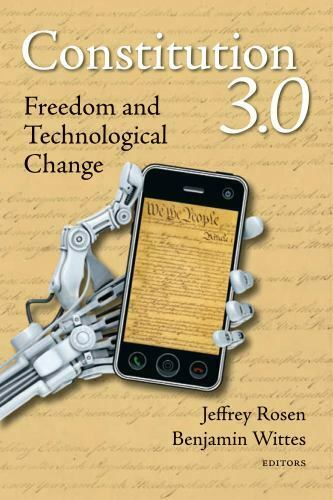
Constitution 3.0 collects the thoughts of several prominent legal analysts and technology experts to muse on the future intersection of law, technology, privacy, and the like. Most of the time they speculate on what the future might and should look like. The authors talk of different things but all agree that we will need creative thinking to solve the coming conflicts over access, security, and privacy. The book deals with big picture questions, but I thought it missed an opportunity to discuss where such issues hit most people most often in real time. The most interesting part of the book for me, then, was one example of just this–the case of Stacey Snyder, who lost her position as a student teacher over what amounted to a particular post she made on MySpace.

The very short summary is

  • While student teaching she posted a picture of herself at a party holding an indeterminate beverage in a cup.
  • She then posted a caption at the bottom of the page which read “Drunken Pirate.”
  • Someone got wind of this picture, which eventually made its way to her supervisors at the school.
  • She then lost her teaching position and, as a result of this, failed to graduate with her teaching degree. She sued for wrongful termination.

Snyder argued that she posted the photo on a private page, and the photo showed nothing illegal. She did not share the photo with students. Her perfectly legal private life should not impact her public duties in any way.

As one might imagine, the issue gets more complicated with more facts revealed (case facts, opinion here). The administration would overlook marginally bad judgment in this case for a good teacher. But Snyder received poor evaluations in some crucial areas throughout her student-teaching, such as classroom management, and being “too familiar with students.” She also, despite warnings from her supervisors, made students aware of her MySpace page, and made thinly veiled criticisms of her teaching supervisors on this page. Finally, despite teaching English, she sometimes wrote incomprehensibly even in the most formal of settings, as some examples submitted by the school district indicated.

Snyder lost her case. From the perspective of the school district, the MySpace post was one factor among many in her dismissal from student-teaching. The judges’ opinion focused primarily on certain technical matters of whether or not the court could compel the school district to award Snyder satisfactory ratings in for her certification. The 1st Amendment issues, however, boiled down to whether or not Snyder should be considered a student while student-teaching, or a public employee, i.e., a teacher. Different protections applied depending, and the judge declared that she functioned as a teacher during the time in question.

Certainly the case is not a slam-dunk, and a judge who focused more on the privacy questions, and saw Snyder primarily functioning as a college student in her role, might have ruled in her favor. For me, it’s not the ruling, but the intersection of what is personal and the public, the technically correct and broader perception, that makes this case important. Constitution 3.0 deals with crucial questions of the role of Congress, the courts, genetic engineering, neuropsychology in interesting ways, but the Snyder case brings many of these issues down to a particular point. More focus on particular questions like this would have made the book more relatable. And, while the book ably points out many of the legal problems heading our way as digital technology expands, it fails to try and understand how such technology changes our view of personhood, and thus of the rights the book discusses.

The book basically seeks to figure out how our current technology and culture should interact with our time-honored principals of the person and privacy. I suggest that possibly that these principles will not survive, not for a lack of will or wisdom, but because these principles arose out of a completely different view of the persons relationship to society than what we have currently evolving.

In a famous interview in the late 1960’s, Marshal McLuhan, he of the famed “the medium is the message,” discussed the impact of literacy and how it shaped society. He said,

Before the invention of the phonetic alphabet, man lived in a world where all the senses were balanced, a closed world of tribal depth and resonance, an oral culture structured by a dominant sense of auditory life. [This] contributed to seamless sense of tribal kinship and interdependence . . . there was little individualism or specialization. Oral cultures act and react simultaneously , whereas the capacity to act without reacting is the special capacity of “literate” man.

McLuhan went on to explain the regimentation of the printing press, and the detachment and regimentation required to read the printed word, created most everything we know of regarding the modern state from ca. 1500-1900 A.D.

Every aspect of mechanical culture was shaped by print technology, but the modern age is the age of electric media, which forge environments and cultures antithetical to the mechanical consumer society derived from print. Print tore man out of his traditional cultural matrix while showing him how to pile individual upon individual into a massive agglomeration of national and industrial power.

. . . The electric media are the telegraph, radio, films, telephone, computer and television, all of which have not only extended a single sense of function as the old mechanical media did, i.e., the wheel as an extension of the foot, print as an extension of the eye–but have enhanced and externalized our entire central nervous system, thus transforming all aspects of our psychic existence.

For McLuhan, the transition began with the invention of the telegraph, the first significant electric media.

When asked if he “relate[d] this identity crisis to the current social unrest and violence in the United States?” he responded,

Yes, and [also] to the booming business psychiatrists are doing. All of our alienation and atomization are reflected in the crumbling of such time-honored social values as the right to privacy and the sanctity of the individual. . . . As man is tribally metamorphosed by electric media, we all become Chicken Littles, scurrying around frantically in search of our former identities

I find McLuhan’s analysis intriguing, though I am sure I fully understand it. Perhaps he overstates his case, but I am convinced that new forms of how we get information will dramatically impact how we view the self. As television attained near ubiquity in American homes, something that McLuhan classifies as a type of transformative electric media, I find it no coincidence that we see the simultaneous rise of the idea of “authenticity”–a belief that our true selves cannot lie within existing structures.

I should state from the start that I hate the idea of authenticity. It has created a great deal of bad literature, bad poetry, and it was the Achilles heel of many of the progressive rock groups I grew up liking.* Charles Taylor’s book The Ethics of Authenticity points out a lot of good and bad with “authenticity” as a way of being, Whatever we might think about it, when we combine McLuhan’s insights with Taylor’s, we see a fusion of philosophy and technology stirring up trouble in good and bad ways for modern man, creating a crisis in our legal system and our culture.

We can see this crisis more clearly when we compare today to the past. In ye olden days, ones view of self had many more limitations, but also much more clarity and solidity. The vast majority of people had their religion, geography, social connections, and job more or less handed to them at birth. People had limited power but a much more stable and coherent view of the self. Now, through a combination of religious and technological shifts, we have more power to define ourselves, but that power comes with increased fragility of the nature of the self.

Increased power always comes with increased vulnerability. Nuclear energy could cleanly power whole regions, but if something goes badly wrong, all those regions would cease to exist. If one walks across the country, one could conceivably stumble and skin their knee. If you ran instead of walked, you would travel faster, but you could fall and twist your ankle. If you drive, you’ll get there much faster than running, but if something goes substantially wrong with the car you could face serious injury or death. Flying is even faster than the car, but if something goes mildly wrong, death would be the only possible result. If one goes into space, one screw coming slightly loose might kill everyone.

We now have a great deal of power to define ourselves. All that used to be perfectly settled is up for grabs. But with that power will inevitably bring with it a much more fragile and fluid view of the self.

This bifurcation between a society constructed with the values of the printing press, and a highly interactive technology that unconsciously promotes the values of pre-literate societies, helps us understand some of the bizarre tensions we see in society today. On the one hand, we live very private lives. We do not interact with our neighbors, everyone in the family has their own Netflix profile, and so on. On the other, we share many mundane details and thoughts of our lives with the world regularly. The reason why so many get so focused on views and likes is because, like other oral cultures, we need feedback that pre-literate man received instantaneously. At the same time, we want privacy and the right to make our choices irrespective of the values of others. We want maximum power, and naturally got maximum vulnerability to accompany it.

This tension comes out in different ways in almost all of our discussions about rights.** We still grant significant protection to home surveillance, or at least, to surveillance that reveals details inside the home. But outside the home . . . most everything is now “public.” Stores, train stations, neighborhoods—we can be legally watched anywhere one can put a camera. Part of this comes from the security concerns that come with our increased power. Constitution 3.0 explores the relationship between privacy and security quite well. It fails, however, to consider the other dynamics at play. Our idea of what constitutes a person has changed a great deal since the 1780’s. We demand the power to define ourselves freely, but cannot accept the accompanying vulnerabilities such power entails. We use technologies that at least attempt to connect us in the manner of pre-literate societies. But we want none of the communal responsibilities and accountability that comes with the technology. We live between these two poles, and so our concept of rights will fluctuate a great deal until we commit to one direction or the other.

Dave

*I have enjoyed listening to Dave Weigel’s The Show That Never Ends, a history of the progressive rock scene in the late 60′ and 70’s Weigel writes as a fan, but also as the classically detached journalist, so deadpan critic and fanboy get mixed together. Time and time again, these groups would attain some kind of great success with brilliant, creative instrumentation, then the band would fracture over the various members need to express themselves. The music also quickly got burdened with lyrics that were wispy, meandering, non-sensical, but certainly “authentic.” The book’s title alludes also to the fact that the bands started writing near/actual self-parodying songs with 8 movements that went on interminably. Band members talked about how their music “requires a lot of the audience.” What it required ultimately was extreme amounts of patience as the band essentially used the stage as a therapists couch.

Weigel spends a lot of time on Yes, and with good reason. No band put together sections of instrumental brilliance quite like them. And yet, their songs often veered into what I term “elves dancing in the meadow” motifs–gibberish masquerading as poetry with no anchor to reality. Alas! “Authenticity” occasionally made even great bands like Yes unlistenable. Thankfully, bassist Chris Squire kept them in reality when he could. If one wants to see what happened when some of Yes’ old members get together without the anchoring of Squire, and to a lesser extent drummer Alan White, sample the Anderson, Bruford, Wakeman, Howe album. All I can say is, prepare yourself for a full-on “Elves Prancing in the Meadow” experience.

**For example, on the abortion question. I am pro-life. I have read some people who are also pro-life that did not think Dobbs was reasoned correctly, however much they might have liked the outcome. I have not read the opinion myself and withhold judgment. I have also read some pro-choice advocates who believed Roe was built on a legal fiction, and this I have always thought. Other than that, I have no comment on the particular legal issues at stake.

Regardless of one’s position on abortion, I find it amusing and “appropriate” (in a way) that pro-choice advocates are not comfortable with the issue being decided locally and democratically. I say “appropriate” in the sense that it fits with the pattern described above. The great power pro-choice advocates desire to determine their lives cannot be subject to the whims and fluidity of democracy. It requires stronger stuff–they need a universal law to accompany their universal “right.”

Local cultures and traditions are much more stable, though of course, more limited. New York City will not be turning Red anytime soon. The habits and the traditions there would gladly support abortions for decades to come. The rights pro-choice people desire would be more stable there. But New York is not the whole country. Stretching the “right” to an abortion across everywhere means, however, that if a few justices flip one way or the other, well, that’s that. What the court creates, the court can unmake. “If you live by the sword, you will die by the sword.”

Ritual, Politics, and Power

This post was originally written in 2017 . . .

*****************************************

President Reagan garnered political popularity and power in part by his skillful use of political theater and imagery.

But in 1985 even this great master of ritual and belief stumbled a bit with the infamous “Bitburg” affair.  A New York Times article read,

It was a day Ronald Reagan had dreaded, even though it was a rite he felt bound to endure.  Walking beside Chancellor Kohl amidst the German military graves of the Bitburg cemetery, he looked stiff and uncomfortable, in awkward contrast to his usual ease.  While Kohl brushed aside tears, Reagan looked straight ahead, careful not to glance down at the graves less he spy the SS symbols sprinkled across the cemetery lawn.  In spite of the West German’s desire to clasp hands over the graves of the war dead, the President’s arms remained resolutely at his side.  Earlier in the day, at a hastily arranged ceremony at the Bergen-Belsen concentration camp, Reagan laid a wreath inscribed, “From the People of the United States.”  At the cemetery, in a ceremony that he was able to limit to just eight minutes, the wreath bore a somewhat different message: “From the President of the United States.”

Reagan got himself into this mess through a series of awkward political circumstances.  First, West Germany had emerged as a crucial ally in the Cold War and Reagan wanted to put a new kind of missile on West German soil.  Second, Chancellor Kohl had engaged in a long campaign of rehabilitation for Germany, and argued that the German people were also the victims of the Nazi regime–a statement most found (and I find) partially true but mostly false.  Still, things in West Germany had obviously changed since the 1940’s.  Still, rehabilitating the Nazi regime . . . ?

Most world leaders balked at any ceremonial recognition.  Reagan felt that he needed to acknowledge West Germany’s emerging role and commitment to freedom.  Plus, the missiles . . . he needed enough political capital with the West Germans to install them on their soil.

So, he decided to go.  He asked that the ceremony be limited in time, pomp, and circumstance.  He asked his aides to pick a spot that would incur the least amount of political damage.  Somehow, in a gaffe of gaffes, his aides picked a spot that included graves of SS officers!  One might understand mourning the ordinary German soldier, but not even Reagan could pull this off.  Still, Reagan had pledged–but he then insisted on another visit to the Bergen-Belsen concentration camp in last-ditch attempt to balance things out.  Hence, his stiff posture at the Bitburg cemetery, and the different messages on the wreaths.

The amount of controversy these simple and subtle gestures caused shows us that such gestures are not that simple.  Rituals reflect deeply held beliefs.  More than that, rituals create beliefs that stick in the minds of men.

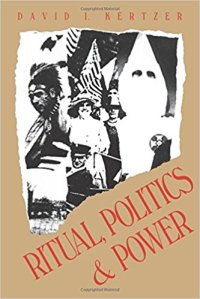
David Kertzer’s Ritual, Politics, and Power discusses this topic brilliantly.  He writes about weighty topics like ritual, psychology, and sociology with a spring in his step, and shares numerous revealing examples across time and space.  By far, his is the best book I have seen on the subject.

Some of us of a more rationalistic bent might say that rituals have no meaning in themselves.  Perhaps they give outward expression to inward meaning, but certainly cannot create meaning.  Meaning and ritual can easily part ways.

But how far could one take the separation of meaning and ritual?  Imagine we felt respect for someone but failed to shake their hand.  Would we really have this respect?  Some might say, “We love each other and we don’t need the state or the church to tell us that we’re married.” But I doubt that such people would refuse the “act of marriage” that creates intimacy in the first place.  “That’s ok, it’s the thought that counts” would not work as a defense.  Without a physical embodiment of the thought, no evidence of the thought exists.  More than that, our thoughts cannot be said to conform to reality without a physical manifestation of them.  We know a tree by its fruits.

In the Socratic dialogue Phaedo, Socrates argues about the nature of reality.  He comments,

Is their true nature contemplated by means of the body? Is it not rather the case that he who prepares himself most carefully to understand the true essence of each thing that he examines would come nearest to the knowledge of it?”  “Would not that man do this most perfectly who approaches each thing, so far as possible, with the reason alone, not introducing sight into his reasoning nor dragging in any of the other senses along with his thinking, but who employs pure, absolute reason in his attempt to search out the pure, absolute essence of things, and who removes himself, so far as possible, from eyes and ears, and, in a word, from his whole body, because he feels that its companionship disturbs the soul and hinders it from attaining truth and wisdom? Is not this the man, Simmias, if anyone, to attain to the knowledge of reality?”

In On the Celestial Hierarchy, St. Dionysius the Areopagite acknowledges that human beings cannot immediately or directly attain to spiritual contemplation.  Being flesh and blood, we require visible symbols and embodiments to know truth.  Kertzer in turn acknowledges that the president mainly functions as, “the chief symbol maker of the land,” so the minute analysis of Reagan’s gestures should not surprise us.*  Kertzer quotes another scholar who similarly wrote, “Most political controversy centers around which myth to apply to a particular problem.”

Kertzer generally ignores religion in his book, but the thin line between religion and politics makes itself perfectly obvious throughout his work–a huge strength in my view.  It illumines the fact that our political commitments come very near, or equivalent to, our religious beliefs, consciously or otherwise.  One immediately thinks of the vesting of clergy to perform religious rites.  We should not be gnostics.  You cannot just “think” yourself into being married.  Even today we still understand that you need a rite, you need “the act of marriage” to create marriage.  We know of the crown, robes, and mitres of kings.  But even in our much more casual modern American democracy, we have fixed expectations of how to look presidential.  To take one example, presidents give the pens they use to sign laws and treaties to favored confidantes or privileged citizens as “sacred” tokens of leadership.

Some may recall how Jimmy Carter’s popularity fell at least in part due to his failure to manage the symbolic nature of his leadership, either in his dress, relationship with Congress, or his tone of voice when speaking.  To take an opposite case, Kertzer shows how Rajiv Ghandi skillfully managed the symbolism of his mother Indira’s funeral to make a political career from nothing to India’s youngest Prime Minister in a matter of months.

We will know that our country’s religion is changing when we see its basic rituals come under fire.  Personally I find the singing of our national anthem at sporting events laborious and excessive.  But once the toothpaste gets out of the tube . . . things get complicated.  Though I find the ritual onerous and misplaced, I acknowledge the power of the rite.  Objectors to singing the anthem wisely engage in a symbolic action of their own.  The fact that they kneel has much more power than holding a press conference to voice their objections.

The more our country moves away from religion and its overt religious rite and symbolism, the more we will seek it elsewhere, the more important our political symbols will likely become, and the more power their proper execution will confer.  Ritual, Politics, and Power makes it clear that we need symbols to make sense of reality, and will have them one way or another.

Dave

*What do our modern presidential elections decide?  Given entitlement and defense spending, our federal budget has very little room to maneuver.  Our system of government and regular elections keep the president more or less in check.  Many believed the world would soon end after Trump’s election, but little of real substance has changed.  I think Kertzer would argue that what is most often really at stake is who gets to craft our symbols.  Neither candidate proposed any radical policy measure, and when Trump talked about a wall few thought it would actually happen.  But . . . it symbolically meant something to talk about it.  The election was bitter and contentious because of the symbolic nature of the candidates.  They may not have actually done radically different things in office but they represent very different symbols of what America is or should be.

Language as Myth

One will sometimes hear thinkers of a materialist stripe say something along the lines of, “A table is obviously a table, but words like truth or beauty are mere abstractions, a placeholder/convenience for certain ideas that different cultures have,” and so on. The problem with this lies in the fact that most everything anyone can think of deserves the title, “abstraction.” A table is not one thing but many things put together in a particular arrangement. Is it only a delusion that we call a table a table? Any living creature has many millions of separate parts, yet these parts function as a unity. Even an atom has multiple parts that we “conveniently” put together as a whole. We all “abstract” reality. Reality functions, in this way, as myth. The title of Ernst Cassirer’s difficult (for me at least) but significant work, Language and Myth could perhaps have the title Language IS Myth.

Writing at the end of WW II mean that Cassirer stood near the end of the unquestioned dominance of the scientific worldview. The deconstruction of the coherence of more traditional ways of knowing seemed complete. Cassirer was struck with the fact that the, “theory of knowledge as philosophers had developed it since the Middle Ages concerned itself solely with ‘facts’ and the development of orderly thoughts about facts. . . . Human intelligence begins with conception, the prime mental activity; the process of conception always culminates in symbolic expression. ” The book’s translator Susanne Langer noted in her introduction that, “Myth never breaks out of the magic circle of its figurative ideas. . . . But language, born in that same magic circle, has the power to break its bounds; language takes us from the myth making to phase of logical thought and the conception of facts.”

Hence, “Myth is an inherent necessity of language.”

In the early chapters Cassirer looks at theorist Max Muller. For Muller,

the mythical world is essentially one of illusion–but an illusion that sings its explanation whenever, the original, necessary self-deception of the mind, from which the error arises, is discovered. . . . From this point it is but a single step to the conclusion which the modern skeptical critics of language have drawn: the complete dissolution of any alleged truth content of language . . . Moreover, from this standpoint, not only myth, art, and language, but even theoretical knowledge itself becomes a phantasmagoria; for even knowledge can never reproduce the true nature of things as they are.

If myth be nothing, Cassirer writes, “it is mystifying indeed that this shadow should . . . evolve a positive activity and vitality in its own right, which tends to eclipse the immediate reality of things . . .” All in all Cassirer critiques “that naive realism which regards the reality of objects as something directly and unequivocally given–literally something tangible.” Objects in themselves cannot give meaning directly, for every object is a contract of other objects–hence, reality requires myth-making to achieve any sort of comprehension.

Most interesting to me were his thoughts on the idea that gods in the ancient world served mainly as embodied synthesized concepts. Much of what I learned about ancient religion growing up often amounted to something like, “The ancients didn’t know about electricity, so they thought Zeus threw lightning bolts.” Of course, how such unsophisticated people all over the ancient world managed to achieve such great heights of philosophy, architecture, etc. remains a mystery. Perhaps aliens?” Cassirer has a better approach, though also incomplete.

He begins talking about the “realness” of ancient religious feeling, even through the classical period in Greece, often thought of an an irreligious era. “Reason, Wealth, Chance, Feasting . . . Whatever comes to us suddenly [is] like a sending from heaven. Whatever rejoices or oppresses us, seems to religious consciousness like a divine being.” From these momentary “daimons” a new kind of god emerged, not from immediate experience but from “the ordered and continual activities of mankind,” which happened as our relation to the outer world went from passivity to active engagement. These gods have a narrow “width” but a degree of depth and permanence, as every year one needs to plant, sow, fish, and so forth. “Whenever a special god is conceived, it is invested with a special name, which is derived from the particular activity that has given rise to the deity.” Here we see the connection between language and religion, and how we need both to synthesize and create meaning from experience. Cassirer, using the work of Hermann Usener, thinks too much in an evolutionary way, but represents a big improvement from standard ways of viewing ancient religion.

Again–we have the link between language, myth, religion, all as examples of a synthesizing of material (be that material certain sounds or certain experiences) into meaning. Cassirer seems to lean heavily on the side of “emergence” in the Emanation/Emergence debate, but we can take his point. Cognitive scientist John Vervake has made a similar point about the current conflict in the Ukraine. Everyone is worried that something will happen to expand the war, but that “something” may not come from individual agency. Rather, war means participation in “Ares/Mars.” When we describe war as having “a logic of its own” we mean that a separate “life” exists as a corporate personality that drives decisions. We get enmeshed within this life and follow its bidding.

We can assert that we control this “life” because we created it. But I think it more accurate to say that we, speaking from the “emergence” side of the coin, call it into being rather than create it. History shows that such “ghosts” can be notoriously difficult to control. Think for example, of all of the allied moral denunciations of German use of chemical warfare in W.W. I, or the German bombing of civilian England in W.W. II. But England used chemical weapons in W.W. I shortly after the Germans, and the British and American forces killed far more civilians with bombs than the axis powers in W.W. II. As Vervake noted, these “collective ideations” (which I think was his term) resemble gods of the Bronze Age in Homer’s Iliad. They have abundant power, but grant no wisdom.

We can say the same for the internet itself. Humans created it, but we also called something into being, as we entered a hybrid-partnership of sorts. We feed it with attention, and it in turn learns and feeds things back to us. Surely, the internet has an agency, and seeks to add to its agency all the time.

Ok, the stuff about the internet I stole directly from

and both Vervake and Pageau explain the concept much better than I could.

The new Compact magazine has an article by Edwin Aponte that attempts to split the horns of the free speech wars. Most look at the fact that the left championed free speech in the 60’s, and now seems to favor more restrictions, or that the Right championed the “Moral Majority” and now wants comedians to say whatever they feel like saying, as either ironic or puzzling. But Aponte sees something else, writing

Consider also the activist left’s resistance to the Reagan White House’s unofficial gag order on public discussion of the HIV/AIDS epidemic in the 1980s, and then, barely a decade later, when the Democratic Party held the executive branch, the push for what was at the time called “political correctness”—a speech rubric spearheaded by many of the same left organizers.

In other words, today conservatives are out of power and railing against the canceling of comedians who make jokes about transgender people; tomorrow, the same people may be in power and leading the charge in favor of a ban against transgenderism in schools. This is borne out by the Times editorial. Per the survey, 66 percent of respondents agreed that democracy is built on the free and open exchange of ideas, yet a whole 30 percent also allowed for the curbing of speech if it runs afoul of acceptable etiquette.

Aponte makes the noteworthy claim that the root of this dichotomy lies in the Liberal (the term includes the modern Left and Right) project itself, which pledges unrestrained autonomy to grant one’s desires. Well, one’s desires could easily include both the right to say what you think and to not be bothered by what other people think. When Liberalism chucked Tradition and social mores as guides, they opened these floodgates.

I think, however, that something else is happening. In his farewell address, George Washington warned his countrymen against the formation of political parties, advice which we ignored almost immediately. Perhaps participation in democracies means that we cannot help but form political collectives to try and get what we want. This in turn catches us up in the war of “gods” who seek power but grant no wisdom. Language itself shows that we cannot avoid synthesizing meaning, but how we do so . . . that’s up to us.

Dave

“Therefore,” and “Nevertheless”

Towards the end of the Benedictine office of Lauds there exists a prayer which uses the old King James English which seems like a shock of cold water amidst the pleasant praises of God’s majesty–“and blessed are the paps which gave suck to Christ the Lord.” Such language could put off different people for different reasons, but mostly I think it boils down to a “disturbing” physicality and particularity. High-flown theological language suits us better. A Christian must confess that the second Person of the Trinity became a male human being in all fulness. The Benedicitine office, as other prayers of the Church, puts the focus on “higher” things of majesty and praise, but rightly will not conclude without bringing us back to earth and ourselves, reminding us of this stark truth. Clearly, Christ did nurse at the breasts of the Virgin Mary, and we must decide whether we celebrate this or feel embarrassed and horrified by it.

Many react with such embarrassment to time. Temporality flows inexorably, which makes those moments of glory, grandeur, and insight we experience at once so powerful and frustrating. We long for their return, but they will not come even for the asking. Our society in general seems embarrassed and frustrated by Time (manifested in some respects with bands like Kiss, Judas Priest, and even the Rolling Stones apparently still touring). Some may accept Time in the sense of merely resigning oneself to its power, but while this may be a superior attitude over ignoring or “rebelling” against Time, it too seems to see the physicality of time not as a blessing but as part of what we must endure in our going hence.

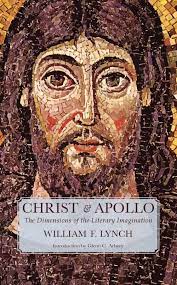
William Lynch’s Christ and Apollo: Dimensions of the Literary Imagination examines the question of physicality and particularity in theology and literature. I lack the depth and breadth of reading needed to truly benefit from this book, but the applications of his insights go beyond the literary and into life and redemption itself. Lynch keeps focus on his crucial question: Does God accomplish His purposes through the finite, or in spite of it? Authors, “regular people,” and civilizations face the temptation to either ignore or despise creation, thereby failing to see through it and discern the patterns of grace. Lynch diagrams this basic idea like so,

with the diagram on the left as the proper path. Heraclitus may have had the same intuition, stating that, “the way up and the way down are one in the same.” Tension has always existed in Christian thought between 1) Moving down “the mountain” as moving away from God (a pattern present from the Garden of Eden, Mt. Sinai, Mt. Tabor, etc.), and seeing that movement as a kind of death, and 2) Recognition that we have no other option other than to take this passage down into death to return to God whole, i.e., “He who wishes to save his life must lose it,” and “unless a seed falleth into the earth and die, it bears no fruit.”* Escape from this tension provides only an illusion of freedom, and in fact produces a kind of slavery to a fear of things, and even of ourselves. Our glimpse into the infinite comes only through the finite.** Dante’s grand cosmological vision would not have been complete without tethering it to 14th century Florence. In The Brothers Karamazov, Dostoevsky knows that Aloysha’s great mystical visions can only come through his engagement with his wretchedly dysfunctional family.

But many modern authors cannot embrace this paradoxical pattern. Lynch examines a few different metaphysical categories to demonstrate the paradox. For Proust, time is man’s greatest enemy. The cubist painter can not accept the finite image–instead they must represent all of the possible angles of vision of the minding a futile attempt to see only the abstract. Lynch writes,

Perhaps the most ambitious, most brilliant, and most sophisticated vendetta launched against time was that of Descartes, who first put forward the notion of a pure intelligence within us not subject to time. . . . when that ambition takes the form of a desire to wipe out the succession and the partial quantities of time, and to live in an isolated area of the personality where the temporal has no meaning or power, then a grave folly has been committed. . . . The “man in the street” knows what the intellectual does not: that true reality is contained within the dramatic temporal life of the body. The peasant knows he will be healed not only by doctors but also by time. [He knows that time] is as much a part of him as his own skin, out of which he cannot leap.

Christ and Apollo, p. 50, 53

Christ exemplifies this true approach to time as a positive good: He refuses to cling to childhood (Lk 2:41-52), He refuses the easy path to glory (Mt. 4), and allows His death to come to Him “in the fullness of time” (Gal. 4:4).

Different literary genres can make the same mistake of rejecting creation. In tragedy, Lynch cites the modern tendency that “exaltation must come from exaltation, and that infinites must come out of infinites.” This path leads to two consequences:

  1. The idea that the achievement of great tragedy has its roots in the mystical conquest of the “human spirit” against pain–the tragic figure as exalted conqueror, which
  2. In fact makes the writing of tragedy more difficult, not easier, because it seems that tragedy, like death, doesn’t really exist.

Comedies too can make the same error. Comedy (in the modern sense of “what makes us laugh”) often deals with the breakdown of order and expectations–all well and good. But if we ask ourselves why A Midsummer Night’s Dream still gets staged four centuries after its debut, we need look no further than that “the play, [even] in its wildest fantasy [in Act 5], is only dealing with Snug the joiner and Bottom the weaver.” T.S. Eliot commented that, “human kind cannot bear very much reality.” “I am not so sure of that,” Lynch writes, “The bigger truth is that they cannot stand very much unreality.”

Perhaps part of the problem lies in that great literary minds can see their idea so clearly that the idea burns away all around it if they fail to take care. Here then, lies Lynch’s “Univocal Man:”

He is, emotionally, full of extraordinary energies–in fact, a kind of energy seems to mark the whole of his character. He has a genius for a unilateral passion, and is, and therefore always has been–a passionate center of good and bad in civilization. . . . Superficially, then, he resembles the religious genius. . . . It is only by exercising great caution that we will avoid this profound mistake and will refrain from giving this character the veneration that is not his due. . . . The univocal man has no respect for reality; he is contemptuous of it, or distorts it, or flattens it–or he refuses to take responsibility in the face of it. . . . The univocal man is not free. He is rigid, unbending, fixed. One can understand the fixity of the idea of logic and essences, but his fixed ideas are born of a fixity of all the forces of his personality and a refusal to remain open to existence. . . . To put the matter simply, these would reject all the unities and relations projected by any sentence, for example, “The horse is white,” for a horse is a horse, and white is white, and that is the end of the discussion.

pp. 141, 144, 147

We might say that the Univocal man has too much “purity” in him. He cannot or will not mix his idea with the stuff of reality. That this should happen to a literary type is no surprise. In general they write because they are gripped by an idea or image.^ The one who mixes things up too much would likely never have the clarity or organization to get anything down on paper to begin with. Lynch shows us Eugene O’Neil, who wants us to be sad, and so gives us Sadness in Mourning Becomes Electra, with her mansion as her prison. Or, even more absurdly, he gives us Laughter in Lazarus Laughed, with this ridiculous passage where Lazarus speaks to Caligula,

You are proud of being evil! What if there is no evil? Believe in the Healthy God called Man within you! . . . Believe! What if you are a man and man is despicable? Men are also unimportant! Men pass! Like rain into the sea! The sea remains! Man remains! . . . For Man death is not! Man, Son of God’s laughter, is! . . . Believe in the laughing God within you!

Alas, too many exclamation points. O’Neill wants rapture but he attempts to achieve it by rebounding off of creation and denying it altogether. Only a fool would say that “death is not.”

With a denial of creation will come an absence of transcendence, purchased at the price of avoiding all mess. George Bernard Shaw claimed a sort of spiritualism but could not stand religion actually practiced, writing,

In Italy, for instance, churches are used in such a way that priceless pictures become smeared with filthy tallow-soot, and have to be rescued by the temporal power and placed in national galleries. But worse than this are the innumerable daily services which disturb the truly religious visitor. If these were decently and intelligently conducted by genuine mystics to whom the mass were no mere rite or miracle, but genuine communion, the celebrants might reasonably claim a place in the church as their share of the common right to its use. But the average Italian priest, personally unclean and with a chronic catarrh in his nose from living in frowsy, ill-ventilated rooms, punctuating his gabbled Latin only by expectorate hawking . . . this unseemly wretch should be seized and put out . . . until he learns to behave himself.

Whatever communion Shaw desires, it would have to include rite, miracle, and perhaps even the dirty priest, for it to happen at all. But for Shaw, such things are too messy and not “spiritual” enough. We should not suppose that he would enter in absent the dirty priest, either–something physical would always bar his way. It is much easier to comment online, or even to read books.

We in our day have the bigger and smaller problem of not even being able to enter into politics. The problem is smaller in that religion is more important than politics, but bigger in that we cannot hope to solve big questions if we cannot solve smaller ones. Too many on the right and left want nothing to do with mixing their ideas in the mess of politics. Some want a Caesar from above to wave a magic wand, some want the “innocent” people to rise up from below to abolish the Bill of Rights. Neither will achieve anything like an ordered communion, for neither wants to find the path to grace through creation. They do have their dreams. These dreams will have to content them, for they can know nothing of sorrow or joy.

Dave

*Perhaps this might explain in part Christ’s sometime reluctance to work miracles. Miracles, could, hypothetically, interrupt the U-shaped pattern and hinder us on our journey back to God.

**If we learn to see this pattern and interpret the Scriptures more analogically and less in a directly moral fashion, many things make themselves more clear. For example, we should honor the elderly not simply because of their wisdom–for some have none of it–but because they are closer to death, and thus also closer to glory. So too, this explains why the Church has always warned less against the “earthly,” “physical” sins of gluttony, too many women, etc., than the “spiritual” sins of pride. Many have gone down the path of fleshly indulgence and found the place where it turns upwards to God. But no path to God exists through pride. Of course, it is best still not to dabble in either.

**The literary, educated types–one always has to watch out for them . . .

Chaos Theory

In the wake of 9/11 Patrick Deneen wrote an essay entitled “Patriotic Vision: At Home in a World made Strange,” in which he lamented the dichotomy he saw in public opinion. On the one hand, you had an entirely uncritical belief among many of the righteousness of the United States. Politicians needed to wear a small flag on their jacket lapels, (couldn’t happen now), and waved through sweeping legislation (the “Patriot Act”) that dramatically increased the surveillance powers of the government. On the other . . . you had many in academia, perhaps especially among our elite institutions, that could barely contain their smugness with pronouncements that America had gotten what it deserved for its overbearing foreign policy. Deneen published this essay in early 2002, and this split would only grow in the run-up to the Iraq War. Remember “America Fries?”

Two seems to be a natural number for democracies to fall into, and perhaps somewhat natural in general for any society. We have night and day, sun and moon, major and minor keys, and so on. But “two” has always been something of a dangerous number, symbolically speaking. The either/or paths “2” creates bring inevitable division among extremes. Still, if we think of myths and creation accounts as, among other things, poetic interpretations of the world, we note that “2,” while obviously prevalent in creation, does not have the final say.

Between day and night, and night and day, lies twilight and dawn, the grey area linking them both. We have Adam and Eve, but they are supposed to “be fruitful and multiply,” i.e., not stay just the two of them. We have six days of creation and the seventh day–a breathing space of sorts within the normal cycle of the week. In Revelation the angel tells the Apostle John to measure the inner court of the temple of God, but to leave the outer court unmeasured (Rev. 11:1-2), i.e., we need to loosen our intellectual hold on at least parts of reality. St. John’s gives us grand cosmic visions, but the Old Testament has this need for an unmeasured, in-between space, displayed even in the most prosaic of ways. The Israelites had to leave the fringe of their fields unharvested, and to leave the edges of their garments loose (Duet. 24, Num. 15).

It is on this fringe, the in-between spaces, where fruitful interaction and new creation can happen.

Certainly Deneen’s essay has resonance with us today. But he did not seek merely to lament the situation that existed in 2002, nor do I seek only to bemoan the world today. Rather, Deneen pointed to the classical world for a possible solution to the dilemma of “2”–the Greek vocation of the “theorist.”

One form of education seeks to construct by rote a particular view of the world. In regard to our own history some proclaim that the founders were all wise and good men–and only wise and good–our wars are always just, etc. Without cultivating any possibility of error, no repentance can happen and growth a forlorn hope. Such infants can never eat meat. As Aristotle noted, the perfect citizen would rarely be a good man. He could never grow into virtue.

The other education aims only at deconstruction–our founders were all misogynists, slave owners, etc. Of course this deconstruction supposes the need to construct something else in its place. Nothing can exist based on a universal negative. But often, having despised their birthright, deconstructionists have no idea what or where to build, and can feed only on dreams, or worse–themselves, and thereby “starve for feeding”(Coriolanus, Act 4.2). We need another approach.

Enter “one who sees,” which is a translation from the Greek word “theorist.” Certain elected officials within most classical Greek city-states had the title of “theoroi.” To quote Deneen,

To “theorize” was to take part in a sacred journey to visit the “other,” to “see” events such as religious or athletic festivals, and to return to their home city to give an account . . . the theorist would then attempt to comprehend, assess, compare, and then, in the idiom of his own city, explain what he had seen. The encounter would inevitably raise questions about the customs and practices of the theorists own city. . . . Might their be a best way of organizing the city that is not our way?

. . . The activity of “seeing” other ways of foreign life comprised half of the theorist’s duty. The other half . . . was the “giving an account” of what the theorist had seen. A “theorist” would betray his office if he were, so to speak, “go native” while abroad. . . . Even if a theorist were persuaded that that foreign practices were superior to those of his own city, the primacy of the theorist’s allegiance to his own city demanded careful and prudent explanation . . .

The “theorist” then, was not chosen only for his ability to “see” and apprehend with sensitivity the new and unusual but equally for the abiding customs of his own way of life. . . . it was by means of deep familiarity and love for that cultural inheritance that the theorist was able to move fellow citizens to renewed devotion to those practices . . . or to subtle questioning of dubious customs . . .

Conserving America: Essays on Present Discontents, pp. 18-20

It is through this lens that Deneen suggests we should see Socrates. He self-consciously went on a “sacred journey” of philosophy and saw himself as a “gadfly” to Athens, but also someone who would never consider disobedience to the laws of his city.*

Deneen examines Rene Descartes as possibly the first example of a modern “theorist.” As a French Catholic fighting other Catholics in the brutal 30 Years War, Descartes had a unique opportunity for serious soul-searching. As Deneen points out, however, he operated purely with his mind and imagination, and not with his heart. He “begins with radical suspicion of all that preceded him in act or thought, and especially all that is the result of the common endeavors of a community or people” (23). Descartes prefers to think by himself in a foreign land, but cares not even for the foreign locale. Time and place matter not to him. “A thinker like Descartes would be content to think anywhere on earth” (24). Descartes loved to sit in bed and think–all well and good. But what person, or place, or custom, did he love?

The abstract method Descartes employed led him to question everything . . . except himself (“I think, therefore, I am”). The mind, powered by egotism and unfettered from the body, became a weapon to remake nations and nature itself for civilizations that followed his wake. But to be free from one’s time and place is also to be estranged from it. We tend to lash out at strangers, even if the stranger is our very selves.

Those younger than me may groan–but nevertheless–a line runs straight from Descartes’ abstractions to the internet and social media, or, the “cloud.” The internet has perfected the art of taking you away from where you reside and placing you nowhere in particular. I suppose with very simple and direct messages, social media works well, i.e., “Look, my son graduated from high school,” or, “I love my new haircut.” But anything involving complexity requires context, and context requires “full body” communication–not just the mind. Misunderstandings become almost the norm if we ignore this, which brings chaos. Our connections to one another disappear. To compensate for the interpersonal gap (which we perhaps feel but may not be fully aware of), we use manipulation as a method to bridge the chasm. Christians are guilty of this just as others are, i.e., “Jesus is the Light of the World–If you love God you will share with all your Friends!” Marshall McLuhan was right–the medium often dictates the message.

In difficult times we face two temptations. One is to bury our vision into the dark and tangled soil. There we meet the demons of blood and earth. The early 20th century saw this nightmare made real. The other involves a flight into escapist utopian fantasy with our heads in the sky. Devils lay there as well (i.e. the “prince of the powers of the air”–Eph. 2:2**). Both soil and clouds exist for a reason, however. Both have their place. We need to see what lies below and above at the same time, with Christ in the center, holding all things together.

*We can note that in The Republic he places his ideal, or perhaps, imaginary, city outside of Athens (I tend to think of The Republic as a thought experiment and not a description of Plato’s “real” beliefs–others disagree). Deneen also notes that the great Athenian dramatists played the role of “theorists,” and they, like Plato, often set their events outside of Athens.

**Perhaps we should think of Paul’s words in a strictly spatial manner, but I am fairly sure that we should interpret his words metaphorically (the two are not mutually exclusive–both meanings are in play). That is, the “air” shifts to and fro–it has no boundaries, no direction–its shiftiness resembles the snake, who speaks with a forked tongue, etc.

11th Grade: “The bombs in Vietnam explode at Home”

Greetings,

This week we continued our look at the Vietnam War, but also focused on the Civil Rights movement.

Vietnam has many controversial aspects, including the way we fought the war.  I think our massive bombing campaigns attracted Johnson for political reasons.  He campaigned in ’64 on a “I don’t want to want to get too involved in Vietnam,” platform and won easily. Bombing allowed us to do something while committing relatively few men and risking relatively few lives compared to other options.  At the same time, our bombing could send the message to the North that we meant business.

But our military actions have a meaning to them that extends far beyond their direct military impact.  Bombing proved disastrous in a number of ways:

  • Bombing, while low-risk, comes with great expense.  As Martin Luther King said, “The bombs in Vietnam explode at home.  They destroy the chance for us to create a decent America.”
  • In jungle terrain, bombing had little to no effect on enemy movements or their ability to fight
  • Bombing makes us look like a bully.  Here we are, the most advanced society on earth, dropping explosives from a safe distance upon a peasant society.  Human nature loves an underdog, and perhaps Americans especially loves them.  Our tactics made the North Vietnamese look like the team a neutral observer would root for (we need to think in similar ways about our use of drones today — how are drone strikes interpreted by the global population?)
  • Finally, one could argue that bombing sent a message not of the strength of our resolve, but of our lack of it.  We know that Johnson wished desperately that the war in Vietnam would “go away.”  Bombing brought little domestic fall-out initially, because it would mean relatively few casualties for us. Ho Chi Minh could easily have interpreted bombing as Johnson’s way of trying to avoid the hard questions Vietnam brought.  It appears that they did just that.

We lost the battle for public opinion in the war by around 1967.

General Westmoreland’s tactics of “Search and Destroy” proved strategically ineffective in the long run.  We like to think of our armed forces as tool for good.  We understand that that might mean violence, but most of don’t want to think of our military primarily being used to kill others.  Westmoreland did not focus on protection, but on “body counts.”  How many of the enemy did we kill?  This does not have the same ring, as “How many innocent lives did we protect?” though obviously that could involve killing the enemy.

The North Vietnamese certainly committed atrocities — more of them than we did and with greater scope.  They usually treated civilians much worse than us, sometimes intentionally using them as human shields.  Their atrocities did  not get equal media attention.  But I suspect that even if such atrocities had been well-reported, it may not have made much difference.  We expected others, the “them,” to be the bad guys.  Nothing in our national psyche or identity prepared us not to like what we saw in the mirror.  One sees this self-delusion in those that said, “The only thing that can defeat America is America,” which asserts that we can attain omnipotence if only we will it.

De Tocqueville and many others have commented that when democratic armies have the support of the population they become very difficult to stop.  Democratic armies naturally seek to draw strength from the people.  But when they cannot do this, their effectiveness gets diminished.  This is something that democratic societies must bear in mind in a way that dictatorships, for example, do not.  In Vietnam, I believe that most historians would agree that we did not fashion a “way of war” that lent itself to gaining the support of the people.  The North Vietnamese realized our predicament long before we did.  Le Duan Thoc, a North Vietnamese strategist, commented fairly early in the war,

[We can win no matter what the United States does.]  They will fight far from home and will be regarded as an old style colonial invader, in a climate to which they are not accustomed, against indigenous forces backed by China and the Soviets.  If they invade the North they will face 17 million of us, and potentially hundreds of millions from China.   If they use nuclear weapons the Soviets will retaliate.  The more they risk, the more they alienate the international community and erode support domestically – the more too they are vulnerable to a crisis in other parts of the world.   The enemy is in a weak position.

Some argue that, in fact, we could never have won in Vietnam.  Eventually we would go home, and they would remain.  Others counter with the argument that, had we fought in a way that focused on security for the South rather than killing the enemy, we could have won over public opinion and given the South Vietnamese government a chance to work.  We in fact began to try this strategy in 1969 when General Abrams replaced Westmoreland, but by then America had given up the fight in our hearts and minds.  Of course, some believe we could have won if we had fought differently, either with more bombing in Cambodia and Laos, or with a different style of fighting (perhaps fewer men and more covert operations).

We also looked this week at how the Civil Rights movement transformed over time.  The enormous moral force of those that demonstrated for equal treatment overwhelmed opposition.  Television brought the issue to the forefront of American homes across the country, much as the Fugitive Slave Law of 1850 moved the slavery question from the abstract to the real for many Americans.  The movement peaked in 1965 with the Voting Rights Act.

But then something happened.  Violence erupted in many cities across America over the next two years, beginning with the Watts riots in Los Angeles.  Student protests spiked sharply.  The fringe “Hippy” movement went into the mainstream.  How did this happen?  At the moment when it seemed that America had become more of the kind of country it was supposed to be, why did so many subsequently turn to violence?

This paradoxical question will occupy us next week.  What I suggest for now is that King’s words above may not have  been merely metaphorical.

Many thanks,

Dave

12th Grade History/Civics: “To be, or not to be. . .”

Greetings,

This week we continued with the Cold War in earnest and took a look at a few key issues and events:

England and America could see the Cold War coming as W.W. II ended.  The unfortunate Eastern European nations of Poland, Hungary, Rumania, and Bulgaria exchanged one conqueror for another.  Soviet dictatorship may not have been as bad as Nazi occupation, but that is hardly saying much.

Atomic weapons quickly became prominent, although not necessarily because we wanted it that way.  Free societies maintain themselves traditionally through a volunteer military, except in emergencies.  With the war over hundreds of thousands of soldiers looked forward to returning home and resuming normal civilian life.

But the Soviets did not disband their army.  They kept it active and occupied much of Eastern Europe.  How could we respond?  We could either:

  • Keep the draft going and maintain our military at W.W. II levels, which might also mean continuing the war-time command economy.

Or

  • Use atomic weapons as a kind of equalizer against the sheer volume of Soviet troops.

The latter option appealed to us for many reasons, but of course created other problems.  If the Soviets eventually got “the bomb,” how then do we maintain our advantage?  Do we make more atomic weapons?  Or do we make them more powerful?  The arms race was on, and one consequence of this was the proliferation of weapons able not to just win wars but wipe out civilization as we know it.

Another problem with nuclear weapons revolves around what exact purpose they serve.  Are they weapons?  This seems obvious on its face.  Of course they are weapons.  But can something be a weapon if you would never actually use it?  No — then it’s just a very expensive and very dangerous showpiece.  But could nuclear weapons actually be used?  For once used, Pandora’s box opens.  Could a nuclear war have a winner?

So, did nuclear weapons in reality function much like status symbols, reflecting the image of power rather than actually having power?  But then again, if everyone thinks they are just status symbols, they pose no threat.  And clearly, these weapons posed a huge threat.  We could not contemplate the consequences of using them, and we felt that we needed to have them ready to use at a moment’s notice. These were some of the terrible dilemmas the Cold War gave us.  The confusion between image and reality bore itself out in this Civil Defense video many elementary school children saw in the early 1950’s:

The idea that we may not have known exactly what we had on our hands gets reinforced from the Castle Bravo disaster in 1954.

At its core, the Cold War presented us with the dilemma of how to win a war without actually fighting the other side.  How could you win a boxing match if neither opponent could touch each other?  Much of our strategy revolved around the following premesis:

  • Communism can only survive as a parasite.  It cannot internally sustain itself, so the only way it can live is by feeding off of others.  Thus, it is imperative to deny them access to new territory, for each new piece of territory will artificially extend their life-span.
  • Since fighting the Soviet Union directly would have exceedingly dire consequences, we have took for non-traditional, or “asymmetrical” ways to fight.  Economic advantage, and our political image, among other things, would play key roles in this conflict.

The Korean War often gets ignored, sandwiched between World War II and Vietnam.  I myself usually breeze over it, but every so often the conflict makes itself very relevant.  The issues involved deal with many of problems discussed above.  Commentators could argue that we

  • Won the war, because after the invasion of the North we pushed the North out of South Korea.
  • Lost the war, because we failed to destroy North Korean forces, largely due to the intervention of China, and got pushed back out of North Korea
  • Tied, because the status quo was restored, but nothing more.

While we could not go through the entirety of the history of the war, the impact of our involvement would have large, though subtle ripple effects in our own society.

  • The Korean War was unquestionably a war, yet the Senate never declared war.  Obviously this was not the first time that we had used troops and not declared war formally, but the scale of the conflict and commitment exceeded previous undeclared wars.
  • After the Korean War we began to maintain a continuously large standing army, a break from the past.
  • The war also raised questions about executive power and the role of Congress.  As foreign policy came to dominate, the power of presidency inevitably increased, but for the most part, these questions have no resolution as of now.

A brief aside, every political commentator of which I am aware from the classical era down to the early modern age (Aristotle, our own founders, etc.) argued that a large standing army posed a dire threat to liberty.  That is, no militarized state could maintain political freedom indefinitely.  Whether they were wrong, or our exception proves the rule, or perhaps our political system has indeed suffered because of this is a point of great debate.

Many of these questions came to a head in October 1962 in the Cuban Missile Crisis, where under a cloak of deceit, the Soviets started building missile silos to house nuclear warheads capable of reaching at least 1/3 of the U.S. mainland.  We could either . . .

  • Ignore the problem.  Perhaps it would not be worth it to get them out, or perhaps we did not have the political will to stop them from installing them.  As parents we sometimes ignore things that we would rather not deal with at the moment.  We then file the incident away to be used later if we need to.
  • Acknowledge the presence of the silos/missiles, but do nothing about it, which would make us look terribly weak.
  • Insist that the missiles not be installed and prepare to take action to prevent it.  Easy to say, but hard to do, because it begs the question of how far we would go.  Would it be worth W.W. III to prevent it?  Would it be worth a global nuclear holocaust?  Maybe we would not actually launch nukes, but do we then bluff and claim we would?  Would that escalate or diffuse the crisis?

Records indicate that initially most favored an air strike against the silos.  Most agreed that we had a good chance of eliminating the silos via bombing, with minimal casualties.  But it would involve a military attack on one of Russia’s allies, and we could not be sure how they would respond.  Would they then take West Berlin?  What would we do then?

Perhaps these questions led Kennedy to decide on a naval quarantine which would prevent the installation of the missiles, and also give the two sides time to talk.  It forced the Soviets to back down or be the first to take aggressive action.

But none of this attempts to see the crisis from the Soviet perspective.  If the U.S. had concerns about missiles 90 miles from our shores, what about the fact that we had missiles 90 miles from the Soviet Union in Turkey?  What about the Bay of Pigs?  One could easily argue that the missiles in Cuba served peace, if you believed that strategic parity gave the best guarantee of avoiding conflict.

In the end the Soviets agreed to remove the missiles if we pledged never to invade Cuba and removed ours from Turkey, which we agreed to do, albeit secretly.  Many felt that we had won, and many praise Kennedy for his handling of the crisis.

But as time passed, we learned more about just how close we came to disaster.  In the documentary The Fog of War, Defense Secretary Robert McNamara discussed his meetings with Castro in 1992 below.

If these revelations are true, the air-strike we nearly decided upon would have led to disaster.  When one understands the possibilities inherent when human fallibility combines with enormous destructive power, we can only thank God that nuclear war did not happen in 1962.

Next week we move on to Vietnam.

Blessings,

Dave

11th/12th Grade: Ending the War Justly(?)

Greetings,

This week we wrapped up World War II by focusing on two key issues: our use of the atomic bomb, and the Nuremberg Trials.

We discussed before how war in general can have a terrible kind of osmosis for the combatants.  So in W.W. I the Germans first used chemical warfare and all cried foul, but soon the Allies followed suit.  All were outraged when the Germans bombed London, but as the war went on the British and Americans killed far more civilians with their bombings than the Axis powers.  Herman Goering called the conflict, “the great racial war,” and Americans as well as the British adopted some similar attitudes to their enemies as the Axis powers did to us.  This proved especially towards our Japanese opponents.  This picture, for example, of a young woman admiring the skull of a dead Japanese soldier her boyfriend sent her, appeared prominently in Life Magazine.  

A few issues regarding the bombings need discussed:

1. Is it the primary job of the commanding officer primarily to abide by a a Christian ethic of human life even if it puts his troops at relative disadvantage, or do we want him to instead seek to have his men accomplish their mission with as few casualties as possible?  What about the President?  It is worth noting that Air Force General Curtis LeMay, who led many of the bombing runs that killed hundreds of thousands of Japanese, thought that he would be tried as a war criminal should the Allies lose the war.

The divide here may be seen this way. . .

  • On the one hand, you have the view that “war is hell,” and exists essentially outside normal ethical standards.  Killing someone, for example, is never the “kind” thing to do.  The main goal, therefore, is to end war as soon as possible, and then resume “normal” life.
  • On the other, you have the view that war is not primarily about victory, but about our sanctification as individuals and as a nation.  If fighting “morally” means we suffer, so be it.  Just as individuals should never do wrong to benefit themselves, so nations should not either.

Granted, this divide may be altogether too simplistic. but it touches on another issue.  What are nations?  When a nations acts should it be held to the same standards as individuals, or are nations in fact artificial, impersonal creations that therefore are not subject to the same standards as individuals?

These questions have no easy answers.

2. Should the ethics of war depend in part on the nature of conflict itself? For example, conflicts in the past involved armies of aristocratic warriors, and rarely involved the general population.  In the 20th century however, war between whole nations became the standard.  If nations fight, can the whole nation, civilian or otherwise, become the target?  I hope the students will consider some difficult questions.  Is there a difference between bombing cities from the sky, and going from house to house shooting those inside?  Can you target areas if civilians are likely to be unintended collateral damage?

Our decision to use the atomic bomb had many factors involved:

  • We wanted to avoid a mainland invasion of Japan, which would likely have cost us at least 100,000 casualties, with some estimates being much higher.
  • We wanted to end the war before the Soviets could get involved and take Japan for themselves.
  • While we could have bombed Hiroshima conventionally with a comparable destructive impact, the atomic weapon had much greater potential for psychologically impacting them.

Our use of the two atomic weapons, “Fat Man,” and “Little Boy” did have the desired effect.  Japan did surrender without us needing to invade.  But nearly all Japanese that died in these attacks were civilians.  For the first time in my teaching career, almost all of the students thought that the decision to use the bomb could not be justified.

Germany’s surrender left us with a variety of post-war dilemmas.  The magnitude of the evil perpetrated in the Holocaust numbs the mind.  Never before in history had such a thing happened on such a scale.

But what should we do with Nazi leaders that surrendered?  Should they be released into civilian life again, as if nothing happened?  Or should they be shot out of hand?  Neither option seems to satisfy.  Putting them on trial had many advantages to it.  We would give them legal counsel.  They would have a fair chance to prove their innocence or at least mitigate their guilt.  This was the “civilized” option.

But that too posed problems.  What right did we have to put Germans on trial?  They were not American citizens and had broken no American laws.  To what kind of law can we hold them accountable?  We can argue for international law, but the Germans had withdrawn from international agreements and oversight before the war began.  Thus, they were not accountable directly to international laws they never pledged to obey.  What legal procedures should even govern the trial?

Furthermore, how could the trials be fair if all the judges were Allies?  Should the Germans have the right to a trial of their peers?  But would that eliminate the possibility of guilty verdicts?  Could the trials be fair if the Soviets participated in the prosecutions?  But how could we exclude them, considering that the Soviet Union suffered far, far more casualties than the U.S. and England combined?

The trials raise many perplexing legal questions, but also difficult moral ones.  How far should the “I was just following orders defense,” be allowed to go?  How far down the chain of command should we prosecute?

Eichmann served in the S.S. and played a role in the Holocaust.  He ended up escaping from Germany, and was captured by Israeli’s 15 years after the end of the war and put on trial.  Many remarked on how ordinary a man Eichmann was.  Hannah Arendt’s famous phrase “the banality of evil” fit him perfectly.

Many thanks,

Dave

The Psychology of Encounters

As an author A.J. Toynbee could be controversial and intimidating.  His grand theories of the scope of history naturally had adherents and skeptics.  Toynbee repeated himself numerous times over the scope of his 12 volume magnum opus.  At times too, Toynbee’s “insights” seem like little more than average common sense, such as his observation that geography must present a challenge to encourage the development of a civilization.

But sometimes his insights, even if not earth-shattering, are nonetheless important to contemplate, and show their worth because of their applicability in different circumstances.  I have always thought that the book The World and the West a great entry point for those interested in Toynbee’s work.  My favorite chapter (the book is a collection of speeches given on a theme) is “The Psychology of Encounters” (available here for those interested).

His main point deals with how cultures interact with one another.  One of his arguments entails showing how when a culture gets transplanted into “non-native” soil, it may not “take” in the way it did so where originally planted.  He uses the rise of nationalism from the mid 19th-early 20th centuries.  The idea of nationalism grew up slowly and organically in England and France, and perhaps to a lesser extent in Russia.  But the exportation of this idea to other areas could have unintended and dangerous consequences.  I quote at length,

We can see why the same institution has had these strikingly different effects in these two different social environments. The institution of ‘national states’ has been comparatively harmless in western Europe for the same reason that accounts for its having originated there; and that is because, in western Europe, it corresponds to the local relation between the distribution of languages and the alignment of political frontiers. In western Europe, people speaking the same language happen, in most cases, to be huddled together in a single continuous and compact block of territory with a fairly well defined boundary separating it from the similarly compact domains of other languages; and, in a region where, as here, the languages are thus distributed in the pattern of a patchwork quilt, the language map provides a convenient basis for the political map, and ‘national states’ are therefore natural products of the social milieu. Most of the domains of the historic states of Western Europe do, in fact, coincide approximately with homogeneous patches of the language map; and this coincidence has come about, for the most part, undesignedly. The west European peoples have not been acutely conscious of the process by which their political containers have been moulded on linguistic lasts; and, accordingly, the spirit of nationalism has been, on the whole, easy-going in its west European homeland. In west European national states, linguistic minorities who have found themselves on the wrong side of a political frontier have in most cases shown loyalty, and been treated with consideration, because their coexistence with the majority speaking ‘the national language’ as fellow-citizens of the same commonwealth has been a historical fact which has therefore been taken for granted by everyone.

But now consider what has happened when this west European institution of ‘national states’, which in its birthplace has been a natural product of the local linguistic map, has been radiated abroad into regions in which the local language map is On a quite different pattern. When we look at a language map, not just of Western Europe, but of the world, we see that the local west European pattern, in which the languages are distributed in fairly clear-cut, compact, and homogeneous blocks, is something rather peculiar and exceptional. In the vastly larger area stretching south-eastward from Danzig and Trieste to Calcutta and Singapore, the pattern of the language map is not like a patchwork quilt; it is like a shot-silk robe. In eastern Europe, south-west Asia, India, and Malaya the speakers of different languages are not neatly sorted out from one another, as they are in western Europe; they are geographically intermingled in alternate houses on the same streets of the same towns and villages; and, in this different, and more normal, social setting, the language map—in which the threads of different colours are interwoven with each other—provides a convenient basis, not for the drawing of frontiers between states, but for the allocation of occupations and trades among individuals.

I thought of Toynbee’s insight when reading Ivan Morris’ excellent The Nobility of Failure.  In his book Morris examines the idea of the Japanese hero through mythology, folklore, and history.  By comparing various stories over two millennia a consistent picture emerges.

  • The hero must be sincerely dedicated and have a purity of devotion.
  • Japanese heroes often dedicate themselves to hopeless, or nearly hopeless causes.  The fact that the cause is relatively hopeless demonstrates his purity and sincerity.  That is, the cause itself is not particularly important — rather, the character of the hero takes center stage.
  • The Japanese hero invariably ends his life in a noble death, one that he himself controls and determines.  This death validates the purity of his cause.  We might assume that the method was always sepiku, the ritual disembowlment.  Not so, Morris explains.  Originally, ritual suicide was performed by slicing the carotid artery on the neck.  Sepiku probably became part of the samurai tradition because it is a much more painful form of death, one that allows for a greater demonstration of suffering and courage.

The last chapter naturally deals with the kamikaze attacks at the end of W.W. II.  Previous to W. W. II heroic status could only be attained by the aristocratic class & samurai class.  But Toynbee’s theory of the unpredictability of cultural transference applies in this case.  This transference on a cultural level can have the same kind of unpredictable detrimental effect as it can on the ecological level.  Think of the kudzu plant, which serves a good purpose in Japan’s unusual geography.  Transplant it to the southeastern U.S., however, and it will take over entire forests. Beginning in the mid-19th century Japan got exposed to western ideology, including obviously the idea of equality.  But what equality meant for Japan in this case became a horrifying kind of parody — now everyone can kill themselves and attain heroic status.

Hence the kamikaze pilots.  As Morris points out, the Japanese did not carry out these attacks primarily because they believed it would lead to victory.  No one really believed in victory by the end of 1944.  Such attacks, however, would certainly lead to the pilots achieving hero status in Japan.  They mimicked almost exactly the form and pattern laid down in Japan’s past.

Below I include various excerpts from Morris’ book.  Another quote from Toynbee illustrates the tragedy of Japan in W.W. II.

Since our discovery of the trick of splitting the atom, we have learned to our cost that the particles composing an atom of some inoffensive element cease to be innocuous and become dangerously corrosive so soon as they have been split off from the orderly society of particles of which an atom is constituted, and have been sent flying by themselves on independent careers of their own.

Excerpts from The Nobility of Failure

Testimonies of Kamikaze Pilots, 1944-45

If only we might fall

Like cherry blossoms in the Spring —

So pure and radiant!

  • Haiku by a kamikaze pilot in the ‘Seven Lives’ Unit, died Feb. 22, 1945, age 22. Kamikaze planes were called “Oka” bombs.  “Oka” is the Japanese word for “Cherry Blossom.”

“The purity of youth will issue in the divine wind.” [i.e., the “shimpu,” or “kamikaze.”]

  • Admiral Onishi, the probable originator of the “kamikaze” attacks.   He said to his officers, “Even if we are defeated, the noble spirit of the kamikaze attack corp will keep our homeland from ruin.  Without this spirit, ruin would surely follow defeat.  [The pilots] are already gods, without earthly desires.”

Beckoned to a chair, the young man [Lt. Seki] sat down facing us.  Commander Tamai patted him on the shoulder.  “Seki, Admiral Onishi himself has visited the 201st air group to present a plan of the greatest importance to Japan.  The plan is to crash-dive our Zero fighters, loaded with 250 kilogram bombs, into the ships of the enemy.  You are being considered to lead such an attack.  How do you feel about it?

There were tears in Tamai’s eyes as he spoke.

For a moment there was no answer.  Seki sat motionless, eyes closed, in deep thought.  Then calmly, raising his head, he said, “You absolutely must let me do it.”  There was not the slightest falter in his voice.

  • Lt. Seki was the first to lead a kamikaze squadron, and he successfully sank an escort carrier.

When it was clear that they understood my message [about forming a kamikaze squadron], I turned and said, “Anyone who wishes to volunteer for today’s sortie will raise his hand.”

The words were hardly spoken before every man raised his hand.  Several of them left their seats and pressed up against me, pleading, “Send me!  Please send me!”

I wheeled about and shouted, “Everyone wants to go.  Don’t be so selfish!”

[As the planes moved to the runway for takeoff] Lt. Nakano raised himself in the cockpit and shouted, “Commander Nakajima!”

Fearing that I had done something wrong I rushed over.  His face was wreathed in smiles as he called, “Thank you Commander!  Thank you very much for choosing me!”  I flagged him on with a vigorous wave of my arm, and other pilots shouted the same thing.  “Thank you!” they shouted.  I pretended not to hear these words, but they tore at my heart.

  • Official log of Capt. Nakajima

It is of no avail to express it now, but  in my 23 years of life I have worked out my own philosophy.  It leaves a bad taste in my mouth when I think of the deceits of the wily politicians upon the innocent population.  But I am willing to take orders from the high-command . . . because I believe in the beautiful polity of Japan.  

The Japanese way of life is indeed beautiful, and I am proud of it, as I am of Japanese history and mythology, which reflect the purity of our ancestors and our past.   And the living embodiment of all wonderful things in our past is the Imperial Family which, too, is the crystallization of the splendour and beauty of Japan and its people.  It is an honor to give my life for such beautiful and lofty things.

  • Last letter of Lt. Yamaguchi Teruo

Dear Parents:

Please congratulate me.  I have been given a splendid opportunity to die.  This destiny of our homeland hinges on the decisive battle in the seas to the south where I shall fall like a blossom from a radiant cherry tree.

How I appreciate this chance to die like a man!  . . . Thank you, my parents, for the years during which you have cared for me and inspired me.  I hope that in some small way this deed will repay you for what you have done.

  • From the last letter of Lt. Matsuo Isao

Never think of winning!

Thoughts of victory will only bring defeat.

When we lose, let us press forward, ever forward!

  • A popular kamikaze song

Cease your optimism,

Open your eyes,

People of Japan!

Japan is bound to be defeated.

It is then that we Japanese

Muse infuse into this land

A new life

A new road to restoration

Will be ours* to carve.

  • Last poem of a kamikaze pilot.  The “ours*” refers to the kamikaze pilots, whose death will plant the seeds of “new life.”

If by some strange chance, Japan should suddenly win this war, it would be a fatal misfortune for the future of the nation.  It will be better for our nation and people if they are tempered through real ordeals, which will serve to strengthen.

  • Sub. Lt. Okabe [?]

Listen carefully!  Imagine you have nothing in your hand but a pebble, and you need to take down a tree.  What is the best method?  To throw the pebble, or to take the pebble in your hand and strike it against the tree yourself?

  • Lt. Nagatsuka, last message to his parents.

Probably the most fearsome of all scenes took place on Saipan in 1944.  When organized military resistance became impossible soldiers  — some 3000 of them — armed with nothing but sticks came charging at the American concentrated machine-gun fire.   They were mowed down to the last man.   A particularly macabre note was provided by wounded Japanese soldiers who limped forward, bandages and all, to the slaughter.

Subsequently, entire units of Japanese soldiers knelt down in rows to be decapitated by their commanders, who then in turn committed ritual suicide.  Hundreds of others shot themselves in the head or, more commonly, exploded themselves with hand grenades.  As the marines advanced through the island they witnessed one mass suicide after another, culminating in the last terrible scene when Japanese civilians, including large numbers of women with children in their arms, hurled themselves off cliffs or rushed out into the sea to drown rather than risk capture.  

  • From Ivan Morris’ The Nobility of Failure

11th/12th Grade: Fascist Culture and Architecture

Greetings,

In our look at Germany this week I wanted us to consider why German society and Nazi ideology developed as it did. One area we focused on was the idea of humiliation.  Germany felt humiliated after W.W. I, and many of us understand the anger and desperation that come with humiliation.  The whole tenor of Nazi society seemed to have this desperate edge to it.  We might think, for example, that for the Nazi’s to have the kind of control it did over the populace it must have been a state with police everywhere.  In fact, the Gestapo usually had very few actual people in a given place, but thousands of denunciations to pore over from average Germans kept them quite busy.  Those denounced were usually turned in by neighbors, not “found out” by the Gestapo.  The common theme in these denunciations was that these “enemies of the state” just didn’t seem to fit in.  They were “asocial.”  They had unusual friends or habits.  They posed a threat to the German sense of German unity.

I wonder if this reveals a deep sense of insecurity in the German people, and the need to therefore overcompensate.

For example, let’s imagine that you are a big fan of band X.  You love the band, they changed your life, and so on.  Many share the same feelings, and you form an intense bond with other fans of the band.  If you believed that people who did not share your beliefs about the band needed sent to a concentration camp, we would not declare that you were entirely secure about your beliefs.  Your attitude would more likely reveal that you simply could not tolerate dissent, perhaps because you did not want reminded of the possibility that all you have bet everything on was a lie.  Or it may not even need to be a “lie” — perhaps you would not want reminded that the band should not occupy such a cult-like status in your own head.

We see this sense of intimidating overcompensation in different aspects of Nazi society.

Fascist architecture has this dynamic:

This first image, from Italy, has an almost comic look.  Mussolini tried to revive the glories of ancient Rome.  The arch was one of ancient Rome’s great achievements, so let’s build a tall building of one arch on top of another!  Rather than show the dynamism of fascism, it instead showed only its sterility.

A few German examples below, however, reveal something else.  Everything revolves around size,  intimidation, and a repellant worship of force.

When their soldiers went on parade, they couldn’t just march normally.  The “goose-step” march heightened the intensity, but in fact only made them more robotic and less human.

Hitler’s private residence reflects all of these concepts.  Naturally, it had to be on top of a mountain, and Hitler insisted that his bay window be the largest known bay window in existence.  Here are Allied troops standing in that window well after its destruction: 

Throughout Hitler’s Germany we see this sense of exaggeration and distortion beyond the common.

Unfortunately the fascist style found adherents in other countries, including the U.S.A.,  as this grade school pledge from the late 1930’s make clear:

Thankfully we dropped the the “Bellamy Salute” (as it was known) in early 1942.

In the end what we see in Japan, Italy, the Soviet Union, and even in the U.S. to a lesser extent, is the idea that the state is God.  Idols succeed because they seem to offer a great deal to us.  Money, for example, puts power, security, and pleasure within reach.  After the Industrial Revolution, with its attendant changes in demographics and communication technology, the state had tremendous power to organize any people’s collective potential.  Again, America was not immune as the case “Minersville v. Gobitis” demonstrates, though again, we showed more sanity than others by overturning that ruling a few years later in “West Virginia v. Barnette.”

We should not think that barbarism is a mere relic of the distant past.  The worship of the state is little more than the worship of the tribe by the tribe.  Those that worship the individual do most of their damage to themselves and their immediate circle.  Concentrated idol worship by collectives has the potential to wreak far more havoc.

Next week we begin the actual fighting of World War II.

Blessings,

Dave Mathwin

Imagined Communities

Today there is much talk surrounding the idea of the lack of communal identification in America.  We have red states, and blue states, and we bowl alone.  Our kids don’t go outside to play with other neighborhood kids.  We have much to lament.

On the other hand, this social/cultural shift (for our purposes here we’ll assume it’s true) has given us some distance from the whole concept of a “nation.”  Paul Graham has a marvelous post entitled “The Re-fragmentation” in which he discusses the darker side of everyone huddled together around the center.  One could argue that the prime era of nationalism produced an eerie cultural conformity on a scale perhaps not seen since ancient times.

It is this spirit that Benedict Anderson writes Imagined Communities.  The book attempts to tackle how it is that communities71hPv-gXglL called “nations” formed.  At times I thought he drifted into a bit of esotericism, but I found other insights of his incisive and quite helpful.  The first of these insights is in the title itself.  Nations require imagination.  We can understand that those within an immediate geographic proximity could be a community.  We can surmise that those of like-minded belief could find a way to become a community.  But how might I be connected with someone in Oregon with whom I may not share either belief, geography, experience, or culture?  It requires a certain leap of the imagination.

Anderson cites two texts from the fathers of Filipino nationalism to demonstrate how this idea of a national community could be formed.  The first is from Jose Rizal:

Towards the end of October, Don Santiago de los Santos, popularly known as Capitan Tiago, was giving a dinner party.  Although, contrary to his usual practice, he announced it only that afternoon, it was already the subject of every conversation in Binondo, in other quarters of the city, and even in the city of Intramuros.  In those days Capitan Tiago had the reputation of a lavish host.  It was known that his house, like his country, closed his doors to nothing — except to commerce or any new or daring idea.

So the news coursed like an electric shock through the community of parasites, spongers, and gatecrashers, whom God, in His infinite goodness, created, and so tenderly multiplies in Manila.  Some hunted polish for their boots, others looked for collar buttons and cravats.  But one and all were occupied with the problem of how to greet their host with the familiarity required to create the appearance of long-standing friendship, or if need be, to excuse themselves for not having arrived earlier .
The dinner was being given on a house on Anloague Street.  Since we cannot recall the street number, we shall describe it such a way that it may be recognized — that is, if earthquakes have not yet destroyed it.  We do not believe that its owner will have had it torn down, since such work is usually left to God or Nature, which besides, holds many contracts with our Government.  

The second from Marko Kartikromo

It was 7 o’clock Saturday evening; young people in Semarang never at home Saturday night.  On this night, however, no one was about.  Because the heavy day-long rain had made the roads wet and very slippery, all had stayed at home.  

For the workers in shops and offices Saturday morning was a time of anticipation–anticipating their leisure and the fun of walking around the city in the evening, but on this night they were to be disappointed–because of the lethargy created by the bad weather.  The main roads usually crammed with all sorts of traffic, the footpaths usually teeming with people, all were deserted.  Now and then the crack of horse cab’s whip could be heard spurring a horse on its way.

Samerang was deserted.  The light from the gas lamps shone on the shining asphalt road.

A young man was seated on a long rattan lounge reading a newspaper.  He was totally engrossed.  His occasional anger and smiles showed his deep interest in the stories.  He turned the pages of the newspaper, thinking that he might find something to make him feel less miserable.  Suddenly he came upon an article entitled:

PROSPERITY

A destitute vagrant became ill on the side of the road and died of exposure

The report moved the young man.  He could just conjure up the the suffering of the poor soul as he lay dying on the side of the road.  One moment he felt an explosive anger well-up inside.  Another moment he felt pity, and yet again he felt anger at the social system which made some men poor and others rich.

If we contrast these texts with two other famous opening passages (The Iliad, and Pride and Prejudice) we may begin to see why the above texts could be described as “nationalistic.”

Sing, O goddess, the anger of Achilles son of Peleus, that brought countless ills upon the Achaeans. Many a brave soul did it send hurrying down to Hades, and many a hero did it yield a prey to dogs and vultures, for so were the counsels of Jove fulfilled from the day on which the son of Atreus, king of men, and great Achilles, first fell out with one another.

And which of the gods was it that set them on to quarrel? It was the son of Jove and Leto; for he was angry with the king and sent a pestilence upon the host to plague the people, because the son of Atreus had dishonoured Chryses his priest. Now Chryses had come to the ships of the Achaeans to free his daughter, and had brought with him a great ransom: moreover he bore in his hand the sceptre of Apollo wreathed with a suppliant’s wreath and he besought the Achaeans, but most of all the two sons of Atreus, who were their chiefs.

“Sons of Atreus,” he cried, “and all other Achaeans, may the gods who dwell in Olympus grant you to sack the city of Priam, and to reach your homes in safety; but free my daughter, and accept a ransom for her, in reverence to Apollo, son of Jove.”

On this the rest of the Achaeans with one voice were for respecting the priest and taking the ransom that he offered; but not so Agamemnon, who spoke fiercely to him and sent him roughly away. “Old man,” said he, “let me not find you tarrying about our ships, nor yet coming hereafter. Your sceptre of the god and your wreath shall profit you nothing. I will not free her. She shall grow old in my house at Argos far from her own home, busying herself with her loom and visiting my couch; so go, and do not provoke me or it shall be the worse for you.”

The old man feared him and obeyed. Not a word he spoke, but went by the shore of the sounding sea and prayed apart to King Apollo whom lovely Leto had borne. “Hear me,” he cried, “O god of the silver bow, that protects Chryse and holy Cilla and rulest Tenedos with thy might, hear me oh thou of Sminthe. If I have ever decked your temple with garlands, or burned your thigh-bones in fat of bulls or goats, grant my prayer, and let your arrows avenge these my tears upon the Danaans.”

Thus did he pray, and Apollo heard his prayer. He came down furious from the summits of Olympus, with his bow and his quiver upon his shoulder, and the arrows rattled on his back with the rage that trembled within him. He sat himself down away from the ships with a face as dark as night, and his silver bow rang death as he shot his arrow in the midst of them. First he smote their mules and their hounds, but presently he aimed his shafts at the people themselves, and all day long the pyres of the dead were burning.

******

It is a truth universally acknowledged, that a single man in possession of a good fortune, must be in want of a wife.

However little known the feelings or views of such a man may be on his first entering a neighbourhood, this truth is so well fixed in the minds of the surrounding families, that he is considered the rightful property of some one or other of their daughters.

“My dear Mr. Bennet,” said his lady to him one day, “have you heard that Netherfield Park is let at last?”

Mr. Bennet replied that he had not.

“But it is,” returned she; “for Mrs. Long has just been here, and she told me all about it.”

Mr. Bennet made no answer.

“Do you not want to know who has taken it?” cried his wife impatiently.

You want to tell me, and I have no objection to hearing it.”

This was invitation enough.

“Why, my dear, you must know, Mrs. Long says that Netherfield is taken by a young man of large fortune from the north of England; that he came down on Monday in a chaise and four to see the place, and was so much delighted with it, that he agreed with Mr. Morris immediately; that he is to take possession before Michaelmas, and some of his servants are to be in the house by the end of next week.”

If we consider the idea that nations are primarily imagined communities we can examine the texts.

The first two texts . . .

  • Conjure up a sense of belonging to a particular place.  The reader may not know the locations described in experience but can imagine being there.
  • Establish a connection between the large groups of people in the story, despite the fact that these people do not know each other — note that in the second text the man feels a connection to the vagrant though they had never met.
  • Presuppose an almost jocular familiarity with the the concept of a “nation.”

But neither The Illiad or Pride and Prejudice do any of these things.  The reader gets dropped into a world that is not theirs, and neither author shows much concern to make it so.  The reader observes the story, but does not participate in the story.  If we consider Austen one of the primary literary voices of her day, we can surmise that the transition to considering “nations” as communities is quite recent.  C.S. Lewis commented that the world of Austen and Homer had much more in common with each other, despite their 2500 year separation, than his world and Austen’s, despite the mere 150 year time difference.^

Too many causes exist for this momentous shift to consider them here.  Anderson focuses on a couple, however, worth considering.

As mentioned above, one can have a sense of community based on physical proximity.  Anderson’s brilliance is to focus on the idea of “imagination” creating this sense of community.  We must always realize, then, in the essential unreality of nationhood, a subject to which we will return.  But Anderson also shows the concrete foundation for the myth of nationality.

Ideologically the idea of equality had to arise before the idea of nationality had a chance.  But the idea of equality needed fertile soil, and Anderson names “print-capitalism” as one primary ingredient.  With the Enlightenment came the idea of rational standardization of measurement (of distance, time, weight, etc.) and language.

The printed book, kept a permanent form, capable of infinite reproduction, temporally and spatially.  It was no longer subject to the ‘unconsciously modernizing’ habits of monastic scribes.  Thus, while 12th century French differed markedly from that written by Villon in the 15th, the rate of change slowed markedly by the in the 16th.  ‘By the end of the 17th century languages in Europe had generally assumed their modern forms.’

Capitalism too played its part.  “In the Middle Ages,” commented Umberto Eco, “one did not ‘make money.’  You either had money or you didn’t.”  Today we hear a great deal about the inequalities of capitalism.  But capitalism helped produced a society in which the vast majority of people can share in common experiences though common consumption.*  The mass production made possible by political unification helped create mass consumption, and so one hand washes the other.  Capitalism and print media together created the newspaper, which formed the ‘daily liturgy’ of the national community.

So to what extent can we say that “nations” have value?  One student of mine refused to take the bait and argued bluntly (but effectively) that “they seem to be doing pretty well so far.”  Ross Douthat writes,

The nation-state is real, and (thus far) irreplaceable. Yes, the world of nations is full of arbitrary borders, invented traditions, and convenient mythologies layered atop histories of plunder and pillage. And yes, not every government or polity constitutes a nation (see Iraq, or Belgium, or half of Africa). But as guarantors of public order and personal liberty, as sources of meaning and memory and solidarity, as engines of common purpose in the service of the common good, successful nation-states offer something that few of the transnational institutions or organizations bestriding our globalized world have been able to supply. (The arguable exception of Roman Catholicism is, I fear, only arguable these days.) So amid trends that tend to weaken, balkanize or dissolve nation-states, it should not be assumed that a glorious alternative awaits us if we hurry that dissolution to its end.

I agree that the effectiveness of nations vis a vis other forms of organization is at least arguable.**  I agree with Douthat that the premature burial of  “nations” before their time, with nothing ready to replace it, would be silly at best.  But . . . Anderson’s work reminds us that we live in purely imagined communities.  They exist not in reality, but for expediency, a product of contingent historical circumstances.

The question remains — will their imaginary existence, like that of the zero, prove so valuable that they will last far into the future?  We can see the challenge posed to them already by the internet, globalization, and political polarization.  We shall see how strong our imaginations can be in the next generation or two.

Dave

*I do not suggest that defining ourselves through consumption is a good thing in itself, merely that consumerism has had this particular impact.

**In brief, we might say that the birth of nations was bloody (ca. 1800-1871), with the next generation settling into a relative peace.  But the first half of the 20th century was catastrophically destructive, with a moderately peaceful era to follow.  For whatever it’s worth, the possibly waning age of “nations” — ca. 1970’s – present, has been a period of steadily decreasing world violence.

^M.I. Finley makes an interesting connection between the two eras in his classic, The World of Odysseus.  Finley looks at Achilles’ comment in Hades and draws an unexpected conclusion.  Achilles seems to state that he would rather be a “thes” on earth than king in Hades.  Most translations assume that “thes” means “slave,” but Finley argues that the best translation would mean something like, “unattached free small landholder.”  This, and not slavery, was the worst fate Achilles could imagine.

This reminds me of a part in the Gwyenth Paltrow Emma movie where Emma disdains the independent farmer.  “He has no society, no information.”  We get another confirmation of the role capitalism and the concept of “equality” played in the creation of nations.

The Family and Civilization

Recently in Government class we briefly discussed Francis Fukuyama’s famous/infamous The End of History and the Last Man, a book often cited but perhaps much less read these days.

I have not read it myself.

Some years ago a student asked in class, “Might monarchy return to western civilization?” Even 30 years ago such a question would be absurd.  But, Plato, Machiavelli, and other thinkers tacitly assume a cycle of governments that repeat themselves over time.  Fukuyama, as best as I understand, challenges this assumption by stating that democracy has proven itself and will now always remain in the conversation.  It will always be “in play” in the world and some type of democracy would become the dominant form of government from here on out.  The cycle of “History” has ended.  Now all that we have left are “events.”

When we discussed this question in class I remained skeptical about monarchy’s return.  But a colleague pointed out that of course it could happen.  The cycle of monarchy, oligarchy, democracy, monarchy (in all but name) played out in Rome.  Rome began as a monarchy, but expanded as a Republic.  If the Republic stood against anything, it was monarchy.  Yet, while monarchs did not return to Rome, Emperors made an appearance for nearly 500 years, a revision to monarchy in all but name.  Furthermore, after Rome’s fall monarchies reappeared even in areas formerly controlled by Rome.

Perhaps, then, monarchies could return even to the West, given several generations.  We tend to believe that history progresses or declines, more or less in a continuous line.  Maybe we should give more credence to a more cyclically influenced theory of events.

I thought of this conversation reading Carle Zimmerman’s Family and Civilization.  He wrote just after W.W. II and foresaw our modern family crisis.  But because he roots his observations in historical observation over many centuries, the book has a timeless quality.  Fundamentally, Zimmerman argues that we should abandon linear evolutionary concepts of the family, not just because he may not agree with evolutionary scientific theory, but primarily because the history of western civilization shows a circle rather than a straight line.

Zimmerman identifies three different basic family models throughout history:

  • The ‘Trustee Family’ resembles something akin to our idea of Scottish clans. Trustee families are so called because each family member acts as a mere caretaker of the bloodline, property, customs, and traditions of the extended family.  Powerful families are a law unto themselves–a kind of miniature state–and stand in active solidarity with other family members in terms of rewards and punishments.
  • The “Domestic Family” has more of a nuclear composition and mentality.  The father heads the family, but women can own property outright.  The domestic family shares corporate blame for minor offenses, but the trend leans toward individual responsibility.  Neither the clan nor the state makes a domestic family or governs it, but the Church (or other religious affiliation).
  • The “Atomistic Family” describes our own age.  In the absence of the state, the Trustee Family assumes significant control over “horizontal” relationships.  The Domestic Family has a sacramental sacredness ordered primarily though religion.  The Atomistic Family is based on the idea of functionality and convenience.  It’s horizontal nature extends only to individual members.  It has no horizontal sacred dimension.  Personal choice determines the shape of individual families.

Few disagree with Zimmerman’s descriptions, but most modern sociologists assume an evolutionary line of change that will eventually dissolve the family as we know it.  Zimmerman shows that each type existed before in Greece and Rome, and that after Rome’s fall, the cycle began again.  He traces all three models this way:

Trustee Family Era’s

  • Homeric Greece–ca. 800 B.C.
  • Early Roman tribal era–12 Tables of Law (ca. 450 B.C.)
  • The post-Roman barbarian Age (ca. 500 A.D.-12th Century)

Domestic Family Era’s

  • 8th-5th century Greece, from Hesiod-Pericles
  • 12 Tables of Roman Law–Dissolution of the Republic
  • 13th Century-18th Century (Aquinas-Enlightenment)

Atomistic Era’s

  • Sophists-End of classical Greece ca. 150 B.C.
  • Augustus-Barbarian Age of Europe
  • Enlightenment Rationalism-Present Day

The main part of the book concerns itself with showing the family transitions from the fall of Rome until today.

The church stood against much of accepted family mores in Rome’s decline.  From an early point the Church declared marriage a sacrament, and worked against the atomistic view of marriage and family in late Rome.  This makes sense.  After Rome’s fall, we they had two polar opposite views of the family to contend with, as the atomistic model lingered alongside of the trustee model brought by barbarian tribes.

The church found itself stuck between a rock and a hard place.  They abhorred the individualism of the atomistic Roman family, but the trustee model led to uncontrolled violence and lack of individual moral responsibility.  Caught between these two, the Church leaned towards working with the trustee model.  Part of this may have had to do with the fact that the collapse of the Roman state made the trustee model almost inevitable.  It also shows, I think, that the values of the early Church do not match our own.  Needing to choose, they preferred unchecked violence to rampant individualism.*

However, the Church quickly worked to transform ideas of the family in small but concrete ways.  They allowed for marriages even in the absence of familial consent.  They insisted that, as marriage was a sacrament, the Church and not the family made a marriage.  Under most barbarian trusteeships, the groom had to provide a financial gift to his father-in-law, as he “took” someone from his family.  The Church transformed this practice into the groom giving a gift of property/cash to his wife.  The practice of writing wills also allowed for a widow to inherit property independent of her husband’s family.

All of these things helped bring about the Domestic Family, though the slow and steady rise of the state also aided in this as well.

Zimmerman sees the Domestic model as the ideal.  Marriage has a sacramental purpose and reality, but the family is not absolute, as many Scriptures attest.  Because the Church creates a new family, the family has a degree of independence from the state.  Civilizations were healthier with these kinds of families.  Greece experienced its explosion of cultural and political growth largely under the Domestic Family.  In Rome the Republic never had healthier days than during the prevalence of the Domestic Family.  In Europe we see the 12th century golden age that experienced innovations in architecture, philosophy, music, etc. etc.

Several things happened over two centuries that eroded the domestic family.

  • Erasmus (Zimmerman calls him a “sophistic playboy”) and other Renaissance humanists began to enamored with classical culture and its attendant individualism.
  • Building on this, the Reformation 1) Removed marriage as a sacrament, giving the Church less power over marriage and giving more to the state, and 2) Marriage had a higher place than celibacy, which lessened marriage’s spiritually symbolic purpose and paved the way for the “contract view of marriage.**
  • Social contract theory put the emphasis of marriage on fulfilling mutual needs of each “party,” and opened the door to different kinds of marriages–all legitimate in theory provided only that both parties freely consented.

Many in the west today see the rise of the atomistic model concomitant with the rise of political and social freedom.  This view has some merit.  The Reformation and Enlightenment democracies broke down nearly all traditions, which led to a focus on the individual.  The individual rights we enjoy likely would not have come without a breakdown in the “Domestic Family.”

But Zimmerman has an apt word of caution–society cannot exist without some method of organization and accountability.  The family has long served as the repository for moral training, education, preparation for life, and so on.  If the family can no longer perform these functions, the state will have to step in, making the state itself our de-facto family.  This happened in Rome.  When social order decayed, the state had to take up the mantle, and they proved in their laws and actions much more stern than the typical pater-familias.  The history of the west, at least, shows us no more than three mechanisms of control: the clan, religion, and the state.  We must choose.  But the state, due to the variable nature of law, and with no particular method or goal, has shown itself the most unpredictable of the three.

We should not assume that the family has disappeared.  It may have gone underground for now but remains the key element of society.  It will return.^  Zimmermann is not a historical determinist or a pessimist.  In his reflections on the history of the family Zimmermann believes that had a few things happened here and there at the top of each society, the history of the family could have gone much differently and better.  He believes that societal elites have been largely responsible for inculcating anti-family policies into society.  If they can be converted we might turn the tide.

I wish it would be so simple.  Today it seems that much of the flow of modern life in its labor, technology, habits, etc. exert great pressure on the family.  Our recent election suggests that our cultural elites have less influence than ever before.  Then again, I believe in the witness of history, and believe that no one period of time is so starkly different from another.  This era then, might have more in common with Imperial Rome than otherwise.  That might sound like bad news, but from the perspective of the family, it isn’t.  It would mean that turning the heads of a few elites could dramatically improve our situation.  This would be vastly easier than a total societal breakdown that occurred during the last major family crisis.

Dave

*We see this in other areas as well.  The medievals viewed Saturn (which makes melancholy isolationists) as the Infortuna Major, while Mars, (which brought war–but war at least brings some groups together) as the Infortuna Minor.

**In an interesting aside, Zimmerman points out how the influence of the primacy of the text over tradition in the Reformation helped aid this transition.  Nothing in the history of the Church supported this shift to de-sacralize marriage, but a) Reformers had a hard time finding a text in the NT saying exactly that marriage was a sacrament (although Ephesians 5 certainly fits)–what text is supposed to say exactly that anything is a sacrament?  The undue influence of the bare text quickly gave Protestant denominations doctrinal confusion with the Trinity, the Incarnation, and other areas–and b) They found a couple of OT texts that they used to support this lessened view of marriage.

However, Zimmerman also argues that most of the Reformers were strongly traditional pro-family in many other ways.  It was not so much the Protestant preacher in the pulpit that eroded the family, but instead the humanist scholars who influenced the Reformation.  The influence of the Reformation on the family, then, is mixed.

^Zimmerman sees the rise of divorce, homosexuality, youth crime, etc. as the symptom of family breakdown, not its cause.

A National Man of Mystery

Anyone who knows anything about the first half of the 20th century knows that the concept of “nation” has a lot to answer for. We have such familiarity with it that we need not rehash the sins of “nationality” here. Slightly less obvious might be the impact, or pendulum swing we experienced in the second half of the 20th century towards the individual related to the state, or the community. This manifested itself in a variety of ways:

  • The proliferation of international bodies like the EU, G-8, World Bank, IMF, etc.
  • Expansion of global markets, facilitated by the internet and the removal of boundaries on communication and information
  • Significant expansion of media technologies that allow us to radically personalize our world everywhere we go, like Facebook, iTunes, Netflix, etc.
  • Removal of barriers to self-expression, encapsulated in the hey-day of free speech in the 1960’s, and now, with the end of traditional beliefs and social norms about gender and sexuality.*

But, if the pendulum swung too far in one direction from 1900-1960, many think that it has gone too far in the other direction (i.e., Bowling Alone, Why Liberalism Failed, etc.). Some form of such swings might be inevitable from a historical perspective, and might even be healthy when mild, as it might prevent stagnation. But dramatic swings destabilize societies and make it harder to get our bearings. At such times, terrible mistakes can occur.

Over the past 5-10 years we have witnessed the reemergence of national populism. In America, the phenomena manifested itself with Trump’s election, but almost every democracy in the western world has dealt with this, both in old and established democracies (Brexit, Marie le Pen), and relatively new ones (Poland, Hungary, etc.). Some see in national populism the dreaded extreme pendulum swing, but authors Roger Eatwell and Matthew Goodwin disagree. In their book National Populism: The Revolt Against Liberal Democracy, they seek not to praise or bury the phenomena, but to understand its reasons for being and the nuances of the movement. Some critics of the book see it as a sympathetic defense of right-leaning populism, a Marc Antony style bait and switch. Instead, I view the book as a careful delineation of the nuances of the movement. Above all, we must resist the urge to cast the label “Fascist,” to all or even most manifestations of national populism. Yes, the authors believe that certain populist leaders have dangerous leanings, but others simply seek to stand against real/perceived excesses of progressive ideology. We must exercise caution in our examination.

The authors first remind readers that populist movements have always existed within democratic governments. Greece had so much direct participation that it scared off our own founders. Rome’s Republic often existed in uneasy tension with more populist strains. More recently, America has seen populist presidents like Andrew Jackson, and to some extent, Teddy Roosevelt, in addition to various populist governors like Huey Long. Some may dislike all of these leaders on balance, but even if one did, democracy survived, and the country stayed far away from “fascism” or even overt nationalism. Of course, we could arguethat, given the horrors of how national populism operated in Germany from 1933-45, we should avoid even minute drops of it.

Eatwell and Goodwin think that this both unfair and unrealistic. They distinguish between fascism and populism in a variety of ways. Fascist regimes have a strong racial ideology, they often wish to expand territorially, and they often have apocalyptic goals. But even if the similarities were more acute, we simply cannot avoid populism if we wish to remain democratic–we cannot ignore the “voice of the people” in a democracy.

I have sympathy for Eatwell and Goodwin’s presentation of their ideas, though I have written before that I think that democratic societies need “elites.” The question comes to, “What kind of elites?” It seems too easy to say that we need elites with connections to the “common man,” “on the ground,” but so it goes. The “elite” culture of Periclean Athens was a very public culture, accessible to the people (recall the free theater performances of plays). Their leaders often competed with one another as to who served in office, who led armies, and so on. Roman elites were likewise quite civically minded, and for much of the Republic’s history patricians did not greatly exceed the wealth of the plebs–and when this gap widened tremendously after the 3rd Punic War so began the breakdown of the Republic (one factor among many, to be sure). Medieval elites lived in castles, but defended the realm, and were obliged to host a variety of festivals and parties for their tenants. They socially mixed frequently with peasants. Our own founding fathers took great risks and served in the army. Some of them had farms or worked as ordinary town lawyers, again, with strong connections to the “common man.”

Perhaps the chicken of the Republican right in the 1990’s, starting perhaps with Newt Gingrich and Rush Limbaugh, pushed the left farther from the center. Or perhaps the egg of the radical progressive ideologies about immigration, abortion, sexuality, etc. have made it hard to maintain something of a traditional conservatism. Or possibly grander historical forces play upon us, or maybe still, we are now experiencing something cyclical akin to the changing of seasons. Whatever the cause, we now have elites at universities, in Hollywood, in Silicon Valley, and in certain segments of the media (a short list that I know does not apply equally everyehere) that drive the agenda of much of the left throughout the democratic world, and I think this is the main cause for the rise of populism.

For example . . .

  • We “know” that “Empire” is a bad word
  • “Nation” is increasingly becoming a bad word in certain circles
  • In the U.S. at least, we don’t want to give much autonomy to states or local communities to decide things, to have any variance on issues that divide us like abortion, gender, sexuality, immigration, etc.

So, all that certain segments of the political spectrum will leave us with is a stateless individualism with no unifying theme, culture, or nod to tradition. Very few can live in such a way or have ever lived in such a way. Older, more personal and familial conceptions of political realities, such as the “realms” of medieval kings, will not return any time soon.

So it appears that, unless we want civil wars across the western world**, we are stuck with the political entity of nations.

I concede, with Benedict Anderson, that there is something mysterious and imaginary about nations, but they undeniably exist, and people want some sense of identity within them. For that to happen, they need to take their bearings and locate themselves within the culture. The ancients often equated the formless and boundless ocean with chaos. We moderns usually associate the sea with freedom, and this might hint at the differences in how we interpret the meaning of our communities then and now. Nations may have less of a concrete reality than a particular individual, but for people to be truly human we need connections with others. These connections can only come with the presence of trust and familiarity. Dramatic change in law, demographics, and ideology make this hard to come by.

One reviewer rightly pointed out that whereas Eatwell and Goodwin take pains to point out the complexity and nuances of populist movements, populist movements themselves reject complexity–the problems we face have self-evident solutions. Maybe so, but I think that, as academic “elites,” Eatwell and Goodwin do one good turn towards rectifying the gap between elites and the common man. They have at least written a serious book about the “average Joe.”

For those who fear this movement on the right and the left, I would suggest them giving us something for us to feel tangible pride in as a nation. The right too often resorts to our expanded freedom to consume, but this comes from the nameless, faceless market–a stark contrast to what “going to market” meant in bygone eras. Many on the left constantly undermine our cultural inheritance and see the past and present as nothing but evil. They would offer instead foolish fantasies of a future that will always reside outside of our grasp. Neither approach will help us build a reasonable national identity and pride, and so neither approach will prevent the global rise of national populism.

Dave

*Free speech today is under attack on campus’ especially, which is ironic considering the modern free speech movement had its birth at the university. Perhaps this means that free speech is at its most vibrant when a) People wish to challenge the existing order, and b) The existing order is at least partially out of alignment with the rest of the culture, and thus ripe for a “fall” of sorts. Free speech in those contexts might just look like “saying what everyone is thinking (or at least the “right” “everyone”). Today there are plenty of people who fit into the first category, but perhaps the prevailing orthodoxy is not yet ready to fall, backed as it is not just by cultural elites but also most businesses. In the 60’s, the main forms of national culture sided with those challenging the existing moral and political order.

Also, free speech can never be an absolute value even in the context of academic freedom. For example, one might imagine a hypothetical Professor Smith, who advocates with extended argument an absurd defense of Jim Crow laws. Whether public or private, no college should allow his continued employment. The problems today are that 1) Such standards are very unevenly applied, with very slippery standards used to decide what is racist and what is not, and 2) Standards get formed very quickly that alienate, at minimum, very large numbers of people with different opinions that until quite recently were quite acceptable–one recalls President Obama’s support for traditional marriage in 2008, and 3) One can get “mobbed” for things far less than careful, systematically expressed thoughts.

**I dread the possibility, but could the U.S. separate into “Red” and “Blue” nations peacefully? One thinks of the famous dictum from the Chinese epic, The Romance of the Three Kingdoms, which states, “The empire, long divided, must unite; long united, must divide.” Maybe, possibly, we should not view the political union of the states as an absolutely fixed good. New York and Texas could easily go their separate ways, but what about the swing states, like Ohio and Florida? Like Kansas in 1854, one can imagine the frightful spectacle of their destiny decided by a few thousand votes one way or the other.

The lack of geographic contiguity would make the prospect difficult even with no violence, and so we would have the problem of 4-5 separate nations, new constitutions, etc. While nodding to the hypothetical possibly, we should do all we can to avoid it.