Festivals of the French Revolution

The modern west, and certainly the United States, has a weird relationship with sports.  Many reasons exist for this, including the fact that sports involve great skill and entertain us.  One key to their hold on us, however, certainly involves the fact that our culture has no communal rituals and emotions.  Politics remains too divisive and negative to provide this.  Democracy tends to prioritize individual vis a vis the group.  Most forms of American Protestantism have no liturgies and no “physicality” to provide the necessary framework for shared experiences.  Sporting events can provide this.  Many fans have pre-game routines, rituals, dress–“liturgies,” in effect.  These routines come with the eating of certain foods, and so on.

All this to say, sports functions much more like a religion than many of our churches–at least in terms of visible manifestations.  Perhaps too, this explains the growth of round-the-clock, all year coverage of seasonal sports.  Our need for communal “religious” experience overpowers even our well-founded moral concerns about certain sports such as football.

Because non-liturgical Protestants formed the ethos of America many of us have little experience with religious communal celebrations.  Often they involve parades, food, music, and a physical embodiment of a particular belief or historical event.  Below, for example, is footage from the festival on the Greek island of Cephalonia, where the relics of St. Gerasimos reside.  On the saint’s feast day, one such embodiment happens when the body of St. Gerasimos “passes over” the town.

The French Revolution sought to transform all of French society.  To do so, the revolutionary leaders recognized that they needed to eliminate Catholicism from the hearts and minds of the people–easier said then done.  The church dictated the calendar and its rhythms, with a proliferation of festivals.  These festivals formed the habits, which formed the hearts, of the French.

They needed new festivals to replace the traditional Catholic celebrations.  Mona Azouf takes up this oft-neglected topic in her book, Festivals of the French Revolution.  

I believe Jaroslav Pelikan made the observation that Christian feasts all celebrate events that happened in observable time.  We celebrate the Incarnation, resurrection, and ascension of Christ.  We have days for remembering the Mother of God and saints of whose lives we have a record.  The only obvious exception to this is Trinity Sunday.  But the Trinitarian nature of God is not an abstract concept, but the concrete–though also mysterious–reality of the Universe.  Celebrations of actual things can have a “natural” atmosphere about them.

We can envision a joyous party for a team when they win the championship.  But what about a team that, during the season itself, had a banquet to celebrate “Victory”?  Things might get awkward quickly.

This challenge confronted France’s revolutionary leadership.  If they wanted wholesale change, then everything old would have to go.  They eliminated a great deal of the previous political leadership.  They transformed the military.  They killed or exiled many recalcitrant aristocrats.  They went farther than almost any other revolutionary group I know of and literally changed the calendar.  They understood that the Gregorian calendar, despite its mainly pagan roots, had been thoroughly Christianized and formed the unconscious rhythms of daily French life.  Some argued that the new France needed no celebrations.  Now that they had banished oppression, each day would have a moderate and joyous character.  But eventually even the die-hards realized that they needed to give the people holy-days (i.e. holidays) to create a new national liturgy.

The festivals for the new calendar attempted to change the concept of time.  They also attempted to alter the concept of space.  Most old Catholic festivals took place in the town near the church.  This meant that the majority of events happened within view of the cathedrals (always the tallest buildings) and in the town streets.  Of course having the church building silently governing the festival would not do.  But the narrow streets and the inevitable buying and selling of goods in the market, conjured up thoughts of secrecy, narrowness, “feudal conspiracy,” and the like.  Festivals of the Revolution often took place in wide fields away from towns and cities.  There they could escape the church building, and the open fields also aided their ideology of equality.  In addition the French Revolution’s obsession with “Nature” had its role to play.  Everything seems new and promising in a lush meadow at springtime.

So far so good.  Here is one contemporary description of the “Festival of Liberty:”

The procession began late, around noon; it was not that the people were made to wait, as by despots at court festivals.  The people turned up at daybreak in large numbers . . . but all waited until all had arrived.  They took pleasure in each other’s company; nonetheless it was time to leave.

On the site of the Bastille an inauguration of the Statue of Liberty was held.  Here more gathered, and it should be noted, they were favored with perfect weather.

There was no excess of pomp; no gold dazzled the eye or insulted the citizens’ humble and honorable poverty.  No soldiers dripping with braid came to cast a condescending eye on the poorly dressed crowd as they passed.  Here actors and witnesses merged, each taking part in the procession.  They had little order but a good deal accord with one another.  No one indulged in the vanity of the haughty gaze, no one set out to be a spectacle.  Boredom, that son of uniformity, found no foothold among the various groups; at each step the scene changed–everyone wanted a part in the Festival of Liberty.

The festival banished luxury, but notable commemorative objects had their role.  The procession opened with the Declaration of the Rights of Man, written on two stone tablets such as the 10 Commandments, though that is no match for the Declaration.  Four citizens proudly carried this noble burden, each reading aloud those immeasurable first lines: “Men are born free and remain free and equal.”

Four busts followed in like manner.  “Ah, there is Voltaire, that old rascal who made us laugh so much at the priests.  That other, worried looking individual [Roussaeu] loved the nobles even less and never sought their favor.  Who is the third?  It is an Englishman, Sydney, who put his head on the block rather than bend a knee to a king.  That old man there, we know him well.  It is Franklin, who can be more rightly called the Liberator of the New World than a certain fop who lives not far from here [i.e. Louis XVI].

The two coffins that followed threw a somber coloring over events as we remembered the martyrs of the massacre at Nancy [some soldiers refused to obey their royalist leaning officers and were shot].  

Preceded by their chains, suspended from trophies and born aloft by young ladies dressed in white, marched our loyal soldiers [loyal to the Revolution that is], with several regular citizen volunteers.  They in turn preceded the Chariot of Liberty, which used the same wheels as the chariot that served for the enshrinement of Voltaire at the Palace of Reason.  Let us not forget that philosophy gave us Liberty.

The chariot, modeled on the antique, was of imposing construction.  On one side David sketched the story of Brutus the Elder of Rome, himself sentencing his royalist sons to death for their disobedience to the law.  On the other he depicted William Tell, aiming a javelin, the target of which was an apple on his own son’s head.  But at his feet we spy another javelin, one that gave independence to Switzerland by slaying the Governor of Austria.  The Lady of Liberty rests on her throne, her hand at her side holding a club, with a gaze that would make king’s blush.   We should never forget that the sceptre of liberty is a bludgeon to her enemies.  It should also be said that six daggers formed the prow of the front of the chariot to threaten any despotism bold enough to impede the march of liberty.

With steady steps 20 democratic horses drew the chariot of the sovereign of the French people.  Their progress had none of the insolence of those idle coursers fed at the stables in Versailles.  They did not hold their heads high; their manes had no gold plait, nor were there plumes adorned.  They walked rather ploddingly, but they kept a steady course.  

Four hundred thousand citizens came to one spot with nary a mishap.  The soldiers on foot had no need to mark the route, none had need to go before the crowds with bayonettes to make way.  Words of peace contained this multitude, it fell into line at the sight of an ear of corn presented to it rather than a musket.

Even a breezy reading of this account reveals that the new foundation was not close to drying.

How do celebrate with the threat of force lingering?  We know of the many imprisonments and beheadings in general, but even here, “Lady Liberty” holds a club. Brutus kills his sons.  The chariot has daggers in the front, and so on. I have some sympathy . . . the only way to completely turn your country 180 degrees is by wrenching the wheel and holding on for dear life.  The question, remains, however . . . how much can you celebrate when you have the sword of Damocles hanging over your head?

A big difference exists between saying, “Everybody dance now!” and, “Everybody dance now.

No particular rhyme or reason exists for how the festival looks and proceeds.  Certain decisions will have to be arbitrary on some level of course.  Perhaps we understand, for example, that “democratic horses” would move “ploddingly” at a “steady” pace. But what if the choreographer had the horses hold their heads high and gallop down the causeway to show the “energy of liberty”?  Would that have been “democratic”. . . or “aristocratic?”

Many such confusions and differences in perception led to imprisonments and even death during the Reign of Terror.

Ultimately Azouf argues that the festivals served not as an emblem of the Revolution’s success but it’s failure.  One cannot invent out of thin air an embodiment of abstract ideals and expect everyone to go along with it.  Azouf herself comments that the revolution in general, and the festivals in particular, represented France’s attempt to reject the entirety of their history–tantamount to rejection of their very selves.  No one can sustain such efforts for long.

And yet . . . while the king eventually came back to France it did not take long to banish him again.  The cultural victory of the French Revolution’s de-sacralization campaign (which, as Azouf points out, involved “sacralizing” different values) took a long time, but France’s subsequent history shows that the revolutionaries won the political battle.

We too have a similar inheritance as the French, having undergone our own radical break from the past at much the same time.  We in time developed some national festivals (the World Series, the Super Bowl, the 4th of July, Thanksgiving, etc.).  Time will tell whether or not this age of atomized individualism will wash those away.  If so, Azouf’s work testifies to the fact that at our core we need such celebrations, and even atomized individuals will find a way to create new festivals.


The White Stag

In medieval legend and folklore, the White Stag appeared to beckon knights to adventure. At times they served as harbingers of change, or perhaps represented an important yet ultimately elusive quest. Perhaps one would not call the appearance of the White Stag an unqualified blessing, but it laid a call upon people they could not ignore.

Ideally, a historian chooses to hunt the White Stag of a grand unified theory of all things. But few choose to do this. Some fail nobly, but helpfully, like Toynbee. Some fail badly and with destructive consequences, like Marx. But–failure seems to be part of the equation of aiming so high. Still, one should make the attempt, for even the failures can serve as signposts along the way.

Should the historian stay shy of the hunt, their next job involves jolting people out of the present and making other times and places strange in some way. Of course a uniformity of human nature exists–history as a discipline could not exist without this. But in making other times “strange” the historian performs the service of helping others realize that our world is not the only one that has ever existed. Our values, mores, and habits may not represent the pinnacle of human achievement. Our beliefs and practices today may actually be “the wrong side of history.” I do not say that the historian should invite skeptical cynicism. Rather–they should help dislodge people from their own societies at least a bit so that they might seek another Kingdom.

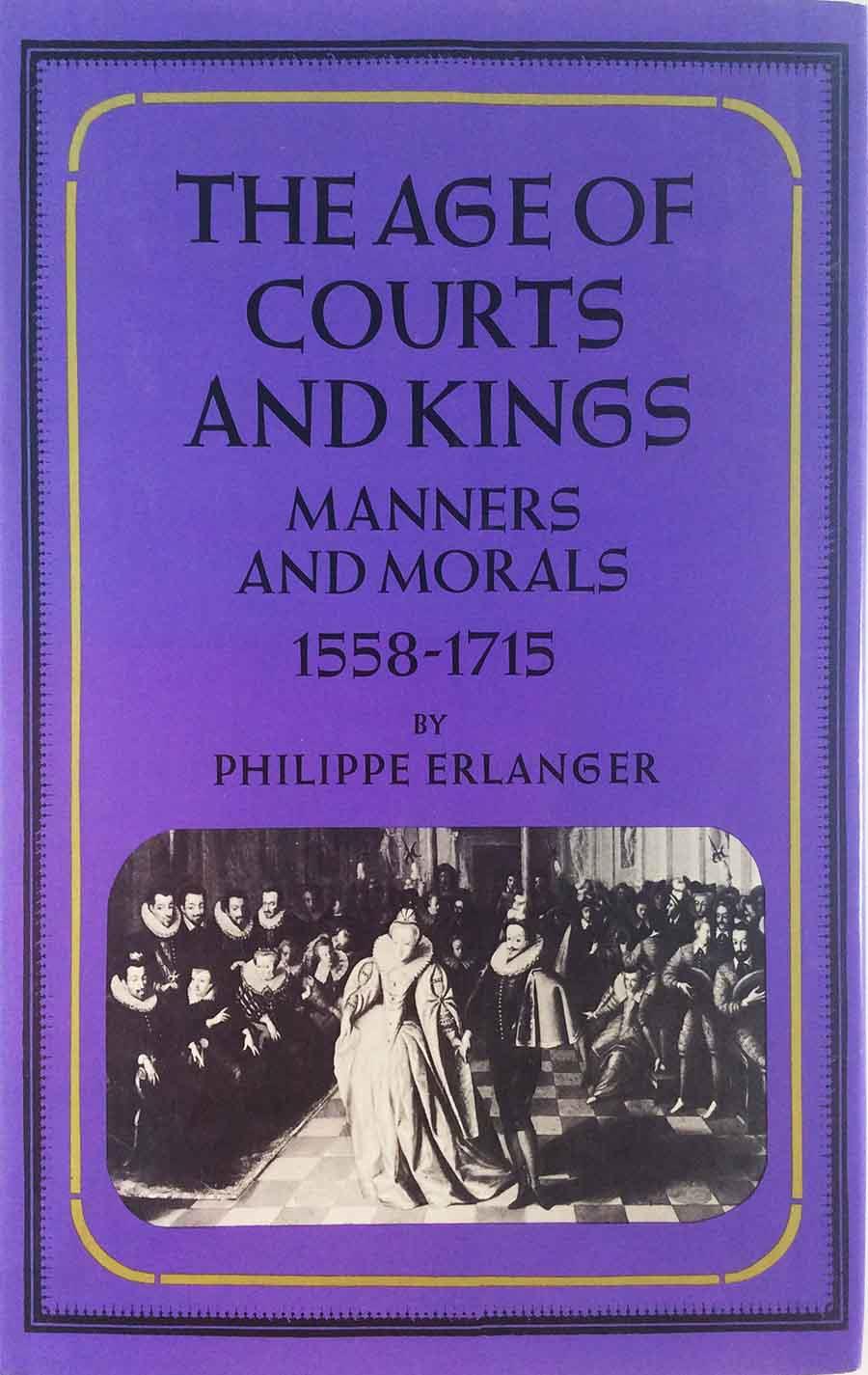
I credit Philippe Erlanger for noticing things others miss in his The Age of Courts and Kings: Mannerans and Morals 1558-1715. He sees the distinctions, not just between past and present, but even unusual elements within the societies he examines. He avoids the lazy habits many fall into of using the past merely to confirm our current beliefs.

For example . . .

  • Most moderns who look at 16th century Spain focus on the prevalence of religious persecution there. But he notes that–contemporaneous with the “narrow” religiosity of Philip II–education exploded. Dozens of colleges and universities opened up, forming a golden age of sorts of Spanish culture.

He points out that this educational expansion involved a lot more than people studying theology:

There were some 30 Spanish universities: the one at Salamanca had no less than 7800 pupils; at Alcala 2000 students studied medicine. In the scientific field the results were remarkable. In metallurgy, mining, astronomy, and ophthalmology, Spain was in the vanguard of progress.

  • He puts on full display what we at least would call the ridiculous fopperies of the French aristocracy of the early 17th century. We get plenty of exposure to the sumptuous dress and other extravagances of court life. But he also shows us that many of these dandies (actually called “minions” to denote their service to the king) died young. They possessed great courage. He writes,

And yet the Minions (or Mignons, as they were called), were avid duelists, prodigal with their blood, fighting with a laugh or a leer of contempt. Nearly all of them gave their lives for the King before they were 30, and their heroic end should have spared them the ignominious meaning which history attached to the once common title of His Majesty’s Minions [the word meant ‘servant’–common in use at the time].

Good for Erlanger. Most just notice the obvious things–the crazy dress, the religious persecution–the things that would offend modern sensibilities. Most do not take a second look. I am grateful for Erlanger taking these second looks and discovering the other side of the coin.

What almost shocks me is that, noticing such things, he didn’t stop and ponder their meaning.

For example, everything about our society tells us that religious fundamentalism and an expansion of education-especially scientific education–shouldn’t mix. The 19th-early 20th century American experience with some fundamentalist Christians bears this out. But this example from Spain should make us wonder–maybe our modern experience is the exception to the general rule? The Puritans, for example, could justifiably fall into the “religious dogmatism” category but stressed education enormously, founding Harvard University seven years after coming to the continent. Christians in late antiquity through the high Middle Ages would not necessarily fit the “religiously dogmatic” bill in the same way as 17th century Puritans. Neither did this period display a joyous and progressive exchange of ideas with other faiths. But any student of the medieval era knows that the Church provided the only means of education during this era, and that various advances in science and architecture took place in this time.

And what of the silly aristocrats and their silly dress? Everything about our democratic mind tells us that such people should be wastes of space, with their lives consumed by the trivial. And yet, as Erlanger indicates, many of these same dandies displayed high courage and most spent their lives before the age of 30. Again–an aberration, or so it seems at least.

But maybe . . . ages of intense religious belief are periods of great conviction, and perhaps this conviction gives one confidence to explore various disciplines. We see the confidence of the Athenians in the 5th century B.C. give rise to many advances in science, as one example.

And maybe . . . the grand style of the Mignons simply served as an accompaniment to their grandeur of spirit. Maybe their detachment from normal life led then to great and heroic action. Maybe the stagnation of spirit we feel today mirrors our bland fashion sense.

I say, “maybe” in earnest–these are just suggestions. But Erlanger has to wonder, has to at least spur us on to wonder, and in this he fails, though the book has real virtues.

Among his other observations, two stand out to me:

  • In England in the 17th century, fathers were prohibited from caring for their illegitimate children for too long in their own house. They could provide for them, certainly, but could not keep them at home for too long. And,
  • In various places a prohibition existed against the excess selling of goods–not prohibited goods, mind you, but perfectly legal goods.

Odd laws and practices tangential to the prevalent culture exist everywhere. But in general I think that disparate mores have a common root of belief or perception. We should attempt to tie these items together, despite their strange appearance to the modern mentality.

The words “open” and “closed” will likely produce subtle but important reactions for most of us. We probably have a positive reaction towards “open” and a negative one towards “closed.” In general, modern western societies build on the preference towards openness–open communication, open sourcing, open markets, much more open and fluid sexual practices, more open immigration, and so on. We want to be “open minded,” and not its opposite.*

But “open” and “closed” are descriptive, not moral categories. Surely, for example, we can’t possibly be open to everything–many things would harm or even kill us. We should not be open to every idea or possibility, every food, or every possible person living in our house. We want to be “closed” to bad things, open to good things. How we define good and bad will differ, obviously, and whether we lean towards “open” or “closed.”

Let us filter the observations above through this grid.

With the laws about illegitimacy, we see a more “closed” approach to the family unit. Laws against “excessive” harboring of illegitimates protected the identity of the family centered on marriage and “common blood.” Thus, the extended family could have more weight in such a culture. The idea, for example, that an aristocrat’s body servant would be “part of the family,” is a modern conceit.

We see this same principle at work with the prohibition of selling “excessive” goods.** A preference towards “closed” leads to a desire to limit the general fluidity of things. Flooding the market one week could lead to drying it up the next, perhaps. I suppose also–a society with an aristocracy needs to strongly rely on tradition. Relying on tradition requires stability. One might counter that economic fluidity would not endanger political stability. This rings false–we know very well how economics, politics, and culture interrelate. Seen in this light such seemingly aberrant data points Erlanger notes actually make sense.

Erlanger includes enough nuggets to make us gawk, but we can’t stay there. We have to wonder, and follow the trail where it leads.

Dave

*This centuries long preference for “open” resides in our cultural DNA, and this makes turning back the fluid concepts of sexuality and gender prevalent in our culture very difficult. One needs a strongreference point outside of our culture in order to try and swim in the other direction. Appealing to our traditions, the Constitution, and so on will have zero impact.

**Perhaps this is not so strange to us, as we have similar practices with farmers today.

To the Victor go Some of the Spoils

Many often declare that since, “To the victor go the spoils,” so too, that, “Victors write the history books.”  This pithy phrase assumes that historical narratives boil down to power, a concession to postmodern theory that I am loathe to make.  Aside from the debate over the theory, however, history itself will not confirm the statement.  Several examples exist to prove this point:

  • The Athenians exiled Thucydides but we read of the war that helped bring about his exile almost exclusively through him.
  • Athenian Democracy “won” by executing Socrates, but subsequent generations of readers learned Athenian democracy primarily through Plato’s eyes.
  • The triumph of the “imperial” system over the Republic in Rome became a fact of life after Augustus, but we think of that triumph foremost through the writings of Tacitus, a significant critic of most of the emperors.
  • The North won the American Civil War, but the Confederacy had a variety of champions shortly after the war and a variety of sympathizers today,

and so on.

As Tocqueville noted, mere physical force can control the body but often has the opposite impact on the soul.  The examples above demonstrate also that, contra the mundane postmodernist, shaping how we see the world has much more to do with our imagination that rote political force.

Jaroslav Pelikan’s The Excellent Empire disappointed me overall.  He is likely one of the few who could have possibly made a history of Christian doctrine an exciting read, and he did just that in his four volume work The Christian Tradition.  In The Excellent Empire he flashes his ability to deftly dance from text to text, but seems to get trapped into the detached tone of his main subject, Edward Gibbon, whose The Decline and Fall of the Roman Empire forms the backdrop of this book.

I give Gibbon much credit for his labors, his erudition, and for having a defined point of view.  Alas, he writes like a know-it-all, and I cannot buy into how he frames his narrative.  Pelikan seems to accept Gibbon’s perspective (or–is just playing a scholarly game, or am I too dense to notice something else?), and discusses how GIbbon’s perspective relates to Christian thoughts at the time from Sts. Jerome and Augustine, as well as a touch of Salvian and Orosius.

Gibbon’s work is an interesting examination of who gets the last laugh.

Roman contemporary critics of Christians viewed them as a drain on the Roman state, and in many ways enemies of the Roman state.  Jerome saw the collapse of Rome in the most starkly apocalyptic terms, and in the most anguished.  He compared Rome’s end to various passages from Revelation.  He saw Rome as ripe for judgement.  Yet, he grieved over their fall, seeing their end as the end of all things as he knew them.  Augustine took a more cerebral approach, which gained him some more penetrating insights.  He conceived of a Rome built upon shaky foundations from the start.  In one brilliant passage from Book 3 of The City of God he writes,

First, then, why was Troy or Ilium, the cradle of the Roman people (for I must not overlook nor disguise what I touched upon in the first book(2)), conquered, taken and destroyed by the Greeks, though it esteemed and worshipped the same gods as they? Priam, some answer, paid the penalty of the perjury of his father Laomedon.(3) Then it is true that Laomedon hired Apollo and Neptune as his workmen. For the story goes that he promised them wages, and then broke his bargain. I wonder that famous diviner Apollo toiled at so huge a work, and never suspected Laomedon was going to cheat him of his pay. And Neptune too, his uncle, brother of Jupiter, king of the sea, it really was not seemly that he should be ignorant of what was to happen. For he is introduced by Homer(4) (who lived and wrote before the building of Rome) as predicting something great of the posterity of AEneas, who in fact founded Rome. And as Homer says, Neptune also rescued AEneas in a cloud from the wrath of Achilles, though (according to Virgil (1))

“All his will was to destroy
His own creation, perjured Troy.”

Gods, then, so great as Apollo and Neptune, in ignorance of the cheat that was to defraud them of their wages, built the walls of Troy for nothing but thanks and thankless people.(2) There may be some doubt whether it is not a worse crime to believe such persons to be gods, than to cheat such gods. Even Homer himself did not give full credence to the story for while he represents Neptune, indeed, as hostile to the Trojans, he introduces Apollo as their champion, though the story implies that both were offended by that fraud. If, therefore, they believe their fables, let them blush to worship such gods; if they discredit the fables, let no more be said of the “Trojan perjury;” or let them explain how the gods hated Trojan, but loved Roman perjury. For how did the conspiracy of Catiline, even in so large and corrupt a city, find so abundant a supply of men whose hands and tongues found them a living by perjury and civic broils? What else but perjury corrupted the judgments pronounced by so many of the senators? What else corrupted the people’s votes and decisions of all causes tried before them? For it seems that the ancient practice of taking oaths has been preserved even in the midst of the greatest corruption, not for the sake of restraining wickedness by religious fear, but to complete the tale of crimes by adding that of perjury.

Such analysis gave medieval Europe a whole new foundation of political and religious ideology on which to proceed.

Rome attacked Christians for not giving themselves fully to the well-being of the state.  For the Romans, this might have taken the form of not giving due sacrifices to the emperor, or not joining the army.  Gibbon pointed out as well that the best men in the Church gave themselves to the Church, and not Rome.  Imagine a Rome where Athanasius, Jerome, Augustine, Ambrose, etc.–with all of their energy and intelligence–served as provincial governors instead of bishops.

Jerome and Augustine responded variously with how Rome had doomed itself to destruction via its sins, or how Christians were in fact the best citizens of Rome.  Their analysis won the day.  Monastics, for example, appear on the surface at least, to not contribute anything to the well-being of civilization.  But monastics would be honored in the west for the next 1000 years.  Their presence made no sense to either the Romans or to Gibbon.  The “social triumph of the church,” as Pelikan calls it, gave the Church the power of interpreting Rome’s history.  But I gathered that Pelikan thought Augustine and Jerome thieves, to a certain extent.*  Perhaps for Pelikan, Gibbon restored Rome’s vision of itself back to the stream of history.

Augustine and Jerome appeared to be the victors in the 5th century A.D. and beyond, as the Church had a strong hand on shaping the next millennium.  But historical spoils can be slippery things.  In an irony that perhaps not even Gibbon might have foreseen, today’s Christians, having abandoned much of the otherworldliness of the Church of the 5th century, may find more congeniality with Gibbon’s interpretation as opposed to Augustine’s.  What modern mega-church leader, for example, would tell anyone to become a monk?  We have our eyes set on this world and have no concept of how to patttern ourselves after the heavenly realms.  Some may applaud this.  But without the worldview of Augustine and Jerome we may find ourselves wishing, along with Gibbon, that St. Augustine had served as proconsul of Alexandria.

DM

*I could be totally wrong here.  Part of the difficulty I had with this book was I felt that I was reading a different Pelikan than the one I encountered in The Christian Tradition.  I had assumed that The Excellent Empire was written before this series, because its tone seemed more distant to me, less committed to the idea of truth than The Christian Tradition.  I knew that Pelikan had converted to Orthodox Christianity in 1998.  But I had somehow thought (how I thought this I’m not sure) that The Christian Tradition was written during/after his conversion, when in reality the early volumes stretch back to 1973, and the last volume predates his official reception into the Church by eight years.

This could mean that

  • I have misread Pelikan entirely in The Excellent Empire
  • Pelikan is deft at hiding his particular point of view from the reader and is simply examining certain points of view in a more detached way.
  • He does admire Gibbon (which is understandable) and agrees with Gibbon that Christians really did bring down Rome from the inside out.  This stance is not Augustine’s or Jerome’s, but it is certainly not an anti-Christian idea in itself.  Nebuchadnezzar’s first dream may hint at this (Daniel 2).  Perhaps I am too ingrained in my distaste for Gibbon’s pompous Enlightenment attitude to see that, despite this weakness, he may have been right after all about the Church’s relationship to Rome.


The Unprofessional Historian

I can’t quite help myself when it comes to Arnold Toynbee.  But I acknowledge  . . . In his 12 volume A Study of History (I have read about 8 of them) he repeats himself many times, and uses some of same examples more than a few times.  He veers sometimes wildly between philosophical speculation and the facts of the case (which I love but I understand might bother others).  A central point of his examination of Greece and Rome involves conflating them to such a degree that he seems to claim that Rome began to decline when the Pelopponesian War began.(!) He drifts too easily into gnostic, or perhaps Neo-Platonic, tendencies that raise many of my eyebrows.

Still, he takes huge swings, takes big risks with his thoughts, and offers a coherent picture of civilizations that mixes various disciplines such as archaeology, philosophy, myth, and the like.  He is in my mind the ideal of what a historian should be, not so much in his conclusions, but in his methods.

‘Volume 10’ is almost last volume of his A Study of History and has only about 150 pages of straight text, with a few appendices and a long and needed index to the other 9 volumes. This conclusion might even serve as a good introduction to the whole of his work, for here he fully describes and defends his view of what an historian is, and what History should be all about.

I say he ‘defends’ but this might be misleading, for it sounds like a didactic argument. It’s not. Part of the charm of this book for me is that he let’s himself go and speaks with passion from the heart. But the Toynbee magic is still here, as even in the first few pages we see him seamlessly weave in his grand view of history with personal recollections and observations about changes in women’s headgear in Victorian England and Turkey in the 1920’s.

I can understand people disagreeing with certain particulars of his “system,” but doesn’t this sound like fun?

His main points are

  • A historian’s proper vocation (as is the case in other vocations) is to receive and act on a call from God to ‘feel after Him and find Him.’ (Acts 17:27). There are as many ‘angles of vision’ as there are proper vocations. The historian’s vision is not greater or lesser than these, but he has a task nonetheless.
  • The inspiration of a historian is ultimately a spiritual one. The ‘muse’ of curiosity leads into broader fields of vision. Since God aims to unite all of humanity, one’s field of vision under the inspiration of the ‘muse’ (I think Toynbee means to use this term in at least a mostly literal sense) will inevitably broaden.
  • He does not spend much time on this, but this question leads to a small digression on Toynbee’s dislike of the ‘professional’ specialist. The ‘professional’ pursues not true knowledge but an impossible omniscience. This pursuit is of course impossible, and whatever knowledge he gains will be sterile — it will in fact not be real knowledge at all, and certainly not wisdom. His lack of ‘action’ in the world has a humble mask, but only serves to camouflage ‘the three deadly sins of Satanic pride, negligence, and sloth.’ (p. 26). God calls us to add to the stream of human knowledge of the world and Himself by adding one’s own thimbleful to the stream. Knowledge is never for one’s own sake or for the sake of knowledge itself, but to put humanity in a better position to know God. The same Spirit that inspires us to investigate human affairs calls us to action in service, however small, to humanity as a whole.

Perhaps this gives us some insight into his admiration for Heinrich Schliemann. Of all the historians he admires here (Polybius, Herodotus, St. Augustine, etc.) it is Schliemann, the messy amateur par excellence, whom he spends the most time with. Surely in Schliemann we find a man “inspired,” one who led with his heart rather than his head. It may be said that he created the modern field of archaeological study by going on a goose chase of absurd proportions.  And yet, he discovered Troy and Mycenae. He created the discipline of archaeology. But as soon as archaeology developed into a profession the “professionals” he creaetd dismissed him as a carnival barker. Toynbee does not dwell on Schliemann’s personal life or professional errors, but surely he would say for every step back he took two or three forward.

Finally, towards the end of the work, Toynbee sheds light on his religious views. He does this in a more straightforward and polemical way in ‘Experiences,’ which he wrote about a decade after this, and his views did not change much from this volume to then. I do not agree with his final conclusion in either volume. But here his conclusions make more sense to me in the context offered — that is — I can see how much his ‘heart’ was in his views. This is a point made by his friend Columba Cary-Elwes, a monk, in their correspondence (“An Historian’s Conscience”) which I accepted but did not understand until now. Cary-Elwes also disagreed with Toynbee ultimately, but felt that there was more agreement than Toynbee may have been aware of. Of course, as a “friend’”of Toynbee myself, I would like to think the same thing. This may be purely wishful or even ego-centric thinking on my part, but I hope not.

Basically, Toynbee believes that ultimate reality is spiritual reality, and that this spiritual reality is Love. Love is best expressed in action, not in words or syllogisms. Hence, Historian’s are called to action, and hence, Toynbee’s rejection of the various dogmas of religion as essentially unimportant distractions. He saw unity in human affairs throughout time, and a uniformity of human nature. All this led him to affirm the essential unity of religions. Claims to exclusivity are at best misdirected and at worst rooted in pride.

This is a good argument, and Toynbee was far from a cynic. He did not seek to attack religion so much as promote what he saw as something ‘higher.’ I think the Church would say that Toynbee was right about many things. But, as Chesterton said, “You cannot make a success of anything, even loving, without thinking.” He said in Orthodoxy,

The things said most confidently by advanced persons to crowded audiences are generally those quite opposite to the fact; it is actually our truisms that are untrue. Here is a case. There is a phrase of facile liberality uttered again and again at ethical societies and parliaments of religion: “the religions of the earth differ in rites and forms, but they are the same in what they teach.” It is false; it is the opposite of the fact. The religions of the earth do not greatly differ in rites and forms; they do greatly differ in what they teach. It is as if a man were to say, “Do not be misled by the fact that the CHURCH TIMES and the FREETHINKER look utterly different, that one is painted on vellum and the other carved on marble, that one is triangular and the other hectagonal; read them and you will see that they say the same thing.” The truth is, of course, that they are alike in everything except in the fact that they don’t say the same thing. An atheist stockbroker in Surbiton looks exactly like a Swedenborgian stockbroker in Wimbledon. You may walk round and round them and subject them to the most personal and offensive study without seeing anything Swedenborgian in the hat or anything particularly godless in the umbrella. It is exactly in their souls that they are divided.

So the truth is that the difficulty of all the creeds of the earth is not as alleged in this cheap maxim: that they agree in meaning, but differ in machinery. It is exactly the opposite. They agree in machinery; almost every great religion on earth works with the same external methods, with priests, scriptures, altars, sworn brotherhoods, special feasts. They agree in the mode of teaching; what they differ about is the thing to be taught. Pagan optimists and Eastern pessimists would both have temples, just as Liberals and Tories would both have newspapers. Creeds that exist to destroy each other both have scriptures, just as armies that exist to destroy each other both have guns.

Chesterton is mostly, but not absolutely correct with this. I would add what C.S. Lewis said in Mere Christianity, that he would not have believed in Christianity unless it professed some similarity with other religions. As he came to see, it would be impossible for other faiths to contain no truths. But Christianity could be the fulfillment of the hints and whispers in other places. Toynbee came to close to asserting this himself in his “Christianity and Civilization” essay included in “Civilization on Trial.”* It is not arrogance to believe that one has found the truth, or more correctly, that the Truth has found you.**

Please pardon the long digression (for those still reading :), but I have learned a great deal from Toynbee. I feel the clue to much of his genius is in his religious views. For him, History was very much a religious endeavor, with an emphatically religious goal. I couldn’t agree more. But here too is his greatest error.

This volume is eminently suited for anyone interested in these kind of questions. The prose is lively, and the heart and mind are both engaged.

Dave

*It is probable that Toynbee came closest to a profession of traditional Christian belief when he wrote this essay in the late 40’s.  Indeed, it is Volumes 4-6 of his study, written just before this time (I think), that are his best work with his best religious insights into the meaning of history.

**After publishing this volume, Toynbee’s views if anything only drifted further from Orthodox Christianity. But there is this brief excerpt from Toynbee’s good friend Columba Cary-Elwes, a monk and frequent correspondent with Toynbee.

During our last meeting, during which he was incapable of clear speech or writing, suddenly he said very distinctly, ‘In the name of the Father, Son, and Holy Ghost,’ and then fell back into silence. As I wrote before, I do not use that to prove anything to the general public. It may have been an act of courtesy to me on his part, as Veronica suggested. For me it was an answer to prayer!

The Passions of Digenis Akritis

I honor Francis Schaeffer as one of the great Christian voices of the 20th century.  While I am not certain, I think he was one of the first to urge Christians to focus on the power of art to shape culture.  He also urged us to pay attention to environmental and stewardship concerns decades before such topics became mainstream.  As well as he commented on the modern age, I feel he badly misrepresented early Christian and medieval culture in his How Shall we Then Live? series.  In his view medieval culture indulged in too much spiritualization, too much “etherealizing,” and missed the stark reality of the Kingdom of God.  He acknowledged Dante’s genius, but then proceeds to essentially dismiss The Divine Comedy because of his idealization of Beatrice and her role as his guide to Heaven.  I fail to see how one can accuse an era that went on the Crusades, built cathedrals, and founded the first universities, of too much “spiritualization.”  As Schaeffer resided in the Reformed Protestant camp, perhaps he carried too much anti-Catholic baggage to see the medieval era straight.

And yet . . . when it comes to his essential critique of Dante, he has a partial point.  Before I continue, I should say that I regard The Divine Comedy, along with Shakespeare’s plays, as the greatest literary achievements of the western world in the last 1500 years.  I have no idea who could possibly challenge them.  But Dante had some of the faults as well as the great strengths of his culture.

The aristocratic tradition of courtly love came out of the positive development of the possibility of men pursuing women romantically and remaining “men,” as C.S. Lewis points out in his Allegory of Love.  But then it morphed into a kind of love that had no feet on the ground.  Romantic love without its proper end in marriage has all of the substance of leaves in the wind, a dance of disembodied heads.  Courtly love could descend into a kind of idealization of a mere passion, which could then become an idealization of lust itself.*

The Orthodox Byzantine epic poem Digenis Akritas** (translated, “The two-blood border lord”), for all its charm and energy, cannot match up to some other contemporary western epic poems such as The Song of Roland.  But its simplicity and clarity reveals a strength, a helpful corrective to the whole courtly love tradition.  To outsiders, Eastern Orthodox practice probably looks “mystical,” with its icons, incense, and so on.  Those with more experience know that Orthodox life and worship has a decided earthy practicality about it.

We see this in the story.  It begins en media res with the life of hero’s father, a prominent Moslem emir.  He raids a Christian town and captures one particularly beautiful Christian woman.  Utterly captivated, he eventually agrees to convert to Christianity and marry her, forsaking family, title, and everything for the sake of her love.  So far we might see parallels to The Divine Comedy, where Dante comes to God through love of Beatrice.  But again, the “earthiness” of Orthodoxy stands out, for in this story the man actually marries the woman.

Interestingly, while Digenis Akritas celebrates the marriage and the emir’s conversion, it warns that such ardent passion can lead also lead to “madness.”  It celebrates the results of the passion of the Emir, but not the passion itself.

In time our hero is born, and as a young man, like his father, he forms an unquenchable passion for  a young maiden.  They marry and live happily.  But . . . the poem’s earlier warning about the possible destructive possibilities in such a passion come to fruition with Digenes.  Twice he commits adultery.  The first time it happens he recounts his repentance bitterly.  The second time, he defeats an Amazon warrior, and then, carried on by his passions, one thing leads to another.  His wife accuses him of infidelity and he denies it.  But again, now possessed by anger and shame, he goes back to the Amazon woman and murders her.

Our hero and his wife die together in the faith, but his tale recognizes what medieval Christendom did not.  When controlled by our desires, if we end up doing the right thing it may be no more than mere luck.  Just as often, such desires lead us into destructive behaviors.  Malory’s version of the Arthurian legends perhaps hint at something similar by showing how Lancelot and Guinevere destroyed the fellowship of the Round Table.  But Digenes Akritas is much more direct.

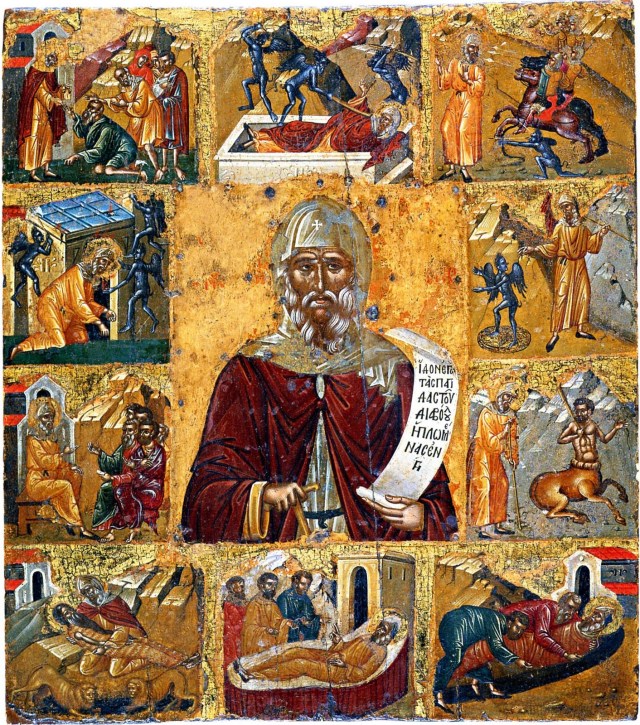
We see this directness in Orthodox iconography.  From the outside I understand those who may feel that, whatever the merits of the artists, icons remain static and lifeless.  But viewed from within the tradition, one sees that icons often depict (though in different ways) victory over the passions.  This victory does not banish emotion, it gives us dominion over them.  Hence, the saints remain quiet, yet alert, like St. Anthony the Great (below) in any all circumstances They have freedom because they have been freed from the dominion of the passions.

The Life of Saint Anthony the Great

Though Digenis Akritis falls a bit short in overall literary merit with other epic poems, it possesses a directness and practicality its western counterparts often lack.

Dave

*As I mentioned, I don’t agree with Schaeffer’s main point.  But on the fringes . . . . ?  For example, the scholastic movement in the late Middle Ages over-rationalized theology.  Too much emphasis on reason, like courtly love, can put one in danger of living purely in a mental construct and risk falling into a kind of gnosticism.

**Many modern perspectives assume that  medieval Christians from the east and west had an implacable, ignorant hatred of Moslems.  And yet, our hero here is half Arab/Persian, half “Roman.”  In Malory’s Morte de Arthur, he includes admirable accounts of Sir Palomides, a Moslem knight.