Some years ago I watched the movie The Blind Swordsman: Zatoichi and enjoyed it, though it did not match my expectations. I watch martial arts movies from time to time, but usually not for the plot or character development. As a kid, I watched any movie I could with big explosions. Now I am a sucker for the balletic action common in many great kung-fu movies from the east.
Certainly the movie has its share of sword fights, but the style of fighting surprised me, ignorant as I was (and am) of Japanese fighting styles. I expected long, drawn out battles. In fact, the fights lasted mere seconds as the combatants focused on short, intense stabs. Towards the end of the movie the best swordsman of the bad guys and Zatoichi face off alone. “Ah, here we go,” I thought. No . . . this was the shortest fight of all, consisting of each man doing only one move.
I thought of this movie reading Japanese Destroyer Captain* by Captain Temeichi Hara of the Japanese Imperial navy. During W.W. II his record made him Japan’s best captain of destroyers, if not one of their top captains in the whole navy. Much of his memoir reads like I suppose an American or British naval man would recount the war. I hoped also to glean something of the culture of Japan that would help illumine the war beyond the narrow confines Hara discusses.
Captain Hara avoids using too much military jargon. At times I had to strain to understand the battles he describes, but usually not. He writes openly without any obvious agenda. He has criticism and praise alike for certain American actions, and even sharply criticizes certain member of Japanese high command (I believe he was the first to do so after the war).
I mentioned The Blind Swordsman because the whole atmosphere of Hara’s account has its roots in samurai lore. Hara often references maxim’s from different literature and famous swordsmen, but he seems to do more than just quote them. He gives evidence of living inside of them. His grandfather actually was a samurai and he speaks at the beginning of the book of his deep connection with his grandfather. He obviously sought to live out this connection in battle. Often his thoughts on tactics and strategy come couched in aphorisms of the samurai, especially Mushashi Miyamoto.
But this applies to the whole Japanese naval effort. Certainly Japan faced certain strategic limitations given their relatively small industrial capacity, but their tactics reminded me of the final sword battle of Zatoichi. The best samurai win with one stroke. The Japanese developed torpedoes that had longer range and ran without leaving a distinct trail in the water. This gave them an advantage that they attempted to exploit in samurai like fashion. They sought to fire first from long range, well before U.S. ships could fire. If successful, the naval battle would over immediately. But if not–and the long ranges from which they fired made this less than likely–the advantage would immediately swing to the Americans. On the one hand, their concepts make sense apart from samurai lore. If you have a smaller chance of winning a close-fought battle (Americans never had to worry about supplies of ammo) try and win it from long-range. Even so, we still see the samurai connection.
We this seeking after a decisive final-blow in other aspects of Hara’s account. He frequently criticized any effort of Japan that failed to use its forces en masse in decisive faction, citing the adage, “A lion uses all its strength when catching a rabbit.” Even in April of 1945, with no chance of victory, Hara seems strangely at peace with their final naval assault. Many eagerly sought death in samurai fashion in an entirely hopeless battle. Hara, if I may venture a guess, seems pleased in a more detached sense that the navy had marshaled all its remaining ships and at least would now use them all at once. In this last moment for the Japanese navy we see the Zatoichi sword fight connection. Rather than keep their ships back to defend Japan, they sought a grand offensive thrust at our beachhead in Okinawa (which also mirrors how they used their torpedos).**
When discussing Guadalcanal Hara shows a keen understanding of strategic and tactical success. The Japanese at one point won a key battle by sinking several U.S. ships. The Japanese celebrated. Hara did not. He noted that nothing about the situation in Guadalcanal had fundamentally changed. The U.S. could still supply its men, and the Japanese still could not supply their own. Soon after the Japanese evacuated their troops.
I thought of this earlier section of the book when reading the last paragraph. Hara writes,
The powerful navy which had launched the Pacific war 40 months before with the attack on Pearl Harbor had at last been struck down. On April 7, 1945, the Japanese Navy died.
That’s it? After giving many opinions and demonstrating time and again the ability and courage to criticize and analyze situations, I found myself mystified that he offered no general conclusions. Why? Again, I am guessing . . . but in the midst of battle, Hara dedicated himself to victory at (almost) any cost.^ Part of this ‘cost’ came in the form of even criticizing high command. But once the war ended, perhaps Hara thought of himself as a ronin, masterless and without purpose. Reflection about some grand meaning after the fact might for him resemble one hand clapping in a void of space–what would be the point? Perhaps . . . perhaps, Hara resembled Zatoichi in more than just a sense of samurai vocation. Perhaps his field of psychological vision was likewise obscured.
Dave
*I assume this is a poor translation and the title in Japanese is not so wooden.
**Perhaps another connection . . . Hara laments that the Japanese could not build small torpedo boats akin to our PT class ships. They had the requisite physical capability, of course, but not, it seems, the ability to match the mental will and physical capacity. Hara offers no explanation for this so my guess will be exceedingly tentative . . . the PT boat offered nothing that would produce a decisive and grand blow. No samurai wanted to inflict a death of 1000 cuts.
I mentioned one effect of the democratization of the samurai ethos in this post. In a more mild vein, Hara mentions a samurai drinking ceremony related to battle. Now, with all supposed to embody the samurai spirit, all would drink as the samurai did. But, there are many more men in the navy than there were samurai. Hara recounts several amusing instances when he “had” to drink many many toasts with his men, with almost any occasion an excuse to drink.
^Hara felt that too many in Japan’s military applied the bushido ethic too far and too liberally, merely seeking death as preferable to life. Hara did not fundamentally object to suicide missions, but he did believe that they must serve some purpose beyond the merely symbolic. He objected to the final sortie to Okinawa not because it would involve the destruction of the fleet, but because it would needlessly destroy the fleet. Hara wanted instead to sell his life attacking supply and transport ships, to do at least some damage to the U.S.
My grandfather fought in W.W. II for the 101st Airborne. He took part in the invasion of Arnhem in September 1944, a campaign immortalized by the book/movie A Bridge too Far. One story he related dealt with the British love of tea. If the British/American plan had a chance of success allied forces needed to move as fast as possible to seize several key bridgeheads across the Rhine River. But at around 4:00, British units pulled over on the side of the road and had their tea for 15 minutes, driving their American counterparts nuts. How anyone could justify teatime at such a time baffled them.
I suppose the British might have responded along the lines of, “If we don’t stop for tea at 4:00, then the Nazi’s have already won!”
Tensions between tradition and the exigencies of the moment have always been with us. In every instance where it arises good arguments exist on both sides that invariably go something like
We must change in order to survive, vs.
If we change the wrong things, or change too much, it won’t be “we” that survive but another sort of society entirely.
I very much enjoyed the many strengths of Basil Liddell Hart’s Scipio Africanus: Greater than Napoleon. My one quibble with the book is his failure to tackle this dilemma as it relates to Rome in the 2nd Punic War.
But first, the book’s strengths . . .
The title indicates that Hart might indulge in a bit of hero-worship, but I have no problem with this in itself. First of all, he lets the reader know from the outset where he stands. And, while her0-worship books have inevitable weaknesses, I very much prefer this approach to writing that equivocates to such a degree so that the author says nothing at all.
Hart’s book also reverses the common tendency to glorify the romantic loser. We love Robert E. Lee, but Grant, well, he’s boring. We love Napoleon and see Wellington as . . . boring. Historians of the 2nd Punic War have devoted an overwhelming amount of attention to Hannibal. His march through the Alps and his enormously impressive successes at Trebia, Trasimene, and Cannae have inspired military minds for centuries. Sure, Rome won in the end, but for “boring” reasons like better political structure and more human resources–just as many assume Grant won not because of what he did, but because of the North’s “boring” industrialization and economy.
But surely Hannibal’s defeat had something to do with Scipio himself, especially seeing as how a variety of other Roman commanders failed spectacularly at fighting the wily Carthaginian. To add to this, if you knock out the champ, doesn’t that mean that we have a new champion?
Liddell Hart gives us some great insights in this book.
Those familiar with Hart’s philosophy know that he constantly praised the value of what he called the “indirect approach” to war, both tactically and strategically. Rome at first tried the direct approach with Hannibal and lost badly. Then with Fabius they practiced what some might call “no approach” with a debatable amount of success. Scipio struck a balance. After assuming command he fought the Carthaginians, but not in Italy. He took the fight to Carthage’s important base in Spain. He fought against Carthaginian troops with Carthaginian commanders, but avoided Hannibal.
I have no great military knowledge and no experience, but Hart’s concise explanation of Scipio’s maneuvering in Spain impressed me greatly. His “double envelopment” move at the Battle of Ilipa against a numerically superior foe was an inspired stroke:
But I found Scipio’s diplomatic and grand-strategical vision more impressive. Hart admits that Hannibal had the edge over Scipio in tactics, but I feel that most overlook or excuse Hannibal’s deficiencies at accomplishing his strategy of prying allies away from Rome. In a very short time Scipio turned the tables completely in Spain, giving Rome a foundation on which to build a Mediterranean empire. Unlike other great commanders such as Napoleon and Alexander, and even Hannibal, Scipio never had full control of his forces or his agenda. He accomplished more than most any other commander while navigating more difficult political terrain. He established the basis militarily and diplomatically for Rome’s preeminence in the Mediterranean. He deserves the praise Hart heaps on him.
However, the ‘hero-worship’ part of the book needs addressing. Hart writes with much more balance than Theodore Dodge, who wrote about Scipio’s counterpart Hannibal. But he makes the same kind of mistakes as Dodge by dismissing some of the political realities Rome faced because of Scipio’s success. In sum, Hart has no appreciation for the tension between Roman tradition and Roman military success at the heart of this conflict.
Rome’s Republic had no written constitution. It ran according to tradition. The bedrock principles were:
Sharing power amongst the aristocratic class
Yearly rotation of offices
Direct appeals to the people smelled of dictatorship
No one stands out too much more than anyone else. They sought more or less to divvy up honor equally.
You wait your turn like everyone else. No one jumps in line ahead of anyone.
From the start of his career Scipio challenged nearly all of these principles in a dramatic way. Hart himself admits that:
He ‘level-jumped’ to high office far earlier than anyone else, breaking the unofficial rules that held things together.
He frequently received his support directly from the people against the wishes of the aristocracy
He at times used religious claims to boost his appeal for office, which the people responded to over and against the scowls of the aristocracy.
In defeating Hannibal he raised his status far higher than any other Roman of his day. This can’t be held against him obviously, but everyone noticed.
Of course we naturally have a distaste for aristocracy and so does Hart, who loses no opportunities to cast aspersions on Cato, Fabius, and other grumpy, jealous old men.
But . . . by any measure the Roman Republic ranks as one of the more successful governments of all-time. While they were not close to fully democratic, they had many democratic elements, and still managed annual, peaceful transitions of power across all levels of government for (at the time of the 2nd Punic War) for 300 years. Judged by the standards of their day, some might even label them as “progressives.” They had a great thing going and we should not rashly blame them for wanting to protect it.
During the war itself one can easily agree with Hart and his roasting of Fabius and especially Cato the Elder. But events in the generations after the 2nd Punic War show that Scipio’s enemies may have been at least partially on to something. Within 30 years of their victory, the Republic had major cracks. After 75 years, the Republic began its collapse. In time the Republic could not even pretend to contain Marius, Sulla, Crassus, Pompey, and Caesar. One could argue that Scipio in an indirect way set the stage for this.
Hart wrote a very good book, but not a great one. I wonder what he would have thought of the British soldiers at Arnhem. The disruption Rome suffered as a result of the 2nd Punic War had a lot more to do with Hannibal than Scipio. And yet, Scipio played some part, albeit a small one. Was it worth it? Could it have reasonably happened differently? Hart doesn’t say, and leaves us to wonder.
If you have driven much at all in any urban or suburban area, I’m guessing that you have experienced something like the following:
You are at a stoplight in a busy intersection, waiting to turn left. You are towards the back of the line but have a hope of making the light, which usually lets several cars through. By the intersection a person in need stands with a sign asking for money.
You have a few dollars and would gladly give it, but you are towards the back of the line before the man in need reaches your car. The cars start to inch forward, anxious to make the light. You have two choices:
Stop your car and give the man some money. This would reasonably take 10 seconds of time, especially if you wanted to look him in the eye and address him as a person. But this means that you might not make the light. For sure, it means that cars behind you would not make the light and the intersection would pile up, with a rubberneck ensuing that would take perhaps three light cycles to clear out.
Go through the light and not stop, keeping up with the flow of traffic.
If you are like me in the situation I described, you have taken option 2 more often than you might care to admit.
Why does this happen? Why does this feel like a no-win situation? Why do we feel such tremendous pressure to get through the intersection as quickly as possible?
Aside from general answers to the question involving the human condition, we need to consider the specific situation. When driving you enter into an unspoken covenant with other drivers that share your immediate space. When on the road other drivers–and not the rest of mankind–become your primary obligation One part of this covenant involves being alert at intersections. We all want to get to our destination. Don’t be on your phone and miss the light change. Be ready to go. This isn’t about selfishness but courtesy to others. Your primary and immediate obligation to other drivers overrides secondary obligations, even those of greater moral weight. When you are behind the wheel in the moment, your fellow drivers, for example, get preference over the poor of the third world.
Sure, we don’t want honked at. But we also don’t want to break the covenant with our momentary “brothers” behind the wheel in other cars.
Reading Christopher Browning’s Ordinary Men brought this everyday situation into starker light. Browning focuses not on Nazi ideology, nor the ideologically committed SS thugs. Rather, he focuses on one particular reserve police battalion and the evolution of most of them into mass murderers. We would like to believe that Nazi’s committed mass murder because they had a previous commitment to racial genocide. The war simply gave them the opportunity to enact their beliefs. This would be safer for us because we do not have a belief that we should mass murder in a racially motivated way. Thus, we would not slaughter Jews. But Browning points out that, while beliefs played a role, what seemed more decisive was the particular situation the men faced. Their actions transformed them over time into mass murderers, not their beliefs. Indeed for many, their actions transformed their beliefs, and not vice-versa.
This means that no one is immune. Our beliefs–what we hold true in our heads–won’t save us under the onslaught of our actions.
Those that comprised Reserve Police Battalions shared the following general characteristics:
They were middle-aged men with other careers apart from the war. All of them came of age before the Nazi’s took power.
Most all of them had membership in the Nazi party, but most all of those had joined late, and one expects, rather as a matter of course.
Reserve police battalions were held in general contempt by the SS rank and file as lacking true commitment to the Nazi cause.
Perhaps most surprisingly, very few expressed overt agreement with Nazi beliefs about Jews. Some of them even expressed specific disagreements with anti-semitic beliefs.
Nearly all of them had blood on their hands in one form or another.
As the Nazi’s occupied much of Eastern Europe by 1942 they sought to clear the area of Jews and other communist partisans–but most particularly Jews were the target. Himmler and Heydrich would much rather have had the SS do the work of mass killing, but the army at that time fought desperately in Russia and could not spare the men. Hence, the calling up of reserve police battalions for this job.
The Nazi’s were smart in how they managed these men. The first job for the battalion involved murdering thousands of Jews point blank in a Polish town called Jozefow, but the officers kept this order secret right up until zero hour. They let bits of information trickle out slowly, none of it objectionable by itself, i.e., “report to place x,” “prepare to help keep order,” and so on. In relaying the mass-murder order to his men, the major of Battalion 101 showed visible distress. He broke down almost in tears, he expressed disagreement with the order, and even gave anyone the option of abstaining themselves from this action.
But he did give the order.
At this point what options do these men have?
If you have strong moral scruples, you have no time to organize any resistance. But even if you wanted to resist, will you fire on your comrades, men with whom you have trained and share a bond, to prevent such a crime?
If the battalion refuses to carry out the order, what will the SS do to you?
You could take your commander’s offer and refuse to fire on the Jews and be given guard duty. Does being on guard duty absolve you?
Perhaps most significantly, soldiering tells you that if you don’t do the job, someone else will have extra work. The army runs on the principle of all for one, one for all. Your “weakness” means that others have harder jobs and more work. No one wants to put their fellows in such a position. The institutional pressure not to shirk your duty and obey orders must have been enormous.
Browning wants us to face the truth that most of us would obey the order. Most of us would shoot Jews, and most of us would find the means to rationalize it. Testimonies given years later reveal that nearly all of them found a way to make peace with this atrocity in different ways, such as:
War is terrible and cannot be redeemed. Besides the enemy bombs our own women and children.
Surely this is an isolated, one-time action. It is horrible that we have this assignment. But given the horrible nature of this job, these Jews must therefore be particularly dangerous. Best to just “rip off the band-aid.”
Some stood in line and fired, but deliberately missed. Perhaps they trusted that their fellow soldiers would not deliberately miss, and this will preserve them from the horror in some way. Indeed, mop-up crews with sub-machine guns came through to finish the job. So . . . some tried to technically not kill anyone.
One soldier even went so far as to say that (paraphrasing), “I paired up with someone who had no problem shooting the women, and then I would shoot the children. I could not shoot mothers, but I figured, once their mother was dead, I could shoot the children as an act of mercy to them. Their lives without their parents would be misery. I could free them from suffering.”
Those that did not join in bore the stigma of cowards and shirkers. Those that attempted to obey, but found that “their nerves” could not handle it, were viewed as those who “tried their best.” Even Himmler himself said in 1943, that while firm obedience stood as the pinnacle of virtue, exceptions came to those whose “nerves are shot, to one who is finished, who has become weak. Then one can say: Good, go take your pension.” Even a small amount participation guaranteed your personal safety, no doubt a strong impetus to at least do something in a token way.
After Jozefow many men got violently ill and many showed acute emotional distress. We might think that this rebellion of the body as a witness to moral truth would turn the tide and what happened would never happen again. In fact, many men who openly wept and got terribly ill after the Josefow massacre later became hardened and even enthusiastic killers of more Jews. Initially, the body rebelled against the mind, but eventually, with enough practice, the two worked in tandem. Eventually, the SS could trust the battalion to commit larger and larger massacres:
The Numbers of Those Murdered by Battalion 101 in
1942: 7-8,000 (minimum)
1943: 30,000 (minimum)
In between their assignments to mass-murder, Battalion 101 received orders to clear the forests of Jews who had fled Nazi roundups. These “Jew-hunts” (as they were known) could also be rationalized:
The main enemy of fascism is communism. Many Jews are communists (so went the party line), thus, they are a threat.
Some of these Jews who fled now have weapons. They will likely engage in guerrilla operations against our forces. Thus, they are not civilians but enemy soldiers, enemies too cowardly to come out and fight. They deserve their fate.
Perhaps because one might possibly find even the thinnest “legitimate” military motive for such action explains why the battalion never had a shortage of volunteers for these missions. It far more resembled “real soldiering” and may have helped them justify their actions in military terms. Such missions made them soldiers in their minds, not murderers.
Ordinary Men demonstrates that one need not be an SS ideologue to commit such atrocities. The commitment to your immediate circle of fellow men, your desire to “do something” for the war, your general patriotism, and perhaps even a lingering sense of guilt that in serving in the reserve police battalions made one a whole lot safer than a front-line solider–thus you might seek to make up for it with brutal deeds– all combine to wreak moral havoc on your soul. Within a year normal middle-age men without overt Nazi sympathies, without being educated in Nazi ideology in their formative years, without defined anti-semitic beliefs, became butchers on an unreal scale.*
We can understand this if we remember the intersection with the man asking for money.
I think the main reason why we fail at the intersection is the competition between our two commitments, one to our fellow drivers, the other to the needy man. Throw in the side-car of our selfishness and desire to get home and not be inconvenienced, etc., and game/set/match for our values. The only way to really navigate this successfully is to park the car and approach him on foot. In one sense this is harder, because it costs us more in time. But in many ways this is the easier path, for now we need not worry about the drivers behind us at all. We have removed ourselves from obligations to them and can act much more freely without worrying about annoying any driver.
Of course the men in Battalion 101 faced a drastically more difficult situation. You cannot escape blame by opting out of shooting and taking guard duty instead. Reasonably, you would not turn your gun against your comrades and go out in a hail of bullets. The only thing you can do is remove your uniform, perhaps facing court martial and even death. Perhaps you could do this if you were a bachelor, but if you have a wife and kids . . . ? What happens to them? Can you sacrifice them in addition to yourself? How many of us would shoot? How many of us would take guard duty?
In the epilogue, Browning quotes from Primo Levi’s book, The Drowned and the Saved, and it seems a fitting way to close. In his book Levi argues passionately that,
It is naive, absurd, and historically false to believe that an infernal system such as National Socialism sanctifies its victims; on the contrary, it degrades them, it makes them resemble itself.
Such was the fate of Reserve Police Battalion 101.
Dave
*Browning also traces the evolution of their anti-semitism. In time many came to hold the same kinds of beliefs about the Jews as Hitler and Himmler. They didn’t start that way, but their actions formed their beliefs.
I have written at times about my dislike for the “great man” theory of historical interpretation (here extensively). My objections to this theory, in brief, are that
The writer invariably sees events only through one lens, which limits their vision
The writer’s hero worship distorts their vision
I could not resist the Kindle deal of Theodore Dodge’s Hannibal: A History of the Art of War Among the Carthaginians and Romans Down to the Battle of Pydna, 168 B.C., with a Detailed Account of the Second Punic War. I suspected from some reviews that Dodge would fall prey to the aforementioned hero-worship, the besetting sin of many a 19th century historian. I happily discovered that while I took issue with some of Dodge’s emphasis and conclusions, he writes an informative and engaging account of the Punic War era. His is a much better book than Druesel’s Bismarck biography linked above, for example. Likely Dodge was simply a more sane and intellectually honest person than Druesel. Or it may be that Dodge’s more practical American sensibility and his own experience in our Civil War gave him better perspective. Whatever the reason, his book pleasantly surprised me. He delves into some hero worship, but keeps it to acceptable levels.
Dodge first argues briefly that Hannibal, with some help from Alexander the Great, invented the art of military strategy. This at first struck me as “hero worship” but upon reflection I mostly agree with him. For the ancients, battle was battle in the way for us that a handshake is a handshake. We don’t think of strategizing a handshake. Handshakes represent our pledge, ourselves. To strategize a handshake seems impersonal, disconnecting us from ourselves and putting up a false pretense.
For the ancients, in battle you lined up in a field and fought. Battle tested not the intellect but the will, the discipline, and the courage of the armies. To have it become something more than that struck many as absurd, or perhaps cheating. Certainly some Romans viewed Hannibal this way. Some of our generals in Vietnam felt similarly. I recall one of them saying, “To *&^% with them! They wouldn’t come out and fight!” So the attitude may have a universality beyond the ancient world.
Hannibal often fought with deception, move, and counter-move. At times he sacrificed a small portion of his men in hopes that Rome would bite on a bait-and-switch. He always seemed to have several tools in his bag to try and get what he wanted. I wondered with a colleague of mine how this came to be. What context helped create Hannibal? Major shifts like this do not happen in a vacuum.
Carthage had a great naval tradition, but little overt military tradition to speak of. A society centered around merchants, they contracted out nearly the entirety of their infantry. An army with dozens of different traditions is an army with no traditions. Dodge does a solid job of explaining the jigsaw puzzle that was the Carthaginian army, which would need a charismatic and forceful leader to hold together, let alone use effectively. Hannibal deserves much of the credit he receives.
Hannibal also spent the majority of his life away from Carthage in Spain with the army, including his formative years. Thus, Hannibal had little connection to Carthaginian civilization (something that would hurt him later in his war with Rome). He roamed as a “free agent” in many respects, and could be dedicated to victory while others dedicated themselves to honor or tradition.
Many of Hannibal’s admirers rightly point out that unlike Alexander, Caesar, or Napoleon Hannibal faced rather than actually had the best army in the known world. True, Rome’s infantry distinguished itself for an almost 200 year unbroken string of victories by the time Hannibal invaded. But for someone like Hannibal Rome offered unique opportunities. Unlike Carthage, their army was embedded directly within their civilization of farmers. And, like farmers, Rome’s army stuck to routine. They could be counted on to charge at any red flag in any environment, and a patient commander with excellent command over his men might find a way to exploit this. Certainly Hannibal did, with Cannae as the exemplar par excellence of his theatrical genius.
In the end, however, Dodge reverts to the hero-worship mentality. The “objective” view (ok — my view) of Hannibal makes him a bit too clever by half. The 2nd Punic War ostensibly began as a dispute over territory in Spain. Had Hannibal stayed in Spain and waited for Rome to come to him, he would have been well supplied and could pick his spots more or less at will. One can easily foresee a significant victory for Carthage in that scenario. But Hannibal chose to play for much bigger and riskier stakes by invading Italy itself. Any full treatment of the 2nd Punic War then, must be largely a biography of Hannibal. Understanding what made him tick would make a great template for a great writer, but Dodge is not it. Granted, Dodge never claimed to write a Hannibal biography, but I don’t see how one can ignore this side of Hannibal in writing about the war. For example, in faithful hero-worship fashion, Dodge brushes off the many cruel acts of Hannibal and never uses them to try and gain insight into the man. When Hannibal makes two prisoners fight each other to the death for their freedom merely as an object lesson for his men, all Dodge can say is, “This had a remarkable effect on his army.”
Essentially, Hannibal’s strategy boiled down to:
Crossing the Alps to invade Italy — this would surprise Rome and put him in a position to quickly ally himself with the Gauls in the north of Italy, long time enemies of Rome, then
March south and hope to gather more allies as he went — to do this he would need a few big battles to impress/scare the locals
Eventually he would have enough troops to march on Rome itself
I think Hannibal a great military commander, but we have to remember that he lost. It’s easy to love Lee, but Grant beat him. Napoleon is more interesting than Wellington, but Wellington had the last laugh. So if we avoid getting carried away with the brilliant nature of some of Hannibal’s victories, we may wonder how great a grand strategist Hannibal really was. His plan had significant flaws.
Many point out that Hannibal got very little support from Carthage itself, and then argue that had he had this support, he would have been victorious. Dodge writes,
That Hannibal eventually failed was not from lack of intelligent policy, but because he had no aid from home. . .
and again,
The opposition of Hanno [a Carthaginian politician] wrecked all of Hannibal’s wonderful work.
and later again,
When we look at the [internal condition of Carthaginian politics], it ceases to be a matter of curiosity why so little was done to aid Hannibal.
It is a mark of faith in the “great men” school of thought that nothing can ever be really the fault of the great man.
True, Hannibal received little support from Carthage, but Hannibal should have been quite familiar with the topsy-turvy nature of his home civilization’s politics. Besides, in crossing the Alps Hannibal adopted a strategy that would isolate him from any kind of supply line. Finally, and most tellingly for me, even Dodge admits that Carthaginian armies had a tradition of operating independently and self-sufficiently apart from Carthage’s government. All this Hannibal should have taken into account, and it was a serious mistake for him not to connect his strategy to his political situation. Again, even Dodge himself writes about the Carthaginian government,
. . . it was natural that [the Carthaginian government] should prefer to hold Spain to winning in Italy. They believed they could do the first, they doubted the other.
So Hannibal adopted a strategy (rather than hold Spain, go for the jugular in Italy) that he either knew or should have known went in direct opposition to Carthage’s political leadership. Carthage refused to take extra risks for a general that had defied them, and this should not surprise us, nor should it have surprised Hannibal. It seems to have surprised Dodge.
For Hannibal’s strategy to work, he would need to pry allies away from Rome. But in cutting his army off from a supply line, he forced them to rely on foraging the countryside, alienating the very people he tried to win over. Oil and water just don’t mix.
Besides this, I think Hannibal also showed a basic ignorance of Rome’s alliance system. Rome wasn’t perfect. No one is. But in general Rome offered a good deal to those they conquered and incorporated into their Republic. They required taxes and military service, and little else. How could Hannibal top this? What better offer could he make? He could, of course, exempt them from military service, but then their “help” would not be much help at all.
I think Hannibal failed to understand the political system his enemy really operated, and by my tally that means he failed to understand politics at all. A general who operated on Hannibal’s scale needed to, and this failure cost him everything. Dodge writes,
Like Napoleon, Hannibal saw that a peace, to be a peace, must be conquered at the doors of the enemy’s capital. This was his policy. It was the proper one; but it failed because he could not control the resources of Carthage.
That Dodge writes this without attaching any blame to Hannibal speaks volumes. Why should we praise a man who undertook a strategy that required he control Carthage’s resources when Hannibal lacked the power to control them? And why be so sure that Napoleon was correct when he too lost, and lost badly?
Those in the romantic “Great Men” school ultimately have to explain why their heroes lost (losers are always more romantic than winners). For those looking at R.E. Lee, it was his generals. “If only Jackson had lived, or Ewell had taken the hill, or if Stuart were there, etc. (Lee of course only blamed himself). Napoleon, serving as his own “Great Man” autobiographer, and perhaps the founder of the “Great Man” school, blamed fate. For him, I think, to blame others would have meant admitting that others had real power, which perhaps he hesitated to do. Alas, Dodge (though thankfully not Hannibal) takes refuge behind Fate as well, writing,
Hannibal . . . was hoping against hope; he recognized that the stars in their courses were fighting against him.
and,
[Alexander the Great] was a prime favorite of Fortune. She smiled on Hannibal until after Cannae. Thereafter no man ever faced luck so contrary.
Fate is a refuge for those who refuse to face the message Reality wishes to convey.
In the end, the traditional story of the 2nd Punic War as a war of personal revenge of Hannibal on Rome may make the most sense. The strategy employed, the blitzkrieg nature of his execution, and his “anger” flaming out after Cannae may speak to the truth of this version.
So, I disagree with Dodge, but I enjoyed his book, and others will too. At least he had an opinion to go with his fine writing and interesting way of presenting Rome and Hannibal’s epic confrontation. Though Rome had the last laugh, Hannibal remains a fascinating figure.
Though see here for the possibility that Hannibal had the last, last laugh after all.
I picked up Tillman Allert’s The Hitler Salute: On the Meaning of a Gesture primarily because I wondered why the infamous gesture could catch on so fast.
Two years after the Nazis took over a book of manners got published which listed and illustrated different forms of proper greetings. Granted, the Nazi salute of outstretched arm with the accompanying “Heil Hitler!” got pride of place. But the book also gave fourteen other accepted and traditional greetings, including handshakes, formal bows, hugs, curtsies, and kisses. But a few years later, as one young German named Helga Hartmann recalled, things had changed:
I was five years old and my grandmother sent me and my cousin . . . to the post office to buy stamps. . . . We went in and said, “Good morning.” The post-office lady scowled at us and sent us back outside with the words, “Don’t come back until you’ve learned your manners.” We exchanged glances and didn’t know what we had done wrong. My cousin thought maybe we should have knocked, so we knocked and said, “Good morning” again. At that point, the post-office lady took us back outside and showed us that the proper German greeting when entering a public building was a salute to the Fuhrer. That’s my memory of “Heil Hitler!” and it has stayed with me to this day.
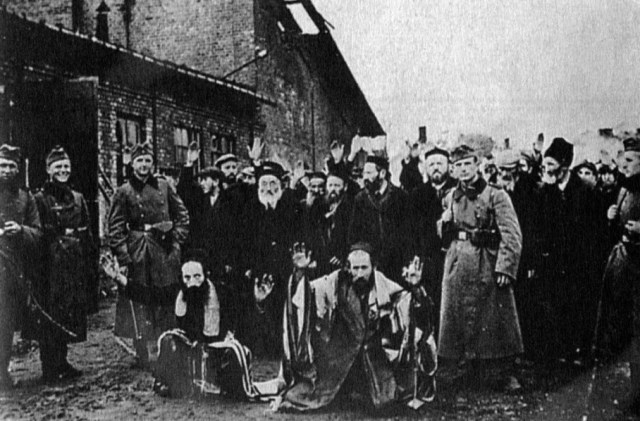
I firmly believe in the power of tradition over time, and the peril societies court when they chuck it wholesale. It should never work. And yet, it some sense the Nazi’s utter abandonment of many very basic social customs “worked” for a time. With obvious exceptions (see the photo below), an entire society changed its form of greeting in an historical blink of an eye.
Allert’s book helped answer my question, but he spends most of his time discussing the sociological aspects of personal greetings, and this proved a welcome surprise for me–though I should have guessed it from the title.
Understanding both the greeting and its rapid ascent we need to see Germany in context. German culture has a long history, but not the German nation. As a distinct political entity “Germany” did not exist until 1871. For centuries the patchwork collection of provinces and principalities had been the happy hunting grounds of older states such as France, Austria, and even Russia. In the mid-18th century Prussia emerged in its own right largely thanks to its military and somewhat autocratic kings. But it took both the Industrial Revolution and Bismarck a full century after this to unite Germany under Prussian political guidance.
Bismarck had certain key goals in German unification. Above all he wanted to avoid uniting Germany along democratic lines. Each major leap forward in the process of unification happened because of wars–the application of force. After Prussia won the Danish War, the Austro-Prussian War, the Franco-Prussian War, Germany lost W.W. I. The Versailles Treaty only added to Germany’s humiliation and frustration at the terms of the peace, their geo-political “encirclement,” and so on. The lackluster Weimar Republic and the accompanying degradation (real or perceived) of German culture fueled the desire to reaffirm German unity. The push for a universal German greeting began in earnest.
Allert directs our attention to the nature of greetings themselves. Even a simple “hello” invites someone into a personal space, and creates the possibility of more/deeper personal relationships. Almost all social greetings have this character. We request that others allow us into their world as we invite them into our own.
“Heil Hitler!” functions much differently. It demands rather than invites, and here we see a link back to the means of German unification itself under Bismarck. Germany became Germany due to force and political manipulation. Now the “German” greeting will bring social unity in the same way–by force. Allert astutely points out that “Heil Hitler” cannot even be called a personal greeting, as it involves no personal contact (as a handshake) and no sign of individual respect (as a bow or curtsy). It immediately makes a division between the abstract mass of those who support the regime and the undefinable minority of those who do not.*
Perhaps this helps explain why the new “greeting” caught on so quickly. It is not a greeting at all. We can imagine the awkwardness of switching from saying, “Hello,” to “A merry-jolly day to you,” or something along those lines. It probably wouldn’t stick. But if we had to stand on one leg and look at the ground instead instead of saying “hello,” maybe that might have a better chance?
“Heil Hitler” shares much in common with other aspects of Nazi life. Just as this “greeting” is not really a greeting, so too the goose-step march is not really a march. Both de-personalize and therefore dehumanize life. This clues us in that the Nazi’s cared not so much for “Germany,” or their warped idea of purity, but ultimately about their perverted idea of the so-called beauty in death. Their desire to raise the stakes of a personal greeting speaks of the nihilism at the bottom of their philosophy (which Father Seraphim Rose alludes to in his brief article below).
Dave
*In their recollections many recalled that they could always tell where their teachers stood in relation to the regime by how they “greeted” the students with the obligatory “Heil Hitler!” at the start of class. None (I presume) could have taught without saying it. But some teachers always looked for ways around the full measure of obligation. One remembered that a particular teacher always walked in the door carrying large stacks of papers under his arms, making it “impossible” for him to raise his arm as he likely said “Heil Hitler.” Another entered invariably with a piece of chalk in his hand already. He would raise his arm to begin writing on the board, then turn to the class and say “Heil Hitler” with his right arm still lingering on the chalkboard. I have much sympathy with these teachers, whatever their circumstances might have been.
This, however, is a better epitaph . . .
From Seraphim Rose . . .
The chief intellectual impetus for Vitalism has been a rejection of the realist/scientific view of the world, which simplifies things and “dries them out” of any emotional life. Unfortunately, however much the Vitalist might yearn for the ‘spiritual’ or the ‘mystical,’ he will never look to Christian truth to fulfill this need, for Christianity for them is as ‘outdated’ for him as the most dedicated rationalist.
The Christian truth which the Enlightenment undermined and rationalism attacked is no mere philosophy, but the Source, the Truth of life and salvation, and once there begins among the multitude a conviction that Christianity no longer remains credible, the result will be not an urbane skepticism imagined by the Enlightenment, but a spiritual catastrophe of enormous dimensions, one whose effect will make itself felt in every area of life and thought.
Towards the end of the 19th century, a restlessness and desperation had begun to steal into the hearts of a select few of Europe’s intellectual elite. This restlessness has been the chief psychological impetus for Vitalism; it forms the raw material that demagogues and craftsmen of human hearts may play upon.
Fascist and National Socialist regimes show us what happens when such craftsmen utilize this restlessness for their own purposes. It may seem strange to some that such restlessness would manifest itself in places that had reached the seeming pinnacle of human cultural and political achievement, but such manifestations should not surprise us . . . .
Perhaps the most striking examples of this unrest manifest themselves in juvenile crime. Gangs roam about and have senseless wars with each other, and to what purpose? Such criminals come from the “best” elements of society just as from the “worst.” When questioned, such people talk of boredom, confusion, an unidentified “urge” to commit these acts. No rational motive appears for their actions.
There are other less violent forms this unrest takes. In our own time we see a passion for movement and speed, expressed especially in the cult of the automobile (we have already noted this passion in Hitler), and in our adulation of athletes. Add to this the universal appeal of television, movies, videos, which mainly serve to distract us and allow us to escape from reality both by their eclectic and “exciting” subject matter and the hypnotic effect of the media themselves; the prevalence of sexual promiscuity, being another form of the “experimental” attitude so encouraged by the arts and sciences.
In such phenomena “activity” serves as an escape–an escape from boredom, meaninglessness, and most profoundly from the emptiness that takes possession of the heart that has abandoned God and refuses to know their own selves.
In politics, the most successful forms of this impulse have Mussolini’s cult of action and violence, and Hitler’s darker cult of “blood and soil.” Vitalism, in its quest for life, smells of Death [and indeed leads to death]. The last 100 years have shown a world-weariness and its prophets have declared the end of the Christian west. Beyond Vitalism there can only be the Nihilism of destruction. Nazism itself had this function. Joseph Goebbels wrote,
The bomb-terror spares neither the rich nor poor; before the labor offices of total war the last class barriers have had to come down . . . . Together with the monuments of culture there crumble also the last obstacles to the fulfillment of our revolutionary task. Now that everything is in ruins, we are forced to rebuild Europe. In trying to destroy us, the enemy has only succeeded in smashing its own past, and with that, everything outworn and old has gone.
“Whatever we may think of Alexander–whether Great or only lucky, a civilizer or a sociopath–most people do not regard him as a religious leader. And yet religion permeated all aspects of his career.”
This opening line of the book blurb for F.S. Naiden’s Soldier, Priest, and God: A Life of Alexander the Great, sucked me right in. I too had viewed Alexander nearly solely through a narrow political and moral lens, and had never really considered his religious views and acts as central to his successes and failures. The book was too long for me. I would have preferred if he assumed reader knowledge of the standard elements of the Alexander narrative. But what Naiden draws out from his expertise in ancient religious rituals helps us see Alexander afresh in certain ways.
Historians tend to think about Alexander along three standard deviations:
Great visionary and magnificent strategist, one of the truly “Great Men” that, naturally, and tragically, few could truly follow
Fantastic military leader with flawed political skills. After Gaugemela in 331 B.C., his political skills become more necessary than his military skills, and so his fortune waned and his decisions got worse
A thug and barbarian who lived for the chase and the kill. He never really changed, or “declined,”–he always was a killer and remained so until his death.
Soldier, Priest, and God tries to bypass all of these paradigms, though touches on each in turn. Naiden’s Alexander is a man who mastered much of the trappings and theater of Greek religion, which included
The hunt
Prowess in battle
A religious bond with his “Companions,”–most of whom were in the elite cavalry units.
Responding properly to suppliants
As he entered into the western part of the Persian empire, i.e., Asia Minor, he encountered many similar kinds of religious rituals and expectations. The common bonds and expectations between he and his men could hold in Asia Minor. But the religious terrain changed as Alexander left Babylon (his experience in Egypt had already put some strain between he and his men, but it could be viewed as a “one-off” on the margins), and he had to adopt entirely new religious forms and rituals to extend his conquest.
Here, Naiden tacitly argues, we have the central reason for Alexander’s failures after the death of Darius. Some examples of Naiden’s new insights . . .
Alexander’s men did not want to follow him into India-they wanted to go home. Some view this in “great man” terms–his men could not share Alexander’s vision. Some view this in political/managerial terms–his army signed on to punish Persia for invading Greece. Having accomplished this, their desire to return was entirely natural and “contractual.” Naiden splits the horns of this dilemma, focusing on the religious aspects of their travels east.
Following Alexander into the Hindu Kush meant far fewer spoils for the men. Some see the army as purely selfish here–hadn’t Alexander already made them rich? But sharing in the spoils formed a crucial part of the bonds of the “Companions.” The Companions were not just friends, as Philip had created a religious cult of sorts of the companions. It wasn’t just that going further east would mean more glory for Alexander and no stuff for his men. It meant a breaking of fellowship and religious ritual. This, perhaps more so than the army being homesick, or tired, led to Alexander having to turn back to Babylon.
Alexander killed Philotas for allegedly taking part in a conspiracy against him. Others see this as either Alexander’s crass political calculus, or a sign of megalomania, or paranoia. Naiden sees this action in religious terms.
Philotas was a Companion. To execute him on the flimsy grounds Alexander possessed could amount to oath-breaking by Alexander, a dangerous religious precedent. “Companionship” bound the two together religiously, not just fraternally.
Philotas did not admit his guilt but presented himself as a suppliant to Alexander and asked for mercy. True–not every suppliant had their request granted, but Philotas fit the bill of one who should normally have his request met.
Killing Philotas, and subsequently Philotas’ father Parmenio (likely one of the original Companions under Philip), should be seen through a religious lens and not primarily psychologically (Alexander is going crazy) or politically (politics is a dirty business, no getting around it, etc.).
We also get additional perspective on the death of Cleitus the Black. We know that he was killed largely because of the heavy drinking engaged by all during a party. We know too that Cleitus had in some ways just received a promotion. Alexander wanted him to leave the army, stay behind and serve as a governor/satrap of some territory. Why then was Cleitus so upset? Naiden points out that Alexander had not so much promoted Cleitus, but made him a subject of himself, as well as exiling him from the other Companions. The Companions shared in the spoils equally, and addressed each other as equals. As satrap, Cleitus would have to address Alexander as king and treat him as other satraps treated the King of Persia. Hence, the taunt of Cleitus (who had saved Alexander’s life at the battle of Granicus), “this is the hand that saved you on that day!” came not just from wounded pride, but as an accusation against Alexander’s religious conversion of sorts. Alexander had abandoned the “Equality” tenet of faith central to the Companions.
We can imagine this tension if we put in modern religious terms (though the parallels do fall short):
Imagine Alexander and his men are Baptists of a particular stripe. They grew up in Sunday school, reciting the “Baptist Faith and Message.” They join Alexander to punish Moslems who had tried to hurt other Baptists.
As they conquer, they link up with other Baptists. There are Southern Baptists, Regular Baptists, Primitive Baptists, and so on. They go to worship with these people, and while it might be a bit different, it is still familiar. All is good.
Flush with success, the go further. Now they meet more varieties of Protestants–some non-denominational churches, Lutherans, Presbyterians, some Assemblies of God, etc. Ok, from a traditional Baptist perspective, it’s getting a little weird, but we are still more or less on familiar ground.
Now we go to Egypt and–what!–Alexander seems to be joining in on a Catholic service. Ok, this is bad, but at least very few in the army saw this, and we don’t have to spread the news.
Now as we get into Bactria and India Alexander seems to be converting to something unrecognizable. He seems to be breaking with the Baptist Faith and Message and repudiating his past. Or is he? He might be converting to Islam, or what else, I have no idea. We can no longer worship with him. In hindsight, his killing of Philotas was a decisive move in this “conversion.”
Naiden points out that Alexander never officially becomes king of Persia, and attributes this largely to the religious ideology behind the Persian monarchy that Alexander could not quite share or, perhaps understand. As he went into Bactria and beyond, not only had he grown religiously distant from his men, but he could no longer understand or adapt to the religions he encountered. He found himself constantly torn between acting as a king to those he conquered, and as a Companion to his army. In the end he could not reconcile the two competing claims, and perhaps no one could.
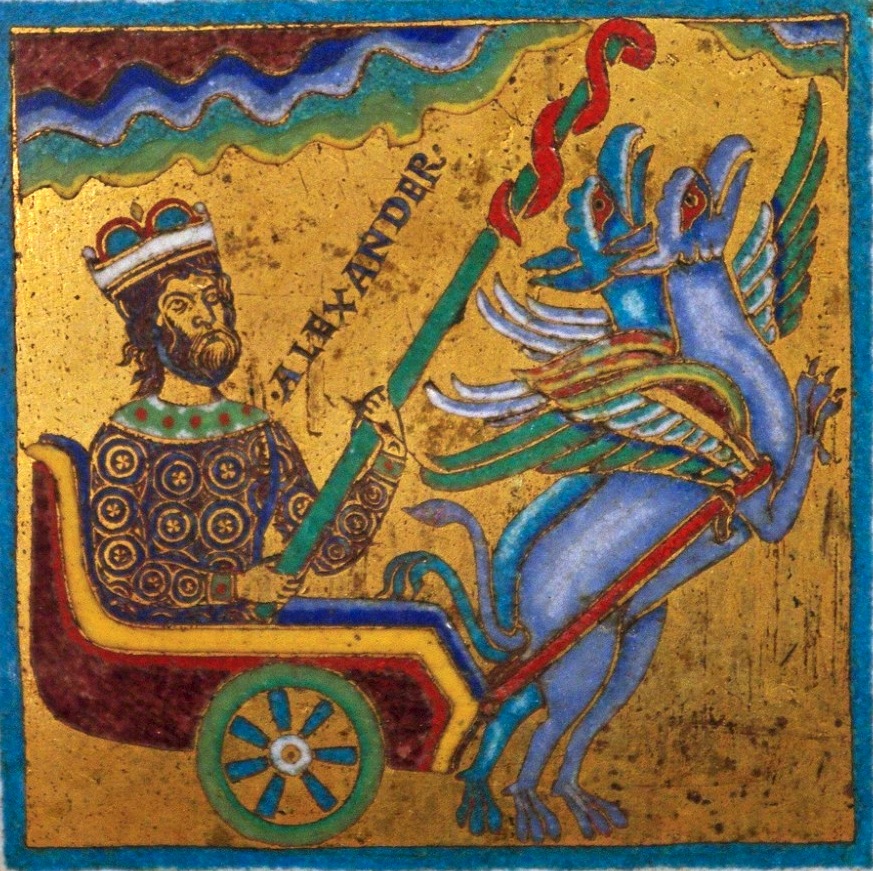
Alexander stands as perhaps the most universal figure from the ancient world. Obviously the Greeks wrote about him, as did the Romans, but stories cropped up about him in India, Egypt, Israel, Byzantium, and within Islam as well. Naiden mentions this but fails to explore its meaning. Naiden has a remarkable ability to find facts and present a different perspective. But he never explores how and why most every ancient and pre-modern culture found in Alexander something universal. Though it will strike many as strange the most common image of Alexander has him not riding into battle on his famous horse, but ascending into the heavens, holding out meat so that large birds will carry him up into the sky.
This image comes from a medieval Russian cathedral:
The story comes from the famous Alexander Romance, and runs like so:
Then I [Alexander] began to ask myself if this place was really the end of the world, where the sky touched the earth. I wanted to discover the truth, and so I gave orders to capture the two birds that we saw nearby. They were very large, white birds, very strong but tame. They did not fly away when they saw us. Some soldiers climbed on their backs, hung on, and flew off with them. The birds fed on carrion, so that they were attracted to our camp by our many dead horses.
I ordered that the birds be captured, and given no food for three days. I had for myself a yoke constructed from wood and tied this to their throats. Then I had an ox-skin made into a large bag, fixed it to the yoke, and climbed in. I held two spears, each about 10 feet long, with horse meat on their tips. At once the birds soared up to seize the meat, and I rose up with them into the air, until I thought I must be close to the sky. I shivered all over due to the extreme cold.
Soon a creature in the form of a man approached me and said, “O Alexander, you have not yet secured the whole earth, and are you now exploring the heavens? Return to earth quickly, or you will become food for these birds. Look down on earth, Alexander!” I looked down, somewhat afraid, and I saw a great snake, curled up, and in the middle of the snake a tiny circle like a threshing-floor.
Then my companion said to me, “Point your spear at the threshing-floor, for that is the world. The snake is the sea that surrounds the world.”
Admonished by Providence above, I returned to earth, landing about seven days journey from my army. I was now frozen and half-dead. Where I landed I found one of my satraps under my command; borrowing 300 horses, I returned to my camp. Now I have decided to make no more attempts at the impossible. Farewell.
Here we have the key to understanding the meaning of Alexander as the ancient world saw him.*
The person of a king becomes the focal point of “bodies.” For example, a single, jobless, man living alone in his parent’s basement has only himself as a “body.” His identity includes only himself–his identity includes nothing outside of himself. Thus, he grows stale. Now imagine said man gets a job. He adds the identity of others to his own. If he gets married, now he has bound his identity to another person. This is why marriage has always been viewed as a religious rite within almost every society past and present, Christian or otherwise. Only God/the gods can effect this kind of change in a person. Then the couple has children, and the man has added more “body” to himself. Then one day he has grandchildren and ascends to the level of “paterfamilias.” His “body” includes multiple families.
A king of Macedon has more “body” than the average Macedonian. As we have seen, Macedonian kingship didn’t function like kingship elsewhere, either politically or religiously. Still, kingship has roots in every culture. But everyone knew that this kind of adding of body involved something of a risky and religious transformation–something akin to marriage. If one goes too far you risk losing everything. We can think of Alexander as holding folded laundry in his hand. He bends down to pick up a book, and can do that, then a plate, and it works, then a cup, etc.–but eventually one reaches a limit as to what you can add to oneself, and everything falls to the floor.
I have written before about the biblical image of the mountain in Genesis. Adam and Eve seek to add something to themselves that they should not. As a result they must descend down the paradisal mountain, where more multiplicity exists, and less unity. This leads to a fracturing of their being, and ultimately violence. This is King Solomon’s story as well. He receives great wisdom–the ability to take in knowledge from multiple sources and achieve penetrating insights (many scholars have noted that the biblical books traditionally ascribed to him contain tropes and fragments from cultures outside of Israel). But he goes too far–he strives for too much multiplicity, too much “adding of body,” as is evidenced by his hundreds of marriages to “foreign women.” This brings about the dissolution of his kingdom, the same result Alexander experienced after his own death. But before Alexander lost his kingdom, many would say he lost himself, with executions, massacres, and other erratic behavior. Like Solomon, he lost his own personal center in his attempt to add body to himself ad infinitum.
The story of the Ascension of Alexander hits on these same themes. He tries to ascend to a unity of the multiplicity through the multiplicity itself (note the use of body in the form of the meat to accomplish this). But it can never work this way. When you attempt to ascend via a Tower of Babel, you get sent back down.
The universality of this problem manifests itself today in these two kinds of people:
Purists who believe that even the slightest deviation from an original aim or interpretation destroys everything. Things here get so dry and lifeless that it brings the “death” of the desert.
Compromisers who want to stretch anything and everything to fit anything and everything. No exception ever endangers the rule–everything can always be included. Here you have the flood–undifferentiated chaos with nothing holding anything together. Eventually you reach points of absurd contradiction, and then, conflict.
Alexander’s life fits this tension between purity/unity and multiplicity:
He could take in Greece
He could take in Asia Minor
Perhaps he could just barely take in Egypt
But beyond that–though he could “eat” other kingdoms further east, they certainly didn’t agree with him.
Indeed, why invoke a blessing from God on food before we eat? We ask, in fact, for a kind of miracle–that things dead might be made life-giving. We too ask for help on the potentially treacherous path of making that which is “not us” a beneficial part of our being. We cannot have real unity without multiplicity, and vice-versa. But no blessing will save us from every deliberate choice to drink from the firehose and ingest foreign gods.
Dave
*Understanding this episode in The Alexander Romance will clue us in on how to read ancient texts. We should not assume that the ancients believed that this story was true in a scientific or “literal” sense. It was true in a more profound, metaphorical, and spiritual sense.
It is sometimes possible to enjoy a book that one cannot understand very much of, provided that
The author has a great deal of fun with the subject, and
The author clearly and deeply understands the subject, which allows him to express his ideas clearly.
I confess to knowing nothing about almost all of the authors CS Lewis discusses in his wonderful English Literature of the Sixteenth Century. Anecdotes exist that indicate Lewis felt real heaviness and irritation in cranking this one out, but this does not come across in the writing. It reads light as a feather. Lewis generously shares his opinions about literature, but mixes these opinions with a marbling of philosophy, history, and cultural analysis. All this makes Lewis’ work come alive and relevant for today. This is some of Lewis’ best writing, and his wit and humor shine on most every page.
Lewis finds this era worthy of extended examination because it stands at a nexus of a variety of momentous shifts:
The early 16th century saw the last vestiges of the medieval worldview have their final say
The early-mid 16th century saw the high water mark of Renaissance humanism and classicism
The entire 16th century saw tumultuous religious upheaval caused by the Reformation, followed on by the Counter-Reformation.
Lewis keeps his focus on the literature, as is proper, but his opening chapters also set the stage historically and culturally. For the historian, Lewis goes to great lengths to reset the balance between the Middle Ages and the Renaissance, but I have covered that topic elsewhere. His basic point for in these opening chapters involves prepping us for the fact that literature at a nexus of cultural death and rebirth tends not to be very good. Things eventually sorted themselves out with Sidney, Spenser, and Shakespeare, but the early to middle part of the century left much to be desired. The main fault of the writers of this time involved a hyper-exaggeration of a certain strengths of cultural movements, which robbed much of their writing of life and merit.
To be sure, the political, cultural and religious tumult eventually settled into a new equilibrium, and after that, writers could borrow from different literary genres much more freely and productively, but until that happened, very little of anything transcendent value got written.
This dynamic makes sense to us if we scale down this larger point to something more tangible to our own experience of, for example, adolescence. Our early teen years involve an ending of childhood and the beginning of something else, akin to a larger scale cultural breakdown and rebirth in our immediate personal experience.
I grew up playing drums and listening to a lot of my dad’s music. This was a pre-headphone era, so we all heard what he played on the living room stereo. I got a healthy dose of the Beatles, Otis Redding, Willie Nelson, and Beethoven, among others. I enjoyed almost all of it. But as a 16 year old drummer, I wanted something else (unfortunately it took a few more years before I appreciated Ringo and Al Jackson), and a way to distinguish myself. One day, my cousin’s friend played for me the opening 30 seconds of Rush’s “The Spirit of Radio,” and it was all over for me. I was enchanted. I had never heard progressive rock, so I dove in headfirst. I immediately went to Tower Records and bought Permanent Waves, Moving Pictures, and Hemispheres.* For the next year, I then decided that everything about my drumming, and many other things about my life besides, must conform to Neil Peart’s particular style.
This improved my drumming in certain small ways but ruined it in others. Things got misshapen. If one believes (as I did), that even when drumming for my high school jazz band I should act like Neil Peart, you sound like an idiot. It took hearing a recording of my playing at the county jazz festival, and the judges comments, to make me realize I needed to snap out of it. I spent the following summer listening Glenn Miller and Count Basie, and at least partially fixed things for my senior year.
This was a classic, “It’s not you, it’s me,” problem. Neil Peart has much to teach any drummer, but not if you become enslaved to his aura. In that state, one plays drums essentially to convince an audience, and you lose all sense of proportion.
Times of personal and cultural death and rebirth offer many opportunities. In separating certain aspects of life from a larger context, we can see them with more clarity, and this is exciting. I’d like to think that in college, I could throw in occasional progressive wrinkles without being bound by them. Unfortunately our internal instability in those moments of initial discovery make it very difficult for us to take fruitful advantage of whatever insights we gain. The same applies to a culture at large. In the midst of breakdown, when things come apart, we notice what we had never seen before. This is great as far it goes, but it has to kept in balance.
Lewis shows us how this dynamic plays out in the literature of the period.
Oftentimes, what seems like an era in the fullness of its strength actually ends up being something akin to “terminal lucidity,” a burst of energy many dying patients experience before passing. For example, the 1980’s seemed like the crest of a wave of American confidence. We had Reagan-era optimism. We won the Cold War. We grew economically. We wore bright colors and made our hair big. But look again, and we see that some of what we were about shows an uncomfortable exaggeration of a theme. We should never have attempted, for example, “Hands Across America.” Big hair is one thing, and glam-metal fashion ca. 1988 quite another.
This “hyper-extension” of cultural posturing naturally collapsed, leading to completely opposite atmosphere. Now we had grunge music with lyrics about how bad things were, loose clothes (anyone who tucked in their shirt at my high school in 1990 would have been hopelessly labeled as a nerd), and “heroin chic.”
In neither era do men or women look particularly normal, with both exaggerating certain ideas to a point of being ridiculous.**
I much prefer medieval literature to that of the Renaissance, but by the end of the Middle Ages, we saw the same kind of unfortunate exaggerations. Lewis suggests that Scotland’s king James IV perfectly encapsulates the problem with the period. “Peak” medieval chivalry ca. 1350 had much to commend it. It ennobled men, and greatly elevated the status of women.^ The courtly love tradition had its good parts, though the best literature of the period grappled with some of the contradictions and tensions involved in knightly service of ladies. The literary figure of Lancelot encapsulates this well.
James IV (b. 1473, d. 1513) had many good qualities. He was open hearted, high spirited, and generous in the best spirit of chivalry. He had courage, but a variety of contemporaries remarked that he had too much courage to be king. He needed more prudence and policy. Many of his contemporaries felt that James never should have fought the Battle of Flodden, where he met his death (in Henry IV, Pt. 1 Shakespeare may have had James IV as a model in mind for Hotspur). As to the service of ladies, James IV almost parodies the medieval complexity and tension by abandoning himself to countless prostitutes and fathering a variety of illegitimate children. His exaggerated chivalric ideals made chivalry itself look ridiculous.
So too, late medieval literature had little balance and often none of the sense of play of the best medieval prose from previous decades. Lewis cites the work of John Fisher, who drank heavily from the medieval moral sense, but alas, could not let an idea go once he fixed himself upon it. In his The Perfect Religion, he instructs a nun to be
Grateful for being created to live in a Christian society. As Lewis states, this is well and proper. But Fisher continues, telling the nun to be
Grateful for being created at all. This is still a good sentiment, but perhaps was already covered in the first injunction? Fisher doesn’t stop there, however, urging that she remain
Grateful that she was created as a human being, and not a toad, and tops this off with the counsel that
She be grateful that she was created instead of all the other people that might have been created instead of her.
Lewis rightly points out that by the third injunction, Fisher has descended into absurdity (“she” could never be a toad—not an option for a human being,) and by the fourth, a work intended to promote Catholic orthodoxy seems to promote a gnostic heresy of the pre-existence of souls and the separation of the body from personhood. Lewis writes, “Fisher’s sincerity is undoubted, but his intellect is not as hard at work as he supposes. We can’t hold Fisher accountable for not answering his questions, but he doesn’t seem to know that he is raising them.”
This lack of balance spilled over into the religiously polemical works of Fisher and Thomas More. Both wrote defenses of purgatory, and both in their zeal latched onto certain rogue strands of late-medieval asceticism. In Dante, the souls in Purgatory sing psalms joyfully, and their bodies suffer in service of redemption, and is in fact an integral part of their redemption. For Fisher and More, we have denigration of the body, so that the purgation is for the sake of purgation itself, and their vision of purgatory means a practically pointless circle of suffering.
We should expect this tendency to exaggeration during times of cultural fragmentation. What was once solid now moves apart. The bell curve of ABC, CBS, and NBC turns into a thousand scattered points, first with cable news, then with the internet. When this scattering happens, we naturally lose our bearings and find what we can to latch onto. What we latch onto, however, will be isolated from a larger context, and thus will lose its relationship to the broader whole.
I have mentioned two late-medieval/early modern Catholics, now for some early Reformation humanists (though it was certainly possible to be a Catholic humanist, i.e. Erasmus). John Colet wished to return to a more pure age, and thus urged a strict “anti-body,” morality upon his readers. He saw no real difference between marital union and fornication, and in fact wished that no one would get married. Marriage and the body proved to messy for his taste. He acknowledged that no marriage would mean the end of the human race on earth, but oh well, these things happen.
The humanists loved classical culture, either for its perceived purity, hardy innocence, or merely because the classical age was not feudal and medieval, the worst of all sins. This meant that he abandoned allegorical or symbolic interpretations of the Bible in search of a platonic “pure” meaning of the text. Others shared these views, but his thoughts on the subject of Latin take him into absurdity in a similar way to Fisher. On the one hand, as mentioned, he was a strict moralist with gnostic tendencies. This led to a distrust of much of pagan literature. On the other, he hated all things medieval, and that meant hating medieval church Latin, which had been “corrupted” from the past that was pure, not in morality, perhaps, but in its use of language. Lewis writes,
{For Colet] the spirit of the classical writers was to be avoided like the plague, and their form to be imposed as an indispensable law. When he founded St. Paul’s school, the boys were to be guarded from every word that did not occur in Vergil or Cicero, and equally, from every idea that did. No more deadly or irrational scheme could have been propounded. Deadly, because it cut the boys off from all the best literature in the Latin world, and irrational, because it put absurd value on certain arbitrary elements dissociated from the spirit which begot them, and for whose sake they existed. For Colet, this seemed a small price to pay for excluding all barbarism, all corruption, all “adulterated” Latin.
We noted above that when something reaches its end, it can mimic strength through one final, exaggerated effort. It might seem on the one hand that Latin had no greater champion than Colet, who sought to emphasize only the “best” Latin. But Lewis points out that all of the efforts of the Renaissance humanists to preserve the purity of latin in fact killed it. A variety of medieval people actually spoke latin (churchmen and merchants), or at least some version of latin. Only a very few scholars knew classical Latin, and fewer still spoke it, and then only in the academy. The attempt to save Latin destroyed it.
It is usually more fun to read a review where the critic pans rather than praises. I have focused on the first half of the book, where the literature, with a few exceptions, stunk. But we should remember that the century ended with some of England’s greatest writers, and with Shakespeare we have an “all-timer.” When we recall Shakespeare’s best work, we see how much more comfortable he was with tension and play than the previous generation. He incorporated medieval and modern elements without going out of his way to defend either. Stylistically, he stuck to certain meters and forms, but not all the time. He could happily dance between them. His characters are rich, both particular to his time and universal.
This can give us hope for our own future. We live in an era where many of the old categories of meaning and belonging have vanished. As a result we see the same kinds of intensification and exaggeration that beset the 16th century. But they learned, and so might we. The path forward comes from Thomas More’s most famous and least understood work, his Utopia. As mentioned previously, Lewis felt that much of More’s polemical work fell prey to the vices of the age. Those vices, he argues, cloud our perception of Utopia. Many moderns attempt to find a point to the work, obscured or otherwise, that will clue us in to More’s meaning in the text. Much of More’s other work had a definite argument. So too must Utopia, right? Was More secretly supporting communism, or was he a closet Protestant? Or perhaps he sought to make some other political point buried in code?
Lewis points out, however, that any attempt to pin the book down specifically one way or another will fail, because More writes in this text like a medieval. Given that medievalism was practically dead at this point, it is no wonder that even his contemporaries remained confused. But Lewis argues the book has no particular point. It’s meant as a romp of this and that, no more, no less. The medievals loved to bandy ideas about and put them in tension and opposition to one another. For them, this was fun–and that signifies of a more healthy age than either our own or the early 16th century. They were more interested in play, we in logical, deductive writing that makes a point and gets somewhere definite.
For us, as for the 16th century, the way out of our predicament involves not stronger arguments, but a greater sense of fun. More shows us that even politics, whatever our position may be, can bear the weight of humor in any age.
*I also bought what was at that time their most recent album, Hold Your Fire. Rush fans may relate to my utter shock, bewilderment, and even anger at going from “Red Barchetta” to “Time Stand Still” in the space of 30 seconds. To this day I still feel that Hold Your Fire is a ridiculous album. Not until Counterparts would I start to forgive them.
**At first glance no two things could seem further apart than the late 80’s and early 90’s aesthetic. But both participate in the same cultural breakdown, and are likely, therefore to share some crucial commonalities. A second glance shows that, surprise, surprise, they have androgyny in common. In glam metal, a lot of guys dressed similarly to women (tight pants, makeup, etc.) and in grunge, a lot women looked like men (short hair, lack of showering, no care for appearance, etc.) No doubt grunge devotees would have been horrified to learn that they shared a crucial similarity with hair metal, but there you go.
In one section of the book, Lewis shows that Thomas More (Catholic) and William Tyndale (Protestant), who wrote page after page attacking one another, actually had a lot in common. Both had similar economic ideas. And on Henry VIII annulment and remarriage to Anne Boleyn, the hot-button issue of the day, they were in lock-step agreement. Both seem to have missed this fact at the time.
^For an example of this, note the famous story from Froissart about how Edward III heeded his wife’s call for clemency for the population of Calais.
I have always had great sympathy for Louis XVI. As far as moral character goes, he far outstripped his two predecessors. He had a genuine Christian faith and a genuine love for his family. The first several years of his reign show a movement towards humanitarian and scientific improvements throughout the country, and he sought to limit spending and the Versailles fluffery that characterized Louis XIV-XV. It seems ironic and almost non-sensical that the French Revolution should have come for him. It makes sense, however, when one realizes that for all his virtues, Louis could not play the role of King when it counted most. He had the very common foibles of indecisiveness, and wanting to be liked a bit too much. One can easily pass over such flaws in a common person, but at the wrong place and time, those in power with such flaws receive no mercy from history.
One can see this crucial difference between the three monarchs in their portraits. First, Louis XIV, then Louis XV:
Louis XV would have washed out as anybody but a king. His flaws would have overborne him as a blacksmith, lawyer, or baker. But . . . he could fill the royal robes. Whatever one can say about him, he cared little what others thought.*
Louis XVI in the same pose
comes up short. He shows the required leg, with none of the confidence. While Louis XIV and XV seem to leap out of the frame, Louis XVI wants us to go away so he can go back to fixing his clocks. Alas that 1789 came for such a decent, normal person. Pressed in trying times to puff out his chest and stand firm, he could not. Let us not say that he lacked the courage for this, for he proved at his trial and death to have plenty of it. Rather, we might say that leopards cannot change their spots. Faced with situations entirely unsuited to his temperament, he blundered into bad move after bad move, vacillating here and there in the process.
Some years ago I came across Edward Luttwak’s Grand Strategy of the Byzantine Empire, a title that, at the time, struck me as bizarre yet intriguing on its face. I thought, like many, that the Byzantines blundered around willy-nilly for some centuries, with their hesitations and diplomatic ploys betraying a complete lack of strategy. But Luttwak masterfully pointed out that
Most wars of any people are unnecessary, and should be avoided if possible. Investing in diplomacy as the Byzantines did costs far less in cash and in human lives.
The Byzantines faced enormous problems of different kinds on. multiple fronts for centuries that called for flexible and careful thought.
Like anyone, they made mistakes, but their survival for 1000 years as essentially 1/2 of the Roman Empire shows that they had great success overall in managing their resources with accuracy and effectiveness.
Luttwak performs a similar turn with his The Grand Strategy of the Roman Empire. Emperors of varied quality came and went over the centuries. But, the Romans had a method to how they comprised and used their army. Again, having a strategy won’t always mean that one stays faithful to it, or even that they have a good strategy. But a method, unconscious or no, existed for the Roman Empire, independent of good generals and emperors.
His introduction lays out his basic approach regarding the use of force:
The superiority of the empire, and it was vast, . . . derived from the whole complex of ideas and traditions that informed the organization of Roman military force and it harnessed the power of the empire to a political purpose. The firm subordination of tactical priorities, martial ideals, and warlike instincts to political priorities was the essential condition of success. . . . In the imperial period at least, force was recognized for what it is, an essentially limited instrument of power, costly and brittle. Much better to conserve force, and use military power indirectly.
As an example . . . Romans considered the loss of a military standard something akin to a national tragedy. The Parthians captured a few such standards at Crassus’ disaster at Carrhae. Luttwak writes,
Augustus did not try and avenge the great defeat inflicted by the Parthians . . . in 53 B.C. Instead, in 20 B.C. he reached a compromise settlement under which Armenia was to be ruled by a king of the Arascid family, who would receive his investiture from Rome. Behind the neatly balanced formula there was strategy, for Parthian troops would thereby be kept out of a neutralized Armenia and far from undefended Anatolia and valuable Syria. There was also politics. The standards lost at Carrhae would be returned to Rome and received with great ceremony. Augustus issued coins falsely proclaiming the “capture” of Armenia.
Not very dramatic or inspiring, but Sun Tzu proclaimed that the best generals win without fighting.**
Luttwak organizes the book into a few different eras, i.e., the Julio-Claudians, the Flavians to the Severi, and so on. He examines the military composition at the time, what that should mean for how they used those forces, and to what degree the tactical situation on the ground matched policy in Rome. Certain eras interested me more than others, so what follows reflects that.
During the heyday of the Republic era, Rome’s legions had some variety and flexibility built within them, with light infantry (effective) and cavalry (not as much) attached to the standard Roman heavy infantry. As Rome underwent political changes, so too its army changed. During the early years of the principate they coalesced their forces to make them “heavier”–gone more or less were the javelin throwers and the horses. Exactly why this happened is hard to say, but interestingly, the centralization of political power mirrored itself in the centralization of the army.
However true this may be, it cannot explain everything–a diplomatic method existed behind it. Rome used client states to aid in their security, and used the militaries of the client states to supplement their own. So–Rome provided the main course, so to speak, and their clients the rest. Luttwak writes,
It is the absence of a perimeter defense that is the key to the entire system of Roman security during this period. There were neither border defenses nor local forces to guard against the “low intensity” threats of petty infiltration, transborder incursions, or localized attack. . . . such protection was provided, by indirect and non-military means. By virtually eliminating the burden of maintaining continuous frontier defenses, the net “disposable” military power generated by the imperial forces was maximized. . . . Thus, the empire’s potential military power could be converted into actual political control at a high rate of exchange.
Luttwak adds the following visual, which helps explain the idea of what he calls the “Hegemonic Empire.”
The weakness of such a system lies in that it requires someone with deft political skills to manage it, but Augustus possessed these in abundance. Some of his successors entirely lacked anything like it, but they ruled for a short time–i.e., Caligula. Others, like Tiberius, had sufficient ability, even if they lacked brilliance. Rome all in all prospered under this system because they had “good enough” emperors rule long enough to cover over the disasters. Rome tended to trust its clients and spent few resources watching over them. In turn, this meant that Rome made itself vulnerable to collapse if multiple clients rebelled at once. But again, the strength of the system and the overall competence of leadership made such a result quite unlikely.
In turn, the structure of the army and the attending political realities mean that,
the Roman army was clearly best equipped to serve an an instrument of warfare against enemies with fixed assets to protect–primarily cities, but also such things as arable lands or even irrigation systems. Conversely, Roman capabilities [declined] when enemies assets were not fixed, or at any rate, not concentrated.
This makes Roman disasters like Teutoburg Forest more understandable. You had Varus in command, one who lacked sufficient political ability in Germany. Perhaps more importantly, you had the Roman army far from any help from client states to supplement their ranks, and thus, able to fight well only against fixed assets. When the Germans under Arminius made his own army less “fixed” by “retreating” into the forest, the Romans got mauled. Rome won battles in subsequent years against certain German tribes, but the lack of fixed assets explains why they never could really conquer Germany, nor Parthia and the Sassanids. Grand strategic nuggets like this make Luttwak’s book a real gem.
Luttwak adds that at times the army could prevail in battle even against those lacking a majority of fixed assets. But such situations called forth the dark side of Roman power, writing that
the Romans could [not] apply their strength effectively against the widely dispersed rural base of warrior nations whose strength did not depend on the survival of city-based economic and social structure. Consequently, if the Romans persisted in their efforts, their only real alternative meant attacking the population base itself, in a war of extermination. . . . Thus at the conclusion of Domitian’s campaign against the Nasamones of North Africa, he reported to the Senate that the war had been won, and that the Nasamones has ceased to exist.
Though Luttwak’s analyzes almost everything dispassionately, one can see an example of the truth of St. Maximos’ dictum that man is a macrocosm of the universe, and that we should therefore interpret history through the lens of the human person. For example, I remember years ago when I tried my hand at fixing a plumbing problem in our house. I have no plumbing skills, but the problem seemed simple enough for me to try. Three trips to Home Depot and various tirades worthy of the dad in A Christmas Story later, I called a plumber, who humored me when he arrived by saying that he had seen worse.
My point here is that it would have been much better for me had the plumbing issue been bad enough that I never would have tried to fix it at all. Instead, it hovered in a tempting in-between space. Having waded in, I lost perspective and my cool. The same thing happened more or less to Roman armies in Parthia. And I can remember feeling akin to the Romans against the Nassamones–that if I bashed the pipes to oblivion, I could tell my wife that we had no more problem with the sink. Louis XVI had courage, and humility as well. In the case of serious invasion of France by a foreign enemy, I can imagine him deferring entirely generals while standing firm in an appropriately kingly way. In that case, the situation would have had clarity for him. When he tried to wade into managing internal social and political dynamics, he stumbled badly and tens of thousands died.
In time, Rome switched from a “Hegemonic Empire” to a “Territorial Empire,” to use Luttwak’s term. They switched from a “defense in depth” to having all the eggs in the “border security” basket. This mean that Rome either annexed, absorbed, or abandoned client states. Luttwak masterfully helps us not attach moral categories to this choice, or even to judge immediately the effectiveness of the switch. Rather, this choice involved different risks and problems.
The most common fallacy of analyses is the tendency to evaluate defensive systems in absolute terms. . . . Defensive systems should instead be evaluated in relative terms: their cost in resources should be compared to their military “output.”
Luttwak, p. 61
One can surmise that the “Territorial Empire” had the advantage of simplifying certain problems. More unity meant more control over various factors of defense. Rome need not have emperors equipped with cunning and subtlety to manage the empire effectively. A bulldog would do just fine. But–any penetration of the line brought a significant crises, and if the armies got either lazy or turned on each other–as (the latter) happened frequently in the 3rd century A.D., disaster would follow.
In my view, we should see the “Hegemonic” model of empire as a holdover from the Republic era. It’s flexible fringe with its solid core mirrors that of the structure of the Republic itself. We can see with hindsight that he principate system inaugurated by Augustus fell in between the stools of Republic and Empire, for which the Territorial model makes more sense.
For our own time . . . the NATO alliance in theory projects maximum deterrence and maximum fragility, akin to the Territorial model above. If someone does anything to any member of NATO, all in theory will respond. Possibly, the penetration of one of its members (by Russia) would rally everyone in the ranks for a defense. Possibly as well, an attack at any point might actually reveal the fragility of the system. NATO might abandon one of its own to prevent a general war, which would effectively end NATO as a viable entity.
A third possibility exists . . . one that shows that NATO in facts functions hegemonically. Perhaps the U.S, acting as NATO’s hegemon, might instead delegate defense based on complex diplomatic relationships. Such a move offers us a way out of the either/or of our current situation, and prevent a general war. But it also requires better political leadership than either or current or previous president could provide. If no one more deft arrives on the scene in 2024, we are stuck with the pro’s . . . and con’s of having all of our eggs in the “Territorial” basket.
Dave
*Incidentally, Charles II of England, a distracted (though certainly intelligent) debauchee much like Louis XV, also could transform himself. He knew how to be a king when it really counted, as this brief clip perfectly captures. If Louis XVI could have acted similarly in 1789 with the Estates General, perhaps things would have been different.
**I have nothing to add to the Russia-Ukraine situation except to say that hopefully, Ukraine can find something akin to a military standard to offer to Russia. It would have be something of little value to them, enormous value to Russia. I don’t know if anything like that exists between them.
Though issues surrounding COVID and race occupy our present discourse, we will likely see the question of women in our society revisited soon. Questions about patriarchy and equal pay have not played themselves out yet, and democracy, which often favors abandoning tradition and rapid change, will likely provide a platform for us to hash these issues out more fully.
Camille Paglia–certainly no conservative–has argued that women in traditional societies actually had a great deal of power, maybe even more than in the modern west. Coming from an Italian background, she observed large family gatherings and saw women deciding the course of events, the menu, etc. while the men mostly stood around and looked under the hoods of cars.*
We think of Rome as a masculine society, with its emphasis on conquest, the ‘pater familias,’ and their Senate. And yet, it appears that the most important job in Rome belonged to women–their Vestal Virgins.
We moderns might blanch at such a statement. We rarely talk about the importance of religion, and certainly never would dream of thinking about virginity as even remotely resembling a civilizational issue. But Robin Lorsch Wildfang (who doesn’t wish that their own name was Robin Lorsch Wildfang?) reminds us in her useful book Rome’s Vestal Virgins: A Study of Rome’s Vestal priestesses in the late Republic and early Empire, that the Romans were not moderns. We have borrowed so much from Rome for our political and legal system. And yet, anyone perusing this book knows a vast gulf separates our two civilizations.
I give credit to Wildfang for telegraphing exactly the nature of her work. As a reader, one knows that the author will give you densely packed facts with gobs of footnotes, with little overall agenda. We read these books for enjoyment no more than we eat those sawdust-like “power bars” for the taste. But both deliver on their promise. So many other books fail on this account.
Several times Wildfang mentions that, “Without the Vestals and their cult, in the eyes of Romans there would be no Rome.” Roman Vestals had unique privileges among women in Rome especially regarding their property rights. They could also suffer the most severe forms of punishment. But their duties seem to boil down to:
Their maintenance of the sacred fire, which always had to stay lit
Their oversight of a secret storeroom/offerings of basic crops
The continuation of the virginity as long as they served (Vestals usually began their service between 8-10 years old, and had to serve for 30 years at least, but could leave after that time).
How we interpret these duties will say much about how one interprets the past.
For the fire . . .
Ovid, Cicero, Dionysius of Hallicanarsus, and Plutarch all agree that the Vestals maintained the sacred fire because fire consumes rather than bears fruit. The “dryness” of fire would be linked then with their virginity. The ancient authors talk of two fires, one of Vulcan, the other of Vesta, goddess of the hearth.
But Wildfang looks for an alternative explanation. Rather than delve into the symbolism here for an explanation, she stresses the antiquity of the rite. Since the Vestal cult predated Rome’s founding, we should see only Rome’s desire to maintain its ties to antiquity, and the various associations some make to virginity and fruitfulness (or its lack) become unnecessary.
I admire Wildfang’s thoroughness and academic integrity, but I rarely approve of Occam’s razor as it applies to historical conclusions. Here at least, it just seems to convenient, too much of an “easy out” for us moderns.
I think that we gain interesting insights by taking these sources along with the scope of Rome’s history. This in turn might lead to understanding the sources in a different way. Wildfang mentions in a few places that Vestals entered into the order via “abduction” somewhere between 6-10 years old. This abduction rite happened with the father’s consent, as the girls were taken from their families in front of their father in a prepared ceremony of sorts. We may blanch at the fact that the girls likely rarely consented themselves, but this in itself gives an important clue as to the meaning of their order for Rome.
Of all the peripheral clues she gives as to the meaning of the abduction ceremony, Wildfang never deal with the story of Rome’s founding, which happened in part through the abduction of Sabine women. Romulus and his male cohorts invite a variety of women on the pretext of a religious festival. They then basically kidnap them and “marry” them–no doubt forcibly for many of them. In the telling Livy refuses to sugarcoat or condemn the deed. He seems to shrug his shoulders over it. Simply put, the Roman state could not have a future without families and children. Maybe this tale has within it some deep symbolism. Maybe the practical Romans just stated the facts and expected one to deal with it. Whatever the case, the abduction into the Vestal order mirrors this event rather evenly. This comparison makes more sense to me when we recall that Romulus’ mother Rhea was a Vestal herself, and begat her twin boys either through the rape/seduction of Mars or some other guy, depending on the tale.
Thus, I think we can say that the Vestals “married” Rome when they entered the order. So I am not sure that we should view the fire they had to maintain so precisely as “sterile.” If the Romans thought of this fire as “fruitless” why punish them so severely for letting it go out?**
If we think of fire as a “heavenly” substance of the “air” and we recall their duty to maintain the sacred storehouse of food, we might see these two elements as a reflection of marriage itself, a union of the masculine and feminine, of Sky father and Earth mother. Relations with another man would effectively then become adultery to Rome itself. The women maintain the fire possibly because women in general are the foremost keepers of the marriage institution. For example, Penelope worked harder to maintain her marriage than Odysseus did.
No Vestal rites means no marriage of heaven and earth, and so no families, and no “future” for Rome. Thus, the Romans took the extinguishing of the Vestal fire after the Battle of Cannae as a worse omen than the massive death toll of the battle itself.
We see Wildfang employ Occam’s razor again with another related issue. If the vestals had sexual relations, they faced a charge of “incestum.” Certainly by the time period covered in the book, the word had just the meaning we would assume–sex with a family member. Wildfang can’t grasp the sense of this. Why would having sex with average Joe Roman be specifically incestuous? Seeking clarity, she suggests that “incestum” didn’t mean “incest,” but “impurity.” The Latin for impurity is “incastum,” so it “makes sense” to Wildfang that, because incastum predates incestum as a word, “incestum” need not be a special, more horrible form of impurity. Best to translate “incestum” in this case as simply impurity, i.e., incastum.
Again, I protest. If “incestum” was not a such an unusual crime, why the unusual punishment of being buried alive? Also, let us assume the Romans meant what they said, when they said it. They had two different words, and distinguished between them. Whatever the original context, in the time period Wildfang examines they had different words with different meanings. Finally, I think the natural meaning of “incestum” could make sense within my interpretation of the vestals “marrying” Rome. Maybe, to have relations with any Roman meant, then, having relations with a family member.
Consider this line of thought above speculative. I am obviously no expert. But I think this makes certain odd pieces of the vestal puzzle fit together.
Wildfang talks briefly about the political influence vestals had on rare occasions. Normally they stayed out of politics, but every so often they intervened. Why didn’t the vestals intervene more, or if they had only a religious function, why intervene at all? If we think of the vestals as married to Rome, per my earlier suggestion, our own experience of family dynamics helps explain this difficulty Wildfang mentions.
I had one set of grandparents who had a lot of influence over family events and dynamics. This influence came not from frequent edicts. They had no need to issue them, and certainly they did not look to control anyone. Their influence came by our love and respect for them. My grandfather might occasionally make a pronouncement or two. Of course we listened, but with my grandfather, we might discuss or mildly argue with him.
My grandmother made “pronouncements” even more rarely than my grandfather, but when she spoke that meant the end of the matter. In my world, challenging or even disagreeing with my grandmother simply was not possible (though please understand that she was the sweetest person in the world–everyone she knew thought that they were her favorite person–she had that effect on people). When I found out that she was a Yankee fan around the age of 9-10 I could not have been more stunned, or had my world more shaken (my dad spent formative years in Brooklyn and we were Dodger fans by birth). With my grandfather, I might have argued the case. Yet, I received this news from my grandmother in silence. I could conceive of no other reaction.^
The vestals likely had a similar power, but if used too frequently it would likely have diminished. When a plant blooms, what secures its life lies hidden in the earth. So too, the vestals kept their symbolic fruits of the earth hidden as part of their duties. They likely thought that the power of women remained greatest when they chose to conceal rather than reveal. Even the masculine, patriarchal Romans seem to have understood this. Perhaps it was just this overt masculinity allowed them to see the importance of the feminine with clarity.
Dave
*Paglia, an self-described atheist and also a lesbian, can speak fondly of ‘tradition’ because of her appreciation for paganism. Perhaps these days, even a pagan could qualify as some kind of conservative.
**I criticize Wildfang for not trusting the ancient sources in regards to “incestum,” but one could throw a similar charge back at me in this instance. Ovid makes a direct reference to linking the flame with the fact that a vestal “yields no seeds.” Dionysius of Halicanarsus makes a similar suggestion, but asserts it only as a suggestion. Plutarch follows Dionysius in making this interpretation one option among many.
In my defense, I would say the following:
Ovid seems to play fast, loose, and as he pleases with his material. I see him as something of a prankster. This does not mean he lied or was inaccurate, but I would not trust him on a point of historical accuracy. That was not his aim.
Dionysius and Plutarch have more gravitas, but both of them give only “some say” credence to this interpretation.
I think that the general sense of the vestal’s history and Rome’s history guide us better than these texts by themselves. The “first” of Rome’s vestals, Rhea, did “bear fruit” in birthing Romulus. When we combine this fact with the parallel to the abduction of the Sabine women, well . . . that’s my argument for my interpretation. It may not fit with with Ovid, but I don’t think it absolutely goes against the others.
^Another story to illustrate this point . . . I collected baseball cards for a few years growing up. When my grandparents visited she would sometimes take me to the local baseball card shop to make a purchase for me. I remember driving home one day from such a trip–I was about 11 years old–and we saw a beautiful motorcycle pass us on the road. She asked if I liked the motorcycle and I said absolutely I did. She stated, “Those are not safe. If you decide to buy a motorcycle, no more trips to the baseball card store.”
In one sense her comment did not make much sense. By the time I was old enough for a motorcycle she would not be taking me to buy baseball cards (nor would I be collecting them).
But her comment absolutely stuck with me. I put all thoughts of motorcycle riding out of my head immediately. I still hear her voice whenever I take wistful middle-aged man glances at a Harley. But in my 30+ years of knowing her on Earth, this was one of only two times she ever told me not to do something. She shot very, very few “bullets” but those hit their mark and left an indelible impression
Some years ago I saw a video about the emergence of Greek culture and the talking heads discussed the magnificent achievements of Greek drama. Before talking about the drama itself, they mentioned the origins of drama, though only very briefly. After all, Greek drama began in the worship of Dionysius, a confusing and strange subject for modern ears. I found it fascinating to watch the speakers deal with this aspect of Greek civilization. They hated being on unfamiliar territory — unfamiliar not so much intellectually, that is, but ideologically and experientially.
Briefly,
Dionysian worship started with women sneaking off illegally, or at least shamefully, for their rites. Dionysius himself occupied, at minimum, the barest fringe of Greek religion. Some of the commentators latched onto this, for it promised a narrative we could identify with. “Aha! A sisterhood of oppressed women, sharing radical beliefs! And observe the vital contribution they made to their society and the world at large, etc.” But Dionysian rites also involved men, too, so they couldn’t press that narrative too far.
The Dionysian rites for women also seemed to involve ecstatic experiences invoking bulls, snakes, wine, and so on. This too got the barest mention, for the “oppressed sisterhood” narrative didn’t really match the fact that Dionysius was a fertility god. So the women may have been praying and dancing furiously for the chance to have children, a very traditional “role” (ha!) for women to play.
To add insult to injury, male Dionysian worship may have invoked blessings to “survive ordeals.” This got no mention at all. It appears that these “rebels” danced around madly and got drunk to attempt to fulfill the most prosaic of traditional gender roles of “tough guy,” and “nurturing mother.” This square peg had no place in their round hole interpretations.
So, after passing over all this in the quickest fashion, finally smiles came to their faces as they talked about the drama itself. Here they felt far more comfortable. Greek drama “allows for the community to come together and deal with issues of importance,” or something like that. Ah, yes, the “humanism” of the Greeks. This we understand, so this they talked about at length. Gone were any of the unusual religious associations involving Dionysius. The important thing to us is the emergence of drama, for without the emergence of drama, how could we watch Dumb and Dumber today instantly on Netflix?* And we very naturally assume that what is important to us must have been of prime importance to the Greeks. Dionysian worship, then, got relegated to a mere carrying device for what we understand and what we feel is important. As a friend of mine stated, whenever we use a word to describe an ancient people that they themselves did not use (in this case, the word “humanism”), we will likely reach false conclusions. The talking heads are not unusual. Most of us unfortunately avoid confrontations with the “other.”
I’m not an Alfred Lord Tennyson fan (to be fair I’ve read hardly anything he wrote), but his poem “The Lady of Shallot” intrigues me in one way. The Lady in question deals with a curse, and can only look at reflections in a mirror to ascertain reality. The mirror of course serves as a poor substitute of reality, and later cracks upon her sad and untimely death.
Out flew the web and floated wide-
The mirror crack’d from side to side;
“The curse is come upon me,” cried
The Lady of Shalott.
Tennyson’s work came from the same spiritual place as the dreaded pre-Raphaelites, whose paintings reveal an intense desire to recover something of antiquity. And yet the grossly over-dramatized version of the past in their eyes reveals far more about themselves, with their aspirations fit perhaps for the teenage soul more than an adult world (hence L.M. Montgomery has her young Anne of Green Gables grow fascinated with the “Lady of Shallot”).
All of us tend to distort reality to fit our own images of it, but the way the Parthenon has been interpreted over time stands as one of the more curious episodes of this typical human folly. Joan Breton Connelly chronicles this and gives her own interpretation of the architectural masterpiece in her recent book, The Parthenon Enigma. The building occupies pride of place in the history of western civilization. Its marble facade inspired those who saw it to grand notions of ideal beauty. The building’s perfect proportions inspired noble visions of clarity and a sense of true humanity. Certain technical achievements of the building are practically unparalleled.
But we made the building in our own image, and Connelly writes to set the record straight. Ever since the Enlightenment we have seen the Parthenon as reflecting the “humanism” of the Athenians. We have some justification for this. If you trace the religion of the Athenians one sees a clear descent from Aeschylus (who takes religion seriously) to Thucydides (who didn’t). The Athenians elected Pericles to multiple terms of their highest office, and he certainly fits the humanist mold. Observers therefore assumed, as the Parthenon was Pericles’ project that it would reflect his values. Then again, maybe not.
She has two main arguments, with the first drawn from the he Parthenon friezes, long thought to depict contemporary Athenians mingling with the gods. Connelly has an ironclad argument that Athens instead hearkens to not to its present but its mythological past. At Athens’ founding it had a king named Erechtheus, who had three daughters that sacrificed themselves that Athens might survive (images below on a Parthenon frieze). Athens makes an explicit statement, and explicit prayer of hope, that death might come from life with the Parthenon.
Amidst our wondering at the architectural genius of the building and the democratic (and therefore mostly familiar) practices of the Athenians, we forget that the Parthenon was a temple to Athena. Excavations show that they built the Parthenon on top of an older temple, so clearly the Parthenon was sacred space, and not merely civic space with a civic purpose.
Modern eyes miss many such death-life associations in Greece. For example, look up any article on Corinthian columns and you will likely see something about their fancy, or perhaps excessive, ornamentation. Certainly Corinthian columns do not fit with Enlightenment sensibilities about classical decorum and proportion — such people always prefer the Ionic column (I prefer the Ionic — to the right — as well so I don’t mean to cast stones). But Connelly points out that the plants in Corinthian columns hearken back to ancient myths about death and rebirth in their city. Articles may describe Corinthian columns as “one example of a Greek votive column” (as one site does) without paying any attention at all to the fact that “votive” columns, like votive candles, have a distinctly religious purpose. It’s almost as if they use the big words to obscure the meaning. We will have the Greeks be “humanists” by hook or crook.
A fascinating sub-plot is the length Victorian society went to deny that the Parthenon originally was painted. Evidence after evidence turned up, mostly brushed aside and denied with too much protest. A painted Parthenon would overturn all of their ideas of classical beauty and classical purity. Whole artistic theories got erected on an unpainted Parthenon, and they could not let it go. This in turn clouded their vision in other areas, and allowed false ideas about the Parthenon to persist well into the 20th century.
Did the Parthenon have no contemporary political meaning? Perhaps . . . perhaps Pericles wanted to heal the fractious wounds of a prosperous democracy. Success has never sat well with democracies, and it would make sense that Athens would want to go back to its founding and a story of sacrifice for the common good. All this rings partially true, but the bulk of the evidence makes the Parthenon an overtly religious shrine — one that seeks life from death. Plenty of evidence exists that Athenians saw it this way themselves. For example, during the plague that struck during the Peloponnesian War, sick Athenians came to the Parthenon for refuge, as well as for healing, and possibly, to die. It would be hard to imagine them doing so if the Parthenon was their equivalent of our Capitol or Washington Monument.
But this interpretation also challenges my own thoughts regarding the Parthenon. The “humanist” interpretation fit how I tended to see the late 5th century Athenians as essentially worshippers of themselves. This view gets lots of support from seeing contemporary Athenians mixed with gods on the Parthenon friezes. With the Parthenon cast in this new light, I think that interpretation gets challenged but not overthrown. I think other evidence exists for seeing the Athenians as self-worshippers, and perhaps the Parthenon itself still supports that view. But this will need rethinking on my part.
The lesson of this book is the peril of using history rather than receiving and letting it change you. Self-idolatry is alas, not only confined only to the Greeks, or the Enlightenment and Victorian eras.
Dave
*To be fair, this is actually a pretty good movie . . .
Despite ourselves, Machiavelli fascinates us. He writes with an enviable brevity and clarity, and then supplies a pertinent historical example to back up his point. Had he been a worse writer, we would care much less about him. There exists as well an easy transference of his thought–he fires the imagination of the global strategist and everyone who has played Risk.
The Garments of Court and Palace has a grand air about it. The title comes from a phrase of Machiavelli, describing his perception of how one had to don a different persona, in a sense, to enter into the political realm. One can write rather easily how Machiavelli advocated for a dangerous amoralism in statecraft. One could also write about how a conflicted Machiavelli seemed a chameleon of sorts depending on time and place. Again–such books would be easy to write and have no reason to exist. But Philip Bobbitt has an entirely different approach, arguing that
Not only was Machiavelli not a amoral thinker, and
Not only was he not a chameleon, but
He was a consistent thinker with a distinct aim of promoting virtue, whose teachings fit easily within a Christian worldview
Now there’s an argument for you. This is a book worth writing.
I have great respect for Bobbitt. I found his Shield of Achilles revelatory and prophetic in certain ways. He takes big swings and at his best writes with the clarity of Machiavelli. I found Bobbitt’s argument ultimately a bridge too far. To go along with him fully, one would have to agree that essentially all of Machiavelli’s contemporaries, and nearly every political philosopher since then, had him wrong. For me, there exists too many areas of Machiavelli’s thought one can’t quite stuff into Bobbitt’s construction, leaving Bobbitt’s only option to impersonate Michael Palin’s befuddled George Bernard Shaw, i.e., “What Machiavelli merely meant . . . “
Still, Bobbitt succeeds in getting one to see Machiavelli more clearly within his time. And while I do not agree with the totality of Bobbitt’s argument, the book reveals the problems of the modern state in fresh ways. Bobbitt rightly argues that Machiavelli had prophetic insight far ahead of his time, and we must grapple honestly with him.
Machiavelli’s world faced great changes, changes that, as usual, were not immediately obvious to nearly everyone living through them. The Black Plague and the breakdown of the Church meant that the personal connections that guided law and culture in the feudal era no longer applied–however much some still wished to make it so. Bobbitt sees Machiavelli clearly perceiving this shift, and attempting to orient Italy and all of Europe towards a new constitutional order. But periods of transition bring great uncertainty, and the need for attendant flexibility. Bobbitt writes,
Imagine you wish to train yourself to be a professional poker player. Part of that training must involve learning all the tricks of the trade, marking cards, palming a card, dealing from the bottom, and so on. But must you practice these tricks yourself? I suppose it depends on how good your game is, and whether the persons with whom you are playing will enforce the rules once you have exposed the cheat. To the question, “Must it be this way? Can’t we do better?” the answers do not lie entirely within your power.
In sum, Bobbitt sees Machiavelli playing a slippery game of poker, both in his personal life and in his writings–yet, with an ultimately just and moral goal in mind. “Republics must be founded by one man,” as Machiavelli wrote in his Discourses. So,
First, the chaos must end, and existing structures cannot end it. It takes someone operating outside those structures to bring order, and then
A republic can emerge, one that governs communally and perhaps abstractly, rather than personally
Of Machiavelli’s two major works, one can very broadly say that The Prince attempted to accomplish the first goal, and The Discourses the latter. Machiavelli must sometimes, then, assume the appearance of Janus, the Roman god who faced in opposite directions.
We can consider the idea of deception. On the face of it, people should never lie or deceive. But few people would actually make this an absolute claim. You might not like your wife’s dress, but if she loves it, you’ll say you think it looks great. In the Bible, men of faith use deception. King David pretended insanity amongst the Philistines. Ehud manipulated King Eglon so that he might kill him. Rahab protects the spies by lying. We praise them for such actions. But we know the difference between “good” lies and true lies. While David rightly deceives the Philistines, he wrongly deceives Uriah, husband of Bathsheba, and suffers for it. Bobbitt places Machiavelli within a traditional moral structure because virtuous people know how and when to deceive for the common good. Machiavellian morality is “good” morality, because he flexibly orients it towards the formation of a virtuous state. Bobbitt makes other such arguments throughout with different aspects of Machiavelli’s thought, and it has merit up to a point.
At root, Bobbitt believes that states evolve and that wise and “good” rulers adapt to changing circumstances to maintain the supremacy of “good” states over bad ones. The state will be formed via “strategy, law, and history,” to use Bobbitt’s terms, and one must use Machiavellian wisdom to appropriately ride the crest of the wave. Republics have a much better chance of adaptation because of their composite nature. Machiavelli cites the Roman example of Fabius and Cicero. Fabius was right in 218 BC to adopt his cautious approach to Hannibal, but a few years later, the situation had changed. Yet–Fabius had not changed with the changing situation. Indeed, few can do so. But because Rome was a Republic, they had the more aggressive Scipio at their disposal. And, because of the Republic’s ability to pool wisdom from a large group, they chose correctly with Scipio. A monarchy or principality had more limitations, and indeed, Hannibal, for all his greatness, could not quite adopt changes in his own strategy when his fortunes started to ebb.
Again, so far so good. But we should go deeper into the nature of the new state Machiavelli heralded and why we should remain uncomfortable with a full embrace of his ideas. I think the final answer lies in the fact that the state Machiavelli saw coming and wanted to bring about would not allow one to safely and wisely live out his advice. So, in what follows below, I make my own grand, foolhardy attempt to solve the Machiavelli conundrum.
The feudal kingdoms that Machiavelli saw retreating from the scene had a few things in common:
Relationships, more so than laws, determined the way of life in a particular region
Particular land was not so much owned, but held in a trust, of sorts with the surrounding culture and people
While various leaders had certain boundaries of church, custom, etc., power resided in people, not principles, ideas, or even laws.
Machiavelli hoped for, and foresaw, a state that would
Be governed more by laws than specific people
Be governed more by procedures of representative bodies than by people directly
Have a more Roman/absolute/legal concept of ownership of land
The modern state, therefore, would be more fixed and abstract in nature.
Though in many ways a modern, Machiavelli still had some roots in the traditional pre-modern world. He understood that sometimes the hero has to go the margins of behavior–like King David. He understood that when facing the evil of disintegration one sometimes has to fight fire with fire. Sometimes society’s solid moral core cannot defeat the monster. You need Godzilla to battle Ghidorah. The law can do nothing to Terry Benedict, so we cheer when “Ocean’s Eleven” take him down. But we should still remember that the guys of “Ocean’s Eleven” are not really good guys. You cannot build a society on Danny, Rusty, and the Mormon twins.
If one sees Machiavelli’s advice within this traditional pattern of reality–a Core, Fringe, and the Chaos beyond, a lot of his advice in The Prince makes sense. People can make difficult moral judgments. People can experience different levels of reality and process them accordingly. Hence–for all of its “radical” nature, The Prince can actually make sense within a traditional society, where governing relationships remain distinctly personal and not abstract.
Machiavelli reacted strongly against the medieval approach, but the irony might be that The Prince is actually a treatise that might find a place in the pre-modern world under certain circumstances.
Machiavelli’s problem . . . modern states cannot experience life this way. We remain too distant from reality with the multitude of hedges of laws and institutions. People can make judgment calls–laws cannot. Bobbitt himself declares that states get their formation through the intersection of “strategy, law, and history.” But he leaves out, “personal relationships.” Modern states have very little to do with personal connections and much more to do with contract, procedure, and so on.*
What about Machiavelli’s Discourses, which many, Bobbitt included, see as a great treatise for modern democratic-republics? The Discourses has many insightful things to say, but we must remember that Rome is the subject. The “imminence” of pagan religion shines through inLivy’s work. The Roman self, Roman religion, and Roman politics all seem intertwined. One could say that Rome worshipped Rome (I include an excerpt from the Discouses below which I think illustrates this). Thus, when the Roman state “moved” the Romans “moved” with it. Of course, if the identity of the state lies in the King/Prince, then when he “moves” we can move with him, because we have a personal tie to him, and he physically embodies the principality/realm where we live.
Not so in the modern age, which still have some tension between the state and that which resides outside the state. It can take various forms across the spectrum, including:
A strong sense of the Kingdom of God residing within and without the state
A strong sense of the autonomous individual
No coherent cultural “north” on the compass
A sense of the “destiny” or purpose of the nation, which lies at least somewhat outside the actions of the nation–this has different manifestations on the right and the left.
I believe this explains our frustration and puzzlement with Machiavelli. We recognize his wisdom. We feel that we should apply at least some of it, but our detachment from our institutions won’t allow us to access it.
Dave
*Hence–suburbia and why we do not know our neighbors, disembodied forms of exchange, and so on.
Machiavelli on Roman Religion
Auguries were not only, as we have shown above, a main foundation of the old religion of the Gentiles, but were also the cause of the prosperity of the Roman commonwealth. Accordingly, the Romans gave more heed to these than to any other of their observances, in undertaking new enterprises; in calling out their armies; in going into battle; and, in short, in every business of importance, whether civil or military. Nor would they ever set forth on any warlike expedition, until they had satisfied their soldiers that the gods had promised them victory.
Among other means of declaring the auguries, they had in their armies a class of soothsayers, named by them pullarii, whom, when they desired to give battle, they would ask to take the auspices, which they did by observing the behaviour of fowls. If the fowls pecked, the engagement was begun with a favourable omen. If they refused, battle was declined. Nevertheless, when it was plain on the face of it that a certain course had to be taken, they take it at all hazards, even though the auspices were adverse; contriving, however, to manage matters so adroitly as not to appear to throw any slight on religion; as was done by the consul Papirius in the great battle he fought with the Samnites wherein that nation was finally broken and overthrown. For Papirius being encamped over against the Samnites, and perceiving that he fought, victory was certain, and consequently being eager to engage, desired the omens to be taken. The fowls refused to peck; but the chief soothsayer observing the eagerness of the soldiers to fight and the confidence felt both by them and by their captain, not to deprive the army of such an opportunity of glory, reported to the consul that the auspices were favourable. Whereupon Papirius began to array his army for battle.
But some among the soothsayers having divulged to certain of the soldiers that the fowls had not pecked, this was told to Spurius Papirius, the nephew of the consul, who reporting it to his uncle, the latter straightway bade him mind his own business, for that so far as he himself and the army were concerned, the auspices were fair; and if the soothsayer had lied, the consequences were on his head. And that the event might accord with the prognostics, he commanded his officers to place the soothsayers in front of the battle. It so chanced that as they advanced against the enemy, the chief soothsayer was killed by a spear thrown by a Roman soldier; which, the consul hearing of, said, “All goes well, and as the Gods would have it, for by the death of this liar the army is purged of blame and absolved from whatever displeasure these may have conceived against it.” And contriving, in this way to make his designs tally with the auspices, he joined battle, without the army knowing that the ordinances of religion had in any degree been disregarded.
But an opposite course was taken by Appius Pulcher, in Sicily, in the first Carthaginian war. For desiring to join battle, he bade the soothsayers take the auspices, and on their announcing that the fowls refused to feed, he answered, “Let us see, then, whether they will drink,” and, so threw them into the sea. After which he fought and was defeated. For this he was condemned at Rome, while Papirius was honoured; not so much because the one had gained while the other had lost a battle, as because in their treatment of the auspices the one had behaved discreetly, the other with rashness . . .
For years now I have wondered how many books actually get published. In the Christian book world every year, for example, books on prayer, grace, parenting, and so on tumble off the shelves each year. Those I glance at sound almost exactly the same. Of course it’s no business of mine that books are published, but nonetheless, I am surprised.
The same phenomena exists in the world of history as well, perhaps especially in ancient history. Here we deal with limited sources and unsure timelines, and so it seems that one can say only so much. When dealing with the Peloponnesian War I thought that we had reached our limit. The advent of archaeology and the concomitant renewed interest in the ancient world in the late 19th century begot groundbreaking history on ancient Greece. This all culminated, I thought, with Donald Kagan’s masterful four-volume work published in the 1960’s-70’s. Having read portions of those books, I thought that the final word had been uttered. Victor Davis Hanson’s uneven A War Like No Other, and Nigel Bagnall’s disappointing book on the conflict proved to me that indeed Kagan had the last word. Now saying anything else would put one in an awkward position . . .
Or so I thought.
After all, in any field we should encourage new books because we have to encourage new ways of thinking. Maybe 90% of what gets published never need see the light of day but that 90% might be needed to get the 10% that shines new light just where it’s needed.
Enter J.E. Lendon, Virginia’s own spirited iconoclast, and his new book Song of Wrath.
Every student of the Peloponessian War rightly begins with Thucydides, and he impresses immediately with his penetrating analysis and fluid arguments. He talks little about what would be for us, the curiosities of ancient life (commonplaces to them of course), and instead focuses on what moderns would tend to appreciate. For Thucydides, practical power politics and universal psychological principles explained the war. But Lendon points out that the very fact that Thucydides has to argue for his point of view shows that he departed from traditional ways the Greeks understood conflict. He did not reflect, then, a typical Greek understanding of the war. This does not mean he was wrong, but it means that we must wonder if this great authority spoke rightly. In the end, Lendon admirably challenges some of Thucydides’ key beliefs and conclusions.
Lendon begins his work by discussing Achilles. The Iliad begins with a seemingly petty dispute between Agamemnon and Achilles over who has the right to a captured slave-girl. Agamemnon pulls rank on Achilles and takes Achilles’ woman which leads Achilles to withdraw from the fighting altogether. Most every modern reader inevitably views Achilles as a total heel, a petulant jerk who would rather see his companions die than accept Agamemnon’s decision, however unfair it may be. And yet Achilles, not Agamemnon or Odysseus, remained for centuries a revered hero of the Greeks, nearly worshipped by such luminaries as Alexander the Great.
How can this be?
Lendon uses this as a window into what the Greeks valued and how they structured their world. Once we see the great value they placed on rank and honor, we understand the reasons for the war, and the reasons for certain strategies pursued by both sides much more clearly. Achilles earned his reputation by sacrificing all to the Greek concept of honor. We know that he sacrificed long life for glory in battle for starters, but he also willingly defies his king and his friends to preserve his honor. He reenters the conflict not when his honor receives satisfaction, but when his friend Patroclus dies. When Achilles fights he does so not for Agamemnon, but to revenge Patroclus, another key Greek concept. After slaying Hector, Achilles goes too far and succumbs to hybris. He drags around Hector’s body and initially refuses burial. For this, he suffers ignominious retribution in the form of an arrow from spineless Paris. But — he had a magnificent run before he ran aground, and that’s what mattered most.
If we understand honor, revenge, and hybris, Lendon argues, we will understand the Peloponnesian War.
Some might suppose this to be a mere gimmick, but I found this lens suddenly made sense of things that had always puzzled me. Take the strategy of Athens’ star politician Pericles in the wars earliest days. Thucydides records Pericles arguing that,
[Sparta’s] greatest difficulty will be want of money, which they can only provide slowly; delay will thus occur, and war waits for no man. Further, no fortified place which they can raise against usis to be feared any more than their navy. As to the first, even in time of peace it would be hard for them to build a city able to compete with Athens; and how much more so when they are in an enemy’s country, and our walls will be a menace to them quite as much as theirs to us! Or, again, if they simply raise a fort in our territory, they may do mischief to some part of our lands by sallies, and the slaves may desert to them; but that will not prevent us from sailing to the Peloponnese and there raising forts against them, and defending ourselves there by the help of our navy, which is our strong arm. For we have gained more experience of fighting on land from warfare at sea than they of naval affairs from warfare on land. And they will not easily acquire the art of seamanship; even you yourselves, who have been practising ever since the Persian War, are not yet perfect. How can they, who are not sailors, but tillers of the soil, do much? They will not even be permitted to practise, because a large fleet will constantly be lying in wait for them. If they were watched by a few ships only, they might run the risk, trusting to their numbers and forgetting their inexperience; but if they are kept off the sea by our superior strength, their want of practice will make them unskilful, and their want of skill timid. Maritime skill is like skill of other kinds, not a thing to be cultivated by the way or at chance times; it is jealous of any other pursuit which distracts the mind for an instant from itself.
The Athenians, Thucydides, and the ancients who commented on the war all approved of Pericles’ strategy, which the above quote outlines in bare detail. Essentially Pericles wanted to make Athens an island by bringing the population within its walls and refusing to fight the Spartans on land. Then, with their superior navy they could ravage the Peloponnesian coasts. Most moderns, on the other hand (myself included) have thought little of his approach. At best it appears a recipe to avoid losing rather than actually winning. At worst, it’s a passive strategy guaranteed to give all the advantages to the other side.
Lendon argues that we misunderstand the strategy because we misunderstand the Athens’ war aims. Athens did not care about imposing their will on Sparta, or finding their “center of gravity” (a la Clauswitz) so much as they desired equal rank with Sparta. Sparta had the rank of “hegemon” in the Peloponnese, Athens sought hegemon status in Attica and thus, equal status with Sparta in the Greek world. Sparta will ravage our lands, but we can ravage theirs as well. We don’t need a “shock and awe” response because we strive not to prove our absolute superiority, but our equality. Besides, the Athenians would wish to avoid the hybris of seeking something beyond their station. They contented themselves with equality, follow the unspoken rules of war, and avoid the wrath of the gods.*
Armed with this perspective, suddenly other aspects of the war made sense to me. Before I criticized Athenian coastal raids for wasting time and resources to achieve purely symbolic results. This led me to make broader conclusions about the vacillating nature of democracies at war.
Lendon argues of course, that honor and rank have everything to do with symbolism. The Athenian coastal raids had nothing to do with “imposing their will” or tactical advantage, and everything to do with displaying status. So Lendon’s work not only entertained me, it has forced me to reconsider most of my lesson plans for teaching the war. Grudgingly . . . I give Lendon my thanks.
Does any of this new analysis have a modern application in war? Some have suggested that 3rd-world warfare resembles many of these “traditional” concepts of honor and symbolism, and that we must abandon all the Cold-War principles that guided our statecraft. Some argue that acts of terrorism have a lot more to do with symbols of honor than tactical advantage. I cannot comment on this as I lack the knowledge to do so. But I do think we see a lot of the same principles in our modern political scene. Democrats and Republicans both press for legislation that will give them “honor” in their districts or with their national following, and often this legislation has mere symbolic value. Both sides too can obstruct purely for reasons of status, or to refuse honor to the other side. Some might argue that this is part and parcel of any democracy. If so, we will need to redefine our definition of democracy, and accept that at least in its modern context, it has little to do with Christianity. It may bear much more direct similarity to our pagan democratic ancestors, and to the song of wrath sung in ancient times . . .
Sing, goddess, the anger of Peleus’ son Achilleus
and its devastation, which put pains thousandfold upon the Achaians,
hurled in their multitudes to the house of Hades strong souls
of heroes, but gave their bodies to be the delicate feasting
of dogs, of all birds, and the will of Zeus was accomplished
since that time when first there stood in division of conflict
Atreus’ son the lord of men and brilliant Achilleus. . . .
*In Kagan’s great work he comes close to understanding this. He addresses the modern puzzlement over Pericles’ strategy by pointing out that the Athenians essentially voted for it on multiple occasions and kept it going even after a plague struck their city In other words, he points out that the strategy surely made sense to them and they must have thought it effective for their purposes. Lendon argues that after a few years, Athens could have made a legitimate argument that they had won and proved themselves. The problem with such conflicts lie in that they need interpreted, and Sparta did not interpret events as the Athenians did. So the war continued, and in time ended with defeat for Athens in a way no one could misconstrue.
Several years ago I read an article where the man interviewed had positive things to say about some developments in Italian democracy. “The people are now ready to criticize and poke fun of their leaders,” he commented. “We’ll know we have arrived as a democracy when the people can criticize themselves.” At the time I read this, I thought, “Good for you, Italy. One day you may join us. We’ve got something better here.” But upon reflection, I’m not so sure this is true. How many politicians, for example, could get away with criticizing the American people? How many political documentaries create a divide between us and them, whether they come from Rush Limbaugh or Michael Moore? It always appears to be “their” fault, never “our” fault.
Judgments about one’s own society, however, are tricky. To see the nose on one’s face you need a mirror. Without significant experience of democracies on a historical scale, the example of Athens from 508-338 B.C. will always prove important for us to get our bearings.
Writing critical assessments of things or events can be more fun than offering praise. Critical people can sometimes come from a distant and cynical spiritual place, and we shouldn’t give much weight to their comments. Sometimes, however, criticism arises out of love, and this should grab our attention. Loren J. Samons’ What’s Wrong with Democracy does this. He seeks to get past our modern adulation of democracy, and thus, our adulation with classical Athens. When we examine them afresh, he argues, we won’t always like what we see. In his criticism Simons sometimes overreaches and sometimes seems to contradict himself. But his book is, as historian J.E. Lendon stated, “cleansing.”
Amidst the various topics Samons discusses, I think the essence boils down to the following question:
What is democracy really about after all?
Christopher Ferrara tackled this question head-on in his book Liberty: The God the Failed. Samons takes a more indirect approach, but still feels that democracy, standing by itself, may lead to little more than a means to perpetuate whatever we happen to desire. The only reason we will have for democracy is . . . democracy.
He looks at Athens’ financial history and its relationship to democracy. He traces a few distinct stages:
An early phase where the ‘tyrants’ got overthrown and the franchise expanded.
The heralded Periclean phase, often seen as the high-point of democracy. But Samons points out that this phase of democracy was made possible only by 1) Their silver mines, and 2) The imperial tribute they received from their client states. The practices we tend to admire about them, such as paying people to attend the Assembly, and large cash payments for their very large juries (101-501) people, could happen only because of their predatory practices abroad.
The era after the Peloponnesian War, where they lacked the cash reserves of earlier times, but refused to modify their practices. This led to serious financial problems and hard choices for the Athenians. Yet, when faced with the task of defending themselves against Macedon or continuing to vote themselves cash payments, they consistently chose the latter.
Perhaps the Athenians didn’t just simply make bad choices, perhaps the kind of democracy they practiced would naturally encourage them to make bad choices. If democracy is all about “serving the people” or “giving the people what they want,” then democracies will inevitably choose to short-term gains and quick fixes. Salmons wrote his book before our own failure to arrive at a budget, or to either 1) Decrease spending, or 2) Raise taxes made itself manifest. Is our own system of government equipped to make hard choices? Given how we consume energy, we may also have to conclude that our democratic lifestyles have a predatory aspect.
Samons’ next points out that in Athens, their more aristocratic past provided a healthy check on democracy. Having a different past gave them a compass from which to orient their democratic practice. It could also serve as a reminder that democracy need not serve as the be all and end all of political life. In America we have no such check, which leads us to nearly worship democracy as a vital part of our existence. This in turn, has led to a confused and misguided foreign policy. On a couple of occasions Athens even voted to switch to a more aristocratic oriented governance, which Samons views as healthy. In time, Athens banned any alternative to their democracy, and this choice contributed to their eventual conquest by Macedon. They refused to allow any other method of making decisions, even when they methods they employed to make choices had no real hope of facilitating good outcomes.
On this issue Samons has weaker arguments. True, I very much wish that we would appreciate democracy because it is ours, instead of investing it with angelic qualities. But the political instability in Athens from 411-400 B.C. was not always as smooth as Samons lets on. Political exiles and political murders came with such transitions. Having the alternative to democracy came at a price.
However, if a democracy has no reference point outside itself, we should consider whether it may be worth the risk to have such an alternative. Currently we have no particular ‘North Star’ of religion or virtue to guide our own political practice, and this will lead to everyone scrambling for whatever they can get. We may be in a position now where we could really benefit from a distinct alternative to borrow from, to get some separation from democracy that we might understand its strengths and weaknesses more clearly. If we have no firm moral guidelines derived from a common faith, the check on democracy may have to come from other viable political ideologies and practices. Of course such an alternative is entirely unthinkable in our modern context. This may bode ill for us.
This lack of an outside reference point for many modern historians impacts how they view ancient critics of Athens. Invariably, whether the ancient chronicler be Thucydides, Xenophon, Socrates, or the “Old Oligarch,” they get discounted due to their “aristocratic bias.” Now, naturally all historians have bias — even democratic ones. But we cannot dismiss them for this bias alone, however uncomfortable their conclusions may be. Perhaps the the extreme form of democratic bias comes in the form of the book by I.F. Stone on the trial of Socrates. I applaud Stone for his enjoyable and Herculean efforts to partially exonerate Athenian democracy while writing about one of its great crimes. His book rises to the level of a great counter-factual history. But in the text Stone spills a lot more ink discussing Socrates’ “aristocratic bias” then in blaming the governmental system that executed him unjustly.
Critics of Salmons conclusions have two good points.
Salmons offers some good criticisms of Athens in particular and democracy in general. But he proposes no alternatives. What does he want? Would he prefer a monarchy or a dictatorship? I grant this makes the book somewhat unsatisfying, but I can’t fault him for it. To develop a viable alternative with historical and philosophical backing would require another book.
More problematic is Salmons’ seemingly simplistic take on the problems Athens faced. Surely he realizes that other forms of government have their problems too? Yes, Athens had issues, but exactly how much blame can we put for their problems on democracy? Would their problems have been less with a monarchy? He can say that Athenian democracy made bad decisions, but kings make bad decisions, oligarchies make bad decisions, and so on. For his book to really work he would have to show that democracies will make more bade decisions, or more catastrophic decisions, then other forms of government. He fails to do so.
Even still, these flaws don’t bother me that much. Salmons modestly set out to 1) Give a more balanced picture of Athenian democracy, and 2) Pour some cold water over our ardent devotion to democracy. He succeeds, and this makes his book worthwhile.
Machiavelli is at various turns a cold man, a dangerous man, and a wise one. Below I include a section from his Discourses on Livy where he discusses the merits of Rome’s Republic building into its foundation an alternative to the Republic when necessary. This, I think, was Machiavelli in one of his wiser moments.
Dave
Book XXIV
Those citizens who first devised a dictatorship for Rome have been
blamed by certain writers, as though this had been the cause of the
tyranny afterwards established there. For these authors allege that the
first tyrant of Rome governed it with the title of Dictator, and that,
but for the existence of the office, Cæsar could never have cloaked
his usurpation under a constitutional name. He who first took up this
opinion had not well considered the matter, and his conclusion has been
accepted without good ground. For it was not the name nor office of
Dictator which brought Rome to servitude, but the influence which
certain of her citizens were able to assume from the prolongation of
their term of power; so that even had the name of Dictator been wanting
in Rome, some other had been found to serve their ends, since power may
readily give titles, but not titles power. We find, accordingly,
that while the dictatorship was conferred in conformity with public
ordinances, and not through personal influence, it was constantly
beneficial to the city. For it is the magistracies created and the
powers usurped in unconstitutional ways that hurt a republic, not those
which conform to ordinary rule; so that in Rome, through the whole
period of her history, we never find a dictator who acted otherwise than
well for the republic. For which there were the plainest reasons. In
the first place, to enable a citizen to work harm and to acquire undue
authority, many circumstances must be present which never can be
present in a State which is not corrupted. For such a citizen must be
exceedingly rich, and must have many retainers and partisans, whom he
cannot have where the laws are strictly observed, and who, if he had
them, would occasion so much alarm, that the free suffrage of the people
would seldom be in his favour. In the second place, the dictator was not
created for life, but for a fixed term, and only to meet the emergency
for which he was appointed. Power was indeed given him to determine by
himself what measures the exigency demanded; to do what he had to do
without consultation; and to punish without appeal. But he had no
authority to do anything to the prejudice of the State, as it would have
been to deprive the senate or the people of their privileges, to subvert
the ancient institutions of the city, or introduce new. So that taking
into account the brief time for which his office lasted, its limited
authority, and the circumstance that the Roman people were still
uncorrupted, it was impossible for him to overstep the just limits of
his power so as to injure the city; and in fact we find that he was
always useful to it.
And, in truth, among the institutions of Rome, this of the dictatorship
deserves our special admiration, and to be linked with the chief causes
of her greatness; for without some such safeguard a city can hardly
pass unharmed through extraordinary dangers. Because as the ordinary
institutions of a commonwealth work but slowly, no council and no
magistrate having authority to act in everything alone, but in most
matters one standing in need of the other, and time being required to
reconcile their differences, the remedies which they provide are most
dangerous when they have to be applied in cases which do not brook
delay. For which reason, every republic ought to have some resource of
this nature provided by its constitution; as we find that the Republic
of Venice, one of the best of those now existing, has in cases of urgent
danger reserved authority to a few of her citizens, if agreed among
themselves, to determine without further consultation what course is to
be followed. When a republic is not provided with some safeguard such
as this, either it must be ruined by observing constitutional forms,
or else, to save it, these must be broken through. But in a republic
nothing should be left to be effected by irregular methods, because,
although for the time the irregularity may be useful, the example will
nevertheless be pernicious, as giving rise to a practice of violating
the laws for good ends, under colour of which they may afterwards be
violated for ends which are not good. For which reason, that can never
become a perfect republic wherein every contingency has not been
foreseen and provided for by the laws, and the method of dealing with it
defined. To sum up, therefore, I say that those republics which cannot
in sudden emergencies resort either to a dictator or to some similar
authority, will, when the danger is serious, always be undone.
We may note, moreover, how prudently the Romans, in introducing this new
office, contrived the conditions under which it was to be exercised.
For perceiving that the appointment of a dictator involved something of
humiliation for the consuls, who, from being the heads of the State,
were reduced to render obedience like every one else, and anticipating
that this might give offence, they determined that the power to appoint
should rest with the consuls, thinking that when the occasion came when
Rome should have need of this regal authority, they would have the
consuls acting willingly and feeling the less aggrieved from the
appointment being in their own hands. For those wounds or other injuries
which a man inflicts upon himself by choice, and of his own free will,
pain him far less than those inflicted by another. Nevertheless, in the
later days of the republic the Romans were wont to entrust this power to
a consul instead of to a dictator, using the formula, _Videat_ CONSUL
_ne quid respublica detrimenti capiat_.
But to return to the matter in hand, I say briefly, that when the
neighbours of Rome sought to crush her, they led her to take measures
not merely for her readier defence, but such as enabled her to attack
them with a stronger force, with better skill, and with an undivided
command.
I encourage my students to play, “Would you rather?” games, i.e., “Would you rather eat 500 live ants or 1 live cricket?” Often questions like this involve no specific moral quandary, but the practice of creating and defending mental hierarchies has great value, even when such hierarchies are relative. Comparing civilizations has something of the apples/oranges dilemma, I admit. And reigning cultural relativism tells us not to judge. But I believe that the mental process involved in deciding whether Greece was better than Rome, or in this case, whether or not Egypt has the leg up over Babylon, helps bring clarity and meaning to the study of history–even if one should hold on loosely to these kinds of distinctions.
Many have used various criteria for evaluating civilizations, such as how long they last, the power they accumulated, their technology, and so on. I think a better lens involves us seeing how each civilization aligns itself with the reality of creation–with the patterns and Truth found in the created order, available for any with eyes to see.
Henri Frankfurt’s Kingship and the Gods gives us more than a rundown of Egyptian and Sumerian/Babylonian kingship. He seeks to integrate religion and politics not just with their history, but also the geography and the general patterns of living from both cultures. He reveals his method early in the introduction, writing,
Mesopotamian society was entirely adapted to the cyclic succession of the seasons. While each winter resolved its harshness in the spring and the plague of summer was succeeded by autumn rains, human society moved through a succession of seasons in which humanity joined in of the cosmic crisis of life, death, rain, and drought. The [Babyonian] sees a dramatic conception played out in nature between the divine and the demoniac, between forces of order and chaos.
The most important seasonal celebrations in [Babylon] centered around the bewailing of the death of Tammuz and his rebirth on the New Year–his victory over death and his sacred marriage to the mother-goddess.
Egypt, too, reflected the natural rhythm of the seasons in the course of the official year. But their celebrations differ profoundly in character from those in Babylon. In the plain of the two rivers, the festivals were never free from anxiety, and those which we know best show a change from deep gloom to exaltation. In Egypt, festivals provided the occasion to affirm that all was well, for Egypt viewed the universe as essentially static. Revolts against the established order happened, but never got classified as anything more than a few ripples under the surface.
The rich Nile valley lies isolated and protected on both sides by a vast desert, while Mesopotamia lacks clear boundaries and was periodically assaulted on its fringes by mountain tribes. Egypt derived its prosperity from the Nile, which never fails to rise, even if the floods differ in effectiveness. But Babylon depended on uncertain rainfall and the Tigris was an unaccountable, turbulent, and dangerous river.
Some might then conclude that religion means nothing more than a natural phenomena, though Frankfurt himself does not suggest this.* Rather, Frankfurt wants to integrate our vision of each society–to see Egypt and the Egyptians as one and not many. When we pull back and see the integrated whole of a civilization, the impression they leave comes into greater focus.
If I had to choose between Egypt and Babylon, I would likely choose Egypt, but one of their key weaknesses lay in their failure to appreciate the feminine aspects of creation and experience. Nearly every religion I am aware of sees creation as essentially feminine, Christianity included. As C.S. Lewis commented, we all stand as essentially feminine in relation to God. All in the Church, whether man or woman, are the “bride” of Christ. Various pagan beliefs have “Mother-goddesses,” whereas Christianity might talk of “Mother Earth” in a slightly more abstract way, as St. Francis did in his “Canticle of the Sun.” Egypt had no “Mother Earth”–for them the earth itself was not even feminine. The idea of power had strong play in Egyptian thought, and so rather than the traditional “receiving and transforming” aspect of Earth, the Egyptians saw supreme power in the male diety of Ptah or Geb. In some creation stories, Ra stands on the Primeval Hill to create, again over-emphasizing the male aspect of reality. Apparently Egypt did not want creation to have any derivative existence.
Most every religion, including ancient Israel, had harvest festivals of some kind. Nearly all of these festivals focus on the idea of death, the earth receiving death, and then having that death transformed into life. Harvest festivals connect us with birth and new life, and so highlight feminine aspects of life in general. A proper conception of this pattern must allow for three days in the tomb, so to speak. So in Greece, as elsewhere, the seed could be identified with the king (think of Mary Renault’s classic, The King Must Die), who “dies” for the people to give them grain. No grain comes without the earth receiving and transforming the seed. But things were different in Egypt. Yes, the king ceremoniously started the harvest by cutting a symbolic stalk, but the forgoing ceremony emphasized that he was the wheat which went up to the cloud, not the chaff that fell to earth. Frankfurt comments that,
All we know of the Egyptians shows they would have found [a festival centering on the death of the seed] distasteful. They did not readily admit the shadow side of life, perhaps on hedonistic grounds, but also because, in their static conception of the world, grief had no [place].
We see this in the Egyptian harvest prayers, i.e.,
Osisris is Unas in the mounting chaff
His loathing is the earth;
He has not entered Geb to perish.
He is not sleeping in his house (i.e., tomb) upon earth
So that his bones may be broken.
His hurt is driven out!
He has purified himself with the Horus Eye.
Unas is up and away to heaven;
Unas is up and away to heaven
With the wind, with the wind!
A Christian might be tempted to see here a foreshadowing of victory over death in the resurrection. Perhaps an aspect of that exists here, but along with Frankfurt I extend a word of caution–even God Himself “submitted” to the pattern of first going down before rising up. The Egyptians seemed to want to short-circuit the process. A Christian might think of something akin to banishing “worldly sorrow”–something the Babylonians struggled mightily with–but they should have remembered that “blessed are those that mourn,” and that it is usually our moms that take pity on us when we scrape our knee or need visited in the hospital.
This same imbalance shows in their depictions of royalty. Certainly every society has a hierarchy and kings might naturally be depicted in some outsized way to show his importance. But in Egypt, one often sees only the king, as in this relief of the conquests of Thutmose III:
Tuthmosis III smiting his enemies, the Cannaanites, at the Battle fo Megiddo from the north wall of the Great Hypostyle Court, Egypt. Ancient Egyptian. New Kingdom 18th Dynasty, 1473 BC. Karnak. (Photo by Werner Forman/Universal Images Group/Getty Images)
If we compare this to how Babylon depicted one of its greatest kings, Nebuchadnezzar a contrast immediately becomes evident:
and
I have mentioned a few times above that Christians should be cautious in interpreting Egypt’s religion in an overly Christological manner. Now, I offer the same caution to women in general. Some might look at certain aspects of Egyptian belief and celebrate that even the feminine earth has been raised to the level of the masculine sky. But in fact Egypt did not raise the feminine up–they (mostly) abolished the feminine aspects of reality from their experience.
Most every traditional belief system sees the following pairings:
Masculine
Strength
Vertical Hierachy
Steady/Unchanging
Feminine
Compassion
Togetherness
Protean
This “exchange,” this relationship between these two different aspects of reality, help form healthy civilizations just as they form healthy families. Historian Kenneth Clark noted when guys and gals are separated too stridently for too long in social situations, the level of discourse tends to decline in both camps.
The history of Egypt, perhaps akin to the history of China (of which I know much less about) could plausibly show forth this pattern of the elimination of feminine qualities. In his A Study of History Toynbee makes the case that after the pyramids, Egypt tightens and “freezes up.” Much of Frankfurt’s religious analysis comes from this post-pyramid era, and the evidence shows an exaggerated desire to eliminate all variability, all doubt and grief, from their way of life. Such an attitude surely helped contribute to their failure when confronted by Moses.
Babylon shows us the opposite problem–too much of the archetypal feminine. As Frankfurt aptly points out, the stately nature of Egyptian geography shows a direct contrast to that of Babylon. Women go through more changes overall than men**–this is neither a virtue or vice–and so a civilization that over-emphasized feminine qualities would tend towards too much change, and not enough solidity. This shows up in Babylonian creation mythology, with its constant conflict and shifting alliances between different gods. It arises in their depictions of the goddess Ishtar, sometimes shown wearing a beard. Aristocratic Babylonian men followed the trend in their religious beliefs and may have engaged in cross-dressing, and so on.
Other manifestations of this imbalance show up:
Coronation rituals for Babylonian kings took place in the temple of Ishtar, and their royal insignia came from the goddesses “Lady of the Crown,” and “Lady of the Scepter.”
Frankfurt suggests that, while obviously Egypt and Babylon had various religious festivals, Babylon had more festivals that “required” everyone to participate at the same time in unison–it is the mom who generally wants to have everyone home for the holidays, etc.
In Egypt, water was effectively tamed. For the Babylonians, “the ways of water are devious. It avoids obstacles rather than conquering them, goes around and yet gets to its goal.” Traditional religions always associate water with the feminine, and we see something of the “mystery of Woman” (guys are not that mysterious) in Babylonian views of water.
For clarification, I am not here suggesting that any of these things are good or bad per se. The question is more of emphasis.
One sometimes hears silly things such as, “If only women were in charge throughout the world then there would be no wars, and everyone would love each other.” But Babylon had an empire as well. And Babylon for biblical writers became (along with Egypt), an archetypal tyranny, albeit with some different manifestations than that of Egypt. I have written elsewhere of the possibilities of feminine tyranny, and will not rehash that here. In Egypt’s case, the excessive emphasis on order “naturally” called forth the chaos of the 10 Plagues. For Babylon, the undue emphasis of the market, of change and flux, of possibility, inevitably called forth excessive order–it is no coincidence that Babylon produced the world’s first known extensive code of law and punishment.
Ancient Egyptian and Babylon societies show us that masculine and feminine “gods,” when freed from proper relationship with the other side, become demons.
Dave
*I would not say that Egyptian and Babylonian religions were false because of this either. Obviously, a Christian would say that such beliefs had deep flaws, while at the same time one can affirm the aspects of the Truth that they professed. Occasionally, a skewed religious belief can at times show forth an aspect of Truth in a more compelling fashion, as they give it undue emphasis in the wrong place. Still, all in all, I think the key problem of pagan religions was their inescapable imminence of the gods. The undue focus on imminence leads to a narrowing, an entrapment of sorts, a tautology. You see this today whenever an argument is based on the fact that, “It’s 2021.” In other words, whatever we happen to be doing must be right because we are in fact doing it–the ethics of imminence. One is inevitably influenced by our surroundings, including our geography. We should not be trapped by it, to be excessively determined by it.
**I think it fair to say that puberty involves more changes for women than men. Marriage involves more change for women. Women obviously go through a lot of change in terms of conceiving and giving birth to children, and then, menopause, and so on.
I have noticed that it seems almost impossible for us to view the medieval period on its own terms. We work this out for almost any other civilization. The period has come under attack in two separate eras, from two different directions. First, we had the period from the late Renaissance through perhaps the end of the Cold War. This attack took the form of 1) Reason instead of “superstition,” and 2) Science over faith, and the like.* Today we see a neo-pagan revival, which has its manifestations in areas of culture such as Bronze Age Pervert, The Northmen, Bernard Cornwall/Netflix’s The Last Kingdom, and The Legend of Redbad. The basic theme of all of them centers around the strong reality of the pagan gods and practices, and the cruelty, venality, femininity and emptiness of Christianity.**
I think a variety of reasons exist for this critique. As I wrote here, one of them involves the idea of the awkward uncle vs. the stranger at Thanksgiving. Maybe your mom invites someone you don’t know to Thanksgiving dinner, a friend or co-worker. They may be great or interesting people, or not. Either way, it matters little. They are not “family,” so they inspire little emotional reaction. Having no attachments to us, we have no stake in how they act. But many of us have encountered the “crazy,” awkward Great Uncle. He’s family, so he gets an invitation, though some groan at the prospect. Maybe his mannerisms or his comments alienate people around him.
The unexpected guest might act obnoxiously as well, but the uncle inspires a much stronger reaction because of his family connection. Most people think he’s annoying and crazy. But maybe a few people think, “No–he’s the sane one–the rest of my family is crazy. Uncle Bill is great!” Those that love Uncle Bill, they tend to love the Middle Ages when they meet.
We have a strange connection to the Middle Ages. They are not nuclear family to us, but neither are they someone’s friend from work who shows up randomly. They are the Great Uncle. We can view civilizations like that of Egypt and China as a new guest at dinner. Showing hospitality to strangers has a universal history. But the awkward family member, i.e., the Middle Ages, gets a different treatment. We can argue and get mad at family, or passionately defend them. We wouldn’t do this with a guest. Some, for example, who seek to appreciate and praise the medievals get called fascists on Twitter. It’s Twitter, sure, but even on Twitter no one would call those who love ancient Chines or Meso-American civilization fascists.
Modern politics in the U.S. today has this same problem. True–many can see something recognizably American about both the guy in the loud oversized pickup with accompanying gun rack, and in the guy drinking a latte admiring the art in the Guggenheim. But . . . very likely neither of the two subjects in question will see this about the other. The Red State guy knows the Blue State guy is technically American, but he looks weird, and that’s unnerving, off-putting, bizarre. It inspires a gut-level horror reactions for both sides. As we have stopped mixing with each other, as technology and other factors allow us to narrow our scope, our fellow Americans increasingly look like the weird Great Uncle at Thanksgiving, though the Red and Blue guy would both show perfect politeness to a guest from Japan.
Jean Francois Revel was a French intellectual who pulled off the unusual feat of liking and defending America during the Cold War. He wrote How Democracies Perish not so much to praise America, however, but to express outrage and incredulity at other European intellectuals and politicians. Much of the book shows how the European press, and European governments, tended to commit a kind of suicide by showing much more suspicion, and less trust overall, to the Americans instead of the Soviets. He cites numerous examples of this with various press releases and newspaper articles regarding different aspects of Soviet and American actions. He compares European treatment of America’s involvement in Vietnam (quite harsh), with the Soviet invasion of Afghanistan, which many other Europeans of Revel’s class described as regrettable, but an understandable reaction against American ambition and aggression. He shows how the European press soft-pedaled the Cambodian genocide, but jumped down the throats of America when we failed to cooperate fully (according to the journalists, at least) with the Soviets on missile reduction.
Smart, sarcastic, old, Frenchies always provide a certain pleasure. Revel delivers the goods. But I think he misses something in the explanation of why this happened, and fails to expound on perhaps his most pertinent and brilliant insight.
As to what he misses in his explanation for Europeans’ attitude towards America, I present the ‘Uncle at Thanksgiving Dinner’ theory. We Americans come off as boorish, too loud, too simple, too whatever for many European sensibilities. But, we’re also clearly a chip off the old block. So that means that we come in for more criticism than those outside the family. Russia, China, Cambodia, . . . they have never been family to Europeans.^ This covers things only partially, I admit, but Revel looks almost entirely at the facts of the difference and mostly leaves off the reasons for it.
Revel’s best insight comes in the beginning of the book. He writes,
Democratic civilization is the first in history to blame itself because another power is working to destroy it.
. . . It follows that a civilization that feels guilty for everything it is and does and thinks will lack the energy and conviction to defend itself when its existence is threatened. Drilling into a civilization that it deserved defending only if it can incarnate absolute justice is tantamount to urging that it let itself die or be enslaved.
This condition has not always existed in America in Europe. But it did seem to grow as we grew more democratic.
Athens after Marathon in 490 B.C. started to show supreme confidence in itself. We see this in a variety of ways, in its literature, its innovations, etc. and this manifested itself in increasing democratic reform. On the eve of the Peloponnesian War, Athens went to war over what many would consider a trifle with the Megaran Decree, over the perception of whether or not they had bowed to Sparta or not. I’m not sure the Greeks would have thought this a trifle, but the point stands. They had great confidence and a thin skin.
Athens lost that war, but a curious thing happened. Their defeat ultimately failed to slow the progress of democracy. Athens may have been more democratic in 350 B.C. than in 450 B.C. I believe that much of the same trappings of democracy existed as in the Periclean era, but the aristocratic tradition which had moderated democracy, giving them an alternate framework to use (as well as the thin skin of the aristocrat) had no more presence. Phillip of Macedon in the 340’s B.C. provoked Athens just as much if not more than the Spartans in 430’s. Yet the Athenians responded much more tamely, much more “politely,” to Phillip than they ever did to Sparta.
Many might point to Athens’ great material prosperity, and then argue that this made them soft. Victor Davis Hanson I believe makes this argument in his book about the Peloponnesian War. This can explain some things, but not the whole picture. Athens had a great deal of wealth in the 430’s, perhaps more proportional wealth vis a vis other city-states than in later decades. This wealth gave no hindrance to their supreme confidence and a bullish imperialism. Likewise, England’s wealth ca. 1880 did nothing to curb their global dominance.
We may miss the fact that Athens’ democratic ethos had grown stronger since the advent of the Peloponnesian War. I believe that the technical Periclean structure had not changed much, i.e., they still had the same voting rights, jury pay, and so on. But they had “addition by subtraction”–the gilding of an aristocratic ethos that still lingered in the 5th century gave Athens an alternate framework to think with. It also gave them the confidence–and thinner skin–associated with aristocracies. But by 350 B.C., that aspect of Athenian life had departed, leaving them with an unvarnished democratic ethos.
Revel points out multiple examples of the following dynamic in Europe, which mirror that of Athens in the 4th century B.C.:
Europeans declare that NATO should avoid unduly antagonizing the Soviets
The Soviets do something antagonizing, such as clamp down on Poland, or invade Afghanistan
Europeans insist on a muted response, to avoid antagonizing the USSR any further.
This leads, naturally enough, to a weak foreign policy. Finding explanations in grand cultural and geo-political terms has great value. But I prefer bring issues into a smaller more human lens. With this above dynamic, the Europeans practice a kind of excessive politeness.
Good manners should produce magnanimity and humility for those who practice them, and a deferential ennobling for those on the receiving end. But the excess of this virtue works against itself, creating slavishness on one side that likely will produce a prideful dominance on the other.
The main virtues of democracies involve
Openness, an openness to the ideas of others, and a belief that the clash of multiple perspectives will give rise to the truth, and related to this,
Inclusion, and the erasure of differences between people, a necessary bulwark of equality.
The problem comes when these virtues, not ultimate in themselves, get extended to a point where they lose their meaning. Those who practice inclusion with no discrimination . . . we call them prostitutes.^^. In such situations, one dies of the flood, where too many things converge, and so we lose distinctions and coherence.
This poses a difficult problem for us. We can see that in eras when western civilization had less democracy (in good and bad ways), say, ca. 1870-1914 we had much more energy, dynamism, and confidence. This resulted in a host of good and bad things–our era has both as well. As we grew more democratic (in good and bad ways) the virtues of inclusion could transform into slavishness. It is impossible to have it all. I am not criticizing democracy, only pointing out that as a political system, it has strengths, weaknesses and limits. It has not come to save us.^^^
Revel shows us that democracies weaken themselves by gorging on democratic virtues. inviting a newcomer to Thanksgiving dinner can have the paradoxical effect of keeping the family together. As George Harrison said, inviting Billy Preston to help them record Let it Be meant that the Fab Four had to be on their best behavior. But . . . invite the whole neighborhood and the identity of the family disappears. To preserve themselves, democracies should temper their virtues, for at their limits these virtues turn to vices.
Dave
*I recently rewatched Bill and Ted’s Excellent Adventure, that renowned 80’s classic. Our heroes go back in time to get greats from the past so they can pass their history class and eventually create universal harmony through glam rock. Everywhere they go back in time, they bring back greats from the past, including Greece, China, and so on. When they get to the medieval period, it’s all darkness, gloom, and people screeching about heretics. They have to rescue two “maidens” from that period forced into marrying some crusty old barons–there is nothing to preserve, nothing to bring back from the Middle Ages. In the movie it serves only as something to escape from. When the two “babes” are brought back into the modern era as part of their rescue, they are un-ironically introduced to the joys of credit cards and shopping malls.
**Albert Mohler has a great line which he uses on those who disparage aspects of the evangelical religious right: “If you don’t like the religious right, wait until you see the irreligious right.” By that he means not your typical agnostic libertarian, but the Neo-pagan worshippers of blood, soil, and violence.
It is interesting that such a revival would occur at a time when culture in various ways seems feminized. I would say that problem is not only Uber-femininity–though that is part of it–but also the reverse. In our culture today, the only way for a female character to be the hero is for her to act like a man, to be as tough, strong, as comfortable with killing, as a man. We have very little sense of the power of the true feminine virtues.
^How then to explain Europe’s current position with Russia as the ultimate enemy once again? Well, I know the ‘Uncle’ theory is incomplete–that’s a start. Also, there is the natural affinity with the underdog at work. But I think also that we went through a period between ca. 1985-2010 or so, that we started to think of Russia a bit more like family. Then, they “betrayed” the west and “reverted to form.” Europe will not forgive them for this.
^^Note how certain strands of feminist thought have turned completely against women. Most early feminists stood strongly against pornography and objectification of women. Now, some take the idea of supporting women so far that they declare “Sex work is work!” and demand equal respect for women who choose those “professions.” No one ever said that it wasn’t work. Objections to such practices had nothing to do with the definition of work.
^^^Democracy may not be my favorite form of government, but that is not the point. I wish that defenders of democracy would focus much less on arguments that it is better than other forms, whether or not such arguments hold weight. I wish we focused more on the fact that whatever its virtues and vices, democracy is our way of life and thus worth something because it is ours. This way of thinking has its limits too. Family is not absolute either. But it is a more solid foundation that debating democracy in the abstract.
 Imperial navy. During W.W. II his record made him Japan’s best captain of destroyers, if not one of their top captains in the whole navy. Much of his memoir reads like I suppose an American or British naval man would recount the war. I hoped also to glean something of the culture of Japan that would help illumine the war beyond the narrow confines Hara discusses.