Chinua Achebe’s “Things Fall Apart”

This book tackles many of the same themes as The Masque of Africa, and like that book this one too is a short but powerful work.

I cannot say if Achebe is entirely accurate about his portrayal of African tribal clan life in the Victorian era, but reading him makes me think that surely he must be accurate, so vividly does he draw the characters and action.  In the hopes of not repeating my Masque of Africa thoughts, the book touches upon many important themes:

1. Does Christianity fulfill or go against native religions?

This debate has gone back almost to the beginning of Church history itself, and Achebe does not try and solve it.  But he does a great job giving us the tension not only in different missionaries, but in the society itself.  Is the paganism of the African tribes a foundation to build upon or a negative force to be supplanted?  Or is it both/and instead of either/or?

Sometimes the reader sees the dignity and cohesiveness of tribal religion.  The Africans understand religion far more than the average agnostic westerner.  But just as often we see the terrible darkness and fear that the African religion produces.  Achebe must be given tremendous credit for not flinching in this area.

2. Religion and Culture

Again, more than many westerners, Achebe understands the importance of religion, because once the religion is changed, the culture must as well.  The missionaries quickly bring in education to the clans, as well as a different law system.  How much of this must by default come with Christianity I can’t say, but surely, for example, education must come with Protestantism.

3. Africa as a Template for Europeans

In a controversial essay, Achebe called Conrad’s “Heart of Darkness” at root a racist book.  Though Conrad certainly took a strong anti-colonial stance, Achebe believed that for Conrad, Africa had no independent legitimate existence of its own to be taken seriously.  Instead, Conrad, like the rest of his time, can’t help but view the world as their “blank slate” to work out their own issues.   Achebe is too good a writer to paint things in stark black and white, but he does work this attitude into the story.  Even when “doing good” the British tend to think of themselves on their own terms, rather than consider the Africans on their terms.

Things Fall Apart is well worth your time.

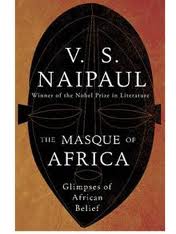
V.S. Naipaul’s “The Masque Of Africa”

This book is short, but dense and challenges readers from at least three backgrounds, including:

  • The Generic ‘Religion as Binding Ritual’ type

I always want to tear my hair out (but can’t because I have none) when I hear people talk about traditional tribal religion as giving shape to communities, providing a pattern of life, and so on, and therefore lament its passing. Yes, it does provide a “pattern of life,” but that is hardly what tribal religion (or any religion) is really about. Make no mistake, according to Naipul many Africans really believe in forest spirits, curses, and charms. They will kill cats (and on rare occasions people) suspected of bringing a curse, sell animals for sacrifices, have the ‘Juju Man’ come and beat ‘offending’ women, and so on. How’s that for a ‘pattern of life?’

Both Christianity and Islam have made huge inroads in Africa over the past century, but Naipaul shows how much traditional religion still survives in Africa, and is even mixed here and there with some Christian ideas.

It’s no good pointing fingers, however.  We in the West should think about how much our cuture influences our view of reality.  I remember a conversation long ago with a friend who asked me what I thought of Eastern medicine.  I expressed my doubts, to which she retorted, “Doesn’t Western medicine proceed with an equally, if not more unbiblical view of mankind as a mere collection of chemicals to be manipulated?”  She had a point.

  • The More Conservative Christian Type

Many Christians (like myself) are unaware of what it means to change one’s religion in the midst of very deep rooted traditions. I wonder if we have taken into account the social and psychological dislocation that results from this religious change. Naipaul subtly shows how Africa’s sense of itself has been uprooted in part by imperialism, and  religious change. This sense of dislocation impacts all areas of life and may contribute in part to much of the continent’s political instability, among other things. And perhaps this is why traditional paganism has a lingering hold. Despite its black magic and confusing ritual it does provide something comfortable and familiar. It is a pattern of life, for all that.

Having said this, one can see the stifling impact ‘traditional’ religion has. The medicine man has to be bribed and appeased.  There are veils of secrecy and fear. What we would consider normal social interaction can’t exist in such an environment. Again, back to my first point, you can’t have meaningful ritual or binding ties without those rituals rooted in some kind of belief. So choose those beliefs carefully. I think one of the African Church’s challenges over the next few decades will be to somehow create a Christian culture that is fully ‘African.’ As the western Church has failed at this task in  our own culture for the past 350 years or so, I have no advice to give them, and wish them more success than us.

  • The African Philanthropist

Maybe westerners are just too impatient with Africa, and because we usually think of religion as a condiment, many well meaning and good humanitarians (better people than myself) have no idea what Africa’s real challenges are. After Rome’s fall, it took Europe about 500 years to reach a ‘pattern of life’ that could bind people together socially and create viable political institutions that could be transferred over time.  None of this happened until the continent was essentially Christian, at least in name. And when it had not fully happened, it took ‘Strong Men’ like Charlemagne to hold things together. Are we wrong to think Africa can do this in the 50 odd years or so since most countries gained independence? It may be that we hold them to much higher standards than we hold ourselves to in our own history.

Naipaul manages to detach himself from his writing and report in deadpan style. He forces the reader into an uncomfortable position. Many times I just wasn’t sure what to make of what he saw, although I don’t know if Naipaul always knew either. I felt uncomfortable, but not in a bad way.  Overall, this book made me have a greater appreciation for 1) African Christians, who even in ‘Christian’ places face unusual challenges, and 2) The idea that religion does more to shape a place than any other factor. In the end, individuals and communities are what they worship, whether consciously realized or not.

Dave

The Integration Between Technology and the Arts

One of the things that has struck me in reading Walter Isaacson’s biography of Steve Job’s is how much Job’s saw himself as an artist.  These artistic impulses help explain a lot about Job’s personality, but also the design of his products.  He cared deeply for simple, integrated elegance.  Bill Gates and others criticized Jobs for making Apple computers closed systems and “robbing people of choice,” as some might say.  But how many artists do collaborative projects?  Once you have a finished work of art, it’s finished.  No artist would allow someone else to add a few brushstrokes here and there.

Some like Apple, and some don’t.  But I don’t think anyone could deny that Job’s largely successful attempt to integrate art and technology is a big reason for Apple’s success.  Western culture is starved for this integration, and while the cult status Apple enjoys among some devotees unnerves many, we should realize that Apple products tap into a deep need we have to make our lives a unified whole.

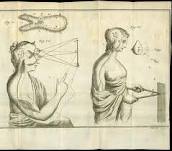
When teaching Descartes I discovered that for much of his work he made his own accompanying drawings.  As far as I know, we have yet to see someone like him, one who combines art, science, and math to such a degree.*

I don’t agree with Descartes’ worldview, but when I see his art part of me wishes I could.

Dave

* I recently realized with delight that the great 20th century physicist Richard Fenyman took art lessons with a friend to help him communicate the emotion of scientific ideas.  But he doesn’t come close to Descartes in my book.  His drawing of people are pretty good, but he couldn’t get the same touch with his famous diagrams.  Looking at Descartes’ drawings, I almost get the sense of what he was trying to say.  I have absolutely no idea what Fenyman tried to communicate with his famous diagrams. . .


Asimov’s “Foundation” and Wikipedia

Last summer I read Asimov’s “Foundation” and enjoyed it.  The plot twist early on (*spoiler alert*) of having the encyclopedia project  function as a ruse to get scientists to an outlying planet hooked me for the duration.  In the story, the mere act of compiling information wasted time. 

Reading Niall Ferguson’s “Civilization, The West and the Rest” got me thinking about encyclopedias again.  Here is my review, and here is another slightly more positive take from which I extracted this quotation (thanks to Marginal Revolution for the link):

In 1420, when London was a backwater, Nanjing was the world’s largest city, and Ming China “had an incontrovertible claim to be [its] most advanced civilization.” That it was a center of learning he makes plain with a typically entertaining detail: the Emperor tasked 2,000 scholars with creating “a compendium of Chinese learning” that “filled more than 11,000 volumes,” which was “surpassed as the world’s largest encyclopedia only in 2007 … by Wikipedia.” So what happened?

Ferguson then goes on to outline the swift decline in China’s navy as the main answer, just as Paul Kennedy did in his The Rise and Fall of Great Powers.  Like Asimov, I have a different theory: China’s encyclopedia itself was a symptom of a disease that already manifested itself in the body politic.

The Roman’s first encyclopedia, for example, came in its post-Diocletian phase, a time of  desperate attempts to conserve what they had lost centuries earlier. There’s the rub; most often, encyclopedias and dictionaries come from a conservative reaction against change.*   A fear of losing something pushes us to gather our nuts frantically for the coming winter.  Thus, it makes perfect sense that the Chinese followed up its massive encyclopedia with a concomitant reaction against traveling to contact new people and ideas and risk losing what they had so carefully tried to preserve.

I use Wikipedia in desperate moments when I forget a date before class, and I think that it has gotten more reliable over the years in giving a general idea of things.  But I have no sympathy with the pleas it makes for support.  For one, we could easily do without it, but something deeper bothers me.  Many, many creative, curious, and intelligent people spend their time for Wikipedia merely repeating and compiling what others have already said elsewhere.  What Truman Capote famously said of “On the Road” could be said of Wikipedia: “That’s not writing. It’s typing.”

Blessings,

Dave

*I admit that the Dictionary made by the French philosophes had a more militant, aggressive character, and is an exception to this rule.

Niall Ferguson’s “Civilization: The West and the Rest”

I did not read this cover-to-cover, so take everything with a handful of salt. 

I liked what I read, but this book feels uneven and rushed in parts. Perhaps that is because his subject is so big. While it feels incomplete, the book does raise some pertinent questions, given the recent rise of China and India.

Ferguson asserts that the great shift in power from East to West that started ca. 1500 can be traced to what he calls six “Killer Applications” (sometimes he uses the word ‘Apps’ – bleah!). They are science, medicine, work ethic, consumption, property rights, and competition. In no order, my thoughts:

  • Some of this feels dated. It seems to me that Paul Kennedy already treated some of these topics regarding competition, openness etc. in his ‘Rise and Fall of Great Powers.’ Ferguson is a great controversialist but this does not feel controversial
  • Couldn’t science and medicine go together?
  • As usual, he has many great visual aids, graphs, etc.
  • Ferguson has an interesting take on the decline of religion in Europe vs. America, and he roots the difference at least in part on America’s more total embrace of competition and the market and its application to churches. He makes the astute observation that having done so, America’s consumer oriented churches will feed an enfeeblement of values that unhindered consumerism brings with it. Thus, while American churches will tell its parishioners to do what we say, not what we do — it probably won’t work.

This was a rare moment of interesting argument for Ferguson (in this book at least), but it doesn’t hold up for me. True, Europe has its state churches, but people are not forbidden from going to Catholic churches in England or Baptist churches in France. The real difference must lie elsewhere — in a deeper place.

The whole religion question seemed like a great opportunity for Ferguson. Here he truly dabbles in some controversy, such as mostly agreeing with Weber’s much discredited ideas surrounding Protestantism. He discusses the rise of Christianity in China and calls it a significant factor in China’s recent rise. By his not not so subtle implication, the decline of Christianity in Europe might be cause for its decline. But having broached the topic, he swerves away. The whole religion question seemed like a great opportunity for him. But he just dips his toe. Jump in, Mr. Ferguson! Sometimes I disagree with you but I like that you make people think and reconsider their ideas. He does not do that here as in some of his other books.

Another moment of missed argument – the idea of a civilization’s ‘confidence.’ He dismisses some of Kenneth Clark’s views on civilization but then basically agrees with one of Clark’s key points, that civilizations need ‘confidence’ to survive. He then comes close to calling out various Western academics that teach nothing but the evils of Western civilization. He almost asserts that such people undermine the basic psychological foundations of the west, an argument many conservatives make. But again, he does not press it home or follow its implications.

This is what makes this work so tame in comparison to others. He no longer acts like the young historian out to take on the world, like in ‘The Pity of War.’ I disagreed with decent chunks of that book, but it was fun to read. This one is boring, if not still informative.

He raises, but leaves wide open, the question of whether or not China’s rise will mean a smooth transition for the West or not. China has gotten more powerful by adopting many of the ‘Killer Applications’ that made the West. Is this good for us? Should we root for China to become more western? Will the U.S. in 20 years be China’s partner like England is to the U.S.? Or will it go worse for us? Ferguson hints, dances, and leaves it in the air.

Here’s hoping that Ferguson takes some time off from books and tv, goes into a cave, and emerges five years from now with something better.

Bligh’s Portable Nightmare

The full title of the book is Captain Bligh’s Portable Nightmare: From the Bounty to Safety — 4,162 Miles Across the Pacific in a Rowing Boat.

With such a title, the author John Toohey borrowed from the dense Enlightenment style from the period he chronicles.  The original title of Bligh’s own book was The Narrative of the Mutiny aboard His Majesty’s Ship ‘Bounty;’ And the Subsequent Voyage of Part of the Crew, in the Ship’s Boat. 

Bligh’s mentor and hero Captain Cook wrote one entitiled, The Voyages of Captain Cook Round the World: Illustrated with Numerous Engravings on Wood and Steel.

Clearly, the late 18th century liked long titles.

Toohey writes well and tells a remarkable story, making some inspired guesswork about what happened on the launch and how they possibly could have traveled so far and survived.  Put Bligh’s accomplishment in the long list of things perhaps no one on Earth could do today.  To be fair to us, Bligh may have been one of the few of his time that could have done it as well.

The book grabbed me for other reasons.  Bligh represents much of his time.  In Bligh we have a man of incredible mathematical and navigational gifts.  But the journey required a great amount of indescribable “feel” as well as inspired guesswork honed by years of sailing by sun and stars.  Bligh’s abilities were innate to be sure but also honed by all the fruits that the Scientific Revolution and Enlightenment had to offer.

But it’s the long titles of all those 18th century books that bothers me.  Those titles seem so earnest and so dedicated, just like the men themselves.  But their style can be so heavy and didactic that all life gets sucked out of them.  In the same way, some of the era’s  great men like Bligh seem out of touch not just with the universe itself but with each other.  Even while in the rowboat fighting for the life of the crew, Bligh managed to make these impressive maps of surrounding islands that later sailors would use themselves and declare accurate:

But when one the men on the launch died in a Dutch settlement, Bligh did not even know if the deceased had family to notify.  He could save the lives of his men without relating to them as human beings.  Bligh’s tragic resentment towards his men whom he believed did not sufficiently appreciate him shows him to be all to human indeed.

Blessings,

Dave

And now as a postscript, being for the edification of Ladies and Gentlemen alike, for the purpose of reinforcing the bloggist’s aforementioned point concerning the titles of books in the said era under discussion. . .

Some other titles of 18th century books:

An Introduction to the Italian Language Containing specimens both of prose and verse … with a literal translation and grammatical notes, for the use of those who, being already acquainted with grammar, attempt to learn it without a master …   By Samuel Johnson

The New England Almanac, or, Lady’s and Gentlemen’s diary, for the year of our Lord Christ 1775, calculated for the meridian of Providence, New England,  lat. 41° 51′ n. and 71° 16′ w. from the Royal Observatory at Greenwich; but may serve all the adjacent provinces.  By Benjamin West

“Everybody Loves Our Town” — Seattle’s (and America’s) Identity Crisis

I grew up loving “Grunge” music.  I remember where I was when I first heard “Smells Like Teen Spirit.”  How many other 18 year olds rejoiced with me, as we could move from cuffed khaki’s and pastel button-up shirts to jeans and untucked flannel?  It was an oasis in a desert.  Freedom!

I also like oral histories, and so it was a given that I read Everybody Loves Our Town: An Oral History of Grunge

The book has many interesting aspects, but a theme throughout was the dilemma Grunge artists faced.  The whole musical movement had its roots in being an outsider and on the fringe.  They bucked the system — the system was the enemy.  But what happens when you get wildly popular?  What happens to your identity when you get on the cover of Time  magazine?  Can the two co-exist?  This theme runs throughout Mark Yarm’s excellent work. 

As you might imagine, the dilemma produced a profound psychological crisis for many.  Take Nirvana’s second album, for example, which is vastly inferior to Nevermind.  It’s almost as if Cobain wanted to make it bad on purpose.  I don’t think they were a “one and done” kind of band, either, as their stellar performance on MTV Unplugged showed.  In tragic retrospect, this video from In Utero shows Cobain’s self-loathing.  Soundgarden bassist Ben Shepperd astutely remarked that you can hear Cobain’s self-hatred in how he uses his voice.

This concept of “identity crisis” I think applies to civilizations as well.  Take Rome — for centuries they are the “Little Engine that Could” and then, within a few years of their victory over Hannibal, they have unquestioned Mediterranean dominance.  Their subsequent history shows that they did not handle their new role well at all, and this identity crisis runs right down through to The Aenid.

How about the United States?  What is our self-image?  Have we gotten used to the idea that we are globally dominant?  Even in the Cold War we could assume the “underdog” mantle.   I think it’s safe to say that we do not like to think of ourselves this way and do not like it when others see us as the “top dog.”  How will we handle our own shift in identity?

Is this perhaps why so many instantly related to the Clint Eastwood Super Bowl commercial?  Being the underdog — that’s what we identify with.  This poses a tricky dilemma for politicians.  On the hand they usually need to say something like, “America is strong!” and on the other have to inculcate a “We’re down, but not out!” mentality.

Regine Pernoud’s “Those Terrible Middle Ages!”

Don’t be fooled by the unfortunate, somewhat silly title.  Ms. Pernoud is sharp old French woman you don’t want to mess with.  She brings her best wit and sarcasm to the table. 

Pernoud starts by acknowledging that most everyone believes that “Middle Ages” means “darkness,” oppression, and rigidity.  Pernoud argues that this grossly misrepresents the period, which should not surprise anyone with some familiarity with actual medieval people. What makes her work interesting and entertaining is that Pernoud thinks that the epithets we apply to the Middle Ages should really be reserved for the Renaissance.

The success of her first aim was almost a given, and the book does serve as a helpful resource for those looking for a quick and positive spin on the Middle Ages.  But as much as we might admire a lone knight sallying forth to slay a dragon, does she have any chance at bringing down the massive psychological support the West has given the Renaissance over the past centuries?

The planks of her argument:

1. For the first time in western history, European civilization during the Middle Ages eliminated slavery from the social structure.  Don’t you dare call serfs “slaves,” she asserts.  Serfs had many legal protections and rights from the Church and from the nobility.  Slavery returned in the Renaissance, when scholars revived Roman concepts of ownership.

2. Medieval culture embodied genuinely popular culture–the culture of the masses, of the tradesmen.  The great artistic achievements, like cathedrals, exemplify truly ‘popular’ achievements in this respect.  By contrast again, the Renaissance introduced aristocratic culture patronized by society’s elite, with only “the artists” fit to contribute.

3. Medieval art and the Gothic style, whatever its weaknesses, brought something original to human expression.  Whatever the merits of Renaissance art, they merely cut and pasted a dead image from Greece and Rome.  We falsely give the Renaissance credit for its supposed color and pageantry; while in reality “classical fanatics” during that period smashed the multi-colored stained glass windows and put clear panes in their place.

4. If you like weak central governments and local color, then you should like the Middle Ages.  The power of the king rested on a variety of contingencies.  During the Renaissance we see the centralization of the power of “The Prince,” and the beginnings of the road to absolutism practiced by Charles I and Louis XIV a century later.  Again, this was due to the pernicious influence of Roman ideas of power.

Does she succeed in this “great reversal?”  Well, at least she come close.  If the book has a weakness, it would be that it is too “French”–too assertive and dogmatic.  But, that is part of what makes it a fun read.

Blessings,

Dave

Spengler’s “The Hour of Decision: Germany and World Historical Evolution”

I confess I am a bit mystified by the high reviews some give this book. It’s not just the disturbing racial undertones  of what Spengler says, but the lack of coherent, consistent, and original thinking that made this book a bit of a chore for me.

One highlight, however, is that here is a Spengler book I can actually understand (for the most part).

The book blurb talks of how this book influenced Nazism and Hitler in particular. Unfortunately, there is good reason for this link. Spengler talks a lot about race, racial vigor, blood, and so on in ways that are most definitely unnerving, considering that he wrote in 1933. So, some of it is distasteful, some of it is frightening, and some of his talk about race is downright absurd. But Spengler is too smart for us to dismiss this book outright.

This link between Spengler and the Nazis may not be fully justified. At one point Spengler writes, “Those who talk too much about race no longer have it in them. what is needed is not a pure race, but a strong one, which has a nation within it.”  I think that Spengler would probably accuse the Nazis of “protesting too much” about race in general. He would have thought that their racial obsessions marked deep insecurities.  At least I hope so.

If we unpack this quote I think one can get to his main point. Spengler likes things to be definite. He likes specific cultural achievements and style (i.e. the Gothic). He likes particular people to make their mark on history (i.e. Bismarck). He likes rights particularly defined, at one point praising Burke for talking about his ‘rights as an Englishman,’ as opposed to vague, uncontexualized, “human rights.” He critiqued the Weimar Republic , for example, for eroding all the best that “Prussianism” had to offer Germany.  Here at least I don’t think I can agree.  I admit it’s easy to dislike the Weimar Republic but much easier and better to hate the word “Prussianism.”

This is why he did not like democracy. He brings out the old saw that it essentially is mob rule and will create a blase and meaningless culture.

Is there anything here worth considering?

  • He has a decent analysis of W.W. I as the wrong war to fight at that time. The real enemy was Russia, and any war fought by Germany with such opposites as Russia and France was bound not to be decisive.
  • He makes thought-provoking comparisons between Russia and the U.S. Both, he argues, have despotism in their future. And his links between democracy and despotism are worth considering. The size and scope of the country (note again his preference for measurable, definite things) will naturally pull us in that direction. Of course Jefferson disagreed and thought the size of the country would prevent it from being centralized. We shall see, and I certainly hope that Spengler is wrong on this one.


A Word on Methodology and the Purpose of History

On the first day of school in 8th grade Ancient History (which is the first time I will have taught any of the students in that class), I begin class with the premise that I am wasting their time.

History, after all, (I argue) has no real bearing on your life.  We study some names and dates from the past, a few battles here and there.  Sometimes it might have entertainment value but will never really impact you in any way.  Whatever Cyrus the Great did, be it good or bad, won’t impact on you today.  The past has no present.

Depending on their personality and previous experience students either get very excited or troubled by the prospect that we can blow off the year.  Yes, eventually we get around to reasons why hopefully I will not waste their time, but we should not sweep the arguments against History under the rug too quickly.  Before we bother with History in the first place, we should know what we are doing and why.

Some students respond by stating that history offers us lessons.  When people do bad things, we can learn to avoid them, when they do good we can emulate them.

This is a very common answer, with some truth in it, but I refuse the premise on which it’s based.  Reducing history to didactic lessons runs akin to telling people that Christianity is about adhering to a superior morality.  Whatever truth lies in that statement, Christianity really is not about “morality” at all, or at least, the moral component makes no sense without a much larger context.

In the same way, History does not begin and end with proverbs and moral lessons.  It should be about encounter.  It should be about transformation.

History is often and easily abused.  One common form of abuse is using History as a vehicle for proving a pet theory, something all of us can be guilty of at times. Such an approach is both dangerous and uncharitable.  Uncharitable, because History has no room to speak for itself when we insist it conform to us.  We stop listening and lose the possibility of empathy and understanding.  Dangerous, because manipulating the past puts us in a position of great power.  We erect a wall between ourselves (the “good,” or those with knowledge and understanding) and others, those who “should know better.”  If we do this, we cannot learn, cannot be challenged, and cannot grow.

Finitude will always limit our experience, but we need confronted with “the other” to get shaken out of our narrow field of vision.  Historians can often make the mistake of viewing the past in terms of the present, but this robs the power of the past to really do its work.  Seeing through different eyes pushes us beyond ourselves.  In writing about great books, C.S. Lewis said,

. . . in reading great literature I become a thousand men and yet remain myself. Like the night sky in the Greek poem, I see with a myriad eyes, but it is still I who see. Here, as in worship, in love, in moral action, and in knowing, I transcend myself; and am never more myself than when I do.

This is how History (like all our endeavors) should prepare us for the Beatific Vision.  The “otherness” of different cultures and people can by grace train our hearts for the “otherness” of God’s Kingdom.  Other times and places should also make us humble and charitable.  Hindsight is a great luxury, but we must avoid “finger-wagging.”  We must honor the past by viewing it as they saw it, not as we see it now.  We too act in a fallen context without omniscience.  Those in the past lived under the same constraints.  What kind of decisions would we make in their place?

Bringing it to the present, how do we act morally and justly with the information we have?  How do we make decisions in a fallen world?   We must take responsibility for these decisions, and the difficulties we face should make us rely on God’s grace and wisdom.  Our own sin should make us slow to judge those in the past that struggled with many of the same things as ourselves.  Are we so sure that we would do better?  When we, with proper conviction, call out the past for its mistakes we likely will need the humility to call ourselves and our own society to account.

I am not interested so much in changing the opinion of any student about, say, Napoleon or the Industrial Revolution.  But I am very much interested in 1) Each student coming to a greater understanding of their view of the world, and the extent to which that view can be supported by Christian belief, ethics, etc., and 2) Each student more fully understanding the implications of their decisions in the short and long term for themselves and others.

Mark Twain once said that history does not repeat itself, but it does rhyme.  As we see connections and patterns, we learn more about humanity.  But humanity does not exist in a vacuum.  As in all disciplines, the study of History involves an attempt to understand Reality, imbued with God’s presence.  As Francis Schaeffer said, “He is there and He is not Silent.”

About the Title of This Site

‘A Stick in the Mud’ pays homage to the late great Kenneth Clark, who won international acclaim for his ‘Civilisation’ series in 1969.

To be sure, Clark has his detractors.

Against him, one might say that,

  1. He is a mildly stuffy British lord
  2. He has bad teeth
  3. Niall Ferguson (another favorite of mine) took a shot at Clark in his latest work, “Civilization: The West and the Rest.”  Ferguson argued that civilization isn’t about pictures and sculpture so much as it is about roads, banking systems, and stable governance.

Would Clark have disagreed?

I think so.  All decent civilizations have roads, financial systems, and so on.  Their differences in these areas would be quite instructive though I suspect we would find more similarity. The variety of artistic styles, however, shines immediate and obvious light into the values of any creative people.  After all, one might make a banking system as a mere slipshod afterthought.  No one would do this with a sculpture.

I heartily encourage you to try out Clark on your students.  Those who do will be delighted by his insight and careful eye.  Yes, your students may groan at the prospect.  When they do that with me I tell them, “You protest too much.  You are only groaning to cover up your real love for Clark, and to maintain some semblance of cool in the eyes of your classmates.  It’s alright, I’ve been there too.”

They usually do not groan after that.

Enjoy!