Stopping the Buck in Russia and Elsewhere

I have always been amused by Milo Yiannapoulos, and have regarded him primarily as a funny person, an obvious provocateur.  Every court jester knows that he has to push the envelope to fulfill his duty.  The king must remain flexible enough of mind and heart to laugh rather than get angry.  It is indeed the foolish king that gets angry at his fool.

Milo has always contained contradictions and has never hid his admiration for Catholicism, despite the fact that he was abused by a priest as a young boy. Despite the fact that he lives as openly gay, he has never wanted the Church to change its official position on gay marriage or homosexual behavior in general.  But despite his support of traditional morality, he is gay married.  But, he then goes on to insist that his is not a marriage at all–which can only be between a man and a woman– but rather a civil partnership of some kind.

In a recent interview with Patrick Coffin, Milo showed that he honestly wrestles with some of these contradictions.  He spoke of how he used free speech as a tool against the radical left and the good effect he felt it had.  But he also acknowledged his realization that free speech by itself remains a mere tool and not a destination.  The tools need used in the service of some greater good, and he feels now that this “greater good” is found in the Christian foundations of western civilization.

But he still remains gay married.  We’ll see where this all ends up for him in the coming years.

I have felt for some time that the current debates about free speech and our current political mess are really about our search for a new center, a new place where we can all agree that the buck stops.  The left, which used to ardently defend free speech, now uses exeedingly irresponsible language in regard to curtailing this right on campuses and beyond.*  We all recognize at least subconsciously that free speech cannot stand as our absolute monarch.  No one thinks we can yell “fire” in a crowded theater.  We know that free speech needs some limits and direction. Our problem now is that we have no agreement as to what end we should direct our rights.  And, if we do not know how they should be used, some now think that we should put away these “weapons,” or at least reduce the scope of these rights.

I use the word “monarch” intentionally.  We booted out George III and banned aristocracy.  But of course we have makers of taste, and of course the buck must stop somewhere in any culture.  In some cases it might be with a person, or possibly a place, or in America’s case, most likely in some shared ideas and beliefs.  As Milo has discovered, not even our vitally important right to free speech is an absolute value or a final destination.

Russia has been in the news for some time lately, and we are used once again to the idea of Russia autocracy.  Certainly Russia’s history gives ample evidence that they have less of a problem with authority than most Americans.  But Russia too has at times had crises of authority, and George Fedotov gives us the context and story of one of their most famous confrontations involving the power of the state in volume three of his collected works entitled, St. Fillipp, Metropolitan of Moscow: Encounter with Ivan the Terrible.

Fedotov gives good background to the conflict between the czar and the saint:

  • Czar Ivan III (grandfather to Ivan IV, the Terrible) began to introduce more “foreign” court subservience via his marriage to a Byzantine princess.  One can argue that the expansion of royal courts could hypothetically serve as a buffer to the unlimited power of the king.  Alas, they can also tend to create competitions for the favor of the monarch, with the resul that royal favorites are merely obsequious to the king, and this seemed to happen in Russia.
  • Fedotov gives proper blame to the church under the reigns of Ivan III and Vasilli III (grandfather and father of Ivan IV, respectively) for continually extolling and promoting the wars of the monarchs.  Many church heirarchs made sacrifices of conscience to honor the power of the czar.
  • As a case in point, Fedotov highlights the divorce and remarriage of Vasilli III, who while not an abusive despot, obtained a most uncanonical divorce due to his lack of children with his first wife.  Some church heirarchs supported the divorce on purely political grounds of succession, which set a dangerous precedent of the church finding ways to justify whatever the czar wanted to do, of putting the state before God–or confusing the state with God.

Thus, by the time we reach the reign of Ivan IV (the Terrible, b. 1530, d. 1584), the power of czars badly needed curbed, and the church desperately needed a soul and spine to give proper direction to the government and the people of Russia.

Ivan IV likely had some kind of genuine religious faith.  However, his faith focused on apocalytpic visions, and he felt himself beseiged by traitors everywhere.  He saw himself as Russia’s last bastion of hope.  Perhaps Ivan truly suffered from a psychological disorder, but as Metropolitan Fillip knew, Ivan did not need “understood” so much as he needed stopped.  Ivan built on his grandfather’s court policies and elevated certain favorites, even foreign favorites from Germany.  He executed his brutal repression of “traitors” through them, the so called “Oprichina.”  In a time reminiscent of the Reign of Terror in France, thousands had property seized, and thousands of random murders took place on a whim.  Fedotov rightly points out that Ivan inaugerated civil war within his own land, a likely reflection of the torments and divisions in his own mind.  No one who looks at those persecuted by Ivan believes that no more than a few were guilty of anything.  But, the will of the Tsar prevailed without question.

Beneath the tragedy lay the genuine questions: what is the basis for authority in the state?  What is authority for?

Ivan possessed great intelligence and had a keenly developed theory to buttress his use of power.  Like many other monarchs of his day he believed in the divine right and gifting of kings.  He saw his power like that of the emperors of Constantine, and even Augustus, showing that he believed Russia to be the new “Rome” after the collapse of the west and of Byzantium.  Ivan asks, “How can an autocrat rule if he does not do so by himself?”  In the realms of the “godless” a different situation exists, he argued, but in Russia, “autocracy has always been supreme in the realm.”  “Every kingdom is destroyed when it is ruled by priests.  [Priests] destroyed the Greek state and now it is ruled by the Turks.”  In Israel as well, “God did not place a priest or commoners as the ruler or rulers of the people when he led them out of Egypt, but gave power only to Moses, like a Czar.  But when Aaron the priest “temporarily assumed this authority over people he led them away from God,” and the same happened in the days of Eli (see I Samuel) “who took unto himself the sacerdotal and lay power,” leading Israel into disaster.  “Do you see how it is not good for the clergy to rule over that which belongs to the czar?”

Ivan points out further that of course, the czar might sin, but even many of the saints “were among the fallen and the rebellious.”  His sins then, did nothing to limit his power.  Russia may suffer, but through suffering Russia will be purified and brought to greater faith.

In his political writings Ivan talks much about justice and wrath against evildoers, and the need for God to rule unfettered in the state through his chosen man.  The czar should promote the good and punish the wicked. Fedotov skillfully points out, however, that for Ivan the reality of truth rarely receives mention, and that, “The patriarchial relationship of the Tsar to the people as his children, as ‘wards of the state,’ gives way to the severe rule of a master over his slaves.”

We may not want the Church to weild political power, but as Fedotov states, “The Church’s participation in worldly affairs is natural, because the world too is subject to Christ’s truth.”   We have many recorded words from Fillip, some of which I include below:

The crown of piety adorns the Tsar more than any earthly glory.  It is glorious to display one’s power over one’s enemies, and one’s humanity to those who are submissive.  And, in defeating enemies by force of arms, it is glorious to be conquered by one’s own unarmed love.

You have been placed by God to judge the Lord’s people in truth, not to take upon yourself the image of a torturer.  Do not divide the realm.  Unify your people, for God is present only when there exists a spirit of sincere love.  Forgive, and you shall be forgiven.  Do not put your trust in any kind of justice which is not from God.

Ivan told Fillip he had heard enough and warned him on many occasions to be silent.  Fillip responded,

Our silence places a sin on your soul and causes national death.   Our faith will be in vain as will the very Incarnation of God.  If I maintain silence in matters of truth, then I cannot retain episcopal rank.

Fillip’s failure to maintain this silence eventually brought about his death at the hands of Ivan, who felt that he had found yet another “traitor” seeking to undermine his holy will.

One notable aspect of Fillip’s responses to Ivan is that they do not concentrate on legal distinctions, but rather personal commitment to something beyond rights and arrangement of power.  In the west, for better or worse, church and state fought at times over legal rights.  Fillip makes no appeal to the legal rights of the church or his own legal standing as Metropolitan.  He sought not a legal solution but a moral or spiritual one.  The “buck stopped” not with a code of conduct, but in the hearts of men committed to universal truth.

For all of my numerous objections regarding the progressive left’s attack on free speech, I acknowledge that they, along with Milo, see that free speech alone gets us nowhere, and should be in service of some higher truth.  One area where I diverge from the left is that their persistent insistence on dividing people into separate identities of race, sexuality, and gender will defeat their very purpose of finding this universal higher truth and lead us all, like Ivan the Terrible, to find “enemies” everywhere we look.

The postscript to Fillip’s death illustrates this.

In 1590, 21 years after his death, the monastery of which he as formerly the head requested that his body be returned to them.  They wrote to Ivan’s grandson Tsar Fedor, who eagerly gave his permission.  His exhumed body showed no decay, and very shortly after he was reinterred at the monastery, many were healed at his tomb.  The miracles continued, and by the 1650’s, Fillip was now St. Fillip of Moscow.  Czar Alexis (who had the interesting moniker of “the Quiet”) wrote a letter to the monastery, addressing St. Fillip directly,

Even though I am innocent of your vexation, my great-grandfather’s coffin convicts me and leads me to grief.  For this reason I bow my imperial dignity for him who sinned against you, that you forgive him by your coming here.  I submit the honor of my kingdom to your venerable relics.  For the sake of his penitence, and for our forgivenesss, come to us, holy one. You have accomplished the word of the Gospel . . . and there is no controversy about the commandments of God.

The monastery did send the body of St. Fillip, and when he appeared in Moscow Tsar Alexis spoke,

O blessed commandments of Christ!   O blessed truth!  O blessed is he, and thrice blessed, who carried out Christ’s commandments and suffered for them for his own people.  Truly, one can choose no better than to be glad and joyous in truth, to suffer for it, and to reason with God’s people about truth.  . . . God’s judgement does not dwell in falsehood . . . . and we have concern for all Christian souls, and it is our duty to stand strong and pillar like in the faith and in truth, and to suffer unto death unto ages of ages.

The Tsar understood that the repentence needed to be on a national level, for many had profitted from Ivan’s plunders and murders, contributing to the de facto civil war within Russia, and many cooperated with the notorious Oprichina.  But if the repentence involved all, so too the joy.  Tsar Alexis wrote to Prince Odoevskii that,

God has given us a great sovereign, a great sun.  Just as the relics of the radiant John Chrysostom were returned to the ancient emperor Theodosius, so also God has granted us a healer, a new Peter, a second Paul . . . the most splendid and most radiant sun.  We have been granted the return of the relics of the miracle-worker Fillip, Metropolitan of Moscow.  . . . We greeted Fillip at the Naprudnaia settlement, and took the relics upon our heads with great honor.  As we were taking them, a miracle occurred–a raving and dumb woman immediately became well and began to speak.  . . . And when we brought [Fillip] to the square across from the Granovitaia, here again a miracle occurred.  A blind man was healed, and just as in the days of Christ, people cried, “Have mercy upon us son of David!

DM

*I refer primarily to Justice Kagan’s remark about the right seeking to “weaponize” the first amendment.  The Janus case has complexity that deserves a fair hearing on both sides, but I found the phrase itself troubling.  But as a counterpoint, see this argument as to why we should think of righs as weapons (though he makes no comment on the merits of the case itself).



The Unprofessional Historian

I can’t quite help myself when it comes to Arnold Toynbee.  But I acknowledge  . . . In his 12 volume A Study of History (I have read about 8 of them) he repeats himself many times, and uses some of same examples more than a few times.  He veers sometimes wildly between philosophical speculation and the facts of the case (which I love but I understand might bother others).  A central point of his examination of Greece and Rome involves conflating them to such a degree that he seems to claim that Rome began to decline when the Pelopponesian War began.(!) He drifts too easily into gnostic, or perhaps Neo-Platonic, tendencies that raise many of my eyebrows.

Still, he takes huge swings, takes big risks with his thoughts, and offers a coherent picture of civilizations that mixes various disciplines such as archaeology, philosophy, myth, and the like.  He is in my mind the ideal of what a historian should be, not so much in his conclusions, but in his methods.

‘Volume 10’ is almost last volume of his A Study of History and has only about 150 pages of straight text, with a few appendices and a long and needed index to the other 9 volumes. This conclusion might even serve as a good introduction to the whole of his work, for here he fully describes and defends his view of what an historian is, and what History should be all about.

I say he ‘defends’ but this might be misleading, for it sounds like a didactic argument. It’s not. Part of the charm of this book for me is that he let’s himself go and speaks with passion from the heart. But the Toynbee magic is still here, as even in the first few pages we see him seamlessly weave in his grand view of history with personal recollections and observations about changes in women’s headgear in Victorian England and Turkey in the 1920’s.

I can understand people disagreeing with certain particulars of his “system,” but doesn’t this sound like fun?

His main points are

  • A historian’s proper vocation (as is the case in other vocations) is to receive and act on a call from God to ‘feel after Him and find Him.’ (Acts 17:27). There are as many ‘angles of vision’ as there are proper vocations. The historian’s vision is not greater or lesser than these, but he has a task nonetheless.
  • The inspiration of a historian is ultimately a spiritual one. The ‘muse’ of curiosity leads into broader fields of vision. Since God aims to unite all of humanity, one’s field of vision under the inspiration of the ‘muse’ (I think Toynbee means to use this term in at least a mostly literal sense) will inevitably broaden.
  • He does not spend much time on this, but this question leads to a small digression on Toynbee’s dislike of the ‘professional’ specialist. The ‘professional’ pursues not true knowledge but an impossible omniscience. This pursuit is of course impossible, and whatever knowledge he gains will be sterile — it will in fact not be real knowledge at all, and certainly not wisdom. His lack of ‘action’ in the world has a humble mask, but only serves to camouflage ‘the three deadly sins of Satanic pride, negligence, and sloth.’ (p. 26). God calls us to add to the stream of human knowledge of the world and Himself by adding one’s own thimbleful to the stream. Knowledge is never for one’s own sake or for the sake of knowledge itself, but to put humanity in a better position to know God. The same Spirit that inspires us to investigate human affairs calls us to action in service, however small, to humanity as a whole.

Perhaps this gives us some insight into his admiration for Heinrich Schliemann. Of all the historians he admires here (Polybius, Herodotus, St. Augustine, etc.) it is Schliemann, the messy amateur par excellence, whom he spends the most time with. Surely in Schliemann we find a man “inspired,” one who led with his heart rather than his head. It may be said that he created the modern field of archaeological study by going on a goose chase of absurd proportions.  And yet, he discovered Troy and Mycenae. He created the discipline of archaeology. But as soon as archaeology developed into a profession the “professionals” he creaetd dismissed him as a carnival barker. Toynbee does not dwell on Schliemann’s personal life or professional errors, but surely he would say for every step back he took two or three forward.

Finally, towards the end of the work, Toynbee sheds light on his religious views. He does this in a more straightforward and polemical way in ‘Experiences,’ which he wrote about a decade after this, and his views did not change much from this volume to then. I do not agree with his final conclusion in either volume. But here his conclusions make more sense to me in the context offered — that is — I can see how much his ‘heart’ was in his views. This is a point made by his friend Columba Cary-Elwes, a monk, in their correspondence (“An Historian’s Conscience”) which I accepted but did not understand until now. Cary-Elwes also disagreed with Toynbee ultimately, but felt that there was more agreement than Toynbee may have been aware of. Of course, as a “friend’”of Toynbee myself, I would like to think the same thing. This may be purely wishful or even ego-centric thinking on my part, but I hope not.

Basically, Toynbee believes that ultimate reality is spiritual reality, and that this spiritual reality is Love. Love is best expressed in action, not in words or syllogisms. Hence, Historian’s are called to action, and hence, Toynbee’s rejection of the various dogmas of religion as essentially unimportant distractions. He saw unity in human affairs throughout time, and a uniformity of human nature. All this led him to affirm the essential unity of religions. Claims to exclusivity are at best misdirected and at worst rooted in pride.

This is a good argument, and Toynbee was far from a cynic. He did not seek to attack religion so much as promote what he saw as something ‘higher.’ I think the Church would say that Toynbee was right about many things. But, as Chesterton said, “You cannot make a success of anything, even loving, without thinking.” He said in Orthodoxy,

The things said most confidently by advanced persons to crowded audiences are generally those quite opposite to the fact; it is actually our truisms that are untrue. Here is a case. There is a phrase of facile liberality uttered again and again at ethical societies and parliaments of religion: “the religions of the earth differ in rites and forms, but they are the same in what they teach.” It is false; it is the opposite of the fact. The religions of the earth do not greatly differ in rites and forms; they do greatly differ in what they teach. It is as if a man were to say, “Do not be misled by the fact that the CHURCH TIMES and the FREETHINKER look utterly different, that one is painted on vellum and the other carved on marble, that one is triangular and the other hectagonal; read them and you will see that they say the same thing.” The truth is, of course, that they are alike in everything except in the fact that they don’t say the same thing. An atheist stockbroker in Surbiton looks exactly like a Swedenborgian stockbroker in Wimbledon. You may walk round and round them and subject them to the most personal and offensive study without seeing anything Swedenborgian in the hat or anything particularly godless in the umbrella. It is exactly in their souls that they are divided.

So the truth is that the difficulty of all the creeds of the earth is not as alleged in this cheap maxim: that they agree in meaning, but differ in machinery. It is exactly the opposite. They agree in machinery; almost every great religion on earth works with the same external methods, with priests, scriptures, altars, sworn brotherhoods, special feasts. They agree in the mode of teaching; what they differ about is the thing to be taught. Pagan optimists and Eastern pessimists would both have temples, just as Liberals and Tories would both have newspapers. Creeds that exist to destroy each other both have scriptures, just as armies that exist to destroy each other both have guns.

Chesterton is mostly, but not absolutely correct with this. I would add what C.S. Lewis said in Mere Christianity, that he would not have believed in Christianity unless it professed some similarity with other religions. As he came to see, it would be impossible for other faiths to contain no truths. But Christianity could be the fulfillment of the hints and whispers in other places. Toynbee came to close to asserting this himself in his “Christianity and Civilization” essay included in “Civilization on Trial.”* It is not arrogance to believe that one has found the truth, or more correctly, that the Truth has found you.**

Please pardon the long digression (for those still reading :), but I have learned a great deal from Toynbee. I feel the clue to much of his genius is in his religious views. For him, History was very much a religious endeavor, with an emphatically religious goal. I couldn’t agree more. But here too is his greatest error.

This volume is eminently suited for anyone interested in these kind of questions. The prose is lively, and the heart and mind are both engaged.

Dave

*It is probable that Toynbee came closest to a profession of traditional Christian belief when he wrote this essay in the late 40’s.  Indeed, it is Volumes 4-6 of his study, written just before this time (I think), that are his best work with his best religious insights into the meaning of history.

**After publishing this volume, Toynbee’s views if anything only drifted further from Orthodox Christianity. But there is this brief excerpt from Toynbee’s good friend Columba Cary-Elwes, a monk and frequent correspondent with Toynbee.

During our last meeting, during which he was incapable of clear speech or writing, suddenly he said very distinctly, ‘In the name of the Father, Son, and Holy Ghost,’ and then fell back into silence. As I wrote before, I do not use that to prove anything to the general public. It may have been an act of courtesy to me on his part, as Veronica suggested. For me it was an answer to prayer!

Relic

The Introduction to Relic opens this way:

American government is dysfunctional . . . .  As a decision-maker Congress is inexcusably bad . . . utterly incapable of taking responsible, effective action . . .

So why is this happening?  The common view is that Congress’ problems are due to the polarization of the [political] parties over the last few decades.  By this rendering, if the nation could move towards a more moderate brand of politics–say by reforming primary elections or campaign finance–Congress could get back to the way it functioned in the good old days when it (allegedly) did a fine job of making public policy.

But this isn’t so.  . . . The brute reality is that the good old days were not good. . . . Congress’ fundamental inadequacies are not due to polarization.  Nor are they of recent vintage.  Congress is irresponsible largely because it is wired to be that way–and it’s wiring is due to Constitutional design.

[Congress’] pathologies are not really of it’s own making.  They are rooted in the Constitution, and it is the Constitution that is the fundamental problem.

I have concerns over the growth of presidential power in the last few generations, but . . . I love it 41XKcNSIeQLwhen writers undertake such magnificent and almost dashing glove-slaps to our received wisdom.  Authors William Howell and Terry Moe teach at the University of Chicago and Stanford respectively, so this is not a talk-show rant.  They write with an apolitical bent for the most part and take a broad view.  They focus on clarity and concision and don’t try and dazzle us with their erudition.

I don’t think I agree with them, but I admire their efforts.  We need more books with these strengths.

Their basic argument runs as follows:

Before the Revolutionary War each colony acted almost entirely independently of one another.  No one had any idea of a “United States of America.”  During the war we created the Articles of Confederation, which, while it created a national government, made it exceedingly weak.

This then, is their first main point.  Yes, the Constitution created a stronger national government–but not that strong.  We have to understand the Constitution’s grant of executive power not in a vacuum but in relation to the Articles of Confederation.  The Constitution still allowed for states to have the pre-eminent place in people’s hearts.*

The design of our federal government reflects this by giving nearly all the most important powers to Congress.  This in turn makes it very difficult to enact national policy.  This was not a mistake.  This is the exact intention of most of the founders (though not all, such as Alexander Hamilton, who argued for a much stronger executive at the Constitutional Convention).

When we manage to create a national policy, such policies get diluted, confusing, and sometimes absurd because of the fact that all laws have to come through Congress.  Everyone wants their piece of pork, everyone needs something to crow about.   The confusion of many laws, and the expense needed to enforce them, weakens government, expands bureaucracy, and lowers quality of life.  Again, the authors don’t blame Congress for this.  Our representatives have job of representing their districts, not the national interest.

The authors argue that Congress has never solved a national problem.  It has either taken either national emergencies (like war, disasters, etc.) or unusually shrewd or charismatic presidents to get Congress to move.  They concede that perhaps our form of government worked in the pre-industrial era when towns remained largely isolated from one another (though Congress certainly could not solve the slavery issue, the biggest contributor to the Civil War). But the Industrial Revolution created a new country that drew the states much closer together.  We now think of ourselves as “Americans” and need national policies on a consistent basis.  Again, we should not say that Congress will not solve them. Congress cannot solve them, just as pigs can’t fly.  We have, in fact, many problems on the horizon that have existed for decades that Congress will never solve, such as Social Security reform, the tax code, the national debt, and so on.  And while the American Revolution inspired a variety of democratic movements across the globe, no one has copied our system of government.**  This should tell us something.

Their solution mirrors the simplicity of their writing.  They know that rewriting the Constitution is impossible, and officially amending it very difficult.  Instead they seek “fast-track” authority for certain kinds of legislation.

Lest we deride their analysis as overblown, the authors point out that we already recognize the foolishness of our constitutional design with international treaties and trade agreements.  We give the president power to negotiate such agreements without congressional interference.  Presidents then can present them to Congress for a simple “yes”/”no” vote.

The authors propose that we simply allow presidents to submit legislation to Congress involving national policy for this kind of yes/no vote.  No pork, no earmarks, no preferments, no deals. Congress needs to keep its diseased hands away from issues like the national debt, health-care, and national defense. If such laws passed they would have the clarity and unity needed for effective policy.

That’s it.  No fuss, no muss.  It preserves the Constitutional role for Congress and merely expands slightly the powers of the executive.

The authors write with great force, but part of me wonders, has it really been so bad?  Sure, the separation of powers brings problems, but America has a top notch military, technological innovation, a leading economy, a high standard of living, and so on.  Yes, we have difficult social issues, but we also have much greater challenges in this regard than most other nations.  Ok, we have rocky outcroppings in many parts of our history, but so too do other modern democracies.

It’s hard to disagree, however, that Congress annoys us like no other branch of government.

As much as I enjoyed the book, the authors missed the root question.  Of course their suggestion would make government more efficient and policy more workable.  The authors argue that their proposed alteration involves no real philosophical issue.  We simply need something that works.  Wanting a dishwasher that works, for example, need not involve politics, philosophy, or theology.

Part of my hesitation to jump in with the authors, however, lies with just these concerns.  We should concern ourselves with more than whether or not something works.  We should consider the implications of increased executive power.  Many of the founders were philosophers as well as practical politicians.  We owe it to our past to at least consider such things before going far beyond what they intended.

Dave

*I wonder if the authors would have agreed with Napoleon’s assessment of America while in exile on St. Helena in 1816.  Napoleon foresaw the Civil War, among other things.  He commented,

What is needed for national defense? Unity and permanence in government. America remains united for now due to their common interest of their emancipation from the English crown. But their existence as a great nation was impeded by their federal constitution. A dissonance exists between northern and southern states which reflects on the weakness of the federal principle. Either the national government will be strengthened by conquest, or else national unity will be broken by local interests and commercial rivalries.

**This is a good point, but America also had a unique historical situation that preceded their revolution.

The Analogy Gap

I remember that back in my day, we had multiple sections of analogies on the SAT.  I always thought they were fun, but alas, analogies are no longer part of the test.  Apparently different reasons exist as to their absence, ranging from cultural bias to not wanting the test to seem too “tricky.”  I care little for standardized tests so I wouldn’t argue the point too strongly, but I think any look around at our discourse, where everyone who sneezes wrongly gets compared to Hitler, shows that we need more rigorous analogical thinking in our lives.

Of course analogies can be tricky, but making sense of reality requires them, so we need good ones and we need to distinguish good ones from bad. As long as we know that using a three-leaf clover to describe the Trinity works in some ways and fails in others, we can benefit from the illustration.  But using a car, a cigarette, and an oven as a replacement analogy can’t help anyone, despite the fact that all three can sometimes produce smoke.

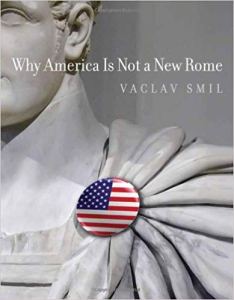
MIT professor Vaclav Smil specializes in the study of energy, but he has a hobby of reading Roman history.  In the wake of our post 9/11 military ventures, and especially after things in Iraq began to go south, we saw many academics proclaiming the demise of the American “empire,” with comparisons to the fate of Rome everywhere across the media landscape.  Smil smelled a rat, and wrote Why America is not a New Rome to counter this wave.  I wish he put more thought into his title, but it points to the straightforward approach of his work.  He brings the discipline of a scientist to the fog of blogs and talking heads.

The question is one of analogy–how alike are the American and Roman experiences?

The comparisons should not surprise us, and have some basis in fact.  Our founders modeled our constitution on Rome’s.  Our early years resemble the heyday of the aristocratically oriented Roman Republic governed primarily by a strong Senate.  Since the Industrial Revolution, and especially since the Great Depression, we have witnessed the continual growth of executive power until now Congress has nearly reached rubber-stamp status, akin to the senate in Rome under the emperors.

Briefly, then, the case for strong links between America and Rome:

  • After 1989, America had no real military or economic competitor, just as Rome had no real competition in its sphere of influence after the 2nd Punic War
  • America has more than 200 overseas bases and can put its military in action most anywhere in the globe much faster than anyone else, just as Rome could move with its road system throughout its empire.
  • The world economy is controlled through New York, and Washington sets the basic rules of this economy, just as Rome did so for centuries in its era.
  • At the same time, both societies experienced drains on the real power of their economy through foolish military ventures and lack of stable monetary policy.
  • Both societies developed professional militaries that have grown increasingly distant from the general public
  • Both societies exercised considerable soft power through their cultural exports
  • The population of both societies seemed driven by distraction and entertainment.  Some point out strong connections between the gladiatorial games and our love for (American) football.
  • A loss of cultural glue across large geography means that trust and the ability to suffer together both decrease.  Hence, both societies would “buy off” the population with bread, buyouts, stimulus packages, etc.
  • Some even went so far as to say that both civilizations had a, “common obsession with central heating and plumbing.”

Stated this way some connections seem strong, but Smil doesn’t buy it.

First we can consider the concept of “empire.”  Some understand that if America has an empire, it is “informal,” and “an empire without an emperor.”  Smil argues that some concepts of empire are so vague as to be meaningless, and pushes for a very specific definition:

Empire means political control exercised by one organized political unit over another unit separate from it and alien to it.  Its essential core is political: the possession of final authority by one entity over the vital political decisions of another.

With this definition in place we should consider if America ever exercised imperial ambitions.  Perhaps one could begin with the Mexican War of 1846, or perhaps earlier with the Indian wars that made the Northwest Territories into Ohio, Indiana, and Illinois. With our various conflicts on the continent we did not so much seek to control ‘alien’ peoples as much as we sought to move in and displace them.  Perhaps one could argue that the Spanish-American War made us an imperial power, but even then, we gave Cuba independence immediately and the Philippines got their independence right after W.W. II.  Smil spends a lot of time on this rather technical argument over what exactly constitutes an empire.  He has some good points to make, but only stylistically.  The real question, I think, involves how much power the U.S. has vis a vis the rest of the world.

Here Smil gets more interesting and convincing.  He cites a variety of data to show that American power, or at least our relative share of power (in political, economic, and military terms), has actually declined dramatically since the end of W.W. II.  Our global share of economic output has dropped by at least 1/3 since 1945, with continuing trade deficits largely due to reliance on foreign energy.  We send much less of our military abroad than we used to.  True, we have hundreds of military bases all over the world, but less than 20 of them have more than 1000 troops.  President Eisenhower served as our top military commander in our most glorious and successful war.  Yet he denounced the “Military-Industrial Complex in his farewell address.  One cannot even conceive of any Roman ever doing any such thing.  Empires do not act this way.

FT_17.08.21_usMilitary_locations_trend-1.png

Smil agrees that we might call the U.S. a “hegemonic” power and not an empire.  But . . . he argues that we are either a weak hegemon or a benign one.  Castro ruled Cuba for decades and all agreed he posed a potential threat to our well being, yet we could do nothing to stop him.  Similarly, we could not get rid of North Korea or beat North Vietnam.  Smil continues,

Germany was defeated by the United States in a protracted war that cost more than 180,000 lives, subsequently received America’s generous financial aid to resurrect its formidable economic potential, and is home to more than 60,000 U.S. troops.  Yet when its foreign minister was asked to join the Iraq War coalition, he simply told the U.S. Secretary of Defense, “Sorry, you haven’t convinced me,” and there the matter ended.

No less tellingly, the Turkish government (with NATO’s second largest standing army and after decades of a close relationship with the U.S.), forbade US forces to use its territory for the invasion of Iraq, a move that complicated the drive to Baghdad and undoubtedly prolonged the campaign.  America in a time of war could not even count on two of its closer allies, but there was no retaliation, no hint of indirect punishment, such as economic sanctions or suspension of certain relations.  One could cite many other such instances . . . both illustrating America’s ineffective hegemony and non-imperial behavior.

With a proliferation of graphs and paragraphs like these, Smil makes a good case that America exercises far less power than its critics at home and abroad surmise.  Smil’s book is not brilliant, but he writes with a concision and clarity that cannot but convince the reader.

Or perhaps, very nearly convince.  American political culture struggles for coherence at the moment, but we have experienced times in our past very much like this before.  We have a disconnect between cultural elites and everyday people, but as Smil points out, this happens in almost every advanced civilization.  Economic inequality is a problem, but again, Smil shows how this tends to happen in many advanced economies, and in any case, our inequality now is not nearly as great as it was in the late 19th century.  By these measures we are no more an empire, or no more in decline, than other countries with power at different times.  The analogy is too thin to make anything of.

But . . . perhaps the strongest point of comparison lies elsewhere.  Toynbee argued that the military and economic problems Rome experienced in the 3rd and 4th centuries AD had their roots in the spiritual detachment of stoicism.  In a similar vein, Eric Voegelin wrote frequently that global power and global influence (of which the U.S. certainly has in some measure) easily leads to a gnostic view of the created order, which again inspires a detachment and loss of engagement.

Perhaps this should be our biggest concern.  We have recently legalized pot, the new drug of choice (in contrast to stimulants like cocaine of 30-40 years ago).  The digital revolution allows us to entertain ourselves with our screens and enter fantasy lands alone in our rooms.  Recently the Caspar mattress company founded a line of stores dedicated to napping as an art form.  It may be a good thing not to have a political, military, or other such analogous connections to Rome.  Here’s hoping that our growing sense of detachment is not in fact the strongest point of comparison between us.


Dave


The Three Languages of Politics

Like many of you, I feel frustrated at the polarization of politics today.  Some of this polarization comes with the territory of democracy, but some of it I feel results from failures in technique and imagination.

Classical rhetoricians used the term “stasis” to refer to the situation in an argument where both sides argue about the same thing.  If an issue did not achieve “stasis” the argument would get nowhere because the rhetorical ships would pass in the night.

For example, you may have observed this lack of stasis in the abortion debate, where the sides argue in circles similar to this example:

  • Pro-Life – Governments should protect those who cannot protect themselves.  They should give a voice to those without a voice.   Governments must stand for the defense of innocent lives if we want to call ourselves civilized.
  • Pro-Choice – Decisions about our families and our futures are some of the most private and personal decisions one can make.  If we wish to avoid any tendency towards a totalitarian regime, we must keep government out of our most private decisions.

Both sides of the abortion debate could hypothetically agree with both statements in different contexts, thus, an argument with these two premises would spin its wheels.  Ironically, most on the “Pro-Life” side are conservatives, but the argument used above has a distinctly Progressive tinge.  Most “Pro-Choice” advocates might usually reside in the Progressive wing of politics, but when they use arguments like the one above they sound just like Libertarians.

I would suggest a Pro-Life argument that went something like. . .

In general, governments have no business making decisions about our bodies.  What we wear, what we eat, whether or not to get a tattoo–no one who values a free society would want government involved in such things.

However, we do give governments the power to make decisions about our bodies when our actions pose a threat to others.  We ban drinking and driving.  We ban the use of various drugs.  These kinds of laws have a good purpose because they protect innocent lives.  If we protect citizens against drunk drivers, how much more should we protect the unborn?

This is just one possible example of stasis on this issue, though no doubt many better ones exist.  Please feel free to share whatever examples you might have.

In his book The Three Languages of Politics author Arnold Kling addresses the problem of a lack of stasis in our political debate and points to one reason for this.  He argues that we speak three different kinds of political language currently, each with its own vocabulary and coded language.  One goal for the book is to expose others to these three different languages and and make us aware of the various worldviews these languages represent.

I mentioned earlier that a failure of stasis in debate can be traced in part to a failure of imagination, and this leads to Kilng’s second main goal.  To achieve stasis we have to learn to use the languages of those we disagree with, and have to enter into their worlds in order to do so.  This does not mean that we abandon our convictions, but it will mean that we reframe in different modes of thought with different emphasis.  This requires a willingness at times to fall down a rabbit hole, but you will actually have a chance of talking to people rather than at them.  Granted, this won’t bring the NRA and NOW to the hallowed halls of Shambala, but it might start something.

Kling starts his book with a quiz designed to help one to discover their own political language, something like a political personality test.  Some of the questions are Kling’s, some are mine.  Of course you may not like either of the three options offered, or may want to combine answers to create a hybrid.  For the purposes of the exercise, however, circle just one letter for each question.

To score the quiz, make three sections on a piece of paper, labeled “P,” “C,” and “L” and follow the guidelines below when you are done.

Gun violence at schools primarily reveals

A. The need for teachers to be armed to fight back.

B. The need for society to have more control over the mentally ill.

C. The need to curtail the power of the gun lobby.

2. If I were honest about myself, the kind of political ad that would appeal to me most would include

A. Pictures of farms, flags, and hallowed documents like the Constitution.

B. Scenes of ordinary Americans from all walks of life working together.

C. A statement about our financial status and clear plan to help reduce spending.

3. During the 1940’s many ordinary Germans committed atrocities against Jews.  This shows us

A. The dangers of a totalitarian system of government

B. The dangers of a collapse of moral values when a country’s institutions have been corrupted and compromised

C. The dangers of anti-Semitism

4. When the issue of tax law comes up, what question is most important?

A. How will the laws impact and reward people get for hard work and thrift?

B. Does government spend money more or less wisely than individuals?

C. How will changes in law impact the growing gap of inequality?

5. What is notable about the conflict between Israelis and Palestinians is that

A. Israelis share many of the same values as Americans

B. The Palestinians are an oppressed people

C. Israel, the Palestinians, other Arab and western governments, all share blame for this tragedy.

6. The wave of mortgage defaults known as the “sub-prime crisis” was caused by mortgage loans that were

A. Given to unqualified and undeserving borrowers

B. Government induced

C. Predatory

7. The large number of unwed mothers with low income reflects that

A. Lack of economic opportunities and education

B. Cultural decay, which overvalues sexual gratification and undervalues marital responsibility

C. Incentives built into our tax and welfare system that can reward bad behavior

8. Since 9/11, Presidents have used controversial powers, such as warrantless surveillance and targeted killings.  What do you think of the use of these powers?

A. Because Islamic terrorism is such a difficult and dangerous problem, I support the use of these powers to protect Americans.

B. I am against the use of these powers on principle.

C. I am not sure about these powers, but I am willing to trust the Obama administration more than the Bush administration on the exercise of them.

9. When teaching the history of the United States, the most important goal should be

A. To have the student develop an appreciation for all that makes America great, especially by focusing on the leadership of people like George Washington, Teddy Roosevelt, and Ronald Reagan.

B. To have the student realize that our country is far from perfect, and has abused the rights of minorities in numerous ways.  We show our greatness as nation most clearly by reforming ourselves and remedying our past mistakes.

C. To have the student appreciate the vital role of American individualism and self-reliance in making our country free and prosperous.

10. If I was visiting the Mall downtown, the most important place to go would be

A. The Capitol, where the representatives of ordinary citizens sit and debate.

B. The Washington, Lincoln, and Jefferson Memorials

C. I wouldn’t want to visit at all.  With its hallowed halls and marble monuments, the Mall downtown encourages a dangerous reverence for government.

11. Which most accurately describes your view of the Press?

A. The Press often functions as an enemy of our civilization, as it artificially makes the margins of society “mainstream” with a distinct liberal bias.

B. The Press works best when it serves as a tool to keep government in check by exposing corruption and abuse of power.

C. The Press works best when it finds societies problems and puts them into public view, thereby giving the organs of representative government a chance to fix the problem.

12.  Of the following, who was the best president?

A. Theodore Roosevelt

B. Calvin Coolidge

C. Ronald Reagan

13. Which most accurately describes your feelings about free markets?

A. Government intervention in the market is counter-productive every time.  The market, unregulated, is one of the best tools of freedom we have.

B. Some form of free market must exist, but government should intervene to minimize the aspects of the market that exploit the poor and create vast gaps in equality.

C. The free market is in general a great tool for a free society, but government should strongly regulate/ban certain items from being sold, like drugs, pornography, and other socially/morally disruptive products.

14. Which most accurately describe your feelings about the War on Drugs?

A. The War on Drugs has failed most notably in that most of those in jail are the poor and underprivileged of society.  Whatever our original aims may have been, the War on Drugs has done little besides incarcerating poor minorities for a host of minor offenses.

B. The War on Drugs has been in some instances a war on what should be personal freedom, and at times it has also been a misguided attempt to enforce purely cultural mores.  It has also costs billions of dollars with little to show for it.

C. The War on Drugs has not had the success we hoped for, but it remains a noble fight with a noble cause.  Drugs ravage lives and communities everywhere, and government rightly acts to try and stop their scourge.

15. Which Most Accurately Describes You?

A. My heroes are people who have stood up for underprivileged and oppressed people.  The people I cannot stand are those who seem to care nothing for the rights of average citizens as opposed to the privileged few, or ethnic and religious minorities.

B. My heroes are people who have stood up for Western values and the beneficial civilizations these values  help create. The people I cannot stand are those who don’t mind, or even encourage, the wanton assault on the traditional values that have made this country great.

C. My heroes are those who have stood up for the right of individuals to make their own choices.  The people I cannot stand are those who want the government to impose their value system on others.

  1. The best thing about a Trump presidency (whether you like him or not, or think he is a good president or not) is likely to be

A. His presidency will shift power away from coastal elites and towards the values and practices of mainstream Americans.

B. He will shine light on the “forgotten” blue collar worker, many of whom have lost jobs due to a globalization process that has moved way too fast.

C. He will “get things done” and help make our government more efficient and lean by getting around the “red tape” of bureaucracy.

The worst thing about a Trump presidency (whether you like him or not, or think he is a good president or not) is likely to be

A. His inflammatory rhetoric and possible racist leanings will hurt immigrants and other minorities, endangering decades of social progress.

B. He will erode the governmental institutions we rely on for a peaceful society, and become a “one man show,” extending the power of the executive branch and growing the reach of government.

C. He is a New York real-estate and tv personality–he focuses only on the bottom line and cares nothing for the values that have made America great.

Question 1

  • If you checked A put a mark in the ‘L’ column
  • If you checked B put a mark in the ‘C” column
  • If you checked C put a mark in the ‘P’ column

Question 2

  • If you checked A put a mark in the ‘C’ column
  • If you checked B put a mark in the ‘L’ column
  • If you checked C put a mark in the ‘P’ column

Question 3

  • If you checked A put a mark in the ‘L’ column
  • If you checked B put a mark in the ‘C’ column
  • If you checked C put a mark in the ‘P’ column

Question 4

  • If you checked A put a mark in the ‘C’ column
  • If you checked B put a mark in the ‘L’ column
  • If you checked C put a mark in the ‘P’ column

Question 5

  • If you checked A put a mark in the ‘C’ column
  • If you checked B put a mark in the ‘P’ column
  • If you checked C put a mark in the ”L” column

Question 6

  • If you checked A put a mark in the ‘C’ column
  • If you checked B put a mark in the ‘L’ column
  • If you checked C put a mark in the ‘P’ column

Question 7

  • If you checked A put a mark in the ‘P’column
  • If you checked B put a mark in the ‘C’ column
  • If you checked C put a mark in the ‘L’ column

Question 8

  • If you checked A put a mark in the ‘C’ column
  • If you checked B put a mark in the ‘L’ column
  • If you checked C put a mark in the ‘P’ column

Question 9

  • If you checked A put a mark in the ‘C’ column
  • If you checked B put a mark in the ‘P’ column
  • If you checked C put a mark in the ‘L’ column

Question 10

  • If you checked A put a mark in the ‘P’ column
  • If you checked B put a mark in the ‘C’ column
  • If you checked C put a mark in the ‘L’ column

Question 11

  • If you checked A put a mark in the ‘C’ column
  • If you checked B put a mark in the ‘L’ column
  • If you checked C put a mark in the ‘P’ column

Question 12

  • If you checked A put a mark in the ‘P’ column
  • If you checked B put a mark in the ‘L’ column
  • If you checked C put a mark in the ‘C’ column

Question 13

  • If you checked A put a mark in the ‘L’ column
  • If you checked B put a mark in the ‘P’ column
  • If you checked C put a mark in the ‘C’ column

Question 14

  • If you checked A put a mark in the ‘P’ column
  • If you checked B put a mark in the ‘L’ column
  • If you checked C put a mark in the ‘C’ column

Question 15

  • If you checked A put a mark in the ‘P’ column
  • If you checked B put a mark in the ‘C’ column
  • If you checked C put a mark in the ‘L’ column

Question 16

  • If you checked A put a mark in the “C” column
  • If you checked B put a mark in the “P” column
  • If you checked C put a mark in the “L” column

Question 17

  • If you checked A put a mark in the “P” column
  • If you checked B put a mark in the “L” column
  • If you checked C put a mark in the “C” column

“P” stands in this case for “Progressives,” who tend to see the world along an axis of oppressor/oppressed.  “Progressives” here put strong emphasis on “no one left behind,” and equality.

“C” stands for “Conservatives,” or “Civilizers” who put primary focus on good vs. evil, or civilization vs. barbarism.  They tend to see a role for government in upholding certain values and traditions.

“L” stands for “Libertarian” who emphasize individual rights and freedoms apart from group/government coercion.  They fear actions that threaten individual autonomy.

In the interest of full disclosure, I score out this way:

Progressive/2, Conservative/10, Libertarian/5

Chances are that your score mixes the three categories in some fashion, and this in itself will help us recognize the limitations of our own particular perspective.  The Progressive, Conservative, and Libertarian axises are all finite and cannot be our main guide on every question.  Kling cites a few examples to this effect.  Libertarians like Goldwater opposed Civil Rights legislation on the grounds that it would give more power to the federal government and upset the balance of federalism.  They were not wrong about this per se, but wrong in their priorities.  The Libertarian axis (Kling’s own personal bias, as he tells us) did not have the proper framework to deal with that issue.  Some Southern “Conservatives” (be they Republican or otherwise) rejected integration for terribly misguided fears about what would happen to their “civilization.” For the sake of fairness, Kling rejects the Progressive explanation for the sub-prime crisis.  The oppressor/oppressed axis has its own limitations.  The strong “Conservatism” of Churchill served him just as poorly in dealing with India as it served him well in dealing with Hitler.

It is this concept of the finite nature of our political vision that is the most valuable takeaway for me.  Every Christian I know would admit to some degree of mystery and incompleteness about their knowledge of God and the Faith.  Yet we do not always apply that same sense of humility to our political ideologies, and we usually get no help from the media with this.  It may be humility, more than anything, that can salvage our broken political discourse.

Dave

Danton Democracy

I originally published this in 2013, and repost it in light of our study of the French Revolution.  Apologies for any dated information on the ACA . . .

***********************

It took a while, but I finally came across an article on the ACA (also called “Obamacare”) that I resonated with.  Ross Douthat does not need to argue that the law will destroy civilization as we know it.  He admits that many will probably benefit from the law.  But in the final analysis (if coming to a final analysis even possible with such a ridiculously complex piece of legislation), he writes.

Now an effective levy of several thousand dollars on the small fraction of middle class Americans who buy on the individual market is not history’s great injustice. But neither does it seem like the soundest or most politically stable public policy arrangement. And to dig back into the position where I do strongly disagree with Cohn’s perspective, what makes this setup potentially more perverse is that it raises rates most sharply on precisely those Americans who up until now were doing roughly what we should want more health insurance purchasers to do: Economizing, comparison shopping, avoiding paying for coverage they don’t need, and buying a level of insurance that covers them in the event of a true disaster while giving them a reason not to overspend on everyday health expenses.

If we want health inflation to stay low and health care costs to be less of an anchor on advancement, we should want more Americans making $50,000 or $60,000 or $70,000 to spend less upfront on health insurance, rather than using regulatory pressure to induce them to spend more. And seen in that light, the potential problem with Obamacare’s regulation-driven “rate shock” isn’t that it doesn’t let everyone keep their pre-existing plans. It’s that it cancels plans, and raises rates, for people who were doing their part to keep all of our costs low.

You can find the full article here.

The article does not fully address my two ‘gut-level’ objections to the law:

  • Many well-intentioned government servants believe that they have found the ‘solution’ to problems that have heretofore eluded society.  Thus, they see only the positive and never realize the cost of certain kinds of legislation.
  • More specifically, the health care system already involved a great deal of physical complexity laid over top of a myriad of individual financial and moral choices.  Government action, almost by definition in cases like this, would almost certainly gum up the works and unintentionally create problems, even those they could not foresee.

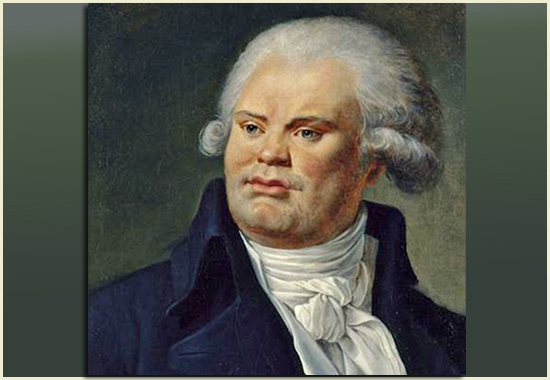
I thought of the health care controversy as I read David Lawday’s enjoyable biography Danton: The Giant of the French Revolution.  Danton’s outsized personality stands in sharp contrast to the cold Robespierre, who eventually turned on Danton and had him executed.  Their faces tell the whole story:

georges_danton


Robespierre

Danton styled himself a man of the people.  He claimed to truly understand the people, for he (and not Robespierre) thought and acted like one of them.  He laughed, enjoyed food, women, and friends.  Thus, as he had a seat in government and understood the people, he naturally assumed that government action would work to benefit the people and help fulfill their wishes.  The video below may not reflect an actual historical meeting between  Danton and Robespierre, but it accurately depicts the different personalities of them both.

One can easily get drawn into Danton’s huge personality, but we should remember that he sanctioned horrible butcheries both before and after the fact, in the name of the people.  Danton was not a thinker.  He did not inscribe his speeches, he wrote few letters (that have survived at least), and so we know little of his motivations.  Lawday allows himself to make his best guesses, and paints a portrait of a man who had no love for violence per se, but believed he could successfully manage it once unleashed.  He later seemed to change his mind about this during the Reign of Terror, and this shift factored into his execution.

Unfortunately Danton’s greatest legacy to the Revolution was the Revolutionary Tribunal, the government’s supreme tool in legitimizing political murder on a mass scale.  Danton had some good motives in starting the tribunal.  He saw the random destruction engaged in by “the people,” and thought that direct government action would relieve the masses of the burden of imposing justice, or at least their version of justice.  This in turn would limit the violence that plagued the Revolution, for government would surely exercise more restraint and wisdom than the masses.  In a speech advocating for the establishment of the tribunal he reportedly said, “Let us be terrible, so they do not have to be.”

Tragically, the Tribunal simply gave legitimacy to the worst impulses of the Revolution, and the amount of deaths and imprisonments skyrocketed.  This same tribunal eventually tried Danton himself and found him guilty without allowing Danton to call any witnesses for his defense.

The ACA and the Revolutionary Tribunal remain vastly different things.  I hesitate to include mention of them both in the same post, for in 99 out of 100 ways they have nothing to do with each other.

But they do share one thing in common–they both spring from the mistaken belief that government can enter a complicated situation and with a wave of a wand make everything alright.  It usually fails to work, even with the best of intentions.

On the subject of good intentions, Marginal Revolution posted a link with this abstract. . .

Truisms that are (at least mostly) Not True

I have an affinity for the crazy theory.  I know that they can’t all be true, if for the only reason that if all of them were true, we would have no crazy theories to enjoy contemplating.  Our times have a strange character to them, however, for it seems the crackpot plays the role of conservative.  Older views of things look bizarre today.  Before continuing, I should fully disclose that, though I love crazy ideas, I am actually a very boring person.  The reason these two fit together in my life is that today the harebrained idea is sometimes quite conservative and, upon closer examination, sometimes even obvious.

Take, for example, a variety of truisms in our day.  We say that in football you have to have a great quarterback but . . .  Blake Bortles, Nick Foles, Case Keenum . . . at least one of them will play in the Super Bowl this year.  One can easily envision some coach with a crew-cut from the early 1960’s telling us how it’s a “team game, and not one of you means more than another,” and so on. We have traveled back in time.

History has its truisms as well.  I hear all the time, even from religious conservatives, that America’s religious competition has saved America from going the way of secular Western Europe.*  I have a particular antipathy for this obvious falsehood.  Medieval Europe had very little religious competition, and religion did quite well there.  Religion thrived in ancient Egypt with almost no competition for millennia.  To take the reverse, ancient Babylon had a lot more religious competition and their religion and morals seemed to suffer.  Today France may be nominally Catholic and Sweden nominally Lutheran, but no laws exist forbidding one from becoming Baptist, Methodist, or Buddhist in either place.  At least some religious competition surely exists there today.  This truism about religious competition is actually a far-fetched theory, based on only the most recent evidence.

To get slightly more controversial, we hear all the time how printing serves as one of the great civilizing tools for mankind.  No one questions this truism. But, just look for a moment . . . it seems obvious to me that the 15th century in Europe had a higher degree of civilization than the century after the printing press gained prevalence.  The printing press brought a lot of religious violence and political fragmentation in its wake. We hear too the truism that, “getting a Bible into everyone’s hands” is the key to spiritual health.  But, again, just look . . . it seems clear that the Church did quite well without the printing press for quite some time.  And, to return to an aforementioned truism, the fact that the Bible always tops bestseller lists has not prevented the west from becoming more and more secular over the last two-three centuries.

Maybe civilization and religion actually rely on things far older, far more “tried and true,” for success rather than new technologies–the crackpot as bland conservative strikes again.

I have written before about another one of my least favorite truisms, that of the evolutionary view of history and progress.  The theory basically means that civilization starts small and has run in a more or less unbroken line of progress and advancement.  Though this theory has general acceptance in many textbooks and the minds of men, it is, in fact, a radical, crazy, notion, for it ignores obvious facts.  For one, we know that a complex civilization could collapse more easily, quickly, and completely than a primitive one, due to its inevitable interdependence.  The presence of advancement makes large steps backward more, not less likely, like stock-market bubbles.  For another, we have a universally acknowledged and plain example of the fall of Rome and the subsequent so-called Dark Ages.  Whatever one thinks of the Dark Ages, Italy ca. 100 A.D. had a much higher level of civilization in most respects than Italy ca. 600 A.D.  Still, the prevalence of the evolutionary view makes those who state otherwise seem crazy.

Enter Charles Hapgood, whose book Maps of the Ancient Sea Kings postulates that, based on an examination of certain ancient maps, it appears that an unknown and likely quite ancient civilization developed a geographical and nautical understanding that humanity would not equal until the modern era. Hapgood’s theory joins the voices of Graham Hancock, Jon Anthony West, and other megalithic architecture (such as Gobeckli-Tepe) that argues that pre-historic people not only existed, but existed at a far higher level of civilization than anyone previously imagined.

Unfortunately for the layman like me, Hapgood immerses the book in large amounts of technical terms and technical data.  I think one would need special knowledge of cartography, geography, and math to understand large portions of the book.  Perhaps no other way existed to make his case.  I found myself junping over much of the technical sections but hope I still understood the basic case, which runs like this:

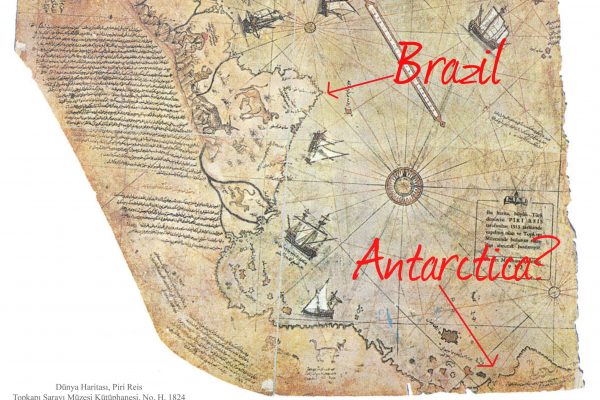
  • In 1929 an unusual map, named, the Piri Re’is, was discovered in the old Imperial Palace of Constantinople, dated the year 1513 A.D. (Moslem reckoning 919).
  • The map was extensive and showed the coast of North America in excellent detail.  This map differed from all other 16th century maps by giving correct longitudes for South America and Africa.  No 16th-century navigator that we know of knew how to calculate longitude except by guesswork.
  • Further investigation showed that Piri Re’is (or basically, Admiral Piri) claimed to copy this map from earlier maps, some of them dating back to (he claimed) the time of Alexander the Great.
  • Even a rough study of this map indicated that it used highly advanced mathematics, including spherical trigonometry, which we do not believe existed in the classical world

So, where did the map come from?

Perhaps Hapgood’s critics are right, and the Greeks knew enough spherical trigonometry to make these maps.  But did they sail across the Atlantic?  No evidence exists for this.  Did the Egyptians or Babylonians have this knowledge?  It appears not, but if they did, they did not sail across the Atlantic to map the coasts of the Americas.  Maybe the Romans in Ptolemy’s time had the knowledge, but again, did not sail across the ocean. Did it come from the medieval period?  But they did not sail much, and no other medieval map exists that compares with the quality of the Piri Re’is.

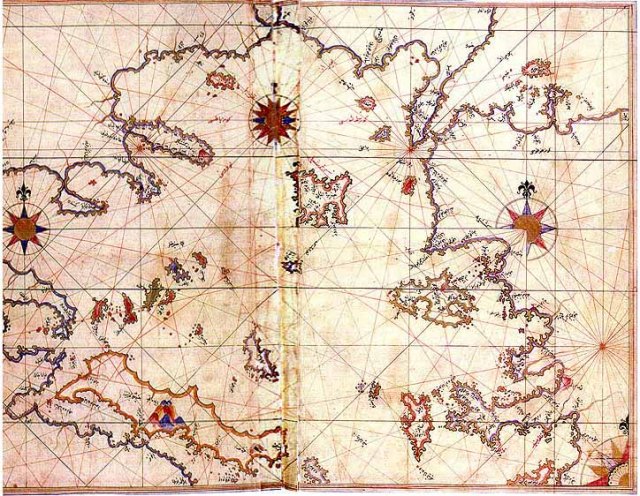
The best map from the classical period comes from Ptolemy, who worked in Alexandria and had access to all of the accumulated knowledge the world knew at the time.  His map shows great skill:

But it cannot compare with the Piri Re’is (although this is only a portion):

And again:

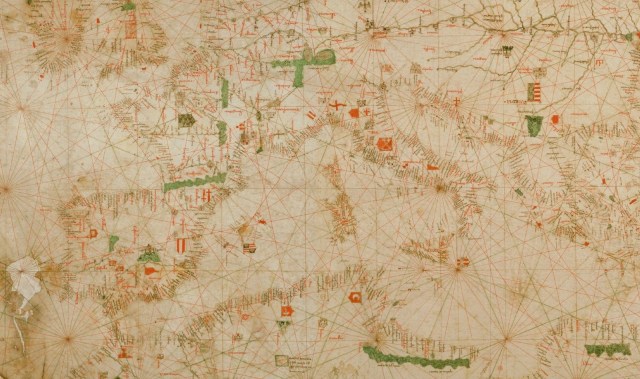
The Portolano Map, of late Medieval/Renaissance origin, is again, very good, but not quite up to snuff, at least in terms of the extent of what it mapped:

The inclusion of Antartica on the Piri Re’is map is particularly noteworthy, as many speculate that it maps landforms that for thousands of years have been covered with ice. In other words, the map seems to have been made before the ice age, and not after.

A few quotes scattered throughout the book from Hapgood illustrate his proposition:

We have discovered that in most cases the errors on the Piri Re’is mapper due to mistakes in the compilation of the world map, presumably in Alexandrian times [that is, the Piri Re’is was discovered in different pieces and put back together not quite accurately], since it appears that Piri Re’is could not himself have put them together at all.  The component maps, coming from a far greater antiquity, were far more accurate.  The Piri Re’is Map appears, therefore, to be evidence of a decline of science from remote antiquity to classical times (p. 39).

******

For a long time after the voyages of Columbus we find the latitudes of Cuba and Haiti are wrong on most maps.  Almost all the mapmakers put the islands above rather than below the Tropic of Cancer [in contrast to the Piri Re’is] (p. 41).

********

To sum up, then, this part of the Piri Re’is Map suggests a source map of Africa, Europe, and the Atlantic islands probably drawn originally on some sort of trigonmetric projection adjusted to the curvature of the earth.  By default of any other narrative, we must assign this map’s origin to a pre-Hellenic people.  The trigonometry of the projection suggests the work of Alexandrian geographers, but the evident knowledge of longitude implies a people unknown to us, a people of seafarers with instruments undreamed of by the Greeks, and as far we know, not possessed by the Phoenicians either (p. 49).

********

The suggestion of a vast antiquity behind the [Piri Re’is] is conveyed by a feature to which Captain Mallery first drew my attention.  He pointed out that the Zeno Map [which very likely had the Piri Re’is as a source map] shows Greenland with no ice caps.  The interior is filled with mountains, and rivers are shown entering the sea, in some cases at the points where glaciers now move through mountains to the coast (p. 152).**

*********

This culture [that made the Piri Re’is] may well have more advanced than Egypt, Babylon, Greece, and Rome.  In astronomy, nautical science, mapmaking, it was likely more advanced than any culture before the 18th century of the Christian era.  Not until the 18th century did we begin to send ships to the Arctic or Antarctic regions.  Organized government is indicated [by the map], as many expeditions would be needed to gather the appropriate information to map the area so precisely (p. 193).

Hapgood writes haphazardly and does not always reason in a clear, linear fashion, a trait he shares with his modern fellow believer in pre-historically advanced ancient civilizations, Graham Hancock.  The key I think to both writers lies not in the exactness of their data but in the accumulation of enough “probably’s” to make their case.  I heard most of a conversation between Hancock and Sceptic editor Michael Shermer.  The discussion went nowhere, with Shermer begging for even a small handful of absolute, concrete, data points, and Hancock pleading with him to consider the mass of “probably’s,” while admitting in the end that the study of ancient civilizations cannot provide the kind of concrete proof Shermer demanded.

Rather than ask, “Can we be absolutely sure if an ancient, advanced, prehistoric civilization existed,” (obvious answer-“no”), or, is it possible that such a civilization existed (obvious answer–“yes”) we should instead wonder whether we should expect or not expect to find such a civilization.  Is the idea reasonably likely?  Hapgood will likely not convince anyone who needs something along the lines of what Shermer requires.  He may entice others who think it likely that some kind of ancient civilization along the lines of those who like Hancock’s work.

To give Hapgood’s theory a shot, it helps to believe that:

  • The myths and folklore of most every ancient civilization that describe advanced civilizations that experienced thorough destruction (like the Atlantis story) likely have a fundamental truth behind them.
  • Civilization devolves just as much as it evolves, and in fact, devolution may be more prevalent than evolution in civilizations.
  • The flood described in Genesis 6 (and many other ancient religious texts) was substantive, historical in at least some sense, and would have had the power to destroy civilizations very quickly.
  • The absence of evidence would not condemn the case outright, as civilizations have at times experienced a catastrophic loss of a great deal of accumulated knowledge (the burning of the library at Alexandria, the collapse of Rome, etc.)

With this in place you might buy what Hapgood sells.  But without these beliefs, his book will likely frustrate readers.  In any case, I don’t find the above propositions crazy.  In fact, I find them rather ordinary.  Folklore and myth are common to all.  Belief in a historical flood of some kind is nothing new, with most ancient civilizations sharing this story.^  We have actual historically undisputed losses of vast amounts of intellectual capital at certain times in the past, such as the destruction of the library at Alexandria.

As I said earlier, despite my inclination towards “crazy” theories, I’m actually a very boring guy.

Dave

P.S.–A good friend and a math/science teacher glanced over the basic arguments of the book and found them wanting, and Hapgood’s selection of material suspicious.  He has a better nose for such things than I and his thoughts give me pause.

My friend and I both believe that ancient civilizations tend to be far more advanced then we might think.   Neither one of us believes that the history of civilization always proceeds in a directly linear way, and certainly not in a progressive evolutionary way.  We thus share some crucial assumptions.

My friend thought that Hapgood underestimates the knowledge of ancients.  For example, we know the ancient Phoenicians existed, we know they were great sailors.  It makes much more sense to say that perhaps they made the map and sailed farther than we thought, then to suggest that an unknown civilization of which we know nothing made the map.

My response would be something like, “If we know a lot about the ancients but have no record of them sailing to the Antarctic, it is plausible that they did not do so.  Thus, someone else must have.”

Plus, I confess that I just simply find the idea of advanced pre-historic civilizations fun, satisfying, and enormously entertaining.  Someone could wave such ideas in front of me daily and they would always get me pretty excited.

*One might modify this theory and argue that perhaps in today’s intellectual and cultural climate, one must have religious competition for religion to survive.  This argument has more plausibility.

**Some believe the Zeno Map to be a hoax precisely because of this feature and other “phantom islands” that do not now show themselves above water.  But Hapgood argues that a perfectly plausible explanation exists for this if the Piri Re’is was a source.  Another map, the Ibn Ben Zara Map, has a remarkably accurate depiction of the Aegean.  But it also includes several islands no longer visible.  How to explain this paradox?  How could the map be so accurate in some respects and so false in others?  We can say the map is a hoax or is filled with errors.  But another possibility is that a source map of great antiquity was constructed when these islands stood above sea-level.

^I do not mean to suggest that the Bible is merely historical.  It certainly has metaphysical, mythological, symbolic, and theological meaning beyond history.  But I don’t see these categories as exclusive.  What is real is not opposed to what is mystical, symbolic, or spiritual.

The Rings of Saturn

Bernard Bailyn starts his book The Peopling of British North America with an illuminating analogy about the rings of Saturn.  When astronomers first noticed Saturn’s rings their beauty appeared as a shimmering uniformity.  Now that technology has given us a closer look, we see that in fact, the “rings” are comprised of thousands of bits of rock and dust, some as big as your hand, some as big as a car, some almost microscopic.

History, he then argues, is often like this.  From a distance things look easy to understand but get up close and the elegant simplicity and uniformity of the past dissipates into confusing bits that won’t go together.  Reality will confound our ability to understand it as a coherent whole.

A lot about this analogy rings true for me.  When young we learn that George Washington was the father of our country, a great leader, and so on.  As we get older, we need to deal with his owning slaves, his social striving, his possible mixed motives for fighting the British, etc.

But ultimately historians can’t stop where Bailyn leaves off.  After seeing what the rings of Saturn actually are, he/she then needs to find a way to have them make sense.  He must interpret and synthesize.  Bailyn’s book tantalizes at times with revealing details about early colonial settlement, but I found myself frustrated that the book never quite got off the ground.

The book shows us that settlement of the colonies happened seemingly without real pattern, aside from the obvious facts that most immigrants were young, male, from a middle-class or lower background.  Different things seemed to happen for different reasons.  In sifting through the data, Bailyn admits that it might take a a poet or impressionist painter to make sense of the disparate information.  This is a wonderful admission of his, and seems to go against his “rings of Saturn” analogy.  Bailyn admits that in this instance he can’t fulfill that role (though he did just this in his great Ideological Origins of the American Revolution).  Interestingly, Bailyn contrasts the disparate design and feel of American settlements with new towns in Germany of the same period.  In Germany, new towns all looked the same.  So again, sometimes the rings of Saturn look exactly like we think they should look.  It may be American history in particular, rather than History in general, that presents a unique picture.

Ultimately, of course, this must be Bailyn’s point.  We might imagine the early days of European settlement to have uniformity, with diversity coming in the 19th century with large scale immigration, but no — from the earliest times no one story could account for everything.  “Let us celebrate America’s diversity,” and all that.

I thought of Bailyn’s work while reflecting on 8th grade reactions to the history of the Roman Republic.  In the year’s “Great Debate” over whether ancient Greece or Rome was the superior civilization, the boys invariably choose Rome by about a 2/3 margin, and the girls Greece by the same amount.  Many years of teaching this class bear this out for me, so why might this be?

Though images of the ancient Greeks reveal a touch of brutishness, they had more feminine qualities than the Romans.  They displayed more creativity and originality than the Romans.  They appreciated beauty and proportion.  As for the Romans, their plodding, methodical nature probably fits very easily within the mind of an 8th grade boy.  Their lack of imagination and their pig-headed stubbornness may have been designed specifically to both infuriate their ancient opponents and the average modern 8th grade girl.  I have seen a few young ladies actually stomp their feet in anger when Rome manages to rise after their disaster at Cannae, as the boys chuckle in Beavis and Butt-head like fashion.  “We’re still here,” the Romans seem to be saying to Carthage, “dunking your pigtails in inkwells yet again.”

I can identify somewhat with this aggravation, but there is something magnificent about how the Romans embraced their sense of identity.  The Roman scholar J.V.P.D. Balsdon makes the observation that the Roman origin story of Romulus and Remus raised by wolves had nothing to commend it to the ancient world.  Apparently it would have been much better if they had been suckled by she-goats, as the Greeks did with Zeus.  To what extent they truly believed in the myths I can’t say, but even a quick perusal of Rome’s stories show fratricide, violence, and no hint of elegance.  The touching Greek story of Pygmalion carried no truck with the Romans.  When they needed women, they simply stole them from the Sabines.  Even when the Romans “invent” their stories (though I am not comfortable with that word, but like a typical guy I can’t think of a better one) they utterly lack imagination and adornment.  And the Romans chuckle stupidly again.  They’re perfectly happy with their unimaginative early history.  Aggravating or no, their fierce sense of identity, no doubt gleaned partially from their commonly accepted founding mythology, gave them great strength of purpose and dedication.  They knew they were a gritty, uncouth, blue collar bunch and reveled in it.

When discussing the Arthurian legend in his A Short History of England G.K. Chesterton made the comment that the “tradition” surrounding Arthur was more true than the “history” surrounding him.  He meant that the Arthurian tradition may not be entirely accurate, but expressed more truth about the past than the confusion produced by historians who tackle the same subject.  I think the same holds true for Rome.  Take Will Durant (whom I like, for the record) in his Caesar and Christ, where he vaguely talks of Roman origins in terms of nomads from the steppes, and scraps of pottery dated to some people at some unsure time.  This tells us nothing.  No one should trust in the full accuracy of Livy’s history, but Livy communicates something more true about Rome’s early period than Durant.

If Chesterton is right we should consider his principle in light of America’s history.  The newness of our country means that we can have far more accurate information about our past than almost any other civilization.  For many of us, the stories we learned in elementary school no longer have persuasive power.  Postmodernism has done its deconstructive work well.  We see this in the words of the great jazz pianist Vijay Iyer who recently spoke at Yale, where he seemed to suggest that all success in America is somehow linked to exploitation (I hope I’m reading him incorrectly, as I like Iyer’s music and don’t want his name attached to something silly like this).  Iyer commented,

And as we continue to consider, construct and develop our trajectories as Americans, I am also constantly mindful of what it means to be complicit with a system like this country, with all of its structural inequalities, its patterns of domination, and its ghastly histories of slavery and violence.

Many of us are here because we’ve become successful in that very context. That’s how we got into Yale, by being voted most likely to succeed; and that may be what emboldened some of us to show our faces here this weekend, because we actually have something to show for ourselves, that somehow in the years since we first dined at the Alternate Food Line we’ve managed to carve a place for ourselves in the landscape of America. Whether you attribute it to some mysterious triple package or to your own Horatio Alger story, to succeed in America is, somehow, to be complicit with the idea of America—which means that at some level you’ve made peace with its rather ugly past.

Perhaps at least a few of those voted, “Most Likely to Succeed” actually worked hard?

But we need not fear or lament the postmodern landscape, but see an opportunity.  We need to seek the truth, and the deconstructive project has helped us do that.  But somewhere out there, I hope, is a historian who can give us a “true tradition” amidst the rings of Saturn to anchor us moving forward.

“A Dialogue Concerning the Two Chief World Systems” by Galileo Galilei

The Dedication of the Dialogue

The Dedication of the Dialogue

I repost this wonderful offering from my friend and colleague Bill Carey . . .

*******************************

A Gallup poll of 6 July 1999 of more than a thousand adults determined that only about four out of five Americans believe that the Earth orbits the Sun. Fully one in five believes that the Sun orbits the Earth. [1] It’s interesting that four in five Americans believe something that seems obviously and demonstrably false. The Earth doesn’t feel like its moving underfoot, and every day we see the Sun rise and set. We believe the moon orbits the Earth, and it sure looks like the behavior of the Sun and moon is pretty similar. Why do four out of five Americans believe that, contrary to our intuition, the Earth orbits the Sun?

I’ve been taking an informal survey of my friends, with just two questions. The first is whether the Earth or the Sun is the center of the solar system. [2] After I assure them it’s not a trick question, everyone answers the Sun. We’re beating Gallup’s averages. The second question confuses people: “How do you know?” The most common answer I’ve gotten is, “Duh, everyone knows that”. Some people know that Copernicus and Galileo got in trouble with the Church for saying the Sun was the center of the solar system. Others vaguely remember a science or history teacher telling them about “heliocentrism”. Fair enough.

When I rephrased the question to ask how human beings originally figured that the Earth orbits the Sun, my friends gave me a quizzical look. I was no better off than them; I knew that Galileo and Copernicus had gotten everyone to switch from the geocentric view to the heliocentric. I didn’t know how or why. How did those astronomers convince everyone to abandon more than a thousand years of careful science and replace it with a new framework? What arguments and data struck the telling blows for heliocentrism?

The Retrogradation of Mars

The Retrogradation of Mars

The work that I turned to to understand the arguments for heliocentrism is Galileo’s delightful Dialogue Concerning the Two Chief World Systems. It is a surprising book. The first surprise it delivers is its style and structure. Galileo imitates a Socratic dialogue. Like all good literature, conflict drives the plot of the Dialogue. In particular, the conflict between Ptolemy and Aristotle on the one hand, and Copernicus on the other, motivates Galileo. His protagonist, Salviati, argues for the Copernican world system. The canny, initially neutral Sagredo drives the conversation forward. The wryly named Simplicio attempts to prop up the Ptolemaic system. Simplicio’s bumbling affords Galileo an opportunity to clearly articulate his ideas about physics and the motion of the stars. Of Aristotle, Salviati says that “[w]e need guides in forests and in unknown lands, but on plains and in open places only the blind need guides. It is better for such people to stay at home, but anyone with eyes in his head and his wits about him could serve as a guide for them. In saying this I do not mean that a person should not listen to Aristotle; indeed, I applaud the reading and careful study of his works, and I reproach only those who give themselves up as slaves to him in such a way as to subscribe blindly to everything he says and take it as inviolable.” [3] The arguments about the motion of the heavens make the work science; the metaphors, plot, dialogue, and humor make it literature.

The second surprise in the Dialogue is Galileo’s outstanding ear for argument. He refutes Aristotle’s arguments bluntly and often amusingly. Aristotle claims that a ball of iron will fall one hundred cubits in the time a block of wood falls ten cubit. This is preposterously false, and Sagredo doubts whether Aristotle ever actually tried it out: “I greatly doubt that Aristotle ever tested by experiment whether it be true that two stones, one weighing ten times as much as the other, if allowed to fall, at the same instant, from a height of, say, 100 cubits, would so differ in speed that when the heavier had reached the ground, the other would not have fallen more than 10 cubits.” Simplicio leaps to the defense of his preposterously wrong philosopher by pointing out that “[Aristotle’s] language would seem to indicate that he had tried the experiment, because he says: ‘we see the heavier’; now the word ‘see’ shows he had made the experiment.” Galileo’s characters are forthright in dismissing this tomfoolery. They describe experimental procedures that we can repeat today that confirm Galileo’s ideas and to refute Aristotle’s.

Epicycles and Deferents

Epicycles and Deferents

Claudius Ptolemy offers Galileo a foil with more scientific substance. [3] Ptolemy’s exposition of the geocentric world system in the unreadably complex Almagest is a surprisingly empirical and scientific work. Ptolemy’s system of deferents and epicycles is a compelling, mathematically precise, vision of the world. To refute it, Galileo works through a detailed analysis of the parallax of various celestial bodies and their distances from the Earth. The argument is technical and subtle. Writing before the great tectonic shift from Euclid to Descartes, Galileo’s mathematical reasoning tends towards geometry as well. Here he argues with Ptolemy on the latter’s home turf. A good edition that reproduces the figures is essential, as the characters lean on them as much as the reader. When a character references a table of astronomical data, Galileo’s language leads one to vividly imagine the characters sitting around a table passing papers to one another as they eat and drink.

The third surprise nestled in the Dialogue is that it’s deeply unsatisfying. It’d be tempting to say that, having read Galileo’s dialogue, I can answer the question about how we know the Earth goes around the Sun. The truth, though, is that I’ve just replaced one authority with another. I haven’t observed the phases of Venus, and I haven’t observed the parallax of the fixed stars (much less of the planets) that would let me work out the celestial mechanics on my own. Even so, reading Galileo’s argument is valuable. When I trust his authority, it’s an authority that I understand a little better than before. It’s an authority that’s grounded in reason and argument that I can wrestle with and assess critically. But if I want to add to the conversation myself, take a stand along with Ptolemy and Galileo, I need to telescope-up and start looking at the stars.

Too often we treat science as an Athena, sprung full grown and clothed from the head of Zeus. We trust our predecessors when they say that the Earth orbits the Sun without understanding how they came to believe that. We belittle people who disagree without understanding the arguments that make us correct. It turns out that the story of scientific discovery is always messy, usually fascinating, often wildly contingent, and occasionally well told. Whenever we can grapple with not only the results of scientific inquiry, but also the story behind it, we should. In his preface to the Dialogue, Einstein writes that, “[t]he leitmotif which I recognize in Galileo’s work is the passionate fight against any kind of dogma based on authority.” Galileo would rue his fate; like Aristotle before him, he’s become an authority, chalky and dead. We can rescue him from that cruel fate by listening carefully to the scientific conversation and the adding our voices to the tumultous banter.

[1] See http://www.gallup.com/poll/3742/new-poll-gauges-americans-general-knowledge-levels.aspx

[2] An astute reader pointed out to me that I beg the question here, so ingrained is the heliocentric system in my mental picture of the universe.

[3] Galileo, The Dialogue, p. 131

[4] Ptolemy will be the subject of another post, I hope. He deserves far more credit as a scientist than we’re inclined to give him.

A House Swept Clean

Richard Rorty’s America had a wonderful run, even if it was short lived.

I well remember my senior year of high school in 1990-91.  For the first few months of school Iraq’s invasion of Kuwait had pride of place in our minds.  We had furious debates as to the rightness or wrongness of our presence in the Mid-East.  As military action looked more imminent, the arguments got more heated.  I filled out my draft service card.  Some thought the war could take years and become a dreaded “quagmire.”

The fighting actually started and a hush fell over the debates.  And then, just as quickly, the fighting  ceased.   The ground war took no more than a week.  We sat stunned for a moment, then, elation.  Talk of world affairs ceased immediately.  We all shifted into thinking about college, planning out our lives, and so on.  The Soviet Empire had crumbled.  What was left but Kant’s dream of perpetual peace and George Bush’s “New World Order?”

The end of the Cold War brought about the end of modernism in the mainstream and a shift towards the postmodern individualistic ethos.  Professors like Richard Rorty from the University of Virginia rode the wave.  Rorty hit the sweet spot.  In contrast to some academics, he championed the American project and American exceptionalism, which went well with our post Cold-War confidence.  He also gave free vent philosophically to our desire to maximize our individual idea of happiness as far as we wanted.  No one grand narrative need control us.  In fact, for Rorty the 1990’s allowed for America to truly fulfill her mission as a kind of blank slate for autonomous individuals.  All could achieve happiness, none need worry about “Civilization” or religion.

Ah, the 1990’s.  Good times, good times.

Peter Augustine Lawler tackles the thorny problem of the nature of the American Enterprise in his Aliens in America: The Strange Truth about our Souls.  In his work Lawler examines the various attempts to craft a secular paradise in America from Thomas Jefferson down to Richard Rorty and Francis Fukuyama.  Lawler agrees with many of the intellectuals he examines that America has essentially been about creating a republic of happy and secular individuals.  In this way he mostly sides with the liberal interpretation of America vs. the religious and conservative interpretation.  But he parts with them ultimately, stating that this dream, though seemingly close to realization at certain points in time, can never come to fruition.

Lawler published this originally just after 9/11.  We might think that he would point to the terrorist attacks as destroying the liberal dream.  True, he seems to argue, 9/11 did perhaps hasten the end of the most recent attempt at secular paradise, but it would have ended at some point in any case. To see this one need not exhaustively examine the thought of various thinkers over time (this indeed got old for me, as each thinker-guy in the book ran together in my brain).  Rather, it was when Lawler looks to two of the most perceptive critics of America in Tocqueville and Walker Percy, that his own ideas make sense.

Most know the basics of Alexis de Tocqueville’s monumental Democracy in America:

  • He came from an aristocratic background
  • He came to investigate democracy, seeing it as the wave of the future
  • He offered important criticisms of democratic practice, while giving it the nod in the end over the aristocratic past.

One could say a great deal about this work.  Lawler focuses on an oft-overlooked observation of Tocqueville’s about aristocracy.  Aristocracy has its flaws, but in giving people a definitive place and a definitive role they give people something to do.  Aristocratic societies come with “meaning included” in the packaging.  This goes not just for the elite.  Even Odysseus’ dog knew he had purpose.

Tocqueville praises the machinery of democracy for making everyone equal to all.  Everyone believes that this means they have worth as an individual, and they have reason for this belief.  This rational pursuit of self-interest then creates a nation of those who create peace by a kind of selfishness, just as markets create equilibrium via constant competition.  But even in the late 1830’s Tocqueville saw what we could not–that equality would actually create a large amorphous mass in which few of us would know where we stand.  We are told to be whatever we wish, but more than a few of us respond with, “And what might that be?”*

Rorty and others no doubt praise this possibility as exactly the meaning of America, one that should persist into time immemorial.

History gives witness to others of like mind and goal to Rorty.  Rorty rejected much of modernity and the Enlightenment, but he shared with Gibbon, Voltaire, Hume, and others of that time a belief that calm, rational self-interest could conquer the ills of “barbarism and religion”–a phrase used by Gibbon in describing the fall of Rome in his magnum opus, writing that, “I have described the triumph of barbarism and religion.”  For him, Rome had reached its zenith with the rule of the humane, tolerant, religiously skeptical and urbane Antonine Emperors (A.D. 96-180).

Like Edward Gibbon, historian Arnold Toynbee sought for universals amongst particulars in his multi-volume A Study of History, and so perhaps this helps explain why one particular quote of Gibbon’s fascinated Toynbee, as he uses the quote several times across his twelve volume work.   In 1781 Gibbon wrote that,

In War the European forces exercised themselves in temperate and indecisive contests.  The Balance of Power will continue to fluctuate, and the prosperity of our own or neighboring kingdoms may be alternately exalted or depressed; but these partial events cannot injure our general state of happiness, the system of arts, laws, and manners, which so advantageously distinguish, above the rest of Mankind, the Europeans and their colonists.

With the mild peace settlement after America’s victory in the Revolutionary War, Gibbon looked justified in his assumption.  It seemed that Europe’s house was swept clean of the various bothers of the religious wars.  It seemed that a paradise of calm rationality awaited them.

But 10 years after his utterance, the illusion disappeared utterly in France’s revolution (a nation that drunk deeply from the well of Enlightenment), engulfing Europe in 20 years of war that left perhaps three million dead.

Hugh Trevor-Roper writes in his History and Enlightenment about Gibbon that

. . . Gibbon gave a confident answer to the problems of his time.  Since progress depended on science, and since science and the useful arts were irreversible in a world of free competition and inquiry, and since Europe, unlike the Roman Empire, was a plural society where competition could not be stifled by a single, repressive, centralized figure, a reversion to barbarism was unthinkable.  Gibbon wrote that, “the essential engine of progress having been distributed over the globe, it can never be lost.  We may therefore acquiesce in the pleasing conclusion that every age of the world has increased, and still increases, the real happiness, knowledge, and virtue of the human race.”

I think Gibbon’s quote above fascinated Toynbee because in Gibbon he saw of man of great intellect, good intention, and broad vision completely miss a seismic shift in the history of his times.  Like Rorty and Fukuyama in the 1990’s, Gibbon thought that European civilization had truly arrived and that history had effectively ended for Europe in 1780.

Had Gibbon looked even at his own field of expertise he could have known his dream was doomed to fail.  Yes, the reign of the mild, intelligent, and reasonable Antonines helped Rome.  But the reaction against this was swift and brutal, beginning with Commodus and not really ending until 150 years later–a period that included decades of conflict between Rome’s generals.  The Antonines could not quite connect with the real heart of Rome, and could not feed their souls on mild urbanity.

Lawler asserts that Tocqueville felt his dilemma keenly.  Aristocracy relies on a kind of fiction and cannot stand up in argument to the exacting syllogisms of equality.  Aristocratic societies, like tradition, just “exist.”  Tocqueville had no arguments, but he saw the spiritual vacuum democracy could easily produce.  The logic of equality satisfies our minds, but inclusion into the great mass in the middle would do little for our hearts.  He feared what the absence of virtue would do to democratic societies.

Walker Percy’s novels touch on a similar theme as Tocqueville.  He came from an aristocratic southern family, and he saw that their time had come and gone.  Novels last The Last Gentlemen deal with the tension of knowing that the old way of living no longer works and not knowing how to replace it.  In time Percy’s characters grow weary of “democratic diversions” and begin seeking something else.  Percy knows that, while the southern aristocratic answer is better than nothing, it failed for the right reasons.**  The quest must continue, but in what direction?^

Today we seem to be at another point of whether we will reaffirm something of what it means to be an American in a traditional sense, or change it dramatically, or, as is more likely, do some of both.  We are discovering that the pragmatic, ‘rational,’ and soulless plurality of self-interest espoused by Gibbon, Rorty, and Marcus Aurelius has a definite shelf life.  Commodus “went native,” the French Revolution unraveled  centuries of tradition and killed thousands in the process, and today we have white nationalists and Antifa radicals.  Thankfully for the moment we’re not nearly in the same place as Rome and France found themselves (or for that matter, the situation of Germany in the 1930’s after the ‘devil-may-care’ Weimar era).

Whatever merits may have been in rejecting the various “gods” of our past, we should be careful in discarding them wholesale.

When an unclean spirit comes out of a man, it passes through arid places seeking rest and does not find it. Then it says, “I will return to the house I left.  On its arrival it finds the house vacant, swept clean, and  put in order.  Then it goes and brings with it seven other spirits more evil than itself, and they go in and dwell there; and the final plight of that man is worse than the first. So will it be with this wicked generation.” — Matthew 12:43-45

Dave

*Of course the mass of people must have someone to follow, and so we do have makers of taste and opinion.  Perhaps a cynic of democracy might agree that these people alone have true freedom.  But, an even greater cynic might point out that even these people quickly become subjects of mass opinion, and the people turn on them quickly when they fall out of line.

**I have read very little about the Civil Rights era, but Percy’s brief essay “Stoicism in the South” is the best analysis of why well meaning southern elites failed to bring about civil rights reform in the decades after the Civil War.

^My favorite novel of Percy’s is The Second Coming, a more profound (I think) sequel to The Last Gentlemen.  In a famous passage found here, the character of Will Barrett wrestles with two unacceptable options of dealing with reality (warning: language).  It is not quite the same as the aristocratic/democratic option, but hints at some of the same tension.

Myths and Realities

Carl Bridenbaugh’s Myths and Realities has a bold title.  One supposes that he will seek to reshape everything about the colonial south.  He doesn’t.  If we view the colonial south as a society of aristocratic-minded men with large social networks, with a mass of underclass and slaves lurking just beneath the surface–well, Bridenbaugh sees the same thing.

But the book shines an unusual and unexpected light on certain aspects of society that surprised me.  What he lacks in flash and dash Bridenbaugh makes up for in clear, concise prose.  Though he grew up in Philadelphia (and taught at Harvard), he writes with the nonchalance of our picture of a southern gentlemen.  It works.

Before I write more I should say that Bridenbaugh deals very little with slavery in this volume.  At certain times he acknowledges its obvious impact and the problems it caused.  Among a few other things, he briefly seeks to dismantle the myth of the contented rural slave.* Here he focuses, however, on those that shaped the overall culture, which means focusing on whites.  Those interested in a much more in-depth look at slavery, at least in Chesapeake society, may wish to go here.  Though Bridenbaugh focuses on a variety of issues, his thoughts on education and cultural formation interested me the most.

Myths are not lies per se, and ancient myths reveal many truths.  In part, myths serve as a kind of synthesis of accumulated data.  Myths might not reveal the whole complete truth but can illumine the important core truths.

I am not anti-myth, any more than I am anti-folklore.  Indeed, these are not things one can really be “against”–they just are.

But . . . while myths can reveal truths, at times they can also obscure them, at least partially.

In Classical-Christian education circles, the narrative (or “myth,” if you prefer) at times runs something like this:

  • America’s founding fathers were an assemblage of great men who gave us a remarkable political system that is the envy of many around the world.
  • The men would not have had the impact they did or been who they were without their educations, which in general were “classical” educations, involving the extensive reading of the classics.
  • Pre-Revolutionary America was largely a Christian society, and Christianity obviously shaped this education along with the classics.
  • Therefore . . . we should all receive this kind of education to help improve our selves and our country.

There are many truths in the above statements, but is it “True”?

Yes, many of our founders were remarkable and interesting men.  Many of them had classical educations.  But they represented a very small sliver of the population and we should wonder whether or not their experience can be transferred to the broader public. Bridenbaugh shows that

  • Formative elite culture and education had little to do with literacy and
  • Little to do with religion, or at least the church

Those that eventually revolted against the British (below the Mason-Dixon line at least) do not quite fit the assumed narrative some have about our past education.  But if the vast bulk of the populace lacked a classical education, what kind of education did they have?

Most settlers might have been literate, but they likely did very little reading.  A few notables had impressive libraries, like Thomas Jefferson, James Madison, and a few others.  Most other families had a Bible, The Pilgrim’s Progress, practical farming manuals, and little else.  They had nothing against book-learning per se.  Part of the reason surely was that books cost a great deal.

But there were other reasons.  Frankly, we hear no great laments about the lack of books in colonial America.  Those that did write books wrote for a small coterie that would have little application beyond their communities.  The lack of books meant they found their education elsewhere, and it seems they liked it that way.

All this made me think about the nature of education, but please consider the following thoughts speculative . . .

Residents in both the mid-atlantic and southern colonies loved visiting, events, and conversation.  Bridenbaugh states that they were all, “Eminently endowed with the art of talking.”  Dancing had great importance for youngsters, but not just because dancing allowed one to demonstrate aristocratic status. Such an interpretation gives far too much credit to Marx. They genuinely believed that learning the social graces and physical movements improved character.  We might suppose that this characater formation had strictly moral applications.  But again, this society had a political consciousness high enough to revolt from the British.  So either we assume that

  • The education of even the upper classes had no real historical content.  Then, this means that the American Revolution was not really a popular revolt, but one led primarily by the top crust of societal elites, something akin to Rome’s republican rebellion against their kings, or
  • Such an education (in visiting, talking, dancing, etc.) really did give one a distinct set of values that had public and political content.

We should not dismiss the first option out of hand (though the American Revolution, like most any revolution, was too messy to categorize absolutely in any direction).  George Washington, for example, had  a great fondness for Addison’s play about Cato the Younger, one of the pre-eminent plays of the Enlightenment.  Our Constitution very obviosuly borrows from the structures and ethos of the Roman Republic.  The Roman aristocracy led the rebellion and formed a government that favored their class.  And, we might note that the colonial rebellion started amongst the more egalitarian (and probably more literate) New England colonies.

But I do think the second option more likely.  This means we might have to change our view of what consititutes a good education, and helps us get beyond our current model, so heavily influenced by the Industrial Revolution.  Bridenbaugh writes that this upbringing did produce “a responsible aristocracy, though not a cultured one.”  And of course, one can get “historical content” in many ways apart from books.

The western emphasis on literacy predates the Reformation.  The Reformation on the whole certainly stressed it, but they inherited this from the Catholic church.  The Church preserved the ancient manuscripts.  Up until quite recently, one had to go to the Church to receive an education.

This might lead us to further speculation . . . if the education in the mid-atlantic and southern regions lacked a strong literate foundation, what might have been the state of the church?  Indeed, Bridenbaugh cites a variety of examples showing the rather deplorable state of the dominant Anglican church in the south.  Among other things, churches could not lead colonial culture because they failed to transcend it.  The majority of churches seemed to provide little in the way of spiritual guidance, training, or education.

This in turn leads us to question the role of the Church in the American Revolution.  To what extent did it have either a firm Christian foundation, or merely a polite Christian veneer that covered an Enlightenment foundation?

As I mentioned earlier, consider this mostly speculative.  But I credit Bridenbaugh with gently encouraging such thoughts.

Dave


*Population figures seem to indicate that in rural areas blacks outnumbered whites, who feared rebellion constantly, which does not support the ‘contented’ myth.


Lawyers, Guns, and Money

In his excellent work on the French Revolution, Citizens, Simon Schama makes many connections between the path of revolution and Romantic philosophy.  They came to associate monarchy with secrecy–secret plans, secret councils, and the like.  Romanticism preached openness to all things, to nature, to oneself, and so on.  Real, authentic, people had nothing to hide.   It made sense then, that real, authentic government had nothing to hide either.

The French paranoia over secrecy, Schama argues, drove much of the violence in the Revolution.  Even simple misunderstandings could be evidence of “plots,” for no true Frenchman would have anything to hide.  For example, Robespierre’s lieutenant Armand St. Just wrote some unpublished ideas for laws that would have taken his ideas of an open society to an absurd degree.  He urged that,

Every man twenty-one years of age shall publicly state in the temples who are his friends. This declaration shall be renewed each year during the month Ventose. If a man deserts his friend, he is bound to explain his motives before the people in the temples; if he refuses, he shall be banished. Friends shall not put their contracts into writing, nor shall they oppose one another at law. If a man commits a crime, his friends shall be banished. Friends shall dig the grave of a deceased friend and prepare for the obsequies, and with the children of the deceased they shall scatter flowers on the grave. He who says that he does not believe in friendship, or who has no friends, shall be banned of ingratitude shall be banished.

But all this wide-eyed optimism did not prevent the Revolution from eventually being run by the Committee of Public Safety, which met in secret.  It did not prevent informers roaming about looking for counter-revolutionaries.

With the best of intentions comes a tremendous and inevitable tension.  We expect monarchies to have secrets.  Monarchs, by definition, are not quite like normal people anyway.  They decide things apart from the people.  Democracies have different standards, which sometimes makes for more difficult choices and an unsolvable tension.

Tim Weiner’s Legacy of Ashes: The History of the CIA is in some respects a marvelous book.  He writes well and so the pages turn easily.   Weiner’s pours gobs of research into his account.  He has more than 100 pages of footnotes.  Many of his citations come not from other books about the CIA, but from the agents themselves and especially from the CIA’s own de-classified documents.  Weiner works for the NY Times in his day-job reporting on national security issues, so he knows the territory for this book quite well.

Unfortunately for me Weiner rarely delves into analysis and synthesis of his material.  Maybe he wants a “just the facts” reporters perspective.  That’s his strength, and if he added analysis the book might get unwieldy in size.  Fair enough, but in the end the failure to plumb the depths of certain questions make this book incomplete in my eyes.

Weiter hammers away at the CIA, citing failure after failure, blown operation after blown operation.  Their charter called for them to provide political leadership with crucial information that could inform decisions but they whiffed on almost every major crisis.  Their most significant “successes,” such as organizing regime change in Iran in the 1950’s, backfired terribly a generation later.  We had very little success recruiting agents within the Soviet Union and often relied on the intel of our allies.  Internal reviews often pointed out the CIA’s shortcomings, but these reports almost always got buried and nothing changed.

Supposing that Weiner’s basic appraisal is true (which is up for debate), I would have liked more from Weiner on why the CIA failed as it did, but he offers only hints.

Time might have something to do with it.  We are still a young country, with a very young intelligence service.  The British, the Russians, and so on have all done  this for much longer than us and would likely do a better job than us for that reason alone.

I wondered if the level of internal criticism from their own reviews is at least a partial function of personality.  Many intelligence analysts might tend toward pessimism and obsession over detail.  Maybe they would naturally be too hard on themselves.  I stress the word “maybe.”  I glanced through Victor Cherkashin’s Spy Handler: Memoir of  a KGB Officer for a different look and he confirmed some of what Weiner wrote, especially regarding our very poor handling of some of our agents behind the curtain.  Cherkashin handled and helped recruit both Aldrich Ames and Robert Hanssen.  He confirms some of what Weiner wrote about the Ames disaster (Hanssen was from the FBI). But he also mentioned some worthy adversaries and tough problems posed by the CIA for the KGB.  His perspective gives the CIA more credit than Weiner.

In one brief aside Weiner mentions that while, yes, the CIA proved almost inept at gathering intelligence, they did an excellent job of using money to buy influence, and they created some really cool gadgets that would be the envy of the international intelligence community.   I am reminded of John le Carre’s quote that one sees the character of a country most particularly in its intelligence service.*  The shoe definitely fits in this case.  We specialize in gadgets and money.

But that doesn’t mean an intelligence failure per se, it could mean a different kind of success.  For example, Weiner seems critical of the development of the U-2 spy plane.  We would not have needed to develop such a plane if we had better human intelligence on the ground.  Eisenhower worried that the plane might get shot down, and so on. True, but the plane gathered important information, some better, some worse, than an agent on the ground would have obtained.  When Gary Powers was shot down it did cause problems, but having an agent captured would also cause problems, albeit of a different type.  We made the U-2 because of our lack of human intelligence, but that doesn’t mean to me that the U-2 symbolizes failure, or is in itself a failure.

A review of Legacy of Ashes by the CIA’s historian, who makes this same point (among many other criticisms), is here.

But it’s in another aside that Weiner gets at the real root issue.  Democracies, he mentions, simply aren’t very good at secrecy, and we’re not good at it mainly because it goes against all of our democratic instincts.  Like the French Romantics, concealment means that we must be up to no good.  And if we commit ourselves to democracy then we need an informed public.  How an informed public, let alone informed public officials, and a clandestine agency should mix we have yet to figure out.  Weiner offers no solutions.  I can’t blame him, as I have none myself.  I do wish, however, that he paid some mind to this tension present in every democracy.

Part of our desire for openness gives the press more freedom in the U.S. than anywhere else.  We have no equivalent, for example, to England’s Official Secrets Act, which allows the British government to shut down almost any story they deem a threat to national security.  The U.S. cannot do this thanks to the first amendment.  Of course sometimes the government lies and the press exposes it.  But sometimes the press gets it wrong and messes up the government.  Weiner cites one such instance during Ford’s presidency.  Ford had orchestrated a dual arms deal to both Egypt and Israel via CIA backchannels.  He wanted to avoid seeming too pro-Israeli, but didn’t want Israel to know about the sales to Egypt.  However we judge it, he had the intention of setting up the U.S. as an international broker between the two countries.  But the press caught wind of the arms sale to Israel and published stories on it, but they had no information on Egypt.  Ford couldn’t say, “Well we sold stuff to Egypt too–we’re trying our best!” for that would expose the operation.

Of course as a reporter Weiner benefits from this access and freedom.  I wish he would have explored this tension. I’m not suggesting that it’s too bad that we have the first amendment, but it’s not an unqualified good. Among other things, it makes life harder for our intelligence services.  Weiner fails to take this into account in his evaluation.

In his Revisionist History podcast renowned author Malcolm Gladwell takes a second look at stories that he feels got neglected by the flow of time.  In his “Damascus Road” episode he looks at an instance involving the press and a CIA asset.  A man named Carlos the Jackal was everybody’s most wanted list.  No one could come close to catching him.  Out of the blue a man volunteered his help to the CIA.  He wanted no money, rather, he sought to try and make amends for the terrorist activities of his past, some of which had killed Americans.  He gave us information that allowed for his capture.

Under the Clinton administration the Justice Department ordered an “asset scrub” as part of the overhaul of the CIA.  How to draw a line between who stays and who goes?  It seemed simple enough to say that anyone who had previously killed Americans needed let go as an asset.

The CIA complied for the most part, but this particular asset was simply too valuable.  He remained on the books.

Eventually, however, a reporter found out about this non-compliance from a variety of sources.  He wrote the story but met with a CIA agent before publishing it.  The CIA representative got the reporter to remove some the crucial details, but not all.  He pleaded with the reporter . . . the details he left in would expose this asset and seal his fate.  The story was published, and the asset was killed shortly thereafter.

You probably guessed that the reporter in question was Tim Weiner.

Weiner argued that if anyone should be blamed for the man’s death, it was the CIA.  They broke the law (a dumb law, but the law nonetheless) and his job as a reporter is to at times expose the misdeeds of government.  He had credible sources within the CIA itself for the story.  He might further argue that he had no reason to fundamentally trust the CIA with its claims, so often did they mislead and misdirect.

I can’t see it that way.  Had Weiner not published the article, or even watered it down more, our asset would not have been exposed.  He played a role in his death.  When asked how those at the NY Times reacted to this turn of events, he said that for the most part it was business as usual.  You move on to the next story.

That argument aside, I find it ironic that Weiner should so stringently criticize the CIA for not developing foreign assets when he himself had a direct hand in exposing one of their best.

Moving on to a different argument . . . I say that “Lawyers, Guns, and Money” is far and away Warren Zevon’s best song.  The song’s unreliable narrator makes this one so enjoyable and so funny.  Those familiar with the lyrics know that the protagonist always goes home with a waitress, and surprise, it doesn’t always work out.  He goes “gambling in Havanna” and–shockingly–finds himself in hot water, then calls upon dear old dad (not for the first time, it seems) to bail him out.  Yet, he remains “an innocent bystander,” who “somehow got stuck.”

Ok, the connection to all I’ve written here is weak.  Mainly, I thought the song made a great title for this post.  It’s a book about the CIA, after all.  I do not suggest that Weiner resembles Zevon’s most famous character.  But Weiner criticizes the CIA constantly throughout his work for losing track of ends and means, for never looking squarely in the mirror, for dissimulation and failure.  However true, Weiner suffers from something similar.  Legacy of Ashes paints with too narrow a brush.

Weiner’s characters almost all suffer from myopia.  Weiner might suffer from it as well.  There is no particular shame in this.  It is a human problem, and not the sole property of spies.

Dave

*Le Carre is a perfect example of the principle I speculate about in the above paragraph.  He is the former spy for the west who now is enormously critical of spying.  His cold war novels expressed an ambivalence about the two major sides, while his post-cold war work exclusively criticizes the West in general, and the U.S. in particular.  People naturally assume that this makes his portrayals more realistic, but I’m confident that’s not necessarily so.


Tolkien the Anarchist

It is easy to confuse anarchism with nihilism.

The nihilist cares for nothing but destruction itself.  He derives strength ironically (and illogically) from the “meaning” of no meaning at all.  Owlman makes this perfectly clear, giving perhaps the clearest nihilistic statement in modern times.

The anarchist has a different approach.  His desire to destroy comes with reasonably good motives and a limited scope.  He really seeks not to destroy and create  better way of life.  One senses this in the music of Rage Against the Machine.  They have passion and plenty of excessive, destructive anger, but they plead for something real.  G.K. Chesteron’s brilliant The Man Who was Thursday touches on this as well, with the character of Sunday (slight spoiler alert) serving as the chief destroyer and chief unifier of the characters in the tale.

So it should not scare us too badly that a professor from Yale comes out in favor of anarchism.

James C. Scott’s book Two Cheers for Anarchism has a bark worse than its bite.  He believes that the state has some function to play, though never quite describes how.  He reveals himself as a strong critic of the industrial capitalistic modern world, much like Ivan Illich.  His critiques hit on something amiss about our predicament.  I wish he said more about about solutions.  In fairness, the road out of our situation is long and narrow.

How might one sympathize with a self-described anarchist?  We must first gain historical perspective and realize that the modern world looks very different from almost every other historical era.  The ordering of our lives occasioned especially by the industrial revolution make our lives much more regimented not by nature, but by our own creations, than any other time.

To work against this Scott urges us to abandon all centralized and regimented government solutions.  A simple example illustrates his point.  The Dutch tried an experiment with a notoriously dangerous and congested intersection.  They could have spent tens of millions and took several months to make an overpass.  The more obvious solution called for breaking up the intersection with more traffic lights and more centralized control.

Instead they opted for a traffic circle, with glorious results.  Accidents sharply declined and so did congestion. Traffic circles call for drivers to pay attention and make judgments, but Scott argues this is precisely why they work.  Governments need to get in the habit of giving over more initiative to the people and divesting themselves of institutional means of control, even with something as simple as traffic lights.  Plenty of other examples illustrate the same point, including

  • The superiority of the ‘randomness’ of nature to regimented/”scientific” planting of trees and gardens
  • The failures of housing projects vs. the concept of “neighborhoods.”
  • The unseen bonuses of shopping in neighborhoods as opposed to the ‘big box’ stores,

and so on.  His basic argument comes down to the concept of “small is beautiful.”

But he goes beyond this.  The “anarchist” part of the book involves his encouragement to small-scale kinds of disobedience to perverse means of establishing control.  He cites the recent example of French cab drivers suddenly finding themselves targeted for offenses of a particular traffic law.  They smelled not safety but money-making for the state as the motive.  So they banded together and decided that they would rigidly obey all the various traffic regulations.  Of course, traffic ground to a halt throughout French cities, the point being that

  • The practice of the people truly define what the law is, such as with speed limits, and
  • The state has stuffed the people full of useless and menacing regulations.  To enforce them all is impossible, to enforce most others would be arbitrary.

Scott laments when the natural actions and interests of the common man get co-opted by organizations.  Whatever their initial intentions, the imposed structure of unions, protest organizations, and the like, can never match the organic actions of the common man.  He admits that at times that state plays a useful function in giving an imprimatur, or proper force behind collective action, such as in the Civil Rights Movement.  But in general, a step towards centralization moves one closer to lifeless banality.

I also give Scott a lot of credit for recognizing that large-scale revolutionary action will make things worse.*  Every modern revolution created a more oppressive state than what it replaced:

  • After the American Revolution, British loyalists got a far worse treatment than any revolutionary against George III ever did before 1775.
  • The French Revolution made things far worse than the worst of the old regime
  • The Bolshevik revolution made Russia far worse than under the czars
  • Mao
  • Etc., etc.

We fix things, then in the steady and simple way of rejecting top-down government centralization, and looking for small ways in everyday life to assert the independence of organic communities and organic action.

So far so good, but while I realize the book merely wants to serve as an introduction, one issue in particular bothered me.

Scott states that, essentially, no possibility of a just society even existed until the political invention of modern democracy.  Ok . . . but . . . all of the worst examples of modern totalitarianism occurred in the name of the people.  It seems like democracy can, like nuclear power, give tremendous benefits but also cause tremendous damage.  Scott admits this from a structural standpoint, i.e., universal citizenship gives way to universal conscription, but misses something on the political side.

Scott also attaches himself too strongly to democracy itself, with the English Civil War as a case in point.  One can make a reasonable case that Charles I abused his power.  I think it much harder to justify his execution, done in the name of the law, in the name of the people, after a trial of dubious legality.  I know of no historian who argues that the Protectorate under Cromwell gave people more freedoms than Charles I.  In time, England begged Charles’ son to come back and rule as Charles II, and he returned to huge acclaim.  Again, it seems that the “Restoration” era under Charles II provided more tolerance and more room for localism than Cromwell and his more democratically minded Puritans.

The vision Scott argues for reminded me of G.K. Chesterton and Hillaire Belloc with “distributism.”  Scott decisively breaks with left-leaning academics who despise the “petty bourgeoise,” and instead looks for just the sort of limited land-ownership and localism that this class provides.  But the closest parallel to this kind of organization has historically only come from

  • Frontier societies, whose time may be sweet but is inevitably limited, as it waits for the rest of society to catch up
  • Societies on geographical fringes, like the eskimos, aborigines, jungle tribes, desert nomads, etc.
  • The Middle Ages

Maybe modern democracy is the cause, not the solution to the problems Scott decries.  Marx himself, I believe, believed that capitalism served the purpose of destroying local traditions, a necessary step towards worldwide revolution.  Maybe we need not blame democracy for all of the problems of the industrialized state.  But at the very least, sometimes non-democratic governments do a better job of preserving localism and traditions.

I wish Scott had tackled this.

Scott also may need to choose.  Does he prefer organic localism, or individual rights, democracy, etc.  The two do not always mix, so which does he prefer?  As an anarchist Scott blames the system.  But with democracies people generally get to create the system they want. If a democracy goes bad, then, blame the people, and not the system.  We get what we deserve.

Scott will strike many as decidedly modern, but if you poke around writers and thinkers with a bent towards bygone eras we get some surprises.  The great J.R.R. Tolkien railed against the modern world with his life and work to no avail.   Yet in a letter to his son he wrote,

My political opinions lean more and more to Anarchy (philosophically understood, meaning the abolition of control not whiskered men with bombs)—or to ‘unconstitutional’ Monarchy. I would arrest anybody who uses the word State (in any sense other than the inanimate real of England and its inhabitants, a thing that has neither power, rights nor mind); and after a chance of recantation, execute them if they remained obstinate! If we could go back to personal names, it would do a lot of good. Government is an abstract noun meaning the art and process of governing and it should be an offence to write it with a capital G or so to refer to people . . . .

He continued on the nature of ruling that,

Not one in a million is fit for it, and least of all those who seek the opportunity. At least it is done only to a small group of men who know who their master is. The mediaevals were only too right in taking nolo episcopari as the best reason a man could give to others for making him a bishop. Grant me a king whose chief interest in life is stamps, railways, or race-horses; and who has the power to sack his Vizier (or whatever you dare call him) if he does not like the cut of his trousers. And so on down the line. But, of course, the fatal weakness of all that—after all only the fatal weakness of all good natural things in a bad corrupt unnatural world—is that it works and has only worked when all the world is messing along in the same good old inefficient human way . . . .

David Bentley Hart quotes from this letter in a recent article in First Things, and Hart himself seems to get the gist of Tolkien’s meaning when he writes,

The ideal king would be rather like the king in chess: the most useless piece on the board, which occupies its square simply to prevent any other piece from doing so, but which is somehow still the whole game. There is something positively sacramental about its strategic impotence. And there is something blessedly gallant about giving one’s wholehearted allegiance to some poor inbred ditherer whose chief passions are Dresden china and the history of fly-fishing, but who nonetheless, quite ex opere operato, is also the bearer of the dignity of the nation, the anointed embodiment of the genius gentis—a kind of totem or, better, mascot.

Scott has done a great service with his book.  If he writes again I would love for his critique of modernism to go a bit a deeper.  Lets see what he can write if he broadens his vision.

Dave

*He never gets into why this is, however, and the question is worth pondering.  Why do popular revolutions create more totalitarianism than the governments they replace?

Be Like the Fox

This post was originally written in 2017, and you will note the reference to Trump as president below . .  .

****************

If you wanted to be an English aristocrat in the Victorian age (or perhaps most any age) one needed to hunt foxes.  For years this perplexed me.  Sure, foxes eat chickens sometimes and maybe cause a bit of mischief, but they posed no real threat to anyone.  They did not seem like noble quarry.  But then I realized that foxes were not hunted because of the damage they did to farms (like you would hunt wolves or wild hogs), or the danger they posed to the hunters (like lions or bears), but because they were so clever at avoiding traps.  To hunt a clever beast, one had to display their own cunning.

Machiavelli has always beguiled his admirers and detractors alike.  Reading him can feel like a bracing tonic, but then he leaves you cold with his “Machiavellian” calculations.  He seems both clear and contradictory.  We may wonder if we can read him as anything more than a guilty pleasure.

We need not look further than his “It is Better to be Feared rather than Loved” chapter from The Prince.  In his typically realistic/pessimistic way, he says that the love of the people will never be constant, whereas fear will keep them bound to the ruler.  This seems to fit within Machiavelli’s general framework, but we should recall that as an avid student of history, Machiavelli would surely know that fear never works beyond the short-term.  The most successful rulers throughout history may not have people “love” them in the sense in which we use the word, but they did establish relationships and a series of mutual benefits for the ruler and ruled.

Erica Benner makes the bold suggestion that not only is Machiavelli giving bad advice in this notorious chapter, he knows he is giving bad advice.  In fact, he wants his audience (the D’ Medici’s who ended Florence’s Republic) to take this advice and make themselves odious to the people.  He hopes, in fact, that the Republic he loves might be restored through the stupidity of those that read him.*

Ordinarily I would suspect some show-off chicanery with this analysis, but Be Like the Fox surprised me with its even-handed and careful approach that remains accessible to someone like me.  She begins by suggesting that we should not view Machiavelli primarily through the lens of The Prince, but rather through the body of his other work, and especially, his life as a diplomat.  The book weaves biography and analysis gracefully.  Diplomats, especially Renaissance diplomats, often had to speak elliptically and carefully.  The message lay not so much in what was said but in how it was said.  Perhaps Machiavelli’s writings evidence some of this same character.

At his best, Machiavelli bring us back to questions of purpose in political action.  Benner includes an example from Machiavelli’s own life to illustrate this.  Early in his marriage Niccolo had a brief affair with his cousin Bernardo’s female servant and got her pregnant.  She admitted to Bernardo that Niccolo was the father.  From his diaries, we know that Bernardo considered carefully what to do.

Privately he approached Niccolo and mentioned the pregnancy and, in neutral tones, the accusation. “What will happen to the Machiavelli name,” Niccolo, “when word of this gets out?”  Niccolo sympathized with the poor girl and his cousin.  He blamed himself . . . because, he said, a friend of his had seduced the poor girl while he and his wife were away from the house.  Niccolo offered to try and track him down.  Of course, after a few days he reported that the “man” was a scoundrel and would never fess up.  But . . . since he recognized that the fault in the end lay with him, he agreed to provide for a large dowry for the girl so she could get married . . . quietly.  After all, no one wanted a scandal to tarnish the Machiavelli name.

If the cousin’s goal was to bring Machiavelli to repentance, this method may have hindered that cause.  If he desired a quiet solution to the outward problem itself, this worked. Would a direct attack on Niccolo bring about a quickening of his conscience, or merely a stubborn defense that would leave him (Bernardo) holding the bag for his pregnant serving girl?  Benner tells this story early in the book to illustrate the point of much of Machiavelli’s writing.

Benner supports her analysis of The Prince especially through the life of Cesare Borgia, whom many suspect Machiavelli admires on their first reading.  As the son of Rodrigo Borgia, a.k.a., Pope Alexander VI, Cesare had enormous advantages.  “Fortune loves and impetuous youth,” Machiavelli writes.  Cesare had a string of great victories throughout Italy based in part on his charisma, luck, and a talent for acquisition via dubious means.  Yet Machiavelli consistently notes that,

  • People who use deception to great effect always assume that everyone else will be honest.
  • People who thrive on conquest often have a hard time building a stable network of alliances, and making and keeping friends.
  • People who have the smile of Fortune rarely realize that Fortune has a fickle streak.  One must do the work of real relationships to create a truly stable state.

In other words, The Prince has much more implied criticism of Cesare Borgia than praise,

Benner illustrates this with other events in Machiavelli’s life.  We assume that Machiavelli just cared about results and not about methods, but Benner argues this would make nonsense of many of his experiences and other writings.  When Pope Sixtus IV (seemingly) supported the failed assassination attempt of Lorenzo and Guillamo d’ Medici, it left Florence in a vulnerable position despite the fact that Lorenzo survived.  Lorenzo’s ruthless revenge not just against the assassins themselves, but the entire Pazzi family from whence they came (which included a few clergy) gave the Pope ammunition to take control of Florence regardless of the failed plot.

Lorenzo scrambled and tried to isolate the pope by getting Naples to break free from their alliance with the Pope.  He thought he scored a major coup for Florence and saved the city.  But then . . .

  • The Pope was still furious because of the treachery of Naples
  • Venice, as an side player in this whole affair, got angry that no one included them in the conversations and joined the Pope against Florence.
  • Meanwhile, Naples had only signed a non-aggression pact with Florence, which meant that they offered no military assistance, leaving Florence in exactly the same position as before.

Slipshod diplomacy made for now diplomacy at all.  Thus, Machiavelli concludes that, “One must things by their methods, and not merely by their results alone,” a conclusion that may surprise us.**

In his fun From Barbarians to Bureaucrats Lawerence Fairley makes the point that companies go through  many of the same life-cycles as civilizations, and uses A.J. Toynbee’s analysis to aid him.  One stage belongs to the “Barbarian.”  Fairley writes that one may be a “barbarian” leader if,

  • You love competition, and the ‘thrill of victory.’  You cannot shrug off losing.
  • You are action-oriented.  You don’t care so much for ideas or systems, but results.
  • You like being in charge and like making decisions
  • You may not have come up with the vision, but want badly to see it through and have definite plans for doing so.
  • You don’t have tons of patience for those who seem to be standing in the way of your mission.
  • You see the ‘struggle’ in absolute terms of us/them, good/evil, etc.

Certainly Cesare Borgia fits this bill, as I think, does our current president.  Fairley points out that we can have good and bad “barbarian” leadership, with each style obviously having its strengths and weaknesses.  Cesare Borgia’s problems came directly after the fighting stopped, as did Alexander the Great’s, as perhaps did Donald Trump’s?  With Cesare, Machiavelli seemed to indirectly counsel that the worst thing one could do with a barbarian was prolong the fighting, which plays directly to his strengths.  The true barbarian, however, will never handle peace well.  Let Cesare stumble over his own feet.  Let Fortune abandon him.  Perhaps Machiavelli would counsel Trump’s political opponents to lay low and let Trump defeat himself.^

In hindsight, of course, some of Machiavelli’s advice looks less and less “Machiavellian.”  In  Debriefing the President, John Nixon writes of his experiences at the CIA and especially about his time spent with Saddam Husssein.  In the midst of his criticism of Clinton, Bush the Younger, Obama, and George Tenet, he reveals changes in his opinion.  He admits that he thought the best intel the U.S. possessed pointed to a stockpile of W.M.D’s, and so initially supported the war.  But he concludes that Iraq and the Mideast would be much better off today with Saddam in power.

Well, obviously.  But Nixon makes this claim more interesting with Saddam’s own words and history, much of which he missed himself as an intelligence analyst leading up to the war.  Saddam’s greatest threat was not the U.S., he argues, but Sunni-based Islamic terror, because he relied on the Sunni’s for nearly all his power in Iraq.  Thus, Saddam would have opposed Al-Queada and especially ISIS, as mortal threats to his regime.  Perhaps the fighting would have happened regardless, but Saddam may have appeared vulnerable enough for more open fighting, which would have played right into the U.S.’s tactical and technological advantages.

Maybe so, though this is much easier to say in 2017 than it was in 2003.  Still, I surmise that Benner would concur with Nixon that the best policies come from taking a lesson from the fox, who lives not by paying attention to ideology, but by finding the best way to avoid traps.^^

DM

*Other aspects of The Prince suggest something similar.  He discusses in one chapter that there are two kinds of kingdoms. One type is easy to conquer because they are divided, but this same type of kingdom is all the more difficult to hold precisely because of its divisions.  Was this a word of warning for his D’ Medici enemies who had taken advantage of Florence’s internal divisions?

**Machiavelli argues that Florence survived only because of the serendipity of Turkish activity right at this moment.  The Italian city-states agreed on little besides the fact that Turkey was their greatest enemy.

^This is the conventional view.  But it may be that Trump is actually doing a good job fulfilling his basic promises, as the irrepressible and always enjoyable Camille Paglia points out in her interview here.

^Here I speculate on Benner’s and Nixon’s position, and do not necessarily mean to give my own.  Machiavelli’s work forces one to answer many questions about Christianity’s relationship to politics–but I haven’t come up with an answer yet!

“Kill Anything That Moves”

Nick Turse’s Kill Anything that Moves is not a comfortable book.  I did not read the whole of it, and I cannot imagine the depression that would set in for those who did.  Turse continually hits the reader over the head with atrocity after atrocity that Americans perpetrated in Vietnam.  By midway through, one feels a bit numb.

Turse’s subject matter hits hard, but only skin deep.  There is not enough context, not enough logical build up, and this may be the reason why his book may not have the impact Turse hopes for.  The work bears the mark of solid research and urgency but not sober reflection. Apparently Turse has recently come across some documents just made available from the army, which kept them secret for many years.

Kill Anything that Moves bears the hallmarks of someone desperate to share something that they have just discovered.  It comes out all at once.

I know that in my experience as a teacher I am at my worst when newly excited about something.  I remember how I rambled incoherently through the French Revolution for three weeks with students just after I read Simon Schama’s excellent Citizens (This happened!  And then this!  And then Danton did this!  And Robespierre did that!  Are you getting this down?).

Turse’s basic contention is that what happened at My Lai was not an accident, but a direct result of standard policies and orders routinely given by the military.  That is, My Lai’s happened frequently, if perhaps on a slightly smaller scale.  Of course untold thousands of civilians died due to the blanket B-52 bombing runs.  But troops also deliberately targeted civilians on their “Search and Destroy” missions.  “Kill anything that moves,” comes from typical scenarios where troops received orders to do this almost literally.  Telling friend from foe on the ground posed terrible difficulties.  They solved it by the simple formula, “If they run from our helicopters, they can be shot as enemies.”  Civilians killed by mistake could be given a weapon and called “VC.”  No one asked too many questions higher up because of their interest in body counts.

The book also details the “Destroy the village to save it,” strategy that we clumsily employed in various sectors.  The strategy had some merit and history behind it, which Turse should have brought up.  A typical mantra of insurgent warfare is that, “The peasants are the sea in which the fish swim.”  If you dry up the sea, the fish perish.  So if the peasants all came to our refugee camps, the VC would slowly suffocate.  I believe that Alexander the Great used this strategy effectively against the Bactrians.  Some say Vercintgetorix should have done this in Gaul against Caesar.   The British used this with at least short-term benefits against the Boers.  The fact, then, that U.S. tried some variation of this strategy should not shock us, and Turse should have discussed this.  It is symptomatic of his narrow focus that he did not.

However a significant difference existed between the U.S. and these previous armies.  Not every army can attempt every strategy.  For a strategy to work it needs to have consistency with the society in which it originates.  An army that fights against the values of its own culture will not march with any weight or support behind it, and will almost certainly lack real effectiveness.

Alexander and Vercintgetorix did not rule from consent.  People expected them to do as they pleased.  In South Africa the British interred not their allies but their civilian enemies.  Also, the Victorian British army represented not a democratic consent-based society but an oligarchic “father knows best” ethos that could allow for more “dramatic” treatment of civilians.

The U.S’s strategy with Vietnamese peasants had nothing to recommend it.  In theory the U.S. was a democratic, consent based society.  For its army to then willy-nilly take peasants from their land had no internal rationale.  Secondly, the U.S. had no history in Vietnam, and thus no build-up of goodwill from which to draw.  And third, the U.S. executed the policy in such a clumsy and morally lazy way that it had to fail.  The British at least knocked door-to-door like proper gentlemen and provided an escort.  Though I do not praise the British in this strategy, at least they attempted some personal connection and took measures to protect Boer civilians, whereas the boorish Americans simply bombed and torched villages and then expected the locals to go to their refugee camps by default.  Add to this, their refugee camps were dirty, unsanitary places.  Nothing about this policy matches a society based on equality and consent, and everything about this policy suggests a people and an army that wanted nothing to do with this conflict in the first place.

Turse details many such blunders and moral darkness.  His most compelling chapters detail the army’s policy about weeding out combatants from non-combatants.  Being able to tell them apart in Vietnam would have required a great deal of patience and “on the ground” intelligence. Instead troops routinely received orders that ordered them to shoot at anyone who ran away from their helicopters.  If they ran, they were VC.  If they made a mistake, no problem.  Put a gun in their hand, take their picture, and add them to the body count.  Air Force pilots patrolling the Ho Chi Minh trail had orders to blow up anything moving south, be it man or machine, indiscriminately.  God could sort them out in the end.

These chapters hit the reader in the gut but don’t get at the roots of why this happened.  He doesn’t go for the head, only our emotional reaction.

So why did this happen?  I have a theory. . .

Vietnam was a war no one wanted.

Johnson inherited the problem from Kennedy.  No one “wants” a war, but Johnson seemed specifically ill-suited to foreign policy.  It was not in his wheelhouse.  He often commented how he wished Vietnam would go away so he could do what he really wanted to do — the Great Society.

Congress did not want to deal with the war either.  With the Gulf of Tonkin resolution they signed away their responsibility and oversight to the president.

At least at the beginning of the war, we drafted troops from sections of society without much political importance, another way to pass the buck and avoid domestic conflict over the war.

Every manual on leadership prescribes leaders sharing burdens and sharing space with those they lead.  In Vietnam, very few higher officers ever patrolled with their men.  They led from desks.  They too wanted nothing to do with the messiness the war entailed.  So it is no coincidence that when they received casualty reports that in no way matched the weapons troops recovered, they looked away.  They were already “looking away” by sitting at their desks.

With all this, we should be slow to place the brunt of the blame on the ground troops themselves.  All of America owned this problem, and all of America contributed to these atrocities.  Turse makes a valuable contribution to the literature on Vietnam, but I think it will take an historian with a more prophetic bent to make the most of his findings.