A Donut Shaped Universe

If anyone every feels a tinge of excitement opening Plato’s Republic for the first time, many find the text quickly snuffs it out. This foundational philosophical work starts off with a rather mundane conversation. Then, when Plato starts to talk about how the state should be built, one of the first points he makes is that no one should more than one job, one task. Stay in your lane, and do not deviate. Otherwise, “great evil” would result.

Such pronouncements strike moderns as absurd and non-sensical. I like Plato and think The Republic deserves its place in the canon, but I too never really liked the explanation given by various commentators about this section of the work.

Ah . . . but Jane Jacobs may have discovered the answer–one I had never heard or considered before.

All readers know the pleasure of discovering a new author, with the prospect not only of the current book in front of you, but of all of their other works. Well, historians get the same thrill as seekers of fiction, and I have to say . . . Jane Jacobs has been too long absent from my life. I am not sure if I agree with her, but that is not the point. The best teachers you have had may not have agreed with you, but pushed you to think, explore, and wonder.

But I have another qualification for a good historian–one cannot be simply a “one thing after another” type of historian. I would say that such people are in fact not historians–however good their research skills–for historians must create meaning. This means that historians must consciously synthesize even if they do not wish to overtly systematize. Jacobs showed in her most famous work (which I have not read) The Life and Death of American Cities that she can pick order out of the seemingly scattered flotsam of different neighborhoods.

One wants to agree with such people, and I find it annoying for the moment that I cannot decide quite what I think about one of her perhaps lesser-known works, Systems of Survival, a book that attempts to unify the entirety of history into two moral systems, or two ways in which civilizations, organizations, or movements, can order themselves. I admire the audacity of the attempt, and I love too that she organizes her thoughts in the form of hypothetical conversations–more books should take this accessible approach.*

Jacobs broadly identifies two “casts of mind” throughout history that derive from these two moral modes of being. The first, the “Guardian,” and the second, the “Commercial.” I think that “Cosmopolitan” fits better (my first minor disagreement with Jacobs), but I will stick with her terms. She has two of her characters demonstrate this with the following conversation:

Guardian: The love of money is the root of all evil.

Commercial: The love of power is the root of all evil.

G: History tells of the dynasties and the fates of nations and empires.

C: History tells us of how social, material, and economic conditions have changed.

G: The most valuable archeological findings are of art, religious artifacts, tombs, of kings, etc.

C: The most valuable artifacts are clues to how people lived everyday life, how they made their living, their tools and materials.

G: War and preparations for war are normal and peace a hiatus from war.

C: No–peace is normal, war is the aberration.

G: Man is a territorial animal.

C: People are city-building animals.

G: Knowledge is a weapon or possibly an adornment

C: Knowledge is a tool.

G: Intelligence gives us insight into others’ way of thinking–we should focus on what divides us.

C: Intelligence means primarily the ability to pick up new skills and good reasoning.  We should focus on what unites us.

G: China is prosperous at our expense.

C: China’s prosperity raises everyone’s standard of living.  Economic gain is not zero-sum.

G: ‘Ask not what your country can do for you, but what you can do for your country.’

C: The state exists for the sake of the people–that’s Locke, Rousseau, Madison–the social contract.

These casts of mind come from what Jacobs describes as two “moral syndromes.” By “syndrome” she simply means that the various parts of the moral system necessarily run together. She calls these the “Commercial” and “Guardian” moralities, and part of the vim and dash of the book is that she commits to the idea that these two “syndromes” are all that have ever existed. The values of each system are . . .

The “Commercial” Syndrome

Shun Force–Come to voluntary agreements

Be honest–collaborate easily with strangers

Compete–but respect contracts and other voluntary agreements

Use initiative and creativity

Be open to new things–change should be embraced

Be thrifty and efficient

Promote comfort and convenience

Dissent is valuable for the sake of the task

Invest for productive and practical results

Be optimistic

The Guardian Moral Syndrome

Shun trading, and exert prowess

Be disciplined and obedient

Value tradition and the ‘old ways’

Respect hierarchy–strive for loyalty

Make rich use of leisure–be ostentatious

Dispense largesse

Group exclusivity strengthens internal identity

Treasure honor

Jacobs has much to say about both, and of course both go right and wrong in different ways. In general, most of the world used to subscribe to a Guardian morality and now certainly the first world at least has shifted to the Commercial syndrome. But the shift has not been absolute, as ancient Babylon and classical Athens strike me as mainly “Commercial” in nature, and even “Guardian” civilizations had Commercial aspects. Cities, and any civilization with a port, generally need to adopt a commercial mentality.

I found myself much taken with her analysis, as it explains a lot of the success and frustrations we have with our predicament. The benefits of the Commercial syndrome seem almost second-nature. Our religious and political freedoms arise from it. The material comforts we enjoy come from the speed of innovation (and its accompanying trampling of tradition) over the last 250 years.** Many of our “freedoms” have also resulted from a variety of moral innovations, especially in the area of sexuality. To point out the obvious, if we like democracy we have to value collaborating with strangers.^

But a second look reveals its weaknesses. A “Commercial” society will never build pyramids or cathedrals–hence the constant critique of the vanilla-tapioca nature of democratic culture. The promotion of comfort will make it hard for us to sacrifice without an extreme need. The combination of valuing comfort and dissent make it hard to act as one with common purpose.

The Guardian Syndrome obviously has its associations with aristocracy and its attendant abuses–be they spiritual (such as pride), moral, (indolence) or otherwise–we see right away. But the Guardian syndrome can also give more civic-mindedness & “noblesse oblige.” Those in a Guardian society know their place and need not fight for it. Most every kind of environmental advocate, for example, uses aspects of the Guardian syndrome, i.e., hedging in and protecting defined spaces, and knows the futility of their approach to a Commercial syndrome society (something that Paul Kingsnorth discovered).

But back to Plato . . .

Jacobs surmises that what Plato might have meant by his condemnation of having more than one job or “calling” strongly correlates to these moral syndromes. When we “mix” these syndromes together we have the possibility of dangerous moral hybrids. A few examples . . .

  • In the 1980’s NYC sought to help fix crime on their subways by injecting the Transit Police (police have a natural Guardian morality) with certain Commercial incentives. The cops got rewards for things like efficiency, i.e., numbers of arrests, and competition (promotions for higher numbers). The result–Transit Police began falsely arresting people least able to fight the charges–the poor–who were mostly minorities.
  • The Nazi’s took certain aspects of the Guardian morality (such as defense of the homeland) and combined them with Commercial science, whose ‘innovation’ had spawned new racial theories, military ideas, and industrial capacity.
  • Marx hated bourgeois Commercial morality. But all of his theories lay rooted in western political categories of thought. One result–A generally Guardian mentality in terms of communal unity, but applied on a scale of universal Commercial ideology. Guardians tend towards being apolitical, but the Soviet Union also united the Guardian aspect of loyalty with Commercial ideological innovation. So–to be on the wrong side of the prevailing ideology=disloyalty to the state.

Yes, Jacobs also discusses positive moral hybrids, but seems to lean towards Plato’s conclusion that mixing them brings problems more often than solutions.

So far, so good. I found Jacobs’ thoughts stimulating and illuminating. Where I part ways with her comes with her theory of how these two moral syndromes developed. She postulates a material cause for each, with the guardian mentality arising from war, and the commercial from trade. But it is mind that generates matter, so to speak. It is mind that shapes matter. I won’t defend this proposition here, suffice to say, as a Christian I reject a strictly materialist argument for the origins of civilization. But, Jacobs has a point. These moral syndromes have ancient roots–more ancient than she supposes.

For civilizations to work, they must take into account both unity and diversity. Something must bring them together for a society to form at all, yet if this “something” binds them too tightly it will neglect their individuality. This has its roots in Being Itself. God is both Unity (1 God) and Diversity (3 Persons).

Christ, being both God and Man incarnated this duality/tension. He revealed to us both what I will “Open” and “Closed” ways of being. The Open way shows how God shows Himself in Nature (Ps. 19:1) or our fellow man (Mt. 25). Marriage is an icon of Christ and His Church. (Eph. 5). In other words, the Open way encourages us seek Truth in our experience of the world.

But just as often, we are encouraged to take the Closed way. We must gouge out our eye if it causes us to sin (Mt. 5). St. Paul often posits enmity between the world, the flesh, and the Spirit. Christ tells us that we must “hate” even our mother and father for the sake of the Kingdom. The Closed approach urges us to seek the Truth by narrowing, not broadening, our focus and shunning the trappings of this mortal coil that we might see God and God alone.

So is the Open or Closed way superior? The answer, of course, is ‘Yes.”

I love that the world Jacob’s presents has coherence–two halves, coming together to make a whole. The problem is that, like a donut, it lacks a center. Without this center, Jacobs’ outstanding observations lack any real meaning. But with the center, we have the possibility of real coherence.

And who would complain about having an extra bite of a donut?

Update . . . if only Jane Jacobs were here to comment on the Blue Angels flyover that happened Saturday (May 2, 2020), she might argue that one’s reaction to the event would pefectly pigenhole a person into one of the two aforementioned moral syndromes–if we keep in mind that heavily symbolic and “ostentatious” nature of the event:

Commercial:

  • This display wasted money that could have been used to so much better practical good
  • This display wasted time and effort.
  • This display foolishly misdirected our attention–encouraging the American public to look at the shiny object, rather than a) the problem itself, or b) the politicians and agency heads responsible for gross mismanagement of the whole pandemic.

Guardian:

  • We live by symbols, and having our most famous and powerful planes flyover gave the nation a powerful symbol of American pride and resolve.
  • These “unnecessary” displays are in fact, absolutely necessary. We are not materialists–we need such acts to lift us out of the mundane of our lives. We need ‘elevated’ out of our current circumstances. We need inspiration as a people if we are to win the “war” against the virus.
  • Leaders act responsibly when they provide these symbols for the people–something to inspire awe and help unify them.

*Another notable fact about Jacobs–she had no college degree and can be therefore classified as an amateur. Toynbee would have rejoiced.

**Though–different writers from different perspectives, such as Tyler Cowen, Ross Douthat, Peter Thiel, and even Jane Jacobs herself (in her last book Dark Age Ahead) have declared that innovation has essentially ceased in western economies.

^This kind of collaboration also seems on the decline, in Congress, in marriages (Republicans don’t marry Democrats, and vice-versa), etc.–and this may herald a decline in democratic practice.

Rebels Against the Future

(The Grumpy Old Man podcast that touches on some of these themes can be found here.).

**************************

A few years ago at the Circe Institute conference Andrew Kern made a startling statement.  In the midst of his opening speech he mentioned the Luddites.  I have always assumed (like most of us I suppose) that the Luddites attacked the mechanical looms for economic reasons.  But Kern suggested that perhaps the Luddites acted unknowingly for more fundamental reasons.

All throughout ancient literature (which people in the early 19th century would be familiar with) weaving relates strongly to wisdom.  So Penelope’s weaving, for example, is not merely a clever device to stall the suitors.  She represents wisdom and faithfulness in contrast to the suitors who grasp for power and wealth.  They will not confirm Odysseus’ death, rather they will take what they want in defiance of the pattern of creation and marriage.  The idea of the “fabric of society” closely relates to weaving, and so on.

So, Kern surmised, the Luddites didn’t just act to try and preserve their jobs.  They may have acted to preserve the idea of wisdom itself, though almost certainly not overtly but in a sub-conscious, Jungian sense.

I thought the idea intriguing at the time, but perhaps a bit of a stretch.  But I started to look for weaving in ancient literature.  To my surprise Plato uses weaving in his dialogue “The Statesmen” as an analogy for good government. With Jason and his Argonauts we see Medea the sorceress contrasted with Queen Arete, who is weaving when we first meet her.  In Homer’s The Odyssey we see a couple of references to the span of life compared to a thread (7.197-198, 24.38-29).  Melville uses similar imagery in chapter 47 of Moby Dickand we also see it in the Upanishads.  Isaiah 38:12 reads, “My life was with me as cloth on a loom, when she that weaves draws near to cut off the thread.”

The philosopher Porphyry uses very similar imagery in his On the Cave of the Nymphs, another reference to the Odyssey (13.102-112).  Here Homer refers to a murky cave which contains, among other things, “looms, likewise of stone, on which the nymphs wear weave sea-purple garments.”  Porphyry writes (and we should remember that he–unfortunately–believed in the pre-existence of the soul),

What symbol could be more appropriate than “looms” for souls descending to birth and the creation of the body?  , . . For flesh is formed in and around the bones, which in living beings resemble stones.

We should not miss the connections to the fundamental facts of weaving, birth, death, blood, and the like.

So perhaps Kern, and the Luddites themselves, were on to something.

I finally went in search of a book on the Luddites and came across Rebels Against the Future by Kirkpatrick Sale.  Sale gives a good overview of the Luddites but does little else.  He gives us some important perspective, showing us that the Luddites had nothing against technology per se, but only against, to quote from a Luddite letter, “Machinery hurtful to commonality.”   He clearly favors the Luddite cause and shows many examples of their courage.  Sale’s explanation for the Luddites ultimate failure, however, leaves out to my mind the most basic reason.  In resorting to violence, they at times fired upon common men like themselves, and thus abandoned their moral high ground.  Furthermore, their use of violence played directly into the hands of their adversaries.  Once they broke the law, the state naturally would defend the men behind the machines.  And the state had much more force to use than the Luddites.*  Had the Luddites exercised more patience and used a non-violent, grass-roots approach, history might have been different.  As to how different, Sale offers no thoughts.  Did industrial looms pose more of a threat than factories that performed other tasks?  Would it be possible to industrialize in some areas and not others?  If other countries industrialized their economy, and thus, their armies, what would the consequences be for a non-industrial country?  The age of imperialism might offer some hints on this, and questions about community balanced with security (among other questions) should be asked.

Sale just scratches the surface.  Maybe not much else exists to see.  Maybe the Luddites had no higher purpose than saving their jobs.  But I think the Luddites continual references to “commonality” hints that Kern had more insight than I first supposed.  I will hope to find other books that can take the issue deeper.

My favorite part of Toynbee’s sixth volume of his A Study of History deals with his examination of what he calls archaism.  “Archaics” in his context seek to recover their civilization in a time of crisis by using a time-machine to travel back to some imagined golden age.  We should much prefer archaism to “futurism.”  The past has the advantage of having an actual reality and thus restrains action somewhat.  The futurist has no such limitations, and the evil they work in their earnest desperation will likely be much more terrible.  Toynbee points out that archaists would usually rather be archaeologists than politicians.  Alas, political realities set in and something must give.  The impossibility of drawing back the masses to the past with you means that archaists often choose violence in the end.  And this ends up dooming their movement.**

I think the Luddites use of violence contributed heavily to their defeat, but I would not call them “archaists.”  They sat on the knife-edge of change and saw a darkness on the horizon.  The “past” they tried to preserve was in fact the present.  Given that they did not reject all technology they had no wish to futilely put the brakes on all aspects of societal change.  They saw clearly what the Industrial Revolution would do to their communities and their sense of self.  If they did not submit to “archaism” they had more psychological flexibility at their disposal, which makes their use of violence more troubling to me.  Perhaps in the end they simply lacked the very rare traits necessary to translate those ideas politically.

Or perhaps their concerns went far away from politics.  Perhaps they saw themselves as doomed crusaders, but bound, like crusaders, to something deeper and older than politics.

Maybe.

According to the Tradition of the Church, at the Annunciation the Virgin Mary was found by Gabriel in the Temple . . . weaving a veil for the Temple where she resided, and some icons of the Annunciation (such as the one below from the 14th century in Serbia) show this as well.

In Hebrews 10:20 we see the identification with Christ’s body with the veil of the sanctuary (10:20), and we know that both the Temple curtain and the Body of Christ were broken for the life of the world.  Father Maximos Constas writes, “With the strictest visual economy, then, Mary’s thread gives consummate expression the . . . continuum of conception and crucifixion.”^

From St. Epiphianos:

About Eve and Mary it was said, “Who gave women the wisdom of weaving, and the knowledge of embroidering? (Job 38:36).  For the first wise woman, Eve, wove material garments for Adam, whom she had stripped naked.  This labor was given to her, for it was through her that the knowledge of nakedness was acquired, and thus to her was given the task of clothing the perceptible body.

To Mary, on the other hand, it was granted by God to give birth to the Lamb and the Shepherd [cf. John 1:29, 10:11], so that from his glory we might be clothed in a garment of incorruptibility (1 Cor. 15:53-54).

And from St. Nelios the Ascetic:

The Theotokos [that is, Mary, the “Mother of God”] displayed such “wisdom and manifold knowledge” (Job 38:36) that, from the wool of the Lamb who was born from her, she was able to clothe all the faithful with garments of incorruptibility.  For all true Christians stand at the right hand of the King, in golden-fringed garments, embroidered in myriad forms of the virtues.

So it may be that the liturgy of the loom points us toward the wisdom of knowing salvation itself.  I’d like to believe that the Luddites thought likewise, and would love for someone to prove or at least suggest this in another book about them.

Dave

*Gene Sharp makes brilliant points about the benefits of non-violent struggle against states or state-sponsored entities in “From Dictatorship to Democracy,” available online.

**I.e, Tiberius Graachi, who committed himself almost entirely to non-violence.  But he did violate the Roman constitution and so became a law-breaker.  This may have cost his movement the fence-sitters they needed, and it also opened the door for the Senate to respond with force.

^The entirety of this paragraph owes everything to The Art of Seeing by Father Maximos Constans, pp. 108-109, as do the quotes below, found on p. 129

A Culture of Victory, a Culture of Collapse

The evaluations of the historically minded often move like a pendulum.  I see this throughout my own life. Initially, like everyone, I thought Napoleon a great genius.  But then you think again . . . after all, he lost.  And what about what happened in Egypt, to say nothing of Russia?  And what of all those armies he beat from 1799-1809–nothing more than decrepit, out-dated Enlightenment entities destined for the trash-heap anyway.

After a while, however, I thought again and gave credit where due.  Sure, his armies were the perfect foil for the Austrians and Prussians, but he helped create the French army that formed that perfect foil.  Like any great leader he imprinted himself all over his army.  And we say that the armies he faced were bound for trash-heap only with the benefit of hindsight.  Napoleon put them there, after all.

But . . . he lost.

Writing about The Civil War comes with similar pitfalls.  As the states began to come together in the Progressive Era (ca. 1880-1920) we looked for unity and healing from our past, and we lionized Lee as a romantically doomed warrior, who nevertheless, performed heroic feats.  Lee’s generalship for that era stood second to none.  Beginning in the 1960’s historians swung the narrative.  They focused on Lee’s irascible temper, his huge losses, his weak opponents, his strategic failures at Antietam, Gettysburg, and so on.

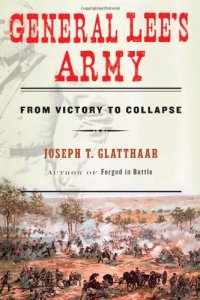
Joseph Glatthar’s excellent General Lee’s Army brings balance back to this narrative.  He studies the army of Northern Virginia in depth and concludes51tuzkutcjl that of course, Lee was a great commander.  He helped forge a great army with a great record in the field.  He deserves much of the credit he receives.

But . . . he lost, and we do well to remember this. Lee’s ultimate defeat may well have had something to do with Lee, and the army he commanded.

Glathaar shows us how the strengths and weaknesses of Lee and his army come from the same place by looking at culture, demographics, the life of the common solider, and those directly under Lee’s command.

We do have to take into account Lee’s frequent opponent, the Union’s Army of the Potomac.  From a pure match-up standpoint, it would have been interesting to have Lee, Longstreet, and Jackson oppose Grant, Sherman, and Thomas for the duration of the conflict.  As it happened Lee only faced Grant towards the end of the war, and then Grant had to work with the Army of the Potomac, where he inherited a completely different, and vastly inferior, operational and command culture than what he worked with out west.

In  A Savage War, the authors point out that the Army of the Potomac inherited a disproportionate number of soldiers recently graduated from West Point.  A West Point education tended at that time to over-emphasize math, engineering, and organization (something that U.S. Grant lamented in his memoirs).  Such skills have their place, but should not have pride of place in officer training.  Those that drank from the firehose of this approach would inevitably give way to excessive caution. Meticulous organization takes a lot of time.  In addition, once you have built something so “pure” and pretty, one might not wish to do anything that might get it dirty. This helps explain why McClellan (tops in his class at West Point) could think himself a great general even though he couldn’t actually win a battle.  He was excellent in doing what his education, at least in the narrow sense, trained him to do.

The plodding, rigidly organized Army of the Potomac gave Lee and his men a perfect target given their particular strengths.

Glaathar points out that the men in Lee’s army fully believed in their cause and came with the strongest of motivations.  Ante-bellum southern society had the duel influences of the aristocratic planter and the Appalachian border-settlers.  Both of these cultures emphasized honor and courage.  Both of these cultures preached a vision of manliness that gave way to no one.  Letters home from top officers on down the ranks show a constant desire for combat and to prove themselves.

Lee both understood and embodied this himself.  Many other accounts of his generalship focus on his ability to psychologically assess his opposite number on the Union side and devise the proper approach accordingly.  Glaathar adds to this, showing how Lee knew how to use his men expertly.  They proved superlative in the counter-attack, and could march quickly and fight hard back-to-back.  We see this at Bull Run, in Jackson’s Shenandoah campaign, and at Chancellorsville, as at other times.

But both the aristocratic planter and border settler culture had its weaknesses, and these too had a significant impact on the war.

Organization:

Appalachian border culture emphasized freedom of initiative and eschewed “systems” like tight and itchy collars.  Lack of formal structure gives one great freedom.  But an army of tens of thousands needs tight organization to act as a unit.  Without this organization, large scale offensives could never be undertaken.

Discipline:

Many in the south seceded because they did not want to be told what to do by anyone they did not like or respect.  They tended to run hot and cold alternatively.  Sure enough, Lee had a hard time enforcing discipline.  We hear a lot about Union armies looting in the South, but Lee’s army at times looted the Virginia countryside for supplies, stole from the bodies of dead Union soldiers,** and had a hard time maintaining equipment.  Many went AWOL unexpectedly not necessarily out of cowardice but because “they felt like it.”

Honor and Ego:

The aristocratic nature of the army came through in the upper echelon of the officers.  The bickered for position and rank.  At times they disobeyed directly if they felt insulted.   Some at times seemed to prefer maintaining their honor to winning a battle.

All of these weaknesses would make coordinated action over a large distance difficult.  Perhaps this is why Lee spread out his armies in his invasion of the north in 1863.  It gave each commander more independence. But . . . when the time came for coordinated action, invariably Lee’s forces could not pull it off.

Shelby Foote wrote that, “Gettysburg was the price the South paid for having Lee command their army.”  I’m guessing that he meant at least that no one is perfect.  But I surmise that he meant more.  The weaknesses of Lee’s army, and of much of southern culture, outed themselves at that battle.   There the Confederacy fought a weaker opponent, but in ways that favored Union’s strengths.  The good ground and interior lines of the Union forces at Gettysburg played right into the laps of the North’s slower, plodding, yet more bull-headed nature.^

Lee’s 1863 invasion may have been a mistake, but he intuited correctly that the South could not win a long and protracted war.  He emphasized the Confederacy’s logistical shortcomings, but the army had cultural shortcomings as well.  Perhaps Lee had read and recalled Tocqueville’s thoughts on aristocratic and democratic societies at war.  Tocqueville comments that,

In aristocracies the military profession, being a privileged career, is held in honor even in time of peace. Men of great talents, great attainments, and great ambition embrace it; the army is in all respects on a level with the nation, and frequently above it.

We have seen, on the contrary, that among a democratic people the choicer minds of the nation are gradually drawn away from the military profession, to seek by other paths distinction, power, and especially wealth. After a long peace, and in democratic times the periods of peace are long, the army is always inferior to the country itself. In this state it is called into active service, and until war has altered it, there is danger for the country as well as for the army.

It may be remarked with surprise that in a democratic army after a long peace all the soldiers are mere boys, and all the superior officers in declining years, so that the former are wanting in experience, the latter in vigor. This is a leading cause of defeat, for the first condition of successful generalship is youth. I should not have ventured to say so if the greatest captain of modern times had not made the observation.

A long war produces upon a democratic army the same effects that a revolution produces upon a people; it breaks through regulations and allows extraordinary men to rise above the common level. Those officers whose bodies and minds have grown old in peace are removed or superannuated, or they die. In their stead a host of young men is pressing on, whose frames are already hardened, whose desires are extended and inflamed by active service. They are bent on advancement at all hazards, and perpetual advancement; they are followed by others with the same passions and desires, and after these are others, yet unlimited by aught but the size of the army. The principle of equality opens the door of ambition to all, and death provides chances for ambition. Death is constantly thinning the ranks, making vacancies, closing and opening the career of arms.

. . . An aristocratic nation that in a contest with a democratic people does not succeed in ruining the latter at the outset of the war always runs a great risk of being conquered by it.

Dave

*Interesting parallels exist between Lee and Napoleon’s armies.  Both faced stiff, rigidly organized opponents.  Both emphasized movement, speed, and capitalized on the energy and spirit of their men.  Both had great success early, but both also suffered significant setbacks as their respective wars dragged on. Each faced manpower issues, but also, their opponents got better over time and neither Napoleon or Lee made the necessary adjustments based on the improvement in their opponents.

In fairness to the Army of the Potomac, the soldiers displayed extreme courage at Fredericksburg, and were stalwart in the defense at Gettysburg.

**Many southerners decry the actions of Sherman.  Glaathar demonstrates that Lee’s army did many of the same things, albeit on a smaller, less organized scale, as Sherman’s army.  And . . . they did this not just in Pennsylvania but in Virginia as well.

^Fredericksburg might serve as a good example of these qualities, with a negative outcome.

“The Civil War as a Theological Crisis”

The Enlightenment historian Edward Gibbon pointed out with some ridicule that in the Arian controversy, Christianity got into a kerfuffle over the smallest letter in the Greek alphabet — the iota.  At the Council of Nicea Arians wanted the word “homoiousios,” meaning “similar substance” inserted into the creed concerning the nature of Christ.  They were comfortable thinking of Jesus in divine terms, but not as an equal to the Father in His essence.  Led by Athanasius, the orthodox contingent objected, insisting on the word “homoousious,” meaning “same substance.”

For Gibbon and other Enlightenment oriented thinkers, this all seemed too much.  Such minutiae, such trifling, would upset things so unnecessarily.  Given that Gibbon liked nothing better than a well-oiled worldly machine, he saw the controversy as so many wrenches in the works.  Of course Gibbon missed the point entirely.  The difference between viewing Christ as fully God as opposed to merely “God-like” changes one’s conception of the entire universe, creation, and history itself.  When it comes to our theological understanding, what we worship will have dramatic consequences.

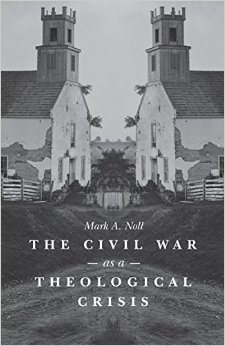
I’ve always believed that understanding religious belief formed the key to understanding any event in history, be it great or small.  Often this is more easily seen in the ancient world, where religion showed on the sleeves much more so than today. But men are men, and as a man thinks, so he is (Prov. 23:7).   Mark Noll  points out the religious roots and the religious mistakes of both North and South in his excellent The Civil War as a Theological Crisis.  Noll’s analysis gets to the heart of the real differences between North and South, and shows how these religious differences formed the roots of the political disagreements that led to war.  Both sides professed belief in the authority of the Bible, and both sides reached different conclusions.  That’s obvious to anyone, but Noll’s approach shows these different interpretations came from the same source American/Enlightenment source, and that makes this brief work a real treasure.

By 1850 America experienced a deep political crisis, but astute observers of the day saw that the roots went deeper. A Protestant ethos merged nicely with Democratic principles in America quite easily.  The individual should be able to read, reason, and think for himself.  Both Protestantism and Democratic government rest on the idea that truth always has a “plain” and obvious character.  It could be argued that an agreed upon “atmosphere” of sorts existed between Protestant denominations despite their differences (Noll takes this for granted and does not argue the point).  But in 1844 both Methodist and Baptist churches (the largest in the U.S. at that time) experienced deep schisms.  A broken Church will lead to a broken nation, and leaders from the North and South predicted this. Henry Clay opined that, “this sundering of religious ties . . . I consider the greatest source of danger to our country. In 1850 John Calhoun of South Carolina warned that if the great Protestant denominations finally broke, “nothing would be left to hold the States together except force.”*  Noll writes,

If we keep in mind that it was never only a matter of interpreting individual biblical texts, but always a question of putting actively to use the authoritative Book on which the national culture of the United States had been built, then we are in a position to understand why in 1860 battles over the Bible were so important, why divergent views of providence cut so deeply, and . . . why the Civil War illuminated much about the general character of religion in America.

First, the South.

Southern arguments in defense of slavery had the advantage of simplicity and (the apparent) strict fidelity to the Biblical text.  They pointed out that . . .

  • God allowed Israel to have slavery
  • Abraham and other luminaries owned slaves
  • Jesus never condemned the institution of slavery
  • Nowhere in the epistles is slavery ever condemned.  In fact, slaves are repeatedly told to obey their masters.  Paul, after finding Onesimus, an escaped slave, has him return to Philemon.

Thus, to argue (as abolitionists often did) that anyone who practiced slavery could have nothing to do with Biblical Christianity flies in the face of the entire and obvious biblical teaching on slavery.  The case was open and shut.

Northern arguments also strove for stark clarity and simplicity.

The most common arguments usually had the following characteristics:

  • Slavery had inextricable links to tyranny and moral abuses that the ethic of the Gospel strenuously opposed
  • Slavery contradicted principles of justice, love, and mercy found throughout the Bible
  • Slavery went against the general spirit of the “brotherhood of mankind” propounded by certain texts, like Galatians 3:28.

In other words, anti-slavery arguments inevitably used first principles but tended to avoid textual rigor and so failed to deal head-on with what pro-slavery advocates said.  Furthermore, many anti-slavery arguments wedded themselves to “natural reason,” “self-evident truths,” and “republican practices” and at times relied on these ideas more than Scripture itself.  Thus, as Noll comments, “The primary reason the biblical defense of slavery remained so strong was that biblical attacks on slavery were so weak.”  Again, Noll doesn’t dispute that slavery was wrong.  His point is one rarely made, that Northern arguments against slavery had some of the same flaws as pro-slavery arguments.  Thus, the two ships were likely to pass in the night.

Much better arguments against American slavery existed from some Protestants, and interestingly, some Catholics as well. Such arguments pointed out that . . .

  • Using Israel as an example for American slavery made the mistake of conflating Israel with America, a mistake Americans had been making for generations.
  • If the South could used ancient Israel for support, they should be informed by their practices.  For one, slaves had rights in Israel, and they did not in the South.  For another, Mosaic law prescribed years of Jubilee every 7th year and again at the 50th year in which all slaves were freed and all debts canceled.  The South never practiced this.  And again, slavery in Israel was not racial, perpetual, or hereditary. The South condemned themselves by asking to be judged by the law.
  • Certain biblical principles of justice, mercy, and love certainly applied to arguments against slavery.  But these more careful Protestant and Catholic voices applied them differently than most abolitionists.  For starters, they kept such principles clear of democratic ideology — on which Scripture remains silent at least directly (and pro-slavery arguments pointed this out).  The goal for the Christian, according to these arguments, was not so much to live in light of specific texts, but in light of the flow of history itself.  If God’s Kingdom is not just coming but is already here in Christ, we have to live in light of the “now” reality of God’s Kingdom. In God’s Kingdom we will not/do not enslave one another.  Evidence exists for this not just in Scripture, but in the early history of the Church.  Christians worked to liberate slaves and medieval civilization stood as the first major civilization in history to essentially eliminate slavery.  It got reintroduced only in the Renaissance, when pagan, Roman concepts of property and ownership tragically got transported back into Europe’s bloodstream.
  • The Roman example of slavery also condemned southerners, at least to an extent.   For one, Roman slavery lacked the racial character of Southern slavery.  In one of the best chapters in the book, Noll pulls from numerous sources that show that the real problem for the South was not slavery but race.

So whatever one might say about slavery in a general vacuum, no good arguments existed for slavery as practiced by the ante-bellum South.

Unfortunately such arguments never made it into the mainstream of American cultural life.  As to why, we might assume something along the lines of a “short attention span,” but this fits modern times more readily.  In fact, audiences flocked to hear discourses and debates of all kinds in the mid 19th century. Lincoln and Douglas in 1858 spoke for many hours at a time to packed audiences.  One debate on slavery lasted for multiple hours over multiple days to an audience of several hundred.  Rather, the reason lies in the common roots shared by mainstream arguments about slavery on both sides.

The mainstream arguments for and against slavery before the Civil War had the following characteristics:

  • They involve no more than a 1-2 step reasoning process
  • They insist on the “plain” character of truth.  Neither side could be described as anti-intellectual, but arguers for both sides seemed to show an exasperation with the need to develop arguments at all.  The truth was so obvious!
  • Anti-slavery arguments relied on “simple” principle, pro-slavery arguments on isolated small texts.  Both arguments only functioned along one track, one line of thought.

Whichever side won the argument (i.e., the war), the future for having the Church influence culture looked bleak.  The Enlightenment had done its dirty work.

Subconsciously perhaps, we reject oversimplifications because reality and our experience have more complexity and mystery than the Enlightenment can fathom.  Rejecting this truth condemned us to search aimlessly for generations hence to fill the void with politics, “The American Dream,” sex, and the like.**  Obviously western theologians could and did make nuanced and complex arguments, but western culture as a whole failed to notice or heed them.

As a buttress to his observations about slavery arguments, Noll includes a section on the idea of God’s providence as debated before and after the war.  True to form, both sides found obvious answers to the results of the conflict.  For the Southerners, even their defeat showed the rightness of their cause, for “God disciplines those He loves” — i.e. — “We are experiencing discipline, showing God’s love for us, showing the rightness of our cause.  For it is often true that the godly rarely prosper in this world.”  For the North, their arguments had a simpler character, though no doubt the South would have made them had they won the war.  “We won.  God was and is on our side.   Therefore we were/are right.”  Lincoln understood better, and pushed back on this simple approach.  We may always know that God has events in His hand, he agreed, but the particular application of His providence often remains a mystery to us.  Not even someone of Lincoln’s stature could get others to embrace this more nuanced view.

Noll’s work has great value for his illumination of the state of religion in 19th century America.  What makes it even more intriguing is how he reveals what may be the central problem of American political and educational life.  Our problem really resides not in short attention spans, not in one political party or the other, not the sexual revolution, or other such movement. Rather, Americans need to grapple with how our democratic ideology meshes with the nature of truth itself.

Dave

*Noll includes some interesting statistics showing the decline of religion and growth of government.  This should not surprise us, as Calhoun (not someone I’d like to agree with very often) foretold.

  • In 1860 about 4.7 million people voted in the presidential election, but in that same year between 3-4 times that many regularly attended church  on Sundays.  In 2004, about 115 million went to the polls, which equaled the number of regular church attendees in 1860 (Noll should take into account, however, the fact that women and many minorities did not vote in 1860).
  • In 1860 the number of Methodist clergy alone equaled the number of postal workers.  Today the ratio of postal workers to Methodist clergy approximates 9-1.
  • Before mobilization in 1860 the number of active duty military was about 1/2 the number of clergy in the country.  In the early 21st century, before mobilization for the war in Iraq, the ratio of military to clergy was about 3-1.
  • In 1860 the total income of the churches and religious organizations nearly equaled the federal budget.  Today the ratio of federal income to annual religion-related giving is about 25-1.
  • In 1860 about 400 institutions of higher-learning existed, with nearly all of them run by religious groups.
  • In 1860 there were 35 churches for each bank.  Today there are four churches for each bank.

**In an interesting digression, Noll points out that warfare and dramatic social change have often produced great works of lasting theological depth.  One thinks immediately of Augustine’s The City of God, but numerous other examples exist (St. Bernard during the Crusades, and St. Francis experienced a dramatic shift after fighting in a small war.  In the modern era, Bonhoeffer comes most clearly to mind).  By that model, the Civil War should have, but failed, to produce any significant theological insight, and this reveals a thin theology throughout North and South at that time.

Perhaps not surprisingly, the great storytellers of the 20th century, MacDonald, Lewis, Tolkien, Flannery O’Connor, Walker Percy — all came from liturgical and historical traditions.  Lewis and Tolkien both fought in W.W. I, and O’Connor and Percy both suffered from lifelong illnesses.

The Frontier Garden City

I am no fan of the “Woke” but a few years ago Ross Douthat wrote a piece entitled “A Crisis our Universities Deserve,” which showed me that at the core of this movement lay something admirable. At some point in the 20th century, college lost its emphasis on ennobling the soul, the great virtues, ideas, etc., and became a means to make more money in life. Certainly in the early 90’s, most of the encouragement from society to go to college came in this form. Students today rightly rebel from this, want more from their education than this, and more from life in general. Many “woke” students seek something moral, something transcendent. Douthat commends them for this, at least.

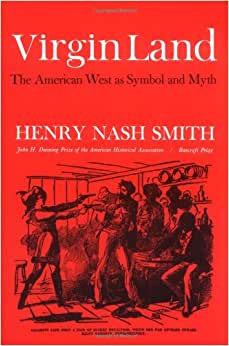
My public school education left me with the impression that the arc of American History bent towards the good, but of course we had x,y,z, and 1, 2,3, things wrong with us. The list of wrong things had grown since my dad’s day, but still stopped just short of overthrowing the basic arc. Subsequent generations have had the scales tipped. Manifest Destiny, the idea that History/God/Fate/Benign Providence wanted/needed America to span the continent, stood very near the core of our things wrong with us, and seemingly impossible to redeem in any way. After reading Henry Nash Smith’s Virgin Land: The American West as Symbol and Myth I had the realization that the Woke and the various champions of Manifest Destiny have a great deal in common, including a highly idealistic goals and a bent towards rebellion against the status quo.

This comparison may surprise some, but makes at least temperamental sense to me. My first reaction to the Woke and Manifest Destiny comes from the gut: “Ick . . . it’s just too much work, too much angst and yearning, too much of everything. Enough, already.” I feel Jerry Seinfeld should have a bit on this–he would agree with me, I’m sure. But one needs more of a foundation to denigrate these two major epochs of our country’s past and present, and one has to admire the energy and drive in both movements.

Smith shows that Manifest Destiny had no direct racial motivations. When race entered into the discussion from some, it usually involved spreading “free labor” across the continent to help limit and eventually squeeze out slavery. Manifest Destiny’s sharpest critics in fact often came from pro-slavery camps, who poured cold water on all of the messianic expectations of free labor across the continent. I found it curious as well that the native Indians got little mention. It strikes me not that they were discounted, but rather not counted from the start. Maybe promoters of expansion automatically assumed that the natives would go along with it. More likely, thoughts of overland Asian trade routes, the fusion of independence, wealth, and power, the sweep of empires throughout time–left no room to see particular people such as the natives. Certainly one could critique the impact of the idea on native peoples, but harming them seems absent from the original intent.

At its core, then Manifest Destiny

  • Believed firmly in America’s unique role in world history
  • Allied with many of the progressive causes of the day–causes that today would certainly look progressive–grants of free government things (not $, but land), the belief that the hand of government should engineer certain social and political ends.
  • Believed strongly in unity–national unity, but also a more expansive international unity, for which the United States could hold the standard. Walt Whitman wrote in his A Passage to India that

The people [are] to become brothers and sisters,

Their races, neighbors, to marry and be given in marriage,

The oceans to be cross’d, the distant brought near,

The lands welded together.

Whitman being Whitman, he waxes rhapsodically about how Man and Nature shall once again fuse together under the “true Son of God”–not sure whom this was supposed to be. We conclude, then, that Manifest Destiny involved not just our national greatness, but

  • A grand union of all humanity, abolishing all national differences and dismantling the hierarchies of the old, worn out traditional world.

All of these are strongly progressive causes.

The progressive Woke have their virtues, but their virtues lean so far in one direction that they have to overcompensate, consciously or no, towards the other pole. So while they talk of abolishing all forms of difference in some grand human unity on the one hand, with the other they proclaim a certain kind of radical individuality. We see this in their insistence that anyone can do anything they like with their body, sexuality, etc. On the one hand, the Woke can be fiercely anti-authoritarian and anti-institutional, but on the other, as Patrick Deneen has pointed out, they need Government writ-large to protect them from local, more traditionally minded majorities. And, while the Woke encourage a general sort of mixing, they have a hard time mixing in a fruitful manner, i.e., with relationships, marriages, and families.

With the heroes of expansion west, real or fictional, we see the same motifs. Civilization requires cooperation, but Cooper’s Leatherstocking, Whitman’s rhapsodies, and the real Daniel Boone can never settle and build. The unbounded horizon calls more strongly to them than any particular place. They decide things for themselves on the fly. Their freedom from the shackles of civilization gives them a newfound moral clarity and moral authority, for they are freed from all bigotry of place. They see with universal eyes. In his novel Old Hicks the then-famous Charles W. Webber (a product of Princeton), declares of the Texas Ranger that,

With them the primitive virtues of a heroic manhood are all-sufficient, and they care nothing for reverences, forms, and duties, as civilization has them, but respect each others rights and recognize the awful presence of a benign God in the grandeur of the mountain, forest, plain, valley, and river. . . . Such men do not look to society except with disgust . . .

Interestingly, as part of the plot, Webber has the head mountain man romantically pursue the wife of the villain, and marry her despite she actually being the wife of the evil Count. The “Laws of Nature” here easily become the Laws of God, which trumps the laws of man. Similar arguments today justify ditching traditional sexual ethics. For example, those that transition, or “come out,” are granted a carte blanche in their decisions regardless of its impact on those around them, for their very distance from society with these decisions grants them supposed insight and authority.

Webber wrote fictional characters, but life imitated art in some respects with the foremost advocates for the frontier. Francis Parkman, another ivy-league grad (Harvard) traveled west in the summer of 1842 following his sophomore year. In his journal Parkman showed disdain for most of the actual people he met, especially the livestock farmer, a foreshadowing of sorts of the frayed relationship between coastal elites and flyover country. After passing beyond civilization further into the forest, Smith notes that “[Parkman’s] tone changes completely.” The independent woodsman garners immense respect: “He is a remarkably intelligent fellow . . . resolute and independent as the wind.” Smith writes,

Parkman’s antithetical attitudes towards farmers and the hunters of the wilderness illustrate the fact that . . . two distinct “West’s” existed in the minds of many [advocates of the frontier from the east]. The agricultural west was tedious. Its inhabitants belonged to a despised social class. The Wild West was by contrast an exhilarating region of adventure in the open air. Its heroes . . . were in reality not members of society at all, but noble anarchs owning no master, free denizens of a limitless wilderness.

Advocates for Manifest Destiny could, like the Woke, see civilization in sweeping terms, and they could see the heroic individual. They both have a harder time with groups in between these categories, the basic societal building blocks of villages, farms, towns, etc.

A competing mythos, that of the west as paradisal garden, also informed America’s westward push. This motif had more to say for it, as it usually involved families, but still had its rose-colored glasses. Timothy Flint wrote against attitudes like Parkman’s, and gloried in farm life, writing in 1827:

Thousands of independent and happy yeoman reside [in the west], with their numerous, healthy, and happy families about them, with the ample abundance that fills their granaries, with their young orchards, whose branches must be propped to sustain the weight of their fruit, beside their beautiful rivers and beech woods, in which the squirrels skip, the deer browse, and the sweet red-bird sings, and with the prospect of settling their children on any of the dozens of farms that surround them.

James Lanman echoed such ideas in the 1830’s . . .

If, as has been remarked by distinguished statesman, cities are the sores of the political body where the bad matter of the state concentrates what healthful attitudes of mind and body are afforded by agricultural enterprise. The exhilarating atmosphere of rural life, the invigorating exercise afforded by its various occupations, the pure water, the necessities supplied for daily existence, leading to early and virtuous marriages, all point to this pursuit as best adapted to the comfort of the individual man.

I do not like to agree with the anti Free-soil crowd (often, though not always, secessionists and pro-slavery) on much of anything, but the “Messenger” was on to something in 1856, when it opined that

Farming is hardly a pleasant occupation, and the idea that it is comes from dreamers and poets. The actual, manual operations of farming are irksome and repulsive to the great mass of mankind.

Alas, reality set in for the devotees of the garden myth shortly after the Civil War. Smith writes,

The yawning gap between agrarian theory and post-war reality . . . comes out in the farmer’s crusades of the last 25 years of the 19th century. The western farmer had been told that he was not a peasant but a peer of the realm; that his contribution to society was basic, and all others peripheral or parasitic, in comparison cities were sores on the body politic. . . . He had been told that he was compensated for any austerity in his mode of life by receiving shelter from the temptations of luxury and vice, and against the ups and downs of the market. His outstanding characteristic was his independence of character and condition.

But after the Civil War Republican policy obviously favored the city against the country, the merchant against the farmer. And the western farmer found that instead of being independent, he was at the mercy not only of the Chicago and New York and Liverpool grain pits, but also of the railways and steamships lines that he must rely on to get his crop to market

I have read most of the volumes of Toynbee’s unabridged A Study of History. I think him a great master and I owe him a great debt, but I found the central theme of Volume III, which describes the growth of civilizations after their infancies, so annoying I stopped reading about halfway through some years ago. I have yet to pick it up again. Toynbee rightly reacted against material measures of progress. A civilization surely must be able to advance in more ways that territory and GDP. Toynbee developed a different approach, which meant a good start. But he ended with what he called “etherealization.” The idea seems to run along the lines of

  • A civilization develops an idea or technique that works for them, but that idea/process, has a limited growth potential because it is anchored to its locality
  • The civilization then extracts the core of the idea, removing it from its trappings, thus making it more transferrable across space.
  • This allows for more sharing of ideas, etc. which aids growth. The process is essentially cooperative and other oriented.

He takes, as an example, the alphabet as an etherealization of language, as opposed to ideograms. Alphabets transfer across cultures relatively easily, but China’s writing, among other things, will not allow for this, keeping them isolated.

Toynbee often nods via anecdote and analysis to “the old ways are best.” He wasn’t always consistent in his ideas, but this is not a fault. He usually explored possibilities as opposed to asserting things absolutely. But etherealization shows Toynbee’s weakness for too much generality, too much “Platonism” (but only in the worst sense of that word). Lifting something too far off the ground tends to make it dangerous and destabilizing to society, like a steroid. Supporters of Woke politics, and mid-19th century supporters of Manifest Destiny, have this same problem. What masks itself as “progress” in fact only abstracts what in embodied form might actually be good, though less dramatic, ideas.

American history mashes together so many competing concepts. Sometimes this results in great creative tension. We get into trouble when succumb to the lure of the unbounded everything America has always foolishly promised.

We should note that the Old Testament takes a dim view of cities. Cain builds the first one, from which evil and violence come, and then you have Sodom, the cities built by Hebrew slaves for Pharaoh, Babylon, Ninevah, and the like. But the end of the New Testament shows the final restoration taking place with a garden within a city–even cities get redeemed in God’s providence over history. So, the frontier, the farm, the city–every civilization that actually functions needs all three.

Dave

Inventing Vietnam

Like most Americans, I root against the New England Patriots.  It is nothing personal, but Americans root for the underdog, and the Patriots have been so successful they are never the underdog.  And yet, I can’t help but admire the brilliance of Bill Belichek.

He confirmed my admiration during a particular playoff game against the Steelers many years. ago.  The Patriots held a slim lead early in the game but the Steelers had a built a nice drive.  They resided just out of field goal range and faced a 4th and 1 somewhere around the Patriots 40 yard line.  The Steelers decided to go for it, and their home crowd cheered.

At this time the Steelers built their identity around a “smash-mouth” style of play and relied heavily on running back Jerome Bettis.  Everyone knew the Steelers would want to run the ball.  The Patriots of course also knew this.  They stacked the line of scrimmage and their defense sold out on the run.  I don’t recall if they had any safeties behind the line of scrimmage.  Their defensive formation triple-dog-dared Pittsburgh to pass.

I remember yelling at the TV for Pittsburgh to call a timeout.  They were obviously going to run, but if they had just flared out a tight-end it could have gone for a touchdown.  But Pittsburgh went ahead and ran the ball anyway.  And of course New England, having every single player right at the line of scrimmage, stopped it easily.  After taking over on downs Brady promptly completed a long pass for a touchdown and broke the will of the Steelers.

Game over.  In the first quarter.

I thought to myself, “How did Belichek know Pittsburgh would run?”  Of course he didn’t really know, but his defense said to me that he knew.  What Belichek, knew, I think, is that under stress, we revert to our comfort foods.  We can’t help it.  In a regular season game, with stress levels lower, maybe Pittsburgh calls a different play.  But in the playoffs?  He knew they would stress-eat the Ritz crackers and run Jerome Bettis over left-tackle even when a voice inside them probably told them to eat carrot sticks instead.  They couldn’t help it.

Civilizations contain a vast aggregate of personalities, but have a undeniable personality and predelictions all their own.  When we picture someone wearing a t-shirt and blue jeans, of course it fails to cover everything about America, but it covers enough.

Toynbee believed that western civilization reveals itself in its passion for mechanics.  He wrote,

The Hellenic civilization displays a manifest tendency towards a predominantly aesthetic rubric for orienting and defining itself.   The Hellenic tendency to view life as a whole distinctively in such terms that the ancient Greek adjective “kalos,” which denotes what is aesthetically beautiful, is used in addition to describe what is morally good.  In other words, Greek concepts of beauty and morality . . . were indistinguishable.

When we come to our own western civilization we find no difficulty discovering our own bent or bias.  It is, of course, a penchant towards machinery: a concentration of interest and effort upon applying discoveries of Natural Science to material purposes through the creation of social-clockwork devices, i.e. steam engines, motor cars, but also social engines like representative governments and military mobilizations.

We sometimes talk as if this appetite for mechanics was a quite recent occurrence in western civilization  . . . But this is precisely how westerners were viewed by the courts in Japan and China [in the early 1800’s, just prior to the Industrial Revolution]–as “barbarians” redeemed partially by our manifest and outsized technical ability.   The Byzantine princess Anna Comnena had the same impression of the first crusaders in 1099 A.D.  She called  their  crossbow a “devilish construction” that, while ingenious in its mechanics, fitted perfectly the barbarians who wielded it . . .

I thought of Toynbee’s analysis reading James Carter’s Inventing Vietnam.  A lot about this book revealed little about the Vietnam War that I had not read elsewhere.  I thought Carter missed some important opportunities to illumine the conflict.  But his basic thesis, that America essentially tried to invent, i.e. “call int0 existence” a country that did not really exist makes sense.  South Vietnam had no real governance, no real culture, no real identity at all, apart from some lines on paper at the U.N.

Carter demonstrates that we tried to create South Vietnam in the only way we knew how.  We went to our comfort food . . . lots and lots of mechanical stuff.

Everyone recognized fairly early on that South Vietnam occupied a precarious position in Southeast Asia.  President Diem failed to inspire confidence.  The North had nearly all the best political leadership.  The major battles of the war against France, and thus, the major political infrastructure to handle the war, happened in the North.  Even in the late 1950’s we realized the South Vietnam could collapse not so much because of the actions of North Vietnam but under its own weight.  Castles cannot built on air.*

But for many reasons, some well-intentioned and justifiable, and some not, we felt that we had to try.**  We sought to modernize their economy, and give thousands of South Vietnamese jobs through our massive construction projects.  We could maybe, just maybe “fast-track” their way towards gaining some kind of statehood.  If nothing else, in attempting this we stayed on familiar territory.  We knew how to provide material goods and benefits.

While Carter’s book disappointed me overall, he proves his main point.  Our efforts to “create” South Vietnam massively undermined our stated goals.

  • The massive surge in U.S. dollars in South Vietnam destabilized their economy
  • South Vietnam’s economy and infrastructure could not absorb the massive inflow of goods, which created a black-market economy almost immediately.  This “shadow economy” further eroded governmental authority.
  • Most significantly, construction projects facilitated the expansion of our war effort.  The expansion of the war effort led to more bombing in South Vietnam, and more troop activity.  The more war South Vietnam experienced, the more disruption they faced, the less chance the South Vietnamese government had of establishing themselves.

Each of these problems served to ensure that the South Vietnamese government had no control over its own destiny.  Many in the State Department and military realized this, but could do little else but press on.  We couldn’t help ourselves.  This is what we knew how to do.  We can reasonably assume that if we had defeated the North Vietnamese militarily, the overall strategic situation would have changed hardly at all since the 1954 Geneva Accords which divided Vietnam in the first place.  South Vietnam would not have been an independent country.

When our war in Afghanistan seemingly went well in late 2001, Secretary of Defense Donald Rumsfeld was a media darling.  His “transformation” doctrine of war, which emphasized smaller troop levels and increased use of technology, seemed to work.  But by 2006 Iraq was a mess, and by 2009 the situation in Afghanistan had significantly eroded.  In truth, much of the Rumsfeld doctrine hardly broke new ground.  It appealed directly to our comfort food of believing in, and relying upon, bigger and better stuff to solve our problems.  Some tech oriented environmentalists tap into this again with their pledge that new green technologies will solve economic and environmental problems.  If we looked closer we would see that our weaknesses, and of course also our strengths, have deeper roots than this.

Dave

*Marine General Victor Krulak commented in 1966 that, “Despite all our assertions to the contrary, the South Vietnamese are not–and have never been–a nation.

For a postscript below, Raymond Fitts’ article entitled, The Uses and Abuses of Technology in War

“The American effort in Vietnam was the best that modern military science could offer. The array of sophisticated weapons used against the enemy boggles the mind. Combat units applied massive firepower using the most advanced scientific methods. Military and civilian managers employed the most advanced techniques of management science to support combat units in the field. The result was an almost unbroken series of American victories that somehow became irrelevant to the war. In the end, the best that military science could offer was not good enough . . .”1

How is it that such a paradox developed? How could a world Super Power lose a war to a third or forth rate military power? The answer has many parts. One part of the answer must lie in the difference between military science and military art. The more technology a country has developed, the more it seems to depend on military science in stead of military art. Another part is in the make up of the combatants and their outlook toward warfare.

Despite the many analyses of the Vietnam war produced by the military, none has adequately considered the fundamental question of how the U.S. could so completely dominate the battlefield and yet lose the war. Senior military officers have published books and memoirs about Vietnam. They have all nearly ignored the insurgent portions of the war and devoted themselves to the conventional side of the conflict. The most celebrated analysis of the war made by a military officer was produced by Col. Harry G. Summers, Jr. His basic treatment of the entire war was as it ended, i.e., in a conventional invasion of South Vietnam by North Vietnam. He ignored the guerrilla tactics and insurgent strategies of the war. All these personal accounts of the war seem to be best summarized by the adage “If they has just turned us loose in 1965, the war would have been over quickly.”2 It is clear that had the war been nothing more than a conventional one, the US should have been more successful than it was.

A clue to understanding the Vietnam paradox lies in the term “military science.” No one can doubt the importance of military science to the success of military operations in today’s world. The firepower provided by today’s weapons dominates the modern battlefield. The procurement of those same systems is a complex science in itself. However, successful military operations are a combination of the application of military science and military art.3

As the term implies, military science is a systematic body of knowledge about the conduct of military affairs. It deals with issues that can be quantified with a considerable degree of precision. It generally deals with what one can or cannot do in military operations–the technical aspects of developing and employing military forces.

Military art is the systematic study and creative planing and conduct of military affairs.4 It involves strategy (including tactics), political-military affairs, leadership, and morale. In short, it deals with the inexact side of military operations. It is concerned with what military forces should or should not do and why. It is learned through a study of history.

Successful military campaigns are the result of some sort of balance between the two. The balance may, in fact, depend on the status of the opposing forces–their equality. Reasonable equality may not exist between opposing forces. The weaker side must then depend on superior military art to achieve victory.

The North Vietnamese and Viet Cong were forced to depend on the use of military art because of the overwhelming resources and superior technology of the U.S. The Communist confused the Americans with a package of political, psychological, economic and military warfare.

There is a considerable body of literature that suggests that the warfare of the future, especially with the end of the Cold War, will be on the low-intensity end of the conflict spectrum. If indeed such is the case, then the U.S. will need to rethink how it uses its technology to fight at this end of the spectrum. But to understand what constitutes the low-intensity conflict some definitions are necessary. Applications of technology in this environment will be explored to evaluate the effects of the use of technology.

Definitions

Low-Intensity Conflict

The American military establishment considers low-intensity conflict to be manifested in four different ways: (1) counterterrorism (assuming there is a terrorist to counter); (2) peace keeping: (3) peacetime contingencies (quick sharp, peacetime military actions like the air raid on Libya in 1986); and (4) insurgency/counterinsurgency. The inclusion of some of these terms in the definition of low-intensity conflict is debatable. Terrorism can be considered a tactic that can be used in any type of warfare. Peace keeping missions are meant to prevent the outbreak of a conflict. The essential difference between war-fighting and peace-keeping missions is that one makes the maximum use of force while the latter is committed to the minimum use of force. Direct action missions tend to be high in intensity but short in duration, a situation that is particularly unsuited for the term “low-intensity conflict.” We are thus left with insurgency and counterinsurgency claiming any legitimacy to the title “low-intensity” conflict.6 A low-intensity conflict includes not only the unconventional aspects of warfare but also economic, political and psychological warfare.

There is an important aspect about low-intensity conflict that needs emphasis. The level of intensity is a relative thing. For the soldier in the trenches, combat is always intense–he’s the one getting shot at. For the United States, Vietnam was not a highly intense conflict because it did not require the full resources of the country. For the North Vietnamese, the war was a high intensity conflict because it involved all the nation’s resources. The level of intensity is usually associated with the probability of occurrence of a certain level of conflict. Terrorism is at one end of the spectrum and is highly probable while all-out nuclear war is at the other end and is least likely.

Partisan vs. Insurgent Warfare

The difference between partisan warfare and an insurgency is what the guerrilla is trying to do to the government. The partisan is merely interested in throwing out a conquering power. The partisan may need help from an outside source. An example might the East Europeans trying to expel the Germans during World War II. An insurgent is trying to overthrow an existing government by any means. Insurgencies are the more insidious of the two in as much as it has no definite beginning; its origins are not military, they are political, economic, and psychological. The insurgency is self-sustaining; and does not need outside support. An insurgency sneaks up on the existing government slowly and quietly.

Successful insurgencies have a number of elements in common. Four characteristics are particularly important for the American military: the protracted nature of the war; the central role of the insurgent political infrastructure; the secondary role of the insurgent military; and the use of guerrilla tactics in military operations.7 An insurgency represents the total integration of political and military factors with the political factors always in complete domination.

Conditions are ripe for insurgencies in many parts of the Third World. They all have several things in common: the stark contrasts between incredible poverty for the vast majority of the population and the extreme wealth for the ruling elite; a small to non-existent middle class that can be a stabilizing influence and a conduit for the upwardly mobile; these same areas often times sit astride important trade routes or trade-route chokepoints; they might contain important deposits of raw material vital to the industrialized world.8 The insurgencies of the twentieth century have been scattered all over the world and have been the result, for the most part, of real or imagined inequities in political and economic power coupled with the perception of minimal opportunity for reform, either political or economic. When taken together, the unique aspects of insurgent warfare suggests that such struggles are different from conventional warfare.

The most important aspect of an insurgency is time. Both the French and the Americans found that their enemies used time as a weapon against them. The Vietminh and later the Vietcong purposely made the struggle longer waiting for the Americans and French to get tired of the endless blood letting and look for a way out of the conflict.

The rebels also need time to build up their political support and military strength relative to the government they are trying to overthrow. Time works for the insurgent in another way: every day the rebellion exists is another day that discredits the government and its ability to govern and control its own destiny. The defeat of the insurgent military threat is only an adjunct to buying time for the government to implement reforms and for those reforms to work..

Guerrilla Warfare

Guerrilla warfare is the classic ploy of the weaker against the stronger. The conventional European military operations are planned to obtain a quick victory while guerrilla warfare tactics are geared for the long haul. The guerrilla attempts to avoid a decisive defeat at the hands of the stronger enemy. They operate in small groups to avoid presenting tempting targets for government forces that usually have vastly superior firepower for its use.9

In fact, a guerrilla wins by not losing, while the government loses by not winning. In short, there is no room for the status quo. Each side must discredit the other by some means whether it be political, economic, psychological, or military. Generally, it is s combination of all these elements. The military aspects usually are fought to make space for the other aspects to work on the minds and pocket books of the population.

The American Way of War

There are several deep-seated reasons for the condition of the American armed forces: military men are still highly regarded in Europe but not much here; the European tradition of martial exploits is missing in America; a technological bias to create weapons that can kill from a distance; and a failure to create a well-motivated, well trained military force.10 Most Americans have not had to come to grips with the central role that military forces play in international settings Americans have not had to confront war as a political act.

Its long span of oceanic-based isolation has led the Americans to think of war as an aberration, a failure of political policy Americans see warfare as a great crusade to over-come a well defined enemy who was definitely evil. Simplistic approaches to political military problems are also indications that Americans have not been forced to deal with the role of force. Despite obstacles, Americans have expected to achieve their goals; the spirit of “can-do” has been a permanent part of their collective psyche.11

The Civil War was the first American conflict observed by professional European soldiers. The British, French and Greater Prussian General Staff sent representatives to observe both sides at war. The observers noted, with some distain, the American penchant for standing off at some distance from each other and throw enormous amounts of lead at each other, often times for hours on end. This method has become ineluctably part of the American way of war.

This proclivity to conserve lives has been all the more difficult because of a distinction in the military tradition: the population has always distrusted a large standing army, it has thus developed a strong militia to fight its wars. American armies have had to learn to fight by fighting. The U.S. has been willing to compensate for what it lacked in preparation by spending its national wealth. America’s war industry has overwhelmed its enemies with weaponry.12

The U.S. military has concentrated on the sciences of developing, deploying, and employing America’s overwhelming resources since the Civil War. The military has, as a result, not had to be very clever in the military arts because it could overwhelm its opponents in a sea of men, weapons, firepower, and logistics.13 This ability has lead to a 20th Century American trend in American thinking: modern American strategists and tacticians have sought to substitute fire and steel for American blood.14 General James Van Fleet, then commander of the Korean based 8th Army in 1952, is a good example of this mode of thinking. He was determined to use his artillery as a substitute for U.S. infantrymen.

The basic aim of the U.S. military, it seems, in peacetime is to buy hardware rather than use it. The main aim of each service is to get from Congress as much money as it wants. The peacetime emphasis has moved from fighting skills to procurement and the management of technology. The best way to a promotion is through running a successful procurement program in the Pentagon. Leadership in the field is a secondary consideration. What the American military has developed is a distorted sense of priorities and a general lack of seriousness about warfare. It has fallen into a push-button mentality that has a developed a passion for hardware to the neglect of strategy, tactics, and the intangibles of warfare.15 We have done a marvelous job of preparing for the next war only to find that we cannot afford to fight it.

In spite of all this high-technology, it has never been the decisive factor in any American war. The struggle to use technology and to deal with the enemies technology has been much more important.16 Using history as a guide, the American record with military aviation technology has been mixed at best. In World War I, the U.S. flew European designed and, for the most part, built aircraft. World War II showed the Japanese Zero was better than any U.S. front line aircraft at the beginning of the war and the MiG-15 was a superior surprise during the Korean conflict.17

The French Experience

France was the last of the European imperial powers to resist, by force, the loss of its colonies following World War II. The wave of independence following the war swept over all of the former European colonies. The wave gave the colonies a moral advantage that made the war in Indochina increasingly unpopular in France.

The French experience in Indo-china finally ended with the signing of a treaty between the Viet Minh and the French. The treaty divided the country into two halves: one half went to the Vietnamese communists, the other went to what became the Republic of Vietnam. The political turmoil over the next decade brought the U. S. into a war that the French could not win. The final disaster for the French was at a small town in northwestern Vietnam called Dien Bien Phu. Hot on the heels of Vietnam was another colony of France: Algeria. It seems that the French didn’t learn enough from Vietnam because they went through the same traumatic experiences in Northern Africa that they had in Asia. The two places were very different, but the guerrilla war fought by France in both countries contained the same French military responses to the insurgents.

Vietnam18

The French experience in Vietnam lasted eight long years. The Viet Minh experienced tactical defeats with huge losses when faced with the terrible destructive power of the French firepower. The Viet Minh accepted their losses and learned from their mistakes. Over time, they succeeded in dominating Indochina except for a few French “safe areas” around Hanoi and its immediate vicinity.

The only real advantage the French had was their mastery of and ability to conduct European-style machine warfare. They believed to the very end that the enemy could be crushed and Indochina subdued by concentrated firepower. Early on, they also learned that artillery and airpower had little effect on an elusive enemy that avoided a fight. What the French wanted was a large-scale battle of attrition that would grind the Viet Minh into the ground under a final massive avalanche of bombs and artillery fire. The strategy has two fatal flaws: (1) the French were frustrated by their inability to find and fix an enemy in an inhospitable environment; and (2) the French assumed that they alone possessed the ability to apply firepower in a battle of attrition.

Giap keep the pressure on the French by infiltrating soldiers into the Delta lowlands around Hanoi thus tying down French units. He initiated local attacks against the French units creating havoc in the colonial heartland. Giap also conceded to the French their superior firepower and willing spent lives to accomplish two things: first, to maintain his offensive and secondly to buy time to build a firepower base that could challenge the French in open warfare. To accomplish such things, surprise and secrecy were essential.

The Viet Minh learned from experience that under no circumstances should a column be caught in the open to be devastated by French firepower. They traveled by night in small groups to lessen the probability of being detected. They stayed in areas firmly under their control. Limited attacks outside of their protective base areas were planned carefully and by moving to and from the objective area without delay. If they were caught in the open, the men would scatter and hide before the French were able to adjust in and mass artillery fire on the position. The elusiveness of their tactics in combination with the difficult terrain greatly reduced the killing power of French firepower.

The Viet Minh also learned something about the application of airpower. Initially, it frightened the green, inexperienced insurgents and forced them to break off attacks. The French could rarely afford to send more than single aircraft to turn back attacks. The Viet Minh learned quickly that airpower employed in small doses possessed little destructive power. They also effectively dissipated French firepower by using a “hugging” tactic that began with a concentrated recoilless rifle, mortar, and machine gun attack on a fire base with the express intent of knocking out the defender’s radio–the sole means of calling for friendly fire. They then moved the entire force within the barbed wire outside the fort. Fortress and firepower proved to be no match for cunning, patience, courage and a willingness to sacrifice lives to achieve an objective.

Close air support became more effective as time went on. The pilots got to know their assigned areas of responsibility. They could bomb and strafe with particular destructiveness because they did not need to worry about the location of their own soldiers.

The French lost the first round of the war when they lost effective control over most of the territory and population in North Vietnam. The lesson to be learned here was that no amount of firepower or fortification can be effective against an insurgent without first obtaining the support of the people who inhabit the country.

The most effective innovation in firepower control was the use of light observation aircraft, specifically the Morane, to control supporting fires in support of an infantry unit in heavy contact. Such control often meant the difference between victory and defeat for the supported unit. The pilot had to be able to put the fire at very close ranges to the friendly forces.

The American observers present were not particularly impressed with the French airsupport system. It had airplanes dashing about from one fire fight to another in small groups (often only a few planes at a time). It was not their idea of a concentrated air campaign because it seemed so disorganized and without purpose. The close air support provided by the French air force, however, was sufficient as long as the enemy restricted himself to low-level hit-and-run tactics.

Both sides were learning from the battles. Giap learned that his forces were too lightly equipped to slug it out with the French and their overwhelming firepower. He therefore resorted to guerrilla warfare tactics using irregular forces against enemy strength and main forces against French weaknesses. He committed his forces only when there was a high probability of success.

On the positive side, Giap learned that the ability to stand up of French firepower increased with experience. A few well hidden machine guns made the effectiveness of French air attacks decrease appreciably. Giap did not have to match French firepower gun for gun to reduce its effect.

Giap also realized his own impatience with his early attempts at open warfare. He then decided that he would fight on his own terms. He sought to draw the French away from their bases thereby weakening the French ability to project and supply large fire-power intensive forces. He then attacked when the right combination of circumstances (weather, lines of communication, terrain) and available forces reduced or eliminated the French firepower advantage.

For the French, their victories convinced several commanders that the war could be won by fighting a decisive set-piece battle of attrition. They therefore sought to lure the Viet Minh into attacking well-prepared positions thus letting the enemy bleed to death in the face of French firepower. In doing so, however, the French made two critical mistakes. The first was to assume that their firepower was more effective than it really was. It was indeed effective early on, but as the enemy became better able to avoid it and developed their own firepower base more and more ordnance was needed to achieve significant results. Their second mistake was in not realizing that unless the attacker has an overwhelming advantage in firepower, causalities were likely to be about the same on both sides.

The French infantry effectiveness began to decline as a result of an accumulation of all of these factors. The French soldiers, because they were often green or shaken, needed more and more concentrations of firepower to keep them effective. The guerrilla retains the strategic initiative because he can determine the level of the conflict whenever the enemy’s firepower proves to be too destructive.

The French left and the Americans began to replace them only to have to learn the same lessons the French had, but without the benefit of consulting the French.

Algeria

The Indochina war was hardly over when fresh trouble broke out in Algeria, France’s colony in Northern Africa. Trouble had been brewing there for some time, just as it had in Tunisia and Morocco. France had settled both of the latter problems by granting them independence. But Algeria was part of metropolitan France and would always be French.

Extensive European land ownership and a local Moslem elite that controlled the economic and financial structure while the bulk of the population went hungry and landless made Algeria look a lot like Vietnam. The French never ruled comfortably and force lay just below the governmental facade.19 Algeria was not France: 90 percent of the wealth was in the hands of 10 percent of the population, nearly a million people were unemployed while nearly two million were underemployed.

Both sides in the rebellion understood much about the other. The French refused to realize the strength of nationalist feelings while the rebels did not recognize the obstinacy of the Europeans or the French military against them.20

French military forces numbered about 50,000 when the rebellion started on the 1st of November, 1954. By May of the following year there were 100,000 French soldiers in Algeria. The military commanders were not worried about “bandits” who would yield rather quickly to the superior power of the French army; they thought nothing of sending mechanized columns to subdue them. Apparently the lessons of Vietnam had not yet sunk in because any Vietnam veteran could have told them that mechanized columns sent anywhere did little more that provide convenient targets for guerrillas.

The French aggravated their situation with the measures taken by the police; numerous arrests for nearly arbitrary reasons and the brutal treatment of the detainees just fed the fire. Further French counter tactics remained the rebels best friend. The build up was still under way and the military commanders did not have the forces to carry out the traditional pacification tactics. The Army was in a particularly dangerous frame of mind after the losses in 1940 and Indochina left it with a monstrous inferiority complex.21 The French guerrilla warfare doctrine applied to Algeria was doomed from the start because the French had ignored the aspirations of the population –in Mao’s doctrine the very first lesson. In spite of their revolutionary doctrine, and the results in Vietnam, the French army continued to rely on the traditional techniques of fighting the Algerian war.

Despite their inept military activities, the French did have some advantages: approximately 400,000 soldiers in Algeria; the factious nature of the rebellion; and the lack of rebellion’s internal cohesion played a disruptive role amongst the rebels.22

The Battle of Algiers occurred after the 10th Parachute Division took over counterterrorism duties. The division was not kind in its tactics. The battle that followed was an outgrowth of their brutality that left many dead behind. Controlled genocide as policy seemed to work though. The rebel infrastructure in Algiers was destroyed and the French efforts in the countryside seemed to be working. The battle in Algiers sent more moslems into the arms of the rebels.

But the French off-set their gains with their garrison concept that took the bulk of their forces. The concept left the countryside to the guerrilla (a failing seen in Indochina). Several other factors degraded the effects of French tactics: the use of inexperienced conscript soldiers, an inadequate force for the mission (again a notion left over from Indochina), guerrilla reinforcements coming in from neighboring sanctuaries, rebel determination to throw them out, French barbarism, and finally the overall extent of the destruction of the country.23 The French barbarism even reached into neighboring Tunisia when an air force colonel ordered a Tunisian village bombed on the pretext that machine guns fired at French aircraft–some three miles away in Algerian skies.24

The French attempted to seal off the Tunisian border with a fortified barrier that was 40 meters wide and just over 250 kilometers long. The Morice Line used an electrified fence as its core. It was surveyed by radar and human patrols, covered by searchlights and artillery in places, and had its approaches mined. It still had its disadvantages: it was expensive to build, it required thousands of soldiers to patrol, it was a far as 50 miles from the border in some places and it could be outflanked.25

French tactics eventually became more effective and more mobile with the use of helicopters. But by this time President Charles de Gaulle realized that the French could fight in Algeria for a hundred years without resolving the issues that brought on the conflict in the first place. He finally put an end to the madness by granting Algeria its long awaited and much desired independence. Algeria wasn’t out of the woods yet, but at least it could set its own course.

The American Experience

Americans have had a love affair with technology since the inception of the country. It helped to develop a new continent from coast to coast through the train and the telegraph. Technology made up for the lack of people in developing a new country. That very love affair carried into the way Americans fought their wars. They took it with them to all of their wars since the Civil War. In a recent example it contributed mightly to their undoing.

Gadgets in Vietnam

The Vietnam experience was a bewildering disaster for the U.S. military. The battlefield effort gave the U.S. military an almost unbroken string of victories. On the one occasion, Tet Offensive of 1968, that the enemy stood and fought the American forces in a conventional style, the enemy was so badly beaten that it could not launch another major offensive for four years.26 The U.S. still did not win the war. Apparent military success could not be translated into political success in the larger war. The United States is so dominated by its technologies and its wealth that it has lost touch with people. The United States believes it can spread democracy and maneuver politics by technology and money only. This may well be a fatal error in the life of our nation.27 The loss of China to the communists and the French loss in Indochina made for rather unpleasant news in the U.S. about a new type of warfare coming onto the world scene. Insurgency was a type of warfare that was wholly unknown and unanticipated in America. This isn’t too surprising because the Americans lacked a number of overpowering attitudes that were, and are still common in the Third World: the depth of belief that comes from desperation, a tradition of humiliation that begets hatred; the immediacy of wide spread starvation in the face of corrupt plenty; the zeal of the patriot in the face of foreign invaders and finally a basic lack of interest in war.28

In tune with their propensity to use gadgets, the Americans invented “think tanks” to think up new devices and ways to use them; the think tank was supposed to devise new policies that would allow the U.S. military to fight an insurgency war. The think tank was a development that followed the end of World War II when the Department of Defense didn’t want of lose all of the scientific talent it had accumulated during the war. Insurgency provided the think tank’s biggest challenge after the Korean war.

So we sent our soldiers to Vietnam unprepared for what they were to face. They were so unprepared, that even the soldiers responsible for intelligence gathering could not speak Vietnamese. They had to hire Vietnamese to translate for them. The translators were as ill-prepared for their task as the American intelligence specialists were; some could only barely speak English at all let alone translate Vietnamese into intelligible English. Given such a starting point, it was hardly unlikely that the wrong story got told, especially with the Oriental propensity to tell a Westerner what he wants to hear.

The toughest technical problem was to just find and identify the enemy. The VC and the NVA did not, as a rule, fight in regiments and divisions. The lengths to which the U.S. gadgeteers went to solve this problem are truly awesome.

The U.S. tried bedbugs to sniff out people.29 The bed bug is supposed to be able to smell human food from a long distance. It then moves around making some small noises. The noises were what the gadgeteers tried to use to operate a meter showing the proximity to people. The think tanks devised a machine to be carried by one soldier and operated by four or five bed bugs. The sniffing tube was pointed at a suspected ambush site thus providing a sign to the soldier that somebody was hidden there. The machine failed combat test.

A “people sniffer”, using a chemical-physical apparatus, did have some successful field tests. The machine was supposed to be able to detect body odor of concealed guerrillas from 200 yards away.

Small infantry units had a small personnel radar that could detect moving human beings and alert defenders in the dark of impending attack. The attacks happened anyway.

The starlight scope turned out to be a useful gadget. It allowed a soldier to see in the dark by concentrating the light of the stars. Aircraft were even using them.

Sound was also used as an indicator in several gadgets: one gadget detected the sound of clothing rubbing against clothing; sensors were used on the Ho Chi Minh trail to detect the sound of trucks and other vehicles. Seismic detectors were used to detect the trembling of the ground as heavy trucks and tanks drove by. Infrared detectors were developed for use to find heat sources beneath the jungle canopy. Special photographic films were developed to detect the dead vegetation used as camouflage.

American gadgeteers seldom reckoned with the propaganda effects of the usage of their gadgets. The bed-bug episode drew a wave of negative editorial comments in the Vietnamese press.

Then their was Operation Ranch Hand. The operation was designed to defoliate the jungle hide-outs of the VC and NVA. It was eventually used to destroy the rice crop. The trick back-fired in a big way because of the special status of rice in the Oriental mind: to waste it is a cardinal sin. Westerners killing whole fields not only deprived the owner of the rice but handed the Viet Cong a propaganda coup of the first magnitude. The destruction of the rice fields drove more peasants into the hands of the waiting VC. The VC then used it as the basis of a charge of germ warfare to exterminate the Vietnamese people.30

The Americans tried tear gas to disable people. The U.S. news men got a hold of the idea about “non-lethal” gas warfare in South Vietnam. The story drew instant and hostile reactions. Napalm also drew adverse reactions from the American public. Despite its military value, it provided a propaganda coup for its detractors.

The M-16 rifle that the infantry used in Vietnam generated a lot of controversy. There was its propensity to jam blamed on the users not keeping it clean while Marines died because of the defects. There was a controversy over the ammunition used–the contracts for its manufacture were suspect. And again the user did the dying.

Other gadgets included such things as the M-26 and M-79 grenade launchers, Claymore mines, airborne miniguns and the AC-47 that used them, Aluminum dust that was sprayed on trails so that radar could follow them, navigation systems for aircraft, Snake-eye bombs, CBU [Cluster Bomb Unit] that generated propaganda for the enemy because unexploded bomblets killed and maimed civilians that stumbled upon them, the Bullpup missile, special jungle clothing, a computer (IBM 1430) to help the intelligence specialists gather and sort data, and finally, of all things, lie detectors.31

The Army tried to use its old technology to provide target information. It brought in the AN/PQ-4 counter-mortar radar. The radar tracked an incoming mortar shell and back plotted its trajectory. A skilled operator could plot the mortar position to about 50 meters. Unfortunately, it was too old and easy to fool. It had a very narrow sector scan and the operator eventually got tired of looking at the screen. The enemy put his mortars where the radar wasn’t looking and fired when the operators were least likely to be alert.

The AN/TPS-25 ground surveillance radar was more modern and could detect a moving vehicle up to six miles away. It was meant for use in a conventional European war and couldn’t pick up small groups of men at a walking pace.32

Ground sensors were used as an aid in the search for targets. But for them to be effective, they had to be precisely located. Most of the sensors were dropped from slow-flying airplanes thus making them hard to locate accurately.

The enemy learned, in time, to counter the sensors in some fashion when he could not avoid them altogether. The sensor system was only effective when used in conjunction with other methods such as patrols, radars, scout dogs, and aerial sightings. Yet the system was all that provided the precision target information with the consistency necessary for effective target engagement by indirect fire.

There were some technological success stories. The AC-47 with its mini-guns proved to be great operational success. A few dedicated individuals managed to develop a system appropriate to the war being fought in Vietnam despite the Air Force’s denigration of the ideal of using an obsolete aircraft for anything (it wasn’t fast enough or the latest in technological innovations). The gunship was used to provide a large volume of firepower in a very small area for infantry engaged in heavy combat, especially at night. Other aircraft used in the gunship role, the AC-130 and AC-119, also saw action. The AC-130 saw action along the Ho Chi Minh trail in Laos.33

Americans have had a plethora of mechanical devices or military hardware in Vietnam. Unfortunately, in this war the relations between human beings and abstract ideas were decisive. Our gadgets were superb but just not enough.

Gadget Driven Tactics

Not long after the siege of Plei Mei (early in the war), in the Central Highlands, General Kinnard commanded the 1st Cavalry Division. He was instructed, by General Westmoreland, to destroy the forces that had attacked Plei Mei. The situation was considered perfect for the Division’s style of air mobile warfare. Kinnard moved his artillery into the battle area by helicopter so that it could support his infantry as soon as they touched the ground. General Kinnard hoped that his scattered units would lead the enemy to believe the units could be defeated in detail. Kinnard planned to use the units not engaged as a reserve to be moved by helicopter to reinforce any units in contact with the enemy. Holding terrain meant little in his style of warfare. The heavy lift helicopter gave isolated units the reassurance that they would and could be supported with an inexhaustible supple of artillery guns and ammunition.34 A road bound relief force could itself become a victim of an well planned ambush. The enemy commander, Colonel Ha, had learned that all he had to do to even the match was to separate the Americans from their firepower.

Another battle that made news was the battle of the Ia Drang. The lesson learned there was that firepower would be the pivotal factor in the tactical battle. The Americans goal was to use his firepower quickly to gain the advantage. (Throughout the war experienced infantry commanders were the loudest proponents of fighting battles with firepower.) The enemy’s objective was to separate the Americans from their firepower or to strike quickly and get away before firepower could shift the odds against them. The Ia Drang battle also taught the Americans that the only way to bring a reluctant enemy to battle was by sending out platoon sized units to search him out. Then the enemy was attacked with standard tactics. Unfortunately additional maneuver forces in the enemy’s rear didn’t mean that the enemy was trapped. In the jungle it was easy for him to disappear thus braking contact at will.

When an enemy base camp was found deep in the jungles and marshes of Vietnam, the conventional wisdom for attacking it was to determine its dimensions, isolate it with a strong cordon and then pound it with firepower. Occasional forays were made into the area to check on the results of the attack by fire, then the fire was repeated. This cycle was repeated as often as desired or needed. The preservation of soldier’s lives was the overriding tactical imperative.

Artillery became the fire support system of choice in Vietnam. It was always available in any weather or at any time of day. The artillery was scattered all over the countryside and concentrated by firing more shells at the enemy. Reinforcements from the Air Force and Army aviation ensured that overwhelming firepower would eventually be achieved. And despite the observer’s opinions of the French methods, the Americans learned to use spotter aircraft just as the French had during their stay in Vietnam.

Close air support from fighter aircraft was, and still is, the best way to deliver overwhelming firepower quickly and precisely against tanks, fortifications, and bunker complexes. Such bunker complexes made up enemy base camps in the deepest parts of the southern swamps and under the jungles of the rest of the country. But the enemy did not always stay at home. Often times, when major offensives were run against such base camps, it was found to be lightly defended or empty altogether. When the enemy did stay at home, a major battle ensued and airpower served its purpose very well.

Airpower in Vietnam followed a phenomenon of recent origin; a trend among Western nations to expect too much from aerial firepower, an expectation that might well be the product of our search for a technical means to win wars without expending lives.35 It took one 105 mm light artillery battery to fire 2000 rounds over a two hour period to equal the effects of a single pass of a flight of F-4s against a target thus making it more desirable for the Infantry to want to see the fighters work for them.

A major problem for fire support efforts was the acquisition of useful intelligence. A guerrilla force had to be found, fixed, targeted, and engaged with a fury of concentrated firepower that was timed to overwhelm it before it could break and run. All major ground forces eventually employed small patrols to destroy the enemy guerrilla with long-range fire power.

North Vietnam’s Giap finally realized the American public did not differentiate between front-line casualties and support troops. He then went after the fire bases used by the artillery. This did two things for him. It reduced the firepower available to the Americans and it caused casualties. Reducing the artillery available was an advantage to him because the Americans rarely moved against the NVA when the engagement was beyond the range of artillery. The less there was of it, the smaller the advantage to the enemy and the smaller the territory he could control. The enemy attacked the fire bases using a “hugging attack” that was launched from within the perimeter wire or from within the garrison itself. These tactics lessened the effectiveness of artillery and air strikes. The growing causality lists sapped morale and national will at home.

Giap tried to use tactics against the Americans that had worked against the French. The Americans fortified their fire bases to withstand the heaviest assaults and succeeded where the French had failed because of their overwhelming firepower.36 But military forces that concentrate on protecting itself forfeits the tactical and strategic initiative to the enemy. As the U.S. forces dug in, they also undermined their own offensive spirit.37

It was common practice to fire artillery at points in the jungle that were supposed to be enemy points of interest: assembly points, way points to elsewhere, temporary base camps of various sized units, and communications nodes. The Army fired and fired and fired with results that are still unknown. This type of fire was known as Harassment and Interdiction fire. Artillery units made very little effort to assess their H & I programs by early morning surveillance or the dispatch of ground patrols to investigate an area recently engaged. Perhaps this failure serves as the greatest indicator of the confidence fire planners placed in the value of H & Is.38

The Russian Experience

The Russians have not been immune from involvement in insurgencies as the counterinsurgent. They spend many years supporting “wars of national liberation” with advisors, equipment, money and weapons to make life difficult for the Western world. They were successful at making life difficult alright, but the results of the insurgencies were mixed.

Afghanistan39

The Soviet love affair with the tank soured quickly with their involvement in Afghanistan. Soviet tactical doctrine directed that tank forces operate as part of a combined arms force with mechanized infantry, artillery, and engineers. Yet in Afghanistan tank units went into combat with out the benefit of mechanized infantry. The tank’s clumsiness in rough terrain makes it vulnerable to ambushes when they have lost the advantage of surprise.

The actual invasion was the easiest part for the Soviet Army. It was, however, an army geared for conventional offensive warfare. Once in Afghanistan, it proved to be a lumbering beast better suited to fighting in the European low lands rather than the rag-tag civilians in the mountains and deserts of Afghanistan. The Soviet 40th Army rolled across the border after an airborne brigade landed at airports to take such places for themselves and to deny them to any resistance. The invasion was swift and surprising. It was planned for winter time when Western countries were preparing for Christmas and New Year’s Day. The weather was bad making guerrilla activity difficult.

Riots broke out in Kandahar. The rioters attacked anything representing either the Soviets or the new government. Soldiers sent in to control the riots couldn’t do so. MiG-17s were sent to strafe buildings and open areas but the Afghan pilots couldn’t attack their own people. The Russians sent in the 66th Motorized Division into Kandahar after the riots. The Soviet air force followed with a fleet of helicopter gunships and attacked positions in the nearby mountains almost immediately.

The Russians had tried initially, to overawe the resistance by a massive display of armor: six divisions in 4500 tanks, T-54s and T-64s, heavy artillery and APCs rolled into Afghanistan after the Airborne takeover of key locations. Afghan units were expected to subdue the rural resistance and keep it to a minimum. Bad planning was obvious from the beginning. Casualties were very high from the start and the population was not overawed. In fact, the resistance became more effective as the winter snows melted.

The Russians discovered that their main battle tank could not fight guerrillas entrenched in high mountain passes because the guns could not be elevated high enough or traversed far enough to fire at the enemy positions. The uneven terrain made it difficult to fire accurately and their engines overheated in the hot, thin air. Inexperience drivers often times snapped the treads trying to negotiate the difficult trails of the country. Some of the early battles were disasters for the round bound Soviet forces.

The Soviets also found it difficult to support their maneuver forces with firepower. Their doctrine was too firmly rooted in meticulous planning and deliberate bombardment by artillery and airpower. Obsessive obedience to a central authority permeated the higher reaches of the command structure. Change in the Soviet army came from the top down as befits a structured, autocratic society. Lower level commanders were driven by strict regulations and tactical “norms” in extreme detail. The result is a rigid method of warfare that leaves little to chance. When things go wrong, commanders excuse failure by showing his fidelity to the planned concept of operations. It is the operational norms that are at fault, that is, the scientific calculations are wrong. The solution was to change the norms.

The rebel leaders learned that they could, very often, attack a Soviet formation and get away without taking any artillery fire at all. This may well have been due to the cumbersome fire support system that was too inflexible to respond. It might well have been due to the reluctance of the ground commander to ask for the support unless it had been planned ahead of time. Not only was the system too “preplanned” oriented, it was also meant to support the main effort and not to save lives.

As in the Indochina wars, firepower played a key role in the protection of Soviet facilities and lines of communication. Mine fields were laid around major installations to such an extent that the Mujahideen did not dare attack the installations. By the summer of 1980 the ubiquitous fire base appeared as the Soviets and reliable Afghan forces sought to extend their influence farther and farther into the countryside.

The Soviets failed to solve the problem of convoy protection. The distances involved were to great for an interlocking, mutually supporting network of position artillery to cover main supply routes. The supplies had to be flown to their destination or sent by heavily protected convoy. Convoys were extremely vulnerable to ambushes without aircraft overhead. The Soviets paid a high price in men and equipment to supply their outposts because the Mujahideen ambushed so many convoys. That left a limited number of fuel and ammunition for the outpost to spend on local combat operations. Too many soldiers were tied up in convoy protection.

The Soviets experimented with various means to add more flexible firepower to their convoys: they tried putting a 4-barreled 23 mm anti-aircraft gun in a truck. They mounted a 30 mm grenade launcher in BTR-60 and some BMP vehicles. They also sent self-propelled guns with their convoys.

Two things became apparent to the Soviet commander: a war that had started out as a war of intervention had become a war of attrition, and a major transformation of Soviet tactical doctrine was necessary if the Army was to prosecute the war with any degree of proficiency. One change was their version of the forward detachment with its own organic firepower. They also decentralized their control of the artillery by splitting it up into less than the usual battery of 18 guns. They also learned that the most important single weapon in a war against a guerrilla was the helicopter–something that could well have been apparent from the French and American experiences. They also learned that to conduct a counter guerrilla campaign they needed to rely on the initiative and self-reliance amongst the junior leaders–the very things a centrally controlled army cannot deal with.

In a war without fronts or a clearly defined enemy, an infantry commander rarely knows what fire support he will need ahead of time. He must find and fix the enemy before he can employ heavy firepower with effect. The Soviets attempts to achieve decisive effect using ground delivered firepower was hampered by an obsolete and inflexible fire support doctrine. They also relearned that soldiers who are dug-in and defending mountainous terrain are nearly impossible to dislodge with indirect firepower.

The Mi-24 Hind was the Soviet version of the attack helicopter. It could carry a wide range of weapons and the pilots could talk directly to the ground commander. It could even carry a squad of infantry into a battle area. The Mujahideen learned to fear the Hind. It was the only weapon in the Soviet repertoire that could thwart effectively a guerrilla operation in the field and cause substantial casualties amongst the rebels. The Hind was the centerpiece of the firepower system in Afghanistan.

Soviet interdiction campaigns do not seem to have been very successful in reducing the fighting strength of the Mujahideen. Such campaigns have little effect against a light, mobile and thinly scattered guerrilla force despite the effects such a campaign might have against a conventional force. The Soviets could not stop movement of supply caravans along the borders or inside the country for the first three years of the war.

Several other reasons might also explain the ineffectiveness of the interdiction campaigns. Soviet munitions proved to be unreliable in the mountains.. The pilots were unable to exercise any initiative at all. They attacked what they were told to attack even if a village, for instance, was uninhabited and the rebels were driving down the road just a few miles away. There were numerous reports of such events. The pilots even flew, nearly right over, past rebel bands in the open without firing a shot at them.

The Soviets employed two basic tactical methods when they ventured into rebel-held territory. The first was to cordon off an area and then search for rebels from the population. The second was to organize “kill zones” (sounds like the Russian counterpart to the American “free-fire zone” of Vietnam) and then attempt to push the rebels into it and overwhelm them with firepower. The Soviets still lacked preparation: they used reserve soldiers who lacked even enough training to take cover from sniper fire; their officers had no maps of their routes; the officers weren’t briefed on the kind of resistance they might encounter; and the units were better versed in the local languages than they were in military tactics.

Despite their overwhelming military strength, the Soviet forces could not conquer Afghanistan. The cities, main roads, and the airbases were taken in a matter of days. Their mechanized army of more than a 100,000 made little progress in reducing insurgent control over the countryside and its control over the cities and the roads was increasingly challenged. They found that shock tactics based on massive air and armored firepower can hurt and scatter the guerrilla groups but not destroy them. The difficult terrain and fighting qualities of the Mujahideen made it evident that pacification would take more forces that the Soviets had deployed.

Road blocks made travel difficult and hazardous. Convoys were necessary with no garantees of their arrival at their destination. The effectiveness of the so-called bandits emphasized the failure of the Soviets to impose control. The Soviets were forced to use terror and destruction in order to crush the opposition. They depended on massive amounts of firepower in conducting search-and-destroy missions and punitive bombing attacks. They used gas and napalm in reprisals against resisting villages. There were many cases of indiscriminate slaughter as a result of bombing, strafing, artillery fire and helicopter attack. Terror weapons brought no advantage because the Soviets had too few soldiers to secure areas decimated by gas or bombing attacks. The population learned to anticipate such attacks thus lessening the effects. But the costs guaranteed nothing but hostility for use of such weapons.

Afghan Mujahideen tactics conformed to the classic requirements of guerrilla warfare. There were small group actions at night in territory remote from centers of power and within a supporting population that inflicted damage on the entrenched authority with vastly greater military resources. The Mujahideen were felt everywhere but lacked the weapons and organization to seriously threaten the Soviet position.

The rebels had a several things going for them in their fight against the Russians. They had the difficult countryside and their expertise with light weapons; their attacks often times took place at night while they hid in the general population when they weren’t actually fighting. They had their own stamina and ability to improvise that worked with their growing ability to organize themselves. Their motivation for the fight was a mixture of fatalism and dedication unique to Islam. They accepted the hardships of defending their way of life and religion.

Such were the conditions upon which they accepted the mission of holy warrior defending what is virtuous and meaningful against the destructive infidel. To die for such a cause was a good thing. The entire population faced massacres, weapons that it could not cope with and the presence of a superpower with a seemingly endless supply of manpower and firepower without letting up its resistance.

When the following spring arrived, the population rallied to fight the Soviets along with refugees who slipped back into the country. They fought with a hodge-podge of weapons that ranged from left-over WWI British Lee Enfields to home made flintlocks. The Soviets brought in seven motorized rifle divisions and the 105th Airborne for a total of 85,000 men. They also introduced five Air Assault brigades. By the end of two years, the Soviet force was at 105,000-110,000 soldiers. By 1985 the total stood at around 115,000 soldiers.

Their failed assault on the Kunar Valley despite overwhelming military superiority (200 MiGs, Su-24s, and helicopter gunships) left serious questions about their ability to contain, let alone destroy, a tightly organized and reasonably equipped resistance front.

The Soviets realized that more soldiers were needed but the Kremlin was unwilling to send them. They needed newer tactics and did manage to develop some that worked. The Russian Special Forces were respected by the Mujahideen for their ability to fight.

In the end, the Russians too left their insurgent war with a bad taste in their military mouths. They had the enemy outmanned and outgunned several times over but could do no better than the French and Americans in Indochina.

Chechnya40

The Russian experience of insurgent warfare wasn’t over just yet. The people of Chechnya wanted and demanded their own independent state. Their demand was the result of the break up of the former communist ruled USSR. Once again the Russians sent in the high technology equipment.

The Chichnians used classic insurgent warfare tactics in their conflict with the Russians. Only this time the rebels had a much better complement of high-technology equipment than the Afghans had. The Chechens made wide use of ambushes and good use of communications and intelligence from covert agents.

When the Russians sent their air force into the fight, the pilots had only a poor understanding of Chechen tactics. Part of those tactics included controlling mobile air defense weapons with radios and celluar phones and constantly changing the weapons systems positions. Because they had no reliable data on the disposition of Chechen weapons, the pilots were forced to operate from maximum possible ranges when using their weapons.

The Russians had learned to use a system developed in Indochina by both the French and Americans. They had learned to use the Forward Air Controller (FAC) to direct the aircraft in their attacks on the rebels. One of the primary Chechen targets for intelligence was the FAC. This mitigated the already disappointing results of the Russian air force.

Against no credible threat, other than a few ZSU-23/4 air defense artillery pieces, the Russian air force was unable to make any major impact on the course of the fighting. The performance of the air force against a lightly armed guerrilla force was less than sterling for several reasons: the rough terrain in which the combat took place; the harsh weather conditions; a general lack of training time for the pilots; old equipment; and finally poor stocks of supplies. One helicopter in ten was lost while one in four was damaged. One Russian Colonel blamed pilot performance on the tactics of retaliatory strikes against an enemy who used hit-and-run tactics constantly. Such tactics took the initiative away from the pilots; such a loss led to belated responses to rebel attacks thus reducing combat capability.

Results and Some Lessons Learned

The results of the intervention of France, the U.S. and the Russians were decidedly one-sided. The super powers of the First World overwhelmed their opponents with technology, equipment, and manpower and still lost the war. In the war of ideas its really true that the pen is mightier than the sword and ideas are harder than bullets and bombs. The wars were settled politically with the major powers leaving the country over which they fought–with the single exception of Checnya. Chechnya was unique in that it was surrounded by Russian territory; the rebels had no where to hide and no one to help them. While they made life difficult for the Russian military they would have a very difficult time obtaining their goals.

A common error in the cases studied here is readily apparent: the intervening power did not consider what it was that the people living in the country wanted for themselves. The major powers seemed to think that they already know what was best for the common people of the country when in fact the politicians had no real idea what was wanted at the grass-roots level.

For the Americans, their political objectives were poorly understood. The military strategy and tactics were designed for a very different sort of war. Morale in the field declined and support for the war disappeared because of the growing casualty list with no end of the war in sight. The problem was that the American version of reality no longer fit the real world.

A nation should never consider intervention in a small war without first considering what firepower and technology can do and what its limitations are. Modern nations have consistently overestimated the worth of their technology and the destructiveness of their firepower. Their expectations were greater than the machines they used could deliver. No matter how good the technology of target selection is, it will never be able to locate an irregular force in dense enough numbers for firepower to have a decisive effect.41

It is also apparent that such a lesson has not been learned. There are senior officers that still think that small detachments will escape detection but that larger, battalion size and bigger, will be found and decimated because when insurgents launch conventional operations they become exposed to crushing defeat.42 Experience dictates otherwise: the Chinese smuggled a quarter of a million men into Korea without anyone being the wiser; in Vietnam, 90 percent of the Viet Cong attacks were made with less than battalion sized units. The NVA moved down the Ho Chi Ming Trail in an uninterrupted, and increasingly large, stream despite the American interdiction campaigns against such traffic. At Dien Bien Phu, the Viet Minh decimated the French while at Khe Sanh it was the NVA and VC that was crushed. A mixed bag of results does not make a golden rule.

The unsuccessful American effort in Vietnam illustrated two important topics: the overwhelming tradition and the U.S. fascination with technology, it was supposed to be more efficient but efficiency does not equal effectiveness; victory on the battlefield does not necessarily mean victory in war.43

At best, modern firepower is an indiscriminate thing especially when used in populated areas. A misplaced artillery round can do more harm than good. It takes a disciplined and limited use of firepower to be effective. The fire controller must know when enough is enough and turn off the rain of destruction when that point has been reached. Firepower must be apportioned to the intensity of the conflict. It cannot compensate for bad strategy.

The American, French and Russians all discovered that there seems to be a relationship between the quality of the maneuver forces and the quantity of firepower necessary to make them effective in combat. In counterinsurgent warfare, massive firepower and large unit operations can be counterproductive. The Americans and Russians should have learned this from their search-and-destroy missions. The lesson seems to be that small units are what are needed for an effective counterinsurgency.

Another lesson all three powers should have learned from their experiences was that there is a premium placed on simple and durable equipment that requires a minimum of maintenance. The equipment must be cheap enough to be affordable by Third World countries or to be given freely by the U.S. Perhaps this is the reason the gunship did so well in Vietnam.

All three countries should have noticed that the insurgent is not without several tactical advantages: knowledge of the terrain: a very short logistical tail; they know the people who provide unlimited intelligence data; to win, the insurgent needs only to survive; the insurgent discovers that napalm is not the atomic bomb; shells do no harm when they are dropped in the wrong place; and many now enjoy having first-rate weaponry.44

In short, there is much to be learned by studying the history of insurgent warfare. Chief among them is that technology is not the answer to everything a country tries to do. In the end it is the human element that will persevere; it is the human element that makes the difference in winning and losing an insurgency. Without recognizing this, technology will be to no avail.

Old Virginia

I have read very few books on the topic of American slavery, but Alan Taylor’s The Internal Enemy: Slavery and War in Virginia, 1772-1832 is the best book I’ve read on the subject.  It has gotten national attention, and deservedly so.  Taylor reveals alternate angles and puts a human faces on a great national disaster.  He avoids getting preachy, and he doesn’t need to be, for his writing, and the story he tells, does it for him.

As to why one should focus on Virginia. . . .  Well, first, it’s his area of expertise.  But Virginia arguably had more influence on the founding of this nation than any other state, and so the focus has justification in any sense.  Virginia has more than slavery in its history of course, but slavery had an enormous impact on us as a whole, and so in some ways Virginia’s story is America’s as well.

Two things make this book a great success.

Taylor puts special focus on the lives of struggling plantation owners.  Some of them believe, or at least almost believe, in the injustice of slavery.  But they also felt trapped.  Many had debts from living the required “Virginia Gentlemen” lifestyle that needed paid off.  Many farms started failing due to bad weather and failing soil.  Many also worried that freeing slaves might create a de facto army of those who would eagerly do them in.  In their minds at least (Taylor’s book has copious original source footnotes) they had inherited tiger riding from their fathers and could not get off.  Many at least wanted no more slaves in Virginia than they already had, for fear of tipping the ethnic balance against them even more.  But again, they trapped themselves by their view of slaves as property.  The whole practice of slavery built itself on a certain idea of property, and the liberty of property. Within this framework ownership of slaves could never be restricted. Countless idealistic 20 year olds become weary and defeated 40 year old inheritors of failing estates.  The web of of sin ensnared just about everyone, including many who  initially wanted nothing to do with it.

Of course this sense of feeling trapped had a way out, but it would involve not just tinkering with the existing social system, but destroying it root and branch.  Most simply did not have either the vision or the courage to do this (as an aside — if we judge a man by his contemporaries George Washington shines brightly while Jefferson flows along with the mass.  Washington not only freed his slaves but provided land for them and a fund for their medical care.  This may have been easier for him because he had no children, but still, he who sought so much to be a Virginia gentlemen for much of his life willingly let that go at the end.  Of course this does not excuse everything, but should be noted).

This web involved not only personal contradictions but political ones as well.  Virginia state politics routinely pitted county vs. county, so certainly they had no love for the federal government.  But when war with the British came many demanded federal troops to protect their plantations and prevent slaves from running away, and many demanded federal restitution for runaway slaves.  At least in Taylor’s book, few if any saw the hypocrisy in this, a willful blindness that sin often creates.

Another fascinating plot in the book deals with the impact of the American Revolution on slavery in Virginia.  Many founders believed that slavery would die out hopefully on its own within a generation of the American victory.  Many perhaps followed Jefferson’s assertion (in his original draft of the Declaration) that slavery had a lot more to do with the British than the Americans, and once they left, the condition of slaves would inevitably improve.

The laws of primogeniture seek to keep estates intact by preventing them from suffering division among multiple heirs.  As long as slaves counted as part of an estates’ property, freeing them brought many difficulties under primogeniture law and custom.  In abolishing primogeniture laws, many may have thought that their absence would indirectly help slavery disappear.  But in increasing social and political freedom, they increased their economic freedom as well.  In a cruel twist of unintended consequence, slave owners now found many more ways to profit from their slaves, including selling and even renting them at much greater rates.  And this meant, first, that slave families got broken up much more frequently than before.  Secondly, it meant that the possibility of some cordiality and respect for slaves by masters (Taylor shows how this did happen on occasion) due to familiarity and stability eroded quickly.  In other words slaves became much more like disposable assets rather than valuable family heirlooms.  Finally, the extra profits from slavery made a political solution to the problem much more difficult.  Too many hands got dirty.

Matters complicated themselves further during the War of 1812, when invading British armies sought to liberate slaves whenever possible.  Many slaves “switched sides” and served with British regiments as scouts and guides in what was unfamiliar territory for the British.  Who does one root for in these circumstances?

Today we cannot safely distance ourselves from this and claim it has nothing to do with us.  Maybe your entire family grew up in Maine.  But Virginia’s story is part of all Americans, and the state certainly played an unusually significant rol in the founding of the United States. We have to face this, and should not spare anyone in any era.  Marginal Revolution recently posted the following blurb on George Washington (full article can be found here)

During the president’s two terms in office, the Washingtons relocated first to New York and then to Philadelphia. Although slavery had steadily declined in the North, the Washingtons decided that they could not live without it. Once settled in Philadelphia, Washington encountered his first roadblock to slave ownership in the region — Pennsylvania’s Gradual Abolition Act of 1780.

The act began dismantling slavery, eventually releasing people from bondage after their 28th birthdays. Under the law, any slave who entered Pennsylvania with an owner and lived in the state for longer than six months would be set free automatically. This presented a problem for the new president.

Washington developed a canny strategy that would protect his property and allow him to avoid public scrutiny. Every six months, the president’s slaves would travel back to Mount Vernon or would journey with Mrs. Washington outside the boundaries of the state. In essence, the Washingtons reset the clock. The president was secretive when writing to his personal secretary Tobias Lear in 1791: “I request that these Sentiments and this advise may be known to none but yourself & Mrs. Washington.”

Ugh.

Kenneth Clark made the astute observation in his Civilisation series that a society really depends on confidence — confidence in institutions, in laws, in “what we’re about,” and in each other.  Without this belief, civilization will collapse quickly, for the foundation upon which our laws, economy, etc. stand will cease to exist.   With it, a society can withstand even great disasters (i.e. Rome in the 2nd Punic War).  And this raises the problem of how we teach our past.  What will happen to us if we can have no “confidence” in the sense Clark meant it?

Someone recently asked me the great question, “Is it the duty of a Christian teacher to promote patriotism, love of country, and devotion to the American way of life?”

To me this question should receive a strong and resounding “No,” in the main, but with a smaller, qualifying, parenthetical “Sort of,” attached to the epilogue of the “No.”

As C.S. Lewis pointed out in Mere Christianity Christians easily fall into the trap of what he called “Christianity and. . . ”  We should apply our Christianity to all areas of life certainly, but “Christianity and Pacifism,” or “Christianity and Low Taxes,” easily morphs into “Pacifism and Christianity,” which then leaves you with just “Pacifism.”  The Truth stands above all civilizations and must remain so in order that civilizations might learn, repent, and change.  Whenever the Truth gets co-opted into an agenda for creating citizens, Truth is the first casualty, but down the line the civilization gets harmed by the collateral damage.  The City of God must never get confused with the City of Man, for the good of both.

But. . . Christians are also called to love particular places, and invest in those around them.  We don’t live disembodied lives, we live as unique people in unique contexts.  To hate and denounce the history of one’s country, or merely to live apart from it in a disembodied state to me seems akin to hating one’s own body.  I don’t appreciate the whitewasher of our country’s sins, but his fault is almost always childlike, like the 8 year old who believes that the sports team he roots for always wears the white hat.  I have much less stomach for the cynical debunker of everything, of the professor who only seeks to get students not to believe in anything, in order that they might believe only in the professor.

A third type exists, seen in what I suspect may be the trend in high school history textbooks today.  This path seeks to uncritically praise other cultures (especially non-western cultures) while giving hefty criticism to one’s own (I have seen this with my oldest son’s textbook).   This has the appearance of humility, i.e. “think of others as better than yourselves.”  But I think it falls short of that, for it’s not rooted in an actual love of one’s own place.  The “virtue” comes at far too cheap a price. This approach reminds me of the teenager who thinks that his parents are hopelessly stupid — if only we could be like this family, or that family, or any other family but their own.  In other words, this view falls fails as an intellectually mature perspective.

Christian teachers do not have a duty to “see the best side of everything,” but they should encourage a healthy sense of appreciating where they are, for it is where God has placed them.  We must come to terms with our country just as we must come to terms with ourselves.  But hating oneself is not Christian.  St. Francis used the term “Brother Ass” for his body/himself.  Chesterton made the great point that, like a donkey, our bodies can be stubborn, stupid, foolish, and even willfully spiteful at times.  But how could one really hate a donkey?  Just look at that face!

The term, and the attitude seem appropriate to have towards one’s country.  “No one hates his own body” (Eph. 5:29).  I am guessing that just about every nation could qualify for the moniker, “Brother Ass.” I confess I don’t know exactly what this means in light of our past with slavery, Native Americans, and so on.  I also couldn’t say how African-Americans, for example, might react to my proposed metaphor.  But for now . . . it will serve as a place for me at least to start.

Dave

The Idea of an “Empire of Liberty”

How we label things, or how we construct their meaning and place in history, obviously will say a lot about us.

The Constitution serves as a good example.

The Constitution has its flaws, its oversights, and some ungainliness about it.  We understand that it’s obviously not perfect. But it surely has worked on some level, having lasted this long.  Because it has worked (or at least we assume it has — more thoughts on this later), we think of it as a very “modern” and forward-looking document.  This matches how we think of ourselves.  We are a “progressive” people, the documents that define us must also have the same character.

But in his two books Empire of Liberty, and The Idea of America acclaimed historian Gordon Wood makes the point that the Constitution tried in fact to stem the rising tide of “liberty” and change unleashed by the “spirit of ’76.” The Constitution may not have been a completely “reactionary” document but it was a response to a quick erosion in society of what many elite revolutionaries like Adams and Madison held dear.

Through various quotes and citations, Wood lists the changes seen and feared by such men in the 1780’s . . .

  • A loosening of traditional relationships between men and women — parents had much less control over who their children married.
  • Riots and protests against professors at the few (and elite) colleges by many students demanding curriculum changes, attitude changes, and the like
  • A decided turn against the virtues of the ancient Romans and a great movement toward the ideas of tolerance and conviviality as the means to hold society together
  • Democratization of religion, which became much less authority driven and much more ‘touchy-feely.’
  • Extreme partisan politics on local levels, with stories of violent behavior in state legislatures rampant.  The rise of the “party-spirit” in politics bewildered many.
  • Both “free love” and drugs going mainstream into the culture

Ok — the last is not true, but if one looks at the list, it looks quite familiar to us, making us think of the 1920’s or the 1960’s, or today.  Maybe we must face the fact that this is what America was, is, and ever shall be.  As Alfred North Whitehead once said, “The major advances in civilization are processes which all but wreck the societies in which they occur.”

Wood asserts that while the Constitution succeeded in establishing a structure that put up some barriers to change, overall the idea of liberty and “the people” triumphed over the Constitution’s conservative aspirations.  In the end, the idea liberty and the reality of the voice of the people ended up remaking the Constitution in its own image.  The Anti-Federalists, those who opposed the Constitution’s ratification, lost the battle but won the war.  The best the ideals of Washington and Adams can do now is fight rear-guard actions against the overwhelming power of the “people.”

Though initially shocking to our sensibilities, the idea of a reactionary Constitution helps make sense of much of American history down to the present day.  It also partially explains why appeals to the vision of the founders, or the intent of the founders falls on deaf ears.  For one, Madison and others probably believed that the factional “evils” they saw in state governments would not transfer to the national legislature.  Perhaps Madison wanted a stronger national government because he thought that only the “better sort” would get elected to the national legislature and thereby elevate discourse.  This “better sort” would not fall prey to party politics.  He sought then, more power not so much to the national government but to the “better men.”  However strong Madison’s hopes on this score, they quickly proved illusory.  Madison and others like him either misinterpreted or remained ignorant of exactly what their revolution had wrought.**

At a deeper level, two other questions arise.  Can the structures of organizations curtail underlying driving principles that form such organizations?  I tend to side on this one with the Jurassic Park dictum, “Life finds a way.”  The early “conservatives” could not call upon the spirit of self-determination in 1776 and then expect to put the toothpaste back in the tube once the Revolution had accomplished what they wanted it to.  The population at large could rightly retort, “What about us?” Bowing to the “will of the people” became a necessity, and eventually, a foreordained, positive good. Even a Constitutional “literalist” or “minimalist” like Jefferson gladly dispensed with his principles with the Louisiana Purchase, among other instances.  Like a nuclear blast, the concept of “liberty” leveled everything in its path.  What mattered to most was not the past, but the future.  The founders had done their part, but our vehement abhorrence to anything smacking of aristocracy made us quickly resistant to anything resembling the determining “tyranny of the past.”  John Adams, among others, quickly tried to assert that, “Wait!  That’s not what we meant!”  Most responded with some form of “I don’t care!”  Within a generation of the Constitution’s ratification, “egghead” professions like that of lawyer already were viewed as “elitist” by many, especially towards the frontier.  The seeming radical nature of the “Jacksonian Revolution” actually had its roots laid years prior.

Wood deals with the slavery question related to these political questions, but I found his analysis of the relationship between Americans and Native Americans more intriguing.  He writes,

Conceiving itself as a composite of different peoples, the British Empire could somehow accommodate the existence of Indians within its territory.  But the new American Republic was different: it contained only citizens who were presumably equal with one another.  Since the United States could scarcely imagine the Indians as citizens equal to all other American citizens, it had to regard Native Americans as members of foreign nations with which treaties had to be negotiated.  Of course, most of the Indians themselves had no desire to become citizens of the American Republic.

While the 17th century colonists did fight with Indians, little doubt exists that American Independence proved a disaster for Native Americans.  Problems began years before the war itself — one of the driving issues behind the Sugar Act and Stamp Act involved keeping colonists off Native American land.  Wood’s reasoning fits with de Tocqueville’s thoughts on equality, and the problem persists today. We have yet to work out the tension between liberty and equality.  When the “people” speak (however we measure this) we cannot tolerate deviation from the norm.  The example of Bruce/Caitlin Jenner speaks to this.  How many ESPN commentator’s could keep their jobs and declare that Jenner is tragically mistaken in his actions?  To be fair, had ESPN existed 50 years ago, could anyone have then applauded his actions and kept his job?

One unsaid implication of Wood’s book is pride of place between the American and French Revolutions.  Most see the American Revolution as giving birth to the French Revolution, with the French Revolution as the bastardization of all that went well in America, then withering on the vine as Napoleon took over.  But we might instead see the French Revolution as the real victor, with its sense of the power and authority of the “people” in more or less full swing by the early 19th century in America.  He who laughs last laughs loudest.  Or perhaps both of these positions wrongly presume an essential difference between the two events.  Maybe the American Revolution started to resemble the French Revolution because they had the same origins — fraternal if not identical twins.  If we consider this option, then we may need to reevaluate America history as a whole — an exciting if not daunting task.

“A man’s worst difficulties begin when he is able to do as he likes.” — T.H. Huxley

Dave

*We should note that those at the the Constitutional Convention had different ideas, and others whom we might consider “founders” like Patrick Henry, John Adams, and Thomas Jefferson were not at the Convention at all.

**Wood cites a variety of sources to demonstrate that the traditional understanding of the need for the Constitutional Convention being the weaknesses of the Articles of Confederation are false.  Many had perfect awareness of these weaknesses and their fix remained relatively simple.  The real concerns of men like Madison and Washington lie rather in their observations of the petty bickering of state legislatures, and the fact any man Jack seemingly could get elected to state legislatures.

Mapping the Middle

Some years ago I listened to an interview with a historian whose name I cannot remember, but she made a startling observation I had never before considered. We cherish the idea of voting in our secret booths. Many regard it as impolite to ask who one voted for. But this method, so cherished as a foundation of democratic practice, has a purely modern origin.* In ye olden days we voted in public, sometimes simply by standing on one side of a room, with those voting for the other guy on the other side, and then counting heads. In a republic, thinking went, one should live openly with their fellow man. The idea of ‘private’ political opinions would have seemed absurd and anti-democratic to Americans of the early-mid 1800’s.

I come back to this nugget often, for it reminds me that things we assume about the ‘absolute’ meaning of America, or democratic identity, may not be quite what we assume. Stories like this also should help us reflect on whether or not the more things change, the more they stay the same.

Gordon Wood needs no praise from me. I find his analysis consistently penetrating and illuminating. One reason for this . . . he seems to know how to appreciate the weirdness of American history and maintain tension between competing perspectives. For those who praise America’s unique role in the history of western civilization, he can say, “Yes, but . . . ,” and for those that decry our faults, he says the same. He draws us into an appreciation for the tensions and oddities of our national life. The best historians make the past seem at once strange and yet familiar. Wood accomplishes this with deep learning and a light touch. His book Power and Liberty: Constitutionalism in the American Revolution serves as a great summary of some of his previous work.

Some surprising details emerge here. We know that the founders had many differences on a variety of issues, but I didn’t know that they had unity in their condemnation of . . . Rhode Island. They objected not to their religious oddities, inspired by the likes of Roger William’s and Anne Hutchinson, nor to their commercial turn–something Alexander Hamilton, at least, appreciated. No, they directed their universal ire towards Rhode Island’s use of paper money. “The cry for paper money,” John Adams commented, “is downright Wickedness and Dishonesty. Every Man must see that it is the worst engine of Knavery that ever was invented.”

Of course we can choose to smile benignly and call them curmudgeons, but Wood reminds us in a variety of other places the radical and progressive nature of the American Revolution. The fact that more or less everyone across the spectrum condemned Rhode Island should tell us something. All knew that paper money represented a loosening of the hierarchy, and a preference for debtors over creditors, Whether they consciously intuited it or not, paper money also meant a more fluid and democratic society than perhaps any of the founders desired.

In discussing the Constitutional Convention, Wood mentions a curious bifurcation in American society. Some progressives and libertarians call the Constitution basically the byproduct of a conspiracy. This groups sees America in the 1780’s as flourishing and in no need of significant alteration. As usual, Wood answers, “Yes, but” and adds nuance. Various state economies performed well in this decade, but the problem lay in the strong commercial push for markets and regulated trade. The government under the Articles of Confederation had no powers regarding trade. This desire for markets ran so deep that Wood suggests a significant portion of Americans would have allied with any foreign power that would ensure their products access to the sea. George Washington commented of such folk in 1784 that, “the slightest touch of a feather would turn them any way.” We needed some kind of stronger national government. But Wood agrees that had the American people actually known how strong a government some of the delegates to Philadelphia wanted during the summer of 1787, they might very well have shut down the process entirely.

Most key members of the Convention sought to supersede state government power with the Federal government, but the theme that almost no one who helped start the American Revolution truly understood what they had unleashed runs throughout Wood’s work. This sometimes had good effects such as with the slavery question. Wood argues that we had a blindness about African-American slavery before the Revolution because we had a basic blindness towards white “slavery” as well. White “indentured servitude” was indeed not the same as “slavery” as we know it, but it was close, most particularly in the idea that owners could sell the labor contracts of their servants. Also,

“because labor was so valuable in America, colonists enacted numerous laws to control the movement of white servants and prevent runaways. There was nothing in England resembling the passes required for traveling servants. . . . No wonder newly arriving Britons were astonished to see how ruthlessly Americans treated their white servants. ‘Generally speaking,’ said William Eddis upon his introduction to Maryland society in 1769, ‘they groan beneath a burden worse than Egyptian bondage.'”

This started changing when the rhetoric of revolution started focusing on “slavery” to England, making “slavery” unacceptable to many for the first time–again–this was not the plan. Wood, a critic of the 1619 Project, wants to focus on the significant progress made by the revolutionary impulse to end slavery/servitude in most of the colonies, rather than its tragic persistence in some. Of course, slavery didn’t just persist in southern colonies, it actually dramatically expanded from 1775-1850. At least here, Wood cannot explain how the impulse that ended slavery in some places seemed to increase it in others. By the early 19th century, one could accurately describe America both as dramatically more and less free than England.

Perhaps because Wood possesses great knowledge and a great ability to parse the details, he cannot quite bring the unusual disparities of America into an explanatory whole. We have already touched on the freedom/slavery divide, but others exist too:

  • Some wanted much less central unity than England had, some wanted much more power for the federal government over states than King George ever had over colonies.
  • The equating of land with freedom, and the “ravenous” appetite for land among colonists that shocked European observers, despite land’s vast abundance.

If we see America in a spatial, symbolic/mythological way an explanation emerges.

Many look at medieval maps and wonder, “what in the world . . . ?

The Hereford “Mappa Mundi,” ca. 1250 (?)

At first glance, and at a second and third glance, the map gives very little physical information. At times the physical data it gives is not even accurate, such as the separation of England and Scotland on the map above. But if we see the map as a means of guiding us to understanding how to navigate the world, or a “map of meaning,” we see as the medievals (and other cultures before them) saw.**

This post has little to do with the map directly, so I will limit my comments to its application for America. If you magnify the map, you see that towards the edges, one meets strange creatures. Reality starts to blur, there exists at once a strange mixing and a strange separation of bodily form, yet also, if managed rightly, a chance for wisdom and new growth. This happens on the “fringe” of reality. Most every great story involves the hero leaving home and being remade, casting bread upon the waters that it might return–in short–heroes must successfully navigate the fringe.^

The key to managing the fringe first involves understanding its meaning. We can consider alcohol as one example of how the fringe works. Taverns and bars have always been a place to meet others and mix. This is not an arbitrary social convention. Alcohol serves to “loosen” us, which is why we should drink only in the evening, as our being naturally gets looser as we move towards sleep. This “loosening” facilitates mixing and mingling with others more easily. So, “Can I buy you a drink?” works better as a pick-up line than, “Can I buy you some carrots?”

But one must be careful. If we stay too long on the fringe–i.e., drink too much–our being splits. We may discover too late that we have “mixed” with someone we should have avoided. Notice too that those who get drunk tend to experience either an unnatural extremity of the fringe (they are over-social, thinking everything is funny, etc.) or they get surly and overly anti-social–i.e., they seek to return “home” from the fringe but return misshapen. They attempt to recalibrate their mixing but their “monstrous” form, acquired from too much transformative “mixing potion,” means they cannot “tighten” themselves with proper form and grace. The moral of the story–one should not stay too long on the fringe.

Though we may not see it easily now, for European settlers in the New World, America was “the fringe,” The glories, degradations, and strangeness of America have their explanation here. Europeans traveled out to the edge, and decided not to return but camp out for good. This has several implications:

  • I have already alluded to the “more free,” and “less free” polarity.
  • Those who wanted to try and implement extreme forms of religiosity might find a home here. The Puritans could implement their views, but the continual implementation of their ideas required close knit communities, which “the fringe” would naturally work against.
  • Those who wanted to basically try and transplant something of the society of the English gentry, like many of colonists in Virginia, could achieve this only through strenuous effort and hence, malformation. This could explain the large number of slaves in Virginia.
  • Washington’s desire that we eschew political parties had no chance of success whatsoever. The fringe brings out extremes and divides us.
  • It might additionally mean that the fringe would define America. Examples might be–American literature has its origins with Twain, who lived out west on the edge of civilization. Many of our folktales involve strange, misshapen people, or those who lived in continual movement (Daniel Boone, Jonny Appleseed, Paul Bunyan, etc.). African Americans, who resided obviously on the social fringe, created some of the best and most noteworthy culture, especially in terms of music. Finally, when we got out as far we could physically go on the fringe (California), we made this “fringe of the fringe” America’s heart with the advent of Hollywood.

We can quickly see that some of this is good (who wouldn’t take American 20th century music over any and all European countries?), some bad, and some of it confusing. It is the fringe, however, that defines American life, and this means that we will experience extremes, and that the lines between “good” and “bad” will blur quickly, right before our eyes. This template also explains much of early American history and the heightened versions of good and bad we see.

Thomas Jefferson took great pride in helping Virginia, and in time, all of America, to develop the practice of religious tolerance and avoiding state sponsored religions. Wood suggests that Jefferson thought this meant that a democratic people could arrive at an “enlightened” understanding of religion that would abandon dogma. Madison thought differently, and knew better. We allowed for toleration only because we feared the monopoly that other religions might gain. Mutual collision, and not mutual understanding, made us “healthy.” Lacking a defined core, “collision” was our last, best option.

The American Revolution saw the European fringe break decisively from the core. Once free, new practices embedded in the ideas of revolution spread rapidly. Having lived on the fringe, Americans could navigate the changes rather easily. When a society with a more traditional core, such as France, tried something similar, it had a much more disruptive impact. When the ideas migrated into an even more traditional society like Russia toward the end of the 19th century, an oppressive tyranny reigned for 70 years, instead of the five we saw in France.

Americans love to spread their ideas, and always have. We believe that our beliefs and practices should transplant everywhere. Many of us look around us and surmise that significant change is coming for western civilization. I don’t think I will like many of the changes coming, but I take some comfort in knowing that America has a large bandwidth for adaptation. My concern lies in what happens when these new ideas migrate into more traditional societies. The impact there will be more traumatic (i.e., Russia and Ukraine?).

Ok, my concerns also lie with us. We need a middle to navigate the extremes, but alas, “middle ground” will always be elusive on the fringe.

Dave

*The historian was not entirely sure of why this switch happened, but speculated that it likely had something to do with Victorian ideas of propriety, and with the new involvement of women voting. In ye olden days, fisticuffs on Election Day with those on the other side were relatively normal occurrences. But with the new system, one didn’t know how the other voted, which made fighting much less likely.

**In this case, obviously the creators of the map knew that England and Scotland were geographically connected, but they remained culturally separate in their experience. The map then, reflects an understanding of their experience, not a mere physical representation.

^There is a great present in Scripture about the core, fringe, etc. if one knows how to look. Consider creation in 6 days, and leaving 1 untouched, leaving something on the edge of plowed fields, not weaving one’s garments to totality (i.e., leave the edge of your garments with a fringe), and so on. But just as Christ ministered first on Israel’s geographic fringe, He came to back “home” to Jerusalem.

A.J. Toynbee: “Hannibal’s Legacy” in 2 vols.

I have republished this because of the partial similarities in theme with Hillaire Belloc’s Waterloo, reviewed here.

And now, the original review. . .

This is a great work, probably a labor of love to write and certainly at times to read. It bogs down in parts, at times too technical and obscure. But if you let it wash over you and absorb the full effects, one sees the book’s great value. It’s theme of how war pressures a society, and how victory can be turned into a defeat of sorts, is entirely relevant for us today.

First, the weaknesses:

  • Toynbee’s subject fits an epic scope, but the book becomes very technical at times. He loads the writing with untranslated Latin phrases. I realize he may have had the specialist in mind with because he does not do this in his other writings. But it’s still aggravating and pointless.
  • The book is too long. I admire his desire to touch on everything related to the subject (such as animal husbandry habits), I often lost focus and momentum reading it.

But don’t let this stop you. Look at me for example. I skipped big chunks of it and here I am, confidently reviewing it!

Toynbee believed that studying the classical world had importance not so much because of its influence on western civilization, however true that may be, but because we have with the Hellenic world a complete story fairly well documented. Given the uniformity of human nature, their story can be instructive for all us.

His argument runs like this:

1. One key to understanding the Hellenic world is the city-state model. Time and again, this model proved its superiority over other political organizations in the Mediterranean and beyond. The Greeks beat Persia for example. Organized along these lines, the Romans were poised to better their less well organized neighbors.

2. Conflict is part of life, and Rome eventually and continually got into conflicts with provinces around them. Their inward structure and at least moderately progressive alliance structure gave them a final advantage in these various conflicts.

Toynbee does not exalt Rome as the paragons of ancient virtue. But neither does he dismiss the good parts of what made them great. It’s ok to discover good things about western civilization!

Their victories solved some problems but created others. By the mid 4th century B.C. Rome’s expansion had done two things

  • It brought them up to the Mediterranean which likely would have inevitably involved them in conflict with Mediterranean naval powers. Should this conflict come the impact on Rome would be far reaching, win or lose. But this particular law of unintended consequence is faced by every civilization.
  • More importantly, Rome’s territorial expansion put great stress on the concept of the city-state. City-state’s work well when their is enough familiarity with one another to share rights, privileges, and responsibilities equally. When done, the resulting social cohesion can be personally fulfilling and politically dynamic.

Now such cohesion would be impossible. They were too big. Rome had a choice to make. They could either a) Transition into a more bureaucratic state with more central authority, b) Expand the base of their rights and go to a broad-based representative democracy, or c) Forget social cohesion and extend the power of their ruling class to these other areas as well.

Given their aversion to monarchy, ‘a’ was not likely, but ‘b’ was possible. Alas, they chose ‘c.’

Toynbee elsewhere makes the somewhat dubious assertion that the Hellenic world (which included Rome in his view) began to collapse in 431 BC with the Peloponnesian War. As it applies to Greece, it works, but not Rome. His argument here though, that Rome began to lose itself somewhere around 350 BC makes more sense. This is when Rome makes the transition from some kind of admirable democracy to a less admirable oligarchy.

3. It is the nature of oligarchies (like most regimes) to maintain control. Rome was still progressive in some ways, but in moral/political matters going half-way is worse than nothing. For example, most would rather not be invited to a party at all, instead of being invited and then told, “You can’t eat that. These rooms are off limits, etc.” They could be benevolent at times, but insisted on control. This dynamic often led to a unity of prominent families over and against the masses. They condescended to give allies some rights, but never equality.  This made them vulnerable.  Pride often does.

4. This was the climate that Hannibal hoped to exploit when he invaded. The traditional narrative is that Rome, pressed to the brink by a military genius, rallied itself and  gained the victory. They add lots of territory in Africa and Spain. It’s a triumph for western civilization.  Rome’s victory over Hannibal saved them from coming under the thumb of an an elitist merchant class oligarchy that would never have let them exercise their political wings.  That was the best case scenario, with the worst case being utter destruction.  Hurray — western civilization is saved!

Not so fast, says Toynbee.  He dedicates the vast majority of vol. 2 to showing the unintended negative ripple effects of Rome’s victory. Some of them were inevitable, but most Rome had a direct or indirect hand in.  They could have avoided their fate.

The Effects:

  • Rome had treated allies generally well before the 2nd Punic War, and often imposed extra burdens on themselves, sparing allied troops certain duties. After the war (during which some key allied states left for Hannibal) this was no longer the case. Rome now often gave the extra/harder duties to their allies. This is just part of the psychological scars the war left on Rome.
  • Much of the SE Italian population and land had been devastated by the war. Many peasants fled to the cities, which caused a manpower shortage in terms of raising troops from the provincial areas. But Rome, being less trusting, would not let their allies short them in any way on troop requirements any longer. But the extra burden came at a time when they were much less able to meet it.

  • New territory had to be manned, but this meant that troops would be away from farms for long extended periods, making their farms unprofitable. The people who get stationed in Spain can’t come back to vote. If they can’t vote they have no power. Legions in Spain would end up serving for 5-10 years at a time. Out of sight out of mind — until you can’t possibly ignore it any longer.  They do not return as happy campers.
  • In general, the war destroyed the average independent peasant farmer. Wealthy oligarchs could easily buy up lots of cheap property and turn them into plantation farms. But who could work these farms? A free peasantry might get called off to war. Slaves made more sense, and of course, were readily available from the conquests. Thus, slavery expands in Rome during and after the 2nd Punic War, which would rot away the core of Rome’s traditional republican values.
  • As the army grew more disconnected from the social and political life of Rome, their habits became more self-serving. Hence, their abuse and looting of the provinces, of seeking conflict for the sake of loot, and of their increased loyalty to the commander instead of Rome itself.
  • Religion changed in Rome as they became exposed to the more emotive Mediterranean faiths. Traditional Roman religion could not provide for the new needs of the people to deal with the trauma of the war. Of course for the most part, the ruling oligarchy responded as they usually did, with force to suppress. But as you might imagine, this did not work very well.
  • The Romans lost perspective in many foreign crisis. ‘Hannibal’ was everywhere, and so what should have been perceived as a minor threat became a major one, which led to the more frequent drafting of larger armies. This put even more stress on an already stressed peasantry.

The main theme of the post-war years is the oligarchy attempting to maintain their hold on power, but shooting themselves in the foot with most every attempt. For example,

  • Vast new flocks and herds required shepherds to watch them. Shepherds need to be armed against theft and animal predators. But shepherds were often also slaves.  So. . . we see a sharp increase in slave rebellions against the oligarchy.  The Romans armed their potential destroyers.
  • The oligarchy maintained their power through accumulation of land, which led to wealth. Their wealth, along with Rome’s Mediterranean expansion, allowed them to acquire more exotic goods from all over. But this created a new class of wealthy merchants who inevitably challenged the oligarchy for control, and the resulting political tension spilled over into violence.

In the end Rome’s response to their victory led to the destruction of the oligarchy, first in their alienation of the peasantry, then in their fratricidal civil wars, and finally, in their death at the hands of the Principate with Augustus.

What lessons can be learned?

Rome made many mistakes, but many of these were not unusual mistakes. When people win the lottery they take the money and don’t consider the consequences. Most civilizations would take the territory gained in war in the same way.

The fact that Rome ‘lashed out’ and became more controlling and paranoid is also not unusual given the horrific shock and destruction Hannibal inflicted. In their minds it must have been ‘prudence.’ ‘Fool me once,’ and all that.

But Rome was not doomed to follow this path. Though Toynbee does not mention this specifically, I believe that his thesis fits with his overall belief that civilization routinely destroy themselves through acts of pride, fear, and envy. Only sacrificial love can allow a civilization to maintain itself long-term. This is not mere sentimentality. In fact, he takes 800 pages with gobs of footnotes from obscure German historians who wrote books with very long titles to prove his point. If we cast our bread upon the waters, we’ll get it back eventually.

For us today, in light of 9/11, the lessons are similar.

We cannot compare the shock of 9/11 to what Rome endured in the 2nd Punic War. The two events are not even close in magnitude, so the fact that our reaction has not been as extreme as Rome’s is nothing to write home about. We should be thankful.

However, in some areas, such as the extension of our military, the possible ‘tightening’ of our society, the easy way which our civilization can give way to fear, should be a warning to us. Through acts we could and perhaps could not help, we find ourselves stretched economically and more divided culturally than before. We would be silly to suppose that are automatically immune from Rome’s fate.

To close the review (too long!) in the true style of Toynbee’s book (also too long!), I need to include a large appendix. So, below is ‘Exhibit A’ for the change of Rome’s character: the expansion of slavery beginning with the first Punic War (264 B.C.) and ending with the destruction of Carthage in 146 B.C.

Expansion of Roman Slavery During Punic Wars (not a complete list): 264-146 B.C.

  • 262 B.C. 25,000 Agrigentines sold into slavery
  • 258 B.C. Myttisstraton massacred by Romans, survivors sold into slavery
  • 258 B.C. Camarinans population into slavery
  • 254 B.C. 13,000 Panormitans, into slavery
  • 241 B.C. 10,000 Carthaginian POW’s into slavery
  • 230 B.C. Romans buy large batch of slaves from Boii
  • 214 B.C. 25,000 killed or enslaved by Fabius Maximus
  • 210 B.C. 2,000 artisans from New Carthage enslaved
  • 210 B.C. Akragas population into slavery by Valerius, leaders executed
  • 210 B.C. Anticyrans sold into slavery, though they had previously made a good faith pledge with Rome
  • 209 B.C. African POW’s in Hasdrubal’s camp enslaved by Scipio
  • 207 B.C. Dymaeans enslaved by Galba
  • 204 B.C. 8,000 African civilians sold into slavery
  • 202 B.C. Wholesale African populations enslaved by Scipio
  • 189 B.C. Samean population enslaved by Fulvius
  • 177 B.C. 5700 from Istrian towns enslaved
  • 177 B.C. 80,000 killed or captured by Sempronius Graachus
  • 171 B.C. Haliatus population massacred, 2500 survivors enslaved
  • 171 B.C. Anti-Roman party at Thisbe enslaved with families
  • 167 B.C. 150,000 from 70 Molossian towns enslaved by direct Senatorial order
  • 155 B.C. Delminium population enslaved by Scipio Nascia
  • 146 B.C. Remaining women-children survivors from the seige of Carthage (perhaps 50,000?) enslaved.
  • 146 B.C. Captured Corinthians massacred, women and children enslaved, liberated Greek slaves re-enslaved by Romans
  • 133 B.C. Numantines enslaved by Scipio Aemilianus

The Blind Swordsman

Some years ago I watched the movie The Blind Swordsman: Zatoichi and enjoyed it, though it did not match my expectations.  I watch martial arts movies from time to time, but usually not for the plot or character development.  As a kid, I watched any movie I could with big explosions.  Now I am a sucker for the balletic action common in many great kung-fu movies from the east.

Certainly the movie has its share of sword fights, but the style of fighting surprised me, ignorant as I was (and am) of Japanese fighting styles.  I expected long, drawn out battles.  In fact, the fights lasted mere seconds as the combatants focused on short, intense stabs.  Towards the end of the movie the best swordsman of the bad guys and Zatoichi face off alone.  “Ah, here we go,” I thought.  No . . . this was the shortest fight of all, consisting of each man doing only one move.

I thought of this movie reading Japanese Destroyer Captain* by Captain Temeichi Hara of the Japanese Imperial navy.  During W.W. II his record made him Japan’s best captain of destroyers, if not one of their top captains in the whole navy.  Much of his memoir reads like I suppose an American or British naval man would recount the war.  I hoped also to glean something of the culture of Japan that would help illumine the war beyond the narrow confines Hara discusses.

Captain Hara avoids using too much military jargon.  At times I had to strain to understand the battles he describes, but usually not.  He writes openly without any obvious agenda.  He has criticism and praise alike for certain American actions, and even sharply criticizes certain member of Japanese high command (I believe he was the first to do so after the war).

I mentioned The Blind Swordsman because the whole atmosphere of Hara’s account has its roots in samurai lore.  Hara often references maxim’s from different literature and famous swordsmen, but he seems to do more than just quote them.  He gives evidence of living inside of them.  His grandfather actually was a samurai and he speaks at the beginning of the book of his deep connection with his grandfather.  He obviously sought to live out this connection in battle.  Often his thoughts on tactics and strategy come couched in aphorisms of the samurai, especially Mushashi Miyamoto.

But this applies to the whole Japanese naval effort.  Certainly Japan faced certain strategic limitations given their relatively small industrial capacity, but their tactics reminded me of the final sword battle of Zatoichi.  The best samurai win with one stroke.  The Japanese developed torpedoes that had longer range and ran without leaving a distinct trail in the water.  This gave them an advantage that they attempted to exploit in samurai like fashion.  They sought to fire first from long range, well before U.S. ships could fire.  If successful, the naval battle would over immediately.  But if not–and the long ranges from which they fired made this less than likely–the advantage would immediately swing to the Americans.  On the one hand, their concepts make sense apart from samurai lore.  If you have a smaller chance of winning a close-fought battle (Americans never had to worry about supplies of ammo) try and win it from long-range.  Even so, we still see the samurai connection.

We this seeking after a decisive final-blow in other aspects of Hara’s account.  He frequently criticized any effort of Japan that failed to use its forces en masse in decisive faction, citing the adage, “A lion uses all its strength when catching a rabbit.”  Even in April of 1945, with no chance of victory, Hara seems strangely at peace with their final naval assault.  Many eagerly sought death in samurai fashion in an entirely hopeless battle.  Hara, if I may venture  a guess, seems pleased in a more detached sense that the navy had marshaled all its remaining ships and at least would now use them all at once.  In this last moment for the Japanese navy we see the Zatoichi sword fight connection.  Rather than keep their ships back to defend Japan, they sought a grand offensive thrust at our beachhead in Okinawa (which also mirrors how they used their torpedos).**

When discussing Guadalcanal Hara shows a keen understanding of strategic and tactical success.  The Japanese at one point won a key battle by sinking several U.S. ships.  The Japanese celebrated.  Hara did not.  He noted that nothing about the situation in Guadalcanal had fundamentally changed.  The U.S. could still supply its men, and the Japanese still could not supply their own.  Soon after the Japanese evacuated their troops.

I thought of this earlier section of the book when reading the last paragraph.  Hara writes,

The powerful navy which had launched the Pacific war 40 months before with the attack on Pearl Harbor had at last been struck down.  On April 7, 1945, the Japanese Navy died.

That’s it?  After giving many opinions and demonstrating time and again the ability and courage to criticize and analyze situations, I found myself mystified that he offered no general conclusions.   Why?  Again, I am guessing . . . but in the midst of battle, Hara dedicated himself to victory at (almost) any cost.^  Part of this ‘cost’ came in the form of even criticizing high command.  But once the war ended, perhaps Hara thought of himself as a ronin, masterless and without purpose.  Reflection about some grand meaning after the fact might for him resemble one hand clapping in a void of space–what would be the point?  Perhaps . . . perhaps, Hara resembled Zatoichi in more than just a sense of samurai vocation.  Perhaps his field of psychological vision was likewise obscured.

Dave

*I assume this is a poor translation and the title in Japanese is not so wooden.

**Perhaps another connection . . . Hara laments that the Japanese could not build small torpedo boats akin to our PT class ships.  They had the requisite physical capability, of course, but not, it seems, the ability to match the mental will and physical capacity.  Hara offers no explanation for this so my guess will be exceedingly tentative . . . the PT boat offered nothing that would produce a decisive and grand blow.  No samurai wanted to inflict a death of 1000 cuts.

I mentioned one effect of the democratization of the samurai ethos in this post.  In a more mild vein, Hara mentions a samurai drinking ceremony related to battle.  Now, with all supposed to embody the samurai spirit, all would drink as the samurai did.  But, there are many more men in the navy than there were samurai.  Hara recounts several amusing instances when he “had” to drink many many toasts with his men, with almost any occasion an excuse to drink.

^Hara felt that too many in Japan’s military applied the bushido ethic too far and too liberally, merely seeking death as preferable to life.  Hara did not fundamentally object to suicide missions, but he did believe that they must serve some purpose beyond the merely symbolic.  He objected to the final sortie to Okinawa not because it would involve the destruction of the fleet, but because it would needlessly destroy the fleet.  Hara wanted instead to sell his life attacking supply and transport ships, to do at least some damage to the U.S.

Drinking Tea in Wartime

My grandfather fought in W.W. II for the 101st Airborne.  He took part in the invasion of Arnhem in September 1944, a campaign immortalized by the book/movie A Bridge too Far. One story he related dealt with the British love of tea.  If the British/American plan had a chance of success allied forces needed to move as fast as possible to seize several key bridgeheads across the Rhine River.  But at around 4:00, British units pulled over on the side of the road and had their tea for 15 minutes, driving their American counterparts nuts.  How anyone could justify teatime at such a time baffled them.

I suppose the British might have responded along the lines of, “If we don’t stop for tea at 4:00, then the Nazi’s have already won!”

Tensions between tradition and the exigencies of the moment have always been with us. In every instance where it arises good arguments exist on both sides that invariably go something like

  • We must change in order to survive, vs.
  • If we change the wrong things, or change too much, it won’t be “we” that survive but another sort of society entirely.

I very much enjoyed the many strengths of Basil Liddell Hart’s Scipio Africanus: Greater than Napoleon.  My one quibble with the book is his failure to tackle this dilemma as it relates to Rome in the 2nd Punic War.

But first, the book’s strengths . . .

The title indicates that Hart might indulge in a bit of hero-worship, but I have no problem with this in itself.  First of all, he lets the reader know from the outset where he stands. And, while her0-worship books have inevitable weaknesses, I very much prefer this approach to writing that equivocates to such a degree so that the author says nothing at all.

Hart’s book also reverses the common tendency to glorify the romantic loser.  We love Robert E. Lee, but Grant, well, he’s boring.  We love Napoleon and see Wellington as . . . boring.  Historians of the 2nd Punic War have devoted an overwhelming amount of attention to Hannibal.  His march through the Alps and his enormously impressive successes at Trebia, Trasimene, and Cannae have inspired military minds for centuries. Sure, Rome won in the end, but for “boring” reasons like better political structure and more human resources–just as many assume Grant won not because of what he did, but because of the North’s “boring” industrialization and economy.

But surely Hannibal’s defeat had something to do with Scipio himself, especially seeing as how a variety of other Roman commanders failed spectacularly at fighting the wily Carthaginian.  To add to this, if you knock out the champ, doesn’t that mean that we have a new champion?

Liddell Hart gives us some great insights in this book.

Those familiar with Hart’s philosophy know that he constantly praised the value of what he called the “indirect approach” to war, both tactically and strategically.  Rome at first tried the direct approach with Hannibal and lost badly.  Then with Fabius they practiced what some might call “no approach” with a debatable amount of success.  Scipio struck a balance.  After assuming command he fought the Carthaginians, but not in Italy.  He took the fight to Carthage’s important base in Spain.  He fought against Carthaginian troops with Carthaginian commanders, but avoided Hannibal.

I have no great military knowledge and no experience, but Hart’s concise explanation of Scipio’s maneuvering in Spain impressed me greatly.  His “double envelopment” move at the Battle of Ilipa against a numerically superior foe was an inspired stroke:

battle-of-ilipa

But I found Scipio’s diplomatic and grand-strategical vision more impressive.  Hart admits that Hannibal had the edge over Scipio in tactics, but I feel that most overlook or excuse Hannibal’s deficiencies at accomplishing his strategy of prying allies away from Rome.  In a very short time Scipio turned the tables completely in Spain, giving Rome a foundation on which to build a Mediterranean empire.  Unlike other great commanders such as Napoleon and Alexander, and even Hannibal, Scipio never had full control of his forces or his agenda.  He accomplished more than most any other commander while navigating more difficult political terrain.  He established the basis militarily and diplomatically for Rome’s preeminence in the Mediterranean.  He deserves the praise Hart heaps on him.

However, the ‘hero-worship’ part of the book needs addressing.  Hart writes with much more balance than Theodore Dodge, who wrote about Scipio’s counterpart Hannibal.  But he makes the same kind of mistakes as Dodge by dismissing some of the political realities Rome faced because of Scipio’s success.  In sum, Hart has no appreciation for the tension between Roman tradition and Roman military success at the heart of this conflict.

Rome’s Republic had no written constitution.  It ran according to tradition.  The bedrock principles were:

  • Sharing power amongst the aristocratic class
  • Yearly rotation of offices
  • Direct appeals to the people smelled of dictatorship
  • No one stands out too much more than anyone else.  They sought more or less to divvy up honor equally.
  • You wait your turn like everyone else.  No one jumps in line ahead of anyone.

From the start of his career Scipio challenged nearly all of these principles in a dramatic way.  Hart himself admits that:

  • He ‘level-jumped’ to high office far earlier than anyone else, breaking the unofficial rules that held things together.
  • He frequently received his support directly from the people against the wishes of the aristocracy
  • He at times used religious claims to boost his appeal for office, which the people responded to over and against the scowls of the aristocracy.
  • In defeating Hannibal he raised his status far higher than any other Roman of his day.  This can’t be held against him obviously, but everyone noticed.

Of course we naturally have a distaste for aristocracy and so does Hart, who loses no opportunities to cast aspersions on Cato, Fabius, and other grumpy, jealous old men.

But . . . by any measure the Roman Republic ranks as one of the more successful governments of all-time.  While they were not close to fully democratic, they had many democratic elements, and still managed annual, peaceful transitions of power across all levels of government for (at the time of the 2nd Punic War) for 300 years.  Judged by the standards of their day, some might even label them as “progressives.”  They had a great thing going and we should not rashly blame them for wanting to protect it.

During the war itself one can easily agree with Hart and his roasting of Fabius and especially Cato the Elder. But events in the generations after the 2nd Punic War show that Scipio’s enemies may have been at least partially on to something.  Within 30 years of their victory, the Republic had major cracks.  After 75 years, the Republic began its collapse.  In time the Republic could not even pretend to contain Marius, Sulla, Crassus, Pompey, and Caesar.  One could argue that Scipio in an indirect way set the stage for this.

Hart wrote a very good book, but not a great one.  I wonder what he would have thought of the British soldiers at Arnhem.  The disruption Rome suffered as a result of the 2nd Punic War had a lot more to do with Hannibal than Scipio.  And yet, Scipio played some part, albeit a small one. Was it worth it?   Could it have reasonably happened differently?  Hart doesn’t say, and leaves us to wonder.


Ordinary Men

If you have driven much at all in any urban or suburban area, I’m guessing that you have experienced something like the following:

You are at a stoplight in a busy intersection, waiting to turn left.  You are towards the back of the line but have a hope of making the light, which usually lets several cars through.  By the intersection a person in need stands with a sign asking for money.

You have a few dollars and would gladly give it, but you are towards the back of the line before the man in need reaches your car.  The cars start to inch forward, anxious to make the light.  You have two choices:

  • Stop your car and give the man some money.  This would reasonably take 10 seconds of time, especially if you wanted to look him in the eye and address him as a person.  But this means that you might not make the light.  For sure, it means that cars behind you would not make the light and the intersection would pile up, with a rubberneck ensuing that would take perhaps three light cycles to clear out.
  • Go through the light and not stop, keeping up with the flow of traffic.

If you are like me in the situation I described, you have taken option 2 more often than you might care to admit.

Why does this happen?  Why does this feel like a no-win situation?  Why do we feel such tremendous pressure to get through the intersection as quickly as possible?

Aside from general answers to the question involving the human condition, we need to consider the specific situation.  When driving you enter into an unspoken covenant with other drivers that share your immediate space. When on the road other drivers–and not the rest of mankind–become your primary obligation  One part of this covenant involves being alert at intersections.  We all want to get to our destination.  Don’t be on your phone and miss the light change.  Be ready to go.  This isn’t about selfishness but courtesy to others.  Your primary and immediate obligation to other drivers overrides secondary obligations, even those of greater moral weight.  When you are behind the wheel in the moment, your fellow drivers, for example, get preference over the poor of the third world.

Sure, we don’t want honked at.  But we also don’t want to break the covenant with our momentary “brothers” behind the wheel in other cars.

Reading Christopher Browning’s Ordinary Men brought this everyday situation into starker light.  Browning focuses not on Nazi ideology, nor the ideologically committed SS thugs.  Rather, he focuses on one particular reserve police battalion and the evolution of most of them into mass murderers.  We would like to believe that Nazi’s committed mass murder because they had a previous commitment to racial genocide. The war simply gave them the opportunity to enact their beliefs.  This would be safer for us because we do not have a belief that we should mass murder in a racially motivated way.  Thus, we would not slaughter Jews. But Browning points out that, while beliefs played a role, what seemed more decisive was the particular situation the men faced.  Their actions transformed them over time into mass murderers, not their beliefs.  Indeed for many, their actions transformed their beliefs, and not vice-versa.

This means that no one is immune.  Our beliefs–what we hold true in our heads–won’t save us under the onslaught of our actions.

Those that comprised Reserve Police Battalions shared the following general characteristics:

  • They were middle-aged men with other careers apart from the war.  All of them came of age before the Nazi’s took power.
  • Most all of them had membership in the Nazi party, but most all of those had joined late, and one expects, rather as a matter of course.
  • Reserve police battalions were held in general contempt by the SS rank and file as lacking true commitment to the Nazi cause.
  • Perhaps most surprisingly, very few expressed overt agreement with Nazi beliefs about Jews.  Some of them even expressed specific disagreements with anti-semitic beliefs.
  • Nearly all of them had blood on their hands in one form or another.

As the Nazi’s occupied much of Eastern Europe by 1942 they sought to clear the area of Jews and other communist partisans–but most particularly Jews were the target.  Himmler and Heydrich would much rather have had the SS do the work of mass killing, but the army at that time fought desperately in Russia and could not spare the men.  Hence, the calling up of reserve police battalions for this job.

The Nazi’s were smart in how they managed these men.  The first job for the battalion involved murdering thousands of Jews point blank in a Polish town called Jozefow, but the officers kept this order secret right up until zero hour. They let bits of information trickle out slowly, none of it objectionable by itself, i.e., “report to place x,” “prepare to help keep order,” and so on.  In relaying the mass-murder order to his men, the major of Battalion 101 showed visible distress.  He broke down almost in tears, he expressed disagreement with the order, and even gave anyone the option of abstaining themselves from this action.

But he did give the order.

At this point what options do these men have?

  • If you have strong moral scruples, you have no time to organize any resistance.  But even if you wanted to resist, will you fire on your comrades, men with whom you have trained and share a bond, to prevent such a crime?
  • If the battalion refuses to carry out the order, what will the SS do to you?
  • You could take your commander’s offer and refuse to fire on the Jews and be given guard duty.  Does being on guard duty absolve you?
  • Perhaps most significantly, soldiering tells you that if you don’t do the job, someone else will have extra work.  The army runs on the principle of all for one, one for all.  Your “weakness” means that others have harder jobs and more work.  No one wants to put their fellows in such a position.  The institutional pressure not to shirk your duty and obey orders must have been enormous.

Browning wants us to face the truth that most of us would obey the order. Most of us would shoot Jews, and most of us would find the means to rationalize it.  Testimonies given years later reveal that nearly all of them found a way to make peace with this atrocity in different ways, such as:

  • War is terrible and cannot be redeemed. Besides the enemy bombs our own women and children.
  • Surely this is an isolated, one-time action.  It is horrible that we have this assignment.  But given the horrible nature of this job, these Jews must therefore be particularly dangerous.  Best to just “rip off the band-aid.”
  • Some stood in line and fired, but deliberately missed.  Perhaps they trusted that their fellow soldiers would not deliberately miss, and this will preserve them from the horror in some way.  Indeed, mop-up crews with sub-machine guns came through to finish the job.  So . . . some tried to technically not kill anyone.
  • One soldier even went so far as to say that (paraphrasing), “I paired up with someone who had no problem shooting the women, and then I would shoot the children.  I could not shoot mothers, but I figured, once their mother was dead, I could shoot the children as an act of mercy to them.  Their lives without their parents would be misery.  I could free them from suffering.”

Those that did not join in bore the stigma of cowards and shirkers.  Those that attempted to obey, but found that “their nerves” could not handle it, were viewed as those who “tried their best.”  Even Himmler himself said in 1943, that while firm obedience stood as the pinnacle of virtue, exceptions came to those whose “nerves are shot, to one who is finished, who has become weak.  Then one can say: Good, go take your pension.”  Even a small amount participation guaranteed your personal safety, no doubt a strong impetus to at least do something in a token way.

After Jozefow many men got violently ill and many showed acute emotional distress.  We might think that this rebellion of the body as a witness to moral truth would turn the tide and what happened would never happen again.  In fact, many men who openly wept and got terribly ill after the Josefow massacre later became hardened and even enthusiastic killers of more Jews.  Initially, the body rebelled against the mind, but eventually, with enough practice, the two worked in tandem.  Eventually, the SS could trust the battalion to commit larger and larger massacres:

The Numbers of Those Murdered by Battalion 101 in

1942: 7-8,000 (minimum)

1943: 30,000 (minimum)

In between their assignments to mass-murder, Battalion 101 received orders to clear the forests of Jews who had fled Nazi roundups.  These “Jew-hunts” (as they were known) could also be rationalized:

  • The main enemy of fascism is communism.  Many Jews are communists (so went the party line), thus, they are a threat.
  • Some of these Jews who fled now have weapons.  They will likely engage in guerrilla operations against our forces.  Thus, they are not civilians but enemy soldiers, enemies too cowardly to come out and fight.  They deserve their fate.

Perhaps because one might possibly find even the thinnest “legitimate” military motive for such action explains why the battalion never had a shortage of volunteers for these missions.  It far more resembled “real soldiering” and may have helped them justify their actions in military terms.  Such missions made them soldiers in their minds, not murderers.

Ordinary Men demonstrates that one need not be an SS ideologue to commit such atrocities.  The commitment to your immediate circle of fellow men, your desire to “do something” for the war, your general patriotism, and perhaps even a lingering sense of guilt that in serving in the reserve police battalions made one a whole lot safer than a front-line solider–thus you might seek to make up for it with brutal deeds– all combine to wreak moral havoc on your soul.  Within a year normal middle-age men without overt Nazi sympathies, without being educated in Nazi ideology in their formative years, without defined anti-semitic beliefs, became butchers on an unreal scale.*

We can understand this if we remember the intersection with the man asking for money.

I think the main reason why we fail at the intersection is the competition between our two commitments, one to our fellow drivers, the other to the needy man.  Throw in the side-car of our selfishness and desire to get home and not be inconvenienced, etc., and game/set/match for our values.  The only way to really navigate this successfully is to park the car and approach him on foot.  In one sense this is harder, because it costs us more in time.  But in many ways this is the easier path, for now we need not worry about the drivers behind us at all.  We have removed ourselves from obligations to them and can act much more freely without worrying about annoying any driver.

Of course the men in Battalion 101 faced a drastically more difficult situation.  You cannot escape blame by opting out of shooting and taking guard duty instead.  Reasonably, you would not turn your gun against your comrades and go out in a hail of bullets.  The only thing you can do is remove your uniform, perhaps facing court martial and even death.  Perhaps you could do this if you were a bachelor, but if you have a wife and kids . . . ?  What happens to them?  Can you sacrifice them in addition to yourself? How many of us would shoot?  How many of us would take guard duty?

In the epilogue, Browning quotes from Primo Levi’s book, The Drowned and the Saved, and it seems a fitting way to close. In his book Levi argues passionately that,

It is naive, absurd, and historically false to believe that an infernal system such as National Socialism sanctifies its victims; on the contrary, it degrades them, it makes them resemble itself.

Such was the fate of Reserve Police Battalion 101.

Dave

*Browning also traces the evolution of their anti-semitism.  In time many came to hold the same kinds of beliefs about the Jews as Hitler and Himmler.  They didn’t start that way, but their actions formed their beliefs.

The Invention of Strategy . . . Sort of

I have written at times about my dislike for the “great man” theory of historical interpretation (here extensively).  My objections to this theory, in brief, are that

  • The writer invariably sees events only through one lens, which limits their vision
  • The writer’s hero worship distorts their vision

I could not resist the Kindle deal of Theodore Dodge’s Hannibal: A History of the Art of War Among the Carthaginians and Romans Down to the Battle of Pydna, 168 B.C., with a Detailed Account of the Second Punic War.  I suspected from some reviews that Dodge would fall prey to the aforementioned hero-worship, the besetting sin of many a 19th century historian.  I happily discovered that while I took issue with some of Dodge’s emphasis and conclusions, he writes an informative and engaging account of the Punic War era.  His is a much better book than Druesel’s Bismarck biography linked above, for example.  Likely Dodge was simply a more sane and intellectually honest person than Druesel.  Or it may be that Dodge’s more practical American sensibility and his own experience in our Civil War gave him better perspective.  Whatever the reason, his book pleasantly surprised me.  He delves into some hero worship, but keeps it to acceptable levels.

Dodge first argues briefly that Hannibal, with some help from Alexander the Great, invented the art of military strategy.  This at first struck me as “hero worship” but upon reflection I mostly agree with him.  For the ancients, battle was battle in the way for us that a handshake is a handshake.  We don’t think of strategizing a handshake.  Handshakes represent our pledge, ourselves.  To strategize a handshake seems impersonal, disconnecting us from ourselves and putting up a false pretense.

For the ancients, in battle you lined up in a field and fought.  Battle tested not the intellect but the will, the discipline, and the courage of the armies.  To have it become something more than that struck many as absurd, or perhaps cheating.  Certainly some Romans viewed Hannibal this way.  Some of our generals in Vietnam felt similarly.  I recall one of them saying, “To *&^% with them!  They wouldn’t come out and fight!”  So the attitude may have a universality beyond the ancient world.

Hannibal often fought with deception, move, and counter-move.  At times he sacrificed a small portion of his men in hopes that Rome would bite on a bait-and-switch.  He always seemed to have several tools in his bag to try and get what he wanted.  I wondered with a colleague of mine how this came to be.  What context helped create Hannibal?  Major shifts like this do not happen in a vacuum.

Carthage had a great naval tradition, but little overt military tradition to speak of.  A society centered around merchants, they contracted out nearly the entirety of their infantry.  An army with dozens of different traditions is an army with no traditions.  Dodge does a solid job of explaining the jigsaw puzzle that was the Carthaginian army, which would need a charismatic and forceful leader to hold together, let alone use effectively.  Hannibal deserves much of the credit he receives.

Hannibal also spent the majority of his life away from Carthage in Spain with the army, including his formative years.  Thus, Hannibal had little connection to Carthaginian civilization (something that would hurt him later in his war with Rome).  He roamed as a “free agent” in many respects, and could be dedicated to victory while others dedicated themselves to honor or tradition.

Many of Hannibal’s admirers rightly point out that unlike Alexander, Caesar, or Napoleon Hannibal faced  rather than actually had the best army in the known world.  True, Rome’s infantry distinguished itself for an almost 200 year unbroken string of victories by the time Hannibal invaded.  But for someone like Hannibal Rome offered unique opportunities.  Unlike Carthage, their army was embedded directly within their civilization of farmers.  And, like farmers, Rome’s army stuck to routine.  They could be counted on to charge at any red flag in any environment, and a patient commander with excellent command over his men might find a way to exploit this.  Certainly Hannibal did, with Cannae as the exemplar par excellence of his theatrical genius.

In the end, however, Dodge reverts to the hero-worship mentality.  The “objective” view (ok — my view) of Hannibal makes him a bit too clever by half.  The 2nd Punic War ostensibly began as a dispute over territory in Spain.  Had Hannibal stayed in Spain and waited for Rome to come to him, he would have been well supplied and could pick his spots more or less at will.  One can easily foresee a significant victory for Carthage in that scenario.  But Hannibal chose to play for much bigger and riskier stakes by invading Italy itself.  Any full treatment of the 2nd Punic War then, must be largely a biography of Hannibal.  Understanding what made him tick would make a great template for a great writer, but Dodge is not it.  Granted, Dodge never claimed to write a Hannibal biography, but I don’t see how one can ignore this side of Hannibal in writing about the war.  For example, in faithful hero-worship fashion, Dodge brushes off the many cruel acts of Hannibal and never uses them to try and gain insight into the man.  When Hannibal makes two prisoners fight each other to the death for their freedom merely as an object lesson for his men, all Dodge can say is, “This had a remarkable effect on his army.”

Essentially, Hannibal’s strategy boiled down to:

  • Crossing the Alps to invade Italy — this would surprise Rome and put him in a position to quickly ally himself with the Gauls in the north of Italy, long time enemies of Rome, then
  • March south and hope to gather more allies as he went — to do this he would need a few big battles to impress/scare the locals
  • Eventually he would have enough troops to march on Rome itself

I think Hannibal a great military commander, but we have to remember that he lost.  It’s easy to love Lee, but Grant beat him.  Napoleon is more interesting than Wellington, but Wellington had the last laugh.  So if we avoid getting carried away with the brilliant nature of some of Hannibal’s victories, we may wonder how great a grand strategist Hannibal really was.  His plan had significant flaws.

Many point out that Hannibal got very little support from Carthage itself, and then argue that had he had this support, he would have been victorious.  Dodge writes,

That Hannibal eventually failed was not from lack of intelligent policy, but because he had no aid from home. . .

and again,

The opposition of Hanno [a Carthaginian politician] wrecked all of Hannibal’s wonderful work.

and later again,

When we look at the [internal condition of Carthaginian politics], it ceases to be a matter of curiosity why so little was done to aid Hannibal.

It is a mark of faith in the “great men” school of thought that nothing can ever be really the fault of the great man.

True, Hannibal received little support from Carthage, but Hannibal should have been quite familiar with the topsy-turvy nature of his home civilization’s politics.  Besides, in crossing the Alps Hannibal adopted a strategy that would isolate him from any kind of supply line.  Finally, and most tellingly for me, even Dodge admits that Carthaginian armies had a tradition of operating independently and self-sufficiently apart from Carthage’s government.  All this Hannibal should have taken into account, and it was a serious mistake for him not to connect his strategy to his political situation.  Again, even Dodge himself writes about the Carthaginian government,

. . . it was natural that [the Carthaginian government] should prefer to hold Spain to winning in Italy.  They believed they could do the first, they doubted the other.

So Hannibal adopted a strategy (rather than hold Spain, go for the jugular in Italy) that he either knew or should have known went in direct opposition to Carthage’s political leadership.  Carthage refused to take extra risks for a general that had defied them, and this should not surprise us, nor should it have surprised Hannibal.  It seems to have surprised Dodge.

For Hannibal’s strategy to work, he would need to pry allies away from Rome.  But in cutting his army off from a supply line, he forced them to rely on foraging the countryside, alienating the very people he tried to win over.  Oil and water just don’t mix.

Besides this, I think Hannibal also showed a basic ignorance of Rome’s alliance system.  Rome wasn’t perfect.  No one is.  But in general Rome offered a good deal to those they conquered and incorporated into their Republic.  They required taxes and military service, and little else.  How could Hannibal top this?  What better offer could he make?  He could, of course, exempt them from military service, but then their “help” would not be much help at all.

I think Hannibal failed to understand the political system his enemy really operated, and by my tally that means he failed to understand politics at all.  A general who operated on Hannibal’s scale needed to, and this failure cost him everything.  Dodge writes,

Like Napoleon, Hannibal saw that a peace, to be a peace, must be conquered at the doors of the enemy’s capital.  This was his policy.  It was the proper one; but it failed because he could not control the resources of Carthage.

That Dodge writes this without attaching any blame to Hannibal speaks volumes.  Why should we praise a man who undertook a strategy that required he control Carthage’s resources when Hannibal lacked the power to control them?  And why be so sure that Napoleon was correct when he too lost, and lost badly?

Those in the romantic “Great Men” school ultimately have to explain why their heroes lost (losers are always more romantic than winners).  For those looking at R.E. Lee, it was his generals.  “If only Jackson had lived, or Ewell had taken the hill, or if Stuart were there, etc. (Lee of course only blamed himself).  Napoleon, serving as his own “Great Man” autobiographer, and perhaps the founder of the “Great Man” school, blamed fate.  For him, I think, to blame others would have meant admitting that others had real power, which perhaps he hesitated to do.  Alas, Dodge (though thankfully not Hannibal) takes refuge behind Fate as well, writing,

Hannibal . . . was hoping against hope; he recognized that the stars in their courses were fighting against him.

and,

[Alexander the Great] was a prime favorite of Fortune.  She smiled on Hannibal until after Cannae.  Thereafter no man ever faced luck so contrary.

Fate is a refuge for those who refuse to face the message Reality wishes to convey.

In the end, the traditional story of the 2nd Punic War as a war of personal revenge of Hannibal on Rome may make the most sense.   The strategy employed, the blitzkrieg nature of his execution, and his “anger” flaming out after Cannae may speak to the truth of this version.

So, I disagree with Dodge, but I enjoyed his book, and others will too.  At least he had an opinion to go with his fine writing and interesting way of presenting Rome and Hannibal’s epic confrontation.  Though Rome had the last laugh, Hannibal remains a fascinating figure.

Though see here for the possibility that Hannibal had the last, last laugh after all.

The Hitler Salute

I picked up Tillman Allert’s The Hitler Salute: On the Meaning of a Gesture primarily because I wondered why the infamous gesture could catch on so fast.

Two years after the Nazis took over a book of manners got published which listed and illustrated different forms of proper greetings.  Granted, the Nazi salute of outstretched arm with the accompanying “Heil Hitler!” got pride of place.  But the book also gave fourteen other accepted and traditional greetings, including handshakes, formal bows, hugs, curtsies, and kisses.  But a few years later, as one young German named Helga Hartmann recalled, things had changed:

I was five years old and my grandmother sent me and my cousin . . . to the post office to buy stamps.  . . . We went in and said, “Good morning.”  The post-office lady scowled at us and sent us back outside with the words, “Don’t come back until you’ve learned your manners.”  We exchanged glances and didn’t know what we had done wrong.  My cousin thought maybe we should have knocked, so we knocked and said, “Good morning” again.  At that point, the post-office lady took us back outside and showed us that the proper German greeting when entering a public building was a salute to the Fuhrer.  That’s my memory of “Heil Hitler!” and it has stayed with me to this day.

I firmly believe in the power of tradition over time, and the peril societies court when they chuck it wholesale.  It should never work.  And yet, it some sense the Nazi’s utter abandonment of many very basic social customs “worked” for a time.  With obvious exceptions (see the photo below), an entire society changed its form of greeting in an historical blink of an eye.

Allert’s book helped answer my question, but he spends most of his time discussing the sociological aspects of personal greetings, and this proved a welcome surprise for me–though I should have guessed it from the title.

Understanding both the greeting and its rapid ascent we need to see Germany in context.  German culture has a long history, but not the German nation.  As a distinct political entity “Germany” did not exist until 1871.  For centuries the patchwork collection of provinces and principalities had been the happy hunting grounds of older states such as France, Austria, and even Russia.  In the mid-18th century Prussia emerged in its own right largely thanks to its military and somewhat autocratic kings.  But it took both the Industrial Revolution and Bismarck a full century after this to unite Germany under Prussian political guidance.

Bismarck had certain key goals in German unification.  Above all he wanted to avoid uniting Germany along democratic lines. Each major leap forward in the process of unification happened because of wars–the application of force.  After Prussia won the Danish War, the Austro-Prussian War, the Franco-Prussian War, Germany lost W.W. I. The Versailles Treaty only added to Germany’s humiliation and frustration at the terms of the peace, their geo-political “encirclement,” and so on.  The lackluster Weimar Republic and the accompanying degradation (real or perceived) of German culture fueled the desire to reaffirm German unity.  The push for a universal German greeting began in earnest.

Allert directs our attention to the nature of greetings themselves.  Even a simple “hello” invites someone into a personal space, and creates the possibility of more/deeper personal relationships.  Almost all social greetings have this character.  We request that others allow us into their world as we invite them into our own.

“Heil Hitler!” functions much differently.  It demands rather than invites, and here we see a link back to the means of German unification itself under Bismarck.  Germany became Germany due to force and political manipulation.  Now the “German” greeting will bring social unity in the same way–by force.   Allert astutely points out that “Heil Hitler” cannot even be called a personal greeting, as it involves no personal contact (as a handshake) and no sign of individual respect (as a bow or curtsy).  It immediately makes a division between the abstract mass of those who support the regime and the undefinable minority of those who do not.*

Perhaps this helps explain why the new “greeting” caught on so quickly.  It is not a greeting at all.  We can imagine the awkwardness of switching from saying, “Hello,” to “A merry-jolly day to you,” or something along those lines.  It probably wouldn’t stick.  But if we had to stand on one leg and look at the ground instead instead of saying “hello,” maybe that might have a better chance?

“Heil Hitler” shares much in common with other aspects of Nazi life.  Just as this “greeting” is not really a greeting, so too the goose-step march is not really a march.  Both de-personalize and therefore dehumanize life.  This clues us in that the Nazi’s cared not so much for “Germany,” or their warped idea of purity, but ultimately about their perverted idea of the so-called beauty in death.  Their desire to raise the stakes of a personal greeting speaks of the nihilism at the bottom of their philosophy (which Father Seraphim Rose alludes to in his brief article below).

Dave

*In their recollections many recalled that they could always tell where their teachers stood in relation to the regime by how they “greeted” the students with the obligatory “Heil Hitler!” at the start of class.  None (I presume) could have taught without saying it.  But some teachers always looked for ways around the full measure of obligation.  One remembered that a particular teacher always walked in the door carrying large stacks of papers under his arms, making it “impossible” for him to raise his arm as he likely said “Heil Hitler.” Another entered invariably with a piece of chalk in his hand already.  He would raise his arm to begin writing on the board, then turn to the class and say “Heil Hitler” with his right arm still lingering on the chalkboard.  I have much sympathy with these teachers, whatever their circumstances might have been.

This, however, is a better epitaph . . .


From Seraphim Rose . . .

The chief intellectual impetus for Vitalism has been a rejection of the realist/scientific view of the world, which simplifies things and “dries them out” of any emotional life.  Unfortunately, however much the Vitalist might yearn for the ‘spiritual’ or the ‘mystical,’ he will never look to Christian truth to fulfill this need, for Christianity for them is as ‘outdated’ for him as the most dedicated rationalist.  

The Christian truth which the Enlightenment undermined and rationalism attacked is no mere philosophy, but the Source, the Truth of life and salvation, and once there begins among the multitude a conviction that Christianity no longer remains credible, the result will be not an urbane skepticism imagined by the Enlightenment, but a spiritual catastrophe of enormous dimensions, one whose effect will make itself felt in every area of life and thought.

Towards the end of the 19th century, a restlessness and desperation had begun to steal into the hearts of a select few of Europe’s intellectual elite.  This restlessness has been the chief psychological impetus for Vitalism; it forms the raw material that demagogues and craftsmen of human hearts may play upon.

Fascist and National Socialist regimes show us what happens when such craftsmen utilize this restlessness for their own purposes.   It may seem strange to some that such restlessness would manifest itself in places that had reached the seeming pinnacle of human cultural and political achievement, but such manifestations should not surprise us . . . .

Perhaps the most striking examples of this unrest manifest themselves in juvenile crime.  Gangs roam about and have senseless wars with each other, and to what purpose?  Such criminals come from the “best” elements of society just as from the “worst.”  When questioned, such people talk of boredom, confusion, an unidentified “urge” to commit these acts.   No rational motive appears for their actions.

There are other less violent forms this unrest takes.  In our own time we see a passion for movement and speed, expressed especially in the cult of the automobile (we have already noted this passion in Hitler), and in our adulation of athletes.  Add to this the universal appeal of television, movies, videos, which mainly serve to distract us and allow us to escape from reality both by their eclectic and “exciting” subject matter and the hypnotic effect of the media themselves; the prevalence of sexual promiscuity, being another form of the “experimental” attitude so encouraged by the arts and sciences.

In such phenomena “activity” serves as an escape–an escape from boredom, meaninglessness, and most profoundly from the emptiness that takes possession of the heart that has abandoned God and refuses to know their own selves.

In politics, the most successful forms of this impulse have Mussolini’s cult of action and violence, and Hitler’s darker cult of “blood and soil.”   Vitalism, in its quest for life, smells of Death [and indeed leads to death].  The last 100 years have shown a world-weariness and its prophets have declared the end of the Christian west.  Beyond Vitalism there can only be the Nihilism of destruction.  Nazism itself had this function.  Joseph Goebbels wrote,

The bomb-terror spares neither the rich nor poor; before the labor offices of total war the last class barriers have had to come down . . . . Together with the monuments of culture there crumble also the last obstacles to the fulfillment of our revolutionary task.  Now that everything is in ruins, we are forced to rebuild Europe.  In trying to destroy us, the enemy has only succeeded in smashing its own past, and with that, everything outworn and old has gone.