“Follow the money . . .”

It’s not easy to get students to see outside themselves and the culture they inhabit.  Our experience conditions us to love what who we are.  This is natural, and even Biblical to some extent.  But of course many other great cultures exist/ed and studying History can shake us up and force us to confront ourselves anew.

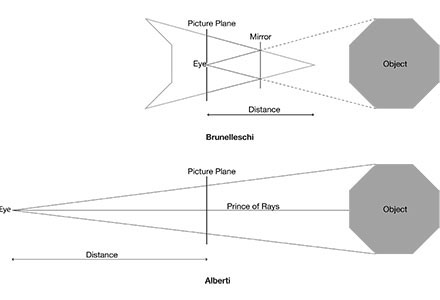
That’s why I treasured the comment of one student years ago when we looked at the work of the Renaissance genius Brunelleschi, who advanced the science of perspective,

brunelleschi-alberti

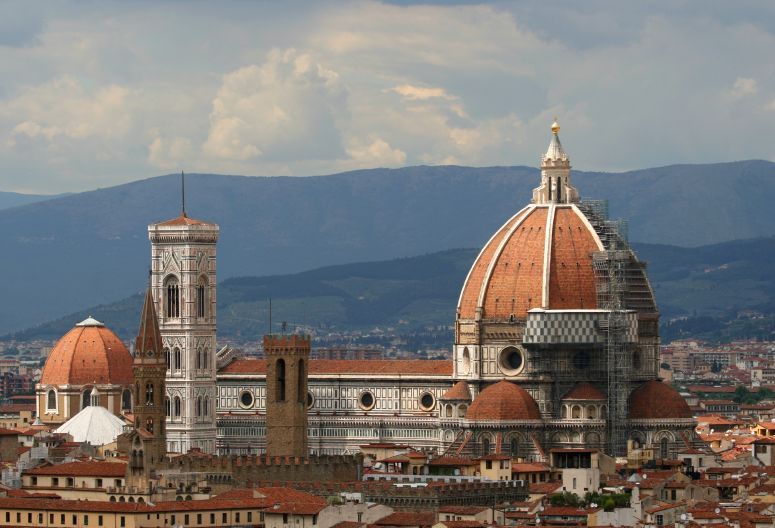
built the first dome in the western world since the Pantheon . . .

filippo-brunelleschi-duomo

and entered the sculpture/engraving contest for the doors of the Florence baptistry . ..

imgres

among other things.  After taking all this in, one student remarked, “Boy, we suck,” which delighted my ears to no end. He understood that in many ways, our civilization has a long way to go.  I don’t love Renaissance culture, but clearly they had enormous achievements in important areas, and we justly remember them for it.  They put their time and money into innovating things beautiful and useful, things that have blessed succeeding generations for more than half a millennium.

What about us today?

I came across this Marginal Revolution post from a few weeks ago, where Tyler Cowen makes the point that India’s latest Mars mission cost less than Gravity, Hollywood’s latest space movie.  At various points in the history of the west different inspirations have taken hold.  At one point we built cathedrals, at other times we sailed the seven seas, or all wanted to speak French.  We had inspiration and aspirations.  This is where we spent our time, energy, and money.

The world will little remember Transformers: Age of Extinction, or Pirates of the Caribbean: On Stranger Tides despite the fact that they cost $325 and $378 million respectively.  On balance it appears we put our money, our dreams, into merely entertaining ourselves.  We’re not, praise God, quite at “bread and circuses” yet, but the trend should concern us.

And given what I witnessed Sunday, we can’t even make good Super Bowl commercials anymore.  I miss the good ol’ days (exhibit ‘A’ below).


The Green Stick and the Saint

How does one know if your faith is “really real?”  Christians can sometimes get hung up unnecessarily on this question, but it’s an easy one to ask.  When you don’t have a dramatic night/day testimony it can seem all the more difficult to answer.  The Church can complicate matters by sometimes venerating the Damascus road kind of conversion of the overtly evil man immediately transformed.  Such people have more certainty, we assume, and so have greater faith and a more profound Christian experience.

But aside from the exceptional experience of St. Paul, very little in the history of Christian spirituality suggests this as the norm. Every significant spiritual writer I am aware explains that God almost always works slowly over time through the mundane aspects of life.  Growth in holiness comes by putting one foot in front of the other.  It makes sense then (barring exceptions of course), that those who had an early start and never traveled in the wrong direction for long periods of time would be further up the mountain than even the “dramatic” converts.

Two recent works I encountered bear this out.

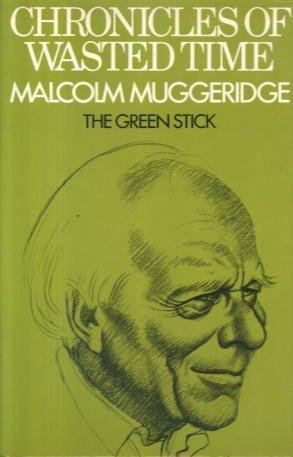
We have no equivalent to Malcolm Muggeridge in the west today.  To get him we would probably have to combine G.K. Chesterton, Truman Capote, and David Brooks.  He made his career as a journalist first, but later became a social “man about town” who rubbed elbows with the media and intellectual elite of English society.  He then rejected much 3102608of the pomp and circumstance of his life and converted to Christianity.  He wrote many books, perhaps his most famous being his autobiography, Chronicles of Wasted Time, a work spread out over three volumes.  In the first volume, “The Green Stick,” he tells the story of his early life, and his embrace of the liberal left.

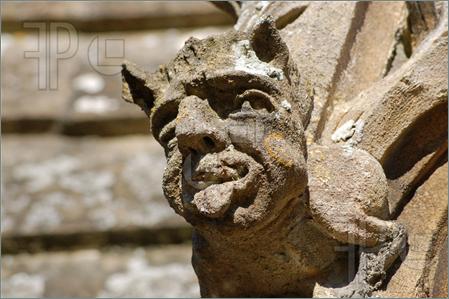
Throughout the book Muggeridge’s wit and panache shine through.  He gleefully pokes Rude-Gargoyle-1073659himself and his profession.  He had gone from devotee to gargoyle, happily mocking all our pretensions.*  Typical of his style is how he discovered as a reporter how to distill all momentous political speeches to just a few phrases.  “We decided that there was no need for politicians to finish their sentences,” he writes,  “with their end being implicit in the beginning.”  Such phrases are,

On this historic occasion when . . .

There can be no one here present who . . .

We have just passed through an ordeal that . . .

No thinking man will underestimate the . . .

While there are many circumstances which . . .

While recognizing the reality of . . .

It is surely incumbent upon all of us to . . .

Such is the choice that at present confronts . . .

It is idle to think that politicians can . . .

It rests with the common people to . . .

With head erect and clear purpose we . . .

One feels the sham nature of so much of our modern existence reading Muggeridge. Having drank deeply from the world, he can expose it all the more readily.  This brief clip illustrates not only his fabulous voice (and who wouldn’t want the life of sitting around, smoking, and giving one’s opinion on everything), but also his abhorrence with that which most fascinated the 20th century.

Muggeridge takes his title from the Russian legend of the Green Stick, so dear to Tolstoy.  In this story, should anyone find the Green Stick he would have the power to remove all suffering.  The simplicity of the idea charms anyone, but of course nothing is ever that simple.  Muggeridge as a boy talked of his wish for the same Green Stick, which may have helped lead him down socialist paths in his younger days.  One can’t fault him for this, but it strikes me that occasionally Muggeridge’s rejection of so much he experienced led him to oversimplify in the other direction.  Even his brief quote in the clip above reveals this flaw.  Power is not evil in itself, obviously, for we rejoice in God’s own power. Naturally no one on earth perfectly uses power, and most abuse it in great or small ways.  Some of the greatest saints of the Church divested themselves entirely of earthly power.

But Muggeridge would, I think, rejoice to see power rightly used to crush evil or to bring justice.  And this is not mere theory.  On rare occasions (like king St. Louis IX) Christian rulers have used power and worldly status for good ends without it getting to their heads.  So power can be redeemed.  Of course Muggeridge could have said something like, “Power is so dangerous, and so rarely used well.  We in the modern world, with it’s deadly combination of technology and our uncertain moral compass, are particularly unsuited to use power, and we should seek to limit its use whenever possible”

But he didn’t.

Muggeridge’s style easily engages the reader, and he mixes humor with profound insight almost perfectly at times.  I recommend him.  But he also comes across at times as someone with a bit too much baggage. He has a hard time appreciating things in general — perhaps he ruined his palate with the life he led.  A convert to Christianity somewhat later in life, I think he still struggled (as I and so many of us do) to see things clearly as they really are.

The Discourse and Sayings of Dorotheos of Gaza are not as entertaining to read as thMuggeridge, but one senses quickly that his writing comes from a much different place.  His stories have an endearing simplicity, though perhaps lack penetrating insight.  His instructions about the spiritual life seem immediately obvious, but then, the best kind of teaching usually has this quality.  What really struck me, however, about reading this on the heels of Muggeridge was how Dorotheos comes across as so unencumbered, so free of the “issues” that run rampant in modern experience.  He led a simple, unadorned life with monks in the wilderness, and this gives him an almost perfect freedom.  If nothing else, it shows how the dramatic, worldly convert is not better off, and often has less to teach the Church, than the slow and steady Christian who has lived the Christian life with others for countless years.  The clarity and simplicity of the Discourses reminds of Dante, who knew something akin to Dorotheos when he ended his journey by seeing God as a single point of light.

Dave

*This, I’m sure, was the true purpose of the medieval gargoyle — they had little to do with scaring anyone.  They were meant to mock us, to humble us, to poke fun at the culture around us.  That’s why I hate the famous Darth Vader gargoyle on the National Cathedral, which pats our culture on the back in a cutesy way.  I suppose though, that’s what happens when we have a “National” cathedral which serves ultimately as a monument to ourselves.

12th Grade: Thucydides and the Cold War

Greetings,

This week we began our own Peloponnesian War game on Friday, and in class we delved into the diplomatic tension that ended up bringing on a war between Athens and Sparta.

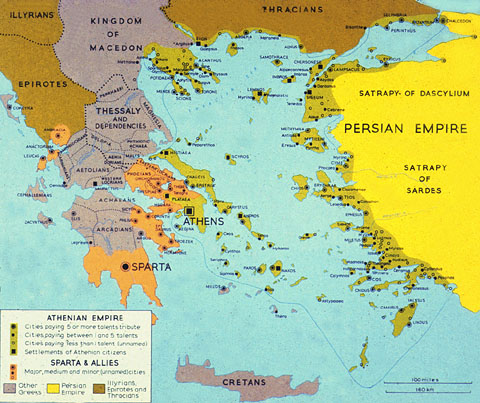
Athens and Sparta represented two different ways of life, with two different basis of military power.  During the Persian Wars between 490-479 B.C. they attained to a measure of foreign unity only because of a common foe.  Afterwards they resumed their normal role of a “cold” animosity.  Just as the war began the Greek world looked like this. . .

Sparta had an army no one could touch, and the same applied to Athens’ navy.  In a way, they had achieved a kind of ancient M.A.D. (Mutually Assured Destruction).  Both could do each other in, hypothetically, in different ways.  Then Athens decided to build a wall around its city and still preserve access to the sea.  It looked something like this:

Athens' Long Wall

Some of us may remember Reagan’s idea of a “Star Wars” missile defense system.  Many objected to the idea along the grounds that the project would not work or be too expensive, but many in Europe objected to it as well.  Why would even our allies object to a defense system?

  • Some probably thought that if the Soviets could not use their long-range weapons to hit the U.S., they would concentrate on their medium-range missiles and obliterate Europe instead.  Thus, some saw that U.S. actions might have an enormous impact on their lives, and yet they had no say in the making of those decisions. Arnold Toynbee called this the complaint of, “No annhilation without representation.”
  • Others saw that if the system worked, M.A.D. would be obsolete.  The deterrent to war from the U.S. perspective would be gone, which might make offensive action from us more likely.  Or, would the Soviets do a first-strike before the system became operational, knowing that their “time was short?”  In this way, many saw the building of a “defensive” system as an essentially offensive act.

Many in Sparta saw the situation in Athens the same way.  If the Spartans could not invade and sack the city, then the Athenians had much less of a deterrent to venture far and wide with its navy.  The walls had the direct purpose of defending themselves from attack, and after all, the Persians had sacked Athens during the Persian Wars.  But, this was not how others interpreted their actions.

When the Cold War began in the late 1940’s Secretary of State George Marshall urged those around him to delve into Thucydides’ The Peloponnesian War, for he believed that the conflict had significant parallels to the problems they would face.  He proved prescient.

Athens faced a crucial decision between the years 434-433 B.C.  Corcyra had maintained neutrality in the run-up to what would be the war but faced a crisis.  Corinth threatened them with invasion, and they knew that in time, they would likely fall in a protracted war.  As a neutral they had no allies, but they could turn to Athens (Corinth was a Spartan ally, so they certainly could not ask for Spartan help).  Athens heard from both delegations, and Thucydides records that the debate hinged on a few key points with one of them being the idea of the inevitability of war.

The Corcyrans argued that conflict with Sparta would come sooner or later, but it would certainly come.  Thus, you should ally with us because when war comes you want us as friends rather than enemies.

Corinth countered with the opposite: peace was the current reality between Athens and Sparta and that had every reason to continue.  War would only come by overt disruption of the peace, and Athenian ships tangling with Corinthian ships might be just the thing to bring on war.

LeMay with KennedyIn the Cuban Missile Crisis of 1962 General Curtis LeMay believed that Kennedy should order a full-strike against the missiles in Cuba and initiate war with the Soviet Union.  He knew that at the time we had a significant lead in nuclear weapons and would therefore win any kind of nuclear conflict.  Yes, millions of U.S. citizens would die, but the Soviets would no longer exist and trouble us no more.  If we waited, the Soviets would close the gap on our lead and then when war came millions more Americans would die and our victory would be much more in doubt.

Athens had the same decision to make, and decided to attempt a halfway solution.  They allied with Corcyra, but only for minimal defensive purposes.  Most of the students approved of this option as a way to get the best of both worlds, and it could have possibly worked out.  In actual fact, the presence of Athenian ships at the Battle of Sybota made Corinth hopping mad, but were not enough to tip the battle decisively in Athens and Corcyra’s favor.  The Corinthian fleet would live to haunt Athens at a later date.

Next week we’ll delve into the actual fighting as the war began.

If you are interested in the speeches of Corcyra and Corinth as Thucydides records them, they can be accessed online, beginning with Book 1, Chapter 32.

Blessings,

Dave

9th Grade: Our Cloudy and Confused Vision

Greetings,

This week we wrapped up our unit on the Crusades.  This difficult era raises many questions for us:

1. Did the Crusades attempt to stem the tide of Moslem aggression, or did they in fact cause more Moslem unity and a resurgence of Moslem power?

Some see the Crusades as a legitimate attempt to strike against Moslem expansionism.  Others argue that the Crusades forced the Moslems to unite once again. Having been invaded by the West, they determined to renew their attacks against them.  Do the Crusades bear any blame for the eventual collapse of Constantinople in 1453?

2. What role should faith and reason play in everyday affairs?

The Third Crusade is a good example of this problem.  Richard I fought his way to Jerusalem, but went home in part because he believed he could not hold the city even if he took it.  Therefore, it was pointless to risk his live and the lives of his men for nothing.  Some criticized his actions, saying something to the effect of, “You must step forward in faith, and watch God bless you.  This is what faith is all about!   You cannot think of this in practical terms. That is not thinking with faith.  Put  a foot into the Jordan, and then watch it part.”

We see this same question also running through the idea of the tragic Children’s Crusades, though here the Church strongly opposed Europe’s youth to no avail.* How should the balance between ‘faith’ and ‘reason’ guide our daily lives?  How should we answer the argument of many young people who participated in the ‘Children’s Crusades,’ which ran something like this:

  • God has called his people to crusade for Jerusalem.  We believed so in 1097.  Has God changed?  He is the same, yesterday, today, forever.  Therefore, His call is the same.  We must still vie for the Holy Land.
  • But how shall we go?  Let us not trust in princes, horses, or chariots (i.e. Ps. 20), let us know that our trust is in God, by marching out in true faith.  We see in Scripture that Moses led the Israelites to the Red Sea and it parted. Joshua marched around the city, and it fell.  Guided by God’s word, we shall emulate their example.  God shall make a way for us to take Jerusalem, and do so in a way so that all glory goes to him.
  • Many argue that the problem with the Crusades was a lack of organization, supplies, or reinforcements.  This only betrays worldly thinking.  Would more supplies have made the Crusaders less greedy in 1204?  Would it have made them less violent inside Jerusalem’s walls in 1099?  No, the problem has been our lack of faith and obedience.
  • Jesus pointed out the strength and purity of the faith of children.  Therefore, who better than the Church’s youth to undertake this venture?

We know that the Children’s Crusades (both of them) ended in utter disaster.  But what would you say in response to their argument?  How can you disprove them? What is faith’s relationship to reason?

3. The west attempted at least seven times at retaking Jerusalem.  What should this tell us about them?

  • That they were foolishly stubborn?
  • That they were intensely dedicated and willing to make great sacrifices for achieving their goal?
  • That they were a people of faith willing to trust in spite of adversity?
  • That they were foolish, naive, and used ‘faith’ as a cover for their prejudice and desire for gain?

In the end, the Crusades would have many unintended consequences.  The West was exposed to Greek literature and philosophy for the first time.  St. Thomas Aquinas, the Renaissance, and Exploration may all have been by-products of this, among other things.  The Crusades also raise many questions about using violence as means to bring about the Kingdom of God that are still with us.  If we agree with the Crusades, should we also agree with the bombing of abortion clinics?

Next week we will return to our look at Medieval Feudal society, and I hope that the students will be confronted with good questions.

Dave

*I should note that scholars debate when these crusades took place, and whether or not there was one crusade or two.  A few even doubt whether or not they were children at all, as some believe they may have been a mass of landless unemployed.  My rendering in class was the traditional story.

9th Grade: Everything Falls Apart

Greetings,

This week we focused on what is known as the First Crusade, the only Crusade to actually reach Jerusalem and conquer the city.  Perhaps more than other crusades, it was this first one that concentrated all that is admirable, strange, and horrifying about this period in the past.

We discussed last week the reasons and motivations for the Crusades, and whether or not one agrees with their reasons, we cannot deny the enormous difficulty of the proposed enterprise.  Capturing Jerusalem meant a journey of several hundred miles on foot without an established supply line, having to take at least one fortified city (Antioch) before even reaching Jerusalem, which would have thousands of defenders behind the large walls of the city.  Even today, parts of the the “old” city of Jerusalem still stands, and we can see what the Crusaders saw themselves 1000 years ago.

Old City Gate

The "Tower of David"

South (?) Wall of Jerusalem

As anyone can see, taking the city would be a formidable task.

From Antioch, the  Crusaders approached the city barefoot, the standard mode of travel for all medieval pilgrims.  This fact alone shows that the Crusaders saw themselves not so much as warriors first and foremost, but on a spiritual quest.  Like Joshua they marched around the city.  This was no standard military operation.

Understandably, they were anxious to get inside the city and claim victory.  They had heard many stories of atrocities perpetrated against Christians in Jerusalem.  They saw with their own own Moslem defenders taunting them, smashing crosses and other relics in front of their eyes.  Moslems also apparently killed pages sent by the knights to get water, which horrified and enraged the Crusaders all the more.  Finally, they broke through and entered the city. One eyewitness described it this way. . .

When the morning came, our men eagerly rushed to be walls and dragged the [seige towers] forward, but the Saracens had constructed so many machines that for each one of ours they now had nine or ten. Thus they greatly interfered with our efforts. This was the ninth day, on which the priest had said that we would capture the city. But why do I delay so long? Our machines were now shaken apart by the blows of many stones, and our men lagged because they were very weary. However, there remained the mercy of the Lord which is never overcome nor conquered, but is always a source of support in times of adversity. One incident must not be omitted. Two women tried to bewitch one of the hurling machines, but a stone struck and crushed them, as well as three slaves, so that their lives were extinguished and the evil incantations averted.

By noon our men were greatly discouraged. They were weary and at the end of their resources. There were still many of the enemy opposing each one of our men; the walls were very high and strong, and the great resources and skill that the enemy exhibited in repairing their defenses seemed too great for us to overcome. But, while we hesitated, irresolute, and the enemy exulted in our discomfiture, the healing mercy of God inspired us and turned our sorrow into joy, for the Lord did not forsake us. While a council was being held to decide whether or not our [seige engines] should be withdrawn, for some were burned and the rest badly shaken to pieces, a knight on the Mount of Olives began to wave his shield to those who were with the Count and others, signalling them to advance. Who this knight was we have been unable to find out. At this signal our men began to take heart, and some began to batter down the wall, while others began to ascend by means of scaling ladders and ropes. Our archers shot burning firebrands, and in this way checked the attack that the Saracens were making upon the wooden towers of the Duke and the two Counts. These firebrands, moreover, were wrapped in cotton. This shower of fire drove the defenders from the walls. Then the Count quickly released the long drawbridge which had protected the side of the wooden tower next to the wall, and it swung down from the top, being fastened to the middle of the tower, making a bridge over which the men began to enter Jerusalem bravely and fearlessly. Among those who entered first were Tancred and the Duke of Lorraine, and the amount of blood that they shed on that day is incredible. All ascended after them, and the Saracens now began to suffer.

They took the city, but then tragically took it one step further, for most of the men went to and fro, killing any Moslem they could find, be they men, women, or children.  The information about this horrifying massacre came not from Moslem sources but directly from the Christians themselves.  One wrote that,

Strange to relate, however, at this very time when the city was practically captured by the Franks, the Saracens were still fighting on the other side, where the Count was attacking the wall as though the city should never be captured. But now that our men had possession of the walls and towers, wonderful sights were to be seen. Some of our men (and this was more merciful) cut off the heads of their enemies; others shot them with arrows, so that they fell from the towers; others tortured them longer by casting them into the flames. Piles of heads, hands, and feet were to be seen in the streets of the city. It was necessary to pick one’s way over the bodies of men and horses. But these were small matters compared to what happened at the Temple of Solomon, a place where religious services are ordinarily chanted. What happened there? If I tell the truth, it will exceed your powers of belief. So let it suffice to say this much, at least, that in the Temple and porch of Solomon, men rode in blood up to their knees and bridle reins. Indeed, it was a just and splendid judgment of God that this place should be filled with the blood of the unbelievers, since it had suffered so long from their blasphemies. The city was filled with corpses and blood. Some of the enemy took refuge in the Tower of David, and, petitioning Count Raymond for protection, surrendered the Tower into his hands.

 Another account confirmed this, writing,

Many fled to the roof of the temple of Solomon, and were shot with arrows, so that they fell to the ground dead. In this temple almost ten thousand were killed. Indeed, if you had been there you would have seen our feet colored to our ankles with the blood of the slain. But what more shall I relate? None of them were left alive; neither women nor children were spared.

When the pagans had been overcome, our men seized great numbers, both men and women, either killing them or keeping them captive, as they wished.

Both Moslems and Christians committed atrocities during the Crusades, but none would equal the shocking scale and brutality of the massacre at Jerusalem.  And yet, the Crusaders at the time interpreted their actions in almost strictly religious terms.  The account continues,

Now that the city was taken, it was well worth all our previous labors and hardships to see the devotion of the pilgrims at the Holy Sepulchre. How they rejoiced and exulted and sang a new song to the Lord! For their hearts offered prayers of praise to God, victorious and triumphant, which cannot be told in words. A new day, new joy, new and perpetual gladness, the consummation of our labor and devotion, drew forth from all new words and new songs. This day, I say, will be famous in all future ages, for it turned our labors and sorrows into joy and exultation; this day, I say, marks the justification of all Christianity, the humiliation of paganism, and the renewal of our faith. “This is the day which the Lord bath made, let us rejoice and be glad in it,” for on this day the Lord revealed Himself to His people and blessed them.

On this day, the Ides of July, Lord Adhemar, Bishop of Puy, was seen in the city by many people. Many also testified that he was the first to scale the wall, and that he summoned the knights and people to follow him. On this day, moreover, the apostles were cast forth from Jerusalem and scattered over the whole world. On this same day, the children of the apostles regained the city and fatherland for God and the fathers. This day, the Ides of July, shall be celebrated to the praise and glory of the name of God, who, answering the prayers of His Church, gave in trust and benediction to His children the city and fatherland which He bad promised to the fathers. On this day we chanted the Office of the Resurrection, since on that day He, who by His virtue arose from the dead, revived us through His grace. So much is to be said of this.

 The “Jersusalem” crosses they etched inside the Church of the Holy Sepulchre can still be seen today.

While we do know that some of the crusaders risked their lives to protect civilians, most joined in the carnage and plunder.  The stain left by this atrocity lingers to this day in minds of many Moslems.  This may seem strange to Americans, but Americans in general have very, very short historical memories.  This is probably because we are a new nation, and an immigrant nation.  Many who came here wanted to make a clean break with the past.  Also, Americans tend not to be rooted in the past with tradition, but look forward to the “next” thing.  Most other societies, and perhaps especially the Mid-East have a much deeper sense of the past, a sense only exacerbated by the significant decline of Moslem power since the mid 16th century.

I related to the students that, in most of the “mountain disaster” books I have read that the problems occur when the climbers descend.  We psychologically ramp ourselves up to reach the summit, and don’t always give as much thought to what comes next.

The crusaders faced a similar problem.  They took vows to liberate Jerusalem, but not to stay and defend it.  Many had been away from home for more then two years, and understandably wanted to return, having fulfilled their purpose.  The west simply could not rally the manpower needed to hold the city, and in 1187 the Moslems retook it.  Several more attempts to retake the city would again be made, the subject of our study next week.

Blessings,

Dave

11th Grade: Power and Markets in the Progressive Era

Greetings,
The week before break we wrapped up our look at Teddy Roosevelt and the Progressive Era.

How did he begin the ‘modern’ presidency?

1. America’s rising power (I think China today is in the position America was 100-120 years ago) meant that they had a role on the world stage.  Foreign policy is the purview of the executive, not the legislative branch.  Inevitably then, the power of the presidency increased as our power relative to the rest of the world increased.

2. A united America would now think of themselves as ‘Americans’ instead of ‘Virginians,’ for example.  In a sense, all the people elect the president, at least in a way that ‘the people’ do not elect senators from Maine.  The formation of a nation would again, put focus inevitably on the presidency.  Along with this, the ‘nationalization’ of industry would lead to a more national focus for media outlets.  National news and national figures would take precedence over local ones.

 There are many across the political spectrum who believe that presidential power needs to be curtailed and is out of line with the founders vision for a dominant legislature.  Truly, there have been very few weak presidents since Roosevelt’s time in office. But those who want to curb executive power need to realize that presidential power takes place in a broad political, economic, and social context.  To add to these factors, Roosevelt had an expansive view of executive power.  For him, if the Constitution did not forbid it, he could do it.  Roosevelt also believed in the government not so much as a threat to people, but as an extension of them.  Government was the people’s steward, the sword point of the arm of the ‘people.’  This attitude led to a couple of groundbreaking actions taken:
  • Roosevelt believed in the establishment of national parks.  Part of this was personal, as Roosevelt’s experience in the west transformed him.  But part of it stemmed from his belief that the land did not belong to individuals, so much as to the nation at large.  Land then, could be used only as it referred to the public at large (he did of course believe in private ownership as well).  Having land set aside for the public fit right in with this vision. . .
  • As did his vision of corporate power and regulation.   The economics of the Industrial Revolution concentrated enormous resources in the hands of a few.  Are economic monopolies consistent with an American view of liberty?  Well, that depends.  If you see liberty as freedom from outside constraint, then there could be nothing inherently wrong with monopolies, provided they were honestly obtained.  But Roosevelt saw monopolies as a threat to liberty.  Monopolies limited the people’s ability to chose, and opened up the possibility that they could be exploited.  Besides, monopolies eliminated competition.  As the students are reading for homework, Roosevelt believed that only a ‘Strenuous Life’ could make us great.  Monopolies could lead to laziness, and in the end, national decline.

These issues raise important questions of constitutional interpretation.  Does the Constitution proscribe a certain attitude towards federal power?  What is the truest meaning of ‘liberty?’  How should we balance individual liberty with the rights of others?  I enjoyed our discussions on these questions, and we related them to the recent controversies surrounding the new body scans at airports.

This also led to a broader discussion of capitalism itself.  Many ‘classical’ economists look with fondness back to the pre-Roosevelt era as the heyday of a more pure capitalism.  This provided an opportunity to consider capitalism itself.   I wanted to place special focus.  I wanted us to consider the following:
1. Does capitalism share common ancestry with Darwinism?  Both rose to prominence at about the same time.  Both stress that it is through competition that we progress.  Both shed few tears over those whom competition eliminates.  Both, curiously enough, have a certain fatalism to them in their purest form, one of class strife, the other of the invisible hand of the market.  Fatalism, no matter the form it takes, is usually a sign of exhaustion or boredom, whether in the individual or the civilization.  C.S. Lewis argued in ‘Mere Christianity’ that a fully Christian economic system would resemble socialism or communism in some key ways (see his ‘Social Morality’ chapter in that book if you are curious).  Taking a different rout. a Christian defense of certain key free market principles can be found here.
Others would counter that while the free market of the Industrial Revolution had its problems and inequalities, surely the end result proved beneficial?  The western world saw unprecedented economic growth and the rise of a truly broad based middle class that is still the foundation of modern democracies.  When all was said and done, standards of living increased, and more people had access to more goods than ever before.
But that still begs the question: Does the free market promote Darwinism?  Or,  as Milton Friedman has argued, is it one of the best indirect promoters of personal freedom?  Or is it, as Philip Bobbitt and Guido Calabresi argued in their book ‘Tragic Choices,’ a method whereby society sometimes avoids hard decisions and puts them in the hands of ‘the market?’
2. If there are links between Darwinism and capitalism, what does that do to our interpretation of capitalism?  Do we affirm it in full, believing that Darwin may have latched onto a truth about existence?  Or does the market need regulated, or ‘softened’ to inject more community oriented values?
3. What might the doctrine of the Trinity have to do with this question?  With God we have community (1 God) and individuality (3 Persons) cohering in their fullness simultaneously.  We, however, are finite, and so we cannot experience both individuality and community in their fullness simultaneously.  Being made in the image of God, we desire and need both.  Might much of our political debates, both then and now, be helpfully viewed through this prism?  How should a society’s economic structure reflect both individual and community values?  Where should the emphasis lie?
Finally, towards the end of the week we looked at some aspects of Progressive Era culture.  Each society has its values and cannot help but give expression to those values, consciously or otherwise.  Here is an image of the city of Chicago ca. 1900
The plan of the city bears all the hallmarks of the Progressive Era.  The design is effecient, ‘scientific,’ and rational.  The design allows the city to be easily navigable to outsiders, reflecting the increasing sense of national over local identity.  Other cities would follow Chicago in their design, and thus cities could be like chain restaurants, more or less the same wherever one went.  Here is an image of St. Louis from about the same time:
Naturally this efficiency of design helped the flow of goods to and from other cities.  The links between cities and regions of the country grew easier to forge and thus became stronger.  To get a sense of the difference and meaning behind the change, here is an image of Philadelphia ca. 1750:
Granted, it’s not as if Philadelphia had no order to it, but the sense of standardization is less.
Blessings,
Dave

Paul McCartney could also play Bass

I realize it won’t shock anyone to say that Paul McCartney in his heyday was a great songwriter.  But listening to a few different songs recently made me realize that McCartney fails to get credit for his skill with the bass guitar.  The Beatles could write songs, yes, and they could sing.  But they wouldn’t have earned their reputation as one of the great all-time bands if they lacked genuine skill on their instruments, and McCartney is no exception.

McCartney’s father had a musical career largely playing show tunes and bouncy, playful big-band numbers, and McCartney has this sunny whimsy in his personality.  I think Lennon grew to resent this side of McCartney — the side that led him to write songs like, “When I’m 64,” and “Penny Lane.”  Lennon wanted “to rock” and saw songs like this as wimpy, soft, and (heaven forbid) “square.”  Lennon of course had a playful side too (i.e., “I am the Walrus”) but used it to destroy conventionality (“I am the Walrus”), not to write fun sing-along numbers.  Lennon loved to destroy — not always a bad thing.

But I’m convinced that McCartney’s whimsical side led him to take some risks with his bass playing at crucial moments.  First off, we can note that he could play a generally solid and fluid bass line, with “Hey Jude” as a good example. You can actually hear the bass line in the version of the song on the Love album — listen around the 3:06 mark:

But I have two examples of his playful side coming out in his bass playing:

Here is “Dear Prudence,” where the bass carries the song, especially from the 1:04 mark onwards:

While The Social Network I got re-exposed to “Baby You’re a Rich Man” (the song gets used expertly right at the end of the movie).  Especially in the chorus’ from about the half-way point of the song onwards, McCartney really unwinds the bass and spices up the song beautifully

The lesson perhaps for the Lennon’s of the world (more absolutist than most) is not to throw the baby out with the bathwater. Perhaps we could also say that certain skills or tendencies that annoy us in one way might have unexpected benefits in other ways.

The “Rite of Spring” as Praeparatio Evangelica

When I first heard Stravinsky’s The Rite of Spring I failed to be impressed.  I knew something of what I thought Stravinsky tried to accomplish, to make something “primal,” but felt that the orchestra may not have been the best tool for that purpose. Besides, I tended to hear jumbled nonsense.  Years later I thought again about the piece and admired it a bit more (but not that much more) when I perhaps gained greater understanding of what Stravinsky might have intended in relation to the end of the Victorian era (something I speculate on in this post).

When The Bad Plus, a jazz-rock piano trio and probably my favorite musical group, decided to play the piece I raised an eyebrow.  True, they had covered other 20th century classical pieces to great effect, but I didn’t really like the “Rite of Spring” all that much.  It didn’t seem like a piece open to reinterpretation or rearranging, and if they did not do this I feared that they would simply play the score rote with a drum beat over top.  Add to that, what ultimate spiritual significance could the piece have?  If Stravinsky hearkens back to a pagan past, could it be considered a historical reflection?  Or if he meant to contemporize the concept, to what extent could I “buy in” with a pagan message?

Thinking about this I recalled a story of G.K. Chesterton in his “Father Brown” stories (I cannot remember which one) where one of the characters has a spiritual transformation by witnessing a person devote themselves to an umbrella (I think) on a ship lost at sea.  He realized that such a person, though crazy, had more spiritual insight about God than his own vague vanilla theism, for the crazy man at least understood the nature of devotion and sacrifice.

The law clearly serves as a preparation for the gospel (Gal. 3:24), but we can wonder to what extent certain elements of pagan religion had their roots in anything beyond the revelation of creation (Rom 1:21).  The Egyptians, the Greeks, and the Norse all have myths about a dying and rising god.  Nearly all pagan religions involved notions of propitiation.  Perhaps this is one reason why Gentiles can directly bypass Judaism and go straight to Christ.  They too had a tutor.  Some early church fathers, notably, Eusebius, wrote about how paganism could be a praeparatio evangelica — a fancy word for “preparation for the gospel.”

Stravinsky’s own walk of faith had its ups and downs.  Raised in the church, he walked away from the faith in his later teens, returning to Christianity for good only in his early 40’s.  He wrote the “Rite” during his sojourning period.  But during this period he apparently did not slip into vaguely religious cant.  With the “Rite” he stayed connected to the crucial truths about death and life. Perhaps the “Rite” served as his own praeparatio evangelica

On Paul’s missionary journeys we generally see three classes of people: 1) “Ensconced” Jews, 2) “God-fearers,” or Gentiles who had converted to some kind of Judaism, and 3) Standard pagans. The “God-fearers” responded the best of these three, but the pagans responded better than the lifelong Jews.  No doubt many reasons exist for this, but one simply might have been complacency.  Perhaps living far away from the temple might have distanced them from the notion of sacrifice, of the need for life to come from death.  For all its faults the pagans still believed enough to offer sacrifices, and perhaps this opened them up to the truth of the gospel.*

So, back to the Bad Plus.

This is a great recording.  The fact that we have just two instrumentalists, and one of them a bassist, gives the music a more spare and earthy feel.  Dave King’s drumming roots the music far more to the ground than and orchestra could.  For me, this is a recording of the “Rite” that makes the music make sense and gives it the power Stravinsky no doubt intended, and for me at least, never achieved.  Here below is an excerpt of the last movement (Bad Plus fans will note their own personal exclamation point in the form of the end of their own song “Physical Cities”).  Normally I hate it when people say, “You have to listen to the whole album to get the full effect.”  In this case I think it true, but this gives one a good entry point.

Having experienced the prelude, we can now experience an “A.D.” reality, with a conductor who marvelously looks like he might have just arrived from a sacrificial dance (try pausing it right at .06 to see some wild hair).  A Merry Christmas to all . . .

*In his essay, “Christianity and Civilization,” historian Arnold Toynbee makes this very point.  I include a portion of it here . . .

. . . In this Catholic form of the Church, I see two fundamental institutions, the Sacrifice of the Mass and the Hierarchy, which are indissolubly welded together by the fact that the priest, by definition, is the person with the power to perform the rite. If, in speaking of the Mass, one may speak, without offence, with the tongues of the historian and the anthropologist, then, using this language, one may describe the Sacrifice of the Mass as the mature form of a most ancient religious rite of which the rudiments can be traced back to the worship of the fertility of the Earth and her fruits by the earliest tillers of the soil. (I am speaking here merely of the mundane origin of the rite.) as for the hierarchy of the Church in its traditional form, this, as one knows, is modelled on a more recent and less awe-inspiring yet nevertheless most potent institution, the imperial civil service of the Roman Empire. The Church in its traditional form thus stands forth armed with the spear of the Mass, the shield of the Hierarchy, and the helmet of the Papacy; and perhaps the subconscious purpose –or the divine intention, if you prefer that language– of this heavy panoply of institutions in which the Church has clad herself is the very practical one of outlasting the toughest of the secular institutions of this world, including all the civilizations. If we survey all the institutions of which we have knowledge in the present and in the past, I think that the institutions created, or adopted and adapted, by Christianity are the toughest and the most enduring of any that we know and are therefore the most likely to last –and outlast all the rest. The history of Protestantism would seem to indicate that the Protestant act of casting off this armour four hundred years ago was premature; but that would not necessarily mean that this step would always be a mistake; and , however that may be, the institutional element in the traditional Catholic form of the Church Militant on Earth, even if it proves to be an invaluable and indispensable means of survival, is all the same a mundane feature which makes the Church Militant’s life different from that of the Kingdom of Heaven, in which they neither marry nor are given in marriage but are as the angels of God, and in which each individual soul catches the spirit of God from direct communion with Him –‘like light caught from a leaping flame,’ as Plato puts it in his Seventh Letter. Thus, even if the Church had won a fully world-wide allegiance and had entered into the inheritance of the last of the civilizations and of all the other higher religions, the Church on Earth would not be a perfect embodiment here on Earth of the Kingdom of Heaven. The Church on Earth would still have sin and sorrow to contend with as well as to profit by as a means of grace on the principle of ?Ueae iUeio, and she would still have to wear for a long time to come a panoply of institutions to give her the massive social solidity that she needs in the mundane struggle for survival, but this at the inevitable price of spirituality weighing her down, On this showing, the victorious Church Militant on Earth will be a province of the Kingdom of God, but a province in which the citizens of the heavenly commonwealth have to live and breathe and labour in an atmosphere that is not their native element.

The position in which the Church would then find herself is well conveyed in Plato’s conceit, in the Phaedo, of the true surface of the Earth. We live, Plato suggests, in a large but local hollow, and what we take to be the air is really a sediment of fog. If one day we could make our way to the upper levels of the surface of the Earth, we should there breathe the pure ether and should see the light of the Sun and stars direct; and then we should realize how dim and blurred had been our vision down in the hollow, where we see the heavenly bodies, through the murky atmosphere in which we breathe, as imperfectly as the fishes see them through the water in which they swim. This Platonic conceit is a good simile for the life of the Church Militant on Earth; but the truth cannot be put better than it has been by Saint Augustine.

“It is written of Cain that he founded a commonwealth; but Abel –true to the type of the pilgrim and sojourner that he was– did not do the like. For the Commonwealth of the Saints is not of this world, though it does give birth to citizens here in whose persons it performs its pilgrimage until the time of its kingdom shall come–the time when it will gather them all together.”

This brings me in conclusion to the last of the topics on which I am going to touch, that of the relation between Christianity and progress.

If it is true, as I think it is, that the Church on Earth will never be a perfect embodiment of the Kingdom of Heaven, in what sense can we say the words of the Lord’s Prayer: ‘Thy Kingdom come, Thy will be done in Earth as it is in Heaven’? Have we been right, after all, in coming to the conclusion that –in contrast to the cyclic movement of the rises and falls of civilizations– the history of religion on Earth is a movement in a single continuous upward line? What are the matters in which there has been, in historical times, a continuous religious advance? And have we any reason to think that this advance will continue without end? Even if the species of societies called civilizations does give way to a historically younger and perhaps spiritually higher species embodied in a single world-wide and enduring representative in the shape of the Christian Church, may there not come a time when the tug of war between Christianity and original sin will settle down to a static balance of spiritual forces?

Let me put forward one or two considerations in reply to these questions.

In the first place, religious progress means spiritual progress, and spirit means personality. Therefore religious progress must take place in the spiritual lives of personalities –it must show itself in their rising to a spiritually higher state and achieving a spiritually finer activity.

Now, in assuming that this individual progress is what spiritual progress means, are we after all admitting Frazer’s thesis that the higher religions are essentially and incurably anti-social? Does a shift of human interests and energy from trying to create the values aimed at in the civilizations to trying to create the values aimed at in the higher religions mean that the values for which the civilizations stand are bound to suffer? Are spiritual and social values antithetical and inimical to each other? Is it true that the fabric of civilization is undermined if the salvation of the individual soul is taken as being the supreme aim of life?

Frazer answers these questions in the affirmative. If his answer were right it would mean that human life was a tragedy without a catharsis. But I personally believe that Frazer’s answer is not right, because I think it is based on a fundamental misconception of what the nature of souls or personalities is. Personalities are inconceivable except as agents of spiritual activity; and the only conceivable scope for spiritual activity lies in relations between spirit and spirit. It is because spirit implies spiritual relations that Christian theology has completed the Jewish doctrine of the Unity of God with the Christian doctrine of the Trinity. The doctrine of the Trinity is the theological way of expressing the revelation that God is a spirit; the doctrine of the Redemption is the theological way of expressing the revelation that God is Love. If man has been created in the likeness of God, and if the tue end of man is to make this likeness ever more and more like, then Aristotle’s saying that ‘man is social animal’ applies to man’s highest potentiality and aim –that of trying to get into ever closer communion with God. Seeking God is itself a social act. And if God’s love has gone into action in this world in the Redemption of mankind by Christ, then man’s efforts to make itself liker to God must include efforts to follow Christ’s example in sacrificing himself for the redemption of his fellow men. Seeking and following God in this way, that is God’s way, is the only true way for a human soul on Earth to seek salvation. The antithesis between trying to save one’s own soul by seeking and following God and trying to do one’s duty to one’s neighbour is therefore wholly false. The two activities are indissoluble. The human soul that is truly seeking to save itself is as fully social a being as the ant-like Spartan or the bee-like Communist. Only, the Christian soul on Earth is a member of a very different society from Sparta or Leviathan. He is a citizen of the Kingdom of God, and therefore his paramount and all-embracing aim is to attain the highest degree of communion with, and likeness to, God Himself; his relations with his fellow men are consequences of, and corollaries to, his relations with God; and his way of loving his neighbour as himself will be to try to help his neighbour to win what he is seeking for himself –that is, to come into closer communion with God and to become more godlike.

If this is a soul’s recognized aim for itself and for its fellow souls in the Christian Church Militant on Earth, then it is obvious that under a Christian dispensation God’s will will be done in Earth as it is in Heaven to an immeasurably greater degree than in a secular mundane society. It is also evident that, in the Church Militant on Earth, the good social aims of the mundane societies will incidentally be achieved very much more successfully than they ever have been or can be achieved in a mundane society which aims at these objects direct, and at nothing higher. In other words, the spiritual progress of individual souls in this life will in fact bring with it much more social progress than could be attained in any other way. It is a paradoxical but profoundly true and important principle of life that the most likely way to reach a goal is to be aiming not at that goal itself but at some more ambitious goal beyond it. This is the meaning of the fable in the Old Testament of Solomon’s Choice and of the saying in the New Testament about losing one’s life and saving it.

Therefore, while the replacement of the mundane civilizations by the world-wide and enduring reign of the Church Militant on Earth would certainly produce what to-day would seem a miraculous improvement in those mundane social conditions which the civilizations have been seeking to improve during the last six thousand years, the aim, and test, of progress under a truly Christian dispensation on Earth would not lie in the field of mundane social life; the field would be the spiritual life of individual souls in their passages through this earthly life from birth into this world to death out of it.

But if spiritual progress in time in this world means progress achieved by individual human souls during their passages through this world to the other world, in what sense can there be any spiritual progress over a time-span far longer than that of individual lives on Earth, and running into thousands of years, such as that of the historical development of the higher religions from the rise of Tammuz-worship and the generation of Abraham to the Christian era?

I have already confessed my own adherence to the traditional Christian view that there is no reason to expect any change in unredeemed human nature while human life on Earth goes on. Till this Earth ceases to be physically habitable by man, we may expect that the endowments of individual human beings with original sin and with natural goodness will be about the same, on the average, as they always have been as far as our knowledge goes. the most primitive societies known to us in the life or by report provide examples of as great natural goodness as, and no lesser wickedness than, the highest civilizations or religious societies that have yet come into existence. There has been no perceptible variation in the average sample of human nature in the past; there is no ground, in the evidence afforded by History, to expect any great variation in the future either for better or for worse.

The matter in which there might be spiritual progress in time on a time-span extending over many successive generations of life on Earth is not the unregenerate nature of man, but the opportunity open to souls, by way of the learning that comes through suffering, for getting into closer communion with God, and becoming less unlike Him, during their passage through this world.

What Christ, with the Prophets before Him and the Saints after Him, has bequeathed to the Church, and what the Church, by virtue of having been fashioned into an incomparably effective institution, succeeds in accumulating, preserving, and communicating to successive generations of Christians, is a growing fund of illumination and of grace-meaning by ‘illumination’ the discovery of revelation or revealed discovery of the true nature of God and the true end of man here and hereafter, and by ‘grace,’ the will or inspiration or inspired will to aim at getting into Him. In this matter of increasing spiritual opportunity for souls in their passages through life on Earth, there is assuredly an inexhaustible possibility of progress in this world.

Is the spiritual opportunity given by Christianity, or by one or other of the higher religions that have been forerunners of Christianity and have partially anticipated Christianity’s gifts of illumination and grace to men on Earth, an indispensable condition for salvation –meaning by ‘salvation’ the spiritual effect on a soul of feeling after God and finding Him in its passage through life on Earth?

If this were so, then the innumerable generations of men who never had the chance of receiving the illumination and grace conveyed by Christianity and the other higher religions would have been born and have died without a chance of the salvation which is the true end of man and the true purpose of life on Earth. This might be conceivable, though still repugnant, if we believed that the true purpose of life on Earth was not the preparation of souls for another life, but the establishment of the best possible human society in this world, which in the Christian belief is not the true purpose, though it is an almost certain by-product of a pursuit of the true purpose. If progress is taken as being the social of Leviathan and not the spiritual progress of individual souls, then it would perhaps be conceivable that, for the gain and glory of the body social, innumerable earlier generations should have been doomed to live a lower social life in order that a higher social life might eventually be lived by successors who had entered into their labours. This would be conceivable on the hypothesis that individual human souls existed for the sake of society, and not for their own sakes or for God’s.But this belief is not only repugnant but is also inconceivable when we are dealing with the history of religion, where the progress of individual souls through this world towards God, and not the progress of society in this world, is the end on which the supreme value is set. We cannot believe that the historically incontestable fact that illumination and grace have been imparted to men on Earth in successive installments, beginning quite recently in the history of the human race on Earth, and even then coming gradually in the course of generations, can have entailed the consequence that the vast majority of souls born into the world up to date, who have had no share in this spiritual opportunity, have, as a result, been spiritually lost. We must believe that the possibilities, provided by God, of learning through suffering in this world have always afforded a sufficient means of salvation to every soul that has made the best of the spiritual opportunity offered to it here, however small that opportunity may have been.

But, if men on Earth have not had to wait for the advent of the higher religions, culminating in Christianity, in order to qualify, in their life on Earth, for eventually attaining, after death, the state of eternal felicity in the other world, then what difference has the advent on Earth of the higher religions, and of Christianity itself, really made? The difference, I should say, is this, that, under the Christian dispensation, a soul which does make the best of its spiritual opportunities will, in qualifying for salvation, be advancing farther towards communion with God and towards likeness to God under the conditions of life on Earth, before death, than has been possible for souls that have not been illuminated, during their pilgrimage on Earth, by the light of the higher religions. A pagan soul, no less than a Christian soul, has ultimate salvation with its reach; but a soul which has been offered, and has opened itself to, the illumination and the grace that Christianity conveys, will, while still in this world, of the narrower opportunity here open to it. The Christian soul can attain, while still on Earth, a greater measure of man’s greatest good than can be attained by any pagan soul in this earthly stage of its existence.

Thus the historical progress of religion in this world, as represented by the rise of the higher religions and by their culmination in Christianity, may, and almost certainly will, bring with it, incidentally, an immeasurable improvement in the conditions of human social life on Earth; but its direct effect and its deliberate aim and its true test is the opportunity which it brings to individual souls for spiritual progress in this world during the passage from birth to death. It is this individual spiritual progress in this world for which we pray when we say ‘Thy will be done in Earth as it is in Heaven.’ It is for the salvation that is open to all men of good will –pagan as well as Christian, primitive as well as civilized– who make the most of their spiritual opportunities on Earth, however narrow these opportunities may be, that we pray when we say ‘Thy Kingdom come.’
Nebuchadnezzar’s Dream

A 9th grader recently asked a great question as we recently wrapped up our study of the Roman empire.  “Suppose that we could freeze Augustus (a great political genius) at the peak of his abilities and power and have him live forever. Would Rome still have eventually collapsed?”  The question immediately grabbed me, for it touches not just on Augustus, not just on Rome itself, but on the idea of decline and death in general.

We can look at this question in a number of ways:

  • We can imagine Augustus as a hypothetically perfect ruler who never makes mistakes.  But other Roman mortals would make mistakes, and these would eventually bring Rome down.
  • Or we can see neither Augustus or his fellow Romans as perfect.  But led continually by Augustus at his peak, the Romans would always be able, at minimum, to tread water and never sink, despite whatever mistakes and sins they commit.
  • Or we can see the question as a musing on the whether or not decline has any purpose in a grand theological sense.  Supposing the near-perfection of Augustus and his fellow Romans, would God still “want” Rome’s decline?

I will speculate on this third option in hopes that it will cover the first two.

When we speak of God “wanting” something we immediately enter the delicate waters of His sovereignty and our free will.  Without commenting on this too much, we can safely say that God uses sin and evil to accomplish His purposes — and His main purpose is to save mankind at all times and places from their sins.  Many, for example, turn to God in the midst of suffering.  Does this mean that God wants us to suffer?  Again, it depends — He could prevent it, but often chooses not to because He knows suffering is always a key ingredient in Christian discipleship. The suffering we experience may be a direct result of our sin, the sins of others, or perhaps have no direct connection to sin at all (i.e. the Book of Job). In this latter case, God asks that we submit to a mystery we cannot understand.  The history of God’s people gives volumes of evidence for all of these. Might we say the same holds true, then, of nations and empires?

In the Greek world there existed Nemesis, who punished pride, and Tyche, who distributed blessings and “misfortune” throughout for purposes unknown to men.  In other words, suffering in the Greek cosmos might result from sin and it might not.  The Medievals pick up on this notion and see “Lady Fortune” as one of God’s agents in the world to work His purposes.  A person’s rise and fall might have something to do with their virtues or sins respectively, and thus teach him some lesson.  Or it might have another, unseen purpose, and the “lesson” from these events may or may not have anything to do with a person’s sin at all.  Perhaps a person’s rise and fall was just something they, or the people as a whole, needed to experience, either to prevent them from falling into pride (God disperses the people at the Tower of Babel not so much because of their existing pride but to prevent their future pride — the division of languages is a mercy), or for some other unknown reason.

Nebuchadnezzar’s famous dream in Daniel 2 touches on the same question.  God gives Nebuchadnezzar a vision of the rise of fall of many kingdoms, and Daniel tells us that,

“Your Majesty looked, and there before you stood a large statue—an enormous, dazzling statue,awesome in appearance.  The head of the statue was made of pure gold, its chest and arms of silver, its belly and thighs of bronze, its legs of iron, its feet partly of iron and partly of baked clay.  While you were watching, a rock was cut out, but not by human hands. It struck the statue on its feet of iron and clay and smashed them. Then the iron, the clay, the bronze, the silver and the gold were all broken to pieces and became like chaff on a threshing floor in the summer. The wind swept them away without leaving a trace. But the rock that struck the statue became a huge mountain and filled the whole earth.”

This dream strikes me not as one of judgment (unlike in Daniel 4), nor one of warning (as was the dream Joseph interpreted for Pharaoh).  Rather, Daniel just describes simply the way things will be.  And the purpose of this rising and falling is not so much to judge sin, but to shine the proper attention on the everlasting kingdom to come.   Babylon’s fall is simply part of God’s plan to redeem mankind, and one not connected directly to their sin.  Can we extrapolate this idea to other nations not mentioned?  Indeed, surely any nation or kingdom could be judged at any time for their sins, but such is not God’s way, it seems.  We must be careful in wishing too much for God’s justice, lest we get it. Perhaps the mystery of His sovereignty is a safer place to reside.

Regarding the student’s question then, I think we can answer in the negative.  Even if Augustus ruled perfectly and Romans lived more or less righteous lives, God works in ways to prevent us from getting too attached to any particular earthly order.  Understanding the redemptive power and purpose of suffering then, forms a necessary foundation for understanding History itself.

When we lose this perspective on life death becomes something to cheat — death grows more menacing than even God intended, for He means suffering and death prepare us for new and fuller life, not as a mere termination of life itself.  But this truth stands in jeopardy today.  We see young people delaying marriage, we see abortion perhaps largely because of fears and suffering that come with raising a child,* and we see the expansion of legal suicide — death without suffering.  Refusal to accept our finitude, then, brings more death, not less.

Such are the lessons of Nebuchadnezzar’s dream.

Dave

*The traditional marriage ceremony clearly stands as a death-new life ritual, especially for the bride.  She, the spotless sacrifice (she wears white) gets led to the altar.  She walks down the aisle, led by the father, to the altar.  “Mary Smith” is “sacrificed,” but she arises again to new life as “Mary Jones.”   The Christological implications of His Church as the bride are obvious.  We too must die so that we can become new creations, and we too receive a new name.  “I will also give that person a white stone with a new name written on it, known only to the one who receives it,” (Rev. 2:17).

Similarly, anyone who has been a parent can testify to the death of an old way of life that arrives with our bundles of joy.  And of course, it is the woman again who images for us most profoundly the death-new life ritual as she gives of her body for her children.

Gender roles are not absolute in every sense.  But when we alter the genders involved in marriage we obscure a gift of revelation from God, we destroy an image of salvation.  Perhaps too, not having this truth as the foundation for marriage has led to the rise of divorces.  Modern notions of marriage make it about personal fulfillment — the marriage will enhance and fulfill you as the individual.  But in reality marriage is instead about imaging and living death-new life in Christ. Marriage involves a kind of death to an old way of life (for both husband and wife), which leads to new life and new creation.  But unless a seed dies, it cannot bear fruit.  Again, it should not surprise us if failure to understand what God’s purpose for us in marriage leads to failure and frustration in marriages everywhere.  Marriage should kill part of our old lives, and we should not panic when we see this taking place.


Hillaire Belloc’s “Europe and the Faith”

This is one Belloc’s most famous works, and should be read by students of Medieval history, though it is far too polemical to serve as ‘the’ text for the period.

To understand the book we should understand a bit about Belloc himself.  Born of an English mother and a French father, Belloc moved easily in both societies but perhaps felt at home in neither.  He served in the French army, but got his education in England.  His strong and unwavering Catholicism definitely made him enemies, especially in England.  He may have felt some alienation, but he loved good fights, and had no trouble finding them.

One must also glimpse the context of when he wrote this book for it to make sense.  I have not read a lot of his histories but he seemed to me have an eternal hatred against 1) The prevailing Whig interpretation of history, which saw history as one long climb out of the darkness in the wake of Rome towards the glorious & inevitable light of Victorian English society, and 2) The then-current Darwin influenced racial interpretations of European history, which saw all things good in Europe, from its “energy,” to its representative governments coming from the all-holy Nordic-Teutonic racial stock.  When he published this book W.W. I had done much to undermine the first premise,  but tragically the second was still gaining steam (Belloc gets high marks for his early and strident criticism of Nazi ideology even before they came into power).

The book makes several different arguments, all around a central theme, that of the essential unity of Europe.

He first mentions that one cannot understand European history without understanding the importance of Christian belief and the theology and history of the Church.  He takes as a type the example of the encounter between Henry II and St. Thomas Beckett.  To one outside this understanding Beckett’s attempt to try and stop Henry II from having legal jurisdiction over priests seems obstructionist and archaic at best.  Those inside see that Beckett may not have chosen the best issue to plant his flag, but he fought ultimately for the freedom and independence of the Church from the state.  Without a free Church, no people can be free in a spiritual or political sense.  If you miss this, you cannot make heads or tails of Beckett or Henry II.

Europe’s history begins, not with Rome’s fall, but from the Roman conquest of Gaul.  Nearly every historian will claim that Europe grew from seeds planted by Rome.  Belloc goes much further and argues for a great deal of continuity between the late Empire and the early Middle Ages.  And this is no mere difference of degree, but of overall perspective and purpose.  He argues that the pseudo-racial theory of hardy German barbarians sweeping down from the north to end Rome has no basis in fact whatsoever.  In denying a cataclysmic end to Rome from without, we can find more Roman, and not barbarian influence, in the society that succeeded Rome, and thus more continuity in the European experience.

True, Rome incorporated barbarians into their army, and towards the end accelerated their progressivism and made many with barbarian ancestry high ranking officials and generals.  Alaric of the famous 410 sack of Rome was one such man.  He did not come to destroy Rome so much as claim his rightful place in it.  The Battle of Adrianople in 378 stands as another such case.  Many different types of Alaric’s throughout the waning phase of Rome fought each other, but for supremacy to rule what they held dear.  None of them dreamt of destroying the empire’s unity, otherwise what would they rule over?

Radagaisus’ invasion, contemporary with Alaric’s turn on Rome, helps Belloc’s point as well.  For here we have a large truly barbarian force decisively beaten by the Roman army at a time when Romans were supposed to be “soft” and “decadent.”  Rome did not fall due to barbarian invasions.

This early section is the clearest and perhaps strongest of the book, but then I think he goes too far.  Perhaps carried away by the fight and the truths he latches onto, he buys into the idea that we cannot really speak of a decisive “fall” of Rome at all.  Instead we should envision and steady, gradual transition from one way of life to another, like easing into a hot-tub.  His theory couldn’t have credence if it had no truth to it, and Belloc cites some linguistic and administrative evidence to back it up.  But  to my mind he goes too far, for a great deal of different evidence shows a large drop off in other kinds of measures of health and well-being, like travel, trade, navigation, writing, etc.  We need not conclude that if Rome did not fall to barbarians, that it had no fall at all.

Belloc then moves on to discuss certain key aspects of the medieval church, specifically their fight against central authority.  They sought spiritual unity, not political unity, for no man can serve two masters.  He also points out that the Christianity developed in such a way to become to very essence of Europe.  We might speak of Stoicism, but not Christism. Christianity for medievals formed not “a way of life,” but the essence of life, with the Church’s life inseparable from that of any individual.

Belloc never lived to see Vatican II, and that may have been a blessing.  He was an old-school absolute Catholic in every respect, so he had no love for the Reformation, which he holds responsible for destroying the 1500 year unity of the continent.

First, his argument:

1. The medieval synthesis faced enormous challenges from within and without.  From without, the Black Plague, the march of Islam, etc. all put enormous pressure upon society.  From within, the natural waxing and waning of any civilization’s ethos was in a waning period, and thus medieval society found itself unable to deal with these challenges.  Belloc writes, “The spiritual hunger of the time was not fed.  [Society’s] extravagance was not exposed to solvent of laughter or the flame of sufficient indignation.”

Belloc admits that the 15th century had many problems, and many from different quarters talked of the need for reform.

2. But he believes that the Reformation had nothing particularly positive to offer.  Protestantism had an essentially negative and narrowing character, as each sect picked its pet doctrines and blew them out of their natural proportion.

3. The Reformation would have petered out had it not been for England.  Before England, nearly everywhere the Reformation took hold stool outside the old Roman empire (Germany, Scandinavia, Switzerland), and thus outside the essential Roman unity of Europe, which the Reformation could not challenge.  England’s defection not only meant that a powerful independent country could lend support to the cause, but most crucially, it broke the pattern of those within Rome’s ancient reach maintaining fidelity to unity, which gave legitimacy to the Reformation as a whole.  Again, without this, he believes the Reformation would have gone the way of Arianism.

4. The Reformation sprang from some noble motives, but ended up severing the soul of Europe. In breaking the spiritual unity, they altered the place of the individual, with terrible results.  Belloc writes,

The grand effect of the Reformation was isolation of the soul.  This was its fruit.  In the first place and underlying all, the isolation of the soul releases in society a furious new accession of force.  The breakup of any stable system in physics, as in society, makes actual a prodigious reserve of potential energy.

This isolation produced a society that swayed from one desperate void-filling attempt to another.  They went from

  • Worship of absolute civil governments, which began in Protestant areas and found its way into France
  • A desperate pursuit of knowledge (i.e. Scientific Revolution)
  • A flight first to reason (Englightenment), then to emotion (Romanticism), which having exhausted itself, left us only to pursue money and material gain (unbridled capitalism in the Industrial Revolution, which Belloc regards as a great evil).
What can we make of Belloc’s arguments?
  • Belloc has much to praise about the Renaissance, stating that the era continued much of the great things medievals started.  But during the Renaissance many of the things Belloc deplores had their origin, like the banking empire of the Catholic (nominally?) D’Medici’s, or the exaltation of the political sphere in Machiavelli.
  • Surely also the Church’s political maneuvering during the Middle Ages contributed to the problem of spiritual sterility in the 15th century.  They played a tight game of fostering political disunity while trying to enhance overall spiritual unity.  But this put them in the position of helping to create the monster that destroyed them, for in the end the political disunity they fostered became a tool for the Reformation to use to their advantage.  It also made the Catholic Church part of the troubled system.  Not standing outside it, they could offer no solution.
  • He asserts that the Reformation had an almost exclusively negative character, but misses the positive aspects of some reformers, notably Luther.  Clearly the Reformation also produced some great culture, Bach, Rembrandt, etc.
  • To accept a Refomation = Bad, Renaissance = Good argument, one must believe in the basic continuity between the Medieval & Renaissance eras.  But I think that more discontinuity presents itself, that the Renaissance began at least the aesthetic narrowing of Europe that the early Reformation built upon.
  • To his great credit, Belloc admits the ultimate spiritual sterility of even the greatest Catholic humanist voices, like that of Erasmus.  Whether justified or no, the Reformation filled a spiritual vacuum that the Catholic church could not fill in the state it was in.
  • Finally, the Catholic church did its fair share of pushing Luther out of the fold.  They helped create the Reformation.  One could go farther and claim that the Reformation gave the Church a needed kick in the seat of their pants to get their own house in order.  The Catholic revival of the mid-late 16th century (which produced such great witnesses as St. John of the Cross and St. Francis de Sales, among others) might not have happened without the Reformation.
So all in all, I do not believe that the Reformation deserves the treatment Belloc gives it.  But I agree with him that the Reformation exacerbated some key negative trends within Europe at the time, and that the lasting fruit of the Reformation is a mixed bag.  It did not heal Europe’s wounds — in some cases it opened them further, and did contribute (without being the only contributor) to many of our modern problems.  One can assert the necessity of the Reformation, but I would not want to make it into a golden age that “rescued” the Church and Europe.  Also, when thinking about Europe Belloc leaves the East out of the discussion entirely, and so gives no credence at all to the possibility of a third path in Eastern Orthodoxy.
Fast forward to today, and I can’t help wondering what Belloc would think of the European Union. Would he applaud it as the beginning of the healing of the harms began (in his view) during the Reformation?  I think not, and I imagine his reaction going something like,
  • Europe has recognized what Napoleon also saw, that every war in Europe had the quality of a civil war. So, kudos to them for seeing the problem.
  • But — they look for a cure in all the wrong places.  First, they have tried to impose unity in an administrative, “top-down” style where the people have little direct say in important policies.  Such an approach is bound to fail.
  • Second, they fail to recognize that from ca. 500 AD on, Europe had spiritual unity but never administrative and political unity.  Thus, they try to give Europe what it never had at the expense of what held them together in the first place.  Their focus almost exclusively on trade, currency, monetary policy, etc. shows their blindness to the true problems they face.

Belloc states in his famous conclusion to the book,

Europe is the Faith, and the Faith is Europe.

A Theology of Time

Very few would place Bach anywhere outside of one of the top musical masters in history.  He has universal praise and admiration for his talent, innovation, and inspiration.  Personally for me, Bach stands at the top, with Beethoven a very close second.  I have yet to read a full-fledged Bach biography, but those that I have glanced at so far turned me off by phrases like, “A man of great musical genius and simple faith,” or “His outstanding musical ability contrasts with his unadorned faith,” or some other such sentiment.

Certainly having a “simple” faith should be praised, if by the term one means something akin to purity of trust, or as Aquinas might have used the term, i.e. “unclouded.”  But I doubt that the authors intend this meaning of the word. Instead I get the impression that they mean something like, “Bach poured his genius into his music while rubber-stamping his faith.” Jaroslav Peikan’s Bach Among the Theologians dispels these notions once and for all, and shows Bach to have thought deeply about theological concerns, which he expressed not in letters, memoirs, or treatises but in his music.

Pelikan first sets the context of Bach’s music within the Reformation as a whole.  Living on this side of the Reformation many may take certain things about worship for granted.  Before the Reformation, churches had musicians, “striving for perfection in the true style of this music, a a performance far removed from subjective expression and concert effectiveness” that often centered around Gregorian chant.  The dissolution of this heritage opened up new possibilities for good and evil.  Granted, Pelikan admits that Protestant worship music might tend to take on a “performance” character, and hence the horrifying “worship leader” stereotype, which must be one of the worst inheritances of the Reformation. On the other hand, we had the introduction of congregational singing and participation in the service.  And while I do think that the Reformation should have kept the baby and at least some of the bathwater from their medieval past, the changes allowed Bach to develop music along a “concert-like” character and forge a whole new style of church music.

But Pelikan does not start his work here.  Instead he contextualizes Bach’s work within the Church calendar as a whole.  Luther himself kept many so-called Catholic “trappings,” with the Church calendar as a whole. Of course the vast majority of Bach’s works were commissioned for worship settings, and the church calendar dictated at least something of the tone and style of Bach’s work.  Here we can make two conclusions, one rather obvious, and the other less so:

  • Artists in the modern era often talk of the need for them to be free to create what they wish.  I think this idea would have struck people in earlier eras as rather odd.  The artist had a job like anyone else. We should not assume that strictures such as “commissions,” and “orders” restrict creativity. Unquestionably, the west’s greatest artists (Machiavelli, Bach, Rembrandt, etc.) did their best work under such so-called “limitations.”
  • “The liturgical year is the context in which the Church commemorates, day by day, all history.”  Pelikan reminds us that the Church calendar doesn’t merely provide a convenience, it expresses a theology of time.*  The major festivals of the church with one exception (Trinity Sunday, the latest addition to the calendar) celebrate not doctrines, but events.  The cycle of four seasons integrate our experience with that of creation as a whole.  This formed the subtle, sometimes unseen backdrop to Bach’s work.  Since much of Bach’s work, then, got commissioned to commemorate events, the possibility of more emotional and experiential content in his music.

Bach never wavered from his staunchly confessional Lutheran perspective.  He appears not to have thought much about ever joining a different church.  Some might use this to support the “simple faith” thesis of Bach, but Pelikan shows that Bach interacted with many different prevailing ideas of his time and yet was captured by none of them. Bach admired Frederick the Great and Enlightenment rationalism, with its emphasis on balance and symmetry, and muted sensibility.  We see this influence in his Well Tempered Clavier, and The Art of the Fugue to great effect (Pelikan also points out the geometrical symmetry of some of his cantatas).  This is the kind of Bach music that gives you a contented sense of completion.

But unlike other somewhat contemporary artists (perhaps like Vivaldi, for example), Bach’s range extended far beyond “rationalist” confines.  To the dismay of some of his Lutheran patrons, Bach admired some aspects of the emerging Pietist movement, which stressed the importance of subjective religious experience. Pietists occupied almost the opposite point on the spectrum from the rationalists, yet Bach felt comfortable here too.  He could see that just as reason has a place in God’s economy, so too does subjective emotional experience.  Bach applied his understanding in his St. Matthew’s Passion, where he emphasizes the suffering of Jesus the individual.

In emphasizing such “subjective” emotions, Bach went against some of his staunchest Lutheran supporters (which undercuts whoever sees Bach as a mere tool of his patrons).  But in St. John’s Passion Bach picks up on that gospel’s different perspective.  In John’s narrative the resurrection receives far more attention, and the resurrection is not just Christ’s victory, but that of all mankind.  So he makes St. John’s Passion more magisterial and universal in scope.  In these different emphases Bach paid heed to the differences in the texts themselves. Matthew’s gospel has the most Old Testament references so might be described as the gospel that gets the most context, hence, the most particularity.  John wrote his gospel much later after the fall of Jerusalem, and so his account gives us more universal, grand themes.  Again we see Bach not merely as a musician in a vacuum, but using music to express theology (as I suppose all music does in one way or another).

And finally, the wilder, unhinged Bach of the B Minor Mass . . . 

Pelikan reminds us that we will not see the modern view of the artist as the man freed from all limits in Bach no matter how hard we look, however.  Yes, he innovated and tweaked sensibilities.  Yes, he refused to let one particular theological perspective bind him  But his “sacred” works (Pelikan recognizes that with Bach the line between his “sacred” and “secular” works is very thin indeed) all answered to the liturgy of the Church and its measurement of time.  If the four seasons of the year give us different perspectives and priorities, so too the Church calendar gives time itself a context.  In rooting us to all of time and mapping it out for us, the Church reminds us that God has something to say about all of our experience in His world. God’s limitations, then, are much broader, wider, and deeper than any freedoms we might imagine we grant ourselves.  No matter how hard we may try, none of us can break free from the limitations of time itself.

Dave

*This gives us a hint as to why controversies in the church surrounding say, when Easter should be celebrated seem arcane and irrelevant to us, but had much greater importance to them.

“Decline in History: The European Experience.”

The back cover of this book by James K. Thompson proclaims that, “there are few comparative studies available” of theories of decline,” whereas “growth” gets all the attention.  This seems false to me. Hollywood can’t go more than a few weeks without making a movie about huge disasters and the end of all things.  Americans, at least, seem to be continually questioning themselves and pondering our place in the cosmos.  Historians too, going back to Thucydides at least, seem in general more drawn to decline than growth.  And admittedly for me, the title Decline in History: The European Experience in itself got me to look at the book in the first place.  It seems that I, like everyone else, have decline on the brain.

Thompson sets out to first examine two basic approaches to decline taken in the 20th century, and then see via synthesis whether or not he can come up his own grand theory.  In past centuries theories of decline had their roots in the actions of men, and here I don’t mean “mankind” generally but men as political leaders most particularly.  Not much else got examined.  In the early 20th century Spengler and Toynbee changed this standard approach and saw the actions of people in general against a back drop of a process of growth and decay that had either the dread inevitability of death about it (Spengler) or the great likelihood of human actions adding up to eventual failure (Toynbee).

Enter into the arena the Fernand Braudel, a patient, meticulous genius who rebelled utterly from the standard way of viewing decline.  He looked at everything but people and instead focused on climate, the soil, geographical positioning, and observed slight changes over time.*  So, Portugal was doomed not so much by what it did as by the fact that their forests could never keep up with their shipbuilding, thus leading to an inevitable overextension in their soil.  The Mediterranean itself never had high quality soil.  So while (perhaps following Toynbee) this initially presented a great challenge and brought out an inspired response from those who lived there, no amount of human ingenuity could fundamentally change nature.  The receding tide of Mediterranean dominance was written under the soles of their feet.

Other 20th century historians followed Braudel armed with a Marxist approach that focused on social class, such as Michael Mann.  Success in any civilization raises the standard of living for the middle class.  This middle class then aspires to join the aristocracy, or at least emulate their habits.  This results in exploitation of the lower classes and with that, an attendant social and political decay.  Thus for Braudel and Mann, success, exploitation, and decline all go together, whether in the soil or in the mass of humanity.

Thompson attempts to glean from these approaches (with a few others thrown in as well) and come up with his own approach.  I liked his broad spectrum approach, and some of his examples show give great illumination into what happens with decline across different civilizations.

Historically rises in power, and shifts in power, tend to have two main characteristics.  One is proximity to the coast, for coastal regions will lead to fruitful contact with other civilizations.  The second factor in significant and sustained growth lies in the coastal region’s proximity to another great power of different aspect, allowing for progress arising out of a dynamic synergy.  So Greece’s proximity to Egypt presaged a shift from the Fertile Crescent to the Mediterranean.  Venice’s location on Italy’s northeastern coast gave them beneficial interaction with Byzantium.  So Venice’s decline in power might have less to do with Venice and more to do with the Moslem conquest of Byzantium by 1453.  Now the possibility of fruitful interaction ended, and the “center of gravity” shifted away from the Mediterranean towards the Atlantic.  This gave Portugal the early advantage in the next growth cycle.

But for Thompson growth and decline involve more than geographic position.  Portugal’s quick rise had something to do with geography, but also to the dominance of the aristocracy with a high-born and heroic ideal.  As De Tocqueville states, aristocratic societies will eagerly jump into the fray when competition, honor, and glory beckon.  They are bred for that sort of thing, and perhaps this explains (along with their geography) why   Thompson then suggests that perhaps Portugal held onto their empire for longer than we might expect due to the tenacity of the peasant class seeping into the Portuguese ethos.  But it was this lack of a strong merchant middle-class that meant that they could not really implement their enormous gains and diffuse them into the whole of society.  Imagine one getting first to Thanksgiving dinner, gorging oneself, but lacking proper digestion.  Everything would sit in the belly with none of the nourishment passed to the body, immobilizing the unfortunate eager diner.

Thompson shows himself torn between the deterministic Braudel/Mann and the more fluid Jonathan Israel, who focused on politics.  It does appear, however, that he has little time for theories of growth and decline that focus on individual rulers.  He offers a lengthy summary of Charles Diehl’s work on Byzantium, whose “traditional interpretation” focuses mainly on the influence of their emperors.  Thompson prefers other sociological factors, namely,

A transitional state, between Antiquity and the medieval world, one too whose quixotic obsession with preserving the imperial ideal [agreeing with Toynbee’s spiritual analysis of Byzantium] caused it to clash continuously with new economic, social, and political developments, thus, not altogether surprisingly, can be seen to have experienced the type of decline associated with both types of civilization.

Based on Thompson’s brief summary, I think I would have more sympathy with Diehl than he.  But Diehl himself suggests an interesting point of confluence between the political and sociological perspectives when he argues that at a certain point, Byzantium issues lay beyond the help of any one ruler.  Eventually concrete sets in that requires a catastrophe to loosen.  I like this approach of synthesizing different approaches, but few historians have the necessary nimbleness of mind, personality, and the patience of research to achieve this.  Perhaps that leaves us layman needing to seek out different writers with different strengths and different points of view.

*I have tried (feebly) to read Braudel and failed on multiple occasions.  How he gathered his research, how he had the patience to do so, is beyond me.  I do think, however, that while his methods have much to commend them, writing history without focusing on people seems too clever by half.

The Face of Roman Decline

As I mentioned here, I believe that art reveals a great deal about a civilization.  This is decidedly not a radical concept, but I always enjoy coming across things that confirm that premise in one way or another.

We can trace Rome’s decline, I think in the sculptured busts over the centuries.  The faces say it all.

First, the hard-bitten men of the Republic, Cato the Elder, and Scipio Africanus Major, ca. 200 B.C. You may not have liked them, but you would have respected them:

Then, Julius Caesar, ca. 50 B.C. — the expression, the eyes, are different — hungrier. He seems part machine, part man, a shark on the prowl.  The basic humanity of Rome’s leaders begins to fade here.

Then Augustus, ca. 10 B.C. —  we see a clean break with the past.  He is an image, not a man.  Unlike his uncle, Augustus was hardly the military type, yet here he poses in military garb. On the right is the soft Emperor Domitian, ca. A.D. 90:

Fast forward and we get the pompous, detached Marcus Aurelius (ca. AD 165, below left), and his son Commodus (ca. AD 190, below right) who went native.  Aurelius’s stoic philosophy of detachment comes through every pore, and his admiration for the Greek style in his facial hair may signal that his mind lay elsewhere.  Commodus, dressed as Hercules, also gets caught up in this Greek sense of unreality.  Like father, like son.

The Emperor Philip, ca. AD 250.

Here we have a relatable man again for the first time in centuries, but we, and Philip too, know it’s too late.

The smug, satisfied look of Marcus Aurelius has got to be the worst of them all.  Similar perhaps to this guy?

Yes, I know that Robespierre was really wicked while Aurelius was merely insufferable.  But still. . .

The Rise of Politics, the Decline of Faith

Measuring religious decline is a tricky business.  How can we measure abstract ideas, principles, and so on?  Well, one helpful guide is to try and see if anything makes a move to displace an idea.

Some interesting but disheartening stuff from Marginal Revolution confirms that politics may be so divisive because politics is becoming a new religion.  By that I mean, politics is becoming the bell-weather by which many make their most important decisions.

In 1960, 5 percent of Republicans and 4 percent of Democrats said that they would feel “displeased” if their son or daughter married outside their political party. By 2010, those numbers had reached 49 percent and 33 percent. Republicans have been found to like Democrats less than they like people on welfare or gays and lesbians. Democrats dislike Republicans more than they dislike big business.

To test for political prejudice, Shanto Iyengar and Sean Westwood, political scientists at Stanford University, conducted a large-scale implicit association test with 2,000 adults. They found people’s political bias to be much larger than their racial bias. When Democrats see “joy,” it’s much easier for them to click on a corner that says “Democratic” and “good” than on one that says “Republican” and “good.”

To find out whether such attitudes predict behavior, Iyengar and Westwood undertook a follow-up study. They asked more than 1,000 people to look at the resumes of several high-school seniors and say which ones should be awarded a scholarship. Some of these resumes contained racial cues (“president of the African American Student Association”) while others had political ones (“president of the Young Republicans”).

Race mattered. African-American participants preferred the African-American candidates 73 percent to 27 percent. Whites showed a modest preference for African-American candidates, as well, though by a significantly smaller margin. But partisanship made a much bigger difference. Both Democrats and Republicans selected their in-party candidate about 80 percent of the time.

These findings remind of Toynbee’s words,

A crushing victory of Science over Religion would be a disaster, for if Science succeeded in expelling the Higher Religions from the human heart, she would not be able to prevent the lower religions from taking their place (Matt. 12:43-45).

We need not call politics part of the “victory of Science” per se to see the similarities.

If we continue the trends outlined in the study above, politics will become almost tribal, and little will then separate us from barbarism.  De Tocqueville’s fears about the tyranny of the majority may then come fully home to roost.

The two greatest (in my opinion) theologians of the Church, St. Augustine and St. Thomas Aquinas, had different visions of political life for Christians.  Augustine believed the “City of God” operated along different lines than the “City of Man.”  While Christians can potentially live at peace with the City of Man, the two really have nothing to do with each other.  Christians should not fool themselves into thinking that they can accomplish meaningful redemptive acts operating within the City of Man.  He writes,

When these two cities began to run their course by a series of deaths and births, the citizen of this world was the first-born, and after him the stranger in this world . . .

Accordingly, it is recorded of Cain that he built a city, (Genesis 4:17) but Abel, being a sojourner, built none. For the city of the saints is above, although here below it begets citizens, in whom it sojourns till the time of its reign arrives . . .

And again,

. . . it has come to pass that the two cities could not have common laws of religion, and that the heavenly city has been compelled in this matter to dissent, and to become obnoxious to those who think differently, and to stand the brunt of their anger and hatred and persecutions, except in so far as the minds of their enemies have been alarmed by the multitude of the Christians and quelled by the manifest protection of God accorded to them. This heavenly city, then, while it sojourns on earth, calls citizens out of all nations, and gathers together a society of pilgrims of all languages, not scrupling about diversities in the manners, laws, and institutions whereby earthly peace is secured and maintained, but recognizing that, however various these are, they all tend to one and the same end of earthly peace. It therefore is so far from rescinding and abolishing these diversities, that it even preserves and adopts them, so long only as no hindrance to the worship of the one supreme and true God is thus introduced. Even the heavenly city, therefore, while in its state of pilgrimage, avails itself of the peace of earth, and, so far as it can without injuring faith and godliness, desires and maintains a common agreement among men regarding the acquisition of the necessaries of life, and makes this earthly peace bear upon the peace of heaven; for this alone can be truly called and esteemed the peace of the reasonable creatures, consisting as it does in the perfectly ordered and harmonious enjoyment of God and of one another in God.

Aquinas saw more hope for integration of the Christian and political life.  With Aristotle, he saw governments as natural to life together.  We would still have something akin to government even if we lived without sin, for government is mainly about rightly ordering our life together, just as God rightly orders the orbits of planets.

Aquinas and Augustine complement each other in some parts and appear exclusive in others.  Their visions of government differ fundamentally, but the Church can take counsel from both.  Perhaps the model we adopt should depend on the context.  Augustine wrote in the waning days of the Roman Empire when a stark contrast between pagan and Christian could easily be seen.  Official power in Rome came with all the necessary attendant pagan trappings.  Rome dedicated itself to earthly glory.  In this environment more spiritual and even physical separation of Christians from government might be warranted.

Aquinas wrote in a much different time, when the overwhelming majority of people accepted key Christian doctrines and exceptions.  Some kings and nobles may not have been Christians themselves, but the hypothetical possibility of applying Christian principles to governance existed.  Thus, Christians could “use” the state more effectively and with less spiritual risk in his day.

We should ask which of these two contexts most fits our current situation.*

I recently attempted to read Gregory of Tours’ History of the Franks.  After Book III or thereabouts I put in down in frustration.  I just could not keep up with all of the Hingest’s killing the Umvold’s marrying the Griselda’s.  I got lost in the maze.  I mentioned my frustration to a colleague and superior medievalist.  He replied along the lines of, “Of course those parts are confusing — Gregory doesn’t care about politics.  He’s really interested in what’s happening with the Church.  That’s where he focuses his attention and does his best writing.”  With this insight I plan on trying Gregory again sometime.

The time may have arrived for the American Church to follow Gregory’s lead, not just for our sake, but for the sake of those around us.

*We should think that Augustine preached a withdrawal from civic life altogether, or that he advocated for Christian “holy huddles.”  Rather, I see Augustine advocating an approach that would help the Church maintain its salty taste.  We shouldn’t enter games where the rules are by design stacked against the God’s command to love one another, to consider others better than ourselves.  Every Congressman, Senator, and President must think primarily of their base.  Every negotiation, every law (so it appears) is formed not from trust but from negotiating partners that start with an untenable position and then give grudgingly.


Naming Infinity

If you were like me you grew up thinking that math stood as the most obvious, least abstract, and therefore most inherently “atheistic” of the disciplines.  Literature involved interpretation, who knows what happened in the past with History, but math was always math, brutal, hard, and cold.

Long after my last math class I found out that in ye olden days, Greek philosophers considered math the most inherently religious of the disciplines.  It involved, after all, abstractions, universals, unchanging reality, and perfection, the very things inherent in the spiritual realms.  After the Greeks, some of the greatest mathematical advances came from deeply religious people like Pascal and Newton.

A strength of Naming Infinity, by Loren Graham and Jean-Michel Kantor, is that it looks at some of the deepest questions about the truths in Math through one obscure group of people at the turn of the 20th century.  In Russia at that time a group of monks arose who engaged in a practice called Name Worshipping.  The roots of this practice go back to the “Jesus Prayer” prevalent in Eastern Orthodox spirituality, where a person repeats the prayer, “Lord Jesus, have mercy on me a sinner” continually to achieve greater spiritual awareness.  Name Worshippers went further, believing that “the Name of God is God.”  The name of God contains His character, so speaking the name of God revealed God Himself.

The church labeled this practice heretical.  God’s name stands for God Himself to be sure, but the church’s  main criticism of this practice stemmed from the seemingly “magical” qualities the monks attributed to the name itself.  And of course, since the name of God gets rendered differently in different languages, it could open up the charge of polytheism.

Naturally the monks accused of heresy had good arguments in their defense, denying that they believed literally in the divinity of the letters or sounds themselves.  Rather, the name of God stood as the most important signifier of divinity in the world (the idea of “signs” would prove to be a link to mathematical innovation). The book frustrates somewhat on this topic, because although this so-called “name worship” will have an indirect link to the story the authors tell, it gets dropped early in the book.  Still, the authors are not Church historians or theologians, and probably rightly step out of the way of an issue they wouldn’t understand well.  This is one weakness of the book — the authors introduce an esoteric and unfamiliar concept and then drop it for the vast majority of the story.

The real root of the book deals with a mathematical and not a theological controversy (though theology remains indirectly involved in the story).  On one side we had the French, who stressed “continuity,” the idea that to get from one mathematical point to another, one must pass through all intermediate points.  Math then, is a closed system, a measurable system, where numbers have a concrete reality that cannot be manipulated.

Russians occupied the other side, the more interesting one for me.  They stressed “discontinuity,” or the idea that reality is not as set in stone as we think, and thus, reality can be manipulated.  We can call reality into being through the creation of numbers, or sets of numbers. In the west at this time determinism held sway over many scientific and mathematical minds.  A Russian priest and mathematician, Pavel Florensky, led the opposition to this school of thought.  He preached discontinuity in all fields, not just in math.  Here the book frustrates yet again, for they back off from going into any real detail linking mysticism and math.  I think the central idea of the Russian school had to do with the concept of naming sets of numbers (linked to set theory), and hence the connection to the heretical school of Name Worshippers.  To quote the authors,

To take a simple example, defining the set of numbers such that their squares are less than 2, and naming it “A,” and analogously the set of numbers such that their squares are larger than 2 and naming it “B,” brought into existence the real number the square root of 2 (emphasis mine).  Similar namings can create highly complex new sets of real numbers.  . . . When a mathematician created a set by naming it, he gave birth to a new mathematical being.

If math dealt with more than finite possibilities, then “real reality” too had to be more than just finite.  The connections of math with religion become obvious, as creation happened in Genesis 1 via the Word, via naming (this idea is present in Egyptian texts as well).

Freed from normal approaches to mathematical questions, the Russian school made key advances in math.  They also taught in new and unusual ways.  One student recalls that,

Luzin would start from the outset by posing to his students who were hardly out of high school problems of the highest level, problems that stymied the most eminent scholars.

The authors add,

One characteristic of the Russian school stood out — the conviction of the best Russian teachers that the most fruitful attack on problems was direct and straightforward, without any preliminary, long, and heavy reading.  In other words, start from scratch.  By doing so one got an almost physical feeling of being directly in contact with mathematical objects and experienced the sensual pleasure of having to fight intellectually with one’s bare hands.  One of the great mathematicians of the time, Israel Moisseivich Gelfand, “We should study this topic before it has been tainted by handling.”*

Here we sense the mystical side of math where one bypasses “matter” to get right in touch with “reality.”  It sounds thrilling, but I don’t understand it.  I never was any good at math, but this sounds appealingly very little like the math I had in high school.  But one also might sense its weaknesses.  The great Luzin (mentioned above) would sometimes brag that he “never solved equations anymore.”  That is, math resided for him not in reality, but perhaps in some gnostic fairy world.  Math need now always have a direct physical application to have value.  The training of the mind itself has great value.  But math must, I think, have some “physical” applications to root us close to the Incarnation.

But though I found the book oddly structured, and though it bounced around too much from topic to topic, the book has great value in exposing western laymen like myself to a whole new way of thinking about math, and about reality itself.

Dave

*This whole approach reminds me of Dostoevsky’s theories on reality as it applied to gambling.  In his story The Gambler, it seemed to me that he thought the interaction of the human will could influence the games played.  It was never about mere statistics.  Likewise, I had a friend who swore that he developed a “system” to win on roulette, which seems like a game one must lose if played for any length of time.  Yet he assured me that over the course of more than a year, with 10+ trips to a local casino, that he had come out ahead $880.